WO2020199806A1 - 唤醒终端的方法、装置和存储介质 - Google Patents
唤醒终端的方法、装置和存储介质 Download PDFInfo
- Publication number
- WO2020199806A1 WO2020199806A1 PCT/CN2020/077002 CN2020077002W WO2020199806A1 WO 2020199806 A1 WO2020199806 A1 WO 2020199806A1 CN 2020077002 W CN2020077002 W CN 2020077002W WO 2020199806 A1 WO2020199806 A1 WO 2020199806A1
- Authority
- WO
- WIPO (PCT)
- Prior art keywords
- group
- wus
- service
- sequence
- target terminal
- Prior art date
- Legal status (The legal status is an assumption and is not a legal conclusion. Google has not performed a legal analysis and makes no representation as to the accuracy of the status listed.)
- Ceased
Links
Images



Classifications
-
- H—ELECTRICITY
- H04—ELECTRIC COMMUNICATION TECHNIQUE
- H04W—WIRELESS COMMUNICATION NETWORKS
- H04W52/00—Power management, e.g. Transmission Power Control [TPC] or power classes
- H04W52/02—Power saving arrangements
- H04W52/0209—Power saving arrangements in terminal devices
- H04W52/0225—Power saving arrangements in terminal devices using monitoring of external events, e.g. the presence of a signal
- H04W52/0229—Power saving arrangements in terminal devices using monitoring of external events, e.g. the presence of a signal where the received signal is a wanted signal
- H04W52/0232—Power saving arrangements in terminal devices using monitoring of external events, e.g. the presence of a signal where the received signal is a wanted signal according to average transmission signal activity
-
- H—ELECTRICITY
- H04—ELECTRIC COMMUNICATION TECHNIQUE
- H04W—WIRELESS COMMUNICATION NETWORKS
- H04W52/00—Power management, e.g. Transmission Power Control [TPC] or power classes
- H04W52/02—Power saving arrangements
- H04W52/0209—Power saving arrangements in terminal devices
- H04W52/0225—Power saving arrangements in terminal devices using monitoring of external events, e.g. the presence of a signal
- H04W52/0229—Power saving arrangements in terminal devices using monitoring of external events, e.g. the presence of a signal where the received signal is a wanted signal
-
- H—ELECTRICITY
- H04—ELECTRIC COMMUNICATION TECHNIQUE
- H04W—WIRELESS COMMUNICATION NETWORKS
- H04W52/00—Power management, e.g. Transmission Power Control [TPC] or power classes
- H04W52/02—Power saving arrangements
- H04W52/0209—Power saving arrangements in terminal devices
- H04W52/0225—Power saving arrangements in terminal devices using monitoring of external events, e.g. the presence of a signal
- H04W52/0229—Power saving arrangements in terminal devices using monitoring of external events, e.g. the presence of a signal where the received signal is a wanted signal
- H04W52/0235—Power saving arrangements in terminal devices using monitoring of external events, e.g. the presence of a signal where the received signal is a wanted signal where the received signal is a power saving command
-
- H—ELECTRICITY
- H04—ELECTRIC COMMUNICATION TECHNIQUE
- H04W—WIRELESS COMMUNICATION NETWORKS
- H04W52/00—Power management, e.g. Transmission Power Control [TPC] or power classes
- H04W52/02—Power saving arrangements
- H04W52/0209—Power saving arrangements in terminal devices
- H04W52/0212—Power saving arrangements in terminal devices managed by the network, e.g. network or access point is leader and terminal is follower
- H04W52/0219—Power saving arrangements in terminal devices managed by the network, e.g. network or access point is leader and terminal is follower where the power saving management affects multiple terminals
-
- H—ELECTRICITY
- H04—ELECTRIC COMMUNICATION TECHNIQUE
- H04W—WIRELESS COMMUNICATION NETWORKS
- H04W68/00—User notification, e.g. alerting and paging, for incoming communication, change of service or the like
- H04W68/005—Transmission of information for alerting of incoming communication
-
- H—ELECTRICITY
- H04—ELECTRIC COMMUNICATION TECHNIQUE
- H04W—WIRELESS COMMUNICATION NETWORKS
- H04W68/00—User notification, e.g. alerting and paging, for incoming communication, change of service or the like
- H04W68/02—Arrangements for increasing efficiency of notification or paging channel
-
- Y—GENERAL TAGGING OF NEW TECHNOLOGICAL DEVELOPMENTS; GENERAL TAGGING OF CROSS-SECTIONAL TECHNOLOGIES SPANNING OVER SEVERAL SECTIONS OF THE IPC; TECHNICAL SUBJECTS COVERED BY FORMER USPC CROSS-REFERENCE ART COLLECTIONS [XRACs] AND DIGESTS
- Y02—TECHNOLOGIES OR APPLICATIONS FOR MITIGATION OR ADAPTATION AGAINST CLIMATE CHANGE
- Y02D—CLIMATE CHANGE MITIGATION TECHNOLOGIES IN INFORMATION AND COMMUNICATION TECHNOLOGIES [ICT], I.E. INFORMATION AND COMMUNICATION TECHNOLOGIES AIMING AT THE REDUCTION OF THEIR OWN ENERGY USE
- Y02D30/00—Reducing energy consumption in communication networks
- Y02D30/70—Reducing energy consumption in communication networks in wireless communication networks
Definitions
- This application relates to the field of wireless communication networks, for example, to a method, device, and storage medium for waking up a terminal.
- a wake-up signal (Wake Up Signal, WUS) can be detected to determine whether it is necessary to monitor the paging message.
- WUS For terminals with the same paging occasion, as long as one terminal is paged, WUS will be sent. This will bring some of the terminals that are not paged will also be awakened, and they must also monitor the paging message to determine whether they are paged , This will bring a certain amount of power consumption, how to reduce the false wake-up rate will be the key to solving unnecessary power consumption.
- the embodiments of the present application provide a method, device and storage medium for waking up a terminal, which reduces the probability of waking up a target terminal by mistake.
- the embodiment of the application provides a method for waking up a terminal, including:
- the wake-up signal WUS corresponding to the sequence index is sent to the target terminal.
- the embodiment of the application provides a method for waking up a terminal, including:
- the WUS sequence set includes: one or more WUS group sequences, sub-public group sequences and public group sequences;
- the wake-up signal detection is performed based on the WUS sequence set.
- the embodiment of the present application provides a device for waking up a terminal, including:
- the first determining module is configured to determine the service group in which the target terminal is located according to the service type of the target terminal;
- a second determining module configured to determine the sequence index corresponding to the target terminal at least according to the service group
- the first sending module is configured to send the WUS corresponding to the sequence index to the target terminal.
- the embodiment of the present application provides a device for waking up a terminal, including:
- the receiving module is set to receive the wake-up signal sent by the base station
- At least one processor configured to determine a corresponding WUS sequence set according to a preset service group, the WUS sequence set including: one or more WUS group sequences, sub-public group sequences and public group sequences;
- the detection module is configured to perform the wake-up signal detection based on the WUS sequence set.
- An embodiment of the present application provides a storage medium that stores a computer program, and when the computer program is executed by a processor, the method described in any of the foregoing embodiments is implemented.
- FIG. 1 is a flowchart of a method for waking up a terminal according to an embodiment of the present application
- FIG. 2 is a schematic diagram of communication interaction between a target terminal and a network node according to an embodiment of the present application
- FIG. 3 is another schematic diagram of communication interaction between a target terminal and a network node provided by an embodiment of the present application
- FIG. 4 is a schematic diagram of communication interaction between a base station and a network node according to an embodiment of the present application
- FIG. 5 is a flowchart of another method for waking up a terminal according to an embodiment of the present application.
- FIG. 6 is a structural block diagram of a device for waking up a terminal according to an embodiment of the present application.
- FIG. 7 is a structural block diagram of another device for waking up a terminal according to an embodiment of the present application.
- FIG. 8 is a schematic structural diagram of a device provided by an embodiment of the present application.
- the interval GAP type of WUS configured for the terminal can be divided into discontinuous reception (Discontinuous Reception, DRX) GAP, denoted as DRX_GAP and enhanced discontinuous reception (extended Discontinuous Reception, eDRX) GAP, denoted as eDRX_GAP, and eDRX_GAP According to the length of time, it can be divided into short-time enhanced discontinuous reception interval (short_eDRX_GAP) and long-term enhanced discontinuous reception interval (long_eDRX_GAP).
- GAP is the time domain interval between the base station sending wake-up information and sending paging message.
- the base station When the base station receives the paging message issued by the core network, if the terminal supports WUS, it can group according to all GAP types before the paging occasion. If the terminals of the same GAP type are not paged, the base station will not send WUS at the WUS position corresponding to the GAP type; otherwise, the base station will send WUS at the WUS position corresponding to the GAP type.
- the terminal According to the relevant configuration parameters of WUS in the received System Information Block (SIB) message, the terminal, for example, the interval GAP value (time offset) between WUS and the current paging occasion, and the duration of WUS (duration), thus The terminal can confirm the starting position of WUS detection by reading the relevant configuration parameters of WUS in the SIB message.
- SIB System Information Block
- the number of terminals with the same GAP type is still large, and there may be fewer terminals being paged. Since the base station sends WUS, for other terminals under the same GAP type, other terminals will also be woken up by mistake, which will cause additional power consumption problems.
- a method for waking up the terminal is provided, which overcomes the problem that the terminal with the same paging occasion is woken up by mistake, and reduces the probability of the terminal being woken up by mistake.
- Fig. 1 is a flowchart of a method for waking up a terminal according to an embodiment of the present application. As shown in FIG. 1, the method provided in this embodiment includes S110 to S130.
- S110 Determine the service group in which the target terminal is located according to the service type of the target terminal.
- the terminals of the same service type since the paging occasions of the terminals of the same service type are basically the same, and the terminals are grouped according to the service type, the terminals of the same service type usually need to monitor the paging message when they need to monitor the paging message. Can achieve the purpose of reducing false wakeups.
- the service type of the target terminal includes at least one of the following: service cycle, mobility status indication, paging probability value, paging probability level, and pre-configured uplink resource (Preset Uplink Resource, PUR) attributes. It can be understood that each target terminal can be grouped according to one service type, or grouped according to multiple service types, to obtain the service group where each target terminal is located. It can also be understood that each service group contains one or more service types, and each target terminal corresponds to one service group.
- S120 Determine a sequence index corresponding to the target terminal at least according to the service group.
- each service group can correspond to multiple WUS groups, after obtaining the service group where each target terminal is located, determine the number of WUS groups corresponding to each service group. If the number of WUS groups corresponding to the service group of the target terminal is one, the sequence index corresponding to the target terminal is directly determined according to the service group; if the number of WUS groups corresponding to the service group of the target terminal is two or more, then according to The identification (ID) of the target terminal and the service group determine the sequence index corresponding to the target terminal. In an embodiment, the target terminal in each service group is classified again according to the ID of the target terminal, and the sequence index corresponding to the target terminal is determined. Among them, the sequence index is the WUS group sequence.
- the base station After determining the WUS group sequence corresponding to each target terminal, the base station sends the wake-up signal of the WUS group sequence to the target terminal.
- the wake-up signal can also detect the wake-up signal, since other terminals do not belong to the WUS group sequence, they cannot wake up according to the wake-up signal. It can be understood that only the target terminal belonging to the WUS group sequence can wake up according to the wake-up signal, and then can monitor the paging message sent by the base station.
- the service group of the target terminal is determined according to the service type of the target terminal; at least the sequence index corresponding to the target terminal is determined according to the service group; the wake-up signal WUS corresponding to the sequence index is sent to the target terminal, because Terminals in the same service type usually have both paging messages and paging messages.
- the target terminals are grouped according to the service type, the probability of falsely waking up the target terminal is reduced.
- determining the service group of the target terminal according to the service type of the target terminal includes: grouping the target terminals according to the service cycle of the target terminal.
- the business cycle can be an uplink business cycle or a downlink business cycle.
- the target terminal when the target terminal periodically reports the service in the uplink, it needs to respond to it in the downlink.
- the service period is an uplink service period
- the corresponding uplink service period can be determined according to the reporting time of the target terminal's uplink service
- the service period is a downlink service period
- the corresponding uplink service period can be determined according to the feedback time of the target terminal's downlink service Downstream business cycle.
- the business cycle can be divided into three types: minute level, hour level, and day level.
- the business group of the target terminal can include: less than 1 minute, greater than 1 minute and less than 1 hour, greater than 1 hour and less than 1 day, and greater than 1. day.
- determining the service group of the target terminal according to the service type of the target terminal includes: determining the mobility status indicator corresponding to the target terminal according to the attribute information of the target terminal, and the mobility status indicator includes a stationary state and a mobile state ; Group the target terminals according to the mobility status indication.
- the attribute information of the target terminal refers to data information used to express the characteristics of the target terminal.
- different target terminals have different corresponding attribute information.
- the target terminal is User Equipment (UE)
- UE User Equipment
- the target terminal is a desktop computer, because the desktop computer is fixed , You can determine that the desktop's mobility status is indicated as stationary.
- the target terminal is grouped according to the target terminal's mobility status indication, which can be divided into a static state and a moving state; correspondingly, the service group where the target terminal is located can be classified as a static state according to the target terminal's mobility status indication And mobile status.
- determining the service group of the target terminal according to the service type of the target terminal includes: grouping the target terminals according to a paging probability value or a paging probability level.
- the paging probability level is determined according to the paging probability value of the target terminal and the preset paging probability threshold, or directly negotiated and determined by the target terminal and the network side.
- negotiation and communication can be carried out between the target terminal and the network side to directly determine the paging probability value and paging probability value of the target terminal.
- Call probability level a threshold may be set in advance for the paging probability value, which is recorded as the preset paging probability threshold, and the paging probability level is determined according to the paging probability value of the target terminal and the preset paging probability threshold.
- one paging probability value corresponds to one business group
- multiple paging probability values correspond to one business group
- one paging probability level corresponds to one business group.
- Multiple paging probability levels are grouped corresponding to one of the four situations of a business group to obtain multiple business groups.
- the paging probability is also a paging cycle, which is used to indicate the probability of the target terminal being paged at each paging occasion.
- a paging probability value can correspond to a business group, for example, a paging probability value of 1% corresponds to business group 1; a paging probability value of 2% corresponds to business group 2.
- Multiple paging probability values can also correspond to one service group, for example, a service group 3 with a paging probability value lower than 10%.
- the paging probability level can be determined according to the paging probability value of the target terminal and the preset paging probability threshold. Exemplarily, a target terminal with a paging probability value lower than 10% belongs to paging probability level 1; a target terminal with a paging probability value greater than 10% and less than 40% belongs to paging probability level 2; a paging probability value greater than 40% is less than 70% of the target terminals belong to the paging probability level 3; the target terminals with a paging probability value greater than 70% and less than 100% belong to the paging probability level 4.
- one paging probability level may correspond to one service group, or multiple paging probability levels may correspond to one service group, for example, paging probability level 1, paging probability level 2, paging probability level 3, and Paging probability level 4 corresponds to business group 1, business group 2, business group 3, and business group 4; another example, paging probability level 1 and paging probability level 2 correspond to business group 1; another example, paging probability level 3 Corresponds to business group 2 with paging probability level 4.
- determining the service group of the target terminal according to the service type of the target terminal includes: dividing the target terminal into a PUR UE and a non-PUR UE according to whether the idle state terminal is pre-configured with the PUR attribute of the uplink resource.
- the target terminals are grouped according to PUR attributes, which can be divided into two service groups: PUR UE and non-PUR UE.
- PUR attributes can be divided into two service groups: PUR UE and non-PUR UE.
- the target terminal is considered to be a PUR UE; if the base station receives the UE feedback invalid PUR If the resource indication or the PUR resource time exceeds the reserved resource time, the target terminal is considered to be a non-PUR UE.
- the target terminal is considered to be a PUR UE; if PUR If the resource is invalid or the PUR resource time exceeds the reserved resource time, or the UE feeds back an invalid PUR resource indication and receives an indication issued by the base station that no new PUR resources are available, the target terminal is considered to be a non-PUR UE.
- the method for waking up a terminal further includes:
- S140 Configure signaling information for the service group.
- the service group is determined according to at least one of the following service types: service cycle, mobility status indication, paging probability value, paging probability level, and PUR attribute.
- the target terminal can accurately detect the corresponding wake-up signal, and configure signaling information for the service group corresponding to the target terminal.
- signaling information can be configured for the service group according to the service type of the target terminal. See the description of the following examples for implementation.
- the signaling information includes at least one of the following: WUS group number, WUS group starting sequence index, WUS group resource, whether the sub-public group sequence is enabled, sub-public group sequence index, public group sequence index, Whether the public group sequence is enabled;
- the number of WUS groups is the total number of WUS groups corresponding to the business group; the starting sequence index of the WUS group is the starting sequence index of the WUS group corresponding to the business group; the resource of the WUS group is the time-frequency domain resource where the business group corresponds to WUS; the sub-public group sequence Whether to enable or not indicates whether the service group sequence includes the sub-public group sequence; the sub-public group sequence index is the sequence corresponding to at least two WUS groups of the same service group; the public group sequence index is the service group corresponding to the time-frequency domain resource corresponding to all WUS The sequence corresponding to the group; whether the public group sequence is enabled indicates whether the service group sequence includes the public group sequence.
- the base station After the base station completes the configuration of the signaling information, it can directly send the signaling information to the target terminal, so that the target terminal can obtain the WUS group sequence, sub-public group sequence, and public group sequence to which it belongs.
- each service group includes one or more service types, and each service group corresponds to a set of signaling information. It can be understood that a service group can correspond to one or more service types, but each service group corresponds to a set of signaling information.
- the signaling information can be configured for the service group according to the service type of the target terminal. In an embodiment, at least one of the following information can be configured for at least one service type of service period, mobility status indication, paging probability value, paging probability level, and PUR attribute: WUS group number, WUS group starting sequence index , WUS group resources, whether the sub public group sequence is enabled, sub public group sequence index, public group sequence index, and public group sequence enabled.
- Table 1 is a classification table of service groups corresponding to a service cycle provided in an embodiment of the present application. It can be obtained from Table 1 that the corresponding relationship between the service group and the service type index, for example, if the service period (Periodic Time) is less than 1 minute, it is recorded as Traffic_index0; the service period is greater than 1 minute (min) and less than 1 hour (hour), Recorded as Traffic_index1; the business cycle is greater than 1 hour and less than 1 day (day), recorded as Traffic_index2; and so on.
- the service period Periodic Time
- Table 1 Classification table of business groups corresponding to a business cycle
- Table 2 is a configuration table of signaling information corresponding to a service cycle provided in an embodiment of the present application.
- the value range of the WUS group number of one or more business groups is ⁇ 0,1,..., the maximum number ⁇ ; the WUS group sequence index of each business group can be passed through the WUS group start sequence
- the index and the number of WUS groups under the service group are determined together.
- Traffic_index0 corresponds to 2 WUS groups, namely WUS group (Group) 0 and WUS Group1. Since the starting sequence index of the WUS group corresponding to Traffic_index0 is sequence_0, then The sequence index of the WUS group corresponding to WUS Group1 is sequence_1.
- the WUS group resource may use time-frequency domain resource 0 or time-frequency domain resource 1.
- multiple WUS groups within the same service type adopt Code Division Multiplexing (CDM); multiple WUS groups of different service types adopt at least one of the following: CDM, time division multiplexing (Time Division Multiplexing, TDM) and frequency division multiplexing (Frequency Division Multiplexing, FDM) methods.
- CDM Code Division Multiplexing
- TDM Time Division Multiplexing
- FDM Frequency Division Multiplexing
- the service type index Traffic_index0 and the service type index Traffic_index1 in Table 2 adopt the CDM method, and multiple WUS groups in the service group occupy the same time-frequency domain resources, all of which are time-frequency domain resource 0;
- the service type index Traffic_index2 and The service type index Traffic_index3 adopts CDM mode, and multiple WUS groups in the service group occupy the same time-frequency domain resources, all of which are time-frequency domain resources 1.
- Service type index Traffic_index0, service type index Traffic_index1, service type index Traffic_index2, service The type index Traffic_index3 adopts the TDM method, and multiple WUS groups in the service group occupy different time-frequency domain resources, namely time-frequency domain resource 0, time-frequency domain resource 0, time-frequency domain resource 1 and time-frequency domain resource 1 .
- the sub-public group sequence is invalid. That is, when the number of WUS groups contained in a business group is greater than 1, a business group corresponds to a sub-public group sequence. For example, if the business group corresponding to the service type index Traffic_index2 in Table 2 contains a WUS group, the corresponding sub-public group The sequence index is none.
- one service group when multiple service groups are multiplexed in the same time-frequency domain resource, one service group corresponds to one sub-public group sequence, and multiple service groups correspond to the same public group sequence. It can be understood that when the number of service groups corresponding to a time-frequency domain resource is greater than 1, one service group corresponds to a sub-public group sequence, and multiple service groups correspond to the same public group sequence.
- the service groups corresponding to Traffic_index0 and Traffic_index1 in Table 2 are multiplexed on time-frequency domain resource 0, then the service groups corresponding to Traffic_index0 and Traffic_index1 correspond to the sub-common group sequence sequence_4 and the sub-common group sequence_5, and Traffic_index0 and Traffic_index1 correspond to Each business group corresponds to a common group sequence sequence_6.
- the base station may also configure the signaling information in an implicit manner.
- Table 3 is an implicit configuration table of the signaling information corresponding to the service cycle provided in an embodiment of the present application.
- Table 3 An implicit configuration table of signaling information corresponding to a business cycle
- the target terminal derives all WUS group sequence indexes, WUS group resources, sub-public group sequence indexes, and public group sequence indexes related to itself.
- One or more WUS group sequence indexes in the service type index Traffic_index0 can be further determined by a grouping method.
- the WUS sequence corresponding to the service group is determined according to the service type index and the WUS group index corresponding to the target terminal.
- the WUS group is randomly selected according to the ID of the target terminal, WUS group 0 corresponds to WUS group sequence index 0 (sequence_0), WUS group 1 corresponds to WUS group sequence index 1 (sequence_1); because traffic_index1 needs to occupy 2 WUS group sequences; so
- the sub-public group sequence index corresponding to one or more WUS groups in Traffic_index0 is sequence_4, and the public group sequence index is sequence_6.
- Table 4 is a configuration table of signaling information corresponding to a WUS group sequence index in a service cycle provided by an embodiment of the present application.
- Table 4 A configuration table of signaling information corresponding to the WUS group sequence index in a business cycle
- WUS group sequence index gWUS_0 and WUS group sequence index gWUS_1 adopt CDM mode
- WUS group sequence index gWUS_2 and WUS group sequence index gWUS_3 adopt CDM mode
- public group resources are available in time-frequency domain resource 0 and time-frequency domain resources 1, or newly-added resource time-frequency domain resource 2. If the public group resource uses the newly-added resource time-frequency domain resource 2, then the WUS group sequence is sequence_0.
- the configuration of the signaling information is described by taking the service type as the paging probability value and the paging probability level as an example.
- Table 5 is a classification table of service groups corresponding to paging probability values and paging probability levels provided in an embodiment of the application. It can be obtained from Table 5 that the corresponding relationship between the service group and the service type index, for example, the paging-rate value (paging-rate) is less than or equal to 1% or the paging-rate level is 0. It is Traffic_index0; paging-rate is greater than 1% and less than 10% or paging-rate level is 1, recorded as Traffic_index1, and so on.
- Table 5 A classification table of service groups corresponding to paging probability values and paging probability levels
- Table 6 is a signaling information configuration table corresponding to a paging probability value and a paging probability level provided in an embodiment of the present application.
- Table 6 A configuration table of signaling information corresponding to a paging probability value and a paging probability level
- the base station may also configure the signaling information in an implicit manner.
- Table 7 is an implicit configuration table of the signaling information corresponding to the paging probability value and the paging probability level provided in the embodiment of the present application.
- Table 7 An implicit configuration table of the signaling information corresponding to the paging probability value and the paging probability level
- Table 8 is a paging probability value and a signaling information configuration table corresponding to the WUS group sequence index in the paging probability level provided by the embodiment of the present application.
- Table 8 A paging probability value and the signaling information configuration table corresponding to the WUS group sequence index in the paging probability level
- Table 9 is a classification table of service groups corresponding to PUR attributes provided in an embodiment of the present application. From Table 9, the corresponding relationship between the service group and the service type index can be obtained, for example, the service type index Traffic_index0 of the assigned PUR resource UE (PUR UE) and the service type index Traffic_index1 of the unallocated PUR resource UE (non-PUR UE) .
- Table 9 A classification table of the business group corresponding to a PUR attribute
- Use Table 4 to configure each WUS group At least one of the corresponding WUS group resource, sub-public group sequence index, public group sequence index, and WUS group sequence index is configured.
- the configuration of the signaling information is described by taking the service type as the paging probability value, the paging probability level, and the mobility status indicator as an example.
- Table 10 is a classification table of the paging probability value or the paging probability level and the service group corresponding to the mobility status indication provided in the embodiment of the present application. It can be obtained from Table 10 that the corresponding relationship between the service group and the service type index, for example, the paging-rate is less than 1% or the paging-rate level is 0 and the mobility status is indicated as the mobility status, which is recorded as Traffic_index0.
- Table 10 A classification table of paging probability value or paging probability level and mobility status indication corresponding service group
- Use Table 4 to configure each WUS group At least one of the corresponding WUS group resource, sub-public group sequence index, public group sequence index, and WUS group sequence index is configured.
- the above configuration information is broadcast to the target terminal through a broadcast message, and the base station indicates which grouping method to use, and configures the corresponding signaling information.
- the configuration information determines the group to which the wakeup signal belongs. If the paging probability attribute negotiated by the target terminal and the core network (network node) is the paging probability value, then the base station includes in the configuration information the threshold information for determining the corresponding paging probability level for the paging probability value, and then Configure the mapping information between the paging probability level and the service grouping group.
- the target terminal determines the WUS group index according to its own ID, and configures the signaling information of each WUS group index.
- Table 11 is a WUS group index signaling information configuration table provided in an embodiment of the present application.
- Table 11 A WUS group index signaling information configuration table
- Table 11 shows the corresponding relationship between each WUS group and WUS group resources, sub-common group sequence (subCommon WUS), common group sequence (Common WUS), sub-common group resources, and common group resources.
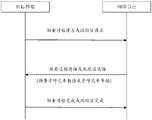
- Fig. 2 is a schematic diagram of communication interaction between a target terminal and a network node provided by an embodiment of the present application. As shown in Figure 2, the target terminal negotiates through non-access stratum (NAS) signaling in the attach process or tracking area (TAU) to determine the paging probability value or paging probability level.
- NAS non-access stratum
- TAU tracking area
- Fig. 3 is another schematic diagram of communication interaction between a target terminal and a network node provided by an embodiment of the present application. As shown in Figure 3, the target terminal negotiates with the network node through NAS signaling in the attach process or tracking area to determine its own service cycle and mobility status indication.
- the core network carries at least one service type among service period, mobility status indicator, paging probability value, and paging probability level during the process of delivering the paging message to the base station, and sends the service type of the target terminal to Base station.
- Fig. 4 is a schematic diagram of communication interaction between a base station and a network node according to an embodiment of the present application. As shown in Fig. 4, the network node will carry at least one service type among service period, mobility status indicator, paging probability value, and paging probability level during the process of sending the paging message to the base station.
- the service group category to which they belong is determined according to the service grouping rule, and then the target terminals belonging to the same service group are randomly grouped according to ID.
- the base station configures the WUS starting position information and/or WUS duration configuration information of each service type based on the service group; then configures one or more groups based on the target terminal ID under one or more service types WUS starting position information and WUS duration configuration information;
- the target terminal can obtain the starting location information of the first-level WUS according to its own service type; then accurately obtain the second-level WUS location information and/or the configuration information of the WUS duration according to the grouping method based on the target terminal ID.
- the target terminals on the same paging occasion are first randomly grouped based on the target terminal ID; then the target terminals in each group are divided into corresponding groups according to the service grouping method.
- the base station configuration is based on the WUS starting position information and/or WUS duration configuration information of each group grouped by the target terminal ID, and each service type corresponds to one or more service group-based WUS starting position information and/or Or configuration information of WUS duration;
- the target terminal obtains the first layer grouping according to the grouping method based on the target terminal ID, and then the WUS location information and/or WUS duration configuration information related to it can be determined according to the service type and corresponding configuration information.
- the interval GAP type of WUS includes a discontinuous reception interval DRX_GAP and an enhanced discontinuous reception interval eDRX_GAP, the interval GAP is the time domain interval between the base station sending a wake-up signal and sending a paging message;
- the WUS groups are sorted in the order of the WUS group of DRX_GAP and the WUS group of eDRX_GAP; or, the WUS group is sorted in the order of the WUS group of eDRX_GAP and the WUS group of DRX_GAP.
- the transmission of each WUS sequence is before the paging occasion, specifically the time domain interval before the paging occasion is defined by GAP (DRX_GAP, short-eDRX_GAP, long-eDRX_GAP), and the target terminal Through its own GAP value, you can know the starting position to start detecting WUS.
- GAP GAP
- eDRX_Gap and DRX_Gap are the same, follow the DRX WUS group number, and then eDRX WUS Group number; or, first number the WUS group of eDRX, and then number the WUS group of DRX.
- Fig. 5 is a flowchart of another method for waking up a terminal according to an embodiment of the present application. As shown in FIG. 5, the method provided in this embodiment includes the following steps.
- S210 Receive a wake-up signal sent by the base station.
- S220 Determine the corresponding WUS sequence set according to the preset service group.
- the WUS sequence set includes: one or more WUS group sequences, sub-public group sequences and public group sequences.
- the target terminal determines at least one of its corresponding WUS group sequence, sub-public group sequence, and public group sequence according to the signaling information configured by the base station.
- Each service group can correspond to one or more WUS group sequences, one sub-public group sequence and one public group sequence.
- S230 Perform wake-up signal detection based on the WUS sequence set.
- the target terminal determines the wake-up signal to which it belongs based on the WUS group sequence, the sub-public group sequence, and the public group sequence. If the sequence index of the wake-up signal sent by the base station is consistent with the WUS group sequence, sub-public group sequence, and public group sequence to which the target terminal belongs, the target terminal can be awakened according to the wake-up signal.
- S220 includes:
- S2201 Configure signaling information according to a preset service group.
- the signaling information includes at least one of the following: WUS group number, WUS group starting sequence index, WUS group resources, sub-public group sequence enabled, sub-public group sequence index, public group sequence index, whether public group sequence Enable;
- the number of WUS groups is the total number of WUS groups corresponding to the business group; the starting sequence index of the WUS group is the starting sequence index of the WUS group corresponding to the business group; the resource of the WUS group is the time-frequency domain resource where the business group corresponds to WUS; the sub-public group sequence Whether to enable or not indicates whether the service group sequence includes the sub-public group sequence; the sub-public group sequence index is the sequence corresponding to at least two WUS groups of the same service group; the public group sequence index is the service group corresponding to the time-frequency domain resource corresponding to all WUS The sequence corresponding to the group; whether the public group sequence is enabled indicates whether the service group sequence includes the public group sequence.
- S2202 Determine the corresponding WUS sequence set according to the signaling information.
- the signaling information includes WUS group starting sequence index, sub-public group sequence index, and public group sequence index. It can be understood that the target terminal can determine the corresponding WUS group sequence, sub-public group sequence, and public group sequence according to the WUS group starting sequence index, sub-public group sequence index, and public group sequence index.
- the WUS sequence corresponding to the service group is determined according to the service type index and the WUS group index corresponding to the target terminal.
- the gap type of WUS includes DRX_GAP and eDRX_GAP;
- the WUS groups are sorted in the order of the WUS group of DRX_GAP and the WUS group of eDRX_GAP; or, the WUS group is sorted in the order of the WUS group of eDRX_GAP and the WUS group of DRX_GAP.
- Fig. 6 is a structural block diagram of an apparatus for waking up a terminal according to an embodiment of the present application.
- the device for waking up a terminal provided in this embodiment includes a first determining module 310, a second determining module 320, and a first sending module 330;
- the first determining module 310 is configured to determine the service group of the target terminal according to the service type of the target terminal; the second determining module 320 is configured to determine the sequence index corresponding to the target terminal at least according to the service group; the first sending module 330 is configured to The wake-up signal WUS corresponding to the sequence index is sent to the target terminal.
- the device for waking up the terminal provided in this embodiment is configured to implement the method for waking up the terminal in the embodiment shown in FIG. 1.
- the implementation principle and technical effect of the device for waking up the terminal provided in this embodiment are similar, and will not be repeated here.
- the first determining module is configured to group the target terminals according to their business cycles.
- the first determining module includes:
- the determining unit is configured to determine the corresponding mobility state indication according to the attribute information of the target terminal, and the mobility state indication includes a stationary state and a moving state;
- the grouping unit is set to group the target terminal according to the mobility status indication.
- the first determining module is configured to group the target terminals according to the paging probability value or the paging probability level, and the paging probability level is determined according to the paging probability value of the target terminal and the preset paging probability threshold. , Or directly negotiated between the target terminal and the network side.
- the first determining module is configured to classify the target terminal into a PUR UE and a non-PUR UE according to whether the idle state terminal is pre-configured with the PUR attribute of the uplink resource.
- the device for waking up the terminal further includes:
- the configuration module is set to configure signaling information for the service group, and the service group is determined according to at least one of the following service types: service cycle, mobility status indication, paging probability value, paging probability level and PUR attribute;
- the second sending module is configured to send signaling information to the target terminal.
- the configuration module is set to include one or more service types for each service group, and each service group corresponds to a set of signaling information.
- the signaling information includes at least one of the following: WUS group number, WUS group starting sequence index, WUS group resource, whether the sub-public group sequence is enabled, sub-public group sequence index, public group sequence index, Whether the public group sequence is enabled;
- the number of WUS groups is the total number of WUS groups corresponding to the business group; the starting sequence index of the WUS group is the starting sequence index of the WUS group corresponding to the business group; the resource of the WUS group is the time-frequency domain resource where the business group corresponds to WUS; the sub-public group sequence Whether to enable or not indicates whether the service group sequence includes the sub-public group sequence; the sub-public group sequence index is the sequence corresponding to at least two WUS groups of the same service group; the public group sequence index is the service group corresponding to the time-frequency domain resource corresponding to all WUS The sequence corresponding to the group; whether the public group sequence is enabled indicates whether the service group sequence includes the public group sequence.
- the WUS sequence corresponding to the service group is determined according to the service type index and the WUS group index corresponding to the target terminal.
- one service group corresponds to one sub-public group sequence, and multiple service groups correspond to the same public group sequence.
- the gap GAP types of WUS include discontinuous reception DRX_GAP and enhanced discontinuous reception eDRX_GAP.
- GAP is the time domain interval between the base station sending a wake-up signal and sending a paging message; in the case where eDRX_Gap and DRX_GAP are the same.
- sort the WUS groups in the order of the WUS group of DRX_GAP and the WUS group of eDRX_GAP sort the WUS groups in the order of the WUS group of eDRX_GAP and the WUS group of DRX_GAP.
- multiple WUS groups within the same service type adopt the code division multiplexing CDM mode; multiple WUS groups of different service types adopt at least one of the following: CDM mode, time division multiplexing TDM mode, and frequency division multiplexing Use FDM.
- Fig. 7 is a structural block diagram of another device for waking up a terminal according to an embodiment of the present application.
- the device for waking up a terminal provided in this embodiment includes a receiving module 410, at least one processor 420, and a detecting module 430;
- the receiving module 410 is configured to receive the wake-up signal sent by the base station
- At least one processor 420 is configured to determine a corresponding WUS sequence set according to a preset service group, and the WUS sequence set includes: one or more WUS group sequences, sub-public group sequences and public group sequences;
- the detection module 430 is configured to perform wake-up signal detection based on the WUS sequence set.
- the device for waking up the terminal provided in this embodiment is configured to implement the method for waking up the terminal in the embodiment shown in FIG. 5.
- the implementation principle and technical effect of the device for waking up the terminal provided in this embodiment are similar, and will not be repeated here.
- At least one processor is configured to: configure signaling information according to a preset service group; and determine a corresponding WUS sequence set according to the signaling information.
- the signaling information includes at least one of the following: WUS group number, WUS group starting sequence index, WUS group resource, whether the sub-public group sequence is enabled, sub-public group sequence index, public group sequence index, Whether the public group sequence is enabled;
- the number of WUS groups is the total number of WUS groups corresponding to the business group; the starting sequence index of the WUS group is the starting sequence index of the WUS group corresponding to the business group; the resource of the WUS group is the time-frequency domain resource where the business group corresponds to WUS; the sub-public group sequence Whether to enable or not indicates whether the service group sequence includes the sub-public group sequence; the sub-public group sequence index is the sequence corresponding to at least two WUS groups of the same service group; the public group sequence index is the service group corresponding to the time-frequency domain resource corresponding to all WUS The sequence corresponding to the group; whether the public group sequence is enabled indicates whether the service group sequence includes the public group sequence.
- the WUS sequence corresponding to the service group is determined according to the service type index and the WUS group index corresponding to the target terminal.
- the gap type of WUS includes DRX_GAP and eDRX_GAP;
- the WUS groups are sorted in the order of the WUS group of DRX_GAP and the WUS group of eDRX_GAP; or, the WUS group is sorted in the order of the WUS group of eDRX_GAP and the WUS group of DRX_GAP.
- FIG. 8 is a schematic structural diagram of a device provided by an embodiment of the present application.
- the device provided by the present application includes a processor 510 and a memory 520.
- the number of processors 510 in the device may be one or more, and one processor 510 is taken as an example in FIG. 8.
- the number of memories 520 in the device may be one or more, and one memory 520 is taken as an example in FIG. 8.
- the processor 510 and the memory 520 of the device may be connected through a bus or in other ways. In FIG. 8, the connection through a bus is taken as an example.
- the device is a base station.
- the memory 520 can be configured to store software programs, computer-executable programs, and modules, such as the program instructions/modules corresponding to the device described in any embodiment of the present application (for example, the The first determining module, the second determining module, and the first sending module).
- the memory 520 may include a program storage area and a data storage area.
- the program storage area may store an operating system and an application program required for at least one function; the data storage area may store data created according to the use of the device, and the like.
- the memory 520 may include a high-speed random access memory, and may also include a non-volatile memory, such as at least one magnetic disk storage device, a flash memory device, or other non-volatile solid-state storage devices.
- the memory 520 may further include a memory remotely provided with respect to the processor 510, and these remote memories may be connected to the device through a network. Examples of the aforementioned networks include, but are not limited to, the Internet, corporate intranets, local area networks, mobile communication networks, and combinations thereof.
- the device provided above can be configured to execute the method for waking up a terminal applied to a base station provided by any of the above embodiments, and has corresponding functions and effects.
- the program stored in the corresponding memory 520 may be a program instruction/module corresponding to the method for waking up the terminal provided in the embodiment of the present application, and the processor 510 runs the software stored in the memory 520 Programs, instructions, and modules to execute one or more functional applications and data processing of the computer equipment, that is, to implement the method of waking up the terminal applied to the target terminal in the foregoing method embodiment. It is understandable that when the above-mentioned device is a target terminal, the method for waking up the terminal provided in any embodiment of the present application applied to the target terminal can be executed, and has corresponding functions and effects.
- the embodiment of the present application also provides a storage medium containing computer-executable instructions.
- the computer-executable instructions are used to execute a method for waking up a terminal when executed by a computer processor.
- the method is applied to the base station side, and the method includes:
- the service type of the target terminal determines the service group in which the target terminal is located; at least the sequence index corresponding to the target terminal is determined according to the service group; the wake-up signal WUS corresponding to the sequence index is sent to the target terminal.
- the embodiment of the present application also provides a storage medium containing computer-executable instructions.
- the computer-executable instructions are used to execute a method for waking up a terminal when executed by a computer processor.
- the method is applied to the target terminal side, and the method includes: Receive the wake-up signal sent by the base station; determine the corresponding WUS sequence set according to the preset service group.
- the WUS sequence set includes: one or more WUS group sequences, sub-public group sequences and public group sequences; wake-up signals based on the WUS sequence set Detection.
- user equipment encompasses any suitable type of wireless user equipment, such as a mobile phone, a portable data processing device, a portable web browser, or a vehicle-mounted mobile station.
- the various embodiments of the present application can be implemented in hardware or dedicated circuits, software, logic or any combination thereof.
- some aspects may be implemented in hardware, while other aspects may be implemented in firmware or software that may be executed by a controller, microprocessor or other computing device, although the application is not limited thereto.
- the embodiments of the present application may be implemented by executing computer program instructions by a data processor of a mobile device, for example, in a processor entity, or by hardware, or by a combination of software and hardware.
- Computer program instructions can be assembly instructions, instruction set architecture (Instruction Set Architecture, ISA) instructions, machine instructions, machine-related instructions, microcode, firmware instructions, state setting data, or written in any combination of one or more programming languages Source code or object code.
- the block diagram of any logical flow in the drawings of the present application may represent program steps, or may represent interconnected logic circuits, modules, and functions, or may represent a combination of program steps and logic circuits, modules, and functions.
- the computer program can be stored on the memory.
- the memory can be of any type suitable for the local technical environment and can be implemented by any suitable data storage technology, such as but not limited to read-only memory (Read-Only Memory, ROM), random access memory (Random Access Memory, RAM), optical Memory devices and systems (Digital Video Disc (DVD) or Compact Disk (CD)), etc.
- Computer-readable media may include non-transitory storage media.
- the data processor can be any type suitable for the local technical environment, such as but not limited to general-purpose computers, special-purpose computers, microprocessors, digital signal processors (Digital Signal Processing, DSP), application specific integrated circuits (ASICs) ), programmable logic devices (Field-Programmable Gate Array, FGPA), and processors based on multi-core processor architecture.
- DSP Digital Signal Processing
- ASICs application specific integrated circuits
- FGPA programmable logic devices
Landscapes
- Engineering & Computer Science (AREA)
- Computer Networks & Wireless Communication (AREA)
- Signal Processing (AREA)
- Mobile Radio Communication Systems (AREA)
- Traffic Control Systems (AREA)
Abstract
Description


| 业务类型索引 | 业务组 |
| Traffic_index0 | 分配PUR资源UE |
| Traffic_index1 | 未分配PUR资源UE |


Claims (20)
- 一种唤醒终端的方法,包括:根据目标终端的业务类型确定所述目标终端所在的业务组;根据所述业务组确定所述目标终端对应的序列索引;将所述序列索引对应的唤醒信号WUS发送给所述目标终端。
- 根据权利要求1所述的方法,其中,所述根据目标终端的业务类型确定所述目标终端所在的业务组,包括:根据所述目标终端的业务周期对所述目标终端进行分组。
- 根据权利要求1所述的方法,其中,所述根据目标终端的业务类型确定所述目标终端所在的业务组,包括:根据所述目标终端的属性信息确定所述目标终端对应的移动性状态指示,其中,所述移动性状态指示包括静止状态和移动状态;根据所述移动性状态指示对所述目标终端进行分组。
- 根据权利要求1所述的方法,其中,所述根据目标终端的业务类型确定所述目标终端所在的业务组,包括:根据寻呼几率数值或寻呼几率等级对所述目标终端进行分组,其中,所述寻呼几率等级根据所述目标终端的寻呼几率数值和预设寻呼几率阈值确定,或者,直接由所述目标终端和网络侧协商确定。
- 根据权利要求1所述的方法,其中,所述根据目标终端的业务类型确定所述目标终端所在的业务组,包括:根据空闲态终端是否预先配置上行资源PUR属性将所述目标终端分为PUR用户设备和非PUR用户设备。
- 根据权利要求1-5任一项所述的方法,还包括:对所述业务组配置信令信息,所述业务组根据下述业务类型至少之一确定:业务周期、移动性状态指示、寻呼几率数值、寻呼几率等级、PUR属性;将所述信令信息发送至所述目标终端。
- 根据权利要求6所述的方法,其中,所述对所述业务组配置信令信息,包括:每个业务组包含一个或多个业务类型,每个业务组对应一组信令信息。
- 根据权利要求6所述的方法,其中,所述信令信息包括下述至少一项:WUS组数、WUS组起始序列索引、WUS组资源、子公共组序列是否使能、子 公共组序列索引、公共组序列索引、公共组序列是否使能;所述WUS组数为所述业务组对应的WUS组的总数量;所述WUS组起始序列索引为所述业务组对应的WUS组起始序列索引;所述WUS组资源为所述业务组对应的WUS所在的时频域资源;所述子公共组序列是否使能表示业务组序列是否包含子公共组序列;所述子公共组序列索引为同一个业务组的至少两个WUS组所对应的序列;所述公共组序列索引为所述业务组对应的时频域资源对应的所有WUS组都对应的序列;所述公共组序列是否使能表示业务组序列是否包含公共组序列。
- 根据权利要求6所述的方法,其中,在多个业务组的WUS组在同一个时频域资源上复用的情况下,所述业务组对应的WUS序列根据业务类型索引和所述目标终端对应的WUS组索引确定。
- 根据权利要求6所述的方法,其中,在多个业务组复用在同一个时频域资源的情况下,一个业务组对应一个子公共组序列,多个业务组对应同一个公共组序列。
- 根据权利要求6所述的方法,其中,所述WUS的间隔GAP类型包括非连续接收间隔DRX_GAP和增强型非连续接收间隔eDRX_GAP,所述GAP为基站发送唤醒信号和发送寻呼消息之间的时域间隔;在所述eDRX_GAP和所述DRX_GAP相同的情况下,依次按照所述DRX_GAP的WUS组和所述eDRX_GAP的WUS组的顺序对WUS组进行排序;或者,依次按照所述eDRX_GAP的WUS组和所述DRX_GAP的WUS组的顺序对WUS组进行排序。
- 根据权利要求6所述的方法,其中,同一业务类型内的多个WUS组采用码分复用CDM方式;不同业务类型的多个WUS组采用下述至少一项:CDM方式、时分复用TDM方式、频分复用FDM方式。
- 一种唤醒终端的方法,包括:接收基站发送的唤醒信号WUS;根据预先设定的业务组确定对应的WUS序列集合,所述WUS序列集合包括:一个或多个WUS组序列,子公共组序列和公共组序列;基于所述WUS序列集合进行所述WUS检测。
- 根据权利要求13所述的方法,其中,所述根据预先设定的业务组确定对应的WUS序列集合,包括:根据预先设定的业务组配置信令信息;根据所述信令信息确定对应的WUS序列集合。
- 根据权利要求14所述的方法,其中,所述信令信息包括下述至少一项:WUS组数、WUS组起始序列索引、WUS组资源、子公共组序列是否使能、子公共组序列索引、公共组序列索引、公共组序列是否使能;所述WUS组数为所述业务组对应的WUS组的总数量;所述WUS组起始序列索引为所述业务组对应的WUS组起始序列索引;所述WUS组资源为所述业务组对应的WUS所在的时频域资源;所述子公共组序列是否使能表示业务组序列是否包含子公共组序列;所述子公共组序列索引为同一个业务组的至少两个WUS组所对应的序列;所述公共组序列索引为所述业务组对应的时频域资源对应的所有WUS组都对应的序列;所述公共组序列是否使能表示业务组序列是否包含公共组序列。
- 根据权利要求14所述的方法,其中,在多个业务组的WUS组在同一个时频域资源上复用的情况下,所述业务组对应的WUS序列根据所述业务类型索引和所述目标终端对应的WUS组索引确定。
- 根据权利要求14所述的方法,其中,所述WUS的间隔GAP类型包括非连续接收间隔DRX_GAP和增强型非连续接收间隔eDRX_GAP;在所述eDRX_GAP和所述DRX_GAP相同的情况下,依次按照所述DRX_GAP的WUS组和所述eDRX_GAP的WUS组的顺序对WUS组进行排序;或者,依次按照所述eDRX_GAP的WUS组和所述DRX_GAP的WUS组的顺序对WUS组进行排序。
- 一种唤醒终端的装置,包括:第一确定模块,设置为根据目标终端的业务类型确定所述目标终端所在的业务组;第二确定模块,设置为根据所述业务组确定所述目标终端对应的序列索引;第一发送模块,设置为将所述序列索引对应的唤醒信号WUS发送至所述目标终端。
- 一种唤醒终端的装置,包括:接收模块,设置为接收基站发送的唤醒信号WUS;至少一个处理器,被配置为根据预先设定的业务组确定对应的WUS序列集合,所述WUS序列集合包括:一个或多个WUS组序列,子公共组序列和公共组序列;检测模块,设置为基于所述WUS序列集合进行所述WUS检测。
- 一种存储介质,所述存储介质存储有计算机程序,所述计算机程序被处理器执行时实现权利要求1-17任一项所述的唤醒终端的方法。
Priority Applications (6)
| Application Number | Priority Date | Filing Date | Title |
|---|---|---|---|
| KR1020217035226A KR20210138773A (ko) | 2019-03-29 | 2020-02-27 | 단말기 웨이킹 방법, 디바이스 및 저장 매체 |
| BR112021019424A BR112021019424A2 (pt) | 2019-03-29 | 2020-02-27 | Método, dispositivo de ativar terminal, e meio de armazenamento |
| CA3131866A CA3131866C (en) | 2019-03-29 | 2020-02-27 | Terminal waking method, device and storage medium |
| EP20785368.0A EP3952479B1 (en) | 2019-03-29 | 2020-02-27 | Terminal waking method, device and storage medium |
| US17/487,766 US12185247B2 (en) | 2019-03-29 | 2021-09-28 | Terminal waking method, device and storage medium |
| US18/946,668 US20250081104A1 (en) | 2019-03-29 | 2024-11-13 | Terminal Waking Method, Device and Storage Medium |
Applications Claiming Priority (2)
| Application Number | Priority Date | Filing Date | Title |
|---|---|---|---|
| CN201910256225.6 | 2019-03-29 | ||
| CN201910256225.6A CN110536384A (zh) | 2019-03-29 | 2019-03-29 | 唤醒终端的方法、装置和存储介质 |
Related Child Applications (1)
| Application Number | Title | Priority Date | Filing Date |
|---|---|---|---|
| US17/487,766 Continuation US12185247B2 (en) | 2019-03-29 | 2021-09-28 | Terminal waking method, device and storage medium |
Publications (1)
| Publication Number | Publication Date |
|---|---|
| WO2020199806A1 true WO2020199806A1 (zh) | 2020-10-08 |
Family
ID=68659236
Family Applications (1)
| Application Number | Title | Priority Date | Filing Date |
|---|---|---|---|
| PCT/CN2020/077002 Ceased WO2020199806A1 (zh) | 2019-03-29 | 2020-02-27 | 唤醒终端的方法、装置和存储介质 |
Country Status (6)
| Country | Link |
|---|---|
| US (2) | US12185247B2 (zh) |
| EP (1) | EP3952479B1 (zh) |
| KR (1) | KR20210138773A (zh) |
| CN (3) | CN121888340A (zh) |
| BR (1) | BR112021019424A2 (zh) |
| WO (1) | WO2020199806A1 (zh) |
Cited By (2)
| Publication number | Priority date | Publication date | Assignee | Title |
|---|---|---|---|---|
| US20210337476A1 (en) * | 2019-01-10 | 2021-10-28 | Huawei Technologies Co., Ltd. | Wake Up Signal Sending Method And Device |
| US12185247B2 (en) | 2019-03-29 | 2024-12-31 | Zte Corporation | Terminal waking method, device and storage medium |
Families Citing this family (10)
| Publication number | Priority date | Publication date | Assignee | Title |
|---|---|---|---|---|
| CN110536386B (zh) * | 2019-08-09 | 2023-04-25 | 中兴通讯股份有限公司 | 唤醒信号的传输方法、装置和存储介质 |
| CN113038634B (zh) * | 2019-12-24 | 2023-02-21 | 维沃移动通信有限公司 | 唤醒信号配置方法、唤醒信号处理方法及相关设备 |
| CN111345075B (zh) * | 2020-02-13 | 2023-08-29 | 北京小米移动软件有限公司 | 省电方法、装置、设备及可读存储介质 |
| US11576126B2 (en) * | 2020-03-24 | 2023-02-07 | Qualcomm Incorporated | Wakeup signaling identification |
| CN112075104B (zh) * | 2020-07-16 | 2023-12-08 | 北京小米移动软件有限公司 | 一种省电方法、省电信号配置装置及存储介质 |
| CN116390252B (zh) * | 2020-09-22 | 2024-12-13 | Oppo广东移动通信有限公司 | 资源确定方法、终端设备和网络设备 |
| CN114557068B (zh) * | 2020-09-24 | 2023-11-07 | 北京小米移动软件有限公司 | 寻呼处理方法、装置、通信设备及存储介质 |
| CN114385256B (zh) * | 2020-10-22 | 2024-06-11 | 华为云计算技术有限公司 | 系统参数的配置方法和配置装置 |
| CN116671197B (zh) * | 2020-12-29 | 2026-01-09 | 华为技术有限公司 | 一种信息接收方法,信息发送方法,以及通信装置 |
| CN116669152A (zh) * | 2022-02-21 | 2023-08-29 | 北京三星通信技术研究有限公司 | 低功率唤醒信号及使用其的方法和装置 |
Citations (4)
| Publication number | Priority date | Publication date | Assignee | Title |
|---|---|---|---|---|
| CN101841911A (zh) * | 2010-05-18 | 2010-09-22 | 华为技术有限公司 | 寻呼终端的方法及装置 |
| CN109327888A (zh) * | 2017-07-31 | 2019-02-12 | 维沃移动通信有限公司 | 一种终端状态的指示、确定方法、基站及终端 |
| CN109429315A (zh) * | 2017-08-28 | 2019-03-05 | 上海朗帛通信技术有限公司 | 一种被用于节省功率的用户、基站中的方法和装置 |
| CN110536384A (zh) * | 2019-03-29 | 2019-12-03 | 中兴通讯股份有限公司 | 唤醒终端的方法、装置和存储介质 |
Family Cites Families (16)
| Publication number | Priority date | Publication date | Assignee | Title |
|---|---|---|---|---|
| KR101169283B1 (ko) | 2008-06-03 | 2012-08-02 | 엘지전자 주식회사 | 광대역 무선 접속 시스템에서 페이징 정보 송수신 방법 |
| CN104581894A (zh) * | 2013-10-11 | 2015-04-29 | 中兴通讯股份有限公司 | 无线电唤醒方法和无线电唤醒电路 |
| US11284372B2 (en) * | 2017-03-24 | 2022-03-22 | Apple Inc. | Wake up signal for machine type communication and narrowband-internet-of-things devices |
| CN108738110B (zh) * | 2017-04-19 | 2022-08-09 | 珠海市魅族科技有限公司 | 无线局域网的通信方法、通信装置和通信设备 |
| JP7150747B2 (ja) * | 2017-05-04 | 2022-10-11 | アイピーエルエー ホールディングス インコーポレイテッド | ウェイクアップ信号動作 |
| WO2018202693A1 (en) * | 2017-05-05 | 2018-11-08 | Sony Corporation | Terminal device, infrastructure equipment, wireless telecommunications system and methods |
| WO2018216871A1 (en) * | 2017-05-24 | 2018-11-29 | Lg Electronics Inc. | Method and apparatus for transmitting and receiving a wake-up signal in a wireless communication system |
| CN115460678B (zh) * | 2017-08-11 | 2024-02-27 | 苹果公司 | 无线电信网络中的唤醒信令 |
| EP3666003A1 (en) * | 2017-09-28 | 2020-06-17 | Sony Corporation | Paging method and apparatus for wireless communication system |
| EP3753305A1 (en) * | 2018-02-16 | 2020-12-23 | Telefonaktiebolaget Lm Ericsson (Publ) | Wireless device grouping indication using wakeup signal |
| US12058617B2 (en) * | 2018-05-11 | 2024-08-06 | Qualcomm Incorporated | Methods and apparatus for a group wake up signal |
| WO2020032726A1 (ko) * | 2018-08-09 | 2020-02-13 | 엘지전자 주식회사 | 무선 통신 시스템에서 통신 장치가 wus 신호를 감지 또는 송신하는 방법 및 장치 |
| CN112514464B (zh) * | 2018-08-10 | 2025-02-18 | 苹果公司 | 用于增强型机器类型通信(eMTC)和窄带物联网(NB-IOT)的唤醒信号子分组 |
| EP3857988A1 (en) * | 2018-09-27 | 2021-08-04 | Telefonaktiebolaget Lm Ericsson (Publ) | Flexible user equipment grouping for wake-up signals |
| US12058618B2 (en) * | 2018-11-12 | 2024-08-06 | Lenovo (Beijing) Limited | Method and apparatus for wake-up signals |
| MX2021011466A (es) * | 2019-03-28 | 2021-10-13 | Ntt Docomo Inc | Aparato de estacion de base y equipo de usuario. |
-
2019
- 2019-03-29 CN CN202610067948.1A patent/CN121888340A/zh active Pending
- 2019-03-29 CN CN202210846806.7A patent/CN115278837A/zh active Pending
- 2019-03-29 CN CN201910256225.6A patent/CN110536384A/zh active Pending
-
2020
- 2020-02-27 WO PCT/CN2020/077002 patent/WO2020199806A1/zh not_active Ceased
- 2020-02-27 EP EP20785368.0A patent/EP3952479B1/en active Active
- 2020-02-27 BR BR112021019424A patent/BR112021019424A2/pt unknown
- 2020-02-27 KR KR1020217035226A patent/KR20210138773A/ko active Pending
-
2021
- 2021-09-28 US US17/487,766 patent/US12185247B2/en active Active
-
2024
- 2024-11-13 US US18/946,668 patent/US20250081104A1/en active Pending
Patent Citations (4)
| Publication number | Priority date | Publication date | Assignee | Title |
|---|---|---|---|---|
| CN101841911A (zh) * | 2010-05-18 | 2010-09-22 | 华为技术有限公司 | 寻呼终端的方法及装置 |
| CN109327888A (zh) * | 2017-07-31 | 2019-02-12 | 维沃移动通信有限公司 | 一种终端状态的指示、确定方法、基站及终端 |
| CN109429315A (zh) * | 2017-08-28 | 2019-03-05 | 上海朗帛通信技术有限公司 | 一种被用于节省功率的用户、基站中的方法和装置 |
| CN110536384A (zh) * | 2019-03-29 | 2019-12-03 | 中兴通讯股份有限公司 | 唤醒终端的方法、装置和存储介质 |
Non-Patent Citations (3)
| Title |
|---|
| NOKIA ET AL.: "Analysis of Group WUS Options", 3GPP TSG-RAN WG2 MEETING #104 R2-1817048, 1 November 2018 (2018-11-01), XP051480973 * |
| NOKIA ET AL.: "UE-Group Wake-Up Signal for NB-IoT", 3GPP TSG RAN WG1 MEETING #95 R1-1812928, 2 November 2018 (2018-11-02), XP051479177 * |
| See also references of EP3952479A4 |
Cited By (3)
| Publication number | Priority date | Publication date | Assignee | Title |
|---|---|---|---|---|
| US20210337476A1 (en) * | 2019-01-10 | 2021-10-28 | Huawei Technologies Co., Ltd. | Wake Up Signal Sending Method And Device |
| US12108335B2 (en) * | 2019-01-10 | 2024-10-01 | Huawei Technologies Co., Ltd. | Wake up signal sending method and device |
| US12185247B2 (en) | 2019-03-29 | 2024-12-31 | Zte Corporation | Terminal waking method, device and storage medium |
Also Published As
| Publication number | Publication date |
|---|---|
| EP3952479A4 (en) | 2022-12-21 |
| CA3131866A1 (en) | 2020-10-08 |
| EP3952479A1 (en) | 2022-02-09 |
| US20220078712A1 (en) | 2022-03-10 |
| US20250081104A1 (en) | 2025-03-06 |
| CN121888340A (zh) | 2026-04-17 |
| US12185247B2 (en) | 2024-12-31 |
| CN115278837A (zh) | 2022-11-01 |
| EP3952479B1 (en) | 2025-12-24 |
| KR20210138773A (ko) | 2021-11-19 |
| CN110536384A (zh) | 2019-12-03 |
| BR112021019424A2 (pt) | 2021-11-30 |
Similar Documents
| Publication | Publication Date | Title |
|---|---|---|
| WO2020199806A1 (zh) | 唤醒终端的方法、装置和存储介质 | |
| US20250056408A1 (en) | Transmitting Wake-Up Signals for Paging Operations | |
| CN109600832B (zh) | 寻呼消息的传输方法及装置 | |
| TW202010336A (zh) | 一種信號發送、接收方法、網路設備及終端 | |
| US12574846B2 (en) | Wake-up signal reception for paging operations | |
| CN107040899A (zh) | 系统信息更新方法及装置 | |
| US20220303941A1 (en) | Determining a Location of a Wake-up Signal for Paging Reception | |
| WO2022151501A1 (zh) | 一种通信方法及装置 | |
| WO2025156967A1 (zh) | 通信方法及相关设备 | |
| WO2025156969A1 (zh) | 通信方法及相关设备 | |
| WO2021082892A1 (zh) | 寻呼检测及指示方法、设备、介质 | |
| WO2019210859A1 (zh) | 一种唤醒控制方法及装置、计算机可读存储介质 | |
| KR20230121135A (ko) | 정보 수신 방법, 정보 전송 방법 및 통신 장치 | |
| CN103875293A (zh) | 用于对等网络中的自适应寻呼的方法和装置 | |
| WO2022007632A1 (zh) | 一种通信方法和通信装置 | |
| WO2021143588A1 (zh) | 寻呼方法及设备 | |
| CN116420364A (zh) | 寻呼监听方法、装置、设备及存储介质 | |
| CN115707102B (zh) | 一种寻呼提前指示的传输方法、装置及设备 | |
| WO2024045691A1 (zh) | 通信方法、设备和存储介质 | |
| CN114374937A (zh) | 业务变更通知方法、终端及网络侧设备 | |
| CN115696573A (zh) | 信号或信道的检测方法、装置、终端及存储介质 | |
| CN107113822A (zh) | 一种信息指示的方法、ue及基站 | |
| US20250261279A1 (en) | Communication method and apparatus | |
| WO2016154934A1 (zh) | D2d系统中设备之间的发现方法、装置及系统 |
Legal Events
| Date | Code | Title | Description |
|---|---|---|---|
| 121 | Ep: the epo has been informed by wipo that ep was designated in this application |
Ref document number: 20785368 Country of ref document: EP Kind code of ref document: A1 |
|
| ENP | Entry into the national phase |
Ref document number: 3131866 Country of ref document: CA |
|
| NENP | Non-entry into the national phase |
Ref country code: DE |
|
| REG | Reference to national code |
Ref country code: BR Ref legal event code: B01A Ref document number: 112021019424 Country of ref document: BR |
|
| ENP | Entry into the national phase |
Ref document number: 20217035226 Country of ref document: KR Kind code of ref document: A |
|
| ENP | Entry into the national phase |
Ref document number: 2020785368 Country of ref document: EP Effective date: 20211029 |
|
| ENP | Entry into the national phase |
Ref document number: 112021019424 Country of ref document: BR Kind code of ref document: A2 Effective date: 20210928 |
|
| WWG | Wipo information: grant in national office |
Ref document number: 2020785368 Country of ref document: EP |