WO2020202731A1 - Système de traitement d'informations et procédé de traitement d'informations - Google Patents
Système de traitement d'informations et procédé de traitement d'informations Download PDFInfo
- Publication number
- WO2020202731A1 WO2020202731A1 PCT/JP2020/002472 JP2020002472W WO2020202731A1 WO 2020202731 A1 WO2020202731 A1 WO 2020202731A1 JP 2020002472 W JP2020002472 W JP 2020002472W WO 2020202731 A1 WO2020202731 A1 WO 2020202731A1
- Authority
- WO
- WIPO (PCT)
- Prior art keywords
- information
- information processing
- learning
- user
- algorithm
- Prior art date
- Legal status (The legal status is an assumption and is not a legal conclusion. Google has not performed a legal analysis and makes no representation as to the accuracy of the status listed.)
- Ceased
Links
Images












Classifications
-
- G—PHYSICS
- G06—COMPUTING OR CALCULATING; COUNTING
- G06N—COMPUTING ARRANGEMENTS BASED ON SPECIFIC COMPUTATIONAL MODELS
- G06N5/00—Computing arrangements using knowledge-based models
- G06N5/02—Knowledge representation; Symbolic representation
- G06N5/022—Knowledge engineering; Knowledge acquisition
-
- G—PHYSICS
- G06—COMPUTING OR CALCULATING; COUNTING
- G06N—COMPUTING ARRANGEMENTS BASED ON SPECIFIC COMPUTATIONAL MODELS
- G06N3/00—Computing arrangements based on biological models
- G06N3/02—Neural networks
- G06N3/08—Learning methods
-
- G—PHYSICS
- G06—COMPUTING OR CALCULATING; COUNTING
- G06N—COMPUTING ARRANGEMENTS BASED ON SPECIFIC COMPUTATIONAL MODELS
- G06N20/00—Machine learning
-
- G—PHYSICS
- G06—COMPUTING OR CALCULATING; COUNTING
- G06N—COMPUTING ARRANGEMENTS BASED ON SPECIFIC COMPUTATIONAL MODELS
- G06N3/00—Computing arrangements based on biological models
- G06N3/02—Neural networks
- G06N3/08—Learning methods
- G06N3/082—Learning methods modifying the architecture, e.g. adding, deleting or silencing nodes or connections
-
- G—PHYSICS
- G06—COMPUTING OR CALCULATING; COUNTING
- G06N—COMPUTING ARRANGEMENTS BASED ON SPECIFIC COMPUTATIONAL MODELS
- G06N3/00—Computing arrangements based on biological models
- G06N3/02—Neural networks
- G06N3/08—Learning methods
- G06N3/09—Supervised learning
-
- G—PHYSICS
- G06—COMPUTING OR CALCULATING; COUNTING
- G06N—COMPUTING ARRANGEMENTS BASED ON SPECIFIC COMPUTATIONAL MODELS
- G06N3/00—Computing arrangements based on biological models
- G06N3/02—Neural networks
- G06N3/08—Learning methods
- G06N3/092—Reinforcement learning
-
- G—PHYSICS
- G06—COMPUTING OR CALCULATING; COUNTING
- G06N—COMPUTING ARRANGEMENTS BASED ON SPECIFIC COMPUTATIONAL MODELS
- G06N5/00—Computing arrangements using knowledge-based models
- G06N5/04—Inference or reasoning models
-
- G—PHYSICS
- G10—MUSICAL INSTRUMENTS; ACOUSTICS
- G10L—SPEECH ANALYSIS TECHNIQUES OR SPEECH SYNTHESIS; SPEECH RECOGNITION; SPEECH OR VOICE PROCESSING TECHNIQUES; SPEECH OR AUDIO CODING OR DECODING
- G10L15/00—Speech recognition
- G10L15/06—Creation of reference templates; Training of speech recognition systems, e.g. adaptation to the characteristics of the speaker's voice
- G10L15/063—Training
-
- G—PHYSICS
- G06—COMPUTING OR CALCULATING; COUNTING
- G06N—COMPUTING ARRANGEMENTS BASED ON SPECIFIC COMPUTATIONAL MODELS
- G06N3/00—Computing arrangements based on biological models
- G06N3/02—Neural networks
- G06N3/04—Architecture, e.g. interconnection topology
- G06N3/044—Recurrent networks, e.g. Hopfield networks
-
- G—PHYSICS
- G06—COMPUTING OR CALCULATING; COUNTING
- G06N—COMPUTING ARRANGEMENTS BASED ON SPECIFIC COMPUTATIONAL MODELS
- G06N3/00—Computing arrangements based on biological models
- G06N3/02—Neural networks
- G06N3/04—Architecture, e.g. interconnection topology
- G06N3/0464—Convolutional networks [CNN, ConvNet]
Definitions
- This disclosure relates to an information processing system and an information processing method.
- Patent Document 1 describes a technique in which an AI agent responds to utterance text data from a user by utterance.
- the response by the above AI agent or the like may be output based on an algorithm based on the accumulation of learning data.
- the more the technology related to the algorithm based on the accumulation of such learning data becomes closer to the user the more the user wants to conveniently modify the accumulated learning data.
- the learning data accumulated during that period may include learning data that is not inconvenient for the user. Therefore, if the learning data accumulated during that period is erased, the learning data that is not inconvenient for the user is also erased, and it is considered that the state of the algorithm intended by the user cannot be generated.
- the learning data used for generating the algorithm is modified after the fact to realize the desired state of the algorithm.
- the degree of influence derived from the specific learning data on the accumulated learning data is adjusted with respect to the algorithm that changes based on the accumulation of the learning data, and the new learning data obtained after the adjustment is adjusted. Based on the above, an information processing system for re-learning is provided.
- the processor adjusts and adjusts the degree of influence of the specific training data on the stored training data on the algorithm that changes based on the storage of the training data.
- An information processing method for re-learning is provided based on new learning data obtained later.
- FIG. 1 shows the information processing system and the user terminal which concerns on 1st Embodiment.
- This is an example of a schematic configuration of learning history data stored in the information processing apparatus according to the first embodiment.
- It is a functional block diagram which shows the structure of the information processing apparatus which concerns on 1st Embodiment.
- It is a functional block diagram which shows an example of the structure of the storage part which concerns on 1st Embodiment.
- It is a functional block diagram which shows the structure of the generation part which concerns on 1st Embodiment.
- It is a functional block diagram which shows the structure of the user terminal which concerns on 1st Embodiment.
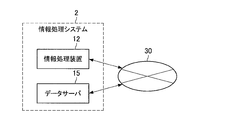
- FIG. 1 It is a figure which shows an example of an information processing system composed of a plurality of devices. It is a functional block diagram which shows the structure of an information processing apparatus. It is a functional block diagram which shows one configuration example of the hardware configuration of the information processing apparatus which constitutes the user terminal or the information processing system which concerns on one Embodiment of this disclosure.
- the information processing system 1 according to the first embodiment will be described with reference to FIG.
- the information processing system 1 according to the first embodiment is composed of an information processing device 10.
- the information processing system 1 and the information processing device 10 are the same.
- the information processing device 10 is connected to the user terminal 20 via the network 30.
- the information processing device 10 has a function of generating output information by using an algorithm generated based on the accumulation of learning data in response to input information from the user. Further, the information processing apparatus 10 is made to relearn the above algorithm as needed.
- the user terminal 20 transmits input information from the user to the information processing device 10 via the network 30, and various outputs (for example, image or audio output) to the user according to the response from the information processing device 10. Has the function of carrying out.
- the user terminal 20 realizes the output by the AI agent.
- the AI agent is a character that serves as a motif of voice or an image output based on an algorithm.
- the character may be a fictitious character or a real character.
- the network 30 may include a public network such as a telephone line network, the Internet, and a satellite communication network, a LAN (Local Area Network), a WAN (Wide Area Network), and the like. Further, the network 30 may include a dedicated line network such as IP-VPN (Internet Protocol-Virtual Private Network).
- a public network such as a telephone line network, the Internet, and a satellite communication network, a LAN (Local Area Network), a WAN (Wide Area Network), and the like.
- the network 30 may include a dedicated line network such as IP-VPN (Internet Protocol-Virtual Private Network).
- IP-VPN Internet Protocol-Virtual Private Network
- the above algorithm is based on the learning data stored in the information processing device 10. That is, the above algorithm is a learning result based on the learning data.
- the information processing device 10 according to the present embodiment stores the learning history of the algorithm.
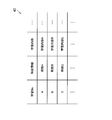
- FIG. 2 is an example of a schematic configuration of the learning history data 40 stored in the information processing apparatus 10 according to the first embodiment.
- the learning history data 40 shown in FIG. 2 is data in which the learning contents of the algorithm are arranged in chronological order.
- the learning contents for three times of learning whose learning numbers are A to C are arranged in chronological order.
- the content of the learning content A is learned at the time A.
- the content of the learning content B is learned at the time B.
- the content of the learning content C is learned at the time C.
- the algorithm is learned based on the learning data corresponding to each learning. In the present embodiment, the algorithm is learned based on the accumulated learning data in this way.
- the learning history data 40 shown in FIG. 2 has a structure in which the learning data and the learning contents are arranged in chronological order, but the structure of the learning history data is not limited to this. Further, although FIG. 2 shows the learning history for three times of learning Nos. A to C, the learning history data may have a learning history for two times or less, and a learning history for four times or more. You may have. In addition, a plurality of learning data may be used or a plurality of learnings may be performed in one learning.
- the learning data is not particularly limited, but may be based on, for example, data accumulated under the environment in which the algorithm is used.
- the algorithm based on the accumulation of learning data can be an algorithm according to the usage environment of the algorithm by the user. Therefore, the information processing system 1 can more appropriately realize the state of the algorithm desired by the user.
- the learning data may include data related to output information from the algorithm based on user input information for the algorithm.
- the algorithm is learned according to the input information from the user on a daily basis and the output information based on the input information.
- the input information and the output information may include information unique to the user. Therefore, the information processing system 1 can more appropriately realize the state of the algorithm desired by the user based on the learning data.
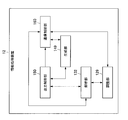
- FIG. 3 is a functional block diagram showing the configuration of the information processing apparatus 10 according to the first embodiment.
- the information processing device 10 adjusts the degree of influence of the accumulated learning data derived from the specific learning data on the algorithm that changes based on the accumulation of the learning data, and re-uses the new learning data obtained after the adjustment. It has a function to make learning.
- the function of the information processing device 10 is realized by the cooperation of the storage unit 110, the processing unit 120, the analysis unit 130, the generation unit 140, the output control unit 150, and the communication control unit 160 included in the information processing device 10. ..
- each functional unit included in the information processing device 10 will be described.
- the storage unit 110 has a function of storing various types of information. Various information stored in the storage unit 110 is referred to by the processing unit 120, the analysis unit 130, the generation unit 140, or the communication control unit 160, if necessary.
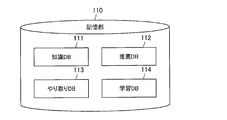
- FIG. 4 is a functional block diagram showing an example of the configuration of the storage unit 110 according to the first embodiment.
- the storage unit 110 has a knowledge DB 111, a recommendation DB 112, an exchange DB 113, and a learning DB 114.
- the knowledge DB 111 various types of information used, for example, for the analysis unit 130 to analyze the input information from the user are recorded.
- the knowledge DB 111 records information on the meanings and contents of various words.
- the knowledge DB 111 records the dictionary-like meanings and contents of various words.
- the knowledge DB 111 records the meanings and contents of words peculiar to the user.
- the word "gunma” generally means Gunma prefecture.
- the word "gunma” may mean a person's name (for example, the name of a person named "Iwasa").
- the knowledge DB 111 remembers that the word "gunma” may refer to the name of a person named "Iwasa”.
- the knowledge DB 111 may probabilistically define the meanings of various words. For example, it may be recorded in the knowledge DB 111 that the word "gunma” means the personal name "Iwasa” with a probability of 70%.
- the knowledge DB 111 may store user data which is data related to the user.
- the user data may be included in the training data for training the algorithm. This allows the user to modify the information about the user himself / herself contained in the learning data. As a result, the information processing apparatus 10 can more appropriately relearn the algorithm, and can more appropriately realize the state of the algorithm desired by the user.
- information on weather or news may be recorded in the knowledge DB 111.
- information such as a memo or a reminder input by the user may be recorded in the knowledge DB 111.
- the knowledge DB 111 may record information for Web extraction or product extraction.
- the recommendation DB 112 records various data used by the recommendation information generation unit 142, which will be described later, to generate output information.
- the recommendation DB 112 may record data on user preferences. For example, it is assumed that the user is listening to a song of a person named "Gunma" on a daily basis, and information about the fact is input to the storage unit 110. In this case, the playlist of the song "Gunma" may be recorded in the recommendation DB 112. Further, the recommendation DB 112 may record a score list to which a recommendation score is given for various songs, such as a recommendation score of song A of 0.2 and a recommendation score of song B of 0.8. Further, the recommendation DB 112 may record information regarding music or purchases recommended to the user.
- the information recorded in the above recommendation DB 112 is transmitted to the generation unit 140, and the generation unit 140 is used to generate the output information.
- the exchange DB 113 stores the input information from the user and the data related to the output information based on the algorithm for the input information. For example, suppose that one day, a user inputs input information requesting that a song of "Gunma" be played in the information processing system 1. As a result, it is assumed that the information processing system 1 generates output information for playing the song "Gunma" based on the algorithm and outputs it to the user terminal 20, for example. At this time, the contents of the input information and the output information, the time when the information is input / output, and the like are recorded in the exchange DB 113.
- the information recorded in the exchange DB 113 (for example, information related to the input information and the output information) is used as label information for extracting the learning data recorded in the learning DB 114 described later. ..
- the information recorded in the exchange DB 113 is also used to update the information recorded in the knowledge DB 111 or the recommendation DB 112.
- the information processing device 10 When the information processing device 10 according to the present embodiment acquires the input information, it generates output information based on the information recorded in the knowledge DB 111 and the recommendation DB 112. Therefore, in the algorithm executed by the information processing apparatus 10 for generating output information, the information recorded in the knowledge DB 111 and the recommendation DB 112 is used. Therefore, when the information recorded in the knowledge DB 111 or the recommendation DB 112 is updated based on the accumulation of the learning data recorded in the exchange DB 113, the algorithm changes.
- the information recorded in the knowledge DB 111 or the recommendation DB 112 may be updated each time the input information and the output information are input / output.
- the algorithm for generating the output information by the information processing apparatus 10 changes each time the input information and the output information are input / output.
- the recording of the learning data may be performed based on an instruction by the user, or may be automatically performed in the background by the information processing system 1.
- the learning data may include various information necessary for output, such as the content of instructions from the user, the situation of the user, and the environment around the user. Further, the learning data may include an index for estimating to what extent the result (for example, the analysis result by the analysis unit 130 described later or the recommendation result by the recommendation information generation unit 145) was appropriate.
- the index may be, for example, FB (feedback) from the user for analysis or recommendation.
- the learning history of the algorithm for the information processing apparatus 10 to generate the output information is recorded. For example, as shown in FIG.
- the learning DB 114 may record a learning history in a format in which the learning contents are arranged in chronological order.
- the learning data itself may not be recorded in the information recorded in the learning DB 114.
- the learning DB 114 may record information that associates the learning history with the learning data corresponding to the learning history.
- the processing unit 120 has a function of performing various processes on the information stored in the storage unit 110.
- the processing unit 120 has a function of adjusting the degree of influence derived from the specific learning data in the accumulated learning data. Further, the processing unit 120 has a function of retraining the algorithm based on the new learning data obtained after the adjustment.
- the result of processing by the processing unit 120 is transmitted to at least one of the analysis unit 130 and the storage unit 110, if necessary.
- the adjustment of the degree of influence and the learning of the algorithm will be described later with reference to FIG.
- the degree of influence is adjusted by the processing unit 120, and then the algorithm is relearned.
- the degree of influence may be, for example, the degree of influence on the output information based on the algorithm. Therefore, the output information is corrected by adjusting the degree of influence. Therefore, the information processing device 10 can generate more appropriate output information for the user by adjusting the degree of influence.
- the above specific learning data may be specified by the user.
- the degree of influence derived from the learning data desired by the user is adjusted.
- the information processing apparatus 10 can more appropriately realize the state of the algorithm desired by the user.
- the specific learning data may include user data which is data related to the user.
- user data is data related to the user.
- the degree of influence derived from the user data By adjusting the degree of influence derived from the user data, the state of the algorithm desired by the user is more appropriately realized.
- the information processing device 10 can generate output information more in line with the data related to the user.
- the above user data may include location information regarding the position of the user.
- the information processing device 10 can generate output information of contents more along the position of the user.
- the user data may include information regarding user preferences.
- the information processing device 10 can generate output information having contents that are more in line with the user's taste.
- the processing unit 120 may relearn the algorithm according to the change in the user data.
- the information processing apparatus 10 can realize the state of the algorithm according to the change and generate more appropriate output information.
- FIG. 5 is a functional block diagram showing the configuration of the processing unit 120 according to the first embodiment.
- the processing unit 120 can output the modified learning data by acquiring the learning data and modifying the learning data.
- the processing unit 120 includes an update unit 121, an extraction unit 122, a determination unit 123, and a correction unit 124. The information generated by these functional units may be appropriately transmitted between these functional units.
- the update unit 121 has a function of updating various information recorded in at least one of the knowledge DB 111 or the recommendation DB 112 of the storage unit 110. For example, the update unit 121 updates various types of information according to the input information from the user. Further, the update unit 121 updates various information according to the change of the learning data recorded in the learning DB 114. For example, the update unit 121 may update the recommendation score or the like recorded in the recommendation DB 112 when the learning data recorded in the learning DB 114 is deleted or modified.
- the information processing device 10 executes an algorithm of "acquiring input information and generating output information based on various information recorded in the knowledge DB 111 or the recommendation DB 112".
- updating various information recorded in the knowledge DB 111 or the recommendation DB 112 corresponds to re-learning the algorithm.
- the extraction unit 122 has a function of extracting various types of information recorded in the storage unit 110. More specifically, the extraction unit 122 extracts a specific learning history that matches a predetermined condition from the learning history of the algorithm based on the database in which the data related to the input information is recorded.
- the specific learning history that meets a predetermined condition may be, for example, a learning history that the user wants to delete.
- a specific learning history that meets a predetermined condition is used for re-learning the algorithm. For example, when a specific learning history is deleted, the algorithm is retrained assuming that the learning history does not exist.
- the learning data may be associated with the learning history.
- the information processing device 10 may adjust the degree of influence derived from the learning data. By adjusting the degree of influence, the algorithm is relearned. As a result, the information processing device 10 can generate more appropriate output information for the user.
- the extraction unit 122 extracts a specific learning history that matches a predetermined condition from the learning DB 114 based on the exchange DB 113 in which the data related to the input information is recorded.
- the specific learning history that meets the above-mentioned predetermined conditions may be, for example, a history related to learning of an algorithm based on learning data including a keyword specified by a user. Therefore, the extraction unit 122 according to the first embodiment extracts the learning history based on the learning data including the keyword specified by the user.
- the extraction unit 122 acquires input information requesting extraction of the keyword "gunma” from the user. At this time, the extraction unit 122 may extract information including the keyword "gunma” from at least one of the knowledge DB 111, the recommendation DB 112, and the exchange DB 113 of the storage unit 110. Further, the extraction unit 122 according to the present embodiment may extract the learning history indicating that the learning has been performed based on the learning data including the above keywords from the learning DB 114.
- the determination unit 123 has a function of performing various determinations. For example, the determination unit 123 may determine the magnitude of the change between the output information recorded in the exchange DB 113 and the output information generated by the generation unit 140. The result determined by the determination unit 123 is transmitted to the correction unit 124. As will be described later, the correction unit 124 deletes or corrects the learning data based on the determination result.
- the correction unit 124 has a function of adjusting the degree of influence derived from the learning data. More specifically, the correction unit 124 according to the first embodiment has a function of adjusting the degree of influence derived from the learning data by deleting or correcting the learning data recorded in the learning DB 114. The correction unit 124 may delete or correct, for example, the information representing the output information recorded in the learning DB 114.
- the correction unit 124 can adjust the degree of influence derived from the learning data by deleting or correcting the learning data recorded in the learning DB 114. More specifically, the correction unit 124 can eliminate the degree of influence on the algorithm derived from the training data by deleting the training data. Further, the correction unit 124 can increase or decrease the degree of influence on the algorithm derived from the learning data by modifying the learning data. In this way, the correction unit 124 can adjust the degree of influence derived from the learning data by deleting or correcting the learning data recorded in the learning DB 114.
- the information recorded in the knowledge DB 111 or the recommendation DB 112 is information based on the learning data recorded in the learning DB 114. Therefore, the learning data recorded in the learning DB 114 (for example, information related to the input information and the output information) is deleted or corrected by the correction unit 124, so that the information recorded in the knowledge DB 111 or the recommendation DB 112 is regenerated. Be learned. In this way, the information processing apparatus 10 according to the present embodiment adjusts the degree of influence derived from the learning data and retrains the algorithm.
- the generation unit 140 has a function of generating various output information based on the information stored in the storage unit 110. The generated output information is transmitted to the output control unit 150.
- the function of the generation unit 140 will be described in more detail with reference to FIG.
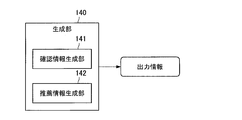
- FIG. 6 is a functional block diagram showing the configuration of the generation unit 140 according to the first embodiment. As shown in FIG. 6, the generation unit 140 includes a confirmation information generation unit 141 and a recommendation information generation unit 142.
- the confirmation information generation unit 141 has a function of generating output information for confirming each place by the user. For example, when the learning data recorded in the learning DB 114 is deleted by the correction unit 124, the confirmation information generation unit 141 generates output information for confirming to the user whether the learning data may be deleted. You may.
- the recommendation information generation unit 142 generates output information for making various recommendations to the user. For example, the recommendation information generation unit 142 may generate output information for playing music desired by the user. At this time, the recommendation information generation unit 142 may determine the content to be recommended to the user based on the recommendation score or the like recorded in the recommendation DB 112, and generate output information.
- the output control unit 150 has a function of controlling the output of output information.
- the output control unit 150 may convert the output information acquired from the generation unit 140 into information for being output to another terminal.
- the output control unit 150 may convert the content of the text information into voice information for outputting as voice.
- the output control unit 150 transmits various acquired or generated information to the communication control unit 160.
- the output control unit 150 may transmit the output information transmitted from the generation unit 140 to the communication control unit 160 as it is.
- the communication control unit 160 has a function of controlling the transmission / reception of various information between the information processing device 10 and the various devices. For example, the communication control unit 160 controls the transmission of the information transmitted from the output control unit 150 from the information processing device 10 to the user terminal 20 via the network 30. Further, the communication control unit 160 controls the information processing device 10 to receive various types of information from an external device (for example, the user terminal 20). Various received information is transmitted to the storage unit 110, the processing unit 120, or the analysis unit 130 via the communication control unit 160.
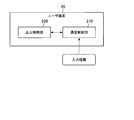
- FIG. 7 is a functional block diagram showing the configuration of the user terminal 20 according to the first embodiment.
- the user terminal 20 includes a communication control unit 210 and an output control unit 220.
- the communication control unit 210 has a function of controlling transmission / reception of various information between the user terminal 20 and various devices (for example, the information processing device 10).
- the communication control unit 160 acquires the input information and controls the transmission of the input information to the information processing device 10.
- the input information may be input to the user terminal 20 based on an operation by the user, or may be automatically input from various devices.
- the communication control unit 210 controls the reception of information related to the output information transmitted from the information processing device 10. Information related to the received output information is transmitted to the output control unit 220.
- the output control unit 220 controls various outputs by the user terminal 20.
- the output control unit 220 causes the output device to perform various outputs by transmitting information related to the output information transmitted from the information processing device 10 to the output device included in the user terminal 20.
- the output control unit 220 may control the output device so as to play music.
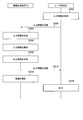
- FIGS. 8 to 10 are flowcharts showing an example of information transmission / reception between the information processing device 10 and the user terminal 20 according to the first embodiment.
- transmission / reception of information (input information and output information) between the information processing device 10 and the user terminal 20 according to the first embodiment (hereinafter, "in the information processing device 10 and the user terminal 20").
- An example of (also referred to as “exchange”) will be described.
- the information processing device 10 generates output information according to the input information transmitted from the user terminal 20.
- the user terminal 20 receives the generated output information and outputs various information to the user according to the output information.
- information transmission / reception between the information processing device 10 and the user terminal 20 will be described in more detail with reference to FIG.
- the user terminal 20 acquires the input information (step S102). More specifically, the communication control unit 210 included in the user terminal 20 acquires input information from the user. For example, the communication control unit 210 acquires voice information that "Gunma's favorite song is XX" as input information. Next, the user terminal 20 transmits the input information to the information processing device 10 (step S104).
- the information processing device 10 receives the input information (step S106).
- the received input information is transmitted to the analysis unit 130 via the communication control unit 160.
- the analysis unit 130 analyzes the input information (step S108). More specifically, the analysis unit 130 analyzes the meaning and content of the input information based on various information and the like stored in the knowledge DB 111. For example, it is assumed that the knowledge DB 111 records that the word "gunma” has only the meaning of "Gunma prefecture". In this case, the analysis unit 130 cannot understand the meaning and content of the input information, and outputs an analysis result that the input information "Gunma's favorite song is XX" is inconsistent to the storage unit 110. At this time, the storage unit 110 records the result of analysis by the analysis unit 130 in the communication DB 113. More specifically, the storage unit 110 stores the input information that "Gunma's favorite song is XX" and the time when the input information is transmitted in the exchange DB 113 in association with each other.
- the generation unit 140 generates output information (step S110). More specifically, the generation unit 140 outputs output information based on the result of analysis by the analysis unit 130 and the information stored in the storage unit 110. For example, the generation unit 140 generates voice information such as "What is Gunma?" As output information, and transmits the output information to the output control unit 150. At this time, the storage unit 110 records the output information "What is Gunma?" In the learning DB 114 in association with the information recorded in step S108. At this time, the storage unit 110 records in the exchange DB 113 that there was an exchange. More specifically, the storage unit 110 records the time of the exchange and the content of the exchange in the exchange DB 113.
- the information processing device 10 transmits the output information to the user terminal 20 (step S112).
- the user terminal 20 outputs the output information (step S114). More specifically, the communication control unit 210 acquires the output information transmitted to the user terminal 20 and transmits the output information to the output control unit 220.
- the output control unit 220 causes the output device included in the user terminal 20 to output the output information based on the output information.
- the output device outputs voice information such as "What is Gunma?" As output information.
- the example of transmitting and receiving information between the information processing device 10 and the user terminal 20 has been described above.
- the input information and the output information are recorded in the learning DB 114 and used as the learning data.
- the exchange shown in FIG. 9 is different from the example of the exchange shown in FIG. 8 in that the information processing apparatus 10 updates the information recorded in the knowledge DB 111 and the recommendation DB 112 based on the input information.
- the user terminal 20 acquires the input information (step S202). More specifically, the communication control unit 210 acquires input information from the user. For example, the communication control unit 210 acquires voice information such as "Gunma is the nickname of my friend Iwasa.” As input information.
- steps S204 and S206 are carried out, but since the processes in steps S204 and S206 are substantially the same as the processes in steps S104 and S106, the description thereof will be omitted here.
- the information processing device 10 analyzes the input information (step S208). More specifically, the analysis unit 130 analyzes the meaning and content of the input information based on the information recorded in the knowledge DB 111. The analysis unit 130 transmits the analysis result to the processing unit 120.
- the update unit 121 updates the information recorded in the knowledge DB 111 (step S210). More specifically, the update unit 121 records in the knowledge DB 111 that "Gunma" is a friend of the user. Further, here, it is assumed that the information that "Gunma's favorite song is XX" is recorded in the knowledge DB 111. At this time, the update unit 121 records in the knowledge DB 111 that "Gunma” likes the song XX, based on the analysis result in step S208. In addition, the update unit 121 creates a playlist of songs that Gunma likes in the recommendation DB 112. Further, the update unit 121 adds the song XX that Gunma likes to the playlist.
- the information processing device 10 updates the information stored in the storage unit 110 in response to the input information from the user terminal 20. This makes it possible for the information processing device 10 to generate output information that is more in line with the user's wishes. For example, when the input information "Please play Gunma's favorite song" is input to the information processing device 10, the output information for outputting XX, which is Gunma's favorite song, to the user terminal 20. Can be generated.
- the user terminal 20 acquires the input information (step S302). More specifically, the communication control unit 210 acquires input information from the user. For example, the communication control unit 210 acquires the voice information "Play a Gunma song.” As input information.
- steps S304 to S308 are carried out, but since the processes of steps S304 to S306 are substantially the same as the processes of steps S204 to S208, the description thereof will be omitted here.
- the information processing device 10 When the process of step S308 is completed, the information processing device 10 generates output information (step S310). More specifically, the recommendation information generation unit 142 generates output information based on the analysis result by the analysis unit 130 and the information recorded in the recommendation DB 112. For example, the recommendation information generation unit 142 generates output information for playing a song included in a playlist that Gunma likes, which is stored in the recommendation DB 112. The song to be played may be the song with the highest recommendation score, or may be a song whose recommendation score is randomly selected from, for example, the top 5%. The recommendation information generation unit 142 transmits the output information to the output control unit 150.
- the information processing device 10 transmits the output information to the user terminal 20 (step S312).
- the information processing device 10 updates the information stored in the storage unit 110 (step S314).
- the update unit 121 raises the recommendation score of the song selected by the recommendation information generation unit 142.
- the update unit 121 records the input input information and the output output information in the learning DB 114.
- the time of the exchange and the content of the exchange are recorded in the exchange DB 113.
- the user terminal 20 outputs the output information (step S316). More specifically, the communication control unit 210 acquires the output information transmitted to the user terminal 20, and transmits the acquired output information to the output control unit 220. The output control unit 220 causes the output device to output output information. As a result, the output device plays, for example, a song included in a playlist that Gunma likes.
- the third example of the exchange between the information processing device 10 and the user terminal 20 according to the present embodiment has been described with reference to FIG.
- the information processing apparatus 10 generates output information according to the input information from the user terminal 20, and transmits the generated output information to the user terminal 20. Further, the information processing device 10 updates the information stored in the storage unit 110 according to the input information and the output information.
- output information related to "Gunma” was generated based on the input information including the noun “Gunma”.
- output information related to "Gunma” may be generated based on input information that does not include the noun “Gunma”. That is, the user can also give an instruction to implicitly generate output information about "Gunma” to the information processing device 10 without saying the word "Gunma”.
- step S302 it is assumed that the user inputs voice information such as "play a song with a taste similar to the song heard yesterday.”
- the audio information does not include the word “Gunma”, but "the song I heard yesterday” shall mean “Gunma's song”.
- the analysis unit 130 can analyze that the "song heard yesterday" included in the input information of the user means the "song of Gunma” based on the information recorded in the knowledge DB 111. ..
- the recommendation information generation unit 142 generates output information for causing the user terminal 20 to play a song having a taste similar to "Gunma's song".
- step S314 the update unit 121 raises the recommendation score of a song having a taste similar to the "Gunma song" stored in the recommendation DB 112. Further, in step S316, the user terminal 20 reproduces a song having a taste similar to "Gunma's song”.
- step S302 an example in which the user inputs audio information such as "play a song with a taste similar to the song heard yesterday” was described, but "play a song completely different from the song heard yesterday.”
- the voice information "" may be input to the user terminal 20.
- the recommendation information generation unit 142 generates output information for causing the user terminal 20 to play a song having a taste completely different from that of the “Gunma song”.
- the user terminal 20 can play a song having a taste completely different from that of the "Gunma song”.
- the update unit 121 may raise the recommendation score of a song having a taste completely different from that of the "Gunma song” recorded in the recommendation DB 112.
- the user does not have to directly speak the noun "Gunma”, but outputs information about "Gunma” to the user terminal 20. It can be output. Further, the updating unit 121 can also update various information about the "gunma" stored in the storage unit 110.
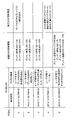
- FIG. 11 is a diagram showing an example of the information recorded in the exchange DB 113 according to the first embodiment, the update history of the knowledge DB 111, and the update history of the recommended DB 112.
- FIG. 11 shows five pieces (NoA to E) of each of the update history of the exchange DB 113, the knowledge DB 111, and the update history of the recommended DB 112.
- No. of the exchange DB 113 it is recorded that "2018/11/22 PM 8:00" is input as time information, and that the user inputs input information such as "Song E is in Gunma's favorite song” at home as exchange information.
- the analysis unit 130 analyzes that the word "gunma" in the input information means the name of a person named "Iwasa”. Then, the update unit 121 raises the probability that the word "gunma” means "Iwasa".
- the update unit 121 raises the probability that the word "gunma” recorded in the knowledge DB 111 means “Iwasa” from 80% to 81%. As a result, the analysis unit 130 will analyze the word “gunma” with an 81% probability of meaning the personal name (nickname) "Iwasa”. On the other hand, the update unit 121 reduces the probability that the word "gunma” stored in the knowledge DB 111 means the prefecture name "Gunma” from 20% to 19%. As a result, the analysis unit 130 has a 19% probability of analyzing the word "gunma” as meaning the prefecture name "Gunma”. In addition, the update unit 121 adds the song E to the favorite playlist of "Gunma" and records it in the recommendation DB 112.
- No. In the same manner as A, No. The records of the knowledge DB 111 and the recommendation DB 112 are updated according to the exchange information related to B to E. Specifically, No. of the exchange DB 113.
- B it is recorded that there was input information from the user such as "2018/11/28 PM 8:01" as time information and "Play Gunma's favorite song” at home as exchange information. ..
- the probability that "Gunma” means “Gunma” is updated from 19% to 18%, and the probability that "Gunma” means “Iwasa” is updated from 81% to 82%. ..
- various information stored in the information processing device 10 is updated by the exchange between the information processing device 10 and the user terminal 20 according to the present embodiment. More specifically, the information stored in the exchange DB 113 is used as the learning data, and the information stored in the knowledge DB 111 and the recommendation DB 112 is updated as the learning data is accumulated.
- the generation unit 140 generates output information based on the information stored in the knowledge DB 111 and the recommendation DB 112. Therefore, as the learning data is accumulated, the algorithm for the information processing apparatus 10 to output the output information changes.
- the information processing apparatus 10 retrains the algorithm by adjusting the degree of influence derived from the training data.
- the information recorded in the learning DB 114 which is the learning data, affects the information recorded in the knowledge DB 111 or the recommendation DB 112.
- the information processing apparatus 10 adjusts the degree of influence on the information recorded in the knowledge DB 111 or the recommendation DB 112 by modifying the information recorded in the exchange DB 113 or the like. As a result, the algorithm is relearned.
- the exchange DB 113 includes information related to input information by the user, information related to output information, information related to a state change of the storage unit 110, and the like.
- the information processing apparatus 10 can relearn the algorithm as long as it stores at least one of these pieces of information.
- the information regarding the input information by the user may be information indicating "who / when / where / what said” or the like.
- the information regarding the output information may be information indicating "when / where / what was said or recommended" by the information processing apparatus 10.
- the information regarding the state change of the storage unit 110 includes information such as the update history of the knowledge DB 111 or the update history of the recommendation DB 112.
- the information processing apparatus 10 extracts a keyword from the exchange DB 113, and deletes the information contained in the knowledge DB 111, the recommendation DB 112, and the exchange DB 113 based on the extraction result.
- the extraction unit 122 acquires the keyword for extraction and extracts the keyword from the exchange DB 113.
- the keyword may be input to the user terminal 20 by the user's operation, transmitted to the information processing apparatus 10, and transmitted to the extraction unit 122, for example.
- the word "gunma” is transmitted to the extraction unit 122 as a keyword.
- the extraction unit 122 searches for information including "gunma" from the exchange DB 113, and extracts learning data from the learning DB 114.
- the correction unit 124 deletes the learning data including "Gunma” recorded in the learning DB 114. "Gunma's favorite song is XX.”, "Gunma is my friend Iwasa's nickname.”, And “Gunma's song” recorded in the correction part 124, for example, the learning DB 114. Delete the learning data containing "Gunma”. Further, the correction unit 124 deletes the information recorded in the knowledge DB 111 indicating that "gunma” means "Iwasa”. Further, the correction unit 124 deletes the playlist that "Gunma” likes, which is stored in the recommendation DB 112, and restores the recommendation score of the song that "Gunma” likes.
- the information processing device 10 analyzes that the contents of the input information are inconsistent. become.
- the confirmation information generation unit 141 included in the information processing device 10 may generate output information such as "What is Gunma?”.
- the recommendation information generation unit 142 may generate output information such as "There is no playlist that Gunma likes.”
- information that does not include the word “gunma” cannot be found by extraction using the above keyword “gunma”. For example, suppose that the input information "Play a song with a taste similar to the song heard yesterday" is input to the information processing device 10. If the song you heard yesterday is a Gunma song, the recommendation score for a taste similar to the Gunma song has been updated. In this case, the above input information that does not include the word "gunma” directly affects the information of the recommendation DB 112.
- the recommendation DB 112 updates the recommendation score for a song with a taste that is completely different from the Gunma song. That is, the input information that does not include the word "gunma” indirectly affects the information of the recommendation DB 112.
- the user may want to delete the influence based on the input information that does not include the information "Gunma” from the storage unit 110. Therefore, as a method of deleting these influences, a method of storing information related to various data in advance, for example, in the storage unit 110 can be considered. For example, the input information "Play a song with a taste similar to the song you heard yesterday" and "Play a song completely different from the song you heard yesterday" becomes the information "Play Gunma's song.” As related information, a method of storing it in the exchange DB 113 can be considered.
- Re-learning method of the second algorithm when certain information is deleted and inconsistency occurs in the output information, the deleted information is determined as related information. More specifically, when certain information is deleted and the output information before deletion and the output information after deletion are different, the deleted information is determined as information related to the keyword. According to the re-learning method of the second algorithm, it is not necessary to record the information indicating the relationship between various kinds of information stored in the exchange DB 113.
- the re-learning method of the second algorithm will be described with reference to FIG. More specifically, a method of determining whether or not the information related to the exchange is related to the keyword based on the change of the output information output based on the algorithm when the information related to the exchange including the keyword is deleted will be described. To do.
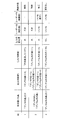
- FIG. 12 is a diagram showing output information generated before and after deletion of information related to exchange and processing contents based on changes in output information before and after that.
- FIG. 12 shows three examples. Hereinafter, three examples shown in FIG. 12 will be described. From left to right, the songs that the user listened to yesterday, the output (before and after deletion), the change in output, and the processing content are shown.
- the output is the content of the output information for the input information from the user, "Play a song with a taste similar to the song you heard yesterday.” Further, in the following three examples, the extraction unit 122 extracts information including the keyword "gunma" from the storage unit 110, and the correction unit 124 deletes the extracted information. The content of the output information for the input information after the deletion is performed is shown as output (after deletion).
- the output information for the input information is the information for playing only the “Gunma song”.
- the determination unit 123 determines that the input information is data (related data) related to the keyword "Gunma”. ..
- the information processing apparatus 10 can delete the information including the keyword and determine the relationship between the input information and the keyword according to the change of the output information before and after the deletion. Therefore, the information processing device 10 does not need to memorize what kind of keyword is associated with each of the input information.
- the output (before deletion) is an output in which "Gunma's song” and “non-Gunma's song” are played.
- the output (after deletion) after various information including “Gunma” is deleted is an output in which only "songs other than Gunma” are played. In this case as well, there is a change between the output (before deletion) and the output (after deletion). Therefore, the determination unit 123 determines that the input information is related data of the keyword "gunma".
- the output (before deletion) is an output in which only "songs other than Gunma" are played.
- the output (before deletion) is an output that is not related to the keyword. Therefore, the output (after deletion) does not change from the output (before deletion).
- the determination unit 123 determines that the input information is data that is not related to the keyword.
- the algorithm can be re-learned by deleting the information regarding the exchange which is the learning data related to the keyword.
- the relationship between the keyword and the input information is determined based on the change in the output information. Therefore, the information processing device 10 does not need to memorize the relationship between various keywords and the input information, and can modify the information related to the exchange based on less information. As a result, the information processing apparatus 10 can relearn the algorithm based on less information.
- Re-learning method of the third algorithm >>>
- the information regarding the input information related to the keyword is deleted from the exchange DB 113. Therefore, data that is not directly related to the keyword (for example, data related to the user's hobbies and tastes) included in the input information may be deleted.
- FIG. 13 shows four examples in which the output recorded in the learning DB 114 is modified.
- the output is modified.
- the extraction unit 122 searches the exchange DB for the keyword "gunma” and extracts learning data from the learning DB 114 based on the search result.
- the correction unit 124 corrects the output according to the extraction result, as described below.
- the user only listened to "Gunma's song” yesterday. That is, specifically, 10 Gunma songs are being played. Since the user is trying to delete the information about "Gunma", it is assumed that there is an FB (feedback) of "No" for the output. In this case, the correction unit 124 deletes the information related to "Gunma" from the storage unit 110. Then, the analysis unit 130 cannot understand the meaning and content of the input information "Play the song of Gunma.” In response to this, the generation unit 140 generates output information such as "Did you play the meander yesterday?" As described above, in the first example, since the change in output is large, the determination unit 123 determines that the change in output is large.
- the correction unit 124 deletes the exchange information corresponding to the first example from the exchange DB. That is, the correction unit 124 deletes the learning data recorded in the learning DB 114 associated with the exchange information. Further, the correction unit 124 also deletes the user's FB from the learning DB 114.
- the user listened to "Gunma's song” and "Non-Gunma's song” yesterday.
- the number of "Gunma songs” and the number of "non-Gunma songs” heard by the user are different.
- the user terminal 20 plays nine "Gunma songs” and one "non-Gunma song”.
- the user terminal 20 plays one "Gunma song” and nine "non-Gunma songs”.
- the output information is from the information that 9 songs of "Gunma's song” and 1 song of "Songs other than Gunma” are played. The information has changed to play one song.
- the exchange information in the second example is deleted.
- the user's "No" FB has also been deleted.
- the output information is "Gunma's song” from one song and "Non-Gunma's song” from nine songs. "Songs other than Gunma” has been changed to 9 songs. In this case, since the change in the output information is small, the output result of playing 9 "songs other than Gunma” is deleted. Along with this, the FB that the user likes is also maintained. In this case, the FB from the user is recorded assuming that the output information is the output information after the learning data related to the keyword "Gunma" is deleted.
- the content of the output is modified according to the magnitude of the change in the output. That is, the information processing apparatus 10 can adjust the degree of influence on the algorithm derived from the output information by not only deleting the record of the output information but also modifying the output information. As a result, the information processing device 10 can realize the state of the algorithm desired by the user.
- the user listened only to "Gunma's song” yesterday.
- the output information has not changed from the information of playing 10 "songs other than Gunma”. Therefore, there is no change in output. Therefore, the user FB also remains "like", and the output information is not updated.
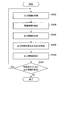
- FIG. 14 is a flowchart showing an update process of the exchange DB 113 by the information processing device 10 according to the embodiment of the present disclosure.
- the update process will be described with reference to FIG.
- the information processing device 10 acquires the input information (step S402). More specifically, the information processing apparatus 10 inputs, for example, a keyword input from the user to the user terminal 20 and information requesting deletion of learning data related to the keyword (hereinafter, also simply referred to as "request information"). Is received via the network 30.
- the above keyword is assumed to be, for example, the word "gunma”.
- the information processing device 10 receives the keyword and the request information as input information, and transmits the received input information to the extraction unit 122 included in the processing unit 120 via the communication control unit 160.
- the extraction unit 122 extracts related information based on the transmitted input information (step S404). Specifically, the extraction unit 122 extracts information related to the keyword "gunma". More specifically, the extraction unit 122 extracts the information stored in the knowledge DB 111, the recommendation DB 112, or the exchange DB 113 related to the word "gunma" of the keyword. The extraction unit 122 does not extract the output information recorded in the exchange DB 113.
- the generation unit 140 generates output information (step S406).
- the generation unit 140 generates the output information assuming that the related information extracted in step S404 (excluding the input information used in step S406) has been deleted. That is, the generation unit 140 generates the output information assuming that there is no exchange or the like related to the keyword "Gunma".
- the output information generated by the generation unit 140 may differ from the output information recorded in the exchange DB 113.
- the determination unit 123 determines the magnitude of the change in the output information (step S408). More specifically, the determination unit 123 differs between the output information generated in step S406 and the output information recorded in the learning DB 114 and corresponding to the input information used to generate the output information. Is determined as the magnitude of change in output information.
- the correction unit 124 corrects the output information recorded in the learning DB 114 according to the determination result by the determination unit 123 in step S408 (step S410). For example, when it is determined in step S408 that the change in the output information is large, the correction unit 124 determines the output information recorded in the learning DB 114, which is the target of the determination in step S408, and the corresponding input information. To delete. In this way, when the output information is deleted, the output information has no effect on the algorithm.
- step S408 when it is determined in step S408 that there is no change in the output information, the correction unit 124 maintains the output information recorded in the exchange DB 113, which is the target of the determination in step S408. Further, if there is a change in the output information in step S408 and it is determined that the change is not large, the correction unit 124 uses the output information recorded in the exchange DB 113 for the determination in step S408. Fix it.
- step S412 determines that there is output information that has not been determined based on the exchange DB 113 (step S412: Yes)
- the extraction unit 122 returns to step S402.
- step S412: No the update process shown in FIG. 14 ends.
- the information processing device 10 modifies the exchange information recorded in the exchange DB 113. That is, the learning data recorded in the learning DB 114 is modified. As a result, the degree of influence derived from the learning data such as the input information or the output information recorded in the learning DB 114 is adjusted, and the algorithm is relearned. As a result, the information processing apparatus 10 can more appropriately realize the state of the algorithm desired by the user.
- Second embodiment> In the first embodiment, an example of using an algorithm based on a rule-based method (that is, a method using a score or the like recorded in the recommendation DB 112 in the knowledge DB 111) has been described. However, the technique of the present disclosure can also be applied to a technique in which the specific processing content is a black box, such as various machine learning techniques represented by deep learning. In the second embodiment, an example in which the technique of the present disclosure is applied to the machine learning technique such as the deep learning will be described. In the following description, the description of the content overlapping with the first embodiment will be omitted.
- FIG. 15 is a functional block diagram showing the configuration of the information processing device 11 according to the second embodiment.
- the information processing device 11 includes a storage unit 118, a processing unit 128, an analysis unit 130, a generation unit 143, an output control unit 150, and a communication control unit 160.
- the storage unit 118, the processing unit 128, and the generation unit 143 which are different from the functional units included in the information processing device 11 according to the first embodiment, will be described.
- FIG. 16 is a functional block diagram showing the configuration of the storage unit 118 according to the second embodiment.
- the storage unit 118 according to the second embodiment includes a knowledge DB 116, a recommendation DB 117, an exchange DB 113, and a learning DB 114.
- the knowledge DB 116 according to the second embodiment does not record data that probabilistically represents the meaning and content of words such as the knowledge DB 111 according to the first embodiment.
- the recommendation DB 117 according to the second embodiment does not record the recommendation score recorded in the recommendation DB 112 according to the first embodiment.
- the analysis of the meaning and content of words or the recommendation to the user is carried out based on the black box parameters (hereinafter, also simply referred to as “parameters”) possessed by the analysis unit 131 and the generation unit 143, which will be described later.
- parameters hereinafter, also simply referred to as “parameters”
- the information recorded in the knowledge DB 116 and the recommendation DB 117 according to the second embodiment and the knowledge DB 111 and the recommendation DB 112 according to the first embodiment are different. More specifically, the analysis unit 131 or the recommendation information generation unit 145 connects the input value to the network in which the input layer composed of a plurality of inputs and the output layer composed of a plurality of outputs are connected by an intermediate layer composed of multiple layers. Is input to output the output value related to the analysis result or recommendation information.
- the parameter that defines the weight of the node in the network is referred to as a “black box parameter”.
- the learning DB 114 records the input value and the output value at the event in which the learning data is recorded.
- the input value is various kinds of information necessary for obtaining an output value such as a user's instruction, a user situation, and environmental information.
- the output value can be, for example, an index (for example, information such as a user's reaction) for estimating how appropriate the analysis result or the like is.
- the recording of the learning data can be performed based on the instruction by the user or automatically by the information processing apparatus 11 in the background. In the present embodiment, each index of the event is recorded as data in the exchange DB 113.
- the exchange DB 113 records label information (for example, information indicating the event occurrence time, input information, output information, etc.) for extracting learning data necessary for re-learning the algorithm recorded in the event. Has been done. Therefore, the learning data can be extracted from the learning DB 114 based on the exchange DB 113.
- label information for example, information indicating the event occurrence time, input information, output information, etc.
- FIG. 17 is a diagram showing an example of the information recorded in the exchange DB 113 according to the second embodiment, the update history of the knowledge DB 116, and the update history of the recommendation DB 117.
- the knowledge DB 116 and the recommendation DB 117 do not record information regarding the probability of meaning content and information such as a recommendation score. Therefore, as shown in FIG. 17, the update history of the meaning content or the update history of the recommendation score as shown in FIG. 11 is not stored in the storage unit 118 according to the second embodiment.
- the exchange DB 113 according to the second embodiment information on the exchange is recorded as in the exchange DB 113 according to the first embodiment.
- FIG. 18 is a functional block diagram showing the configuration of the processing unit 128 according to the second embodiment.
- the processing unit 128 according to the second embodiment includes a learning unit 125 in addition to the functional unit included in the processing unit 120 according to the first embodiment.
- the learning unit 125 has a function of performing learning (for example, reinforcement learning) of various parameters possessed by the analysis unit 131 or the generation unit 143. More specifically, the learning unit 125 performs parameter learning based on the exchange information recorded in the exchange DB 113 and based on a technique such as reinforcement learning. This updates the parameters.
- parameter learning means optimizing a black box parameter according to the accumulation of input values and output values (that is, learning data).
- the learning unit 125 may perform parameter learning when the information regarding the exchange recorded in the exchange DB 113 is added, deleted, or modified.
- the information processing device 11 When the information processing device 11 according to the second embodiment acquires the input information, it generates the output information based on various parameters of the analysis unit 131 or the generation unit 143. Therefore, updating the parameters by the learning unit 125 corresponds to re-learning the algorithm for generating the output information by the information processing device 11.
- the analysis unit 131 uses the semantic analysis parameters before and after the correspondence between the input information and the semantic content, not in the form of probability. Find the optimal response from the context / situation. More specifically, when voice information from the user is input, the analysis unit 131 outputs the meaning analysis result of the voice information based on the meaning analysis parameter, for example, using the voice information as an input value.
- the analysis unit 131 may output the semantic analysis result of the voice information by inputting various information (user status, characteristic information, environment information, contents of user's instruction, etc.) in addition to the voice.
- the user characteristic information may be information about the user characteristics such as age, gender, or address.
- the environmental information may be information about the space in which the user exists, such as information about time, place, or people with whom the user is present.
- the analysis unit 131 may analyze that "gunma” means a person named "Iwasa” when talking about friendship until just before. Further, when the user is traveling to Gunma prefecture, it may be analyzed that "Gunma" means the prefecture name "Gunma".
- the semantic analysis result output by the analysis unit 131 is used as an input value for the recommendation information generation unit 145, which will be described later, to generate the recommendation information.
- the analysis unit 130 also performs semantic analysis during re-learning of the algorithm, and details of the processing at that time will be described later.
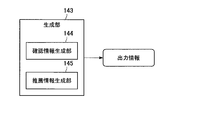
- FIG. 19 is a functional block diagram showing the configuration of the generation unit 143 according to the second embodiment.
- the generation unit 143 shown in FIG. 19 includes a confirmation information generation unit 144 and a recommendation information generation unit 145, similarly to the generation unit 140 according to the first embodiment.
- the recommendation information generation unit 142 according to the first embodiment generates output information for recommending a song, for example, based on a song recommendation score or the like.
- the recommendation information generation unit 145 generates optimum output information based on the recommendation parameters, for example, based on the context or situation before and after, and recommends music or the like to the user. More specifically, the recommendation information generation unit 145 outputs recommendation information based on the analysis result by the analysis unit 130, various information (user status, characteristic information, environment information, user instruction content, etc.) and recommendation parameters. Generate as.
- voice information and various above-mentioned information are used for semantic analysis or generation of recommendation information. Therefore, a machine learning technique capable of performing processing in consideration of a large number of conditions is suitable for processing that requires processing such as recommendation based on various conditions as in the present embodiment.
- the user may be preferable for the user to play a song similar to the song that appeared in the conversation immediately before the user.
- the recommendation parameter reflects the content of the song that appeared in the user's conversation up to the last minute, and the recommendation information generation unit 145 resembles the song that the user was talking about until just before, based on the recommendation parameter.
- Output information for playing a song can be generated.
- the recommendation parameter reflects information about the previously recommended song
- the recommendation information generation unit 145 recommends the song when one week or more has passed since the previously recommended song was played. Output information can be generated.
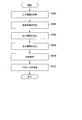
- FIG. 20 is a flowchart showing an example of the parameter update process according to the second embodiment.
- the parameter update process will be described with reference to FIG.
- the information processing device 11 acquires the input information (step S502).
- the information processing device 11 receives, for example, input information from the user terminal 20 via the network 30.
- the received input information is transmitted to the analysis unit 131 via the communication control unit 160.
- the analysis unit 131 analyzes the meaning and content of the input information (step S504). More specifically, the analysis unit 131 analyzes the semantic content of the input information based on the semantic analysis parameters stored in the storage unit 118. The analysis result is transmitted to the generation unit 143.
- the generation unit 143 generates output information (step S506). More specifically, the recommendation information generation unit 145 generates output information for making various recommendations to the user based on the analysis result and the recommendation parameters stored in the storage unit 118. The output information is transmitted to the output control unit 150.
- the output control unit 150 outputs output information (step S508). More specifically, the output control unit 150 transmits the output information to the communication control unit 160.
- the output information is transmitted to, for example, the user terminal 20 connected to the network 30.
- the user terminal 20 outputs the output information. For example, the user terminal 20 outputs a voice that recommends a certain song to the user.
- the information processing device 11 acquires the FB (step S510). For example, the information processing device 11 acquires a response to an output result from the user as an FB. The acquired FB is transmitted to the processing unit 128.
- the processing unit 128 learns the semantic analysis parameter and the recommended parameter (step S512). Specifically, the learning unit 125 learns the semantic analysis parameter and the recommended parameter stored in the storage unit 118 based on the FB from the user. As a result, the semantic analysis parameters and the recommended parameters are updated. When these parameters are updated, the parameter update process ends.
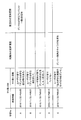
- FIG. 21 is a diagram showing an outline of a process in which the information processing apparatus 11 according to the second embodiment retrains the algorithm.
- the history of communication between the user and the information processing device 11 is shown on the upper side with the horizontal axis as the time axis. More specifically, the times (t1 to t18) when the input information from the user is input to the information processing apparatus 11 and the output information for the input information is output are arranged on the time axis in chronological order. Triangular markers with diagonal lines are shown at the times when the input and output information are input and output. The information processing device 11 trains the algorithm based on these exchanges.
- the record of the exchange recorded in the exchange DB is deleted or modified as in the first embodiment.
- the information regarding the exchange at times t6 to t9 corresponding to the diagonal line or the triangular mark without the grid is deleted from the exchange DB 113.
- the information regarding the exchanges at times t11, 12, and 15 corresponding to the gridded triangular marks has been modified.
- the output information generated at these times has been modified.
- the exchange at the time corresponding to the diagonally shaded triangular mark remains as it is.
- the processing unit 120 searches for the exchange to be deleted based on the exchange DB 113, and deletes the exchange. More specifically, the extraction unit 122 searches for the exchange (label information) recorded in the exchange DB 113, for example, based on the input from the user. For example, the extraction unit 122 can search the label information from the exchange DB 113 based on the keyword such as “Gunma” described above, and extract the learning data based on the label information. The correction unit 124 deletes the searched learning data from the learning DB 114. Further, the correction unit 124 may delete the searched label information and the like from the exchange DB 113.
- the extraction unit 122 may extract learning data derived from the information regarding the exchange to be deleted from the learning DB 114. For example, when the learning data is deleted based on the keyword "gunma", the extraction unit 122 may extract the learning data corresponding to the event in which the output information changes before and after the deletion. The correction unit 124 may delete the learning data related to the event.
- the event deleted in this way corresponds to the exchange at times t6 to t9 shown in FIG.
- the correction unit 124 may correct the learning data without deleting it. For example, as described with reference to FIG. 13, the correction unit 124 may correct the learning data based on the magnitude of the change in the output information due to the deletion of the learning data based on the keyword.
- the exchange corresponding to the modified learning data corresponds to the exchange at the times t11, 12, and 15 shown in FIG.
- the parameters are learned based on the exchange. Therefore, it is possible to relearn the parameters by modifying or deleting at least a part of the exchange as described above. That is, the algorithm can be retrained by modifying or deleting at least a part of the interaction. As a result, it is possible to create an algorithm that eliminates a specific effect.
- FIG. 22 is a flowchart showing the parameter re-learning process according to the second embodiment.
- the parameter re-learning process according to the second embodiment will be described with reference to FIG. 22.
- FIG. 21 it is assumed that the information related to each exchange recorded in the exchange DB 113 is maintained, corrected or deleted.
- the determination unit 123 sets the value of the time t at which the exchange to be updated (deleted or modified) is executed to 1 (step S602). That is, the determination unit 123 sets the exchange to be updated to the oldest exchange.
- the determination unit 123 refers to the exchange DB 113 and confirms the exchange information corresponding to the set time (step S604). If there is exchange information corresponding to the time set in the exchange DB 113 (step S606: Yes), the process proceeds to step S608. On the other hand, if the exchange information corresponding to the set time is deleted (step S606: No), the process proceeds to step S610.
- step S608 the learning unit 125 learns the parameters (step S610). More specifically, the learning unit 125 updates the parameters possessed by at least one of the analysis unit 131 and the generation unit 143 based on the information related to the exchange up to the time t.
- the learning unit 125 updates the semantic analysis parameters and the recommended parameters. More specifically, the learning unit 125 relearns until the time t-1 by using the input information from the user, various information, and the FB information for the analysis result at the time t set in the analysis unit 130. By optimizing the semantic analysis parameters based on, new semantic analysis parameters are generated.
- the FB information may be a direct FB from the user (for example, an FB of "good” or "bad") or an implicit FB. Further, the FB information may be a change in the user's facial expression or biological information. As a result, the semantic analysis parameters are updated.
- the learning unit 125 relearns until the time t-1 by using the input information, various information, the output recommendation information, and the FB information for the recommendation set in the recommendation information generation unit 145 at the time t. By optimizing the recommendation parameters based on, new recommendation parameters are generated. This updates the recommendation parameters.
- the determination unit 123 adds 1 to the set time t and sets a new time t + 1 (step S610).
- the determination unit 123 determines whether or not the newly set time t + 1 exceeds the maximum value (step S612).
- the maximum value at time t + 1 may be, for example, the number of exchanges recorded in the exchange DB.
- the parameter re-learning process has been described above with reference to FIG. In this way, the parameters are sequentially relearned based on the past exchange information. As a result, the algorithm for the information processing apparatus 11 to generate the output information is relearned. In this way, the information processing apparatus 11 according to the second embodiment can realize the state of the desired algorithm.
- the trigger for the information processing system 1 to relearn the algorithm is not particularly limited, but the information processing system 1 can be, for example, explicit by the user (input that the address has changed) or GPS (The algorithm may be retrained based on the detection of changes in attribute information (for example, user's constant position information) based on Global Positioning System information.
- the information processing system 1 starts from the changed address such as the content related to the area and the content related to the commuting or school route while maintaining the tendency of recommendation based on the behavioral characteristics of the user.
- the specific recommendation content can be optimized.
- the information processing system 1 can generate output information about news according to the study abroad destination, for example, based on a change in the user's address or a change in lifestyle from "work” to "student".
- the algorithm can be retrained as it can.
- the information processing system 1 according to the embodiment of the present disclosure can be applied to an entertainment robot such as "AIBO" (registered trademark).
- AIBO registered trademark
- the information processing system 1 can relearn the algorithm based on location-related information.
- the pet robot has acquired "habits about the place” as a result of learning, and specifically, the pet robot behaved as a favorite place under the stairs in the floor plan of the house before moving. To do. After that, when the new residence where the user has moved does not have stairs, it is conceivable that the pet robot will continue to search for a favorite place.
- the information processing system 1 can relearn the algorithm and delete the learning data related to the old floor plan (information related to the location) later. This allows the pet robot to forget only location-related behavior while maintaining the personality or response to the user acquired as a result of previous growth.
- the information processing system 1 can make the pet robot naturally adapt to the new place by deleting the learning data associated with the moving source place step by step.
- the guide robot is a robot that optimizes the guidance of the place where the guide robot is arranged through the interaction with the customer.
- the information processing system 1 for example, when the tenant on the floor is changed, the information related to the tenant (for example, the products handled by the tenant and the past with the customer who is looking for the tenant). Information related to information processing or guidance including the tenant in the route) may be deleted from various databases and relearned for the algorithm.
- the guidance robot can provide guidance suitable for the changed environment while maintaining familiarity with the facility. For example, even if the guidance robot receives a customer's request for a product handled by the tenant before the change after the change of the tenant, the guidance does not take into consideration the tenant before the change that no longer exists.
- the information processing system 1 deletes the past history related to the specifications when the specifications of the target parts flowing in the line handled by the industrial robot are changed, so that the industrial robot is newly created. Even if a part with a different specification flows to the line, the algorithm can be retrained so that it can respond quickly.
- the information processing system 1 provides a driving navigation to a user.
- the information processing system 1 can relearn the algorithm when the user moves to another area or changes the map information due to construction work or the like.
- the information processing system 1 performs route recommendation optimized for new areas and changed map information while maintaining the tendency of driving navigation corresponding to the user's driving preference and lifestyle. Can be done.
- the information processing system 1 may be relearned for the algorithm due to the change of the vehicle owner.
- the vehicle eliminates the habits and preferences of the owner before the change, while leaving the learning results on the driving support control and the vehicle control based on the driving history and the vehicle control history until the re-learning is carried out. It will be possible to perform driving support or autonomous driving control that suits the tastes of various owners. Such re-learning is also suitable, for example, when the registered user of a share car shared in the same area changes.
- the algorithm may be mounted on the vehicle, or may be arranged on the network referred to by the vehicle.
- the investment advisor AI is an AI technology that gives advice on investment to users. According to the information processing system 1 of the present disclosure, it is possible to dynamically delete the past learning data and relearn the algorithm while the learning history is accumulated. Triggers for algorithm re-learning include, for example, changes in the user's portfolio, changes in the user's investment policy, or the discovery of fraudulent incidents related to the target stock (other, subsequent discovery of facts that should be relearned for the algorithm). And so on.
- the algorithm can be retrained so that output information regarding various recommendations (for example, the above-mentioned recommendations related to music) is not generated. More specifically, you may want to remove the influence of music recommended by a friend from the algorithm because you don't want to remember the friend you disliked. In this case, the information processing system 1 can relearn the algorithm by adjusting (for example, deleting) the degree of influence derived from the learning data related to the music recommended by the friend. As a result, the information processing system 1 does not output information about music recommended by a friend of the user as output information based on the relearned algorithm.
- various recommendations for example, the above-mentioned recommendations related to music
- the information processing system 1 can relearn the algorithm in the same manner as in the case of removing the influence of the music described above.
- the information processing system 1 can delete various information recorded in the exchange DB or the like. More specifically, the information processing system 1 can delete recorded memos, reminders, information related to communication between the information processing system 1 and the user terminal 20 (for example, daily conversation) and the like. For example, the information processing system 1 can delete information about a friend who the user dislikes when he / she does not want to remember the friend. In addition, the information processing system 1 can delete the information about her in the past when she is in trouble when her past record of the user is seen by her now. Further, when the user does not want to remember the information in junior high school, the information processing system 1 can delete the record in junior high school. Further, if the user does not want to remember the information near the workplace, the information processing system 1 can delete the record near the workplace. By deleting the information that is inconvenient for the user in this way, the information processing system 1 can generate output information that is more appropriate for the user.
- information such as the knowledge DB 111, the recommendation DB 112, or the exchange DB 113 is updated by using the input information from the user and the output information for the input information. That is, the information processing device 10 learns and relearns the algorithm based on the input information from the user and the output information from the information processing device 10.
- the information processing apparatus 10 may obtain information that is popular in the world by, for example, Web crawling, and learn the algorithm based on the obtained information. That is, data on trends in the world may be used as learning data. This makes it possible for the information processing device 10 to realize a state of an algorithm that can generate output information that is more in line with the fashion of the world.
- the basis may be indirectly specified by the input of the user as described later.
- the re-learning may be automatically performed based on the above-mentioned Web crawling and the user's behavior on the Web.
- the information processing device 10 may learn an algorithm based on generalized information of a type of attribute similar to a user (for example, information such as "single woman in her 40s").
- the recommendation to the user is made based on the user's behavior or the like of the generalized attribute information, not based on the user's own specific behavior or the like.
- the information processing device 10 responds to the change in the algorithm. Re-learning can be carried out.
- the information processing apparatus 10 may train the algorithm by using the result of SNS (Social Network Service) follow-up (see timeline or the like) by the user or the like. For example, according to the situation where the user is following Mr. A, it is presumed that the user has an interest or sympathy for Mr. A. Therefore, the information processing device 10 may learn, for example, an algorithm used for recommendation based on the behavior information and preference information of Mr. A based on the information that the user is following Mr. A.
- SNS Social Network Service
- the information processing system 1 can learn an algorithm according to the information edited by the caller or the like based on the user's designation for a specific caller or blogger on the influential SNS or a celebrity. ..
- the information processing system 1 learns an algorithm based on information such as foods and places recommended by a celebrity, so that the user can also be recommended about the foods and places.
- the information processing system 1 can learn the algorithm using the information acquired based on Web crawling or the like.
- the information processing system 1 may use the technique according to the present disclosure when the follow-up status of the user to another caller or the designation for the curator changes. For example, when the user unfollows Mr. A, it can be estimated that the user has lost the interest and sympathy of Mr. A. Therefore, by re-learning the algorithm afterwards with respect to the past learning results regarding Mr. A, it is possible to exclude only the contents influenced by Mr. A without significantly changing the recommendation tendency to the user.
- the information processing system 1 may relearn the algorithm so that output information pronounced of the curator is not generated.
- the information stored in the exchange DB or the like is modified, but the information before and after the modification may be stored in the exchange DB or the like.
- the information processing system 1 can use the information before modification later. Further, the information processing system 1 may store a part of the corrected or deleted information.
- the information processing system 1 may detect a change in a user's situation (behavior or preference situation, etc.) and delete the stored history according to the result of the detection. At this time, the information processing system 1 may inquire the user to delete the history, or may delete the history without inquiring the user.
- the deleted history may be restored when the user makes an inquiry.
- the information processing device 10 can store the history to be deleted for a certain period of time on the premise of recovering the history. Further, the information processing system 1 may perform stepwise deletion such that the history is gradually deleted and the algorithm is relearned repeatedly. At this time, the information processing system 1 may delete the information in order from the oldest information, or may delete the information in order from the newest information.
- the information processing system 1 may change the density of information as a whole regardless of the newness of the information when deleting the history in stages. That is, the information processing system 1 may delete various information in stages so as to thin out various information in the history to be deleted, regardless of the newness of the information. In addition, the information processing system 1 may recommend to the user the degree to which the information should be deleted in stages.
- the information processing system 1 responds to changes in the detected user situation, etc., without the permission of the user (that is, does not confirm with the user), and various information (for example, learning history or information related to past exchanges) in the background. ) May be deleted.
- the information processing system 1 may delete various types of information in response to a predetermined trigger. In this case, the information processing system 1 may casually confirm to the user whether or not the event that triggers the deletion is correct.
- the information processing system 1 subsequently relearns the algorithm when the output information output based on the algorithm is determined to be unfavorable from an ethical point of view.
- the information processing system 1 can extract information on past exchanges from an ethical point of view.
- the information processing system 1 extracts information on exchanges that may lack fairness from information on past exchanges.
- the information processing system 1 sets a flag for race, gender, religion, cultural customs, regional customs, etc. based on keywords that may cause problems from the viewpoint of discrimination or compliance. You may.
- the information processing system 1 can perform processing such as determining whether the flagged information can actually cause a problem from an ethical point of view, and deleting the information related to the exchange.
- the information processing system 1 relearns the algorithm based on the judgment result from the above ethical viewpoint.
- the first example is about re-learning algorithms in the event of ethical issues or incidents in society. For example, when the usage of a certain term or the recognition that a specific event contains discriminatory nuances is constructed in society by the remarks of a person who has a social influence, the usage or event is not taken into consideration. , It is not desirable for the algorithm to continue presenting information. Therefore, the information processing system 1 can be made to relearn the algorithm so as to match the values after the incident.
- the algorithm re-learning may be performed in the form of delivering a patch to the terminal system used by the user.
- the algorithm is re-learned after the information is sorted based on the exchange DB.
- the algorithm can avoid performing actions that have come to be recognized by society as discriminatory, while maintaining the tendency of actions in recommendation and information presentation.
- the user may be able to refuse to relearn the algorithm.
- the information processing system 1 may cause, for example, the user terminal 20 to present a message to the effect that the user is responsible for the subsequent behavior of the AI agent.
- the algorithm is relearned when the AI agent is operated across borders and regions after shipping. For example, it is assumed that the user moves from Japan to a foreign country together with the information processing system owned by the user, or the business equipment is moved between bases across cultural areas. At this time, the information processing system 1 can relearn the algorithm so as to adapt to the exchanges that are consistent with the culture and customs of the area after migration or migration.
- the re-learning of the algorithm may be performed based on the operation by the user. Depending on the region and target industry, options may be provided to set compliance with the standards adopted by the region and target industry.
- the information processing system 1 may relearn the algorithm so that the output information output based on the algorithm after relearning conforms to the standard adopted in the region or the target industry. This allows the algorithm to prevent the expression of behavior in the pre-movement area that does not match the culture and customs of the new area, while maintaining the tendency of the previous behavior.
- the information processing system 1 makes the algorithm easier based on the ethical viewpoint and the like. Can be relearned.
- the algorithm by re-learning the algorithm from an ethical point of view, it becomes easy for the user to use it across regions or cultural areas, and to deploy commercial equipment and the like between regions.
- the information processing system 1 may relearn the algorithm according to a period elapsed from a predetermined time.
- the learning data may include data that requires processing related to rights such as copyright. More specifically, for example, when the permission period for the copyright of the data included in the learning data has expired, the information processing system 1 deletes the learning history related to the data, thereby resulting in learning (that is, learning). The influence on the algorithm generated based on) can also be removed. Such processing may be carried out when the copyright holder or the like performs such processing.
- the information processing system 1 may relearn the algorithm by deleting the information such as the exchange DB after the trial period (trial period) of the algorithm is completed. More specifically, the information processing system 1 may delete data related to exchanges during the free trial period of the AI character or the like after the free trial period ends, and relearn the algorithm.
- the information processing system 1 relearns the algorithm according to a period elapsed from a predetermined time, so that, for example, the provider who provides the algorithm relearns the algorithm at a desired timing. Can be done.
- the information processing system 1 may warn the user if the deletion has a large effect on the algorithm. For example, when trying to delete information about a specific person in a group composed of a plurality of people, the influence on the algorithm may be large. In an extreme case, deleting the information of the person concerned may delete the influence on the algorithm of the group.
- the information processing system 1 may warn the user when there is a possibility that there is data that should not be deleted when deleting the information of the person concerned. This is because when trying to delete information about one person in a group, the exchanges that should not disappear in view of the current hobbies and tastes may disappear.
- the information processing system 1 may confirm the interpretation of the meaning of the request when, for example, the user requests "I want you to erase the history of Gunma.” This is to prevent unintended re-learning by the user due to misunderstanding that the word that is a candidate for deletion is ambiguous and has another meaning.
- the user may be output information confirming the interpretation of the meaning "Gunma is your friend's XXX?" This makes it possible to confirm that the information about Gunma as a place name is not deleted.
- the user may be asked "Is it okay if I erase (Gunma's history) to make it look like YYY?", Or the effect of re-learning may be visualized in advance.
- the confirmation may be performed by voice or by screen display. It may also be displayed on a display existing around the user. As a result, the user can select whether or not to delete the history according to the confirmation result.
- the information processing system 1 may delete the information stored in another information processing system (for example, a system in which AI technology is used) or the like.
- the information processing system 1 teaches another information processing system data regarding the exchange to be deleted.
- the other information processing system may delete the information from the exchange DB or the like or correct the inconsistency of the output information based on the deletion in the same manner as the processing in the information processing system 1 according to the present embodiment.
- the information processing device 10 or 11 constitutes an information processing system. Not limited to this, the information processing system may be composed of a plurality of devices.
- FIG. 23 is a diagram showing an example of an information processing system 2 composed of a plurality of devices. As shown in FIG. 23, the information processing system 2 is composed of an information processing device 12 and a data server 15. Further, the information processing device 12 and the data server 15 are connected to each other via the network 30.
- FIG. 24 is a functional block diagram showing the configuration of the information processing device 12. Unlike the information processing devices 10 and 11 according to the first and second embodiments, the information processing device 12 shown in FIG. 24 does not have a database corresponding to a knowledge DB, a recommendation DB, an exchange DB, a learning DB, or the like. .. These databases are recorded in the data server 15. In this case, the information processing device 12 can acquire information from a data server connected to the network as needed and relearn the algorithm. Although not shown in FIG. 24, it is assumed that the information processing apparatus 12 has a storage unit for storing information necessary for various processes.
- FIG. 25 is a functional block diagram showing a configuration example of a hardware configuration of the information processing devices 10, 11 and 12 constituting the user terminal 20 or the information processing system 1 according to the embodiment of the present disclosure.
- the information processing device 10 constituting the information processing system 1 mainly includes a CPU 601, a ROM 602, and a RAM 603. Further, the information processing device 10 further includes a host bus 604, a bridge 605, an external bus 606, an interface 607, an input device 608, an output device 609, a storage device 610, a drive 612, and a connection port 614. And a communication device 616.
- the CPU 601 functions as an arithmetic processing device and a control device, and controls all or a part of the operation in the information processing device 10 according to various programs recorded in the ROM 602, the RAM 603, the storage device 610, or the removable recording medium 613.
- the ROM 602 stores programs, calculation parameters, and the like used by the CPU 601.
- the RAM 603 primarily stores a program used by the CPU 601 and parameters that change as appropriate in the execution of the program. These are connected to each other by a host bus 604 composed of an internal bus such as a CPU bus.
- the processing unit 120, the analysis unit 130, the generation unit 140, the output control unit 150, and the communication control unit 160 shown in FIG. 3 may be configured by the CPU 601.
- the host bus 604 is connected to an external bus 606 such as a PCI (Peripheral Component Interconnect / Interface) bus via a bridge 605. Further, an input device 608, an output device 609, a storage device 610, a drive 612, a connection port 614, and a communication device 616 are connected to the external bus 606 via the interface 607.
- PCI Peripheral Component Interconnect / Interface
- the input device 608 is an operating means operated by the user, such as a mouse, keyboard, touch panel, buttons, switches, levers, and pedals. Further, the input device 608 may be, for example, a remote control means (so-called remote controller) using infrared rays or other radio waves, or an externally connected device such as a mobile phone or PDA that supports the operation of the information processing device 10. It may be 615. Further, the input device 608 is composed of, for example, an input control circuit that generates an input signal based on the information input by the user using the above-mentioned operating means and outputs the input signal to the CPU 601. By operating the input device 608, the user of the information processing devices 10, 11, 12 or the user terminal 20 inputs various data to the information processing devices 10, 11, 12 or the user terminal 20, and performs a processing operation. Can be instructed.
- a remote control means such as a mouse, keyboard, touch panel, buttons, switches, levers, and pedals.
- the input device 608 may be, for example,
- the output device 609 is composed of a device capable of visually or audibly notifying the user of the acquired information.
- Such devices include display devices such as CRT display devices, liquid crystal display devices, plasma display devices, EL display devices and lamps, audio output devices such as speakers and headphones, and printer devices.
- the output device 609 outputs, for example, the results obtained by various processes performed by the information processing devices 10, 11, 12, or the user terminal 20.
- the display device displays the results obtained by various processes performed by the information processing devices 10, 11, 12 or the user terminal 20 as text or an image.
- the audio output device converts an audio signal composed of reproduced audio data, acoustic data, and the like into an analog signal and outputs the signal.
- the storage device 610 is a data storage device configured as an example of the storage unit of the information processing device 10.
- the storage device 610 is composed of, for example, a magnetic storage device such as an HDD (Hard Disk Drive), a semiconductor storage device, an optical storage device, an optical magnetic storage device, or the like.
- the storage device 610 stores programs executed by the CPU 601, various data, and the like.
- the storage unit 110 shown in FIG. 3 may be configured by the storage device 610.
- the drive 612 is a reader / writer for a recording medium, and is built in or externally attached to the information processing device 10.
- the drive 612 reads the information recorded on the removable recording medium 613 such as the mounted magnetic disk, optical disk, magneto-optical disk, or semiconductor memory, and outputs the information to the RAM 603.
- the drive 612 can also write a record to a removable recording medium 613 such as a mounted magnetic disk, optical disk, magneto-optical disk, or semiconductor memory.
- the removable recording medium 613 is, for example, DVD media, HD-DVD media, Blu-ray (registered trademark) media, or the like.
- the removable recording medium 613 may be a compact flash (registered trademark) (CF: CompactFlash), a flash memory, an SD memory card (Secure Digital memory card), or the like. Further, the removable recording medium 613 may be, for example, an IC card (Integrated Circuit card) or an electronic device equipped with a non-contact type IC chip.
- CF CompactFlash
- SD memory card Secure Digital memory card
- the connection port 614 is a port for directly connecting to the information processing devices 10, 11, 12 or the user terminal 20.
- Examples of the connection port 614 include a USB (Universal Serial Bus) port, an IEEE1394 port, a SCSI (Small Computer System Interface) port, and the like.
- Other examples of the connection port 614 include an RS-232C port, an optical audio terminal, an HDMI (registered trademark) (High-Definition Multimedia Interface) port, and the like.
- the communication device 616 is, for example, a communication interface composed of a communication device or the like for connecting to a communication network (network) 917.
- the communication device 616 is, for example, a communication card for a wired or wireless LAN (Local Area Network), Bluetooth (registered trademark), WUSB (Wireless USB), or the like.
- the communication device 616 may be a router for optical communication, a router for ADSL (Asymmetric Digital Subscriber Line), a modem for various communications, or the like.
- the communication device 616 can transmit and receive signals and the like to and from the Internet and other communication devices in accordance with a predetermined protocol such as TCP / IP.
- the communication network 617 connected to the communication device 616 is composed of a network connected by wire or wireless, and may be, for example, the Internet, a home LAN, infrared communication, radio wave communication, satellite communication, or the like. ..
- the above is an example of a hardware configuration capable of realizing the functions of the information processing devices 10, 11 and 12 constituting the user terminal 20 or the information processing system 1 according to the embodiment of the present disclosure.
- Each of the above components may be configured by using general-purpose members, or may be configured by hardware specialized for the function of each component. Therefore, it is possible to appropriately change the hardware configuration to be used according to the technical level at each time when the present embodiment is implemented.
- various configurations corresponding to the information processing devices 10, 11 and 12 constituting the user terminal 20 or the information processing system 1 are naturally provided.
- the recording medium is, for example, a magnetic disk, an optical disk, a magneto-optical disk, a flash memory, or the like.
- the above computer program may be distributed via a network, for example, without using a recording medium.
- the number of computers for executing the computer program is not particularly limited. For example, a plurality of computers (for example, a plurality of servers and the like) may execute the computer program in cooperation with each other.
- the information processing system 1 deletes various information from both the knowledge DB 111 and the recommendation DB 112, but the present technology is not limited to such an example.
- the information processing system 1 may delete various information from either the knowledge DB 111 or the recommendation DB 112.
- the method of specifying the information for which the influence is to be deleted or reduced may be in hours (seconds, minutes, hours, days, months, or years).
- the designation method may be a place (place name or map area).
- the user may specify the map area by, for example, tracing a map displayed on the user terminal 20.
- the designated object may be an individual or a group.
- the information processing system 1 may generate output information for displaying a list of which exchanges are deleted or modified. The user can recognize which exchange is deleted or modified by the output based on the output information.
- the information processing system 1 may generate output information for allowing the user to select a level at which the exchange is deleted or modified. For example, on the user terminal 20, information regarding representatives of exchanges to be deleted or modified at each level is displayed as an image based on the output information. In addition, the user can select whether or not to delete or modify the information related to the exchange based on the image display.
- the information processing system 1 may allow the user to try the algorithm relearned by deleting or modifying the exchange. At this time, the information processing system 1 holds the exchange DB before the exchange is deleted or modified, and can return to the algorithm before the exchange is deleted or modified, if necessary.
- the information processing system 1 may modify the details of the exchange. The modification may be performed by the user or automatically by the information processing system 1.
- the training data is deleted or modified in order to retrain the algorithm.
- new training data may be added as needed in order to retrain the algorithm.
- a neural network such as RNN (Recurrent Neural Network) and CNN (Convolutional Neural Network) are used. May be good.
- the information recorded in the database at the time of shipment of the product may be protected so as not to be deleted.
- the database may be used for an application that cannot be uninstalled (for example, software used in a mobile terminal or the like).
- specific information among the information recorded in the knowledge DB 111 may be protected so as not to be deleted by the user's specification.
- the information processing system 1 may set the exchange information recorded in the exchange DB 113 to be protected according to the flow of the exchange and the like.
- steps shown in the flowchart of the above-described embodiment are executed in parallel or individually, not only in the processing performed in chronological order in the described order but also in the processing not necessarily in chronological order. Including the processing to be performed. Needless to say, it is possible to change the order of the steps processed in chronological order as appropriate in some cases.
- the following configurations also belong to the technical scope of the present disclosure.
- (1) For an algorithm that changes based on the accumulation of training data, the degree of influence derived from the specific learning data on the accumulated learning data is adjusted, and re-learning is performed based on the new learning data obtained after the adjustment.
- (2) The training data is based on the data accumulated under the environment in which the algorithm is used. The information processing system according to (1) above.
- the learning data includes data regarding output information from the algorithm based on user input information for the algorithm.
- (4) Based on the database in which the data related to the input information is recorded, a specific learning history that matches a predetermined condition is extracted from the learning history of the algorithm.
- the information processing system according to (4) above. Adjusting the degree of influence by deleting or modifying the specific training data.
- the degree of influence is the degree of influence on the output information based on the algorithm.
- the degree of influence is adjusted according to the change in the output from the output obtained before the change, which occurs when the specific training data is changed.
- the information processing system according to (7) above. (9)
- the specific training data is specified by the user.
- the specific learning data includes user data, which is data about the user.
- the information processing system according to any one of (1) to (9) above.
- the user data includes position information regarding the position of the user.
- the user data includes preference information regarding the preference of the user.
- the particular training data includes epidemic-related data.
- the learning data includes data related to ethics.
- the information processing system according to any one of (1) to (14) above. (16) Retrain the algorithm according to the period elapsed from the predetermined time.
- the information processing system according to any one of (1) to (15) above.
Landscapes
- Engineering & Computer Science (AREA)
- Theoretical Computer Science (AREA)
- Physics & Mathematics (AREA)
- Artificial Intelligence (AREA)
- Software Systems (AREA)
- General Engineering & Computer Science (AREA)
- Computational Linguistics (AREA)
- Data Mining & Analysis (AREA)
- Evolutionary Computation (AREA)
- Mathematical Physics (AREA)
- General Physics & Mathematics (AREA)
- Computing Systems (AREA)
- Health & Medical Sciences (AREA)
- Biophysics (AREA)
- Molecular Biology (AREA)
- General Health & Medical Sciences (AREA)
- Biomedical Technology (AREA)
- Life Sciences & Earth Sciences (AREA)
- Computer Vision & Pattern Recognition (AREA)
- Medical Informatics (AREA)
- Audiology, Speech & Language Pathology (AREA)
- Human Computer Interaction (AREA)
- Acoustics & Sound (AREA)
- Multimedia (AREA)
- Information Retrieval, Db Structures And Fs Structures Therefor (AREA)
Abstract
L'invention concerne un système de traitement d'informations qui effectue un ajustement du niveau d'influence à partir d'un ensemble de données d'apprentissage spécifique parmi des ensembles de données d'apprentissage accumulés par rapport à un algorithme qui change sur la base d'une accumulation des ensembles de données d'apprentissage, et amène, sur la base d'un ensemble de données d'apprentissage nouvellement acquis après ledit ajustement, l'algorithme à subir un processus de ré-apprentissage.
Priority Applications (3)
| Application Number | Priority Date | Filing Date | Title |
|---|---|---|---|
| EP20784398.8A EP3951665A4 (fr) | 2019-04-04 | 2020-01-24 | Système de traitement d'informations et procédé de traitement d'informations |
| CN202080024844.3A CN113632113A (zh) | 2019-04-04 | 2020-01-24 | 信息处理系统和信息处理方法 |
| US17/442,770 US20220172047A1 (en) | 2019-04-04 | 2020-01-24 | Information processing system and information processing method |
Applications Claiming Priority (2)
| Application Number | Priority Date | Filing Date | Title |
|---|---|---|---|
| JP2019071736 | 2019-04-04 | ||
| JP2019-071736 | 2019-04-04 |
Publications (1)
| Publication Number | Publication Date |
|---|---|
| WO2020202731A1 true WO2020202731A1 (fr) | 2020-10-08 |
Family
ID=72668089
Family Applications (1)
| Application Number | Title | Priority Date | Filing Date |
|---|---|---|---|
| PCT/JP2020/002472 Ceased WO2020202731A1 (fr) | 2019-04-04 | 2020-01-24 | Système de traitement d'informations et procédé de traitement d'informations |
Country Status (4)
| Country | Link |
|---|---|
| US (1) | US20220172047A1 (fr) |
| EP (1) | EP3951665A4 (fr) |
| CN (1) | CN113632113A (fr) |
| WO (1) | WO2020202731A1 (fr) |
Cited By (5)
| Publication number | Priority date | Publication date | Assignee | Title |
|---|---|---|---|---|
| JP2022131406A (ja) * | 2021-02-26 | 2022-09-07 | 日本電気通信システム株式会社 | モデル学習装置、モデル学習方法、およびプログラム |
| WO2023238544A1 (fr) * | 2022-06-09 | 2023-12-14 | コニカミノルタ株式会社 | Dispositif de gestion de modèle, système de gestion de modèle et procédé de gestion de modèle |
| JP2024120027A (ja) * | 2023-06-30 | 2024-09-03 | ベイジン バイドゥ ネットコム サイエンス テクノロジー カンパニー リミテッド | 対話型生成モデルトレーニング方法、生成式対話実現方法及び装置 |
| WO2024225408A1 (fr) * | 2023-04-25 | 2024-10-31 | ソフトバンクグループ株式会社 | Système de commande de comportement et dispositif électronique |
| JP2025097420A (ja) * | 2023-12-19 | 2025-07-01 | 株式会社フィードフォース | 情報処理システム、プログラム及び情報処理方法 |
Families Citing this family (1)
| Publication number | Priority date | Publication date | Assignee | Title |
|---|---|---|---|---|
| JP7414704B2 (ja) * | 2020-12-14 | 2024-01-16 | 株式会社東芝 | 異常検出装置、異常検出方法、およびプログラム |
Citations (6)
| Publication number | Priority date | Publication date | Assignee | Title |
|---|---|---|---|---|
| JPH06266405A (ja) * | 1993-03-11 | 1994-09-22 | Toshiba Corp | ワンループコントローラ |
| JP2007200044A (ja) * | 2006-01-26 | 2007-08-09 | Matsushita Electric Works Ltd | 異常検出方法及び異常検出装置 |
| JP2013117861A (ja) * | 2011-12-02 | 2013-06-13 | Canon Inc | 学習装置、学習方法およびプログラム |
| JP2017142781A (ja) * | 2016-02-12 | 2017-08-17 | 富士通株式会社 | 確率的価格及び急変予測 |
| JP2017528852A (ja) * | 2014-07-10 | 2017-09-28 | ボルタ インダストリーズ, エルエルシー | 電気自動車のための充電ステーションに標的広告を提供するためのシステムおよび方法 |
| WO2017191696A1 (fr) | 2016-05-06 | 2017-11-09 | ソニー株式会社 | Système de traitement d'informations et procédé de traitement d'informations |
Family Cites Families (5)
| Publication number | Priority date | Publication date | Assignee | Title |
|---|---|---|---|---|
| WO2006085661A1 (fr) * | 2005-02-08 | 2006-08-17 | Nec Corporation | Dispositif d’édition de données de réponse de question, méthode d’édition de données de réponse de question et programme d’édition de données de réponse de question |
| JP2007299366A (ja) * | 2006-01-31 | 2007-11-15 | Sony Corp | 学習装置および学習方法、認識装置および認識方法、生成装置および生成方法、認識生成装置および認識生成方法、並びにプログラム |
| CA2944180A1 (fr) * | 2015-10-30 | 2017-04-30 | The Toronto-Dominion Bank | Systemes et methodes destines a la determination et la detection d'evenement en contexte |
| KR101927706B1 (ko) * | 2016-08-03 | 2018-12-11 | 주식회사 버즈뮤직코리아 | 상황별 음악 추천 방법 및 이를 이용하는 장치 |
| US11687800B2 (en) * | 2017-08-30 | 2023-06-27 | P Tech, Llc | Artificial intelligence and/or virtual reality for activity optimization/personalization |
-
2020
- 2020-01-24 EP EP20784398.8A patent/EP3951665A4/fr active Pending
- 2020-01-24 CN CN202080024844.3A patent/CN113632113A/zh active Pending
- 2020-01-24 US US17/442,770 patent/US20220172047A1/en active Pending
- 2020-01-24 WO PCT/JP2020/002472 patent/WO2020202731A1/fr not_active Ceased
Patent Citations (6)
| Publication number | Priority date | Publication date | Assignee | Title |
|---|---|---|---|---|
| JPH06266405A (ja) * | 1993-03-11 | 1994-09-22 | Toshiba Corp | ワンループコントローラ |
| JP2007200044A (ja) * | 2006-01-26 | 2007-08-09 | Matsushita Electric Works Ltd | 異常検出方法及び異常検出装置 |
| JP2013117861A (ja) * | 2011-12-02 | 2013-06-13 | Canon Inc | 学習装置、学習方法およびプログラム |
| JP2017528852A (ja) * | 2014-07-10 | 2017-09-28 | ボルタ インダストリーズ, エルエルシー | 電気自動車のための充電ステーションに標的広告を提供するためのシステムおよび方法 |
| JP2017142781A (ja) * | 2016-02-12 | 2017-08-17 | 富士通株式会社 | 確率的価格及び急変予測 |
| WO2017191696A1 (fr) | 2016-05-06 | 2017-11-09 | ソニー株式会社 | Système de traitement d'informations et procédé de traitement d'informations |
Non-Patent Citations (2)
| Title |
|---|
| See also references of EP3951665A4 |
| TAISHI IKEMATSU, TOSHIHIRO NAKAE, FUJIE NAGAMORI, MARIKO INOMAE, NAOYA MIYASHITA, HIDEAKI KIMATA: "An efficient user interface to simplify training process of deep learning for image recognition", IEICE TECHNICAL REPORT, vol. 115, no. 414 (2016-CVIM-200), 14 January 2016 (2016-01-14), JP, pages 89 - 94, XP009530350, ISSN: 0913-5685 * |
Cited By (10)
| Publication number | Priority date | Publication date | Assignee | Title |
|---|---|---|---|---|
| JP2022131406A (ja) * | 2021-02-26 | 2022-09-07 | 日本電気通信システム株式会社 | モデル学習装置、モデル学習方法、およびプログラム |
| JP7636060B2 (ja) | 2021-02-26 | 2025-02-26 | 日本電気通信システム株式会社 | モデル学習装置、モデル学習方法、およびプログラム |
| WO2023238544A1 (fr) * | 2022-06-09 | 2023-12-14 | コニカミノルタ株式会社 | Dispositif de gestion de modèle, système de gestion de modèle et procédé de gestion de modèle |
| JPWO2023238544A1 (fr) * | 2022-06-09 | 2023-12-14 | ||
| JP7648009B2 (ja) | 2022-06-09 | 2025-03-18 | コニカミノルタ株式会社 | モデル管理装置、モデル管理システム及びモデル管理方法 |
| WO2024225408A1 (fr) * | 2023-04-25 | 2024-10-31 | ソフトバンクグループ株式会社 | Système de commande de comportement et dispositif électronique |
| JP2024120027A (ja) * | 2023-06-30 | 2024-09-03 | ベイジン バイドゥ ネットコム サイエンス テクノロジー カンパニー リミテッド | 対話型生成モデルトレーニング方法、生成式対話実現方法及び装置 |
| JP7725772B2 (ja) | 2023-06-30 | 2025-08-20 | ベイジン バイドゥ ネットコム サイエンス テクノロジー カンパニー リミテッド | 対話型生成モデルトレーニング方法、生成式対話実現方法及び装置 |
| JP2025097420A (ja) * | 2023-12-19 | 2025-07-01 | 株式会社フィードフォース | 情報処理システム、プログラム及び情報処理方法 |
| JP2025097875A (ja) * | 2023-12-19 | 2025-07-01 | 株式会社フィードフォース | 情報処理システム、プログラム及び情報処理方法 |
Also Published As
| Publication number | Publication date |
|---|---|
| CN113632113A (zh) | 2021-11-09 |
| EP3951665A1 (fr) | 2022-02-09 |
| EP3951665A4 (fr) | 2022-06-29 |
| US20220172047A1 (en) | 2022-06-02 |
Similar Documents
| Publication | Publication Date | Title |
|---|---|---|
| WO2020202731A1 (fr) | Système de traitement d'informations et procédé de traitement d'informations | |
| Prey | Nothing personal: Algorithmic individuation on music streaming platforms | |
| US12099558B2 (en) | Method and apparatus for providing content based on user activity | |
| CN107943998B (zh) | 一种基于知识图谱的人机对话控制系统及方法 | |
| US20210020182A1 (en) | Personalization of experiences with digital assistants in communal settings through voice and query processing | |
| US11194796B2 (en) | Intuitive voice search | |
| JP6305389B2 (ja) | 人工知能によるヒューマン・マシン間の知能チャットの方法および装置 | |
| US8612866B2 (en) | Information processing apparatus, information processing method, and information processing program | |
| JP3389948B2 (ja) | 表示広告選択システム | |
| US10872116B1 (en) | Systems, devices, and methods for contextualizing media | |
| CN111295708B (zh) | 语音识别设备及其操作方法 | |
| CN112071302A (zh) | 计算代理的合成语音选择 | |
| JP2009076043A (ja) | メッセージから活動関連のコンテキスト情報を推測するための方法 | |
| US20220391464A1 (en) | Query entity-experience classification | |
| JP2017224190A (ja) | コミュニケーションを支援する人工知能システム | |
| CN107209776A (zh) | 用于基于元数据来呈现与事件有关的信息的方法、系统和介质 | |
| CN105512349A (zh) | 一种用于学习者自适应学习的问答方法及装置 | |
| CN105975496A (zh) | 一种基于上下文感知的音乐推荐方法及装置 | |
| WO2021237196A1 (fr) | Génération et distribution de contenus édités pour un client | |
| JP2020035409A (ja) | 特性推定装置、特性推定方法、及び特性推定プログラム等 | |
| US20200394194A1 (en) | Multi-vertical entity-based search system | |
| JP2021026261A (ja) | 情報処理システム、方法およびプログラム | |
| JP7800137B2 (ja) | 情報処理装置、情報処理方法 | |
| WO2020241467A1 (fr) | Dispositif de traitement d'informations, procédé de traitement d'informations et programme | |
| JP7600999B2 (ja) | 情報処理装置 |
Legal Events
| Date | Code | Title | Description |
|---|---|---|---|
| 121 | Ep: the epo has been informed by wipo that ep was designated in this application |
Ref document number: 20784398 Country of ref document: EP Kind code of ref document: A1 |
|
| NENP | Non-entry into the national phase |
Ref country code: DE |
|
| ENP | Entry into the national phase |
Ref document number: 2020784398 Country of ref document: EP Effective date: 20211104 |
|
| NENP | Non-entry into the national phase |
Ref country code: JP |