WO2020203311A1 - カチオン電着塗料組成物 - Google Patents
カチオン電着塗料組成物 Download PDFInfo
- Publication number
- WO2020203311A1 WO2020203311A1 PCT/JP2020/012049 JP2020012049W WO2020203311A1 WO 2020203311 A1 WO2020203311 A1 WO 2020203311A1 JP 2020012049 W JP2020012049 W JP 2020012049W WO 2020203311 A1 WO2020203311 A1 WO 2020203311A1
- Authority
- WO
- WIPO (PCT)
- Prior art keywords
- group
- electrodeposition coating
- compound
- cationic electrodeposition
- examples
- Prior art date
- Legal status (The legal status is an assumption and is not a legal conclusion. Google has not performed a legal analysis and makes no representation as to the accuracy of the status listed.)
- Ceased
Links
Classifications
-
- C—CHEMISTRY; METALLURGY
- C09—DYES; PAINTS; POLISHES; NATURAL RESINS; ADHESIVES; COMPOSITIONS NOT OTHERWISE PROVIDED FOR; APPLICATIONS OF MATERIALS NOT OTHERWISE PROVIDED FOR
- C09D—COATING COMPOSITIONS, e.g. PAINTS, VARNISHES OR LACQUERS; FILLING PASTES; CHEMICAL PAINT OR INK REMOVERS; INKS; CORRECTING FLUIDS; WOODSTAINS; PASTES OR SOLIDS FOR COLOURING OR PRINTING; USE OF MATERIALS THEREFOR
- C09D5/00—Coating compositions, e.g. paints, varnishes or lacquers, characterised by their physical nature or the effects produced; Filling pastes
- C09D5/44—Coating compositions, e.g. paints, varnishes or lacquers, characterised by their physical nature or the effects produced; Filling pastes for electrophoretic applications
- C09D5/4419—Coating compositions, e.g. paints, varnishes or lacquers, characterised by their physical nature or the effects produced; Filling pastes for electrophoretic applications with polymers obtained otherwise than by polymerisation reactions only involving carbon-to-carbon unsaturated bonds
- C09D5/443—Polyepoxides
- C09D5/4457—Polyepoxides containing special additives, e.g. pigments, polymeric particles
-
- C—CHEMISTRY; METALLURGY
- C08—ORGANIC MACROMOLECULAR COMPOUNDS; THEIR PREPARATION OR CHEMICAL WORKING-UP; COMPOSITIONS BASED THEREON
- C08G—MACROMOLECULAR COMPOUNDS OBTAINED OTHERWISE THAN BY REACTIONS ONLY INVOLVING UNSATURATED CARBON-TO-CARBON BONDS
- C08G18/00—Polymeric products of isocyanates or isothiocyanates
- C08G18/06—Polymeric products of isocyanates or isothiocyanates with compounds having active hydrogen
- C08G18/28—Polymeric products of isocyanates or isothiocyanates with compounds having active hydrogen characterised by the compounds used containing active hydrogen
- C08G18/2805—Compounds having only one group containing active hydrogen
- C08G18/281—Monocarboxylic acid compounds
-
- C—CHEMISTRY; METALLURGY
- C08—ORGANIC MACROMOLECULAR COMPOUNDS; THEIR PREPARATION OR CHEMICAL WORKING-UP; COMPOSITIONS BASED THEREON
- C08G—MACROMOLECULAR COMPOUNDS OBTAINED OTHERWISE THAN BY REACTIONS ONLY INVOLVING UNSATURATED CARBON-TO-CARBON BONDS
- C08G18/00—Polymeric products of isocyanates or isothiocyanates
- C08G18/06—Polymeric products of isocyanates or isothiocyanates with compounds having active hydrogen
- C08G18/28—Polymeric products of isocyanates or isothiocyanates with compounds having active hydrogen characterised by the compounds used containing active hydrogen
- C08G18/2805—Compounds having only one group containing active hydrogen
- C08G18/2815—Monohydroxy compounds
- C08G18/283—Compounds containing ether groups, e.g. oxyalkylated monohydroxy compounds
-
- C—CHEMISTRY; METALLURGY
- C08—ORGANIC MACROMOLECULAR COMPOUNDS; THEIR PREPARATION OR CHEMICAL WORKING-UP; COMPOSITIONS BASED THEREON
- C08G—MACROMOLECULAR COMPOUNDS OBTAINED OTHERWISE THAN BY REACTIONS ONLY INVOLVING UNSATURATED CARBON-TO-CARBON BONDS
- C08G18/00—Polymeric products of isocyanates or isothiocyanates
- C08G18/06—Polymeric products of isocyanates or isothiocyanates with compounds having active hydrogen
- C08G18/28—Polymeric products of isocyanates or isothiocyanates with compounds having active hydrogen characterised by the compounds used containing active hydrogen
- C08G18/2805—Compounds having only one group containing active hydrogen
- C08G18/285—Nitrogen containing compounds
- C08G18/2865—Compounds having only one primary or secondary amino group; Ammonia
-
- C—CHEMISTRY; METALLURGY
- C08—ORGANIC MACROMOLECULAR COMPOUNDS; THEIR PREPARATION OR CHEMICAL WORKING-UP; COMPOSITIONS BASED THEREON
- C08G—MACROMOLECULAR COMPOUNDS OBTAINED OTHERWISE THAN BY REACTIONS ONLY INVOLVING UNSATURATED CARBON-TO-CARBON BONDS
- C08G18/00—Polymeric products of isocyanates or isothiocyanates
- C08G18/06—Polymeric products of isocyanates or isothiocyanates with compounds having active hydrogen
- C08G18/28—Polymeric products of isocyanates or isothiocyanates with compounds having active hydrogen characterised by the compounds used containing active hydrogen
- C08G18/30—Low-molecular-weight compounds
- C08G18/38—Low-molecular-weight compounds having heteroatoms other than oxygen
- C08G18/3819—Low-molecular-weight compounds having heteroatoms other than oxygen having nitrogen
- C08G18/3842—Low-molecular-weight compounds having heteroatoms other than oxygen having nitrogen containing heterocyclic rings having at least one nitrogen atom in the ring
- C08G18/3848—Low-molecular-weight compounds having heteroatoms other than oxygen having nitrogen containing heterocyclic rings having at least one nitrogen atom in the ring containing two nitrogen atoms in the ring
-
- C—CHEMISTRY; METALLURGY
- C08—ORGANIC MACROMOLECULAR COMPOUNDS; THEIR PREPARATION OR CHEMICAL WORKING-UP; COMPOSITIONS BASED THEREON
- C08G—MACROMOLECULAR COMPOUNDS OBTAINED OTHERWISE THAN BY REACTIONS ONLY INVOLVING UNSATURATED CARBON-TO-CARBON BONDS
- C08G18/00—Polymeric products of isocyanates or isothiocyanates
- C08G18/06—Polymeric products of isocyanates or isothiocyanates with compounds having active hydrogen
- C08G18/28—Polymeric products of isocyanates or isothiocyanates with compounds having active hydrogen characterised by the compounds used containing active hydrogen
- C08G18/40—High-molecular-weight compounds
- C08G18/58—Epoxy resins
- C08G18/584—Epoxy resins having nitrogen
-
- C—CHEMISTRY; METALLURGY
- C08—ORGANIC MACROMOLECULAR COMPOUNDS; THEIR PREPARATION OR CHEMICAL WORKING-UP; COMPOSITIONS BASED THEREON
- C08G—MACROMOLECULAR COMPOUNDS OBTAINED OTHERWISE THAN BY REACTIONS ONLY INVOLVING UNSATURATED CARBON-TO-CARBON BONDS
- C08G18/00—Polymeric products of isocyanates or isothiocyanates
- C08G18/06—Polymeric products of isocyanates or isothiocyanates with compounds having active hydrogen
- C08G18/70—Polymeric products of isocyanates or isothiocyanates with compounds having active hydrogen characterised by the isocyanates or isothiocyanates used
- C08G18/71—Monoisocyanates or monoisothiocyanates
-
- C—CHEMISTRY; METALLURGY
- C08—ORGANIC MACROMOLECULAR COMPOUNDS; THEIR PREPARATION OR CHEMICAL WORKING-UP; COMPOSITIONS BASED THEREON
- C08G—MACROMOLECULAR COMPOUNDS OBTAINED OTHERWISE THAN BY REACTIONS ONLY INVOLVING UNSATURATED CARBON-TO-CARBON BONDS
- C08G18/00—Polymeric products of isocyanates or isothiocyanates
- C08G18/06—Polymeric products of isocyanates or isothiocyanates with compounds having active hydrogen
- C08G18/70—Polymeric products of isocyanates or isothiocyanates with compounds having active hydrogen characterised by the isocyanates or isothiocyanates used
- C08G18/72—Polyisocyanates or polyisothiocyanates
- C08G18/74—Polyisocyanates or polyisothiocyanates cyclic
- C08G18/76—Polyisocyanates or polyisothiocyanates cyclic aromatic
- C08G18/7657—Polyisocyanates or polyisothiocyanates cyclic aromatic containing two or more aromatic rings
- C08G18/7664—Polyisocyanates or polyisothiocyanates cyclic aromatic containing two or more aromatic rings containing alkylene polyphenyl groups
-
- C—CHEMISTRY; METALLURGY
- C08—ORGANIC MACROMOLECULAR COMPOUNDS; THEIR PREPARATION OR CHEMICAL WORKING-UP; COMPOSITIONS BASED THEREON
- C08G—MACROMOLECULAR COMPOUNDS OBTAINED OTHERWISE THAN BY REACTIONS ONLY INVOLVING UNSATURATED CARBON-TO-CARBON BONDS
- C08G18/00—Polymeric products of isocyanates or isothiocyanates
- C08G18/06—Polymeric products of isocyanates or isothiocyanates with compounds having active hydrogen
- C08G18/70—Polymeric products of isocyanates or isothiocyanates with compounds having active hydrogen characterised by the isocyanates or isothiocyanates used
- C08G18/72—Polyisocyanates or polyisothiocyanates
- C08G18/77—Polyisocyanates or polyisothiocyanates having heteroatoms in addition to the isocyanate or isothiocyanate nitrogen and oxygen or sulfur
- C08G18/78—Nitrogen
- C08G18/79—Nitrogen characterised by the polyisocyanates used, these having groups formed by oligomerisation of isocyanates or isothiocyanates
- C08G18/791—Nitrogen characterised by the polyisocyanates used, these having groups formed by oligomerisation of isocyanates or isothiocyanates containing isocyanurate groups
- C08G18/792—Nitrogen characterised by the polyisocyanates used, these having groups formed by oligomerisation of isocyanates or isothiocyanates containing isocyanurate groups formed by oligomerisation of aliphatic and/or cycloaliphatic isocyanates or isothiocyanates
-
- C—CHEMISTRY; METALLURGY
- C08—ORGANIC MACROMOLECULAR COMPOUNDS; THEIR PREPARATION OR CHEMICAL WORKING-UP; COMPOSITIONS BASED THEREON
- C08G—MACROMOLECULAR COMPOUNDS OBTAINED OTHERWISE THAN BY REACTIONS ONLY INVOLVING UNSATURATED CARBON-TO-CARBON BONDS
- C08G18/00—Polymeric products of isocyanates or isothiocyanates
- C08G18/06—Polymeric products of isocyanates or isothiocyanates with compounds having active hydrogen
- C08G18/70—Polymeric products of isocyanates or isothiocyanates with compounds having active hydrogen characterised by the isocyanates or isothiocyanates used
- C08G18/72—Polyisocyanates or polyisothiocyanates
- C08G18/80—Masked polyisocyanates
- C08G18/8061—Masked polyisocyanates masked with compounds having only one group containing active hydrogen
- C08G18/8064—Masked polyisocyanates masked with compounds having only one group containing active hydrogen with monohydroxy compounds
-
- C—CHEMISTRY; METALLURGY
- C08—ORGANIC MACROMOLECULAR COMPOUNDS; THEIR PREPARATION OR CHEMICAL WORKING-UP; COMPOSITIONS BASED THEREON
- C08G—MACROMOLECULAR COMPOUNDS OBTAINED OTHERWISE THAN BY REACTIONS ONLY INVOLVING UNSATURATED CARBON-TO-CARBON BONDS
- C08G18/00—Polymeric products of isocyanates or isothiocyanates
- C08G18/06—Polymeric products of isocyanates or isothiocyanates with compounds having active hydrogen
- C08G18/70—Polymeric products of isocyanates or isothiocyanates with compounds having active hydrogen characterised by the isocyanates or isothiocyanates used
- C08G18/72—Polyisocyanates or polyisothiocyanates
- C08G18/80—Masked polyisocyanates
- C08G18/8061—Masked polyisocyanates masked with compounds having only one group containing active hydrogen
- C08G18/807—Masked polyisocyanates masked with compounds having only one group containing active hydrogen with nitrogen containing compounds
-
- C—CHEMISTRY; METALLURGY
- C08—ORGANIC MACROMOLECULAR COMPOUNDS; THEIR PREPARATION OR CHEMICAL WORKING-UP; COMPOSITIONS BASED THEREON
- C08G—MACROMOLECULAR COMPOUNDS OBTAINED OTHERWISE THAN BY REACTIONS ONLY INVOLVING UNSATURATED CARBON-TO-CARBON BONDS
- C08G59/00—Polycondensates containing more than one epoxy group per molecule; Macromolecules obtained by polymerising compounds containing more than one epoxy group per molecule using curing agents or catalysts which react with the epoxy groups
- C08G59/02—Polycondensates containing more than one epoxy group per molecule
- C08G59/04—Polycondensates containing more than one epoxy group per molecule of polyhydroxy compounds with epihalohydrins or precursors thereof
- C08G59/06—Polycondensates containing more than one epoxy group per molecule of polyhydroxy compounds with epihalohydrins or precursors thereof of polyhydric phenols
- C08G59/066—Polycondensates containing more than one epoxy group per molecule of polyhydroxy compounds with epihalohydrins or precursors thereof of polyhydric phenols with chain extension or advancing agents
-
- C—CHEMISTRY; METALLURGY
- C08—ORGANIC MACROMOLECULAR COMPOUNDS; THEIR PREPARATION OR CHEMICAL WORKING-UP; COMPOSITIONS BASED THEREON
- C08G—MACROMOLECULAR COMPOUNDS OBTAINED OTHERWISE THAN BY REACTIONS ONLY INVOLVING UNSATURATED CARBON-TO-CARBON BONDS
- C08G59/00—Polycondensates containing more than one epoxy group per molecule; Macromolecules obtained by polymerising compounds containing more than one epoxy group per molecule using curing agents or catalysts which react with the epoxy groups
- C08G59/14—Polycondensates modified by chemical after-treatment
- C08G59/1433—Polycondensates modified by chemical after-treatment with organic low-molecular-weight compounds
- C08G59/1477—Polycondensates modified by chemical after-treatment with organic low-molecular-weight compounds containing nitrogen
-
- C—CHEMISTRY; METALLURGY
- C08—ORGANIC MACROMOLECULAR COMPOUNDS; THEIR PREPARATION OR CHEMICAL WORKING-UP; COMPOSITIONS BASED THEREON
- C08G—MACROMOLECULAR COMPOUNDS OBTAINED OTHERWISE THAN BY REACTIONS ONLY INVOLVING UNSATURATED CARBON-TO-CARBON BONDS
- C08G59/00—Polycondensates containing more than one epoxy group per molecule; Macromolecules obtained by polymerising compounds containing more than one epoxy group per molecule using curing agents or catalysts which react with the epoxy groups
- C08G59/18—Macromolecules obtained by polymerising compounds containing more than one epoxy group per molecule using curing agents or catalysts which react with the epoxy groups ; e.g. general methods of curing
- C08G59/40—Macromolecules obtained by polymerising compounds containing more than one epoxy group per molecule using curing agents or catalysts which react with the epoxy groups ; e.g. general methods of curing characterised by the curing agents used
- C08G59/4007—Curing agents not provided for by the groups C08G59/42 - C08G59/66
- C08G59/4014—Nitrogen containing compounds
- C08G59/4028—Isocyanates; Thioisocyanates
-
- C—CHEMISTRY; METALLURGY
- C08—ORGANIC MACROMOLECULAR COMPOUNDS; THEIR PREPARATION OR CHEMICAL WORKING-UP; COMPOSITIONS BASED THEREON
- C08G—MACROMOLECULAR COMPOUNDS OBTAINED OTHERWISE THAN BY REACTIONS ONLY INVOLVING UNSATURATED CARBON-TO-CARBON BONDS
- C08G59/00—Polycondensates containing more than one epoxy group per molecule; Macromolecules obtained by polymerising compounds containing more than one epoxy group per molecule using curing agents or catalysts which react with the epoxy groups
- C08G59/18—Macromolecules obtained by polymerising compounds containing more than one epoxy group per molecule using curing agents or catalysts which react with the epoxy groups ; e.g. general methods of curing
- C08G59/40—Macromolecules obtained by polymerising compounds containing more than one epoxy group per molecule using curing agents or catalysts which react with the epoxy groups ; e.g. general methods of curing characterised by the curing agents used
- C08G59/50—Amines
- C08G59/5046—Amines heterocyclic
- C08G59/5053—Amines heterocyclic containing only nitrogen as a heteroatom
- C08G59/5073—Amines heterocyclic containing only nitrogen as a heteroatom having two nitrogen atoms in the ring
-
- C—CHEMISTRY; METALLURGY
- C09—DYES; PAINTS; POLISHES; NATURAL RESINS; ADHESIVES; COMPOSITIONS NOT OTHERWISE PROVIDED FOR; APPLICATIONS OF MATERIALS NOT OTHERWISE PROVIDED FOR
- C09D—COATING COMPOSITIONS, e.g. PAINTS, VARNISHES OR LACQUERS; FILLING PASTES; CHEMICAL PAINT OR INK REMOVERS; INKS; CORRECTING FLUIDS; WOODSTAINS; PASTES OR SOLIDS FOR COLOURING OR PRINTING; USE OF MATERIALS THEREFOR
- C09D163/00—Coating compositions based on epoxy resins; Coating compositions based on derivatives of epoxy resins
-
- C—CHEMISTRY; METALLURGY
- C09—DYES; PAINTS; POLISHES; NATURAL RESINS; ADHESIVES; COMPOSITIONS NOT OTHERWISE PROVIDED FOR; APPLICATIONS OF MATERIALS NOT OTHERWISE PROVIDED FOR
- C09D—COATING COMPOSITIONS, e.g. PAINTS, VARNISHES OR LACQUERS; FILLING PASTES; CHEMICAL PAINT OR INK REMOVERS; INKS; CORRECTING FLUIDS; WOODSTAINS; PASTES OR SOLIDS FOR COLOURING OR PRINTING; USE OF MATERIALS THEREFOR
- C09D175/00—Coating compositions based on polyureas or polyurethanes; Coating compositions based on derivatives of such polymers
- C09D175/02—Polyureas
-
- C—CHEMISTRY; METALLURGY
- C09—DYES; PAINTS; POLISHES; NATURAL RESINS; ADHESIVES; COMPOSITIONS NOT OTHERWISE PROVIDED FOR; APPLICATIONS OF MATERIALS NOT OTHERWISE PROVIDED FOR
- C09D—COATING COMPOSITIONS, e.g. PAINTS, VARNISHES OR LACQUERS; FILLING PASTES; CHEMICAL PAINT OR INK REMOVERS; INKS; CORRECTING FLUIDS; WOODSTAINS; PASTES OR SOLIDS FOR COLOURING OR PRINTING; USE OF MATERIALS THEREFOR
- C09D5/00—Coating compositions, e.g. paints, varnishes or lacquers, characterised by their physical nature or the effects produced; Filling pastes
- C09D5/44—Coating compositions, e.g. paints, varnishes or lacquers, characterised by their physical nature or the effects produced; Filling pastes for electrophoretic applications
- C09D5/4419—Coating compositions, e.g. paints, varnishes or lacquers, characterised by their physical nature or the effects produced; Filling pastes for electrophoretic applications with polymers obtained otherwise than by polymerisation reactions only involving carbon-to-carbon unsaturated bonds
- C09D5/443—Polyepoxides
- C09D5/4434—Polyepoxides characterised by the nature of the epoxy binder
- C09D5/4438—Binder based on epoxy/amine adducts, i.e. reaction products of polyepoxides with compounds containing amino groups only
-
- C—CHEMISTRY; METALLURGY
- C09—DYES; PAINTS; POLISHES; NATURAL RESINS; ADHESIVES; COMPOSITIONS NOT OTHERWISE PROVIDED FOR; APPLICATIONS OF MATERIALS NOT OTHERWISE PROVIDED FOR
- C09D—COATING COMPOSITIONS, e.g. PAINTS, VARNISHES OR LACQUERS; FILLING PASTES; CHEMICAL PAINT OR INK REMOVERS; INKS; CORRECTING FLUIDS; WOODSTAINS; PASTES OR SOLIDS FOR COLOURING OR PRINTING; USE OF MATERIALS THEREFOR
- C09D5/00—Coating compositions, e.g. paints, varnishes or lacquers, characterised by their physical nature or the effects produced; Filling pastes
- C09D5/44—Coating compositions, e.g. paints, varnishes or lacquers, characterised by their physical nature or the effects produced; Filling pastes for electrophoretic applications
- C09D5/4419—Coating compositions, e.g. paints, varnishes or lacquers, characterised by their physical nature or the effects produced; Filling pastes for electrophoretic applications with polymers obtained otherwise than by polymerisation reactions only involving carbon-to-carbon unsaturated bonds
- C09D5/443—Polyepoxides
- C09D5/4453—Polyepoxides characterised by the nature of the curing agent
-
- C—CHEMISTRY; METALLURGY
- C09—DYES; PAINTS; POLISHES; NATURAL RESINS; ADHESIVES; COMPOSITIONS NOT OTHERWISE PROVIDED FOR; APPLICATIONS OF MATERIALS NOT OTHERWISE PROVIDED FOR
- C09D—COATING COMPOSITIONS, e.g. PAINTS, VARNISHES OR LACQUERS; FILLING PASTES; CHEMICAL PAINT OR INK REMOVERS; INKS; CORRECTING FLUIDS; WOODSTAINS; PASTES OR SOLIDS FOR COLOURING OR PRINTING; USE OF MATERIALS THEREFOR
- C09D7/00—Features of coating compositions, not provided for in group C09D5/00; Processes for incorporating ingredients in coating compositions
- C09D7/40—Additives
- C09D7/60—Additives non-macromolecular
- C09D7/63—Additives non-macromolecular organic
-
- C—CHEMISTRY; METALLURGY
- C25—ELECTROLYTIC OR ELECTROPHORETIC PROCESSES; APPARATUS THEREFOR
- C25D—PROCESSES FOR THE ELECTROLYTIC OR ELECTROPHORETIC PRODUCTION OF COATINGS; ELECTROFORMING; APPARATUS THEREFOR
- C25D13/00—Electrophoretic coating characterised by the process
- C25D13/04—Electrophoretic coating characterised by the process with organic material
-
- B—PERFORMING OPERATIONS; TRANSPORTING
- B05—SPRAYING OR ATOMISING IN GENERAL; APPLYING FLUENT MATERIALS TO SURFACES, IN GENERAL
- B05D—PROCESSES FOR APPLYING FLUENT MATERIALS TO SURFACES, IN GENERAL
- B05D1/00—Processes for applying liquids or other fluent materials
- B05D1/18—Processes for applying liquids or other fluent materials performed by dipping
-
- B—PERFORMING OPERATIONS; TRANSPORTING
- B05—SPRAYING OR ATOMISING IN GENERAL; APPLYING FLUENT MATERIALS TO SURFACES, IN GENERAL
- B05D—PROCESSES FOR APPLYING FLUENT MATERIALS TO SURFACES, IN GENERAL
- B05D2503/00—Polyurethanes
-
- B—PERFORMING OPERATIONS; TRANSPORTING
- B05—SPRAYING OR ATOMISING IN GENERAL; APPLYING FLUENT MATERIALS TO SURFACES, IN GENERAL
- B05D—PROCESSES FOR APPLYING FLUENT MATERIALS TO SURFACES, IN GENERAL
- B05D2504/00—Epoxy polymers
-
- B—PERFORMING OPERATIONS; TRANSPORTING
- B05—SPRAYING OR ATOMISING IN GENERAL; APPLYING FLUENT MATERIALS TO SURFACES, IN GENERAL
- B05D—PROCESSES FOR APPLYING FLUENT MATERIALS TO SURFACES, IN GENERAL
- B05D3/00—Pretreatment of surfaces to which liquids or other fluent materials are to be applied; After-treatment of applied coatings, e.g. intermediate treating of an applied coating preparatory to subsequent applications of liquids or other fluent materials
- B05D3/02—Pretreatment of surfaces to which liquids or other fluent materials are to be applied; After-treatment of applied coatings, e.g. intermediate treating of an applied coating preparatory to subsequent applications of liquids or other fluent materials by baking
- B05D3/0254—After-treatment
-
- B—PERFORMING OPERATIONS; TRANSPORTING
- B05—SPRAYING OR ATOMISING IN GENERAL; APPLYING FLUENT MATERIALS TO SURFACES, IN GENERAL
- B05D—PROCESSES FOR APPLYING FLUENT MATERIALS TO SURFACES, IN GENERAL
- B05D7/00—Processes, other than flocking, specially adapted for applying liquids or other fluent materials to particular surfaces or for applying particular liquids or other fluent materials
- B05D7/14—Processes, other than flocking, specially adapted for applying liquids or other fluent materials to particular surfaces or for applying particular liquids or other fluent materials to metal, e.g. car bodies
- B05D7/142—Auto-deposited coatings, i.e. autophoretic coatings
-
- B—PERFORMING OPERATIONS; TRANSPORTING
- B05—SPRAYING OR ATOMISING IN GENERAL; APPLYING FLUENT MATERIALS TO SURFACES, IN GENERAL
- B05D—PROCESSES FOR APPLYING FLUENT MATERIALS TO SURFACES, IN GENERAL
- B05D7/00—Processes, other than flocking, specially adapted for applying liquids or other fluent materials to particular surfaces or for applying particular liquids or other fluent materials
- B05D7/14—Processes, other than flocking, specially adapted for applying liquids or other fluent materials to particular surfaces or for applying particular liquids or other fluent materials to metal, e.g. car bodies
- B05D7/148—Processes, other than flocking, specially adapted for applying liquids or other fluent materials to particular surfaces or for applying particular liquids or other fluent materials to metal, e.g. car bodies using epoxy-polyolefin systems in mono- or multilayers
-
- C—CHEMISTRY; METALLURGY
- C08—ORGANIC MACROMOLECULAR COMPOUNDS; THEIR PREPARATION OR CHEMICAL WORKING-UP; COMPOSITIONS BASED THEREON
- C08K—Use of inorganic or non-macromolecular organic substances as compounding ingredients
- C08K5/00—Use of organic ingredients
- C08K5/16—Nitrogen-containing compounds
- C08K5/34—Heterocyclic compounds having nitrogen in the ring
- C08K5/3442—Heterocyclic compounds having nitrogen in the ring having two nitrogen atoms in the ring
- C08K5/3445—Five-membered rings
Definitions
- cationic electrodeposition paints have excellent coating workability and good corrosion resistance of the formed coating film, and are therefore widely used in automobile parts, electrical equipment parts, and other industrial equipment that require these performances. ing.
- a cationic electrodeposition coating composition is a resin component composed of a cationic resin (for example, an amino group-containing epoxy resin or the like) and a curing agent (also referred to as a cross-linking agent, for example, a blocked polyisocyanate compound or the like), and a pigment dispersion resin.
- a cationic resin for example, an amino group-containing epoxy resin or the like
- a curing agent also referred to as a cross-linking agent, for example, a blocked polyisocyanate compound or the like
- a pigment dispersion resin Contains a pigment-dispersed paste containing a pigment dispersed in.
- the blocked polyisocyanate compound does not react with the resin at room temperature, but when heated, the blocking agent dissociates and regenerates the isocyanate group, and the cross-linking reaction with the resin having active hydrogen proceeds. Therefore, there is no limitation on the pot life, and it can be used as a one-component paint, and it can also be applied to a water-based paint using water having active hydrogen, alcohol, or the like as a medium.
- the blocking agent used for the blocked polyisocyanate compound compounds such as phenol-based compounds, caprolactam-based compounds, oxime-based compounds, active methylene-based compounds, and pyrazole-based compounds are known, and dissociation of the blocking agent.
- organic tin compounds such as dibutyltin dibenzoate, dioctyltin oxide, and dibutyltin oxide have been generally used.
- Japanese Unexamined Patent Publication No. 2000-290542 Japanese Unexamined Patent Publication No. 2012-152725 JP-A-10-120947 Japanese Patent Application Laid-Open No. 7-300698 Japanese Unexamined Patent Publication No. 2000-290542
- An object to be solved by the present invention is to provide a novel blocked polyisocyanate-based cationic electrodeposition coating composition having high curability and high corrosion resistance and finish of the obtained coating film.
- the present invention provides the following sections: Item 1. Amino group-containing epoxy resin (A), blocked polyisocyanate compound (B), and the following formula (1)
- R 1 , R 2 , R 3 and R 4 may be the same or different, and are a hydrogen atom or an organic group having 1 or more carbon atoms, and the organic group is an oxygen atom, a nitrogen atom, a sulfur atom and It may contain at least one selected from the group consisting of halogen atoms, and two or more of R 1 , R 2 , R 3 and R 4 together with the carbon and / or nitrogen atoms to which they are bonded to each other. They may be combined to form a ring. If X is an oxygen or nitrogen atom, if X is an oxygen atom, then Y is absent and n is 1. If X is a nitrogen atom, Y is organic.
- the cationic electrodeposition coating composition according to Item 1 which contains 0.01 to 10% by mass of the imidazole modified product (C) based on the total amount of the resin solid content of the cationic electrodeposition coating composition.
- Item 3. Item 2. The cationic electrodeposition coating composition according to Item 1 or 2, wherein the rust preventive agent (D) is contained in an amount of 0.01 to 10% by mass based on the total amount of the resin solid content of the cationic electrodeposition coating composition.
- Item 4. A method for producing a coated article, which comprises a step of immersing a metal object to be coated in an electrodeposition coating bath comprising the cationic electrodeposition coating composition according to any one of the above items 1 to 3 and subjecting the metal to the electrodeposition coating.
- Item 5. Item 4. The method according to Item 4, further comprising a step of heat-curing the coating film obtained by electrodeposition coating.
- Item 6. Item 5. The method according to Item 5, wherein the temperature of the heat curing step is 130 ° C.
- the present invention is a cationic electrodeposition coating composition containing an amino group-containing epoxy resin (A), a blocked polyisocyanate compound (B), and a specific imidazole modified product (C), wherein the following (i) and With respect to a cationic electrodeposition coating composition satisfying one or both of (ii): (I) The blocking agent (b-2) of the (ii) blocked polyisocyanate compound (B) in which the cationic electrodeposition coating composition further contains a rust preventive agent (D) is an oxime compound (b-2-). 1) and / or pyrazole-based compound (b-2-2). The details will be described below.
- examples of the alkyl group include a linear or branched alkyl group having 1 to 10 carbon atoms. More specifically, the alkyl groups include methyl group, ethyl group, n-propyl group, isopropyl group, n-butyl group, sec-butyl group, isobutyl group, tert-butyl group, 1-methylpropyl group and n.
- -Pentyl group isopentyl group, tert-pentyl group, n-hexyl group, 1,1-dimethylpropyl group, n-heptyl group, n-octyl group, n-nonyl group, n-decyl group and the like.
- examples of the alkenyl group include a linear or branched alkenyl group having 1 to 10 carbon atoms containing at least one double bond.
- the number of double bonds can be, for example, 1-2 or 1.
- the alkenyl group includes vinyl group, allyl group, 1-propenyl group, 2-methyl-2-propenyl group, isopropenyl group, 1-butenyl group, 2-pentenyl group and 3-methyl-2. Examples thereof include -butenyl group, 1-pentenyl group, 5-hexenyl group, 3-methyl-3-butenyl group, 1-heptenyl group, 2-octenyl group, 3-nonenyl group, 1-decenyl group and the like.
- examples of the alkynyl group include a linear or branched alkynyl group having 1 to 10 carbon atoms containing at least one triple bond.
- the number of triple bonds can be, for example, 1-2 or 1.
- the alkynyl groups include ethynyl group, 1-propynyl group, 2-butynyl group, 1-methyl-2-propynyl group, 1-pentynyl group, 2-hexynyl group, 3-heptinyl group and 2-. Examples thereof include an octynyl group, a 4-noninyl group and a 6-decynyl group.
- examples of the cycloalkyl group include a cycloalkyl group having 3 to 10 carbon atoms. More specifically, examples of the cycloalkyl group include a cyclopropyl group, a cyclobutyl group, a cyclopentyl group, a cyclohexyl group, a cycloheptyl group, a cyclooctyl group, a cyclononyl group, a cyclodecyl group and the like.
- cycloalkylalkyl group for example, the above-mentioned cycloalkyl group (linear or branched alkyl group having 1 to 10 carbon atoms, etc.) is added to the alkyl moiety.
- Cycloalkylalkyl is a group to which one cycloalkyl moiety, which is a cycloalkyl group having 3 to 10 carbon atoms, is bonded.
- the cycloalkylalkyl group includes a cyclopropylmethyl group, a 10-cyclopropyldecyl group, an 8-cyclobutylnonyl group, a 3-cyclopentylpropyl group, a cyclohexylmethyl group, a cycloheptylmethyl group, and a 2-cyclo.
- Examples thereof include an octylethyl group, a 2-cyclononylethyl group, and a cyclodecylmethyl group.
- examples of the hydroxyalkyl group include a hydroxymethyl group, a 1-hydroxyethyl group, a 2-hydroxyethyl group, a 1-hydroxypropyl group, a 2-hydroxypropyl group, a 3-hydroxypropyl group, and a 1-hydroxy group.
- examples thereof include a linear or branched alkyl group having 1 to 10 carbon atoms in which one hydroxy group such as a butyl group, a 2-hydroxybutyl group, a 3-hydroxybutyl group, or a 4-hydroxybutyl group is substituted.
- examples of the alkoxy group include an oxy group to which the above-mentioned alkyl group (linear or branched alkyl group having 1 to 10 carbon atoms) is bonded. More specifically, methoxy group, ethoxy group, n-propoxy group, isopropoxy group, n-butoxy group, isobutoxy group, tert-butoxy group, n-pentyloxy group, n-isopentyloxy group, n-hexyl Examples thereof include an oxy group, an n-octyloxy group, an n-nonyloxy group and an n-decyloxy group.
- alkoxyalkyl group for example, the above-mentioned alkyl group having one or more of the above-mentioned alkoxy groups (such as a linear or branched alkoxy group having 1 to 10 carbon atoms) (directly). Chain-shaped or branched chain-shaped alkyl groups having 1 to 10 carbon atoms, etc.) can be mentioned.
- examples of the thioalkoxy group include a thio group to which the above-mentioned alkyl group (linear or branched alkyl group having 1 to 10 carbon atoms) is bonded. More specifically, thiomethoxy group, thioethoxy group, n-thiopropoxy group, thioisopropoxy group, n-thiobutoxy group, isothiobutoxy group, tert-thiobutoxy group, n-thiopentyloxy group, n-isothiopentyl Examples thereof include an oxy group, an n-thiohexyloxy group, an n-thiooctyloxy group, an n-thiononyloxy group, an n-thiodecyloxy group and the like.
- the thioalkoxyalkyl group for example, the alkyl having one or more of the thioalkoxy groups (linear or branched thioalkoxy groups having 1 to 10 carbon atoms, etc.). Examples thereof include a linear or branched alkyl group having 1 to 10 carbon atoms.
- examples of the aryl group include an aryl group having 6 to 14 carbon atoms. More specifically, a phenyl group, a naphthyl group, a biphenylenyl group, an anthrasenyl group, a phenanthryl group, a fluorenyl group, a tetrahydronaphthyl group and the like can be mentioned.
- examples of the aralkyl group include the above-mentioned alkyl group having one or more of the above-mentioned aryl groups. More specifically, benzyl group, phenethyl group, diphenylmethyl group, triphenylmethyl group, naphthylmethyl group, fluorenylmethyl group and the like can be mentioned.
- the heterocyclic group includes, for example, one or a plurality (1 to 3 or the like) of heteroatoms selected from the group consisting of nitrogen atoms, oxygen atoms and sulfur atoms, and is monocyclic or polycyclic. Cyclic saturated or unsaturated heterocyclic groups can be mentioned.
- morpholino group pyrrolidinyl group, piperidino group, piperazinyl group, tetrahydrofuranyl group, tetrahydropyranyl group, tetrahydrothiophenyl group, thiazolidinyl group, oxazolidinyl group, imidazolyl group, pyrrolyl group, thienyl group, frill group, Oxazolyl group, isoxazolyl group, thiazolyl group, isothiazolyl group, thiadiazolyl group, pyrazolyl group, triazolyl group, tetrazolyl group, pyridyl group, pyrazil group, pyrimidinyl group, pyridazinyl group, indolyl group, isoindrill group, indazolyl group, triazolopyridyl group, Benzoimidazolyl group, benzoxazolyl group, benzothiazo
- examples of the mono or di-alkylamino group include an amino group in which one or two of the above-mentioned alkyl groups are bonded. More specifically, N-methylamino group, N, N-diethylamino group, N-methyl-N-ethylamino group, N, N-di-n-propylamino group, N, N-diisopropyl group, N, N-di-n-butylamino group, N-sec-butylamino group, N-isobutylamino group, N-tert-butylamino group, N, N-di-1-methylpropylamino group, N, N-di -N-pentylamino group, N, N-di-isopentylamino group, N-tert-pentylamino group, N, N-di-n-hexylamino group, N-1,1-dimethylpropylamino group, N
- examples of the mono or di-alkylcarbamoylamino group include an amino group in which one or two of the above-mentioned alkyl groups are bonded and one carbamoyl group is bonded. More specifically, (N-methylcarbamoyl) amino group, N, N-diethylcarbamoylamino group, (N-methyl-N-ethylcarbamoyl) amino group, N, N-di-n-propylcarbamoylamino group, N, N-diisopropylcarbamoylamino group, N, N-di-n-butylcarbamoylamino group, (N-sec-butylcarbamoyl) amino group, (N-isobutylcarbamoyl) amino group, (N-tert-butyl) carbamoyl Amino group, N, N-di-1-methylpropylcarbamoyla
- Amino group-containing epoxy resin (A) examples include (1) an adduct of an epoxy resin and a primary mono- and polyamine, a secondary mono- and a polyamine, or a primary and secondary mixed polyamine (for example,). (See US Pat. No. 3,984,299); (2) Additives of epoxy resin with secondary mono- and polyamines having ketiminated primary amino groups (eg, US Pat. No. 4, 4,984). (See 017,438); (3) Reactant obtained by etherification of an epoxy resin and a ketiminated hydroxy compound having a primary amino group (see, for example, JP-A-59-43013). Etc. can be mentioned.
- the epoxy resin used for producing the above amino group-containing epoxy resin (A) is a compound having at least one epoxy group, preferably two or more epoxy groups in one molecule, and its molecular weight is at least 300, preferably at least 300. Those having a number average molecular weight in the range of 400 to 4,000, more preferably 800 to 2,500 and an epoxy equivalent in the range of at least 160, preferably 180 to 2,500, even more preferably 400 to 1,500. Is suitable.
- an epoxy resin for example, one obtained by reacting a polyphenol compound with epichlorohydrin (for example, epichlorohydrin or the like) can be used.
- Examples of the polyphenol compound used for forming the epoxy resin include bis (4-hydroxyphenyl) -2,2-propane [bisphenol A], bis (4-hydroxyphenyl) methane [bisphenol F], and bis ( 4-Hydroxycyclohexyl) methane [hydroxic bisphenol F], 2,2-bis (4-hydroxycyclohexyl) propane [hydroxylphenol A], 4,4'-dihydroxybenzophenone, bis (4-hydroxyphenyl) -1, 1-ethane, bis (4-hydroxyphenyl) -1,1-isobutane, bis (4-hydroxy-3-tert-butyl-phenyl) -2,2-propane, bis (2-hydroxynaphthyl) methane, tetra ( 4-Hydroxyphenyl) -1,1,2,2-ethane, 4,4'-dihydroxydiphenylsulfone, phenol novolac, cresol novolac and the like can be mentioned.
- the resin obtained by the reaction of the polyphenol compound and epihalohydrin the resin of the following formula derived from bisphenol A is particularly preferable.
- Examples of commercially available products of such epoxy resins include those sold by Mitsubishi Chemical Corporation under the trade names jER828EL, jER1002, jER1004, and jER1007.
- an epoxy resin containing a polyalkylene oxide chain in the resin skeleton can be used.
- an epoxy resin is a method of introducing a polyalkylene oxide chain by reacting an epoxy resin having at least one ( ⁇ ) epoxy group, preferably two or more, with an alkylene oxide or a polyalkylene oxide ( ⁇ ).
- ⁇ alkylene oxide or a polyalkylene oxide
- It can be obtained by a method of introducing a polyalkylene oxide chain by reacting the above polyphenol compound with a polyalkylene oxide having at least one epoxy group, preferably two or more epoxy groups.
- an epoxy resin already containing a polyalkylene oxide chain may be used (see, for example, JP-A-8-337750).
- an alkylene group having 2 to 8 carbon atoms is preferable, an ethylene group, a propylene group or a butylene group is more preferable, and a propylene group is particularly preferable.
- the content of the above polyalkylene oxide chain is the content as a constituent component of the polyalkylene oxide based on the solid content mass of the amino group-containing epoxy resin from the viewpoint of improving paint stability, finish and corrosion resistance. , Usually 1.0 to 15% by mass, preferably 2.0 to 9.5% by mass, and more preferably 3.0 to 8.0% by mass.
- Examples of the primary mono- and polyamine, secondary mono-and polyamine, and primary and secondary mixed polyamines used in the production of the amino group-containing epoxy resin (A) of the above (1) include monomethylamine.
- Mono- or di-alkylamines such as dimethylamine, monoethylamine, diethylamine, monoisopropylamine, diisopropylamine, monobutylamine, dibutylamine; monoethanolamine, diethanolamine, mono (2-hydroxypropyl) amine, monomethylaminoethanol, etc.
- Alkanolamines; alkylene polyamines such as ethylenediamine, propylenediamine, butylenediamine, hexamethylenediamine, diethylenetriamine and triethylenetetramine can be mentioned.
- Examples of the secondary mono- and polyamine having a ketiminated primary amino group used in the production of the amino group-containing epoxy resin (A) of the above (2) include the amine-added epoxy of the above (1).
- the primary and secondary mixed polyamines used in the production of resins for example, ketiminated products produced by reacting a ketone compound with diethylenetriamine or the like can be mentioned.
- Examples of the hydroxy compound having a ketiminated primary amino group used in the production of the amino group-containing epoxy resin (A) of the above (3) include the amino group-containing epoxy resin (A) of the above (1).
- the primary mono-and polyamines secondary mono- and polyamines or primary and secondary mixed polyamines used in the production of, compounds having a primary amino group and a hydroxyl group, such as monoethanolamine, Examples thereof include hydroxyl group-containing ketimines obtained by reacting a ketone compound with mono (2-hydroxypropyl) amine or the like.
- the amine value of such an amino group-containing epoxy resin (A) should be in the range of 30 to 80 mgKOH / g resin solid content and further in the range of 40 to 70 mgKOH / g resin solid content for water dispersibility and anticorrosion. It is preferable from the viewpoint of improving the property.
- the amino group-containing epoxy resin (A) can be optionally modified with a modifier.
- a modifier is not particularly limited as long as it is a resin or compound having reactivity with an epoxy resin, for example, polyol, polyether polyol, polyester polyol, polyamide amine, polycarboxylic acid, fatty acid, polyisocyanate compound, poly.
- Compounds obtained by reacting an isocyanate compound, lactone compounds such as ⁇ -caprolactone, acrylic monomers, compounds obtained by polymerizing an acrylic monomer, xyleneformaldehyde compounds, and epoxy compounds can also be used as modifiers. These denaturants can be used alone or in combination of two or more.
- the denaturing agent it is preferable to use at least one saturated and / or unsaturated fatty acid, particularly from the viewpoint of circumvention and / or anticorrosion.
- a long-chain fatty acid having 8 to 22 carbon atoms is preferable, and for example, caprylic acid, capric acid, octanoic acid, nonanoic acid, decanoic acid, lauric acid, myristic acid, pentadecic acid, palmitic acid, and margaric acid.
- Stearic acid, oleic acid, linoleic acid, linolenic acid and the like long-chain fatty acids having 10 to 20 carbon atoms are more preferable, and long-chain fatty acids having 13 to 18 carbon atoms are even more preferable.
- the addition reaction of the above amine compound and the modifier to the epoxy resin is usually carried out in a suitable solvent at a temperature of about 80 to about 170 ° C., preferably about 90 to about 150 ° C. for about 1 to 6 hours, preferably about 1 to 6 hours. It can be done in about 1 to 5 hours.
- Examples of the above solvent include hydrocarbon systems such as toluene, xylene, cyclohexane and n-hexane; ester systems such as methyl acetate, ethyl acetate and butyl acetate; ketones such as acetone, methyl ethyl ketone, methyl isobutyl ketone and methyl amyl ketone.
- alcohol-based compounds such as methanol, ethanol, n-propanol and iso-propanol
- ether alcohol-based compounds such as ethylene glycol monobutyl ether and diethylene glycol monoethyl ether; or mixtures thereof. Can be mentioned.
- the proportion of the above-mentioned modifier used is not strictly limited and can be appropriately changed depending on the use of the coating composition, etc., but from the viewpoint of improving the finish and corrosion resistance, the amino group-containing epoxy resin Based on the solid content mass, it is usually in the range of 0 to 50% by mass, preferably 3 to 30% by mass, and more preferably 6 to 20% by mass.
- Blocked polyisocyanate compound (B) represents an addition reaction product of the polyisocyanate compound (b-1) and the blocking agent (b-2).
- an active hydrogen-containing compound other than the blocking agent (b-2) can be optionally reacted with the polyisocyanate compound (b-1) together with the blocking agent (b-2).
- polyisocyanate compound (b-1) known ones can be used, for example, tolylene diisocyanate, xylylene diisocyanate, phenylenedi isocyanate, diphenylmethane-2,2'-diisocyanate, diphenylmethane-2,4'.
- aliphatic such as diisocyanate, diphenylmethane-4,4'-diisocyanate, crude MDI [polymethylenepolyphenylisocyanate], bis (isocyanatemethyl) cyclohexane, tetramethylene diisocyanate, hexamethylene diisocyanate, methylene diisocyanate, isophorone diisocyanate, etc.
- MDI polymethylenepolyphenylisocyanate
- bis (isocyanatemethyl) cyclohexane bis (isocyanatemethyl) cyclohexane
- tetramethylene diisocyanate bis (isocyanatemethyl) cyclohexane
- tetramethylene diisocyanate hexamethylene diisocyanate
- methylene diisocyanate methylene diisocyanate
- isophorone diisocyanate etc.
- the blocking agent (b-2) is added to the isocyanate group of the polyisocyanate compound (b-1) to block it, and the blocked polyisocyanate compound (B) produced by the addition is stable at room temperature.
- the blocking agent dissociates and regenerates free isocyanate groups when heated to the baking temperature of the coating (eg, about 80 to about 200 ° C.).
- Examples of the blocking agent (b-2) include oxime compounds, phenol compounds, alcohol compounds, lactam compounds, active methylene compounds, pyrazole compounds, mercaptan compounds, acid amide compounds, and imide compounds. , Amin-based compounds, imidazole-based compounds, urea-based compounds, carbamic acid ester-based compounds, imine-based compounds, sulfite-based compounds, etc., and these can be used alone or in combination of two or more. ..
- Examples of the oxime compound include methyl ethyl keto oxime and cyclohexanone oxime.
- Examples of the phenolic compound include phenol, para-t-butylphenol, cresol and the like.
- Alcohol-based compounds include n-butanol, 2-ethylhexanol, phenylcarbinol, methylphenylcarbinol, ethylene glycol monomethyl ether, ethylene glycol monoethyl ether, ethylene glycol monobutyl ether, diethylene glycol monoethyl ether, ethylene glycol, and propylene glycol. , Propylene glycol monomethyl ether, methoxymethanol and the like.
- lactam compound examples include ⁇ -caprolactam and ⁇ -butyrolactam.
- active methylene compound examples include dimethyl malonate, diethyl malonate, diisopropyl malonate, ethyl acetoacetate, isopropyl acetoacetate, methyl acetoacetate, isopropyl acetoacetate, and acetylacetone.
- Examples of the pyrazole-based compound include pyrazole, 3,5-dimethylpyrazole, 3-methylpyrazole, 4-bromo-3,5-dimethylpyrazole, 4-nitro-3,5-dimethylpyrazole, 4-benzyl-3, Examples thereof include 5-dimethylpyrazole, methyl-5-methylpyrazole-3-carboxylate, 3-methyl-5-phenylpyrazole, and 3,5-dimethylpyrazole-4-carboxyanilide.
- Examples of the mercaptan-based compound include butyl mercaptan, t-butyl mercaptan, hexyl mercaptan, t-dodecyl mercaptan, 2-mercaptobenzothiazole, thiophenol, methyl thiophenol, ethyl thiophenol and the like.
- Examples of acid amide compounds include acetanilide, acetanilide, acettolide, acrylamide, methacrylamide, acetic acid amide, stearic acid amide, and benzamide.
- Examples of the imide compound include succinimide, phthalate imide, and maleate imide.
- Examples of amine-based compounds include diphenylamine, phenylnaphthylamine, xylidine, N-phenylxylidine, carbazole, aniline, naphthylamine, butylamine, dibutylamine, butylphenylamine and the like.
- Examples of the imidazole compound include imidazole and 2-ethylimidazole.
- Examples of the urea compound include urea, thiourea, ethylene urea, ethylene thiourea, diphenyl urea and the like.
- Examples of the carbamic acid ester compound include N-phenylcarbamic acid phenyl and the like.
- Examples of the imine compound include ethyleneimine and propyleneimine.
- Examples of the sulfite-based compound include sodium bisulfite and potassium bisulfite.
- At least one oxime compound (b-2-1) and / or a pyrazole compound (b-2-2) may be used as the blocking agent (b-2). it can.
- the oxime-based compound (b-2-1) and the pyrazole-based compound (b-2-2) the above-mentioned ones can be used, and these may be used alone or in combination of two or more. Can be used in combination.
- the embodiment using such a specific blocked polyisocyanate compound (B) is preferable from the viewpoint of curability at low temperature and storage stability.
- the heating temperature at the time of forming the coating film of Patent Documents 1 and 2 is usually higher than 160 ° C., but in order to reduce energy cost, it is low temperature (20 to 130 ° C.). , Preferably at 50 to 120 ° C., more preferably 80 to 110 ° C.), and further improvement in catalyst performance is essential.
- Patent Document 3 describes a cationic electrodeposition coating material containing an isocyanate blocked with an oxime. It is disclosed that low temperature curing is performed using.
- Patent Document 4 describes that a blocked polyisocyanate compound blocked by an oxime system and a lactam system is used in order to dissociate (react) the blocked polyisocyanate compound at a relatively low temperature.
- the electrodeposition coating composition having increased reactivity at low temperature has insufficient long-term storage stability (bath stability), and as a result, the finishability and corrosion resistance of the coating film may be inferior. ..
- the oxime compound (b-2-1) may be used from the viewpoint of storage stability. preferable.
- a blocking agent other than the compound (b-2-1) and the pyrazole-based compound (b-2-2) can be used in combination, optionally.
- another blocking agent that can be used in combination for example, the above-mentioned ones can be mentioned.
- the oxime compound (b-2-1) is used as the blocking agent (b-2)
- the blending ratio thereof is not limited.
- the oxime compound (b-2-1) itself is used alone as the blocking agent (b-2).
- the solid content of the oxime compound (b-2-1) is preferably 30% by mass or more with respect to 100% by mass of the solid content of the blocking agent (b-2). More preferably, it is 50% by mass or more. Further, it is preferable that the solid content of the oxime compound (b-2-1) is 100% by mass or less with respect to 100% by mass of the solid content of the blocking agent (b-2).
- the blending ratio thereof is not limited. For example, the pyrazole-based compound (b-2-2) itself is used alone as the blocking agent (b-2-2).
- the solid content of the pyrazole-based compound (b-2-2) is preferably 30% by mass or more with respect to 100% by mass of the solid content of the blocking agent (b-2). More preferably, it is 50% by mass or more. Further, it is preferable that the solid content of the pyrazole-based compound (b-2-2) is 100% by mass or less with respect to 100% by mass of the solid content of the blocking agent (b-2).
- the blending ratio thereof is not limited, and the solid content of the oxime compound (b-2-1) is 100 parts by mass.
- the solid content of the pyrazole-based compound (b-2-2) is preferably 0.1 to 99.9 parts by mass.
- Imidazole modified product (C) The imidazole modified product (C) is a compound represented by the following formula (1).
- R 1 , R 2 , R 3 and R 4 may be the same or different, and are a hydrogen atom or an organic group having 1 or more carbon atoms, and the organic group is an oxygen atom, a nitrogen atom, a sulfur atom and It may contain at least one selected from the group consisting of halogen atoms. Also, two or more (typically adjacent) of R 1 , R 2 , R 3 and R 4 are carbons to which they are bonded. Atoms and / or nitrogen atoms may be combined with each other to form a ring. If X is an oxygen or nitrogen atom and X is an oxygen atom, then Y is absent and n is 1.
- the organic groups include, for example, an alkyl group, an alkenyl group, an alkynyl group, a cycloalkyl group, a cycloalkylalkyl group, a hydroxyalkyl group, and the like.
- Examples thereof include monovalent organic groups such as an alkoxy group, a thioalkoxy group, an alkoxyalkyl group, a thioalkoxyalkyl group, an aryl group, an arylalkyl group, an aralkyl group and a heterocyclic group.
- X is a nitrogen atom
- examples of the organic group represented by Y include an aryl group and an aralkyl group.
- the aryl group include those described above, but a phenyl group, a naphthyl group and the like are preferable, and a phenyl group is more preferable.
- the aralkyl group include those described above, but a phenylalkyl group, a naphthylalkyl group and the like are preferable, and a phenylalkyl group is more preferable.
- the aryl group or aralkyl group represented by Y may have a substituent or may be unsubstituted.
- the substituent include a halogen (preferably chlorine or fluorine, more preferably chlorine), an alkyl group and the like.
- the number of the substituents is not limited, but is, for example, 1 to 3, preferably 1 to 2.
- the substituents may be the same or different.
- Examples of Y include hydrocarbon groups having one or more aromatic rings, and examples thereof include divalent groups represented by the following formula (2).
- R 7 and R 8 are the same or different and represent hydrogen or alkyl groups. p indicates an integer of 0 or more. ]
- R 7 and / or R 8 is an alkyl group, for example, it has 1 to 10 carbon atoms, preferably 1 to 6 carbon atoms, more preferably 1 to 3 carbon atoms, more preferably 1 to 2 carbon atoms, and more preferably. Is an alkyl group having 1 carbon atom.
- R 7 and R 8 may be the same or different, but are preferably the same.
- P is an integer of 0 or more, preferably 1 to 4. When p is 2 or more, multiple groups
- R 7 and R 8 are as described above. ] May be the same or different. Further, it is preferable that the above portion in the formula (2) is bonded to nitrogen at the para position, and therefore shows the following structure.
- the portion of is also bonded to nitrogen at the para position, and therefore it is preferable to show the following structure.
- Y for example, a group represented by the following formula (3) can be mentioned.
- R 9 , R 10 and R 11 are the same or different organic groups having 1 or more carbon atoms, and the organic groups are selected from the group consisting of oxygen atoms, nitrogen atoms, sulfur atoms and halogen atoms. May include at least one of them. When s and t are 0 or 1, and s and / or t is 0,
- the part indicates a hydrogen atom.
- q, r, u, v and w each independently represent an integer of 0 to 4. When q is 0, at least one of s and t is 1. ].
- the group represented by the above formula (3) is preferably a trivalent or higher valent group, that is, the total of s, t and q in the above formula (3) is preferably 3 or more. ..
- the organic groups represented by R 9 , R 10 and R 11 include an alkyl group, an alkenyl group, an alkynyl group, a cycloalkyl group, a cycloalkylalkyl group, a mono or di-alkylamino group (preferably). , Dialkylamino group), mono or di-alkylcarbamoylamino group (preferably dialkylcarbamoylamino group) and the like.
- two or more of R 1 , R 2 , R 3 , R 4 and Y may bond to each other to form a ring, along with the carbon and / or nitrogen atoms to which they bond.
- R 12 , R 13 , R 14 and R 15 are the same or different organic groups having a hydrogen atom or one or more carbon atoms, and the organic group is selected from the group consisting of an oxygen atom, a nitrogen atom, a sulfur atom and a halogen atom. It may contain at least one of the following. ].
- the organic group includes, for example, an alkyl group, an alkoxy group, an alkynyl group, a cycloalkyl group, or a cycloalkylalkyl group.
- the organic groups may be resins.
- resins include acrylic resins, polyester resins, urethane resins, epoxy resins, polyisocyanate resins and the like.
- the molecular weight of the resin represented by R 1 , R 2 , R 3 , R 4 and Y is not particularly limited, but is preferably 300 or more, more preferably 500 or more, still more preferably 800 or more.
- the imidazole modified product (C) it is preferable to use one having low water solubility, typically one that is insoluble in water. Therefore, in the formula (1), at least one selected from R 1 , R 2 , R 3 , R 4 , and Y is preferably an organic group having 6 or more carbon atoms, and an organic group having 8 or more carbon atoms. It is more preferable that the organic group has 21 or more carbon atoms.
- Y is an organic group having 21 or more carbon atoms.
- R 1 or R 4 is an organic group having 6 to 18 carbon atoms (preferably 6 to 12), and the organic group is an alkyl group, an alkoxy group, an alkynyl group, a cycloalkyl group, a cycloalkylalkyl group. , Hydrokylalkyl group, alkoxy group, thioalkoxy group, alkoxyalkyl group, thioalkoxyalkyl group, aryl group, arylalkyl group, aralkyl group, or heterocyclic group.
- one of R 1 and R 4 is an organic group having 1 to 5 carbon atoms
- the other of R 1 and R 4 is an organic group having 6 to 18 carbon atoms (preferably 6 to 12).
- R 1 organic group and R 4 organic group independently, alkyl group, alkenyl group, alkynyl group, cycloalkyl group, cycloalkylalkyl group, hydroxyalkyl group, alkoxy group, thioalkyl group, alkoxyalkyl group, It is a thioalkoxyalkyl group, an aryl group, an arylalkyl group, an aralkyl group, or a heterocyclic group.
- one of R 1 and R 4 is an organic group having 1 to 5 carbon atoms
- the other of R 1 and R 4 is an organic group having 6 to 18 carbon atoms (preferably 6 to 12).
- R 1 organic group and R 4 organic group independently, alkyl group, alkenyl group, alkynyl group, hydroxyalkyl group, alkoxy group, thioalkoxy group, alkoxyalkyl group, thioalkoxyalkyl group, aryl group, aryl It is an alkyl group, an alkoxy group, or a heterocyclic group, and R 2 and R 3 are hydrogen.
- R 1 and R 4 are organic groups having 6 to 18 carbon atoms (preferably 6 to 12), and the organic group of R 1 and the organic group of R 4 are independently alkyl groups and alkoxy groups.
- R 1 and R 4 are organic groups having 6 to 18 carbon atoms (preferably 6 to 12), and the organic group of R 1 and the organic group of R 4 are independently alkyl groups, alkoxy groups.
- R 2 and R 3 are hydrogen. is there.
- the imidazole modified product (C) preferably has a counterion in the same molecule in order to balance the charge.
- the following method can be adopted.
- imidazole modified product (C1) (hereinafter referred to as imidazole modified product (C1)) when X is an oxygen atom in the formula (1):
- imidazole modified product (C1) (hereinafter referred to as imidazole modified product (C1)) when X is an oxygen atom in the formula (1):
- dialkyl carbonate (6) represented by (hereinafter referred to as dialkyl carbonate (6)), the formula (7)
- Preferred examples of the nitrogen-containing organic compound (5) include 1-methylimidazole, 1-butyl imidazole, 1-octyl imidazole and the like.
- dialkyl carbonate (6) examples include dimethyl carbonate and the like.
- the amount of the dialkyl carbonate (6) used is usually 1 mol or more, preferably 1 to 6 mol, per 1 mol of the nitrogen-containing organic compound (5).
- the solvent may or may not be used.
- the solvent used is not particularly limited as long as it does not affect the reaction.
- Specific examples of the solvent include monohydric alcohol solvents such as methanol, ethanol, propanol, butanol, pentanol, hexanol, 1-methoxy-2-propanol and ethoxyethanol, and polyol solvents such as ethylene glycol, propylene glycol and diethylene glycol.
- examples thereof include glycol monoalkyl ether solvents such as butyl ether, propylene glycol monomethyl ether and diethylene glycol monoethyl ether, and a monohydric alcohol solvent is preferable, and methanol is particularly preferable.
- the amount of the solvent used is usually 50 parts by mass or less, preferably 10 parts by mass or less, based on 1 part by mass of the nitrogen-containing organic compound (5).
- reaction solution can be concentrated and the solvent can be removed to isolate the imidazole-modified product (C1). If unreacted nitrogen-containing organic compound (5) and dialkyl carbonate (6) remain in the reaction solution, they can be removed by concentrating the reaction solution.
- imidazole modified product (C2) (hereinafter referred to as imidazole modified product (C2)) when X is a nitrogen atom in the formula (1):
- imidazole modified product (C2) (hereinafter referred to as imidazole modified product (C2)) when X is a nitrogen atom in the formula (1):
- Z is a divalent organic group and m is an integer of 1 or more. n is as described above with respect to equation (1).
- a group known per se can be used without particular limitation, and specific examples thereof include a linear, branched, and / or cyclic alkylene group.
- It is a method of reacting an isocyanate compound represented by (hereinafter referred to as an isocyanate compound (8')) with the imidazole modified product (C1), and further, before, after and / or at the same time as the reaction.
- a compound (C3) other than the imidazole modified product (C1) that reacts with an isocyanate group hereinafter referred to as compound (C3) is reacted with the following formula (9').
- R 1 , R 2 , R 3 , R 4 , Z, m and n are as described above.
- A represents an organic group derived from compound (C3). When m is 2 or more, A may be the same or different] It can also be produced by a method for obtaining an imidazole compound (C2') represented by.
- the isocyanate compound (8) and the isocyanate compound (8') are compounds having one or more isocyanate groups in one molecule.
- Examples of the isocyanate compound having one isocyanate group in one molecule include methyl isocyanate, ethyl isocyanate, propyl isocyanate, butyl isocyanate, lauryl isocyanate, cyclohexyl isocyanate, phenyl isocyanate, tolylen isocyanate, and derivatives of these isocyanate compounds. Etc. can be mentioned.
- Examples of the compound having two or more isocyanate groups in one molecule include aliphatic polyisocyanates, alicyclic polyisocyanates, aromatic aliphatic polyisocyanates, aromatic polyisocyanates, and derivatives of these polyisocyanates. Can be done.
- aliphatic polyisocyanate examples include trimethylene diisocyanate, tetramethylene diisocyanate, hexamethylene diisocyanate (HDI), 1,2-, 2,3- or 1,3-butylenediocyanate, 2,4,4-or 2, Examples thereof include 2,4-trimethylhexamethylene diisocyanate.
- Examples of the alicyclic polyisocyanate include 1,3-cyclopentene diisocyanate, 1,4-cyclohexanediisocyanate, 1,3-cyclohexanediisocyanate, and 3-isocyanatomethyl-3,5,5-trimethylcyclohexylisocyanate (isophorone diisocyanate; IPDI), 4,4'-, 2,4'-or 2,2'-dicyclohexylmethane diisocyanate or a mixture thereof (hydrogenated MDI), methyl-2,4-cyclohexanediisocyanate, methyl-2,6-cyclohexanediisocyanate, Examples thereof include 1,3- or 1,4-bis (isocyanatomethyl) cyclohexane or a mixture thereof (hydrogenated XDI), norbornandiisocyanate (NBDI).
- IPDI isophorone diisocyanate
- MDI 4,4'-, 2,
- aromatic polyisocyanate examples include m- or p-phenylenediocyanate or a mixture thereof, 2,4- or 2,6-tolylene diisocyanate or a mixture thereof (TDI), 4,4'-, 2,4'-. Or 2,2'-diphenylmethane diisocyanate or a mixture thereof (MDI), 4,4'-toluidine diisocyanate (TODI), 4,4'-diphenyl ether diisocyanate, 4,4'-diphenyl diisocyanate, 1,5-naphthalenedi isocyanate (NDI). ) And the like, such as aromatic diisocyanates.
- polyisocyanate derivative examples include dimer, trimmer, biuret, allophanate, carbodiimide, uretdione, uretoimine, isocyanurate, oxadiazine trione, and polymethylene polyphenyl polyisocyanate (crude MDI, polypeptide MDI) of the above polyisocyanate compound. ) And Crude TDI.
- phenyl isocyanate is preferable as the isocyanate compound having one isocyanate group in one molecule.
- isocyanate compound having two or more isocyanate groups in one molecule aromatic polyisocyanate is preferable, and MDI or crude MDI is more preferable.
- isocyanate compounds (8) one type can be used alone or two or more types can be used in combination.
- examples of the organic group represented by A include a mono- or di-alkylamino group.
- the amount of the imidazole modified product (C1) used is usually 0.8 mol or more, preferably 1 to 3 mol, based on 1 mol of the isocyanate group contained in the isocyanate compound (8).
- the solvent may or may not be used.
- a hydrocarbon solvent is preferably used.
- the hydrocarbon solvent include aromatic hydrocarbon solvents such as toluene, benzene and xylene, aliphatic or alicyclic hydrocarbon solvents such as methylcyclohexane, cyclohexane, n-hexane, n-heptane and octane, dichloromethane and chloroform.
- examples thereof include halogenated aliphatic hydrocarbon solvents such as chlorobenzene and dichlorobenzene, and the like, preferably aromatic hydrocarbon solvents and halogenated aromatic hydrocarbon solvents, and particularly preferably toluene.
- Xylene and chlorobenzene Two or more kinds of solvents can be optionally mixed and used.
- the solvent in the reaction solution is used as it is with the isocyanate compound (8) and imidazole. It can be used as a solvent for the reaction with the modified product (C1). At that time, the reaction may be carried out by adding a solvent arbitrarily.
- the amount of the solvent used is usually 50 parts by mass or less, preferably 0.1 parts by mass or more and 35 parts by mass or less, based on 1 part by mass of the imidazole modified product (C1).
- the reaction temperature is not particularly limited, but may be equal to or lower than the boiling point of the solvent, and is usually 10 ° C. or higher, preferably 40 to 200 ° C., particularly preferably 80 to 150 ° C.
- the reaction may be optionally carried out in an inert gas atmosphere that does not affect the reaction of nitrogen, argon, helium, etc.
- the imidazole modified product (C2) can be obtained by concentrating the reaction solution or removing the solvent by filtration. Further, the obtained imidazole modified product (C2) can be purified by a method such as recrystallization.
- the cationic electrodeposition coating material of the present invention can use a rust preventive agent (D).
- a catalyst other than the tin-based catalyst is substantially used, and the blocked polyisocyanate has high curability and high corrosion resistance and finish of the obtained coating film. It is preferable because a novel cationic electrodeposition coating composition of the system can be provided.
- the rust preventive agent (D) include at least one metal compound selected from the group consisting of Be, Mg, Ca, Sr, Ba, Zn, Al, and Bi.
- the Ba system includes: Examples include barium phosphate and barium phosphite.
- Examples of the Mg system include magnesium phosphite, magnesium phosphate, and magnesium phosphate.
- Examples of Ca-based products include zinc phosphate calcium phosphate, calcium phosphate, calcium phosphite and the like, MC-400WR, MC-400WZ (all manufactured by Kikuchi Color Co., Ltd., trade name, calcium molybdate), NP-1020C (Toho pigment, product). Name, calcium phosphite).
- Examples of the Sr system include strontium phosphate and strontium phosphite.
- Examples of the Zn system include zinc phosphite, zinc phosphate, and zinc oxide, and include YM102NS (manufactured by Taihei Chemical Co., Ltd., trade name, zinc phosphite strontium), PW-2 (manufactured by Kikuchi Color Co., Ltd., trade name). , Zinc phosphate), ZP600 (manufactured by Kikuchi Color Co., Ltd., trade name, zinc phosphite) and the like.
- Al-based products include aluminum phosphite, aluminum phosphate, aluminum tripolyphosphate, and aluminum phosphate, PM-303W (manufactured by Kikuchi Color Co., Ltd., trade name, aluminum phosphate), K-G105W, K-. There are 140W, K-84 (above, manufactured by Teika, trade name, aluminum tripolyphosphate) and the like.
- the Bi system an inorganic bismuth-containing compound and an organic bismuth-containing compound can be used.
- the inorganic system include bismuth silicate, bismuth hydroxide, bismuth trioxide, bismuth nitrate, and bismuth oxycarbonate. Of these, bismuth hydroxide is particularly suitable.
- organic system examples include bismuth lactate, bismuth triphenyl, bismuth benzoate, bismuth benzoate, bismuth citrate, bismuth methoxyacetate, bismuth acetate, bismuth formate, bismuth 2,2-dimethylpropionate and the like. Be done. Further, as the rust preventive agent (D), the above-mentioned metal composite metal compound (compound containing two or more kinds of metals) can also be preferably used.
- One of these metal compounds can be used alone or in combination of two or more, and among them, it is preferable to use a bismuth compound from the viewpoint of corrosion resistance and curability.
- the blending ratios of the amino group-containing epoxy resin (A) and the blocked polyisocyanate compound (B) in the cationic electrodeposition coating composition of the present invention include the above components (A) and (B).
- the solid content of the component (A) is 50 to 90 parts by mass, preferably 55 to 85 parts by mass, and the solid content of the component (B) is 10 to 50 parts by mass, preferably based on 100 parts by mass of the total resin solid content of the above. Is preferably in the range of 15 to 45 parts by mass in order to obtain a coated article having good paint stability and excellent finish and corrosion resistance.
- the blending ratio of the imidazole modified product (C) is preferably 0.01 to 10% by mass, preferably 0.1 to 8% by mass, based on, for example, the total amount of the resin solid content of the cationic electrodeposition coating composition. More preferably, 0.5 to 6% by mass is further preferable.
- the mixing ratio of the rust preventive agent (D) is, for example, preferably 0.01 to 10% by mass, preferably 0.1 to 8% by mass, based on the total amount of the resin solid content of the cationic electrodeposition coating composition. More preferably, 0.5 to 6% by mass is further preferable.
- the total amount of the imidazole modified product (C) and the rust preventive agent (D) is preferably 0.02 to 15% by mass, preferably 0.2 to 12% based on the total amount of the resin solid content of the cationic electrodeposition coating composition.
- the mass% is more preferable, and 0.5 to 9% by mass is further preferable.
- the amine value of the entire resin contained in the coating material the amine value is usually in the range of 20 to 100 mgKOH / g and in the range of 25 to 90 mgKOH / g based on the resin solid content. More preferred. From the viewpoint of the above coating properties and coating film performance, it is preferable to set the blending ratio, the amine value of the entire resin, and the like within the above ranges.
- the method for producing the cationic electrodeposition coating composition of the present invention is not particularly limited, and for example, the above resin (A) and various additives such as compound (B), surfactant, and surface conditioner can be used.
- the above resin (A) and various additives such as compound (B), surfactant, and surface conditioner can be used.
- a compounded resin After sufficiently mixing to obtain a compounded resin, it is dispersed in water, and a pigment-dispersed paste, water, an organic solvent, a neutralizing agent, or the like can be sufficiently mixed thereto to obtain the resin.
- the neutralizing agent known organic acids can be used without particular limitation, and formic acid, lactic acid, acetic acid or a mixture thereof is particularly preferable.
- the imidazole modified product (C) may be water-dispersed together with the resin (A) and the compound (B), or may be dispersed together with the pigment and the pigment-dispersed resin and mixed with the paint as a pigment-dispersed paste.
- the above pigment dispersion paste is obtained by pre-dispersing pigments such as coloring pigments, rust preventive pigments and extender pigments into fine particles.
- a pigment dispersion resin, a neutralizing agent and a pigment are blended in a ball mill or a sand mill.
- Pigment dispersion paste can be prepared by dispersion treatment in a dispersion mixer such as Pebble Mill.
- pigment dispersion resin known ones can be used without particular limitation.
- an epoxy resin having a hydroxyl group and a cationic group and / or an acrylic resin, a surfactant or the like, a tertiary amine type epoxy resin, or a quaternary ammonium salt can be used.
- Type epoxy resin, tertiary sulfonium salt type epoxy resin, tertiary amine type acrylic resin, quaternary ammonium salt type acrylic resin, tertiary sulfonium salt type acrylic resin and the like can be used.
- pigments can be used without particular limitation, and for example, colored pigments such as titanium oxide, carbon black and red iron oxide; and extender pigments such as clay, mica, varita, calcium carbonate and silica can be added.
- a known curing catalyst such as an organic catalyst can be used in combination as an option.
- the present invention includes a step of immersing an object to be coated in an electrodeposition bath made of the above-mentioned cationic electrodeposition coating composition and a step of energizing the object to be coated as a cathode to form a cationic electrodeposition coating film. Provide a method.
- the present invention also includes a step of immersing the object to be coated in the electrodeposition bath made of the above-mentioned cationic electrodeposition coating composition, and a step of energizing the object to be coated to form a coating film on the object to be coated.
- Provided is a method for manufacturing a painted article.
- Examples of the object to be coated of the cationic electrodeposition coating composition of the present invention include automobile bodies, two-wheeled vehicle parts, household equipment, other equipment, and the like, and are not particularly limited as long as they are metals.
- Metallic steel sheets as objects to be coated include cold-rolled steel sheets, alloyed hot-dip galvanized steel sheets, electrogalvanized steel sheets, electrozinc-iron double-layer plated steel sheets, organic composite plated steel sheets, Al materials, Mg materials, and these metals. Examples thereof include those in which the surface of the plate is arbitrarily cleaned by alkali degreasing and then surface-treated such as phosphate chemical conversion treatment, chromate treatment, and composite oxide treatment.
- the cationic electrodeposition coating composition can be applied to the desired surface of the substrate to be coated by cationic electrodeposition coating.
- the cation electrodeposition method is generally diluted with deionized water or the like to have a solid content concentration of about 5 to 40% by mass, preferably 10 to 25% by mass, and a pH of 4.0 to 9.0.
- the cathodic electrodeposition coating composition adjusted in the range of 5.5 to 7.0 is preferably used as a bath, and the bath temperature is usually adjusted to 15 to 35 ° C., and the load voltage is 100 to 400 V, preferably 150 to 350 V. This is done by energizing the object to be coated as a cathode.
- ultrafiltration solution UF filtrate
- RO water reverse osmosis permeation water
- industrial water, pure water, etc. are usually sufficient to remove excess cationic electrodeposition paint adhering to the object to be coated. Wash with water.
- the film thickness of the electrodeposition coating film is not particularly limited, but generally, it can be in the range of 5 to 40 ⁇ m, preferably 10 to 30 ⁇ m based on the dry coating film.
- the electrodeposited coating film can be usually baked at a temperature of 50 to 200 ° C. using a drying facility such as an electric hot air dryer or a gas hot air dryer, but in the present invention. In particular, it is preferable to bake at a low temperature (20 to 130 ° C., preferably 50 to 120 ° C., more preferably 80 to 110 ° C.). The time is 10 to 180 minutes, preferably 20 to 50 minutes, and the electrodeposition coating film is heated. A cured coating film can be obtained by the above baking and drying.
- the amino group-containing epoxy resin A-1a had an amine value of 59 mgKOH / g and a number average molecular weight of 2100.
- methyl isobutyl ketone was further added to obtain a blocked isocyanate curing agent (B-1a) having a resin solid content of 70%.
- the amount of NCO of the blocked isocyanate curing agent (B-1a) using the obtained alcohol compound as a blocking agent was 16.7%.
- the amount of NCO means the amount (%) of NCO groups with respect to 100 parts by mass of the resin solid content.
- Block isocyanate curing agent (B-2a) 272 parts of hexamethylene diisocyanate and 214 parts of methyl ethyl ketone were charged into a four-necked flask equipped with a stirrer, a heating device, a cooling device, and a depressurizing device, and heated to 60 ° C. Then, 169 parts of methyl ethyl ketooxime was gradually added over 1 hour with stirring. Then, after reacting at 60 ° C. for 2 hours, 59 parts of trimethylolpropane was gradually added so that the temperature did not exceed 70 ° C. Under stirring, the reaction mixture was reacted at 60 ° C.
- the molecular sieve 4A was removed by filtration, the obtained solution was charged into a nitrogen-substituted 200 mL three-mouth reactor, 15.4 g (0.10 mol) of methyl N-phenylcarbamate was added, and 4 at 130 ° C. Stirred for hours. After stirring, the obtained reaction mixture was concentrated under reduced pressure to obtain 24.0 g of a brown solid. The obtained brown liquid was isolated on an alumina column to obtain a modified compound imidazole C-6a represented by the above formula (15). Moreover, this composition did not dissolve in water.
- the molecular sieve 4A was removed by filtration, the obtained solution was charged into a nitrogen-substituted 200 mL three-mouth reactor, 15.4 g (0.10 mol) of methyl N-phenylcarbamate was added, and 4 at 130 ° C. Stirred for hours. After stirring, the obtained reaction mixture was concentrated under reduced pressure to obtain 24.0 g of a brown solid. The obtained brown liquid was isolated on an alumina column to obtain a modified compound imidazole C-7a represented by the above formula (16). Moreover, this composition did not dissolve in water.
- C-8a and C-9a in the table are the following compounds.
- C-8a 1,3-dimethylimidazolium chloride (manufactured by Tokyo Chemical Industry Co., Ltd., dissolved in water)
- C-9a Dioctyl tin oxide (tin-based catalyst).
- Examples a2 to a13, Comparative Examples a1 to a3 Cationic electrodeposition coatings X-2a to 16a were produced in the same manner as in Example a1 except that the formulation was changed as shown in Table 1 below.
- the results of the evaluation tests (curability, low temperature curability, finish, corrosion resistance, storage stability) described later are shown in the table.
- the evaluation result was at a passing level, but it did not contain the imidazole modified product according to the present invention, and it failed in terms of environment (toxicity), so it was used as a comparative example.
- the amount of resin compounded in the table is the value in terms of solid content.
- test plate Cold-rolled steel sheet (150 mm (length) x 70 mm (width) x 0.8 mm (thickness)) subjected to chemical conversion treatment (trade name, Palbond # 3020, manufactured by Nihon Parkerizing Co., Ltd., zinc phosphate treatment agent)
- chemical conversion treatment trade name, Palbond # 3020, manufactured by Nihon Parkerizing Co., Ltd., zinc phosphate treatment agent
- the cationic electrodeposition paints obtained in Examples and Comparative Examples were used for electrodeposition coating so as to have a dry film thickness of 17 ⁇ m, and the material was baked and dried at 110 ° C., 150 ° C. and 170 ° C. for 20 minutes. Test plates (3 types) were obtained.
- ⁇ Corrosion resistance (baked at 150 ° C)> A cross-cut scratch was made on the coating film with a cutter knife so as to reach the base material of the obtained test plate (baked at 150 ° C), and a 35 ° C salt spray test was performed for 840 hours according to JIS Z-2371 to cut the cut portion. It was evaluated according to the following criteria based on the rust on one side and the blistering width. In the evaluation, A and B pass, and C fails. A: The maximum width of rust and blisters is 2.0 mm or less on one side of the cut part. B: The maximum width of rust and blisters exceeds 2.0 mm on one side of the cut part and 3.0 mm or less. C: The maximum width of rust and blisters exceeds 3.0 mm on one side of the cut portion.
- the coated surface of the obtained test plate was measured with a surface roughness value (Ra) using a surf test 301 (trade name, manufactured by Mitutoyo Co., Ltd., surface roughness meter) with a cutoff of 0.8 mm. It was evaluated according to the criteria of. In the evaluation, SB is a pass and C is a failure.
- B The surface roughness value (Ra) is 0.25 or more and less than 0.3.
- C The surface roughness value (Ra) is 0.3 or more.
- Production Examples b12 to b27 Pigment-dispersed pastes P-2b to 17b having a solid content of 55% were obtained in the same manner as in Production Example a13 except that the formulation was changed as shown in Table 3 below.
- C-8b and C-9b are the following compounds.
- C-8b 1,3-dimethylimidazolium chloride (manufactured by Tokyo Chemical Industry Co., Ltd., dissolved in water)
- C-9b Dioctyl tin oxide (tin-based catalyst).
- Production Example b1 of Cationic Electroplated Paint 87.5 parts (solid content 70 parts) of the amino group-containing epoxy resin A-1b obtained in Production Example b1 and 37.5 parts (solid content 30 parts) of the blocked polyisocyanate compound B-1b obtained in Production Example b2. ) was mixed, and 13 parts of 10% acetic acid was further added and stirred uniformly, and then the deionized water was added dropwise over about 15 minutes while vigorously stirring to obtain an emulsion having a solid content of 34%.
- Examples b2 to b15, Comparative Examples b1 to b4 Cationic electrodeposition coatings X-2b to 19b were produced in the same manner as in Example b1 except that the formulation was changed as shown in Table 4 below.
- the results of the evaluation tests (curability, finish, corrosion resistance) described later are shown in the table.
- the evaluation result was a passing level, but it did not contain an imidazole modified product according to the present invention and was unacceptable in terms of environment (toxicity), so it was used as a comparative example. ..
- the resin blending amounts in the table are all values in terms of solid content.
- test plate Cold-rolled steel sheet (150 mm (length) x 70 mm (width) x 0.8 mm (thickness)) subjected to chemical conversion treatment (trade name, Palbond # 3020, manufactured by Nihon Parkerizing Co., Ltd., zinc phosphate treatment agent)
- chemical conversion treatment trade name, Palbond # 3020, manufactured by Nihon Parkerizing Co., Ltd., zinc phosphate treatment agent
- the cationic electrodeposition coatings obtained in Examples and Comparative Examples were used for electrodeposition coating so as to have a dry film thickness of 17 ⁇ m, and the test plate was baked and dried at 150 ° C. and 170 ° C. for 20 minutes. 2 types) were obtained.
Landscapes
- Chemical & Material Sciences (AREA)
- Organic Chemistry (AREA)
- Chemical Kinetics & Catalysis (AREA)
- Health & Medical Sciences (AREA)
- Medicinal Chemistry (AREA)
- Polymers & Plastics (AREA)
- Life Sciences & Earth Sciences (AREA)
- Engineering & Computer Science (AREA)
- Materials Engineering (AREA)
- Wood Science & Technology (AREA)
- Molecular Biology (AREA)
- Electrochemistry (AREA)
- Metallurgy (AREA)
- General Chemical & Material Sciences (AREA)
- Paints Or Removers (AREA)
- Polyurethanes Or Polyureas (AREA)
Abstract
アミノ基含有エポキシ樹脂(A)、ブロック化ポリイソシアネート化合物(B)、及び特定の構造を有するイミダゾール変性物(C)を含有するカチオン電着塗料組成物であって、以下の(i)及び(ii)の一方又は両方を満たす、カチオン電着塗料組成物: (i)該カチオン電着塗料組成物がさらに防錆剤(D)を含有する (ii)ブロック化ポリイソシアネート化合物(B)のブロック剤(b-2)が、オキシム系化合物(b-2-1)及び/又はピラゾール系化合物(b-2-2)である。
Description
[関連出願の相互参照]
本出願は、2019年3月29日に出願された、日本国特許出願第2019-065671号明細書及び日本国特許出願第2019-066339号明細書(これらの開示全体が参照により本明細書中に援用される)に基づく優先権を主張する。本発明は、カチオン電着塗料組成物に関する。
本出願は、2019年3月29日に出願された、日本国特許出願第2019-065671号明細書及び日本国特許出願第2019-066339号明細書(これらの開示全体が参照により本明細書中に援用される)に基づく優先権を主張する。本発明は、カチオン電着塗料組成物に関する。
従来から、カチオン電着塗料は塗装作業性が優れ形成した塗膜の防食性が良好なことから、これらの性能が要求される自動車部品、電気機器部品及びその他の工業用機器等に広く利用されている。
一般に、カチオン電着塗料組成物は、カチオン性樹脂(例えば、アミノ基含有エポキシ樹脂等)と硬化剤(架橋剤ともいう。例えば、ブロック化ポリイソシアネート化合物等)からなる樹脂成分、及び顔料分散樹脂で分散された顔料を含む顔料分散ペーストを含有している。この塗料組成物を塗装浴に用い、被塗物を陰極、また対極を陽極として通電し、被塗物上に析出塗膜を形成させた後、該析出塗膜を加熱することによって、架橋硬化された塗膜が形成される。
上記ブロック化ポリイソシアネート化合物は、常温では樹脂と反応しないが、加熱されることでブロック剤が解離してイソシアネート基を再生し、活性水素を有する樹脂との架橋反応が進むものである。このため、可使時間に制限がなく、一液型塗料とすることができ、さらに活性水素を有する水、アルコール等を媒体とする水性塗料への適用も可能となっている。
上記ブロック化ポリイソシアネート化合物に用いられるブロック剤としては、フェノール系化合物、カプロラクタム系化合物、オキシム系化合物、活性メチレン系化合物、ピラゾール系化合物等の化合物が知られており、また、該ブロック剤の解離触媒としては、ジブチル錫ジベンゾエート、ジオクチル錫オキサイド、ジブチル錫オキサイド等の有機錫化合物が一般的に用いられてきた。
しかし、有機錫化合物は、その触媒性能は非常に高いものの、近年その毒性が問題となっているため、有機錫化合物に代わる触媒が求められてきた。その代替品として、ビスマス系触媒、又は亜鉛系触媒等の触媒が開発されている(特許文献1、特許文献2)。
しかし、従来のカチオン電着塗料組成物はいずれも錫系触媒を含むため、環境面の問題があった。また、金属系触媒はそれぞれが高価であったり、触媒効果が不十分であったり、塗料中で不安定であるという問題もあった。
本発明が解決しようとする課題は、硬化性が高く、かつ得られる塗膜の防食性及び仕上がり性も高い、ブロック化ポリイソシアネート系の新規カチオン電着塗料組成物を提供することである。
発明者らは、上記課題を解決するために鋭意検討した結果、アミノ基含有エポキシ樹脂(A)、特定のブロック化ポリイソシアネート化合物(B)、並びに特定のイミダゾール変性物(C)を用いてカチオン電着塗料組成物を作製することにより上記課題を解決できることを見いだした。従って、本発明は、以下の項を提供する:
項1.アミノ基含有エポキシ樹脂(A)、ブロック化ポリイソシアネート化合物(B)、及び下記式(1)
項1.アミノ基含有エポキシ樹脂(A)、ブロック化ポリイソシアネート化合物(B)、及び下記式(1)
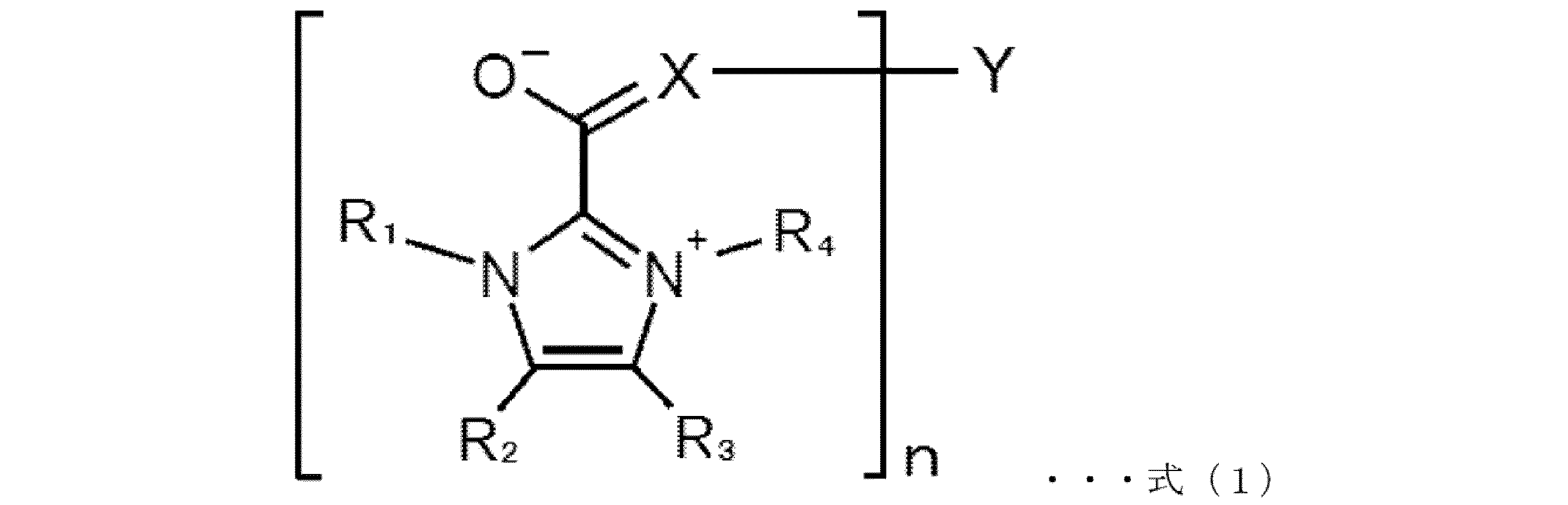
(式中、R1、R2、R3及びR4は同一でも異なっていても良く、水素原子又は炭素数1以上の有機基であり、該有機基は酸素原子、窒素原子、硫黄原子及びハロゲン原子からなる群より選択される少なくとも一種を含んでもよい。また、R1、R2、R3及びR4のうち2種以上が、これらが結合する炭素原子及び/又は窒素原子と共に、互いに結合して環を形成してもよい。Xは酸素原子又は窒素原子であり、Xが酸素原子の場合、Yは存在せず、nは1である。Xが窒素原子の場合、Yは有機基であり、nは1以上の整数である。)
で示されるイミダゾール変性物(C)を含有するカチオン電着塗料組成物であって、以下の(i)及び(ii)の一方又は両方を満たす、カチオン電着塗料組成物:
(i)該カチオン電着塗料組成物がさらに防錆剤(D)を含有する
(ii)ブロック化ポリイソシアネート化合物(B)のブロック剤(b-2)が、オキシム系化合物(b-2-1)及び/又はピラゾール系化合物(b-2-2)である。
項2.カチオン電着塗料組成物の樹脂固形分の総量を基準として、イミダゾール変性物(C)を0.01~10質量%含有する前記項1に記載のカチオン電着塗料組成物。
項3.カチオン電着塗料組成物の樹脂固形分の総量を基準として、防錆剤(D)を0.01~10質量%含有する前記項1又は2に記載のカチオン電着塗料組成物。
項4.前記項1~3のいずれか1項に記載のカチオン電着塗料組成物からなる電着塗料浴に金属被塗物を浸漬し、電着塗装する工程を含む、塗装物品の製造方法。
項5.前記項4に記載の方法であって、電着塗装により得られた塗膜を加熱硬化する工程を含む、方法。
項6.前記項5に記載の方法であって、前記加熱硬化工程の温度が130℃以下である、方法。
で示されるイミダゾール変性物(C)を含有するカチオン電着塗料組成物であって、以下の(i)及び(ii)の一方又は両方を満たす、カチオン電着塗料組成物:
(i)該カチオン電着塗料組成物がさらに防錆剤(D)を含有する
(ii)ブロック化ポリイソシアネート化合物(B)のブロック剤(b-2)が、オキシム系化合物(b-2-1)及び/又はピラゾール系化合物(b-2-2)である。
項2.カチオン電着塗料組成物の樹脂固形分の総量を基準として、イミダゾール変性物(C)を0.01~10質量%含有する前記項1に記載のカチオン電着塗料組成物。
項3.カチオン電着塗料組成物の樹脂固形分の総量を基準として、防錆剤(D)を0.01~10質量%含有する前記項1又は2に記載のカチオン電着塗料組成物。
項4.前記項1~3のいずれか1項に記載のカチオン電着塗料組成物からなる電着塗料浴に金属被塗物を浸漬し、電着塗装する工程を含む、塗装物品の製造方法。
項5.前記項4に記載の方法であって、電着塗装により得られた塗膜を加熱硬化する工程を含む、方法。
項6.前記項5に記載の方法であって、前記加熱硬化工程の温度が130℃以下である、方法。
本発明によれば、硬化性、防食性、及び仕上がり性を備えたブロック化ポリイソシアネート系の新規カチオン電着塗料組成物を提供することができる。
本発明は、アミノ基含有エポキシ樹脂(A)、ブロック化ポリイソシアネート化合物(B)、及び特定のイミダゾール変性物(C)を含有するカチオン電着塗料組成物であって、以下の(i)及び(ii)の一方又は両方を満たす、カチオン電着塗料組成物に関する:
(i)該カチオン電着塗料組成物がさらに防錆剤(D)を含有する
(ii)ブロック化ポリイソシアネート化合物(B)のブロック剤(b-2)が、オキシム系化合物(b-2-1)及び/又はピラゾール系化合物(b-2-2)である。以下、詳細に述べる。
(i)該カチオン電着塗料組成物がさらに防錆剤(D)を含有する
(ii)ブロック化ポリイソシアネート化合物(B)のブロック剤(b-2)が、オキシム系化合物(b-2-1)及び/又はピラゾール系化合物(b-2-2)である。以下、詳細に述べる。
本明細書において、アルキル基としては、例えば、直鎖状又は分枝鎖状の炭素数1~10のアルキル基が挙げられる。より具体的には、アルキル基としては、メチル基、エチル基、n-プロピル基、イソプロピル基、n-ブチル基、sec-ブチル基、イソブチル基、tert-ブチル基、1-メチルプロピル基、n-ペンチル基、イソペンチル基、tert-ペンチル基、n-ヘキシル基、1,1-ジメチルプロピル基、n-ヘプチル基、n-オクチル基、n-ノニル基、n-デシル基等が挙げられる。
本明細書において、アルケニル基としては、例えば、二重結合を少なくとも1個含む、炭素数1~10の直鎖状若しくは分枝状のアルケニル基が挙げられる。二重結合の数は、例えば1~2個、又は1個であり得る。より具体的には、アルケニル基としては、ビニル基、アリル基、1-プロペニル基、2-メチル-2-プロペニル基、イソプロペニル基、1-ブテニル基、2-ペンテニル基、3-メチル-2-ブテニル基、1-ペンテニル基、5-ヘキセニル基、3-メチル-3-ブテニル基、1-ヘプテニル基、2-オクテニル基、3-ノネニル基、1-デセニル基等が挙げられる。
本明細書において、アルキニル基としては、例えば、三重結合を少なくとも1個含む、炭素数1~10の直鎖状若しくは分枝状のアルキニル基が挙げられる。三重結合の数は、例えば1~2個、又は1個であり得る。より具体的には、アルキニル基としては、エチニル基、1-プロピニル基、2-ブチニル基、1-メチル-2-プロピニル基、1-ペンチニル基、2-ヘキシニル基、3-ヘプチニル基、2-オクチニル基、4-ノニニル基、6-デシニル基等が挙げられる。
本明細書において、シクロアルキル基としては、例えば、炭素数3~10のシクロアルキル基が挙げられる。より具体的には、シクロアルキル基としては、シクロプロピル基、シクロブチル基、シクロペンチル基、シクロヘキシル基、シクロヘプチル基、シクロオクチル基、シクロノニル基、シクロデシル基等が挙げられる。
本明細書において、シクロアルキルアルキル基としては、例えば、前述したアルキル基(直鎖状又は分枝鎖状の炭素数1~10のアルキル基等)であるアルキル部分に、前述したシクロアルキル基(炭素数3~10のシクロアルキル基等)であるシクロアルキル部分が1個結合した基であるシクロアルキルアルキルが挙げられる。より具体的には、シクロアルキルアルキル基としては、シクロプロピルメチル基、10-シクロプロピルデシル基、8-シクロブチルノニル基、3-シクロペンチルプロピル基、シクロヘキシルメチル基、シクロヘプチルメチル基、2-シクロオクチルエチル基、2-シクロノニルエチル基、シクロデシルメチル基等が挙げられる。
本明細書において、ヒドロキシアルキル基としては、例えば、ヒドロキシメチル基、1-ヒドロキシエチル基、2-ヒドロキシエチル基、1-ヒドロキシプロピル基、2-ヒドロキシプロピル基、3-ヒドロキシプロピル基、1-ヒドロキシブチル基、2-ヒドロキシブチル基、3-ヒドロキシブチル基、4-ヒドロキシブチル基等のヒドロキシ基が1個置換された炭素数1~10の直鎖又は分枝鎖状アルキル基が挙げられる。
本明細書において、アルコキシ基としては、例えば、前述したアルキル基(直鎖状又は分枝鎖状の炭素数1~10のアルキル基等)が結合したオキシ基が挙げられる。より具体的には、メトキシ基、エトキシ基、n-プロポキシ基、イソプロポキシ基、n-ブトキシ基、イソブトキシ基、tert-ブトキシ基、n-ペンチルオキシ基、n-イソペンチルオキシ基、n-ヘキシルオキシ基、n-オクチルオキシ基、n-ノニルオキシ基、n-デシルオキシ基等が挙げられる。
本明細書において、アルコキシアルキル基としては、例えば、前記のアルコキシ基(直鎖状又は分枝鎖状の炭素数1~10のアルコキシ基等)を1個又は複数個有する前記のアルキル基(直鎖状又は分枝鎖状の炭素数1~10のアルキル基等)が挙げられる。より具体的には、メトキシメチル基、エトキシメチル基、デシルオキシメチル基、n-プロポキシメチル基、n-ブトキシメチル基、2-メトキシエチル基、1-メトキシ-n-プロピル基、3-メトキシ-n-プロピル基、2-エトキシ-n-ブチル基、4-メトキシ-n-ブチル基、5-メトキシ-n-ペンチル基、6-メトキシ-n-ヘキシル基、7-メトキシ-n-ヘキシル基、8-メトキシ-n-オクチル基、9-メトキシ-n-ノニル基、10-メトキシ-n-デシル等が挙げられる。
本明細書において、チオアルコキシ基としては、例えば、前述したアルキル基(直鎖状又は分枝鎖状の炭素数1~10のアルキル基等)が結合したチオ基が挙げられる。より具体的には、チオメトキシ基、チオエトキシ基、n-チオプロポキシ基、チオイソプロポキシ基、n-チオブトキシ基、イソチオブトキシ基、tert-チオブトキシ基、n-チオペンチルオキシ基、n-イソチオペンチルオキシ基、n-チオヘキシルオキシ基、n-チオオクチルオキシ基、n-チオノニルオキシ基、n-チオデシルオキシ基等が挙げられる。
本明細書において、チオアルコキシアルキル基としては、例えば、前記のチオアルコキシ基(直鎖状又は分枝鎖状の炭素数1~10のチオアルコキシ基等)を1個又は複数個有する前記のアルキル基(直鎖状又は分枝鎖状の炭素数1~10のアルキル基等)が挙げられる。より具体的には、チオメトキシメチル基、チオエトキシメチル基、チオデシルオキシメチル基、n-チオプロポキシメチル基、n-チオブトキシメチル基、2-チオメトキシエチル基、1-チオメトキシ-n-プロピル基、3-チオメトキシ-n-プロピル基、2-チオエトキシ-n-ブチル基、4-チオメトキシ-n-ブチル基、5-チオメトキシ-n-ペンチル基、6-チオチオメトキシ-n-ヘキシル基、7-チオメトキシ-n-ヘキシル基、8-チオメトキシ-n-オクチル基、9-チオメトキシ-n-ノニル基、10-チオメトキシ-n-デシル等が挙げられる。
本明細書において、アリール基としては、例えば、炭素数6~14のアリール基が挙げられる。より具体的には、フェニル基、ナフチル基、ビフェニレニル基、アントラセニル基、フェナントリル基、フルオレニル基、テトラヒドロナフチル基等が挙げられる。
本明細書において、アラルキル基としては、例えば、前記のアリール基を1個又は2個以上有する前記のアルキル基が挙げられる。より具体的には、ベンジル基、フェネチル基、ジフェニルメチル基、トリフェニルメチル基、ナフチルメチル基、フルオレニルメチル基等が挙げられる。
本明細書において、複素環基としては、例えば、窒素原子、酸素原子及び硫黄原子からなる群より選択されるヘテロ原子を1個又は複数個(1~3個等)含む、単環式若しくは多環式の飽和又は不飽和の複素環基が挙げられる。より具体的には、モルホリノ基、ピロリジニル基、ピペリジノ基、ピペラジニル基、テトラヒドロフラニル基、テトラヒドロピラニル基、テトラヒドロチオフェニル基、チアゾリジニル基、オキサゾリジニル基、イミダゾリル基、ピロリル基、チエニル基、フリル基、オキサゾリル基、イソキサゾリル基、チアゾリル基、イソチアゾリル基、チアジアゾリル基、ピラゾリル基、トリアゾリル基、テトラゾリル基、ピリジル基、ピラジル基、ピリミジニル基、ピリダジニル基、インドリル基、イソインドリル基、インダゾリル基、トリアゾロピリジル基、ベンゾイミダゾリル基、ベンゾオキサゾリル基、ベンゾチアゾリル基、ベンゾチエニル基、ベンゾフラニル基、キノリル基、イソキノリル基、キナゾリニル基、キノキサリニル基、メチレンジオキシフェニル基、ジヒドロチアゾリル基、ベンゾチオフェニル基等が挙げられる。
本明細書において、モノ又はジ-アルキルアミノ基としては、例えば、前述したアルキル基が1個又は2個結合したアミノ基が挙げられる。より具体的には、N-メチルアミノ基、N,N-ジエチルアミノ基、N-メチル-N-エチルアミノ基、N,N-ジ-n-プロピルアミノ基、N,N-ジイソプロピル基、N,N-ジ-n-ブチルアミノ基、N-sec-ブチルアミノ基、N-イソブチルアミノ基、N-tert-ブチルアミノ基、N,N-ジ-1-メチルプロピルアミノ基、N,N-ジ-n-ペンチルアミノ基、N,N-ジ-イソペンチルアミノ基、N-tert-ペンチルアミノ基、N,N-ジ-n-ヘキシルアミノ基、N-1,1-ジメチルプロピルアミノ基、N,N-ジ-n-ヘプチルアミノ基、N,N-ジ-n-オクチルアミノ基、N,N-ジ-2-エチルヘキシルアミノ基、N,N-ジ-n-ノニルアミノ基、N,N-ジ-n-デシルアミノ基等が挙げられる。
本明細書において、モノ又はジ-アルキルカルバモイルアミノ基としては、例えば、前述したアルキル基が1個又は2個結合したカルバモイル基が1個結合したアミノ基が挙げられる。より具体的には、(N-メチルカルバモイル)アミノ基、N,N-ジエチルカルバモイルアミノ基、(N-メチル-N-エチルカルバモイル)アミノ基、N,N-ジ-n-プロピルカルバモイルアミノ基、N,N-ジイソプロピルカルバモイルアミノ基、N,N-ジ-n-ブチルカルバモイルアミノ基、(N-sec-ブチルカルバモイル)アミノ基、(N-イソブチルカルバモイル)アミノ基、(N-tert-ブチル)カルバモイルアミノ基、N,N-ジ-1-メチルプロピルカルバモイルアミノ基、N,N-ジ-n-ペンチルカルバモイルアミノ基、N,N-ジ-イソペンチルカルバモイルアミノ基、(N-tert-ペンチルカルバモイル)アミノ基、N,N-ジ-n-ヘキシルカルバモイルアミノ基、N-1,1-ジメチルプロピルカルバモイルアミノ基、N,N-ジ-n-ヘプチルカルバモイルアミノ基、N,N-ジ-n-オクチルカルバモイルアミノ基、N,N-ジ-2-エチルヘキシルカルバモイルアミノ基、N,N-ジ-n-ノニルカルバモイルアミノ基、N,N-ジ-n-デシルカルバモイルアミノ基等が挙げられる。
アミノ基含有エポキシ樹脂(A)
上記アミノ基含有エポキシ樹脂(A)としては、例えば、(1)エポキシ樹脂と第1級モノ-及びポリアミン、第2級モノ-及びポリアミン又は第1、2級混合ポリアミンとの付加物(例えば、米国特許第3,984,299号明細書参照);(2)エポキシ樹脂とケチミン化された第1級アミノ基を有する第2級モノ-及びポリアミンとの付加物(例えば、米国特許第4,017,438号 明細書参照);(3)エポキシ樹脂とケチミン化された第1級アミノ基を有するヒドロキシ化合物とのエーテル化により得られる反応物(例えば、特開昭59-43013号公報参照)等を挙げることができる。
上記アミノ基含有エポキシ樹脂(A)としては、例えば、(1)エポキシ樹脂と第1級モノ-及びポリアミン、第2級モノ-及びポリアミン又は第1、2級混合ポリアミンとの付加物(例えば、米国特許第3,984,299号明細書参照);(2)エポキシ樹脂とケチミン化された第1級アミノ基を有する第2級モノ-及びポリアミンとの付加物(例えば、米国特許第4,017,438号 明細書参照);(3)エポキシ樹脂とケチミン化された第1級アミノ基を有するヒドロキシ化合物とのエーテル化により得られる反応物(例えば、特開昭59-43013号公報参照)等を挙げることができる。
上記のアミノ基含有エポキシ樹脂(A)の製造に使用されるエポキシ樹脂は、1分子中にエポキシ基を少なくとも1個、好ましくは2個以上有する化合物であり、その分子量は、少なくとも300、好ましくは400~4,000、さらに好ましくは800~2,500の範囲内の数平均分子量及び少なくとも160、好ましくは180~2,500、さらに好ましくは400~1,500の範囲内のエポキシ当量を有するものが適している。かかるエポキシ樹脂としては、例えば、ポリフェノール化合物とエピハロヒドリン(例えば、エピクロルヒドリン等)との反応によって得られるものを使用することができる。
上記エポキシ樹脂の形成のために用いられるポリフェノール化合物としては、例えば、ビス(4-ヒドロキシフェニル)-2,2-プロパン[ビスフェノールA]、ビス(4-ヒドロキシフェニル)メタン[ビスフェノールF]、ビス(4-ヒドロキシシクロヘキシル)メタン[水添ビスフェノールF]、2,2-ビス(4-ヒドロキシシクロヘキシル)プロパン[水添ビスフェノールA]、4,4’-ジヒドロキシベンゾフェノン、ビス(4-ヒドロキシフェニル)-1,1-エタン、ビス(4-ヒドロキシフェニル)-1,1-イソブタン、ビス(4-ヒドロキシ-3-tert-ブチル-フェニル)-2,2-プロパン、ビス(2-ヒドロキシナフチル)メタン、テトラ(4-ヒドロキシフェニル)-1,1,2,2-エタン、4,4’-ジヒドロキシジフェニルスルホン、フェノールノボラック、クレゾールノボラック等を挙げることができる。
また、ポリフェノール化合物とエピハロヒドリンとの反応によって得られるエポキシ樹脂としては、中でも、ビスフェノールAから誘導される下記式の樹脂が好適である。

ここで、n=0~8で示されるものが好適である。
かかるエポキシ樹脂の市販品としては、例えば、三菱化学(株)からjER828EL、jER1002、jER1004、jER1007なる商品名で販売されているものが挙げられる。
また、上記エポキシ樹脂としては、樹脂骨格中にポリアルキレンオキシド鎖を含有しているエポキシ樹脂を使用することができる。通常、このようなエポキシ樹脂は、(α)エポキシ基を少なくとも1個、好ましくは2個以上有するエポキシ樹脂と、アルキレンオキシド又はポリアルキレンオキシドを反応せしめてポリアルキレンオキシド鎖を導入する方法、(β)上記ポリフェノール化合物と、エポキシ基を少なくとも1個、好ましくは2個以上有するポリアルキレンオキシドとを反応せしめてポリアルキレンオキシド鎖を導入する方法等により得ることができる。また、既にポリアルキレンオキシド鎖を含有しているエポキシ樹脂を用いても良い(例えば、特開平8-337750号 明細書参照)。
ポリアルキレンオキシド鎖中のアルキレン基としては、炭素数が2~8のアルキレン基が好ましく、エチレン基、プロピレン基又はブチレン基がより好ましく、プロピレン基が特に好ましい。
上記のポリアルキレンオキシド鎖の含有量は、塗料安定性、仕上り性及び防食性向上の観点から、アミノ基含有エポキシ樹脂の固形分質量を基準にして、ポリアルキレンオキシドの構成成分としての含有量で、通常1.0~15質量%、好ましくは2.0~9.5質量%、より好ましくは3.0~8.0質量%の範囲内が適当である。
上記のポリアルキレンオキシド鎖の含有量は、塗料安定性、仕上り性及び防食性向上の観点から、アミノ基含有エポキシ樹脂の固形分質量を基準にして、ポリアルキレンオキシドの構成成分としての含有量で、通常1.0~15質量%、好ましくは2.0~9.5質量%、より好ましくは3.0~8.0質量%の範囲内が適当である。
上記(1)のアミノ基含有エポキシ樹脂(A)の製造に使用される第1級モノ-及びポリアミン、第2級モノ-及びポリアミン又は第1、2級混合ポリアミンとしては、例えば、モノメチルアミン、ジメチルアミン、モノエチルアミン、ジエチルアミン、モノイソプロピルアミン、ジイソプロピルアミン、モノブチルアミン、ジブチルアミン等のモノ-もしくはジ-アルキルアミン;モノエタノールアミン、ジエタノールアミン、モノ(2-ヒドロキシプロピル)アミン、モノメチルアミノエタノール等のアルカノールアミン;エチレンジアミン、プロピレンジアミン、ブチレンジアミン、ヘキサメチレンジアミン、ジエチレントリアミン、トリエチレンテトラミン等のアルキレンポリアミン等を挙げることができる。
上記(2)のアミノ基含有エポキシ樹脂(A)の製造に使用されるケチミン化された第1級アミノ基を有する第2級モノ-及びポリアミンとしては、例えば、上記(1)のアミン付加エポキシ樹脂の製造に使用される第1、2級混合ポリアミンのうち、例えば、ジエチレントリアミン等にケトン化合物を反応させて生成させたケチミン化物を挙げることができる。
上記(3)のアミノ基含有エポキシ樹脂(A)の製造に使用されるケチミン化された第1級アミノ基を有するヒドロキシ化合物としては、例えば、上記(1)のアミノ基含有エポキシ樹脂(A)の製造に使用される第1級モノ-及びポリアミン、第2級モノ-及びポリアミン又は第1、2級混合ポリアミンのうち、第1級アミノ基とヒドロキシル基を有する化合物、例えば、モノエタノールアミン、モノ(2-ヒドロキシプロピル)アミン等にケトン化合物を反応させてなるヒドロキシル基含有ケチミン化物を挙げることができる。
このようなアミノ基含有エポキシ樹脂(A)のアミン価としては、30~80mgKOH/g樹脂固形分の範囲、さらには40~70mgKOH/g樹脂固形分の範囲とすることが、水分散性と防食性向上の点から好ましい。
またアミノ基含有エポキシ樹脂(A)は、任意選択で、変性剤により変性を図ることができる。このような変性剤は、エポキシ樹脂との反応性を有する樹脂又は化合物であれば特に限定されず、例えばポリオール、ポリエーテルポリオール、ポリエステルポリオール、ポリアミドアミン、ポリカルボン酸、脂肪酸、ポリイソシアネート化合物、ポリイソシアネート化合物を反応させた化合物、ε-カプロラクトン等のラクトン化合物、アクリルモノマー、アクリルモノマーを重合反応させた化合物、キシレンホルムアルデヒド化合物、エポキシ化合物も変性剤として用いることができる。これらの変性剤は、1種を単独で又は2種以上を併用して用いることができる。
これらのうち、変性剤としては、特につきまわり性及び/又は防食性の観点から、少なくとも1種の飽和及び/又は不飽和脂肪酸を用いることが好ましい。使用しうる脂肪酸としては、炭素数8~22の長鎖脂肪酸が好ましく、例えば、カプリル酸、カプリン酸、オクタン酸、ノナン酸、デカン酸、ラウリン酸、ミリスチン酸、ペンタデシル酸、パルミチン酸、マルガリン酸、ステアリン酸、オレイン酸、リノール酸、リノレン酸等が挙げられる。中でも、炭素数10~20の長鎖脂肪酸がより好ましく、炭素数13~18の長鎖脂肪酸がさらに好ましい。
これらのうち、変性剤としては、特につきまわり性及び/又は防食性の観点から、少なくとも1種の飽和及び/又は不飽和脂肪酸を用いることが好ましい。使用しうる脂肪酸としては、炭素数8~22の長鎖脂肪酸が好ましく、例えば、カプリル酸、カプリン酸、オクタン酸、ノナン酸、デカン酸、ラウリン酸、ミリスチン酸、ペンタデシル酸、パルミチン酸、マルガリン酸、ステアリン酸、オレイン酸、リノール酸、リノレン酸等が挙げられる。中でも、炭素数10~20の長鎖脂肪酸がより好ましく、炭素数13~18の長鎖脂肪酸がさらに好ましい。
上記のアミン化合物と変性剤のエポキシ樹脂への付加反応は、通常、適当な溶媒中で、約80~約170℃、好ましくは約90~約150℃の温度で1~6時間程度、好ましくは1~5時間程度で行なうことができる。
上記の溶媒としては、例えば、トルエン、キシレン、シクロヘキサン、n-ヘキサン等の炭化水素系;酢酸メチル、酢酸エチル、酢酸ブチル等のエステル系;アセトン、メチルエチルケトン、メチルイソブチルケトン、メチルアミルケトン等のケトン系;ジメチルホルムアミド、ジメチルアセトアミド等のアミド系;メタノール、エタノール、n-プロパノール、iso-プロパノール等のアルコール系、エチレングリコールモノブチルエーテル、ジエチレングリコールモノエチルエーテル等のエーテルアルコール系化合物;あるいはこれらの混合物等が挙げられる。
上記の変性剤の使用割合は、厳密に制限されるものではなく、塗料組成物の用途等に応じて適宜変えることができるが、仕上り性及び防食性向上の観点から、アミノ基含有エポキシ樹脂の固形分質量を基準にして、通常0~50質量%、好ましくは3~30質量%、より好ましくは6~20質量%の範囲内が適当である。
ブロック化ポリイソシアネート化合物(B)
上記ブロック化ポリイソシアネート化合物(B)とは、ポリイソシアネート化合物(b-1)とブロック剤(b-2)との付加反応生成物を示す。
また、任意選択で、ブロック剤(b-2)以外の活性水素含有化合物を用い、ブロック剤(b-2)と共にポリイソシアネート化合物(b-1)と反応することができる。
上記ブロック化ポリイソシアネート化合物(B)とは、ポリイソシアネート化合物(b-1)とブロック剤(b-2)との付加反応生成物を示す。
また、任意選択で、ブロック剤(b-2)以外の活性水素含有化合物を用い、ブロック剤(b-2)と共にポリイソシアネート化合物(b-1)と反応することができる。
上記ポリイソシアネート化合物(b-1)としては、公知のものを使用することができ、例えば、トリレンジイソシアネート、キシリレンジイソシアネート、フェニレンジイソシアネート、ジフェニルメタン-2,2’-ジイソシアネート、ジフェニルメタン-2,4’-ジイソシアネート、ジフェニルメタン-4,4’-ジイソシアネート、クルードMDI[ポリメチレンポリフェニルイソシアネート]、ビス(イソシアネートメチル)シクロヘキサン、テトラメチレンジイソシアネート、ヘキサメチレンジイソシアネート、メチレンジイソシアネート、イソホロンジイソシアネート等の芳香族、脂肪族又は脂環族ポリイソシアネート化合物;これらのポリイソシアネート化合物の環化重合体又はビゥレット体;又はこれらの組合せを挙げることができる。
一方、前記ブロック剤(b-2)は、ポリイソシアネート化合物(b-1)のイソシアネート基に付加してブロックするものであり、付加によって生成するブロック化ポリイソシアネート化合物(B)は常温において安定であるが、塗膜の焼付け温度(例えば、約80~約200℃)に加熱した際、ブロック剤が解離して遊離のイソシアネート基を再生することが望ましい。
上記ブロック剤(b-2)としては、例えば、オキシム系化合物、フェノール系化合物、アルコール系化合物、ラクタム系化合物、活性メチレン系化合物、ピラゾール系化合物、メルカプタン系化合物、酸アミド系化合物、イミド系化合物、アミン系化合物、イミダゾール系化合物、尿素系化合物、カルバミン酸エステル系化合物、イミン系化合物、亜硫酸塩系化合物等が挙げられ、これらは1種を単独で又は2種以上を組み合わせて用いることが出来る。
オキシム系化合物としては、例えば、メチルエチルケトオキシム、シクロヘキサノンオキシム等が挙げられる。フェノール系化合物としては、フェノール、パラ-t-ブチルフェノール、クレゾール等が挙げられる。アルコール系化合物としては、n-ブタノール、2-エチルヘキサノール、フェニルカルビノール、メチルフェニルカルビノール、エチレングリコールモノメチルエーテル、エチレングリコールモノエチルエーテル、エチレングリコールモノブチルエーテル、ジエチレングリコールモノエチルエーテル、エチレングリコール、プロピレングリコール、プロピレングリコールモノメチルエーテル、メトキシメタノール等が挙げられる。ラクタム系化合物としては、ε-カプロラクタム、γ-ブチロラクタム等が挙げられる。活性メチレン系化合物としては、マロン酸ジメチル、マロン酸ジエチル、マロン酸ジイソプロピル、アセト酢酸エチル、アセト酢酸イソプロピル、アセト酢酸メチル、アセト酢酸イソプロピル、アセチルアセトン等が挙げられる。ピラゾール系化合物としては、例えば、ピラゾール、3,5-ジメチルピラゾール、3-メチルピラゾール、4-ブロモ-3,5-ジメチルピラゾール、4-ニトロ-3,5-ジメチルピラゾール、4-ベンジル-3,5-ジメチルピラゾール、メチル-5-メチルピラゾール-3-カルボキシレート、3-メチル-5-フェニルピラゾール、3,5-ジメチルピラゾール-4-カルボキシアニリド等が挙げられる。メルカプタン系化合物としては、ブチルメルカプタン、t-ブチルメルカプタン、ヘキシルメルカプタン、t-ドデシルメルカプタン、2-メルカプトベンゾチアゾール、チオフェノール、メチルチオフェノール、エチルチオフェノール等が挙げられる。酸アミド系化合物としては、アセトアニリド、アセトアニシジド、アセトトルイド、アクリルアミド、メタクリルアミド、酢酸アミド、ステアリン酸アミド、ベンズアミド等が挙げられる。イミド系化合物としては、コハク酸イミド、フタル酸イミド、マレイン酸イミド等が挙げられる。アミン系化合物としては、ジフェニルアミン、フェニルナフチルアミン、キシリジン、N-フェニルキシリジン、カルバゾール、アニリン、ナフチルアミン、ブチルアミン、ジブチルアミン、ブチルフェニルアミン等が挙げられる。イミダゾール系化合物としては、イミダゾール、2-エチルイミダゾール等が挙げられる。尿素系化合物としては、尿素、チオ尿素、エチレン尿素、エチレンチオ尿素、ジフェニル尿素等が挙げられる。カルバミン酸エステル系化合物としては、N-フェニルカルバミン酸フェニル等が挙げられる。イミン系化合物としてはエチレンイミン、プロピレンイミン等が挙げられる。亜硫酸塩系化合物としては、重亜硫酸ソーダ、重亜硫酸カリ等が挙げられる。
本発明の好ましい実施形態においては、ブロック剤(b-2)としては、少なくとも1種のオキシム系化合物(b-2-1)及び/又はピラゾール系化合物(b-2-2)を用いることができる。かかる実施形態において、オキシム系化合物(b-2-1)及びピラゾール系化合物(b-2-2)としては、前述のものを使用することができ、これらは1種を単独で又は2種以上を組み合わせて用いることが出来る。かかる特定のブロック化ポリイソシアネート化合物(B)を用いる実施形態は、低温での硬化性及び貯蔵安定性の観点から好ましい。
具体的には、上記特許文献1、特許文献2等の塗膜形成時の加熱温度は、通常、160℃より高い温度で行なっているが、エネルギーコスト削減のために、低温(20~130℃、好ましくは50~120℃、より好ましくは80~110℃)で行なうことが求められてきており、更なる触媒の性能向上が必須である。
上記低温焼付けを行なうためには、低温硬化性のブロック化ポリイソシアネート化合物を硬化剤に用いることが一般的であり、例えば、特許文献3には、オキシムでブロックされたイソシアネートを含むカチオン電着塗料を用いて低温硬化することが開示されている。また、特許文献4には、ブロック化ポリイソシアネート化合物を比較的低温で解離(反応)させるためにオキシム系及びラクタム系でブロックされたブロック化ポリイソシアネート化合物を用いることが記載されている。
しかし、低温での反応性を高めた電着塗料組成物では、長期の貯蔵安定性(浴安定性)が不十分となり、その結果、塗膜の仕上がり性、防食性等が劣る場合があった。これに対し、本発明の上記好ましい実施形態においては、特定のブロック化ポリイソシアネート化合物(B)を用いることにより、低温での硬化性及び貯蔵安定性を両立できることから好ましい。
しかし、低温での反応性を高めた電着塗料組成物では、長期の貯蔵安定性(浴安定性)が不十分となり、その結果、塗膜の仕上がり性、防食性等が劣る場合があった。これに対し、本発明の上記好ましい実施形態においては、特定のブロック化ポリイソシアネート化合物(B)を用いることにより、低温での硬化性及び貯蔵安定性を両立できることから好ましい。
本実施形態において、オキシム系化合物(b-2-1)及びピラゾール系化合物(b-2-2)のなかでも、貯蔵安定性の観点からオキシム系化合物(b-2-1)を用いることが好ましい。また、かかる実施形態において、任意選択で、化合物(b-2-1)及びピラゾール系化合物(b-2-2)以外のブロック剤を併用して用いることができる。併用できる別のブロック剤としては、例えば、前述したものが挙げられる。ブロック剤(b-2)としてオキシム系化合物(b-2-1)を用いる場合、その配合割合は限定されず、例えば、オキシム系化合物(b-2-1)自体を単独でブロック剤(b-2)として用いることもでき、またブロック剤(b-2)の固形分100質量%に対し、オキシム系化合物(b-2-1)の固形分を30質量%以上とすることが好ましく、50質量%以上とすることがより好ましい。また、ブロック剤(b-2)の固形分100質量%に対し、オキシム系化合物(b-2-1)の固形分を100質量%以下とすることが好ましい。
ブロック剤(b-2)としてピラゾール系化合物(b-2-2)を用いる場合、その配合割合は限定されず、例えば、ピラゾール系化合物(b-2-2)自体を単独でブロック剤(b-2)として用いることもでき、またブロック剤(b-2)の固形分100質量%に対し、ピラゾール系化合物(b-2-2)の固形分を30質量%以上とすることが好ましく、50質量%以上とすることがより好ましい。また、ブロック剤(b-2)の固形分100質量%に対し、ピラゾール系化合物(b-2-2)の固形分を100質量%以下とすることが好ましい。
オキシム系化合物(b-2-1)及びピラゾール系化合物(b-2-2)を共に用いる場合、その配合割合は限定されず、オキシム系化合物(b-2-1)の固形分100質量部に対し、ピラゾール系化合物(b-2-2)の固形分を0.1~99.9質量部とすることが好ましい。
ブロック剤(b-2)としてピラゾール系化合物(b-2-2)を用いる場合、その配合割合は限定されず、例えば、ピラゾール系化合物(b-2-2)自体を単独でブロック剤(b-2)として用いることもでき、またブロック剤(b-2)の固形分100質量%に対し、ピラゾール系化合物(b-2-2)の固形分を30質量%以上とすることが好ましく、50質量%以上とすることがより好ましい。また、ブロック剤(b-2)の固形分100質量%に対し、ピラゾール系化合物(b-2-2)の固形分を100質量%以下とすることが好ましい。
オキシム系化合物(b-2-1)及びピラゾール系化合物(b-2-2)を共に用いる場合、その配合割合は限定されず、オキシム系化合物(b-2-1)の固形分100質量部に対し、ピラゾール系化合物(b-2-2)の固形分を0.1~99.9質量部とすることが好ましい。
イミダゾール変性物(C)
上記イミダゾール変性物(C)は、下記式(1)で示される化合物である。
上記イミダゾール変性物(C)は、下記式(1)で示される化合物である。
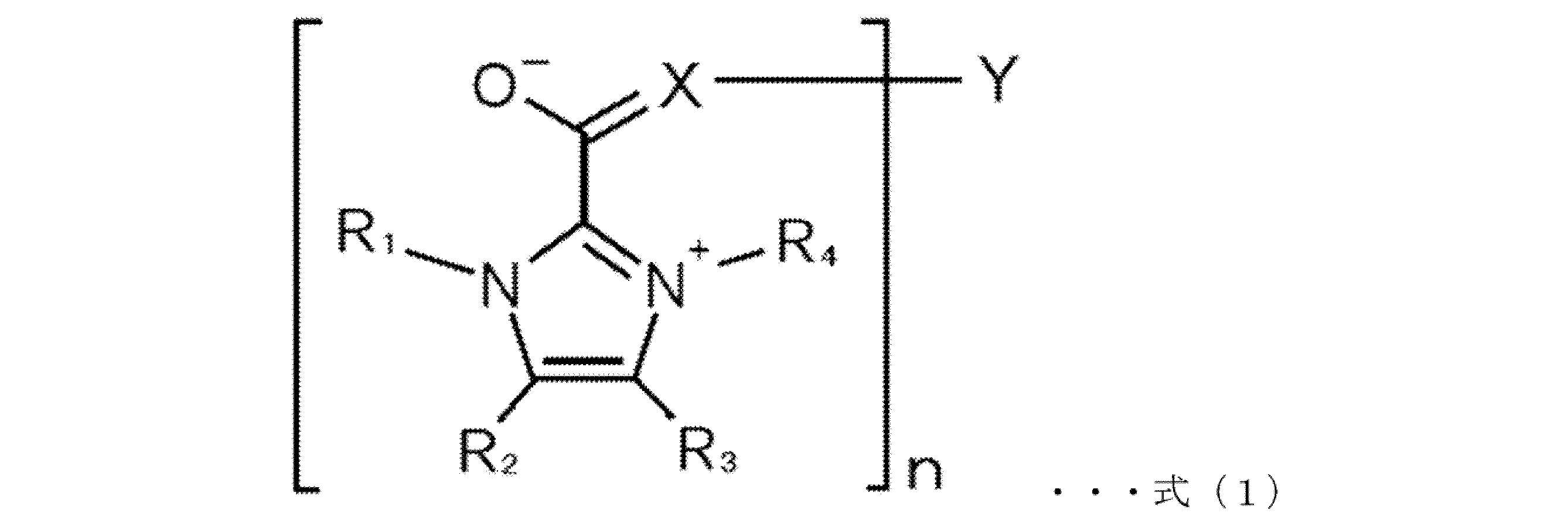
(式中、R1、R2、R3及びR4は同一でも異なっていても良く、水素原子又は炭素数1以上の有機基であり、該有機基は酸素原子、窒素原子、硫黄原子及びハロゲン原子からなる群より選択される少なくとも一種を含んでもよい。また、R1、R2、R3及びR4のうち(典型的には、隣り合う)2種以上が、これらが結合する炭素原子及び/又は窒素原子と共に、互いに結合して環を形成してもよい。Xは酸素原子又は窒素原子であり、Xが酸素原子の場合、Yは存在せず、nは1である。Xが窒素原子の場合、Yは有機基であり、nは1以上の整数である。)
R1、R2、R3及び/又はR4が有機基である場合、当該有機基としては、例えば、アルキル基、アルケニル基、アルキニル基、シクロアルキル基、シクロアルキルアルキル基、ヒドロキシアルキル基、アルコキシ基、チオアルコキシ基、アルコキシアルキル基、チオアルコキシアルキル基、アリール基、アリールアルキル基、アラルキル基、複素環基等の一価の有機基を挙げることができる。
R1、R2、R3及び/又はR4が有機基である場合、当該有機基としては、例えば、アルキル基、アルケニル基、アルキニル基、シクロアルキル基、シクロアルキルアルキル基、ヒドロキシアルキル基、アルコキシ基、チオアルコキシ基、アルコキシアルキル基、チオアルコキシアルキル基、アリール基、アリールアルキル基、アラルキル基、複素環基等の一価の有機基を挙げることができる。
Xは窒素原子であることが好ましく、Xが窒素原子である場合、Yで示される有機基としては、アリール基、アラルキル基等が挙げられる。当該アリール基としては、前述したものが挙げられるが、フェニル基、ナフチル基等が好ましく、フェニル基がより好ましい。当該アラルキル基としては、前述したものが挙げられるが、フェニルアルキル基、ナフチルアルキル基等が好ましく、フェニルアルキル基がより好ましい。Yで示されるアリール基又はアラルキル基は、置換基を有していても、無置換でもよい。Yで示されるアリール基又はアラルキル基が置換基を有する場合、置換基としては、例えば、ハロゲン(好ましくは、塩素又はフッ素、より好ましくは塩素)、アルキル基等が挙げられる。アリール基又はアラルキル基が置換基を有する場合、置換基の数は限定されないが、例えば、1~3個、好ましくは1~2個である。Yで示されるアリール基又はアラルキル基が2個以上の置換基を有する場合、置換基は、同一であっても異なっていてもよい。
Yとしては、例えば、芳香族環を1個又は2個以上有する炭化水素基等が挙げられ、例えば、下記式(2)で表される2価の基が挙げられる。
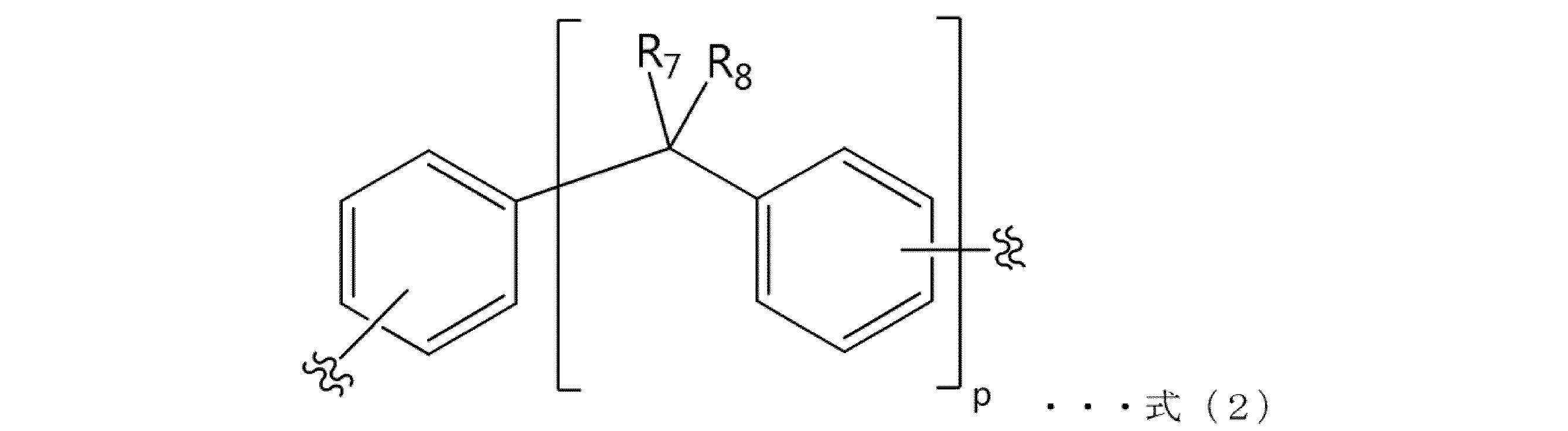
[式中、R7及びR8は同一又は異なって、水素又はアルキル基を示す。pは0以上の整数を示す。]
R7及び/又はR8がアルキル基である場合、例えば、炭素数1~10、好ましくは炭素数1~6、より好ましくは炭素数1~3、より好ましくは炭素数1~2、より好ましくは炭素数1のアルキル基が挙げられる。R7及びR8は同一又は異なってもよいが、同一であることが好ましい。
R7及び/又はR8がアルキル基である場合、例えば、炭素数1~10、好ましくは炭素数1~6、より好ましくは炭素数1~3、より好ましくは炭素数1~2、より好ましくは炭素数1のアルキル基が挙げられる。R7及びR8は同一又は異なってもよいが、同一であることが好ましい。
pは0以上の整数であり、好ましくは1~4である。pが2以上の場合、複数の基

[式中、R7及びR8は前記の通り。]
は、同一でも異なっていてもよい。また、式(2)における上記部分は、パラ位置で窒素と結合すること、従って、下記構造を示すことが好ましい。
は、同一でも異なっていてもよい。また、式(2)における上記部分は、パラ位置で窒素と結合すること、従って、下記構造を示すことが好ましい。

[式中、R7及びR8は前記の通り。]
また、式(2)における
また、式(2)における

の部分もパラ位置で窒素と結合すること、従って、下記構造を示すことが好ましい。

また、Yとしては、例えば、下記式(3)で表される基が挙げられる。
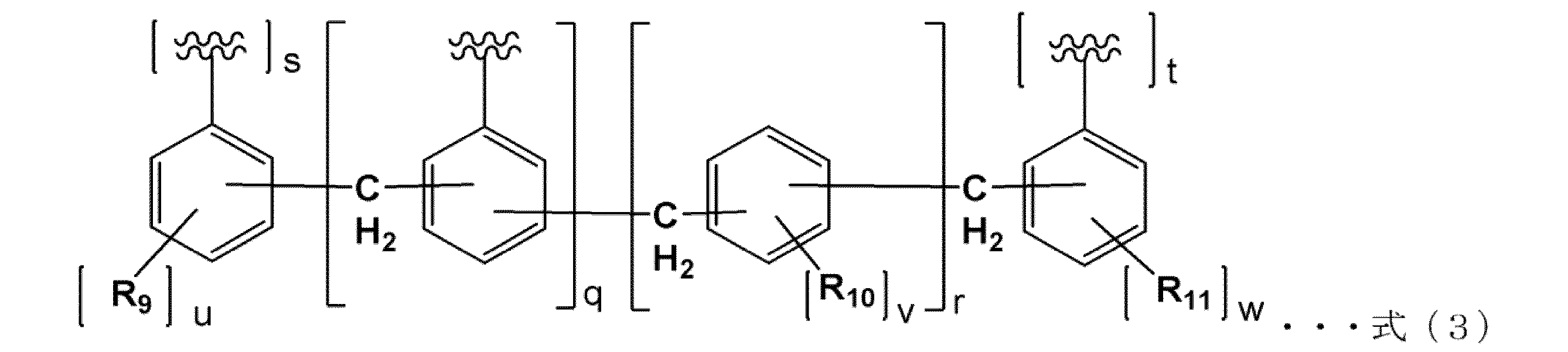
[式中、R9、R10、及びR11は同一又は異なって、炭素数1以上の有機基であり、該有機基は酸素原子、窒素原子、硫黄原子及びハロゲン原子からなる群より選択される少なくとも一種を含んでもよい。s及びtは、0又は1であり、s及び/又はtが0の場合、

部分は、水素原子を示す。q、r、u、v及びwは、それぞれ独立して0~4の整数を示す。また、qが0の場合、s又はtの少なくともいずれか1つは1である。]。
当該実施形態において、上記式(3)で表される基は、3価以上の基であること、すなわち、上記式(3)において、s、t及びqの合計が3以上であることが好ましい。
本実施形態において、R9、R10、及びR11で示される有機基としては、アルキル基、アルケニル基、アルキニル基、シクロアルキル基、シクロアルキルアルキル基、モノ又はジ-アルキルアミノ基(好ましくは、ジアルキルアミノ基)、モノ又はジ-アルキルカルバモイルアミノ基(好ましくは、ジアルキルカルバモイルアミノ基)等が挙げられる。
また、本発明の別の実施形態においては、R1、R2、R3、R4及びYのうち2種以上(典型的にはR1、R2、R3、及びR4のうち隣り合う2つ)が、これらが結合する炭素原子及び/又は窒素原子と共に、互いに結合して環を形成してもよい。
例えば、R2及びR3が、これらが結合する炭素原子と共に、互いに結合して環を形成する場合、下記式(4)のような構造を取りうる。
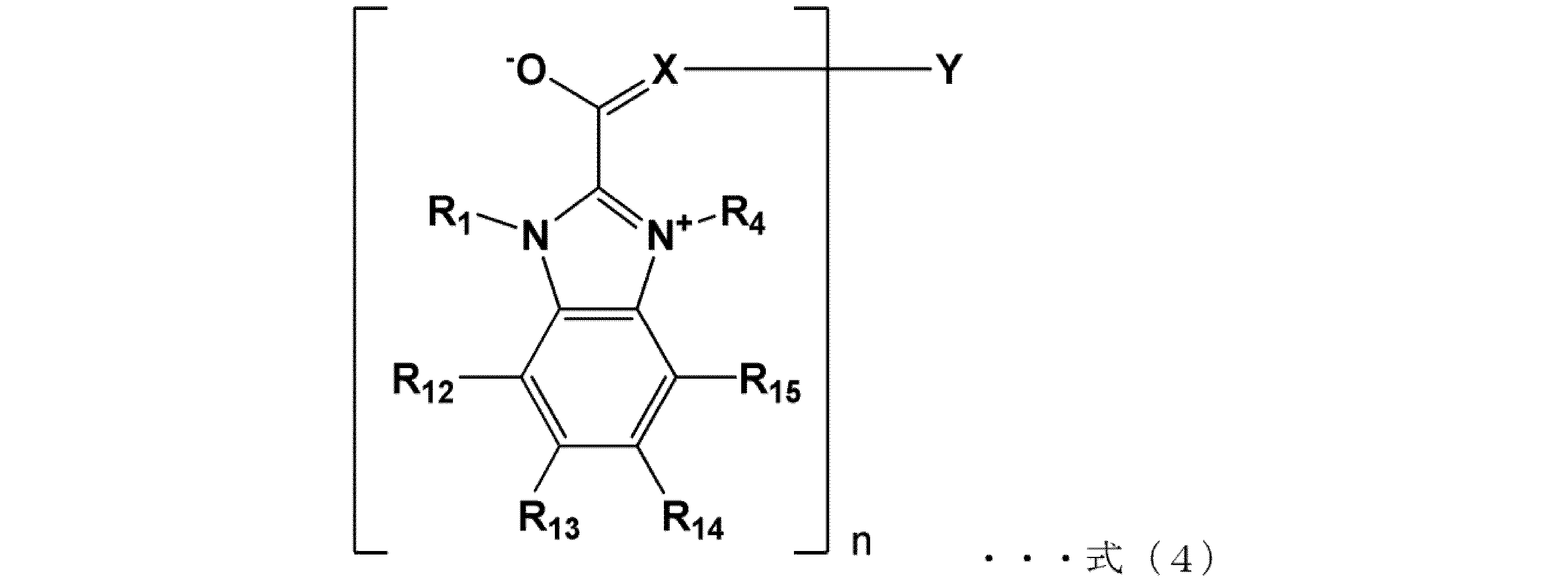
[式中、R1、R4及びYは前記の通り。R12、R13、R14及びR15は同一又は異なって、水素原子又は炭素数1以上の有機基であり、該有機基は酸素原子、窒素原子、硫黄原子及びハロゲン原子からなる群より選択される少なくとも一種を含んでもよい。]。
当該実施形態において、R12、R13、R14及び/又はR15が有機基である場合、当該有機基としては、例えば、アルキル基、アルケニル基、アルキニル基、シクロアルキル基、シクロアルキルアルキル基、ヒドロキシアルキル基、アルコキシ基、チオアルコキシ基、アルコキシアルキル基、チオアルコキシアルキル基、アリール基、アリールアルキル基、アラルキル基、複素環基等の一価の有機基を挙げることができる。
また、R1、R2、R3、R4、R12、R13、R14、R15及びYが有機基である場合、当該有機基は、樹脂であってもよい。かかる樹脂としては、アクリル樹脂、ポリエステル樹脂、ウレタン樹脂、エポキシ樹脂、ポリイソシアネート樹脂等が挙げられる。かかる実施形態において、R1、R2、R3、R4及びYにより示される樹脂の分子量は特に限定されないが、好ましくは、300以上、より好ましくは500以上、さらに好ましくは800以上である。
イミダゾール変性物(C)は、水溶性の低いもの、典型的には、水に溶解しないものを用いるのが好ましい。そのため、式(1)において、R1、R2、R3、R4、及びYから選ばれる少なくとも1種が、炭素数6以上の有機基であることが好ましく、炭素数8以上の有機基であることがより好ましく、炭素数21以上の有機基であることが更に好ましい。
一つの実施形態では、Yが炭素数21以上の有機基である。
別の実施形態では、R1又はR4が炭素数6~18(好ましくは6~12)の有機基であり、有機基はアルキル基、アルケニル基、アルキニル基、シクロアルキル基、シクロアルキルアルキル基、ヒドロキシアルキル基、アルコキシ基、チオアルコキシ基、アルコキシアルキル基、チオアルコキシアルキル基、アリール基、アリールアルキル基、アラルキル基、又は複素環基である。
別の実施形態では、R1及びR4の一方が炭素数1~5の有機基であり、R1及びR4の他方が炭素数6~18(好ましくは6~12)の有機基であり、R1の有機基及びR4の有機基は独立して、アルキル基、アルケニル基、アルキニル基、シクロアルキル基、シクロアルキルアルキル基、ヒドロキシアルキル基、アルコキシ基、チオアルコキシ基、アルコキシアルキル基、チオアルコキシアルキル基、アリール基、アリールアルキル基、アラルキル基、又は複素環基である。
別の実施形態では、R1及びR4の一方が炭素数1~5の有機基であり、R1及びR4の他方が炭素数6~18(好ましくは6~12)の有機基であり、R1の有機基及びR4の有機基は独立して、アルキル基、アルケニル基、アルキニル基、ヒドロキシアルキル基、アルコキシ基、チオアルコキシ基、アルコキシアルキル基、チオアルコキシアルキル基、アリール基、アリールアルキル基、アラルキル基、又は複素環基であり、R2及びR3は水素である。
別の実施形態では、R1及びR4が炭素数6~18(好ましくは6~12)の有機基であり、R1の有機基及びR4の有機基は独立して、アルキル基、アルケニル基、アルキニル基、シクロアルキル基、シクロアルキルアルキル基、ヒドロキシアルキル基、アルコキシ基、チオアルコキシ基、アルコキシアルキル基、チオアルコキシアルキル基、アリール基、アリールアルキル基、アラルキル基、又は複素環基である。
別の実施形態では、R1及びR4が炭素数6~18(好ましくは6~12)の有機基であり、R1の有機基及びR4の有機基は独立して、アルキル基、アルケニル基、アルキニル基、ヒドロキシアルキル基、アルコキシ基、チオアルコキシ基、アルコキシアルキル基、チオアルコキシアルキル基、アリール基、アリールアルキル基、アラルキル基、又は複素環基であり、R2及びR3は水素である。
また、イミダゾール変性物(C)は、電荷を均衡にさせるため、同一分子内で対イオンを有することが好ましい。
イミダゾール変性物(C)の製造方法としては、例えば、以下の方法を採りうる。
式(1)中、Xが酸素原子である場合のイミダゾール変性物(C)(以下、イミダゾール変性物(C1)という)の製造方法:
下記式(5)
下記式(5)

[式中、R1、R2及びR3は前記の通り。]
で表される含窒素有機化合物(以下、含窒素有機化合物(5)という。)と下記式(6)
で表される含窒素有機化合物(以下、含窒素有機化合物(5)という。)と下記式(6)

[式中、R4は前記の通り。]
で表される炭酸ジアルキル(6)(以下、炭酸ジアルキル(6)という。)とを反応させて、式(7)
で表される炭酸ジアルキル(6)(以下、炭酸ジアルキル(6)という。)とを反応させて、式(7)

[式中、R1、R2、R3、及びR4は前記の通り。]
で表されるイミダゾール変性物(C1)を製造することができる。
で表されるイミダゾール変性物(C1)を製造することができる。
含窒素有機化合物(5)として、好ましくは、1-メチルイミダゾール、1-ブチルイミダゾール、1-オクチルイミダゾール等が挙げられる。
炭酸ジアルキル(6)として好ましくは、炭酸ジメチル等が挙げられる。炭酸ジアルキル(6)の使用量は、含窒素有機化合物(5)1モルに対して通常1モル以上、好ましくは1~6モルである。
溶媒は使用してもしなくてもよい。溶媒を使用する場合、使用する溶媒は反応に影響を与えないものであれば特に制限されない。溶媒の具体例としては、メタノール、エタノール、プロパノール、ブタノール、ペンタノール、ヘキサノール、1-メトキシ-2-プロパノール、エトキシエタノール等の1価のアルコール溶媒、エチレングリコール、プロピレングリコール、ジエチレングリコール等のポリオール溶媒、ジプロピレングリコールモノn-ブチルエーテル、ジプロピレングリコールモノメチルエーテル、トリプロピレングリコールモノメチルエーテル、プロピレングリコールモノn-プロピルエーテル、ジプロピレングリコールモノn-プロピルエーテル、プロピレングリコールモノn-ブチルエーテル、トリプロピレングリコールモノn-ブチルエーテル、プロピレングリコールモノメチルエーテル、ジエチレングリコールモノエチルエーテル等のグリコールモノアルキルエーテル溶媒等が挙げられ、好ましくは1価のアルコール溶媒であり、特に好ましくはメタノールである。溶媒の使用量は、含窒素有機化合物(5)1質量部に対して、通常50質量部以下、好ましくは10質量部以下である。
反応終了後は、反応液を濃縮し、溶媒を除去してイミダゾール変性物(C1)を単離できる。反応液中に未反応の含窒素有機化合物(5)及び炭酸ジアルキル(6)が残存している場合、反応液を濃縮することでこれらを除去することもできる。
式(1)中、Xが窒素原子である場合のイミダゾール変性物(C)(以下、イミダゾール変性物(C2)という)の製造方法:
下記式(8)
下記式(8)

[式中、Y及びnは式(1)に関して前述した通り。]
で表されるイソシアネート化合物(以下、イソシアネート化合物(8)という。)と前記イミダゾール変性物(C1)とを反応させて、式(9)
で表されるイソシアネート化合物(以下、イソシアネート化合物(8)という。)と前記イミダゾール変性物(C1)とを反応させて、式(9)

[式中、R1、R2、R3、R4、Y及びnは式(1)に関して前述した通り。]
で表されるイミダゾール変性物(C2)を製造することができる。
で表されるイミダゾール変性物(C2)を製造することができる。
本発明の1つの実施形態において、イミダゾール変性物(C2)のうち一部の化合物については、下記式(8’)

[式中、Zは2価の有機基であり、mは1以上の整数である。nは式(1)に関して前述した通り。Zの有機基はそれ自体既知のものを特に制限なく用いることができ、具体的には、例えば、直鎖状、分岐状、及び/又は環状のアルキレン基等が挙げられる。]
で表されるイソシアネート化合物(以下、イソシアネート化合物(8’)という。)と前記イミダゾール変性物(C1)とを反応させる方法であって、当該反応の前、後及び/又はこれと同時に、さらに、イソシアネート基と反応するイミダゾール変性物(C1)以外の化合物(C3)(以下、化合物(C3)と示す)とを反応させて、下記式(9’)
で表されるイソシアネート化合物(以下、イソシアネート化合物(8’)という。)と前記イミダゾール変性物(C1)とを反応させる方法であって、当該反応の前、後及び/又はこれと同時に、さらに、イソシアネート基と反応するイミダゾール変性物(C1)以外の化合物(C3)(以下、化合物(C3)と示す)とを反応させて、下記式(9’)
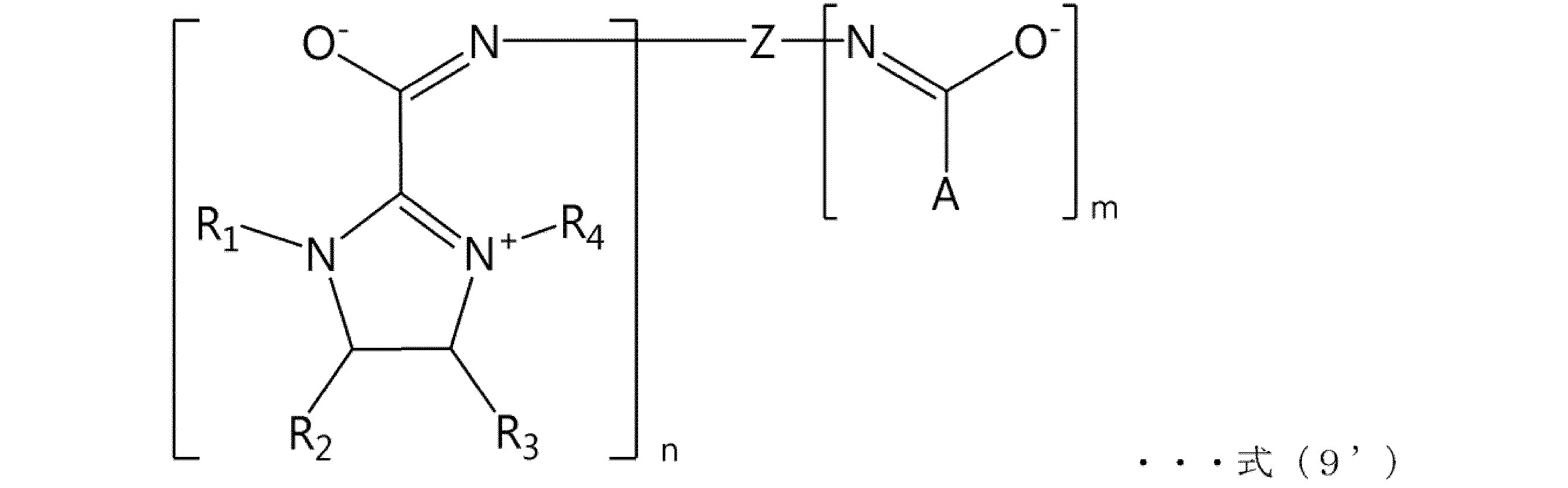
[式中、R1、R2、R3、R4、Z、m及びnは前記の通り。Aは、化合物(C3)に由来する有機基を示す。mが2以上の場合、Aは同一でも異なっていてもよい]
で表されるイミダゾール化合物(C2’)を得る方法によっても製造することができる。
で表されるイミダゾール化合物(C2’)を得る方法によっても製造することができる。
上記イソシアネート化合物(8)及びイソシアネート化合物(8’)は、1分子中に1個以上のイソシアネート基を有する化合物である。
1分子中に1個のイソシアネート基を有するイソシアネート化合物としては、例えば、メチルイソシアネート、エチルイソシアネート、プロピルイソシアネート、ブチルイソシアネート、ラウリルイソシアネート、シクロヘキシルイソシアネート、フェニルイソシアネート、トリレンイソシアネート、及びこれらのイソシアネート化合物の誘導体等を挙げることができる。
1分子中に2個以上のイソシアネート基を有する化合物としては、例えば、脂肪族ポリイソシアネート、脂環族ポリイソシアネート、芳香脂肪族ポリイソシアネート、芳香族ポリイソシアネート、及びこれらポリイソシアネートの誘導体等を挙げることができる。
脂肪族ポリイソシアネートとしては、例えば、トリメチレンジイソシアネート、テトラメチレンジイソシアネート、ヘキサメチレンジイソシアネート(HDI)、1,2-、2,3-又は1,3-ブチレンジイソシアネート、2,4,4-又は2,2,4-トリメチルヘキサメチレンジイソシアネート等を挙げることができる。
脂環族ポリイソシアネートとしては、例えば、1,3-シクロペンテンジイソシアネート、1,4-シクロヘキサンジイソシアネート、1,3-シクロヘキサンジイソシアネート、3-イソシアナトメチル-3,5,5-トリメチルシクロヘキシルイソシアネート(イソホロンジイソシアネート;IPDI)、4,4′-、2,4′-又は2,2′-ジシクロヘキシルメタンジイソシアネートもしくはその混合物(水添MDI)、メチル-2,4-シクロヘキサンジイソシアネート、メチル-2,6-シクロヘキサンジイソシアネート、1,3-又は1,4-ビス(イソシアナトメチル)シクロヘキサンもしくはその混合物(水添XDI)、ノルボルナンジイソシアネート(NBDI)等を挙げることができる。
芳香族ポリイソシアネートとしては、例えば、m-又はp-フェニレンジイソシアネートもしくはその混合物、2,4-又は2,6-トリレンジイソシアネートもしくはその混合物(TDI)、4,4′-、2,4′-又は2,2′-ジフェニルメタンジイソシアネートもしくはその混合物(MDI)、4,4′-トルイジンジイソシアネート(TODI)、4,4′-ジフェニルエーテルジイソシアネート、4,4′-ジフェニルジイソシアネート、1,5-ナフタレンジイソシアネート(NDI)等の芳香族ジイソシアネート等を挙げることができる。
また、ポリイソシアネートの誘導体としては、例えば、上記ポリイソシアネート化合物のダイマー、トリマー、ビウレット、アロファネート、カルボジイミド、ウレトジオン、ウレトイミン、イソシアヌレート、オキサジアジントリオン、ポリメチレンポリフェニルポリイソシアネート(クルードMDI、ポリメリックMDI)及びクルードTDI等を挙げることができる。
なかでも、1分子中に1個のイソシアネート基を有するイソシアネート化合物としては、フェニルイソシアネートが好ましい。1分子中に2個以上のイソシアネート基を有するイソシアネート化合物としては、芳香族ポリイソシアネートが好ましく、MDI又はクルードMDIがより好ましい。
これらのイソシアネート化合物(8)としては、1種を単独で又は2種以上を併用して用いることができる。
これらのイソシアネート化合物(8)としては、1種を単独で又は2種以上を併用して用いることができる。
上記式中、Aで示される有機基としては、モノ又はジ-アルキルアミノ基等が挙げられる。
イミダゾール変性物(C1)の使用量は、イソシアネート化合物(8)に含まれるイソシアネート基1モルに対して、通常0.8モル以上、好ましくは1~3モルである。
溶媒を使用してもしなくてもよい。溶媒を使用する場合、炭化水素溶媒が好適に使用される。炭化水素溶媒としては、例えば、トルエン、ベンゼン、キシレン等の芳香族炭化水素溶媒、メチルシクロヘキサン、シクロヘキサン、n-ヘキサン、n-ヘプタン、オクタン等の脂肪族ないし脂環式炭化水素溶媒、ジクロロメタン、クロロホルム等のハロゲン化脂肪族炭化水素溶媒、クロロベンゼン、ジクロロベンゼン等ハロゲン化芳香族炭化水素溶媒等が挙げられ、好ましくは芳香族炭化水素溶媒及びハロゲン化芳香族炭化水素溶媒であり、特に好ましくはトルエン、キシレン及びクロロベンゼンである。溶媒は任意選択で2種以上を混合して使用することもできる。
イミダゾール変性物(C1)として、含窒素有機化合物(5)と炭酸ジアルキル(6)との反応で得られた反応液を使用する場合、当該反応液中の溶媒をそのままイソシアネート化合物(8)とイミダゾール変性物(C1)との反応の溶媒として使用することができる。その際、任意選択で溶媒を追加して反応を行っても良い。
溶媒を使用する場合、使用される溶媒の使用量は、イミダゾール変性物(C1)1質量部に対して、通常50質量部以下、好ましくは0.1質量部以上35質量部以下である。
反応温度は、特に制限されないが、溶媒の沸点以下であればよく、通常10℃以上、好ましくは40~200℃、特に好ましくは80~150℃である。
任意選択で、窒素、アルゴン、ヘリウム等の反応に影響を与えない不活性ガス雰囲気下で反応させてもよい。
反応終了後は、反応液を濃縮又はろ過により溶媒を除去することにより、イミダゾール変性物(C2)を得ることができる。また、得られたイミダゾール変性物(C2)は、再結晶等の方法により精製することができる。
防錆剤(D)
好ましい実施形態において、本発明のカチオン電着塗料は、、防錆剤(D)を用いることができる。防錆剤(D)を用いる本発明の実施形態は、実質的に錫系触媒以外の触媒を用い、硬化性が高く、かつ得られる塗膜の防食性及び仕上がり性も高い、ブロック化ポリイソシアネート系の新規カチオン電着塗料組成物を提供することができるため、好ましい。
上記防錆剤(D)としては、Be、Mg、Ca、Sr、Ba、Zn、Al、Biからなる群より選ばれる少なくとも一種の金属化合物が挙げられ、具体的には、Ba系としては、リン酸バリウム、亜リン酸バリウムが挙げられる。Mg系としては、亜リン酸マグネシウム、リン酸マグネシウム、リン酸亜鉛マグネシウムが挙げられる。Ca系としては、リン酸亜鉛カルシウム、リン酸カルシウム、亜リン酸カルシウム等が挙げられ、MC-400WR、MC-400WZ(以上、キクチカラー社製、商品名、モリブデン酸カルシウム)、NP-1020C(東邦顔料、商品名、亜リン酸カルシウム)がある。Sr系としては、リン酸ストロンチウム、亜リン酸ストロンチウムが挙げられる。Zn系としては、亜リン酸亜鉛、リン酸亜鉛、酸化亜鉛が挙げられ、YM102NS(太平化学社製、商品名、亜リン酸亜鉛ストロンチウム)、P-W-2(キクチカラー社製、商品名、リン酸亜鉛)、ZP600(キクチカラー社製、商品名、亜リン酸亜鉛)等がある。Al系としては、亜リン酸アルミニウム、リン酸アルミニウム、トリポリリン酸アルミニウム、リンモリブデン酸アルミニウムが挙げられ、PM-303W(キクチカラー社製、商品名、リンモリブデン酸アルミニウム)、K-G105W、K-140W、K-84(以上、テイカ社製、商品名、トリポリリン酸アルミニウム)等がある。Bi系としては、無機系ビスマス含有化合物及び有機系ビスマス含有化合物が使用できる。無機系としては、ケイ酸ビスマス、水酸化ビスマス、三酸化ビスマス、硝酸ビスマス、オキシ炭酸ビスマス等があげられる。このうち水酸化ビスマスが特に好適である。有機系としては、例えば、乳酸ビスマス、トリフェニルビスマス、没食子酸ビスマス、安息香酸ビスマス、クエン酸ビスマス、メトキシ酢酸ビスマス、酢酸ビスマス、ぎ酸ビスマス、2,2-ジメチロ-ルプロピオン酸ビスマス等が挙げられる。
また、防錆剤(D)としては、上記に挙げた金属の複合金属化合物(2種類以上の金属を含む化合物)も好適に用いることができる。
好ましい実施形態において、本発明のカチオン電着塗料は、、防錆剤(D)を用いることができる。防錆剤(D)を用いる本発明の実施形態は、実質的に錫系触媒以外の触媒を用い、硬化性が高く、かつ得られる塗膜の防食性及び仕上がり性も高い、ブロック化ポリイソシアネート系の新規カチオン電着塗料組成物を提供することができるため、好ましい。
上記防錆剤(D)としては、Be、Mg、Ca、Sr、Ba、Zn、Al、Biからなる群より選ばれる少なくとも一種の金属化合物が挙げられ、具体的には、Ba系としては、リン酸バリウム、亜リン酸バリウムが挙げられる。Mg系としては、亜リン酸マグネシウム、リン酸マグネシウム、リン酸亜鉛マグネシウムが挙げられる。Ca系としては、リン酸亜鉛カルシウム、リン酸カルシウム、亜リン酸カルシウム等が挙げられ、MC-400WR、MC-400WZ(以上、キクチカラー社製、商品名、モリブデン酸カルシウム)、NP-1020C(東邦顔料、商品名、亜リン酸カルシウム)がある。Sr系としては、リン酸ストロンチウム、亜リン酸ストロンチウムが挙げられる。Zn系としては、亜リン酸亜鉛、リン酸亜鉛、酸化亜鉛が挙げられ、YM102NS(太平化学社製、商品名、亜リン酸亜鉛ストロンチウム)、P-W-2(キクチカラー社製、商品名、リン酸亜鉛)、ZP600(キクチカラー社製、商品名、亜リン酸亜鉛)等がある。Al系としては、亜リン酸アルミニウム、リン酸アルミニウム、トリポリリン酸アルミニウム、リンモリブデン酸アルミニウムが挙げられ、PM-303W(キクチカラー社製、商品名、リンモリブデン酸アルミニウム)、K-G105W、K-140W、K-84(以上、テイカ社製、商品名、トリポリリン酸アルミニウム)等がある。Bi系としては、無機系ビスマス含有化合物及び有機系ビスマス含有化合物が使用できる。無機系としては、ケイ酸ビスマス、水酸化ビスマス、三酸化ビスマス、硝酸ビスマス、オキシ炭酸ビスマス等があげられる。このうち水酸化ビスマスが特に好適である。有機系としては、例えば、乳酸ビスマス、トリフェニルビスマス、没食子酸ビスマス、安息香酸ビスマス、クエン酸ビスマス、メトキシ酢酸ビスマス、酢酸ビスマス、ぎ酸ビスマス、2,2-ジメチロ-ルプロピオン酸ビスマス等が挙げられる。
また、防錆剤(D)としては、上記に挙げた金属の複合金属化合物(2種類以上の金属を含む化合物)も好適に用いることができる。
これらの金属化合物は1種を単独で又は2種以上を併用して用いることができ、なかでも、防食性と硬化性の観点からビスマス化合物を用いることが好ましい。
カチオン電着塗料組成物について
本発明のカチオン電着塗料組成物におけるアミノ基含有エポキシ樹脂(A)、及びブロック化ポリイソシアネート化合物(B)の配合割合としては、上記成分(A)及び(B)の樹脂固形分合計質量100部を基準にして、成分(A)の固形分を50~90質量部、好ましくは55~85質量部、成分(B)の固形分を10~50質量部、好ましくは15~45質量部の範囲内であることが、塗料安定性が良好で、仕上がり性、防食性に優れた塗装物品を得る為にも好ましい。また、イミダゾール変性物(C)の配合割合としては、例えば、カチオン電着塗料組成物の樹脂固形分の総量を基準として、0.01~10質量%が好ましく、0.1~8質量%がより好ましく、0.5~6質量%がさらに好ましい。また、防錆剤(D)の配合割合としては、例えば、カチオン電着塗料組成物の樹脂固形分の総量を基準として、0.01~10質量%が好ましく、0.1~8質量%がより好ましく、0.5~6質量%がさらに好ましい。
イミダゾール変性物(C)と防錆剤(D)の合計量としては、カチオン電着塗料組成物の樹脂固形分の総量を基準として、0.02~15質量%が好ましく、0.2~12質量%がより好ましく、0.5~9質量%がさらに好ましい。
また、塗料中に含まれる樹脂全体のアミン価としては、樹脂固形分を基準として、アミン価が、通常20~100mgKOH/gの範囲内であり、25~90mgKOH/gの範囲内であることがより好ましい。
上記の塗料特性及び塗膜性能の観点から、配合割合、樹脂全体のアミン価等を上記範囲とすることが好ましい。
本発明のカチオン電着塗料組成物におけるアミノ基含有エポキシ樹脂(A)、及びブロック化ポリイソシアネート化合物(B)の配合割合としては、上記成分(A)及び(B)の樹脂固形分合計質量100部を基準にして、成分(A)の固形分を50~90質量部、好ましくは55~85質量部、成分(B)の固形分を10~50質量部、好ましくは15~45質量部の範囲内であることが、塗料安定性が良好で、仕上がり性、防食性に優れた塗装物品を得る為にも好ましい。また、イミダゾール変性物(C)の配合割合としては、例えば、カチオン電着塗料組成物の樹脂固形分の総量を基準として、0.01~10質量%が好ましく、0.1~8質量%がより好ましく、0.5~6質量%がさらに好ましい。また、防錆剤(D)の配合割合としては、例えば、カチオン電着塗料組成物の樹脂固形分の総量を基準として、0.01~10質量%が好ましく、0.1~8質量%がより好ましく、0.5~6質量%がさらに好ましい。
イミダゾール変性物(C)と防錆剤(D)の合計量としては、カチオン電着塗料組成物の樹脂固形分の総量を基準として、0.02~15質量%が好ましく、0.2~12質量%がより好ましく、0.5~9質量%がさらに好ましい。
また、塗料中に含まれる樹脂全体のアミン価としては、樹脂固形分を基準として、アミン価が、通常20~100mgKOH/gの範囲内であり、25~90mgKOH/gの範囲内であることがより好ましい。
上記の塗料特性及び塗膜性能の観点から、配合割合、樹脂全体のアミン価等を上記範囲とすることが好ましい。
本発明のカチオン電着塗料組成物の製造方法は、特に限定されるものではないが、例えば、上記樹脂(A)、及び化合物(B)、界面活性剤、表面調整剤等の各種添加剤を十分に混合して調合樹脂とした後、水分散化し、これに顔料分散ペースト、水や有機溶剤、中和剤等を十分に混合して得ることができる。上記中和剤としては、公知の有機酸を特に制限なく用いることができ、なかでもギ酸、乳酸、酢酸又はこれらの混合物が好適である。
イミダゾール変性物(C)に関しては、樹脂(A)、及び化合物(B)と共に水分散化しても良く、または顔料及び顔料分散樹脂と共に分散して顔料分散ペーストとして塗料に混合しても良い。
上記の顔料分散ペーストは、着色顔料、防錆顔料及び体質顔料等の顔料をあらかじめ微細粒子に分散したものであって、例えば、顔料分散用樹脂、中和剤及び顔料を配合し、ボールミル、サンドミル、ペブルミル等の分散混合機中で分散処理して、顔料分散ペーストを調製できる。
上記顔料分散用樹脂としては、公知のものを特に制限なく使用でき、例えば水酸基及びカチオン性基を有するエポキシ樹脂及び/又はアクリル樹脂、界面活性剤等、3級アミン型エポキシ樹脂、4級アンモニウム塩型エポキシ樹脂、3級スルホニウム塩型エポキシ樹脂、3級アミン型アクリル樹脂、4級アンモニウム塩型アクリル樹脂、3級スルホニウム塩型アクリル樹脂等を使用できる。
上記顔料としては、公知のものを特に制限なく使用でき、例えば、酸化チタン、カーボンブラック、ベンガラ等の着色顔料;クレー、マイカ、バリタ、炭酸カルシウム、シリカ等の体質顔料を添加することができる。
また、塗膜硬化性の向上を目的として、任意選択で有機系触媒等公知の硬化触媒を併用することができる。
塗膜形成方法
本発明は、前述のカチオン電着塗料組成物からなる電着浴に被塗物を浸漬する工程、及び被塗物を陰極として通電する工程を含む、カチオン電着塗膜の形成方法を提供する。また、本発明は、前述のカチオン電着塗料組成物からなる電着浴に被塗物を浸漬する工程、及び被塗物を通電して該被塗物に塗膜を形成する工程を含む、塗装物品の製造方法を提供する。
本発明は、前述のカチオン電着塗料組成物からなる電着浴に被塗物を浸漬する工程、及び被塗物を陰極として通電する工程を含む、カチオン電着塗膜の形成方法を提供する。また、本発明は、前述のカチオン電着塗料組成物からなる電着浴に被塗物を浸漬する工程、及び被塗物を通電して該被塗物に塗膜を形成する工程を含む、塗装物品の製造方法を提供する。
本発明のカチオン電着塗料組成物の被塗物としては、自動車ボディ、2輪車部品、家庭用機器、その他の機器等が挙げられ、金属であれば特に制限はない。
被塗物としての金属鋼板としては、冷延鋼板、合金化溶融亜鉛めっき鋼板、電気亜鉛めっき鋼板、電気亜鉛-鉄二層めっき鋼板、有機複合めっき鋼板、Al素材、Mg素材等、並びにこれらの金属板を任意選択でアルカリ脱脂等の表面を洗浄化した後、リン酸塩化成処理、クロメート処理、複合酸化物処理等の表面処理を行ったものが挙げられる。
カチオン電着塗料組成物は、カチオン電着塗装によって所望の被塗物基材表面に塗装することができる。カチオン電着方法は、一般的には、脱イオン水等で希釈して固形分濃度が約5~40質量%とし、好ましくは10~25質量%とし、さらにpHを4.0~9.0、好ましくは5.5~7.0の範囲内に調整したカチオン電着塗料組成物を浴として、通常、浴温15~35℃に調整し、負荷電圧100~400V好ましくは150~350Vの条件で被塗物を陰極として通電することによって行う。電着塗装後、通常、被塗物に余分に付着したカチオン電着塗料を落とすために、限外濾過液(UF濾液)、逆浸透透過水(RO水)、工業用水、純水等で十分に水洗する。
電着塗膜の膜厚は、特に制限されるものではないが、一般的には、乾燥塗膜に基づいて5~40μm、好ましくは10~30μmの範囲内とすることができる。また、塗膜の焼き付け乾燥は、電着塗膜を電気熱風乾燥機、ガス熱風乾燥機等の乾燥設備を用いて、通常50~200℃の温度で焼付けすることができるが、本発明においては、特に低温(20~130℃、好ましくは50~120℃、より好ましくは80~110℃)にて焼き付けることが好ましい。また時間としては10~180分間、好ましくは20~50分間、電着塗膜を加熱して行う。上記焼付け乾燥により硬化塗膜を得ることができる。
以下、実施例及び比較例により、本発明をさらに説明する。
各種樹脂の重合方法、塗料の製造方法、評価試験方法等は当該技術分野で従来公知の方法を用いている。
各種樹脂の重合方法、塗料の製造方法、評価試験方法等は当該技術分野で従来公知の方法を用いている。
しかし、本発明はこれに限定されるものではなく、本発明の技術思想と特許請求の範囲の均等範囲内で多様な修正及び変形が可能である。
各例中の「部」は質量部、「%」は質量%を示す。
各例中の「部」は質量部、「%」は質量%を示す。
アミノ基含有エポキシ樹脂の製造
製造例a1
攪拌機、温度計、窒素導入管及び還流冷却器を取りつけたフラスコに、jER828EL(商品名、ジャパンエポキシレジン社製エポキシ樹脂、エポキシ当量190、数平均分子量350)1200部に、ビスフェノールA 500部及びジメチルベンジルアミン0.2部を加え、130℃でエポキシ当量850になるまで反応させた。
製造例a1
攪拌機、温度計、窒素導入管及び還流冷却器を取りつけたフラスコに、jER828EL(商品名、ジャパンエポキシレジン社製エポキシ樹脂、エポキシ当量190、数平均分子量350)1200部に、ビスフェノールA 500部及びジメチルベンジルアミン0.2部を加え、130℃でエポキシ当量850になるまで反応させた。
次に、ジエタノールアミン160部及びジエチレントリアミンとメチルイソブチルケトンとのケチミン化物65部を加え、120℃で4時間反応させた後、エチレングリコールモノブチルエーテル480gを加え、固形分80%のアミノ基含有エポキシ樹脂A-1a溶液を得た。アミノ基含有エポキシ樹脂A-1aは、アミン価59mgKOH/g、数平均分子量2100であった。
ブロック化ポリイソシアネート化合物の製造
製造例a2 ブロックイソシアネート硬化剤(B-1a)
反応容器中に、コスモネートM-200(商品名、三井化学社製、クルードMDI)270部及びメチルイソブチルケトン127部を加え70℃に昇温した。この中にエチレングリコールモノブチルエーテル236部を1時間かけて滴下して加え、その後、100℃に昇温し、この温度を保ちながら、経時でサンプリングし、赤外線吸収スペクトル測定にて未反応のイソシアネート基の吸収がなくなったことを確認し、更にメチルイソブチルケトンを加えて樹脂固形分70%のブロックイソシアネート硬化剤(B-1a)を得た。得られたアルコール系化合物をブロック剤とするブロックイソシアネート硬化剤(B-1a)のNCO量は16.7%であった。
なお、本明細書において、NCO量は、樹脂固形分100質量部に対するNCO基の量(%)を意味する。
製造例a2 ブロックイソシアネート硬化剤(B-1a)
反応容器中に、コスモネートM-200(商品名、三井化学社製、クルードMDI)270部及びメチルイソブチルケトン127部を加え70℃に昇温した。この中にエチレングリコールモノブチルエーテル236部を1時間かけて滴下して加え、その後、100℃に昇温し、この温度を保ちながら、経時でサンプリングし、赤外線吸収スペクトル測定にて未反応のイソシアネート基の吸収がなくなったことを確認し、更にメチルイソブチルケトンを加えて樹脂固形分70%のブロックイソシアネート硬化剤(B-1a)を得た。得られたアルコール系化合物をブロック剤とするブロックイソシアネート硬化剤(B-1a)のNCO量は16.7%であった。
なお、本明細書において、NCO量は、樹脂固形分100質量部に対するNCO基の量(%)を意味する。
製造例a3 ブロックイソシアネート硬化剤(B-2a)
攪拌機、加熱装置、冷却装置、減圧装置を備えた4つ口フラスコにヘキサメチレンジイソシアネート272部及びメチルエチルケトン214部を仕込み、60℃に加熱した。次いで、メチルエチルケトオキシム169部を攪拌しながら1時間かけて徐々に添加した。その後、60℃で2時間反応させた後、トリメチロールプロパン59部を温度が70℃以上にならないように徐々に添加した。攪拌下、その反応混合物を赤外分光法によって、遊離のイソシアネート基が検出されなくなるまで60℃にて反応させた。反応終了後、固形分70%のブロックイソシアネート硬化剤(B-2a)を得た。得られたオキシム系化合物をブロック剤とするブロックイソシアネート硬化剤(B-2a)のNCO量は16.4%であった。
攪拌機、加熱装置、冷却装置、減圧装置を備えた4つ口フラスコにヘキサメチレンジイソシアネート272部及びメチルエチルケトン214部を仕込み、60℃に加熱した。次いで、メチルエチルケトオキシム169部を攪拌しながら1時間かけて徐々に添加した。その後、60℃で2時間反応させた後、トリメチロールプロパン59部を温度が70℃以上にならないように徐々に添加した。攪拌下、その反応混合物を赤外分光法によって、遊離のイソシアネート基が検出されなくなるまで60℃にて反応させた。反応終了後、固形分70%のブロックイソシアネート硬化剤(B-2a)を得た。得られたオキシム系化合物をブロック剤とするブロックイソシアネート硬化剤(B-2a)のNCO量は16.4%であった。
製造例a4 ブロックイソシアネート硬化剤(B-3a)
攪拌機、加熱装置、冷却装置、減圧装置を備えた4つ口フラスコに、「スミジュールN3300」(住化バイエルウレタン社製、商品名、ヘキサメチレンジイソシアネートのイソシアヌレート体)250部及びメチルエチルケトン125部を仕込み、30℃に加熱した。次いで、3,5-ジメチルピラゾール126部を攪拌しながら2時間かけて徐々に添加し、攪拌下、その反応混合物を赤外分光法によって、遊離のイソシアネート基が検出されなくなるまで30℃にて反応させた。反応終了後、固形分70%のブロックイソシアネート硬化剤(B-3a)を得た。得られたピラザール系化合物をブロック剤とするブロックイソシアネート硬化剤(B-3a)のNCO量は14.4%であった。
攪拌機、加熱装置、冷却装置、減圧装置を備えた4つ口フラスコに、「スミジュールN3300」(住化バイエルウレタン社製、商品名、ヘキサメチレンジイソシアネートのイソシアヌレート体)250部及びメチルエチルケトン125部を仕込み、30℃に加熱した。次いで、3,5-ジメチルピラゾール126部を攪拌しながら2時間かけて徐々に添加し、攪拌下、その反応混合物を赤外分光法によって、遊離のイソシアネート基が検出されなくなるまで30℃にて反応させた。反応終了後、固形分70%のブロックイソシアネート硬化剤(B-3a)を得た。得られたピラザール系化合物をブロック剤とするブロックイソシアネート硬化剤(B-3a)のNCO量は14.4%であった。
顔料分散用樹脂の製造
製造例a5
撹拌機、温度計、滴下ロート及び還流冷却器を取り付けたフラスコに、jER828EL(商品名、ジャパンエポキシレジン社製エポキシ樹脂、エポキシ当量190、数平均分子量350)1010部に、ビスフェノールAを390部、プラクセル212(商品名、ポリカプロラクトンジオール、ダイセル化学工業株式会社、重量平均分子量約1250)240部及びジメチルベンジルアミン0.2部を加え、130℃でエポキシ当量が約1090になるまで反応させた。次に、ジメチルエタノールアミン134部及び濃度90%の乳酸水溶液150部を加え、90℃でエポキシ基が消失するまで反応させた。次いで、プロピレングリコールモノメチルエーテルを加えて固形分を調整し、固形分60%の4級アンモニウム塩基を含有する顔料分散用樹脂を得た。
製造例a5
撹拌機、温度計、滴下ロート及び還流冷却器を取り付けたフラスコに、jER828EL(商品名、ジャパンエポキシレジン社製エポキシ樹脂、エポキシ当量190、数平均分子量350)1010部に、ビスフェノールAを390部、プラクセル212(商品名、ポリカプロラクトンジオール、ダイセル化学工業株式会社、重量平均分子量約1250)240部及びジメチルベンジルアミン0.2部を加え、130℃でエポキシ当量が約1090になるまで反応させた。次に、ジメチルエタノールアミン134部及び濃度90%の乳酸水溶液150部を加え、90℃でエポキシ基が消失するまで反応させた。次いで、プロピレングリコールモノメチルエーテルを加えて固形分を調整し、固形分60%の4級アンモニウム塩基を含有する顔料分散用樹脂を得た。
イミダゾール変性物の製造
製造例a6 イミダゾール変性物C-1aの製造
製造例a6 イミダゾール変性物C-1aの製造

窒素置換した500mLのオートクレーブに1-メチルイミダゾール82.1g(1.0mol)、炭酸ジメチル119.8g(1.0mol)及びメタノール83.1gを仕込み、120℃で22時間撹拌した。得られた反応混合物を25℃に冷却後、減圧乾燥した。得られた白色固体をトルエンで洗浄後、減圧乾燥し、上記式(10)で表されるイミダゾール変性物C-1a(1,3-ジメチルイミダゾリウム-2-カルボキシレート)を47.8g得た(収率34%)。また、本組成物は水に溶解した。
製造例a7 イミダゾール変性物C-2aの製造

窒素置換した180mLのオートクレーブに1-ブチルイミダゾール25.9g(0.2mol)、炭酸ジメチル25.0g(0.3mol)、メタノール26.2gを仕込み、125℃で19時間撹拌後、更に130℃で4時間撹拌した。得られた反応混合物を25℃に冷却し、上記式(11)で表されるイミダゾール変性物C-2aをメタノール溶液として73.0g得た(イミダゾール変性物C-2a純分34.3g、収率95%)。また、本組成物は水に溶解した。
製造例a8 イミダゾール変性物C-3aの製造

窒素置換した3つ口フラスコに製造例a4で得られたイミダゾール変性物C-1a(1,3-ジメチルイミダゾリウム-2-カルボキシレート)3.0g(21mmol)、トルエン100mL及びフェニルイソシアネート2.5g(21mmol)を仕込み、110℃で3時間撹拌した。得られた反応混合物を25℃に冷却後、減圧濃縮し、上記式で表されるイミダゾール変性物C-3aを5.3g得た(上記式(12)で表される化合物純分4.9g、収率97%)。また、本組成物は水に溶解しなかった。
製造例a9 イミダゾール変性物C-4aの製造

窒素置換した1L4つ口フラスコに、スミジュール44V20L(住化コベストロウレタン株式会社製、クルードMDI、イソシアネート含有率:33%)を52.9g(イソシアネート基として414.1mmol)、トルエン400mLを仕込み、混合物を氷冷(内温6℃)し、撹拌しながら、ジ(2-エチルヘキシル)アミン50.0g(207.1mol)/トルエン100mL溶液を滴下後、室温で1時間撹拌した。
得られた反応液に製造例a6で得られたイミダゾール変性物C-1a(1,3-ジメチルイミダゾリウム-2-カルボキシレート)29.0g(207.1mmol)を添加し、110℃で2時間撹拌した。得られた反応混合液を減圧乾燥し、得られた濃縮残を水500mLで2回洗浄後、減圧乾燥し、イミダゾール変性物C-4aを93.9g得た。イミダゾール変性物C-4aは、上記式(13)で表される構造を有する化合物を含有する組成物であると推定される。また、本組成物は水に溶解しなかった。
製造例a10 イミダゾール変性物C-5aの製造

窒素置換した180mLのオートクレーブに1-オクチルイミダゾール25.0g(139mmol)、炭酸ジメチル16.7g(185mmol)及びメタノール25.1gを仕込み、125℃で29時間撹拌した。得られた反応混合物を溶媒の沸点以下に冷却後、炭酸ジメチル8.5g(94mmol)を追加し、更に130℃で3時間撹拌した。得られた反応混合物を25℃に冷却し、1-オクチル-3-メチルイミダゾリウム-2-カルボキシレートのメタノール溶液を44.0g得た(純分33.0g、収率99%)。
次いで、窒素置換した200mL試験管に1-オクチル-3-メチルイミダゾリウム-2-カルボキシレートのメタノール溶液4.0g(1-オクチル-3-メチルイミダゾリウム-2-カルボキシレート純分3.0g(13mmol))、フェニルイソシアネート1.5g(13mmol)及びトルエン100mLを仕込み、110℃で3時間撹拌した。得られた反応混合物を25℃に冷却後、減圧濃縮し、上記式(14)で表されるイミダゾール変性物C-5aを3.3g得た(収率84%)。また、本組成物は水に溶解しなかった。
製造例a11 イミダゾール変性物C-6aの製造

窒素置換した300mLの4つ口反応器にオクチルアミン77.5g(0.60mol)を仕込み、反応液を10℃以下に冷却した。次いで、40%ホルムアルデヒド水溶液22.9g(ホルムアルデヒド純分0.30mol)と酢酸27.0g(0.45mol)の混合液を2時間かけて滴下し、0℃で30分間撹拌した。その後、室温に戻し、40%グリオキサール水溶液43.5g(グリオキザール純分0.30mol)を加え、得られた混合物を室温で20時間撹拌した。撹拌後、得られた反応混合物を、ヘプタン50gで3回洗浄し、得られた水層を減圧濃縮することで、1,3-ジオクチルイミダゾリウム アセテートを108.4g得た。
次いで、1,3-ジオクチルイミダゾリウム アセテート10.0g(0.03mol)、クロロベンゼン50.0g、モレキュラーシーブ4A3.0gを仕込み、窒素下で16時間静置した。その後、ろ過でモレキュラーシーブ4Aを除去し、得られた溶液を窒素置換した200mLの3つ口反応器に仕込み、N-フェニルカルバミン酸メチル15.4g(0.10mol)を加え、130℃で4時間攪拌した。撹拌後、得られた反応混合物を減圧濃縮し、褐色固体を24.0g得た。得られた褐色液体をアルミナカラムで単離し、上記式(15)で表される化合物イミダゾール変性物C-6aを得た。また、本組成物は水に溶解しなかった。
次いで、1,3-ジオクチルイミダゾリウム アセテート10.0g(0.03mol)、クロロベンゼン50.0g、モレキュラーシーブ4A3.0gを仕込み、窒素下で16時間静置した。その後、ろ過でモレキュラーシーブ4Aを除去し、得られた溶液を窒素置換した200mLの3つ口反応器に仕込み、N-フェニルカルバミン酸メチル15.4g(0.10mol)を加え、130℃で4時間攪拌した。撹拌後、得られた反応混合物を減圧濃縮し、褐色固体を24.0g得た。得られた褐色液体をアルミナカラムで単離し、上記式(15)で表される化合物イミダゾール変性物C-6aを得た。また、本組成物は水に溶解しなかった。
製造例a12 イミダゾール変性物C-7aの製造

窒素置換した300mLの4つ口反応器に2-エチルヘキシルアミン77.5g(0.60mol)を仕込み、反応液を10℃以下に冷却した。次いで、40%ホルムアルデヒド水溶液22.9g(ホルムアルデヒド純分0.30mol)と酢酸27.0g(0.45mol)の混合液を2時間かけて滴下し、0℃で30分間撹拌した。その後、室温に戻し、40%グリオキサール水溶液43.5g(グリオキザール純分0.30mol)を加え、得られた混合物を室温で20時間撹拌した。撹拌後、得られた反応混合物を、ヘプタン50gで3回洗浄し、得られた水層を減圧濃縮することで、1,3-ジオクチルイミダゾリウム アセテートを108.4g得た。
次いで、1,3-ジオクチルイミダゾリウム アセテート10.0g(0.03mol)、クロロベンゼン50.0g、モレキュラーシーブ4A3.0gを仕込み、窒素下で16時間静置した。その後、ろ過でモレキュラーシーブ4Aを除去し、得られた溶液を窒素置換した200mLの3つ口反応器に仕込み、N-フェニルカルバミン酸メチル15.4g(0.10mol)を加え、130℃で4時間攪拌した。撹拌後、得られた反応混合物を減圧濃縮し、褐色固体を24.0g得た。得られた褐色液体をアルミナカラムで単離し、上記式(16)で表される化合物イミダゾール変性物C-7aを得た。また、本組成物は水に溶解しなかった。
次いで、1,3-ジオクチルイミダゾリウム アセテート10.0g(0.03mol)、クロロベンゼン50.0g、モレキュラーシーブ4A3.0gを仕込み、窒素下で16時間静置した。その後、ろ過でモレキュラーシーブ4Aを除去し、得られた溶液を窒素置換した200mLの3つ口反応器に仕込み、N-フェニルカルバミン酸メチル15.4g(0.10mol)を加え、130℃で4時間攪拌した。撹拌後、得られた反応混合物を減圧濃縮し、褐色固体を24.0g得た。得られた褐色液体をアルミナカラムで単離し、上記式(16)で表される化合物イミダゾール変性物C-7aを得た。また、本組成物は水に溶解しなかった。
顔料分散ペーストの製造
製造例a13
製造例a5で得た固形分60%の4級アンモニウム塩基を含有する顔料分散用樹脂8.3部(固形分5部)、酸化チタン14.5部、精製クレー5部、カーボンブラック0.3部、製造例a6で得たイミダゾール変性物C-1a(有効成分量)2部、水酸化ビスマス2部、及び脱イオン水20.3部を加え、ボールミルにて20時間分散し、固形分55%の顔料分散ペーストP-1aを得た。
製造例a13
製造例a5で得た固形分60%の4級アンモニウム塩基を含有する顔料分散用樹脂8.3部(固形分5部)、酸化チタン14.5部、精製クレー5部、カーボンブラック0.3部、製造例a6で得たイミダゾール変性物C-1a(有効成分量)2部、水酸化ビスマス2部、及び脱イオン水20.3部を加え、ボールミルにて20時間分散し、固形分55%の顔料分散ペーストP-1aを得た。
製造例a14~a25
配合を下記表1記載のように変更した以外は製造例a13と同様にして、固形分55%の顔料分散ペーストP-2a~13aを得た。
配合を下記表1記載のように変更した以外は製造例a13と同様にして、固形分55%の顔料分散ペーストP-2a~13aを得た。
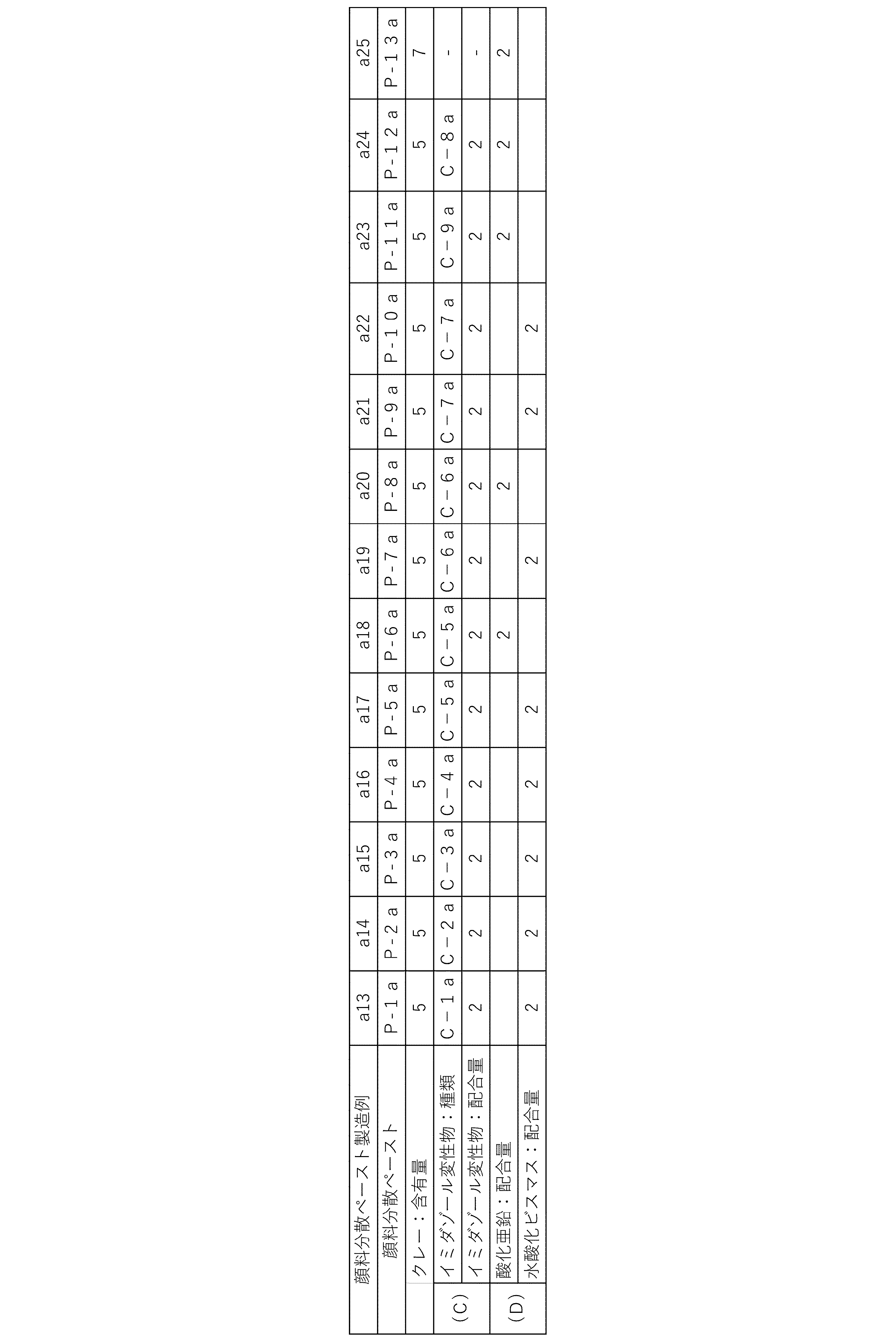
表中の配合量は全て有効成分量である。
尚、表中のC-8a及びC-9aは下記化合物である。
C-8a:1,3-ジメチルイミダゾリウムクロリド(東京化成工業社製、水に溶解)、
C-9a:ジオクチル錫オキサイド(錫系触媒)。
尚、表中のC-8a及びC-9aは下記化合物である。
C-8a:1,3-ジメチルイミダゾリウムクロリド(東京化成工業社製、水に溶解)、
C-9a:ジオクチル錫オキサイド(錫系触媒)。
カチオン電着塗料の製造
実施例a1
製造例a1で得られたアミノ基含有エポキシ樹脂A-1a 87.5部(固形分70部)、製造例a3で得られたブロック化ポリイソシアネート化合物B-2a 37.5部(固形分30部)を混合し、さらに10%酢酸13部を配合して均一に攪拌した後、脱イオン水を強く攪拌しながら約15分間を要して滴下して固形分34%のエマルションを得た。
次に、上記エマルション294部(固形分100部)、製造例a14で得た顔料分散ペーストP-1a 52.4部、脱イオン水350部を加え、固形分20%のカチオン電着塗料X-1aを製造した。
実施例a1
製造例a1で得られたアミノ基含有エポキシ樹脂A-1a 87.5部(固形分70部)、製造例a3で得られたブロック化ポリイソシアネート化合物B-2a 37.5部(固形分30部)を混合し、さらに10%酢酸13部を配合して均一に攪拌した後、脱イオン水を強く攪拌しながら約15分間を要して滴下して固形分34%のエマルションを得た。
次に、上記エマルション294部(固形分100部)、製造例a14で得た顔料分散ペーストP-1a 52.4部、脱イオン水350部を加え、固形分20%のカチオン電着塗料X-1aを製造した。
実施例a2~a13、比較例a1~a3
配合を下記表1記載のように変更した以外は実施例a1と同様にして、カチオン電着塗料X-2a~16aを製造した。
また、後述する評価試験(硬化性、低温硬化性、仕上がり性、防食性、貯蔵安定性)の結果を表中に記載した。ジオクチル錫オキサイドを含有する塗料に関しては、評価結果は合格レベルであるが本発明に従うイミダゾール変性物を含まず、また、環境面(有毒性)において不合格であるため比較例とした。
配合を下記表1記載のように変更した以外は実施例a1と同様にして、カチオン電着塗料X-2a~16aを製造した。
また、後述する評価試験(硬化性、低温硬化性、仕上がり性、防食性、貯蔵安定性)の結果を表中に記載した。ジオクチル錫オキサイドを含有する塗料に関しては、評価結果は合格レベルであるが本発明に従うイミダゾール変性物を含まず、また、環境面(有毒性)において不合格であるため比較例とした。
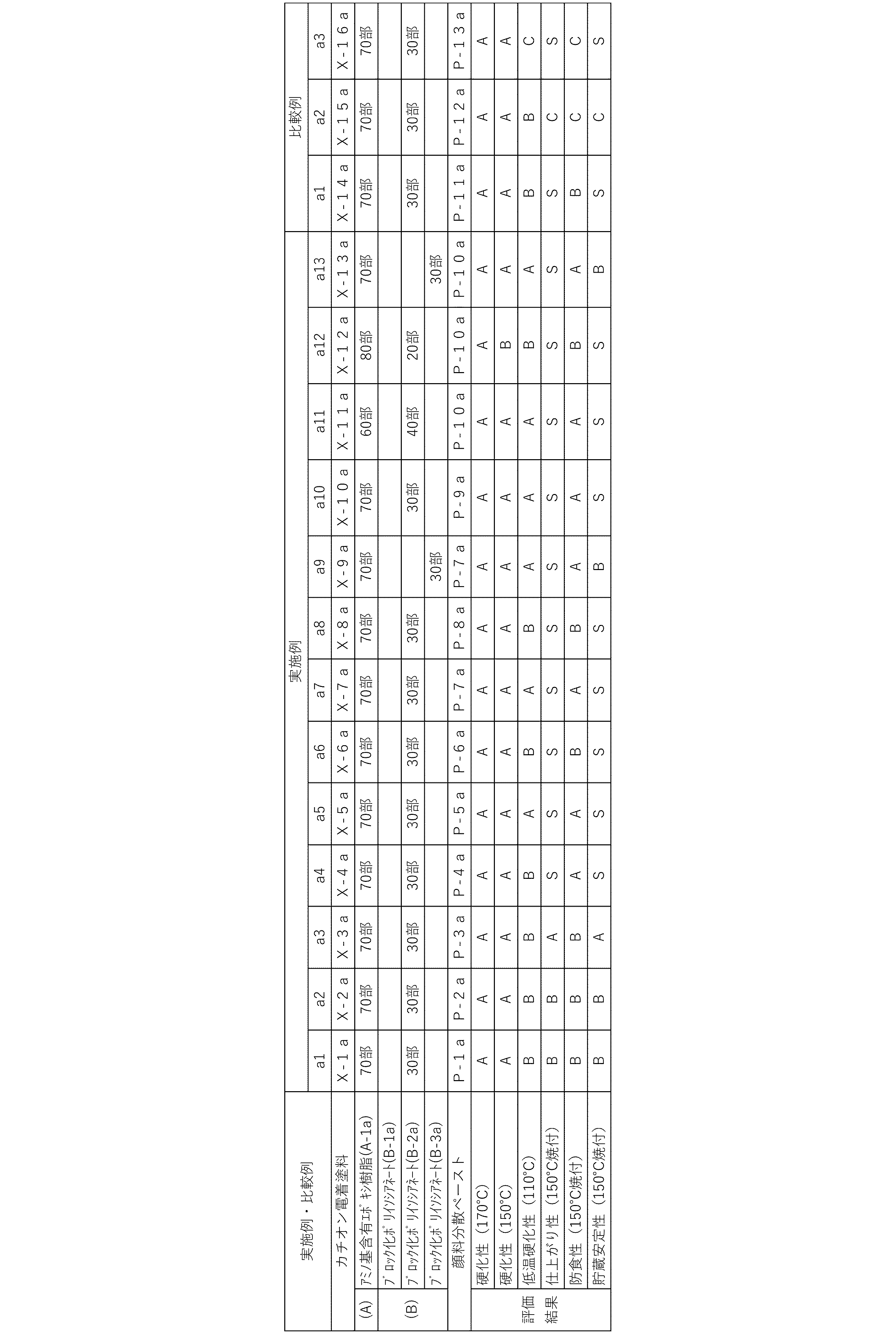
尚、表中の樹脂配合量は全て固形分での値である。
試験板の作成
化成処理(商品名、パルボンド#3020、日本パーカライジング社製、リン酸亜鉛処理剤)を施した冷延鋼板(150mm(縦)×70mm(横)×0.8mm(厚))を被塗物として、実施例及び比較例で得た各々のカチオン電着塗料を用いて乾燥膜厚17μmとなるように電着塗装し、110℃と150℃と170℃で20分間焼付け乾燥して試験板(3種類)を得た。
化成処理(商品名、パルボンド#3020、日本パーカライジング社製、リン酸亜鉛処理剤)を施した冷延鋼板(150mm(縦)×70mm(横)×0.8mm(厚))を被塗物として、実施例及び比較例で得た各々のカチオン電着塗料を用いて乾燥膜厚17μmとなるように電着塗装し、110℃と150℃と170℃で20分間焼付け乾燥して試験板(3種類)を得た。
<仕上がり性(表面粗度)>
得られた試験板(150℃焼付け)の塗面をサーフテスト301(商品名、株式会社ミツトヨ製、表面粗度計)を用いて、表面粗度値(Ra)をカットオフ0.8mmにて測定し、以下の基準で評価した。評価は、S~Bが合格であり、Cが不合格である。
S:表面粗度値(Ra)が、0.2未満、
A:表面粗度値(Ra)が、0.2以上、かつ0.25未満、
B:表面粗度値(Ra)が、0.25以上、かつ0.3未満、
C:表面粗度値(Ra)が、0.3以上、を示す。
得られた試験板(150℃焼付け)の塗面をサーフテスト301(商品名、株式会社ミツトヨ製、表面粗度計)を用いて、表面粗度値(Ra)をカットオフ0.8mmにて測定し、以下の基準で評価した。評価は、S~Bが合格であり、Cが不合格である。
S:表面粗度値(Ra)が、0.2未満、
A:表面粗度値(Ra)が、0.2以上、かつ0.25未満、
B:表面粗度値(Ra)が、0.25以上、かつ0.3未満、
C:表面粗度値(Ra)が、0.3以上、を示す。
<硬化性(ゲル分率)>
得られた試験板から、150℃及び170℃での硬化性(ゲル分率)を評価した。
評価は、A及びBが合格であり、Cが不合格である。
A:ゲル分率が、90%以上、
B:ゲル分率が、70%以上で、かつ90%未満、
C:ゲル分率が、70%未満、を示す。
得られた試験板から、150℃及び170℃での硬化性(ゲル分率)を評価した。
評価は、A及びBが合格であり、Cが不合格である。
A:ゲル分率が、90%以上、
B:ゲル分率が、70%以上で、かつ90%未満、
C:ゲル分率が、70%未満、を示す。
<低温硬化性(ゲル分率)>
得られた試験板から、110℃での硬化性(ゲル分率)を評価した。
評価は、A及びBが合格であり、Cが不合格である。
A:ゲル分率が、80%以上、
B:ゲル分率が、60%以上で、かつ80%未満、
C:ゲル分率が、60%未満、を示す。
得られた試験板から、110℃での硬化性(ゲル分率)を評価した。
評価は、A及びBが合格であり、Cが不合格である。
A:ゲル分率が、80%以上、
B:ゲル分率が、60%以上で、かつ80%未満、
C:ゲル分率が、60%未満、を示す。
なお、ゲル分率の測定は以下の手順により行った。
(1)塗装前の試験板質量(X)を測定する。
(2)電着塗装及び焼付けをして、硬化塗膜の試験板質量(Y)を測定する。
(3)上記試験板をアセトンに浸漬し、加熱・還流させた状態で5時間処理する。
(4)処理後の試験板を乾燥させた試験板質量(Z)を測定する。
(5)下記式により、ゲル分率(%)を計算する。
ゲル分率(%)=〔Z-X〕/〔Y-X〕×100。
(1)塗装前の試験板質量(X)を測定する。
(2)電着塗装及び焼付けをして、硬化塗膜の試験板質量(Y)を測定する。
(3)上記試験板をアセトンに浸漬し、加熱・還流させた状態で5時間処理する。
(4)処理後の試験板を乾燥させた試験板質量(Z)を測定する。
(5)下記式により、ゲル分率(%)を計算する。
ゲル分率(%)=〔Z-X〕/〔Y-X〕×100。
<防食性(150℃焼付け)>
得られた試験板(150℃焼付け)の素地に達するように塗膜にカッターナイフでクロスカット傷を入れ、これをJIS Z-2371に準じて、35℃ソルトスプレー試験を840時間行い、カット部からの片側での錆、フクレ幅によって以下の基準で評価した。
評価は、A及びBが合格であり、Cが不合格である。
A:錆及びフクレの最大幅がカット部より片側で2.0mm以下、
B:錆及びフクレの最大幅がカット部より片側で2.0mmを超え、かつ3.0mm以下、
C:錆及びフクレの最大幅がカット部より片側で3.0mmを超える。
得られた試験板(150℃焼付け)の素地に達するように塗膜にカッターナイフでクロスカット傷を入れ、これをJIS Z-2371に準じて、35℃ソルトスプレー試験を840時間行い、カット部からの片側での錆、フクレ幅によって以下の基準で評価した。
評価は、A及びBが合格であり、Cが不合格である。
A:錆及びフクレの最大幅がカット部より片側で2.0mm以下、
B:錆及びフクレの最大幅がカット部より片側で2.0mmを超え、かつ3.0mm以下、
C:錆及びフクレの最大幅がカット部より片側で3.0mmを超える。
<貯蔵安定性(貯蔵後の仕上がり性・表面粗度)>
実施例及び比較例で得られたカチオン電着塗料を密封容器に入れ、40℃で30日間貯蔵を行った。次いで化成処理(商品名、パルボンド#3020、日本パーカライジング社製、リン酸亜鉛処理剤)を施した冷延鋼板(150mm(縦)×70mm(横)×0.8mm(厚))を被塗物として、貯蔵後のカチオン電着塗料を用いて乾燥膜厚17μmとなるように電着塗装し、150℃で20分間焼付け乾燥して試験板を得た。
更に得られた試験板の塗面をサーフテスト301(商品名、株式会社ミツトヨ製、表面粗度計)を用いて、表面粗度値(Ra)をカットオフ0.8mmにて測定し、以下の基準で評価した。評価は、S~Bが合格であり、Cが不合格である。
S:表面粗度値(Ra)が、0.2未満、
A:表面粗度値(Ra)が、0.2以上、かつ0.25未満、
B:表面粗度値(Ra)が、0.25以上、かつ0.3未満、
C:表面粗度値(Ra)が、0.3以上、を示す。
実施例及び比較例で得られたカチオン電着塗料を密封容器に入れ、40℃で30日間貯蔵を行った。次いで化成処理(商品名、パルボンド#3020、日本パーカライジング社製、リン酸亜鉛処理剤)を施した冷延鋼板(150mm(縦)×70mm(横)×0.8mm(厚))を被塗物として、貯蔵後のカチオン電着塗料を用いて乾燥膜厚17μmとなるように電着塗装し、150℃で20分間焼付け乾燥して試験板を得た。
更に得られた試験板の塗面をサーフテスト301(商品名、株式会社ミツトヨ製、表面粗度計)を用いて、表面粗度値(Ra)をカットオフ0.8mmにて測定し、以下の基準で評価した。評価は、S~Bが合格であり、Cが不合格である。
S:表面粗度値(Ra)が、0.2未満、
A:表面粗度値(Ra)が、0.2以上、かつ0.25未満、
B:表面粗度値(Ra)が、0.25以上、かつ0.3未満、
C:表面粗度値(Ra)が、0.3以上、を示す。
アミノ基含有エポキシ樹脂の製造
製造例b1
攪拌機、温度計、窒素導入管及び還流冷却器を取りつけたフラスコに、jER828EL(商品名、ジャパンエポキシレジン社製エポキシ樹脂、エポキシ当量190、数平均分子量350)1200部に、ビスフェノールA 500部及びジメチルベンジルアミン0.2部を加え、130℃でエポキシ当量850になるまで反応させた。
製造例b1
攪拌機、温度計、窒素導入管及び還流冷却器を取りつけたフラスコに、jER828EL(商品名、ジャパンエポキシレジン社製エポキシ樹脂、エポキシ当量190、数平均分子量350)1200部に、ビスフェノールA 500部及びジメチルベンジルアミン0.2部を加え、130℃でエポキシ当量850になるまで反応させた。
次に、ジエタノールアミン160部及びジエチレントリアミンとメチルイソブチルケトンとのケチミン化物65部を加え、120℃で4時間反応させた後、エチレングリコールモノブチルエーテル480gを加え、前記製造例a1で得られたアミノ基含有エポキシ樹脂A-1a溶液(固形分80%)を、アミノ基含有エポキシ樹脂A-1bとして用いた
ブロック化ポリイソシアネート化合物の製造
製造例b2
反応容器中に、コスモネートM-200(商品名、三井化学社製、クルードMDI、NCO基含有率 31.3%)270部、及びメチルイソブチルケトン127部を加え70℃に昇温した。この中にエチレングリコールモノブチルエーテル236部を1時間かけて滴下して加え、その後100℃に昇温し、この温度を保ちながら経時でサンプリングし、赤外線吸収スペクトル測定にて未反応のイソシアネート基の吸収がなくなったことを確認し、樹脂固形分80%のブロック化ポリイソシアネートB-1bを得た。
ブロック化ポリイソシアネート化合物の製造
製造例b2
反応容器中に、コスモネートM-200(商品名、三井化学社製、クルードMDI、NCO基含有率 31.3%)270部、及びメチルイソブチルケトン127部を加え70℃に昇温した。この中にエチレングリコールモノブチルエーテル236部を1時間かけて滴下して加え、その後100℃に昇温し、この温度を保ちながら経時でサンプリングし、赤外線吸収スペクトル測定にて未反応のイソシアネート基の吸収がなくなったことを確認し、樹脂固形分80%のブロック化ポリイソシアネートB-1bを得た。
顔料分散用樹脂の製造
製造例b3
前記製造例a5に記載の方法により4級アンモニウム塩基を含有する顔料分散用樹脂(固形分60%)を得た。
製造例b3
前記製造例a5に記載の方法により4級アンモニウム塩基を含有する顔料分散用樹脂(固形分60%)を得た。
イミダゾール変性物の製造
製造例b4~b10 イミダゾール変性物C-1b~C-7bの製造
前記製造例a6~12に記載の方法により得られたイミダゾール変性物C-1a~C-7aを、それぞれ、イミダゾール変性物C-1b~C-7bとして用いた。
製造例b4~b10 イミダゾール変性物C-1b~C-7bの製造
前記製造例a6~12に記載の方法により得られたイミダゾール変性物C-1a~C-7aを、それぞれ、イミダゾール変性物C-1b~C-7bとして用いた。
顔料分散ペーストの製造
製造例b11
前記製造例a13で得られた顔料分散ペーストP-1aを顔料分散ペーストP-1bとして用いた。
製造例b11
前記製造例a13で得られた顔料分散ペーストP-1aを顔料分散ペーストP-1bとして用いた。
製造例b12~b27
配合を下記表3記載のように変更した以外は製造例a13と同様にして、固形分55%の顔料分散ペーストP-2b~17bを得た。
配合を下記表3記載のように変更した以外は製造例a13と同様にして、固形分55%の顔料分散ペーストP-2b~17bを得た。

表中の配合量は全て有効成分量である。
尚、C-8b及びC-9bは下記化合物である。
C-8b:1,3-ジメチルイミダゾリウムクロリド(東京化成工業社製、水に溶解)、
C-9b:ジオクチル錫オキサイド(錫系触媒)。
尚、C-8b及びC-9bは下記化合物である。
C-8b:1,3-ジメチルイミダゾリウムクロリド(東京化成工業社製、水に溶解)、
C-9b:ジオクチル錫オキサイド(錫系触媒)。
カチオン電着塗料の製造
実施例b1
製造例b1で得られたアミノ基含有エポキシ樹脂A-1b 87.5部(固形分70部)、製造例b2で得られたブロック化ポリイソシアネート化合物B-1b 37.5部(固形分30部)を混合し、さらに10%酢酸13部を配合して均一に攪拌した後、脱イオン水を強く攪拌しながら約15分間を要して滴下して固形分34%のエマルションを得た。
次に、上記エマルション294部(固形分100部)、製造例b11で得た顔料分散ペーストP-1b 52.4部、脱イオン水350部を加え、固形分20%のカチオン電着塗料X-1bを製造した。
実施例b1
製造例b1で得られたアミノ基含有エポキシ樹脂A-1b 87.5部(固形分70部)、製造例b2で得られたブロック化ポリイソシアネート化合物B-1b 37.5部(固形分30部)を混合し、さらに10%酢酸13部を配合して均一に攪拌した後、脱イオン水を強く攪拌しながら約15分間を要して滴下して固形分34%のエマルションを得た。
次に、上記エマルション294部(固形分100部)、製造例b11で得た顔料分散ペーストP-1b 52.4部、脱イオン水350部を加え、固形分20%のカチオン電着塗料X-1bを製造した。
実施例b2~b15、比較例b1~b4
配合を下記表4記載のように変更した以外は実施例b1と同様にして、カチオン電着塗料X-2b~19bを製造した。
また、後述する評価試験(硬化性、仕上がり性、防食性)の結果を表中に記載した。ジオクチル錫オキサイドを含有する塗料(X-16b)に関しては、評価結果は合格レベルであるが本発明に従うイミダゾール変性物を含まない上に環境面(有毒性)で不合格であるため比較例とした。
配合を下記表4記載のように変更した以外は実施例b1と同様にして、カチオン電着塗料X-2b~19bを製造した。
また、後述する評価試験(硬化性、仕上がり性、防食性)の結果を表中に記載した。ジオクチル錫オキサイドを含有する塗料(X-16b)に関しては、評価結果は合格レベルであるが本発明に従うイミダゾール変性物を含まない上に環境面(有毒性)で不合格であるため比較例とした。
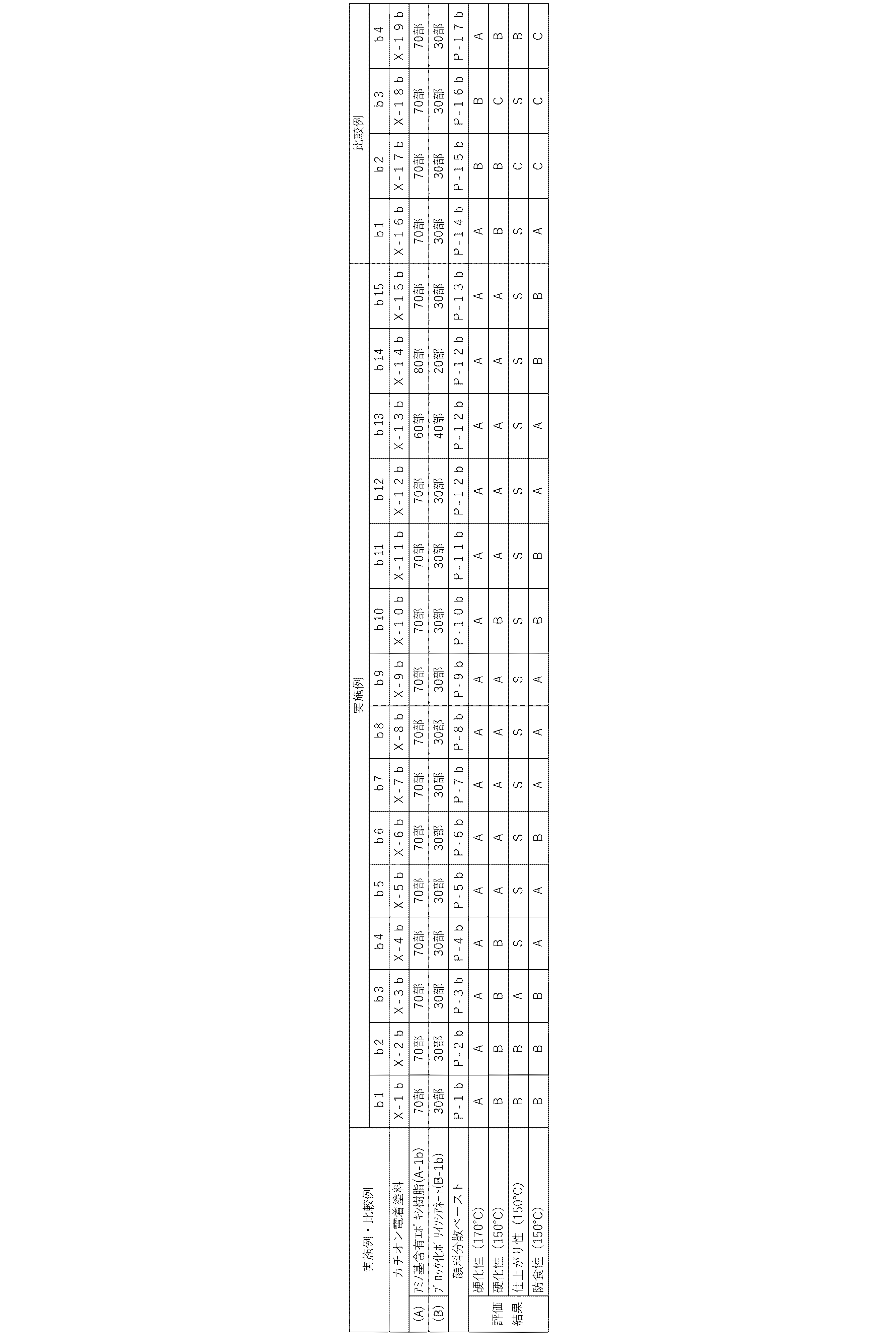
尚、表中の樹脂配合量は全て固形分での値である。
試験板の作成
化成処理(商品名、パルボンド#3020、日本パーカライジング社製、リン酸亜鉛処理剤)を施した冷延鋼板(150mm(縦)×70mm(横)×0.8mm(厚))を被塗物として、実施例及び比較例で得た各々のカチオン電着塗料を用いて乾燥膜厚17μmとなるように電着塗装し、150℃と170℃で20分間焼付け乾燥して試験板(2種類)を得た。
化成処理(商品名、パルボンド#3020、日本パーカライジング社製、リン酸亜鉛処理剤)を施した冷延鋼板(150mm(縦)×70mm(横)×0.8mm(厚))を被塗物として、実施例及び比較例で得た各々のカチオン電着塗料を用いて乾燥膜厚17μmとなるように電着塗装し、150℃と170℃で20分間焼付け乾燥して試験板(2種類)を得た。
<仕上がり性(表面粗度)、硬化性(ゲル分率)及び防食性(150℃焼付け)>
前記<仕上がり性(表面粗度)>、<硬化性(ゲル分率)>及び<防食性(150℃焼付け)>に記載の方法により、各試験板の仕上がり性、硬化性及び防食性の評価を行った。
前記<仕上がり性(表面粗度)>、<硬化性(ゲル分率)>及び<防食性(150℃焼付け)>に記載の方法により、各試験板の仕上がり性、硬化性及び防食性の評価を行った。
Claims (6)
- アミノ基含有エポキシ樹脂(A)、ブロック化ポリイソシアネート化合物(B)、及び下記式(1)

で示されるイミダゾール変性物(C)を含有するカチオン電着塗料組成物であって、以下の(i)及び(ii)の一方又は両方を満たす、カチオン電着塗料組成物:
(i)該カチオン電着塗料組成物がさらに防錆剤(D)を含有する
(ii)ブロック化ポリイソシアネート化合物(B)のブロック剤(b-2)が、オキシム系化合物(b-2-1)及び/又はピラゾール系化合物(b-2-2)である。 - カチオン電着塗料組成物の樹脂固形分の総量を基準として、イミダゾール変性物(C)を0.01~10質量%含有する請求項1に記載のカチオン電着塗料組成物。
- カチオン電着塗料組成物の樹脂固形分の総量を基準として、防錆剤(D)を0.01~10質量%含有する請求項1に記載のカチオン電着塗料組成物。
- 請求項1に記載のカチオン電着塗料組成物からなる電着塗料浴に金属被塗物を浸漬し、電着塗装する工程を含む、塗装物品の製造方法。
- 請求項4に記載の方法であって、電着塗装により得られた塗膜を加熱硬化する工程を含む、方法。
- 請求項5に記載の方法であって、前記加熱硬化工程の温度が130℃以下である、方法。
Priority Applications (3)
| Application Number | Priority Date | Filing Date | Title |
|---|---|---|---|
| US17/599,141 US20220154014A1 (en) | 2019-03-29 | 2020-03-18 | Cationic electrodeposition coating material composition |
| CN202080039174.2A CN113924171A (zh) | 2019-03-29 | 2020-03-18 | 阳离子电沉积涂料组合物 |
| EP20783976.2A EP3950149A4 (en) | 2019-03-29 | 2020-03-18 | COMPOSITION OF CATIONIC ELECTRODEPOSITION COATING MATERIAL |
Applications Claiming Priority (4)
| Application Number | Priority Date | Filing Date | Title |
|---|---|---|---|
| JP2019066339A JP6995076B2 (ja) | 2019-03-29 | 2019-03-29 | カチオン電着塗料組成物 |
| JP2019-066339 | 2019-03-29 | ||
| JP2019065671A JP6976281B2 (ja) | 2019-03-29 | 2019-03-29 | カチオン電着塗料組成物 |
| JP2019-065671 | 2019-03-29 |
Publications (1)
| Publication Number | Publication Date |
|---|---|
| WO2020203311A1 true WO2020203311A1 (ja) | 2020-10-08 |
Family
ID=72668796
Family Applications (1)
| Application Number | Title | Priority Date | Filing Date |
|---|---|---|---|
| PCT/JP2020/012049 Ceased WO2020203311A1 (ja) | 2019-03-29 | 2020-03-18 | カチオン電着塗料組成物 |
Country Status (4)
| Country | Link |
|---|---|
| US (1) | US20220154014A1 (ja) |
| EP (1) | EP3950149A4 (ja) |
| CN (1) | CN113924171A (ja) |
| WO (1) | WO2020203311A1 (ja) |
Cited By (2)
| Publication number | Priority date | Publication date | Assignee | Title |
|---|---|---|---|---|
| WO2023279087A1 (en) | 2021-07-01 | 2023-01-05 | Ppg Industries Ohio, Inc. | Electrodepositable coating compositions |
| WO2023279075A1 (en) | 2021-07-01 | 2023-01-05 | Ppg Industries Ohio, Inc. | Electrodepositable coating compositions |
Families Citing this family (7)
| Publication number | Priority date | Publication date | Assignee | Title |
|---|---|---|---|---|
| EP4095201A1 (en) * | 2021-05-28 | 2022-11-30 | Axalta Coating Systems GmbH | Cathodic electrocoating composition having reduced volatile organic compounds |
| CN120752313A (zh) | 2023-01-05 | 2025-10-03 | Ppg工业俄亥俄公司 | 具有多个树脂畴的电沉积涂层 |
| EP4658831A2 (en) | 2023-02-01 | 2025-12-10 | PPG Industries Ohio Inc. | Compositions, systems, and methods for treating a substrate |
| DE112024000759T5 (de) | 2023-02-01 | 2025-12-04 | Ppg Industries Ohio, Inc. | Elektrolytisch abscheidbare beschichtungszusammensetzungen und verfahren zum beschichten von substraten |
| KR20260013986A (ko) | 2023-05-26 | 2026-01-29 | 피피지 인더스트리즈 오하이오 인코포레이티드 | 소성 점토를 포함하는 전착성 코팅 조성물 |
| WO2025178894A1 (en) | 2024-02-21 | 2025-08-28 | Ppg Industries Ohio, Inc. | Electrodepositable coating compositions comprising a bismuth catalyst |
| WO2025178898A1 (en) | 2024-02-21 | 2025-08-28 | Ppg Industries Ohio, Inc. | Electrodepositable coating compositions comprising a guanidine curing catalyst |
Citations (13)
| Publication number | Priority date | Publication date | Assignee | Title |
|---|---|---|---|---|
| US3984299A (en) | 1970-06-19 | 1976-10-05 | Ppg Industries, Inc. | Process for electrodepositing cationic compositions |
| US4017438A (en) | 1974-12-16 | 1977-04-12 | Ppg Industries, Inc. | Ketimine-blocked primary amine group-containing cationic electrodepositable resins |
| JPH06200194A (ja) * | 1992-12-28 | 1994-07-19 | Kansai Paint Co Ltd | カチオン電着塗料組成物 |
| JPH08120222A (ja) * | 1994-10-25 | 1996-05-14 | Nippon Polyurethane Ind Co Ltd | 電着塗料組成物 |
| WO2009135600A1 (de) * | 2008-05-07 | 2009-11-12 | Bayer Materialscience Ag | Katalysatoren zur synthese von polyurethanen |
| JP2014080569A (ja) * | 2012-09-28 | 2014-05-08 | Kansai Paint Co Ltd | 水性塗料組成物及び塗膜形成方法 |
| WO2014187782A1 (de) * | 2013-05-23 | 2014-11-27 | Deutsche Institute Für Textil- Und Faserforschung Denkendorf | Polymerisierbare reaktionsmischung zur herstellung von epoxidharzen und deren verwendung |
| WO2015087932A1 (ja) * | 2013-12-11 | 2015-06-18 | 関西ペイント株式会社 | 複層塗膜形成方法 |
| JP2017155203A (ja) * | 2016-03-04 | 2017-09-07 | 広栄化学工業株式会社 | 軟質ポリウレタンフォーム製造用触媒組成物 |
| WO2019066029A1 (ja) * | 2017-09-29 | 2019-04-04 | 関西ペイント株式会社 | カチオン電着塗料組成物 |
| WO2019065953A1 (ja) * | 2017-09-29 | 2019-04-04 | 広栄化学工業株式会社 | ブロックイソシアネート用ブロック剤解離触媒及び該ブロック剤解離触媒を含有する熱硬化性組成物 |
| JP2019065671A (ja) | 2017-10-05 | 2019-04-25 | 株式会社アルテック | ドレンキャップ |
| JP2019066339A (ja) | 2017-10-02 | 2019-04-25 | 株式会社日立製作所 | 音による診断装置、診断方法、および診断システム |
Family Cites Families (13)
| Publication number | Priority date | Publication date | Assignee | Title |
|---|---|---|---|---|
| GB2250512A (en) * | 1990-12-07 | 1992-06-10 | Leonid Alexandrovich Mirkind | Composition for cathodic electrodeposition |
| JPH0559347A (ja) * | 1991-09-03 | 1993-03-09 | Honda Motor Co Ltd | 高強度シーリング材組成物 |
| JP2001213938A (ja) * | 2000-01-31 | 2001-08-07 | Nippon Paint Co Ltd | アミノポリエーテル変性エポキシおよびこれを含有するカチオン電着塗料組成物 |
| JP2003012764A (ja) * | 2001-06-28 | 2003-01-15 | Kansai Paint Co Ltd | カチオン性樹脂の製造方法及びカチオン電着塗料 |
| JP2006137864A (ja) * | 2004-11-12 | 2006-06-01 | Nippon Paint Co Ltd | 無鉛性カチオン電着塗料組成物 |
| JP2010024288A (ja) * | 2008-07-16 | 2010-02-04 | Nippon Paint Co Ltd | カチオン電着塗料組成物 |
| DE102008061329A1 (de) * | 2008-12-11 | 2010-06-17 | Basf Coatings Ag | Verwendung von 1,3-substituierten Imidazoliumsalzen zur katalytischen Deblockierung blockierter Isocyanate |
| US8486538B2 (en) * | 2009-01-27 | 2013-07-16 | Ppg Industries Ohio, Inc | Electrodepositable coating composition comprising silane and yttrium |
| US20120077401A1 (en) * | 2009-03-27 | 2012-03-29 | Tomohiko Kotake | Resin composition for production of clad layer, resin film for production of clad layer utilizing the resin composition, and optical waveguide and optical module each utilizing the resin composition or the resin film |
| WO2013129517A1 (ja) * | 2012-02-28 | 2013-09-06 | 日本ペイント株式会社 | カチオン電着塗料用エマルション樹脂組成物の調製方法 |
| EP3415574B1 (en) * | 2016-02-08 | 2020-09-16 | Kansai Paint Co., Ltd. | Method for producing cationic electrodeposition coating composition |
| EP3495353B1 (en) * | 2016-08-04 | 2021-11-17 | Koei Chemical Company, Limited | Amidate compound, catalyst for polyurethane production, and method for producing polyurethane resin |
| CN107674540B (zh) * | 2017-09-18 | 2020-03-31 | 江苏锐康新材料科技有限公司 | 一种低温固化型粉末涂料及其制备方法和应用 |
-
2020
- 2020-03-18 EP EP20783976.2A patent/EP3950149A4/en not_active Withdrawn
- 2020-03-18 US US17/599,141 patent/US20220154014A1/en not_active Abandoned
- 2020-03-18 CN CN202080039174.2A patent/CN113924171A/zh active Pending
- 2020-03-18 WO PCT/JP2020/012049 patent/WO2020203311A1/ja not_active Ceased
Patent Citations (13)
| Publication number | Priority date | Publication date | Assignee | Title |
|---|---|---|---|---|
| US3984299A (en) | 1970-06-19 | 1976-10-05 | Ppg Industries, Inc. | Process for electrodepositing cationic compositions |
| US4017438A (en) | 1974-12-16 | 1977-04-12 | Ppg Industries, Inc. | Ketimine-blocked primary amine group-containing cationic electrodepositable resins |
| JPH06200194A (ja) * | 1992-12-28 | 1994-07-19 | Kansai Paint Co Ltd | カチオン電着塗料組成物 |
| JPH08120222A (ja) * | 1994-10-25 | 1996-05-14 | Nippon Polyurethane Ind Co Ltd | 電着塗料組成物 |
| WO2009135600A1 (de) * | 2008-05-07 | 2009-11-12 | Bayer Materialscience Ag | Katalysatoren zur synthese von polyurethanen |
| JP2014080569A (ja) * | 2012-09-28 | 2014-05-08 | Kansai Paint Co Ltd | 水性塗料組成物及び塗膜形成方法 |
| WO2014187782A1 (de) * | 2013-05-23 | 2014-11-27 | Deutsche Institute Für Textil- Und Faserforschung Denkendorf | Polymerisierbare reaktionsmischung zur herstellung von epoxidharzen und deren verwendung |
| WO2015087932A1 (ja) * | 2013-12-11 | 2015-06-18 | 関西ペイント株式会社 | 複層塗膜形成方法 |
| JP2017155203A (ja) * | 2016-03-04 | 2017-09-07 | 広栄化学工業株式会社 | 軟質ポリウレタンフォーム製造用触媒組成物 |
| WO2019066029A1 (ja) * | 2017-09-29 | 2019-04-04 | 関西ペイント株式会社 | カチオン電着塗料組成物 |
| WO2019065953A1 (ja) * | 2017-09-29 | 2019-04-04 | 広栄化学工業株式会社 | ブロックイソシアネート用ブロック剤解離触媒及び該ブロック剤解離触媒を含有する熱硬化性組成物 |
| JP2019066339A (ja) | 2017-10-02 | 2019-04-25 | 株式会社日立製作所 | 音による診断装置、診断方法、および診断システム |
| JP2019065671A (ja) | 2017-10-05 | 2019-04-25 | 株式会社アルテック | ドレンキャップ |
Non-Patent Citations (2)
| Title |
|---|
| BANTU, BHASKER ET AL.: "C02, Magnesium, Alumninum, and Zinc Adducts of N- Heterocyclic Carbenes as (Latent) Catalysts for Polyurethane Synthesis", EUROPEAN JOURNAL OF INORGANIC CHEMISTRY, vol. 13, 2009, pages 1970 - 1976, XP055459774, DOI: 10.1002/ejic.200801161 * |
| COUTELIER, OLIVIER ET AL.: "N-HETEROCYCLIC CARBENE-CATALYZED SYNTHESIS OF POLYURETHANES", POLYMER PREPRINTS, vol. 52, no. 2, 2011, pages 290 - 291, XP009519621 * |
Cited By (2)
| Publication number | Priority date | Publication date | Assignee | Title |
|---|---|---|---|---|
| WO2023279087A1 (en) | 2021-07-01 | 2023-01-05 | Ppg Industries Ohio, Inc. | Electrodepositable coating compositions |
| WO2023279075A1 (en) | 2021-07-01 | 2023-01-05 | Ppg Industries Ohio, Inc. | Electrodepositable coating compositions |
Also Published As
| Publication number | Publication date |
|---|---|
| US20220154014A1 (en) | 2022-05-19 |
| CN113924171A (zh) | 2022-01-11 |
| EP3950149A1 (en) | 2022-02-09 |
| EP3950149A4 (en) | 2022-12-07 |
Similar Documents
| Publication | Publication Date | Title |
|---|---|---|
| WO2020203311A1 (ja) | カチオン電着塗料組成物 | |
| JP6665355B2 (ja) | カチオン電着塗料組成物 | |
| US10316200B2 (en) | Method for manufacturing a cationic electrodeposition coating composition | |
| US8026320B2 (en) | Cationic electrodeposition coating composition | |
| CN115362193B (zh) | 环氧树脂及电沉积涂料 | |
| JP6796229B1 (ja) | カチオン電着塗料の塗装方法 | |
| US8951398B2 (en) | Cationic electrodeposition coating composition | |
| JP6976281B2 (ja) | カチオン電着塗料組成物 | |
| US20080227911A1 (en) | Cathodic electrodeposition coating compositions | |
| EP3354701B1 (en) | Method for preparing cationic electrodeposition coating composition | |
| JP6997279B2 (ja) | エポキシ系樹脂及び電着塗料 | |
| CN114040947B (zh) | 阳离子电沉积涂料组合物 | |
| JP6995076B2 (ja) | カチオン電着塗料組成物 | |
| EP3978576A1 (en) | Method for preparing cationic electrodeposition coating composition | |
| KR102090727B1 (ko) | 전착 수지 조성물 및 이를 포함하는 전착 도료 키트 | |
| JP2022096854A (ja) | カチオン電着塗料組成物 | |
| JP2015187197A (ja) | カチオン電着塗料組成物 | |
| JP7634360B2 (ja) | カチオン電着塗料組成物、電着塗装方法及びカチオン電着塗膜 | |
| JP2023050150A (ja) | 変性エポキシ樹脂及びカチオン電着塗料 | |
| WO2023048273A1 (ja) | 変性エポキシ樹脂及び電着塗料 | |
| CN118103424A (zh) | 改性环氧树脂及电沉积涂料 | |
| JP2006137863A (ja) | 無鉛性カチオン電着塗料組成物 |
Legal Events
| Date | Code | Title | Description |
|---|---|---|---|
| 121 | Ep: the epo has been informed by wipo that ep was designated in this application |
Ref document number: 20783976 Country of ref document: EP Kind code of ref document: A1 |
|
| NENP | Non-entry into the national phase |
Ref country code: DE |
|
| ENP | Entry into the national phase |
Ref document number: 2020783976 Country of ref document: EP Effective date: 20211029 |