WO2020203525A1 - 潤滑油組成物 - Google Patents
潤滑油組成物 Download PDFInfo
- Publication number
- WO2020203525A1 WO2020203525A1 PCT/JP2020/013227 JP2020013227W WO2020203525A1 WO 2020203525 A1 WO2020203525 A1 WO 2020203525A1 JP 2020013227 W JP2020013227 W JP 2020013227W WO 2020203525 A1 WO2020203525 A1 WO 2020203525A1
- Authority
- WO
- WIPO (PCT)
- Prior art keywords
- lubricating oil
- oil composition
- component
- mass
- content
- Prior art date
- Legal status (The legal status is an assumption and is not a legal conclusion. Google has not performed a legal analysis and makes no representation as to the accuracy of the status listed.)
- Ceased
Links
Classifications
-
- C—CHEMISTRY; METALLURGY
- C10—PETROLEUM, GAS OR COKE INDUSTRIES; TECHNICAL GASES CONTAINING CARBON MONOXIDE; FUELS; LUBRICANTS; PEAT
- C10M—LUBRICATING COMPOSITIONS; USE OF CHEMICAL SUBSTANCES EITHER ALONE OR AS LUBRICATING INGREDIENTS IN A LUBRICATING COMPOSITION
- C10M169/00—Lubricating compositions characterised by containing as components a mixture of at least two types of ingredient selected from base-materials, thickeners or additives, covered by the preceding groups, each of these compounds being essential
- C10M169/04—Mixtures of base-materials and additives
-
- C—CHEMISTRY; METALLURGY
- C10—PETROLEUM, GAS OR COKE INDUSTRIES; TECHNICAL GASES CONTAINING CARBON MONOXIDE; FUELS; LUBRICANTS; PEAT
- C10M—LUBRICATING COMPOSITIONS; USE OF CHEMICAL SUBSTANCES EITHER ALONE OR AS LUBRICATING INGREDIENTS IN A LUBRICATING COMPOSITION
- C10M129/00—Lubricating compositions characterised by the additive being an organic non-macromolecular compound containing oxygen
- C10M129/02—Lubricating compositions characterised by the additive being an organic non-macromolecular compound containing oxygen having a carbon chain of less than 30 atoms
- C10M129/26—Carboxylic acids; Salts thereof
- C10M129/48—Carboxylic acids; Salts thereof having carboxyl groups bound to a carbon atom of a six-membered aromatic ring
- C10M129/54—Carboxylic acids; Salts thereof having carboxyl groups bound to a carbon atom of a six-membered aromatic ring containing hydroxy groups
-
- C—CHEMISTRY; METALLURGY
- C10—PETROLEUM, GAS OR COKE INDUSTRIES; TECHNICAL GASES CONTAINING CARBON MONOXIDE; FUELS; LUBRICANTS; PEAT
- C10M—LUBRICATING COMPOSITIONS; USE OF CHEMICAL SUBSTANCES EITHER ALONE OR AS LUBRICATING INGREDIENTS IN A LUBRICATING COMPOSITION
- C10M133/00—Lubricating compositions characterised by the additive being an organic non-macromolecular compound containing nitrogen
- C10M133/02—Lubricating compositions characterised by the additive being an organic non-macromolecular compound containing nitrogen having a carbon chain of less than 30 atoms
- C10M133/38—Heterocyclic nitrogen compounds
- C10M133/44—Five-membered ring containing nitrogen and carbon only
-
- C—CHEMISTRY; METALLURGY
- C10—PETROLEUM, GAS OR COKE INDUSTRIES; TECHNICAL GASES CONTAINING CARBON MONOXIDE; FUELS; LUBRICANTS; PEAT
- C10M—LUBRICATING COMPOSITIONS; USE OF CHEMICAL SUBSTANCES EITHER ALONE OR AS LUBRICATING INGREDIENTS IN A LUBRICATING COMPOSITION
- C10M137/00—Lubricating compositions characterised by the additive being an organic non-macromolecular compound containing phosphorus
- C10M137/02—Lubricating compositions characterised by the additive being an organic non-macromolecular compound containing phosphorus having no phosphorus-to-carbon bond
- C10M137/04—Phosphate esters
- C10M137/10—Thio derivatives
-
- C—CHEMISTRY; METALLURGY
- C10—PETROLEUM, GAS OR COKE INDUSTRIES; TECHNICAL GASES CONTAINING CARBON MONOXIDE; FUELS; LUBRICANTS; PEAT
- C10M—LUBRICATING COMPOSITIONS; USE OF CHEMICAL SUBSTANCES EITHER ALONE OR AS LUBRICATING INGREDIENTS IN A LUBRICATING COMPOSITION
- C10M139/00—Lubricating compositions characterised by the additive being an organic non-macromolecular compound containing atoms of elements not provided for in groups C10M127/00 - C10M137/00
-
- C—CHEMISTRY; METALLURGY
- C10—PETROLEUM, GAS OR COKE INDUSTRIES; TECHNICAL GASES CONTAINING CARBON MONOXIDE; FUELS; LUBRICANTS; PEAT
- C10M—LUBRICATING COMPOSITIONS; USE OF CHEMICAL SUBSTANCES EITHER ALONE OR AS LUBRICATING INGREDIENTS IN A LUBRICATING COMPOSITION
- C10M141/00—Lubricating compositions characterised by the additive being a mixture of two or more compounds covered by more than one of the main groups C10M125/00 - C10M139/00, each of these compounds being essential
- C10M141/12—Lubricating compositions characterised by the additive being a mixture of two or more compounds covered by more than one of the main groups C10M125/00 - C10M139/00, each of these compounds being essential at least one of them being an organic compound containing atoms of elements not provided for in groups C10M141/02 - C10M141/10
-
- C—CHEMISTRY; METALLURGY
- C10—PETROLEUM, GAS OR COKE INDUSTRIES; TECHNICAL GASES CONTAINING CARBON MONOXIDE; FUELS; LUBRICANTS; PEAT
- C10M—LUBRICATING COMPOSITIONS; USE OF CHEMICAL SUBSTANCES EITHER ALONE OR AS LUBRICATING INGREDIENTS IN A LUBRICATING COMPOSITION
- C10M163/00—Lubricating compositions characterised by the additive being a mixture of a compound of unknown or incompletely defined constitution and a non-macromolecular compound, each of these compounds being essential
-
- C—CHEMISTRY; METALLURGY
- C10—PETROLEUM, GAS OR COKE INDUSTRIES; TECHNICAL GASES CONTAINING CARBON MONOXIDE; FUELS; LUBRICANTS; PEAT
- C10M—LUBRICATING COMPOSITIONS; USE OF CHEMICAL SUBSTANCES EITHER ALONE OR AS LUBRICATING INGREDIENTS IN A LUBRICATING COMPOSITION
- C10M2203/00—Organic non-macromolecular hydrocarbon compounds and hydrocarbon fractions as ingredients in lubricant compositions
- C10M2203/003—Organic non-macromolecular hydrocarbon compounds and hydrocarbon fractions as ingredients in lubricant compositions used as base material
-
- C—CHEMISTRY; METALLURGY
- C10—PETROLEUM, GAS OR COKE INDUSTRIES; TECHNICAL GASES CONTAINING CARBON MONOXIDE; FUELS; LUBRICANTS; PEAT
- C10M—LUBRICATING COMPOSITIONS; USE OF CHEMICAL SUBSTANCES EITHER ALONE OR AS LUBRICATING INGREDIENTS IN A LUBRICATING COMPOSITION
- C10M2203/00—Organic non-macromolecular hydrocarbon compounds and hydrocarbon fractions as ingredients in lubricant compositions
- C10M2203/10—Petroleum or coal fractions, e.g. tars, solvents, bitumen
- C10M2203/102—Aliphatic fractions
- C10M2203/1025—Aliphatic fractions used as base material
-
- C—CHEMISTRY; METALLURGY
- C10—PETROLEUM, GAS OR COKE INDUSTRIES; TECHNICAL GASES CONTAINING CARBON MONOXIDE; FUELS; LUBRICANTS; PEAT
- C10M—LUBRICATING COMPOSITIONS; USE OF CHEMICAL SUBSTANCES EITHER ALONE OR AS LUBRICATING INGREDIENTS IN A LUBRICATING COMPOSITION
- C10M2207/00—Organic non-macromolecular hydrocarbon compounds containing hydrogen, carbon and oxygen as ingredients in lubricant compositions
- C10M2207/02—Hydroxy compounds
- C10M2207/023—Hydroxy compounds having hydroxy groups bound to carbon atoms of six-membered aromatic rings
- C10M2207/026—Hydroxy compounds having hydroxy groups bound to carbon atoms of six-membered aromatic rings with tertiary alkyl groups
-
- C—CHEMISTRY; METALLURGY
- C10—PETROLEUM, GAS OR COKE INDUSTRIES; TECHNICAL GASES CONTAINING CARBON MONOXIDE; FUELS; LUBRICANTS; PEAT
- C10M—LUBRICATING COMPOSITIONS; USE OF CHEMICAL SUBSTANCES EITHER ALONE OR AS LUBRICATING INGREDIENTS IN A LUBRICATING COMPOSITION
- C10M2207/00—Organic non-macromolecular hydrocarbon compounds containing hydrogen, carbon and oxygen as ingredients in lubricant compositions
- C10M2207/10—Carboxylix acids; Neutral salts thereof
- C10M2207/14—Carboxylix acids; Neutral salts thereof having carboxyl groups bound to carbon atoms of six-membered aromatic rings
- C10M2207/144—Carboxylix acids; Neutral salts thereof having carboxyl groups bound to carbon atoms of six-membered aromatic rings containing hydroxy groups
-
- C—CHEMISTRY; METALLURGY
- C10—PETROLEUM, GAS OR COKE INDUSTRIES; TECHNICAL GASES CONTAINING CARBON MONOXIDE; FUELS; LUBRICANTS; PEAT
- C10M—LUBRICATING COMPOSITIONS; USE OF CHEMICAL SUBSTANCES EITHER ALONE OR AS LUBRICATING INGREDIENTS IN A LUBRICATING COMPOSITION
- C10M2207/00—Organic non-macromolecular hydrocarbon compounds containing hydrogen, carbon and oxygen as ingredients in lubricant compositions
- C10M2207/26—Overbased carboxylic acid salts
- C10M2207/262—Overbased carboxylic acid salts derived from hydroxy substituted aromatic acids, e.g. salicylates
-
- C—CHEMISTRY; METALLURGY
- C10—PETROLEUM, GAS OR COKE INDUSTRIES; TECHNICAL GASES CONTAINING CARBON MONOXIDE; FUELS; LUBRICANTS; PEAT
- C10M—LUBRICATING COMPOSITIONS; USE OF CHEMICAL SUBSTANCES EITHER ALONE OR AS LUBRICATING INGREDIENTS IN A LUBRICATING COMPOSITION
- C10M2215/00—Organic non-macromolecular compounds containing nitrogen as ingredients in lubricant Compositions
- C10M2215/02—Amines, e.g. polyalkylene polyamines; Quaternary amines
- C10M2215/06—Amines, e.g. polyalkylene polyamines; Quaternary amines having amino groups bound to carbon atoms of six-membered aromatic rings
- C10M2215/064—Di- and triaryl amines
-
- C—CHEMISTRY; METALLURGY
- C10—PETROLEUM, GAS OR COKE INDUSTRIES; TECHNICAL GASES CONTAINING CARBON MONOXIDE; FUELS; LUBRICANTS; PEAT
- C10M—LUBRICATING COMPOSITIONS; USE OF CHEMICAL SUBSTANCES EITHER ALONE OR AS LUBRICATING INGREDIENTS IN A LUBRICATING COMPOSITION
- C10M2215/00—Organic non-macromolecular compounds containing nitrogen as ingredients in lubricant Compositions
- C10M2215/24—Organic non-macromolecular compounds containing nitrogen as ingredients in lubricant Compositions having hydrocarbon substituents containing thirty or more carbon atoms, e.g. nitrogen derivatives of substituted succinic acid
- C10M2215/28—Amides; Imides
-
- C—CHEMISTRY; METALLURGY
- C10—PETROLEUM, GAS OR COKE INDUSTRIES; TECHNICAL GASES CONTAINING CARBON MONOXIDE; FUELS; LUBRICANTS; PEAT
- C10M—LUBRICATING COMPOSITIONS; USE OF CHEMICAL SUBSTANCES EITHER ALONE OR AS LUBRICATING INGREDIENTS IN A LUBRICATING COMPOSITION
- C10M2215/00—Organic non-macromolecular compounds containing nitrogen as ingredients in lubricant Compositions
- C10M2215/24—Organic non-macromolecular compounds containing nitrogen as ingredients in lubricant Compositions having hydrocarbon substituents containing thirty or more carbon atoms, e.g. nitrogen derivatives of substituted succinic acid
- C10M2215/30—Heterocyclic compounds
-
- C—CHEMISTRY; METALLURGY
- C10—PETROLEUM, GAS OR COKE INDUSTRIES; TECHNICAL GASES CONTAINING CARBON MONOXIDE; FUELS; LUBRICANTS; PEAT
- C10M—LUBRICATING COMPOSITIONS; USE OF CHEMICAL SUBSTANCES EITHER ALONE OR AS LUBRICATING INGREDIENTS IN A LUBRICATING COMPOSITION
- C10M2219/00—Organic non-macromolecular compounds containing sulfur, selenium or tellurium as ingredients in lubricant compositions
- C10M2219/04—Organic non-macromolecular compounds containing sulfur, selenium or tellurium as ingredients in lubricant compositions containing sulfur-to-oxygen bonds, i.e. sulfones, sulfoxides
- C10M2219/046—Overbased sulfonic acid salts
-
- C—CHEMISTRY; METALLURGY
- C10—PETROLEUM, GAS OR COKE INDUSTRIES; TECHNICAL GASES CONTAINING CARBON MONOXIDE; FUELS; LUBRICANTS; PEAT
- C10M—LUBRICATING COMPOSITIONS; USE OF CHEMICAL SUBSTANCES EITHER ALONE OR AS LUBRICATING INGREDIENTS IN A LUBRICATING COMPOSITION
- C10M2223/00—Organic non-macromolecular compounds containing phosphorus as ingredients in lubricant compositions
- C10M2223/02—Organic non-macromolecular compounds containing phosphorus as ingredients in lubricant compositions having no phosphorus-to-carbon bonds
- C10M2223/04—Phosphate esters
- C10M2223/045—Metal containing thio derivatives
-
- C—CHEMISTRY; METALLURGY
- C10—PETROLEUM, GAS OR COKE INDUSTRIES; TECHNICAL GASES CONTAINING CARBON MONOXIDE; FUELS; LUBRICANTS; PEAT
- C10M—LUBRICATING COMPOSITIONS; USE OF CHEMICAL SUBSTANCES EITHER ALONE OR AS LUBRICATING INGREDIENTS IN A LUBRICATING COMPOSITION
- C10M2227/00—Organic non-macromolecular compounds containing atoms of elements not provided for in groups C10M2203/00, C10M2207/00, C10M2211/00, C10M2215/00, C10M2219/00 or C10M2223/00 as ingredients in lubricant compositions
- C10M2227/06—Organic compounds derived from inorganic acids or metal salts
- C10M2227/061—Esters derived from boron
-
- C—CHEMISTRY; METALLURGY
- C10—PETROLEUM, GAS OR COKE INDUSTRIES; TECHNICAL GASES CONTAINING CARBON MONOXIDE; FUELS; LUBRICANTS; PEAT
- C10N—INDEXING SCHEME ASSOCIATED WITH SUBCLASS C10M RELATING TO LUBRICATING COMPOSITIONS
- C10N2030/00—Specified physical or chemical properties which is improved by the additive characterising the lubricating composition, e.g. multifunctional additives
- C10N2030/02—Pour-point; Viscosity index
-
- C—CHEMISTRY; METALLURGY
- C10—PETROLEUM, GAS OR COKE INDUSTRIES; TECHNICAL GASES CONTAINING CARBON MONOXIDE; FUELS; LUBRICANTS; PEAT
- C10N—INDEXING SCHEME ASSOCIATED WITH SUBCLASS C10M RELATING TO LUBRICATING COMPOSITIONS
- C10N2030/00—Specified physical or chemical properties which is improved by the additive characterising the lubricating composition, e.g. multifunctional additives
- C10N2030/04—Detergent property or dispersant property
-
- C—CHEMISTRY; METALLURGY
- C10—PETROLEUM, GAS OR COKE INDUSTRIES; TECHNICAL GASES CONTAINING CARBON MONOXIDE; FUELS; LUBRICANTS; PEAT
- C10N—INDEXING SCHEME ASSOCIATED WITH SUBCLASS C10M RELATING TO LUBRICATING COMPOSITIONS
- C10N2030/00—Specified physical or chemical properties which is improved by the additive characterising the lubricating composition, e.g. multifunctional additives
- C10N2030/40—Low content or no content compositions
-
- C—CHEMISTRY; METALLURGY
- C10—PETROLEUM, GAS OR COKE INDUSTRIES; TECHNICAL GASES CONTAINING CARBON MONOXIDE; FUELS; LUBRICANTS; PEAT
- C10N—INDEXING SCHEME ASSOCIATED WITH SUBCLASS C10M RELATING TO LUBRICATING COMPOSITIONS
- C10N2040/00—Specified use or application for which the lubricating composition is intended
- C10N2040/25—Internal-combustion engines
Definitions
- the present invention relates to a lubricating oil composition.
- Gas engine heat pump systems and gas engine cogeneration systems have been put to practical use for air conditioning of houses and buildings.
- a gas engine that uses natural gas, liquefied petroleum gas (LPG), or the like as fuel is generally used.
- LPG liquefied petroleum gas
- Various gas engine oils applied to such gas engines have also been developed.
- Patent Document 1 contains a lubricating oil base oil, a wear inhibitor containing phosphorus as a constituent element and not containing sulfur, an organic molybdenum-based friction modifier, a calcium salicylate-based cleaning agent, and a magnesium salicylate-based cleaning agent.
- a lubricating oil composition for a gas engine is described in which the ratio of the element content of magnesium and calcium is adjusted within a predetermined range and the amount of ash sulfate is 0.6% by mass or less.
- the present invention is a gas engine containing a base oil, a calcium-based cleaning agent, and an alkenyl succinimide containing a non-boron-modified alkenyl succinimide bisimide, and the content of calcium atom and boron atom is adjusted to a specific range. To provide a lubricating oil composition for use.
- a lubricating oil composition for a gas engine which comprises a base oil (A), a calcium-based cleaning agent (B), and an alkenyl succinimide (C).
- the content of the component (B) in terms of calcium atom is 0.09 to 0.17% by mass based on the total amount of the lubricating oil composition.
- Ingredient (C) contains non-boron-modified bisimide succinate (C1) The content of the boron atom derived from the component (C) is less than 0.02% by mass based on the total amount of the lubricating oil composition.
- Lubricating oil composition [2] The content ratio [N / Ca] of the nitrogen atom derived from the component (C) and the calcium atom derived from the component (B) is 0.90 or less in terms of mass ratio, as described above [1].
- the component (C1) is a non-boron-modified alkenylsuccinate bisimide having at least a polybutenyl group or a polyisobutenyl group having a weight average molecular weight of 500 to 3000, according to any one of the above [1] to [3].
- [5] The lubricating oil composition according to any one of the above [1] to [4], wherein the component (C) further contains a boron-modified alkenyl succinimide (C2) together with the component (C1).
- the content ratio [B / N] of the boron atom derived from the component (C2) and the nitrogen atom derived from the component (C) is 0.01 to 0.35 in terms of mass ratio.
- the lubricating oil composition according to item 1. [8] The lubricating oil composition according to any one of the above [1] to [7], which further contains zinc dithiophosphate (D). [9] The lubricating oil composition according to any one of the above [1] to [8], wherein the content of magnesium atoms is less than 0.04% by mass based on the total amount of the lubricating oil composition. [10] The lubricating oil composition according to any one of the above [1] to [9], wherein the content of molybdenum atoms is less than 0.01% by mass based on the total amount of the lubricating oil composition. [11] A gas engine using the lubricating oil composition according to any one of the above [1] to [10]. [12] Use of a lubricating oil composition for applying the lubricating oil composition according to any one of the above [1] to [10] to a gas engine.
- the lubricating oil composition of one preferred embodiment of the present invention is excellent in at least one of various properties required for lubrication of a gas engine, and in a more preferred embodiment, even when used for a long period of time, it is premature. It has an excellent effect of suppressing ignition. These lubricating oil compositions having such properties can be suitably used for lubrication of gas engines.
- the kinematic viscosity and the viscosity index mean values measured and calculated in accordance with JIS K2283: 2000.
- the content of calcium atom, phosphorus atom, boron atom, zinc atom and molybdenum atom means a value measured according to JPI-5S-38-92.
- the content of nitrogen atom means a value measured according to JIS K2609: 1998.
- the lubricating oil composition of the present invention is a lubricating oil composition for a gas engine containing a base oil (A), a calcium-based cleaning agent (B), and an alkenyl succinimide (C).
- the content of the component (B) in terms of calcium atom is 0.09 to 0.17% by mass based on the total amount of the lubricating oil composition.
- Ingredient (C) contains non-boron modified bisimide alkenyl succinate (C1) The content of the boron atom derived from the component (C) is adjusted to be less than 0.02% by mass based on the total amount of the lubricating oil composition.
- the frequency of premature ignition of the lubricating oil composition is usually determined from the peak calorific value by performing high-pressure DSC measurement (differential scanning calorimetry) on the lubricating oil composition which is a new oil. There is.
- the alkenyl succinimide (C) a non-boron-modified alkenyl succinimide (C1) is used, and the content of the calcium-based cleaning agent (B) in terms of calcium atom and the component (C) are derived.
- the lubricating oil composition according to one aspect of the present invention preferably further contains zinc dithiophosphate (D). Further, the lubricating oil composition according to one aspect of the present invention further contains additives for lubricating oil other than the above components (B) to (D), if necessary, as long as the effects of the present invention are not impaired. May be good.
- the total content of the components (A), (B) and (C) is preferably 60% by mass based on the total amount (100% by mass) of the lubricating oil composition. % Or more, more preferably 65% by mass or more, still more preferably 70% by mass or more, still more preferably 75% by mass or more, and particularly preferably 80% by mass or more.
- Examples of the base oil (A) used in one aspect of the present invention include one or more selected from mineral oils and synthetic oils.
- the mineral oil for example, atmospheric residual oil obtained by atmospheric distillation of crude oil such as paraffin crude oil, intermediate base crude oil, and naphthen crude oil; and distillate obtained by vacuum distillation of these atmospheric residual oils.
- examples thereof include refined petroleum obtained by subjecting the distillate oil to one or more refining treatments such as solvent removal, solvent extraction, hydrocracking, solvent removal, contact removal, and hydrorefining.
- Examples of the synthetic oil include poly such as an ⁇ -olefin homopolymer or an ⁇ -olefin copolymer (for example, an ⁇ -olefin copolymer having 8 to 14 carbon atoms such as an ethylene- ⁇ -olefin copolymer).
- Examples thereof include synthetic oil (GTL) obtained by isomerizing the produced wax (GTL wax (Gas To Liquids WAX)).
- the base oil (A) used in one embodiment of the present invention is preferably one or more selected from mineral oils classified into Group 2 and Group 3 of the API (American Petroleum Institute) base oil category, and synthetic oils. ..
- the kinematic viscosity of the base oil (A) used in one aspect of the present invention at 40 ° C. is preferably 10 to 130 mm 2 / s, more preferably 20 to 120 mm 2 / s, still more preferably 30 to 110 mm 2 / s. Even more preferably, it is 40 to 100 mm 2 / s.
- the viscosity index of the base oil (A) used in one embodiment of the present invention is preferably 70 or more, more preferably 80 or more, still more preferably 90 or more, still more preferably 100 or more, and particularly preferably 105 or more. is there.
- the kinematic viscosity and viscosity index of the mixed oil are preferably in the above ranges.
- the content of the component (A) is preferably 50 to 99.5% by mass, more preferably 60, based on the total amount (100% by mass) of the lubricating oil composition. It is -99.0% by mass, more preferably 65-97.0% by mass, and even more preferably 70-95.0% by mass.
- the lubricating oil composition of the present invention contains a calcium-based cleaning agent (B).
- a calcium-based cleaning agent (B) By containing the calcium-based cleaning agent (B), it is possible to obtain a lubricating oil composition that can effectively suppress the occurrence of premature ignition even when used for a long time. In addition, it also contributes to extending the life of the lubricating oil composition by suppressing the generation of sludge generated when used in a high temperature and high load environment in a gas engine.
- the component (B) may be used alone or in combination of two or more.
- the content of the component (B) in terms of calcium atom is the same from the viewpoint of obtaining a lubricating oil composition having an excellent effect of suppressing premature ignition even when used for a long time.
- the total amount (100% by mass) of the lubricating oil composition it is 0.09 to 0.17% by mass, preferably 0.10 to 0.16% by mass, and more preferably 0.11 to 0.15% by mass. %, More preferably 0.115 to 0.14% by mass, and even more preferably 0.118 to 0.135% by mass.
- the calcium-based cleaning agent (B) used in one aspect of the present invention may be one or more selected from calcium salicylate (B1), calcium sulfonate (B2), and calcium phenate (B3). It is preferable to contain at least calcium salicylate (B1).
- the content ratio of calcium salicylate (B1) in the component (B) is preferably 50 to 100% by mass, more preferably 50% by mass, based on the total amount (100% by mass) of the component (B). It is 60 to 100% by mass, more preferably 70 to 100% by mass, still more preferably 80 to 100% by mass, and particularly preferably 90 to 100% by mass.
- the calcium salicylate (B1) is preferably a compound represented by the following general formula (b-1), and the calcium sulfonate (B2) is preferably a compound represented by the following general formula (b-2).
- the calcium phenate (B3) a compound represented by the following general formula (b-3) is preferable.
- R is a hydrogen atom or a hydrocarbon group having 1 to 18 carbon atoms.
- the hydrocarbon group that can be selected as R include an alkyl group having 1 to 18 carbon atoms, an alkenyl group having 1 to 18 carbon atoms, a cycloalkyl group having 3 to 18 ring-forming carbon atoms, and 6 to 18 ring-forming carbon atoms. Examples thereof include an aryl group of 7 to 18, an alkylaryl group having 7 to 18 carbon atoms, and an arylalkyl group having 7 to 18 carbon atoms.
- y is an integer of 0 or more, preferably an integer of 0 to 3.
- the base value of the component (B) used in one embodiment of the present invention is preferably 0 to 600 mgKOH / g.
- the component (B) contains a superbasic calcium-based cleaning agent having a base value of 100 mgKOH / g or more.
- the base value of the overbasic calcium-based cleaning agent is 100 mgKOH / g or more, preferably 150 to 500 mgKOH / g, and more preferably 200 to 400 mgKOH / g.
- the "base value" of the component (B) is defined as 7. of JIS K2501 "Petroleum products and lubricating oil-neutralization value test method". It means the base value by the hydrochloric acid method measured according to.
- the blending amount (content) of the component (B) is appropriately adjusted so that the content of calcium atoms in the lubricating oil composition is within the above range. Based on the total amount (100% by mass) of the lubricating oil composition, it is preferably 0.10 to 10.0% by mass, more preferably 0.20 to 7.5% by mass, and further preferably 0.30 to 5.0. It is by mass, more preferably 0.50 to 2.5% by mass.
- the lubricating oil composition of one aspect of the present invention may contain a metal-based cleaning agent other than the component (B) as long as the effects of the present invention are not impaired.
- the metal-based cleaning agent other than the component (B) include one or more selected from metal salicylates, metal phenates, and metal sulfonates containing alkali metal atoms or alkaline earth metal atoms other than calcium atoms. ..
- the metal salicylate, the metal phenate, and the metal sulfonate have the structures represented by the general formulas (b-1), (b-2), and (b-3), respectively. ..
- the lubricating oil composition of the present invention contains alkenyl succinimide (C).
- the component (C) may be used alone or in combination of two or more.
- the component (C) has a function of uniformly dispersing the additive containing the component (B) in the lubricating oil composition.
- a modified alkenyl succinimide may be used as the alkenyl succinimide (C).
- the boron-modified alkenyl succinimide which is a boron-modified product, is excellent in that the additive such as the component (B) is uniformly dispersed and the function of the additive is effectively exhibited.
- the boron-modified alkenyl succinimide is contained in the deposit generated by long-term use, it tends to cause premature ignition. Therefore, in the lubricating oil composition of the present invention, the content of the boron atom derived from the component (C) is less than 0.02% by mass based on the total amount (100% by mass) of the lubricating oil composition.
- the content of the boron atom derived from the component (C) is preferably 0 based on the total amount (100% by mass) of the lubricating oil composition. It is .018% by mass or less, more preferably 0.015% by mass or less, still more preferably 0.012% by mass or less, still more preferably 0.011% by mass or less.
- Examples of the component (C) used in one embodiment of the present invention include bisimide alkenyl succinate represented by the following general formula (c-1) and alkenyl succinic acid represented by the following general formula (c-2). Examples include monoimide.
- RA1 , RA2, and RA3 are independently alkenyl groups having a weight average molecular weight (Mw) of 500 to 3000 (preferably 900 to 2500).
- R A1 may be selected by R A2 and R A3,
- Examples of the alkenyl group include a polybutenyl group, a polyisobutenyl group, an ethylene - propylene copolymer and the like, among these, preferably polybutenyl group or a polyisobutenyl group .
- R B1 , R B2, and R B3 are independently alkylene groups having 2 to 5 carbon atoms.
- x1 is an integer of 0 to 10, preferably an integer of 1 to 4, and more preferably 2 or 3.
- x2 is an integer of 1 to 10, preferably an integer of 2 to 5, and more preferably 3 or 4.
- the component (C) includes the compound represented by the general formula (c-1) or (c-2), a boron compound, an alcohol, an aldehyde, a ketone, an alkylphenol, a cyclic carbonate, an epoxy compound, an organic acid, or the like.
- a modified alkenyl succinimide obtained by reacting with one or more selected from the above is also included.
- the component (C) contains a non-boron-modified bisimide alkenyl succinate (C1). It is presumed that the component (C1) has a high effect of uniformly dispersing the component (B), and it is considered that the effect of suppressing the premature ignition of the component (B) can be maintained even after long-term use. .. Therefore, the lubricating oil composition containing the non-boron-modified bisimide alkenyl succinate (C1) as the component (C) together with the component (B) effectively causes premature ignition even when used for a long time. Can be suppressed.
- the component (C1) is a non-boron-modified alkenyl succinate bisimide, but a non-boron-modified alkenyl succinate bisimide is preferable.
- the content of the component (C1) in terms of nitrogen atoms is preferably 0.001 based on the total amount (100% by mass) of the lubricating oil composition. It is ⁇ 0.15% by mass, more preferably 0.005 to 0.10% by mass, still more preferably 0.01 to 0.09% by mass, still more preferably 0.03 to 0.07% by mass.
- the content ratio of the non-boron-modified alkenyl succinate bisimide (C1) in the component (C) is preferably 30 with respect to the total amount (100% by mass) of the component (C). It is mass% or more, more preferably 50% by mass or more, still more preferably 60% by mass or more, still more preferably 70% by mass or more, and particularly preferably 80% by mass or more.
- the component (C1) from the viewpoint of preparing a lubricating oil composition capable of improving the dispersibility of the component (B) and effectively suppressing the occurrence of premature ignition even when used for a long period of time.
- It is preferably a bisimide alkenyl succinate represented by the general formula (c-1), and is a non-boron-modified alkenyl having at least a polybutenyl group or a polyisobutenyl group having a weight average molecular weight of 500 to 3000 (preferably 900 to 2500). More preferably, it is bisimide succinate.
- the component (C) can further contain a boron-modified alkenyl succinimide (C2) together with the component (C1).
- a boron-modified alkenyl succinimide (C2) together with the component (C1).
- the effect of further improving the dispersibility of the component (B) can be expected.
- the boron-modified alkenyl succinimide (C2) in the component (C2) is contained in the deposit generated by long-term use, it is likely to cause premature ignition. There is also an aspect. Therefore, the content of the component (C2) needs to be adjusted so that the content of the boron atom in the lubricating oil composition is within the above range.
- Examples of the component (C2) include a boron-modified form of bisimi alkenylsuccinate represented by the general formula (c-1) and boron of monoimide alkenylsuccinate represented by the following general formula (c-2). Examples thereof include a modified product, and a boron-modified product of monoimide alkenyl succinate represented by the following general formula (c-2) is preferable.
- the boron-modified alkenyl succinimide (C2) can be produced, for example, by reacting an alkenyl succinimide obtained by reacting a polyolefin with maleic anhydride with a polyamine and a boron compound.
- the polyolefin include a polymer obtained by polymerizing one or more selected from ⁇ -olefins having 2 to 8 carbon atoms, and a copolymer of isobutene and 1-butene is preferable.
- polyamine examples include single diamines such as ethylenediamine, propylenediamine, butylenediamine and pentylenediamine, diethylenetriamine, triethylenetetramine, tetraethylenepentamine, pentaethylenehexamine, di (methylethylene) triamine and dibutylenetriamine.
- Polyalkylene polyamines such as tributylenetetramine and pentapentylene hexamine; piperazine derivatives such as aminoethyl piperazine; and the like can be mentioned.
- boron compound include boron oxide, boron halide, boric acid, boric anhydride, boric acid ester, and ammonium salt of boric acid.
- the ratio [B / N] of the boron atom and the nitrogen atom constituting the component (C2) is preferably 0.1 or more, more preferably 0.2 or more, still more preferably 0.3. The above is even more preferably 0.5 or more.
- the content ratio [N / Ca] of the nitrogen atom derived from the component (C) and the calcium atom derived from the component (B) is the dispersion of the component (B).
- the mass ratio is preferably 0.90 or less, more preferably 0. .80 or less, more preferably 0.70 or less, still more preferably 0.60 or less, particularly preferably 0.55 or less, and preferably 0.01 or more, more preferably 0.05 or more, still more preferable. Is 0.10 or more, more preferably 0.15 or more, and particularly preferably 0.20 or more.
- the content ratio [B / N] of the boron atom derived from the component (C2) and the nitrogen atom derived from the component (C) is preferably a mass ratio. 0.01 to 0.35, more preferably 0.03 to 0.25, still more preferably 0.05 to 0.22, even more preferably 0.10 to 0.20, particularly preferably 0.12 to 0. It is .18.
- the content of the component (C) in terms of nitrogen atoms is preferably 0.005 to 0.15 based on the total amount (100% by mass) of the lubricating oil composition. It is by mass, more preferably 0.01 to 0.10% by mass, still more preferably 0.02 to 0.09% by mass, and even more preferably 0.04 to 0.07% by mass.
- the blending amount (content) of the component (C) is appropriately adjusted so that the content of the nitrogen atom derived from the component (C) is within the above range, and the total amount (100) of the lubricating oil composition is adjusted.
- mass%) preferably 0.10 to 15.0% by mass, more preferably 0.50 to 12.0% by mass, still more preferably 1.0 to 10.0% by mass, still more preferably 2. It is 5 to 8.0% by mass.
- the lubricating oil composition of one aspect of the present invention preferably further contains zinc dithiophosphate (ZnDTP) (D) as an abrasion resistant agent.
- ZnDTP zinc dithiophosphate
- the component (D) may be used alone or in combination of two or more.
- a compound represented by the following general formula (d-1) is preferable.
- R 1 to R 4 each independently represent a hydrocarbon group, and may be the same as or different from each other.
- the number of carbon atoms of the hydrocarbon group that can be selected as R 1 to R 4 is preferably 1 to 20, more preferably 1 to 16, still more preferably 3 to 12, and even more preferably 3 to 10.
- Alkyl groups such as groups, undecyl groups, dodecyl groups, tridecyl groups, tetradecyl groups, pentadecyl groups, hexadecyl groups, heptadecyl groups, octadecyl groups; octenyl groups, nonenyl groups, decenyl groups, undecenyl groups, dodecenyl groups, tridecenyl groups, tetradecenyl groups.
- Alkenyl groups such as pentadecenyl group; cycloalkyl groups such as cyclohexyl group, dimethylcyclohexyl group, ethylcyclohexyl group, methylcyclohexylmethyl group, cyclohexylethyl group, propylcyclohexyl group, butylcyclohexyl group, heptylcyclohexyl group; phenyl group, naphthyl group , Aryl groups such as anthrasenyl group, biphenyl group, terphenyl group; alkylaryl groups such as tolyl group, dimethylphenyl group, butylphenyl group, nonylphenyl group, methylbenzyl group, dimethylnaphthyl group; phenylmethyl group, phenylethyl group , Arylalkyl groups such as diphenylmethyl group and the like.
- hydrocarbon group such as penta
- the content of the component (D) in terms of zinc atoms is preferably 0.001 to 1.0 based on the total amount (100% by mass) of the lubricating oil composition. Mass%, more preferably 0.005 to 0.80 mass%, still more preferably 0.01 to 0.60 mass%, even more preferably 0.02 to 0.50 mass%, particularly preferably 0.03 to 0.03 to It is 0.40% by mass.
- the content (blending amount) of the component (D) may be adjusted so that the content in terms of zinc atoms belongs to the above range, but is based on the total amount (100% by mass) of the lubricating oil composition. It is preferably 0.01 to 15.0% by mass, more preferably 0.05 to 10.0% by mass, still more preferably 0.10 to 8.0% by mass, and even more preferably 0.20 to 5. It may be 0% by mass, 1.00% by mass or less, 0.90% by mass or less, 0.85% by mass or less, or 0.80% by mass or less.
- the lubricating oil composition of one aspect of the present invention may further contain additives for lubricating oil other than the components (B) to (D), if necessary, as long as the effects of the present invention are not impaired.
- additives for lubricating oil include antioxidants, pour point depressants, viscosity index improvers, antiemulsifiers, friction modifiers, corrosion inhibitors, metal deactivators, antistatic agents, and defoamers. Agents and the like can be mentioned.
- Each of these additives for lubricating oil may be used alone or in combination of two or more.
- each of these additives for lubricating oil can be appropriately prepared within a range that does not impair the effects of the present invention, but each addition is based on the total amount (100% by mass) of the lubricating oil composition. Independently for each agent, it is usually 0.001 to 15% by mass, preferably 0.005 to 10% by mass, and more preferably 0.01 to 5% by mass.
- the method for producing the lubricating oil composition according to one aspect of the present invention is not particularly limited, but from the viewpoint of productivity, the base oil (A), the above-mentioned components (B) and (C), and necessary Correspondingly, it is preferable that the method has a step of blending the component (D) and other additives for lubricating oil.
- the blending amounts of the components (A), (B), (C) and (D), and the additive for lubricating oil are as described above.
- the kinematic viscosity of the lubricating oil composition of one aspect of the present invention at 40 ° C. is preferably 10 to 130 mm 2 / s, more preferably 20 to 115 mm 2 / s, still more preferably 30 to 100 mm 2 / s, and further. It is preferably 40 to 90 mm 2 / s.
- the kinematic viscosity of the lubricating oil composition of one aspect of the present invention at 100 ° C. is preferably 2.5 to 20.0 mm 2 / s, more preferably 4.0 to 16.0 mm 2 / s, and even more preferably 5. It is .5 to 14.0 mm 2 / s, more preferably 7.0 to 12.0 mm 2 / s.
- the viscosity index of the lubricating oil composition according to one aspect of the present invention is preferably 90 or more, more preferably 100 or more, still more preferably 110 or more, and even more preferably 130 or more.
- the acid value of the lubricating oil composition according to one aspect of the present invention is preferably 0.30 to 2.00 mgKOH / g, more preferably 0.35 to 1.70 mgKOH / g, and even more preferably 0.40 to 1. It is 30 mgKOH / g, more preferably 0.45 to 1.00 mgKOH / g.
- the acid value of a lubricating oil composition means a value measured in accordance with JIS K2501: 2003 (indicator method).
- the base value of the lubricating oil composition according to one aspect of the present invention is preferably 2.0 to 10.0 mgKOH / g, more preferably 2.5 to 8.0 mgKOH / g, and even more preferably 3.0 to 6. It is 5 mgKOH / g, more preferably 3.5 to 5.0 mgKOH / g.
- the base value of the lubricating oil composition means a value measured in accordance with JIS K2501: 2003 (hydrochloric acid method).
- the content of phosphorus atoms is preferably 0.01 to 0.15% by mass, more preferably 0, based on the total amount (100% by mass) of the lubricating oil composition. It is .015 to 0.12% by mass, more preferably 0.02 to 0.10% by mass, and even more preferably 0.025 to 0.08% by mass.
- the content of nitrogen atoms is preferably 0.01 to 0.50% by mass, more preferably 0, based on the total amount (100% by mass) of the lubricating oil composition. It is 0.02 to 0.30% by mass, more preferably 0.03 to 0.20% by mass, still more preferably 0.04 to 0.15% by mass, and particularly preferably 0.045 to 0.10% by mass. ..
- the content of magnesium atoms is preferably less than 0.04% by mass, more preferably based on the total amount of the lubricating oil composition, from the viewpoint of reducing the causative substance of the deposit. Is less than 0.02% by mass, more preferably less than 0.01% by mass, and even more preferably less than 0.001% by mass.
- the content of the molybdenum atom is determined from the viewpoint of preparing a lubricating oil composition capable of effectively suppressing the occurrence of premature ignition even when used for a long time. Based on the total amount (100% by mass) of the lubricating oil composition, it is preferably less than 0.01% by mass, more preferably less than 0.005% by mass, and further preferably less than 0.001% by mass.
- the lubricating oil composition of one preferred embodiment of the present invention is excellent in the effect of suppressing premature ignition even when used for a long time. Therefore, the lubricating oil composition of one aspect of the present invention can be applied to various devices capable of exhibiting the above characteristics, but is preferably applied to lubrication of a gas engine.
- the present invention may also provide the following [1] and [2].
- [1] A gas engine using the lubricating oil composition of one aspect of the present invention described above.
- [2] Use of a lubricating oil composition obtained by applying the lubricating oil composition of one aspect of the present invention described above to a gas engine.
- Weight average molecular weight (Mw) It was measured under the following conditions using a gel permeation chromatograph device (manufactured by Agilent, "1260 type HPLC"), and the value measured in terms of standard polystyrene was used. (Measurement condition) -Column: Two “Shodex LF404" are connected in sequence. -Column temperature: 35 ° C -Development solvent: Chloroform-Flow velocity: 0.3 mL / min
- ⁇ Other additives> -Antioxidant A mixture of amine-based antioxidant and phenol-based antioxidant.
- the prepared lubricating oil composition was placed in a crucible as a 25 mL sample and completely burned for 30 minutes.
- the ash content after combustion was raised from 50 ° C. to 600 ° C. at a heating rate of 10 ° C./min under a high-pressure oxygen atmosphere of 3 MPa using a differential scanning calorimeter (METTTLER, high-pressure DSC).
- the peak calorific value of ash (unit: mW) was measured.
- the peak calorific value of the ash is preferably 22.0 mW or less, more preferably 20.0 mW or less, still more preferably 18.5 mW or less, still more preferably 15.0 mW or less, and particularly preferably 11.0 mW or less. Further, in the lubricating oil compositions prepared in Example 1 and Comparative Example 1, the peak calorific value (unit: mW) of the new oil was measured by the same operation as above with the new oil as it was. These results are as shown in Tables 1 and 2.
- the peak calorific value of the ash content of the lubricating oil compositions prepared in Examples 1 to 6 was lower than that of Comparative Examples 1 to 4. Therefore, it can be said that the lubricating oil compositions prepared in Examples 1 to 6 have a high effect of suppressing premature ignition due to heat generation of the deposit.
- the peak calorific value of the new oil of Example 1 and Comparative Example 1 is almost the same, but the peak calorific value of the ash content is different. From this, it can be seen that premature ignition due to heat generation of the deposit can occur.
Landscapes
- Chemical & Material Sciences (AREA)
- Chemical Kinetics & Catalysis (AREA)
- General Chemical & Material Sciences (AREA)
- Oil, Petroleum & Natural Gas (AREA)
- Organic Chemistry (AREA)
- Lubricants (AREA)
Abstract
基油(A)、カルシウム系清浄剤(B)、及びアルケニルコハク酸イミド(C)を含む、ガスエンジン用の潤滑油組成物であって、カルシウム原子の含有量が、前記潤滑油組成物の全量基準で、0.09~0.17質量%であり、成分(C)が、非ホウ素変性のアルケニルコハク酸ビスイミド(C1)を含み、成分(C)に由来するホウ素原子の含有量が、前記潤滑油組成物の全量基準で、0.02質量%未満である、潤滑油組成物を提供する。
Description
本発明は、潤滑油組成物に関する。
ガスエンジンヒートポンプシステムやガスエンジンコージェネレーションシステムは、家屋や建造物の空調用として実用化されている。これらのシステムにおいては、一般に天然ガスや液化石油ガス(LPG)等を燃料とするガスエンジンが使用される。
このようなガスエンジンに適用されるガスエンジン油も様々開発されている。
このようなガスエンジンに適用されるガスエンジン油も様々開発されている。
例えば、特許文献1には、潤滑油基油、構成元素としてリンを含み、かつ硫黄を含まない摩耗防止剤、有機モリブデン系摩擦調整剤、カルシウムサリシレート系清浄剤、及びマグネシウムサリシレート系清浄剤を含有し、マグネシウムとカルシウムの元素含有量の比を所定の範囲で調製し、硫酸灰分量を0.6質量%以下としたガスエンジン用潤滑油組成物が記載されている。
このような状況において、各種性能が良好である新たなガスエンジンに好適に使用し得る潤滑油組成物が求められている。
本発明は、基油、カルシウム系清浄剤、及び、非ホウ素変性のアルケニルコハク酸ビスイミドを含むアルケニルコハク酸イミドを含有し、カルシウム原子及びホウ素原子の含有量を特定の範囲に調製した、ガスエンジン用の潤滑油組成物を提供する。
本発明は、例えば、下記[1]~[12]の態様に係る潤滑油組成物、ガスエンジン、及び潤滑油組成物の使用を提供する。
[1]基油(A)、カルシウム系清浄剤(B)、及びアルケニルコハク酸イミド(C)を含む、ガスエンジン用の潤滑油組成物であって、
成分(B)のカルシウム原子換算での含有量が、前記潤滑油組成物の全量基準で、0.09~0.17質量%であり、
成分(C)が、非ホウ素変性のアルケニルコハク酸ビスイミド(C1)を含み、
成分(C)に由来するホウ素原子の含有量が、前記潤滑油組成物の全量基準で、0.02質量%未満である、
潤滑油組成物。
[2]成分(C)に由来する窒素原子と、成分(B)に由来するカルシウム原子との含有量比〔N/Ca〕が、質量比で、0.90以下である、上記[1]に記載の潤滑油組成物。
[3]成分(B)が、カルシウムサリシレート(B1)を含む、上記[1]又は[2]に記載の潤滑油組成物。
[4]成分(C1)が、重量平均分子量500~3000のポリブテニル基又はポリイソブテニル基を少なくとも有する、非ホウ素変性のアルケニルコハク酸ビスイミドである、上記[1]~[3]のいずれか一項に記載の潤滑油組成物。
[5]成分(C)が、成分(C1)と共に、さらにホウ素変性アルケニルコハク酸イミド(C2)を含む、上記[1]~[4]のいずれか一項に記載の潤滑油組成物。
[6]成分(C2)に由来するホウ素原子と、成分(C)に由来する窒素原子との含有量比〔B/N〕が、質量比で、0.01~0.35である、上記[5]に記載の潤滑油組成物。
[7]成分(C)の窒素原子換算での含有量が、前記潤滑油組成物の全量基準で、0.005~0.15質量%である、上記[1]~[6]のいずれか一項に記載の潤滑油組成物。
[8]さらにジチオリン酸亜鉛(D)を含有する、上記[1]~[7]のいずれか一項に記載の潤滑油組成物。
[9]マグネシウム原子の含有量が、前記潤滑油組成物の全量基準で、0.04質量%未満である、上記[1]~[8]のいずれか一項に記載の潤滑油組成物。
[10]モリブデン原子の含有量が、前記潤滑油組成物の全量基準で、0.01質量%未満である、上記[1]~[9]のいずれか一項に記載の潤滑油組成物。
[11]上記[1]~[10]のいずれか一項に記載の潤滑油組成物を用いた、ガスエンジン。
[12]上記[1]~[10]のいずれか一項に記載の潤滑油組成物をガスエンジンに適用する、潤滑油組成物の使用。
[1]基油(A)、カルシウム系清浄剤(B)、及びアルケニルコハク酸イミド(C)を含む、ガスエンジン用の潤滑油組成物であって、
成分(B)のカルシウム原子換算での含有量が、前記潤滑油組成物の全量基準で、0.09~0.17質量%であり、
成分(C)が、非ホウ素変性のアルケニルコハク酸ビスイミド(C1)を含み、
成分(C)に由来するホウ素原子の含有量が、前記潤滑油組成物の全量基準で、0.02質量%未満である、
潤滑油組成物。
[2]成分(C)に由来する窒素原子と、成分(B)に由来するカルシウム原子との含有量比〔N/Ca〕が、質量比で、0.90以下である、上記[1]に記載の潤滑油組成物。
[3]成分(B)が、カルシウムサリシレート(B1)を含む、上記[1]又は[2]に記載の潤滑油組成物。
[4]成分(C1)が、重量平均分子量500~3000のポリブテニル基又はポリイソブテニル基を少なくとも有する、非ホウ素変性のアルケニルコハク酸ビスイミドである、上記[1]~[3]のいずれか一項に記載の潤滑油組成物。
[5]成分(C)が、成分(C1)と共に、さらにホウ素変性アルケニルコハク酸イミド(C2)を含む、上記[1]~[4]のいずれか一項に記載の潤滑油組成物。
[6]成分(C2)に由来するホウ素原子と、成分(C)に由来する窒素原子との含有量比〔B/N〕が、質量比で、0.01~0.35である、上記[5]に記載の潤滑油組成物。
[7]成分(C)の窒素原子換算での含有量が、前記潤滑油組成物の全量基準で、0.005~0.15質量%である、上記[1]~[6]のいずれか一項に記載の潤滑油組成物。
[8]さらにジチオリン酸亜鉛(D)を含有する、上記[1]~[7]のいずれか一項に記載の潤滑油組成物。
[9]マグネシウム原子の含有量が、前記潤滑油組成物の全量基準で、0.04質量%未満である、上記[1]~[8]のいずれか一項に記載の潤滑油組成物。
[10]モリブデン原子の含有量が、前記潤滑油組成物の全量基準で、0.01質量%未満である、上記[1]~[9]のいずれか一項に記載の潤滑油組成物。
[11]上記[1]~[10]のいずれか一項に記載の潤滑油組成物を用いた、ガスエンジン。
[12]上記[1]~[10]のいずれか一項に記載の潤滑油組成物をガスエンジンに適用する、潤滑油組成物の使用。
本発明の好適な一態様の潤滑油組成物は、ガスエンジンの潤滑に要求される各種特性の少なくとも一つに優れており、より好適な態様においては、長時間使用した場合においても、過早着火の抑制効果に優れている。このような特性を有するこれらの潤滑油組成物は、ガスエンジンの潤滑に好適に使用し得る。
本明細書において、動粘度及び粘度指数は、JIS K2283:2000に準拠して測定及び算出された値を意味する。
カルシウム原子、リン原子、ホウ素原子、亜鉛原子、モリブデン原子の含有量は、JPI-5S-38-92に準拠して測定された値を意味する。
窒素原子の含有量は、JIS K2609:1998に準拠して測定された値を意味する。
カルシウム原子、リン原子、ホウ素原子、亜鉛原子、モリブデン原子の含有量は、JPI-5S-38-92に準拠して測定された値を意味する。
窒素原子の含有量は、JIS K2609:1998に準拠して測定された値を意味する。
〔潤滑油組成物の構成〕
本発明の潤滑油組成物は、基油(A)、カルシウム系清浄剤(B)、及びアルケニルコハク酸イミド(C)を含む、ガスエンジン用の潤滑油組成物であって、
成分(B)のカルシウム原子換算での含有量が、前記潤滑油組成物の全量基準で、0.09~0.17質量%であり、
成分(C)が、非ホウ素変性のアルケニルコハク酸ビスイミド(C1)を含み、
成分(C)に由来するホウ素原子の含有量が、前記潤滑油組成物の全量基準で、0.02質量%未満となるように調製されたものである。
本発明の潤滑油組成物は、基油(A)、カルシウム系清浄剤(B)、及びアルケニルコハク酸イミド(C)を含む、ガスエンジン用の潤滑油組成物であって、
成分(B)のカルシウム原子換算での含有量が、前記潤滑油組成物の全量基準で、0.09~0.17質量%であり、
成分(C)が、非ホウ素変性のアルケニルコハク酸ビスイミド(C1)を含み、
成分(C)に由来するホウ素原子の含有量が、前記潤滑油組成物の全量基準で、0.02質量%未満となるように調製されたものである。
近年、ガスエンジンの高出力化及び高効率化が求められており、それに伴い、ガスエンジンの連続運転時間は1500時間を超え、ガスエンジン内部の温度も非常に高くなる傾向にある。そのような環境下での使用に伴い、ガスエンジン内での過早着火(プレイグニッション)と呼ばれる異常燃焼が生じ易い。そのため、過早着火を抑制し得る、ガスエンジンに好適に使用し得る潤滑油組成物の開発が望まれている。
ところで、潤滑油組成物の過早着火の発生頻度は、新油である潤滑油組成物に対して高圧DSC測定(示差走査熱量測定)を行い、ピーク発熱量から判断することが通常行われている。
しかしながら、このような高圧DSC測定による新油のピーク発熱量による評価によって、過早着火が生じ難いと判断された潤滑油組成物であっても、長時間使用した際に、過早着火の発生頻度が高くなってしまう場合があった。
その要因を特定するために、様々な検討をしたところ、潤滑油組成物の使用に伴い生じる「デポジット」と呼ばれる不完全燃焼物の堆積物が、発熱し、それによって過早着火が引き起こされる場合があることが分かった。つまり、デポジットの発熱に起因した過早着火の抑制も求められる。
ところで、潤滑油組成物の過早着火の発生頻度は、新油である潤滑油組成物に対して高圧DSC測定(示差走査熱量測定)を行い、ピーク発熱量から判断することが通常行われている。
しかしながら、このような高圧DSC測定による新油のピーク発熱量による評価によって、過早着火が生じ難いと判断された潤滑油組成物であっても、長時間使用した際に、過早着火の発生頻度が高くなってしまう場合があった。
その要因を特定するために、様々な検討をしたところ、潤滑油組成物の使用に伴い生じる「デポジット」と呼ばれる不完全燃焼物の堆積物が、発熱し、それによって過早着火が引き起こされる場合があることが分かった。つまり、デポジットの発熱に起因した過早着火の抑制も求められる。
そこで、潤滑油組成物の長時間の使用に伴い生じる「デポジット」の発熱を抑制するために、更なる検討を重ね、その結果、本発明の潤滑油組成物によりデポジットの発熱を効果的に要請し得ることが判明した。
つまり、アルケニルコハク酸イミド(C)として、非ホウ素変性のアルケニルコハク酸ビスイミド(C1)を用いると共に、カルシウム系清浄剤(B)のカルシウム原子換算での含有量、及び成分(C)に由来するホウ素原子の含有量を所定の範囲に調製した潤滑油組成物とし、当該潤滑油組成物の灰分の高圧DSC測定をしたところ、ピーク発熱量が抑制された結果が得られ、過早着火の発生頻度が低減されていることが分かった。
つまり、本発明の潤滑油組成物は、長時間使用した場合においても、過早着火の発生を効果的に抑制し得ると考えられる。
つまり、アルケニルコハク酸イミド(C)として、非ホウ素変性のアルケニルコハク酸ビスイミド(C1)を用いると共に、カルシウム系清浄剤(B)のカルシウム原子換算での含有量、及び成分(C)に由来するホウ素原子の含有量を所定の範囲に調製した潤滑油組成物とし、当該潤滑油組成物の灰分の高圧DSC測定をしたところ、ピーク発熱量が抑制された結果が得られ、過早着火の発生頻度が低減されていることが分かった。
つまり、本発明の潤滑油組成物は、長時間使用した場合においても、過早着火の発生を効果的に抑制し得ると考えられる。
なお、本発明の一態様の潤滑油組成物において、さらにジチオリン酸亜鉛(D)を含有することが好ましい。
また、本発明の一態様の潤滑油組成物は、本発明の効果を損なわない範囲で、必要に応じて、上記成分(B)~(D)以外の潤滑油用添加剤をさらに含有してもよい。
また、本発明の一態様の潤滑油組成物は、本発明の効果を損なわない範囲で、必要に応じて、上記成分(B)~(D)以外の潤滑油用添加剤をさらに含有してもよい。
本発明の一態様の潤滑油組成物において、成分(A)、(B)及び(C)の合計含有量としては、当該潤滑油組成物の全量(100質量%)基準で、好ましくは60質量%以上、より好ましくは65質量%以上、更に好ましくは70質量%以上、より更に好ましくは75質量%以上、特に好ましくは80質量%以上である。
以下、本発明の一態様の潤滑油組成物に含まれる各成分の詳細について説明する。
<基油(A)>
本発明の一態様で用いる基油(A)としては、鉱油及び合成油から選ばれる1種以上が挙げられる。
鉱油としては、例えば、パラフィン系原油、中間基系原油、ナフテン系原油等の原油を常圧蒸留して得られる常圧残油;これらの常圧残油を減圧蒸留して得られる留出油;当該留出油を、溶剤脱れき、溶剤抽出、水素化分解、溶剤脱ろう、接触脱ろう、及び水素化精製等の精製処理を1つ以上施して得られる精製油;等が挙げられる。
本発明の一態様で用いる基油(A)としては、鉱油及び合成油から選ばれる1種以上が挙げられる。
鉱油としては、例えば、パラフィン系原油、中間基系原油、ナフテン系原油等の原油を常圧蒸留して得られる常圧残油;これらの常圧残油を減圧蒸留して得られる留出油;当該留出油を、溶剤脱れき、溶剤抽出、水素化分解、溶剤脱ろう、接触脱ろう、及び水素化精製等の精製処理を1つ以上施して得られる精製油;等が挙げられる。
合成油としては、例えば、α-オレフィン単独重合体、又はα-オレフィン共重合体(例えば、エチレン-α-オレフィン共重合体等の炭素数8~14のα-オレフィン共重合体)等のポリα-オレフィン;イソパラフィン;ポリアルキレングリコール;ポリオールエステル、二塩基酸エステル、リン酸エステル等のエステル系油;ポリフェニルエーテル等のエーテル系油;アルキルベンゼン;アルキルナフタレン;天然ガスからフィッシャー・トロプシュ法等により製造されるワックス(GTLワックス(Gas To Liquids WAX))を異性化することで得られる合成油(GTL)等が挙げられる。
本発明の一態様で用いる基油(A)としては、API(米国石油協会)基油カテゴリーのグループ2及びグループ3に分類される鉱油、並びに合成油から選ばれる1種以上であることが好ましい。
本発明の一態様で用いる基油(A)の40℃における動粘度としては、好ましくは10~130mm2/s、より好ましくは20~120mm2/s、更に好ましくは30~110mm2/s、より更に好ましくは40~100mm2/sである。
また、本発明の一態様で用いる基油(A)の粘度指数としては、好ましくは70以上、より好ましくは80以上、更に好ましくは90以上、より更に好ましくは100以上、特に好ましくは105以上である。
なお、本発明の一態様において、基油(A)として、2種以上の基油を組み合わせた混合油を用いる場合、当該混合油の動粘度及び粘度指数が上記範囲であることが好ましい。
なお、本発明の一態様において、基油(A)として、2種以上の基油を組み合わせた混合油を用いる場合、当該混合油の動粘度及び粘度指数が上記範囲であることが好ましい。
本発明の一態様の潤滑油組成物において、成分(A)の含有量は、当該潤滑油組成物の全量(100質量%)基準で、好ましくは50~99.5質量%、より好ましくは60~99.0質量%、更に好ましくは65~97.0質量%、より更に好ましくは70~95.0質量%である。
<カルシウム系清浄剤(B)>
本発明の潤滑油組成物は、カルシウム系清浄剤(B)を含有する。
カルシウム系清浄剤(B)を含有することで、長時間使用した場合においても、過早着火の発生の効果的に抑制し得る潤滑油組成物とすることができる。また、ガスエンジン内の高温高負荷の環境下で使用した際に生じるスラッジの発生を抑制する等、潤滑油組成物の長寿命化にも寄与する。
なお、成分(B)は、単独で用いてもよく、2種以上を併用してもよい。
本発明の潤滑油組成物は、カルシウム系清浄剤(B)を含有する。
カルシウム系清浄剤(B)を含有することで、長時間使用した場合においても、過早着火の発生の効果的に抑制し得る潤滑油組成物とすることができる。また、ガスエンジン内の高温高負荷の環境下で使用した際に生じるスラッジの発生を抑制する等、潤滑油組成物の長寿命化にも寄与する。
なお、成分(B)は、単独で用いてもよく、2種以上を併用してもよい。
本発明の潤滑油組成物において、長時間使用した場合においても、過早着火の抑制効果に優れた潤滑油組成物とする観点から、成分(B)のカルシウム原子換算での含有量は、当該潤滑油組成物の全量(100質量%)基準で、0.09~0.17質量%であるが、好ましくは0.10~0.16質量%、より好ましくは0.11~0.15質量%、更に好ましくは0.115~0.14質量%、より更に好ましくは0.118~0.135質量%である。
本発明の一態様で用いるカルシウム系清浄剤(B)としては、上記観点から、カルシウムサリシレート(B1)、カルシウムスルホネート(B2)、及びカルシウムフェネート(B3)から選ばれる1種以上であることが好ましく、少なくともカルシウムサリシレート(B1)を含むことがより好ましい。
本発明の一態様において、成分(B)中のカルシウムサリシレート(B1)の含有割合としては、成分(B)の全量(100質量%)に対して、好ましくは50~100質量%、より好ましくは60~100質量%、更に好ましくは70~100質量%、より更に好ましくは80~100質量%、特に好ましくは90~100質量%である。
なお、カルシウムサリシレート(B1)としては、下記一般式(b-1)で表される化合物が好ましく、カルシウムスルホネート(B2)としては、下記一般式(b-2)で表される化合物が好ましく、カルシウムフェネート(B3)としては、下記一般式(b-3)で表される化合物が好ましい。

上記一般式(b-1)~(b-3)中、Rは、水素原子又は炭素数1~18の炭化水素基である。
Rとして選択し得る炭化水素基としては、例えば、炭素数1~18のアルキル基、炭素数1~18のアルケニル基、環形成炭素数3~18のシクロアルキル基、環形成炭素数6~18のアリール基、炭素数7~18のアルキルアリール基、炭素数7~18のアリールアルキル基等が挙げられる。
また、上記一般式(b-3)中、yは、0以上の整数であり、好ましくは0~3の整数である。
Rとして選択し得る炭化水素基としては、例えば、炭素数1~18のアルキル基、炭素数1~18のアルケニル基、環形成炭素数3~18のシクロアルキル基、環形成炭素数6~18のアリール基、炭素数7~18のアルキルアリール基、炭素数7~18のアリールアルキル基等が挙げられる。
また、上記一般式(b-3)中、yは、0以上の整数であり、好ましくは0~3の整数である。
本発明の一態様で用いる成分(B)の塩基価は、0~600mgKOH/gであることが好ましい。
ただし、本発明の一態様の潤滑油組成物において、成分(B)が、塩基価が100mgKOH/g以上の過塩基性のカルシウム系清浄剤を含むことがより好ましい。
過塩基性のカルシウム系清浄剤の塩基価としては、100mgKOH/g以上であるが、好ましくは150~500mgKOH/g、より好ましくは200~400mgKOH/gである。
なお、本明細書において、成分(B)の「塩基価」とは、JIS K2501「石油製品および潤滑油-中和価試験方法」の7.に準拠して測定される塩酸法による塩基価を意味する。
ただし、本発明の一態様の潤滑油組成物において、成分(B)が、塩基価が100mgKOH/g以上の過塩基性のカルシウム系清浄剤を含むことがより好ましい。
過塩基性のカルシウム系清浄剤の塩基価としては、100mgKOH/g以上であるが、好ましくは150~500mgKOH/g、より好ましくは200~400mgKOH/gである。
なお、本明細書において、成分(B)の「塩基価」とは、JIS K2501「石油製品および潤滑油-中和価試験方法」の7.に準拠して測定される塩酸法による塩基価を意味する。
本発明の一態様の潤滑油組成物において、成分(B)の配合量(含有量)は、潤滑油組成物中のカルシウム原子の含有量が上述の範囲になるように適宜調製されるが、前記潤滑油組成物の全量(100質量%)基準で、好ましくは0.10~10.0質量%、より好ましくは0.20~7.5質量%、更に好ましくは0.30~5.0質量%、より更に好ましくは0.50~2.5質量%である。
<成分(B)以外の金属系清浄剤>
本発明の一態様の潤滑油組成物は、本発明の効果を損なわない範囲で、成分(B)以外の金属系清浄剤を含有していてもよい。
成分(B)以外の金属系清浄剤としては、アルカリ金属原子、又は、カルシウム原子以外のアルカリ土類金属原子を含有する、金属サリシレート、金属フェネート、及び金属スルホネートから選ばれる1種以上が挙げられる。ただし、デポジットの原因物質を低減する観点から、マグネシウム系清浄剤の含有量は少ないほど好ましい。
なお、上記の金属サリシレート、金属フェネート、及び金属スルホネートは、それぞれ、前記一般式(b-1)、(b-2)及び(b-3)で表される構造を有するものであることが好ましい。
本発明の一態様の潤滑油組成物は、本発明の効果を損なわない範囲で、成分(B)以外の金属系清浄剤を含有していてもよい。
成分(B)以外の金属系清浄剤としては、アルカリ金属原子、又は、カルシウム原子以外のアルカリ土類金属原子を含有する、金属サリシレート、金属フェネート、及び金属スルホネートから選ばれる1種以上が挙げられる。ただし、デポジットの原因物質を低減する観点から、マグネシウム系清浄剤の含有量は少ないほど好ましい。
なお、上記の金属サリシレート、金属フェネート、及び金属スルホネートは、それぞれ、前記一般式(b-1)、(b-2)及び(b-3)で表される構造を有するものであることが好ましい。
<アルケニルコハク酸イミド(C)>
本発明の潤滑油組成物は、アルケニルコハク酸イミド(C)を含有する。
成分(C)は、単独で用いてもよく、2種以上を併用してもよい。
成分(C)は、潤滑油組成物中にて、成分(B)を含む添加剤を均一に分散させる機能を有する。
本発明の潤滑油組成物は、アルケニルコハク酸イミド(C)を含有する。
成分(C)は、単独で用いてもよく、2種以上を併用してもよい。
成分(C)は、潤滑油組成物中にて、成分(B)を含む添加剤を均一に分散させる機能を有する。
また、本発明の潤滑油組成物において、アルケニルコハク酸イミド(C)は、変性したアルケニルコハク酸イミドを用いてもよい。
例えば、ホウ素変性物であるホウ素変性アルケニルコハク酸イミドは、成分(B)等の添加剤を均一に分散させて、添加剤の機能を効果的に発現させる点では優れている。しかしながら、ホウ素変性アルケニルコハク酸イミドは、長時間の使用に伴い発生したデポジット中に含まれていると、過早着火の発生の要因ともなり易い。
そのため、本発明の潤滑油組成物においては、成分(C)に由来するホウ素原子の含有量は、当該潤滑油組成物の全量(100質量%)基準で、0.02質量%未満としている。
例えば、ホウ素変性物であるホウ素変性アルケニルコハク酸イミドは、成分(B)等の添加剤を均一に分散させて、添加剤の機能を効果的に発現させる点では優れている。しかしながら、ホウ素変性アルケニルコハク酸イミドは、長時間の使用に伴い発生したデポジット中に含まれていると、過早着火の発生の要因ともなり易い。
そのため、本発明の潤滑油組成物においては、成分(C)に由来するホウ素原子の含有量は、当該潤滑油組成物の全量(100質量%)基準で、0.02質量%未満としている。
なお、上記観点から、本発明の一態様の潤滑油組成物において、成分(C)に由来するホウ素原子の含有量は、当該潤滑油組成物の全量(100質量%)基準で、好ましくは0.018質量%以下、より好ましくは0.015質量%以下、更に好ましくは0.012質量%以下、より更に好ましくは0.011質量%以下である。
本発明の一態様で用いる成分(C)としては、例えば、下記一般式(c-1)で表されるアルケニルコハク酸ビスイミド、及び、下記一般式(c-2)で表されるアルケニルコハク酸モノイミド等が挙げられる。
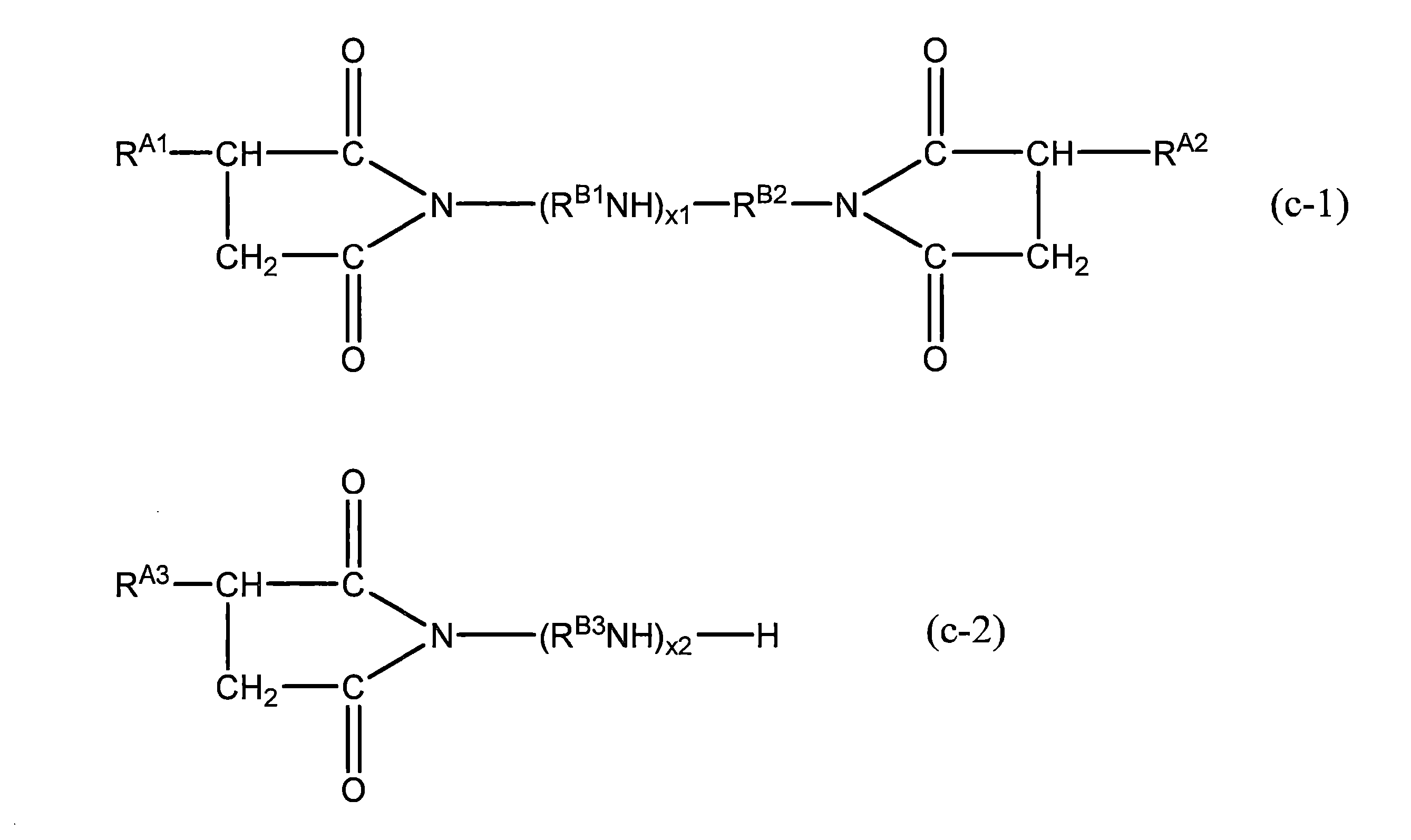
上記一般式(c-1)及び(c-2)中、RA1、RA2及びRA3は、それぞれ独立に、重量平均分子量(Mw)が500~3000(好ましくは900~2500)のアルケニル基である。
RA1、RA2及びRA3して選択し得る、前記アルケニル基としては、例えば、ポリブテニル基、ポリイソブテニル基、エチレン-プロピレン共重合体等が挙げられ、これらの中でも、ポリブテニル基又はポリイソブテニル基が好ましい。
RB1、RB2及びRB3は、それぞれ独立に、炭素数2~5のアルキレン基である。
x1は0~10の整数であり、好ましくは1~4の整数、より好ましくは2又は3である。
x2は1~10の整数であり、好ましくは2~5の整数、より好ましくは3又は4である。
RA1、RA2及びRA3して選択し得る、前記アルケニル基としては、例えば、ポリブテニル基、ポリイソブテニル基、エチレン-プロピレン共重合体等が挙げられ、これらの中でも、ポリブテニル基又はポリイソブテニル基が好ましい。
RB1、RB2及びRB3は、それぞれ独立に、炭素数2~5のアルキレン基である。
x1は0~10の整数であり、好ましくは1~4の整数、より好ましくは2又は3である。
x2は1~10の整数であり、好ましくは2~5の整数、より好ましくは3又は4である。
また、成分(C)は、前記一般式(c-1)又は(c-2)で表される化合物と、ホウ素化合物、アルコール、アルデヒド、ケトン、アルキルフェノール、環状カーボネート、エポキシ化合物、及び有機酸等から選ばれる1種以上とを反応させた変性アルケニルコハク酸イミドも含まれる。
ここで、本発明の潤滑油組成物において、成分(C)は、非ホウ素変性のアルケニルコハク酸ビスイミド(C1)を含む。
成分(C1)は、成分(B)を均一に分散させる効果が高いと推測され、成分(B)が有する過早着火の抑制効果を、長時間の使用においても持続させることができると考えられる。
そのため、成分(B)と共に、成分(C)として、非ホウ素変性のアルケニルコハク酸ビスイミド(C1)を含む潤滑油組成物は、長時間使用した場合においても、過早着火の発生を効果的に抑制し得る。
なお、成分(C1)は、非ホウ素変性のアルケニルコハク酸ビスイミドであるが、非変性のアルケニルコハク酸ビスイミドであることが好ましい。
成分(C1)は、成分(B)を均一に分散させる効果が高いと推測され、成分(B)が有する過早着火の抑制効果を、長時間の使用においても持続させることができると考えられる。
そのため、成分(B)と共に、成分(C)として、非ホウ素変性のアルケニルコハク酸ビスイミド(C1)を含む潤滑油組成物は、長時間使用した場合においても、過早着火の発生を効果的に抑制し得る。
なお、成分(C1)は、非ホウ素変性のアルケニルコハク酸ビスイミドであるが、非変性のアルケニルコハク酸ビスイミドであることが好ましい。
また、上記効果は、非ホウ素変性のアルケニルコハク酸ビスイミド(C1)を用いた場合には認められる一方で、前記一般式(c-2)で表されるような、アルケニルコハク酸モノイミドでは、当該効果が十分に発現し難いことも検討の中で分かった。
上記観点から、本発明の一態様の潤滑油組成物において、成分(C1)の窒素原子換算での含有量は、当該潤滑油組成物の全量(100質量%)基準で、好ましくは0.001~0.15質量%、より好ましくは0.005~0.10質量%、更に好ましくは0.01~0.09質量%、より更に好ましくは0.03~0.07質量%である。
上記観点から、本発明の一態様の潤滑油組成物において、成分(C1)の窒素原子換算での含有量は、当該潤滑油組成物の全量(100質量%)基準で、好ましくは0.001~0.15質量%、より好ましくは0.005~0.10質量%、更に好ましくは0.01~0.09質量%、より更に好ましくは0.03~0.07質量%である。
また、本発明の一態様において、成分(C)中の非ホウ素変性のアルケニルコハク酸ビスイミド(C1)の含有割合としては、成分(C)の全量(100質量%)に対して、好ましくは30質量%以上、より好ましくは50質量%以上、更に好ましくは60質量%以上、より更に好ましくは70質量%以上、特に好ましくは80質量%以上である。
また、成分(C1)としては、成分(B)の分散性を向上させ、長時間使用した場合においても、過早着火の発生を効果的に抑制し得る潤滑油組成物を調製する観点から、前記一般式(c-1)で表されるアルケニルコハク酸ビスイミドであることが好ましく、重量平均分子量500~3000(好ましくは900~2500)のポリブテニル基又はポリイソブテニル基を少なくとも有する、非ホウ素変性のアルケニルコハク酸ビスイミドであることがより好ましい。
また、本発明の一態様において、成分(C)は、成分(C1)と共に、さらにホウ素変性アルケニルコハク酸イミド(C2)を含むこともできる。
成分(C2)を含むことで、成分(B)の分散性の更なる向上効果が期待できる。
ただし、上述のとおり、成分(C2)中のホウ素変性アルケニルコハク酸イミド(C2)は、長時間の使用に伴い発生したデポジット中に含まれていると、過早着火の発生の要因ともなり易いという側面もある。そのため、成分(C2)の含有量は、潤滑油組成物中のホウ素原子の含有量が上述の範囲となるように調製されることを要する。
成分(C2)を含むことで、成分(B)の分散性の更なる向上効果が期待できる。
ただし、上述のとおり、成分(C2)中のホウ素変性アルケニルコハク酸イミド(C2)は、長時間の使用に伴い発生したデポジット中に含まれていると、過早着火の発生の要因ともなり易いという側面もある。そのため、成分(C2)の含有量は、潤滑油組成物中のホウ素原子の含有量が上述の範囲となるように調製されることを要する。
成分(C2)としては、例えば、前記一般式(c-1)で表されるアルケニルコハク酸ビスイミのホウ素変性体、及び、下記一般式(c-2)で表されるアルケニルコハク酸モノイミドのホウ素変性体等が挙げられるが、下記一般式(c-2)で表されるアルケニルコハク酸モノイミドのホウ素変性体が好ましい。
なお、ホウ素変性アルケニルコハク酸イミド(C2)は、例えば、ポリオレフィンと無水マレイン酸との反応で得られるアルケニルコハク酸無水物を、ポリアミン及びホウ素化合物と反応させることで製造することができる。
前記ポリオレフィンは、例えば、炭素数2~8のα-オレフィンから選ばれる1種又は2種以上を重合して得られる重合体が挙げられるが、イソブテンと1-ブテンとの共重合体が好ましい。
前記ポリアミンとしては、例えば、エチレンジアミン、プロピレンジアミン、ブチレンジアミン、ペンチレンジアミン等の単一ジアミン、ジエチレントリアミン、トリエチレンテトラミン、テトラエチレンペンタミン、ペンタエチレンヘキサミン、ジ(メチルエチレン)トリアミン、ジブチレントリアミン、トリブチレンテトラミン、及びペンタペンチレンヘキサミン等のポリアルキレンポリアミン;アミノエチルピペラジン等のピペラジン誘導体;等が挙げられる。
前記ホウ素化合物としては、例えば、酸化ホウ素、ハロゲン化ホウ素、ホウ酸、ホウ酸無水物、ホウ酸エステル、ホウ酸のアンモニウム塩等が挙げられる。
前記ポリオレフィンは、例えば、炭素数2~8のα-オレフィンから選ばれる1種又は2種以上を重合して得られる重合体が挙げられるが、イソブテンと1-ブテンとの共重合体が好ましい。
前記ポリアミンとしては、例えば、エチレンジアミン、プロピレンジアミン、ブチレンジアミン、ペンチレンジアミン等の単一ジアミン、ジエチレントリアミン、トリエチレンテトラミン、テトラエチレンペンタミン、ペンタエチレンヘキサミン、ジ(メチルエチレン)トリアミン、ジブチレントリアミン、トリブチレンテトラミン、及びペンタペンチレンヘキサミン等のポリアルキレンポリアミン;アミノエチルピペラジン等のピペラジン誘導体;等が挙げられる。
前記ホウ素化合物としては、例えば、酸化ホウ素、ハロゲン化ホウ素、ホウ酸、ホウ酸無水物、ホウ酸エステル、ホウ酸のアンモニウム塩等が挙げられる。
本発明の一態様において、成分(C2)を構成するホウ素原子と窒素原子の比率〔B/N〕としては、好ましくは0.1以上、より好ましくは0.2以上、更に好ましくは0.3以上、より更に好ましくは0.5以上である。
本発明の一態様の潤滑油組成物において、成分(C)に由来する窒素原子と、成分(B)に由来するカルシウム原子との含有量比〔N/Ca〕は、成分(B)の分散性を向上させ、長時間使用した場合においても、過早着火の発生を効果的に抑制し得る潤滑油組成物を調製する観点から、質量比で、好ましくは0.90以下、より好ましくは0.80以下、更に好ましくは0.70以下、より更に好ましくは0.60以下、特に好ましくは0.55以下であり、また、好ましくは0.01以上、より好ましくは0.05以上、更に好ましくは0.10以上、より更に好ましくは0.15以上、特に好ましくは0.20以上である。
本発明の一態様の潤滑油組成物において、成分(C2)に由来するホウ素原子と、成分(C)に由来する窒素原子との含有量比〔B/N〕が、質量比で、好ましくは0.01~0.35、より好ましくは0.03~0.25、更に好ましくは0.05~0.22、より更に好ましくは0.10~0.20、特に好ましくは0.12~0.18である。
本発明の一態様の潤滑油組成物において、成分(C)の窒素原子換算での含有量は、当該潤滑油組成物の全量(100質量%)基準で、好ましくは0.005~0.15質量%、より好ましくは0.01~0.10質量%、更に好ましくは0.02~0.09質量%、より更に好ましくは0.04~0.07質量%である。
また、成分(C)の配合量(含有量)は、成分(C)に由来する窒素原子の含有量が上述の範囲になるように適宜調製されるが、当該潤滑油組成物の全量(100質量%)基準で、好ましくは0.10~15.0質量%、より好ましくは0.50~12.0質量%、更に好ましくは1.0~10.0質量%、より更に好ましくは2.5~8.0質量%である。
<ジチオリン酸亜鉛(D)>
本発明の一態様の潤滑油組成物は、耐摩耗剤として、さらにジチオリン酸亜鉛(ZnDTP)(D)を含有することが好ましい。
成分(D)は、単独で用いてもよく、2種以上を併用してもよい。
本発明の一態様の潤滑油組成物は、耐摩耗剤として、さらにジチオリン酸亜鉛(ZnDTP)(D)を含有することが好ましい。
成分(D)は、単独で用いてもよく、2種以上を併用してもよい。
本発明の一態様で用いるジチオリン酸亜鉛(D)としては、下記一般式(d-1)で表される化合物が好ましい。

上記式(d-1)中、R1~R4は、それぞれ独立に、炭化水素基を示し、互いに同一であってもよく、異なっていてもよい。
R1~R4として選択し得る炭化水素基の炭素数は、好ましくは1~20、より好ましくは1~16、更に好ましくは3~12、より更に好ましくは3~10である。
R1~R4として選択し得る炭化水素基の炭素数は、好ましくは1~20、より好ましくは1~16、更に好ましくは3~12、より更に好ましくは3~10である。
R1~R4として選択し得る、具体的な当該炭化水素基としては、例えば、メチル基、エチル基、プロピル基、ブチル基、ペンチル基、ヘキシル基、ヘプチル基、オクチル基、ノニル基、デシル基、ウンデシル基、ドデシル基、トリデシル基、テトラデシル基、ペンタデシル基、ヘキサデシル基、ヘプタデシル基、オクタデシル基等のアルキル基;オクテニル基、ノネニル基、デセニル基、ウンデセニル基、ドデセニル基、トリデセニル基、テトラデセニル基、ペンタデセニル基等のアルケニル基;シクロヘキシル基、ジメチルシクロヘキシル基、エチルシクロヘキシル基、メチルシクロヘキシルメチル基、シクロヘキシルエチル基、プロピルシクロヘキシル基、ブチルシクロヘキシル基、ヘプチルシクロヘキシル基等のシクロアルキル基;フェニル基、ナフチル基、アントラセニル基、ビフェニル基、ターフェニル基等のアリール基;トリル基、ジメチルフェニル基、ブチルフェニル基、ノニルフェニル基、メチルベンジル基、ジメチルナフチル基等のアルキルアリール基;フェニルメチル基、フェニルエチル基、ジフェニルメチル基等のアリールアルキル基等が挙げられる。
これらの中でも、R1~R4として選択し得る、当該炭化水素基としては、アルキル基が好ましく、第1級又は第2級のアルキル基がより好ましく、第2級のアルキル基が更に好ましい。
これらの中でも、R1~R4として選択し得る、当該炭化水素基としては、アルキル基が好ましく、第1級又は第2級のアルキル基がより好ましく、第2級のアルキル基が更に好ましい。
本発明の一態様の潤滑油組成物において、成分(D)の亜鉛原子換算での含有量は、当該潤滑油組成物の全量(100質量%)基準で、好ましくは0.001~1.0質量%、より好ましくは0.005~0.80質量%、更に好ましくは0.01~0.60質量%、より更に好ましくは0.02~0.50質量%、特に好ましくは0.03~0.40質量%である。
また、成分(D)の含有量(配合量)としては、亜鉛原子換算での含有量が上記範囲に属するように調製されればよいが、当該潤滑油組成物の全量(100質量%)基準で、好ましくは0.01~15.0質量%、より好ましくは0.05~10.0質量%、更に好ましくは0.10~8.0質量%、より更に好ましくは0.20~5.0質量%であり、また、1.00質量%以下、0.90質量%以下、0.85質量%以下、又は0.80質量%以下としてもよい。
<潤滑油用添加剤>
本発明の一態様の潤滑油組成物は、本発明の効果を損なわない範囲で、必要に応じて、更に成分(B)~(D)以外の潤滑油用添加剤を含有してもよい。
このような潤滑油用添加剤としては、例えば、酸化防止剤、流動点降下剤、粘度指数向上剤、抗乳化剤、摩擦調整剤、腐食防止剤、金属不活性化剤、帯電防止剤、消泡剤等が挙げられる。
これらの潤滑油用添加剤は、それぞれ、単独で用いてもよく、2種以上を併用してもよい。
本発明の一態様の潤滑油組成物は、本発明の効果を損なわない範囲で、必要に応じて、更に成分(B)~(D)以外の潤滑油用添加剤を含有してもよい。
このような潤滑油用添加剤としては、例えば、酸化防止剤、流動点降下剤、粘度指数向上剤、抗乳化剤、摩擦調整剤、腐食防止剤、金属不活性化剤、帯電防止剤、消泡剤等が挙げられる。
これらの潤滑油用添加剤は、それぞれ、単独で用いてもよく、2種以上を併用してもよい。
これらの潤滑油用添加剤のそれぞれの含有量は、本発明の効果を損なわない範囲内で、適宜調製することができるが、潤滑油組成物の全量(100質量%)基準で、それぞれの添加剤ごとに独立して、通常0.001~15質量%、好ましくは0.005~10質量%、より好ましくは0.01~5質量%である。
<潤滑油組成物の製造方法>
本発明の一態様の潤滑油組成物の製造方法としては、特に制限はないが、生産性の観点から、基油(A)に、上述の成分(B)及び(C)、並びに、必要に応じて、成分(D)及び他の潤滑油用添加剤を配合する工程を有する、方法であることが好ましい。
ここで、成分(A)、(B)、(C)及び(D)、並びに潤滑油用添加剤の配合量は、上述のとおりである。
本発明の一態様の潤滑油組成物の製造方法としては、特に制限はないが、生産性の観点から、基油(A)に、上述の成分(B)及び(C)、並びに、必要に応じて、成分(D)及び他の潤滑油用添加剤を配合する工程を有する、方法であることが好ましい。
ここで、成分(A)、(B)、(C)及び(D)、並びに潤滑油用添加剤の配合量は、上述のとおりである。
〔潤滑油組成物の性状〕
本発明の一態様の潤滑油組成物の40℃における動粘度としては、好ましくは10~130mm2/s、より好ましくは20~115mm2/s、更に好ましくは30~100mm2/s、より更に好ましくは40~90mm2/sである。
本発明の一態様の潤滑油組成物の40℃における動粘度としては、好ましくは10~130mm2/s、より好ましくは20~115mm2/s、更に好ましくは30~100mm2/s、より更に好ましくは40~90mm2/sである。
本発明の一態様の潤滑油組成物の100℃における動粘度としては、好ましくは2.5~20.0mm2/s、より好ましくは4.0~16.0mm2/s、更に好ましくは5.5~14.0mm2/s、より更に好ましくは7.0~12.0mm2/sである。
本発明の一態様の潤滑油組成物の粘度指数としては、好ましくは90以上、より好ましくは100以上、更に好ましくは110以上、より更に好ましくは130以上である。
本発明の一態様の潤滑油組成物の酸価としては、好ましくは0.30~2.00mgKOH/g、より好ましくは0.35~1.70mgKOH/g、更に好ましくは0.40~1.30mgKOH/g、より更に好ましくは0.45~1.00mgKOH/gである。
なお、本明細書において、潤滑油組成物の酸価は、JIS K2501:2003(指示薬法)に準拠して測定された値を意味する。
なお、本明細書において、潤滑油組成物の酸価は、JIS K2501:2003(指示薬法)に準拠して測定された値を意味する。
本発明の一態様の潤滑油組成物の塩基価としては、好ましくは2.0~10.0mgKOH/g、より好ましくは2.5~8.0mgKOH/g、更に好ましくは3.0~6.5mgKOH/g、より更に好ましくは3.5~5.0mgKOH/gである。
なお、本明細書において、潤滑油組成物の塩基価は、JIS K2501:2003(塩酸法)に準拠して測定された値を意味する。
なお、本明細書において、潤滑油組成物の塩基価は、JIS K2501:2003(塩酸法)に準拠して測定された値を意味する。
本発明の一態様の潤滑油組成物において、リン原子の含有量は、当該潤滑油組成物の全量(100質量%)基準で、好ましくは0.01~0.15質量%、より好ましくは0.015~0.12質量%、更に好ましくは0.02~0.10質量%、より更に好ましくは0.025~0.08質量%である。
本発明の一態様の潤滑油組成物において、窒素原子の含有量は、当該潤滑油組成物の全量(100質量%)基準で、好ましくは0.01~0.50質量%、より好ましくは0.02~0.30質量%、更に好ましくは0.03~0.20質量%、より更に好ましくは0.04~0.15質量%、特に好ましくは0.045~0.10質量%である。
本発明の一態様の潤滑油組成物において、デポジットの原因物質を低減する観点から、マグネシウム原子の含有量は、前記潤滑油組成物の全量基準で、好ましくは0.04質量%未満、より好ましくは0.02質量%未満、更に好ましくは0.01質量%未満、より更に好ましくは0.001質量%未満である。
本発明の一態様の潤滑油組成物において、長時間使用した場合においても、過早着火の発生を効果的に抑制し得る潤滑油組成物を調製する観点から、モリブデン原子の含有量は、当該潤滑油組成物の全量(100質量%)基準で、好ましくは0.01質量%未満、より好ましくは0.005質量%未満、更に好ましくは0.001質量%未満である。
〔潤滑油組成物の用途〕
本発明の好適な一態様の潤滑油組成物は、長時間使用した場合においても、過早着火の抑制効果に優れている。
そのため、本発明の一態様の潤滑油組成物は、上記特性を発揮し得る各種装置に適用することができるが、ガスエンジンの潤滑に適用されることが好ましい。
本発明の好適な一態様の潤滑油組成物は、長時間使用した場合においても、過早着火の抑制効果に優れている。
そのため、本発明の一態様の潤滑油組成物は、上記特性を発揮し得る各種装置に適用することができるが、ガスエンジンの潤滑に適用されることが好ましい。
また、本発明の一態様の潤滑油組成物の上述の特性を考慮すると、本発明は、以下の[1]及び[2]も提供し得る。
[1]上述の本発明の一態様の潤滑油組成物を用いた、ガスエンジン。
[2]上述の本発明の一態様の潤滑油組成物をガスエンジンに適用した、潤滑油組成物の使用。
[1]上述の本発明の一態様の潤滑油組成物を用いた、ガスエンジン。
[2]上述の本発明の一態様の潤滑油組成物をガスエンジンに適用した、潤滑油組成物の使用。
次に、本発明を実施例により更に詳細に説明するが、本発明はこれらの例によって何ら限定されるものではない。なお、各種物性の測定法は、下記のとおりである。
(1)動粘度、粘度指数
JIS K2283:2000に準拠して測定及び算出した。
(2)カルシウム原子、リン原子、ホウ素原子、亜鉛原子、モリブデン原子の含有量
JPI-5S-38-92に準拠して測定した。
(3)窒素原子の含有量
JIS K2609:1998に準拠して測定した。
(4)酸価
JIS K2501:2003(指示薬法)に準拠して測定した。
(5)塩基価(塩酸法)
JIS K2501:2003(塩酸法)に準拠して測定した。
JIS K2283:2000に準拠して測定及び算出した。
(2)カルシウム原子、リン原子、ホウ素原子、亜鉛原子、モリブデン原子の含有量
JPI-5S-38-92に準拠して測定した。
(3)窒素原子の含有量
JIS K2609:1998に準拠して測定した。
(4)酸価
JIS K2501:2003(指示薬法)に準拠して測定した。
(5)塩基価(塩酸法)
JIS K2501:2003(塩酸法)に準拠して測定した。
(6)重量平均分子量(Mw)
ゲル浸透クロマトグラフ装置(アジレント社製、「1260型HPLC」)を用いて、下記の条件下で測定し、標準ポリスチレン換算にて測定した値を用いた。
(測定条件)
・カラム:「Shodex LF404」を2本、順次連結したもの。
・カラム温度:35℃
・展開溶媒:クロロホルム
・流速:0.3mL/min
ゲル浸透クロマトグラフ装置(アジレント社製、「1260型HPLC」)を用いて、下記の条件下で測定し、標準ポリスチレン換算にて測定した値を用いた。
(測定条件)
・カラム:「Shodex LF404」を2本、順次連結したもの。
・カラム温度:35℃
・展開溶媒:クロロホルム
・流速:0.3mL/min
実施例1~6、比較例1~5
表1及び表2に示す種類の基油及び各種添加剤を、表1及び表2に示す配合量にて添加して混合し、潤滑油組成物をそれぞれ調製した。
当該潤滑油組成物の調製に使用した、各成分の詳細は以下のとおりである。
表1及び表2に示す種類の基油及び各種添加剤を、表1及び表2に示す配合量にて添加して混合し、潤滑油組成物をそれぞれ調製した。
当該潤滑油組成物の調製に使用した、各成分の詳細は以下のとおりである。
<基油>
・「基油(a-i)」:グループIIに分類されるパラフィン系鉱油、40℃動粘度=90.5mm2/s、粘度指数=107。
・「基油(a-ii)」:グループIIIに分類されるパラフィン系鉱油、40℃動粘度=44.7mm2/s、粘度指数=140。
・「基油(a-i)」:グループIIに分類されるパラフィン系鉱油、40℃動粘度=90.5mm2/s、粘度指数=107。
・「基油(a-ii)」:グループIIIに分類されるパラフィン系鉱油、40℃動粘度=44.7mm2/s、粘度指数=140。
<カルシウム系清浄剤>
・「Caサリシレート(b-i)」:塩基価=214mgKOH/g(塩酸法)、Ca原子含有量=8.0質量%。
・「Caサリシレート(b-i)」:塩基価=214mgKOH/g(塩酸法)、Ca原子含有量=8.0質量%。
<イミド化合物>
・「非変性コハク酸ビスイミド(c1-i)」:Mw=950のポリブテニル基を有するポリブテニルコハク酸ビスイミド、窒素原子の含有量=1.1質量%。
・「非変性コハク酸ビスイミド(c1-ii)」:Mw=2300のポリブテニル基を有するポリブテニルコハク酸ビスイミド、窒素原子の含有量=1.0質量%。
・「ホウ素変性コハク酸モノイミド(c2-i)」:ポリブテニル基を有するポリブテニルコハク酸モノイミドのホウ素化物、ホウ素原子(B)の含有量=0.49質量%、窒素原子(N)の含有量=1.50質量%、B/N=0.33。
・「ホウ素変性コハク酸モノイミド(c2-ii)」:ポリブテニル基を有するポリブテニルコハク酸モノイミドのホウ素化物、ホウ素原子(B)の含有量=1.30質量%、窒素原子(N)の含有量=1.23質量%、B/N=1.06。
・「非変性コハク酸モノイミド(c3)」:Mw=950のポリブテニル基を有するポリブテニルコハク酸モノイミド、窒素原子の含有量=2.10質量%。
・「非変性コハク酸ビスイミド(c1-i)」:Mw=950のポリブテニル基を有するポリブテニルコハク酸ビスイミド、窒素原子の含有量=1.1質量%。
・「非変性コハク酸ビスイミド(c1-ii)」:Mw=2300のポリブテニル基を有するポリブテニルコハク酸ビスイミド、窒素原子の含有量=1.0質量%。
・「ホウ素変性コハク酸モノイミド(c2-i)」:ポリブテニル基を有するポリブテニルコハク酸モノイミドのホウ素化物、ホウ素原子(B)の含有量=0.49質量%、窒素原子(N)の含有量=1.50質量%、B/N=0.33。
・「ホウ素変性コハク酸モノイミド(c2-ii)」:ポリブテニル基を有するポリブテニルコハク酸モノイミドのホウ素化物、ホウ素原子(B)の含有量=1.30質量%、窒素原子(N)の含有量=1.23質量%、B/N=1.06。
・「非変性コハク酸モノイミド(c3)」:Mw=950のポリブテニル基を有するポリブテニルコハク酸モノイミド、窒素原子の含有量=2.10質量%。
<ジチオリン酸亜鉛>
・「Pri-ZnDTP」:第1級ジアルキルジチオリン酸亜鉛、リン原子含有量=7.4質量%、亜鉛原子含有量=8.9質量%。
・「Sec-ZnDTP」:第2級ジアルキルジチオリン酸亜鉛、リン原子含有量=8.2質量%、亜鉛原子含有量=9.0質量%。
・「Pri-ZnDTP」:第1級ジアルキルジチオリン酸亜鉛、リン原子含有量=7.4質量%、亜鉛原子含有量=8.9質量%。
・「Sec-ZnDTP」:第2級ジアルキルジチオリン酸亜鉛、リン原子含有量=8.2質量%、亜鉛原子含有量=9.0質量%。
<他の添加剤>
・酸化防止剤:アミン系酸化防止剤及びフェノール系酸化防止剤の混合物。
・酸化防止剤:アミン系酸化防止剤及びフェノール系酸化防止剤の混合物。
調製した潤滑油組成物について、動粘度、粘度指数、酸価及び塩基価を測定もしくは算出すると共に、以下の過早着火の抑制効果の試験を行った。これらの結果を表1及び表2に示す。
[過早着火の抑制効果試験]
調製した潤滑油組成物を25mL試料としてるつぼに入れ、30分間かけて完全燃焼させた。燃焼後の灰分につき、示差走査熱量計(METTLER社製、高圧DSC)を用いて、3MPaの高圧酸素雰囲気下で、50℃から600℃まで、昇温速度10℃/分にて昇温し、灰分のピーク発熱量(単位:mW)を測定した。
当該灰分のピーク発熱量は、好ましくは22.0mW以下、より好ましくは20.0mW以下、更に好ましくは18.5mW以下、より更に好ましくは15.0mW以下、特に好ましくは11.0mW以下である。
また、実施例1及び比較例1で調製した潤滑油組成物は、新油のまま、上記と同じ操作にて、新油のピーク発熱量(単位:mW)を測定した。
これらの結果は、表1及び表2に示すとおりとなった。
調製した潤滑油組成物を25mL試料としてるつぼに入れ、30分間かけて完全燃焼させた。燃焼後の灰分につき、示差走査熱量計(METTLER社製、高圧DSC)を用いて、3MPaの高圧酸素雰囲気下で、50℃から600℃まで、昇温速度10℃/分にて昇温し、灰分のピーク発熱量(単位:mW)を測定した。
当該灰分のピーク発熱量は、好ましくは22.0mW以下、より好ましくは20.0mW以下、更に好ましくは18.5mW以下、より更に好ましくは15.0mW以下、特に好ましくは11.0mW以下である。
また、実施例1及び比較例1で調製した潤滑油組成物は、新油のまま、上記と同じ操作にて、新油のピーク発熱量(単位:mW)を測定した。
これらの結果は、表1及び表2に示すとおりとなった。
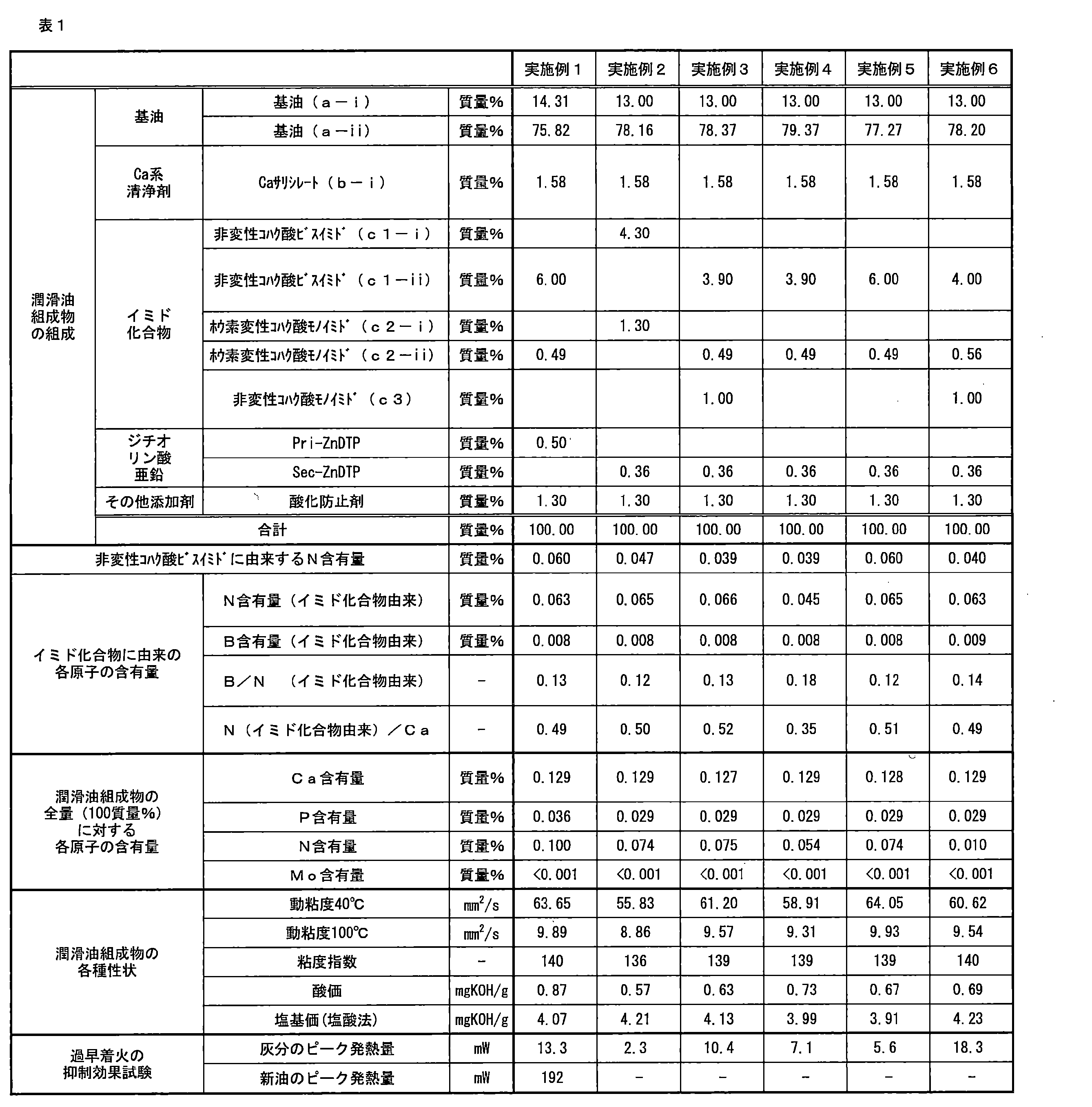

表1及び表2より、実施例1~6で調製した潤滑油組成物の灰分のピーク発熱量は、比較例1~4に比べて、低い値であった。そのため、実施例1~6で調製した潤滑油組成物は、デポジットの発熱に起因した過早着火の抑制効果が高いものであるといえる。
なお、表1及び表2に示されているとおり、実施例1と比較例1の新油のピーク発熱量は、ほとんど同じであるのに対して、灰分のピーク発熱量は異なる結果となることからも、デポジットの発熱に起因した過早着火は起こり得ることが分かる。
なお、表1及び表2に示されているとおり、実施例1と比較例1の新油のピーク発熱量は、ほとんど同じであるのに対して、灰分のピーク発熱量は異なる結果となることからも、デポジットの発熱に起因した過早着火は起こり得ることが分かる。
Claims (12)
- 基油(A)、カルシウム系清浄剤(B)、及びアルケニルコハク酸イミド(C)を含む、ガスエンジン用の潤滑油組成物であって、
成分(B)のカルシウム原子換算での含有量が、前記潤滑油組成物の全量基準で、0.09~0.17質量%であり、
成分(C)が、非ホウ素変性のアルケニルコハク酸ビスイミド(C1)を含み、
成分(C)に由来するホウ素原子の含有量が、前記潤滑油組成物の全量基準で、0.02質量%未満である、
潤滑油組成物。 - 成分(C)に由来する窒素原子と、成分(B)に由来するカルシウム原子との含有量比〔N/Ca〕が、質量比で、0.90以下である、請求項1に記載の潤滑油組成物。
- 成分(B)が、カルシウムサリシレート(B1)を含む、請求項1又は2に記載の潤滑油組成物。
- 成分(C1)が、重量平均分子量500~3000のポリブテニル基又はポリイソブテニル基を少なくとも有する、非ホウ素変性のアルケニルコハク酸ビスイミドである、請求項1~3のいずれか一項に記載の潤滑油組成物。
- 成分(C)が、成分(C1)と共に、さらにホウ素変性アルケニルコハク酸イミド(C2)を含む、請求項1~4のいずれか一項に記載の潤滑油組成物。
- 成分(C2)に由来するホウ素原子と、成分(C)に由来する窒素原子との含有量比〔B/N〕が、質量比で、0.01~0.35である、請求項5に記載の潤滑油組成物。
- 成分(C)の窒素原子換算での含有量が、前記潤滑油組成物の全量基準で、0.005~0.15質量%である、請求項1~6のいずれか一項に記載の潤滑油組成物。
- さらにジチオリン酸亜鉛(D)を含有する、請求項1~7のいずれか一項に記載の潤滑油組成物。
- マグネシウム原子の含有量が、前記潤滑油組成物の全量基準で、0.04質量%未満である、請求項1~8のいずれか一項に記載の潤滑油組成物。
- モリブデン原子の含有量が、前記潤滑油組成物の全量基準で、0.01質量%未満である、請求項1~9のいずれか一項に記載の潤滑油組成物。
- 請求項1~10のいずれか一項に記載の潤滑油組成物を用いた、ガスエンジン。
- 請求項1~10のいずれか一項に記載の潤滑油組成物をガスエンジンに適用する、潤滑油組成物の使用。
Priority Applications (4)
| Application Number | Priority Date | Filing Date | Title |
|---|---|---|---|
| JP2021511525A JP7454556B2 (ja) | 2019-03-29 | 2020-03-25 | 潤滑油組成物 |
| US17/442,769 US20220169946A1 (en) | 2019-03-29 | 2020-03-25 | Lubricating oil composition |
| EP20781970.7A EP3950904B1 (en) | 2019-03-29 | 2020-03-25 | Lubricating oil composition |
| FIEP20781970.7T FI3950904T3 (fi) | 2019-03-29 | 2020-03-25 | Voiteluöljykoostumus |
Applications Claiming Priority (2)
| Application Number | Priority Date | Filing Date | Title |
|---|---|---|---|
| JP2019-065482 | 2019-03-29 | ||
| JP2019065482 | 2019-03-29 |
Publications (1)
| Publication Number | Publication Date |
|---|---|
| WO2020203525A1 true WO2020203525A1 (ja) | 2020-10-08 |
Family
ID=72667776
Family Applications (1)
| Application Number | Title | Priority Date | Filing Date |
|---|---|---|---|
| PCT/JP2020/013227 Ceased WO2020203525A1 (ja) | 2019-03-29 | 2020-03-25 | 潤滑油組成物 |
Country Status (5)
| Country | Link |
|---|---|
| US (1) | US20220169946A1 (ja) |
| EP (1) | EP3950904B1 (ja) |
| JP (1) | JP7454556B2 (ja) |
| FI (1) | FI3950904T3 (ja) |
| WO (1) | WO2020203525A1 (ja) |
Cited By (1)
| Publication number | Priority date | Publication date | Assignee | Title |
|---|---|---|---|---|
| JP7118327B1 (ja) * | 2021-03-30 | 2022-08-15 | 出光興産株式会社 | 潤滑油組成物 |
Families Citing this family (2)
| Publication number | Priority date | Publication date | Assignee | Title |
|---|---|---|---|---|
| JP7763662B2 (ja) * | 2019-06-28 | 2025-11-04 | 出光興産株式会社 | 潤滑油組成物 |
| CN117321179A (zh) * | 2021-05-20 | 2023-12-29 | 雪佛龙日本有限公司 | 低灰分润滑油组合物 |
Citations (4)
| Publication number | Priority date | Publication date | Assignee | Title |
|---|---|---|---|---|
| JPH0971795A (ja) * | 1995-09-06 | 1997-03-18 | Nippon Oil Co Ltd | ガスエンジン用潤滑油組成物 |
| JP2004107556A (ja) * | 2002-09-20 | 2004-04-08 | Osaka Gas Co Ltd | ガスエンジン油 |
| JP2018203952A (ja) | 2017-06-08 | 2018-12-27 | Jxtgエネルギー株式会社 | ガスエンジン用潤滑油組成物、及び燃料消費量の改善方法又は異常燃焼の低減方法 |
| JP2019147864A (ja) * | 2018-02-26 | 2019-09-05 | 出光興産株式会社 | 潤滑油組成物 |
Family Cites Families (21)
| Publication number | Priority date | Publication date | Assignee | Title |
|---|---|---|---|---|
| JP2000192069A (ja) * | 1998-12-28 | 2000-07-11 | Oronite Japan Ltd | ディ―ゼル内燃機関用潤滑油組成物及び添加剤組成物 |
| JP4643030B2 (ja) * | 2001-01-29 | 2011-03-02 | 日産自動車株式会社 | ディーゼルエンジン油組成物 |
| WO2003033629A1 (en) * | 2001-10-12 | 2003-04-24 | Nippon Oil Corporation | Lubricating oil composition for internal combustion engine |
| JP4700288B2 (ja) * | 2004-03-29 | 2011-06-15 | 出光興産株式会社 | 無段変速機用潤滑油組成物 |
| CN101646757B (zh) * | 2007-03-28 | 2013-07-24 | 出光兴产株式会社 | 润滑油组合物 |
| CN104204164A (zh) * | 2012-03-21 | 2014-12-10 | 出光兴产株式会社 | 铝合金制发动机用润滑油组合物以及润滑方法 |
| JP5988891B2 (ja) * | 2013-02-19 | 2016-09-07 | Jxエネルギー株式会社 | 変速機用潤滑油組成物 |
| JP6302458B2 (ja) * | 2013-03-08 | 2018-03-28 | 出光興産株式会社 | 潤滑油組成物 |
| EP2883945B1 (en) * | 2013-12-05 | 2018-12-26 | Infineum International Limited | A gas engine lubricating oil composition |
| JP6134852B2 (ja) | 2014-01-31 | 2017-05-24 | 東燃ゼネラル石油株式会社 | 潤滑油組成物 |
| US10519394B2 (en) * | 2014-05-09 | 2019-12-31 | Exxonmobil Research And Engineering Company | Method for preventing or reducing low speed pre-ignition while maintaining or improving cleanliness |
| US20150322367A1 (en) * | 2014-05-09 | 2015-11-12 | Exxonmobil Research And Engineering Company | Method for preventing or reducing low speed pre-ignition |
| JP6572581B2 (ja) * | 2015-03-24 | 2019-09-11 | 出光興産株式会社 | 火花点火式内燃機関用潤滑油組成物、該潤滑油組成物の製造方法、該潤滑油組成物を用いた火花点火式内燃機関、及び該内燃機関の潤滑方法 |
| EP3275978B1 (en) * | 2015-03-24 | 2024-05-08 | Idemitsu Kosan Co.,Ltd. | Lubricant composition for gasoline engines and method for producing same |
| US10793803B2 (en) * | 2015-03-31 | 2020-10-06 | Idemitsu Kosan Co., Ltd. | Gasoline engine lubricant oil composition and manufacturing method therefor |
| WO2017099052A1 (ja) * | 2015-12-07 | 2017-06-15 | Jxエネルギー株式会社 | 内燃機関用潤滑油組成物 |
| JP6714423B2 (ja) | 2016-04-25 | 2020-06-24 | コスモ石油ルブリカンツ株式会社 | ディーゼルエンジン油組成物 |
| JP6741550B2 (ja) | 2016-10-18 | 2020-08-19 | Eneos株式会社 | 内燃機関の潤滑方法 |
| US10487289B2 (en) * | 2017-02-21 | 2019-11-26 | Exxonmobil Research And Engineering Company | Lubricating oil compositions and methods of use thereof |
| US20180258365A1 (en) * | 2017-03-08 | 2018-09-13 | Chevron Japan Ltd. | Low viscosity lubricating oil composition |
| EP3766948A4 (en) * | 2018-03-14 | 2021-12-08 | Idemitsu Kosan Co.,Ltd. | OIL COMPOSITION |
-
2020
- 2020-03-25 US US17/442,769 patent/US20220169946A1/en not_active Abandoned
- 2020-03-25 EP EP20781970.7A patent/EP3950904B1/en active Active
- 2020-03-25 FI FIEP20781970.7T patent/FI3950904T3/fi active
- 2020-03-25 JP JP2021511525A patent/JP7454556B2/ja active Active
- 2020-03-25 WO PCT/JP2020/013227 patent/WO2020203525A1/ja not_active Ceased
Patent Citations (4)
| Publication number | Priority date | Publication date | Assignee | Title |
|---|---|---|---|---|
| JPH0971795A (ja) * | 1995-09-06 | 1997-03-18 | Nippon Oil Co Ltd | ガスエンジン用潤滑油組成物 |
| JP2004107556A (ja) * | 2002-09-20 | 2004-04-08 | Osaka Gas Co Ltd | ガスエンジン油 |
| JP2018203952A (ja) | 2017-06-08 | 2018-12-27 | Jxtgエネルギー株式会社 | ガスエンジン用潤滑油組成物、及び燃料消費量の改善方法又は異常燃焼の低減方法 |
| JP2019147864A (ja) * | 2018-02-26 | 2019-09-05 | 出光興産株式会社 | 潤滑油組成物 |
Non-Patent Citations (1)
| Title |
|---|
| See also references of EP3950904A4 |
Cited By (3)
| Publication number | Priority date | Publication date | Assignee | Title |
|---|---|---|---|---|
| JP7118327B1 (ja) * | 2021-03-30 | 2022-08-15 | 出光興産株式会社 | 潤滑油組成物 |
| WO2022209540A1 (ja) * | 2021-03-30 | 2022-10-06 | 出光興産株式会社 | 潤滑油組成物 |
| EP4317385A4 (en) * | 2021-03-30 | 2025-04-02 | Idemitsu Kosan Co., Ltd. | LUBRICANT OIL COMPOSITION |
Also Published As
| Publication number | Publication date |
|---|---|
| JPWO2020203525A1 (ja) | 2020-10-08 |
| EP3950904B1 (en) | 2025-03-19 |
| EP3950904A4 (en) | 2022-12-07 |
| JP7454556B2 (ja) | 2024-03-22 |
| FI3950904T3 (fi) | 2025-04-25 |
| EP3950904A1 (en) | 2022-02-09 |
| US20220169946A1 (en) | 2022-06-02 |
Similar Documents
| Publication | Publication Date | Title |
|---|---|---|
| JP6197124B2 (ja) | ガソリンエンジン用潤滑油組成物、及びその製造方法 | |
| JP6572900B2 (ja) | 潤滑油組成物、及び当該潤滑油組成物の製造方法 | |
| JP6197123B2 (ja) | ガソリンエンジン用潤滑油組成物、及びその製造方法 | |
| US11965142B2 (en) | Lubricating oil composition | |
| CN106133122A (zh) | 燃气发动机用润滑油组合物 | |
| US12359144B2 (en) | Lubricant composition | |
| JP7454556B2 (ja) | 潤滑油組成物 | |
| US11384310B2 (en) | Lubricating oil composition and production method therefor | |
| JP2020164747A (ja) | 潤滑油組成物 | |
| JP7118327B1 (ja) | 潤滑油組成物 | |
| WO2022209942A1 (ja) | 潤滑油組成物 | |
| JP7132880B2 (ja) | 潤滑油組成物 | |
| WO2025004733A1 (ja) | 潤滑油組成物 | |
| WO2021187370A1 (ja) | 潤滑油組成物、過給機搭載ディーゼルエンジン、及び潤滑油組成物の使用方法 |
Legal Events
| Date | Code | Title | Description |
|---|---|---|---|
| 121 | Ep: the epo has been informed by wipo that ep was designated in this application |
Ref document number: 20781970 Country of ref document: EP Kind code of ref document: A1 |
|
| ENP | Entry into the national phase |
Ref document number: 2021511525 Country of ref document: JP Kind code of ref document: A |
|
| NENP | Non-entry into the national phase |
Ref country code: DE |
|
| ENP | Entry into the national phase |
Ref document number: 2020781970 Country of ref document: EP Effective date: 20211029 |