WO2020203926A1 - 血液浄化器及びその製法 - Google Patents
血液浄化器及びその製法 Download PDFInfo
- Publication number
- WO2020203926A1 WO2020203926A1 PCT/JP2020/014383 JP2020014383W WO2020203926A1 WO 2020203926 A1 WO2020203926 A1 WO 2020203926A1 JP 2020014383 W JP2020014383 W JP 2020014383W WO 2020203926 A1 WO2020203926 A1 WO 2020203926A1
- Authority
- WO
- WIPO (PCT)
- Prior art keywords
- porous molded
- blood purifier
- polymer
- molded body
- molded product
- Prior art date
- Legal status (The legal status is an assumption and is not a legal conclusion. Google has not performed a legal analysis and makes no representation as to the accuracy of the status listed.)
- Ceased
Links
Images



Classifications
-
- A—HUMAN NECESSITIES
- A61—MEDICAL OR VETERINARY SCIENCE; HYGIENE
- A61M—DEVICES FOR INTRODUCING MEDIA INTO, OR ONTO, THE BODY; DEVICES FOR TRANSDUCING BODY MEDIA OR FOR TAKING MEDIA FROM THE BODY; DEVICES FOR PRODUCING OR ENDING SLEEP OR STUPOR
- A61M1/00—Suction or pumping devices for medical purposes; Devices for carrying-off, for treatment of, or for carrying-over, body-liquids; Drainage systems
- A61M1/36—Other treatment of blood in a by-pass of the natural circulatory system, e.g. temperature adaptation, irradiation ; Extra-corporeal blood circuits
- A61M1/3679—Other treatment of blood in a by-pass of the natural circulatory system, e.g. temperature adaptation, irradiation ; Extra-corporeal blood circuits by absorption
-
- A—HUMAN NECESSITIES
- A61—MEDICAL OR VETERINARY SCIENCE; HYGIENE
- A61M—DEVICES FOR INTRODUCING MEDIA INTO, OR ONTO, THE BODY; DEVICES FOR TRANSDUCING BODY MEDIA OR FOR TAKING MEDIA FROM THE BODY; DEVICES FOR PRODUCING OR ENDING SLEEP OR STUPOR
- A61M1/00—Suction or pumping devices for medical purposes; Devices for carrying-off, for treatment of, or for carrying-over, body-liquids; Drainage systems
- A61M1/14—Dialysis systems; Artificial kidneys; Blood oxygenators ; Reciprocating systems for treatment of body fluids, e.g. single needle systems for hemofiltration or pheresis
-
- B—PERFORMING OPERATIONS; TRANSPORTING
- B01—PHYSICAL OR CHEMICAL PROCESSES OR APPARATUS IN GENERAL
- B01J—CHEMICAL OR PHYSICAL PROCESSES, e.g. CATALYSIS OR COLLOID CHEMISTRY; THEIR RELEVANT APPARATUS
- B01J20/00—Solid sorbent compositions or filter aid compositions; Sorbents for chromatography; Processes for preparing, regenerating or reactivating thereof
- B01J20/02—Solid sorbent compositions or filter aid compositions; Sorbents for chromatography; Processes for preparing, regenerating or reactivating thereof comprising inorganic material
- B01J20/06—Solid sorbent compositions or filter aid compositions; Sorbents for chromatography; Processes for preparing, regenerating or reactivating thereof comprising inorganic material comprising oxides or hydroxides of metals not provided for in group B01J20/04
-
- B—PERFORMING OPERATIONS; TRANSPORTING
- B01—PHYSICAL OR CHEMICAL PROCESSES OR APPARATUS IN GENERAL
- B01J—CHEMICAL OR PHYSICAL PROCESSES, e.g. CATALYSIS OR COLLOID CHEMISTRY; THEIR RELEVANT APPARATUS
- B01J20/00—Solid sorbent compositions or filter aid compositions; Sorbents for chromatography; Processes for preparing, regenerating or reactivating thereof
- B01J20/02—Solid sorbent compositions or filter aid compositions; Sorbents for chromatography; Processes for preparing, regenerating or reactivating thereof comprising inorganic material
- B01J20/06—Solid sorbent compositions or filter aid compositions; Sorbents for chromatography; Processes for preparing, regenerating or reactivating thereof comprising inorganic material comprising oxides or hydroxides of metals not provided for in group B01J20/04
- B01J20/08—Solid sorbent compositions or filter aid compositions; Sorbents for chromatography; Processes for preparing, regenerating or reactivating thereof comprising inorganic material comprising oxides or hydroxides of metals not provided for in group B01J20/04 comprising aluminium oxide or hydroxide; comprising bauxite
-
- B—PERFORMING OPERATIONS; TRANSPORTING
- B01—PHYSICAL OR CHEMICAL PROCESSES OR APPARATUS IN GENERAL
- B01J—CHEMICAL OR PHYSICAL PROCESSES, e.g. CATALYSIS OR COLLOID CHEMISTRY; THEIR RELEVANT APPARATUS
- B01J20/00—Solid sorbent compositions or filter aid compositions; Sorbents for chromatography; Processes for preparing, regenerating or reactivating thereof
- B01J20/02—Solid sorbent compositions or filter aid compositions; Sorbents for chromatography; Processes for preparing, regenerating or reactivating thereof comprising inorganic material
- B01J20/10—Solid sorbent compositions or filter aid compositions; Sorbents for chromatography; Processes for preparing, regenerating or reactivating thereof comprising inorganic material comprising silica or silicate
-
- B—PERFORMING OPERATIONS; TRANSPORTING
- B01—PHYSICAL OR CHEMICAL PROCESSES OR APPARATUS IN GENERAL
- B01J—CHEMICAL OR PHYSICAL PROCESSES, e.g. CATALYSIS OR COLLOID CHEMISTRY; THEIR RELEVANT APPARATUS
- B01J20/00—Solid sorbent compositions or filter aid compositions; Sorbents for chromatography; Processes for preparing, regenerating or reactivating thereof
- B01J20/22—Solid sorbent compositions or filter aid compositions; Sorbents for chromatography; Processes for preparing, regenerating or reactivating thereof comprising organic material
- B01J20/26—Synthetic macromolecular compounds
- B01J20/261—Synthetic macromolecular compounds obtained by reactions only involving carbon to carbon unsaturated bonds
-
- B—PERFORMING OPERATIONS; TRANSPORTING
- B01—PHYSICAL OR CHEMICAL PROCESSES OR APPARATUS IN GENERAL
- B01J—CHEMICAL OR PHYSICAL PROCESSES, e.g. CATALYSIS OR COLLOID CHEMISTRY; THEIR RELEVANT APPARATUS
- B01J20/00—Solid sorbent compositions or filter aid compositions; Sorbents for chromatography; Processes for preparing, regenerating or reactivating thereof
- B01J20/28—Solid sorbent compositions or filter aid compositions; Sorbents for chromatography; Processes for preparing, regenerating or reactivating thereof characterised by their form or physical properties
- B01J20/28002—Solid sorbent compositions or filter aid compositions; Sorbents for chromatography; Processes for preparing, regenerating or reactivating thereof characterised by their form or physical properties characterised by their physical properties
- B01J20/28011—Other properties, e.g. density, crush strength
-
- B—PERFORMING OPERATIONS; TRANSPORTING
- B01—PHYSICAL OR CHEMICAL PROCESSES OR APPARATUS IN GENERAL
- B01J—CHEMICAL OR PHYSICAL PROCESSES, e.g. CATALYSIS OR COLLOID CHEMISTRY; THEIR RELEVANT APPARATUS
- B01J20/00—Solid sorbent compositions or filter aid compositions; Sorbents for chromatography; Processes for preparing, regenerating or reactivating thereof
- B01J20/28—Solid sorbent compositions or filter aid compositions; Sorbents for chromatography; Processes for preparing, regenerating or reactivating thereof characterised by their form or physical properties
- B01J20/28014—Solid sorbent compositions or filter aid compositions; Sorbents for chromatography; Processes for preparing, regenerating or reactivating thereof characterised by their form or physical properties characterised by their form
- B01J20/2803—Sorbents comprising a binder, e.g. for forming aggregated, agglomerated or granulated products
-
- B—PERFORMING OPERATIONS; TRANSPORTING
- B01—PHYSICAL OR CHEMICAL PROCESSES OR APPARATUS IN GENERAL
- B01J—CHEMICAL OR PHYSICAL PROCESSES, e.g. CATALYSIS OR COLLOID CHEMISTRY; THEIR RELEVANT APPARATUS
- B01J20/00—Solid sorbent compositions or filter aid compositions; Sorbents for chromatography; Processes for preparing, regenerating or reactivating thereof
- B01J20/28—Solid sorbent compositions or filter aid compositions; Sorbents for chromatography; Processes for preparing, regenerating or reactivating thereof characterised by their form or physical properties
- B01J20/28014—Solid sorbent compositions or filter aid compositions; Sorbents for chromatography; Processes for preparing, regenerating or reactivating thereof characterised by their form or physical properties characterised by their form
- B01J20/28042—Shaped bodies; Monolithic structures
-
- A—HUMAN NECESSITIES
- A61—MEDICAL OR VETERINARY SCIENCE; HYGIENE
- A61M—DEVICES FOR INTRODUCING MEDIA INTO, OR ONTO, THE BODY; DEVICES FOR TRANSDUCING BODY MEDIA OR FOR TAKING MEDIA FROM THE BODY; DEVICES FOR PRODUCING OR ENDING SLEEP OR STUPOR
- A61M2205/00—General characteristics of the apparatus
- A61M2205/05—General characteristics of the apparatus combined with other kinds of therapy
Definitions
- the present invention relates to a blood purifier having a porous molded body and a method for producing the same. More specifically, the present invention relates to a blood purifier having a porous molded body, which has a high phosphorus adsorption ability, a good cytokine adsorption performance, no hemolysis, and can be used safely, and a method for producing the same.
- phosphorus accumulated in the body is regularly removed and adjusted by dialysis therapy such as blood dialysis, blood filtration dialysis and blood filtration so as not to lead to hyperphosphoremia.
- dialysis therapy a treatment time of 4 hours is generally required 3 times a week.
- phosphorus 650 mg
- phosphorus (650 mg) that should normally be excreted from the kidney accumulates in the body, and 4550 mg accumulates in one week.
- about 800 to 1000 mg of phosphorus can be removed by one dialysis, and about 3000 mg of phosphorus can be removed by dialysis three times a week.
- the amount of phosphorus that can be removed by dialysis therapy (3000 mg) does not reach the amount of phosphorus accumulated in one week (4550 mg), and as a result, phosphorus is accumulated in the body.
- maintenance dialysis patients who are patients with chronic renal failure, have lost the renal function of the main excretion route of phosphorus, so that the function of excreting phosphorus into urine is almost lost.
- dialysis therapy since phosphorus is not contained in the dialysate, phosphorus can be removed from the body by the diffusion phenomenon into the dialysate, but the actual situation is that sufficient discharge cannot be achieved under the current dialysis time and dialysis conditions. Is.
- phosphorus removing effect is insufficient only by dialysis therapy
- diet therapy and drug therapy by ingesting a phosphorus adsorbent can be mentioned in order to control phosphorus, but it is important. After evaluating the patient's nutritional status and confirming that it is not undernourished, the phosphorus intake should be restricted.
- the serum phosphorus level is 3.5 to 6.0 mg / dL in the CKD-MBD (abnormal bone mineral metabolism associated with chronic kidney disease) guideline.
- CKD-MBD normal bone mineral metabolism associated with chronic kidney disease
- hypophosphatemia causes rickets and osteomalacia
- hyperphosphatemia occurs, which causes cardiovascular calcification. It becomes.
- an oral phosphorus adsorbent that binds to food-derived phosphate ions in the digestive tract to form an insoluble phosphate and suppresses the absorption of phosphorus from the intestinal tract is administered before or during each meal. By taking it, the phosphorus concentration is controlled.
- the dose of phosphorus adsorbent at each meal is considerably large. Therefore, as side effects when taking phosphorus adsorbents, vomiting, bloating, constipation, accumulation of drugs in the body, etc. occur with high probability, and the dose compliance caused by them is very low (50% or less). It is difficult for both doctors and patients to control phosphorus levels with drugs.
- Patent Document 1 by circulating a dialysis composition containing a phosphorus adsorbent in a dialysate during hemodialysis treatment, phosphorus in the blood can be efficiently removed without causing the phosphorus adsorbent to come into direct contact with blood. It is disclosed to remove.
- Patent Document 2 discloses a hemodialysis system in which a phosphorus adsorbent made of a polycation polymer for removing phosphorus accumulated in blood in an extracorporeal blood circuit is arranged separately from a hemodialysis machine. ing.
- Patent Document 3 discloses a porous molded body suitable for an adsorbent capable of adsorbing and removing phosphorus and the like at high speed.
- the problems to be solved by the present invention are a porous molded body having high phosphorus adsorption ability, good cytokine adsorption performance, no hemolysis, and safe use. Is to provide a blood purifier with.
- the porous molded body contains an inorganic ion adsorbent having a high phosphorus adsorbing ability, has no hemolysis, and is a supercritical fluid or subcritical fluid.
- the blood has a high phosphorus clearance value, has good cytokine adsorption performance, and can be used safely.
- it can be used as a purifier, and have completed the present invention. Examples of embodiments of the present invention are listed below.
- the number of fine particles of 10 ⁇ m or more in 1 mL of the physiological saline solution for injection after 3 months and 6 months has been 25 or less, and the number of fine particles of 25 ⁇ m or more is 3 or less.
- Blood purifier. [2] The blood purifier according to the above [1], wherein the contact change rate of the porous molded product is 0 or more and 0.2 or less.
- the blood purifier according to the above [1], wherein the porous molded body is composed of a porous molded body-forming polymer, a hydrophilic polymer, and an inorganic ion adsorbent.
- the biocompatible polymer is a polyvinylpyrrolidone (PVP) -based polymer.
- PVP polyvinylpyrrolidone
- the inorganic ion adsorbent has the following formula (1): MN x O n ⁇ mH 2 O ⁇ (1) ⁇ In the formula, x is 0 to 3, n is 1 to 4, m is 0 to 6, and M and N are Ti, Zr, Sn, Sc, Y, La, Ce. , Pr, Nd, Sm, Eu, Gd, Tb, Dy, Ho, Er, Tm, Yb, Lu, Al, Si, Cr, Co, Ga, Fe, Mn, Ni, V, Ge, Nb, and Ta. It is a metal element selected from the group, and is different from each other.
- the metal oxide is the following group (a) to (c): (A) Titanium hydrate, zirconium hydrate, tin hydrate, cerium hydrate, lanthanum hydrate, and yttrium hydrate; (B) Composite metal oxidation of at least one metal element selected from the group consisting of titanium, zirconium, tin, cerium, lantern, and yttrium and at least one metal element selected from the group consisting of aluminum, silicon, and iron. object; (C) The blood purifier according to the above [7], which is selected from activated alumina.
- the blood purifier according to the above [1], wherein the adsorption rate of the cytokine TNF- ⁇ is 30% or more.
- the blood purifier according to the present invention has high phosphorus adsorption ability, good cytokine adsorption performance, no hemolysis, and can be used safely.
- the blood purifier of the present invention has excellent selectivity and adsorptivity of phosphorus in blood even in the case of high blood flow velocity during extracorporeal circulation treatment, and can be used as other components in blood.
- the required amount of phosphorus in the blood can be eliminated without affecting it.
- the phosphorus concentration in the blood can be appropriately controlled without ingesting an oral phosphorus adsorbent having a side effect.
- the blood purifier of the present invention even if the dialysis patient does not take the oral phosphorus adsorbent or takes a small amount (auxiliary use), the dialysis patient does not have any side effects.
- the phosphorus concentration in the body blood can be appropriately controlled.
- FIG. 1 is a schematic view of a column flow test apparatus for a phosphorus adsorption amount of the blood purifier of the present embodiment.
- FIG. 2 shows an example of the DSC measurement result of the porous molded product.
- FIG. 3 is a diagram showing the solubility of PMEA in the solvent of the PMEA coat solution.
- FIG. 4 is an example of ATR / FT-IR analysis of a porous molded product containing PES and MOX after PMEA coating.
- FIG. 5 is a graph illustrating the difference in the amount of PMEA coated depending on the solvent of the PMEA coated solution.
- the blood purifier of the present embodiment is a blood purifier having a porous molded body having a low melting point water content of 0.12 g or more and 1.35 g or less per 1 g of dry weight, and is for injection into the blood purifier.
- the number of fine particles of 10 ⁇ m or more in 1 mL of the physiological saline for injection is 25 or less, and the number of fine particles of 25 ⁇ m or more is 3 or less 3 months and 6 months after the saline solution is sealed. It is a blood purifier characterized by.
- the low melting point water content per 1 g of the dry weight of the porous molded product is 0.12 g. It is necessary to adjust to the range of 1.35 g or less. A porous molded article outside this range has hemolysis or the amount of phosphorus adsorbed in the blood is lower than the desired performance.
- Non-Patent Document 1 It is known that the more intermediate water present on the surface of the polymer constituting the porous molded product, the better the blood compatibility (for example, Non-Patent Document 1).
- the water adsorbed on the surface of the polymer that constitutes the porous molding is "antifreeze water” that strongly interacts with the polymer, "free water” that does not interact with it, and "intermediate water” that interacts weakly. It is classified as.
- the effect of intermediate water on the biointerface is completely different from that of water that freezes at 0 ° C., and it is considered that the presence of intermediate water is important for materials with excellent blood compatibility.
- “intermediate water” is defined as water that freezes below 0 ° C. (for example, Non-Patent Document 2).
- Cumulative pore volume of 200nm or less of the pore diameter than 100nm in the porous molded body is preferably 0.25 cm 3 / g or less, more preferably 0.22 cm 3 / g or less, more preferably 0.20 cm 3 / g It is as follows.
- the integrated porosity is within the above range, the porous molded product has many pores having a size suitable for adsorption of hydrophobic protein molecules, and as a result, a porous molded product having more excellent adsorptivity is obtained. It is preferable because it can be obtained.
- the integrated porosity is calculated by measuring the freeze-dried porous molded body by the nitrogen gas adsorption method and by the BJH method.
- the amount of albumin adsorbed in the porous molded product is preferably 13 mg / mL or more and 90 mg / mL or less, more preferably 30 mg / mL or more and 90 mg / mL or less, and further preferably 45 mg / mL or more and 64 mg / mL or less.
- the albumin adsorption amount is 13 mg / mL or more, the adsorption performance of cytokines in the porous molded body is improved, and when the albumin adsorption amount is 90 mg / mL or less, the decrease in the albumin amount useful for the human body is suppressed. be able to.
- the porosity of the porous molded product excluding TNF- ⁇ is 50% or more, preferably 60% or more, more preferably 70% or more, and these are the low melting point water content per 1 g of the dry weight of the porous molded product. It can be achieved by increasing the amount to 0.12 g or more.
- the TNF- ⁇ adsorption rate is 30% or more, preferably 60% or more, and these can be achieved by setting the low melting point water content per 1 g of the dry weight of the porous molded product to 0.12 g or more.
- the porous molded body containing the inorganic ion adsorbent can not only adsorb the above-mentioned cytokines but also greatly improve the adsorption rate of high mobility group box 1 (HMGB1) which is an allamine.
- the porous molded body containing a specific inorganic ion adsorbent and a specific hydrophilic polymer, preferably a polyvinylpyrrolidone (PVP) -based polymer has a low integrated porosity of a pore diameter of 5 nm or more and 100 nm or less. As a result, it is possible to make it difficult to adsorb the amount of albumin adsorbed, which is useful for the human body.
- a porous molded article containing a specific inorganic ion adsorbent and a specific hydrophilic polymer, preferably a polyvinylpyrrolidone (PVP) -based polymer can have an adsorption rate of HMGB1 of 90% or more.
- PVP polyvinylpyrrolidone
- the adsorption rate of high mobility group box 1 (HMGB1), which is alamine, is 60% or more, preferably 65% or more, more preferably 90% or more, and these are low melting point moisture per 1 g of dry weight of the porous molded article. This can be achieved by setting the amount to 0.12 g or more and 2.00 g or less. If the low melting point water content per 1 g of the dry weight of the porous molded product exceeds 2.00 g, the HMGB1 adsorption rate tends to be less than 60%, which is not preferable.
- HMGB1 high mobility group box 1
- the contact change rate of the porous molded product of the present embodiment is preferably 0% or more and 0.2% or less, more preferably 0% or more and 0.1% or less, and further preferably 0%.
- the contact change rate is the rate of change in mass when a part of the porous molded body is broken and becomes fine particles when the porous molded bodies are brought into contact with each other, and the strength of the porous molded body is changed to that of the porous molded body. Or it is an index showing brittleness.
- the inventors of the present application have found that when the contact change rate is higher than 0.2%, adsorption during transportation and use It was found that the wear of the material increased and the generated fine particles had an adverse effect on the living body.
- the contact change rate is in the range of 0% or more and 0.2% or less, the generation of fine particles can be suppressed, and a blood purifier having more excellent safety can be provided.
- the hydrophilic polymer is coated. It is preferred that the previous porous molding is made of a hydrophobic polymer.
- the molding slurry solution of the porous molded product may contain a water-insoluble (high molecular weight, crosslinked structure, sparingly soluble in water) hydrophilic polymer. preferable.
- the molding slurry solution may contain polyvinylpyrrolidone.
- polyvinylpyrrolidone Although polyvinylpyrrolidone is water-soluble, it has a high affinity for hydrophobic polymers, so that a large amount of polyvinylpyrrolidone tends to remain in the obtained porous molded product.
- examples of polyvinylpyrrolidone include polyvinylpyrrolidone K90 (manufactured by BASF, with a weight average molecular weight of 1,200,000). Further, it is more preferable to coat the porous molded product with a hydrophilic polymer.
- the pore volume of the porous molded body measured by the nitrogen gas adsorption method is a value that mainly reflects the pore volume of the inorganic ion adsorbent contained in the porous molded body, so the larger the value, the more inorganic it is. This means that the diffusion efficiency of ions into the ion adsorbent becomes high and the adsorption capacity becomes high.
- the total pore volume per unit mass of the inorganic ion adsorbent is smaller than 0.05 cm 3 / g, the pore volume of the inorganic ion adsorbent is small and the adsorption capacity is significantly reduced.
- this value is larger than 0.7 cm 3 / g, the bulk density of the inorganic ion adsorbent is high, the viscosity of the stock solution slurry increases, and granulation becomes difficult.
- the specific surface area of the porous molded body measured by the nitrogen gas adsorption method is preferably 50 m 2 / g to 400 m 2 / g, more preferably 70 m 2 / g to 350 m 2 / g, and further preferably 100 m. It is 2 / g to 300m 2 / g.
- the specific surface area is calculated by measuring the freeze-dried porous molded body by the nitrogen gas adsorption method and by the BET method.
- the specific surface area of the porous molded body measured by the nitrogen gas adsorption method is a value that mainly reflects the specific surface area of the inorganic ion adsorbent contained in the porous molded body.
- the larger the value the more ions are adsorbed. This means that the number of sites increases and the adsorption capacity increases.
- the specific surface area of the porous molded body is smaller than 50 m 2 / g, there are few adsorption sites of the inorganic ion adsorbent, and the adsorption capacity is significantly reduced.
- this value is larger than 400 m 2 / g, the bulk density of the inorganic ion adsorbent is high, the viscosity of the stock solution slurry increases, and granulation becomes difficult.
- the amount of the inorganic ion adsorbent contained in the porous molded body is preferably 30% by mass to 95% by mass, more preferably 40% by mass to 90% by mass, and further preferably 50% by mass to 80%. It is mass%. If the amount supported is less than 30% by mass, the frequency of contact between the substance to be adsorbed with ions and the inorganic ion adsorbent as the adsorption substrate tends to be insufficient, while if it exceeds 95% by mass, the porous molded body is likely to be inadequate. The strength is likely to be insufficient.
- the porous molded article of the present embodiment preferably has an average particle size of 100 ⁇ m to 2500 ⁇ m and is substantially in the form of spherical particles, and more preferably has an average particle shape of 150 ⁇ m to 2000 ⁇ m. It is more preferably 200 ⁇ m to 1500 ⁇ m, and even more preferably 300 ⁇ m to 1000 ⁇ m.
- the porous molded product of the present embodiment is preferably in the form of spherical particles, and the spherical particles may be not only true spherical particles but also elliptical spherical particles.
- the average particle size means a median diameter having a sphere-equivalent diameter obtained from an angular distribution of scattered light intensity of diffraction by laser light, regarding the porous molded body as a sphere.
- the average particle size is 100 ⁇ m or more, the pressure loss is small when the porous molded product is filled in a container such as a column or a tank, so that it is suitable for high-speed water flow treatment.
- the average particle size is 2500 ⁇ m or less, the surface area of the porous molded body when filled in a column or tank can be increased, and ions can be reliably adsorbed even when liquid is passed through at high speed. ..
- the porous molded article in this embodiment may include an inorganic ion adsorbent.
- inorganic ion adsorbent means an inorganic substance that exhibits an ion adsorption phenomenon or an ion exchange phenomenon.
- natural product-based inorganic ion adsorbents include various mineral substances such as zeolite and montmorillonite.
- various mineral substances include kaolin minerals with aluminosilicates and a single-layer lattice, muscovite with a two-layer lattice structure, glauconite, Kanuma soil, pyrophyllite, talc, and feldspar with a three-dimensional skeleton structure. , Zeolite, montmorillonite and the like.
- Examples of the synthetic inorganic ion adsorbent include metal oxides, salts of polyvalent metals, and insoluble hydrous oxides.
- the metal oxide includes a composite metal oxide, a composite metal hydroxide, a metal hydrous oxide and the like.
- the inorganic ion adsorbent is an adsorbed object, and in particular, from the viewpoint of phosphorus adsorption performance, the following formula (1): MN x O n ⁇ mH 2 O ⁇ (1) ⁇ In the formula, x is 0 to 3, n is 1 to 4, m is 0 to 6, and M and N are Ti, Zr, Sn, Sc, Y, La, Ce. , Pr, Nd, Sm, Eu, Gd, Tb, Dy, Ho, Er, Tm, Yb, Lu, Al, Si, Cr, Co, Ga, Fe, Mn, Ni, V, Ge, Nb, and Ta. It is a metal element selected from the group, and is different from each other. ⁇ Is preferably contained at least one kind of metal oxide.
- the metal oxide may be a non-hydrated (unhydrated) metal oxide in which m is 0 in the above formula (1), or a metal hydroxide (water) in which m is a value other than 0. Japanese metal oxide) may be used.
- x in the above formula (1) is a numerical value other than 0, each metal element contained is regularly distributed throughout the oxide and is contained in the metal oxide. It is a composite metal oxide represented by a chemical formula in which the composition ratio of each metal element is fixed. Specifically, a perovskite structure, a spinel structure, etc. are formed, and nickel ferrite (NiFe 2 O 4 ) and zirconium hydrous arsenate (Zr ⁇ Fe 2 O 4 ⁇ mH 2 O, where m is 0. 5 to 6) and the like.
- the inorganic ion adsorbent may contain a plurality of types of metal oxides represented by the above formula (1).
- the metal oxide as an inorganic ion adsorbent is an adsorbed object, and from the viewpoint of excellent phosphorus adsorption performance, the following groups (a) to (c): (A) Hydrated titanium oxide, hydrated zirconium oxide, hydrated tin oxide, hydrated cerium oxide, hydrated lanthanum oxide and hydrated yttrium oxide (b) From the group consisting of titanium, zirconium, tin, cerium, lanthanum and yttrium. A composite metal oxide of at least one metal element selected and at least one metal element selected from the group consisting of aluminum, silicon and iron (c) It is preferably selected from active alumina.
- the material may be selected from any of the groups (a) to (c), or a material selected from any of the groups (a) to (c) may be used in combination.
- the materials in each of the groups (a) to (c) may be used in combination. When used in combination, it may be a mixture of two or more materials selected from any of the groups (a) to (c), and two or more groups of the groups (a) to (c). It may be a mixture of two or more kinds of materials selected from.
- the inorganic ion adsorbent may contain activated alumina impregnated with aluminum sulfate from the viewpoint of being inexpensive and having high adsorptivity.
- the inorganic ion adsorbent in addition to the metal oxide represented by the above formula (1), a solid solution of a metal element other than M and N is obtained from the viewpoint of the adsorptivity of inorganic ions and the production cost. More preferred.
- iron is dissolved in hydrated zirconium oxide represented by ZrO 2 ⁇ mH 2 O (m is a value other than 0).
- Examples of the salt of the polyvalent metal include the following formula (2): M 2+ (1-p) M 3+ p (OH -) (2 + p-q) (A n-) q / r ⁇ (2) ⁇ In the formula, M 2+ is at least one divalent metal ion selected from the group consisting of Mg 2+ , Ni 2+ , Zn 2+ , Fe 2+ , Ca 2+ , and Cu 2+ , and M 3+ is Al 3+ and At least one trivalent metal ion selected from the group consisting of Fe 3+ , An ⁇ is an n-valent anion, 0.1 ⁇ p ⁇ 0.5, 0.1 ⁇ q ⁇ 0 .5 and r is 1 or 2. ⁇ Can be mentioned as a hydrotalcite-based compound. The hydrotalcite compound represented by the above formula (2) is preferable because the raw material is inexpensive as an inorganic ion adsorbent and the adsorptivity is high.
- insoluble hydrous oxide examples include insoluble heteropolylates and insoluble hexacyanoferrates.
- metal carbonate As an inorganic ion adsorbent, metal carbonate has excellent performance from the viewpoint of adsorption performance, but from the viewpoint of elution, it is necessary to study the application when using carbonate. From the viewpoint that an ion exchange reaction with carbonate ions can be expected as the metal carbonate, the following formula (3): QyRz (CO 3 ) s ⁇ tH 2 O. .. .. (3) ⁇ In the formula, y is 1-2, z is 0-1, s is 1-3, t is 0-8, and Q and R are Mg, Ca.
- the metal carbonate may be a non-hydrated (unhydrated) metal carbonate in which t is 0 in the above formula (3), or may be a hydrate having a value other than 0. Good.
- the inorganic ion adsorbent has less elution and has excellent adsorption performance of phosphorus, boron, fluorine and / or arsenic
- the inorganic ion adsorbent constituting the porous molded body in the present embodiment may contain an impurity element mixed due to the production method or the like within a range that does not impair the function of the porous molded body.
- impurity elements include nitrogen (nitrite, nitrite, ammonium), sodium, magnesium, sulfur, chlorine, potassium, calcium, copper, zinc, bromine, barium and hafnium. Be done.
- the method of substituting with the organic liquid is not particularly limited, and the inorganic ion adsorbent containing water may be dispersed in the organic liquid and then centrifuged and filtered, or filtered with a filter press or the like. After that, the organic liquid may be passed through. In order to increase the substitution rate, it is preferable to repeat the method of dispersing the inorganic ion adsorbent in the organic liquid and then filtering.
- the substitution rate of the water contained in the production with an organic liquid may be 50% by mass to 100% by mass, preferably 70% by mass to 100% by mass, and more preferably 80% by mass to 100% by mass. Good.
- the water content of the filtrate after treatment with an organic liquid can be determined by measuring with the Karl Fischer method.
- the substitution rate of the organic liquid is less than 50% by mass, the effect of suppressing aggregation during drying is reduced and the pore volume of the inorganic ion adsorbent does not increase.
- the total Porosity Va per unit mass of the inorganic ion adsorbent is Vb (cm 3 / g), which is the porosity of the porous molded body calculated from the dried porous molded body.
- Vb porosity of the porous molded body calculated from the dried porous molded body.
- the amount of the inorganic ion adsorbent supported on the molded product is Sa (mass%)
- Va Vb / Sa x 100. .. .. (7) Is required by.
- the supported amount (mass%) Sa of the inorganic ion adsorbent of the porous molded body is the mass Wa (g) of the porous molded body when dried and the mass Wb (g) of the ash content
- the following formula (8): Sa Wb / Wa ⁇ 100. .. .. (8) Is required by.
- the ash content is the residue when the porous molded product is fired at 800 ° C. for 2 hours.
- the blood purifier of the present embodiment can be safely used even though the porous molded body contains the inorganic ion adsorbent.
- the blood purifier of the present embodiment has fine particles of 10 ⁇ m or more in 1 mL of the injectable physiological saline solution 3 months and 6 months after the injection physiological saline solution is sealed in the blood purifier.
- the number is 25 or less
- the number of fine particles of 25 ⁇ m or more is 3 or less
- the absorbance of the eluate test solution is 0.1 or less
- a membrane pore-retaining agent is contained in the test solution. Not included.
- the present inventors have performed blood by washing the porous molded body with a supercritical fluid or a subcritical fluid even though the porous molded body contains an inorganic ion adsorbent. It was found that the fine particles generated from the purifier can be completely removed.
- the supercritical fluid means a fluid under conditions of critical pressure (hereinafter, also referred to as Pc) or higher and critical temperature (hereinafter, also referred to as Tc) or higher.
- the subcritical fluid is a state other than the supercritical state, and when the pressure and temperature at the time of reaction are P and T, respectively, 0.5 ⁇ P / Pc ⁇ 1.0 and 0.5 ⁇ T / It means a fluid having Tc or 0.5 ⁇ P / Pc and 0.5 ⁇ T / Tc ⁇ 1.0 conditions.
- the preferred pressure and temperature ranges for the subcritical fluid are 0.6 ⁇ P / Pc ⁇ 1.0 and 0.6 ⁇ T / Tc, or 0.6 ⁇ P / Pc and 0.6 ⁇ T / Tc ⁇ 1.
- the temperature and pressure ranges for the sub-critical fluid are 0.5 ⁇ P / Pc ⁇ 1.0 and 0.5 ⁇ T / Tc, or 0.5 ⁇ P. It can be / Pc and 0.5 ⁇ T / Tc ⁇ 1.0.
- the temperature represents Celsius, but when either Tc or T is negative, the formula representing the subcritical state is not limited to this.
- an organic medium such as water or alcohol
- a gas such as carbon dioxide, nitrogen, oxygen, helium, argon, or air, or a mixed fluid thereof is used.
- Carbon dioxide is most preferable because it can be in a supercritical state even at a temperature of about room temperature and dissolves various substances well.
- the porous molded body-forming polymer that can form the porous molded body used in the blood purifier according to the present embodiment is not particularly limited, and is, for example, a polysulfone-based polymer, a polyvinylidene fluoride-based polymer, or a vinylidene chloride-based polymer. , Acrylonitrile polymer, polymethyl methacrylate polymer, polyamide polymer, polyimide polymer, cellulose polymer, ethylene vinyl alcohol copolymer polymer, polyaryl ether sulfone, polypropylene polymer, polystyrene polymer, polycarbonate polymer, many Types and the like can be mentioned. Among them, aromatic polysulfone is preferable because it is excellent in thermal stability, acid resistance, alkali resistance and mechanical strength.
- the aromatic polysulfone used in this embodiment includes the following formula (5): -O-Ar-C (CH 3 ) 2- Ar-O-Ar-SO 2 -Ar-... (5) ⁇ In the formula, Ar is a di-substituted phenyl group at the para position. ⁇ Or the following formula (6): -O-Ar-SO 2 -Ar-... (6) ⁇ In the formula, Ar is a di-substituted phenyl group at the para position. ⁇ Can be mentioned as having a repeating unit represented by. The degree of polymerization and molecular weight of aromatic polysulfone are not particularly limited.
- Hydrophilic polymer The hydrophilic polymer contained in the porous molded product swells in water, but is not particularly limited as long as it is a biocompatible polymer that is insoluble in water. In the specification of the present application, the hydrophilic polymer is also referred to as "biocompatible polymer”. Hydrophilic polymers include sulfonic acid groups, carboxyl groups, carbonyl groups, ester groups, amino groups, amide groups, cyano groups, hydroxyl groups, methoxy groups, phosphoric acid groups, oxyethylene groups, imino groups, imide groups and imino ethers. Examples thereof include a polymer having a group, a pyridine group, a pyrrolidone group, an imidazole group, a quaternary ammonium group, etc. alone or in combination of two or more.
- the hydrophilic polymer is preferably a polyvinylpyrrolidone (PVP) -based polymer.
- PVP polyvinylpyrrolidone
- examples of the polyvinylpyrrolidone-based polymer include a vinylpyrrolidone / vinyl acetate copolymer polymer, a vinylpyrrolidone / vinyl caprolactam copolymer polymer, a vinylpyrrolidone / vinyl alcohol copolymer polymer, and the like, and at least one of these is a hydrophilic polymer. Is preferably contained.
- polyvinylpyrrolidone, vinylpyrrolidone / vinylacetate copolymer polymer, and vinylpyrrolidone / vinylcaprolactam copolymer polymer are preferably used from the viewpoint of compatibility with the polysulfone polymer and the polyethersulfone polymer.
- the hydrophilic polymer is preferably a polymer containing a monomer represented by the following chemical formula (1) as a monomer unit.
- R 1 is a hydrogen atom or a methyl group
- R 2 is -CH 2 (CH 2 ) q OC t H 2 t + 1 or -CH 2 C m H 2 m + 1
- q is 1 to 1. It is 5, t is 0 to 2, and m is 0 to 17.
- the monomer represented by the chemical formula (1) is selected from the group consisting of 2-hydroxyethyl methacrylate (HEMA), 2-methoxyethyl methacrylate (MEMA), n-butyl methacrylate (BMA), and lauric acid methacrylate (LMA). It is more preferably at least one, and further preferably 2-methoxyethyl methacrylate (MEMA). These monomers are preferable because they can improve blood compatibility while maintaining higher hyperadsorption to the porous molded product.
- HEMA 2-hydroxyethyl methacrylate
- MEMA 2-methoxyethyl methacrylate
- BMA n-butyl methacrylate
- LMA lauric acid methacrylate
- MEMA 2-methoxyethyl methacrylate
- the porous molded body preferably has a hydrophilic polymer (biocompatible polymer) supported on the porous molded body of the hydrophobic polymer, and is biocompatible represented by the chemical formula (1). More preferably, a polymer is supported.
- the content of the monomer represented by the chemical formula (1) is preferably 40 mol% or more, more preferably 60 mol% or more, based on the entire monomer constituting the biocompatible polymer.
- the upper limit of the content of the monomer is not limited, and may be 100 mol%, 80 mol% or less, or 60 mol% or less based on the entire monomer constituting the biocompatible polymer. Good.
- the biocompatible polymer preferably further contains a charged monomer copolymerizable with the monomer represented by the chemical formula (1) as a monomer unit.
- a "charged monomer” is a monomer having a functional group that is partially or completely positively or negatively charged under the conditions of pH 7.0.
- the biocompatible polymer further contains a charged monomer as a monomer unit, the amount of the biocompatible polymer supported on the porous molded product is reduced in combination with the porous molded product, and the adsorptivity is lowered. Can be suppressed.
- the charged monomer since the charged monomer has high hydrophilicity, biocompatibility is also improved. As a result, there is a tendency to obtain a porous molded product having better adsorptivity and blood compatibility.
- Examples of the charged monomer include an amino group (-NH 2 , -NHR 3 , NR 3 R 4 ), a carboxyl group (-COOH), a phosphoric acid group (-OPO 3 H 2 ), and a sulfonic acid group (-SO). 3 H), and a monomer having at least one group selected from the group consisting of an amphoteric ionic group.
- R 3 and R 4 are each independently preferably an alkyl group having 1 to 3 carbon atoms, and more preferably an alkyl group having 1 or 2 carbon atoms.
- the charged monomer is more preferably a monomer having at least one group selected from the group consisting of an amino group, a carboxyl group, and a zwitterionic group.
- the charged monomer is a group consisting of a cationic monomer having an amino group, an anionic monomer having a carboxyl group, an amphoteric ionic monomer having an amino group and a carboxyl group, and an amphoteric ionic monomer having an amino group and a phosphoric acid group. More preferably, it is at least one selected from.
- the charged monomer has a carboxyl group, it is more preferable because the porous molded product can adsorb Ca 2+ and suppress the promotion of blood coagulation.
- the charged monomers include 2-aminoethyl methacrylate (AEMA), dimethylaminoethyl methacrylate (DMAEMA), diethylaminoethyl methacrylate (DEAEMA), [2- (methacryloyloxy) ethyl] trimethylammonium, and acrylic.
- AEMA 2-aminoethyl methacrylate
- DMAEMA dimethylaminoethyl methacrylate
- DEAEMA diethylaminoethyl methacrylate
- [2- (methacryloyloxy) ethyl] trimethylammonium and acrylic.
- the charged monomers are methylaminoethyl methacrylate (DMAEMA), diethylaminoethyl methacrylate (DEAEMA), acrylic acid (AAac), N-methacryloyloxyethyl-N, N-dimethylammonium- ⁇ -N-methylcarboxy. More preferably, it is at least one selected from the group consisting of betaine (CMB) and 2- (methacryloyloxy) ethyl 2- (trimethylammonio) ethyl (MPC), preferably N-methacryloyloxyethyl-N. , N-Dimethylammonium- ⁇ -N-methylcarboxybetaine (CMB) is more preferred.
- DMAEMA methylaminoethyl methacrylate
- DEAEMA diethylaminoethyl methacrylate
- acrylic acid AAac
- N-methacryloyloxyethyl-N N-dimethylammonium
- the content of the charged monomer is preferably 10 mol% or more and 60 mol% or less, and more preferably 15 mol% or more and 40 mol% or less, based on the entire monomer constituting the biocompatible polymer.
- a porous molded product having an excellent balance of impregnation property and hydrophilicity into the porous molded product and having more excellent adsorptivity and biocompatibility tends to be obtained. is there.
- the weight average molecular weight (Mw) of the biocompatible polymer is preferably 5,000 or more and 5,000,000 or less, more preferably 10,000 or more and 1,000,000 or less, and further preferably 10,000 or more and 300,000. It is as follows. When the weight average molecular weight of the biocompatible polymer is within the above range, it is preferable from the viewpoints of appropriate impregnation into the porous molded product, prevention of elution into blood, reduction of the supported amount, and the like.
- the method for analyzing the weight average molecular weight (Mw) of a biocompatible polymer can be measured by, for example, gel permeation chromatography (GPC).
- the measurement region of the ATR-IR method was substantially equal to the depth of the "surface layer" corresponding to the surface of the porous molded body. That is, the blood compatibility in a depth region substantially equal to the measurement region of the ATR-IR method controls the blood compatibility of the porous molded body, and the presence of PMEA in that region has a certain blood compatibility.
- the measurement region by the ATR-IR method depends on the wavelength of infrared light in the air, the angle of incidence, the refractive index of the prism, the refractive index of the sample, etc., and is usually a region within 1 ⁇ m from the surface.
- the presence of PMEA on the surface of the porous molded product can be confirmed by thermal decomposition gas chromatograph mass spectrometry of the porous molded product.
- the presence of PMEA is estimated by total reflection infrared absorption (ATR-IR) measurement on the surface of the porous molded body, if a peak is seen near 1735 cm -1 of the infrared absorption curve, but other peaks around this are estimated. It may be derived from the substance of. Therefore, the presence of PMEA can be confirmed by performing thermal decomposition gas chromatograph mass spectrometry and confirming 2-methoxyethanol derived from PMEA.
- ATR-IR total reflection infrared absorption
- the solubility of PMEA in a solvent is unique.
- PMEA is insoluble in 100% ethanol solvent and 100% methanol solvent, but the water / ethanol mixed solvent or water / methanol mixed solvent has a region in which it is dissolved depending on the mixing ratio.
- the mixing ratio in the dissolving region the larger the amount of water, the stronger the peak intensity of the peak derived from PMEA (around 1735 cm -1 ).
- the ratio of methanol: water is preferably 80:20 to 40:60, more preferably 70:30 to 45:55, and even more preferably 60:40 to 45:55 from the viewpoint of the solubility of PMEA and the amount of PMEA coated. Is.
- PMEA is provided on the surface of the porous molded body.
- PMEA adheres to the porous molded body in the form of an ultrathin film and is porous with almost no pores closed. It is considered that the surface of the sex molded product is coated.
- PMEA is preferable because it has a small molecular weight and a short molecular chain, so that the structure of the coating film is difficult to thicken and the structure of the porous molded product is difficult to change.
- PMEA is preferable because it has high compatibility with other substances, can be uniformly applied to the surface of the porous molded product, and can improve blood compatibility.
- a method for forming the PMEA coating layer on the surface of the porous molded product for example, a method of coating by flowing a coating liquid in which PMEA is dissolved from the upper part of a column (container) filled with the porous molded product is preferably used. Be done.
- the polyvinylpyrrolidone (PVP) -based polymer is not particularly limited, but polyvinylpyrrolidone (PVP) is preferably used.
- the blood purifier of the present embodiment needs to meet the elution test criteria described in the artificial kidney device approval criteria.
- the number of fine particles of 10 ⁇ m or more in 1 mL of the saline solution is 25 or less and 25 or less after 3 months and 6 months after the physiological saline solution for injection is sealed in the blood purifier.
- the number of fine particles of 25 ⁇ m or more in 1 mL of the saline solution is 3 or less, and the absorbance of the eluate test solution is 0.1 or less.
- the method for measuring the number of fine particles in the saline solution for injection enclosed in the blood purifier is as follows.
- (1) Measurement method in wet type blood purifier
- the wet type blood purifier is shipped as it is after enclosing a solution (for example, UF filtration membrane water) in the solution and performing radiation sterilization in the solution.
- a solution for example, UF filtration membrane water
- 10 L of physiological saline for injection is passed through the porous molded body in the blood purifier (the porous molded body is hollow).
- a new physiological saline solution for injection In the case of a thread membrane, after filtering from the inner surface side to the outer surface side of the membrane), enclose a new physiological saline solution for injection, keep the temperature at 25 ° C ⁇ 1 ° C, and store it in a stationary state for 3 months.
- the salt solution is sampled from the blood purifier after all the solutions (filling solution) are taken out from the blood purifier as much as possible and then mixed uniformly. For example, sampling for measurement at 3 months. After that, the remaining saline solution is placed in the original blood purifier, sealed, stored for another 3 months, and used for the measurement at 6 months.
- the remaining saline solution is placed in the original blood purifier, sealed, stored for another 3 months, and used for measurement at 6 months.
- the number of fine particles in the sampled solution (or filler) can be measured with a particle counter.
- the porous molded body of the present embodiment is suitably used for phosphorus adsorption in hemodialysis of dialysis patients.
- the blood composition is divided into a plasma component and a blood cell component, and the plasma component is composed of 91% water, 7% protein, a lipid component and inorganic salts, and phosphorus is present in the plasma component as a phosphate ion in the blood.
- the blood cell component is composed of 96% red blood cells, 3% white blood cells and 1% platelets.
- the size of red blood cells is 7 to 8 ⁇ m in diameter
- the size of white blood cells is 5 to 20 ⁇ m in diameter
- the size of platelets is 2 to 3 ⁇ m in diameter. is there.
- the amount of inorganic ion adsorbents on the outer surface is large, so even if the liquid is passed through at high speed, phosphorus ions Can be reliably adsorbed, and the phosphorus ions permeate and diffuse into the porous molded body and have excellent adsorption. Furthermore, the blood flowability does not decrease due to clogging of blood cell components or the like.
- a biocompatible polymer on the surface of such a porous molded product, it can be used as a more suitable phosphorus adsorbent for blood treatment.
- phosphorus ions in blood are selectively and reliably adsorbed. By doing so, the blood phosphorus concentration returned to the body becomes almost zero. It is considered that returning blood containing almost no phosphorus to the body activates the movement of phosphorus into the blood from inside or outside the cell, and the refilling effect is enhanced. In addition, by inducing a refilling effect that attempts to supplement phosphorus in the blood, extracellular fluid that cannot normally be excreted and phosphorus existing inside the cell may also be excreted. As a result, even if the dialysis patient does not take the oral phosphorus adsorbent or takes a small amount (auxiliary use), the phosphorus concentration in the body blood is appropriately controlled without causing side effects of the dialysis patient. can do.
- a blood purifier filled with a porous molded body in a container (column) or the like can be used by connecting it in series or in parallel before and after the dialyzer during dialysis.
- the blood purifier of the present embodiment can be used as a blood purifier for phosphorus adsorption, and is excellent in the selectivity and adsorption performance of inorganic phosphorus even in a state where the phosphorus concentration in blood is low and the space velocity is high. From the viewpoint of facilitating the induction of the refilling effect, it is preferable to connect the blood purifier of the present embodiment before and after the dialyzer.
- the phosphorus adsorption rate (%) (ratio of phosphorus adsorbed in blood) is preferably 50% or more, more preferably 60% or more, and 70% or more. , 80% or more, 85% or more, 90% or more, 95% or more, 99% or more are preferable.
- the material of the container (column) of the blood purifier of the present embodiment is not limited, and for example, a mixture such as polystyrene polymer, polysulfone polymer, polyethylene polymer, polypropylene polymer, polycarbonate polymer, styrene / butadiene block copolymer is used. Resin or the like can be used. From the viewpoint of material cost, polyethylene-based polymers and polypropylene-based polymers are preferably used.
- the method for producing the porous polymer of the present embodiment is, for example, (1) a step of drying the inorganic ion adsorbent, (2) a step of crushing the inorganic ion adsorbent obtained in step (1), and (3).
- a slurry is prepared by mixing the inorganic ion adsorbent obtained in step (2), a good solvent for the porous molded body-forming polymer, the porous molded body-forming polymer, and optionally a hydrophilic polymer (water-soluble polymer).
- the process includes a step of molding the slurry obtained in the step (4) step (3), and a step of solidifying the molded product obtained in the step (5) step (4) in a poor solvent.
- Step (1) Drying step of the inorganic ion adsorbent
- the inorganic ion adsorbent is dried to obtain a powder.
- an organic liquid is not particularly limited as long as it has the effect of suppressing the aggregation of the inorganic ion adsorbent, but it is preferable to use a liquid having high hydrophilicity.
- alcohols, ketones, esters, ethers and the like can be mentioned.
- the substitution rate with the organic liquid may be 50% by mass to 100% by mass, preferably 70% by mass to 100% by mass, and more preferably 80% by mass to 100% by mass.
- the method of substituting with the organic liquid is not particularly limited, and the inorganic ion adsorbent containing water may be dispersed in the organic liquid and then centrifuged and filtered, or filtered with a filter press or the like. After that, the organic liquid may be passed through. In order to increase the substitution rate, it is preferable to repeat the method of dispersing the inorganic ion adsorbent in the organic liquid and then filtering.
- the substitution rate with an organic liquid can be determined by measuring the water content of the filtrate by the Karl Fischer method.
- the substitution rate of the organic liquid is less than 50% by mass, the effect of suppressing aggregation during drying is reduced and the pore volume of the inorganic ion adsorbent does not increase.
- Step (2) Crushing step of the inorganic ion adsorbent
- the pulverization method is not particularly limited, and dry pulverization or wet pulverization can be used.
- the dry crushing method is not particularly limited, and an impact crusher such as a hammer mill, an airflow crusher such as a jet mill, a medium crusher such as a ball mill, a compression crusher such as a roller mill, or the like is used. be able to.
- the airflow type crusher is preferable because the particle size distribution of the crushed inorganic ion adsorbent can be sharpened.
- the wet pulverization method is not particularly limited as long as it can pulverize and mix a good solvent of the inorganic ion adsorbent and the porous molded body-forming polymer, and is not particularly limited, and is limited to pressure fracture, mechanical grinding, and sonication. Means used for physical crushing methods such as treatment can be used.
- the pulverizing and mixing means include a generator shaft type homogenizer, a blender such as a waring blender, a medium stirring type mill such as a sand mill, a ball mill, an attritor, and a bead mill, a jet mill, a mortar and pestle, a mortar, an ultrasonic processor, etc. Can be mentioned.
- a medium stirring type mill is preferable because it has high pulverization efficiency and can pulverize even those having high viscosity.
- the ball diameter used in the medium stirring type mill is not particularly limited, but is preferably 0.1 mm to 10 mm. If the ball diameter is 0.1 mm or more, the ball mass is sufficient, so that there is crushing power and the crushing efficiency is high.
- the material of the balls used in the medium stirring type mill is not particularly limited, but various types of metals such as iron and stainless steel, oxides such as alumina and zirconia, and non-oxides such as silicon nitride and silicon carbide. Examples include ceramics. Among them, zirconia is excellent in that it has excellent wear resistance and less contamination (mixture of wear) into the product.
- the particle size of the pulverized and purified inorganic ion adsorbent is 0.001 to 10 ⁇ m, preferably 0.001 to 2 ⁇ m, and more preferably 0.01 to 0.1 ⁇ m.
- the smaller the particle size the better. It tends to be difficult to produce uniform fine particles of less than 0.001 ⁇ m. With an inorganic ion adsorbent exceeding 10 ⁇ m, it tends to be difficult to stably produce a porous molded body.
- Step (3) Slurry preparation step In the step (3), the inorganic ion adsorbent obtained in the step (2), a good solvent for the porous molded polymer, a porous molded polymer, and in some cases water-soluble. A polymer (hydrophilic polymer) is mixed to prepare a slurry.
- a good solvent for the porous molded product-forming polymer used in the steps (2) and (3) the porous molded product-forming polymer is stably dissolved in excess of 1% by mass under the manufacturing conditions of the porous molded product. If there is, it is not particularly limited, and conventionally known ones can be used.
- the good solvent examples include N-methyl-2pyrrolidone (NMP), N, N-dimethylacetamide (DMAC), N, N-dimethylformamide (DMF) and the like. Only one type of good solvent may be used, or two or more types may be mixed and used.
- the amount of the porous molded product-forming polymer added in the step (3) is such that the ratio of the porous molded product-forming polymer / (porous molded product-forming polymer + water-soluble polymer + good solvent of the porous molded product-forming polymer) is It is preferably 3% by mass to 40% by mass, and more preferably 4% by mass to 30% by mass.
- the content of the porous molded product-forming polymer is 3% by mass or more, a highly strong porous molded product can be obtained, and when it is 40% by mass or less, a porous molded product having a high porosity can be obtained.
- the water-soluble polymer does not necessarily have to be added, but by adding it, a fibrous structure that forms a three-dimensionally continuous network structure on the outer surface and inside of the porous molded body.
- a porous molded product containing a body can be uniformly obtained, that is, a porous molded product can be obtained in which the pore size can be easily controlled and ions can be reliably adsorbed even when the liquid is passed through at high speed.
- the water-soluble polymer used in the step (3) is not particularly limited as long as it is compatible with the good solvent of the porous molded product-forming polymer and the porous molded product-forming polymer.
- the water-soluble polymer any of a natural polymer, a semi-synthetic polymer, and a synthetic polymer can be used.
- the natural polymer include guar gum, locust bean gum, color ginan, gum arabic, tragant, pectin, starch, dextrin, gelatin, casein, collagen and the like.
- Examples of the semi-synthetic polymer include methyl cellulose, ethyl cellulose, hydroxyethyl cellulose, ethyl hydroxyethyl cellulose, carboxymethyl starch, methyl starch and the like.
- Examples of the synthetic polymer include polyvinyl alcohol, polyvinylpyrrolidone (PVP), polyvinylmethyl ether, carboxyvinyl polymer, polyethylene glycols such as sodium polyacrylate, tetraethylene glycol, and triethylene glycol.
- synthetic polymers are preferable from the viewpoint of enhancing the supportability of the inorganic ion adsorbent, and polyvinylpyrrolidone (PVP) and polyethylene glycol are more preferable from the viewpoint of improving porosity.
- PVP polyvinylpyrrolidone
- polyethylene glycol are more preferable from the viewpoint of improving porosity.
- the mass average molecular weight of polyvinylpyrrolidone (PVP) and polyethylene glycols is preferably 400 to 35,000,000, more preferably 1,000 to 1,000,000, and 2,000 to 100, It is more preferably 000. If the mass average molecular weight is 400 or more, a porous molded product having a high surface opening property can be obtained, and if it is 35,000,000 or less, the viscosity of the slurry at the time of molding is low, so that molding tends to be easy. is there.
- the mass average molecular weight of the water-soluble polymer can be measured by dissolving the water-soluble polymer in a predetermined solvent and performing gel permeation chromatography (GPC) analysis.
- GPC gel permeation chromatography
- the ratio of the water-soluble polymer / (water-soluble polymer + porous molded body-forming polymer + good solvent of the porous molded body-forming polymer) is 0.1% by mass to 40% by mass. It is preferable that the content is 0.1% by mass to 30% by mass, and more preferably 0.1% by mass to 10% by mass.
- the porous molded product contains a fibrous structure that forms a three-dimensionally continuous network structure on the outer surface and inside of the porous molded product. Is uniformly obtained.
- the amount of the water-soluble polymer added is 40% by mass or less, the porosity of the outer surface is appropriate, and the amount of the inorganic ion adsorbent on the outer surface of the porous molded product is large.
- a porous molded body capable of reliably adsorbing ions can be obtained.
- Step (4) Molding step
- the slurry (molding slurry) obtained in step (3) is molded.
- the molding slurry is a mixed slurry of a porous molded body-forming polymer, a good solvent for the porous molded body-forming polymer, an inorganic ion adsorbent, and if necessary, a water-soluble polymer.
- the form of the porous molded body of the present embodiment can be any form such as particle-like, thread-like, sheet-like, hollow thread-like, columnar, and hollow columnar, depending on the method of molding the molding slurry.
- the method of molding into particles is not particularly limited, but for example, the molding slurry stored in the container is scattered from a nozzle provided on the side surface of the rotating container to form a liquid.
- examples include a rotary nozzle method for forming droplets.
- the rotary nozzle method it can be formed into a particulate form having a uniform particle size distribution.
- a method of spraying a molding slurry from a one-fluid nozzle or a two-fluid nozzle to coagulate in a coagulation bath can be mentioned.
- the diameter of the nozzle is preferably 0.1 mm to 10 mm, more preferably 0.1 mm to 5 mm. If the diameter of the nozzle is 0.1 mm or more, the droplets are likely to scatter, and if it is 10 mm or less, the particle size distribution can be made uniform.
- Centrifugal force is expressed by centrifugal acceleration, and is preferably 5G to 1500G, more preferably 10G to 1000G, and even more preferably 10G to 800G.
- the centrifugal acceleration is 5 G or more, the droplets are easily formed and scattered, and when the centrifugal acceleration is 1500 G or less, the molding slurry is discharged without forming a thread, and it is possible to suppress the widening of the particle size distribution. Due to the narrow particle size distribution, the water flow path becomes uniform when the column is filled with the porous compact, so ions (adsorption objects) leak out from the initial stage of water flow even when used for ultra-high-speed water flow treatment. It has the advantage that it does not break through.
- Examples of the method of molding into a thread-like or sheet-like form include a method of extruding a molding slurry from a spun or die having a corresponding shape and coagulating it in a poor solvent.
- a method for forming the hollow filament-shaped porous molded body by using a spun made of an annular orifice, it can be molded in the same manner as the method for forming the filament-shaped or sheet-shaped porous molded body.
- the molding slurry when the molding slurry is extruded from the spun, it may be solidified in a poor solvent while being cut, or it may be solidified into a thread and then cut. It doesn't matter.
- Step (5) Solidification Step
- the solidified molded product obtained in the step (4) is solidified in a poor solvent to obtain a porous molded product.
- a solvent having a solubility of 1% by mass or less of the porous molded product-forming polymer under the conditions of the step (5) can be used, and for example, alcohols such as water, methanol and ethanol can be used. , Ethers, aliphatic hydrocarbons such as n-hexane and n-heptane, and the like. Of these, water is preferable as the poor solvent.
- step (5) a good solvent is brought in from the preceding step, and the concentration of the good solvent changes at the start and the end of the solidification step. Therefore, it may be a poor solvent to which a good solvent is added in advance, and it is preferable to perform the coagulation step by controlling the concentration while separately adding water or the like so as to maintain the initial concentration.
- concentration of the good solvent By adjusting the concentration of the good solvent, the structure (outer surface aperture ratio and particle shape) of the porous molded product can be controlled.
- the content of the good solvent of the porous molded polymer with respect to water in the coagulation step may be 0 to 80% by mass. It is preferably 0 to 60% by mass, and more preferably 0 to 60% by mass.
- the content of the good solvent of the porous molded product forming polymer is 80% by mass or less, the effect of improving the shape of the porous molded product can be obtained.
- the temperature of the poor solvent is preferably 40 to 100 ° C., preferably 50 to 100 ° C., from the viewpoint of controlling the temperature and humidity of the space in the rotary container in which the droplets described below are scattered by centrifugal force. Is more preferable, and 60 to 100 ° C. is even more preferable.
- the manufacturing apparatus includes a rotary container for scattering droplets by centrifugal force and a coagulation tank for storing the coagulation liquid, and coagulates with the rotary container. It can be provided with a cover that covers the space portion between the tanks, and is provided with a control means for controlling the temperature and humidity of the space portion.
- the rotary container that scatters the droplets by centrifugal force is not limited to one having a specific structure as long as it has a function of making the molding slurry into spherical droplets and scatters by centrifugal force.
- a well-known rotating disk and Examples include a rotary nozzle.
- the molding slurry is supplied to the center of the rotating disc, and the molding slurry is developed into a film with a uniform thickness along the surface of the rotating disc, and is split into droplets by centrifugal force from the periphery of the disc. To scatter fine droplets.
- the rotary nozzle forms a large number of through holes in the peripheral wall of the hollow disk-shaped rotary container, or the nozzle is attached by penetrating the peripheral wall to supply the molding slurry into the rotary container and rotate the rotary container. At this time, a molding slurry is discharged from a through hole or a nozzle by centrifugal force to form droplets.
- the coagulation tank for storing the coagulation liquid is not limited to a coagulation tank having a specific structure as long as it has a function of storing the coagulation liquid.
- Examples thereof include a coagulation tank having a structure in which a coagulation liquid naturally flows down along the inner surface of the body by gravity.
- the coagulation tank with an open top surface is a device that naturally drops droplets scattered in the horizontal direction from a rotary container and captures the droplets on the water surface of the coagulation liquid stored in the coagulation tank with an open top surface.
- the coagulation tank which has a structure in which the coagulation liquid naturally flows down by gravity along the inner surface of the cylinder arranged so as to surround the rotating container, allows the coagulation liquid to flow out along the inner surface of the cylinder at a substantially uniform flow rate in the circumferential direction.
- the temperature and humidity control means of the space portion is a means for controlling the temperature and humidity of the space portion by providing a cover covering the space portion between the rotary container and the coagulation tank.
- the cover covering the space is not limited to a specific structure as long as it has a function of isolating the space from the external environment and facilitating the practical control of the temperature and humidity of the space, for example, a box. It can be shaped like a cylinder, a cylinder, or an umbrella.
- cover examples include metal stainless steel and plastic. It can also be covered with a known insulating agent in terms of isolation from the external environment.
- the cover may be provided with a partial opening to adjust the temperature and humidity.
- the means for controlling the temperature and humidity of the space portion need only have a function of controlling the temperature and humidity of the space portion, and is not limited to a specific means.
- a heater such as an electric heater or a steam heater, or an ultrasonic humidification type.
- Humidifiers such as vessels and heated humidifiers can be mentioned. From the viewpoint of simple structure, a means of heating the coagulation liquid stored in the coagulation tank and controlling the temperature and humidity of the space portion by using the steam generated from the coagulation liquid is preferable.
- a coating film can be formed by applying, for example, a coating liquid containing a PMEA or PVP-based polymer to the surface of the porous molded product.
- the PMEA coating liquid penetrates into the pores formed in the porous molded body, and does not significantly change the pore diameter on the surface of the porous molded body, but covers the entire pore surface of the porous molded body.
- PMEA can also be included.
- the solvent of the PMEA coating liquid is particularly limited as long as it is a solvent that can dissolve or disperse PMEA without dissolving a polymer such as a porous molded body forming polymer or a water-soluble polymer constituting the porous molded body.
- water or an aqueous alcohol solution is preferable because of the safety of the process and the ease of handling in the subsequent drying process.
- water, ethanol aqueous solution, methanol aqueous solution, isopropyl alcohol aqueous solution, water / ethanol mixed solvent, water / methanol mixed solvent and the like are preferably used.
- the type of solvent of the coating liquid and the composition of the solvent are appropriately set in relation to the polymer constituting the porous molded product.
- the concentration of PMEA in the PMEA coating solution is not limited, but can be, for example, 0.001% by mass to 1% by mass, more preferably 0.005% by mass to 0.2% by mass of the coating solution. ..
- the method of applying the coating liquid is not limited, but for example, a porous molded body is filled in an appropriate column (container), the coating liquid containing PMEA is flowed from above, and then an excess solution is applied using compressed air. A removal method can be adopted. Then, it can be used as a medical device by washing with distilled water or the like to replace and remove the remaining unnecessary solvent, and then sterilizing it.
- the total water content of the porous molded product is calculated by subtracting the weight of the bread after vacuum drying according to 5 from the weight of the bread according to 2. 8.
- the heat flow (vertical axis of the graph) after DSC measurement is standardized by the total water content.
- the "low melting point water content” is calculated by multiplying the total water content by the low melting point water content (low melting point water heat amount / total melting heat amount) obtained by DSC. 11.
- the entire volume of the suction-filtered porous molded article was placed in a 200 mL three-necked flask using a funnel. 100 mL of Otsuka Pharmaceutical's water for injection measured with a whole pipette was added to the three-necked flask.
- the three-one motor, clamp, stirring shaft, and stirring blade were attached to the stand and set in the flask.
- As the stirring blade a square type made of PTFE, a width of 52 mm, a length of 14 mm, and a thickness of 3.2 mm, AS ONE Catalog 1-7733-01 was used.
- the stirring shaft was installed in the center of the three-necked flask, and the stirring blade was installed so as to protrude only 3 mm from the water surface. Then, the mixture was stirred with a three-one motor at 400 rpm for 1 hour.
- Two filter papers obtained by filtering 100 mL of water for injection by suction filtration were prepared in advance, and these two filter papers were dried at 60 ° C. for 3 hours, and the weights thereof were measured three times to calculate the average value.
- a precision balance of AUW120D manufactured by SHIMADU was used for the weight measurement.
- the stirred liquid after the above experiment was completed was filtered using two prepared filter papers. At this time, care was taken not to let the porous molded body in the three-necked flask flow out.
- the filter paper was dried at 80 ° C. for 3 hours, its weight was measured three times, and an average value was calculated. The weight obtained by subtracting the weight of the filter paper from this weight was defined as the contact change weight. The value derived from the following formula was defined as the contact change rate (%).
- Contact change rate (%) ⁇ contact change weight / (dry weight of porous molded article with apparent volume of 10 mL) ⁇ x 100 The above measurement was performed 10 times, and the average value of 8 points excluding the maximum value and the minimum value was used.
- the phosphorus adsorption amount was measured by a column flow test using human blood. 8 mL of the porous molded body weighed by repeating tapping using a measuring cylinder was filled in a column (inner diameter 10 mm), and human blood (human fresh blood within 3 hours after blood collection to which an anticoagulant was added, hematocrit value 40). ⁇ 46%) was passed in one pass at a rate of 960 mL / hr (SV120hr-1). Bleeding from the column (treated blood) was sampled 3 times every 2 minutes.
- Hemolysis was tested by the following method for hemolysis sampled three times, and if there was even one hemolysis, it was considered to be hemolysis.
- Hemolysis test method After centrifuging human blood before and after filtration for 15 minutes at 3000 rpm (1700 xg), the coloring of the supernatant was observed and compared before and after filtration against the background of white paper, etc., and evaluated according to the following evaluation criteria. : With hemolysis: (i) the supernatant of the blood product after filtration is clearly darker than the supernatant of the blood product before filtration, or (ii) after filtration compared to the supernatant of the blood product before filtration. Blood products in the supernatant show red coloration; No hemolysis: (iii) No red coloring is observed in the supernatant of the blood product after filtration as compared with the supernatant of the blood product before filtration.
- Example 1 [Manufacturing of inorganic ion adsorbent] 2000 g of cerium sulfate tetrahydrate (Wako Pure Chemical Industries, Ltd.) is put into 50 L of pure water, dissolved using a stirring blade, and then 3 L of 8M caustic soda (Wako Pure Chemical Industries, Ltd.) is 20 ml / min. A precipitate of hydrated cerium oxide was obtained. After filtering the obtained precipitate with a filter press, 500 L of pure water is passed through the solution for washing, and 80 L of ethanol (Wako Pure Chemical Industries, Ltd.) is passed through the solution to remove the water contained in the hydrated cerium oxide. Replaced with ethanol.
- DMSO dimethyl sulfoxide
- MOX pulverized hydrated cerium oxide powder
- PMMA poly (methyl methacrylate)
- PVP polyvinylpyrrolidone
- the obtained molding slurry was supplied into a cylindrical rotary container having a nozzle having a diameter of 4 mm on the side surface, and the container was rotated to form droplets from the nozzle by centrifugal force (15 G).
- a coagulation liquid having an NMP content of 50% by mass with respect to water was heated to 60 ° C. and stored, and the droplets were landed in a coagulation tank having an upper opening to solidify the molding slurry. Further, after replacement with ethanol, alkali washing and classification were performed to obtain a spherical porous molded product.
- the particle size of the porous molded product was 537 ⁇ m.
- [PMEA coating] 1 mL of the obtained porous molded product was filled in a cylindrical container (a glass filter was installed on the bottom surface, L (length) / D (cylindrical diameter) was 1.5). Next, 0.2 g of PMEA (Mn20,000, Mw / Mn2.4) was dissolved in an aqueous solution (100 g) of 40 g of methanol / 60 g of water to prepare a coating liquid. The container filled with the porous molded body was vertically grasped, and the coating liquid was flowed from above the container at a flow rate of 100 mL / min to bring the coating liquid into contact with the porous molded body, and then washed with pure water.
- the porous molded product obtained in Example 1 was added to half (1000 mL) of the obtained plasma, stirred at room temperature for 2 hours, centrifuged (3500 rpm, 5 min), and plasma having a phosphorus concentration of about 950 mL was obtained.
- Got 35 mL of plasma having a phosphorus concentration of 10.8 mg / dL and 465 mL of plasma having a phosphorus concentration of 0 were mixed and centrifuged (3500 rpm, 5 min) to obtain plasma having a phosphorus concentration of 0.8 mg / dL and 495 mL as a supernatant.
- a blood purifier was incorporated using the porous molded product obtained in Example 1, and 450 mL of the obtained plasma was passed at a flow rate of 2 mL / min, and the first fraction was 10 mL. After that, 20 mL was collected per sample.
- the phosphorus adsorption amount of the porous molded product at a plasma flow amount of 350 mL / min was 1.54 mg-P / mL-Resin.
- the low melting point water content per 1 g of dry weight of the obtained porous molded product was 0.62 g.
- the performance of the obtained blood purifier is shown in Table 1 below. It was a blood purifier that had high phosphorus adsorption capacity, good cytokine adsorption performance, no hemolysis, and the number of fine particles met the approval criteria for artificial kidney devices.
- Example 2 In [Production of porous molded product], 217.6 g of N-methyl-2pyrrolidone (NMP, manufactured by Mitsubishi Chemical Corporation) as a good solvent for organic polymer resin, and polyvinylpyrrolidone as a hydrophilic polymer (water-soluble polymer). (PVP, K90 manufactured by BASF) 31.6 g, lanthanum oxide (manufactured by Nakaraitesk) 119.2 g instead of MOX, and 31.6 g of polyether sulfone (PES, manufactured by Sumitomo Chemical Co., Ltd.) as an organic polymer resin. In addition, the same operation as in Example 1 was carried out to obtain a spherical porous molded body.
- NMP N-methyl-2pyrrolidone
- PVS polyether sulfone
- the particle size of the porous molded product was 533 ⁇ m.
- the low melting point water content per 1 g of the dry weight of the obtained porous molded product was 0.14 g.
- the amount of phosphorus adsorbed was 9.88 mg-P / mL-Resin.
- the performance of the obtained blood purifier is shown in Table 1 below. It was a blood purifier that had high phosphorus adsorption capacity, good cytokine adsorption performance, no hemolysis, and the number of fine particles met the approval criteria for artificial kidney devices.
- Example 3 In [PMEA coating], a spherical porous molded product was obtained in the same manner as in Example 1 except that 1.0 g of PMEA was dissolved in an aqueous solution (100 g) of 40 g of methanol / 60 g of water to prepare a coating liquid. ..
- the various characteristics of the obtained blood purifier are shown in Table 1 below.
- the low melting point water content per 1 g of dry weight of the obtained porous molded product was 1.30 g.
- the amount of phosphorus adsorbed was 1.55 mg-P / mL-Resin.
- the performance of the obtained blood purifier is shown in Table 1 below. It was a blood purifier that had high phosphorus adsorption capacity, good cytokine adsorption performance, no hemolysis, and the number of fine particles met the approval criteria for artificial kidney devices.
- Comparative Example 1 A spherical porous molded product was obtained by performing the same operation as in Example 2 except that PMEA coating was not performed.
- the performance of the obtained blood purifier is shown in Table 1 below.
- the low melting point water content per 1 g of the dry weight of the obtained porous molded product was 0.10 g.
- the low melting point water content was low, resulting in hemolysis in the porous molded product.
- Comparative Example 3 A blood purifier was prepared in the same manner as in Example 1 except that washing with a supercritical fluid was not performed. The various characteristics of the obtained blood purifier are shown in Table 1 below. The result was a large number of fine particles.
- Example 4 [Synthesis of hydrophilic polymer (biocompatible polymer)]
- MEMA 2-methoxyethyl methacrylate
- CMB N-methacryloyloxyethyl-N, N-dimethylammonium- ⁇ -N-methylcarboxybetaine
- AIBN azoisobutyronitrile
- the obtained polymer polymerization solution was added dropwise to diethyl ether, and the precipitated polymer was recovered.
- the recovered polymer was purified by a reprecipitation operation using diethyl ether. Then, the obtained polymer was dried under reduced pressure for 24 hours to obtain a hydrophilic polymer (biocompatible polymer).
- the molar ratio of the HEMA monomer unit to the CMB monomer unit in the hydrophilic polymer (biocompatible polymer) was measured as follows. After dissolving the obtained hydrophilic polymer (biocompatible polymer) in dimethyl sulfoxide, the peak of 4.32 ppm (derived from H atom peculiar to CMB) in the chart calculated by 1 H-NMR measurement and 0. It was calculated by the following formula from the area ratio of 65 to 2.15 ppm (total H atomic weight).
- Example 2 The same operation as in Example 2 was performed except that a blood purifier was prepared by the method described in the [PMEA coating] column using the above coating solution.
- the various characteristics of the obtained blood purifier are shown in Table 1 below.
- the low melting point water content per 1 g of the dry weight of the porous molded product was 1.20 g.
- the amount of phosphorus adsorbed was 9.86 mg-P / mL-Resin.
- the performance of the obtained blood purifier is shown in Table 1 below. It was a blood purifier that had high phosphorus adsorption capacity, good cytokine adsorption performance, no hemolysis, and the number of fine particles met the approval criteria for artificial kidney devices.
- Example 5 In [Production of a porous molded product], the same operation as in Example 4 was carried out except that polyetherimide (PEI, GENERAL ELECTRIC Co. Ultem 1010) was used as the organic polymer resin.
- the various characteristics of the obtained blood purifier are shown in Table 1 below.
- the low melting point water content per 1 g of the dry weight of the porous molded product was 1.20 g.
- the amount of phosphorus adsorbed was 9.84 mg-P / mL-Resin.
- the performance of the obtained blood purifier is shown in Table 1 below. It was a blood purifier that had high phosphorus adsorption capacity, good cytokine adsorption performance, no hemolysis, and the number of fine particles met the approval criteria for artificial kidney devices.
- Example 6 Same as in Example 5 except that 240 g of hydrated zirconium oxide (trade name: R zirconium hydroxide manufactured by Daiichi Rare Element Co., Ltd.) was used instead of 119.2 g of lanthanum oxide in [Production of porous molded product]. The operation was performed. The various characteristics of the obtained blood purifier are shown in Table 1 below. The low melting point water content per 1 g of dry weight of the obtained porous molded product was 1.20 g. The amount of phosphorus adsorbed was 1.50 mg-P / mL-Resin. The performance of the obtained blood purifier is shown in Table 1 below. It was a blood purifier that had high phosphorus adsorption capacity, good cytokine adsorption performance, no hemolysis, and the number of fine particles met the approval criteria for artificial kidney devices.
- Table 1 The performance of the obtained blood purifier is shown in Table 1 below. It was a blood purifier that had high phosphorus adsorption capacity, good cytokin
- the amount of phosphorus adsorbed was 1.52 mg-P / mL-Resin.
- the performance of the obtained blood purifier is shown in Table 1 below. It was a blood purifier that had high phosphorus adsorption capacity, good cytokine adsorption performance, no hemolysis, and the number of fine particles met the approval criteria for artificial kidney devices.
- Example 8 In [Production of porous molded body], the same operation as in Example 7 was performed except that neodymium carbonate (trade name: neodymium carbonate octahydrate manufactured by Fuji Film Wako Chemical Co., Ltd.) was used instead of hydrated zirconium oxide. went.
- the various characteristics of the obtained blood purifier are shown in Table 1 below.
- the low melting point water content per 1 g of dry weight of the obtained porous molded product was 1.20 g.
- the amount of phosphorus adsorbed was 9.22 mg-P / mL-Resin.
- the performance of the obtained blood purifier is shown in Table 1 below. It was a blood purifier that had high phosphorus adsorption capacity, good cytokine adsorption performance, no hemolysis, and the number of fine particles met the approval criteria for artificial kidney devices.
- Example 9 In [Production of porous molded product], the same operation as in Example 4 was performed except that neodymium carbonate (trade name: neodymium carbonate octahydrate manufactured by Fuji Film Wako Chemical Co., Ltd.) was used instead of lanthanum oxide. ..
- the various characteristics of the obtained blood purifier are shown in Table 1 below.
- the low melting point water content per 1 g of dry weight of the obtained porous molded product was 1.20 g.
- the amount of phosphorus adsorbed was 9.25 mg-P / mL-Resin.
- the performance of the obtained blood purifier is shown in Table 1 below. It was a blood purifier that had high phosphorus adsorption capacity, good cytokine adsorption performance, no hemolysis, and the number of fine particles met the approval criteria for artificial kidney devices.
- Example 10 In [Production of a porous molded product], the same operation as in Example 9 was carried out except that polysulfone (P-1700 manufactured by Amoco Engineering Polymers) was used as the organic polymer resin.
- the various characteristics of the obtained blood purifier are shown in Table 1 below.
- the low melting point water content per 1 g of dry weight of the obtained porous molded product was 1.20 g.
- the amount of phosphorus adsorbed was 9.26 mg-P / mL-Resin.
- the performance of the obtained blood purifier is shown in Table 1 below. It was a blood purifier that had high phosphorus adsorption capacity, good cytokine adsorption performance, no hemolysis, and the number of fine particles met the approval criteria for artificial kidney devices.
- Example 11 In [Manufacturing a porous molded product], the same operation as in Example 3 was performed except that an ethylene vinyl alcohol copolymer (EVOH, manufactured by Nippon Synthetic Chemical Industry Co., Ltd., trade name: Soanol E3803) was used as the organic polymer resin. It was.
- the various characteristics of the obtained blood purifier are shown in Table 1 below.
- the low melting point water content per 1 g of dry weight of the obtained porous molded product was 1.20 g.
- the amount of phosphorus adsorbed was 1.55 mg-P / mL-Resin.
- the performance of the obtained blood purifier is shown in Table 1 below. It was a blood purifier that had high phosphorus adsorption capacity, good cytokine adsorption performance, no hemolysis, and the number of fine particles met the approval criteria for artificial kidney devices.
- the obtained slurry solution for molding is heated to 60 ° C. and supplied into a cylindrical rotary container having a nozzle with a diameter of 5 mm on the side surface, and this container is rotated to droplets from the nozzle by centrifugal force (15 G). Was formed. Subsequently, the space between the rotary container and the coagulation tank is covered with a polypropylene cover, and the space where the temperature of the space is controlled to 50 ° C. and the relative humidity is controlled to 100% is flown, and water as a coagulation liquid is 80.
- the molding slurry was coagulated by landing in a coagulation tank with an upper opening, which was heated to °C and stored. Further, it was washed and classified to obtain a spherical porous molded product.
- [PMEA coating on porous molding] 50 mL of the obtained porous molded product was filled in a cylindrical column (with a glass filter installed on the bottom surface). Next, 0.2 g of PMEA (Mn20,000, Mw / Mn2.4) was dissolved in an aqueous solution (100 g) of 40 g of ethanol / 60 g of water to prepare a coating liquid. The column filled with the porous molded body was vertically grasped, and the coating liquid was flowed from above the column at a flow rate of 100 mL / min to bring the coating liquid into contact with the porous molded body, and then washed with pure water.
- the coating liquid in the module was blown off with 0.1 KMpa air, the module was placed in a vacuum dryer, vacuum dried at 35 ° C. for 15 hours, and gamma ray sterilized at 25 Kgy under an air atmosphere.
- the low melting point water content was 0.01 g and the contact change rate was 0.4%. Since the polyethylene glycol (PEG35,000, Merck & Co., Inc.) used in the slurry solution for molding the porous molded body was water-soluble, it did not remain in the porous molded body. As a result of confirming the amount of PMEA in the porous molded product by ATR-IR, it was confirmed that the amount of PMEA in the porous molded product was about 25% of that of Example 1 of the present application.
- the low melting point water content was 0.01 g and the contact change rate was 0.4%.
- polyvinylpyrrolidone PVP, BASF Japan Ltd., Luvitec K30 Powerer (trade name); described in Example 2 used in the slurry solution for molding the porous molded product is water-soluble, the porous molded product It did not remain inside.
- the amount of PMEA in the porous molded product was about 25% of that of Example 1 of the present application.
- FIG. 3 is a diagram showing the solubility of PMEA in the solvent of the PMEA coat solution.
- FIG. 4 is an example of ATR / FT-IR analysis of a porous molded body containing polyether sulfone (PES) and MOX after PMEA coating.
- PES polyether sulfone
- FIG. 5 shows the difference in the amount of PMEA coated depending on the solvent of the PMEA coated solution. It can be seen that even with the same PMEA concentration, there is a large difference (up to 4 times) in the coating amount depending on the type of solvent used. In addition, the coating amount measured by the UV meter and the C2 / C1 ratio of ATR showed the same tendency.
- a mixed solvent of methanol / water as the solvent of the coating solution of PMEA, and the ratio of methanol: water is preferably 80:20 to 40:60, more preferably 70:30 to 45:55. , More preferably 60:40 to 45:55.
- the blood purifier according to the present invention has a high phosphorus adsorbing ability, does not cause hemolysis, and can be used safely, it can be suitably used for therapy for periodically removing phosphorus accumulated in the body. ..
Landscapes
- Chemical & Material Sciences (AREA)
- Health & Medical Sciences (AREA)
- Heart & Thoracic Surgery (AREA)
- Chemical Kinetics & Catalysis (AREA)
- Organic Chemistry (AREA)
- Analytical Chemistry (AREA)
- Vascular Medicine (AREA)
- Anesthesiology (AREA)
- Biomedical Technology (AREA)
- Animal Behavior & Ethology (AREA)
- General Health & Medical Sciences (AREA)
- Public Health (AREA)
- Veterinary Medicine (AREA)
- Engineering & Computer Science (AREA)
- Life Sciences & Earth Sciences (AREA)
- Hematology (AREA)
- Inorganic Chemistry (AREA)
- Urology & Nephrology (AREA)
- Emergency Medicine (AREA)
- Cardiology (AREA)
- Solid-Sorbent Or Filter-Aiding Compositions (AREA)
- External Artificial Organs (AREA)
- Medicines Containing Material From Animals Or Micro-Organisms (AREA)
Abstract
リン吸着能が高く、良好なサイトカイン吸着性能を有し、溶血が無く、安全に使用可能な多孔性成形体を有する血液浄化器を提供する。血液浄化器は、乾燥重量1gあたりの低融点水分量が0.12g以上1.35g以下である多孔性成形体を有する。血液浄化器中に注射用生理食塩液を封入してから3月後及び6月後における該注射用生理食塩液1mL中の10μm以上の微粒子数が25個以下であり、かつ、25μm以上の微粒子数が3個以下である。
Description
本発明は、多孔性成形体を有する血液浄化器及びその製法に関する。より詳しくは、本発明は、リン吸着能が高く、良好なサイトカイン吸着性能を有し、溶血が無く、安全に使用可能な、多孔性成形体を有する血液浄化器及びその製法に関する。
正常に腎臓が機能している健常成人であれば、体内の過剰なリンは、主に尿として体外に排出される。他方、慢性腎不全患者等の腎機能に障害を有している腎疾患患者等は、過剰なリンを体外に適切に排出できないため、徐々に体内にリンが蓄積され、高リン血症等の疾患を引き起こす。高リン血症が持続すると、二次性副甲状腺機能亢進症が引き起こされ、骨が痛む、脆くなる、変形する、骨折しやすい等の症状を特徴とする腎性骨症となり、これに高カルシウム血症を合併した場合は、心血管系の石灰化による心不全発症のリスクが高くなる。心血管系の石灰化は慢性腎不全等の最も深刻な合併症の1つであるので、慢性腎不全患者において、高リン血症を防ぐために体内のリンの量を適切にコントロールすることは非常に重要である。
血液透析患者においては、高リン血症に至らないよう、血液透析、血液ろ過透析及び血液ろ過等の透析療法により、体内に蓄積したリンを定期的に除去し、調節している。透析療法においては、一般に、週3回、1回4時間の治療時間を要する。しかしながら、健常成人が1日に摂取する1000mgのリンを、血液透析患者が摂取した場合、通常、腎臓から排出されるはずのリン(650mg)が体内に蓄積し、1週間で4550mgも蓄積する。通常の血液透析では、1回の透析で800~1000mg程度のリンの除去が可能であり、週3回の透析で約3000mgのリンを除去することが可能となる。透析療法で除去できるリンの量(3000mg)は、1週間で蓄積されたリンの量(4550mg)に至らないため、結果として体内にリンが蓄積される。また、中でも、慢性腎不全患者である維持透析患者は、リンの主排泄経路の腎機能を失っているため、尿中へのリンの排出機能はほぼ失われている。透析療法において、透析液中にリンが含まれていないため、透析液への拡散現象によりリンを体外に除去することができるが、現状の透析時間及び透析条件では十分な排出ができないのが実情である。以上のように、透析療法のみではリン除去効果が不十分であるため、リンをコントロールするために、透析療法に加え、食事療法とリン吸着剤の飲用による薬物療法とが挙げられるが、重要なのは、患者の栄養状態を評価して低栄養状態でないことを確認後、リン摂取量の制限を行うことである。
リンのコントロールとして、CKD-MBD(慢性腎臓病に伴う骨ミネラル代謝異常)ガイドラインにおいては、血清リン値は3.5~6.0mg/dLとされている。血清リン値が、3.5mg/dL以下になると低リン血症で、くる病や骨軟化症の原因となり、6.0mg/dL以上になると高リン血症となり心血管系の石灰化の原因となる。リンの摂取量を抑える食事療法については、患者の栄養状態との兼ね合いもあり、また患者自体の嗜好も考えなければならないため、食事療法での体内のリン濃度を管理することは難しい。また、薬物療法においては、消化管内で食物由来のリン酸イオンと結合して不溶性のリン酸塩を形成し、腸管からのリンの吸収を抑制するリン吸着剤経口薬を毎食事前又は食事中に服用することで、リン濃度の管理が行われる。しかしながら、薬物療法においては、毎食事時のリン吸着剤の飲用量は相当多くなる。そのため、リン吸着剤の服用時の副作用として、嘔吐、膨満感、便秘、体内への薬剤の蓄積等が高い確率で起こるため、それらに起因する服用コンプライアンスが非常に低く(50%以下だとも言われている)、リン濃度を薬剤により管理するのはドクターにとっても患者にとっても困難な状態にある。
以下の特許文献1には、血液透析治療時の透析液の中にリン吸着剤を含む透析組成物を循環させることにより、リン吸着剤を血液と直接接触させないで血液中のリンを効率的に除去することが開示されている。
また、以下の特許文献2には体外血液回路に血液中に蓄積されたリンを除去する、ポリカチオンポリマーからなるリン吸着剤を、血液透析器とは別に、配設した血液透析システムが開示されている。
また、以下の特許文献3には、リン等を高速に吸着除去できる吸着剤に適した多孔性成形体が開示されている。
しかしながら、今日まで、リンの吸着能が高く、溶血が無く、かつ、安全に使用可能な、多孔性形成体を有する血液浄化器は提供されていない。
Shigeaki Morita, Masaru Tanaka 及び Yukihiro Ozaki, 「Time-Resolved In Situ ATR-IR Observations of the Process of Sorption of Water into a Poly(2-methoxyethyl acrylate) Film」, Langmuir, 2007, 23 (7), 公開日(ウェブ)2007年3月3日, pp.3750-3761
T. Tsuruta, J. Biomater.等, 「The roles of water molecules in the interfaces between biological systems and polymers」, Sci. Polvm. Ed., 21, 2010, pp.1827-1920
前記した従来技術の問題点に鑑み、本発明が解決しようとする課題は、リン吸着能が高く、良好なサイトカイン吸着性能を有し、溶血が無く、かつ、安全に使用可能な多孔性成形体を有する血液浄化器を提供することである。
本発明者らは、前記課題を解決すべく鋭意検討し実験を重ねた結果、多孔性成形体にリン吸着能が高い無機イオン吸着体を含有させつつ、溶血が無く、超臨界流体又は亜臨界流体で洗浄し該多孔性成形体を有する血液浄化器から発生する微粒子を完全に除去することで、リンのクリアランス値が高く、良好なサイトカイン吸着性能を有し、かつ、安全に使用可能な血液浄化器とすることができることを見出し、本発明を完成するに至ったものである。
以下、本発明の実施形態の例を列記する。
[1]乾燥重量1gあたりの低融点水分量が0.12g以上1.35g以下である多孔性成形体を有する血液浄化器であって、前記血液浄化器中に注射用生理食塩液を封入してから3月後及び6月後における該注射用生理食塩液1mL中の10μm以上の微粒子数が25個以下であり、かつ、25μm以上の微粒子数が3個以下である、ことを特徴とする血液浄化器。
[2]前記多孔性成形体の接触変化率が0以上0.2以下である、前記[1]に記載の血液浄化器。
[3]前記多孔性成形体は、多孔性成形体形成ポリマーと親水性ポリマーと無機イオン吸着体から構成される、前記[1]に記載の血液浄化器。
[4]前記親水性ポリマーは、生体適合性ポリマーである、前記[3]に記載の血液浄化器。
[5]前記生体適合性ポリマーは、ポリビニルピロリドン(PVP)系ポリマーである、前記[4]に記載の血液浄化器。
[6]前記多孔性成形体は、生体適合性ポリマーにより被覆されている、前記[1]~[5]のいずれかに記載の血液浄化器。
[7]前記無機イオン吸着体が、下記式(1):
MNxOn・mH2O ・・・(1)
{式中、xは、0~3であり、nは、1~4であり、mは、0~6であり、そしてMとNは、Ti、Zr、Sn、Sc、Y、La、Ce、Pr、Nd、Sm、Eu、Gd、Tb、Dy、Ho、Er、Tm、Yb、Lu、Al、Si、Cr、Co、Ga、Fe、Mn、Ni、V、Ge、Nb、及びTaからなる群から選ばれる金属元素であり、互いに異なる。}で表される少なくとも一種の金属酸化物を含有する、前記[3]~[6]のいずれかに記載の血液浄化器。
[8]前記金属酸化物が、下記(a)~(c)群:
(a)水和酸化チタン、水和酸化ジルコニウム、水和酸化スズ、水和酸化セリウム、水和酸化ランタン、及び水和酸化イットリウム;
(b)チタン、ジルコニウム、スズ、セリウム、ランタン、及びイットリウムからなる群から選ばれる少なくとも一種の金属元素と、アルミニウム、珪素、及び鉄からなる群から選ばれる少なくとも一種の金属元素との複合金属酸化物;
(c)活性アルミナ
から選ばれる、前記[7]に記載の血液浄化器。
[9]リン吸着量が1.5(mg-P/mL-Resin)以上である、前記[1]に記載の血液浄化器。
[10]サイトカインであるIL-1b、IL-6、IL-8、及びIL-10の吸着率が50%以上である、前記[1]に記載の血液浄化器。
[11]サイトカインであるTNF-αの吸着率が30%以上である、前記[1]に記載の血液浄化器。
[12]アラーミンであるHMGB-1の吸着率が50%以上である、前記[1]に記載の血液浄化器。
以下、本発明の実施形態の例を列記する。
[1]乾燥重量1gあたりの低融点水分量が0.12g以上1.35g以下である多孔性成形体を有する血液浄化器であって、前記血液浄化器中に注射用生理食塩液を封入してから3月後及び6月後における該注射用生理食塩液1mL中の10μm以上の微粒子数が25個以下であり、かつ、25μm以上の微粒子数が3個以下である、ことを特徴とする血液浄化器。
[2]前記多孔性成形体の接触変化率が0以上0.2以下である、前記[1]に記載の血液浄化器。
[3]前記多孔性成形体は、多孔性成形体形成ポリマーと親水性ポリマーと無機イオン吸着体から構成される、前記[1]に記載の血液浄化器。
[4]前記親水性ポリマーは、生体適合性ポリマーである、前記[3]に記載の血液浄化器。
[5]前記生体適合性ポリマーは、ポリビニルピロリドン(PVP)系ポリマーである、前記[4]に記載の血液浄化器。
[6]前記多孔性成形体は、生体適合性ポリマーにより被覆されている、前記[1]~[5]のいずれかに記載の血液浄化器。
[7]前記無機イオン吸着体が、下記式(1):
MNxOn・mH2O ・・・(1)
{式中、xは、0~3であり、nは、1~4であり、mは、0~6であり、そしてMとNは、Ti、Zr、Sn、Sc、Y、La、Ce、Pr、Nd、Sm、Eu、Gd、Tb、Dy、Ho、Er、Tm、Yb、Lu、Al、Si、Cr、Co、Ga、Fe、Mn、Ni、V、Ge、Nb、及びTaからなる群から選ばれる金属元素であり、互いに異なる。}で表される少なくとも一種の金属酸化物を含有する、前記[3]~[6]のいずれかに記載の血液浄化器。
[8]前記金属酸化物が、下記(a)~(c)群:
(a)水和酸化チタン、水和酸化ジルコニウム、水和酸化スズ、水和酸化セリウム、水和酸化ランタン、及び水和酸化イットリウム;
(b)チタン、ジルコニウム、スズ、セリウム、ランタン、及びイットリウムからなる群から選ばれる少なくとも一種の金属元素と、アルミニウム、珪素、及び鉄からなる群から選ばれる少なくとも一種の金属元素との複合金属酸化物;
(c)活性アルミナ
から選ばれる、前記[7]に記載の血液浄化器。
[9]リン吸着量が1.5(mg-P/mL-Resin)以上である、前記[1]に記載の血液浄化器。
[10]サイトカインであるIL-1b、IL-6、IL-8、及びIL-10の吸着率が50%以上である、前記[1]に記載の血液浄化器。
[11]サイトカインであるTNF-αの吸着率が30%以上である、前記[1]に記載の血液浄化器。
[12]アラーミンであるHMGB-1の吸着率が50%以上である、前記[1]に記載の血液浄化器。
本発明に係る血液浄化器は、リン吸着能が高く、良好なサイトカイン吸着性能を有し、溶血が無く、かつ、安全に使用可能である。
具体的には、本発明の血液浄化器は、体外循環治療時の高い血液流速の場合であっても、血液中のリンの選択性、吸着性に優れており、血液中の他の成分に影響を及ぼすことなく、血液中のリンを必要量排除することができる。また、血液中のリンを体外循環によって有効に除去できるため、副作用のあるリン吸着剤経口薬等を飲用することなく、血液中のリン濃度を適切に管理することができる。
したがって、本発明の血液浄化器を用いることで、透析患者が、リン吸着剤経口薬を服用しないか、少量の服用(補助的な使用)に留めても、透析患者の副作用を起こさずに、体内血液中のリン濃度を適切に管理することができる。
以下、本発明の実施形態について詳細に説明する。
本実施形態の血液浄化器は、乾燥重量1gあたりの低融点水分量が0.12g以上1.35g以下である多孔性成形体を有する血液浄化器であって、該血液浄化器中に注射用生理食塩液を封入してから3月後及び6月後における該注射用生理食塩液1mL中の10μm以上の微粒子数が25個以下であり、かつ、25μm以上の微粒子数が3個以下である、ことを特徴とする血液浄化器である。
本実施形態の血液浄化器は、乾燥重量1gあたりの低融点水分量が0.12g以上1.35g以下である多孔性成形体を有する血液浄化器であって、該血液浄化器中に注射用生理食塩液を封入してから3月後及び6月後における該注射用生理食塩液1mL中の10μm以上の微粒子数が25個以下であり、かつ、25μm以上の微粒子数が3個以下である、ことを特徴とする血液浄化器である。
[低融点水分量]
本実施形態の血液浄化器の製造においては、リン吸着能が高く、かつ、溶血が無い、血液浄化器を得るために、多孔性成形体の乾燥重量1gあたりの低融点水分量が0.12g以上1.35g以下の範囲に調節することが必要である。この範囲から外れる多孔性成形体は、溶血が有るか、又は血中のリン吸着量が目的とする性能よりも低い性能となる。
本実施形態の血液浄化器の製造においては、リン吸着能が高く、かつ、溶血が無い、血液浄化器を得るために、多孔性成形体の乾燥重量1gあたりの低融点水分量が0.12g以上1.35g以下の範囲に調節することが必要である。この範囲から外れる多孔性成形体は、溶血が有るか、又は血中のリン吸着量が目的とする性能よりも低い性能となる。
多孔性成形体を構成するポリマー表面に存在する中間水が多い程、血液適合性に優れることが知られている(例えば、非特許文献1)。多孔性成形体を構成するポリマー表面に吸着した水は、ポリマーと強く相互作用している「不凍水」と、相互作用のない「自由水」と、弱く相互作用している「中間水」とに分類される。中間水は通常の0℃で凍る水とはバイオ界面に与える影響が全く異なり、血液適合性に優れた材料は、中間水の存在が重要であると考えられている。一般的に、「中間水」とは、0℃未満で凍る水として定義されている(例えば、非特許文献2)。これに対して、本発明者等は、多孔性成形体中に含まれる水を詳細に解析した結果、血液適合性に重要な影響を及ぼす水は、0.18℃未満で凍る水であることを解明した。そこで、本願明細書において、0.18℃未満で凍る水を「低融点水」と定義する。
従来、バイオ界面に影響を及ぼすのはポリマー表面に存在する水の「中間水」の割合であると考えられてきたため、多孔性成形体を構成するポリマー表面の水の解析において、通常の0℃で凍る水に対する「中間水」の割合にのみ着目してきた。本発明者等は、0.18℃未満で凍る水である「低融点水」の量が、血液適合性だけでなく、溶血の防止、サイトカイン吸着率及びリン吸着量等に影響を及ぼすことを初めて見出した。
[積算細孔容量]
多孔性成形体の100nm以上200nm以下の細孔直径の積算細孔容量は、好ましくは0.25cm3/g以下、より好ましくは0.22cm3/g以下、更に好ましくは0.20cm3/g以下である。該積算細孔容量が上記範囲内である場合、多孔性成形体は疎水性蛋白質分子の吸着に適したサイズの細孔を多く有し、その結果、より吸着性に優れた多孔性成形体を得ることができるため好ましい。積算細孔容量は凍結乾燥した多孔性成形体を窒素ガス吸着法により測定し、BJH法によって算出されるものである。
多孔性成形体の100nm以上200nm以下の細孔直径の積算細孔容量は、好ましくは0.25cm3/g以下、より好ましくは0.22cm3/g以下、更に好ましくは0.20cm3/g以下である。該積算細孔容量が上記範囲内である場合、多孔性成形体は疎水性蛋白質分子の吸着に適したサイズの細孔を多く有し、その結果、より吸着性に優れた多孔性成形体を得ることができるため好ましい。積算細孔容量は凍結乾燥した多孔性成形体を窒素ガス吸着法により測定し、BJH法によって算出されるものである。
[アルブミン吸着量]
多孔性成形体のアルブミン吸着量は、好ましくは13mg/mL以上90mg/mL以下、より好ましくは30mg/mL以上90mg/mL以下、更に好ましくは45mg/mL以上64mg/mL以下である。アルブミン吸着量が13mg/mL以上であることにより、多孔性成形体のサイトカインの吸着性能が向上し、アルブミン吸着量が90mg/mL以下であることにより、人体に有用なアルブミン量の低下を抑制することができる。
多孔性成形体のアルブミン吸着量は、好ましくは13mg/mL以上90mg/mL以下、より好ましくは30mg/mL以上90mg/mL以下、更に好ましくは45mg/mL以上64mg/mL以下である。アルブミン吸着量が13mg/mL以上であることにより、多孔性成形体のサイトカインの吸着性能が向上し、アルブミン吸着量が90mg/mL以下であることにより、人体に有用なアルブミン量の低下を抑制することができる。
[サイトカイン吸着率]
多孔性成形体のTNF-αを除くサイトカイン吸着率は50%以上、好ましくは60%以上、より好ましくは70%以上であり、これらは、多孔性成形体の乾燥重量1gあたりの低融点水分量を0.12g以上にすることで達成可能である。TNF-α吸着率は30%以上、好ましくは60%以上であり、これらは、多孔性成形体の乾燥重量1gあたりの低融点水分量を0.12g以上にすることで達成可能である。
多孔性成形体のTNF-αを除くサイトカイン吸着率は50%以上、好ましくは60%以上、より好ましくは70%以上であり、これらは、多孔性成形体の乾燥重量1gあたりの低融点水分量を0.12g以上にすることで達成可能である。TNF-α吸着率は30%以上、好ましくは60%以上であり、これらは、多孔性成形体の乾燥重量1gあたりの低融点水分量を0.12g以上にすることで達成可能である。
無機イオン吸着体を含む多孔性成形体は、上述したサイトカインを吸着するのみでなくアラーミンであるハイモビリティグループボックス1(HMGB1)の吸着率を大きく向上することが可能である。一実施形態において、特定の無機イオン吸着体と特定の親水性ポリマー、好ましくはポリビニルピロリドン(PVP)系ポリマーを含む多孔性成形体は、5nm以上100nm以下の細孔直径の積算細孔容量を低くすることが可能であり、その結果、人体に有用であるアルブミン吸着量を吸着し難くすることが可能である。さらに、特定の無機イオン吸着体と特定の親水性ポリマー、好ましくはポリビニルピロリドン(PVP)系ポリマーを含む多孔性成形体は、HMGB1の吸着率を90%以上にすることが可能である。
アラーミンであるハイモビリティグループボックス1(HMGB1)の吸着率は60%以上、好ましくは65%以上、より好ましくは90%以上であり、これらは、多孔性成形体の乾燥重量1gあたりの低融点水分量を0.12g以上2.00g以下にすることで達成可能である。多孔性成形体の乾燥重量1gあたりの低融点水分量が2.00gを超えると、HMGB1吸着率は60%未満になる傾向にあることから好ましくない。好ましくは、特定の無機イオン吸着体を多孔性成形体に含有させることで、アラーミンであるハイモビリティグループボックス1(HMGB1)の吸着率を90%以上にすることが可能である。
[接触変化率]
本実施形態の多孔性成形体の接触変化率は、好ましくは0%以上0.2%以下、より好ましくは0%以上0.1%以下、さらに好ましくは0%である。接触変化率とは、多孔性成形体を撹拌し互いに接触させたときに、その一部が破損し微粒子となって減少する質量の変化率であり、多孔性成形体を多孔性成形体の強度又は脆さを示す指標である。これまで、多孔性成形体の強度又は脆さを的確に示す指標が存在しなかったところ、本願発明者らは、当該接触変化率が0.2%より高いと、輸送時及び使用時の吸着材の磨耗が大きくなり、発生した微粒子が生体に悪影響を与えることを見いだした。接触変化率が0%以上0.2%以下の範囲内にあることにより、微粒子の発生を抑えられ、より安全性に優れた血液浄化器を提供することができる。
本実施形態の多孔性成形体の接触変化率は、好ましくは0%以上0.2%以下、より好ましくは0%以上0.1%以下、さらに好ましくは0%である。接触変化率とは、多孔性成形体を撹拌し互いに接触させたときに、その一部が破損し微粒子となって減少する質量の変化率であり、多孔性成形体を多孔性成形体の強度又は脆さを示す指標である。これまで、多孔性成形体の強度又は脆さを的確に示す指標が存在しなかったところ、本願発明者らは、当該接触変化率が0.2%より高いと、輸送時及び使用時の吸着材の磨耗が大きくなり、発生した微粒子が生体に悪影響を与えることを見いだした。接触変化率が0%以上0.2%以下の範囲内にあることにより、微粒子の発生を抑えられ、より安全性に優れた血液浄化器を提供することができる。
接触変化率を0%以上0.2%以下の範囲内に調整するためには、多孔性成形体に親水性ポリマーをコーティングすることにより得られる多孔性成形体の場合、親水性ポリマーをコーティングする前の多孔性成形体が疎水性ポリマーからなることが好ましい。無機イオン吸着体を含む多孔性成形体の場合、多孔性成形体の成形用スラリー溶液中に、水不溶性の(高分子量で架橋構造を含む。水に溶け難い)親水性ポリマーを含有することが好ましい。成形用スラリー溶液は、ポリビニルピロリドンを含んでもよい。ポリビニルピロリドンは水溶性であるが、疎水性ポリマーとの親和性が高いため、得られた多孔性成形体中に多くのポリビニルピロリドンが残存する傾向にある。ポリビニルピロリドンとしては、例えば、ポリビニルピロリドンK90(BASF社製、重量平均分子量1,200,000)が挙げられる。さらに、多孔性成形体を親水性ポリマーでコーティングすることがより好ましい。
[細孔体積]
窒素ガス吸着法により測定される多孔性成形体の細孔体積は、主に多孔性成形体に含まれる無機イオン吸着体の細孔体積が反映された値となるため、その値が大きいほど無機イオン吸着体内部へのイオンの拡散効率が高くなり、吸着容量が高くなることを意味する。無機イオン吸着体の単位質量当たりの細孔体積の総和が0.05cm3/gより小さいと、無機イオン吸着体の細孔体積が小さく、吸着容量が著しく低下する。他方、この値が0.7cm3/gより大きいと、無機イオン吸着体の嵩密度が高く、原液スラリーの粘度上昇が起こり、造粒が困難となる。
窒素ガス吸着法により測定される多孔性成形体の細孔体積は、主に多孔性成形体に含まれる無機イオン吸着体の細孔体積が反映された値となるため、その値が大きいほど無機イオン吸着体内部へのイオンの拡散効率が高くなり、吸着容量が高くなることを意味する。無機イオン吸着体の単位質量当たりの細孔体積の総和が0.05cm3/gより小さいと、無機イオン吸着体の細孔体積が小さく、吸着容量が著しく低下する。他方、この値が0.7cm3/gより大きいと、無機イオン吸着体の嵩密度が高く、原液スラリーの粘度上昇が起こり、造粒が困難となる。
[比表面積]
本実施形態において、窒素ガス吸着法により測定した多孔性成形体の比表面積は、好ましくは50m2/g~400m2/g、より好ましくは70m2/g~350m2/g、さらに好ましくは100m2/g~300m2/gである。比表面積は凍結乾燥した多孔性成形体を窒素ガス吸着法により測定し、BET法によって算出されるものである。窒素ガス吸着法により測定される多孔性成形体の比表面積は、主に多孔性成形体に含まれる無機イオン吸着体の比表面積が反映された値となるため、その値が大きいほどイオンの吸着サイトが増加して、吸着容量が高くなることを意味する。多孔性成形体の比表面積が50m2/gより小さいと、無機イオン吸着体の吸着サイトが少なく、吸着容量が著しく低下する。他方、この値が400m2/gより大きいと、無機イオン吸着体の嵩密度が高く、原液スラリーの粘度上昇が起こり、造粒が困難となる。
本実施形態において、窒素ガス吸着法により測定した多孔性成形体の比表面積は、好ましくは50m2/g~400m2/g、より好ましくは70m2/g~350m2/g、さらに好ましくは100m2/g~300m2/gである。比表面積は凍結乾燥した多孔性成形体を窒素ガス吸着法により測定し、BET法によって算出されるものである。窒素ガス吸着法により測定される多孔性成形体の比表面積は、主に多孔性成形体に含まれる無機イオン吸着体の比表面積が反映された値となるため、その値が大きいほどイオンの吸着サイトが増加して、吸着容量が高くなることを意味する。多孔性成形体の比表面積が50m2/gより小さいと、無機イオン吸着体の吸着サイトが少なく、吸着容量が著しく低下する。他方、この値が400m2/gより大きいと、無機イオン吸着体の嵩密度が高く、原液スラリーの粘度上昇が起こり、造粒が困難となる。
[無機イオン吸着体の担持量]
本実施形態において、多孔性成形体に含まれる無機イオン吸着体の担持量は、好ましくは30質量%~95質量%、より好ましくは40質量%~90質量%、さらに好ましくは50質量%~80質量%である。かかる担持量が30質量%未満であると、イオンの吸着対象物質と吸着基質である無機イオン吸着体との接触頻度が不十分となりやすく、他方、95質量%を超えると、多孔性成形体の強度が不足しやすい。
本実施形態において、多孔性成形体に含まれる無機イオン吸着体の担持量は、好ましくは30質量%~95質量%、より好ましくは40質量%~90質量%、さらに好ましくは50質量%~80質量%である。かかる担持量が30質量%未満であると、イオンの吸着対象物質と吸着基質である無機イオン吸着体との接触頻度が不十分となりやすく、他方、95質量%を超えると、多孔性成形体の強度が不足しやすい。
[平均粒径]
本実施形態の多孔性成形体は、平均粒径が100μm~2500μmであり、かつ、実質的に球状粒子の形態にあることが好ましく、平均粒形は、150μm~2000μmであることがより好ましく、200μm~1500μmであることがさらに好ましく、300μm~1000μmであることがよりさらに好ましい。本実施形態の多孔性成形体は、球状粒子の形態であることが好ましく、球状粒子としては、真球状のみならず、楕円球状であってもよい。本実施形態において、平均粒径は、多孔性成形体を球状とみなして、レーザー光による回折の散乱光強度の角度分布から求めた球相当径のメディアン径を意味する。平均粒径が100μm以上であれば、多孔性成形体をカラムやタンクになどの容器へ充填した際に圧カ損失が小さいため高速通水処理に適する。他方、平均粒径が2500μm以下であれば、カラムやタンクに充填したときの多孔性成形体の表面積を大きくすることができ、高速で通液処理してもイオンを確実に吸着することができる。
本実施形態の多孔性成形体は、平均粒径が100μm~2500μmであり、かつ、実質的に球状粒子の形態にあることが好ましく、平均粒形は、150μm~2000μmであることがより好ましく、200μm~1500μmであることがさらに好ましく、300μm~1000μmであることがよりさらに好ましい。本実施形態の多孔性成形体は、球状粒子の形態であることが好ましく、球状粒子としては、真球状のみならず、楕円球状であってもよい。本実施形態において、平均粒径は、多孔性成形体を球状とみなして、レーザー光による回折の散乱光強度の角度分布から求めた球相当径のメディアン径を意味する。平均粒径が100μm以上であれば、多孔性成形体をカラムやタンクになどの容器へ充填した際に圧カ損失が小さいため高速通水処理に適する。他方、平均粒径が2500μm以下であれば、カラムやタンクに充填したときの多孔性成形体の表面積を大きくすることができ、高速で通液処理してもイオンを確実に吸着することができる。
[無機イオン吸着体]
本実施形態における多孔性成形体は、無機イオン吸着体を含んでもよい。本願明細書において、「無機イオン吸着体」とは、イオン吸着現象又はイオン交換現象を示す無機物質を意味する。天然物系の無機イオン吸着体としては、例えば、ゼオライト、モンモリロナイト等の各種の鉱物性物質等が挙げられる。各種の鉱物性物質の具体例としては、アルミノケイ酸塩で単一層格子をもつカオリン鉱物、2層格子構造の白雲母、海緑石、鹿沼土、パイロフィライト、タルク、3次元骨組み構造の長石、ゼオライト、モンモリロナイト等が挙げられる。合成物系の無機イオン吸着体としては、例えば、金属酸化物、多価金属の塩及び不溶性の含水酸化物等が挙げられる。金属酸化物としては、複合金属酸化物、複合金属水酸化物及び金属の含水酸化物等を含む。
本実施形態における多孔性成形体は、無機イオン吸着体を含んでもよい。本願明細書において、「無機イオン吸着体」とは、イオン吸着現象又はイオン交換現象を示す無機物質を意味する。天然物系の無機イオン吸着体としては、例えば、ゼオライト、モンモリロナイト等の各種の鉱物性物質等が挙げられる。各種の鉱物性物質の具体例としては、アルミノケイ酸塩で単一層格子をもつカオリン鉱物、2層格子構造の白雲母、海緑石、鹿沼土、パイロフィライト、タルク、3次元骨組み構造の長石、ゼオライト、モンモリロナイト等が挙げられる。合成物系の無機イオン吸着体としては、例えば、金属酸化物、多価金属の塩及び不溶性の含水酸化物等が挙げられる。金属酸化物としては、複合金属酸化物、複合金属水酸化物及び金属の含水酸化物等を含む。
無機イオン吸着体は、吸着対象物、中でも、リンの吸着性能の観点で、下記式(1):
MNxOn・mH2O ・・・(1)
{式中、xは、0~3であり、nは、1~4であり、mは、0~6であり、そしてMとNは、Ti、Zr、Sn、Sc、Y、La、Ce、Pr、Nd、Sm、Eu、Gd、Tb、Dy、Ho、Er、Tm、Yb、Lu、Al、Si、Cr、Co、Ga、Fe、Mn、Ni、V、Ge、Nb、及びTaからなる群から選ばれる金属元素であり、互いに異なる。}で表される少なくとも一種の金属酸化物を含有することが好ましい。
MNxOn・mH2O ・・・(1)
{式中、xは、0~3であり、nは、1~4であり、mは、0~6であり、そしてMとNは、Ti、Zr、Sn、Sc、Y、La、Ce、Pr、Nd、Sm、Eu、Gd、Tb、Dy、Ho、Er、Tm、Yb、Lu、Al、Si、Cr、Co、Ga、Fe、Mn、Ni、V、Ge、Nb、及びTaからなる群から選ばれる金属元素であり、互いに異なる。}で表される少なくとも一種の金属酸化物を含有することが好ましい。
金属酸化物は、上記式(1)中のmが0である未含水(未水和)の金属酸化物であってもよいし、mが0以外の数値である金属の含水酸化物(水和金属酸化物)であってもよい。上記式(1)中のxが0以外の数値である場合の金属酸化物は、含有される各金属元素が規則性を持って酸化物全体に均一に分布し、金属酸化物に含有される各金属元素の組成比が一定に定まった化学式で表される複合金属酸化物である。具体的には、ペロブスカイト構造、スピネル構造等を形成し、ニッケルフェライト(NiFe2O4)、ジルコニウムの含水亜鉄酸塩(Zr・Fe2O4・mH2O、ここで、mは0.5~6である。)等が挙げられる。無機イオン吸着体は、上記式(1)で表される金属酸化物を複数種含有していてもよい。
無機イオン吸着体としての金属酸化物は、吸着対象物、中でも、リンの吸着性能に優れているという観点から、下記(a)~(c)群:
(a)水和酸化チタン、水和酸化ジルコニウム、水和酸化スズ、水和酸化セリウム、水和酸化ランタン及び水和酸化イットリウム
(b)チタン、ジルコニウム、スズ、セリウム、ランタン及びイットリウムからなる群から選ばれる少なくとも一種の金属元素と、アルミニウム、珪素及び鉄からなる群から選ばれる少なくとも一種の金属元素との複合金属酸化物
(c)活性アルミナ
から選ばれることが好ましい。
(a)水和酸化チタン、水和酸化ジルコニウム、水和酸化スズ、水和酸化セリウム、水和酸化ランタン及び水和酸化イットリウム
(b)チタン、ジルコニウム、スズ、セリウム、ランタン及びイットリウムからなる群から選ばれる少なくとも一種の金属元素と、アルミニウム、珪素及び鉄からなる群から選ばれる少なくとも一種の金属元素との複合金属酸化物
(c)活性アルミナ
から選ばれることが好ましい。
(a)~(c)群のいずれかの群から選択される材料であってもよく、(a)~(c)群のいずれかの群から選択される材料を組み合わせて用いてもよく、(a)~(c)群のそれぞれにおける材料を組み合わせて用いてもよい。組み合わせて用いる場合には、(a)~(c)群のいずれかの群から選ばれる2種以上の材料の混合物であってもよく、(a)~(c)群の2つ以上の群から選ばれる2種以上の材料の混合物であってもよい。
無機イオン吸着体は、安価で吸着性が高いという観点から、硫酸アルミニウム添着活性アルミナを含有してもよい。
無機イオン吸着体としては、上記式(1)で表される金属酸化物に加え、上記M及びN以外の金属元素がさらに固溶したものは、無機イオンの吸着性や製造コストの観点から、より好ましい。例えば、ZrO2・mH2O(mが0以外の数値である。)で表される水和酸化ジルコニウムに、鉄が固溶したものが挙げられる。
多価金属の塩としては、例えば、下記式(2):
M2+ (1-p)M3+ p(OH-)(2+p-q)(An-)q/r ・・・(2)
{式中、M2+は、Mg2+、Ni2+、Zn2+、Fe2+、Ca2+、及びCu2+からなる群から選ばれる少なくとも一種の二価の金属イオンであり、M3+は、Al3+及びFe3+からなる群から選ばれる少なくとも一種の三価の金属イオンであり、An-は、n価のアニオンであり、0.1≦p≦0.5であり、0.1≦q≦0.5であり、そしてrは、1又は2である。}で表されるハイドロタルサイト系化合物が挙げられる。上記式(2)で表されるハイドロタルサイト系化合物は、無機イオン吸着体として原料が安価であり、吸着性が高いことから好ましい。
M2+ (1-p)M3+ p(OH-)(2+p-q)(An-)q/r ・・・(2)
{式中、M2+は、Mg2+、Ni2+、Zn2+、Fe2+、Ca2+、及びCu2+からなる群から選ばれる少なくとも一種の二価の金属イオンであり、M3+は、Al3+及びFe3+からなる群から選ばれる少なくとも一種の三価の金属イオンであり、An-は、n価のアニオンであり、0.1≦p≦0.5であり、0.1≦q≦0.5であり、そしてrは、1又は2である。}で表されるハイドロタルサイト系化合物が挙げられる。上記式(2)で表されるハイドロタルサイト系化合物は、無機イオン吸着体として原料が安価であり、吸着性が高いことから好ましい。
不溶性の含水酸化物としては、例えば、不溶性のヘテロポリ酸塩及び不溶性ヘキサシアノ鉄酸塩等が挙げられる。無機イオン吸着体として、金属炭酸塩は吸着性能の観点で優れた性能を有するが、溶出の観点からは炭酸塩を用いる場合は用途の検討が必要である。金属炭酸塩としては、炭酸イオンとのイオン交換反応が期待できるという観点から、下記式(3):
QyRz(CO3)s・tH2O ...(3)
{式中、yは、1~2であり、zは、0~1であり、sは、1~3であり、tは、0~8であり、そして、QとRは、Mg、Ca、Sr、Ba、Sc、Mn、Fe、Co、Ni、Ag、Zn、Y、La、Ce、Pr、Nd、Sm、Eu、Gd、Tb、Dy、Ho、Er、Tm、Yb、及びLuからなる群から選ばれる金属元素であり、互いに異なる。}で表される少なくとも一種の金属炭酸塩を含有することができる。金属炭酸塩は、上記式(3)中のtが0である未含水(未水和)の金属炭酸塩であってもよいし、tが0以外の数値である水和物であってもよい。
QyRz(CO3)s・tH2O ...(3)
{式中、yは、1~2であり、zは、0~1であり、sは、1~3であり、tは、0~8であり、そして、QとRは、Mg、Ca、Sr、Ba、Sc、Mn、Fe、Co、Ni、Ag、Zn、Y、La、Ce、Pr、Nd、Sm、Eu、Gd、Tb、Dy、Ho、Er、Tm、Yb、及びLuからなる群から選ばれる金属元素であり、互いに異なる。}で表される少なくとも一種の金属炭酸塩を含有することができる。金属炭酸塩は、上記式(3)中のtが0である未含水(未水和)の金属炭酸塩であってもよいし、tが0以外の数値である水和物であってもよい。
無機イオン吸着体としては、溶出が少なく、リン、ホウ素、フッ素及び/又はヒ素の吸着性能に優れているという観点から、下記(d)群:
(d)炭酸マグネシウム、炭酸カルシウム、炭酸ストロンチウム、炭酸バリウム、炭酸スカンジウム、炭酸マンガン、炭酸鉄、炭酸コバルト、炭酸ニッケル、炭酸銀、炭酸亜鉛、炭酸イットリウム、炭酸ランタン、炭酸セリウム、炭酸プラセオジム、炭酸ネオジム、炭酸サマリウム、炭酸ユウロピウム、炭酸ガドリニウム、炭酸テルビウム、炭酸ジスプロシウム、炭酸ホルミウム、炭酸エルビウム、炭酸ツリウム、炭酸イッテルビウム、及び炭酸ルテチウム;
から選ばれることが好ましい。
(d)炭酸マグネシウム、炭酸カルシウム、炭酸ストロンチウム、炭酸バリウム、炭酸スカンジウム、炭酸マンガン、炭酸鉄、炭酸コバルト、炭酸ニッケル、炭酸銀、炭酸亜鉛、炭酸イットリウム、炭酸ランタン、炭酸セリウム、炭酸プラセオジム、炭酸ネオジム、炭酸サマリウム、炭酸ユウロピウム、炭酸ガドリニウム、炭酸テルビウム、炭酸ジスプロシウム、炭酸ホルミウム、炭酸エルビウム、炭酸ツリウム、炭酸イッテルビウム、及び炭酸ルテチウム;
から選ばれることが好ましい。
金属炭酸塩の無機イオン吸着機構としては、金属炭酸塩の溶出、金属炭酸塩上での無機イオンと金属イオンの再結晶化が予想されるため、金属炭酸塩の溶解度が高いものほど無機イオン吸着量は高く、優れた吸着性能を期待できる。同時に、無機イオン吸着体からの金属溶出が懸念されるため、金属溶出が問題となる用途での使用においては充分な検討が必要となる。
本実施形態における多孔性成形体を構成する無機イオン吸着体は、その製造方法等に起因して混入する不純物元素を、多孔性成形体の機能を阻害しない範囲で含有していてもよい。混入する可能性がある不純物元素としては、例えば、窒素(硝酸態、亜硝酸態、アンモニウム態)、ナトリウム、マグネシウム、イオウ、塩素、カリウム、カルシウム、銅、亜鉛、臭素、バリウム及びハフニウム等が挙げられる。
有機液体への置換方法は、特に限定されるものではなく、有機液体に水を含んだ無機イオン吸着体を分散させた後に遠心分離、濾過をしてもよいし、フィルタープレス等でろ過を行った後に有機液体を通液してもよい。置換率を高くするためには、有機液体へ無機イオン吸着体を分散後に濾過する方法を繰り返すことが好ましい。
製造時に含有される水分の有機液体への置換率は、50質量%~100質量%であればよく、好ましくは70質量%~100質量%、より好ましくは80質量%~100質量%であればよい。有機液体の置換率とは、有機液体への置換率をSb(質量%)、水を含んだ無機イオン吸着体を有機液体で処理後の濾液の水分率をWc(質量%)とするとき下記式(4):
Sb = 100 - Wc ...(4)
で表される値をいう。
有機液体で処理後の濾液の水分率は、カールフィッシャー法で測定することで求められる。
Sb = 100 - Wc ...(4)
で表される値をいう。
有機液体で処理後の濾液の水分率は、カールフィッシャー法で測定することで求められる。
無機イオン吸着体に含まれる水分を有機液体に置換した後に乾燥を行うことで、乾燥時の凝集を抑制することができ、無機イオン吸着体の細孔体積を増加させることができ、その吸着容量を増加させることができる。有機液体の置換率が50質量%未満であると、乾燥時の凝集抑制効果が低くなり無機イオン吸着体の細孔体積が増加しない。
無機イオン吸着体の単位質量当たりの細孔体積の総和Vaは、乾燥した多孔性成形体から算出された多孔性成形体の単位質量当たりの細孔体積をVb(cm3/g)、多孔性成形体の無機イオン吸着体担持量をSa(質量%)としたとき、下記式(7):
Va = Vb / Sa × 100 ...(7)
で求められる。
多孔性成形体の無機イオン吸着体の担持量(質量%)Saは、多孔性成形体の乾燥時の質量Wa(g)、灰分の質量Wb(g)とするとき下記式(8):
Sa = Wb / Wa × 100 ...(8)
で求められる。
ここで、灰分とは多孔性成形体を800℃で2時間焼成したときの残分である。
Va = Vb / Sa × 100 ...(7)
で求められる。
多孔性成形体の無機イオン吸着体の担持量(質量%)Saは、多孔性成形体の乾燥時の質量Wa(g)、灰分の質量Wb(g)とするとき下記式(8):
Sa = Wb / Wa × 100 ...(8)
で求められる。
ここで、灰分とは多孔性成形体を800℃で2時間焼成したときの残分である。
[微粒子の除去]
本実施形態の血液浄化器は、多孔質成形体が前記無機イオン吸着体を含有しているにも拘わらず、安全に使用可能なものである。具体的には、本実施形態の血液浄化器は、血液浄化器内に注射用生理食塩液を封入してから3月後及び6月後における前記注射用生理食塩液1mL中の10μm以上の微粒子数が25個以下であり、かつ、25μm以上の微粒子数が3個以下であり、さらに、溶出物試験液の吸光度が0.1以下であり、かつ、該試験液中に膜孔保持剤を含まない。
本実施形態の血液浄化器は、多孔質成形体が前記無機イオン吸着体を含有しているにも拘わらず、安全に使用可能なものである。具体的には、本実施形態の血液浄化器は、血液浄化器内に注射用生理食塩液を封入してから3月後及び6月後における前記注射用生理食塩液1mL中の10μm以上の微粒子数が25個以下であり、かつ、25μm以上の微粒子数が3個以下であり、さらに、溶出物試験液の吸光度が0.1以下であり、かつ、該試験液中に膜孔保持剤を含まない。
本発明者らは、本実施形態の血液浄化器の製造において、多孔性成形体が無機イオン吸着体を含んでいるにも拘わらず、これを超臨界流体又は亜臨界流体で洗浄することにより血液浄化器から発生する微粒子を完全に除去することができることを見出した。
超臨界流体とは、臨界圧力(以下、Pcともいう)以上、かつ、臨界温度(以下、Tcともいう)以上の条件の流体を意味する。亜臨界流体とは、超臨界状態以外の状態であって、反応時の圧力、温度をそれぞれP、Tとしたときに、0.5<P/Pc<1.0かつ0.5<T/Tc、又は0.5<P/Pcかつ0.5<T/Tc<1.0の条件の流体を意味する。亜臨界流体の好ましい圧力、温度の範囲は、0.6<P/Pc<1.0かつ0.6<T/Tc、又は0.6<P/Pcかつ0.6<T/Tc<1.0である。但し、流体が水である場合には、亜臨界流体となる温度、圧力の範囲は、0.5<P/Pc<1.0かつ0.5<T/Tc、又は、0.5<P/Pcかつ0.5<T/Tc<1.0であることができる。ここで温度は摂氏を表すが、Tc又はTのいずれかがマイナスである場合には、亜臨界状態を表す式はこの限りではない。
超臨界流体又は亜臨界流体としては、水やアルコール等の有機媒体、二酸化炭素、窒素、酸素、ヘリウム、アルゴン、空気等の気体、又はこれらの混合流体が用いられる。二酸化炭素は、常温程度の温度下でも超臨界状態にでき、様々な物質を良く溶解することから、最も好ましい。
[多孔性成形体形成ポリマー]
本実施形態に係る血液浄化器に用いる多孔性成形体を構成することができる多孔性成形体形成ポリマーは、特に限定されず、例えば、ポリスルホン系ポリマー、ポリフッ化ビニリデン系ポリマー、ポリ塩化ビニリデン系ポリマー、アクリロニトリル系ポリマー、ポリメタクリル酸メチル系ポリマー、ポリアミド系ポリマー、ポリイミド系ポリマー、セルロース系ポリマー、エチレンビニルアルコール共重合体系ポリマー、ポリアリールエーテルスルホン、ポリプロピレン系ポリマー、ポリスチレン系ポリマー、ポリカーボネート系ポリマー、多種類等が挙げられる。中でも芳香族ポリスルホンは、その熱安定性、耐酸、耐アルカリ性及び機械的強度に優れるため好ましい。
本実施形態に係る血液浄化器に用いる多孔性成形体を構成することができる多孔性成形体形成ポリマーは、特に限定されず、例えば、ポリスルホン系ポリマー、ポリフッ化ビニリデン系ポリマー、ポリ塩化ビニリデン系ポリマー、アクリロニトリル系ポリマー、ポリメタクリル酸メチル系ポリマー、ポリアミド系ポリマー、ポリイミド系ポリマー、セルロース系ポリマー、エチレンビニルアルコール共重合体系ポリマー、ポリアリールエーテルスルホン、ポリプロピレン系ポリマー、ポリスチレン系ポリマー、ポリカーボネート系ポリマー、多種類等が挙げられる。中でも芳香族ポリスルホンは、その熱安定性、耐酸、耐アルカリ性及び機械的強度に優れるため好ましい。
本実施形態で用いられる芳香族ポリスルホンとしては、下記式(5):
-O-Ar-C(CH3)2-Ar-O-Ar-SO2-Ar- ・・・(5)
{式中、Arは、パラ位での2置換のフェニル基である。}又は下記式(6):
-O-Ar-SO2-Ar- ・・・(6)
{式中、Arは、パラ位での2置換のフェニル基である。}で表される繰り返し単位を有するものが挙げられる。尚、芳香族ポリスルホンの重合度や分子量については特に限定しない。
-O-Ar-C(CH3)2-Ar-O-Ar-SO2-Ar- ・・・(5)
{式中、Arは、パラ位での2置換のフェニル基である。}又は下記式(6):
-O-Ar-SO2-Ar- ・・・(6)
{式中、Arは、パラ位での2置換のフェニル基である。}で表される繰り返し単位を有するものが挙げられる。尚、芳香族ポリスルホンの重合度や分子量については特に限定しない。
[親水性ポリマー]
多孔性成形体に含まれる親水性ポリマーは、水中で膨潤するが、水に溶解しない生体適合性ポリマーであれば特に限定されない。本願明細書において、親水性ポリマーを「生体適合性ポリマー」ともいう。親水性ポリマーとしては、スルホン酸基、カルボキシル基、カルボニル基、エステル基、アミノ基、アミド基、シアノ基、ヒドロキシル基、メトキシ基、リン酸基、オキシエチレン基、イミノ基、イミド基、イミノエーテル基、ピリジン基、ピロリドン基、イミダゾール基、4級アンモニウム基等を単独で又は複数種有するポリマーが挙げられる。
多孔性成形体に含まれる親水性ポリマーは、水中で膨潤するが、水に溶解しない生体適合性ポリマーであれば特に限定されない。本願明細書において、親水性ポリマーを「生体適合性ポリマー」ともいう。親水性ポリマーとしては、スルホン酸基、カルボキシル基、カルボニル基、エステル基、アミノ基、アミド基、シアノ基、ヒドロキシル基、メトキシ基、リン酸基、オキシエチレン基、イミノ基、イミド基、イミノエーテル基、ピリジン基、ピロリドン基、イミダゾール基、4級アンモニウム基等を単独で又は複数種有するポリマーが挙げられる。
疎水性ポリマーが芳香族ポリスルホンである場合、親水性ポリマーとしては、ポリビニルピロリドン(PVP)系ポリマーが好ましい。ポリビニルピロリドン系ポリマーとしては、ビニルピロリドン・酢酸ビニル共重合ポリマー、ビニルピロリドン・ビニルカプロラクタム共重合ポリマー、及びビニルピロリドン・ビニルアルコール共重合ポリマー等が挙げられ、親水性ポリマーは、これらのうち少なくとも1種を含んでいることが好ましい。中でも、ポリスルホン系ポリマー、ポリエーテルスルホン系ポリマーとの相溶性という観点から、ポリビニルピロリドン、ビニルピロリドン・酢酸ビニル共重合ポリマー、ビニルピロリドン・ビニルカプロラクタム共重合ポリマーが好適に用いられる。
親水性ポリマーは、下記化学式(1)で表されるモノマーを単量体単位として含むポリマーであることが好ましい。

{化学式(1)中、R1は、水素原子又はメチル基であり、R2は、-CH2(CH2)qOCtH2t+1又は-CH2CmH2m+1であり、qは1~5であり、tは0~2であり、mは0~17である。}
化学式(1)で表されるモノマーは、2-ヒドロキシエチルメタクリレート(HEMA)、2-メトキシエチルメタクリレート(MEMA)、n-ブチルメタクリレート(BMA)、及びラウリル酸メタクリレート(LMA)からなる群から選択される少なくとも一つであることがより好ましく、2-メトキシエチルメタクリレート(MEMA)であることが更に好ましい。これらのモノマーは、多孔性成形体への過度吸着性をより高く維持しつつ、血液適合性を向上させることができるため好ましい。
一実施形態において、多孔性成形体は、疎水性ポリマーの多孔性成形体上に親水性ポリマー(生体適合性ポリマー)が担持されていることが好ましく、化学式(1)で表される生体適合性ポリマーが担持されていることがより好ましい。
化学式(1)で表されるモノマーの含有量は、生体適合性ポリマーを構成するモノマー全体を基準として、好ましくは40モル%以上、より好ましくは60モル%以上である。該モノマーの含有量の上限値は限定されず、生体適合性ポリマーを構成するモノマー全体を基準として、100モル%であってもよく、又は80モル%以下、若しくは60モル%以下であってもよい。
生体適合性ポリマーは、化学式(1)で表されるモノマーと共重合可能な、電荷を有するモノマーを単量体単位として更に含むことが好ましい。本願明細書において、「電荷を有するモノマー」は、pH7.0の条件下で部分的もしくは完全に正電荷又は負電荷を帯びる官能基を有するモノマーである。生体適合性ポリマーが電荷を有するモノマーを単量体単位として更に含む場合、多孔性成形体との組み合わせにおいて、多孔性成形体上への生体適合性ポリマーの担持量が低減され、吸着性の低下を抑制できる。また、電荷を有するモノマーは高い親水性を有するため、生体適合性も向上する。その結果、より良好な吸着性及び血液適合性を有する多孔性成形体が得られる傾向にある。
電荷を有するモノマーとしては、例えば、アミノ基(-NH2、-NHR3、NR3R4)、カルボキシル基(-COOH)、リン酸基(-OPO3H2)、スルホン酸基(-SO3H)、及び両性イオン基からなる群から選択される少なくとも一つの基を有するモノマーが挙げられる。アミノ基において、R3及びR4は、それぞれ独立して、炭素数1~3のアルキル基であることが好ましく、炭素数1又は2のアルキル基であることがより好ましい。
これらの中でも、電荷を有するモノマーは、アミノ基、カルボキシル基、及び両性イオン基からなる群から選択される少なくとも一つの基を有するモノマーであることがより好ましい。電荷を有するモノマーは、アミノ基を有するカチオン性モノマー、カルボキシル基を有するアニオン性モノマー、アミノ基とカルボキシル基との両性イオン型モノマー、及びアミノ基とリン酸基との両性イオン型モノマーからなる群から選択される少なくとも一つであることが更に好ましい。電荷を有するモノマーがカルボキシル基を有する場合、多孔性成形体がCa2+を吸着し、血液凝固の亢進を抑制できる点で、更に好ましい。
より具体的には、電荷を有するモノマーとしては、2-アミノエチルメタクリレート(AEMA)、ジメチルアミノエチルメタクリレート(DMAEMA)、ジエチルアミノエチルメタクリレート(DEAEMA)、[2-(メタクリロイルオキシ)エチル]トリメチルアンモニウム、アクリル酸(AAc)、メタクリル酸(MAc)、リン酸2-(メタクリロイルオキシ)エチル、N-メタクリロイルオキシエチル-N,N-ジメチルアンモニウム-α-N-メチルカルボキシベタイン(CMB)、[2-(メタクリロイルオキシ)エチル]ジメチル-(3-スルホプロピル)アンモニウムヒドロキシド(SPB)、[3-(メタクリロイルアミノ)プロピル]ジメチル(3-スルホプロピル)アンモニウムヒドロキシド(SPBA)、リン酸2-(メタクリロイルオキシ)エチル2-(トリメチルアンモニオ)エチル(MPC)、及び[3-(メタクリロイルアミノ)プロピル]ジメチル(3-スルホブチル)アンモニウムからなる群から選択される少なくとも一つであることがより好ましい。
これらの中でも、電荷を有するモノマーは、メチルアミノエチルメタクリレート(DMAEMA)、ジエチルアミノエチルメタクリレート(DEAEMA)、アクリル酸(AAc)、N-メタクリロイルオキシエチル-N,N-ジメチルアンモニウム-α-N-メチルカルボキシベタイン(CMB)、及びリン酸2-(メタクリロイルオキシ)エチル2-(トリメチルアンモニオ)エチル(MPC)からなる群から選択される少なくとも一つであることがより好ましく、N-メタクリロイルオキシエチル-N,N-ジメチルアンモニウム-α-N-メチルカルボキシベタイン(CMB)であることが更に好ましい。
電荷を有するモノマーの含有量は、生体適合性ポリマーを構成するモノマー全体を基準として、好ましくは10モル%以上60モル%以下、より好ましくは15モル%以上40モル%以下である。電荷を有するモノマーの含有量が上記範囲内である場合、多孔性成形体への含浸性及び親水性のバランスに優れ、より吸着性及び生体適合性に優れた多孔性成形体が得られる傾向にある。
生体適合性ポリマーの重量平均分子量(Mw)は、好ましくは5,000以上5,000,000以下、より好ましくは10,000以上1,000,000以下、更に好ましくは10,000以上300,000以下である。生体適合性ポリマーの重量平均分子量が上記範囲内であると、多孔性成形体への適度な含浸性、血液中への溶出の防止、及び担持量の低減等の観点から好ましい。生体適合性ポリマーの重量平均分子量(Mw)の分析方法は、例えば、ゲルパーミエーションクロマトグラフィー(GPC)などにより測定することができる。
PMEAの生体適合性(血液適合性)については、田中 賢,人工臓器の表面を生体適合化するマテリアル,BIO INDUSTRY,Vol20,No.12,59-70 2003に詳細に述べられている。
ATR-IR法においては、試料に入射した波は試料に僅かにもぐり込んで反射するため、このもぐり込み深さ領域の赤外吸収を測定できることが知られているところ、本発明者らは、このATR-IR法の測定領域が、多孔性成形体の表面に相当する「表層」の深さとほぼ等しいことも見出した。すなわち、ATR-IR法の測定領域とほぼ等しい深さ領域における血液適合性が、多孔性成形体の血液適合性を支配し、その領域にPMEAを存在させることで、一定の血液適合性を有する血液浄化器を提供できることを見出した。PMEAを多孔性成形体の表面にコートすることで、長期保管後の血液浄化器からの微粒子の発生も抑制可能である。
ATR-IR法による測定領域は、空気中での赤外光の波長、入射角、プリズムの屈折率、試料の屈折率等に依存し,通常、表面から1μm以内の領域である。
PMEAが多孔性成形体の表面に存在することは、多孔性成形体の熱分解ガスクロマトグラフ質量分析により確認できる。PMEAの存在は多孔性成形体の表面に対する全反射赤外吸収(ATR-IR)測定で、赤外吸収曲線の1735cm-1付近にピークが見られれば推定されるが、この付近のピークは他の物質に由来する可能性もある。そこで、熱分解ガスクロマトグラフ質量分析を行い、PMEA由来の2-メトキシエタノールを確認することでPMEAの存在を確認することができる。
PMEAの溶媒に対する溶解性は特異なものがある。例えば、PMEAは100%エタノール溶媒、100%メタノール溶媒には溶解しないが、水/エタノール混合溶媒、或いは水/メタノール混合溶媒には、その混合比によって溶解する領域がある。そして、その溶解する領域内の混合比では、水の量が多いほど、PMEA由来のピーク(1735cm-1付近)のピーク強度は強くなる。メタノール:水の割合は、PMEAの溶解性、PMEAコート量の観点から、好ましくは80:20~40:60、より好ましくは70:30~45:55、さらに好ましくは60:40~45:55である。
表面にPMEAを含む多孔性成形体においては、表面の細孔径の変化が小さいので、透水性能の変化があまりなく製品設計が簡単である。本実施形態においては、PMEAを多孔性成形体の表面に有するが、例えば、PMEAを多孔性成形体にコートした場合、PMEAが極薄膜状に付着し、細孔をほぼ塞がない状態で多孔性成形体表面をコートしていると考えられる。特に、PMEAは分子量が小さく、分子鎖が短いことから、被膜の構造が厚くなりにくく、多孔性成形体の構造を変化させにくいため好ましい。PMEAは他の物質との相溶性が高く、多孔性成形体の表面に均一に塗布することができ、血液適合性を向上させることができるため好ましい。
また、PMEAを含む水/メタノール混合溶媒を用いて多孔性成形体の表面にPMEAを均一に塗布することにより多孔性成形体の溶血を無くすことが可能である。
多孔性成形体の表面にPMEA被覆層を形成する方法としては、例えば、多孔性成形体を充填したカラム(容器)の上部からPMEAを溶解したコート液を流してコーティングする方法等が好適に用いられる。
ポリビニルピロリドン(PVP)系ポリマーは、特に制限はないが、ポリビニルピロリドン(PVP)が好適に用いられる。
[微粒子数]
透析用途の血液浄化器が透析型人工腎臓装置の製造(輸入)承認を得るためには、厚生労働省の定める人工腎臓装置承認基準を満たす必要がある。したがって、本実施形態の血液浄化器は、人工腎臓装置承認基準に記載の溶出物試験の基準を満たす必要がある。本実施形態の血液浄化器は、血液浄化器中に注射用生理食塩液を封入してから3月後及び6月後における前記食塩液1mL中の10μm以上の微粒子数が25個以下で且つ前記食塩液1mL中の25μm以上の微粒子数が3個以下であり、さらに、溶出物試験液の吸光度が0.1以下である。
透析用途の血液浄化器が透析型人工腎臓装置の製造(輸入)承認を得るためには、厚生労働省の定める人工腎臓装置承認基準を満たす必要がある。したがって、本実施形態の血液浄化器は、人工腎臓装置承認基準に記載の溶出物試験の基準を満たす必要がある。本実施形態の血液浄化器は、血液浄化器中に注射用生理食塩液を封入してから3月後及び6月後における前記食塩液1mL中の10μm以上の微粒子数が25個以下で且つ前記食塩液1mL中の25μm以上の微粒子数が3個以下であり、さらに、溶出物試験液の吸光度が0.1以下である。
血液浄化器中に封入した注射用生理食塩液中の微粒子数の測定方法は、以下の通りである。
(1)(ウエットタイプの血液浄化器における測定方法
ウエットタイプの血液浄化器は、出荷直前に溶液(例えば、UF濾過膜水等)を封入して、溶液中で放射線滅菌を行い、そのまま出荷される。このようなウエットタイプの血液浄化器では、溶液を完全に除去した後、10Lの注射用生理食塩液で血液浄化器中の多孔性成形体に通液した後(孔性成形体が中空糸膜の場合には膜内表面側から膜外表面側に濾過した後)、新たな注射用生理食塩液を封入してから25℃±1℃に保温して3ヶ月間静置状態で保管する。血液浄化器から食塩液のサンプリングは、血液浄化器から全ての溶液(充填液)を可能な限り取り出した後、均一に混合してから行う。例えば、3ヶ月時点の測定の為のサンプリング後、残りの食塩液を元の血液浄化器の中に入れ密封して更に3ヶ月間保管し、6ヶ月時点の測定に用いる。
(1)(ウエットタイプの血液浄化器における測定方法
ウエットタイプの血液浄化器は、出荷直前に溶液(例えば、UF濾過膜水等)を封入して、溶液中で放射線滅菌を行い、そのまま出荷される。このようなウエットタイプの血液浄化器では、溶液を完全に除去した後、10Lの注射用生理食塩液で血液浄化器中の多孔性成形体に通液した後(孔性成形体が中空糸膜の場合には膜内表面側から膜外表面側に濾過した後)、新たな注射用生理食塩液を封入してから25℃±1℃に保温して3ヶ月間静置状態で保管する。血液浄化器から食塩液のサンプリングは、血液浄化器から全ての溶液(充填液)を可能な限り取り出した後、均一に混合してから行う。例えば、3ヶ月時点の測定の為のサンプリング後、残りの食塩液を元の血液浄化器の中に入れ密封して更に3ヶ月間保管し、6ヶ月時点の測定に用いる。
(2)ドライタイプの血液浄化器における測定方法
ドライタイプの血液浄化器では放射線滅菌を溶液中で行わない場合が多く、乾燥状態で出荷されることが多い。10Lの注射用生理食塩液で血液浄化器中の多孔性成形体に通液した後(孔性成形体が中空糸膜の場合には膜内表面側から膜外表面側に濾過した後)、新たな注射用生理食塩液を封入してから25℃±1℃に保温して3ヶ月間静置状態で保管する。血液浄化器から食塩液のサンプリングは、血液浄化器から全ての溶液(充填液)を可能な限り取り出した後、均一に混合してから行う。例えば、3ヶ月時点の測定の為のサンプリング後、残りの食塩液を元の血液浄化器の中に入れ密封して更に3ヶ月間保管し、6ヶ月時点の測定に用いる。サンプリングした溶液(又は充填液)中の微粒子数はパーティクルカウンターにて測定可能である。
ドライタイプの血液浄化器では放射線滅菌を溶液中で行わない場合が多く、乾燥状態で出荷されることが多い。10Lの注射用生理食塩液で血液浄化器中の多孔性成形体に通液した後(孔性成形体が中空糸膜の場合には膜内表面側から膜外表面側に濾過した後)、新たな注射用生理食塩液を封入してから25℃±1℃に保温して3ヶ月間静置状態で保管する。血液浄化器から食塩液のサンプリングは、血液浄化器から全ての溶液(充填液)を可能な限り取り出した後、均一に混合してから行う。例えば、3ヶ月時点の測定の為のサンプリング後、残りの食塩液を元の血液浄化器の中に入れ密封して更に3ヶ月間保管し、6ヶ月時点の測定に用いる。サンプリングした溶液(又は充填液)中の微粒子数はパーティクルカウンターにて測定可能である。
[多孔性成形体のリン吸着性能]
本実施形態の多孔性成形体は、透析患者の血液透析におけるリン吸着に好適に用いられる。血液組成は血漿成分と血球成分に分かれ、血漿成分は水91%、タンパク質7%、脂質成分及び無機塩類で構成されており、血液中でリンは、リン酸イオンとして血漿成分中に存在する。血球成分は赤血球96%、白血球3%及び血小板1%で構成されており、赤血球の大きさは直径7~8μm、白血球の大きさは直径5~20μm、血小板の大きさは直径2~3μmである。
本実施形態の多孔性成形体は、透析患者の血液透析におけるリン吸着に好適に用いられる。血液組成は血漿成分と血球成分に分かれ、血漿成分は水91%、タンパク質7%、脂質成分及び無機塩類で構成されており、血液中でリンは、リン酸イオンとして血漿成分中に存在する。血球成分は赤血球96%、白血球3%及び血小板1%で構成されており、赤血球の大きさは直径7~8μm、白血球の大きさは直径5~20μm、血小板の大きさは直径2~3μmである。
水銀ポロシメーターで測定した多孔性成形体の最頻細孔径が0.08~0.70μmであることにより、外表面の無機イオン吸着体の存在量が多いため、高速で通液処理してもリンイオンを確実に吸着でき、リンイオンの多孔性成形体内部への浸透拡散吸着性にも優れる。さらに、血球成分等の目詰り等による血液流れ性が低下することもない。本実施形態においては、かかる多孔性成形体の表面に生体適合性ポリマーを有することにより、より好適な血液処理用リン吸着剤として用いることができる。
最頻細孔径が0.08~0.70μmである多孔性成形体を含有し、該多孔性成形体の表面に生体適合性ポリマーを有することにより、血液中のリンイオンを選択的に確実に吸着することで、体内に戻る血中リン濃度はほとんど0に近いものとなる。ほとんどリンを含まない血液を体内に戻すことで細胞内又は細胞外からの血中へのリンの移動が活発になりリフィリング効果が大きくなることが考えられる。また、血中のリンを補おうとするリフィリング効果を誘発することで、通常排泄できない細胞外液、細胞内に存在するリンも排泄できる可能性がある。これにより、透析患者が、リン吸着剤経口薬を服用しないか、少量の服用(補助的な使用)に留めても、透析患者の副作用を起こさずに、体内血液中のリン濃度を適切に管理することができる。
多孔性成形体を容器(カラム)等に充填した血液浄化器を透析時のダイアライザー前後に直列、並列等に繋いで使用することができる。本実施形態の血液浄化器をリン吸着用血液浄化器として用いることができ、血中のリン濃度が低く、空間速度が速い状態でも無機リンの選択性と吸着性能に優れる。リフィリング効果を誘発しやすくなる観点から、ダイアライザーの前後に本実施形態の血液浄化器を繋いで使用することが好ましい。
リフィリング効果が期待できる観点から、リン吸着率(%)(血中のリンが吸着される割合)は、50%以上であることが好ましく、60%以上であることがより好ましく、70%以上、80%以上、85%以上、90%以上、95%以上、99%以上であることが好適である。
本実施形態の血液浄化器の容器(カラム)の素材に限定はなく、例えば、ポリスチレン系ポリマー、ポリスルホン系ポリマー、ポリエチレン系ポリマー、ポリプロピレン系ポリマー、ポリカーボネート系ポリマー、スチレン・ブタジエンブロックコポリマーの様な混合樹脂等を用いることができる。素材のコストの観点からポリエチレン系ポリマー、ポリプロピレン系ポリマーが好ましく用いられる。
[多孔性成形体の製造方法]
次に、本実施形態の多孔性成形体の製造方法を詳細に説明する。
本実施形態の多孔性成形体の製造方法は、例えば、(1)無機イオン吸着体を乾燥する工程、(2)工程(1)で得られた無機イオン吸着体を粉砕する工程、(3)工程(2)で得られた無機イオン吸着体、多孔性成形体形成ポリマーの良溶媒、多孔性成形体形成ポリマー、及び場合により親水性ポリマー(水溶性高分子)を混合してスラリーを作製する工程、(4)工程(3)で得られたスラリーを成形する工程、(5)工程(4)で得られた成形品を貧溶媒中で凝固させる工程を含む。
次に、本実施形態の多孔性成形体の製造方法を詳細に説明する。
本実施形態の多孔性成形体の製造方法は、例えば、(1)無機イオン吸着体を乾燥する工程、(2)工程(1)で得られた無機イオン吸着体を粉砕する工程、(3)工程(2)で得られた無機イオン吸着体、多孔性成形体形成ポリマーの良溶媒、多孔性成形体形成ポリマー、及び場合により親水性ポリマー(水溶性高分子)を混合してスラリーを作製する工程、(4)工程(3)で得られたスラリーを成形する工程、(5)工程(4)で得られた成形品を貧溶媒中で凝固させる工程を含む。
工程(1):無機イオン吸着体の乾燥工程
工程(1)において、無機イオン吸着体を乾燥させて粉体を得る。このとき、乾燥時の凝集を抑制するために、製造時に含有される水分を有機液体に置換した後に乾燥されることが好ましい。有機液体としては、無機イオン吸着体の凝集を抑制される効果があれば特に限定されないが、親水性が高い液体を用いることが好ましい。例えば、アルコール類、ケトン類、エステル類、エーテル類等が挙げられる。
工程(1)において、無機イオン吸着体を乾燥させて粉体を得る。このとき、乾燥時の凝集を抑制するために、製造時に含有される水分を有機液体に置換した後に乾燥されることが好ましい。有機液体としては、無機イオン吸着体の凝集を抑制される効果があれば特に限定されないが、親水性が高い液体を用いることが好ましい。例えば、アルコール類、ケトン類、エステル類、エーテル類等が挙げられる。
有機液体への置換率は、50質量%~100質量%であればよく、好ましくは70質量%~100質量%、より好ましくは80質量%~100質量%であればよい。有機液体への置換方法は、特に限定されるものではなく、有機液体に水を含んだ無機イオン吸着体を分散させた後に遠心分離、濾過をしてもよいし、フィルタープレスなどでろ過を行った後に有機液体を通液してもよい。置換率を高くするためには、有機液体へ無機イオン吸着体を分散後に濾過する方法を繰り返すことが好ましい。有機液体への置換率は、濾液の水分率をカールフィッシャー法で測定することで求められる。
無機イオン吸着体に含まれる水分を有機液体に置換した後に乾燥を行うことで、乾燥時の凝集を抑制することができ、無機イオン吸着体の細孔体積を増加させることができ、その吸着容量を増加させることができる。有機液体の置換率が50質量%未満であると、乾燥時の凝集抑制効果が低くなり無機イオン吸着体の細孔体積が増加しない。
工程(2):無機イオン吸着体の粉砕工程
工程(2)においては、工程(1)により得られた無機イオン吸着体の粉末を粉砕する。粉砕の方法としては、特に限定されるものではなく、乾式粉砕や湿式粉砕を用いることができる。乾式粉砕方法は、特に限定されるものではなく、ハンマーミルなどの衝撃式破砕機、ジェットミルなどの気流式粉砕機、ボールミルなどの媒体式粉砕機、ローラーミルなどの圧縮式粉砕機などを用いることができる。中でも、粉砕した無機イオン吸着体の粒子径分布をシャープにすることができることから、気流式粉砕機が好ましい。湿式粉砕方法は、無機イオン吸着体及び多孔性成形体形成ポリマーの良溶媒を合わせて粉砕、混合できるものであれば、特に限定されるものではなく、加圧型破壊、機械的磨砕、超音波処理等の物理的破砕方法に用いられる手段を用いることができる。
工程(2)においては、工程(1)により得られた無機イオン吸着体の粉末を粉砕する。粉砕の方法としては、特に限定されるものではなく、乾式粉砕や湿式粉砕を用いることができる。乾式粉砕方法は、特に限定されるものではなく、ハンマーミルなどの衝撃式破砕機、ジェットミルなどの気流式粉砕機、ボールミルなどの媒体式粉砕機、ローラーミルなどの圧縮式粉砕機などを用いることができる。中でも、粉砕した無機イオン吸着体の粒子径分布をシャープにすることができることから、気流式粉砕機が好ましい。湿式粉砕方法は、無機イオン吸着体及び多孔性成形体形成ポリマーの良溶媒を合わせて粉砕、混合できるものであれば、特に限定されるものではなく、加圧型破壊、機械的磨砕、超音波処理等の物理的破砕方法に用いられる手段を用いることができる。
粉砕混合手段の具体例としては、ジェネレーターシャフト型ホモジナイザー、ワーリングブレンダー等のブレンダー、サンドミル、ボールミル、アトライタ、ビーズミル等の媒体撹拌型ミル、ジェットミル、乳鉢と乳棒、らいかい器、超音波処理器等が挙げられる。中でも、粉砕効率が高く、粘度の高いものまで粉砕できることから、媒体撹拌型ミルが好ましい。
媒体撹拌型ミルに使用するボール径は、特に限定されるものではないが、0.1mm~10mmであることが好ましい。ボール径が0.1mm以上であれば、ボール質量が充分あるので粉砕力があり粉砕効率が高く、ボール径が10mm以下であれば、微粉砕する能力に優れる。
媒体攪拌型ミルに使用するボールの材質は、特に限定されるものではないが、鉄やステンレス等の金属、アルミナ、ジルコニア等の酸化物類、窒化ケイ素、炭化ケイ素等の非酸化物類の各種セラミック等が挙げられる。中でも、耐摩耗性に優れ、製品へのコンタミネーション(摩耗物の混入)が少ない点で、ジルコニアが優れている。
粉砕後は多孔性成形体形成ポリマーの良溶媒に無機イオン吸着体が十分に分散した状態でフィルター等を用いて濾過精製することが好ましい。粉砕・精製した無機イオン吸着体の粒子径は、0.001~10μm、好ましくは0.001~2μm、より好ましくは0.01~0.1μmである。製膜原液中で無機イオン吸着体を均一に分散させるには、粒子径が小さい程良い。0.001μm未満の均一した微粒子を製造し難い傾向にある。10μmを超える無機イオン吸着体では、多孔性成形体を安定して製造し難い傾向にある。
工程(3):スラリー作製工程
工程(3)においては、工程(2)により得られた無機イオン吸着体と、多孔性成形体形成ポリマーの良溶媒、多孔性成形体形成ポリマー、場合により水溶性高分子(親水性ポリマー)を混合してスラリーを作製する。工程(2)及び工程(3)に用いる多孔性成形体形成ポリマーの良溶媒としては、多孔性成形体の製造条件において多孔性成形体形成ポリマーを安定に1質量%を超えて溶解するものであれば、特に限定されるものではなく、従来公知のものを使用できる。良溶媒としては、例えば、N-メチル-2ピロリドン(NMP)、N,N-ジメチルアセトアミド(DMAC)、N,N-ジメチルホルムアミド(DMF)等が挙げられる。良溶媒は1種のみを用いてもよく、2種以上を混合して用いてもよい。
工程(3)においては、工程(2)により得られた無機イオン吸着体と、多孔性成形体形成ポリマーの良溶媒、多孔性成形体形成ポリマー、場合により水溶性高分子(親水性ポリマー)を混合してスラリーを作製する。工程(2)及び工程(3)に用いる多孔性成形体形成ポリマーの良溶媒としては、多孔性成形体の製造条件において多孔性成形体形成ポリマーを安定に1質量%を超えて溶解するものであれば、特に限定されるものではなく、従来公知のものを使用できる。良溶媒としては、例えば、N-メチル-2ピロリドン(NMP)、N,N-ジメチルアセトアミド(DMAC)、N,N-ジメチルホルムアミド(DMF)等が挙げられる。良溶媒は1種のみを用いてもよく、2種以上を混合して用いてもよい。
工程(3)における多孔性成形体形成ポリマーの添加量は、多孔性成形体形成ポリマー/(多孔性成形体形成ポリマー+水溶性高分子+多孔性成形体形成ポリマーの良溶媒)の割合が、3質量%~40質量%となるようにすることが好ましく、4質量%~30質量%であることがより好ましい。多孔性成形体形成ポリマーの含有率が3質量%以上であれば、強度の高い多孔性成形体が得られ、40質量%以下であれば、空孔率の高い多孔性成形体が得られる。
工程(3)において、水溶性高分子は必ずしも添加される必要は無いが、添加をすることで多孔性成形体の外表面及び内部に三次元的に連続した網目構造を形成する繊維状の構造体を含む多孔性成形体が均一に得られ、すなわち、孔径制御が容易になり、高速で通液処理してもイオンを確実に吸着できる多孔性成形体が得られる。
工程(3)に用いる水溶性高分子は、多孔性成形体形成ポリマーの良溶媒と多孔性成形体形成ポリマーとに対して相溶性のあるものであれば、特に限定されるものではない。水溶性高分子としては、天然高分子、半合成高分子、及び合成高分子のいずれも使用できる。天然高分子としては、例えば、グアーガム、ローカストビーンガム、カラーギナン、アラビアゴム、トラガント、ペクチン、デンプン、デキストリン、ゼラチン、カゼイン、コラーゲン等が挙げられる。半合成高分子としては、例えば、メチルセルロース、エチルセルロース、ヒドロキシエチルセルロース、エチルヒドロキシエチルセルロース、カルボキシメチルデンプン、メチルデンプン等が挙げられる。合成高分子としては、例えば、ポリビニルアルコール、ポリビニルピロリドン(PVP)、ポリビニルメチルエーテル、カルボキシビニルポリマー、ポリアクリル酸ナトリウム、テトラエチレングリコール、トリエチレングリコール等のポリエチレングリコール類等が挙げられる。中でも、無機イオン吸着体の担持性を高める点から、合成高分子が好ましく、多孔性が向上する点から、ポリビニルピロリドン(PVP)、ポリエチレングリコール類がより好ましい。
ポリビニルピロリドン(PVP)とポリエチレングリコール類の質量平均分子量は、400~35,000,000であることが好ましく、1,000~1,000,000であることがより好ましく、2,000~100,000であることがさらに好ましい。質量平均分子量が400以上であれば、表面開口性の高い多孔性成形体が得られ、35,000,000以下であれば、成形する時のスラリーの粘度が低いので成形が容易になる傾向がある。水溶性高分子の質量平均分子量は、水溶性高分子を所定の溶媒に溶解し、ゲル浸透クロマトグラフィー(GPC)分析により測定できる。
水溶性高分子の添加量は、水溶性高分子/(水溶性高分子+多孔性成形体形成ポリマー+多孔性成形体形成ポリマーの良溶媒)の割合が、0.1質量%~40質量%となるようにすることが好ましく、0.1質量%~30質量%であることがより好ましく、0.1質量%~10質量%であることがさらに好ましい。
水溶性高分子の添加量が0.1質量%以上であれば、多孔性成形体の外表面及び内部に三次元的に連続した網目構造を形成する繊維状の構造体を含む多孔性成形体が均一に得られる。水溶性高分子の添加量が40質量%以下であれば、外表面開口率が適当であり、多孔性成形体の外表面の無機イオン吸着体の存在量が多いため、高速で通液処理してもイオンを確実に吸着できる多孔性成形体が得られる。
工程(4):成形工程
工程(4)においては、工程(3)により得られたスラリー(成形用スラリー)を成形する。成形用スラリーは、多孔性成形体形成ポリマーと、多孔性成形体形成ポリマーの良溶媒と、無機イオン吸着体と、必要により水溶性高分子の混合スラリーである。本実施形態の多孔性成形体の形態は、成形用スラリーを成形する方法によって、粒子状、糸状、シート状、中空糸状、円柱状、中空円柱状等の任意の形態を採ることができる。
工程(4)においては、工程(3)により得られたスラリー(成形用スラリー)を成形する。成形用スラリーは、多孔性成形体形成ポリマーと、多孔性成形体形成ポリマーの良溶媒と、無機イオン吸着体と、必要により水溶性高分子の混合スラリーである。本実施形態の多孔性成形体の形態は、成形用スラリーを成形する方法によって、粒子状、糸状、シート状、中空糸状、円柱状、中空円柱状等の任意の形態を採ることができる。
粒子状、例えば、球状粒子の形態に成形する方法としては、特に限定されないが、例えば、回転する容器の側面に設けたノズルから、容器中に収納されている成形用スラリーを飛散させて、液滴を形成させる回転ノズル法等が挙げられる。回転ノズル法により、粒度分布が揃った粒子状の形態に成形することができる。具体的には、1流体ノズルや2流体ノズルから、成形用スラリーを噴霧して凝固浴中で凝固する方法が挙げられる。
ノズルの径は、0.1mm~10mmであることが好ましく、0.1mm~5mmであることがより好ましい。ノズルの径が0.1mm以上であれば、液滴が飛散しやすく、10mm以下であれば、粒度分布を均一にすることができる。
遠心力は、遠心加速度で表され、5G~1500Gであることが好ましく、10G~1000Gであることがより好ましく、10G~800Gであることがさらに好ましい。遠心加速度が5G以上であれば、液滴の形成と飛散が容易であり、1500G以下であえば、成形用スラリーが糸状にならずに吐出し、粒度分布が広くなるのを抑えることができる。粒度分布が狭いことにより、カラムに多孔性成形体を充填した時に水の流路が均一になるため、超高速通水処理に用いても通水初期からイオン(吸着対象物)が漏れ出す(破過する)ことが無いという利点を有している。
糸状又はシート状の形態に成形する方法としては、該当する形状の紡口、ダイスから成形用スラリーを押し出し、貧溶媒中で凝固させる方法が挙げられる。中空糸状の多孔性成形体を成形する方法としては、環状オリフィスからなる紡口を用いることで、糸状やシート状の多孔性成形体を成形する方法と同様にして成形できる。
円柱状又は中空円柱状の多孔性成形体を成形する方法としては、紡口から成形用スラリーを押し出す際、切断しながら貧溶媒中で凝固させてもよいし、糸状に凝固させてから後に切断しても構わない。
工程(5):凝固工程
工程(5)においては、工程(4)で得られた凝固が促進された成形品を貧溶媒中で凝固させて、多孔性成形体を得る。工程(5)における貧溶媒としては、工程(5)の条件において多孔性成形体形成ポリマーの溶解度が1質量%以下の溶媒を使用することができ、例えば、水、メタノール及びエタノール等のアルコール類、エーテル類、n-ヘキサン及びn-ヘプタン等の脂肪族炭化水素類等が挙げられる。中でも、貧溶媒としては、水が好ましい。
工程(5)においては、工程(4)で得られた凝固が促進された成形品を貧溶媒中で凝固させて、多孔性成形体を得る。工程(5)における貧溶媒としては、工程(5)の条件において多孔性成形体形成ポリマーの溶解度が1質量%以下の溶媒を使用することができ、例えば、水、メタノール及びエタノール等のアルコール類、エーテル類、n-ヘキサン及びn-ヘプタン等の脂肪族炭化水素類等が挙げられる。中でも、貧溶媒としては、水が好ましい。
工程(5)では、先行する工程から良溶媒が持ち込まれ、良溶媒の濃度が、凝固工程開始時と終点で、変化してしまう。そのため、予め良溶媒を加えた貧溶媒としてもよく、初期の濃度を維持するように水等を別途加えながら濃度を管理して凝固工程を行うことが好ましい。良溶媒の濃度を調整することで、多孔性成形体の構造(外表面開口率及び粒子形状)を制御できる。
貧溶媒が水又は多孔性成形体形成ポリマーの良溶媒と水の混合物の場合、凝固工程において、水に対する多孔性成形体形成ポリマーの良溶媒の含有量は、0~80質量%であることが好ましく、0~60質量%であることがより好ましい。多孔性成形体形成ポリマーの良溶媒の含有量が80質量%以下であれば、多孔性成形体の形状が良好になる効果が得られる。
貧溶媒の温度は、以下に説明する液滴を遠心力で飛散させる回転容器における空間部の温度と湿度を制御する観点から、40~100℃であることが好ましく、50~100℃であることがより好ましく、60~100℃であることがさらに好ましい。
[多孔性成形体の製造装置]
本実施形態における多孔性成形体が粒子状の形態である場合、その製造装置は、液滴を遠心力で飛散させる回転容器と、凝固液を貯留する凝固槽と、を備え、回転容器と凝固槽の間の空間部分を覆うカバーを具備し、空間部の温度と湿度を制御する制御手段を備えたものであることができる。
本実施形態における多孔性成形体が粒子状の形態である場合、その製造装置は、液滴を遠心力で飛散させる回転容器と、凝固液を貯留する凝固槽と、を備え、回転容器と凝固槽の間の空間部分を覆うカバーを具備し、空間部の温度と湿度を制御する制御手段を備えたものであることができる。
液滴を遠心力で飛散させる回転容器は、成形用スラリーを球状の液滴にして遠心力で飛散する機能があれば、特定の構造からなるものに限定されず、例えば、周知の回転ディスク及び回転ノズル等が挙げられる。回転ディスクは、成形用スラリーが回転するディスクの中心に供給され、回転するディスクの表面に沿って成形用スラリーが均一な厚みでフィルム状に展開し、ディスクの周縁から遠心力で滴状に分裂して微小液滴を飛散させるものである。回転ノズルは、中空円盤型の回転容器の周壁に多数の貫通孔を形成するか、または周壁に貫通させてノズルを取付け、回転容器内に成形用スラリーを供給すると共に回転容器を回転させ、その際に貫通孔又はノズルから遠心力により成形用スラリーを吐出させて液滴を形成するものである。
凝固液を貯留する凝固槽は、凝固液を貯留できる機能があれば、特定の構造からなるものに限定されず、例えば、周知の上面開口の凝固槽や、回転容器を囲むように配置した筒体の内面に沿って凝固液を重力により自然流下させる構造の凝固槽等が挙げられる。上面開口の凝固槽は、回転容器から水平方向に飛散した液滴を自然落下させ、上面が開口した凝固槽に貯留した凝固液の水面で液滴を捕捉する装置である。回転容器を囲むように配置した筒体の内面に沿って凝固液を重力により自然流下させる構造の凝固槽は、凝固液を筒体の内面に沿わせて周方向にほぼ均等な流量で流出させ、内面に沿って自然流下する凝固液流中に液滴を捕捉して凝固させる装置である。
空間部の温度と湿度の制御手段は、回転容器と凝固槽の間の空間部を覆うカバーを具備し、空間部の温度と湿度を制御する手段である。空間部を覆うカバーは、空間部を外部の環境から隔離して、空間部の温度及び湿度を現実的に制御し易くする機能があれば、特定の構造からなるものに限定されず、例えば箱状、筒状及び傘状の形状とすることができる。
カバーの材質は、例えば、金属のステンレス鋼やプラスチック等が挙げられる。外部環境と隔離する点で、公知の断熱剤で覆うこともできる。カバーには、一部開口部を設けて、温度及び湿度を調整してもよい。
空間部の温度及び湿度の制御手段は、空間部の温度と湿度を制御する機能があればよく、特定の手段に限定されず、例えば、電気ヒーター及びスチームヒーター等の加熱機、超音波式加湿器、加熱式加湿器等の加湿器が挙げられる。構造が簡便であるという点で、凝固槽に貯留した凝固液を加温して、凝固液から発生する蒸気を利用して空間部の温度と湿度を制御する手段が好ましい。
以下、多孔性成形体の表面に生体適合性ポリマーの被覆層を形成する方法について説明する。本実施形態においては、多孔性成形体の表面に、例えば、PMEA又はPVP系ポリマーを含むコート液を塗布することによって、被膜を形成することができる。この際、例えば、PMEAコート液は多孔性成形体に形成された細孔内に浸入し、多孔質な成形体表面の細孔径を大きく変化させずに、多孔性成形体の細孔表面全体にPMEAが含ませることもできる。
PMEAコート液の溶媒としては、多孔性成形体を構成する多孔性成形体形成ポリマーや水溶性高分子といった高分子を溶解せず、PMEAを溶解する又は分散させることができる溶媒であれば特に限定されるものではないが、工程の安全性や、続く乾燥工程での取り扱いの良さから、水やアルコール水溶液が好ましい。沸点、毒性の観点から、水、エタノール水溶液、メタノール水溶液、イソプロピルアルコール水溶液、水/エタノール混合溶媒、水/メタノール混合溶媒になどが好適に用いられる。コート液の溶媒の種類、溶媒の組成については、多孔性成形体を構成する高分子との関係で、適宜設定する。
PMEAコート液のPMEAの濃度に限定はないが、例えば、コート液の0.001質量%~1質量%とすることができ、0.005質量%~0.2質量%であることがより好ましい。
コート液の塗布方法に限定はないが、例えば、多孔性成形体を適当なカラム(容器)に充填し、上部からPMEAを含んだコート液を流し、次いで、圧縮空気を用いて余分な溶液を除去する方法を採用することができる。その後、蒸留水などで洗浄を行い残った不要な溶媒を置換除去した後、滅菌をすることで医療用具として用いることができる。
以下、実施例、比較例を挙げて説明するが、本発明はこれらに限定されるものではない。多孔性成形体の物性、血液浄化器の性能等の測定は、以下のように実施した。本発明の範囲は以下の実施例等のみに限定されるものではなく、その要旨の範囲内で種々変形して実施することができる。
《評価及び測定方法》
[低融点水分量]
多孔性成形体の「乾燥重量1gあたりの低融点水分量」を下記の手順で測定した。
<手順>
1.空パンの重量を量る。
2.パンに含水させた多孔性成形体を入れて密閉し、パンの重量を量る。
3.DSC測定を行う。
4.DSC測定後に密封パンに小さな穴を開け、80℃にて8時間以上真空乾燥する。
5.前記4に記載の真空乾燥後のパンの重量を量る。
6.前記5に記載の真空乾燥後のパンの重量から前記1に記載の空パンの重量を引くことにより、「多孔性成形体の乾燥重量」を算出する。
7.前記2に記載のパンの重量から前記5に記載の真空乾燥後のパンの重量を引くことにより、多孔性成形体の全水分量を算出する。
8.DSC測定後のヒートフロー(グラフの縦軸)を全水分量で規格化する。
9.DSC測定の吸収(吸熱)ピーク面積のうち(図2参照)、0.18℃以上をバルク水の融解熱量(全融解熱量)、0.18℃未満を低融点水の融解熱量(低融点水融解熱量)と定義する。
10.全水分量にDSCにて得られる低融点水分率(低融点水融解熱量/全融解熱量)をかけることにより、「低融点水分量」を算出する。
11.「低融点水分量」を「多孔性成形体の乾燥重量」で割ることにより、「乾燥重量1gあたりの低融点水分量」を算出する。
<使用機器>
装置:TAインスツルメント製DSC Q2000又は同等機
雰囲気:窒素(流量50mL/min.)
温度校正:シクロヘキサン 6.71℃
熱量校正:シクロヘキサン 31.9J/g
測定セル:Tzero Harmetic AI Pan(密閉パン)
リファレンス:空のTzero Harmetic Al Pan(空パン)
測定温度:-40℃~5℃
昇温速度:0.3℃/分(-30℃ までの降温速度は-3℃/分)
サンプルの秤量:メトラートレド製ウルトラミクロ天秤
[低融点水分量]
多孔性成形体の「乾燥重量1gあたりの低融点水分量」を下記の手順で測定した。
<手順>
1.空パンの重量を量る。
2.パンに含水させた多孔性成形体を入れて密閉し、パンの重量を量る。
3.DSC測定を行う。
4.DSC測定後に密封パンに小さな穴を開け、80℃にて8時間以上真空乾燥する。
5.前記4に記載の真空乾燥後のパンの重量を量る。
6.前記5に記載の真空乾燥後のパンの重量から前記1に記載の空パンの重量を引くことにより、「多孔性成形体の乾燥重量」を算出する。
7.前記2に記載のパンの重量から前記5に記載の真空乾燥後のパンの重量を引くことにより、多孔性成形体の全水分量を算出する。
8.DSC測定後のヒートフロー(グラフの縦軸)を全水分量で規格化する。
9.DSC測定の吸収(吸熱)ピーク面積のうち(図2参照)、0.18℃以上をバルク水の融解熱量(全融解熱量)、0.18℃未満を低融点水の融解熱量(低融点水融解熱量)と定義する。
10.全水分量にDSCにて得られる低融点水分率(低融点水融解熱量/全融解熱量)をかけることにより、「低融点水分量」を算出する。
11.「低融点水分量」を「多孔性成形体の乾燥重量」で割ることにより、「乾燥重量1gあたりの低融点水分量」を算出する。
<使用機器>
装置:TAインスツルメント製DSC Q2000又は同等機
雰囲気:窒素(流量50mL/min.)
温度校正:シクロヘキサン 6.71℃
熱量校正:シクロヘキサン 31.9J/g
測定セル:Tzero Harmetic AI Pan(密閉パン)
リファレンス:空のTzero Harmetic Al Pan(空パン)
測定温度:-40℃~5℃
昇温速度:0.3℃/分(-30℃ までの降温速度は-3℃/分)
サンプルの秤量:メトラートレド製ウルトラミクロ天秤
[接触変化率]
湿潤状態にある多孔性成形体を、メスシリンダーに投入した。メスシリンダーを最低20回以上機械的にタップし、体積変化が見られなくなった時点での、見かけ容積10mLの多孔性成形体を、メスシリンダーの目盛りによって測定した。当該10mLの多孔性成形体を60℃で3時間乾燥し、乾燥重量を測定した。さらに、別の10mLの多孔性成形体を準備し、これを吸引ろ過した。吸引ろ過には、アスピレーター(ULVAC社製 MDA-015にて、0.01MPaで5分間吸引)、及びろ紙(Merck Millipore社製 PHWP04700 Mixed Cellulose Ester)を用いた。吸引ろ過した多孔性成形体の全量を、漏斗を用いて200mLの三口フラスコに入れた。ホールピペットにて測りとった大塚製薬製注射用水100mLを三口フラスコに加えた。スタンドにスリーワンモーター、クランプ、撹拌シャフト、撹拌羽を取り付けてフラスコにセットした。撹拌羽は、PTFE製、横幅52mm、縦幅14mm、厚み3.2mmのスクエア型、アズワンカタログ1-7733-01を用いた。撹拌シャフトは三口フラスコ内の中心に設置し、撹拌羽は、水面から3mmだけ出るように設置した。その後、スリーワンモーターにて400rpm、1時間撹拌した。予め、吸引ろ過にて100mLの注射用水をろ過したろ紙を2枚用意し、これら2枚のろ紙を60℃、3時間にて乾燥させ、その重量を3回測り取り平均値を算出した。重量測定にはSHIMADU製AUW120Dの精密天秤を用いた。上記実験が終了した撹拌後の液を、用意した2枚のろ紙を用いてろ過した。この際、三口フラスコ内の多孔性成形体が流れ出さないように注意した。その後、50mL×4の注射用水で壁全体を濡らしながらフラスコを2回、漏斗を2回洗浄した。上記ろ紙を80℃で3時間乾燥させ、その重量を3回測定し、平均値を算出した。この重量からろ紙の重量分を差し引いた重量を、接触変化重量とした。下記式から導かれる値を接触変化率(%)とした。
接触変化率(%)={接触変化重量/(見かけ容積10mLの多孔性成形体の乾燥重量)}×100
上記の測定を10回測行い、最大値と最小値を除いた8点の値の平均値を用いた。
湿潤状態にある多孔性成形体を、メスシリンダーに投入した。メスシリンダーを最低20回以上機械的にタップし、体積変化が見られなくなった時点での、見かけ容積10mLの多孔性成形体を、メスシリンダーの目盛りによって測定した。当該10mLの多孔性成形体を60℃で3時間乾燥し、乾燥重量を測定した。さらに、別の10mLの多孔性成形体を準備し、これを吸引ろ過した。吸引ろ過には、アスピレーター(ULVAC社製 MDA-015にて、0.01MPaで5分間吸引)、及びろ紙(Merck Millipore社製 PHWP04700 Mixed Cellulose Ester)を用いた。吸引ろ過した多孔性成形体の全量を、漏斗を用いて200mLの三口フラスコに入れた。ホールピペットにて測りとった大塚製薬製注射用水100mLを三口フラスコに加えた。スタンドにスリーワンモーター、クランプ、撹拌シャフト、撹拌羽を取り付けてフラスコにセットした。撹拌羽は、PTFE製、横幅52mm、縦幅14mm、厚み3.2mmのスクエア型、アズワンカタログ1-7733-01を用いた。撹拌シャフトは三口フラスコ内の中心に設置し、撹拌羽は、水面から3mmだけ出るように設置した。その後、スリーワンモーターにて400rpm、1時間撹拌した。予め、吸引ろ過にて100mLの注射用水をろ過したろ紙を2枚用意し、これら2枚のろ紙を60℃、3時間にて乾燥させ、その重量を3回測り取り平均値を算出した。重量測定にはSHIMADU製AUW120Dの精密天秤を用いた。上記実験が終了した撹拌後の液を、用意した2枚のろ紙を用いてろ過した。この際、三口フラスコ内の多孔性成形体が流れ出さないように注意した。その後、50mL×4の注射用水で壁全体を濡らしながらフラスコを2回、漏斗を2回洗浄した。上記ろ紙を80℃で3時間乾燥させ、その重量を3回測定し、平均値を算出した。この重量からろ紙の重量分を差し引いた重量を、接触変化重量とした。下記式から導かれる値を接触変化率(%)とした。
接触変化率(%)={接触変化重量/(見かけ容積10mLの多孔性成形体の乾燥重量)}×100
上記の測定を10回測行い、最大値と最小値を除いた8点の値の平均値を用いた。
[多孔性成形体の平均粒径及び無機イオン吸着体の平均粒径]
多孔性成形体の平均粒径及び無機イオン吸着体の平均粒径は、レーザー回折/散乱式粒度分布測定装置(HORIBA社製のLA-950(商品名))で測定した。分散媒体は水を用いた。無機イオン吸着体に水和酸化セリウムを使用したサンプルの測定時は、屈折率に酸化セリウムの値を使用して測定した。同様に、無機イオン吸着体に水和酸化ジルコニウムを使用したサンプルを測定する時は、屈折率に酸化ジルコニウムの値を使用して測定した。
多孔性成形体の平均粒径及び無機イオン吸着体の平均粒径は、レーザー回折/散乱式粒度分布測定装置(HORIBA社製のLA-950(商品名))で測定した。分散媒体は水を用いた。無機イオン吸着体に水和酸化セリウムを使用したサンプルの測定時は、屈折率に酸化セリウムの値を使用して測定した。同様に、無機イオン吸着体に水和酸化ジルコニウムを使用したサンプルを測定する時は、屈折率に酸化ジルコニウムの値を使用して測定した。
[牛血漿でのリン吸着量]
図1に示す装置を用いて、牛血漿を使用した低リン濃度血清によるカラムフロー試験により、リン吸着量を測定した。低リン濃度(0.7mg/dL)程度に調整した牛血漿を用いて、一般的な透析条件(空間速度SV=120,4時間透析)と同等な条件でカラム(容器)に充填した多孔性成形体のリン吸着量(mg-P/mL-Resin(多孔性成形体))を測定した。
リン酸イオン濃度は、モリブデン酸直接法にて測定した。
通液速度がSV120の時のリン吸着量が、1.5(mg-P/mL-Resin)以上であれば、吸着容量が大きく、リン吸着剤として良好であると判断した。
図1に示す装置を用いて、牛血漿を使用した低リン濃度血清によるカラムフロー試験により、リン吸着量を測定した。低リン濃度(0.7mg/dL)程度に調整した牛血漿を用いて、一般的な透析条件(空間速度SV=120,4時間透析)と同等な条件でカラム(容器)に充填した多孔性成形体のリン吸着量(mg-P/mL-Resin(多孔性成形体))を測定した。
リン酸イオン濃度は、モリブデン酸直接法にて測定した。
通液速度がSV120の時のリン吸着量が、1.5(mg-P/mL-Resin)以上であれば、吸着容量が大きく、リン吸着剤として良好であると判断した。
[微粒子量]
微粒子計測器(リオン社製 KL-04)を用いて、それぞれの評価用サンプルを測定した。測定値は1回目の測定値を廃棄し、2回目以降3回測定し、その平均値を正式な値とした。
微粒子計測器(リオン社製 KL-04)を用いて、それぞれの評価用サンプルを測定した。測定値は1回目の測定値を廃棄し、2回目以降3回測定し、その平均値を正式な値とした。
[溶血の有無]
図1に示す装置を用いて、人血液を用いたカラムフロー試験により、リン吸着量を測定した。
メスシリンダーを用いてタッピングを繰り返して秤量した多孔性成形体8mLを、カラム(内径10mm)に充填して、人血液(抗凝固剤を添加した採血後3時間以内の人新鮮血、ヘマトクリット値40~46%)を960mL/hr(SV120hr-1)の速度で、ワンパスで通液した。
カラムからの流出血(処理血液)を2分毎に3回サンプリングした。3回サンプリングした流出血を以下の方法で溶血試験して、1つでも溶血が有れば、溶血有りとした。
(溶血試験方法)
濾過前後の人血液を3000回転/分(1700×g)15分間遠心分離した後、白い紙等を背景にして、上清部分の着色を濾過前後で観察比較し、以下の評価基準で評価した:
溶血有り:(i)濾過前の血液製剤の上清と比べて濾過後の血液製剤の上清の赤色が明らかに濃いもの、又は(ii)濾過前の血液製剤の上清と比べて濾過後の血液製剤の上清に赤色着色が見られるもの;
溶血無し:(iii)濾過前の血液製剤の上清と比べて濾過後の血液製剤の上清に赤色着色が認められないもの。
図1に示す装置を用いて、人血液を用いたカラムフロー試験により、リン吸着量を測定した。
メスシリンダーを用いてタッピングを繰り返して秤量した多孔性成形体8mLを、カラム(内径10mm)に充填して、人血液(抗凝固剤を添加した採血後3時間以内の人新鮮血、ヘマトクリット値40~46%)を960mL/hr(SV120hr-1)の速度で、ワンパスで通液した。
カラムからの流出血(処理血液)を2分毎に3回サンプリングした。3回サンプリングした流出血を以下の方法で溶血試験して、1つでも溶血が有れば、溶血有りとした。
(溶血試験方法)
濾過前後の人血液を3000回転/分(1700×g)15分間遠心分離した後、白い紙等を背景にして、上清部分の着色を濾過前後で観察比較し、以下の評価基準で評価した:
溶血有り:(i)濾過前の血液製剤の上清と比べて濾過後の血液製剤の上清の赤色が明らかに濃いもの、又は(ii)濾過前の血液製剤の上清と比べて濾過後の血液製剤の上清に赤色着色が見られるもの;
溶血無し:(iii)濾過前の血液製剤の上清と比べて濾過後の血液製剤の上清に赤色着色が認められないもの。
《実施例1》
[無機イオン吸着体の製造]
硫酸セリウム4水和物(和光純薬(株))2000gを50Lの純水中に投入し、撹拌羽を用いて溶解させた後、8M苛性ソーダ(和光純薬(株))3Lを20ml/minの速度で滴下し、水和酸化セリウムの沈殿物を得た。得られた沈殿物をフィルタープレスにてろ過した後、純水500Lを通液して洗浄し、さらにエタノール(和光純薬(株))80Lを通液して水和酸化セリウムに含まれる水分をエタノールに置換した。このとき、濾過終了時の濾液10mlを採取し、カールフィッシャー水分率計((株)三菱ケミカルアナリテック社製のCA-200(商品名))にて水分率の測定を行ったところ、水分率は5質量%であり、有機液体の置換率は95質量%であった。得られた有機液体を含む水和酸化セリウムを風乾し、乾燥した水和酸化セリウムを得た。
[無機イオン吸着体の製造]
硫酸セリウム4水和物(和光純薬(株))2000gを50Lの純水中に投入し、撹拌羽を用いて溶解させた後、8M苛性ソーダ(和光純薬(株))3Lを20ml/minの速度で滴下し、水和酸化セリウムの沈殿物を得た。得られた沈殿物をフィルタープレスにてろ過した後、純水500Lを通液して洗浄し、さらにエタノール(和光純薬(株))80Lを通液して水和酸化セリウムに含まれる水分をエタノールに置換した。このとき、濾過終了時の濾液10mlを採取し、カールフィッシャー水分率計((株)三菱ケミカルアナリテック社製のCA-200(商品名))にて水分率の測定を行ったところ、水分率は5質量%であり、有機液体の置換率は95質量%であった。得られた有機液体を含む水和酸化セリウムを風乾し、乾燥した水和酸化セリウムを得た。
[多孔性成形体の製造]
得られた乾燥水和酸化セリウムを、ジェットミル装置(日清エンジニアリング(株)社製のSJ-100(商品名))を用いて、圧気圧力0.8MPa、原料フィード速度100g/hrの条件で粉砕し、粒子径平均1.2μmの水和酸化セリウム粉末を得た。ジメチルスルホキシド(DMSO、関東化学社製)220gと、粉砕した水和酸化セリウム粉末(MOX)120g、ポリ(メタクリル酸メチル)(PMMA、三菱化学社製 商品名:ダイヤナールBR-77)28g、親水性ポリマー(水溶性高分子)としてポリビニルピロリドン(PVP、BASF社製K90)32gを加えて、溶解槽中にて、60℃に加温して撹拌羽根を用いて撹拌・溶解し、均一な成形用スラリー溶液を得た。得られた成形用スラリーを側面に直径4mmのノズルを開けた円筒状回転容器の内部に供給し、この容器を回転させ、遠心力(15G)によりノズルから液滴を形成させた。水に対するNMPの含有量が50質量%の凝固液を60℃に加温して貯留した、上面開口の凝固槽中に液滴を着水させ、成形用スラリーを凝固させた。さらに、エタノール置換後にアルカリ洗浄、分級を行い、球状の多孔性成形体を得た。多孔性成形体の粒径は537μmであった。
得られた乾燥水和酸化セリウムを、ジェットミル装置(日清エンジニアリング(株)社製のSJ-100(商品名))を用いて、圧気圧力0.8MPa、原料フィード速度100g/hrの条件で粉砕し、粒子径平均1.2μmの水和酸化セリウム粉末を得た。ジメチルスルホキシド(DMSO、関東化学社製)220gと、粉砕した水和酸化セリウム粉末(MOX)120g、ポリ(メタクリル酸メチル)(PMMA、三菱化学社製 商品名:ダイヤナールBR-77)28g、親水性ポリマー(水溶性高分子)としてポリビニルピロリドン(PVP、BASF社製K90)32gを加えて、溶解槽中にて、60℃に加温して撹拌羽根を用いて撹拌・溶解し、均一な成形用スラリー溶液を得た。得られた成形用スラリーを側面に直径4mmのノズルを開けた円筒状回転容器の内部に供給し、この容器を回転させ、遠心力(15G)によりノズルから液滴を形成させた。水に対するNMPの含有量が50質量%の凝固液を60℃に加温して貯留した、上面開口の凝固槽中に液滴を着水させ、成形用スラリーを凝固させた。さらに、エタノール置換後にアルカリ洗浄、分級を行い、球状の多孔性成形体を得た。多孔性成形体の粒径は537μmであった。
[超臨界流体による洗浄]
得られた多孔性成形体を二酸化炭素からなる超臨界流体(臨界温度304.1K、臨界圧力7.38MPa、株式会社アイテック社製機器)にて1時間洗浄した。
得られた多孔性成形体を二酸化炭素からなる超臨界流体(臨界温度304.1K、臨界圧力7.38MPa、株式会社アイテック社製機器)にて1時間洗浄した。
[PMEAコーティング]
得られた多孔性成形体1mLを円筒型容器(底面にガラスフィルター設置したもの、L(長さ)/D(円筒直径)は1.5)に充填した。次いで、PMEA(Mn20,000,Mw/Mn2.4)0.2gをメタノール40g/水60gの水溶液(100g)中に溶解させ、コート液を作製した。多孔性成形体を充填した容器を垂直に把持しその上部からコート液を流速100mL/minで流し多孔性成形体にコート液を接触させ、その後、純水で洗浄した。純水洗浄後、0.1KMpaのエアーで容器内のコート液を吹き飛ばし、真空乾燥機内にモジュールを入れて35℃で15時間真空乾燥させ、大気雰囲気下、25Kgyでガンマ線滅菌を実施して血液浄化器を作製した。
得られた多孔性成形体1mLを円筒型容器(底面にガラスフィルター設置したもの、L(長さ)/D(円筒直径)は1.5)に充填した。次いで、PMEA(Mn20,000,Mw/Mn2.4)0.2gをメタノール40g/水60gの水溶液(100g)中に溶解させ、コート液を作製した。多孔性成形体を充填した容器を垂直に把持しその上部からコート液を流速100mL/minで流し多孔性成形体にコート液を接触させ、その後、純水で洗浄した。純水洗浄後、0.1KMpaのエアーで容器内のコート液を吹き飛ばし、真空乾燥機内にモジュールを入れて35℃で15時間真空乾燥させ、大気雰囲気下、25Kgyでガンマ線滅菌を実施して血液浄化器を作製した。
[牛血漿を使用した低リン濃度血清によるカラムフロー試験]
透析治療時にダイアライザーの後にリン吸着器を使用する場合を考えて、透析治療時のダイアライザー出口の血中無機リン濃度0.2~1.0mg/dLでのリン吸着量を測定することにした。そのため、試験血漿液のリン濃度の調整を行った。市販品の牛血清を遠心分離(3500rpm、5min)してその上澄み液である血漿を2000mL作製した。血漿中のリン濃度は10.8mg/dLであった。得られた血漿の半分(1000mL)に実施例1で得られた多孔性成形体を加え、室温で2時間攪拌処理を行い、遠心分離(3500rpm、5min)をしてリン濃度0の血漿約950mLを得た。リン濃度10.8mg/dLの血漿35mLとリン濃度0の血漿465mLを混合し遠心分離(3500rpm、5min)をかけて上澄み液としてリン濃度0.8mg/dL、495mLの血漿を得た。
透析治療時にダイアライザーの後にリン吸着器を使用する場合を考えて、透析治療時のダイアライザー出口の血中無機リン濃度0.2~1.0mg/dLでのリン吸着量を測定することにした。そのため、試験血漿液のリン濃度の調整を行った。市販品の牛血清を遠心分離(3500rpm、5min)してその上澄み液である血漿を2000mL作製した。血漿中のリン濃度は10.8mg/dLであった。得られた血漿の半分(1000mL)に実施例1で得られた多孔性成形体を加え、室温で2時間攪拌処理を行い、遠心分離(3500rpm、5min)をしてリン濃度0の血漿約950mLを得た。リン濃度10.8mg/dLの血漿35mLとリン濃度0の血漿465mLを混合し遠心分離(3500rpm、5min)をかけて上澄み液としてリン濃度0.8mg/dL、495mLの血漿を得た。
図1に示すように、実施例1で得られた多孔性成形体を用いて血液浄化器を組み込み、得られた血漿450mLを2mL/minの流速で通液し、1フラクション目は10mLでそれ以降は1サンプルあたり20mLずつ採取した。通常、平均的な透析条件は流速Qb=200mL/minで4時間透析を行うことから、200mL×4時間=48000mL/minの全血流量となり、血球成分をHt=30%とすると血漿としては33600mL/minの流量となる。今回は1/100スケールでの実験としたので340mL/minの通液を目安とした。
血漿フロー量350mL/minでの多孔性成形体のリン吸着量は1.54mg-P/mL-Resinであった。得られた多孔性成形体の乾燥重量1gあたりの低融点水分量は0.62gであった。得られた血液浄化器の性能を以下の表1に示す。リン吸着能が高く、良好なサイトカイン吸着性能を有し、溶血が無く、微粒子数が人工腎臓装置承認基準を満たす安全に使用可能な血液浄化器であった。
《実施例2》
[多孔性成形体の製造]において、有機高分子樹脂の良溶媒としてN-メチル-2ピロリドン(NMP、三菱化学(株)製)217.6g、親水性ポリマー(水溶性高分子)としてポリビニルピロリドン(PVP、BASF社製K90)31.6g、MOXの代わりに酸化ランタン(ナカライテスク社製)119.2g、有機高分子樹脂としてポリエーテルスルホン(PES、住友化学(株)製)31.6gを加えて、実施例1と同様操作を行い球状の多孔性成形体を得た。多孔性成形体の粒径は533μmであった。得られた多孔性成形体の乾燥重量1gあたりの低融点水分量は0.14gであった。また、リン吸着量は9.88mg-P/mL-Resinであった。得られた血液浄化器の性能を以下の表1に示す。リン吸着能が高く、良好なサイトカイン吸着性能を有し、溶血が無く、微粒子数が人工腎臓装置承認基準を満たす安全に使用可能な血液浄化器であった。
[多孔性成形体の製造]において、有機高分子樹脂の良溶媒としてN-メチル-2ピロリドン(NMP、三菱化学(株)製)217.6g、親水性ポリマー(水溶性高分子)としてポリビニルピロリドン(PVP、BASF社製K90)31.6g、MOXの代わりに酸化ランタン(ナカライテスク社製)119.2g、有機高分子樹脂としてポリエーテルスルホン(PES、住友化学(株)製)31.6gを加えて、実施例1と同様操作を行い球状の多孔性成形体を得た。多孔性成形体の粒径は533μmであった。得られた多孔性成形体の乾燥重量1gあたりの低融点水分量は0.14gであった。また、リン吸着量は9.88mg-P/mL-Resinであった。得られた血液浄化器の性能を以下の表1に示す。リン吸着能が高く、良好なサイトカイン吸着性能を有し、溶血が無く、微粒子数が人工腎臓装置承認基準を満たす安全に使用可能な血液浄化器であった。
《実施例3》
[PMEAコーティング]において、PMEA1.0gをメタノール40g/水60gの水溶液(100g)中に溶解させ、コート液を作製した以外は、実施例1と同様操作を行い球状の多孔性成形体を得た。得られた血液浄化器の各種特性を以下の表1に示す。得られた多孔性成形体の乾燥重量1gあたりの低融点水分量は1.30gであった。また、リン吸着量は1.55mg-P/mL-Resinであった。得られた血液浄化器の性能を以下の表1に示す。リン吸着能が高く、良好なサイトカイン吸着性能を有し、溶血が無く、微粒子数が人工腎臓装置承認基準を満たす安全に使用可能な血液浄化器であった。
[PMEAコーティング]において、PMEA1.0gをメタノール40g/水60gの水溶液(100g)中に溶解させ、コート液を作製した以外は、実施例1と同様操作を行い球状の多孔性成形体を得た。得られた血液浄化器の各種特性を以下の表1に示す。得られた多孔性成形体の乾燥重量1gあたりの低融点水分量は1.30gであった。また、リン吸着量は1.55mg-P/mL-Resinであった。得られた血液浄化器の性能を以下の表1に示す。リン吸着能が高く、良好なサイトカイン吸着性能を有し、溶血が無く、微粒子数が人工腎臓装置承認基準を満たす安全に使用可能な血液浄化器であった。
《比較例1》
PMEAコートを行わなかった以外は、実施例2と同様操作を行い球状の多孔性成形体を得た。得られた血液浄化器の性能を以下の表1に示す。得られた多孔性成形体の乾燥重量1gあたりの低融点水分量は0.10gであった。低融点水分量が低く、多孔性成形体に溶血がある結果となった。
PMEAコートを行わなかった以外は、実施例2と同様操作を行い球状の多孔性成形体を得た。得られた血液浄化器の性能を以下の表1に示す。得られた多孔性成形体の乾燥重量1gあたりの低融点水分量は0.10gであった。低融点水分量が低く、多孔性成形体に溶血がある結果となった。
《比較例2》
[PMEAコーティング]において、PMEA1.2gをメタノール40g/水60gの水溶液(100g)中に溶解させ、コート液を作製した以外は実施例1と同様操作を行い球状の多孔性成形体を得た。得られた血液浄化器の性能を以下の表1に示す。得られた多孔性成形体の乾燥重量1gあたりの低融点水分量は1.40gであった。また、リン吸着量は1.45mg-P/mL-Resinであった。低融点水分量が高すぎるため、リン吸着量が低い結果となった。
[PMEAコーティング]において、PMEA1.2gをメタノール40g/水60gの水溶液(100g)中に溶解させ、コート液を作製した以外は実施例1と同様操作を行い球状の多孔性成形体を得た。得られた血液浄化器の性能を以下の表1に示す。得られた多孔性成形体の乾燥重量1gあたりの低融点水分量は1.40gであった。また、リン吸着量は1.45mg-P/mL-Resinであった。低融点水分量が高すぎるため、リン吸着量が低い結果となった。
《比較例3》
超臨界流体による洗浄を行わなかった以外は、実施例1と同様に血液浄化器を作製した。得られた血液浄化器の各種特性を以下の表1に示す。微粒子数が多い結果となった。
超臨界流体による洗浄を行わなかった以外は、実施例1と同様に血液浄化器を作製した。得られた血液浄化器の各種特性を以下の表1に示す。微粒子数が多い結果となった。
《実施例4》
[親水性ポリマー(生体適合性ポリマー)の合成]
2-メトキシエチルメタクリレート(MEMA)とN-メタクリロイルオキシエチル-N,N-ジメチルアンモニウム-α-N-メチルカルボキシベタイン(CMB)との共重合体を通常の溶液重合によって合成した。重合条件は、エタノール溶液中、開始剤としてアゾイソブチロニトリル(AIBN)0.0025モル/L存在下、各モノマー濃度を1モル/Lとし、反応温度60℃にて8時間重合反応を行い、ポリマー重合液を得た。得られたポリマー重合液をジエチルエーテルに滴下し、析出したポリマーを回収した。回収したポリマーを、ジエチルエーテルを用いて再沈殿操作を行うことで精製した。その後、得られたポリマーを減圧条件下で24時間乾燥して親水性ポリマー(生体適合性ポリマー)を得た。
[親水性ポリマー(生体適合性ポリマー)の合成]
2-メトキシエチルメタクリレート(MEMA)とN-メタクリロイルオキシエチル-N,N-ジメチルアンモニウム-α-N-メチルカルボキシベタイン(CMB)との共重合体を通常の溶液重合によって合成した。重合条件は、エタノール溶液中、開始剤としてアゾイソブチロニトリル(AIBN)0.0025モル/L存在下、各モノマー濃度を1モル/Lとし、反応温度60℃にて8時間重合反応を行い、ポリマー重合液を得た。得られたポリマー重合液をジエチルエーテルに滴下し、析出したポリマーを回収した。回収したポリマーを、ジエチルエーテルを用いて再沈殿操作を行うことで精製した。その後、得られたポリマーを減圧条件下で24時間乾燥して親水性ポリマー(生体適合性ポリマー)を得た。
親水性ポリマー(生体適合性ポリマー)中のHEMAモノマー単位とCMBモノマー単位とのモル比は以下のように測定した。得られた親水性ポリマー(生体適合性ポリマー)をジメチルスルホキシドへ溶解した後、1H-NMR測定を行うことにより算出したチャートにおける4.32ppm(CMBに固有のH原子由来)のピークと0.65から2.15ppm(全体のH原子量)の面積比から次の式により算出した。
CMBモノマーのモル比=(“4.32ppm領域の面積比”/2)/(“0.65-2.15ppm領域の面積比”/5)×100
HEMAモノマーのモル比=100-CMBモノマーのモル比
親水性ポリマー(生体適合性ポリマー)におけるHEMAモノマー単位とCMBモノマー単位とのモル比は、65対35と算出された。
CMBモノマーのモル比=(“4.32ppm領域の面積比”/2)/(“0.65-2.15ppm領域の面積比”/5)×100
HEMAモノマーのモル比=100-CMBモノマーのモル比
親水性ポリマー(生体適合性ポリマー)におけるHEMAモノマー単位とCMBモノマー単位とのモル比は、65対35と算出された。
[コーティング溶液の調製]
上記親水性ポリマー(生体適合性ポリマー)を70W/W%のエチルアルコールへ添加した後、12時間撹拌し、コーティングポリマー濃度が0.1重量%のコーティング液を調整した。
上記親水性ポリマー(生体適合性ポリマー)を70W/W%のエチルアルコールへ添加した後、12時間撹拌し、コーティングポリマー濃度が0.1重量%のコーティング液を調整した。
上記コーティング溶液を用いて[PMEAコーティング]欄で記載した方法により血液浄化器を作製した以外は、実施例2と同様な操作を行った。得られた血液浄化器の各種特性を以下の表1に示す。多孔性成形体の乾燥重量1gあたりの低融点水分量は1.20gであった。また、リン吸着量は9.86mg-P/mL-Resinであった。得られた血液浄化器の性能を以下の表1に示す。リン吸着能が高く、良好なサイトカイン吸着性能を有し、溶血が無く、微粒子数が人工腎臓装置承認基準を満たす安全に使用可能な血液浄化器であった。
《実施例5》
[多孔性成形体の製造]において、有機高分子樹脂としてポリエーテルイミド(PEI、GENERAL ELECTRIC Co.Ultem1010)を用いた以外は、実施例4と同様な操作を行った。得られた血液浄化器の各種特性を以下の表1に示す。多孔性成形体の乾燥重量1gあたりの低融点水分量は1.20gであった。また、リン吸着量は9.84mg-P/mL-Resinであった。得られた血液浄化器の性能を以下の表1に示す。リン吸着能が高く、良好なサイトカイン吸着性能を有し、溶血が無く、微粒子数が人工腎臓装置承認基準を満たす安全に使用可能な血液浄化器であった。
[多孔性成形体の製造]において、有機高分子樹脂としてポリエーテルイミド(PEI、GENERAL ELECTRIC Co.Ultem1010)を用いた以外は、実施例4と同様な操作を行った。得られた血液浄化器の各種特性を以下の表1に示す。多孔性成形体の乾燥重量1gあたりの低融点水分量は1.20gであった。また、リン吸着量は9.84mg-P/mL-Resinであった。得られた血液浄化器の性能を以下の表1に示す。リン吸着能が高く、良好なサイトカイン吸着性能を有し、溶血が無く、微粒子数が人工腎臓装置承認基準を満たす安全に使用可能な血液浄化器であった。
《実施例6》
[多孔性成形体の製造]において、酸化ランタン119.2gの代わりに水和酸化ジルコニウム(第一稀元素社製 商品名:R水酸化ジルコニウム)240gを用いた以外は、実施例5と同様な操作を行った。得られた血液浄化器の各種特性を以下の表1に示す。得られた多孔性成形体の乾燥重量1gあたりの低融点水分量は1.20gであった。また、リン吸着量は1.50mg-P/mL-Resinであった。得られた血液浄化器の性能を以下の表1に示す。リン吸着能が高く、良好なサイトカイン吸着性能を有し、溶血が無く、微粒子数が人工腎臓装置承認基準を満たす安全に使用可能な血液浄化器であった。
[多孔性成形体の製造]において、酸化ランタン119.2gの代わりに水和酸化ジルコニウム(第一稀元素社製 商品名:R水酸化ジルコニウム)240gを用いた以外は、実施例5と同様な操作を行った。得られた血液浄化器の各種特性を以下の表1に示す。得られた多孔性成形体の乾燥重量1gあたりの低融点水分量は1.20gであった。また、リン吸着量は1.50mg-P/mL-Resinであった。得られた血液浄化器の性能を以下の表1に示す。リン吸着能が高く、良好なサイトカイン吸着性能を有し、溶血が無く、微粒子数が人工腎臓装置承認基準を満たす安全に使用可能な血液浄化器であった。
《実施例7》
[多孔性成形体の製造]において、有機高分子樹脂としてアクリロニトリル91.5重量%、アクリル酸メチル8.0重量%、メタクリルスルホン酸ソーダ0.5重量%、からなる極限粘度[η]=1.2の共重合体(有機高分子樹脂、PAN)、有機高分子樹脂の良溶媒としてDMSOを用いた以外は、実施例6と同様な操作を行った。得られた血液浄化器の各種特性を以下の表1に示す。得られた多孔性成形体の乾燥重量1gあたりの低融点水分量は1.20gであった。また、リン吸着量は1.52mg-P/mL-Resinであった。得られた血液浄化器の性能を以下の表1に示す。リン吸着能が高く、良好なサイトカイン吸着性能を有し、溶血が無く、微粒子数が人工腎臓装置承認基準を満たす安全に使用可能な血液浄化器であった。
[多孔性成形体の製造]において、有機高分子樹脂としてアクリロニトリル91.5重量%、アクリル酸メチル8.0重量%、メタクリルスルホン酸ソーダ0.5重量%、からなる極限粘度[η]=1.2の共重合体(有機高分子樹脂、PAN)、有機高分子樹脂の良溶媒としてDMSOを用いた以外は、実施例6と同様な操作を行った。得られた血液浄化器の各種特性を以下の表1に示す。得られた多孔性成形体の乾燥重量1gあたりの低融点水分量は1.20gであった。また、リン吸着量は1.52mg-P/mL-Resinであった。得られた血液浄化器の性能を以下の表1に示す。リン吸着能が高く、良好なサイトカイン吸着性能を有し、溶血が無く、微粒子数が人工腎臓装置承認基準を満たす安全に使用可能な血液浄化器であった。
《実施例8》
[多孔性成形体の製造]において、水和酸化ジルコニウムの代わりに炭酸ネオジム(富士フィルムワコーケミカル社製 商品名:炭酸ネオジム八水和物)を用いた以外は、実施例7と同様な操作を行った。得られた血液浄化器の各種特性を以下の表1に示す。得られた多孔性成形体の乾燥重量1gあたりの低融点水分量は1.20gであった。また、リン吸着量は9.22mg-P/mL-Resinであった。得られた血液浄化器の性能を以下の表1に示す。リン吸着能が高く、良好なサイトカイン吸着性能を有し、溶血が無く、微粒子数が人工腎臓装置承認基準を満たす安全に使用可能な血液浄化器であった。
[多孔性成形体の製造]において、水和酸化ジルコニウムの代わりに炭酸ネオジム(富士フィルムワコーケミカル社製 商品名:炭酸ネオジム八水和物)を用いた以外は、実施例7と同様な操作を行った。得られた血液浄化器の各種特性を以下の表1に示す。得られた多孔性成形体の乾燥重量1gあたりの低融点水分量は1.20gであった。また、リン吸着量は9.22mg-P/mL-Resinであった。得られた血液浄化器の性能を以下の表1に示す。リン吸着能が高く、良好なサイトカイン吸着性能を有し、溶血が無く、微粒子数が人工腎臓装置承認基準を満たす安全に使用可能な血液浄化器であった。
《実施例9》
[多孔性成形体の製造]において、酸化ランタンの代わりに炭酸ネオジム(富士フィルムワコーケミカル社製 商品名:炭酸ネオジム八水和物)を用いた以外は、実施例4と同様な操作を行った。得られた血液浄化器の各種特性を以下の表1に示す。得られた多孔性成形体の乾燥重量1gあたりの低融点水分量は1.20gであった。また、リン吸着量は9.25mg-P/mL-Resinであった。得られた血液浄化器の性能を以下の表1に示す。リン吸着能が高く、良好なサイトカイン吸着性能を有し、溶血が無く、微粒子数が人工腎臓装置承認基準を満たす安全に使用可能な血液浄化器であった。
[多孔性成形体の製造]において、酸化ランタンの代わりに炭酸ネオジム(富士フィルムワコーケミカル社製 商品名:炭酸ネオジム八水和物)を用いた以外は、実施例4と同様な操作を行った。得られた血液浄化器の各種特性を以下の表1に示す。得られた多孔性成形体の乾燥重量1gあたりの低融点水分量は1.20gであった。また、リン吸着量は9.25mg-P/mL-Resinであった。得られた血液浄化器の性能を以下の表1に示す。リン吸着能が高く、良好なサイトカイン吸着性能を有し、溶血が無く、微粒子数が人工腎臓装置承認基準を満たす安全に使用可能な血液浄化器であった。
《実施例10》
[多孔性成形体の製造]において、有機高分子樹脂としてポリスルホン(Amoco Engineering Polymers社製 P-1700)を用いた以外は、実施例9と同様な操作を行った。得られた血液浄化器の各種特性を以下の表1に示す。得られた多孔性成形体の乾燥重量1gあたりの低融点水分量は1.20gであった。また、リン吸着量は9.26mg-P/mL-Resinであった。得られた血液浄化器の性能を以下の表1に示す。リン吸着能が高く、良好なサイトカイン吸着性能を有し、溶血が無く、微粒子数が人工腎臓装置承認基準を満たす安全に使用可能な血液浄化器であった。
[多孔性成形体の製造]において、有機高分子樹脂としてポリスルホン(Amoco Engineering Polymers社製 P-1700)を用いた以外は、実施例9と同様な操作を行った。得られた血液浄化器の各種特性を以下の表1に示す。得られた多孔性成形体の乾燥重量1gあたりの低融点水分量は1.20gであった。また、リン吸着量は9.26mg-P/mL-Resinであった。得られた血液浄化器の性能を以下の表1に示す。リン吸着能が高く、良好なサイトカイン吸着性能を有し、溶血が無く、微粒子数が人工腎臓装置承認基準を満たす安全に使用可能な血液浄化器であった。
《実施例11》
[多孔性成形体の製造]において、有機高分子樹脂としてエチレンビニルアルコール共重合体(EVOH、日本合成化学社製 商品名:ソアノールE3803)を用いた以外は、実施例3と同様な操作を行った。得られた血液浄化器の各種特性を以下の表1に示す。得られた多孔性成形体の乾燥重量1gあたりの低融点水分量は1.20gであった。また、リン吸着量は1.55mg-P/mL-Resinであった。得られた血液浄化器の性能を以下の表1に示す。リン吸着能が高く、良好なサイトカイン吸着性能を有し、溶血が無く、微粒子数が人工腎臓装置承認基準を満たす安全に使用可能な血液浄化器であった。
[多孔性成形体の製造]において、有機高分子樹脂としてエチレンビニルアルコール共重合体(EVOH、日本合成化学社製 商品名:ソアノールE3803)を用いた以外は、実施例3と同様な操作を行った。得られた血液浄化器の各種特性を以下の表1に示す。得られた多孔性成形体の乾燥重量1gあたりの低融点水分量は1.20gであった。また、リン吸着量は1.55mg-P/mL-Resinであった。得られた血液浄化器の性能を以下の表1に示す。リン吸着能が高く、良好なサイトカイン吸着性能を有し、溶血が無く、微粒子数が人工腎臓装置承認基準を満たす安全に使用可能な血液浄化器であった。
《比較例4》
[多孔性成形体の作製]
N-メチル-2-ピロリドン(NMP、三菱化学(株))110gと、平均粒径30μmの水和酸化セリウム粉末(高南無機(株))150gを、直径5mmφのステンレス製ボール1.5kgを充填した容積1Lのステンレス製ボールミルポットに投入し、75rpmの回転数で150分間粉砕・混合処理を行い黄色のスラリーを得た。得られたスラリーに、ポリエーテルスルホン(住友化学(株)、スミカエクセル5003PS(商品名)、OH末端グレード、末端水酸基組成90(モル%))15g、水溶性高分子であるポリエチレングリコール(PEG35,000、メルク(株))2gを加えて、溶解槽中にて、60℃に加温して撹拌羽根を用いて撹拌・溶解し、均一な成形用スラリー溶液を得た。
[多孔性成形体の作製]
N-メチル-2-ピロリドン(NMP、三菱化学(株))110gと、平均粒径30μmの水和酸化セリウム粉末(高南無機(株))150gを、直径5mmφのステンレス製ボール1.5kgを充填した容積1Lのステンレス製ボールミルポットに投入し、75rpmの回転数で150分間粉砕・混合処理を行い黄色のスラリーを得た。得られたスラリーに、ポリエーテルスルホン(住友化学(株)、スミカエクセル5003PS(商品名)、OH末端グレード、末端水酸基組成90(モル%))15g、水溶性高分子であるポリエチレングリコール(PEG35,000、メルク(株))2gを加えて、溶解槽中にて、60℃に加温して撹拌羽根を用いて撹拌・溶解し、均一な成形用スラリー溶液を得た。
得られた成形用スラリー溶液を60℃に加温し、側面に直径5mmのノズルを開けた円筒状回転容器の内部に供給し、この容器を回転させ、遠心力(15G)によりノズルから液滴を形成させた。続いて、回転容器と凝固槽の間の空間部をポリプロピレン製のカバーで覆って空間部の温度を50℃、相対湿度を100%に制御した空間部を飛行させ、凝固液としての水を80℃に加温して貯留した、上面開口の凝固槽中に着水させ、成形用スラリーを凝固させた。さらに、洗浄、分級を行い、球状の多孔性成形体を得た。
[多孔性成形体へのPMEAコーティング]
得られた多孔性成形体50mLを円筒型カラム(底面にガラスフィルター設置したもの)に充填した。次いでPMEA(Mn20,000,Mw/Mn2.4)0.2gをエタノール40g/水60gの水溶液(100g)中に溶解させ、コート液を作製した。多孔性成形体を充填したカラムを垂直に把持しその上部からコート液を流速100mL/minで流し多孔性成形体にコート液を接触させ、その後、純水で洗浄した。純水洗浄後、0.1KMpaのエアーでモジュール内のコート液を吹き飛ばし、真空乾燥機内にモジュールを入れて35℃15時間真空乾燥させ、大気雰囲気下、25Kgyでガンマ線滅菌を実施した。
得られた多孔性成形体50mLを円筒型カラム(底面にガラスフィルター設置したもの)に充填した。次いでPMEA(Mn20,000,Mw/Mn2.4)0.2gをエタノール40g/水60gの水溶液(100g)中に溶解させ、コート液を作製した。多孔性成形体を充填したカラムを垂直に把持しその上部からコート液を流速100mL/minで流し多孔性成形体にコート液を接触させ、その後、純水で洗浄した。純水洗浄後、0.1KMpaのエアーでモジュール内のコート液を吹き飛ばし、真空乾燥機内にモジュールを入れて35℃15時間真空乾燥させ、大気雰囲気下、25Kgyでガンマ線滅菌を実施した。
得られた多孔性成形体の低融点水分量及び接触変化率を測定した結果、低融点水分量が0.01g、接触変化率が0.4%であった。多孔性成形体の成形用スラリー溶液中に用いられたポリエチレングリコール(PEG35,000、メルク(株))が水溶性であるため、多孔性成形体中に残存していなかった。多孔性成形体の中のPMEA量をATR-IRで確認した結果、多孔性成形体の中のPMEA量は本願実施例1の25%程度であることを確認した。
《比較例5》
NMPを147gとし、水和酸化セリウム粉末(高南無機(株))を80.5gとし、粉砕・混合処理を200分間行い、得られたスラリーに、ポリエーテルスルホン(住友化学(株)、スミカエクセル5003PS(商品名)、OH末端グレード、末端水酸基組成90(モル%))21.3g、水溶性高分子としてポリエチレングリコールの代わりにポリビニルピロリドン(PVP、BASFジャパン(株)、Luvitec K30 Powder(商品名))21.3gを加えたこと以外は、比較例4に記載の方法と同様にして、球状の多孔性成形体を得た。
NMPを147gとし、水和酸化セリウム粉末(高南無機(株))を80.5gとし、粉砕・混合処理を200分間行い、得られたスラリーに、ポリエーテルスルホン(住友化学(株)、スミカエクセル5003PS(商品名)、OH末端グレード、末端水酸基組成90(モル%))21.3g、水溶性高分子としてポリエチレングリコールの代わりにポリビニルピロリドン(PVP、BASFジャパン(株)、Luvitec K30 Powder(商品名))21.3gを加えたこと以外は、比較例4に記載の方法と同様にして、球状の多孔性成形体を得た。
得られた多孔性成形体の低融点水分量及び接触変化率を測定した結果、低融点水分量が0.01g、接触変化率が0.4%であった。多孔性成形体の成形用スラリー溶液中に用いられたポリビニルピロリドン(PVP、BASFジャパン(株)、Luvitec K30 Powder(商品名);実施例2に記載)が水溶性であるため、多孔性成形体中に残存していなかった。多孔性成形体の中のPMEA量をATR-IRで確認した結果、多孔性成形体の中のPMEA量は本願実施例1の25%程度であることを確認した。
《PMEAコート液における溶媒の影響》
上記比較例4及び5では、PMEAコート溶液として、エタノール40g/水60gの水溶液を用いている。これに対して、本願実施例1~3及び11では、メタノール40g/水60gの水溶液を用いている。図3は、PMEAコート溶液の溶媒による、PMEA溶解性を示す図である。図4は、PMEAコート後のポリエーテルスルホン(PES)及びMOXを含む多孔性成形体の、ATR/FT-IR分析の一例である。図4中、C1は、PESのC=C結合に由来するピークであり、C2は、PMEAのC=O結合に由来するピークを示す。図5は、PMEAコート溶液の溶媒による、PMEAコート量の違いを示す。同程度のPMEA濃度であっても、用いる溶媒の種類によって、コート量に大幅な違い(4倍にも及ぶ)があることが分かる。なお、UV計測定によるコート量とATRのC2/C1比は同じ傾向が見られた。そのため、PMEAのコート溶液の溶媒としては、メタノール/水の混合溶媒を用いることが好ましく、メタノール:水の割合は、好ましくは80:20~40:60、より好ましくは70:30~45:55、さらに好ましくは60:40~45:55である。
上記比較例4及び5では、PMEAコート溶液として、エタノール40g/水60gの水溶液を用いている。これに対して、本願実施例1~3及び11では、メタノール40g/水60gの水溶液を用いている。図3は、PMEAコート溶液の溶媒による、PMEA溶解性を示す図である。図4は、PMEAコート後のポリエーテルスルホン(PES)及びMOXを含む多孔性成形体の、ATR/FT-IR分析の一例である。図4中、C1は、PESのC=C結合に由来するピークであり、C2は、PMEAのC=O結合に由来するピークを示す。図5は、PMEAコート溶液の溶媒による、PMEAコート量の違いを示す。同程度のPMEA濃度であっても、用いる溶媒の種類によって、コート量に大幅な違い(4倍にも及ぶ)があることが分かる。なお、UV計測定によるコート量とATRのC2/C1比は同じ傾向が見られた。そのため、PMEAのコート溶液の溶媒としては、メタノール/水の混合溶媒を用いることが好ましく、メタノール:水の割合は、好ましくは80:20~40:60、より好ましくは70:30~45:55、さらに好ましくは60:40~45:55である。
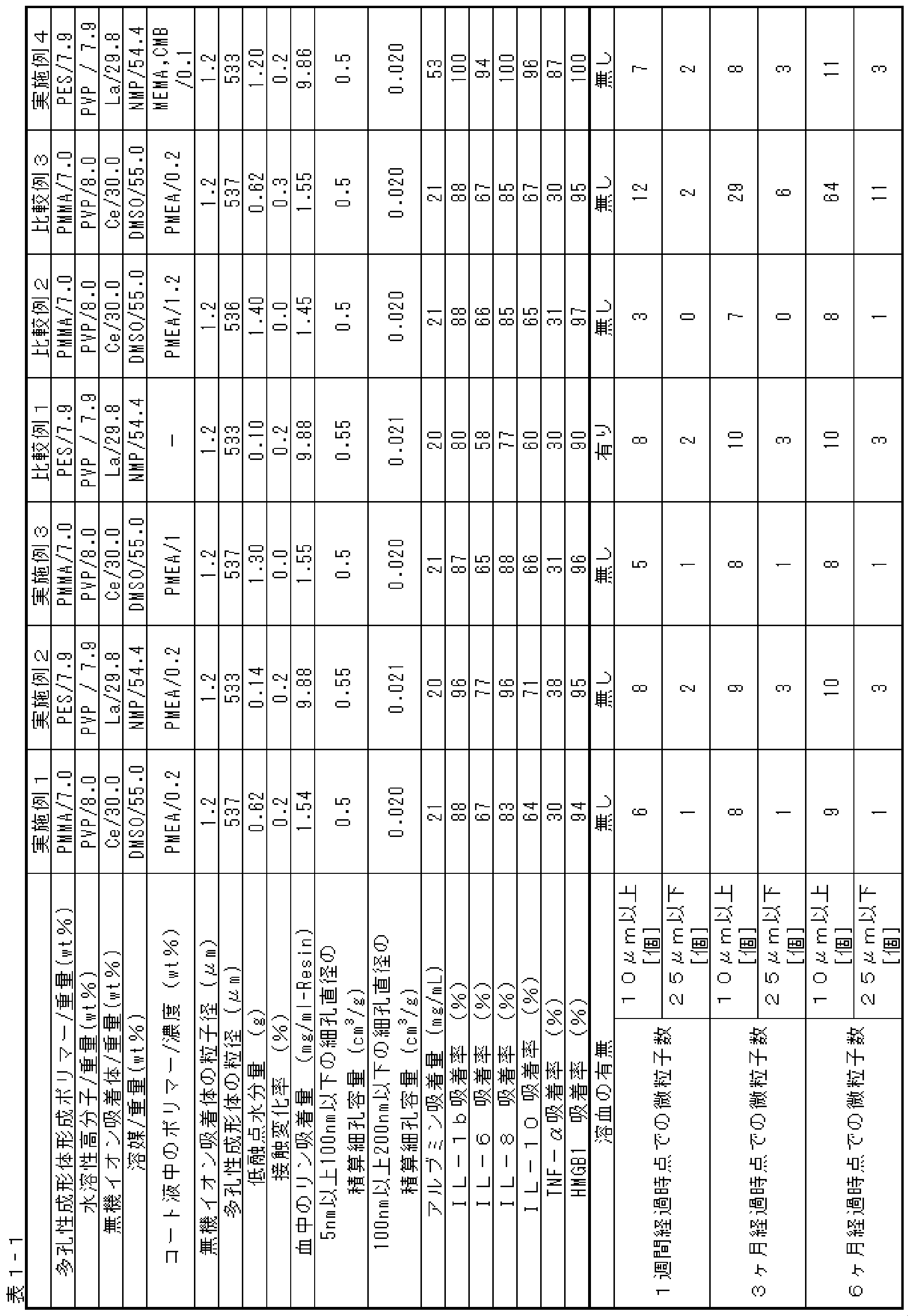

本発明に係る血液浄化器は、リン吸着能が高く、溶血が無く、かつ、安全に使用可能であるため、体内に蓄積したリンを定期的に除去するための療法に好適に利用可能である。
1 恒温槽
2 実験台
3 ポンプ
4 多孔性吸収体(リン吸収剤)入りカラム
5 圧力計
6 サンプリング
2 実験台
3 ポンプ
4 多孔性吸収体(リン吸収剤)入りカラム
5 圧力計
6 サンプリング
Claims (12)
- 乾燥重量1gあたりの低融点水分量が0.12g以上1.35g以下である多孔性成形体を有する血液浄化器であって、該血液浄化器中に注射用生理食塩液を封入してから3月後及び6月後における該注射用生理食塩液1mL中の10μm以上の微粒子数が25個以下であり、かつ、25μm以上の微粒子数が3個以下である、ことを特徴とする血液浄化器。
- 前記多孔性成形体の接触変化率が0以上0.2以下である、請求項1に記載の血液浄化器。
- 前記多孔性成形体は、多孔性成形体形成ポリマーと親水性ポリマーと無機イオン吸着体から構成される、請求項1に記載の血液浄化器。
- 前記親水性ポリマーは、生体適合性ポリマーである、請求項3に記載の血液浄化器。
- 前記生体適合性ポリマーは、ポリビニルピロリドン(PVP)系ポリマーである、請求項4に記載の血液浄化器。
- 前記多孔性成形体は、生体適合性ポリマーにより被覆されている、請求項1~5のいずれか1項に記載の血液浄化器。
- 前記無機イオン吸着体が、下記式(1):
MNxOn・mH2O ・・・(1)
{式中、xは、0~3であり、nは、1~4であり、mは、0~6であり、そしてMとNは、Ti、Zr、Sn、Sc、Y、La、Ce、Pr、Nd、Sm、Eu、Gd、Tb、Dy、Ho、Er、Tm、Yb、Lu、Al、Si、Cr、Co、Ga、Fe、Mn、Ni、V、Ge、Nb、及びTaからなる群から選ばれる金属元素であり、互いに異なる。}で表される少なくとも一種の金属酸化物を含有する、請求項3~6のいずれか1項に記載の血液浄化器。 - 前記金属酸化物が、下記(a)~(c)群:
(a)水和酸化チタン、水和酸化ジルコニウム、水和酸化スズ、水和酸化セリウム、水和酸化ランタン、及び水和酸化イットリウム;
(b)チタン、ジルコニウム、スズ、セリウム、ランタン、及びイットリウムからなる群から選ばれる少なくとも一種の金属元素と、アルミニウム、珪素、及び鉄からなる群から選ばれる少なくとも一種の金属元素との複合金属酸化物;
(c)活性アルミナ
から選ばれる、請求項7に記載の血液浄化器。 - リン吸着量が1.5(mg-P/mL-Resin)以上である、請求項1に記載の血液浄化器。
- サイトカインであるIL-1b、IL-6、IL-8、及びIL-10の吸着率が50%以上である、請求項1に記載の血液浄化器。
- サイトカインであるTNF-αの吸着率が30%以上である、請求項1に記載の血液浄化器。
- アラーミンであるHMGB-1の吸着率が50%以上である、請求項1に記載の血液浄化器。
Priority Applications (4)
| Application Number | Priority Date | Filing Date | Title |
|---|---|---|---|
| JP2021512088A JP7228679B2 (ja) | 2019-03-29 | 2020-03-27 | 血液浄化器及びその製法 |
| CN202080024484.7A CN113631257B (zh) | 2019-03-29 | 2020-03-27 | 血液净化器及其制法 |
| US17/598,082 US20220168490A1 (en) | 2019-03-29 | 2020-03-27 | Blood purifier and method for manufacturing same |
| EP20785112.2A EP3950119A4 (en) | 2019-03-29 | 2020-03-27 | BLOOD PURIFIER AND METHOD OF PRODUCTION |
Applications Claiming Priority (2)
| Application Number | Priority Date | Filing Date | Title |
|---|---|---|---|
| JP2019068818 | 2019-03-29 | ||
| JP2019-068818 | 2019-03-29 |
Publications (1)
| Publication Number | Publication Date |
|---|---|
| WO2020203926A1 true WO2020203926A1 (ja) | 2020-10-08 |
Family
ID=72669002
Family Applications (1)
| Application Number | Title | Priority Date | Filing Date |
|---|---|---|---|
| PCT/JP2020/014383 Ceased WO2020203926A1 (ja) | 2019-03-29 | 2020-03-27 | 血液浄化器及びその製法 |
Country Status (6)
| Country | Link |
|---|---|
| US (1) | US20220168490A1 (ja) |
| EP (1) | EP3950119A4 (ja) |
| JP (1) | JP7228679B2 (ja) |
| CN (1) | CN113631257B (ja) |
| TW (1) | TWI788647B (ja) |
| WO (1) | WO2020203926A1 (ja) |
Citations (8)
| Publication number | Priority date | Publication date | Assignee | Title |
|---|---|---|---|---|
| JP2002102335A (ja) | 2000-09-28 | 2002-04-09 | M P G Kk | 血液透析装置 |
| JP2010233999A (ja) * | 2009-03-31 | 2010-10-21 | Asahi Kasei Kuraray Medical Co Ltd | 血液浄化器 |
| JP4671419B2 (ja) | 2003-12-15 | 2011-04-20 | 旭化成ケミカルズ株式会社 | 多孔性成形体及びその製造方法 |
| WO2011125758A1 (ja) | 2010-03-31 | 2011-10-13 | 富田製薬株式会社 | 透析組成物、血液透析システムおよび血液透析器 |
| JP2015116214A (ja) * | 2013-12-16 | 2015-06-25 | 旭化成メディカル株式会社 | 血液処理器 |
| JP2015116212A (ja) * | 2013-12-16 | 2015-06-25 | 旭化成メディカル株式会社 | 血液処理用中空糸膜及びその膜を組み込んだ血液処理器 |
| JP2016077570A (ja) * | 2014-10-17 | 2016-05-16 | 旭化成メディカル株式会社 | 血液処理用分離膜及びその膜を組み込んだ血液処理器 |
| JP2017086563A (ja) * | 2015-11-11 | 2017-05-25 | 旭化成メディカル株式会社 | サイトカイン及びハイモビリティグループボックス1の吸着体、並びに血液処理システム |
Family Cites Families (6)
| Publication number | Priority date | Publication date | Assignee | Title |
|---|---|---|---|---|
| CN105992600B (zh) * | 2013-12-18 | 2017-11-14 | 旭化成医疗株式会社 | 血液处理用分离膜以及具备其的血液处理器 |
| CN104258829B (zh) * | 2014-09-24 | 2016-08-31 | 珠海健帆生物科技股份有限公司 | 血磷吸附剂及其制备方法、用于血液灌流的吸附柱 |
| CN107735167A (zh) * | 2015-06-23 | 2018-02-23 | 旭化成医疗株式会社 | 血液处理用分离膜及组入该膜的血液处理器 |
| WO2017082423A1 (ja) * | 2015-11-11 | 2017-05-18 | 旭化成メディカル株式会社 | 血液処理用リン吸着剤、血液処理システム及び血液処理方法 |
| WO2018212269A1 (ja) * | 2017-05-17 | 2018-11-22 | 旭化成メディカル株式会社 | 血液処理用リン吸着剤、血液処理システム及び血液処理方法 |
| TWI724396B (zh) * | 2018-03-30 | 2021-04-11 | 日商旭化成醫療股份有限公司 | 血液淨化器及其製法 |
-
2020
- 2020-03-27 CN CN202080024484.7A patent/CN113631257B/zh active Active
- 2020-03-27 WO PCT/JP2020/014383 patent/WO2020203926A1/ja not_active Ceased
- 2020-03-27 JP JP2021512088A patent/JP7228679B2/ja active Active
- 2020-03-27 TW TW109110638A patent/TWI788647B/zh active
- 2020-03-27 US US17/598,082 patent/US20220168490A1/en active Pending
- 2020-03-27 EP EP20785112.2A patent/EP3950119A4/en active Pending
Patent Citations (8)
| Publication number | Priority date | Publication date | Assignee | Title |
|---|---|---|---|---|
| JP2002102335A (ja) | 2000-09-28 | 2002-04-09 | M P G Kk | 血液透析装置 |
| JP4671419B2 (ja) | 2003-12-15 | 2011-04-20 | 旭化成ケミカルズ株式会社 | 多孔性成形体及びその製造方法 |
| JP2010233999A (ja) * | 2009-03-31 | 2010-10-21 | Asahi Kasei Kuraray Medical Co Ltd | 血液浄化器 |
| WO2011125758A1 (ja) | 2010-03-31 | 2011-10-13 | 富田製薬株式会社 | 透析組成物、血液透析システムおよび血液透析器 |
| JP2015116214A (ja) * | 2013-12-16 | 2015-06-25 | 旭化成メディカル株式会社 | 血液処理器 |
| JP2015116212A (ja) * | 2013-12-16 | 2015-06-25 | 旭化成メディカル株式会社 | 血液処理用中空糸膜及びその膜を組み込んだ血液処理器 |
| JP2016077570A (ja) * | 2014-10-17 | 2016-05-16 | 旭化成メディカル株式会社 | 血液処理用分離膜及びその膜を組み込んだ血液処理器 |
| JP2017086563A (ja) * | 2015-11-11 | 2017-05-25 | 旭化成メディカル株式会社 | サイトカイン及びハイモビリティグループボックス1の吸着体、並びに血液処理システム |
Non-Patent Citations (3)
| Title |
|---|
| SHIGEAKI MORITAMASARU TANAKAYUKIHIRO OZAKI: "Time-Resolved In Situ ATR-IR Observations of the Process of Sorption of Water into a Poly(2-methoxyethyl acrylate) Film", LANGMUIR, vol. 23, no. 7, 3 March 2007 (2007-03-03), pages 3750 - 3761 |
| T. TSURUTAJ. BIOMATER. ET AL.: "The roles of water molecules in the interfaces between biological systems and polymers", SCI. POLYM. ED., vol. 21, 2010, pages 1827 - 1920 |
| TANAKA, K.: "Artificial organ surface-biocompatibilizing materials", BIO INDUSTRY, vol. 20, no. 12, 2003, pages 59 - 70 |
Also Published As
| Publication number | Publication date |
|---|---|
| TWI788647B (zh) | 2023-01-01 |
| EP3950119A1 (en) | 2022-02-09 |
| TW202102274A (zh) | 2021-01-16 |
| CN113631257A (zh) | 2021-11-09 |
| CN113631257B (zh) | 2023-06-30 |
| US20220168490A1 (en) | 2022-06-02 |
| EP3950119A4 (en) | 2022-05-18 |
| JPWO2020203926A1 (ja) | 2021-11-18 |
| JP7228679B2 (ja) | 2023-02-24 |
Similar Documents
| Publication | Publication Date | Title |
|---|---|---|
| JP7076437B2 (ja) | 血液処理用リン吸着剤、血液処理システム及び血液処理方法 | |
| JP6899957B2 (ja) | 血液浄化器及びその製法 | |
| CN108348673B (zh) | 血液处理用磷吸附剂、血液处理系统及血液处理方法 | |
| JP7397857B2 (ja) | 血液浄化器 | |
| JP7117368B2 (ja) | 血液浄化器及びその製法 | |
| JP7228679B2 (ja) | 血液浄化器及びその製法 | |
| JP2020163150A (ja) | 血液処理用多孔性成形体 | |
| JP7397856B2 (ja) | 血液浄化器 |
Legal Events
| Date | Code | Title | Description |
|---|---|---|---|
| 121 | Ep: the epo has been informed by wipo that ep was designated in this application |
Ref document number: 20785112 Country of ref document: EP Kind code of ref document: A1 |
|
| ENP | Entry into the national phase |
Ref document number: 2021512088 Country of ref document: JP Kind code of ref document: A |
|
| NENP | Non-entry into the national phase |
Ref country code: DE |
|
| ENP | Entry into the national phase |
Ref document number: 2020785112 Country of ref document: EP Effective date: 20211029 |