WO2020205910A1 - Thermochromic temperature sensor - Google Patents
Thermochromic temperature sensor Download PDFInfo
- Publication number
- WO2020205910A1 WO2020205910A1 PCT/US2020/026073 US2020026073W WO2020205910A1 WO 2020205910 A1 WO2020205910 A1 WO 2020205910A1 US 2020026073 W US2020026073 W US 2020026073W WO 2020205910 A1 WO2020205910 A1 WO 2020205910A1
- Authority
- WO
- WIPO (PCT)
- Prior art keywords
- temperature
- color
- temperature sensor
- ester
- changing system
- Prior art date
- Legal status (The legal status is an assumption and is not a legal conclusion. Google has not performed a legal analysis and makes no representation as to the accuracy of the status listed.)
- Ceased
Links
Classifications
-
- C—CHEMISTRY; METALLURGY
- C09—DYES; PAINTS; POLISHES; NATURAL RESINS; ADHESIVES; COMPOSITIONS NOT OTHERWISE PROVIDED FOR; APPLICATIONS OF MATERIALS NOT OTHERWISE PROVIDED FOR
- C09D—COATING COMPOSITIONS, e.g. PAINTS, VARNISHES OR LACQUERS; FILLING PASTES; CHEMICAL PAINT OR INK REMOVERS; INKS; CORRECTING FLUIDS; WOODSTAINS; PASTES OR SOLIDS FOR COLOURING OR PRINTING; USE OF MATERIALS THEREFOR
- C09D11/00—Inks
- C09D11/50—Sympathetic, colour changing or similar inks
-
- C—CHEMISTRY; METALLURGY
- C09—DYES; PAINTS; POLISHES; NATURAL RESINS; ADHESIVES; COMPOSITIONS NOT OTHERWISE PROVIDED FOR; APPLICATIONS OF MATERIALS NOT OTHERWISE PROVIDED FOR
- C09B—ORGANIC DYES OR CLOSELY-RELATED COMPOUNDS FOR PRODUCING DYES, e.g. PIGMENTS; MORDANTS; LAKES
- C09B67/00—Influencing the physical, e.g. the dyeing or printing properties of dyestuffs without chemical reactions, e.g. by treating with solvents grinding or grinding assistants, coating of pigments or dyes; Process features in the making of dyestuff preparations; Dyestuff preparations of a special physical nature, e.g. tablets, films
- C09B67/0071—Process features in the making of dyestuff preparations; Dehydrating agents; Dispersing agents; Dustfree compositions
- C09B67/0083—Solutions of dyes
-
- C—CHEMISTRY; METALLURGY
- C09—DYES; PAINTS; POLISHES; NATURAL RESINS; ADHESIVES; COMPOSITIONS NOT OTHERWISE PROVIDED FOR; APPLICATIONS OF MATERIALS NOT OTHERWISE PROVIDED FOR
- C09B—ORGANIC DYES OR CLOSELY-RELATED COMPOUNDS FOR PRODUCING DYES, e.g. PIGMENTS; MORDANTS; LAKES
- C09B9/00—Esters or ester-salts of leuco compounds of vat dyestuffs
-
- C—CHEMISTRY; METALLURGY
- C09—DYES; PAINTS; POLISHES; NATURAL RESINS; ADHESIVES; COMPOSITIONS NOT OTHERWISE PROVIDED FOR; APPLICATIONS OF MATERIALS NOT OTHERWISE PROVIDED FOR
- C09D—COATING COMPOSITIONS, e.g. PAINTS, VARNISHES OR LACQUERS; FILLING PASTES; CHEMICAL PAINT OR INK REMOVERS; INKS; CORRECTING FLUIDS; WOODSTAINS; PASTES OR SOLIDS FOR COLOURING OR PRINTING; USE OF MATERIALS THEREFOR
- C09D11/00—Inks
- C09D11/02—Printing inks
- C09D11/03—Printing inks characterised by features other than the chemical nature of the binder
- C09D11/033—Printing inks characterised by features other than the chemical nature of the binder characterised by the solvent
-
- C—CHEMISTRY; METALLURGY
- C09—DYES; PAINTS; POLISHES; NATURAL RESINS; ADHESIVES; COMPOSITIONS NOT OTHERWISE PROVIDED FOR; APPLICATIONS OF MATERIALS NOT OTHERWISE PROVIDED FOR
- C09D—COATING COMPOSITIONS, e.g. PAINTS, VARNISHES OR LACQUERS; FILLING PASTES; CHEMICAL PAINT OR INK REMOVERS; INKS; CORRECTING FLUIDS; WOODSTAINS; PASTES OR SOLIDS FOR COLOURING OR PRINTING; USE OF MATERIALS THEREFOR
- C09D11/00—Inks
- C09D11/02—Printing inks
- C09D11/03—Printing inks characterised by features other than the chemical nature of the binder
- C09D11/037—Printing inks characterised by features other than the chemical nature of the binder characterised by the pigment
-
- C—CHEMISTRY; METALLURGY
- C09—DYES; PAINTS; POLISHES; NATURAL RESINS; ADHESIVES; COMPOSITIONS NOT OTHERWISE PROVIDED FOR; APPLICATIONS OF MATERIALS NOT OTHERWISE PROVIDED FOR
- C09K—MATERIALS FOR MISCELLANEOUS APPLICATIONS, NOT PROVIDED FOR ELSEWHERE
- C09K9/00—Tenebrescent materials, i.e. materials for which the range of wavelengths for energy absorption is changed as a result of excitation by some form of energy
- C09K9/02—Organic tenebrescent materials
-
- G—PHYSICS
- G01—MEASURING; TESTING
- G01K—MEASURING TEMPERATURE; MEASURING QUANTITY OF HEAT; THERMALLY-SENSITIVE ELEMENTS NOT OTHERWISE PROVIDED FOR
- G01K11/00—Measuring temperature based upon physical or chemical changes not covered by groups G01K3/00, G01K5/00, G01K7/00 or G01K9/00
- G01K11/12—Measuring temperature based upon physical or chemical changes not covered by groups G01K3/00, G01K5/00, G01K7/00 or G01K9/00 using changes in colour, translucency or reflectance
- G01K11/16—Measuring temperature based upon physical or chemical changes not covered by groups G01K3/00, G01K5/00, G01K7/00 or G01K9/00 using changes in colour, translucency or reflectance of organic materials
-
- G—PHYSICS
- G01—MEASURING; TESTING
- G01K—MEASURING TEMPERATURE; MEASURING QUANTITY OF HEAT; THERMALLY-SENSITIVE ELEMENTS NOT OTHERWISE PROVIDED FOR
- G01K3/00—Thermometers giving results other than momentary value of temperature
- G01K3/005—Circuits arrangements for indicating a predetermined temperature
-
- C—CHEMISTRY; METALLURGY
- C09—DYES; PAINTS; POLISHES; NATURAL RESINS; ADHESIVES; COMPOSITIONS NOT OTHERWISE PROVIDED FOR; APPLICATIONS OF MATERIALS NOT OTHERWISE PROVIDED FOR
- C09K—MATERIALS FOR MISCELLANEOUS APPLICATIONS, NOT PROVIDED FOR ELSEWHERE
- C09K2211/00—Chemical nature of organic luminescent or tenebrescent compounds
- C09K2211/10—Non-macromolecular compounds
- C09K2211/1003—Carbocyclic compounds
- C09K2211/1007—Non-condensed systems
-
- C—CHEMISTRY; METALLURGY
- C09—DYES; PAINTS; POLISHES; NATURAL RESINS; ADHESIVES; COMPOSITIONS NOT OTHERWISE PROVIDED FOR; APPLICATIONS OF MATERIALS NOT OTHERWISE PROVIDED FOR
- C09K—MATERIALS FOR MISCELLANEOUS APPLICATIONS, NOT PROVIDED FOR ELSEWHERE
- C09K2211/00—Chemical nature of organic luminescent or tenebrescent compounds
- C09K2211/10—Non-macromolecular compounds
- C09K2211/1018—Heterocyclic compounds
- C09K2211/1025—Heterocyclic compounds characterised by ligands
- C09K2211/1088—Heterocyclic compounds characterised by ligands containing oxygen as the only heteroatom
-
- G—PHYSICS
- G01—MEASURING; TESTING
- G01K—MEASURING TEMPERATURE; MEASURING QUANTITY OF HEAT; THERMALLY-SENSITIVE ELEMENTS NOT OTHERWISE PROVIDED FOR
- G01K2207/00—Application of thermometers in household appliances
- G01K2207/02—Application of thermometers in household appliances for measuring food temperature
- G01K2207/04—Application of thermometers in household appliances for measuring food temperature for conservation purposes
Definitions
- the product may be necessary to know whether the product has been exposed to a temperature below or above a threshold, as that temperature threshold may affect the product’s quality, safety, etc.
- a temperature threshold may affect the product’s quality, safety, etc.
- certain vaccines are subjected to temperatures below about 2° Celsius, the efficacy of the vaccine may be compromised.
- some foodstuffs, such as meat should not be stored at temperatures above about 8° Celsius to ensure food safety.
- a broad object of a particular embodiment of the invention can be to provide a temperature sensor, and methods of making and using such a temperature sensor, whereby the temperature sensor includes a thermochromic color-changing system having a dye, a developer, and a solvent. Upon exposure to a preselected temperature threshold, association or disassociation of the dye and the developer results in a visible color change. Further, the color-changing system includes a color-memory property which facilitates retention of the color change to effectively record exposure to the temperature threshold.
- Figure 1A shows an illustration of a low temperature indicator including a particular embodiment of the instant temperature sensor reliably associated with a temperature-sensitive product, such as a vaccine, prior to exposure to a preselected temperature threshold, whereby the dye and the developer are dissociated and the color-changing system has not undergone a visible color change.
- a temperature-sensitive product such as a vaccine
- Figure IB shows an illustration of the particular embodiment of the temperature sensor shown in Figure 1 A following exposure to a temperature threshold of about 2° Celsius, whereby this temperature threshold facilitates association of the dye and the developer and corresponding formation of a visibly colored dye-developer complex to provide a visible color change from colorless to visibly colored.
- FIG 1C shows an illustration of the particular embodiment of the temperature sensor shown in Figure IB following an increase in temperature from the temperature threshold, whereby the color-changing system retains the visible color change.
- Figure 2A shows an illustration of a high temperature indicator including a particular embodiment of the instant temperature sensor reliably associated with a temperature-sensitive product, such as a foodstuff, (i) prior to activation, whereby the dye and the developer are dissociated (as shown on the left), and (ii) following exposure to an activation temperature of about -5° Celsius, whereby this activation temperature facilitates association of the dye and the developer and corresponding formation of a visibly colored dye-developer complex (as shown on the right).
- a temperature-sensitive product such as a foodstuff
- Figure 2B shows an illustration of the particular embodiment of the temperature sensor shown in Figure 2A prior to exposure to a preselected temperature threshold, whereby the color changing system has not undergone a visible color change.
- FIG. 2C shows an illustration of the particular embodiment of the temperature sensor shown in Figure 2B following exposure to a temperature threshold of about 8° Celsius, whereby this temperature threshold facilitates dissociation of the dye and the developer to provide a visible color change from visibly colored to colorless.
- Figure 2D shows an illustration of the particular embodiment of the temperature sensor shown in Figure 2C following a decrease in temperature from the temperature threshold, whereby the color-changing system retains the visible color change.
- Figure 3 shows an illustration of hysteresis characteristics of a particular embodiment of the instant color-changing system which has a color-memory property.
- Figure 4A shows an illustration of a dual temperature indicator including a particular embodiment of the instant temperature sensor, (i) prior to activation, whereby the dye and the developer of both the first and second color-changing systems are dissociated (as shown on the left), and (ii) following exposure to an activation temperature, whereby the activation temperature facilitates association of the dye and the developer of the second color-changing system and corresponding formation of a visibly colored dye-developer complex (as shown on the right).
- FIG 4B shows an illustration of the particular embodiment of the temperature sensor shown in Figure 4A following exposure to a low temperature threshold, whereby this temperature threshold facilitates association of the dye and the developer of the first color-changing system and corresponding formation of a visibly colored dye-developer complex to provide a visible color change from colorless to visibly colored; this color change can be retained upon an increase in temperature.
- FIG 4C shows an illustration of the particular embodiment of the temperature sensor shown in Figure 4A following exposure to a high temperature threshold, whereby this temperature threshold facilitates dissociation of the dye and the developer of the second color-changing system to provide a visible color change from visibly colored to colorless; this color change can be retained upon a decrease in temperature.
- FIG. 1A through Figure 2D illustrate particular embodiments of the inventive temperature sensor (1) operative to provide an indication of exposure to a preselected temperature threshold (2)
- the temperature sensor (1) includes a color-changing system (3) comprising: a dye (4), a developer (5), and a solvent (6).
- the developer (5) variably interacts with the dye (4) according to the temperature of the color-changing system (3), whereby upon exposure to the temperature threshold (2), association or disassociation of the dye (4) and the developer (5) results in a visible color change which can be visually observed (for example by a human, i.e. human-readable) or detected (for example by a human, i.e. human- readable, or a machine, i.e. machine-readable).
- the color-changing system (3) comprises a thermochromic color-changing system which can be susceptible to a temperature-modulated color change, whereby typically, a lower temperature will result in a colored state and a higher temperature will result in a colorless or substantially colorless state.
- the color-changing system (3) can be formulated such that exposure to the temperature threshold (2) results in association of the dye (4) and the developer (5) to form a visibly colored dye-developer complex (7) which can be visually observed or detected, thereby indicating that the temperature sensor (1) has been exposed to the temperature threshold (2).
- the color-changing system (3) can be formulated such that exposure to the temperature threshold (2) results in dissociation of the dye (4) and the developer (5) and accordingly, dissociation of the colored dye-developer complex (7), whereby the consequential color change to colorless can be visually observed or detected to indicate that the temperature sensor (1) has been exposed to the temperature threshold (2).
- the method of use can include detecting whether or not a color change occurred, for example by visually observing the temperature sensor (1), whereby visual detection of a color change indicates that the temperature sensor (1) has been exposed to the temperature threshold (2). Conversely, visual detection of the absence of a color change, meaning no color change occurred, indicates that the temperature sensor (1) has not been exposed to the temperature threshold (2).
- thermo-sensitive products (8) there is a need for an indicator that can (i) accompany the temperature-sensitive product (8), for example during shipping and storage, and (ii) indicate (preferably, via a direct visual indication) the thermal history of the temperature-sensitive product (8) and particularly, whether the temperature-sensitive product (8) has been exposed to a temperature threshold (2) which may compromise the quality and/or safety of the temperature-sensitive product (8).
- the method of use can include reliably associating the temperature sensor (1) with a temperature-sensitive product (8) and subsequently detecting whether or not a color change occurred. Consequently, visual detection of a color change indicates that the temperature-sensitive product (8) has been exposed to the temperature threshold (2), and visual detection of the absence of a color change indicates that the temperature-sensitive product (8) has not been exposed to the temperature threshold (2).
- the temperature sensor (1) may herein be shown in a highly simplified form for the sake of clarity and generality of presentation thereof, it should be appreciated that the temperature sensor (1) may have a more intricate structure and/or may form a portion of a more extensive marking or indicium, such as a barcode.
- the term“sensor” means a composition or an apparatus which detects or measures a stimulus and reacts to it in a particular way.
- the term“detect” and forms thereof means to discover or ascertain the presence of.
- predetermined means predetermined or decided in advance.
- the term“threshold” means the point which must be reached or exceeded for a certain phenomenon to occur or be manifested.
- the term“dye” means a chemical compound which can change color, such as a color former capable of reacting with the instant developer (5) to form a dye-developer complex (7) which exhibits optical properties that can be discerned by the human eye.
- developer means a chemical compound capable of reacting with the instant dye (4) to form a dye-developer complex (7) which exhibits optical properties that can be discerned by the human eye.
- developer can be synonymous with“color developer”, both meaning a chemical compound which facilitates a change in color of the dye (4).
- phase-change material can, but need not necessarily, be synonymous with phase-change material, whereby phase-change material is herein defined as a material which changes from one phase to another.
- temperature-sensitive product means any product which may benefit from an indication of the thermal history thereof, for example because its quality may be adversely affected if its thermal history includes exposure to a particular temperature or range of temperatures.
- temperature-sensitive products can include foodstuff, pharmaceuticals, chemical materials, biological materials, medical equipment, pigmented compositions (such as paint or stain), adhesives, etc.
- foodstuff means a good, item, or article that can be consumable (including edible or drinkable) or can be useful as an ingredient for making a consumable item or article.
- foodstuffs can include fruits, juices, vegetables, grains, flours, milks, yogurts, sweetened beverages, meats, processed foods, medicaments, and the like.
- Two objects such as a temperature-sensitive product (8) and the temperature sensor (1), can be“reliably associated” if the association between the two objects can be expected not to be disrupted by routine treatment or processes.
- Non-limiting examples of such reliable association can include adhering one object to another, tying the two objects together, containing both objects in a container, printing one object (for example the temperature sensor (1) configured as a printing ink) on packaging material or a container used to contain the other object (for example the temperature-sensitive product (8)), affixing one object (for example the temperature sensor (1)) to packaging material or a container used to contain the other object (for example the temperature- sensitive product (8)), and laminating one object (for example the temperature sensor (1)) in a portion of a packaging material used to enclose the other object (for example the temperature- sensitive product (8)).
- the instant temperature sensor (1) which may take the form of a composition or an apparatus, includes a color-changing system (3) comprising a dye (4), a developer (5), and a solvent (6).
- the developer (5) variably interacts with the dye (4) according to the temperature of the color-changing system (3), whereby upon exposure to a preselected temperature threshold (2), association or dissociation of the dye (4) and the developer (5) results in a color change which can be visually observed or detected.
- aspects of the instant temperature sensor (1) may be similar to the indicators disclosed in United States Patent No. 10, 113,920, United States Patent No. 10,345,278, United States Patent No. 10,585,080, United States Patent No. 10,605,681, and/or United States Patent Application No. 62/971,544, each of which is hereby incorporated by reference in its entirety herein.
- the color-changing system (3) can be a reversible color-changing system, meaning that the color change can be reversible, as opposed to an irreversible color change or a permanent color change.
- the dye (4) of the color-changing system (3) can comprise a leuco dye which can reversibly change between two forms, one of which can typically be colorless or substantially colorless.
- the leuco dye can be: crystal violet lactone (CAS No. :
- Pigment Blue 63 (CAS No. : 16521-38-3); 2'-(dibenzylamino)-6'-
- Anilino-3-diethylamino-6-m ethyl fluoran (CAS No. : 29512-49-0); ODB-2 or 2-Anilino-6- dibutylamino-3-methylfluoran (CAS No. : 89331-94-2); 6'-(Diethylamino)-r,3'-dimethylfluoran orange (CAS No. : 21934-68-9); Yamamoto Red 40 or 3,3-bis(l-butyl-2-methyl-lH-indol-3- yl)phthalide (CAS No.
- the leuco dye can be an electron-donating compound (or proton-accepting compound).
- the developer (5) can comprise an electron-accepting compound (or proton-donating compound), such as an acid and particularly, a weak acid.
- the leuco dye can reversibly change color, for example from a colorless state to a colored state.
- the color-changing system (3) can have two visual appearances which differ from one another depending upon temperature, namely (i) a first visual appearance which may be a colorless appearance, and (ii) a second visual appearance which may be a colored appearance.
- the developer (5) can be: 3, 5 -di-/er/-butyl catechol (CAS No. : 1020-31-1); 4,4'-(l,3-dimethylbutylidene)diphenol (CAS No.: 1020-31-1); 2,2’-biphenol (CAS No.: 1806-29-7); 4-[2-ethyl-l-(4-hydroxyphenyl)hexyl]phenol (PubChem CID 13782487); or the like.
- the developer (5) upon exposure to a temperature which results in association of the leuco dye and the developer (5), the developer (5) can reversibly interact with the leuco dye via an electron transfer reaction to open up the lactone ring of the leuco dye and stabilize the opened structure, forming a supramolecular colored dye-developer complex (7), to which a color change can be attributable.
- the lactone ring When open, the lactone ring can be cationic in nature, thereby extending conjugation of its p electrons and allowing absorption in the visible spectrum to provide the colored dye-developer complex (7), whereby the stability of the colored dye-developer complex (7) can be determined, at least in part, by the affinity of the developer (5) for the leuco dye.
- the color-changing system (3) further includes a solvent (6) which effects or controls the reversible interaction between the dye (4) and the developer (5).
- a solvent (6) which may be useful with the reversible color changing system (3) can be (i) a solvent (6) in which both the dye (4) and the developer (5) are soluble, and (ii) a solvent (6) capable of being contained along with the dye (4) and the developer (5), for example within a capsule or microcapsule (9) to provide a corresponding encapsulated or microencapsulated color-changing system (3).
- the solvent (6) can facilitate interaction between the dye (4) and the developer
- the developer (5) can also interact with the solvent (6) to form a solvent-developer complex, whereby this interaction can be determined, at least in part, by the affinity of the developer (5) for the solvent (6).
- the color change can be linked to a competition between the dye (4) and the solvent (6) for complexing with the developer (5), whereby the developer (5) forms a complex with the molecule(s) which it has a greater affinity for.
- the complex can be stable until an amount of energy sufficient to destabilize the complex is input into the system, thereby dissociating the components of the complex.
- the developer (5) can have a greater affinity for the solvent (6) than for the leuco dye and accordingly, the solvent-developer complex can be favored over the colored dye-developer complex (7).
- the developer (5) can be precluded from interacting with the leuco dye and correspondingly, the lactone ring can be closed and the leuco dye can be colorless.
- the developer (5) can have a greater affinity for the leuco dye than for the solvent (6); hence, the colored dye-developer complex (7) can form and stabilize.
- the solvent (6) can be an ester.
- the solvent (6) can be an ester as disclosed in United States PatentNo. 10,345,278, United States Patent No. 10,585,080, United States Patent No. 10,605,681, and/or United States Patent Application No. 62/971,544, each of which is hereby incorporated by reference in its entirety herein.
- the solvent (6) can be a diphenylmethyl ester.
- the ester can have Formula I as follows:
- R can be (i) a straight-chain or branched alkyl group, (ii) a straight-chain or branched alkenyl group, or (iii) a straight-chain or branched alkynyl group, whereby any of the groups can be unsubstituted or substituted.
- R can have 5 or more carbon atoms, or can have at least 5 carbon atoms.
- R can have 7 or more carbon atoms, or can have at least 7 carbon atoms.
- R can have 9 or more carbon atoms, or can have at least 9 carbon atoms. As to particular embodiments, R can have 11 or more carbon atoms, or can have at least
- R can have 13 or more carbon atoms, or can have at least 13 carbon atoms.
- R can have 15 or more carbon atoms, or can have at least 15 carbon atoms.
- R can have 17 or more carbon atoms, or can have at least 17 carbon atoms.
- R can have 19 or more carbon atoms, or can have at least 19 carbon atoms.
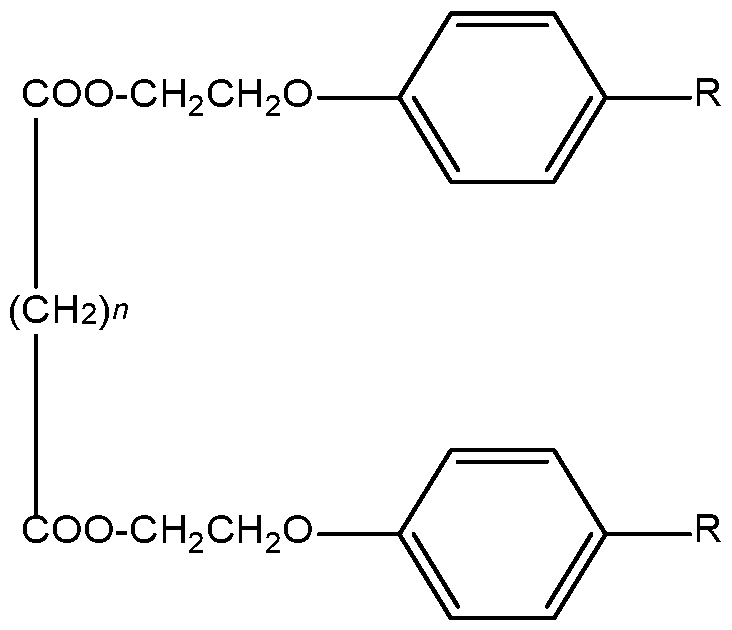
- the ester can have Formula II as follows:
- n can be an integer between 1 and 15.
- the ester can have Formula III as follows:
- this ester may have a molecular formula of C31H46O2, a molecular weight of g/mol, and a CAS Registry Number of 103390-75-6.
- the ester can have Formula IV as follows:
- this ester may have a molecular formula of C29H42O2, a molecular weight of g/mol, and a CAS Registry Number of 103209-25-2.
- the ester can have Formula V as follows: whereby this ester may have a molecular formula of C31H46O2, and a molecular weight of 450.70 g/mol.
- the ester can have Formula VI as follows:
- this ester may have a molecular formula of C29H42O2, and a molecular weight of 422.64 g/mol.
- the ester can have Formula VII as follows:
- the ester can have Formula VIII as follows:
- ester can have Formula IX as follows:
- m can be an integer between 1 and 10.
- the ester can have Formula X as follows:
- n can be an integer between 1 and 3.
- the ester can have Formula XI as follows:
- R can be a hydrogen or an alkyl group from Cl to C4, and n can be an integer between 1 and 6.
- the ester can have Formula XII as follows: XII wherein m can be an integer between 1 and 10.
- the ester can have Formula XIII as follows:
- n can be an integer between 0 and 2.
- the solvent (6) can be a hydrocarbon.
- the solvent (6) can be a ketone.
- the solvent (6) can be a ketone as disclosed in United States PatentNo. 10,345,278, United States Patent No. 10,585,080, United States Patent No. 10,605,681, and/or United States Patent Application No. 62/971,544, each of which is hereby incorporated by reference in its entirety herein.
- the ketone can have Formula XIV as follows:
- R can be a hydrogen or an alkyl group, such as methyl group or an ethyl group
- n can be an integer between 1 and 10.
- the solvent (6) can be an alcohol.
- the solvent (6) can be an alcohol as disclosed in United States Patent No. 10,345,278, United States Patent No. 10,585,080, United States Patent No. 10,605,681, and/or United States Patent Application No. 62/971,544, each of which is hereby incorporated by reference in its entirety herein.
- the solvent (6) can be a single compound.
- the solvent (6) can be in an amount of about 50% to about 99% of the color-changing system (3).
- the solvent (6) can be in an amount of about 60% to about 75% of the color-changing system (3).
- the solvent (6) can be a mixture of two or more compounds. As to particular embodiments, the solvent (6) can be a mixture of two or more of the solvents (6) described above.
- the solvent (6) comprising a mixture of two or more compounds can be in an amount of about 50% to about 99% of the color-changing system (3).
- the solvent (6) comprising a mixture of two or more compounds can be in an amount of about 60% to about 75% of the color-changing system (3).
- the solvent (6) can be a mixture of the esters shown in Formulas III and IV, whereby the ester shown in Formula III and the ester shown in Formula IV can be in a ratio of 1 : 1.
- the ester shown in Formula III and the ester shown in Formula IV can be in a ratio of 1 : 1.
- other ratios may be used and are herein contemplated.
- the solvent (6) can be a phase change material which changes between a liquid phase (or a substantially liquid phase) and a solid phase (or a substantially solid phase) according to the temperature of the color-changing system (3).
- the solvent (6) can change from a liquid phase to a solid phase upon exposure to the temperature threshold (2). As to other particular embodiments, the solvent (6) can change from a solid phase to a liquid phase upon exposure to the temperature threshold (2).
- the solid phase of the solvent (6) can facilitate or enable interaction between the leuco dye and the developer (5), whereby the colored dye-developer complex (7) can be a crystalized structure having an extended conjugation of its p electrons.
- liquid phase of the solvent (6) can preclude interaction between the leuco dye and the developer (5), rendering the leuco dye colorless.
- the color-changing system (3) can be a thermochromic color-changing system which can be susceptible to a temperature-modulated color change. Additionally, the color-changing system (3) can be a reversible thermochromic color-changing system, whereby the temperature-modulated color change can be reversible, as opposed to an irreversible color change or a permanent color change.
- the color-changing system (3) can have a color-memory property whereby after a color change occurs following exposure to the temperature threshold (2), the color change can be retained even upon discontinuation of exposure to the temperature threshold (2); hence, the color change can be retained at temperatures which differ from the temperature threshold (2).
- the temperature sensor (1) can effectively record exposure to the temperature threshold (2), thereby functioning as a cumulative exposure indicator, which can be in contrast to a conventional thermometer that only displays the current temperature and does not record temperatures which the thermometer may have been exposed to prior to exposure to the current temperature.
- the color-changing system (3) can include a coloration temperature at which the color-changing system (3) reversibly changes from a colorless state to a colored state. Also, the color-changing system (3) can include a decoloration temperature at which the color-changing system (3) reversibly changes from the colored state to the colorless state.
- the coloration and decoloration temperatures of the color-changing system (3) can be different, meaning that the coloration temperature can be discrete from the decoloration temperature.
- the coloration temperature can be less than the decoloration temperature.
- the color-memory property of the color-changing system (3) can facilitate retention of the color change upon an increase in temperature from the coloration temperature.
- the color-memory property of the color-changing system (3) can facilitate retention of the colored state upon an increase in temperature from the coloration temperature, as shown in Figure IB and Figure 1C.
- the color-memory property of the color-changing system (3) can facilitate retention of the color change upon a decrease in temperature from the decoloration temperature. Accordingly, the color-memory property of the color-changing system (3) can facilitate retention of the colorless state upon a decrease in temperature from the decoloration temperature, as shown in Figure 2C and Figure 2D.
- the coloration temperature can be associated with the freezing point of the color-changing system (3) and the decoloration temperature can be associated with the melting point of the color-changing system (3).
- the color-changing system (3) can include (i) a freezing point at which the color-changing system (3) changes from a colorless state to a colored state, and (ii) a melting point at which the color-changing system (3) changes from a colored state to a colorless state.
- the colored dye-developer complex (7) can remain stable even when the solvent (6) may be in the liquid phase (for example, upon an increase in temperature).
- the dye (4) and the developer (5) can remain dissociated even when the solvent (6) may be in the solid phase (for example, upon a decrease in temperature).
- the coloration temperature can differ from the decoloration temperature by at least one selected from the group including or consisting of: at least about 20 Celsius degrees, at least about 25 Celsius degrees, at least about 30 Celsius degrees, at least about 35 Celsius degrees, at least about 40 Celsius degrees, at least about 45 Celsius degrees, at least about 50 Celsius degrees, at least about 55 Celsius degrees, at least about 60 Celsius degrees, at least about 65 Celsius degrees, at least about 70 Celsius degrees, at least about 75 Celsius degrees, at least about 80 Celsius degrees, at least about 85 Celsius degrees, at least about 90 Celsius degrees, at least about 95 Celsius degrees, at least about 100 Celsius degrees, and greater than about 100 Celsius degrees.
- the coloration temperature can differ from the decoloration temperature by at least about 20 Celsius degrees, meaning that the decoloration temperature can be at least about 20 Celsius degrees greater than the coloration temperature.
- the coloration temperature can differ from the decoloration temperature by at least about 25 Celsius degrees, meaning that the decoloration temperature can be at least about 25 Celsius degrees greater than the coloration temperature.
- the coloration temperature can differ from the decoloration temperature by at least about 30 Celsius degrees, meaning that the decoloration temperature can be at least about 30 Celsius degrees greater than the coloration temperature.
- the coloration temperature can differ from the decoloration temperature by at least about 35 Celsius degrees, meaning that the decoloration temperature can be at least about 35 Celsius degrees greater than the coloration temperature.
- the coloration temperature can differ from the decoloration temperature by at least about 40 Celsius degrees, meaning that the decoloration temperature can be at least about 40 Celsius degrees greater than the coloration temperature, whereby as to particular embodiments, at least about 40 Celsius degrees may be the preferable minimal difference.
- the coloration temperature can differ from the decoloration temperature by at least about 45 Celsius degrees, meaning that the decoloration temperature can be at least about 45 Celsius degrees greater than the coloration temperature, whereby as to particular embodiments, at least about 45 Celsius degrees may be the preferable minimal difference.
- the coloration temperature can differ from the decoloration temperature by at least about 50 Celsius degrees, meaning that the decoloration temperature can be at least about 50 Celsius degrees greater than the coloration temperature, whereby as to particular embodiments, at least about 50 Celsius degrees may be the preferable minimal difference.
- the coloration temperature can differ from the decoloration temperature by at least about 55 Celsius degrees, meaning that the decoloration temperature can be at least about 55 Celsius degrees greater than the coloration temperature, whereby as to particular embodiments, at least about 55 Celsius degrees may be the preferable minimal difference.
- the coloration temperature can differ from the decoloration temperature by at least about 60 Celsius degrees, meaning that the decoloration temperature can be at least about 60 Celsius degrees greater than the coloration temperature.
- the coloration temperature can differ from the decoloration temperature by at least about 65 Celsius degrees, meaning that the decoloration temperature can be at least about 65 Celsius degrees greater than the coloration temperature.
- the coloration temperature can differ from the decoloration temperature by at least about 70 Celsius degrees, meaning that the decoloration temperature can be at least about 70 Celsius degrees greater than the coloration temperature.
- the coloration temperature can differ from the decoloration temperature by at least about 75 Celsius degrees, meaning that the decoloration temperature can be at least about 75 Celsius degrees greater than the coloration temperature.
- the coloration temperature can differ from the decoloration temperature by at least about 80 Celsius degrees, meaning that the decoloration temperature can be at least about 80 Celsius degrees greater than the coloration temperature.
- the coloration temperature can differ from the decoloration temperature by at least about 85 Celsius degrees, meaning that the decoloration temperature can be at least about 85 Celsius degrees greater than the coloration temperature.
- the coloration temperature can differ from the decoloration temperature by at least about 90 Celsius degrees, meaning that the decoloration temperature can be at least about 90 Celsius degrees greater than the coloration temperature.
- the coloration temperature can differ from the decoloration temperature by at least about 95 Celsius degrees, meaning that the decoloration temperature can be at least about 95 Celsius degrees greater than the coloration temperature.
- the coloration temperature can differ from the decoloration temperature by at least about 100 Celsius degrees, meaning that the decoloration temperature can be at least about 100 Celsius degrees greater than the coloration temperature.
- the coloration temperature can differ from the decoloration temperature by greater than about 100 Celsius degrees.
- the y axis shows the color density and the x axis shows the temperature.
- the color density of the color-changing system (3) changes with temperature along the curve in the direction shown by the arrow marks.
- Point A indicates the color density at the highest temperature Ti for achieving the completely colored state (whereby Ti can be the complete coloration temperature).
- Point B indicates the color density at the highest temperature T2 for retention of the completely colored state (whereby T2 can be the decoloration initiation temperature).
- Point C indicates the color density at the lowest temperature T3 for achieving a completely colorless state (whereby T3 can be the complete decoloration temperature).
- Point D indicates the color density at the lowest temperature T4 for retention of the completely colorless state (whereby T4 can be the coloration initiation temperature).
- the state retained can be dependent upon the state previously achieved. For example, if the completely colored state was previously achieved upon exposure to Ti, the completely colored state will be retained until exposure to a temperature equal to or greater than T2. Alternatively, if the completely colorless state was previously achieved upon exposure to T3, the completely colorless state will be retained until exposure to a temperature equal to or lesser than T4.
- the color-changing system (3) may be in the completely colored state or the completely colorless state at a temperature between T2 and T4, depending upon whether the color-changing system (3) approaches that temperature from a lower or higher temperature or depending upon whether the color-changing system (3) is being heated from a lower temperature or cooled from a higher temperature.
- the colored state or the colorless state can be retained upon exposure to temperatures between about 20 Celsius degrees to about 100 Celsius degrees or between about 50 Celsius degrees to about 100 Celsius degrees from the temperature at which the colored state or the colorless state was achieved.
- the length of segment EF shown in Figure 3 which represents the temperature range width indicating the degree of hysteresis or hysteresis range or hysteresis window DH, can be in a range of between about 20 Celsius degrees to about 100 Celsius degrees or between about 50 Celsius degrees to about 100 Celsius degrees.
- the color changing system (3) in addition to having a color-memory property, can also have a narrow transition between the colorless state and the colored state, or between the colored state and the colorless state.
- a narrow transition between the colorless state and the colored state means that the difference between the coloration initiation temperature (T4) and the complete coloration temperature (Ti) is relatively small, whereby this difference may be referred to as Dt 4 -ti.
- Dt4-ti can be related to the sensitivity of the temperature sensor (1), whereby a smaller difference between the coloration initiation temperature (T4) and the complete coloration temperature (Ti) can equate to greater sensitivity, whereby it may be advantageous to have a more sensitive, and accordingly more accurate, temperature sensor (1).
- a narrow transition between the colored state and the colorless state means that the difference between the decoloration initiation temperature (T2) and the complete decoloration temperature (T3) is relatively small, whereby this difference may be referred to as Dt3-t2.
- DT3-T2 can be related to the sensitivity of the temperature sensor (1), whereby a smaller difference between the decoloration initiation temperature (T2) and the complete decoloration temperature (T3) can equate to greater sensitivity, whereby it may be advantageous to have a more sensitive, and accordingly more accurate, temperature sensor (1).
- the difference between the coloration initiation temperature and the complete coloration temperature (Dt4-ti) and/or the difference between the decoloration initiation temperature and the complete decoloration temperature (D T 3- T 2) can be not greater than about 4 Celsius degrees.
- the difference between the coloration initiation temperature and the complete coloration temperature (Dt 4 -ti) and/or the difference between the decoloration initiation temperature and the complete decoloration temperature (Dt3-t2) can be not greater than about 3 Celsius degrees.
- the difference between the coloration initiation temperature and the complete coloration temperature (Dt 4 -ti) and/or the difference between the decoloration initiation temperature and the complete decoloration temperature (D T 3- T 2) can be not greater than about 2 Celsius degrees.
- the difference between the coloration initiation temperature and the complete coloration temperature (Dt 4 -ti) and/or the difference between the decoloration initiation temperature and the complete decoloration temperature (D T 3- T 2) can be not greater than about 1 Celsius degree.
- the reversible color-changing system (3) can be contained, meaning that the dye (4), the developer (5), and the solvent (6) are continuously kept within a physical proximity which allows interaction between the components. Additionally, by being contained, the color-changing system (3) can be separated from the external environment, which may damage or destroy the color-changing system (3).
- the color-changing system (3) can be encapsulated within a capsule or microcapsule (9) to provide a corresponding encapsulated or microencapsulated color-changing system (3), whereby the capsule or microcapsule (9) can have a diameter in a range of between about 500 nanometers to about 50 microns, depending upon the embodiment.
- the microcapsules (9) can have a mean diameter of between about 1 micron to about 3 microns.
- the capsule or microcapsule wall which forms the corresponding capsule or microcapsule (9) around the color-changing system (3) can be formed from any of a numerous and wide variety of polymers, such as melamine formaldehyde resin (CAS No.: 9003-08-01); polyurethane resin (CAS No.: 9009-54-5); acrylic resin, epoxy resin, CYMEL® 385 resin, gelatin, or the like. Coating
- the encapsulated or microencapsulated color-changing system (3) can be incorporated into a coating.
- the encapsulated or microencapsulated color-changing system (3) can be incorporated into an ink.
- the ink can be selected from the group including or consisting of: flexographic inks, gravure inks, offset inks, screen inks, and metal decoration inks.
- the ink can be water-based, solvent-based, UV-curable, wet, dry, or combinations thereof, depending upon the application.
- the ink can comprise: an acrylic solution, an acrylic emulsion, a sulfonated polyester, a polyester resin, an epoxy resin, an acrylated monomer or oligomer, an alkyd resin, or the like.
- the ink can be specifically formulated for application to a substrate via printing, such as medium-speed printing or high-speed printing onto a substrate configured as a label, tag, or packaging material.
- the encapsulated or microencapsulated color-changing system (3) can be coupled to a substrate, which can be formed from any of a numerous and wide variety of materials.
- the substrate can include paper, paper products, wood, fiber, metal, glass, ceramic, plastic, thermoplastic materials, thermoset materials, or the like, or combinations thereof.
- the temperature sensor (1) can, but need not necessarily, further include a cover which covers the encapsulated or microencapsulated color changing system (3) coupled to the substrate, thus disposing the encapsulated or microencapsulated color-changing system (3) between the substrate and the cover.
- the cover may be used for aesthetic reasons or for safety reasons, for example when it may be desirable to prevent contact between elements of the temperature sensor (1) and the temperature-sensitive product (8).
- the precise shapes and conformations of the substrate and the cover may not be critical. However, some embodiments lend themselves to easier manufacture and assembly.
- the substrate and the cover can have the form of a sheet (i.e., the substrate and the cover are configured as two sheets opposed adjacent one another).
- the substrate and the cover can have approximately the same thickness or different thicknesses, such as each being a plastic film having a thickness of about 2 to 50 mils.
- each of the substrate and the cover can be substantially immaterial, other than the substrate should be sufficient to support the encapsulated or microencapsulated color-changing system (3) and the cover should be sufficient to cover the encapsulated or microencapsulated color-changing system (3).
- each of the substrate and the cover can be a polyester film having a thickness of about 2 to 10 mils.
- at least one of the substrate and the cover can be transparent.
- At least one of the substrate and the cover can have a viewing portion adapted to permit detection of the color change associated with formation of the colored dye-developer complex (7), for example by visual observation of the temperature sensor (1) (i.e., not requiring disassembly of the temperature sensor (1)).
- the temperature sensor (1) can be disassembled to determine whether the colored dye-developer complex (7) formed.
- at least one of the substrate and the cover can be sufficiently transparent or translucent such that the color change can be detected by direct visual observation of the viewing portion.
- one or both of the substrate and the cover can act as a packaging material or package, or a component thereof, for containing a temperature-sensitive product (8).
- the substrate, the cover, or both can be an integral part of the packaging material (i.e., unitary with the packaging material such that removal of the substrate or the cover would compromise the integrity of the packaging material and its function of separating its interior from the external environment).
- the substrate, the cover, or both can be separable (e.g., tearable, detachable, or peelable) from the packaging material.
- the capsules or microcapsules (9) which contain the color changing system (3) can be bound to the substrate, to the cover, or to both, either directly or by way of a binding agent.
- the capsules or microcapsules (9) which contain the color-changing system (3) can be kept proximate to, but not necessarily bound to any surface of, the substrate or the cover.
- the encapsulated or microencapsulated color-changing system (3) can be coupled to a substrate configured as a container component of a container which can contain the temperature-sensitive product (8).
- the container component can include or be formed from at least one thermoplastic material, such as a thermoplastic polymer, or a thermoplastic resin.
- the container component can include at least one thermoplastic material and the encapsulated or microencapsulated color-changing system (3).
- the container component can include or be formed from at least one thermoset material, such as a thermosetting polymer, a thermosetting resin, or a thermosetting plastic.
- the container component can include at least one thermoset material and the encapsulated or microencapsulated color-changing system (3).
- the thermoplastic material and/or the thermoset material can include a material that can be processed below about 232°C (about 450°F).
- the thermoplastic material and/or the thermoset material can include low density polyethylene (LDPE), linear low density polyethylene (LLDPE), high density polyethylene (HOPE), polypropylene (PP, OPP, BOPP), polystyrene (PS), high impact polystyrene (HIPS), styrene acrylonitrile (SAN), acrylonitrile butadiene styrene (ABS), polycarbonate (PC), polyurethane (PU), silicones (PDMS), polyvinyl chloride (PVC), polyethylene terephthalate (PET), crystalline polystyrene, epoxy, epoxy resins, and polyepoxides, of the like, or combinations thereof.
- LDPE low density polyethylene
- LLDPE linear low density polyethylene
- HOPE high density polyethylene
- PP, OPP, BOPP polysty
- the container component can include or be formed from the encapsulated or microencapsulated color-changing system (3) in admixture with at least a portion of the thermoplastic material.
- the container component can include or be formed from the encapsulated or microencapsulated color-changing system (3) incorporated into at least a portion of the thermoplastic material.
- the container component can include or be formed from the encapsulated or microencapsulated color-changing system (3) integrated with at least a portion of the thermoplastic material.
- the container component can include or be formed from the encapsulated or microencapsulated color-changing system (3) suspended in at least a portion of the thermoplastic material.
- the container component can include or be formed from the encapsulated or microencapsulated color-changing system (3) substantially homogenously suspended in at least a portion of the thermoplastic material.
- the container component can include or be formed from the encapsulated or microencapsulated color-changing system (3) embedded in at least a portion of the thermoplastic material.
- the container component can include or be formed from the encapsulated or microencapsulated color-changing system (3) substantially homogenously embedded in at least a portion of the thermoplastic material.
- the encapsulated or microencapsulated color-changing system (3) can be applied to an external surface of the container component.
- the encapsulated or microencapsulated color-changing system (3) can be printed on an external surface of the container component.
- the encapsulated or microencapsulated color-changing system (3) can be incorporated into an ink which can be printed on an external surface of the container component.
- the container component can be configured as a closure, such as a cap or a lid.
- thermoplastic material can be formed into an embodiment of a container component according to known methods for producing plastic products, including (but not limited to) injection molding, compression molding, and extrusion.
- the encapsulated or microencapsulated color-changing system (3) can be incorporated into the container component according to known methods for producing plastic products including two or more constituents.
- the encapsulated or microencapsulated color changing system (3) can be incorporated as a masterbatch or mixed or admixed or integrated with the thermoplastic material prior to formation of the container component.
- the amount of the encapsulated or microencapsulated color-changing system (3) incorporated into the container component may not be particularly limited, so long as the desired thermochromic effect can be achieved.
- the encapsulated or microencapsulated color-changing system (3) can be present in the container component in an amount of about 1% to about 50% by weight, based on the weight of the container component.
- the instant temperature sensor (1) can be used as a low temperature indicator, a cool temperature indictor, or a freeze indicator, whereby the preselected temperature threshold (2) can be a temperature at which a temperature-sensitive product (8) becomes undesirably cool or freezes.
- the colored dye-developer complex (7) will form and remain stable even upon an increase in temperature to effectively record exposure of the temperature-sensitive product (8) to the temperature threshold (2).
- FIG. 1A one illustrative example of a low temperature indicator is illustrated, whereby upon exposure to the temperature threshold (2), the color-changing system (3) can undergo a color change and be completely colored at Ti. Following, the completely colored state can be retained upon an increase in temperature, as the colored dye-developer complex (7) remains stable until temperature T2 is reached.
- the temperature threshold (2) may, but need not necessarily, be a temperature not higher than about 2° Celsius, and T2 may, but need not necessarily, be a temperature not lower than ambient, and not lower than about 45° Celsius.
- the temperature threshold (2) may, but need not necessarily, be a temperature of about 2° Celsius, and T2 may, but need not necessarily, be a temperature of about 45° Celsius.
- this example has a hysteresis window (DH) of 43 Celsius degrees.
- the temperature threshold (2) may be a temperature between about -20° Celsius and about 20° Celsius.
- the esters shown in Formulas I through VI may be useful for embodiments of the temperature sensor (1) configured as a low temperature indicator, a cool temperature indictor, or a freeze indicator.
- the instant temperature sensor (1) can be used as a high temperature indicator, a warm temperature indictor, or a thaw indicator, whereby the preselected temperature threshold (2) can be a temperature at which a temperature-sensitive product (8) becomes undesirably warm or thaws.
- the dye (4) and developer (5) will dissociate and remain dissociated even upon a decrease in temperature to effectively record exposure of the temperature-sensitive product (8) to the temperature threshold (2).
- the color-changing system (3) may be activated by exposure to an activation temperature (10) which results in association of the dye (4) and the developer (5) to form the colored dye-developer complex (7).
- an activation temperature 10 which results in association of the dye (4) and the developer (5) to form the colored dye-developer complex (7).
- a temperature threshold (2) which results in dissociation of the dye (4) and the developer (5) and accordingly, dissociation of the colored dye-developer complex (7), a color change to colorless can occur.
- the activation temperature (10) can be significantly lower than the lowest temperature typically achievable by a conventional refrigerator.
- the activation temperature (10) can be significantly lower than the lowest temperature typically achievable by a conventional refrigerator.
- the activation temperature (10) can be significantly lower than the lowest temperature typically achievable by a conventional freezer.
- the activation temperature (10) can be significantly lower than the lowest temperature typically achievable by a conventional freezer.
- the activation temperature (10) can be a temperature achievable with freeze spray, cold spray, vapocoolant, refrigerant spray, gas duster, or the like, which may be able to achieve a temperature of lower than about -20° Celsius, for example a temperature of about -50° Celsius.
- FIG. 2B one illustrative example of a high temperature indicator is illustrated, whereby upon exposure to the temperature threshold (2), the color-changing system (3) can undergo a color change and be completely colorless at T 3 (as shown in Figure 2C). Following, the completely colorless state can be retained upon a decrease in temperature from T 3 (as shown in Figure 2D), as the dye (4) and developer (5) remain dissociated until temperature T 4 is reached.
- the temperature threshold (2) may, but need not necessarily, be a temperature not lower than about 8° Celsius, and T 4 may, but need not necessarily, be a temperature not higher than about -1° Celsius.
- the temperature threshold (2) may, but need not necessarily, be a temperature of about 8° Celsius, and T 4 may, but need not necessarily, be a temperature of about -1° Celsius.
- this example has a hysteresis window (DH) of 9 Celsius degrees.
- the temperature threshold (2) may, but need not necessarily, be a temperature not lower than about 8° Celsius, and T 4 may, but need not necessarily, be a temperature not higher than about -5° Celsius.
- the temperature threshold (2) may, but need not necessarily, be a temperature of about 8° Celsius, and T 4 may, but need not necessarily, be a temperature of about -5° Celsius.
- this example has a hysteresis window (DH) of 13 Celsius degrees.
- the temperature threshold (2) may be a temperature between about -20° Celsius and about 20° Celsius.
- esters shown in Formulas VII through IX may be useful for embodiments of the temperature sensor (1) configured as a high temperature indicator, a warm temperature indictor, or a thaw indicator.
- the instant temperature sensor (1) can include a plurality of populations of encapsulated or microencapsulated color-changing systems (3), whereby each population has a characteristic preselected temperature threshold (2) to which it reacts to provide a color change.
- the temperature sensor (1) can include (i) a first color-changing system (11) useful as a low temperature indicator (thus, having a relatively low temperature threshold (2)) and (ii) a second color-changing system (12) useful as a high temperature indicator (thus, having a relatively high temperature threshold (2)), whereby the components of the color-changing systems (11)(12) can be the same or different, depending upon the application.
- This dual temperature indicator may be employed to provide an indication of exposure to at least two temperature thresholds (2), which may be useful to determine if a temperature-sensitive product (8) was maintained within a preselected temperature range between the two temperature thresholds (2).
- the second color-changing system (12) can be activated (as described above and as shown in Figure 4A) and accordingly, can be in a colored state. Subsequently, the temperature sensor (1) can initially display both a colored state (via the activated second color changing system (12)) and a colorless state (via the first color-changing system (11)) when at a temperature above T4 and below T2.
- both the first and second color-changing systems (11)(12) will be in a completely colored state, as shown in Figure 4B. Further, if the temperature sensor (1) is exposed to a temperature at or above the temperature threshold (2) of the second color-changing system (12), namely above T3, both the first and second color-changing systems (11)(12) will be in a completely colorless state, as shown in Figure 4C. After exposure to at least one of the temperature thresholds (2), it will not be possible for the temperature sensor (1) to display both a completely colored state and a completely colorless state, thereby providing evidence of exposure to at least one of the temperature thresholds (2).
- a particular embodiment of the dual temperature indicator can indicate exposure to temperatures outside a range of about 2° Celsius to about 8° Celsius. Said another way, this embodiment of the dual temperature indicator can function as (i) a low temperature indicator with a temperature threshold (2) of about 2° Celsius and (ii) a high temperature indicator with a temperature threshold (2) of about 8° Celsius.
- embodiments of the instant dual temperature indicator may be useful as tamper indicators, especially if the first and second color-changing systems (11)(12) are disposed on a substrate such that they cannot be thermally separated. As but one illustrative example, this may be accomplished by arranging the first and second color-changing systems (11)(12) adjacent one another or interposed between one another.
- embodiments of the dual temperature indicator may be particularly useful with sealed items which may be subjected to unauthorized opening and resealing, whereby this tampering may not have been previously detectable.
- one method of unauthorized opening of a sealed item may involve heating the sealing adhesive to a temperature at which it ceases to act as an adherent, thereby allowing access to the previously-sealed item; following, the item may then be resealed.
- another method of unauthorized opening may involve freezing the sealing adhesive to a temperature at which it ceases to act as an adherent, thereby again allowing access to the previously-sealed item; heating the adhesive may then allow it to regain its adhesive properties such that the unauthorized access may not detectable.
- the instant dual temperature indicator would provide a visual indication of both the heating and cooling of the sealing adhesive, thus providing visual evidence of tampering.
- the instant temperature sensor (1) can include other indicators (e.g., a time indicator, a pressure indicator, a moisture indicator, etc.) associated with it, so that the temperature-sensing functionality of the temperature sensor (1) can be combined with corresponding time-sensing functionality, pressure-sensing functionality, moisture-sensing functionality, etc.
- other indicators e.g., a time indicator, a pressure indicator, a moisture indicator, etc.
- the instant temperature sensor (1) can be configured as a human-readable textual message or a machine-readable message. Regarding the latter, as to particular embodiments, the temperature sensor (1) can be configured as a barcode or a matrix barcode, which can typically be read by a scanner.
- the barcode can be colored and machine-readable at temperatures less than the temperature threshold (2), and colorless at temperatures greater than the temperature threshold (2), thus rendering the barcode unreadable.
- Example 1
- a particular embodiment of a microencapsulated reversible thermochromic color-changing system can be made, according to methods taught in United States Patent No. 8,883,049, United States Patent No. 9, 175, 175, and United States Patent No. 9,695,320, by combining (i) about 5- 15% w/w crystal violet lactone as the dye, (ii) about 5-15% w/w 4-[2-ethyl-l-(4- hydroxyphenyl)hexyl]phenol as the developer, (iii) about 55-65% w/w of a mixture of the solvents shown in Formulas III and IV present in a 1 : 1 ratio, and (iv) about 15-25% w/w melamine resin, whereby the latter forms the microcapsule wall upon microencapsulation of the dye, developer, and solvent.
- this microencapsulated reversible thermochromic color-changing system can exhibit a coloration initiation temperature at about 0° Celsius and a complete coloration temperature at about -2° Celsius, thus having a narrow transition between the colorless state and the colored state and namely, a difference of only about 2 Celsius degrees between the coloration initiation temperature and the complete coloration temperature. Additionally, this microencapsulated reversible thermochromic color-changing system can change from colored to colorless at about 50° Celsius.
- microencapsulated reversible thermochromic color-changing system can be incorporated into an ink vehicle, for example in an amount of about 35-45% w/w.
- the basic concepts of the present invention may be embodied in a variety of ways.
- the invention involves numerous and varied embodiments of a temperature sensor and methods for making and using such a temperature sensor.
- the term“a” or“an” entity refers to one or more of that entity unless otherwise limited.
- the terms“a” or“an”,“one or more” and“at least one” can be used interchangeably herein.
- each of the temperature sensors herein disclosed and described ii) the related methods disclosed and described, iii) similar, equivalent, and even implicit variations of each of these devices and methods, iv) those alternative embodiments which accomplish each of the functions shown, disclosed, or described, v) those alternative designs and methods which accomplish each of the functions shown as are implicit to accomplish that which is disclosed and described, vi) each feature, component, and step shown as separate and independent inventions, vii) the applications enhanced by the various systems or components disclosed, viii) the resulting products produced by such systems or components, ix) methods and apparatuses substantially as described hereinbefore and with reference to any of the accompanying examples, x) the various combinations and permutations of each of the previous elements disclosed.
Landscapes
- Chemical & Material Sciences (AREA)
- Organic Chemistry (AREA)
- Engineering & Computer Science (AREA)
- Materials Engineering (AREA)
- Wood Science & Technology (AREA)
- Life Sciences & Earth Sciences (AREA)
- Chemical Kinetics & Catalysis (AREA)
- Physics & Mathematics (AREA)
- General Physics & Mathematics (AREA)
- General Chemical & Material Sciences (AREA)
- Measuring Temperature Or Quantity Of Heat (AREA)
- Heterocyclic Carbon Compounds Containing A Hetero Ring Having Oxygen Or Sulfur (AREA)
- Heat Sensitive Colour Forming Recording (AREA)
Abstract
Description




Claims
Priority Applications (5)
| Application Number | Priority Date | Filing Date | Title |
|---|---|---|---|
| CA3135839A CA3135839A1 (en) | 2019-04-01 | 2020-04-01 | Thermochromic temperature sensor |
| JP2021558827A JP7675656B2 (en) | 2019-04-01 | 2020-04-01 | Thermochromic Temperature Sensor |
| EP20785251.8A EP3945851B1 (en) | 2019-04-01 | 2020-04-01 | Thermochromic temperature sensor |
| BR112021019561A BR112021019561A2 (en) | 2019-04-01 | 2020-04-01 | Temperature sensor, methods for visually determining and indicating whether a temperature-sensitive product has been exposed to a preselected temperature limit, and for using and producing a temperature sensor. |
| MX2021012031A MX2021012031A (en) | 2019-04-01 | 2020-04-01 | THERMOCHROMIC TEMPERATURE SENSOR. |
Applications Claiming Priority (6)
| Application Number | Priority Date | Filing Date | Title |
|---|---|---|---|
| US201962827715P | 2019-04-01 | 2019-04-01 | |
| US62/827,715 | 2019-04-01 | ||
| US201962908986P | 2019-10-01 | 2019-10-01 | |
| US62/908,986 | 2019-10-01 | ||
| US16/835,983 | 2020-03-31 | ||
| US16/835,983 US12078550B2 (en) | 2019-04-01 | 2020-03-31 | Thermochromic temperature sensor |
Publications (1)
| Publication Number | Publication Date |
|---|---|
| WO2020205910A1 true WO2020205910A1 (en) | 2020-10-08 |
Family
ID=72605476
Family Applications (1)
| Application Number | Title | Priority Date | Filing Date |
|---|---|---|---|
| PCT/US2020/026073 Ceased WO2020205910A1 (en) | 2019-04-01 | 2020-04-01 | Thermochromic temperature sensor |
Country Status (7)
| Country | Link |
|---|---|
| US (2) | US12078550B2 (en) |
| EP (1) | EP3945851B1 (en) |
| JP (1) | JP7675656B2 (en) |
| BR (1) | BR112021019561A2 (en) |
| CA (1) | CA3135839A1 (en) |
| MX (1) | MX2021012031A (en) |
| WO (1) | WO2020205910A1 (en) |
Cited By (1)
| Publication number | Priority date | Publication date | Assignee | Title |
|---|---|---|---|---|
| US20240280417A1 (en) * | 2023-02-21 | 2024-08-22 | Temptime Corporation | Multi-response single layer sensor platform |
Families Citing this family (6)
| Publication number | Priority date | Publication date | Assignee | Title |
|---|---|---|---|---|
| WO2020097154A1 (en) | 2018-11-07 | 2020-05-14 | Temptime Corporation | Printable irreversible minimum temperature indicator |
| JP2021178011A (en) * | 2020-05-14 | 2021-11-18 | 株式会社モリタ製作所 | Detection tool and detection method |
| US20220112391A1 (en) * | 2020-10-08 | 2022-04-14 | Temptime Corporation | Thermal transfer ribbons and direct thermal print media including environmental exposure indicator material |
| US12247884B2 (en) * | 2021-10-22 | 2025-03-11 | Temptime Corporation | Customizable supplies for high temperature exposure monitoring |
| US12498274B2 (en) * | 2022-07-26 | 2025-12-16 | StarKrug LLC | Multifunctional thermal exposure indicator |
| EP4390350A1 (en) * | 2022-12-21 | 2024-06-26 | NOS Inovação, S.A. | Energetically autonomous thermochormic smart tags |
Citations (13)
| Publication number | Priority date | Publication date | Assignee | Title |
|---|---|---|---|---|
| JPH03197573A (en) | 1989-12-26 | 1991-08-28 | Kanzaki Paper Mfg Co Ltd | Thermochromic ink composition |
| US5281570A (en) * | 1991-07-22 | 1994-01-25 | Mitsui Toatsu Chemicals, Incorporated | Thermochromic materials |
| US5527385A (en) | 1992-08-19 | 1996-06-18 | Sakura Color Products Corporation | Thermochromic composition |
| US5558699A (en) * | 1993-12-24 | 1996-09-24 | The Pilot Ink Co., Ltd. | Thermochromic color-memory composition |
| US20040229754A1 (en) * | 2003-05-16 | 2004-11-18 | The Pilot Ink Co., Ltd. | Thermochromic coloring color-memory composition and thermochromic coloring color-memory microcapsule pigment containing the same |
| JP2006188660A (en) * | 2004-12-08 | 2006-07-20 | Pilot Ink Co Ltd | Temperature-sensitive color-change color memory composition and temperature-sensitive color-change color memory microcapsule pigment containing the same |
| US20120141188A1 (en) * | 2009-08-18 | 2012-06-07 | The Pilot Ink Co., Ltd. | Reversibly thermochromic aqueous ink composition, and writing instrument and writing instrument set each utilizing same |
| US8883049B2 (en) | 2013-03-15 | 2014-11-11 | Chromatic Technologies, Inc. | Small scale microencapsulated pigments and uses thereof |
| WO2018110200A1 (en) | 2016-12-14 | 2018-06-21 | 株式会社日立製作所 | Temperature detection material, temperature detection ink using same, temperature indicator, method for manufacturing temperature detection material, and product management system |
| EP3367079A1 (en) | 2015-10-21 | 2018-08-29 | Hitachi, Ltd. | Temperature sensing body |
| US10113920B2 (en) | 2014-12-01 | 2018-10-30 | Chromatic Technologies, Inc. | Thermochromic efficiency indicator |
| US10345278B2 (en) | 2016-09-23 | 2019-07-09 | Chromatic Technologies, Inc. | High pressure processing pressure sensor |
| US10605681B2 (en) | 2016-09-23 | 2020-03-31 | Chromatic Technologies, Inc. | High pressure processing pressure sensor |
Family Cites Families (1)
| Publication number | Priority date | Publication date | Assignee | Title |
|---|---|---|---|---|
| US4717710A (en) * | 1985-01-17 | 1988-01-05 | Matsui Shikiso Chemical Co. Ltd. | Thermochromic composition |
-
2020
- 2020-03-31 US US16/835,983 patent/US12078550B2/en active Active
- 2020-04-01 WO PCT/US2020/026073 patent/WO2020205910A1/en not_active Ceased
- 2020-04-01 EP EP20785251.8A patent/EP3945851B1/en active Active
- 2020-04-01 JP JP2021558827A patent/JP7675656B2/en active Active
- 2020-04-01 MX MX2021012031A patent/MX2021012031A/en unknown
- 2020-04-01 BR BR112021019561A patent/BR112021019561A2/en unknown
- 2020-04-01 CA CA3135839A patent/CA3135839A1/en active Pending
-
2024
- 2024-09-03 US US18/822,723 patent/US20240426677A1/en active Pending
Patent Citations (16)
| Publication number | Priority date | Publication date | Assignee | Title |
|---|---|---|---|---|
| JPH03197573A (en) | 1989-12-26 | 1991-08-28 | Kanzaki Paper Mfg Co Ltd | Thermochromic ink composition |
| US5281570A (en) * | 1991-07-22 | 1994-01-25 | Mitsui Toatsu Chemicals, Incorporated | Thermochromic materials |
| US5527385A (en) | 1992-08-19 | 1996-06-18 | Sakura Color Products Corporation | Thermochromic composition |
| US5558699A (en) * | 1993-12-24 | 1996-09-24 | The Pilot Ink Co., Ltd. | Thermochromic color-memory composition |
| US20040229754A1 (en) * | 2003-05-16 | 2004-11-18 | The Pilot Ink Co., Ltd. | Thermochromic coloring color-memory composition and thermochromic coloring color-memory microcapsule pigment containing the same |
| JP2006188660A (en) * | 2004-12-08 | 2006-07-20 | Pilot Ink Co Ltd | Temperature-sensitive color-change color memory composition and temperature-sensitive color-change color memory microcapsule pigment containing the same |
| US20120141188A1 (en) * | 2009-08-18 | 2012-06-07 | The Pilot Ink Co., Ltd. | Reversibly thermochromic aqueous ink composition, and writing instrument and writing instrument set each utilizing same |
| US9175175B2 (en) | 2013-03-15 | 2015-11-03 | Chromatic Technologies, Inc. | Small scale microencapsulated pigments and uses thereof |
| US8883049B2 (en) | 2013-03-15 | 2014-11-11 | Chromatic Technologies, Inc. | Small scale microencapsulated pigments and uses thereof |
| US9695320B2 (en) | 2013-03-15 | 2017-07-04 | Chromatic Technologies, Inc. | Small scale microencapsulated pigments and uses thereof |
| US10113920B2 (en) | 2014-12-01 | 2018-10-30 | Chromatic Technologies, Inc. | Thermochromic efficiency indicator |
| EP3367079A1 (en) | 2015-10-21 | 2018-08-29 | Hitachi, Ltd. | Temperature sensing body |
| US10345278B2 (en) | 2016-09-23 | 2019-07-09 | Chromatic Technologies, Inc. | High pressure processing pressure sensor |
| US10585080B2 (en) | 2016-09-23 | 2020-03-10 | Chromatic Technologies, Inc. | High pressure processing pressure sensor |
| US10605681B2 (en) | 2016-09-23 | 2020-03-31 | Chromatic Technologies, Inc. | High pressure processing pressure sensor |
| WO2018110200A1 (en) | 2016-12-14 | 2018-06-21 | 株式会社日立製作所 | Temperature detection material, temperature detection ink using same, temperature indicator, method for manufacturing temperature detection material, and product management system |
Non-Patent Citations (4)
| Title |
|---|
| "PubChem", Database accession no. 13782487 |
| "Random House Webster's Unabridged Dictionary" |
| ANONYMOUS: "Leuco Dye", 5 March 2018 (2018-03-05), pages 1 - 2, XP055745048, Retrieved from the Internet <URL:https://en.wikipedia.org/w/index.php?title=Leuco_dye&oldid=828934140> * |
| See also references of EP3945851A4 |
Cited By (1)
| Publication number | Priority date | Publication date | Assignee | Title |
|---|---|---|---|---|
| US20240280417A1 (en) * | 2023-02-21 | 2024-08-22 | Temptime Corporation | Multi-response single layer sensor platform |
Also Published As
| Publication number | Publication date |
|---|---|
| MX2021012031A (en) | 2021-12-10 |
| EP3945851A1 (en) | 2022-02-09 |
| EP3945851B1 (en) | 2025-12-24 |
| US20200309607A1 (en) | 2020-10-01 |
| US20240426677A1 (en) | 2024-12-26 |
| US12078550B2 (en) | 2024-09-03 |
| EP3945851A4 (en) | 2022-12-28 |
| BR112021019561A2 (en) | 2021-12-07 |
| EP3945851C0 (en) | 2025-12-24 |
| JP7675656B2 (en) | 2025-05-13 |
| JP2022519947A (en) | 2022-03-25 |
| CA3135839A1 (en) | 2020-10-08 |
Similar Documents
| Publication | Publication Date | Title |
|---|---|---|
| US20240426677A1 (en) | Thermochromic Temperature Sensor | |
| EP3515715B1 (en) | High pressure processing pressure sensor | |
| EP2904385B1 (en) | Indicator device | |
| US9464944B2 (en) | Temperature range compliance indicator | |
| US11131656B2 (en) | Dual-function heat indicator and method of manufacture | |
| EP3620767B1 (en) | Dual-function heat indicator | |
| US20160011157A1 (en) | Time Passage Indicator | |
| US20090206080A1 (en) | Universal Lids and Methods for Making and Using the Same | |
| EP3349991A1 (en) | Temperature-sensitive indicator | |
| US20080202128A1 (en) | Eutectic Plate | |
| US10605681B2 (en) | High pressure processing pressure sensor | |
| Panák et al. | Colorimetric characterization of thermochromic composites with different molar ratios of components | |
| JP2003315167A (en) | Irreversible thermochromic display for temperature history detection | |
| JP7260633B2 (en) | High pressure processing pressure sensor | |
| JP2002206972A (en) | Thermochromic suitable temperature display | |
| US20250123158A1 (en) | Temperature indication labels | |
| HK1203607B (en) | Dual-function heat indicator |
Legal Events
| Date | Code | Title | Description |
|---|---|---|---|
| 121 | Ep: the epo has been informed by wipo that ep was designated in this application |
Ref document number: 20785251 Country of ref document: EP Kind code of ref document: A1 |
|
| ENP | Entry into the national phase |
Ref document number: 2021558827 Country of ref document: JP Kind code of ref document: A |
|
| ENP | Entry into the national phase |
Ref document number: 3135839 Country of ref document: CA |
|
| NENP | Non-entry into the national phase |
Ref country code: DE |
|
| REG | Reference to national code |
Ref country code: BR Ref legal event code: B01A Ref document number: 112021019561 Country of ref document: BR |
|
| ENP | Entry into the national phase |
Ref document number: 2020785251 Country of ref document: EP Effective date: 20211102 |
|
| ENP | Entry into the national phase |
Ref document number: 112021019561 Country of ref document: BR Kind code of ref document: A2 Effective date: 20210929 |
|
| WWG | Wipo information: grant in national office |
Ref document number: 202117048290 Country of ref document: IN |
|
| WWG | Wipo information: grant in national office |
Ref document number: 2020785251 Country of ref document: EP |