WO2020206306A1 - Multiple immiscible phase change materials contained in common vessel - Google Patents
Multiple immiscible phase change materials contained in common vessel Download PDFInfo
- Publication number
- WO2020206306A1 WO2020206306A1 PCT/US2020/026648 US2020026648W WO2020206306A1 WO 2020206306 A1 WO2020206306 A1 WO 2020206306A1 US 2020026648 W US2020026648 W US 2020026648W WO 2020206306 A1 WO2020206306 A1 WO 2020206306A1
- Authority
- WO
- WIPO (PCT)
- Prior art keywords
- vessel assembly
- payload
- vessel
- phase change
- pcm
- Prior art date
- Legal status (The legal status is an assumption and is not a legal conclusion. Google has not performed a legal analysis and makes no representation as to the accuracy of the status listed.)
- Ceased
Links
Classifications
-
- B—PERFORMING OPERATIONS; TRANSPORTING
- B65—CONVEYING; PACKING; STORING; HANDLING THIN OR FILAMENTARY MATERIAL
- B65D—CONTAINERS FOR STORAGE OR TRANSPORT OF ARTICLES OR MATERIALS, e.g. BAGS, BARRELS, BOTTLES, BOXES, CANS, CARTONS, CRATES, DRUMS, JARS, TANKS, HOPPERS, FORWARDING CONTAINERS; ACCESSORIES, CLOSURES, OR FITTINGS THEREFOR; PACKAGING ELEMENTS; PACKAGES
- B65D81/00—Containers, packaging elements, or packages, for contents presenting particular transport or storage problems, or adapted to be used for non-packaging purposes after removal of contents
- B65D81/38—Containers, packaging elements, or packages, for contents presenting particular transport or storage problems, or adapted to be used for non-packaging purposes after removal of contents with thermal insulation
- B65D81/3848—Containers, packaging elements, or packages, for contents presenting particular transport or storage problems, or adapted to be used for non-packaging purposes after removal of contents with thermal insulation semi-rigid container folded up from one or more blanks
- B65D81/3862—Containers, packaging elements, or packages, for contents presenting particular transport or storage problems, or adapted to be used for non-packaging purposes after removal of contents with thermal insulation semi-rigid container folded up from one or more blanks with a foam formed container located inside a folded box
-
- B—PERFORMING OPERATIONS; TRANSPORTING
- B65—CONVEYING; PACKING; STORING; HANDLING THIN OR FILAMENTARY MATERIAL
- B65D—CONTAINERS FOR STORAGE OR TRANSPORT OF ARTICLES OR MATERIALS, e.g. BAGS, BARRELS, BOTTLES, BOXES, CANS, CARTONS, CRATES, DRUMS, JARS, TANKS, HOPPERS, FORWARDING CONTAINERS; ACCESSORIES, CLOSURES, OR FITTINGS THEREFOR; PACKAGING ELEMENTS; PACKAGES
- B65D81/00—Containers, packaging elements, or packages, for contents presenting particular transport or storage problems, or adapted to be used for non-packaging purposes after removal of contents
- B65D81/18—Containers, packaging elements, or packages, for contents presenting particular transport or storage problems, or adapted to be used for non-packaging purposes after removal of contents providing specific environment for contents, e.g. temperature above or below ambient
-
- B—PERFORMING OPERATIONS; TRANSPORTING
- B65—CONVEYING; PACKING; STORING; HANDLING THIN OR FILAMENTARY MATERIAL
- B65B—MACHINES, APPARATUS OR DEVICES FOR, OR METHODS OF, PACKAGING ARTICLES OR MATERIALS; UNPACKING
- B65B55/00—Preserving, protecting or purifying packages or package contents in association with packaging
-
- B—PERFORMING OPERATIONS; TRANSPORTING
- B65—CONVEYING; PACKING; STORING; HANDLING THIN OR FILAMENTARY MATERIAL
- B65D—CONTAINERS FOR STORAGE OR TRANSPORT OF ARTICLES OR MATERIALS, e.g. BAGS, BARRELS, BOTTLES, BOXES, CANS, CARTONS, CRATES, DRUMS, JARS, TANKS, HOPPERS, FORWARDING CONTAINERS; ACCESSORIES, CLOSURES, OR FITTINGS THEREFOR; PACKAGING ELEMENTS; PACKAGES
- B65D81/00—Containers, packaging elements, or packages, for contents presenting particular transport or storage problems, or adapted to be used for non-packaging purposes after removal of contents
- B65D81/38—Containers, packaging elements, or packages, for contents presenting particular transport or storage problems, or adapted to be used for non-packaging purposes after removal of contents with thermal insulation
- B65D81/3813—Containers, packaging elements, or packages, for contents presenting particular transport or storage problems, or adapted to be used for non-packaging purposes after removal of contents with thermal insulation rigid container being in the form of a box, tray or like container
- B65D81/3816—Containers, packaging elements, or packages, for contents presenting particular transport or storage problems, or adapted to be used for non-packaging purposes after removal of contents with thermal insulation rigid container being in the form of a box, tray or like container formed of foam material
-
- B—PERFORMING OPERATIONS; TRANSPORTING
- B65—CONVEYING; PACKING; STORING; HANDLING THIN OR FILAMENTARY MATERIAL
- B65D—CONTAINERS FOR STORAGE OR TRANSPORT OF ARTICLES OR MATERIALS, e.g. BAGS, BARRELS, BOTTLES, BOXES, CANS, CARTONS, CRATES, DRUMS, JARS, TANKS, HOPPERS, FORWARDING CONTAINERS; ACCESSORIES, CLOSURES, OR FITTINGS THEREFOR; PACKAGING ELEMENTS; PACKAGES
- B65D81/00—Containers, packaging elements, or packages, for contents presenting particular transport or storage problems, or adapted to be used for non-packaging purposes after removal of contents
- B65D81/38—Containers, packaging elements, or packages, for contents presenting particular transport or storage problems, or adapted to be used for non-packaging purposes after removal of contents with thermal insulation
- B65D81/3813—Containers, packaging elements, or packages, for contents presenting particular transport or storage problems, or adapted to be used for non-packaging purposes after removal of contents with thermal insulation rigid container being in the form of a box, tray or like container
- B65D81/3818—Containers, packaging elements, or packages, for contents presenting particular transport or storage problems, or adapted to be used for non-packaging purposes after removal of contents with thermal insulation rigid container being in the form of a box, tray or like container formed with double walls, i.e. hollow
-
- B—PERFORMING OPERATIONS; TRANSPORTING
- B65—CONVEYING; PACKING; STORING; HANDLING THIN OR FILAMENTARY MATERIAL
- B65D—CONTAINERS FOR STORAGE OR TRANSPORT OF ARTICLES OR MATERIALS, e.g. BAGS, BARRELS, BOTTLES, BOXES, CANS, CARTONS, CRATES, DRUMS, JARS, TANKS, HOPPERS, FORWARDING CONTAINERS; ACCESSORIES, CLOSURES, OR FITTINGS THEREFOR; PACKAGING ELEMENTS; PACKAGES
- B65D81/00—Containers, packaging elements, or packages, for contents presenting particular transport or storage problems, or adapted to be used for non-packaging purposes after removal of contents
- B65D81/38—Containers, packaging elements, or packages, for contents presenting particular transport or storage problems, or adapted to be used for non-packaging purposes after removal of contents with thermal insulation
- B65D81/3813—Containers, packaging elements, or packages, for contents presenting particular transport or storage problems, or adapted to be used for non-packaging purposes after removal of contents with thermal insulation rigid container being in the form of a box, tray or like container
- B65D81/3823—Containers, packaging elements, or packages, for contents presenting particular transport or storage problems, or adapted to be used for non-packaging purposes after removal of contents with thermal insulation rigid container being in the form of a box, tray or like container formed of different materials, e.g. laminated or foam filling between walls
-
- C—CHEMISTRY; METALLURGY
- C09—DYES; PAINTS; POLISHES; NATURAL RESINS; ADHESIVES; COMPOSITIONS NOT OTHERWISE PROVIDED FOR; APPLICATIONS OF MATERIALS NOT OTHERWISE PROVIDED FOR
- C09K—MATERIALS FOR MISCELLANEOUS APPLICATIONS, NOT PROVIDED FOR ELSEWHERE
- C09K5/00—Heat-transfer, heat-exchange or heat-storage materials, e.g. refrigerants; Materials for the production of heat or cold by chemical reactions other than by combustion
- C09K5/02—Materials undergoing a change of physical state when used
- C09K5/06—Materials undergoing a change of physical state when used the change of state being from liquid to solid or vice versa
- C09K5/063—Materials absorbing or liberating heat during crystallisation; Heat storage materials
-
- C—CHEMISTRY; METALLURGY
- C09—DYES; PAINTS; POLISHES; NATURAL RESINS; ADHESIVES; COMPOSITIONS NOT OTHERWISE PROVIDED FOR; APPLICATIONS OF MATERIALS NOT OTHERWISE PROVIDED FOR
- C09K—MATERIALS FOR MISCELLANEOUS APPLICATIONS, NOT PROVIDED FOR ELSEWHERE
- C09K5/00—Heat-transfer, heat-exchange or heat-storage materials, e.g. refrigerants; Materials for the production of heat or cold by chemical reactions other than by combustion
- C09K5/02—Materials undergoing a change of physical state when used
- C09K5/06—Materials undergoing a change of physical state when used the change of state being from liquid to solid or vice versa
- C09K5/066—Cooling mixtures; De-icing compositions
-
- F—MECHANICAL ENGINEERING; LIGHTING; HEATING; WEAPONS; BLASTING
- F25—REFRIGERATION OR COOLING; COMBINED HEATING AND REFRIGERATION SYSTEMS; HEAT PUMP SYSTEMS; MANUFACTURE OR STORAGE OF ICE; LIQUEFACTION SOLIDIFICATION OF GASES
- F25D—REFRIGERATORS; COLD ROOMS; ICE-BOXES; COOLING OR FREEZING APPARATUS NOT OTHERWISE PROVIDED FOR
- F25D11/00—Self-contained movable devices, e.g. domestic refrigerators
- F25D11/006—Self-contained movable devices, e.g. domestic refrigerators with cold storage accumulators
-
- F—MECHANICAL ENGINEERING; LIGHTING; HEATING; WEAPONS; BLASTING
- F25—REFRIGERATION OR COOLING; COMBINED HEATING AND REFRIGERATION SYSTEMS; HEAT PUMP SYSTEMS; MANUFACTURE OR STORAGE OF ICE; LIQUEFACTION SOLIDIFICATION OF GASES
- F25D—REFRIGERATORS; COLD ROOMS; ICE-BOXES; COOLING OR FREEZING APPARATUS NOT OTHERWISE PROVIDED FOR
- F25D3/00—Devices using other cold materials; Devices using cold-storage bodies
- F25D3/02—Devices using other cold materials; Devices using cold-storage bodies using ice, e.g. ice-boxes
- F25D3/06—Movable containers
- F25D3/08—Movable containers portable, i.e. adapted to be carried personally
-
- F—MECHANICAL ENGINEERING; LIGHTING; HEATING; WEAPONS; BLASTING
- F25—REFRIGERATION OR COOLING; COMBINED HEATING AND REFRIGERATION SYSTEMS; HEAT PUMP SYSTEMS; MANUFACTURE OR STORAGE OF ICE; LIQUEFACTION SOLIDIFICATION OF GASES
- F25D—REFRIGERATORS; COLD ROOMS; ICE-BOXES; COOLING OR FREEZING APPARATUS NOT OTHERWISE PROVIDED FOR
- F25D2201/00—Insulation
- F25D2201/10—Insulation with respect to heat
- F25D2201/14—Insulation with respect to heat using subatmospheric pressure
-
- F—MECHANICAL ENGINEERING; LIGHTING; HEATING; WEAPONS; BLASTING
- F25—REFRIGERATION OR COOLING; COMBINED HEATING AND REFRIGERATION SYSTEMS; HEAT PUMP SYSTEMS; MANUFACTURE OR STORAGE OF ICE; LIQUEFACTION SOLIDIFICATION OF GASES
- F25D—REFRIGERATORS; COLD ROOMS; ICE-BOXES; COOLING OR FREEZING APPARATUS NOT OTHERWISE PROVIDED FOR
- F25D2303/00—Details of devices using other cold materials; Details of devices using cold-storage bodies
- F25D2303/08—Devices using cold storage material, i.e. ice or other freezable liquid
- F25D2303/085—Compositions of cold storage materials
Definitions
- PCM phase change material
- a single PCM can be used in situations in which it is desired to maintain a payload at temperature below or above a certain temperature.
- a single PCM can be used at or near the desired temperature range.
- a single PCM is not effective. This is because a single PCM is unable to affect or bracket both ends of the temperature range.
- the PCM must be preconditioned at a temperature of above 4 °C to a liquid state at 6 °C.
- this liquid 6 °C PCM is not effective at preventing the temperature from rising above 8 °C. If, on the other hand, a different PCM, which changes phase at 6 °C is frozen to 4 °C, is used, the frozen PCM is effective in preventing the payload from rising in temperature above 8 °C, but not effective in preventing the payload from falling in temperature below 2 °C.
- PCM in situations in which it is desired to maintain a payload temperature across a range of temperatures, more than one PCM can be used.
- a single PCM is placed within a vessel (e.g., a bag, bottle, container and the like).
- Another PCM is placed within a second vessel.
- a mixture of the two vessels are then arranged within a shipper box to achieve the desired temperature range.
- this arrangement often leads to an excess of packaging materials that do not contribute to the desired temperature control because each vessel, when packed, increases the amount of packaging materials within the shipper box, and importantly, adds empty spaces within the shipper box.
- shipper boxes are commonly assembled by personnel who are not experienced with PCMs. What can happen is that, without specific instructions, the wrong mixture of PCM containing vessels may be used, thereby compromising the product being shipped.
- the two different PCMs can be placed in a single multi-chamber vessel assembly in which the two PCMs are physically separated from each other, but the overall bottle is a single part.
- US Patent Application Publication No. 2018/0086534 discloses such a dual-PCM single bottle design.
- the single multi-chamber bottle design has benefits. For example, the single bottle design makes the insulated box packing process easier and less error-prone since all the bottles are identical and the arrangement cannot be done incorrectly.
- the vessel assembly of the present disclosure provides a vessel assembly for use in temperature sensitive shipping that can maintain a payload temperature across a range of temperatures.
- the vessel assembly of the present disclosure comprises a vessel having a single chamber, in which a plurality of PCMs are in contact, but immiscible, with each other.
- the two immiscible PCMs while placed in the same vessel assembly, function as two independent PCMs.
- this vessel assembly reduces the overall packaging materials used in a shipper box, reduces manufacturing and material costs, is easily manufactured and used, reduces filling challenges that can occur in multi -chamber vessel assemblies, and prevents the “wrong” mixture of PCM-containing vessels from being used.
- the present disclosure provides a vessel assembly comprising a vessel having a chamber and optionally a filling port.
- the chamber comprises a first PCM that operates at an upper limit in a range of temperatures and a second phase change material that operates at a lower limit in the range of temperatures.
- the second phase change material is in contact with but immiscible with the first phase change material.
- the present disclosure provides a method of preparing a vessel assembly for maintaining a payload temperature across a range of temperatures.
- the method comprises filling a chamber of a vessel with a first PCM that operates at an upper limit in a range of temperatures; and filling the chamber with a second PCM that operates at a lower limit in the range of temperatures.
- the second phase change material is in contact with, but immiscible, with the first phase change material.
- the present disclosure provides a method of transporting a payload to a desired location using any of the vessel assemblies described herein.
- the present disclosure provides a method of insulating a payload using any of the vessel assemblies described herein.
- the present disclosure provides a method of maintaining payload temperature across a range of temperatures using any of the vessel assemblies described herein.
- FIG. 1 shows a vessel assembly according to one embodiment of the disclosure.
- FIG. 2 shows an insulated shipping box comprising a vessel assembly of the disclosure.
- FIG. 3 shows measures of latent heat for samples of hexadecane at its freezing point and melting point (see Example 3).
- FIG. 4 shows measures of latent heat for samples of calcium chloride hexahydrate solution at its freezing point and melting point (see Example 3).
- the invention includes the following:
- a vessel assembly comprising a vessel having a chamber and optionally a fdling port, the chamber comprising a first phase change material that operates at an upper limit in a range of
- vessel comprises a material selected from Nylon-LLDPE laminated plastic film, fluorine-treated blow-molded HDPE, polyethylene, polypropylene, EVOH, nylon, fluorinated PE, fluorinated PP, PTFE, a fluorinated polymer, coextruded PE/Nylon, PP/Nylon, PE/EVOH and PP/EVOH.
- the vessel assembly of the above (1) to (2), wherein the first phase change material is a hydrated salt(s).
- the hydrated salt is selected from the group consisting of sodium chloride, calcium chloride, sodium sulfate, ammonium nitrate, potassium carbonate, ammonium chloride, and potassium chloride.
- a method of preparing a vessel assembly for maintaining a payload temperature across a range of temperatures comprising a. filling a chamber of a vessel with a first PCM that operates at an upper limit in a range of temperatures; and b. filling the chamber with a second PCM that operates at a lower limit in the range of temperatures, the second phase change material being in contact with, but immiscible with, the first phase change material.
- An insulated shipping box comprising the vessel assembly of any of the above (1) to (9).
- the vacuum insulation panel comprises a core material selected from the group consisting of polystyrene, polyurethane, fiberglass, silica and organic foam.
- a method of transporting a payload to a desired location comprising a. placing a vessel assembly according to any one of the above (1) to (9) and preconditioned to a specific temperature within a shipper box; b. placing a payload within the shipper box; and c. transporting the shipper box comprising the payload to the desired location.
- a method of insulating a payload comprising a. providing a vessel assembly according to any one of the above (1) to (9) and preconditioned to a specific temperature within a shipper box; and b. placing a payload within the shipper box.
- a method of maintaining a payload temperature within a range comprising a. providing a vessel assembly according to any one of the above (1) to (9) and, preconditioned to a specific temperature, within a shipper box; and b. placing a payload within the shipper box; wherein the vessel assembly maintains the payload temperature within the range.
- the term“a” or“an” may mean more than one of an item.
- the terms“and” and“or” may refer to either the conjunctive or disjunctive and mean“and/or”.
- phase change material refers to a substance that absorbs and releases thermal energy while changing from one phase to another, e.g., melting and freezing. Since PCMs undergo this energy change isothermally, or nearly isothermally, very narrow temperature ranges can be maintained.
- alkane refers to a saturated hydrocarbon having the formula C JT and having a melting point in the range of about -30 °C to about 40 °C.
- the alkane has a latent heat in the range of about 150 kJ/kg to about 280 kJ/kg.
- the alkane has a latent heat in the range of about 175 kJ/kg to about 280 kJ/kg.
- the alkane has a latent heat in the range of about 200 kJ/kg to about 280 kJ/kg.
- the alkane has a nearly isothermal melting transition.
- alkyl residue having a specific number of carbons When an alkyl residue having a specific number of carbons is named, all geometric isomers having that number of carbon atoms are intended to be encompassed; thus, for example, when decane is named, it includes, inter alia, «-decane, 2-methylnonane, 3-methylnonane, 4-methylnonane, 5- methylnonane, 3-ethyloctane, 4-ethyloctane, 2,2-dimethyloctane, etc.
- alkene refers to an unsaturated hydrocarbon having the formula C JT n and having a melting point in the range of about -40 °C to about 40 °C.
- the alkane has a latent heat in the range of about 150 kJ/kg to about 280 kJ/kg.
- the alkane has a latent heat in the range of about 175 kJ/kg to about 280 kJ/kg.
- the alkane has a latent heat in the range of about 200 kJ/kg to about 280 kJ/kg.
- the alkane has a nearly isothermal melting transition.
- alkanes examples include dodecene, tridecene, tetradecene, pentadecane, hexadecene, heptadecene, octadecene, nonadecene, eicosene, and docosene.
- the alkene is selected from 1-dodecene, 1 -tetradecene, 1-hexadecene, 1-octadecene, 1-icosene, 1-docosene.
- the alkene is 1-octadecene orl-icosene.
- hydrated salt(s) refers to water mixed with a single salt or combination of salts.
- fatty acid refers to an alkane or alkene with a carboxylic acid group and having a melting point in the range of about -5 °C to about 40 °C.
- alkyl or alkenyl residue having a specific number of carbons When an alkyl or alkenyl residue having a specific number of carbons is named, all geometric isomers having that number of carbon atoms are intended to be encompassed.
- fatty acids include acetic acid, propionic acid, butyric acid, pentanoic acid, hexanoic acid, heptanoic acid, octanoic acid, nonanoic acid, decanoic acid, undecanoic acid and dodecanoic acid.
- fatty esters refers to a fatty acid in which the carboxylic acid group is replaced with an ester and having a melting point in the range of about -40 °C to about 80 °C.
- fatty esters include methyl, ethyl, propyl, and butyl esters of decanoic acid, undecanoic acid, dodecanoic acid, trideconic acid, tetradecanoic acid, pentanoic acid, hexanoic acid, heptanoic acid, and octanoic acid.
- eutectic mixture refers to the lowest melting composition of a mixture of two components.
- eutectics include about a 1 :2 of choline chloride to urea, acetamide, thiourea, trichloroacetic acid, phenlyacetic acid, malonic acid, oxalic acid, p-toluene sulfonic acid, m-cresol, phenol, ethylene glycol, glycerol, or D-(-)-fructose.
- the eutectics mixture is about a 1 :2 ratio of choline chloride to p-toluenesulfonic acid or about 1 :2 ratio of choline chloride to oxalic acid.
- open cell foam is a type of foam in which greater than about 50% of the cells are open and/or interconnected by pores on the cell walls. Pore size can range in size from 1 nm to 100 um. Examples of open cell foams include floral foam, pressed silica, polyurethane -based foams, EVA foams, polyesters, epoxide foams, vinyl-based foams, wood (e.g. balsa) and cellulosic foams.
- the present disclosure provides a vessel assembly for use in temperature sensitive shipping that can maintain a payload temperature across a range of temperatures (e.g., from about 15 °C to about 25 °C).
- the vessel assembly comprises two or more immiscible PCMs in contact with each other.
- the overall packaging materials used in a shipper box is reduced.
- the single vessel assembly comprising two or more PCMs prevents the “wrong” mixture of PCM-containing vessels from being used.
- the present disclosure provides a vessel assembly comprising a vessel having a chamber and optionally a fdling port.
- the chamber comprises a first PCM that operates at an upper limit in a range of temperatures and a second phase change material that operates at a lower limit in the range of temperatures.
- the second phase change material is in contact with but immiscible with the first phase change material.
- the vessel used in the vessel assembly of the present disclosure is constructed from materials that are impermeable to the particular PCMs being used. Suitable materials for the vessel include, but are not limited to, Nylon-LLDPE laminated plastic film, fluorine-treated blow-molded HDPE, polyethylene, polypropylene, EVOH, nylon, fluorinated PE, fluorinated PP, PTFE, a fluorinated polymer, coextruded PE/Nylon, PP/Nylon, PE/EVOH and PP/EVOH.
- the first and second PCMs are selected based on their melting points and latent heat. When the desired temperature range is from about 15 °C to about 25 °C, the first PCM operates at the upper limit in the range and the second PCM operates at the lower limit. When the first and second PCMs are used together in an insulated shipping box, they can buffer the internal temperature against high or low external temperatures.
- first and second PCMs are immiscible and unreactive with each other.
- the first PCM can be a polar molecule and the second PCM can be a non-polar molecule.
- each PCM must also chemically stable and not decompose.
- the PCMs have largely different densities from each other. When the two PCMs are placed in the same container, they remain as separate phases. For example, the first PCM remains separate from the second PCM regardless of whether the PCM is in the liquid or solid state and at across the desired range of temperatures.
- the two PCMs will naturally separate and form two regions or phases within the same vessel assembly. No mixing is required. If the vessel assembly is shaken, the two phases will quickly settle out separately from each other.
- the two PCM are not forced to mix though the addition of emulsifiers, surfactants, or other additives. In fact, emulsification is not preferred as it disrupts both PCMs’ individual thermal properties and the resulting mixture has undesirable thermal properties.
- the mixture of two PCMs is not a slurry comprised of micro-encapsulated PCM, PCM capsules, or other method keeping the materials physically separated. Furthermore, it is not a composite structure where the PCMs are encased in an inert structural matrix (like wallboard).
- the chamber of the vessel assembly comprises a first PCM that operates at an upper limit in a range of temperatures.
- the first PCM is a hydrated salt and includes sodium chloride, magnesium nitrate, sodium nitrate, ammonium chloride, calcium bromide, calcium chloride, ammonium nitrate, sodium sulfate, potassium carbonate, potassium chloride, and others.
- the first PCM is calcium chloride hexahydrate.
- the chamber of the vessel assembly comprises a second PCM that operates at a lower limit in a range of temperatures.
- the second PCM is an alkane and includes decane, undecane, dodecane, tridecane, tetradecane, pentadecane, hexadecane, heptadecane, octadecane, nonadecane, icosane and mixtures thereof.
- the alkane is selected from tetradecane, hexadecane, heptadecane, octadecane and nonadecane.
- the alkane is selected from tetradecane, hexadecane, heptadecane, and octadecane.
- the alkane is selected from tetradecane, hexadecane, heptadecane, and nonadecane. In another embodiment, the alkane is selected from tetradecane, heptadecane, octadecane and nonadecane. In another embodiment, the alkane is hexadecane. In another embodiment, the alkane is tetradecane.
- one PCM is selected from Microtek 24B5 (custom blend, an alkane mixture), PLUSS OM21 (blend of various organic fatty acids), PLUSS HS22 (mixture of inorganic salts), RGEES HS22P (mixture of hydrated salts), Rubitherm RT21 (data sheet is found on the world wide web at
- rubitherm.eu/media/products/datasheets/Techdata_-RT21_EN_06082018.PDF Rubitherm RT21HC (data sheet is found on the world wide web at rubitherm.eu/media/products/datasheets/Techdata_- RT21HC_EN_06082018.PDF)
- Rubitherm RT22HC data sheet is found on the world wide web at rubitherm.eu/media/products/datasheets/Techdata_-RT22HC_EN_06082018.PDF
- Climator ClimSel C21 a hydrated salt containing sodium chloride, water and additives
- Climator ClimSel C24 a hydrated salt containing sodium sulphate, water and additives
- Cryopak Phase 22 eutectic mixture
- CrodaTherm 21 water insoluble organic PCM derived from plant-based feedstocks with product information available on the world wide web at crodatherm.com/en-gb/technical-library/
- the mass ratio of the PCMs used will vary depending on the season of shipping, the size and
- the mass ratio of the PCMs provides optimal performance in both hot and cold season shipping.
- the mass ratio of the first PCM to the second PCM is from about 5: 1, from about 4: 1, from about 3: 1, from about 2: 1, and from about 1: 1.
- the mass ratio of the first PCM to the second PCM is from about 5: 1.
- the mass ratio of the first PCM to the second PCM is from about 4: 1.
- the mass ratio of the first PCM to the second PCM is from about 3: 1.
- the mass ratio of the first PCM to the second PCM is from about 2: 1.
- the mass ratio of the first PCM to the second PCM is from about 1 : 1.
- the second PCM is hexadecane and is predominantly n-hexadecane (>97%) with other n-alkane and branched alkane impurities.
- the first PCM is predominately calcium chloride hexahydrate and water but may contain other inorganic hydrated salts and other additives. The ratio is approximately 48% weight percent of calcium chloride to water.
- the vessel assembly contains 450g of hexadecane and 905g of the calcium chloride hexahydrate solution.
- one aspect of the disclosure provides a vessel assembly 1 comprising a vessel 2 having a chamber and a filling port 3.
- the chamber of the vessel is filled with a first PCM 4, and a second PCM 5.
- the filling port 3 is sealed.
- the filling port 3 can be permanently sealed, e.g., using a heat sealer, or temporarily sealed with a cap.
- the vessel assembly is made from a flexible material
- the vessel assembly 1 is depicted in FIG. 1 as a rectangle, it should be understood that any shape can be used and tailored to the size and shape of the payload.
- the vessel assembly can have a rectangular profile on one face and a semi-cylindrical profile on the opposite face. Such a shape can be used for cylindrical payloads.
- the opposite face can be semi -cylindrical, rectangular with other dimensions, or any shape that provides a volume -efficient fit to the payload.
- the vessel assembly comprises a temperature indicator.
- the temperature indicator may be a mechanical device, such as a bimetallic disk, strip, or coiled spring, etc. that reacts to temperature and provides a visual indication.
- the temperature indicator may be a chemical device, such as a phase change, leuco dye, thermochromic material, liquid crystal, etc. that reacts to temperature and provides a visual indicator through change in color or opacity.
- the vessel assembly further comprises electronics.
- the electronics can be integrated into or onto the vessel. Examples of useful electronics include RFID, temperature sensors, humidity sensors, accelerometers, GPS and the like. 4.3 METHODS OF PREPARING VESSEL ASSEMBLIES
- the present disclosure provides a method of preparing a vessel assembly for maintaining a payload temperature across a range of temperatures.
- the method comprises filling a chamber of a vessel with a first PCM; and filling the chamber vessel with a second PCM.
- the first PCM operates at an upper limit in a range of temperatures and the second PCM operates at a lower limit in the range of temperatures.
- the second phase change material is in contact with but immiscible with the first phase change material.
- the two PCMs are each filled into the vessel assembly by any method known in the art.
- the two PCMs can be poured or pumped into the vessel assembly sequentially, with no preference on which PCM is filled first.
- the vessel assembly can be filled using a volumetric metering system such as a two-piston pump or a set of metering pumps and then through a common nozzle.
- the amount of each PCM type is determined by selecting a ratio that optimizes the vessel assembly’s ability to control the temperature in both a hot and cold environment.
- the present disclosure provides an insulated shipping box comprising a vessel assembly as described herein.
- the insulated shipping box may further comprise at least one vacuum insulation panel.
- Vacuum insulation panels are well known in the art and comprise a core material contained within a sealed enclosure, from which air has been evacuated.
- the core material may be made from any open cell material, including but not limited to, polystyrene, polyurethane, fiberglass, silica and organic foam. Suitable core materials include, but are not limited to, AEROCORE (available from American Aerogel Corporation), NANOGEL (available from Nanopore), and those disclosed in U.S. patent 7,521,485, U.S. patent 6,344,240, U.S. patent 6,315,971, U.S. patent 6,090,439 and U.S. patent 5,877,100, the contents of which are incorporated by reference.
- the insulated shipping box may further comprise a payload.
- the payload may be any temperature sensitive product. Examples of temperature sensitive products that may be used include, but are not limited to, food products, specialty chemicals, pharmaceutical and life science products, biomedical products, test specimens, blood, organ, tissues and electronics.
- the shipping box may be any size or shape, depending on the size and shape of the payload and the number of payloads.
- the container may be paper, pressboard, composition board, cardboard, wood, metal, plastic or any other suitable material.
- the insulated shipper box 6 comprises an outer paperboard box 7, vacuum insulation panel assembly 8, the vacuum insulated panel lid 9, vessel assembly 10 and payload box 11.
- the payload box 11 comprises a temperature-sensitive payload. While FIG. 1 shows an insulated shipper box containing three vessel assemblies, it is to be understood that the number, and nature, of the vessel assemblies can be varied depending on the desired temperature control.
- a shipper box can contain four vessel assemblies each of which has the same set of PCMs or four vessel assemblies, at least one different set of PCMs.
- the shipper box can contain one vessel assembly or more.
- the present disclosure also provides methods of transporting a payload to a desired location.
- This method comprises placing a vessel assembly within a shipper box; placing a payload within the shipper box; and transporting the shipper box comprising the payload to the desired location.
- the vessel assembly may be any of the vessel assemblies described herein.
- the present disclosure also provides methods of insulating a payload.
- the method comprises providing a vessel assembly within a shipper box; and placing a payload within the shipper box.
- the vessel assembly insulates the payload.
- the present disclosure further provides methods of maintaining a payload temperature within a range.
- the method comprises providing a vessel assembly within a shipper box; and placing a payload within the shipper box.
- the vessel assembly maintains the payload temperature within the range.
- the PCM vessel assemblies prior to use, are pre-conditioned at a temperature of 20 °C for a period of time which puts the calcium chloride hexahydrate in a solid state and hexadecane in a liquid state. Then the PCM vessel assemblies are placed inside the insulated shipping box adjacent to the temperature-sensitive payload. During shipping, when the insulated shipping box encounters hot external temperatures, the first PCM (e.g., calcium chloride hexahydrate) melts.
- the first PCM e.g., calcium chloride hexahydrate
- the second PCM e.g., hexadecane freezes.
- This change of phase of the PCM adsorbs (or releases) energy that would normally raise (or lower) the internal temperature and helps maintain the desired internal temperature for a longer time.
- Hexadecane was sourced from Sasol (Parafol 16-97). Calcium chloride hexahydrate solution was sourced from PLUSS (PCM HS22P).
- the insulated shipping box was an AeroSafe Global A50 8L2 shipper with 1-inch thick Vacuum Insulated Panels. It has outside dimensions of 14.63 x 10.13 x 11.13 inches.
- the PCM bottle is a blow-molded HD PE bottle with dimensions of 5.9 x 11.5 x.1.5 inches and having a capacity of 1.2 L.
- the hexadecane and calcium chloride hexahydrate solution were measured out to achieve the desired ratio as indicated in Table 1 and placed into the bottle.
- the fdling port was permanently closed with an HDPE cap sealed by spin welding or ultrasonic welding.
- each PCM bottle Prior to use, each PCM bottle was preconditioned at a temperature of 20 °C for 48 hours to ensure that the hexadecane was in a liquid state and the calcium chloride hexahydrate solution was in a solid state.
- three“cycled” PCM bottles were placed inside one insulated shipping box and three “non-cycled” PCM bottles were placed inside a second insulated shipping box.
- a vial of 20mL water attached to a thermocouple was placed within each insulated shipping box. The insulated shipping box was then closed.
- the two boxes were placed in an environmental chamber where a temperature vs. time profile was run to simulate external temperatures seen in real-world shipping.
- the ISTA 7D 72hr Summer and Winter Profiles were used.
- A-B tests were done for both summer and winter profiles, with all tests repeated with the PCM bottles from the first box placed into the second and those from the second box placed into the first box. Exchanging the PCM bottles verified that the insulating value of the box was not a factor.
- Duration was determined by measuring the time required for the internal temperature of the water in the vial to increase or decrease outside the 15 to 30 °C range. Table 2 below provides the results of the duration test.
- the T-history method was used to measure the latent heat, melting point, and freezing point of the PCMs. Samples of each type of PCM were taken out of a bottle containing the combined PCMs, as well as new (never-mixed) samples. Both melting and freezing tests were done on each sample to obtain the latent heat and specific heat of each PCM material over the range of 15 to 25 °C.
- Table 3 and Table 4 provides the latent heat results of the T-History experiments (melting point and freezing point results not shown). Table 3.
Landscapes
- Engineering & Computer Science (AREA)
- Mechanical Engineering (AREA)
- Chemical & Material Sciences (AREA)
- Combustion & Propulsion (AREA)
- Physics & Mathematics (AREA)
- Thermal Sciences (AREA)
- General Engineering & Computer Science (AREA)
- Chemical Kinetics & Catalysis (AREA)
- Materials Engineering (AREA)
- Organic Chemistry (AREA)
- Packages (AREA)
Abstract
This present disclosure provides a vessel assembly for use in temperature sensitive shipping that can maintain a payload temperature across a range of temperatures. The vessel assembly of the present disclosure comprises a vessel having a single chamber, in which a plurality of PCMs are in contact, but immiscible, with each other. The present disclosure reduces the overall packaging materials used in a shipper box and prevents the "wrong" mixture of PCM-containing vessels from being used.
Description
MULTIPLE IMMISCIBLE PHASE CHANGE MATERIALS CONTAINED IN
COMMON VESSEL
1. BACKGROUND
In the field of temperature sensitive shipping, it is desirable to keep the temperature as constant as possible and within a specific temperature range, depending on the type of product being shipped (“payload”). Typically, this is achieved, in passive systems (i.e., those without mechanical devices), by using a phase change material (“PCM”) within a shipper box. The PCM offsets the heat energy entering or leaving the shipper box, by absorbing or releasing energy as it changes temperature or as it changes phase from solid to a liquid, solid to a gas or from a liquid to a gas (or vice versa).
A single PCM can be used in situations in which it is desired to maintain a payload at temperature below or above a certain temperature. For example, a single PCM can be used at or near the desired temperature range. However, in situations in which it is desired to maintain a payload within a range of temperatures, a single PCM is not effective. This is because a single PCM is unable to affect or bracket both ends of the temperature range. Specifically, if a single PCM that changes phase at 4 °C is used to maintain a range of temperatures, such as from 2 to 8 °C, then to keep the temperature from falling below 2 °C, the PCM must be preconditioned at a temperature of above 4 °C to a liquid state at 6 °C. However, this liquid 6 °C PCM is not effective at preventing the temperature from rising above 8 °C. If, on the other hand, a different PCM, which changes phase at 6 °C is frozen to 4 °C, is used, the frozen PCM is effective in preventing the payload from rising in temperature above 8 °C, but not effective in preventing the payload from falling in temperature below 2 °C.
Thus, in situations in which it is desired to maintain a payload temperature across a range of temperatures, more than one PCM can be used. In practice, a single PCM is placed within a vessel (e.g., a bag, bottle, container and the like). Another PCM is placed within a second vessel. A mixture of the two vessels are then arranged within a shipper box to achieve the desired temperature range. However, this arrangement often leads to an excess of packaging materials that do not contribute to the desired temperature control because each vessel, when packed, increases the amount of packaging materials within the shipper box, and importantly, adds empty spaces within the shipper box. Moreover, shipper boxes are commonly assembled by personnel who are not experienced with PCMs. What can happen is that, without specific
instructions, the wrong mixture of PCM containing vessels may be used, thereby compromising the product being shipped.
Alternatively, the two different PCMs can be placed in a single multi-chamber vessel assembly in which the two PCMs are physically separated from each other, but the overall bottle is a single part. US Patent Application Publication No. 2018/0086534 discloses such a dual-PCM single bottle design. In practice, the single multi-chamber bottle design has benefits. For example, the single bottle design makes the insulated box packing process easier and less error-prone since all the bottles are identical and the arrangement cannot be done incorrectly.
Citation of any reference in Section 1 of this application is not to be construed as an admission that such reference is prior art to the present application.
2. SUMMARY OF THE DISCLOSURE
This present disclosure provides a vessel assembly for use in temperature sensitive shipping that can maintain a payload temperature across a range of temperatures. The vessel assembly of the present disclosure comprises a vessel having a single chamber, in which a plurality of PCMs are in contact, but immiscible, with each other. The two immiscible PCMs, while placed in the same vessel assembly, function as two independent PCMs. Importantly, this vessel assembly reduces the overall packaging materials used in a shipper box, reduces manufacturing and material costs, is easily manufactured and used, reduces filling challenges that can occur in multi -chamber vessel assemblies, and prevents the “wrong” mixture of PCM-containing vessels from being used.
In one aspect, the present disclosure provides a vessel assembly comprising a vessel having a chamber and optionally a filling port. The chamber comprises a first PCM that operates at an upper limit in a range of temperatures and a second phase change material that operates at a lower limit in the range of temperatures. The second phase change material is in contact with but immiscible with the first phase change material.
In a second aspect, the present disclosure provides a method of preparing a vessel assembly for maintaining a payload temperature across a range of temperatures. The method comprises filling a chamber of a vessel with a first PCM that operates at an upper limit in a range of temperatures; and filling the chamber with a second PCM that operates at a lower limit in the range of temperatures. The second phase change material is in contact with, but immiscible, with the first phase change material.
In a third aspect, the present disclosure provides a method of transporting a payload to a desired location using any of the vessel assemblies described herein.
In a fourth aspect, the present disclosure provides a method of insulating a payload using any of the vessel assemblies described herein.
In a fifth aspect, the present disclosure provides a method of maintaining payload temperature across a range of temperatures using any of the vessel assemblies described herein.
3. BRIEF DESCRIPTION OF THE FIGURES
FIG. 1 shows a vessel assembly according to one embodiment of the disclosure.
FIG. 2 shows an insulated shipping box comprising a vessel assembly of the disclosure.
FIG. 3 shows measures of latent heat for samples of hexadecane at its freezing point and melting point (see Example 3).
FIG. 4 shows measures of latent heat for samples of calcium chloride hexahydrate solution at its freezing point and melting point (see Example 3).
4. DETAILED DESCRIPTION
The invention includes the following:
(1) A vessel assembly comprising a vessel having a chamber and optionally a fdling port, the chamber comprising a first phase change material that operates at an upper limit in a range of
temperatures and a second phase change material that operates at a lower limit in the range of temperatures, the second phase change material being in contact with, but immiscible with, the first phase change material.
(2) The vessel assembly of the above (1), wherein vessel comprises a material selected from Nylon-LLDPE laminated plastic film, fluorine-treated blow-molded HDPE, polyethylene, polypropylene, EVOH, nylon, fluorinated PE, fluorinated PP, PTFE, a fluorinated polymer, coextruded PE/Nylon, PP/Nylon, PE/EVOH and PP/EVOH.
(3) The vessel assembly of the above (1) to (2), wherein the first phase change material is a hydrated salt(s).
(4) The vessel assembly of the above (3), wherein the hydrated salt is selected from the group consisting of sodium chloride, calcium chloride, sodium sulfate, ammonium nitrate, potassium carbonate, ammonium chloride, and potassium chloride.
(5) The vessel assembly of the above (4), wherein first phase change material is calcium chloride.
(6) The vessel assembly of any of the above (1) to (5), wherein the second phase change material is an alkane.
(7) The vessel assembly of the above (6), wherein the second phase change material is hexadecane.
(8) The vessel assembly of any of the above (1) to (7), further comprising a temperature indicator.
(9) The vessel assembly of any of the above (1) to (8), further comprising electronics.
(10) A method of preparing a vessel assembly for maintaining a payload temperature across a range of temperatures, the method comprising a. filling a chamber of a vessel with a first PCM that operates at an upper limit in a range of temperatures; and b. filling the chamber with a second PCM that operates at a lower limit in the range of temperatures, the second phase change material being in contact with, but immiscible with, the first phase change material.
(11) An insulated shipping box, comprising the vessel assembly of any of the above (1) to (9).
(12) The insulated shipping box of the above (11), further comprising at least one vacuum insulation panel.
(13) The insulated shipping box of the above (12), wherein the vacuum insulation panel comprises a core material selected from the group consisting of polystyrene, polyurethane, fiberglass, silica and organic foam.
(14) The insulated shipping box of any of the above (11) to (13), further comprising a payload.
(15) A method of transporting a payload to a desired location, the method comprising a. placing a vessel assembly according to any one of the above (1) to (9) and preconditioned to a specific temperature within a shipper box; b. placing a payload within the shipper box; and c. transporting the shipper box comprising the payload to the desired location.
(16) A method of insulating a payload, the method comprising a. providing a vessel assembly according to any one of the above (1) to (9) and preconditioned to a specific temperature within a shipper box; and b. placing a payload within the shipper box.
(17) A method of maintaining a payload temperature within a range, the method comprising a. providing a vessel assembly according to any one of the above (1) to (9) and, preconditioned to a specific temperature, within a shipper box; and b. placing a payload within the shipper box; wherein the vessel assembly maintains the payload temperature within the range.
4.1 DEFINITIONS
Unless defined otherwise, all technical and scientific terms used herein have the same meaning as those commonly understood by one of ordinary skill in the art to which this invention belongs. Although methods and materials similar or equivalent to those described herein can be used in the practice or testing of the present invention, suitable methods and materials are described below. The materials, methods and examples are illustrative only, and are not intended to be limiting. All references, publications, patents, patent applications and other documents mentioned herein are incorporated by reference in their entirety. Unless clearly indicated otherwise, the following terms as used herein have the meanings indicated below.
Throughout this specification, the word“comprise” or variations such as“comprises” or“comprising” will be understood to imply the inclusion of a stated integer or groups of integers but not the exclusion of any other integer or group of integers.
The term“a” or“an” may mean more than one of an item.
The terms“and” and“or” may refer to either the conjunctive or disjunctive and mean“and/or”.
The term“about” means within plus or minus 10% of a stated value. For example,“about 100” would refer to any number between 90 and 110.
The term“phase change material” refers to a substance that absorbs and releases thermal energy while changing from one phase to another, e.g., melting and freezing. Since PCMs undergo this energy change isothermally, or nearly isothermally, very narrow temperature ranges can be maintained.
The term“alkane” refers to a saturated hydrocarbon having the formula C JT
 and having a melting point in the range of about -30 °C to about 40 °C. In one embodiment, the alkane has a latent heat in the range of about 150 kJ/kg to about 280 kJ/kg. In another embodiment, the alkane has a latent heat in the range of about 175 kJ/kg to about 280 kJ/kg. In another embodiment, the alkane has a latent heat in the range of about 200 kJ/kg to about 280 kJ/kg. In another embodiment, the alkane has a nearly isothermal melting transition. When an alkyl residue having a specific number of carbons is named, all geometric isomers having that number of carbon atoms are intended to be encompassed; thus, for example, when decane is named, it includes, inter alia, «-decane, 2-methylnonane, 3-methylnonane, 4-methylnonane, 5- methylnonane, 3-ethyloctane, 4-ethyloctane, 2,2-dimethyloctane, etc.
The term“alkene” refers to an unsaturated hydrocarbon having the formula C JTn and having a melting point in the range of about -40 °C to about 40 °C. In one embodiment, the alkane has a latent heat in the range of about 150 kJ/kg to about 280 kJ/kg. In another embodiment, the alkane has a latent heat in the range of about 175 kJ/kg to about 280 kJ/kg. In another embodiment, the alkane has a latent heat in the range of about 200 kJ/kg to about 280 kJ/kg. In another embodiment, the alkane has a nearly isothermal melting transition. Examples of alkanes include dodecene, tridecene, tetradecene, pentadecane, hexadecene, heptadecene, octadecene, nonadecene, eicosene, and docosene. In one embodiment, the alkene is selected from 1-dodecene, 1 -tetradecene, 1-hexadecene, 1-octadecene, 1-icosene, 1-docosene.
In another embodiment, the alkene is 1-octadecene orl-icosene.
The term“hydrated salt(s)” refers to water mixed with a single salt or combination of salts.
The term“fatty acid” refers to an alkane or alkene with a carboxylic acid group and having a melting point in the range of about -5 °C to about 40 °C. When an alkyl or alkenyl residue having a specific number of carbons is named, all geometric isomers having that number of carbon atoms are intended to be encompassed. Examples of fatty acids include acetic acid, propionic acid, butyric acid, pentanoic acid, hexanoic acid, heptanoic acid, octanoic acid, nonanoic acid, decanoic acid, undecanoic acid and dodecanoic acid.
The term“fatty esters” refers to a fatty acid in which the carboxylic acid group is replaced with an ester and having a melting point in the range of about -40 °C to about 80 °C. Examples of fatty esters include methyl, ethyl, propyl, and butyl esters of decanoic acid, undecanoic acid, dodecanoic acid, trideconic acid, tetradecanoic acid, pentanoic acid, hexanoic acid, heptanoic acid, and octanoic acid.
The term“eutectic mixture” refers to the lowest melting composition of a mixture of two components. Examples of eutectics include about a 1 :2 of choline chloride to urea, acetamide, thiourea, trichloroacetic acid, phenlyacetic acid, malonic acid, oxalic acid, p-toluene sulfonic acid, m-cresol, phenol, ethylene glycol, glycerol, or D-(-)-fructose. In one embodiment, the eutectics mixture is about a 1 :2 ratio of choline chloride to p-toluenesulfonic acid or about 1 :2 ratio of choline chloride to oxalic acid.
The term“open cell foam” is a type of foam in which greater than about 50% of the cells are open and/or interconnected by pores on the cell walls. Pore size can range in size from 1 nm to 100 um. Examples of open cell foams include floral foam, pressed silica, polyurethane -based foams, EVA foams, polyesters, epoxide foams, vinyl-based foams, wood (e.g. balsa) and cellulosic foams.
The term“bottle” is used interchangeably with the term“vessel assembly”.
4.2 VESSEL ASSEMBLIES
The present disclosure provides a vessel assembly for use in temperature sensitive shipping that can maintain a payload temperature across a range of temperatures (e.g., from about 15 °C to about 25 °C). The vessel assembly comprises two or more immiscible PCMs in contact with each other. By using two or more immiscible PCMs in a single vessel assembly, the overall packaging materials used in a shipper box is reduced. Advantageously, the single vessel assembly comprising two or more PCMs prevents the “wrong” mixture of PCM-containing vessels from being used.
In one aspect, the present disclosure provides a vessel assembly comprising a vessel having a chamber and optionally a fdling port. The chamber comprises a first PCM that operates at an upper limit in a range of temperatures and a second phase change material that operates at a lower limit in the range of temperatures. The second phase change material is in contact with but immiscible with the first phase change material.
The vessel used in the vessel assembly of the present disclosure is constructed from materials that are impermeable to the particular PCMs being used. Suitable materials for the vessel include, but are not limited to, Nylon-LLDPE laminated plastic film, fluorine-treated blow-molded HDPE, polyethylene,
polypropylene, EVOH, nylon, fluorinated PE, fluorinated PP, PTFE, a fluorinated polymer, coextruded PE/Nylon, PP/Nylon, PE/EVOH and PP/EVOH.
The first and second PCMs are selected based on their melting points and latent heat. When the desired temperature range is from about 15 °C to about 25 °C, the first PCM operates at the upper limit in the range and the second PCM operates at the lower limit. When the first and second PCMs are used together in an insulated shipping box, they can buffer the internal temperature against high or low external temperatures.
In addition, the first and second PCMs are immiscible and unreactive with each other. For example, the first PCM can be a polar molecule and the second PCM can be a non-polar molecule.
At the temperatures being used, each PCM must also chemically stable and not decompose. The PCMs have largely different densities from each other. When the two PCMs are placed in the same container, they remain as separate phases. For example, the first PCM remains separate from the second PCM regardless of whether the PCM is in the liquid or solid state and at across the desired range of temperatures.
The two PCMs will naturally separate and form two regions or phases within the same vessel assembly. No mixing is required. If the vessel assembly is shaken, the two phases will quickly settle out separately from each other. The two PCM are not forced to mix though the addition of emulsifiers, surfactants, or other additives. In fact, emulsification is not preferred as it disrupts both PCMs’ individual thermal properties and the resulting mixture has undesirable thermal properties. The mixture of two PCMs is not a slurry comprised of micro-encapsulated PCM, PCM capsules, or other method keeping the materials physically separated. Furthermore, it is not a composite structure where the PCMs are encased in an inert structural matrix (like wallboard).
The chamber of the vessel assembly comprises a first PCM that operates at an upper limit in a range of temperatures. The first PCM is a hydrated salt and includes sodium chloride, magnesium nitrate, sodium nitrate, ammonium chloride, calcium bromide, calcium chloride, ammonium nitrate, sodium sulfate, potassium carbonate, potassium chloride, and others. In one embodiment, the first PCM is calcium chloride hexahydrate. The chamber of the vessel assembly comprises a second PCM that operates at a lower limit in a range of temperatures. The second PCM is an alkane and includes decane, undecane, dodecane, tridecane, tetradecane, pentadecane, hexadecane, heptadecane, octadecane, nonadecane, icosane and mixtures thereof. In one embodiment, the alkane is selected from tetradecane, hexadecane, heptadecane, octadecane and nonadecane. In another embodiment, the alkane is selected from
tetradecane, hexadecane, heptadecane, and octadecane. In another embodiment, the alkane is selected from tetradecane, hexadecane, heptadecane, and nonadecane. In another embodiment, the alkane is selected from tetradecane, heptadecane, octadecane and nonadecane. In another embodiment, the alkane is hexadecane. In another embodiment, the alkane is tetradecane.
In one embodiment, one PCM is selected from Microtek 24B5 (custom blend, an alkane mixture), PLUSS OM21 (blend of various organic fatty acids), PLUSS HS22 (mixture of inorganic salts), RGEES HS22P (mixture of hydrated salts), Rubitherm RT21 (data sheet is found on the world wide web at
rubitherm.eu/media/products/datasheets/Techdata_-RT21_EN_06082018.PDF), Rubitherm RT21HC (data sheet is found on the world wide web at rubitherm.eu/media/products/datasheets/Techdata_- RT21HC_EN_06082018.PDF), Rubitherm RT22HC (data sheet is found on the world wide web at rubitherm.eu/media/products/datasheets/Techdata_-RT22HC_EN_06082018.PDF), Climator ClimSel C21 (a hydrated salt containing sodium chloride, water and additives), Climator ClimSel C24 (a hydrated salt containing sodium sulphate, water and additives), Cryopak Phase 22 (eutectic mixture), CrodaTherm 21 (water insoluble organic PCM derived from plant-based feedstocks with product information available on the world wide web at crodatherm.com/en-gb/technical-library/datasheets-and-msds), CrodaTherm 24 (water insoluble organic PCM derived from plant-based feedstocks with product information available on the world wide web at crodatherm.com/en-gb/products-and-applications/product- fmder/product/1364/CrodaTherm_l_24), CrodaTherm 24W (water insoluble organic PCM derived from plant-based feedstocks with product information available on the world wide web at crodatherm.com/en- gb/products-and-applications/product-fmder/product/1365/CrodaTherm_l_24W), Roper 23 A (custom blend, alkane mixture), Roper 23 B (custom blend, alkane mixture), Roper 23 C (custom blend, alkane mixture); and the other PCM is selected from the group consisting of Microtek 19.7B5 (custom blend, alkane mixture), Sasol Parafol 16-97 (a high purity mixture of saturated alkanes in the CM - Cu carbon range), Sasol PARAFOL 17-97 (heptadecane), Sasol LINPAR 17 (heptadecane).
It should be understood that the selection of a particular combination of PCMs will depend on a variety of factors, including the desired thermal characteristics, immiscibility, chemical stability, safety, suitability for use in shipping boxes, availability, and cost of the PCMs.
The mass ratio of the PCMs used will vary depending on the season of shipping, the size and
configuration of the shipping box, the targeted thermal profile(s) and shipping lanes. In some embodiments, the mass ratio of the PCMs provides optimal performance in both hot and cold season shipping. In some embodiments, the mass ratio of the first PCM to the second PCM is from about 5: 1, from about 4: 1, from about 3: 1, from about 2: 1, and from about 1: 1. In one embodiment, the mass ratio
of the first PCM to the second PCM is from about 5: 1. In one embodiment, the mass ratio of the first PCM to the second PCM is from about 4: 1. In one embodiment, the mass ratio of the first PCM to the second PCM is from about 3: 1. In one embodiment, the mass ratio of the first PCM to the second PCM is from about 2: 1. In one embodiment, the mass ratio of the first PCM to the second PCM is from about 1 : 1.
In one embodiment, the second PCM is hexadecane and is predominantly n-hexadecane (>97%) with other n-alkane and branched alkane impurities. The first PCM is predominately calcium chloride hexahydrate and water but may contain other inorganic hydrated salts and other additives. The ratio is approximately 48% weight percent of calcium chloride to water. The vessel assembly contains 450g of hexadecane and 905g of the calcium chloride hexahydrate solution.
Referring now to FIG. 1, one aspect of the disclosure provides a vessel assembly 1 comprising a vessel 2 having a chamber and a filling port 3. The chamber of the vessel is filled with a first PCM 4, and a second PCM 5. After the chamber is filled with the PCMs, the filling port 3 is sealed. The filling port 3 can be permanently sealed, e.g., using a heat sealer, or temporarily sealed with a cap.
In embodiments in which the vessel assembly is made from a flexible material, it may be desirable to mix the PCM with an open-cell material to stabilize the form of the vessel.
While the vessel assembly 1 is depicted in FIG. 1 as a rectangle, it should be understood that any shape can be used and tailored to the size and shape of the payload. For example, the vessel assembly can have a rectangular profile on one face and a semi-cylindrical profile on the opposite face. Such a shape can be used for cylindrical payloads. In addition, the opposite face can be semi -cylindrical, rectangular with other dimensions, or any shape that provides a volume -efficient fit to the payload.
In some embodiments, the vessel assembly comprises a temperature indicator. The temperature indicator may be a mechanical device, such as a bimetallic disk, strip, or coiled spring, etc. that reacts to temperature and provides a visual indication. The temperature indicator may be a chemical device, such as a phase change, leuco dye, thermochromic material, liquid crystal, etc. that reacts to temperature and provides a visual indicator through change in color or opacity.
In another embodiment, the vessel assembly further comprises electronics. The electronics can be integrated into or onto the vessel. Examples of useful electronics include RFID, temperature sensors, humidity sensors, accelerometers, GPS and the like.
4.3 METHODS OF PREPARING VESSEL ASSEMBLIES
The present disclosure provides a method of preparing a vessel assembly for maintaining a payload temperature across a range of temperatures. The method comprises filling a chamber of a vessel with a first PCM; and filling the chamber vessel with a second PCM. The first PCM operates at an upper limit in a range of temperatures and the second PCM operates at a lower limit in the range of temperatures.
The second phase change material is in contact with but immiscible with the first phase change material.
The two PCMs are each filled into the vessel assembly by any method known in the art. For example, the two PCMs can be poured or pumped into the vessel assembly sequentially, with no preference on which PCM is filled first. Alternatively, the vessel assembly can be filled using a volumetric metering system such as a two-piston pump or a set of metering pumps and then through a common nozzle. The amount of each PCM type is determined by selecting a ratio that optimizes the vessel assembly’s ability to control the temperature in both a hot and cold environment.
4.4 INSULATED SHIPPING BOXES
The present disclosure provides an insulated shipping box comprising a vessel assembly as described herein.
The insulated shipping box may further comprise at least one vacuum insulation panel. Vacuum insulation panels are well known in the art and comprise a core material contained within a sealed enclosure, from which air has been evacuated. The core material may be made from any open cell material, including but not limited to, polystyrene, polyurethane, fiberglass, silica and organic foam. Suitable core materials include, but are not limited to, AEROCORE (available from American Aerogel Corporation), NANOGEL (available from Nanopore), and those disclosed in U.S. patent 7,521,485, U.S. patent 6,344,240, U.S. patent 6,315,971, U.S. patent 6,090,439 and U.S. patent 5,877,100, the contents of which are incorporated by reference.
The insulated shipping box may further comprise a payload. The payload may be any temperature sensitive product. Examples of temperature sensitive products that may be used include, but are not limited to, food products, specialty chemicals, pharmaceutical and life science products, biomedical products, test specimens, blood, organ, tissues and electronics.
The shipping box may be any size or shape, depending on the size and shape of the payload and the number of payloads. The container may be paper, pressboard, composition board, cardboard, wood, metal, plastic or any other suitable material.
Referring to FIG. 1, the insulated shipper box 6 comprises an outer paperboard box 7, vacuum insulation panel assembly 8, the vacuum insulated panel lid 9, vessel assembly 10 and payload box 11. The payload box 11 comprises a temperature-sensitive payload. While FIG. 1 shows an insulated shipper box containing three vessel assemblies, it is to be understood that the number, and nature, of the vessel assemblies can be varied depending on the desired temperature control. For example, a shipper box can contain four vessel assemblies each of which has the same set of PCMs or four vessel assemblies, at least one different set of PCMs. Similarly, the shipper box can contain one vessel assembly or more.
4.5 METHODS OF USE
The present disclosure also provides methods of transporting a payload to a desired location. This method comprises placing a vessel assembly within a shipper box; placing a payload within the shipper box; and transporting the shipper box comprising the payload to the desired location. The vessel assembly may be any of the vessel assemblies described herein.
The present disclosure also provides methods of insulating a payload. The method comprises providing a vessel assembly within a shipper box; and placing a payload within the shipper box. The vessel assembly insulates the payload.
The present disclosure further provides methods of maintaining a payload temperature within a range.
The method comprises providing a vessel assembly within a shipper box; and placing a payload within the shipper box. The vessel assembly maintains the payload temperature within the range.
In the methods of the present disclosure, prior to use, the PCM vessel assemblies are pre-conditioned at a temperature of 20 °C for a period of time which puts the calcium chloride hexahydrate in a solid state and hexadecane in a liquid state. Then the PCM vessel assemblies are placed inside the insulated shipping box adjacent to the temperature-sensitive payload. During shipping, when the insulated shipping box encounters hot external temperatures, the first PCM (e.g., calcium chloride hexahydrate) melts.
Conversely, in cold external environments, the second PCM (e.g., hexadecane) freezes. This change of phase of the PCM adsorbs (or releases) energy that would normally raise (or lower) the internal temperature and helps maintain the desired internal temperature for a longer time.
In order that this invention be more fully understood, the following examples are set forth. These examples are for the purpose of illustration only and are not to be construed as limiting the scope of the invention in any way.
5. EXAMPLES
The following examples are presented for illustrative purposes and should not serve to limit the scope of the disclosed subject matter.
Source of Materials
Hexadecane was sourced from Sasol (Parafol 16-97). Calcium chloride hexahydrate solution was sourced from PLUSS (PCM HS22P). The insulated shipping box was an AeroSafe Global A50 8L2 shipper with 1-inch thick Vacuum Insulated Panels. It has outside dimensions of 14.63 x 10.13 x 11.13 inches.
PCM Bottle
The PCM bottle is a blow-molded HD PE bottle with dimensions of 5.9 x 11.5 x.1.5 inches and having a capacity of 1.2 L. The hexadecane and calcium chloride hexahydrate solution were measured out to achieve the desired ratio as indicated in Table 1 and placed into the bottle. The fdling port was permanently closed with an HDPE cap sealed by spin welding or ultrasonic welding.
Instruments Used
Environmental chambers, Omega T-type thermocouples, National Instruments NI-9213 data acquisition module.
Example 1: Preparation of Materials
The hexadecane and calcium chloride hexahydrate solution were measured out to achieve the desired ratio as indicated in Table 1 and divided into 10 HDPE blow-molded bottles. In this way, a set of identical, fdled containers were produced, each having the same ratio of the two PCMs inside. Half of these containers were set aside (these samples are referred to as“non-cycled” in Table 2 below). The remaining 5 containers were placed in an environmental chamber that cycled between -20 and 45 °C, being held for 90 minutes at each temperature, in order to cause melting and freezing of both PCMs within. This was repeated for 100 freeze/melt cycles (these samples are referred to as“cycled” in Table 2 below). Also, control samples of each unmixed PCM were prepared and set aside for use in Example 3.
Table 1.

Example 2: Insulated Shipper Duration Test
Prior to use, each PCM bottle was preconditioned at a temperature of 20 °C for 48 hours to ensure that the hexadecane was in a liquid state and the calcium chloride hexahydrate solution was in a solid state. After preconditioning, three“cycled” PCM bottles were placed inside one insulated shipping box and three “non-cycled” PCM bottles were placed inside a second insulated shipping box. A vial of 20mL water attached to a thermocouple was placed within each insulated shipping box. The insulated shipping box was then closed.
The two boxes were placed in an environmental chamber where a temperature vs. time profile was run to simulate external temperatures seen in real-world shipping. The ISTA 7D 72hr Summer and Winter Profiles were used. A-B tests were done for both summer and winter profiles, with all tests repeated with the PCM bottles from the first box placed into the second and those from the second box placed into the first box. Exchanging the PCM bottles verified that the insulating value of the box was not a factor.
Results
Duration was determined by measuring the time required for the internal temperature of the water in the vial to increase or decrease outside the 15 to 30 °C range. Table 2 below provides the results of the duration test.
Table 2.
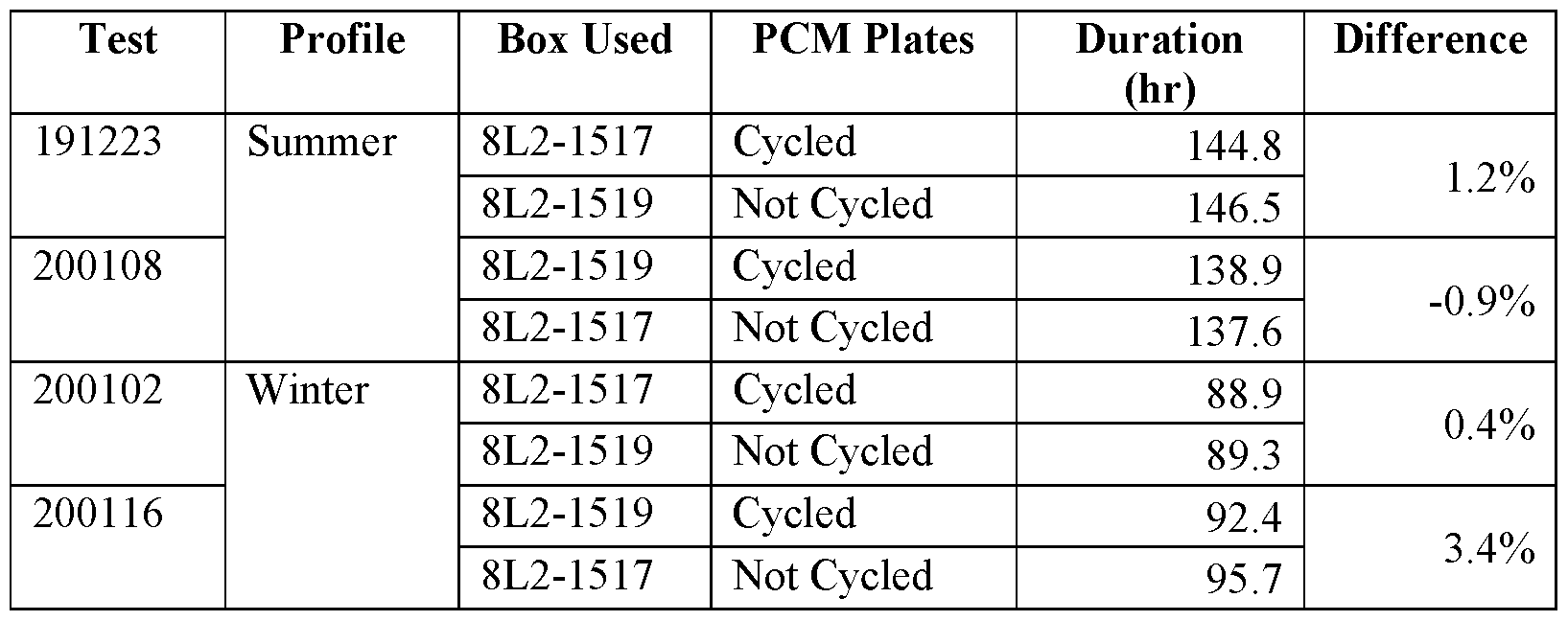
As shown in Table 2, in all four sets of tests, the difference in duration between the cycled and not cycled PCM plates was less than ±3.5% (summertests: 144.8/146.5 and 138.9/137.6 hours; winter tests:
88.9/89.3 and 92.4/95.7 hours). This difference is less than the typical experimental error for this type of test, so the performance of the cycled and non-cycled were deemed to be equivalent.
Conclusion
These results showed that placing the two immiscible PCMs in a common vessel did not adversely affect their thermal properties and their ability to buffer temperature changes in an insulated shipping box.
Example 3: T-History
The T-history method was used to measure the latent heat, melting point, and freezing point of the PCMs. Samples of each type of PCM were taken out of a bottle containing the combined PCMs, as well as new (never-mixed) samples. Both melting and freezing tests were done on each sample to obtain the latent heat and specific heat of each PCM material over the range of 15 to 25 °C.
Results
Table 3 and Table 4 provides the latent heat results of the T-History experiments (melting point and freezing point results not shown).
Table 3.

Table 4.

As shown in Tables 3 and 4 and in FIGS. 3 and 4 , some change in the measured latent heat was observed, but the differences between the samples from the mixed vs. the new materials were small and within the range of error for the equipment used.
Conclusion
These results showed that placing the two immiscible PCMs in a common vessel did not adversely affect their thermal properties and their ability to buffer temperature changes in an insulated shipping box.
While the invention has been disclosed in some detail by way of illustration and example for purposes of clarity of understanding, it is apparent to those in the art that various changes may be made and equivalents may be substituted without departing from the true spirit and scope of the invention.
Therefore, the description and examples should not be construed as limiting the scope of the invention.
Claims
1. A vessel assembly comprising a vessel having a chamber and optionally a filling port, the chamber comprising a first phase change material that operates at an upper limit in a range of
temperatures and a second phase change material that operates at a lower limit in the range of temperatures, the second phase change material being in contact with, but immiscible with, the first phase change material.
2. The vessel assembly of claim 1, wherein the first phase change material is a hydrated salt(s).
3. The vessel assembly of claim 2, wherein the hydrated salt is selected from the group consisting of sodium chloride, calcium chloride, sodium sulfate, ammonium nitrate, potassium carbonate, ammonium chloride, and potassium chloride.
4. The vessel assembly of claim 3, wherein first phase change material is calcium chloride.
5. The vessel assembly of any one of claims 1 to 4, wherein the second phase change material is an alkane.
6. The vessel assembly of claim 5, wherein the second phase change material is hexadecane.
7. The vessel assembly of claim 1, wherein vessel comprises a material selected from
Nylon-LLDPE laminated plastic film, fluorine-treated blow-molded HDPE, polyethylene, polypropylene, EVOH, nylon, fluorinated PE, fluorinated PP, PTFE, a fluorinated polymer, coextruded PE/Nylon, PP/Nylon, PE/EVOH and PP/EVOH.
8. The vessel assembly of claim 1, further comprising a temperature indicator.
9. The vessel assembly of claim 1, further comprising electronics.
10. A method of preparing a vessel assembly for maintaining a payload temperature across a range of temperatures, the method comprising a. filling a chamber of a vessel with a first PCM that operates at an upper limit in a range of temperatures; and b. filling the chamber with a second PCM that operates at a lower limit in the range of temperatures, the second phase change material being in contact with, but immiscible with, the first phase change material.
11 An insulated shipping box, comprising the vessel assembly of claim 1.
12. The insulated shipping box of claim 11, further comprising at least one vacuum insulation panel.
13. The insulated shipping box of claim 12, wherein the vacuum insulation panel comprises a core material selected from the group consisting of polystyrene, polyurethane, fiberglass, silica and organic foam.
14. The insulated shipping box of any of claims 11 to 13, further comprising a payload.
15. A method of transporting a payload to a desired location, the method comprising a. placing a vessel assembly according to claim 1 and preconditioned to a specific temperature within a shipper box; b. placing a payload within the shipper box; and c. transporting the shipper box comprising the payload to the desired location.
16. A method of insulating a payload, the method comprising a. providing a vessel assembly according to claim 1 and preconditioned to a specific temperature within a shipper box; and b. placing a payload within the shipper box.
17. A method of maintaining a payload temperature within a range, the method comprising a. providing a vessel assembly according to claim 1 and, preconditioned to a specific temperature, within a shipper box; and b. placing a payload within the shipper box; wherein the vessel assembly maintains the payload temperature within the range.
Priority Applications (3)
| Application Number | Priority Date | Filing Date | Title |
|---|---|---|---|
| US17/601,338 US12129094B2 (en) | 2019-04-05 | 2020-04-03 | Multiple immiscible phase change materials contained in common vessel |
| CA3136120A CA3136120A1 (en) | 2019-04-05 | 2020-04-03 | Multiple immiscible phase change materials contained in common vessel |
| EP20785269.0A EP3948112A4 (en) | 2019-04-05 | 2020-04-03 | SEVERAL IMMISCABLE STORAGE SUBSTANCES IN A COMMON CONTAINER |
Applications Claiming Priority (2)
| Application Number | Priority Date | Filing Date | Title |
|---|---|---|---|
| US201962829675P | 2019-04-05 | 2019-04-05 | |
| US62/829,675 | 2019-04-05 |
Publications (1)
| Publication Number | Publication Date |
|---|---|
| WO2020206306A1 true WO2020206306A1 (en) | 2020-10-08 |
Family
ID=72667419
Family Applications (1)
| Application Number | Title | Priority Date | Filing Date |
|---|---|---|---|
| PCT/US2020/026648 Ceased WO2020206306A1 (en) | 2019-04-05 | 2020-04-03 | Multiple immiscible phase change materials contained in common vessel |
Country Status (4)
| Country | Link |
|---|---|
| US (1) | US12129094B2 (en) |
| EP (1) | EP3948112A4 (en) |
| CA (1) | CA3136120A1 (en) |
| WO (1) | WO2020206306A1 (en) |
Cited By (1)
| Publication number | Priority date | Publication date | Assignee | Title |
|---|---|---|---|---|
| US20230064649A1 (en) * | 2021-08-25 | 2023-03-02 | Otter Products, Llc | Insulated specimen container |
Families Citing this family (5)
| Publication number | Priority date | Publication date | Assignee | Title |
|---|---|---|---|---|
| US12366400B2 (en) | 2021-03-04 | 2025-07-22 | Cold Chain Technologies, Llc | Shipping system for storing and/or transporting temperature-sensitive materials |
| US20240253853A1 (en) | 2023-01-30 | 2024-08-01 | Pratt Corrugated Holdings, Inc. | Meal kit assembly |
| US12264006B1 (en) | 2023-12-21 | 2025-04-01 | Pratt Corrugated Holdings, Inc. | Insulated packaging liner |
| USD1083588S1 (en) | 2023-12-28 | 2025-07-15 | Pratt Corrugated Holdings, Inc. | Packaging insert |
| US12497229B2 (en) | 2024-01-29 | 2025-12-16 | Pratt Corrugated Holdings, Inc. | Packaging assembly |
Citations (8)
| Publication number | Priority date | Publication date | Assignee | Title |
|---|---|---|---|---|
| US5755987A (en) | 1996-08-23 | 1998-05-26 | The Dow Chemical Company | Dibasic ester based phase change material compositions |
| EP1006058A1 (en) * | 1998-12-01 | 2000-06-07 | Siemens-Elema AB | Packaging comprising a phase changes temperature moderator |
| US20060277938A1 (en) * | 2005-06-08 | 2006-12-14 | Doubleday Acquisitions, Llc | Cargo container for transporting temperature sensitive items |
| US20080230203A1 (en) | 2005-05-12 | 2008-09-25 | Christ Martin U | Latent Heat Storage Material and Process for Manufacture of the Latent Heat Storage Material |
| WO2012176708A1 (en) | 2011-06-21 | 2012-12-27 | シャープ株式会社 | Heat storage member and heat storage container |
| US20130255306A1 (en) | 2012-03-27 | 2013-10-03 | William T. Mayer | Passive thermally regulated shipping container employing phase change material panels containing dual immiscible phase change materials |
| US20140151382A1 (en) * | 2012-12-04 | 2014-06-05 | Nanopore, Inc. | Insulated container system for maintaining a controlled payload temperature |
| US20180086534A1 (en) | 2015-04-15 | 2018-03-29 | American Aerogel Corporation | Vessel assemblies for temperature control |
Family Cites Families (68)
| Publication number | Priority date | Publication date | Assignee | Title |
|---|---|---|---|---|
| US1369367A (en) | 1920-01-05 | 1921-02-22 | Henry M Whitney | Cooling-container |
| US2595328A (en) | 1949-04-29 | 1952-05-06 | Goodrich Co B F | Heat-transfer container |
| US2814382A (en) | 1955-09-21 | 1957-11-26 | Frederic H Lassiter | Cellophane packaging and method |
| US3893834A (en) | 1974-03-04 | 1975-07-08 | Arthur E Armstrong | Insulated cold pack |
| US4344300A (en) | 1980-08-25 | 1982-08-17 | Frank Taylor | Chillerwell cooler |
| US5111957A (en) | 1988-06-08 | 1992-05-12 | Transtech Service Network, Inc. | Method and apparatus for packaging refrigerated goods |
| US4981135A (en) | 1989-06-16 | 1991-01-01 | Hardy John F | Therapeutic thermal cuff |
| US5269368A (en) * | 1991-08-05 | 1993-12-14 | Vacu Products B.V. | Rechargeable temperature regulating device for controlling the temperature of a beverage or other object |
| US5534020A (en) | 1994-01-24 | 1996-07-09 | Cheney, Iii; Henry H. | Instant reusable compress |
| US5609039A (en) * | 1995-05-24 | 1997-03-11 | Dennis E. Green | Cooling cartridge for plastic drinking bottles |
| US5843145A (en) | 1996-01-23 | 1998-12-01 | Dura-Kold Corporation | Reusable hot/cold temperature pack |
| US6083256A (en) | 1996-08-15 | 2000-07-04 | Der Ovanesian; Mary | NNT or cold pad with inner element |
| US5840080A (en) | 1996-08-15 | 1998-11-24 | Der Ovanesian; Mary | Hot or cold applicator with inner element |
| US20040173556A1 (en) | 1997-09-19 | 2004-09-09 | Smolko Daniel D. | Vented closures for containers |
| TW470837B (en) * | 2000-04-21 | 2002-01-01 | Matsushita Refrigeration | Vacuum heat insulator |
| JP2001330351A (en) | 2000-05-22 | 2001-11-30 | Mitsubishi Cable Ind Ltd | Composite cold storage substance and its use method |
| US6484514B1 (en) | 2000-10-10 | 2002-11-26 | The Procter & Gamble Company | Product dispenser having internal temperature changing element |
| US6765031B2 (en) | 2001-02-20 | 2004-07-20 | Vacupanel, Inc. | Micropore open cell foam composite and method for manufacturing same |
| US6688132B2 (en) * | 2001-06-06 | 2004-02-10 | Nanopore, Inc. | Cooling device and temperature-controlled shipping container using same |
| US6644383B2 (en) | 2001-06-29 | 2003-11-11 | The Procter & Gamble Company | Self-heating/self-cooling package |
| US6868982B2 (en) | 2001-12-05 | 2005-03-22 | Cold Chain Technologies, Inc. | Insulated shipping container and method of making the same |
| US6494056B1 (en) | 2002-04-23 | 2002-12-17 | Hank Roth | Method and system for use with a consumable beverage |
| KR100440243B1 (en) | 2002-04-23 | 2004-07-12 | 돈나 로쓰 | Method and system for use with a consumable beverage |
| US6675606B1 (en) | 2002-06-28 | 2004-01-13 | Birdsall L. Jones | Cooler with combination ice pack and canteen |
| US7422143B2 (en) | 2002-10-23 | 2008-09-09 | Minnesota Thermal Science, Llc | Container having passive controlled temperature interior |
| US20040180176A1 (en) * | 2003-03-14 | 2004-09-16 | Rusek Stanley J. | Vaccum insulation article |
| US7257963B2 (en) | 2003-05-19 | 2007-08-21 | Minnesota Thermal Science, Llc | Thermal insert for container having a passive controlled temperature interior |
| US8053047B2 (en) | 2004-04-02 | 2011-11-08 | Curwood, Inc. | Packaging method that causes and maintains the preferred red color of fresh meat |
| US20080230508A1 (en) | 2007-03-19 | 2008-09-25 | Erik Overgaard | Removable temperature regulating mechanism |
| TWM326384U (en) | 2007-08-07 | 2008-02-01 | Co Union Industry Co Ltd | Cold preserving pot |
| US8448809B2 (en) | 2007-10-15 | 2013-05-28 | Millercoors, Llc | Thermal barrier liner for containers |
| US7954338B2 (en) | 2008-10-03 | 2011-06-07 | Chien Ping Lien | Water storage unit with dual bladders |
| GB2465376B (en) | 2008-11-14 | 2012-11-28 | Tower Cold Chain Solutions Ltd | Thermally insulated reuseable transportation container |
| US9751682B2 (en) * | 2009-02-20 | 2017-09-05 | Pelican Biothermal Llc | Modular cuboidal passive temperature controlled shipping container |
| US20130174581A1 (en) | 2009-12-09 | 2013-07-11 | CARLSBERG BREWERIES AlS | Self cooling container and a cooling device |
| AU2011232831A1 (en) | 2010-03-28 | 2012-10-18 | Kimberly Cull | Treating medical conditions in body cavities |
| WO2011159978A1 (en) | 2010-06-18 | 2011-12-22 | American Aerogel Corporation | Insulating inserts, containers comprising them and methods of assembling and using them |
| CH703828B1 (en) | 2010-09-24 | 2015-05-15 | Suricate Sa | Flexible thermal container to the envelope or bag with multi-chamber or multicell incorporated. |
| US8887515B2 (en) | 2012-08-23 | 2014-11-18 | Pelican Biopharma, Llc | Thermal management systems and methods |
| US9181015B2 (en) | 2013-03-15 | 2015-11-10 | Raymond Booska | Thermal receptacle with phase change material |
| US9267722B2 (en) | 2013-05-10 | 2016-02-23 | Packaging Technology Group, Inc. | Phase change material bladder for use in a temperature controlled product shipper |
| US10588820B2 (en) | 2013-05-16 | 2020-03-17 | Sandy Wengreen | Storage systems and methods for medicines |
| US9618252B2 (en) | 2014-01-09 | 2017-04-11 | Bruce C. Andrews | Cooler insert |
| CN107110614A (en) | 2014-09-04 | 2017-08-29 | 升级服务股份公司 | Refrigeration or thermal energy storage systems via phase change materials |
| US20160200501A1 (en) | 2015-01-14 | 2016-07-14 | Monosol, Llc | Web of cleaning products having a modified internal atmosphere and method of manufacture |
| JP6221144B2 (en) | 2015-05-28 | 2017-11-01 | シャープ株式会社 | Heat storage pack, heat exchange unit, and method of manufacturing heat storage pack |
| FR3040210B1 (en) | 2015-08-20 | 2019-09-06 | Hutchinson | MODULAR ASSEMBLY FOR STORER OR BATTERY |
| PT3341298T (en) | 2015-08-26 | 2020-08-14 | Commw Scient Ind Res Org | Container for use in food processing |
| US10583978B2 (en) * | 2015-10-06 | 2020-03-10 | Cold Chain Technologies, Llc | Pallet cover compromising one or more temperature-control members and kit for use in making the pallet cover |
| EP3359889B1 (en) * | 2015-10-06 | 2020-08-05 | Cold Chain Technologies, LLC | Thermally insulated shipping system for pallet-sized payload |
| US11591133B2 (en) * | 2015-10-06 | 2023-02-28 | Cold Chain Technologies, Llc | Pallet cover comprising one or more temperature-control members and kit for use in making the pallet cover |
| US10604326B2 (en) * | 2015-10-06 | 2020-03-31 | Cold Chain Technologies, Llc. | Pallet cover comprising one or more temperature-control members and kit for use in making the pallet cover |
| CN112722591A (en) * | 2015-11-25 | 2021-04-30 | 野醍冷却器有限责任公司 | Insulated container with vacuum insulated panel and method |
| US10451335B2 (en) | 2016-03-07 | 2019-10-22 | Phase Change Energy Solutions, Inc. | Product transport containers |
| WO2017177329A1 (en) | 2016-04-12 | 2017-10-19 | 9352-1425 Québec Inc. | Ice pack and ice pack grid system |
| WO2017192396A1 (en) | 2016-05-02 | 2017-11-09 | Ember Technologies, Inc. | Heated or cooled drinkware |
| GB201611031D0 (en) | 2016-06-24 | 2016-08-10 | Softbox Systems Ltd | A passive temperature control system for transport and storage containers |
| JP6925106B2 (en) | 2016-07-19 | 2021-08-25 | 富士フイルム富山化学株式会社 | Transport device |
| EP3851098B1 (en) | 2016-10-12 | 2022-12-21 | Drug Plastics & Glass Company, Inc. | Container assembly with predetermined humidity |
| US10107541B2 (en) | 2016-11-14 | 2018-10-23 | International Business Machines Corporation | Reusable cold pack |
| US10631968B2 (en) | 2017-03-06 | 2020-04-28 | Edwards Lifesciences Corporation | Humidity-management packaging systems and methods |
| US11511928B2 (en) | 2017-05-09 | 2022-11-29 | Cold Chain Technologies, Llc | Shipping system for storing and/or transporting temperature-sensitive materials |
| WO2018208986A1 (en) | 2017-05-09 | 2018-11-15 | Cold Chain Technologies, Inc. | Shipping system for storing and/or transporting temperature-sensitive materials |
| KR101822577B1 (en) | 2017-10-31 | 2018-03-08 | 나정균 | Eco-friendly ice pack |
| TWI654956B (en) | 2018-04-26 | 2019-04-01 | National Tsing Hua University | Temperature storage heat storage container |
| SG11202012328VA (en) * | 2018-06-15 | 2021-01-28 | Cold Chain Technologies Llc | Shipping system for storing and/or transporting temperature-sensitive materials |
| US11673731B2 (en) | 2018-08-02 | 2023-06-13 | Boveda, Inc. | Method of making an injection molded product packaging having a humidity control material |
| WO2020150644A1 (en) * | 2019-01-17 | 2020-07-23 | Cold Chain Technologies, Llc | Thermally insulated shipping system for parcel-sized payload |
-
2020
- 2020-04-03 WO PCT/US2020/026648 patent/WO2020206306A1/en not_active Ceased
- 2020-04-03 EP EP20785269.0A patent/EP3948112A4/en active Pending
- 2020-04-03 US US17/601,338 patent/US12129094B2/en active Active
- 2020-04-03 CA CA3136120A patent/CA3136120A1/en active Pending
Patent Citations (8)
| Publication number | Priority date | Publication date | Assignee | Title |
|---|---|---|---|---|
| US5755987A (en) | 1996-08-23 | 1998-05-26 | The Dow Chemical Company | Dibasic ester based phase change material compositions |
| EP1006058A1 (en) * | 1998-12-01 | 2000-06-07 | Siemens-Elema AB | Packaging comprising a phase changes temperature moderator |
| US20080230203A1 (en) | 2005-05-12 | 2008-09-25 | Christ Martin U | Latent Heat Storage Material and Process for Manufacture of the Latent Heat Storage Material |
| US20060277938A1 (en) * | 2005-06-08 | 2006-12-14 | Doubleday Acquisitions, Llc | Cargo container for transporting temperature sensitive items |
| WO2012176708A1 (en) | 2011-06-21 | 2012-12-27 | シャープ株式会社 | Heat storage member and heat storage container |
| US20130255306A1 (en) | 2012-03-27 | 2013-10-03 | William T. Mayer | Passive thermally regulated shipping container employing phase change material panels containing dual immiscible phase change materials |
| US20140151382A1 (en) * | 2012-12-04 | 2014-06-05 | Nanopore, Inc. | Insulated container system for maintaining a controlled payload temperature |
| US20180086534A1 (en) | 2015-04-15 | 2018-03-29 | American Aerogel Corporation | Vessel assemblies for temperature control |
Non-Patent Citations (1)
| Title |
|---|
| See also references of EP3948112A4 |
Cited By (1)
| Publication number | Priority date | Publication date | Assignee | Title |
|---|---|---|---|---|
| US20230064649A1 (en) * | 2021-08-25 | 2023-03-02 | Otter Products, Llc | Insulated specimen container |
Also Published As
| Publication number | Publication date |
|---|---|
| EP3948112A4 (en) | 2022-11-30 |
| CA3136120A1 (en) | 2020-10-08 |
| US12129094B2 (en) | 2024-10-29 |
| US20220194678A1 (en) | 2022-06-23 |
| EP3948112A1 (en) | 2022-02-09 |
Similar Documents
| Publication | Publication Date | Title |
|---|---|---|
| US12129094B2 (en) | Multiple immiscible phase change materials contained in common vessel | |
| US11396415B2 (en) | Vessel assemblies for temperature control | |
| US7919163B2 (en) | Thermal packaging system | |
| US6765031B2 (en) | Micropore open cell foam composite and method for manufacturing same | |
| Singh et al. | Phase change materials for advanced cooling packaging | |
| US9957099B2 (en) | Insulated container system for maintaining a controlled payload temperature | |
| WO2016204284A1 (en) | Cold storage material composition, cold storage material, and transport container | |
| EP2221569A1 (en) | Modular cuboidal passive temperature controlled shipping container | |
| CN110461987B (en) | Cold storage material composition, method for using cold storage material composition, cold storage material, and transport container | |
| Borri et al. | Experimental and numerical characterization of sub-zero phase change materials for cold thermal energy storage | |
| JP6227559B2 (en) | Thermal storage material composition, thermal storage material and transport container | |
| WO2021155145A1 (en) | Temperature control sheets for packaging | |
| JPWO2020004586A1 (en) | Heat storage material composition and its use | |
| EP3122335A1 (en) | Gel comprising a phase-change material, method of preparing the gel, thermal exchange implement comprising the gel | |
| US20210025660A1 (en) | System and method for active cooling of a substance | |
| Fernandes et al. | Biodegradable thermoactive packaging using phase change material particles on cellulosic materials | |
| Pauken et al. | Thermal energy storage technology developments | |
| JP2009120734A (en) | Thermal storage material composition | |
| GB2600510A (en) | Phase change material | |
| US20200408470A1 (en) | Thermal Control System | |
| Rasta et al. | The role of heterogeneous nucleation in water based phase change material for medium temperature refrigeration | |
| JP2025126574A (en) | Cold storage material composition | |
| Johnston | Nano-structured calcium silicate phase change materials for packaging temperature sensitive products | |
| JP2024010569A (en) | Heat storage material composition and manufacturing method thereof | |
| EP4539994A1 (en) | Methods and devices for thermal stabilization of perishable biological specimens |
Legal Events
| Date | Code | Title | Description |
|---|---|---|---|
| 121 | Ep: the epo has been informed by wipo that ep was designated in this application |
Ref document number: 20785269 Country of ref document: EP Kind code of ref document: A1 |
|
| ENP | Entry into the national phase |
Ref document number: 3136120 Country of ref document: CA |
|
| NENP | Non-entry into the national phase |
Ref country code: DE |
|
| ENP | Entry into the national phase |
Ref document number: 2020785269 Country of ref document: EP Effective date: 20211105 |