WO2020210619A1 - Activatable multi-specific antigen binding protein complexes - Google Patents
Activatable multi-specific antigen binding protein complexes Download PDFInfo
- Publication number
- WO2020210619A1 WO2020210619A1 PCT/US2020/027663 US2020027663W WO2020210619A1 WO 2020210619 A1 WO2020210619 A1 WO 2020210619A1 US 2020027663 W US2020027663 W US 2020027663W WO 2020210619 A1 WO2020210619 A1 WO 2020210619A1
- Authority
- WO
- WIPO (PCT)
- Prior art keywords
- region
- fab
- chain
- seq
- antigen binding
- Prior art date
- Legal status (The legal status is an assumption and is not a legal conclusion. Google has not performed a legal analysis and makes no representation as to the accuracy of the status listed.)
- Ceased
Links
Classifications
-
- A—HUMAN NECESSITIES
- A61—MEDICAL OR VETERINARY SCIENCE; HYGIENE
- A61P—SPECIFIC THERAPEUTIC ACTIVITY OF CHEMICAL COMPOUNDS OR MEDICINAL PREPARATIONS
- A61P35/00—Antineoplastic agents
-
- C—CHEMISTRY; METALLURGY
- C07—ORGANIC CHEMISTRY
- C07K—PEPTIDES
- C07K16/00—Immunoglobulins [IG], e.g. monoclonal or polyclonal antibodies
- C07K16/18—Immunoglobulins [IG], e.g. monoclonal or polyclonal antibodies against material from animals or humans
- C07K16/28—Immunoglobulins [IG], e.g. monoclonal or polyclonal antibodies against material from animals or humans against receptors, cell surface antigens or cell surface determinants
- C07K16/2803—Immunoglobulins [IG], e.g. monoclonal or polyclonal antibodies against material from animals or humans against receptors, cell surface antigens or cell surface determinants against the immunoglobulin superfamily
- C07K16/2809—Immunoglobulins [IG], e.g. monoclonal or polyclonal antibodies against material from animals or humans against receptors, cell surface antigens or cell surface determinants against the immunoglobulin superfamily against the T-cell receptor (TcR)-CD3 complex
-
- C—CHEMISTRY; METALLURGY
- C07—ORGANIC CHEMISTRY
- C07K—PEPTIDES
- C07K16/00—Immunoglobulins [IG], e.g. monoclonal or polyclonal antibodies
- C07K16/18—Immunoglobulins [IG], e.g. monoclonal or polyclonal antibodies against material from animals or humans
- C07K16/28—Immunoglobulins [IG], e.g. monoclonal or polyclonal antibodies against material from animals or humans against receptors, cell surface antigens or cell surface determinants
- C07K16/2803—Immunoglobulins [IG], e.g. monoclonal or polyclonal antibodies against material from animals or humans against receptors, cell surface antigens or cell surface determinants against the immunoglobulin superfamily
- C07K16/2827—Immunoglobulins [IG], e.g. monoclonal or polyclonal antibodies against material from animals or humans against receptors, cell surface antigens or cell surface determinants against the immunoglobulin superfamily against B7 molecules, e.g. CD80, CD86
-
- C—CHEMISTRY; METALLURGY
- C07—ORGANIC CHEMISTRY
- C07K—PEPTIDES
- C07K16/00—Immunoglobulins [IG], e.g. monoclonal or polyclonal antibodies
- C07K16/18—Immunoglobulins [IG], e.g. monoclonal or polyclonal antibodies against material from animals or humans
- C07K16/28—Immunoglobulins [IG], e.g. monoclonal or polyclonal antibodies against material from animals or humans against receptors, cell surface antigens or cell surface determinants
- C07K16/2863—Immunoglobulins [IG], e.g. monoclonal or polyclonal antibodies against material from animals or humans against receptors, cell surface antigens or cell surface determinants against receptors for growth factors, growth regulators
-
- C—CHEMISTRY; METALLURGY
- C07—ORGANIC CHEMISTRY
- C07K—PEPTIDES
- C07K16/00—Immunoglobulins [IG], e.g. monoclonal or polyclonal antibodies
- C07K16/18—Immunoglobulins [IG], e.g. monoclonal or polyclonal antibodies against material from animals or humans
- C07K16/28—Immunoglobulins [IG], e.g. monoclonal or polyclonal antibodies against material from animals or humans against receptors, cell surface antigens or cell surface determinants
- C07K16/2878—Immunoglobulins [IG], e.g. monoclonal or polyclonal antibodies against material from animals or humans against receptors, cell surface antigens or cell surface determinants against the NGF-receptor/TNF-receptor superfamily, e.g. CD27, CD30, CD40, CD95
-
- C—CHEMISTRY; METALLURGY
- C07—ORGANIC CHEMISTRY
- C07K—PEPTIDES
- C07K16/00—Immunoglobulins [IG], e.g. monoclonal or polyclonal antibodies
- C07K16/18—Immunoglobulins [IG], e.g. monoclonal or polyclonal antibodies against material from animals or humans
- C07K16/28—Immunoglobulins [IG], e.g. monoclonal or polyclonal antibodies against material from animals or humans against receptors, cell surface antigens or cell surface determinants
- C07K16/2896—Immunoglobulins [IG], e.g. monoclonal or polyclonal antibodies against material from animals or humans against receptors, cell surface antigens or cell surface determinants against molecules with a "CD"-designation, not provided for elsewhere
-
- A—HUMAN NECESSITIES
- A61—MEDICAL OR VETERINARY SCIENCE; HYGIENE
- A61K—PREPARATIONS FOR MEDICAL, DENTAL OR TOILETRY PURPOSES
- A61K39/00—Medicinal preparations containing antigens or antibodies
- A61K2039/505—Medicinal preparations containing antigens or antibodies comprising antibodies
-
- A—HUMAN NECESSITIES
- A61—MEDICAL OR VETERINARY SCIENCE; HYGIENE
- A61K—PREPARATIONS FOR MEDICAL, DENTAL OR TOILETRY PURPOSES
- A61K39/00—Medicinal preparations containing antigens or antibodies
- A61K2039/62—Medicinal preparations containing antigens or antibodies characterised by the link between antigen and carrier
- A61K2039/627—Medicinal preparations containing antigens or antibodies characterised by the link between antigen and carrier characterised by the linker
-
- C—CHEMISTRY; METALLURGY
- C07—ORGANIC CHEMISTRY
- C07K—PEPTIDES
- C07K2317/00—Immunoglobulins specific features
- C07K2317/30—Immunoglobulins specific features characterized by aspects of specificity or valency
- C07K2317/31—Immunoglobulins specific features characterized by aspects of specificity or valency multispecific
-
- C—CHEMISTRY; METALLURGY
- C07—ORGANIC CHEMISTRY
- C07K—PEPTIDES
- C07K2317/00—Immunoglobulins specific features
- C07K2317/30—Immunoglobulins specific features characterized by aspects of specificity or valency
- C07K2317/35—Valency
-
- C—CHEMISTRY; METALLURGY
- C07—ORGANIC CHEMISTRY
- C07K—PEPTIDES
- C07K2317/00—Immunoglobulins specific features
- C07K2317/50—Immunoglobulins specific features characterized by immunoglobulin fragments
- C07K2317/55—Fab or Fab'
-
- C—CHEMISTRY; METALLURGY
- C07—ORGANIC CHEMISTRY
- C07K—PEPTIDES
- C07K2317/00—Immunoglobulins specific features
- C07K2317/60—Immunoglobulins specific features characterized by non-natural combinations of immunoglobulin fragments
-
- C—CHEMISTRY; METALLURGY
- C07—ORGANIC CHEMISTRY
- C07K—PEPTIDES
- C07K2317/00—Immunoglobulins specific features
- C07K2317/70—Immunoglobulins specific features characterized by effect upon binding to a cell or to an antigen
-
- C—CHEMISTRY; METALLURGY
- C07—ORGANIC CHEMISTRY
- C07K—PEPTIDES
- C07K2317/00—Immunoglobulins specific features
- C07K2317/70—Immunoglobulins specific features characterized by effect upon binding to a cell or to an antigen
- C07K2317/73—Inducing cell death, e.g. apoptosis, necrosis or inhibition of cell proliferation
-
- C—CHEMISTRY; METALLURGY
- C07—ORGANIC CHEMISTRY
- C07K—PEPTIDES
- C07K2317/00—Immunoglobulins specific features
- C07K2317/90—Immunoglobulins specific features characterized by (pharmaco)kinetic aspects or by stability of the immunoglobulin
- C07K2317/92—Affinity (KD), association rate (Ka), dissociation rate (Kd) or EC50 value
Definitions
- the present disclosure provides multi-specific antigen binding protein complexes having immunoglobulin-like antigen binding activity, methods for their production,
- Tumors are known to contain heterogenous cell types including malignant, stromal and immune cells, which play various roles in tumor vascularization, growth and metastasis.
- Tumor metastasis is a complex process that involves tumor cells over-expressing proteases that degrade cellular structures that surround tumor cells which promotes cell invasion and metastasis.
- proteases that play a role in tumor progression include serine proteases, metalloproteases, cysteine proteases and aspartyl proteases.
- Tumor cells produce
- Tumor extracts containing certain proteases that are associated with poor patient prognosis including type II transmembrane serine proteases, urokinase plasminogen activator (uPA) systems, metalloproteases including MMPs and ADAMs, and cysteine proteases including cysteine cathepsins.
- Bispecific antibodies that are designed to generate immune cell synapse can bind antigens on effector cells and tumor-associated antigens expressed by tumors which leads to tumor-selective cytotoxic cell killing.
- bispecific antibodies sometimes bind to healthy cells that express low levels of tumor-associated antigens, resulting in on-target off-tumor cell killing.
- activatable bispecific antibodies have been developed to utilize the proteases located in the tumor microenvironment.
- Protease-activatable antibodies also known as activatable probodies
- the cleavable peptide in an intact state interferes with antibody binding capacity to effector cells but does not interfere with binding capacity to the tumor-associated antigen.
- the protease-activatable antibodies selectively bind in an inactive state to tumor-associated antigens expressed by tumor and healthy cells however cell killing is not initiated because the cleavable linker is intact.
- the cleavable linker is not cleaved until the bispecific antibody is in close proximity to a tumor microenvironment containing a protease that can cleave the linker which generates the activated form of the antibody which in turn binds effector T cells, leading to cytotoxic cell killing, thus sparing healthy cells and tissues.
- the protease-activatable bispecific antibodies need not physically contact the tumor cell, nor enter the tumor cell, but rather need to be located in the tumor microenvironment which contains the tumor-secreted protease.
- multi-specific antigen binding protein complexes comprising (i) two different Fab regions, each capable of binding two different epitopes, and (ii) an Fc region.
- the multi-specific antigen binding protein complexes may comprise two or three polypeptide chains that associate with each other to form a protein complex.
- the multi-specific antigen binding protein complex may comprise a cleavable linker that reduces, inhibits, or prevents binding of one of the Fab regions to its target antigen unless the cleavable linker is cleaved (which would convert a two-chain complex to a three-chain complex).
- the multi-specific antigen binding protein complex may comprise a cleavable linker that reduces, inhibits, or prevents binding of one of the Fab regions to its target antigen unless the cleavable linker is cleaved (which would convert a two-chain complex to a three-chain complex).
- binding protein complexes are relatively simple compared to existing multi-specific antibodies in that only two or three polypeptide chains are used per complex, which is fewer than a standard human IgG molecule, which consists of four chains.
- the positioning of the half Fab heavy and half Fab light regions on the two or three chains of the complexes according to the disclosure will favor efficient formation of heterodimer protein complexes that bind two different epitopes, or at least provide the public with a useful choice.
- the multi-specific antigen binding protein complexes can activate an immune cell in the presence of a target cell.
- the multi-specific antigen binding protein complexes may provide one or more benefits, such as high specificity for activation of immune cells in the presence of cancer cells or a target tumor environment, and/or high efficacy in promoting immune cell-mediated target cell killing, or at least provide the public with a useful choice.
- the present disclosure provides various embodiments of a two-chain multi-specific antigen binding protein complex that can bind two different epitopes on the same target antigen or two different epitopes on different target antigens at the same time, where the protein complex comprises: two different Fab regions, an Fc region, and a first and a second linker.
- the two different Fab regions and the Fc region are formed from the association of a first polypeptide chain with a second polypeptide chain, wherein each of the first and second polypeptide chains carries two different half Fab regions and a half Fc region, wherein the first polypeptide chain carries the first linker, the second polypeptide chain carries the second linker, and the second linker is cleavable.
- the first and second polypeptide chains associate with each other to form the multi-specific antigen binding protein complex having a first Fab region that is capable of binding a first epitope, a second Fab region that is capable of binding a second epitope that differs from the first epitope, a full Fc region that is capable of binding an Fc receptor, and a first and second linker.
- the first Fab region exhibits binding to the first target epitope and the second Fab region exhibits reduced binding to the second target epitope when the second linker is un-cleaved compared to when the second linker is cleaved.
- the second Fab region exhibits increased binding to the second target epitope when the second linker is cleaved compared to when the second linker is un-cleaved.
- the first Fab region and the second Fab region are capable of binding to the first and second target epitopes, respectively, at the same time.
- the first linker is cleavable with a matrix metalloprotease, wherein the matrix metalloprotease is MMP1, MMP2, MMP3, MMP8, MMP9, MMP11, MMP13, MMP14, or MT1-MMP (membrane type 1 matrix metalloproteinase).
- the first linker comprises the amino acid sequence of
- n is an integer of 1-6.
- the second linker comprises the amino acid sequence of
- the two different Fab regions are arranged in-tandem, and the protein complex comprises: (a) a first polypeptide chain comprising (i) a first half Fab heavy region, (ii) a first linker, (iii) a second half Fab heavy region, and (iv) a first half Fc region, wherein the first half Fab heavy region comprises a first-variable region and first-constant region from a first Fab heavy chain, and wherein the second half Fab heavy region comprises a second-variable region and second- constant region from a second Fab heavy chain; and (b) a second polypeptide chain comprising (i) a first half Fab light region, (ii) a second linker, (iii) a second half Fab light region, and (iv) a second half Fc region, wherein the first half Fab light region comprises a first-variable region
- Non-limiting examples of in-tandem protein complexes are shown in Figures 1, 5, 6 and 7.
- the two different Fab regions are arranged in a non-tandem manner, and the protein complex comprises: (a) a first polypeptide chain comprising (i) a first half Fab heavy region, (ii) a first half Fc region, (iii) a first linker, and (iv) a second half Fab heavy region, wherein the first half Fab heavy region comprises a first-variable region and first-constant region from a first Fab heavy chain, and wherein the second half Fab heavy region comprises a second-variable region and second-constant region from a second Fab heavy chain; and (b) a second polypeptide chain comprising (i) a first half Fab light region, (ii) a second half Fc region, (iii) a second linker, and (iv) a second half Fab light region, wherein the first half Fab light region comprises a first- variable region and first-constant
- any of the two-chain multi-specific antigen binding protein complexes described herein comprise (i) a first polypeptide chain having a hole mutation in the first half Fc region and a second polypeptide chain having a knob mutation in the second half Fc region, or (ii) a first polypeptide chain having a knob mutation in the first half Fc region and a second polypeptide chain having a hole mutation in the second half Fc region.
- any of the two-chain multi-specific antigen binding protein complexes described herein comprise first and second polypeptide chains having any one or any combination of two or more knob and hole mutations comprising T366Y, T366W, T366S, L368A, T394S, T394W, F405A, F405W, Y407A, Y407V and/or Y407T according to Kabat numbering.
- any of the two-chain multi-specific antigen binding protein complexes described herein comprise a first Fab region that binds the first target epitope with a dissociation constant K d of 10 -5 M or less, or 10 -6 M or less, or 10 -7 M or less, or 10 -8 M or less, or 10 -9 M or less, or 10 -10 M or less.
- any of the two-chain multi-specific antigen binding protein complexes described herein comprise a second Fab region wherein upon cleavage of the second linker the second Fab region binds the second target epitope with a dissociation constant K d of 10 -5 M or less, or 10 -6 M or less, or 10 -7 M or less, or 10 -8 M or less, or 10 -9 M or less, or 10 -10 M or less.
- the two different Fab regions are arranged in-tandem, and the protein complex comprises: (a) a first polypeptide chain which comprises (e.g., in N- to C-terminal order): (i) a first heavy chain variable domain comprising an amino acid sequence that is at least 95% identical to SEQ ID NO:1; (ii) a first heavy chain constant domain comprising an amino acid sequence that is at least 95% identical to SEQ ID NO:2; (iii) a first linker comprising an amino acid sequence that is at least 95% identical to SEQ ID NO:3; (iv) a second heavy chain variable domain comprising an amino acid sequence that is at least 95% identical to SEQ ID NO:4; (v) a second heavy chain constant domain comprising an amino acid sequence that is at least 95% identical to SEQ ID NO:5; (vi) a first hinge sequence comprising an amino acid sequence that is at least 95% identical to SEQ ID NO:
- the two different Fab regions are arranged in a non-tandem manner, and the protein complex comprises: (a) a first polypeptide chain which comprises (e.g., in N- to C-terminal order): (i) a first heavy chain variable domain comprising an amino acid sequence that is at least 95% identical to SEQ ID NO:30; (ii) a first heavy chain constant domain comprising an amino acid sequence that is at least 95% identical to SEQ ID NO:31; (iii) a first hinge comprising an amino acid sequence that is at least 95% identical to SEQ ID NO:32; (iv) a first CH2 domain comprising an amino acid sequence that is at least 95% identical to SEQ ID NO:33; (v) a first CH3 domain comprising an amino acid sequence that is at least 95% identical to SEQ ID NO:34; (vi) a first linker sequence comprising an amino acid sequence that is at least 95% identical to SEQ ID
- the present disclosure provides a pharmaceutical composition comprising any one of the two-chain multi-specific antigen binding protein complexes described herein and a pharmaceutically-acceptable excipient.
- any of the two-chain multi-specific antigen binding protein complexes described herein can be used as a medicament.
- the present disclosure provides one or more nucleic acids encoding (i) the first polypeptide chain of any one of the two-chain multi-specific antigen binding protein complexes described herein, and encoding (ii) the second polypeptide chain of any of the two-chain multi- specific antigen binding protein complexes described herein.
- the present disclosure provides one or more vectors comprising any of the one or more nucleic acids described herein operably linked to one or more promoters.
- the present disclosure provides a host cell harboring any of the one or more vectors described herein.
- the present disclosure provides a method for preparing any of the two-chain multi- specific antigen binding protein complexes described herein, comprising: culturing a population of the host cell described herein under conditions suitable for expressing the first and second polypeptide chains. In one embodiment, the method further comprises: isolating (e.g., recovering) the first and second polypeptide chains. In one embodiment, the method further comprises subjecting the first and second polypeptide chains to conditions suitable for associating the first and second polypeptide chains with each other to form the two-chain multi- specific antigen binding protein complex. In one embodiment, the formed two-chain multi- specific antigen binding protein complex comprises a hetero-dimeric molecule.
- the present disclosure provides (i) a first nucleic acid encoding the first polypeptide chain of any one of the two-chain multi-specific antigen binding protein complexes described herein, and (ii) a second nucleic acid encoding the second polypeptide chain of any of the two- chain multi-specific antigen binding protein complexes described herein.
- the present disclosure provides (i) a first vector operably linked to the first nucleic acid encoding the first polypeptide chain of any one of the two-chain multi-specific antigen binding protein complexes described herein, and (ii) a second vector operably linked to the second nucleic acid encoding the second polypeptide chain of any of the two-chain multi-specific antigen binding protein complexes described herein.
- the first vector is a first expression vector comprising at least one promoter which is operably linked to the first nucleic acid encoding the first polypeptide chain.
- the second vector is a second expression vector comprising at least one promoter which is operably linked to the second nucleic acid encoding the second polypeptide chain.
- the present disclosure provides a host cell harboring any of the first and second vectors described herein.
- the present disclosure provides method for preparing any of the two-chain multi- specific antigen binding protein complexes described herein, comprising: culturing a population of the host cell harboring the first and second vectors under conditions suitable for expressing the first and second polypeptide chains, wherein the first vector is operably linked to the first nucleic acid encoding the first polypeptide chain of any one of the two-chain multi-specific antigen binding protein complexes described herein, and wherein the second vector is operably linked to the second nucleic acid encoding the second polypeptide chain of any of the two-chain multi- specific antigen binding protein complexes described herein.
- the method further comprises: isolating (recovering) the first and second polypeptide chains.
- the method further comprises subjecting the first and second polypeptide chains to conditions suitable for associating the first and second polypeptide chains with each other to form the two-chain multi-specific antigen binding protein complex.
- the formed two-chain multi-specific antigen binding protein complex comprises a hetero-dimeric molecule.
- the present disclosure provides (i) a first host cell harboring the first vector comprising a promoter operably linked to the first nucleic acid encoding the first polypeptide chain of any one of the two-chain multi-specific antigen binding protein complexes described herein, and (ii) a second host cell harboring the second vector comprising a promoter operably linked to the second nucleic acid encoding the second polypeptide chain of any one of the two-chain multi- specific antigen binding protein complexes described herein.
- the present disclosure provides a method for preparing any of the two-chain multi- specific antigen binding protein complexes described herein, comprising: (a) culturing a population of the first host cell harboring the first vector under conditions suitable for expressing the first polypeptide chain, and (b) culturing a population of the second host cell harboring the second vector under conditions suitable for expressing the second polypeptide chain.
- the method further comprises: isolating (recovering) the first and second polypeptide chains.
- the method further comprises subjecting the first and second polypeptide chains to conditions suitable for associating the first and second polypeptide chains with each other to form the two-chain multi-specific antigen binding protein complex.
- the formed two-chain multi-specific antigen binding protein complex comprises a hetero-dimeric molecule.
- the present disclosure provides a method for treating a disease in a subject, comprising: administering to the subject a therapeutically effective amount of any one of the two-chain multi-specific antigen binding protein complexes described herein.
- the disease comprises a cancer of the: prostate, breast, ovary, head and neck, bladder, skin, colorectal, anus, rectum, pancreas, lung (including non-small cell lung and small cell lung cancers), leiomyoma, brain, glioma, glioblastoma, esophagus, liver, kidney, stomach, colon, cervix, uterus, endometrium, vulva, larynx, vagina, bone, nasal cavity, paranasal sinus, nasopharynx, oral cavity, oropharynx, larynx, hypolarynx, salivary glands, ureter, urethra, penis, or testis.
- the disease comprises a hematologic cancer
- the hematologic cancer is B chronic lymphocytic leukemia (B-CLL), B and T acute lymphocytic leukemia (ALL), acute myeloid leukemia (AML), chronic lymphocytic leukemia (CLL), chronic myelogenous leukemia (CML), hairy cell leukemia (HCL), myeloproliferative disorder/neoplasm (MPDS), myelodysplasia syndrome, non-Hodgkin's lymphoma (NHL) including Burkitt's lymphoma (BL), Waldenstrom's Macroglobulinemia, mantle cell lymphoma, AIDS-related lymphoma, Hodgkin's Lymphoma (HL), T cell lymphoma (TCL), multiple myeloma (MM), plasma cell myeloma, plamocytoma, giant cell myeloma, heavy-chain mye
- NHL non-Hodg
- the present disclosure provides a method for binding a first and a second target epitope, comprising: (a) contacting the first target epitope with any of the two-chain multi- specific antigen binding protein complexes described herein, wherein the second linker is in an un-cleaved state and the protein complex is inactive; and (b) binding the first target epitope with the first Fab region, wherein the first Fab region binds the first target epitope and the second Fab region exhibits reduced binding to the second target epitope when the second linker is in the un- cleaved state.
- the method further comprises: (c) cleaving the second linker to generate an activated two-chain multi-specific antigen binding protein complex wherein the second Fab region can bind to the second target epitope. In one embodiment, the method further comprises: (d) contacting the second target epitope with the activated two-chain multi-specific
- the first target epitope comprises a cell surface antigen expressed by a tumor or cancer cell.
- second epitope comprises a cell surface antigen expressed by an effector T cell.
- the activated two-chain multi-specific antigen binding protein complex forms a cell synapse by binding the cell surface antigen expressed by the tumor or cancer cell and by binding the cell surface antigen expressed by the effector T cell.
- the effector T cell in the cell synapse kills the tumor or cancer cell by mediating cytotoxic cell killing.
- the present disclosure provides various embodiments of a three-chain multi-specific antigen binding protein complex that can bind two different epitopes on the same target antigen or two different epitopes on different target antigens at the same time, where the protein complex comprises: two different Fab regions, an Fc region, and a first and a second linker.
- the two different Fab regions and the Fc region are formed from the association of a first, second and third polypeptide chains.
- the first, second and third polypeptide chains associate with each other to form the multi-specific antigen binding protein complex having a first Fab region that is capable of binding a first epitope, a second Fab region that is capable of binding a second epitope that differs from the first epitope, a full Fc region that is capable of binding an Fc receptor, and a first and second linker.
- the two different Fab regions are arranged in-tandem, and the protein complex comprises: (a) a first polypeptide chain comprising (i) a first half Fab heavy region, (ii) a first linker, (iii) a second half Fab heavy region, and (iv) a first half Fc region, wherein the first half Fab heavy region comprises a first-variable region and first-constant region from a first Fab heavy chain, and wherein the second half Fab heavy region comprises a second-variable region and second- constant region from a second Fab heavy chain; (b) a second polypeptide chain comprising (i) a first half Fab light region, wherein the first half Fab light region comprises a first-variable region and first-constant region from a first Fab light chain; and (c) a third polypeptide chain comprising (i) a second half Fab light region, and (ii) a
- second half Fab light region comprises a second-variable region and second-constant region from a second Fab light chain.
- in-tandem protein complexes are shown in Figures 2, 11, 12 and 13.
- the two different Fab regions are arranged in a non-tandem manner, and the protein complex comprises: (a) a first polypeptide chain comprising (i) a first half Fab heavy region, (ii) a first half Fc region, (iii) a first linker, and (iv) a second half Fab heavy region, wherein the first half Fab heavy region comprises a first-variable region and first-constant region from a first Fab heavy chain, and wherein the second half Fab heavy region comprises a second-variable region and second-constant region from a second Fab heavy chain; and (b) a second polypeptide chain comprising (i) a first half Fab light region, (ii) a second half Fc region, wherein the first half Fab light region comprises a first-variable region and first-constant region from a first Fab light chain; and (c) a third polypeptide chain comprising (
- any of the three-chain multi-specific antigen binding protein complexes having the two different Fab regions are arranged in-tandem as described herein comprise (i) a first polypeptide chain having a hole mutation in the first half Fc region and a third polypeptide chain having a knob mutation in the second half Fc region, or (ii) a first polypeptide chain having a knob mutation in the first half Fc region and a third polypeptide chain having a hole mutation in the second half Fc region.
- any of the three-chain multi-specific antigen binding protein complexes having the two different Fab regions are arranged in-tandem as described herein comprise first and third polypeptide chains having any one or any combination of two or more knob and hole mutations comprising T366Y, T366W, T366S, L368A, T394S, T394W, F405A, F405W, Y407A, Y407V and/or Y407T according to Kabat numbering.
- any of the three-chain multi-specific antigen binding protein complexes having the two different Fab regions are arranged in a non-tandem manner as described herein comprise (i) a first polypeptide chain having a hole mutation in the first half Fc region and a second polypeptide chain having a knob mutation in the second half Fc region, or
- any of the three-chain multi-specific antigen binding protein complexes having the two different Fab regions are arranged in a non-tandem manner as described herein comprise first and second polypeptide chains having any one or any combination of two or more knob and hole mutations comprising T366Y, T366W, T366S, L368A, T394S, T394W, F405A, F405W, Y407A, Y407V and/or Y407T according to Kabat numbering.
- any of the three-chain multi-specific antigen binding protein complexes described herein comprise a first Fab region that binds the first target epitope with a dissociation constant Kd of 10 -5 M or less, or 10 -6 M or less, or 10 -7 M or less, or 10 -8 M or less, or 10 -9 M or less, or 10 -10 M or less.
- any of the three-chain multi-specific antigen binding protein complexes described herein comprise a second Fab region that binds the second target epitope with a dissociation constant Kd of 10 -5 M or less, or 10 -6 M or less, or 10 -7 M or less, or 10 -8 M or less, or 10 -9 M or less, or 10 -10 M or less.
- the two different Fab regions are arranged in-tandem, and the protein complex comprises: (a) a first polypeptide chain which comprises (e.g., in N- to C-terminal order): (i) a first heavy chain variable domain comprising an amino acid sequence that is at least 95% identical to SEQ ID NO:59; (ii) a first heavy chain constant domain comprising an amino acid sequence that is at least 95% identical to SEQ ID NO:60; (iii) a first linker comprising an amino acid sequence that is at least 95% identical to SEQ ID NO:61; (iv) a second heavy chain variable domain comprising an amino acid sequence that is at least 95% identical to SEQ ID NO:62; (v) a second heavy chain constant domain comprising an amino acid sequence that is at least 95% identical to SEQ ID NO:63; (vi) a first hinge sequence comprising an amino acid sequence that is at least 95% identical to SEQ ID NO:
- a third polypeptide chain which comprises (e.g., in N- to C-terminal order): (i) a second light chain variable domain comprising an amino acid sequence that is at least 95% identical to SEQ ID NO:69; (ii) a second light chain constant domain comprising an amino acid sequence that is at least 95% identical to SEQ ID NO:70; (iii) a second hinge sequence comprising an amino acid sequence that is at least 95% identical to SEQ ID NO:71; (iv) a second CH2 domain comprising an amino acid sequence that is at least 95% identical to SEQ ID NO:72; and (v) a second CH3 domain comprising an amino acid sequence that is at least 95% identical to SEQ ID NO:73 (e.g., Kv5.1, Figures 33A-B).
- a second light chain variable domain comprising an amino acid sequence that is at least 95% identical to SEQ ID NO:69
- a second light chain constant domain comprising an amino acid sequence that is at least 95% identical to SEQ ID NO
- the two different Fab regions are arranged in-tandem, and the protein complex comprises: (a) a first polypeptide chain which comprises (e.g., in N- to C-terminal order): (i) a first heavy chain variable domain comprising an amino acid sequence that is at least 95% identical to SEQ ID NO:105; (ii) a first heavy chain constant domain comprising an amino acid sequence that is at least 95% identical to SEQ ID NO:106; (iii) a first linker comprising an amino acid sequence that is at least 95% identical to SEQ ID NO:107; (iv) a second heavy chain variable domain comprising an amino acid sequence that is at least 95% identical to SEQ ID NO:108; (v) a second heavy chain constant domain comprising an amino acid sequence that is at least 95% identical to SEQ ID NO:109; (vi) a first hinge sequence comprising an amino acid sequence that is at least 95% identical to SEQ ID NO:
- the two different Fab regions are arranged in-tandem, and the protein complex comprises: (a) a first polypeptide chain which comprises (e.g., in N- to C-terminal order): (i) a first heavy chain variable domain comprising an amino acid sequence that is at least 95% identical to SEQ ID NO:135; (ii) a first heavy chain constant domain comprising an amino acid sequence that is at least 95% identical to SEQ ID NO:136; (iii) a first linker comprising an amino acid sequence that is at least 95% identical to SEQ ID NO:137; (iv) a second heavy chain variable domain comprising an amino acid sequence that is at least 95% identical to SEQ ID NO:138; (v) a second heavy chain constant domain comprising an amino acid sequence that is at least 95% identical to SEQ ID NO:139; (vi) a first hinge sequence comprising an amino acid sequence that is at least 95% identical to SEQ ID NO:
- the two different Fab regions are arranged in a non-tandem manner, and the protein complex comprises: (a) a first polypeptide chain which comprises (e.g., in N- to C-terminal order): (i) a first heavy chain variable domain comprising an amino acid sequence that is at least 95% identical to SEQ ID NO:74; (ii) a first heavy chain constant domain comprising an amino acid
- the two different Fab regions are arranged in a non-tandem manner, and the protein complex comprises: (a) a first polypeptide chain which comprises (e.g., in N- to C-terminal order): (i) a first heavy chain variable domain comprising an amino acid sequence that is at least 95% identical to SEQ ID NO:90; (ii) a first heavy chain constant domain comprising an amino acid sequence that is at least 95% identical to SEQ ID NO:91; (iii) a first hinge comprising an amino acid sequence that is at least 95% identical to SEQ ID NO:92; (iv) a first CH2 domain comprising an amino acid sequence that is at least 95% identical to SEQ ID NO:93; (v) a first CH3 domain comprising an amino acid sequence that is at least 95% identical to SEQ ID NO:94; (vi) a first linker sequence comprising an amino acid sequence that is at least 95% identical to SEQ ID NO:
- a second polypeptide chain which comprises (e.g., in N- to C-terminal order): (i) a first light chain variable domain comprising an amino acid sequence that is at least 95% identical to SEQ ID NO:98 (ii) a first light chain constant domain comprising an amino acid sequence that is at least 95% identical to SEQ ID NO:99; (iii) a second hinge comprising an amino acid sequence that is at least 95% identical to SEQ ID NO:100; (iv) a second CH2 domain comprising an amino acid sequence that is at least 95% identical to SEQ ID NO:101; (v) a second CH3 domain comprising an amino acid sequence that is at least 95% identical to SEQ ID NO:102; and (c) (i) a second light chain variable domain comprising an amino acid sequence that is at least 95% identical to SEQ ID NO:103; and (ii) a second light chain constant domain comprising an amino amino acid sequence that is at least 95% identical to SEQ ID NO:103; and (ii)
- the two different Fab regions are arranged in a non-tandem manner, and the protein complex comprises: (a) a first polypeptide chain which comprises (e.g., in N- to C-terminal order): (i) a first heavy chain variable domain comprising an amino acid sequence that is at least 95% identical to SEQ ID NO:120; (ii) a first heavy chain constant domain comprising an amino acid sequence that is at least 95% identical to SEQ ID NO:121; (iii) a first hinge comprising an amino acid sequence that is at least 95% identical to SEQ ID NO:122; (iv) a first CH2 domain comprising an amino acid sequence that is at least 95% identical to SEQ ID NO:123; (v) a first CH3 domain comprising an amino acid sequence that is at least 95% identical to SEQ ID NO:124; (vi) a first linker sequence comprising an amino acid sequence that is at least 95% identical to SEQ ID
- the present disclosure provides a pharmaceutical composition comprising any one of the three-chain multi-specific antigen binding protein complexes described herein and a pharmaceutically-acceptable excipient.
- any of the three-chain multi-specific antigen binding protein complexes described herein can be used as a medicament.
- the present disclosure provides one or more nucleic acids encoding (i) the first polypeptide chain of any one of the three-chain multi-specific antigen binding protein complexes described herein, and encoding (ii) the second polypeptide chain of any of the three-chain multi-specific antigen binding protein complexes described herein, and encoding (iii) the third polypeptide chain of any of the three-chain multi-specific antigen binding protein complexes described herein.
- the present disclosure provides a vector operably linked to the one or more nucleic acids encoding the first polypeptide chain of any one of the three-chain multi-specific antigen binding protein complexes described herein, and encoding the second polypeptide chain of any of the three-chain multi-specific antigen binding protein complexes described herein, and encoding the third polypeptide chain of any of the three-chain multi-specific antigen binding protein complexes described herein.
- the present disclosure provides a host cell harboring the vector which is operably linked to the one or more nucleic acids encoding the first polypeptide chain of any one of the three-chain multi-specific antigen binding protein complexes described herein, and encoding the second polypeptide chain of any of the three-chain multi-specific antigen binding protein complexes described herein, and encoding the third polypeptide chain of any of the three-chain multi-specific antigen binding protein complexes described herein.
- the present disclosure provides a method for preparing any of the three-chain multi-specific antigen binding protein complexes described herein, comprising: culturing a population of the host cell harboring the vector under conditions suitable for expressing the first, second and third polypeptide chains, wherein the vector is operably linked to the one or more nucleic acids
- the method further comprises: isolating (recovering) the first, second and third polypeptide chains. In one embodiment, the method further comprises subjecting the first, second and third polypeptide chains to conditions suitable for associating the first, second and third polypeptide chains with each other to form/assemble the three-chain multi-specific antigen binding protein complex. In one embodiment, the formed/assembled three-chain multi-specific antigen binding protein complex comprises a hetero-dimeric molecule.
- the present disclosure provides (i) a first nucleic acid encoding the first polypeptide chain of any one of the three-chain multi-specific antigen binding protein complexes described herein, and (ii) a second nucleic acid encoding the second polypeptide chain of any of the three- chain multi-specific antigen binding protein complexes described herein, (ii) a third nucleic acid encoding the third polypeptide chain of any of the three-chain multi-specific antigen binding protein complexes described herein.
- the present disclosure provides a vector system comprising a first vector operably linked to the first nucleic acid and optionally operably linked to any one or any combination of the second and/or third nucleic acid(s), and a second vector operably linked to any one or any combination of the second and/or third nucleic acid(s), wherein the first nucleic acid encodes the first polypeptide chain of any one of the three-chain multi-specific antigen binding protein complexes described herein, wherein the second nucleic acid encodes the second polypeptide chain of any of the three-chain multi-specific antigen binding protein complexes described herein, and wherein the third nucleic acid encodes the third polypeptide chain of any of the three- chain multi-specific antigen binding protein complexes described herein.
- a first vector is operably linked to the first nucleic acid encoding the first polypeptide chain of any one of the three-chain multi-specific antigen binding protein complexes described herein, and (ii) a second vector operably linked to the second nucleic acid encoding the second polypeptide chain of any of the three-chain multi-specific antigen binding protein complexes described herein, and the second vector operably linked to the
- the first vector is a first expression vector comprising at least one promoter which is operably linked to the first nucleic acid encoding the first polypeptide chain.
- the second vector is a second expression vector comprising at least one promoter which is operably linked to the second nucleic acid encoding the second polypeptide chain and is operably linked to the third nucleic acid encoding the third polypeptide chain.
- the present disclosure provides a host cell harboring the vector system, wherein the vector system comprises a first vector operably linked to the first nucleic acid and optionally operably linked to any one or any combination of the second and/or third nucleic acid(s), and a second vector operably linked to any one or any combination of the second and/or third nucleic acid(s), wherein the first nucleic acid encodes the first polypeptide chain of any one of the three- chain multi-specific antigen binding protein complexes described herein, wherein the second nucleic acid encodes the second polypeptide chain of any of the three-chain multi-specific antigen binding protein complexes described herein, and wherein the third nucleic acid encodes the third polypeptide chain of any of the three-chain multi-specific antigen binding protein complexes described herein.
- the host cell harbors the first and second vectors, wherein (i) the first vector is operably linked to the first nucleic acid encoding the first polypeptide chain of any one of the three-chain multi-specific antigen binding protein complexes described herein, and (ii) the second vector operably linked to the second nucleic acid encoding the second polypeptide chain of any of the three-chain multi-specific antigen binding protein complexes described herein, and the second vector is operably linked to the third nucleic acid encoding the third polypeptide chain of any of the three-chain multi-specific antigen binding protein complexes described herein.
- the present disclosure provides method for preparing any of the three-chain multi-specific antigen binding protein complexes described herein, comprising: culturing a population of the host cell harboring the first and second vectors under conditions suitable for expressing the first, second and third polypeptide chains, wherein (i) the first vector is operably linked to the first nucleic acid encoding the first polypeptide chain of any one of the three-chain multi-specific antigen binding protein complexes described herein, and (ii) the second vector operably linked to
- the method further comprises: isolating (recovering) the first, second and third polypeptide chains. In one embodiment, the method further comprises subjecting the first, second and third polypeptide chains to conditions suitable for associating the first, second and third polypeptide chains with each other to form/assemble the three-chain multi-specific antigen binding protein complex. In one embodiment, the formed/assembled three-chain multi-specific antigen binding protein complex comprises a hetero-dimeric molecule.
- the present disclosure provides a method for treating a disease in a subject, comprising: administering to the subject a therapeutically effective amount of any one of the three-chain multi-specific antigen binding protein complexes described herein.
- the disease comprises a cancer of the: prostate, breast, ovary, head and neck, bladder, skin, colorectal, anus, rectum, pancreas, lung (including non-small cell lung and small cell lung cancers), leiomyoma, brain, glioma, glioblastoma, esophagus, liver, kidney, stomach, colon, cervix, uterus, endometrium, vulva, larynx, vagina, bone, nasal cavity, paranasal sinus, nasopharynx, oral cavity, oropharynx, larynx, hypolarynx, salivary glands, ureter, urethra, penis, or testis.
- the disease comprises a hematologic cancer, wherein the hematologic cancer is B chronic lymphocytic leukemia (B-CLL), B and T acute lymphocytic leukemia (ALL), acute myeloid leukemia (AML), chronic lymphocytic leukemia (CLL), chronic myelogenous leukemia (CML), hairy cell leukemia (HCL), myeloproliferative disorder/neoplasm (MPDS), myelodysplasia syndrome, non-Hodgkin's lymphoma (NHL) including Burkitt's lymphoma (BL), Waldenstrom's Macroglobulinemia, mantle cell lymphoma, AIDS-related lymphoma, Hodgkin's Lymphoma (HL), T cell lymphoma (TCL), multiple myeloma (MM), plasma cell myeloma, plamocytoma, giant cell myeloma, heavy-chain mye
- B-CLL B
- the present disclosure provides a method for binding a first and a second target epitope, comprising: (a) contacting the first target epitope and the second target epitope with any of the three-chain multi-specific antigen binding protein complexes described herein, and (b)
- the first target epitope comprises a cell surface antigen expressed by a tumor or cancer cell.
- second epitope comprises a cell surface antigen expressed by an effector T cell.
- the three-chain multi-specific antigen binding protein complex forms a cell synapse by binding the cell surface antigen expressed by the tumor or cancer cell and by binding the cell surface antigen expressed by the effector T cell.
- the effector T cell in the cell synapse kills the tumor or cancer cell by mediating cytotoxic cell killing.
- Figure 1 is a schematic showing a non-limiting embodiment of a protein complex comprising 2 polypeptide chains with two different Fab regions arranged in an in-tandem manner (e.g., Kv6.1).
- Figure 2 is a schematic showing a non-limiting embodiment of a protein complex comprising 3 polypeptide chains with two different Fab regions arranged in an in-tandem manner (e.g., Kv5.1).
- Figure 3 is a schematic showing a non-limiting embodiment of a protein complex comprising 2 polypeptide chains with two different Fab regions arranged in a non-tandem manner (e.g., Kv6.2).
- Figure 4 is a schematic showing a non-limiting embodiment of a protein complex comprising 3 polypeptide chains with two different Fab regions arranged in a non-tandem manner (e.g., Kv4.33).
- Figure 5 is a schematic showing a non-limiting embodiment of a protein complex comprising 2 polypeptide chains with two different Fab regions arranged in an in-tandem manner (e.g., an alternative arrangement).
- Figure 6 is a schematic showing a non-limiting embodiment of a protein complex comprising 2 polypeptide chains with two different Fab regions arranged in an in-tandem manner (e.g., an alternative arrangement).
- Figure 7 is a schematic showing a non-limiting embodiment of a protein complex comprising 2 polypeptide chains with two different Fab regions arranged in an in-tandem manner (e.g., an alternative arrangement).
- Figure 8 is a schematic showing a non-limiting embodiment of a protein complex comprising 2 polypeptide chains with two different Fab regions arranged in a non-tandem manner (e.g., an alternative arrangement).
- Figure 9 is a schematic showing a non-limiting embodiment of a protein complex comprising 2 polypeptide chains with two different Fab regions arranged in a non-tandem manner (e.g., an alternative arrangement).
- Figure 10 is a schematic showing a non-limiting embodiment of a protein complex comprising 2 polypeptide chains with two different Fab regions arranged in a non-tandem manner (e.g., an alternative arrangement).
- Figure 11 is a schematic showing a non-limiting embodiment of a protein complex comprising 3 polypeptide chains with two different Fab regions arranged in an in-tandem manner (e.g., an alternative arrangement).
- Figure 12 is a schematic showing a non-limiting embodiment of a protein complex comprising 3 polypeptide chains with two different Fab regions arranged in an in-tandem manner (e.g., an alternative arrangement).
- Figure 13 is a schematic showing a non-limiting embodiment of a protein complex comprising 3 polypeptide chains with two different Fab regions arranged in an in-tandem manner (e.g., an alternative arrangement).
- Figure 14 is a schematic showing a non-limiting embodiment of a protein complex comprising 3 polypeptide chains with two different Fab regions arranged in a non-tandem manner (e.g., an alternative arrangement).
- Figure 15 is a schematic showing a non-limiting embodiment of a protein complex comprising 3 polypeptide chains with two different Fab regions arranged in a non-tandem manner (e.g., an alternative arrangement).
- Figure 16 is a schematic showing a non-limiting embodiment of a protein complex comprising 3 polypeptide chains with two different Fab regions arranged in a non-tandem manner (e.g., an alternative arrangement).
- Figure 17A is an SPR sensorgram showing binding of a bispecific antibody with EGFR.
- the bispecific antibody comprises a 3-chain non-tandem protein complex (Kv4.33) having an anti-EGFR first Fab region and an anti-PD-L1 second Fab region.
- Figure 17B is an SPR sensorgram showing binding of a bispecific antibody with EGFR.
- the bispecific antibody comprises a 3-chain in-tandem protein complex (Kv5.1) having an anti-EFGR first Fab region and an anti-PD-L1 second Fab region.
- Figure 17C is an SPR sensorgram showing binding of a control anti-EGFR antibody (a mouse-human chimeric MoAb; see Figure 43) with EGFR.
- a control anti-EGFR antibody a mouse-human chimeric MoAb; see Figure 43
- Figure 17D is an SPR sensorgram showing binding of an anti-EGFR mAb (parental antibody) with EGFR.
- Figure 18A is an SPR sensorgram showing binding of a bispecific antibody with PD- L1.
- the bispecific antibody comprises a 3-chain non-tandem protein complex (Kv4.33) having an anti-EGFR first Fab region and an anti-PD-L1 second Fab region.
- Figure 18B is an SPR sensorgram showing binding of a bispecific antibody with PD- L1.
- the bispecific antibody comprises a 3-chain in-tandem protein complex (Kv5.1) having an anti-EFGR first Fab region and an anti-PD-L1 second Fab region.
- Figure 18C is an SPR sensorgram showing binding of an anti-PD-L1 mAb (parental antibody) with PD-L1.
- Figure 19A is an SPR sensorgram showing binding of a bispecific antibody with CD38.
- the bispecific antibody comprises a 3-chain non-tandem protein complex (Kv4.33) having an anti-CD38 first Fab region and an anti-CD3 second Fab region.
- Figure 19B is an SPR sensorgram showing binding of a bispecific antibody with CD38.
- the bispecific antibody comprises a 3-chain in-tandem protein complex (Kv5.1) having an anti-CD38 first Fab region and an anti-CD3 second Fab region.
- Figure 19C is an SPR sensorgram showing binding of an anti-CD38 mAb (parental antibody) with CD38.
- Figure 19D is an SPR sensorgram showing binding of a bispecific antibody with CD38.
- the bispecific antibody comprises a 2-chain in-tandem protein complex (Kv6.1) having an anti-CD38 first Fab region and an anti-CD3 second Fab region.
- Figure 19E is an SPR sensorgram showing binding of a bispecific antibody with CD38.
- the bispecific antibody comprises a 2-chain non-tandem protein complex (Kv6.2) having an anti-CD38 first Fab region and an anti-CD3 second Fab region.
- Kv6.2 2-chain non-tandem protein complex
- Figure 20A is an SPR sensorgram showing binding of a bispecific antibody with BCMA.
- the bispecific antibody comprises a 3-chain non-tandem protein complex (Kv4.33) having an anti-BCMA first Fab region and an anti-CD3 second Fab region.
- Figure 20B is an SPR sensorgram showing binding of an anti-BCMA mAb (parental antibody) with BCMA.
- Figure 21A is an SPR sensorgram showing binding of a bispecific antibody with immobilized EGFR.
- the bispecific antibody comprises a 3-chain non-tandem protein complex (Kv4.33) having an anti-EGFR first Fab region and an anti-PD-L1 second Fab region.
- Figure 21B is an SPR sensorgram showing binding of a bispecific antibody with immobilized EGFR.
- the bispecific antibody comprises a 3-chain in-tandem protein complex (Kv5.1) having an anti-EFGR first Fab region and an anti-PD-L1 second Fab region.
- Figure 21C is an SPR sensorgram showing binding of a bispecific antibody with immobilized PD-L1.
- the bispecific antibody comprises a 3-chain non-tandem protein complex (Kv4.33) having an anti-EGFR first Fab region and an anti-PD-L1 second Fab region.
- Figure 21D is an SPR sensorgram showing binding of a bispecific antibody with immobilized PD-L1.
- the bispecific antibody comprises a 3-chain in-tandem protein complex (Kv5.1) having an anti-EFGR first Fab region and an anti-PD-L1 second Fab region.
- Figure 22A is an SPR sensorgram showing binding of a bispecific antibody with both EGFR and PD-L1 antigen binding domains.
- the EGFR antigen is immobilized, which binds a bispecific antibody comprising a 3-chain in-tandem protein complex (Kv5.1) having an anti-EFGR first Fab region and an anti-PD-L1 second Fab region, and the PD-L1 antigen is in the mobile phase.
- Kv5.1 3-chain in-tandem protein complex
- Figure 22B is reference-subtracted sensorgram of the rectangle area from Figure 22A.
- Figure 23A is an SPR sensorgram showing binding of a bispecific antibody with both EGFR and PD-L1 antigen binding domains.
- the PD-L1 antigen is immobilized, which binds a bispecific antibody comprising a 3-chain in-tandem protein complex (Kv5.1) having an anti-
- the EGFR antigen is in the mobile phase.
- Figure 23B is reference-subtracted sensorgram of the rectangle area from Figure 23A.
- Figure 24A is an anti-human Fc Western blot (reducing condition) of various two chain in-tandem (Kv6.1) CD38/CD3 bispecific antibodies each carrying a different cleavable linker, and cleaved with MMP9 protease for 1 hour.
- the arrows designate the cleavage product.
- the cleavable linker sequences for EI, EJ, EK, EL EM, EN, EO, EP, EQ, ER, ES, ET and EG are listed in Table 1 in Example 4.
- Figure 24B is an anti-human Fc Western blot (reducing condition) of various two chain non-tandem (Kv6.2) CD38/CD3 bispecific antibodies each carrying a different cleavable linker, and cleaved with MMP9 protease for 1 hour.
- the arrows designate the cleavage product.
- the cleavable linker sequences for EU, EV, EW, EX, EY, EZ, FA, FB, FC, FD, FE, FF and EH are listed in Table 1 in Example 4.
- Figure 24C is an anti-human Fc Western blot (reducing condition) of various two chain non-tandem (Kv6.2) CD38/CD3 bispecific antibodies each carrying a different cleavable linker, and cleaved with MMP9 protease for 2 hours.
- the arrows designate the cleavage product.
- the cleavable linker sequences for EU, EV, EW, EX, EY, EZ, FA, FB, FC, FD, FE, FF and EH are listed in Table 1 in Example 4.
- Figure 24D is an anti-human Fc Western blot (reducing condition) of various two chain non-tandem (Kv6.2) CD38/CD3 bispecific antibodies each carrying a different cleavable linker, and cleaved with MMP2 protease for 1 hour.
- the arrows designate the cleavage product.
- the cleavable linker sequences for EU, EV, EW, EX, EY, EZ, FA, FB, FC, FD, FE, FF and EH are listed in Table 1 in Example 4.
- Figure 24E is an anti-human Fc Western blot (reducing condition) of various two chain non-tandem (Kv6.2) CD38/CD3 bispecific antibodies each carrying a different cleavable linker, and cleaved with MMP2 protease for 2 hours.
- the arrows designate the cleavage product.
- the cleavable linker sequences for EU, EV, EW, EX, EY, EZ, FA, FB, FC, FD, FE, FF and EH are listed in Table 1 in Example 4.
- Figure 25A shows dose-dependent binding curves of various intact two-chain and three-chain, and in-tandem and non-tandem, CD38/CD3 bispecific antibodies binding to CD3- expressing T cells.
- Figure 25B shows dose-dependent binding curves of an intact BCMA/CD3 bispecific antibody (three-chain non-tandem; Kv4.33) binding to CD3-expressing T cells.
- Figure 25C shows dose-dependent binding curves of intact BCMA/CD3 bispecific antibodies (three-chain tandem Kv5.1 and non-tandem Kv4.33) binding to CD3-expressing T cells.
- Figure 26A shows dose-dependent binding curves of various two-chain in-tandem (Kv6.1) CD38/CD3 bispecific antibodies each carrying a different cleavable linker sequence, cleaved with MMP9 protease or intact, binding to CD3-expressing T cells.
- Kv6.1 two-chain in-tandem
- Kv5.1 three-chain in-tandem bispecific antibody
- Figure 26B shows dose-dependent binding curves of various two-chain non-tandem (Kv6.2) CD38/CD3 bispecific antibodies each carrying a different cleavable linker sequence, cleaved with MMP9 protease or intact, binding to CD3-expressing T cells.
- Kv6.2 two-chain non-tandem
- CD38/CD3 bispecific antibodies each carrying a different cleavable linker sequence, cleaved with MMP9 protease or intact, binding to CD3-expressing T cells.
- the binding capability of a three-chain (Kv4.33) non-tandem bispecific antibody is included for comparison.
- Figure 27A shows an IFNg release profile of three-chain in-tandem (Kv5.1) and non- tandem (Kv4.33) CD38/CD3 bispecific antibodies from an antibody-mediated tumor associated antigen-dependent T cell cytotoxicity assay.
- Figure 27B shows an IL2 release profile of three-chain in-tandem (Kv5.1) and non- tandem (Kv4.33) CD38/CD3 bispecific antibodies from an antibody-mediated tumor associated antigen-dependent T cell cytotoxicity assay.
- Figure 27C shows an TFNa release profile of three-chain in-tandem (Kv5.1) and non-tandem (Kv4.33) CD38/CD3 bispecific antibodies from an antibody-mediated tumor associated antigen-dependent T cell cytotoxicity assay.
- Figure 27D is a bar graph showing a side-by-side comparison of cytokine release profiles of the three-chain in-tandem (Kv5.1) and non-tandem (Kv4.33) CD38/CD3 bispecific antibodies from the antibody-mediated tumor associated antigen-dependent T cell cytotoxicity assays shown in Figures 27A-C.
- Figure 28A is a bar graph showing the results of an in vitro dose response T cell activation assay testing different concentrations of three chain in-tandem (Kv5.1) and non- tandem (Kv4.33), BCMA/CD3 and CD38/CD3, bispecific antibodies.
- Figure 28B is a bar graph showing the results of an in vitro dose response T cell activation assay, in the absence of tumor cells, and testing different concentrations of three chain in-tandem (Kv5.1) and non-tandem (Kv4.33), BCMA/CD3 and CD38/CD3, bispecific antibodies.
- Figure 28C is a bar graph showing the results of an in vitro dose response T cell activation assay that also shows target specificity of a three chain non-tandem (Kv4.33) BCMA/CD3 bispecific antibody.
- Figure 28D is a bar graph showing the results of an in vitro dose response T cell activation assay that also shows target specificity of a three chain non-tandem (Kv4.33) CD38/CD3 bispecific antibody.
- Figure 28E is a bar graph showing the results of an in vitro dose response T cell activation assay that also shows target specificity of a three chain in-tandem (Kv5.1) CD38/CD3 bispecific antibody.
- Figure 28F is a bar graph showing the results of an in vitro dose response T cell activation assay of a mixture of control parental anti-BCMA mAb and anti-CD3 mAb.
- Figure 28G is a bar graph showing the results of an in vitro dose response T cell activation assay of a mixture of control parental anti-CD38 mAb and anti-CD3 mAb.
- Figure 29A shows the results of an in vitro tumor associated antigen (TAA) dependent T cell cytotoxicity assay comparing the killing activity of RPMI8226 cells by two different three chain bispecific antibodies that bind CD38/CD3: in tandem (Kv4.33) and non- tandem (Kv5.1).
- TAA tumor associated antigen
- Figure 29B shows the results of an in vitro tumor associated antigen (TAA) dependent T cell cytotoxicity assay comparing the killing activity of MM1.R cells by two different three chain bispecific antibodies that bind CD38/CD3 or BCMA/CD3: in tandem (Kv4.33) and non-tandem (Kv5.1).
- TAA tumor associated antigen
- FIG. 29C shows the results of an in vitro tumor associated antigen (TAA) dependent T cell cytotoxicity assay comparing the killing activity of MM1.R cells by three
- Figure 30A is a bar graph showing the results of CD38 expression level
- Figure 30B is a graph showing donor effector cell cytotoxicity T cell and NK cell quantification by flow cytometry.
- Figure 30C is a series of 6 graphs showing the results of in vitro dose-dependent cytotoxicity of CD38/CD3 three-chain bispecific antibody (in-tandem Kv5.1) compared to Darzalex against CD38(+) tumor cell lines by cytotoxic T cells or NK cells.
- Figure 31A is the amino acid sequences of various regions of the first polypeptide chain of a two chain in-tandem bispecific antibody (Kv6.1) that binds CD38 and CD3.
- Figures 31B is the amino acid sequences of various regions of the second
- polypeptide chain of the two chain in-tandem bispecific antibody (Kv6.2) shown in Figure 31A including embodiments of different second linker sequences.
- Figures 31C is a continuation of Figure 31B showing the amino acid sequences of various regions of the second polypeptide chain of the two chain in-tandem bispecific antibody (Kv6.2).
- Figure 32A is the amino acid sequences of various regions of the first polypeptide chain of a two chain non-tandem bispecific antibody (Kv6.2) that binds CD38 and CD3.
- Figures 32B is the amino acid sequences of various regions of the second
- polypeptide chain of the two chain non-tandem bispecific antibody (Kv6.2) shown in Figure 32A including embodiments of different second linker sequences.
- Figures 32C is a continuation of Figure 32B showing the amino acid sequences of various regions of the second polypeptide chain of the two chain non-tandem bispecific antibody (Kv6.2).
- Figure 33A is the amino acid sequences of various regions of the first polypeptide chain of a three chain in-tandem bispecific antibody (Kv5.1) that binds CD38 and CD3.
- Figures 33B is the amino acid sequences of various regions of the second and third polypeptides chain of the two chain in-tandem bispecific antibody (Kv5.1) shown in Figure 33A.
- Figure 34A is the amino acid sequences of various regions of the first polypeptide chain of a three chain non-tandem bispecific antibody (Kv4.33) that binds CD38 and CD3.
- Figures 34B is the amino acid sequences of various regions of the second and third polypeptides chain of the two chain non-tandem bispecific antibody (Kv4.33) shown in Figure 33A.
- Figure 35A is the amino acid sequences of various regions of the first polypeptide chain of a three chain non-tandem bispecific antibody (Kv4.33) that binds BCMA and CD3.
- Figures 35B is the amino acid sequences of various regions of the second and third polypeptides chain of the two chain non-tandem bispecific antibody (Kv4.33) shown in Figure 35A.
- Figure 36A is the amino acid sequences of various regions of the first polypeptide chain of a three chain in-tandem bispecific antibody (Kv5.1) that binds EGFR and PD-L1.
- Figures 36B is the amino acid sequences of various regions of the second and third polypeptides chain of the two chain in-tandem bispecific antibody (Kv5.1) shown in Figure 36A.
- Figure 37A is the amino acid sequences of various regions of the first polypeptide chain of a three chain non-tandem bispecific antibody (Kv4.33) that binds PD-L1 and EGFR.
- Figures 37B is the amino acid sequences of various regions of the second and third polypeptides chain of the two chain non-tandem bispecific antibody (Kv4.33) shown in Figure 37A.
- Figure 38A is the amino acid sequences of various regions of the first polypeptide chain of a three chain in-tandem bispecific antibody (Kv5.1) that binds BCMA and CD3.
- Figures 38B is the amino acid sequences of various regions of the second and third polypeptides chain of the two chain in-tandem bispecific antibody (Kv5.1) shown in Figure 38A. DETAILED DESCRIPTION
- Enzymatic reactions and enrichment/purification techniques are also well known and are performed according to manufacturer's specifications, as commonly accomplished in the art or as described herein.
- the terminology used in connection with, and the laboratory procedures and techniques of, analytical chemistry, synthetic organic chemistry, and medicinal and pharmaceutical chemistry described herein are well known and commonly used in the art. Standard techniques can be used for chemical syntheses, chemical analyses, pharmaceutical preparation, formulation, and delivery, and treatment of patients.
- the term“and/or” used herein is to be taken mean specific disclosure of each of the specified features or components with or without the other.
- the term“and/or” as used in a phrase such as“A and/or B” herein is intended to include“A and B,”“A or B,”“A” (alone), and“B” (alone).
- the term“and/or” as used in a phrase such as“A, B, and/or C” is intended to encompass each of the following aspects: A, B, and C; A, B, or C; A or C; A or B; B or C; A and C; A and B; B and C; A (alone); B (alone); and C (alone).
- the term“about” refers to a value or composition that is within an acceptable error range for the particular value or composition as determined by one of ordinary skill in the art, which will depend in part on how the value or composition is measured or determined, i.e., the limitations of the measurement system. For example,“about” or
- “approximately” can mean within one or more than one standard deviation per the practice in the art.
- “about” or“approximately” can mean a range of up to 10% (i.e., ⁇ 10%) or more depending on the limitations of the measurement system.
- about 5 mg can include any number between 4.5 mg and 5.5 mg.
- the terms can mean up to an order of magnitude or up to 5-fold of a value.
- Polypeptide refers to a polymer of amino acids and are not limited to any particular length.
- Polypeptides may comprise natural and non-natural amino acids.
- Polypeptides include recombinant or chemically-synthesized forms.
- Polypeptides also include precursor molecules that have not yet been subjected to cleavage, for example cleavage by a secretory signal peptide or by non-enzymatic cleavage at certain amino acid residues.
- Polypeptides include mature molecules that have undergone cleavage. These terms encompass native and
- polypeptides can associate with each other, via covalent and/or non-covalent association, to form a multimeric polypeptide complex (e.g., multi-specific antigen binding protein complex). Association of the polypeptide chains can also include peptide folding.
- a polypeptide complex can be dimeric, trimeric, tetrameric, or higher order complexes depending on the number of polypeptide chains that form the complex.
- nucleic acid refers to polymers of nucleotides and are not limited to any particular length.
- Nucleic acids include recombinant and chemically-synthesized forms. Nucleic acids include DNA molecules (cDNA or genomic DNA), RNA molecules (e.g., mRNA), analogs of the DNA or RNA generated using nucleotide analogs (e.g., peptide nucleic acids and non-naturally occurring nucleotide analogs), and hybrids thereof. Nucleic acid molecule can be single-stranded or double-stranded. In one embodiment, the nucleic acid molecules of the disclosure comprise a contiguous open reading frame encoding an antibody, or a fragment or scFv, derivative, mutein, or variant thereof.
- the term“recover” or“recovery” or“recovering”, and other related terms refers to obtaining a protein (e.g., an antibody or an antigen binding portion thereof), from host cell culture medium or from host cell lysate or from the host cell membrane.
- the protein is expressed by the host cell as a recombinant protein fused to a secretion signal peptide sequence which mediates secretion of the expressed protein.
- the secreted protein can be recovered from the host cell medium.
- the protein is expressed by the host cell as a recombinant protein that lacks a secretion signal peptide sequence which can be recovered from the host cell lysate.
- the protein is expressed by the host cell as a membrane-bound protein which can be recovered using a detergent to release the expressed protein from the host cell membrane.
- the protein can be subjected to procedures that remove cellular debris from the recovered protein.
- the recovered protein can be subjected to chromatography, gel electrophoresis and/or dialysis.
- the chromatography comprises any one or any combination or two or more procedures including affinity chromatography,
- affinity chromatography comprises protein A or G (cell wall components from Staphylococcus aureus).
- isolated refers to a protein (e.g., an antibody or an antigen binding portion thereof) or polynucleotide that is substantially free of other cellular material.
- a protein may be rendered substantially free of naturally associated components (or components associated with a cellular expression system or chemical synthesis methods used to produce the antibody) by isolation, using protein purification techniques well known in the art.
- isolated also refers in some embodiments to protein or polynucleotides that are substantially free of other molecules of the same species, for example other protein or polynucleotides having different amino acid or nucleotide sequences, respectively.
- the purity of homogeneity of the desired molecule can be assayed using techniques well known in the art, including low resolution methods such as gel electrophoresis and high resolution methods such as HPLC or mass spectrophotometry.
- low resolution methods such as gel electrophoresis and high resolution methods such as HPLC or mass spectrophotometry.
- HPLC high resolution liquid crystal display
- the multi-specific antigen binding protein complexes, or antigen binding portions thereof, of the present disclosure are isolated.
- an "antigen binding protein” and related terms used herein refers to a protein comprising a portion that binds to an antigen and, optionally, a scaffold or framework portion that allows the antigen binding portion to adopt a conformation that promotes binding of the antigen binding protein to the antigen.
- antigen binding proteins include antibodies, antibody fragments (e.g., an antigen binding portion of an antibody), antibody derivatives, and antibody analogs.
- the antigen binding protein can comprise, for example, an alternative protein scaffold or artificial scaffold with grafted CDRs or CDR derivatives.
- Such scaffolds include, but are not limited to, antibody-derived scaffolds comprising mutations introduced to, for example, stabilize the three-dimensional structure of the antigen binding protein as well as wholly synthetic scaffolds comprising, for example, a biocompatible polymer. See, for example, Korndorfer et al., 2003, Proteins: Structure, Function, and Bioinformatics, Volume 53, Issue 1:121-129; Roque et al., 2004, Biotechnol. Prog.20:639-654.
- PAMs peptide antibody mimetics
- scaffolds based on antibody mimetics utilizing fibronection components as a scaffold.
- An antigen binding protein can have, for example, the structure of an
- an "immunoglobulin” refers to a tetrameric molecule
- each chain composed of two identical pairs of polypeptide chains, each pair having one "light” (about 25 kDa) and one "heavy” chain (about 50-70 kDa).
- the amino-terminal portion of each chain includes a variable region of about 100 to 110 or more amino acids primarily responsible for antigen recognition.
- the carboxy-terminal portion of each chain defines a constant region primarily responsible for effector function.
- Human light chains are classified as kappa or lambda light chains.
- Heavy chains are classified as mu, delta, gamma, alpha, or epsilon, and define the antibody's isotype as IgM, IgD, IgG, IgA, and IgE, respectively.
- variable and constant regions are joined by a "J" region of about 12 or more amino acids, with the heavy chain also including a "D” region of about 10 more amino acids.
- the variable regions of each light/heavy chain pair form the antibody binding site such that an intact immunoglobulin has two antigen binding sites.
- an antigen binding protein can be a synthetic molecule having a structure that differs from a tetrameric immunoglobulin molecule but still binds a target antigen or binds two or more target antigens.
- a synthetic antigen binding protein can comprise antibody fragments, 1-6 or more polypeptide chains, asymmetrical assemblies of polypeptides, or other synthetic molecules.
- variable regions of immunoglobulin chains exhibit the same general structure of relatively conserved framework regions (FR) joined by three hypervariable regions, also called complementarity determining regions or CDRs. From N-terminus to C-terminus, both light and heavy chains comprise the domains FR1, CDR1, FR2, CDR2, FR3, CDR3 and FR4.
- One or more CDRs may be incorporated into a molecule either covalently or noncovalently to make it an antigen binding protein.
- An antigen binding protein may incorporate the CDR(s) as part of a larger polypeptide chain, may covalently link the CDR(s) to another polypeptide chain, or may incorporate the CDR(s) noncovalently.
- the CDRs permit the antigen binding protein to specifically bind to a particular antigen of interest.
- an "antibody” and“antibodies” and related terms used herein refers to an intact immunoglobulin or to an antigen binding portion thereof that binds specifically to an antigen.
- Antigen binding portions may be produced by recombinant DNA techniques or by enzymatic or chemical cleavage of intact antibodies.
- Antigen binding portions include, inter alia, Fab, Fab', F(ab') 2 , Fv, domain antibodies (dAbs), and complementarity determining region (CDR) fragments, single-chain antibodies (scFv), chimeric antibodies, diabodies, triabodies, tetrabodies, and polypeptides that contain at least a portion of an immunoglobulin that is sufficient to confer specific antigen binding to the polypeptide.
- Antibodies include recombinantly produced antibodies and antigen binding portions.
- Antibodies include non-human, chimeric, humanized and fully human antibodies.
- Antibodies include monospecific, multispecific (e.g., bispecific, trispecific and higher order specificities).
- Antibodies include tetrameric antibodies, light chain monomers, heavy chain monomers, light chain dimers, heavy chain dimers.
- Antibodies include F(ab’) 2 fragments, Fab’ fragments and Fab fragments.
- Antibodies include single domain antibodies, monovalent antibodies, single chain antibodies, single chain variable fragment (scFv), camelized antibodies, affibodies, disulfide- linked Fvs (sdFv), anti-idiotypic antibodies (anti-Id), minibodies.
- Antibodies include monoclonal and polyclonal populations.
- An“antigen binding domain,”“antigen binding region,” or“antigen binding site” and other related terms used herein refer to a portion of an antigen binding protein that contains amino acid residues (or other moieties) that interact with an antigen and contribute to the antigen binding protein's specificity and affinity for the antigen. For an antibody that specifically binds to its antigen, this will include at least part of at least one of its CDR domains.
- an antibody specifically binds to a target antigen if it binds to the antigen with a dissociation constant KD of 10 -5 M or less, or 10 -6 M or less, or 10 -7 M or less, or 10 -8 M or less, or 10 -9 M or less, or 10 -10 M or less.
- a dissociation constant can be measured using a BIACORE surface plasmon resonance (SPR) assay.
- SPR surface plasmon resonance refers to an optical phenomenon that allows for the analysis of real-time interactions by detection of alterations in protein concentrations within a biosensor matrix, for example using the BIACORE system (Biacore Life Sciences division of GE Healthcare, Piscataway, NJ).
- An “epitope” and related terms as used herein refers to a portion of an antigen that is bound by an antigen binding protein (e.g., by an antibody or an antigen binding portion thereof).
- An epitope can comprise portions of two or more antigens that are bound by an antigen binding protein.
- An epitope can comprise non-contiguous portions of an antigen or of two or more antigens (e.g., amino acid residues that are not contiguous in an antigen’s primary sequence but that, in the context of the antigen’s tertiary and quaternary structure, are near enough to each other to be bound by an antigen binding protein).
- the variable regions, particularly the CDRs, of an antibody interact with the epitope.
- an "antibody fragment”, “antibody portion”, “antigen-binding fragment of an antibody”, or “antigen-binding portion of an antibody” and other related terms used herein refer to a molecule other than an intact antibody that comprises a portion of an intact antibody that binds the antigen to which the intact antibody binds.
- antibody fragments include, but are not limited to, Fv, Fab, Fab', Fab'-SH, F(ab')2; Fd; and Fv fragments, as well as dAb; diabodies; linear antibodies; single-chain antibody molecules (e.g. scFv); polypeptides that contain at least a portion of an antibody that is sufficient to confer specific antigen binding to the polypeptide.
- Antigen binding portions of an antibody may be produced by recombinant DNA techniques or by enzymatic or chemical cleavage of intact antibodies.
- Antigen binding portions include, inter alia, Fab, Fab', F(ab')2, Fv, domain antibodies (dAbs), and complementarity determining region (CDR) fragments, chimeric antibodies, diabodies, triabodies, tetrabodies, and polypeptides that contain at least a portion of an immunoglobulin that is sufficient to confer antigen binding properties to the antibody fragment.
- Fab fragment
- VL variable light chain region
- CL constant light chain region
- a half Fab heavy region comprises a variable heavy chain region (VH) and first constant region (CH1).
- a half Fab light region comprises a variable light chain region (V L ) and constant light chain region (C L ).
- a Fab is capable of binding an antigen.
- An F(ab')2 fragment is a bivalent fragment comprising two Fab fragments linked by a disulfide bridge at the hinge region.
- a F(Ab’)2 has antigen binding capability.
- An Fd fragment comprises V H and C H1 regions.
- An Fv fragment comprises V L and V H regions.
- An Fv can bind an antigen.
- a dAb fragment has a V H domain, a V L domain, or an antigen-binding fragment of a VH or VL domain (U.S. Patents 6,846,634 and 6,696,245; U.S. published Application Nos.2002/02512, 2004/0202995, 2004/0038291, 2004/0009507, 2003/0039958; and Ward et al., Nature 341:544-546, 1989).
- a single-chain antibody is an antibody in which a VL and a VH region are joined via a linker (e.g., a synthetic sequence of amino acid residues) to form a continuous protein chain.
- a linker e.g., a synthetic sequence of amino acid residues
- the linker is long enough to allow the protein chain to fold back on itself and form a monovalent antigen binding site (see, e.g., Bird et al., 1988, Science 242:423-26 and Huston et al., 1988, Proc. Natl. Acad. Sci. USA 85:5879-83).
- Diabodies are bivalent antibodies comprising two polypeptide chains, wherein each polypeptide chain comprises V H and V L domains joined by a linker that is too short to allow for pairing between two domains on the same chain, thus allowing each domain to pair with a complementary domain on another polypeptide chain (see, e.g., Holliger et al., 1993, Proc. Natl. Acad. Sci. USA 90:6444-48, and Poljak et al., 1994, Structure 2:1121-23). If the two polypeptide chains of a diabody are identical, then a diabody resulting from their pairing will have two identical antigen binding sites.
- Polypeptide chains having different sequences can be used to make a diabody with two different antigen binding sites.
- tribodies and tetrabodies are antibodies comprising three and four polypeptide chains, respectively, and forming three and four antigen binding sites, respectively, which can be the same or different.
- variable and constant regions derived from human immunoglobulin sequences.
- all of the variable and constant domains are derived from human immunoglobulin sequences (e.g., a fully human antibody).
- human immunoglobulin sequences e.g., a fully human antibody.
- an antigen of interest of a mouse that is genetically modified to express antibodies derived from human heavy and/or light chain-encoding genes.
- A“humanized” antibody refers to an antibody having a sequence that differs from the sequence of an antibody derived from a non-human species by one or more amino acid substitutions, deletions, and/or additions, such that the humanized antibody is less likely to induce an immune response, and/or induces a less severe immune response, as compared to the non-human species antibody, when it is administered to a human subject.
- certain amino acids in the framework and constant domains of the heavy and/or light chains of the non-human species antibody are mutated to produce the humanized antibody.
- the constant domain(s) from a human antibody are fused to the variable domain(s) of a non-human species.
- one or more amino acid residues in one or more CDR sequences of a non-human antibody are changed to reduce the likely immunogenicity of the non-human antibody when it is administered to a human subject, wherein the changed amino acid residues either are not critical for immunospecific binding of the antibody to its antigen, or the changes to the amino acid sequence that are made are conservative changes, such that the binding of the humanized antibody to the antigen is not significantly worse than the binding of the non-human antibody to the antigen. Examples of how to make humanized antibodies may be found in U.S. Pat. Nos.6,054,297, 5,886,152 and 5,877,293.
- chimeric antibody refers to an antibody that contains one or more regions from a first antibody and one or more regions from one or more other antibodies.
- one or more of the CDRs are derived from a human antibody.
- all of the CDRs are derived from a human antibody.
- the CDRs from more than one human antibody are mixed and matched in a chimeric antibody.
- a chimeric antibody may comprise a CDR1 from the light chain of a first human antibody, a CDR2 and a CDR3 from the light chain of a second human antibody, and the CDRs from the heavy chain from a third antibody.
- the CDRs originate from different species such as human and mouse, or human and rabbit, or human and goat.
- the framework regions may be derived from one of the same antibodies, from one or more different antibodies, such as a human antibody, or from a humanized antibody.
- a portion of the heavy and/or light chain is identical with,
- homologous to, or derived from an antibody from a particular species or belonging to a particular antibody class or subclass while the remainder of the chain(s) is/are identical with, homologous to, or derived from an antibody (-ies) from another species or belonging to another antibody class or subclass.
- fragments of such antibodies that exhibit the desired biological activity (i.e., the ability to specifically bind a target antigen).
- variant polypeptides and“variants” of polypeptides refers to a polypeptide comprising an amino acid sequence with one or more amino acid residues inserted into, deleted from and/or substituted into the amino acid sequence relative to a reference polypeptide sequence.
- Polypeptide variants include fusion proteins.
- a variant polynucleotide comprises a nucleotide sequence with one or more nucleotides inserted into, deleted from and/or substituted into the nucleotide sequence relative to another
- Polynucleotide sequence includes fusion polynucleotides.
- the term“derivative” of a polypeptide is a polypeptide (e.g., an antibody) that has been chemically modified, e.g., via conjugation to another chemical moiety such as, for example, polyethylene glycol, albumin (e.g., human serum albumin),
- antibody includes, in addition to antibodies comprising two full-length heavy chains and two full-length light chains, derivatives, variants, fragments, and muteins thereof, examples of which are described below.
- the term“Fc” or“Fc region” as used herein refers to the portion of an antibody heavy chain constant region beginning in or after the hinge region and ending at the C-terminus of the heavy chain.
- the Fc region comprises at least a portion of the CH2 and CH3 regions, and may or may not include a portion of the hinge region.
- Two polypeptide chains each carrying a half Fc region can dimerize to form an Fc region.
- An Fc region can bind Fc cell surface receptors and some proteins of the immune complement system.
- An Fc region exhibits effector function, including any one or any combination of two or more activities including complement- dependent cytotoxicity (CDC), antibody-dependent cell-mediated cytotoxicity (ADCC), antibody-dependent phagocytosis (ADP), opsonization and/or cell binding.
- An Fc region can bind an Fc receptor, including FcgRI (e.g., CD64), FcgRII (e.g., CD32) and/or FcgRIII (e.g., CD16a).
- labeled antibody or related terms as used herein refers to antibodies and their antigen binding portions thereof that are unlabeled or joined to a detectable label or moiety
- the detectable label or moiety is radioactive, colorimetric, antigenic, enzymatic, a detectable bead (such as a magnetic or electrodense (e.g., gold) bead), biotin, streptavidin or protein A.
- a detectable bead such as a magnetic or electrodense (e.g., gold) bead
- biotin streptavidin or protein A.
- labels can be employed, including, but not limited to, radionuclides, fluorescers, enzymes, enzyme substrates, enzyme cofactors, enzyme inhibitors and ligands (e.g., biotin, haptens).
- The“percent identity” or“percent homology” and related terms used herein refers to a quantitative measurement of the similarity between two polypeptide or between two
- the percent identity between two polypeptide sequences is a function of the number of identical amino acids at aligned positions that are shared between the two polypeptide sequences, taking into account the number of gaps, and the length of each gap, which may need to be introduced to optimize alignment of the two polypeptide sequences.
- the percent identity between two polynucleotide sequences is a function of the number of identical nucleotides at aligned positions that are shared between the two
- polynucleotide sequences taking into account the number of gaps, and the length of each gap, which may need to be introduced to optimize alignment of the two polynucleotide sequences.
- a comparison of the sequences and determination of the percent identity between two polypeptide sequences, or between two polynucleotide sequences, may be accomplished using a
- the "percent identity” or “percent homology” of two polypeptide or two polynucleotide sequences may be determined by comparing the sequences using the GAP computer program (a part of the GCG Wisconsin Package, version 10.3
- Expressions such as“comprises a sequence with at least X% identity to Y” with respect to a test sequence mean that, when aligned to sequence Y as described above, the test sequence comprises residues identical to at least X% of the residues of Y.
- the amino acid sequence of a test antibody may be similar but not identical to any of the amino acid sequences of the polypeptides that make up the multi-specific antigen binding protein complexes described herein.
- the similarities between the test antibody and the polypeptides can be at least 95%, or at or at least 96% identical, or at least 97% identical, or at least 98% identical, or at least 99% identical, to any of the polypeptides that make up the multi-specific antigen binding protein complexes described herein.
- similar polypeptides can contain amino acid substitutions within a heavy and/or light chain.
- the amino acid substitutions comprise one or more conservative amino acid substitutions.
- a "conservative amino acid substitution” is one in which an amino acid residue is substituted by another amino acid residue having a side chain (R group) with similar chemical properties (e.g., charge or hydrophobicity).
- R group side chain
- a conservative amino acid substitution will not substantially change the functional properties of a protein.
- the percent sequence identity or degree of similarity may be adjusted upwards to correct for the conservative nature of the substitution. Means for making this adjustment are well-known to those of skill in the art. See, e.g., Pearson (1994) Methods Mol. Biol.24: 307-331, herein incorporated by reference in its entirety.
- Examples of groups of amino acids that have side chains with similar chemical properties include (1) aliphatic side chains: glycine, alanine, valine, leucine and isoleucine; (2) aliphatic-hydroxyl side chains: serine and threonine; (3) amide-containing side chains:
- Antibodies can be obtained from sources such as serum or plasma that contain immunoglobulins having varied antigenic specificity. If such antibodies are subjected to affinity purification, they can be enriched for a particular antigenic specificity. Such enriched
- preparations of antibodies usually are made of less than about 10% antibody having specific binding activity for the particular antigen. Subjecting these preparations to several rounds of affinity purification can increase the proportion of antibody having specific binding activity for the antigen. Antibodies prepared in this manner are often referred to as "monospecific.”
- Monospecific antibody preparations can be made up of about 10%, 20%, 30%, 40%, 50%, 60%, 70%, 75%, 80%, 85%, 90%, 95%, 97%, 99%, or 99.9% antibody having specific binding activity for the particular antigen.
- Antibodies can be produced using recombinant nucleic acid technology as described below.
- a "vector" and related terms used herein refers to a nucleic acid molecule (e.g., DNA or RNA) which can be operably linked to foreign genetic material (e.g., nucleic acid transgene).
- Vectors can be used as a vehicle to introduce foreign genetic material into a cell (e.g., host cell).
- Vectors can include at least one restriction endonuclease recognition sequence for insertion of the transgene into the vector.
- Vectors can include at least one gene sequence that confers
- Vectors can be single-stranded or double-stranded nucleic acid molecules.
- Vectors can be linear or circular nucleic acid molecules.
- a donor nucleic acid used for gene editing methods employing zinc finger nuclease, TALEN or CRISPR/Cas can be a type of a vector.
- One type of vector is a "plasmid,” which refers to a linear or circular double stranded extrachromosomal DNA molecule which can be linked to a transgene, and is capable of replicating in a host cell, and transcribing and/or translating the transgene.
- a viral vector typically contains viral RNA or DNA backbone sequences which can be linked to the transgene.
- the viral backbone sequences can be modified to disable infection but retain insertion of the viral backbone and the co-linked transgene into a host cell genome.
- examples of viral vectors include retroviral, lentiviral, adenoviral, adeno-associated, baculoviral, papovaviral, vaccinia viral, herpes simplex viral and Epstein Barr viral vectors.
- Certain vectors are capable of autonomous replication in a host cell into which they are introduced (e.g., bacterial vectors comprising a bacterial origin of replication and episomal mammalian vectors).
- Other vectors e.g., non-episomal mammalian vectors
- An "expression vector” is a type of vector that can contain one or more regulatory sequences, such as inducible and/or constitutive promoters and enhancers. Expression vectors can include ribosomal binding sites and/or polyadenylation sites. Regulatory sequences direct transcription, or transcription and translation, of a transgene linked to the expression vector which is transduced into a host cell.
- the regulatory sequence(s) can control the level, timing and/or location of expression of the transgene.
- the regulatory sequence can, for example, exert its effects directly on the transgene, or through the action of one or more other molecules (e.g., polypeptides that bind to the regulatory sequence and/or the nucleic acid). Regulatory sequences can be part of a vector.
- a transgene is“operably linked” to a vector when there is linkage between the transgene and the vector to permit functioning or expression of the transgene sequences contained in the vector.
- a transgene is "operably linked” to at least one
- regulatory sequence when the regulatory sequence affects the expression (e.g., the level, timing, or location of expression) of the transgene.
- transfected or “transformed” or “transduced” or other related terms used herein refer to a process by which exogenous nucleic acid (e.g., transgene) is transferred or introduced into a host cell.
- a “transfected” or “transformed” or “transduced” host cell is one which has been transfected, transformed or transduced with exogenous nucleic acid (transgene).
- the host cell includes the primary subject cell and its progeny.
- the terms "host cell” or“or a population of host cells” or related terms as used herein refer to a cell (or a population thereof) into which foreign (exogenous or transgene) nucleic acids have been introduced.
- the foreign nucleic acids can include an expression vector operably linked to a transgene, and the host cell can be used to express the nucleic acid and/or polypeptide encoded by the foreign nucleic acid (transgene).
- a host cell (or a population thereof) can be a cultured cell or can be extracted from a subject.
- the host cell (or a population thereof) includes the primary subject cell and its progeny without any regard for the number of passages. Progeny cells may or may not harbor identical genetic material compared to the parent cell.
- Host cells encompass progeny cells.
- a host cell describes any cell (including its progeny) that has been modified, transfected, transduced, transformed, and/or manipulated in any way to express an antibody, as disclosed herein.
- the host cell (or population thereof) can be introduced with an expression vector operably linked to a nucleic acid encoding the desired antibody, or an antigen binding portion thereof, described herein.
- Host cells and populations thereof can harbor an expression vector that is stably integrated into the host’s genome, or can harbor an extrachromosomal expression vector.
- host cells and populations thereof can harbor an extrachromosomal vector that is present after several cell divisions or is present transiently and is lost after several cell divisions.
- Transgenic host cells can be prepared using non-viral methods, including well-known designer nucleases including zinc finger nucleases, TALENS or CRISPR/Cas.
- a transgene can be introduced into a host cell’s genome using genome editing technologies such as zinc finger nuclease.
- a zinc finger nuclease includes a pair of chimeric proteins each containing a non-specific endonuclease domain of a restriction endonuclease (e.g., FokI ) fused to a DNA-binding domain from an engineered zinc finger motif.
- the DNA-binding domain can be engineered to bind a specific sequence in the host’s genome and the endonuclease domain makes a double-
- the donor DNA carries the transgene, for example any of the nucleic acids encoding a CAR or DAR construct described herein, and flanking sequences that are
- Transgenic mammalian host cells have been prepared using zinc finger nucleases (U.S. patent Nos.9,597,357, 9,616,090, 9,816,074 and 8,945,868).
- a transgenic host cell can be prepared using TALEN (Transcription Activator-Like Effector Nucleases) which are similar to zinc finger nucleases in that they include a non-specific endonuclease domain fused to a DNA- binding domain which can deliver precise transgene insertion.
- TALEN Transcription Activator-Like Effector Nucleases
- TALEN Like zinc finger nucleases, TALEN also introduce a double-strand cut into the host’s DNA.
- Transgenic host cells can be prepared using CRISPR (Clustered Regularly Interspaced Short Palindromic Repeats).
- CRISPR employs a Cas endonuclease coupled to a guide RNA for target specific donor DNA integration.
- the guide RNA includes a conserved multi-nucleotide containing protospacer adjacent motif (PAM) sequence upstream of the gRNA-binding region in the target DNA and hybridizes to the host cell target site where the Cas endonuclease cleaves the double-stranded target DNA.
- the guide RNA can be designed to hybridize to a specific target site. Similar to zinc finger nuclease and TALEN, the CRISPR/Cas system can be used to introduce site specific insertion of donor DNA having flanking sequences that have homology to the insertion site. Examples of
- transgenic host cells can be prepared using zinc finger nuclease, TALEN or CRISPR/Cas system, and the host target site can be a TRAC gene (T Cell Receptor Alpha Constant).
- the donor DNA can include for example any of the nucleic acids encoding a CAR or DAR construct described herein. Electroporation, nucleofection or lipofection can be used to co-deliver into the host cell the donor DNA with the zinc finger nuclease, TALEN or CRISPR/Cas system.
- a host cell can be a prokaryote, for example, E. coli, or it can be a eukaryote, for example, a single-celled eukaryote (e.g., a yeast or other fungus), a plant cell (e.g., a tobacco or tomato plant cell), an mammalian cell (e.g., a human cell, a monkey cell, a hamster cell, a rat cell, a mouse cell, or an insect cell) or a hybridoma.
- a host cell can be introduced with an expression vector operably linked to a nucleic acid encoding a desired
- host cells comprise non-human cells including CHO, BHK, NS0, SP2/0, and YB2/0.
- host cells comprise human cells including HEK293, HT-1080, Huh-7 and PER.C6.
- host cells examples include the COS-7 line of monkey kidney cells (ATCC CRL 1651) (see Gluzman et al., 1981, Cell 23: 175), L cells, C127 cells, 3T3 cells (ATCC CCL 163), Chinese hamster ovary (CHO) cells or their derivatives such as Veggie CHO and related cell lines which grow in serum- free media (see Rasmussen et al., 1998, Cytotechnology 28:31) or CHO strain DX-B 11, which is deficient in DHFR (see Urlaub et al., 1980, Proc. Natl. Acad. Sci.
- COS-7 line of monkey kidney cells ATCC CRL 1651
- L cells C127 cells
- 3T3 cells ATCC CCL 163
- CHO Chinese hamster ovary
- HeLa cells include lymphoid cells such as Y0, NS0 or Sp20.
- a host cell is a mammalian host cell, but is not a human host cell.
- a host cell is a cultured cell that can be transformed or transfected with a polypeptide-encoding nucleic acid, which can then be expressed in the host cell.
- the phrase“transgenic host cell” or "recombinant host cell” can be used to denote a host cell that has been transformed or transfected with a nucleic acid to be expressed.
- a host cell also can be a cell that comprises the nucleic acid but does not express it at a desired level unless a regulatory sequence is introduced into the host cell such that it becomes operably linked with the nucleic acid.
- host cell refers not only to the particular subject cell but also to the progeny or potential progeny of such a cell. Because certain modifications may occur in succeeding generations due to, e.g., mutation or environmental influence, such progeny may not, in fact, be identical to the parent cell, but are still included within the scope of the term as used herein.
- Polypeptides of the present disclosure can be produced using any method known in the art.
- the polypeptides are produced by recombinant nucleic acid methods by inserting a nucleic acid sequence (e.g., DNA)
- nucleic acid e.g., DNA
- the nucleic acid encoding the polypeptide is operably linked to an expression vector carrying one or more suitable transcriptional or translational regulatory elements derived from mammalian, viral, or insect genes.
- Such regulatory elements include a transcriptional promoter, an optional operator sequence to control transcription, a sequence encoding suitable mRNA ribosomal binding sites, and sequences that control the termination of transcription and translation.
- the expression vector can include an origin or replication that confers replication capabilities in the host cell.
- the expression vector can include a gene that confers selection to facilitate recognition of transgenic host cells (e.g., transformants).
- the recombinant DNA can also encode any type of protein tag sequence that may be useful for purifying the protein.
- protein tags include but are not limited to a histidine tag, a FLAG tag, a myc tag, an HA tag, or a GST tag.
- Appropriate cloning and expression vectors for use with bacterial, fungal, yeast, and mammalian cellular hosts can be found in Cloning Vectors: A Laboratory Manual, (Elsevier, N.Y., 1985).
- the expression vector construct can be introduced into the host cell using a method appropriate for the host cell.
- a variety of methods for introducing nucleic acids into host cells are known in the art, including, but not limited to, electroporation; transfection employing calcium chloride, rubidium chloride, calcium phosphate, DEAE-dextran, or other substances; viral transfection; non-viral transfection; microprojectile bombardment; lipofection; and infection (e.g., where the vector is an infectious agent).
- Suitable host cells include prokaryotes, yeast, mammalian cells, or bacterial cells.
- Suitable bacteria include gram negative or gram positive organisms, for example, E. coli or Bacillus spp. Yeast, preferably from the Saccharomyces species, such as S. cerevisiae, may also be used for production of polypeptides.
- Saccharomyces species such as S. cerevisiae
- Various mammalian or insect cell culture systems can also be employed to express recombinant proteins.
- Baculovirus systems for example, E. coli or Bacillus spp. Yeast preferably from the Saccharomyces species, such as S. cerevisiae, may also be used for production of polypeptides.
- Saccharomyces species such as S. cerevisiae
- Various mammalian or insect cell culture systems can also be employed to express recombinant proteins.
- Baculovirus systems for example, E. coli or Bacillus spp. Yeast preferably from the Saccharomyces species, such as S. cerevisia
- heterologous proteins in insect cells are reviewed by Luckow and Summers, (Bio/Technology, 6:47, 1988).
- suitable mammalian host cell lines include endothelial cells, COS-7 monkey kidney cells, CV-1, L cells, C127, 3T3, Chinese hamster ovary (CHO), human embryonic kidney cells, HeLa, 293, 293T, and BHK cell lines.
- Purified polypeptides are prepared by culturing suitable host/vector systems to express the recombinant proteins. For many applications, the small size of many of the polypeptides disclosed herein would make expression in E. coli as the preferred method for expression. The protein is then purified from culture media or cell extracts.
- Antibodies and antigen binding proteins disclosed herein can also be produced using cell-translation systems.
- the nucleic acids encoding the polypeptide must be modified to allow in vitro transcription to produce mRNA and to allow cell-free translation of the mRNA in the particular cell-free system being utilized (eukaryotic such as a mammalian or yeast cell-free translation system or prokaryotic such as a bacterial cell-free translation system.
- Nucleic acids encoding any of the various polypeptides disclosed herein may be synthesized chemically. Codon usage may be selected so as to improve expression in a cell. Such codon usage will depend on the cell type selected. Specialized codon usage patterns have been developed for E. coli and other bacteria, as well as mammalian cells, plant cells, yeast cells and insect cells. See for example: Mayfield et al., Proc. Natl. Acad. Sci. USA.2003100(2):438-42; Sinclair et al. Protein Expr. Purif.2002 (1):96-105; Connell N D. Curr. Opin. Biotechnol.2001 12(5):446-9; Makrides et al. Microbiol. Rev.199660(3):512-38; and Sharp et al. Yeast.1991 7(7):657-78.
- Antibodies and antigen binding proteins described herein can also be produced by chemical synthesis (e.g., by the methods described in Solid Phase Peptide Synthesis, 2nd ed., 1984, The Pierce Chemical Co., Rockford, Ill.). Modifications to the protein can also be produced by chemical synthesis.
- Antibodies and antigen binding proteins described herein can be purified by isolation/purification methods for proteins generally known in the field of protein chemistry.
- Non-limiting examples include extraction, recrystallization, salting out (e.g., with ammonium sulfate or sodium sulfate), centrifugation, dialysis, ultrafiltration, adsorption chromatography, ion exchange chromatography, hydrophobic chromatography, normal phase chromatography, reversed-phase chromatography, gel filtration, gel permeation chromatography, affinity
- polypeptides may be exchanged into different buffers and/or concentrated by any of a variety of methods known to the art, including, but not limited to, filtration and dialysis.
- the purified antibodies and antigen binding proteins described herein are preferably at least 65% pure, at least 75 % pure, at least 85% pure, more preferably at least 95% pure, and most preferably at least 98% pure. Regardless of the exact numerical value of the purity, the polypeptide is sufficiently pure for use as a pharmaceutical product.
- the antibodies and antigen binding proteins herein can further comprise post-translational modifications.
- post-translational protein modifications include phosphorylation, acetylation, methylation, ADP-ribosylation,
- the modified polypeptides may contain non-amino acid elements, such as lipids, poly- or mono-saccharide, and phosphates.
- a preferred form of glycosylation is sialylation, which conjugates one or more sialic acid moieties to the polypeptide. Sialic acid moieties improve solubility and serum half-life while also reducing the possible immunogenicity of the protein. See Raju et al. Biochemistry.200131; 40(30):8868-76.
- the antibodies and antigen binding proteins described herein can be modified to become soluble polypeptides which comprises linking the antibodies and antigen binding proteins to non-proteinaceous polymers.
- the non-proteinaceous polymer comprises polyethylene glycol (“PEG”), polypropylene glycol, or polyoxyalkylenes, in the manner as set forth in U.S. Pat. Nos.4,640,835; 4,496,689; 4,301,144; 4,670,417; 4,791,192 or 4,179,337.
- PEG is a water soluble polymer that is commercially available or can be prepared by ring-opening polymerization of ethylene glycol according to methods well known in the art (Sandler and Karo, Polymer Synthesis, Academic Press, New York, Vol.3, pages 138-161).
- the term“PEG” is used broadly to encompass any polyethylene glycol molecule, without regard to size or to modification at an end of the PEG, and can be represented by the formula: X—
- n 20 to 2300 and X is H or a terminal modification, e.g., a C 1-4 alkyl.
- the PEG terminates on one end with hydroxy or methoxy, i.e., X is H or CH3 (“methoxy PEG”).
- a PEG can contain further chemical groups which are
- PEG polyethylene oxide
- Branched PEGs can be prepared, for example, by the addition of polyethylene oxide to various polyols, including glycerol, pentaerythriol, and sorbitol.
- a four-armed branched PEG can be prepared from pentaerythriol and ethylene oxide.
- Branched PEG are described in, for example, EP-A 0473084 and U.S. Pat. No.5,932,462.
- One form of PEGs includes two PEG side-chains (PEG2) linked via the primary amino groups of a lysine (Monfardini et al., Bioconjugate Chem.6 (1995) 62-69).
- the serum clearance rate of PEG-modified polypeptide may be modulated (e.g., increased or decreased) by about 10%, 20%, 30%, 40%, 50%, 60%, 70%, 80%, or even 90%, relative to the clearance rate of the unmodified antibodies and antigen binding proteins binding polypeptides.
- the PEG-modified antibodies and antigen binding proteins may have a half-life (t1/2) which is enhanced relative to the half-life of the unmodified polypeptide.
- the half-life of PEG-modified polypeptide may be enhanced by at least 10%, 20%, 30%, 40%, 50%, 60%, 70%, 80%, 90%, 100%, 125%, 150%, 175%, 200%, 250%, 300%, 400% or 500%, or even by 1000% relative to the half-life of the unmodified antibodies and antigen binding proteins.
- the protein half-life is determined in vitro, such as in a buffered saline solution or in serum.
- the protein half-life is an in vivo half-life, such as the half-life of the protein in the serum or other bodily fluid of an animal.
- compositions comprising any of the multi-specific antigen binding protein complexes described herein in an admixture with a pharmaceutically-acceptable excipient.
- An excipient encompasses carriers, stabilizers and excipients.
- Excipients of pharmaceutically acceptable excipients includes for example inert diluents or fillers (e.g., sucrose and sorbitol), lubricating agents, glidants, and anti-adhesives (e.g., magnesium stearate, zinc stearate, stearic acid, silicas, hydrogenated vegetable oils, or talc). Additional examples include buffering agents, stabilizing agents, preservatives, non-ionic detergents, anti-oxidants and isotonifiers.
- compositions and methods for preparing them are well known in the art and are found, for example, in“Remington: The Science and Practice of Pharmacy” (20th ed., ed. A. R. Gennaro A R., 2000, Lippincott Williams & Wilkins, Philadelphia, Pa.). Therapeutics and methods for preparing them are well known in the art and are found, for example, in“Remington: The Science and Practice of Pharmacy” (20th ed., ed. A. R. Gennaro A R., 2000, Lippincott Williams & Wilkins, Philadelphia, Pa.).
- compositions can be formulated for parenteral administration may, and can for example, contain excipients, sterile water, saline, polyalkylene glycols such as polyethylene glycol, oils of vegetable origin, or hydrogenated napthalenes.
- excipients sterile water, saline, polyalkylene glycols such as polyethylene glycol, oils of vegetable origin, or hydrogenated napthalenes.
- Biocompatible, biodegradable lactide polymer, lactide/glycolide copolymer, or polyoxyethylene-polyoxypropylene copolymers may be used to control the release of the antibody (or antigen binding protein thereof) described herein.
- Nanoparticulate formulations may be used to control the biodistribution of the antibody (or antigen binding protein thereof).
- Other potentially useful parenteral delivery systems include ethylene-vinyl acetate copolymer particles, osmotic pumps, implantable infusion systems, and liposomes.
- concentration of the antibody (or antigen binding protein thereof) in the formulation varies depending upon a number of factors, including the dosage of the drug to be administered, and the route of administration.
- the multi-specific antigen binding protein complexes may be optionally administered as a pharmaceutically acceptable salt, such as non-toxic acid addition salts or metal complexes that are commonly used in the pharmaceutical industry.
- acid addition salts include organic acids such as acetic, lactic, pamoic, maleic, citric, malic, ascorbic, succinic, benzoic, palmitic, suberic, salicylic, tartaric, methanesulfonic, toluenesulfonic, or trifluoroacetic acids or the like; polymeric acids such as tannic acid, carboxymethyl cellulose, or the like; and inorganic acid such as hydrochloric acid, hydrobromic acid, sulfuric acid phosphoric acid, or the like.
- Metal complexes include zinc, iron, and the like.
- the antibody (or antigen binding protein thereof) is formulated in the presence of sodium acetate to increase thermal stability.
- the multi-specific antigen binding protein complexes may be formulated for oral use include tablets containing the active ingredient(s) in a mixture with non-toxic pharmaceutically acceptable excipients.
- Formulations for oral use may also be provided as chewable tablets, or as hard gelatin capsules wherein the active ingredient is mixed with an inert solid diluent, or as soft gelatin capsules wherein the active ingredient is mixed with water or an oil medium.
- subject refers to human and non-human animals, including vertebrates, mammals and non-mammals.
- subject can be human, non-
- human primates simian, ape, murine (e.g., mice and rats), bovine, porcine, equine, canine, feline, caprine, lupine, ranine or piscine.
- murine e.g., mice and rats
- bovine porcine
- equine canine
- feline feline
- caprine caprine
- lupine ranine or piscine.
- administering refers to the physical introduction of an agent to a subject, using any of the various methods and delivery systems known to those skilled in the art. Exemplary routes of administration for the
- formulations disclosed herein include intravenous, intramuscular, subcutaneous, intraperitoneal, spinal or other parenteral routes of administration, for example by injection or infusion.
- parenteral administration means modes of administration other than enteral and topical administration, usually by injection, and includes, without limitation, intravenous, intramuscular, intraarterial, intrathecal, intralymphatic, intralesional, intracapsular, intraorbital, intracardiac, intradermal, intraperitoneal, transtracheal, subcutaneous, subcuticular, intraarticular, subcapsular, subarachnoid, intraspinal, epidural and intrasternal injection and infusion, as well as in vivo electroporation.
- the formulation is
- non-parenteral route e.g., orally.
- Other non-parenteral routes include a topical, epidermal or mucosal route of administration, for example, intranasally, vaginally, rectally, sublingually or topically.
- Administering can also be performed, for example, once, a plurality of times, and/or over one or more extended periods.
- an effective amount may be used interchangeably and refer to an amount of antibody or an antigen binding protein (e.g., multi-specific antigen binding protein complexes) that when administered to a subject, is sufficient to effect a measurable improvement or prevention of a disease or disorder associated with tumor or cancer antigen expression.
- Therapeutically effective amounts of antibodies provided herein, when used alone or in combination, will vary depending upon the relative activity of the antibodies and combinations (e.g. , in inhibiting cell growth) and depending upon the subject and disease condition being treated, the weight and age and sex of the subject, the severity of the disease condition in the subject, the manner of administration and the like, which can readily be determined by one of ordinary skill in the art.
- a therapeutically effective amount will depend on certain aspects of the subject to be treated and the disorder to be treated and may be ascertained by one skilled in the art using known techniques.
- the polypeptide is administered at about 0.01 g/kg to about 50 mg/kg per day, preferably 0.01 mg/kg to about 30 mg/kg per day, most preferably 0.1
- the polypeptide may be administered daily (e.g., once, twice, three times, or four times daily) or preferably less frequently (e.g., weekly, every two weeks, every three weeks, monthly, or quarterly).
- adjustments for age as well as the body weight, general health, sex, diet, time of administration, drug interaction, and the severity of the disease may be necessary.
- the present disclosure provides methods for treating a subject having a disease associated with expression (e.g., over-expression) of one or more tumor-associated antigens.
- the disease comprises cancer or tumor cells expressing the tumor-associated antigens.
- the cancer or tumor includes cancer of the prostate, breast, ovary, head and neck, bladder, skin, colorectal, anus, rectum, pancreas, lung (including non-small cell lung and small cell lung cancers), leiomyoma, brain, glioma, glioblastoma, esophagus, liver, kidney, stomach, colon, cervix, uterus, endometrium, vulva, larynx, vagina, bone, nasal cavity, paranasal sinus, nasopharynx, oral cavity, oropharynx, larynx, hypolarynx, salivary glands, ureter, urethra, penis and testis.
- the cancer comprises hematological cancers, including leukemias, lymphomas, myelomas and B cell lymphomas.
- Hematologic cancers include multiple myeloma (MM), non-Hodgkin's lymphoma (NHL) including Burkitt's lymphoma (BL), B chronic lymphocytic leukemia (B-CLL), systemic lupus erythematosus (SLE), B and T acute lymphocytic leukemia (ALL), acute myeloid leukemia (AML), chronic lymphocytic leukemia (CLL), diffuse large B cell lymphoma, chronic myelogenous leukemia (CML), hairy cell leukemia (HCL), follicular lymphoma, Waldenstrom's Macroglobulinemia, mantle cell lymphoma, Hodgkin's Lymphoma (HL), plasma cell myeloma, precursor B cell lymphoblastic leukemia/lymphom
- a“linker” in the context of a polypeptide refers to a segment of amino acids that connects a first region (e.g., variable or constant heavy or light domain, half Fab region, or Fc region) to a second region (e.g., variable or constant heavy or light domain, half Fab region, or Fc region).
- first region e.g., variable or constant heavy or light domain, half Fab region, or Fc region
- a second region e.g., variable or constant heavy or light domain, half Fab region, or Fc region
- a linker can be distinguished from the first and second regions because it does not comprise sequence that naturally occurs adjacent to the first and second regions.
- a linker is recognized by a protease, or one or more proteases.
- a linker substantially lacks known binding activities other than being recognized by a protease, or one or more proteases.
- in-tandem as used herein with respect to regions in a protein complex, such as Fab regions, means that the regions are arranged head-to-tail without an intervening different region (e.g., Fc region) between the Fab regions.
- the in-tandem Fab regions may be separated by a linker.
- the exemplary structure illustrated in Fig.1 comprises in-tandem Fab regions.
- non-tandem as used herein with respect to regions in a protein complex, such as Fab regions, means that the regions are not in an“in-tandem” arrangement.
- the exemplary structure illustrated in Fig.3 comprises non-tandem Fab regions.
- an Fc region or a CH2 or CH3 domain, is located between Fab regions that are in a non-tandem arrangement.
- multi-specific antigen binding protein complexes compositions comprising the multi-specific antigen binding protein complexes including pharmaceutical compositions and kits, and methods of making them and using the same.
- the terms“multi-specific antigen binding protein complex” and“protein complex” may be used interchangeably herein and refer to protein complexes formed from association of multiple polypeptide chains wherein the protein complexes comprise two different Fab regions each capable of binding two different epitopes and wherein the protein complexes comprise an Fc region.
- the multi-specific antigen binding protein complexes each comprise two or three polypeptide chains that associate with each other to form a protein complex.
- the two different Fab regions are arranged in an in- tandem or non-tandem manner.
- the protein complex comprises an Fc region
- the multi-specific antigen binding protein complex comprises a bispecific antibody that binds two different epitopes.
- the present disclosure provides several embodiments of the multi-specific antigen binding protein complexes that are simple, being composed of either two or three polypeptide chains that assemble with each other to form heterodimeric or heterotrimeric molecules that can bind two different epitopes.
- the two polypeptide chains can be modified to include mutations, e.g., in the Fc region, that favor interchain association between the first and second polypeptide chains to increase the yield of hetero-dimeric molecules, rather than formation of homo-dimeric molecules.
- the modifications include introduction of additional interchain disulfide bonds, optimization of interchain disulfide bonds and/or interchain steric complementarity, e.g., comprising knob-in-hole structures.
- a first polypeptide chain associates with a second and third chain to form a heterodimeric molecule, wherein the first, second and third polypeptide chains are modified in a manner similar to the 2-chain embodiments to favor formation of hetero-dimeric complexes.
- Another feature of the multi-specific antigen binding protein complexes is that, for example in the two chain embodiment, the half Fab heavy regions (e.g., VH and CH domains) are carried on the first polypeptide chain, and the half Fab light regions (e.g., VL and CL domains) are carried on the second polypeptide chain, so that association between the two chains more closely resemble association between heavy and light chains in a naturally-occurring immunoglobulin molecule.
- the half Fab heavy regions e.g., VH and CH domains
- the half Fab light regions e.g., VL and CL domains
- the half Fab heavy regions e.g., VH and CH domains
- the half Fab light regions e.g., VL and CL domains
- the simplicity of the two and three chain embodiments, and the positioning of the half Fab heavy and half Fab light regions on the two chains can favor efficient formation of heterodimer protein complexes that bind two different epitopes.
- a heavy chain constant domain (e.g., CHa or CHb) comprises SEQ ID NO:2, 5, 31, 37, 60, 63, 75, 82, 91, 97, 91, 97, 106, 109, 121, 127, 136, or 139, or a sequence at least 95%, 96%, 97%, 98%, or 99% identical thereto.
- a hinge sequence comprises
- a CH2 domain comprises SEQ ID NO: 7, 33, 65, 72, 77, 93, 101, 111, 118, 123, 131, 141, or 148, or a sequence at least 95%, 96%, 97%, 98%, or 99% identical thereto.
- a CH3 domain comprises SEQ ID NO: 8, 34, 66, 73, 78, 94, 102, 112, 119, 124, 132, 142, or 149, a sequence at least 95%, 96%, 97%, 98%, or 99% identical thereto.
- a light chain constant domain e.g., CLa or CLb
- CH1 domain e.g., CHa or CHb
- hinge domain CH2 domain
- CH3 domain e.g., CH2 domain
- a heavy chain variable domain (e.g., VHa or VHb) comprises SEQ ID NO: 1, 4, 30, 36, 59, 62, 74, 81, 105, 108, 120, 126, 135, or 138, or a sequence at least 95%, 96%, 97%, 98%, or 99% identical thereto.
- a light chain variable domain (e.g., VLa or VLb) comprises SEQ ID NO: 9, 25, 38, 57, 67, 69, 83, 88, 98, 103, 113, 115, 128, 133, 143, or 145, or a sequence at least 95%, 96%, 97%, 98%, or 99% identical thereto.
- VLa or VLb comprises SEQ ID NO: 9, 25, 38, 57, 67, 69, 83, 88, 98, 103, 113, 115, 128, 133, 143, or 145, or a sequence at least 95%, 96%, 97%, 98%, or 99% identical thereto.
- the multi-specific antigen binding protein complex comprises a pair of a VH and a VL that form an antigen binding site, wherein the VH and VL respectively comprise the sequences of SEQ ID NOs: 1 and 9; 4 and 25; 30 and 38; 36 and 57; 59 and 67; 62 and 69; 74 and 83; 81 and 88; 90 and 98; 96 and 103; 105 and 113; 108 and 115; 120 and 128; 126 and 133; 135 and 143; or 138 and 145.
- the multi-specific antigen binding protein complex comprises a pair of a VH and a VL that form an antigen binding site, wherein the VH and VL respectively comprise sequences having at least 95%, 96%, 97%, 98%, or 99% identity to the sequences of SEQ ID NOs: 1 and 9; 4 and 25; 30 and 38; 36 and 57; 59 and 67; 62 and 69; 74 and 83; 81 and 88; 90 and 98; 96 and 103; 105 and 113; 108 and 115; 120 and 128; 126 and 133; 135 and 143; or 138 and 145.
- the multi-specific antigen binding comprises a pair of a VH and a VL that form an antigen binding site, wherein the VH and VL respectively comprise sequences having at least 95%, 96%, 97%, 98%, or 99% identity to the sequences of SEQ ID NOs: 1 and 9; 4 and 25; 30 and 38; 36 and 57; 59 and
- the protein complex comprises a pair of a VH and a VL that form an antigen binding site selected from a VHa and a VLa sequence shown in a figure or in related panels of a figure (e.g., Fig.36A shows a VHa sequence and Fig.36B shows a VLa sequence that pairs with the VHa of Fig. 36A).
- the multi-specific antigen binding protein complex comprises a pair of a VH and a VL that form an antigen binding site selected from a VHb and a VLb sequence shown in a figure or in related panels of a figure.
- the multi-specific antigen binding protein complex comprises a first pair of a VH and a VL that form an antigen binding site selected from a VHa and a VLa sequence shown in a figure or in related panels of a figure and a second pair of a VH and a VL that form an antigen binding site selected from a VHb and a VLb sequence shown in a figure or in related panels of a figure.
- a heavy chain variable domain (e.g., VHa or VHb) comprises the complementarity-determining regions (CDRs) of SEQ ID NO: 1, 4, 30, 36, 59, 62, 74, 81, 105, 108, 120, 126, 135, or 138.
- a light chain variable domain (e.g., VLa or VLb) comprises the complementarity-determining regions (CDRs) of SEQ ID NO: 9, 25, 38, 57, 67, 69, 83, 88, 98, 103, 113, 115, 128, 133, 143, or 145.
- the multi- specific antigen binding protein complex comprises a pair of a VH and a VL that form an antigen binding site, wherein the VH and VL respectively comprise the CDRs of SEQ ID NOs: 1 and 9; 4 and 25; 30 and 38; 36 and 57; 59 and 67; 62 and 69; 74 and 83; 81 and 88; 90 and 98; 96 and 103; 105 and 113; 108 and 115; 120 and 128; 126 and 133; 135 and 143; or 138 and 145.
- the multi-specific antigen binding protein complex comprises a pair of a VH and a VL that form an antigen binding site, wherein the CDRs of the VH and VL are the CDRs of a VHa and a VLa sequence shown in a figure or in related panels of a figure (e.g., Fig.36A shows a VHa sequence and Fig.36B shows a VLa sequence that pairs with the VHa of Fig. 36A).
- the multi-specific antigen binding protein complex comprises a pair of a VH and a VL that form an antigen binding site, wherein the CDRs of the VH and VL are the CDRs of a VHb and a VLb sequence shown in a figure or in related panels of a figure.
- the multi-specific antigen binding protein complex comprises a first pair of a VH and a VL that form an antigen binding site, wherein the CDRs of the first pair are the CDRs of a VHa and a VLa sequence shown in a figure or in related panels of a figure, and a second pair of a VH and a VL that form an antigen binding site, wherein the CDRs of the second pair are the CDRs of a VHb and a VLb sequence shown in a figure or in related panels of a figure.
- the VH and/or VL sequences may further comprise framework sequences having at least 95%, 96%, 97%, 98%, or 99% identity to the framework sequences of the VH and/or VL sequence disclosed herein that contains the CDRs.
- an“activatable” multi- specific antigen binding protein complex refers to multiple polypeptide chains associated with each other to form a protein complex in which at least one of the polypeptide chains carries a cleavable linker and the protein complex comprises two different antigen binding domains in which one or both are activatable with cleavage of the cleavable linker.
- the first antigen binding domain can bind its target epitope however the intact cleavable linker inhibits the second antigen binding domain from binding its target antigen, thus rendering the protein complex in an inactive state.
- the second antigen binding domain can bind its target antigen.
- cleavage of the cleavable linker results in an activated multi-specific antigen binding protein complex or activated protein complex.
- the cleavable linker can be a peptide linker that is cleavable with a protease, esterase, reductive condition, or oxidative condition.
- the multi-specific antigen binding protein complexes can be administered to a subject in need of tumor treatment, as the first antigen binding domain binds to its target epitope (e.g., an antigen expressed by tumor cells) but cell killing is not initiated until the cleavable linker is cleaved.
- the cleavable linker is cleaved by a cleaving condition (e.g., a protease) that is present in the tumor microenvironment which generates the activated form of the protein complex which in turn permits the second antigen binding domain to bind its target epitope (e.g., a surface antigen expressed by effector T cells).
- a cleaving condition e.g., a protease
- target epitope e.g., a surface antigen expressed by effector T cells.
- the activated protein complex when the activated protein complex includes a functional Fc region, then the Fc region can bind an Fc receptor, thereby forming a three-way immune cell synapse comprising the protein complex binding at the same time to an effector T cell, a tumor cell expressing a target tumor antigen, and an Fc receptor-expressing cell (e.g., macrophage, natural killer cell or dendritic cell).
- the three-way immune cell synapse can mediate cytotoxic cell killing. It is not necessary for the intact protease-activatable protein complexes to physically contact the tumor cell, nor enter the tumor cell, but rather the intact protease-activatable protein complexes are converted to activated protein complexes when
- cleaving condition e.g., tumor- secreted protease
- the multi-specific antigen binding protein complexes having a three polypeptide chain configuration do not carry a cleavable linker and are already in an“activated state.
- the three polypeptide chain protein complexes can bind first and second epitopes at the same time, and the Fc region has effector function, and in manner similar to the two chain protein complex the three-chain protein complex can form an immune cell synapse which can lead to cytotoxic cell killing.
- the present disclosure also provides various embodiments of multi-specific antigen binding protein complexes or protein complexes comprising any three polypeptide chain configuration that can be used to bind a first and second target epitope at the same time, thereby blocking binding to the first and second epitope by competing antigen binding molecules (e.g., antibodies).
- competing antigen binding molecules e.g., antibodies
- the multi-specific antigen binding protein complexes are bispecific antibodies that can be used treat a disease or disorder associated with tumor or cancer antigen expression.
- the protein complexes described herein comprise two different Fab regions and a mutated Fc region (although embodiments having functional Fc regions are described herein).
- the protein complexes mediate formation of an immune cell synapse by binding two different antigens at the same time, for example antigens on effector cells and tumor-associated antigens expressed by tumors, which brings the effector cell (e.g., T cell) in close proximity to the tumor cell which leads to tumor cell-selective cell killing.
- the multi-specific antigen binding protein complexes carry two Fab regions where, in the activated form or in the three-chain configuration, at least one or both of the Fab regions binds its cognate target antigen with an affinity level similar to that exhibited by the parent antibody from which the Fab region(s) are derived.
- the multi-specific antigen binding protein complexes in the activated form or in the three-chain configuration, induce antigen-specific cytokine release, induce cytotoxicity, and induce T-cell activation.
- the present disclosure provides a multi-specific antigen binding protein complex that can bind two different epitopes on the same target antigen or two different epitopes on different target antigens, comprising: two different Fab regions, an Fc region and a cleavable linker.
- the two different Fab regions, the Fc region and the cleavable linker are formed
- first and second polypeptide chains can associate with each other to form the multi- specific antigen binding protein complex having a first Fab region that is capable of binding a first epitope and having a second Fab region that is capable of binding a second epitope that differs from the first epitope.
- the first and second polypeptide chains can associate with each other to form the multi-specific antigen binding protein complex having an Fc region that is capable of binding an Fc receptor, or exhibits reduced or null binding to an Fc receptor.
- the first and second polypeptide chains can associate with each other via covalent and/or non-covalent bonds to form the multi-specific antigen binding protein complex.
- the covalent bond comprises a disulfide bond.
- the non-covalent bond comprises steric or electrostatic complementarity.
- the first Fab region exhibits binding to its target epitope and the second Fab region exhibits reduced binding to its target epitope when the cleavable linker is in the un-cleaved state (e.g., intact cleavable linker).
- the second Fab region exhibits reduced binding to its target epitope due to steric hinderance when the cleavable linker is in the un-cleaved state.
- the second Fab regions exhibits increased binding to its target epitope (e.g., activated) when the cleavable linker is cleaved.
- the first Fab region and the second Fab region are capable of binding to the first and second target epitopes, respectively, at the same time.
- the first and second polypeptide chains carry a first half Fab region and a second half Fab region arranged in-tandem, and a half Fc region.
- the first and second polypeptide chains carry a first half Fab region and a second half Fab region and an intervening a half Fc region (e.g., first and second half Fab regions arranged in a non-tandem manner).
- the Fc region is mutated which reduces or eliminates binding to an Fc receptor.
- the present disclosure provides a multi-specific antigen binding protein complex that can bind two different epitopes on the same target antigen or two different epitopes on different target antigens, comprising: two different Fab regions and an Fc region.
- the two different Fab regions and the Fc region are formed from three polypeptide chains ( Figures 2 and 4).
- the first polypeptide chain can carry a half Fab heavy region of the first and second half
- the first polypeptide chain can carry a first peptide linker.
- the second and third polypeptide chains together can carry a half Fab light region of the first and second half Fabs and a second half Fc region.
- the first, second and third polypeptide chains can associate with each other to form the multi-specific antigen binding protein complex having a first Fab region that is capable of binding a first epitope and having a second Fab region that is capable of binding a second epitope that differs from the first epitope.
- the first, second and third polypeptide chains can associate with each other to form the multi-specific antigen binding protein complex having an Fc region that is capable of binding an Fc receptor, or exhibits reduced or null binding to an Fc receptor.
- the first, second and third polypeptide chains can associate with each other via covalent and/or non-covalent bonds to form the multi-specific antigen binding protein complex.
- the covalent bond comprises a disulfide bond.
- the non-covalent bond comprises steric or electrostatic
- the first Fab region exhibits binding to its target epitope and the second Fab region exhibits binding to its target epitope.
- the first Fab region and the second Fab region are capable of binding to the first and second target epitopes, respectively, at the same time.
- the first, second and third polypeptide chains carry a first half Fab region and a second half Fab region arranged in-tandem, and a half Fc region.
- the first, second and third polypeptide chains carry a first half Fab region and a second half Fab region and an intervening a half Fc region (e.g., first and second half Fab regions arranged in a non-tandem manner).
- the Fc region is mutated which reduces or eliminates binding to an Fc receptor.
- the present disclosure provides a two chain multi-specific antigen binding protein complex that can bind two different epitopes on the same target antigen or two different epitopes on different target antigens, comprising: (a) a first polypeptide chain comprising (i) a first half Fab heavy region, (ii) a first linker, (iii) a second half Fab heavy region, and (iv) a first half Fc region, wherein the first half Fab heavy region comprises a first-variable region and first-constant region from a first Fab heavy chain, and wherein the second half Fab heavy region comprises a second-variable region and second-constant region from a second Fab heavy chain; and (b) a second polypeptide chain comprising (i) a first half Fab light region, (ii) a second linker, (iii) a second half Fab light region, and (iv) a second half Fc region, wherein the first half Fab light region comprises a first polypeptide chain
- the second half Fab light region comprises a second-variable region and second-constant region from a second Fab light chain, and wherein the second linker is cleavable or is not cleavable.
- the first and second polypeptide chains each comprise first and second half Fab regions arranged in an in-tandem manner ( Figure 1).
- the two chain multi-specific antigen binding protein complex comprises: (a) a first polypeptide chain comprising 5 regions ordered from the amino terminus to the carboxyl terminus: (i) a first heavy chain variable region (VHa) and a first heavy chain constant region (CHa), (ii) a first linker (L1), (iii) a second heavy chain variable region (VHb) and a second heavy chain constant region (CHb), (iv) a first hinge region, and (v) a first Fc region comprising a first CH2 region and a first CH3 region; and (b) a second polypeptide chain comprising 5 regions ordered from the amino terminus to the carboxyl terminus: (i) a first light chain variable region (VLa) and a first light chain constant region (CLa), (ii) a second linker (L2), (iii) a second light chain variable region (VLb) and a second light chain constant region (CLb), (iv
- the first and second polypeptide chains each comprise first and second half Fab regions arranged in an in-tandem manner ( Figure 1).
- the first and second polypeptide chains can associate with each other to form the multi-specific antigen binding protein complex having an Fc region that is capable of binding an Fc receptor.
- the Fc region is mutated which reduces or eliminates binding to an Fc receptor.
- the Fc region comprises an equivalent to a LALA or LALA- PG mutation (e.g., aligns with L234A, L235A, P329G) which reduces effector function.
- the first and second polypeptide chains can associate with each other via covalent and/or non-covalent bonds to form the multi-specific antigen binding protein complex.
- the covalent bond comprises a disulfide bond.
- the non-covalent bond comprises steric complementarity (e.g., knob-in-hole) or electrostatic complementarity.
- a knob-in-hole structure is located in the Fc region as shown in Figure 1.
- the present disclosure provides a multi-specific antigen binding protein complex comprising a first polypeptide chain which comprises (e.g., in N- to C-terminal order) a heavy chain variable domain comprising an amino acid sequence that is at least 95% identical to, at least 96% identical to, at least 97% identical to, at least 98% identical to, at least 99% identical to, or 100% identical to SEQ ID NO:1; a heavy chain constant domain (e.g., SEQ ID NO:2 or a sequence at least 95%, 96%, 97%, 98%, or 99% identical thereto); a first linker (e.g., SEQ ID NO:3 or a sequence at least 95%, 96%, 97%, 98%, or 99% identical thereto); an amino acid sequence that is at least 95% identical to, at least 96% identical to, at least 97% identical to, at least 98% identical to, at least 99% identical to, or 100% identical to SEQ ID NO:4; a heavy chain constant domain (e.g., SEQ ID NO
- the present disclosure provides a multi-specific antigen binding protein complex comprising a first polypeptide chain (or a portion thereof) which comprises an amino acid sequence that is at least 95% identical to, at least 96% identical to, at least 97% identical to, at
- the present disclosure provides a multi-specific antigen binding protein complex comprising a second polypeptide chain (or a portion thereof) which comprises an amino acid sequence that is at least 95% identical to, at least 96% identical to, at least 97% identical to, at least 98% identical to, or at least 99% identical to the amino acid sequences shown in Figures 31A-C (e.g., Kv6.1, CD38/CD3).
- the first Fab region can bind to its target epitope and the second Fab region exhibits reduced binding to its target epitope when the cleavable linker is in the un-cleaved state.
- the second Fab regions exhibits increased binding to its target epitope (e.g., activated) when the cleavable linker is cleaved.
- the first Fab region and the second Fab region are capable of binding to the first and second target epitopes, respectively, at the same time.
- the first and second linkers comprise peptide linkers.
- the multi-specific antigen binding protein complex comprises a single cleavable linker.
- the linker is cleavable with a protease selected from a group consisting of a matrix metalloprotease (MMP), MMP1, MMP2, MMP3, MMP8, MMP9, MMP11, MMP13, MMP14, MT1-MMP (membrane type 1 matrix metalloproteinase), ADAM protease, urokinase plasminogen activator (uPA), serine proteases, cysteine proteases, aspartate proteases, threonine proteases, cathepsins, cathepsin B, cathepsin C, cathepsin D, cathepsin E, cathepsin K and cathepsin L.
- MMP matrix metalloprotease
- MMP1, MMP2, MMP3, MMP8, MMP9 MMP11
- a cleavable linker comprises an amino acid sequence that is cleavable with at least one matrix metalloprotease (U.S. published application No.2015/0087810).
- the linker can be cleavable with other types of proteases which are listed in Figures 31A-C or 32A-C.
- the cleavable linker comprises the amino acid sequence selected from a group consisting of
- TSGSGGSPAALVLV (ES or FE linker) or TSGSGGSPAGLVLV (ST or FF linker) (SEQ ID NOS; 11-24, respectively, or SEQ ID NOS:43-56, respectively).
- first linker comprises an amino acid sequence selected from a group consisting of: (SG)n (SEQ ID NO: 157), (SGG)n (SEQ ID NO: 158), (SGGG)n (SEQ ID NO:
- the first linker comprises an amino acid sequence of TSGSGGSGGSV (SEQ ID NO: 156).
- the first polypeptide chain comprises: a first-variable region (VHa) and a first-constant region (CHa) from a first Fab heavy chain, a first or second linker (L1 or L2), a second-variable region (VLb) and a second-constant region (CLb) from a second Fab light chain, and a first Fc region (CH2 and CH3).
- the second polypeptide chain comprises: a first- variable region (VLa) and a first-constant region (CLa) from a first Fab light chain, a second or first linker (L2 or L1), a second-variable region (VHb) and a second-constant region (CHb) from a second Fab heavy chain, and a second Fc region (CH2 and CH3).
- VLa first- variable region
- CLa first-constant region
- L2 or L1 second or first linker
- VHb second-variable region
- CHb second-constant region
- CH3 second Fc region
- the first polypeptide chain comprises: a first-variable region (VLa) and a first-constant region (CLa) from a first Fab light chain, a first or second linker (L1 or L2), a second-variable region (VHb) and a second-constant region (CHb) from a second Fab heavy chain, and a first Fc region (CH2 and CH3).
- the second polypeptide chain comprises: a first-variable region (VHa) and a first-constant region (CHa) from a first Fab heavy chain, a second or first linker (L2 or L1), a second-variable region (VLb) and a second-constant region (CLb) from a second Fab light chain, and a second Fc region (CH2 and CH3).
- VHa first-variable region
- CHa first-constant region from a first Fab heavy chain
- L2 or L1 second or first linker
- VLb second-variable region
- CLb second-constant region
- the first or second linker is cleavable ( Figure 6).
- the first and second linkers are not cleavable.
- the first polypeptide chain comprises: a first-variable region (VLa) and a first-constant region (CLa) from a first Fab light chain, a first or second linker (L1
- the second polypeptide chain comprises: a first-variable region (VHa) and a first-constant region (CHa) from a first Fab heavy chain, a second or first linker (L2 or L1), a second-variable region (VHb) and a second-constant region (CHb) from a second Fab heavy chain, and a second Fc region (CH2 and CH3).
- the first or second linker is cleavable ( Figure 7).
- the first and second linkers are not cleavable.
- Figures 5, 6 and 7, comprise a wild type Fc region or a mutant Fc region, wherein the mutant Fc region comprises an equivalent to a LALA or LALA-PG mutation (e.g., aligned at L234A, L235A, P329G) which reduces effector function.
- the first or second linker is cleavable with a protease, such as a matrix metalloprotease.
- the first or second linker comprises the amino acid sequence of one of the cleavable linkers according to SEQ ID NOS:11-24 or 43-56.
- the first or second linker is not cleavable with a protease and comprises the amino acid sequence of one of the non-cleavable linkers according to SEQ ID NOS:3, 35, 61, 79, 80, 95, 107 or 125.
- the present disclosure provides a two-chain multi-specific antigen binding protein complex that can bind two different epitopes on the same target antigen or two different epitopes on different target antigens, comprising: (a) a first polypeptide chain comprising (i) a first half Fab heavy region, (ii) a first half Fc region, (iii) a first linker, and (iv) a second half Fab heavy region, wherein the first half Fab heavy region comprises a first-variable region and first-constant region from a first Fab heavy chain, and wherein the second half Fab heavy region comprises a second-variable region and second-constant region from a second Fab heavy chain; and (b) a second polypeptide chain comprising (i) a first half Fab light region, (ii) a second half Fc region, (iii) a second linker, and (iv) a second half Fab light region, wherein the first half Fab light region comprises a first polypeptide
- the two chain multi-specific antigen binding protein complex that can bind two different epitopes on the same target antigen or two different epitopes on different target antigens, comprising: (a) a first polypeptide chain comprising 5 regions ordered from the amino terminus to the carboxyl terminus: (i) a first heavy chain variable region (VHa) and a first heavy chain constant region (CHa), (ii) a first hinge region, (iii) a first Fc region comprising a first CH2 region and a first CH3 region, (iv) a first linker (L1), and (v) a second heavy chain variable region (VHb) and a second heavy chain constant region (CHb); and (b) a second polypeptide chain comprising 5 regions ordered from the amino terminus to the carboxyl terminus: (i) a first light chain variable region (VLa) and a first light chain constant region (CLa), (ii) a second hinge region, (iii
- the first and second polypeptide chains can associate with each other to form the multi-specific antigen binding protein complex having an Fc region that is capable of binding an Fc receptor.
- the Fc region comprises an equivalent to a LALA or LALA-PG mutation (e.g., aligned at L234A, L235A, P329G) which reduces effector function.
- the first and second polypeptide chains can associate with each other via covalent and/or non-covalent bonds to form the multi-specific antigen binding protein complex.
- the covalent bond comprises a disulfide bond.
- the non-covalent bond comprises steric complementarity (e.g., knob-in-hole) or electrostatic complementarity.
- a knob-in-hole structure is located in the full Fc domain as shown in Figure 3.
- the present disclosure provides a multi-specific antigen binding protein complex comprising a first polypeptide chain which comprises (e.g., in N- to C-terminal order) a heavy chain variable domain comprising an amino acid sequence that is at least 95% identical to, at least 96% identical to, at least 97% identical to, at least 98% identical to, at least 99% identical
- SEQ ID NO:30 a heavy chain constant domain (e.g., SEQ ID NO:31 or a sequence at least 95%, 96%, 97%, 98%, or 99% identical thereto); a hinge sequence (e.g., SEQ ID NO:32 or a sequence at least 95%, 96%, 97%, 98%, or 99% identical thereto); a CH2 domain (e.g., SEQ ID NO:33 or a sequence at least 95%, 96%, 97%, 98%, or 99% identical thereto); a CH3 domain (e.g., SEQ ID NO:34 or a sequence at least 95%, 96%, 97%, 98%, or 99% identical thereto); a first linker (e.g., SEQ ID NO:35 or a sequence at least 95%, 96%, 97%, 98%, or 99% identical thereto); an amino acid sequence that is at least 95% identical to, at least 96% identical to, at least 97% identical to, at least 98% identical thereto); an amino acid
- the present disclosure provides a multi-specific antigen binding protein complex comprising a first polypeptide chain (or a portion thereof) which comprises an amino acid sequence that is at least 95% identical to, at least 96% identical to, at least 97% identical to, at least 98% identical to, or at least 99% identical to the amino acid sequences shown in Figures 32A-C (e.g., Kv6.2, CD38/CD3).
- the present disclosure provides a multi-specific antigen binding protein complex comprising a second polypeptide chain (or a portion thereof) which comprises an amino acid sequence that is at least 95% identical to, at least 96% identical to, at least 97% identical to, at
- the first Fab region can bind to its target epitope and the second Fab region exhibits reduced binding to its target epitope when the cleavable linker is in the un-cleaved state.
- the second Fab regions exhibits increased binding to its target epitope (e.g., activated) when the cleavable linker is cleaved.
- the first Fab region and the second Fab region are capable of binding to the first and second target epitopes, respectively, at the same time.
- the first and second linkers comprise peptide linkers.
- the multi-specific antigen binding protein complex comprises a single cleavable linker.
- the linker is cleavable with a protease selected from a group consisting of a matrix metalloprotease (MMP), MMP1, MMP2, MMP3, MMP8, MMP9, MMP11, MMP13, MMP14, MT1-MMP (membrane type 1 matrix metalloproteinase), ADAM protease, urokinase plasminogen activator (uPA), serine proteases, cysteine proteases, aspartate proteases, threonine proteases, cathepsins, cathepsin B, cathepsin C, cathepsin D, cathepsin E, cathepsin K and cathepsin L.
- MMP matrix metalloprotease
- MMP1, MMP2, MMP3, MMP8, MMP9 MMP11
- a cleavable linker comprises an amino acid sequence that is cleavable with at least one matrix metalloprotease (U.S. published application No.2015/0087810).
- the linker can be cleavable with other types of proteases which are listed in Figures 31A-C and 32A-C.
- the cleavable linker comprises the amino acid sequence selected from a group consisting of
- first linker comprises an amino acid sequence selected from a group consisting of: (SG) n (SEQ ID NO: 157), (SGG) n (SEQ ID NO: 158), (SGGG) n (SEQ ID NO: 159), (SSG)n (SEQ ID NO: 160), (GS)n (SEQ ID NO: 161), (GGG)n (SEQ ID NO: 162), ( ) ( Q ), ( ) ( Q ), ( ) ( Q ), ( ) ( Q ), ( ) ( Q ) ( Q ) ( Q ) ( Q ) ( Q
- the first linker comprises an amino acid sequence of TSGSGGSGGSV (SEQ ID NO: 156).
- the first polypeptide chain comprises a first-variable region (VHa) and a first-constant region (CHa) from a first Fab heavy chain, a first Fc region (CH2 and CH3), a first or second linker (L1 or L2), a second-variable region (VLb) and a second-constant region (CLb) from a second Fab light chain.
- VHa first-variable region
- CHa first-constant region
- CLb second-constant region
- the second polypeptide chain comprises a first-variable region (VLa) and a first-constant region (CLa) from a first Fab light chain, a second Fc region (CH2 and CH3), a second or first linker (L2 or L1), and a second-variable region (VHb) and a second-constant region (CHb) from a second Fab heavy chain.
- the first or second linker is cleavable ( Figure 8).
- the first and second linkers are not cleavable.
- the first polypeptide chain comprises a first-variable region (VLa) and a first-constant region (CLa) from a first Fab light chain, a first Fc region (CH2 and CH3), a first or second linker (L1 or L2), a second-variable region (VHb) and a second-constant region (CHb) from a second Fab heavy chain.
- the second polypeptide chain comprises a first- variable region (VHa) and a first-constant region (CHa) from a first Fab heavy chain, a second Fc region (CH2 and CH3), a second or first linker (L2 or L1), and a second-variable region (VLb) and a second-constant region (CLb) from a second Fab light chain.
- the first or second linker is cleavable ( Figure 9).
- the first and second linkers are not cleavable.
- the first polypeptide chain comprises a first-variable region VLa) and a first-constant region (CLa) from a first Fab light chain, a first Fc region (CH2 and CH3), a first or second linker (L1 or L2), a second-variable region (VLb) and a second-constant region (CLb) from a second Fab light chain.
- the second polypeptide chain comprises a first- variable region (VHa) and a first-constant region (CHa) from a first Fab heavy chain, a second Fc region (CH2 and CH3), a second or first linker (L2 or L1), and a second-variable region (VHb) and a second-constant region (CHb) from a second Fab heavy chain.
- VHa first- variable region
- CH3 first-constant region
- L2 or L1 second or first linker
- VHb second-variable region
- CHb second-constant region
- the first or second linker is cleavable ( Figure 10).
- the first and second linkers are not cleavable.
- the alternative protein complexes shown in Figures 8, 9 and 10 comprise a wild type Fc region or a mutant Fc region, wherein the mutant Fc region comprises an equivalent to a LALA or LALA-PG mutation (e.g., aligned at L234A, L235A, P329G) which reduces effector function.
- the first or second linker is cleavable with a protease, such as a matrix metalloprotease.
- the first or second linker comprises the amino acid sequence of one of the cleavable linkers according to SEQ ID NOS:11- 24 or 43-56.
- the first or second linker is not cleavable with a protease and comprises the amino acid sequence of one of the non-cleavable linkers according to SEQ ID NOS:3, 35, 61, 79, 80, 95, 107 or 125.
- the present disclosure provides a three chain multi-specific antigen binding protein complex that can bind two different epitopes on the same target antigen or two different epitopes on different target antigens, comprising: (a) a first polypeptide chain comprising (i) a first half Fab heavy region, (ii) a first linker, (iii) a second half Fab heavy region, and (iv) a first half Fc region, wherein the first half Fab heavy region comprises a first-variable region and first-constant region from a first Fab heavy chain, and wherein the second half Fab heavy region comprises a second-variable region and second-constant region from a second Fab heavy chain; (b) a second polypeptide chain comprising a first half Fab light region which comprises a first-variable region and first-constant region from a first Fab light chain; and (c) a third polypeptide chain
- the first polypeptide chain comprises first and second half Fab regions arranged in an in-tandem manner
- the second and third polypeptide chains are assembled with the first polypeptide chain and comprise first and second half Fab regions arranged in an in-tandem manner ( Figure 2).
- the three chain multi-specific antigen binding protein complex comprises: (a) a first polypeptide chain comprising 5 regions ordered from the amino terminus to the carboxyl terminus: (i) a first heavy chain variable region (VHa) and a first heavy chain constant region (CHa), (ii) a first linker (L1), (iii) a second heavy chain variable region (VHb) and a second heavy chain constant region (CHb), (iv) a first hinge region, and (v) a first Fc
- first, second and third polypeptide chains associate with each other to form the multi-specific antigen binding protein complex having a first Fab region that is capable of binding a first epitope and having a second Fab region that is capable of binding a second epitope that differs from the first epitope.
- the first polypeptide chain comprises first and second half Fab regions arranged in an in-tandem manner
- the second and third polypeptide chains are assembled with the first polypeptide chain and comprise first and second half Fab regions arranged in an in-tandem manner ( Figure 2).
- the first, second and third polypeptide chains can associate with each other to form the multi-specific antigen binding protein complex having an Fc region that is capable of binding an Fc receptor.
- the Fc region comprises an equivalent to a LALA or LALA- PG mutation (e.g., aligns with L234A, L235A, P329G) which reduces effector function.
- the first polypeptide chain can associate with the second and third polypeptide chains via covalent and/or non-covalent bonds to form the multi-specific antigen binding protein complex.
- the covalent bond comprises a disulfide bond.
- the non- covalent bond comprises steric complementarity (e.g., knob-in-hole) or electrostatic
- knob-in-hole structure is located in the full Fc domain as shown in Figure 2.
- the present disclosure provides a multi-specific antigen binding protein complex comprising a first polypeptide chain (or a portion thereof) which comprises an amino acid sequence that is at least 95% identical to, at least 96% identical to, at least 97% identical to, at least 98% identical to, or at least 99% identical to the amino acid sequences shown in Figures 32A-B (e.g., CD38/CD3) or 35A-B (e.g., EGFR/PD-L1).
- a first polypeptide chain or a portion thereof which comprises an amino acid sequence that is at least 95% identical to, at least 96% identical to, at least 97% identical to, at least 98% identical to, or at least 99% identical to the amino acid sequences shown in Figures 32A-B (e.g., CD38/CD3) or 35A-B (e.g., EGFR/PD-L1).
- the present disclosure provides a multi-specific antigen binding protein complex comprising a second polypeptide chain (or a portion thereof) which comprises an amino acid sequence that is at least 95% identical to, at least 96% identical to, at least 97% identical to, at
- the present disclosure provides a multi-specific antigen binding protein complex comprising a third polypeptide chain (or a portion thereof) which comprises an amino acid sequence that is at least 95% identical to, at least 96% identical to, at least 97% identical to, at least 98% identical to, or at least 99% identical to the amino acid sequences shown in Figures 32A-B (e.g., CD38/CD3) or 35A-B (e.g., EGFR/PD-L1).
- a third polypeptide chain or a portion thereof which comprises an amino acid sequence that is at least 95% identical to, at least 96% identical to, at least 97% identical to, at least 98% identical to, or at least 99% identical to the amino acid sequences shown in Figures 32A-B (e.g., CD38/CD3) or 35A-B (e.g., EGFR/PD-L1).
- the present disclosure provides a multi-specific antigen binding protein complex comprising a first polypeptide chain which comprises (e.g., in N- to C-terminal order) a heavy chain variable domain comprising an amino acid sequence that is at least 95% identical to, at least 96% identical to, at least 97% identical to, at least 98% identical to, at least 99% identical to, or 100% identical to SEQ ID NO:59; a heavy chain constant domain (e.g., SEQ ID NO:60 or a sequence at least 95%, 96%, 97%, 98%, or 99% identical thereto); a first linker (e.g., SEQ ID NO:61 or a sequence at least 95%, 96%, 97%, 98%, or 99% identical thereto); an amino acid sequence that is at least 95% identical to, at least 96% identical to, at least 97% identical to, at least 98% identical to, at least 99% identical to, or 100% identical to SEQ ID NO:62; and a heavy chain constant domain (e.g.
- CH3 domain e.g., SEQ ID NO:73 or a sequence at least 95%, 96%, 97%, 98%, or 99% identical thereto.
- the first Fab region and the second Fab region are capable of binding to the first and second target epitopes, respectively, at the same time.
- the present disclosure provides a multi-specific antigen binding protein complex comprising a first polypeptide chain (or a portion thereof) which comprises an amino acid sequence that is at least 95% identical to, at least 96% identical to, at least 97% identical to, at least 98% identical to, or at least 99% identical to the amino acid sequences shown in Figures 33A-B (e.g., Kv5.1, CD38/CD3).
- the present disclosure provides a multi-specific antigen binding protein complex comprising a second polypeptide chain (or a portion thereof) which comprises an amino acid sequence that is at least 95% identical to, at least 96% identical to, at least 97% identical to, at least 98% identical to, or at least 99% identical to the amino acid sequences Figures 33A-B (e.g., Kv5.1, CD38/CD3).
- the present disclosure provides a multi-specific antigen binding protein complex comprising a third polypeptide chain (or a portion thereof) which comprises an amino acid sequence that is at least 95% identical to, at least 96% identical to, at least 97% identical to, at least 98% identical to, or at least 99% identical to the amino acid sequences Figures 33A-B (e.g., Kv5.1, CD38/CD3).
- the present disclosure provides a multi-specific antigen binding protein complex comprising a first polypeptide chain which comprises (e.g., in N- to C-terminal order) a heavy chain variable domain comprising an amino acid sequence that is at least 95% identical to, at least 96% identical to, at least 97% identical to, at least 98% identical to, at least 99% identical to, or 100% identical to SEQ ID NO:105; a heavy chain constant domain (e.g., SEQ ID NO:106 or a sequence at least 95%, 96%, 97%, 98%, or 99% identical thereto); a first linker (e.g., SEQ ID NO:107 or a sequence at least 95%, 96%, 97%, 98%, or 99% identical thereto); an amino acid sequence that is at least 95% identical to, at least 96% identical to, at least 97% identical to, at least 98% identical to, at least 99% identical to, or 100% identical to SEQ ID NO:108; a heavy chain constant domain (e.g.,
- a CH3 domain e.g., SEQ ID NO:112 or a sequence at least 95%, 96%, 97%, 98%, or 99% identical thereto
- a second polypeptide chain which comprises (e.g., in N- to C-terminal order) an amino acid sequence that is at least 95% identical to, at least 96% identical to, at least 97% identical to, at least 98% identical to, at least 99% identical to, or 100% identical to SEQ ID NO:113; and a light chain constant domain (e.g., SEQ ID NO:114 or a sequence at least 95%, 96%, 97%, 98%, or 99% identical thereto); and a third polypeptide chain which comprises (e.g., in N- to C-terminal order) an amino acid sequence that is at least 95% identical to, at least 96% identical to, at least 97% identical to, at least 98% identical to, at least 99% identical to, or 100% identical to
- the first Fab region and the second Fab region are capable of binding to the first and second target epitopes, respectively, at the same time.
- the present disclosure provides a multi-specific antigen binding protein complex comprising a first polypeptide chain (or a portion thereof) which comprises an amino acid sequence that is at least 95% identical to, at least 96% identical to, at least 97% identical to, at least 98% identical to, or at least 99% identical to the amino acid sequences shown in Figures 36A-B (e.g., Kv5.1, EGFR/PD-L1).
- the present disclosure provides a multi-specific antigen binding protein complex comprising a second polypeptide chain (or a portion thereof) which comprises an amino acid sequence that is at least 95% identical to, at least 96% identical to, at least 97% identical to, at least 98% identical to, or at least 99% identical to the amino acid sequences Figures 36A-B (e.g., Kv5.1, EGFR/PD-L1).
- the present disclosure provides a multi-specific antigen binding protein complex comprising a third polypeptide chain (or a portion thereof) which comprises an amino acid sequence that is at least 95% identical to, at least 96% identical to, at least 97% identical to, at least 98% identical to, or at least 99% identical to the amino acid sequences Figures 36A-B (e.g., Kv5.1, EGFR/PD-L1).
- the present disclosure provides a multi-specific antigen binding protein complex comprising a first polypeptide chain which comprises (e.g., in N- to C-terminal order) a heavy chain variable domain comprising an amino acid sequence that is at least 95% identical to, at least 96% identical to, at least 97% identical to, at least 98% identical to, at least 99% identical to, or 100% identical to SEQ ID NO:135; a heavy chain constant domain (e.g., SEQ ID NO:136 or a sequence at least 95%, 96%, 97%, 98%, or 99% identical thereto); a first linker (e.g., SEQ ID NO:137 or a sequence at least 95%, 96%, 97%, 98%, or 99% identical thereto); an amino acid sequence that is at least 95% identical to, at least 96% identical to, at least 97% identical to, at least 98% identical to, at least 99% identical to, or 100% identical to SEQ ID NO:138; and a heavy chain constant domain (e.g., in N
- the first Fab region and the second Fab region are capable of binding to the first and second target epitopes, respectively, at the same time.
- the present disclosure provides a multi-specific antigen binding protein complex comprising a first polypeptide chain (or a portion thereof) which comprises an amino acid sequence that is at least 95% identical to, at least 96% identical to, at least 97% identical to, at
- the present disclosure provides a multi-specific antigen binding protein complex comprising a second polypeptide chain (or a portion thereof) which comprises an amino acid sequence that is at least 95% identical to, at least 96% identical to, at least 97% identical to, at least 98% identical to, or at least 99% identical to the amino acid sequences Figures 38A-B (e.g., Kv5.1, BCMA/CD3).
- the present disclosure provides a multi-specific antigen binding protein complex comprising a third polypeptide chain (or a portion thereof) which comprises an amino acid sequence that is at least 95% identical to, at least 96% identical to, at least 97% identical to, at least 98% identical to, or at least 99% identical to the amino acid sequences Figures 38A-B (e.g., Kv5.1, BCMA/CD3).
- a third polypeptide chain or a portion thereof which comprises an amino acid sequence that is at least 95% identical to, at least 96% identical to, at least 97% identical to, at least 98% identical to, or at least 99% identical to the amino acid sequences Figures 38A-B (e.g., Kv5.1, BCMA/CD3).
- the first polypeptide chain comprises: a first-variable region (VHa) and a first-constant region (CHa) from a first Fab heavy chain, a first linker (L1), a second- variable region (VLb) and a second-constant region (CLb) from a second Fab light chain, and a first Fc region (CH2 and CH3).
- the second polypeptide chain comprises: a first-variable region (VLa) and a first-constant region (CLa) from a first Fab light chain.
- the third polypeptide chain comprises: a second-variable region (VHb) and a second-constant region (CHb) from a second Fab heavy chain, and a second Fc region (CH2 and CH3).
- the first linker is not cleavable ( Figure 11).
- the first polypeptide chain comprises: a first-variable region (VLa) and a first-constant region (CLa) from a first Fab light chain, a first linker (L1), a second- variable region (VHb) and a second-constant region (CHb) from a second Fab heavy chain, and a first Fc region (CH2 and CH3).
- the second polypeptide chain comprises: a first-variable region (VHa) and a first-constant region (CHa) from a first Fab heavy chain.
- the third polypeptide chains comprises: a second-variable region (VLb) and a second-constant region (CLb) from a second Fab light chain, and a second Fc region (CH2 and CH3).
- the first linker is not cleavable ( Figure 12).
- the first polypeptide chain comprises: a first-variable region (VLa) and a first-constant region (CLa) from a first Fab light chain, a first linker (L1), a second- variable region (VLb) and a second-constant region (CLb) from a second Fab light chain, and a first Fc region (CH2 and CH3).
- the second polypeptide chain comprises: a first-variable region (VHa) and a first-constant region (CHa) from a first Fab heavy chain.
- the third polypeptide chain comprises: a second-variable region (VHb) and a second-constant region (CHb) from a second Fab heavy chain, and a second Fc region (CH2 and CH3).
- the first linker is not cleavable ( Figure 13).
- Figures 11, 12 and 13 comprise a wild type Fc region or a mutant Fc region, wherein the mutant Fc region comprises an equivalent to a LALA or LALA-PG mutation (e.g., aligned at L234A, L235A, P329G) which reduces effector function.
- the first or second linker is cleavable with a protease, such as a matrix metalloprotease.
- the first or second linker comprises the amino acid sequence of one of the cleavable linkers according to SEQ ID NOS:11-24 or 43-56.
- the first or second linker is not cleavable with a protease and comprises the amino acid sequence of one of the non-cleavable linkers according to SEQ ID NOS:3, 35, 61, 79, 80, 95, 107 or 125.
- the present disclosure provides a three chain multi-specific antigen binding protein complex that can bind two different epitopes on the same target antigen or two different epitopes on different target antigens, comprising: (a) a first polypeptide chain comprising (i) a first half Fab heavy region, (ii) a first half Fc region, (iii) a first linker, and (iv) a second half Fab heavy region, wherein the first half Fab heavy region comprises a first-variable region and first-constant region from a first Fab heavy chain, and wherein the second half Fab heavy region comprises a second-variable region and second-constant region from a second Fab heavy chain; (b) a second polypeptide chain comprising (i) a first half Fab light region, and (ii) a second half Fc region; and (c) a third polypeptide chain comprising a second half Fab light region, wherein the first half Fab light region comprises a first-variable
- second and third polypeptide chains are assembled with the first polypeptide chain and comprise first and second half Fab regions arranged in a non-tandem manner ( Figure 4).
- the three chain multi-specific antigen binding protein complex comprises: (a) a first polypeptide chain comprising 5 regions ordered from the amino terminus to the carboxyl terminus: (i) a first heavy chain variable region (VHa) and a first heavy chain constant region (CHa), (ii) a first hinge region, (iii) a first Fc region comprising a first CH2 region and a first CH3 region, (iv) a first linker (L1), and (v) a second heavy chain variable region (VHb) and a second heavy chain constant region (CHb); and (b) a second polypeptide chain comprising three regions ordered from the amino terminus to the carboxyl terminus: (i) a first light chain variable region (VLa) and a first light chain constant region (CLa), (ii) a second hinge region, (iii) a second Fc region comprising a second CH2 region and a second CH3 region; and (c) a third polypeptide chain comprising 5 regions ordered
- the first polypeptide chain comprises first and second half Fab regions arranged in a non-tandem manner
- the second and third polypeptide chains are assembled with the first polypeptide chain and comprise first and second half Fab regions arranged in a non-tandem manner ( Figure 4).
- the first, second and third polypeptide chains can associate with each other to form the multi-specific antigen binding protein complex having an Fc region that is capable of binding an Fc receptor.
- the Fc region comprises an equivalent to a LALA or LALA- PG mutation (e.g., aligns with L234A, L235A, P329G) which reduces effector function.
- the first polypeptide chain can associate with the second and third polypeptide chains via covalent and/or non-covalent bonds to form the multi-specific antigen binding protein complex.
- the covalent bond comprises a disulfide bond.
- the non- covalent bond comprises steric complementarity (e.g., knob-in-hole) or electrostatic
- knob-in-hole structure is located in the full Fc domain as shown in Figure 4.
- the present disclosure provides a multi-specific antigen binding protein complex comprising a first polypeptide chain (or a portion thereof) which comprises an amino acid sequence that is at least 95% identical to, at least 96% identical to, at least 97% identical to, at least 98% identical to, or at least 99% identical to the amino acid sequences shown in Figures 33A-B (e.g., Kv4.33, CD38/CD3), 34A-B (e.g., Kv4.33, BCMA/CD3) and 36A-B (e.g., Kv4.33, PD-L1/EGFR).
- a first polypeptide chain or a portion thereof which comprises an amino acid sequence that is at least 95% identical to, at least 96% identical to, at least 97% identical to, at least 98% identical to, or at least 99% identical to the amino acid sequences shown in Figures 33A-B (e.g., Kv4.33, CD38/CD3), 34A-B (e.g., Kv4.33, BCMA/CD3) and 36A-B
- the present disclosure provides a multi-specific antigen binding protein complex comprising a second polypeptide chain (or a portion thereof) which comprises an amino acid sequence that is at least 95% identical to, at least 96% identical to, at least 97% identical to, at least 98% identical to, or at least 99% identical to the amino acid sequences shown in Figures 33A-B (e.g., Kv4.33, CD38/CD3), 34A-B (e.g., Kv4.33, BCMA/CD3) and 36A-B (e.g., Kv4.33, PD-L1/EGFR).
- a second polypeptide chain or a portion thereof which comprises an amino acid sequence that is at least 95% identical to, at least 96% identical to, at least 97% identical to, at least 98% identical to, or at least 99% identical to the amino acid sequences shown in Figures 33A-B (e.g., Kv4.33, CD38/CD3), 34A-B (e.g., Kv4.33, BCMA/CD3) and 36A-B
- the present disclosure provides a multi-specific antigen binding protein complex comprising a third polypeptide chain (or a portion thereof) which comprises an amino acid sequence that is at least 95% identical to, at least 96% identical to, at least 97% identical to, at least 98% identical to, or at least 99% identical to the amino acid sequences shown in Figures 33A-B (e.g., Kv4.33, CD38/CD3), 34A-B (e.g., Kv4.33, BCMA/CD3) and 36A-B (e.g., Kv4.33, PD-L1/EGFR).
- a third polypeptide chain or a portion thereof which comprises an amino acid sequence that is at least 95% identical to, at least 96% identical to, at least 97% identical to, at least 98% identical to, or at least 99% identical to the amino acid sequences shown in Figures 33A-B (e.g., Kv4.33, CD38/CD3), 34A-B (e.g., Kv4.33, BCMA/CD3) and 36A-B
- the present disclosure provides a multi-specific antigen binding protein complex comprising a first polypeptide chain which comprises (e.g., in N- to C-terminal order) a heavy chain variable domain comprising an amino acid sequence that is at least 95% identical to, at least 96% identical to, at least 97% identical to, at least 98% identical to, at least 99% identical to, or 100% identical to SEQ ID NO:74; a heavy chain constant domain (e.g., SEQ ID NO:75 or a sequence at least 95%, 96%, 97%, 98%, or 99% identical thereto); a hinge sequence (e.g., SEQ ID NO:76 or a sequence at least 95%, 96%, 97%, 98%, or 99% identical thereto); a CH2 domain (e.g., SEQ ID NO:77 or a sequence at least 95%, 96%, 97%, 98%, or 99% identical thereto); a CH3 domain (e.g., SEQ ID NO:78 or a sequence at least 9
- a second polypeptide chain which comprises (e.g., in N- to C-terminal order) an amino acid sequence that is at least 95% identical to, at least 96% identical to, at least 97% identical to, at least 98% identical to, at least 99% identical to, or 100% identical to SEQ ID NO:83; a light chain constant domain (e.g., SEQ ID NO:84 or a sequence at least 95%, 96%, 97%, 98%, or 99% identical thereto); a hinge sequence (e.g., SEQ ID NO:85 or a sequence at least 95%, 96%, 97%, 98%, or 99% identical thereto); a CH2 domain (e.g., SEQ ID NO:86 or a sequence at least 95%, 96%, 97%, 98%, or 99% identical thereto); and a CH3 domain (e.g., SEQ ID NO:87 or a sequence at least 95%, 96%,
- the present disclosure provides a multi-specific antigen binding protein complex comprising a first polypeptide chain (or a portion thereof) which comprises an amino acid sequence that is at least 95% identical to, at least 96% identical to, at least 97% identical to, at least 98% identical to, or at least 99% identical to the amino acid sequences shown in Figures 34A-B (e.g., Kv4.33, CD38/CD3).
- the present disclosure provides a multi-specific antigen binding protein complex comprising a second polypeptide chain (or a portion thereof) which comprises an amino acid sequence that is at least 95% identical to, at least 96% identical to, at least 97% identical to, at least 98% identical to, or at least 99% identical to the amino acid sequences Figures 34A-B (e.g., Kv4.33, CD38/CD3).
- the present disclosure provides a multi-specific antigen binding protein complex comprising a third polypeptide chain (or a portion thereof) which comprises an amino acid sequence that is at least 95% identical to, at least 96% identical to, at least 97% identical to, at least 98% identical to, or at least 99% identical to the amino acid sequences Figures 34A-B (e.g., Kv4.33, CD38/CD3).
- the present disclosure provides a multi-specific antigen binding protein complex comprising a first polypeptide chain which comprises (e.g., in N- to C-terminal order) a heavy chain variable domain comprising an amino acid sequence that is at least 95% identical to, at
- a heavy chain constant domain e.g., SEQ ID NO:91 or a sequence at least 95%, 96%, 97%, 98%, or 99% identical thereto
- a hinge sequence e.g., SEQ ID NO:92 or a sequence at least 95%, 96%, 97%, 98%, or 99% identical thereto
- a CH2 domain e.g., SEQ ID NO:93 or a sequence at least 95%, 96%, 97%, 98%, or 99% identical thereto
- a CH3 domain e.g., SEQ ID NO:94 or a sequence at least 95%, 96%, 97%, 98%, or 99% identical thereto
- a first linker e.g., SEQ ID NO:95 or a sequence at least 95%, 96%, 97%, 98%, or 99% identical thereto
- an amino acid sequence that is at least 97%, 98%
- the present disclosure provides a multi-specific antigen binding protein complex comprising a first polypeptide chain (or a portion thereof) which comprises an amino acid sequence that is at least 95% identical to, at least 96% identical to, at least 97% identical to, at least 98% identical to, or at least 99% identical to the amino acid sequences shown in Figures 35A-B (e.g., Kv4.33, BCMA/CD3).
- the present disclosure provides a multi-specific antigen binding protein complex comprising a second polypeptide chain (or a portion thereof) which comprises an amino acid sequence that is at least 95% identical to, at least 96% identical to, at least 97% identical to, at
- the present disclosure provides a multi-specific antigen binding protein complex comprising a third polypeptide chain (or a portion thereof) which comprises an amino acid sequence that is at least 95% identical to, at least 96% identical to, at least 97% identical to, at least 98% identical to, or at least 99% identical to the amino acid sequences Figures 35A-B (e.g., Kv4.33, BCMA/CD3).
- the present disclosure provides a multi-specific antigen binding protein complex comprising a first polypeptide chain which comprises (e.g., in N- to C-terminal order) a heavy chain variable domain comprising an amino acid sequence that is at least 95% identical to, at least 96% identical to, at least 97% identical to, at least 98% identical to, at least 99% identical to, or 100% identical to SEQ ID NO:120; a heavy chain constant domain (e.g., SEQ ID NO:121 or a sequence at least 95%, 96%, 97%, 98%, or 99% identical thereto); a hinge sequence (e.g., SEQ ID NO:122 or a sequence at least 95%, 96%, 97%, 98%, or 99% identical thereto); a CH2 domain (e.g., SEQ ID NO:123 or a sequence at least 95%, 96%, 97%, 98%, or 99% identical thereto); a CH3 domain (e.g., SEQ ID NO:124 or a sequence at least
- the present disclosure provides a multi-specific antigen binding protein complex comprising a first polypeptide chain (or a portion thereof) which comprises an amino acid sequence that is at least 95% identical to, at least 96% identical to, at least 97% identical to, at least 98% identical to, or at least 99% identical to the amino acid sequences shown in Figures 37A-B (e.g., Kv4.33, PDL1/EGFR).
- the present disclosure provides a multi-specific antigen binding protein complex comprising a second polypeptide chain (or a portion thereof) which comprises an amino acid sequence that is at least 95% identical to, at least 96% identical to, at least 97% identical to, at least 98% identical to, or at least 99% identical to the amino acid sequences Figures 37A-B (e.g., Kv4.33, PDL1/EGFR).
- the present disclosure provides a multi-specific antigen binding protein complex comprising a third polypeptide chain (or a portion thereof) which comprises an amino acid sequence that is at least 95% identical to, at least 96% identical to, at least 97% identical to, at least 98% identical to, or at least 99% identical to the amino acid sequences Figures 37A-B (e.g., Kv4.33, PDL1/EGFR).
- the first Fab region and the second Fab region are capable of binding to the first and second target epitopes, respectively, at the same time.
- the first polypeptide chain carries a first peptide linker. In one embodiment, the first peptide linker is not cleavable.
- first linker comprises an amino acid sequence selected from a group consisting of:
- n is an integer of 1-6. In one embodiment, the first
- linker comprises an amino acid sequence of TSGSGGSGGSV (SEQ ID NO: 156).
- first polypeptide chain comprises a first-variable region (VHa) and
- the second polypeptide chain comprises a first-variable region (VLa) and a first-constant region (CLa) from a first Fab light chain, and a second Fc region (CH2 and CH3).
- the third polypeptide chain comprises a second-variable region (VHb) and a second- constant region (CHb) from a second Fab heavy chain.
- the first is not cleavable ( Figure 14).
- the first polypeptide chain comprises a first-variable region (VLa) and a first-constant region (CLa) from a first Fab light chain, a first Fc region (CH2 and CH3), a first linker (L1), a second-variable region (VHb) and a second-constant region (CHb) from a second Fab heavy chain.
- the second polypeptide chain comprises a first-variable region (VHa) and a first-constant region (CHa) from a first Fab heavy chain, and a second Fc region (CH2 and CH3).
- the third polypeptide chain comprises a second-variable region (VLb) and a second-constant region (CLb) from a second Fab light chain.
- the first linker is not cleavable ( Figure 15).
- the first polypeptide chain comprises a first-variable region (VLa) and a first-constant region (CLa) from a first Fab light chain, a first Fc region (CH2 and CH3), a first linker (L1), a second-variable region (VLb) and a second-constant region (CLb) from a second Fab light chain.
- the second polypeptide chain comprises a first-variable region (VHa) and a first-constant region (CHa) from a first Fab heavy chain, and a second Fc region (CH2 and CH3).
- the third polypeptide chain comprises a second-variable region (VHb) and a second-constant region (CHb) from a second Fab heavy chain.
- the first linker is not cleavable ( Figure 16).
- Figures 14, 15 and 16 comprise a wild type Fc region or a mutant Fc region, wherein the mutant Fc region comprises an equivalent to a LALA or LALA-PG mutation (e.g., aligned at L234A, L235A, P329G) which reduces effector function.
- the first or second linker is cleavable with a protease, such as a matrix metalloprotease.
- the first or second linker comprises the amino acid sequence of one of the cleavable linkers according to SEQ ID NOS:11-24 or 43-56. In one embodiment, the first or second linker is not cleavable
- protease and comprises the amino acid sequence of one of the non-cleavable linkers according to SEQ ID NOS:3, 35, 61, 79, 80, 95, 107 or 125.
- kits comprising: at least one of the multi-specific antigen binding protein complexes described herein, including a two polypeptide chain protein complex and/or a three polypeptide protein complex, that binds a first and second target epitope.
- the kit comprises one or more adjunct compounds selected from a group consisting of Tris, phosphate, carbonate, stabilizers, excipients, biocides and bovine serum albumin.
- the kit comprises one or more adjunct compounds selected from a group consisting of Tris, phosphate, carbonate, stabilizers, excipients, biocides and bovine serum albumin.
- the kit comprises one container which contains at least one multi-specific antigen binding protein complex and optionally one or more adjunct compound. In one embodiment, the kit comprises two or more containers, wherein one container contains at least one multi-specific antigen binding protein complex and a separate container contains one or more adjunct compounds.
- the present disclosure provides nucleic acids that encode a first, second and/or third polypeptide chain that make up any of the multi-specific antigen binding protein complexes described herein.
- the present disclosure provides a first and a second nucleic acid that encode a first and a second polypeptide chain, respectively, wherein the first and second polypeptide chains can assemble to form a two chain protein complex (e.g., shown in Figure 1).
- the present disclosure provides a first nucleic acid that encodes a first polypeptide chain, comprising a first half Fab heavy region, a linker, a second half Fab heavy region, and a first half Fc region, wherein the first and second half heavy Fab regions are arranged in-tandem.
- the present disclosure provide a second nucleic acid that encodes a second polypeptide comprising a first half Fab light region, a cleavable linker, a second half Fab light region, and a second half Fc region, wherein the first and second half light Fab regions are arranged in-tandem.
- the first nucleic acid encodes the first polypeptide chain comprising (i) a first half Fab heavy region, (ii) a first linker, (iii) a second half Fab heavy region, and (iv) a first half Fc region, wherein the first half Fab heavy region comprises a first-variable region and first-constant region from a first Fab heavy chain, and wherein the second half Fab heavy region comprises a second-variable region and second-constant region from a second Fab heavy chain.
- the second nucleic acid encodes the second polypeptide chain comprising (i) a first half Fab light region, (ii) a second linker, (iii) a second half Fab light region, and (iv) a second half Fc region, wherein the first half Fab light region comprises a first-variable region and first- constant region from a first Fab light chain, and wherein the second half Fab light region comprises a second-variable region and second-constant region from a second Fab light chain, and wherein the second linker is cleavable.
- the Fc region comprises an equivalent to a LALA or LALA-PG mutation (e.g., aligns with L234A, L235A, P329G) which reduces effector function.
- the first and/or second nucleic acid further encodes a signal peptide for polypeptide secretion.
- the first nucleic acid encodes the first polypeptide chain comprising the amino acid sequences shown in Figures 31A-C (e.g., Kv6.1, CD38/CD3).
- the second nucleic acid encodes the second polypeptide chain comprising the amino acid sequences shown in Figures 31A-C (e.g., Kv6.1, CD38/CD3).
- the present disclosure provides a first and a second nucleic acid that encode a first and a second polypeptide chain, respectively, wherein the first and second polypeptide chains can assemble to form a two chain protein complex (e.g., shown in Figure 3).
- the present disclosure provides a first nucleic acid that encodes a first polypeptide comprising a first half Fab heavy region, a first half Fc region, a linker, and a second half Fab heavy region, wherein the first and second half heavy Fab regions are arranged in a non-tandem manner.
- the present disclosure provides a second nucleic acid that encodes a second polypeptide comprising a first half Fab light region, a second half Fc region, a cleavable linker, and a second half Fab light region, wherein the first and second half heavy Fab regions are arranged in a non-tandem manner.
- the first nucleic acid encodes the first polypeptide chain comprising (i) a first half Fab heavy region, (ii) a first half Fc region, (iii) a first linker, and (iv) a second half Fab heavy region, wherein the first half Fab heavy region comprises a first-variable region and first-constant region from a first Fab heavy chain, and wherein the second half Fab heavy region comprises a second-variable region and second-constant region from a second Fab heavy chain.
- the second nucleic acid encodes the second polypeptide chain comprising (i) a first half Fab light region, (ii) a second half Fc region, (iii) a second linker, and (iv) a second half Fab light region, wherein the first half Fab light region comprises a first- variable region and first-constant region from a first Fab light chain, and wherein the second half
- Fab light region comprises a second-variable region and second-constant region from a second Fab light chain, and wherein the second linker is cleavable.
- the Fc region comprises an equivalent to a LALA or LALA-PG mutation (e.g., aligns with L234A, L235A, P329G) which reduces effector function.
- the first and/or second nucleic acid further encodes a signal peptide for polypeptide secretion.
- the first nucleic acid encodes the first polypeptide chain comprising the amino acid sequences shown in Figures 32A-C (e.g., Kv6.1, CD38/CD3).
- the second nucleic acid encodes the second polypeptide chain comprising the amino acid sequences shown in Figures 32A-C (e.g., Kv6.1, CD38/CD3).
- the present disclosure provides a first, second and third nucleic acid that encode a first, second, and third polypeptide chain, respectively, wherein the first, second and third polypeptide chains can assemble to form a three chain protein complex (e.g., shown in Figure 2).
- the present disclosure provides a nucleic acid that encodes a first polypeptide comprising a first half Fab heavy region, a linker, a second half Fab heavy region, and a first half Fc region, wherein the first and second half heavy Fab regions are arranged in-tandem.
- the present disclosure provide a nucleic acid that encodes a second polypeptide comprising a first half Fab light region.
- the present disclosure provides a nucleic acid that encodes a third polypeptide comprising a second half Fab light region, and a second half Fc region.
- the first nucleic acid encodes the first polypeptide chain comprising (i) a first half Fab heavy region, (ii) a first linker, (iii) a second half Fab heavy region, and (iv) a first half Fc region, wherein the first half Fab heavy region comprises a first-variable region and first-constant region from a first Fab heavy chain, and wherein the second half Fab heavy region comprises a second-variable region and second-constant region from a second Fab heavy chain.
- the second nucleic acid encodes the second polypeptide chain comprising a first half Fab light region which comprises a first-variable region and first-constant region from a first Fab light chain.
- the third nucleic acid encodes the third polypeptide chain comprising (i) a second half Fab light region, and (ii) a second half Fc region, wherein the second half Fab light region comprises a second-variable region and second-constant region from a second Fab light chain.
- the Fc region comprises an equivalent to a LALA or LALA-PG mutation (e.g., aligns with L234A, L235A, P329G) which reduces effector function.
- the first, second and/or third nucleic acid further encodes a signal peptide for polypeptide secretion.
- the first nucleic acid encodes the first polypeptide chain comprising the amino acid sequences shown in Figures 33A-B (e.g., Kv5.1, CD38/CD3) or 36A- B (e.g., Kv5.1, EGFR/PD-L1) or 38A-B (e.g., Kv5.1, BCMA/CD3).
- the second nucleic acid encodes the second polypeptide chain comprising the amino acid sequences shown in Figures 33A-B (e.g., Kv5.1, CD38/CD3) or 36A-B (e.g., Kv5.1, EGFR/PD-L1) or 38A-B (e.g., Kv5.1, BCMA/CD3).
- the third nucleic acid encodes the third polypeptide chain comprising the amino acid sequences shown in Figures 33A-B (e.g., Kv5.1, CD38/CD3) or 36A-B (e.g., Kv5.1, EGFR/PD-L1) or 38A-B (e.g., Kv5.1, BCMA/CD3).
- Figures 33A-B e.g., Kv5.1, CD38/CD3
- 36A-B e.g., Kv5.1, EGFR/PD-L1
- 38A-B e.g., Kv5.1, BCMA/CD3
- the present disclosure provides a first, second and third nucleic acid that encode a first, second, and third polypeptide chain, respectively, wherein the first, second and third polypeptide chains can assemble to form a three chain protein complex (e.g., shown in Figure 4).
- the present disclosure provides a first nucleic acid that encodes a first polypeptide comprising a first half Fab heavy region, a first half Fc region, a linker, and a second half Fab heavy region, wherein the first and second half Fab heavy regions are arranged in a non-tandem manner.
- the present disclosure provides a second nucleic acid that encodes a second polypeptide comprising a first half Fab light region, and a second half Fc region.
- the present disclosure provides a third nucleic acid that encodes a third polypeptide comprising a second half Fab light region.
- the first nucleic acid encodes the first polypeptide comprising (i) a first half Fab heavy region, (ii) a first half Fc region, (iii) a first linker, and (iv) a second half Fab heavy region, wherein the first half Fab heavy region comprises a first-variable region and first-constant region from a first Fab heavy chain, and wherein the second half Fab heavy region comprises a second- variable region and second-constant region from a second Fab heavy chain.
- the second nucleic acid encodes the second polypeptide comprising (i) a first half Fab light region, and (ii) a second half Fc region, wherein the first half Fab light region comprises a first- variable region and first-constant region from a first Fab light chain.
- the third nucleic acid encodes the third polypeptide comprising a second half Fab light region, wherein the second half Fab light region comprises a second-variable region and second-constant region from a second Fab light chain.
- the Fc region comprises an equivalent to a LALA or LALA-PG mutation (e.g., aligns with L234A, L235A, P329G) which reduces
- the first, second and/or third nucleic acid further encodes a signal peptide for polypeptide secretion.
- the first nucleic acid encodes the first polypeptide chain comprising the amino acid sequences shown in Figures 34A-B (e.g., Kv4.33, CD38/CD3) or 35A-B (e.g., Kv4.33, BCMA/CD3) or 37A-B (e.g., Kv4.33, PD-L1/EGFR).
- the second nucleic acid encodes the second polypeptide chain comprising the amino acid sequences shown in Figures 34A-B (e.g., Kv4.33, CD38/CD3) or 35A-B (e.g., Kv4.33,
- the third nucleic acid encodes the third polypeptide chain comprising the amino acid sequences shown in Figures 34A- B (e.g., Kv4.33, CD38/CD3) or 35A-B (e.g., Kv4.33, BCMA/CD3) or 37A-B (e.g., Kv4.33, PD- L1/EGFR).
- the present disclosure provides individual vectors, including expression vectors, that are operably joined to one or more nucleic acids (e.g., nucleic acid transgene(s)) that encode a first, second and/or third polypeptide chain that make up any of the multi-specific antigen binding protein complexes described herein.
- the expression vector comprises one or more promoters which control transcription of the nucleic acid encoding the first, second and/or third polypeptide chain.
- the vector comprises at least one regulatory sequence, for example a promoter and optionally an enhancer, that is operably joined to a nucleic acid that encodes a first, second or third polypeptide chain, wherein the promoter controls transcription of the nucleic acid encoding the first, second or third polypeptide chain in a mono-cistronic manner.
- a promoter and optionally an enhancer operably joined to a nucleic acid that encodes a first, second or third polypeptide chain, wherein the promoter controls transcription of the nucleic acid encoding the first, second or third polypeptide chain in a mono-cistronic manner.
- the vector comprises a promoter (and optionally an enhancer) that is operably joined to any two or any combination of multiple nucleic acids that encode a first, second and/or third polypeptide chain, where the promoter controls transcription of a polycistronic transcript encoding the first, second and/or third polypeptide chains.
- the vector comprises multiple promoters (and optionally at least one enhancer sequence) to permit operably joining individual promoters to individual nucleic acids each encoding a first, second or third polypeptide chain, wherein multiple promoters within a single vector control transcription of different transcript encoding the first, second and/or third polypeptide chains.
- one vector is introduced into a host cell, wherein the vector within the host cell carries a promoter (and optionally an enhancer sequence) which is operably joined to one nucleic acid that encodes a polypeptide chain (e.g., first, second or third
- the host cell can express the first, second or third polypeptide chain that make up any of the multi-specific antigen binding protein complexes.
- one vector is introduced into a host cell, wherein the vector within the host cell carries a promoter (and optionally an enhancer sequence) which is operably joined to two or more nucleic acids that encode a first, second and/or third polypeptide chain.
- the host cell can express the first, second and/or third polypeptide chain that make up any of the multi-specific antigen binding protein complexes.
- multiple vectors are introduced into a host cell, wherein individual vectors within a host cell carry at least one promoter (and optionally an enhancer sequence), and one nucleic acid that encodes a polypeptide chain is joined to one promoter in one vector.
- individual host cells can express any two or any combination of the first, second and/or third polypeptide chains that make up any of the multi-specific antigen binding protein complexes.
- the vectors comprise promoters that are inducible or constitutive promoters.
- the vectors and host cells can be selected to generate transgenic host cells that transiently or stably express any of the polypeptide chains described herein.
- the present disclosure provides host cells that harbor a single vector that is operably joined to one or more nucleic acids that encode a first, second and/or third polypeptide chain that make up any of the multi-specific antigen binding protein complexes.
- the present disclosure provides host cells that harbor two or more vectors each vector being operably joined to one or more nucleic acids that encode a first, second and/or third polypeptide chain that make up any of the multi-specific antigen binding protein complexes.
- the host cell can be a bacterial or mammalian cell.
- the host cell comprises a Chinese hamster ovary (CHO) cell.
- At least one vector is introduced into the host cell via lipofection (e.g., using a lipid surfactant); electroporation; transfection employing calcium chloride, rubidium chloride, calcium phosphate, DEAE-dextran, or other substances; viral transfection;
- non-viral transfection e.g., where the vector is an infectious agent.
- host cells harbor two vectors, wherein the first vector is operably joined to nucleic acids encoding the first polypeptide and the second vector is operably joined to nucleic acid encoding the second polypeptide.
- the two vectors harbored by the host cells can be present at a molar ratio for first polypeptide:second polypeptide of 1:1, 1:1.5, 1.5:1, 1:2, 2:1, 1:3, or 3:1. Other molar ratios are possible as well known in the art.
- host cells harbor three vectors, wherein the first vector is operably joined to nucleic acids encoding the first polypeptide, the second vector is operably joined to nucleic acid encoding the second polypeptide, and the third vector is operably joined to nucleic acids encoding the third polypeptide.
- the three vectors harbored by the host cells can be present at a molar ratio for first polypeptide:second polypeptide:third polypeptide of 1:1:1, 1:1.5:1, 1:1:1.5, 1.5:1:1, 1:2:1, 1:1:2, 2:1:1, 1:3:1, 1:1:3, or 3:1:1. Other molar ratios are possible as well known in the art.
- the present disclosure provide methods for preparing any of the multi-specific antigen binding protein complexes described herein, the method comprising: culturing a population of host cells, wherein individual host cells in the population harbor at least one expression vector that is operably linked to any one or any combination of two or more first, second and/or third nucleic acids encoding any one or any combination of two or more of the first, second and/or third polypeptide chains described herein, wherein the culturing is conducted under conditions suitable for expressing the polypeptide chains by the population of host cells.
- the nucleic acids encoding any one or any combination of two or more of the first, second and/or third polypeptide chains further encodes a signal peptide for secretion of the expressed polypeptide chains.
- the culturing is conducted under conditions suitable for secretion of the first, second and/or third polypeptide chains by the population of host cells.
- the nucleic acids encoding any one or any combination of two or more of the first, second and/or third polypeptide chains further encodes an affinity tag sequence for enriching the polypeptides.
- affinity tag sequences include histidine tag, FLAG tag, myc tag, HA tag, and GST tag.
- the method further comprises isolating the expressed first, second and/or third polypeptide chains.
- the culturing is conducted under conditions that are suitable for assembly or association of the first, second and/or third polypeptide chains to form the multi- specific antigen binding protein complexes.
- polypeptide chains associate with each other to form heterodimeric protein complexes comprising first and second Fab regions and an Fc region.
- first, second and third polypeptide chains associate with each other to form heterodimeric protein complexes comprising first and second Fab regions and an Fc region.
- the method further comprises isolating or recovering the assembled multi-specific antigen binding protein complexes.
- the isolating is conducted using affinity chromatography.
- the isolating is conducted using affinity chromatography with protein A or G from Staphylococcus aureus, glutathione S- transferase (GST), or immuno-affinity.
- one or more additional isolating steps are conducted which are selected from a group consisting of cation and/or anion exchange chromatography, hydrophobic interaction chromatography, mixed mode chromatography and hydroxyapatite chromatography.
- the assembled multi-specific antigen binding protein complexes comprise a first Fab region that is capable of binding a first epitope, and a second Fab region that is capable of binding a second epitope that differs from the first epitope.
- the assembled multi-specific antigen binding protein complexes comprise an Fc region that is capable of binding an Fc receptor, comprising an Fc-gamma receptor.
- the multi-specific antigen binding protein complexes can be prepared using transgenic host cell expression, phage display, yeast display and human antibody gene transgenic mice using methods that are well known in the art. In one embodiment, the yield of
- heterodimeric protein complexes using transgenic host cell expression can be about 20-80%, or about 30-90%, or about 40-95%, or about 50-99% of the total protein complexes formed.
- the first nucleic acid encodes a first polypeptide chain comprising (i) a first half Fab heavy region, (ii) a first linker, (iii) a second half Fab heavy region, and (iv) a first half Fc region, wherein the first half Fab heavy region comprises a first-variable region and first-
- the second nucleic acid encodes a second polypeptide chain comprising a second polypeptide chain comprising (i) a first half Fab light region, (ii) a second linker, (iii) a second half Fab light region, and (iv) a second half Fc region, wherein the first half Fab light region comprises a first- variable region and first-constant region from a first Fab light chain, and wherein the second half Fab light region comprises a second-variable region and second-constant region from a second Fab light chain, wherein the second half Fc region comprises CH2 and CH3, and wherein the second linker is cleavable.
- the first and second polypeptide chains associate with each other to form a multi-specific antigen binding
- the first nucleic acid encodes a first polypeptide chain comprising (i) a first half Fab heavy region, (ii) a first half Fc region, (iii) a first linker, and (iv) a second half Fab heavy region, wherein the first half Fab heavy region comprises a first-variable region and first- constant region from a first Fab heavy chain, wherein the first half Fc region comprises CH2 and CH3, and wherein the second half Fab heavy region comprises a second-variable region and second-constant region from a second Fab heavy chain.
- the second nucleic acid encodes a second polypeptide chain comprising (i) a first half Fab light region, (ii) a second half Fc region, (iii) a second linker, and (iv) a second half Fab light region, wherein the first half Fab light region comprises a first-variable region and first-constant region from a first Fab light chain, wherein the second half Fc region comprises CH2 and CH3, wherein the second half Fab light region comprises a second-variable region and second-constant region from a second Fab light chain, and wherein the second linker is cleavable.
- the first and second polypeptide chains associate with each other to form a multi-specific antigen binding protein complex comprising a first full Fab domain, a full Fc domain, and a second full Fab domain.
- the first nucleic acid encodes a first polypeptide chain comprising (i) a first half Fab heavy region, (ii) a first linker, (iii) a second half Fab heavy region, and (iv) a first half Fc region, wherein the first half Fab heavy region comprises a first-variable region and first-
- the second nucleic acid encodes a second polypeptide chain comprising a first half Fab light region which comprises a first-variable region and first-constant region from a first Fab light chain.
- the third nucleic acid encodes a third polypeptide chain comprising (i) a second half Fab light region, and (ii) a second half Fc region, wherein the second half Fab light region comprises a second-variable region and second-constant region from a second Fab light chain, and wherein the second half Fc region comprises CH2 and CH3.
- the first, second and third polypeptide chains associate with each other to form a multi-specific antigen binding protein complex comprising a first full Fab domain, a second full Fab domain, and a full Fc domain.
- the first nucleic acid encodes a first polypeptide chain comprising (i) a first half Fab heavy region, (ii) a first half Fc region, (iii) a first linker, and (iv) a second half Fab heavy region, wherein the first half Fab heavy region comprises a first-variable region and first- constant region from a first Fab heavy chain, wherein the first half Fc region comprises CH2 and CH3, and wherein the second half Fab heavy region comprises a second-variable region and second-constant region from a second Fab heavy chain.
- the second nucleic acid encodes a second polypeptide chain comprising (i) a first half Fab light region, and (ii) a second half Fc region, wherein the first half Fab light region comprises a first-variable region and first-constant region from a first Fab light chain, and wherein the second half Fc region comprises CH2 and CH3.
- the third nucleic acid encodes a third polypeptide chain comprising a second half Fab light region which comprises a second-variable region and second-constant region from a second Fab light chain.
- the first, second and third polypeptide chains associate with each other to form a multi-specific antigen binding protein complex comprising a first full Fab domain, a full Fc domain, and a second full Fab domain.
- the present disclosure provide in vitro and in vivo methods for binding any of the multi-specific antigen binding protein complexes comprising two polypeptide chains which are described herein to a first target epitope, the method comprising: (a) contacting the first target
- the epitope with a multi-specific antigen binding protein complex (a two-chain protein complex) in an inactive form which comprises a first Fab region, a second Fab region, an Fc region, and a cleavable linker in an un-cleaved state, wherein the first Fab region binds the first target epitope and the second Fab region exhibits reduced binding to a second target epitope when the cleavable linker is in the un-cleaved state; and (b) binding the first epitope to the first full Fab of the protein complex.
- the multi-specific antigen binding protein complex used in step (a) comprises any of the two chain protein complexes described herein which includes a first cleavable linker.
- the cleavable linker is cleavable with a matrix metalloprotease (MMP), MMP1, MMP2, MMP3, MMP8, MMP9, MMP11, MMP13, MMP14, MT1-MMP (membrane type 1 matrix metalloproteinase), a disintegrin and
- MMP matrix metalloprotease
- the first target epitope comprises a first soluble cell surface antigen or a first membrane-bound cell surface antigen.
- the method further comprises: cleaving the cleavable linker to generate an activated multi-specific antigen binding protein complex wherein the second Fab region can bind to the second target epitope.
- the second target epitope comprises a second soluble cell surface antigen or a second membrane-bound cell surface antigen.
- the method further comprises: (a) contacting the second target epitope with the activated multi-specific antigen binding protein complex; and (b) binding the second target epitope with the second Fab region of the activated multi-specific antigen binding protein complex to form an activated multi-specific antigen binding protein complex bound to the first and second target epitopes.
- the first Fab region and the second Fab region are capable of binding to the first and second target epitopes, respectively, at the same time.
- the method further comprises: detecting the activated multi- specific antigen binding protein complex bound to the first and second target epitopes.
- the first target epitope comprises a first antigen (e.g., surface antigen) expressed by a tumor or cancer cell.
- the second epitope comprises second antigen (e.g., surface antigen) expressed by an effector T cell.
- the tumor or cancer cell that expresses the first target epitope also expresses one or more enzyme that cleaves the cleavable linker.
- the tumor or cancer cell expresses one or a combination of two or more enzymes comprising a matrix metalloprotease (MMP), MMP1, MMP2, MMP3, MMP8, MMP9, MMP11, MMP13, MMP14, MT1-MMP (membrane type 1 matrix metalloproteinase), a disintegrin and
- ADAM metalloproteinase
- ADAM10 ADAM12
- ADAM17 urokinase plasminogen activator
- uPA urokinase plasminogen activator
- serine proteases cysteine proteases
- cysteine proteases aspartate proteases
- threonine proteases cathepsins, cathepsin B, cathepsin C, cathepsin D, cathepsin E, cathepsin K and/or cathepsin L.
- the method further comprises: forming a cell synapse by binding the first epitope (e.g., first antigen) expressed by the tumor or cancer cell with the first full Fab of the activated multi-specific antigen binding protein complex, and binding the second epitope (e.g., second antigen) expressed by the effector T cell with the second full Fab of the activated multi-specific antigen binding protein complex.
- first epitope e.g., first antigen
- second epitope e.g., second antigen
- the method further comprises: killing the tumor or cancer cell with the effector T cell in the cell synapse which mediates cytotoxic cell killing.
- the multi-specific antigen binding protein complex in the in- active form comprises two polypeptide chains associated with each other to form a first Fab region, a second Fab region, an Fc region and a cleavable linker.
- each polypeptide chain comprises a first half Fab region, a second half Fab region and a half Fc region.
- one of the polypeptide chains comprises a cleavable linker.
- the first and second Fab regions are arranged in-tandem.
- the cleavable linker is located between the first Fab region and the second Fab region (e.g., the first and second Fab regions are arranged in a non-tandem manner).
- the cleavable linker is cleavable with a peptide cleaving condition which is selected from a group selected from a protease, esterase, reductive condition and oxidative condition.
- the cleavable linker is cleavable with a protease selected from a group consisting of a matrix metalloprotease (MMP), MMP1, MMP2, MMP3, MMP8, MMP9,
- MMP matrix metalloprotease
- MMP11, MMP13, MMP14, MT1-MMP membrane type 1 matrix metalloproteinase
- ADAM disintegrin and metalloproteinase
- uPA urokinase plasminogen activator
- serine proteases cysteine proteases, aspartate proteases, threonine proteases, cathepsins, cathepsin B, cathepsin C, cathepsin D, cathepsin E, cathepsin K and cathepsin L.
- the cleavable linker is cleavable with a peptide cleaving condition that is present in a tumor microenvironment.
- the peptide cleaving condition that is present in a tumor microenvironment comprise a protease selected from a group consisting of a matrix
- MMP metalloprotease
- MMP1, MMP2, MMP3, MMP8, MMP9 MMP11, MMP13, MMP14, MT1-MMP (membrane type 1 matrix metalloproteinase), a disintegrin and metalloproteinase (ADAM) protease, ADAM10, ADAM12, ADAM17, urokinase plasminogen activator (uPA), serine proteases, cysteine proteases, aspartate proteases, threonine proteases, cathepsins, cathepsin B, cathepsin C, cathepsin D, cathepsin E, cathepsin K and cathepsin L.
- uPA urokinase plasminogen activator
- the present disclosure provide in vitro and in vivo methods for binding any of the multi-specific antigen binding protein complexes comprising three polypeptide chains which are described herein to a first target epitope and a second target epitope, the method comprising: contacting the first and second target epitopes with a multi-specific antigen binding protein complex (a three-chain protein complex) which comprises a first Fab region, a second Fab region, and an Fc region, wherein the first Fab region binds the first target epitope and the second Fab region bind the second target epitope.
- the first Fab region and the second Fab region are capable of binding to the first and second target epitopes, respectively, at the same time.
- the first target epitope comprises a first soluble cell surface antigen or a first membrane-bound cell surface antigen.
- the second target epitope comprises a second soluble cell surface antigen or a second membrane-bound cell surface antigen.
- the first target epitope comprises a first antigen (e.g., surface antigen) expressed by a tumor or cancer cell.
- the second epitope comprises second antigen (e.g., surface antigen) expressed by a tumor or cancer cell, or expressed by an effector T cell.
- the method further comprises: forming a cell synapse by binding the first epitope (e.g., first antigen) expressed by the tumor or cancer cell with the first full Fab of the activated multi-specific antigen binding protein complex, and binding the second epitope (e.g., second antigen) expressed by the tumor or cancer cell or expressed by the effector T cell with the second full Fab of the activated multi-specific antigen binding protein complex.
- first epitope e.g., first antigen
- second epitope e.g., second antigen
- method further comprises: killing the tumor or cancer cell with the effector T cell in the cell synapse which mediates cytotoxic cell killing.
- the multi-specific antigen binding protein complex comprises three polypeptide chains associated with each other to form a first Fab region, a second Fab region, and an Fc region.
- the first and second Fab regions are arranged in- tandem or are arranged in a non-tandem manner.
- the present disclosure provide methods treating a subject having a disease associated with expression or over-expression of a tumor-associated antigen, the method comprising:
- the protein complex comprises: two different Fab regions, an Fc region and a cleavable linker.
- the two different Fab regions, the Fc region and the cleavable linker are formed from two polypeptide chains and each polypeptide chain carries two different half Fab regions and a half Fc region.
- the one polypeptide chain carries a single cleavable peptide linker.
- the two different Fab regions, the Fc region and the cleavable linker are formed from three polypeptide chains, wherein the three polypeptide chains associate with each other to form a multi-specific antigen binding protein complex comprising a first full Fab domain, a full Fc domain, and a second full Fab domain, or wherein the three polypeptide chains associate with each other to form a multi-specific antigen binding protein complex comprising a first full Fab domain, a second full Fab domain, and a full Fc domain.
- the subject is administered a multi-specific antigen binding protein complex comprising: (a) a first polypeptide chain comprising (i) a first half Fab heavy region, (ii) a first linker, (iii) a second half Fab heavy region, and (iv) a first half Fc region, wherein the first half Fab heavy region comprises a first-variable region and first-constant region from a first Fab heavy chain, and wherein the second half Fab heavy region comprises a second-
- variable region and second-constant region from a second Fab heavy chain comprising (i) a first half Fab light region, (ii) a second linker, (iii) a second half Fab light region, and (iv) a second half Fc region, wherein the first half Fab light region comprises a first-variable region and first-constant region from a first Fab light chain, and wherein the second half Fab light region comprises a second-variable region and second-constant region from a second Fab light chain, and wherein the second linker is cleavable.
- the subject is administered a multi-specific antigen binding protein complex comprising: (a) a first polypeptide chain comprising (i) a first half Fab heavy region, (ii) a first half Fc region, (iii) a first linker, and (iv) a second half Fab heavy region, wherein the first half Fab heavy region comprises a first-variable region and first-constant region from a first Fab heavy chain, and wherein the second half Fab heavy region comprises a second- variable region and second-constant region from a second Fab heavy chain; and (b) a second polypeptide chain comprising (i) a first half Fab light region, (ii) a second half Fc region, (iii) a second linker, and (iv) a second half Fab light region, wherein the first half Fab light region comprises a first-variable region and first-constant region from a first Fab light chain, and wherein the second half Fab light region
- the subject is administered a multi-specific antigen binding protein complex comprising: (a) a first polypeptide chain comprising (i) a first half Fab heavy region, (ii) a first linker, (iii) a second half Fab heavy region, and (iv) a first half Fc region, wherein the first half Fab heavy region comprises a first-variable region and first-constant region from a first Fab heavy chain, and wherein the second half Fab heavy region comprises a second- variable region and second-constant region from a second Fab heavy chain; (b) a second polypeptide chain comprising a first half Fab light region which comprises a first-variable region and first-constant region from a first Fab light chain; and (c) a third polypeptide chain
- the second half Fab light region comprises a second-variable region and second-constant region from a second Fab light chain.
- the subject is administered a multi-specific antigen binding protein complex comprising: (a) a first polypeptide chain comprising (i) a first half Fab heavy region, (ii) a first half Fc region, (iii) a first linker, and (iv) a second half Fab heavy region,
- first half Fab heavy region comprises a first-variable region and first-constant region from a first Fab heavy chain
- second half Fab heavy region comprises a second- variable region and second-constant region from a second Fab heavy chain
- second polypeptide chain comprising (i) a first half Fab light region, and (ii) a second half Fc region
- a third polypeptide chain comprising a second half Fab light region, wherein the first half Fab light region comprises a first-variable region and first-constant region from a first Fab light chain, and wherein the second half Fab light region comprises a second-variable region and second-constant region from a second Fab light chain.
- the present disclosure provides an in vitro cleavage-based method to detect protease activity and specificity for detecting, diagnosing, monitoring and/or staging a cancer or tumor.
- a tumor or cancer mass can be extracted from a subject and contacted with one or more different two-chain multi-specific antigen binding protein complexes described herein, each having a different cleavable linker (e.g., the second linker) with a known protease cleavage profile.
- the tumor or cancer mass produces one or more protease and is contacted with different two-chain multi-specific antigen binding protein complexes under conditions suitable for a protease(s) to cleave the cleavable linker on the two chain protein complex(es).
- a product resulting from cleavage of the linker can be detected using any suitable method.
- one or more type(s) of protease produced by the tumor or cancer mass can be identified.
- the cleavable linker is cleavable with any one or any combination of two or more proteases selected from a matrix metalloprotease (MMP), MMP1, MMP2, MMP3, MMP8, MMP9, MMP11, MMP13, MMP14, MT1-MMP (membrane type 1 matrix metalloproteinase), ADAM protease, urokinase plasminogen activator (uPA), serine proteases, cysteine proteases, aspartate proteases, threonine proteases, cathepsins, cathepsin B, cathepsin C, cathepsin D, cathepsin E, cathepsin K and cathepsin L.
- MMP matrix metalloprotease
- the present disclosure provides a method for detecting the presence of a protease produced by a tumor from a subject, the method comprising: (a) contacting (i) a tumor obtained from the subject with (ii) a multi-specific antigen binding protein complex that comprises two different Fab regions, an Fc region and a cleavable linker (e.g., any of the two-chain protein complexes described herein), wherein the tumor sample produces a protease, wherein the amino acid sequence of the cleavable linker may or may not be a substrate for cleavage by the protease produced by the tumor sample, and wherein the contacting is performed under conditions
- the method further comprises: (c) identifying the type of protease produced by the tumor from the subject by detecting the cleavage product and correlating the cleavage product with the amino acid sequence of the cleavable linker. In one embodiment, by identifying the type of protease produced by the tumor in the subject, the cancer in the subject can be diagnosed.
- the cleavage product can be detected by gel electrophoresis, Western blot analysis, immunology, immunohistochemistry, colorimetrically, spectrophotometrically, mass spectrophotometry, liquid chromatography, or by any combination thereof.
- the tumor or cancer mass can be obtained from a prostate, breast, ovary, head and neck, bladder, skin, colorectal, anus, rectum, pancreas, lung (including non- small cell lung and small cell lung cancers), leiomyoma, brain, glioma, glioblastoma, esophagus, liver, kidney, stomach, colon, cervix, uterus, endometrium, vulva, larynx, vagina, bone, nasal cavity, paranasal sinus, nasopharynx, oral cavity, oropharynx, larynx, hypolarynx, salivary glands, ureter, urethra, penis, and testis.
- the subject is a human, non-human primate, simian, ape, murine (e.g., mice and rats), bovine, porcine, equine, canine, feline, caprine, lupine, ranine or piscine.
- murine e.g., mice and rats
- the in vitro cleavage-based method can be used for detecting, diagnosing, monitoring and/or staging a cancer in the subject.
- the present disclosure provides any multi-specific antigen binding protein complex described herein, wherein the first or second light chain variable regions comprise amino acid sequence from k (kappa) or l (lambda) chains.
- the present disclosure provides any multi-specific antigen binding protein complex described herein, wherein the first or second heavy chain variable regions comprise amino acid sequences from m (mu), g (gamma), a (alpha), d (delta) or e (epsilon) chains.
- variable heavy region and constant heavy region are directly joined together without any intervening linker sequences which avoids introducing immunogenic sites.
- variable light region and constant light region are directly joined together without any intervening linker sequences which avoids introducing immunogenic sites.
- the present disclosure provides any multi-specific antigen binding protein complex described herein, wherein the first Fab region can bind a first target epitope selected from a group consisting of a cell surface protein, cytokine, cytokine receptor, chemokine, and an enzyme.
- the first target epitope comprises a disease-associated antigen on a cancer or tumor cell.
- the first Fab region can bind the first target epitope and exhibit a dissociation constant K d of 10 -5 M or less, or 10 -6 M or less, or 10 -7 M or less, or 10 -8 M or less, or 10 -9 M or less, or 10 -10 M or less.
- the multi-specific antigen binding protein complex comprises a first Fab region, or a first and second Fab region, that can bind a first target epitope which is selected from a group consisting of B7-H3 (CD276), B7-H4, BCMA, BTLA, CCR2, CD19, CD20, CD27 ,CD30 ,CD32B, CD33, CD38, CD40L, CD47, CD123, CD137, CEA, cKIT, c-Met, CXCR3, CXCR5, CTLA4, DLL4, EGFR, EpCAM, ErbB3, ErbB2, gpA33, Her1, Her2, Her3, Her4, ICOS, IGF1R, IL1a, IL4, IL6R, IL13, IL17A/F, JAG1, KIR, KRAS, LAG3, MUC1, MUC2, MUC3, MUC4, MUC5AC, MUC5B, MUC7, OPRF, OPRI, O
- the present disclosure provides any multi-specific antigen binding protein complex described herein, wherein the second Fab region is capable of binding a second target epitope selected from a group consisting of a cell surface antigen on a T cell (e.g., effector T cell), a NK cell, a monocyte, a neutrophil or a macrophage.
- the second target epitope comprises a disease-associated antigen on a cancer or tumor cell.
- the second Fab region is capable of binding the second target epitope and exhibit a dissociation constant K d of 10 -5 M or less, or 10 -6 M or less, or 10 -7 M or less, or 10 -8 M or less, or 10 -9 M or less, or 10 -10 M or less.
- the second Fab region binds the second epitope upon cleavage of the second linker.
- the second target epitope comprises: CD3, TCRa, TCRb, CD28, or CTLA4 (e.g., expressed on T cells); or PD-L1 (a.k.a. B7-H1; e.g., expressed on macrophage and dendritic cells); or CD16 (a.k.a. FcgRIII; e.g., expressed on NK cells); or CD64 (a.k.a.
- FCgRI e.g., expressed on macrophage, neutrophil or monocyte cells.
- the multi-specific antigen binding protein complex comprises a second Fab region that can bind a second target epitope which is selected from a group consisting of CD3, CD8, CD10, CD16a, CD19, CD20, CD21, CD22, CD33, CD79B, HAS (human serum albumin), IL13, IL17, IL17A and VEGF.
- a second target epitope which is selected from a group consisting of CD3, CD8, CD10, CD16a, CD19, CD20, CD21, CD22, CD33, CD79B, HAS (human serum albumin), IL13, IL17, IL17A and VEGF.
- the second full Fab comprises an antigen binding domain that is capable of binding CD3 and the antigen binding domain is derived from a known anti-CD3 antibody selected from a group consisting of muromonab-CD3 (OKT3), otelixizumab (TRX4), teplizumab (MGA031), visilizumab (Nuvion), SP34 or I2C, TR-66 or X35-3, VIT3, BMA030 (BW264/56), CLB-T3/3, CRIS7, YTH12.5, Fl 11-409, CLB-T3.4.2, TR-66, WT32, SPv-T3b, 11D8, XIII-141, XIII-46, XIII-87, 12F6, T3/RW2-8C8, T3/RW2-4B6, OKT3D, M-T301, SMC2, F101.01, UCHT-1 and WT-31.e.
- a known anti-CD3 antibody selected from a group consisting of muro
- the present disclosure provides any multi-specific antigen binding protein complex described herein, comprising a first Fab region and a second Fab region that are capable of binding a pair of target epitopes selected from a group consisting of CD38 and CD3, BCMA and CD3, EFGR and PD-L1, and CD20 and CD47.
- a pair of target epitopes selected from a group consisting of CD38 and CD3, BCMA and CD3, EFGR and PD-L1, and CD20 and CD47.
- the present disclosure provides any multi-specific antigen binding protein complex described herein, wherein the Fc region comprises CH2 and CH3 sequences that are directly joined together without any intervening amino acids or peptide linker sequence.
- the Fc region exhibits effector function, including complement- dependent cytotoxicity (CDC), antibody-dependent cell-mediated cytotoxicity (ADCC) and/or antibody-dependent phagocytosis (ADP), and a mutation in the Fc region can increase or decrease any one or any combination of these functions.
- the Fc region comprises a LALA-PG mutation (L234A, L235A, P329G) which reduces effector function.
- the Fc region mediates serum half-life of the protein complex, and a mutation in the Fc region can increase or decrease the serum half-life of the protein complex.
- the Fc region affects thermal stability of the protein complex, and mutation in the Fc region can increase or decrease the thermal stability of the protein complex.
- the present disclosure provides any multi-specific antigen binding protein complex described herein, comprising one or more amino acid mutations in any half Fab region and/or any half Fc region that promotes formation of heterodimers in an assembled protein complex, where the mutations lead to introducing knob-in-hole structures (Ridgeway 1996 Protein
- the present disclosure provides any multi-specific antigen binding protein complex described herein, wherein the Fc region, or the first or second Fab region, includes mutations in any of the polypeptide chains that create a protrusion (e.g., knob) on one chain and a socket (e.g., hole) on the other chain so that the protrusion and socket associate with each other.
- the protrusion and socket promote association between the polypeptide chains, for example to promote heterodimerization.
- one of the polypeptide chains is mutated by substituting a small amino acid with a larger one to create a protrusion (e.g., in the first or second half Fc region).
- Fc region knob-in-hole mutations comprise a substitute mutation at any one Fc location or any combination of two or more Fc locations selected from a group consisting of T366, L368, T394, F405, Y407 and K409 (numbering is based on Kabat system).
- Fc region knob-in-hole mutations comprise any one or any combination of two or more of the following mutations: T366Y, T366W, T366S, L368A, T394S, T394W, F405A, F405W, Y407A, Y407V, Y407T (numbering based on Kabat system).
- the present disclosure provides any multi-specific antigen binding protein complex described herein, wherein any first half Fab heavy region and the first half Fab light region are capable of associating with each other to form at least one covalent bond (e.g., interchain disulfide bonding). Any of the half Fab heavy regions and/or half Fab light regions can be mutated to add the capability to form at least one disulfide bonds(e.g., see“S-S” in Figures 1- 16), or to remove existing disulfide bonds (e.g., see“X-X” in Figures 1-16).
- any first half Fab heavy region and the first half Fab light region are capable of associating with each other to form at least one covalent bond (e.g., interchain disulfide bonding).
- Any of the half Fab heavy regions and/or half Fab light regions can be mutated to add the capability to form at least one disulfide bonds(e.g., see“S-S” in Figures 1- 16), or to remove existing
- a first half Fab heavy region and a first half Fab light region includes an amino acid modification (e.g., amino acid substitution; e.g., serine substituted with cysteine, or tyrosine substituted with cysteine) for forming an additional disulfide bond when the first half Fab heavy region and the first Fab light region associate with each other.
- amino acid modification e.g., amino acid substitution; e.g., serine substituted with cysteine, or tyrosine substituted with cysteine
- a second half Fab heavy region and a second half Fab light region includes an amino acid modification (e.g., amino acid substitution; e.g., serine substituted with cysteine, or tyrosine substituted with cysteine) for forming an additional disulfide bond when the first half Fab heavy region and the first Fab light region associate with each other.
- amino acid modification e.g., amino acid substitution; e.g., serine substituted with cysteine, or tyrosine substituted with cysteine
- a first half Fab heavy region and a first half Fab light region includes an amino acid modification (e.g., amino acid substitution) which removes the capability to form a covalent bond when the second half Fab heavy region and the second Fab light region associate with each other.
- amino acid modification e.g., amino acid substitution
- a second half Fab heavy region and a second half Fab light region includes an amino acid modification (e.g., amino acid substitution) which removes the capability to form a disulfide bond when the second half Fab heavy region and the second Fab light region associate with each other.
- amino acid modification e.g., amino acid substitution
- the present disclosure provides any multi-specific antigen binding protein complex described herein, wherein any first half Fc region and the second half Fc region are capable of associating with each other to form at least one covalent bond (e.g., disulfide bond). Any of the half Fc regions can be mutated to add the capability to form additional disulfide bonds, or to remove existing disulfide bonds.
- any first half Fc region and the second half Fc region are capable of associating with each other to form at least one covalent bond (e.g., disulfide bond).
- Any of the half Fc regions can be mutated to add the capability to form additional disulfide bonds, or to remove existing disulfide bonds.
- a first half Fc region and a second half Fc region includes an amino acid modification (e.g., amino acid substitution; e.g., serine substituted with cysteine, or tyrosine substituted with cysteine) for forming an additional covalent bond when the first half Fc region and the second half Fc region associate with each other.
- amino acid modification e.g., amino acid substitution; e.g., serine substituted with cysteine, or tyrosine substituted with cysteine
- a first half Fc region and a second half Fc region includes an amino acid modification (e.g., amino acid substitution) which removes the capability to form a covalent bond when the first half Fc region and the second half Fc region associate with each other.
- amino acid modification e.g., amino acid substitution
- the present disclosure provides any multi-specific antigen binding protein complex described herein, wherein the Fc region, or the first or second Fab region, includes mutations in any of the polypeptide chains that create a new interchain salt bridge.
- a threonine residue at any position in the first, second or third polypeptide chain is replaced with glutamic acid, and an asparagine at a corresponding position in the paired polypeptide chain is replaced with lysine, thereby creating an interchain salt bridge.
- the hinge region comprises any one or any combination of two or more regions comprising an upper, core or lower hinge sequences from an IgG1, IgG2, IgG3 or IgG4 immunoglobulin molecule.
- the hinge region comprises an IgG1 upper hinge sequence EPKSCDKTHT (SEQ ID NO: 170).
- the hinge region comprises an IgG1 core hinge sequence CPXC, wherein X is P, R or S (SEQ ID NO: 171).
- the hinge region comprises a lower hinge/CH2 sequence PAPELLGGP (SEQ ID NO: 172).
- the hinge is joined to an Fc region (CH2) having the amino acid sequence SVFLFPPKPKDT (SEQ ID NO: 173).
- the hinge region includes the amino acid sequence of an upper, core and lower hinge and comprises
- the hinge region comprises one, two, three or more cysteines that can form at least one, two, three or more interchain disulfide bonds.
- the present disclosure provides any multi-specific antigen binding protein complex described herein, wherein the first linker comprises a peptide linker that permits
- the first linker length can be 1-50 amino acids which optionally can include at least one amino acid analog.
- the first linker comprises predominantly any combination of two or more amino acids glycine, serine, alanine and/or threonine.
- the first linker comprises at least one and up to four polymers of glycine-alanine, or alanine-serine, or other flexible linkers sequences.
- first linker comprises an amino acid sequence selected from a group consisting of: (SG) (SEQ ID NO 157) (SGG) (SEQ ID NO 158) (SGGG) (SEQ ID NO 159) (SSG)
- the first linker comprises an amino acid sequence selected from a group consisting of: , , p y)
- the second linker comprises an amino acid sequence that is at least 95%, or at least 96%, or at least 97%, or at least 98%, or at least 99% identical to any of the first linkers described supra.
- the first linker sequence can be derived from a heavy chain of any isotype, including for example Cg1, Cg2, Cg3, Cg4, Ca1, Ca2, Cd, Ce, and Cm.
- the first linker sequence can be derived from an immunoglobulin-like polypeptide including TCR, FcR and KIR.
- the first linker sequence can be derived from an immunoglobulin hinge region.
- the present disclosure provides any multi-specific antigen binding protein complex described herein, wherein the second linker comprises a peptide linker that permits
- the second linker length can be 1-50 amino acids which optionally can include at least one amino acid analog.
- the second linker is intact (e.g, un-cleaved). In one embodiment, the intact second linker does not significantly increase or decrease the capability of the first Fab region to bind its target epitope. In one embodiment, the intact second linker reduces/restricts the capability of the second Fab region to bind its target epitope. In one embodiment, the intact second linker does not significantly increase or decrease the capability of the first Fab region to bind its target epitope and reduces/restricts the capability of the second Fab region to bind its target epitope.
- the second Fab region exhibits reduced binding to the second epitope when the second linker is intact compared to a multi-specific antigen binding protein complex in which the second linker is cleaved.
- the intact second linker renders the multi-specific antigen binding protein complex to be in an inactive state.
- the multi-specific antigen binding protein complex upon cleavage of the second linker the multi-specific antigen binding protein complex becomes an activated protein complex and the second Fab region can bind its target epitope. It is postulated that when the second linker in the protein complex is cleaved, the multi- specific protein complex undergoes a conformational change so that the second Fab region assumes a conformation that can bind its target epitope.
- the multi-specific antigen binding protein complex comprising a cleaved second linker becomes is an activated protein prodrug.
- the second linker includes an amino acid sequence that is cleavable with a cleaving condition which includes a protease, esterase, reductive condition, or oxidative condition.
- the second linker is cleavable with a protease that is present in a tumor microenvironment or is cleavable with a reductive or oxidative condition that is present in a tumor microenvironment (Rakashanda et al., 2012 Biotechnology and Molecular Biology Review 7(4):90-101).
- the cleaving condition comprises one protease or any combination of two or more proteases, including serine proteases, cysteine proteases, aspartate proteases, threonine proteases, glutamic acid proteases, metalloproteases, asparagine peptide lyases, serum proteases, matrix metalloproteinase (MMP), MMP1, MMP2, MMP3, MMP7, MMP8, MMP9, MMP11, MMP13, MMP14, MT1-MMP (membrane type 1 matrix metalloproteinase), urokinase plasminogen activator (uPA), enterokinase, prostate- specific antigen (PSA, hK3), interleukin- ⁇ b converting enzyme, thrombin, FAP (FAP-a), dipeptidyl peptidase, meprins, granzymes (e.g., granzyme B), dipeptidyl peptidase
- DPPIV/CD26 a disintegrin and metalloproteinase (e.g., ADAM proteases), ADAM10, ADAM12, ADAM17, hepsin, cathepsins, cathepsin B, cathepsin C, cathepsin D, cathepsin E, cathepsin K, cathepsin L, kallikreins, hKl, hK10, hK15, plasmin, collagenase, Type IV collagenase, stromelysin, lysosomal enzyme, Factor Xa, chymotrypsin-like protease, trypsin-like protease, elastase- like protease, subtili sin-like protease, actinidain, bromelain, calpain, caspases, caspase-1, caspase-2, caspase-3, caspase-8, caspase-9, cas
- the second linker comprises an amino acid sequence that is at least 95%, or at least 96%, or at least 97%, or at least 98%, or at least 99% identical to a peptide that is cleavable with a matrix metalloprotease protease, for example the amino acid sequence of
- the second linker comprises the amino acid sequence LEATA which is recognized and cleaved by MMP9. In one embodiment, the second linker comprises the amino acid sequence PR(S/T)(L/I)(S/T) which is recognized and cleaved by MMP9. In one embodiment, the second linker comprises the amino acid sequence SGSGGSPLGMGGSGSVD, respectively). In one embodiment, the second linker comprises the amino acid sequence GGAANLVRGG (SEQ ID NO:188) which is recognized and cleaved by MMP11.
- the present disclosure provides any multi-specific antigen binding protein complex described herein, which binds an epitope or an antigen from a human.
- the present disclosure provides any multi-specific antigen binding protein complex described herein, which binds an epitope or an antigen from a human and can bind (e.g., cross-react) with an epitope or antigen (e.g., homologous antigen) from any one or any combination of non-human animals such as mouse, rat, goat, rabbit, hamster and/or monkey (e.g., cynomolgus, rhesus or macaque).
- non-human animals such as mouse, rat, goat, rabbit, hamster and/or monkey (e.g., cynomolgus, rhesus or macaque).
- the binding kinetics of three-chain and two-chain bispecific antibodies to their respective antigen as a sole binding event was compared binding kinetics of their parental monoclonal antibodies.
- the bispecific antibodies were immobilized to a biosensor surface via amine coupled anti-Fc antibodies on a CM5 biosensor chip (GE Healthcare) according to manufacturer’s recommendation.
- a concentration series, ranging from 0 to approximately 10X of the KD, of the individual antigen were applied as the analytes to the biosensor surface for 2 minutes for the association phase, followed by a buffer flow of 5 minutes for the dissociation phase.
- Figure 17A shows a sensorgram of surface-bound three-chain non-tandem bispecific antibody (structure shown in Figure 4, Kv4.33) binding to mobile phase EGFR antigen.
- Figure 17B shows a sensorgram of surface-bound three-chain in-tandem bispecific antibody (structure shown in Figure 2, Kv5.1) binding to mobile phase EGFR antigen.
- Figure 17C shows a sensorgram of surface-bound control anti-EGFR antibody (see Figure 43) binding to mobile phase EGFR antigen.
- Figure 17D shows a sensorgram of surface-bound parental anti-EGFR monoclonal antibody (2DGA1) binding to mobile phase EGFR antigen.
- the parental monoclonal anti-EGFR antibody is described in U.S. patent No.9,944,707 as antibody clone 2DGA1.
- Figure 18A shows a sensorgram of surface-bound three-chain non-tandem bispecific antibody (structure shown in Figure 4, Kv4.33) binding to mobile phase PD-L1 antigen.
- Figure 18B shows a sensorgram of surface-bound three-chain in-tandem bispecific antibody (structure shown in Figure 2, Kv5.1) binding to mobile phase PD-L1 antigen.
- Figure 18C shows a sensorgram of surface-bound parental anti-PD-L1 monoclonal antibody (SH1E2) binding to mobile phase PD-L1 antigen.
- the parental monoclonal anti-PD-L1 antibody is described in U.S. patent No.9,175,082 as antibody clone SH1E2, and antibody clone H6b1L is also described in U.S. patent No.9,175,082.
- Figure 19A shows a sensorgram of surface-bound three-chain non-tandem bispecific antibody (structure shown in Figure 4, Kv4.33) binding to mobile phase CD38 antigen.
- Figure 19B shows a sensorgram of surface-bound three-chain in-tandem bispecific antibody (structure shown in Figure 2, Kv5.1) binding to mobile phase CD38 antigen.
- Figure 19C shows a sensorgram of surface-bound parental anti-CD38 monoclonal antibody (3H10m1) binding to mobile phase CD38 antigen.
- Figure 19D shows a sensorgram of surface-bound two-chain in- tandem bispecific antibody (intact, non-cleaved) (structure shown in Figure 2, Kv6.1) binding to mobile phase CD38 antigen.
- Figure 19E shows a sensorgram of surface-bound two-chain non- tandem bispecific antibody (intact, non-cleaved) (structure shown in Figure 3, Kv6.2) binding to mobile phase CD38 antigen.
- the parental monoclonal anti-CD38 antibody is described in U.S. provisional application No.62/825,983, filed March 29, 2019, and PCT application No.
- Figure 20A shows a sensorgram of surface-bound three-chain non-tandem bispecific antibody (structure shown in Figure 4, Kv4.33) binding to mobile phase BCMA antigen.
- Figure 20B shows a sensorgram of surface-bound parental anti-BCMA monoclonal antibody (2C5) binding to mobile phase BCMA antigen.
- the parental monoclonal anti-BCMA antibody is described in U.S. provisional application No.62/811,431, filed February 27, 2019, and
- the EGFR target antigen was obtained from Sino Biological (catalog #10001-H08H, NCBI accession NP 005219, Met 1- Ser 645, see Figure 39), the PD-L1 target antigen was obtained from Sino Biological (catalog #10081-H08H, NCBI accession NP054862.1, Met 1– Thr 239, see Figure 40), the CD38 target antigen was obtained from Sino Biological (catalog #10818-H08H NCBI accession NP
- Target antigens (EGFR or PD-L1) were immobilized to a biosensor surface via amine coupling onto the reference and test flow cell surface on a CM5 senor chip (GE Healthcare). A concentration series of the three-chain bispecific antibodies were applied to the test flow cells only, with a 2-minute association phase and a 5-minute dissociation phase.
- Figure 21A shows a sensorgram of surface-bound EGFR antigen binding to the three- chain non-tandem bispecific antibody (structure shown in Figure 4, Kv4.33).
- Figure 21B shows a sensorgram of surface-bound EGFR antigen binding to the three-chain in-tandem bispecific antibody (structure shown in Figure 2, Kv5.1).
- Figure 21C shows a sensorgram of surface- bound PD-L1 antigen binding to the three-chain non-tandem bispecific antibody (structure shown in Figure 4, Kv4.33).
- Figure 21D shows a sensorgram of surface-bound PD-L1 antigen binding to the three-chain in-tandem bispecific antibody (structure shown in Figure 2, Kv5.1).
- Target antigen-1 either EGFR or PD-L1
- CM5 sensor chip surface was immobilized by amine coupling onto a CM5 sensor chip surface. Then a three-chain bispecific antibody was immobilized to the reference and test flows
- target antigen-2 either PD-L1 or EGFR
- Figure 22A shows a sensorgram of surface-bound EGFR antigen-1 binding to three- chain in-tandem bispecific antibody (structure shown in Figure 2, Kv5.1) and binding PD-L1 antigen-2 at different concentrations in the mobile phase.
- the rectangle highlights the sensorgram time period that was subjected to kinetic analysis after subtraction of the reference flowcell responses.
- Figure 22B shows the reference-subtracted sensorgram of the rectangle area from Figure 22A.
- Figure 23A shows a sensorgram of surface-bound PD-L1 antigen-1 binding to three- chain in-tandem bispecific antibody (structure shown in Figure 2, Kv5.1) and binding EGFR antigen-2 at different concentrations in the mobile phase.
- the rectangle highlights the sensorgram time period that was subjected to kinetic analysis after subtraction of the reference flowcell responses.
- Figure 23B shows the reference-subtracted sensorgram of the rectangle area from Figure 22A.
- CD38/CD3 The linker sequences and code annotations are listed in Table 1 below.
- a series of MMP2/9 cleavable linkers were designed to include a combination of 1 or 2 units of flexible 5-amino acid linker of Glycine/Serine blend.
- a non-cleavable linker was also designed.
- Various two chain in-tandem (Kv6.1) and non-tandem (Kv6.2) bispecific antibodies were constructed to include one of these cleavable or non-cleavable linkers for transient CHO cell expression. The supernatant from the CHO cell culture was harvested, and the bispecific antibodies in the supernatant was processed by employing a one-step gravity protein A purification.
- the linker cleavage efficiency was assessed by subjecting each of the protein A purified bispecific antibodies to a commercially-available MMP2 or MMP9 enzyme at conditions similar to the manufacturer recommended with some modifications.
- the Kv6.1 bispecific antibodies were digested in 50 mM Na Acetate, 50 mM Tris-HCl, and 10 mM CaCl2 at pH6.8 with 2.7 nM MMP9 (CalbioChem) at 37 ⁇ C for 1 hr.
- the Kv6.2 bispecific antibodies were digested in 50 mM Na Acetate, 50 mM Tris-HCl, 10 mM CaCl 2 , 0.05% BSA, and 0.05% Polysorbate 20 pH6.8, with 22 nM MMP9 (CalbioChem) or 3 U of MMP2 (Creative BioLab), at 37 ⁇ C for up to 2 hr.
- protease-digested Kv6.1 and Kv6.2 bispecific antibodies were subjected to SDS- PAGE under reducing condition and subsequent anti-human Fc Western blot analysis to identify the presence of an Fc Fusion chain having an observed smaller molecular weight compared to the intact HC-Fc Fusion and LC-Fc Fusion chains.
- the marker-merged anti-human Fc Western blots of the protease-digested Kv6.1 and Kv6.2 bispecific antibodies are presented in Figures 24A-E.
- results indicate there is a difference in cleavage efficiency by the two related MMP protease enzymes.
- the results also indicate that the bispecific antibody format of the in- tandem (Kv6.1) and non-tandem (Kv6.2) design influence linker cleavage efficiency, because the same linker exhibits different cleavage efficiency in the in-tandem (Kv6.1) and non-tandem (Kv6.2) formats.
- Binding of CD3 antigen on primary human T cells with various three-chain or two- chain bispecific antibodies was measured using an Intellicyt iQue screener flow cytometer.
- the bispecific antibodies tested included: three chain non-tandem bispecific antibodies (Kv4.33) that bind CD38 and CD3, or bind BCMA and CD3; three chain in-tandem bispecific antibody (Kv5.1) that binds CD38 and CD3; two chain non-tandem bispecific antibody (Kv6.2) that binds CD38 and CD3; and two chain in-tandem bispecific antibody (Kv6.1) that binds CD38 and CD3.
- bispecific antibodies containing anti-CD38 antigen binding domain freshly isolated human T cells were negatively selected for CD38-minus subpopulation prior to the analysis.
- T cells For analysis of the three chain non-tandem bispecific antibody (Kv4.33) that binds BCMA/CD3, freshly isolated human T cells that were kept in ATC (Active T cell) media for less than one week were used.
- ATC Active T cell
- FBS FBS
- each dose-dependent curve of bispecific antibody or control mAb binding to CD3 on T cells a series of 1:3 dilution, up to twelve times, of each bispecific antibody or control mAb were prepared in the FACS buffer. Equal volume of each bispecific antibody dilution and the T cells were mixed in a well of a 96-well plate. The concentration range for a particular bispecific antibody or control mAb were selected based on their estimated EC50 (concentration that gives half-maximal binding) towards CD3. After one hour of incubation of each concentration series of bispecific antibody or control mAb with their corresponding T cells, the mixtures were washed with FACS buffer and supernatant removed after centrifugation.
- bispecific antibody or control mAb/cell mixture An anti-human Fc- APC conjugate as secondary antibody were added to each bispecific antibody or control mAb/cell mixture at the manufacturer recommended titer and incubated for approximately 15-20 minutes.
- the bispecific antibody or control mAb/cell mixtures were washed and the supernatant removed as described above.
- the final bispecific/cell mixtures were resuspended in 25 uL of FACS buffer and subjected to FACS analysis on the flow cytometer with 10 uL of each suspension analyzed.
- the dose-dependent binding curve of each bispecific antibody or control mAb binding to CD3 T cells were generated by plotting the Geomean of the fluorescence height of the detected singlet cells in the corresponding bispecific antibody or control mAb/cell mixture in each concentration series.
- EC50 of each bispecific or control mAb towards CD3 on T cells were determined after fitting the curve to the dose-dependent curve with a four-parameter linear regression (4PL) model.
- the binding curves of intact anti-CD3 containing bispecific antibodies toward CD3 on T cells are presented in Figures 25A, B and C.
- the EC50s of the control antibodies and the anti CD3-containing bispecific antibodies towards CD3 on T cells are listed in Tables 2 and 3A and B, respectively (see below).
- MMP9 enzyme was used to digest the bispecific antibody at 1:200 Ab:Enzyme mass ratio in 50 mM Na Acetate, 50 mM Tris-HCl, 10 mM CaCl2, 0.05% BSA, and 0.05% Polysorbate 20 pH6.8 at 16 ⁇ C overnight. Each digestion mixture was purified by protein-A affinity batch binding and gravity elution with 50 mM acetic acid, followed by a one-step titration with equal volume of 0.2 M Na Acetate pH5.5 to reach final buffer condition at 125 mM Na Acetate pH5.0.
- the pH-titrated protein A elution fractions of the MMP9-diggested CD38/CD3 bispecific antibodies were subjected to SDS-PAGE under non-reducing as well as reducing conditions for linker cleavage validation. Upon confirmation of complete cleavage of the cleavable linker by comparative reducing SDS-PAGE of the intact and digested bispecific antibodies, the titrated protein A elution fractions were quantified for protein concentration by UV280 absorption and prepared for T cell binding assay. The preparation of the concentration series and CD3-expressing CD38-minus human T cells, as well as the assay setup and analyses are described in Example 5 above.
- Control non-cleavable antibodies that bind CD38/CD3 included two chain in-tandem (Kv6.1) and non-tandem (Kv6.2) molecules that carry a non-cleavable GS linker replacing the cleavable linker on the second polypeptide.
- Control three chain antibodies that bind CD38/CD3 included in-tandem (Kv5.1) and non-tandem (Kv4.33) molecules.
- a multiplex MSD (Meso Scale Diagnostics) method was used to analyze cytokine release capability of CD38/CD3 bispecific antibodies. Unstimulated human T cells and
- RPMI8226 cells were mixed with various concentrations of CD38/CD3 bispecific antibodies or control antibodies in the redirected T cell cytotoxicity assays.
- Three cytokines were tested, including IFNg, IL-2, and TNFa, in a T cell cytotoxicity which were assayed simultaneously for each redirected T cell cytotoxicity condition.
- the manufacturer recommended assay procedure was used in carrying out the assays with the following sample handling practice.
- FIGs 27A-C are dose-dependent 4 parameter non-linear regression (4PL) fitted curves of the corresponding data sets.
- 4PL 4 parameter non-linear regression
- Example 8 In Vitro T Cell Activation Assay:
- Freshly isolated unstimulated human T cells were mixed with CD38(+)/BCMA(+) myeloma cell line MM1.R GFR/luc, and CD38/CD3 or BCMA/CD3 bispecific antibodies or parent monoclonal antibody.
- the T cells and tumor cells were mixed at a fixed E/T (effector cell/target cells) ratio which were reacted with each bispecific antibody at concentrations above or below the previously-determined EC50 of the given bispecific antibody.
- Antigen-free control assays included T cell only with each of the corresponding bispecific antibody or control parental mAbs. Cells from the overnight incubation were pelleted by centrifugation and washed once with the RPMI media + 10% FBS prior to FACS staining and analysis. Cell pellets were resuspended in FACS buffer and double-stained with anti-CD25-APC and anti-CD69-APC-Cy7 antibodies (BioLegend, Inc.) according to manufacturer recommended assay titer and procedure. Proper compensation control for double-color FACS assay as well as no-Ab controls were also included in the assay design.
- the level of T cell activation was not dependent upon the presence of tumor antigen (shown in Figures 28A and B).
- the percent activation per assay condition was normalized by subtracting the level of activation observed in target cells and T cells only conditions. The normalized percent activation was plotted against the corresponding bispecific antibody or control parent mAb concentration and is presented in Figure 28C-G.
- Example 9 In Vitro T Cell Cytotoxicity Assay :
- TAA tumor associated antigen
- Freshly isolated (unstimulated) human T cells were kept in RPMI media, supplemented with 10% FBS and 10 ng/mL IL-7 at approximately 2-5 x 10 6 cells/mL at 37 oC static incubator overnight.
- an assay of cytotoxic versus helper T cell ratio was conducted by quantifying the percentage of CD8(+) and CD4(+) subpopulations, respectively, in total CD3(+) T cell counts using a compensated three-color flow cytometry method.
- An approximate CD4(+)/CD8(+) ratio of 2:1 is a typical criterion for qualifying the isolated human T cells for the cytotoxicity assay.
- RPMI8226 cell line a CD38 high-expressing human multiple myeloma cell line (ATCC, CCL-155)
- ATCC human multiple myeloma cell line
- pMYs-IRES a retrovirus-derived vector with GFP and firefly luciferase genes and subsequent selection for a stable cell line of endogenous GFP and luciferase expression for fluorescence as well as luminescence detection.
- RPMI GFP-Luc cell and freshly isolated T cells of viability > 90% on the day of the assay setup were each washed with RPMI media once and the density was adjusted to provide an E/T ratio of 20:1 in each assay condition, with approximately 15,000 target cells used per data point.
- a series of target cell and T cell only wells were also setup as the secondary antigen only and no- bispecific antibody controls.
- RPMI only and T cell only wells were also included in the setup to assess the intrinsic apoptosis baseline of each cell type.
- the assay plates were then subjected to FACS analysis on the Intellicyte iQue Screener (Sartorius) instrument with BL-1 channel for GFP and RL-1 channel Annexin V detection. Due to the constitutive expression of GFP, the RPMI GFP/Fluc target cells can be distinguished from the T cells on the FSC-A (forward scattering– area) vs. BL1-H (height) scatter plot, with the BL1-H high population being the target cells, the BL1-H low the effector cells. The RPMI cells were further gated on the RL1-H (Annexin V) vs.
- the %Kill of the target cells is defined as the percentage of the Annexin V high expressing subset over the total cell counts of the RPMI in each assay condition.
- the %Kill of RMPI is then plotted against the bispecific antibody or mAb, parental mix or secondary antibody concentration ( Figures 29A and B).
- the 4-parameter non-linear regression (4-PL) fitted dose-dependent curves of these %Kill vs Log[Concentration] plots produce an IC50 for each of the bispecific antibody or parental mAb mix control (see Table 6 below).
- the IC50 is defined as the concentration of the biological agent needed to produce 50% of the maximal observable effect for the defined experimental condition.
- the 4-PL fitted dose-dependent killing curves of the CD38/CD3 bispecific antibody as well as the parental monoclonal antibody mix control are presented in Figure 29A and the IC50 of the corresponding molecules are listed in Table 6 below.
- BCMA/CD3 bispecific antibody was used, and the E/T ratio was 10:1. Similar to the RPMI- GFP/Fluc transgenic expression of GFP/luciferase marker, MM1.R cells (ATCC) were
- Example 10 Donor response profiling of CD38-targeting bispecific or mAb- mediated in vitro tumor cell cytotoxicity:
- RPMI 8226 ATCC, CCL-155
- MM.1R ATCC, CRL-2975
- IM-9 ATCC, CCL-159
- Raji ATCC, CCL-86
- Daudi ATCC, CCL-213
- NCI-H929 ATCC CRL-9068
- RPMI 8226, MM.1R, IM-9, and Raji cell lines were labeled by transduction with pMYs-IRES, a retrovirus-derived vector with GFP and firefly luciferase genes and subsequent selection for a stable cell line of endogenous GFP and luciferase expression for fluorescence as well as luminescence detection.
- Each of the 6 cell lines were cultured to sub-confluent in cell culture flasks the day prior to CD38 antigen staining. Cells with greater to 90% viability were titrated to 1E+6 per mL density and seeded in a V-bottom 96-well plate at 50,000 cells per well. FACS buffer, 2% fetal bovine serum (FBS) in DPBS, was added to wash the cells and supernatants aspired after gentle centrifugation at 500xg for 3 min at room temperature. The cell pellets were resuspended in FACS buffer with anti-CD38 APC-conjugate (Biolegend) at manufacturer recommended concentration along with designated unstained controls.
- FBS fetal bovine serum
- the cells were incubated at room temperature in the dark for 20 min. FACS buffer was added to wash the cells and supernatants aspired after similar gentle centrifugation as described earlier. The cell pellets were resuspended in FACS buffer prior to flow cytometry analysis.
- Flow cytometer (Intellicyte IQue Screener, Sartorius) was set up with BL-1 channel for GFP and RL-1 channel for CD38-APC detection.
- the CD38-APC unstained samples served as compensation reference for APC channels.
- Cells were then identified using the FSC-H (forward scattering fluorescence height) vs SSC-H (side scattering fluorescence-height) scatter plot of all events.
- the cell population was then plotted with FCS-H vs FCS-A (area) to identify the singlets.
- the singlets were further plotted with fluorescence channel BL1-H vs RL1-H and the geocentric mean of the RL1-H peak for each tumor cell line was exported.
- the geocentric mean on RL1-H peak of each stained cell line was plotted as representation of CD38 expression level using GraphPad Prism software (Figure 30A).
- Example 11 CD38/CD3 bispecific or CD38 mAb-mediated tumor cell killing by previously unstimulated human PBMCs:
- CD38/CD3 bispecific antibody to redirect primary human T cells to kill CD38-expressing tumor cell lines were assessed by subjecting equal amount of freshly isolated human PBMCs and each CD38(+) tumor cell lines, at a fixed E/T (effector cells/target cells) ratio, to a concentration gradient of CD38/CD3 bispecific antibody in 96-well plates overnight at 37 C.
- RTCC redirected T cell cytotoxicity
- ADCC antibody-dependent cell-mediated cytotoxicity
- a series of target cell and T cell only wells were also setup as the secondary antigen only and no- bispecific antibody controls. Tumor cells only and PBMCs only wells were also included to assess the intrinsic apoptosis baseline of each cell type.
- To address the edge effect of plate- based assays only the inner rows and columns of the 96-well plates were used for setting the assays. The border rows and columns were filled with equal volumes of the RPMI media as the inner assay wells. The assay plates were than kept in at a 37 ⁇ C static incubator overnight.
- the assay plates were then subjected to FACS analysis on the Intellicyte IQue Screener (Sartorius) instrument with BL-1 channel for GFP and RL-1 channel Annexin V detection. Due to the constitutive expression of GFP, the tumor target cells can be distinguished from the effector cells on the FSC-A (forward scattering– area) vs BL1-H scatter plot, with the BL1-H high population being the target cells, the BL1-H low the effector cells. The GFP(+) tumor cells were further gated on the RL1-H (Annexin V) vs BL1-H scatter plot, with the RL1-H
- the %Kill of the target cells is defined as the percentage of the Annexin V high expressing subset over the total cell counts of the GFP high tumor cell population in each assay condition.
- the %Kill of each assay well was plotted against the Kv5.1 CD38/CD3 bispecific antibody or anti-CD38 mAb Darzalex concentration gradient.
- PMBCs from multiple donors were profiled against each of the six CD38(+) tumor cells in duplicates.
- Each tumor cell lines were screened with PBMCs from at least 6 random healthy donors from the blood bank for respective RTCC by anti-CD38/CD3 bispecific antibody or ADCC by anti-CD38 mAb Darzalex.
- the percent tumor killing responses in either bispecific antibody or mAb gradient by each donor were plotted together with line style coded for bispecific antibody or mAb molecule only without distinguishing individual donors.
- Figure 38C the dose-dependent killing of each CD38(+) tumor cell line by cytotoxic T cells or NK cells from each tested donor were plotted in the same panel.
- Kv5.1 CD38/CD3 bispecific antibody responses are represented by grey curves (solid lines) and those of Darzalex’s by dash-lines.
- the data shown in Figure 30C indicates that Kv5.1 CD38/CD3 bispecific antibody exhibits greater potency in inducing CD38(+) tumor target cell death mediated by cytotoxic T cells than Darzalex by NK cells.
- EXAMPLE 12 In vivo tumor killing in a mouse model
- CD38(+) MM or other solid tumor cell lines from ATCC will be virally transfected with a polycistronic expression cassette for luciferase and GFP genes.
- a single cell clone with stable polycistronic luciferase and GFP expression is selected from the CD38(+) tumor cell line transfectant.
- the CD38(+) tumor-FLuc cells are suspended in PBS or other appropriate formulation buffer and injected intravenously into the tail vein of each NSG mouse for tumor uptake and xenograft establishment either weeks or days prior to bispecific antibody treatment for evaluating antitumor efficacy for existing/established tumors. Animals with very small or very large tumor burden will be excluded based on the bioluminescence from IVIS imaging.
- CD38(+) tumor- Fluc cell suspension can be intravenously injected to the NSG mice the same day of bispecific antibody treatment to assess its prophylactic effect against aggressive metastatic tumors.
- the bispecific antibody and control treatment agents are similarly administered through the opposite tail vein or intraperitoneally the same day of tumor cells/PBMC injection as described earlier.
- a single dose of the bispecific antibody and control treatments are administered, or multiple doses are administered weekly and can be continued up to 4 weeks until tumor burden reaches regulation criteria for the individual(s) animals to be euthanized.
- Tumor growth in the mice will be monitored by measuring total photon flux on the dorsal side of each mouse weekly after tumor cell inoculation and continued weekly during treatment course. The monitoring can continue up to 4 or 5 weeks after the last treatment. The images will be taken about 10 to 20 minutes after 150 mg/kg luciferin intraperitoneal administration. The body weight of all mice will be monitored and recorded at the same time that tumor bioluminescence is measured. Blood samples are collected from each animal via tail vein prior to as well as the day after each treatment. After the administration of the last dose, blood samples are collected weekly thereafter.
- the blood samples will be analyzed via flow cytometry for tumor abundance and cell death markers, as well effector cell biomarkers such as activation, cytotoxicity, proliferation, activation-induced cell death, and receptor occupancy by bispecific antibody. Serum extracted from the blood samples are also analyzed for cytokine release, free bispecific antibody, and potential bispecific antibody fragments.
- the anti-tumor efficacy of the bispecific antibodies Kv5.1 and Kv4.33 CD38/CD3 is evaluated primarily as the extent of survival extension in the bispecific-treated group vs control mAb, control bispecific, or PBMC-only treated groups.
Landscapes
- Health & Medical Sciences (AREA)
- Chemical & Material Sciences (AREA)
- Immunology (AREA)
- Organic Chemistry (AREA)
- Life Sciences & Earth Sciences (AREA)
- General Health & Medical Sciences (AREA)
- Medicinal Chemistry (AREA)
- Biochemistry (AREA)
- Biophysics (AREA)
- Genetics & Genomics (AREA)
- Molecular Biology (AREA)
- Proteomics, Peptides & Aminoacids (AREA)
- Chemical Kinetics & Catalysis (AREA)
- General Chemical & Material Sciences (AREA)
- Nuclear Medicine, Radiotherapy & Molecular Imaging (AREA)
- Pharmacology & Pharmacy (AREA)
- Animal Behavior & Ethology (AREA)
- Public Health (AREA)
- Veterinary Medicine (AREA)
- Peptides Or Proteins (AREA)
- Preparation Of Compounds By Using Micro-Organisms (AREA)
- Micro-Organisms Or Cultivation Processes Thereof (AREA)
- Medicinal Preparation (AREA)
- Medicines Containing Antibodies Or Antigens For Use As Internal Diagnostic Agents (AREA)
Abstract
Description





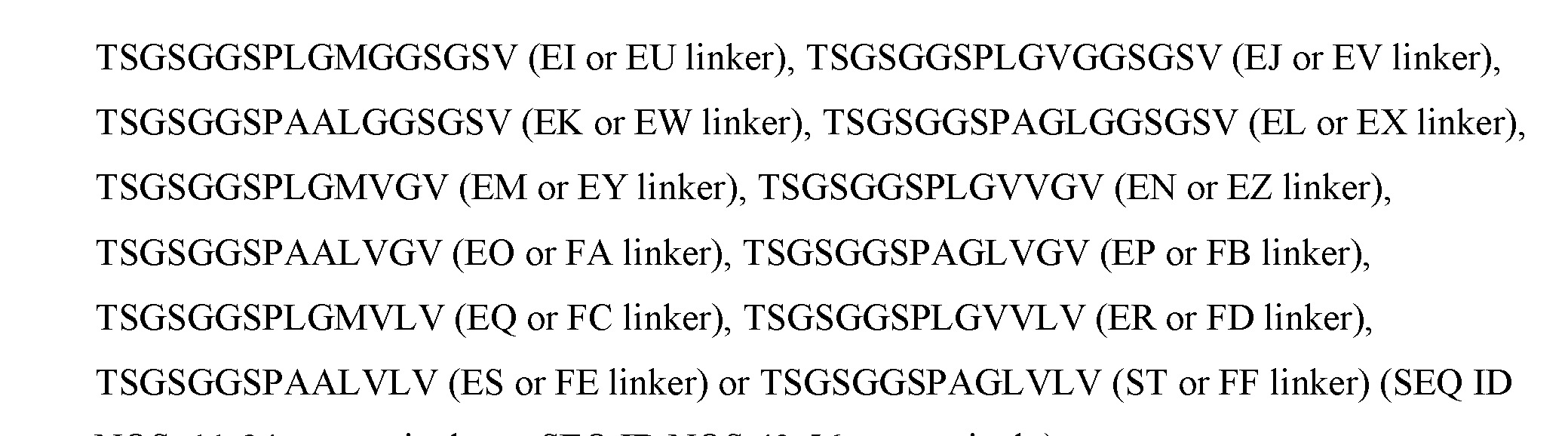


Claims


Priority Applications (10)
| Application Number | Priority Date | Filing Date | Title |
|---|---|---|---|
| CN202080043404.2A CN113993886A (en) | 2019-04-12 | 2020-04-10 | activatable multispecific antigen binding protein complex |
| KR1020217036997A KR20210151204A (en) | 2019-04-12 | 2020-04-10 | Multi-specific antigen binding protein complexes capable of being activated |
| JP2021559787A JP2022526426A (en) | 2019-04-12 | 2020-04-10 | Activateable multispecific antigen-binding protein complex |
| SG11202110147WA SG11202110147WA (en) | 2019-04-12 | 2020-04-10 | Activatable multi-specific antigen binding protein complexes |
| CA3136253A CA3136253A1 (en) | 2019-04-12 | 2020-04-10 | Activatable multi-specific antigen binding protein complexes |
| AU2020271100A AU2020271100A1 (en) | 2019-04-12 | 2020-04-10 | Activatable multi-specific antigen binding protein complexes |
| MX2021012514A MX2021012514A (en) | 2019-04-12 | 2020-04-10 | Activatable multi-specific antigen binding protein complexes. |
| EP20787199.7A EP3953382A4 (en) | 2019-04-12 | 2020-04-10 | Activatable multi-specific antigen binding protein complexes |
| US17/602,908 US20220324974A1 (en) | 2019-04-12 | 2020-04-10 | Activatable Multi-Specific Antigen Binding Protein Complexes |
| IL287158A IL287158A (en) | 2019-04-12 | 2021-10-11 | Activatable multi-specific antigen binding protein complexes |
Applications Claiming Priority (4)
| Application Number | Priority Date | Filing Date | Title |
|---|---|---|---|
| US201962833360P | 2019-04-12 | 2019-04-12 | |
| US62/833,360 | 2019-04-12 | ||
| US201962899347P | 2019-09-12 | 2019-09-12 | |
| US62/899,347 | 2019-09-12 |
Publications (1)
| Publication Number | Publication Date |
|---|---|
| WO2020210619A1 true WO2020210619A1 (en) | 2020-10-15 |
Family
ID=72751419
Family Applications (1)
| Application Number | Title | Priority Date | Filing Date |
|---|---|---|---|
| PCT/US2020/027663 Ceased WO2020210619A1 (en) | 2019-04-12 | 2020-04-10 | Activatable multi-specific antigen binding protein complexes |
Country Status (11)
| Country | Link |
|---|---|
| US (1) | US20220324974A1 (en) |
| EP (1) | EP3953382A4 (en) |
| JP (1) | JP2022526426A (en) |
| KR (1) | KR20210151204A (en) |
| CN (1) | CN113993886A (en) |
| AU (1) | AU2020271100A1 (en) |
| CA (1) | CA3136253A1 (en) |
| IL (1) | IL287158A (en) |
| MX (1) | MX2021012514A (en) |
| SG (1) | SG11202110147WA (en) |
| WO (1) | WO2020210619A1 (en) |
Cited By (2)
| Publication number | Priority date | Publication date | Assignee | Title |
|---|---|---|---|---|
| WO2023025156A1 (en) * | 2021-08-23 | 2023-03-02 | Concept To Medicine Biotech Co., Ltd. | Antibody prodrugs with constant domains |
| WO2025199278A3 (en) * | 2024-03-20 | 2025-11-06 | Regeneron Pharmaceuticals, Inc. | Masked multispecific antigen-binding molecules with cleavable linkers |
Citations (2)
| Publication number | Priority date | Publication date | Assignee | Title |
|---|---|---|---|---|
| US20130266568A1 (en) * | 2010-08-24 | 2013-10-10 | Roche Glycart Ag | Activatable bispecific antibodies |
| US20190010242A1 (en) * | 2017-04-11 | 2019-01-10 | Inhibrx, Inc. | Multispecific polypeptide constructs having constrained cd3 binding and methods of using the same |
-
2020
- 2020-04-10 EP EP20787199.7A patent/EP3953382A4/en not_active Withdrawn
- 2020-04-10 MX MX2021012514A patent/MX2021012514A/en unknown
- 2020-04-10 SG SG11202110147WA patent/SG11202110147WA/en unknown
- 2020-04-10 US US17/602,908 patent/US20220324974A1/en not_active Abandoned
- 2020-04-10 CA CA3136253A patent/CA3136253A1/en active Pending
- 2020-04-10 WO PCT/US2020/027663 patent/WO2020210619A1/en not_active Ceased
- 2020-04-10 AU AU2020271100A patent/AU2020271100A1/en not_active Abandoned
- 2020-04-10 CN CN202080043404.2A patent/CN113993886A/en active Pending
- 2020-04-10 JP JP2021559787A patent/JP2022526426A/en active Pending
- 2020-04-10 KR KR1020217036997A patent/KR20210151204A/en not_active Withdrawn
-
2021
- 2021-10-11 IL IL287158A patent/IL287158A/en unknown
Patent Citations (2)
| Publication number | Priority date | Publication date | Assignee | Title |
|---|---|---|---|---|
| US20130266568A1 (en) * | 2010-08-24 | 2013-10-10 | Roche Glycart Ag | Activatable bispecific antibodies |
| US20190010242A1 (en) * | 2017-04-11 | 2019-01-10 | Inhibrx, Inc. | Multispecific polypeptide constructs having constrained cd3 binding and methods of using the same |
Non-Patent Citations (1)
| Title |
|---|
| See also references of EP3953382A4 * |
Cited By (2)
| Publication number | Priority date | Publication date | Assignee | Title |
|---|---|---|---|---|
| WO2023025156A1 (en) * | 2021-08-23 | 2023-03-02 | Concept To Medicine Biotech Co., Ltd. | Antibody prodrugs with constant domains |
| WO2025199278A3 (en) * | 2024-03-20 | 2025-11-06 | Regeneron Pharmaceuticals, Inc. | Masked multispecific antigen-binding molecules with cleavable linkers |
Also Published As
| Publication number | Publication date |
|---|---|
| EP3953382A4 (en) | 2023-01-18 |
| US20220324974A1 (en) | 2022-10-13 |
| CA3136253A1 (en) | 2020-10-15 |
| IL287158A (en) | 2021-12-01 |
| AU2020271100A1 (en) | 2021-11-18 |
| CN113993886A (en) | 2022-01-28 |
| MX2021012514A (en) | 2021-11-12 |
| SG11202110147WA (en) | 2021-10-28 |
| JP2022526426A (en) | 2022-05-24 |
| KR20210151204A (en) | 2021-12-13 |
| EP3953382A1 (en) | 2022-02-16 |
Similar Documents
| Publication | Publication Date | Title |
|---|---|---|
| US20230322924A1 (en) | Anti-cd3 antibodies and uses thereof | |
| US20200339690A1 (en) | Antibodies to lilrb2 | |
| CN115380047A (en) | CD28 Single Domain antibodies and multivalent and multispecific constructs thereof | |
| US20240150464A1 (en) | Materials and methods for modulating t cell mediated immunity | |
| CN113166261A (en) | B7H3 single domain antibodies and therapeutic compositions thereof | |
| TW202019473A (en) | Anti-steap1 antigen-binding protein | |
| CN113518647A (en) | 5T4 single domain antibodies and therapeutic compositions thereof | |
| EP4076523A1 (en) | Materials and methods for in vivo biological targeting | |
| US20230183377A1 (en) | Activatable antigen binding proteins with universal masking moieties | |
| JP7759996B2 (en) | Anti-TREM1 Antibodies and Related Methods | |
| US20220324974A1 (en) | Activatable Multi-Specific Antigen Binding Protein Complexes | |
| US20220363758A1 (en) | Heterodimeric Antibodies That Bind to CD38 and CD3 | |
| EP4172207A1 (en) | Anti-pd1 antibodies and uses thereof | |
| KR20260011226A (en) | Anti-CTLA4 antibodies and methods for their preparation and use | |
| EA045935B1 (en) | ANTIBODIES TO CD3 AND THEIR APPLICATION |
Legal Events
| Date | Code | Title | Description |
|---|---|---|---|
| 121 | Ep: the epo has been informed by wipo that ep was designated in this application |
Ref document number: 20787199 Country of ref document: EP Kind code of ref document: A1 |
|
| ENP | Entry into the national phase |
Ref document number: 3136253 Country of ref document: CA |
|
| ENP | Entry into the national phase |
Ref document number: 2021559787 Country of ref document: JP Kind code of ref document: A |
|
| NENP | Non-entry into the national phase |
Ref country code: DE |
|
| ENP | Entry into the national phase |
Ref document number: 20217036997 Country of ref document: KR Kind code of ref document: A |
|
| ENP | Entry into the national phase |
Ref document number: 2020271100 Country of ref document: AU Date of ref document: 20200410 Kind code of ref document: A |
|
| ENP | Entry into the national phase |
Ref document number: 2020787199 Country of ref document: EP Effective date: 20211112 |