WO2020213406A1 - 熱可塑性樹脂プリプレグ、その製造方法及び繊維強化複合材料 - Google Patents
熱可塑性樹脂プリプレグ、その製造方法及び繊維強化複合材料 Download PDFInfo
- Publication number
- WO2020213406A1 WO2020213406A1 PCT/JP2020/015130 JP2020015130W WO2020213406A1 WO 2020213406 A1 WO2020213406 A1 WO 2020213406A1 JP 2020015130 W JP2020015130 W JP 2020015130W WO 2020213406 A1 WO2020213406 A1 WO 2020213406A1
- Authority
- WO
- WIPO (PCT)
- Prior art keywords
- thermoplastic resin
- pekk
- resin composition
- prepreg
- base material
- Prior art date
- Legal status (The legal status is an assumption and is not a legal conclusion. Google has not performed a legal analysis and makes no representation as to the accuracy of the status listed.)
- Ceased
Links
Classifications
-
- C—CHEMISTRY; METALLURGY
- C08—ORGANIC MACROMOLECULAR COMPOUNDS; THEIR PREPARATION OR CHEMICAL WORKING-UP; COMPOSITIONS BASED THEREON
- C08J—WORKING-UP; GENERAL PROCESSES OF COMPOUNDING; AFTER-TREATMENT NOT COVERED BY SUBCLASSES C08B, C08C, C08F, C08G or C08H
- C08J5/00—Manufacture of articles or shaped materials containing macromolecular substances
- C08J5/04—Reinforcing macromolecular compounds with loose or coherent fibrous material
- C08J5/0405—Reinforcing macromolecular compounds with loose or coherent fibrous material with inorganic fibres
- C08J5/042—Reinforcing macromolecular compounds with loose or coherent fibrous material with inorganic fibres with carbon fibres
-
- C—CHEMISTRY; METALLURGY
- C08—ORGANIC MACROMOLECULAR COMPOUNDS; THEIR PREPARATION OR CHEMICAL WORKING-UP; COMPOSITIONS BASED THEREON
- C08J—WORKING-UP; GENERAL PROCESSES OF COMPOUNDING; AFTER-TREATMENT NOT COVERED BY SUBCLASSES C08B, C08C, C08F, C08G or C08H
- C08J5/00—Manufacture of articles or shaped materials containing macromolecular substances
- C08J5/24—Impregnating materials with prepolymers which can be polymerised in situ, e.g. manufacture of prepregs
- C08J5/241—Impregnating materials with prepolymers which can be polymerised in situ, e.g. manufacture of prepregs using inorganic fibres
- C08J5/243—Impregnating materials with prepolymers which can be polymerised in situ, e.g. manufacture of prepregs using inorganic fibres using carbon fibres
-
- C—CHEMISTRY; METALLURGY
- C08—ORGANIC MACROMOLECULAR COMPOUNDS; THEIR PREPARATION OR CHEMICAL WORKING-UP; COMPOSITIONS BASED THEREON
- C08G—MACROMOLECULAR COMPOUNDS OBTAINED OTHERWISE THAN BY REACTIONS ONLY INVOLVING UNSATURATED CARBON-TO-CARBON BONDS
- C08G65/00—Macromolecular compounds obtained by reactions forming an ether link in the main chain of the macromolecule
- C08G65/02—Macromolecular compounds obtained by reactions forming an ether link in the main chain of the macromolecule from cyclic ethers by opening of the heterocyclic ring
- C08G65/26—Macromolecular compounds obtained by reactions forming an ether link in the main chain of the macromolecule from cyclic ethers by opening of the heterocyclic ring from cyclic ethers and other compounds
- C08G65/2603—Macromolecular compounds obtained by reactions forming an ether link in the main chain of the macromolecule from cyclic ethers by opening of the heterocyclic ring from cyclic ethers and other compounds the other compounds containing oxygen
- C08G65/2606—Macromolecular compounds obtained by reactions forming an ether link in the main chain of the macromolecule from cyclic ethers by opening of the heterocyclic ring from cyclic ethers and other compounds the other compounds containing oxygen containing hydroxyl groups
- C08G65/2612—Macromolecular compounds obtained by reactions forming an ether link in the main chain of the macromolecule from cyclic ethers by opening of the heterocyclic ring from cyclic ethers and other compounds the other compounds containing oxygen containing hydroxyl groups containing aromatic or arylaliphatic hydroxyl groups
-
- C—CHEMISTRY; METALLURGY
- C08—ORGANIC MACROMOLECULAR COMPOUNDS; THEIR PREPARATION OR CHEMICAL WORKING-UP; COMPOSITIONS BASED THEREON
- C08L—COMPOSITIONS OF MACROMOLECULAR COMPOUNDS
- C08L71/00—Compositions of polyethers obtained by reactions forming an ether link in the main chain; Compositions of derivatives of such polymers
-
- C—CHEMISTRY; METALLURGY
- C08—ORGANIC MACROMOLECULAR COMPOUNDS; THEIR PREPARATION OR CHEMICAL WORKING-UP; COMPOSITIONS BASED THEREON
- C08G—MACROMOLECULAR COMPOUNDS OBTAINED OTHERWISE THAN BY REACTIONS ONLY INVOLVING UNSATURATED CARBON-TO-CARBON BONDS
- C08G2650/00—Macromolecular compounds obtained by reactions forming an ether link in the main chain of the macromolecule
- C08G2650/28—Macromolecular compounds obtained by reactions forming an ether link in the main chain of the macromolecule characterised by the polymer type
- C08G2650/38—Macromolecular compounds obtained by reactions forming an ether link in the main chain of the macromolecule characterised by the polymer type containing oxygen in addition to the ether group
- C08G2650/40—Macromolecular compounds obtained by reactions forming an ether link in the main chain of the macromolecule characterised by the polymer type containing oxygen in addition to the ether group containing ketone groups, e.g. polyarylethylketones, PEEK or PEK
-
- C—CHEMISTRY; METALLURGY
- C08—ORGANIC MACROMOLECULAR COMPOUNDS; THEIR PREPARATION OR CHEMICAL WORKING-UP; COMPOSITIONS BASED THEREON
- C08J—WORKING-UP; GENERAL PROCESSES OF COMPOUNDING; AFTER-TREATMENT NOT COVERED BY SUBCLASSES C08B, C08C, C08F, C08G or C08H
- C08J2365/00—Characterised by the use of macromolecular compounds obtained by reactions forming a carbon-to-carbon link in the main chain; Derivatives of such polymers
-
- C—CHEMISTRY; METALLURGY
- C08—ORGANIC MACROMOLECULAR COMPOUNDS; THEIR PREPARATION OR CHEMICAL WORKING-UP; COMPOSITIONS BASED THEREON
- C08J—WORKING-UP; GENERAL PROCESSES OF COMPOUNDING; AFTER-TREATMENT NOT COVERED BY SUBCLASSES C08B, C08C, C08F, C08G or C08H
- C08J2371/00—Characterised by the use of polyethers obtained by reactions forming an ether link in the main chain; Derivatives of such polymers
-
- C—CHEMISTRY; METALLURGY
- C08—ORGANIC MACROMOLECULAR COMPOUNDS; THEIR PREPARATION OR CHEMICAL WORKING-UP; COMPOSITIONS BASED THEREON
- C08J—WORKING-UP; GENERAL PROCESSES OF COMPOUNDING; AFTER-TREATMENT NOT COVERED BY SUBCLASSES C08B, C08C, C08F, C08G or C08H
- C08J2465/00—Characterised by the use of macromolecular compounds obtained by reactions forming a carbon-to-carbon link in the main chain; Derivatives of such polymers
-
- C—CHEMISTRY; METALLURGY
- C08—ORGANIC MACROMOLECULAR COMPOUNDS; THEIR PREPARATION OR CHEMICAL WORKING-UP; COMPOSITIONS BASED THEREON
- C08J—WORKING-UP; GENERAL PROCESSES OF COMPOUNDING; AFTER-TREATMENT NOT COVERED BY SUBCLASSES C08B, C08C, C08F, C08G or C08H
- C08J2471/00—Characterised by the use of polyethers obtained by reactions forming an ether link in the main chain; Derivatives of such polymers
Definitions
- the present invention relates to a prepreg composed of a reinforcing fiber base material and a thermoplastic resin composition impregnated therein, and a method for producing the same.
- Fiber reinforced composite materials obtained by combining reinforced fiber materials such as carbon fiber, glass fiber, and aramid fiber with various matrix resins are widely used in various fields and applications.
- thermosetting resins such as unsaturated polyester resin, epoxy resin, and polyimide resin are mainly used as matrix resins in the aerospace field and industrial field where high mechanical properties and heat resistance are required. Has been done.
- thermosetting resins have the drawback of being brittle and inferior in impact resistance. Therefore, especially in the aerospace field, a thermoplastic resin is being studied as a matrix resin from the viewpoint of impact resistance of the obtained composite material and molding cost.
- polyaryletherketone such as polyetheretherketone (PEEK) and polyetherketoneketone (PEKK) is excellent in heat resistance, chemical resistance, and mechanical strength. Therefore, it is expected.
- PEKK can change its characteristics by changing the content ratio of the terephthaloyl group (T) and the isophthaloyl group (I) contained in its structure, so that the characteristics and molding conditions required for each member can be met. Development has been accelerating in recent years because the characteristics can be adjusted accordingly.
- Patent Document 1 proposes a method of mixing PEKK with a specific polyetherketone resin.
- some physical properties such as heat resistance and impact resistance are slightly improved, other physical properties such as the tensile elastic modulus of the resin are lowered.
- a sufficient effect could not be obtained by molding at a low temperature and for a short time.
- An object of the present invention is to provide a thermoplastic resin prepreg that provides a fiber-reinforced composite material having excellent mechanical strength even when molded at a low temperature in a short time.
- the present inventors have obtained molding at a low temperature in a short time by using a thermoplastic resin composition in which the thermal properties measured by a differential scanning calorimeter (DSC) satisfy specific conditions. It has been found that the mechanical properties of the obtained fiber-reinforced composite material can be improved even in the case of the above, and the present invention has been completed.
- DSC differential scanning calorimeter
- thermoplastic resin prepreg of the present invention that solves the above problems is a thermoplastic resin prepreg comprising at least a reinforcing fiber base material and a thermoplastic resin composition in which the reinforcing fiber base material is partially or completely impregnated.
- the thermoplastic resin composition contains 50% by mass or more of polyetherketoneketone (PEKK) with respect to the total thermoplastic resin contained in the resin composition, and is used in the differential scanning calorimeter (DSC).
- PEKK polyetherketoneketone
- DSC differential scanning calorimeter
- thermoplastic resin prepreg which is a thermoplastic resin composition having a crystallization enthalpy of 22 J / g or more when measured from 400 ° C. at a temperature lowering rate of 50 ° C./min.
- thermoplastic resin prepreg comprising, at least, a reinforcing fiber base material and a thermoplastic resin composition in which the reinforcing fiber base material is partially or wholly impregnated.
- the thermoplastic resin composition contains 50% by mass or more of polyetherketoneketone (PEKK) with respect to the total thermoplastic resin composition, and has a lower reducing viscosity than the first PEKK and the first PEKK.
- PEKK polyetherketoneketone
- the reducing viscosities of the first PEKK and the second PEKK satisfy the following formulas (1) and (2).
- the mass ratio of the first PEKK to the second PEKK is preferably 99.9995 / 0.0005 to 50/50.
- thermoplastic resin prepreg composed of at least a reinforcing fiber base material and a thermoplastic resin composition in which the reinforcing fiber base material is partially or wholly impregnated.
- the thermoplastic resin composition contains PEKK in an amount of 50% by mass or more based on the total thermoplastic resin contained in the resin composition, and the total amount of aluminum, phosphorus and sodium contained in the PEKK is 100 ppm or less. It is a prepreg.
- the amount of aluminum contained in PEKK is preferably 45 ppm or less.
- thermoplastic resin prepreg comprises, at least, a thermoplastic resin base material and a thermoplastic resin composition in which the reinforcing fiber base material is partially or wholly impregnated.
- the thermoplastic resin composition contains 50% by mass or more of polyetherketoneketone (PEKK) with respect to the total thermoplastic resin contained in the resin composition, and the following chemical formula (PEKK) is contained in the PEKK.
- PEKK polyetherketoneketone
- the thermoplasticity characterized in that the ratio of the structural isomer in which the ether group is bonded to Ar at the ortho position with respect to the ketone group is 1.6% or less. It is a resin prepreg.
- the present invention includes a method for producing a thermoplastic resin prepreg in which a reinforcing fiber base material is impregnated with a thermoplastic resin composition, and at least a fiber-reinforced composite material comprising a reinforcing fiber base material and a thermoplastic resin composition. To do.
- thermoplastic resin prepreg of the present invention it is possible to obtain a fiber-reinforced composite material having excellent mechanical strength even when molded at a low temperature in a short time.
- the fiber-reinforced composite material of the present invention can be molded at low cost and has excellent mechanical strength, so that it can be suitably used for members in the aerospace field and the like.
- thermoplastic resin prepreg of the present invention The details of the thermoplastic resin prepreg of the present invention will be described below.
- the thermoplastic resin prepreg of the present invention comprises at least a reinforcing fiber base material and a thermoplastic resin composition in which the reinforcing fiber base material is partially or completely impregnated.
- the thermoplastic resin composition used in the present invention contains at least 50% by mass or more of polyetherketoneketone (PEKK) with respect to the total thermoplastic resin contained in the resin composition.
- PEKK polyetherketoneketone
- the content of PEKK is in this range, the original characteristics of the PEKK resin are exhibited, and a fiber-reinforced composite material having excellent mechanical properties can be obtained. If the content of PEKK is too small, the coexistence of resins other than PEKK may impair the original properties of PEKK and reduce the mechanical properties of the obtained fiber-reinforced composite material.
- the content of PEKK is preferably 70% by mass or more, and more preferably 90% by mass or more.
- the upper limit of the PEKK content is not particularly limited and may be 100% by mass, preferably 99.99% by mass or less.
- the thermoplastic resin composition used in the present invention may contain a thermoplastic resin other than PEKK resin and other additives.
- thermoplastic resin composition used in the thermoplastic resin prepreg of the present invention further has a crystallization enthalpy ( ⁇ Hcd) of 22 J when measured from 400 ° C. to a temperature lowering rate of 50 ° C./min with a differential scanning calorimeter (DSC). It is a thermoplastic resin composition of / g or more.
- ⁇ Hcd crystallization enthalpy
- DSC differential scanning calorimeter
- the crystallization enthalpy of the thermoplastic resin composition used in the present invention is preferably 25 J / g or more, more preferably 30 J / g or more, and particularly preferably 32 J / g or more.
- the upper limit of the crystallization enthalpy is not particularly limited, but 130 J / g is sufficient.
- the thermoplastic resin composition has thermal characteristics measured by a differential scanning calorimeter (DSC) satisfying the following requirements (A) and (B).
- DSC differential scanning calorimeter
- the melting point when measured at a temperature rise rate of 10 ° C./min in the temperature range of 30 to 400 ° C. is 350 ° C. or less
- the melting point (Tm) in the above (A) is from 30 ° C. This is the peak top value of the heat absorption peak that appears on the DSC chart during the heating process at 400 ° C. If there are two or more peaks, the peak top with the highest height from the baseline is among them. Means a value.
- the temperature lowering crystallization temperature (Tcd) in the above (B) is the value of the peak top of the endothermic peak observed on the DSC chart during the temperature lowering process up to 30 ° C. after holding at 400 ° C. for 1 minute. When two or more peaks are present, it means the value of the peak top having the highest height from the baseline. Further, the crystallization enthalpy ( ⁇ Hcd) is obtained by integrating the peak having the highest peak top value observed in the temperature lowering process.
- the melting point of the thermoplastic resin composition is in this range, a prepreg having excellent moldability can be obtained. If the melting point of the thermoplastic resin composition is too high, the thermoplastic resin constituting the prepreg and the additives contained therein may cause thermal decomposition, and the physical properties of the obtained composite material may be deteriorated.
- the melting point of the thermoplastic resin composition is more preferably 345 ° C. or lower, and even more preferably 340 ° C. or lower.
- the lower limit of the melting point of the thermoplastic resin composition is not particularly limited, but from the viewpoint of heat resistance, it is preferably 250 ° C. or higher, more preferably 280 ° C. or higher, and further preferably 300 ° C. or higher. preferable.
- the temperature lowering crystallization temperature is 230 ° C. or higher, the thermoplastic resin composition is easily crystallized even when the fiber-reinforced composite material is molded at a low temperature in a short time, so that the fiber-reinforced composite material has excellent mechanical strength. Can be obtained. If the temperature-lowering crystallization temperature is too low, crystallization of the thermoplastic resin composition tends to be difficult to proceed, which may reduce the mechanical properties of the obtained fiber-reinforced composite material.
- the temperature-lowering crystallization temperature is more preferably 240 ° C. or higher, and even more preferably 250 ° C. or higher.
- the upper limit of the temperature-lowering crystallization temperature of the thermoplastic resin composition is not particularly limited, but is preferably 340 ° C. or lower, and more preferably 320 ° C. or lower.
- thermoplastic resin prepreg comprising, at least, a reinforcing fiber base material and a thermoplastic resin composition in which the reinforcing fiber base material is partially or wholly impregnated.
- the thermoplastic resin composition contains 50% by mass or more of polyetherketoneketone (PEKK) with respect to the total thermoplastic resin contained in the resin composition, and is more than the first PEKK and the first PEKK.
- PEKK polyetherketoneketone
- the reducing viscosities of the first PEKK and the second PEKK satisfy the following formulas (1) and (2) in order to enhance the crystallinity of the thermoplastic resin composition. 50 cm 3 / g ⁇ reduction viscosity of the first PEKK ⁇ 200 cm 3 / g ... Equation (1) 2 cm 3 / g ⁇ reduction viscosity of the second PEKK ⁇ 100 cm 3 / g ... Equation (2)
- the reducing viscosity of the first PEKK is within this range, a thermoplastic resin prepreg having both moldability and mechanical properties of the obtained composite material can be obtained.
- the reduction viscosity of the first PEKK is more preferably 60 to 180 cm 3 / g, and even more preferably 70 to 160 cm 3 / g.
- the crystallinity of the thermoplastic resin can be further improved.
- the reduction viscosity of the second PEKK is more preferably 2.5 to 90 cm 3 / g, further preferably 3 to 80 cm 3 / g, and particularly preferably 10 to 60 cm 3 / g.
- the melting point of the second PEKK used in the present invention is preferably 20 ° C. or higher higher than that of the first PEKK.
- the mass ratio of the first PEKK and the second PEKK is preferably 99.9995 / 0.0005 to 50/50.
- the mass ratio of the first PEKK to the second PEKK is more preferably 99.995 / 0.005 to 60/40, further preferably 99.95 / 0.05 to 80/20. It is particularly preferably 99.9 / 0.1 to 90/10.
- Both the first PEKK and the second PEKK may have a linear, cyclic, or branched structure, but in particular, the first PEKK may have a linear polymer structure. preferable.
- thermoplastic resin prepreg of the present invention is a thermoplastic resin prepreg in which the total amount of aluminum, phosphorus, and sodium contained in PEKK is 100 ppm or less.
- the total amount of aluminum, phosphorus, and sodium contained in PEKK is 100 ppm or less, the crystallinity and melt stability of PEKK are excellent, so that a fiber-reinforced composite material having excellent mechanical properties can be obtained.
- the total amount of aluminum, phosphorus, and sodium contained in PEKK is preferably 80 ppm or less, and more preferably 50 ppm or less. Further, the amount of aluminum contained in PEKK is more preferably 30 ppm or less, and further preferably 20 ppm or less. The lower limit of the total amount of aluminum, phosphorus and sodium is not particularly limited, but 0.01 ppm is sufficient.
- the amount of aluminum contained in PEKK is preferably 45 ppm or less.
- the amount of aluminum contained in PEKK is 45 ppm or less, the crystallinity and melt stability of PEKK can be further improved, so that a fiber-reinforced composite material having better mechanical properties can be obtained.
- the lower limit of the amount of aluminum is not particularly limited, but 0.001 ppm is sufficient.
- the total amount of aluminum, phosphorus, and sodium in PEKK, or / and the amount of aluminum is not particularly limited, but can be reduced by washing and purifying the PEKK resin.
- a reprecipitation purification method, a Soxhlet extraction method, a stirring washing method in a dispersion system using a solvent, and the like can be adopted.
- the reprecipitation purification method is preferably used because of its high effect of removing aluminum, phosphorus, and sodium.
- the good solvent for PEKK used in the reprecipitation purification method is not particularly limited as long as it is a solvent capable of dissolving PEKK, but concentrated sulfuric acid is preferably used because of its high dissolving power and easy availability.
- the poor solvent for PEKK used in the reprecipitation purification method is not particularly limited as long as it has a lower solubility of PEKK than a good solvent, but it is easy to handle and obtain, and the recovery rate of PEKK after purification is high. It is preferable to use water or alcohol because of its height.
- thermoplastic resin prepreg of the further aspect of the present invention among all the allylene ether ketone structural units represented by the following chemical formula (I) contained in PEKK, the ether group is bonded to Ar at the ortho position with respect to the ketone group. It is a thermoplastic resin prepreg having a structural isomer ratio of 1.6% or less.
- Ar represents an arylene group which may have a substituent.
- the content of the structural isomer having an ortho bond is 1.6% or less, the crystallinity of PEKK is excellent, so that a fiber-reinforced composite material having excellent mechanical properties can be obtained.
- the content of the structural isomer having an ortho bond is more preferably 1.5% or less.
- the lower limit of the content of the structural isomer having an ortho bond is not particularly limited, but 0.01% is sufficient.
- the method for reducing the content of the structural isomer having an ortho bond in PEKK is not particularly limited, but it can be reduced by washing and purifying the PEKK resin.
- a reprecipitation purification method, a Soxhlet extraction method, a stirring washing method in a dispersion system using a solvent, and the like can be adopted.
- a stirring washing method using a solvent in a dispersion system is preferably used from the viewpoints of high removal effect of structural isomers having an ortho bond, ease of operation, and ease of scale-up.
- the solvent used is not particularly limited, but a solvent selected from alcohols and carbon halides is preferably used because of its high detergency and easy availability. Examples of suitable alcohols include methanol, ethanol and 2-propanol. Moreover, examples of carbon halides preferably used include dichloromethane, chloroform and 1,2-dichloroethane.
- the thermoplastic resin prepreg of the present invention is a prepreg in which a part or the whole of the reinforcing fiber base material is impregnated with the above-mentioned thermoplastic resin composition.
- the content of the thermoplastic resin composition in the entire prepreg is preferably 15 to 60% by mass based on the total mass of the prepreg. When the resin content is in this range, a fiber-reinforced composite material having better mechanical properties can be obtained.
- the resin content is preferably 20 to 55% by mass, more preferably 25 to 50% by mass. If the resin content is too low, voids or the like may be generated in the obtained fiber-reinforced composite material, which may reduce the mechanical properties. If the resin content is too high, the reinforcing effect of the reinforcing fibers may be insufficient, and the mechanical properties relative to the mass may be substantially low.
- thermoplastic resin prepreg of the present invention By using the thermoplastic resin prepreg of the present invention as described above, it is possible to obtain a fiber-reinforced composite material having excellent mechanical strength even when molded at a low temperature in a short time.
- the prepreg of the present invention will be described in more detail below.
- (1-1) Reinforcing fiber base material The reinforcing fiber used as the reinforcing fiber base material of the present invention is not particularly limited, and is, for example, carbon fiber, glass fiber, aramid fiber, silicon carbide fiber, polyester fiber, ceramic fiber, alumina fiber. , Boron fiber, metal fiber, mineral fiber, rock fiber, slug fiber and the like.
- carbon fiber is more preferable because it has good specific strength and specific elastic modulus, and a lightweight and high-strength fiber-reinforced composite material can be obtained.
- Polyacrylonitrile (PAN) -based carbon fibers are particularly preferable because of their excellent tensile strength.
- a PAN-based carbon fiber When a PAN-based carbon fiber is used as the reinforcing fiber, its tensile elastic modulus is preferably 100 to 600 GPa, more preferably 200 to 500 GPa, and particularly preferably 230 to 450 GPa.
- the tensile strength is preferably 2000 MPa to 10000 MPa, more preferably 3000 to 8000 MPa.
- the diameter of the carbon fiber is preferably 4 to 20 ⁇ m, more preferably 5 to 10 ⁇ m.
- the reinforcing fiber base material may be a reinforcing fiber bundle, or may be used as a reinforcing fiber sheet in which reinforcing fibers are formed in a sheet shape. It is more preferable to use a reinforcing fiber sheet in which reinforcing fibers are formed in a sheet shape.
- the reinforcing fiber sheet include a sheet (UD sheet) in which a large number of reinforcing fibers are aligned in one direction, a laminated sheet in which a plurality of UD sheets are aligned in the fiber direction or laminated by changing the fiber direction.
- Examples include bidirectional woven fabrics such as plain weaves and twill weaves, multi-axis woven fabrics, non-woven fabrics, mats, knits, braids, and papers made from reinforcing fibers.
- a UD sheet, a laminated sheet, a bidirectional woven fabric, or a multi-axis woven fabric base material in which reinforcing fibers are formed into a sheet as continuous fibers is used, a fiber-reinforced composite material having more excellent mechanical properties can be obtained.
- the thickness of the sheet-shaped reinforcing fiber base material is preferably 0.01 to 3 mm, more preferably 0.1 to 1.5 mm.
- thermoplastic resin composition used in the present invention contains 50% by mass or more of polyetherketoneketone (PEKK) with respect to the total thermoplastic resin contained in the resin composition.
- PEKK polyetherketoneketone
- Polyether ketone The ketone (PEKK) can be produced by a known method, for example, a copolymerization reaction using a combination of a dihalogenated acyl aromatic compound and a diaryl ether (for example, US Pat. No. 3,065,205). , US Pat. No. 3,441,538, US Pat. No. 3,442,857, US Pat. No. 3,516,966, US Pat. No. 4,704,448, See US Pat. No. 4,816,556 and US Pat. No. 6,177,518, etc.). Moreover, a commercially available product can also be used. Examples of commercially available PEKK resins include "Kepstan” manufactured by Arkema and "GAPEKK” manufactured by Gharda Chemicals.
- the PEKK resin used in the present invention preferably has a terephthaloyl group (T) and isophthaloyl group (I) content ratio (T / I ratio) of 60/40 to 100/0 contained in the structure.
- T / I ratio is in this range, PEKK can be crystallized, which is preferable because a fiber-reinforced composite material having more excellent mechanical properties can be obtained.
- the T / I ratio is more preferably 65/35 to 75/25.
- the T / I ratio can be adjusted, for example, by the relative amount of dihalogenated terephthaloyl and dihalogenated isophthaloyl to be subjected to the copolymerization reaction during production.
- the PEKK resin used in the present invention is a structural isomer in which the ether group is bonded to Ar at the ortho position with respect to the ketone group among all the arylene ether ketone structural units represented by the following chemical formula (I). It is a PEKK resin having a ratio of 1.6% or less.
- Ar represents an arylene group which may have a substituent.
- the PEKK resin in which the ratio of the structural isomer in which the ether group is bonded to Ar at the para position with respect to the ketone group is 90% or more. It is preferably 95% or more, and more preferably 95% or more.
- the ratio of the structural isomer in which the ether group is bonded to Ar at the meta position with respect to the ketone group is not particularly limited, but is 5% or less. It is preferably 0.01 to 3%, and more preferably 0.01 to 3%.
- the thermoplastic resin composition may contain PEKK in an amount of 50% by mass or more based on the total thermoplastic resin contained in the resin composition, and may contain a thermoplastic resin other than the PEKK resin. ..
- the thermoplastic resin other than PEKK used in the present invention is not particularly limited, but a crystalline or amorphous thermoplastic resin having a melting point or a glass transition temperature of 150 ° C. or higher is preferable.
- Specific examples of preferable resins include polyaryletherketone (PAEK) such as polyetheretherketone (PEEK) and polyetherketone (PEK), polypropylene, polysulfone, polyethersulfone, polyphenylene sulfide, aromatic or aliphatic polyamide, and the like. Examples thereof include aromatic polyester, aromatic polycarbonate, polyetherimide, polyarylene oxide, thermoplastic polyimide, and polyamideimide. These resins may be used alone or in combination of two or more. Moreover, these copolymers can also be used.
- thermoplastic resin composition of the present invention (1-3) Other Additives Additives for imparting desired physical properties can be optionally added to the thermoplastic resin composition of the present invention.
- the thermoplastic resin composition used in the present invention preferably contains 0.001 to 20% by mass of a carbon material with respect to the total thermoplastic resin composition.
- a carbon material is contained in this range with respect to the total thermoplastic resin composition, the crystallinity of the thermoplastic resin is further improved, and a fiber-reinforced composite material having excellent mechanical properties can be obtained. If the content of the carbon material is too small, the effect of improving the crystallinity of the thermoplastic resin may not be obtained, and if it is too large, the viscosity at the time of melting becomes remarkably high, and the reinforcing fiber base material can be used. The impregnation property of the resin composition may be reduced.
- the content of the carbon material with respect to the total thermoplastic resin composition is more preferably 0.01 to 15% by mass, further preferably 0.1 to 10% by mass, and 0.3 to 7% by mass. This is particularly preferable, and the content is most preferably 0.6 to 5% by mass.
- the carbon material examples include fullerene, carbon black, ketjen black, carbon nanotubes, carbon nanoribbons, carbon nanofibers, carbon fibers, activated carbon and the like.
- carbon black, Ketjen black, carbon nanotubes, and activated carbon can be preferably used.
- inorganic fillers such as talc, mica, kaolin, calcium carbonate, calcium silicate, and boron nitride, conductive particles, antioxidants, light stabilizers, and flame retardants.
- Plasticants, inorganic fillers, internal mold release agents and the like may be included.
- thermoplastic resin prepreg of the present invention is a method for producing a prepreg in which a reinforcing fiber base material is impregnated with the above-mentioned thermoplastic resin composition.
- the method for producing the thermoplastic resin prepreg will be described in detail below.
- (2-1) Method for Producing Thermoplastic Resin Composition The thermoplastic resin product used in the present invention can be produced by mixing PEKK and, if necessary, other components. The order of mixing these is not limited.
- the method of mixing PEKK and other components as necessary is not particularly limited, and conventionally known methods such as a powder mixing method, a solution method, a melt method, and a masterbatch method are used. Can be done. At the time of kneading, a kneading method in a solution state or a kneading method in a molten state is preferable from the viewpoint of uniform kneading property.
- a conventionally known kneading device can be used for the mixing operation of PEKK and other components.
- the kneading device is not particularly limited, and examples thereof include a conventionally known vertical reaction vessel, mixing tank, kneading tank or uniaxial or multiaxial horizontal kneading apparatus such as a uniaxial or multiaxial extruder or kneader.
- the melting temperature is appropriately adjusted according to the type and mixing ratio of the resin and the presence and type of additives, but from the viewpoint of productivity and the like, it is preferably 320 ° C. or higher, more preferably 330 ° C. or higher. .. Further, it is preferably 380 ° C. or lower, more preferably 360 ° C. or lower.
- thermoplastic resin prepreg of the present invention it is preferable to wash and purify the PEKK resin before mixing the PEKK.
- the washing and purification methods are not particularly limited, and examples thereof include a reprecipitation purification method, a Soxhlet extraction method, and a stirring washing method in a dispersion system using a solvent. Of these, it is more preferable to use the reprecipitation purification method because of the high effect of removing aluminum, phosphorus, and sodium.
- the good solvent for PEKK used in the reprecipitation purification method is not particularly limited as long as it is a solvent capable of dissolving PEKK, but concentrated sulfuric acid is preferably used because of its high dissolving power and easy availability.
- the poor solvent for PEKK used in the reprecipitation purification method is not particularly limited as long as it has a lower solubility of PEKK than a good solvent, but it is easy to handle and obtain, and the recovery rate of PEKK after purification is high. It is preferable to use water or alcohol because of its height.
- thermoplastic resin prepreg of the present invention it is preferable to wash and purify the PEKK resin before mixing the PEKK.
- the washing and purification methods are not particularly limited, and specific examples thereof include a reprecipitation purification method, a Soxhlet extraction method, and a stirring washing method in a dispersion system using a solvent.
- a stirring washing method using a solvent in a dispersion system is preferably used from the viewpoints of high removal effect of structural isomers having an ortho bond, ease of operation, and ease of scale-up.
- the solvent used is not particularly limited, but a solvent selected from alcohols and carbon halides is preferably used because of its high detergency and easy availability. Examples of suitable alcohols include methanol, ethanol and 2-propanol. Moreover, examples of carbon halides preferably used include dichloromethane, chloroform and 1,2-dichloroethane.
- the method for producing a prepreg of the present invention is not particularly limited, and any conventionally known method can be adopted. Specifically, a method of heat-sealing a reinforcing fiber base material to a film made of a thermoplastic resin composition (hot melt method), a method of immersing the reinforcing fiber base material in a solution or emulsion of a thermoplastic resin, drying it, and then melting it. , A method in which a reinforcing fiber base material is passed through and adhered to the floor of the thermoplastic resin powder and then heat-sealed. The reinforcing fiber base material is immersed in a suspension solution (suspension solution) of the thermoplastic resin powder to make it thermoplastic.
- a suspension solution suspension solution
- An example is a method (powder suspension method) in which a resin powder is attached to a substrate and then heated and melted.
- the powder suspension method is preferably used because the thermoplastic resin can be uniformly impregnated into the reinforcing fibers.
- the method for forming the thermoplastic resin composition into a resin composition film is not particularly limited, and any conventionally known method can be used. Specifically, a resin composition film is obtained by casting and casting a resin composition on a support such as a paper pattern or a film using a die extrusion, an applicator, a reverse roll coater, a comma coater, or the like. Can be done. The resin temperature at the time of producing the film is appropriately determined according to the composition and viscosity of the resin composition. The heat fusion of the resin composition to the reinforcing fiber base material and the impregnation into the fiber layer may be performed once or may be performed in a plurality of times.
- thermoplastic resin composition In the powder suspension method, a powdery thermoplastic resin composition is used. Considering the good deposition on the reinforcing fiber base material (the state where the resin powder is held between the fibers or on the fiber surface), the particle size of the thermoplastic resin powder is 50 ⁇ m or less, and it does not fall below 1 ⁇ m in terms of handleability. It is preferable that the average particle size is in the range of 5 to 50 ⁇ m.
- the thermoplastic resin powder in the above particle size range is dispersed in the liquid described below, its dispersibility (dispersibility of the resin powder in suspension) is stable, and it can be used as a reinforcing fiber base material even in long-term production. Resin powder can be deposited stably.
- the average particle size is the value of the cumulative 50% by volume particle size (D 50 ) of the particle size distribution measured by the laser diffraction / scattering method.
- thermoplastic resin powder it is preferable to use a liquid in order to disperse the thermoplastic resin powder.
- a liquid used one or more solvents or mixed solvents selected from water, alcohols, ketones, and halogenated carbon hydrogens are preferable.
- alcohols include methanol, ethanol, isopropyl alcohol, methyl cellsolve and the like
- ketones include acetone and methyl ethyl ketone
- halogenated hydrocarbons include methylene chloride and dichloroethane. Of these, ethanol, isopropyl alcohol, acetone or a mixed solvent of them and water, or water is preferable.
- a commercially available product containing the above solvent and having a suitable solvent composition can also be used, and Solmix (product name, manufactured by Japan Alcohol Trading Co., Ltd.) is exemplified as such a commercially available product. Since such a liquid also has an action of appropriately opening the reinforcing fiber base material, it is effective for the resin powder in suspension to be uniformly deposited on the fiber base material.
- thermoplastic resin powder and the liquid (solvent) for dispersing the thermoplastic resin powder is preferably a solvent that is poor with respect to the thermoplastic resin and is preferably insoluble.
- the concentration of the thermoplastic resin in the suspension is preferably 1 to 50% by mass, more preferably 1 to 30% by mass, and 1 to 1 to 30% by mass. 15% by mass is more preferable.
- the suspension temperature when the reinforcing fiber base material is immersed is not particularly limited as long as the dispersed state of the resin is kept good, and varies depending on the type and concentration of the thermoplastic resin or liquid used, but is usually 5. It is about 50 ° C., preferably 5 to 30 ° C., more preferably 15 to 30 ° C.
- the amount of the thermoplastic resin powder to be attached to the reinforcing fiber base material is preferably 10 to 70% by mass with respect to the total amount of the reinforcing fibers and the thermoplastic resin powder, and 20 to 50% by mass in the production of the prepreg. Is more preferable.
- the reinforcing fiber base material to which the thermoplastic resin powder is attached in this way is usually dried at a temperature at which the thermoplastic resin does not decompose or react.
- the drying temperature is preferably 80 to 200 ° C.
- the drying time is preferably 1 to 20 minutes in terms of production.
- the reinforcing fiber base material to which the thermoplastic resin powder is attached is heated at a temperature not lower than the glass transition temperature or the melting point of the thermoplastic resin composition. By this treatment, the thermoplastic resin powder is softened or melted, and the reinforcing fibers and the thermoplastic resin composition are integrated to obtain a thermoplastic resin prepreg.
- the method for heating the reinforcing fiber base material to which the thermoplastic resin powder is attached is not particularly limited, and a heating roller, a heating slit, a heat press device, a dryer, or the like can be used.
- thermoplastic resin prepreg of the present invention According to the method for producing a thermoplastic resin prepreg of the present invention as described above, it is possible to obtain a thermoplastic resin prepreg that gives a fiber-reinforced composite material having excellent mechanical strength even when molded at a low temperature in a short time.
- the fiber-reinforced composite material of the present invention is a fiber-reinforced composite material composed of at least a reinforcing fiber base material and the above-mentioned thermoplastic resin composition.
- the molding method of the fiber-reinforced composite material of the present invention is not particularly limited, and examples thereof include molding methods having excellent productivity such as injection molding, autoclave molding, press molding, filament winding molding, and stamping molding. Can be used in combination. It is preferable to mold the fiber-reinforced composite material using the prepreg of the present invention.
- the fiber-reinforced composite material of the present invention can be molded at low cost and has excellent mechanical strength, it can be suitably applied to applications such as automobiles, aircraft, electrical / electronic equipment, and sports / leisure goods.
- the fiber-reinforced composite material of the present invention can be particularly preferably used for members in the aerospace field and the like.
- thermoplastic resin prepreg of the present invention By using the thermoplastic resin prepreg of the present invention as described above, it is possible to obtain a fiber-reinforced composite material having excellent mechanical strength even when molded at a low temperature in a short time.
- Tm melting point
- Tcd temperature-decreasing crystallization temperature
- the crystallization enthalpy ( ⁇ Hcd) was calculated by integrating the peak having the highest peak top value observed in the temperature lowering process. Measurement conditions Atmosphere: Nitrogen atmosphere Temperature rise conditions Temperature rise rate: 10 ° C / min Temperature range: 30 ° C to 400 ° C Temperature lowering condition Temperature lowering rate: 50 °C / min Temperature range: 400 °C to 30 °C After the temperature was raised (after reaching 400 ° C.) and held for 1 minute, the temperature was lowered.
- PEKK sample After carbonizing 0.5 g of PEKK sample with an electric heater, it was incinerated in an electric furnace at 750 ° C. The incinerated sample was dried over hydrochloric acid and then dissolved in hydrochloric acid. Then, using a 50 ml volumetric flask, the obtained solution diluted with pure water was used as a test solution, and the content of each component was measured by ICP emission spectroscopy.
- an ICP emission analysis apparatus an ICP-OES multi-type ICP issuing analyzer manufactured by Agilent Technologies Co., Ltd. was used.
- Ratio of structural isomers with orthobonds So / ( So + Sp + S m )
- Ratio of structural isomers with meta-bonds S m / ( So + Sp + S m )
- Ratio of structural isomers with parabonds Sp / ( So + Sp + S m )
- S o value sum divided by two of the integrated value of the peak attributed to H 5 o chemical integral value of peaks attributed to H 4 o shift 7.2ppm and 7.5 ppm
- S p chemical shift 7
- the integral value of chloroform and H 3 o is subtracted from the peak of 3 to 7.4 ppm, and the integral value attributed to H 1 p is divided by 2.
- S m Attributable to H 7 m of chemical shift 7.0 ppm. Integral value of peaks
- Average particle size is the particle size distribution [cumulative 10% by volume particle size (D 10 ), cumulative 50% by volume particle size particle size, using a laser diffraction / scattering type particle size analyzer Microtrac manufactured by Nikkiso Co., Ltd. (D 50 ), cumulative 90% by volume particle size (D 90 )] was measured, and the cumulative 50% by volume particle size (D 50 ) was taken as the average particle size.
- ILSS Interlayer shear strength
- This laminate is placed in a press machine set at 385 ° C., press-molded under a pressure of 2 MPa for 5 minutes, and then allowed to cool at room temperature to form a molded plate of a carbon fiber reinforced thermoplastic resin composite material having a thickness of 2 mm.
- a test piece having a length of 14 mm in the 0 ° direction and a test piece having a length of 10 mm in the 90 ° direction was cut out from the produced molded plate to obtain a test piece for ILSS measurement.
- ILSS measurements and calculations were performed in accordance with JIS K7078.
- the interlayer shear strength (ILSS) of the fiber-reinforced composite material is preferably 75 MPa or more, more preferably 85 MPa or more, and particularly preferably 95 to 150 MPa.
- thermoplastic resin composition chip was pulverized to obtain a thermoplastic resin composition powder having an average particle diameter of 20 ⁇ m.
- the obtained powder was dispersed in a mixed solvent Solmix AP-7 (product name, mixed solvent for ethanol, manufactured by Japan Alcohol Trading Co., Ltd.) to prepare a suspension solution having a concentration of 5.5% by mass.
- a reinforcing fiber base material As a reinforcing fiber base material, 55 carbon fibers were aligned in parallel to form a sheet, and a carbon fiber alignment sheet was prepared so that the carbon fiber texture was 194 g / m 2 .
- the two obtained reinforcing fiber base materials were introduced into a suspension bathtub filled with the above suspension, immersed for 15 seconds, and then the two base materials were laminated and derived from the suspension bathtub as one laminated sheet.
- the obtained laminated sheet was dried at 150 ° C. for 5 minutes.
- thermoplastic resin prepreg The resin content in the obtained prepreg was 35% by mass.
- a composite material was produced using the prepreg thus obtained, and its interlayer shear strength (ILSS) was measured. The measurement results are shown in Table 1.
- the composite material obtained in Example 1 had an ILSS of 110 MPa and showed excellent physical properties.
- thermoplastic resin composition and a thermoplastic resin prepreg were obtained in the same manner as in Example 1 except that the PEKK resin was changed to the component composition shown in Table 1.
- Table 1 shows the DSC measurement results of the obtained thermoplastic resin composition and the ILSS measurement results of the composite material obtained by using the prepreg. Both of the composite materials obtained in Examples 2 to 6 showed excellent physical properties.
- thermoplastic resin composition and the thermoplastic resin prepreg were prepared in the same manner as in Example 1 except that the component composition of the thermoplastic resin composition was changed to the composition shown in Table 1.
- Table 1 shows the DSC measurement results of the obtained thermoplastic resin composition and the ILSS measurement results of the composite material obtained by using the prepreg.
- the ILSS of the composite materials obtained in Comparative Examples 1 to 5 was lower than that of Examples, and the physical properties were insufficient.
- Example 7 50 parts by mass of sulfuric acid (manufactured by Fujifilm Wako Pure Chemical Industries, Ltd.) was added to 1 part by mass of PEKK-1A to dissolve it, and the obtained uniform solution was dissolved in 750 parts by mass of distilled water (Fujifilm Wako Pure Chemical Industries, Ltd.). Slowly dropped onto the product). The solid precipitated here was recovered and dried to obtain PEKK reprecipitated and purified. The obtained purified PEKK had a non-uniform shape and size. The results of measuring the reduced viscosity, aluminum, phosphorus, sodium content and DSC of the purified PEKK resin are shown in Table 2.
- thermoplastic resin composition chip was prepared by melt-kneading the purified PEKK at 380 ° C., and further pulverized to obtain a thermoplastic resin composition powder having an average particle size of 20 ⁇ m.
- the obtained powder was dispersed in a mixed solvent Solmix AP-7 (product name, mixed solvent for ethanol, manufactured by Japan Alcohol Trading Co., Ltd.) to prepare a suspension solution having a concentration of 5.5% by mass.
- a reinforcing fiber base material As a reinforcing fiber base material, 55 carbon fibers were aligned in parallel to form a sheet, and a carbon fiber alignment sheet was prepared so that the carbon fiber texture was 194 g / m 2 .
- the two obtained reinforcing fiber base materials were introduced into a suspension bathtub filled with a suspension solution, immersed for 15 seconds, and then the two base materials were laminated and derived from the suspension bathtub as one laminated sheet.
- the obtained laminated sheet was dried at 150 ° C. for 5 minutes.
- thermoplastic resin prepreg The resin content in the obtained prepreg was 35% by mass.
- a composite material was produced using the prepreg thus obtained, and its interlayer shear strength (ILSS) was measured. The measurement results are shown in Table 2.
- the composite material obtained in Example 7 had an ILSS of 97 MPa and showed excellent physical properties.
- Example 8 The same operation as in Example 7 was carried out except that PEKK-1B was used to prepare a thermoplastic resin composition powder and a thermoplastic resin prepreg.
- the results of measuring the reduced viscosity, aluminum, phosphorus, sodium content and DSC of the purified PEKK resin are shown in Table 2.
- a composite material was manufactured using the obtained thermoplastic resin prepreg, and its ILSS was measured.
- the measurement results of ILSS are shown in Table 2.
- the composite material obtained in Example 8 had an ILSS of 103 MPa and exhibited excellent physical properties.
- Example 6 The same operation as in Example 7 was carried out except that the PEKK resin was not purified, to prepare a thermoplastic resin composition powder and a prepreg.
- the results of measuring the reduced viscosity, aluminum, phosphorus, sodium content and DSC of the PEKK resin used are shown in Table 2.
- thermoplastic resin prepreg thermoplastic resin prepreg
- ILSS ILSS
- Example 7 The same operation as in Example 8 was carried out except that the PEKK resin was not purified, to prepare a thermoplastic resin composition powder and a thermoplastic resin prepreg.
- the results of measuring the reduced viscosity, aluminum, phosphorus, sodium content and DSC of the PEKK resin used are shown in Table 2.
- thermoplastic resin prepreg thermoplastic resin prepreg
- ILSS ILSS
- Example 9 100 parts by mass of chloroform (manufactured by Fujifilm Wako Pure Chemical Industries, Ltd.) was added to 1 part by mass of PEKK-1A, and the obtained dispersion was stirred under reflux conditions for about 3 hours. After cooling, the dispersion was filtered to obtain PEKK powder. The obtained PEKK powder was washed with chloroform again in the same manner as described above, and then filtered and dried to obtain a purified thermoplastic resin composition powder having an average particle size of 20 ⁇ m. The results of measuring the reduced viscosity, structural isomer ratio and DSC of the purified PEKK resin are shown in Table 3.
- thermoplastic resin powder was dispersed in a mixed solvent Solmix AP-7 (product name, mixed solvent for ethanol, manufactured by Japan Alcohol Trading Co., Ltd.) to prepare a suspension solution having a concentration of 5.5% by mass. ..
- a reinforcing fiber base material 55 carbon fibers were aligned in parallel to form a sheet, and a carbon fiber alignment sheet was prepared so that the carbon fiber texture was 194 g / m 2 .
- the two obtained reinforcing fiber base materials were introduced into a suspension bathtub filled with the above suspension solution, soaked for 15 seconds, and then the two base materials were laminated and taken out from the suspension bathtub as one laminated sheet.
- the obtained laminated sheet was dried at 150 ° C. for 5 minutes.
- thermoplastic resin prepreg The resin content in the obtained prepreg was 35% by mass.
- a composite material was produced using the prepreg thus obtained, and its interlayer shear strength (ILSS) was measured. The measurement results are shown in Table 3.
- the composite material obtained in Example 9 had an ILSS of 90 MPa and showed excellent physical properties.
- Example 10 The same operation as in Example 9 was carried out except that PEKK-1B was used to prepare a thermoplastic resin composition powder and a thermoplastic resin prepreg.
- the results of measuring the reduced viscosity, structural isomer ratio and DSC of the purified PEKK resin are shown in Table 3.
- a composite material was manufactured using the obtained thermoplastic resin prepreg, and its ILSS was measured.
- the measurement results of ILSS are shown in Table 3.
- the composite material obtained in Example 10 had an ILSS of 92 MPa and showed excellent physical properties.
- Example 8 The same operation as in Example 9 was carried out except that the PEKK resin was not purified, to prepare a thermoplastic resin composition powder and a thermoplastic resin prepreg.
- the results of measuring the reduced viscosity, structural isomer ratio and DSC of the purified PEKK resin are shown in Table 3.
- a composite material was manufactured using the obtained thermoplastic resin prepreg, and its ILSS was measured.
- the measurement results of ILSS are shown in Table 3.
- the composite material obtained in Comparative Example 8 had an ILSS of 65 MPa and had insufficient physical properties.
- Example 9 The same operation as in Example 10 was carried out except that the PEKK resin was not purified, to prepare a thermoplastic resin composition powder and a thermoplastic resin prepreg.
- the results of measuring the reduced viscosity, structural isomer ratio and DSC of the purified PEKK resin are shown in Table 3.
- a composite material was manufactured using the obtained thermoplastic resin prepreg, and its ILSS was measured.
- the measurement results of ILSS are shown in Table 3.
- the composite material obtained in Comparative Example 9 had an ILSS of 72 MPa and had insufficient physical properties.
- Example 11 50 parts by mass of sulfuric acid (manufactured by Fujifilm Wako Pure Chemical Industries, Ltd.) was added to 1 part by mass of PEKK-1A to dissolve it, and the obtained uniform solution was dissolved in 750 parts by mass of distilled water (Fujifilm Wako Pure Chemical Industries, Ltd.). Slowly dropped onto the product). The solid precipitated here was recovered and dried to obtain PEKK reprecipitated and purified. Then, 100 parts by mass of chloroform (manufactured by Fujifilm Wako Pure Chemical Industries, Ltd.) was added to 1 part by mass of PEKK-1A after purification with sulfuric acid, and the obtained dispersion was stirred under reflux conditions for about 3 hours.
- sulfuric acid manufactured by Fujifilm Wako Pure Chemical Industries, Ltd.
- the dispersion was filtered to obtain PEKK powder.
- the obtained PEKK powder was washed with chloroform again in the same manner as described above, and then filtered and dried to obtain a purified PEKK-1A powder.
- the reduced viscosity of the PEKK resin after purification was 106.3 cm 3 / g, and the element content was 4.0 ppm for aluminum, 0.4 ppm for phosphorus, and 1.3 ppm for sodium.
- the structural isomer ratios were 1.3% for ortho, 1.0% for meta, and 97.7% for para.
- PEKK-1A 100 parts by mass
- PEKK-2A 1 part by mass
- a thermoplastic resin composition As a result of DSC measurement of the obtained thermoplastic resin composition, heat having a melting point (Tm) of 334.2 ° C., a crystallization enthalpy ( ⁇ Hcd) of 32.8 J / g, and a temperature lowering crystallization temperature of 285.4 ° C. It was a plastic resin composition.
- thermoplastic resin composition chip was pulverized to obtain a thermoplastic resin composition powder having an average particle diameter of 20 ⁇ m.
- the obtained powder was dispersed in a mixed solvent Solmix AP-7 (product name, mixed solvent for ethanol, manufactured by Japan Alcohol Trading Co., Ltd.) to prepare a suspension solution having a concentration of 5.5% by mass.
- a mixed solvent Solmix AP-7 product name, mixed solvent for ethanol, manufactured by Japan Alcohol Trading Co., Ltd.
- a reinforcing fiber base material As a reinforcing fiber base material, 55 carbon fibers were aligned in parallel to form a sheet, and a carbon fiber alignment sheet was prepared so that the carbon fiber texture was 194 g / m 2 .
- the two obtained reinforcing fiber base materials were introduced into a suspension bathtub filled with the above suspension, immersed for 15 seconds, and then the two base materials were laminated and derived from the suspension bathtub as one laminated sheet.
- the obtained laminated sheet was dried at 150 ° C. for 5 minutes.
- thermoplastic resin prepreg The resin content in the obtained prepreg was 35% by mass.
- a composite material was produced using the prepreg thus obtained, and its interlayer shear strength (ILSS) was measured.
- the composite material obtained in Example 11 had an ILSS of 115 MPa and exhibited excellent physical properties.
Landscapes
- Chemical & Material Sciences (AREA)
- Engineering & Computer Science (AREA)
- Materials Engineering (AREA)
- Health & Medical Sciences (AREA)
- Chemical Kinetics & Catalysis (AREA)
- Medicinal Chemistry (AREA)
- Polymers & Plastics (AREA)
- Organic Chemistry (AREA)
- Inorganic Chemistry (AREA)
- Manufacturing & Machinery (AREA)
- Reinforced Plastic Materials (AREA)
Abstract
発明の目的は、低温、短時間で成形した場合でも、機械強度に優れた繊維強化複合材料を与える熱可塑性樹脂プリプレグを提供することである。 本発明の熱可塑性樹脂プリプレグは、少なくとも、強化繊維基材と、前記強化繊維基材に一部又は全部が含浸している熱可塑性樹脂組成物と、から成る熱可塑性樹脂プリプレグであって、熱可塑性樹脂組成物が、ポリエーテルケトンケトン(PEKK)を全熱可塑性樹脂組成物に対して50質量%以上含有し、且つ、示差走査熱量計(DSC)にて、400℃から降温速度50℃/分で測定した際の結晶化エンタルピーが22J/g以上の熱可塑性樹脂組成物である熱可塑性樹脂プリプレグである。
Description
本発明は、強化繊維基材とこれに含浸した熱可塑性樹脂組成物とからなるプリプレグ及びその製造方法に関する。
炭素繊維、ガラス繊維、アラミド繊維等の強化繊維材料と、各種のマトリクス樹脂とを複合化して得られる繊維強化複合材料は、種々の分野・用途に広く利用されている。従来、高度の機械的特性や耐熱性等を要求される航空・宇宙分野や、産業分野などでは、マトリクス樹脂として、不飽和ポリエステル樹脂、エポキシ樹脂、ポリイミド樹脂等の熱硬化性樹脂が主に使用されている。
しかし、これらの熱硬化性樹脂は、脆く、耐衝撃性に劣るという欠点を有する。そのため、特に航空・宇宙分野では、得られる複合材料の耐衝撃性や、成形コストの観点から、熱可塑性樹脂が、マトリクス樹脂として検討されている。
熱可塑性樹脂の中でも、航空・宇宙分野においては、ポリエーテルエーテルケトン(PEEK)やポリエーテルケトンケトン(PEKK)などのポリアリールエーテルケトン(PAEK)が、耐熱性、耐薬品性、機械強度に優れるため、期待されている。特にPEKKは、その構造中に含まれるテレフタロイル基(T)とイソフタロイル基(I)の含有比率を変化させることにより、その特性を変化させることができるため、部材ごとに求められる特性や成形条件に応じて特性を調整できる等の理由から、近年開発が加速している。
しかし、成形コストを抑制するために、より低温、短時間の成形条件で繊維強化複合材料を成形使用すると、得られる繊維強化複合材料中でのPEKKの結晶性が低下し、耐衝撃性や靭性などの機械物性や耐薬品性などに悪影響を及ぼすことが問題となっている。
PEKKをマトリクス樹脂とする複合材料の機械物性を向上させる方法として、例えば、特許文献1では、PEKKに特定のポリエーテルサルホン樹脂を混合する方法が提案されている。しかし、この方法では、耐熱性や耐衝撃性などの一部の物性は若干向上するものの、樹脂の引張弾性率など別の物性が低下してしまう。また、低温、短時間の成形では、十分な効果が得られるものではなかった。
本発明の目的は、低温、短時間で成形した場合でも、機械強度に優れた繊維強化複合材料を与える熱可塑性樹脂プリプレグを提供することである。
本発明者らは、上記課題を解決すべく検討した結果、示差走査熱量計(DSC)で測定される熱特性が特定の条件を満たす熱可塑性樹脂組成物を用いると、低温、短時間で成形をした場合においても、得られる繊維強化複合材料の機械物性を向上できることを見出し、本発明を完成するに至った。
上記課題を解決する本発明の熱可塑性樹脂プリプレグは、少なくとも、強化繊維基材と、前記強化繊維基材に一部又は全部が含浸している熱可塑性樹脂組成物と、から成る熱可塑性樹脂プリプレグであって、熱可塑性樹脂組成物が、ポリエーテルケトンケトン(PEKK)を、樹脂組成物に含まれる全熱可塑性樹脂に対して50質量%以上含有し、且つ、示差走査熱量計(DSC)にて、400℃から降温速度50℃/分で測定した際の結晶化エンタルピーが22J/g以上の熱可塑性樹脂組成物である熱可塑性樹脂プリプレグである。
本発明のもう一つの態様は、少なくとも、強化繊維基材と、前記強化繊維基材に一部又は全部が含浸している熱可塑性樹脂組成物と、から成る熱可塑性樹脂プリプレグであって、前記熱可塑性樹脂組成物が、ポリエーテルケトンケトン(PEKK)を全熱可塑性樹脂組成物に対して50質量%以上含有し、且つ、第一のPEKKと、第一のPEKKよりも還元粘度の小さい第二のPEKKを含有する熱可塑性樹脂プリプレグである。本発明において、第一のPEKKと第二のPEKKの還元粘度が下記式(1)および(2)を満たすことが好ましい。
50cm3/g≦第一のPEKKの還元粘度≦200cm3/g ・・・式(1)
2cm3/g≦第二のPEKKの還元粘度≦100cm3/g ・・・式(2)
また、第一のPEKKと第二のPEKKの質量比率は、99.9995/0.0005~50/50であることが好ましい。
50cm3/g≦第一のPEKKの還元粘度≦200cm3/g ・・・式(1)
2cm3/g≦第二のPEKKの還元粘度≦100cm3/g ・・・式(2)
また、第一のPEKKと第二のPEKKの質量比率は、99.9995/0.0005~50/50であることが好ましい。
本発明のもう一つの様態は、少なくとも、強化繊維基材と、前記強化繊維基材に一部又は全部が含浸している熱可塑性樹脂組成物と、から成る熱可塑性樹脂プリプレグであって、前記熱可塑性樹脂組成物が、PEKKを樹脂組成物に含まれる全熱可塑性樹脂に対して50質量%以上含有し、前記PEKK中に含まれるアルミニウム、リン、ナトリウムの合計量が100ppm以下の熱可塑性樹脂プリプレグである。PEKK中に含まれるアルミニウムの量は45ppm以下であることが好ましい。
本発明の更なる様態は、熱可塑性樹脂プリプレグは、少なくとも、強化繊維基材と、前記強化繊維基材に一部又は全部が含浸している熱可塑性樹脂組成物と、から成る熱可塑性樹脂プリプレグであって、前記熱可塑性樹脂組成物が、ポリエーテルケトンケトン(PEKK)を、樹脂組成物に含まれる全熱可塑性樹脂に対して50質量%以上含有し、前記PEKK中に含まれる下記化学式(I)で表される全アリーレンエーテルケトン構造単位のうち、エーテル基がケトン基に対するオルト位でArに結合している構造異性体の比率が1.6%以下であることを特徴とする熱可塑性樹脂プリプレグである。

(ただし、Arは置換基を有していても良いアリーレン基を表す。)
本発明は、強化繊維基材に、熱可塑性樹脂組成物を含浸させる熱可塑性樹脂プリプレグの製造方法および、少なくとも、強化繊維基材と、熱可塑性樹脂組成物と、から成る繊維強化複合材料を包含する。
本発明は、強化繊維基材に、熱可塑性樹脂組成物を含浸させる熱可塑性樹脂プリプレグの製造方法および、少なくとも、強化繊維基材と、熱可塑性樹脂組成物と、から成る繊維強化複合材料を包含する。
本発明の熱可塑性樹脂プリプレグを用いると、低温、短時間で成形した場合でも、機械強度に優れた繊維強化複合材料を得ることができる。
本発明の繊維強化複合材料は、低コストで成形でき、かつ、機械強度に優れるため、航空・宇宙分野等の部材に好適に用いることができる。
1.プリプレグ
以下、本発明の熱可塑性樹脂プリプレグの詳細について説明する。
以下、本発明の熱可塑性樹脂プリプレグの詳細について説明する。
本発明の熱可塑性樹脂プリプレグは、少なくとも、強化繊維基材と、前記強化繊維基材内に一部又は全部が含浸している熱可塑性樹脂組成物と、から成る。本発明で用いる熱可塑性樹脂組成物は、少なくともポリエーテルケトンケトン(PEKK)を、樹脂組成物に含まれる全熱可塑性樹脂に対して50質量%以上含んで成る。PEKKの含有率がこの範囲であると、PEKK樹脂本来の特性が発揮され、優れた機械物性を有する繊維強化複合材料を得ることができる。PEKKの含有率が少なすぎる場合、PEKK以外の樹脂が共存することによりPEKK本来の特性が損なわれ、得られる繊維強化複合材料の機械物性を低下させる場合がある。PEKKの含有率は、好ましくは70質量%以上であり、より好ましくは90質量%以上である。PEKKの含有率の上限は特に限定されず100質量%であってもよく、99.99質量%以下であることが好ましい。本発明で用いる熱可塑性樹脂組成物は、PEKK樹脂以外の熱可塑性樹脂や、その他の添加剤を含んでいても良い。
本発明の熱可塑性樹脂プリプレグで用いる熱可塑性樹脂組成物は、さらに、示差走査熱量計(DSC)にて、400℃から降温速度50℃/分で測定した際の結晶化エンタルピー(ΔHcd)が22J/g以上の熱可塑性樹脂組成物である。熱可塑性樹脂組成物の結晶化エンタルピーが22J/g以上であると繊維強化複合材料を短時間で成形した場合でも、熱可塑性樹脂組成物が十分に結晶化するため、機械強度に優れた繊維強化複合材料を得ることができる。熱可塑性樹脂組成物の結晶化エンタルピーが低すぎると、繊維強化複合材料を成形する工程の時間枠内で熱可塑性樹脂組成物が十分な結晶化度に到達せず、得られる繊維強化複合材料の機械物性を低下させる場合があるため好ましくない。本発明に用いる熱可塑性樹脂組成物の結晶化エンタルピーは好ましくは25J/g以上、より好ましくは30J/g以上であり、特に好ましくは32J/g以上である。結晶化エンタルピーの上限は特に限定されないが、130J/gもあれば十分である。
本発明においては、示差走査熱量計(DSC)で測定される熱特性が下記(A)および(B)の要件を満たす熱可塑性樹脂組成物であることが好ましい。
(A)示差走査熱量計(DSC)にて、30~400℃の温度範囲で、昇温速度10℃/分で測定した際の融点が350℃以下
(B)示差走査熱量計(DSC)にて、400℃から降温速度50℃/分で測定した際の結晶化エンタルピーが22J/g以上、かつ降温結晶化温度が230℃以上
なお、上記(A)における融点(Tm)とは30℃から400℃における昇温過程中にDSCチャートに現れる吸熱ピークのピークトップの値であり、2個以上のピークが存在する場合には、それらのうち、ベースラインからの高さが最も高いピークトップの値を意味する。また、上記(B)における降温結晶化温度(Tcd)とは、400℃で1分保持した後の30℃までの降温過程中にDSCチャートで観測される吸熱ピークのピークトップの値であり、2個以上のピークが存在する場合には、それらのうち、ベースラインからの高さが最も高いピークトップの値を意味する。さらに結晶化エンタルピー(ΔHcd)は上記降温過程で観測される、最も高いピークトップ値を有するピークを積分することにより得られる。
(A)示差走査熱量計(DSC)にて、30~400℃の温度範囲で、昇温速度10℃/分で測定した際の融点が350℃以下
(B)示差走査熱量計(DSC)にて、400℃から降温速度50℃/分で測定した際の結晶化エンタルピーが22J/g以上、かつ降温結晶化温度が230℃以上
なお、上記(A)における融点(Tm)とは30℃から400℃における昇温過程中にDSCチャートに現れる吸熱ピークのピークトップの値であり、2個以上のピークが存在する場合には、それらのうち、ベースラインからの高さが最も高いピークトップの値を意味する。また、上記(B)における降温結晶化温度(Tcd)とは、400℃で1分保持した後の30℃までの降温過程中にDSCチャートで観測される吸熱ピークのピークトップの値であり、2個以上のピークが存在する場合には、それらのうち、ベースラインからの高さが最も高いピークトップの値を意味する。さらに結晶化エンタルピー(ΔHcd)は上記降温過程で観測される、最も高いピークトップ値を有するピークを積分することにより得られる。
熱可塑性樹脂組成物の融点がこの範囲であると、成形性に優れたプリプレグとすることができる。熱可塑性樹脂組成物の融点が高すぎると、プリプレグを構成する熱可塑性樹脂や含まれる添加剤等が熱分解を引き起こし、得られる複合材料の物性が低下する場合がある。熱可塑性樹脂組成物の融点は345℃以下であることがより好ましく、340℃以下であることがさらに好ましい。熱可塑性樹脂組成物の融点の下限は、特に制限はないが、耐熱性の観点から、250℃以上であることが好ましく、280℃以上であることがより好ましく、300℃以上であることがさらに好ましい。
また、降温結晶化温度が、230℃以上であると、繊維強化複合材料を低温、短時間で成形した場合でも、熱可塑性樹脂組成物が結晶化しやすいため、機械強度に優れた繊維強化複合材料を得ることができる。降温結晶化温度が低すぎる場合、熱可塑性樹脂組成物の結晶化が進みにくくなりやすく、得られる繊維強化複合材料の機械物性を低下させる場合がある。降温結晶化温度は、240℃以上であることがより好ましく、250℃以上であることがさらに好ましい。熱可塑性樹脂組成物の降温結晶化温度の上限は、特に制限はないが、340℃以下であることが好ましく、320℃以下であることがより好ましい。
本発明のもう一つの態様は、少なくとも、強化繊維基材と、前記強化繊維基材に一部又は全部が含浸している熱可塑性樹脂組成物と、から成る熱可塑性樹脂プリプレグであって、前記熱可塑性樹脂組成物が、ポリエーテルケトンケトン(PEKK)を、樹脂組成物に含まれる全熱可塑性樹脂に対して50質量%以上含有し、且つ、第一のPEKKと、第一のPEKKよりも還元粘度の小さい第二のPEKKを含有する熱可塑性樹脂プリプレグである。上記二種類のPEKKを混合することにより、熱可塑性樹脂組成物の結晶性を高めることができ、低温、短時間で成形した場合でも、機械強度に優れた繊維強化複合材料を得ることができる。
本発明においては、第一のPEKKと第二のPEKKの還元粘度が下記式(1)および(2)を満たすことが、熱可塑性樹脂組成物の結晶性を高めるために好ましい。
50cm3/g≦第一のPEKKの還元粘度≦200cm3/g ・・・式(1)
2cm3/g≦第二のPEKKの還元粘度≦100cm3/g ・・・式(2)
第一のPEKKの還元粘度がこの範囲内にあると、成形性と得られる複合材料の機械物性を両立した、熱可塑性樹脂プリプレグとすることができる。第一のPEKKの還元粘度が小さすぎると得られる繊維強化複合材料の機械物性を低下させる場合があり、一方、大きすぎると溶融時の粘度が著しく高くなり含浸性を低下させる場合がある。第一のPEKKの還元粘度は、60~180cm3/gであることがより好ましく、70~160cm3/gがさらに好ましい。
50cm3/g≦第一のPEKKの還元粘度≦200cm3/g ・・・式(1)
2cm3/g≦第二のPEKKの還元粘度≦100cm3/g ・・・式(2)
第一のPEKKの還元粘度がこの範囲内にあると、成形性と得られる複合材料の機械物性を両立した、熱可塑性樹脂プリプレグとすることができる。第一のPEKKの還元粘度が小さすぎると得られる繊維強化複合材料の機械物性を低下させる場合があり、一方、大きすぎると溶融時の粘度が著しく高くなり含浸性を低下させる場合がある。第一のPEKKの還元粘度は、60~180cm3/gであることがより好ましく、70~160cm3/gがさらに好ましい。
また、上記第二のPEKKの還元粘度がこの範囲にあると、熱可塑性樹脂の結晶性をより向上させることができる。第二のPEKKの還元粘度は、2.5~90cm3/gであることがより好ましく、3~80cm3/gであることがさらに好ましく、10~60cm3/gであることが特に好ましい。
本発明で用いる第二のPEKKの融点は、第一のPEKKよりも20℃以上の高いことが好ましい。
また、第一のPEKKと第二のPEKKの質量比率は、99.9995/0.0005~50/50であることが好ましい。二種類のPEKKの混合比率をこの範囲とすることで、熱可塑性樹脂組成物の結晶性をさらに高めることが可能となる。第一のPEKKと第二のPEKKの質量比率は、99.995/0.005~60/40であることがより好ましく、99.95/0.05~80/20であることがさらに好ましく、99.9/0.1~90/10であることが特に好ましい。
第一のPEKKおよび第二のPEKKは、いずれも直鎖状、環状、もしくは分岐構造を有していてもよいが、特に、第一のPEKKは、直鎖状の高分子構造を有することが好ましい。
本発明のもう一つの様態の熱可塑性樹脂プリプレグは、PEKK中に含まれるアルミニウム、リン、ナトリウムの合計量が100ppm以下の熱可塑性樹脂プリプレグである。PEKK中に含まれるアルミニウム、リン、ナトリウムの合計量が100ppm以下であると、PEKKの結晶性および溶融安定性に優れるため、機械物性に優れた繊維強化複合材料を得ることができる。
PEKK中に含まれるアルミニウム、リン、ナトリウムの合計量は80ppm以下であることが好ましく、50ppm以下であることがより好ましい。また、PEKK中に含まれるアルミニウムの量は、30ppm以下であることがより好ましく、20ppm以下であることがさらに好ましい。アルミニウム、リン、ナトリウムの合計量の下限は特に限定されないが、0.01ppmであれば十分である。
また、PEKK中に含まれるアルミニウムの量は45ppm以下であることが好ましい。PEKK中に含まれるアルミニウムの量が45ppm以下であると、PEKKの結晶性および溶融安定性をより向上させることができるため、機械物性により優れた繊維強化複合材料を得ることができる。アルミニウムの量の下限は特に限定されないが、0.001ppmであれば十分である。
本発明において、PEKK中のアルミニウム、リン、ナトリウムの合計量、または/および、アルミニウムの量は、特に限定されないが、PEKK樹脂を洗浄、精製することで低減させることができる。具体的には、再沈殿精製法、ソックスレー抽出法、溶媒を用いた分散系での撹拌洗浄法などをとることができる。このうち、アルミニウム、リン、ナトリウムの除去効果の高さから、再沈殿精製法が好適に用いられる。再沈殿精製法において使用されるPEKKの良溶媒としては、PEKKを溶解させることができる溶媒であれば特に限定されないが、その溶解力の高さや入手の容易性から、濃硫酸が好ましく用いられる。また、再沈殿精製法において使用されるPEKKの貧溶媒は、良溶媒に比べてPEKKの溶解性が低いものであれば特に限定されないが、取り扱いや入手の容易性、精製後PEKKの回収率の高さなどから、水やアルコール類を使用するのが好ましい。
本発明のさらなる様態の熱可塑性樹脂プリプレグは、PEKK中に含まれる下記化学式(I)で表される全アリーレンエーテルケトン構造単位のうち、エーテル基がケトン基に対するオルト位でArに結合している構造異性体の比率が1.6%以下である熱可塑性樹脂プリプレグである。

(ただし、Arは置換基を有していても良いアリーレン基を表す。)
オルト結合を有する構造異性体の含有率が1.6%以下であると、PEKKの結晶性に優れるため、機械物性に優れた繊維強化複合材料を得ることができる。オルト結合を有する構造異性体の含有率は1.5%以下であることがより好ましい。オルト結合を有する構造異性体の含有率の下限は特に限定されないが、0.01%であれば充分である。
オルト結合を有する構造異性体の含有率が1.6%以下であると、PEKKの結晶性に優れるため、機械物性に優れた繊維強化複合材料を得ることができる。オルト結合を有する構造異性体の含有率は1.5%以下であることがより好ましい。オルト結合を有する構造異性体の含有率の下限は特に限定されないが、0.01%であれば充分である。
本発明において、PEKK中のオルト結合を有する構造異性体の含有率を低減する方法は特に限定されないが、PEKK樹脂を洗浄、精製することで低減することができる。具体的には、再沈殿精製法、ソックスレー抽出法、溶媒を用いた分散系での撹拌洗浄法などをとることができる。このうち、オルト結合を有する構造異性体の除去効果の高さや、操作の簡便性、スケールアップの容易さなどの観点から、溶媒を用いた分散系での撹拌洗浄法が好適に用いられる。使用される溶媒は特に限定されないが、その洗浄力の高さや入手の容易性から、アルコール類、ハロゲン化炭素類から選ばれる溶媒が好ましく用いられる。好適なアルコール類としては、メタノール、エタノール、2-プロパノールが例示される。また、好適に使用されるハロゲン化炭素類としては、ジクロロメタン、クロロホルム、1,2-ジクロロエタンが挙げられる。
本発明の熱可塑性樹脂プリプレグは、強化繊維基材の一部又は全体に上記熱可塑性樹脂組成物が含浸されたプリプレグである。プリプレグ全体における熱可塑性樹脂組成物の含有率は、プリプレグの全質量を基準として、15~60質量%であることが好ましい。樹脂含有率がこの範囲であると、機械物性により優れた繊維強化複合材料を得ることができる。樹脂含有率は、20~55質量%であることが好ましく、25~50質量%であることがより好ましい。樹脂含有率が低すぎる場合、得られる繊維強化複合材料に空隙などが発生し、機械物性を低下させる場合がある。樹脂含有率が高すぎる場合、強化繊維による補強効果が不十分となり、実質的に質量対比機械物性が低いものになる場合がある。
上記のような本発明の熱可塑性樹脂プリプレグを用いると、低温、短時間で成形した場合でも、機械強度に優れた繊維強化複合材料を得ることができる。
以下に、本発明のプリプレグをさらに詳細に説明する。
(1-1) 強化繊維基材
本発明の強化繊維基材として用いる強化繊維は、特に制限はなく、例えば、炭素繊維、ガラス繊維、アラミド繊維、炭化ケイ素繊維、ポリエステル繊維、セラミック繊維、アルミナ繊維、ボロン繊維、金属繊維、鉱物繊維、岩石繊維及びスラッグ繊維などが挙げられる。
(1-1) 強化繊維基材
本発明の強化繊維基材として用いる強化繊維は、特に制限はなく、例えば、炭素繊維、ガラス繊維、アラミド繊維、炭化ケイ素繊維、ポリエステル繊維、セラミック繊維、アルミナ繊維、ボロン繊維、金属繊維、鉱物繊維、岩石繊維及びスラッグ繊維などが挙げられる。
これらの強化繊維の中でも、炭素繊維、ガラス繊維、アラミド繊維が好ましい。比強度、比弾性率が良好で、軽量かつ高強度の繊維強化複合材料が得られる点で、炭素繊維がより好ましい。引張強度に優れる点でポリアクリロニトリル(PAN)系炭素繊維が特に好ましい。
強化繊維にPAN系炭素繊維を用いる場合、その引張弾性率は、100~600GPaであることが好ましく、200~500GPaであることがより好ましく、230~450GPaであることが特に好ましい。また、引張強度は、2000MPa~10000MPaであることが好ましく、3000~8000MPaであることがより好ましい。炭素繊維の直径は、4~20μmが好ましく、5~10μmがより好ましい。このような炭素繊維を用いることにより、得られる繊維強化複合材料の機械的性質を向上できる。
本発明において強化繊維基材は、強化繊維束であってもよく、強化繊維をシート状に形成した強化繊維シートとして用いてもよい。強化繊維をシート状に形成した強化繊維シートを用いることがより好ましい。強化繊維シートとしては、例えば、多数本の強化繊維を一方向に引き揃えたシート(UDシート)や、UDシートを複数、繊維方向を揃えて、または、繊維方向を変えて積層した積層シート、平織や綾織などの二方向織物、多軸織物、不織布、マット、ニット、組紐、強化繊維を抄紙した紙を挙げることができる。これらの中でも、強化繊維を連続繊維としてシート状に形成した、UDシートや、積層シート、二方向織物、多軸織物基材を用いると、より機械物性に優れた繊維強化複合材料が得られるため好ましい。シート状の強化繊維基材の厚さは、0.01~3mmが好ましく、0.1~1.5mmがより好ましい。
(1-2) 熱可塑性樹脂組成物
本発明で用いる熱可塑性樹脂組成物は、ポリエーテルケトンケトン(PEKK)を、樹脂組成物に含まれる全熱可塑性樹脂に対して50質量%以上含有する。
本発明で用いる熱可塑性樹脂組成物は、ポリエーテルケトンケトン(PEKK)を、樹脂組成物に含まれる全熱可塑性樹脂に対して50質量%以上含有する。
ポリエーテルケトンケトン(PEKK)は、公知の方法、例えば、ジハロゲン化アシル芳香族化合物とジアリールエーテルの組み合わせによる共重合反応などにより製造することができる(例えば、米国特許第3,065,205号明細書、米国特許第3,441,538号明細書、米国特許第3,442,857号明細書、米国特許第3,516,966号明細書、米国特許第4,704,448号明細書、米国特許第4,816,556号明細書、および米国特許第6,177,518号明細書等参照)。また、市販品を用いることもできる。市販のPEKK樹脂としては、例えば、アルケマ社製の「ケプスタン」や、Gharda Chemicals社製の「GAPEKK」などが挙げられる。
本発明に用いるPEKK樹脂は、その構造中に含まれるテレフタロイル基(T)とイソフタロイル基(I)の含有比率(T/I比)が、60/40~100/0であることが好ましい。T/I比がこの範囲にあるときにはPEKKが結晶化することが可能であり、より機械物性に優れた繊維強化複合材料が得られるため好ましい。T/I比は65/35~75/25であることがより好ましい。T/I比は、例えば、製造時の共重合反応に供するジハロゲン化テレフタロイルおよびジハロゲン化イソフタロイルの相対量により調節することができる。
また、本発明で用いるPEKK樹脂は、上記の通り、下記化学式(I)で表される全アリーレンエーテルケトン構造単位のうち、エーテル基がケトン基に対するオルト位でArに結合している構造異性体の比率が1.6%以下のPEKK樹脂である。

(ただし、Arは置換基を有していても良いアリーレン基を表す。)
また、化学式(I)で表される全アリーレンエーテルケトン構造単位のうち、エーテル基がケトン基に対するパラ位でArに結合している構造異性体の比率が90%以上のPEKK樹脂であることが好ましく、95%以上であることがより好ましい。化学式(I)で表される全アリーレンエーテルケトン構造単位のうち、エーテル基がケトン基に対するメタ位でArに結合している構造異性体の比率は、特に制限はないが、5%以下であることが好ましく、0.01~3%であることがより好ましい。
また、化学式(I)で表される全アリーレンエーテルケトン構造単位のうち、エーテル基がケトン基に対するパラ位でArに結合している構造異性体の比率が90%以上のPEKK樹脂であることが好ましく、95%以上であることがより好ましい。化学式(I)で表される全アリーレンエーテルケトン構造単位のうち、エーテル基がケトン基に対するメタ位でArに結合している構造異性体の比率は、特に制限はないが、5%以下であることが好ましく、0.01~3%であることがより好ましい。
本発明において、熱可塑性樹脂組成物は、PEKKを樹脂組成物に含まれる全熱可塑性樹脂に対して50質量%以上含有していればよく、PEKK樹脂以外の熱可塑性樹脂を含んでいても良い。本発明において用いられるPEKK以外の熱可塑性樹脂は、特に制限されないが、融点又はガラス転移温度が、150℃以上の結晶性又は非晶性の熱可塑性樹脂が好ましい。好ましい樹脂の具体例としては、ポリエーテルエーテルケトン(PEEK)やポリエーテルケトン(PEK)などのポリアリールエーテルケトン(PAEK)、ポリプロピレン、ポリスルホン、ポリエーテルスルホン、ポリフェニレンスルフィド、芳香族又は脂肪族ポリアミド、芳香族ポリエステル、芳香族ポリカーボネート、ポリエーテルイミド、ポリアリーレンオキシド、熱可塑性ポリイミド、ポリアミドイミドなどが挙げられる。これらの樹脂は、単独で用いてもよいし、2種以上併用しても良い。また、これらの共重合体を用いることもできる。
(1-3) その他の添加剤
本発明の熱可塑性樹脂組成物には、所望物性を付与するための添加剤を任意に配合することができる。
本発明の熱可塑性樹脂組成物には、所望物性を付与するための添加剤を任意に配合することができる。
本発明で用いる熱可塑性樹脂組成物は、全熱可塑性樹脂組成物に対して0.001~20質量%の炭素材料を含有することが好ましい。全熱可塑性樹脂組成物に対して、炭素材料をこの範囲で含有すると、熱可塑性樹脂の結晶性がより向上し、優れた機械物性を有する繊維強化複合材料を得ることができる。炭素材料の含有量が少なすぎる場合は熱可塑性樹脂の結晶性を向上させる効果が得られない場合があり、また、多すぎる場合は、溶融時の粘度が著しく高くなり、強化繊維基材への樹脂組成物の含浸性を低下させる場合がある。全熱可塑性樹脂組成物に対する炭素材料の含有量は0.01~15質量%であることがより好ましく、0.1~10質量%であることがさらに好ましく、0.3~7質量%であることが特に好ましく、0.6~5質量%であることが最も好ましい。
炭素材料としては、フラーレン、カーボンブラック、ケッチェンブラック、カーボンナノチューブ、カーボンナノリボン、カーボンナノファイバー、炭素繊維、活性炭などが挙げられる。これらの中でも、カーボンブラック、ケッチェンブラック、カーボンナノチューブ、活性炭を好適に用いることができる。
また、炭素材料の他に添加剤として、例えば、タルク、マイカ、カオリン、炭酸カルシウム、ケイ酸カルシウム、窒化ホウ素などの無機系充填剤や、導電性粒子、酸化防止剤、光安定剤、難燃剤、可塑剤、無機系充填剤、内部離型剤などを含んでいてもよい。
また、炭素材料の他に添加剤として、例えば、タルク、マイカ、カオリン、炭酸カルシウム、ケイ酸カルシウム、窒化ホウ素などの無機系充填剤や、導電性粒子、酸化防止剤、光安定剤、難燃剤、可塑剤、無機系充填剤、内部離型剤などを含んでいてもよい。
2.プリプレグの製造方法
本発明の熱可塑性樹脂プリプレグの製造方法は、強化繊維基材に、上記の熱可塑性樹脂組成物を含浸させるプリプレグの製造方法である。以下に、熱可塑性樹脂プリプレグの製造方法を詳細に説明する。
(2-1) 熱可塑性樹脂組成物の製造方法
本発明に用いる熱可塑性樹脂成物は、PEKKと、必要に応じてその他の成分とを混合することにより製造できる。これらの混合の順序は問わない。
本発明の熱可塑性樹脂プリプレグの製造方法は、強化繊維基材に、上記の熱可塑性樹脂組成物を含浸させるプリプレグの製造方法である。以下に、熱可塑性樹脂プリプレグの製造方法を詳細に説明する。
(2-1) 熱可塑性樹脂組成物の製造方法
本発明に用いる熱可塑性樹脂成物は、PEKKと、必要に応じてその他の成分とを混合することにより製造できる。これらの混合の順序は問わない。
本発明において、PEKKと、必要に応じてその他の成分とを混合する方法は特に限定なく、従来公知の方法、例えば、粉体混合法、溶液法、融液法あるいはマスターバッチ法などをとることができる。混練に際しては、溶液状態での混練法あるいは溶融状態での混練法が、均一混練性の観点より好ましい。PEKKと、その他の成分との混合操作は、従来公知の混練装置を使用することができる。混練装置としては、特に限定なく、従来公知の縦型の反応容器、混合槽、混練槽あるいは一軸または多軸の横型混練装置、例えば一軸あるいは多軸のエクストルーダー、ニーダーなどが例示される。
溶融温度は、樹脂の種類や混合比率、添加剤の有無や種類に応じて適宜調整されるが、生産性等の観点から、320℃以上であることが好ましく、より好ましくは330℃以上である。また、380℃以下であることが好ましく、より好ましくは360℃以下である。
本発明の熱可塑性樹脂プリプレグの製造方法では、PEKKを混合する前に、PEKK樹脂を洗浄、精製することが好ましい。洗浄、精製方法は、特に限定されるものではないが、例えば、再沈殿精製法、ソックスレー抽出法、溶媒を用いた分散系での撹拌洗浄法、などが挙げられる。このうち、アルミニウム、リン、ナトリウムの除去効果の高さから、再沈殿精製法を用いることがより好ましい。
再沈殿精製法において使用されるPEKKの良溶媒としては、PEKKを溶解させることができる溶媒であれば特に限定されないが、その溶解力の高さや入手の容易性から、濃硫酸が好ましく用いられる。また、再沈殿精製法において使用されるPEKKの貧溶媒は、良溶媒に比べてPEKKの溶解性が低いものであれば特に限定されないが、取り扱いや入手の容易性、精製後PEKKの回収率の高さなどから、水やアルコール類を使用するのが好ましい。
本発明の熱可塑性樹脂プリプレグの製造方法では、PEKKを混合する前に、PEKK樹脂を洗浄、精製することが好ましい。洗浄、精製方法は、特に限定されるものではないが、具体的には、再沈殿精製法、ソックスレー抽出法、溶媒を用いた分散系での撹拌洗浄法、などが挙げられる。このうち、オルト結合を有する構造異性体の除去効果の高さや、操作の簡便性、スケールアップの容易さなどの観点から、溶媒を用いた分散系での撹拌洗浄法が好適に用いられる。使用される溶媒は特に限定されないが、その洗浄力の高さや入手の容易性から、アルコール類、ハロゲン化炭素類から選ばれる溶媒が好ましく用いられる。好適なアルコール類としては、メタノール、エタノール、2-プロパノールが例示される。また、好適に使用されるハロゲン化炭素類としては、ジクロロメタン、クロロホルム、1,2-ジクロロエタンが挙げられる。
(2-2) プリプレグの製造方法
本発明のプリプレグの製造方法は、特に制限がなく、従来公知のいかなる方法も採用できる。具体的には、熱可塑性樹脂組成物からなるフィルムに強化繊維基材を熱融着させる方法(ホットメルト法)、熱可塑性樹脂の溶液またはエマルジョンに強化繊維基材を浸漬、乾燥後に溶融させる方法、熱可塑性樹脂粉末の床中に強化繊維基材を通し付着させた後、加熱融着させる方法、熱可塑性樹脂粉末のサスペンジョン溶液(懸濁溶液)に強化繊維基材を浸漬して、熱可塑性樹脂粉末を基材に付着させた後、加熱溶融させる方法(パウダーサスペンジョン法)などが例示される。この中でも熱可塑性樹脂を強化繊維の内部まで且つ均一に含浸させることができることから、パウダーサスペンジョン法が好ましく用いられる。
本発明のプリプレグの製造方法は、特に制限がなく、従来公知のいかなる方法も採用できる。具体的には、熱可塑性樹脂組成物からなるフィルムに強化繊維基材を熱融着させる方法(ホットメルト法)、熱可塑性樹脂の溶液またはエマルジョンに強化繊維基材を浸漬、乾燥後に溶融させる方法、熱可塑性樹脂粉末の床中に強化繊維基材を通し付着させた後、加熱融着させる方法、熱可塑性樹脂粉末のサスペンジョン溶液(懸濁溶液)に強化繊維基材を浸漬して、熱可塑性樹脂粉末を基材に付着させた後、加熱溶融させる方法(パウダーサスペンジョン法)などが例示される。この中でも熱可塑性樹脂を強化繊維の内部まで且つ均一に含浸させることができることから、パウダーサスペンジョン法が好ましく用いられる。
ホットメルト法を用いる場合、熱可塑性樹脂組成物を樹脂組成物フィルムにする方法としては、特に限定されるものではなく、従来公知のいずれの方法を用いることもできる。具体的には、ダイ押し出し、アプリケーター、リバースロールコーター、コンマコーターなどを用いて、離型紙やフィルムなどの支持体上に樹脂組成物を流延、キャストをすることにより樹脂組成物フィルムを得ることができる。フィルムを製造する際の樹脂温度は、樹脂組成物の組成や粘度に応じて適宜決定する。樹脂組成物の強化繊維基材への熱融着、繊維層内への含浸は1回で行ってもよいし、複数回に分けて行ってもよい。
パウダーサスペンジョン法では、粉末状の熱可塑性樹脂組成物を用いる。強化繊維基材への良好な沈着(繊維間あるいは繊維表面に樹脂粉末が保持された状態)を考慮すると、熱可塑性樹脂粉末の粒子径は50μm以下で、取扱性の点からは1μmを下回らないのが良く、平均粒子径が5~50μmの範囲のものがより好ましい。上記粒度範囲の熱可塑性樹脂粉末は、下述の液体に分散させたとき、その分散性(サスペンジョン中の樹脂粉末の分散性)が安定しており、長時間生産においても、強化繊維基材に樹脂粉末を安定的に沈着できる。なお、上記の平均粒子径は、レーザー回折・散乱法を用いて測定される粒度分布の累積50体積%粒子径(D50)の値を言う。
パウダーサスペンジョン法においは、熱可塑性樹脂粉末を分散させるため液体を用いることが好ましい。用いられる液体としては、水、アルコール類、ケトン類、ハロゲン化炭素水素類から選ばれた1種若しくは2種以上の溶媒又は混合溶媒が好ましい。アルコール類としては、メタノール、エタノール、イソプロピルアルコール、メチルセルソルブ等が、ケトン類としては、アセトン、メチルエチルケトン等が、ハロゲン化炭化水素類としては、塩化メチレン、ジクロロエタン等が挙げられる。中でも好ましいのは、エタノール、イソプロピルアルコール、アセトンあるいはそれらと水との混合溶媒、又は水である。また、上記溶媒を含有し、好適な溶媒組成を有する市販品を使用することもでき、そのような市販品としてソルミックス(製品名、日本アルコール販売(株)製)が例示される。かかる液体は、強化繊維基材を適度に開繊させるという作用もあるので、サスペンジョン中の樹脂粉末が繊維基材に均一に沈着するのに効果的である。
熱可塑性樹脂粉末とそれを分散させるための液体(溶媒)との組み合わせは、溶媒が、熱可塑性樹脂に対して貧溶媒であることが好ましく、溶解しないものであることが好ましい。
サスペンジョン中の熱可塑性樹脂の濃度[熱可塑性樹脂質量/(液体質量+熱可塑性樹脂質量)×100]は、1~50質量%であることが好ましく、1~30質量%がより好ましく、1~15質量%がさらに好ましい。
強化繊維基材を浸漬させるときのサスペンジョンの温度は、樹脂の分散状態が良好に保たれる限り特に制限はなく、また、用いられる熱可塑性樹脂や液体の種類、濃度によって異なるが、通常は5~50℃、好ましくは5~30℃、さらに好ましくは15~30℃である。
強化繊維基材に付着させる熱可塑性樹脂粉末の量は、強化繊維と熱可塑性樹脂粉末との合計量に対して10~70質量%であることが好ましく、プリプレグの製造上は20~50質量%がより好ましい。
このように熱可塑性樹脂粉末を付着させた強化繊維基材は、通常、熱可塑性樹脂が分解または反応しない温度で乾燥される。乾燥温度は、80~200℃であることが好ましく、乾燥時間は1~20分間であることが製造上好ましい。
熱可塑性樹脂粉末の付着した強化繊維基材は、熱可塑性樹脂組成物のガラス転移温度または融点よりも低くない温度で加熱される。この処理により、熱可塑性樹脂粉末が、軟化または溶融し、強化繊維と熱可塑性樹脂組成物が一体化することにより、熱可塑性樹脂プリプレグが得られる。熱可塑性樹脂粉末の付着した強化繊維基材の加熱方法は、特に制限はなく、加熱ローラー、加熱スリット、熱プレス装置、乾燥機などを用いることができる。
上記のような本発明の熱可塑性樹脂プリプレグの製造方法によれば、低温、短時間で成形した場合でも、機械強度に優れた繊維強化複合材料を与える熱可塑性樹脂プリプレグを得ることができる。
3.繊維強化複合材料
本発明の繊維強化複合材料は、少なくとも、強化繊維基材と、上記の熱可塑性樹脂組成物と、から成る繊維強化複合材料である。本発明の繊維強化複合材料の成形方法としては、特に限定しないが、例えば、射出成形、オートクレーブ成形、プレス成形、フィラメントワインディング成形、スタンピング成形などの生産性に優れた成形方法が挙げられ、これらを組み合わせて用いることができる。本発明のプリプレグを用いて繊維強化複合材料を成形することが好ましい。
本発明の繊維強化複合材料は、少なくとも、強化繊維基材と、上記の熱可塑性樹脂組成物と、から成る繊維強化複合材料である。本発明の繊維強化複合材料の成形方法としては、特に限定しないが、例えば、射出成形、オートクレーブ成形、プレス成形、フィラメントワインディング成形、スタンピング成形などの生産性に優れた成形方法が挙げられ、これらを組み合わせて用いることができる。本発明のプリプレグを用いて繊維強化複合材料を成形することが好ましい。
本発明の繊維強化複合材料は、低コストで成形でき、かつ、機械強度に優れるため、自動車、航空機、電気・電子機器、スポーツ・レジャー用品などの用途に好適に適用できる。これらの中でも、本発明の繊維強化複合材料は航空・宇宙分野等の部材に特に好適に用いることができる。
上記のような本発明の熱可塑性樹脂プリプレグを用いると、低温、短時間で成形した場合でも、機械強度に優れた繊維強化複合材料を得ることができる。
以下、実施例によって本発明をより具体的に説明するが、本発明は実施例に限定されるものではない。本実施例、比較例において使用する樹脂組成物の各成分や評価方法を以下に記載する。
〔成分〕
(PEKK樹脂)
・PEKK-1A:PEKK樹脂粒子、Kepstan PT7002(製品名)、Tm=334.0℃、還元粘度=100.2cm3/g、T/I比率=70/30、アルケマ社製
・PEKK-1B:PEKK樹脂粒子、Kepstan 7003(製品名)、Tm=331.0℃、還元粘度:83.9cm3/g、T/I比率=70/30、アルケマ社製
・PEKK-2A:下記製造例1により得られたPEKK樹脂、Tm=399.7℃、還元粘度:43.4cm3/g、T/I比率=100/0
・PEKK-2B:下記製造例2により得られたPEKK樹脂、Tm=214.3℃、還元粘度:3.6cm3/g、T/I比率=100/0
・PEKK-2C:PEKK樹脂粒子、GAPEKK 8-3200P(製品名)、Tm=367.0℃、還元粘度:121.8cm3/g、T/I比率=80/20、Gharda Chemicals社製
〔成分〕
(PEKK樹脂)
・PEKK-1A:PEKK樹脂粒子、Kepstan PT7002(製品名)、Tm=334.0℃、還元粘度=100.2cm3/g、T/I比率=70/30、アルケマ社製
・PEKK-1B:PEKK樹脂粒子、Kepstan 7003(製品名)、Tm=331.0℃、還元粘度:83.9cm3/g、T/I比率=70/30、アルケマ社製
・PEKK-2A:下記製造例1により得られたPEKK樹脂、Tm=399.7℃、還元粘度:43.4cm3/g、T/I比率=100/0
・PEKK-2B:下記製造例2により得られたPEKK樹脂、Tm=214.3℃、還元粘度:3.6cm3/g、T/I比率=100/0
・PEKK-2C:PEKK樹脂粒子、GAPEKK 8-3200P(製品名)、Tm=367.0℃、還元粘度:121.8cm3/g、T/I比率=80/20、Gharda Chemicals社製
〔製造例1〕PEKK-2Aの製造
撹拌機を備えた反応容器に、1,2-ジクロロエタン125ml、ジフェニルエーテル1.70g(0.010mol)、テレフタル酸クロリド2.03g(0.010mol)を仕込み、撹拌しながら均一な溶液とし、氷浴中で内温が-5℃以下になるまで冷却した。-5℃以下に冷却後、この溶液に塩化アルミニウム3.72g(0.028mol)を加え、約2時間かけて内温が室温(約20℃)になるまで昇温し、内温が室温に到達してから6時間撹拌を継続した。得られた反応液を氷水に加え、生成した固体をろ過、回収した。得られた固体をメタノールで終夜還流洗浄、およびろ過することにより目的とするPEKK-2Aを得た。
撹拌機を備えた反応容器に、1,2-ジクロロエタン125ml、ジフェニルエーテル1.70g(0.010mol)、テレフタル酸クロリド2.03g(0.010mol)を仕込み、撹拌しながら均一な溶液とし、氷浴中で内温が-5℃以下になるまで冷却した。-5℃以下に冷却後、この溶液に塩化アルミニウム3.72g(0.028mol)を加え、約2時間かけて内温が室温(約20℃)になるまで昇温し、内温が室温に到達してから6時間撹拌を継続した。得られた反応液を氷水に加え、生成した固体をろ過、回収した。得られた固体をメタノールで終夜還流洗浄、およびろ過することにより目的とするPEKK-2Aを得た。
〔製造例2〕PEKK-2Bの製造
撹拌機を備えた反応容器に、1,2-ジクロロエタン600mlおよびジフェニルエーテル20.3g(0.12mol)を仕込み、撹拌しながら均一な溶液とし、氷浴中で内温が-5℃以下になるまで冷却した。-5℃以下に冷却後、この溶液に塩化アルミニウム17.8g(0.13mol)およびテレフタル酸クロリド9.70g(0.048mol)を加え、約2時間かけて内温が室温(約20℃)になるまで昇温し、内温が室温に到達してから6時間撹拌を継続した。得られた反応液を氷水に加え、生成した固体をろ過、回収した。得られた固体をメタノールで終夜還流洗浄、およびろ過することにより目的とするPEKK-2Bを得た。
撹拌機を備えた反応容器に、1,2-ジクロロエタン600mlおよびジフェニルエーテル20.3g(0.12mol)を仕込み、撹拌しながら均一な溶液とし、氷浴中で内温が-5℃以下になるまで冷却した。-5℃以下に冷却後、この溶液に塩化アルミニウム17.8g(0.13mol)およびテレフタル酸クロリド9.70g(0.048mol)を加え、約2時間かけて内温が室温(約20℃)になるまで昇温し、内温が室温に到達してから6時間撹拌を継続した。得られた反応液を氷水に加え、生成した固体をろ過、回収した。得られた固体をメタノールで終夜還流洗浄、およびろ過することにより目的とするPEKK-2Bを得た。
(その他PAEK樹脂)
・PEEK-1:ポリエーテルエーテルケトン(PEEK)樹脂、VESTAKEEP1000G(製品名)、Tm=345.6℃、還元粘度:64.7cm3/g、ダイセル・エボニック株式会社製
・PEEK-2:PEEK樹脂、VESTAKEEP2000G(製品名)、Tm=343.8℃、還元粘度:71.4cm3/g、ダイセル・エボニック株式会社製
・PEEK-1:ポリエーテルエーテルケトン(PEEK)樹脂、VESTAKEEP1000G(製品名)、Tm=345.6℃、還元粘度:64.7cm3/g、ダイセル・エボニック株式会社製
・PEEK-2:PEEK樹脂、VESTAKEEP2000G(製品名)、Tm=343.8℃、還元粘度:71.4cm3/g、ダイセル・エボニック株式会社製
(強化繊維)
・炭素繊維:テナックス(登録商標) HTS45 P12 12K 800tex、フィラメント数12,000本、引張強度4500MPa、引張弾性率240GPa、帝人株式会社製
・炭素繊維:テナックス(登録商標) HTS45 P12 12K 800tex、フィラメント数12,000本、引張強度4500MPa、引張弾性率240GPa、帝人株式会社製
[評価方法]
(1)融点、結晶化エンタルピー、降温結晶化温度
得られた樹脂組成物からサンプルを採取し、示唆捜査熱量計(DSC)として、TAインスツルメント社製 示唆捜査熱量計 Q2000を用い、以下の条件にてDSC測定を実施した。
(1)融点、結晶化エンタルピー、降温結晶化温度
得られた樹脂組成物からサンプルを採取し、示唆捜査熱量計(DSC)として、TAインスツルメント社製 示唆捜査熱量計 Q2000を用い、以下の条件にてDSC測定を実施した。
融点(Tm)は、下記測定条件における昇温過程中にDSCチャートに現れる吸熱ピークのピークトップの値を読み取った。2個以上のピークが存在する場合には、それらのうち、ベースラインからの高さが最も高いピークトップの値を融点とした。
降温結晶化温度(Tcd)は、下記測定条件における降温過程中に観測される吸熱ピークのピークトップの値を読み取った。2個以上のピークが存在する場合には、それらのうち、ベースラインからの高さが最も高いピークトップの値を降温結晶化温度とした。
結晶化エンタルピー(ΔHcd)は降温過程で観測される、最も高いピークトップ値を有するピークを積分し算出した。
測定条件
雰囲気:窒素雰囲気
昇温条件
昇温速度:10℃/分
温度範囲:30℃から400℃
降温条件
降温速度:50℃/分
温度範囲:400℃から30℃
昇温後(400℃到達後)1分間保持した後、降温を開始した。
測定条件
雰囲気:窒素雰囲気
昇温条件
昇温速度:10℃/分
温度範囲:30℃から400℃
降温条件
降温速度:50℃/分
温度範囲:400℃から30℃
昇温後(400℃到達後)1分間保持した後、降温を開始した。
(2)還元粘度(ηsp/C)
各成分の還元粘度を下記条件にて測定、算出した。
粘度計:オストワルド型粘度計
溶媒:硫酸(富士フイルム和光純薬株式会社製、精密分析用)
サンプル濃度:0.001g/cm3(サンプル質量/硫酸容量)
測定温度:30℃
ηsp/C計算式:ηsp/C=[(t/t0)-1]/C
t:サンプル溶液の通過時間(秒)
t0:溶媒の通過時間(秒)
C:溶液濃度(g/cm3)
各成分の還元粘度を下記条件にて測定、算出した。
粘度計:オストワルド型粘度計
溶媒:硫酸(富士フイルム和光純薬株式会社製、精密分析用)
サンプル濃度:0.001g/cm3(サンプル質量/硫酸容量)
測定温度:30℃
ηsp/C計算式:ηsp/C=[(t/t0)-1]/C
t:サンプル溶液の通過時間(秒)
t0:溶媒の通過時間(秒)
C:溶液濃度(g/cm3)
(3)元素含有量
PEKK樹脂中のアルミニウム、リン、ナトリウム含有量は、ICP発光分光分析法による元素分析により測定した。
PEKK樹脂中のアルミニウム、リン、ナトリウム含有量は、ICP発光分光分析法による元素分析により測定した。
PEKKサンプル0.5gを電熱器で炭化した後、750℃の電気炉で灰化させた。灰化させたサンプルを塩酸で乾固した後、塩酸に溶解させた。ついで、50mlメスフラスコを用いて、得られた溶液を純水で希釈したものを検液として使用し、ICP発光分光分析法にて各成分の含有量を測定した。ICP発光分析の装置としては、アジレント・テクノロジー株式会社製マルチ型ICP発行分析装置Agilent5100 ICP-OESを用いた。
(4)アリーレンエーテルケトンの構造異性体比率
PEKK樹脂中のアリーレンエーテルケトン構造の構造異性体の比率は、プロトン核磁気共鳴(1H-NMR)測定により算出した。測定装置として、NMR装置(日本電子株式会社製 JNM-ECA600)を用い、PEKKサンプル10mgを重水素化トリフルオロ酢酸:重水素化クロロホルム=1:1の混合溶媒0.6mlに溶解し、室温で1H-NMRを測定した。
PEKK樹脂中のアリーレンエーテルケトン構造の構造異性体の比率は、プロトン核磁気共鳴(1H-NMR)測定により算出した。測定装置として、NMR装置(日本電子株式会社製 JNM-ECA600)を用い、PEKKサンプル10mgを重水素化トリフルオロ酢酸:重水素化クロロホルム=1:1の混合溶媒0.6mlに溶解し、室温で1H-NMRを測定した。
得られたスペクトルから、下記算出法に従い構造異性体比率を算出した。なお、得られたスペクトルから、以下の化学式(II)~(IV)に記載の各水素に由来するピークの帰属を、「Polymer、vol.38、No.14、p.3441、1997」を参照して行った。



オルト結合を有する構造異性体の比率=So/(So+Sp+Sm)
メタ結合を有する構造異性体の比率=Sm/(So+Sp+Sm)
パラ結合を有する構造異性体の比率=Sp/(So+Sp+Sm)
So:ケミカルシフト7.2ppmのH4 oに帰属されるピークの積分値と7.5ppmのH5 oに帰属されるピークの積分値の和を2で除した値
Sp:ケミカルシフト7.3~7.4ppmのピークからクロロホルムとH3 oの積分値を引いた、H1 pに帰属される積分値を2で除した値
Sm:ケミカルシフト7.0ppmのH7 mに帰属されるピークの積分値
メタ結合を有する構造異性体の比率=Sm/(So+Sp+Sm)
パラ結合を有する構造異性体の比率=Sp/(So+Sp+Sm)
So:ケミカルシフト7.2ppmのH4 oに帰属されるピークの積分値と7.5ppmのH5 oに帰属されるピークの積分値の和を2で除した値
Sp:ケミカルシフト7.3~7.4ppmのピークからクロロホルムとH3 oの積分値を引いた、H1 pに帰属される積分値を2で除した値
Sm:ケミカルシフト7.0ppmのH7 mに帰属されるピークの積分値
(5)平均粒子径
平均粒子径は、日機装株式会社製 レーザー回折・散乱式の粒度分析計マイクロトラックを用いて、粒度分布[累積10体積%粒径(D10)、累積50体積%粒径(D50)、累積90体積%粒径(D90)]の測定を実施し、累積50体積%粒径(D50)を平均粒子径とした。
(6)層間せん断強度(ILSS)
得られたプリプレグを0°方向に100mm、90°方向に100mmの正方形にカットした後、繊維の配向方向が同じ方向になるようにして10枚積層した。この積層体を385℃に設定したプレス機内に設置し、2MPaの圧力下、5分間プレス成型し、その後室温下で放冷することにより、厚み2mmの炭素繊維強化熱可塑性樹脂複合材料の成形板を作製した。作製した成形板から、0°方向に長さ14mm、90°方向に10mmの試験片を切り出すことで、ILSS測定用の試験片を得た。ILSS測定および算出はJIS K7078に準拠し実施した。
平均粒子径は、日機装株式会社製 レーザー回折・散乱式の粒度分析計マイクロトラックを用いて、粒度分布[累積10体積%粒径(D10)、累積50体積%粒径(D50)、累積90体積%粒径(D90)]の測定を実施し、累積50体積%粒径(D50)を平均粒子径とした。
(6)層間せん断強度(ILSS)
得られたプリプレグを0°方向に100mm、90°方向に100mmの正方形にカットした後、繊維の配向方向が同じ方向になるようにして10枚積層した。この積層体を385℃に設定したプレス機内に設置し、2MPaの圧力下、5分間プレス成型し、その後室温下で放冷することにより、厚み2mmの炭素繊維強化熱可塑性樹脂複合材料の成形板を作製した。作製した成形板から、0°方向に長さ14mm、90°方向に10mmの試験片を切り出すことで、ILSS測定用の試験片を得た。ILSS測定および算出はJIS K7078に準拠し実施した。
繊維強化複合材料の層間せん断強度(ILSS)は75MPa以上であることが好ましく、85MPa以上であることがより好ましく、95~150MPaであることが特に好ましい。
(実施例1)
PEKK-1A(100質量部)とPEKK-2A(1質量部)を380℃で溶融混練し、チップ状の熱可塑性樹脂組成物を得た。得られた熱可塑性樹脂組成物のDSC測定結果を表1に記載した。次いで、得られた熱可塑性樹脂組成物チップを粉砕し、平均粒子径が20μmの熱可塑性樹脂組成物粉末を得た。得られた粉末を混合溶剤ソルミックスAP-7(製品名、エタノールを取材とする混合溶剤、日本アルコール販売株式会社製)に分散させ、5.5質量%濃度のサスペンジョン溶液を調製した。
PEKK-1A(100質量部)とPEKK-2A(1質量部)を380℃で溶融混練し、チップ状の熱可塑性樹脂組成物を得た。得られた熱可塑性樹脂組成物のDSC測定結果を表1に記載した。次いで、得られた熱可塑性樹脂組成物チップを粉砕し、平均粒子径が20μmの熱可塑性樹脂組成物粉末を得た。得られた粉末を混合溶剤ソルミックスAP-7(製品名、エタノールを取材とする混合溶剤、日本アルコール販売株式会社製)に分散させ、5.5質量%濃度のサスペンジョン溶液を調製した。
強化繊維基材として、炭素繊維を平行に55本引き揃えてシート状にし、炭素繊維の目付が194g/m2になるよう炭素繊維の引き揃えシートを調製した。得られた強化繊維基材2枚を、上記サスペンジョンを満たしたサスペンジョン浴槽中に導入し、15秒間浸漬した後、2枚の基材を重ねて1枚の積層シートとしてサスペンジョン浴槽から導出した。得られた積層シートを150℃で5分間乾燥させた。
引き続いて、積層シートを表面温度が380℃のローラーに通し樹脂を溶融させ含浸させることにより熱可塑性樹脂プリプレグを得た。得られたプリプレグ中の樹脂含有率は35質量%であった。こうして得られたプリプレグを用いて複合材料を製造し、その層間せん断強度(ILSS)を測定した。測定結果を表1に記載した。
実施例1で得られた複合材料は、ILSSが110MPaであり、優れた物性を示した。
(実施例2~6)
PEKK樹脂として、表1に記載の成分組成に変更した以外は、実施例1と同様にして、熱可塑性樹脂組成物および熱可塑性樹脂プリプレグを得た。得られた熱可塑性樹脂組成物のDSC測定結果、および、プリプレグを用いて得られた複合材料のILSS測定結果を表1に示した。実施例2~6で得られた複合材料は、どちらも優れた物性を示した。
PEKK樹脂として、表1に記載の成分組成に変更した以外は、実施例1と同様にして、熱可塑性樹脂組成物および熱可塑性樹脂プリプレグを得た。得られた熱可塑性樹脂組成物のDSC測定結果、および、プリプレグを用いて得られた複合材料のILSS測定結果を表1に示した。実施例2~6で得られた複合材料は、どちらも優れた物性を示した。
(比較例1~5)
熱可塑性樹脂組成物の成分組成を表1に示す組成に変えた以外は実施例1と同様の操作で熱可塑樹脂組成物、および熱可塑性樹脂プリプレグを調製した。得られた熱可塑性樹脂組成物のDSC測定結果、および、プリプレグを用いて得られた複合材料のILSS測定結果を表1に示した。比較例1~5で得られた複合材料のILSSは実施例と比べて低く、物性は不十分であった。
熱可塑性樹脂組成物の成分組成を表1に示す組成に変えた以外は実施例1と同様の操作で熱可塑樹脂組成物、および熱可塑性樹脂プリプレグを調製した。得られた熱可塑性樹脂組成物のDSC測定結果、および、プリプレグを用いて得られた複合材料のILSS測定結果を表1に示した。比較例1~5で得られた複合材料のILSSは実施例と比べて低く、物性は不十分であった。
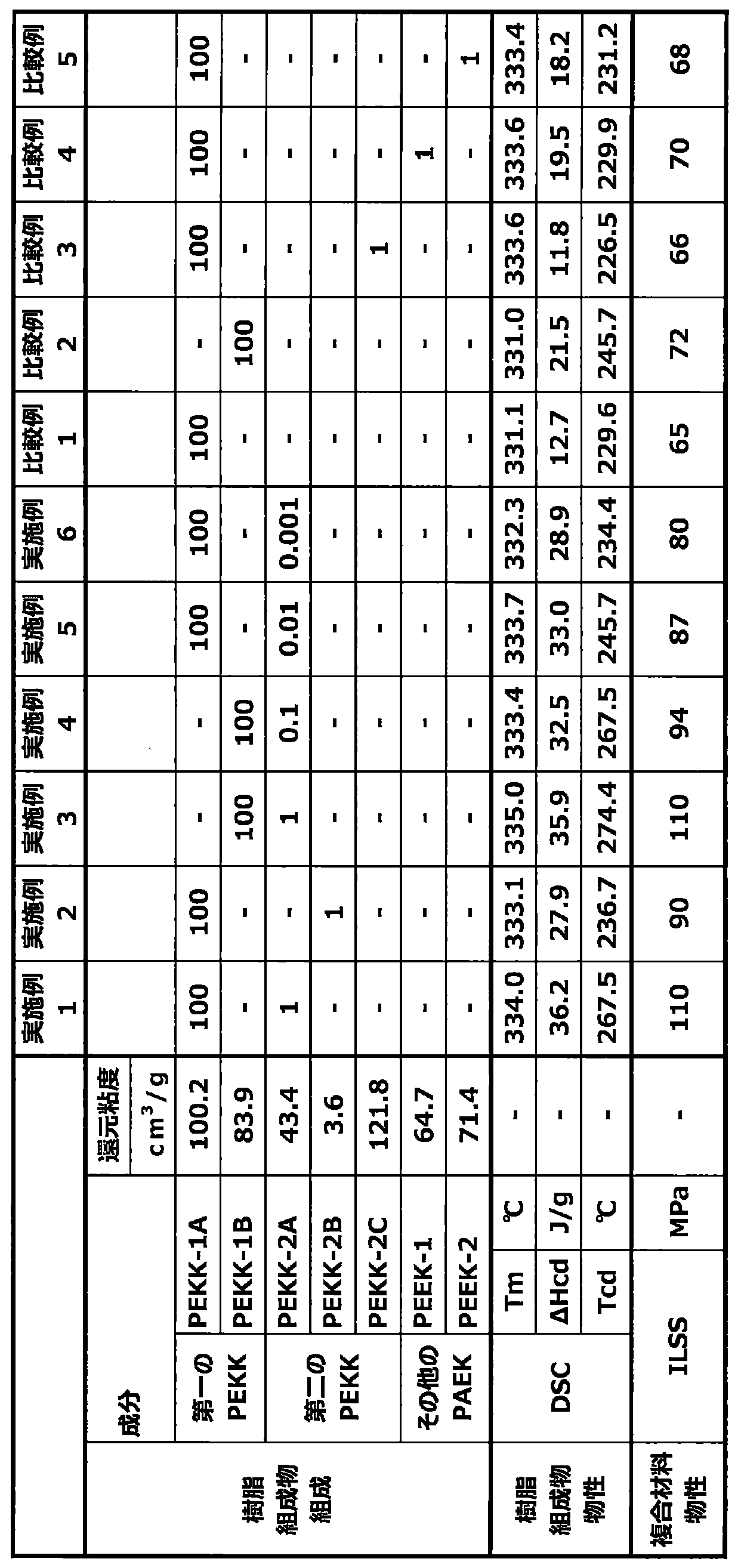
(実施例7)
1質量部のPEKK-1Aに対し、50質量部の硫酸(富士フイルム和光純薬株式会社製)を加え溶解させ、得られた均一溶液を750質量部の蒸留水(富士フイルム和光純薬株式会社製)にゆっくりと滴下した。ここで析出した固体を回収、乾燥することにより再沈殿精製したPEKKを得た。得られた精製済みPEKKは形状や大きさが不均一であった。精製後のPEKK樹脂の還元粘度、アルミニウム、リン、ナトリウム含有量およびDSCを測定した結果を、表2に示した。
1質量部のPEKK-1Aに対し、50質量部の硫酸(富士フイルム和光純薬株式会社製)を加え溶解させ、得られた均一溶液を750質量部の蒸留水(富士フイルム和光純薬株式会社製)にゆっくりと滴下した。ここで析出した固体を回収、乾燥することにより再沈殿精製したPEKKを得た。得られた精製済みPEKKは形状や大きさが不均一であった。精製後のPEKK樹脂の還元粘度、アルミニウム、リン、ナトリウム含有量およびDSCを測定した結果を、表2に示した。
精製済みPEKKを380℃で溶融混練することにより熱可塑性樹脂組成物チップを作製し、さらに粉砕することにより、平均粒子径が20μmの熱可塑性樹脂組成物粉末を得た。得られた粉末を混合溶剤ソルミックスAP-7(製品名、エタノールを取材とする混合溶剤、日本アルコール販売株式会社製)に分散させ、5.5質量%濃度のサスペンジョン溶液を調製した。
強化繊維基材として、炭素繊維を平行に55本引き揃えてシート状にし、炭素繊維の目付が194g/m2になるよう炭素繊維の引き揃えシートを調製した。得られた強化繊維基材2枚を、サスペンジョン溶液を満たしたサスペンジョン浴槽中に導入し、15秒間浸漬した後、2枚の基材を重ねて1枚の積層シートとしてサスペンジョン浴槽から導出した。得られた積層シートを150℃で5分間乾燥させた。
引き続いて、積層シートを表面温度が380℃のローラーに通し樹脂を溶融させ含浸させることにより熱可塑性樹脂プリプレグを得た。得られたプリプレグ中の樹脂含有率は35質量%であった。こうして得られたプリプレグを用いて複合材料を製造し、その層間せん断強度(ILSS)を測定した。測定結果を表2に記載した。
実施例7で得られた複合材料は、ILSSが97MPaであり、優れた物性を示した。
(実施例8)
PEKK-1Bを使用した以外は実施例7と同様の操作を行い、熱可塑樹脂組成物粉末、および熱可塑性樹脂プリプレグを調製した。精製後のPEKK樹脂の還元粘度、アルミニウム、リン、ナトリウム含有量およびDSCを測定した結果を、表2に示した。
PEKK-1Bを使用した以外は実施例7と同様の操作を行い、熱可塑樹脂組成物粉末、および熱可塑性樹脂プリプレグを調製した。精製後のPEKK樹脂の還元粘度、アルミニウム、リン、ナトリウム含有量およびDSCを測定した結果を、表2に示した。
得られた熱可塑性樹脂プリプレグを用いて複合材料を製造し、そのILSSを測定した。ILSSの測定結果を表2に示した。実施例8で得られた複合材料は、ILSSが103MPaであり、優れた物性を示した。
(比較例6)
PEKK樹脂の精製処理を行わなかった以外は、実施例7と同様の操作を行い、熱可塑樹脂組成物粉末、およびプリプレグを調製した。用いたPEKK樹脂の還元粘度、アルミニウム、リン、ナトリウム含有量およびDSCを測定した結果を、表2に示した。
PEKK樹脂の精製処理を行わなかった以外は、実施例7と同様の操作を行い、熱可塑樹脂組成物粉末、およびプリプレグを調製した。用いたPEKK樹脂の還元粘度、アルミニウム、リン、ナトリウム含有量およびDSCを測定した結果を、表2に示した。
得られた熱可塑性樹脂プリプレグを用いて複合材料を製造し、そのILSSを測定した。測定結果を表2に示した。比較例6で得られた複合材料は、ILSSが65MPaであり、物性が不十分であった。
(比較例7)
PEKK樹脂の精製処理を行わなかった以外は、実施例8と同様の操作を行い、熱可塑樹脂組成物粉末、および熱可塑性樹脂プリプレグを調製した。用いたPEKK樹脂の還元粘度、アルミニウム、リン、ナトリウム含有量およびDSCを測定した結果を、表2に示した。
PEKK樹脂の精製処理を行わなかった以外は、実施例8と同様の操作を行い、熱可塑樹脂組成物粉末、および熱可塑性樹脂プリプレグを調製した。用いたPEKK樹脂の還元粘度、アルミニウム、リン、ナトリウム含有量およびDSCを測定した結果を、表2に示した。
得られた熱可塑性樹脂プリプレグを用いて複合材料を製造し、そのILSSを測定した。測定結果を表2に示した。比較例7で得られた複合材料は、ILSSが72MPaであり、物性が不十分であった。

(実施例9)
1質量部のPEKK-1Aに対し、100質量部のクロロホルム(富士フイルム和光純薬株式会社製)を加え、得られた分散液を還流条件下で約3時間撹拌した。冷却後、分散液を濾過することによりPEKK粉末を得た。得られたPEKK粉末について、再度上記と同様のクロロホルム洗浄を行い、次いで濾過、乾燥することにより、平均粒子径が20μmの精製済み熱可塑性樹脂組成物粉末を得た。精製後のPEKK樹脂の還元粘度、構造異性体比率およびDSCを測定した結果を、表3に示した。
1質量部のPEKK-1Aに対し、100質量部のクロロホルム(富士フイルム和光純薬株式会社製)を加え、得られた分散液を還流条件下で約3時間撹拌した。冷却後、分散液を濾過することによりPEKK粉末を得た。得られたPEKK粉末について、再度上記と同様のクロロホルム洗浄を行い、次いで濾過、乾燥することにより、平均粒子径が20μmの精製済み熱可塑性樹脂組成物粉末を得た。精製後のPEKK樹脂の還元粘度、構造異性体比率およびDSCを測定した結果を、表3に示した。
得られた熱可塑性樹脂粉末を混合溶剤ソルミックスAP-7(製品名、エタノールを取材とする混合溶剤、日本アルコール販売株式会社製)に分散させ、5.5質量%濃度のサスペンジョン溶液を調製した。
ついで、強化繊維基材として、炭素繊維を平行に55本引き揃えてシート状にし、炭素繊維の目付が194g/m2になるよう炭素繊維の引き揃えシートを調製した。得られた強化繊維基材2枚を、上記サスペンジョン溶液を満たしたサスペンジョン浴槽中に導入し、15秒間浸漬した後、2枚の基材を重ねて1枚の積層シートとしてサスペンジョン浴槽から導出した。得られた積層シートを150℃で5分間乾燥させた。
引き続いて、積層シートを表面温度が380℃のローラーに通し樹脂を溶融させ含浸させることにより熱可塑性樹脂プリプレグを得た。得られたプリプレグ中の樹脂含有率は35質量%であった。こうして得られたプリプレグを用いて複合材料を製造し、その層間せん断強度(ILSS)を測定した。測定結果を表3に記載した。
実施例9で得られた複合材料は、ILSSが90MPaであり、優れた物性を示した。
(実施例10)
PEKK-1Bを使用した以外は実施例9と同様の操作を行い、熱可塑樹脂組成物粉末、および熱可塑性樹脂プリプレグを調製した。精製後のPEKK樹脂の還元粘度、構造異性体比率およびDSCを測定した結果を、表3に示した。
PEKK-1Bを使用した以外は実施例9と同様の操作を行い、熱可塑樹脂組成物粉末、および熱可塑性樹脂プリプレグを調製した。精製後のPEKK樹脂の還元粘度、構造異性体比率およびDSCを測定した結果を、表3に示した。
得られた熱可塑性樹脂プリプレグを用いて複合材料を製造し、そのILSSを測定した。ILSSの測定結果を表3に示した。実施例10で得られた複合材料は、ILSSが92MPaであり、優れた物性を示した。
(比較例8)
PEKK樹脂の精製処理を行わなかった以外は実施例9と同様の操作を行い、熱可塑樹脂組成物粉末、および熱可塑性樹脂プリプレグを調製した。精製後のPEKK樹脂の還元粘度、構造異性体比率およびDSCを測定した結果を、表3に示した。
PEKK樹脂の精製処理を行わなかった以外は実施例9と同様の操作を行い、熱可塑樹脂組成物粉末、および熱可塑性樹脂プリプレグを調製した。精製後のPEKK樹脂の還元粘度、構造異性体比率およびDSCを測定した結果を、表3に示した。
得られた熱可塑性樹脂プリプレグを用いて複合材料を製造し、そのILSSを測定した。ILSSの測定結果を表3に示した。比較例8で得られた複合材料は、ILSSが65MPaであり、物性が不十分であった。
(比較例9)
PEKK樹脂の精製処理を行わなかった以外は実施例10と同様の操作を行い、熱可塑樹脂組成物粉末、および熱可塑性樹脂プリプレグを調製した。精製後のPEKK樹脂の還元粘度、構造異性体比率およびDSCを測定した結果を、表3に示した。
PEKK樹脂の精製処理を行わなかった以外は実施例10と同様の操作を行い、熱可塑樹脂組成物粉末、および熱可塑性樹脂プリプレグを調製した。精製後のPEKK樹脂の還元粘度、構造異性体比率およびDSCを測定した結果を、表3に示した。
得られた熱可塑性樹脂プリプレグを用いて複合材料を製造し、そのILSSを測定した。ILSSの測定結果を表3に示した。比較例9で得られた複合材料は、ILSSが72MPaであり、物性が不十分であった。
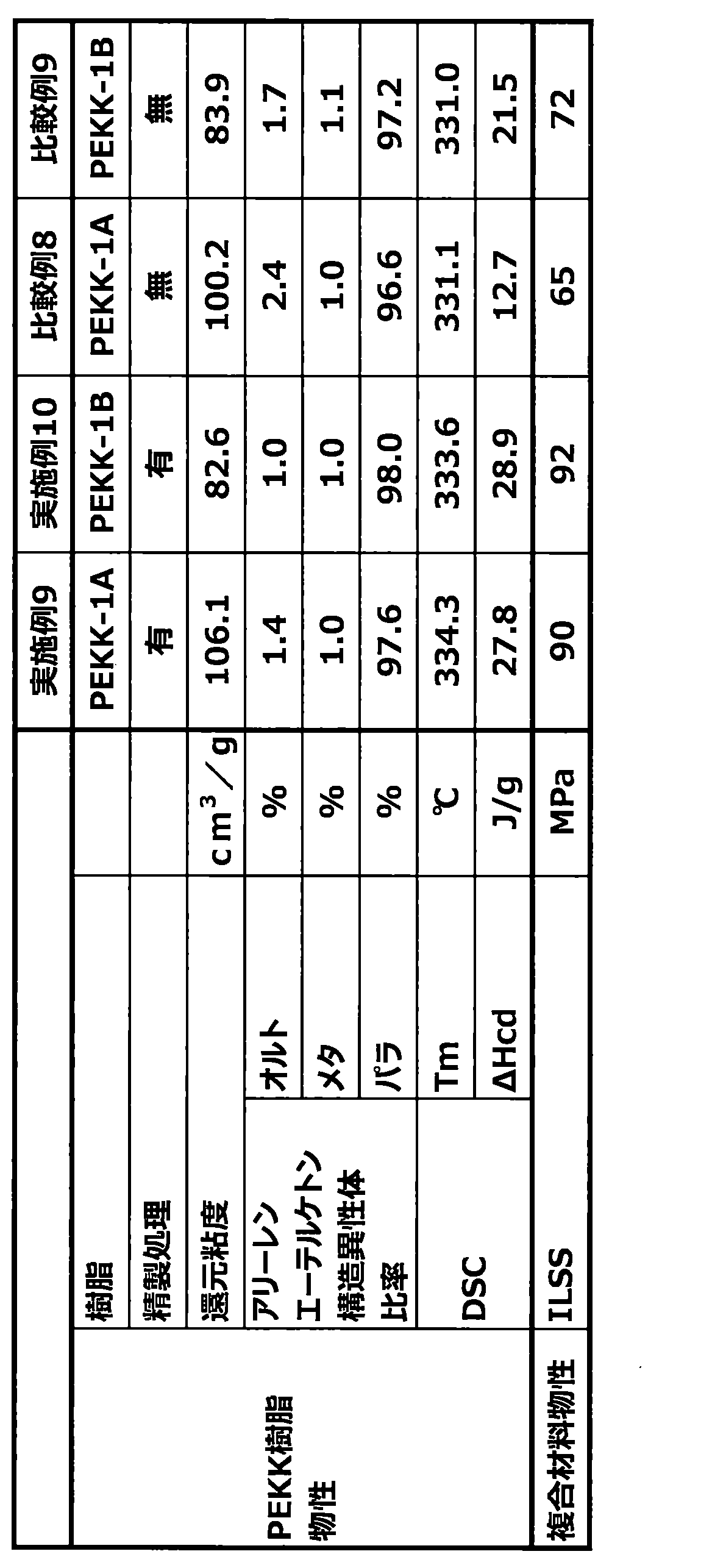
(実施例11)
1質量部のPEKK-1Aに対し、50質量部の硫酸(富士フイルム和光純薬株式会社製)を加え溶解させ、得られた均一溶液を750質量部の蒸留水(富士フイルム和光純薬株式会社製)にゆっくりと滴下した。ここで析出した固体を回収、乾燥することにより再沈殿精製したPEKKを得た。ついで、硫酸精製後のPEKK-1A 1質量部に対し、100質量部のクロロホルム(富士フイルム和光純薬株式会社製)を加え、得られた分散液を還流条件下で約3時間撹拌した。冷却後、分散液を濾過することによりPEKK粉末を得た。得られたPEKK粉末について、再度上記と同様のクロロホルム洗浄を行い、次いで濾過、乾燥し精製済みPEKK-1A粉末を得た。精製後のPEKK樹脂の還元粘度は106.3cm3/gであり、元素含有量はアルミニウム 4.0ppm、リン 0.4ppm、ナトリウム 1.3ppmであった。また、構造異性体比率は、オルト1.3%、メタ1.0%、パラ97.7%であった。
1質量部のPEKK-1Aに対し、50質量部の硫酸(富士フイルム和光純薬株式会社製)を加え溶解させ、得られた均一溶液を750質量部の蒸留水(富士フイルム和光純薬株式会社製)にゆっくりと滴下した。ここで析出した固体を回収、乾燥することにより再沈殿精製したPEKKを得た。ついで、硫酸精製後のPEKK-1A 1質量部に対し、100質量部のクロロホルム(富士フイルム和光純薬株式会社製)を加え、得られた分散液を還流条件下で約3時間撹拌した。冷却後、分散液を濾過することによりPEKK粉末を得た。得られたPEKK粉末について、再度上記と同様のクロロホルム洗浄を行い、次いで濾過、乾燥し精製済みPEKK-1A粉末を得た。精製後のPEKK樹脂の還元粘度は106.3cm3/gであり、元素含有量はアルミニウム 4.0ppm、リン 0.4ppm、ナトリウム 1.3ppmであった。また、構造異性体比率は、オルト1.3%、メタ1.0%、パラ97.7%であった。
次いで、硫酸及びクロロホルムで精製したPEKK-1A(100質量部)とPEKK-2A(1質量部)を380℃で溶融混練し、チップ状の熱可塑性樹脂組成物を得た。得られた熱可塑性樹脂組成物のDSC測定を行った結果、融点(Tm)が334.2℃、結晶化エンタルピー(ΔHcd)が32.8J/g、降温結晶化温度が285.4℃の熱可塑性樹脂組成物であった。
次いで、得られた熱可塑性樹脂組成物チップを粉砕し、平均粒子径が20μmの熱可塑性樹脂組成物粉末を得た。得られた粉末を混合溶剤ソルミックスAP-7(製品名、エタノールを取材とする混合溶剤、日本アルコール販売株式会社製)に分散させ、5.5質量%濃度のサスペンジョン溶液を調製した。
強化繊維基材として、炭素繊維を平行に55本引き揃えてシート状にし、炭素繊維の目付が194g/m2になるよう炭素繊維の引き揃えシートを調製した。得られた強化繊維基材2枚を、上記サスペンジョンを満たしたサスペンジョン浴槽中に導入し、15秒間浸漬した後、2枚の基材を重ねて1枚の積層シートとしてサスペンジョン浴槽から導出した。得られた積層シートを150℃で5分間乾燥させた。
引き続いて、積層シートを表面温度が380℃のローラーに通し樹脂を溶融させ含浸させることにより熱可塑性樹脂プリプレグを得た。得られたプリプレグ中の樹脂含有率は35質量%であった。こうして得られたプリプレグを用いて複合材料を製造し、その層間せん断強度(ILSS)を測定した。実施例11で得られた複合材料は、ILSSが115MPaであり、優れた物性を示した。
Claims (16)
- 少なくとも、強化繊維基材と、前記強化繊維基材に一部又は全部が含浸している熱可塑性樹脂組成物と、から成る熱可塑性樹脂プリプレグであって、
前記熱可塑性樹脂組成物が、ポリエーテルケトンケトン(PEKK)を、樹脂組成物に含まれる全熱可塑性樹脂に対して50質量%以上含有し、且つ、示差走査熱量計(DSC)にて、400℃から降温速度50℃/分で測定した際の結晶化エンタルピーが22J/g以上の熱可塑性樹脂組成物であることを特徴とする熱可塑性樹脂プリプレグ。 - 少なくとも、強化繊維基材と、前記強化繊維基材に一部又は全部が含浸している熱可塑性樹脂組成物と、から成る熱可塑性樹脂プリプレグであって、
前記熱可塑性樹脂組成物が、ポリエーテルケトンケトン(PEKK)を、樹脂組成物に含まれる全熱可塑性樹脂に対して50質量%以上含有し、且つ、第一のPEKKと、第一のPEKKよりも還元粘度の小さい第二のPEKKを含有することを特徴とする熱可塑性樹脂プリプレグ。 - 第一のPEKKと第二のPEKKの還元粘度が下記式(1)および(2)を満たす請求項2に記載の熱可塑性樹脂プリプレグ。
50cm3/g≦第一のPEKKの還元粘度≦200cm3/g ・・・式(1)
2cm3/g≦第二のPEKKの還元粘度≦100cm3/g ・・・式(2) - 第一のPEKKと第二のPEKKの質量比率が99.9995/0.0005~50/50である請求項2または3に記載の熱可塑性樹脂プリプレグ。
- 少なくとも、強化繊維基材と、前記強化繊維基材に一部又は全部が含浸している熱可塑性樹脂組成物と、から成る熱可塑性樹脂プリプレグであって、
前記熱可塑性樹脂組成物が、ポリエーテルケトンケトン(PEKK)を全熱可塑性樹脂組成物に対して50質量%以上含有し、
前記PEKK中に含まれるアルミニウム、リン、ナトリウムの合計量が100ppm以下であることを特徴とする熱可塑性樹脂プリプレグ。 - PEKK中に含まれるアルミニウムの量が45ppm以下である請求項5に記載のプリプレグ。
- 少なくとも、強化繊維基材と、前記強化繊維基材に一部又は全部が含浸している熱可塑性樹脂組成物と、から成る熱可塑性樹脂プリプレグであって、
前記熱可塑性樹脂組成物が、ポリエーテルケトンケトン(PEKK)を全熱可塑性樹脂組成物に対して50質量%以上含有し、
前記PEKK中に含まれる下記化学式(I)で表される全アリーレンエーテルケトン構造単位のうち、エーテル基がケトン基に対するオルト位でArに結合している構造異性体の比率が1.6%以下であることを特徴とする熱可塑性樹脂プリプレグ。

- 前記熱可塑性樹脂組成物が、示差走査熱量計(DSC)にて、400℃から降温速度50℃/分で測定した際の結晶化エンタルピーが22J/g以上の熱可塑性樹脂組成物である請求項2~7のいずれか1項に記載の熱可塑性樹脂プリプレグ。
- 強化繊維基材に、熱可塑性樹脂組成物を含浸させる熱可塑性樹脂プリプレグの製造方法であって、
前記熱可塑性樹脂組成物が、ポリエーテルケトンケトン(PEKK)を、樹脂組成物に含まれる全熱可塑性樹脂に対して50質量%以上含有し、且つ、示差走査熱量計(DSC)にて、400℃から降温速度50℃/分で測定した際の結晶化エンタルピーが22J/g以上の熱可塑性樹脂組成物であることを特徴とするプリプレグの製造方法。 - 強化繊維基材に熱可塑性樹脂組成物を含浸させる熱可塑性樹脂プリプレグの製造方法であって、
前記熱可塑性樹脂組成物が、ポリエーテルケトンケトン(PEKK)を、樹脂組成物に含まれる全熱可塑性樹脂に対して50質量%以上含有し、且つ、第一のPEKKと、第一のPEKKよりも還元粘度の小さい第二のPEKKを含有することを特徴とする熱可塑性樹脂プリプレグの製造方法。 - 強化繊維基材に熱可塑性樹脂組成物を含浸させる熱可塑性樹脂プリプレグの製造方法であって、
前記熱可塑性樹脂組成物が、ポリエーテルケトンケトン(PEKK)を全熱可塑性樹脂組成物に対して50質量%以上含有し、
前記PEKK中に含まれるアルミニウム、リン、ナトリウムの合計量が100ppm以下の熱可塑性樹脂組成物であることを特徴とする熱可塑性樹脂プリプレグの製造方法。 - 強化繊維基材に熱可塑性樹脂組成物を一部又は全部が含浸させる熱可塑性樹脂プリプレグの製造方法であって、
前記熱可塑性樹脂組成物が、ポリエーテルケトンケトン(PEKK)を全熱可塑性樹脂組成物に対して50質量%以上含有し、
前記PEKK中に含まれる下記化学式(I)で表される全アリーレンエーテルケトン構造単位のうち、エーテル基がケトン基に対するオルト位でArに結合している構造異性体の比率が1.6%以下であることを特徴とする熱可塑性樹脂プリプレグの製造方法。

- 少なくとも、強化繊維基材と、熱可塑性樹脂組成物と、から成る繊維強化複合材料であって、
前記熱可塑性樹脂組成物が、ポリエーテルケトンケトン(PEKK)を、樹脂組成物に含まれる全熱可塑性樹脂に対して50質量%以上含有し、且つ、示差走査熱量計(DSC)にて、400℃から降温速度50℃/分で測定した際の結晶化エンタルピーが22J/g以上の熱可塑性樹脂組成物であることを特徴とする繊維強化複合材料。 - 少なくとも、強化繊維基材と、熱可塑性樹脂組成物と、から成る繊維強化複合材料であって、
前記熱可塑性樹脂組成物が、ポリエーテルケトンケトン(PEKK)を、樹脂組成物に含まれる全熱可塑性樹脂に対して50質量%以上含有し、且つ、第一のPEKKと、第一のPEKKよりも還元粘度の小さい第二のPEKKを含有することを特徴とする繊維強化複合材料。 - 少なくとも、強化繊維基材と、熱可塑性樹脂組成物と、から成る繊維強化複合材料であって、
前記熱可塑性樹脂組成物が、ポリエーテルケトンケトン(PEKK)を全熱可塑性樹脂組成物に対して50質量%以上含有し、
前記PEKK中に含まれるアルミニウム、リン、ナトリウムの合計量が100ppm以下であることを特徴とする繊維強化複合材料。 - 少なくとも、強化繊維基材と、熱可塑性樹脂組成物と、から成る繊維強化複合材料であって、
前記熱可塑性樹脂組成物が、ポリエーテルケトンケトン(PEKK)を全熱可塑性樹脂組成物に対して50質量%以上含有し、
前記PEKK中に含まれる下記化学式(I)で表される全アリーレンエーテルケトン構造単位のうち、エーテル基がケトン基に対するオルト位でArに結合している構造異性体の比率が1.6%以下であることを特徴とする繊維強化複合材料。

Priority Applications (4)
| Application Number | Priority Date | Filing Date | Title |
|---|---|---|---|
| US17/604,607 US20220195134A1 (en) | 2019-04-19 | 2020-04-02 | Thermoplastic resin prepreg, production method thereof, and fiber-reinforced composite material |
| EP20791333.6A EP3957687A4 (en) | 2019-04-19 | 2020-04-02 | PREPREGNATED WITH THERMOPLASTIC RESIN, METHOD FOR PRODUCTION THEREOF, AND FIBER REINFORCED COMPOSITE MATERIAL |
| JP2021514870A JP7189333B2 (ja) | 2019-04-19 | 2020-04-02 | 熱可塑性樹脂プリプレグ、その製造方法及び繊維強化複合材料 |
| US18/624,323 US20240247118A1 (en) | 2019-04-19 | 2024-04-02 | Thermoplastic resin prepreg, production method thereof, and fiber-reinforced composite material |
Applications Claiming Priority (6)
| Application Number | Priority Date | Filing Date | Title |
|---|---|---|---|
| JP2019080027 | 2019-04-19 | ||
| JP2019-080027 | 2019-04-19 | ||
| JP2019-080026 | 2019-04-19 | ||
| JP2019080028 | 2019-04-19 | ||
| JP2019-080028 | 2019-04-19 | ||
| JP2019080026 | 2019-04-19 |
Related Child Applications (2)
| Application Number | Title | Priority Date | Filing Date |
|---|---|---|---|
| US17/604,607 A-371-Of-International US20220195134A1 (en) | 2019-04-19 | 2020-04-02 | Thermoplastic resin prepreg, production method thereof, and fiber-reinforced composite material |
| US18/624,323 Division US20240247118A1 (en) | 2019-04-19 | 2024-04-02 | Thermoplastic resin prepreg, production method thereof, and fiber-reinforced composite material |
Publications (1)
| Publication Number | Publication Date |
|---|---|
| WO2020213406A1 true WO2020213406A1 (ja) | 2020-10-22 |
Family
ID=72837179
Family Applications (1)
| Application Number | Title | Priority Date | Filing Date |
|---|---|---|---|
| PCT/JP2020/015130 Ceased WO2020213406A1 (ja) | 2019-04-19 | 2020-04-02 | 熱可塑性樹脂プリプレグ、その製造方法及び繊維強化複合材料 |
Country Status (5)
| Country | Link |
|---|---|
| US (2) | US20220195134A1 (ja) |
| EP (1) | EP3957687A4 (ja) |
| JP (1) | JP7189333B2 (ja) |
| TW (1) | TWI857046B (ja) |
| WO (1) | WO2020213406A1 (ja) |
Cited By (4)
| Publication number | Priority date | Publication date | Assignee | Title |
|---|---|---|---|---|
| CN114373586A (zh) * | 2021-12-30 | 2022-04-19 | 重庆沃特智成新材料科技有限公司 | 漆包线及其制备方法、用电设备 |
| WO2023013527A1 (ja) * | 2021-08-02 | 2023-02-09 | 帝人株式会社 | 熱可塑性樹脂プリプレグ、及びその製造方法 |
| WO2023171753A1 (ja) * | 2022-03-10 | 2023-09-14 | 帝人株式会社 | 熱可塑性樹脂組成物、熱可塑性樹脂フィルム、プリプレグ及び繊維強化複合材料、並びにプリプレグ及び繊維強化複合材料の製造方法 |
| WO2024195341A1 (ja) | 2023-03-23 | 2024-09-26 | 東レ株式会社 | 繊維強化熱可塑性樹脂基材 |
Families Citing this family (7)
| Publication number | Priority date | Publication date | Assignee | Title |
|---|---|---|---|---|
| WO2021132415A1 (ja) * | 2019-12-27 | 2021-07-01 | 三菱ケミカル株式会社 | 複合材料用部材、複合材料、移動体及び複合材料用フィルムの製造方法 |
| WO2021132417A1 (ja) * | 2019-12-27 | 2021-07-01 | 三菱ケミカル株式会社 | 複合材料用部材、複合材料、移動体及び複合材料用フィルムの製造方法 |
| CN114901731A (zh) * | 2019-12-27 | 2022-08-12 | 三菱化学株式会社 | 复合材料用构件、复合材料、移动体和复合材料用薄膜的制造方法 |
| CN115791885B (zh) * | 2022-11-25 | 2024-07-05 | 巨石集团有限公司 | 玻纤增强结晶性树脂复合材料中树脂含量的测定方法 |
| WO2025113789A1 (en) * | 2023-11-29 | 2025-06-05 | Ithaka Institute For Carbon Strategies | Prepreg, prepreg body and a method to produce a prepreg |
| CN117621300B (zh) * | 2023-12-13 | 2026-05-26 | 中国航空制造技术研究院 | 一种高性能热塑性聚芳醚酮类宽幅织物预浸料的制备方法 |
| CN120795385A (zh) * | 2025-07-01 | 2025-10-17 | 沈阳航空航天大学 | 包含耐高温pekk涂层的复合材料及其制备方法 |
Citations (15)
| Publication number | Priority date | Publication date | Assignee | Title |
|---|---|---|---|---|
| US3065205A (en) | 1959-10-27 | 1962-11-20 | Du Pont | Aromatic polyketones and preparation thereof |
| US3441538A (en) | 1965-08-04 | 1969-04-29 | Du Pont | Boron trifluoride - hydrogen fluoride catalyzed synthesis of poly(aromatic ketone) and poly(aromatic sulfone) polymers |
| US3442857A (en) | 1965-11-10 | 1969-05-06 | Du Pont | Boron trifluoride-hydrogen fluoride catalyzed synthesis of poly(aromatic sulfone) and poly(aromatic ketone) polymers |
| US3516966A (en) | 1968-02-05 | 1970-06-23 | Du Pont | Polyketone copolymers |
| US4704448A (en) | 1985-11-25 | 1987-11-03 | E. I. Du Pont De Nemours And Company | Copolyetherketones |
| US4816556A (en) | 1985-02-22 | 1989-03-28 | E. I. Du Pont De Nemours And Company | Ordered polyetherketones |
| US6177518B1 (en) | 1997-07-25 | 2001-01-23 | E. I. Du Pont De Nemours And Company | Blends of fluoroplastics with polyetherketoneketone |
| JP2011513529A (ja) * | 2008-02-29 | 2011-04-28 | ビクトレックス マニュファクチャリング リミテッド | 複合材料 |
| WO2012176788A1 (ja) * | 2011-06-24 | 2012-12-27 | 東レ株式会社 | 成形材料およびそれを用いた成形方法、成形材料の製造方法ならびに繊維強化複合材料の製造方法 |
| WO2017056693A1 (ja) * | 2015-09-30 | 2017-04-06 | 帝人株式会社 | プレス成形体、及び複合材料 |
| JP2017523256A (ja) * | 2014-05-22 | 2017-08-17 | サイテック インダストリーズ インコーポレイテッド | 強化剤として使用するための官能化重合体粒子 |
| JP2017149804A (ja) | 2016-02-22 | 2017-08-31 | 三菱ケミカル株式会社 | フィルム |
| WO2018115490A1 (en) * | 2016-12-22 | 2018-06-28 | Arkema France | Use of a polymeric material based on polyetherketoneketones for reducing wear |
| WO2018115739A1 (fr) * | 2016-12-22 | 2018-06-28 | Arkema France | Procede de fabrication d'un materiau fibreux pre-impregne de polymere thermoplastique par projection |
| JP2018138383A (ja) * | 2016-12-14 | 2018-09-06 | ザ・ボーイング・カンパニーThe Boeing Company | 材料系、及び材料系を製造する方法 |
Family Cites Families (4)
| Publication number | Priority date | Publication date | Assignee | Title |
|---|---|---|---|---|
| US9683311B2 (en) * | 2009-02-02 | 2017-06-20 | Arkema Inc. | High performance fibers |
| US9925714B2 (en) * | 2012-11-21 | 2018-03-27 | Stratasys, Inc. | Method for printing three-dimensional items wtih semi-crystalline build materials |
| WO2015060917A2 (en) * | 2013-08-01 | 2015-04-30 | General Electric Company | Process of producing a thermoplastic-fiber composite and fan blades formed therefrom |
| FR3070979B1 (fr) * | 2017-09-08 | 2019-08-30 | Arkema France | Pieces en polyether cetone cetone presentant une stabilite dimensionnelle amelioree |
-
2020
- 2020-04-02 US US17/604,607 patent/US20220195134A1/en not_active Abandoned
- 2020-04-02 JP JP2021514870A patent/JP7189333B2/ja active Active
- 2020-04-02 WO PCT/JP2020/015130 patent/WO2020213406A1/ja not_active Ceased
- 2020-04-02 EP EP20791333.6A patent/EP3957687A4/en active Pending
- 2020-04-13 TW TW109112333A patent/TWI857046B/zh active
-
2024
- 2024-04-02 US US18/624,323 patent/US20240247118A1/en not_active Abandoned
Patent Citations (15)
| Publication number | Priority date | Publication date | Assignee | Title |
|---|---|---|---|---|
| US3065205A (en) | 1959-10-27 | 1962-11-20 | Du Pont | Aromatic polyketones and preparation thereof |
| US3441538A (en) | 1965-08-04 | 1969-04-29 | Du Pont | Boron trifluoride - hydrogen fluoride catalyzed synthesis of poly(aromatic ketone) and poly(aromatic sulfone) polymers |
| US3442857A (en) | 1965-11-10 | 1969-05-06 | Du Pont | Boron trifluoride-hydrogen fluoride catalyzed synthesis of poly(aromatic sulfone) and poly(aromatic ketone) polymers |
| US3516966A (en) | 1968-02-05 | 1970-06-23 | Du Pont | Polyketone copolymers |
| US4816556A (en) | 1985-02-22 | 1989-03-28 | E. I. Du Pont De Nemours And Company | Ordered polyetherketones |
| US4704448A (en) | 1985-11-25 | 1987-11-03 | E. I. Du Pont De Nemours And Company | Copolyetherketones |
| US6177518B1 (en) | 1997-07-25 | 2001-01-23 | E. I. Du Pont De Nemours And Company | Blends of fluoroplastics with polyetherketoneketone |
| JP2011513529A (ja) * | 2008-02-29 | 2011-04-28 | ビクトレックス マニュファクチャリング リミテッド | 複合材料 |
| WO2012176788A1 (ja) * | 2011-06-24 | 2012-12-27 | 東レ株式会社 | 成形材料およびそれを用いた成形方法、成形材料の製造方法ならびに繊維強化複合材料の製造方法 |
| JP2017523256A (ja) * | 2014-05-22 | 2017-08-17 | サイテック インダストリーズ インコーポレイテッド | 強化剤として使用するための官能化重合体粒子 |
| WO2017056693A1 (ja) * | 2015-09-30 | 2017-04-06 | 帝人株式会社 | プレス成形体、及び複合材料 |
| JP2017149804A (ja) | 2016-02-22 | 2017-08-31 | 三菱ケミカル株式会社 | フィルム |
| JP2018138383A (ja) * | 2016-12-14 | 2018-09-06 | ザ・ボーイング・カンパニーThe Boeing Company | 材料系、及び材料系を製造する方法 |
| WO2018115490A1 (en) * | 2016-12-22 | 2018-06-28 | Arkema France | Use of a polymeric material based on polyetherketoneketones for reducing wear |
| WO2018115739A1 (fr) * | 2016-12-22 | 2018-06-28 | Arkema France | Procede de fabrication d'un materiau fibreux pre-impregne de polymere thermoplastique par projection |
Non-Patent Citations (2)
| Title |
|---|
| POLYMER, vol. 38, no. 14, 1997, pages 3441 |
| See also references of EP3957687A4 |
Cited By (6)
| Publication number | Priority date | Publication date | Assignee | Title |
|---|---|---|---|---|
| WO2023013527A1 (ja) * | 2021-08-02 | 2023-02-09 | 帝人株式会社 | 熱可塑性樹脂プリプレグ、及びその製造方法 |
| CN114373586A (zh) * | 2021-12-30 | 2022-04-19 | 重庆沃特智成新材料科技有限公司 | 漆包线及其制备方法、用电设备 |
| CN114373586B (zh) * | 2021-12-30 | 2024-04-05 | 重庆沃特智成新材料科技有限公司 | 漆包线及其制备方法、用电设备 |
| WO2023171753A1 (ja) * | 2022-03-10 | 2023-09-14 | 帝人株式会社 | 熱可塑性樹脂組成物、熱可塑性樹脂フィルム、プリプレグ及び繊維強化複合材料、並びにプリプレグ及び繊維強化複合材料の製造方法 |
| WO2024195341A1 (ja) | 2023-03-23 | 2024-09-26 | 東レ株式会社 | 繊維強化熱可塑性樹脂基材 |
| EP4685175A1 (en) | 2023-03-23 | 2026-01-28 | Toray Industries, Inc. | Fiber-reinforced thermoplastic resin base material |
Also Published As
| Publication number | Publication date |
|---|---|
| JP7189333B2 (ja) | 2022-12-13 |
| TW202104397A (zh) | 2021-02-01 |
| US20220195134A1 (en) | 2022-06-23 |
| EP3957687A1 (en) | 2022-02-23 |
| JPWO2020213406A1 (ja) | 2021-12-23 |
| EP3957687A4 (en) | 2022-06-22 |
| US20240247118A1 (en) | 2024-07-25 |
| TWI857046B (zh) | 2024-10-01 |
Similar Documents
| Publication | Publication Date | Title |
|---|---|---|
| JP7189333B2 (ja) | 熱可塑性樹脂プリプレグ、その製造方法及び繊維強化複合材料 | |
| CN103608386B (zh) | 成型材料和使用其的成型方法、成型材料的制造方法以及纤维强化复合材料的制造方法 | |
| WO2019122226A1 (en) | A METHOD OF MAKING A PEEK-PEmEK COPOLYMER AND COPOLYMER OBTAINED FROM THE METHOD | |
| JPWO2016186100A1 (ja) | ポリカーボネート樹脂組成物、およびポリカーボネート樹脂製プリプレグ | |
| CN114127191A (zh) | 纤维增强热塑性基质复合材料 | |
| TWI503361B (zh) | A resin composition, and a composite hardener using the same, and a method for producing the composite cured product | |
| JP5245266B2 (ja) | 繊維強化成形基材の製造方法 | |
| JP6854591B2 (ja) | プリプレグ、強化繊維、繊維強化複合材料、およびプリプレグの製造方法 | |
| JP5589973B2 (ja) | 成形材料の製造方法 | |
| Lee et al. | A star-shaped crystalline curing agent for thermally conductive epoxy composites: Synthesis and thermal management performance | |
| JP2023519941A (ja) | ポリアリールエーテルケトンポリマー | |
| JP5589974B2 (ja) | 繊維強化複合材料の製造方法 | |
| JP5589971B2 (ja) | 成形材料 | |
| JP5589972B2 (ja) | 成形材料およびそれを用いた成形方法 | |
| CN110461907B (zh) | 热塑性复合材料和相应的制造方法以及制品 | |
| Zheng et al. | Crystallized polyarylene ether nitrile blends with improved thermal, mechanical, dielectric properties, and processability | |
| JP5614382B2 (ja) | 成形材料の製造方法 | |
| EP3783047A1 (en) | Peek-peodek copolymer and method of making the copolymer | |
| EP3986955A1 (en) | Peek-peodek copolymer and method of making the copolymer |
Legal Events
| Date | Code | Title | Description |
|---|---|---|---|
| 121 | Ep: the epo has been informed by wipo that ep was designated in this application |
Ref document number: 20791333 Country of ref document: EP Kind code of ref document: A1 |
|
| ENP | Entry into the national phase |
Ref document number: 2021514870 Country of ref document: JP Kind code of ref document: A |
|
| NENP | Non-entry into the national phase |
Ref country code: DE |
|
| WWE | Wipo information: entry into national phase |
Ref document number: 2020791333 Country of ref document: EP |