WO2020213501A1 - Analogue d'acide nucléique et agent anti-virus de l'hépatite b - Google Patents
Analogue d'acide nucléique et agent anti-virus de l'hépatite b Download PDFInfo
- Publication number
- WO2020213501A1 WO2020213501A1 PCT/JP2020/015885 JP2020015885W WO2020213501A1 WO 2020213501 A1 WO2020213501 A1 WO 2020213501A1 JP 2020015885 W JP2020015885 W JP 2020015885W WO 2020213501 A1 WO2020213501 A1 WO 2020213501A1
- Authority
- WO
- WIPO (PCT)
- Prior art keywords
- hepatitis
- virus
- group
- formula
- active ingredient
- Prior art date
- Legal status (The legal status is an assumption and is not a legal conclusion. Google has not performed a legal analysis and makes no representation as to the accuracy of the status listed.)
- Ceased
Links
Images


Classifications
-
- A—HUMAN NECESSITIES
- A61—MEDICAL OR VETERINARY SCIENCE; HYGIENE
- A61K—PREPARATIONS FOR MEDICAL, DENTAL OR TOILETRY PURPOSES
- A61K31/00—Medicinal preparations containing organic active ingredients
- A61K31/70—Carbohydrates; Sugars; Derivatives thereof
- A61K31/7042—Compounds having saccharide radicals and heterocyclic rings
- A61K31/7052—Compounds having saccharide radicals and heterocyclic rings having nitrogen as a ring hetero atom, e.g. nucleosides, nucleotides
- A61K31/706—Compounds having saccharide radicals and heterocyclic rings having nitrogen as a ring hetero atom, e.g. nucleosides, nucleotides containing six-membered rings with nitrogen as a ring hetero atom
- A61K31/7064—Compounds having saccharide radicals and heterocyclic rings having nitrogen as a ring hetero atom, e.g. nucleosides, nucleotides containing six-membered rings with nitrogen as a ring hetero atom containing condensed or non-condensed pyrimidines
- A61K31/7076—Compounds having saccharide radicals and heterocyclic rings having nitrogen as a ring hetero atom, e.g. nucleosides, nucleotides containing six-membered rings with nitrogen as a ring hetero atom containing condensed or non-condensed pyrimidines containing purines, e.g. adenosine, adenylic acid
-
- A—HUMAN NECESSITIES
- A61—MEDICAL OR VETERINARY SCIENCE; HYGIENE
- A61P—SPECIFIC THERAPEUTIC ACTIVITY OF CHEMICAL COMPOUNDS OR MEDICINAL PREPARATIONS
- A61P1/00—Drugs for disorders of the alimentary tract or the digestive system
- A61P1/16—Drugs for disorders of the alimentary tract or the digestive system for liver or gallbladder disorders, e.g. hepatoprotective agents, cholagogues, litholytics
-
- A—HUMAN NECESSITIES
- A61—MEDICAL OR VETERINARY SCIENCE; HYGIENE
- A61P—SPECIFIC THERAPEUTIC ACTIVITY OF CHEMICAL COMPOUNDS OR MEDICINAL PREPARATIONS
- A61P31/00—Antiinfectives, i.e. antibiotics, antiseptics, chemotherapeutics
- A61P31/12—Antivirals
- A61P31/20—Antivirals for DNA viruses
-
- A—HUMAN NECESSITIES
- A61—MEDICAL OR VETERINARY SCIENCE; HYGIENE
- A61P—SPECIFIC THERAPEUTIC ACTIVITY OF CHEMICAL COMPOUNDS OR MEDICINAL PREPARATIONS
- A61P35/00—Antineoplastic agents
Definitions
- the present disclosure discloses, for example, novel nucleic acid analogs, pharmaceutical compositions containing nucleic acid analogs as active ingredients, anti-hepatitis virus agents (particularly anti-hepatitis B virus agents), and hepatitis virus-related diseases (particularly hepatitis B virus-related diseases). ) About preventive or therapeutic agents.
- HBV Hepatitis B virus
- HCV hepatitis C virus
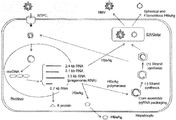
- FIG. HBV is an incomplete double-stranded DNA virus belonging to the genus Orthohepadnavirus of the family Hepadnaviridae. When HBV invades the cell, it forms a complete double-stranded DNA in the nucleus and becomes cccDNA.
- RNA RNA is transcribed and translated into polymerase, HBcAg (Core), HBsAg, and X protein.
- HBcAg Core
- HBsAg HBsAg
- X protein X protein.
- pgRNA premium RNA
- HBV HBV is not a retrovirus, it has reverse transcriptase activity in the polymerase, so reverse transcriptase inhibitors against HIV-1 have been used for its treatment.
- the present disclosure discloses pharmaceutical compositions, anti-hepatitis virus agents (particularly anti-hepatitis B virus agents), and hepatitis virus-related diseases (particularly hepatitis B virus-related diseases) containing new nucleic acid analogs and nucleic acid analogs as active ingredients.
- the purpose is to provide a prophylactic or therapeutic agent for the virus.
- the present disclosure includes the following aspects.
- Item 1. The following equation (1): (In the formula, Z is bromine or iodine.) An anti-hepatitis B virus agent containing, as an active ingredient, a compound represented by (1), a prodrug thereof, a pharmaceutically acceptable salt thereof, or a solvate thereof.
- Item 2. The following equation (1): (In the formula, Z is bromine or iodine.) A prophylactic or therapeutic agent for hepatitis B virus-related diseases, which comprises a compound represented by (1), a prodrug thereof, a pharmaceutically acceptable salt thereof, or a solvate thereof as an active ingredient.
- Item 3. Item 2.
- the prophylactic or therapeutic agent according to Item 2 wherein the hepatitis B virus-related disease is at least one selected from the group consisting of hepatitis B, cirrhosis B, and liver cancer B.
- Item 4. 2'-deoxy-2'-fluoro- ⁇ -2-iodo-D-adenosine or a prodrug thereof, or a pharmaceutically acceptable salt thereof, or a solvate thereof.
- Item 5. A pharmaceutical composition containing the compound according to Item 4 as an active ingredient.
- An anti-hepatitis virus agent containing the compound according to Item 4 as an active ingredient.
- Item 7. A prophylactic or therapeutic agent for hepatitis virus-related diseases containing the compound according to Item 4 as an active ingredient.
- Item 8. Item 2. The prophylactic or therapeutic agent according to Item 7, wherein the hepatitis virus-related disease is one or more selected from the group consisting of chronic hepatitis, liver cirrhos
- the disclosure further includes the following aspects: -The compound represented by the above formula (1) or a prodrug thereof, or a pharmaceutically acceptable salt thereof, or a drug thereof for use as a medicine for the prevention or treatment of hepatitis B virus-related diseases.
- Solvation product 2'-deoxy-2'-fluoro- ⁇ -2-iodo-D-adenosine or a prodrug thereof for use as a medicinal drug for the prevention or treatment of hepatitis virus-related diseases, or their pharmaceutically acceptable Salts or solvates thereof.
- novel nucleic acid analogs pharmaceutical compositions containing nucleic acid analogs as active ingredients, anti-hepatitis virus agents (particularly anti-hepatitis B virus agents), and hepatitis virus-related diseases (particularly hepatitis B virus-related).
- a prophylactic or therapeutic agent for the disease is provided.
- FIG. 1 is a diagram showing a life cycle of HBV.
- FIG. 2 is a graph comparing the relative amounts of extracellular HBs antigens between the compound of Example 1 and the existing anti-hepatitis B virus agent.
- FIG. 3 is a graph showing changes in serum HBe antigen concentration when the drug is withdrawn after administration of vehicle, entecavir, or the compound of Example 1.
- examples of halogen atoms include fluorine, chlorine, bromine, and iodine.
- examples of alkyl groups are linear or branched C 1-20 alkyl [eg, methyl, ethyl, propyl (n-propyl, i-propyl), butyl (n-butyl, s-butyl).
- cycloalkyl groups herein include C 3-10 cycloalkyl [eg cyclopentyl, and cyclohexyl].
- examples of aryl groups include C 6-10 aryl [eg, phenyl and naphthyl].
- aralkyl groups herein include C 6-10 aryl-linear or branched C 1-10 alkyl [eg, benzyl and phenethyl].
- alkoxy groups herein include linear or branched C 1-10 alkyloxy [eg, methoxy, ethoxy, and propoxy].
- examples of alkoxyalkoxy groups are linear or branched C 1-20 alkyloxy-linear or branched C 1-4 alkyloxy [eg, methoxymethoxy, methoxyethoxy, ethoxyethoxy].
- acyloxy groups include linear or branched C 1-10 alkylcarbonyloxy [eg, methylcarbonyloxy, ethylcarbonyloxy, and propylcarbonyloxy].
- substituents that the alkyl group, cycloalkyl group, aryl group, aralkyl group, alkoxy group, alkoxyalkoxy group, acyloxy group, and steroid group may each have are: Halogen, and organic groups are included, and suitable examples thereof are: Includes fluorine, chlorine, bromine, alkoxy, alkylcarbonyloxy, alkylcarbonylthio, alkyloxycarbonyl, and alkyldithio, and more preferred examples thereof.
- Halogen linear or branched chain C 1-20 alkyloxy, linear or branched chain C 1-10 alkylcarbonyloxy, linear or branched chain C 1-10 alkylcarbonylthio, linear or branched Includes branched C 1-10 alkyloxycarbonyl and linear or branched C 1-10 alkyl dithio.
- the "anti-hepatitis B virus agent” means an agent that delays or suppresses the growth of hepatitis B virus.
- the hepatitis B virus may be a strain having resistance to existing anti-hepatitis B virus agents (eg, entecavir, tenofovir, adefovir pivoxil).
- a "strain having resistance" to an anti-hepatitis B virus is a strain in which the growth retardation or growth inhibitory effect expressed by the anti-hepatitis virus agent on a normal strain is not expressed, or the degree of the effect is usually expressed. It means a low stock compared to the stock of.
- the anti-hepatitis B virus agent according to one embodiment of the present disclosure is described in the following formula (1): (In the formula, Z is bromine or iodine.) It is an anti-hepatitis B virus agent containing the compound represented by (1), a prodrug thereof, a pharmaceutically acceptable salt thereof, or a solvate thereof as an active ingredient.
- the compound in which Z is iodine is 2'-deoxy-2'-fluoro- ⁇ -2-iodo-D-adenosin [also known as: (2R, 3R, 4S, 5R). ) -5- (6-Amino-2-iodo-9H-purine-9-yl) -4-fluoro-2- (hydroxymethyl) tetrahydrofuran-3-ol].
- the compound represented by the formula (1) has a high inhibitory activity on the growth of hepatitis B virus.
- Z in the formula (1) is preferably bromine from the viewpoint of the above-mentioned inhibitory activity.
- the method for producing the compound represented by the formula (1) is not particularly limited.
- the method for producing the compound represented by the formula (1) is as follows: (Wherein, Q 1 and Q 2 are the same or different, a protecting group for hydroxyl group, X is bromine or iodine.)
- Step A in which the compound represented by is reacted with 2-amino-6-chloro-9H-purine,
- the product obtained by the reaction in step A is nitrite or an ester thereof and a bromine source (eg, CuBr, CH 2 Br 2 , a combination thereof) or an iodine source (eg, CuI, CH 2 I 2 , these).
- Step C Can be a method that includes.
- Q 1 and Q 2 are not particularly limited as long as they are functional groups capable of protecting hydroxyl groups, respectively, and examples thereof include ether-type protecting groups (eg, t-butyl, etc.). Includes benzyl, trityl), acetal protecting groups (eg tetrahydropyranyl), acyl protecting groups (eg acetyl, benzoyl), and silyl ether protecting groups (eg t-butyldimethylsilyl, etc.).
- the amounts of the compound represented by the formula (I) and the amounts of 2-amino-6-chloro-9H-purine used are not particularly limited as long as the reaction proceeds, but the compound represented by the formula (I).
- the reaction of step A is usually carried out in the presence of a base.
- the base is preferably a non-nucleophilic base, examples of which include metal hydrides (eg calcium hydride), metal alkoxides (eg t-butoxysodium, and t-butoxypotassium).
- the reaction of step A is usually carried out in a solvent.
- the solvent is Halogen solvents (eg dichloromethane, chloroform, dichloroethane), Alcoholic solvents (eg ethanol, propanol, butanol, pentanol), Includes nitrile solvents (eg acetonitrile) and mixed solvents thereof.
- the reaction temperature in step A is not particularly limited as long as the reaction proceeds, but can be, for example, a temperature in the range of 15 to 80 ° C.
- As the reaction time of the step A a time during which the desired product can be sufficiently obtained can be adopted, and the reaction can be carried out until the reaction is completed.
- Step B The method of reacting the product obtained by the reaction of step A with nitrite or nitrite and a bromine source or iodine source is called a Sandmeyer reaction.
- the reaction conditions of the step B the conditions generally adopted in the Sandmeyer reaction can be adopted.
- Step C The method for aminoing the 6-position of the purine ring of the product obtained by the reaction in step B and deprotecting the protecting groups of the hydroxy groups at the 3'and 5'positions of the furan ring skeleton is not particularly limited.
- a method of reacting the product with ammonia can be mentioned.
- Ammonia is usually used in the form of a solution (eg, aqueous ammonia, ammonia-methanol solution).
- the reaction temperature in step C is not particularly limited as long as the reaction proceeds, but can be, for example, a temperature in the range of 15 to 100 ° C.
- As the reaction time of the step C a time during which the desired product can be sufficiently obtained can be adopted, and the reaction can be carried out until the reaction is completed.
- the products obtained from the reactions of steps A to C may be purified by a method such as filtration or column chromatography, if desired.
- the method for producing the compound represented by the formula (I) is not particularly limited, but for example, the following formula (II): (In the formula, Q 1 and Q 2 have the same meanings as described above, and Q 3 is a protecting group for the hydroxyl group.)
- the method can include a step of reacting the compound represented by with hydrogen bromide or hydrogen iodide.
- the amount of the compound represented by the formula (II) and hydrogen bromide or hydrogen iodide used is not particularly limited as long as the reaction proceeds, but the compound represented by the formula (II) and hydrogen bromide or hydrogen iodide are used.
- the molar ratio of hydrogen bromide is, for example, in the range of 1: 1 to 1: 5.
- the reaction of the compound represented by the formula (II) and hydrogen bromide or hydrogen iodide is usually carried out in a solvent.
- solvents include halogen-based solvents (eg, dichloromethane, chloroform, dichloroethane), carboxylic acid-based solvents (eg, acetic acid), and mixed solvents thereof.
- the reaction temperature is not particularly limited as long as the reaction proceeds, but can be, for example, a temperature in the range of 15 to 30 ° C.
- the prodrug of the compound represented by the formula (1) is not particularly limited as long as it can be converted into its active metabolite or the compound represented by the formula (1) in vivo, and is a nucleic acid analog prodrug. Anything that is used as can be used.
- Representative examples of such prodrugs include esters and ester amides.
- esters examples include phosphate esters.
- a suitable example thereof is the following equation: (In the formula, Z has the same meaning as described above, and R 1 and R 2 are the same or different alkyl groups which may have one or more substituents, and one or more substituents.
- Phosphoric acid monoester represented by, and the following formula: (During the ceremony, Z has the same meaning as above, R 3 and R 4 in each appearance are the same or different, an alkyl group which may have one or more substituents, and a cycloalkyl which may have one or more substituents.
- R 5 is an alkyl group which may have one or more substituents, an alkoxy group which may have one or more substituents, and an alkoxy group which may have one or more substituents.
- n is 1, or 2.
- R 1 is preferably an alkyl group which may have one or more substituents, and more preferably a substitution selected from the group consisting of alkoxy, alkylcarbonyloxy, alkylcarbonylthio, and alkyldithio. It is an alkyl group that may have a group.
- R 2 preferably contains a hydrogen atom, an alkyl group which may have one or more substituents, an aryl group which may have one or more substituents, or one or more substituents. It may have an aralkyl group, more preferably a hydrogen atom, an alkyl group, an aryl group, or an aralkyl group.
- the ring formed by combining R 1 and R 2 together with a phosphorus atom and an oxygen atom constituting a phosphate ester portion can be a monocyclic ring or a condensed ring.
- the number of constituent atoms of the ring is, for example, an integer in the range of 6 to 10.
- Specific examples of the ring include the following equation: Includes the ring represented by.
- the ring may have one or more substituents. Examples of such substituents include halogens, alkyls, cycloalkyls, aryls, and aralkyls.
- R 3 and R 4 are preferably a hydrogen atom, an alkyl group which may have one or more substituents, an aryl group which may have one or more substituents, or one or more. It is an aralkyl group which may have a substituent, and more preferably a hydrogen atom, an alkyl group, an aryl group, or an aralkyl group.
- R 5 is preferably an alkyl group, alkoxy group, alkoxyalkoxy group, an acyloxy group, or steroid group.
- ester amide examples include, for example, a phosphate ester amide.
- a suitable example thereof is the following equation: (During the ceremony, Z has the same meaning as above, R 8 is -NR 8a R 8b , or -OR 8c , and R 6 , R 7 , R 8a , R 8b , and R 8c are the same or different hydrogen atoms, one or more substituents.
- R 6 and R 8a are preferably alkyl groups which may have one or more substituents, and more preferably have a substituent selected from the group consisting of halogens and alkyloxycarbonyls. It is an alkyl group which may be used.
- R 7 and R 8b are preferably a hydrogen atom or an alkyl group which may have one or more substituents, and more preferably a hydrogen atom or an alkyl group.
- R 8c preferably has a hydrogen atom, an alkyl group which may have one or more substituents, an aryl group which may have one or more substituents, and one or more substituents. It is an aryl group which may have one or more substituents, and more preferably a hydrogen atom, an alkyl group, an aryl group, or an aralkyl group.
- prodrug examples include compounds represented by the following formulas.
- R 1a , R 6a , and R 8d are alkyl groups, respectively.
- R 1b is a halogen or alkyl group and R 2 and R 7 have the same meaning as described above.
- Ar is an aryl group Nu is the following equation: (In the formula, Z has the same meaning as described above.) It is a group represented by m1 is an integer in the range 1-18, and m2 is an integer in the range 1-10. )
- the production of the prodrug can be carried out based on common general technical knowledge with reference to known methods (for example, the methods described in Chemical Reviews 2014, 114, 9154-9218), depending on its chemical structure.
- Examples of pharmaceutically acceptable salts of the compound represented by the formula (1) or its prodrugs include (1) inorganic acids [eg, hydrochloric acid, sulfuric acid, phosphoric acid, hydrobromic acid, hydroiodic acid, Salts with nitrates, pyrosulfates, metaphosphates, etc.]; and (2) organic acids [eg citric acid, benzoic acid, acetic acid, propionic acid, fumaric acid, maleic acid, and sulfonic acid (eg methanesulfonic acid, p-Toluene sulfonic acid and naphthalene sulfonic acid)]; and (3) alkali metal salts [eg, sodium and potassium salts] Including.
- inorganic acids eg, hydrochloric acid, sulfuric acid, phosphoric acid, hydrobromic acid, hydroiodic acid, Salts with nitrates, pyrosulfates, metaphosphates, etc.
- organic acids eg
- solvates of compounds represented by the formula (1), prodrugs thereof, or pharmaceutically acceptable salts thereof are hydrates and organic solvates (eg, methanol solvates, ethanol solvates). Includes products, dimethyl sulfoxide solvates, etc.).
- the anti-hepatitis B virus agent may further contain other active ingredients.
- other active ingredients include other nucleic acid analogs (such as 2'-deoxy-2'-fluoro-nucleosides) and other anti-hepatitis B virus agents.
- the anti-hepatitis B virus agent may contain two or more preparations.
- the compound represented by the formula (1) or a prodrug thereof, a pharmaceutically acceptable salt thereof, or a solvate thereof is prepared in a separate preparation from the "other active ingredient". It may be converted.
- the compound represented by the formula (1) or a prodrug thereof, or a pharmaceutically acceptable salt thereof, or a solvate thereof is used sequentially or alternately at the same time as the "other active ingredient". It may be administered to the subject.
- the lower limit of the content of the active ingredient is, for example, 0.001% by mass, preferably 0.01% by mass, more preferably 0.05% by mass, based on the total mass of the anti-hepatitis B virus agent from the viewpoint of activity. Can be set to%.
- the upper limit of the content of the active ingredient is not particularly limited, but is set to, for example, 99.99% by mass, preferably 90% by mass, and more preferably 80% by mass with respect to the total mass of the anti-hepatitis B virus agent. be able to.
- the content of the active ingredient is within a range in which the lower limit value and the upper limit value are arbitrarily selected, for example, 0.001 to 99.99% by mass, preferably 0.01 to 90% by mass, and more preferably 0.05 to 80. It can be in the range of mass%.
- Anti-hepatitis B virus agents may contain pharmaceutically acceptable additives.
- forms of anti-hepatitis B virus agents are solid preparations (eg granules, powders, tablets, capsules, dry syrups), semi-solid preparations (eg creams, ointments, gels), and liquid preparations. (Example: solution, suspension) is included.
- the solid formulation is, for example, mixed with active ingredients and additives (eg, excipients, binders, disintegrants, lubricants, colorants) and, if desired, granulated, sized, compressed, and /. Alternatively, it can be manufactured by coating.
- excipients examples include lactose, lactose hydrate, sucrose, mannitol, sorbitol, crystalline cellulose, starch (eg, cornstarch), hydrous silicon dioxide, and combinations thereof.
- binder examples include agar, gum arabic, hyaluronic acid, hydroxyethyl cellulose, hydroxypropyl cellulose, hydroxypropyl methyl cellulose, and combinations thereof.
- disintegrant include alginic acid, carboxymethyl cellulose (carmellose), croscarmellose sodium, low degree of substitution hydroxypropyl cellulose, polyvinylpyrrolidone (povidone), crospovidone, and combinations thereof.
- the lubricant examples include stearic acid, magnesium stearate, calcium stearate, talc, and combinations thereof.
- the colorants include iron sesquioxide, titanium oxide, and combinations thereof.
- the semi-solid preparation can be produced, for example, by mixing an active ingredient, a semi-solid carrier, and other additives as desired.
- the liquid formulation may include, for example, an active ingredient, a liquid carrier [eg, an aqueous carrier (eg, purified water), an oily carrier], and optionally other additives (eg, emulsifiers, dispersants, suspensions, buffers). It can be produced by mixing (antioxidants, surfactants, osmotic pressure regulators, chelating agents, antibacterial agents) and, if necessary, sterilizing.
- the method of administration of the anti-hepatitis B virus agent can be oral administration or parenteral administration (eg, intravenous administration, muscular administration, subcutaneous administration).
- the method of administering the anti-hepatitis B virus agent may be local administration.
- the target of administration of the anti-hepatitis B virus agent may be any of humans, non-human mammals (eg, monkeys, sheep, dogs, mice, rats), and non-mammals.
- the number of administrations of the anti-hepatitis B virus agent can be appropriately selected according to the age, body weight, medical condition, etc. of the administration target, for example, once, twice, or three times a day, once every two days.
- the single dose of the anti-hepatitis B virus agent can be in the range of 0.1 mg to 1000 mg depending on the administration target, the number of administrations, and the like.
- a suitable example of an anti-hepatitis B virus agent is an orally administered preparation, and a specific example thereof is Tablets containing the active ingredient, crystalline cellulose, hydroxypropylmethyl cellulose, povidone, magnesium stearate, and titanium oxide; and hard gelatin capsules include capsules containing the active ingredient, povidone, and magnesium stearate.
- Hepatitis B virus-related disease means a disease that develops due to infection with hepatitis B virus.
- the hepatitis B virus-related disease can be, for example, one or more selected from the group consisting of hepatitis B (eg, acute hepatitis B, chronic hepatitis B), cirrhosis B, and liver cancer B. ..
- the prophylactic or therapeutic agent for hepatitis B virus-related diseases is a compound represented by the formula (1) or a prodrug thereof, or a pharmaceutically acceptable salt thereof, or a solvate thereof. Contains the substance as an active ingredient.
- compositions and additives that may be included in the prophylactic or therapeutic agent, as well as the dosage form and mode of administration of the prophylactic or therapeutic agent (eg, route of administration, subject of administration, frequency of administration, and dose).
- the dosage form and mode of administration of the prophylactic or therapeutic agent eg, route of administration, subject of administration, frequency of administration, and dose.
- it can be selected from those described for the anti-hepatitis B virus agent.
- a method of delaying or suppressing the growth of hepatitis B virus, or a method of preventing or treating a disease related to hepatitis B virus A method of delaying or suppressing the growth of hepatitis B virus according to one embodiment of the present disclosure, or B
- a method for preventing or treating a hepatitis virus-related disease is to use a compound represented by the formula (1) or a prodrug thereof, or a pharmaceutically acceptable salt thereof, or a solvate thereof, if necessary.
- the form of administration eg, route of administration, subject of administration, frequency of administration, and dose
- compositions The pharmaceutical composition of one embodiment of the present disclosure is 2'-deoxy-2'-fluoro- ⁇ -2-iodo-D-adenosine or a prodrug thereof, or a pharmaceutically acceptable salt thereof. Alternatively, those solvates are contained as active ingredients.
- the content of the active ingredient in the pharmaceutical composition, other active ingredients and additives, and the dosage form and dosage form of the pharmaceutical composition shall be selected from those described for, for example, the anti-hepatitis B virus agent. Can be done.
- the "anti-hepatitis virus agent” means an agent that delays or suppresses the growth of hepatitis virus.
- the anti-hepatitis viral agent of one embodiment of the present disclosure is 2'-deoxy-2'-fluoro- ⁇ -2-iodo-D-adenosine or a prodrug thereof, or a pharmaceutically acceptable salt thereof, or them.
- the solvate of is contained as an active ingredient.
- the content of the active ingredient in the hepatitis virus agent, other active ingredients and additives, and the dosage form and the form of administration of the hepatitis virus agent shall be selected from those described for, for example, the anti-hepatitis B virus agent. Can be done.
- Hepatitis virus-related diseases means diseases that develop due to hepatitis virus infection. Specific examples of hepatitis virus-related diseases include, for example, chronic hepatitis, cirrhosis, and liver cancer.
- the prophylactic or therapeutic agent for hepatitis virus-related diseases according to one embodiment of the present disclosure is 2'-deoxy-2'-fluoro- ⁇ -2-iodo-D-adenosine or a prodrug thereof, or pharmaceutically acceptable thereof. Salt or a solvate thereof is contained as an active ingredient.
- the prophylactic or therapeutic agent for hepatitis virus-related diseases of other embodiments of the present disclosure comprises the pharmaceutical composition.
- the content of the active ingredient in the prophylactic or therapeutic agent for hepatitis virus-related diseases, other active ingredients, and additives, and the dosage form and the form of administration of the hepatitis virus agent are described, for example, the anti-hepatitis B virus agent. You can choose from the above.
- a method of delaying or suppressing the growth of hepatitis virus, or a method of preventing or treating a hepatitis virus-related disease A method of delaying or suppressing the growth of hepatitis virus according to an embodiment of the present disclosure, or a method of preventing or suppressing a hepatitis virus-related disease.
- the method of treatment comprises the step of administering the compound or the pharmaceutical composition to a subject as needed.
- the form of administration can be selected from, for example, those described for the anti-hepatitis B virus agent.
- Example 1 (synthesis example) (1) (2R, 3R, 4S, 5R) -5- (2-amino-6-chloro-9H-purine-9-yl) -2-((benzoyloxy) methyl) -4-fluorotetrahydrofuran-3-yl Synthesis of benzoate Calcium hydride (0.24 g, 5.6 mmol), t -butoxypotassium (0.6 g, 5.6 mmol), 2-amino-6-chloro-9H-purine (0.24 g, 5.6 mmol) in a mixed solvent of 50 mL of t- amyl alcohol and 10 mL of acetonitrile. 0.9 g, 5.6 mmol) was added and stirred.
- Test Example 1 The anti-HBV activity was evaluated using the HepG 2.2.15 cell line, which is an HBV-producing cell in which a gene twice as long as the HBV genome was introduced into the human hepatitis cell line HepG2, and the amount of intracellular HBV DNA 7 days after drug addition. was evaluated by a quantitative PCR method.
- Forward primer (HBV-S190F; 5'-GCT CGT GTT ACA GGC GGG-3': 1)
- Reverse primer HBV-S703R; 5'-GAA CCA CTG AAC AAA TGG CAC TAG TA- 3': SEQ ID NO: 2 was used.
- PCR was performed in 35 cycles with 95 ° C 10sec to 62 ° C 10sec to 72 ° C 30sec as one reaction. Specifically, HepG 2.2.15 cells were seeded at 1 ⁇ 10 5 cells / well. After 24 hours, the compounds of Example 1 and Comparative Example 1 were diluted to 0, 0.49, 0.97, 1.95, 3.90, 7.81, 15.6, 31.3, 62.5, 125, 250, 500, 1000 nM and added to the cells. did. After culturing the cells for 7 days, the cytoplasmic fraction was collected and DNA was purified by phenol / chloroform extraction. The amount of intracellular HBV DNA was measured by quantitative PCR using 20 ng of purified DNA.
- Test Example 2 For the amount of HBs antigen, use HepG2.2.15, which is an HBV-producing cell in which a gene twice the HBV genome length is introduced into the human hepatitis cell line HepG2, and use the CLIA method (chemiluminescent) for the culture supernatant on the 4th day after drug addition. It was measured by immunoassay (chemiluminescence immunoassay).
- Test Example 3 HepG2 NTCP-myc cells were seeded at 2x10 4 cell / well. After 24 hours, the drug was diluted to 0, 0.49, 0.97, 1.95, 3.90, 7.81, 15.6, 31.3, 62.5, 125, 250, 500, 1000 nM and added to the cells. HepG2 NTCP-myc cells were cultured for 7 days. After culturing, 10 ⁇ l of Premix WST-1 Cell Proliferation Assay System (TaKaRa) was added, and the cells were cultured at 37 ° C. for 2 hours, and then the absorbance was measured at 450 nm using a microplate reader.
- TaKaRa Premix WST-1 Cell Proliferation Assay System
- Anti-HBV activity EC 50 (50% effective concentration) was calculated from a graph showing the relationship between compound concentration and anti-HBV activity. From Table 1, it can be seen that the compounds of Examples 1 and 2 have significantly higher anti-HBV activity than the compounds of Comparative Example 1.
- HBsAg Amount The measurement results of the HBsAg amount are shown in FIG. From FIG. 2, it can be seen that the compound of Example 1 has a significantly reduced amount of HBs antigen as compared with the existing anti-hepatitis B virus agents (entecavir and tenofovir disoproxil fumarate).
- Cytotoxicity CC 50 (50% cytotoxicity concentration) was calculated from a graph showing the relationship between compound concentration and cytotoxicity. From Table 2, it can be seen that the cytotoxicity of the compounds of Example 1 and Example 2 is low.
- SI value (Selectivity Index)
- Test Example 4 (in vivo test) (1) Grouping of mice Mice (HBV C-infected PXB, PhoenixBio Co., Ltd.) were used after being brought into the laboratory for inoculation of the source of infection and at least 8 weeks before the start of administration.
- the PXB mouse is a mouse in which human hepatocytes are introduced into cDNA-uPA wild / + / SCID mice, and the expected replacement rate of human hepatocytes calculated based on the h-Alb concentration in mouse blood is 70% or more.
- Mouse On the day of group formation (Day -1), general condition observation and weight measurement were performed on all mice, and those satisfying the selection criteria shown below were used for group formation.
- the groups were grouped so that the arithmetic mean weight measurements, geometric mean blood h-Alb concentration, and geometric mean serum HBV DNA concentration were as even as possible.
- the blood h-Alb concentration and serum HBV DNA concentration used for grouping were measured by collecting 25 ⁇ L of blood on Day -7. The specific measurement method was in accordance with the contents described in (4-1) and (4-2) described later.
- the vehicle administration solution was prepared at the time of use before administration. Specifically, before administration of Day 0 and Day 7, dimethyl sulfoxide was diluted 10-fold with phosphate buffered saline to prepare an administration solution.
- the entecavir administration solution was prepared at the time of use before administration. Specifically, 1 mL of dimethyl sulfoxide was added to 1 mg of entecavir before administration of Day 0 and Day 7 to completely dissolve the solution to prepare a stock solution. After dispensing 0.12 mL each into sterilized containers, the mixture was stored at room temperature in the dark. Phosphate buffered saline was added to the dispensed stock solution and diluted 10-fold to obtain a 0.1 mg / mL administration solution.
- the administration solution of the compound of Example 1 was prepared at the time of use before administration. Specifically, 1 mL of dimethyl sulfoxide was added to 5 mg of the compound of Example 1 before administration of Day 0 and Day 7 to completely dissolve it. From this, 0.8 mL was taken, 3.2 mL of dimethyl sulfoxide was added, and the mixture was diluted 5-fold to prepare a stock solution. After dispensing 0.12 mL each into sterilized containers, the mixture was stored at room temperature in the dark. Phosphate buffered saline was added to the dispensed stock solution and diluted 10-fold to obtain a 0.1 mg / mL administration solution.
- the administration solution was repeatedly administered intraperitoneally to the target mice once a day on Day 0-13.
- a disposable needle Nipro Co., Ltd. or Terumo Corporation
- a 1 mL disposable syringe Teumo Corporation
- a syringe with a disposable needle Teumo Corporation
- Serum samples were stored at -80 ° C until use.
- (4) Measurement and analysis of sample (4-1) Measurement of blood h-Alb concentration 2 ⁇ L of blood was diluted with 200 ⁇ L of physiological saline and centrifuged at 390 ⁇ g at room temperature for 10 minutes. Blood h-Alb concentration is determined by using the latex agglutination immunoturbidimetric method (LZ test'Eiken'U-ALB, Eiken Chemical Co., Ltd.), automatic analyzer BioMajesty TM (JCA-BM6050, JEOL Ltd.) Measured by the company).
- the quantification range of serum HBV DNA using this HBV DNA standard ranged from 4.0 ⁇ 10 4 copies / mL to 2.0 ⁇ 10 9 copies / mL.
- the serum HBV DNA quantitative PCR reaction solution was prepared by using 5 ⁇ L of lysed DNA stock solution or diluted DNA and TaqMan TM Fast Advanced Master Mix (Applied Biosystems, Thermo Fisher Scientific). In addition, Applied Biosystems TM 7500 real-time PCR system (Applied Biosystems) was used for PCR reaction and analysis. The PCR reaction was carried out in a cycle of 50 ° C. 2 minutes ⁇ 95 ° C.
- Serum HBV DNA concentration was calculated on average in 2 wells.
- the sequences of the primers (Takara Bio Inc.) and probes (Takara Bio Inc.) used are as shown in Table 6 below.
- (4-3) Measurement of serum HBeAg concentration For the measurement of serum HBeAg concentration, Lumipulse TM Presto II (Fujirebio Co., Ltd.), which uses a chemiluminescent enzyme immunoassay, was used. The measurement range was 0.1 to 1590 COI. The dilution ratio of the sample to be measured in this test was 30 times, and the measurement range at the same dilution ratio was 3 to 47700 COI.
- Results of Test Example 4 The results are as shown in FIG. 3 and Table 7 below. From the results of FIG. 3 and Table 7, it can be seen that the compound of Example 1 can significantly reduce the serum HBe antigen concentration as compared with the vehicle and the existing anti-hepatitis B virus agent (entecavir).
Landscapes
- Health & Medical Sciences (AREA)
- Life Sciences & Earth Sciences (AREA)
- Animal Behavior & Ethology (AREA)
- Chemical & Material Sciences (AREA)
- Veterinary Medicine (AREA)
- Public Health (AREA)
- Medicinal Chemistry (AREA)
- General Health & Medical Sciences (AREA)
- Pharmacology & Pharmacy (AREA)
- Nuclear Medicine, Radiotherapy & Molecular Imaging (AREA)
- Organic Chemistry (AREA)
- General Chemical & Material Sciences (AREA)
- Chemical Kinetics & Catalysis (AREA)
- Virology (AREA)
- Molecular Biology (AREA)
- Engineering & Computer Science (AREA)
- Biotechnology (AREA)
- Communicable Diseases (AREA)
- Oncology (AREA)
- Epidemiology (AREA)
- Gastroenterology & Hepatology (AREA)
- Bioinformatics & Cheminformatics (AREA)
- Pharmaceuticals Containing Other Organic And Inorganic Compounds (AREA)
Abstract
Le problème à résoudre par la présente invention est de fournir un analogue d'acide nucléique ; et une composition pharmaceutique, un agent anti-virus de l'hépatite et un agent préventif ou thérapeutique pour une maladie liée au virus de l'hépatite, chacun comprenant un analogue d'acide nucléique comme ingrédient actif. Ledit problème peut être résolu par un composé représenté par (1) (dans la formule, Z représente le brome ou l'iode), un promédicament, un sel pharmaceutiquement acceptable ou un solvate de celui-ci.
Applications Claiming Priority (2)
| Application Number | Priority Date | Filing Date | Title |
|---|---|---|---|
| JP2019-078619 | 2019-04-17 | ||
| JP2019078619A JP2020176082A (ja) | 2019-04-17 | 2019-04-17 | 核酸アナログ及び抗b型肝炎ウイルス剤 |
Publications (1)
| Publication Number | Publication Date |
|---|---|
| WO2020213501A1 true WO2020213501A1 (fr) | 2020-10-22 |
Family
ID=72837358
Family Applications (1)
| Application Number | Title | Priority Date | Filing Date |
|---|---|---|---|
| PCT/JP2020/015885 Ceased WO2020213501A1 (fr) | 2019-04-17 | 2020-04-08 | Analogue d'acide nucléique et agent anti-virus de l'hépatite b |
Country Status (2)
| Country | Link |
|---|---|
| JP (1) | JP2020176082A (fr) |
| WO (1) | WO2020213501A1 (fr) |
Cited By (1)
| Publication number | Priority date | Publication date | Assignee | Title |
|---|---|---|---|---|
| WO2023063168A1 (fr) * | 2021-10-13 | 2023-04-20 | ダイキン工業株式会社 | Composition de lutte contre les organismes nuisibles |
Citations (3)
| Publication number | Priority date | Publication date | Assignee | Title |
|---|---|---|---|---|
| JPH05502014A (ja) * | 1989-05-23 | 1993-04-15 | サウザン・リサーチ・インスティテュート | プリン ヌクレオシド類 |
| JPH06507644A (ja) * | 1991-05-10 | 1994-09-01 | サザン・リサーチ・インスティテュート | 抗癌剤としての2’−フルオロ−2−置換アデニニルアラビノシド |
| WO2017155082A1 (fr) * | 2016-03-11 | 2017-09-14 | 国立大学法人鹿児島大学 | Agent permettant de lutter contre des virus liés à un hépatome |
-
2019
- 2019-04-17 JP JP2019078619A patent/JP2020176082A/ja active Pending
-
2020
- 2020-04-08 WO PCT/JP2020/015885 patent/WO2020213501A1/fr not_active Ceased
Patent Citations (3)
| Publication number | Priority date | Publication date | Assignee | Title |
|---|---|---|---|---|
| JPH05502014A (ja) * | 1989-05-23 | 1993-04-15 | サウザン・リサーチ・インスティテュート | プリン ヌクレオシド類 |
| JPH06507644A (ja) * | 1991-05-10 | 1994-09-01 | サザン・リサーチ・インスティテュート | 抗癌剤としての2’−フルオロ−2−置換アデニニルアラビノシド |
| WO2017155082A1 (fr) * | 2016-03-11 | 2017-09-14 | 国立大学法人鹿児島大学 | Agent permettant de lutter contre des virus liés à un hépatome |
Non-Patent Citations (3)
| Title |
|---|
| MARUYAMA, T. ET AL.: "Synthesis and anti-HIV activity of 2-substituted 2'- deoxy-2'-fluoroadenosines", NUCLEOSIDES & NUCLEOTIDES, vol. 13, no. 6&7, 1994, pages 1219 - 1230, XP009042788, ISSN: 0732-8311 * |
| NELSON, KATHRYN M., VISWANATHAN KISHORE, DAWADI SURENDRA, DUCKWORTH BENJAMIN P., BOSHOFF HELENA I., BARRY CLIFTON E., ALDRICH COUR: "Synthesis and Pharmacokinetic Evaluation of Siderophore Biosynthesis Inhibitors for Mycobacterium tuberculosis", JOURNAL OF MEDICINAL CHEMISTRY, vol. 58, no. 14, 2015, pages 5459 - 5475, XP055751005, ISSN: 0022-2623, DOI: 10.1021/acs.jmedchem.5b00391 * |
| SUZUKI, FUMITAKA: "Advances in antiviral therapy for hepatitis B", PHARMA MEDICA, vol. 34, no. 2, 20 February 2016 (2016-02-20), pages 25 - 30, ISSN: 0289-5803 * |
Cited By (3)
| Publication number | Priority date | Publication date | Assignee | Title |
|---|---|---|---|---|
| WO2023063168A1 (fr) * | 2021-10-13 | 2023-04-20 | ダイキン工業株式会社 | Composition de lutte contre les organismes nuisibles |
| JP2023058314A (ja) * | 2021-10-13 | 2023-04-25 | ダイキン工業株式会社 | 有害生物防除組成物 |
| JP7381913B2 (ja) | 2021-10-13 | 2023-11-16 | ダイキン工業株式会社 | 有害生物防除組成物 |
Also Published As
| Publication number | Publication date |
|---|---|
| JP2020176082A (ja) | 2020-10-29 |
Similar Documents
| Publication | Publication Date | Title |
|---|---|---|
| ES2350197T3 (es) | Nuevos derivados de fosfonato nucleósido acíclicos, sales de los mismos y procedimiento para su preparación. | |
| JP6462659B2 (ja) | 非環式ヌクレオシドホスホン酸ジエステル | |
| CN114191438A (zh) | 治疗丝状病毒科病毒感染的方法 | |
| BR112017005111B1 (pt) | Compostos análogos de nucleotídeo acíclico, composição farmacêutica contendo tais compostos, e usos da composição no tratamento de uma infecção por papilomavírus | |
| JP2005508924A (ja) | 抗ウイルス剤 | |
| CN113166115A (zh) | 单体和多聚体抗hbv药剂 | |
| JP2022518258A (ja) | N-複素環式5員環含有カプシドタンパク質のアセンブリの阻害剤、その医薬組成物および使用 | |
| JP2017057200A (ja) | 抗dnaウィルス活性などの生理活性を有するヌクレオシド誘導体 | |
| WO2020213501A1 (fr) | Analogue d'acide nucléique et agent anti-virus de l'hépatite b | |
| JP7496132B2 (ja) | 核酸アナログ及び抗b型肝炎ウイルス剤 | |
| JP7378764B2 (ja) | 抗b型肝炎ウイルス剤 | |
| CN112778372A (zh) | 咪唑并喹啉取代磷酸酯类激动剂及其制备方法和应用 | |
| EP3862004A1 (fr) | Agent contre le virus de l'hépatite b | |
| WO2022198195A1 (fr) | Promédicaments anitiviraux de l'entécavir (etv) et leurs formulations | |
| WO2020184677A1 (fr) | Agent contre le virus de l'hépatite b | |
| CN105705508B (zh) | 非环核苷磷酸酯类衍生物及其制备方法与在医学上的应用 | |
| JP2020125245A (ja) | 抗c型肝炎ウイルス剤 | |
| TWI654198B (zh) | Aryl substituted phosphonium derivatives and their application in medicine | |
| JP2013514350A (ja) | 新規な3’−デオキシ−3’−メチリデン−β−L−ヌクレオシド | |
| CN114341137B (zh) | 二氢嘧啶衍生物及其用途 | |
| JP2020164521A (ja) | 抗ウィルス薬 | |
| EP0475992A1 (fr) | Nucleosides therapeutiques | |
| JP2015113285A (ja) | 抗b型肝炎ウイルス薬 | |
| HK40064998A (en) | Methods for treating filoviridae virus infections | |
| CN121673347A (zh) | 2´-脱氧-2´-氟-4´-叠氮-n-羟基胞苷及其制备方法和应用 |
Legal Events
| Date | Code | Title | Description |
|---|---|---|---|
| 121 | Ep: the epo has been informed by wipo that ep was designated in this application |
Ref document number: 20791469 Country of ref document: EP Kind code of ref document: A1 |
|
| NENP | Non-entry into the national phase |
Ref country code: DE |
|
| 122 | Ep: pct application non-entry in european phase |
Ref document number: 20791469 Country of ref document: EP Kind code of ref document: A1 |