WO2020217603A1 - Procédé de production d'un élément contenant du titane - Google Patents
Procédé de production d'un élément contenant du titane Download PDFInfo
- Publication number
- WO2020217603A1 WO2020217603A1 PCT/JP2020/001439 JP2020001439W WO2020217603A1 WO 2020217603 A1 WO2020217603 A1 WO 2020217603A1 JP 2020001439 W JP2020001439 W JP 2020001439W WO 2020217603 A1 WO2020217603 A1 WO 2020217603A1
- Authority
- WO
- WIPO (PCT)
- Prior art keywords
- titanium
- base material
- solution composition
- molten salt
- plating solution
- Prior art date
- Legal status (The legal status is an assumption and is not a legal conclusion. Google has not performed a legal analysis and makes no representation as to the accuracy of the status listed.)
- Ceased
Links
Images
Classifications
-
- C—CHEMISTRY; METALLURGY
- C23—COATING METALLIC MATERIAL; COATING MATERIAL WITH METALLIC MATERIAL; CHEMICAL SURFACE TREATMENT; DIFFUSION TREATMENT OF METALLIC MATERIAL; COATING BY VACUUM EVAPORATION, BY SPUTTERING, BY ION IMPLANTATION OR BY CHEMICAL VAPOUR DEPOSITION, IN GENERAL; INHIBITING CORROSION OF METALLIC MATERIAL OR INCRUSTATION IN GENERAL
- C23C—COATING METALLIC MATERIAL; COATING MATERIAL WITH METALLIC MATERIAL; SURFACE TREATMENT OF METALLIC MATERIAL BY DIFFUSION INTO THE SURFACE, BY CHEMICAL CONVERSION OR SUBSTITUTION; COATING BY VACUUM EVAPORATION, BY SPUTTERING, BY ION IMPLANTATION OR BY CHEMICAL VAPOUR DEPOSITION, IN GENERAL
- C23C18/00—Chemical coating by decomposition of either liquid compounds or solutions of the coating forming compounds, without leaving reaction products of surface material in the coating; Contact plating
- C23C18/16—Chemical coating by decomposition of either liquid compounds or solutions of the coating forming compounds, without leaving reaction products of surface material in the coating; Contact plating by reduction or substitution, e.g. electroless plating
- C23C18/31—Coating with metals
Definitions
- This disclosure relates to a method for manufacturing a titanium-containing member.
- This application claims priority based on Japanese Patent Application No. 2019-086081, which is a Japanese patent application filed on April 26, 2019. All the contents of the Japanese patent application are incorporated herein by reference.
- Titanium (Ti) is a metal with excellent corrosion resistance, heat resistance and specific strength.
- titanium has a high production cost and is difficult to smelt and process. This hinders the widespread use of titanium.
- a method of forming a titanium film on a predetermined substrate by a dry film forming method has been partially industrialized.
- CVD Chemical Vapor Deposition
- PVD Physical Vapor Deposition
- the dry film forming method tends to be difficult to form on a substrate having a complicated shape.
- Patent Document 1 Japanese Patent Application Laid-Open No. 2015-193899
- the method for manufacturing a titanium-containing member according to the present disclosure is as follows.
- the base material contains a metal element on its surface and has a metal element on its surface.
- the molten salt titanium plating solution composition contains fluoride ions and titanium (II) ions or titanium (III) ions.
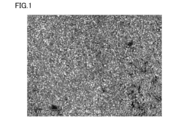
- FIG. 1 shows the sample No. It is an SEM image of the surface of the titanium-containing member of 1.
- the present disclosure has been made in view of the above circumstances, and an object of the present disclosure is to provide a method for manufacturing a titanium-containing member having excellent peel resistance.
- the method for manufacturing a titanium-containing member according to the present disclosure is as follows.
- the base material contains a metal element on its surface and has a metal element on its surface.
- the molten salt titanium plating solution composition contains fluoride ions and titanium (II) ions or titanium (III) ions.
- the titanium-containing member manufacturing method according to the present disclosure can manufacture a titanium-containing member having excellent peel resistance by providing the above-mentioned configuration.
- peeling resistance means the resistance of a titanium-plated film to peeling from a substrate.
- the ratio of the fluoride ions in the molten salt titanium plating solution composition is 0.1 mol% or more and 100 mol% or less based on the number of moles of all anions in the molten salt titanium plating solution composition.
- the "titanium plating film” means a film formed by plating (for example, electroless plating) and containing titanium as a constituent element.
- the proportion of titanium ions in the molten salt titanium plating solution composition is 0.1 mol% or more and 20 mol% or less based on the number of moles of all cations in the molten salt titanium plating solution composition.
- the temperature of the molten salt titanium plating solution composition is 500 ° C. or higher and 850 ° C. or lower.
- the molten salt titanium plating solution composition contains lithium fluoride, potassium fluoride, sodium fluoride or potassium hexafluorotitanium (IV) acid.
- the metal element contained in the surface of the base material is at least one selected from the group consisting of nickel, iron, copper, molybdenum, aluminum, boron, manganese, cobalt, gallium, silicon, platinum, tantalum and tungsten. including.
- the base material has a three-dimensional network shape. By defining in this way, it is possible to manufacture a titanium-containing member having excellent gas permeability or liquid permeability.
- the present embodiment hereinafter referred to as “the present embodiment”.
- the notation in the form of "A to Z” means the upper and lower limits of the range (that is, A or more and Z or less), and when the unit is not described in A and the unit is described only in Z, A The unit of and the unit of Z are the same.
- the method for manufacturing the titanium-containing member according to the present embodiment is A method for manufacturing a titanium-containing member including a base material and a titanium plating film provided on the base material.
- the base material contains a metal element on its surface and has a metal element on its surface.
- the molten salt titanium plating solution composition contains fluoride ions and titanium (II) ions or titanium (III) ions.
- the Roman numeral indicates the valence of the element immediately preceding the element.
- the titanium (II) ion means "Ti 2+ ".
- Titanium (III) ion means "Ti 3+ ".
- each step will be described.
- a base material is prepared.
- the base material contains a metal element on its surface.
- the surface contains a metal element means that the surface has a substance containing a metal element as a constituent element. Examples of the substance containing a metal element include simple substances of metals, alloys, ceramics and the like.
- the substance containing a metal element according to the present embodiment may have a melting point higher than the temperature of the molten salt titanium plating solution composition. When a substance having a melting point lower than the temperature of the molten salt titanium plating solution composition is used on the surface of the base material, in the "step of immersing the base material in the molten salt titanium plating solution composition and performing electroless plating" described later. , The surface of the base material tends to dissolve in the molten salt titanium plating solution composition.
- the base material may be, for example, a base material having a substance containing the metal element as a whole, or the surface of a base material precursor made of an insulator or the like is coated with the substance containing the metal element. It may be a base material.
- the metal elements contained on the surface of the base material include, for example, Ni (nickel), Fe (iron), Cu (copper), Mo (molybdenum), Al (aluminum), B (boron), Mn (manganese), and the like. It preferably contains at least one selected from the group consisting of Co (cobalt), Ga (gallium), Si (silicon), Pt (platinum), Ta (tantal) and W (tungsten).
- the metal element may consist of at least one selected from the group consisting of Ni, Fe, Cu, Mo, Al, B, Mn, Co, Ga, Si, Pt, Ta and W. More preferred. Boron is usually regarded as a metalloid exhibiting properties intermediate between metal elements and non-metal elements. However, in the present embodiment, the element having free electrons is regarded as a metal, and boron is included in the range of the metal element. Examples of the substance containing Fe include stainless steel (SUS304, SUS310S, SUS430, etc.).
- the shape of the base material is not particularly limited.
- a base material having various shapes such as a plate shape, a columnar shape, a pipe shape, a two-dimensional network shape, and a three-dimensional network shape can be adopted.
- the base material preferably has a three-dimensional network shape.
- the base material having a three-dimensional network shape include Celmet (registered trademark) manufactured by Sumitomo Electric Industries, Ltd.
- the prepared base material is immersed in a molten salt titanium plating solution composition (hereinafter, may be referred to as "plating solution composition") to perform electroless plating.
- a molten salt titanium plating solution composition hereinafter, may be referred to as "plating solution composition"
- the "molten salt titanium plating solution composition” means a molten salt composition used as a plating bath when performing electroless plating of titanium.
- the molten salt titanium plating solution composition contains fluoride ions and titanium (II) ions or titanium (III) ions.
- the source of titanium (II) ions is not particularly limited, and examples thereof include titanium dichloride (II).
- titanium (II) ion may be obtained by reducing the titanium (IV) ion in the plating solution composition by a leveling reaction represented by the following formula (1).
- the source of the titanium (IV) ion is not particularly limited, and is, for example, hexafluorotitanium (IV) acid (H 2 TiF 6 ), potassium hexafluorotitanium (IV) (K 2 TiF 6 ), and hexafluoro.
- Ammonium titanium (IV) acid ((NH 4 ) 2 TiF 6 ), sodium hexafluorotitanium (IV) (Na 2 TiF 6 ), titanium potassium oxalate dihydrate (K 2 thio (C 2 O 4 ) 2 ) -2H 2 O), titanium tetrachloride (IV) (TiCl 4 ) and the like.
- the shape of the Ti metal used in the above leveling reaction is not particularly limited, and examples thereof include a sponge shape and a powder shape.
- the amount of the Ti metal to be supplied may be an amount exceeding the minimum amount necessary for Ti 4+ in the plating solution composition to become Ti 2+ by the leveling reaction represented by the above formula (1).
- the "minimum required amount" of the Ti metal to be supplied means the number of moles equal to the number of moles of Ti 4+ in the plating solution composition.
- the source of titanium (III) ions is not particularly limited, but for example, titanium trichloride (III), lithium hexafluorotitanium (III) (Li 3 TiF 6 ), potassium hexafluorotitanium (III) (K). 3 TiF 6 ) and the like can be mentioned.
- the titanium (III) ion may be obtained by reducing the titanium (IV) ion in the plating solution composition by a leveling reaction represented by the following formula (2). 3Ti 4+ + Ti metal ⁇ 4Ti 3+ formula (2)
- the shape of the titanium (IV) ion source and the titanium metal is the same as the shape of the source and the titanium metal used in the leveling reaction represented by the above formula (1).
- the amount of the Ti metal to be supplied may be an amount exceeding the minimum amount necessary for Ti 4+ in the plating solution composition to become Ti 3+ by the leveling reaction represented by the above formula (2).
- the "minimum required amount" of the Ti metal to be supplied means the number of moles of 1/3 of the number of moles of Ti 4+ in the plating solution composition. To do.
- the ratio of titanium ions in the molten salt titanium plating solution composition is not particularly limited and can be appropriately set depending on the conditions for electroless plating.
- the ratio of the titanium ions is preferably 0.1 to 20 mol%, more preferably 0.2 to 12 mol%, based on the number of moles of all cations in the molten salt titanium plating solution composition.
- titanium ion means titanium (II) ion, titanium (III) ion, titanium (IV) ion or a combination thereof in the plating solution composition.
- the plating solution composition may contain cations other than titanium (II) ions and titanium (III) ions as long as the effects of the present embodiment are not impaired.
- cations other than titanium (II) ion and titanium (III) ion include titanium (IV) ion, lithium ion, sodium ion, potassium ion and the like.
- the source of fluoride ions is not particularly limited, but for example, lithium fluoride (LiF), potassium fluoride (KF), sodium fluoride (NaF), and potassium hexafluorotitanium (IV) (K 2 TiF). 6 ) and the like.
- the molten salt titanium plating solution composition preferably contains lithium fluoride, potassium fluoride, sodium fluoride or potassium hexafluorotitanium (IV) acid.
- the above-mentioned compound may be contained in the molten salt titanium plating solution composition in an ionized state, or may be contained in the molten salt titanium plating solution composition in a non-ionized state.
- the ratio of the fluoride ions in the molten salt titanium plating solution composition is preferably 0.1 to 100 mol% based on the number of moles of all anions in the molten salt titanium plating solution composition, and is preferably 2 to 98 mol. More preferably.
- examples of the anion in the molten salt titanium plating solution composition include chloride ion, bromide ion, iodide ion, and the like, in addition to fluoride ion.
- the molar ratio F ⁇ : Cl ⁇ of the fluoride ions to the chloride ions is 0.1: 99.9 to 1. : 99 is preferable, and 0.1: 99.9 to 2:98 is more preferable.
- the temperature of the plating solution composition is equal to or higher than the melting point of the plating solution composition, and the melting point of the substance containing the metal element contained in the surface of the base material.
- the following is preferable. More specifically, the temperature of the plating solution composition is more preferably 500 ° C. or higher and 850 ° C. or lower, and further preferably 500 ° C. or higher and 750 ° C. or lower.
- titanium metal is deposited on the surface of the base material by the reaction represented by the following formula (3) or the following formula (4).
- the reaction represented by the above formula (3) or the above formula (4) is carried out in the presence of fluoride ions. Therefore, the particle size of the Ti metal adhering to the base material is smaller than that in the absence of fluoride ions.
- the particle size of the Ti metal adhering to the base material is small (for example, 2 ⁇ m or less)
- the surface of the titanium plating film becomes smooth.
- the present inventors have stated that the small particle size of the Ti metal adhering to the base material increases the contact area between the base material and the titanium plating film and improves the adhesion between the base material and the titanium plating film. Is thinking.
- a Ti metal may be formed on the base material, or an alloy containing Ti and a metal element derived from the above-mentioned base material may be formed.
- the titanium plating film produced by electroless plating of titanium may contain a Ti metal or an alloy containing Ti and Ni.
- alloys containing Ti and Ni include TiNi 3 , TiNi and Ti 2 Ni.
- the composition of the titanium plating film can be analyzed by using, for example, EDX (Energy Dispersive X-ray Spectrometri) attached to SEM (Scanning Electron Microscope).
- the entire base material may be immersed in the molten salt titanium plating solution composition. Further, a part of the base material may be immersed in the molten salt titanium plating solution composition.
- immersion time is not particularly limited, but may be, for example, 10 minutes or more and 120 minutes or less. It may be 40 minutes or more and 100 minutes or less, or 60 minutes or more and 90 minutes or less. At this time, if the immersion time is long, an alloy containing the above-mentioned Ti and the metal element derived from the above-mentioned base material tends to be easily produced.
- the method for producing a titanium-containing member according to the present embodiment may further include other steps in addition to the steps described above. Examples of other steps include a step of cleaning the titanium-containing member, a step of drying the titanium-containing member after cleaning, and the like.
- a titanium plating film is formed on a base material by electroless plating. Therefore, it is not necessary to provide the energizing equipment required for electrolytic plating and the like. Further, since it is only necessary to immerse the base material in the molten salt titanium plating solution composition, even if the equipment for mass production is designed, it is possible to simplify and reduce the size.
- the titanium-containing member according to the present embodiment includes a base material and a titanium plating film provided on the base material.
- the titanium plating film preferably contains a Ti metal or an alloy containing Ti and a metal element derived from the base material.
- the median diameter (D50) of the Ti metal in the titanium plating film is preferably less than 2 ⁇ m, preferably 0.5 ⁇ m or more and 1.5 ⁇ m or less.
- the median diameter (D50) can be determined by surface observation by SEM.
- the base material those exemplified as the base material used in the above-mentioned manufacturing method can be used.
- the titanium-containing member having the above-mentioned structure can be manufactured by the above-mentioned manufacturing method.
- the titanium-containing member produced in this manner is a member having excellent peel resistance.
- the titanium-containing member is a member having a protective film having high hardness, high surface smoothness, and excellent corrosion resistance and wear resistance.
- it is a high-quality titanium-containing member with a small amount of residual impurities on the plating film. Therefore, it can be used in various fields such as electrolysis, electricity storage, and medical fields.
- (Appendix 1) A method for manufacturing a titanium-containing member including a base material and a titanium plating film provided on the base material. The process of preparing the base material and Including the step of immersing the base material in the molten salt titanium plating solution composition and performing electroless plating.
- the base material contains a metal element on its surface and contains a metal element.
- the molten salt titanium plating solution composition is a method for producing a titanium-containing member containing fluoride ions and titanium (II) ions or titanium (III) ions.
- (Appendix 2) The titanium content according to Appendix 1, wherein the ratio of fluoride ions in the molten salt titanium plating solution composition is 0.1 to 100 mol% based on the number of moles of all anions in the molten salt titanium plating solution composition. Manufacturing method of parts. (Appendix 3) The ratio of titanium ions in the molten salt titanium plating solution composition is 0.1 to 20 mol% based on the number of moles of all cations in the molten salt titanium plating solution composition, according to Appendix 1 or Appendix 2. A method for manufacturing a titanium-containing member.
- Appendix 4 The method for producing a titanium-containing member according to any one of Appendix 1 to Appendix 3, wherein the molten salt titanium plating solution composition has a temperature of 500 ° C. or higher and 850 ° C. or lower.
- Appendix 5 The method for producing a titanium-containing member according to any one of Appendix 1 to Appendix 4, wherein the molten salt titanium plating solution composition contains lithium fluoride, potassium fluoride, sodium fluoride or potassium hexafluorotitanium (IV). ..
- a base material containing a metal element on the surface As a base material used for electroless plating of titanium, a metal plate made of Ni or SUS304 (30 mm square, thickness t0.5 mm) and a three-dimensional network-like metal porous body made of Ni (Ni Celmet (registered trademark)) are prepared. did.
- molten salt titanium plating solution composition precursor molten salt titanium plating solution composition precursor
- sample No. In No. 1 LiF, LiCl and K 2 TiF 6 were mixed so that the mixing ratio of LiF and LiCl was 45:55 in molar ratio and the concentration of K 2 TiF 6 was 2 mol%.
- the obtained mixture was heated to 650 ° C. to prepare a molten salt plating bath (molten salt titanium plating solution composition precursor).
- the molten salt titanium plating solution composition comprises fluoride ions and titanium (II) ions or titanium (III) ions. including.
- Plating bath temperature Temperature immersion time shown in Table 1: Time shown in Table 1.
- sample No. The characteristics of the titanium-containing members 1 to 8 were evaluated.
- the sample No. 1-4, sample No. 6 and sample No. 8 corresponds to the embodiment.
- Sample No. 5 and sample No. 7 corresponds to a comparative example.
- the median diameter of the Ti metal particles on the surface of the titanium-containing member was less than 2 ⁇ m (FIG. 1). From the above, the sample No. It was confirmed that the titanium-containing member of No. 1 includes a base material and a titanium plating film provided on the base material. Sample No. In the case of 1, the base material is a Ni metal plate. Further, it is considered that the titanium plating film contains an alloy represented by TiNi 3 .
- sample No. 1-4 and sample No. The titanium-containing member of No. 6 is the sample No. 5 and sample No. It was suggested that the adhesion between the base material and the titanium plating film was stronger and the peel resistance was excellent as compared with the titanium-containing member of 7.
- sample No. Since the titanium-containing member of No. 8 is a porous body having a three-dimensional network structure, the above-mentioned peel resistance test has not been performed. Since it is manufactured under the same conditions as in No. 1, the sample No. The present inventors consider that it has the same peeling resistance as the titanium-containing member of 1.
Landscapes
- Chemical & Material Sciences (AREA)
- General Chemical & Material Sciences (AREA)
- Chemical Kinetics & Catalysis (AREA)
- Engineering & Computer Science (AREA)
- Materials Engineering (AREA)
- Mechanical Engineering (AREA)
- Metallurgy (AREA)
- Organic Chemistry (AREA)
- Chemically Coating (AREA)
Abstract
L'invention concerne un procédé de production d'un élément contenant du titane qui comprend un matériau de base et un film de placage de titane qui est disposé sur le matériau de base. Le procédé de production comprend une étape de préparation du matériau de base et une étape d'immersion du matériau de base dans une composition de solution de placage de titane de sel fondu et de réalisation d'un dépôt autocatalytique. Le matériau de base comprend un élément métallique au niveau de sa surface, et la composition de solution de placage de titane de sel fondu comprend des ions fluorure et des ions titane (II) ou des ions titane (III).
Priority Applications (1)
| Application Number | Priority Date | Filing Date | Title |
|---|---|---|---|
| JP2021515789A JPWO2020217603A1 (fr) | 2019-04-26 | 2020-01-17 |
Applications Claiming Priority (2)
| Application Number | Priority Date | Filing Date | Title |
|---|---|---|---|
| JP2019086081 | 2019-04-26 | ||
| JP2019-086081 | 2019-04-26 |
Publications (1)
| Publication Number | Publication Date |
|---|---|
| WO2020217603A1 true WO2020217603A1 (fr) | 2020-10-29 |
Family
ID=72942519
Family Applications (1)
| Application Number | Title | Priority Date | Filing Date |
|---|---|---|---|
| PCT/JP2020/001439 Ceased WO2020217603A1 (fr) | 2019-04-26 | 2020-01-17 | Procédé de production d'un élément contenant du titane |
Country Status (2)
| Country | Link |
|---|---|
| JP (1) | JPWO2020217603A1 (fr) |
| WO (1) | WO2020217603A1 (fr) |
Citations (4)
| Publication number | Priority date | Publication date | Assignee | Title |
|---|---|---|---|---|
| JPH0483810A (ja) * | 1990-07-25 | 1992-03-17 | Hitachi Ltd | 摺動部材 |
| JP2007063771A (ja) * | 2005-08-29 | 2007-03-15 | Panahome Corp | 建具 |
| WO2017159324A1 (fr) * | 2016-03-18 | 2017-09-21 | 住友電気工業株式会社 | Matériau conducteur et son procédé de production |
| WO2018216322A1 (fr) * | 2017-05-22 | 2018-11-29 | 住友電気工業株式会社 | Corps poreux métallique composite et procédé de production de corps poreux métallique composite |
-
2020
- 2020-01-17 WO PCT/JP2020/001439 patent/WO2020217603A1/fr not_active Ceased
- 2020-01-17 JP JP2021515789A patent/JPWO2020217603A1/ja active Pending
Patent Citations (4)
| Publication number | Priority date | Publication date | Assignee | Title |
|---|---|---|---|---|
| JPH0483810A (ja) * | 1990-07-25 | 1992-03-17 | Hitachi Ltd | 摺動部材 |
| JP2007063771A (ja) * | 2005-08-29 | 2007-03-15 | Panahome Corp | 建具 |
| WO2017159324A1 (fr) * | 2016-03-18 | 2017-09-21 | 住友電気工業株式会社 | Matériau conducteur et son procédé de production |
| WO2018216322A1 (fr) * | 2017-05-22 | 2018-11-29 | 住友電気工業株式会社 | Corps poreux métallique composite et procédé de production de corps poreux métallique composite |
Non-Patent Citations (1)
| Title |
|---|
| KOURA, NOBUYUKI ET AL.: "TiC Coating on Steels from the Molten Salts Bath by Electroless Technique.", JOURNAL OF THE METAL FINISHING SOCIETY OF JAPAN.), vol. 29, no. 2, 1979, pages 94 - 96, XP055758388 * |
Also Published As
| Publication number | Publication date |
|---|---|
| JPWO2020217603A1 (fr) | 2020-10-29 |
Similar Documents
| Publication | Publication Date | Title |
|---|---|---|
| JP6960095B2 (ja) | 金属多孔体、不溶性陽極、燃料電池用電極、水素の製造装置、生体材料、および金属多孔体の製造方法 | |
| JP6487258B2 (ja) | 金属製基材の表面に多孔質層を形成する方法 | |
| WO2018216322A1 (fr) | Corps poreux métallique composite et procédé de production de corps poreux métallique composite | |
| Norikawa et al. | Electrodeposition of titanium in a water-soluble KF–KCl molten salt | |
| Zemanová et al. | Ni-W alloy coatings deposited from a citrate electrolyte | |
| JP6802255B2 (ja) | 導電性材料及びその製造方法 | |
| JP5065948B2 (ja) | 溶融塩反応浴を利用した合金粉末製造法 | |
| WO2018216319A1 (fr) | Procédé de production d'un élément plaqué de titane | |
| JP2017137551A (ja) | 溶融塩電解による金属チタン箔の製造方法 | |
| WO2020217603A1 (fr) | Procédé de production d'un élément contenant du titane | |
| CN110582594A (zh) | 熔融盐钛镀液组合物以及镀钛部件的制造方法 | |
| JP7086172B2 (ja) | チタンめっき部材の製造方法及びチタンめっき部材 | |
| Duhin et al. | Electroless plating of rhenium–nickel alloys | |
| JP2014082176A (ja) | 耐食導電材、耐食導電性皮膜および耐食導電部材 | |
| JP7575445B2 (ja) | チタンめっき用電解質及びチタンめっき用電解質を用いたチタンめっき部材の製造方法 | |
| RU2744087C1 (ru) | Электрохимический способ металлизации алмазных частиц | |
| TWI525225B (zh) | 鍍鉬電解質及形成含鉬鍍層方法 | |
| JP5544617B2 (ja) | 合金皮膜の無電解めっき方法およびめっき液 | |
| CN102041527A (zh) | 通过电铸在不使用有毒金属的情况下获得黄色金合金沉积物的方法 | |
| JP2018135570A (ja) | Sn系合金めっき鋼板及びSn系合金めっき鋼板の製造方法 | |
| KR101204509B1 (ko) | 티타늄 또는 지르코늄 치환형 질화 염욕 열처리 방법 | |
| JP7516903B2 (ja) | アルミニウム箔の製造方法 | |
| JPH09302495A (ja) | 鉄族元素合金皮膜のめっき方法 | |
| JP2018003072A (ja) | タングステン膜及びタングステン膜の製造方法 | |
| Liu et al. | The incorporation of Sn enhances the properties of electroless Ni-based coatings and their corrosion resistance |
Legal Events
| Date | Code | Title | Description |
|---|---|---|---|
| 121 | Ep: the epo has been informed by wipo that ep was designated in this application |
Ref document number: 20794713 Country of ref document: EP Kind code of ref document: A1 |
|
| ENP | Entry into the national phase |
Ref document number: 2021515789 Country of ref document: JP Kind code of ref document: A |
|
| NENP | Non-entry into the national phase |
Ref country code: DE |
|
| 122 | Ep: pct application non-entry in european phase |
Ref document number: 20794713 Country of ref document: EP Kind code of ref document: A1 |