WO2020225971A1 - 自動分析装置の前処理方法 - Google Patents
自動分析装置の前処理方法 Download PDFInfo
- Publication number
- WO2020225971A1 WO2020225971A1 PCT/JP2020/009996 JP2020009996W WO2020225971A1 WO 2020225971 A1 WO2020225971 A1 WO 2020225971A1 JP 2020009996 W JP2020009996 W JP 2020009996W WO 2020225971 A1 WO2020225971 A1 WO 2020225971A1
- Authority
- WO
- WIPO (PCT)
- Prior art keywords
- magnetic beads
- measured
- automatic analyzer
- magnetic
- pretreatment method
- Prior art date
- Legal status (The legal status is an assumption and is not a legal conclusion. Google has not performed a legal analysis and makes no representation as to the accuracy of the status listed.)
- Ceased
Links
Images


Classifications
-
- G—PHYSICS
- G01—MEASURING; TESTING
- G01N—INVESTIGATING OR ANALYSING MATERIALS BY DETERMINING THEIR CHEMICAL OR PHYSICAL PROPERTIES
- G01N35/00—Automatic analysis not limited to methods or materials provided for in any single one of groups G01N1/00 - G01N33/00; Handling materials therefor
- G01N35/0098—Automatic analysis not limited to methods or materials provided for in any single one of groups G01N1/00 - G01N33/00; Handling materials therefor involving analyte bound to insoluble magnetic carrier, e.g. using magnetic separation
-
- G—PHYSICS
- G01—MEASURING; TESTING
- G01N—INVESTIGATING OR ANALYSING MATERIALS BY DETERMINING THEIR CHEMICAL OR PHYSICAL PROPERTIES
- G01N27/00—Investigating or analysing materials by the use of electric, electrochemical, or magnetic means
- G01N27/72—Investigating or analysing materials by the use of electric, electrochemical, or magnetic means by investigating magnetic variables
- G01N27/74—Investigating or analysing materials by the use of electric, electrochemical, or magnetic means by investigating magnetic variables of fluids
- G01N27/745—Investigating or analysing materials by the use of electric, electrochemical, or magnetic means by investigating magnetic variables of fluids for detecting magnetic beads used in biochemical assays
-
- G—PHYSICS
- G01—MEASURING; TESTING
- G01N—INVESTIGATING OR ANALYSING MATERIALS BY DETERMINING THEIR CHEMICAL OR PHYSICAL PROPERTIES
- G01N33/00—Investigating or analysing materials by specific methods not covered by groups G01N1/00 - G01N31/00
- G01N33/48—Biological material, e.g. blood, urine; Haemocytometers
- G01N33/50—Chemical analysis of biological material, e.g. blood, urine; Testing involving biospecific ligand binding methods; Immunological testing
- G01N33/53—Immunoassay; Biospecific binding assay; Materials therefor
- G01N33/543—Immunoassay; Biospecific binding assay; Materials therefor with an insoluble carrier for immobilising immunochemicals
- G01N33/54313—Immunoassay; Biospecific binding assay; Materials therefor with an insoluble carrier for immobilising immunochemicals the carrier being characterised by its particulate form
- G01N33/54326—Magnetic particles
-
- G—PHYSICS
- G01—MEASURING; TESTING
- G01N—INVESTIGATING OR ANALYSING MATERIALS BY DETERMINING THEIR CHEMICAL OR PHYSICAL PROPERTIES
- G01N35/00—Automatic analysis not limited to methods or materials provided for in any single one of groups G01N1/00 - G01N33/00; Handling materials therefor
- G01N2035/00346—Heating or cooling arrangements
- G01N2035/00356—Holding samples at elevated temperature (incubation)
-
- G—PHYSICS
- G01—MEASURING; TESTING
- G01N—INVESTIGATING OR ANALYSING MATERIALS BY DETERMINING THEIR CHEMICAL OR PHYSICAL PROPERTIES
- G01N35/00—Automatic analysis not limited to methods or materials provided for in any single one of groups G01N1/00 - G01N33/00; Handling materials therefor
- G01N2035/00465—Separating and mixing arrangements
- G01N2035/00534—Mixing by a special element, e.g. stirrer
-
- G—PHYSICS
- G01—MEASURING; TESTING
- G01N—INVESTIGATING OR ANALYSING MATERIALS BY DETERMINING THEIR CHEMICAL OR PHYSICAL PROPERTIES
- G01N35/00—Automatic analysis not limited to methods or materials provided for in any single one of groups G01N1/00 - G01N33/00; Handling materials therefor
- G01N35/02—Automatic analysis not limited to methods or materials provided for in any single one of groups G01N1/00 - G01N33/00; Handling materials therefor using a plurality of sample containers moved by a conveyor system past one or more treatment or analysis stations
- G01N35/04—Details of the conveyor system
- G01N2035/0439—Rotary sample carriers, i.e. carousels
- G01N2035/0446—Combinations of the above
Definitions
- the present invention relates to a pretreatment method for an automatic analyzer that analyzes a sample.
- the automatic analyzer contributes to quick and efficient clinical examination work by automating a part of the examination procedure.
- a general automatic analyzer is provided with a dispensing mechanism for dispensing a predetermined amount of a solution such as a sample or a reagent into a reaction vessel, and a stirring mechanism for stirring the sample or the reagent in the reaction vessel.
- the immune system holds the substance to be measured by a carrier in which a functional group is bound to the surface of magnetic beads, and uses the electrochemical luminescence immunoassay (ECLIA), which is one of the immunoassays, with high accuracy and high sensitivity. Moreover, it enables wide-range inspection.
- ELIA electrochemical luminescence immunoassay
- the liquid chromatograph mass spectrometer (HPLC / MS) is a device that combines a liquid chromatograph and a mass spectrometer.
- Pretreatment is performed by inspection kits and methods, and is being tested for HPLC / MS. Verification of each inspection method is carried out under the responsibility of each inspection organization, and the inspection results are guaranteed.
- Patent Document 1 discloses an automatic analyzer that can perform a batch process from pretreatment to HPLC / MS fully automatically.
- the pretreatment step of a general immune system is a method in which a substance to be measured is bound to a functional group of a magnetic bead, the liquid is sent to a liquid feed flow path, magnetized in the flow path, and measured by electrochemical luminescence.
- ECLIA which is one of the methods used in the immune system, after reacting with an antigen using beads to which an antibody is bound, an antibody labeled with a ruthenium pyridine complex is secondarily reacted with the antigen, and ruthenium pyridine is subjected to an electrochemical reaction.
- This is a method for measuring the luminescence intensity of a complex, and uses one type of magnetic beads to which an antibody of one measurement target substance is bound.
- the fluorescent immunostaining method is a method in which magnetic beads having a primary antibody conjugated with a fluorescent dye bonded to the surface are bound to a substance to be measured, and a labeled secondary antibody against the primary antibody is bound to enhance the fluorescent signal. ..
- DNA microarray analysis is a method in which microbeads are bound to cDNA or rDNA, which are multiple fluorescently labeled nucleic acid templates, reacted with the target DNA, and the state of color development is observed with a scanner.
- Immune in situ hybridization is a method of observing the state of color development by binding a nucleic acid template in situ without extracting DNA or RNA.
- a solution containing an organic dye such as Cy3 or Cy5 or a dye such as an inorganic label such as a quantum dot is used. Even with the method using one type of magnetic beads, if a polyclonal antibody is conjugated to the surface of the magnetic beads instead of a monoclonal antibody with high specificity, one type of magnetic beads can be used for a plurality of substances to be measured. It is possible to combine.
- Patent Document 2 discloses an invention in which the above method is comprehensively implemented in a microreactor.
- solid-phase extraction is used to bind the substance to be measured to the filler, and then extraction is performed in multiple stages using a plurality of types of eluates. ..
- solid-phase extraction in which a C18 filler is encapsulated, there is a method of separating the substance to be measured and the contaminants using a plurality of eluates having different organic solvent concentrations.
- the substance to be measured is bound to the functional group of the magnetic beads, and after washing. , The elution solution is added in the magnetized state, and the solution in which only the substance to be measured is eluted is subjected to HPLC / MS.
- the pretreatment method using magnetic beads requires more steps than the general immune system, the treatment time is longer than that of the general immune system, and it is necessary to improve the throughput.
- Patent Document 2 does not disclose the method and timing of the elution step necessary for improving the throughput without deteriorating the inspection accuracy when a plurality of magnetic beads are used.
- An object of the present invention is a plurality of measurement targets in a pretreatment method of an automatic analyzer in which a substance to be measured is bound to magnetic beads for treatment, and a batch process from pretreatment to a liquid chromatograph mass spectrometer is performed fully automatically. It is to realize a pretreatment method of an automatic analyzer capable of pretreating a plurality of substances to be measured in a series of treatments by using a plurality of magnetic beads capable of binding substances.
- the present invention is configured as follows.
- magnetic beads are added to a sample containing a substance to be measured, the substance to be measured is bound to the magnetic beads, the magnetic beads are extracted from the sample, and the substance to be measured is separated from the magnetic beads by an eluent.
- a plurality of magnetic beads that bind to a plurality of types of substances to be measured are added to the sample, and the plurality of types of substances to be measured are separated from the magnetic beads by the eluent.
- a pretreatment method of an automatic analyzer in which a substance to be measured is bound to magnetic beads for treatment, and a batch process from pretreatment to a liquid chromatograph mass spectrometer is performed fully automatically.
- FIG. 5 is an explanatory diagram of an assay protocol when two types of magnetic beads are used for Example 2.
- FIG. It is a figure which shows the concept of the magnetic bead which has a plurality of functional groups in Example 3.
- FIG. It is a figure which shows the concept of the magnetic bead which has a plurality of functional groups in Example 3.
- FIG. It is a figure which shows the concept of the magnetic bead which has a plurality of functional groups in Example 3.
- FIG. It is a conceptual diagram which shows the amount ratio of the substance to be measured before and after the pretreatment when the magnetic beads having a plurality of functional groups in Example 3 are used.
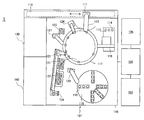
- FIG. 1 is a schematic view of an automatic analyzer that executes the pretreatment method according to the first embodiment of the present invention.
- the automatic analyzer 1 includes an analysis unit 101 for performing an analysis operation, a control unit 102 for controlling the operation of the entire device, and an input unit 103 for a user to input information to the device.
- a display unit 104 for displaying information to the user is provided.
- the input unit 103 and the display unit 104 may be the same, and an example thereof is a touch panel type monitor.
- the analysis unit 101 of the automatic analyzer 1 is composed of a pretreatment unit 110, an HPLC unit 130, and a detection unit 140.
- the analysis unit 101 is a reaction vessel equipped with a sample container transport mechanism 112 for transporting the sample container 111 containing the sample to the sample collection position, a sample dispensing mechanism 113 for discharging the sample, and a reaction vessel 114. It includes a mounting rack 115, a reaction vessel transport mechanism 116 for transporting the reaction vessel 114, and a reaction vessel disc 117 capable of holding a plurality of reaction vessels 114.
- the analysis unit 101 includes a reagent disk 119 for holding the measurement reagent container 118 containing the measurement reagent, a reagent dispensing mechanism 120 for discharging the measurement reagent to the reaction container 114, and a liquid contained in the reaction container 114.
- the reaction vessel 114 is conveyed between the stirring mechanism 121 for non-contact stirring, the first magnetic collecting mechanism 122 for collecting magnetic beads, the reaction vessel disk 117, the stirring mechanism 121, and the first magnetic collecting mechanism 122. It includes a first transfer mechanism 123 and a waste liquid dispensing mechanism 124 that dispenses waste liquid from the first magnetic collecting mechanism 122.
- the analysis unit 101 elutes a second magnetic collection mechanism 125 that collects magnetic beads, a second transfer mechanism 126 that conveys the reaction vessel 114 between the reaction vessel disc 117 and the second magnetic collection mechanism 125, and an elution. It is provided with an eluate dispensing mechanism 127 for introducing the liquid into the HPLC unit 130.
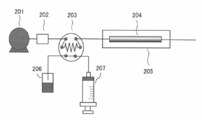
- FIG. 2 is a schematic configuration diagram of the HPLC unit 130.
- the HPLC unit 130 includes a pump 201 for sending a sample (pretreated eluate), a pressure sensor 202 for measuring system pressure, and a sample loop for measuring a sample (pretreated eluate). It is equipped with a 6-way 2-position injection valve 203 equipped with.
- the HPLC unit 130 introduces the column 204, the column oven 205 for controlling the temperature of the column 204, the sample vial 206 holding the sample (pretreated eluate), and the sample from the sample vial 206 into the sample loop. It is provided with a syringe 207.
- the HPLC unit 130 also includes a mechanism for adding a diluent to the sample vial 206 when the composition of the sample is changed so that the substance to be measured binds to the column 204.
- the detection unit 140 shown in FIG. 1 is equipped with a mass spectrometer.
- the mass spectrometer includes an ionization unit that is ionized by applying a high temperature and a high voltage to the solution containing the substance to be measured separated by the HPLC unit 130, and the substance to be measured according to the number of masses. It is equipped with a triple quadrupole mass spectrometer that separates contaminants. Using a triple quadrupole mass spectrometer, the component to be measured is measured in the SRM (Selected Reaction Monitoring) mode.
- SRM Select Reaction Monitoring
- the automatic analyzer 1 transports the reaction vessel 114 from the reaction vessel mounting rack 115 by the reaction vessel transport mechanism 116, and installs the reaction vessel 114 on the reaction vessel disc 117.
- the sample dispensing mechanism 113 sucks the sample from the sample container 111 transported by the sample container transport mechanism 112 and discharges the sample into the reaction vessel 114 on the reaction vessel disc 117.
- the sample dispensing mechanism 113 employs a dispensing mechanism in which the tip is not replaced, but the dispensing tip is attached to the tip at the dispensing tip attachment / detachment portion (not shown) prior to suctioning the sample. It may be a disposable dispensing mechanism. In the case of the disposable dispensing mechanism, the sample dispensing mechanism 113 discards the dispensing tip at the dispensing tip attachment / detachment portion when the sample dispensing from one sample container 111 is completed.
- the reaction vessel 114 from which the sample is dispensed on the reaction vessel disc 117 is conveyed to the stirring mechanism 121 by the first transfer mechanism 123. After stirring the sample in the reaction vessel 114, the reaction vessel 114 is returned to the reaction vessel disc 117 by the first transfer mechanism 123.
- the reagent dispensing mechanism 120 sucks the measuring reagent from the measuring reagent container 118 on the reagent disk 119 and discharges it into the reaction container 114.
- the operating location of the reagent dispensing mechanism 120 is a location where both the reaction vessel disk 117 and the stirring mechanism 121 can be accessed, and after the stirring mechanism 121 starts stirring the liquid contained in the reaction vessel 114, the stirring mechanism With the reaction vessel 114 held in 121, the discharge of the reagent is started.
- the stirring mechanism 121 stirs the liquid in the reaction vessel 114, for example, before the reagent dispensing mechanism 120 finishes discharging a predetermined amount of reagent to the reaction vessel 114. In this way, insoluble matter is less likely to be generated as compared with the case where the reagent dispensing mechanism 120 finishes discharging a large amount of reagent and then starts stirring the solution.
- the predetermined amount of reagent means a part of the reagent sucked from the measurement reagent container 118 by the reagent dispensing mechanism 120. Further, the reagent dispensing mechanism 120 may be operated at the same time as the stirring mechanism 121, or may be operated while the stirring mechanism 121 is stopped.
- the mixed solution of the sample and the reagent contained in the reaction vessel 114 is stirred by the stirring mechanism 121 to generate a flow.
- the reagent dispensing mechanism 120 may discharge the reagent to the reaction vessel 114 on the reaction vessel disc 117, and then the reagent is conveyed to the stirring mechanism 121 by the first transfer mechanism 123 and stirred.
- the reaction vessel 114 after the discharge of the reagent by the reagent dispensing mechanism 120 and the stirring by the stirring mechanism 121 is completed is re-installed on the reaction vessel disk 117 by the first transfer mechanism 123.
- the reaction vessel disc 117 functions, for example, as an incubator and incubates the retained reaction vessel 114 for a certain period of time.
- the magnetic beads are stored (contained) in the measurement reagent container 118, and are discharged to the test reaction container 114 using the reagent dispensing mechanism 120.
- the substance to be measured in the sample binds to the magnetic beads.
- the reaction vessel 114 is conveyed to the first magnetic collection mechanism 122 by the first transfer mechanism 123, and the magnetic beads are adsorbed on the side surface of the reaction vessel 114.
- the waste liquid dispensing mechanism 124 is equipped with two shippers and has a mechanism capable of sucking / discharging waste liquid and discharging cleaning liquid.
- the waste liquid dispensing mechanism 124 moves to the first magnetic collecting mechanism 122, sucks the solution, and extracts the magnetic beads from the sample. Then, the waste liquid dispensing mechanism 124 moves to the waste liquid discharge position and discharges the waste liquid.
- the waste liquid dispensing mechanism 124 moves to the first magnetic collecting mechanism 122 and discharges the cleaning liquid into the reaction vessel 114.
- the reaction vessel 114 from which the cleaning liquid has been discharged is conveyed to the stirring mechanism 121 by the first transport mechanism 123 and stirred.
- the reaction vessel 114 is conveyed to the first magnetic collection mechanism 122 by the first transfer mechanism 123, and the cleaning liquid is sucked and discharged by the waste liquid dispensing mechanism 124.
- the waste liquid is sucked and discharged and the cleaning liquid is discharged a plurality of times.
- the stirring mechanism 121 and the first magnetic collecting mechanism 122 are provided in two places in each mechanism, and a plurality of reaction vessels 114 can be washed in parallel at the same time.
- the reaction vessel 114 After cleaning the reaction vessel 114, the reaction vessel 114 is returned to the reaction vessel disc 117 by the first transfer mechanism 123.
- the magnetic beads after washing are held in the reaction vessel 114.
- the reagent dispensing mechanism 120 discharges the eluate stored in the reagent container 118 into the reaction vessel 114, and separates the substance to be measured from the magnetic beads. Then, the reaction vessel 114 is transferred to the stirring mechanism 121 by the first transfer mechanism 123, stirred, and then returned to the reaction vessel disc 117 for incubation.
- the eluate depends on the type of magnetic beads.
- the reaction vessel 114 after incubation is conveyed to the second magnetic collection mechanism 125 by the second transfer mechanism 126, and the magnetic beads are adsorbed on the side surface of the reaction vessel 114.
- the dispensing mechanism 127 for the detection unit sucks the eluate in the reaction vessel 114 and conveys it to the HPLC unit 130.
- FIGS. 3A, 3B, 4A, 4B and 4C are explanatory views of the operation of the injection valve 203.
- the injection valve 203 can be set to position 2 (the position where the sample loop is separated from the sample vial 206 and the syringe 207), and the sample can be taken into the HPLC unit 130.
- sample can be taken into the HPLC unit 130 by the method shown in FIGS. 4A, 4B, and 4C.
- the sample is pulled to the syringe side at position 2 of the injection valve 203 (the position where the sample vial 206-syringe 207 is connected).
- the injection valve 203 is switched to position 1 (the position where the sample vial 206-sample loop-syringe 207 is connected) and pushed into the sample loop by the syringe pump 207.
- the injection valve 203 can be set to position 2, and the sample can be taken into the HPLC unit 130.
- the solution containing the substance to be measured separated by the HPLC unit 130 is introduced into the detection unit 140.
- the detection unit 140 is equipped with a mass spectrometer, and the solution is ionized in the ionization unit and introduced into a triple quadrupole mass spectrometer for measurement.
- the ratio of the area values is acquired, and the sample concentration is calculated using a calibration curve prepared from a sample having a known concentration.
- the mass spectrometer other types of mass spectrometers such as a quadrupole mass spectrometer and an ion trap mass spectrometer can also be used.
- the detection unit 140 does not have to be a mass spectrometer, and may be a DAD (Diode Array Detecor), a UV detector, gas chromatography, NMR or the like.
- first magnetic bead magnetic beads whose surface is modified with an antibody as a functional group
- ODS octadecylsilyl group
- the assay protocol in the case of magnetic beads (second magnetic beads) modified in (2) will be described.
- the first magnetic bead reacts with the substance to be measured before the second magnetic bead.
- ODS is a magnetic bead whose surface is modified with an octadecyl group by reacting porous silica gel with a silane coupling agent such as dimethyloctadecylsilane.
- a silane coupling agent such as dimethyloctadecylsilane.
- the substance to be measured in the sample is bound by a hydrophobic interaction and eluted with an organic solvent or the like.
- FIG. 5 is an explanatory diagram of an assay protocol when one type of magnetic beads (functional group: ODS beads) is used. A case where testosterone, which is one of the steroid hormones, is used as a measurement target substance will be described.
- the assay protocol requires a total of 51 cycles and 30.6 minutes. Therefore, the time per cycle is set to 36 seconds.
- one cycle is set to 36 seconds, but it may be longer or shorter than 36 seconds.
- the explanation for each cycle is described below.
- the treatment steps 501 to 511 are pretreatment steps when one type of magnetic beads is used.
- the treatment steps 501 to 509 can also be defined as pretreatment steps when one type of magnetic beads is used.
- cycle 1 treatment step 501
- the sample and the internal standard substance are added and stirred.
- cycle 2 (treatment step 502), reagent 1 is added and stirred.
- cycle 11 treatment step 504
- reagent 2 is added and stirred.
- cycle 51 (treatment step 511), the eluate is transferred to the HPLC section 130.
- the sample added in Cycle 1 was serum, and 100 ⁇ L was added.
- the sample does not have to be serum, and may be plasma, whole blood, urine, cell tissue, blood cells, or the like.
- 100 ⁇ L of 100 pg / mL testosterone-2,3,4-13C3 was added.
- the internal standard substance may be testosterone-D3.
- reagent 1 added in cycle 2 10 ⁇ L of a 0.1% formic acid aqueous solution, which is a reagent for adjusting pH, was added. Incubation was performed at 37 ° C.
- the reagent 2 added in cycle 11 is not used in Example 1, but is usually a second reagent for pH adjustment, a protein denaturing agent, or the like.
- the magnetic beads added in cycle 27 were stirred before the addition (the stirring mechanism for the magnetic beads is not shown), and then 100 ⁇ L was added.
- As the cleaning liquid added in cycles 43-45 100 ⁇ L of pure water was added.
- As the eluate added in cycle 46 50 ⁇ L of 80% methanol solution was added.
- FIG. 6 is an explanatory diagram of the assay protocol in the case of Example 1 when two types of magnetic beads (functional groups: ODS beads and antibody beads) are used.
- the case of measuring two kinds of substances to be measured, testosterone which is one kind of steroid hormone and gentamicin which is one kind of aminoglycoside antibacterial agent, will be described.
- the assay protocol requires a total of 74 cycles and 44.4 minutes. Therefore, the time per cycle is set to 36 seconds. In the first embodiment, one cycle is set to 36 seconds, but it may be longer than 36 seconds or shorter. The explanation for each cycle is described below.
- the treatment steps 601 to 616 are pretreatment steps when two types of magnetic beads are used. However, the treatment steps 601 to 611 and 614 can also be defined as pretreatment steps when two types of magnetic beads are used.
- cycle 1-2 treatment step 601
- the sample, the internal standard substance 1, and the internal standard substance 2 are added and stirred.
- Incubation is performed in cycles 13-27 (treatment step 605) (9.0 minutes).
- cycle 60-62 treatment step 610
- the cleaning liquid is added and stirred.
- cycle 63 (treatment step 611), the eluate 1 is added and stirred.
- Incubation is performed in cycles 64-67 (treatment step 612) (2.4 minutes).
- cycle 68 (treatment step 613), the eluate is transferred to the HPLC section 130.
- cycle 69 (treatment step 614), the eluate 2 is added and stirred.
- Incubation is performed in cycles 70-73 (treatment step 615) (2.4 minutes).
- cycle 74 (treatment step 616), the eluate is transferred to the HPLC section 130.
- the sample added in cycle 1-2 (treatment step 601) is 100 ⁇ L of serum, 1 ⁇ g / mL tobramycin is added as an internal standard for gentamicin, and 100 pg / mL testosterone-2, as an internal standard for testosterone. 100 ⁇ L of each of 3,4-13C3 was added.
- reagent 1 added in cycle 3 10 ⁇ L of a 0.1% formic acid aqueous solution, which is a reagent for pH adjustment, was used. Incubation was performed at 37 ° C.
- the reagent 2 added in cycle 12 (treatment step 604) is not used in Example 1, but is usually a second reagent for pH adjustment, a protein denaturing agent, or the like.
- the magnetic beads 1 added in cycle 28 are magnetic beads having an antibody that specifically binds to the structure of the aminoglycoside antibacterial agent as a functional group, and 1 ⁇ L was added.
- the magnetic bees 2 added in cycle 44 were magnetic beads having ODS as a functional group, and 100 ⁇ L was added.
- the cleaning liquid added in cycle 60-62 was pure water, and 100 ⁇ L was added.
- the eluate 1 added in cycle 63 was a 0.1% glycine-sodium solution (pH 10.0), which is a high pH solution, and 50 ⁇ L was added.
- the eluate for the magnetic beads 1 having an antibody as a functional group is limited depending on the type of the magnetic beads 2. In the first embodiment, since the magnetic beads 2 have magnetic beads having ODS as a functional group, a solvent having a high organic solvent cannot be used.
- glycine / sodium solution pH 10.0
- 100 mM glycine / hydrochloric acid solution pH 3.0
- 8 mol / L urea which is a denaturant
- 6 mol / L glycine hydrochloride You may use it.
- the eluate 2 added in cycle 69 was an 80% methanol solution, and 50 ⁇ L was added.
- two types of magnetic beads, ODS and antibody were used as the functional groups modified on the surface of the magnetic beads, but other modes may be used, for example, HILIC, normal phase, ion exchange, GPC (molecular weight fractionation). , SFC (supercritical fluid chromatography) may be used.
- This is appropriately selected depending on the physical properties of the two types of substances to be measured, but it is preferable to select magnetic beads having high adsorption specificity for each substance to be measured.
- magnetic beads in which the functional group in the normal phase mode is modified on the surface of the magnetic beads are used.
- Magnetic beads whose surface is modified with a functional group in reverse phase mode are used as the substance to be measured having high hydrophobicity.
- the magnetic beads 1 added in the cycle 28 (treatment step 606) and the magnetic beads 2 added in the cycle 44 (treatment step 608) have a high number of cycles in which the magnetic beads modified with a more specific functional group are used as the magnetic beads 1.
- Add with. Higher specificity is, for example, magnetic beads whose surface is modified by an antibody. The accuracy of reproducibility is improved by adding from magnetic beads with high specificity and treating the substance to be measured from the sample.
- the amount of magnetic beads added in cycle 28 (treatment step 606) and cycle 44 (treatment step 608) 1 ⁇ L of magnetic beads 1 and 100 ⁇ L of magnetic beads 2 were added in this Example 1, but the addition amount was contained in the sample. It can be appropriately changed depending on the amount ratio of the substance to be measured. For example, when the first measurement target substance is on the order of several pg / mL and the second measurement target substance is on the order of several ⁇ g / mL, the amount of magnetic beads added and the concentration of magnetic beads stored in the measurement reagent container 118 are determined. It can be adjusted to homogenize the concentration of each substance to be measured contained in the solution after the pretreatment.
- the concentration ratio of the substance to be measured contained in the solution after the pretreatment is high (for example, about 1000 times)
- the peaks after separation overlap in the HPLC section 130, and the substance to be measured is simultaneously introduced into the detection section 140 at the same time.
- the substance to be measured at a high concentration is preferentially ionized in the ionization section.
- the substance to be measured at a low concentration has low ionization efficiency and poor reproducibility. Therefore, the measurement accuracy can be improved by making the concentration ratios of the plurality of substances to be measured contained in the eluate after the pretreatment uniform.
- Example 1 of the present invention by using a plurality of types of magnetic beads that can be bound to a plurality of types of measurement target substances in one assay protocol, a plurality of measurement target substances can be subjected to a series of pretreatments. Preprocessing can be performed. In this case, the number of cycles per assay protocol increases, but since it is possible to process multiple types of substances to be measured, the number of tests per hour can be increased by performing pretreatment in parallel for each cycle. It can be increased and the throughput can be improved.
- the first embodiment it is set to 36 seconds (0.6 minutes) per cycle. Therefore, if one type of magnetic beads is used, one assay protocol has 51 cycles, which requires 30.6 minutes.
- the amount of sample used in one assay protocol is the same, the amount of sample per substance to be measured that can be processed is about half, and the amount of sample can be saved.
- an automatic analyzer capable of pretreating a plurality of measurement target substances in a series of treatments using a plurality of magnetic beads capable of binding a plurality of measurement target substances. Preprocessing method can be realized.
- Example 2 Next, Example 2 of the present invention will be described.
- the pretreatment method according to the second embodiment is also executed by the automatic analyzer shown in FIG.
- FIG. 7 is an explanatory view of Example 2, in which two types of magnetic beads (functional group: antibody bead type (both the first magnetic bead and the second magnetic bead are surface-modified with an antibody as a functional group). )) Is an explanatory diagram of the assay protocol when () is used.
- PTH is a factor that regulates the metabolism of calcium and phosphoric acid in the blood, and is a substance that contributes to thyroid disease and cancer.
- Vitamin D is a factor that regulates the metabolism of calcium in the blood and is a substance that contributes to cancer, diabetes, etc. in addition to osteoporosis.
- Example 2 antibody beads capable of selectively supplementing PTH and antibody beads capable of selectively supplementing vitamin D3 are used.
- the assay protocol requires a total of 53 cycles, 31.8 minutes.
- the time per cycle is set to 36 seconds. In the second embodiment, one cycle is set to 36 seconds, but it may be longer than 36 seconds or shorter.
- the explanation for each cycle is described below.
- the treatment steps 701 to 711 are pretreatment steps when the two types of magnetic beads in Example 2 are used. However, the treatment steps 701 to 709 can also be defined as the pretreatment step when the two types of magnetic beads in Example 2 are used.
- cycle 1-2 treatment step 701
- the sample, the internal standard substance 1, and the internal standard substance 2 are added and stirred.
- cycle 3 treatment step 702
- reagent 1 is added and stirred.
- cycle 12 treatment step 704
- reagent 2 is added and stirred.
- Incubation is performed in cycles 13-27 (treatment step 705) (9.0 minutes).
- the sample added in cycle 1-2 was serum, and 100 ⁇ L was added.
- 1 ⁇ g / mL 15N-labeled PTH was used as the internal standard substance for PTH, and 100 pg / mL 25-OH vitamin D3-d6 was used as the internal standard substance for 25-OH vitamin D3, and 100 ⁇ L was added to each. did.
- treatment step 702 As the reagent 1 added in cycle 3 (treatment step 702), 10 ⁇ L of a 0.1% formic acid aqueous solution, which is a reagent for adjusting pH, was added. Incubation in steps 703, 705, 707, 710 was performed at 37 ° C.
- Reagent 2 added in cycle 12 is not used in Example 2, but is usually a second reagent for pH adjustment, a protein denaturing agent, or the like.
- the magnetic beads 1 added in cycle 28 are magnetic beads having an antibody that specifically binds to PTH as a functional group, and 50 ⁇ L was added.
- the magnetic beads 2 added in cycle 29 are magnetic beads having an antibody that specifically binds to 25-OH vitamin D3 as a functional group, and 50 ⁇ L was added.
- the cleaning liquid added in cycles 45-47 was pure water, and 100 ⁇ L was added.
- the eluate 1 added in cycle 48 was a 0.1% glycine-sodium solution (pH 10.0), which is a high pH solution, and 50 ⁇ L was added.
- Example 1 Since the substance to be measured in Example 1 and the substance to be measured in Example 2 are different from each other, there are two types of magnetic beads, but the types of magnetic beads are different between Example 1 and Example 2. There is.
- Example 1 the magnetic beads 1 were added and stirred in step 606, and then incubated in the treatment step 607.
- the magnetic beads 2 were added and stirred in the treatment step 608, and then the treatment step. Incubation is performed at 609.
- Example 2 the magnetic beads 1 and the magnetic beads 2 were added in the treatment step 706, stirred, and then incubated in the treatment step 707.
- Example 1 since two kinds of eluates are used in Example 1, the eluate 1 is added and stirred in the treatment step 611, incubated in the treatment step 612, and the HPLC part of the eluate is used in the treatment step 613. Transfer to 130. Then, in the treatment step 614, the eluate 2 is added and stirred, in the treatment step 615, the incubation is performed, and in the treatment step 616, the eluate is transferred to the HPLC section 130.
- Example 2 since one kind of eluate is used, the eluate 1 is added and stirred in the treatment step 709, incubated in the treatment step 710, and in the treatment step 711. The eluate is being transferred to the HPLC section 130.
- Example 1 the assay protocol requires a total of 74 cycles, which requires 44.4 minutes.
- Example 2 the assay protocol requires 53 cycles in total, which requires 31.8 minutes.
- the processing time of Example 2 is shorter than the processing time of Example 1.
- the processing time can be further shortened.
- Example 3 of the present invention will be described.
- the pretreatment method according to the third embodiment is also executed by the automatic analyzer shown in FIG.
- Example 3 is an assay protocol when one type of magnetic beads is used. Although there is only one type of magnetic beads in Example 3, magnetic beads in which a plurality of functional groups are modified on the surface of the magnetic beads are used.
- 8A, 8B, and 8C are diagrams showing the concept of magnetic beads having a plurality of functional groups in Example 3.
- the magnetic beads used in Example 3 are obtained by modifying the magnetic beads 801 with antibody A802 (first antibody) and antibody B803 (second antibody), and the antibody A802 is used as the substance to be measured A804.
- the first type of measurement target substance specifically binds
- the measurement target substance B805 specifically binds to the antibody B803.
- Example 3 a case where PTH, which is one of the thyroid hormones, and 25-OH vitamin D3, which is one of the fat-soluble vitamins of the measurement target substance B805, are used as the measurement target substances in the measurement target substance A804 will be described.
- the surface of the magnetic beads 801 is modified with an antibody that specifically binds to PTH as antibody A802 and an antibody that specifically binds to 25-OH vitamin D3 as antibody B803.
- the blood concentration of PTH in healthy males is 10-65 pg / mL, and the blood concentration of 25-OH is 15-40 ng / mL, which is about 1000 times different.
- the amount ratio of the antibody A802 modified on the surface of the magnetic beads 801 is increased, for example, about 1000 times that of the antibody B803.
- the amount ratio of the antibody A802 modified on the surface of the magnetic beads 801 is determined by the blood concentration ratio of the substance A804 to be measured and the substance B805 to be measured. It may be less than B803.
- the amount ratio of the antibody A802 modified on the surface of the magnetic beads 801 may be the same as that of the antibody B803.
- FIG. 9 is a conceptual diagram showing the amount ratio of the substance to be measured before and after the pretreatment when the magnetic beads 801 having a plurality of functional groups in Example 3 are used.
- FIG. 9A shows a graph 901 showing the relationship between the substance to be measured and the blood (sample) concentration
- FIG. 9B shows the concentration relationship between the substance to be measured and the eluate after pretreatment.
- the graph 902 shown is shown.
- the measurement target substance A concentration 903 is lower than the measurement target substance B concentration 904 in the blood (sample).
- the concentration of the substance A to be measured 905 in the eluate and the elution can be equal to 906.
- the concentration ratios of the plurality of substances to be measured contained in the eluate after the pretreatment can be made uniform, and the measurement accuracy is improved. Will be done.
- the assay protocol in Example 3 carries out processing steps 501 to 511 when one type of magnetic beads is used.
- the one type of magnetic beads 801 used is modified with an antibody that binds to a plurality of types of measurement target substances, it is possible to process a plurality of types of measurement target substances. Since the throughput can be improved and the concentration ratios of a plurality of substances to be measured can be made uniform, the measurement accuracy can be improved.
- the processing steps 501 to 511 shown in FIG. 5 may be executed, and the processing steps 611 to 616 shown in FIG. 6 may be executed.
- the same effects as those of the first and second embodiments can be obtained, and as described above, the measurement accuracy can be improved.
- the magnetic beads 801 in which the surface of the magnetic beads is modified with two types of functional groups have been described, but the types of functional groups may be at least two types. Preferably, for example, there may be 3 types or 4 types.
- the one assay protocol is from the addition of the sample to the completion of the pretreatment and the introduction of the pretreated solution into the separation / detection step.
- One assay protocol consists of multiple cycles. The time of each cycle is the same, and the operation of each cycle is continuously performed to obtain one assay protocol.
- the amount of sample per substance to be inspected can be reduced.
- the amount of sample used in one assay protocol is the same, so that the amount of sample per testable substance to be measured can be small.
- the concentration of the substance to be measured in the eluate after pretreatment can be adjusted to improve the inspection accuracy.
- the amount of magnetic beads for each substance to be measured according to the content of a plurality of substances to be measured in the sample the content of the substance to be measured contained in the solution after the pretreatment can be adjusted. ..
- concentration of the magnetic beads stored in the measurement reagent container for the low-concentration measurement target substance is increased, and the concentration of the magnetic beads stored in the measurement reagent container for the high-concentration measurement target substance is decreased.
- concentration and addition amount of each magnetic bead are adjusted.
- the amount of the substance to be measured contained after the pretreatment can be made uniform, and the influence of the ionization efficiency at the MS ion source, which causes a large variation, can be reduced, so that the inspection accuracy is improved.
- a first magnetic bead that binds to the first type of measurement target substance and a second magnetic bead that binds to the second type of measurement target substance are contained in the sample.
- the concentration or addition amount of the first magnetic bead and the second magnetic bead contained in the measurement reagent container 118 is adjusted according to the blood concentration ratio of the plurality of types of substances to be measured. You can also do it.
Landscapes
- Health & Medical Sciences (AREA)
- Immunology (AREA)
- Life Sciences & Earth Sciences (AREA)
- Chemical & Material Sciences (AREA)
- Analytical Chemistry (AREA)
- Physics & Mathematics (AREA)
- Pathology (AREA)
- Biochemistry (AREA)
- General Physics & Mathematics (AREA)
- General Health & Medical Sciences (AREA)
- Engineering & Computer Science (AREA)
- Urology & Nephrology (AREA)
- Molecular Biology (AREA)
- Hematology (AREA)
- Biomedical Technology (AREA)
- Cell Biology (AREA)
- Medicinal Chemistry (AREA)
- Food Science & Technology (AREA)
- Microbiology (AREA)
- Biotechnology (AREA)
- Chemical Kinetics & Catalysis (AREA)
- Electrochemistry (AREA)
- Investigating Or Analysing Biological Materials (AREA)
- Sampling And Sample Adjustment (AREA)
- Automatic Analysis And Handling Materials Therefor (AREA)
- Other Investigation Or Analysis Of Materials By Electrical Means (AREA)
Abstract
Description
図1は、本発明の実施例1による前処理方法を実行する自動分析装置の概略図である。
次に、本発明の実施例2について説明する。なお、実施例2による前処理方法も、図1に示した自動分析装置により実行される。
次に、本発明の実施例3について説明する。なお、実施例3による前処理方法も、図1に示した自動分析装置により実行される。
Claims (11)
- 測定対象物質を含む試料に磁性ビーズを添加し、前記磁性ビーズに前記測定対象物質を結合させ、前記磁性ビーズを前記試料から摘出し、前記磁性ビーズから前記測定対象物質を溶出液によって分離する自動分析装置の前処理方法において、
前記試料に、複数種類の測定対象物質と結合する複数の磁性ビーズを添加し、
前記溶出液により、前記磁性ビーズから前記複数種類の測定対象物質を分離する、
ことを特徴とする自動分析装置の前処理方法。 - 請求項1に記載の自動分析装置の前処理方法において、
前記複数の磁性ビーズは、前記複数種類の測定対象物質のうちのいずれかの種類の測定対象物質と結合する複数種類の磁性ビーズであることを特徴とする自動分析装置の前処理方法。 - 請求項2に記載の自動分析装置の前処理方法において、
前記磁性ビーズの種類に応じた溶出液により、前記磁性ビーズから前記いずれかの種類の測定対象物質を前記磁性ビーズから分離することを特徴とする自動分析装置の前処理方法。 - 請求項1に記載の自動分析装置の前処理方法において、
前記複数の磁性ビーズのそれぞれは、前記複数種類の測定対象物質のいずれとも結合する磁性ビーズであることを特徴とする自動分析装置の前処理方法。 - 請求項2に記載の自動分析装置の前処理方法において、
前記複数種類の磁性ビーズは、第1の磁性ビーズと第2の磁性ビーズを有し、前記第1の磁性ビーズは、官能基として抗体が表面に修飾された磁性ビーズであり、第2の磁性ビーズは、逆相モードの官能基が表面に修飾された磁性ビーズであることを特徴とする自動分析装置の前処理方法。 - 請求項5に記載の自動分析装置の前処理方法において、
前記第1の磁性ビーズが第2の磁性ビーズより先に測定対象物質と反応することを特徴とする自動分析装置の前処理方法。 - 請求項2に記載の自動分析装置の前処理方法において、
前記複数種類の磁性ビーズは、第1の磁性ビーズと第2の磁性ビーズを有し、前記第1の磁性ビーズ及び前記第2の磁性ビーズは、官能基として抗体が表面に修飾された磁性ビーズであることを特徴とする自動分析装置の前処理方法。 - 請求項4に記載の自動分析装置の前処理方法において、
前記複数種類の磁性ビーズのそれぞれには、第1の種類の測定対象物質と結合する第1の抗体と、第2の種類の測定対象物質と結合する第2の抗体とが修飾されていることを特徴とする自動分析装置の前処理方法。 - 請求項8に記載の自動分析装置の前処理方法において、
前記試料中に含まれる前記複数種類の測定対象物質の血中濃度比に応じて、前記第1の抗体と前記第2の抗体との量比を調整することを特徴とする自動分析装置の前処理方法。 - 請求項2に記載の自動分析装置の前処理方法において、
前記複数種類の磁性ビーズは、測定試薬容器に収容され、
前記複数種類の磁性ビーズは、
第1の種類の測定対象物質と結合する第1の磁性ビーズと、第2の種類の測定対象物質と結合する第2の磁性ビーズとを有し、
前記試料中に含まれる前記複数種類の測定対象物質の血中濃度比に応じて、前記測定試薬容器に収容された、前記第1の磁性ビーズと前記第2の磁性ビーズとの濃度を調整することを特徴とする自動分析装置の前処理方法。 - 請求項2に記載の自動分析装置の前処理方法において、
前記複数種類の磁性ビーズは、測定試薬容器に収容され、
前記複数種類の磁性ビーズは、
第1の種類の測定対象物質と結合する第1の磁性ビーズと、第2の種類の測定対象物質と結合する第2の磁性ビーズとを有し、
前記試料中に含まれる前記複数種類の測定対象物質の血中濃度比に応じて、前記測定試薬容器に収容された、前記第1の磁性ビーズと前記第2の磁性ビーズとの添加量を調整することを特徴とする自動分析装置の前処理方法。
Priority Applications (4)
| Application Number | Priority Date | Filing Date | Title |
|---|---|---|---|
| EP20802846.4A EP3968029B1 (en) | 2019-05-08 | 2020-03-09 | Automatic analysis device pretreatment method |
| US17/601,469 US12422446B2 (en) | 2019-05-08 | 2020-03-09 | Pretreatment method of an automatic analyzer |
| CN202080032039.5A CN113785204B (zh) | 2019-05-08 | 2020-03-09 | 自动分析装置的预处理方法 |
| JP2021518307A JP7520824B2 (ja) | 2019-05-08 | 2020-03-09 | 自動分析装置の前処理方法 |
Applications Claiming Priority (2)
| Application Number | Priority Date | Filing Date | Title |
|---|---|---|---|
| JP2019088019 | 2019-05-08 | ||
| JP2019-088019 | 2019-05-08 |
Publications (1)
| Publication Number | Publication Date |
|---|---|
| WO2020225971A1 true WO2020225971A1 (ja) | 2020-11-12 |
Family
ID=73051365
Family Applications (1)
| Application Number | Title | Priority Date | Filing Date |
|---|---|---|---|
| PCT/JP2020/009996 Ceased WO2020225971A1 (ja) | 2019-05-08 | 2020-03-09 | 自動分析装置の前処理方法 |
Country Status (5)
| Country | Link |
|---|---|
| US (1) | US12422446B2 (ja) |
| EP (1) | EP3968029B1 (ja) |
| JP (1) | JP7520824B2 (ja) |
| CN (1) | CN113785204B (ja) |
| WO (1) | WO2020225971A1 (ja) |
Cited By (1)
| Publication number | Priority date | Publication date | Assignee | Title |
|---|---|---|---|---|
| WO2024101257A1 (ja) * | 2022-11-08 | 2024-05-16 | 株式会社日立ハイテク | 自動分析装置 |
Families Citing this family (2)
| Publication number | Priority date | Publication date | Assignee | Title |
|---|---|---|---|---|
| CN115569623B (zh) * | 2022-09-29 | 2025-02-11 | 安徽松羽生物系统工程有限公司 | 一种高效连续性磁珠母液制备装置 |
| CN117054574A (zh) * | 2023-08-08 | 2023-11-14 | 翊新诊断技术(苏州)有限公司 | 一种基于微流控囊袋技术的质谱样本前处理方法和应用 |
Citations (11)
| Publication number | Priority date | Publication date | Assignee | Title |
|---|---|---|---|---|
| JP2003527606A (ja) * | 2000-03-16 | 2003-09-16 | バイアコア アーベー | 表面結合リガンドから溶出された分析物を捕捉するための方法 |
| JP2004045395A (ja) * | 2002-05-22 | 2004-02-12 | Sysmex Corp | 免疫測定方法、免疫測定装置、及び免疫測定用試薬 |
| JP2004527732A (ja) * | 2001-02-01 | 2004-09-09 | マグネティック バイオソリューションズ スウェーデン エービー | 方法 |
| WO2005095969A1 (ja) * | 2004-03-30 | 2005-10-13 | Universal Bio Research Co., Ltd. | 反応性色素結合磁性粒子及びタンパク質分離精製法 |
| WO2006088192A1 (ja) * | 2005-02-21 | 2006-08-24 | The University Of Tokyo | 分析用担体及びそれを用いる測定方法 |
| JP2011504236A (ja) * | 2007-11-20 | 2011-02-03 | スリーエム イノベイティブ プロパティズ カンパニー | ジアセチレンを含むポリマーセンサーを用いる細菌試料の分析方法 |
| WO2014077400A1 (ja) * | 2012-11-16 | 2014-05-22 | ユニバーサル・バイオ・リサーチ株式会社 | 直動型反応処理装置およびその方法 |
| US9236236B2 (en) | 2010-10-29 | 2016-01-12 | Thermo Fisher Scientific Oy | System layout for an automated system for sample preparation and analysis |
| JP2016090570A (ja) * | 2014-11-04 | 2016-05-23 | 三洋化成工業株式会社 | 磁性シリカ粒子を用いた対象物質の分離方法 |
| JP2018046848A (ja) | 2006-01-11 | 2018-03-29 | レインダンス テクノロジーズ, インコーポレイテッド | ナノリアクターの形成および制御において使用するマイクロ流体デバイスおよび方法 |
| JP2019049455A (ja) * | 2017-09-08 | 2019-03-28 | 東芝テック株式会社 | 試料調製装置及び試料調製方法 |
Family Cites Families (10)
| Publication number | Priority date | Publication date | Assignee | Title |
|---|---|---|---|---|
| US6027945A (en) * | 1997-01-21 | 2000-02-22 | Promega Corporation | Methods of isolating biological target materials using silica magnetic particles |
| US20040132044A1 (en) * | 2001-05-07 | 2004-07-08 | Menachem Ritterband | Magnetic beads and uses thereof |
| DE60308259T2 (de) | 2002-05-22 | 2007-04-05 | Sysmex Corp. | Immunologische Verfahren, Vorrichtungen und Reagenzien |
| AU2006299414A1 (en) * | 2005-09-30 | 2007-04-12 | Caliper Life Sciences, Inc. | Microfluidic device for purifying a biological component using magnetic beads |
| WO2015025378A1 (ja) | 2013-08-21 | 2015-02-26 | 株式会社日立製作所 | 試料分析方法及び試料分析装置 |
| CN106574934B (zh) | 2014-07-07 | 2019-01-04 | 株式会社日立高新技术 | 分析装置以及分析方法 |
| CN107850581B (zh) | 2015-12-29 | 2021-01-05 | 株式会社爱思迪科学 | 含有浓度显著不同的多种成分的试样的分析预处理方法 |
| CN106198963A (zh) | 2016-08-31 | 2016-12-07 | 上海美吉生物医药科技有限公司 | 一种用于捕获白细胞的免疫磁珠及其制备方法 |
| CN110959185B (zh) | 2017-05-22 | 2023-06-30 | 拜克门寇尔特公司 | 具有多种检测能力的集成样品处理系统 |
| CN108333357A (zh) * | 2018-02-09 | 2018-07-27 | 广州源起健康科技有限公司 | 一种磁珠时间分辨荧光免疫定量检测ck-mb试剂盒 |
-
2020
- 2020-03-09 EP EP20802846.4A patent/EP3968029B1/en active Active
- 2020-03-09 US US17/601,469 patent/US12422446B2/en active Active
- 2020-03-09 WO PCT/JP2020/009996 patent/WO2020225971A1/ja not_active Ceased
- 2020-03-09 JP JP2021518307A patent/JP7520824B2/ja active Active
- 2020-03-09 CN CN202080032039.5A patent/CN113785204B/zh active Active
Patent Citations (11)
| Publication number | Priority date | Publication date | Assignee | Title |
|---|---|---|---|---|
| JP2003527606A (ja) * | 2000-03-16 | 2003-09-16 | バイアコア アーベー | 表面結合リガンドから溶出された分析物を捕捉するための方法 |
| JP2004527732A (ja) * | 2001-02-01 | 2004-09-09 | マグネティック バイオソリューションズ スウェーデン エービー | 方法 |
| JP2004045395A (ja) * | 2002-05-22 | 2004-02-12 | Sysmex Corp | 免疫測定方法、免疫測定装置、及び免疫測定用試薬 |
| WO2005095969A1 (ja) * | 2004-03-30 | 2005-10-13 | Universal Bio Research Co., Ltd. | 反応性色素結合磁性粒子及びタンパク質分離精製法 |
| WO2006088192A1 (ja) * | 2005-02-21 | 2006-08-24 | The University Of Tokyo | 分析用担体及びそれを用いる測定方法 |
| JP2018046848A (ja) | 2006-01-11 | 2018-03-29 | レインダンス テクノロジーズ, インコーポレイテッド | ナノリアクターの形成および制御において使用するマイクロ流体デバイスおよび方法 |
| JP2011504236A (ja) * | 2007-11-20 | 2011-02-03 | スリーエム イノベイティブ プロパティズ カンパニー | ジアセチレンを含むポリマーセンサーを用いる細菌試料の分析方法 |
| US9236236B2 (en) | 2010-10-29 | 2016-01-12 | Thermo Fisher Scientific Oy | System layout for an automated system for sample preparation and analysis |
| WO2014077400A1 (ja) * | 2012-11-16 | 2014-05-22 | ユニバーサル・バイオ・リサーチ株式会社 | 直動型反応処理装置およびその方法 |
| JP2016090570A (ja) * | 2014-11-04 | 2016-05-23 | 三洋化成工業株式会社 | 磁性シリカ粒子を用いた対象物質の分離方法 |
| JP2019049455A (ja) * | 2017-09-08 | 2019-03-28 | 東芝テック株式会社 | 試料調製装置及び試料調製方法 |
Non-Patent Citations (1)
| Title |
|---|
| See also references of EP3968029A4 |
Cited By (1)
| Publication number | Priority date | Publication date | Assignee | Title |
|---|---|---|---|---|
| WO2024101257A1 (ja) * | 2022-11-08 | 2024-05-16 | 株式会社日立ハイテク | 自動分析装置 |
Also Published As
| Publication number | Publication date |
|---|---|
| JPWO2020225971A1 (ja) | 2020-11-12 |
| CN113785204B (zh) | 2024-10-15 |
| JP7520824B2 (ja) | 2024-07-23 |
| CN113785204A (zh) | 2021-12-10 |
| EP3968029A1 (en) | 2022-03-16 |
| US20220276270A1 (en) | 2022-09-01 |
| EP3968029A4 (en) | 2023-01-18 |
| EP3968029B1 (en) | 2025-05-21 |
| US12422446B2 (en) | 2025-09-23 |
Similar Documents
| Publication | Publication Date | Title |
|---|---|---|
| US20250027950A1 (en) | Integrated Sample Processing System with Multiple Detection Capability | |
| KR102658086B1 (ko) | 자동화된 임상 진단 시스템 및 방법 | |
| US9128070B2 (en) | Analysis device | |
| US8865418B2 (en) | Immunoanalytical method and system using mass spectrometry technology | |
| US10845278B2 (en) | Method and apparatus for automated analysis | |
| JP7520824B2 (ja) | 自動分析装置の前処理方法 | |
| EP2856142A1 (en) | Rapid and high-throughput analysis of sterols/stanols or derivatives thereof | |
| US10876939B2 (en) | Apparatus for automated analysis | |
| Wang et al. | Rapid LC-MS/MS detection of 25-hydroxyvitamin D in dried blood spots | |
| KR19980080723A (ko) | 액체시료 성분의 분리방법 및 그 방법에 사용하는 장치 | |
| EP1898215A1 (en) | Method of assaying endocrine substance in specimen | |
| CN119438466A (zh) | 特异性抗体免疫磁珠富集血清人胰岛素的质谱检测方法 | |
| US20210048377A1 (en) | System and Method for Automation of Sample Pretreatment Operations for Peptide Mapping | |
| CN114487185B (zh) | 一种胆固醇通路的分离鉴定方法 | |
| KR20210117268A (ko) | Lc-ms 기초된 hba1c 계측을 위한 고속 표본 작업 흐름 | |
| WO2025253138A1 (en) | Automated clinical analysis | |
| US20230333130A1 (en) | System and Method for Disposing of a Reaction Vessel of a Mass Spectrometry System | |
| JP2001099838A (ja) | 化学発光反応に基づく糖尿病診断のための多項目検査項目の同時測定方法 | |
| CN117890488A (zh) | 一种基于质谱的微量/单细胞样本n-糖肽分析方法 | |
| GB1598992A (en) | Automated immunoassay |
Legal Events
| Date | Code | Title | Description |
|---|---|---|---|
| 121 | Ep: the epo has been informed by wipo that ep was designated in this application |
Ref document number: 20802846 Country of ref document: EP Kind code of ref document: A1 |
|
| DPE2 | Request for preliminary examination filed before expiration of 19th month from priority date (pct application filed from 20040101) | ||
| ENP | Entry into the national phase |
Ref document number: 2021518307 Country of ref document: JP Kind code of ref document: A |
|
| NENP | Non-entry into the national phase |
Ref country code: DE |
|
| ENP | Entry into the national phase |
Ref document number: 2020802846 Country of ref document: EP Effective date: 20211208 |
|
| WWG | Wipo information: grant in national office |
Ref document number: 2020802846 Country of ref document: EP |
|
| WWG | Wipo information: grant in national office |
Ref document number: 17601469 Country of ref document: US |