WO2020230600A1 - 薬剤用添加剤 - Google Patents
薬剤用添加剤 Download PDFInfo
- Publication number
- WO2020230600A1 WO2020230600A1 PCT/JP2020/017902 JP2020017902W WO2020230600A1 WO 2020230600 A1 WO2020230600 A1 WO 2020230600A1 JP 2020017902 W JP2020017902 W JP 2020017902W WO 2020230600 A1 WO2020230600 A1 WO 2020230600A1
- Authority
- WO
- WIPO (PCT)
- Prior art keywords
- polymer
- mass
- mol
- acid
- polymerization
- Prior art date
- Legal status (The legal status is an assumption and is not a legal conclusion. Google has not performed a legal analysis and makes no representation as to the accuracy of the status listed.)
- Ceased
Links
Classifications
-
- A—HUMAN NECESSITIES
- A61—MEDICAL OR VETERINARY SCIENCE; HYGIENE
- A61K—PREPARATIONS FOR MEDICAL, DENTAL OR TOILETRY PURPOSES
- A61K8/00—Cosmetics or similar toiletry preparations
- A61K8/18—Cosmetics or similar toiletry preparations characterised by the composition
- A61K8/72—Cosmetics or similar toiletry preparations characterised by the composition containing organic macromolecular compounds
- A61K8/81—Cosmetics or similar toiletry preparations characterised by the composition containing organic macromolecular compounds obtained by reactions involving only carbon-to-carbon unsaturated bonds
- A61K8/817—Compositions of homopolymers or copolymers of compounds having one or more unsaturated aliphatic radicals, each having only one carbon-to-carbon double bond, and at least one being terminated by a single or double bond to nitrogen or by a heterocyclic ring containing nitrogen; Compositions or derivatives of such polymers, e.g. vinylimidazol, vinylcaprolactame, allylamines (Polyquaternium 6)
- A61K8/8182—Copolymers of vinyl-pyrrolidones. Compositions of derivatives of such polymers
-
- A—HUMAN NECESSITIES
- A61—MEDICAL OR VETERINARY SCIENCE; HYGIENE
- A61K—PREPARATIONS FOR MEDICAL, DENTAL OR TOILETRY PURPOSES
- A61K8/00—Cosmetics or similar toiletry preparations
- A61K8/18—Cosmetics or similar toiletry preparations characterised by the composition
- A61K8/72—Cosmetics or similar toiletry preparations characterised by the composition containing organic macromolecular compounds
- A61K8/81—Cosmetics or similar toiletry preparations characterised by the composition containing organic macromolecular compounds obtained by reactions involving only carbon-to-carbon unsaturated bonds
- A61K8/817—Compositions of homopolymers or copolymers of compounds having one or more unsaturated aliphatic radicals, each having only one carbon-to-carbon double bond, and at least one being terminated by a single or double bond to nitrogen or by a heterocyclic ring containing nitrogen; Compositions or derivatives of such polymers, e.g. vinylimidazol, vinylcaprolactame, allylamines (Polyquaternium 6)
-
- A—HUMAN NECESSITIES
- A61—MEDICAL OR VETERINARY SCIENCE; HYGIENE
- A61Q—SPECIFIC USE OF COSMETICS OR SIMILAR TOILETRY PREPARATIONS
- A61Q19/00—Preparations for care of the skin
-
- C—CHEMISTRY; METALLURGY
- C08—ORGANIC MACROMOLECULAR COMPOUNDS; THEIR PREPARATION OR CHEMICAL WORKING-UP; COMPOSITIONS BASED THEREON
- C08F—MACROMOLECULAR COMPOUNDS OBTAINED BY REACTIONS ONLY INVOLVING CARBON-TO-CARBON UNSATURATED BONDS
- C08F26/00—Homopolymers and copolymers of compounds having one or more unsaturated aliphatic radicals, each having only one carbon-to-carbon double bond, and at least one being terminated by a single or double bond to nitrogen or by a heterocyclic ring containing nitrogen
- C08F26/06—Homopolymers and copolymers of compounds having one or more unsaturated aliphatic radicals, each having only one carbon-to-carbon double bond, and at least one being terminated by a single or double bond to nitrogen or by a heterocyclic ring containing nitrogen by a heterocyclic ring containing nitrogen
-
- A—HUMAN NECESSITIES
- A61—MEDICAL OR VETERINARY SCIENCE; HYGIENE
- A61K—PREPARATIONS FOR MEDICAL, DENTAL OR TOILETRY PURPOSES
- A61K2800/00—Properties of cosmetic compositions or active ingredients thereof or formulation aids used therein and process related aspects
- A61K2800/10—General cosmetic use
-
- A—HUMAN NECESSITIES
- A61—MEDICAL OR VETERINARY SCIENCE; HYGIENE
- A61K—PREPARATIONS FOR MEDICAL, DENTAL OR TOILETRY PURPOSES
- A61K2800/00—Properties of cosmetic compositions or active ingredients thereof or formulation aids used therein and process related aspects
- A61K2800/40—Chemical, physico-chemical or functional or structural properties of particular ingredients
- A61K2800/41—Particular ingredients further characterized by their size
- A61K2800/412—Microsized, i.e. having sizes between 0.1 and 100 microns
-
- A—HUMAN NECESSITIES
- A61—MEDICAL OR VETERINARY SCIENCE; HYGIENE
- A61K—PREPARATIONS FOR MEDICAL, DENTAL OR TOILETRY PURPOSES
- A61K2800/00—Properties of cosmetic compositions or active ingredients thereof or formulation aids used therein and process related aspects
- A61K2800/40—Chemical, physico-chemical or functional or structural properties of particular ingredients
- A61K2800/48—Thickener, Thickening system
-
- A—HUMAN NECESSITIES
- A61—MEDICAL OR VETERINARY SCIENCE; HYGIENE
- A61K—PREPARATIONS FOR MEDICAL, DENTAL OR TOILETRY PURPOSES
- A61K2800/00—Properties of cosmetic compositions or active ingredients thereof or formulation aids used therein and process related aspects
- A61K2800/40—Chemical, physico-chemical or functional or structural properties of particular ingredients
- A61K2800/52—Stabilizers
Definitions
- the present invention relates to pharmaceutical additives.
- Drugs exhibit various functions and are used in, for example, cosmetics, fragrances, air fresheners, deodorants, pharmaceuticals, insect repellents, insecticides, pesticides, etc. Such agents usually contain a functional component for exerting that function. However, some of these drugs have a low duration of various effects such as a cool sensation (low sustained release), and some have a poor feel.
- An object of the present invention is to provide a drug additive capable of improving the functions of various drugs.
- the pharmaceutical additive according to the embodiment of the present invention It contains a polymer (I) containing 50 mol% to 100 mol% of structural units derived from N-vinyllactam-based monomers with respect to 100 mol% of structural units derived from all monomers.
- the average particle size when dried at 100 ° C. for 1 hour under a reduced pressure of 0.02 MPa or less is 100 ⁇ m or less.
- the pharmaceutical additive according to the embodiment of the present invention has an average particle size of 180 ⁇ m or less when swollen with deionized water.
- the polymer (I) is a polymer obtained by precipitation polymerization.
- the above-mentioned pharmaceutical additive is a cosmetic additive.
- weight When the expression “weight” is used in this specification, it may be read as “mass” which is commonly used as an SI unit indicating weight.
- the pharmaceutical additive according to the embodiment of the present invention can be used for any suitable drug as long as the effect of the present invention is not impaired.
- suitable drugs include cosmetics, fragrances, air fresheners, deodorants, pharmaceuticals, insect repellents, insecticides, pesticides, and the like, and typical examples include cosmetics. That is, the pharmaceutical additive according to the embodiment of the present invention is typically a cosmetic additive.
- the drug may contain alcohol.
- the content of alcohol is preferably 30% by mass to 100% by mass, more preferably 50% by mass to 100% by mass, based on 100% by mass of the drug. It is more preferably 60% by mass to 100% by mass, and particularly preferably 70% by mass to 100% by mass.
- any appropriate alcohol can be adopted as long as the effect of the present invention is not impaired.
- the pharmaceutical additive contains a polymer (I) containing 50 mol% to 100 mol% of structural units derived from N-vinyllactam-based monomers with respect to 100 mol% of structural units derived from all monomers.
- the content ratio of the polymer (I) in the drug additive is preferably 50% by mass to 100% by mass with respect to 100% by mass of the drug additive in that the effect of the present invention can be more exhibited. , More preferably 70% by mass to 100% by mass, further preferably 90% by mass to 100% by mass, particularly preferably 95% by mass to 100% by mass, and most preferably substantially 100% by mass. is there.
- substantially means that the polymer (I) is positively provided with another component for exhibiting an effect other than the effect caused by the polymer (I), or the polymer (I). It means excluding the form that is positively used in combination with I). For example, the inclusion of impurities and the like that are unavoidably mixed in the manufacturing process is permitted as long as the effects of the present invention are not impaired.
- the polymer (I) contains 50 mol% to 100 mol% of structural units derived from N-vinyllactam-based monomers with respect to 100 mol% of structural units derived from all monomers, and more expresses the effects of the present invention. It is preferably contained in an amount of 60 mol% to 100 mol%, and more preferably 70 mol% to 100 mol%.
- the structural unit derived from the N-vinyllactam-based monomer contained in the polymer (I) may be only one type or two or more types.
- the N-vinyllactam-based monomer may be only one kind or two or more kinds.
- Typical examples of the structural unit derived from the N-vinyllactam-based monomer include the structural unit represented by the general formula (1).
- R represents a hydrogen atom or a methyl group.
- m represents an integer of 1 to 3.
- the structural unit derived from the monomer is a structural unit having the same structure as the structure formed by polymerizing the monomer.
- the structural unit derived from the monomer is not limited to the structural unit actually formed by polymerizing the monomer, and may have the same structure as the structure formed by polymerizing the monomer. For example, it is included in a structural unit derived from a monomer.
- a typical example of a monomer capable of forming a structural unit derived from an N-vinyllactam-based monomer is an N-vinyllactam-based monomer represented by the general formula (2).
- R represents a hydrogen atom or a methyl group.
- n represents an integer of 1 to 3.
- Examples of the monomer represented by the general formula (2) include N-vinylpyrrolidone, N-vinylpiperidone, and N-vinylcaprolactam.
- the monomer represented by the general formula (2) is preferably N-vinylpyrrolidone in that the effects of the present invention can be more exhibited.
- the polymer (I) may have a structural unit other than the structural unit derived from the N-vinyllactam-based monomer.
- Other structural units are structural units derived from other monomers other than N-vinyllactam-based monomers.
- the other structural units may be only one type or two or more types.
- the other monomers may be only one kind or two or more kinds.
- any suitable monomer can be adopted as long as it can be copolymerized with the N-vinyllactam-based monomer, as long as the effect of the present invention is not impaired.
- examples of such other monomers include, for example. 1) (Meta) acrylic acid esters such as methyl (meth) acrylate, ethyl (meth) acrylate, butyl (meth) acrylate, cyclohexyl (meth) acrylate; 2) Hydroxyethyl (meth) acrylate, hydroxypropyl (meth) acrylate, 3- (meth) allyloxy-1,2-dihydroxypropane, (meth) allyl alcohol, isoprenol, and hydroxyl groups thereof.
- the alkylene oxide having 1 to 20 carbon atoms is preferable, and the alkylene oxide having 1 to 4 carbon atoms is more preferable.
- the alkylene oxide at least one selected from the group consisting of ethylene oxide and propylene oxide is preferable from the viewpoint that the effects of the present invention can be more exhibited.
- the number of moles of the alkylene oxide added is preferably 0 to 50 mol, more preferably 0 to 20 mol, per 1 mol of the compound of 2) above.
- the other monomers are preferably 1) to 9), and more preferably 1 from the viewpoint of copolymerizability with N-vinyllactam-based monomers. ) -6).
- the content ratio of the structural units derived from other monomers in the polymer (I) is preferably 100 mol% of the structural units derived from all the monomers in that the effects of the present invention can be more exhibited. It is 0 mol% to 50 mol%, preferably 0 mol% to 40 mol%, and more preferably 0 mol% to 30 mol%.
- the polymer (I) preferably has a crosslinked structure.
- the effects of the present invention can be more exhibited.
- the crosslinked structure is selected from the group consisting of a structure derived from a crosslinking agent having at least two polymerizable double bond groups per molecule, and a structure formed by reacting the main chain or side chains of the polymer. At least one species.
- any suitable cross-linking agent can be adopted as long as the effect of the present invention is not impaired.
- examples of such a cross-linking agent include N, N'-methylenebis (meth) acrylamide, (poly) ethyleneglycoldi (meth) allyl, (poly) propyleneglycoldi (meth) allyl, and trimethylo.
- the remaining N-vinyllactam-based monomer and soluble component tend to decrease, so that the number of allyl groups is two or more. It is preferable to use the compound having. Specifically, pentaerythritol (di, tri, tetra) (meth) allyl ether, triallyl isocyanurate, triallyl phosphate, triallylamine, diallyl carbonate, 1,4-butylenebis (N-vinylamide) and (di, tri).
- Tetra, penta, hexa, hepta, octa) allyl sucrose is preferred, and pentaerythritol (di, tri, tetra) allyl ether and (di, tri, tetra, penta, hex, hepta, octa) allyl sucrose are more preferred.
- Pentaerythritol (di, tri, tetra) allyl ether and (di, tri, tetra, penta, hexa, hepta, octa) allyl sucrose are more safe and therefore crosslinks obtained by using such crosslinkers.
- the polymer can be more preferably used for cosmetic applications.
- the cross-linking agent may be only one type or two or more types.
- the content ratio of the structural unit derived from the crosslinker in the polymer (I) is derived from all the monomers in that the effect of the present invention can be more exhibited. It is preferably 0.001 mol% to 10 mol%, more preferably 0.005 mol% to 5 mol%, and further preferably 0.01 mol% to 5 mol% with respect to 100 mol% of the structural unit of. %, Particularly preferably 0.01 mol% to 1 mol%, and most preferably 0.05 mol% to 0.8 mol%.
- the cross-linking agent has a polymerizable double bond group, however, in the present specification, the cross-linking agent is not treated as a monomer for the purpose of clarifying the composition. That is, the cross-linking agent is not included in "all monomers".
- the pharmaceutical additive may contain a polymer other than the polymer (I).
- the content ratio of such other polymers is preferably 0% by mass to 50% by mass, more preferably 0% by mass, based on 100% by mass of the pharmaceutical additive, in that the effects of the present invention can be more exhibited. It is 0% by mass to 30% by mass, more preferably 0% by mass to 10% by mass, particularly preferably 0% by mass to 5% by mass, and most preferably substantially 0% by mass.
- the shape of the pharmaceutical additive is preferably particulate. That is, the pharmaceutical additive is preferably in the form of particles. Examples of the shape of the particles include spherical, cubic, rectangular, and amorphous.
- the chemical additive has an average particle size of 100 ⁇ m or less, preferably 80 ⁇ m or less, more preferably 60 ⁇ m or less, and even more preferably 60 ⁇ m or less when dried at 100 ° C. for 1 hour under a reduced pressure of 0.02 MPa or less. It is 40 ⁇ m or less, particularly preferably 30 ⁇ m or less, and most preferably 25 ⁇ m or less.
- the lower limit of the average particle size when dried at 100 ° C. for 1 hour under a reduced pressure of 0.02 MPa or less is practically 0.1 ⁇ m or more.
- the chemical additive can improve the functions of various chemicals when the average particle size when dried at 100 ° C. for 1 hour under a reduced pressure of 0.02 MPa or less is within the above range.
- the means for drying at 100 ° C. for 1 hour under a reduced pressure of 0.02 MPa or less is any drying as long as it is a means for giving conditions that allow drying at 100 ° C. for 1 hour under a reduced pressure of 0.02 MPa or less. It can also be used in devices and decompression devices.
- the average particle size when the pharmaceutical additive is dried at 100 ° C. for 1 hour under a reduced pressure of 0.02 MPa or less is typically a cumulative volume distribution of 50 measured by a laser diffraction type particle size distribution measuring device (dry type). % Value.
- the laser diffraction type particle size distribution measuring device dry type
- examples of the laser diffraction type particle size distribution measuring device include a model manufactured by Spectris Co., Ltd. Malvern Division: Master Sizar 3000, a model manufactured by HORIBA, Ltd .: Partica LA-950V2, and the like. It can be obtained by the method described in the examples of.
- the pharmaceutical additive When a pharmaceutical additive is added to cosmetics, etc., the pharmaceutical additive is in the form of swelling in a medium such as water.
- the average particle size of the swelled body of such a pharmaceutical additive is preferably 180 ⁇ m or less, more preferably 100 ⁇ m or less, as the average particle size of the swelled body when swollen with deionized water. ..
- the lower limit of the average particle size of the swollen body when swollen with deionized water is practically 0.1 ⁇ m or more.
- the average particle size of the swollen body when the chemical additive is swollen with deionized water is typically a cumulative 50% value of the volume distribution measured by a laser diffraction type particle size distribution measuring device (wet).
- a laser diffraction type particle size distribution measuring device (wet type) include a model manufactured by Spectris Co., Ltd. Malvern Division: Master Sizar 3000, a model manufactured by HORIBA, Ltd .: Partica LA-950V2, and the like, which will be described later. It can be obtained by the method described in the examples of.
- the pharmaceutical additive may contain any suitable other components as long as the effects of the present invention are not impaired. Good.
- the content ratio of such other components is preferably 0% by mass to 10% by mass, and more preferably 0, with respect to 100% by mass of the pharmaceutical additive, in that the effects of the present invention can be more exhibited. It is from mass% to 5% by mass, more preferably 0% by mass to 3% by mass, particularly preferably 0% by mass to 1% by mass, and most preferably substantially 0% by mass.
- the pharmaceutical additive according to the embodiment of the present invention can be produced by any suitable method as long as the effect of the present invention is not impaired.
- Such a production method preferably includes a step of polymerizing a monomer component as at least one of the raw materials for forming the polymer (I).
- the monomer component for forming the polymer (I) contains N-vinyllactam-based monomer in an amount of 50 to 100 mol%, preferably 60 mol% to 60 mol%, based on 100 mol% of the total monomer component. It contains 100 mol%, more preferably 70 mol% to 100 mol%.
- the N-vinyllactam-based monomer may be only one type or two or more types.
- the monomer component may have other monomers other than the N-vinyllactam-based monomer.
- the other monomers may be only one kind or two or more kinds.
- the monomer component is preferably 0 mol% to 50 mol%, preferably 0 mol% to 50 mol%, based on 100 mol% of the total monomer component, in that other monomers can more express the effects of the present invention. Is 0 mol% to 40 mol%, more preferably 0 mol% to 30 mol%.
- the polymer (I) preferably has a crosslinked structure in that the effects of the present invention can be more exhibited.
- the crosslinked structure is selected from the group consisting of a structure derived from a crosslinking agent having at least two polymerizable double-bonding groups per molecule, and a structure formed by reacting the main chain or side chains of the polymer. It is at least one kind, and can be constructed by at least one kind selected from the group consisting of using a cross-linking agent in the step of polymerizing the monomer component and cross-linking the polymer.
- the amount of the cross-linking agent used is preferably 0.001 mol% to 10 mol% with respect to 100 mol% of all monomer components in that the effects of the present invention can be more exhibited. It is more preferably 0.005 mol% to 5 mol%, further preferably 0.01 mol% to 5 mol%, particularly preferably 0.01 mol% to 1 mol%, and most preferably. It is 0.05 mol% to 0.8 mol%.
- the method for producing the polymer (I) preferably includes, as described above, a step of polymerizing a monomer component as at least one of the raw materials for forming the polymer (I).
- any suitable polymerization method can be adopted as long as the effect of the present invention is not impaired.
- Examples of such a polymerization method include a bulk polymerization method, a solution polymerization method, an emulsion polymerization method, a suspension polymerization method, and a precipitation polymerization method.
- the solution polymerization method and the precipitation polymerization method are preferable, and the precipitation polymerization method is more preferable, in that the effect of the present invention can be more exhibited.
- the precipitation polymerization method typically includes a dropping step of dropping a monomer component containing an N-vinyllactam-based monomer and a polymerization initiator separately into a reaction medium.
- the amount of the polymerization initiator in the initial reaction medium before the dropping step is preferably 30% by mass or less, more preferably 20% by mass or less, still more preferably 20% by mass or less, based on the total amount of the polymerization initiator used in the reaction. Is 10% by mass or less, and particularly preferably 0% by mass to 5% by mass.
- the polymerization initiator is dropped for a time longer than the dropping time of the monomer component to obtain a polymer as an agglomerate.
- the agglomerates preferably include a spherical object, and examples of the spherical object include a perfect spherical object, a substantially spherical object, a substantially elliptical object in a plan view, and the like.
- the precipitation polymerization method is a polymerization method in a polymerization system in which the monomer component is compatible with and dissolves in the polymerization solvent, but the produced polymer is not dissolved in the polymerization solvent.
- the produced polymer is precipitated (precipitated) as the polymerization reaction progresses.
- the precipitated polymer is swollen with a monomer component, and the polymerization reaction proceeds in the solvent and in the vicinity of the polymer, respectively.
- a polymerization initiator is used, and it is preferable that such a polymerization initiator is soluble in both the polymerization solvent and the monomer component.
- the dropping step as a method of separately dropping the monomer component containing the N-vinyllactam-based monomer and the polymerization initiator into the reaction medium, for example, an N-vinyllactam-based monomer is included.
- the monomer component and the polymerization initiator may be placed in separate dropping rotors and dropped separately in the reaction vessel containing the initial reaction medium.
- the monomer component containing the N-vinyllactam-based monomer and the polymerization initiator may be mixed solutions with a solvent, respectively.
- a solvent is used as the reaction medium.
- the solvent include hydrocarbon solvents such as heptane and cyclohexane.
- Examples of the initial reaction medium before the dropping step include a solvent or a solvent to which a polymerization initiator in the range shown above is added.
- the amount of the monomer component in the initial reaction medium is preferably 30% by mass or less, more preferably 20% by mass or less, still more preferably 10% by mass or less, based on the total amount of the monomer components. It is particularly preferably 0% by mass to 5% by mass.
- the dropping time of the monomer component into the initial reaction medium is preferably 0.5 hour to 10.0 hours. Further, the dropping time of the polymerization initiator into the initial reaction medium is preferably longer than the dropping time of the monomer component, and more preferably 1.0 hour to 20 hours.
- the dropping time of the polymerization initiator into the initial reaction medium is preferably 1.10 times to 3.00 times, more preferably 1.15 times to 2.50 times the dropping time of the monomer component. It is double, more preferably 1.20 to 2.00 times.
- the polymerization temperature when performing the precipitation polymerization method is preferably + 15 ° C. or higher and + 30 ° C. or lower with respect to the 10-hour half-life temperature of the polymerization initiator.
- the polymerization temperature is the temperature of the reaction solution while the monomer component is being added dropwise, and if it fluctuates during the reaction, it is set to a value between the maximum temperature and the minimum temperature.
- the 10-hour half-life temperature is a temperature at which the concentration of the polymerization initiator becomes 1/2 of the initial value 10 hours after the start of the reaction, and is generally used as a criterion for selecting the polymerization initiator.
- the starting radical concentration in the reaction system decreases with the passage of time, whereas when the polymerization initiator is added dropwise to the reaction solution at an appropriate temperature, the starting radical concentration becomes constant. It is maintained, the monomer consumption is stable, and the agglomeration of the polymer and the adhesion to the vessel wall / stirring blade can be suppressed.
- the polymerization initiator will be described later.
- the 10-hour half-life temperature of the polymerization initiator for example, a value published by the manufacturing manufacturer can be used.
- organic peroxide-based initiators for example, it has been published by Nichiyu Co., Ltd., 32.7 ° C for isobutyl peroxide, 36.5 ° C for cumylper-oxyneodecanoate, and di-n-propylper oxica.
- the 10-hour half-life temperature of the azo-based polymerization initiator is disclosed by, for example, Fujifilm Wako Pure Chemical Industries, Ltd., and 2,2-azobis (isobutyronitrile) is 65 ° C., 2,2'-azobis.
- any suitable polymerization initiator can be used as the polymerization initiator as long as the effect of the present invention is not impaired.
- examples of such a polymerization initiator include persulfates, hydrogen peroxide, organic peroxides, azo compounds and the like, and organic peroxides and azo compounds are preferable.
- a redox-type initiator that generates radicals by combining an oxidizing agent and a reducing agent can also be used.
- the polymerization initiator may be one kind or two or more kinds.
- organic peroxide examples include diisobutyl peroxide, cumylper oxyneodecanoate, di-n-propylper oxidica-bonate, diisopropylperoxydica-bonate, and di-sec-.
- azo compound examples include 2,2-azobis (isobutyronitrile), 2,2'-azobis (4-methoxy-2,4-dimethylvaleronitrile), and 2,2'-azobis (2,4-). Dimethylvaleronitrile), dimethyl-2,2'-azobis (2-methylpropionate), 2,2'-azobis (2-methylbutyronitrile), 1,1'-azobis (cyclohexane-1-carbonitrile) ), 2,2'-Azobis (N-butyl-2-methylpropionamide, dimethyl-1,1-azobis (1-cyclohexanecarboxylate)) and the like.
- the amount of the polymerization initiator used is preferably 0.01 g to 10 g, more preferably 0.05 g to 7 g, still more preferably, with respect to 1 mol of the total amount of the total monomer and the cross-linking agent. It is 0.1 g to 5 g.
- a reaction vessel made of any suitable material can be adopted as long as it can carry out the polymerization step.
- a reaction vessel made of a material such as stainless steel By carrying out the polymerization reaction using a reaction vessel made of such a material that easily transfers heat, the polymerization reaction proceeds sufficiently, and the content of unreacted monomers and cross-linking agents contained in the obtained polymer can be determined. Can be reduced. It is also preferable to use a reaction vessel made of a material that does not elute iron, such as polypropylene. By using a reaction vessel made of such a material, the content of iron contained in the obtained polymer can be reduced. ..
- any appropriate shape can be adopted as long as the effect of the present invention is not impaired.
- Examples of such a shape include a paddle type, a multi-stage paddle type, an inclined paddle type, an anchor type, a propeller type and a combination thereof, and a max blend type.
- a polymer containing a sphere in which very small primary particles are loosely aggregated can be preferably obtained.
- This spherical object has a weight superior to that of static electricity and airflow, and not only is it difficult for powder to scatter and is easy to handle, but it can also be crushed very easily. Therefore, an excellent effect that a special crusher is not required for crushing can be exhibited.
- the agglomerated spherical substance as described above is put into a solution, it quickly becomes primary particles and disperses, and a uniform dispersion liquid or gel-like substance can be obtained in a short time.
- the pulverized spherical substance to the solution, it can be quickly dispersed as primary particles, and a uniform dispersion liquid or gel-like substance can be obtained in a short time.
- the polymer obtained by the precipitation polymerization method is preferably a spherical product having a size of several hundred ⁇ m.
- the size of such a sphere is preferably more than 100 ⁇ m and 2000 ⁇ m, more preferably 200 ⁇ m to 1500 ⁇ m, and even more preferably 300 ⁇ m to 1000 ⁇ m.
- the polymer obtained by the precipitation polymerization method which is preferably a spherical product, is an aggregate of amorphous primary particles, and the particle size of such amorphous primary particles is preferably 2 ⁇ m or less, which is more preferable. Is 10 nm to 2000 nm, more preferably 20 nm to 1000 nm.
- any other appropriate step may be included as long as the effect of the present invention is not impaired.
- examples of such other steps include a drying step, a crushing step, a classification step, a granulation step, a post-crosslinking step, and the like.
- drying refers to an operation of increasing the solid content, and usually, the ratio of the solid content to the mass of the entire polymer may be increased as compared with that before drying.
- the drying may be carried out at the same time as a part of the polymerization, or the drying at the time of the polymerization and the drying after the polymerization may be used in combination.
- a drying step is provided in which the polymerization is dried using a drying device.
- the drying step is preferably carried out in a range of 80 ° C. to 250 ° C. for 50% or more of the total time of the drying step, and preferably substantially all the drying steps.
- the drying temperature is specified by the heat medium temperature, but if it cannot be specified by the heat medium temperature such as microwave, it is specified by the material temperature.
- any appropriate drying method can be adopted as long as the drying temperature is within the above range, as long as the effects of the present invention are not impaired. Examples of such a drying method include hot air drying, windless drying, vacuum drying, infrared drying, microwave drying and the like. Among these drying methods, it is preferable to use hot air drying and vacuum drying.
- the drying air volume is preferably 0.01 m / sec to 10 m / sec, more preferably 0.1 m / sec to 5 m / sec.
- the drying temperature range is more preferably 110 ° C. to 220 ° C., still more preferably 120 ° C. to 200 ° C. Further, the drying may be performed at a constant temperature or may be performed by changing the temperature, but it is preferable that substantially all the drying steps are performed within the above temperature range.
- the precipitation polymerization method it is preferable to provide a pulverization step in that the effects of the present invention can be more exhibited.
- the crushing step is preferably performed using a crusher.
- the pulverization step may be performed before, during, or after the drying step, and is preferably after the drying step.
- a polymer containing a spherical substance in which very small primary particles are loosely aggregated can be preferably obtained and can be pulverized very easily. Therefore, a special pulverizer for pulverization is performed. Can exhibit the excellent effect of not requiring. Therefore, as the crusher, a simple crusher can be adopted. Examples of such a crusher include a roll crusher such as a roll mill, a hammer crusher such as a hammer mill, an impact crusher, a cutter mill, a turbo grinder, a ball mill, a flash mill, and a jet mill. Be done. Among these, it is preferable to use a roll mill when the particle size distribution is more controlled.
- each crusher may be the same or different. It is also possible to use different types of crushers in combination.
- a classification step or a granulation step may be provided.
- a sieve having a specific opening may be used.
- any appropriate classifier can be adopted as long as the effect of the present invention is not impaired. Examples of such a classifier include a vibrating sieve (unbalanced weight drive type, resonance type, vibration motor type, electromagnetic type, circular vibration type, etc.) and an in-plane motion sieve (horizontal motion type, horizontal circle-). Linear motion type, three-dimensional circular motion type, etc.), movable net type sieve, forced stirring type sieve, net surface vibration type sieve, wind force sieve, sonic sieve, etc. can be mentioned.
- a solvent is preferably used.
- the solvent include at least one selected from the group consisting of water and alcohol.
- the alcohol include methyl alcohol, ethyl alcohol, isopropyl alcohol, n-butyl alcohol, diethylene glycol and the like.
- the concentration of the monomer component in the solution is preferably 20% by mass or more and 80% by mass or less. If the concentration of the monomer component in the solution is less than 20% by mass, it may be difficult to obtain a polymer, or even if it is obtained, it may be difficult to crush it after polymerization.
- the concentration of the monomer component in the solution exceeds 80% by mass, it becomes difficult to control the polymerization, and the residual monomer may increase.
- reaction conditions such as the reaction temperature and pressure in the polymerization reaction as long as the effects of the present invention are not impaired.
- the reaction temperature is preferably 20 to 150 ° C.
- the pressure in the reaction system is preferably normal pressure or reduced pressure.
- any appropriate means can be adopted as a means for initiating the polymerization of the monomer component as long as the effects of the present invention are not impaired.
- examples of such means include a method of adding a polymerization initiator, a method of irradiating UV, a method of applying heat, a method of irradiating light in the presence of a photoinitiator, and the like.
- any suitable polymerization initiator can be adopted as long as the effects of the present invention are not impaired.
- examples of such a polymerization initiator include peroxides such as hydrogen peroxide and t-butylhydropaoxide; 2- (carbamoylazo) isobutyronitrile, 2,2'-azobis (2-amidinopropane) 2 Hydrochloride, 2,2'-azobis (2-methyl-N-phenylprolion amidine) dihydrochloride, 2,2'-azobis [2- (N-allylamidino) propane] dihydrochloride, 2,2' -Azobisisobuty [2- (5-hydroxy-3,4,5,6-tetrahydropyrimidine-2-yl) propane] dihydrochloride, 2,2'-azobis [2- (2-imidazolin-2-yl) propane] ], 2,2'-azobis [2- (2-imidazolin-2-yl) propane] dihydrochloride, 2,2'-azobis [
- any appropriate amount can be used as long as the effect of the present invention is not impaired.
- the amount used is, for example, 0.002% by mass or more based on 100% by mass of the total of all the monomers (total of N-vinyllactam-based monomer and other monomers) and the cross-linking agent. It is preferably 15% by mass, more preferably 0.01% by mass to 5% by mass.
- a basic pH regulator may be used for the purpose of promoting the polymerization reaction and preventing the hydrolysis of the N-vinyllactam-based monomer.
- the addition of the basic pH adjuster can be carried out by any appropriate method as long as the effect of the present invention is not impaired. For example, it may be charged in the system from the initial stage of polymerization, or sequentially during the polymerization. It may be added.
- Specific examples of the basic pH adjuster include ammonia; aliphatic amines such as monoethanolamine, dietanolamine, and trietanolamine; aromatic amines such as aniline; sodium hydroxide, potassium hydroxide, and the like. Alkali metal hydroxides; and the like.
- the basic pH regulator may be only one type or two or more types.
- any appropriate amount can be used as long as the effect of the present invention is not impaired.
- a transition metal salt may be used for the purpose of promoting the polymerization reaction.
- Specific examples of the transition metal salt include carboxylates such as copper, iron, cobalt, and nickel, chlorides, and the like.
- the transition metal salt may be only one kind or two or more kinds.
- any appropriate amount can be used as long as the effect of the present invention is not impaired. As such a usage amount, 0.1 ppb to 20000 ppb is preferable with respect to the monomer component, and 1 ppb to 5000 ppb is more preferable.
- any other suitable additive may be used as long as the effect of the present invention is not impaired.
- examples of such other additives include chain transfer agents, buffers and the like.
- a cross-linked polymer may be obtained by a method of polymerizing a monomer component in the presence of a cross-linking agent, or a cross-linking treatment is performed after the monomer component is polymerized.
- a polymer may be obtained.
- a crosslinked polymer is obtained by a method of polymerizing a monomer component in the presence of a crosslinking agent. Examples of the method of cross-linking after polymerization include (i) irradiating the polymer with UV, ⁇ -rays, and electron beams, (ii) applying heat to the polymer to self-crosslink, and (iii) the polymer.
- a method of self-crosslinking by applying heat after containing a radical generator (iv) a method of containing a radically polymerizable crosslinking agent and a radical polymerization initiator in a polymer, and then heating and / or irradiating with light. And so on.
- any appropriate addition method can be adopted as the addition method of each charged component as long as the effect of the present invention is not impaired.
- Examples of such an addition method include a batch type and a continuous type.
- an N-vinyllactam-based monomer is used as a monomer component in the solution polymerization method
- an organic acid By adding an organic acid to the obtained polymer, the amount of residual N-vinyllactam-based monomer in the polymer can be reduced.
- any suitable organic acid can be adopted as long as the effects of the present invention are not impaired. Examples of such an organic acid include organic compounds having an acid group such as a carboxyl group, a sulfonic acid group, a phosphonic acid group, a sulfate group, and a phosphoric acid group.
- organic acids examples include malonic acid, oxalic acid, succinic acid, aspartic acid, citric acid, glutamic acid, fumaric acid, malic acid, maleic acid, phthalic acid, trimellitic acid, pyromellitic acid, propionic acid, and the like.
- the organic acid may be only one kind or two or more kinds.
- the amount of the organic acid used any appropriate amount can be adopted as long as the effect of the present invention is not impaired.
- the amount used is preferably 0.01% by mass to 5% by mass, more preferably 0.05, based on 100% by mass of the N-vinyllactam-based monomer charged in the reaction step. It is from mass% to 3% by mass, more preferably 0.1% by mass to 1% by mass.
- the amount of the organic acid (salt) can be reduced while reducing the amount of the residual N-vinyllactam-based monomer in the obtained polymer.
- the organic acid (salt) represents an organic acid and / or a salt of an organic acid, and the salt of an organic acid is a neutralized product of a base and an organic acid mainly added in a neutralization step described later.
- reaction time between the organic acid and the polymer any appropriate reaction time can be adopted as long as the effects of the present invention are not impaired.
- the reaction time is preferably 10 minutes to 3 hours, more preferably 30 minutes to 2 hours.
- the reaction time between the organic acid and the polymer should be 10 minutes or more.
- the organic acid can be sufficiently permeated by the polymer, and the amount of the residual N-vinyllactam-based monomer in the obtained polymer can be reduced more sufficiently.
- the reaction time between the organic acid and the polymer is preferably 3 hours or less.
- the solution polymerization method preferably includes a step of aging the polymer (aging step) after the polymerization reaction.
- aging step any appropriate temperature can be adopted as long as the effect of the present invention is not impaired.
- a temperature is preferably 70 ° C. to 150 ° C., and more preferably 80 ° C. to 100 ° C.
- the aging temperature is within the above range, the polymerization of the residual N-vinyllactam-based monomer can be promoted.
- any appropriate aging time can be adopted as the aging time in the aging step as long as the effect of the present invention is not impaired.
- the aging time is preferably 10 minutes to 5 hours, more preferably 30 minutes to 3 hours.
- the solution polymerization method includes a step of adding an organic acid
- the aging step is preferably carried out while crushing the polymer.
- the organic acid when the step of adding an organic acid is included, the organic acid is sufficiently permeated by the polymer by crushing, so that the residual N-vinyllactam-based monomer in the obtained polymer is obtained. The amount can be reduced more sufficiently.
- the polymer can be crushed by a commonly used method, and examples thereof include a method of crushing the polymer using a needle.
- a neutralization step after the organic acid addition step.
- a neutralization step it is preferable to add a base after reacting the organic acid with the polymer.
- bases include ammonia; aliphatic amines such as monoethanolamine, dietanolamine, and trietanolamine; aromatic amines such as aniline; hydroxides of alkali metals such as sodium hydroxide and potassium hydroxide. And so on.
- ammonia, aliphatic amines, and alkali metal hydroxides are preferable, and ammonia, monoethanolamine, dietanolamine, sodium hydroxide, and potassium hydroxide are more preferable.
- Such a base may be only one kind or two or more kinds.
- the solution polymerization method may include other steps.
- Other steps include, for example, a drying step, a crushing step, a classification step, a granulation step and the like.
- drying refers to an operation of increasing the solid content, and usually, the solid content may be increased as compared with that before drying, and the solid content is preferably 95% by mass or more, more preferably 96% by mass or more. Raise to.
- the upper limit of the solid content is ideally 100% by mass, and in reality, preferably 99% by mass. Drying and polymerization may be performed at the same time, or drying at the time of polymerization and drying after polymerization may be used in combination.
- the drying step is preferably performed after the step of adding the organic acid.
- the solid content of the polymer refers to a value measured by the method described in Examples.
- the temperature of the drying step is preferably 80 ° C. to 250 ° C. over 50% or more of the total time of the drying step, more preferably substantially 100% of the total time of the drying step.
- the temperature is 80 ° C to 250 ° C.
- the drying temperature range is preferably 80 ° C. to 250 ° C., more preferably 110 ° C. to 220 ° C., and even more preferably 120 ° C. to 200 ° C. Further, the drying may be performed at a constant temperature or may be performed by changing the temperature. By setting the temperature of the drying step in this way, various physical properties of the polymer can be further improved.
- the drying temperature may be specified by the heat medium temperature, and if it cannot be specified by the heat medium temperature, it may be specified by the material temperature.
- drying method in the drying step examples include hot air drying, no wind drying, vacuum drying, infrared drying, and microwave drying. Among these, it is more preferable to use hot air drying.
- the drying air volume is preferably 0.01 m / sec to 10 m / sec, more preferably 0.1 m / sec to 5 m / sec.
- the pulverization step may be performed before, during, or after the drying step.
- the pulverization step is preferably carried out after the drying step.
- composition containing pharmaceutical additives The pharmaceutical additive according to the embodiment of the present invention can be combined with a drug to form a pharmaceutical additive-containing composition. That is, the pharmaceutical additive-containing composition contains a drug and a pharmaceutical additive.
- any suitable drug can be adopted as long as the effect of the present invention is not impaired.
- examples of such agents include cosmetics, fragrances, air fresheners, deodorants, pharmaceuticals, insect repellents, insecticides, pesticides, and the like, and typical examples include cosmetics.
- the pharmaceutical additive according to the embodiment of the present invention exhibits the function improving effect of various drugs.
- Examples of such a function improving effect include continuation of the effect and improvement of the effect.
- any suitable drug can be adopted as long as the effect of the present invention is not impaired.
- examples of such agents include UV absorbers, antioxidants, preservatives / antibacterial agents, fragrances and the like.
- UV absorber examples include homomentyl salicylate, 2-cyano-3,3-diphenylprop-2-enoic acid 2-ethylhexyl ester (also known as octocrylene), glyceryl diparamethoxycinnamic acid mono-2-ethylhexanoate, and the like.
- antioxidants examples include dibutylhydroxytoluene (labeled name: BHT); butylated hydroxyanisole (labeled name: BHA), vitamin E such as ⁇ -tocopherol, and derivatives thereof; thiotaurine; mematsuyoigusa extract; ⁇ -carotene; catechin compound.
- BHT dibutylhydroxytoluene
- BHA butylated hydroxyanisole
- vitamin E such as ⁇ -tocopherol
- derivatives thereof thiotaurine
- mematsuyoigusa extract ⁇ -carotene
- catechin compound examples include flavonoid compounds; polyphenol compounds; and the like.
- the catechin compound can be used as a green tea extract or the like.
- antiseptic / antibacterial agents examples include parabens such as isopropylparaben and benzylparaben, benzoic acid, benzoate, alkyldiaminoethylglycine hydrochloride, photosensitizer, chlorcresol, chlorobutanol, salicylic acid, and salicylate.
- fragrance examples include terpenes and terpenoids such as citral, menthol, ginger, salvinolin A, cannabinoid, hinokithiol, limonene, farnesol and vitamin A; aromatic alcohols such as phenoxyethanol, phenols such as eugenol and ginger; butyric acid ester, Examples thereof include esters such as propionic acid esters; lactones such as ⁇ -nonalactone and ⁇ -undecalactone; aldehydes having 6 to 20 carbon atoms.
- terpenes and terpenoids such as citral, menthol, ginger, salvinolin A, cannabinoid, hinokithiol, limonene, farnesol and vitamin A
- aromatic alcohols such as phenoxyethanol, phenols such as eugenol and ginger
- butyric acid ester examples thereof include esters such as propionic acid esters; lactones such as ⁇ -nonalactone and ⁇ -
- the drug may be used as it is, or may be dissolved or dispersed in various solvents.
- the pharmaceutical additive-containing composition containing the pharmaceutical additive and the drug of the present invention can also be one of the present inventions.
- the chemical additive and the drug of the present invention may be only one kind or two or more kinds, respectively.
- the amount of the drug additive of the present invention to be used with respect to the drug is not particularly limited, but is preferably 0.001 part by mass to 100 parts by mass with respect to 1 part by mass of the drug. is there.
- Example 1 Cyclohexane: 100 g was initially charged in a flask having a capacity of 300 ml equipped with a stirrer (paddle blade type), a thermometer, a reflux condenser, and a nitrogen introduction tube, and heated in an oil bath at 85 ° C. under a nitrogen atmosphere.
- the dropping component 1 N-vinylpyrrolidone: 25 g, acrylic acid: 0.025 g, pentaerythritol triallyl ether: 0.05 g
- the dropping component 2 oil-soluble azo polymerization initiator
- V-65 manufactured by Fujifilm Wako Pure Chemical Industries, Ltd.
- heptane 40 g
- the reaction solution was filtered to recover the polymer precipitate, which was dried under reduced pressure at 125 ° C. for 1 hour to obtain a crosslinked product. Since the crosslinked body was obtained as a spherical object having an appropriate size, decantation and filtration were completed in a short time, and when handling the powder, the influence of air flow and static electricity was small, and the crosslinked body was easy to handle.
- the diameter was 2 ⁇ m. It is considered that the reason why the average particle size of the swollen material is smaller than the average particle size of the powder is that the powder absorbs water and swells, and at the same time, the agglomeration is loosened and approaches the primary particles.
- Example 2 The powder of the crosslinked product (2) as a fine and uniform powder is obtained by further finely pulverizing the particulate crosslinked product (C1) obtained in Comparative Example 1 described later with a target jet mill. The body was obtained. The solid content of the obtained crosslinked product (2) was 97%. The average particle size of the obtained crosslinked body (2) when dried at 100 ° C. for 1 hour under a reduced pressure of 0.01 MPa was 4 ⁇ m, and the average particles of the swollen body when swollen with deionized water. The diameter was 6 ⁇ m.
- the obtained crosslinked product was pulverized with a pulverizer until it passed through a JIS standard sieve having a mesh size of 500 ⁇ m to obtain a particulate crosslinked product (C1).
- the solid content of the obtained crosslinked product (C1) was 97%.
- the average particle size of the obtained crosslinked body (C1) when dried at 100 ° C. for 1 hour under a reduced pressure of 0.01 MPa was 320 ⁇ m, and the average particles of the swollen body when swollen with deionized water. The diameter was 195 ⁇ m.
- a human sensory evaluation was performed according to the following procedure.
- the prepared evaluation solution was filled in an eye drop container, 2 drops were dropped on the evaluation site, spread thinly by hand to check the application feel, and then the cool feeling was confirmed as it was.
- the evaluation site was first performed on the back of the hand, and if it was difficult to feel cool, it was changed to the inside of the forearm. Separate samples were applied to the right and left hands and compared which cool sensation persisted. The sample that felt cool for a longer time was compared with another sample to determine the sample that lasted the longest. The number of people was 10.
- Table 2 shows the evaluation results of the sustainability of the cool feeling
- Table 3 shows the evaluation results of the coating feeling.
- the sterilization test in vitro was carried out as follows. First, using the crosslinked product (1), the crosslinked product (C1), and phenoxyethanol (manufactured by Fujifilm Wako Pure Chemical Industries, Ltd.), 10 ml each of the compositions shown in Table 4 was prepared. In Table 4, PVP means polyvinylpyrrolidone and PE means phenoxyethanol. Next, Escherichia coli was cultured in Mueller-Hinton agar medium (manufactured by Fujifilm Wako Pure Chemical Industries, Ltd.) at 35 ° C. for 18 hours, the colonies that appeared were scraped off, and butterfield buffer (0.0425 g / L diphosphate) was used.
- potassium hydrogen buffer suspended in pH7.2 adjusted
- pH7.2 pH7.2
- 0.5 ml of this bacterial solution was added to the composition shown in Table 4 and mixed by inversion for about 10 seconds, and then incubated at 25 ° C. Sampling was performed from each composition after 1 hour, 24 hours, and 1 week, a dilution series was prepared using butterfield buffer, and the mixture was applied to Mueller-Hinton agar medium and cultured. The number of surviving bacteria was counted from the number of colonies that appeared.
- the strain used was Escherichia coli, Escherichia coli, NBRC-3972.
- the crosslinked body (1) alone, the crosslinked body (2) alone, and phenoxyethanol alone showed low bactericidal properties, but the crosslinked body (1) and phenoxyethanol were used in combination, and It was found that the combined use of the crosslinked product (2) and phenoxyethanol accelerated the decrease in the number of bacteria and showed a synergistic effect.
- the judgment in Table 4 is that the sample in which the number of bacteria decreased by 4 digits or more per week is ⁇ , the sample in which the number of 3 or 2 digits is decreased is ⁇ , and the sample in which the number of 1 digit is decreased is ⁇ . Those in which the number did not decrease were marked with x.
- the formulations (C1) and the crosslinked products (1) using the crosslinked products (C1) are also included. Compared with the formulation (C2) in which neither (2) nor (C1) was used, a uniform drug having an appropriate viscosity was obtained. Further, when the coating feel was confirmed, the formulations (1) and (2) using the cross-linking agents (1) and (2) were smooth, but the formulation (C1) using the cross-linking agent (C1) was smooth. There was a feeling of grain and it was not smooth. The viscosity was measured using a B-type viscometer (BM-2 type, rotor number 3, rotation speed 60 RPM, measurement time 60 seconds, measurement temperature 25 ° C.) manufactured by Toki Sangyo.
- BM-2 type, rotor number 3, rotation speed 60 RPM, measurement time 60 seconds, measurement temperature 25 ° C. manufactured by Toki Sangyo.
- the pharmaceutical additive of the present invention is suitably used for, for example, cosmetics, fragrances, air fresheners, deodorants, pharmaceuticals, insect repellents, insecticides, pesticides and the like.
Landscapes
- Health & Medical Sciences (AREA)
- Life Sciences & Earth Sciences (AREA)
- Veterinary Medicine (AREA)
- Public Health (AREA)
- General Health & Medical Sciences (AREA)
- Animal Behavior & Ethology (AREA)
- Chemical & Material Sciences (AREA)
- Epidemiology (AREA)
- Birds (AREA)
- Dermatology (AREA)
- Organic Chemistry (AREA)
- Polymers & Plastics (AREA)
- Medicinal Chemistry (AREA)
- Chemical Kinetics & Catalysis (AREA)
- Addition Polymer Or Copolymer, Post-Treatments, Or Chemical Modifications (AREA)
- Cosmetics (AREA)
- Acyclic And Carbocyclic Compounds In Medicinal Compositions (AREA)
- Medicinal Preparation (AREA)
Abstract
各種薬剤の機能を向上させ得る薬剤用添加剤を提供する。 本発明の実施形態による薬剤用添加剤は、N-ビニルラクタム系単量体由来の構造単位を全単量体由来の構造単位100モル%に対して50モル%~100モル%含む重合体(I)を含み、0.02MPa以下の減圧下において100℃で1時間乾燥したときの平均粒子径が100μm以下である。
Description
本発明は、薬剤用添加剤に関する。
薬剤は各種機能を発現し、例えば、化粧品、香料、芳香剤、消臭剤、医薬品、防虫剤、殺虫剤、農薬などに用いられる。このような薬剤は、通常、その機能を発現するための機能性成分を含む。しかし、このような薬剤には、涼感などの各種効果の持続性が低い(徐放性が低い)もの、感触が悪いもの、などが存在する。
最近、徐放性薬剤を吸収して用いる吸液能力に優れたゲル化剤であって、優れた徐放性をも付与できる徐放性薬剤用ゲル化剤が報告されている(特許文献1)。
本出願人は、各種薬剤の機能を向上させ得る新たな添加剤を開発するべく、鋭意検討を行った。その結果、特定の重合体を含み、特定の物性を有する添加剤が、各種薬剤の機能を向上させ得ることを見出し、本発明を完成させるに至った。
本発明の課題は、各種薬剤の機能を向上させ得る薬剤用添加剤を提供することにある。
本発明の実施形態による薬剤用添加剤は、
N-ビニルラクタム系単量体由来の構造単位を全単量体由来の構造単位100モル%に対して50モル%~100モル%含む重合体(I)を含み、
0.02MPa以下の減圧下において100℃で1時間乾燥したときの平均粒子径が100μm以下である。
N-ビニルラクタム系単量体由来の構造単位を全単量体由来の構造単位100モル%に対して50モル%~100モル%含む重合体(I)を含み、
0.02MPa以下の減圧下において100℃で1時間乾燥したときの平均粒子径が100μm以下である。
一つの実施形態においては、本発明の実施形態による薬剤用添加剤は、脱イオン水を用いて膨潤させたときの膨潤体の平均粒子径が180μm以下である。
一つの実施形態においては、上記重合体(I)が、沈殿重合によって得られる重合体である。
一つの実施形態においては、上記薬剤用添加剤は、化粧品用添加剤である。
本発明によれば、各種薬剤の機能を向上させ得る薬剤用添加剤を提供することができる。
本明細書中で「重量」との表現がある場合は、重さを示すSI系単位として慣用されている「質量」と読み替えてもよい。
≪薬剤用添加剤≫
本発明の実施形態による薬剤用添加剤は、本発明の効果を損なわない範囲で、任意の適切な薬剤に用い得る。このような薬剤としては、例えば、化粧品、香料、芳香剤、消臭剤、医薬品、防虫剤、殺虫剤、農薬などが挙げられ、代表的には、化粧品が挙げられる。すなわち、本発明の実施形態による薬剤用添加剤は、代表的には、化粧品用添加剤である。
本発明の実施形態による薬剤用添加剤は、本発明の効果を損なわない範囲で、任意の適切な薬剤に用い得る。このような薬剤としては、例えば、化粧品、香料、芳香剤、消臭剤、医薬品、防虫剤、殺虫剤、農薬などが挙げられ、代表的には、化粧品が挙げられる。すなわち、本発明の実施形態による薬剤用添加剤は、代表的には、化粧品用添加剤である。
薬剤は、アルコ-ルを含んでいてもよい。薬剤がアルコ-ルを含む場合、アルコ-ルの含有量としては、薬剤100質量%に対して、好ましくは30質量%~100質量%であり、より好ましくは50質量%~100質量%であり、さらに好ましくは60質量%~100質量%であり、特に好ましくは70質量%~100質量%である。アルコ-ルとしては、本発明の効果を損なわない範囲で、任意の適切なアルコ-ルを採用し得る。
薬剤用添加剤は、N-ビニルラクタム系単量体由来の構造単位を全単量体由来の構造単位100モル%に対して50モル%~100モル%含む重合体(I)を含む。
薬剤用添加剤中の重合体(I)の含有割合は、本発明の効果をより発現させ得る点で、薬剤用添加剤100質量%に対して、好ましくは50質量%~100質量%であり、より好ましくは70質量%~100質量%であり、さらに好ましくは90質量%~100質量%であり、特に好ましくは95質量%~100質量%であり、最も好ましくは実質的に100質量%である。
ここにいう「実質的に、」とは、重合体(I)に起因する効果以外の効果を発現させるための別の成分が、重合体(I)に積極的に備えられたり、重合体(I)と積極的に併用されたりする形態を除くことを意味し、例えば、本発明の効果を損なわない範囲で、製造過程などによって不可避に混入する不純物等の含有は許容される。
重合体(I)は、N-ビニルラクタム系単量体由来の構造単位を全単量体由来の構造単位100モル%に対して50モル%~100モル%含み、本発明の効果をより発現させ得る点で、好ましくは60モル%~100モル%含み、より好ましくは70モル%~100モル%含む。
重合体(I)に含まれるN-ビニルラクタム系単量体由来の構造単位は、1種のみであってもよいし、2種以上であってもよい。N-ビニルラクタム系単量体は、1種のみであってもよいし、2種以上であってもよい。
N-ビニルラクタム系単量体由来の構造単位としては、代表的には、一般式(1)で表される構造単位が挙げられる。

一般式(1)中、Rは、水素原子またはメチル基を表す。
一般式(1)中、mは、1~3の整数を表す。
なお、本明細書において、単量体由来の構造単位とは、単量体が重合して形成される構造と同じ構造を有する構造単位である。ただし、単量体由来の構造単位は、実際に単量体が重合して形成された構造単位には限定されず、単量体が重合して形成される構造と同じ構造を有していれば、単量体に由来する構造単位に含まれる。
N-ビニルラクタム系単量体由来の構造単位を形成させ得る単量体としては、代表的には、一般式(2)で表されるN-ビニルラクタム系単量体が挙げられる。
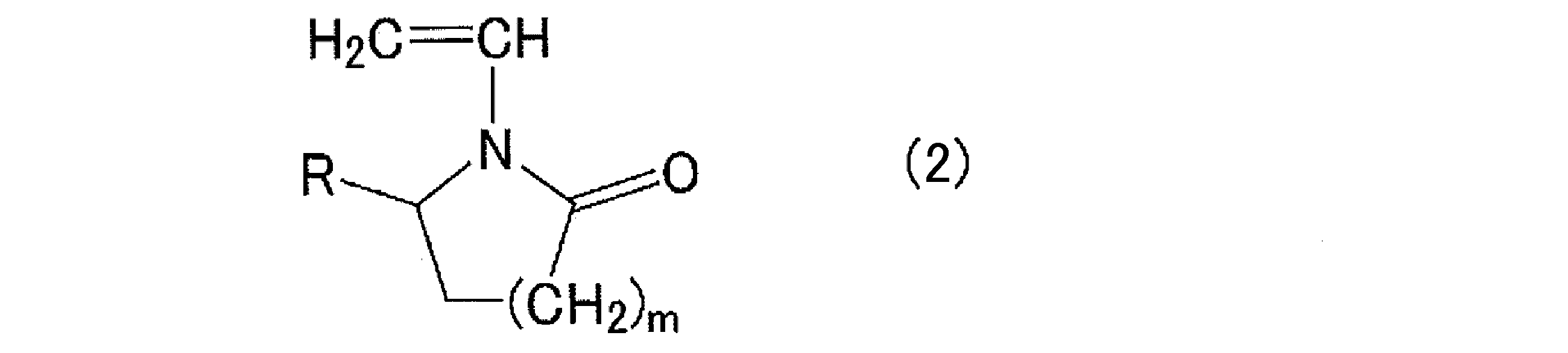
一般式(2)中、Rは、水素原子またはメチル基を表す。
一般式(2)中、mは、1~3の整数を表す。
一般式(2)で表される単量体としては、例えば、N-ビニルピロリドン、N-ビニルピペリドン、N-ビニルカプロラクタムなどが挙げられる。本発明の効果をより発現させ得る点で、一般式(2)で表される単量体としては、好ましくは、N-ビニルピロリドンである。
重合体(I)は、N-ビニルラクタム系単量体由来の構造単位以外のその他の構造単位を有していてもよい。その他の構造単位は、N-ビニルラクタム系単量体以外のその他の単量体由来の構造単位である。
その他の構造単位は、1種のみであってもよいし、2種以上であってもよい。その他の単量体は、1種のみであってもよいし、2種以上であってもよい。
その他の単量体としては、N-ビニルラクタム系単量体と共重合できるものであれば、本発明の効果を損なわない範囲で、任意の適切な単量体を採用し得る。このようなその他の単量体としては、例えば、
1)(メタ)アクリル酸メチル、(メタ)アクリル酸エチル、(メタ)アクリル酸ブチル、(メタ)アクリル酸シクロヘキシル等の(メタ)アクリル酸エステル類;
2)ヒドロキシエチル(メタ)アクリレ-ト、ヒドロキシプロピル(メタ)アクリレ-ト、3-(メタ)アリルオキシ-1,2-ジヒドロキシプロパン、(メタ)アリルアルコ-ル、イソプレノ-ル、およびこれらの水酸基にアルキレンオキシドを付加した不飽和アルコ-ル;
3)(メタ)アクリルアミド、N-モノメチル(メタ)アクリルアミド、N-モノエチル(メタ)アクリルアミド、N,N-ジメチル(メタ)アクリルアミド等の(メタ)アクリルアミド誘導体類;
4)(メタ)アクリル酸ジメチルアミノエチル、ジメチルアミノエチル(メタ)アクリルアミド、ビニルピリジン、ビニルイミダゾ-ル等の塩基性不飽和単量体、およびその塩または第4級化物;
5)ビニルホルムアミド、ビニルアセトアミド、ビニルオキサゾリドン等のビニルアミド類;
6)(メタ)アクリル酸、イタコン酸、マレイン酸、フマル酸等のカルボキシル基含有不飽和単量体、およびその塩;
7)無水マレイン酸、無水イタコン酸等の不飽和無水物類;
8)酢酸ビニル、プロピオン酸ビニル等のビニルエステル類;
9)ビニルエチレンカ-ボネ-ト、およびその誘導体;
10)スチレン、およびその誘導体;
11)(メタ)アクリル酸-2-スルホン酸エチル、およびその誘導体;
12)3-アリルオキシ-2-ヒドロキシプロパンスルホン酸、(メタ)アリルスルホン酸、イソプレンスルホン酸、およびこれらの塩等のビニルスルホン酸及びその誘導体;
13)メチルビニルエ-テル、エチルビニルエ-テル、ブチルビニルエ-テル等のビニルエ-テル類;
14)エチレン、プロピレン、オクテン、ブタジエン等のオレフィン類;
等などが挙げられる。
1)(メタ)アクリル酸メチル、(メタ)アクリル酸エチル、(メタ)アクリル酸ブチル、(メタ)アクリル酸シクロヘキシル等の(メタ)アクリル酸エステル類;
2)ヒドロキシエチル(メタ)アクリレ-ト、ヒドロキシプロピル(メタ)アクリレ-ト、3-(メタ)アリルオキシ-1,2-ジヒドロキシプロパン、(メタ)アリルアルコ-ル、イソプレノ-ル、およびこれらの水酸基にアルキレンオキシドを付加した不飽和アルコ-ル;
3)(メタ)アクリルアミド、N-モノメチル(メタ)アクリルアミド、N-モノエチル(メタ)アクリルアミド、N,N-ジメチル(メタ)アクリルアミド等の(メタ)アクリルアミド誘導体類;
4)(メタ)アクリル酸ジメチルアミノエチル、ジメチルアミノエチル(メタ)アクリルアミド、ビニルピリジン、ビニルイミダゾ-ル等の塩基性不飽和単量体、およびその塩または第4級化物;
5)ビニルホルムアミド、ビニルアセトアミド、ビニルオキサゾリドン等のビニルアミド類;
6)(メタ)アクリル酸、イタコン酸、マレイン酸、フマル酸等のカルボキシル基含有不飽和単量体、およびその塩;
7)無水マレイン酸、無水イタコン酸等の不飽和無水物類;
8)酢酸ビニル、プロピオン酸ビニル等のビニルエステル類;
9)ビニルエチレンカ-ボネ-ト、およびその誘導体;
10)スチレン、およびその誘導体;
11)(メタ)アクリル酸-2-スルホン酸エチル、およびその誘導体;
12)3-アリルオキシ-2-ヒドロキシプロパンスルホン酸、(メタ)アリルスルホン酸、イソプレンスルホン酸、およびこれらの塩等のビニルスルホン酸及びその誘導体;
13)メチルビニルエ-テル、エチルビニルエ-テル、ブチルビニルエ-テル等のビニルエ-テル類;
14)エチレン、プロピレン、オクテン、ブタジエン等のオレフィン類;
等などが挙げられる。
その他の単量体が上記2)の場合における上記アルキレンオキシドとしては、炭素数1~20のアルキレンオキシドが好ましく、炭素数1~4のアルキレンオキシドがより好ましい。本発明の効果をより発現させ得る点で、アルキレンオキシドとしては、エチレンオキシドおよびプロピレンオキシドからなる群から選ばれる少なくとも1種が好ましい。
その他の単量体が上記2)の場合における上記アルキレンオキシドの付加モル数としては、上記2)の化合物1モルあたり、0~50モルが好ましく、0~20モルがより好ましい。
その他の単量体としては、上記の1)~14)の中でも、N-ビニルラクタム系単量体との共重合性等の点から、好ましくは1)~9)であり、より好ましくは1)~6)である。
重合体(I)中のその他の単量体由来の構造単位の含有割合は、本発明の効果をより発現させ得る点で、全単量体由来の構造単位100モル%に対して、好ましくは0モル%~50モル%であり、好ましくは0モル%~40モル%であり、より好ましくは0モル%~30モル%である。
重合体(I)は、架橋構造を有するものであることが好ましい。重合体(I)が架橋構造を有することにより、本発明の効果がより発現し得る。
架橋構造は、1分子あたりに少なくとも2個の重合性二重結合基を有する架橋剤由来の構造、および、重合体の主鎖または側鎖同士が反応してできる構造、からなる群から選ばれる少なくとも1種である。
架橋剤としては、本発明の効果を損なわない範囲で、任意の適切な架橋剤を採用し得る。このような架橋剤としては、例えば、N,N’-メチレンビス(メタ)アクリルアミド、(ポリ)エチレングリコ-ルジ(メタ)アクリレ-ト、(ポリ)プロピレングリコ-ルジ(メタ)アクリレ-ト、トリメチロ-ルプロパントリ(メタ)アクリレ-ト、トリメチロ-ルプロパンジ(メタ)アクリレ-ト、グリセリントリ(メタ)アクリレ-ト、グリセリンアクリレ-トメタクリレ-ト、エチレンオキサイド変性トリメチロ-ルプロパントリ(メタ)アクリレ-ト、ペンタエリスリト-ルテトラ(メタ)アクリレ-ト、ペンタエリスリト-ルトリ(メタ)アクリレ-ト、ジペンタエリスリト-ルヘキサ(メタ)アクリレ-ト、トリアリルシアヌレ-ト(シアヌル酸トリアリル)、トリアリルイソシアヌレ-ト、トリアリルホスフェ-ト、トリアリルアミン、ペンタエリスリト-ルテトラアリルエ-テル、ペンタエリスリト-ルトリアリルエ-テル、ペンタエリスリト-ルジアリルエ-テル、ポリ(メタ)アリロキシアルカン、ジビニルベンゼン、ジビニルトルエン、ジビニルキシレン、ジビニルナフタレン、ジビニルエ-テル、ジビニルケトン、トリビニルベンゼン、トリレンジイソシアネ-ト、ヘキサメチレンジイソシアネ-ト、炭酸ジアリル、1,3-ビス(アリルオキシ)-2-プロパノール、ジビニルエチレン尿素、1,4-ブチレンビス(N-ビニルアミド)及び(ジ、トリ、テトラ、ペンタ、ヘキサ、ヘプタ、オクタ)アリルスクロース等が挙げられる。
上記架橋剤の中でも、残存するN-ビニルラクタム系単量体及び可溶分(架橋されない重合体分であって水への溶解分)が低下する傾向にあることから、アリル基を2個以上有する化合物を使用することが好ましい。具体的には、ペンタエリスリトール(ジ、トリ、テトラ)(メタ)アリルエーテル、トリアリルイソシアヌレート、トリアリルホスフェート、トリアリルアミン、炭酸ジアリル、1,4-ブチレンビス(N-ビニルアミド)及び(ジ、トリ、テトラ、ペンタ、ヘキサ、ヘプタ、オクタ)アリルスクロースが好ましく、ペンタエリスリトール(ジ、トリ、テトラ)アリルエーテル及び(ジ、トリ、テトラ、ペンタ、ヘキサ、ヘプタ、オクタ)アリルスクロースがより好ましい。ペンタエリスリトール(ジ、トリ、テトラ)アリルエーテル及び(ジ、トリ、テトラ、ペンタ、ヘキサ、ヘプタ、オクタ)アリルスクロースは、安全性がより高いため、このような架橋剤を採用して得られる架橋重合体は、化粧品用途に、より好適に用いることができる。
架橋剤は、1種のみであってもよいし、2種以上であってもよい。
重合体(I)が架橋構造を有するものである場合、重合体(I)中の架橋剤由来の構造単位の含有割合は、本発明の効果をより発現させ得る点で、全単量体由来の構造単位100モル%に対して、好ましくは0.001モル%~10モル%であり、より好ましくは0.005モル%~5モル%であり、さらに好ましくは0.01モル%~5モル%であり、特に好ましくは0.01モル%~1モル%であり、最も好ましくは0.05モル%~0.8モル%である。
なお、架橋剤は重合性二重結合基を有するが、しかしながら、本明細書においては、組成の明確化のため、架橋剤は単量体として扱わないものとする。すなわち、「全単量体」の中には架橋剤は含めない。
薬剤用添加剤は、重合体(I)以外のその他の重合体を含んでいてもよい。このようなその他の重合体の含有割合は、本発明の効果をより発現させ得る点で、薬剤用添加剤100質量%に対して、好ましくは0質量%~50質量%であり、より好ましくは0質量%~30質量%であり、さらに好ましくは0質量%~10質量%であり、特に好ましくは0質量%~5質量%であり、最も好ましくは実質的に0質量%である。
薬剤用添加剤の形状としては、好ましくは、粒子状である。すなわち、薬剤用添加剤は、好ましくは、粒子の形態である。粒子の形は、例えば、球状、立方状、直方状、不定形などが挙げられる。
薬剤用添加剤は、0.02MPa以下の減圧下において100℃で1時間乾燥したときの平均粒子径が100μm以下であり、好ましくは80μm以下であり、より好ましくは60μm以下であり、さらに好ましくは40μm以下であり、特に好ましくは30μm以下であり、最も好ましくは25μm以下である。0.02MPa以下の減圧下において100℃で1時間乾燥したときの平均粒子径の下限値は、現実的には、0.1μm以上である。薬剤用添加剤は、0.02MPa以下の減圧下において100℃で1時間乾燥したときの平均粒子径が上記範囲内にあることにより、各種薬剤の機能を向上させ得る。なお、0.02MPa以下の減圧下において100℃で1時間乾燥するための手段は、0.02MPa以下の減圧下において100℃で1時間乾燥可能な条件を与える手段であれば、どのような乾燥装置や減圧装置でも使用可能である。
薬剤用添加剤を0.02MPa以下の減圧下において100℃で1時間乾燥したときの平均粒子径は、代表的には、レーザー回折式粒度分布測定装置(乾式)により測定した体積分布の累積50%値である。レーザー回折式粒度分布測定装置(乾式)としては、スペクトリス株式会社マルバーン事業部製の型式:マスターサイザー3000、株式会社堀場製作所製の型式:Partica LA-950V2等が挙げられ、具体的には、後述の実施例に記載の方法で求めることができる。
薬剤用添加剤を化粧品等に配合した場合、薬剤用添加剤は水などの媒体で膨潤した形態となる。このような、薬剤用添加剤の膨潤体の平均粒子径は、脱イオン水を用いて膨潤させたときの膨潤体の平均粒子径として、好ましくは180μm以下であり、より好ましくは100μm以下である。脱イオン水を用いて膨潤させたときの膨潤体の平均粒子径の下限値は、現実的には、0.1μm以上である。脱イオン水を用いて膨潤させたときの膨潤体の平均粒子径が上記範囲内にあることにより、各種薬剤の機能をより向上させ得る薬剤用添加剤となり得る。
薬剤用添加剤を脱イオン水を用いて膨潤させたときの膨潤体の平均粒子径は、代表的には、レーザー回折式粒度分布測定装置(湿式)により測定した体積分布の累積50%値である。レーザー回折式粒度分布測定装置(湿式)としては、スペクトリス株式会社マルバーン事業部製の型式:マスターサイザー3000、株式会社堀場製作所製の型式:Partica LA-950V2等が挙げられ、具体的には、後述の実施例に記載の方法で求めることができる。
薬剤用添加剤は、重合体(I)および必要に応じて含んでいてもよいその他の重合体以外に、本発明の効果を損なわない範囲で、任意の適切な他の成分を含んでいてもよい。このような他の成分の含有割合は、本発明の効果をより発現させ得る点で、薬剤用添加剤100質量%に対して、好ましくは0質量%~10質量%であり、より好ましくは0質量%~5質量%であり、さらに好ましくは0質量%~3質量%であり、特に好ましくは0質量%~1質量%であり、最も好ましくは実質的に0質量%である。
≪薬剤用添加剤の製造方法≫
本発明の実施形態による薬剤用添加剤は、本発明の効果を損なわない範囲で、任意の適切な方法によって製造し得る。このような製造方法は、好ましくは、重合体(I)を構成するための原料の少なくとも1種として単量体成分を重合反応させる工程を含む。
本発明の実施形態による薬剤用添加剤は、本発明の効果を損なわない範囲で、任意の適切な方法によって製造し得る。このような製造方法は、好ましくは、重合体(I)を構成するための原料の少なくとも1種として単量体成分を重合反応させる工程を含む。
重合体(I)を構成するための単量体成分は、N-ビニルラクタム系単量体を、全単量体成分100モル%に対して50~100モル%含み、好ましくは60モル%~100モル%含み、より好ましくは70モル%~100モル%含む。
N-ビニルラクタム系単量体は、1種のみであってもよいし、2種以上であってもよい。
N-ビニルラクタム系単量体の詳細は、≪薬剤用添加剤≫の項での説明をそのまま援用し得る。
単量体成分は、N-ビニルラクタム系単量体以外のその他の単量体を有していてもよい。その他の単量体は、1種のみであってもよいし、2種以上であってもよい。
単量体成分は、その他の単量体を、本発明の効果をより発現させ得る点で、全単量体成分100モル%に対して、好ましくは0モル%~50モル%であり、好ましくは0モル%~40モル%であり、より好ましくは0モル%~30モル%である。
その他の単量体の詳細は、≪薬剤用添加剤≫の項での説明をそのまま援用し得る。
重合体(I)は、本発明の効果がより発現し得る点で、架橋構造を有するものであることが好ましい。架橋構造は、1分子あたりに少なくとも2個の重合性二重結合基を有する架橋剤由来の構造、および、重合体の主鎖または側鎖同士が反応してできる構造、からなる群から選ばれる少なくとも1種であり、単量体成分を重合反応させる工程において架橋剤を使用すること、および、重合体に架橋処理すること、からなる群から選ばれる少なくとも1種によって構築し得る。
架橋剤を使用する場合、架橋剤の使用量は、本発明の効果をより発現させ得る点で、全単量体成分100モル%に対して、好ましくは0.001モル%~10モル%であり、より好ましくは0.005モル%~5モル%であり、さらに好ましくは0.01モル%~5モル%であり、特に好ましくは0.01モル%~1モル%であり、最も好ましくは0.05モル%~0.8モル%である。
架橋剤の詳細は、≪薬剤用添加剤≫の項での説明をそのまま援用し得る。
重合体(I)を製造する方法は、好ましくは、上述の通り、重合体(I)を構成するための原料の少なくとも1種として単量体成分を重合反応させる工程を含む。このような重合反応の方法としては、本発明の効果を損なわない範囲で、任意の適切な重合方法を採用し得る。このような重合方法としては、例えば、バルク重合法、溶液重合法、乳化重合法、懸濁重合法、沈殿重合法などが挙げられる。これらの重合方法の中でも、本発明の効果をより発現させ得る点で、溶液重合法、沈殿重合法が好ましく、沈殿重合法がより好ましい。
<沈殿重合法を用いた製造方法>
沈殿重合法においては、代表的には、N-ビニルラクタム系単量体を含む単量体成分と、重合開始剤と、を別個に反応媒体中に滴下する滴下工程を含む。
沈殿重合法においては、代表的には、N-ビニルラクタム系単量体を含む単量体成分と、重合開始剤と、を別個に反応媒体中に滴下する滴下工程を含む。
滴下工程前の初期反応媒体中の重合開始剤の量は、反応に使用する重合開始剤の全量に対して、好ましくは30質量%以下であり、より好ましくは20質量%以下であり、さらに好ましくは10質量%以下であり、特に好ましくは0質量%~5質量%である。
滴下工程においては、好ましくは、重合開始剤を単量体成分の滴下時間より長い時間で滴下し、凝集物として重合体を得る。この凝集物は、好ましくは球形物を含み、この球形物としては、完全な球形物、略球形物、平面視で略楕円形物などが挙げられる。
沈殿重合法とは、単量体成分は重合溶媒と相溶・溶解するが、生成した重合体は重合溶媒に溶解しない重合系における重合法である。この重合法においては、重合反応の進行と共に、生成した重合体が析出(沈殿)する。析出した重合体は、単量体成分で膨潤しており、重合反応は、溶媒中と、ポリマ-近傍において、それぞれ進行する。この場合に重合開始剤を使用するが、このような重合開始剤は、重合溶媒と単量体成分の両方に溶解可能であることが好ましい。
滴下工程において、N-ビニルラクタム系単量体を含む単量体成分と、重合開始剤と、を別個に反応媒体中に滴下する方法としては、例えば、N-ビニルラクタム系単量体を含む単量体成分と、重合開始剤と、を別々の滴下ロ-トに入れ、初期反応媒体を入れた反応容器にそれぞれ別個に滴下すればよい。N-ビニルラクタム系単量体を含む単量体成分と、重合開始剤とは、それぞれ、溶剤との混合溶液であってもよい。
沈殿重合法においては、反応媒体として溶剤を使用する。溶剤としては、例えば、ヘプタン、シクロヘキサン等の炭化水素系溶剤が挙げられる。
滴下工程前の初期反応媒体としては、溶剤、または、溶剤に上記で示した範囲の重合開始剤を加えたものが挙げられる。初期反応媒体中の単量体成分の量としては、単量体成分の全量に対して、好ましくは30質量%以下であり、より好ましくは20質量%以下であり、さらに好ましくは10質量%以下であり、特に好ましくは0質量%~5質量%である。
初期反応媒体中への単量体成分の滴下時間は、好ましくは0.5時間~10.0時間である。また、初期反応媒体中への重合開始剤の滴下時間は、単量体成分の滴下時間より長いことが好ましく、1.0時間~20時間がより好ましい。初期反応媒体中への重合開始剤の滴下時間は、単量体成分の滴下時間に対して、好ましくは1.10倍~3.00倍であり、より好ましくは1.15倍~2.50倍であり、さらに好ましくは1.20倍~2.00倍である。
沈殿重合法を行なう際の重合温度は、重合開始剤の10時間半減期温度に対し、+15℃以上+30℃以下であることが好ましい。重合温度は単量体成分を滴下している間の反応液の温度であり、反応中に変動する場合は、最大温度と最低温度の中間の値とする。10時間半減期温度とは、重合開始剤の濃度が反応開始から10時間後に初期値の1/2となる温度であり、重合開始剤の選択の基準として一般的に用いられている。
重合開始剤を初期一括で添加した場合、反応系内の開始ラジカル濃度は時間の経過と共に減少するのに対し、適切な温度の反応液に重合開始剤を滴下した場合は開始ラジカル濃度が一定に保たれ、モノマ-消費が安定し、重合物の塊状化や器壁・攪拌羽への付着を抑制できる。重合開始剤については後述する。
重合開始剤の10時間半減期温度としては、例えば、製造メ-カ-が公開している値を用いることができる。有機過酸化物系開始剤では、例えば日油株式会社から公開されており、イソブチルパ-オキシドでは32.7℃、クミルパ-オキシネオデカノエ-トでは36.5℃、ジ-n-プロピルパ-オキジカ-ボ-ネ-トでは40.3℃、ジイソプロピルパ-オキシジカ-ボネ-トでは40.5℃、ジ-sec-ブチルパ-オキシジカ-ボネ-トでは40.5℃、1,1,3,3-テトラメチルブチルパ-オキシネオデカノエ-トでは40.7℃、ジ(4-t-ブチルシクロヘキシル)パ-オキシジカ-ボネ-トでは40.8℃、ジ(2-エチルヘキシル)パ-オキシジカ-ボネ-トでは43.6℃、t-ヘキシルパ-オキシネオデカノエ-トでは44.5℃、t-ブチルパ-オキシネオデカノエ-トでは46.4℃、t-ヘキシルパ-オキシピバレ-トでは53.2℃、t-ブチルパ-オキシピバレ-トでは54.6℃、ジ(3,5,5-トリメチルヘキサノイル)パ-オキシドでは59.4℃、ジラウロイルパ-オキシドでは61.6℃、1,1,3,3-テトラメチルブチルパ-オキシ-2-エチルヘキサノエ-トでは65.3℃、ジサクシニックアシッドパ-オキシドでは65.9℃、2,5-ジメチル-2,5-ジ(2-エチルヘキサノイルパ-オキシ)ヘキサンでは66.2℃、t-ヘキシルパ-オキシ-2-エチルヘキサノエ-トでは69.9℃、t-ブチルパ-オキシ-2-エチルヘキサノエ-トでは72.1℃、ジ(3-メチルベンゾイル)パ-オキシドとベンゾイル(3-メチルベンゾイル)パ-オキシドとジベンゾイルパ-オキシドの混合物では73.1℃、ジベンゾイルパ-オキシドでは73.6℃、1,1-ジ(t-ヘキシルパ-オキシ)シクロヘキサンでは87.1℃、1,1-ジ(t-ブチルパ-オキシ)シクロヘキサンでは90.7℃、2,2-ジ(4,4-ジ-(t-ブチルパ-オキシ)シクロヘキシル)プロパンでは94.7℃、t-ヘキシルパ-オキシイソプロピルモノカ-ボネ-トでは95.0℃、t-ブチルパ-オキシ-3,5,5-トリメチルヘキサノエ-トでは97.1℃、t-ブチルパ-オキシラウレ-トでは98.3℃、t-ブチルパ-オキシイソプロピルモノカ-ボネ-トでは98.7℃、t-ブチルパ-オキシ-2-エチルヘキシルモノカ-ボネ-トでは99.0℃、t-ヘキシルパ-オキシベンゾエ-トでは99.4℃、2,5-ジメチル2,5-ジ(ベンゾイルパ-オキシ)ヘキサンでは99.7℃、t-ブチルパ-オキシアセテ-トでは101.9℃、2,2-ジ(t-ブチルパ-オキシ)ブタンでは103.1℃、t-ブチルパ-オキシベンゾエ-トでは104.3℃、n-ブチル 4,4,-ジ(t-ブチルパ-オキシ)バレレ-トでは104.5℃、ジ(2-t-ブチルパ-オキシイソプロピル)ベンゼンでは119.2℃、ジクミルパ-オキシドでは116.4℃、ジ-t-ヘキシルパ-オキシドでは116.4℃、2,5-ジメチル2,5-ジ(t-ブチルパ-オキシ)ヘキサンでは117.9℃、t-ブチルクミルパ-オキシドでは119.5℃、ジ-t-ブチルパ-オキシドでは123.7℃、p-メンタンハイドロパ-オキシドでは128.0℃、2,5-ジメチル2,5-ジ(t-ブチルパ-オキシ)ヘキシン-3では128.4℃、ジイソプロピルベンゼンでは145.1℃、1,1,3,3-テトラメチルブチルハイドロパ-オキシドでは152.9℃、クメンハイロドパ-オキシドでは157.9℃、t-ブチルヒドロパ-オキシドでは166.5℃である。また、アルケマ吉冨株式会社からも同様の重合開始剤の10時間半減期温度が開示されている。
アゾ系重合開始剤の10時間半減期温度としては、例えば、富士フイルム和光純薬株式会社より公開されており、2,2-アゾビス(イソブチロニトリル)では65℃、2,2’-アゾビス(4-メトキシ-2,4-ジメチルバレロニトリル)では30℃、2,2’-アゾビス(2,4-ジメチルバレロニトリル)では51℃、ジメチル2,2’-アゾビス(2-メチルプロピオネ-ト)では66℃、2,2’-アゾビス(2-メチルブチロニトリル)では67℃、1、1’-アゾビス(シクロヘキサン-1-カ-ボニトリル)では88℃、2,2’-アゾビス(N-ブチル-2-メチルプロピオンアミドでは110℃、ジメチル1,1-アゾビス(1-シクロヘキサンカルボキシレ-ト)では73℃である。
沈殿重合法においては、重合開始剤として、本発明の効果を損なわない範囲で、任意の適切な重合開始剤を採用し得る。このような重合開始剤としては、例えば、過硫酸塩類、過酸化水素、有機過酸化物、アゾ化合物などが挙げられ、好ましくは、有機過酸化物とアゾ化合物である。重合開始剤として、酸化剤と還元剤とを組み合わせてラジカルを発生させる酸化還元型開始剤も使用できる。重合開始剤は、1種であってもよいし、2種以上であってもよい。
有機過酸化物としては、例えば、ジイソブチルパ-オキシド、クミルパ-オキシネオデカノエ-ト、ジ-n-プロピルパ-オキジカ-ボ-ネ-ト、ジイソプロピルパ-オキシジカ-ボネ-ト、ジ-sec-ブチルパ-オキシジカ-ボネ-ト、1,1,3,3-テトラメチルブチルパ-オキシネオデカノエ-ト、ジ(4-t-ブチルシクロヘキシル)パ-オキシジカ-ボネ-ト、ジ(2-エチルヘキシル)パ-オキシジカ-ボネ-ト、t-ヘキシルパ-オキシネオデカノエ-ト、t-ブチルパ-オキシネオデカノエ-ト、t-ヘキシルパ-オキシピバレ-ト、t-ブチルパ-オキシピバレ-ト、ジ(3,5,5-トリメチルヘキサノイル)パ-オキシド、ジラウロイルパ-オキシド、1,1,3,3-テトラメチルブチルパ-オキシ-2-エチルヘキサノエ-ト、ジサクシニックアシッドパ-オキシド、2,5-ジメチル-2,5-ジ(2-エチルヘキサノイルパ-オキシ)ヘキサン、t-ヘキシルパ-オキシ-2-エチルヘキサノエ-ト、t-ブチルパ-オキシ-2-エチルヘキサノエ-ト、ジ(3-メチルベンゾイル)パ-オキシドとベンゾイル(3-メチルベンゾイル)パ-オキシドとジベンゾイルパ-オキシドの混合物、ジベンゾイルパ-オキシド、1,1-ジ(t-ヘキシルパ-オキシ)シクロヘキサン、1,1-ジ(t-ブチルパ-オキシ)シクロヘキサン、2,2-ジ(4,4-ジ-(t-ブチルパ-オキシ)シクロヘキシル)プロパン、t-ヘキシルパ-オキシイソプロピルモノカ-ボネ-ト、t-ブチルパ-オキシ-3,5,5-トリメチルヘキサノエ-ト、t-ブチルパ-オキシラウレ-ト、t-ブチルパ-オキシイソプロピルモノカ-ボネ-ト、t-ブチルパ-オキシ-2-エチルヘキシルモノカ-ボネ-ト、t-ヘキシルパ-オキシベンゾエ-ト、2,5-ジメチル2,5-ジ(ベンゾイルパ-オキシ)ヘキサン、t-ブチルパ-オキシアセテ-ト、2,2-ジ(t-ブチルパ-オキシ)ブタン、t-ブチルパ-オキシベンゾエ-ト、n-ブチル-4,4,-ジ(t-ブチルパ-オキシ)バレレ-ト、ジ(2-t-ブチルパ-オキシイソプロピル)ベンゼン、ジクミルパ-オキシド、ジ-t-ヘキシルパ-オキシド、2,5-ジメチル2,5-ジ(t-ブチルパ-オキシ)ヘキサン、t-ブチルクミルパ-オキシド、ジ-t-ブチルパ-オキシド、p-メンタンハイドロパ-オキシド、2,5-ジメチル2,5-ジ(t-ブチルパ-オキシ)ヘキシン-3、ジイソプロピルベンゼン、1,1,3,3-テトラメチルブチルハイドロパ-オキシド、クメンハイロドパ-オキシド、t-ブチルヒドロパ-オキシドなどが挙げられる。
アゾ化合物としては、例えば、2,2-アゾビス(イソブチロニトリル)、2,2’-アゾビス(4-メトキシ-2,4-ジメチルバレロニトリル)、2,2’-アゾビス(2,4-ジメチルバレロニトリル)、ジメチル-2,2’-アゾビス(2-メチルプロピオネ-ト)、2,2’-アゾビス(2-メチルブチロニトリル)、1、1’-アゾビス(シクロヘキサン-1-カ-ボニトリル)、2,2’-アゾビス(N-ブチル-2-メチルプロピオンアミド、ジメチル-1,1-アゾビス(1-シクロヘキサンカルボキシレ-ト)などが挙げられる。
重合開始剤の使用量としては、全単量体と架橋剤との合計量1モルに対して、好ましくは0.01g~10gであり、より好ましくは0.05g~7gであり、さらに好ましくは0.1g~5gである。重合開始剤の使用量をこのようにすれば、得られる重合体に含まれる未反応の単量体や架橋剤の割合を十分に少なくすることができる。
重合工程を行う反応容器は、重合工程を行うことができるものであれば、任意の適切な材質の反応容器を採用し得る。このような反応容器としては、例えば、ステンレス等の材質の反応容器が挙げられる。このような熱が伝わりやすい材質の反応容器を用いて重合反応を行うことで、重合反応が十分に進行し、得られる重合体中に含まれる未反応の単量体や架橋剤の含有量を少なくすることができる。また、ポリプロピレン等の、鉄を溶出させない材質の反応容器を用いることも好ましく、このような材質の反応容器を用いることで、得られる重合体中に含まれる鉄分の含有量を少なくすることができる。
重合工程において重合反応を行なう際の攪拌羽根の形状は、本発明の効果を損なわない範囲で、任意の適切な形状を採用し得る。このような形状としては、例えば、パドル型、多段パドル型、傾斜パドル型、錨型、プロペラ型やこれらを組み合わせたもの、マックスブレンド型などが挙げられる。
沈殿重合法で重合を行うことで、重合の制御が容易となる。沈殿重合法によれば、非常に小さい1次粒子が緩やかに凝集した球形物を含む重合体が好ましく得られる。この球形物は、静電気や気流の影響より自重が勝り、粉が飛び散り難くハンドリングし易いだけでなく、非常に容易に粉砕され得る。このため、粉砕のために特殊な粉砕機が不要であるという優れた効果を発現し得る。また、上記のような凝集した球形物を溶液に投入すると、速やかに1次粒子となって分散し、短時間で均一な分散液またはゲル状物を得ることができる。同様に、粉砕後の球形物についても、溶液へ投入することで、速やかに1次粒子となって分散し、短時間で均一な分散液またはゲル状物を得ることができる。
沈殿重合法によって得られる重合体は、好ましくは数百μmの球形物となる。このような球形物の大きさは、好ましくは100μmを超えて2000μmであり、より好ましくは200μm~1500μmであり、さらに好ましくは300μm~1000μmである。
沈殿重合法によって得られる、好ましくは球形物である重合体は、不定形の一次粒子の集合体であり、このような不定形の一次粒子の粒子径は、好ましくは2μm以下であり、より好ましくは10nm~2000nmであり、さらに好ましくは20nm~1000nmである。
沈殿重合法においては、重合工程に加え、本発明の効果を損なわない範囲で、任意の適切な他の工程を含んでいてもよい。このような他の工程としては、例えば、乾燥工程、粉砕工程、分級工程、造粒工程、後架橋工程などが挙げられる。
沈殿重合法においては、乾燥工程を設けることが好ましい。なお、乾燥とは固形分の上昇操作をいい、通常、重合体全体の質量に対する固形分の割合が乾燥前と比較して上昇すればよい。乾燥は重合の一部と同時に行ってもよく、重合時の乾燥と重合後の乾燥とを併用してもよい。好ましくは、重合後に乾燥装置を用いて乾燥する乾燥工程が設けられる。
乾燥工程は、好ましくは乾燥工程の時間全体の50%以上の時間、また、好ましくは実質的に全ての乾燥工程を通じて80℃~250℃の範囲で行われる。このように乾燥工程を行うことにより、重合体の諸物性がより向上し得る。なお、乾燥温度は熱媒温度で規定するが、マイクロ波等熱媒温度で規定できない場合は材料温度で規定する。乾燥方法としては、乾燥温度が上記範囲内であれば、本発明の効果を損なわない範囲で、任意の適切な乾燥方法を採用し得る。このような乾燥方法としては、例えば、熱風乾燥、無風乾燥、減圧乾燥、赤外線乾燥、マイクロ波乾燥などが挙げられる。これらの乾燥方法の中でも、熱風乾燥、減圧乾燥を用いることが好ましい。熱風乾燥を用いる場合の乾燥風量は、好ましくは0.01m/sec~10m/secであり、より好ましくは0.1m/sec~5m/secである。乾燥温度の範囲は、より好ましくは110℃~220℃、さらに好ましくは120℃~200℃である。また、乾燥は、一定温度で乾燥してもよく、温度を変化させて乾燥してもよいが、実質的に全ての乾燥工程が上記の温度範囲内でなされることが好ましい。
本発明の効果をより発現させ得る点で、沈殿重合法においては、粉砕工程を設けることが好ましい。粉砕工程は、粉砕機を使用して行うことが好ましい。沈殿重合法が乾燥工程を含む場合、粉砕工程は、乾燥工程の前、中、後のいずれに行ってもよく、好ましくは乾燥工程の後である。
上述の通り、沈殿重合法によれば、非常に小さい1次粒子が緩やかに凝集した球形物を含む重合体が好ましく得られ、非常に容易に粉砕され得るため、粉砕のために特殊な粉砕機が不要であるという優れた効果を発現し得る。したがって、粉砕機は、簡易な粉砕機を採用し得る。このような粉砕機としては、例えば、ロールミルのようなロール式粉砕機、ハンマーミルのようなハンマー式粉砕機、衝撃式粉砕機、カッターミル、ターボグラインダー、ボールミル、フラッシュミル、ジェットミルなどが挙げられる。これらの中でも、粒度分布をより制御する場合にはロールミルを用いることが好ましい。粒度分布を制御するために、連続して2回以上粉砕してもよく、連続して3回以上粉砕してもよい。また、2回以上粉砕する場合には、それぞれの粉砕機は同じであってもよいし、異なっていてもよい。また、異なる種類の粉砕機を組み合わせて使うことも可能である。
沈殿重合法で得られる重合体を特定の粒度分布に制御するために、分級工程や造粒工程を設けてもよい。分級工程においては、特定の目開きの篩を使用してもよい。篩で分級するために用いる分級機としては、本発明の効果を損なわない範囲で任意の適切な分級機を採用し得る。このような分級機としては、例えば、振動篩(アンバランスウェイト駆動式、共振式、振動モ-タ式、電磁式、円型振動式等)、面内運動篩(水平運動式、水平円-直線運動式、3次元円運動式等)、可動網式篩、強制攪拌式篩、網面振動式篩、風力篩、音波篩等などが挙げられる。
<溶液重合法を用いた製造方法>
溶液重合法においては、好ましくは、溶媒を使用する。溶媒としては、例えば、水およびアルコ-ルからなる群から選ばれる少なくとも1種が挙げられる。アルコ-ルとしては、例えば、メチルアルコ-ル、エチルアルコ-ル、イソプロピルアルコ-ル、n-ブチルアルコ-ル、ジエチレングリコ-ルなどが挙げられる。溶媒を使用する場合、溶液中の単量体成分の濃度は、好ましくは20質量%以上80質量%以下である。溶液中の単量体成分の濃度が20質量%未満では、重合体が得られにくかったり、得られた場合であっても重合後に解砕することが困難となったりするおそれがある。また、重合反応後の乾燥に長い時間を必要とし、乾燥中に重合体が劣化してしまうおそれがある。他方、溶液中の単量体成分の濃度が80質量%を超えると、重合の制御が困難となり、残存単量体が増加するおそれがある。
溶液重合法においては、好ましくは、溶媒を使用する。溶媒としては、例えば、水およびアルコ-ルからなる群から選ばれる少なくとも1種が挙げられる。アルコ-ルとしては、例えば、メチルアルコ-ル、エチルアルコ-ル、イソプロピルアルコ-ル、n-ブチルアルコ-ル、ジエチレングリコ-ルなどが挙げられる。溶媒を使用する場合、溶液中の単量体成分の濃度は、好ましくは20質量%以上80質量%以下である。溶液中の単量体成分の濃度が20質量%未満では、重合体が得られにくかったり、得られた場合であっても重合後に解砕することが困難となったりするおそれがある。また、重合反応後の乾燥に長い時間を必要とし、乾燥中に重合体が劣化してしまうおそれがある。他方、溶液中の単量体成分の濃度が80質量%を超えると、重合の制御が困難となり、残存単量体が増加するおそれがある。
溶液重合法において、重合反応における反応温度や圧力等の反応条件としては、本発明の効果を損なわない範囲で、任意の適切な条件を採用し得る。このような条件としては、例えば、反応温度は20~150℃とすることが好ましく、反応系内の圧力は、常圧または減圧とすることが好ましい。
溶液重合法において、単量体成分の重合を開始する手段としては、本発明の効果を損なわない範囲で、任意の適切な手段を採用し得る。このような手段としては、例えば、重合開始剤を添加する方法、UVを照射する方法、熱を加える方法、光開始剤存在下に光を照射する方法などが挙げられる。
重合開始剤としては、本発明の効果を損なわない範囲で、任意の適切な重合開始剤を採用し得る。このような重合開始剤としては、例えば、過酸化水素、t-ブチルヒドロパ-オキシド等の過酸化物;2-(カルバモイルアゾ)イソブチロニトリル、2,2’-アゾビス(2-アミジノプロパン)2塩酸塩、2,2’-アゾビス(2-メチル-N-フェニルプロリオンアミジン)2塩酸塩、2,2’-アゾビス〔2-(N-アリルアミジノ)プロパン〕2塩酸塩、2,2’-アゾビス〔2-(5-ヒドロキシ-3,4,5,6-テトラヒドロピリミジン-2-イル)プロパン〕2塩酸塩、2,2’-アゾビス〔2-(2-イミダゾリン-2-イル)プロパン〕、2,2’-アゾビス〔2-(2-イミダゾリン-2-イル)プロパン〕2塩酸塩、2,2’-アゾビス〔2-(2-イミダゾリン-2-イル)プロパン〕2硫酸塩水和物、4,4’-アゾビス(4-シアノペンタ酸)、2,2’-アゾビス〔N-(2-カルボキシエチル)-2-メチルプロピオンアミジン〕n水和物、2,2’-アゾビス〔2-メチル-N-(2-ヒドロキシエチル)プロピオンアミド〕等のアゾ化合物;過硫酸カリウム、過硫酸アンモニウム、過硫酸ナトリウム等の過硫酸塩類;アスコルビン酸と過酸化水素、スルホキシル酸ナトリウムとt-ブチルヒドロパ-オキシド、過硫酸塩と金属塩等の、酸化剤と還元剤とを組み合わせてラジカルを発生させる酸化還元型開始剤;などが挙げられる。重合開始剤は、1種のみであってもよいし、2種以上であってもよい。
重合開始剤の使用量としては、本発明の効果を損なわない範囲で、任意の適切な使用量を採用し得る。このような使用量としては、例えば、全単量体(N-ビニルラクタム系単量体およびその他の単量体の合計)および架橋剤の合計100質量%に対して、0.002質量%~15質量%が好ましく、0.01質量%~5質量%がさらに好ましい。
溶液重合法においては、重合反応の促進やN-ビニルラクタム系単量体の加水分解を防止するなどの目的で、塩基性pH調節剤を使用してもよい。塩基性pH調節剤の添加は、本発明の効果を損なわない範囲で、任意の適切な方法で行うことができ、例えば、重合初期より系内に仕込んでおいてもよいし、重合中に逐次添加してもよい。塩基性pH調節剤としては、具体的には、例えば、アンモニア;モノエタノ-ルアミン、ジエタノ-ルアミン、トリエタノ-ルアミン等の脂肪族アミン;アニリン等の芳香族アミン;水酸化ナトリウム、水酸化カリウム等のアルカリ金属の水酸化物;などが挙げられる。これらの中でも、アンモニア、モノエタノ-ルアミン、ジエタノ-ルアミン、水酸化ナトリウム、水酸化カリウムが好ましい。塩基性pH調節剤は、1種のみであってもよいし、2種以上であってもよい。塩基性pH調節剤を用いる場合、その使用量としては、本発明の効果を損なわない範囲で、任意の適切な使用量を採用し得る。このような使用量としては、重合時の溶液が、好ましくは5~10のpH領域、より好ましくは7~9のpH領域となるように使用するのがよい。
溶液重合法においては、重合反応の促進などの目的で、遷移金属塩を使用してもよい。遷移金属塩としては、具体的には、例えば、銅、鉄、コバルト、ニッケル等のカルボン酸塩や塩化物などが挙げられる。遷移金属塩は、1種のみであってもよいし、2種以上であってもよい。遷移金属塩を用いる場合、その使用量としては、本発明の効果を損なわない範囲で、任意の適切な使用量を採用し得る。このような使用量としては、単量体成分に対して、質量比で0.1ppb~20000ppbが好ましく、1ppb~5000ppbがさらに好ましい。
溶液重合法においては、本発明の効果を損なわない範囲で、任意の適切な他の添加剤を用いてもよい。このような他の添加剤としては、例えば、連鎖移動剤、緩衝剤などが挙げられる。
溶液重合法において架橋剤を使用する場合、架橋剤の存在下において、単量体成分を重合する方法により架橋重合体を得てもよく、単量体成分を重合した後に架橋処理する方法により架橋重合体を得てもよい。好ましくは、架橋剤の存在下において、単量体成分を重合する方法により架橋重合体を得ることである。重合した後架橋処理する方法としては、例えば、(i)重合体にUV、γ線、電子線を照射する方法、(ii)重合体に熱を加えて自己架橋させる方法、(iii)重合体にラジカル発生剤を含有させた後、熱を加えて自己架橋させる方法、(iv)重合体にラジカル重合性架橋剤及びラジカル重合開始剤を含有させた後、加熱及び/又は光照射する方法、などが挙げられる。
溶液重合法において、各仕込み成分の添加方法としては、本発明の効果を損なわない範囲で、任意の適切な添加方法を採用し得る。このような添加方法としては、例えば、回分式や連続式などが挙げられる。
溶液重合法において、単量体成分としてN-ビニルラクタム系単量体を使用する場合、重合反応後、得られた重合体に有機酸を添加する工程を含むことが好ましい。得られた重合体に有機酸を添加することにより、重合体中の残存N-ビニルラクタム系単量体の量を低減することができる。このような有機酸としては、本発明の効果を損なわない範囲で、任意の適切な有機酸を採用し得る。このような有機酸としては、例えば、カルボキシル基、スルホン酸基、ホスホン酸基、硫酸基、リン酸基等の酸基を有する有機化合物が挙げられる。このような有機酸としては、例えば、マロン酸、シュウ酸、コハク酸、アスパラギン酸、クエン酸、グルタミン酸、フマル酸、リンゴ酸、マレイン酸、フタル酸、トリメリット酸、ピロメリット酸、プロピオン酸、ヘプタン酸、オクタン酸、グリコ-ル酸、サリチル酸、乳酸、L-アスコルビン酸、安息香酸、メタンスルホン酸、ベンゼンスルホン酸、ラウリルベンゼンスルホン酸、p-トルエンスルホン酸、ベンゼンホスホン酸、ラウリル硫酸などが挙げられる。有機酸は、1種のみであってもよいし、2種以上であってもよい。
有機酸の使用量としては、本発明の効果を損なわない範囲で、任意の適切な使用量を採用し得る。このような使用量としては、例えば、反応工程で仕込んだN-ビニルラクタム系単量体100質量%に対して、好ましくは0.01質量%~5質量%であり、より好ましくは0.05質量%~3質量%であり、さらに好ましくは0.1質量%~1質量%である。有機酸の使用量が上記範囲内にあれば、得られる重合体中の残存N-ビニルラクタム系単量体の量を低減しつつ、有機酸(塩)の量も低減することができる。なお、有機酸(塩)は、有機酸および/または有機酸の塩を表し、有機酸の塩は、主に後述する中和工程において添加する塩基と有機酸との中和物である。
有機酸と重合体との反応時間としては、本発明の効果を損なわない範囲で、任意の適切な反応時間を採用し得る。このような反応時間としては、好ましくは10分~3時間であり、より好ましくは30分~2時間である。重合体が架橋重合体である場合、非架橋の重合体よりも、有機酸が重合体の内部まで浸透するのに時間がかかるが、有機酸と重合体との反応時間が10分以上であれば、有機酸が重合体により十分に浸透し、得られる重合体中の残存N-ビニルラクタム系単量体の量をより十分に低減することができる。また、生産性の観点から、有機酸と重合体との反応時間は3時間以下とすることが好ましい。
溶液重合法においては、重合反応後に、重合体を熟成する工程(熟成工程)を含むことが好ましい。熟成工程における温度としては、本発明の効果を損なわない範囲で、任意の適切な温度を採用し得る。このような温度としては、好ましくは70℃~150℃であり、より好ましくは80℃~100℃である。熟成温度が上記範囲内にあれば、残存N-ビニルラクタム系単量体の重合を促進することができる。
溶液重合法において、熟成工程における熟成時間は、本発明の効果を損なわない範囲で、任意の適切な熟成時間を採用し得る。このような熟成時間としては、好ましくは10分~5時間であり、より好ましくは30分~3時間である。
溶液重合法において、有機酸を添加する工程を含む場合、熟成工程は、有機酸を添加する工程の前に行うことが好ましい。
溶液重合法において、熟成工程は、重合体を解砕しながら行うことが好ましい。溶液重合法において、有機酸を添加する工程を含む場合、解砕することにより、有機酸が重合体により十分に浸透することから、得られる重合体中の残存N-ビニルラクタム系単量体の量をより十分に低減することができる。重合体の解砕は、通常用いられる方法により行うことができ、例えば、ニ-ダ-を用いて解砕する方法などが挙げられる。
溶液重合法において、有機酸を添加する場合、有機酸の添加工程の後に中和工程を含むことが好ましい。中和の方法としては、有機酸を重合体に反応させた後に、塩基を添加することが好ましい。このような塩基としては、例えば、アンモニア;モノエタノ-ルアミン、ジエタノ-ルアミン、トリエタノ-ルアミン等の脂肪族アミン;アニリン等の芳香族アミン;水酸化ナトリウム、水酸化カリウム等のアルカリ金属の水酸化物などが挙げられる。これらの塩基の中でも、好ましくは、アンモニア、脂肪族アミン、アルカリ金属の水酸化物であり、より好ましくは、アンモニア、モノエタノ-ルアミン、ジエタノ-ルアミン、水酸化ナトリウム、水酸化カリウムである。このような塩基は、1種のみであってもよいし、2種以上であってもよい。
溶液重合法においては、その他の工程を含んでいてもよい。その他の工程としては、例えば、乾燥工程、粉砕工程、分級工程、造粒工程等である。
乾燥工程において、乾燥とは、固形分の上昇操作をいい、通常、固形分が乾燥前と比較して上昇すればよく、固形分が、好ましくは95質量%以上、より好ましくは96質量%以上まで上昇させる。なお、固形分の上限は、理想的には100質量%であり、現実的には、好ましくは99質量%である。乾燥と重合は同時に行ってもよく、重合時の乾燥と重合後の乾燥とを併用してもよい。好ましくは、重合後に乾燥装置を用いて乾燥する乾燥工程を行うことである溶液重合法において、有機酸の添加工程を含む場合には、乾燥工程を有機酸の添加工程の後に行うことが好ましい。なお、重合体の固形分は、実施例に記載の方法により測定される値をいう。
乾燥工程の温度は、好ましくは、乾燥工程の全体時間の50%以上の時間において80℃~250℃とすることであり、より好ましくは、乾燥工程の全体時間の実質的に100%の時間において80℃~250℃とすることである。乾燥温度の範囲は、好ましくは80℃~250℃であり、より好ましくは110℃~220℃であり、さらに好ましくは120℃~200℃である。また、乾燥は、一定温度で乾燥してもよく、温度を変化させて乾燥してもよい。このように乾燥工程の温度を設定することで、重合体の諸物性がより向上し得る。なお、乾燥温度は、熱媒温度で規定すればよく、熱媒温度で規定できない場合は材料温度で規定すればよい。
乾燥工程における乾燥方法としては、例えば、熱風乾燥、無風乾燥、減圧乾燥、赤外線乾燥、マイクロ波乾燥などが挙げられる。これらの中でも、熱風乾燥を用いることがより好ましい。熱風乾燥を用いる場合の乾燥風量は、好ましくは0.01m/sec~10m/secであり、より好ましくは0.1m/sec~5m/secである。
粉砕工程においては、粉砕機を使用することが好ましい。溶液重合法において、乾燥工程を含む場合、粉砕工程は、乾燥工程の前、中、後のいずれに行ってもよい。粉砕工程は、好ましくは、乾燥工程の後に行う。
粉砕機としては、<沈殿重合法>の項での説明をそのまま援用し得る。
分級工程や造粒工程については、<沈殿重合法>の項での説明をそのまま援用し得る。
≪薬剤用添加剤含有組成物≫
本発明の実施形態による薬剤用添加剤は、薬剤と組み合わせて、薬剤用添加剤含有組成物となり得る。すなわち、薬剤用添加剤含有組成物は、薬剤と薬剤用添加剤を含む。
本発明の実施形態による薬剤用添加剤は、薬剤と組み合わせて、薬剤用添加剤含有組成物となり得る。すなわち、薬剤用添加剤含有組成物は、薬剤と薬剤用添加剤を含む。
薬剤としては、本発明の効果を損なわない範囲で、任意の適切な薬剤を採用し得る。このような薬剤としては、例えば、化粧品、香料、芳香剤、消臭剤、医薬品、防虫剤、殺虫剤、農薬などが挙げられ、代表的には、化粧品が挙げられる。
本発明の実施形態による薬剤用添加剤は、各種薬剤の機能向上効果を発現する。このような機能向上効果としては、効果の継続や効果向上などが挙げられる。
薬剤としては、本発明の効果を損なわない範囲で、任意の適切な薬剤を採用し得る。このような薬剤としては、例えば、UV吸収剤、酸化防止剤、防腐・抗菌剤、香料などが挙げられる。
UV吸収剤としては、例えば、サリチル酸ホモメンチル、2-シアノ-3,3-ジフェニルプロパ-2-エン酸2-エチルヘキシルエステル(別名オクトクリレン)、ジパラメトキシケイ皮酸モノ-2-エチルヘキサン酸グリセリル、トリスビフェニルトリアジン、パラアミノ安息香酸及びそのエステル、4-tert-ブチル-4’-メトキシジベンゾイルメタン、4-(2-β-グルコピラノシロキシ)プロポキシ-2-ヒドロキシベンゾフェノン、サリチル酸オクチル、2,5-ジイソプロピルケイ皮酸メチル、2-[4-(ジエチルアミノ)-2-ヒドロキシベンゾイル]安息香酸ヘキシルエステルシノキサート、ジヒドロキシジメトキシベンゾフェノン、ジヒドロキシジメトキシベンゾフェノンジスルホン酸ナトリウム、ジヒドロキシベンゾフェノン、ジメチコジエチルベンザルマロネート、1-(3,4-ジメトキシフェニル)-4,4-ジメチル-1,3-ペンタンジオン、ジメトキシベンジリデンジオキソイミダゾリジンプロピオン酸2-エチルヘキシルテトラヒドロキシベンゾフェノン、テレフタリリデンジカンフルスルホン酸、2,4,6-トリス[4-(2-エチルヘキシルオキシカルボニル)アニリノ]-1,3,5-トリアジン、トリメトキシケイ皮酸メチルビス(トリメチルシロキシ)シリルイソペンチル、ドロメトリゾールトリシロキサン、パラジメチルアミノ安息香酸アミル、パラジメチルアミノ安息香酸2-エチルヘキシル、パラメトキシケイ皮酸イソプロピル・ジイソプロピルケイ皮酸エステル混合物、パラメトキシケイ皮酸2-エチルヘキシル、2,4-ビス-[{4-(2-エチルヘキシルオキシ)-2-ヒドロキシ}-フェニル]-6-(4-メトキシフェニル)-1,3,5-トリアジン、2-ヒドロキシ-4-メトキシベンゾフェノン、ヒドロキシメトキシベンゾフェノンスルホン酸及びその三水塩、ヒドロキシメトキシベンゾフェノンスルホン酸ナトリウム、フェニルベンズイミダゾールスルホン酸、フェルラ酸、2,2’-メチレンビス(6-(2H ベンゾトリアゾール-2-イル)-4-(1,1,3,3-テトラメチルブチル)フェノール)などが挙げられる。
酸化防止剤としては、例えば、ジブチルヒドロキシトルエン(表示名称:BHT);ブチルヒドロキシアニソール(表示名称:BHA)、δトコフェロールなどのビタミンE、及びその誘導体;チオタウリン;メマツヨイグサ抽出液;βカロチン;カテキン化合物;フラボノイド化合物;ポリフェノール化合物;などが挙げられる。なお、カテキン化合物は、緑茶エキス等として用いることができる。
防腐・抗菌剤としては、例えば、イソプロピルパラべンやベンジルパラベン等のパラべン類、安息香酸、安息香酸塩、塩酸アルキルジアミノエチルグリシン、感光素、クロルクレゾール、クロロブタノール、サリチル酸、サリチル酸塩類、ソルビン酸及びその塩類、デヒドロ酢酸及びその塩類、トリクロロヒドロキシジフェニルエーテル(別名トリクロサン)、パラオキシ安息香酸エステル及びそのナトリウム塩、フェノキシエタノール、フェノール、ラウリルジアミノエチルグリシンナトリウム、レゾルシン、亜鉛・アンモニア・銀複合置換型ゼオライト、安息香酸パントテニルエチルエーテル、イソプロピルメチルフェノール、塩化セチルピリジニウム、塩化ベンザルコニウム、塩化ベンゼトニウム、塩酸クロルヘキシジン、オルトフェニルフェノール、オルトフェニルフェノールナトリウム、銀-銅ゼオライト、グルコン酸クロルヘキシジン、クレゾール、クロラミンT、クロルキシレノール、クロルフェネシン、クロルヘキシジン、1,3-ジメチロール-5,5-ジメチルヒダントイン、臭化アルキルイソキノリニウム、チアントール、チモールなどが挙げられる。
香料としては、例えば、シトラール、メントール、ショウノウ、サルビノリンA、カンナビノイド、ヒノキチオール、リモネン、ファルネソール、ビタミンA等のテルペン・テルペノイド;フェノキシエタノール等の芳香族アルコール、オイゲノール、ショウガオール等のフェノール類;酪酸エステル、プロピオン酸エステル等のエステル類;γ-ノナラクトン、γ-ウンデカラクトン等のラクトン類;炭素数6~20のアルデヒド類;などが挙げられる。
薬剤はそのまま用いてもよく、各種溶媒に溶解もしくは分散させて用いてもよい。
本発明の薬剤用添加剤と薬剤を含む薬剤用添加剤含有組成物もまた、本発明の一つであり得る。この薬剤用添加剤含有組成物において、本発明の薬剤用添加剤や薬剤は、それぞれ1種のみであってもよいし、2種以上であってもよい。薬剤用添加剤含有組成物において、薬剤に対する本発明の薬剤用添加剤の使用量は、特に制限されないが、例えば、薬剤1質量部に対して、好ましくは0.001質量部~100質量部である。
以下、実施例を挙げて本発明を具体的に説明するが、本発明はこれらの実施例に限定されるものではない。なお、特に断りのない限り、「部」は「質量部」を、「%」は「質量%」を意味する。
<0.02MPa以下の減圧下において100℃で1時間乾燥したときの平均粒子径の測定>
乾式の粒子径分布測定装置(スペクトリス株式会社マルバーン事業部製、型式:マスターサイザー3000、乾式)により測定した体積分布の累積50%値を、0.02MPa以下の減圧下において100℃で1時間乾燥したときの平均粒子径とした。測定条件を以下に示す。
(測定条件)
乾式レーザー回折散乱法
分散圧力:2.0bar
ベンチュリ:HEベンチュリ
粒子屈折率:1.52
粒子吸収率:0.01
粒子密度:1.05g/cm3
粒子形状:非球形
溶媒名:空気(AIR)
測定範囲:0.1μm~3500μm
乾式の粒子径分布測定装置(スペクトリス株式会社マルバーン事業部製、型式:マスターサイザー3000、乾式)により測定した体積分布の累積50%値を、0.02MPa以下の減圧下において100℃で1時間乾燥したときの平均粒子径とした。測定条件を以下に示す。
(測定条件)
乾式レーザー回折散乱法
分散圧力:2.0bar
ベンチュリ:HEベンチュリ
粒子屈折率:1.52
粒子吸収率:0.01
粒子密度:1.05g/cm3
粒子形状:非球形
溶媒名:空気(AIR)
測定範囲:0.1μm~3500μm
<脱イオン水を用いて膨潤させたときの膨潤体の平均粒子径の測定>
湿式の粒子径分布測定装置(株式会社堀場製作所製、型式:Partica LA-950V2、湿式)により測定した体積分布の累積50%値を、膨潤体の平均粒子径とした。測定条件を以下に示す。
(測定条件)
膨潤体屈折率:1.5
分散媒:脱イオン水
測定範囲:0.01μm~3000μm
湿式の粒子径分布測定装置(株式会社堀場製作所製、型式:Partica LA-950V2、湿式)により測定した体積分布の累積50%値を、膨潤体の平均粒子径とした。測定条件を以下に示す。
(測定条件)
膨潤体屈折率:1.5
分散媒:脱イオン水
測定範囲:0.01μm~3000μm
<重合体の固形分測定>
底面の直径が約5cmの秤量缶(質量W1g)に約1gの重合体をはかりとり(質量W2g)、150℃の定温乾燥機中において、1時間静置し、乾燥させた。乾燥後の秤量缶と重合体の合計(質量W3g)を測定し、下記式より固形分を求めた。
固形分(質量%)=[(W3-W1)/W2]×100
底面の直径が約5cmの秤量缶(質量W1g)に約1gの重合体をはかりとり(質量W2g)、150℃の定温乾燥機中において、1時間静置し、乾燥させた。乾燥後の秤量缶と重合体の合計(質量W3g)を測定し、下記式より固形分を求めた。
固形分(質量%)=[(W3-W1)/W2]×100
〔実施例1〕
攪拌装置(パドル翼タイプ)、温度計、還流冷却器、窒素導入管を備えた容量300mlのフラスコに、シクロヘキサン:100gを初期仕込みし、窒素雰囲気下で85℃のオイルバスで加熱した。フラスコ内の温度が一定になった後、滴下成分1(N-ビニルピロリドン:25g、アクリル酸:0.025g、ペンタエリスリトールトリアリルエーテル:0.05g)および滴下成分2(油溶性アゾ重合開始剤V-65(富士フイルム和光純薬株式会社製):0.075g、ヘプタン:40g)の投入を開始した。滴下成分1は3時間、滴下成分2は4.5時間かけて一定速度で計量投入した。滴下開始から10分程度で、重合体の析出が始まり次第に析出量が増えていった。滴下成分2の投入終了後、さらに0.5時間加熱を継続した後、フラスコを冷却し反応を終了した。フラスコ内の温度は、79℃から81℃の間であり、概ね時間の経過と共に上昇する傾向であった(中間値は80℃)。
続いて、反応液をろ過して重合体である沈殿物を回収し、125℃で1時間減圧乾燥を行い、架橋体を得た。架橋体は、適度な大きさの球形物として得られたため、短時間でデカンテーションとろ過が終了し、粉体を取り扱う際に気流や静電気の影響が小さく、取り扱いが容易であった。マイクロスコープで観察すると、大部分が直径約200~600μmの球形であり、球形物の平均粒子径は460μmであった。
得られた球形物の全量を、大阪ケミカル株式会社製のラボ用粉砕機OML-1によって粉砕すると、20秒程度で容易に粉砕され、きめの細かい均一な粉体としての架橋体(1)の粉体が得られた。得られた架橋体(1)の固形分は99%であった。
得られた架橋体(1)の、0.01MPaの減圧下において100℃で1時間乾燥したときの平均粒子径は20μmであり、脱イオン水を用いて膨潤させたときの膨潤体の平均粒子径は2μmであった。なお、膨潤体の平均粒子径が粉体の平均粒子径より小さい理由は、粉体が水を吸収して膨潤すると同時に、凝集がほぐれて1次粒子に近付いたためと考えられる。
攪拌装置(パドル翼タイプ)、温度計、還流冷却器、窒素導入管を備えた容量300mlのフラスコに、シクロヘキサン:100gを初期仕込みし、窒素雰囲気下で85℃のオイルバスで加熱した。フラスコ内の温度が一定になった後、滴下成分1(N-ビニルピロリドン:25g、アクリル酸:0.025g、ペンタエリスリトールトリアリルエーテル:0.05g)および滴下成分2(油溶性アゾ重合開始剤V-65(富士フイルム和光純薬株式会社製):0.075g、ヘプタン:40g)の投入を開始した。滴下成分1は3時間、滴下成分2は4.5時間かけて一定速度で計量投入した。滴下開始から10分程度で、重合体の析出が始まり次第に析出量が増えていった。滴下成分2の投入終了後、さらに0.5時間加熱を継続した後、フラスコを冷却し反応を終了した。フラスコ内の温度は、79℃から81℃の間であり、概ね時間の経過と共に上昇する傾向であった(中間値は80℃)。
続いて、反応液をろ過して重合体である沈殿物を回収し、125℃で1時間減圧乾燥を行い、架橋体を得た。架橋体は、適度な大きさの球形物として得られたため、短時間でデカンテーションとろ過が終了し、粉体を取り扱う際に気流や静電気の影響が小さく、取り扱いが容易であった。マイクロスコープで観察すると、大部分が直径約200~600μmの球形であり、球形物の平均粒子径は460μmであった。
得られた球形物の全量を、大阪ケミカル株式会社製のラボ用粉砕機OML-1によって粉砕すると、20秒程度で容易に粉砕され、きめの細かい均一な粉体としての架橋体(1)の粉体が得られた。得られた架橋体(1)の固形分は99%であった。
得られた架橋体(1)の、0.01MPaの減圧下において100℃で1時間乾燥したときの平均粒子径は20μmであり、脱イオン水を用いて膨潤させたときの膨潤体の平均粒子径は2μmであった。なお、膨潤体の平均粒子径が粉体の平均粒子径より小さい理由は、粉体が水を吸収して膨潤すると同時に、凝集がほぐれて1次粒子に近付いたためと考えられる。
〔実施例2〕
後述する比較例1で得られた粒子状の架橋体(C1)に対して、ターゲット式ジェットミルによってさらに細かく粉砕を行うことによって、きめの細かい均一な粉体としての架橋体(2)の粉体が得られた。得られた架橋体(2)の固形分は97%であった。
得られた架橋体(2)の、0.01MPaの減圧下において100℃で1時間乾燥したときの平均粒子径は4μmであり、脱イオン水を用いて膨潤させたときの膨潤体の平均粒子径は6μmであった。
後述する比較例1で得られた粒子状の架橋体(C1)に対して、ターゲット式ジェットミルによってさらに細かく粉砕を行うことによって、きめの細かい均一な粉体としての架橋体(2)の粉体が得られた。得られた架橋体(2)の固形分は97%であった。
得られた架橋体(2)の、0.01MPaの減圧下において100℃で1時間乾燥したときの平均粒子径は4μmであり、脱イオン水を用いて膨潤させたときの膨潤体の平均粒子径は6μmであった。
〔比較例1〕
N-ビニルピロリドン:130.0部、架橋剤としてシアヌル酸トリアリル:0.52部、脱イオン水:304.6部を卓上型ニ-ダ-(株式会社中央理化製、PNV-1H型)に仕込んだ。次いで、100ml/分で30分間窒素置換を行った。次いで、窒素導入を30ml/分にし、56℃まで昇温した。液温を56℃に安定させた後、重合開始剤として2、2’-アゾビス[2-(2-イミダゾリン-2-イル)プロパン]ジヒドロクロライドの15質量%水溶液を1.96部添加し、重合を開始した。重合反応が進み、ゲルが生成した後、ニ-ダ-のブレ-ドを回転させてゲルを解砕しながら、90℃で60分間熟成を行い、重合を終了した。次いで、マロン酸の1質量%水溶液を65.0部、3分かけて添加し、90℃で60分間撹拌した。さらに、ジエタノ-ルアミンの2質量%水溶液を32.5部、3分かけて添加し、30分間撹拌した。次いで、得られたゲルを120℃で2時間乾燥を行うことにより、架橋体を得た。次いで、得られた架橋体を粉砕機で、目開き500μmのJIS標準篩を通過するまで粉砕して、粒子状の架橋体(C1)を得た。得られた架橋体(C1)の固形分は97%であった。
得られた架橋体(C1)の、0.01MPaの減圧下において100℃で1時間乾燥したときの平均粒子径は320μmであり、脱イオン水を用いて膨潤させたときの膨潤体の平均粒子径は195μmであった。
N-ビニルピロリドン:130.0部、架橋剤としてシアヌル酸トリアリル:0.52部、脱イオン水:304.6部を卓上型ニ-ダ-(株式会社中央理化製、PNV-1H型)に仕込んだ。次いで、100ml/分で30分間窒素置換を行った。次いで、窒素導入を30ml/分にし、56℃まで昇温した。液温を56℃に安定させた後、重合開始剤として2、2’-アゾビス[2-(2-イミダゾリン-2-イル)プロパン]ジヒドロクロライドの15質量%水溶液を1.96部添加し、重合を開始した。重合反応が進み、ゲルが生成した後、ニ-ダ-のブレ-ドを回転させてゲルを解砕しながら、90℃で60分間熟成を行い、重合を終了した。次いで、マロン酸の1質量%水溶液を65.0部、3分かけて添加し、90℃で60分間撹拌した。さらに、ジエタノ-ルアミンの2質量%水溶液を32.5部、3分かけて添加し、30分間撹拌した。次いで、得られたゲルを120℃で2時間乾燥を行うことにより、架橋体を得た。次いで、得られた架橋体を粉砕機で、目開き500μmのJIS標準篩を通過するまで粉砕して、粒子状の架橋体(C1)を得た。得られた架橋体(C1)の固形分は97%であった。
得られた架橋体(C1)の、0.01MPaの減圧下において100℃で1時間乾燥したときの平均粒子径は320μmであり、脱イオン水を用いて膨潤させたときの膨潤体の平均粒子径は195μmであった。
〔涼感の持続性と塗布感触の評価〕
表1に示す配合で、無水エタノールに所定量のl-メントールを添加して溶解した。そこに、表1に示す配合で、架橋体(1)、架橋体(2)、架橋体(C1)のいずれかを添加して、または、いずれも添加しないで、ディスパーを用いて攪拌し均一化した。さらに、表1に示す配合で、無水エタノールおよび精製水を添加し、ディスパーを用いて攪拌し均一化し、評価液A~Dを調製した。
表1に示す配合で、無水エタノールに所定量のl-メントールを添加して溶解した。そこに、表1に示す配合で、架橋体(1)、架橋体(2)、架橋体(C1)のいずれかを添加して、または、いずれも添加しないで、ディスパーを用いて攪拌し均一化した。さらに、表1に示す配合で、無水エタノールおよび精製水を添加し、ディスパーを用いて攪拌し均一化し、評価液A~Dを調製した。
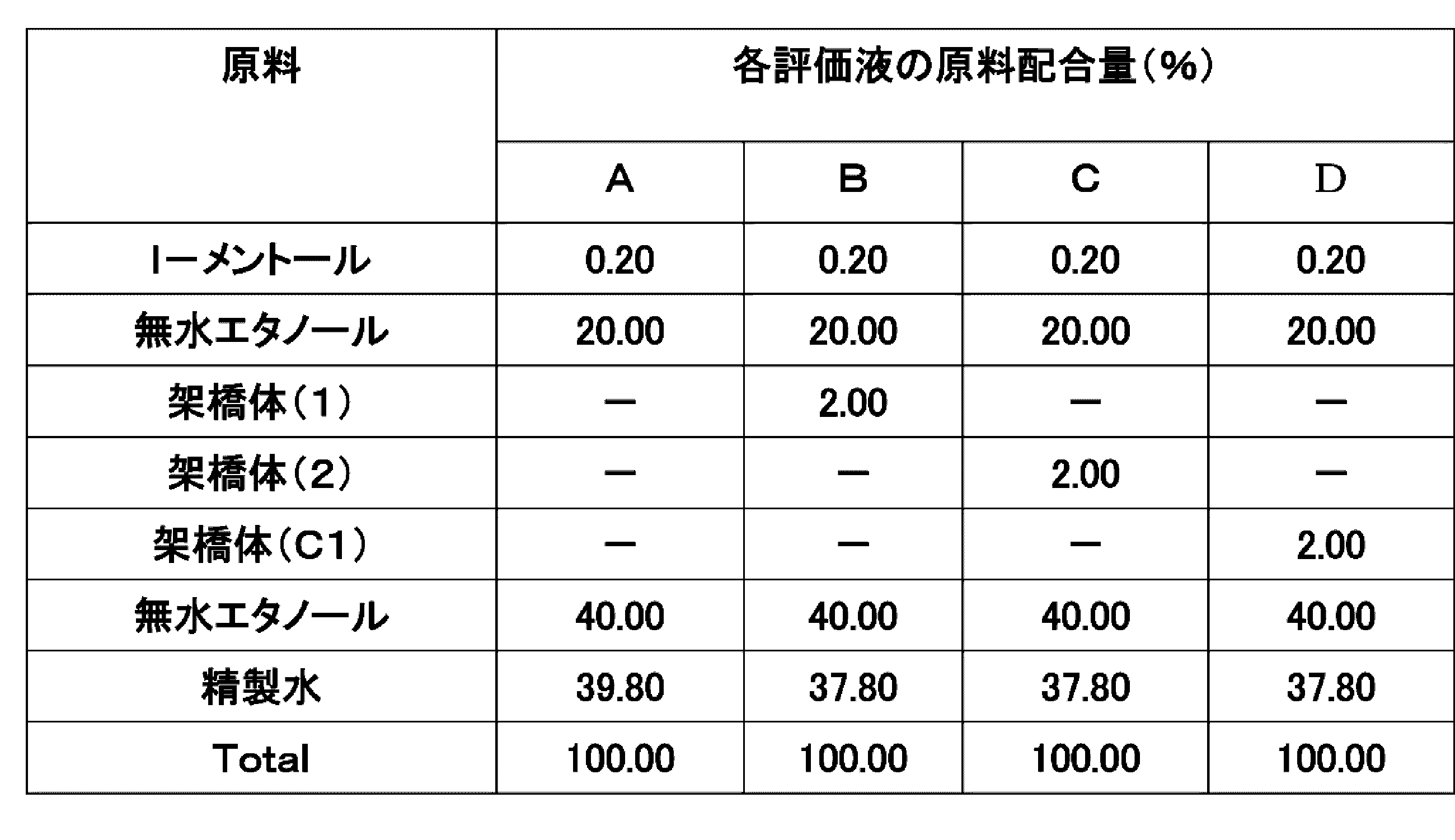
以下の手順に従い、人による官能評価を行った。調製した評価液を点眼容器に充填し、評価部位に2滴を落とし、手で薄く延ばし塗布感触を確認した後、そのまま涼感を確認した。評価部位は、初めに手の甲で行い、涼感を感じ難い場合は前腕の内側に変更した。右手と左手に別々のサンプルを適用し、どちらの涼感が持続するか比較した。より長く涼感を感じたサンプルをさらに別のサンプルと比較し、最も涼感が持続するサンプルを決定した。人数は10人とした。涼感の持続性の評価結果を表2に、塗布感触の評価結果を表3に示した。
表2より、架橋体(1)、架橋体(2)、架橋体(C1)のいずれも涼感の持続性が高い効果を有し、中でも、架橋体(1)が特に効果が高いことが判った。
表3より、架橋体(1)が最も塗布感触の評価が高く、次いで、架橋体(2)、架橋体(C1)の順に塗布感触の評価が高いことが判った。
表2より、架橋体(1)、架橋体(2)、架橋体(C1)のいずれも涼感の持続性が高い効果を有し、中でも、架橋体(1)が特に効果が高いことが判った。
表3より、架橋体(1)が最も塗布感触の評価が高く、次いで、架橋体(2)、架橋体(C1)の順に塗布感触の評価が高いことが判った。
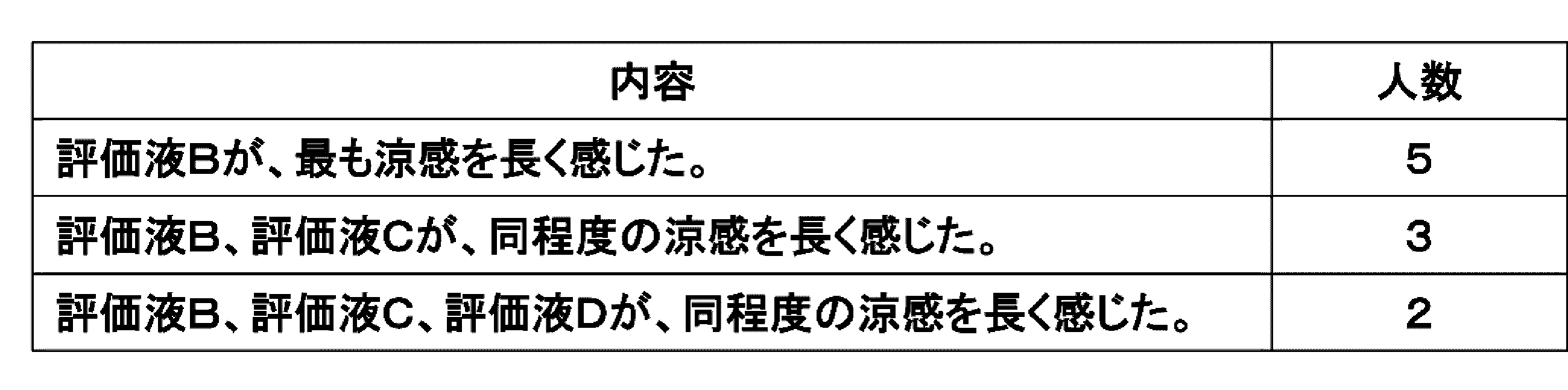

〔殺菌試験〕
試験管内での殺菌試験を以下のように実施した。まず、架橋体(1)、架橋体(C1)、フェノキシエタノール(富士フイルム和光純薬株式会社製)を用いて、表4に示すような組成物を各10mlずつ調製した。なお、表4中、PVPはポリビニルピロリドンを意味し、PEはフェノキシエタノールを意味する。次に、大腸菌を、ミューラーヒントン寒天培地(富士フイルム和光純薬株式会社製)を用いて35℃で18時間培養し、出現したコロニーをかきとり、バターフィールド緩衝液(0.0425g/Lリン酸二水素カリウム緩衝液、pH7.2調整)に懸濁して、10×108CFU/L程度となるよう調整した。この菌液を、表4の組成物に0.5mlずつ添加し、10秒程度転倒混和させたのち、25℃でインキュベートした。1時間後、24時間後、1週間後にそれぞれの組成物からサンプリングを行い、バターフィールド緩衝液を用いて希釈系列を調製し、ミューラーヒントン寒天培地に塗布して培養した。出現したコロニー数から生存菌数のカウントを行った。用いた菌株は、大腸菌;Escherichia coli、NBRC-3972であった。
試験の結果、表4に示すように、架橋体(1)単体や架橋体(2)単体やフェノキシエタノール単体では低い殺菌性しか示さないが、架橋体(1)とフェノキシエタノールを併用したもの、および、架橋体(2)とフェノキシエタノールを併用したものについては、菌数の減少が加速され、相乗効果を示すことが判明した。
なお、表4においての判定は、1週間に4ケタ以上菌数が減少したサンプルを◎、3ケタ~2ケタ菌数が減少したサンプルを○、1ケタ菌数が減少したサンプルを△、菌数の減少がみられなかったものを×とした。
試験管内での殺菌試験を以下のように実施した。まず、架橋体(1)、架橋体(C1)、フェノキシエタノール(富士フイルム和光純薬株式会社製)を用いて、表4に示すような組成物を各10mlずつ調製した。なお、表4中、PVPはポリビニルピロリドンを意味し、PEはフェノキシエタノールを意味する。次に、大腸菌を、ミューラーヒントン寒天培地(富士フイルム和光純薬株式会社製)を用いて35℃で18時間培養し、出現したコロニーをかきとり、バターフィールド緩衝液(0.0425g/Lリン酸二水素カリウム緩衝液、pH7.2調整)に懸濁して、10×108CFU/L程度となるよう調整した。この菌液を、表4の組成物に0.5mlずつ添加し、10秒程度転倒混和させたのち、25℃でインキュベートした。1時間後、24時間後、1週間後にそれぞれの組成物からサンプリングを行い、バターフィールド緩衝液を用いて希釈系列を調製し、ミューラーヒントン寒天培地に塗布して培養した。出現したコロニー数から生存菌数のカウントを行った。用いた菌株は、大腸菌;Escherichia coli、NBRC-3972であった。
試験の結果、表4に示すように、架橋体(1)単体や架橋体(2)単体やフェノキシエタノール単体では低い殺菌性しか示さないが、架橋体(1)とフェノキシエタノールを併用したもの、および、架橋体(2)とフェノキシエタノールを併用したものについては、菌数の減少が加速され、相乗効果を示すことが判明した。
なお、表4においての判定は、1週間に4ケタ以上菌数が減少したサンプルを◎、3ケタ~2ケタ菌数が減少したサンプルを○、1ケタ菌数が減少したサンプルを△、菌数の減少がみられなかったものを×とした。

〔化粧品乳液の配合〕
表5に示す配合量で、(1)~(5)を配合し、60℃で均一に溶解した。そこに、表5に示す配合量で、60℃に加温した(6)を徐々に添加し、ホモジナイザーを用いて乳化し、40℃まで冷却して乳化液を得た。さらに、表5に示す配合量で、均一化した(7)~(10)の混合液に上記乳化液を添加し、均一に混合した。その結果、配合性は良好であった。
表5に示す配合量で、(1)~(5)を配合し、60℃で均一に溶解した。そこに、表5に示す配合量で、60℃に加温した(6)を徐々に添加し、ホモジナイザーを用いて乳化し、40℃まで冷却して乳化液を得た。さらに、表5に示す配合量で、均一化した(7)~(10)の混合液に上記乳化液を添加し、均一に混合した。その結果、配合性は良好であった。
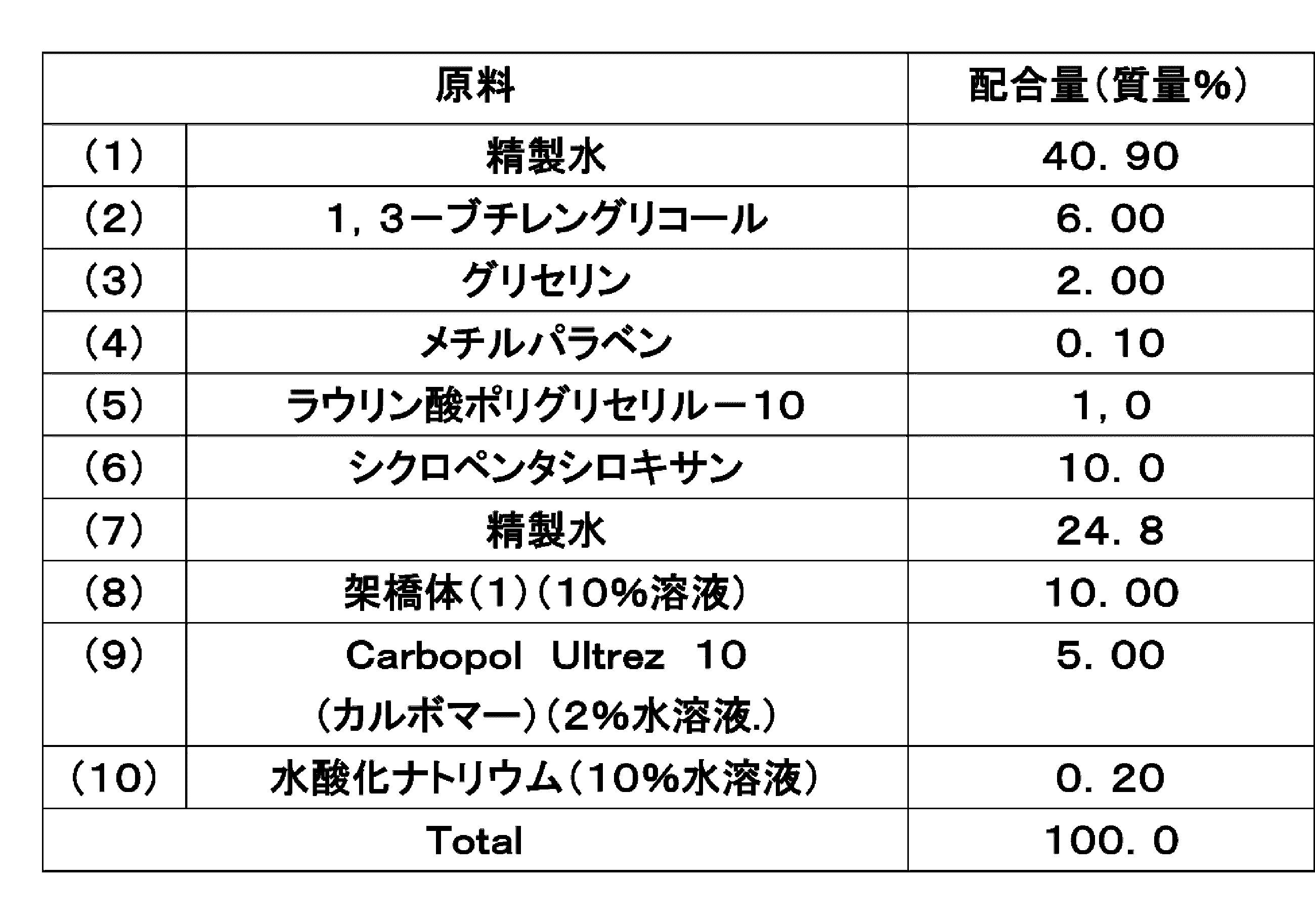
〔イオン性化合物(アスコルビルリン酸ナトリウム)の配合〕
表6に示す配合量で、(1)に(2)を溶解した後、(3)~(5)のいずれかを徐々に添加し、ホモジナイザーを用いて均一に混合した。さらに、別途、表6に示す配合量で、(6)と(7)と(8)を均一に混合したものを加え、ホモジナイザーで均一に混合し、配合物(1)、(2)、(C1)を調製した。また、表6に示す配合量で、(1)に(2)を溶解した後、(3)~(5)のいずれも添加せず、別途、表6に示す配合量で、(6)と(7)と(8)を均一に混合したものを加え、ホモジナイザーで均一に混合し、配合物(C2)を調製した。表6に示すように、架橋体(1)、(2)を用いた配合物(1)、(2)では、架橋体(C1)を用いた配合物(C1)や架橋体(1)も(2)も(C1)も用いない配合物(C2)に比べて、適度な粘度を有する均一な薬剤が得られた。さらに、塗布感触を確認したところ、架橋剤(1)(2)を用いた配合物(1)、(2)では滑らかであったが、架橋剤(C1)を用いた配合物(C1)では粒がある感じがあり滑らかではなかった。なお、粘度の測定は、東機産業製のB形粘度計(BM-2型、ローターナンバー3、回転数60RPM、測定時間60秒、測定温度25℃)を用いた。
表6に示す配合量で、(1)に(2)を溶解した後、(3)~(5)のいずれかを徐々に添加し、ホモジナイザーを用いて均一に混合した。さらに、別途、表6に示す配合量で、(6)と(7)と(8)を均一に混合したものを加え、ホモジナイザーで均一に混合し、配合物(1)、(2)、(C1)を調製した。また、表6に示す配合量で、(1)に(2)を溶解した後、(3)~(5)のいずれも添加せず、別途、表6に示す配合量で、(6)と(7)と(8)を均一に混合したものを加え、ホモジナイザーで均一に混合し、配合物(C2)を調製した。表6に示すように、架橋体(1)、(2)を用いた配合物(1)、(2)では、架橋体(C1)を用いた配合物(C1)や架橋体(1)も(2)も(C1)も用いない配合物(C2)に比べて、適度な粘度を有する均一な薬剤が得られた。さらに、塗布感触を確認したところ、架橋剤(1)(2)を用いた配合物(1)、(2)では滑らかであったが、架橋剤(C1)を用いた配合物(C1)では粒がある感じがあり滑らかではなかった。なお、粘度の測定は、東機産業製のB形粘度計(BM-2型、ローターナンバー3、回転数60RPM、測定時間60秒、測定温度25℃)を用いた。
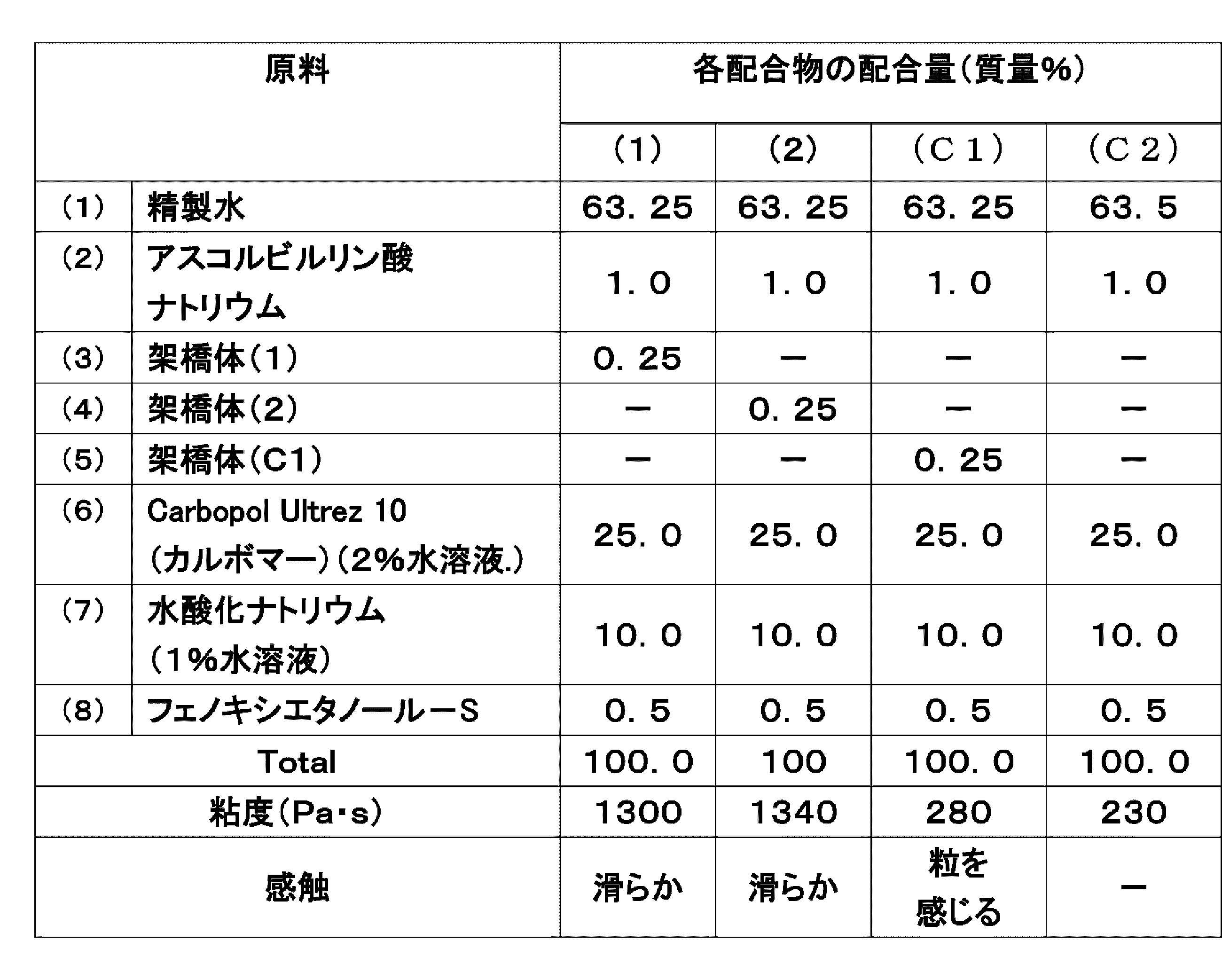
本発明の薬剤用添加剤は、例えば、化粧品、香料、芳香剤、消臭剤、医薬品、防虫剤、殺虫剤、農薬などに好適に用いられる。
Claims (4)
- N-ビニルラクタム系単量体由来の構造単位を全単量体由来の構造単位100モル%に対して50モル%~100モル%含む重合体(I)を含み、
0.02MPa以下の減圧下において100℃で1時間乾燥したときの平均粒子径が100μm以下である、
薬剤用添加剤。 - 脱イオン水を用いて膨潤させたときの膨潤体の平均粒子径が180μm以下である、請求項1に記載の薬剤用添加剤。
- 前記重合体(I)が、沈殿重合によって得られる重合体である、請求項1または2に記載の薬剤用添加剤。
- 化粧品用添加剤である、請求項1から3までのいずれかに記載の薬剤用添加剤。
Priority Applications (3)
| Application Number | Priority Date | Filing Date | Title |
|---|---|---|---|
| US17/601,879 US11964042B2 (en) | 2019-05-14 | 2020-04-27 | Additive for medicinal agents |
| EP20806324.8A EP3970805A4 (en) | 2019-05-14 | 2020-04-27 | ADDITIVE FOR MEDICINAL AGENTS |
| JP2021519352A JP7281541B2 (ja) | 2019-05-14 | 2020-04-27 | 薬剤用添加剤 |
Applications Claiming Priority (2)
| Application Number | Priority Date | Filing Date | Title |
|---|---|---|---|
| JP2019091541 | 2019-05-14 | ||
| JP2019-091541 | 2019-05-14 |
Publications (1)
| Publication Number | Publication Date |
|---|---|
| WO2020230600A1 true WO2020230600A1 (ja) | 2020-11-19 |
Family
ID=73289994
Family Applications (1)
| Application Number | Title | Priority Date | Filing Date |
|---|---|---|---|
| PCT/JP2020/017902 Ceased WO2020230600A1 (ja) | 2019-05-14 | 2020-04-27 | 薬剤用添加剤 |
Country Status (5)
| Country | Link |
|---|---|
| US (1) | US11964042B2 (ja) |
| EP (1) | EP3970805A4 (ja) |
| JP (1) | JP7281541B2 (ja) |
| TW (1) | TWI786402B (ja) |
| WO (1) | WO2020230600A1 (ja) |
Citations (4)
| Publication number | Priority date | Publication date | Assignee | Title |
|---|---|---|---|---|
| JP2004161829A (ja) * | 2002-11-11 | 2004-06-10 | Nippon Shokubai Co Ltd | ポリビニルラクタム架橋体微粒子及びその製造方法 |
| JP2010254974A (ja) * | 2009-03-31 | 2010-11-11 | Kose Corp | 水溶性コポリマー及びそれを配合する化粧料又は皮膚外用剤 |
| WO2018061916A1 (ja) * | 2016-09-30 | 2018-04-05 | 東レ株式会社 | 共重合体及びこれを用いた医療材料 |
| JP2018104406A (ja) * | 2016-07-08 | 2018-07-05 | 株式会社日本触媒 | 化粧料 |
Family Cites Families (12)
| Publication number | Priority date | Publication date | Assignee | Title |
|---|---|---|---|---|
| US5252611A (en) * | 1992-07-20 | 1993-10-12 | Isp Investments Inc. | Controlled release tablets including strongly swellable, moderately crosslinked polyvinylpyrrolidone |
| US5663258A (en) * | 1996-02-20 | 1997-09-02 | Isp Investments Inc. | Strongly swellable, moderately crosslinked copolymers of vinylpyrrolidone and vinyl acetate |
| DE102005034412A1 (de) * | 2005-07-22 | 2007-01-25 | Basf Ag | Ampholytisches Copolymer, dessen Herstellung und Verwendung |
| RU2012141628A (ru) * | 2010-03-02 | 2014-04-10 | Басф Се | Анионные ассоциативные модификаторы реологических свойств |
| ES2446977T3 (es) | 2010-03-02 | 2014-03-11 | Basf Se | Modificadores de reología asociativos aniónicos |
| US10414963B2 (en) * | 2013-06-26 | 2019-09-17 | Halliburton Energy Services, Inc. | High-temperature crosslinked polymer for use in a well |
| US10883037B2 (en) * | 2013-06-26 | 2021-01-05 | Halliburton Energy Services, Inc. | Crosslinked n-vinylpyrrolidone polymers for use in subterranean formations and wells |
| WO2015010945A1 (en) * | 2013-07-24 | 2015-01-29 | Basf Se | Polymer |
| JP6706040B2 (ja) | 2015-09-11 | 2020-06-03 | 株式会社日本触媒 | 徐放性薬剤用ゲル化剤 |
| JP7072506B2 (ja) | 2016-07-08 | 2022-05-20 | 株式会社日本触媒 | N-ビニルラクタム系架橋重合体、化粧料、インク用吸収剤及び吸収性複合体 |
| CN106866868A (zh) * | 2017-04-19 | 2017-06-20 | 广州天赐高新材料股份有限公司 | 一种共聚物增稠剂及其制备方法 |
| CN107157807A (zh) * | 2017-06-08 | 2017-09-15 | 广州天赐高新材料股份有限公司 | 一种毛发定型组合物及其制备方法 |
-
2020
- 2020-04-27 EP EP20806324.8A patent/EP3970805A4/en active Pending
- 2020-04-27 US US17/601,879 patent/US11964042B2/en active Active
- 2020-04-27 WO PCT/JP2020/017902 patent/WO2020230600A1/ja not_active Ceased
- 2020-04-27 JP JP2021519352A patent/JP7281541B2/ja active Active
- 2020-05-14 TW TW109115968A patent/TWI786402B/zh active
Patent Citations (4)
| Publication number | Priority date | Publication date | Assignee | Title |
|---|---|---|---|---|
| JP2004161829A (ja) * | 2002-11-11 | 2004-06-10 | Nippon Shokubai Co Ltd | ポリビニルラクタム架橋体微粒子及びその製造方法 |
| JP2010254974A (ja) * | 2009-03-31 | 2010-11-11 | Kose Corp | 水溶性コポリマー及びそれを配合する化粧料又は皮膚外用剤 |
| JP2018104406A (ja) * | 2016-07-08 | 2018-07-05 | 株式会社日本触媒 | 化粧料 |
| WO2018061916A1 (ja) * | 2016-09-30 | 2018-04-05 | 東レ株式会社 | 共重合体及びこれを用いた医療材料 |
Non-Patent Citations (1)
| Title |
|---|
| See also references of EP3970805A4 * |
Also Published As
| Publication number | Publication date |
|---|---|
| TW202108121A (zh) | 2021-03-01 |
| TWI786402B (zh) | 2022-12-11 |
| JPWO2020230600A1 (ja) | 2021-11-25 |
| EP3970805A4 (en) | 2023-07-05 |
| EP3970805A1 (en) | 2022-03-23 |
| US11964042B2 (en) | 2024-04-23 |
| JP7281541B2 (ja) | 2023-05-25 |
| US20220202688A1 (en) | 2022-06-30 |
Similar Documents
| Publication | Publication Date | Title |
|---|---|---|
| US11173472B2 (en) | N-vinyl lactam-based crosslinked polymer, cosmetic, absorbent agent for ink, and absorbent composite | |
| Williams et al. | Bespoke cationic nano-objects via RAFT aqueous dispersion polymerisation | |
| CN102516578B (zh) | 丙烯酸高吸水性树脂的制备方法 | |
| CN103370049A (zh) | 用具有amps且富含丙烯酸的聚合物的碱可溶胀乳液增稠化妆品制剂的方法 | |
| WO2017057571A1 (ja) | 抗菌剤 | |
| JP2015048386A (ja) | 吸水性樹脂の微粉砕方法及び耐塩性に優れた吸水性樹脂 | |
| CN108135813A (zh) | 油包水型高分子乳液组合物以及油包水型高分子乳液组合物的制造方法 | |
| JP2015172028A (ja) | 化粧料 | |
| JP6706040B2 (ja) | 徐放性薬剤用ゲル化剤 | |
| JP7281541B2 (ja) | 薬剤用添加剤 | |
| JP4908758B2 (ja) | 皮膚及び髪組成物用ビニルアミドポリマー組成物の製造方法 | |
| JP2017043778A (ja) | N−ビニルラクタム系架橋重合体の製造方法及びn−ビニルラクタム系架橋重合体 | |
| JP6294313B2 (ja) | ポリマー粒子の水性分散液、それを含有する膜形成組成物、及びその使用 | |
| JPWO2003016382A1 (ja) | 架橋型カルボキシル基含有重合体粒子 | |
| JP2006506504A5 (ja) | ||
| JP2016069439A (ja) | 新規架橋重合体およびその製造方法 | |
| JP6937547B2 (ja) | 界面活性剤の担持剤 | |
| JP7712747B2 (ja) | 組成物 | |
| WO2023127738A1 (ja) | カルボキシル基含有水溶性共重合体及びその用途 | |
| JP6606343B2 (ja) | ジェル状制汗剤組成物 | |
| JP2021169436A (ja) | カルボン酸系化合物含有組成物用増粘剤 | |
| JP2021169437A (ja) | ベンジルアルコール含有組成物用増粘剤 | |
| JP2019143158A (ja) | 粉末状n−ビニルカルボン酸アミド重合体組成物及びポリビニルアミン水溶液の製造方法 | |
| JP2013107988A (ja) | 顆粒状カルボキシル基含有重合体粒子の製造方法及び顆粒状カルボキシル基含有重合体粒子 | |
| JP6694309B2 (ja) | 重合体複合組成物 |
Legal Events
| Date | Code | Title | Description |
|---|---|---|---|
| 121 | Ep: the epo has been informed by wipo that ep was designated in this application |
Ref document number: 20806324 Country of ref document: EP Kind code of ref document: A1 |
|
| ENP | Entry into the national phase |
Ref document number: 2021519352 Country of ref document: JP Kind code of ref document: A |
|
| NENP | Non-entry into the national phase |
Ref country code: DE |
|
| ENP | Entry into the national phase |
Ref document number: 2020806324 Country of ref document: EP Effective date: 20211214 |