WO2020235556A1 - 活性エネルギー線硬化型平版印刷用インキ、およびそれを用いた印刷物の製造方法 - Google Patents
活性エネルギー線硬化型平版印刷用インキ、およびそれを用いた印刷物の製造方法 Download PDFInfo
- Publication number
- WO2020235556A1 WO2020235556A1 PCT/JP2020/019777 JP2020019777W WO2020235556A1 WO 2020235556 A1 WO2020235556 A1 WO 2020235556A1 JP 2020019777 W JP2020019777 W JP 2020019777W WO 2020235556 A1 WO2020235556 A1 WO 2020235556A1
- Authority
- WO
- WIPO (PCT)
- Prior art keywords
- active energy
- mass
- lithographic printing
- meth
- energy ray
- Prior art date
- Legal status (The legal status is an assumption and is not a legal conclusion. Google has not performed a legal analysis and makes no representation as to the accuracy of the status listed.)
- Ceased
Links
Classifications
-
- C—CHEMISTRY; METALLURGY
- C09—DYES; PAINTS; POLISHES; NATURAL RESINS; ADHESIVES; COMPOSITIONS NOT OTHERWISE PROVIDED FOR; APPLICATIONS OF MATERIALS NOT OTHERWISE PROVIDED FOR
- C09D—COATING COMPOSITIONS, e.g. PAINTS, VARNISHES OR LACQUERS; FILLING PASTES; CHEMICAL PAINT OR INK REMOVERS; INKS; CORRECTING FLUIDS; WOODSTAINS; PASTES OR SOLIDS FOR COLOURING OR PRINTING; USE OF MATERIALS THEREFOR
- C09D11/00—Inks
- C09D11/02—Printing inks
- C09D11/10—Printing inks based on artificial resins
- C09D11/101—Inks specially adapted for printing processes involving curing by wave energy or particle radiation, e.g. with UV-curing following the printing
-
- B—PERFORMING OPERATIONS; TRANSPORTING
- B41—PRINTING; LINING MACHINES; TYPEWRITERS; STAMPS
- B41M—PRINTING, DUPLICATING, MARKING, OR COPYING PROCESSES; COLOUR PRINTING
- B41M1/00—Inking and printing with a printer's forme
- B41M1/06—Lithographic printing
-
- C—CHEMISTRY; METALLURGY
- C09—DYES; PAINTS; POLISHES; NATURAL RESINS; ADHESIVES; COMPOSITIONS NOT OTHERWISE PROVIDED FOR; APPLICATIONS OF MATERIALS NOT OTHERWISE PROVIDED FOR
- C09D—COATING COMPOSITIONS, e.g. PAINTS, VARNISHES OR LACQUERS; FILLING PASTES; CHEMICAL PAINT OR INK REMOVERS; INKS; CORRECTING FLUIDS; WOODSTAINS; PASTES OR SOLIDS FOR COLOURING OR PRINTING; USE OF MATERIALS THEREFOR
- C09D11/00—Inks
- C09D11/02—Printing inks
- C09D11/03—Printing inks characterised by features other than the chemical nature of the binder
- C09D11/037—Printing inks characterised by features other than the chemical nature of the binder characterised by the pigment
-
- C—CHEMISTRY; METALLURGY
- C09—DYES; PAINTS; POLISHES; NATURAL RESINS; ADHESIVES; COMPOSITIONS NOT OTHERWISE PROVIDED FOR; APPLICATIONS OF MATERIALS NOT OTHERWISE PROVIDED FOR
- C09D—COATING COMPOSITIONS, e.g. PAINTS, VARNISHES OR LACQUERS; FILLING PASTES; CHEMICAL PAINT OR INK REMOVERS; INKS; CORRECTING FLUIDS; WOODSTAINS; PASTES OR SOLIDS FOR COLOURING OR PRINTING; USE OF MATERIALS THEREFOR
- C09D11/00—Inks
- C09D11/02—Printing inks
- C09D11/10—Printing inks based on artificial resins
- C09D11/102—Printing inks based on artificial resins containing macromolecular compounds obtained by reactions other than those only involving unsaturated carbon-to-carbon bonds
-
- C—CHEMISTRY; METALLURGY
- C09—DYES; PAINTS; POLISHES; NATURAL RESINS; ADHESIVES; COMPOSITIONS NOT OTHERWISE PROVIDED FOR; APPLICATIONS OF MATERIALS NOT OTHERWISE PROVIDED FOR
- C09D—COATING COMPOSITIONS, e.g. PAINTS, VARNISHES OR LACQUERS; FILLING PASTES; CHEMICAL PAINT OR INK REMOVERS; INKS; CORRECTING FLUIDS; WOODSTAINS; PASTES OR SOLIDS FOR COLOURING OR PRINTING; USE OF MATERIALS THEREFOR
- C09D11/00—Inks
- C09D11/02—Printing inks
- C09D11/10—Printing inks based on artificial resins
- C09D11/106—Printing inks based on artificial resins containing macromolecular compounds obtained by reactions only involving carbon-to-carbon unsaturated bonds
- C09D11/107—Printing inks based on artificial resins containing macromolecular compounds obtained by reactions only involving carbon-to-carbon unsaturated bonds from unsaturated acids or derivatives thereof
-
- B—PERFORMING OPERATIONS; TRANSPORTING
- B41—PRINTING; LINING MACHINES; TYPEWRITERS; STAMPS
- B41M—PRINTING, DUPLICATING, MARKING, OR COPYING PROCESSES; COLOUR PRINTING
- B41M1/00—Inking and printing with a printer's forme
- B41M1/26—Printing on other surfaces than ordinary paper
- B41M1/28—Printing on other surfaces than ordinary paper on metals
-
- B—PERFORMING OPERATIONS; TRANSPORTING
- B41—PRINTING; LINING MACHINES; TYPEWRITERS; STAMPS
- B41M—PRINTING, DUPLICATING, MARKING, OR COPYING PROCESSES; COLOUR PRINTING
- B41M1/00—Inking and printing with a printer's forme
- B41M1/26—Printing on other surfaces than ordinary paper
- B41M1/30—Printing on other surfaces than ordinary paper on organic plastics, horn or similar materials
Definitions
- the present invention relates to an active energy ray-curable lithographic printing ink and a method for producing a printed matter using the ink.
- Planographic printing is a printing method that is widely used as a system that supplies printed matter at high speed, in large quantities, and at low cost.
- active energy ray-curable slab printing ink which cures instantly by irradiating active energy rays such as mercury lamps, metal halide lamps, light emitting diodes, and electron beams, has been used in terms of equipment, safety, and environment. Due to its high productivity, it is spreading in many fields.
- the lithographic printing method often uses paper as the base material, but from the viewpoint of diversifying the applicable base materials, printing on plastic films and the like is also expanding.
- studies have begun on application to flexible packaging printing used for daily necessities, foodstuffs, pharmaceuticals, etc., which are based on a thin film plastic film.
- the active energy ray-curable lithographic printing ink can be cured at room temperature in a short time, it is considered to be the most suitable material for forming an ink film on a plastic film having poor heat resistance. ..
- a base material such as a thin plastic film using an active energy ray-curable lithographic printing ink
- the adhesion between the ink and the surface of the plastic film may be insufficient. For this reason, development of an active energy ray-curable lithographic printing ink having excellent adhesion to a plastic film is underway (see Patent Document 1).
- the present invention overcomes the problems of the prior art, and uses an active energy ray-curable lithographic printing ink that exhibits good adhesion to a plastic film and does not deteriorate in adhesion performance even during hot water treatment.
- An object of the present invention is to provide a method for producing a printed matter used.
- the present invention is an active energy ray-curable lithographic printing ink characterized by containing (a) polyurethane and (b) a polymerizable monomer.
- the present invention is a method for producing a printed matter, which is characterized by using the active energy ray-curable lithographic printing ink of the present invention.
- the active energy ray-curable lithographic printing ink according to the present invention contains (a) polyurethane.
- the polyurethane (a) contained in the present invention is preferably a compound having a urethane bond formed by reacting a polyol compound with an isocyanate compound.
- the urethane bond contained in (a) polyurethane can form a hard segment by hydrogen bonding to impart toughness to the ink film, and also has a strong bond with the surface of a plastic film or the like to provide good adhesion. Gender can be imparted.
- the polyol contained in the polyurethane (a) has a flexible structure, it can form soft segments and impart flexibility to the ink film.
- the polyol compound used for (a) polyurethane contained in the present invention is not particularly limited, but preferably contains a polyester polyol, a polyether polyol, or a polycarbonate polyol from the viewpoint of improving heat resistance and water resistance. .. These polyols can be used alone or in combination of two or more. Having a rigid bond in polyurethane suppresses the entanglement of molecular chains, reduces the viscosity of the ink, and improves the fluidity of the ink, which can exhibit good transferability during printing. Therefore, ester bond and carbonate bond. It is preferable to have. It is particularly preferable to have a rigid carbonate bond.
- the polyester polyol can be obtained, for example, by reacting a polyvalent carboxylic acid compound with a polyhydric alcohol compound.
- polyvalent carboxylic acid compounds include succinic acid, adipic acid, sebacic acid, azelaic acid, terephthalic acid, isophthalic acid, orthophthalic acid, hexahydroterephthalic acid, hexahydroisophthalic acid, hexahydroorthophthalic acid, and naphthalene.
- dicarboxylic acids polycarboxylic acids such as trimellitic acid, their acid esters, and their acid anhydrides.
- polyhydric alcohol compound examples include ethylene glycol, 1,2-propanediol, 1,3-propanediol, 1,2-butanediol, 1,3-butanediol, 1,4-butanediol, 1, 5-pentanediol, 1,6-hexanediol, 3-methyl-1,5-pentanediol, neopentyl glycol, 1,8-octanediol, 1,9-nonanediol, diethylene glycol, dipropylene glycol, 1,4 -Includes low molecular weight alcohol compounds such as cyclohexanedimethanol, ethylene oxide or propylene oxide adducts of bisphenol A, trimethylolpropane, glycerin, and pentaerythritol, and low molecular weight amino alcohol compounds such as monoethanolamine and diethanolamine.
- polycarbonate polyol examples include those obtained by a dehydroxylation reaction of a polyhydric alcohol compound similar to that used for the synthesis of the polyester polyol as described above and phosgene, and the polyhydric alcohol compound and diethylene carbonate. Examples thereof include those obtained by a transesterification reaction with dimethyl carbonate, diethyl carbonate, diphenyl carbonate and the like.
- polyether polyol for example, alkylene oxides such as ethylene oxide, propylene oxide and butylene oxide, ring-opening polymerization of tetrahydrofuran and the like were carried out using the same polyhydric alcohol compound and the like used for the synthesis of polyester polyol as an initiator.
- examples thereof include polyoxyethylene polyol, polyoxypropylene polyol, polytetramethylene ether polyol, and polyoxyethylene polyoxypropylene polyol.
- examples thereof include the above-mentioned polyester polyol, polyester ether polyol using polycarbonate polyol as an initiator, and polycarbonate ether polyol.
- the polyurethane (a) of the present invention is preferably water-soluble.
- the water-soluble polyurethane is not particularly limited, but is obtained by imparting a hydrophilic group to polyurethane by various methods.
- the hydrophilic group include an ethylene oxide skeleton, a carboxyl group, a hydroxyl group, an amino group, and a sulfonic acid group. Since the hydrophilic group strongly interacts with the urethane bond in the polyurethane (a) in the ink, good resistance to hot water treatment and the like can be obtained. In addition, good dispersibility of the pigment in the ink can be provided, and the fluidity of the ink is improved.
- Examples of the polyol compound used for (a) polyurethane having one or more functional groups selected from a carboxyl group, a sulfonic acid group and a hydroxyl group include 2,2-dimethylolpropionic acid and 2,2-dimethylolbutanoic acid. , 2,2-Dimethylolbutyric acid, 2,2-Dimethylolpropane, etc., 5-sulfoisophthalic acid, sulfoterephthalic acid, 4-sulfophthalic acid, glycerin, trimethylolpropane, pentaerythritol, etc. can be preferably used. ..
- the polyol compound having one or more functional groups selected from these carboxyl groups, sulfonic acid groups and hydroxyl groups is at least one selected from organic amines such as ammonia and triethylamine and metal bases such as Na, K, Li and Ca. After neutralizing with seeds, it can also be used as a raw material for prepolymers.
- the isocyanate compound used for polyurethane is not particularly limited, but diisocyanate is preferably used. Of these, diisocyanates having an aliphatic or alicyclic structure are more preferable because they can suppress yellowing due to heat.
- the aliphatic or alicyclic diisocyanate is not particularly limited, and examples thereof include toluene diisocyanate, isophorone diisocyanate, hexamethylene diisocyanate, diphenylmethane diisocyanate, naphthalenediocyanate, and dicyclohexylmethane 4,4'-diisocyanate. Can be mentioned.
- toluene diisocyanate and dicyclohexylmethane 4,4'-diisocyanate can be particularly preferably used.
- Diisocyanates having an aliphatic or alicyclic structure can be used alone or in combination of two or more.
- the urethane bond fraction in polyurethane can be given good adhesion by forming a strong bond with the surface of a plastic film or the like, and the rigid urethane bond suppresses the entanglement of molecular chains and ink. 10% by mass or more is preferable, 15% by mass or more is more preferable, and 18% by mass or more is further preferable, because the viscosity of the urethane can be reduced. In addition, 25% by mass or less is preferable, 23% by mass or less is more preferable, and 21% by mass or less is preferable, because the compatibility with other ink compositions can be improved, the ink film can be softened, and adhesion can be imparted. More preferred.
- the abundance ratio of urethane bonds in (a) polyurethane can be obtained by performing nuclear magnetic resonance (NMR) measurement.
- the active energy ray-curable lithographic printing ink according to the present invention contains (b) a polymerizable monomer.
- (B) By containing the polymerizable monomer, the physical properties of the ink such as viscosity and leveling required for lithographic printing can be adjusted. Further, since the polymerizable monomer (b) causes a covalent reaction by irradiation with active energy rays, the resistance to hot water treatment and the like can be improved by curing the ink film.
- the weight average molecular weight of the polyurethane (a) is preferably 500 or more, more preferably 1,000 or more, still more preferably 5,000 or more because the heat resistance of the ink film printed and cured by this ink is improved. Further, since the viscosity of the ink is maintained and the fluidity is improved, 1,000,000 or less is preferable, 500,000 or less is more preferable, and 30,000 or less is further preferable.
- the weight average molecular weight of the resin can be obtained by measuring in terms of polystyrene using gel permeation chromatography (GPC).
- the content of (a) polyurethane is 0.5% by mass or more with respect to the ink of the present invention because good adhesion can be imparted by forming a strong bond with the surface of a plastic film or the like.
- 0.7% by mass or more is more preferable, 0.9% by mass or more is further preferable, and 1% by mass is further preferable.
- 20% by mass or less is preferable, 5% by mass or less is more preferable, and 4% by mass or less. Is more preferable, and 3% by mass or less is further preferable.
- the active energy ray-curable lithographic printing ink according to the present invention contains (b) a polymerizable monomer, many of the contained components are crosslinked with each other, and excellent adhesion and resistance to hot water treatment can be obtained.
- the weight average molecular weight of the polymerizable monomer (b) is preferably 100 or more, more preferably 150 or more, still more preferably 200 or more, in order to soften the ink film and impart adhesion. Further, since the viscosity of the ink is maintained and the fluidity is improved, 1,000 or less is preferable, 700 or less is more preferable, and 500 or less is further preferable.
- the weight average molecular weight is (b) the molecular weight of the polymerizable monomer when the chemical structure is known, and (b) gel permeation chromatography (GPC) when the polymerizable monomer has a molecular weight distribution. ), And can be obtained by measuring in terms of polystyrene.
- the content of the polymerizable monomer (b) in the active energy ray-curable slab printing ink of the present invention is 10% by mass or more, the curability of the ink film is improved and the hot water treatment resistance is improved, which is preferable. , 15% by mass or more is more preferable, and 20% by mass or more is further preferable. Further, in order to maintain the viscosity of the ink and show good ground stain resistance, 80% by mass or less is preferable, 70% by mass or less is more preferable, and 60% by mass or less is further preferable.
- the polymerizable monomer preferably contains a polyfunctional (meth) acrylate from the viewpoint of cross-linking a large number of contained components, and contains a polyfunctional (meth) acrylate having a hydrophilic group from the viewpoint of resistance to hot water treatment. It is preferable to do so.
- (meth) acrylate is a generic term including acrylate and methacrylate. Examples of the hydrophilic group include an ethylene oxide skeleton, a carboxyl group, a hydroxyl group, an amino group, a sulfonic acid group, and the like.
- the hydrophilic group interacts with the urethane bond in the polyurethane (a) in the ink, good resistance to hot water treatment and the like can be obtained. In addition, it is possible to provide good dispersibility of the pigment in the ink and improve the fluidity of the ink.
- the polyfunctional (meth) acrylate having a hydrophilic group can improve the hot water treatment resistance of the ink film and the fluidity of the ink, it is preferably 10% by mass or more with respect to the ink of the present invention. 20% by mass or more is more preferable, and 30% by mass or more is further preferable. Further, since it is possible to suppress an increase in viscosity of the ink due to polar groups and maintain good fluidity, 80% by mass or less is preferable, 70% by mass or less is more preferable, 60% by mass or less is further preferable, and 50% by mass or less. The following is more preferable.
- the polyfunctional (meth) acrylates having a hydrophilic group it is preferable to contain a polyfunctional (meth) acrylate having a hydroxyl group having a particularly high hydrophilicity.
- the hydroxyl value of the polyfunctional (meth) acrylate having a hydroxyl group is preferably 50 mgKOH / g or more, more preferably 75 mgKOH / g or more, and more preferably 100 mgKOH / g because the hot water resistance of the ink film and the fluidity of the ink are improved. More than g is more preferable.
- the hydroxyl value is preferably 200 mgKOH / g or less, more preferably 180 mgKOH / g or less, and further preferably 160 mgKOH / g or less, because it is possible to suppress an increase in viscosity of the ink due to polar groups and maintain good fluidity. preferable.
- polyfunctional (meth) acrylate having a hydroxyl group examples include poly (meth) of polyhydric alcohols such as trimethylolpropane, glycerin, pentaerythritol, diglycerin, trimethylolpropane, isocyanuric acid, and dipentaerythritol.
- polyhydric alcohols such as trimethylolpropane, glycerin, pentaerythritol, diglycerin, trimethylolpropane, isocyanuric acid, and dipentaerythritol.
- examples include acrylates and their alkylene oxide adducts. Specifically, trimethylolpropane di (meth) acrylate, glycerin di (meth) acrylate, pentaerythritol di or tri (meth) acrylate, diglycerin di or tri (meth) acrylate, and trimethylolpropane di (meth) acrylate.
- tri (meth) acrylate, di, tri, tetra or penta (meth) acrylate of dipentaerythritol can be mentioned.
- these ethylene oxide adducts, propylene oxide adducts, butylene oxide adducts, tetramethylene oxide adducts and the like can be mentioned.
- pentaerythritol tri (meth) acrylate, diglycerin tri (meth) acrylate, and ditrimethylolpropane tri (meth) acrylate are particularly preferable because the ink of the present invention has excellent pigment dispersibility and fluidity. ..
- the (b) polymerizable monomer contained in the active energy ray-curable lithographic printing ink according to the present invention preferably contains a (meth) acrylate having an alicyclic skeleton or an aliphatic skeleton having 6 to 18 carbon atoms.
- the addition of the alicyclic skeleton or the (meth) acrylate having an aliphatic skeleton having 6 to 18 carbon atoms reduces the viscosity and surface free energy of the ink, thereby improving the ink transferability and adhesion to the substrate.
- the alicyclic skeleton or the (meth) acrylate having an aliphatic skeleton having 6 to 18 carbon atoms has a small volume shrinkage during curing by irradiation with active energy rays and improves adhesion to a substrate. It is preferable to have.
- the alicyclic skeleton is more preferable because it is more rigid, has less volume shrinkage during curing, and has good film physical properties such as scratch resistance of the cured film.
- Examples of the alicyclic skeleton include a norbornane skeleton, an adamantane skeleton, a tricyclodecane skeleton, a dicyclopentadiene skeleton, and the like, and a tricyclodecane skeleton is particularly preferable.
- the (meth) acrylate having an alicyclic skeleton or an aliphatic skeleton having 6 to 18 carbon atoms is of the present invention because, when added, the ink transferability and adhesion to the substrate are improved. It is preferably 1% by mass or more, more preferably 5% by mass or more, and further preferably 10% by mass or more with respect to the ink. Further, in order to suppress the decrease in viscosity of the ink and maintain the ground stain resistance, 40% by mass or less is preferable, 35% by mass or less is more preferable, and 30% by mass or less is further preferable.
- the (meth) acrylate having an alicyclic skeleton or an aliphatic skeleton having 6 to 18 carbon atoms has good curing sensitivity to active energy rays, enhances the strength of the cured film, and improves adhesion. Therefore, (meth) It is preferable to have two or more acrylate-derived structures in the molecule.
- the (meth) acrylate having an aliphatic skeleton having 6 to 18 carbon atoms preferably has 6 or more carbon atoms, more preferably 8 or more carbon atoms, and further preferably 8 or more carbon atoms in order to improve ink transferability to the substrate. It is 10 or more.
- Suppresses (c) a decrease in compatibility with a resin having an ethylenically unsaturated group and a hydrophilic group, and a hydrophilic polyfunctional (meth) acrylate, an increase in ink viscosity, and a decrease in ink transferability, which will be described later. Therefore, the number of carbon atoms is preferably 18 or less, more preferably 16 or less, and further preferably 14 or less.
- the ratio of (meth) acrylate having an aliphatic skeleton having 6 to 18 carbon atoms is the ratio of hydrophilic polyfunctional (meth) acrylate.
- 0.02 parts by mass or more is preferable, 0.04 parts by mass or more is more preferable, and 0.06 parts by mass or more is further preferable.
- the ratio of (meth) acrylate having an aliphatic skeleton having 6 to 18 carbon atoms is determined based on the total amount of hydrophilic polyfunctional (meth) acrylate (1.00 parts by mass). It is preferably 0.30 parts by mass or less, more preferably 0.20 parts by mass or less, further preferably 0.15 parts by mass or less, still more preferably 0.10 parts by mass or less.
- (C) The proportion of (meth) acrylate having an aliphatic skeleton having 6 to 18 carbon atoms is hydrophilic, based on the total amount of the resin having an ethylenically unsaturated group and a hydrophilic group (1.00 parts by mass).
- 0.10 parts by mass or more is preferable, 0.15 parts by mass or more is more preferable, and 0.20 parts by mass or more is further preferable. preferable.
- the ratio of acrylate is preferably 0.60 parts by mass or less, more preferably 0.45 parts by mass or less, and further preferably 0.30 parts by mass or less.
- the (meth) acrylate having an alicyclic skeleton or an aliphatic skeleton having 6 to 18 carbon atoms include hexyl (meth) as the (meth) acrylate having an aliphatic skeleton having 6 to 18 carbon atoms in monofunctionality. Examples thereof include acrylate, octyl (meth) acrylate, nonyl (meth) acrylate, dodecyl (meth) acrylate, stearyl (meth) acrylate, and isostearyl (meth) acrylate.
- Examples of the (meth) acrylate having an alicyclic skeleton include isobornyl (meth) acrylate, norbornane (meth) acrylate, norbornane-2-methanol (meth) acrylate, cyclohexyl (meth) acrylate, tricyclopentenyl (meth) acrylate, and tricyclo. Examples thereof include pentenyloxy (meth) acrylate and tricyclodecanemonomethylol (meth) acrylate.
- (meth) acrylate having an alicyclic skeleton or an aliphatic skeleton having 6 to 18 carbon atoms dicyclopentadiene dimethanol di (meth) acrylate, tricyclodecanedimethanol di (meth) acrylate, 1,6 -Hexanediol di (meth) acrylate, 1,9-nonanediol di (meth) acrylate, 1,7-heptanediol di (meth) acrylate, 1,8-octanediol di (meth) acrylate, 1,10-decane Didioldi (meth) acrylate, 1,11-undecanediol di (meth) acrylate, 1,12-dodecanediol di (meth) acrylate, 1,13-tridecanediol di (meth) acrylate, 1,14-tetradecanediol Di (meth)
- polyester di (meth) acrylate having an aliphatic skeleton having 6 to 18 carbon atoms as a repeating unit may be used. Two or more of these may be included.
- tricyclodecanedimethanol di (meth) acrylate which has a small volume shrinkage during curing, has a condensed ring skeleton, and is bifunctional, is particularly preferable.
- 1,10- Decanediol di (meth) acrylates are also particularly preferred.
- the functional number refers to the number of structures derived from (meth) acrylate.
- the active energy ray-curable lithographic printing ink according to the present invention preferably contains (c) a resin having an ethylenically unsaturated group and a hydrophilic group.
- the ethylenically unsaturated group of the resin forms a covalent bond between the molecules by reacting with the polymerizable group contained in the (b) polymerizable monomer when irradiated with active energy rays, whereby the heat of the ink film is heated. Improves resistance to water treatment, etc.
- the hydrophilic group strongly interacts with the urethane bond, the carboxyl group, the sulfonic acid group, the hydroxyl group and the like contained in the polyurethane (a), the resistance of the ink film to hot water treatment and the like is remarkably improved. To do. Further, the hydrophilic groups in the ink interact with each other to increase the cohesive force of the ink, so that the ink repulsion to the non-image area is improved, and as a result, the ground stain resistance is also improved.
- Preferred examples of the hydrophilic group of the resin having the ethylenically unsaturated group and the hydrophilic group (c) include a hydroxyl group, an amino group, a mercapto group, a carboxyl group, a sulfo group and a phosphoric acid group. Of these, it is particularly preferable to contain a carboxyl group and a hydroxyl group, which have a good interaction with the urethane bond.
- the acid value of the resin (c) having an ethylenically unsaturated group and a hydrophilic group has good hot water treatment resistance of the ink film, good pigment dispersibility of the ink, and improved anti-scumming resistance. Therefore, 30 mgKOH / g or more is preferable, 60 mgKOH / g or more is more preferable, and 75 mgKOH / g or more is further preferable. Further, since it exhibits solubility in polyfunctional (meth) acrylate and can suppress an increase in viscosity of the ink due to polar groups, 250 mgKOH / g or less is preferable, 200 mgKOH / g or less is more preferable, and 150 mgKOH / g or less is further preferable.
- the acid value of the resin can be determined in accordance with the neutralization titration method of Section 3.1 of the test method of JIS K 0070: 1992.
- the ethylenically unsaturated group forms a crosslinked structure by reacting with a radical species, and therefore, the active energy ray-curable slab printing ink of the present invention. Improves sensitivity to active energy rays.
- the iodine value of the resin (c) having an ethylenically unsaturated group and a hydrophilic group is preferably 0.5 mol / kg or more, preferably 1.0 mol / kg or more, because the curing sensitivity to active energy rays is good. Is more preferable, and 1.5 mol / kg or more is further preferable. Further, since the storage stability of the ink is improved, 3.0 mol / kg or less is preferable, 2.5 mol / kg or less is more preferable, and 2.0 mol / kg or less is further preferable.
- the iodine value of a resin having an ethylenically unsaturated group and a hydrophilic group can be adjusted by the amount of the ethylenically unsaturated group.
- the iodine value of the resin having an ethylenically unsaturated group and a hydrophilic group can be determined by the method described in Section 6.0 of the test method of JIS K 0070: 1992.
- acrylic resin, styrene acrylic resin, styrene maleic acid resin, rosin-modified maleic acid resin, rosin-modified acrylic resin, epoxy resin, polyester resin , Polyurethane resin, phenol resin and the like are not particularly limited.
- acrylic resin and styrene acrylic resin are easy to obtain monomers, low cost, easy to synthesize, compatible with ink and other components, and dispersibility of pigments.
- a main chain structure derived from a styrene maleic acid resin is preferably used.
- Examples of the polymer skeleton of the resin having (c) ethylenically unsaturated groups and hydrophilic groups include (meth) acrylic acid copolymer, (meth) acrylic acid- (meth) acrylic acid ester copolymer, and styrene- (. Meta) acrylic acid copolymer, styrene- (meth) acrylic acid- (meth) acrylic acid ester copolymer, styrene-maleic acid copolymer, styrene-maleic acid- (meth) acrylic acid copolymer, styrene- Examples include maleic acid- (meth) acrylic acid ester copolymers.
- resins having a skeleton of a resin selected from acrylic resin, styrene acrylic resin and styrene maleic acid resin and having an ethylenically unsaturated group and a hydrophilic group can be prepared by, for example, the following methods. Can be made.
- Monomer hydroxyl group-containing monomer such as 2-hydroxyethyl (meth) acrylate, amino group-containing monomer such as dimethylaminoethyl (meth) acrylate, mercapto group-containing monomer such as 2- (mercaptoacetoxy) ethyl (meth) acrylate,
- a monomer selected from a sulfo group-containing monomer such as (meth) acrylamide t-butyl sulfonic acid and a phosphoric acid group-containing monomer such as 2- (meth) acryloxyethyl acid phosphate can be used together with a radical polymerization initiator. To polymerize. Here, a resin having a hydrophilic group is obtained.
- a resin having an ethylenically unsaturated group and a hydrophilic group can be obtained by subjecting an allyl chloride to an addition reaction.
- the method is not limited to these methods.
- ethylenically unsaturated compound having a glycidyl group examples include glycidyl (meth) acrylate, allyl glycidyl ether, glycidyl crotonate, and glycidyl isocrotonate.
- ethylenically unsaturated compound having an isocyanate group examples include (meth) acryloyl isocyanate and (meth) acryloyl ethyl isocyanate.
- the weight average molecular weight of the resin (c) having an ethylenically unsaturated group and a hydrophilic group is preferably 5,000 or more, preferably 15,000 or more, because the resistance of the ink film to hot water treatment and ground stain resistance are improved.
- the above is more preferable, and 20,000 or more is further preferable.
- 100,000 or less is preferable, 75,000 or less is more preferable, and 50,000 or less is further preferable.
- the weight average molecular weight of the resin can be obtained by measuring in terms of polystyrene using gel permeation chromatography (GPC).
- the resin having the (c) ethylenically unsaturated group and hydrophilic group is added to the active energy ray-curable lithographic printing ink according to the present invention, it is preferably contained in an amount of 5% by mass or more and 50% by mass or less. .. When the content of the resin is within the above range, the resistance of the ink film to hot water treatment can be kept good.
- the active energy ray-curable lithographic printing ink according to the present invention preferably contains a pigment composed of an organic pigment and / or an inorganic pigment.
- organic pigments include phthalocyanine pigments, soluble azo pigments, insoluble azo pigments, lake pigments, quinacridone pigments, isoindolin pigments, slen pigments, metal complex pigments, and the like.
- examples thereof include phthalocyanine blue, phthalocyanine green, azo red, mono azo red, mono azo yellow, disazo red, disazo yellow, quinacridone red, quinacridone magenta, and isoindrin yellow.
- Inorganic pigments include titanium oxide, zinc oxide, alumina white, calcium carbonate, barium sulfate, red iron oxide, cadmium red, yellow lead, zinc yellow, dark blue, ultramarine blue, oxide coated glass powder, oxide coated mica, and oxide coated metal.
- examples thereof include particles, aluminum powder, gold powder, silver powder, copper powder, zinc powder, stainless powder, nickel powder, organic bentonite, iron oxide, carbon black, graphite and the like.
- white pigments such as titanium dioxide, zinc oxide, and alumina white that impart hiding properties are preferable.
- the particle size of the white pigment is preferably 200 nm or more and 300 nm or less, which causes the transmittance of visible light to decrease most due to scattering.
- the pigment concentration contained in the active energy ray-curable flat plate printing ink according to the present invention is preferably 5% by mass or more in order to obtain a printing density if the organic pigment or carbon black has a specific gravity of 2 or less. It is more preferably mass% or more, and further preferably 15% by mass or more. Further, in order to improve the fluidity of the ink and obtain good transferability, 50% by mass or less is preferable, 45% by mass or less is more preferable, and 40% by mass or less is further preferable. In the case of an inorganic pigment having a specific gravity of more than 2, 20% by mass or more is preferable, 30% by mass or more is more preferable, and 40% by mass or more is further preferable, in order to obtain a print density. Further, in order to improve the fluidity of the ink and obtain good transferability, 70% by mass or less is preferable, 60% by mass or less is more preferable, and 50% by mass or less is further preferable.
- the active energy ray-curable lithographic printing ink according to the present invention preferably contains an acylphosphine oxide compound. Since the acylphosphine oxide compound also absorbs light in a long wavelength region of 350 nm or more, it has high sensitivity even in a system containing a pigment that absorbs or reflects ultraviolet light. In addition, the acylphosphine oxide compound has a photobleaching effect in which light absorption disappears once the reaction has occurred, and this effect exhibits excellent internal curability.
- the acylphosphine oxide compound since the acylphosphine oxide compound generally has low solubility in polyfunctional (meth) acrylate, it does not diffuse uniformly into the ink, and as a result, the sensitivity does not improve in proportion to the amount added, or Ink fluidity may decrease due to precipitation of the acylphosphine oxide compound.
- the acylphosphine oxide compound since the acylphosphine oxide compound exhibits high compatibility with the polyfunctional (meth) acrylate having a hydroxyl group, it diffuses uniformly in the medium, and as a result, the sensitivity to active energy rays is improved.
- acylphosphine oxide compound examples include 2,4,6-trimethylbenzoyl-diphenyl-phosphine oxide, 2,6-dimethylbenzoyl-diphenyl-phosphine oxide, 2,6-dimethoxybenzoyl-diphenyl-phosphine oxide, and benzoyl.
- 2,4,6-trimethylbenzoyl-diphenyl-phosphine oxide bis (2,4,6-trimethylbenzoyl) -phenyl-phosphine oxide, bis (2,6-dimethoxybenzoyl) -2,4, which are easily available.
- 4-Trimethylpentyl-phosphine oxide is particularly preferred.
- the active energy ray-curable lithographic printing ink according to the present invention preferably contains the acylphosphine oxide compound in an amount of 1% by mass or more, more preferably 3% by mass or more, because the curing sensitivity to light emission of 350 nm or more is improved. 5% by mass or more is more preferable. Further, it is preferably 20% by mass or less, more preferably 15% by mass or less, still more preferably 10% by mass or less, which can improve the storage stability of the ink and maintain good fluidity.
- the active energy ray-curable lithographic printing ink according to the present invention can contain a sensitizer.
- the sensitizer include 2-methylthioxanthone, 2-chlorothioxanthone, 2,4-diethylthioxanthone, isopropylthioxanthone, 2,4-dichlorothioxanthone, and 2,3-bis (4-diethylaminobenzal) cyclopenta.
- the content thereof is 0.1% by mass or more of the active energy ray-curable lithographic printing ink because the active energy ray-curable lithographic printing ink can obtain good sensitivity. Is preferable, 1% by mass or more is more preferable, and 3% by mass or more is further preferable. Further, since the storage stability of the active energy ray-curable lithographic printing ink is improved, the active energy ray-curable lithographic printing ink is preferably 20% by mass or less, more preferably 15% by mass or less, and 10% by mass. % Or less is more preferable.
- the active energy ray-curable lithographic printing ink according to the present invention preferably contains a polymerization inhibitor.
- polymerization inhibitors include hydroquinone, hydroquinone monoesterides, N-nitrosodiphenylamine, phenothiazine, pt-butylcatechol, N-phenylnaphthylamine, 2,6-di-t-butyl-p-. Examples thereof include methylphenol, chloranyl and pyrogallol.
- a polymerization inhibitor When a polymerization inhibitor is added, the content thereof is 0.001% by mass of the active energy ray-curable lithographic printing ink because the active energy ray-curable lithographic printing ink can obtain good storage stability. The above is preferable, and 5% by mass or less, which can obtain good sensitivity, is preferable.
- the active energy ray-curable lithographic printing ink according to the present invention contains one or more of components selected from silicone liquid, alkyl (meth) acrylate, vegetable oil, fatty acid ester derived from vegetable oil, hydrocarbon solvent, and fluorocarbon. Is preferable. More preferably, it contains one or more components selected from silicone liquids, alkyl (meth) acrylates, hydrocarbon solvents, and fluorocarbons.
- the component has the effect of reducing the ink adhesion to the silicone rubber, which is the non-image area of the waterless lithographic printing plate.
- the reason for reducing the ink adhesion to the silicone rubber is presumed as follows. That is, the component contained in the ink diffuses from the ink by contact with the surface of the silicone rubber, and covers the surface of the silicone rubber in a thin film form. It is presumed that the thin film formed in this way prevents the ink from adhering to the surface of the silicone rubber and prevents the surface of the silicone from becoming dirty.
- alkyl (meth) acrylate is preferable because it cures when irradiated with active energy rays, and thus improves the water resistance of the cured film of the ink and at the same time improves the sensitivity to active energy rays.
- Specific compounds of the above components are as follows.
- Silicone liquids include dimethyl silicone, methylphenyl silicone, alkyl-modified silicone, polyether-modified silicone, aralkyl-modified silicone, fatty acid amide-modified silicone, fatty acid ester-modified silicone, fluoroalkyl-modified silicone, methylhydrogen silicone, silanol-modified silicone, and alcohol.
- Examples thereof include modified silicone, amino-modified silicone, epoxy-modified silicone, epoxy polyether-modified silicone, phenol-modified silicone, carboxy-modified silicone, and mercapto-modified silicone.
- alkyl (meth) acrylate examples include nonyl (meth) acrylate, decyl (meth) acrylate, undecyl (meth) acrylate, dodecyl (meth) acrylate, tridecyl (meth) acrylate, tetradecyl (meth) acrylate, and pentadecyl (meth) acrylate. Hexadecyl (meth) acrylate, heptadecyl (meth) acrylate, octadecyl (meth) acrylate, isooctadecyl (meth) acrylate and the like can be mentioned.
- the alkyl group of the alkyl (meth) acrylate preferably has 5 to 24 carbon atoms, and more preferably 6 to 21 carbon atoms.
- Examples of vegetable oils include soybean oil, linseed oil, safflower oil, tung oil, tall oil, and dehydrated castor oil.
- Fatty acid esters derived from vegetable oils include stearic acid, isostearic acid, hydroxystearic acid, oleic acid, linoleic acid, linolenic acid, eleostearic acid, and other fatty acids having an alkyl main chain having about 15 to 20 carbon atoms, such as methyl, ethyl, and Examples thereof include alkyl esters having about 1 to 10 carbon atoms such as propyl, isopropyl, butyl, isobutyl, tert-butyl, and 2-ethylhexyl.
- hydrocarbon solvent examples include polyolefin oil, naphthenic oil, paraffin oil and the like.
- Fluorocarbons include 1,1,1,2,2-pentafluoroethane, 1,1,1,2,2,3,4,4-nonafluorobutane, 1,1,1,2,2, 3,3,4,4,5,5,6,6-tridecafluorohexane, 1,1,1,2,2,3,4,4,5,5,6,6,7,7 , 8,8-Heptadecafluorooctane, 1,1,1,2,3,3,3-heptafluoropropane, 1,1,1,2,3,3,4,4-octafluoro-2-tri Fluoromethylbutane, 1,1,1,2,3,3,4,5,5,6,6-dodecafluoro-2-trifluoromethylhexane, 1,1,2,2-tetrafluoroethane, 1,1,2,2,3,3,4,4-octafluorobutane, 1,1,2,2,3,3,4,5,5,6,6-dodecafluorohexane and the like. Be done.
- the active energy ray-curable flat plate printing ink according to the present invention improves the ground stain resistance
- the active energy ray-curable lithographic printing ink according to the present invention preferably contains a pigment dispersant in order to enhance the dispersibility of the pigment.
- the pigment dispersant acts on the surface of the pigment and suppresses aggregation of the pigment. As a result, the dispersibility of the pigment is enhanced, and the fluidity of the active energy ray-curable lithographic printing ink is improved.
- pigment dispersant examples include "Anti-Terra-U”, “Anti-Terra-203 / 204" and "Disperbyk-101, 102, 103, 106, 107, 110, 111, 115” manufactured by BYK Chemie. , 118, 130, 140, 142, 145, 161, 162, 163, 164, 165, 166, 167, 168, 170, 171, 174, 180, 181, 182, 184, 185, 187, 190, 191 and 192.
- Kao Corporation "Demor RN, N, MS, C, SN-B, EP", “Homogenol L-18,” Emargen 920, 930, 931, 935, 950, 985 “,” Acetamine 24, 86 “, Examples thereof include “Solspers 5000, 13940, 17000, 24000GR, 32000, 33000, 39000, 41000, 53000” manufactured by Abyssia, and "Ajispar PB821, 822, 824" manufactured by Ajinomoto Fine Techno.
- the content of the pigment dispersant is preferably 5% by mass or more and 50% by mass or less with respect to the pigment because the fluidity of the active energy ray-curable flat plate printing ink is improved.
- the active energy ray-curable lithographic printing ink according to the present invention can use additives such as wax, defoaming agent, transferability improver, and leveling agent, if necessary.
- the viscosity of the active energy ray-curable lithographic printing ink according to the present invention is measured at 35 ° C. using a cone plate type rotary viscometer.
- the viscosity (A) at a rotation speed of 0.5 rpm is preferably 5 Pa ⁇ s or more and 100 Pa ⁇ s or less.
- the viscosity (A) When the viscosity (A) is 5 Pa ⁇ s or more, the ink tends to show good transferability between rollers. More preferably, it is 10 Pa ⁇ s or more, and even more preferably 20 Pa ⁇ s or more. Further, when the viscosity (A) is 100 Pa ⁇ s or less, the fluidity of the ink becomes good, and particularly in the case of white ink, the hiding property is improved. It is more preferably 80 Pa ⁇ s or less, and further preferably 60 Pa ⁇ s or less.
- the viscosity (B) at a rotation speed of 50 rpm is preferably 10 Pa ⁇ s or more and 40 Pa ⁇ s or less.
- the viscosity (B) is 10 Pa ⁇ s or more, the ground stain resistance of the ink can be improved. More preferably, it is 15 Pa ⁇ s or more, and even more preferably 20 Pa ⁇ s or more.
- the viscosity (B) is 40 Pa ⁇ s or less, the transferability of the ink to the lithographic printing plate (that is, the inking property to the image area portion of the printing plate) is improved. It is more preferably 35 Pa ⁇ s or less, and further preferably 30 Pa ⁇ s or less.
- the viscosity ratio (B) / (A), which is the ratio of the viscosity (A) to the viscosity (B), is preferably 0.25 or more and 0.4 or less. It is more preferably 0.30 or more and 0.4 or less, and further preferably 0.35 or more and 0.4 or less.
- the active energy ray-curable lithographic printing ink according to the present invention preferably contains a surfactant. Since the active energy ray-curable lithographic printing ink contains a surfactant, an appropriate amount (generally said to be 10 to 20% by mass) of dampening water is taken in and emulsified during lithographic printing with water. As a result, the resilience of the non-image area to the dampening water is increased, and the ground stain resistance of the ink is improved.
- the ratio of the hydrophilic group to the hydrophobic group of the surfactant is represented by the HLB value.
- the HLB value referred to here is a value indicating the degree of affinity of the surfactant with water and oil, and the HLB value takes a value from 0 to 20, and the closer to 0, the higher the lipophilicity and the closer to 20. It means that it is highly hydrophilic.
- the HLB value of the surfactant is preferably 8 or more, and more preferably 10 or more, because it dissolves water. Further, since it dissolves in the active energy ray-curable lithographic printing ink, it is preferably 18 or less, and more preferably 16 or less.
- surfactant examples include polyoxyethylene alkyl ether, polyoxyethylene lauryl ether, polyoxyethylene oleyl ether, polyoxyethylene stearyl ether, polyoxyethylene cetyl ether, polyoxyethylene palmitin ether, and polyoxypropylene alkyl.
- the active energy ray-curable lithographic printing ink according to the present invention preferably contains 0.01% by mass or more of the surfactant because it takes in dampening water during lithographic printing with water and stabilizes the emulsified state. , 0.05% by mass or more, more preferably 0.1% by mass or more. Further, 5% by mass or less is preferable, and 3% by mass or less is more preferable, and 1% by mass is used so that the active energy ray-curable lithographic printing ink does not excessively take in dampening water during printing and is compatible with the fountain solution. % Or less is more preferable.
- the active energy ray-curable lithographic printing ink according to the present invention (a) polyurethane, (b) polymerizable monomer, preferably a pigment, and other components are dissolved at 5 to 100 ° C., if necessary, and then a kneader. , Three-roll mill, ball mill, planetary ball mill, bead mill, roll mill, attritor, sand mill, gate mixer, paint shaker, homogenizer, self-revolving stirrer, etc., obtained by uniformly mixing and dispersing with a stirrer or kneader. .. Defoaming under vacuum or reduced pressure conditions is also preferably performed after mixing and dispersing, or in the process of mixing and dispersing.
- the method for producing a printed matter using the active energy ray-curable lithographic printing ink according to the present invention is as follows. First, a printed matter having an ink coating film can be obtained by a step of applying the active energy ray-curable lithographic printing ink according to the present invention onto a substrate to be printed by a lithographic printing method. Further, the step of irradiating the ink coating film printed on the substrate with active energy rays can be included.
- the active energy ray-curable lithographic printing ink according to the present invention can instantly cure an ink coating film on a printed matter by irradiating it with active energy rays.
- the active energy ray any one having an excitation energy required for the curing reaction can be used, and for example, ultraviolet rays and electron beams are preferably used.
- an electron beam device having an energy ray of 100 to 500 keV is preferably used.
- an ultraviolet irradiation device such as a high-pressure mercury lamp, a xenon lamp, a metal halide lamp, or a light emitting diode (LED) is preferably used. It is preferable to use ultraviolet rays (LED-UV) using a light emitting diode that emits a emission line having a wavelength of 350 to 420 nm as a light source from the viewpoint of power saving and cost reduction.
- the base material examples include, but are not limited to, art paper, coated paper, cast paper, synthetic paper, newspaper paper, plastic film, plastic film laminated paper, metal, metal vapor deposition paper, and metal vapor deposition plastic film.
- plastic films such as polyethylene terephthalate, polyethylene, polyester, polyamide, polyimide, polystyrene, polypropylene, polycarbonate, polyvinyl acetal, plastic film laminated paper on which the plastic film is laminated on paper, metals such as aluminum, zinc, copper, etc.
- the metal vapor-deposited paper on which the metal and the oxide of the metal are vapor-deposited on the paper, the metal-deposited plastic film on which the metal and the oxide of the metal are vapor-deposited on the plastic, and the like do not absorb ink, so that they are placed on the substrate. Since the ink cannot be fixed, the flat plate printing ink of the present invention, which can instantly cure and fix the ink by irradiating it with active energy rays, is preferably used.
- a primer resin coating in order to impart easy adhesiveness to these plastic films, it is preferable to apply a primer resin coating, a corona discharge treatment, and a plasma treatment surface treatment.
- the base material has a nitrogen element concentration of 0.5 atomic% or more and 10.0 atomic% or less on the surface side of the base material on the printing surface side.
- Functional groups derived from compounds containing nitrogen atoms such as amino groups present on the surface of the base material are intermolecular such as hydrogen bonds between resins having a particularly hydrophilic group in ink and polyfunctional (meth) acrylates.
- the nitrogen element concentration is preferably 0.5 atomic% or more because the force can improve the transferability of the ink and the adhesion between the ink and the base material. Further, in order to prevent yellowing due to irradiation with active energy rays or exposure to ultraviolet rays for a long time, 10.0 atomic% or less is preferable.
- the nitrogen element concentration on the surface of the base material is the average nitrogen element concentration on the surface of the base material, and is measured by a general composition analysis method such as X-ray photoelectron spectroscopy (XPS) or Rutherford backscattering analysis (RBS). Can be done.
- the preferred analytical method is X-ray photoelectron spectroscopy, where the excited X-rays are monochromatic Al K ⁇ 1 and 2, the X-ray diameter is 200 ⁇ m, and the photoelectron escape angle, that is, the inclination of the detector with respect to the film surface is 45 ° or 60 °.
- the inclination of the detector can be appropriately selected depending on the film thickness of the easy-adhesion layer described later.
- a layer containing at least one compound selected from amines, amides, isocyanates and urethanes is present on the surface of the base material on the printing surface side (hereinafter, this layer is used).
- this layer is used.
- an “easy adhesive layer” The functional groups derived from the easy-adhesion layer are transferred to the ink and adhere to the base material due to the intermolecular force such as hydrogen bonding between the resin having a particularly acidic group in the ink and the polyfunctional (meth) acrylate. Improves sex.
- amines examples include ethylenediamine, propylenediamine, hexamethylenediamine, phenylenediamine, tolylenediamine, dihenyldiamine, diaminodiphenylmethane, diaminodiphenylmethane, diaminocyclohexylmethane, ethylenediaminetetraacetic acid, N, N-dimethylaminoethyl (meth).
- N, N-dialkylaminoalkyl (meth) acrylates such as acrylates, N, N-diethylaminoethyl (meth) acrylates, N, N-dimethylaminopropyl (meth) acrylates, 2- (methacryloyloxy) ethyltrimethylammonium chloride , 2- (methacryloyloxy) ethyltrimethylammonium bromide, (meth) acryloyloxyalkyltrialkylammonium salts such as 2- (methacryloyloxy) ethyltrimethylammoniumdimethylphosphate, methacryloylaminopropyltrimethylammonium chloride, methacryloylaminopropyltrimethylammonium bromide Such as (meth) acryloylaminoalkyltrialkylammonium salt, tetraalkyl (meth) acrylate such as tetrabutylammoni
- amides examples include aliphatic amides such as ethylene bisstearic amide and hexamethylene bisstearic amide, N, N-dimethylaminoethyl (meth) acrylamide, N, N-diethylaminoethyl (meth) acrylamide, N, Examples thereof include N and N-dialkylaminoalkyl (meth) acrylamide such as N-dimethylaminopropyl (meth) acrylamide.
- isocyanates examples include tolylene diisocyanate, diphenylmethane-4,4'-diisocyanate, metaxylylene diisocyanate, hexamethylene-1,6-diisocyanate, 1,6-diisocyanate hexane, and additions of tolylene diisocyanate and hexanetriol.
- isocyanates include aromatic diisocyanates such as tolylene diisocyanate and diphenylmethane-4,4-diisocyanate, aromatic aliphatic diisocyanates such as xylylene diisocyanate, isophorone diisocyanate, 4,4-dicyclohexylmethane diisocyanate, and 1,3-.
- aromatic diisocyanates such as bis (isocyanate methyl) cyclohexane, aliphatic diisocyanates such as hexamethylene diisocyanate, 2,2,4-trimethylhexamethylene diisocyanate, and a single or a plurality of these compounds in advance with trimethyl propane and the like.
- Examples thereof include added polyisocyanates. These may be used alone or in combination of two or more.
- the inclusion of an amine compound and an isocyanate compound in the surface layer includes a case where an amine group and an isocyanate group are contained in one compound.
- urethanes for example, those obtained by obtaining a polyol and an isocyanate compound by a known polymerization method may be used.
- a constituent component at least a polyol and an isocyanate compound may be contained, and if necessary, a chain extender may be contained.
- Polyols include polyvalent carboxylic acids (eg malonic acid, succinic acid, adipic acid, sebacic acid, fumaric acid, maleic acid, terephthalic acid, isophthalic acid, etc.) or their acid anhydrides and polyhydric alcohols (eg ethylene).
- glycol diethylene glycol, triethylene glycol, propylene glycol, butanediol, 1,3-butanediol, 1,4-butanediol, 2,3-butanediol, neopentyl glycol, 1,6-hexanediol, etc.
- polyester polyols polyethylene glycols, polypropylene glycols, polyethylene propylene glycols, polytetramethylene ether glycols, polyether polyols such as polyhexamethylene ether glycols, polycarbonate polyols, polyolefin polyols, acrylic polyols and the like.
- the content of amines, amides, isocyanates and urethanes contained in the easy-adhesion layer is not particularly limited, but is 0.1% by mass or more and 80% by mass or less when the entire easy-adhesion layer is 100% by mass. Is preferable, 1.0% by mass or more and 50% by mass or less is more preferable, and 5% by mass or more and 20% by mass or less is particularly preferable.
- the easy-adhesion layer may further contain a resin component.
- the resin component is not particularly limited as long as it has adhesiveness to the base material, and for example, polyester, polycarbonate, epoxy resin, alkyd resin, acrylic resin, urea resin and the like can be preferably used. Polyester and acrylic resin are preferable, and polyester having a phthalic acid skeleton is particularly preferably used. Further, the above-mentioned urethanes may be contained as the urethane resin. Further, two or more different kinds of resins may be used in combination.
- the easy-adhesive layer is a cross-linking agent, a plasticizer, a heat-resistant stabilizer, a weather-resistant stabilizer, organic or inorganic fine particles, a waxing agent, an antioxidant, a weather-resistant agent, an antistatic agent, and a pigment as long as the properties of the film are not impaired.
- Various additives such as the above may be appropriately contained.
- cross-linking agent examples include a melamine-based cross-linking agent, an aziridine-based cross-linking agent, an epoxy-based cross-linking agent, a methylolized or alkylolized urea-based cross-linking agent, an acrylamide-based cross-linking agent, a polyamide-based cross-linking agent, an oxazoline-based cross-linking agent, and a carbodiimide.
- Various cross-linking agents, isocyanate-based cross-linking agents, various silane coupling agents, various titanate-based coupling agents and the like can be used.
- the thickness of the easy-adhesion layer can be appropriately adjusted according to the optical characteristics and productivity, but is preferably 10 nm or more and 5000 nm or less. More preferably, it is 50 nm or more and 3000 nm or less, and particularly preferably 100 nm or more and 1000 nm or less.
- the thickness is 10 nm or more, it can be uniformly applied onto the base material without any defects, and the adhesion can be uniformly imparted. Further, when the thickness is 5000 nm or less, the adverse effect on the optical characteristics can be reduced.
- the thickness of the base material is preferably 5 ⁇ m or more, more preferably 10 ⁇ m or more, from the mechanical strength of the base material required for printing. Further, the cost of the base material is preferably 50 ⁇ m or less, and more preferably 30 ⁇ m or less.
- the active energy ray-curable flat plate printing ink according to the present invention is applied on the base material by a well-known method such as flexographic printing, offset printing, gravure printing, screen printing, and bar coater. can do.
- lithographic printing is preferable, and lithographic printing methods include waterless printing and waterless printing, but either method can be used.
- the base material either a single sheet or a roll film can be used. When printing on a thin film for flexible packaging, it is preferable to use a roll film and roll-to-roll printing.
- the thickness of the ink coating film (ink curing film) on the printed matter is preferably 0.1 to 50 ⁇ m. When the thickness of the ink coating film is within the above range, the ink cost can be reduced while maintaining good print quality.
- ⁇ Ink raw material> Resin: Addition reaction of 0.55 equivalent of glycidyl methacrylate with the carboxyl group of the copolymer obtained from 25% by mass of methyl methacrylate, 25% by mass of styrene, and 50% by mass of methacrylic acid to make it ethylenically. A resin having an unsaturated group and a hydrophilic group was obtained. The obtained resin had a weight average molecular weight of 34,000, an acid value of 105 mgKOH / g, and an iodine value of 2.0 mol / kg.
- Polyurethane emulsion 1 UA200 (manufactured by Sanyo Kasei Kogyo Co., Ltd., solid content 30% by mass, urethane bond fraction composed when the polyurethane contained in the polyurethane emulsion 1 is 100% by mass: 14.7% by mass) ..
- Polyurethane emulsion 2 UWS145 (manufactured by Sanyo Kasei Kogyo Co., Ltd., solid content 40% by mass, urethane bond fraction composed when the polyurethane contained in the polyurethane emulsion 2 is 100% by mass: 20.3% by mass) ..
- Polycarbonate-based polyurethane solution A polycarbonate polyol obtained by reacting 1: 1,6-hexanediol (44 mL), 1,4-cyclohexanedimethanol (23 mL), and dimethyl carbonate (35 mL) with dicyclohexylmethane 4,4. It was diluted with ′ -diisocyanate (31 mL part) with ethyl acetate so as to have a solid content of 30% by mass, and reacted at 75 to 85 ° C. for 4 hours to obtain a polycarbonate polyurethane solution 1. The end of the polyurethane was a hydroxyl group, and the urethane bond fraction in the polyurethane was 20.5% by mass.
- Polycarbonate-based polyurethane solution 2 1,6-Hexanediol (44 mL), 1,4-cyclohexanedimethanol (23 mL), dimethyl carbonate (46 mL) was reacted to obtain a polycarbonate polyol and dicyclohexylmethane 4,4. It was diluted with ′ -diisocyanate (20 mL part) with ethyl acetate so as to have a solid content of 30% by mass, and reacted at 75 to 85 ° C. for 4 hours to obtain a polycarbonate polyurethane solution 2. The end of the polyurethane was a hydroxyl group, and the urethane bond fraction in the polyurethane was 15.7% by mass.
- Polycarbonate-based polyurethane solution 3 1,6-hexanediol (44 mL), 1,4-cyclohexanedimethanol (23 mL), dimethyl carbonate (50 mL), polycarbonate polyol obtained by reacting with dicyclohexylmethane 4,4 Dilute with ′ -diisocyanate (16 mL part) with ethyl acetate so as to have a solid content of 30% by mass, and react at 75 to 85 ° C. for 4 hours to obtain a polycarbonate polyurethane solution 3.
- the end of the polyurethane was a hydroxyl group, and the urethane bond fraction in the polyurethane was 13.7% by mass.
- Polycarbonate-based polyurethane solution 4 1,6-hexanediol (44 mL), 1,4-cyclohexanedimethanol (23 mL), dimethyl carbonate (56 mL) was reacted to obtain a polycarbonate polyol and dicyclohexylmethane 4,4. Dilute with ′ -diisocyanate (10 mL part) with ethyl acetate so as to have a solid content of 30% by mass, and react at 75 to 85 ° C. for 4 hours to obtain a polycarbonate polyurethane solution 4. The end of the polyurethane was a hydroxyl group, and the urethane bond fraction in the polyurethane was 9.4% by mass.
- Polycarbonate-based polyurethane solution 5 1,6-hexanediol (44 mL), 1,4-cyclohexanedimethanol (23 mL), dimethyl carbonate (20 mL) and a polycarbonate polyol obtained by reacting with dicyclohexylmethane 4,4 It was diluted with ′ -diisocyanate (46 mL part) with ethyl acetate so as to have a solid content of 30% by mass, and reacted at 75 to 85 ° C. for 4 hours to obtain a polycarbonate polyurethane solution 5. The end of the polyurethane was a hydroxyl group, and the urethane bond fraction in the polyurethane was 25.7% by mass.
- Polyester-based polyurethane solution Solid content 30% by mass of polyester polyol obtained by reacting 1,4-butanediol (50 mL part) and terephthalic acid (25 mL part) and dicyclohexylmethane 4,4'-diisocyanate (24 mL part) It was diluted with ethyl acetate so as to be the same, and reacted at 75 to 85 ° C. for 4 hours to obtain a polyester polyurethane solution 1. The end of the polyurethane was a hydroxyl group, and the urethane bond fraction in the polyurethane was 20.2% by mass.
- Polyurethane solution of polyether Polyethylene glycol (50 mL part) having a number average molecular weight of 280 and dicyclohexylmethane 4,4'-diisocyanate (49 mL part) diluted with ethyl acetate so as to have a solid content of 30% by mass, and 75 to 85.
- the reaction was carried out at ° C. for 4 hours to obtain a polyether polyurethane solution 1.
- the end of the polyurethane was a hydroxyl group, and the urethane bond fraction in the polyurethane was 20.3% by mass.
- Polymerizable Monomer 1 A mixture of pentaerythritol triacrylate and pentaerythritol tetraacrylate "Miramer” (registered trademark) M340 (manufactured by MIWON). It has a hydroxyl group and has a hydroxyl value of 115 mgKOH / g (calculated, the content of pentaerythritol triacrylate is 61% by mass).
- Polymerizable Monomer 2 Tricyclodecanedimethanol diacrylate "Miramer” (registered trademark) M262 (manufactured by MIWON).
- Pigment 1 Seika Cyanine Blue 4920 (manufactured by Dainichiseika Co., Ltd.)
- Pigment 2 Micro Ace P-8 (manufactured by Nippon Talc Co., Ltd.)
- Polymerization inhibitor p-methoxyphenol (manufactured by Wako Pure Chemical Industries, Ltd.)
- Wax Fine powder of polytetrafluoroethylene "KTL-4N" (registered trademark) (manufactured by Kitamura Co., Ltd.).
- the weight average molecular weight of the resin is a value measured by gel permeation chromatography (GPC) using tetrahydrofuran as a mobile phase.
- GPC gel permeation chromatography
- HLC-8220 manufactured by Tosoh Co., Ltd.
- columns are TSKgel SuperHM-H (manufactured by Tosoh Co., Ltd.), TSKgel SuperHM-H (manufactured by Tosoh Co., Ltd.), TSKgel SuperH2000 (manufactured by Tosoh Co., Ltd.) in that order.
- RI differential refractometer detection was measured using the RI detector built in the GPC.
- a calibration curve was prepared using a polystyrene standard material, and the weight average molecular weight of the sample was calculated.
- a method for preparing a measurement sample will be described.
- the sample is diluted with tetrahydrofuran so that the concentration becomes 0.25% by mass, and the diluted solution is dissolved by stirring with a mix rotor (MIX-ROTAR VMR-5, manufactured by AS ONE Co., Ltd.) at 100 rpm for 5 minutes to 0.
- the mixture was filtered through a 2 ⁇ m filter (Z227536-100EA, manufactured by SIGMA), and the filtrate was used as a measurement sample.
- the measurement conditions will be described.
- the amount of injection was 10 ⁇ L, the analysis time was 30 minutes, the flow rate was 0.4 mL / min, and the column temperature was 40 degrees.
- the urethane bond fraction (mass%) is a value measured by proton nuclear magnetic resonance (1H-NMR). The measurement conditions are as follows.
- the masses of polyurethane and the standard substance in the measurement sample are a and A (grams), respectively, and the spectral integral value derived from the urethane bond NH when the spectral integrated value derived from the standard substance CH is standardized by 1, is b.
- the molecular weights of the urethane bond and the standard substance were set to 59.0 and 212.1, respectively, and the urethane bond fraction (mass%) was obtained from the formula (1).
- polyurethane emulsion and the polyurethane solution polyurethane was obtained by removing water and a solvent by drying, and used in this measurement.
- the transferability of the ink is lowered, so that it is “defective”, when it is 15 or more and less than 20, it is “good”, and when it is 10 or more and less than 15, it is “better”. It was judged to be "extremely good” if it was as follows.
- Ink is applied on the easy-adhesion surface of polyester film PTM12 (manufactured by Unitica, thickness 12 ⁇ m) and nylon film ONM15 (manufactured by Unitica, thickness 15 ⁇ m) as a base material using an RI tester (manufactured by Tester Sangyo Co., Ltd., PI-600). Transfer to each film so that the coating amount is 1 g / m 2, and use the electron beam irradiation device EC250 / 30/90LS (acceleration voltage 125 kV, irradiation amount 30 kGy) manufactured by Iwasaki Electric Co., Ltd., and the belt conveyor speed is 9 m / min.
- a printed matter having an ink-cured film was obtained by irradiating with an electron beam. Takelac A-626 / Takenate A-65 (mixed at a mass ratio of 16/1, both manufactured by Mitsui Kagaku Co., Ltd.) was applied as an adhesive on the ink-cured film by the bar coating method, and dried at 80 ° C. for 1 minute. The coating amount after the coating was adjusted to 4.0 g / m 2 . The printed matter coated with the adhesive and the sealant were laminated with a hand roller, and then aged at 40 ° C. for 72 hours to obtain a film laminate of the sealant / adhesive / ink curing film / base material.
- the sealant is a non-stretched polypropylene film ZK207 (manufactured by Toray Industries, Inc., thickness 50 ⁇ m), and when the base material is a nylon film, the sealant is a linear low-density polyethylene LL-XHT50 (Futamura). Made by Kagaku Co., Ltd., thickness 50 ⁇ m) was used.
- Two sheets of the same base material of the film laminate (10 cm ⁇ 10 cm square) are prepared and stacked so that the sealants are in contact with each other, and then the heat sealer TP-701-B (manufactured by Tester Sangyo Co., Ltd.)
- a bag having one side open was prepared by sealing three of the four sides at a heater temperature of 180 ° C., a pressure of 0.1 MPa, and a time of 1.0 second. After putting 50 ml of pure water in this bag, air is sufficiently removed, and the remaining one side is sealed with the sheet sealer to form a pouch formed of a film laminate containing pure water inside. Obtained.
- the pouch was put into a water bath set at 95 ° C. and hot water treatment was performed for 30 minutes.
- the seal portion of the pouch after the hot water treatment was cut off and the water inside was removed to obtain a film laminate after the hot water treatment.
- a section having a width of 15 mm and a length of 50 mm was cut out from the film laminate before and after the hot water treatment. Peeling strength between the base material and the sealant by the 90 degree T-type peeling method (JIS K 6854-3) using a Tencilon universal material testing machine (manufactured by A & D Co., Ltd., model number "RTG-1210"). The measurement was performed, and the value of the first maximum point was taken as the laminate peel strength.
- the main failure mode of each Example / Comparative Example is the interfacial peeling between the base film and the ink. If the peeling strength is less than 1.5N / 15mm, the adhesion is insufficient and it is “poor", and 1.5N. When it is / 15 mm or more and less than 2.0 N / 15 mm, the adhesion is "good", and when it is 2.0 N / 15 mm or more and less than 2.5 N / 15 mm, the adhesion is "better” and 2.5 N / It was judged that the adhesion was "extremely good” when the film substrate was broken at 15 mm or more or when the breaking mode was breaking.
- Waterless plate printing plate with a strip-shaped solid image of length (printing direction) 400 mm x width (printing width direction) 900 mm provided at the center of a plate of length (printing direction) 854 mm x width (printing width direction) 1,070 mm. -VG5, manufactured by Toray Co., Ltd. was mounted on an offset rotary printing machine (CI-8, manufactured by COMEXI), and the polyester film PTM12 (manufactured by Unitica, thickness 12 ⁇ m) was used with the inks described in Examples and Comparative Examples.
- TAC Waterless plate printing plate
- Examples 1 to 7 and Comparative Example 1 The resin, polyurethane emulsion or polyurethane solution shown in Table 1, polymerizable monomer 1, polymerizable monomer 2, and polymerization inhibitor were weighed.
- the amount of the polyurethane emulsion or the polyurethane solution in Table 1 is the amount containing water or a solvent, but since these water and the solvent evaporate and volatilize in the step of obtaining the varnish as described below, polyurethane and the like in the composition of the ink Does not affect the content of.
- the weighed raw material was heated and dissolved at a temperature of 95 ° C. for 390 minutes while stirring at 500 rpm using a disper blade to remove water and a solvent contained in the polyurethane emulsion or polyurethane solution to obtain a varnish.
- Pigment 1, Pigment 2 and wax are weighed on the varnish so as to have the composition shown in Table 1, and set in the same apparatus using a three-roll mill "EXAKT" (registered trademark) M-80S (manufactured by EXAKT).
- EXAKT registered trademark
- M-80S manufactured by EXAKT
- Example 2 For Examples 2 and 3 in which the urethane bond fraction is 18% by mass or more and 21% by mass or less, the ink tack is 12.1 and “better” in Example 2, and Example 3 in which the polyurethane has a carbonate bond.
- the result was 7.3, which was "extremely good”.
- the laminating peeling strength of the polyester film was “extremely good” before the hot water treatment and “good” after the hot water treatment in both Examples 2 and 3, and the laminating peeling strength of the nylon film was "excellent” before and after the hot water treatment. Very good ".
- Example 4 For Example 4 in which the urethane bond fraction was 15% by mass or more and less than 18% by mass and the polyurethane had a carbonate bond, the ink tack was 9.8, which was “extremely good", and the laminate peeling strength of the polyester film was It was “extremely good” before hot water treatment and "good” after hot water treatment, and the laminate peeling strength of the nylon film was “better” before hot water treatment and “extremely good” after hot water treatment. It was.
- Example 1 For Examples 1 and 5 in which the urethane bond fraction was 10% by mass or more and less than 15% by mass, the ink tack was "good” at 18.6 in Example 1, and Example 5 in which the polyurethane had a carbonate bond. It was 12.9, which was “good”.
- the laminating peeling strength of the polyester film is "extremely good” before hot water treatment and "good” after hot water treatment, and the laminating peeling strength of nylon film is “good” before hot water treatment and after hot water treatment. was “better”.
- Example 6 In Example 6 in which the urethane bond fraction was less than 10% by mass and the polyurethane had a carbonate bond, the tack of the ink was 17.9, which was “good”, and the laminate peeling strength of the polyester film was "" before the hot water treatment. It was “extremely good” and “good” after the hot water treatment, and the laminate peeling strength of the nylon film was “good” both before and after the hot water treatment.
- Example 7 in which the urethane bond fraction exceeds 25% by mass and the polyurethane has a carbonate bond, the tack of the ink is 5.2, which is “extremely good”, and the laminate peeling strength of the polyester film is "" before the hot water treatment. It was “extremely good” and “good” after the hot water treatment, and the laminate peeling strength of the nylon film was “good” both before and after the hot water treatment.
- Examples 3 and 8, 9 The same operation and adhesion evaluation as in Example 1 were performed except that the composition of the ink was changed as shown in Table 2.
- the urethane bond fraction is 18% by mass or more and 21% by mass or less
- the laminate peeling strength of the polyester film is "extremely good” before hot water treatment and "good” after hot water treatment.
- the laminate peeling strength was “extremely good” both before and after the hot water treatment.
- Example 3 where the polyurethane has a carbonate bond, the ink tack is "very good” at 7.3, while for Example 8 where the polyurethane has an ester bond, the ink tack is "better” at 10.8.
- the ink tack was 15.1 which was "good” for Example 9 in which the polyurethane had an ether bond.
- Examples 3 and 10, 11 The same operation and adhesion evaluation as in Example 1 were performed except that the composition of the ink was changed as shown in Table 3.
- Example 3 In which the polyurethane content was 1.1% by mass, the polyester film laminate peeling strength was "extremely good” before hot water treatment and “good” after hot water treatment, and the nylon film laminate. The peel strength was “extremely good” both before and after the hot water treatment.
- the laminate peeling strength of the polyester film was "extremely good” before the hot water treatment and “good” after the hot water treatment.
- the laminate peeling strength of the nylon film was “good” both before and after the hot water treatment.
- Examples 3 and 12, 13 The same operation and adhesion evaluation as in Example 1 were performed except that the composition of the ink was changed as shown in Table 4.
- Example 3 which does not contain (meth) acrylate having an aliphatic skeleton having 6 to 18 carbon atoms, the laminate peeling strength of the polyester film is "extremely good” before hot water treatment and “good” after hot water treatment.
- the laminate peeling strength of the nylon film was “extremely good” both before and after the hot water treatment, and the solid portion concentration in the ink transferability evaluation was 1.40.
- Example 12 containing 1,6-hexanediol diacrylate, the polyester film laminate peeling strength was "extremely good” before hot water treatment and “good” after hot water treatment, and the nylon film laminate peeling strength. was “extremely good” both before and after the hot water treatment, and the reflection density of the solid portion in the evaluation of ink transferability was 1.60.
- Example 13 containing 1,10-decanediol diacrylate, the polyester film laminate peeling strength was "extremely good” before hot water treatment and “good” after hot water treatment, and the nylon film laminate peeling strength. was “extremely good” both before and after the hot water treatment, and the reflection density of the solid portion in the evaluation of ink transferability was 1.70.
Landscapes
- Chemical & Material Sciences (AREA)
- Life Sciences & Earth Sciences (AREA)
- Engineering & Computer Science (AREA)
- Materials Engineering (AREA)
- Wood Science & Technology (AREA)
- Organic Chemistry (AREA)
- Chemical Kinetics & Catalysis (AREA)
- General Chemical & Material Sciences (AREA)
- Inks, Pencil-Leads, Or Crayons (AREA)
Abstract
Description
樹脂:25質量%のメタクリル酸メチル、25質量%のスチレン、50質量%のメタクリル酸から得られた共重合体のカルボキシル基に対して0.55当量のグリシジルメタクリレートを付加反応させて、エチレン性不飽和基と親水性基を有する樹脂を得た。得られた樹脂は重量平均分子量34,000、酸価105mgKOH/g、ヨウ素価2.0mol/kgであった。
重合性モノマー2:トリシクロデカンジメタノールジアクリレート“Miramer”(登録商標)M262(MIWON社製)。ヒドロキシル基なし、水酸基価0mgKOH/g
重合性モノマー3:1,6-ヘキサンジオールジアクリレート(共栄社化学株式会社製、ライトアクリレート1.6HX-A)。ヒドロキシル基なし、水酸基価0mgKOH/g
重合性モノマー4:1,10-デカンジオールジアクリレート(新中村化学工業株式会社製、NKエステル A-DOD-N)。ヒドロキシル基なし、水酸基価0mgKOH/g
顔料1:セイカシアニンブルー4920(大日精化(株)製)
顔料2:ミクロエースP-8(日本タルク(株)製)
重合禁止剤:p-メトキシフェノール(和光純薬工業(株)製)
ワックス:ポリテトラフルオロエチレンの微粉末“KTL-4N”(登録商標)((株)喜多村製)。
樹脂の重量平均分子量はテトラヒドロフランを移動相としたゲル浸透クロマトグラフィー(GPC)により測定した値である。GPCはHLC-8220(東ソー(株)製)、カラムはTSKgel SuperHM-H(東ソー(株)製)、TSKgel SuperHM-H(東ソー(株)製)、TSKgel SuperH2000(東ソー(株)製)の順で連結したものを用い、RI(示差屈折率)検出は前記GPCに内蔵されたRI検出器を用い測定した。検量線はポリスチレン標準物質を用いて作成し、試料の重量平均分子量を計算した。測定試料の作成方法を説明する。濃度が0.25質量%となるように試料をテトラヒドロフランで希釈し、希釈溶液をミックスローター(MIX-ROTAR VMR-5、アズワン(株)社製)にて5分間100rpmで攪拌し溶解させ、0.2μmフィルター(Z227536-100EA、SIGMA社製)でろ過して、ろ液を測定試料とした。測定条件を説明する。打ち込み量は10μL、分析時間は30分、流量は0.4mL/min、カラム温度は40度として、測定した。
ウレタン結合分率(質量%)はプロトン核磁気共鳴(1H-NMR)により測定した値である。測定条件は以下の通りである。
観測周波数:600MHz
温度:20度
積算回数:26,214回
サンプル組成:ポリウレタン20mg/N,N-ジメチルホルムアミド-d7(重溶媒)1mL/3,5-ジニトロ安息香酸(標準物質)5mg。

インキ1.3mlをインコメーターINKOGRAPH TYPE-V(テスター産業社製)のローラーに塗布し、ローラー温度38℃、回転速度400rpmにて運転し、1分後のタック値を測定した。
インキをRIテスター(テスター産業(株)製、PI-600)にて、基材としてポリエステルフィルムPTM12(ユニチカ社製、厚み12μm)およびナイロンフィルムONM15(ユニチカ社製、厚み15μm)の易接着面上にそれぞれ塗布量が1g/m2となるように転写し、岩崎電気(株)製電子線照射装置EC250/30/90LS(加速電圧125kV、照射量30kGy)を用いて、ベルトコンベアースピード9m/分で電子線を照射してインキ硬化膜を有する印刷物を得た。前記インキ硬化膜上に接着剤としてタケラックA―626/タケネートA-65(質量比16/1で混合、ともに三井化学(株)製)をバーコート法で塗布して、80℃で1分乾燥させた後の塗布量が4.0g/m2となるように調整した。前記接着剤を塗布した印刷物とシーラントをハンドローラーでラミネートし、その後40℃で72時間エージングすることでシーラント/接着剤/インキ硬化膜/基材のフィルム積層体を得た。印刷物の基材がポリエステルフィルムの場合、シーラントは無延伸ポリプロピレンフィルムZK207(東レ社製、厚み50μm)を使用し、基材がナイロンフィルムの場合、シーラントは直鎖状低密度ポリエチレンLL-XHT50(フタムラ化学社製、厚み50μm)を使用した。
テンシロン万能材料試験機(エー・アンド・デイ社製、型番「RTG―1210」)を用いて、90度T型剥離法(JIS K 6854-3)にて基材とシーラントとの間の剥離強度測定を行い、第一極大点の値をラミネート剥離強度とした。試験環境は気温25℃・湿度50%、試験速度は300mm/分とした。
縦(印刷方向)854mm×横(印刷幅方向)1,070mmの版の中心に縦(印刷方向)400mm×横(印刷幅方向)900mmの帯状のベタ画像を設けた水なし平版印刷版(TAC―VG5、東レ(株)製)をオフセット輪転印刷機(CI-8、COMEXI社製)に装着し、実施例および比較例に記載のインキを用いて、ポリエステルフィルムPTM12(ユニチカ社製、厚み12μm)に印刷速度200m/分、インキ供給量50%で、1,000m印刷し、上質紙を紙白(反射濃度0の基準)としてベタ部の反射濃度を反射濃度計(GretagMacbeth製、SpectroEye、ステータスE)を用いて評価した。ベタ部の反射濃度が高いほど転移性が良好であることを示す。
表1に示す樹脂、ポリウレタンエマルションもしくはポリウレタン溶液、重合性モノマー1、重合性モノマー2、重合禁止剤を秤量した。なお、表1におけるポリウレタンエマルションまたはポリウレタン溶液の量は水あるいは溶媒を含む量であるが、これらの水および溶媒は、下記のようにワニスを得る工程において蒸発・揮発するためインキの組成におけるポリウレタン等の含有量には影響しない。
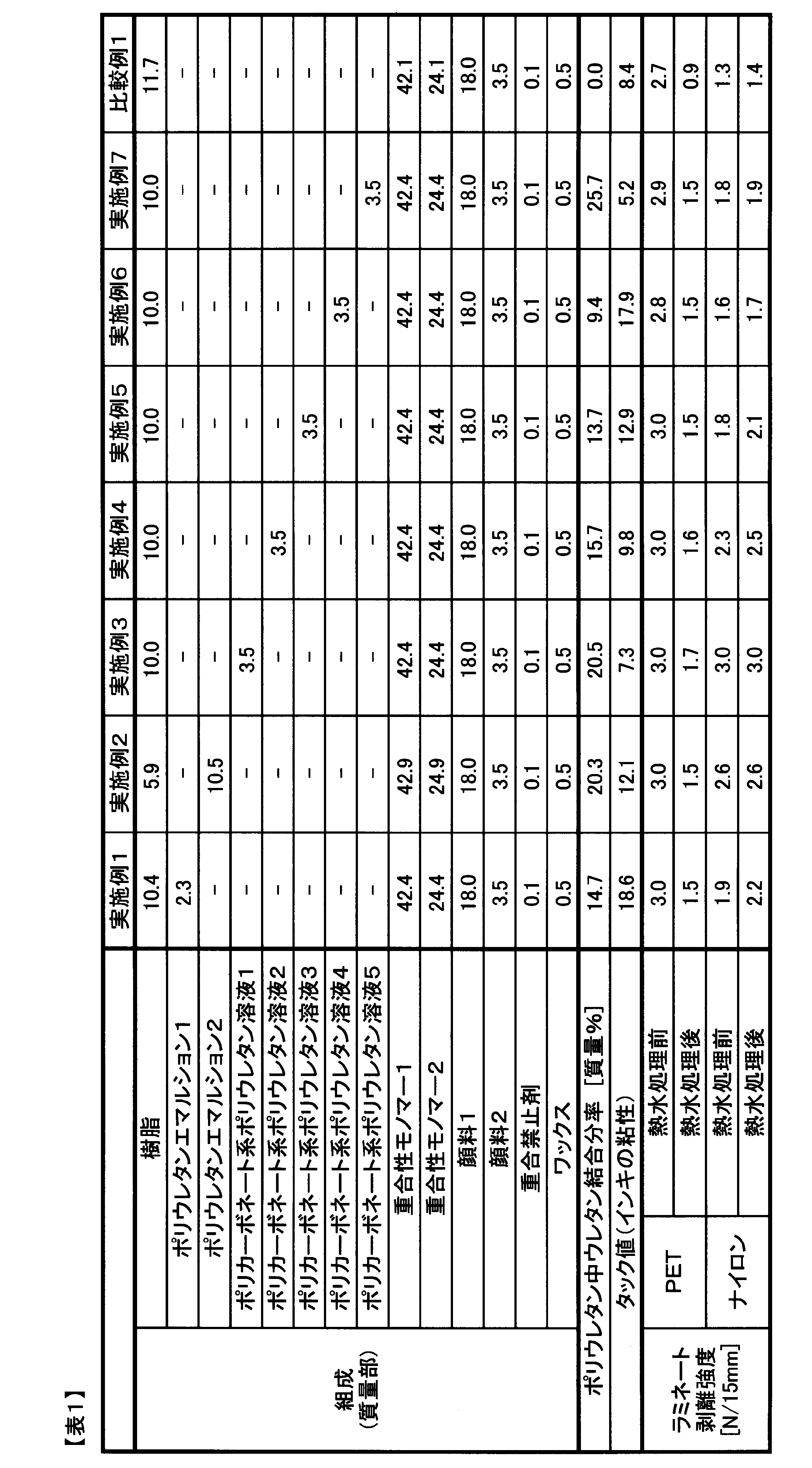
インキの組成を表2のとおりに変更する以外は、実施例1と同様の操作ならびに密着性の評価を行った。
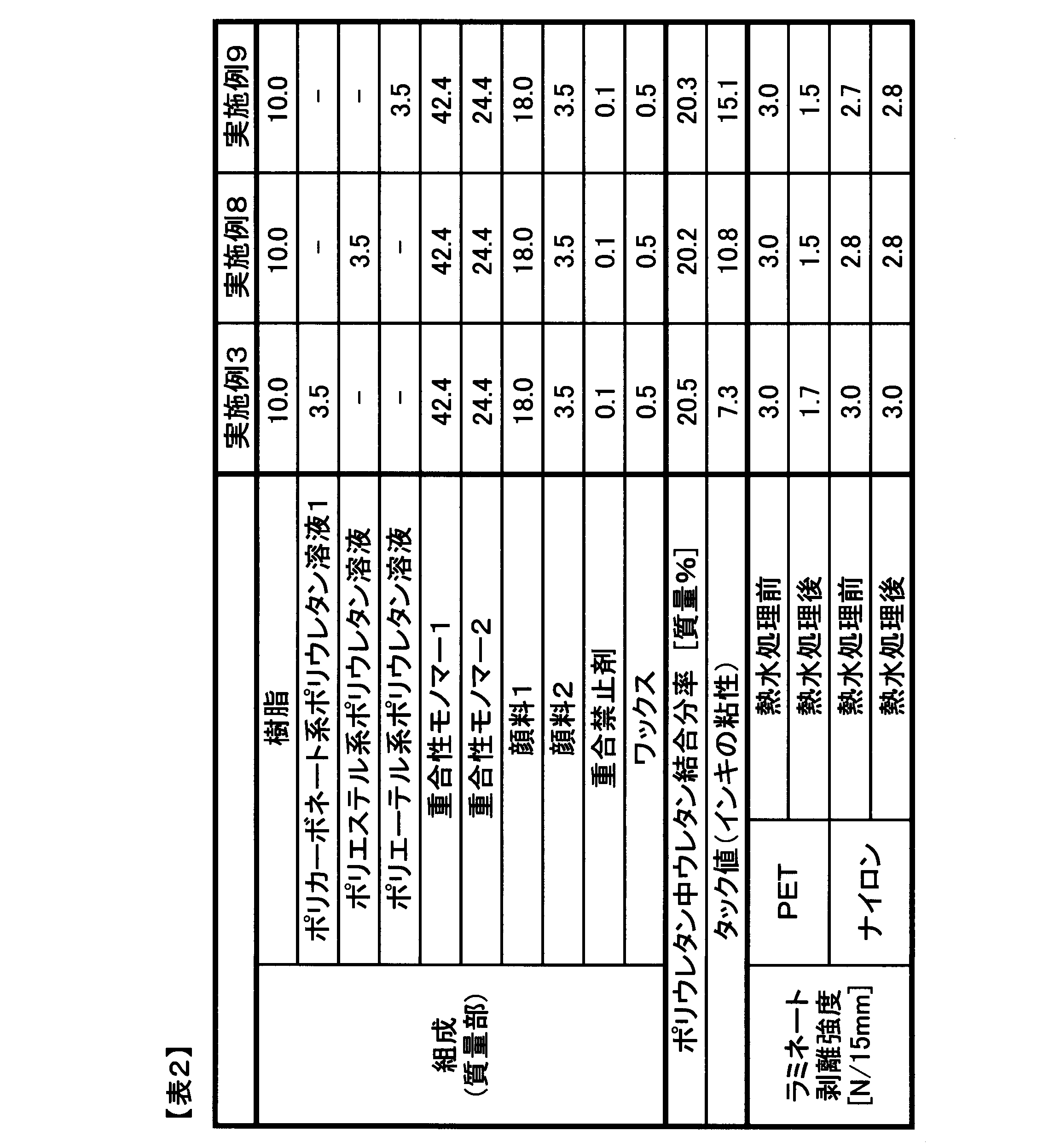
インキの組成を表3のとおりに変更する以外は、実施例1と同様の操作ならびに密着性の評価を行った。

インキの組成を表4のとおりに変更する以外は、実施例1と同様の操作ならびに密着性の評価を行った。
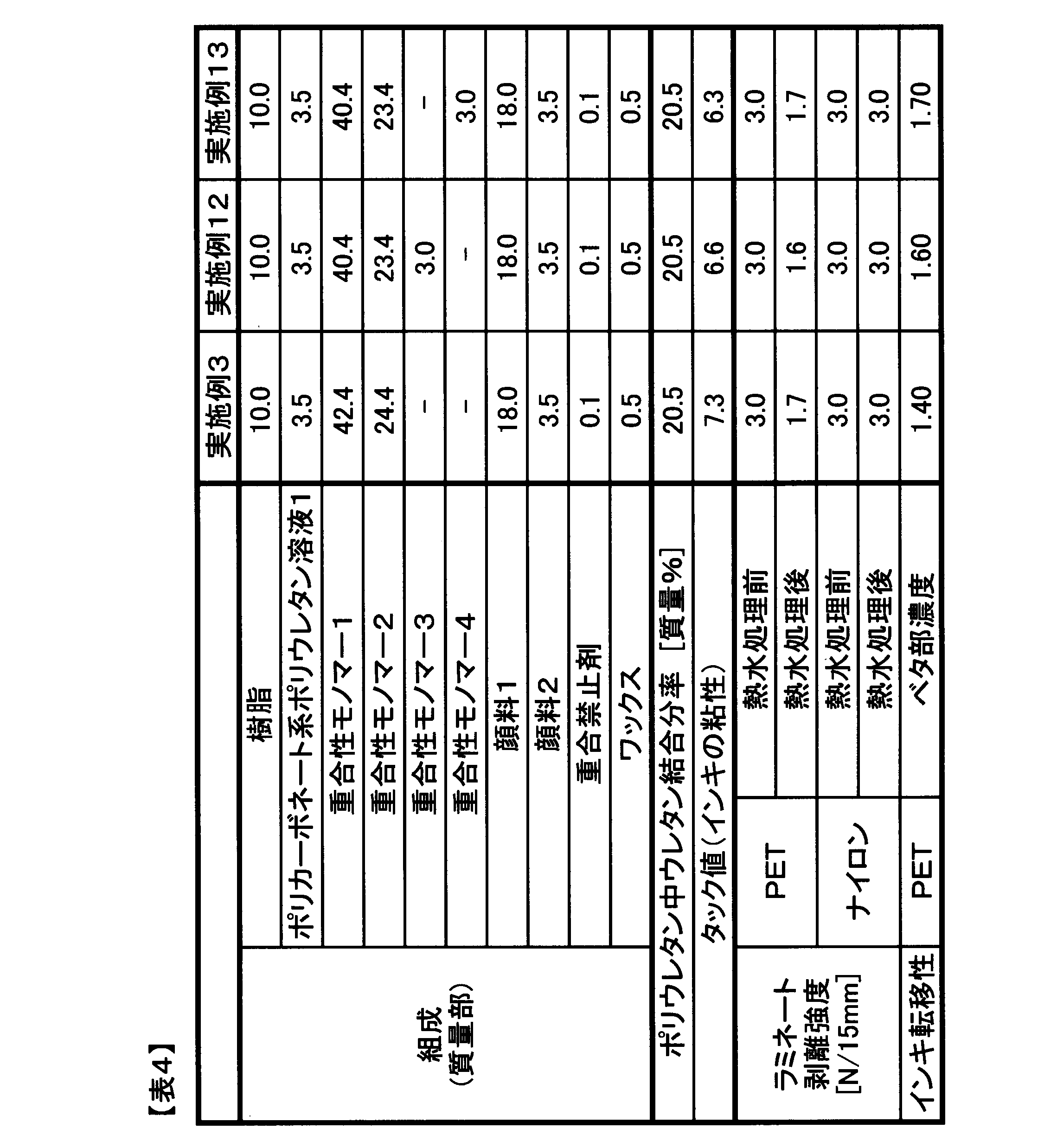
Claims (16)
- (a)ポリウレタン、および(b)重合性モノマーを含有することを特徴とする活性エネルギー線硬化型平版印刷用インキ。
- 前記(a)ポリウレタンが水溶性ポリウレタンである請求項1に記載の活性エネルギー線硬化型平版印刷用インキ。
- 前記(a)ポリウレタンがカルボキシル基、スルホン酸基およびヒドロキシル基から選ばれる1種以上の官能基を有する請求項1または2に記載の活性エネルギー線硬化型平版印刷用インキ。
- 前記(a)ポリウレタン中のウレタン結合分率が10質量%以上25質量%以下である、請求項1~3のいずれかに記載の活性エネルギー線硬化型平版印刷用インキ。
- 前記(a)ポリウレタンがカーボネート結合を有する、請求項1~4のいずれかに記載の活性エネルギー線硬化型平版印刷用インキ。
- 前記(a)ポリウレタンの含有量がインキに対して0.5質量%以上、5質量%以下である、請求項1~5のいずれかに記載の活性エネルギー線硬化型平版印刷用インキ。
- 前記(b)重合性モノマーが親水性の多官能(メタ)アクリレートを含む、請求項1~6のいずれかに記載の活性エネルギー線硬化型平版印刷用インキ。
- 前記(b)重合性モノマーが、ヒドロキシル基を有する多官能(メタ)アクリレートを含む、請求項1~7のいずれかに記載の活性エネルギー線硬化型平版印刷用インキ。
- 前記(b)重合性モノマーが、脂環骨格または炭素数6から18の脂肪族骨格を有する(メタ)アクリレートを含む、請求項1~8のいずれかに記載の活性エネルギー線硬化型平版印刷用インキ。
- 前記脂環骨格または炭素数6から18の脂肪族骨格を有する(メタ)アクリレートが、少なくともトリシクロデカン骨格を有する、請求項9に記載の活性エネルギー線硬化型平版印刷用インキ。
- さらに(c)エチレン性不飽和基および親水性基を有する樹脂を含む請求項1~10のいずれかに記載の活性エネルギー線硬化型平版印刷用インキ。
- 前記(c)エチレン性不飽和基および親水性基を有する樹脂が、アクリル樹脂、スチレンアクリル樹脂、およびスチレンマレイン酸樹脂からなる群より選ばれる少なくとも1種類を含む、請求項11に記載の活性エネルギー線硬化型平版印刷用インキ。
- 請求項1~12のいずれかに記載の活性エネルギー線硬化型平版印刷用インキを用いることを特徴とする印刷物の製造方法。
- 請求項1~12のいずれかに記載の活性エネルギー線硬化型平版印刷用インキを基材上に塗布し、活性エネルギー線を照射する工程を含む、印刷物の製造方法。
- 前記基材がプラスチックフィルム、プラスチックフィルムラミネート紙、金属、金属蒸着紙、金属蒸着プラスチックフィルムから選ばれる少なくとも1つを含む請求項14に記載の印刷物の製造方法。
- 前記活性エネルギー線が、電子線、またはLED-UVである請求項15に記載の印刷物の製造方法。
Priority Applications (4)
| Application Number | Priority Date | Filing Date | Title |
|---|---|---|---|
| CN202080037842.8A CN113825810B (zh) | 2019-05-22 | 2020-05-19 | 活性能量射线固化型平版印刷用油墨、和使用其的印刷物的制造方法 |
| EP20810670.8A EP3974200A4 (en) | 2019-05-22 | 2020-05-19 | LITHOGRAPHIC PRINTING INK CURABLE WITH ACTINIC RADIATION AND PROCESS FOR PRODUCTION THEREOF |
| US17/611,407 US20220235237A1 (en) | 2019-05-22 | 2020-05-19 | Active energy ray-curable lithographic ink and method for producing print using same |
| JP2020531175A JP7302602B2 (ja) | 2019-05-22 | 2020-05-19 | 活性エネルギー線硬化型平版印刷用インキ、およびそれを用いた印刷物の製造方法 |
Applications Claiming Priority (6)
| Application Number | Priority Date | Filing Date | Title |
|---|---|---|---|
| JP2019-095754 | 2019-05-22 | ||
| JP2019095754 | 2019-05-22 | ||
| JP2019-190821 | 2019-10-18 | ||
| JP2019190821 | 2019-10-18 | ||
| JP2019230233 | 2019-12-20 | ||
| JP2019-230233 | 2019-12-20 |
Publications (1)
| Publication Number | Publication Date |
|---|---|
| WO2020235556A1 true WO2020235556A1 (ja) | 2020-11-26 |
Family
ID=73459429
Family Applications (1)
| Application Number | Title | Priority Date | Filing Date |
|---|---|---|---|
| PCT/JP2020/019777 Ceased WO2020235556A1 (ja) | 2019-05-22 | 2020-05-19 | 活性エネルギー線硬化型平版印刷用インキ、およびそれを用いた印刷物の製造方法 |
Country Status (5)
| Country | Link |
|---|---|
| US (1) | US20220235237A1 (ja) |
| EP (1) | EP3974200A4 (ja) |
| JP (1) | JP7302602B2 (ja) |
| CN (1) | CN113825810B (ja) |
| WO (1) | WO2020235556A1 (ja) |
Cited By (2)
| Publication number | Priority date | Publication date | Assignee | Title |
|---|---|---|---|---|
| JP2022022990A (ja) * | 2020-06-26 | 2022-02-07 | 花王株式会社 | ポリエステル樹脂水分散液 |
| WO2023054322A1 (ja) * | 2021-09-30 | 2023-04-06 | 東レ株式会社 | 樹脂、活性エネルギー線硬化型組成物、活性エネルギー線硬化型インキ、オーバーコートワニス、塗料、接着剤、フォトレジスト、および印刷物の製造方法 |
Families Citing this family (2)
| Publication number | Priority date | Publication date | Assignee | Title |
|---|---|---|---|---|
| WO2025125432A1 (de) * | 2023-12-15 | 2025-06-19 | Covestro Deutschland Ag | Thermoplastisches poly(urethan-co-carbonat) |
| WO2026125061A1 (de) * | 2024-12-12 | 2026-06-18 | Covestro Deutschland Ag | Thermoplastisches poly(urethan-co-carbonat) auf basis (hetero)aromatischer urethandiol-prepolymere |
Citations (5)
| Publication number | Priority date | Publication date | Assignee | Title |
|---|---|---|---|---|
| JP2005329983A (ja) * | 2004-05-20 | 2005-12-02 | Dainippon Printing Co Ltd | 加熱処理用インジケータ付積層体、およびその製造方法 |
| WO2006003811A1 (ja) * | 2004-07-01 | 2006-01-12 | Matsui Chemical Co., Ltd. | 重ね塗り印刷用活性エネルギー線硬化型インキ組成物 |
| JP2012031388A (ja) * | 2010-05-19 | 2012-02-16 | Fujifilm Corp | 印刷方法、オーバープリントの作製方法、ラミネート加工方法、発光ダイオード硬化性コーティング組成物、及び、発光ダイオード硬化性インク組成物 |
| WO2015141552A1 (ja) | 2014-03-18 | 2015-09-24 | Dicグラフィックス株式会社 | 活性エネルギー線硬化型オフセットインキ組成物 |
| JP2020023614A (ja) * | 2018-08-07 | 2020-02-13 | Dicグラフィックス株式会社 | 活性エネルギー線硬化性オフセットインキ、及び印刷物 |
Family Cites Families (4)
| Publication number | Priority date | Publication date | Assignee | Title |
|---|---|---|---|---|
| GB2370279A (en) * | 2000-12-21 | 2002-06-26 | Coates Brothers Plc | Inks for in-mould decoration |
| JP5954556B2 (ja) * | 2014-03-17 | 2016-07-20 | Kjケミカルズ株式会社 | ウレタンオリゴマー及びそれを含有する活性エネルギー線硬化性樹脂組成物 |
| TW201720881A (zh) * | 2015-09-17 | 2017-06-16 | Toray Industries | 平版印刷用印墨、平版印墨用清漆及使用其之印刷物的製造方法 |
| KR102269778B1 (ko) * | 2017-03-07 | 2021-06-28 | 도레이 카부시키가이샤 | 인쇄물의 제조 방법 및 인쇄기 |
-
2020
- 2020-05-19 WO PCT/JP2020/019777 patent/WO2020235556A1/ja not_active Ceased
- 2020-05-19 EP EP20810670.8A patent/EP3974200A4/en not_active Withdrawn
- 2020-05-19 JP JP2020531175A patent/JP7302602B2/ja active Active
- 2020-05-19 US US17/611,407 patent/US20220235237A1/en not_active Abandoned
- 2020-05-19 CN CN202080037842.8A patent/CN113825810B/zh active Active
Patent Citations (5)
| Publication number | Priority date | Publication date | Assignee | Title |
|---|---|---|---|---|
| JP2005329983A (ja) * | 2004-05-20 | 2005-12-02 | Dainippon Printing Co Ltd | 加熱処理用インジケータ付積層体、およびその製造方法 |
| WO2006003811A1 (ja) * | 2004-07-01 | 2006-01-12 | Matsui Chemical Co., Ltd. | 重ね塗り印刷用活性エネルギー線硬化型インキ組成物 |
| JP2012031388A (ja) * | 2010-05-19 | 2012-02-16 | Fujifilm Corp | 印刷方法、オーバープリントの作製方法、ラミネート加工方法、発光ダイオード硬化性コーティング組成物、及び、発光ダイオード硬化性インク組成物 |
| WO2015141552A1 (ja) | 2014-03-18 | 2015-09-24 | Dicグラフィックス株式会社 | 活性エネルギー線硬化型オフセットインキ組成物 |
| JP2020023614A (ja) * | 2018-08-07 | 2020-02-13 | Dicグラフィックス株式会社 | 活性エネルギー線硬化性オフセットインキ、及び印刷物 |
Non-Patent Citations (1)
| Title |
|---|
| See also references of EP3974200A4 |
Cited By (3)
| Publication number | Priority date | Publication date | Assignee | Title |
|---|---|---|---|---|
| JP2022022990A (ja) * | 2020-06-26 | 2022-02-07 | 花王株式会社 | ポリエステル樹脂水分散液 |
| JP7654316B2 (ja) | 2020-06-26 | 2025-04-01 | 花王株式会社 | ポリエステル樹脂水分散液 |
| WO2023054322A1 (ja) * | 2021-09-30 | 2023-04-06 | 東レ株式会社 | 樹脂、活性エネルギー線硬化型組成物、活性エネルギー線硬化型インキ、オーバーコートワニス、塗料、接着剤、フォトレジスト、および印刷物の製造方法 |
Also Published As
| Publication number | Publication date |
|---|---|
| CN113825810A (zh) | 2021-12-21 |
| JP7302602B2 (ja) | 2023-07-04 |
| CN113825810B (zh) | 2023-12-01 |
| US20220235237A1 (en) | 2022-07-28 |
| JPWO2020235556A1 (ja) | 2020-11-26 |
| EP3974200A1 (en) | 2022-03-30 |
| EP3974200A4 (en) | 2023-04-05 |
Similar Documents
| Publication | Publication Date | Title |
|---|---|---|
| JP7559554B2 (ja) | 印刷用インキおよびそれを用いた印刷物の製造方法 | |
| JP7302602B2 (ja) | 活性エネルギー線硬化型平版印刷用インキ、およびそれを用いた印刷物の製造方法 | |
| JP7384022B2 (ja) | 活性エネルギー線硬化型平版印刷用インキ、およびそれを用いた印刷物の製造方法 | |
| EP3594006B1 (en) | Method for producing a printed matter | |
| EP3351602B1 (en) | Lithographic printing ink, varnish for lithographic inks, and method for producing printed matter using said ink | |
| JP7215122B2 (ja) | 活性エネルギー線硬化型平版印刷用インキ、およびそれを用いた印刷物の製造方法 | |
| CN102119183B (zh) | 聚氨酯水分散体在印刷油墨中的用途和相应的印刷方法 | |
| US11434384B2 (en) | Method for manufacturing printed material using lithographic printing ink, and lithographic printing ink set | |
| JP7715148B2 (ja) | フィルム積層体の製造方法 | |
| CN101001928A (zh) | 罩印用活性能量线固化型油墨组合物 | |
| JP7625861B2 (ja) | 印刷物の製造方法 | |
| EP2388146A2 (en) | Printing method, method for preparing overprint, method for processing laminate, light-emitting diode curable coating composition, and light-emitting diode curable ink composition | |
| JP7416060B2 (ja) | 印刷フィルム用コーティング剤、積層体、および印刷物の製造方法 | |
| JP7501243B2 (ja) | 印刷物の製造方法 | |
| JP7464455B2 (ja) | 平版オフセット印刷用活性エネルギー線硬化型インキ、その製造方法、インキ硬化物の製造方法及び印刷物 |
Legal Events
| Date | Code | Title | Description |
|---|---|---|---|
| ENP | Entry into the national phase |
Ref document number: 2020531175 Country of ref document: JP Kind code of ref document: A |
|
| 121 | Ep: the epo has been informed by wipo that ep was designated in this application |
Ref document number: 20810670 Country of ref document: EP Kind code of ref document: A1 |
|
| NENP | Non-entry into the national phase |
Ref country code: DE |
|
| ENP | Entry into the national phase |
Ref document number: 2020810670 Country of ref document: EP Effective date: 20211222 |
|
| WWW | Wipo information: withdrawn in national office |
Ref document number: 2020810670 Country of ref document: EP |