WO2020241679A1 - 脂質ナノ粒子 - Google Patents
脂質ナノ粒子 Download PDFInfo
- Publication number
- WO2020241679A1 WO2020241679A1 PCT/JP2020/020895 JP2020020895W WO2020241679A1 WO 2020241679 A1 WO2020241679 A1 WO 2020241679A1 JP 2020020895 W JP2020020895 W JP 2020020895W WO 2020241679 A1 WO2020241679 A1 WO 2020241679A1
- Authority
- WO
- WIPO (PCT)
- Prior art keywords
- lipid
- lipid nanoparticles
- rnp
- flow path
- integer
- Prior art date
- Legal status (The legal status is an assumption and is not a legal conclusion. Google has not performed a legal analysis and makes no representation as to the accuracy of the status listed.)
- Ceased
Links
Images










Classifications
-
- C—CHEMISTRY; METALLURGY
- C12—BIOCHEMISTRY; BEER; SPIRITS; WINE; VINEGAR; MICROBIOLOGY; ENZYMOLOGY; MUTATION OR GENETIC ENGINEERING
- C12N—MICROORGANISMS OR ENZYMES; COMPOSITIONS THEREOF; PROPAGATING, PRESERVING, OR MAINTAINING MICROORGANISMS; MUTATION OR GENETIC ENGINEERING; CULTURE MEDIA
- C12N15/00—Mutation or genetic engineering; DNA or RNA concerning genetic engineering, vectors, e.g. plasmids, or their isolation, preparation or purification; Use of hosts therefor
- C12N15/09—Recombinant DNA-technology
- C12N15/87—Introduction of foreign genetic material using processes not otherwise provided for, e.g. co-transformation
- C12N15/88—Introduction of foreign genetic material using processes not otherwise provided for, e.g. co-transformation using microencapsulation, e.g. using amphiphile liposome vesicle
-
- A—HUMAN NECESSITIES
- A61—MEDICAL OR VETERINARY SCIENCE; HYGIENE
- A61K—PREPARATIONS FOR MEDICAL, DENTAL OR TOILETRY PURPOSES
- A61K9/00—Medicinal preparations characterised by special physical form
- A61K9/48—Preparations in capsules, e.g. of gelatin, of chocolate
- A61K9/50—Microcapsules having a gas, liquid or semi-solid filling; Solid microparticles or pellets surrounded by a distinct coating layer, e.g. coated microspheres, coated drug crystals
- A61K9/51—Nanocapsules; Nanoparticles
- A61K9/5192—Processes
-
- A—HUMAN NECESSITIES
- A61—MEDICAL OR VETERINARY SCIENCE; HYGIENE
- A61K—PREPARATIONS FOR MEDICAL, DENTAL OR TOILETRY PURPOSES
- A61K9/00—Medicinal preparations characterised by special physical form
- A61K9/10—Dispersions; Emulsions
- A61K9/127—Synthetic bilayered vehicles, e.g. liposomes or liposomes with cholesterol as the only non-phosphatidyl surfactant
- A61K9/1271—Non-conventional liposomes, e.g. PEGylated liposomes or liposomes coated or grafted with polymers
-
- A—HUMAN NECESSITIES
- A61—MEDICAL OR VETERINARY SCIENCE; HYGIENE
- A61K—PREPARATIONS FOR MEDICAL, DENTAL OR TOILETRY PURPOSES
- A61K9/00—Medicinal preparations characterised by special physical form
- A61K9/10—Dispersions; Emulsions
- A61K9/127—Synthetic bilayered vehicles, e.g. liposomes or liposomes with cholesterol as the only non-phosphatidyl surfactant
- A61K9/1271—Non-conventional liposomes, e.g. PEGylated liposomes or liposomes coated or grafted with polymers
- A61K9/1272—Non-conventional liposomes, e.g. PEGylated liposomes or liposomes coated or grafted with polymers comprising non-phosphatidyl surfactants as bilayer-forming substances, e.g. cationic lipids or non-phosphatidyl liposomes coated or grafted with polymers
-
- A—HUMAN NECESSITIES
- A61—MEDICAL OR VETERINARY SCIENCE; HYGIENE
- A61K—PREPARATIONS FOR MEDICAL, DENTAL OR TOILETRY PURPOSES
- A61K9/00—Medicinal preparations characterised by special physical form
- A61K9/10—Dispersions; Emulsions
- A61K9/127—Synthetic bilayered vehicles, e.g. liposomes or liposomes with cholesterol as the only non-phosphatidyl surfactant
- A61K9/1277—Preparation processes; Proliposomes
-
- A—HUMAN NECESSITIES
- A61—MEDICAL OR VETERINARY SCIENCE; HYGIENE
- A61K—PREPARATIONS FOR MEDICAL, DENTAL OR TOILETRY PURPOSES
- A61K9/00—Medicinal preparations characterised by special physical form
- A61K9/48—Preparations in capsules, e.g. of gelatin, of chocolate
- A61K9/50—Microcapsules having a gas, liquid or semi-solid filling; Solid microparticles or pellets surrounded by a distinct coating layer, e.g. coated microspheres, coated drug crystals
- A61K9/51—Nanocapsules; Nanoparticles
- A61K9/5107—Excipients; Inactive ingredients
- A61K9/5123—Organic compounds, e.g. fats, sugars
-
- B—PERFORMING OPERATIONS; TRANSPORTING
- B82—NANOTECHNOLOGY
- B82Y—SPECIFIC USES OR APPLICATIONS OF NANOSTRUCTURES; MEASUREMENT OR ANALYSIS OF NANOSTRUCTURES; MANUFACTURE OR TREATMENT OF NANOSTRUCTURES
- B82Y30/00—Nanotechnology for materials or surface science, e.g. nanocomposites
-
- C—CHEMISTRY; METALLURGY
- C12—BIOCHEMISTRY; BEER; SPIRITS; WINE; VINEGAR; MICROBIOLOGY; ENZYMOLOGY; MUTATION OR GENETIC ENGINEERING
- C12N—MICROORGANISMS OR ENZYMES; COMPOSITIONS THEREOF; PROPAGATING, PRESERVING, OR MAINTAINING MICROORGANISMS; MUTATION OR GENETIC ENGINEERING; CULTURE MEDIA
- C12N11/00—Carrier-bound or immobilised enzymes; Carrier-bound or immobilised microbial cells; Preparation thereof
- C12N11/02—Enzymes or microbial cells immobilised on or in an organic carrier
- C12N11/04—Enzymes or microbial cells immobilised on or in an organic carrier entrapped within the carrier, e.g. gel or hollow fibres
-
- C—CHEMISTRY; METALLURGY
- C12—BIOCHEMISTRY; BEER; SPIRITS; WINE; VINEGAR; MICROBIOLOGY; ENZYMOLOGY; MUTATION OR GENETIC ENGINEERING
- C12N—MICROORGANISMS OR ENZYMES; COMPOSITIONS THEREOF; PROPAGATING, PRESERVING, OR MAINTAINING MICROORGANISMS; MUTATION OR GENETIC ENGINEERING; CULTURE MEDIA
- C12N15/00—Mutation or genetic engineering; DNA or RNA concerning genetic engineering, vectors, e.g. plasmids, or their isolation, preparation or purification; Use of hosts therefor
- C12N15/09—Recombinant DNA-technology
- C12N15/11—DNA or RNA fragments; Modified forms thereof; Non-coding nucleic acids having a biological activity
- C12N15/113—Non-coding nucleic acids modulating the expression of genes, e.g. antisense oligonucleotides; Antisense DNA or RNA; Triplex- forming oligonucleotides; Catalytic nucleic acids, e.g. ribozymes; Nucleic acids used in co-suppression or gene silencing
-
- C—CHEMISTRY; METALLURGY
- C12—BIOCHEMISTRY; BEER; SPIRITS; WINE; VINEGAR; MICROBIOLOGY; ENZYMOLOGY; MUTATION OR GENETIC ENGINEERING
- C12N—MICROORGANISMS OR ENZYMES; COMPOSITIONS THEREOF; PROPAGATING, PRESERVING, OR MAINTAINING MICROORGANISMS; MUTATION OR GENETIC ENGINEERING; CULTURE MEDIA
- C12N9/00—Enzymes; Proenzymes; Compositions thereof; Processes for preparing, activating, inhibiting, separating or purifying enzymes
- C12N9/14—Hydrolases (3)
- C12N9/16—Hydrolases (3) acting on ester bonds (3.1)
- C12N9/22—Ribonucleases [RNase]; Deoxyribonucleases [DNase]
-
- B—PERFORMING OPERATIONS; TRANSPORTING
- B82—NANOTECHNOLOGY
- B82Y—SPECIFIC USES OR APPLICATIONS OF NANOSTRUCTURES; MEASUREMENT OR ANALYSIS OF NANOSTRUCTURES; MANUFACTURE OR TREATMENT OF NANOSTRUCTURES
- B82Y40/00—Manufacture or treatment of nanostructures
-
- B—PERFORMING OPERATIONS; TRANSPORTING
- B82—NANOTECHNOLOGY
- B82Y—SPECIFIC USES OR APPLICATIONS OF NANOSTRUCTURES; MEASUREMENT OR ANALYSIS OF NANOSTRUCTURES; MANUFACTURE OR TREATMENT OF NANOSTRUCTURES
- B82Y5/00—Nanobiotechnology or nanomedicine, e.g. protein engineering or drug delivery
-
- C—CHEMISTRY; METALLURGY
- C12—BIOCHEMISTRY; BEER; SPIRITS; WINE; VINEGAR; MICROBIOLOGY; ENZYMOLOGY; MUTATION OR GENETIC ENGINEERING
- C12N—MICROORGANISMS OR ENZYMES; COMPOSITIONS THEREOF; PROPAGATING, PRESERVING, OR MAINTAINING MICROORGANISMS; MUTATION OR GENETIC ENGINEERING; CULTURE MEDIA
- C12N2310/00—Structure or type of the nucleic acid
- C12N2310/10—Type of nucleic acid
- C12N2310/20—Type of nucleic acid involving clustered regularly interspaced short palindromic repeats [CRISPR]
Definitions
- the present invention relates to lipid nanoparticles useful as carriers of RNA-protein complexes (ribonucleoproteins; RNPs) used for genome editing by the CRISPR system.
- RNPs ribonucleoproteins
- Genome editing technology is a biotechnology that can selectively introduce mutations or insert arbitrary DNA sequences containing genes into any target genomic DNA region. Genome editing technology is eagerly desired to be applied to medicine because it leads to the realization of fundamental treatments for various intractable diseases such as hereditary diseases and infectious diseases. Among them, the CRISPR (clustered regularly interspaced short palindromic repeats) / Cas9 (CRISPR-associatedproteins9) system, which is the third-generation genome editing technology, is currently receiving the most attention due to its excellent gene knockout efficiency and ease of design. Is.
- This system is a gRNA (guide) that is a chimeric RNA consisting of Cas9 protein with DNA double-strand break (DSB) activity and bacterial-derived crRNA (CRISPRRNA) and tracrRNA (trans-activating CRISPRRNA). Functions as an RNP with RNA). Therefore, it is possible to induce a gene knockout of interest by expressing RNP in the target cell or delivering the RNP itself into the target cell. Furthermore, by simultaneously delivering the donor DNA, it is possible to induce gene knock-in.
- gRNA guide
- CRISPRRNA bacterial-derived crRNA
- tracrRNA trans-activating CRISPRRNA
- Non-Patent Document 1 a method using DNA Nanoclews (Non-Patent Document 1), a method using in vivo reducing lipid nanoparticles (Non-Patent Document 2), a method using a conjugate with gold nanoparticles (Non-Patent Document 3), and liposome.
- Non-Patent Document 4 a method using in vivo reducing lipid nanoparticles
- Non-Patent Document 3 a method using a conjugate with gold nanoparticles
- Non-Patent Document 5 a method using lecithin nano-liposomal particles
- CRISPR-Gold Non-Patent Document 6
- CRISPR-Gold has been reported as an example of inducing gene knock-in.
- a high concentration of Cas9 is required to induce gene knockdown in cultured cells, and there remains a problem in genome editing efficiency.
- lipid nanoparticles containing nucleic acids and the like there is a method based on an alcohol dilution method using a flow path.
- lipid nanoparticles having a diameter of about 30 nm can be reproducibly produced by using a microchannel having a built-in three-dimensional micromixer capable of achieving instantaneous mixing of two liquids (Non-Patent Document 7).
- lipid nanoparticles carrying nucleic acids such as fat-soluble drugs and siRNA (short interfering RNA) or mRNA.
- LNPs lipid nanoparticles
- siRNA short interfering RNA
- lipid nanoparticles containing pH-sensitive cationic lipids as constituent lipids have been reported as lipid nanoparticles serving as carriers for efficiently delivering nucleic acids such as siRNA into target cells (Patent Document 2).
- Proteins such as RNP are irreversible due to various physical parameters during particle production such as organic solvents such as alcohol, pH of buffer solution, salt concentration, temperature, etc., compared to small molecule drugs and nucleic acids that have been used so far. Susceptible to inactivation. Therefore, to date, there have been no reports on the production of RNP-loaded lipid nanoparticle preparations based on the alcohol dilution method.
- An object of the present invention is to provide lipid nanoparticles containing nucleic acids and the like necessary for genome editing, which can be produced by an alcohol dilution method using a flow path, and have excellent genome editing efficiency. And.
- RNP which is a complex of crRNA, tracrRNA, and Cas9 protein
- ssON single-stranded oligonucleotide
- the present invention provides the following lipid nanoparticles.
- lipid component Containing a lipid component, a DNA nuclease, a guide RNA, and a single-strand oligonucleotide
- the lipid component has the following general formula (I).
- d represents an integer of 0 to 3; R 3 and R 4 are independently C 1-4 alkyl groups or C 2-4 alkenyl groups (the C 1-4 alkyl groups or C 2), respectively.
- the -4 alkenyl group indicates that one or two hydrogen atoms may be substituted with a phenyl group), whereas R 3 and R 4 are bonded to each other to form a 5- to 7-membered non-aromatic heterocycle (the).
- One or two hydrogen atoms on the ring may be substituted with a C 1-4 alkyl group or a C 2-4 alkenyl group)).
- a group represented by or a 5- to 7-membered non-aromatic heterocyclic group (however, the group is bonded to (O-CO) b- by a carbon atom, and one or two hydrogen atoms of the ring are C. It may be substituted with a 1-4 alkyl group or a C 2-4 alkenyl group)] It contains a pH-sensitive cationic lipid represented by, a neutral phospholipid, and a polyalkylene glycol-modified lipid. The ratio of the pH-sensitive cationic lipid to the total amount of lipids constituting the lipid nanoparticles is 30 to 50 mol%.
- the ratio of the neutral phospholipid to the total amount of lipids constituting the lipid nanoparticles is 20 to 50 mol%.
- Lipid nanoparticles in which the ratio of the polyalkylene glycol-modified lipid to the total amount of lipids constituting the lipid nanoparticles is 1 to 4 mol%.
- the DNA nuclease is a Cas9 protein.
- the Cas9 protein is a protein having only one of RuvC nuclease activity and HNH nuclease activity.
- the first introduction path into which the first fluid is introduced and the second introduction path into which the second fluid is introduced, which are independent of each other, have a certain length and merge with each other. It forms one dilution channel and
- the dilution channel has a two-dimensionally bent channel portion at least in a part thereof.
- the axial direction of the dilution flow path upstream from this or its extension direction is the X direction
- the width direction of the dilution flow path perpendicular to the X direction is the Y direction, and upstream of this.
- the substantially Y direction (approximately + Y direction, approximately ⁇ Y direction) is alternately directed toward the center side of the flow path from both side walls of the dilution flow paths facing each other in the Y direction. )
- the structure that regulates the flow path width of the above is formed by providing at least two or more structure elements at regular intervals d 1 , d 2 ...
- the pH of the lipid solution containing the lipid component dissolved in ethanol from the first introduction route and the DNA nuclease, the guide RNA, and the single-stranded oligonucleotide from the second introduction route is 5.0 or more.
- a method for producing lipid nanoparticles wherein the total flow rate of the aqueous solution is 1 ⁇ L / min to 100 mL / min, and the ratio of the flow velocity of the aqueous solution to the flow velocity of the lipid-dissolved solution is 7 or more.
- the flow path structure further has a third introduction path for introducing a third fluid.
- the first introduction path, the second introduction path, and the third introduction path meet with each other having a certain length so as to form one dilution flow path.
- the lipid nanoparticles according to the present invention are mounted on lipid nanoparticles having a specific composition of lipid membrane structure containing pH-sensitive cationic lipids, RNP can efficiently edit the genome of target cells. Further, the lipid nanoparticles according to the present invention can be produced by an alcohol dilution method because the RNP mounted on the lipid membrane structure contains ssON and is negatively charged.
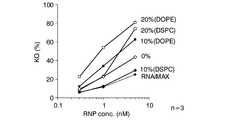
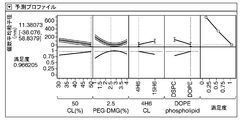
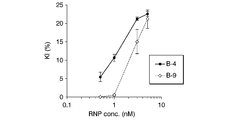
- Example 1 the measurement result of the ratio ([KI (%)] / [KO (%)]) of the knock-in efficiency (%) to the knockout efficiency (%) of each RNP-loaded lipid nanoparticles with respect to HeLa-GFP cells was obtained. It is a figure shown. In Example 2, it is a figure which showed the measurement result of the GFP knockout efficiency (%) with respect to the HeLa-GFP cell of each RNP-loaded lipid nanoparticle in the primary screening. In Example 2, it is a figure which showed the prediction profile of the number average particle diameter when the factor which significantly influences the number average particle diameter in the primary screening was changed. It is a figure which showed the prediction profile of the encapsulation rate when the factor which significantly influences the encapsulation rate in the primary screening was changed in Example 2.
- Example 2 it is a figure which showed the prediction profile of the gene knockout activity when the factor which significantly influences the gene knockout activity in the primary screening was changed.
- Example 2 it is a figure which showed the prediction profile of the number average particle diameter when the factor which significantly influences the number average particle diameter in the secondary screening was changed.
- Example 2 it is a figure which showed the prediction profile of the encapsulation rate when the factor which significantly influences the encapsulation rate in the secondary screening was changed.
- Example 2 it is a figure which showed the prediction profile of the gene knockout activity when the factor which significantly influences the gene knockout activity in the secondary screening was changed.
- FIG. 3 is a diagram showing the results of measuring the zeta potential and PdI over time by storing cells to which RNP-loaded lipid nanoparticles B-9 were added in Example 3 at 4 ° C.
- Example 3 it is the figure which showed the measurement result of the GFP knockout efficiency (%) with respect to the HeLa-GFP cell of the RNP-carrying lipid nanoparticles B-9 before and after storage at 4 degreeC.
- Example 4 measurement of GFP knockout efficiency (%) in HeLa-GFP cells cultured by adding RNP-loaded lipid nanoparticles B-4 or B-9 to a medium so as to have a Cas9 protein concentration of 0.1 nM. It is a figure which showed the result.
- Example 4 measurement of GFP knockout efficiency (%) in HeLa-GFP cells cultured by adding RNP-loaded lipid nanoparticles B-4 or B-9 to a medium so as to have a Cas9 protein concentration of 0.3 nM. It is a figure which showed the result.
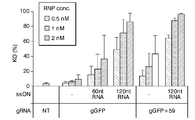
- Example 5 the measurement result of the GFP knockout efficiency (%) in HeLa-GFP cells cultured by adding RNP-loaded lipid nanoparticles to a medium so that the Cpf1 protein concentration was 0.5, 1, or 2 nM was obtained. It is a figure shown.
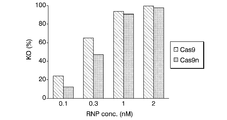
- Example 6 RNP-loaded lipid nanoparticles containing Cas9n protein or RNP-loaded lipid nanoparticles containing Cas9 protein were added to the medium so that the concentration of Cas9n protein or the like was 0.1, 0.3, 1, or 2 nM. It is a figure which showed the measurement result of the GFP knockout efficiency (%) in the HeLa-GFP cell cultured by.
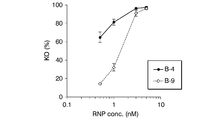
- Example 7 GFP in HEK-GFP cells cultured by adding RNP-loaded lipid nanoparticles B-4 or B-9 to a medium so that the Cas9 protein concentration was 0.5, 1, 3, or 5 nM. It is a figure which showed the measurement result of the knockout efficiency (%).
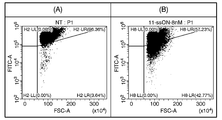
- Example 8 the result (A) of the flow cytometry of the GFP constitutive expression BMDM before the introduction of the RNP-loaded lipid nanoparticles and the result of the flow cytometry of the GFP constitutive expression BMDM after the introduction of the RNP-loaded lipid nanoparticles. It is a figure which showed (B).
- Example 9 the GFP knockout efficiency (GFP knockout efficiency) in HeLa-GFP cells cultured by adding each RNP-loaded lipid nanoparticles B-9 to a medium so that the Cas9 protein concentration was 0.1, 0.3, or 1 nM. %) Is the figure which showed the measurement result.
- Example 10 It is a figure which showed the measurement result of the GFP knockout efficiency (%) in the HeLa-GFP cell cultured by adding the RNP-loaded lipid nanoparticles containing Cas9 protein in Example 10. In Example 10, it is a figure which showed the measurement result of the GFP knockout efficiency (%) in the HeLa-GFP cell which was cultured by adding the RNP-loaded lipid nanoparticles containing Cpf1 protein.
- the lipid nanoparticles according to the present invention are used as carriers for introducing RNP into target cells in the CRISPR system, and are a complex of DNA nuclease, guide RNA (gRNA) and ssON used for genome editing.
- RNPs are lipid nanoparticles that are loaded into a lipid membrane structure of a particular composition, including pH-sensitive cationic lipids. Examples of the RNP mounted on the lipid nanoparticles include a complex of Cas9 protein, crRNA, tracrRNA, and ssON.
- RNP itself is directly mounted on lipid nanoparticles and introduced into a target cell, the off-target action is smaller than that of a method in which a gene encoding a DNA nuclease such as Cas9 protein is introduced into the target cell and expressed.
- the DNA nuclease loaded on the lipid nanoparticles binds to the DNA in a gRNA-dependent manner, and recognizes and cleaves the double-stranded DNA formed by pairing with a part of the gRNA. It is an enzyme.
- the DNA nuclease include Cas9 and Cpf1.
- the Cas9 protein is a protein that binds to DNA in a gRNA-dependent manner and has at least one of RuvC nuclease activity and HNH nuclease activity.
- a Cas9 protein with both RuvC nuclease activity and HNH nuclease activity cleaves double strands of genomic DNA.
- a Cas9 protein having only one of RuvC nuclease activity and HNH nuclease activity cleaves only one of the double strands of genomic DNA.
- the Cas9 protein used in the present invention may be a wild-type Cas9 protein derived from a CRISPR-based bacterium, or a mutant protein obtained by modifying the wild-type protein.
- bacteria having a CRISPR system include Streptococcus pyogenes, Staphylococcus aureus, Neisseria meningitidis, Campylobacter jejuni, and Geobacillus stearomophilus. Geobacillus stearothermophilus), Streptococcus thermophilus, Treponema denticola, etc.
- mutant protein obtained by modifying the wild-type Cas9 protein examples include mutants into which a mutation that inactivates either the RuvC nuclease activity or the HNH nuclease activity has been introduced.
- mutants into which a mutation that inactivates either the RuvC nuclease activity or the HNH nuclease activity examples include a mutant (Cas9 (D10A)) in which the 10th aspartic acid of the wild-type Cas9 protein is replaced with alanine.
- Cas9 (D10A) is also called Cas9 nickase (Cas9n) because it functions as a DNA nickase.
- the Cas9 protein used in the present invention may be a wild-type Cas9 protein or a mutant protein thereof to which various peptides are added, or may be a chimeric protein fused with another protein.
- the peptide include tag peptides such as His tag, Myc tag and Flag tag, and signal peptides such as nuclear localization signal peptide.
- Other proteins to be fused with the wild-type or mutant Cas9 protein include, for example, GST, fluorescent protein and the like.
- the Cpf1 protein is a protein that binds to DNA in a gRNA-dependent manner and has only RuvC nuclease activity.
- Cas9 proteins with both RuvC nuclease activity and HNH nuclease activity cleave double strands of genomic DNA to form blunt ends, whereas Cpf1 proteins form 5'protruding ends.
- the Cpf1 protein used in the present invention may be a wild-type Cpf1 protein derived from a bacterium having a CRISPR / Cpf1 system, or may be a mutant protein obtained by modifying the wild-type protein.
- the bacterium having the CRISPR / Cpf1 system include Acidaminococcus sp., Lachnospiraceae bacterium and the like.
- the mutant protein obtained by modifying the wild-type Cpf1 protein include a mutant in which a mutation that increases nuclease activity is introduced and a mutant protein in which a mutation that does not affect the nuclease activity is introduced. ..
- the Cpf1 protein used in the present invention may be a wild-type Cpf1 protein or a mutant protein thereof to which various peptides are added, or may be a chimeric protein fused with another protein.
- the peptide and other proteins the same ones as those mentioned in Cas9 protein can be used.
- a gRNA is an RNA having a base sequence capable of pairing with a target sequence (base sequence of a target for genome editing) on genomic DNA to be cleaved by DNA nucleose.
- the "base sequence capable of pairing with the target sequence” is usually a base sequence homologous (identical) or complementary to the target sequence in order to suppress recognition of a region other than the target sequence.
- the gRNA may consist of one RNA, or may be a complex of two or more RNAs.
- crRNA and tracrRNA can be used as the gRNA.
- crRNA is derived from a bacterium having a CRISPR system, and consists of a region consisting of a base sequence complementary to a part of tracrRNA (binding region with tracrRNA) and a base sequence homologous or complementary to the target sequence on genomic DNA. It is a single-stranded RNA containing a region (genome DNA binding region).
- TracrRNA is derived from a bacterium that also has a CRISPR system, has a region consisting of a base sequence complementary to a part of crRNA (binding region with crRNA), and hybridizes with crRNA in the region to form a hairpin structure. It is a single-stranded RNA that forms.
- the Cas9 protein recognizes the hairpin structure and RNP is formed.
- the crRNA and tracrRNA may be independent single-stranded RNAs, or both may be single-stranded RNAs linked via an appropriate RNA linker. Examples of bacteria having a CRISPR system include those as described above.
- the Cas9 protein, crRNA and tracrRNA may all be derived from the same type of bacteria or may be derived from different bacteria. Further, crRNA and tracrRNA may consist only of natural RNA as long as the function of the CRISPR / Cas9 system is not impaired, and a part or all of the modified RNA or artificial nucleic acid may be contained.
- the gRNA may be RNA containing a target sequence as in crRNA, and tracrRNA is unnecessary. Therefore, the gRNA can be shorter than when using the Cas9 protein. Further, the gRNA may consist only of natural RNA as long as the function of the CRISPR / Cpf1 system is not impaired, and a modified RNA or artificial nucleic acid may be contained in a part or all of the gRNA.
- the target sequence As the target sequence, the base sequence of the region immediately following the PAM sequence is usually selected.
- the PAM sequence is a sequence recognized by a DNA nuclease such as Cas9 protein, and is determined depending on the DNA nuclease such as Cas9 protein used.
- the PAM sequence recognized by the Cas9 protein includes 5'-NGG (N: A, G, C, T)
- the PAM sequence recognized by the Cpf1 protein includes 5'-TTTV (V: A,).
- G, C), 5'-TTTN N: A, G, C, T.
- the base length of the target sequence in gRNA such as crRNA is not particularly limited, and can be, for example, about 15 to 30 base lengths, preferably 18 to 22 base lengths.
- the ssON used in the present invention contains a region that can be paired with a part of gRNA. As a result, it contains a region capable of pairing with the gRNA in a state of forming a complex with the DNA nuclease mounted on the lipid nanoparticles. As a result, RNP, which is a complex of DNA nuclease, gRNA, and ssON, is formed.
- ssON may be an oligonucleotide consisting only of DNA, an oligonucleotide consisting only of RNA, or a chimeric oligonucleotide containing both DNA and RNA. Further, ssON may consist only of natural RNA or DNA as long as it does not impair the function of the CRISPR system used, or may contain modified nucleic acid or artificial nucleic acid in part or all of it. ..
- the DNA nuclease loaded on the lipid nanoparticles is Cas9 protein
- it contains a partial region of crRNA other than the binding region with tracrRNA and a region consisting of a complementary base sequence.
- SsON and crRNA hybridize through a region complementary to this crRNA (a region that binds to crRNA). That is, the RNP mounted on the lipid nanoparticles according to the present invention is a complex of crRNA and tracrRNA, and crRNA and ssON hybridized with each other, and the formed tripartite complex and Cas9 protein.
- the region in the crRNA that hybridizes with ssON (the region that binds to ssON) can hybridize with tracrRNA at the same time as ssON to form a tripartite complex, and this tripartite complex is recognized by the Cas9 protein.
- the hairpin structure is not particularly limited as long as it can be formed.
- the binding region with ssON in crRNA may include a part or all of the genomic DNA binding region, or may be the same as the genomic DNA binding region.
- ssON uses two types that hybridize to each guide RNA.
- ssON can also be used as the knocked-in donor DNA.
- ssON having a region in which 40 to 60 bp homologous sequence regions (homology arms) for homologous recombination are added to both ends of a gene fragment to be knocked in, in addition to a region that binds to gRNA such as crRNA. Functions as donor DNA.
- the nucleic acid complexed with DNA nuclease such as Cas9 protein includes not only gRNA such as crRNA and tracrRNA but also ssON.
- the amount of nucleic acid contained in RNP is large, the positive charge of RNP is suppressed and the negative charge becomes strong, so that it can be efficiently mounted on lipid nanoparticles containing pH-sensitive cationic lipid.
- the base length of ssON used in the present invention may be long enough to negatively charge RNP, and is appropriate in consideration of the base lengths of gRNA, for example, crRNA and tracrRNA, the type of Cas9 protein, and the like. Can be decided.
- the length of ssON can be, for example, about 50 to 500 bases.
- gRNA can be designed using a design tool such as CRISPRDesignTool (HorizonDiscovery) or TrueDesignGenomeEditor (Invitrogen).
- the lipid nanoparticles according to the present invention are lipid nanoparticles in which RNP is mounted on a lipid film structure.
- the lipid component constituting the lipid membrane structure contains at least a pH-sensitive cationic lipid, a neutral phospholipid, and a polyalkylene glycol-modified lipid.
- pH-sensitive cationic lipid contained in the lipid nanoparticles according to the present invention may be referred to as a cationic lipid represented by the following general formula (I) (hereinafter, “pH-sensitive cationic lipid of the present invention”. ).
- a represents an integer of 3 to 5, but is preferably 4.
- b indicates 0 or 1. When b is 0, it means that the -O-CO- group does not exist and it is a single bond.
- R 1 and R 2 each independently represent a group represented by the following general formula (A).
- q represents an integer from 1 to 9; r represents 0 or 1; s represents an integer from 1 to 3; t represents 0 or 1; u represents an integer from 1 to 8.
- Indicates; c indicates 0 or 1; v indicates an integer of 4-12. However, when b and c are 0 at the same time, q is an integer of 3 to 5, r and t are 1, s is 1, and u + v is an integer of 6 to 10. except.
- the hydrocarbon chains of R 1 and R 2 are preferably relatively long chains from the viewpoint of the stability of the lipid nanoparticles according to the present invention.
- R 1 and R 2 are groups having 20 or more carbon atoms, that is, in the general formula (A), q + 2r + s + 2t + u + c + v is an integer of 19 or more. Is preferable.
- q + 2r + s + 2t + u + c + v is preferably an integer of 19 to 33, more preferably an integer of 19 to 31, and even more preferably an integer of 21 to 31. , 21-27, more preferably.
- R 1 and R 2 pH-sensitive cationic lipids of the present invention in the general formula (A), r is 1, t is 0, q is 5-11 integer, preferably from 6 to 10 A group in which s + u is an integer of 5 to 11, preferably an integer of 6 to 10, c is 1, v is an integer of 4 to 12, and q + s + u + v is an integer of 16 or more; 0, t is 1, q + s is an integer of 5 to 11, preferably an integer of 6 to 10, u is an integer of 5 to 8, c is 1, and v is 4 to 12.
- a group that is an integer and q + s + u + v is an integer of 16 or more; r and t are 0, q + s + u is an integer of 13 to 23, preferably 15 to 21, c is 1, and v is 4 to 12.
- a group that is an integer and q + s + u + v is an integer of 18 or more; r and t are 0, q + s + u is an integer of 13 to 23, preferably 15 to 21, c is 1, and v is 6 to 10.
- a group that is an integer and q + s + u + v is an integer of 18 or more is preferable.
- R 1 and R 2 may be groups represented by the general formula (A) and may be different groups from each other, but the same group is preferable.
- X represents a group represented by the following general formula (B) or a 5- to 7-membered non-aromatic heterocyclic group.
- the 5- to 7-membered non-aromatic heterocyclic group indicated by X is bonded to (O-CO) b- by a carbon atom.
- d represents an integer of 0 to 3. When d is 0, it means that the-(CH 2 ) -group does not exist and it is a single bond.
- R 3 and R 4 independently form a C 1-4 alkyl group (alkyl group having 1 to 4 carbon atoms) or a C 2-4 alkenyl group (alkenyl group having 1 to 4 carbon atoms), respectively. Shown.
- the C 1-4 alkyl group or C 2-4 alkenyl group indicated by R 3 and R 4 may have one or two hydrogen atoms substituted with a phenyl group.
- Examples of the C 1-4 alkyl group include a methyl group, an ethyl group, a propyl group, an isopropyl group, an n-butyl group, an isobutyl group and a t-butyl group.
- the C2-4 alkenyl group includes a vinyl group, a 1-propenyl group, a 2-propenyl group, a 1-methylvinyl group, a 2-methyl-1-propenyl group, a 1-butenyl group, a 2-butenyl group and a 3-butenyl group. The group is mentioned.
- R 3 and R 4 may be bonded to each other to form a 5- to 7-membered non-aromatic heterocycle.
- Examples of the 5- to 7-membered non-aromatic heterocycle formed by binding R 3 and R 4 to each other include 1-pyrrolidinyl group, 1-piperidinyl group, 1-morpholinyl group, and 1-piperazinyl group. ..
- one or two hydrogen atoms in the ring are converted into a C 1-4 alkyl group or a C 2-4 alkenyl group. It may be replaced.
- two hydrogen atoms in the ring are substituted with a C 1-4 alkyl group or a C 2-4 alkenyl group, they may be substituted with the same group or different groups. May be good.
- heteroatom contained in the heterocyclic group examples include a nitrogen atom, an oxygen atom, a sulfur atom and the like. ..
- the heteroatom constituting the heterocycle in the heterocyclic group may be one, and the same or different heteroatoms may be two or more.
- the heterocycle in the heterocyclic group may be a saturated heterocycle or may contain one or more double bonds, but the heterocycle does not become an aromatic ring.
- a is an integer of 3 to 5
- b is 1
- X is a 5- to 7-membered non-aromatic heterocyclic group (however, hetero). It is attached to (O-CO) b- by the carbon atom in the ring group), preferably 1-pyrrolidinyl group, 1-piperidinyl group, 1-morpholinyl group, or 1-piperazinyl group (by the carbon atom in the ring ( It is bonded to O-CO) b-, and one hydrogen atom may be substituted with a C 1-4 alkyl group or a C 2-4 alkenyl group), and R 1 and R 2 are respectively.
- r is 1, t is 0, q is an integer of 5 to 11, preferably an integer of 6 to 10, and s + u is an integer of 5 to 11, preferably.
- Is a group of 6 to 10 integers, c is 1, v is an integer of 4 to 12, and q + s + u + v is an integer of 16 or more; in the general formula (I), a is 3 to It is an integer of 5, b is 1, and X is a 5- to 7-membered non-aromatic heterocyclic group (where carbon atoms in the heterocyclic group bind to (O-CO) b-), preferably.
- An integer, preferably an integer of 6 to 10, s + u is an integer of 5 to 11, preferably an integer of 6 to 10, c is 1, v is an integer of 4 to 12, and q + s + u + v is 16 or more.
- R 1 and R 2 are independent of each other, and in the general formula (A), r is 0, t is 1, q + s is an integer of 5 to 11, preferably an integer of 6 to 10, and u. Is an integer of 5 to 8, c is 1, v is an integer of 4 to 12, and q + s + u + v is an integer of 16 or more.
- the lipid R 1 and R 2 are the same group, more preferably a pH-sensitive cationic lipids of the general formula (I), R 1 and R 2 are the same group, And a lipid having a of 4 is particularly preferable.
- the pKa of the pH-sensitive cationic lipid represented by the general formula (I) is not particularly limited, but is, for example, about 4.0 to 9.0, preferably about 4.5 to 8.5, and more preferably about 6 to 8. It is preferable to select the type of each substituent so as to give a pKa in this range.
- the pH-sensitive cationic lipid represented by the general formula (I) can be easily produced, for example, by the method specifically shown in the examples of the present specification. Those skilled in the art can easily produce any lipid included in the range of the general formula (I) by appropriately selecting the raw material compound, the reagent, the reaction conditions and the like with reference to this production method.
- neutral phospholipid of the present invention has a neutral charge as a whole and is a phosphate group.
- glycerophospholipid or sphingolipid is preferable.
- the neutral glycerophospholipid include phosphatidylethanolamine, phosphatidylcholine, cardiolipin, plasmalogen and the like.
- the neutral sphingolipid include sphingomyelin, ceramide phosphoryl glycerol, and ceramide phosphoryl ethanolamine.
- the fatty acid residues in these neutral glycerophospholipids or neutral sphingolin lipids are not particularly limited, and examples thereof include saturated or unsaturated fatty acid residues having 12 to 24 carbon atoms and having 14 to 20 carbon atoms. Saturated or unsaturated fatty acid residues are preferred.
- acyl groups derived from fatty acids such as lauric acid, myristic acid, palmitic acid, palmitoleic acid, stearic acid, oleic acid, linoleic acid, linolenic acid, arachidic acid, arachidonic acid, bechenic acid, and lignoseric acid. Can be done. When these glycerolipids or sphingolipids have two or more fatty acid residues, all the fatty acid residues may be the same group or different groups from each other.
- neutral phospholipid of the present invention a neutral glycerophospholipid having a saturated or unsaturated fatty acid residue having 12 to 24 carbon atoms is preferable, and a neutral glycerophospholipid having 12 to 24 carbon atoms is preferable from the viewpoint of further improving the efficiency of genome editing.
- Neutral glycerophospholipids or neutral sphingolin phospholipids having unsaturated fatty acid residues are more preferred, and neutral glycerophospholipids having unsaturated fatty acid residues having 12 to 24 carbon atoms are even more preferred.
- phosphatidylethanolamine having an unsaturated fatty acid residue having 12 to 24 carbon atoms having an unsaturated fatty acid residue having 12 to 24 carbon atoms is preferable, and phosphatidylethanolamine having a fatty acid residue having 14 to 20 carbon atoms is preferable. Is more preferable, and dioleoylphosphatidylethanolamine (DOPE) is particularly preferable.
- DOPE dioleoylphosphatidylethanolamine
- the polyalkylene glycol-modified lipid contained in the lipid component of the lipid nanoparticles according to the present invention (hereinafter, may be referred to as “polyalkylene glycol-modified lipid of the present invention”) is a lipid modified with polyalkylene glycol.
- the polyalkylene glycol is a hydrophilic polymer, and the surface of the lipid nanoparticles can be modified with the polyalkylene glycol by constructing the lipid nanoparticles using the polyalkylene glycol-modified lipid as the lipid film-constituting lipid.
- surface modification with polyalkylene glycol it may be possible to enhance the stability of lipid nanoparticles such as retention in blood.
- polyethylene glycol for example, polyethylene glycol, polypropylene glycol, polytetramethylene glycol, polyhexamethylene glycol and the like can be used.
- the weight average molecular weight of the polyalkylene glycol is, for example, about 300 to 10,000, preferably about 500 to 10,000, and more preferably about 1,000 to 5,000.
- stearyllated polyethylene glycol for example, PEG45 stearate (STR-PEG45)
- PEG45 stearate STR-PEG45
- lipids other than the pH-sensitive cationic lipid of the present invention, the neutral phospholipid of the present invention, and the polyalkylene glycol-modified lipid of the present invention generally form liposomes.
- the lipids used in this can be used. Examples of such lipids include positively or negatively charged phospholipids, sterols, saturated or unsaturated fatty acids and the like. These can be used alone or in combination of two or more.
- Examples of positively or negatively charged phospholipids include phosphatidylserine, phosphatidylinositol, phosphatidylglycerol, ceramide phosphorylglycerol phosphate, and phosphatidic acid.
- Examples of sterols include animal-derived sterols such as cholesterol, cholesterol succinic acid, lanosterol, dihydrolanosterol, desmosterol, and dihydrocholesterol; plant-derived sterols such as stigmasterol, cytosterol, campesterol, and brushcasterol (phytosterols); Examples thereof include sterols derived from microorganisms such as thymosterol and ergosterol.
- the pH-sensitive cationic lipid of the present invention, the neutral lipid, and the polyalkylene glycol-modified lipid of the present invention, which constitute the lipid nanoparticles according to the present invention may be of only one type or two or more types, respectively. May be good.
- the amount of the pH-sensitive cationic lipids of the present invention is the present among the lipid molecules constituting the lipid nanoparticles. It means the total amount of lipid molecules corresponding to the pH-sensitive cationic lipids of the present invention.
- the amount of the neutral lipids of the present invention is the present invention among the lipid molecules constituting the lipid nanoparticles. It means the total amount of lipid molecules corresponding to triglycerides.
- the amount of the polyalkylene glycol-modified lipids of the present invention is the present among the lipid molecules constituting the lipid nanoparticles. It means the total amount of lipid molecules corresponding to the polyalkylene glycol-modified lipid of the invention.
- the ratio of the pH-sensitive cationic lipid of the present invention to the total amount of lipids constituting the lipid nanoparticles according to the present invention ([Amount of pH-sensitive cationic lipid of the present invention (mol)). ] / ([Amount of total lipids constituting lipid nanoparticles (mol)]) ⁇ 100%) is 30 to 50 mol%, and the neutral phospholipid of the present invention with respect to the total amount of lipids constituting lipid nanoparticles.
- the ratio ([amount of neutral phospholipid of the present invention (mol)] / ([amount of total lipids constituting lipid nanoparticles (mol)]) ⁇ 100%) is 20 to 50 mol%, and the lipid nanoparticles.
- Ratio of the polyalkylene glycol-modified lipid of the present invention to the total amount of lipids constituting the above is preferably 1.0 to 4.0 mol%, and the ratio of the pH-sensitive cationic lipid of the present invention to the total amount of lipids constituting the lipid nanoparticles according to the present invention is 40 to 50 mol.
- the ratio of the neutral phospholipid of the present invention to the total amount of lipids constituting the lipid nanoparticles is 20 to 50 mol%, and the polyalkylene glycol-modified lipid of the present invention to the total amount of lipids constituting the lipid nanoparticles. More preferably, the ratio of is 1.5 to 2.0.
- the lipid nanoparticles according to the present invention can be appropriately surface-modified, if necessary.
- modifying the surface of the lipid nanoparticles according to the present invention with a hydrophilic polymer or the like the retention in blood can be enhanced.
- surface modification can be performed by using a lipid modified with these modifying groups as a constituent lipid of lipid nanoparticles.
- lipid derivatives for enhancing blood retention for example, glycophorin, ganglioside GM1, phosphatidylinositol, ganglioside GM3, glutamic acid derivative, glutamic acid derivative, polyglycerin phospholipid derivative and the like. Can also be used.
- polyalkylene glycol as a hydrophilic polymer for enhancing blood retention, dextran, pullulan, ficoll, polyvinyl alcohol, styrene-maleic anhydride copolymer, and divinyl ether-maleic anhydride alternating copolymer , Amylose, amylopectin, chitosan, mannan, cyclodextran, pectin, carrageenan and the like can also be used for surface modification.
- the lipid nanoparticles can be surface-modified with an oligosaccharide compound having 3 or more sugars.
- the type of oligosaccharide compound having 3 or more sugars is not particularly limited, but for example, an oligosaccharide compound in which about 3 to 10 sugar units are bound can be used, and preferably about 3 to 6 sugar units are bound. Oligosaccharide compounds can be used.
- an oligosaccharide compound which is preferably a trimer or a hexamer of glucose can be used, and more preferably an oligosaccharide compound which is a trimer or a tetramer of glucose can be used.
- isomaltotriose, isopanone, maltotriose, maltotetraose, maltopentaose, maltohexaose and the like can be preferably used, and among these, malto with ⁇ 1-4 bond of glucose can be preferably used. More preferred are triose, maltotetraose, maltopentaose, or maltohexaose.
- the amount of surface modification of the lipid nanoparticles by the oligosaccharide compound is not particularly limited, but for example, it is about 1 to 30 mol%, preferably about 2 to 20 mol%, more preferably about 5 to 10 mol% with respect to the total amount of lipid. Is.
- the method for surface-modifying lipid nanoparticles with an oligosaccharide compound is not particularly limited.
- liposomes International Publication No. 2007/102481
- lipid nanoparticles are surface-modified with a monosaccharide such as galactose or mannose are known. Therefore, the surface modification method described in this publication can be adopted. All disclosures of the above publications are included as disclosures herein by reference.
- the lipid nanoparticles according to the present invention can be imparted with any one or more or more functions such as a temperature change sensitive function, a membrane permeation function, a gene expression function, and a pH sensitive function.
- a temperature change sensitive function such as a temperature change sensitive function, a membrane permeation function, a gene expression function, and a pH sensitive function.
- the retention of lipid nanoparticles in blood is improved, the capture rate by reticular endothelial tissues such as the liver and spleen is reduced, and after endocytosis in target cells.
- Lipid nanoparticles can be efficiently escaped from endosomes and translocated into the nucleus, and high genome editing activity can be achieved in the nucleus.
- the lipid nanoparticles according to the present invention can be modified with a substance such as an antibody capable of specifically binding to a receptor or an antigen on the cell surface, improving the efficiency of delivering the substance into the nucleus of the cell. can do.
- a substance such as an antibody capable of specifically binding to a receptor or an antigen on the cell surface, improving the efficiency of delivering the substance into the nucleus of the cell. can do.
- a lipid derivative capable of reacting with a mercapto group in a monoclonal antibody or a fragment thereof for example, poly (ethylene glycol) - ⁇ -Distearoyl phosphatidylethanolamine- ⁇ -male imide, ⁇ - [N- (1,2-distearoyl-sn-glycero-3-phosphoryl-ethyl) carboxamide)- ⁇ - [3- [2- (2) , 5-dihydro-2,5-dioxo-1H-pyrrole-1-yl) ethanecarboxamide] propyl ⁇ -poly (oxy-1,2-ethandyl) by containing a lipid derivative having a maleimide structure.
- Monoclonal antibodies can be attached to the surface of the membrane of lipid lipid nanoparticles.
- the surface of the lipid nanoparticles according to the present invention may be modified with a polypeptide containing a plurality of consecutive arginine residues (hereinafter, referred to as "polyarginine").
- polyarginine preferably a polypeptide containing 4 to 20 consecutive arginine residues, more preferably a polypeptide consisting of only 4 to 20 consecutive arginine residues, particularly preferably octaarginine or the like is used. Can be done.
- lipid nanoparticles such as liposomes By modifying the surface of lipid nanoparticles such as liposomes with polyarginine such as octaarginine, the intracellular delivery efficiency of RNP encapsulated in liposomes can be improved (Journal of Controlled Release, 98, pp.317-). 323, 2004; International Publication No. 2005/32593). Modification of the surface of lipid nanoparticles with polyarginine can be facilitated by using, for example, lipid-modified polyarginine, such as steallylated octaarginine, as constituent lipids of lipid nanoparticles according to the methods described in the publications above. Can be done. The disclosure of the above publications and the disclosures of all references cited in this publication are included as disclosures herein by reference.
- the lipid nanoparticles according to the present invention are one or more selected from the group consisting of antioxidants such as tocopherol, propyl gallate, ascorbyl palmitate, or butylated hydroxytoluene, charged substances, and membrane polypeptides. It may further contain the substance of.
- antioxidants such as tocopherol, propyl gallate, ascorbyl palmitate, or butylated hydroxytoluene
- charged substances and membrane polypeptides. It may further contain the substance of.
- the charged substance that imparts a positive charge include saturated or unsaturated aliphatic amines such as stearylamine and oleylamine; saturated or unsaturated cationic synthetic lipids such as dioleoyltrimethylammonium propane; and cationic polymers.
- Examples of the charged substance that imparts a negative charge include disetyl phosphate, cholesteryl hemiscusinate, phosphatidylserine, phosphatidylinositol, and phosphatidylic acid.
- Examples of the membrane polypeptide include a membrane superficial polypeptide, a membrane endogenous polypeptide, and the like. The blending amount of these substances is not particularly limited, and can be appropriately selected depending on the intended purpose.
- the lipid nanoparticles according to the present invention are lipid membrane structures composed of lipid components and carry RNP. Since the encapsulation rate of RNP in lipid nanoparticles is further increased, the ratio of RNP mounted on the lipid nanoparticles to the total amount of lipids constituting the lipid nanoparticles according to the present invention ([Amount of RNP (mol)). )] / ([Amount of total lipids constituting lipid nanoparticles (mol)]) ⁇ 100%) is preferably 1.8 to 3.6 ⁇ 10-2 mol%.
- the average particle size of the lipid nanoparticles is 80 nm or less, and the average particle size is 80 nm or less, because high delivery efficiency can be easily obtained even when the target cells are present in a relatively deep part in the living body.
- the particle size is more preferably 50 nm or less, further preferably 40 nm or less, further preferably 30 nm or less, and particularly preferably 10 to 30 nm.
- the average particle size of the lipid nanoparticles means the number average particle size measured by a dynamic light scattering (DLS) method. The measurement by the dynamic light scattering method can be performed by a conventional method using a commercially available DLS apparatus or the like.
- the polydispersity index (PDI) of the lipid nanoparticles according to the present invention is about 0.05 to 0.1, preferably about 0.06 to 0.08, and more preferably about 0.07.
- the zeta potential can be in the range of 5.5 mV to 6.0 mV, preferably about 5.8 mV.
- the form of the lipid nanoparticles according to the present invention is not particularly limited, and examples thereof include monomembrane liposomes, multilamellar liposomes, spherical micelles, and atypical layered structures as the forms dispersed in an aqueous solvent.
- the lipid nanoparticles according to the present invention are preferably single membrane liposomes and multilamellar liposomes.
- the method for producing lipid nanoparticles according to the present invention is not particularly limited, and any method available to those skilled in the art can be adopted.
- all lipid components are dissolved in an organic solvent such as chloroform, and a lipid film is formed by vacuum drying with an evaporator or spray drying with a spray dryer, and then the aqueous solvent containing RNP or the like is dried.
- It can be produced by adding it to the above-mentioned mixture and further emulsifying it with an emulsifier such as a homogenizer, an ultrasonic emulsifier, or a high-pressure injection emulsifier.
- lipid nanoparticles it can also be produced by a well-known method for producing liposomes, such as a reverse phase evaporation method. If it is desired to control the size of the lipid nanoparticles, it may be subjected to extrusion (extrusion filtration) under high pressure using a membrane filter having a uniform pore size or the like.
- the lipid nanoparticles according to the present invention can be produced by an alcohol dilution method using a flow path.
- the flow path used for production may be a microchannel with a built-in three-dimensional micromixer capable of achieving instantaneous mixing of two solutions, but since it is possible to form a nano-sized lipid particle formation system with high particle size controllability.
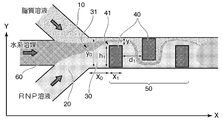
- flow path structure of the present invention On the upstream side (left side of the drawing), the first introduction path 10 for introducing the first fluid and the second introduction path 20 for introducing the second fluid, which are independent of each other, each have a constant length. Then, they merge to form one dilution flow path 30 toward the downstream side thereof.
- the dilution flow path 30 has a flow path portion 50 that is two-dimensionally bent at least in a part thereof, and the bending flow path portion 50 extends in the axial direction or the extension direction of the dilution flow path upstream of the dilution flow path portion 50.
- the flow path widths y 1 , y 2 ... of the dilution flow path are 1 / 2y 0 during the constant lengths x 1 , x 2 ... in the X direction.
- it will be regulated to 1 / 2y 0 or less and 1 / 40y 0 or more.
- the flow path structure of the present invention has a shape in which substantially rectangular baffles are alternately arranged from both side surfaces in a micro-sized flow path as illustrated in FIG. 1A and described above.
- it is not limited to the one configured by arranging a separate baffle on the flow path in this way. That is, the configuration of the structure element 40 is not particularly limited as long as a flow path having a similar shape is formed so as to correspond to the flow path formed by arranging such a baffle, as described above.
- the wall surface of the flow path structure is bent into a predetermined shape (while maintaining a substantially constant wall thickness) and integrally formed so as to form the structure element 40 as described above.
- the flow path of such a two-dimensional structure can be, for example, injection molding using a thermoplastic resin, a thermosetting resin, an ultraviolet curable resin, a metal or a glassy material, casting molding, or molding using a three-dimensional printer. It can be formed relatively easily by such means.
- the flow path width y 0 of the dilution flow path 30 after the first introduction path 10 and the second introduction path 20 merge is also influenced to some extent by the size of the particle size of the nano-sized lipid particles to be formed. However, it is typically about 20 to 1000 ⁇ m, more preferably about 100 to 200 ⁇ m. Desired nanosized, in obtaining the lipid particles having a particle diameter size within the particle size range and specific examples about 10 ⁇ 100 nm, flow path width y 0 in the lipid solution diluent medium in the range as described above It is a necessary condition to dilute with.
- each structure 40 The heights h 1 , h 2 ... (length in the Y direction) of each structure 40 are 1 / 2y 0 or more and 1 y with respect to the flow path width y 0 of the dilution flow path 30 on the upstream side thereof. Less than 0 , preferably 1 / 2y 0 or more and 39 / 40y 0 or less, more preferably 1 / 2y 0 or more and 3/4y 0 or less, and the presence of each of the structure elements 40 on the upstream side thereof. From the flow path width y 0 of the dilution flow path 30, the flow path widths y 1 , y 2 ... are reduced to a width less than 1 / 2y 0 and larger than 0.
- the heights h 1 , h 2 ... of the structure elements 40 provided in the bent flow path portion 50 do not necessarily have to be the same, as long as the above-mentioned predetermined conditions are satisfied. Each may be different.
- the flow path widths y 1 , y 2 ... formed by this may also be different. For example, even in a mode in which the widths h 1 , h 2 ... of each structure member 40 gradually increase and the flow path widths y 1 , y 2 ... become narrower toward the downstream direction. Good.
- the heights h 1 , h 2 ... (length in the Y direction) of each structure element 40 are predetermined, and the flow path widths y 1 , y 2 ... of these existing parts are 1 / 2y. By narrowing down to a width less than 0 , the efficiency of molecular diffusion is improved.
- each structure element 40 includes the size of the lipid particle to be obtained, the number of structure elements 40, and the height h of each structure element 40.
- the respective widths x 1 , x 2 ... Is preferably about 20 ⁇ m to 1000 ⁇ m.
- the widths x 1 , x 2 ... of each structure member 40 do not necessarily have to be the same, and may be different as long as the above-mentioned predetermined conditions are satisfied.
- the width x 1 , x 2 ... may gradually increase toward the downstream direction.
- the intervals d 1 , d 2 ... between the adjacent structure elements 40 include the size of the lipid particles to be obtained, the number of structure elements 40, and the heights h 1 , h 2 of each structure element 40. ... (length in the Y direction), width of each structure 40 (length in the X direction) x 1 , x 2 ..., etc., depending on other conditions, but the flow of the upstream dilution channel to road width y 0, it is preferred that a length of the extent 1 / 10y 0 or 5y 0 or less.
- the intervals between the adjacent structure 40s d 1 , d 2 . are 20 to 1000 ⁇ m, typically 200 ⁇ m. It is desirable that the value is about 20 ⁇ m to 1000 ⁇ m.
- the intervals d 1 , d 2 ... between the adjacent structure 40s do not necessarily have to be the same, and may be different as long as the above-mentioned predetermined conditions are satisfied.
- the mode may be such that the intervals d 1 , d 2 ... gradually become narrower toward the downstream direction.
- each structure member 40 is alternately extended from the wall surfaces on both sides in the substantially Y direction (approximately + Y direction, approximately ⁇ Y direction) toward the center side of the flow path, and is substantially extended in the flow path direction (X direction).
- the angle does not necessarily have to be exactly 90 °, and even if it is inclined to some extent, it can be an effective configuration, and it is not particularly limited.
- each structure member 40 is in the range of about 30 to 150 °, more preferably 40 to 140 °, and particularly preferably 80 to 100 °.
- shape of the corner portion on the center side of the flow path of each structure member 40 is also allowed to have a certain degree of roundness and is not particularly limited, but is, for example, R50 ⁇ m or less, more preferably R20 ⁇ m or less. It may be acceptable. However, in order to obtain more controllable and uniform nano-sized lipid particles, it is desirable that these tolerances are as small as possible. Further, in the embodiment shown in FIG.
- the axial direction of the upstream dilution flow path in the flow path structure or the X direction which is an extension direction thereof is represented by a linear line for convenience, but this X direction is merely linear. It indicates the axial direction of the dilution flow path, and is not limited to such a linear one in practice, and may be curved with a certain curvature, for example. In such a case, the Y direction, which is the width direction of the dilution flow path that intersects the X direction perpendicularly, points to the direction perpendicular to the X direction at the portion having the unit length.
- the size of the flow path in the depth direction is particularly limited. However, for example, it is preferably about 10 to 1000 ⁇ m, more preferably about 50 to 200 ⁇ m.
- the dilution flow path 30 in the flow path structure shown in FIG. 1A can generate a three-dimensional flow. If it is a road, it is not particularly limited.
- the flow path structure of the present invention is chaotic by grooves or microprojections formed on the wall surface of the flow path in place of the two-dimensionally bent flow path portion 50 in at least a part of the dilution flow path 30. It may be a chaotic micromixer (staggered herringbone mixer) (Non-Patent Document 8) in which a flow is generated.
- the first introduction path 10 into which the first fluid is introduced and the second introduction path 20 into which the second fluid is introduced have a constant length, respectively.
- a lipid solution in which a lipid component is dissolved in ethanol is used from the first introduction route, and Cas9 protein, crRNA and tracrRNA are added from the second introduction route.
- An aqueous solution containing ssON (an aqueous solution containing RNP) is introduced.
- the lipid solution is diluted with an RNP-containing aqueous solution, and in this process, lipid nanoparticles carrying RNP are produced.
- the flow path structure of the present invention has a plurality of introduction paths independent of each other, and it is sufficient that these introduction paths have a constant length and merge to form one dilution flow path. It may have three introduction paths.
- the first fluid introduced from the first introduction path is before merging with the second fluid introduced from the second introduction path.
- the first introduction path, the second introduction path, and the third introduction path merge with each other having a certain length so as to come into contact with the third fluid introduced from the third introduction path, and one diluted flow flows.
- a road can be formed.
- the introduction paths where the confluence points to the dilution flow paths 30 are farthest from each other are designated as the first introduction path 10 and the second introduction path 20, and the remaining introduction paths are designated as the third introduction path 60.
- the lipid solution obtained by dissolving the lipid component in ethanol from the first introduction path 10 the RNP-containing aqueous solution from the second introduction path 20, and the aqueous solvent used for preparing the RNP-containing aqueous solution from the third introduction path 60 are used. , Introduce each.
- the lipid solution introduced from the first introduction path 10 first merges with the aqueous solvent introduced from the third introduction path 60, and then merges with the RNP-containing aqueous solution introduced from the second introduction path 20. Since it is possible to prevent the RNP-containing aqueous solution from coming into direct contact with the lipid solution, which is a high-concentration ethanol solution, it is possible to prevent the proteins in the RNP-containing aqueous solution from being aggregated by the high-concentration ethanol in the dilution channel 30, especially near the inlet thereof. it can.
- Dilution in the flow path structure of the present invention depends on molecular diffusion.
- the RNP-containing aqueous solution can be prepared by dissolving Cas9 protein, crRNA, tracrRNA and ssON in an aqueous solvent.
- the aqueous solvent is not particularly limited as long as it is an aqueous solvent in which RNP can be mixed with a lipid solution while maintaining genome editing activity, and the produced lipid nanoparticles can be stably dispersed.
- the aqueous solvent include a buffer solution such as a phosphate buffer solution, a citrate buffer solution, and a phosphate buffered physiological saline solution, a physiological saline solution, and a medium for cell culture.
- aqueous solvents further include monosaccharides of glucose, galactose, mannose, fructose, inositol, ribose, and xylose sugar; disaccharides such as lactose, sucrose, cellobiose, trehalose, and maltose; Sugars; polysaccharides such as cyclodextrin; sugar alcohols such as erythritol, xylitol, sorbitol, mannitol, martitol; glycerin, diglycerin, polyglycerin, propylene glycol, polypropylene glycol, ethylene glycol, diethylene glycol, triethylene glycol, polyethylene glycol, Polyhydric alcohols such as ethylene glycol monoalkyl ether, diethylene glycol monoalkyl ether, and 1,3-butylene glycol; etc. may be added.
- the pH of the RNP-containing aqueous solution is preferably 5.0 or higher, more preferably in the range of 5.0 to 8.5, and even more preferably in the range of 5.0 to 8.0. It is even more preferably in the range of 5.0 to 7.5.
- the pH of the RNP-containing aqueous solution is preferably 6 or more, more preferably in the range of 6 to 8.5, further preferably in the range of 6 to 8, and in the range of 6 to 7.5. Is even more preferable.
- the flow velocity ratio between the lipid solution and the RNP-containing aqueous solution affects the dilution rate of the lipid solution, which in turn affects the size of the lipid particles produced.
- the ratio of the flow velocity of the RNP-containing aqueous solution to the flow velocity of the lipid solution is from the viewpoint of producing lipid nanoparticles having a sufficiently small average particle size and high uptake efficiency into target cells. , 7 or more is preferable, 7 to 10 is more preferable, and 7 to 9 is further preferable.
- the total flow rate of the lipid solution and the RNP-containing aqueous solution is not particularly limited, and can be appropriately adjusted within the range of 1 ⁇ L / min to 100 mL / min.
- the total flow rate of the lipid solution and the RNP-containing aqueous solution is preferably in the range of 50 ⁇ L / min to 1 mL / min, more preferably in the range of 50 to 800 ⁇ L / min, and is in the range of 50 to 800 ⁇ L / min.
- the range of 600 ⁇ L / min is more preferable, and the range of 50 to 500 ⁇ L / min is even more preferable.
- the lipid nanoparticles according to the present invention are carriers that deliver RNP for genome editing to target cells. Genome editing can be performed by introducing the lipid nanoparticles according to the present invention into a target cell. When the target cell is a cultured cell, the lipid nanoparticles according to the present invention are added to the culture medium. When the target cell is a cell in the body of an animal, the lipid nanoparticles according to the present invention are administered to the animal.
- the administration route is not particularly limited, but parenteral administration such as intravenous administration, enteral administration, intramuscular administration, subcutaneous administration, transdermal administration, nasal administration, and pulmonary administration is preferable.
- the animal to which the lipid nanoparticles according to the present invention are administered is not particularly limited, and may be a human or a non-human animal.
- non-human animals include mammals such as cows, pigs, horses, sheep, goats, monkeys, dogs, cats, rabbits, mice, rats, hamsters and guinea pigs, and birds such as chickens, quails and ducks.
- FIG. 2 schematically shows the structure of the manufacturing equipment actually used.
- FIG. 2A is a schematic view of the entire structure
- FIG. 2B is a perspective view of a microchannel (channel structure) with a built-in mixer
- FIG. 2C is one of the dilution channels 104c. It is an enlarged view of a part.
- a syringe 101 equipped with a lipid solution and a syringe 102 equipped with an RNP solution are respectively installed in the flow control device 103, and these are installed in the first introduction path of the microchannel 104 with a built-in mixer.
- the injection port 104a of the above and the injection port 104b of the second introduction path were connected by a tube 105, and the injection port 104d of the dilution flow path 104c was connected to the collection container 106 for collecting the produced lipid nanoparticles by the tube 105.
- lipid solution Cas9 protein derived from Streptococcus pyogenes (160 kDa) (product name: "Alt-R Sp Cas9 Nuclease V3", manufactured by Integrated DNA technologies) and a target sequence (sequence) in the GFP (green fluorescent protein) gene.
- RNP solution Cas9 protein derived from Streptococcus pyogenes (160 kDa) (product name: "Alt-R Sp Cas9 Nuclease V3", manufactured by Integrated DNA technologies) and a target sequence (sequence) in the GFP (green fluorescent protein) gene.
- tracrRNA SEQ ID NO: A solution (RNP solution) in which 3,67 base length) was dissolved in a buffer solution so as to have a molar ratio of 1: 1: 1 was used.
- crRNA and racrRNA were obtained by amplification by PCR using the genomic DNA of GFP stable expression HeLa (HeLa-GFP) cells as a template.
- the pH 6 buffer is MES buffer (20 mM MES, 50 mM NaCl, pH 6.0), and the pH 4.0, 5.0, or 5.5 buffer is citric acid buffer (20 mM citric acid, 50 mM NaCl, pH 4.0, 5.0, or 5.5) was used.
- the solution discharged from the dilution channel is collected and placed in a dialysis membrane (MWCO: 12,000-14,000).
- Buffer exchange and alcohol removal were performed by dialysis in PBS ( ⁇ ) at 4 ° C. for 2 hours or longer.
- the RNP solution was converted into double-stranded DNA (dsDNA) containing the target sequence (SEQ ID NO: 4, 0.25 pmol) in terms of Cas9 protein amount. The mixture was mixed so as to have 2 or 5 equivalents (molar ratio), and reacted at 37 ° C. for 1 hour.
- the reaction solution after the reaction was subjected to agarose gel electrophoresis to evaluate the DNA cleavage efficiency.
- the dsDNA not mixed with RNP was used as a negative control, and the sample obtained by adding RNP not passed through the microchannel to the dsDNA was used as a positive control.
- the relative cleavage activity was calculated when the cleavage activity in the sample to which 5 equivalents of RNP was added to the target dsDNA was set to 1 among the positive controls.
- Image analysis software ImageJ was used for the quantitative analysis.
- the RNP solution was prepared with a buffer solution having a pH of 6.0, the FRR was set to 9.0, and the experiment was conducted with the TFR in the range of 50 to 500 ⁇ L / min to investigate the effect of the TFR.
- the results are shown in Table 1.
- "NC” indicates the result of negative control
- "PC” indicates the result of positive control.
- the cleavage activity was similar to that of the positive control at any total flow velocity, and no effect of the total flow velocity on the DNA cleavage activity was observed. Therefore, in the subsequent experiments, the mixing rate was higher. A large 500 ⁇ L / min was adopted.
- the RNP solution was prepared with a buffer solution having a pH of 6.0, the TFR was set to 500 ⁇ L / min, and the FRR was set to the range of 3.0 to 9.0, and the effect of FRR was investigated.
- the results are shown in Table 2.
- Table 2 in the range of FRR of 5.0 or less, a decrease in DNA cleavage activity was observed as the FRR decreased.
- the range of FRR of 7.0 or more the activity was similar to that of the positive control, and the influence of the liquid feeding to the microchannel was not observed. From this result, FFR of 9.0 was adopted in the subsequent experiments.
- the TFR was set to 500 ⁇ L / min, the FRR was set to 9.0, and the pH of the buffer solution for preparing the RNP solution was set in the range of 4.0 to 6.0, and the effect of the pH of the RNP solution was investigated.
- the results are shown in Table 3.
- Table 3 while the DNA cleavage activity was maintained at pH 6.0 to the same level as that of the positive control, a significant decrease in DNA cleavage activity was observed as the pH decreased in the pH range of 5.5 or less. From this result, in the subsequent experiments, a buffer solution having a pH of 6.0 was used for preparing the RNP solution.
- FIG. 3A is a perspective view of a microchannel (channel structure) with a built-in chaotic mixer
- FIG. 3B is an enlarged view of a part of the dilution channel 107c.
- MES buffer (20 mM MES, 50 mM NaCl, pH 6.0) is used as the buffer for pH 6 to 6.6
- citric acid buffer (20 mM citric acid, 50 mM NaCl, pH 5.5) is used as the buffer for pH 5.5.
- the RNP solution and ethanol were sent into the microchannel of the manufacturing apparatus shown in FIG. 3 under the conditions of TFR of 500 ⁇ L / min and FRR of 9, and the RNP solution discharged from the dilution channel was recovered. Dialysis was performed in the same manner as in 1.
- the RNP solution after dialysis was mixed with dsDNA to 5 equivalents (molar ratio) in terms of Cas9 protein amount in the same manner as in Reference Example 1, and reacted at 37 ° C. for 1 hour to evaluate the DNA cleavage efficiency.
- the relative cleavage activity was calculated when the cleavage activity of the positive control by adding 5 equivalents of RNP to the target dsDNA was set to 1. The results are shown in Table 4. Similar to Reference Example 1, the DNA cleavage activity was maintained at pH 6.0 to the same level as that of the positive control, while the DNA cleavage activity was significantly reduced at pH 5.5.
- the RNP solution was prepared with a buffer solution having a pH of 6.0, the TFR was set to 500 ⁇ L / min, the FRR was set to 5.0, 7.0, or 9.0, and the same experiment was performed to investigate the effect of the FRR.
- the results are shown in Table 5.
- the FRR was 5.0, the DNA cleavage activity was slightly low, whereas when the FRR was 7.0 or more, the activity was similar to that of the positive control, and the effect of sending the liquid to the microchannel was observed. There wasn't.
- the lipid nanoparticles according to the present invention can be produced as lipid nanoparticles under the same conditions as when the production apparatus shown in FIG. 2 is used, even when the production apparatus shown in FIG. 3 is used. Became clear. That is, it was suggested that the structural selectivity of the mixer was low in the production of the lipid nanoparticles according to the present invention.
- Example 1 Lipid nanoparticles with different lipid compositions equipped with RNP for knockout of the GFP gene were produced, and the GFP knockout activity against HeLa-GFP cells was examined.
- lipid nanoparticles having different lipid compositions equipped with RNP for knocking in to modify the GFP gene into a BFP (blue fluorescent protein) gene were produced, and the GFP knockin activity against HeLa-GFP cells was examined.
- the lipid nanoparticles were produced using the production apparatus used in Reference Example 1.
- CL4H6 (pKa-6.25, Patent Document 2) as a pH-sensitive cationic lipid, 1,2-distearoyl-sn-glycero-3-phosphatidylcholine (DSPC) or 1 as a neutral phospholipid as constituent lipids of lipid nanoparticles.
- DSPC 1,2-distearoyl-sn-glycero-3-phosphatidylcholine
- DOPE 2-diore oil-sn-glycero-3-phosphatidylethanolamine
- cholesterol cholesterol
- PEG-DMG 1,2-dimiristoyl-rac-glycero-3-methoxypolyethylene glycol-2000
- the lipid components of the five types of lipid compositions shown in Table 6 were used for the production of lipid nanoparticles.
- the Cas9 protein, crRNA, and tracrRNA used were the same as those used in Reference Example 1.
- a 132-base long DNA (sequence) consisting of the same base sequence as a partial region of genomic DNA containing the target sequence (SEQ ID NO: 1) is used as ssON for GFP knockout.
- the region Nos. 5 and 68 to 87 have the same base sequence as the target sequence).
- mutations are introduced into the three bases (65th, 67, and 72nd bases) of ssON used for knockout as ssON for BFP knock-in. DNA (SEQ ID NO: 6) was used.
- HDR homology-dependent repair
- Each RNP-loaded lipid nanoparticle was added to the medium of HeLa-GFP cells seeded the day before so that the Cas9 protein concentration was 0.3, 1, or 5 nM, and cultured. After exchanging the medium 2 days after the addition of the RNP-loaded lipid nanoparticles, the cells were collected 1 day later, and the GFP knockout efficiency (%) by flow cytometry (the ratio of cells not emitting GFP fluorescence to the whole cells). (%)) was measured.
- a commercially available transfection reagent “Lipofectamine RNAiMAX” manufactured by Thermo Fisher Scientific, which has been used for introducing RNP, was used.
- RNP-loaded lipid nanoparticles containing DOPE as a neutral phospholipid showed higher knockout activity than RNP-loaded lipid nanoparticles containing DSPC.
- RNP-loaded lipid nanoparticles having a high neutral phospholipid content or containing DOPE as a neutral phospholipid showed higher knockout activity than "Lipofectamine RNAiMAX".
- ssON for knock-in is used, and the lipid composition is 20% DSPC content (“20% (DSPC)” in Table 6) or 20% DOPE content (Table 6).
- RNP-loaded lipid nanoparticles were produced in the same manner except that "20% (DOPE)"). Each RNP-loaded lipid nanoparticle was added to the medium of HeLa-GFP cells seeded the day before so that the Cas9 protein concentration was 0.3, 1, or 5 nM, and cultured.
- FIG. 5 shows the results of determining the ratio ([KI (%)] / [KO (%)]) of the knock-in efficiency (%) to the knock-out efficiency (%) for each RNP-loaded lipid nanoparticle.
- Example 2 The effect of the formulation of lipid nanoparticles on gene knockout activity was investigated.
- the items to be examined were pH-sensitive cationic lipid (CL) content (30, 40, 50 mol%), neutral phospholipid (PL) content (20, 35, 50 mol%), and PEG-DMG content (1, 2). .5, 4 mol%), type of pH-sensitive cationic lipid (CL4H6 or CL15H6 (pKa to 7.25, Patent Document 2)), type of neutral phospholipid (DSPC or DOPE), and RNP / lipid ratio (1.8).
- the six factors were 2.7, 3.6 ⁇ 10 -4 mol).
- RNP-loaded lipid nanoparticles for GFP knockout were produced in the same manner as the RNP-loaded lipid nanoparticles for GFP knockout in Example 1 except that the ratio of the lipid component, the lipid, and the RNP was set in the formulation shown in Table 8.
- the number average particle diameter (nm) of the obtained RNP-loaded lipid nanoparticles and the encapsulation rate (%) of PdI, gRNA and ssON in the lipid nanoparticles were measured in the same manner as in Example 1.
- each RNP-loaded lipid nanoparticle was added to the medium of HeLa-GFP cells seeded the day before so that the Cas9 protein concentration was 0.1, 0.5, or 2 nM, and cultured. After changing the medium 2 days after the addition of the RNP-loaded lipid nanoparticles, the cells were collected 3 days later, and the GFP knockout efficiency (%) was measured by flow cytometry in the same manner as in Example 1. The results are shown in Table 9. Further, FIG. 6 shows the measurement result of the GFP knockout efficiency (%).
- Table 10 shows the main effects that significantly affect the number average particle size and the results of the interaction between the two factors, and the prediction profile of the number average particle size when the factors that significantly affect the number average particle size are changed. Each is shown in FIG.
- the pH-sensitive cationic lipid content, PEG-DMG content, type of pH-sensitive cationic lipid, and neutral phospholipid were detected as factors that significantly affected the particle size. More specifically, the pH-sensitive cationic lipid content is increased, the PEG-DMG content is set to around 2.5 mol%, CL4H6 is used as the pH-sensitive cationic lipid, and DOPE is used as the neutral phospholipid. It was clarified that the particle size can be controlled to be small by using it. In particular, it was clarified that the influence of the amount of PEG lipid and the type of neutral phospholipid is a large factor.
- the encapsulation rate was similarly statistically analyzed.
- Table 11 shows the results of the main effect and the interaction between the two factors that significantly affect the encapsulation rate
- FIG. 8 shows the prediction profile of the encapsulation rate when the factors that significantly affect the encapsulation rate are changed. ..
- all the factors significantly affected the encapsulation rate More specifically, increasing the pH-sensitive cationic lipid content, increasing the neutral phospholipid content, decreasing the PEG-DMG content, using CL15H6 as the pH-sensitive cationic lipid, as the neutral phospholipid. It was clarified that the encapsulation rate was improved by using DOPE and further lowering the RNP / lipid ratio. The type of neutral phospholipid was the most influential factor.
- the gene knockout activity (%) was similarly statistically analyzed.
- Table 12 shows the main effects that significantly affect the gene knockout activity (%) and the results of the interaction between the two factors.
- Prediction profiles are shown in FIG. 9, respectively.
- PEG-DMG content, pH-sensitive cationic lipid types, and neutral phospholipid types were identified as factors that significantly affected knockout activity. More specifically, it was revealed that the gene knockout activity is improved by setting the PEG-DMG content to about 1 mol%, the pH-sensitive cationic lipid to CL4H6, and the neutral phospholipid to DOPE. ..
- the types of cationic lipids and the types of neutral phospholipids were the factors with the greatest influence.
- A-7 and A-11 is a formulation that satisfies the condition for improving the gene knockout activity, shows high knockout activity compared with other lipid nanoparticles (FIG. 6), IC 50 of the RNP (50% inhibitory concentration) was 0.1 nM or less (Cas9 protein concentration conversion). In addition, the maximum knockout efficiency reached 95% or more (Fig. 6).
- CL4H6 was used as the pH-sensitive cationic lipid
- DOPE was used as the neutral phospholipid.
- RNP-loaded lipid nanoparticles for GFP knockout were produced in the same manner as in the primary screening except that the ratio of lipid component, lipid, and RNP was set in the formulation shown in Table 13, and the number average particles of the obtained RNP-loaded lipid nanoparticles were obtained.
- the encapsulation rate (%) of the diameter (nm), PdI, gRNA and ssON in lipid nanoparticles was measured.
- each RNP-loaded lipid nanoparticle was added to HeLa-GFP cells, and the GFP knockout efficiency (%) was measured. The results are shown in Table 13.
- FIG. 10 shows the prediction profile of the number average particle size when the factors that significantly affect the number average particle size are changed. .. It was clarified that the particle size can be controlled to be small by increasing the amount of PEG lipid.
- the encapsulation rate was similarly statistically analyzed.
- Table 15 shows the results of the main effects that significantly affect the encapsulation rate
- FIG. 11 shows the prediction profile of the encapsulation rate when the factors that significantly affect the encapsulation rate are changed.
- the encapsulation rate was improved by increasing the pH-sensitive cationic lipid content, increasing the neutral phospholipid content, or decreasing the PEG-DMG content.
- the gene knockout activity (%) was similarly statistically analyzed.
- Table 16 shows the results of the main effects that significantly affect the gene knockout activity (%), and the predicted profile of the gene knockout activity (%) when the factors that significantly affect the gene knockout activity (%) are changed. Each is shown in FIG. It was revealed that the gene knockout activity was improved by reducing the PEG-DMG content or increasing the pH-sensitive cationic lipid content to 40 mol% or more.
- Example 3 The cytotoxicity and storage stability of the RNP-loaded lipid nanoparticles B-4 and B-9 produced in Example 2 were examined.
- Each RNP-loaded lipid nanoparticle was added to the medium of HeLa-GFP cells seeded the day before so that the Cas9 protein concentration was 0.3, 0.5, or 1 nM, and cultured.
- the WST-8 assay was performed.
- the WST-8 assay was performed using a cell count kit (product name: "Cell Counting Kit-8", manufactured by Dojin Chemical Co., Ltd.).
- the WST-8 assay was similarly performed using cells in which PBS ( ⁇ ) was added to the medium of HeLa-GFP cells instead of RNP-loaded lipid nanoparticles as a control.
- Example 4 The effect of the base length of ssON mounted on the RNP-loaded lipid nanoparticles on the knockout activity was investigated.
- 132 base length DNA (SEQ ID NO: 5), 20 base length DNA (same base sequence as the 68th to 87th region of SEQ ID NO: 5), 60 base length used in Example 2 DNA (same base sequence as the 48th to 107th regions of SEQ ID NO: 5) or DNA having a length of 60 bases as RNA (SEQ ID NO: 7) was used.
- the RNP-loaded lipid nanoparticles B-9 and the RNP-loaded lipid nanoparticles B-9 and B-4 was manufactured.
- each RNP-loaded lipid nanoparticles was added to the medium of HeLa-GFP cells seeded the day before so that the Cas9 protein concentration was 0.1 nM or 0.3 nM, and the cells were cultured.
- the cells were collected and GFP knockout efficiency (%) (cells that do not emit GFP fluorescence in the whole cells) by flow cytometry. Percentage (%)) was measured.
- FIG. 16A The results of cells into which RNP-loaded lipid nanoparticles were introduced so that the Cas9 protein concentration was 0.1 nM are shown in FIG. 16A, and the results of cells into which RNP-loaded lipid nanoparticles were introduced so that the Cas9 protein concentration was 0.3 nM are shown in FIG. Each is shown in FIG. 16B.
- Example 5 Lipid nanoparticles carrying RNA-dependent DNA nuclease Cpf1 instead of Cas9 were produced and their gene knockout activity was examined.
- Cpf1 protein product name: "Alt-R As Cas12a (Cpf1) Ultra", manufactured by Integrated DNA technologies
- crRNA and tracrRNA used in Reference Example 1 as gRNA.
- 41 base long RNA SEQ ID NO: 8
- 100 base length RNA SEQ ID NO: 9
- ssON 120 base length RNA
- SEQ ID NO: 10 60 base length RNA
- RNA-loaded lipid nanoparticles B-9 were produced in the same manner as in Example 2 except that the same base sequence as the 86th region was used. SEQ ID NO: 11) was used.
- each RNP-loaded lipid nanoparticles was added to the medium of HeLa-GFP cells seeded the day before so that the Cpf1 protein concentration was 0.5, 1, or 2 nM, and the cells were cultured. After exchanging the medium 2 days after the addition of the RNP-loaded lipid nanoparticles, and after culturing for another 3 days, the cells were collected and GFP knockout efficiency (%) (cells that do not emit GFP fluorescence in the whole cells) by flow cytometry. Percentage (%)) was measured.
- NT indicates the results of cells cultured in a medium to which RNP-loaded lipid nanoparticles were not added.
- GGFP is the result of cells cultured in a medium containing no RNP-loaded lipid nanoparticles using 41-base-long RNA (SEQ ID NO: 8), and "gGFP + 59” is 100-base-long RNA (SEQ ID NO: 9).
- SEQ ID NO: 8 41-base-long RNA
- gGFP + 59 is 100-base-long RNA
- the results of the cells cultured in the medium to which the RNP-loaded lipid nanoparticles used were not added are shown.
- ssON indicates the results of cells cultured in a medium containing no ssON-containing RNP-loaded lipid nanoparticles.
- each of the 0.5 nM, 1 nM, and 2 nM columns shows the results of cells in which RNP-loaded lipid nanoparticles were added to the medium so that the Cpf1 protein concentration was 0.5, 1, or 2 nM, respectively.
- the GFP knockout activity was improved by adding ssON to RNP as in the case of using Cas9 protein.
- the longer the base length of ssON to be added the higher the knockout activity. From these results, it is clear that the lipid nanoparticles according to the present invention are useful as carriers for introducing RNP not only in the CRISPR / Cas9 system but also in the CRISPR / Cpf1 system.
- Example 6 As a method for reducing the off-target effect (introduction of mutation into a non-targeted gRNA region) by Cas9, a double nicking method using two pairs of Cas9 nickase (Cas9n) inactivated by one of RuvC nuclease activity and HNH nuclease activity It has been known. Lipid nanoparticles equipped with RNP used in this double nicking method were produced, and their gene knockout activity was investigated.
- Cas9n protein product name: "Alt-R Sp Cas9 D10A Nickase V3", manufactured by Integrated DNA technologies
- gRNA the tracrRNA used in Reference Example 1 and the tracrRNA in the GFP gene were used.
- RNP-loaded lipid nanoparticles B-9 were produced in the same manner as in Example 2 except that ssON was not used.
- RNP-loaded lipid nanoparticles B-9 loaded with RNP containing Cas9 protein were produced in the same manner as in Example 2.
- each RNP-loaded lipid nanoparticles was added to the medium of HeLa-GFP cells seeded the day before so that the concentration of Cas9n protein or Cas9 protein was 0.1, 0.3, 1, or 2 nM, and cultured. was done.
- the cells were collected and GFP knockout efficiency (%) (cells that do not emit GFP fluorescence in the whole cells) by flow cytometry. Percentage (%)) was measured.
- the measurement results are shown in FIG.
- the RNP-loaded lipid nanoparticles loaded with Cas9n protein also had high GFP knockout activity, similar to the RNP-loaded lipid nanoparticles loaded with Cas9 protein.
- the GFP knockout efficiency was 98% in the cells added so that the Cas9n protein concentration was 2 nM. From this result, it is clear that the lipid nanoparticles having a specific lipid composition according to the present invention are useful as carriers for introducing RNP in the double nicking method using Cas9n protein, and the RNP in this double nicking method can be used.
- RNP containing ssON that hybridizes with each gRNA is also useful as a carrier for introducing RNP in the double nicking method.
- Example 7 The RNP-loaded lipid nanoparticles B-4 and B-9 produced in Example 2 were introduced into GFP-stable expression HEK (HEK-GFP) cells, and their knockout activity, knock-in activity, and cytotoxicity were examined.
- HEK-GFP GFP-stable expression HEK
- RNP-loaded lipid nanoparticles B-9 and B-4 were produced in the same manner as in Example 2 except that the ssON for GFP knock-in used in Example 1 was used instead of the ssON for GFP knockout. ..
- each RNP-loaded lipid nanoparticle was introduced into HEK-GFP cells and cultured in the same manner as in the above-mentioned measurement of GFP knockout activity, and then collected and flow cytometry was performed to perform knock-in efficiency (%) (over the entire cell). The percentage of cells emitting BFP fluorescence (%) was measured. The measurement result is shown in FIG. 19B. Cells introduced with either RNP-loaded lipid nanoparticles B-9 or B-4 had a maximum knock-in efficiency of about 23%.
- Example 8 The RNP-loaded lipid nanoparticles B-9 produced in Example 2 were introduced into bone marrow-derived macrophages (BMDM) that constitutively express GFP, and the GFP knockout activity was examined.
- BMDM bone marrow-derived macrophages
- BMDM constitutively expressing GFP those recovered from GFP constitutive expression mice (C57BL / 6-Tg (CAG-EGFP) mice) (female, 6 weeks old) were used. Specifically, bone marrow cells were collected from the femur and tibia of GFP constitutively expressing mice, passed through a 40 ⁇ m cell strainer, and then red blood cells were used using a solubilization buffer (product name: “ACK lysing buffer”, manufactured by Gibco). Was removed.
- solubilization buffer product name: “ACK lysing buffer”, manufactured by Gibco).
- the bone marrow cells were then cultured in a medium containing recombinant mouse M-CSF (final concentration: 50 ng / mL, manufactured by BioLegend) and deactivated FBS (final concentration: 10%) for 7 days to obtain BMDM. ..
- FIG. 21 (A) The results of BMDM flow cytometry before the introduction of RNP-loaded lipid nanoparticles are shown in FIG. 21 (A), and the results of BMDM flow cytometry after the introduction of RNP-loaded lipid nanoparticles are shown in FIG. 21 (B). Each is shown.
- BMDM before the introduction of RNP-loaded lipid nanoparticles almost all cells emitted GFP fluorescence, but in BMDM after introduction of RNP-loaded lipid nanoparticles, the proportion of cells that did not emit GFP fluorescence increased. .. From these results, it is clear that the lipid nanoparticles according to the present invention are also useful as carriers for introducing RNP used for genome editing and the like into cells collected from a living body.
- Example 9 Using an apparatus in which the mixer-embedded microchannel 104 of the manufacturing apparatus shown in FIG. 2 used in Reference Example 1 and the like is replaced with a channel 107 having three introduction paths as shown in FIG. 1B. RNP-loaded lipid nanoparticles were produced and their physical properties and GFP knockout activity were investigated.
- the number average particle diameter (nm) of the obtained RNP-loaded lipid nanoparticles and the encapsulation rate (%) of PdI, gRNA and ssON in the lipid nanoparticles were measured in the same manner as in Example 1. The measurement results are shown in Table 17. As a result, even when a manufacturing apparatus having three introduction paths is used, the RNP-loaded lipid nanoparticles having physical properties equal to or higher than those of the RNP-loaded lipid nanoparticles obtained in Example 2 using the manufacturing apparatus having two introduction paths. The particles could be produced.
- the obtained RNP-loaded lipid nanoparticles were added to the medium so that the Cas9 protein concentration was 0.1, 0.3, or 1 nM in the same manner as in Example 4, and introduced into HeLa-GFP cells.
- the GFP knockout activity was examined. The results are shown in FIG.
- Each of the RNP-loaded lipid nanoparticles had a GFP knockout activity equal to or higher than that of the RNP-loaded lipid nanoparticles obtained in Example 2.
- Example 10 The effect of the pH of the RNP solution at the time of producing the RNP-loaded lipid nanoparticles on the knockout activity of the produced RNP-loaded lipid nanoparticles was investigated.
- a buffer solution for preparing the RNP solution use a MES buffer solution (20 mM MES, 50 mM NaCl, pH 6.0 or 6.3) as the buffer solution of pH 6.0 or 6.3, and pH 4.0, 5.0.
- a citrate buffer (20 mM citrate, 50 mM NaCl, pH 4.0, 5.0, or 5.5) was used as the buffer of 5.5.
- RNP-loaded lipid nanoparticles containing Cas9 protein were prepared in the same manner as in particle B-9. Further, RNP-loaded lipid nanoparticles containing the Cpf1 protein were prepared in the same manner except that the Cpf1 protein used in Example 5 was used instead of the Cas9 protein.
- each RNP-loaded lipid nanoparticles was placed in the medium of HeLa-GFP cells seeded the day before so that the Cas9 protein concentration was 0.1 nM or 0.3 nM, or the Cpf1 protein concentration was 0.5 nM, 1.0 nM. , Or 2.0 nM, and the cells were added and cultured.
- the cells were collected after culturing for another 3 days, and the GFP knockout efficiency (%) (cells that do not emit GFP fluorescence in the whole cells) by flow cytometry. Percentage (%)) was measured.
- FIG. 23A The results of cells into which RNP-loaded lipid nanoparticles containing Cas9 protein have been introduced are shown in FIG. 23A, and the results of cells into which RNP-loaded lipid nanoparticles containing Cpf1 protein have been introduced are shown in FIG. 23B.
- the gene knockout activity was retained in the RNP-loaded lipid nanoparticles containing either the Cas9 protein or the Cpf1 protein when the pH at the time of preparation was 5.0 or higher.
Landscapes
- Health & Medical Sciences (AREA)
- Chemical & Material Sciences (AREA)
- Engineering & Computer Science (AREA)
- Life Sciences & Earth Sciences (AREA)
- Genetics & Genomics (AREA)
- Bioinformatics & Cheminformatics (AREA)
- Zoology (AREA)
- Wood Science & Technology (AREA)
- Organic Chemistry (AREA)
- Biomedical Technology (AREA)
- General Health & Medical Sciences (AREA)
- Biotechnology (AREA)
- General Engineering & Computer Science (AREA)
- Molecular Biology (AREA)
- Physics & Mathematics (AREA)
- Nanotechnology (AREA)
- Microbiology (AREA)
- Biochemistry (AREA)
- Medicinal Chemistry (AREA)
- Biophysics (AREA)
- Pharmacology & Pharmacy (AREA)
- Dispersion Chemistry (AREA)
- Public Health (AREA)
- Veterinary Medicine (AREA)
- Epidemiology (AREA)
- Animal Behavior & Ethology (AREA)
- Plant Pathology (AREA)
- Crystallography & Structural Chemistry (AREA)
- Condensed Matter Physics & Semiconductors (AREA)
- General Physics & Mathematics (AREA)
- Optics & Photonics (AREA)
- Composite Materials (AREA)
- Materials Engineering (AREA)
- Manufacturing & Machinery (AREA)
- Medical Informatics (AREA)
- Medicines That Contain Protein Lipid Enzymes And Other Medicines (AREA)
- Medicinal Preparation (AREA)
- Pharmaceuticals Containing Other Organic And Inorganic Compounds (AREA)
- Peptides Or Proteins (AREA)
Abstract
Description
本願は、2019年5月30日に、日本に出願された特願2019-101203号に基づき優先権を主張し、その内容をここに援用する。
[1] 脂質成分と、DNAヌクレアーゼと、ガイドRNAと、一本鎖オリゴヌクレオチドと、を含有し、
前記脂質成分が、下記一般式(I)


で表される基を示し;Xは、下記一般式(B):

で表される基又は5~7員非芳香族ヘテロ環基(ただし、該基は炭素原子により(O-CO)b-に結合し、該環の1個又は2個の水素原子が、C1-4アルキル基又はC2-4アルケニル基に置換されていてもよい)を示す〕
で表されるpH感受性カチオン性脂質と、中性リン脂質と、ポリアルキレングリコール修飾脂質と、を含有し、
脂質ナノ粒子を構成する全脂質量に対する前記pH感受性カチオン性脂質の割合が30~50モル%であり、
脂質ナノ粒子を構成する全脂質量に対する前記中性リン脂質の割合が20~50モル%であり、
脂質ナノ粒子を構成する全脂質量に対する前記ポリアルキレングリコール修飾脂質の割合が1~4モル%である、脂質ナノ粒子。
[2] 前記中性リン脂質が、炭素数12~24の飽和又は不飽和の脂肪酸残基を有する中性グリセロリン脂質である、前記[1]の脂質ナノ粒子。
[3] 前記中性リン脂質が、炭素数12~24の不飽和の脂肪酸残基を有するホスファチジルエタノールアミンである、前記[1]の脂質ナノ粒子。
[4] 前記pH感受性カチオン性脂質が、ポリエチレングリコール修飾脂質である、前記[1]~[3]のいずれかの脂質ナノ粒子。
[5] 前記DNAヌクレアーゼが、Cas9タンパク質であり、
前記ガイドRNAが、crRNAとtracrRNAとからなる、前記[1]~[4]のいずれかの脂質ナノ粒子。
[6] 前記Cas9タンパク質が、RuvCヌクレアーゼ活性とHNHヌクレアーゼ活性のいずれか一方のみを有するタンパク質である、前記[5]の脂質ナノ粒子。
[7] 前記DNAヌクレアーゼが、Cpf1タンパク質である、前記[1]~[4]のいずれかの脂質ナノ粒子。
[8] 前記[1]~[7]のいずれかの脂質ナノ粒子を細胞内へ導入する、ゲノム編集方法。
[9] 前記[1]~[7]のいずれかの脂質ナノ粒子を、流路構造体を用いて製造する方法であって、
前記流路構造体が、互いに独立した、第1の流動体を導入する第1導入路と、第2の流動体を導入する第2導入路とが、それぞれ一定長を有して合流して1つの希釈流路を形成しており、
前記希釈流路は、少なくともその一部において二次元的に屈曲した流路部位を有し、
当該屈曲した流路部位は、これより上流の希釈流路の軸線方向ないしその延長方向をX方向と、このX方向と垂直に交差する希釈流路の幅方向をY方向とし、これより上流の希釈流路の流路幅をy0とした場合に、Y方向において対向する希釈流路の両側壁面より交互に、流路中心側に向かって、略Y方向(略+Y方向、略-Y方向)に、1/2y0以上1y0未満の一定高さh1、h2...を有し、かつX方向に一定幅x1、x2...を有して突出し、希釈流路の流路幅を規制する構造子が、一定間隔d1、d2...をもって少なくとも2つ以上設けられていることで形成されており、
前記第1導入路より前記脂質成分をエタノールに溶解させた脂質溶液を、前記第2導入路より前記DNAヌクレアーゼと前記ガイドRNAと前記一本鎖オリゴヌクレオチドとを含有するpHが5.0以上の水溶液を、総流量が1μL/分~100mL/分であり、かつ前記脂質溶溶液の流速に対する前記水溶液の流速の比が7以上である、脂質ナノ粒子の製造方法。
[10] 前記流路構造体が、さらに、第3の流動体を導入する第3導入路を有しており、
前記第1導入路から導入された第1の流動体が、前記第2導入路から導入された第2の流動体と合流する前に、前記第3導入路から導入された第3の流動体と接触するように、前記第1導入路と前記第2導入路と前記第3導入路とが、それぞれ一定長を有して合流して1つの希釈流路を形成している、前記[9]の脂質ナノ粒子の製造方法。
本発明及び本願明細書において、脂質ナノ粒子に搭載されるDNAヌクレアーゼは、gRNA依存的にDNAに結合し、gRNAの一部と対合して形成された二本鎖DNAを認識して切断する酵素である。当該DNAヌクレアーゼとしては、Cas9、Cpf1等が挙げられる。
本発明及び本願明細書において、Cas9タンパク質は、gRNA依存的にDNAに結合し、RuvCヌクレアーゼ活性とHNHヌクレアーゼ活性の少なくとも一方を有するタンパク質である。RuvCヌクレアーゼ活性とHNHヌクレアーゼ活性の両方を備えるCas9タンパク質は、ゲノムDNAの二本鎖を切断する。RuvCヌクレアーゼ活性とHNHヌクレアーゼ活性のいずれか一方のみを備えるCas9タンパク質は、ゲノムDNAの二本鎖のうちのいずれか一方の鎖のみを切断する。
本発明及び本願明細書において、Cpf1タンパク質は、gRNA依存的にDNAに結合し、RuvCヌクレアーゼ活性のみを有するタンパク質である。RuvCヌクレアーゼ活性とHNHヌクレアーゼ活性の両方を備えるCas9タンパク質が、ゲノムDNAの二本鎖を切断して平滑末端を形成するのに対して、Cpf1タンパク質は、5’突出末端を形成する。
本発明及び本願明細書において、gRNAは、DNAヌクレーゼによって切断させるゲノムDNA上の標的配列(ゲノム編集する対象の塩基配列)に対合可能な塩基配列を有するRNAである。「標的配列に対合可能な塩基配列」とは、標的配列以外の領域の認識を抑制するため、通常は、標的配列と相同的(同一)又は相補的な塩基配列である。gRNAは、1本のRNAからなるものであってもよく、2本以上のRNAが複合体を形成しているものであってもよい。
脂質ナノ粒子に搭載されるDNAヌクレアーゼがCas9タンパク質の場合、gRNAとしては、crRNA及びtracrRNAを用いることができる。crRNAは、CRISPR系を有する細菌に由来し、tracrRNAの一部と相補的な塩基配列からなる領域(tracrRNAとの結合領域)と、ゲノムDNA上の標的配列と相同的又は相補的な塩基配列からなる領域(ゲノムDNA結合領域)とを含む1本鎖RNAである。tracrRNAは、同じくCRISPR系を有する細菌に由来し、crRNAの一部と相補的な塩基配列からなる領域(crRNAとの結合領域)を有しており、当該領域においてcrRNAとハイブリダイズしてヘアピン構造を形成する1本鎖RNAである。当該ヘアピン構造をCas9タンパク質が認識し、RNPが形成される。crRNAとtracrRNAは、それぞれ独立した1本鎖RNAであってもよく、両者が適当なRNAリンカーを介して連結された1本鎖RNAであってもよい。なお、CRISPR系を有する細菌としては、前記の通りのものが挙げられる。Cas9タンパク質、crRNA及びtracrRNAは、いずれも同種の細菌由来であってもよく、互いに異種の細菌由来であってもよい。また、crRNA及びtracrRNAは、CRISPR/Cas9システムの機能を損なわない限り、天然のRNAのみからなるものであってもよく、その一部又は全部に修飾RNAや人工核酸が含まれていてもよい。
脂質ナノ粒子に搭載されるDNAヌクレアーゼがCpf1タンパク質の場合、gRNAとしては、crRNAと同様に標的配列を含むRNAであればよく、tracrRNAは不要である。このため、gRNAを、Cas9タンパク質を用いる場合よりもより短いものとすることができる。また、gRNAは、CRISPR/Cpf1システムの機能を損なわない限り、天然のRNAのみからなるものであってもよく、その一部又は全部に修飾RNAや人工核酸が含まれていてもよい。
標的配列は、通常、PAM配列がその直後にくる領域の塩基配列を選択する。PAM配列は、Cas9タンパク質等のDNAヌクレアーゼに認識される配列であり、用いられるCas9タンパク質等のDNAヌクレアーゼに依存して決定される。例えば、Cas9タンパク質が認識するPAM配列としては、5'-NGG(N:A、G、C、T)が挙げられ、Cpf1タンパク質が認識するPAM配列としては、5'-TTTV(V:A、G、C)、5'-TTTN(N:A、G、C、T)が挙げられる。crRNA等のgRNA中の標的配列の塩基長は、特に限定されるものではなく、例えば、15~30塩基長程度にすることができ、18~22塩基長が好ましい。
本発明において用いられるssONは、gRNAの一部と対合可能な領域を含む。これにより、脂質ナノ粒子に搭載されるDNAヌクレアーゼと複合体を形成している状態のgRNAと対合可能な領域を含む。これにより、DNAヌクレアーゼとgRNAとssONの複合体であるRNPが形成される。ssONは、DNAのみからなるオリゴヌクレオチドであってもよく、RNAのみからなるオリゴヌクレオチドであってもよく、DNAとRNAの両方を含むキメラオリゴヌクレオチドであってもよい。また、ssONは、使用されるCRISPRシステムの機能を損なわない限り、天然のRNAやDNAのみからなるものであってもよく、その一部又は全部に修飾核酸や人工核酸が含まれていてもよい。
本発明に係る脂質ナノ粒子は、脂質膜構造体にRNPが搭載された脂質ナノ粒子である。脂質膜構造体を構成する脂質成分には、少なくとも、pH感受性カチオン性脂質と、中性リン脂質と、ポリアルキレングリコール修飾脂質と、が含有されている。
本発明に係る脂質ナノ粒子に含有されているpH感受性カチオン性脂質は、下記一般式(I)で表されるカチオン性脂質(以下、「本発明のpH感受性カチオン性脂質」ということがある。)である。

bは0又は1を示す。bが0の場合には-O-CO-基が存在せず、単結合であることを意味する。


本発明に係る脂質ナノ粒子の脂質成分に含まれる中性リン脂質(以下、「本発明の中性リン脂質」ということがある。)は、基全体として電荷が中性であり、リン酸基と正に帯電している基とが適当な連結基で連結された脂質である。正に帯電している基としては、例えば、アンモニウム基や4級アンモニウム基等が挙げられる。
本発明に係る脂質ナノ粒子の脂質成分に含まれるポリアルキレングリコール修飾脂質(以下、「本発明のポリアルキレングリコール修飾脂質」ということがある。)は、ポリアルキレングリコールで修飾された脂質であれば特に限定されるものではないが、pH感受性カチオン性脂質及び中性リン脂質は除かれる。ポリアルキレングリコールは親水性ポリマーであり、ポリアルキレングリコール修飾脂質を脂質膜構成脂質として用いて脂質ナノ粒子を構築することにより、脂質ナノ粒子の表面をポリアルキレングリコールで修飾することができる。ポリアルキレングリコールで表面修飾することにより、脂質ナノ粒子の血中滞留性などの安定性を高めることができる場合がある。
本発明に係る脂質ナノ粒子の構成脂質のうち、本発明のpH感受性カチオン性脂質と本発明の中性リン脂質と本発明のポリアルキレングリコール修飾脂質以外の脂質としては、一般的にリポソームを形成する際に使用される脂質を用いることができる。このような脂質としては、例えば、正又は負に帯電したリン脂質、ステロール、又は飽和若しくは不飽和の脂肪酸等が挙げられる。これらは1種又は2種以上を組み合わせて用いることができる。
本発明に係る脂質ナノ粒子を構成する本発明のpH感受性カチオン性脂質、中性脂質及び本発明のポリアルキレングリコール修飾脂質は、それぞれ、1種類のみであってもよく、2種類以上であってもよい。本発明に係る脂質ナノ粒子を構成する本発明のpH感受性カチオン性脂質が2種類以上である場合、本発明のpH感受性カチオン性脂質の量は、脂質ナノ粒子を構成する脂質分子のうち、本発明のpH感受性カチオン性脂質に相当する脂質分子の合計量を意味する。同様に、本発明に係る脂質ナノ粒子を構成する本発明の中性脂質が2種類以上である場合、本発明の中性脂質の量は、脂質ナノ粒子を構成する脂質分子のうち、本発明の中性脂質に相当する脂質分子の合計量を意味する。本発明に係る脂質ナノ粒子を構成する本発明のポリアルキレングリコール修飾脂質が2種類以上である場合、本発明のポリアルキレングリコール修飾脂質の量は、脂質ナノ粒子を構成する脂質分子のうち、本発明のポリアルキレングリコール修飾脂質に相当する脂質分子の合計量を意味する。
本発明に係る脂質ナノ粒子には、必要に応じて適宜の表面修飾などを行うことができる。
本発明に係る脂質ナノ粒子は、表面を親水性ポリマー等で修飾することにより、血中滞留性を高めることができる。これらの修飾基で修飾された脂質を脂質ナノ粒子の構成脂質として使用することにより、表面修飾を行なうことができる場合もある。
本発明に係る脂質ナノ粒子は、トコフェロール、没食子酸プロピル、パルミチン酸アスコルビル、又はブチル化ヒドロキシトルエンなどの抗酸化剤、荷電物質、及び膜ポリペプチドなどからなる群から選ばれる1種又は2種以上の物質をさらに含んでいてもよい。正荷電を付与する荷電物質としては、例えば、ステアリルアミン、オレイルアミンなどの飽和若しくは不飽和脂肪族アミン;ジオレオイルトリメチルアンモニウムプロパンなどの飽和若しくは不飽和カチオン性合成脂質;又は、カチオン性ポリマーなどを挙げることができ、負電荷を付与する荷電物質としては、例えば、ジセチルホスフェート、コレステリルヘミスクシネート、ホスファチジルセリン、ホスファチジルイノシトール、ホスファチジン酸などを挙げることができる。膜ポリペプチドとしては、例えば、膜表在性ポリペプチド、又は膜内在性ポリペプチドなどが挙げられる。これらの物質の配合量は特に限定されず、目的に応じて適宜選択することができる。
本発明に係る脂質ナノ粒子は、脂質成分から構成される脂質膜構造体であって、RNPを搭載している。RNPの脂質ナノ粒子への封入率がより高められることから、本発明に係る脂質ナノ粒子を構成する全脂質量に対する、当該脂質ナノ粒子に搭載されているRNPの割合([RNPの量(mol)]/([脂質ナノ粒子を構成する全脂質の量(mol)])×100%)は1.8~3.6×10-2モル%であることが好ましい。
本発明に係る脂質ナノ粒子の製造方法は特に限定されず、当業者に利用可能な任意の方法を採用することができる。一例を挙げれば、全ての脂質成分をクロロホルムなどの有機溶媒に溶解し、エバポレータによる減圧乾固や噴霧乾燥機による噴霧乾燥を行うことによって脂質膜を形成した後、RNP等を含む水系溶媒を乾燥した上記の混合物に添加し、さらにホモジナイザーなどの乳化機、超音波乳化機、又は高圧噴射乳化機などにより乳化することで製造することができる。また、リポソームを製造する方法としてよく知られている方法、例えば逆相蒸発法などによっても製造することができる。脂質ナノ粒子の大きさを制御したい場合には、孔径のそろったメンブランフィルターなどを用いて、高圧下でイクストルージョン(押し出し濾過)を行えばよい。
図1Aに示すような流路構造体を含む製造装置を用いて、RNPを搭載した脂質ナノ粒子を調製するための条件を検討した。具体的にはRNPを溶解する緩衝液のpH、エタノールに対するRNP溶液の流速比(flow rate ratio;FRR)、及びエタノールとRNP溶液の総流速(total flow rate;TFR)を検討した。


本発明に係る脂質ナノ粒子を、カオティックミキサーを搭載した製造装置を使用して製造可能かどうかを調べた。具体的には、RNPを溶解する緩衝液のpH、エタノールに対するRNP溶液の流速比(FRR)、及びエタノールとRNP溶液の総流速(TFR)を検討した。脂質ナノ粒子の製造は、参考例1で使用した製造装置のうち、ミキサー内蔵マイクロ流路104が図3に記載のカオティックミキサー内蔵マイクロ流路107である製造装置を用いて行った。図3(A)はカオティックミキサー内蔵マイクロ流路(流路構造体)の斜視図であり、図3(B)は希釈流路107cの一部の拡大図である。


GFP遺伝子のノックアウトを行うためのRNPを搭載した、脂質組成の異なる脂質ナノ粒子を製造し、HeLa-GFP細胞に対するGFPノックアウト活性を調べた。また、GFP遺伝子をBFP(blue fluorescent protein)遺伝子へ改変するノックインを行うためのRNPを搭載した、脂質組成の異なる脂質ナノ粒子を製造し、HeLa-GFP細胞に対するGFPノックイン活性を調べた。脂質ナノ粒子の製造は、参考例1で使用した製造装置を用いて行った。


GFPのノックアウトを行うためのRNPを製造する際には、GFPノックアウト用のssONとして、標的配列(配列番号1)を含むゲノムDNAの部分領域と同一の塩基配列からなる132塩基長のDNA(配列番号5、68~87番目の領域が標的配列と同一の塩基配列である。)を用いた。
GFPからBFPへ改変するノックインを行うためのRNPを製造する際には、BFPノックイン用のssONとして、ノックアウト用に用いたssONの3塩基(65、67、及び72番目の塩基)に変異を導入したDNA(配列番号6)を用いた。変異配列の導入により、ホモロジー依存的修復(homology-dependent repair;HDR)経路が機能すると、GFPの蛍光団を構成するアミノ酸(スレオニン-チロシン-グリシン)がBFPの蛍光団を構成するアミノ酸(セリン-ヒスチジン-グリシン)に置換される。
160nMのCas9タンパク質、160nMのcrRNA、160nMのtracrRNA、及び160nMのssONを、参考例1で使用したpH6.0の緩衝液に溶解させてRNP溶液を調製し、第2導入路の注入口104bに連結したシリンジ102に充填した。また、脂質のエタノール溶液(総脂質:8.20mM)を第1導入路の注入口104aに連結したシリンジ101に充填した。FRRが9.0、TFRが500μL/分の送液条件でマイクロ流路内に送液し、RNP搭載脂質ナノ粒子を製造した。製造されたRNP搭載脂質ナノ粒子を、参考例1と同様にして透析した後、粒子計測機「zetasizer nano ZS ZEN3600」(Marvern製)を用いて、動的光散乱法により、個数平均粒子径(nm)、多分散度指数(polydispersity index;PdI)及びζ電位(mV)を測定した(n=3、Mean±SD)。また、gRNA及びssONの脂質ナノ粒子への封入率(%)及び脂質ナノ粒子溶液中濃度を、Ribogreen assay(Thermo Fisher Scientific社製)により測定した(n=3、Mean±SD)。gRNA及びssONの脂質ナノ粒子溶液中濃度の測定値から、RNP搭載脂質ナノ粒子の製造に使用したgRNA及びssONの総量に対する、図3に記載の装置による希釈及び透析による精製後に回収された核酸総量の割合(回収率:%)を算出した。

GFPノックアウト用のssONに代えて、ノックイン用ssONを用い、さらに脂質組成をDSPC含有量が20%(表6中、「20% (DSPC)」)又はDOPE含有量が20%(表6中、「20% (DOPE)」)とした以外は同様にして、RNP搭載脂質ナノ粒子を製造した。各RNP搭載脂質ナノ粒子を、前日に播種したHeLa-GFP細胞の培地に、Cas9タンパク質濃度が0.3、1、又は5nMとなるように添加し、培養を行った。RNP搭載脂質ナノ粒子添加から2日後に培地交換した後、さらに1日後に細胞を回収して、フローサイトメトリーによりノックイン効率(%)(細胞全体に占める、BFP蛍光を発している細胞の割合(%))を測定した。BFPはGFPよりも蛍光波長が短波長側であるため、ノックインによりGFP遺伝子がBFP遺伝子に改変された細胞は、フローサイトメトリーにより定量的に識別可能である。各RNP搭載脂質ナノ粒子について、ノックアウト効率(%)に対するノックイン効率(%)の比([KI(%)]/[KO(%)])を求めた結果を図5に示す。この結果、変異を導入したssONを用いた場合、いずれのRNP搭載脂質ナノ粒子でも4~5%の遺伝子ノックイン効率を示した。
脂質ナノ粒子の製剤処方が遺伝子ノックアウト活性に及ぼす影響を調べた。
検討項目として、pH感受性カチオン性脂質(CL)含有量(30、40、50mol%)、中性リン脂質(PL)含有量(20、35、50mol%)、PEG-DMG含有量(1、2.5、4mol%)、pH感受性カチオン性脂質の種類(CL4H6又はCL15H6(pKa ~7.25、特許文献2))、中性リン脂質の種類(DSPC又はDOPE)、並びにRNP/lipid比(1.8、2.7、3.6×10-4mol)の6因子とした。


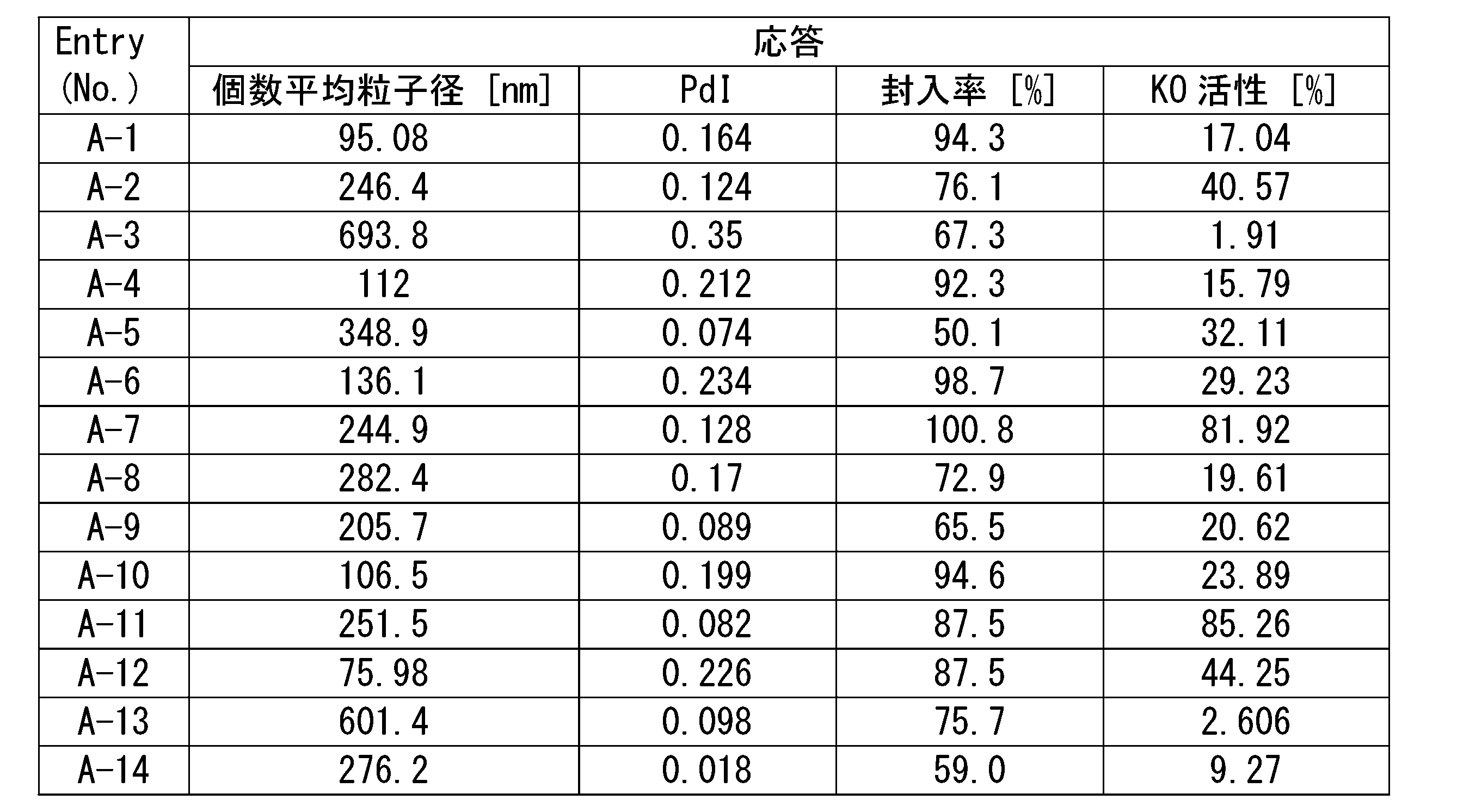


一次スクローニングの結果を受けて、二次スクリーニングを行った。実験系は、一次スクリーニングと同様の実験系で評価した。
検討項目として、pH感受性カチオン性脂質(CL)含有量(30、40、50mol%)、中性リン脂質(PL)含有量(20、35、50mol%)、及びPEG-DMG含有量(1.0、2.0、3.0mol%)の3因子3水準とし、全組み合わせ27通りの内、決定的スクリーニング計画により、表13に記載の9通りの処方を選抜した。脂質組成は、pH感受性カチオン性脂質(CL):中性リン脂質(PL):コレステロール:PEG-DMG=X:Y:(100-X-Y):Z(mol%)(X:表13中の「CL[%]」欄の数値、Y:表13中の「PL[%]」欄の数値)とした。pH感受性カチオン性脂質はCL4H6を、中性リン脂質はDOPEを、それぞれ用いた。




実施例2で製造したRNP搭載脂質ナノ粒子B-4及びB-9について、細胞毒性や保存安定性を調べた。
各RNP搭載脂質ナノ粒子を、前日に播種したHeLa-GFP細胞の培地に、Cas9タンパク質濃度が0.3、0.5、又は1nMとなるように添加し、培養を行った。RNP搭載脂質ナノ粒子添加から1日後に、WST-8アッセイを行った。WST-8アッセイは、細胞数測定用キット(製品名:「Cell Counting Kit-8」、同仁化学社製)を用いて行った。RNP搭載脂質ナノ粒子に代えてPBS(-)をHeLa-GFP細胞の培地に添加した細胞をコントロールとして、同様にWST-8アッセイを行った。
実施例2と同様にして製造したRNP搭載脂質ナノ粒子B-9を、4℃で保存し、保存後の物性とノックアウト活性を調べた。具体的には、経時的にゼータ電位とPdIを測定した。また、4℃保存前と4℃で2週間保存した後のRNP搭載脂質ナノ粒子B-9を、Cas9タンパク質濃度が0.3nMとなるように培地に添加することによってHeLa-GFP細胞に導入し、GFPノックアウト活性を調べた。ゼータ電位、PdI、及びGFPノックアウト活性は、実施例1と同様にして測定した。
RNP搭載脂質ナノ粒子に搭載するssONの塩基長が、ノックアウト活性に与える影響を調べた。
Cas9に代えて、RNA依存性DNAヌクレアーゼCpf1を搭載した脂質ナノ粒子を製造し、その遺伝子ノックアウト活性を調べた。
Cas9によるオフターゲット効果(標的としないgRNA領域への変異導入)を減少させる手法として、RuvCヌクレアーゼ活性とHNHヌクレアーゼ活性の一方を不活化したCas9ニッカーゼ(Cas9n)を2対組み合わせて使用するダブルニッキング法が知られている。このダブルニッキング法に使用するRNPを搭載した脂質ナノ粒子を製造し、その遺伝子ノックアウト活性を調べた。
実施例2で製造したRNP搭載脂質ナノ粒子B-4及びB-9について、GFP安定発現HEK(HEK-GFP)細胞に導入して、ノックアウト活性、ノックイン活性、及び細胞毒性を調べた。
まず、実施例2と同様にして、GFPノックアウト用のssONを含むRNP搭載脂質ナノ粒子B-9及びB-4を製造した。次いで、各RNP搭載脂質ナノ粒子を、前日に播種したHEK-GFP細胞の培地に、Cas9タンパク質濃度が0.5、1、3、又は5nMとなるように添加し、培養を行った。RNP搭載脂質ナノ粒子添加から3日後に培地交換した後、さらに3日後に細胞を回収して、フローサイトメトリーにより、ノックアウト効率(%)(細胞全体に占める、GFP蛍光を発していない細胞の割合(%))を測定した。測定結果を図19Aに示す。RNP搭載脂質ナノ粒子B-9及びB-4のどちらを導入した細胞でも、最大で約97%のノックアウト効率であった。
まず、GFPノックアウト用のssONに代えて、実施例1で使用したGFPノックイン用のssONを用いた以外は実施例2と同様にして、RNP搭載脂質ナノ粒子B-9及びB-4を製造した。次いで、各RNP搭載脂質ナノ粒子を、前記のGFPノックアウト活性の測定と同様にHEK-GFP細胞に導入して培養した後、回収してフローサイトメトリーを行い、ノックイン効率(%)(細胞全体に占める、BFP蛍光を発している細胞の割合(%))を測定した。測定結果を図19Bに示す。RNP搭載脂質ナノ粒子B-9及びB-4のどちらを導入した細胞でも、最大で約23%のノックイン効率であった。
各RNP搭載脂質ナノ粒子を、前日に播種したHEK-GFP細胞の培地に、Cas9タンパク質濃度が0.5、1、2、3、4、又は5nMとなるように添加し、培養を行った。RNP搭載脂質ナノ粒子添加から1日後に、実施例3と同様にしてWST-8アッセイを行い、細胞生存率(%)を測定した。結果を図20に示す。RNP搭載脂質ナノ粒子の量にかかわらず、RNP搭載脂質ナノ粒子B-4及びB-9を導入させた細胞の細胞生存率はほぼ100%であった。すなわち、これらのRNP搭載脂質ナノ粒子は、HEK細胞においてもHeLa細胞と同様に、顕著な細胞毒性を示さなかった。
実施例2で製造したRNP搭載脂質ナノ粒子B-9について、GFPを恒常発現している骨髄由来マクロファージ(BMDM)に導入して、GFPノックアウト活性を調べた。
GFPを恒常発現しているBMDMは、GFP恒常発現マウス(C57BL/6-Tg(CAG-EGFP)マウス)(雌、6週齢)から回収したものを用いた。具体的には、GFP恒常発現マウスの大腿骨及び脛骨から骨髄細胞を採取し、40μmセルストレーナーを通した後、可溶化バッファー(製品名:「ACK lysing buffer」、Gibco社製)を用いて赤血球を除去した。次いで、当該骨髄細胞を、recombinant mouse M-CSF(終濃度:50ng/mL、BioLegend社製)及び非働化FBS(終濃度:10%)を含む培地で7日間培養することによって、BMDMを得た。
まず、実施例2と同様にして、GFPノックアウト用のssONを含むRNP搭載脂質ナノ粒子B-9を製造した。次いで、RNP搭載脂質ナノ粒子を、BMDMを培養している培地に、Cas9タンパク質濃度が8nMとなるように添加し、培養を行った。RNP搭載脂質ナノ粒子添加から1日後に培地交換した後、さらに2日後に細胞を回収して、フローサイトメトリーを行った。
参考例1等で使用された図2に記載されている製造装置のミキサー内蔵マイクロ流路104が、図1Bに示すような三つの導入路を有する流路107に置換された装置を用いて、RNP搭載脂質ナノ粒子を製造し、物性とGFPノックアウト活性を調べた。
図1Bと同様に、第1の導入路(図中、上方の導入路)から脂質のエタノール溶液を、第2の導入路(図中、下方の導入路)からRNP溶液を、第3の導入路(図中、中央の導入路)からPBS(-)を、それぞれのFRR(流速比:[脂質のエタノール溶液の流速(x)]/[PBS(-)をの流速(y)]/[RNP溶液の流速(z)])が表17に記載の通りとなるように導入した以外は、実施例2と同様にして、RNP搭載脂質ナノ粒子B-9を製造した。なお、表16中、FRRがx/y/z=9/0/1の場合には、参考例1で用いた2つの導入路の製造装置を用いて製造した。

RNP搭載脂質ナノ粒子の製造時のRNP溶液のpHが、製造されたRNP搭載脂質ナノ粒子のノックアウト活性に与える影響を調べた。
Claims (10)
- 脂質成分と、DNAヌクレアーゼと、ガイドRNAと、一本鎖オリゴヌクレオチドと、を含有し、
前記脂質成分が、下記一般式(I)


で表される基を示し;Xは、下記一般式(B):

で表される基又は5~7員非芳香族ヘテロ環基(ただし、該基は炭素原子により(O-CO)b-に結合し、該環の1個又は2個の水素原子が、C1-4アルキル基又はC2-4アルケニル基に置換されていてもよい)を示す〕
で表されるpH感受性カチオン性脂質と、中性リン脂質と、ポリアルキレングリコール修飾脂質と、を含有し、
脂質ナノ粒子を構成する全脂質量に対する前記pH感受性カチオン性脂質の割合が30~50モル%であり、
脂質ナノ粒子を構成する全脂質量に対する前記中性リン脂質の割合が20~50モル%であり、
脂質ナノ粒子を構成する全脂質量に対する前記ポリアルキレングリコール修飾脂質の割合が1~4モル%である、脂質ナノ粒子。 - 前記中性リン脂質が、炭素数12~24の飽和又は不飽和の脂肪酸残基を有する中性グリセロリン脂質である、請求項1に記載の脂質ナノ粒子。
- 前記中性リン脂質が、炭素数12~24の不飽和の脂肪酸残基を有するホスファチジルエタノールアミンである、請求項1に記載の脂質ナノ粒子。
- 前記pH感受性カチオン性脂質が、ポリエチレングリコール修飾脂質である、請求項1~3のいずれか一項に記載の脂質ナノ粒子。
- 前記DNAヌクレアーゼが、Cas9タンパク質であり、
前記ガイドRNAが、crRNAとtracrRNAとからなる、請求項1~4のいずれか一項に記載の脂質ナノ粒子。 - 前記Cas9タンパク質が、RuvCヌクレアーゼ活性とHNHヌクレアーゼ活性のいずれか一方のみを有するタンパク質である、請求項5に記載の脂質ナノ粒子。
- 前記DNAヌクレアーゼが、Cpf1タンパク質である、請求項1~4のいずれか一項に記載の脂質ナノ粒子。
- 請求項1~7のいずれか一項に記載の脂質ナノ粒子を細胞内へ導入する、ゲノム編集方法。
- 請求項1~7のいずれか一項に記載の脂質ナノ粒子を、流路構造体を用いて製造する方法であって、
前記流路構造体が、互いに独立した、第1の流動体を導入する第1導入路と、第2の流動体を導入する第2導入路とが、それぞれ一定長を有して合流して1つの希釈流路を形成しており、
前記希釈流路は、少なくともその一部において二次元的に屈曲した流路部位を有し、
当該屈曲した流路部位は、これより上流の希釈流路の軸線方向ないしその延長方向をX方向と、このX方向と垂直に交差する希釈流路の幅方向をY方向とし、これより上流の希釈流路の流路幅をy0とした場合に、Y方向において対向する希釈流路の両側壁面より交互に、流路中心側に向かって、略Y方向(略+Y方向、略-Y方向)に、1/2y0以上1y0未満の一定高さh1、h2...を有し、かつX方向に一定幅x1、x2...を有して突出し、希釈流路の流路幅を規制する構造子が、一定間隔d1、d2...をもって少なくとも2つ以上設けられていることで形成されており、
前記第1導入路より前記脂質成分をエタノールに溶解させた脂質溶液を、前記第2導入路より前記DNAヌクレアーゼと前記ガイドRNAと前記一本鎖オリゴヌクレオチドとを含有するpHが5.0以上の水溶液を、総流量が1μL/分~100mL/分であり、かつ前記脂質溶溶液の流速に対する前記水溶液の流速の比が7以上である、脂質ナノ粒子の製造方法。 - 前記流路構造体が、さらに、第3の流動体を導入する第3導入路を有しており、
前記第1導入路から導入された第1の流動体が、前記第2導入路から導入された第2の流動体と合流する前に、前記第3導入路から導入された第3の流動体と接触するように、前記第1導入路と前記第2導入路と前記第3導入路とが、それぞれ一定長を有して合流して1つの希釈流路を形成している、請求項9に記載の脂質ナノ粒子の製造方法。
Priority Applications (5)
| Application Number | Priority Date | Filing Date | Title |
|---|---|---|---|
| KR1020217037647A KR20220015385A (ko) | 2019-05-30 | 2020-05-27 | 지질 나노 입자 |
| US17/595,156 US12365921B2 (en) | 2019-05-30 | 2020-05-27 | Lipid nanoparticle |
| JP2021522808A JP7721128B2 (ja) | 2019-05-30 | 2020-05-27 | 脂質ナノ粒子 |
| CN202080050354.0A CN114174522B (zh) | 2019-05-30 | 2020-05-27 | 脂质纳米粒子 |
| EP20815073.0A EP3967649B1 (en) | 2019-05-30 | 2020-05-27 | Lipid nanoparticle |
Applications Claiming Priority (2)
| Application Number | Priority Date | Filing Date | Title |
|---|---|---|---|
| JP2019101203 | 2019-05-30 | ||
| JP2019-101203 | 2019-05-30 |
Publications (1)
| Publication Number | Publication Date |
|---|---|
| WO2020241679A1 true WO2020241679A1 (ja) | 2020-12-03 |
Family
ID=73552443
Family Applications (1)
| Application Number | Title | Priority Date | Filing Date |
|---|---|---|---|
| PCT/JP2020/020895 Ceased WO2020241679A1 (ja) | 2019-05-30 | 2020-05-27 | 脂質ナノ粒子 |
Country Status (6)
| Country | Link |
|---|---|
| US (1) | US12365921B2 (ja) |
| EP (1) | EP3967649B1 (ja) |
| JP (1) | JP7721128B2 (ja) |
| KR (1) | KR20220015385A (ja) |
| CN (1) | CN114174522B (ja) |
| WO (1) | WO2020241679A1 (ja) |
Cited By (6)
| Publication number | Priority date | Publication date | Assignee | Title |
|---|---|---|---|---|
| WO2022226344A1 (en) * | 2021-04-22 | 2022-10-27 | The Board Of Regents Of The University Of Texas System | All-in-one dendrimer-based lipid nanoparticles enable precise hdr-mediated gene editing in vivo |
| JP2022178879A (ja) * | 2021-05-21 | 2022-12-02 | 国立大学法人北海道大学 | 脂質ナノ粒子 |
| US11622547B2 (en) | 2019-06-07 | 2023-04-11 | Regeneran Pharmaceuticals, Inc. | Genetically modified mouse that expresses human albumin |
| WO2023188830A1 (ja) * | 2022-03-31 | 2023-10-05 | 国立大学法人北海道大学 | 脂質ナノ粒子 |
| US20240269323A1 (en) * | 2021-06-01 | 2024-08-15 | Nanovation Therapeutics Inc. | DNA Vector Delivery Using Lipid Nanoparticles |
| WO2024181359A1 (ja) * | 2023-02-27 | 2024-09-06 | 国立大学法人北海道大学 | ミトコンドリアゲノム編集用脂質ナノ粒子 |
Families Citing this family (2)
| Publication number | Priority date | Publication date | Assignee | Title |
|---|---|---|---|---|
| EP4577196A1 (en) * | 2022-08-24 | 2025-07-02 | Popvax Private Limited | Lipid nanoparticle (lnp) composition or formulation for nucleic acid therapeutics |
| KR102716110B1 (ko) * | 2024-01-19 | 2024-10-15 | (주) 멥스젠 | 다양한 크기를 갖는 지질나노입자 제조용 미세유체장치 및 이를 이용한 제조방법 |
Citations (7)
| Publication number | Priority date | Publication date | Assignee | Title |
|---|---|---|---|---|
| WO2005032593A1 (ja) | 2003-10-01 | 2005-04-14 | Japan Science And Technology Agency | 核移行能を有するポリアルギニン修飾リポソーム |
| WO2007102481A1 (ja) | 2006-03-07 | 2007-09-13 | National University Corporation Hokkaido University | 目的物質の核内送達用ベクター |
| WO2018107028A1 (en) * | 2016-12-08 | 2018-06-14 | Intellia Therapeutics, Inc. | Modified guide rnas |
| WO2018190423A1 (ja) | 2017-04-13 | 2018-10-18 | 国立大学法人北海道大学 | 流路構造体およびこれを用いた脂質粒子ないしミセル形成方法 |
| WO2018213708A1 (en) * | 2017-05-18 | 2018-11-22 | The Broad Institute, Inc. | Systems, methods, and compositions for targeted nucleic acid editing |
| WO2018230710A1 (ja) | 2017-06-15 | 2018-12-20 | 国立大学法人北海道大学 | siRNA細胞内送達のための脂質膜構造体 |
| JP2019101203A (ja) | 2017-12-01 | 2019-06-24 | シャープ株式会社 | 廃トナー回収容器および画像形成装置 |
Family Cites Families (4)
| Publication number | Priority date | Publication date | Assignee | Title |
|---|---|---|---|---|
| JP6570188B2 (ja) * | 2014-05-20 | 2019-09-04 | 国立大学法人北海道大学 | siRNA細胞内送達のための脂質膜構造体 |
| AU2016326711B2 (en) * | 2015-09-24 | 2022-11-03 | Editas Medicine, Inc. | Use of exonucleases to improve CRISPR/Cas-mediated genome editing |
| WO2018081728A1 (en) * | 2016-10-31 | 2018-05-03 | Emendobio Inc. | Compositions for genome editing |
| CN106754912B (zh) * | 2016-11-16 | 2019-11-08 | 上海交通大学 | 一类定向清除肝细胞中HBVcccDNA的质粒及制剂 |
-
2020
- 2020-05-27 WO PCT/JP2020/020895 patent/WO2020241679A1/ja not_active Ceased
- 2020-05-27 US US17/595,156 patent/US12365921B2/en active Active
- 2020-05-27 CN CN202080050354.0A patent/CN114174522B/zh active Active
- 2020-05-27 EP EP20815073.0A patent/EP3967649B1/en active Active
- 2020-05-27 JP JP2021522808A patent/JP7721128B2/ja active Active
- 2020-05-27 KR KR1020217037647A patent/KR20220015385A/ko not_active Ceased
Patent Citations (7)
| Publication number | Priority date | Publication date | Assignee | Title |
|---|---|---|---|---|
| WO2005032593A1 (ja) | 2003-10-01 | 2005-04-14 | Japan Science And Technology Agency | 核移行能を有するポリアルギニン修飾リポソーム |
| WO2007102481A1 (ja) | 2006-03-07 | 2007-09-13 | National University Corporation Hokkaido University | 目的物質の核内送達用ベクター |
| WO2018107028A1 (en) * | 2016-12-08 | 2018-06-14 | Intellia Therapeutics, Inc. | Modified guide rnas |
| WO2018190423A1 (ja) | 2017-04-13 | 2018-10-18 | 国立大学法人北海道大学 | 流路構造体およびこれを用いた脂質粒子ないしミセル形成方法 |
| WO2018213708A1 (en) * | 2017-05-18 | 2018-11-22 | The Broad Institute, Inc. | Systems, methods, and compositions for targeted nucleic acid editing |
| WO2018230710A1 (ja) | 2017-06-15 | 2018-12-20 | 国立大学法人北海道大学 | siRNA細胞内送達のための脂質膜構造体 |
| JP2019101203A (ja) | 2017-12-01 | 2019-06-24 | シャープ株式会社 | 廃トナー回収容器および画像形成装置 |
Non-Patent Citations (12)
| Title |
|---|
| CHO ET AL., JOURNAL OF NANOBIOTECHNOLOGY, vol. 17, 2019, pages 19 |
| JOURNAL OF CONTROLLED RELEASE, vol. 98, 2004, pages 317 - 323 |
| LEE ET AL., NATURE BIOMEDICAL ENGINEERING, vol. 1, 2017, pages 889 - 901 |
| LEUNG ET AL., JOURNAL OF PHYSICAL CHEMISTRY C NANOMATER INTERFACES, vol. 116, no. 34, 2012, pages 18440 - 18450 |
| LI ET AL., BIOMATERIALS, vol. 178, 2018, pages 652 - 662 |
| LI, YAMIN ET AL.: "Intracellular delivery and biodistribution study of CRISPR/Cas9 ribonucleoprotein loaded bioreducible lipidoid nanoparticles", BIOMATERIALS SCIENCE, vol. 7, 1 February 2019 (2019-02-01), pages 596 - 606, XP055579768, DOI: 10.1039/C8BM00637G * |
| MOUT ET AL., AMERICAN CHEMICAL SOCIETY NANO, vol. 11, 2017, pages 2452 - 2458 |
| RICHARDSON, C. D. ET AL.: "Non-homologous DNA increases gene disruption efficiency by altering DNA repair outcomes", NATURE COMMUNICATIONS, vol. 7, no. 12463, 2016, pages 1 - 7, XP055767499 * |
| See also references of EP3967649A4 |
| STROOCK ET AL., SCIENCE, vol. 295, 2002, pages 647 - 651 |
| SUN ET AL., ANGEWANDTE CHEMIE INTERNATIONAL EDITION, vol. 54, 2015, pages 12029 - 12033 |
| WANG ET AL., PROCEEDINGS OF THE NATIONAL ACADEMY OF SCIENCES OF THE UNITED STATES OF AMERICA, vol. 113, 2016, pages 2868 - 2873 |
Cited By (9)
| Publication number | Priority date | Publication date | Assignee | Title |
|---|---|---|---|---|
| US11622547B2 (en) | 2019-06-07 | 2023-04-11 | Regeneran Pharmaceuticals, Inc. | Genetically modified mouse that expresses human albumin |
| US12317874B2 (en) | 2019-06-07 | 2025-06-03 | Regeneron Pharmaceuticals, Inc. | Method of using a genetically modified mouse that expresses human albumin |
| WO2022226344A1 (en) * | 2021-04-22 | 2022-10-27 | The Board Of Regents Of The University Of Texas System | All-in-one dendrimer-based lipid nanoparticles enable precise hdr-mediated gene editing in vivo |
| JP2022178879A (ja) * | 2021-05-21 | 2022-12-02 | 国立大学法人北海道大学 | 脂質ナノ粒子 |
| EP4342496A4 (en) * | 2021-05-21 | 2024-11-13 | National University Corporation Hokkaido University | LIPID DNANOPARTICLES |
| JP7761921B2 (ja) | 2021-05-21 | 2025-10-29 | 国立大学法人北海道大学 | 脂質ナノ粒子 |
| US20240269323A1 (en) * | 2021-06-01 | 2024-08-15 | Nanovation Therapeutics Inc. | DNA Vector Delivery Using Lipid Nanoparticles |
| WO2023188830A1 (ja) * | 2022-03-31 | 2023-10-05 | 国立大学法人北海道大学 | 脂質ナノ粒子 |
| WO2024181359A1 (ja) * | 2023-02-27 | 2024-09-06 | 国立大学法人北海道大学 | ミトコンドリアゲノム編集用脂質ナノ粒子 |
Also Published As
| Publication number | Publication date |
|---|---|
| EP3967649B1 (en) | 2025-11-12 |
| EP3967649A4 (en) | 2023-01-18 |
| EP3967649A1 (en) | 2022-03-16 |
| JP7721128B2 (ja) | 2025-08-12 |
| US12365921B2 (en) | 2025-07-22 |
| CN114174522A (zh) | 2022-03-11 |
| EP3967649C0 (en) | 2025-11-12 |
| JPWO2020241679A1 (ja) | 2020-12-03 |
| US20220213509A1 (en) | 2022-07-07 |
| KR20220015385A (ko) | 2022-02-08 |
| CN114174522B (zh) | 2024-10-25 |
Similar Documents
| Publication | Publication Date | Title |
|---|---|---|
| JP7721128B2 (ja) | 脂質ナノ粒子 | |
| Mendes et al. | Nanodelivery of nucleic acids | |
| Lian et al. | Bone-marrow-homing lipid nanoparticles for genome editing in diseased and malignant haematopoietic stem cells | |
| Aliakbarinodehi et al. | Interaction kinetics of individual mRNA-containing lipid nanoparticles with an endosomal membrane mimic: dependence on pH, protein corona formation, and lipoprotein depletion | |
| Sahel et al. | CRISPR/Cas9 genome editing for tissue‐specific in vivo targeting: nanomaterials and translational perspective | |
| Kulkarni et al. | Lipid nanoparticle technology for clinical translation of siRNA therapeutics | |
| Allemailem et al. | Current updates of CRISPR/Cas9‐mediated genome editing and targeting within tumor cells: an innovative strategy of cancer management | |
| Moss et al. | Lipid nanoparticles for delivery of therapeutic RNA oligonucleotides | |
| Li et al. | Acidification-induced structure evolution of lipid nanoparticles correlates with their in vitro gene transfections | |
| Vogelaar et al. | Use of microfluidics to prepare lipid-based nanocarriers | |
| AU2016288237B2 (en) | Compositions and methods for delivery of gene editing tools using polymeric vesicles | |
| Seo et al. | High‐Precision Synthesis of RNA‐Loaded Lipid Nanoparticles for Biomedical Applications | |
| Balbino et al. | Microfluidic assembly of pDNA/Cationic liposome lipoplexes with high pDNA loading for gene delivery | |
| Ali et al. | Microfluidics for development of lipid nanoparticles: paving the way for nucleic acids to the clinic | |
| JP2011503070A (ja) | 全身遺伝子送達のための自己構築型ミセル様ナノ粒子 | |
| Berggreen et al. | CRISPR delivery with extracellular vesicles: Promises and challenges | |
| WO2020262150A1 (ja) | 脂質ナノ粒子 | |
| Palanki et al. | Optimized microfluidic formulation and organic excipients for improved lipid nanoparticle mediated genome editing | |
| CN120787165A (zh) | 用于递送核酸载物的纳米颗粒 | |
| Morales et al. | Biodistribution of therapeutic small interfering RNAs delivered with lipid-substituted polyethylenimine-based delivery systems | |
| Lee et al. | In vivo delivery systems for CRISPR genome editing: Viral and non-viral carriers | |
| WO2022244844A1 (ja) | 脂質ナノ粒子 | |
| Wu et al. | Sequentially conquering transfection obstacles of primary human T cells via non-classical lipid nanoparticles delivering reformative transposon system | |
| JP2025525843A (ja) | ハイブリッドペプチドデンドリマー系及び肝外送達 | |
| Pirrottina et al. | Precondensed Plasmid DNA Enhances CAR-T Cell Generation via Lipid Nanoparticles |
Legal Events
| Date | Code | Title | Description |
|---|---|---|---|
| 121 | Ep: the epo has been informed by wipo that ep was designated in this application |
Ref document number: 20815073 Country of ref document: EP Kind code of ref document: A1 |
|
| DPE1 | Request for preliminary examination filed after expiration of 19th month from priority date (pct application filed from 20040101) | ||
| ENP | Entry into the national phase |
Ref document number: 2021522808 Country of ref document: JP Kind code of ref document: A |
|
| NENP | Non-entry into the national phase |
Ref country code: DE |
|
| ENP | Entry into the national phase |
Ref document number: 2020815073 Country of ref document: EP Effective date: 20211209 |
|
| WWG | Wipo information: grant in national office |
Ref document number: 2020815073 Country of ref document: EP |