WO2020246313A1 - シロキサン及びその製造方法 - Google Patents
シロキサン及びその製造方法 Download PDFInfo
- Publication number
- WO2020246313A1 WO2020246313A1 PCT/JP2020/020739 JP2020020739W WO2020246313A1 WO 2020246313 A1 WO2020246313 A1 WO 2020246313A1 JP 2020020739 W JP2020020739 W JP 2020020739W WO 2020246313 A1 WO2020246313 A1 WO 2020246313A1
- Authority
- WO
- WIPO (PCT)
- Prior art keywords
- group
- integer
- represented
- siloxane
- formula
- Prior art date
- Legal status (The legal status is an assumption and is not a legal conclusion. Google has not performed a legal analysis and makes no representation as to the accuracy of the status listed.)
- Ceased
Links
Classifications
-
- C—CHEMISTRY; METALLURGY
- C07—ORGANIC CHEMISTRY
- C07F—ACYCLIC, CARBOCYCLIC OR HETEROCYCLIC COMPOUNDS CONTAINING ELEMENTS OTHER THAN CARBON, HYDROGEN, HALOGEN, OXYGEN, NITROGEN, SULFUR, SELENIUM OR TELLURIUM
- C07F7/00—Compounds containing elements of Groups 4 or 14 of the Periodic Table
- C07F7/02—Silicon compounds
- C07F7/08—Compounds having one or more C—Si linkages
- C07F7/0834—Compounds having one or more O-Si linkage
- C07F7/0838—Compounds with one or more Si-O-Si sequences
- C07F7/0872—Preparation and treatment thereof
- C07F7/0876—Reactions involving the formation of bonds to a Si atom of a Si-O-Si sequence other than a bond of the Si-O-Si linkage
- C07F7/0878—Si-C bond
- C07F7/0879—Hydrosilylation reactions
-
- C—CHEMISTRY; METALLURGY
- C08—ORGANIC MACROMOLECULAR COMPOUNDS; THEIR PREPARATION OR CHEMICAL WORKING-UP; COMPOSITIONS BASED THEREON
- C08F—MACROMOLECULAR COMPOUNDS OBTAINED BY REACTIONS ONLY INVOLVING CARBON-TO-CARBON UNSATURATED BONDS
- C08F120/00—Homopolymers of compounds having one or more unsaturated aliphatic radicals, each having only one carbon-to-carbon double bond, and only one being terminated by only one carboxyl radical or a salt, anhydride, ester, amide, imide or nitrile thereof
- C08F120/62—Monocarboxylic acids having ten or more carbon atoms; Derivatives thereof
- C08F120/68—Esters
-
- A—HUMAN NECESSITIES
- A61—MEDICAL OR VETERINARY SCIENCE; HYGIENE
- A61L—METHODS OR APPARATUS FOR STERILISING MATERIALS OR OBJECTS IN GENERAL; DISINFECTION, STERILISATION OR DEODORISATION OF AIR; CHEMICAL ASPECTS OF BANDAGES, DRESSINGS, ABSORBENT PADS OR SURGICAL ARTICLES; MATERIALS FOR BANDAGES, DRESSINGS, ABSORBENT PADS OR SURGICAL ARTICLES
- A61L27/00—Materials for grafts or prostheses or for coating grafts or prostheses
- A61L27/14—Macromolecular materials
- A61L27/16—Macromolecular materials obtained by reactions only involving carbon-to-carbon unsaturated bonds
-
- A—HUMAN NECESSITIES
- A61—MEDICAL OR VETERINARY SCIENCE; HYGIENE
- A61L—METHODS OR APPARATUS FOR STERILISING MATERIALS OR OBJECTS IN GENERAL; DISINFECTION, STERILISATION OR DEODORISATION OF AIR; CHEMICAL ASPECTS OF BANDAGES, DRESSINGS, ABSORBENT PADS OR SURGICAL ARTICLES; MATERIALS FOR BANDAGES, DRESSINGS, ABSORBENT PADS OR SURGICAL ARTICLES
- A61L27/00—Materials for grafts or prostheses or for coating grafts or prostheses
- A61L27/14—Macromolecular materials
- A61L27/18—Macromolecular materials obtained otherwise than by reactions only involving carbon-to-carbon unsaturated bonds
-
- C—CHEMISTRY; METALLURGY
- C07—ORGANIC CHEMISTRY
- C07F—ACYCLIC, CARBOCYCLIC OR HETEROCYCLIC COMPOUNDS CONTAINING ELEMENTS OTHER THAN CARBON, HYDROGEN, HALOGEN, OXYGEN, NITROGEN, SULFUR, SELENIUM OR TELLURIUM
- C07F7/00—Compounds containing elements of Groups 4 or 14 of the Periodic Table
- C07F7/02—Silicon compounds
- C07F7/08—Compounds having one or more C—Si linkages
- C07F7/0834—Compounds having one or more O-Si linkage
- C07F7/0838—Compounds with one or more Si-O-Si sequences
-
- C—CHEMISTRY; METALLURGY
- C08—ORGANIC MACROMOLECULAR COMPOUNDS; THEIR PREPARATION OR CHEMICAL WORKING-UP; COMPOSITIONS BASED THEREON
- C08F—MACROMOLECULAR COMPOUNDS OBTAINED BY REACTIONS ONLY INVOLVING CARBON-TO-CARBON UNSATURATED BONDS
- C08F220/00—Copolymers of compounds having one or more unsaturated aliphatic radicals, each having only one carbon-to-carbon double bond, and only one being terminated by only one carboxyl radical or a salt, anhydride ester, amide, imide or nitrile thereof
- C08F220/02—Monocarboxylic acids having less than ten carbon atoms; Derivatives thereof
- C08F220/52—Amides or imides
- C08F220/54—Amides, e.g. N,N-dimethylacrylamide or N-isopropylacrylamide
-
- C—CHEMISTRY; METALLURGY
- C08—ORGANIC MACROMOLECULAR COMPOUNDS; THEIR PREPARATION OR CHEMICAL WORKING-UP; COMPOSITIONS BASED THEREON
- C08F—MACROMOLECULAR COMPOUNDS OBTAINED BY REACTIONS ONLY INVOLVING CARBON-TO-CARBON UNSATURATED BONDS
- C08F230/00—Copolymers of compounds having one or more unsaturated aliphatic radicals, each having only one carbon-to-carbon double bond, and containing phosphorus, selenium, tellurium or a metal
- C08F230/04—Copolymers of compounds having one or more unsaturated aliphatic radicals, each having only one carbon-to-carbon double bond, and containing phosphorus, selenium, tellurium or a metal containing a metal
- C08F230/08—Copolymers of compounds having one or more unsaturated aliphatic radicals, each having only one carbon-to-carbon double bond, and containing phosphorus, selenium, tellurium or a metal containing a metal containing silicon
- C08F230/085—Copolymers of compounds having one or more unsaturated aliphatic radicals, each having only one carbon-to-carbon double bond, and containing phosphorus, selenium, tellurium or a metal containing a metal containing silicon the monomer being a polymerisable silane, e.g. (meth)acryloyloxy trialkoxy silanes or vinyl trialkoxysilanes
-
- C—CHEMISTRY; METALLURGY
- C08—ORGANIC MACROMOLECULAR COMPOUNDS; THEIR PREPARATION OR CHEMICAL WORKING-UP; COMPOSITIONS BASED THEREON
- C08F—MACROMOLECULAR COMPOUNDS OBTAINED BY REACTIONS ONLY INVOLVING CARBON-TO-CARBON UNSATURATED BONDS
- C08F290/00—Macromolecular compounds obtained by polymerising monomers on to polymers modified by introduction of aliphatic unsaturated end or side groups
- C08F290/02—Macromolecular compounds obtained by polymerising monomers on to polymers modified by introduction of aliphatic unsaturated end or side groups on to polymers modified by introduction of unsaturated end groups
- C08F290/06—Polymers provided for in subclass C08G
- C08F290/068—Polysiloxanes
-
- C—CHEMISTRY; METALLURGY
- C08—ORGANIC MACROMOLECULAR COMPOUNDS; THEIR PREPARATION OR CHEMICAL WORKING-UP; COMPOSITIONS BASED THEREON
- C08G—MACROMOLECULAR COMPOUNDS OBTAINED OTHERWISE THAN BY REACTIONS ONLY INVOLVING UNSATURATED CARBON-TO-CARBON BONDS
- C08G77/00—Macromolecular compounds obtained by reactions forming a linkage containing silicon with or without sulfur, nitrogen, oxygen or carbon in the main chain of the macromolecule
- C08G77/04—Polysiloxanes
- C08G77/38—Polysiloxanes modified by chemical after-treatment
-
- A—HUMAN NECESSITIES
- A61—MEDICAL OR VETERINARY SCIENCE; HYGIENE
- A61L—METHODS OR APPARATUS FOR STERILISING MATERIALS OR OBJECTS IN GENERAL; DISINFECTION, STERILISATION OR DEODORISATION OF AIR; CHEMICAL ASPECTS OF BANDAGES, DRESSINGS, ABSORBENT PADS OR SURGICAL ARTICLES; MATERIALS FOR BANDAGES, DRESSINGS, ABSORBENT PADS OR SURGICAL ARTICLES
- A61L2430/00—Materials or treatment for tissue regeneration
- A61L2430/16—Materials or treatment for tissue regeneration for reconstruction of eye parts, e.g. intraocular lens, cornea
Definitions
- the present invention relates to siloxane. Specifically, siloxane suitable for medical materials and a method for producing the same are provided.
- a monomer having siloxane is known as a compound used for medical materials such as ophthalmic devices.
- 3- [Tris (trimethylsiloxy) silyl] propyl methacrylate (TRIS) is widely used as a monomer for ophthalmic devices.
- TRIS Tris (trimethylsiloxy) silyl] propyl methacrylate
- the polymer obtained by copolymerizing this TRIS with N, N-dimethylacrylamide or N-vinyl-2-pyrrolidone, which are hydrophilic monomers has a beneficial feature of being highly oxygen permeable.
- the highly hydrophobic siloxane monomer has high compatibility with these hydrophilic monomers, and there is a problem that phase separation occurs when hydrogel as a medical material is produced, resulting in cloudiness. ..
- Patent Documents 1, 2, 3 and 4 describe siloxanes having glycerol methacrylate represented by the following formulas (a), (a') and (b) (b'). Since the compound has a hydroxyl group in the molecule, it exhibits good hydrophilicity. Therefore, it has an advantage of being excellent in compatibility with the hydrophilic monomer.
- JP-A-54-55455 Japanese Unexamined Patent Publication No. 56-22325 Japanese Unexamined Patent Publication No. 2004-182724 Japanese Unexamined Patent Publication No. 2013-231046
- An object of the present invention is to provide a siloxane suitable for a medical material and a method for producing the same.
- the present inventors have diligently studied to solve the above problems, and have a (poly) siloxane structure at the end and a tertiary hydroxyl group at the portion where the (poly) siloxane and the polymerizable group are connected (poly). It has been found that the siloxane monomer has excellent compatibility with other hydrophilic monomers and does not cause the formation of an unexpected crosslinked structure in the (co) polymer of the (poly) siloxane monomer and the hydrophilic monomer. ..
- the present invention is a siloxane represented by the following formula (1).
- R 1 is a hydrogen atom or a methyl group
- R 2 is a monovalent hydrocarbon group having 1 to 6 carbon atoms
- L is a divalent hydrocarbon having 2 to 10 carbon atoms which may contain an ether bond. It is a hydrogen group
- A is a group represented by the following formula (2) or (3).
- n is an integer of 1 to 100
- a is an integer of 0 to 10
- c is an integer of 0 to 10.
- the present invention provides a method for producing the siloxane compound, a polymer containing a repeating unit derived from the compound, and a medical material containing the polymer, particularly an ophthalmic device.
- the siloxane of the present invention has a tertiary hydroxyl group, it has excellent compatibility with a hydrophilic monomer and provides preferable strength in a (co) polymer containing a repeating unit derived from the compound of the present invention.
- the compound of the present invention is useful as a monomer for medical materials.
- the present invention is a siloxane represented by the above formula (1).
- the siloxane has a tertiary hydroxyl group at the terminal (poly) siloxane structure (portion represented by A), the terminal (meth) acryloyl group, and the linking group between the (poly) siloxane and the (meth) acryloyl group. It is a feature.
- the hydroxyl group serving as a hydrophilic group is tertiary and can suppress side reactions.
- R 1 is a hydrogen atom or a methyl group, preferably a methyl group.
- R 2 is a monovalent hydrocarbon group having 1 to 6 carbon atoms.
- the monovalent hydrocarbon group include an alkyl group such as a methyl group, an ethyl group, a propyl group, an n-butyl group, a t-butyl group, a pentyl group and a hexyl group; a cycloalkyl group such as a cyclopentyl group and a cyclohexyl group; and a phenyl group.
- Examples include an aryl group such as a group.
- R 2 is preferably an alkyl group having 1 to 4 carbon atoms, more preferably a methyl group.
- L is a divalent hydrocarbon group having 2 to 10 carbon atoms, which may contain an ether bond, and is preferably a divalent hydrocarbon group having 4 to 10 carbon atoms.
- the divalent hydrocarbon group include ethylene, 1,3-propylene, 1-methylpropylene, 1,1-dimethylpropylene, 2-methylpropylene, 1,2-dimethylpropylene, and 1,1,2-trimethyl.
- examples of the divalent hydrocarbon group having 2 to 10 carbon atoms, preferably 4 to 10 carbon atoms, containing an ether bond include polyalkylene oxides such as polyethylene oxide, polypropylene oxide, and polyethylene-propylene oxide. .. It is preferably a group represented by the following formula (4).
- p is an integer of 1 to 2
- q is an integer of 1 to 4
- q is an integer of 2 to 4
- more preferably q is 2.
- the group represented by the formula (4) is preferably -CH 2 OC 3 H 6- or -CH 2 OC 2 H 4 OC 3 H 6- .
- A is a polysiloxane represented by the above formula (2) or (3), n is an integer of 1 to 100, a is an integer of 0 to 10, and b is an integer of 0 to 10. c is an integer from 0 to 10, where a + b + c is 2 or more. Preferably, n is an integer of 2 to 20. Further, in the formula (3), it is preferable that a is 1, b is 1, and c is 0.
- R is a monovalent hydrocarbon group having 1 to 10 carbon atoms, preferably 1 to 6 carbon atoms, independently of each other.
- the monovalent hydrocarbon group include an alkyl group such as a methyl group, an ethyl group, a propyl group, an n-butyl group, a t-butyl group, a pentyl group, a hexyl group, a heptyl group, an octyl group, a nonyl group and a decyl group; Cycloalkyl groups such as groups and cyclohexyl groups; aryl groups such as phenyl groups and tolyl groups can be mentioned.
- R is preferably an alkyl group or a phenyl group having 1 to 10 carbon atoms, more preferably 1 to 6 carbon atoms, and more preferably R is a methyl group, an n-butyl group, or a t-butyl group.
- the production method of the present invention is a compound represented by the following formula (5), which contains an unsaturated group at the end.
- R 1 and R 2 are as described above, R 3 is a hydrogen atom or a methyl group, and L'is a divalent hydrocarbon group having 1 to 8 carbon atoms, which may contain a single bond or an ether bond.
- R, n, a, b, and c are as described above) And are hydrosilylated to obtain the compound represented by the above formula (1).
- the production method of the present invention is characterized in that a compound having an unsaturated bond at the terminal and having a tertiary hydroxyl group (formula (5)) is used as a raw material. Since the hydroxyl group of the raw material compound represented by the above formula (5) in the production method of the present invention is tertiary, it is possible to suppress the hydroxyl group from causing an undesired side reaction in the hydrosilylation reaction. Thereby, the compound of the present invention can be obtained with high purity.
- R 3 is a hydrogen atom or a methyl group, preferably a hydrogen atom.
- L' is a divalent hydrocarbon group having 1 to 8 carbon atoms which may contain a single bond or an ether bond, and is preferably a divalent hydrocarbon group having 2 to 8 carbon atoms including an ether bond. It is a hydrocarbon group.
- Examples of the divalent hydrocarbon group having 1 to 8 carbon atoms include methylene and the like in addition to the above-mentioned examples.
- Examples of the group containing an ether bond include polyalkylene oxides such as polyethylene oxide, polypropylene oxide, and polyethylene-propylene oxide. Particularly preferably, it is a group represented by the following formula (4') or (4 ′′).
- p is an integer of 1 to 2
- q'is an integer of 0 to 2
- * is the bond with the carbon atom in formula (5)
- ** is the bond with A in formula (1)). It is preferably -CH 2 OCH 2- or -CH 2 OC 2 H 4 OCH 2- .
- the hydrosilylation reaction may be carried out according to a conventionally known method. For example, 1 molar equivalent or more of the unsaturated compound represented by the formula (5) may be added to the hydrogen siloxane compound represented by the formula (6) or (7) for reaction.
- the reaction temperature is not particularly limited, but is preferably a temperature that does not exceed the boiling point of the solvent used. For example, it is preferably carried out at a temperature of about 0 ° C to about 120 ° C.
- the reaction may be carried out in the presence of a solvent, hydrosilylation catalyst, or stabilizer.
- the solvent, hydrosilylation catalyst and stabilizer may be any conventionally known one and are not particularly limited.
- the reaction it is preferable to add 1 molar equivalent or more of the unsaturated compound to the hydrogen siloxane compound. It is more preferably 1.0 to 3.0 molar equivalents, still more preferably 1.1 to 2.0 molar equivalents, and particularly preferably 1.2 to 1.5 molar equivalents.
- the upper limit is not limited, but a large amount of the unsaturated compound added is not preferable from the viewpoint of yield and economy.
- the hydrosilylation catalyst is preferably, for example, a noble metal catalyst, particularly a platinum catalyst derived from chloroplatinic acid.
- a noble metal catalyst particularly a platinum catalyst derived from chloroplatinic acid.
- a complex (calstead catalyst) of 1,1,3,3-tetramethyl-1,3-divinyldisiloxane and a sodium bicarbonate neutralized product of chloroplatinic acid is more preferable.
- the amount of the hydrosilylation catalyst added may be any amount as long as it is the amount of the catalyst for advancing the above reaction.
- a complex of 1,1,3,3-tetramethyl-1,3-divinyldisiloxane and a layered neutralized product of chloroplatinic acid is a hydrogensiloxane compound represented by the formula (6) or (7). It may be used in an amount of 1 ppm to 80 ppm in terms of platinum with respect to the mass of.
- Solvents include, for example, methyl cellosolve, ethyl cellosolve, isopropyl cellosolve, butyl cellosolve, propylene glycol monomethyl ether, diethylene glycol monomethyl ether, triethylene glycol monomethyl ether, polyethylene glycol monomethyl ether, ethylene glycol dimethyl ether, diethylene glycol dimethyl ether, triethylene glycol dimethyl ether and polyethylene glycol.
- Glycol ether solvents such as dimethyl ether; ester solvents such as ethyl acetate, butyl acetate, amyl acetate, ethyl lactate and methyl benzoate; aliphatic hydrocarbon solvents such as linear hexane, linear heptane and linear octane; cyclohexane and Alicyclic hydrocarbon solvents such as ethylcyclohexane; ketone solvents such as acetone, methyl ethyl ketone and methyl isobutyl ketone; aromatic hydrocarbon solvents such as benzene, toluene and xylene; and petroleum solvents; and methyl alcohol, ethyl.
- alcohol solvents such as alcohol, linear propyl alcohol, isopropyl alcohol, linear butyl alcohol, isobutyl alcohol, tert-butyl alcohol, ethylene glycol, diethylene glycol, triethylene glycol, tetraethylene glycol and polyethylene glycol.
- the solvent may be used alone or in combination of two or more.
- the stabilizer examples include phenolic antioxidants, phosphorus-based antioxidants, amine-based antioxidants, sulfur-based antioxidants, and the like.
- the phenolic antioxidant is not particularly limited, but for example, p-methoxyphenol, di-tert-butyl-p-cresol, pyrogallol, tert-butylcatechol, 4,4-thiobis (3-methyl-). 6-tert-butylphenol), 2,2'-methylenebis (4-methyl-6-t-butylphenol), phenolic resins, compounds selected from the group consisting of cresol resins and the like.
- the phosphorus-based antioxidant is not particularly limited, but for example, Tris [2-[[2,4,8,10-tetrakis (1,1-dimethylethyl) dibenzo [d, f] [1, 3,2] Dioxaphosfepine-6-yl] oxy] ethyl] amine, tris [2-[(4,6,9,11-tetra-tert-butyldibenzo [d, f] [1,3] 2] Dioxaphosfepin-2-yl) oxy] ethyl] amine, ethylbis phosphite (2,4-ditert-butyl-6-methylphenyl) and the like can be mentioned.
- the amine-based antioxidant is not particularly limited, but is, for example, tri or tetra C1-3 alkylpiperidin or a derivative thereof, bis (2,2,6,6-tetramethyl-4-piperidyl) oxalate, 1 , 2-Bis (2,2,6,6-tetramethyl-4-piperidyloxy) ethane, phenylnaphthylamine, N, N'-diphenyl-1,4-phenylenediamine, N-phenyl-N'-cyclohexyl-1 , 4-Phenylenediamine and the like.
- the sulfur-based antioxidant is not particularly limited, and examples thereof include dilaurylthiodipropionate and distearylthiodipropionate.
- the stabilizer may be used alone or in combination of two or more.
- the reaction end point is that the peak of the raw material compound disappears by, for example, thin layer chromatography (TCL), high performance liquid chromatography (HPLC), gas chromatography (GC), etc. according to a conventionally known method. You can check.
- purification may be performed according to a conventionally known method. For example, the product can be isolated by washing the organic layer with water and then removing the solvent. Further, vacuum distillation, activated carbon treatment, or the like may be used.
- the method for producing the unsaturated group-containing compound represented by the above formula (5) is not particularly limited, but for example, the epoxy compound represented by the following formula (a) can be used. (R 2 , R 3 , and L'are as described above) It can be obtained by reacting with (meth) acrylic acid. Further, the method for producing the compound represented by the above formula (a) can follow a conventionally known method. For example, an epoxy represented by the above formula (a) in which L'contains an ether bond and has 2 to 8 carbon atoms. As a method for producing the compound, an alcohol compound represented by the following formula (4) is used.
- R 3 is as described above, and L'' is a divalent hydrocarbon group having 1 to 6 carbon atoms, which may contain a single bond or an ether bond. It can be obtained by reacting with an epoxy compound represented by the following formula (5).
- R 2 is as above, X is a halogen atom
- the reaction between the alcohol compound and the epoxy compound can be carried out according to a conventionally known method.
- an epoxy compound having an equivalent amount of 1 mol or more may be added to the alcohol compound and reacted.
- the reaction temperature is not particularly limited, but is preferably a temperature that does not exceed the boiling point of the solvent used. For example, it is preferably carried out at a temperature of about 0 ° C to about 120 ° C.
- the reaction may be carried out in the presence of a solvent or a catalyst.
- the solvent and catalyst may be conventionally known ones and are not particularly limited.
- the reaction between the epoxy compound represented by the above formula (a) and (meth) acrylic acid may also be carried out according to a conventionally known method.
- 1 mol equivalent or more of (meth) acrylic acid may be added to the epoxy compound for reaction.
- the reaction temperature is not particularly limited, but is preferably a temperature that does not exceed the boiling point of the solvent used. For example, it is preferably carried out at a temperature of about 0 ° C to about 110 ° C.
- the reaction may be carried out in the presence of a solvent, a catalyst or a stabilizer.
- the solvent, catalyst, and stabilizer are not particularly limited as long as they are conventionally known. As the solvent, those described above can be used.
- the catalyst examples include organometallic catalysts, basic compounds, organophosphorus compounds, amine catalysts, and Lewis acids.
- the stabilizer examples include a phenol-based antioxidant, a phosphorus-based antioxidant, an amine-based antioxidant, a sulfur-based antioxidant, and the like, and examples thereof include those exemplified above.
- the progress of the reaction can be confirmed by monitoring the unsaturated compound or the compound to be produced by GC measurement or the like.
- the siloxane compound represented by the above formula (1) can be obtained by distilling off the raw material under reduced pressure.
- the compound of the present invention can provide a polymer having a repeating unit derived from addition polymerization of a (meth) acrylic group.
- the compound of the present invention has good compatibility with other compounds having a polymerizable group such as a (meth) acrylic group (hereinafter, referred to as a polymerizable monomer or a hydrophilic monomer). Therefore, a colorless and transparent copolymer can be provided by copolymerizing with the polymerizable monomer. It is also possible to polymerize alone.
- the compounding ratio of the compound of the present invention is the weight of the entire polymer of the present invention.
- the mass ratio of the repeating unit derived from the compound may be 10% or more. More specifically, the amount of the compound of the present invention is preferably 10 to 80 parts by mass, more preferably 10 to 60 parts by mass with respect to 100 parts by mass in total of the compound of the present invention and the polymerizable (hydrophilic) monomer. Is good. If the mass ratio of the repeating unit is less than 10%, the characteristics of the compound of the present invention are unlikely to appear.
- polymerizable monomer examples include (meth) acrylic acid, methyl (meth) acrylate, ethyl (meth) acrylate, (poly) ethylene glycol dimethacrylate, polyalkylene glycol mono (meth) acrylate, and polyalkylene glycol monoalkyl ether (.
- Acrylic monomers such as meta) acrylate, trifluoroethyl (meth) acrylate, 2-hydroxyethyl (meth) acrylate, 2,3-dihydroxypropyl (meth) acrylate; N, N-dimethylacrylamide, N, N-diethylacrylamide , N-acryloylmorpholine, acrylic acid derivatives such as N-methyl (meth) acrylamide; other unsaturated aliphatic or aromatic compounds such as N-vinylpyrrolidone, such as crotonic acid, cinnamic acid, vinyl benzoic acid; ) Examples thereof include a siloxane monomer having a polymerizable group such as an acrylic group. These may be used alone or in combination of two or more.
- Copolymerization of the compound of the present invention with the above-mentioned other polymerizable monomer may be carried out by a conventionally known method.
- a known polymerization initiator such as a thermal polymerization initiator or a photopolymerization initiator.
- the polymerization initiator include 2-hydroxy-2-methyl-1-phenyl-propan-1-one, azobisisobutyronitrile, azobisdimethylvaleronitrile, benzoyl peroxide, tert-butyl hydroperoxide, and cumene.
- examples thereof include hydroperoxide and 2,2'-azobis (2-methylpropionamidine) dihydrochloride.
- polymerization initiators can be used alone or in combination of two or more.
- the blending amount of the polymerization initiator is preferably 0.001 to 2 parts by mass, preferably 0.01 to 1 part by mass with respect to 100 parts by mass of the total of the polymerization components.
- the polymer containing a repeating unit derived from the compound of the present invention has excellent hydrophilicity.
- the hydrogel obtained from the polymer has high transparency and strength. Therefore, the compounds of the present invention are suitable for producing medical materials such as ophthalmic devices, contact lenses, intraocular lenses and artificial corneas.
- the method for producing a medical material using the polymer is not particularly limited, and a conventionally known method for producing a medical material may be followed. For example, when molding into the shape of a lens such as a contact lens or an intraocular lens, a cutting method or a mold method can be used.
- Measuring device Agilent gas chromatography (FID detector)
- Capillary column J & W HP-5MS (0.25 mm x 30 m x 0.25 ⁇ m) Heating program: 50 ° C (5 minutes) ⁇ 10 ° C / min ⁇ 250 ° C (holding)
- Carrier gas Helium (1.0 ml / min)
- Split ratio 50: 1 Injection volume: 1 ⁇ L
- AHMPM 3- (Aryloxy) -2-hydroxy-2-methylpropyl methacrylate
- AHPM 3- (Aryloxy) -2-hydroxypropyl methacrylate
- SiGMA Methylbis (trimethylsiloxy) Cyrilpropylglycerol methacrylate
- Example 2 In Example 1, 1,1,1,3,5,5,5-heptamethyltrisiloxane was used in an amount of 50.0 g of a hydrogen siloxane compound represented by the following formula (10A) and 51.4 g of AHMPM (non-replaceable for a hydrogen siloxane compound). Example 1 was repeated except that the molar ratio of the saturated compound was changed to 1.5) to obtain a colorless transparent liquid. Yield 69.0 g. 1 It was confirmed by 1 H-NMR that the compound was represented by the following formula (10B). 1 1 H-NMR data is shown below.
- Example 3 In Example 1, 1,1,1,3,5,5,5-heptamethyltrisiloxane was used in an amount of 50.0 g of a hydrogensiloxane compound represented by the following formula (11A) and 10.6 g of AHMPM (non-replaceable for a hydrogensiloxane compound). Example 1 was repeated except that the molar ratio of the saturated compound was changed to 1.5) to obtain a colorless transparent liquid. Yield 70.5g. 1 It was confirmed by 1 H-NMR that the compound was represented by the following formula (11B). 1 1 H-NMR data is shown below.
- the target compound is that the molar ratio of AHMPM to the hydrogensiloxane compound is 1.0 or more. Purity is particularly greatly improved. In addition, since side reactions during the hydrosilylation reaction are suppressed, it is possible to produce with higher purity.
- the compound of Comparative Example 1 obtained from the addition reaction of the unsaturated group-containing compound (AHPM) having a secondary hydroxyl group and hydrogensiloxane has a purity compared with the result of Example 7 having the same molar ratio. Low. This is because a side reaction occurs during the hydrosilylation reaction.
- UV irradiation was performed using a high-pressure mercury lamp and the mixture was cured. After curing, it was washed by immersing it in the order of isopropanol, 50% isopropanol aqueous solution, and deionized water for several seconds to obtain a hydrogel film. Each physical property value of the obtained film was measured according to the method shown below. The results are shown in Tables 2 and 3.
- SiGMA Methylbis (trimethylsiloxy) Cyrilpropylglycerol methacrylate
- TRIS 3- [Tris (trimethylsiloxy) Cyril] Propyl Methacrylate
- hydrogels using TRIS as a comparative compound have difficulty in transparency (Comparative Example 2). Further, the hydrogel using SiGMA as the comparative compound has a high elastic modulus (Comparative Examples 3 and 4). On the other hand, as shown in Table 2, the hydrogel using the siloxane compound of the present invention has excellent transparency and an appropriate elastic modulus. That is, the hydrogel using the compound of the present invention provides a material having beneficial hydrophilicity and sufficient strength.
- the siloxane compound of the present invention gives a hydrogel having excellent hydrophilicity and strength.
- the siloxane compound of the present invention is useful as a medical material, for example, a monomer for manufacturing ophthalmic devices, contact lenses, intraocular lenses, artificial corneas, and spectacle lenses.
Landscapes
- Chemical & Material Sciences (AREA)
- Health & Medical Sciences (AREA)
- Organic Chemistry (AREA)
- Chemical Kinetics & Catalysis (AREA)
- Medicinal Chemistry (AREA)
- Polymers & Plastics (AREA)
- Life Sciences & Earth Sciences (AREA)
- Public Health (AREA)
- Transplantation (AREA)
- Epidemiology (AREA)
- Dermatology (AREA)
- Animal Behavior & Ethology (AREA)
- General Health & Medical Sciences (AREA)
- Oral & Maxillofacial Surgery (AREA)
- Veterinary Medicine (AREA)
- General Chemical & Material Sciences (AREA)
- Compositions Of Macromolecular Compounds (AREA)
- Addition Polymer Or Copolymer, Post-Treatments, Or Chemical Modifications (AREA)
- Macromonomer-Based Addition Polymer (AREA)
- Materials For Medical Uses (AREA)
- Silicon Polymers (AREA)
Abstract
[課題] 医療用材料に好適なシロキサン化合物及びその製造方法を提供する。 [解決手段] 下記式(1)で表されるシロキサン及びその製造方法。(式中、R1は水素原子又はメチル基であり、R2は炭素数1~6の一価炭化水素基であり、Lは、エーテル結合を含んでよい炭素数2~10の二価炭化水素基であり、Aは下記式(2)または(3)で表される基であり、上記式(2)においてnは1~100の整数であり、上記式(3)においてaは0~10の整数であり、bは0~10の整数であり、cは0~10の整数であり、ただしa+b+cは2以上であり、Rは、互いに独立に炭素数1~10の1価炭化水素基である)。
Description
本発明はシロキサンに関する。詳細には、医療用材料に好適なシロキサン及びその製造方法を提供する。
従来、眼科用デバイスをはじめとした医療用材料に用いられる化合物として、シロキサンを有するモノマーが知られている。例えば、3-[トリス(トリメチルシロキシ)シリル]プロピルメタクリレート(TRIS)は、眼科用デバイス用モノマーとして広く用いられている。このTRISと親水性モノマーであるN,N-ジメチルアクリルアミドやN-ビニル-2-ピロリドンを共重合して得られるポリマーは高酸素透過性であるという有益な特長を有する。しかし、疎水性の高いシロキサンモノマーはこれらの親水性モノマーとの相溶性が高いとは言えず、医療用材料となるハイドロゲルを作製した際に相分離が起こり、白濁してしまうという問題がある。
特許文献1、2、3、4には、下記式(a)、(a’)、(b)(b’)で示されるグリセロールメタクリレートを有するシロキサンが記載されている。


該化合物は、分子内に水酸基を有するために良好な親水性を発現する。そのため、親水性モノマーとの相溶性に優れるという利点を有している。
しかし、上述したような(ポリ)シロキサンと重合性基とが連結する部分に第一級水酸基または第二級水酸基を有する化合物を用いてハイドロゲルを作製する場合、分子内に存在する反応性の高い水酸基によって望ましくない結果をもたらす場合がある。例えば、存在する水酸基にラジカルが付加し、ヒドロキシラジカルによる架橋構造の形成が引き起こされる恐れがある。それにより、予期せぬ硬度の増加や水酸基の減少による親水性の低下が引き起こされる。そのため、従来のシロキサン化合物では、有益な親水性や十分な強度を有する医療用材料を提供することができない。そこで、これらの欠点を克服する化合物及び組成物に対する需要が依然として存在する。
本発明は医療用材料に好適なシロキサン及びその製造方法を提供することを目的とする。
本発明者らは上記課題を解決する為に鋭意検討し、末端に(ポリ)シロキサン構造を有し、かつ(ポリ)シロキサンと重合性基とが連結する部分に第三級水酸基を有する(ポリ)シロキサンモノマーは、他の親水性モノマーとの相溶性に優れ、且つ、該(ポリ)シロキサンモノマー及び親水性モノマーの(共)重合体において予期せぬ架橋構造の形成を引き起こさないことを見出した。
即ち、本発明は、下記式(1)で表されるシロキサン

(式中、R1は水素原子又はメチル基であり、R2は炭素数1~6の一価炭化水素基であり、Lは、エーテル結合を含んでよい炭素数2~10の二価炭化水素基であり、Aは下記式(2)または(3)で表される基であり、


上記式(2)においてnは1~100の整数であり、上記式(3)においてaは0~10の整数であり、bは0~10の整数であり、cは0~10の整数であり、ただしa+b+cは2以上であり、Rは、互いに独立に炭素数1~10の1価炭化水素基である)。
さらに本発明は、該シロキサン化合物の製造方法、該化合物から導かれる繰り返し単位を含むポリマー、及び該ポリマーを含む医療用材料、特には眼科用デバイスを提供する。
さらに本発明は、該シロキサン化合物の製造方法、該化合物から導かれる繰り返し単位を含むポリマー、及び該ポリマーを含む医療用材料、特には眼科用デバイスを提供する。
本発明のシロキサンは第三級水酸基を有することにより、親水性モノマーとの相溶性に優れ、且つ、本発明の化合物から導かれる繰返し単位を含む(共)重合体において好ましい強度を提供する。本発明の化合物は、医療用材料用モノマーとして有用である。
以下、本発明のシロキサンについて、詳細に説明する。
本発明は上記式(1)で表されるシロキサンである。該シロキサンは末端(ポリ)シロキサン構造(Aで示される部分)、末端(メタ)アクリロイル基、及び、該(ポリ)シロキサンと(メタ)アクリロイル基との連結基に第三級水酸基を有することを特徴とする。本発明のシロキサンにおいて親水基となる水酸基は第三級であり、副反応を抑制できる。これらの特徴により、親水性モノマーとの相溶性を保ちつつ、本発明のシロキサンから導かれる繰返し単位を含む(共)重合体において好ましい強度を提供できる。
上記式(1)において、R1は水素原子又はメチル基であり、好ましくはメチル基である。
上記式(1)において、R2は炭素数1~6の一価炭化水素基である。一価炭化水素基としては、メチル基、エチル基、プロピル基、n-ブチル基、t-ブチル基、ペンチル基、ヘキシル基等のアルキル基;シクロペンチル基、及びシクロヘキシル基等のシクロアルキル基;フェニル基等のアリール基等が挙げられる。R2は、好ましくは炭素数1~4のアルキル基であり、更に好ましくはメチル基である。
上記式(1)において、Lはエーテル結合を含んでよい、炭素数2~10の二価炭化水素基であり、好ましくは炭素数4~10の二価炭化水素基である。該二価炭化水素基としては、例えば、エチレン、1,3-プロピレン、1-メチルプロピレン、1,1-ジメチルプロピレン、2-メチルプロピレン、1,2-ジメチルプロピレン、1,1,2-トリメチルプロピレン、1,4-ブチレン、2-メチル-1,4-ブチレン、2、2-ジメチル-1,4-ブチレン、3-メチル-1,4-ブチレン、2,2-ジメチル-1,4-ブチレン、2,3-ジメチル-1,4-ブチレン、2,2,3-トリメチル-1,4-ブチレン、1,5-ペンチレン、1,6-ヘキサニレン、1,7-ヘプタニレン、1,8-オクタニレン、1,9-ノナニレン、及び1,10-デカニレン等が挙げられる。
また、エーテル結合を含む、炭素数2~10の、好ましくは炭素数4~10の二価炭化水素基としては、例えば、ポリエチレンオキサイド、ポリプロピレンオキサイド、ポリエチレン-プロピレンオキサイド等のポリアルキレンオキサイドが挙げられる。好ましくは下記式(4)で表される基であるのがよい。

(式(4)において、pは1~2の整数であり、qは1~4の整数であり、好ましくはqは2~4の整数であり、より好ましくはqは2である。*は式(1)における炭素原子との結合箇所であり、**は式(1)におけるAとの結合箇所である)
該式(4)で表される基として、好ましくは-CH2OC3H6-、または-CH2OC2H4OC3H6-である。
該式(4)で表される基として、好ましくは-CH2OC3H6-、または-CH2OC2H4OC3H6-である。
Aは上記式(2)または(3)で表されるポリシロキサンであり、nは1~100の整数であり、aは0~10の整数であり、bは0~10の整数であり、cは0~10の整数であり、ただしa+b+cは2以上である。好ましくは、nは2~20の整数である。また、式(3)においてaが1であり、bが1であり、及びcが0であるのが好ましい。
Rは、互いに独立に、炭素数1~10の、好ましくは炭素数1~6の一価炭化水素基である。一価炭化水素基としては、メチル基、エチル基、プロピル基、n-ブチル基、t-ブチル基、ペンチル基、ヘキシル基、ヘプチル基、オクチル基、ノニル基、デシル基等のアルキル基;シクロペンチル基、及びシクロヘキシル基等のシクロアルキル基;フェニル基、及びトリル基等のアリール基等が挙げられる。Rは、好ましくは炭素数1~10の、より好ましくは炭素数1~6のアルキル基又はフェニル基であり、更に好ましくはRがメチル基、n-ブチル基、又はt-ブチル基である。
以下、上記式(1)で示される化合物の製造方法を説明する。
本発明の製造方法は、下記式(5)で表される、末端に不飽和基を含有する化合物、

(R1及びR2は上記の通りであり、R3は水素原子又はメチル基であり、L’は単結合、又は、エーテル結合を含んでよい、炭素数1~8の二価炭化水素基である)
と、下記式(6)または(7)で表されるハイドロジェンシロキサン化合物


(R、n、a、b、及びcは上記の通りである)
とをヒドロシリル化反応させて、上記式(1)で表される化合物を得る工程を含む。
本発明の製造方法は、下記式(5)で表される、末端に不飽和基を含有する化合物、
と、下記式(6)または(7)で表されるハイドロジェンシロキサン化合物
とをヒドロシリル化反応させて、上記式(1)で表される化合物を得る工程を含む。
本発明の製造方法は、末端に不飽和結合を有し、かつ第三級水酸基を有する化合物(式(5))を原料として用いることを特徴とする。本発明の製造方法において上記式(5)で表される原料化合物が有する水酸基は第三級であるため、ヒドロシリル化反応において水酸基が望ましくない副反応を起こすことを抑制できる。これにより本発明の化合物を高純度にて得ることができる。
上記式(5)においてR3は水素原子又はメチル基であり、好ましくは水素原子である。
上記式(5)においてL’は単結合、又は、エーテル結合を含んでよい、炭素数1~8の二価炭化水素基であり、好ましくはエーテル結合を含む炭素数2~8の二価炭化水素基である。
炭素数1~8の二価炭化水素基としては、前述した例に加え、例えば、メチレン等が挙げられる。エーテル結合を含む基としては、例えば、ポリエチレンオキサイド、ポリプロピレンオキサイド、ポリエチレン-プロピレンオキサイド等のポリアルキレンオキサイドが挙げられる。特に好ましくは、下記式(4’)又は(4’’)で表される基である。

(式(4’)において、pは1~2の整数であり、q’は0~2の整数であり、好ましくはq’は0又は1であり、より好ましくはq’は0である。式(4’)及び(4’’)において、*は式(5)における炭素原子との結合箇所であり、**は式(1)におけるAとの結合箇所である)
好ましくは-CH2OCH2-、または-CH2OC2H4OCH2-である。
好ましくは-CH2OCH2-、または-CH2OC2H4OCH2-である。
上記ヒドロシリル化反応は従来公知の方法に従い行えばよい。例えば、式(6)または(7)で表されるハイドロジェンシロキサン化合物に式(5)で表される不飽和化合物1モル当量以上を添加して反応させればよい。反応温度は特に制限されるものでないが、使用する溶媒の沸点を超えない程度の温度が好ましい。例えば、約0℃から約120℃の温度で行われるのがよい。該反応は溶媒、ヒドロシリル化触媒、又は安定剤の存在下で行ってもよい。溶媒及びヒドロシリル化触媒及び安定剤は従来公知のものであればよく特に制限されるものでない。
該反応において不飽和化合物は、ハイドロジェンシロキサン化合物に対して1モル当量以上を添加することが好ましい。より好ましくは1.0~3.0モル当量であり、更に好ましくは1.1~2.0モル当量であり、特に好ましくは1.2~1.5モル当量である。ハイドロジェンシロキサン化合物に対して不飽和化合物を当量以上添加することでハイドロジェンシロキサン化合物の残存および副反応の抑制ができる。また、上限値は制限されないが、不飽和化合物の添加量が多いと収率や経済性の点から好ましくない。
ヒドロシリル化触媒は、例えば、貴金属触媒、特には塩化白金酸から誘導される白金触媒が好ましい。特に、塩化白金酸の塩素イオンを重曹で完全中和して白金触媒の安定性を向上させるのがよい。例えば1,1,3,3-テトラメチル-1,3-ジビニルジシロキサンと塩化白金酸の重曹中和物との錯体(カルステッド触媒)がより好ましい。
ヒドロシリル化触媒の添加量は上記反応を進行させるための触媒量であればよい。例えば、1,1,3,3-テトラメチル-1,3-ジビニルジシロキサンと塩化白金酸の重層中和物との錯体を、式(6)または(7)で表されるハイドロジェンシロキサン化合物の質量に対し、白金換算量で1ppm~80ppmとなる量で使用すればよい。
溶媒は、例えば、メチルセロソルブ、エチルセロソルブ、イソプロピルセロソルブ、ブチルセロソルブ、プロピレングリコールモノメチルエーテル、ジエチレングリコールモノメチルエーテル、トリエチレングリコールモノメチルエーテル、ポリエチレングリコールモノメチルエーテル、エチレングリコールジメチルエーテル、ジエチレングリコールジメチルエーテル、トリエチレングリコールジメチルエーテル及びポリエチレングリコールジメチルエーテル等のグリコールエーテル溶媒;酢酸エチル、酢酸ブチル、酢酸アミル、乳酸エチル及び安息香酸メチル等のエステル系溶媒;直鎖ヘキサン、直鎖ヘプタン及び直鎖オクタン等の脂肪族炭化水素系溶媒;シクロヘキサン及びエチルシクロヘキサン等の脂環式炭化水素系溶媒;アセトン、メチルエチルケトン及びメチルイソブチルケトン等のケトン系溶媒;ベンゼン、トルエン及びキシレン等の芳香族炭化水素溶媒;並びに石油系溶媒等;及び、メチルアルコール、エチルアルコール、直鎖プロピルアルコール、イソプロピルアルコール、直鎖ブチルアルコール、イソブチルアルコール、tert-ブチルアルコール、エチレングリコール、ジエチレングリコール、トリエチレングリコール、テトラエチレングリコール及びポリエチレングリコールなどのアルコール系溶媒が挙げられる。前記溶媒は1種を単独で使用しても、2種以上を組合せて使用してもよい。
安定剤は、例えば、フェノール系酸化防止剤、リン系酸化防止剤、アミン系酸化防止剤、及びイオウ系酸化防止剤等が挙げられる。フェノール系酸化防止剤としては、特に限定するものではないが、例えば、p-メトキシフェノール、ジ-tert-ブチル-p-クレゾール、ピロガロール、tert-ブチルカテコール、4,4-チオビス(3-メチル-6-tert-ブチルフェノール)、2,2'-メチレンビス(4-メチル-6-t-ブチルフェノール)、フェノール樹脂類、及びクレゾール樹脂類からなる群より選択される化合物等が挙げられる。リン系酸化防止剤としては、特に限定するものではないが、例えば、トリス[2-[[2,4,8,10-テトラキス(1,1-ジメチルエチル)ジベンゾ[d,f][1,3,2]ジオキサホスフェピン-6-イル]オキシ]エチル]アミン、トリス[2-[(4,6,9,11-テトラ-tert-ブチルジベンゾ[d,f][1,3,2]ジオキサホスフェピン-2-イル)オキシ]エチル]アミン、および亜リン酸エチルビス(2,4-ジtert-ブチル-6-メチルフェニル)等が挙げられる。アミン系酸化防止剤としては、特に限定するものではないが、例えば、トリ又はテトラC1-3アルキルピペリジン又はその誘導体、ビス(2,2,6,6-テトラメチル-4-ピペリジル)オギサレート、1,2-ビス(2,2,6,6-テトラメチル-4-ピペリジルオキシ)エタン、フェニルナフチルアミン、N,N′-ジフェニル-1,4-フェニレンジアミン、N-フェニル-N′-シクロヘキシル-1,4-フェニレンジアミン等が挙げられる。イオウ系酸化防止剤としては、特に限定するものではないが、例えば、ジラウリルチオジプロピオネート、ジステアリルチオジプロピオネート等が挙げられる。前記安定剤は1種を単独で使用しても、2種以上を組合せて使用してもよい。
上記の反応において、反応終点は、従来公知の方法に従い、例えば、薄層クロマトグラフィー(TCL)、高速液体クロマトグラフィー(HPLC)又はガスクロマトグラフィー(GC)等によって原料化合物のピークが消失したことで確認できる。反応終了後は、従来公知の方法に従い精製すればよい。例えば、有機層を水で洗浄した後、溶媒を除去することにより生成物を単離することができる。また減圧蒸留や活性炭処理などを使用してもよい。
尚、上記式(5)で表される不飽和基含有化合物の製造方法は特に制限されるものでないが、例えば、下記式(a)で表されるエポキシ化合物と

(R2、R3、及びL’は上記の通りである)
(メタ)アクリル酸とを反応させて得ることができる。
さらに上記式(a)で表される化合物の製造方法は従来公知の方法に方法に従うことができるが、例えば上記式(a)で表されL’がエーテル結合を含む炭素数2~8のエポキシ化合物の製造方法としては、下記式(4)で表されるアルコール化合物と

(R3は上記の通りであり、L’’は単結合、又はエーテル結合を含んでよい、炭素数1~6の二価炭化水素基である)
下記式(5)で表されるエポキシ化合物とを反応させて得ることができる。

(R2は上記の通りであり、Xはハロゲン原子である)
(メタ)アクリル酸とを反応させて得ることができる。
さらに上記式(a)で表される化合物の製造方法は従来公知の方法に方法に従うことができるが、例えば上記式(a)で表されL’がエーテル結合を含む炭素数2~8のエポキシ化合物の製造方法としては、下記式(4)で表されるアルコール化合物と
下記式(5)で表されるエポキシ化合物とを反応させて得ることができる。
上記アルコール化合物とエポキシ化合物の反応は、従来公知の方法に従い行うことができる。例えば、アルコール化合物に1モル当量以上のエポキシ化合物を添加して反応させればよい。反応温度は特に制限されるものでないが、使用する溶媒の沸点を超えない程度の温度が好ましい。例えば、約0℃から約120℃の温度で行われるのがよい。該反応は溶媒や触媒の存在下で行ってもよい。溶媒及び触媒は従来公知のものであればよく、特に制限されるものでない。
上記式(a)で表されるエポキシ化合物と(メタ)アクリル酸との反応も、従来公知の方法に従い、行えばよい。例えばエポキシ化合物に(メタ)アクリル酸1モル当量以上を添加して反応させればよい。反応温度は特に制限されるものでないが、使用する溶媒の沸点を超えない程度の温度が好ましい。例えば、約0℃から約110℃の温度で行われるのがよい。該反応は溶媒や触媒、安定剤の存在下で行ってもよい。溶媒、触媒、及び安定剤は従来公知のものであればよく特に制限されるものでない。溶媒は前述したものが使用できる。
触媒は、例えば、有機金属触媒、塩基性化合物、有機リン系化合物、アミン触媒、及びルイス酸等が挙げられる。安定剤は、例えば、フェノール系酸化防止剤、リン系酸化防止剤、アミン系酸化防止剤、及びイオウ系酸化防止剤等が挙げられ、上記にて例示したものが挙げられる。
本発明の製造方法の一例としては、式(6)または(7)で表されるハイドロジェンシロキサン化合物1モル当量と上記式(5)で表される不飽和化合物1.5モル当量、塩化白金酸重曹中和物・ビニルシロキサン錯体のトルエン溶液(白金含有量0.5wt%)をポリシロキサン化合物の質量に対し白金換算量で10ppm、トルエンをハイドロジェンシロキサン化合物に対して0.1質量%を添加し、窒素雰囲気下80℃で加熱撹拌を行う。2時間程度反応させることにより反応は完結する。また、その際に不飽和化合物あるいは生成する化合物をGC測定等でモニタリングすることで反応の進行を確認できる。反応の完結後、n-ヘキサンをハイドロジェンシロキサン化合物に対して100質量%を添加し、有機層をメタノール水(メタノール:水=4:1)で洗浄し、有機層に存在する溶媒、未反応の原料を減圧留去することで上記式(1)で表されるシロキサン化合物を得ることができる。
本発明の化合物は(メタ)アクリル基の付加重合から導かれる繰り返し単位を有する重合体を与えることができる。本発明の化合物は、(メタ)アクリル基などの重合性基を有する他の化合物(以下、重合性モノマー、または親水性モノマーという)との相溶性が良好である。そのため、重合性モノマーと共重合することにより無色透明の共重合体を与えることができる。また、単独で重合することも可能である。
本発明の化合物と他の重合性(親水性)モノマーとの重合から導かれる繰返し単位を含む共重合体の製造において、本発明の化合物の配合割合は、ポリマー全体の質量に対して本発明の化合物から導かれる繰り返し単位の質量割合が10%以上であればよい。より詳細には、本発明の化合物と重合性(親水性)モノマーとの合計100質量部に対して本発明の化合物を好ましくは10~80質量部、より好ましくは10~60質量部となる量がよい。上記繰り返し単位の質量割合が10%未満であると、本発明の化合物の特性が表れにくい。
重合性モノマーとしては、例えば、(メタ)アクリル酸、メチル(メタ)アクリレート、エチル(メタ)アクリレート、(ポリ)エチレングリコールジメタクリレート、ポリアルキレングリコールモノ(メタ)アクリレート、ポリアルキレングリコールモノアルキルエーテル(メタ)アクリレート、トリフルオロエチル(メタ)アクリレート、2-ヒドロキシエチル(メタ)アクリレート、2,3―ジヒドロキシプロピル(メタ)アクリレート等のアクリル系モノマー;N,N-ジメチルアクリルアミド、N,N-ジエチルアクリルアミド、N-アクリロイルモルホリン、N-メチル(メタ)アクリルアミド等のアクリル酸誘導体;N-ビニルピロリドン等、その他の不飽和脂肪族もしくは芳香族化合物、例えばクロトン酸、桂皮酸、ビニル安息香酸;及び(メタ)アクリル基などの重合性基を有するシロキサンモノマーが挙げられる。これらは1種単独でも、2種以上を併用してもよい。
本発明の化合物と上記他の重合性モノマーとの共重合は従来公知の方法により行えばよい。例えば、熱重合開始剤や光重合開始剤など既知の重合開始剤を使用して行うことができる。該重合開始剤としては、2-ヒドロキシ-2-メチル-1-フェニル-プロパン-1-オン、アゾビスイソブチロニトリル、アゾビスジメチルバレロニトリル、ベンゾイルパーオキサイド、tert-ブチルハイドロパーオキサイド、クメンハイドロパーオキサイド、2,2'-アゾビス(2-メチルプロピオンアミジン)2塩酸塩などがあげられる。これら重合開始剤は単独でまたは2種以上を混合して用いることができる。重合開始剤の配合量は、重合成分の合計100質量部に対して0.001~2質量部、好ましくは0.01~1質量部であるのがよい。
本発明の化合物から導かれる繰返し単位を含む重合体は、親水性に優れる。また、該重合体から得られるハイドロゲルは透明性および強度が高い。従って、本発明の化合物は、医療用材料、例えば、眼科デバイス、コンタクトレンズ、眼内レンズ、人工角膜を製造するのに好適である。該重合体を用いた医療用材料の製造方法は特に制限されるものでなく、従来公知の医療用材料の製造方法に従えばよい。例えば、コンタクトレンズ、眼内レンズなどレンズの形状に成形する際には、切削加工法や鋳型(モールド)法などを使用できる。
以下、実施例及び比較例を示し、本発明をより詳細に説明するが、本発明は下記の実施例に制限されるものではない。下記実施例において、1H-NMR分析はJEOL製のECS400を用い、測定溶媒として重クロロホルムを使用して実施した。またガスクロマトグラフ(GC)測定は、すべて下記の条件で行われた。
測定装置:Agilent社ガスクロマトグラフィー(FID検出器)
キャピラリーカラム:J&W社HP-5MS(0.25mm×30m×0.25μm)
昇温プログラム:50℃(5分)→10℃/分→250℃(保持)
注入口温度250℃、検出器温度FID300℃
キャリアガス:ヘリウム(1.0ml/分)
スプリット比:50:1 注入量:1μL
測定装置:Agilent社ガスクロマトグラフィー(FID検出器)
キャピラリーカラム:J&W社HP-5MS(0.25mm×30m×0.25μm)
昇温プログラム:50℃(5分)→10℃/分→250℃(保持)
注入口温度250℃、検出器温度FID300℃
キャリアガス:ヘリウム(1.0ml/分)
スプリット比:50:1 注入量:1μL
下記実施例および比較例に使用した化合物は以下の通りである。
AHMPM:3-(アリロキシ)-2-ヒドロキシ-2-メチルプロピルメタクリレート

AHPM:3-(アリロキシ)-2-ヒドロキシプロピルメタクリレート

SiGMA:メチルビス(トリメチルシロキシ)シリルプロピルグリセロールメタクリレート

AHMPM:3-(アリロキシ)-2-ヒドロキシ-2-メチルプロピルメタクリレート
実施例1
ジムロート、温度計を付けた300mLの三口ナスフラスコに、窒素雰囲気下で1,1,1,3,5,5,5-ヘプタメチルトリシロキサン50.0g、AHMPM72.0g(ハイドロジェンシロキサン化合物に対する不飽和化合物のモル比=1.5)、塩化白金酸重曹中和物・ビニルシロキサン錯体のトルエン溶液(白金含有量0.5wt%)0.03gを添加し、80℃まで加熱し、4時間熟成した。反応後にn-ヘキサンを50.0g添加し、メタノール水溶液(メタノール:水=4:1)で5回洗浄し、内温80℃で溶媒および未反応の原料などを減圧留去することで無色透明液体を得た。収量62.5g。1H-NMRから式(9)で表される化合物であることを確認した。

以下に1H-NMRデータを示す。
0.0-0.1ppm(21H)、0.4ppm(2H)、1.2ppm(3H)、1.6ppm(2H)、2.0ppm(3H)、3.3-3.4ppm(4H)、4.1ppm(2H)、5.6ppm(1H)、6.1ppm(1H)。
ジムロート、温度計を付けた300mLの三口ナスフラスコに、窒素雰囲気下で1,1,1,3,5,5,5-ヘプタメチルトリシロキサン50.0g、AHMPM72.0g(ハイドロジェンシロキサン化合物に対する不飽和化合物のモル比=1.5)、塩化白金酸重曹中和物・ビニルシロキサン錯体のトルエン溶液(白金含有量0.5wt%)0.03gを添加し、80℃まで加熱し、4時間熟成した。反応後にn-ヘキサンを50.0g添加し、メタノール水溶液(メタノール:水=4:1)で5回洗浄し、内温80℃で溶媒および未反応の原料などを減圧留去することで無色透明液体を得た。収量62.5g。1H-NMRから式(9)で表される化合物であることを確認した。
0.0-0.1ppm(21H)、0.4ppm(2H)、1.2ppm(3H)、1.6ppm(2H)、2.0ppm(3H)、3.3-3.4ppm(4H)、4.1ppm(2H)、5.6ppm(1H)、6.1ppm(1H)。
実施例2
実施例1において1,1,1,3,5,5,5-ヘプタメチルトリシロキサンを下記式(10A)で表されるハイドロジェンシロキサン化合物50.0g、AHMPM51.4g(ハイドロジェンシロキサン化合物に対する不飽和化合物のモル比=1.5)に替えた他は実施例1を繰り返して無色透明液体を得た。収量69.0g。1H-NMRにより下記式(10B)で表される化合物であることを確認した。


以下に1H-NMRデータを示す。
0.0-0.1ppm(30H)、0.5ppm(4H)、0.9ppm(3H)、1.2ppm(3H)、1.3ppm(4H)、1.6ppm(2H)、2.0ppm(3H)、3.3-3.4ppm(4H)、4.1ppm(2H)、5.6ppm(1H)、6.1ppm(1H)。
実施例1において1,1,1,3,5,5,5-ヘプタメチルトリシロキサンを下記式(10A)で表されるハイドロジェンシロキサン化合物50.0g、AHMPM51.4g(ハイドロジェンシロキサン化合物に対する不飽和化合物のモル比=1.5)に替えた他は実施例1を繰り返して無色透明液体を得た。収量69.0g。1H-NMRにより下記式(10B)で表される化合物であることを確認した。
0.0-0.1ppm(30H)、0.5ppm(4H)、0.9ppm(3H)、1.2ppm(3H)、1.3ppm(4H)、1.6ppm(2H)、2.0ppm(3H)、3.3-3.4ppm(4H)、4.1ppm(2H)、5.6ppm(1H)、6.1ppm(1H)。
実施例3
実施例1において1,1,1,3,5,5,5-ヘプタメチルトリシロキサンを下記式(11A)で表されるハイドロジェンシロキサン化合物50.0g、AHMPM10.6g(ハイドロジェンシロキサン化合物に対する不飽和化合物のモル比=1.5)に替えた他は実施例1を繰り返して無色透明液体を得た。収量70.5g。1H-NMRにより下記式(11B)で表される化合物であることを確認した。


以下に1H-NMRデータを示す。
0.0-0.1ppm(120H)、0.5ppm(4H)、0.9ppm(3H)、1.2ppm(3H)、1.3ppm(4H)、1.6ppm(2H)、2.0ppm(3H)、3.3-3.4ppm(4H)、4.1ppm(2H)、5.6ppm(1H)、6.1ppm(1H)。
実施例1において1,1,1,3,5,5,5-ヘプタメチルトリシロキサンを下記式(11A)で表されるハイドロジェンシロキサン化合物50.0g、AHMPM10.6g(ハイドロジェンシロキサン化合物に対する不飽和化合物のモル比=1.5)に替えた他は実施例1を繰り返して無色透明液体を得た。収量70.5g。1H-NMRにより下記式(11B)で表される化合物であることを確認した。
0.0-0.1ppm(120H)、0.5ppm(4H)、0.9ppm(3H)、1.2ppm(3H)、1.3ppm(4H)、1.6ppm(2H)、2.0ppm(3H)、3.3-3.4ppm(4H)、4.1ppm(2H)、5.6ppm(1H)、6.1ppm(1H)。
原料不飽和基含有化合物の反応性評価
実施例4~9、比較例1
上記式(10A)で表されるハイドロジェンシロキサン化合物と、下記に示すAHMPM(第三級水酸基含有化合物)、又は下記に示すAHPM(第二級水酸基含有化合物)と、塩化白金酸重曹中和物・ビニルシロキサン錯体のトルエン溶液(白金含有量0.5wt%)とを、下記表1に示す配合比で添加し、窒素雰囲気下80℃まで加熱し、4時間熟成した。反応後にGC測定を行い、目的物の純度を面積%から算出した。ただし、原料のハイドロジェンシロキサン化合物、AHMPA,AHPMは除外した。結果を表1に示す。
AHMPM:3-(アリロキシ)-2-ヒドロキシ-2-メチルプロピルメタクリレート

AHPM:3-(アリロキシ)-2-ヒドロキシプロピルメタクリレート

実施例4~9、比較例1
上記式(10A)で表されるハイドロジェンシロキサン化合物と、下記に示すAHMPM(第三級水酸基含有化合物)、又は下記に示すAHPM(第二級水酸基含有化合物)と、塩化白金酸重曹中和物・ビニルシロキサン錯体のトルエン溶液(白金含有量0.5wt%)とを、下記表1に示す配合比で添加し、窒素雰囲気下80℃まで加熱し、4時間熟成した。反応後にGC測定を行い、目的物の純度を面積%から算出した。ただし、原料のハイドロジェンシロキサン化合物、AHMPA,AHPMは除外した。結果を表1に示す。
AHMPM:3-(アリロキシ)-2-ヒドロキシ-2-メチルプロピルメタクリレート

表1に示す通り、第三級水酸基を含有する不飽和基含有化合物(AHMPM)とハイドロジェンシロキサンとの付加反応において、ハイドロジェンシロキサン化合物に対するAHMPMのモル比が1.0以上であると目的化合物の純度が特に大きく向上する。また、ヒドロシリル化反応の際の副反応が抑制されることから、より高い純度で製造することが可能である。一方、第二級水酸基を有する不飽和基含有化合物(AHPM)とハイドロジェンシロキサンとの付加反応から得られる比較例1の化合物は、モル比が同じである実施例7の結果と対比すると純度が低い。これは、ヒドロシリル化反応の際に副反応が起きているためである。
[実施例10~14及び比較例2~4]
ハイドロゲルの製造例
上記実施例1~3で得た各化合物、下記式で表されるSiGMA、下記式で表される3-[トリス(トリメチルシロキシ)シリル]プロピルメタクリレート(TRIS)、2-ヒドロキシエチルメタクリレート(HEMA)、N、N-ジメチルアクリルアミド(DMA)、エチレングリコールジメタクリレート(EGDMA)、イルガキュア1173(Irg1173)を、表2又は3に示す組成及び配合比で混合し、均一な溶液になるまで撹拌した。撹拌後N2によるバブリング5分間を行い、十分に脱気を行った後、ポリプロピレン製の鋳型へと封入した。高圧水銀ランプを用いてUV照射を行い、硬化した。硬化後、イソプロパノール、50%イソプロパノール水溶液、脱イオン水の順にそれぞれ数秒浸漬させることで洗浄を行い、ハイドロゲルフィルムを得た。得られたフィルムの各物性値を下記に示す方法に従い測定した。結果を表2及び3に示す。
SiGMA:メチルビス(トリメチルシロキシ)シリルプロピルグリセロールメタクリレート

TRIS:3-[トリス(トリメチルシロキシ)シリル]プロピルメタクリレート

ハイドロゲルの製造例
上記実施例1~3で得た各化合物、下記式で表されるSiGMA、下記式で表される3-[トリス(トリメチルシロキシ)シリル]プロピルメタクリレート(TRIS)、2-ヒドロキシエチルメタクリレート(HEMA)、N、N-ジメチルアクリルアミド(DMA)、エチレングリコールジメタクリレート(EGDMA)、イルガキュア1173(Irg1173)を、表2又は3に示す組成及び配合比で混合し、均一な溶液になるまで撹拌した。撹拌後N2によるバブリング5分間を行い、十分に脱気を行った後、ポリプロピレン製の鋳型へと封入した。高圧水銀ランプを用いてUV照射を行い、硬化した。硬化後、イソプロパノール、50%イソプロパノール水溶液、脱イオン水の順にそれぞれ数秒浸漬させることで洗浄を行い、ハイドロゲルフィルムを得た。得られたフィルムの各物性値を下記に示す方法に従い測定した。結果を表2及び3に示す。
SiGMA:メチルビス(トリメチルシロキシ)シリルプロピルグリセロールメタクリレート
[平衡含水率]
フィルムを脱イオン水に25℃で48時間浸漬させた後、表面の水分を拭き取り、水和したフィルムの質量を計測した。次に水和したフィルムを50℃のオーブンで48時間、25℃のオーブンで24時間乾燥させ、乾燥フィルムの質量を計測した。平衡含水率は以下の式により算出した。
平衡含水率(%)=100×(水和フィルムの質量-乾燥フィルムの質量)/水和フィルムの質量
フィルムを脱イオン水に25℃で48時間浸漬させた後、表面の水分を拭き取り、水和したフィルムの質量を計測した。次に水和したフィルムを50℃のオーブンで48時間、25℃のオーブンで24時間乾燥させ、乾燥フィルムの質量を計測した。平衡含水率は以下の式により算出した。
平衡含水率(%)=100×(水和フィルムの質量-乾燥フィルムの質量)/水和フィルムの質量
[透明性]
フィルムを脱イオン水に25℃で48時間浸漬させた後、表面の水分を拭き取り、水和したフィルムを作成した。その外観を目視により観察し、下記の指標により評価した。
A:均一かつ透明であった
B:不均一あるいは白濁していた
フィルムを脱イオン水に25℃で48時間浸漬させた後、表面の水分を拭き取り、水和したフィルムを作成した。その外観を目視により観察し、下記の指標により評価した。
A:均一かつ透明であった
B:不均一あるいは白濁していた
[弾性率]
フィルムを脱イオン水に25℃で48時間浸漬させた後、表面の水分を拭き取り、水和したフィルムを作成した。該水和したフィルムのヤング弾性率をインストロン5943を用いて測定した。0.8cm×4.0cmに切断されたフィルムを50Nのロードセル、1cm/分のヘッド速度で測定を行い、縦軸に得られる応力、横軸にひずみををとった応力-ひずみ曲線の初期(直線部)の傾きを算出し、ヤング弾性率(MPa)とした。
フィルムを脱イオン水に25℃で48時間浸漬させた後、表面の水分を拭き取り、水和したフィルムを作成した。該水和したフィルムのヤング弾性率をインストロン5943を用いて測定した。0.8cm×4.0cmに切断されたフィルムを50Nのロードセル、1cm/分のヘッド速度で測定を行い、縦軸に得られる応力、横軸にひずみををとった応力-ひずみ曲線の初期(直線部)の傾きを算出し、ヤング弾性率(MPa)とした。


表3に示す通り、比較化合物としてTRISを用いたハイドロゲルは透明性に難がある(比較例2)。また、比較化合物としてSiGMAを用いたハイドロゲルは弾性率が高い(比較例3及び4)。一方、表2に示す通り、本発明のシロキサン化合物を用いたハイドロゲルは、透明性に優れ、適度な弾性率を有する。すなわち、本発明の化合物を用いたハイドロゲルは、有益な親水性や十分な強度を有する材料を提供する。
本発明のシロキサン化合物は親水性や強度に優れるハイドロゲルを与える。本発明のシロキサン化合物は、医療用材料、例えば、眼科用デバイス、コンタクトレンズ、眼内レンズ、人工角膜、及び眼鏡レンズ製造用モノマーとして有用である。
Claims (20)
- 下記式(1)で表されるシロキサン



- Lが下記式(4)で表される二価の基である、請求項1記載のシロキサン

- Lが上記式(4)で表され、pが1であり、qが2である、請求項2記載のシロキサン。
- 式(1)においてAが上記式(2)で表され、nが2~20の整数である、請求項1~3のいずれか1項記載のシロキサン。
- 式(1)においてAが上記式(3)で表され、aが1であり、bが1であり、cが0である、請求項1~3のいずれか1項記載のシロキサン。
- 式(1)においてR2がメチル基である、請求項1~5のいずれか1項記載のシロキサン。
- 式(2)及び(3)において、Rが互いに独立に、炭素数1~6のアルキル基、又はフェニル基である、請求項1~6のいずれか1項記載のシロキサン。
- Rが互いに独立にメチル基、n-ブチル基、又はt-ブチル基である、請求項7記載の化合物。
- 請求項1~8のいずれか1項記載のシロキサンの(メタ)アクリル基の重合から導かれる繰り返し単位を含むポリマー。
- 前記繰り返し単位の質量割合がポリマーの全質量に対し10質量%以上である、請求項9記載のポリマー。
- 請求項9または10記載のポリマーを含むハイドロゲル。
- 請求項9または10記載のポリマーを含む医療用材料。
- 下記式(1)で表されるシロキサン



下記式(5)で表される末端不飽和基含有化合物

と、下記式(6)または(7)で表されるハイドロジェンシロキサン

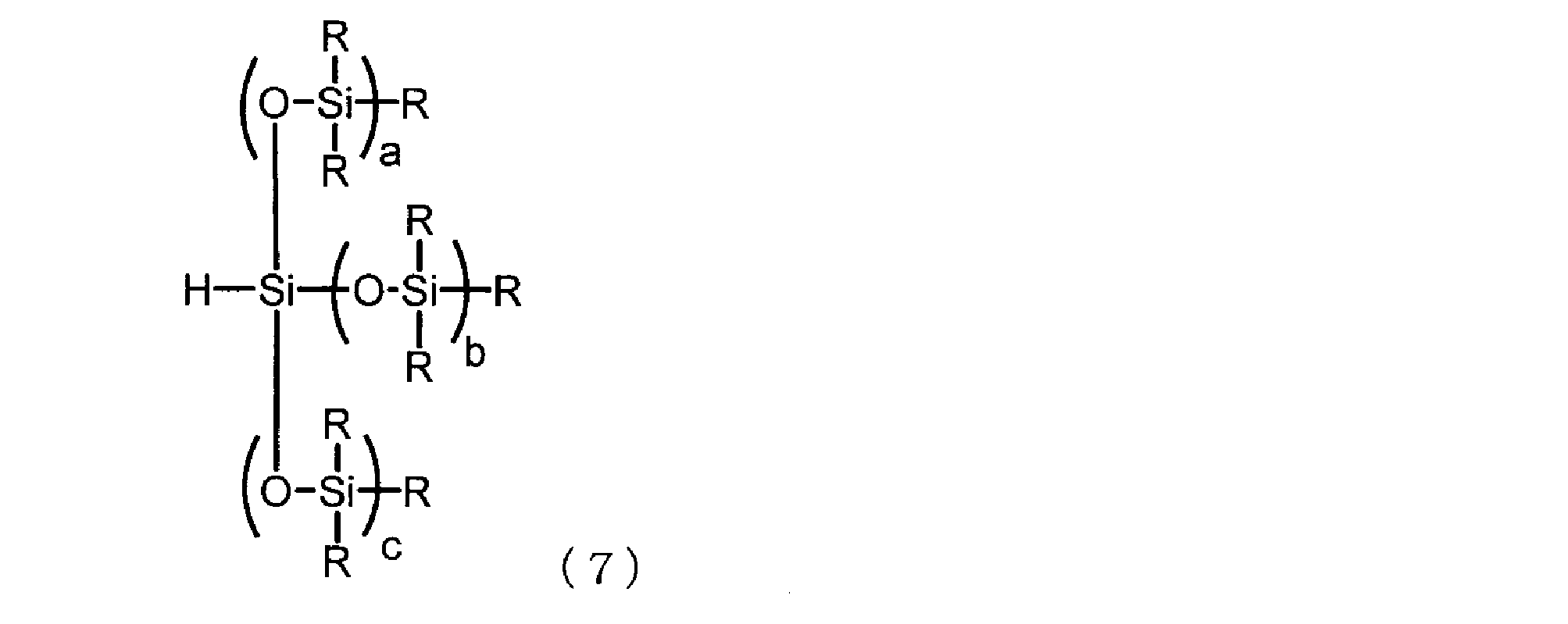
とをヒドロシリル化反応させて上記式(1)で表されるシロキサンを得る工程を含む、前記製造方法。 - 前記ハイドロジェンシロキサンに対する前記不飽和基含有化合物のモル比が1.0~3.0である、請求項13記載の製造方法。
- Lが下記式(4)で表される二価の基である、請求項13又は14記載の製造方法。

- Aが上記式(2)で表され、nは2~20の整数である、請求項13~15のいずれか1項記載の製造方法。
- Aが上記式(3)で表され、aは1であり、bは1であり、cは0である、請求項13~15のいずれか1項記載の製造方法。
- R2がメチル基である、請求項13~17のいずれか1項記載の製造方法。
- Rが互いに独立に、炭素数1~6のアルキル基、又はフェニル基である、請求項13~18のいずれか1項記載の製造方法。
- Rが互いに独立に、メチル基、n-ブチル基、又はt-ブチル基である、請求項19記載の製造方法。
Priority Applications (3)
| Application Number | Priority Date | Filing Date | Title |
|---|---|---|---|
| EP20818839.1A EP3981802B1 (en) | 2019-06-06 | 2020-05-26 | Siloxane and method for producing same |
| CN202080041610.XA CN113906037B (zh) | 2019-06-06 | 2020-05-26 | 硅氧烷及其制备方法 |
| US17/616,388 US12180310B2 (en) | 2019-06-06 | 2020-05-26 | Siloxane and a method for preparing the same |
Applications Claiming Priority (2)
| Application Number | Priority Date | Filing Date | Title |
|---|---|---|---|
| JP2019106366A JP7145122B2 (ja) | 2019-06-06 | 2019-06-06 | シロキサン及びその製造方法 |
| JP2019-106366 | 2019-06-06 |
Publications (1)
| Publication Number | Publication Date |
|---|---|
| WO2020246313A1 true WO2020246313A1 (ja) | 2020-12-10 |
Family
ID=73652883
Family Applications (1)
| Application Number | Title | Priority Date | Filing Date |
|---|---|---|---|
| PCT/JP2020/020739 Ceased WO2020246313A1 (ja) | 2019-06-06 | 2020-05-26 | シロキサン及びその製造方法 |
Country Status (5)
| Country | Link |
|---|---|
| US (1) | US12180310B2 (ja) |
| EP (1) | EP3981802B1 (ja) |
| JP (1) | JP7145122B2 (ja) |
| CN (1) | CN113906037B (ja) |
| WO (1) | WO2020246313A1 (ja) |
Cited By (1)
| Publication number | Priority date | Publication date | Assignee | Title |
|---|---|---|---|---|
| WO2025032949A1 (ja) * | 2023-08-07 | 2025-02-13 | 信越化学工業株式会社 | ポリシロキサン化合物、ポリマー、ハイドロゲル、医療用材料、及びポリシロキサン化合物の製造方法 |
Families Citing this family (3)
| Publication number | Priority date | Publication date | Assignee | Title |
|---|---|---|---|---|
| JP2022159148A (ja) * | 2021-03-31 | 2022-10-17 | セントラル硝子株式会社 | ヘキサフルオロイソプロパノール基を含む医療用樹脂組成物 |
| JP7628929B2 (ja) * | 2021-10-14 | 2025-02-12 | 信越化学工業株式会社 | ポリシロキサン化合物及びその製造方法 |
| KR20250170565A (ko) * | 2023-04-10 | 2025-12-05 | 도레이 카부시키가이샤 | 실리콘 모노머 혼합물 및 실리콘 모노머 조성물 |
Citations (5)
| Publication number | Priority date | Publication date | Assignee | Title |
|---|---|---|---|---|
| JPS5455455A (en) | 1977-10-12 | 1979-05-02 | Toyo Contact Lens Co Ltd | Contact lens |
| JPS5622325A (en) | 1979-07-31 | 1981-03-02 | Shin Etsu Chem Co Ltd | Production of polymerizable organopolysiloxane |
| JP2004182724A (ja) | 2002-11-18 | 2004-07-02 | Toray Ind Inc | シリコーンモノマーの製造方法 |
| JP2009542674A (ja) * | 2006-06-30 | 2009-12-03 | 東レ株式会社 | プラスチック成型体用アクリロイル原料 |
| WO2020045225A1 (ja) * | 2018-08-30 | 2020-03-05 | 信越化学工業株式会社 | (メタ)アクリロイル化合物及びその製造方法 |
Family Cites Families (11)
| Publication number | Priority date | Publication date | Assignee | Title |
|---|---|---|---|---|
| JPS58217532A (ja) * | 1982-06-11 | 1983-12-17 | Unitika Ltd | ガラス繊維強化ポリオレフインの製造方法 |
| DE69615393T2 (de) * | 1995-12-07 | 2002-07-04 | Bausch & Lomb Inc., Rochester | Monomere zur reduzierung des modulus von siloxynhydrogele |
| FR2826964B1 (fr) * | 2001-07-06 | 2003-09-05 | Atofina | Procede de fabrication de (meth) acrylates silanes |
| US8080622B2 (en) * | 2007-06-29 | 2011-12-20 | Johnson & Johnson Vision Care, Inc. | Soluble silicone prepolymers |
| DE102009036534A1 (de) * | 2009-08-07 | 2011-02-10 | Lanxess Deutschland Gmbh | EVM-Granulat |
| CN103333198A (zh) * | 2013-06-21 | 2013-10-02 | 安徽硅宝翔飞有机硅新材料有限公司 | 一种不饱合酰氧基硅烷及其制备方法 |
| CN103554169B (zh) * | 2013-10-29 | 2016-03-16 | 烟台德邦先进硅材料有限公司 | 一种用于uv固化树脂的有机硅丙烯酸酯和有机硅甲基丙烯酸酯单体的制备方法 |
| CN104926853A (zh) * | 2014-03-19 | 2015-09-23 | 张家港市国泰华荣化工新材料有限公司 | 丙烯酰氧基丙基三烷氧基硅烷的制备方法 |
| CN107541180B (zh) * | 2017-09-29 | 2021-04-27 | 山东三泽硅胶有限公司 | 一种酸性室温硫化硅酮密封胶 |
| JP7074641B2 (ja) * | 2018-10-29 | 2022-05-24 | 信越化学工業株式会社 | (メタ)アクリロイル基含有オルガノシロキサン |
| NL2025455B1 (en) * | 2020-04-29 | 2021-11-09 | Chemstream Bvba | Reactive silane compound, coating composition and use thereof |
-
2019
- 2019-06-06 JP JP2019106366A patent/JP7145122B2/ja active Active
-
2020
- 2020-05-26 CN CN202080041610.XA patent/CN113906037B/zh active Active
- 2020-05-26 WO PCT/JP2020/020739 patent/WO2020246313A1/ja not_active Ceased
- 2020-05-26 EP EP20818839.1A patent/EP3981802B1/en active Active
- 2020-05-26 US US17/616,388 patent/US12180310B2/en active Active
Patent Citations (6)
| Publication number | Priority date | Publication date | Assignee | Title |
|---|---|---|---|---|
| JPS5455455A (en) | 1977-10-12 | 1979-05-02 | Toyo Contact Lens Co Ltd | Contact lens |
| JPS5622325A (en) | 1979-07-31 | 1981-03-02 | Shin Etsu Chem Co Ltd | Production of polymerizable organopolysiloxane |
| JP2004182724A (ja) | 2002-11-18 | 2004-07-02 | Toray Ind Inc | シリコーンモノマーの製造方法 |
| JP2009542674A (ja) * | 2006-06-30 | 2009-12-03 | 東レ株式会社 | プラスチック成型体用アクリロイル原料 |
| JP2013231046A (ja) | 2006-06-30 | 2013-11-14 | Toray Ind Inc | プラスチック成型体用アクリロイル原料 |
| WO2020045225A1 (ja) * | 2018-08-30 | 2020-03-05 | 信越化学工業株式会社 | (メタ)アクリロイル化合物及びその製造方法 |
Non-Patent Citations (1)
| Title |
|---|
| See also references of EP3981802A4 |
Cited By (1)
| Publication number | Priority date | Publication date | Assignee | Title |
|---|---|---|---|---|
| WO2025032949A1 (ja) * | 2023-08-07 | 2025-02-13 | 信越化学工業株式会社 | ポリシロキサン化合物、ポリマー、ハイドロゲル、医療用材料、及びポリシロキサン化合物の製造方法 |
Also Published As
| Publication number | Publication date |
|---|---|
| US20220332863A1 (en) | 2022-10-20 |
| EP3981802A1 (en) | 2022-04-13 |
| US12180310B2 (en) | 2024-12-31 |
| JP2020200365A (ja) | 2020-12-17 |
| JP7145122B2 (ja) | 2022-09-30 |
| EP3981802B1 (en) | 2025-08-13 |
| EP3981802A4 (en) | 2023-05-24 |
| CN113906037A (zh) | 2022-01-07 |
| CN113906037B (zh) | 2024-06-28 |
Similar Documents
| Publication | Publication Date | Title |
|---|---|---|
| CN110494457B (zh) | 聚硅氧烷单体及其制备方法 | |
| CN113906037B (zh) | 硅氧烷及其制备方法 | |
| JP2021088689A (ja) | シロキサン化合物及びその製造方法 | |
| EP2955208B1 (en) | Silicone compound and a use thereof | |
| EP2873673B1 (en) | Silicone compound and a use thereof | |
| EP2955207B1 (en) | Silicone compound and a use thereof | |
| EP2921497B1 (en) | Silicone compound and a use thereof | |
| JP7050583B2 (ja) | ポリシロキサンモノマー及びその製造方法 | |
| EP4310130A1 (en) | Siloxane compound and method for producing same | |
| JP7145123B2 (ja) | シロキサンの製造方法 | |
| JP7050630B2 (ja) | (メタ)アクリロイル化合物及びその製造方法 | |
| JP6305323B2 (ja) | 共重合体および眼科デバイス | |
| JP7628929B2 (ja) | ポリシロキサン化合物及びその製造方法 | |
| JP2025024626A (ja) | ポリシロキサン化合物、ポリマー、ハイドロゲル、医療用材料、及びポリシロキサン化合物の製造方法 | |
| JP7411598B2 (ja) | シロキサン化合物及びその製造方法 | |
| WO2026028660A1 (ja) | カルボキシベタイン基含有ポリシロキサン化合物、その製造方法、ポリマー、ハイドロゲル及び医療用材料 |
Legal Events
| Date | Code | Title | Description |
|---|---|---|---|
| 121 | Ep: the epo has been informed by wipo that ep was designated in this application |
Ref document number: 20818839 Country of ref document: EP Kind code of ref document: A1 |
|
| NENP | Non-entry into the national phase |
Ref country code: DE |
|
| WWE | Wipo information: entry into national phase |
Ref document number: 2020818839 Country of ref document: EP |
|
| WWG | Wipo information: grant in national office |
Ref document number: 2020818839 Country of ref document: EP |