WO2020246500A1 - 表面修飾ナノダイヤモンド及び表面修飾ナノダイヤモンドの製造方法 - Google Patents
表面修飾ナノダイヤモンド及び表面修飾ナノダイヤモンドの製造方法 Download PDFInfo
- Publication number
- WO2020246500A1 WO2020246500A1 PCT/JP2020/021924 JP2020021924W WO2020246500A1 WO 2020246500 A1 WO2020246500 A1 WO 2020246500A1 JP 2020021924 W JP2020021924 W JP 2020021924W WO 2020246500 A1 WO2020246500 A1 WO 2020246500A1
- Authority
- WO
- WIPO (PCT)
- Prior art keywords
- group
- modified
- nanodiamond
- particles
- mass
- Prior art date
- Legal status (The legal status is an assumption and is not a legal conclusion. Google has not performed a legal analysis and makes no representation as to the accuracy of the status listed.)
- Ceased
Links
Images


Classifications
-
- B—PERFORMING OPERATIONS; TRANSPORTING
- B01—PHYSICAL OR CHEMICAL PROCESSES OR APPARATUS IN GENERAL
- B01J—CHEMICAL OR PHYSICAL PROCESSES, e.g. CATALYSIS OR COLLOID CHEMISTRY; THEIR RELEVANT APPARATUS
- B01J3/00—Processes of utilising sub-atmospheric or super-atmospheric pressure to effect chemical or physical change of matter; Apparatus therefor
- B01J3/06—Processes using ultra-high pressure, e.g. for the formation of diamonds; Apparatus therefor, e.g. moulds or dies
- B01J3/062—Processes using ultra-high pressure, e.g. for the formation of diamonds; Apparatus therefor, e.g. moulds or dies characterised by the composition of the materials to be processed
-
- C—CHEMISTRY; METALLURGY
- C01—INORGANIC CHEMISTRY
- C01B—NON-METALLIC ELEMENTS; COMPOUNDS THEREOF; METALLOIDS OR COMPOUNDS THEREOF NOT COVERED BY SUBCLASS C01C
- C01B32/00—Carbon; Compounds thereof
- C01B32/25—Diamond
- C01B32/26—Preparation
-
- C—CHEMISTRY; METALLURGY
- C01—INORGANIC CHEMISTRY
- C01B—NON-METALLIC ELEMENTS; COMPOUNDS THEREOF; METALLOIDS OR COMPOUNDS THEREOF NOT COVERED BY SUBCLASS C01C
- C01B32/00—Carbon; Compounds thereof
- C01B32/25—Diamond
- C01B32/28—After-treatment, e.g. purification, irradiation, separation or recovery
-
- C—CHEMISTRY; METALLURGY
- C08—ORGANIC MACROMOLECULAR COMPOUNDS; THEIR PREPARATION OR CHEMICAL WORKING-UP; COMPOSITIONS BASED THEREON
- C08G—MACROMOLECULAR COMPOUNDS OBTAINED OTHERWISE THAN BY REACTIONS ONLY INVOLVING UNSATURATED CARBON-TO-CARBON BONDS
- C08G65/00—Macromolecular compounds obtained by reactions forming an ether link in the main chain of the macromolecule
- C08G65/02—Macromolecular compounds obtained by reactions forming an ether link in the main chain of the macromolecule from cyclic ethers by opening of the heterocyclic ring
- C08G65/04—Macromolecular compounds obtained by reactions forming an ether link in the main chain of the macromolecule from cyclic ethers by opening of the heterocyclic ring from cyclic ethers only
- C08G65/22—Cyclic ethers having at least one atom other than carbon and hydrogen outside the ring
-
- C—CHEMISTRY; METALLURGY
- C08—ORGANIC MACROMOLECULAR COMPOUNDS; THEIR PREPARATION OR CHEMICAL WORKING-UP; COMPOSITIONS BASED THEREON
- C08G—MACROMOLECULAR COMPOUNDS OBTAINED OTHERWISE THAN BY REACTIONS ONLY INVOLVING UNSATURATED CARBON-TO-CARBON BONDS
- C08G65/00—Macromolecular compounds obtained by reactions forming an ether link in the main chain of the macromolecule
- C08G65/02—Macromolecular compounds obtained by reactions forming an ether link in the main chain of the macromolecule from cyclic ethers by opening of the heterocyclic ring
- C08G65/32—Polymers modified by chemical after-treatment
- C08G65/329—Polymers modified by chemical after-treatment with organic compounds
-
- B—PERFORMING OPERATIONS; TRANSPORTING
- B82—NANOTECHNOLOGY
- B82Y—SPECIFIC USES OR APPLICATIONS OF NANOSTRUCTURES; MEASUREMENT OR ANALYSIS OF NANOSTRUCTURES; MANUFACTURE OR TREATMENT OF NANOSTRUCTURES
- B82Y30/00—Nanotechnology for materials or surface science, e.g. nanocomposites
-
- B—PERFORMING OPERATIONS; TRANSPORTING
- B82—NANOTECHNOLOGY
- B82Y—SPECIFIC USES OR APPLICATIONS OF NANOSTRUCTURES; MEASUREMENT OR ANALYSIS OF NANOSTRUCTURES; MANUFACTURE OR TREATMENT OF NANOSTRUCTURES
- B82Y40/00—Manufacture or treatment of nanostructures
Definitions
- the present disclosure relates to surface-modified nanodiamonds and methods for producing surface-modified nanodiamonds.
- the present application claims the priority of Japanese Patent Application No. 2019-105065 filed in Japan on June 5, 2019, the contents of which are incorporated herein by reference.
- nano-sized fine substances have new properties that cannot be expressed in the bulk state.
- nanodiamond particles generally have a large proportion of surface atoms, the sum of van der Waals forces that can act between the surface atoms of adjacent particles is large, and agglutination is likely to occur.
- a phenomenon called agglutination can occur in which the Coulomb interaction between crystal planes of adjacent crystal faces contributes and very strongly aggregates.
- nanodiamonds in which polyglycerin chains are introduced on the surface of nanodiamond particles are known to have excellent solubility or dispersibility in water or polar organic solvents (see Patent Documents 1 and 2).
- an object of the present disclosure is to provide a polyglycerin chain-containing surface-modified nanodiamond having excellent dispersibility in a low polar solvent and a method for producing the same.
- the inventors of the present disclosure have found that the polyglycerin chain terminal in the polyglycerin chain-containing surface-modified nanodiamond is sealed with an alcohol, an isocyanic acid ester, or a carboxylated product. , It was found that a polyglycerin chain-containing surface-modified nanodiamond having excellent dispersibility in a low polar solvent can be obtained as compared with nanodiamond particles having a surface-modifying group containing a polyglycerin chain in which the hydroxyl group terminal is not sealed. It was. The present disclosure relates to what has been completed based on these findings.
- the nanodiamond particles have a polyglycerin chain that surface-modifies the nanodiamond particles, and at least a part of the hydroxyl group hydrogen atoms in the polyglycerin chain are replaced with monovalent organic groups.
- surface-modified nanodiamonds containing a surface-modifying group are provided.
- the monovalent organic group is preferably a group represented by the following formula (1).
- R represents an alkyl group.
- R preferably represents an alkyl group having 1 to 18 carbon atoms.
- R preferably represents an ethyl group, a butyl group, or a hexyl group.
- the surface-modified nano diamonds may have respective absorption peaks at around 1510 ⁇ 1540 cm -1 and around 1700 ⁇ 1730 cm -1.
- the surface-modified nanodiamond may have an absorption peak in the vicinity of 1730 to 1750 cm -1 in the FT-IR spectrum.
- the surface-modified nanodiamond may have peaks at around 5 to 45 ppm, around 60 to 85 ppm, and around 140 to 200 ppm, respectively, in the 13 C-NMR spectrum.
- the surface-modified nanodiamond contains at least one surface-modified nanodiamond having a Hildebrand solubility parameter ( ⁇ ) of 10 (cal / cm 3 ) 1/2 or less so that the content ratio is 0.1% by mass.
- ⁇ Hildebrand solubility parameter
- the median diameter when dispersed in an organic dispersion medium is preferably 5 to 100 nm.
- the surface-modified nanodiamonds of the present disclosure are excellent in dispersibility in low-polar solvents as compared with nanodiamond particles having surface-modifying groups containing polyglycerin chains whose hydroxyl group ends are not sealed.
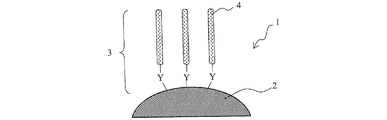
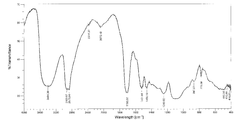
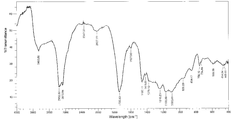
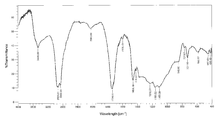
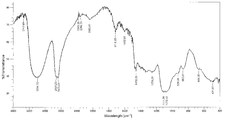
- FIG. 6 is an enlarged schematic view showing an example of surface-modified nanodiamond according to an embodiment of the present disclosure, wherein the surface-modified ND [1] includes a polyglycerin chain [4] on the surface of ND particles (parts) [2]. It has a surface modifying group [3]. It is a figure which shows the FT-IR spectrum of the surface-modified nanodiamond obtained in Example 1. It is a figure which shows the FT-IR spectrum of the surface-modified nanodiamond obtained in Example 2. It is a figure which shows the FT-IR spectrum of the surface-modified nanodiamond obtained in Example 3. It is a figure which shows the FT-IR spectrum of the surface-modified nanodiamond obtained in Example 4.
- the surface-modified nanodiamond according to the embodiment of the present disclosure (hereinafter, the nanodiamond may be referred to as “ND”) has nanodiamond particles and a polyglycerin chain that surface-modifies the nanodiamond particles. It contains a surface modifying group in which at least a part of the hydrogen atom of the hydroxyl group in the polyglycerin chain is replaced with a monovalent organic group.
- a surface modifying group having the above polyglycerin chain and having at least a part of the hydrogen atoms of the hydroxyl groups in the polyglycerin chain substituted with a monovalent organic group is referred to as "surface modifying group (X). ) ”.
- the surface-modified ND may have only one surface-modifying group (X), or may have two or more.
- FIG. 1 is an enlarged schematic view showing an example of a surface-modified ND according to an embodiment of the present disclosure.
- the surface-modified ND [1] has a hydrogen atom of at least a part of hydroxyl groups on the surface of the ND particle [2]. It has a surface modifying group (surface modifying group (X)) [3] having a polyglycerin chain [4] in which is substituted with a monovalent organic group.
- Y in FIG. 1 is the same as Y in the formula (2) described later.
- the ND particles constituting the surface-modified ND preferably include primary particles of nanodiamond. In addition, it may contain secondary particles in which several to several tens of the primary particles are aggregated (adhered). Further, the surface of the surface-modified ND may have one or more types of other surface functional groups (for example, amino group, hydroxyl group, carboxyl group, etc.) in addition to the surface modifying group (X). ..
- the surface modifying group (X) is a group having a polyglycerin chain in which at least a part of the hydrogen atoms of the hydroxyl groups in the polyglycerin chain are substituted with monovalent organic groups. That is, the monovalent organic group is bonded to an oxygen atom derived from the hydroxyl group at the terminal of the polyglycerin chain.
- the polyglycerin chain may be directly bonded to the ND particles or may be bonded via a divalent group. Examples of the divalent group include a divalent group exemplified as Y in the formula (2) described later.
- Examples of the monovalent organic group include a substituted or unsubstituted hydrocarbon group (monovalent hydrocarbon group), a substituted or unsubstituted heterocyclic group (monovalent heterocyclic group), and 2 of these. Examples thereof include a group bonded as described above and a group to which a bonding group is bonded to these. The bonded group may be directly bonded or may be bonded via a linking group. Examples of the linking group include amino group, ether bond, ester bond, phosphinic acid group, sulfide bond, carbonyl group, organic group substituted amide group, organic group substituted urethane bond, organic group substituted imide bond, thiocarbonyl group and siloxane.
- Examples include a bond, a group in which two or more of these are bonded, and the like.
- the bonding group is a group that bonds to an oxygen atom derived from a hydroxyl group at the end of a polyglycerin chain.
- a group that bonds with the oxygen atom to form an ester group, a urethane bond (carbamoyl group, etc.) is formed.
- Examples thereof include groups to be formed.
- hydrocarbon group in the monovalent organic group examples include an aliphatic hydrocarbon group, an alicyclic hydrocarbon group, an aromatic hydrocarbon group, and a group in which two or more of these are bonded.
- Examples of the aliphatic hydrocarbon group include an alkyl group, an alkenyl group, and an alkynyl group.
- Examples of the alkyl group include a C 1-20 alkyl group (preferably C 1-) such as a methyl group, an ethyl group, a propyl group, an isopropyl group, a butyl group, a hexyl group, an octyl group, an isooctyl group, a decyl group and a dodecyl group. 10 alkyl groups, more preferably C 1-4 alkyl groups) and the like.
- alkenyl group examples include a vinyl group, an allyl group, a metalyl group, a 1-propenyl group, an isopropenyl group, a 1-butenyl group, a 2-butenyl group, a 3-butenyl group, a 1-pentenyl group and a 2-pentenyl group.
- Examples thereof include a C 2-20 alkenyl group (preferably a C 2-10 alkenyl group, more preferably a C 2-4 alkenyl group) such as a 3-pentenyl group, a 4-pentenyl group and a 5-hexenyl group.
- alkynyl group examples include a C 2-20 alkynyl group such as an ethynyl group and a propynyl group (preferably a C 2-10 alkynyl group, more preferably a C 2-4 alkynyl group).
- Examples of the alicyclic hydrocarbon group include a C 3-12 cycloalkyl group such as a cyclopropyl group, a cyclobutyl group, a cyclopentyl group, a cyclohexyl group and a cyclododecyl group; and a C 3-12 cycloalkenyl group such as a cyclohexenyl group.
- Examples include C 4-15 crosslinked cyclic hydrocarbon groups such as bicycloheptanyl group and bicycloheptenyl group.
- aromatic hydrocarbon group examples include a C 6-14 aryl group such as a phenyl group and a naphthyl group (particularly, a C 6-10 aryl group).
- heterocycle forming the above heterocyclic group examples include aromatic heterocycles and non-aromatic heterocycles.
- a heterocycle is a 3- to 10-membered ring (preferably a 4- to 6-membered ring) having a carbon atom and at least one heteroatom (for example, an oxygen atom, a sulfur atom, a nitrogen atom, etc.) in the atoms constituting the ring. ), These fused rings can be mentioned.
- a heterocycle containing an oxygen atom as a heteroatom for example, a 3-membered ring such as an oxyran ring; a 4-membered ring such as an oxetane ring; a furan ring, a tetrahydrofuran ring, an oxazole ring, an isooxazole ring, a ⁇ -butyrolactone ring).
- 6-membered rings such as a ring, a pyrimidine ring, a pyrazine ring, a piperidine ring, a piperazine ring; an indole ring, an indolin ring, a quinoline ring, an acridin ring, a naphthylidine ring, a quinazoline ring, a fused ring such as a purine ring, etc.
- Examples of the group in which the aliphatic hydrocarbon group and the alicyclic hydrocarbon group are bonded include a cyclohexylmethyl group and a methylcyclohexyl group.
- Examples of the group in which the aliphatic hydrocarbon group and the aromatic hydrocarbon group are bonded include a C 7-18 aralkyl group (particularly, C 7-10 aralkyl group) such as a benzyl group and a phenethyl group, and a C such as a cinnamyl group.
- Examples thereof include a C 1-4 alkyl-substituted aryl group such as a 6-10 aryl-C 2-6 alkenyl group and a tolyl group, and a C 2-4 alkenyl-substituted aryl group such as a styryl group.
- Examples of the group in which two or more of the monovalent hydrocarbon group and / or the monovalent heterocyclic group are bonded via a linking group include the monovalent hydrocarbon group and / or the monovalent heterocycle.
- the monovalent organic group may have a substituent.
- substituents include halogen atoms such as fluorine atom, chlorine atom, bromine atom and iodine atom; hydroxyl group; mercapto group; carboxy group; amino group; oxo group and the like.
- the monovalent organic group is preferably a group represented by the following formula (1).
- Examples of the monovalent organic group in R include a substituted or unsubstituted hydrocarbon group (monovalent hydrocarbon group), a substituted or unsubstituted heterocyclic group (monovalent heterocyclic group), and the like. Examples thereof include a group in which two or more are bonded.
- the bonded group may be directly bonded or may be bonded via a linking group.
- Examples of the linking group include amino group, ether bond, ester bond, phosphinic acid group, sulfide bond, carbonyl group, organic group substituted amide group, organic group substituted urethane bond, organic group substituted imide bond, thiocarbonyl group and siloxane.
- Examples include a bond, a group in which two or more of these are bonded, and the like.
- the monovalent hydrocarbon group, the monovalent heterocyclic group, and the group in which two or more of these are bonded are the monovalent organic group (polyglycerin chain terminal hydroxyl group) in the surface modifying group (X) described above, respectively. Examples and explanations thereof include monovalent organic groups bonded to oxygen atoms derived from.
- a substituted or unsubstituted hydrocarbon group is preferable, an alkyl group is more preferable, an alkyl group having 1 to 18 carbon atoms is more preferable, and an alkyl group having 1 to 6 carbon atoms is particularly preferable.
- the Rs of the plurality of groups represented by the above formula (1) may be the same as each other. , May be different.
- the surface modifying group (X) is preferably a polyglycerin chain-containing surface modifying group represented by the following formula (2).
- p and q indicate the average degree of polymerization of the repeating unit in parentheses, respectively, p is a value of 0 or more, q is a value of 0 or more, and p + q is a value of 1 or more.
- R 1 represents a monovalent organic group.
- [-OR 2 ] indicates the end of the polyglycerin chain, and R 2 indicates a hydrogen atom or a monovalent organic group. However, when R 2 is a hydrogen atom, q indicates a value exceeding 0.
- Y represents a single bond or a divalent group, and the bond extending to the left from Y bonds to the ND particle. ]
- [C 3 H 6 O 2 ] with p in the above formula (2) has one or more of the structures represented by the following formulas (3) to (5). -OCH 2- CHOH-CH 2- (3) -OCH (CH 2 OH) -CH 2- (4) -OCH 2- CH (CH 2 OH)-(5)
- [C 3 H 5 O 2 R 1 ] with q in the above formula (2) has one or more of the structures represented by the following formulas (6) to (8).
- p and q each indicate the average degree of polymerization (number average degree of polymerization) of the repeating unit in parentheses.
- p is a value of 0 or more
- q is a value of 1 or more
- p + q is a value of 1 or more.
- R 2 is a hydrogen atom
- q indicates a value exceeding 0.
- p + q is preferably 1 to 100, more preferably 2 to 40, and even more preferably 3 to 30.
- p + q is 1 or more, the steric hindrance between the surface modifying groups becomes sufficient and it is easy to disperse in the dispersion medium.
- [Q / (p + q)] is preferably 0.6 or more (for example, 0.8 to 1.0).
- the average degree of polymerization is defined by the number of glycidol units constituting the polyglycerin chain bonded to the surface functional group 1 of the raw material nanodiamond, and the number of surface functional groups of the raw material nanodiamond is an element analysis value of the raw material nanodiamond. It can be determined by measurement, measurement of acid value, or a combination of both.
- R 1 represents a monovalent organic group, preferably a group represented by the above formula (1).
- the monovalent organic group in R 1 is exemplified as, for example, the monovalent organic group in the above-mentioned surface modifying group (X) (a monovalent organic group bonded to an oxygen atom derived from the hydroxyl group at the terminal of the polyglycerin chain). And those described.
- [-OR 2 ] indicates the terminal of the polyglycerin chain
- R 2 indicates a hydrogen atom or a monovalent organic group, and preferably represents a group represented by the above formula (1). ..
- R 2 is a monovalent organic group
- a plurality of R 2 in the above formula (2) are the same.
- the monovalent organic group in R 2 is exemplified as, for example, the monovalent organic group in the above-mentioned surface modifying group (X) (a monovalent organic group bonded to an oxygen atom derived from the hydroxyl group at the terminal of the polyglycerin chain). And those described.
- Y represents a single bond or a divalent group, and the bond extending to the left from Y bonds to the ND particle.
- divalent hydrocarbon group A group in which two or more of these are bonded, and the like.
- divalent hydrocarbon group include a residue obtained by removing one hydrogen atom from the monovalent hydrocarbon group.
- the divalent group may have a substituent. Examples of the substituent include those exemplified and described as the substituent that the monovalent organic group may have.
- the joining order of the structural unit with p and the structural unit with q is not particularly limited. That is, the oxygen atom bonded to Y in the formula (2) may be an oxygen atom in the structural unit with p or an oxygen atom in the structural unit with q.
- the carbon atom in the formula (2) to be bonded to OR 2 in the formula (2) may be a carbon atom in the constitutional unit with p, and the carbon atom in the constitutional unit with q. It may be.
- the method of combining the structural unit with p and the structural unit with q is random, alternating, or block. It may be any of.
- the plurality of R 1s may be the same or different.
- the binding form of the structural unit with q may be random, alternating, or block.
- the mass ratio [ND / surface modifying group (X)] of ND to the surface modifying group (X) in the surface modifying ND is not particularly limited, but is preferably 0.5 to 1.0, and more preferably 0.6. It is ⁇ 0.8. When the mass ratio is 0.5 or more (particularly 0.6 or more), the characteristics as a nanodiamond material are not easily impaired. When the mass ratio is 1.0 or less (particularly 0.8 or less), the degree of modification of the surface modifying group (X) is sufficient, and the dispersibility in a low polar solvent is excellent.
- the mass ratio is determined based on the weight loss rate measured by thermogravimetric analysis, and the reduced weight is determined as the mass of the polyglycerin chain-containing surface modifying group.
- the absorption peak may fluctuate slightly depending on R and the like in the above formula (1).
- the surface-modified ND having such a peak corresponds to the surface-modified ND in which R in the above formula (1) contains a monovalent aliphatic hydrocarbon group.
- the peak may fluctuate slightly depending on R and the like in the above equation (1).
- the surface-modified ND is obtained when the surface-modified ND is dispersed in at least one organic dispersion medium having an SP value of 10 (cal / cm 3 ) 1/2 or less so that the content ratio is 0.1% by mass.
- the median diameter (D50) of the above is preferably 5 to 100 nm. That is, it is preferable that the median diameter of the surface-modified ND in the dispersion medium is within the above range with respect to at least one organic dispersion medium among the organic dispersion media satisfying the SP value.
- the median diameter is more preferably 5 to 80 nm, still more preferably 5 to 50 nm.
- the SP value refers to the Hildebrand solubility parameter ( ⁇ ) at 25 ° C.
- the median diameter is adjusted to 20000 ⁇ after adding the organic dispersion medium so that the surface-modified ND content ratio is 0.1% by mass, stirring with an ultrasonic cleaner for 5 minutes, and allowing to stand for 1 day. It can be determined by measuring the surface-modified ND particles of the supernatant that have been centrifuged at g for 10 minutes.
- Examples of the organic dispersion medium having an SP value of 10 (cal / cm 3 ) 1/2 or less include hexane (SP: 7.0), alkylbenzene (SP: 7.6), and methyl isobutyl ketone (MIBK, SP).
- SP: 8.4 toluene (SP: 8.8), tetrahydrofuran (SP: 9.1), ethyl acetate (SP: 9.1), methyl ethyl ketone (MEK, SP: 9.3), chloroform (SP: 9) .3), polyol ester (SP: 9.6), methylene chloride (SP: 9.7), dioxane (SP: 9.8), ethylene dichloride (SP: 9.8) acetone (SP: 10.0) ), Poly ⁇ -olefin (SP: about 6.0 to 8.0), mineral oil (SP: about 6.0 to 8.0) and the like.
- the SP value is preferably 7 to 10.0 (cal / cm 3 ) 1/2 , more preferably 7.3 to 9.9 (cal / cm 3 ) 1/2 .
- the surface-modified ND has excellent dispersibility in a low-polarity solvent, and can be dispersed in various dispersion media by controlling the polarity of ND particles by adjusting the branched structure of the polyglycerin chain or the length of the polyglycerin chain. Affinity for sex and resin is realized. Therefore, it can be used in engineering application fields such as abrasives for CMPs, materials for dressers, corrosion-resistant electrode plating materials for fuel cells, high-hardness surface coating layer forming materials such as cutting tools, and high heat resistance and high thermal conductivity materials.
- the particle size (D50) of the surface-modified ND is, for example, 400 nm or less, preferably 300 nm or less, more preferably 100 nm or less, and further preferably 50 nm or less.
- the lower limit of the particle size (D50) of the surface-modified ND is, for example, 5 nm.
- the particle size (D90) is, for example, 500 nm or less, preferably 180 nm or less, and more preferably 170 nm or less.
- the lower limit of the particle size (D90) of the surface-modified ND is, for example, 50 nm.
- the smaller the particle size of the surface-modified ND the higher the transparency of the composite material described later, which is preferable.
- the (average) particle size of the surface-modified ND can be measured by a dynamic light scattering method.
- Nanodiamond dispersion composition By dispersing the surface-modified ND in a dispersion medium, a nanodiamond dispersion composition (ND dispersion composition) containing the dispersion medium and the surface-modified ND dispersed in the dispersion medium can be obtained.
- the dispersion medium is a medium for dispersing the surface-modified ND, and examples thereof include water, an organic solvent, and an ionic liquid.
- the dispersion medium only one kind may be used, or two or more kinds may be used.
- organic solvent examples include aliphatic hydrocarbons such as hexane, heptane, and octane (particularly, linear saturated aliphatic hydrocarbons); aromatic hydrocarbons such as benzene, toluene, and xylene; cyclohexane, methylcyclohexane, and the like.
- Alicyclic hydrocarbons such as dimethylformamide (DMF), dimethylacetamide, N-methylpyrrolidone, dimethylsulfoxide; alcohols such as methanol; chloroform, dichloromethane, dichloroethane, carbon tetrachloride, chlorobenzene, trifluoromethyl Halogenated hydrocarbons such as benzene; chain or cyclic ethers such as diethyl ether, diisopropyl ether, dimethoxyethane, tetrahydrofuran (THF), dioxane; esters such as ethyl acetate and butyl acetate; methyl ethyl ketone (MEK), methyl isobutyl ketone and the like Chain ketones; examples thereof include nitriles such as acetonitrile.
- the cyclic ether or the chain ketone is preferable in that the dispersibility of the surface-
- the content ratio of the ND particles in the ND dispersion composition is not particularly limited, but is, for example, 0.1 mass ppm to 10 mass%.
- the content ratio of the ND particles can be calculated from the absorbance at 350 nm.
- a compound in which the ND particles are surface-modified is detected by high-frequency inductively coupled plasma emission spectroscopy (ICP emission spectroscopy). , It can also be obtained based on the detected amount.
- ICP emission spectroscopy high-frequency inductively coupled plasma emission spectroscopy
- the content ratio of the dispersion medium in the ND dispersion composition is, for example, 90 to 99.9999% by mass.
- the upper limit is 100% by mass.
- the ND dispersion composition may consist only of the surface-modified ND and the dispersion medium, or may contain other components.
- Other components include, for example, surfactants, thickeners, coupling agents, dispersants, rust preventives, corrosion inhibitors, freezing point lowering agents, defoamers, abrasion resistant additives, preservatives, colorants and the like. Can be mentioned.
- the content ratio of the other components is, for example, 30% by mass or less, preferably 20% by mass or less, more preferably 10% by mass or less, still more preferably 5% by mass or less, particularly preferably 5% by mass or less, based on the total amount of the ND dispersion composition. Is 1% by mass or less.
- the total content ratio of the surface-modified ND and the dispersion medium is, for example, 70% by mass or more, preferably 80% by mass or more, more preferably 90% by mass or more, still more preferably 90% by mass or more, based on the total amount of the ND dispersion composition. It is 95% by mass or more, particularly preferably 99% by mass or more.
- the ND dispersion composition contains the surface-modified ND in a highly dispersed state.
- the average dispersed particle size (D50) of the ND particles in the ND dispersion composition is, for example, 100 nm or less, preferably 60 nm or less, more preferably 50 nm or less, and further preferably 30 nm or less.
- the lower limit of the average dispersed particle size of the ND particles is, for example, 5 nm.
- the ND dispersion composition preferably has a haze value of 5 or less, more preferably 3 or less, and even more preferably 1 or less. Since the ND dispersion composition is excellent in dispersibility of the surface-modified ND, an ND dispersion composition having the haze value can be obtained. The haze value can be measured based on JIS K 7136.
- the ND dispersion composition has, for example, a resin that has the characteristics of fine ND particles (for example, mechanical strength, high refractive index, thermal conductivity, insulating property, antioxidant property, crystallization promoting action, dendrite suppressing action, etc.). It can be preferably used as an additive for composite materials, which is applied to (for example, thermosetting resin, thermoplastic resin, etc.).
- the composition obtained by adding the above ND dispersion composition to the resin is, for example, a functional hybrid material, a thermal function (heat resistance, heat storage, thermoconductivity, heat insulation, etc.) material, photonics (organic EL element, LED, etc.).
- Liquid crystal display, optical disk, etc.) material bio / biocompatible material, coating material, film (hard coat film for touch panel and various displays, heat shield film, etc.) material, sheet material, screen (transmissive transparent screen, etc.) material, It can be preferably used as a filler (filler for heat dissipation, filler for improving mechanical properties, etc.) material, a heat-resistant plastic substrate (substrate for flexible display, etc.) material, a lithium ion battery, or the like.
- the ND dispersion composition can also be used as an anti-friction agent or a lubricant applied to medical applications and sliding parts of mechanical parts (for example, automobiles, aircraft, etc.).
- the surface-modified ND is a surface-modified ND (A) having a surface-modifying ND particle and a surface-modifying group containing a polyglycerin chain having a hydroxyl group, which modifies the surface of the ND particle, an alcohol (B1), and an isocyanic acid ester (B2). ), And one or more compounds selected from the group consisting of the carboxylated product (B3) can be reacted for production.
- the above-mentioned surface modifying group containing a polyglycerin chain has a hydroxyl group on the polyglycerin chain.
- the surface-modified ND having the polyglycerin chain-containing surface-modifying group (sometimes referred to as "surface-modified ND (A)") can be obtained by ring-opening polymerization of glycidol directly on the ND particles.
- the ND particles originally have a carboxyl group or a hydroxyl group generated in the production process, and the surface of the ND can be modified by a polyglycerin chain by reacting these functional groups with glycidol.
- the reaction between the ND particles and glycidol can be carried out, for example, by adding glycidol and a catalyst to the ND particles in an inert gas atmosphere and heating to 50 to 100 ° C.
- a catalyst either an acidic catalyst or a basic catalyst can be used.
- the acidic catalyst include trifluoroboron etherate, acetic acid, and phosphoric acid.
- the basic catalyst include triethylamine, pyridine, dimethylaminopyridine, triphenylphosphine and the like.
- the surface-modified ND (A) can also be obtained by ring-opening polymerization of glycidol on ND particles having a functional group containing active hydrogen introduced on the surface.
- the functional group containing active hydrogen is not particularly limited, and examples thereof include an amino group, a hydroxyl group, a carboxyl group, a mercapto group (thiol group), and a phosphinic acid group.
- JP-A-2012-82103, JP-A-2010-248023 and the like can be referred to.
- the ring-opening polymerization of glycidol on the ND particles in which a functional group containing active hydrogen is introduced on the surface can be carried out in the same manner as the ring-opening polymerization of glycidol on the ND particles described above.
- the surface-modified ND is obtained by dehydration condensation by the reaction between the surface-modified ND (A) and alcohol (B1) to form an ether bond.
- the isocyanic acid ester (B2) in the surface-modified ND, the isocyanate group and the hydroxyl group in the isocyanic acid ester are added by the reaction between the surface-modified ND (A) and the isocyanic acid ester (B2). Obtained by forming a urethane bond (carbamoyl group).
- the carboxyl chloride (B3) the surface-modified ND is obtained by forming an ester bond by reacting the surface-modified ND (A) with the carboxyl chloride (B3).
- the alcohol (B1), isocyanic acid ester (B2), and carboxyl chloride (B3) can be appropriately selected according to the obtained surface-modified ND.
- the organic group bonded to the hydroxyl group in the alcohol (B1), the organic group on the nitrogen atom in the isocyanic acid ester (B2), and the organic group bonded to the carbonyl group in the carboxylated product (B3) are each represented by the above formula (B3).
- R in 1) for example, the monovalent organic group exemplified and described as R described above can be mentioned.
- the alcohol (B1), the isocyanate (B2), and the carboxyl chloride (B3) only one kind may be used, or two or more kinds may be used.
- the alcohol (B1) is preferably C 1-18 alcohol, more preferably ethanol, n-butanol, or n-hexanol.
- the isocyanic acid ester (B2) is preferably alkyl isocyanate, more preferably C 1-18 alkyl isocyanate, still more preferably ethyl isocyanate, n-butyl isocyanate, n-hexyl isocyanate.
- the carboxyl chloride (B3) is preferably acyl chloride, and the number of carbon atoms in the acyl group is preferably C 1-19 alkyl, more preferably valeryl chloride.
- the reaction with the alcohol, the isocyanate, or the carboxyl chloride may be carried out in a solvent.
- the solvent include the above-mentioned organic solvent.
- the reaction can be carried out, for example, by adding a catalyst to the ND particles under an inert gas atmosphere and stirring at room temperature.
- a basic catalyst is preferable.
- the basic catalyst include tertiary amines such as triethylamine, pyridine, dimethylaminopyridine, and triphenylphosphine.
- the basic catalyst is a liquid, the basic catalyst may be used as the reaction solvent.
- the ratio (former: latter, mass ratio) of the surface-modified ND (A) to be subjected to the reaction to the alcohol (B1), the isocyanate (B2), and / or the carboxyl chloride (B3) is, for example, 2: 1 to 2. It is 1:80.
- the concentration of the surface-modified ND (A) in the solvent is, for example, 0.5 to 10% by mass, and the alcohol (B1), the isocyanate ester (B2), and / or the carboxyl chloride (B3) in the solvent. ) Is, for example, 5 to 60% by mass.
- the reaction time between the surface-modified ND (A) and the alcohol (B1), the isocyanate (B2), and / or the carboxyl chloride (B3) is, for example, 4 to 24 hours.
- the surface-modified ND and the ND dispersion composition in which the surface-modified ND is dispersed in the dispersion medium can be obtained.
- the liquid after the reaction it is preferable to allow the liquid after the reaction to stand and then collect the supernatant to prepare the ND dispersion composition.
- a solvent advantageous for the reaction is used in the reaction between the surface-modified ND (A) and the alcohol (B1), the isocyanic acid ester (B2), and / or the carboxylated product (B3), the surface modification is once performed.
- the dispersion medium in the dispersion liquid is distilled off with an evaporator or the like, and then a new dispersion medium is mixed and stirred, that is, the above-mentioned ND dispersion composition is also produced by exchanging the solvent. can do.
- the detonation method ND that is, the ND generated by the detonation method
- the high temperature and high pressure method ND that is, the ND generated by the high temperature and high pressure method
- the detonation method ND is preferable in that the dispersibility in the dispersion medium is more excellent, that is, the particle size of the primary particles is a single digit nanometer.
- the detonation method ND includes an air-cooled detonation method ND (that is, an ND generated by the air-cooled detonation method) and a water-cooled detonation method ND (that is, an ND generated by the water-cooled detonation method). .. Above all, the air-cooled detonation method ND is preferable in that the primary particles are smaller than the water-cooled detonation method ND.
- the detonation may be carried out in an atmospheric atmosphere, or in an inert gas atmosphere such as a nitrogen atmosphere, an argon atmosphere, or a carbon dioxide atmosphere.
- ND particles used in the above production method An example of a method for producing ND particles used in the above production method will be described below, but the ND particles used are not limited to those obtained by the following production method.
- a molded explosive equipped with an electric detonator is installed inside a pressure-resistant container for detonation, and the container is sealed in a state where the atmospheric composition normal pressure gas and the explosive used coexist in the container. ..
- the container is made of iron, for example, and the volume of the container is, for example, 0.5 to 40 m 3 .
- As the explosive a mixture of trinitrotoluene (TNT) and cyclotrimethylene trinitroamine or hexogen (RDX) can be used.
- TNT / RDX The mass ratio of TNT to RDX (TNT / RDX) is, for example, in the range of 40/60 to 60/40.
- the container and its inside are then cooled by allowing it to cool at room temperature for about 24 hours.
- the ND particle crude product (including the ND particle coagulant and soot produced as described above) adhering to the inner wall of the container is scraped off with a spatula to perform the ND particle coarse product. Collect the product.
- a crude product of ND particles (crude product of ND particles) can be obtained. Further, it is possible to obtain a desired amount of crude ND particle product by performing the nanodiamond production step as described above a required number of times.
- a strong acid is allowed to act on the raw material ND particle crude product, for example, in an aqueous solvent to remove the metal oxide.
- the crude ND particle product obtained by the detonation method tends to contain metal oxides, and these metal oxides are oxides such as Fe, Co, and Ni derived from the container used in the detonation method. ..
- the strong acid used for this acid treatment is preferably a mineral acid, and examples thereof include hydrochloric acid, hydrofluoric acid, sulfuric acid, nitric acid, and aqua regia.
- the strong acid one kind may be used, or two or more kinds may be used.
- the concentration of the strong acid used in the acid treatment is, for example, 1 to 50% by mass.
- the acid treatment temperature is, for example, 70 to 150 ° C.
- the acid treatment time is, for example, 0.1 to 24 hours. Further, the acid treatment can be performed under reduced pressure, normal pressure, or pressure. After such acid treatment, the solid content (including the nanodiamond adherent) is washed with water, for example, by decantation. It is preferable to repeatedly wash the solid content with water by decantation until the pH of the precipitate reaches, for example, 2 to 3. When the content of the metal oxide in the crude ND particle product obtained by the detonation method is small, the above acid treatment may be omitted.
- the oxidation treatment step is a step of removing graphite from the crude ND particle product using an oxidizing agent.
- the crude ND particle product obtained by the detonation method contains graphite (graphite), which does not form ND particle crystals out of the carbon released by the explosive used due to partial incomplete combustion. Detonated from graphite.
- Graphite can be removed from the crude ND particle product by allowing an oxidizing agent to act on the crude ND particle product in an aqueous solvent. Further, by allowing an oxidizing agent to act, an oxygen-containing group such as a carboxyl group or a hydroxyl group can be introduced into the surface of the ND particles.
- Examples of the oxidizing agent used in this oxidation treatment include chromic acid, chromic anhydride, dichromic acid, permanganic acid, perchloric acid, nitric acid, a mixture thereof, and at least one acid selected from these.
- Examples include mixed acids with other acids (such as sulfuric acid) and salts thereof.
- it is preferable to use a mixed acid particularly, a mixed acid of sulfuric acid and nitric acid because it is environmentally friendly and has an excellent action of oxidizing and removing graphite.
- the mixing ratio of sulfuric acid and nitric acid (former / latter; mass ratio) in the mixed acid is, for example, 60/40 to 95/5, even under pressure near normal pressure (for example, 0.5 to 2 atm).
- the lower limit is preferably 65/35, more preferably 70/30.
- the upper limit is preferably 90/10, more preferably 85/15, and even more preferably 80/20.
- a catalyst may be used together with the mixed acid.
- the efficiency of removing graphite can be further improved.
- the catalyst include copper (II) carbonate and the like.
- the amount of the catalyst used is, for example, about 0.01 to 10 parts by mass with respect to 100 parts by mass of the crude ND particle product.
- the oxidation treatment temperature is, for example, 100 to 200 ° C.
- the oxidation treatment time is, for example, 1 to 24 hours.
- the oxidation treatment can be performed under reduced pressure, normal pressure, or pressure.
- Alkaline hydrogen peroxide treatment process If the metal oxide that could not be completely removed remains in the ND particles even after the acid treatment step, the primary particles interact very strongly with each other to form an aggregate (secondary). It takes the form of particles). In such a case, alkali and hydrogen peroxide may be allowed to act on the ND particles in an aqueous solvent. As a result, the metal oxide remaining on the ND particles can be removed, and the separation of the primary particles from the adherent can be promoted. Examples of the alkali used in this treatment include sodium hydroxide, ammonia, potassium hydroxide and the like.
- the concentration of alkali is, for example, 0.1 to 10% by mass
- the concentration of hydrogen peroxide is, for example, 1 to 15% by mass
- the treatment temperature is, for example, 40 to 100 ° C.
- the treatment time is For example, 0.5 to 5 hours.
- the alkaline hydrogen peroxide treatment can be performed under reduced pressure, normal pressure, or pressure.
- the oxidation treatment step or the alkaline hydrogen peroxide treatment step it is preferable to remove the supernatant by, for example, decantation. Further, at the time of decantation, it is preferable to wash the solid content with water. Although the supernatant liquid at the beginning of washing with water is colored, it is preferable to repeatedly wash the solid content with water until the supernatant liquid becomes visually transparent.
- the ND particles may be subjected to a crushing treatment, if necessary.
- a crushing treatment for example, a high shear mixer, a high shear mixer, a homomixer, a ball mill, a bead mill, a high-pressure homogenizer, an ultrasonic homogenizer, a colloid mill and the like can be used.
- the crushing treatment may be carried out by a wet method (for example, a crushing treatment in a state of being suspended in water or the like) or by a dry method. When the dry method is used, it is preferable to provide a drying step before the crushing process. Further, the crushing treatment step may be carried out after these when the oxidation treatment or the hydrogenation treatment is carried out.
- drying process It is preferable to provide a drying step after the alkaline hydrogen peroxide treatment step. For example, after evaporating the liquid content from the ND particle-containing solution obtained through the above alkaline hydrogen peroxide treatment step using a spray dryer or an evaporator, the residual solid content generated thereby is heated in a drying oven. Dry by drying. The heating and drying temperature is, for example, 40 to 150 ° C. By undergoing such a drying step, ND particles can be obtained.
- the ND particles may be subjected to an oxidation treatment (for example, oxygen oxidation) or a reduction treatment (for example, hydrogenation treatment) in the gas phase, if necessary.
- an oxidation treatment for example, oxygen oxidation
- a reduction treatment for example, hydrogenation treatment
- ND particles having many CH groups on the surface can be obtained.
- Example 1 The surface-modified ND particles and the dispersion composition were produced through the following steps.
- a molded explosive equipped with an electric detonator was installed inside a pressure-resistant container for detonation, and the container was sealed.
- the container is made of iron and the volume of the container is 15 m 3 .
- As the explosive 0.50 kg of a mixture of TNT and RDX was used.
- the mass ratio of TNT to RDX (TNT / RDX) in this explosive is 50/50.
- the electric detonator was detonated and the explosive was detonated in the container (generation of ND by the detonation method).
- the temperature of the container and its inside was lowered by leaving it at room temperature for 24 hours.
- the ND crude product adhering to the inner wall of the container (including the cohesive body of the ND particles and soot generated by the above detonation method) is scraped off with a spatula, and the ND crude product is scraped off.
- the ND crude product adhering to the inner wall of the container (including the cohesive body of the ND particles and soot generated by the above detonation method) is scraped off with a spatula, and the ND crude product is scraped off. was recovered.
- an oxidation treatment step was performed. Specifically, 6 L of 98% by mass sulfuric acid and 1 L of 69% by mass nitric acid are added to a precipitate (including an ND adhering body) obtained through decantation after acid treatment to form a slurry, which is then added.
- the slurry was heat-treated for 48 hours under reflux under normal pressure conditions. The heating temperature in this oxidation treatment is 140 to 160 ° C.
- the solid content (including the ND adherent) was washed with water by decantation. The supernatant liquid at the beginning of washing with water was colored, and the solid content was repeatedly washed with water by decantation until the supernatant liquid became visually transparent.
- the precipitate liquid (liquid containing the ND cohesive body) obtained through the above-mentioned water washing treatment was subjected to a drying step to obtain a dry powder (ND cohesive body).
- a drying step evaporative drying performed using an evaporator was adopted.
- the heating rate was 10 ° C./min up to 380 ° C., which is 20 ° C. lower than the set heating temperature, and 1 ° C./min from 380 ° C. to 400 ° C. thereafter. Then, while maintaining the temperature condition in the furnace at 400 ° C., the ND powder in the furnace was subjected to oxygen oxidation treatment. The processing time was 3 hours.
- the hydrogenation process was carried out using the above-mentioned gas atmosphere furnace. Specifically, after the nitrogen gas is continuously passed through the gas atmosphere furnace in which the ND powder that has undergone the oxygen oxidation step is arranged at a flow rate of 1 L / min for 30 minutes, the flowing gas is changed from nitrogen to hydrogen. The gas was switched to a mixed gas of nitrogen and nitrogen, and the mixed gas was continuously passed through the core tube at a flow rate of 1 L / min. The hydrogen concentration in the mixed gas is 2% by volume. After switching to the mixed gas, the temperature inside the furnace was raised to the set heating temperature of 600 ° C. The heating rate was 10 ° C./min. Then, while maintaining the temperature condition in the furnace at 600 ° C., the ND powder in the furnace was hydrogenated. The processing time was 5 hours. As described above, the hydrogenated ND powder was obtained.
- the crushing process was performed. Specifically, first, 0.9 g of ND powder and 29.1 ml of pure water that had undergone the above-mentioned hydrogenation step were added to a 50 ml sample bottle and mixed to obtain about 30 ml of slurry. After adjusting the pH to 4 with 1N hydrochloric acid, the slurry was sonicated. In the ultrasonic treatment, an ultrasonic irradiator (trade name "ultrasonic cleaner AS-3", manufactured by AS ONE) was used to irradiate the slurry with ultrasonic waves for 2 hours. ..
- an ultrasonic irradiator trade name "ultrasonic cleaner AS-3", manufactured by AS ONE
- bead milling was performed using a bead milling device (trade name "parallel four-cylinder sand grinder LSG-4U-2L type", manufactured by IMEX Co., Ltd.). Specifically, 30 ml of the slurry after ultrasonic irradiation and zirconia beads having a diameter of 30 ⁇ m are put into a 100 ml mill container, Vessel (manufactured by Imex Co., Ltd.) and sealed, and the device is driven to perform bead milling. Executed. In this bead milling, the input amount of zirconia beads is, for example, 33% by volume with respect to the volume of the mill container, the rotation speed of the mill container is 2570 rpm, and the milling time is 2 hours.
- a bead milling device trade name "parallel four-cylinder sand grinder LSG-4U-2L type", manufactured by IMEX Co., Ltd.
- the slurry that had undergone the above-mentioned crushing step was centrifuged using a centrifuge device (classification operation).
- the centrifugal force in this centrifugation treatment was 20000 ⁇ g, and the centrifugation time was 10 minutes.
- 10 ml of the supernatant of the ND-containing solution that had undergone the centrifugation treatment was collected.
- the solid content concentration of this nanodiamond dispersion was 2.1% by mass, and the pH was 5.40.
- the median diameter (particle size D50) of the ND dispersion obtained as described above was 35.8 nm.
- the ND particle aqueous dispersion obtained through the above-mentioned crushing step was dried using an evaporator to obtain a black dry powder.
- the obtained dry powder (100 mg) was added to 12 mL of glycidol placed in a glass reactor, and used in an ultrasonic cleaner (trade name "BRANSON2510", manufactured by Marshall Scientific) at room temperature. It was sonicated for hours to dissolve. This was reacted at 140 ° C. for 20 hours while stirring under a nitrogen atmosphere. After cooling the reaction mixture, 120 mL of methanol was added, the mixture was sonicated, and then centrifuged at 50400 ⁇ g for 2 hours to obtain a precipitate.
- Pyridine was added to the PG-ND gray powder, and the concentration was adjusted to 4 g / L based on the mass of the ND particles to obtain a PG-ND particle pyridine dispersion.
- a PG-ND particle pyridine dispersion To 20 ml of the obtained PG-ND particle pyridine dispersion, 4 g of ethyl isothiocyanate was added, and the mixture was stirred at room temperature for 30 minutes. Subsequently, 40 ml of hexane was added, and the mixture was centrifuged at 20000 ⁇ g for 10 minutes to obtain a precipitate. This washing operation was repeated 3 times, and after removing pyridine, the mixture was allowed to stand at 50 ° C. for 24 hours in a vacuum dryer to obtain a dry solid content.
- Tetrahydrofuran was added so that the ND content was 0.1% by mass with respect to the dry solid content obtained above, and the mixture was stirred with an ultrasonic cleaner for 5 minutes and the appearance after standing for 1 day was observed. It was confirmed that a good dispersion state was maintained.
- the median diameter (particle size D50) of the surface-modified nanodiamond particles of the supernatant centrifuged at 20000 ⁇ g for 10 minutes was 34 nm.
- methanol was used instead of tetrahydrofuran
- ultrapure water was used instead of tetrahydrofuran, it was confirmed that nanodiamonds aggregated and precipitated.
- Example 2 Dry solid content (at least a part of the hydroxyl group terminal of the polyglycerin chain is n-butyl isocyanate) in the same manner as in Example 1 except that 5.6 g of n-butyl isocyanate was used instead of 4 g of ethyl isocyanate.
- a surface-modified nanodiamond sealed in (1) was obtained.
- the mass ratio [ND / polyglycerin chain-containing surface modifying group] determined by thermogravimetric analysis of the obtained surface-modified nanodiamond particles was 0.74.
- Tetrahydrofuran was added so that the ND content was 0.1% by mass with respect to the dry solid content obtained above, and the mixture was stirred with an ultrasonic cleaner for 5 minutes and the appearance after standing for 1 day was observed. It was confirmed that a good dispersion state was maintained.
- the median diameter (particle size D50) of the surface-modified nanodiamond particles of the supernatant centrifuged at 20000 ⁇ g for 10 minutes was 38 nm.
- methanol was used instead of tetrahydrofuran
- ultrapure water was used instead of tetrahydrofuran, it was confirmed that nanodiamonds aggregated and precipitated.
- Example 3 In the same manner as in Example 1 except that 7.16 g of n-hexyl isocyanate was used instead of ethyl isocyanate, the dry solid content (at least a part of the hydroxyl group ends of the polyglycerin chain became n-hexyl isocyanate). A sealed surface-modified nanodiamond) was obtained. The mass ratio [ND / polyglycerin chain-containing surface modifying group] determined by thermogravimetric analysis of the obtained surface-modified nanodiamond particles was 0.62.
- Tetrahydrofuran was added so that the ND content was 0.1% by mass with respect to the dry solid content obtained above, and the mixture was stirred with an ultrasonic cleaner for 5 minutes and the appearance after standing for 1 day was observed. It was confirmed that a good dispersion state was maintained.
- the median diameter (particle size D50) of the surface-modified nanodiamond particles of the supernatant centrifuged at 20000 ⁇ g for 10 minutes was 42 nm. When the same operation was performed when toluene was used instead of tetrahydrofuran, it was confirmed that a good dispersed state was maintained.
- Example 4 Pyridine was added to the PG-ND gray powder obtained in Example 1, and the concentration was adjusted to 2 g / L based on the mass of the ND particles to obtain a PG-ND particle pyridine dispersion.
- 4.8 g of valeryl chloride was added to 40 ml of the obtained PG-ND particle pyridine dispersion, and the mixture was stirred at 60 ° C. for 24 hours. Subsequently, after adding 80 ml of ultrapure water, the mixture was centrifuged at 6000 ⁇ g for 5 minutes to remove the supernatant, 40 ml of methanol was added and stirred, and then the mixture was centrifuged at 20000 ⁇ g for 10 minutes to precipitate a precipitate.
- Tetrahydrofuran was added so that the ND content was 0.1% by mass with respect to the dry solid content obtained above, and the mixture was stirred with an ultrasonic cleaner for 5 minutes and the appearance after standing for 1 day was observed. It was confirmed that a good dispersion state was maintained.
- the median diameter (particle size D50) of the surface-modified nanodiamond particles of the supernatant centrifuged at 20000 ⁇ g for 10 minutes was 38 nm. When the same operation was performed when toluene was used instead of tetrahydrofuran, it was confirmed that a good dispersed state was maintained.
- Example 5 Pyridine was added to the PG-ND gray powder obtained in Example 1, and the concentration was adjusted to 2 g / L based on the mass of the ND particles to obtain a PG-ND particle pyridine dispersion. 5.5 g of heptanoyl chloride was added to 40 ml of the obtained PG-ND particle pyridine dispersion, and the mixture was stirred at 60 ° C. for 24 hours. Subsequently, after adding 80 ml of methanol, the mixture was centrifuged at 6000 ⁇ g for 5 minutes to remove the supernatant, 40 ml of methanol was added and stirred, and then the mixture was centrifuged at 20000 ⁇ g for 10 minutes to wash the precipitate. did.
- Comparative Example 1 After adding tetrahydrofuran so that the ND solid content was 0.1% by mass with respect to the PG-ND gray powder, the mixture was stirred with an ultrasonic cleaner for 5 minutes, and the appearance after standing for 1 day was observed. It was confirmed that the nanodiamonds aggregated and settled. On the other hand, when methanol was used instead of tetrahydrofuran, the same operation was carried out, and the nanodiamonds maintained a good dispersed state. Further, when the same operation was performed when ultrapure water was used instead of tetrahydrofuran, the nanodiamonds maintained a good dispersed state.
- ⁇ Diameter D50> The median diameter (particle size D50) of the ND particles in the ND dispersion composition of the examples obtained as described above was measured from the particle size distribution of nanodiamonds obtained by the dynamic light scattering method. Specifically, the particle size distribution is measured by a dynamic light scattering method (non-contact backscattering method) using a device manufactured by Malvern (trade name "Zetasizer Nano ZS"). did.
- FT-IR analysis> The surface-modified nanodiamonds obtained in Examples 1 to 5 and Comparative Example 1 were subjected to a Fourier transform infrared spectrophotometer "IRTracer” (manufactured by Shimadzu Corporation) with a heated vacuum stirring reflection "Heat Chamber Type-1000 ° C.”
- FT-IR measurement was performed using a device equipped with (manufactured by ST Japan Co., Ltd.). In order to remove the adsorbed water of the ND particles, FT-IR measurement was carried out after heating at 150 ° C. for 10 minutes under a vacuum degree of 2 ⁇ 10 -3 Pa.
- the FT-IR spectrum of the surface-modified nanodiamond obtained in Example 1 is shown in FIG. 2, the FT-IR spectrum of the surface-modified nanodiamond obtained in Example 2 is shown in FIG. 3, and the surface obtained in Example 3 is shown.
- the FT-IR spectrum of the modified nanodiamond is shown in FIG. 4, the FT-IR spectrum of the surface-modified nanodiamond obtained in Example 4 is shown in FIG. 5, and the FT-IR spectrum of the surface-modified nanodiamond obtained in Example 5 is shown in FIG. 6 is shown in FIG. 6, and the FT-IR spectrum of the surface-modified nanodiamond obtained in Comparative Example 1 is shown in FIG. 7, respectively.
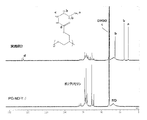
- Example 2 The surface-modified nanodiamonds obtained in Example 2 were subjected to 13 C-NMR analysis. Specifically, the dry powder of surface-modified nanodiamond obtained in Example 2 and hydrophilic ND particles (PG-ND) modified with polyglycerin were converted to heavy DMSO (0.3% tetramethylsilane). After dispersion using an ultrasonic cleaner, 13 C-NMR spectrum measurements were performed using Bruker AVANCE (600 MHz). The measurement was carried out under the conditions of 25 ° C. and 200,000 times of integration.
- PG-ND hydrophilic ND particles
- Example 2 The 13 C-NMR spectrum of the surface-modified nanodiamond obtained in Example 2 is shown in FIG.
- a peak a near 13 to 14 ppm and a peak b near 19 to 20 ppm and 31 to 32 ppm were observed, respectively.
- These peaks are derived from the hydroxyl groups on the polyglycerin chain being sealed with an alkyl chain.
- the nanodiamond particles have a polyglycerin chain that surface-modifies the nanodiamond particles, and at least a part of the hydroxyl group hydrogen atoms in the polyglycerin chain are replaced with monovalent organic groups.
- Surface-modified nanodiamonds including with surface-modifying groups.
- Appendix 2 The surface-modified nanodiamond according to Appendix 1, wherein the polyglycerin chain is bonded to the nanodiamond particles via a single bond or a divalent group.
- the surface-modified nanodiamond according to Appendix 2 which is preferably a single bond).
- Appendix 4 The surface-modified nanodiamond according to any one of Supplementary notes 1 to 3, wherein the monovalent organic group is a group represented by the following formula (1).
- the R is a substituted or unsubstituted hydrocarbon group (preferably an alkyl group, more preferably an alkyl group having 1 to 18 carbon atoms, still more preferably an alkyl group having 1 to 6 carbon atoms, particularly preferably ethyl. Group, butyl group, or hexyl group).
- p and q indicate the average degree of polymerization of the repeating unit in parentheses, respectively, p is a value of 0 or more, q is a value of 0 or more, and p + q is 1 or more (preferably 1 to 100). , More preferably 2 to 40, still more preferably 3 to 30).
- R 1 represents a monovalent organic group.
- [-OR 2 ] indicates the end of the polyglycerin chain, and R 2 indicates a hydrogen atom or a monovalent organic group. However, when R 2 is a hydrogen atom, q indicates a value exceeding 0.
- the oxygen atom bonded to Y in the formula (2) may be an oxygen atom in the structural unit with p, or may be an oxygen atom in the structural unit with q, and the formula (2)
- the carbon atom in the formula (2) that bonds with OR 2 in the compound may be a carbon atom in the structural unit with p or a carbon atom in the structural unit with q.
- [Appendix 7] The surface-modified nanodiamond according to Appendix 6, wherein [q / (p + q)] in the formula (2) is 0.6 or more (preferably 0.8 to 1.0).
- [Appendix 8] The surface-modified nanodiamond according to Appendix 4 or 5, wherein R represents an alkyl group in the above formula (1).
- [Appendix 9] The surface-modified nanodiamond according to Appendix 4 or 5, wherein R represents an alkyl group having 1 to 18 carbon atoms in the above formula (1).
- [Appendix 10] The surface-modified nanodiamond according to Appendix 4 or 5, wherein in the formula (1), R represents an ethyl group, a butyl group, or a hexyl group.
- [Appendix 13] The surface-modified nanodiamond according to any one of Annex 1 to 11, which has an absorption peak in the vicinity of 1730 to 1750 cm -1 in the FT-IR spectrum.
- [Appendix 14] 13 The surface-modified nanodiamond according to any one of Appendix 1 to 13, which has a peak in the vicinity of 60 to 85 ppm in the C-NMR spectrum.
- [Appendix 15] 13 The surface-modified nanodiamond according to any one of Appendix 1 to 14, which has a peak in the vicinity of 140 to 200 ppm in the C-NMR spectrum.
- [Appendix 16] 13 The surface-modified nanodiamond according to any one of Appendix 1 to 15, which has a peak in the vicinity of 5 to 45 ppm in the C-NMR spectrum.
- Appendix 17] At least one organic dispersion medium having a solubility parameter ( ⁇ ) of Hildebrandt of 10 (cal / cm 3 ) 1/2 or less so that the content ratio of the surface-modified nanodiamond is 0.1% by mass.
- Appendix 23 The nanodiamond dispersion composition according to Appendix 21 or 22, wherein the content ratio of the nanodiamond particles in the nanodiamond dispersion composition is 0.1% by mass to 10% by mass.
- Supplementary Note 24 The nanodiamond dispersion composition according to any one of Supplementary notes 21 to 23, wherein the content ratio of the dispersion medium in the nanodiamond dispersion composition is 90 to 99.9999% by mass.
- the total content of the surface-modified nanodiamond and the dispersion medium is 70% by mass or more (preferably 80% by mass or more, more preferably 90% by mass or more) with respect to the total amount of the nanodiamond dispersion composition. , More preferably 95% by mass or more, particularly preferably 99% by mass or more).
- the nanodiamond dispersion composition according to any one of Appendix 21 to 24.
- the average dispersed particle diameter (D50) of the nanodiamond particles in the nanodiamond dispersion composition is 100 nm or less (preferably 60 nm or less, more preferably 50 nm or less, still more preferably 30 nm or less).
- the nanodiamond dispersion composition according to any one of 25 to 25.
- Appendix 27 The nanodiamond dispersion composition according to any one of Annex 21 to 26, wherein the haze value of the nanodiamond dispersion composition is 5 or less (preferably 3 or less, more preferably 1 or less).
- Appendix 28 Surface-modified nanodiamonds (A) having nanodiamond particles and surface-modifying groups containing polyglycerin chains having hydroxyl groups that surface-modify the nanodiamond particles, alcohol (B1), and isocyanic acid ester.
- the isocyanic acid ester (B2) contains alkyl isocyanate (preferably C 1-18 alkyl isocyanate, more preferably ethyl isocyanate, n-butyl isocyanate, n-hexyl isocyanate).
- alkyl isocyanate preferably C 1-18 alkyl isocyanate, more preferably ethyl isocyanate, n-butyl isocyanate, n-hexyl isocyanate.
- Appendix 31 The surface modification according to Appendix 28, wherein the carboxyl chloride (B3) contains an acyl chloride (preferably an acyl chloride having a C 1-19 alkyl carbon number in an acyl group, more preferably a valeryl chloride). How to make nanodiamonds.
- [Appendix 32] The ratio (former: latter, mass ratio) of the surface-modified nanodiamond (A) to be subjected to the reaction to the alcohol (B1), the isocyanate (B2), and / or the carboxyl chloride (B3) is 2.
- Appendix 33 The surface-modified nanodiamond according to any one of Appendix 28 to 32, wherein the nanodiamond in the surface-modified nanodiamond (A) includes a detonation nanodiamond (preferably an air-cooled detonation nanodiamond). Manufacturing method.
Landscapes
- Chemical & Material Sciences (AREA)
- Organic Chemistry (AREA)
- Life Sciences & Earth Sciences (AREA)
- General Life Sciences & Earth Sciences (AREA)
- Geology (AREA)
- Inorganic Chemistry (AREA)
- Chemical Kinetics & Catalysis (AREA)
- Health & Medical Sciences (AREA)
- Medicinal Chemistry (AREA)
- Polymers & Plastics (AREA)
- General Chemical & Material Sciences (AREA)
- Carbon And Carbon Compounds (AREA)
Abstract
Description
-X-R (1)
[上記式(1)中、Xは、単結合、-C(=O)-、又は-C(=O)-NH-を示す。Rは一価の有機基を示し、Xと結合する原子が炭素原子である。]
-Y-(C3H6O2)p-(C3H5O2R1)q-OR2 (1)
[式(1)中、p及びqは、それぞれ、括弧内の繰り返し単位の平均重合度を示し、pは0以上の値、qは0以上の値、p+qは1以上の値である。R1は、一価の有機基を示す。[-OR2]は、ポリグリセリン鎖の末端を示し、R2は水素原子又は一価の有機基を示す。但し、R2が水素原子である場合、qは0を超える値を示す。Yは、単結合又は二価の基を示し、Yから左に伸びる結合手はナノダイヤモンド粒子に結合する。]
本開示の一実施形態に係る表面修飾ナノダイヤモンド(以後、ナノダイヤモンドを「ND」と称する場合がある)は、ナノダイヤモンド粒子と、上記ナノダイヤモンド粒子を表面修飾する、ポリグリセリン鎖を有し且つ上記ポリグリセリン鎖における少なくとも一部のヒドロキシル基の水素原子が一価の有機基に置換されている表面修飾基とを含む。なお、本明細書において、上記ポリグリセリン鎖を有し且つ上記ポリグリセリン鎖における少なくとも一部のヒドロキシル基の水素原子が一価の有機基に置換されている表面修飾基を「表面修飾基(X)」と称する場合がある。上記表面修飾NDは、表面修飾基(X)を一種のみ有していてもよいし、二種以上を有していてもよい。
-X-R (1)
[上記式(1)中、Xは、単結合、-C(=O)-、又は-C(=O)-NH-を示す。Rは一価の有機基を示し、Xと結合する原子が炭素原子である。]
-Y-(C3H6O2)p-(C3H5O2R1)q-OR2 (2)
[式(2)中、p及びqは、それぞれ、括弧内の繰り返し単位の平均重合度を示し、pは0以上の値、qは0以上の値、p+qは1以上の値である。R1は、一価の有機基を示す。[-OR2]は、ポリグリセリン鎖の末端を示し、R2は水素原子又は一価の有機基を示す。但し、R2が水素原子である場合、qは0を超える値を示す。Yは、単結合又は二価の基を示し、Yから左に伸びる結合手はND粒子に結合する。]
-OCH2-CHOH-CH2- (3)
-OCH(CH2OH)-CH2- (4)
-OCH2-CH(CH2OH)- (5)
-OCH2-CH(OR1)-CH2- (6)
-OCH(CH2OR1)-CH2- (7)
-OCH2-CH(CH2OR1)- (8)
上記表面修飾NDを分散媒に分散させることにより、分散媒と、上記分散媒中に分散している上記表面修飾NDとを含む、ナノダイヤモンド分散組成物(ND分散組成物)が得られる。
上記表面修飾NDは、ND粒子と、上記ND粒子を表面修飾する、ヒドロキシル基を有するポリグリセリン鎖を含む表面修飾基とを有する表面修飾ND(A)とアルコール(B1)、イソシアン酸エステル(B2)、及びカルボン酸塩化物(B3)からなる群より選択される1以上の化合物とを反応させて製造することができる。
成形された爆薬に電気雷管が装着されたものを爆轟用の耐圧性容器の内部に設置し、容器内において大気組成の常圧の気体と使用爆薬とが共存する状態で、容器を密閉する。容器は例えば鉄製で、容器の容積は例えば0.5~40m3である。爆薬としては、トリニトロトルエン(TNT)とシクロトリメチレントリニトロアミンすなわちヘキソーゲン(RDX)との混合物を使用することができる。TNTとRDXの質量比(TNT/RDX)は、例えば40/60~60/40の範囲である。
酸処理工程では、原料であるND粒子粗生成物に例えば水溶媒中で強酸を作用させて金属酸化物を除去する。爆轟法で得られるND粒子粗生成物には金属酸化物が含まれやすく、この金属酸化物は、爆轟法に使用される容器などに由来するFe、Co、Niなどの酸化物である。例えば水溶媒中で強酸を作用させることにより、ND粒子粗生成物から金属酸化物を溶解・除去することができる(酸処理)。この酸処理に用いられる強酸としては、鉱酸が好ましく、例えば、塩酸、フッ化水素酸、硫酸、硝酸、王水が挙げられる。上記強酸は、一種を用いてもよいし、二種以上を用いてもよい。酸処理で使用される強酸の濃度は例えば1~50質量%である。酸処理温度は例えば70~150℃である。酸処理時間は例えば0.1~24時間である。また、酸処理は、減圧下、常圧下、又は加圧下で行うことが可能である。このような酸処理の後、例えばデカンテーションにより、固形分(ナノダイヤモンド凝着体を含む)の水洗を行う。沈殿液のpHが例えば2~3に至るまで、デカンテーションによる当該固形分の水洗を反復して行うのが好ましい。爆轟法で得られるND粒子粗生成物における金属酸化物の含有量が少ない場合には、以上のような酸処理を省略してもよい。
酸化処理工程は、酸化剤を用いてND粒子粗生成物からグラファイトを除去する工程である。爆轟法で得られるND粒子粗生成物にはグラファイト(黒鉛)が含まれるが、このグラファイトは、使用爆薬が部分的に不完全燃焼を起こして遊離した炭素のうちND粒子結晶を形成しなかった炭素に由来する。ND粒子粗生成物に、水溶媒中で酸化剤を作用させることにより、ND粒子粗生成物からグラファイトを除去することができる。また、酸化剤を作用させることにより、ND粒子表面にカルボキシル基やヒドロキシル基などの酸素含有基を導入することができる。
上記酸処理工程を経た後であっても、ND粒子に除去しきれなかった金属酸化物が残存する場合は、一次粒子間が非常に強く相互作用して集成している凝着体(二次粒子)の形態をとる。このような場合には、ND粒子に対して水溶媒中でアルカリ及び過酸化水素を作用させてもよい。これにより、ND粒子に残存する金属酸化物を除去することができ、凝着体から一次粒子の分離を促進することができる。この処理に用いられるアルカリとしては、例えば、水酸化ナトリウム、アンモニア、水酸化カリウムなどが挙げられる。アルカリ過水処理において、アルカリの濃度は例えば0.1~10質量%であり、過酸化水素の濃度は例えば1~15質量%であり、処理温度は例えば40~100℃であり、処理時間は例えば0.5~5時間である。また、アルカリ過水処理は、減圧下、常圧下、又は加圧下で行うことが可能である。
ND粒子には、必要に応じて、解砕処理を施してもよい。解砕処理には、例えば、高剪断ミキサー、ハイシアーミキサー、ホモミキサー、ボールミル、ビーズミル、高圧ホモジナイザー、超音波ホモジナイザー、コロイドミルなどを使用することができる。なお、解砕処理は湿式(例えば、水等に懸濁した状態での解砕処理)で行ってもよいし、乾式で行ってもよい。乾式で行う場合は、解砕処理前に乾燥工程を設けることが好ましい。また、解砕処理工程は、酸化処理又は水素化処理を行う場合はこれらの後に行ってもよい。
上記アルカリ過水処理工程の後、乾燥工程を設けることが好ましい。例えば、上記アルカリ過水処理工程を経て得られたND粒子含有溶液から噴霧乾燥装置やエバポレーターなどを使用して液分を蒸発させた後、これによって生じる残留固形分を乾燥用オーブン内での加熱乾燥によって乾燥させる。加熱乾燥温度は、例えば40~150℃である。このような乾燥工程を経ることにより、ND粒子が得られる。
下記工程を経て、表面修飾ND粒子及び分散組成物を製造した。
まず、爆轟法によるNDの生成工程を行った。本工程では、まず、成形された爆薬に電気雷管が装着されたものを爆轟用の耐圧性容器の内部に設置して容器を密閉した。容器は鉄製で、容器の容積は15m3である。爆薬としては、TNTとRDXとの混合物0.50kgを使用した。この爆薬におけるTNTとRDXの質量比(TNT/RDX)は、50/50である。次に、電気雷管を起爆させ、容器内で爆薬を爆轟させた(爆轟法によるNDの生成)。次に、室温での24時間の放置により、容器及びその内部を降温させた。この放冷の後、容器の内壁に付着しているND粗生成物(上記爆轟法で生成したND粒子の凝着体と煤を含む)をヘラで掻き取る作業を行い、ND粗生成物を回収した。
イソシアン酸エチル4gの代わりにイソシアン酸n-ブチル5.6gを用いたこと以外は実施例1と同様にして、乾燥固形分(ポリグリセリン鎖の少なくとも一部のヒドロキシル基末端がイソシアン酸n-ブチルに封止された表面修飾ナノダイヤモンド)を得た。得られた表面修飾ナノダイヤモンド粒子の熱重量分析により求められる質量比[ND/ポリグリセリン鎖含有表面修飾基]は0.74であった。
イソシアン酸エチルの代わりにイソシアン酸n-ヘキシル7.16gを用いたこと以外は実施例1と同様にして、乾燥固形分(ポリグリセリン鎖の少なくとも一部のヒドロキシル基末端がイソシアン酸n-ヘキシルに封止された表面修飾ナノダイヤモンド)を得た。得られた表面修飾ナノダイヤモンド粒子の熱重量分析により求められる質量比[ND/ポリグリセリン鎖含有表面修飾基]は0.62であった。
実施例1で得られたPG-ND灰色粉体にピリジンを加え、ND粒子の質量を基準として、2g/Lになるように濃度調整してPG-ND粒子ピリジン分散液を得た。得られたPG-ND粒子ピリジン分散液40mlに対してバレリルクロリド4.8gを加えて60℃で24時間撹拌した。続いて、80mlの超純水を加えた後に6000×gで5分間遠心分離して上澄み液を除去した後、40mlのメタノールを加えて撹拌した後に20000×gで10分間遠心分離し、沈殿物を洗浄した。この洗浄作業を3回繰り返し、ピリジンを取り除いた後に真空乾燥機内で50℃24時間静置することで乾燥固形分を得た。以上のようにして、ポリグリセリン鎖の少なくとも一部のヒドロキシル基末端がカルボン酸エステルに封止された表面修飾ナノダイヤモンドを得ることができた。得られた表面修飾ナノダイヤモンド粒子の熱重量分析により求められる質量比[ND/ポリグリセリン鎖含有表面修飾基]は0.61であった。
実施例1で得られたPG-ND灰色粉体にピリジンを加え、ND粒子の質量を基準として、2g/Lになるように濃度調整してPG-ND粒子ピリジン分散液を得た。得られたPG-ND粒子ピリジン分散液40mlに対してヘプタノイルクロリド5.5gを加えて60℃で24時間撹拌した。続いて、80mlのメタノールを加えた後に6000×gで5分間遠心分離して上澄み液を除去した後、40mlのメタノールを加えて撹拌した後に20000×gで10分間遠心分離し、沈殿物を洗浄した。この洗浄作業を3回繰り返し、ピリジンを取り除いた後に真空乾燥機内で50℃24時間静置することで乾燥固形分を得た。以上のようにして、ポリグリセリン鎖の少なくとも一部のヒドロキシル基末端がカルボン酸エステルに封止された表面修飾ナノダイヤモンドを得ることができた。得られた表面修飾ナノダイヤモンド粒子の熱重量分析により求められる質量比[ND/ポリグリセリン鎖含有表面修飾基]は0.68であった。
PG-ND灰色粉体に対してND固形分が0.1質量%になるようにテトラヒドロフランを添加した後に超音波洗浄器で5分間撹拌を行い、1日静置後の外観を観察したところ、ナノダイヤモンドが凝集し沈殿することを確認した。一方、テトラヒドロフランの代わりにメタノールを使用した場合についても同様の操作を行ったところ、ナノダイヤモンドが良好な分散状態を保っていた。また、テトラヒドロフランの代わりに超純水を使用した場合についても同様の操作を行ったところ、ナノダイヤモンドが良好な分散状態を保っていた。
上述のようにして得られた実施例のND分散組成物におけるND粒子のメディアン径(粒径D50)は、動的光散乱法によって得られたナノダイヤモンドの粒度分布から測定した。上記粒度分布は、具体的には、Malvern社製の装置(商品名「ゼータサイザー ナノZS」)を使用して、ナノダイヤモンドの粒度分布を動的光散乱法(非接触後方散乱法)によって測定した。
TG/DTA(熱重量測定・示差熱分析)装置(商品名「EXSTAR6300」、エスアイアイナノテクノロジー社製)を用い、試料(約3mg)を、空気雰囲気下、昇温速度20℃/分にて加熱して重量減少を測定した。なお、基準物質には、アルミナを用いた。
実施例1~5及び比較例1で得られた表面修飾ナノダイヤモンドについて、フーリエ変換赤外分光光度計「IRTracer」(株式会社島津製作所製)に、加熱真空撹拌反射「Heat Chamber Type-1000℃」(株式会社エス・ティ・ジャパン製)を取り付けた装置を用いてFT-IR測定を行った。なお、ND粒子の吸着水を除去するために、真空度2×10⁻³Pa下、150℃、10分間加熱を行った後に、FT-IR測定を実施した。
実施例2で得られた表面修飾ナノダイヤモンドについて13C-NMR分析を行った。具体的には、実施例2で得られた表面修飾ナノダイヤモンドの乾燥粉体とポリグリセリンで修飾された親水性ND粒子(PG-ND)について、重DMSO(0.3%テトラメチルシラン)に超音波洗浄機を使って分散させた後に、Brucker AVANCE(600MHz)を用いて13C-NMRスペクトル測定を行った。なお、測定は25℃、積算回数200000回の条件で実施した。
[付記1]ナノダイヤモンド粒子と、前記ナノダイヤモンド粒子を表面修飾する、ポリグリセリン鎖を有し且つ前記ポリグリセリン鎖における少なくとも一部のヒドロキシル基の水素原子が一価の有機基に置換されている表面修飾基とを含む、表面修飾ナノダイヤモンド。
[付記2]前記ポリグリセリン鎖は、単結合又は二価の基を介して前記ナノダイヤモンド粒子に結合している、付記1に記載の表面修飾ナノダイヤモンド。
[付記3]前記二価の基は、アミノ基(-NH-)、エーテル結合(-O-)、エステル結合(-C(=O)O-)、ホスフィン酸基(-PH(=O)O-)、スルフィド結合(-S-)、カルボニル基(-C(=O)-)、アミド基(-C(=O)-NH-)、ウレタン結合(-NH-C(=O)-O-)、イミド結合(-C(=O)-NH-C(=O)-)、チオカルボニル基(-C(=S)-)、シロキサン結合(-Si-O-)、二価の炭化水素基、又はこれらの2以上が結合した基(単結合、-NH-、-O-、-C(=O)O-、-PH(=O)O-、-S-が好ましく、より好ましくは単結合)である、付記2に記載の表面修飾ナノダイヤモンド。
[付記4]前記一価の有機基が下記式(1)で表される基である、付記1~3のいずれか1つに記載の表面修飾ナノダイヤモンド。
-X-R (1)
[式(1)中、Xは、単結合、-C(=O)-、又は-C(=O)-NH-を示す。Rは一価の有機基を示し、Xと結合する原子が炭素原子である。]
[付記5]前記Rは、置換又は無置換の炭化水素基(好ましくはアルキル基、より好ましくは炭素数1~18のアルキル基、さらに好ましくは炭素数1~6のアルキル基、特に好ましくはエチル基、ブチル基、又はヘキシル基)である。付記4に記載の表面修飾ナノダイヤモンド。
[付記6]前記表面修飾基が下記式(2)で表されるポリグリセリン鎖含有表面修飾基である、付記1~5のいずれか1つに記載の表面修飾ナノダイヤモンド。
-Y-(C3H6O2)p-(C3H5O2R1)q-OR2 (2)
[式(2)中、p及びqは、それぞれ、括弧内の繰り返し単位の平均重合度を示し、pは0以上の値、qは0以上の値、p+qは1以上(好ましくは1~100、より好ましくは2~40、さらに好ましくは3~30)の値である。R1は、一価の有機基を示す。[-OR2]は、ポリグリセリン鎖の末端を示し、R2は水素原子又は一価の有機基を示す。但し、R2が水素原子である場合、qは0を超える値を示す。Yは、単結合又は二価の基(好ましくは、単結合、-NH-、-O-、-C(=O)O-、-PH(=O)O-、-S-、より好ましくは単結合)を示し、Yから左に伸びる結合手はナノダイヤモンド粒子に結合する。式(2)中のYと結合する酸素原子は、pが付された構成単位における酸素原子であってもよく、qが付された構成単位における酸素原子であってもよく、式(2)中のOR2と結合する式(2)中の炭素原子は、pが付された構成単位における炭素原子であってもよく、qが付された構成単位における炭素原子であってもよい。]
[付記7]前記式(2)における[q/(p+q)]は0.6以上(好ましくは0.8~1.0)である、付記6に記載の表面修飾ナノダイヤモンド。
[付記8]前記式(1)中、Rはアルキル基を示す、付記4又は5に記載の表面修飾ナノダイヤモンド。
[付記9]前記式(1)中、Rは炭素数1~18のアルキル基を示す、付記4又は5に記載の表面修飾ナノダイヤモンド。
[付記10]前記式(1)中、Rはエチル基、ブチル基、又はヘキシル基を示す、付記4又は5に記載の表面修飾ナノダイヤモンド。
[付記12]FT-IRスペクトルにおいて、1510~1540cm-1付近と1700~1730cm-1付近とにそれぞれ吸収ピークを有する、付記1~11のいずれか1つに記載の表面修飾ナノダイヤモンド。
[付記13]FT-IRスペクトルにおいて、1730~1750cm-1付近に吸収ピークを有する、付記1~11のいずれか1つに記載の表面修飾ナノダイヤモンド。
[付記14]13C-NMRスペクトルにおいて、60~85ppm付近にピークを有する、付記1~13のいずれか1つに記載の表面修飾ナノダイヤモンド。
[付記15]13C-NMRスペクトルにおいて、140~200ppm付近にピークを有する、付記1~14のいずれか1つに記載の表面修飾ナノダイヤモンド。
[付記16]13C-NMRスペクトルにおいて、5~45ppm付近にピークを有する、付記1~15のいずれか1つに記載の表面修飾ナノダイヤモンド。
[付記17]表面修飾ナノダイヤモンドを、含有割合が0.1質量%となるようにヒルデブラントの溶解度パラメーター(δ)が10(cal/cm3)1/2以下である少なくとも1つの有機分散媒に分散させた際のメディアン径が5~100nm(好ましくは5~80nm、より好ましくは5~50nm)である、付記1~16のいずれか1つに記載の表面修飾ナノダイヤモンド。
[付記18]前記表面修飾ナノダイヤモンドの粒子径(D50)は400nm以下(好ましくは300nm以下、より好ましくは100nm以下、さらに好ましくは50nm以下)である付記1~17のいずれか1つに記載の表面修飾ナノダイヤモンド。
[付記19]前記表面修飾ナノダイヤモンドの粒子径(D90)は500nm以下(好ましくは180nm以下、より好ましくは170nm以下)である付記1~18のいずれか1つに記載の表面修飾ナノダイヤモンド。
[付記20]前記ナノダイヤモンド粒子は爆轟法ナノダイヤモンド(好ましくは空冷式爆轟法ナノダイヤモンド)を含む付記1~19のいずれか1つに記載の表面修飾ナノダイヤモンド。
[付記21]分散媒と、前記分散媒中に分散している付記1~20のいずれか1つに記載の表面修飾ナノダイヤモンドとを含む、ナノダイヤモンド分散組成物。
[付記23]前記ナノダイヤモンド分散組成物中のナノダイヤモンド粒子の含有割合が0.1質量ppm~10質量%である付記21又は22に記載のナノダイヤモンド分散組成物。
[付記24]前記ナノダイヤモンド分散組成物中の分散媒の含有割合が90~99.9999質量%である付記21~23のいずれか1つに記載のナノダイヤモンド分散組成物。
[付記25]前記表面修飾ナノダイヤモンド及び前記分散媒の合計の含有割合は、前記ナノダイヤモンド分散組成物総量に対して、70質量%以上(好ましくは80質量%以上、より好ましくは90質量%以上、さらに好ましくは95質量%以上、特に好ましくは99質量%以上)である、付記21~24のいずれか1つに記載のナノダイヤモンド分散組成物。
[付記26]前記ナノダイヤモンド分散組成物中におけるナノダイヤモンド粒子の平均分散粒子径(D50)は、100nm以下(好ましくは60nm以下、より好ましくは50nm以下、さらに好ましくは30nm以下)である、付記21~25のいずれか1つに記載のナノダイヤモンド分散組成物。
[付記27]前記ナノダイヤモンド分散組成物のヘイズ値は5以下(好ましくは3以下、より好ましくは1以下)である付記21~26のいずれか1つに記載のナノダイヤモンド分散組成物。
[付記28]ナノダイヤモンド粒子と、前記ナノダイヤモンド粒子を表面修飾する、ヒドロキシル基を有するポリグリセリン鎖を含む表面修飾基とを有する表面修飾ナノダイヤモンド(A)と、アルコール(B1)、イソシアン酸エステル(B2)、及びカルボン酸塩化物(B3)からなる群より選択される1以上の化合物と、を反応させて付記1~20のいずれか1つに記載の表面修飾ナノダイヤモンドを得る、表面修飾ナノダイヤモンドの製造方法。
[付記29]前記アルコール(B1)はC1-18アルコール(好ましくはエタノール、n-ブタノール、n-ヘキサノール)を含む付記28に記載の表面修飾ナノダイヤモンドの製造方法。
[付記30]前記イソシアン酸エステル(B2)はイソシアン酸アルキル(好ましくはイソシアン酸C1-18アルキル、より好ましくはイソシアン酸エチル、イソシアン酸n-ブチル、イソシアン酸n-ヘキシル)を含む付記28に記載の表面修飾ナノダイヤモンドの製造方法。
[付記31]前記カルボン酸塩化物(B3)はアシルクロライド(好ましくはアシル基における炭素数がC1-19アルキルであるアシルクロライド、より好ましくはバレリルクロライド)を含む付記28に記載の表面修飾ナノダイヤモンドの製造方法。
[付記32]反応に供する表面修飾ナノダイヤモンド(A)とアルコール(B1)、イソシアン酸エステル(B2)、及び/又はカルボン酸塩化物(B3)との比率(前者:後者、質量比)が2:1~1:80である付記28~31のいずれか1つに記載の表面修飾ナノダイヤモンドの製造方法。
[付記33]前記表面修飾ナノダイヤモンド(A)におけるナノダイヤモンドは爆轟法ナノダイヤモンド(好ましくは空冷式爆轟法ナノダイヤモンド)を含む付記28~32のいずれか1つに記載の表面修飾ナノダイヤモンドの製造方法。
2 ナノダイヤモンド粒子
3 表面修飾基(X)
4 ポリグリセリン鎖
Claims (11)
- ナノダイヤモンド粒子と、前記ナノダイヤモンド粒子を表面修飾する、ポリグリセリン鎖を有し且つ前記ポリグリセリン鎖における少なくとも一部のヒドロキシル基の水素原子が一価の有機基に置換されている表面修飾基とを含む、表面修飾ナノダイヤモンド。
- 前記一価の有機基が下記式(1)で表される基である、請求項1に記載の表面修飾ナノダイヤモンド。
-X-R (1)
[式(1)中、Xは、単結合、-C(=O)-、又は-C(=O)-NH-を示す。Rは一価の有機基を示し、Xと結合する原子が炭素原子である。] - 前記表面修飾基が下記式(2)で表されるポリグリセリン鎖含有表面修飾基である、請求項1又は2に記載の表面修飾ナノダイヤモンド。
-Y-(C3H6O2)p-(C3H5O2R1)q-OR2 (2)
[式(2)中、p及びqは、それぞれ、括弧内の繰り返し単位の平均重合度を示し、pは0以上の値、qは0以上の値、p+qは1以上の値である。R1は、一価の有機基を示す。[-OR2]は、ポリグリセリン鎖の末端を示し、R2は水素原子又は一価の有機基を示す。但し、R2が水素原子である場合、qは0を超える値を示す。Yは、単結合又は二価の基を示し、Yから左に伸びる結合手はナノダイヤモンド粒子に結合する。] - 前記式(1)中、Rはアルキル基を示す、請求項2又は3に記載の表面修飾ナノダイヤモンド。
- 前記式(1)中、Rは炭素数1~18のアルキル基を示す、請求項2又は3に記載の表面修飾ナノダイヤモンド。
- 前記式(1)中、Rはエチル基、ブチル基、又はヘキシル基を示す、請求項2又は3に記載の表面修飾ナノダイヤモンド。
- FT-IRスペクトルにおいて、1510~1540cm-1付近と1700~1730cm-1付近とにそれぞれ吸収ピークを有する、請求項1~6のいずれか1項に記載の表面修飾ナノダイヤモンド。
- FT-IRスペクトルにおいて、1730~1750cm-1付近に吸収ピークを有する、請求項1~6のいずれか1項に記載の表面修飾ナノダイヤモンド。
- 13C-NMRスペクトルにおいて、5~45ppm付近と60~85ppm付近と140~200ppm付近とにそれぞれピークを有する、請求項1~8のいずれか1項に記載の表面修飾ナノダイヤモンド。
- 表面修飾ナノダイヤモンドを、含有割合が0.1質量%となるようにヒルデブラントの溶解度パラメーター(δ)が10(cal/cm3)1/2以下である少なくとも1つの有機分散媒に分散させた際のメディアン径が5~100nmである、請求項1~9のいずれか1項に記載の表面修飾ナノダイヤモンド。
- ナノダイヤモンド粒子と、前記ナノダイヤモンド粒子を表面修飾する、ヒドロキシル基を有するポリグリセリン鎖を含む表面修飾基とを有する表面修飾ナノダイヤモンド(A)と、アルコール(B1)、イソシアン酸エステル(B2)、及びカルボン酸塩化物(B3)からなる群より選択される1以上の化合物と、を反応させて請求項1~10のいずれか1項に記載の表面修飾ナノダイヤモンドを得る、表面修飾ナノダイヤモンドの製造方法。
Priority Applications (5)
| Application Number | Priority Date | Filing Date | Title |
|---|---|---|---|
| CN202080041280.4A CN113993612B (zh) | 2019-06-05 | 2020-06-03 | 表面修饰纳米金刚石及表面修饰纳米金刚石的制造方法 |
| EP20819562.8A EP3981740A4 (en) | 2019-06-05 | 2020-06-03 | SURFACE-MODIFIED NANODIAMANT AND METHOD FOR PRODUCING SURFACE-MODIFIED NANODIAMANT |
| JP2021524877A JP7536008B2 (ja) | 2019-06-05 | 2020-06-03 | 表面修飾ナノダイヤモンド及び表面修飾ナノダイヤモンドの製造方法 |
| KR1020217043297A KR102872834B1 (ko) | 2019-06-05 | 2020-06-03 | 표면 수식 나노다이아몬드 및 표면 수식 나노다이아몬드의 제조 방법 |
| US17/611,613 US12534374B2 (en) | 2019-06-05 | 2020-06-03 | Surface-modified nanodiamond and method for producing surface-modified nanodiamond |
Applications Claiming Priority (2)
| Application Number | Priority Date | Filing Date | Title |
|---|---|---|---|
| JP2019105065 | 2019-06-05 | ||
| JP2019-105065 | 2019-06-05 |
Publications (1)
| Publication Number | Publication Date |
|---|---|
| WO2020246500A1 true WO2020246500A1 (ja) | 2020-12-10 |
Family
ID=73653259
Family Applications (1)
| Application Number | Title | Priority Date | Filing Date |
|---|---|---|---|
| PCT/JP2020/021924 Ceased WO2020246500A1 (ja) | 2019-06-05 | 2020-06-03 | 表面修飾ナノダイヤモンド及び表面修飾ナノダイヤモンドの製造方法 |
Country Status (6)
| Country | Link |
|---|---|
| US (1) | US12534374B2 (ja) |
| EP (1) | EP3981740A4 (ja) |
| JP (1) | JP7536008B2 (ja) |
| KR (1) | KR102872834B1 (ja) |
| CN (1) | CN113993612B (ja) |
| WO (1) | WO2020246500A1 (ja) |
Cited By (6)
| Publication number | Priority date | Publication date | Assignee | Title |
|---|---|---|---|---|
| WO2022138986A1 (ja) * | 2020-12-25 | 2022-06-30 | 株式会社ダイセル | ナノダイヤモンド分散組成物の製造方法およびナノダイヤモンド分散組成物 |
| WO2023022238A1 (ja) * | 2021-08-20 | 2023-02-23 | 株式会社ダイセル | ナノダイヤモンド水分散液 |
| JP2023105628A (ja) * | 2022-01-19 | 2023-07-31 | 国立大学法人金沢大学 | 修飾ナノダイヤモンドの製造方法 |
| WO2023162595A1 (ja) * | 2022-02-28 | 2023-08-31 | 株式会社ダイセル | 表面修飾微粒子、及びその製造方法 |
| CN117460698A (zh) * | 2021-06-11 | 2024-01-26 | 国立大学法人京都大学 | 表面修饰纳米粒子 |
| EP4382481A4 (en) * | 2021-08-04 | 2025-12-10 | Daicel Corp | HETEROATOM-DOPED NANODIAMOND PARTICLES AND PROCESS FOR PRODUCING HETEROATOM-DOPED NANODIAMOND PARTICLES |
Citations (5)
| Publication number | Priority date | Publication date | Assignee | Title |
|---|---|---|---|---|
| JP2010248023A (ja) | 2009-04-13 | 2010-11-04 | Daicel Chem Ind Ltd | 表面修飾ナノダイヤモンド及びその製造法 |
| JP2012082103A (ja) | 2010-10-12 | 2012-04-26 | Shiga Univ Of Medical Science | サイズ制御された表面修飾ナノダイヤモンド |
| JP2015147733A (ja) * | 2014-02-04 | 2015-08-20 | 国立大学法人滋賀医科大学 | 抗癌剤が担持されたナノ粒子 |
| CN106179271A (zh) * | 2016-08-05 | 2016-12-07 | 四川大学 | 聚偕胺肟功能化的超支化纳米金刚石及其制备方法与应用 |
| JP2019105065A (ja) | 2017-12-12 | 2019-06-27 | 旭化成建材株式会社 | 雨水浸入防止カバー |
Family Cites Families (3)
| Publication number | Priority date | Publication date | Assignee | Title |
|---|---|---|---|---|
| JP5583906B2 (ja) * | 2008-12-22 | 2014-09-03 | 東レ・ダウコーニング株式会社 | 部分炭化水素基封鎖(ポリ)グリセロール変性ポリシロキサン、その製造方法、及び、当該ポリシロキサンを含む化粧料 |
| JP5275088B2 (ja) * | 2009-03-03 | 2013-08-28 | 株式会社ダイセル | 表面修飾ナノダイヤモンド及びその製造法 |
| TWI404754B (zh) | 2010-04-30 | 2013-08-11 | Univ Nat Taipei Technology | 互穿孔洞環氧樹脂薄膜之製造方法 |
-
2020
- 2020-06-03 WO PCT/JP2020/021924 patent/WO2020246500A1/ja not_active Ceased
- 2020-06-03 JP JP2021524877A patent/JP7536008B2/ja active Active
- 2020-06-03 US US17/611,613 patent/US12534374B2/en active Active
- 2020-06-03 KR KR1020217043297A patent/KR102872834B1/ko active Active
- 2020-06-03 EP EP20819562.8A patent/EP3981740A4/en active Pending
- 2020-06-03 CN CN202080041280.4A patent/CN113993612B/zh active Active
Patent Citations (5)
| Publication number | Priority date | Publication date | Assignee | Title |
|---|---|---|---|---|
| JP2010248023A (ja) | 2009-04-13 | 2010-11-04 | Daicel Chem Ind Ltd | 表面修飾ナノダイヤモンド及びその製造法 |
| JP2012082103A (ja) | 2010-10-12 | 2012-04-26 | Shiga Univ Of Medical Science | サイズ制御された表面修飾ナノダイヤモンド |
| JP2015147733A (ja) * | 2014-02-04 | 2015-08-20 | 国立大学法人滋賀医科大学 | 抗癌剤が担持されたナノ粒子 |
| CN106179271A (zh) * | 2016-08-05 | 2016-12-07 | 四川大学 | 聚偕胺肟功能化的超支化纳米金刚石及其制备方法与应用 |
| JP2019105065A (ja) | 2017-12-12 | 2019-06-27 | 旭化成建材株式会社 | 雨水浸入防止カバー |
Non-Patent Citations (6)
| Title |
|---|
| E. J. VANDERBERG, J. POLYM. SCI., POLYM. CHEM., vol. 23, 1985, pages 915 |
| G. R. NEWCOME ET AL.: "Dendritic Macromolecules: Concepts, Syntheses, Perspectives", 1996, VCH |
| HSIEH FENG-JEN, SOTOMA SHINGO, LIN HSIN-HUNG, CHENG CHING-YA, YU TSYR-YAN, HSIEH CHIA-LUNG, LIN CHUN-HUNG, CHANG HUAN-CHENG: "Bioorthogonal Fluorescent Nanodiamonds for Continuous Long-Term Imaging and Tracking of Membrane Proteins", ACS APPLIED MATERIALS & INTERFACES, vol. 11, no. 22, 13 May 2019 (2019-05-13), pages 19774 - 19781, XP055770314 * |
| LI TONG-FEI, XU YONG-HONG, LI KE, WANG CHAO, LIU XIN, YUE YUAN, CHEN ZHUO, YUAN SHEN-JUN, WEN YU, ZHANG QUAN, HAN MIN, KOMATSU NAO: "Doxorubicin-polyglycerol-nanodiamond composites stimulate glioblastoma cell immunogenicity through activation of autophagy", ACTA BIOMATERIALIA, vol. 86, 14 January 2019 (2019-01-14), pages 381 - 394, XP055770325 * |
| S. R. SANDLER ET AL., J. POLYM. SCI., POLYM. CHEM., vol. 4, 1966, pages 1253 |
| TERADA DAIKI, SOTOMA SHINGO, HARADA YOSHIE, IGARASHI RYUJI, SHIRAKAWA MASAHIRO: "One-Pot Synthesis of Highly Dispersible Fluorescent Nanodiamonds for Bioconjugation", BIOCONJUGATE CHEMISTRY, vol. 29, 5 July 2018 (2018-07-05), pages 2786 - 2792, XP055770318 * |
Cited By (10)
| Publication number | Priority date | Publication date | Assignee | Title |
|---|---|---|---|---|
| WO2022138986A1 (ja) * | 2020-12-25 | 2022-06-30 | 株式会社ダイセル | ナノダイヤモンド分散組成物の製造方法およびナノダイヤモンド分散組成物 |
| JPWO2022138986A1 (ja) * | 2020-12-25 | 2022-06-30 | ||
| EP4269339A4 (en) * | 2020-12-25 | 2025-03-26 | Daicel Corporation | METHOD FOR PRODUCING NANODIAMOND DISPERSION COMPOSITION, AND NANODIAMOND DISPERSION COMPOSITION |
| CN117460698A (zh) * | 2021-06-11 | 2024-01-26 | 国立大学法人京都大学 | 表面修饰纳米粒子 |
| EP4382481A4 (en) * | 2021-08-04 | 2025-12-10 | Daicel Corp | HETEROATOM-DOPED NANODIAMOND PARTICLES AND PROCESS FOR PRODUCING HETEROATOM-DOPED NANODIAMOND PARTICLES |
| WO2023022238A1 (ja) * | 2021-08-20 | 2023-02-23 | 株式会社ダイセル | ナノダイヤモンド水分散液 |
| JP2023105628A (ja) * | 2022-01-19 | 2023-07-31 | 国立大学法人金沢大学 | 修飾ナノダイヤモンドの製造方法 |
| JP7793185B2 (ja) | 2022-01-19 | 2026-01-05 | 国立大学法人金沢大学 | 修飾ナノダイヤモンドの製造方法 |
| WO2023162595A1 (ja) * | 2022-02-28 | 2023-08-31 | 株式会社ダイセル | 表面修飾微粒子、及びその製造方法 |
| EP4488229A4 (en) * | 2022-02-28 | 2026-04-15 | Daicel Corp | Surface-modified microparticles and their production method |
Also Published As
| Publication number | Publication date |
|---|---|
| US20220227633A1 (en) | 2022-07-21 |
| EP3981740A1 (en) | 2022-04-13 |
| JPWO2020246500A1 (ja) | 2020-12-10 |
| CN113993612B (zh) | 2025-03-11 |
| CN113993612A (zh) | 2022-01-28 |
| KR102872834B1 (ko) | 2025-10-21 |
| KR20220016219A (ko) | 2022-02-08 |
| US12534374B2 (en) | 2026-01-27 |
| EP3981740A4 (en) | 2023-10-18 |
| JP7536008B2 (ja) | 2024-08-19 |
Similar Documents
| Publication | Publication Date | Title |
|---|---|---|
| WO2020246500A1 (ja) | 表面修飾ナノダイヤモンド及び表面修飾ナノダイヤモンドの製造方法 | |
| JP7094267B2 (ja) | 表面修飾ナノダイヤモンド、表面修飾ナノダイヤモンド分散液、及び樹脂分散体 | |
| JP7094283B2 (ja) | 表面修飾ナノダイヤモンド、表面修飾ナノダイヤモンドを含む分散液、及び樹脂分散体 | |
| JP6770469B2 (ja) | 表面修飾ナノダイヤモンド、及びその有機溶媒分散体 | |
| WO2017170251A1 (ja) | 表面修飾ナノダイヤモンド、及びその有機溶媒分散体、並びにその製造方法 | |
| KR102617099B1 (ko) | 표면 수식 나노 다이아몬드, 나노 다이아몬드 분산 조성물, 및 표면 수식 나노 다이아몬드의 제조 방법 | |
| WO2020246501A1 (ja) | 電池用電解液及びリチウムイオン電池 | |
| WO2022091725A1 (ja) | ナノダイヤモンド分散組成物 | |
| JP6755020B2 (ja) | 表面修飾ナノダイヤモンド、前記表面修飾ナノダイヤモンドを含む分散液及び複合材料 | |
| KR102871769B1 (ko) | 표면 수식 나노다이아몬드 및 표면 수식 나노 탄소 입자의 제조 방법 | |
| JP6824086B2 (ja) | 表面修飾ナノダイヤモンドの製造方法 | |
| WO2020095581A1 (ja) | ナノダイヤモンド分散組成物 | |
| TWI845495B (zh) | 奈米鑽石粒子分散液 | |
| RU2780325C1 (ru) | Поверхностно-модифицированный наноалмаз, дисперсная композиция наноалмаза и способ производства поверхностно-модифицированного наноалмаза | |
| JP2023131428A (ja) | 表面修飾ナノ炭素粒子及びその製造方法、並びに表面修飾ナノ炭素粒子を含む分散液、複合材料 | |
| WO2021006120A1 (ja) | 表面修飾ナノダイヤモンド、ナノダイヤモンド分散組成物、及び表面修飾ナノ炭素粒子の製造方法 | |
| WO2020195328A1 (ja) | ナノダイヤモンド分散組成物の製造方法及びナノダイヤモンド分散組成物 |
Legal Events
| Date | Code | Title | Description |
|---|---|---|---|
| 121 | Ep: the epo has been informed by wipo that ep was designated in this application |
Ref document number: 20819562 Country of ref document: EP Kind code of ref document: A1 |
|
| ENP | Entry into the national phase |
Ref document number: 2021524877 Country of ref document: JP Kind code of ref document: A |
|
| NENP | Non-entry into the national phase |
Ref country code: DE |
|
| ENP | Entry into the national phase |
Ref document number: 20217043297 Country of ref document: KR Kind code of ref document: A |
|
| ENP | Entry into the national phase |
Ref document number: 2020819562 Country of ref document: EP Effective date: 20220105 |
|
| WWG | Wipo information: grant in national office |
Ref document number: 202080041280.4 Country of ref document: CN |
|
| WWG | Wipo information: grant in national office |
Ref document number: 17611613 Country of ref document: US |