WO2020247297A1 - Glucose-responsive insulin conjugates - Google Patents
Glucose-responsive insulin conjugates Download PDFInfo
- Publication number
- WO2020247297A1 WO2020247297A1 PCT/US2020/035503 US2020035503W WO2020247297A1 WO 2020247297 A1 WO2020247297 A1 WO 2020247297A1 US 2020035503 W US2020035503 W US 2020035503W WO 2020247297 A1 WO2020247297 A1 WO 2020247297A1
- Authority
- WO
- WIPO (PCT)
- Prior art keywords
- ioc
- amino
- oxy
- mannopyranosyl
- ethyl
- Prior art date
- Legal status (The legal status is an assumption and is not a legal conclusion. Google has not performed a legal analysis and makes no representation as to the accuracy of the status listed.)
- Ceased
Links
- 0 *[C@@]1CCC(*C(CCCCC(N[C@@](CCC(N[C@@](CC(NCCO[C@]([C@]([C@]2O)O)O[C@](CO)[C@]2O)=O)C(NCCO[C@]([C@@]([C@]2O)O)O[C@](CO)[C@]2O)=O)=O)C(NCCO[C@]([C@]2O)O[C@](CO)C[C@@]2O)=O)=O)O)CCC1 Chemical compound *[C@@]1CCC(*C(CCCCC(N[C@@](CCC(N[C@@](CC(NCCO[C@]([C@]([C@]2O)O)O[C@](CO)[C@]2O)=O)C(NCCO[C@]([C@@]([C@]2O)O)O[C@](CO)[C@]2O)=O)=O)C(NCCO[C@]([C@]2O)O[C@](CO)C[C@@]2O)=O)=O)O)CCC1 0.000 description 5
- XLVRYEULBSKKQK-JPIRMJGKSA-N CC(CCCCC(N[C@@H](CCC(N[C@@H](CC(NCCO[C@H]([C@H]([C@H]1O)O)O[C@H](CO)[C@H]1O)=O)C(NCCO[C@H]([C@H]([C@H]1O)O)O[C@H](CO)[C@H]1O)=O)=O)C(NCCO[C@H]([C@H]1O)O[C@H](CO)C[C@@H]1O)=O)=O)=O Chemical compound CC(CCCCC(N[C@@H](CCC(N[C@@H](CC(NCCO[C@H]([C@H]([C@H]1O)O)O[C@H](CO)[C@H]1O)=O)C(NCCO[C@H]([C@H]([C@H]1O)O)O[C@H](CO)[C@H]1O)=O)=O)C(NCCO[C@H]([C@H]1O)O[C@H](CO)C[C@@H]1O)=O)=O)=O XLVRYEULBSKKQK-JPIRMJGKSA-N 0.000 description 1
- BXVAERDQOJQBDK-JGVFFNPUSA-N C[C@@H]([C@H](OC)OCCNCC[O-2])O Chemical compound C[C@@H]([C@H](OC)OCCNCC[O-2])O BXVAERDQOJQBDK-JGVFFNPUSA-N 0.000 description 1
- IIMWJDXXECQNCG-UHFFFAOYSA-N O=C1NCOCCCC1 Chemical compound O=C1NCOCCCC1 IIMWJDXXECQNCG-UHFFFAOYSA-N 0.000 description 1
- YLLILPWGTMBVNI-ILUBUTQZSA-N OC[C@H](C[C@@H]([C@@H]1O)O)O[C@@H]1OCCNC(CC[C@@H](C(NCCO[C@H]([C@H]([C@H]1O[C@H]([C@H]([C@H]2O)O)O[C@H](CO)[C@H]2O)O)O[C@H](CO[C@H]([C@H]([C@H]2O)O)O[C@H](CO)[C@H]2O)[C@H]1O)=O)NC(C(CCC(NCCO[C@H]([C@H]([C@H]1O)O)O[C@H](CO)[C@H]1O)=O)NC([C@H](CCC(NCCO[C@H]([C@H]([C@H]1O)O)O[C@H](CO)[C@H]1O)=O)NC(CCCCC(ON(C(CC1)=O)C1=O)=O)=O)=O)=O)=O Chemical compound OC[C@H](C[C@@H]([C@@H]1O)O)O[C@@H]1OCCNC(CC[C@@H](C(NCCO[C@H]([C@H]([C@H]1O[C@H]([C@H]([C@H]2O)O)O[C@H](CO)[C@H]2O)O)O[C@H](CO[C@H]([C@H]([C@H]2O)O)O[C@H](CO)[C@H]2O)[C@H]1O)=O)NC(C(CCC(NCCO[C@H]([C@H]([C@H]1O)O)O[C@H](CO)[C@H]1O)=O)NC([C@H](CCC(NCCO[C@H]([C@H]([C@H]1O)O)O[C@H](CO)[C@H]1O)=O)NC(CCCCC(ON(C(CC1)=O)C1=O)=O)=O)=O)=O)=O YLLILPWGTMBVNI-ILUBUTQZSA-N 0.000 description 1
- MPCAJMNYNOGXPB-KVTDHHQDSA-N OC[C@H]([C@H]([C@@H]1O)O)OC[C@H]1O Chemical compound OC[C@H]([C@H]([C@@H]1O)O)OC[C@H]1O MPCAJMNYNOGXPB-KVTDHHQDSA-N 0.000 description 1
Classifications
-
- A—HUMAN NECESSITIES
- A61—MEDICAL OR VETERINARY SCIENCE; HYGIENE
- A61K—PREPARATIONS FOR MEDICAL, DENTAL OR TOILETRY PURPOSES
- A61K38/00—Medicinal preparations containing peptides
- A61K38/16—Peptides having more than 20 amino acids; Gastrins; Somatostatins; Melanotropins; Derivatives thereof
- A61K38/17—Peptides having more than 20 amino acids; Gastrins; Somatostatins; Melanotropins; Derivatives thereof from animals; from humans
- A61K38/22—Hormones
- A61K38/28—Insulins
-
- A—HUMAN NECESSITIES
- A61—MEDICAL OR VETERINARY SCIENCE; HYGIENE
- A61K—PREPARATIONS FOR MEDICAL, DENTAL OR TOILETRY PURPOSES
- A61K47/00—Medicinal preparations characterised by the non-active ingredients used, e.g. carriers or inert additives; Targeting or modifying agents chemically bound to the active ingredient
- A61K47/50—Medicinal preparations characterised by the non-active ingredients used, e.g. carriers or inert additives; Targeting or modifying agents chemically bound to the active ingredient the non-active ingredient being chemically bound to the active ingredient, e.g. polymer-drug conjugates
- A61K47/51—Medicinal preparations characterised by the non-active ingredients used, e.g. carriers or inert additives; Targeting or modifying agents chemically bound to the active ingredient the non-active ingredient being chemically bound to the active ingredient, e.g. polymer-drug conjugates the non-active ingredient being a modifying agent
- A61K47/54—Medicinal preparations characterised by the non-active ingredients used, e.g. carriers or inert additives; Targeting or modifying agents chemically bound to the active ingredient the non-active ingredient being chemically bound to the active ingredient, e.g. polymer-drug conjugates the non-active ingredient being a modifying agent the modifying agent being an organic compound
- A61K47/549—Sugars, nucleosides, nucleotides or nucleic acids
-
- A—HUMAN NECESSITIES
- A61—MEDICAL OR VETERINARY SCIENCE; HYGIENE
- A61K—PREPARATIONS FOR MEDICAL, DENTAL OR TOILETRY PURPOSES
- A61K47/00—Medicinal preparations characterised by the non-active ingredients used, e.g. carriers or inert additives; Targeting or modifying agents chemically bound to the active ingredient
- A61K47/50—Medicinal preparations characterised by the non-active ingredients used, e.g. carriers or inert additives; Targeting or modifying agents chemically bound to the active ingredient the non-active ingredient being chemically bound to the active ingredient, e.g. polymer-drug conjugates
- A61K47/51—Medicinal preparations characterised by the non-active ingredients used, e.g. carriers or inert additives; Targeting or modifying agents chemically bound to the active ingredient the non-active ingredient being chemically bound to the active ingredient, e.g. polymer-drug conjugates the non-active ingredient being a modifying agent
- A61K47/62—Medicinal preparations characterised by the non-active ingredients used, e.g. carriers or inert additives; Targeting or modifying agents chemically bound to the active ingredient the non-active ingredient being chemically bound to the active ingredient, e.g. polymer-drug conjugates the non-active ingredient being a modifying agent the modifying agent being a protein, peptide or polyamino acid
- A61K47/65—Peptidic linkers, binders or spacers, e.g. peptidic enzyme-labile linkers
-
- A—HUMAN NECESSITIES
- A61—MEDICAL OR VETERINARY SCIENCE; HYGIENE
- A61P—SPECIFIC THERAPEUTIC ACTIVITY OF CHEMICAL COMPOUNDS OR MEDICINAL PREPARATIONS
- A61P3/00—Drugs for disorders of the metabolism
- A61P3/08—Drugs for disorders of the metabolism for glucose homeostasis
- A61P3/10—Drugs for disorders of the metabolism for glucose homeostasis for hyperglycaemia, e.g. antidiabetics
-
- C—CHEMISTRY; METALLURGY
- C07—ORGANIC CHEMISTRY
- C07K—PEPTIDES
- C07K14/00—Peptides having more than 20 amino acids; Gastrins; Somatostatins; Melanotropins; Derivatives thereof
- C07K14/435—Peptides having more than 20 amino acids; Gastrins; Somatostatins; Melanotropins; Derivatives thereof from animals; from humans
- C07K14/575—Hormones
- C07K14/62—Insulins
-
- C—CHEMISTRY; METALLURGY
- C07—ORGANIC CHEMISTRY
- C07K—PEPTIDES
- C07K5/00—Peptides containing up to four amino acids in a fully defined sequence; Derivatives thereof
- C07K5/02—Peptides containing up to four amino acids in a fully defined sequence; Derivatives thereof containing at least one abnormal peptide link
- C07K5/0215—Peptides containing up to four amino acids in a fully defined sequence; Derivatives thereof containing at least one abnormal peptide link containing natural amino acids, forming a peptide bond via their side chain functional group, e.g. epsilon-Lys, gamma-Glu
Definitions
- the present disclosure relates to glucose-responsive insulin conjugates that contain one or more linear oligomer sugar cluster.
- the insulin conjugate that displays a pharmacokinetic (PK) and/or pharmacodynamic (PD) profile that is responsive to the systemic concentrations of a saccharide such as glucose or alpha-methylmannose, even when administered to a subject in need thereof in the absence of an exogenous multivalent saccharide-binding molecule.
- PK pharmacokinetic
- PD pharmacodynamic
- sequence listing of the present application is submitted electronically via EFS-Web as an ASCII-formatted sequence listing, with a file name of“24725-SEQLIST-MAY2020”, a creation date of May 13, 2020, and a size of 3.60KB.
- This sequence listing submitted via EFS- Web is part of the specification and is herein incorporated by reference in its entirety.
- the majority of known“controlled-release” drug delivery systems are incapable of providing drugs to a patient at intervals and concentrations that are in direct proportion to the amount of a molecular indicator (e.g ., a metabolite) present in the human body.
- a molecular indicator e.g ., a metabolite
- the drugs in these systems are thus not literally“controlled,” but simply provided in a slow release format that is independent of external or internal factors.
- the present disclosure relates to glucose-responsive insulin conjugates, which comprise linear glycosylated amino acid oligomers, and their synthesis. These insulin conjugates may display a pharmacokinetic (PK) and/or pharmacodynamic (PD) profile that is responsive to the systemic concentrations of a saccharide such as glucose or alpha-methylmannose when administered to a subject in need thereof.
- PK pharmacokinetic
- PD pharmacodynamic
- the conjugates comprise an insulin or insulin analog molecule covalently attached at its N-terminal amino groups of A-chain, such as A1 Gly, and B-chain B1 Phe, respectively, or e-amino group of the side chain of B29 Lys, or any Lys residue engineered into insulin backbone, to a linear glycosylated amino acid oligomer as cluster of sugar moieties.
- the linear glycosylated amino acid oligomers are conjugated onto the side chain amino group of B29 lysine or any other lysine and/or A1 and B1 amino groups of insulins or insulin analogs.
- Such conjugates offer a balanced binding profile against both insulin receptor and mannose receptor. These conjugates demonstrate glucose lowering in the presence of alpha-methyl mannose, a surrogate for glucose, and are potentially useful for the treatment of diabetes with lower risk of hypoglycemia.
- acyl groups include aldehydes (-CHO), carboxylic acids (-C0 2 H), ketones, acyl halides, esters, amides, imines, carbonates, carbamates, and ureas.
- Acyl substituents include, but are not limited to, any of the substituents described herein, that result in the formation of a stable moiety (e.g., aliphatic, alkyl, alkenyl, alkynyl, heteroaliphatic, heterocyclic, aryl, heteroaryl, acyl, oxo, imino, thiooxo, cyano, isocyano, amino, azido, nitro, hydroxyl, thiol, halo, aliphaticamino, heteroaliphaticamino, alkylamino, heteroalkylamino, arylamino, heteroarylamino, alkylaryl, arylalkyl, aliphaticoxy, heteroaliphaticoxy, alky
- aliphatic or“aliphatic group” denotes an optionally substituted hydrocarbon moiety that may be straight-chain (i.e., unbranched), branched, or cyclic
- aliphatic groups may be completely saturated or may contain one or more units of unsaturation, but which is not aromatic. Unless otherwise specified, aliphatic groups contain 1- 12 carbon atoms. In some embodiments, aliphatic groups contain 1-6 carbon atoms. In some embodiments, aliphatic groups contain 1-4 carbon atoms, and in yet other embodiments aliphatic groups contain 1-3 carbon atoms. Suitable aliphatic groups include, but are not limited to, linear or branched, alkyl, alkenyl, and alkynyl groups, and hybrids thereof such as (cycloalkyl)alkyl, (cycloalkenyl)alkyl or (cycloalkyl)alkenyl.
- alkyl refers to optionally substituted saturated, straight- or branched-chain hydrocarbon radicals derived from an aliphatic moiety containing between 1-6 carbon atoms by removal of a single hydrogen atom.
- the alkyl group employed in the disclosure contains 1-5 carbon atoms.
- the alkyl group employed contains 1-4 carbon atoms.
- the alkyl group contains 1-3 carbon atoms.
- the alkyl group contains 1-2 carbons.
- alkyl radicals include, but are not limited to, methyl, ethyl, n-propyl, isopropyl, n-butyl, iso butyl, sec-butyl, sec-pentyl, iso-pentyl, tert-butyl, n-pentyl, neopentyl, n-hexyl, sec-hexyl, n- heptyl, n-octyl, n-decyl, n-undecyl, dodecyl, and the like.
- the alkyl group may be substituted by replacing one or more hydrogen atoms with independently selected
- alkenyl denotes an optionally substituted monovalent group derived from a straight- or branched-chain aliphatic moiety having at least one carbon-carbon double bond by the removal of a single hydrogen atom.
- the alkenyl group employed in the disclosure contains 2-6 carbon atoms.
- the alkenyl group employed in the disclosure contains 2-5 carbon atoms.
- the alkenyl group employed in the disclosure contains 2-4 carbon atoms.
- the alkenyl group employed contains 2-3 carbon atoms.
- Alkenyl groups include, for example, ethenyl, propenyl, butenyl, l-methyl-2-buten-l-yl, and the like.
- the alkenyl group may be substituted by replacing one or more hydrogen atoms with independently selected substituents.
- alkynyl refers to an optionally substituted monovalent group derived from a straight- or branched-chain aliphatic moiety having at least one carbon-carbon triple bond by the removal of a single hydrogen atom.
- the alkynyl group employed in the disclosure contains 2-6 carbon atoms.
- the alkynyl group employed in the disclosure contains 2-5 carbon atoms.
- the alkynyl group employed in the disclosure contains 2-4 carbon atoms.
- the alkynyl group employed contains 2-3 carbon atoms.
- Representative alkynyl groups include, but are not limited to, ethynyl, 2-propynyl (propargyl), 1-propynyl, and the like.
- the alkynyl group may be substituted by replacing one or more hydrogen atoms with independently selected substituents.
- aryl used alone or as part of a larger moiety as in“aralkyl”, “aralkoxy”, or“ aryl oxy alkyl”, refers to an optionally substituted monocyclic and bicyclic ring systems having a total of five to 10 ring members, wherein at least one ring in the system is aromatic and wherein each ring in the system contains three to seven ring members.
- aryl may be used interchangeably with the term“aryl ring”.
- aryl refers to an aromatic ring system which includes, but not limited to, phenyl (“Ph”), biphenyl, naphthyl, anthracyl and the like, which may bear one or more substituents.
- arylalkyl refers to an alkyl group substituted with an aryl group (e.g., an aromatic or heteroaromatic group).
- carbonyl refers to a monovalent or bivalent moiety containing a carbon-oxygen double bond.
- Non-limiting examples of carbonyl groups include aldehydes, ketones, carboxylic acids, ester, amide, enones, acyl halides, anhydrides, ureas, carbamates, carbonates, thioesters, lactones, lactams, hydroxamates, isocyanates, and chloroformates.
- cycloaliphatic As used herein, the terms“cycloaliphatic”,“carbocycle”, or“carbocyclic”, used alone or as part of a larger moiety, refer to an optionally substituted saturated or partially unsaturated cyclic aliphatic monocyclic or bicyclic ring systems, as described herein, having from 3 to 10 members.
- Cycloaliphatic groups include, without limitation, cyclopropyl, cyclobutyl, cyclopentyl, cyclopentenyl, cyclohexyl, cyclohexenyl, cycloheptyl, cycloheptenyl, cyclooctyl, cyclooctenyl, and cyclooctadienyl.
- the cycloalkyl has 3-6 carbons.
- halo and“halogen” refer to an atom selected from fluorine (fluoro, -F), chlorine (chloro, -Cl), bromine (bromo, -Br), and iodine (iodo, -I).
- heteroaliphatic or“heteroaliphatic group” denote an optionally substituted hydrocarbon moiety having, in addition to carbon atoms, from one to five heteroatoms, that may be straight-chain (i.e., unbranched), branched, or cyclic (“heterocyclic”) and may be completely saturated or may contain one or more units of unsaturation, but which is not aromatic.
- heteroaliphatic groups contain 1-6 carbon atoms wherein 1-3 carbon atoms are optionally and independently replaced with heteroatoms selected from oxygen, nitrogen and sulfur.
- heteroaliphatic groups contain 1-4 carbon atoms, wherein 1-2 carbon atoms are optionally and independently replaced with heteroatoms selected from oxygen, nitrogen and sulfur.
- heteroaliphatic groups contain 1-3 carbon atoms, wherein 1 carbon atom is optionally and independently replaced with a heteroatom selected from oxygen, nitrogen and sulfur.
- Suitable heteroaliphatic groups include, but are not limited to, linear or branched, heteroalkyl, heteroalkenyl, and heteroalkynyl groups.
- heteroarylkyl refers to an alkyl group substituted by a heteroaryl, wherein the alkyl and heteroaryl portions independently are optionally substituted.
- heteroaryl used alone or as part of a larger moiety, e.g., “heteroaralkyl”, or“heteroaralkoxy”, refers to an optionally substituted group having 5 to 10 ring atoms, preferably 5, 6, or 9 ring atoms; having 6, 10, or 14 p electrons shared in a cyclic array; and having, in addition to carbon atoms, from one to five heteroatoms.
- Heteroaryl groups include, without limitation, thienyl, furanyl, pyrrolyl, imidazolyl, pyrazolyl, triazolyl, tetrazolyl, oxazolyl, isoxazolyl, oxadiazolyl, thiazolyl, isothiazolyl, thiadiazolyl, pyridyl, pyridazinyl, pyrimidinyl, pyrazinyl, indolizinyl, purinyl, naphthyridinyl, and pteridinyl.
- heteroaryl and“heteroar-”, as used herein, also include groups in which a heteroaromatic ring is fused to one or more aryl, carbocyclic, or heterocyclic rings, where the radical or point of attachment is on the heteroaromatic ring.
- Non-limiting examples include indolyl, isoindolyl, benzothienyl, benzofuranyl, dibenzofuranyl, indazolyl, benzimidazolyl, benzthiazolyl, quinolyl, isoquinolyl, cinnolinyl, phthalazinyl, quinazolinyl, quinoxalinyl, 4H-quinolizinyl, carbazolyl, acridinyl, phenazinyl, phenothiazinyl, phenoxazinyl, tetrahydro-quinolinyl, and
- heteroaryl group may be mono- or bicyclic.
- heteroaryl may be used interchangeably with the terms“heteroaryl ring”,“heteroaryl group”, or “heteroaromatic”, which are unsubstituted unless otherwise noted.
- heteroatom refers to nitrogen, oxygen, or sulfur, and includes any oxidized form of nitrogen or sulfur, and any quatemized form of a basic nitrogen.
- nitrogen also includes a substituted nitrogen.
- heterocyclic ring refers to a stable optionally substituted 5- to 7- membered monocyclic or 7- to 10-membered bicyclic heterocyclic moiety that is either saturated or partially unsaturated, and having, in addition to carbon atoms, one or more heteroatoms, as defined above.
- a heterocyclic ring can be attached to its pendant group at any heteroatom or carbon atom that results in a stable structure and any of the ring atoms can be optionally substituted.
- saturated or partially unsaturated heterocyclic radicals include, without limitation, tetrahydrofuranyl, tetrahydrothienyl, pyrrolidinyl, pyrrolidonyl, piperidinyl, pyrrolinyl, tetrahydroquinolinyl, tetrahydroisoquinolinyl, decahydroquinolinyl, oxazolidinyl, piperazinyl, dioxanyl, dioxolanyl, diazepinyl, oxazepinyl, thiazepinyl, morpholinyl, and quinuclidinyl.
- heterocycle “heterocyclyl”,“heterocyclyl ring”,“heterocyclic group”,“heterocyclic moiety”, and“heterocyclic radical”, are used interchangeably herein, and also include groups in which a heterocyclyl ring is fused to one or more aryl, heteroaryl, or carbocyclic rings, such as indolinyl, 3H-indolyl, chromanyl, phenanthridinyl, or
- heterocyclyl group may be mono- or bicyclic.
- heterocyclylalkyl refers to an alkyl group substituted by a heterocyclyl, wherein the alkyl and heterocyclyl portions independently are optionally substituted.
- multivalent hydrocarbon chain (also referred to as a “multivalent alkylene group”) is a polyalkylene group, in which having two or more free valencies or points of connection to other portions of the molecule, for example 2, 3, 4, 5, 6 or more free valencies.
- bivalent hydrocarbon chain (also referred to as a "bivalent alkylene group”) is a polymethylene group, i.e., -(CFh) z -, wherein z is a positive integer from 1 to 30, from 1 to 20, from 1 to 12, from 1 to 8, from 1 to 6, from 1 to 4, from 1 to 3, from 1 to 2, from 2 to 30, from 2 to 20, from 2 to 10, from 2 to 8, from 2 to 6, from 2 to 4, or from 2 to 3.
- a substituted bivalent hydrocarbon chain is a polymethylene group in which one or more methylene hydrogen atoms are replaced with a substituent. Suitable substituents include those described for a substituted aliphatic group.
- trivalent hydrocarbon chain (also referred to as a "trivalent alkylene group”) is a polymethylene group, i.e., , wherein W is independently a carbon atom, a heteroatom, or an optionally substituted group selected from the group consisting of aliphatic, heteroaliphatic, aryl, heteroaryl, and heterocyclic; each z is a positive integer from 1 to 30, from 1 to 20, from 1 to 12, from 1 to 8, from 1 to 6, from 1 to 4, from 1 to 3, from 1 to 2, from 2 to 30, from 2 to 20, from 2 to 10, from 2 to 8, from 2 to 6, from 2 to 4, or from 2 to 3.
- a substituted trivalent hydrocarbon chain is one in which one or more hydrogen atoms are replaced with a substituent. Suitable substituents include those described for a substituted aliphatic group.
- the term“unsaturated”, means that a moiety has one or more double or triple bonds.
- the term“partially unsaturated” refers to a ring moiety that includes at least one double or triple bond.
- the term“partially unsaturated” is intended to encompass rings having multiple sites of unsaturation but is not intended to include aryl or heteroaryl moieties, as herein defined.
- conjugates of the disclosure may contain“optionally substituted” moieties.
- conjugates and moieties are unsubstituted unless otherwise noted.
- the term“substituted” means that one or more hydrogens of the designated moiety are replaced with a suitable substituent.
- an“optionally substituted” group may have a suitable substituent at each substitutable position of the group, and when more than one position in any given structure may be substituted with more than one substituent selected from a specified group, the substituent may be either the same or different at every position.
- Suitable monovalent substituents on a substitutable carbon atom of an“optionally substituted” group are independently halogen; -(CH2)o-4R°; -(CThj f OR 0 ; -0-(CH 2 )o- 4 C(0)OR°; -(CH 2 ) O-4 CH(OR°) 2 ; -(CH2) O -4SR°; -(Cffcjt M Ph that may be substituted with R°;
- each R° may be substituted as defined below and is independently hydrogen, Ci- 6 aliphatic, -CH 2 Ph, -0(CH 2 )o-iPh, or a 5-6- membered saturated, partially unsaturated, or aryl ring having 0-4 heteroatoms independently selected from nitrogen, oxygen, or sulfur, or, notwithstanding the
- Suitable monovalent substituents on R° are independently halogen, -(CH 2 )o- 2 R ⁇ , -(haloR * ), -(CH 2 ) O-2 OH, -(CH 2 ) O.2 OR * , -(CH 2 ) 0-2 CH(OR * ) 2 ; -0(haloR * ), -CN, -N 3 ,
- each R * is unsubstituted or where preceded by “halo” is substituted only with one or more halogens, and is independently selected from Ci-4 aliphatic, -CH 2 Ph, -0(CH 2 )o-iPh, or a 5-6-membered saturated, partially unsaturated, or aryl ring having 0-4 heteroatoms independently selected from nitrogen, oxygen, or sulfur.
- Suitable divalent substituents that are bound to vicinal substitutable carbons of an“optionally substituted” group include: -0(CR* 2 ) 2-3 0-, wherein each independent occurrence of R* is selected from hydrogen, Ci- 6 aliphatic which may be substituted as defined below, or an unsubstituted 5-6-membered saturated, partially unsaturated, or aryl ring having 0-4 heteroatoms independently selected from nitrogen, oxygen, or sulfur.
- Suitable substituents on the aliphatic group of R* include halogen, -R * , -(haloR * ), -OH, -OR * , -0(haloR * ), -CN, -C(0)OH, -C(0)OR * , -NH 2 , -NHR * , -NR * 2 , or -N0 2 , wherein each R * is unsubstituted or where preceded by“halo” is substituted only with one or more halogens, and is independently Ci-4 aliphatic, -QHhPh, -0(CH 2 )o-iPh, or a 5-6-membered saturated, partially unsaturated, or aryl ring having 0-4 heteroatoms independently selected from nitrogen, oxygen, or sulfur.
- Suitable substituents on a substitutable nitrogen of an“optionally substituted” group include -R ⁇ , -NR ⁇ 2 , -C(0)R ⁇ , -C(0)OR ⁇ , -C(0)C(0)R ⁇ , -C(0)CH 2 C(0)R ⁇ , -S(0) 2 R ⁇ ,
- each R' is independently hydrogen, Ci- 6 aliphatic which may be substituted as defined below, unsubstituted -OPh, or an unsubstituted 5-6-membered saturated, partially unsaturated, or aryl ring having 0-4 heteroatoms independently selected from nitrogen, oxygen, or sulfur, or, notwithstanding the definition above, two independent occurrences of R ⁇ , taken together with their intervening atom(s) form an unsubstituted 3-12-membered saturated, partially unsaturated, or aryl mono- or bicyclic ring having 0-4 heteroatoms independently selected from nitrogen, oxygen, or sulfur.
- Suitable substituents on the aliphatic group of R ⁇ are independently halogen, -R * , -(haloR * ), -OH, -OR * , -0(haloR * ), -CN, -C(0)OH, -C(0)OR * , -NH 2 , -NHR * , -NR * 2 , or -N0 2 , wherein each R * is unsubstituted or where preceded by“halo” is substituted only with one or more halogens, and is independently Ci-4 aliphatic, -QHhPh, -0(CH 2 )o-iPh, or a 5-6-membered saturated, partially unsaturated, or aryl ring having 0-4 heteroatoms independently selected from nitrogen, oxygen, or sulfur.
- suitable protecting group refers to amino protecting groups or hydroxyl protecting groups depending on its location within the compound and includes those described in detail in Protecting Groups in Organic Synthesis , T. W. Greene and P. G. M. Wuts, 3rd edition, John Wiley & Sons, 1999.
- biodegradable refers to molecules that degrade (i.e., lose at least some of their covalent structure) under physiological or endosomal conditions.
- Biodegradable molecules are not necessarily hydrolytically degradable and may require enzymatic action to degrade.
- an“exogenous” molecule is one which is not present at significant levels in a patient unless administered to the patient.
- the patient is a mammal, e.g., a human, a dog, a cat, a rat, a minipig, etc.
- a molecule is not present at significant levels in a patient if normal serum for that type of patient includes less than 0. ImM of the molecule.
- normal serum for the patient may include less than 0.08mM, less than 0.06mM, or less than 0.04mM of the molecule.
- a“hyperbranched” structure is a covalent structure that includes at least one branched branch (e.g., a dendrimeric structure).
- a hyperbranched structure may include polymeric and/or non-polymeric substructures.
- normal serum is serum obtained by pooling approximately equal amounts of the liquid portion of coagulated whole blood from five or more non-diabetic patients.
- a non-diabetic human patient is a randomly selected 18 to 30 year old who presents with no diabetic symptoms at the time blood is drawn.
- a“polymer” or“polymeric structure” is a structure that includes a string of covalently bound monomers.
- a polymer can be made from one type of monomer or more than one type of monomer.
- the term“polymer” therefore encompasses copolymers, including block-copolymers in which different types of monomer are grouped separately within the overall polymer.
- a polymer can be linear or branched.
- a“polypeptide” is a polymer made of amino acids that are connected via peptide bonds (or amide bonds).
- the terms“peptide”,“polypeptide”,“oligopeptide”, and “protein”, may be used interchangeably.
- Polypeptides may contain natural amino acids, non natural amino acids (i.e., compounds that do not occur in nature but that can be incorporated into a polypeptide chain) and/or amino acid analogs as are known in the art.
- amino acid residues in a polypeptide may be modified, for example, by the addition of a chemical entity such as a carbohydrate group, a phosphate group, a famesyl group, an isofarnesyl group, a fatty acid group, a linker for conjugation, functionalization, or other modification, etc. These modifications may include cyclization of the peptide, the incorporation of D-amino acids, etc.
- a“polysaccharide” is a large polymer made of many individual monosaccharides that are connected via glycosidic bonds.
- the terms“polysaccharide”, “carbohydrate”, and“oligosaccharide” may be used interchangeably.
- the polymer may include natural monosaccharides (e.g., arabinose, lyxose, ribose, xylose, ribulose, xylulose, allose, altrose, galactose, glucose, gulose, idose, mannose, talose, fructose, psicose, sorbose, tagatose, mannoheptulose, sedoheptulose, octolose, and sialose) and/or modified monosaccharides (e.g., 2'-fluororibose, 2'-deoxyribose, and hexose).
- natural monosaccharides e.g., arabinose, lyxose, ribose, xylose, ribulose, xylulose, allose, altrose, galactose, glucose, gulose, idose, mannose, talose,
- Exemplary disaccharides include sucrose, lactose, maltose, trehalose, gentiobiose, isomaltose, kojibiose, laminaribiose, mannobiose, melibiose, nigerose, rutinose, and xylobiose.
- the term“treat” refers to the administration of a conjugate of the present disclosure to a subject in need thereof with the purpose to alleviate, relieve, alter, ameliorate, improve or affect a condition (e.g., diabetes), a symptom or symptoms of a condition (e.g., hyperglycemia), or the predisposition toward a condition.
- a condition e.g., diabetes
- a symptom or symptoms of a condition e.g., hyperglycemia
- the term“treating diabetes” will refer in general to maintaining glucose blood levels near normal levels and may include increasing or decreasing blood glucose levels depending on a given situation.
- the term“pharmaceutically acceptable carrier” includes any of the standard pharmaceutical carriers, such as a phosphate buffered saline solution, water, emulsions such as an oil/water or water/oil emulsion, and various types of wetting agents.
- the term also encompasses any of the agents approved by a regulatory agency of the US Federal government or listed in the US Pharmacopeia for use in animals, including humans.
- the term“pharmaceutically acceptable salt” refers to salts of compounds that retain the biological activity of the parent compound, and which are not biologically or otherwise undesirable. Many of the compounds disclosed herein are capable of forming acid and/or base salts by virtue of the presence of amino and/or carboxyl groups or groups similar thereto.
- Pharmaceutically acceptable base addition salts can be prepared from inorganic and organic bases.
- Salts derived from inorganic bases include by way of example only, sodium, potassium, lithium, ammonium, calcium and magnesium salts.
- Salts derived from organic bases include, but are not limited to, salts of primary, secondary and tertiary amines.
- Salts derived from inorganic acids include hydrochloric acid, hydrobromic acid, sulfuric acid, nitric acid, phosphoric acid, and the like.
- Salts derived from organic acids include acetic acid, propionic acid, glycolic acid, pyruvic acid, oxalic acid, malic acid, malonic acid, succinic acid, maleic acid, fumaric acid, tartaric acid, citric acid, benzoic acid, cinnamic acid, mandelic acid, methanesulfonic acid, ethanesulfonic acid, p-toluene-sulfonic acid, salicylic acid, and the like.
- the terms“effective amount” or“therapeutically effective amount” refer to a nontoxic but sufficient amount of an insulin analog to provide the desired effect.
- one desired effect would be the prevention or treatment of hyperglycemia.
- the amount that is“effective” will vary from subject to subject, depending on the age and general condition of the individual, mode of administration, and the like. Thus, it is not always possible to specify an exact “effective amount.” However, an appropriate“effective” amount in any individual case may be determined by one of ordinary skill in the art using routine experimentation.
- parenteral means not through the alimentary canal but by some other route such as intranasal, inhalation, subcutaneous, intramuscular, intraspinal, or intravenous.
- insulin means the active principle of the pancreas that affects the metabolism of carbohydrates in the animal body and which is of value in the treatment of diabetes mellitus.
- insulin or insulin analog includes wild-type and modified insulins, including human insulin, porcine insulin, insulin lispro, insulin aspart, insulin glulisine, insulin glargine, and insulin detemir.
- the term includes synthetic and biotechnologically derived products that are the same as, or similar to, naturally occurring insulins in structure, use, and intended effect and are of value in the treatment of diabetes mellitus.
- the term“insulin or insulin molecule” is a generic term that designates the 51 amino acid heterodimer comprising the A-chain peptide having the amino acid sequence shown in SEQ ID NO: 1 and the B-chain peptide having the amino acid sequence shown in SEQ ID NO: 2, wherein the cysteine residues a positions 6 and 11 of the A chain are linked in a disulfide bond, the cysteine residues at position 7 of the A chain and position 7 of the B chain are linked in a disulfide bond, and the cysteine residues at position 20 of the A chain and 19 of the B chain are linked in a disulfide bond.
- the terms“insulin analog” or“insulin analogue” as used herein include any heterodimer insulin analog or single-chain insulin analog that comprises one or more modifications of the native A-chain peptide and/or B-chain peptide. Modifications include but are not limited to substituting an amino acid for the native amino acid at a position selected from Al, A4, A5, A8, A9, A10, A12, A13, A14, A15, A16, A17, A18, A19, A21, Bl, B2, B3, B4, B5, B9, B10, B13, B14, B15, B16, B17, B18, B20, B21, B22, B23, B26, B27, B28, B29, B30:
- the cysteine residues a positions 6 and 11 of the A chain are linked in a disulfide bond
- the cysteine residues at position 7 of the A chain and position 7 of the B chain are linked in a disulfide bond
- the cysteine residues at position 20 of the A chain and 19 of the B chain are linked in a disulfide bond.
- insulin analogs include but are not limited to the heterodimer and single-chain analogues disclosed in U.S. Patent No. 8,722,620 and published international application
- WO20100080606, W02009099763, and W02010080609 the disclosures of which are incorporated herein by reference.
- single-chain insulin analogues also include but are not limited to those disclosed in published International Applications W09634882,
- amino acid modification refers to a substitution of an amino acid, or the derivation of an amino acid by the addition and/or removal of chemical groups to/from the amino acid, and it includes substitution with any of the 20 amino acids commonly found in human proteins, as well as atypical or non-naturally occurring amino acids.
- Atypical amino acids include Sigma-Aldrich (Milwaukee, WI), ChemPep Inc. (Miami, FL), and Genzyme Pharmaceuticals (Cambridge, MA). Atypical amino acids may be purchased from commercial suppliers, synthesized de novo, or chemically modified or derivatized from naturally occurring amino acids.
- amino acid substitution refers to the replacement of one amino acid residue by a different amino acid residue.
- the disclosure provides methods for controlling the pharmacokinetic (PK) and/or pharmacodynamic (PD) profiles of insulin in a manner that is responsive to the systemic concentrations of a saccharide such as glucose.
- PK pharmacokinetic
- PD pharmacodynamic
- the methods are based in part on the discovery disclosed in U.S. Published Application No. 2011/0301083 that when particular insulin conjugates are modified to include high affinity saccharide ligands such as branched trimannose, they could be made to exhibit PK/PD profiles that responded to saccharide concentration changes even in the absence of an exogenous multivalent saccharide-binding molecule.
- the insulin conjugates of the present invention comprise an insulin analog molecule covalently attached to at least one branched linker having or consisting of two arms, each arm independently covalently attached to a ligand comprising or consisting of a saccharide wherein at least one ligand of the linker includes the saccharide fucose.
- a branched linker having or consisting of two arms, each arm independently covalently attached to a ligand comprising or consisting of a saccharide wherein at least one ligand of the linker includes the saccharide fucose.
- the ligands are capable of competing with a saccharide (e.g., glucose or alpha- methylmannose) for binding to an endogenous saccharide-binding molecule.
- the ligands are capable of competing with glucose or alpha-methylmannose for binding to Con A.
- the linker is non-polymeric.
- the conjugate may have a polydispersity index of one and a MW of less than about 20,000Da.
- the conjugate is of formula (I) or (II) as defined and described herein.
- the conjugate is long acting (i.e., exhibits a PK profile that is more sustained than soluble recombinant human insulin (RHI)).
- This disclosure relates to glucose-responsive insulin conjugates, which comprise linear glycosylated amino acid oligomers, and their synthesis. These insulin conjugates may display a pharmacokinetic (PK) and/or pharmacodynamic (PD) profile that is responsive to the systemic concentrations of a saccharide, such as glucose or alpha-methylmannose, when administered to a subject in need thereof.
- PK pharmacokinetic
- PD pharmacodynamic
- the insulin conjugates that comprise an insulin analog molecule covalently attached to at least one oligomer sugar cluster having two or more monomers or subunits linked through the amide bond, wherein each monomer or subunit is independently covalently linked through a side chain to a ligand comprising or consisting of a saccharide, which may be a saccharide, bisaccharide, tri saccharide, tetrasaccharide, or branched trisaccharide.
- a ligand comprises or consists of a bisaccharide, trisaccharide, tetrasaccharide, or branched trisaccharide.
- ligands may comprise or consist of fucose, mannose, glucosamine, or glucose.
- a ligand comprises a bimannose, trimannose, tetramannose, or branched trimannose.
- pharmacokinetic or pharmacodynamic property of the conjugate is sensitive to the serum concentration of a saccharide.
- the PK and/or PD properties of the conjugate are sensitive to the serum concentration of an endogenous saccharide such as glucose.
- the PK and/or PD properties of the conjugate are sensitive to the serum concentration of an exogenous saccharide, e.g., without limitation, mannose, L-fucose, N- acetyl glucosamine and/or alpha-methyl mannose.
- the pharmacokinetic and/or pharmacodynamic behavior of the insulin conjugate herein may be modified by variations in the serum concentration of a saccharide.
- the serum concentration curve may shift upward when the serum concentration of the saccharide (e.g., glucose) increases or when the serum concentration of the saccharide crosses a threshold (e.g., is higher than normal glucose levels).
- the serum concentration curve of an insulin conjugate is substantially different when administered to the mammal under fasted and hyperglycemic conditions.
- the term“substantially different” means that the two curves are statistically different as determined by a student t-test (p ⁇ 0.05).
- the term “fasted conditions” means that the serum concentration curve was obtained by combining data from five or more fasted non-diabetic individuals.
- a fasted non diabetic individual is a randomly selected 18 to 30 year old human who presents with no diabetic symptoms at the time blood is drawn and who has not eaten within 12 hours of the time blood is drawn.
- the term“hyperglycemic conditions” means that the serum concentration curve was obtained by combining data from five or more fasted non-diabetic individuals in which hyperglycemic conditions (glucose Cmax at least lOOmg/dL above the mean glucose concentration observed under fasted conditions) were induced by concurrent administration of conjugate and glucose.
- Concurrent administration of conjugate and glucose simply requires that the glucose C max occur during the period when the conjugate is present at a detectable level in the serum.
- a glucose injection or ingestion
- the conjugate and glucose are administered by different routes or at different locations.
- the conjugate is administered subcutaneously while glucose is administered orally or intravenously.
- the serum Cmax of the conjugate is higher under
- the serum area under the curve (AUC) of the conjugate is higher under hyperglycemic conditions as compared to fasted conditions.
- the serum elimination rate of the conjugate is slower under hyperglycemic conditions as compared to fasted conditions.
- the serum concentration curve of the conjugates can be fit using a two-compartment bi-exponential model with one short and one long half-life. The long half-life appears to be particularly sensitive to glucose concentration. Thus, in particular embodiments, the long half-life is longer under hyperglycemic conditions as compared to fasted conditions.
- the fasted conditions involve a glucose C max of less than lOOmg/dL (e.g., 80mg/dL, 70mg/dL, 60mg/dL, 50mg/dL, etc.).
- the hyperglycemic conditions involve a glucose Cmax in excess of 200mg/dL (e.g., 300mg/dL, 400mg/dL, 500mg/dL, 600mg/dL, etc.).
- MRT mean serum residence time
- MAT mean serum absorption time
- the normal range of glucose concentrations in humans, dogs, cats, and rats is 60 to 200mg/dL.
- One skilled in the art will be able to extrapolate the following values for species with different normal ranges (e.g., the normal range of glucose concentrations in miniature pigs is 40 to 150mg/dl).
- Glucose concentrations below 60mg/dL are considered hypoglycemic.
- Glucose concentrations above 200mg/dL are considered hyperglycemic.
- the PK properties of the conjugate may be tested using a glucose clamp method (see Examples) and the serum concentration curve of the conjugate may be substantially different when administered at glucose concentrations of 50 and 200mg/dL, 50 and 300mg/dL, 50 and 400mg/dL, 50 and 500mg/dL, 50 and 600mg/dL, 100 and 200mg/dL, 100 and 300mg/dL, 100 and 400mg/dL, 100 and 500mg/dL, 100 and 600mg/dL, 200 and 300mg/dL, 200 and 400mg/dL, 200 and 500mg/dL, 200 and 600mg/dL, etc.
- the serum Tmax, serum Cmax, mean serum residence time (MRT), mean serum absorption time (MAT) and/or serum half-life may be substantially different at the two glucose concentrations.
- MRT mean serum residence time
- MAT mean serum absorption time
- serum half-life may be substantially different at the two glucose concentrations.
- lOOmg/dL and 300mg/dL may be used as comparative glucose concentrations.
- the present disclosure encompasses each of these embodiments with an alternative pair of comparative glucose concentrations including, without limitation, any one of the following pairs: 50 and 200mg/dL, 50 and 300mg/dL, 50 and 400mg/dL, 50 and 500mg/dL, 50 and 600mg/dL, 100 and 200mg/dL, 100 and 400mg/dL, 100 and 500mg/dL, 100 and 600mg/dL, 200 and 300mg/dL , 200 and 400mg/dL, 200 and 500mg/dL, 200 and 600mg/dL, etc.
- the Cmax of the conjugate is higher when administered to the mammal at the higher of the two glucose concentrations (e.g., 300 vs. lOOmg/dL glucose).
- the C max of the conjugate is at least 50% (e.g., at least 100%, at least 200% or at least 400%) higher when administered to the mammal at the higher of the two glucose concentrations (e.g., 300 vs. lOOmg/dL glucose).
- the AUC of the conjugate is higher when administered to the mammal at the higher of the two glucose concentrations (e.g., 300 vs. lOOmg/dL glucose). In particular embodiments, the AUC of the conjugate is at least 50% (e.g., at least 100%, at least 200% or at least 400%) higher when administered to the mammal at the higher of the two glucose concentrations (e.g., 300 vs. lOOmg/dL glucose).
- the serum elimination rate of the insulin conjugate is slower when administered to the mammal at the higher of the two glucose concentrations (e.g., 300 vs. lOOmg/dL glucose). In particular embodiments, the serum elimination rate of the conjugate is at least 25% (e.g., at least 50%, at least 100%, at least 200%, or at least 400%) faster when administered to the mammal at the lower of the two glucose concentrations (e.g., 100 vs.
- the serum concentration curve of insulin conjugates may be fit using a two-compartment bi-exponential model with one short and one long half-life.
- the long half-life appears to be particularly sensitive to glucose concentration.
- the long half-life is longer when administered to the mammal at the higher of the two glucose concentrations (e.g., 300 vs. lOOmg/dL glucose).
- the long half-life is at least 50% (e.g., at least 100%, at least 200% or at least 400%) longer when administered to the mammal at the higher of the two glucose concentrations (e.g., 300 vs.
- the present disclosure provides a method in which the serum concentration curve of an insulin conjugate is obtained at two different glucose concentrations (e.g., 300 vs. lOOmg/dL glucose); the two curves are fit using a two-compartment bi-exponential model with one short and one long half-life; and the long half-lives obtained under the two glucose concentrations are compared.
- this method may be used as an assay for testing or comparing the glucose sensitivity of one or more insulin conjugates.
- the present disclosure provides a method in which the serum concentration curves of a conjugated drug (e.g., an insulin conjugate of the present disclosure) and an unconjugated version of the drug (e.g., RHI) are obtained under the same conditions (e.g., fasted conditions); the two curves are fit using a two-compartment bi-exponential model with one short and one long half-life; and the long half-lives obtained for the conjugated and unconjugated drug are compared.
- this method may be used as an assay for identifying conjugates that are cleared more rapidly than the unconjugated drug.
- the serum concentration curve of an insulin conjugate is substantially the same as the serum concentration curve of an unconjugated version of the drug when administered to the mammal under hyperglycemic conditions.
- the term “substantially the same” means that there is no statistical difference between the two curves as determined by a student t-test (p > 0.05).
- the serum concentration curve of the insulin conjugate is substantially different from the serum concentration curve of an unconjugated version of the drug when administered under fasted conditions.
- the serum concentration curve of the insulin conjugate is substantially the same as the serum concentration curve of an unconjugated version of the drug when administered under hyperglycemic conditions and substantially different when administered under fasted conditions.
- the hyperglycemic conditions involve a glucose Cma x in excess of 200mg/dL (e.g., 300mg/dL, 400mg/dL, 500mg/dL, 600mg/dL, etc.).
- the fasted conditions involve a glucose C max of less than lOOmg/dL (e.g.,
- PK parameters such as serum T max , serum Cma x , AUC, mean serum residence time (MRT), mean serum absorption time (MAT) and/or serum half-life could be compared.
- the bioactivity of the insulin conjugate may increase when the glucose concentration increases or when the glucose concentration crosses a threshold, e.g., is higher than normal glucose levels.
- the bioactivity of an insulin conjugate is lower when administered under fasted conditions as compared to hyperglycemic conditions.
- the fasted conditions involve a glucose Cmax of less than lOOmg/dL (e.g., 80mg/dL, 70mg/dL, 60mg/dL, 50mg/dL, etc.).
- the hyperglycemic conditions involve a glucose Cmax in excess of 200mg/dL (e.g., 300mg/dL, 400mg/dL, 500mg/dL, 600mg/dL, etc.).
- the PD properties of the insulin conjugate may be tested by measuring the glucose infusion rate (GIR) required to maintain a steady glucose concentration.
- GIR glucose infusion rate
- the bioactivity of the insulin conjugate may be substantially different when administered at glucose concentrations of 50 and 200mg/dL, 50 and 300mg/dL,
- the bioactivity of the insulin conjugate is higher when administered to the mammal at the higher of the two glucose concentrations (e.g., 300 vs. lOOmg/dL glucose).
- the bioactivity of the conjugate is at least 25% (e.g., at least 50% or at least 100%) higher when administered to the mammal at the higher of the two glucose concentrations (e.g., 300 vs.
- the PD behavior for the insulin analog can be observed by comparing the time to reach minimum blood glucose concentration (Tnadir), the duration over which the blood glucose level remains below a particular percentage of the initial value (e.g., 70% of initial value or T70% BGL), etc.
- any of the PK and PD characteristics discussed in this section can be determined according to any of a variety of published pharmacokinetic and pharmacodynamic methods (e.g., see Baudys et al., Bioconjugate Chem. 9: 176-183, 1998 for methods suitable for subcutaneous delivery). It is also to be understood that the PK and/or PD properties may be measured in any mammal (e.g., a human, a rat, a cat, a minipig, a dog, etc.).
- PK and/or PD properties are measured in a human. In particular embodiments, PK and/or PD properties are measured in a rat. In particular embodiments, PK and/or PD properties are measured in a minipig. In particular embodiments, PK and/or PD properties are measured in a dog.
- insulin conjugates that are responsive to other saccharides including exogenous saccharides, e.g., mannose, L- fucose, N-acetyl glucosamine, alpha-methyl mannose, etc.
- exogenous saccharides e.g., mannose, L- fucose, N-acetyl glucosamine, alpha-methyl mannose, etc.
- the PK and/or PD properties may be compared under fasted conditions with and without administration of the exogenous saccharide. It is to be understood that conjugates can be designed that respond to different C max values of a given exogenous saccharide.
- This disclosure relates to glucose-responsive insulin conjugates, which comprise linear glycosylated amino acid oligomers, and their synthesis. These insulin conjugates may display a pharmacokinetic (PK) and/or pharmacodynamic (PD) profile that is responsive to the systemic concentrations of a saccharide, such as glucose or alpha-methylmannose, when administered to a subject in need thereof.
- PK pharmacokinetic
- PD pharmacodynamic
- the conjugates comprise an insulin or insulin analog molecule covalently attached at its AlGly, BIPhe, and/or B29Lys amino acid or Lys on another position to one or more linear glycosylated amino acid oligomer as cluster of sugar moieties.
- the conjugates comprise an insulin or insulin analog molecule covalently attached at its AlGly, BIPhe, and/or B29Lys amino acid or Lys on another position to one or two linear glycosylated amino acid oligomer as cluster of sugar moieties.
- the one or more linear glycosylated amino acid oligomers is conjugated onto the side chain amino group of B29 lysine or A1 and B1 amino groups of insulins.
- the present disclosure provides a conjugate comprising an insulin or insulin analog molecule covalently attached via a linker to at least one linear glycosylated amino acid oligomer, which comprises an oligopeptide having amino acid units bound to a sugar containing moiety.
- Each sugar-containing moiety independently comprises or consists of a saccharide such as a monosaccharide, bisaccharide, trisaccharide, tetrasaccharide, or branched trisaccharide.
- the conjugate comprises an insulin or insulin analog molecule conjugated to at least one or more ligands selected from linear glycosylated amino acid oligomers and sugar clusters, and the remaining amino groups modified with another sugar containing moiety, such as a monosaccharide, or organic functional groups, such as
- the conjugate comprises an insulin or insulin analog molecule conjugated to at least two ligands selected from linear glycosylated amino acid oligomers and sugar clusters. In a further embodiment, the conjugate comprises an insulin or insulin analog molecule conjugated to at least three ligands selected from linear glycosylated amino acid oligomers and sugar clusters.
- the conjugate displays a pharmacodynamic (PD) and/or pharmacokinetic (PK) profile that is sensitive to the serum concentration of a serum saccharide when administered to a subject in need thereof in the absence of an exogenous saccharide binding molecule.
- PD pharmacodynamic
- PK pharmacokinetic
- the serum saccharide is glucose or alpha- methylmannose.
- the conjugate binds an endogenous saccharide binding molecule at a serum glucose concentration of 60mg/dL or less when administered to a subject in need thereof.
- the endogenous saccharide binding molecule is human mannose receptor 1.
- This disclosure relates to glucose-responsive insulin conjugates that comprise linear glycosylated amino acid oligomers, and their synthesis. These insulin conjugates may display a pharmacokinetic (PK) and/or pharmacodynamic (PD) profile that is responsive to the systemic concentrations of a saccharide, such as glucose or alpha-methylmannose, when administered to a subject in need thereof.
- PK pharmacokinetic
- PD pharmacodynamic
- the insulin conjugates comprise an insulin analog molecule covalently attached to at least one linker having linear glycosylated amino acid oligomer ligands wherein the ligand comprises or consists of one or more saccharides.
- the insulin conjugates may further include one or more linear linkers, each comprising a single ligand, which comprises or consist of one or more saccharides.
- the insulin conjugates may further include one or more branched linkers that each includes at least two, three, four, five, or more ligands, where each ligand independently comprises or consists of one or more saccharides. When more than one ligand is present the ligands may have the same or different chemical structures.
- the ligands are capable of competing with a saccharide (e.g., glucose, alpha-methylmannose, or mannose) for binding to an endogenous saccharide-binding molecule (e.g., without limitation surfactant proteins A and D or members of the selectin family).
- a saccharide e.g., glucose, alpha-methylmannose, or mannose
- cell-surface sugar receptor e.g., without limitation macrophage mannose receptor, glucose transporter ligands, endothelial cell sugar receptors, or hepatocyte sugar receptors.
- the ligands are capable of competing with glucose for binding to an endogenous glucose-binding molecule (e.g., without limitation surfactant proteins A and D or members of the selectin family).
- the ligands are capable of competing with glucose or alpha-methylmannose for binding to the human macrophage mannose receptor 1 (MRC1).
- the ligands are capable of competing with a saccharide for binding to a non-human lectin (e.g., Con A).
- the ligands are capable of competing with glucose, alpha- methylmannose, or mannose for binding to a non-human lectin (e.g., Con A).
- Exemplary glucose-binding lectins include calnexin, calreticulin, N-acetylglucosamine receptor, selectin, asialoglycoprotein receptor, collectin (mannose-binding lectin), mannose receptor, aggrecan, versican, pisum sativum agglutinin (PSA), vicia faba lectin, lens culinaris lectin, soybean lectin, peanut lectin, lathyrus ochrus lectin, sainfoin lectin, sophora japonica lectin, bowringia milbraedii lectin, concanavalin A (Con A), and pokeweed mitogen.
- PSA pisum sativum agglutinin
- vicia faba lectin lens culinaris lectin
- soybean lectin peanut lectin
- lathyrus ochrus lectin sainfoin lectin
- sophora japonica lectin bowringi
- the ligand(s) may have a saccharide having the same chemical structure as glucose or may be a chemically related species of glucose, e.g., glucosamine.
- a ligand that includes glucose, mannose, L- fucose or derivatives of these (e.g., alpha-L-fucopyranoside, mannosamine, beta-linked N-acetyl mannosamine, methylglucose, methylmannose, ethylglucose, ethylmannose, propylglucose, propylmannose, etc.) and/or higher order combinations of these (e.g., a bimannose, linear and/or branched trimannose, etc.).
- the ligand(s) include(s) a monosaccharide. In particular embodiments, the ligand(s) include(s) a disaccharide. In particular embodiments, the ligand(s) include(s) a trisaccharide. In some embodiments, the ligand(s) comprise a saccharide and one or more amine groups. In some embodiments, the ligand(s) comprise a saccharide and ethyl group. In particular embodiments, the saccharide and amine group are separated by a C 1 -C 6 alkyl group, e.g., a C 1 -C 3 alkyl group.
- the ligand is aminoethylglucose (AEG). In some embodiments, the ligand is aminoethylmannose (AEM). In some embodiments, the ligand is aminoethylbimannose (AEBM). In some embodiments, the ligand is aminoethyltrimannose (AETM). In some embodiments, the ligand is b-aminoethyl-N-acetylglucosamine (AEGA). In some embodiments, the ligand is aminoethylfucose (AEF). In particular embodiments, the saccharide is of the“D” configuration and in other embodiments, the saccharide is of the“L” configuration.
- insulin conjugate includes insulin conjugates comprising an insulin analog molecule wherein the insulin analog comprises an amino acid sequence that differs from the native or wild-type human insulin amino acid sequence by at least one amino acid substitution, deletion, rearrangement, or addition.
- the wild-type sequence of human insulin is shown below.
- the insulin analog comprise an A chain polypeptide sequence comprising a sequence of Xil X 2 E X 3 CCX 4 X 5 X 6 CS X 7 Xs X 9 LE X 10 YC X 11 X 12 (SEQ ID NO: 3); and a B chain polypeptide sequence comprising a sequence of X 13 VX 14 X 15 HLCGS HLVEALX16X17VCGERGFX18YTX19X20X21X22X23X24X25X26 (SEQ ID NO: 4) wherein
- Xi is glycine (G) or lysine (K);
- X 2 is valine (V), glycine (G), or lysine (K);
- X 3 is glutamine (Q) or lysine (K);
- X 4 is threonine (T), histidine (H), or lysine (K);
- X 5 is serine (S) or lysine (K);
- C ⁇ is isoleucine (I) or lysine (K);
- X 7 is leucine (L) or lysine (K);
- X 8 is tyrosine (Y) or lysine (K);
- X 9 is glutamine (Q) or lysine (K);
- X 10 is asparagine (N) or lysine (K);
- X 11 is asparagine (N), glycine (G), or lysine (K);
- X 12 is arginine (R), lysine (K), or absent;
- Xi 3 is phenylalanine (F) or lysine (K);
- Xi 4 is asparagine (N) or lysine (K);
- Xi 5 is glutamine (Q) or lysine (K);
- Xi 6 is tyrosine (Y) or lysine (K);
- Xi 7 is leucine (L) or lysine (K);
- Xi 8 is phenylalanine (F) or lysine (K);
- Xi 9 is proline (P) or lysine (K):
- X 20 is lysine (K), proline (P), arginine (R), or is absent;
- X 21 is threonine (T) or absent
- X 22 is arginine (R) if X 21 is threonine (T), or absent;
- X 23 is proline (P) if X 22 is arginine (R), or absent;
- X 24 is arginine (R) if X 23 is proline (P), or absent;
- X 25 is proline (P) if X 24 is arginine (R), or absent;
- X 26 is arginine (R) if X 25 is proline (P), or absent,
- Xi, X3, X5, Xe, X7, Xs, X9, X10, X12, X13, X14, X15, Xi6, Xn, Xi 8 , and Xi 9 is a lysine (K) and when X 19 is lysine (K) then X 20 is absent or if X 20 is present then at least one of Xi, X3, X4, X5, Xe, X7, Xs, X9, X10, X11, X12, X13, X14, XI 5, C1 ⁇ 2, and X17 is lysine (K), or X4 is histidine (H), or Xu is glycine (G); or at least one of X12 or X21 is present.
- the insulin analog is GlyA21 human insulin; GlyA3 human insulin; LysA22 human insulin; LysB3 human insulin; HisA8 human insulin; GlyA21 ArgA22 human insulin; DesB30 human insulin; LysA9 DesB30 human insulin; GlyA21 DesB30 human insulin; LysA22 DesB30 human insulin; LysB3 DesB30 human insulin; LysAl ArgB29 DesB30 human insulin; LysA5 ArgB29 DesB30 human insulin; LysA9 ArgB29 DesB30 human insulin; LysAlO ArgB29 DesB30 human insulin; LysA13 ArgB29 DesB30 human insulin;
- LysA14 ArgB29 DesB30 human insulin LysAl 5 ArgB29 DesB30 human insulin; LysAl 8 ArgB29 DesB30 human insulin; LysA22 ArgB29 DesB30 human insulin; LysAl GlyA21 ArgB29 DesB30 human insulin; GlyA21 ArgB29 DesB30 human insulin; LysBl ArgB29 DesB30 human insulin; LysB3 ArgB29 DesB30 human insulin; LysB4 ArgB29 DesB30 human insulin; LysBl 6 ArgB29 DesB30 human insulin; LysBl 7 ArgB29 DesB30 human insulin;
- an insulin analog molecule is conjugated to a linker via the A1 amino acid residue.
- the A1 amino acid residue is glycine. It is to be understood however, that the present disclosure is not limited to N-terminal conjugation and that in particular embodiments an insulin analog molecule may be conjugated via a non-terminal A-chain amino acid residue.
- the present disclosure encompasses conjugation via the epsilon-amine group of a lysine residue present at any position in the A-chain, including at position A1. It will be appreciated that different conjugation positions on the A-chain may lead to different reductions in insulin activity.
- an insulin analog molecule is conjugated to the linker via the B1 amino acid residue.
- the B1 amino acid residue is phenylalanine.
- an insulin analog molecule may be conjugated via a non-terminal B-chain amino acid residue.
- the present disclosure encompasses conjugation via the epsilon-amine group of a lysine residue present at any position in the B- chain, including position Bl. It will be appreciated that different conjugation positions on the B- chain may lead to different reductions in insulin activity.
- an insulin analog molecule is conjugated to the linker via the B29 amino acid residue.
- the B29 amino acid residue is lysine.
- the present disclosure is not limited to N-terminal conjugation and that in particular embodiments an insulin analog molecule may be conjugated via a non terminal B-chain amino acid residue.
- the present disclosure encompasses conjugation via the epsilon-amine group of a lysine residue present at any position in the B- chain, including position B29. It will be appreciated that different conjugation positions on the B-chain may lead to different reductions in insulin activity.
- an insulin analog molecule is conjugated to the linker via acylation of the epsilon-amine group of lysine.
- the present disclosure encompasses conjugation via the epsilon-amine group of a lysine residue present at any position on the insulin or insulin analog molecule. It will be appreciated that different conjugation positions may lead to different reductions in insulin activity.
- the ligands are conjugated to more than one conjugation point on the insulin analog molecule.
- an insulin analog molecule can be conjugated at both the A1 N-terminus and the epsilon amino group of a lysine at position A5, A9, A10, A13, A14, A15, A18, A22, Bl, B3, B4, B16, B17, B25, B28, or B29.
- an insulin molecule can be conjugated at the A1 N-terminus, the Bl N-terminus, and the epsilon amino group of lysine.
- protecting groups are used such that conjugation takes place at the Bl and epsilon amino group of lysine or Bl and A1 positions. It will be appreciated that any combination of conjugation points on an insulin molecule may be employed.
- insulin and insulin analog conjugates wherein the conjugate is characterized as having a ratio of EC50 or IP as determined by a functional insulin receptor phosphorylation assay as opposed to the IC50 or IP as determined by a competition binding assay at the macrophage mannose receptor is about 0.5: 1 to about 1 : 100; about 1 : 1 to about 1 :50; about 1 : 1 to about 1 :20; or about 1 : 1 to about 1 : 10.
- the above conjugate is characterized as having a ratio of EC50 or IP as determined by a functional insulin receptor phosphorylation assay as opposed to the IC50 or IP as determined by a competition binding assay at the macrophage mannose receptor is about 0.5: 1 to about 1 : 100; about 1 : 1 to about 1 :50; about 1 : 1 to about 1 :20; or about 1 : 1 to about 1 : 10.
- the term“IP” refers to the inflection point, which is a point on a curve at which the curvature or concavity changes sign from plus to minus or from minus to plus. In general, IP is usually equivalent to the EC50 or IC50.
- the IC50 or IP as determined by a competition binding assay at the macrophage mannose receptor may be less than about lOOnM and greater than about 0.5nM.
- the IC50 or IP is less than about 50nM and greater than about InM; less than about 25nM and greater than about InM; or less than about 20nM and greater than about InM.
- the IC50 or IP as determined by a functional insulin receptor may be less than about lOOnM and greater than about 0.5nM.
- the IC50 or IP is less than about 50nM and greater than about InM; less than about 25nM and greater than about InM; or less than about 20nM and greater than about InM.
- the IC50 or IP as determined by a functional insulin receptor may be less than about lOOnM and greater than about 0.5nM.
- the IC50 or IP is less than about 50nM and greater than about InM; less than about 25nM and greater than about InM; or less than about 20nM and greater
- the phosphorylation assay may be less than about lOOnM and greater than about 0.5nM.
- the IC50 or IP is less than about 50nM and greater than about InM; less than about 25nM and greater than about InM; or less than about 20nM and greater than about InM.
- the instant disclosure relates to glucose-responsive insulin conjugates having general formula (I):
- the insulin or insulin analog is selected from human insulin, porcine insulin, insulin lispro, insulin aspart, insulin glulisine, insulin glargine, and insulin detemir;
- the spacer T is covalently linked to the amino group at position A1 of the insulin or insulin analog molecule; position B1 of the insulin or insulin analog molecule; position B29 of the insulin or insulin analog molecule; or other lysine residue of the insulin or insulin analog molecule;
- each occurrence of spacer T is selected independently from the group consisting of a covalent bond or a bivalent, straight or branched, saturated or unsaturated, optionally substituted Ci-30 hydrocarbon chain, wherein one or more methylene units of T are optionally and independently replaced by -0-, -S-, -N(R)-, -C(O)-, -C(0)0-, -OC(O)-, -N(R)C(0)-, -C(0)N(R)-, -S(O)-, -S(0) 2 -, -N(R)S02-, -S02N(R)-, a heterocyclic group, an aryl group, or a heteroaryl group;
- each occurrence of R is independently hydrogen, a suitable protecting group, or an acyl moiety, arylalkyl moiety, aliphatic moiety, aryl moiety, heteroaryl moiety, or heteroaliphatic moiety;
- each occurrence of is independently an optionally substituted monomeric amino acid unit selected from the group consisting of aspartic acid and glutamic acid, where either a-carboxylic acid or side chain carboxylic acid group or both carboxylic acids are conjugated to a sugar, or lysine, where either a-amino group or e-amino group or both amino groups are conjugated to a sugar;
- each occurrence of B is a sugar-containing moiety having a valence v that is independently 0, 1, 2, 3, or 4;
- n is the number of individual, independently selected monomeric units I— I , and is selected from 0, 1, 2, 3, or 4.
- each sugar-containing moiety B independently comprises or consists of a saccharide selected from the group consisting of fucose, mannose, glucosamine, glucose, bimannose, trimannose, tetramannose, or branched trimannose.
- each sugar-containing moiety B comprises or consists of a saccharide and aminoethyl group.
- the saccharide and ethyl group are separated by a C 1 -C 6 alkyl group, e.g., a C 1 -C 3 alkyl group.
- the ligand comprises or consists of a saccharide selected from the group consisting of
- AEG aminoethylglucose
- AEM aminoethylmannose
- AEBM aminoethylbimannose
- AETM aminoethyltrimannose
- AEGA b-aminoethyl-N-acetylglucosamine
- the saccharide is of the“D” configuration, and in other embodiments, the saccharide is of the“L” configuration.
- the spacer T is covalently linked to the amino acid at position A1 of the insulin or insulin analog molecule; position B1 of the insulin or insulin analog molecule; or position B29 of the insulin or insulin molecule; or e-amino group of lysine residue engineered into insulin analogs.
- each occurrence of 1 E—L 1 is i,n,dependently an optionally substituted monomeric amino acid unit selected from the group consisting of aspartic acid and glutamic acid, where either a-carboxylic acid or side chain carboxylic acid group or both carboxylic acids are conjugated to a sugar, or lysine, where either a-amino group or e-amino group or both amino groups are conjugated to a sugar.
- each occurrence of 1 E—L 1 is i,n,dependently an optionally substituted monomeric amino acid unit selected from the group consisting of aspartic acid and glutamic acid, where either a-carboxylic acid or side chain carboxylic acid group or both carboxylic acids are conjugated to a sugar, or lysine, where either a-amino group or e-amino group or both amino groups are conjugated to a sugar.
- each occurrence of 1 — 1 is the same. In some embodiments, each occurrence of 1 — 1 is different from each other occurrences
- each occurrence of T is independently a bivalent, straight or branched, saturated or unsaturated, optionally substituted Ci-20 hydrocarbon chain wherein one or more methylene units of T are optionally and independently replaced by -O-, -S-, -N(R)-, -C(O)-, -C(0)0-, -0C(0)-, -N(R)C(0)-, -C(0)N(R)-, -S(O)-, -S(0) 2 -, -N(R)S0 2 -, S0 2 N(R)-, a heterocyclic group, an aryl group, or a heteroaryl group.
- T is constructed from a Ci-io, Ci-8, Ci- 6 , Ci-4, C2-12, C4-12, C6-12, C8-12, or Cio-12 hydrocarbon chain wherein one or more methylene units of T are optionally and independently replaced by -0-, -S-, -N(R)-, -C(0)-, C(0)0-, OC(O)-, -N(R)C(0)-, -C(0)N(R)-, -S(O)-, -S(0) 2 -, -N(R)S0 2 -, S0 2 N(R)-, a heterocyclic group, an aryl group, or a heteroaryl group.
- one or more methylene units of T is replaced by a heterocyclic group. In some embodiments, one or more methylene units of T is replaced by a triazole moiety. In particular embodiments, one or more methylene units of T is replaced by -C(O)-. In particular embodiments, one or more methylene units of T is replaced by -C(0)N(R)-. In particular embodiments, one or more methylene units of T is replaced by -0-.
- each individual T may be selected from structure
- the present disclosure provides insulin analog conjugates comprising 1, 2, or 3 linkers, each independently selected from the group consisting of
- each X is independently a ligand comprising a saccharide (B) and a spacer (T).
- the wavy line marks the bond between the linker and the amino group from the N-terminus or the epsilon amino group of lysine of the insulin analog.
- each B may independently be
- EG is ethylglucose
- EM is ethylmannose
- EF is ethylfucose
- ETM is ethyltrimannose
- EBM is ethyldimannose
- EGA is ethylgluccosamine
- EDG is ethyldeoxyglucose
- EDF is
- EDM is ethyldeoxymannose
- conjugation chemistries may be used to covalently conjugate an X with a linker.
- Such techniques are widely known in the art, and exemplary techniques are discussed below.
- Components can be directly bonded (i.e., with no intervening chemical groups) or indirectly bonded through a spacer (e.g., a coupling agent or covalent chain that provides some physical separation between X and the linker).
- spacer e.g., a coupling agent or covalent chain that provides some physical separation between X and the linker.
- X may be covalently bound to a linker through any number of chemical bonds, including but not limited to amide, amine, ester, ether, thioether, isourea, imine, etc. bonds.
- Particular components may naturally possess more than one of the same chemically reactive moieties.
- the N- terminal a-Phe-Bl may be more desirable as a site of attachment over the N-terminal a-Gly-Al and e-Lys-B29 to preserve insulin bioactivity (e.g., see Mei et ah, Pharm. Res. 16: 1680-1686, 1999 and references cited therein as well as Tsai et ah, J Pharm. Sci. 86: 1264-1268, 1997).
- the component e.g., insulin
- the component e.g., insulin
- the component e.g., insulin
- selective protection of insulin amine groups available in the literature including those that may be deprotected under acidic (BOC), slightly acidic (citraconic anhydride), and basic (MSC) conditions (e.g., see Tsai et al., J Pharm. Sci. 86: 1264-1268, 1997; Dixon et al., Biochem. J.
- the Gly-Al and Lys-B29 amines may be selectively protected with tert-butoxy carbonyl (BOC) groups which are then removed after conjugation by incubation for one hour at 4 C in a 90% trifluoroacetic acid (TFA)/10% anisole solution.
- BOC tert-butoxy carbonyl
- TFA 90% trifluoroacetic acid
- a dry powder of insulin is dissolved in anhydrous DMSO followed by an excess of triethylamine.
- the desired di-BOC protected product may be separated from unreacted insulin analog, undesired di-BOC isomers, and mono-BOC and tri-BOC byproducts using preparative reverse phase HPLC or ion exchange chromatography (e.g., see Tsai et al., J. Pharm. Sci. 86: 1264-1268, 1997).
- reverse phase HPLC a solution of the crude product in 70% water/30% acetonitrile containing 0.1% TFA is loaded onto a C8 column and eluted with an increasing acetonitrile gradient. The desired di-BOC peak is collected, the acetonitrile removed and lyophilized to obtain the product.
- the linker may have formula A, B, C, D, E, F, G, H, I, J, K, L, M, N, O, P, Q, and R, as shown supra wherein X is a saccharide; with the proviso that for at least one linker the X on at least one arm of the at least one linker is fucose.
- X has the formula EG, EM, EBM, EGA, EF, EFp, EBM, ETM, EDG, EDF, or EDM as shown supra.
- the insulin analog is conjugated to at least one linker selected from ML-1, ML-2, ML-3, ML-4, ML-5, ML-6, ML-7, ML-8, ML-9, ML-10, ML-11, ML-12, ML-13, ML-14, ML-15, ML-16, ML-17, ML-18, ML-19, ML-20, ML-21,
- Each conjugation may independently be an amide linkage between the linker and the N-terminal amino group of the A chain polypeptide or B chain polypeptide or the epsilon amino group of a lysine residue within the A chain polypeptide or B chain polypeptide.
- At least one A-terminal amino acid is conjugated via the N2 nitrogen to a substituent comprising an A-hydroxysuccinimide ester linked to a group having the general formula RC(O)-, where R can be R’CEb, R’NH, RO, and R’ can be H, linear alkyl chain, amino acid, peptide, polyethylene glycol (PEG), saccharides, which in particular aspects RC(O)- may be acetyl, phenylacetyl , carbamoyl, A-alkyl carbamoyl, or alkoxycarbonyl.
- the substituent is a carbamoyl group, acetyl group, glycine, methyl group, methoxy group, dimethyl group, isobutyl group, PEG1 group, or PEG2 group.
- morpholinoproprionate wherein the wavy line indicates the bond between the substituent and the A-terminal amino group.
- the substituent may also N-dimethyl) wherein the wavy line indicates the bond between Me2N and the alpha carbon of the N-terminal amino acid.
- Additional embodiments of the disclosure provide for the use of any one of the conjugates disclosed herein for the manufacture of a medicament to treat diabetes.
- Additional embodiments of the disclosure provide for the use of any one of the conjugates disclosed herein for the manufacture of a medicament to treat a Type I diabetes, Type II diabetes, gestational diabetes, impaired glucose tolerance, or prediabetes.
- compositions comprising of any one of the conjugates disclosed herein and a pharmaceutically acceptable carrier.
- compositions comprising of any one of the conjugates disclosed herein and a pharmaceutically acceptable carrier for the treatment of diabetes.
- the diabetes is Type I diabetes, Type II diabetes, or gestational diabetes.
- the disclosure further provides embodiments of a method for treating a subject who has diabetes, comprising administering to the subject an effective amount of the composition comprising of any one of the conjugates disclosed herein and a pharmaceutically acceptable carrier for treating the diabetes, wherein said administering treats the diabetes.
- the diabetes is Type I diabetes, Type II diabetes, or gestational diabetes.
- compositions comprising any one of the conjugates disclosed herein, wherein the conjugate is characterized as having a ratio of EC50 or IP as determined by a functional insulin receptor phosphorylation assay to the IC50 or IP as determined by a competition binding assay at the macrophage mannose receptor that is about 0.5: 1 to about 1 : 100; about 1 : 1 to about 1 :50; about 1 : 1 to about 1 :20; or about 1 : 1 to about 1 : 10; and a pharmaceutically acceptable carrier.
- the disclosure still further provides embodiments of a method for treating a subject who has diabetes, comprising administering to the subject a composition comprising any one of the conjugates disclosed herein, wherein the conjugate is characterized as having a ratio of EC50 or IP as determined by a functional insulin receptor phosphorylation assay to the IC50 or IP as determined by a competition binding assay at the macrophage mannose receptor that is about 0.5: 1 to about 1 : 100; about 1 : 1 to about 1 :50; about 1 : 1 to about 1 :20; or about 1 : 1 to about 1 : 10; and a pharmaceutically acceptable carrier, wherein the administering treats the diabetes.
- the diabetes is Type I diabetes, Type II diabetes, or gestational diabetes.
- an insulin conjugate in a sustained fashion (i.e., in a form that exhibits an absorption profile that is more sustained than soluble recombinant human insulin).
- This will provide a sustained level of conjugate that can respond to fluctuations in glucose on a timescale that is more closely related to the typical glucose fluctuation timescale (i.e., hours rather than minutes).
- the sustained release formulation may exhibit a zero-order release of the conjugate when
- non-hyperglycemic conditions i.e., fasted conditions
- any formulation that provides a sustained absorption profile may be used. In particular embodiments this may be achieved by combining the conjugate with other ingredients that slow its release properties into systemic circulation.
- PZI protamine zinc insulin
- the present disclosure encompasses amorphous and crystalline forms of these PZI formulations.
- a formulation of the present disclosure includes from about 0.05 to about lOmg protamine/mg conjugate.
- a formulation of the present disclosure includes from about 0.05 to about lOmg protamine/mg conjugate.
- from about 0.2 to about lOmg protamine/mg conjugate e.g., about 1 to about 5mg protamine/mg conjugate.
- a formulation of the present disclosure includes from about 0.006 to about 0.5mg zinc/mg conjugate.
- a formulation of the present disclosure includes from about 0.006 to about 0.5mg zinc/mg conjugate.
- from about 0.05 to about 0.5mg zinc/mg conjugate e.g., about 0.1 to about 0.25mg zinc/mg conjugate.
- a formulation of the present disclosure includes protamine and zinc in a ratio (w/w) in the range of about 100: 1 to about 5: 1, for example, from about 50: 1 to about 5: 1, e.g., about 40: 1 to about 10: 1.
- a PZI formulation of the present disclosure includes protamine and zinc in a ratio (w/w) in the range of about 20: 1 to about 5: 1, for example, about 20: 1 to about 10: 1, about 20: 1 to about 15: 1, about 15: 1 to about 5: 1, about 10: 1 to about 5: 1, about 10: 1 to about 15: 1.
- One or more of the following components may be included in the PZI formulation: an antimicrobial preservative, an isotonic agent, and/or an unconjugated insulin molecule.
- a formulation of the present disclosure includes an
- antimicrobial preservative e.g., m-cresol, phenol, methylparaben, or propylparaben.
- the antimicrobial preservative is m-cresol.
- a formulation may include from about 0.1 to about 1.0% v/v m-cresol.
- a formulation of the present disclosure includes a polyol as isotonic agent (e.g., mannitol, propylene glycol or glycerol).
- the isotonic agent is glycerol.
- the isotonic agent is a salt, e.g., NaCl.
- a formulation may comprise from about 0.05 to about 0.5M NaCl, e.g., from about 0.05 to about 0.25M NaCl or from about 0.1 to about 0.2M NaCl.
- a formulation of the present disclosure includes an amount of unconjugated insulin molecule.
- a formulation includes a molar ratio of conjugated insulin molecule to unconjugated insulin molecule in the range of about 100: 1 to 1 :1, e.g., about 50: 1 to 2: 1 or about 25: 1 to 2: 1.
- the present disclosure also encompasses the use of standard sustained (also called extended) release formulations that are well known in the art of small molecule formulation (e.g., see Remington’s Pharmaceutical Sciences, 19th ed., Mack Publishing Co., Easton, PA, 1995).
- the present disclosure also encompasses the use of devices that rely on pumps or hindered diffusion to deliver a conjugate on a gradual basis.
- a long acting formulation may (additionally or alternatively) be provided by using a modified insulin molecule.
- insulin glargine LANTUS®
- insulin detemir insulin detemir
- Insulin glargine is an exemplary long acting insulin analog in which Asn at position A21 of the A-chain has been replaced by glycine and two arginine residues are at the C-terminus of the B-chain. The effect of these changes is to shift the isoelectric point, producing an insulin that is insoluble at
- Insulin detemir is another long acting insulin analog in which Thr at position B30 of the B-chain has been deleted and a C14 fatty acid chain has been attached to the Lys at position B29.
- the present disclosure provides methods of using the insulin conjugates.
- the insulin conjugates can be used to controllably provide insulin to an individual in need in response to a saccharide (e.g., glucose or an exogenous saccharide such as mannose, alpha-methyl mannose, L-fucose, etc.).
- a saccharide e.g., glucose or an exogenous saccharide such as mannose, alpha-methyl mannose, L-fucose, etc.
- the disclosure encompasses treating diabetes by administering an insulin conjugate of the present disclosure.
- the insulin conjugates can be used to treat any patient (e.g., dogs, cats, cows, horses, sheep, pigs, mice, etc.), they are most preferably used in the treatment of humans.
- An insulin conjugate may be administered to a patient by any route.
- the present disclosure encompasses administration by oral, intravenous, intramuscular, intra-arterial, subcutaneous, intraventricular, transdermal, rectal, intravaginal, intraperitoneal, topical (as by powders, ointments, or drops), buccal, or as an oral or nasal spray or aerosol.
- oral, intravenous, intramuscular, intra-arterial, subcutaneous, intraventricular, transdermal, rectal, intravaginal, intraperitoneal, topical (as by powders, ointments, or drops), buccal, or as an oral or nasal spray or aerosol General considerations in the formulation and manufacture of pharmaceutical compositions for these different routes may be found, for example, in
- the conjugate may be administered subcutaneously, e.g., by injection.
- the insulin conjugate may be dissolved in a carrier for ease of delivery.
- the carrier can be an aqueous solution including, but not limited to, sterile water, saline or buffered saline.
- a therapeutically effective amount of the insulin conjugate will be
- the term“therapeutically effective amount” means a sufficient amount of the insulin conjugate to treat diabetes at a reasonable benefit/risk ratio, which involves a balancing of the efficacy and toxicity of the insulin conjugate.
- the average daily dose of insulin is in the range of 10 to 200U, e.g., 25 to 100U (where 1 Unit of insulin is ⁇ 0.04mg).
- an amount of conjugate with these insulin doses is administered on a daily basis.
- an amount of conjugate with 5 to 10 times these insulin doses is administered on a weekly basis.
- an amount of conjugate with 10 to 20 times these insulin doses is administered on a bi-weekly basis.
- an amount of conjugate with 20 to 40 times these insulin doses is administered on a monthly basis.
- a conjugate of the present disclosure may be used to treat hyperglycemia in a patient (e.g., a mammalian or human patient).
- the patient is diabetic.
- the present methods are not limited to treating diabetic patients.
- a conjugate may be used to treat hyperglycemia in a patient with an infection associated with impaired glycemic control.
- a conjugate may be used to treat diabetes.
- an insulin conjugate or formulation of the present disclosure when administered to a patient (e.g., a mammalian patient) it induces less hypoglycemia than an unconjugated version of the insulin molecule.
- a formulation of the present disclosure induces a lower HbAlc value in a patient (e.g., a mammalian or human patient) than a formulation comprising an unconjugated version of the insulin molecule.
- the formulation leads to an HbAlc value that is at least 10% lower (e.g., at least 20% lower, at least 30% lower, at least 40% lower, at least 50% lower) than a
- the formulation comprising an unconjugated version of the insulin molecule.
- the formulation leads to an HbAlc value of less than 7%, e.g., in the range of about 4 to about 6%.
- a formulation comprising an unconjugated version of the insulin molecule leads to an HbAlc value in excess of 7%, e.g., about 8 to about 12%.
- an insulin conjugate may be triggered by exogenous administration of a saccharide other than glucose such as alpha-methyl mannose or any other saccharide that can alter the PK or PD properties of the conjugate.
- a conjugate Once a conjugate has been administered as described above (e.g., as a sustained release formulation), it can be triggered by administration of a suitable exogenous saccharide.
- a triggering amount of the exogenous saccharide is administered.
- a“triggering amount” of exogenous saccharide is an amount sufficient to cause a change in at least one PK and/or PD property of the conjugate (e.g., C max , AUC, half-life, etc. as discussed previously). It is to be understood that any of the aforementioned methods of administration for the conjugate apply equally to the exogenous saccharide. It is also to be understood that the methods of administration for the conjugate and exogenous saccharide may be the same or different.
- the methods of administration are different (e.g., for purposes of illustration the conjugate may be administered by subcutaneous injection on a weekly basis while the exogenous saccharide is administered orally on a daily basis).
- the oral administration of an exogenous saccharide is of particular value because it facilitates patient compliance.
- the PK and PD properties of the conjugate will be related to the PK profile of the exogenous saccharide.
- the conjugate PK and PD properties can be tailored by controlling the PK profile of the exogenous saccharide.
- the PK profile of the exogenous saccharide can be tailored based on the dose, route, frequency and formulation used.
- an oral immediate release formulation might be used.
- an oral extended release formulation might be used instead.
- General considerations in the formulation and manufacture of immediate and extended release formulation may be found, for example, in Remington’s Pharmaceutical Sciences, 19th ed., Mack Publishing Co., Easton, PA, 1995.
- the relative frequency of administration of a conjugate of the present disclosure and an exogenous saccharide may be the same or different.
- the exogenous saccharide is administered more frequently than the conjugate.
- the conjugate may be administered daily while the exogenous saccharide is administered more than once a day.
- the conjugate may be administered twice weekly, weekly, biweekly or monthly while the exogenous saccharide is administered daily.
- the conjugate is administered monthly and the exogenous saccharide is administered twice weekly, weekly, or biweekly.
- TLC analytical thin layer chromatography
- HPLC- MS high performance liquid chromatography-mass spectrometry
- UPLC-MS ultra performance liquid chromatography-mass spectrometry
- High performance liquid chromatography was conducted on a Waters AcquityTM UPLC® using BEH Cl 8, 1.7 pm, 1.0x50mm column with gradient 10:90-99: 1 v/v CH3CN/H2O + v 0.05% TFA over 2.0min; flow rate 0.3mL/min, UV range 215nm (LC-MS Method A). Mass analysis was performed on a Waters Micromass® ZQTM with electrospray ionization in positive ion detection mode and the scan range of the mass-to-charge ratio was either 170-900 or 500-1500. Ultra performance liquid chromatography (UPLC) was performed on a Waters AcquityTM UPLC® system using the following methods:
- UPLC-MS Method A Waters AcquityTM UPLC® BEH C18 1.7pm 2.1x100mm column with gradient 10:90-70:30 v/v CH 3 CN/H 2 O + v 0.1% TFA over 4.0min and 70:30-95:5 v/v CH 3 CN/H 2 O + v 0.1% TFA over 0.4min; flow rate 0.3mL/min, UV wavelength 200-300nm.
- UPLC-MS Method B Waters AcquityTM UPLC® BEH C18 1.7pm 2.1x100mm column with gradient 60:40-100:0 v/v CH 3 CN/H 2 O + v 0.1% TFA over 4.0min and 100:0-95:5 v/v CH 3 CN/H 2 O + v 0.1% TFA over 0.4min; flow rate 0.3mL/min, UV wavelength 200-300nm.
- UPLC-MS Method C Waters AcquityTM UPLC® HSS T3 1.7pm 2.1x100mm column with gradient 0: 100-40:60 v/v CH 3 CN/H 2 O + v 0.05% TFA over 8.0min and 40:60-10:90 v/v CH 3 CN/H 2 O + v 0.05% TFA over 2.0min; flow rate 0.3mL/min, UV wavelength 200-300nm.
- UPLC-MS Method D Waters AcquityTM UPLC® BEH C18 1.7pm 2.1x100mm column with gradient 0: 100-60:40 v/v CH 3 CN/H 2 O + v 0.1% TFA over 8.0min and 60:40-90: 10 v/v CH 3 CN/H 2 O + v 0.1% TFA over 3.0min and hold at 100:0 v/v CH 3 CN/H 2 O + v 0.1% TFA for 2min; flow rate 0.3mL/min, UV wavelength 200-3 OOnm.
- UPLC-MS Method E Waters AcquityTM UPLC® BEH C8 1.7qm 2.1x100mm column with gradient 10:90-55:45 v/v CH 3 CN/H 2 O + v 0.1% TFA over 4.2min and 100: 0-95:5 v/v CH 3 CN/H 2 O + v 0.1% TFA over 0.4min; flow rate 0.3mL/min, UV wavelength 200-300nm.
- UPLC-MS Method F Waters AcquityTM UPLC® BEH C8 1 7pm 2.1x100mm column with gradient 10:90-90: 10 v/v CH 3 CN/H 2 O + v 0.1% TFA over 4.2min and 90: 10-95:5 v/v CH 3 CN/H 2 O + v 0.1% TFA over 0.4min; flow rate 0.3mL/min, UV wavelength 200-300nm.
- UPLC-MS Method G Waters AcquityTM UPLC® BEH300 C4 1.7pm 2.1x100mm column with gradient 10:90-90: 10 v/v CH3CN/H2O + v 0.1% TFA over 4.0min and 90: 10-95:5 v/v CH3CN/H2O + v 0.1% TFA over 0.4min; flow rate 0.3mL/min, UV wavelength 200-300nm.
- Mass analysis was performed on a Waters Micromass® LCT PremierTM XE with electrospray ionization in positive ion detection mode and the scan range of the mass-to-charge ratio was 300-2000.
- the identification of the produced insulin conjugates was confirmed by comparing the theoretical molecular weight to the experimental value that was measured using UPLC-MS.
- insulin conjugates were subjected to DTT treatment (for a/b chain) or Glu-C digestion (with reduction and alkylation), and then the resulting peptides were analyzed by LC-MS. Based on the measured masses, the sugar positions were deduced.
- Flash chromatography was performed using either a Biotage Flash Chromatography apparatus (Dyax Corp.) or a CombiFlash® Rf instrument (Teledyne Isco). Normal-phase chromatography was carried out on silica gel (20-70pm, 6q ⁇ pore size) in pre-packed cartridges of the size noted. Concentration of organic solutions was carried out on a rotary evaporator under reduced pressure. Reverse-phase chromatography was carried out on C18-bonded silica gel (20-60pm, 60- 100 A pore size) in pre-packed cartridges of the size noted.
- TMS Tetramethylsilane
- J Coupling constants
- EXAMPLE 1 2,5-dioxopyrrolidin-l-yl 6- ⁇ [(S)-5- ⁇ [(S)-l,5-dioxo-l,5-bis( ⁇ 2-[(a-D- mannopyranosyl)oxy]ethyl ⁇ amino)pentan-2-yl]amino ⁇ -l,5-dioxo-l-( ⁇ 2-[(a-D - mannopyranosyl)oxy]ethyl ⁇ amino)pentan-2-yl]amino ⁇ -6-oxohexanoate (ML-1)
- Step 1 ⁇ (S)-4-[6-(benzyloxy)-6-oxohexanamido]-4-carboxybutanoyl ⁇ -L-glutamic acid
- Step 2 benzyl 6- ⁇ [(S)-5- ⁇ [(S)-l ,5-dioxo-l ,5-bis( ⁇ 2-[(a-D-mannopyranosyl)oxy] ethyl ⁇ amino) pentan-2-yl] amino ⁇ -! ,5-dioxo-l ⁇ ( ⁇ 2-[(a-D-mannopyranosyl)oxy] ethyl ⁇ amino)pentan-2- yl]amino ⁇ -6-oxohexanoate
- Step 3 6- ⁇ [ (S)-5- ⁇ [ (S)-l, 5-dioxo-l,5-bis( ⁇ 2-[(a-D-mannopyranosyl)oxy]ethyl ⁇ amino)pentan-2 - yl]amino ⁇ -l, 5-dioxo-l-( ⁇ 2-[(a-D-mannopyranosyl)oxy] ethyl ⁇ amino)pentan-2-yl] amino ⁇ -6- oxohexanoic acid
- Step 4 5-dioxopyrrolidin-l-yl 6- ⁇ [ (S)-5- ⁇ [ (S)-l, 5-dioxo-l, 5-bis( ⁇ 2-[(a-D-mannopyranosyl)oxy] ethyl ⁇ amino)pentan-2-yl] amino ⁇ - 1, 5-dioxo-l-( ⁇ 2-[(a-D-mannopyranosyl)oxy]ethyl ⁇ amino ) pentan-2-yl]amino ⁇ -6-oxohexanoate
- EXAMPLE 2 2, 5-dioxopyrrolidin-l-yl 6 ⁇ [(S)-5- ⁇ [(S)-l, 5-dioxo-l, 5-bis( ⁇ 2-[(a-L- fucopyranosyl)oxy]ethyl ⁇ amino)pentan-2-yl]amino ⁇ -l,5-dioxo-l-( ⁇ 2-[(a-L- fucopyranosyl)oxy]ethyl ⁇ amino)pentan-2-yl]amino ⁇ -6-oxohexanoate (ML-2)
- EXAMPLE 3 2,5-dioxopyrrolidin-l-yl 6- ⁇ [(S)-5- ⁇ [(S)-l,5-dioxo-l,5-bis( ⁇ 2-[(a-L- fucopyranosyl)oxy]ethyl ⁇ amino)pentan-2-yl]amino ⁇ -l,5-dioxo-l- ⁇ [2-( ⁇ a-D- mannopyranosyl-(l 3)-[a-D-mannopyranosyl-(l 6)]-a-D-mannopyranosyl ⁇ oxy) ethyl]amino ⁇ pentan-2-yl]amino ⁇ 6-oxohexanoate (ML-3)
- Step 1 benzyl (S)-4- ⁇ [(benzyloxy)carbonyl]amino ⁇ -5-oxo-5- ⁇ [2-( ⁇ a-D-mannopyranosyl-(l 3)- [ '/ -D- mat u lopyrca iosyl-( l 6)] -a-D-mannopyranosyl ⁇ oxy)ethyl ] amino ⁇ pentanoate
- the mixture was diluted with FbO (lOmL) and purified using HPLC (C4, 50x250mm, 10-30% AcCN in H2O with 0.1% TFA over 25min, flow rate 85mL/min). The desired fractions were combined and freeze-dried to give the title compound.
- Step 4 benzyl (S)-[ 1 ,5-dioxo-l ,5-bis( ⁇ 2-[(a-L-fucopyranosyl)oxy] ethyl ⁇ amino)pentan-2- yl]carbamate
- Step 6 benzyl 6- ⁇ [ (S)-5- ⁇ [ (S)-l, 5-dioxo-l, 5-bis( (2-f (a-L-fucopyranosyl)oxy]ethyl ⁇ amino)pentan- 2-yl] amino ⁇ - 1, 5-dioxo-l - ⁇ [ 2-( (a-D-mannopyranosyl-( l 3)-[ a-D-mannopyranosyl-( l 6) ]-a- D-mannopyranosyl ⁇ oxy)ethyl]amino ⁇ pentan-2-yl]amino ⁇ 6-oxohexanoate
- Step 7 5-dioxopyrrolidin-l-yl 6- ⁇ [ (S)-5- ⁇ [ (S)-l, 5-dioxo-l, 5-bis( ⁇ 2-[(a-L-fucopyranosyl)oxy ⁇ ethyl ⁇ amino)pentan-2-yl]amino ⁇ -l,5-dioxo-l- ⁇ [2-( ⁇ a-D-mannopyranosyl-(l 3)-[a-D- mannopyranosyl-(l 6)]-a-D-mannopyranosyl ⁇ oxy)ethyl]amino ⁇ pentan-2-yl]amino ⁇ 6- oxohexanoate
- Step 1 (10S, 13S,16S)-10, 13-bis(2-carboxyethyl)-16-isobutyl-3, 8,11, 14-tetraoxo-l-phenyl-2-oxa- 9, 12, 15-triazaheptadecan-l 7-oic acid
- Step 2 benzyl (14S, 19S)-14-[(6-(bis(2-[(a-D-mannopyranosyl)oxy]ethyl ⁇ amino)-6-oxohexyl) carbamoyl / -19-(tert-butoxycarbonyl)-4, 11,16, 21 ,24-pentaoxo-l-[ ( a-D-mannopyranosyl)oxy] -3- ⁇ 2-[(a-D-mannopyranosyl)oxy] ethyl ⁇ -3, 10, 15,20,23-pentaazahentriacontan-31-oate
- Step 4 benzyl (14S,19S)-14- ⁇ [6-(bis ⁇ 2-[(a-D-mannopyranosyl)oxy]ethyl ⁇ amino)-6-oxohexyl] carbamoyl ⁇ -4, 11,16,21, 24-pentaoxo-19-[ ( 6-oxo-6- ⁇ [ 2-( ⁇ a-D-mannopyranosyl-( l 3)-[ a-D- mannopyranosyl-(l 6)]-a-D-mannopyranosyl ⁇ oxy)ethyl]amino ⁇ hexyl)carbamoyl]-l-[(a-D- mannopyranosyl)oxy] -3- ⁇ 2-[(a-D-mannopyranosyl)oxy] ethyl ⁇ -3, 10, 15,20,23- pentaazanonacosan-29-oate
- Step 4 (15S, 18S)-4, 9, 16, 19-tetraoxo-15-( 6-oxo-6- ⁇ [ 2-( (a-D-mannopyranosyl-( l 3)-[ a-D- mannopyranosyl-(l 6)]-a-D-mannopyranosyl ⁇ oxy)ethyl]amino ⁇ hexanamido)-18-[4-(6-oxo-6- ⁇ [2-( ⁇ a-D-mannopyranosyl-(l 3)-[a-D-mannopyranosyl-(l 6)]-a-D-mannopyranosyl ⁇ oxy) ethyl]amino ⁇ hexanamido)butyl]-l-( ⁇ a-D-mannopyranosyl-(l 3)-[a-D-mannopyranosyl- (1 6) ]-a-D-mannopyranosyl ⁇ oxy)-3, 10,17 ,
- EXAMPLE 8 2,5-dioxopyrrolidin-l-yl (S)-l-[(a-D-mannopyranosyl)oxy]-6-[2-( ⁇ 2-[(a-D- mannopyranosyl)oxy]ethyl ⁇ amino)-2-oxoethyl]-13-( ⁇ 2-[(a-D-mannopyranosyl)oxy]ethyl ⁇ arbamoyl)-4,8,ll,16-tetraoxo-3,6,9,12,17-pentaazatricosan-23-oate (ML-8)
- Step 1 2,2'-[(2- ⁇ [2-(benzyloxy)-2-oxoethyl]amino ⁇ -2-oxoethyl)azanediyl]diacetic acid
- Step 2 benzyl bis[2-( ⁇ 2-[(a-D-mannopyranosyl)oxy]ethyl ⁇ amino)-2-oxoethyl]glycylglycinate
- Step 3 bis[2-( ⁇ 2-[(a-D-mannopyranosyl)oxy]ethyl ⁇ amino)-2-oxoethyl]glycylglycine
- Step 4 benzyl (S)-4-amino-5-( ⁇ 2-[(a-D-mannopyranosyl)oxy]ethyl ⁇ amino)-5-oxopentanoate
- Step 5 (S)-4, 8, 1 l-trioxo-6-[ 2-oxo-2-( (2-[ ( a-D-mannopyranosyl)oxy] ethyl jamino) ethyl ]-l-[ (a-D- mannopyranosyl)oxy] -13-( ⁇ 2-[(a-D-mannopyranosyl)oxy]ethyl ⁇ carbamoyl)-3 , 6, 9, 12- tetraazahexadecan-16-oic acid
- Step 6 benzyl (S)-4,8,ll,16-tetraoxo-6-[2-oxo-2-( ⁇ 2-[(a-D-mannopyranosyl)oxy]ethyl ⁇ amino) ethyl] -l-[(a-D-mannopyranosyl)oxy] -13-( ⁇ 2-[(a-D-mannopyranosyl)oxy]ethyl ⁇ carbamoyl ')- 3, 6, 9, 12, 17-pentaazatricosan-23-oate
- EXAMPLE 10 2,5-dioxopyrrolidin-l-yl (S)-4,8,ll,19-tetraoxo-6-[2-oxo-2-( ⁇ 2-[(a-D- glucopyranosyl)oxy] ethyl ⁇ amino)ethyl] - 13-( ⁇ 2- [(a-D-mannopyranosyl)oxy] ethyl ⁇ carbamoyl)-l-[(a-D-glucopyranosyl)oxy]-3,6,9,12,18-pentaazatetracosan-24-oate (ML-10)
- Step 1 bis[2-( ⁇ 2-[(a-D-glucopyranosyl)oxy]ethyl ⁇ amino)-2-oxoethyl]glycylglycine
- Step 3 (S)-2, 2 '-( (2-[ (2- ⁇ [ 6-amino- l-oxo-l-( (2-[ (a-D-mannopyranosyl)oxy]ethyl ⁇ amino)hexan- 2-yl]amino)-2-oxoethyl ⁇ amino)-2-oxoethyl]azanediyl ⁇ bis(N- ⁇ 2-[(a-D-glucopyranosyl)oxy] ethyl ⁇ acetamide)
- Step 4 benzyl (S)-4,8, 11 , 19-tetraoxo-6-[2-oxo-2-( ⁇ 2-[(a-D-glucopyranosyl)oxy] ethyl ⁇ amino) ethyl] -13-( ⁇ 2-[(a-D-mannopyranosyl)oxy]ethyl ⁇ carbamoyl)-l-[(a-D-glucopyranosyl)oxy] ⁇
- Step 5 5-dioxopyrrolidin-l-yl (S)-4,8, l 1, 19-tetraoxo-6-[ 2-oxo-2-( (2-[ ( a-D-glucopyranosyl ) oxy] ethyl ⁇ amino) ethyl] -13-( ⁇ 2-[(a-D-mannopyranosyl)oxy]ethyl ⁇ carbamoyl)-l-[(a-D - glucopyranosyl)oxy] -3, 6,9, 12, 18-pentaazatetracosan-24-oate
- EXAMPLE 11 2, 5-dioxopyrrolidin-l-yl (S)-4,8,ll,19-tetraoxo-6-[2-oxo-2-( ⁇ 2-[(a-D- mannopyranosyl)oxy]ethyl ⁇ amino)ethyl]-l-[(a-D-mannopyranosyl)oxy]-13-( ⁇ 2-[(a-D- mannopyranosyl)oxy]ethyl ⁇ carbamoyl)-3,6,9,12,18-pentaazatetracosan-24-oate (ML-11)
- EXAMPLE 12 2, 5-dioxopyrrolidin-l-yl (S)-4,8,ll,19-tetraoxo-6-[2-oxo-2-( ⁇ 2-[(a-L- fucoyranosyl)oxy]ethyl ⁇ amino)ethyl]-l-[(a-D-mannopyranosyl) oxy]-13-( ⁇ 2-[(a-L- fucopyranosyl)oxy]ethyl ⁇ carbamoyl)-3,6,9,12,18-pentaazatetracosan-24-oate (ML-12)
- EXAMPLE 13 2,5-dioxopyrrolidin-l-yl (S)-4,8,ll,19-tetraoxo-6-[2-oxo-2-( ⁇ 2-[(a-D- mannoyranosyl)oxy]ethyl ⁇ amino)ethyl]-l-[(a-D-glucopyranosyl) oxy]-13-( ⁇ 2-[(a-D- mannopyranosyl)oxy]ethyl ⁇ carbamoyl)-3,6,9,12,18-pentaazatetracosan-24-oate (ML-13)
- EXAMPLE 14 2,5-dioxopyrrolidin-l-yl (S)-4,8,ll,19-tetraoxo-6-[2-oxo-2-( ⁇ 2-[(a-D- glucoyranosyl)oxy] ethyl ⁇ amino)ethyl] - 1- [(a-D-glucopyranosyl) oxy] -13-( ⁇ 2- [(a-D- glucopyranosyl)oxy] ethyl ⁇ carbamoyl)-3,6,9,12, 18-pentaazatetracosan-24-oate (ML- 14)
- EXAMPLE 15 2,5-dioxopyrrolidin-l-yl (S)-4,8,ll,19-tetraoxo-6-[2-oxo-2-( ⁇ 2-[(a-L- fucoyranosyl)oxy]ethyl ⁇ amino)ethyl]-l-[(a-L-fucopyranosyl) oxy]-13-( ⁇ 2-[(a-L- fucopyranosyl)oxy]ethyl ⁇ carbamoyl)-3,6,9,12,18-pentaazatetracosan-24-oate (ML-15)
- EXAMPLE 16 2,5-dioxopyrrolidin-l-yl (7S,10S,13S)-4,9,12,15-tetraoxo-10,13-bis[3-oxo-3- ( ⁇ 2-[(a-D-mannopyranosyl)oxy]ethyl ⁇ amino)propyl]-l-[(a-D-mannopyranosyl)oxy]-7-( ⁇ 2- [(a-D-mannopyranosyl)oxy]ethyl ⁇ carbamoyl)-3,8,ll,14-tetraazaicosan-20-oate (ML-16)
- EXAMPLE 17 2,5-dioxopyrrolidin-l-yl (7S,10S,13S)-4,9,12,15-tetraoxo-10,13-bis[3-oxo-3- ( ⁇ 2-[(a-L-fucopyranosyl)oxy]ethyl ⁇ amino) propyl]-l-[(a-L-fucopyranosyl)oxy]-7-( ⁇ 2-[(a-L- fucopyranosyl)oxy]ethyl ⁇ carbamoyl)-3,8,ll,14-tetraazaicosan-20-oate (ML-17)
- EXAMPLE 18 2,5-dioxopyrrolidin-l-yl (7S,10S,13S)-4,9,12,15-tetraoxo-10,13-bis[3-oxo-3- ( ⁇ 2-[(a-D-mannopyranosyl)oxy]ethyl ⁇ amino)propyl]-l-[(a-D-mannopyranosyl)oxy]-7- ⁇ [2- ( ⁇ a-D-mannopyranosyl-(l 3)-[a-D-mannopyranosyl-(l 6)]-a-D-mannopyranosyl ⁇ oxy) ethyl] carbamoyl ⁇ -3,8, 11 , 14-tetraazaicosan-20-oate (ML-18)
- Step 1 tert-butyl (6S,9S, 12S)-6,9-bis [3-(tert-butoxy)-3-oxopropyl] -2,2-dimethyl-4, 7,10-trioxo- 12- ⁇ [ 2-( ⁇ a-D-mannopyranosyl-( l®3)-[ a-D-mannopyranosyl-( 1®6)] -a-D-mannopyranosyl ⁇ oxy)ethyl]carbamoyl ⁇ -3-oxa-5, 8,11-triazapentade can- 15 -oate
- Step 3 (10S, 13S,16S)-10, 13-bis(2-carboxyethyl)-3,8, 11, 14-tetraoxo-l-phenyl-16- ⁇ [2-( ⁇ a-D- mannopyranosyl-( l®3)-[ a-D-mannopyranosyl-( 1®6)] -a-D-mannopyranosyl ⁇ oxy) ethyl / carbamoyl ⁇ -2-oxa-9, 12, 15-triazanonadecan-19-oic acid
- EXAMPLE 19 2,5-dioxopyrrolidin-l-yl (14S, 19S,24S)-4, 11, 16,21, 26-pentaoxo-14, 19,24- tris[(6-oxo-6- ⁇ [2-( ⁇ a-D-mannopyranosyl-(l 3)-[a-D-mannopyranosyl-(l 6)]-a-D- mannopyranosyl ⁇ oxy)ethyl]amino ⁇ hexyl)carbamoyl]-l-( ⁇ a-D-mannopyranosyl-(l 3)-[a- D-mannopyranosyl-(l 6)]-a-D-mannopyranosyl ⁇ oxy)-3,10,15,20, 25- pentaazahentriacontan-31-oate (ML- 19)
- EXAMPLE 21 2,5-dioxopyrrolidin-l-yl (14S,19S)-l-( ⁇ a-D-mannopyranosyl-(l 3)-[a-D- mannopyranosyl-(l 6)]-a-D-mannopyranosyl ⁇ oxy)-14,19-bis[(6- ⁇ [2-( ⁇ a-D- mannopyranosyl-(l 3)-[a-D-mannopyranosyl-(l 6)]-a-D-mannopyranosyl ⁇
- EXAMPLE 22 2,5-dioxopyrrolidin-l-yl (14S,19S)-14- ⁇ [6-(bis ⁇ 2-[(a-D-mannopyranosyl) oxy]ethyl ⁇ amino)-6-oxohexyl]carbamoyl ⁇ -4, 11, 16,21, 24-pentaoxo-19-[(6-oxo-6- ⁇ [2-( ⁇ a-D- mannopyranosyl-(l 3)-[a-D-mannopyranosyl-(l 6)]-a-D-mannopyranosyl ⁇ oxy)ethyl] amino ⁇ hexyl)carbamoyl]-l-[(a-D-mannopyranosyl)oxy]-3- ⁇ 2-[(a-D-mannopyranosyl)oxy] ethyl ⁇ -3,10,15,20,23-pentaazanonacosan-29-oate (ML-22)
- Step 1 N-(2- ⁇ [ 6-(benzyloxy)-6-oxohexyl]amino ⁇ -2-oxoethyl)-N-[2-(bis ⁇ 2-[ (2, 3, 4, 6-tetra-O- acetyl-a-D-mannopyranosyl)oxy]ethyl ⁇ amino)-2-oxoethyl] glycine
- Step 3 6-(2- ⁇ [2-(bis ⁇ 2-[(a-D-mannopyranosyl)oxy]ethyl ⁇ amino)-2-oxoethyl] [2-( ⁇ 2-[(a-L - fucopyranosyl)oxy]ethyl ⁇ amino)-2-oxoethyl]amino ⁇ acetamido)hexanoic acid
- Step 1 benzyl 6-(2- ⁇ bis[2-oxo-2-( ⁇ 2-[(a-D-mannopyranosyl)oxy]ethyl ⁇ amino)ethyl]amino ⁇ acetamido)hexanoate
- EXAMPLE 25 2,5-dioxopyrrolidin-l-yl (21S,24S)-21-[6-(2- ⁇ bis [2-( ⁇ 2-[(a-L-fucopyranosyl) oxy] ethyl ⁇ amino)-2-oxoethyl] a m inoj aceta m ido ) hexanamido] - 1- [(a-L-fucopyranosyl)oxy] - 24- ⁇ l-[(a-L-fucopyranosyl)oxy]-6-[2-( ⁇ 2-[(a-L-fucopyranosyl)oxy] ethyl ⁇ amino)-2- oxoethyl]-4,8,15-trioxo-3,6,9,16-tetraazaicosan-20-yl ⁇ -6-(2- ⁇ [(a-L- fucopyranosyl)oxy]ethyl ⁇ amino)-2-
- EXAMPLE 27 2,5-dioxopyrrolidin-l-yl (24S,27S)-l-[(a-L-fucopyranosyl)oxy]-27- ⁇ l-[(a-L- fucopyranosyl)oxy]-6-[2-( ⁇ 2-[(a-L-fucopyranosyl)oxy]ethyl ⁇ amino)-2-oxoethyl]-4,8,18- trioxo-12,15-dioxa-3,6,9,19-tetraazatricosan-23-yl ⁇ -24- ⁇ l-[(a-L-fucopyranosyl)oxy]-6-[2- ( ⁇ 2-[(a-L-fucopyranosyl)oxy] ethyl ⁇ amino)-2-oxoethyl]-4,8-dioxo-12,15-dioxa-3,6,9- triazaoctadecan-18-amido ⁇ -6
- Step 1 benzyl l-(9H-fluoren-9-yl)-3-oxo-2, 7,10-trioxa-4-azatridecan-13-oate
- Step 2 15-(carboxymethyl)-3, 13-dioxo-l -phenyl-2, 6, 9-trioxa-12, 15-diazaheptadecan-l 7-oic acid
- benzyl l-(9H-fluoren-9-yl)-3-oxo-2,7,10-trioxa-4-azatridecan-13-oate (2.91g, 5.94mmol) in DMF (30mL) was added piperidine (5.89mL, 59.4mmol). After stirring for 2hr, the reaction mixture was concentrated. The obtained solid was suspended in DMF (30mL), treated with 2-(2,6-dioxomorpholino)acetic acid (1.029g, 5.94mmol).
- EXAMPLE 28 2,5-dioxopyrrolidin-l-yl N6-[6-(bis ⁇ 2-[(a-D-mannopyranosyl)oxy]ethyl ⁇ amino)-6-oxohexanoyl]-N2- ⁇ (S)-2,5-bis[6-(bis ⁇ 2-[(a-D-mannopyranosyl)oxy]ethyl ⁇ amino)- 6-oxohexanamido]pentanoyl ⁇ -L-lysinate (ML-28)
- Step 1 benzyl 6-(bis ⁇ 2-[(2,3,4,6-tetra-0-acetyl-a-D-mannopyranosyl)oxy]ethyl ⁇ amino)-6- oxohexanoate
- Step 4 N6-[6-(bis ⁇ 2-[(a-D-mannopyranosyl)oxy]ethyl ⁇ amino)-6-oxohexanoyl]-N2- ⁇ (S)-2,5- bis[ 6-(bis ⁇ 2-[ ( '/-D-mtu it lopyrcu losyl ) oxy/e thy I ⁇ amino)-6-oxohexanamido ]pentanoyl ⁇ -L-lysine
- EXAMPLE 29 2,5-dioxopyrrolidin-l-yl (21S,28S)-21,28-bis(2- ⁇ bis[2-( ⁇ 2-[(a-D- mannopyranosyl)oxy]ethyl ⁇ amino)-2-oxoethyl]amino ⁇ acetamido)-l-[(a-D- mannopyranosyl)oxy]-6-(2-( ⁇ 2-[(a-D-mannopyranosyl)oxy]ethyl)amino ⁇ -2-oxoethyl)- 4,8,15,22,29-pentaoxo-3,6,9,16,23,30-hexaazahexatriacontan-36-oate (ML-29)
- Step 1 (S)-l 3-(carboxymethyl)-9-(methoxycarbonyl)-3, 1 l-dioxo-l-phenyl-2-oxa-4, 10, 13- triazapentadecan-15-oic acid
- Step 7 benzyl (S)-10-(4- ⁇ [(benzyloxy)carbonyl]amino ⁇ butyl)-l-[(a-D-mannopyranosyl)oxy]-6- [2-( ⁇ 2-[(a-D-mannopyranosyl)oxy]ethyl ⁇ amino)-2-oxoethyl]-4,8, 1 l-trioxo-3, 6,9, 12- tetraazaoctadecan-18-oate
- Step 8 methyl (S)-10-(4- ⁇ [(benzyloxy)carbonyl]amino ⁇ butyl)-l-[(a-D-mannopyranosyl)oxy]-6- [2-( ⁇ 2-[(a-D-mannopyranosyl)oxy] ethyl ⁇ amino)-2-oxoethyl] -4,8, 1 l-trioxo-3, 6,9, 12- tetraazaoctadecan-18-oate
- Step 9 methyl (S)-10-(4-aminobutyl)-l-[(a-D-mannopyranosyl)oxy]-6-[2-( ⁇ 2-[(a-D- mannopyranosyl)oxy] ethyl ⁇ amino)-2-oxoethyl J-4, 8, 1 l-trioxo-3, 6, 9, 12-tetraazaoctadecan-18- oate
- Step 11 methyl (10S,17S)-10-(4-aminobutyl)-17-(2- ⁇ bis[2-( ⁇ 2-[(a-D-mannopyranosyl)oxy]ethyl ⁇ amino)-2-oxoethyl]amino ⁇ acetamido)-l-[(a-D-mannopyranosyl)oxy]-6-[2-( ⁇ 2-[(a-D - mannopyranosyl)oxy] ethyl ⁇ amino)-2-oxoethyl] -4,8, 11 , 18-tetraoxo-3, 6,9, 12, 19- pentaazapentacosan-25-oate
- Step 12 methyl (21S,28S) ⁇ 21 ,28-bis(2- ⁇ bis[2-( ⁇ 2-[(a-D-mannopyranosyl)oxy] ethyl ⁇ amino)-2- oxoethyl] amino ⁇ acetamido)-l-[(a-D-mannopyranosyl)oxy] -6-[2-( ⁇ 2-[(a-D-mannopyranosyl ) oxy] ethyl ⁇ amino)-2-oxoethyl ]-4, 8, 15, 22, 29-pentaoxo-3, 6, 9,16,23,3 O-hexaazahexatriacontan-36- oate
- Step 14 2, 5-dioxopyrrolidin-l-yl (2 IS, 28S)-21, 28-bis(2-(bis[ 2-( ⁇ 2-[(a-D-mannopyranosyl)oxy] ethyl ⁇ amino)-2-oxoethyl]amino ⁇ acetamido)-l-[(a-D-mannopyranosyl)oxy]-6-(2-( (2-[ (a-D- mannopyranosyl)oxy]ethyl)amino ⁇ -2-oxoethyl)-4, 8, 15, 22,29-pentaoxo-3, 6, 9,16, 23,30- hexaazahexatriacontan-36-oate
- EXAMPLE 30 2, 5-dioxopyrrolidin-l-yl (21S,28S)-21,28-bis(2- ⁇ bis[2-( ⁇ 2-[(a-L- fucopyranosyl)oxy] ethyl ⁇ amino)-2-oxoethyl] amino ⁇ acetamido)-l - [(a-L-fucopyranosyl)oxy] - 6-(2-( ⁇ 2-[(a-L-fucopyranosyl)oxy]ethyl)amino ⁇ -2-oxoethyl)-4,8,15,22,29-pentaoxo- 3,6,9,16,23,30-hexaazahexatriacontan-36-oate (ML-30)
- Step 1 bis[2-( ⁇ 2-[( a -L-fucopyranosyl)oxy]ethyl ⁇ amino)-2-oxoethyl] glycine
- EXAMPLE 32 2,5-dioxopyrrolidin-l-yl (14S,19S)-14,19-bis ⁇ [6-(bis ⁇ 2-[(a-D- mannopyranosyl)oxy]ethyl ⁇ amino)-6-oxohexyl] carbamoyl ⁇ -l-[(a-D-mannopyranosyl)oxy]- 3- ⁇ 2-[(a-D-mannopyranosyl)oxy]ethyl ⁇ -4, 11,16, 21, 24-pentaoxo-3, 10, 15, 20,23- pentaazanonacosan-29-oate (ML-32)
- EXAMPLE 33 2,5-dioxopyrrolidin-l-yl (12S,15S,18S)-15,18-bis(3- ⁇ [6-(bis ⁇ 2-[(a-D- mannopyranosyl)oxy]ethyl ⁇ amino)-6-oxohexyl]amino ⁇ -3-oxopropyl)-l-[(a-D- mannopyranosyl)oxy]-3- ⁇ 2-[(a-D-mannopyranosyl)oxy]ethyl ⁇ -12-isobutyl-4,ll,14,17,20- pentaoxo-3,10,13,16,19-pentaazapentacosan-25-oate (ML-33)
- EXAMPLE 34 2,5-dioxopyrrolidin-l-yl (17S,22S)-l-[(a-L-fucopyranosyl)oxy]-17,22-bis[(6- ⁇ [2-( ⁇ 2-[(a-L-fucopyranosyl)oxy]ethyl ⁇ amino)-2-oxoethyl] [2-oxo-2-( ⁇ 2-[(a-D- mannopyranosyl)oxy]ethyl ⁇ amino)ethyl]amino ⁇ -6-oxohexyl)carbamoyl]-4,7,14,19,24,27- hexaoxo-6-[2-oxo-2-( ⁇ 2-[(a-D-mannopyranosyl)oxy]ethyl ⁇ amino)ethyl]-3,6,13, 18,23,26- hexaazadotriacontan-32-oate (ML-34)
- Step 1 tert-butyl N- ⁇ [(9H-fluoren-9-yl)methoxy]carbonyl ⁇ -N-[2-( ⁇ 2-[(a-L-fucopyranosyl)oxy] ethyl ⁇ amino)-2-oxoethyl ]glycinate
- Step 3 (9H-fluoren-9-yl)methyl [2-( ⁇ 2-[(a-L-fucopyranosyl)oxy] ethyl ⁇ amino)-2-oxoethyl] [2- oxo-2-( ⁇ 2-[(a-D-mannopyranosyl)oxy]ethyl ⁇ amino)ethyl] carbamate
- Step 4 N- ⁇ 2-[(a-L-fucopyranosyl)oxy]ethyl ⁇ -2- ⁇ [2-oxo-2-( ⁇ 2-[(a-D-mannopyranosyl)oxy] ethyl ⁇ amino) ethyl] amino ⁇ acetamide
- Step 5 benzyl (6- ⁇ [2-( ⁇ 2-[(a-L-fucopyranosyl)oxy]ethyl ⁇ amino)-2-oxoethyl] [2-oxo-2-( ⁇ 2-[(a-D- mannopyranosyl)oxy]ethyl ⁇ amino)ethyl]amino ⁇ -6-oxohexyl)carbamate
- Step 6 6-amino-N-[2-( ⁇ 2-[(a-L-fucopyranosyl)oxy]ethyl ⁇ amino)-2-oxoethyl ]-N-[2-oxo-2-( ⁇ 2- [(a-D-mannopyranosyl)oxy]ethyl ⁇ amino)ethyl]hexanamide
- EXAMPLE 35 2,5-dioxopyrrolidin-l-yl (14S,19S)-19-[(6- ⁇ bis[2-( ⁇ 2-[(a-L-fucopyranosyl) oxy] ethyl ⁇ amino)-2-oxoethyl] amino ⁇ -6-oxohexyl) carbamoyl] - 14- ⁇ [6-(bis ⁇ 2- [(a-D- mannopyranosyl)oxy]ethyl ⁇ amino)-6-oxohexyl]carbamoyl ⁇ -4,ll,16,21,24-pentaoxo-l-[(a-D- mannopyranosyl)oxy]-3- ⁇ 2-[(a-D-mannopyranosyl)oxy]ethyl ⁇ -3,10,15,20,23- pentaazanonacosan-29-oate (ML-35)
- Step 1 benzyl [5-(2- ⁇ bis[2-( ⁇ 2-[(a-L-fucopyranosyl)oxy]ethyl ⁇ amino)-2-oxoethyl] amino ⁇ acetamido )pentyl ] carbamate
- Step 2 2,2'-( ⁇ 2-[(5-aminopentyl)amino]-2-oxoethyl ⁇ azanediyl)bis(N- ⁇ 2-[(a-L-fucopyranosyl) oxy] ethyl ⁇ acetamide)
- EXAMPLE 36 2,5-dioxopyrrolidin-l-yl (S)-28-((S)-21-[6-(2- ⁇ bis[2-( ⁇ 2-[(a-D- mannopyranosyl)oxy]ethyl ⁇ amino)-2-oxoethyl]amino ⁇ acetamido) hexanamido]-l-[(a-D- mannopyranosyl)oxy]-6-[2-( ⁇ 2-[(a-D-mannopyranosyl)oxy]ethyl ⁇ amino)-2-oxoethyl]-4,8,15- trioxo-3,6,9,16-tetraazadocosan-22-amido)-l-[(a-D-mannopyranosyl)oxy]-6-[2-( ⁇ 2-[(a-D- mannopyranosyl)oxy]ethyl ⁇ amino)-2-oxoethyl]-4
- EXAMPLE 37 2,5-dioxopyrrolidin-l-yl (S)-l-[(a-L-fucopyranosyl)oxy]-28- ⁇ (S)-l-[(a-L- fucopyranosyl)oxy]-21-[6-(2- ⁇ [2-( ⁇ 2-[(a-L-fucopyranosyl) oxy]ethyl ⁇ amino)-2-oxoethyl][2- oxo-2-( ⁇ 2-[(a-D-mannopyranosyl)oxy]ethyl ⁇ amino)ethyl] amino ⁇ acetamido)hexanamido]- 4,8, 15-trioxo-6-[2-oxo-2-( ⁇ 2-[(a-D-mannopyranosyl)oxy] ethyl ⁇ amino)ethyl]-3,6,9,16- tetraazadocosan-22-amido ⁇ -4,8,15,
- EXAMPLE 38 2,5-dioxopyrrolidin-l-yl (7S,12S,17S,22S,27S)-l-[(a-L-fucopyranosyl)oxy]- 7,12,17,22,27-pentakis( ⁇ 2-[(a-L-fucopyranosyl)oxy]ethyl ⁇ carbamoyl)-4,9,14,19,24,29- hexaoxo-3,8,13,18,23,28-hexaazatetratriacontan-34-oate (ML-38)
- EXAMPLE 39 2,5-dioxopyrrolidin-l-yl (14S,19S,24S)-14,19,24-tris ⁇ [6-(bis ⁇ 2-[(a-D- mannopyranosyl)oxy]ethyl ⁇ amino)-6-oxohexyl]carbamoyl ⁇ -l-[(a-D-mannopyranosyl)oxy]- 3- ⁇ 2-[(a-D-mannopyranosyl)oxy]ethyl ⁇ -4, 11,16, 21, 26-pentaoxo-3, 10, 15, 20,25- pentaazahentriacontan-31-oate (ML-39)
- EXAMPLE 40 2,5-dioxopyrrolidin-l-yl (7S,14S,17S, 20S)-17,20-bis( ⁇ 3- ⁇ [(S)-5- ⁇ bis[2-( ⁇ 2- [(a-D-mannopyranosyl)oxy]ethyl ⁇ amino)-2-oxoethyl] amino ⁇ -6-( ⁇ 2-[(a-D-mannopyranosyl) oxy]ethyl ⁇ amino)-6-oxohexyl]amino ⁇ -3-oxopropyl)-l-[(a-D-mannopyranosyl)oxy]-6-[2-( ⁇ 2- [(a-D-mannopyranosyl)oxy]ethyl ⁇ amino)-2-oxoethyl]-7-( ⁇ 2-[(a-D-mannopyranosyl)oxy] ethyl ⁇ carbamoyl)-14-isobutyl-4,13,
- Step 1 N6-[ (benzyloxy)carbonyl]-N-[2-(a-D-mannopyranosyloxy)ethyl]-N2,N2-bis[2-( (2-[ (a-D- mannopyranosyl)oxy] ethyl ⁇ amino)-2-oxoethyl] -L-lysinamide
- Step 2 N- ⁇ 2-[ ( a-D-mannopyranosyl)oxy]ethyl ⁇ -N2,N2-bis[ 2-( (2-[ ( a-D-mannopyranosyl)oxy] ethyl ⁇ amino)-2-oxoethyl]-L-lysinamide
- Step 1 N6-[(benzyloxy)carbonyl]-N-[2-(a-L-fucopyranosyloxy)ethyl]-N2,N2-bis[2-( ⁇ 2-[(a-L- fucopyranosyl)oxy] ethyl ⁇ amino)-2-oxoethyl] -L-lysinamide
- Step 3 benzyl (S)-6- ⁇ [5-(bis[2-( ⁇ 2-[(a-L-fucopyranosyl)oxy]ethyl ⁇ amino)-2-oxoethyl]amino ⁇ -6- ( ⁇ 2-[(a-L-fucopyranosyl)oxy]ethyl ⁇ amino)-6-oxohexyl]amino ⁇ -6-oxohexanoate
- the title compound was prepared using procedures analogous to those described for ML- 23 substituting 6-amino-N-[2-( ⁇ a-D-mannopyranosyl-(l 3)-[a-D-mannopyranosyl-(l 6)]-a- D-mannopyranosyl ⁇ oxy)ethyl]hexanamide and 2-aminoethyl a-D-mannopyranoside for bis ⁇ 2- [(2,3,4,6-tetra-0-acetyl-a-D-mannopyranosyl)oxy]ethyl ⁇ amine and 2-aminoethyl a-L- fucopyranoside in Step 1 and Step 2, respectively.
- Step 2 methyl (10S,17S,24S)-10-(4-aminobutyl)-17,24-bis(2- ⁇ bis[2-( ⁇ 2-[(a-D-mannopyranosyl) oxy]ethyl ⁇ amino)-2-oxoethyl]amino ⁇ acetamido)-l-[(a-D-mannopyranosyl)oxy]-6-[2-( ⁇ 2-[(a-D - mannopyranosyl)oxy] ethyl ⁇ amino)-2-oxoethyl] -4,8, 11 , 18,25-pentaoxo-3, 6,9, 12, 19,26- hexaazadotriacontan-32-oate
- Step 4 methyl (10S,17S,24S,31S)-10-(4-aminobutyl)-17,24,31-tris(2- ⁇ bis[2-( ⁇ 2-[(a-D- mannopyranosyl)oxy]ethyl ⁇ amino)-2-oxoethyl]amino ⁇ acetamido)-l-[(a-D-mannopyranosyl) oxy]-6-[2-( (2-[(a-D-mannopyranosyl)oxyJ ethyl ⁇ amino)-2-oxoethyl] -4, 8,11, 18, 25, 32-hexaoxo- 3, 6, 9, 12, 19,26, 33-heptaazanonatriacontan-39-oate
- Step 5 methyl (21S,28S,35S,42S)-21,28,35,42-tetrakis(2- ⁇ bis[2-( ⁇ 2-[(a-D-mannopyranosyl)oxy] ethyl ⁇ amino)-2-oxoethyl]amino ⁇ acetamido)-l-[(a-D-mannopyranosyl)oxy]-6-[2-( ⁇ 2-[(a-D - mannopyranosyl)oxy] ethyl ⁇ amino)-2-oxoethyl ]-4, 8, 15, 22, 29, 36, 43-heptaoxo-3, 6, 9,16,23,30,37, 44-octaazapentacontan-50-oate
- Step 6 (2 IS, 28S, 35S, 42S)-21,28, 35, 42-tetrakis(2- ⁇ bis[2-( ⁇ 2-[ (a-D-mannopyranosyl)oxy] ethyl ⁇ amino)-2-oxoethyl]amino ⁇ acetamido)-l-[(a-D-mannopyranosyl)oxy]-6-[2-( ⁇ 2-[(a-D - mannopyranosyl)oxy] ethyl ⁇ amino)-2-oxoethyl ]-4, 8, 15, 22, 29, 36, 43-heptaoxo-3, 6, 9,16,23,30,
- Step 7 5-dioxopyrrolidin-l-yl (22S, 29S,36S, 43S)-22, 29,36, 43-tetrakis(2- ⁇ bis[ 2-( ⁇ 2-[(a-D - mannopyranosyl)oxy]ethyl ⁇ amino)-2-oxoethyl]amino ⁇ acetamido)-l-[(a-D-mannopyranosyl) oxy]-6-[2-( (2-[(a-D-mannopyranosyl)oxyJ ethyl ⁇ amino)-2-oxoethyl] -4, 8,16,23,30, 37, 44- heptaoxo-3, 6, 9, 17,24,31, 38, 45-octaazahenpentacontan-51-oate
- Step 1 benzyl 6-(2- ⁇ bis[2-(bis ⁇ 2-[(2,3,4,6-tetra-0-acetyl-a-D-mannopyranosyl)oxy]ethyl ⁇ amino) -2-oxoethyl]amino ⁇ cetamido)hexanoate
- Step 2 6-(2- ⁇ bis[2-(bis ⁇ 2-[ (a-D-mannopyranosyl)oxy] ethyl ⁇ amino)-2-oxoethyl] amino ⁇ cetamido)hexanoic acid
- Step 3 benzyl (2 lS,24S)-21 [6-(2- ⁇ bis[2-(bis ⁇ 2-[(a-D-mannopyranosyl)oxy] ethyl ⁇ amino)-2- oxoethyl ] amino ⁇ acetamido)hexanamido ]-6-[ 2-(bis ⁇ 2-[ ( a-D-mannopyranosyl)oxy] ethyl jamino)- 2-oxoethyl] -24-(6-[2-(bis ⁇ 2-[(a-D-mannopyranosyl)oxy] ethyl ⁇ amino)-2-oxoethyl] -l-[(a-D- mannopyranosyl)oxy]-3- ⁇ 2-[ (a-D-mannopyranosyl)oxy]ethyl ⁇ -4,8, 15-trioxo-3, 6,9, 16- tetraazaicosan-20-yl)-l-[(
- EXAMPLE 46 2,5-dioxopyrrolidin-l-yl (7S,19S,22S)-7-(bis ⁇ 2-[(a-D-mannopyranosyl)oxy] ethyl ⁇ carbamoyl)-19-(5- ⁇ [(S)-l,5-bis(bis ⁇ 2-[(a-D-mannopyranosyl) oxy]ethyl ⁇ amino)-l,5- dioxopentan-2-yl]amino ⁇ -5-oxopentanamido)-22-[4-(5- ⁇ [(S)-l,5-bis(bis ⁇ 2-[(a-D- mannopyranosyl)oxy]ethyl ⁇ amino)-l,5-dioxopentan-2-yl]amino ⁇ -5-oxopentanamido) butyl]-l-[(a-D-mannopyranosyl)oxy]-3- ⁇ 2-[(
- N A1 -Trifluoroacetyl Human Insulin (lOOmg, 0.017mmol; prepared according to the procedures disclosed in W02015/051052 A2) in DMSO (2mL) at rt was added TEA (24pL, 0.169mmol) and a solution of ML-6 (50.1mg, 0.041mmol) in DMSO (750pL).
- Human insulin 800mg, 0.138mmol was dissolved in aqueous Na 2 C0 3 (6.85mL, 0.1M) and AcCN (4.6mL). The pH of the resulting solution was adjusted to 10.5, to which ML-16 (300mg, 0.207mmol) in DMSO (2.25mL) in 4 portions over 80min, the reaction mixture was quenched by adding 2-aminoethanol (41.7pL, 0.689mmol). After stirring at rt for 15min, the reaction mixture was diluted with 3 ⁇ 40 and pH was adjusted to about 2.5 using 1.0N HC1 solution, concentrated.
- IOC-16 (100.6mg, 0.014mmol) was dissolved in 1ml DMSO at rt. To this solution was added TEA (14.25mg, 0.141mmol). 6-[(2,5-dioxopyrrolidin-l-yl)oxy]-N-[2-(a-D-mannopyrano- syloxy)ethyl]-6-oxohexanamide (10.7mg, 0.024mmol; prepared according to the procedures disclosed in W02015/051052 A2) was dissolved in 500pL DMSO and added to the reaction mixture in 3 portions over 60min. The reaction mixture was quenched by adding 2-amino- ethanol (8.5pL, 0.141mmol).
- the reaction mixture was diluted with EhO (30mL), and pH was adjusted to about 2.5 using 1.0N HC1 solution, concentrated.
- the resulting solution was purified by ion exchange chromatography.
- the desired fraction for the first eluting isomer (IOC-18) and the second eluting isomer (IOC-17) were collected. Both isomers were concentrated, then further purified by HPLC (C4, gradient 24-30% AcCN in 3 ⁇ 40 with 0.1% TFA over 30min, flow rate 85mL/min) respectively. The combined desired fractions were lyophilized.
- N A1 -Fmoc insulin 50mg, 0.00829mmol; prepared according to the procedures disclosed in W02015/051052 A2
- linker ML-17 57.5mg, 0.041mmol
- DMSO DMSO
- TEA 10pL, 0.072mmol
- ML-17 57.5mg, 0.041mmol
- DMSO 580pL
- the reaction was quenched by adding 2-aminoethanol (75pL, 1.244mmol) and stirred at rt for 30min.
- the mixture was diluted into FhO (10 mL) at 0°C.
- the pH of the reaction mixture is adjusted to be about 2.5 using IN HC1.
- Human insulin (lOOmg, 0.017mmol) was dissolved in water (5mL) and adjusted to pH ⁇ 4.0 by acetic acid solution, then formaldehyde (9.6pL, 0.129mmol) was added, followed by addition of a freshly prepared solution of sodium cyanoborohydride (8.7mg, 0.138mmol) in water (lmL). lmL DMSO was added, and the pH was adjusted to pH ⁇ 4.0 by acetic acid. The mixture was gently stirred. After completion of the reaction about lhr, the mixture was carefully acidified by dropwise addition of IN HC1 to pH ⁇ 2.9. The mixture was purified by ion exchange chromatography.
- N A1 /N B1 -Tetrakis(dimethyl) human insulin (105mg, 0.018mmol) was dissolved in aqueous Na 2 C0 3 (1.28mL, 0.1M) and AcCN (0.8mL). The pH of the resulting solution was adjusted to 10.8, followed by addition of a solution of ML-5 (41mg, 0.018mmol) in DMSO (390pL) in portions in 45min. The reaction progress was monitored by UPLC-MS. The reaction mixture was diluted with H2O (15mL), and pH was adjusted to about 2.5 using 1.0N HC1 solution. The resulting mixture was purified by ion exchange chromatography.
- CHO cells stably expressing human IR(B) were in grown in in F12 cell media containing 10% FBS and antibiotics (G418, Penicillin/Strepavidin) for at least 8hr, and then serum starved by switching to F12 media containing 0.5% BSA (insulin-free) in place of FBS for overnight growth.
- F12 media containing 0.5% BSA (insulin-free) in place of FBS for overnight growth.
- BSA insulin-free
- the media was aspirated and chilled MSD cell lysis buffer was added as per MSD kit instructions.
- the cells were lysed on ice for 40min and the lysate then mixed for lOmin at rt.
- the lysate was transferred to the MSD kit pIR detection plates. The remainder of the assay was carried out following the MSD kit recommended protocol.
- IR binding assay was a whole cell binding method using CHO cells overexpressing human IR(B).
- the cells were grown in F12 media containing 10% FBS and antibiotics (G418, Penicillin/Strepavidin), plated at 40,000 cells/well in a 96-well tissue culture plate for at least 8hrs.
- the cells were then serum starved by switching to DMEM media containing 1% BSA (insulin-free) overnight.
- the cells were washed twice with chilled DMEM media containing 1% BSA (insulin-free) followed by the addition of IOC molecules at appropriate concentration in 90pL of the same media.
- the cells were incubated on ice for 60min.
- the 125 [I]-insulin (10pL) was added at 0.015nm final concentration and incubated on ice for 4hrs. The cells were gently washed three times with chilled media and lysed with 30pL of Cell Signaling lysis buffer (cat #9803) with shaking for lOmin at rt. The lysate was added to scintillation liquid and counted to determine 125 [I]-insulin binding to IR and the titration effects of IOC molecules on this interaction.
- Method D IR binding assay was run in a scintillation proximity assay (SPA) in 384-well format using cell membranes prepared from CHO cells overexpressing human IR(B) grown in F12 media containing 10% FBS and antibiotics (G418, Penicillin/Strepavidin). Cell membranes were prepared in 50mM Tris buffer, pH 7.8 containing 5mM MgCh. The assay buffer contained 50mM Tris buffer, pH 7.5, 150mM NaCl, ImM CaCh, 5mgCb, 0.1% BSA and protease inhibitors (Complete-Mini-Roche). Cell membranes were added to WGA PVT PEI SPA beads (5mg/mL final concentration) followed by addition of IOC molecules at appropriate
- MRC1 Human Macrophage Mannose Receptor 1
- the competition binding assay for Human macrophage mannose receptor 1 utilized a ligand, mannosylated-BSA labeled with the DELFIA Eu-Nl-ITC reagent, as reported in the literature. Assay was performed either in a 96-well plate with 100 pL well volume (Method E) or in a 384-well plate with 25 pL well volume (Method F).
- Anti-MRCl antibody (2ng/pl) in PBS containing 1% stabilizer BSA was added to a Protein G plate that had been washed three times with lOOpl of 50mM Tris buffer, pH 7.5 containing lOOmM NaCl, 5mM CaCh, ImM MgCh and 0.1% Tween-20 (wash buffer).
- the antibody was incubated in the plate for lhr at rt with shaking.
- the plate was washed with wash buffer 3-5 times followed by addition of MRCl (2 ng/pl final concentration) in PBS containing 1% stabilizer BSA.
- the plate was incubated at rt with gentle shaking for lhr.
- the plate was washed three times with wash buffer.
- the IOC molecules in 12.5pL (or 50pL depending on plate format) buffer at appropriate concentrations were added followed by 12.5pL (or 50pL) Eu-mannosylated-BSA (O.lnm final concentration) in 50mM Tris, pH 7.5 containing lOOmM NaCl, 5mM CaCh, ImM MgCh and 0.2% stabilizer BSA.
- the plate was incubated for 2hrs at rt with shaking followed by washing three times with wash buffer.
- IR insulin receptor
- Method A IR phosphorylation assay based on 96-well
- Method B IR phosphorylation assay based on 384-well with automated liquid dispense
- Method C cell-based IR binding assay
- Method D SPA IR binding assay method E
- Method E MRCl assay was performed in a 96-well plate
- Method F MRCl assay was performed in a 384-well plate.
- Methyl a-d-Mannopyranoside (aMM) was evaluated.
- VAP Jugular vein vascular access ports
- mice were administered IOC as a single bolus IV. Sampling continued for 90minutes, with final readouts of plasma glucose and compound levels.
- Time points for sample collection -60min, Omin, lmin, 2min, 4min, 6min, 8min, lOmin, 15min, 20min, 25min, 30min, 35min, 45min, 60min, and 90min.
- Blood was collected in K3-EDTA tubes, supplemented with 10pg/ml aprotinin, and kept on an ice bath until processing, within 3 Omin of collection. After centrifugation at 3000rpm, 4°C, for 8min, plasma was collected and aliquoted for glucose measurement using a Beckman
Landscapes
- Health & Medical Sciences (AREA)
- Life Sciences & Earth Sciences (AREA)
- Chemical & Material Sciences (AREA)
- General Health & Medical Sciences (AREA)
- Medicinal Chemistry (AREA)
- Engineering & Computer Science (AREA)
- Bioinformatics & Cheminformatics (AREA)
- Veterinary Medicine (AREA)
- Public Health (AREA)
- Animal Behavior & Ethology (AREA)
- Pharmacology & Pharmacy (AREA)
- Diabetes (AREA)
- Epidemiology (AREA)
- Proteomics, Peptides & Aminoacids (AREA)
- Organic Chemistry (AREA)
- Endocrinology (AREA)
- Molecular Biology (AREA)
- Biochemistry (AREA)
- Gastroenterology & Hepatology (AREA)
- Zoology (AREA)
- Immunology (AREA)
- Biophysics (AREA)
- Genetics & Genomics (AREA)
- Emergency Medicine (AREA)
- Nuclear Medicine, Radiotherapy & Molecular Imaging (AREA)
- Hematology (AREA)
- Obesity (AREA)
- Chemical Kinetics & Catalysis (AREA)
- General Chemical & Material Sciences (AREA)
- Toxicology (AREA)
- Medicines That Contain Protein Lipid Enzymes And Other Medicines (AREA)
Abstract
Glucose-responsive insulin conjugates that contain one or more linear oligomer sugar cluster are provided. Such insulin conjugates that may display a pharmacokinetic (PK) and/or pharmacodynamic (PD) profile that is responsive to the systemic concentrations of a saccharide such as glucose or alpha-methylmannose, even when administered to a subject in need thereof in the absence of an exogenous multivalent saccharide-binding molecule.
Description
TITLE OF THE APPLICATION
GLUCOSE-RESPONSIVE INSULIN CONJUGATES
FIELD OF THE INVENTION
The present disclosure relates to glucose-responsive insulin conjugates that contain one or more linear oligomer sugar cluster. In particular aspects, the insulin conjugate that displays a pharmacokinetic (PK) and/or pharmacodynamic (PD) profile that is responsive to the systemic concentrations of a saccharide such as glucose or alpha-methylmannose, even when administered to a subject in need thereof in the absence of an exogenous multivalent saccharide-binding molecule.
REFERENCE TO SEQUENCE LISTING SUBMITTED ELECTRONICALLY
The sequence listing of the present application is submitted electronically via EFS-Web as an ASCII-formatted sequence listing, with a file name of“24725-SEQLIST-MAY2020”, a creation date of May 13, 2020, and a size of 3.60KB. This sequence listing submitted via EFS- Web is part of the specification and is herein incorporated by reference in its entirety.
BACKGROUND OF THE INVENTION
The majority of known“controlled-release” drug delivery systems are incapable of providing drugs to a patient at intervals and concentrations that are in direct proportion to the amount of a molecular indicator ( e.g ., a metabolite) present in the human body. The drugs in these systems are thus not literally“controlled,” but simply provided in a slow release format that is independent of external or internal factors.
The treatment of diabetes mellitus with injectable insulin is a well-known and studied example in which uncontrolled, slow release of insulin is undesirable. In fact, it is apparent that the simple replacement of the hormone is not sufficient to prevent the pathological sequelae associated with this disease. Insulin replacement therapy for glycemic control in diabetic patients is often insufficient due to the inability of these exogenous insulins to function in response to the varying glucose concentration. Among approaches to develop glucose responsive insulins, conjugation of a cluster of sugars, e.g., D-mannose and L-fucose, to insulin has been reported in patent literature that potentially offer such glucose responsive insulins. The cluster of sugar moieties, acting as substrate of endogenous mannose receptor, potentially affect the pharmacokinetic properties of their corresponding insulin conjugates in a way that is
sensitive to the endogenous glucose concentration, rendering these insulin conjugates low risk of hypoglycemia.
SUMMARY OF THE INVENTION
The present disclosure relates to glucose-responsive insulin conjugates, which comprise linear glycosylated amino acid oligomers, and their synthesis. These insulin conjugates may display a pharmacokinetic (PK) and/or pharmacodynamic (PD) profile that is responsive to the systemic concentrations of a saccharide such as glucose or alpha-methylmannose when administered to a subject in need thereof. In general, the conjugates comprise an insulin or insulin analog molecule covalently attached at its N-terminal amino groups of A-chain, such as A1Gly, and B-chain B1Phe, respectively, or e-amino group of the side chain of B29Lys, or any Lys residue engineered into insulin backbone, to a linear glycosylated amino acid oligomer as cluster of sugar moieties. Specifically, the linear glycosylated amino acid oligomers are conjugated onto the side chain amino group of B29 lysine or any other lysine and/or A1 and B1 amino groups of insulins or insulin analogs. Such conjugates offer a balanced binding profile against both insulin receptor and mannose receptor. These conjugates demonstrate glucose lowering in the presence of alpha-methyl mannose, a surrogate for glucose, and are potentially useful for the treatment of diabetes with lower risk of hypoglycemia.
Other embodiments, aspects and features of the present disclosure are either further described in or will be apparent from the ensuing description, examples and appended claims.
BRIEF DESCRIPTION OF THE DRAWINGS
Figure 1 shows plasma glucose depression curves in non-diabetic male Yucatan minipigs equipped with dual vascular access ports (n = 3 per study) following i.v. injection of conjugate IOC-1 at 0.69nmol/kg under conditions of PBS infusion or i.v. alpha methyl mannose (aMM) infusion.
Figure 2 shows plasma glucose depression curves in non-diabetic male Yucatan minipigs equipped with dual vascular access ports (n = 3 per study) following i.v. injection of conjugate IOC-2 at 0.17nmol/kg under conditions of PBS infusion or i.v. alpha methyl mannose (aMM) infusion.
Figure 3 shows plasma glucose depression curves in non-diabetic male Yucatan minipigs equipped with dual vascular access ports (n = 3 per study) following i.v. injection of conjugate IOC-4 at 0.17nmol/kg under conditions of PBS infusion or i.v. alpha methyl mannose (aMM)
infusion.
Figure 4 shows plasma glucose depression curves in non-diabetic male Yucatan minipigs equipped with dual vascular access ports (n = 3 per study) following i.v. injection of conjugate IOC-6 at 0.17nmol/kg under conditions of PBS infusion or i.v. alpha methyl mannose (aMM) infusion.
Figure 5 shows plasma glucose depression curves in non-diabetic male Yucatan minipigs equipped with dual vascular access ports (n = 3 per study) following i.v. injection of conjugate IOC-10 at 0.17nmol/kg under conditions of PBS infusion or i.v. alpha methyl mannose (aMM) infusion.
Figure 6 shows plasma glucose depression curves in non-diabetic male Yucatan minipigs equipped with dual vascular access ports (n = 3 per study) following i.v. injection of conjugate IOC-11 at 0.17nmol/kg under conditions of PBS infusion or i.v. alpha methyl mannose (aMM) infusion.
Figure 7 shows plasma glucose depression curves in non-diabetic male Yucatan minipigs equipped with dual vascular access ports (n = 3 per study) following i.v. injection of conjugate IOC-12 at 0.17nmol/kg under conditions of PBS infusion or i.v. alpha methyl mannose (aMM) infusion.
Figure 8 shows plasma glucose depression curves in non-diabetic male Yucatan minipigs equipped with dual vascular access ports (n = 3 per study) following i.v. injection of conjugate IOC-13 at 0.69nmol/kg under conditions of PBS infusion or i.v. alpha methyl mannose (aMM) infusion.
Figure 9 shows plasma glucose depression curves in non-diabetic male Yucatan minipigs equipped with dual vascular access ports (n = 3 per study) following i.v. injection of conjugate IOC-14 at 0.69nmol/kg under conditions of PBS infusion or i.v. alpha methyl mannose (aMM) infusion.
Figure 10 shows plasma glucose depression curves in non-diabetic male Yucatan minipigs equipped with dual vascular access ports (n = 3 per study) following i.v. injection of conjugate IOC-22 at 0.17nmol/kg under conditions of PBS infusion or i.v. alpha methyl mannose (aMM) infusion.
Figure 11 shows plasma glucose depression curves in non-diabetic male Yucatan minipigs equipped with dual vascular access ports (n = 3 per study) following i.v. injection of conjugate IOC-24 at 0.17nmol/kg under conditions of PBS infusion or i.v. alpha methyl mannose (aMM) infusion.
Figure 12 shows plasma glucose depression curves in non-diabetic male Yucatan minipigs equipped with dual vascular access ports (n = 3 per study) following i.v. injection of conjugate IOC-26 at 0.35nmol/kg under conditions of PBS infusion or i.v. alpha methyl mannose (aMM) infusion.
Figure 13 shows plasma glucose depression curves in non-diabetic male Yucatan minipigs equipped with dual vascular access ports (n = 3 per study) following i.v. injection of conjugate IOC-27 at 0.17nmol/kg under conditions of PBS infusion or i.v. alpha methyl mannose (aMM) infusion.
Figure 14 shows plasma glucose depression curves in non-diabetic male Yucatan minipigs equipped with dual vascular access ports (n = 3 per study) following i.v. injection of conjugate IOC-28 at 0.17nmol/kg under conditions of PBS infusion or i.v. alpha methyl mannose (aMM) infusion.
Figure 15 shows plasma glucose depression curves in non-diabetic male Yucatan minipigs equipped with dual vascular access ports (n = 3 per study) following i.v. injection of conjugate IOC-41 at 0.17nmol/kg under conditions of PBS infusion or i.v. alpha methyl mannose (aMM) infusion.
Figure 16 shows plasma glucose depression curves in non-diabetic male Yucatan minipigs equipped with dual vascular access ports (n = 3 per study) following i.v. injection of conjugate IOC-42 at 0.17nmol/kg under conditions of PBS infusion or i.v. alpha methyl mannose (aMM) infusion.
Figure 17 shows plasma glucose depression curves in non-diabetic male Yucatan minipigs equipped with dual vascular access ports (n = 3 per study) following i.v. injection of conjugate IOC-43 at 0.17nmol/kg under conditions of PBS infusion or i.v. alpha methyl mannose (aMM) infusion.
Figure 18 shows plasma glucose depression curves in non-diabetic male Yucatan minipigs equipped with dual vascular access ports (n = 3 per study) following i.v. injection of conjugate IOC-45 at 0.17nmol/kg under conditions of PBS infusion or i.v. alpha methyl mannose (aMM) infusion.
Figure 19 shows plasma glucose depression curves in non-diabetic male Yucatan minipigs equipped with dual vascular access ports (n = 3 per study) following i.v. injection of conjugate IOC-46 at 0.17nmol/kg under conditions of PBS infusion or i.v. alpha methyl mannose (aMM) infusion.
Figure 20 shows plasma glucose depression curves in non-diabetic male Yucatan
minipigs equipped with dual vascular access ports (n = 3 per study) following i.v. injection of conjugate IOC-47 at 0.17nmol/kg under conditions of PBS infusion or i.v. alpha methyl mannose (aMM) infusion.
Figure 21 shows plasma glucose depression curves in non-diabetic male Yucatan minipigs equipped with dual vascular access ports (n = 3 per study) following i.v. injection of conjugate IOC-48 at 0.17nmol/kg under conditions of PBS infusion or i.v. alpha methyl mannose (aMM) infusion.
Figure 22 shows plasma glucose depression curves in non-diabetic male Yucatan minipigs equipped with dual vascular access ports (n = 3 per study) following i.v. injection of conjugate IOC-49 at 0.17nmol/kg under conditions of PBS infusion or i.v. alpha methyl mannose (aMM) infusion.
Figure 23 shows plasma glucose depression curves in non-diabetic male Yucatan minipigs equipped with dual vascular access ports (n = 3 per study) following i.v. injection of conjugate IOC-54 at 0.17nmol/kg under conditions of PBS infusion or i.v. alpha methyl mannose (aMM) infusion.
Figure 24 shows plasma glucose depression curves in non-diabetic male Yucatan minipigs equipped with dual vascular access ports (n = 3 per study) following i.v. injection of conjugate IOC-55 at 0.17nmol/kg under conditions of PBS infusion or i.v. alpha methyl mannose (aMM) infusion.
Figure 25 shows plasma glucose depression curves in non-diabetic male Yucatan minipigs equipped with dual vascular access ports (n = 3 per study) following i.v. injection of conjugate IOC-56 at 0.17nmol/kg under conditions of PBS infusion or i.v. alpha methyl mannose (aMM) infusion.
Figure 26 shows plasma glucose depression curves in non-diabetic male Yucatan minipigs equipped with dual vascular access ports (n = 3 per study) following i.v. injection of conjugate IOC-58 at 0.17nmol/kg under conditions of PBS infusion or i.v. alpha methyl mannose (aMM) infusion.
Figure 27 shows plasma glucose depression curves in non-diabetic male Yucatan minipigs equipped with dual vascular access ports (n = 3 per study) following i.v. injection of conjugate IOC-59 at 0.17nmol/kg under conditions of PBS infusion or i.v. alpha methyl mannose (aMM) infusion.
Figure 28 shows plasma glucose depression curves in non-diabetic male Yucatan minipigs equipped with dual vascular access ports (n = 3 per study) following i.v. injection of
conjugate IOC-61 at 0.17nmol/kg under conditions of PBS infusion or i.v. alpha methyl mannose (aMM) infusion.
DETAILED DESCRIPTION OF THE INVENTION
DEFINITIONS
Definitions of specific functional groups, chemical terms, and general terms used throughout the specification are described in more detail below. For purposes of this disclosure, the chemical elements are identified in accordance with the Periodic Table of the Elements, CAS version, Handbook of Chemistry and Physics, 75th Ed., inside cover, and specific functional groups are generally defined as described therein. Additionally, general principles of organic chemistry, as well as specific functional moieties and reactivity, are described in Organic Chemistry, Thomas Sorrell, University Science Books, Sausalito, 1999; Smith and March March’s Advanced Organic Chemistry, 5th Edition, John Wiley & Sons, Inc., New York, 2001; Larock, Comprehensive Organic Transformations, VCH Publishers, Inc., New York, 1989; Carruthers, Some Modern Methods of Organic Synthesis, 3rd Edition, Cambridge University Press, Cambridge, 1987.
As used herein, the term“acyl,” refers to a group having the general formula -C(=0)RX1, -C(=0)ORxl, -C(=0)-0-C(=0)Rxl, -C(=0)SRX1, -C(=0)N(RX1)2, -C(=S)RX1, -C(=S)N(RX1)2, and -C(=S)S(RX1), -C(=NRX1)RX1, -C(=NRxl)ORxl, -C(=NRX1)SRX1, and -C(=NRX1)N(RX1)2, wherein RX1 is hydrogen; halogen; substituted or unsubstituted hydroxyl; substituted or unsubstituted thiol; substituted or unsubstituted amino; substituted or unsubstituted acyl; cyclic or acyclic, substituted or unsubstituted, branched or unbranched aliphatic; cyclic or acyclic, substituted or unsubstituted, branched or unbranched heteroaliphatic; cyclic or acyclic, substituted or unsubstituted, branched or unbranched alkyl; cyclic or acyclic, substituted or unsubstituted, branched or unbranched alkenyl; substituted or unsubstituted alkynyl, substituted or unsubstituted aryl, substituted or unsubstituted heteroaryl, aliphaticoxy, heteroaliphaticoxy, alkyloxy, heteroalkyloxy, aryloxy, heteroaryloxy, aliphaticthioxy, heteroaliphaticthioxy, alkylthioxy, heteroalkylthioxy, arylthioxy, heteroarylthioxy, mono- or di- aliphaticamino, mono- or di- heteroaliphaticamino, mono- or di- alkylamino, mono- or di- heteroalkylamino, mono- or di- arylamino, or mono- or di- heteroarylamino; or two RX1 groups taken together form a 5- to 6- membered heterocyclic ring. Exemplary acyl groups include aldehydes (-CHO), carboxylic acids (-C02H), ketones, acyl halides, esters, amides, imines, carbonates, carbamates, and ureas. Acyl substituents include, but are not limited to, any of the substituents described herein, that
result in the formation of a stable moiety (e.g., aliphatic, alkyl, alkenyl, alkynyl, heteroaliphatic, heterocyclic, aryl, heteroaryl, acyl, oxo, imino, thiooxo, cyano, isocyano, amino, azido, nitro, hydroxyl, thiol, halo, aliphaticamino, heteroaliphaticamino, alkylamino, heteroalkylamino, arylamino, heteroarylamino, alkylaryl, arylalkyl, aliphaticoxy, heteroaliphaticoxy, alkyloxy, heteroalkyloxy, aryloxy, heteroaryl oxy, aliphaticthioxy, heteroaliphaticthioxy, alkylthioxy, heteroalkylthioxy, arylthioxy, heteroarylthioxy, acyloxy, and the like, each of which may or may not be further substituted).
As used herein, the term“aliphatic” or“aliphatic group” denotes an optionally substituted hydrocarbon moiety that may be straight-chain (i.e., unbranched), branched, or cyclic
(“carbocyclic”) and may be completely saturated or may contain one or more units of unsaturation, but which is not aromatic. Unless otherwise specified, aliphatic groups contain 1- 12 carbon atoms. In some embodiments, aliphatic groups contain 1-6 carbon atoms. In some embodiments, aliphatic groups contain 1-4 carbon atoms, and in yet other embodiments aliphatic groups contain 1-3 carbon atoms. Suitable aliphatic groups include, but are not limited to, linear or branched, alkyl, alkenyl, and alkynyl groups, and hybrids thereof such as (cycloalkyl)alkyl, (cycloalkenyl)alkyl or (cycloalkyl)alkenyl.
As used herein, the term“alkyl” refers to optionally substituted saturated, straight- or branched-chain hydrocarbon radicals derived from an aliphatic moiety containing between 1-6 carbon atoms by removal of a single hydrogen atom. In some embodiments, the alkyl group employed in the disclosure contains 1-5 carbon atoms. In another embodiment, the alkyl group employed contains 1-4 carbon atoms. In still other embodiments, the alkyl group contains 1-3 carbon atoms. In yet another embodiment, the alkyl group contains 1-2 carbons. Examples of alkyl radicals include, but are not limited to, methyl, ethyl, n-propyl, isopropyl, n-butyl, iso butyl, sec-butyl, sec-pentyl, iso-pentyl, tert-butyl, n-pentyl, neopentyl, n-hexyl, sec-hexyl, n- heptyl, n-octyl, n-decyl, n-undecyl, dodecyl, and the like. In embodiments, the alkyl group may be substituted by replacing one or more hydrogen atoms with independently selected
substituents.
As used herein, the term“alkenyl” denotes an optionally substituted monovalent group derived from a straight- or branched-chain aliphatic moiety having at least one carbon-carbon double bond by the removal of a single hydrogen atom. In particular embodiments, the alkenyl group employed in the disclosure contains 2-6 carbon atoms. In particular embodiments, the alkenyl group employed in the disclosure contains 2-5 carbon atoms. In some embodiments, the alkenyl group employed in the disclosure contains 2-4 carbon atoms. In another embodiment,
the alkenyl group employed contains 2-3 carbon atoms. Alkenyl groups include, for example, ethenyl, propenyl, butenyl, l-methyl-2-buten-l-yl, and the like. In embodiments, the alkenyl group may be substituted by replacing one or more hydrogen atoms with independently selected substituents.
As used herein, the term“alkynyl” refers to an optionally substituted monovalent group derived from a straight- or branched-chain aliphatic moiety having at least one carbon-carbon triple bond by the removal of a single hydrogen atom. In particular embodiments, the alkynyl group employed in the disclosure contains 2-6 carbon atoms. In particular embodiments, the alkynyl group employed in the disclosure contains 2-5 carbon atoms. In some embodiments, the alkynyl group employed in the disclosure contains 2-4 carbon atoms. In another embodiment, the alkynyl group employed contains 2-3 carbon atoms. Representative alkynyl groups include, but are not limited to, ethynyl, 2-propynyl (propargyl), 1-propynyl, and the like. In
embodiments, the alkynyl group may be substituted by replacing one or more hydrogen atoms with independently selected substituents.
As used herein, the term“aryl” used alone or as part of a larger moiety as in“aralkyl”, “aralkoxy”, or“ aryl oxy alkyl”, refers to an optionally substituted monocyclic and bicyclic ring systems having a total of five to 10 ring members, wherein at least one ring in the system is aromatic and wherein each ring in the system contains three to seven ring members. The term “aryl” may be used interchangeably with the term“aryl ring”. In particular embodiments of the present invention,“aryl” refers to an aromatic ring system which includes, but not limited to, phenyl (“Ph”), biphenyl, naphthyl, anthracyl and the like, which may bear one or more substituents.
As used herein, the term“arylalkyl” refers to an alkyl group substituted with an aryl group (e.g., an aromatic or heteroaromatic group).
As used herein, the term“carbonyl” refers to a monovalent or bivalent moiety containing a carbon-oxygen double bond. Non-limiting examples of carbonyl groups include aldehydes, ketones, carboxylic acids, ester, amide, enones, acyl halides, anhydrides, ureas, carbamates, carbonates, thioesters, lactones, lactams, hydroxamates, isocyanates, and chloroformates.
As used herein, the terms“cycloaliphatic”,“carbocycle”, or“carbocyclic”, used alone or as part of a larger moiety, refer to an optionally substituted saturated or partially unsaturated cyclic aliphatic monocyclic or bicyclic ring systems, as described herein, having from 3 to 10 members. Cycloaliphatic groups include, without limitation, cyclopropyl, cyclobutyl, cyclopentyl, cyclopentenyl, cyclohexyl, cyclohexenyl, cycloheptyl, cycloheptenyl, cyclooctyl,
cyclooctenyl, and cyclooctadienyl. In some embodiments, the cycloalkyl has 3-6 carbons.
As used herein, the terms“halo” and“halogen” refer to an atom selected from fluorine (fluoro, -F), chlorine (chloro, -Cl), bromine (bromo, -Br), and iodine (iodo, -I).
As used herein, the terms“heteroaliphatic” or“heteroaliphatic group”, denote an optionally substituted hydrocarbon moiety having, in addition to carbon atoms, from one to five heteroatoms, that may be straight-chain (i.e., unbranched), branched, or cyclic (“heterocyclic”) and may be completely saturated or may contain one or more units of unsaturation, but which is not aromatic. Unless otherwise specified, heteroaliphatic groups contain 1-6 carbon atoms wherein 1-3 carbon atoms are optionally and independently replaced with heteroatoms selected from oxygen, nitrogen and sulfur. In some embodiments, heteroaliphatic groups contain 1-4 carbon atoms, wherein 1-2 carbon atoms are optionally and independently replaced with heteroatoms selected from oxygen, nitrogen and sulfur. In yet other embodiments,
heteroaliphatic groups contain 1-3 carbon atoms, wherein 1 carbon atom is optionally and independently replaced with a heteroatom selected from oxygen, nitrogen and sulfur. Suitable heteroaliphatic groups include, but are not limited to, linear or branched, heteroalkyl, heteroalkenyl, and heteroalkynyl groups.
As used herein, the term“heteroaralkyl” refers to an alkyl group substituted by a heteroaryl, wherein the alkyl and heteroaryl portions independently are optionally substituted.
As used herein, the term“heteroaryl” used alone or as part of a larger moiety, e.g., “heteroaralkyl”, or“heteroaralkoxy”, refers to an optionally substituted group having 5 to 10 ring atoms, preferably 5, 6, or 9 ring atoms; having 6, 10, or 14 p electrons shared in a cyclic array; and having, in addition to carbon atoms, from one to five heteroatoms. Heteroaryl groups include, without limitation, thienyl, furanyl, pyrrolyl, imidazolyl, pyrazolyl, triazolyl, tetrazolyl, oxazolyl, isoxazolyl, oxadiazolyl, thiazolyl, isothiazolyl, thiadiazolyl, pyridyl, pyridazinyl, pyrimidinyl, pyrazinyl, indolizinyl, purinyl, naphthyridinyl, and pteridinyl. The terms “heteroaryl” and“heteroar-”, as used herein, also include groups in which a heteroaromatic ring is fused to one or more aryl, carbocyclic, or heterocyclic rings, where the radical or point of attachment is on the heteroaromatic ring. Non-limiting examples include indolyl, isoindolyl, benzothienyl, benzofuranyl, dibenzofuranyl, indazolyl, benzimidazolyl, benzthiazolyl, quinolyl, isoquinolyl, cinnolinyl, phthalazinyl, quinazolinyl, quinoxalinyl, 4H-quinolizinyl, carbazolyl, acridinyl, phenazinyl, phenothiazinyl, phenoxazinyl, tetrahydro-quinolinyl, and
tetrahydroisoquinolinyl. A heteroaryl group may be mono- or bicyclic. The term“heteroaryl” may be used interchangeably with the terms“heteroaryl ring”,“heteroaryl group”, or
“heteroaromatic”, which are unsubstituted unless otherwise noted.
As used herein, the term“heteroatom” refers to nitrogen, oxygen, or sulfur, and includes any oxidized form of nitrogen or sulfur, and any quatemized form of a basic nitrogen. The term “nitrogen” also includes a substituted nitrogen.
As used herein, the terms“heterocycle”,“heterocyclyl”,“heterocyclic radical”, and “heterocyclic ring” are used interchangeably and refer to a stable optionally substituted 5- to 7- membered monocyclic or 7- to 10-membered bicyclic heterocyclic moiety that is either saturated or partially unsaturated, and having, in addition to carbon atoms, one or more heteroatoms, as defined above. A heterocyclic ring can be attached to its pendant group at any heteroatom or carbon atom that results in a stable structure and any of the ring atoms can be optionally substituted. Examples of such saturated or partially unsaturated heterocyclic radicals include, without limitation, tetrahydrofuranyl, tetrahydrothienyl, pyrrolidinyl, pyrrolidonyl, piperidinyl, pyrrolinyl, tetrahydroquinolinyl, tetrahydroisoquinolinyl, decahydroquinolinyl, oxazolidinyl, piperazinyl, dioxanyl, dioxolanyl, diazepinyl, oxazepinyl, thiazepinyl, morpholinyl, and quinuclidinyl. The terms“heterocycle”,“heterocyclyl”,“heterocyclyl ring”,“heterocyclic group”,“heterocyclic moiety”, and“heterocyclic radical”, are used interchangeably herein, and also include groups in which a heterocyclyl ring is fused to one or more aryl, heteroaryl, or carbocyclic rings, such as indolinyl, 3H-indolyl, chromanyl, phenanthridinyl, or
tetrahydroquinolinyl, where the radical or point of attachment is on the heterocyclyl ring. A heterocyclyl group may be mono- or bicyclic. The term“heterocyclylalkyl” refers to an alkyl group substituted by a heterocyclyl, wherein the alkyl and heterocyclyl portions independently are optionally substituted.
As used herein, the term“multivalent hydrocarbon chain” (also referred to as a “multivalent alkylene group”) is a polyalkylene group, in which having two or more free valencies or points of connection to other portions of the molecule, for example 2, 3, 4, 5, 6 or more free valencies. For example, the term "bivalent hydrocarbon chain" (also referred to as a "bivalent alkylene group") is a polymethylene group, i.e., -(CFh)z-, wherein z is a positive integer from 1 to 30, from 1 to 20, from 1 to 12, from 1 to 8, from 1 to 6, from 1 to 4, from 1 to 3, from 1 to 2, from 2 to 30, from 2 to 20, from 2 to 10, from 2 to 8, from 2 to 6, from 2 to 4, or from 2 to 3. A substituted bivalent hydrocarbon chain is a polymethylene group in which one or more methylene hydrogen atoms are replaced with a substituent. Suitable substituents include those described for a substituted aliphatic group. Similarly, the term "trivalent hydrocarbon chain" (also referred to as a "trivalent alkylene group") is a polymethylene group, i.e.,
 , wherein W is independently a carbon atom, a heteroatom, or an optionally substituted group selected from the group consisting of aliphatic, heteroaliphatic, aryl, heteroaryl, and heterocyclic; each z is a positive integer from 1 to 30, from 1 to 20, from 1 to 12, from 1 to 8, from 1 to 6, from 1 to 4, from 1 to 3, from 1 to 2, from 2 to 30, from 2 to 20, from 2 to 10, from 2 to 8, from 2 to 6, from 2 to 4, or from 2 to 3. A substituted trivalent hydrocarbon chain is one in which one or more hydrogen atoms are replaced with a substituent. Suitable substituents include those described for a substituted aliphatic group.
As used herein, the term“unsaturated”, means that a moiety has one or more double or triple bonds.
As used herein, the term“partially unsaturated” refers to a ring moiety that includes at least one double or triple bond. The term“partially unsaturated” is intended to encompass rings having multiple sites of unsaturation but is not intended to include aryl or heteroaryl moieties, as herein defined.
As described herein, conjugates of the disclosure may contain“optionally substituted” moieties. In general, conjugates and moieties are unsubstituted unless otherwise noted. The term“substituted” means that one or more hydrogens of the designated moiety are replaced with a suitable substituent. Unless otherwise indicated, an“optionally substituted” group may have a suitable substituent at each substitutable position of the group, and when more than one position in any given structure may be substituted with more than one substituent selected from a specified group, the substituent may be either the same or different at every position.
Combinations of substituents envisioned by this disclosure are preferably those that result in the formation of stable or chemically feasible compounds. The term“stable”, as used herein, refers to compounds that are not substantially altered when subjected to conditions to allow for their production, detection, and, in particular embodiments, their recovery, purification, and use for one or more of the purposes disclosed herein.
Suitable monovalent substituents on a substitutable carbon atom of an“optionally substituted” group are independently halogen; -(CH2)o-4R°; -(CThjf OR0; -0-(CH2)o-4C(0)OR°; -(CH2)O-4CH(OR°)2; -(CH2)O-4SR°; -(CffcjtMPh that may be substituted with R°;
-(CH2)o-40(CH2)o-iPh that may be substituted with R°; -CH=CHPh that may be substituted with
R°; -N02; -CN; -N3; -(CH2)O-4N(R0)2; -(CH2)0.4N(RO)C(O)R°; -N(R°)C(S)R°;
-(CH2)O-4N(R°)C(0)NR°2; -N(R°)C(S)NR°2; -(CH2)O-4N(R0)C(0)OR°; -N(R°)N(R°)C(0)R°; -N(R°)N(R°)C(0)NR°2; -N(R°)N(R°)C(0)0R°; -(CH2)O. C(0)R°; -C(S)R°; -(CH2)O. C(0)OR°; -(CH2)O-4C(0)SR0; -(CH2)O-4C(0)0 SiR°3 ; -(CH2)o. OC(0)R0; -OC(O)(CH2)0. SR-, SC(S)SR°; -(CH2)O-4 SC(0)R° ; -(CH2)O-4C(0)NR0 2; -C(S)NR°2; -C(S)SR°; -SC(S)SR°,
-(CH2)O-4OC(0)NR°2; -C(0)N(0R°)R°; -C(0)C(0)R°; -C(0)CH2C(0)R°; -C(NOR°)R°;
-(CH2)O-4SSR°; -(CH2)O-4S(0)2R°; -(CH2)O. S(0)2OR°; -(CH2)O. OS(0)2R°; -S(0)2NR°2;
-(CH2)O-4S(0)R0; -N(R°)S(0)2NR°2; -N(R°)S(0)2R°; -N(OR°)R°; -C(NH)NR°2; -P(0)2R°; -P(0)R°2; -0P(0)R°2; -0P(0)(0R°)2; SiR°3; -(Ci-4 straight or branched alkylene)0-N(R°)2; or -(Ci-4 straight or branched alkylene)C(0)0-N(R°)2, wherein each R° may be substituted as defined below and is independently hydrogen, Ci-6 aliphatic, -CH2Ph, -0(CH2)o-iPh, or a 5-6- membered saturated, partially unsaturated, or aryl ring having 0-4 heteroatoms independently selected from nitrogen, oxygen, or sulfur, or, notwithstanding the definition above, two independent occurrences of R°, taken together with their intervening atom(s), form a 3- to 12- membered saturated, partially unsaturated, or aryl mono- or bicyclic ring having 0-4 heteroatoms independently selected from nitrogen, oxygen, or sulfur, which may be substituted as defined below.
Suitable monovalent substituents on R° (or the ring formed by taking two independent occurrences of R° together with their intervening atoms), are independently halogen, -(CH2)o- 2R·, -(haloR*), -(CH2)O-2OH, -(CH2)O.2OR*, -(CH2)0-2CH(OR*)2; -0(haloR*), -CN, -N3,
-(CH2)O-2C(0)R·, -(CH2)O-2C(0)OH, -(CH2)O-2C(0)OR·, -(CH2)O-2SR*, -(CH2)O-2SH,
-(CH2)O-2NH2, -(CH2)O-2NHR·, -(CH2)O-2NR* 2, -N02, -SiR* 3, -OSiRN, -C(0)SR*, -(CM straight or branched alkylene)C(0)OR*, or -SSR* wherein each R* is unsubstituted or where preceded by “halo” is substituted only with one or more halogens, and is independently selected from Ci-4 aliphatic, -CH2Ph, -0(CH2)o-iPh, or a 5-6-membered saturated, partially unsaturated, or aryl ring having 0-4 heteroatoms independently selected from nitrogen, oxygen, or sulfur. Suitable divalent substituents on a saturated carbon atom of R° include =0 and =S.
Suitable divalent substituents on a saturated carbon atom of an“optionally substituted” group include the following: =0, =S, =NNR*2, =NNHC(0)R*, =NNHC(0)OR*,
=NNHS(0)2R*, =NR*, =NOR*, -0(C(R*2))2-30-, or -S(C(R*2))2-3S-, wherein each independent occurrence of R* is selected from hydrogen, Ci-6 aliphatic which may be substituted as defined below, or an unsubstituted 5-6-membered saturated, partially unsaturated, or aryl ring having 0-4 heteroatoms independently selected from nitrogen, oxygen, or sulfur. Suitable divalent
substituents that are bound to vicinal substitutable carbons of an“optionally substituted” group include: -0(CR*2)2-30-, wherein each independent occurrence of R* is selected from hydrogen, Ci-6 aliphatic which may be substituted as defined below, or an unsubstituted 5-6-membered saturated, partially unsaturated, or aryl ring having 0-4 heteroatoms independently selected from nitrogen, oxygen, or sulfur.
Suitable substituents on the aliphatic group of R* include halogen, -R*, -(haloR*), -OH, -OR*, -0(haloR*), -CN, -C(0)OH, -C(0)OR*, -NH2, -NHR*, -NR* 2, or -N02, wherein each R* is unsubstituted or where preceded by“halo” is substituted only with one or more halogens, and is independently Ci-4 aliphatic, -QHhPh, -0(CH2)o-iPh, or a 5-6-membered saturated, partially unsaturated, or aryl ring having 0-4 heteroatoms independently selected from nitrogen, oxygen, or sulfur.
Suitable substituents on a substitutable nitrogen of an“optionally substituted” group include -R†, -NR† 2, -C(0)R†, -C(0)OR†, -C(0)C(0)R†, -C(0)CH2C(0)R†, -S(0)2R†,
-S(0)2NR† 2, -C(S)NR÷2, -C(NH)NR÷2, or -N(R')S(0)2R'; wherein each R' is independently hydrogen, Ci-6 aliphatic which may be substituted as defined below, unsubstituted -OPh, or an unsubstituted 5-6-membered saturated, partially unsaturated, or aryl ring having 0-4 heteroatoms independently selected from nitrogen, oxygen, or sulfur, or, notwithstanding the definition above, two independent occurrences of R†, taken together with their intervening atom(s) form an unsubstituted 3-12-membered saturated, partially unsaturated, or aryl mono- or bicyclic ring having 0-4 heteroatoms independently selected from nitrogen, oxygen, or sulfur.
Suitable substituents on the aliphatic group of R† are independently halogen, -R*, -(haloR*), -OH, -OR*, -0(haloR*), -CN, -C(0)OH, -C(0)OR*, -NH2, -NHR*, -NR* 2, or -N02, wherein each R* is unsubstituted or where preceded by“halo” is substituted only with one or more halogens, and is independently Ci-4 aliphatic, -QHhPh, -0(CH2)o-iPh, or a 5-6-membered saturated, partially unsaturated, or aryl ring having 0-4 heteroatoms independently selected from nitrogen, oxygen, or sulfur.
As used herein, the term“suitable protecting group,” refers to amino protecting groups or hydroxyl protecting groups depending on its location within the compound and includes those described in detail in Protecting Groups in Organic Synthesis , T. W. Greene and P. G. M. Wuts, 3rd edition, John Wiley & Sons, 1999.
As used herein, the term“biodegradable” refers to molecules that degrade (i.e., lose at least some of their covalent structure) under physiological or endosomal conditions.
Biodegradable molecules are not necessarily hydrolytically degradable and may require
enzymatic action to degrade.
As used herein, an“exogenous” molecule is one which is not present at significant levels in a patient unless administered to the patient. In particular embodiments, the patient is a mammal, e.g., a human, a dog, a cat, a rat, a minipig, etc. As used herein, a molecule is not present at significant levels in a patient if normal serum for that type of patient includes less than 0. ImM of the molecule. In particular embodiments, normal serum for the patient may include less than 0.08mM, less than 0.06mM, or less than 0.04mM of the molecule.
As used herein, a“hyperbranched” structure is a covalent structure that includes at least one branched branch (e.g., a dendrimeric structure). A hyperbranched structure may include polymeric and/or non-polymeric substructures.
As used herein,“normal serum” is serum obtained by pooling approximately equal amounts of the liquid portion of coagulated whole blood from five or more non-diabetic patients. A non-diabetic human patient is a randomly selected 18 to 30 year old who presents with no diabetic symptoms at the time blood is drawn.
As used herein, a“polymer” or“polymeric structure” is a structure that includes a string of covalently bound monomers. A polymer can be made from one type of monomer or more than one type of monomer. The term“polymer” therefore encompasses copolymers, including block-copolymers in which different types of monomer are grouped separately within the overall polymer. A polymer can be linear or branched.
As used herein, a“polypeptide” is a polymer made of amino acids that are connected via peptide bonds (or amide bonds). The terms“peptide”,“polypeptide”,“oligopeptide”, and “protein”, may be used interchangeably. Polypeptides may contain natural amino acids, non natural amino acids (i.e., compounds that do not occur in nature but that can be incorporated into a polypeptide chain) and/or amino acid analogs as are known in the art. Also, one or more of the amino acid residues in a polypeptide may be modified, for example, by the addition of a chemical entity such as a carbohydrate group, a phosphate group, a famesyl group, an isofarnesyl group, a fatty acid group, a linker for conjugation, functionalization, or other modification, etc. These modifications may include cyclization of the peptide, the incorporation of D-amino acids, etc.
As used herein, a“polysaccharide” is a large polymer made of many individual monosaccharides that are connected via glycosidic bonds. The terms“polysaccharide”, “carbohydrate”, and“oligosaccharide” may be used interchangeably. The polymer may include natural monosaccharides (e.g., arabinose, lyxose, ribose, xylose, ribulose, xylulose, allose,
altrose, galactose, glucose, gulose, idose, mannose, talose, fructose, psicose, sorbose, tagatose, mannoheptulose, sedoheptulose, octolose, and sialose) and/or modified monosaccharides (e.g., 2'-fluororibose, 2'-deoxyribose, and hexose). Exemplary disaccharides include sucrose, lactose, maltose, trehalose, gentiobiose, isomaltose, kojibiose, laminaribiose, mannobiose, melibiose, nigerose, rutinose, and xylobiose.
As used herein, the term“treat” (or“treating”,“treated”,“treatment”, etc.) refers to the administration of a conjugate of the present disclosure to a subject in need thereof with the purpose to alleviate, relieve, alter, ameliorate, improve or affect a condition (e.g., diabetes), a symptom or symptoms of a condition (e.g., hyperglycemia), or the predisposition toward a condition. For example, as used herein the term“treating diabetes” will refer in general to maintaining glucose blood levels near normal levels and may include increasing or decreasing blood glucose levels depending on a given situation.
As used herein, the term“pharmaceutically acceptable carrier” includes any of the standard pharmaceutical carriers, such as a phosphate buffered saline solution, water, emulsions such as an oil/water or water/oil emulsion, and various types of wetting agents. The term also encompasses any of the agents approved by a regulatory agency of the US Federal government or listed in the US Pharmacopeia for use in animals, including humans.
As used herein, the term“pharmaceutically acceptable salt” refers to salts of compounds that retain the biological activity of the parent compound, and which are not biologically or otherwise undesirable. Many of the compounds disclosed herein are capable of forming acid and/or base salts by virtue of the presence of amino and/or carboxyl groups or groups similar thereto.
Pharmaceutically acceptable base addition salts can be prepared from inorganic and organic bases. Salts derived from inorganic bases, include by way of example only, sodium, potassium, lithium, ammonium, calcium and magnesium salts. Salts derived from organic bases include, but are not limited to, salts of primary, secondary and tertiary amines.
Pharmaceutically acceptable acid addition salts may be prepared from inorganic and organic acids. Salts derived from inorganic acids include hydrochloric acid, hydrobromic acid, sulfuric acid, nitric acid, phosphoric acid, and the like. Salts derived from organic acids include acetic acid, propionic acid, glycolic acid, pyruvic acid, oxalic acid, malic acid, malonic acid, succinic acid, maleic acid, fumaric acid, tartaric acid, citric acid, benzoic acid, cinnamic acid, mandelic acid, methanesulfonic acid, ethanesulfonic acid, p-toluene-sulfonic acid, salicylic acid, and the like.
As used herein, the terms“effective amount” or“therapeutically effective amount” refer to a nontoxic but sufficient amount of an insulin analog to provide the desired effect. For example, one desired effect would be the prevention or treatment of hyperglycemia. The amount that is“effective” will vary from subject to subject, depending on the age and general condition of the individual, mode of administration, and the like. Thus, it is not always possible to specify an exact "effective amount." However, an appropriate“effective” amount in any individual case may be determined by one of ordinary skill in the art using routine experimentation.
As used herein, the term“parenteral” means not through the alimentary canal but by some other route such as intranasal, inhalation, subcutaneous, intramuscular, intraspinal, or intravenous.
As used herein, the term“insulin” means the active principle of the pancreas that affects the metabolism of carbohydrates in the animal body and which is of value in the treatment of diabetes mellitus. Herein,“insulin or insulin analog” includes wild-type and modified insulins, including human insulin, porcine insulin, insulin lispro, insulin aspart, insulin glulisine, insulin glargine, and insulin detemir. The term includes synthetic and biotechnologically derived products that are the same as, or similar to, naturally occurring insulins in structure, use, and intended effect and are of value in the treatment of diabetes mellitus.
As used herein, the term“insulin or insulin molecule” is a generic term that designates the 51 amino acid heterodimer comprising the A-chain peptide having the amino acid sequence shown in SEQ ID NO: 1 and the B-chain peptide having the amino acid sequence shown in SEQ ID NO: 2, wherein the cysteine residues a positions 6 and 11 of the A chain are linked in a disulfide bond, the cysteine residues at position 7 of the A chain and position 7 of the B chain are linked in a disulfide bond, and the cysteine residues at position 20 of the A chain and 19 of the B chain are linked in a disulfide bond.
As used herein, the terms“insulin analog” or“insulin analogue” as used herein include any heterodimer insulin analog or single-chain insulin analog that comprises one or more modifications of the native A-chain peptide and/or B-chain peptide. Modifications include but are not limited to substituting an amino acid for the native amino acid at a position selected from Al, A4, A5, A8, A9, A10, A12, A13, A14, A15, A16, A17, A18, A19, A21, Bl, B2, B3, B4, B5, B9, B10, B13, B14, B15, B16, B17, B18, B20, B21, B22, B23, B26, B27, B28, B29, B30:
inserting or adding an amino acid to position A22, A23, A24, B31, B32, B33, B34, or B35; deleting any or all of the amino acids at positions Bl, B2, B3, B4, B30, or B26-30; or alkylating with one or more alkyl group(s) to one or both N-terminal amino groups of A-chain, such as
A1Gly, and B-chain B1Phe, respectively, or conjugating directly or by a polymeric or non polymeric linker one or more acyl, polyethylglycine (PEG), or saccharide moiety (moieties); or any combination thereof. In general, in the insulin analogs the cysteine residues a positions 6 and 11 of the A chain are linked in a disulfide bond, the cysteine residues at position 7 of the A chain and position 7 of the B chain are linked in a disulfide bond, and the cysteine residues at position 20 of the A chain and 19 of the B chain are linked in a disulfide bond. Examples of insulin analogs include but are not limited to the heterodimer and single-chain analogues disclosed in U.S. Patent No. 8,722,620 and published international application
WO20100080606, W02009099763, and W02010080609, the disclosures of which are incorporated herein by reference. Examples of single-chain insulin analogues also include but are not limited to those disclosed in published International Applications W09634882,
W095516708, W02005054291, W02006097521, W02007104734, W02007104736,
W02007104737, W02007104738, W02007096332, WO2009132129; U.S. Patent Nos.
5,304,473 and 6,630,348; and Kristensen et ah, BlOCHEM. J. 305: 981-986 (1995), the disclosures of which are each incorporated herein by reference.
As used herein, the term“amino acid modification” refers to a substitution of an amino acid, or the derivation of an amino acid by the addition and/or removal of chemical groups to/from the amino acid, and it includes substitution with any of the 20 amino acids commonly found in human proteins, as well as atypical or non-naturally occurring amino acids.
Commercial sources of atypical amino acids include Sigma-Aldrich (Milwaukee, WI), ChemPep Inc. (Miami, FL), and Genzyme Pharmaceuticals (Cambridge, MA). Atypical amino acids may be purchased from commercial suppliers, synthesized de novo, or chemically modified or derivatized from naturally occurring amino acids.
As used herein, the term“amino acid substitution” refers to the replacement of one amino acid residue by a different amino acid residue.
As used herein, the term“conservative amino acid substitution” is defined herein as exchanges within one of the following five groups:
I. Small aliphatic, nonpolar or slightly polar residues:
Ala, Ser, Thr, Pro, Gly;
II. Polar, negatively charged residues and their amides:
Asp, Asn, Glu, Gin, cysteic acid and homocysteic acid;
III. Polar, positively charged residues:
His, Arg, Lys; Ornithine (Om)
IV. Large, aliphatic, nonpolar residues:
Met, Leu, lie, Val, Cys, Norleucine (Me), homocysteine
V. Large, aromatic residues:
Phe, Tyr, Trp, acetyl phenylalanine
The disclosure provides methods for controlling the pharmacokinetic (PK) and/or pharmacodynamic (PD) profiles of insulin in a manner that is responsive to the systemic concentrations of a saccharide such as glucose. The methods are based in part on the discovery disclosed in U.S. Published Application No. 2011/0301083 that when particular insulin conjugates are modified to include high affinity saccharide ligands such as branched trimannose, they could be made to exhibit PK/PD profiles that responded to saccharide concentration changes even in the absence of an exogenous multivalent saccharide-binding molecule.
In general, the insulin conjugates of the present invention comprise an insulin analog molecule covalently attached to at least one branched linker having or consisting of two arms, each arm independently covalently attached to a ligand comprising or consisting of a saccharide wherein at least one ligand of the linker includes the saccharide fucose. In particular
embodiments, the ligands are capable of competing with a saccharide (e.g., glucose or alpha- methylmannose) for binding to an endogenous saccharide-binding molecule. In particular embodiments, the ligands are capable of competing with glucose or alpha-methylmannose for binding to Con A. In particular embodiments, the linker is non-polymeric. In particular embodiments, the conjugate may have a polydispersity index of one and a MW of less than about 20,000Da. In particular embodiments, the conjugate is of formula (I) or (II) as defined and described herein. In particular embodiments, the conjugate is long acting (i.e., exhibits a PK profile that is more sustained than soluble recombinant human insulin (RHI)).
Insulin Conjugates
This disclosure relates to glucose-responsive insulin conjugates, which comprise linear glycosylated amino acid oligomers, and their synthesis. These insulin conjugates may display a pharmacokinetic (PK) and/or pharmacodynamic (PD) profile that is responsive to the systemic concentrations of a saccharide, such as glucose or alpha-methylmannose, when administered to a subject in need thereof. In one aspect, the insulin conjugates that comprise an insulin analog molecule covalently attached to at least one oligomer sugar cluster having two or more monomers or subunits linked through the amide bond, wherein each monomer or subunit is
independently covalently linked through a side chain to a ligand comprising or consisting of a saccharide, which may be a saccharide, bisaccharide, tri saccharide, tetrasaccharide, or branched trisaccharide. In aspects, a ligand comprises or consists of a bisaccharide, trisaccharide, tetrasaccharide, or branched trisaccharide. In some aspects, ligands may comprise or consist of fucose, mannose, glucosamine, or glucose. In some particular aspects, a ligand comprises a bimannose, trimannose, tetramannose, or branched trimannose.
When the insulin conjugate herein is administered to a mammal at least one
pharmacokinetic or pharmacodynamic property of the conjugate is sensitive to the serum concentration of a saccharide. In particular embodiments, the PK and/or PD properties of the conjugate are sensitive to the serum concentration of an endogenous saccharide such as glucose. In particular embodiments, the PK and/or PD properties of the conjugate are sensitive to the serum concentration of an exogenous saccharide, e.g., without limitation, mannose, L-fucose, N- acetyl glucosamine and/or alpha-methyl mannose.
PK and PD properties
In various embodiments, the pharmacokinetic and/or pharmacodynamic behavior of the insulin conjugate herein may be modified by variations in the serum concentration of a saccharide. For example, from a pharmacokinetic (PK) perspective, the serum concentration curve may shift upward when the serum concentration of the saccharide (e.g., glucose) increases or when the serum concentration of the saccharide crosses a threshold (e.g., is higher than normal glucose levels).
In particular embodiments, the serum concentration curve of an insulin conjugate is substantially different when administered to the mammal under fasted and hyperglycemic conditions. As used herein, the term“substantially different” means that the two curves are statistically different as determined by a student t-test (p < 0.05). As used herein, the term “fasted conditions” means that the serum concentration curve was obtained by combining data from five or more fasted non-diabetic individuals. In particular embodiments, a fasted non diabetic individual is a randomly selected 18 to 30 year old human who presents with no diabetic symptoms at the time blood is drawn and who has not eaten within 12 hours of the time blood is drawn. As used herein, the term“hyperglycemic conditions” means that the serum concentration curve was obtained by combining data from five or more fasted non-diabetic individuals in which hyperglycemic conditions (glucose Cmax at least lOOmg/dL above the mean glucose concentration observed under fasted conditions) were induced by concurrent administration of
conjugate and glucose. Concurrent administration of conjugate and glucose simply requires that the glucose Cmax occur during the period when the conjugate is present at a detectable level in the serum. For example, a glucose injection (or ingestion) could be timed to occur shortly before, at the same time or shortly after the conjugate is administered. In particular embodiments, the conjugate and glucose are administered by different routes or at different locations. For example, in particular embodiments, the conjugate is administered subcutaneously while glucose is administered orally or intravenously.
In particular embodiments, the serum Cmax of the conjugate is higher under
hyperglycemic conditions as compared to fasted conditions. Additionally or alternatively, in particular embodiments, the serum area under the curve (AUC) of the conjugate is higher under hyperglycemic conditions as compared to fasted conditions. In various embodiments, the serum elimination rate of the conjugate is slower under hyperglycemic conditions as compared to fasted conditions. In particular embodiments, the serum concentration curve of the conjugates can be fit using a two-compartment bi-exponential model with one short and one long half-life. The long half-life appears to be particularly sensitive to glucose concentration. Thus, in particular embodiments, the long half-life is longer under hyperglycemic conditions as compared to fasted conditions. In particular embodiments, the fasted conditions involve a glucose Cmax of less than lOOmg/dL (e.g., 80mg/dL, 70mg/dL, 60mg/dL, 50mg/dL, etc.). In particular embodiments, the hyperglycemic conditions involve a glucose Cmax in excess of 200mg/dL (e.g., 300mg/dL, 400mg/dL, 500mg/dL, 600mg/dL, etc.). It will be appreciated that other PK parameters such as mean serum residence time (MRT), mean serum absorption time (MAT), etc. could be used instead of or in conjunction with any of the aforementioned parameters.
The normal range of glucose concentrations in humans, dogs, cats, and rats is 60 to 200mg/dL. One skilled in the art will be able to extrapolate the following values for species with different normal ranges (e.g., the normal range of glucose concentrations in miniature pigs is 40 to 150mg/dl). Glucose concentrations below 60mg/dL are considered hypoglycemic. Glucose concentrations above 200mg/dL are considered hyperglycemic. In particular embodiments, the PK properties of the conjugate may be tested using a glucose clamp method (see Examples) and the serum concentration curve of the conjugate may be substantially different when administered at glucose concentrations of 50 and 200mg/dL, 50 and 300mg/dL, 50 and 400mg/dL, 50 and 500mg/dL, 50 and 600mg/dL, 100 and 200mg/dL, 100 and 300mg/dL, 100 and 400mg/dL, 100 and 500mg/dL, 100 and 600mg/dL, 200 and 300mg/dL, 200 and 400mg/dL, 200 and 500mg/dL, 200 and 600mg/dL, etc. Additionally or alternatively, the serum Tmax, serum Cmax, mean serum
residence time (MRT), mean serum absorption time (MAT) and/or serum half-life may be substantially different at the two glucose concentrations. As discussed below, in particular embodiments, lOOmg/dL and 300mg/dL may be used as comparative glucose concentrations. It is to be understood however that the present disclosure encompasses each of these embodiments with an alternative pair of comparative glucose concentrations including, without limitation, any one of the following pairs: 50 and 200mg/dL, 50 and 300mg/dL, 50 and 400mg/dL, 50 and 500mg/dL, 50 and 600mg/dL, 100 and 200mg/dL, 100 and 400mg/dL, 100 and 500mg/dL, 100 and 600mg/dL, 200 and 300mg/dL , 200 and 400mg/dL, 200 and 500mg/dL, 200 and 600mg/dL, etc.
Thus, in particular embodiments, the Cmax of the conjugate is higher when administered to the mammal at the higher of the two glucose concentrations (e.g., 300 vs. lOOmg/dL glucose). In particular embodiments, the Cmax of the conjugate is at least 50% (e.g., at least 100%, at least 200% or at least 400%) higher when administered to the mammal at the higher of the two glucose concentrations (e.g., 300 vs. lOOmg/dL glucose).
In particular embodiments, the AUC of the conjugate is higher when administered to the mammal at the higher of the two glucose concentrations (e.g., 300 vs. lOOmg/dL glucose). In particular embodiments, the AUC of the conjugate is at least 50% (e.g., at least 100%, at least 200% or at least 400%) higher when administered to the mammal at the higher of the two glucose concentrations (e.g., 300 vs. lOOmg/dL glucose).
In particular embodiments, the serum elimination rate of the insulin conjugate is slower when administered to the mammal at the higher of the two glucose concentrations (e.g., 300 vs. lOOmg/dL glucose). In particular embodiments, the serum elimination rate of the conjugate is at least 25% (e.g., at least 50%, at least 100%, at least 200%, or at least 400%) faster when administered to the mammal at the lower of the two glucose concentrations (e.g., 100 vs.
300mg/dL glucose).
In particular embodiments, the serum concentration curve of insulin conjugates may be fit using a two-compartment bi-exponential model with one short and one long half-life. The long half-life appears to be particularly sensitive to glucose concentration. Thus, in particular embodiments, the long half-life is longer when administered to the mammal at the higher of the two glucose concentrations (e.g., 300 vs. lOOmg/dL glucose). In particular embodiments, the long half-life is at least 50% (e.g., at least 100%, at least 200% or at least 400%) longer when administered to the mammal at the higher of the two glucose concentrations (e.g., 300 vs.
lOOmg/dL glucose).
In particular embodiments, the present disclosure provides a method in which the serum concentration curve of an insulin conjugate is obtained at two different glucose concentrations (e.g., 300 vs. lOOmg/dL glucose); the two curves are fit using a two-compartment bi-exponential model with one short and one long half-life; and the long half-lives obtained under the two glucose concentrations are compared. In particular embodiments, this method may be used as an assay for testing or comparing the glucose sensitivity of one or more insulin conjugates.
In particular embodiments, the present disclosure provides a method in which the serum concentration curves of a conjugated drug (e.g., an insulin conjugate of the present disclosure) and an unconjugated version of the drug (e.g., RHI) are obtained under the same conditions (e.g., fasted conditions); the two curves are fit using a two-compartment bi-exponential model with one short and one long half-life; and the long half-lives obtained for the conjugated and unconjugated drug are compared. In particular embodiments, this method may be used as an assay for identifying conjugates that are cleared more rapidly than the unconjugated drug.
In particular embodiments, the serum concentration curve of an insulin conjugate is substantially the same as the serum concentration curve of an unconjugated version of the drug when administered to the mammal under hyperglycemic conditions. As used herein, the term “substantially the same” means that there is no statistical difference between the two curves as determined by a student t-test (p > 0.05). In particular embodiments, the serum concentration curve of the insulin conjugate is substantially different from the serum concentration curve of an unconjugated version of the drug when administered under fasted conditions. In particular embodiments, the serum concentration curve of the insulin conjugate is substantially the same as the serum concentration curve of an unconjugated version of the drug when administered under hyperglycemic conditions and substantially different when administered under fasted conditions.
In particular embodiments, the hyperglycemic conditions involve a glucose Cmax in excess of 200mg/dL (e.g., 300mg/dL, 400mg/dL, 500mg/dL, 600mg/dL, etc.). In particular embodiments, the fasted conditions involve a glucose Cmax of less than lOOmg/dL (e.g.,
80mg/dL, 70mg/dL, 60mg/dL, 50mg/dL, etc.). It will be appreciated that any of the
aforementioned PK parameters such as serum Tmax, serum Cmax, AUC, mean serum residence time (MRT), mean serum absorption time (MAT) and/or serum half-life could be compared.
From a pharmacodynamic (PD) perspective, the bioactivity of the insulin conjugate may increase when the glucose concentration increases or when the glucose concentration crosses a threshold, e.g., is higher than normal glucose levels. In particular embodiments, the bioactivity of an insulin conjugate is lower when administered under fasted conditions as compared to
hyperglycemic conditions. In particular embodiments, the fasted conditions involve a glucose Cmax of less than lOOmg/dL (e.g., 80mg/dL, 70mg/dL, 60mg/dL, 50mg/dL, etc.). In particular embodiments, the hyperglycemic conditions involve a glucose Cmax in excess of 200mg/dL (e.g., 300mg/dL, 400mg/dL, 500mg/dL, 600mg/dL, etc.).
In particular embodiments, the PD properties of the insulin conjugate may be tested by measuring the glucose infusion rate (GIR) required to maintain a steady glucose concentration. According to such embodiments, the bioactivity of the insulin conjugate may be substantially different when administered at glucose concentrations of 50 and 200mg/dL, 50 and 300mg/dL,
50 and 400mg/dL, 50 and 500mg/dL, 50 and 600mg/dL, 100 and 200mg/dL, 100 and 300mg/dL, 100 and 400mg/dL, 100 and 500mg/dL, 100 and 600mg/dL, 200 and 300mg/dL , 200 and 400mg/dL, 200 and 500mg/dL, 200 and 600mg/dL, etc. Thus, in particular embodiments, the bioactivity of the insulin conjugate is higher when administered to the mammal at the higher of the two glucose concentrations (e.g., 300 vs. lOOmg/dL glucose). In particular embodiments, the bioactivity of the conjugate is at least 25% (e.g., at least 50% or at least 100%) higher when administered to the mammal at the higher of the two glucose concentrations (e.g., 300 vs.
lOOmg/dL glucose).
In particular embodiments, the PD behavior for the insulin analog can be observed by comparing the time to reach minimum blood glucose concentration (Tnadir), the duration over which the blood glucose level remains below a particular percentage of the initial value (e.g., 70% of initial value or T70% BGL), etc.
In general, it will be appreciated that any of the PK and PD characteristics discussed in this section can be determined according to any of a variety of published pharmacokinetic and pharmacodynamic methods (e.g., see Baudys et al., Bioconjugate Chem. 9: 176-183, 1998 for methods suitable for subcutaneous delivery). It is also to be understood that the PK and/or PD properties may be measured in any mammal (e.g., a human, a rat, a cat, a minipig, a dog, etc.).
In particular embodiments, PK and/or PD properties are measured in a human. In particular embodiments, PK and/or PD properties are measured in a rat. In particular embodiments, PK and/or PD properties are measured in a minipig. In particular embodiments, PK and/or PD properties are measured in a dog.
It will also be appreciated that while the foregoing was described in the context of glucose-responsive insulin conjugates, the same properties and assays apply to insulin conjugates that are responsive to other saccharides including exogenous saccharides, e.g., mannose, L- fucose, N-acetyl glucosamine, alpha-methyl mannose, etc. As discussed in more detail below
and in the Examples, instead of comparing PK and/or PD properties under fasted and hyperglycemic conditions, the PK and/or PD properties may be compared under fasted conditions with and without administration of the exogenous saccharide. It is to be understood that conjugates can be designed that respond to different Cmax values of a given exogenous saccharide.
This disclosure relates to glucose-responsive insulin conjugates, which comprise linear glycosylated amino acid oligomers, and their synthesis. These insulin conjugates may display a pharmacokinetic (PK) and/or pharmacodynamic (PD) profile that is responsive to the systemic concentrations of a saccharide, such as glucose or alpha-methylmannose, when administered to a subject in need thereof.
In general, the conjugates comprise an insulin or insulin analog molecule covalently attached at its AlGly, BIPhe, and/or B29Lys amino acid or Lys on another position to one or more linear glycosylated amino acid oligomer as cluster of sugar moieties. In specific embodiments, the conjugates comprise an insulin or insulin analog molecule covalently attached at its AlGly, BIPhe, and/or B29Lys amino acid or Lys on another position to one or two linear glycosylated amino acid oligomer as cluster of sugar moieties. Specifically, the one or more linear glycosylated amino acid oligomers is conjugated onto the side chain amino group of B29 lysine or A1 and B1 amino groups of insulins.
The present disclosure provides a conjugate comprising an insulin or insulin analog molecule covalently attached via a linker to at least one linear glycosylated amino acid oligomer, which comprises an oligopeptide having amino acid units bound to a sugar containing moiety. Each sugar-containing moiety independently comprises or consists of a saccharide such as a monosaccharide, bisaccharide, trisaccharide, tetrasaccharide, or branched trisaccharide.
In embodiments of the conjugate, the conjugate comprises an insulin or insulin analog molecule conjugated to at least one or more ligands selected from linear glycosylated amino acid oligomers and sugar clusters, and the remaining amino groups modified with another sugar containing moiety, such as a monosaccharide, or organic functional groups, such as
aminocarbonyl and methyl.
In embodiments of the conjugate, the conjugate comprises an insulin or insulin analog molecule conjugated to at least two ligands selected from linear glycosylated amino acid oligomers and sugar clusters. In a further embodiment, the conjugate comprises an insulin or insulin analog molecule conjugated to at least three ligands selected from linear glycosylated
amino acid oligomers and sugar clusters.
In particular embodiments of the conjugate, the conjugate displays a pharmacodynamic (PD) and/or pharmacokinetic (PK) profile that is sensitive to the serum concentration of a serum saccharide when administered to a subject in need thereof in the absence of an exogenous saccharide binding molecule.
In particular embodiments of the conjugate, the serum saccharide is glucose or alpha- methylmannose.
In particular embodiments of the conjugate, the conjugate binds an endogenous saccharide binding molecule at a serum glucose concentration of 60mg/dL or less when administered to a subject in need thereof.
In particular embodiments of the conjugate, the endogenous saccharide binding molecule is human mannose receptor 1.
Ligand(s)
This disclosure relates to glucose-responsive insulin conjugates that comprise linear glycosylated amino acid oligomers, and their synthesis. These insulin conjugates may display a pharmacokinetic (PK) and/or pharmacodynamic (PD) profile that is responsive to the systemic concentrations of a saccharide, such as glucose or alpha-methylmannose, when administered to a subject in need thereof.
In general, the insulin conjugates comprise an insulin analog molecule covalently attached to at least one linker having linear glycosylated amino acid oligomer ligands wherein the ligand comprises or consists of one or more saccharides. In particular embodiments, the insulin conjugates may further include one or more linear linkers, each comprising a single ligand, which comprises or consist of one or more saccharides. In particular embodiments, the insulin conjugates may further include one or more branched linkers that each includes at least two, three, four, five, or more ligands, where each ligand independently comprises or consists of one or more saccharides. When more than one ligand is present the ligands may have the same or different chemical structures.
In particular embodiments, the ligands are capable of competing with a saccharide (e.g., glucose, alpha-methylmannose, or mannose) for binding to an endogenous saccharide-binding molecule (e.g., without limitation surfactant proteins A and D or members of the selectin family). In particular embodiments, the ligands are capable of competing with a saccharide (e.g., glucose, alpha-methylmannose, or mannose) for binding to cell-surface sugar receptor (e.g.,
without limitation macrophage mannose receptor, glucose transporter ligands, endothelial cell sugar receptors, or hepatocyte sugar receptors). In particular embodiments, the ligands are capable of competing with glucose for binding to an endogenous glucose-binding molecule (e.g., without limitation surfactant proteins A and D or members of the selectin family). In particular embodiments, the ligands are capable of competing with glucose or alpha-methylmannose for binding to the human macrophage mannose receptor 1 (MRC1). In particular embodiments, the ligands are capable of competing with a saccharide for binding to a non-human lectin (e.g., Con A). In particular embodiments, the ligands are capable of competing with glucose, alpha- methylmannose, or mannose for binding to a non-human lectin (e.g., Con A). Exemplary glucose-binding lectins include calnexin, calreticulin, N-acetylglucosamine receptor, selectin, asialoglycoprotein receptor, collectin (mannose-binding lectin), mannose receptor, aggrecan, versican, pisum sativum agglutinin (PSA), vicia faba lectin, lens culinaris lectin, soybean lectin, peanut lectin, lathyrus ochrus lectin, sainfoin lectin, sophora japonica lectin, bowringia milbraedii lectin, concanavalin A (Con A), and pokeweed mitogen.
In particular embodiments, the ligand(s) may have a saccharide having the same chemical structure as glucose or may be a chemically related species of glucose, e.g., glucosamine. In various embodiments, it may be advantageous for the ligand(s) to have a different chemical structure from glucose, e.g., in order to fine tune the glucose response of the conjugate. For example, in particular embodiments, one might use a ligand that includes glucose, mannose, L- fucose or derivatives of these (e.g., alpha-L-fucopyranoside, mannosamine, beta-linked N-acetyl mannosamine, methylglucose, methylmannose, ethylglucose, ethylmannose, propylglucose, propylmannose, etc.) and/or higher order combinations of these (e.g., a bimannose, linear and/or branched trimannose, etc.).
In particular embodiments, the ligand(s) include(s) a monosaccharide. In particular embodiments, the ligand(s) include(s) a disaccharide. In particular embodiments, the ligand(s) include(s) a trisaccharide. In some embodiments, the ligand(s) comprise a saccharide and one or more amine groups. In some embodiments, the ligand(s) comprise a saccharide and ethyl group. In particular embodiments, the saccharide and amine group are separated by a C1-C6 alkyl group, e.g., a C1-C3 alkyl group. In some embodiments, the ligand is aminoethylglucose (AEG). In some embodiments, the ligand is aminoethylmannose (AEM). In some embodiments, the ligand is aminoethylbimannose (AEBM). In some embodiments, the ligand is aminoethyltrimannose (AETM). In some embodiments, the ligand is b-aminoethyl-N-acetylglucosamine (AEGA). In some embodiments, the ligand is aminoethylfucose (AEF). In particular embodiments, the
saccharide is of the“D” configuration and in other embodiments, the saccharide is of the“L” configuration. Below are the structures of exemplary saccharides having an amine group separated from the saccharide by a C2 ethyl group wherein R may be hydrogen or a carbonyl group of the linker. Other exemplary ligands will be recognized by those skilled in the art.

As used herein, the term“insulin conjugate” includes insulin conjugates comprising an insulin analog molecule wherein the insulin analog comprises an amino acid sequence that differs from the native or wild-type human insulin amino acid sequence by at least one amino acid substitution, deletion, rearrangement, or addition. The wild-type sequence of human insulin (A-chain and B-chain) is shown below.
A-Chain polypeptide: GIVEQCCTSICSLYQLENYCN (SEQ ID NO: l)
B-Chain polypeptide: F VNQHLC GSHL VE AL YL V C GERGFF YTPKT (SEQ ID NO:2) In particular aspects of the conjugate, the insulin analog comprise an A chain polypeptide sequence comprising a sequence of Xil X2E X3CCX4 X5 X6CS X7 Xs X9LE X10YC X11X12 (SEQ ID NO: 3); and a B chain polypeptide sequence comprising a sequence of X13VX14X15HLCGS HLVEALX16X17VCGERGFX18YTX19X20X21X22X23X24X25X26 (SEQ ID NO: 4) wherein
Xi is glycine (G) or lysine (K);
X2 is valine (V), glycine (G), or lysine (K);
X3 is glutamine (Q) or lysine (K);
X4 is threonine (T), histidine (H), or lysine (K);
X5 is serine (S) or lysine (K);
Cό is isoleucine (I) or lysine (K);
X7 is leucine (L) or lysine (K);
X8 is tyrosine (Y) or lysine (K);
X9 is glutamine (Q) or lysine (K);
X10 is asparagine (N) or lysine (K);
X11 is asparagine (N), glycine (G), or lysine (K);
X12 is arginine (R), lysine (K), or absent;
Xi3 is phenylalanine (F) or lysine (K);
Xi4 is asparagine (N) or lysine (K);
Xi5 is glutamine (Q) or lysine (K);
Xi6 is tyrosine (Y) or lysine (K);
Xi7 is leucine (L) or lysine (K);
Xi8 is phenylalanine (F) or lysine (K);
Xi9 is proline (P) or lysine (K):
X20 is lysine (K), proline (P), arginine (R), or is absent;
X21 is threonine (T) or absent;
X22 is arginine (R) if X21 is threonine (T), or absent;
X23 is proline (P) if X22 is arginine (R), or absent;
X24 is arginine (R) if X23 is proline (P), or absent;
X25 is proline (P) if X24 is arginine (R), or absent; and
X26 is arginine (R) if X25 is proline (P), or absent,
with the proviso that at least one of Xi, X3, X5, Xe, X7, Xs, X9, X10, X12, X13, X14, X15, Xi6, Xn, Xi8, and Xi9 is a lysine (K) and when X19 is lysine (K) then X20 is absent or if X20 is present
then at least one of Xi, X3, X4, X5, Xe, X7, Xs, X9, X10, X11, X12, X13, X14, XI 5, C½, and X17 is lysine (K), or X4 is histidine (H), or Xu is glycine (G); or at least one of X12 or X21 is present.
In particular aspects of the conjugate, the insulin analog is GlyA21 human insulin; GlyA3 human insulin; LysA22 human insulin; LysB3 human insulin; HisA8 human insulin; GlyA21 ArgA22 human insulin; DesB30 human insulin; LysA9 DesB30 human insulin; GlyA21 DesB30 human insulin; LysA22 DesB30 human insulin; LysB3 DesB30 human insulin; LysAl ArgB29 DesB30 human insulin; LysA5 ArgB29 DesB30 human insulin; LysA9 ArgB29 DesB30 human insulin; LysAlO ArgB29 DesB30 human insulin; LysA13 ArgB29 DesB30 human insulin;
LysA14 ArgB29 DesB30 human insulin; LysAl 5 ArgB29 DesB30 human insulin; LysAl 8 ArgB29 DesB30 human insulin; LysA22 ArgB29 DesB30 human insulin; LysAl GlyA21 ArgB29 DesB30 human insulin; GlyA21 ArgB29 DesB30 human insulin; LysBl ArgB29 DesB30 human insulin; LysB3 ArgB29 DesB30 human insulin; LysB4 ArgB29 DesB30 human insulin; LysBl 6 ArgB29 DesB30 human insulin; LysBl 7 ArgB29 DesB30 human insulin;
LysB25 ArgB29 DesB30 human insulin; GlyA21 ArgB31 ProB32 ArgB33 ProB34 ArgB35 human insulin; or GlyA21 ArgA22 ArgB31 ProB32 ArgB33 human insulin.
Methods for conjugating insulin analog molecules are described below.
In particular embodiments, an insulin analog molecule is conjugated to a linker via the A1 amino acid residue. In particular embodiments, the A1 amino acid residue is glycine. It is to be understood however, that the present disclosure is not limited to N-terminal conjugation and that in particular embodiments an insulin analog molecule may be conjugated via a non-terminal A-chain amino acid residue. In particular, the present disclosure encompasses conjugation via the epsilon-amine group of a lysine residue present at any position in the A-chain, including at position A1. It will be appreciated that different conjugation positions on the A-chain may lead to different reductions in insulin activity.
In particular embodiments, an insulin analog molecule is conjugated to the linker via the B1 amino acid residue. In particular embodiments, the B1 amino acid residue is phenylalanine.
It is to be understood however, that the present disclosure is not limited to N-terminal conjugation and that in particular embodiments an insulin analog molecule may be conjugated via a non-terminal B-chain amino acid residue. In particular, the present disclosure encompasses conjugation via the epsilon-amine group of a lysine residue present at any position in the B- chain, including position Bl. It will be appreciated that different conjugation positions on the B- chain may lead to different reductions in insulin activity.
In particular embodiments, an insulin analog molecule is conjugated to the linker via the B29 amino acid residue. In particular embodiments, the B29 amino acid residue is lysine. It is to be understood however, that the present disclosure is not limited to N-terminal conjugation and that in particular embodiments an insulin analog molecule may be conjugated via a non terminal B-chain amino acid residue. In particular, the present disclosure encompasses conjugation via the epsilon-amine group of a lysine residue present at any position in the B- chain, including position B29. It will be appreciated that different conjugation positions on the B-chain may lead to different reductions in insulin activity.
In particular embodiments, an insulin analog molecule is conjugated to the linker via acylation of the epsilon-amine group of lysine. In particular, the present disclosure encompasses conjugation via the epsilon-amine group of a lysine residue present at any position on the insulin or insulin analog molecule. It will be appreciated that different conjugation positions may lead to different reductions in insulin activity.
In particular embodiments, the ligands are conjugated to more than one conjugation point on the insulin analog molecule. For example, an insulin analog molecule can be conjugated at both the A1 N-terminus and the epsilon amino group of a lysine at position A5, A9, A10, A13, A14, A15, A18, A22, Bl, B3, B4, B16, B17, B25, B28, or B29. In some embodiments, an insulin molecule can be conjugated at the A1 N-terminus, the Bl N-terminus, and the epsilon amino group of lysine. In yet other embodiments, protecting groups are used such that conjugation takes place at the Bl and epsilon amino group of lysine or Bl and A1 positions. It will be appreciated that any combination of conjugation points on an insulin molecule may be employed.
Insulin conjugates
In particular embodiments, provided are insulin and insulin analog conjugates wherein the conjugate is characterized as having a ratio of EC50 or IP as determined by a functional insulin receptor phosphorylation assay as opposed to the IC50 or IP as determined by a competition binding assay at the macrophage mannose receptor is about 0.5: 1 to about 1 : 100; about 1 : 1 to about 1 :50; about 1 : 1 to about 1 :20; or about 1 : 1 to about 1 : 10. In further aspects, the above conjugate is characterized as having a ratio of EC50 or IP as determined by a functional insulin receptor phosphorylation assay as opposed to the IC50 or IP as determined by a competition binding assay at the macrophage mannose receptor is about 0.5: 1 to about 1 : 100; about 1 : 1 to about 1 :50; about 1 : 1 to about 1 :20; or about 1 : 1 to about 1 : 10.
The term“IP” refers to the inflection point, which is a point on a curve at which the curvature or concavity changes sign from plus to minus or from minus to plus. In general, IP is usually equivalent to the EC50 or IC50.
In particular aspects, the IC50 or IP as determined by a competition binding assay at the macrophage mannose receptor may be less than about lOOnM and greater than about 0.5nM. In particular aspects, the IC50 or IP is less than about 50nM and greater than about InM; less than about 25nM and greater than about InM; or less than about 20nM and greater than about InM. In particular aspects, the IC50 or IP as determined by a functional insulin receptor
phosphorylation assay may be less than about lOOnM and greater than about 0.5nM. In particular aspects, the IC50 or IP is less than about 50nM and greater than about InM; less than about 25nM and greater than about InM; or less than about 20nM and greater than about InM.
The instant disclosure relates to glucose-responsive insulin conjugates having general formula (I):

wherein
(a) the insulin or insulin analog is selected from human insulin, porcine insulin, insulin lispro, insulin aspart, insulin glulisine, insulin glargine, and insulin detemir;
(b) the spacer T is covalently linked to the amino group at position A1 of the insulin or insulin analog molecule; position B1 of the insulin or insulin analog molecule; position B29 of the insulin or insulin analog molecule; or other lysine residue of the insulin or insulin analog molecule;
(c) each occurrence of spacer T is selected independently from the group consisting of a covalent bond or a bivalent, straight or branched, saturated or unsaturated, optionally substituted Ci-30 hydrocarbon chain, wherein one or more methylene units of T are optionally and independently replaced by -0-, -S-, -N(R)-, -C(O)-, -C(0)0-, -OC(O)-, -N(R)C(0)-, -C(0)N(R)-, -S(O)-, -S(0)2-, -N(R)S02-, -S02N(R)-, a heterocyclic group, an aryl group, or a heteroaryl group;
(d) each occurrence of R is independently hydrogen, a suitable protecting group, or an acyl moiety, arylalkyl moiety, aliphatic moiety, aryl moiety, heteroaryl moiety, or
heteroaliphatic moiety;
(e) each occurrence of
 is independently an optionally substituted monomeric amino acid unit selected from the group consisting of aspartic acid and glutamic acid, where either a-carboxylic acid or side chain carboxylic acid group or both carboxylic acids are conjugated to a sugar, or lysine, where either a-amino group or e-amino group or both amino groups are conjugated to a sugar;
(f) each occurrence of B is a sugar-containing moiety having a valence v that is independently 0, 1, 2, 3, or 4;
(h) n is the number of individual, independently selected monomeric units I— I , and is selected from 0, 1, 2, 3, or 4.
In embodiments of the conjugate, each sugar-containing moiety B independently comprises or consists of a saccharide selected from the group consisting of fucose, mannose, glucosamine, glucose, bimannose, trimannose, tetramannose, or branched trimannose.
In particular embodiments, each sugar-containing moiety B comprises or consists of a saccharide and aminoethyl group. In particular embodiments, the saccharide and ethyl group are separated by a C1-C6 alkyl group, e.g., a C1-C3 alkyl group. In particular embodiments, the ligand comprises or consists of a saccharide selected from the group consisting of
aminoethylglucose (AEG), aminoethylmannose (AEM), aminoethylbimannose (AEBM), aminoethyltrimannose (AETM), b-aminoethyl-N-acetylglucosamine (AEGA), and
aminoethylfucose (AEF). In particular embodiments, the saccharide is of the“D” configuration, and in other embodiments, the saccharide is of the“L” configuration.
In particular embodiments of the conjugate, the spacer T is covalently linked to the amino acid at position A1 of the insulin or insulin analog molecule; position B1 of the insulin or insulin analog molecule; or position B29 of the insulin or insulin molecule; or e-amino group of lysine residue engineered into insulin analogs.
Description of Exemplary Groups
1X1
1 - 1 (monomeric amino acid unit)
In particular embodiments, each occurrence of 1 E—L 1 is i,n,dependently an optionally substituted monomeric amino acid unit selected from the group consisting of aspartic acid and glutamic acid, where either a-carboxylic acid or side chain carboxylic acid group or both
carboxylic acids are conjugated to a sugar, or lysine, where either a-amino group or e-amino group or both amino groups are conjugated to a sugar. In some embodiments, each occurrence
GAΊ GAΊ
of 1— 1 is the same. In some embodiments, each occurrence of 1— 1 is different from each other occurrences

T (spacer)
In particular embodiments, each occurrence of T is independently a bivalent, straight or branched, saturated or unsaturated, optionally substituted Ci-20 hydrocarbon chain wherein one or more methylene units of T are optionally and independently replaced by -O-, -S-, -N(R)-, -C(O)-, -C(0)0-, -0C(0)-, -N(R)C(0)-, -C(0)N(R)-, -S(O)-, -S(0)2-, -N(R)S02-, S02N(R)-, a heterocyclic group, an aryl group, or a heteroaryl group. In particular embodiments, one, two, three, four, or five methylene units of T are optionally and independently replaced. In particular embodiments, T is constructed from a Ci-io, Ci-8, Ci-6, Ci-4, C2-12, C4-12, C6-12, C8-12, or Cio-12 hydrocarbon chain wherein one or more methylene units of T are optionally and independently replaced by -0-, -S-, -N(R)-, -C(0)-, C(0)0-, OC(O)-, -N(R)C(0)-, -C(0)N(R)-, -S(O)-, -S(0)2-, -N(R)S02-, S02N(R)-, a heterocyclic group, an aryl group, or a heteroaryl group. In some embodiments, one or more methylene units of T is replaced by a heterocyclic group. In some embodiments, one or more methylene units of T is replaced by a triazole moiety. In particular embodiments, one or more methylene units of T is replaced by -C(O)-. In particular embodiments, one or more methylene units of T is replaced by -C(0)N(R)-. In particular embodiments, one or more methylene units of T is replaced by -0-.

In particular embodiments, each individual T may be selected from structure


In particular embodiments, the present disclosure provides insulin analog conjugates comprising 1, 2, or 3 linkers, each independently selected from the group consisting of

5


wherein the wavy line indicates the bond is linked to an atom comprising the linker. EG is ethylglucose, EM is ethylmannose, EF is ethylfucose, ETM is ethyltrimannose, EBM is ethyldimannose, EGA is ethylgluccosamine, EDG is ethyldeoxyglucose, EDF is
ethyldeoxyfucose, and EDM is ethyldeoxymannose.
Examples of multivalent (B)v groups are shown below wherein the wavy line indicates the bond linked to an atom comprising the spacer T:


One of ordinary skill will appreciate that a variety of conjugation chemistries may be used to covalently conjugate an X with a linker. Such techniques are widely known in the art, and exemplary techniques are discussed below. Components can be directly bonded (i.e., with no intervening chemical groups) or indirectly bonded through a spacer (e.g., a coupling agent or covalent chain that provides some physical separation between X and the linker). It is to be understood that X may be covalently bound to a linker through any number of chemical bonds, including but not limited to amide, amine, ester, ether, thioether, isourea, imine, etc. bonds.
Particular components may naturally possess more than one of the same chemically reactive moieties. In some examples, it is possible to choose the chemical reaction type and conditions to selectively react with the component at only one of those sites. For example, in the case where insulin is conjugated through reactive amines, in particular embodiments, the N- terminal a-Phe-Bl may be more desirable as a site of attachment over the N-terminal a-Gly-Al and e-Lys-B29 to preserve insulin bioactivity (e.g., see Mei et ah, Pharm. Res. 16: 1680-1686, 1999 and references cited therein as well as Tsai et ah, J Pharm. Sci. 86: 1264-1268, 1997). In an exemplary reaction between insulin with hexadecenal (an aldehyde-terminated molecule), researchers found that mixing the two components overnight in a 1.5M pH 6.8 sodium salicylate aqueous solution containing 54% isopropanol at a ratio of 1 :6 (insulimaldehyde mol/mol) in the presence of sodium cyanoborohydride resulted in over 80% conversion to the single-substituted
Phe-Bl secondary amine-conjugated product (Mei et al., Pharm. Res. 16: 1680-1686, 1999). Their studies showed that the choice of solvent, pH, and insulimaldehyde ratio all affected the selectivity and yield of the reaction. In most cases, however, achieving selectivity through choice of chemical reaction conditions is difficult. Therefore, in particular embodiments, it may be advantageous to selectively protect the component (e.g., insulin) at all sites other than the one desired for reaction followed by a deprotection step after the material has been reacted and purified. For example, there are numerous examples of selective protection of insulin amine groups available in the literature including those that may be deprotected under acidic (BOC), slightly acidic (citraconic anhydride), and basic (MSC) conditions (e.g., see Tsai et al., J Pharm. Sci. 86: 1264-1268, 1997; Dixon et al., Biochem. J. 109: 312-314, 1968; and Schuettler et al., D. Brandenburg Hoppe Seyler's Z. Physiol. Chem. 360: 1721, 1979). In one example, the Gly-Al and Lys-B29 amines may be selectively protected with tert-butoxy carbonyl (BOC) groups which are then removed after conjugation by incubation for one hour at 4 C in a 90% trifluoroacetic acid (TFA)/10% anisole solution. In one embodiment, a dry powder of insulin is dissolved in anhydrous DMSO followed by an excess of triethylamine. To this solution, approximately two equivalents of di-tert-butyl dicarbonate solution in THF are added slowly and the solution allowed to mix for 30 to 60 minutes. After reaction, the crude solution is poured in an excess of acetone followed by dropwise addition of dilute HC1 to precipitate the reacted insulin. The precipitated material is centrifuged, washed with acetone and dried completely under vacuum.
The desired di-BOC protected product may be separated from unreacted insulin analog, undesired di-BOC isomers, and mono-BOC and tri-BOC byproducts using preparative reverse phase HPLC or ion exchange chromatography (e.g., see Tsai et al., J. Pharm. Sci. 86: 1264-1268, 1997). In the case of reverse phase HPLC, a solution of the crude product in 70% water/30% acetonitrile containing 0.1% TFA is loaded onto a C8 column and eluted with an increasing acetonitrile gradient. The desired di-BOC peak is collected, the acetonitrile removed and lyophilized to obtain the product.
In particular embodiments, the linker may have formula A, B, C, D, E, F, G, H, I, J, K, L, M, N, O, P, Q, and R, as shown supra wherein X is a saccharide; with the proviso that for at least one linker the X on at least one arm of the at least one linker is fucose. In particular embodiments, X has the formula EG, EM, EBM, EGA, EF, EFp, EBM, ETM, EDG, EDF, or EDM as shown supra.
In particular aspects of the conjugate, the insulin analog is conjugated to at least one linker selected from ML-1, ML-2, ML-3, ML-4, ML-5, ML-6, ML-7, ML-8, ML-9, ML-10,
ML-11, ML-12, ML-13, ML-14, ML-15, ML-16, ML-17, ML-18, ML-19, ML-20, ML-21,
ML-22, ML-23, ML-24, ML-25, ML-26, ML-27, ML-28, ML-29, ML-30, ML-31, ML-32,
ML-33, ML-34, ML-35, ML-36, ML-37, ML-38, ML-39, ML-40, ML-41, ML-42, ML-43,
ML-44, ML-45, and ML-46. Each conjugation may independently be an amide linkage between the linker and the N-terminal amino group of the A chain polypeptide or B chain polypeptide or the epsilon amino group of a lysine residue within the A chain polypeptide or B chain polypeptide.
In particular embodiments, at least one A-terminal amino acid is conjugated via the N2 nitrogen to a substituent comprising an A-hydroxysuccinimide ester linked to a group having the general formula RC(O)-, where R can be R’CEb, R’NH, RO, and R’ can be H, linear alkyl chain, amino acid, peptide, polyethylene glycol (PEG), saccharides, which in particular aspects RC(O)- may be acetyl, phenylacetyl , carbamoyl, A-alkyl carbamoyl, or alkoxycarbonyl. In particular aspects, the substituent is a carbamoyl group, acetyl group, glycine, methyl group, methoxy group, dimethyl group, isobutyl group, PEG1 group, or PEG2 group.
Exemplary substituents conjugated to the A-terminal amino group may be
O O o O
(isobutyl), (carbamoyl), */ (acetyl), ^ "O / * (methoxy acetyl),

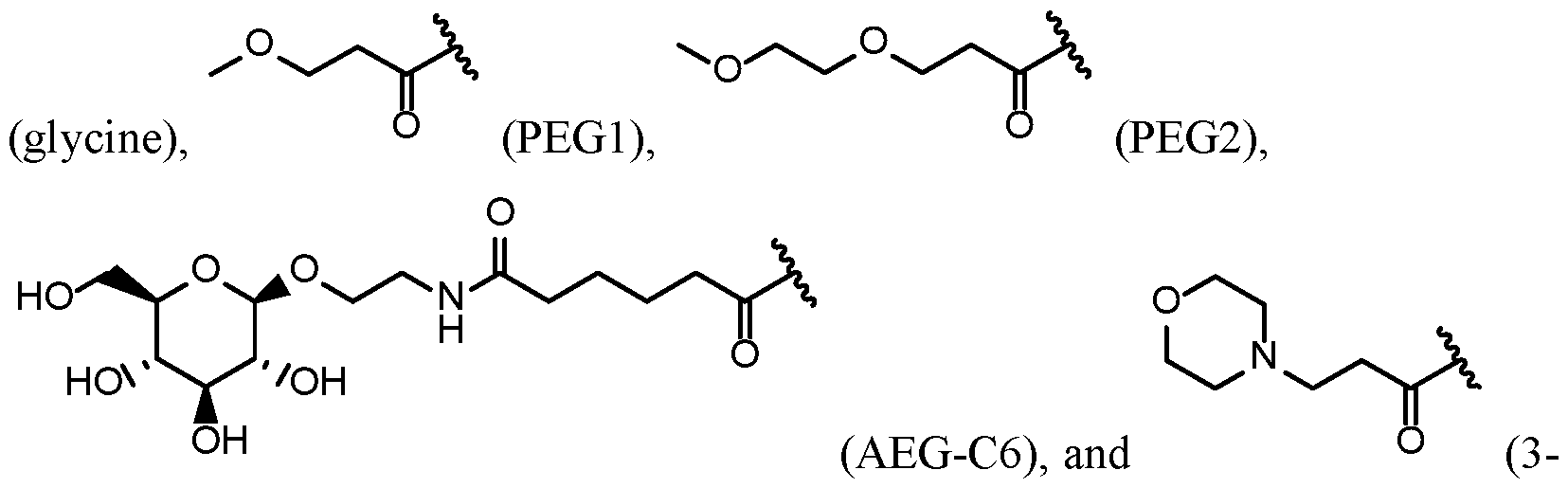
morpholinoproprionate), wherein the wavy line indicates the bond between the substituent and the A-terminal amino group. The substituent may also
 N-dimethyl) wherein the wavy line indicates the bond between Me2N and the alpha carbon of the N-terminal amino acid.
Embodiments of this disclosure provide conjugates having the formula as set forth in
Table 1 for IOC-1, IOC-2, IOC-3, IOC-4, IOC-5, IOC-6, IOC-7, IOC-8, IOC-9, IOC-10, IOC-11, IOC-12, IOC-13, IOC-14, IOC-15, IOC-16, IOC-17, IOC-18, IOC-19, IOC-20, IOC-21, IOC-22, IOC-23, IOC-24, IOC-25, IOC-26, IOC-27, IOC-28, IOC-29, IOC-30,
IOC-31, IOC-32, IOC-33, IOC-34, IOC-35, IOC-36, IOC-37, IOC-38, IOC-39, IOC-40, IOC-41, IOC-42, IOC-43, IOC-44, IOC-45, IOC-46, IOC-47, IOC-48, IOC-49, IOC-50, IOC-51, IOC-52, IOC-53, IOC-54, IOC-55, IOC-56, IOC-57, IOC-58, IOC-59, IOC-60, IOC-61, and IOC-62


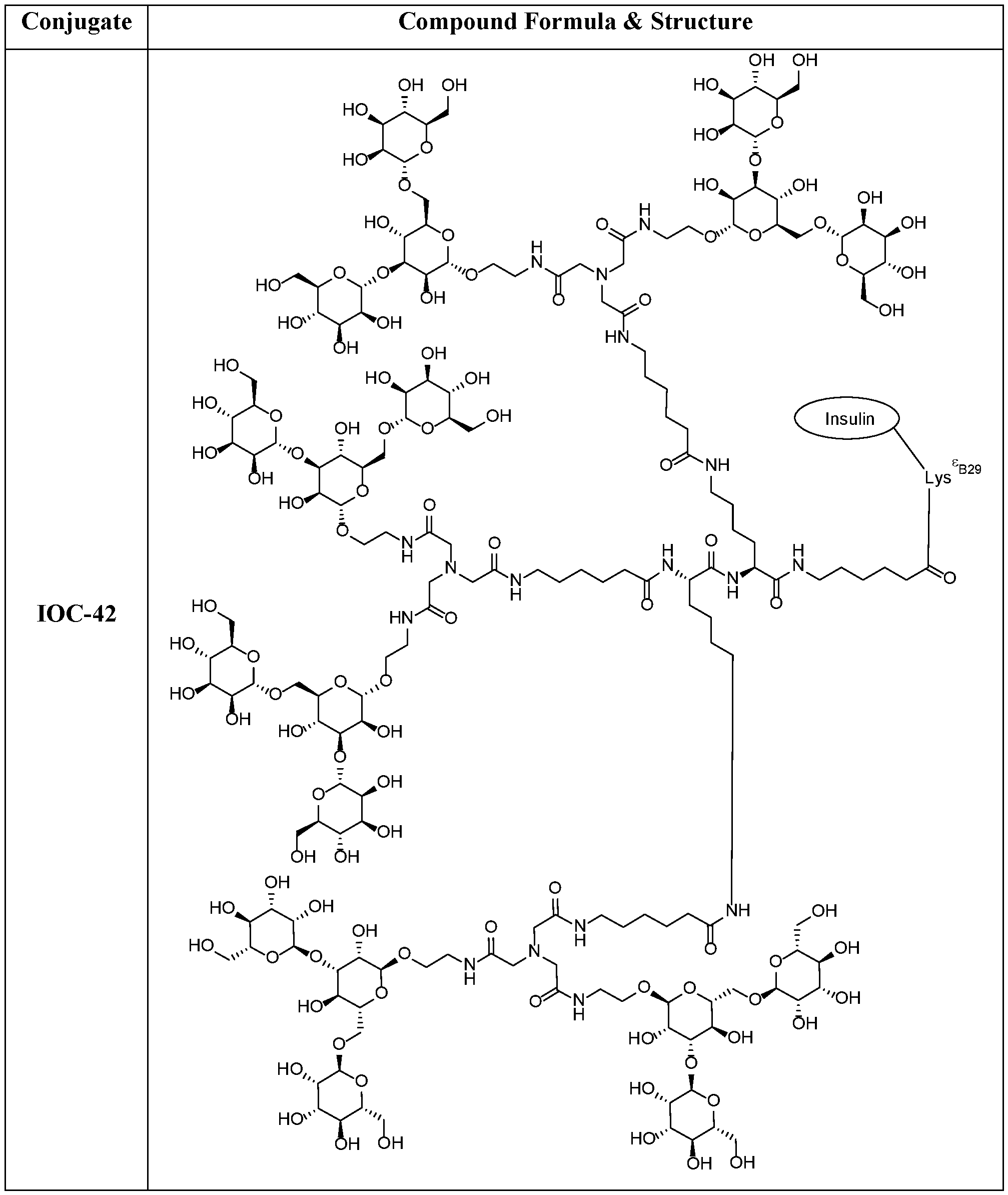


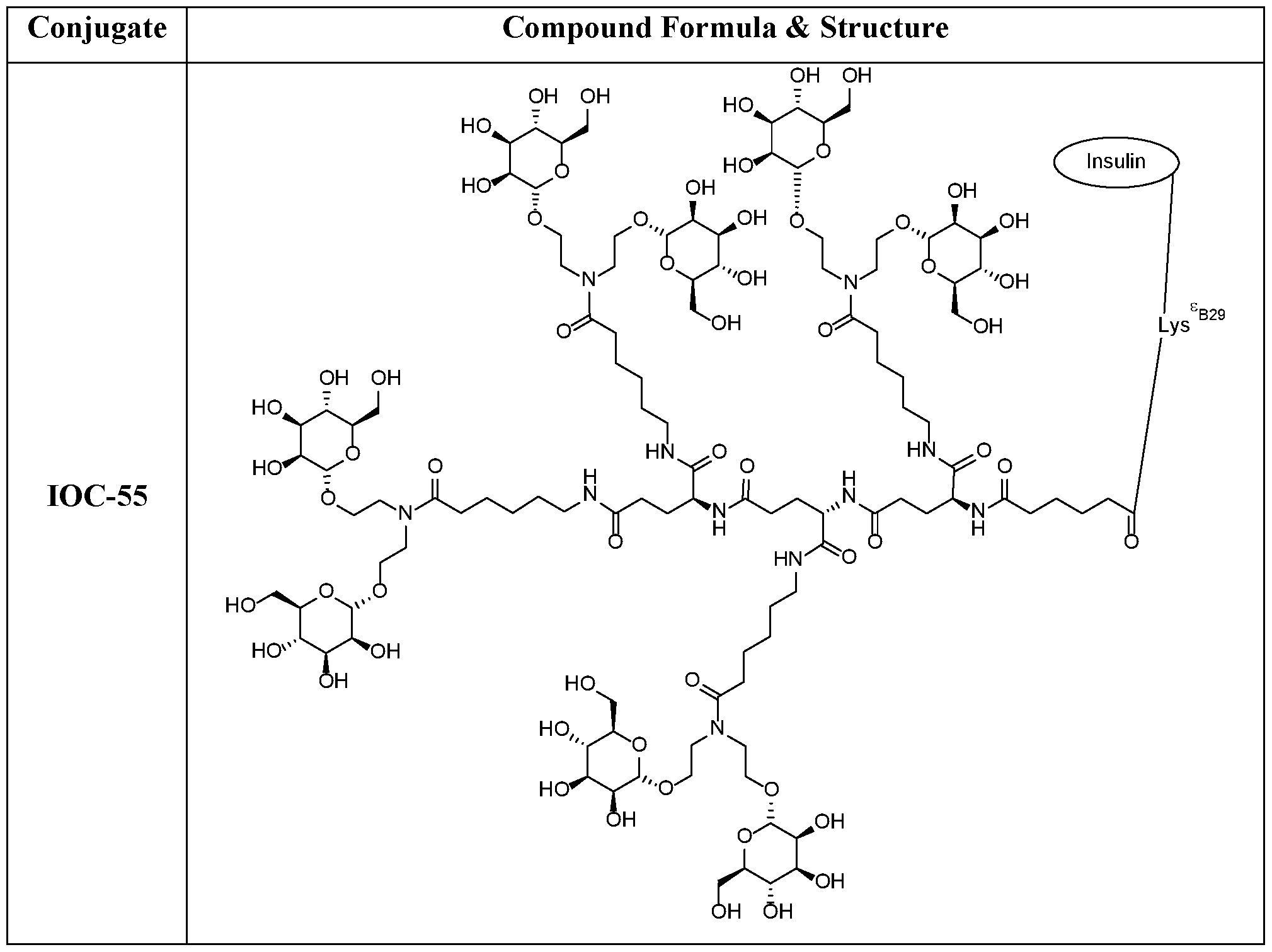


Additional embodiments of the disclosure provide for the use of any one of the conjugates disclosed herein for the manufacture of a medicament to treat diabetes.
Additional embodiments of the disclosure provide for the use of any one of the conjugates disclosed herein for the manufacture of a medicament to treat a Type I diabetes, Type II diabetes, gestational diabetes, impaired glucose tolerance, or prediabetes.
Additional embodiments of the disclosure provide a composition comprising of any one of the conjugates disclosed herein and a pharmaceutically acceptable carrier.
Additional embodiments of the disclosure provide for use of the composition comprising of any one of the conjugates disclosed herein and a pharmaceutically acceptable carrier for the treatment of diabetes. In particular aspects, the diabetes is Type I diabetes, Type II diabetes, or
gestational diabetes.
The disclosure further provides embodiments of a method for treating a subject who has diabetes, comprising administering to the subject an effective amount of the composition comprising of any one of the conjugates disclosed herein and a pharmaceutically acceptable carrier for treating the diabetes, wherein said administering treats the diabetes. In particular aspects, the diabetes is Type I diabetes, Type II diabetes, or gestational diabetes.
The disclosure further provides embodiments of a composition comprising any one of the conjugates disclosed herein, wherein the conjugate is characterized as having a ratio of EC50 or IP as determined by a functional insulin receptor phosphorylation assay to the IC50 or IP as determined by a competition binding assay at the macrophage mannose receptor that is about 0.5: 1 to about 1 : 100; about 1 : 1 to about 1 :50; about 1 : 1 to about 1 :20; or about 1 : 1 to about 1 : 10; and a pharmaceutically acceptable carrier.
The disclosure still further provides embodiments of a method for treating a subject who has diabetes, comprising administering to the subject a composition comprising any one of the conjugates disclosed herein, wherein the conjugate is characterized as having a ratio of EC50 or IP as determined by a functional insulin receptor phosphorylation assay to the IC50 or IP as determined by a competition binding assay at the macrophage mannose receptor that is about 0.5: 1 to about 1 : 100; about 1 : 1 to about 1 :50; about 1 : 1 to about 1 :20; or about 1 : 1 to about 1 : 10; and a pharmaceutically acceptable carrier, wherein the administering treats the diabetes. In particular aspects, the diabetes is Type I diabetes, Type II diabetes, or gestational diabetes.
Sustained release formulations
In particular embodiments, it may be advantageous to administer an insulin conjugate in a sustained fashion (i.e., in a form that exhibits an absorption profile that is more sustained than soluble recombinant human insulin). This will provide a sustained level of conjugate that can respond to fluctuations in glucose on a timescale that is more closely related to the typical glucose fluctuation timescale (i.e., hours rather than minutes). In particular embodiments, the sustained release formulation may exhibit a zero-order release of the conjugate when
administered to a mammal under non-hyperglycemic conditions (i.e., fasted conditions).
It will be appreciated that any formulation that provides a sustained absorption profile may be used. In particular embodiments this may be achieved by combining the conjugate with other ingredients that slow its release properties into systemic circulation.
For example, PZI (protamine zinc insulin) formulations may be used for this purpose.
The present disclosure encompasses amorphous and crystalline forms of these PZI formulations.
Thus, in particular embodiments, a formulation of the present disclosure includes from about 0.05 to about lOmg protamine/mg conjugate. For example, from about 0.2 to about lOmg protamine/mg conjugate, e.g., about 1 to about 5mg protamine/mg conjugate.
In particular embodiments, a formulation of the present disclosure includes from about 0.006 to about 0.5mg zinc/mg conjugate. For example, from about 0.05 to about 0.5mg zinc/mg conjugate, e.g., about 0.1 to about 0.25mg zinc/mg conjugate.
In particular embodiments, a formulation of the present disclosure includes protamine and zinc in a ratio (w/w) in the range of about 100: 1 to about 5: 1, for example, from about 50: 1 to about 5: 1, e.g., about 40: 1 to about 10: 1. In particular embodiments, a PZI formulation of the present disclosure includes protamine and zinc in a ratio (w/w) in the range of about 20: 1 to about 5: 1, for example, about 20: 1 to about 10: 1, about 20: 1 to about 15: 1, about 15: 1 to about 5: 1, about 10: 1 to about 5: 1, about 10: 1 to about 15: 1.
One or more of the following components may be included in the PZI formulation: an antimicrobial preservative, an isotonic agent, and/or an unconjugated insulin molecule.
In particular embodiments, a formulation of the present disclosure includes an
antimicrobial preservative (e.g., m-cresol, phenol, methylparaben, or propylparaben). In particular embodiments, the antimicrobial preservative is m-cresol. For example, in particular embodiments, a formulation may include from about 0.1 to about 1.0% v/v m-cresol. For example, from about 0.1 to about 0.5% v/v m-cresol, e.g., about 0.15 to about 0.35% v/v m- cresol.
In particular embodiments, a formulation of the present disclosure includes a polyol as isotonic agent (e.g., mannitol, propylene glycol or glycerol). In particular embodiments the isotonic agent is glycerol. In particular embodiments, the isotonic agent is a salt, e.g., NaCl. For example, a formulation may comprise from about 0.05 to about 0.5M NaCl, e.g., from about 0.05 to about 0.25M NaCl or from about 0.1 to about 0.2M NaCl.
In particular embodiments, a formulation of the present disclosure includes an amount of unconjugated insulin molecule. In particular embodiments, a formulation includes a molar ratio of conjugated insulin molecule to unconjugated insulin molecule in the range of about 100: 1 to 1 :1, e.g., about 50: 1 to 2: 1 or about 25: 1 to 2: 1.
The present disclosure also encompasses the use of standard sustained (also called extended) release formulations that are well known in the art of small molecule formulation (e.g., see Remington’s Pharmaceutical Sciences, 19th ed., Mack Publishing Co., Easton, PA, 1995).
The present disclosure also encompasses the use of devices that rely on pumps or hindered diffusion to deliver a conjugate on a gradual basis. In particular embodiments, a long acting formulation may (additionally or alternatively) be provided by using a modified insulin molecule. For example, one could use insulin glargine (LANTUS®) or insulin detemir
(LEVEMIR®) instead of wild-type human insulin in preparing the conjugate. Insulin glargine is an exemplary long acting insulin analog in which Asn at position A21 of the A-chain has been replaced by glycine and two arginine residues are at the C-terminus of the B-chain. The effect of these changes is to shift the isoelectric point, producing an insulin that is insoluble at
physiological pH but is soluble at pH 4. Insulin detemir is another long acting insulin analog in which Thr at position B30 of the B-chain has been deleted and a C14 fatty acid chain has been attached to the Lys at position B29.
Uses of conjugates
In another aspect, the present disclosure provides methods of using the insulin conjugates. In general, the insulin conjugates can be used to controllably provide insulin to an individual in need in response to a saccharide (e.g., glucose or an exogenous saccharide such as mannose, alpha-methyl mannose, L-fucose, etc.). The disclosure encompasses treating diabetes by administering an insulin conjugate of the present disclosure. Although the insulin conjugates can be used to treat any patient (e.g., dogs, cats, cows, horses, sheep, pigs, mice, etc.), they are most preferably used in the treatment of humans. An insulin conjugate may be administered to a patient by any route. In general, the present disclosure encompasses administration by oral, intravenous, intramuscular, intra-arterial, subcutaneous, intraventricular, transdermal, rectal, intravaginal, intraperitoneal, topical (as by powders, ointments, or drops), buccal, or as an oral or nasal spray or aerosol. General considerations in the formulation and manufacture of pharmaceutical compositions for these different routes may be found, for example, in
Remington’s Pharmaceutical Sciences, 19th ed., Mack Publishing Co., Easton, PA, 1995. In various embodiments, the conjugate may be administered subcutaneously, e.g., by injection. The insulin conjugate may be dissolved in a carrier for ease of delivery. For example, the carrier can be an aqueous solution including, but not limited to, sterile water, saline or buffered saline.
In general, a therapeutically effective amount of the insulin conjugate will be
administered. The term“therapeutically effective amount” means a sufficient amount of the insulin conjugate to treat diabetes at a reasonable benefit/risk ratio, which involves a balancing of the efficacy and toxicity of the insulin conjugate. In various embodiments, the average daily
dose of insulin is in the range of 10 to 200U, e.g., 25 to 100U (where 1 Unit of insulin is ~ 0.04mg). In particular embodiments, an amount of conjugate with these insulin doses is administered on a daily basis. In particular embodiments, an amount of conjugate with 5 to 10 times these insulin doses is administered on a weekly basis. In particular embodiments, an amount of conjugate with 10 to 20 times these insulin doses is administered on a bi-weekly basis. In particular embodiments, an amount of conjugate with 20 to 40 times these insulin doses is administered on a monthly basis.
In particular embodiments, a conjugate of the present disclosure may be used to treat hyperglycemia in a patient (e.g., a mammalian or human patient). In particular embodiments, the patient is diabetic. However, the present methods are not limited to treating diabetic patients.
For example, in particular embodiments, a conjugate may be used to treat hyperglycemia in a patient with an infection associated with impaired glycemic control. In particular embodiments, a conjugate may be used to treat diabetes.
In particular embodiments, when an insulin conjugate or formulation of the present disclosure is administered to a patient (e.g., a mammalian patient) it induces less hypoglycemia than an unconjugated version of the insulin molecule. In particular embodiments, a formulation of the present disclosure induces a lower HbAlc value in a patient (e.g., a mammalian or human patient) than a formulation comprising an unconjugated version of the insulin molecule. In particular embodiments, the formulation leads to an HbAlc value that is at least 10% lower (e.g., at least 20% lower, at least 30% lower, at least 40% lower, at least 50% lower) than a
formulation comprising an unconjugated version of the insulin molecule. In particular embodiments, the formulation leads to an HbAlc value of less than 7%, e.g., in the range of about 4 to about 6%. In particular embodiments, a formulation comprising an unconjugated version of the insulin molecule leads to an HbAlc value in excess of 7%, e.g., about 8 to about 12%.
Exogenous trigger
As mentioned previously, the methods, conjugates and compositions that are described herein are not limited to glucose responsive-conjugates. As demonstrated in the Examples, several exemplary insulin conjugates were also responsive to exogenous saccharides such as alpha-methyl mannose. It will therefore be appreciated that, in particular embodiments, an insulin conjugate may be triggered by exogenous administration of a saccharide other than glucose such as alpha-methyl mannose or any other saccharide that can alter the PK or PD
properties of the conjugate.
Once a conjugate has been administered as described above (e.g., as a sustained release formulation), it can be triggered by administration of a suitable exogenous saccharide. In a particular embodiment, a triggering amount of the exogenous saccharide is administered. As used herein, a“triggering amount” of exogenous saccharide is an amount sufficient to cause a change in at least one PK and/or PD property of the conjugate (e.g., Cmax, AUC, half-life, etc. as discussed previously). It is to be understood that any of the aforementioned methods of administration for the conjugate apply equally to the exogenous saccharide. It is also to be understood that the methods of administration for the conjugate and exogenous saccharide may be the same or different. In various embodiments, the methods of administration are different (e.g., for purposes of illustration the conjugate may be administered by subcutaneous injection on a weekly basis while the exogenous saccharide is administered orally on a daily basis). The oral administration of an exogenous saccharide is of particular value because it facilitates patient compliance. In general, it will be appreciated that the PK and PD properties of the conjugate will be related to the PK profile of the exogenous saccharide. Thus, the conjugate PK and PD properties can be tailored by controlling the PK profile of the exogenous saccharide. As is well known in the art, the PK profile of the exogenous saccharide can be tailored based on the dose, route, frequency and formulation used. For example, if a short and intense activation of the conjugate is desired then an oral immediate release formulation might be used. In contrast, if a longer less intense activation of conjugate is desired then an oral extended release formulation might be used instead. General considerations in the formulation and manufacture of immediate and extended release formulation may be found, for example, in Remington’s Pharmaceutical Sciences, 19th ed., Mack Publishing Co., Easton, PA, 1995.
It will also be appreciated that the relative frequency of administration of a conjugate of the present disclosure and an exogenous saccharide may be the same or different. In particular embodiments, the exogenous saccharide is administered more frequently than the conjugate. For example, in particular embodiment, the conjugate may be administered daily while the exogenous saccharide is administered more than once a day. In particular embodiment, the conjugate may be administered twice weekly, weekly, biweekly or monthly while the exogenous saccharide is administered daily. In particular embodiments, the conjugate is administered monthly and the exogenous saccharide is administered twice weekly, weekly, or biweekly.
Other variations on these schemes will be recognized by those skilled in the art and will vary depending on the nature of the conjugate and formulation used.
The following examples are intended to promote a further understanding of the present invention.
EXAMPLES
General Procedures
All chemicals were purchased from commercial sources, unless otherwise noted.
Reactions sensitive to moisture or air were performed under nitrogen or argon using anhydrous solvents and reagents. The progress of reactions was monitored by analytical thin layer chromatography (TLC), high performance liquid chromatography-mass spectrometry (HPLC- MS), or ultra performance liquid chromatography-mass spectrometry (UPLC-MS). TLC was performed on E. Merck TLC plates precoated with silica gel 60F-254, layer thickness 0.25mm. The plates were visualized using 254nm UV and/or by exposure to cerium ammonium molybdate (CAM) or p-anisaldehyde staining solutions followed by charring. High performance liquid chromatography (HPLC) was conducted on a Waters Acquity™ UPLC® using BEH Cl 8, 1.7 pm, 1.0x50mm column with gradient 10:90-99: 1 v/v CH3CN/H2O + v 0.05% TFA over 2.0min; flow rate 0.3mL/min, UV range 215nm (LC-MS Method A). Mass analysis was performed on a Waters Micromass® ZQ™ with electrospray ionization in positive ion detection mode and the scan range of the mass-to-charge ratio was either 170-900 or 500-1500. Ultra performance liquid chromatography (UPLC) was performed on a Waters Acquity™ UPLC® system using the following methods:
UPLC-MS Method A: Waters Acquity™ UPLC® BEH C18 1.7pm 2.1x100mm column with gradient 10:90-70:30 v/v CH3CN/H2O + v 0.1% TFA over 4.0min and 70:30-95:5 v/v CH3CN/H2O + v 0.1% TFA over 0.4min; flow rate 0.3mL/min, UV wavelength 200-300nm.
UPLC-MS Method B: Waters Acquity™ UPLC® BEH C18 1.7pm 2.1x100mm column with gradient 60:40-100:0 v/v CH3CN/H2O + v 0.1% TFA over 4.0min and 100:0-95:5 v/v CH3CN/H2O + v 0.1% TFA over 0.4min; flow rate 0.3mL/min, UV wavelength 200-300nm.
UPLC-MS Method C: Waters Acquity™ UPLC® HSS T3 1.7pm 2.1x100mm column with gradient 0: 100-40:60 v/v CH3CN/H2O + v 0.05% TFA over 8.0min and 40:60-10:90 v/v CH3CN/H2O + v 0.05% TFA over 2.0min; flow rate 0.3mL/min, UV wavelength 200-300nm.
UPLC-MS Method D: Waters Acquity™ UPLC® BEH C18 1.7pm 2.1x100mm column with gradient 0: 100-60:40 v/v CH3CN/H2O + v 0.1% TFA over 8.0min and 60:40-90: 10 v/v CH3CN/H2O + v 0.1% TFA over 3.0min and hold at 100:0 v/v CH3CN/H2O + v 0.1% TFA for 2min; flow rate 0.3mL/min, UV wavelength 200-3 OOnm.
UPLC-MS Method E: Waters Acquity™ UPLC® BEH C8 1.7qm 2.1x100mm column with gradient 10:90-55:45 v/v CH3CN/H2O + v 0.1% TFA over 4.2min and 100: 0-95:5 v/v CH3CN/H2O + v 0.1% TFA over 0.4min; flow rate 0.3mL/min, UV wavelength 200-300nm.
UPLC-MS Method F: Waters Acquity™ UPLC® BEH C8 1 7pm 2.1x100mm column with gradient 10:90-90: 10 v/v CH3CN/H2O + v 0.1% TFA over 4.2min and 90: 10-95:5 v/v CH3CN/H2O + v 0.1% TFA over 0.4min; flow rate 0.3mL/min, UV wavelength 200-300nm.
UPLC-MS Method G: Waters Acquity™ UPLC® BEH300 C4 1.7pm 2.1x100mm column with gradient 10:90-90: 10 v/v CH3CN/H2O + v 0.1% TFA over 4.0min and 90: 10-95:5 v/v CH3CN/H2O + v 0.1% TFA over 0.4min; flow rate 0.3mL/min, UV wavelength 200-300nm.
Mass analysis was performed on a Waters Micromass® LCT Premier™ XE with electrospray ionization in positive ion detection mode and the scan range of the mass-to-charge ratio was 300-2000. The identification of the produced insulin conjugates was confirmed by comparing the theoretical molecular weight to the experimental value that was measured using UPLC-MS. For the determination of the position of sugar modification(s), specifically, insulin conjugates were subjected to DTT treatment (for a/b chain) or Glu-C digestion (with reduction and alkylation), and then the resulting peptides were analyzed by LC-MS. Based on the measured masses, the sugar positions were deduced.
Flash chromatography was performed using either a Biotage Flash Chromatography apparatus (Dyax Corp.) or a CombiFlash® Rf instrument (Teledyne Isco). Normal-phase chromatography was carried out on silica gel (20-70pm, 6qΆ pore size) in pre-packed cartridges of the size noted. Concentration of organic solutions was carried out on a rotary evaporator under reduced pressure. Reverse-phase chromatography was carried out on C18-bonded silica gel (20-60pm, 60- 100 A pore size) in pre-packed cartridges of the size noted. Preparative scale HPLC was performed on Gilson GX-281 Liquid Handler powered by Gilson 333-334 binary system using Waters Delta Pak C4 15pm, 300A, 50x250mm column or Kromasil® C8 10pm, 100 A, 50x250mm column, flow rate 85mL/min, with gradient noted. Ion exchange
chromatography was carried out on Gilson 215 Liquid Handler powered by Gilson 332 binary system using PolyLC PolySULFOEthyl A 9.4x250mm column, with gradient 5-25% Mobile Phase B in Mobile Phase A (Mobile Phase A: 0.1% (v/v) H3PO4 /25% AcCN in water, mobile phase B: 0.1% (v/v) H3PO4/25%AcCN/0.5M NaCl in water, over 30min, flow rate 15mL/min). Concentration and diafiltration of aqueous solutions or HPLC fractions were carried out using Amicon Ultra-15 Centrifugal Filter Units (Millipore) with 10K MWCO, unless noted otherwise, on a Hettich Rotina 380R Benchtop Centrifuge at 3500 RPM and 4°C, or freeze-dried on a
VirTis Freezemobile Freeze Dryer (SP Scientific).
'H-NMR spectra were acquired at 500MHz (or otherwise specified) spectrometers in deuterated solvents noted. Chemical shifts were reported in parts per million (ppm).
Tetramethylsilane (TMS) or residual proton peak of deuterated solvents was used as an internal reference. Coupling constants (J) were reported in hertz (Hz).
Abbreviations: acetic acid (AcOH), acetonitrile (AcCN or MeCN), aqueous (aq), tert- butoxycarbonyl protecting group (Boc), 0-(7-azabenzotriazol-l-yl)-N,N,N',N'-tetramethyl- uronium hexafluorophosphate) (HATU), column volume (CV), N,N'-Dicyclohexylcarbodiimide (DCC), dichloromethane (DCM), diethyl ether (ether or Et20), N,N-diisopropylethylamine or Hiinig’s base (DIPEA), N,N-dimethylacetamide (DMA), (4-dimethylamino)pyridine (DMAP), N,N-dimethylformamide (DMF), dimethylsulfoxide (DMSO), ethyl acetate (EtOAc), N-(3- dimethylaminopropyl)-N’-ethylcarbodiimide hydrochloride (EDC), gram(s) (g), 1 -hydroxy - benzotriazole hydrate (HOBt), hour(s) (h or hr), isopropyl alcohol (IP A), liquid chromatography- mass spectrometry (LC-MS), mass spectrum (ms or MS), N-methylmorpholine (NMM), microliter(s) (pL), milligram(s) (mg), milliliter(s) (mL), millimole (mmol),minute(s) (min), tert- butyl ester (OtBu), pentafluorphenol-tetramethyluronium hexafluorophosphate (PFTU), petroleum ether (PE), silicon dioxide (SiCh), retention time (tit), room temperature (rt), saturated (sat.), saturated aq sodium chloride solution (brine), triethylamine (TEA), trifluoroacetic acid (TFA), trifluoroacetic anhydride (TFAA), tetrahydrofuran (THF), N,N,N’,N’-tetramethyl-0-(N- succinimidyl)uronium tetrafluorob orate (TSTU), and weight (wt).
EXAMPLE 1: 2,5-dioxopyrrolidin-l-yl 6-{[(S)-5-{[(S)-l,5-dioxo-l,5-bis({2-[(a-D- mannopyranosyl)oxy]ethyl}amino)pentan-2-yl]amino}-l,5-dioxo-l-({2-[(a-D - mannopyranosyl)oxy]ethyl}amino)pentan-2-yl]amino}-6-oxohexanoate (ML-1)

Step 1. {(S)-4-[6-(benzyloxy)-6-oxohexanamido]-4-carboxybutanoyl}-L-glutamic acid
To a solution of H-Glu-Asp-OH (l .Og, 3.81mmol) in DMF (26mL) at 0°C was added benzyl (2,5-dioxopyrrolidin-l-yl) adipate (1.34g, 4.00mmol) in DMF (3mL) portionwise over 15min and then TEA (585pL, 4.20mmol) dropwise over a period of lOmin. After stirring at rt overnight, to the resulting suspension was added more benzyl (2,5-dioxopyrrolidin-l-yl) adipate (70mg) in DMF (18mL). After overnight, insoluble material was removed by filtration, and the filtrate was concentrated. The residue was purified by reverse phase prep HPLC (C-4 column, 50x250cm, 85mL/min, gradient from 11% to 19% in 20min) (Water with 0.1% TFA and MeCN with 0.1%TFA) to give the title compound. Ή-NMEI (CD3OD) d: 7.28-7.36 (m, 5H), 5.12 (s, 2H), 4.74 (t, J = 5.7, 1H), 4.43 (t, J = 5.7, 1H), 2.84 (d, J = 5.7, 2H), 2.38-2.45 (m, 4H), 2.26 (t, J = 7.0, 2H), 2.12 (m, 1H), 1.91 (m, 1H), 1.60-1.70 (m, 2H).
Step 2. benzyl 6-{[(S)-5-{[(S)-l ,5-dioxo-l ,5-bis({2-[(a-D-mannopyranosyl)oxy] ethyl}amino) pentan-2-yl] amino}-! ,5-dioxo-l ~({2-[(a-D-mannopyranosyl)oxy] ethyl}amino)pentan-2- yl]amino}-6-oxohexanoate
To a solution of {(S)-4-[6-(benzyloxy)-6-oxohexanamido]-4-carboxybutanoyl}-L- glutamic acid (1.114g, 2.319mmol) in DMF (40mL) at 0°C was added EDC (2.22g, 11.59mmol) and HOBt (1 78g, 11 59mmol). After stirring at 0°C for 30min to the resulting suspension was added 2-aminoethyl a-D-mannopyranoside (2.588g, 11.59mmol) in DMF (15mL). The mixture was allowed to gradually warm to rt and stirred at rt. After overnight, the reaction mixture was concentrated. The residue was purified by column chromatography on silica gel (120g), eluting
with EtOAC/MeOH/MeCN/HiO (60: 15 : 15 : 15), to give the title compound. UPLC-MS Method A: m/z = 1096.4 (z = 1); tR = 2.32min.
Step 3. 6-{[ (S)-5-{[ (S)-l, 5-dioxo-l,5-bis( { 2-[(a-D-mannopyranosyl)oxy]ethyl}amino)pentan-2 - yl]amino}-l, 5-dioxo-l-( {2-[(a-D-mannopyranosyl)oxy] ethyl}amino)pentan-2-yl] amino}-6- oxohexanoic acid
To a solution of benzyl 6-{[(S)-5-{[(S)-l,5-dioxo-l,5-bis({2-[(a-D-mannopyranosyl)oxy] ethyl } amino)pentan-2-yl Jamino } - 1 , 5 -dioxo- 1 -({ 2- [(a-D-mannopyranosyl)oxy] ethyl } amino) pentan-2-yl]amino}-6-oxohexanoate (1.84g, 1.679mmol) in EbO (30mL) was added Pd/C (268mg, 0.252mmol). The resulting mixture was stirred under Eb at rt overnight. The catalyst was filtered off through a cake of diatomaceous earth (e.g. CELITE®) and washed with MeOH. The filtrate was concentrated, redissolved in water and freeze-dried to give the title compound. UPLC-MS Method A: m/z = 1006.4 (z = 1); tR = 1.20min.
Step 4. 2, 5-dioxopyrrolidin-l-yl 6-{[ (S)-5-{[ (S)-l, 5-dioxo-l, 5-bis( {2-[(a-D-mannopyranosyl)oxy] ethyl}amino)pentan-2-yl] amino}- 1, 5-dioxo-l-( { 2-[(a-D-mannopyranosyl)oxy]ethyl}amino ) pentan-2-yl]amino}-6-oxohexanoate
To a solution of 6-{[(S)-5-{[(S)-l, 5-dioxo-l, 5-bis({2-[(a-D-mannopyranosyl)oxy] ethyl } amino)pentan-2-yl Jamino } - 1 , 5 -dioxo- 1 -({ 2- [(a-D-mannopyranosyl)oxy] ethyl } amino) pentan-2-yl]amino}-6-oxohexanoic acid (1.735g, 1.725mmol) in DMF (62mL) at 0°C was added TSTU (701mg, 2.328mmol) and DIPEA (467pL, 2.67mmol). After stirring at 0°C for lhr and then at rt for lhr, UPLC-MS analysis showed that still some starting material left. To the reaction mixture was added TSTU (70mg) and DIPEA (45pL). After stirring at rt for lhr, the reaction mixture was concentrated, and the residue was added dropwise to AcCN (lOOmL). The resulting precipitate was collected through centrifugation to give the title compound. UPLC-MS Method A: m/z = 1103.4 (z = 1); tR = 1.32min.
EXAMPLE 2: 2, 5-dioxopyrrolidin-l-yl 6{[(S)-5-{[(S)-l, 5-dioxo-l, 5-bis({2-[(a-L- fucopyranosyl)oxy]ethyl}amino)pentan-2-yl]amino}-l,5-dioxo-l-({2-[(a-L- fucopyranosyl)oxy]ethyl}amino)pentan-2-yl]amino}-6-oxohexanoate (ML-2)

ML-2
The title compound was prepared using procedures analogous to those described for ML- 1 substituting H-g-Glu-Glu-OH for H-Glu-Asp-OH in Step 1 and 2-aminoethyl a-L- fucopyranoside for 2-aminoethyl a-D-mannopyranoside in Step 2, respectively. UPLC-MS Method A: m/z = 1069.526 (z = 1); tR = 2.03min.
EXAMPLE 3: 2,5-dioxopyrrolidin-l-yl 6-{[(S)-5-{[(S)-l,5-dioxo-l,5-bis({2-[(a-L- fucopyranosyl)oxy]ethyl}amino)pentan-2-yl]amino}-l,5-dioxo-l-{[2-({a-D- mannopyranosyl-(l 3)-[a-D-mannopyranosyl-(l 6)]-a-D-mannopyranosyl}oxy) ethyl]amino}pentan-2-yl]amino}6-oxohexanoate (ML-3)

ML-3
Step 1. benzyl (S)-4-{[(benzyloxy)carbonyl]amino}-5-oxo-5-{[2-({a-D-mannopyranosyl-(l 3)-
[ '/-D- mat u lopyrca iosyl-( l 6)] -a-D-mannopyranosyl}oxy)ethyl ] amino}pentanoate
To a solution of Z-Glu-a-Bn (l.Og, 2.69mmol) and 2-({ a-D-mannopyranosyl -(l 3)-[a- D-mannopyranosyl-(l 6)]-a-D-mannopyranosyl}oxy)ethan-l-amine (2.21g, 4.04mmol) in DMF (lOmL) was added HOBt (41mg, 0.269mmol), EDC (1.29g, 6.73mmol) and TEA (38 pL, 0.269mmol). The mixture was stirred at rt. After overnight, the mixture was diluted with EhO (20mL), and the resulting mixture was purified on HPLC (50x250mm, C4, flow rate 85mL/min, gradient 25-35% AcCN in EbO with 0.1% TFA over 30min). The desired fractions were combined and freeze-dried to give the title compound. UPLC-MS Method A: m/z = 901.315 (z = 1); tR = 3.49min.
Step 2. (S)-4-amino-5-oxo-5-{[ 2-( {a-D-mannopyranosyl-( l 3 )-[ a-D-mannopyranosyl-( l 6)]~ a-D-mannopyranosyl}oxy)ethyl]amino}pentanoic acid
A mixture of benzyl (S)-4-{[(benzyloxy)carbonyl]amino}-5-oxo-5-{[2-({a-D- mannopyranosyl -( 1 3 )- [a-D-mannopyranosyl -( 1 6)] -a-D-mannopyranosyl } oxy)ethyl] amino } pentanoate ( 1.41 g, 1.565mmol) and Pd(OH)2 (l lOmg, 0.157mmol) in H2O (30mL) was shaken under 344.74kPa of Fb on a Parr shaker overnight at rt. The mixture was diluted with 20mL of CH3OH, and the catalyst was filtered off through a fiberglass filter and washed with FbO. The filtrate was concentrated to give the title compound. UPLC-MS Method A: m/z = 677.25 (z =
1); tR = l. l lmin.
Step 3. (S)-4-[6-(benzyloxy)-6-oxohexanamido]-5-oxo-5-{[2-({a-D-mannopyranosyl-(l 3)-[a- D-mannopyranosyl-(l 6)]-a-D-mannopyranosyl}oxy)ethyl]amino}pentanoic acid
To a suspension containing (S)-4-amino-5-oxo-5-{[2-({a-D-mannopyranosyl-(l 3)-[a- D-mannopyranosyl-(l 6)]-a-D-mannopyranosyl}oxy)ethyl]amino}pentanoic acid (1.06g, 1.565mmol) and TEA (436pL, 3.13mmol) in DMF (lOmL) at rt was added benzyl (2,5- dioxopyrrolidin-l-yl) adipate (574mg, 1.72mmol). The mixture was stirred at rt overnight. The mixture was diluted with FbO (lOmL) and purified using HPLC (C4, 50x250mm, 10-30% AcCN in H2O with 0.1% TFA over 25min, flow rate 85mL/min). The desired fractions were combined and freeze-dried to give the title compound.
Step 4. benzyl (S)-[ 1 ,5-dioxo-l ,5-bis({2-[(a-L-fucopyranosyl)oxy] ethyl}amino)pentan-2- yl]carbamate
To a solution of Z-Glu-OH (l.lg, 3.91mmol) and 2-aminoethyl a-L-fucopyranoside (2.03g, 9.78mmol) in DMF (20mL) was added EDC (3.00g, 15.64mmol) and HOBt (60mg, 0.391mmol). The mixture was stirred at rt. After overnight, the reaction mixture was diluted with H2O (20mL) and purified using HPLC (C4, 50x250mm, gradient 5-30% AcCN with 0.1%
TFA in H2O with 0.1% TFA over 20min, flow rate 85mL/min). The desired fractions were combined and freeze-dried to give the title compound. UPLC-MS Method A: m/z = 660.29 (z = 1); tR = 2.78min.
Step 5. (S)-2-amino-N 1 ,N5-bis{2-[ (a-L-fucopyranosyl)oxy]ethyl}pentanediamide
A suspension of benzyl (S)-[l,5-dioxo-l,5-bis({2-[(a-L-fucopyranosyl)oxy]ethyl}amino) pentan-2-yl]carbamate (660mg, l .OOOmmol) and Pd(OH)2 (70mg, O. lOOmmol) in H2O (20mL) was stirred under Fh at rt. After stirring overnight, the reaction mixture was diluted with FhO (20mL), and the catalyst was filtered off through a pad of CELITE®. The filtrate was freeze- dried to give the title compound. UPLC-MS Method A: m/z = 526.25 (z = 1); tR = 1.09min.
Step 6. benzyl 6-{[ (S)-5-{[ (S)-l, 5-dioxo-l, 5-bis( (2-f (a-L-fucopyranosyl)oxy]ethyl}amino)pentan- 2-yl] amino}- 1, 5-dioxo-l -{[ 2-( (a-D-mannopyranosyl-( l 3)-[ a-D-mannopyranosyl-( l 6) ]-a- D-mannopyranosyl}oxy)ethyl]amino}pentan-2-yl]amino}6-oxohexanoate
To a solution of (S)-4-[6-(benzyloxy)-6-oxohexanamido]-5-oxo-5-{[2-({a-D- mannopyranosyl -( 1 3 )- [a-D-mannopyranosyl -( 1 6)] -a-D-mannopyranosyl } oxy)ethyl] amino } pentanoic acid (158.4mg, 0.177mmol) and (S)-2-amino- ,A5-bis{2-[(a-L-fucopyranosyl)oxy] ethyl }pentanediamide (93mg, 0.177mmol) in DMF (lOmL) at rt was added EDC (51mg, 0.266mmol). The mixture was stirred at rt overnight. The mixture was diluted with FhO (lOmL) and purified using HPLC (C4, 50x250mm, 10-30% AcCN in FhO with 0.1% TFA over 25min, flow rate 85mL/min). The desired fractions were combined and freeze-dried to give the title compound. UPLC-MS Method A: m/z = 1050.373 (z = 1); tR = 3.01min.
Step 7. 2, 5-dioxopyrrolidin-l-yl 6-{[ (S)-5-{[ (S)-l, 5-dioxo-l, 5-bis( { 2-[(a-L-fucopyranosyl)oxy } ethyl}amino)pentan-2-yl]amino}-l,5-dioxo-l-{[2-({a-D-mannopyranosyl-(l 3)-[a-D- mannopyranosyl-(l 6)]-a-D-mannopyranosyl}oxy)ethyl]amino}pentan-2-yl]amino}6- oxohexanoate
The title compound was prepared using procedures analogous to those described for ML- 1 substituting benzyl 6-{[(S)-5-{[(S)-l, 5-dioxo-l, 5-bis({2-[(a-L-fucopyranosyl)oxy]ethyl} amino)pentan-2-yl]amino}-l,5-dioxo-l-{[2-({a-D-mannopyranosyl-(l 3)-[a-D- mannopyranosyl -( 1 6)] -a-D-mannopyranosyl } oxy)ethyl] amino } pentan-2-yl] amino } 6- oxohexanoate for benzyl 6-{[(S)-5-{[(S)-l, 5-dioxo-l, 5-bis({2-[(a-D-mannopyranosyl)oxy] ethyl }amino)pentan-2-yl]amino}- 1 ,5-dioxo- 1 -({2-[(a-D-mannopyranosyl)oxy]ethyl } amino) pentan-2-yl]amino}-6-oxohexanoate in Step 3. UPLC-MS Method A: m/z = 1409.56 (z = 1); tR = 1.96min.
EXAMPLE 4: 2,5-dioxopyrrolidin-l-yl (5S,8S,llS)-5-isobutyl-4,7,10,13-tetraoxo-8,ll- bis(3-oxo-3-{[2-({a-D-mannopyranosyl-(l 3)-[a-D-mannopyranosyl-(l 6)]-a-D- mannopyranosyl}oxy)ethyl]amino}propyl)-l-({a-D-mannopyranosyl-(l 3)-[a-D- mannopyranosyl-(l 6)]-a-D-mannopyranosyl}oxy)-3,6,9,12-tetraazaoctadecan-18-oate (ML-4)

Step 1. (10S, 13S,16S)-10, 13-bis(2-carboxyethyl)-16-isobutyl-3, 8,11, 14-tetraoxo-l-phenyl-2-oxa- 9, 12, 15-triazaheptadecan-l 7-oic acid
To a solution of H-Glu-Glu-Leu-OH (l.Og, 2.57mmol) in DMF (20mL) at 0°C was added
1-benzyl 8-(2,5-dioxopyrrolidin-l-yl) octanedioate (899mg, 2.70mmol) in DMF (3mL) portionwise over 15min and then TEA (394pL, 2.82mmol) over lOmin. The resulting suspension was stirred at rt overnight and then concentrated. The residue was purified by column chromatography on lOOg C18 reverse phase silica gel, eluting with AcCN/FhO (gradient from 5% to 60% in 24 CV), to give the title compound. UPLC-MS Method B: m/z = 608.2 (z = 1); tR = 3.91min.
Step 2. benzyl (5S,8S, 11 ) -5 -isobutyl-4, 7 , 10, 13-tetraoxo-8, 1 l-bis(3-oxo-3-{[2-({a-D- mannopyranosyl-( l®3)-[ '/.-l)-mat // lopyrat losyl - ( l®6)] -a-D-mannopyranosyl}oxy) ethyl / amino}propyl)-l-({a-D-mannopyranosyl-(l®3)-[a-D-mannopyranosyl-(l®6)]-a-D- mannopyranosyl}oxy)-3, 6, 9, 12-tetraazaoctadecan-18-oate
To a solution of (10S,13S,16S)-10,13-bis(2-carboxyethyl)-16-isobutyl-3,8,l l,14- tetraoxo-l-phenyl-2-oxa-9,12,15-triazaheptadecan-17-oic acid (220mg, 0.362mmol) in DMF (lOmL) at 0°C were added EDC (312mg, 1.629mmol) and HOBt (55.4mg, 0.362mmol). After stirring at 0°C for 30min, to the resulting mixture was added 2-({a-D-mannopyranosyl-(l 3)- [a-D-mannopyranosyl-(l 6)]-a-D-mannopyranosyl}oxy)ethan-l -amine (837mg, 1.267mmol) in DMF (8mL). The mixture was gradually warmed up to rt. After stirring at rt overnight, the mixture was concentrated. The residue was purified by column chromatography on 130g C18 reverse phase silica gel, eluting with AcCN/FhO (gradient from 5% to 40% in 15 CV), to give the title compound. UPLC-MS Method A: m/z= 1268.468 (z = 2); tR = 4.12min.
Step 3. 2,5-dioxopyrrolidin-l-yl (5S,8S, 11 S)-5-isobutyl-4, 7, 10, 13-tetraoxo-8, 11 -bis(3-oxo-3-{[2- ({a-D-mannopyranosyl-(l®3)-[a-D-mannopyranosyl-(l®6)]-a-D-mannopyranosyl}oxy)ethyl] amino}propyl)-l-({a-D-mannopyranosyl-(l®3)-[a-D-mannopyranosyl-(l®6)]-a-D- mannopyranosyl}oxy)-3, 6, 9, 12-tetraazaoctadecan-18-oate
The title compound was prepared using procedures analogous to those described for ML- 1 substituting benzyl (5S,8S,1 lS)-5-isobutyl-4,7,10,13-tetraoxo-8,l l-bis(3-oxo-3-{[2-({a-D- mannopyranosyl -( 1 3 )- [a-D-mannopyranosyl -( 1 6)] -a-D-mannopyranosyl } oxy)ethyl] amino } propyl)- 1 -({ a-D-mannopyranosyl -( 1 3 )- [a-D-mannopyranosyl -( 1 6)]-a-D- mannopyranosyl}oxy)-3,6,9,12-tetraazaoctadecan-18-oate for benzyl 6-{[(S)-5-{[(S)-l,5-dioxo- l,5-bis({2-[(a-D-mannopyranosyl)oxy]ethyl}amino)pentan-2-yl]amino}-l,5-dioxo-l-({2-[(a-D- mannopyranosyl)oxy]ethyl}amino)pentan-2-yl]amino}-6-oxohexanoate in Step 3. UPLC-MS Method A m/z = 1223.472 (z = 2); tR = 3.72min.
EXAMPLE 5: 2,5-dioxopyrrolidin-l-yl (14S,19S)-14-{[6-(bis{2-[(a-D-mannopyranosyl)oxy] ethyl}amino)-6-oxohexyl]carbamoyl}-4, 11, 16,21, 24-pentaoxo-19-[(6-oxo-6-{[2-({a-D- mannopyranosyl-(l 3)-[a-D-mannopyranosyl-(l 6)]-a-D-mannopyranosyl}oxy)ethyl] amino}hexyl)carbamoyl]-l-[(a-D-mannopyranosyl)oxy]-3-{2-[(a-D-mannopyranosyl)oxy] ethyl}-3,10,15,20,23-pentaazanonacosan-29-oate (ML-5)

ML-5
Step 1. [ (S)-4-{2-[8-(benzyloxy)-8-oxooctanamido]acetamido}-5-(tert-butoxy)-5-oxopentanoyl]- L-glutamic acid
To a solution of H-Gly-yGlu(OtBu)-Glu-OH (503mg, 1.292mmol) in DMF (lOmL) at
0°C was added 1-benzyl 8-(2,5-dioxopyrrolidin-l-yl) octanedioate (490mg, 1.356mmol) in DMF (2mL) portionwise over 15min and then TEA (360pL, 2.58mmol) dropwise over lOmin. The resulting suspension was stirred at rt overnight and concentrated. The residue was purified by column chromatography on lOOg C18 reverse phase silica gel, eluting with AcCN/FhO (gradient from 5% to 60% in 24 CV), to give the title compound. UPLC-MS Method B: m/z = 636.367 (z = 1); tR = 4.63min.
Step 2. benzyl (14S, 19S)-14-[(6-(bis(2-[(a-D-mannopyranosyl)oxy]ethyl}amino)-6-oxohexyl) carbamoyl / -19-(tert-butoxycarbonyl)-4, 11,16, 21 ,24-pentaoxo-l-[ ( a-D-mannopyranosyl)oxy] -3- {2-[(a-D-mannopyranosyl)oxy] ethyl}-3, 10, 15,20,23-pentaazahentriacontan-31-oate
To a solution of [(S)-4-{2-[8-(benzyloxy)-8-oxooctanamido]acetamido}-5-(tert-butoxy)-
5-oxopentanoyl]-L-glutamic acid (l.Og, 1.646mmol) in DMF (40mL) was added EDC (946mg,
4.94mmol) and HOBt (252mg, 1.646mmol) at 0°C. After stirring at 0°C for 30min, to the mixture was added 6-amino-N,N-bis{2-[(a-D-mannopyranosyl)oxy]ethyl}hexanamide (2.054g, 3.79mmol). The mixture was allowed to gradually warm up to rt and to stir overnight. The resulting mixture was concentrated, and the residue was purified by column chromatography on 150 g C18 reverse phase silica gel, eluting with AcCN/ThO (gradient from 0% to 50% in 20 CV), to give the title compound. UPLC-MS Method B: m/z = 1657.862 (z = 1); tR = 4.60min. Step 3. N2-{[8-(benzyloxy)-8-oxooctanoyl] glycyl}-N5-[(S)-4, 11 , 15,22-tetraoxo-l ,25-di[(a-D- mannopyranosyl)oxy]-3,23-bis{2-[ (a-D-mannopyranosyl)oxy] ethyl}-3, 10, 16,23- tetraazapentacosan-12-yl]-L-glutamine
To a flask containing benzyl (14S,19S)-14-[(6-{bis(2-[(a-D-mannopyranosyl)oxy] ethyl } amino)-6-oxohexyl)carbamoyl]- 19-(tert-butoxycarbonyl)-4, 11,16,21 ,24-pentaoxo- 1 -[(a-D- mannopyranosyl)oxy]-3-{2-[(a-D-mannopyranosyl)oxy]ethyl}-3, 10,15,20,23-pentaaza- hentriacontan-31-oate (1.967g, 1.187mmol) at 0°C was added TFA (14mL, 182mmol). The mixture was stirred at 0°C for 2hr and then concentrated. The residue was purified by column chromatography on lOOg C18 reverse phase silica gel, eluting with AcCN/ThO (gradient from 0% to 55% in 26min), to give the title compound. UPLC-MS Method B: m/z = 1601.839 (z =
1); tR = 4.08min.
Step 4. benzyl (14S,19S)-14-{[6-(bis{2-[(a-D-mannopyranosyl)oxy]ethyl}amino)-6-oxohexyl] carbamoyl}-4, 11,16,21, 24-pentaoxo-19-[ ( 6-oxo-6-{[ 2-( {a-D-mannopyranosyl-( l 3)-[ a-D- mannopyranosyl-(l 6)]-a-D-mannopyranosyl}oxy)ethyl]amino}hexyl)carbamoyl]-l-[(a-D- mannopyranosyl)oxy] -3-{2-[(a-D-mannopyranosyl)oxy] ethyl}-3, 10, 15,20,23- pentaazanonacosan-29-oate
To a solution of N2-{[8-(benzyloxy)-8-oxooctanoyl]glycyl}-N5-[(S)-4, 11, 15,22- tetraoxo- 1 ,25 -di [(a-D-mannopyranosyl)oxy] -3,23 -bis { 2- [(a-D-mannopyranosyl)oxy] ethyl } - 3,10, 16,23-tetraazapentacosan-12-yl]-L-glutamine (820mg, 0.512mmol) in DMF (40mL) at 0°C was added EDC (196mg, 1.025mmol) and HOBt (39.2mg, 0.256mmol). After stirring at 0°C for 30min, to the resulting mixture was added 6-amino-N-[2-({a-D-mannopyranosyl-(l 3)-[a-D- mannopyranosyl-(l 6)]-a-D-mannopyranosyl}oxy)ethyl]hexanamide (406mg, 0.615mmol).
The mixture was allowed to gradually warm to rt and to stir at rt overnight. The mixture was concentrated, and the residue was purified by column chromatography on lOOg Cl 8 reverse phase silica gel, eluting with ACCN/H2O (gradient from 0% to 45% in 2 CV), to give the title compound. UPLC-MS Method B: m/z = 1122.705 (z = 2); tR = 2.19min.
Step 5. 2,5-dioxopyrrolidin-l-yl (14S,19S)-14-{[6-(bis{2-[(a-D-mannopyranosyl)oxy]ethyl}
amino) -6-oxohexyl] car bamoyl}-4, 11 , 16, 21 ,24-pentaoxo-l 9-[(6-oxo-6-{[2-({a-D- mannopyranosyl-( l 3)-[ a-D-mannopyranosyl-( 1 6)] -a-D-mannopyranosyl}oxy) ethyl / amino}hexyl)carbamoyl]-l-[(a-D-mannopyranosyl)oxy]-3-{2-[(a-D-mannopyranosyl)oxy] ethyl}-3, 10, 15, 20,23-pentaazanonacosan-29-oate
The title compound was prepared using procedures analogous to those described for ML- 1 substituting benzyl (14S, 19S)-14-{[6-(bis{2-[(a-D-mannopyranosyl)oxy]ethyl} amino)-6- oxohexyl]carbamoyl}-4, 11, 16,21, 24-pentaoxo-19-[(6-oxo-6-{ [2-({a-D-mannopyranosyl-(l 3)- [a-D-mannopyranosyl -( 1 6)] -a-D-mannopyranosyl } oxy)ethyl] amino } hexyl) carb amoyl] - 1 - [(a-D-mannopyranosyl)oxy]-3-{2-[(a-D-mannopyranosyl)oxy]ethyl}-3, 10, 15,20, 23-penta- azanonacosan-29-oate for benzyl 6-{[(S)-5-{[(S)-l,5-dioxo-l,5-bis({2-[(a-D-mannopyranosyl) oxyjethyl } amino)pentan-2-yl]amino} -1 ,5-dioxo- 1 -({2-[(a-D-mannopyranosyl)oxy]ethyl }amino) pentan-2-yl]amino}-6-oxohexanoate in Step 3. UPLC-MS Method A: m/z = 1125.669 (z = 2); tR = 1.63min.
EXAMPLE 6: 2,5-dioxopyrrolidin-l-yl (6S,9S,12S)-12-methyl-4,8,ll,14-tetraoxo-9-[3-oxo- 3-({2-[(a-D-mannopyranosyl)oxy]ethyl} amino)propyl]-l-[(a-D-mannopyranosyl)oxy]-6- ({2-[(a-D-mannopyranosyl)oxy]ethyl} carbamoyl)-3,7,10,13-tetraazanonadecan-19-oate (ML-6)

ML-6
The title compound was prepared using procedures analogous to those described for ML- 1 substituting [6-(benzyloxy)-6-oxohexanoyl]-L-alanyl-L-glutamyl-L-aspartic acid for {(S)-4-[6- (benzyloxy)-6-oxohexanamido]-4-carboxybutanoyl}-L-glutamic acid in Step 2. UPLC-MS Method A: m/z = 1231.5653 (z = 2); tR = 1.50min.
EXAMPLE 7: 2,5-dioxopyrrolidin-l-yl (15S,18S)-4,9,16,19-tetraoxo-15-(6-oxo-6-{[2-({a-D- mannopyranosyl-(l 3)-[a-D-mannopyranosyl-(l 6)]-a-D-mannopyranosyl}oxy)ethyl] amino}hexanamido)-18-[4-(6-oxo-6-{[2-({a-D-mannopyranosyl-(l 3)-[a-D- mannopyranosyl-(l 6)]-a-D-mannopyranosyl}oxy)ethyl]amino}hexanamido) butyl]-l-({a- D-mannopyranosyl-(l 3)-[a-D-mannopyranosyl-(l 6)]-a-D-mannopyranosyl} oxy)- 3,10,17,20-tetraazahexacosan-26-oate (ML-7)

ML-7
Step 1. N6-[(benzyloxy)carbonyl]-N2-{N2,N6-bis[(benzyloxy)carbonyl]-L-lysyl}-L-lysine
To a solution of L-lysyl-L-lysine dihydrochloride (l.OOg, 2.88mmol) in a mixture of 1M NaOH (8.64mL, 8.64mmol) and dioxane (19.2mL) at rt was added dibenzyl dicarbonate (3.30g, 11.52mmol). After stirring overnight, the mixture was diluted with ThO and acidified with 1M
HC1 to pH ~ 2. The resulting mixture was extracted with EtOAc. The organic phase was separated, washed with brine, and concentrated. The title material was isolated by
chromatography (120g S1O2 column, flow lOOmL/min, gradient A-B of 0-50%B in 30min followed by hold, where solvent A was EtOAc and solvent B was EtO A c/M eO H/ A cC N/H2O (v/v/v/v = 6/1/1/1). UPLC-MS Method D: m/z = 677.34 (z = 1); tR = 4.44min.
Step 2. benzyl (9S,12S)-9-{[(benzyloxy)carbonyl]amino}-12-(4-{[(benzyloxy)carbonyl] amino} butyl)-3,10, 13-trioxo-l-phenyl-2-oxa-4, 11, 14-triazaicosan-20-oate
To a solution of 6-(benzyloxy)-6-oxohexan-l-aminium 4-methylbenzenesulfonate (704mg, 1.788mmol) and N6-[(benzyloxy)carbonyl]-N2-{N2,N6-bis[(benzyloxy)carbonyl]-L- lysyl}-L4ysine (931 mg, 1.376mmol) in DMF (13.8mL) was added HOBt (316mg, 2.064mmol), DIPEA (312m1, 1.788mmol), and EDC (343mg, 1.788mmol). After stirring overnight, the mixture was diluted with EtOAc (lOOmL) and washed with 1M HC1 (2x50mL), NaHC03 (2x50mL), and brine (50mL). The organic phase was separated, dried over Na2S04, and concentrated. The residue was purified by chromatography (S1O2 column, solvent A = DCM, Solvent B = 80%EtOAc/20%DCM, gradient 0-100% A-B in 30min followed by hold) to give the title material. LC-MS Method A: m/z = 880.60 (z = 1); tR = 1.42min.
Step 3. 6-{(S)-6-amino-2-[(S)-2,6-diaminohexanamido]hexanamido}hexanoic acid
A mixture of benzyl (9S,12S)-9-{[(benzyloxy)carbonyl]amino}-12-(4-{[(benzyloxy) carbonyl]amino}butyl)-3,10,13-trioxo-l-phenyl-2-oxa-4,l l,14-triazaicosan-20-oate (810mg, 0.920mmol) in MeOH (180mL) and Pd(OH)2 (129mg, 0.184mmol) was shaken on a Parr shaker under 344.74kPa of ¾ overnight. The catalyst was filtered off, and the filtrate was concentrated to give the title compound. UPLC-MS Method A: m/z = 388.3 (z = 1); tR = 1.74min.
Step 4. (15S, 18S)-4, 9, 16, 19-tetraoxo-15-( 6-oxo-6-{[ 2-( (a-D-mannopyranosyl-( l 3)-[ a-D- mannopyranosyl-(l 6)]-a-D-mannopyranosyl}oxy)ethyl]amino}hexanamido)-18-[4-(6-oxo-6- {[2-({a-D-mannopyranosyl-(l 3)-[a-D-mannopyranosyl-(l 6)]-a-D-mannopyranosyl}oxy) ethyl]amino}hexanamido)butyl]-l-({a-D-mannopyranosyl-(l 3)-[a-D-mannopyranosyl- (1 6) ]-a-D-mannopyranosyl}oxy)-3, 10,17 ,20-tetraazahexacosan-26-oic acid
To a solution of 6-[(2,5-Dioxopyrrolidin-l-yl)oxy]-N-(2-{[a-D-mannopyranosyl-(l 3)- [a-D-mannopyranosyl-(l 6)]-a-D-mannopyranosyl]oxy}ethyl)-6-oxohexanamide (598mg, 0.774mmol, WO 2015/051052 A2) and 6-{(S)-6-amino-2-[(S)-2,6-diaminohexanamido] hexanamido}hexanoic acid (lOOmg, 0.258mmol) in DMF (5mL) was added TEA (106pL, 0.774 mmol). After lhr, the mixture was purified by chromatography (240g reverse phase Cl 8 silica gel column, 0 to 50% AcCN in H2O over 60min), and the desired fractions were combined and
dried, which was further purified on 40g silica column (flow rate 40mL/min, gradient 0-100% Solvent B in Solvent A over 30min; hold at 100% B for 5min; Solvent A: EtOAc/MeOH/AcCN/ H2O (v/v/v/v = 6/1/1/1) and Solvent B: EtO A c/M eO H/ A cC N/H2O (v/v/v/v = 2/1/1/1) to give the title compound. EIPLC-MS Method A: m/z = 1181.0841 (z = 2); tR = 4.20min.
Step 4. 2,5-dioxopyrrolidin-l-yl (15S, 18S)-4,9, 16, 19-tetraoxo-l 5-(6-oxo-6-{[2-({a-D- mannopyranosyl-(l®3)-[a-D-mannopyranosyl-(l®6)]-a-D-mannopyranosyl}oxy)ethyl] amino} hexanamido)-18[ 4-( 6-oxo-6-{[ 2-( (a-D-mannopyranosyl-( l ®3 )-[ a-D-mannopyranosyl-( l®6)]~ a-D-mannopyranosyl}oxy)ethyl]amino}hexanamido)butyl]-l-({a-D-mannopyranosyl-(l®3)-[a- D-mannopyranosyl-(l®6)]-a-D-mannopyranosyl}oxy)-3, 10,17,20-tetraazahexacosan-26-oate The title compound was prepared using procedures analogous to those described for ML- 1 substituting (15S, 18S)-4,9,16, 19-tetraoxo-15-(6-oxo-6-{[2-({a-D-mannopyranosyl-(l 3)-[a- D-mannopyranosyl-(l 6)]-a-D-mannopyranosyl}oxy)ethyl]amino}hexanamido)-18-[4-(6-oxo- 6- { [2-({ a-D-mannopyranosyl -( 1 3 )-[a-D-mannopyranosyl -( 1 6)] -a-D-mannopyranosyl } oxy) ethyl]amino}hexanamido)butyl]-l-({a-D-mannopyranosyl-(l 3)-[a-D-mannopyranosyl- (l 6)]-a-D-mannopyranosyl}oxy)-3,10, 17,20-tetraazahexacosan-26-oic acid for 6-{[(S)-5- {[(S)-l,5-dioxo-l,5-bis({2-[(a-D-mannopyranosyl)oxy]ethyl}amino)pentan-2-yl]amino}-l,5- dioxo-l-({2-[(a-D-mannopyranosyl)oxy]ethyl}amino)pentan-2-yl]amino}-6-oxohexanoic acid in Step 4.
EXAMPLE 8: 2,5-dioxopyrrolidin-l-yl (S)-l-[(a-D-mannopyranosyl)oxy]-6-[2-({2-[(a-D- mannopyranosyl)oxy]ethyl}amino)-2-oxoethyl]-13-({2-[(a-D-mannopyranosyl)oxy]ethyl} arbamoyl)-4,8,ll,16-tetraoxo-3,6,9,12,17-pentaazatricosan-23-oate (ML-8)

ML-8
Step 1. 2,2'-[(2-{[2-(benzyloxy)-2-oxoethyl]amino}-2-oxoethyl)azanediyl]diacetic acid
To a solution of 2-(benzyloxy)-2-oxoethanaminium chloride (4.0g, 19.84mmol) in DMF (29mL) was added DIPEA (3.46mL, 19.84mmol) at 0°C. The mixture was stirred at 0°C for 2hr
and then transferred via a cannula to a stirred solution of 2-(2,6-dioxomorpholino)acetic acid (3.434g, 19.84mmol) in DMF (29.0mL) at 0°C. The resulting mixture was stirred at 0°C for 30min, then at rt for 2hr. The reaction was quenched at 0°C by adding ThO (29mL). The resulting mixture was concentrated, and the residue was resuspended in ThO (29mL). The mixture was stirred at 0°C for 3hr, and the precipitate was collected by filtration, washed with ThO (25x2mL), and dried to give the title compound. UPLC-MS Method A: m/z = 339.13 (z = 1); tR = 2.72min.
Step 2. benzyl bis[2-({2-[(a-D-mannopyranosyl)oxy]ethyl}amino)-2-oxoethyl]glycylglycinate
To a solution of 2,2'-[(2-{[2-(benzyloxy)-2-oxoethyl]amino}-2-oxoethyl)azanediyl] diacetic acid (3.4g, 10.05mmol) in DMF (lOmL) at 0°C was added EDC (5.78g, 30.1mmol) HOBt (4.62g, 30.1mmol), and 30min later, 2-aminoethyl a-D-mannopyranoside (5.61g,
25.1mmol). The resulting mixture was allowed to gradually warm to rt, stirred overnight, and concentrated. The residue was purified by column chromatography on 130g Cl 8 reverse phase silica gel (3x), eluting with AcCN/ThO (gradient from 5% to 30% in 15 CV), to give the title compound. UPLC-MS Method A: m/z = 749.3 (z = 1); tR = 2.19min.
Step 3. bis[2-({2-[(a-D-mannopyranosyl)oxy]ethyl}amino)-2-oxoethyl]glycylglycine
To a degassed solution of benzyl bis[2-({2-[(a-D-mannopyranosyl)oxy]ethyl} amino)-2- oxoethyljglycyl glycinate (4.1g, 5.48mmol) in ThO (50mL) was added Pd/C (1.07g,
1.005mmol). The mixture was stirred at rt under Th for 15hr. The mixture was diluted with MeOH (50mL), filtered through a pad of CELITE®, washed with MeOH/water (v/v = 1 : 1,
15mL). The filtrate was concentrated and freeze-dried to give the title compound. UPLC-MS Method A: m/z = 659.3 (z = 1); tR = 0.91min.
Step 4. benzyl (S)-4-amino-5-({2-[(a-D-mannopyranosyl)oxy]ethyl}amino)-5-oxopentanoate
In a 250mL round bottom flask were added L-glutamic acid g-benzyl ester (l.Og, 4.21mmol), EDC (808mg, 4.21mmol), HOBt (645mg, 4.21mmol) and 2-aminoethyl a-D- mannopyranoside (941mg, 4.21mmol). To the flask was added DMF (30mL). The mixture was stirred at rt for 48hr and concentrated. The residue was purified by C18 reverse phase chromatography (eluted with 0-40% ACCN/H2O in 30min) to give the title product. UPLC-MS Method A: m/z = 443.2 (z = 1); tR = 2.18min.
Step 5. (S)-4, 8, 1 l-trioxo-6-[ 2-oxo-2-( (2-[ ( a-D-mannopyranosyl)oxy] ethyl jamino) ethyl ]-l-[ (a-D- mannopyranosyl)oxy] -13-( { 2-[(a-D-mannopyranosyl)oxy]ethyl}carbamoyl)-3 , 6, 9, 12- tetraazahexadecan-16-oic acid
In a solution of bis[2-({2-[(a-D-mannopyranosyl)oxy]ethyl}amino)-2-oxoethyl]glycyl
glycine (476mg, 0.723mmol) in DMF (6mL) was added EDC (208mg, 1.085mmol) HOBt (166mg, 1.085mmol), and 20min later, benzyl (S)-4-amino-5-({2-[(a-D-mannopyranosyl)oxy] ethyl}amino)-5-oxopentanoate (320mg, 0.723mmol) in DMF (3mL) dropwise. After stirring at 25°C for 18hr, the reaction mixture was concentrated, and the residue was purified by Cl 8 (eluted with 5-40% AcCN/FhO) and C8 reverse phase chromatography (eluted with 5-32% AcCN/FhO with 0.1% TFA) to give the title compound. UPLC-MS Method A: m/z = 1083.4 (z = 1); tR = 2.17min.
To a solution of the resulting product in FhO (20mL) was added Pd/C (7.7mg,
0.072mmol). The flask was degassed and filled with N2 (3x), then stirred under Eh for 2hr. The mixture was filtered through a pad of CELITE®, and the filtrate was freeze-dried to give the title compound. UPLC-MS Method A: m/z = 993.4 (z = 1); tR = 1.36min.
Step 6. benzyl (S)-4,8,ll,16-tetraoxo-6-[2-oxo-2-({2-[(a-D-mannopyranosyl)oxy]ethyl}amino) ethyl] -l-[(a-D-mannopyranosyl)oxy] -13-( { 2-[(a-D-mannopyranosyl)oxy]ethyl}carbamoyl ')- 3, 6, 9, 12, 17-pentaazatricosan-23-oate
The title compound was prepared using the procedure analogous to that described for ML-7 substituting (S)-4,8,l l-trioxo-6-[2-oxo-2-({2-[(a-D-mannopyranosyl)oxy]ethyl}amino) ethyl]-l-[(a-D-mannopyranosyl)oxy]-13-({2-[(a-D-mannopyranosyl)oxy]ethyl}carbamoyl)- 3,6,9, 12-tetraazahexadecan-16-oic acid for 6-(benzyloxy)-6-oxohexan-l-aminium 4- methylbenzenesulfonate in Step 2. UPLC-MS Method A: m/z = 1106.5 (z = 1); tR = 1.52min. Step 7. 2,5-dioxopyrrolidin-l-yl (S)-l-[(a-D-mannopyranosyl)oxy]-6-[2-({2-[(a-D- mannopyranosyl)oxy]ethyl}amino)-2-oxoethyl]-13-( { 2-[(a-D - mannopyranosyl)oxy]ethyl}arbamoyl)-4, 8,11, 16-tetraoxo-3, 6, 9, 12, 17-pentaazatricosan-23-oate
The title compound was prepared using procedures analogous to those described for ML- 1 substituting benzyl (S)-4,8, l l,16-tetraoxo-6-[2-oxo-2-({2-[(a-D-mannopyranosyl)oxy] ethyl } amino)ethyl] - 1 - [(a-D-mannopyranosyl)oxy] - 13 -({ 2- [(a-D-mannopyranosyl)oxy] ethyl } carbamoyl)-3,6,9,12, 17-pentaazatricosan-23-oate for benzyl 6-{[(S)-5-{[(S)-l,5-dioxo-l,5- bis({2-[(a-D-mannopyranosyl)oxy]ethyl}amino)pentan-2-yl]amino}-l,5-dioxo-l-({2-[(a-D- mannopyranosyl)oxy]ethyl}amino)pentan-2-yl]amino}-6-oxohexanoate in Step 3. UPLC-MS Method A: m/z = 1203.52 (z = 1); tR = 1.99min.
EXAMPLE 9: 2,5-dioxopyrrolidin-l-yl (S)-{4-[2-(2-{bis-[2-oxo-2-({2-[(a-D- mannopyranosyl)oxy]ethyl}amino)ethyl]amino}acetamido)acetamido]-5-oxo-5-({2-[(a-D- mannopyranosyl)oxy]ethyl}amino)pentanoyl}glycinate (ML-9)

ML-9
The title compound was prepared using procedures analogous to those described for ML- 8 substituting benzyl glycinate p-toluenesulfonate for 6-(benzyloxy)-6-oxohexan-l-aminium 4- methylbenzenesulfonate in Step 6.
EXAMPLE 10: 2,5-dioxopyrrolidin-l-yl (S)-4,8,ll,19-tetraoxo-6-[2-oxo-2-({2-[(a-D- glucopyranosyl)oxy] ethyl} amino)ethyl] - 13-({2- [(a-D-mannopyranosyl)oxy] ethyl} carbamoyl)-l-[(a-D-glucopyranosyl)oxy]-3,6,9,12,18-pentaazatetracosan-24-oate (ML-10)

ML-10
Step 1. bis[2-({2-[(a-D-glucopyranosyl)oxy]ethyl}amino)-2-oxoethyl]glycylglycine
The title compound was prepared using procedures analogous to those (Step 1-3) described for ML-8 substituting 2-aminoethyl a-D-glucopyranoside for 2-aminoethyl a-D- mannopyranoside in Step 2. UPLC-MS Method A: m/z = 659.2562 (z = 1); tR = 0.91min.
Step 2. benzyl (S)-[5-amino-6-oxo-6-({2-[(a-D-mannopyranosyl)oxy]ethyl}amino)hexyl] carbamate
To a solution of (S)-6-(((benzyloxy)carbonyl)amino)-2-((tert-butoxycarbonyl) amino)
hexanoic acid (2.0g, 5.26mmol) in DMF (30mL) at 0°C was added EDC (1.51mg, 7.89mmol) and HOBt (242mg, 1 577mmol). After stirring at rt for 20min, to the resulting mixture was added 2-aminoethyl a-D-mannopyranoside (1.174g, 5.26mmol). After stirring at rt overnight, the reaction mixture was concentrated, and the residue was purified by flash column (40g, eluted with 0-17% MeOH/DCM in 16 CV). UPLC-MS Method A: m/z = 586.3254 (z = 1); tR = 2.74min.
The resulting intermediate (1.24g, 2.117mmol) was dissolved in DCM/TFA (1/1 20mL) at rt. After stirring for 2hr, the reaction mixture was concentrated, and the residue was purified by Cl 8 reverse phase column (eluted with 0-30% AcCN/FhO) to give the title compound. LC- MS Method A: m/z = 5486.33 (z = 1); tR = 1.22min.
Step 3. (S)-2, 2 '-( (2-[ (2-{[ 6-amino- l-oxo-l-( (2-[ (a-D-mannopyranosyl)oxy]ethyl}amino)hexan- 2-yl]amino)-2-oxoethyl}amino)-2-oxoethyl]azanediyl}bis(N-{2-[(a-D-glucopyranosyl)oxy] ethyl} acetamide)
To a solution of bis[2-({2-[(a-D-glucopyranosyl)oxy]ethyl}amino)-2-oxoethyl] glycylglycine (75mg, 0.114mmol) in DMF (6mL) at rt was added DCC (28.2mg, 0.137mmol) and, 20min later, benzyl (S)-[5-amino-6-oxo-6-({2-[(a-D-mannopyranosyl)oxy]ethyl}amino) hexyl] carbarn ate (39mg, 0.080mmol) in DMF (3mL) dropwise. After stirring at rt for 4hr, the reaction mixture was concentrated, and the residue was purified by reverse phase Cl 8
chromatography (5-40% AcCN/water) and reverse phase C8 chromatography (gradient 5-32% AcCN/water) to give the benzyl ester intermediate. UPLC-MS Method A: m/z = 1126.4677 (z = 1); tR = 2.43min.
To a solution of the resulting benzyl ester intermediate in water (lOmL) was added Pd/C (12mg, 0.114mmol). The mixture was degassed and filled with N2 (3x), and then stirred under Fh for 2hr. The mixture filtered through a pad of CELITE®, and the filtrate was freeze-dried to give the title compound. UPLC-MS Method A: m/z = 992.4921 (z = 1); tR = 1.35min.
Step 4. benzyl (S)-4,8, 11 , 19-tetraoxo-6-[2-oxo-2-({2-[(a-D-glucopyranosyl)oxy] ethyl}amino) ethyl] -13-( {2-[(a-D-mannopyranosyl)oxy]ethyl}carbamoyl)-l-[(a-D-glucopyranosyl)oxy]~
3, 6, 9, 12, 18-pentaazatetracosan-24-oate
To a solution of (S)-2,2'-({2-[(2-{[6-amino-l-oxo-l-({2-[(a-D-mannopyranosyl)oxy] ethyl}amino)hexan-2-yl]amino)-2-oxoethyl}amino)-2-oxoethyl]azanediyl}bis(N-{2-[(a-D- glucopyranosyl)oxy] ethyl (acetamide) (115mg, 0.116mmol) in DMF (lmL) and 1,4-dioxane (4mL) was added benzyl (2,5-dioxopyrrolidin-l-yl) adipate (43mg, 0.128mmol) and TEA (18pL, 0.128mmol). The reaction mixture was stirred at rt for 5hr and concentrated. The residue was
purified by C18 reverse phase column chromatography to give the title compound. UPLC-MS Method A: m/z = 1210.5599 (z = 1); tR = 2.75min.
Step 5. 2, 5-dioxopyrrolidin-l-yl (S)-4,8, l 1, 19-tetraoxo-6-[ 2-oxo-2-( (2-[ ( a-D-glucopyranosyl ) oxy] ethyl}amino) ethyl] -13-( { 2-[(a-D-mannopyranosyl)oxy]ethyl}carbamoyl)-l-[(a-D - glucopyranosyl)oxy] -3, 6,9, 12, 18-pentaazatetracosan-24-oate
The title compound was prepared using procedures analogous to those described for ML- 1 substituting benzyl (S)-4,8,l l,19-tetraoxo-6-[2-oxo-2-({2-[(a-D-glucopyranosyl)oxy]ethyl} amino)ethyl]-13-({2-[(a-D-mannopyranosyl)oxy]ethyl}carbamoyl)-l-[(a-D-glucopyranosyl) oxy]-3,6,9,12,18-pentaazatetracosan-24-oate for benzyl 6-{[(S)-5-{[(S)-l,5-dioxo-l,5-bis({2-[(a- D-mannopyranosyl)oxy]ethyl}amino)pentan-2-yl]amino}-l,5-dioxo-l-({2-[(a-D- mannopyranosyl)oxy]ethyl}amino)pentan-2-yl]amino}-6-oxohexanoate in Step 3.
EXAMPLE 11: 2, 5-dioxopyrrolidin-l-yl (S)-4,8,ll,19-tetraoxo-6-[2-oxo-2-({2-[(a-D- mannopyranosyl)oxy]ethyl}amino)ethyl]-l-[(a-D-mannopyranosyl)oxy]-13-({2-[(a-D- mannopyranosyl)oxy]ethyl}carbamoyl)-3,6,9,12,18-pentaazatetracosan-24-oate (ML-11)

ML-11
The title compound was prepared using procedures analogous to those described for ML- 10 substituting 2-aminoethyl a-D-mannopyranoside for 2-aminoethyl a-D-glucopyranoside in Step 1. UPLC-MS Method A: m/z = 1217.5698 (z = 1); tR = 1.90min.
EXAMPLE 12: 2, 5-dioxopyrrolidin-l-yl (S)-4,8,ll,19-tetraoxo-6-[2-oxo-2-({2-[(a-L- fucoyranosyl)oxy]ethyl}amino)ethyl]-l-[(a-D-mannopyranosyl) oxy]-13-({2-[(a-L- fucopyranosyl)oxy]ethyl}carbamoyl)-3,6,9,12,18-pentaazatetracosan-24-oate (ML-12)

ML-12
The title compound was prepared using procedures analogous to those described for ML- 10 substituting 2-aminoethyl a-L-fucopyranoside for 2-aminoethyl a-D-glucopyranoside in Step 1. UPLC-MS Method A: m/z = 1185.5710 (z = 1); tR = 2.08min.
EXAMPLE 13: 2,5-dioxopyrrolidin-l-yl (S)-4,8,ll,19-tetraoxo-6-[2-oxo-2-({2-[(a-D- mannoyranosyl)oxy]ethyl}amino)ethyl]-l-[(a-D-glucopyranosyl) oxy]-13-({2-[(a-D- mannopyranosyl)oxy]ethyl}carbamoyl)-3,6,9,12,18-pentaazatetracosan-24-oate (ML-13)

ML-13
The title compound was prepared using procedures analogous to those described for ML- 10 substituting 2-aminoethyl a-D-mannopyranoside for 2-aminoethyl a-D-glucopyranoside in Step 1 and 2-aminoethyl a-D-glucopyranoside for 2-aminoethyl a-D-mannopyranoside in Step 2, respectively. UPLC-MS Method A: m/z = 1217.5433 (z = 1); tR = 1.89min.
EXAMPLE 14: 2,5-dioxopyrrolidin-l-yl (S)-4,8,ll,19-tetraoxo-6-[2-oxo-2-({2-[(a-D- glucoyranosyl)oxy] ethyl} amino)ethyl] - 1- [(a-D-glucopyranosyl) oxy] -13-({2- [(a-D- glucopyranosyl)oxy] ethyl} carbamoyl)-3,6,9,12, 18-pentaazatetracosan-24-oate (ML- 14)

ML-14
The title compound was prepared using procedures analogous to those described for ML- 10 substituting 2-aminoethyl a-D-glucopyranoside for 2-aminoethyl a-D-mannopyranoside in Step 2. UPLC-MS Method A: m/z = 1217.5182 (z = 1); tR = 1.88min.
EXAMPLE 15: 2,5-dioxopyrrolidin-l-yl (S)-4,8,ll,19-tetraoxo-6-[2-oxo-2-({2-[(a-L- fucoyranosyl)oxy]ethyl}amino)ethyl]-l-[(a-L-fucopyranosyl) oxy]-13-({2-[(a-L- fucopyranosyl)oxy]ethyl}carbamoyl)-3,6,9,12,18-pentaazatetracosan-24-oate (ML-15)

EXAMPLE 16: 2,5-dioxopyrrolidin-l-yl (7S,10S,13S)-4,9,12,15-tetraoxo-10,13-bis[3-oxo-3- ({2-[(a-D-mannopyranosyl)oxy]ethyl} amino)propyl]-l-[(a-D-mannopyranosyl)oxy]-7-({2- [(a-D-mannopyranosyl)oxy]ethyl} carbamoyl)-3,8,ll,14-tetraazaicosan-20-oate (ML-16)

ML-16
The title compound was prepared using procedures analogous to those described for ML- 1 substituting H-Glu-Glu-Glu-OH for H-Glu-Asp-OH in Step 1. UPLC-MS Method A: m/z = 1451.1 (z = 1); tR = l. l lmin. EXAMPLE 17: 2,5-dioxopyrrolidin-l-yl (7S,10S,13S)-4,9,12,15-tetraoxo-10,13-bis[3-oxo-3- ({2-[(a-L-fucopyranosyl)oxy]ethyl} amino) propyl]-l-[(a-L-fucopyranosyl)oxy]-7-({2-[(a-L- fucopyranosyl)oxy]ethyl}carbamoyl)-3,8,ll,14-tetraazaicosan-20-oate (ML-17)

ML-17
The title compound was prepared using procedures analogous to those described for ML- 1 substituting H-Glu-Glu-Glu-OH for H-Glu-Asp-OH in Step 1 and 2-aminoethyl a-L- fucopyranoside for 2-aminoethyl a-D-mannopyranoside in Step 2, respectively. UPLC-MS Method A: m/z = 1387.4 (z = 1); tR =1.93min.
EXAMPLE 18: 2,5-dioxopyrrolidin-l-yl (7S,10S,13S)-4,9,12,15-tetraoxo-10,13-bis[3-oxo-3- ({2-[(a-D-mannopyranosyl)oxy]ethyl}amino)propyl]-l-[(a-D-mannopyranosyl)oxy]-7-{[2- ({a-D-mannopyranosyl-(l 3)-[a-D-mannopyranosyl-(l 6)]-a-D-mannopyranosyl}oxy) ethyl] carbamoyl}-3,8, 11 , 14-tetraazaicosan-20-oate (ML-18)

To a solution of Boc-Glu(OtBu)-Glu(OtBu)-Glu(OtBu) (1.80g, 2.67mmol) in DMF (30mL) at 0°C was added EDC (1.02g, 5.34mmol) and HOBt (205mg, 1.336mmol) and, after 30min, a suspension of 2-({a-D-mannopyranosyl-(l 3)-[a-D-mannopyranosyl-(l 6)]-a-D- mannopyranosyl}oxy)ethan-l -amine (3.06g, 3.21mmol). After stirring at rt overnight, the mixture was concentrated, and the residue was purification by reverse phase prep HPLC (C-4 column, 50x250cm, 85mL/min, gradient from 20% to 90% in 20min) (Water with 0.1% TFA and MeCN with 0.1%TFA). UPLC-MS Method A: m/z = 1203.393 (z = 1); tR = 3.56min.
Step 2. (S)-4-amino-5-{[ (S)-4-carboxy-l -{[ (S)-4-carboxy-l-oxo-l-{[2-( f a-D-mannopyranosyl - (l®3)-[ a-D-mannopyranosyl-( 1®6)] -a-D-mannopyranosyl}oxy) ethyl ] amino } butan-2- yl] amino}- l-oxobutan-2-yl]amino}-5-oxopentanoic acid
To a round bottom flask containing tert-butyl (6S,9S,12S)-6,9-bis[3-(tert-butoxy)-3- oxopropyl]-2,2-dimethyl-4,7,10-trioxo-12-{[2-({a-D-mannopyranosyl-(l 3)-[a-D- mannopyranosyl-(l 6)]-a-D-mannopyranosyl}oxy)ethyl]carbamoyl}-3-oxa-5,8,l l- triazapentadecan-15-oate (1.20g, 0.997mmol) at 0°C was added TFA (5mL, 64.9mmol). The mixture was stirred at 0°C for 60min and concentrated. The residue was dissolved in FhO (lOmL), and the resulting mixture was freeze-dried to give the title compound. UPLC-MS Method A: m/z = 935.249 (z = 1); tR = l.Olmin.
Step 3. (10S, 13S,16S)-10, 13-bis(2-carboxyethyl)-3,8, 11, 14-tetraoxo-l-phenyl-16-{[2-({a-D- mannopyranosyl-( l®3)-[ a-D-mannopyranosyl-( 1®6)] -a-D-mannopyranosyl}oxy) ethyl / carbamoyl}-2-oxa-9, 12, 15-triazanonadecan-19-oic acid
To a solution of (S)-4-amino-5-{[(S)-4-carboxy-l-{[(S)-4-carboxy-l-oxo-l-{[2-({a-D- mannopyranosyl -( 1 3 )- [a-D-mannopyranosyl -( 1 6)] -a-D-mannopyranosyl } oxy)ethyl] amino}butan-2-yl]amino}-l-oxobutan-2-yl]amino}-5-oxopentanoic acid (1.05g, 1.119mmol) in DMF (20mL) at 0°C was added benzyl (2,5-dioxopyrrolidin-l-yl) adipate (392mg, 1.175mmol) in DMF (3mL) portionwise over 15min and then TEA (312pL, 2.238mmol) dropwise over lOmin. The resulting mixture was stirred at rt over weekend. Insoluble material was removed by filtration, and the filtrate was concentrated. The residue was purified by reverse phase prep HPLC (C-4 column, 50x250cm, 85mL/min, gradient from 15% to 40% in 20min) (Water with 0.1% TFA and MeCN with 0.1%TFA) to give the title compound. UPLC-MS Method: m/z =
1153.385 (z = 1); tR = 3.08min. 5min run.
Step 4. benzyl (7S, 1 OS, 13S)-4,9, 12, 15-tetraoxo-l 0, 13-bis[3-oxo-3-({2-[(a-D-mannopyranosyl) oxy]ethyl}amino)propyl]-l-[(a-D-mannopyranosyl)oxy]-7-{[2-({a-D-mannopyranosyl-(l®3)- [ a- 1) -mat it lopyrat losyl - ( l®6)] -a-D-mannopyranosyl}oxy) ethyl ]carbamoyl}-3, 8, 11, 14- tetraazaicosan-20-oate
To a solution of (10S, 13S,16S)-10,13-bis(2-carboxyethyl)-3,8, l l,14-tetraoxo-l-phenyl- 16- { [2-({ a-D-mannopyranosyl -( 1 3 )-[a-D-mannopyranosyl -( 1 6)] -a-D-mannopyranosyl } oxy)ethyl]carbamoyl}-2-oxa-9, 12,15-triazanonadecan-19-oic acid (544mg, 0.873mmol) in DMF (5.0mL) at 0°C was added EDC (185mg, 0.964mmol), HOBt (74mg, 0.482mmol) and, after 30min, a suspension of 2-aminoethyl a-D-mannopyranoside (215mg, 0.964mmol) in DMF (5.0mL). After stirring at rt overnight, the mixture was concentrated, and the residue was purified by reverse phase prep HPLC (C-4 column, 50x250cm, 85mL/min, gradient from 10% to 17% in 17min). (Water with 0.1% TFA and MeCN with 0.1%TFA) to give the title compound. UPLC-MS Method A: m/z/ = 1769.228 (z = 1); tR = 2.42min.
Step 5. 2,5-dioxopyrrolidin-l-yl (7S,10S, 13S)-4,9, 12, 15-tetraoxo-l 0, 13-bis[3-oxo-3-({2-[(a-D- mannopyranosyl)oxy] ethyl }amino)propyl ]-l-[( a-D-mannopyranosyl)oxy] - 7-{[ 2-( {a-D- mannopyranosyl^ 1 ®3)-[ a-D-mannopyranosyl-( 1®6)] -a-D-mannopyranosyl}oxy) ethyl / carbamoyl}-3,8, 11, 14-tetraazaicosan-20-oate
The title compound was prepared using procedures analogous to those described for ML- 1 substituting benzyl (7S,10S, 13S)-4,9,12, 15-tetraoxo-10, 13-bis[3-oxo-3-({2-[(a-D- mannopyranosyl)oxy] ethyl } amino)propyl] - 1 - [(a-D-mannopyranosyl)oxy] -7- { [2-( { a-D- mannopyranosyl -( 1 3 )- [a-D-mannopyranosyl -( 1 6)] -a-D-mannopyranosyl } oxy)ethyl] carbamoyl}-3,8, l l,14-tetraazaicosan-20-oate for benzyl 6-{[(S)-5-{[(S)-l,5-dioxo-l,5-bis({2- [(a-D-mannopyranosyl)oxy] ethyl } amino)pentan-2-yl] amino} -1 ,5-dioxo- 1 -({2-[(a-D- mannopyranosyl)oxy]ethyl}amino)pentan-2-yl]amino}-6-oxohexanoate in Step 3. UPLC-MS Method A: m/z = 1776.461 (z = 1); tR = l . l lmin.
EXAMPLE 19: 2,5-dioxopyrrolidin-l-yl (14S, 19S,24S)-4, 11, 16,21, 26-pentaoxo-14, 19,24- tris[(6-oxo-6-{[2-({a-D-mannopyranosyl-(l 3)-[a-D-mannopyranosyl-(l 6)]-a-D- mannopyranosyl}oxy)ethyl]amino}hexyl)carbamoyl]-l-({a-D-mannopyranosyl-(l 3)-[a- D-mannopyranosyl-(l 6)]-a-D-mannopyranosyl}oxy)-3,10,15,20, 25- pentaazahentriacontan-31-oate (ML- 19)

ML-19
The title compound was prepared using procedures analogous to those described for ML- 1 substituting {(S)-4-[(S)-4-amino-4-carboxybutanamido]-4-carboxybutanoyl}-L-glutamic acid for H-Glu-Asp-OH in Step 1 and 6-amino-N-[2-({a-D-mannopyranosyl-(l 3)-[a-D- mannopyranosyl-(l 6)]-a-D-mannopyranosyl}oxy)ethyl]hexanamide for 2-aminoethyl a-D- mannopyranoside in Step 2, respectively. UPLC-MS Method A: m/z = 1601.445 (z = 2); tR = 2.82min. EXAMPLE 20: 2,5-dioxopyrrolidin-l-yl (7S,12S,17S,22S)-4,9,14,19,24-pentaoxo-l-[(a-L- fucopyranosyl)oxy]-7,12,17,22-tetrakis({2-[(a-L-fucopyranosyl) oxy]ethyl}carbamoyl)- 3,8,13,18,23-pentaazanonacosan-29-oate (ML-20)

ML-20
The title compound was prepared using procedures analogous to those described for ML- 1 substituting {(S)-4-[(S)-4-amino-4-carboxybutanamido]-4-carboxybutanoyl}-L-glutamic acid for H-Glu-Asp-OH in Step 1 and 2-aminoethyl a-L-fucopyranoside for 2-aminoethyl a-D- mannopyranoside in Step 2, respectively. UPLC-MS Method A: m/z = 1705.785 (z = 1); tR = 1.75min.
EXAMPLE 21: 2,5-dioxopyrrolidin-l-yl (14S,19S)-l-({a-D-mannopyranosyl-(l 3)-[a-D- mannopyranosyl-(l 6)]-a-D-mannopyranosyl}oxy)-14,19-bis[(6-{[2-({a-D- mannopyranosyl-(l 3)-[a-D-mannopyranosyl-(l 6)]-a-D-mannopyranosyl}
oxy)ethyl]amino}-6-oxohexyl)carbamoyl]-4, 11, 16,21, 24-pentaoxo-3, 10, 15, 20,23- pentaazanonacosan-29-oate (ML-21 )

ML-21
The title compound was prepared using procedures analogous to those described for ML- 1 substituting H-Gly-yGlu-Glu-OH for H-Glu-Asp-OH in Step A and 6-amino-N-[2-({a-D- mannopyranosyl -( 1 3 )- [a-D-mannopyranosyl -( 1 6)] -a-D-mannopyranosyl } oxy)ethyl] hexanamide for 2-aminoethyl a-D-mannopyranoside in Step 2, respectively. UPLC-MS Method A: m/z = 1244.06 (z = 2); tR = 3.88min.
EXAMPLE 22: 2,5-dioxopyrrolidin-l-yl (14S,19S)-14-{[6-(bis{2-[(a-D-mannopyranosyl) oxy]ethyl} amino)-6-oxohexyl]carbamoyl}-4, 11, 16,21, 24-pentaoxo-19-[(6-oxo-6-{[2-({a-D- mannopyranosyl-(l 3)-[a-D-mannopyranosyl-(l 6)]-a-D-mannopyranosyl}oxy)ethyl] amino}hexyl)carbamoyl]-l-[(a-D-mannopyranosyl)oxy]-3-{2-[(a-D-mannopyranosyl)oxy] ethyl}-3,10,15,20,23-pentaazanonacosan-29-oate (ML-22)

The title compound was prepared using procedures analogous to those described for ML- 5 substituting 6-amino-N-[2-({a-D-mannopyranosyl-(l 3)-[a-D-mannopyranosyl-(l 6)]-a-D- mannopyranosyl}oxy)ethyl]hexanamide for 6-amino-N-[2-({a-D-mannopyranosyl-(l 3)-[a-D- mannopyranosyl-(l 6)]-a-D-mannopyranosyl}oxy)ethyl]hexanamide in Step 4. UPLC-MS Method A: m/z = 1077.5947 (z = 2); tR = 3.94min.
EXAMPLE 23: 2,5-dioxopyrrolidin-l-yl (21S,24S)-21-[6-(2-{[2-(bis{2-[(a-D- mannopyranosyl)oxy] ethyl}amino)-2-oxoethyl] [2-({2- [(a-L-fucopyranosyl)oxy] ethyl} amino)-2-oxoethyl]amino}acetamido)hexanamido]-6-[2-({2-[(a-L-fucopyranosyl)oxy] ethyl}amino)-2-oxoethyl]-24-(6-[2-({2-[(a-L-fucopyranosyl)oxy]ethyl}amino)-2-oxoethyl]- 4,8,15-trioxo- 1- [(a-D-mannopyranosyl)oxy] -3-{2- [(a-D-mannopyranosyl)oxy] ethyl}- 3,6,9,16-tetraazaicosan-20-yl)-4,8,15,22,25-pentaoxo-l-[(a-D-mannopyranosyl)oxy]-3-{2- [(a-D-mannopyranosyl)oxy]ethyl}-3,6,9,16,23,26-hexaazadotriacontan-32-oate (ML-23)

ML-23
Step 1. N-(2-{[ 6-(benzyloxy)-6-oxohexyl]amino}-2-oxoethyl)-N-[2-(bis{2-[ (2, 3, 4, 6-tetra-O- acetyl-a-D-mannopyranosyl)oxy]ethyl}amino)-2-oxoethyl] glycine
To a suspension of 2,2'-[(2-{[6-(benzyloxy)-6-oxohexyl]amino}-2-oxoethyl)azanediyl] diacetic acid (0.50g, 1.27mmol) in DCM (4.0mL) at 0°C was added TFAA (213pL, 1.585mmol). After stirring at 0°C for 3 hr, the mixture was cooled to -30°C, to which was added a solution of TEA (424pL, 3.04mmol) in DMF (2.0mL) and, after 30min, a solution of bis{2-[(2,3,4,6-tetra- 0-acetyl-a-D-mannopyranosyl)oxy] ethyl} amine (971mg, 1.268mmol) in DMF (8.0mL) dropwise. The reaction mixture was allowed to warm over a period of 2hr to rt and concentrated. The residue was purified by chromatography (120 g S1O2 column, flow lOOmL/min, gradient solvent A - solvent B of 0-30% solvent B in 30min followed by hold, where solvent A was EtOAc/MeOH/OBCN/H O (v/v/v/v = 6/1/1/1, and solvent B was Et0Ac/Me0H/CH CN/H20
(v/v/v/v = 2/1/1/1) to give the title compound. UPLC Method A: m/z = 1142.24 (z = 1); tR = 4.49min.
Step 2. benzyl 6-(2-{[2-(bis{2-[(2,3,4,6-tetra-0-acetyl-a-D-mannopyranosyl)oxy]ethyl}amino)-2- oxoethyl] [2-({2-[(a-L-fucopyranosyl)oxy]ethyl}amino)-2-oxoethyl]amino}acetamido)hexanoate To a solution of N-(2-{[6-(benzyloxy)-6-oxohexyl]amino}-2-oxoethyl)-N-[2-(bis{2- [(2,3,4,6-tetra-0-acetyl-a-D-mannopyranosyl)oxy]ethyl}amino)-2-oxoethyl]glycine (1.26g, 1.103mmol) and 2-aminoethyl a-L-fucopyranoside (297mg, 1.434mmol) in DMF (16mL) was added DIPEA (578pL, 3.31mmol), HOBt (169mg, 1.103mmol) and EDC (317mg, 1.655mmol). After stirring at rt overnight, the reaction mixture was concentrated. The residue was purified by chromatography (120 g C18 silica gel column, flow rate = 50mL/min; gradient 0-80%
AcCN/EhO in 40min) to give the title compound. UPLC Method A: m/z = 1331.54 (z = 1); tR = 3.31min.
Step 3. 6-(2-{[2-(bis{2-[(a-D-mannopyranosyl)oxy]ethyl}amino)-2-oxoethyl] [2-( { 2-[(a-L - fucopyranosyl)oxy]ethyl}amino)-2-oxoethyl]amino}acetamido)hexanoic acid
To a solution of benzyl 6-(2-{[2-(bis{2-[(2,3,4,6-tetra-0-acetyl-a-D-mannopyranosyl) oxy]ethyl}amino)-2-oxoethyl][2-({2-[(a-L-fucopyranosyl)oxy]ethyl}amino)-2-oxoethyl]amino} acetamido)hexanoate (980mg, 0.736mmol) in CH3OH (lO.OmL) was added sodium methoxide (30% wt in MeOH) (40mg, 0.221mmol). After stirring at rt overnight, UPLC-MS analysis of an aliquot of reaction mixture indicated removal of acyl groups and concomitant transesterification of benzyl to methyl (UPLC Method A: m/z = 919.45 (z = 1); tR = 1.75min). The reaction mixture was concentrated, re-dissolved in H2O (5.0mL) and treated with 5M NaOH (294 pL,
I.472mmol). After 2hr, the reaction mixture was neutralized with 1M HC1 and freeze-dried to give the title compound. UPLC Method A: m/z = 905.43 (z = 1); tR = 1.4min.
Step 4. N2-[N2,N6-bis(tert-butoxycarbonyl]-L-lysyl)-N6-(tert-butoxycarbonyl)-L-lysine
To a solution of L-lysyl-L-lysine dihydrochloride (l.OOg, 2.88mmol) in a mixture of 1,4- dioxane (19.2mL) and 1M NaOH (8.64mL, 8.64mmol) at rt was added BOC-anhydride (2.67g,
I I.52mmol). After stirring overnight, the mixture was partitioned between EtOAc (50mL) and a solution of citric acid (6.64g, 34.6mmol) in water (lOOmL). The aqueous phase was separated and extracted with EtOAc. The organic phases were combined, washed with brine, dried over Na2S04 and concentrated. The residue was purified by chromatography (40g S1O2 column, flow rate 40mL/min, gradient solvent A - solvent B of 0-50% solvent B in 30min. followed by hold, where solvent A was EtOAc and solvent B was EtOAc/MeOH/AcCN/ftO (v/v/v/v = 6/ 1/1/1) to give the title compound. UPLC Method D: m/z = 575.4 (z = 1); tR = 4.19min.
Step 5. benzyl (10S,13S)-10-[(tert-butoxycarbonyl)amino]-13-{4-[(tert-butoxycarbonyl)amino] butyl}-2, 2-dimethyl-4, 11 , 14-trioxo-3-oxa-5, 12, 15-triazahenicosan-21-oate
To a solution of N2-[N2,N6-bis(tert-butoxycarbonyl]-L-lysyl)-N6-(tert-butoxycarbonyl)- L-lysine (2.00g, 3.48mmol) and 6-(benzyloxy)-6-oxohexan-l-aminium 4-methylbenzene sulfonate (2.054g, 5.22mmol) in DMF (17.0mL) was added DIPEA (2.73mL, 15.66mmol),
HOBt (799mg, 5.22mmol) and EDC (l.OOlg, 5.22mmol). After stirring overnight, the reaction mixture was partitioned between a mixture of EtO Ac/hexanes (v/v = 2: 1, 200mL) and 1M HC1 (lOOmL). The organic layer was separated and washed with saturated NaHCCh and brine, dried over Na2S04 and evaporated. The title material was isolated by chromatography (40g S1O2 column, flow rate 40mL/min, gradient 0-100% of EtO Ac in hexanes in 30min followed by lOmin hold with 100% EtOAc). UPLC Method D: m/z = 778.52 (z = 1); tR = 4.79min.
Step 6. benzyl 6-{(S)-6-amino-2-[(S)-2,6-diaminohexanamido]hexanamido}hexanoate
To a solution of benzyl (10S,13S)-10-[(tert-butoxycarbonyl)amino]-13-{4-[(tert- butoxycarbonyl)amino]butyl}-2,2-dimethyl-4,l l,14-trioxo-3-oxa-5,12,15-triazahenicosan-21- oate (1.89g, 2.429mmol) in DCM (18mL) was added TFA (19mL, 243mmol). After stirring at rt for 5hr, the mixture was concentrated. The title material was isolated by chromatography (125g Cl 8 silica gel column, flow rate = 60mL/min, gradient 0-40% AcCN/FhO in 30min, followed by column wash with 100% AcCN over lOmin). UPLC Method D:, m/z = 478.39 (z = 1); tR = 2.85min.
Step 7. 2,5-dioxopyrrolidin-l-yl (2 lS,24S)-2 l-[6-(2-{[2-(bis{2-[(a-D-mannopyranosyl)oxy] ethyl }amino)-2-oxoethyl / [ 2-( (2-[ ( a-L-fucopyranosyl)oxy] ethyl }amino)-2-oxoethyl ] amino} acetamido)hexanamido ]-6-[ 2-( (2-[ ( a-L-fucopyranosyl)oxy] ethyl }amino)-2-oxoethyl J-24-( 6-[ 2- ( (2-[(a-L-fucopyranosyl)oxy] ethyl}amino)-2-oxoethyl] -4, 8, 15-trioxo-l-[(a-D-mannopyranosyl) oxy] -3-{2-[(a-D-mannopyranosyl)oxy] ethyl}-3, 6,9, 16-tetraazaicosan-20-yl)-4,8, 15,22,25- pentaoxo-l-[(a-D-mannopyranosyl)oxy]-3-{2-[(a-D-mannopyranosyl)oxy]ethyl}-3, 6, 9,16, 23,26- hexaazadotriacontan-32-oate
The title compound was prepared using procedures analogous to those described for ML- 1 substituting 6-(2-{[2-(bis{2-[(a-D-mannopyranosyl)oxy]ethyl}amino)-2-oxoethyl][2-({2-[(a- L-fucopyranosyl)oxy]ethyl}amino)-2-oxoethyl]amino}acetamido)hexanoic acid for {(S)-4-[6- (benzyloxy)-6-oxohexanamido]-4-carboxybutanoyl}-L-glutamic acid and benzyl 6-{(S)-6- amino-2-[(S)-2,6-diaminohexanamido]hexanamido}hexanoate for 2-aminoethyl a-D- mannopyranoside, respectively, in Step 2. UPLC -MS Method A: m/z = 1573.74 (z = 2); tR = 2.06min.
EXAMPLE 24: 2,5-dioxopyrrolidin-l-yl (21S, 24S)-21-[6-(2-{bis[2-({2-[(a-D- mannopyranosyl)oxy]ethyl}amino)-2-oxoethyl]amino}acetamido) hexanamido]-l-[(a-D- mannopyranosyl)oxy]-24-{l-[(a-D-mannopyranosyl)oxy]-6-[2-({2-[(a-D-mannopyranosyl) oxy] ethyl} amino)-2-oxoethyl] -4,8,15-trioxo-3, 6,9,16-tetraazaicosan-20-yl}-6-(2- { [(a-D- mannopyranosyl)oxy]ethyl}amino)-2-oxoethyl)-4,8,15,22,25-pentaoxo-3,6,9,16,23, 26- hexaazadotriacontan-32-oate (ML-24)

ML-24
Step 1. benzyl 6-(2-{bis[2-oxo-2-({2-[(a-D-mannopyranosyl)oxy]ethyl}amino)ethyl]amino} acetamido)hexanoate
To a solution of 2,2'-[(2-{[6-(benzyloxy)-6-oxohexyl]amino}-2-oxoethyl)azanediyl] diacetic acid (l .OOg, 2.54mmol) and 2-aminoethyl a-D-mannopyranoside (1.70g, 7.61mmol) in DMF (8.45mL) at rt was added DIPEA (2.66mL, 15.21mmol), HOBt (1.17g, 7.61mmol) and EDC (1.46g, 7.61mmol). After stirring overnight, the reaction mixture was concentrated. The title compound was isolated by chromatography (300 g C18 silica gel column, gradient 0-40% AcCN/EhO over 40min, flow rate lOOmL/min). UPLC-MS Method A: m/z = 805.4 (z = 1); tR = 2.97min.
Step 2. 6-(2-{bis[2-oxo-2-( {2-[(a-D-mannopyranosyl)oxy] ethyl}amino)ethyl] amino} acetamido)hexanoic acid
To a solution of benzyl 6-(2-{bis[2-oxo-2-({2-[(a-D-mannopyranosyl)oxy]ethyl} amino)ethyl]amino}acetamido)hexanoate (330mg, 0.410mmol) in ¾0 (50mL) was added Pd(OH)2 (115mg, 0.164mmol). The mixture was degassed and shaken on a Parr shaker under 344.74kPa of ¾. After 3hr, catalyst was filtered off through a cake of CELITE® and washed with EhO. The filtrate was freeze-dried to give the title compound. UPLC-MS Method A: m/z = 715.39 (z = l); tR = 1.04min.
Step 3. 2,5-dioxopyrrolidin-l-yl 6-(2-{bis[2-oxo-2-({2-[(a-D-mannopyranosyl)oxy] ethyl} amino) ethyl] amino}acetamido)hexanoate
To a solution of 6-(2-{bis[2-oxo-2-({2-[(a-D-mannopyranosyl)oxy]ethyl}amino)ethyl] amino}acetamido)hexanoic acid (300mg, 0.420mmol) in DMF (5mL) at 0°C was added TSTU (126mg, 0.420mmol) in DMF (5mL) and, after 15min, DIPEA (73pL, 0.420mmol). After lhr, the reaction mixture was added dropwise into AcCN (70mL). Precipitate was collected by centrifugation (3500 rpm, 15min, 4°C) and dried to give the title compound. UPLC-MS Method A: m/z = 812.39 (z = 1); tR = 2.65min.
Step 4. 6-{(S)-6-amino-2-[(S)-2,6-diaminohexanamido]hexanamido}hexanoic acid
To a solution of H-Lys(Z)-OMe hydrochloride (4.0g, 12.09mmol), Z-Lys(Z)-OH (5.61g, 13,54mmol) and HOBt (1.863g, 13.78mmol) in DCM (50mL) and NMM (1.5mL) at rt was added a suspension of EDC (3.94g, 20.56mmol) and NMM (2mL) in DCM (50mL) over lOmin. After stirring overnight, the reaction mixture was concentrated.
To a solution of aforementioned in MeOH/EtOH (v/v = 1/1, lOOmL) was added IN NaOH (15mL). After 45min, the hydrolysis was complete, and the pH of the resulting mixture was adjusted to ~7.0 using HC1. Solids were filtered off, and the filtrate was concentrated.
To a solution of the aforementioned (7.0g, 10.34mmol) and 6-(benzyloxy)-6-oxohexan-l- aminium 4-methylbenzenesulfonate (4.88g, 12.41mmol) in DMF (200mL) at rt was add HOBt (1.69g, 12.41mmol), EDC (2.379g, 12.41mmol) and DIPEA (3.66mL, 20.69mmol). After stirring at rt for 4h, to the reaction mixture was added ¾0 (5-6 times volume of the mixture). After stirring at 0°C for lhr, the precipitate was collected and washed with sufficient ¾0 through filtration. The solids were dissolved in MeOH, and the resulting solution was partitioned between EtOAC (500mL) and IN HC1 (300mL). The organic layer was washed with saturated NaHC03 (300mL), dried over Na2S04 and concentrated. The residue was purified on 220g silica gel with hexanes/EtOAc 0-100% over 60min.
A slurry of the aforementioned (6.0g, 6.82mmol) in IPA (lOOmL) and Pd(OH)2 (957mg, 6.82mmol) was degassed and shaken on a Parr shaker under 344.74kPa of Eh. After overnight, catalyst was filtered off through a pad of CELITE® and washed with water. The filtrate was freeze-dried to give the title compound.
Step 5. (2 IS, 24S)-21-[ 6-(2-{bis[2-( { 2-[(a-D-mannopyranosyl)oxy]ethyl}amino)-2-oxoethyl '] amino}acetamido)hexanamido]-l-[(a-D-mannopyranosyl)oxy]-24-{l-[ (a-D-mannopyranosyl) oxy]-6-[2-( (2-[(a-D-mannopyranosyl)oxyJ ethyl}amino)-2-oxoethyl] -4, 8, 15-trioxo-3, 6,9, 16- tetraazaicosan-20-yl}-6-(2-{[(a-D-mannopyranosyl)oxy]ethyl}amino)-2-oxoethyl)-4,8,15,22,25- pentaoxo-3, 6,9, 16,23,26-hexaazadotriacontan-32-oic acid
To a solution of 6-{(S)-6-amino-2-[(S)-2,6-diaminohexanamido]hexanamido}hexanoic acid (38mg, 0.098mmol) in DMF (lOmL) was added 2,5-dioxopyrrolidin-l-yl 6-(2-{bis[2-oxo-2- ({2-[(a-D-mannopyranosyl)oxy]ethyl}amino)ethyl]amino}acetamido)hexanoate (300mg, 0.420mmol) and DIPEA (73 pL, 0.420mmol). After stirring overnight at rt, the reaction mixture was purified by HPLC (C4 column, flow rate = 37mL/min, 210nm collect fractions, 0 to 15% Ac CN over 30min) to give the title compound.
Step 6. 2,5-dioxopyrrolidin-l-yl (2 lS,24S)-2 l-[6-(2-(bis[2-({2-[(a-D-mannopyranosyl)oxy] ethyl }amino)-2-oxoethyl ]amino}acetamido)hexanamido ]-l-[ ( a-D-mannopyranosyl)oxy] -24-{l - [(a-D-mannopyranosyl)oxy]-6-[2-( (2-[(a-D-mannopyranosyl)oxyJ ethyl}amino)-2-oxoethyl] - 4,8, 15-trioxo-3, 6,9, 16-tetraazaicosan-20-yl}-6-(2-{[ (a-D-mannopyranosyl)oxy]ethyl}amino)-2- oxoethyl)-4, 8, 15, 22, 25 -pentaoxo-3, 6, 9, 16, 23,26-hexaazadotriacontan-32-oate
The title compound was prepared using the procedure analogous to that described for ML-1 substituting (21S,24S)-21-[6-(2-{bis[2-({2-[(a-D-mannopyranosyl)oxy]ethyl}amino)-2- oxoethyl]amino}acetamido)hexanamido]-l-[(a-D-mannopyranosyl)oxy]-24-{ l-[(a-D- mannopyranosyl)oxy]-6-[2-({2-[(a-D-mannopyranosyl)oxy]ethyl}amino)-2-oxoethyl]-4,8,15- trioxo-3,6,9,16-tetraazaicosan-20-yl}-6-(2-{[(a-D-mannopyranosyl)oxy]ethyl}amino)-2- oxoethyl)-4,8,15,22,25-pentaoxo-3,6,9,16,23,26-hexaazadotriacontan-32-oic acid for 6-{[(S)-5- {[(S)-l,5-dioxo-l,5-bis({2-[(a-D-mannopyranosyl)oxy]ethyl}amino)pentan-2-yl]amino}-l,5- dioxo-l-({2-[(a-D-mannopyranosyl)oxy]ethyl}amino)pentan-2-yl]amino}-6-oxohexanoic acid in Step 4. UPLC-MS Method A: m/z = 1288.63 (z = 2); tR = 1.89min.
EXAMPLE 25: 2,5-dioxopyrrolidin-l-yl (21S,24S)-21-[6-(2-{bis [2-({2-[(a-L-fucopyranosyl) oxy] ethyl} amino)-2-oxoethyl] a m inoj aceta m ido ) hexanamido] - 1- [(a-L-fucopyranosyl)oxy] - 24-{l-[(a-L-fucopyranosyl)oxy]-6-[2-({2-[(a-L-fucopyranosyl)oxy] ethyl}amino)-2-
oxoethyl]-4,8,15-trioxo-3,6,9,16-tetraazaicosan-20-yl}-6-(2-{[(a-L- fucopyranosyl)oxy]ethyl}amino)-2-oxoethyl)-4,8,15,22,25-pentaoxo-3,6,9,16,23,26- hexaazadotriacontan-32-oate (ML-25)

ML-25
The title compound was prepared using procedures analogous to those described for ML- 24 substituting 2-aminoethyl a-L-fucopyranoside for a-D-mannopyranoside in Step 1. UPLC- MS Method A: m/z = 1126.685 (z = 2); tR = 2.86min. EXAMPLE 26: 2,5-dioxopyrrolidin-l-yl (21S,24S)-21-(6-{2-[bis(2-{[2-({a-D- mannopyranosyl-(l 3)-[a-D-mannopyranosyl-(l 6)]-a-D-mannopyranosyl}oxy)ethyl] amino}-2-oxoethyl)amino]acetamido}hexanamido)-l-({a-D-mannopyranosyl-(l 3)-[a-D- mannopyranosyl-(l 6)]-a-D-mannopyranosyl}oxy)-24-[l-({a-D-mannopyranosyl-(l 3)- [a-D-mannopyranosyl-(l 6)]-a-D-mannopyranosyl}oxy)-6-(2-{[2-({a-D-mannopyranosyl- (l 3)-[a-D-mannopyranosyl-(l 6)]-a-D-mannopyranosyl}oxy)ethyl] amino}-2-oxoethyl)- 4,8,15-trioxo-3,6,9,16-tetraazaicosan-20-yl]-6-{2-[({a-D-mannopyranosyl-(l 3)-[a-D- mannopyranosyl-(l 6)]-a-D-mannopyranosyl}oxy)ethyl]amino}-2-oxoethyl)-4,8,15,22,25- pentaoxo-3,6,9,16,23,26-hexaazadotriacontan-32-oate (ML-26)

ML-26
The title compound was prepared using procedures analogous to those described for ML- 24 substituting 6-amino-N-[2-({a-D-mannopyranosyl-(l 3)-[a-D-mannopyranosyl-(l 6)]-a- D-mannopyranosyl}oxy)ethyl]hexanamide for a-D-mannopyranoside in Step 1.
EXAMPLE 27: 2,5-dioxopyrrolidin-l-yl (24S,27S)-l-[(a-L-fucopyranosyl)oxy]-27-{l-[(a-L- fucopyranosyl)oxy]-6-[2-({2-[(a-L-fucopyranosyl)oxy]ethyl} amino)-2-oxoethyl]-4,8,18- trioxo-12,15-dioxa-3,6,9,19-tetraazatricosan-23-yl}-24-{l-[(a-L-fucopyranosyl)oxy]-6-[2- ({2-[(a-L-fucopyranosyl)oxy] ethyl}amino)-2-oxoethyl]-4,8-dioxo-12,15-dioxa-3,6,9- triazaoctadecan-18-amido}-6-[2-({2-[(a-L-fucopyranosyl)oxy]ethyl}amino)-2-oxoethyl]- 4,8,18,25,28-pentaoxo-12,15-dioxa-3,6,9, 19,26,29-hexaazapentatriacontan-35-oate (ML-27)

ML-27
Step 1. benzyl l-(9H-fluoren-9-yl)-3-oxo-2, 7,10-trioxa-4-azatridecan-13-oate
To a solution of l-(9H-fluoren-9-yl)-3-oxo-2,7,10-trioxa-4-azatridecan-13-oic acid (5.0g, 12.52mmol) in DMF (41mL) was added benzyl bromide (1.86mL, 15.65mmol) and CS2CO3 (5. lg, 15.65mmol). After stirring overnight, the mixture was filtered, and the filtrate was diluted with EtOAc (200mL), washed with H2O (200mL), and concentrated. The title material was isolated by chromatography (120g S1O2 column, gradient 0-100% EtOAc/Hex over 40min, flow rate lOOmL/min). UPLC-MS Method A: m/z = 490.23 (z = 1); tR = 3.96min.
Step 2. 15-(carboxymethyl)-3, 13-dioxo-l -phenyl-2, 6, 9-trioxa-12, 15-diazaheptadecan-l 7-oic acid To a solution of benzyl l-(9H-fluoren-9-yl)-3-oxo-2,7,10-trioxa-4-azatridecan-13-oate (2.91g, 5.94mmol) in DMF (30mL) was added piperidine (5.89mL, 59.4mmol). After stirring for 2hr, the reaction mixture was concentrated. The obtained solid was suspended in DMF (30mL), treated with 2-(2,6-dioxomorpholino)acetic acid (1.029g, 5.94mmol). After stirring overnight, the mixture was concentrated and suspended in AcCN (lOOmL). Solids were filtered
off; the filtrate was concentrated, and the title compound was isolated by chromatography (C8 reverse phase silica gel 10pm lOOA, size 250x50mm; solvent A: water/0.05 %TF A, solvent B: AcCN/0.05%TFA, Flow rate = 85mL/min, gradient solvent B in solvent A 20-40% in 20min followed by wash with 95% solvent B). LC-MS Method A, m/z = 441.32 (z = 1); tR = 0.72min. Step 3. 2,5-dioxopyrrolidin-l-yl (24S,27S)-l-[(a-L-fucopyranosyl)oxy]-27-{l-[(a-L- fucopyranosyl)oxy] -6-[2-( {2-[(a-L-fucopyranosyl)oxy] ethyl}amino)-2-oxoethyl] -4, 8, 18-trioxo- 12, 15-dioxa-3, 6,9, 19-tetraazatricosan-23-yl}-24-{l-[(a-L-fiicopyranosyl)oxy]-6-[2-( { 2-[(a-L - fucopyranosyl)oxy]ethyl}amino)-2-oxoethyl]-4,8-dioxo-12,15-dioxa-3, 6,9-triazaoctadecan-18- amido}-6-[ 2-( (2-[ ( a-L-fucopyranosyl)oxy] ethyl }amino)-2-oxoethyl ]-4, 8, 18, 25, 28-pentaoxo- 12, 15-dioxa-3, 6, 9, 19,26, 29-hexaazapentatriacontan-35-oate
The title compound was prepared using procedures analogous to those described for ML- 24 substituting 2-aminoethyl a-L-fucopyranoside for a-D-mannopyranoside and 15- (carboxymethyl)-3,13-dioxo-l-phenyl-2,6,9-trioxa-12,15-diazaheptadecan-17-oic acid for 2,2'- [(2-{[6-(benzyloxy)-6-oxohexyl]amino}-2-oxoethyl)azanediyl]diacetic acid, respectively, in Step 1. UPLC-MS Method A: m/z = 1309.29 (z = 1); tR = 2.20min.
EXAMPLE 28: 2,5-dioxopyrrolidin-l-yl N6-[6-(bis{2-[(a-D-mannopyranosyl)oxy]ethyl} amino)-6-oxohexanoyl]-N2-{(S)-2,5-bis[6-(bis{2-[(a-D-mannopyranosyl)oxy]ethyl} amino)- 6-oxohexanamido]pentanoyl}-L-lysinate (ML-28)

ML-28
Step 1. benzyl 6-(bis{2-[(2,3,4,6-tetra-0-acetyl-a-D-mannopyranosyl)oxy]ethyl}amino)-6- oxohexanoate
To a solution of adipic acid monobenzyl ester (l.Og, 4.23mmol) and bis{2-[(2,3,4,6-tetra-
0-acetyl-a-D-mannopyranosyl)oxy] ethyl} amine (3.24g, 4.23mmol) in DMF (3.0mL) was added DIPEA (2.22mL, 12.70mmol), HOBt (843 mg, 5.50mmol) and, after stirring for lOmin, EDC (1.055g, 5.50mmol). After stirring at rt overnight, the mixture was concentrated. The residue was dissolved in EtOAc (lOOmL) and washed with 1M HC1 (lOOmL), saturated NaElCCh (lOOmL) and brine (lOOmL). The organic layer was separated, dried over NaiSCE, and concentrated. The title material was isolated by chromatography (80g SiCh column, flow rate = 80mL/min, gradient 0-100% of EtOAc in Hexanes in 30min followed by 30min hold with 100% EtOAc). UPLC-MS Method D: m/z = 984.44 (z = 1); tR = 4.46min.
Step 2. 6-(bis{2-[(a-D-mannopyranosyl)oxy]ethyl}amino)-6-oxohexanoic acid
To a solution of benzyl 6-(bis{2-[(2,3,4,6-tetra-0-acetyl-a-D-mannopyranosyl)oxy]
ethyl }amino)-6-oxohexanoate (3.26g, 3.31mmol) in MeOH (17mL) at it was added NaOCIHb (18mg, 0.331mmol). After stirring overnight, UPLC-MS analysis of an aliquot of reaction mixture indicated removal of all acetyl groups and commitant transesterefication of benzyl ester to methyl ester. The mixture was concentrated, and the residue was redissolved in ThO
(16.57mL) and treated with NaOH (6.63mL, 6.63mmol, 1 M). After stirring for 3hr, the pH value of the reaction mixture was adjusted to ~6 using IN HC1. The mixture was freeze-dried to give the title compound. UPLC-MS Method A: m/z = 558.286 (z = 1); tR = 2.87min.
Step 3. 2,5-dioxopyrrolidin-l-yl 6-(bis{2-[(a-D-mannopyranosyl)oxy]ethyl}amino)-6- oxohexanoate
To a solution of 6-(bis{2-[(a-D-mannopyranosyl)oxy]ethyl}amino)-6-oxohexanoic acid (2.37g, 3.51mmol) in DMF (43.9mL) at 0°C was added TSTU (1.06g, 3.51mmol) and, after 5min, DIPEA (798pL, 4.57mmol) dropwise. After stirring at 0°C for lhr, the reaction mixture was poured in 10-fold volume of acetone. The precipitate was isolated by centrifugation and re dissolved in H2O (50mL), which was freeze-dried to give the title compound. UPLC-MS Method A: m/z = 655.3135 (z = 1); tR = 3.82min.
Step 4. N6-[6-(bis{2-[(a-D-mannopyranosyl)oxy]ethyl}amino)-6-oxohexanoyl]-N2-{(S)-2,5- bis[ 6-(bis{2-[ ( '/-D-mtu it lopyrcu losyl ) oxy/e thy I }amino)-6-oxohexanamido ]pentanoyl}-L-lysine
To a solution of H-Lys-Lys-OH hydrochloride in DMSO (2mL) and H2O (0.2mL) at rt was added 2,5-dioxopyrrolidin-l-yl 6-(bis{2-[(a-D-mannopyranosyl)oxy]ethyl}amino)-6- oxohexanoate (248mg, 0.322mmol). After stirring for 3hr, the reaction mixture was
concentrated, and the residue was purified on (120g C18 reverse phase gel column, gradient water/ AcCN = 0-40% over 50min followed by hold) to give the title compound. UPLC-MS Method A: m/z = 1893.8734 (z = 1); tR = 3.91min.
Step 5. 2,5-dioxopyrrolidin-l-yl N6-[6-(bis{2-[(a-D-mannopyranosyl)oxy]ethyl}amino)-6- oxohexanoyl] -N2-{(S)-2, 5-bis[ 6-(bis{2-[(a-D-mannopyranosyl)oxy]ethyl}amino)-6- oxohexanamido ]pentanoyl}-L-lysinate
To a solution of N6-[6-(bis{2-[(a-D-mannopyranosyl)oxy]ethyl}amino)-6-oxohexanoyl]- N2-{(S)-2,5-bis[6-(bis{2-[(a-D-mannopyranosyl)oxy]ethyl}amino)-6-oxohexanamido] pentanoyl}-L-lysine (68mg, 0.036mmol) in DMF (0.7mL) at 0°C was added TSTU (1 lmg, 0.036mmol) and, after 5min, DIPEA (13 mΐ, 0.072mmol). After stirred for 2hr, the reaction mixture was poured into 20x volumes of acetone. A precipitate formed and was isolated by centrifugation, which was dried to give the title compound. UPLC-MS Method: m/z = 995.4828 (z = 2); tR = 4.05min.
EXAMPLE 29: 2,5-dioxopyrrolidin-l-yl (21S,28S)-21,28-bis(2-{bis[2-({2-[(a-D- mannopyranosyl)oxy]ethyl}amino)-2-oxoethyl]amino}acetamido)-l-[(a-D- mannopyranosyl)oxy]-6-(2-({2-[(a-D-mannopyranosyl)oxy]ethyl)amino}-2-oxoethyl)- 4,8,15,22,29-pentaoxo-3,6,9,16,23,30-hexaazahexatriacontan-36-oate (ML-29)
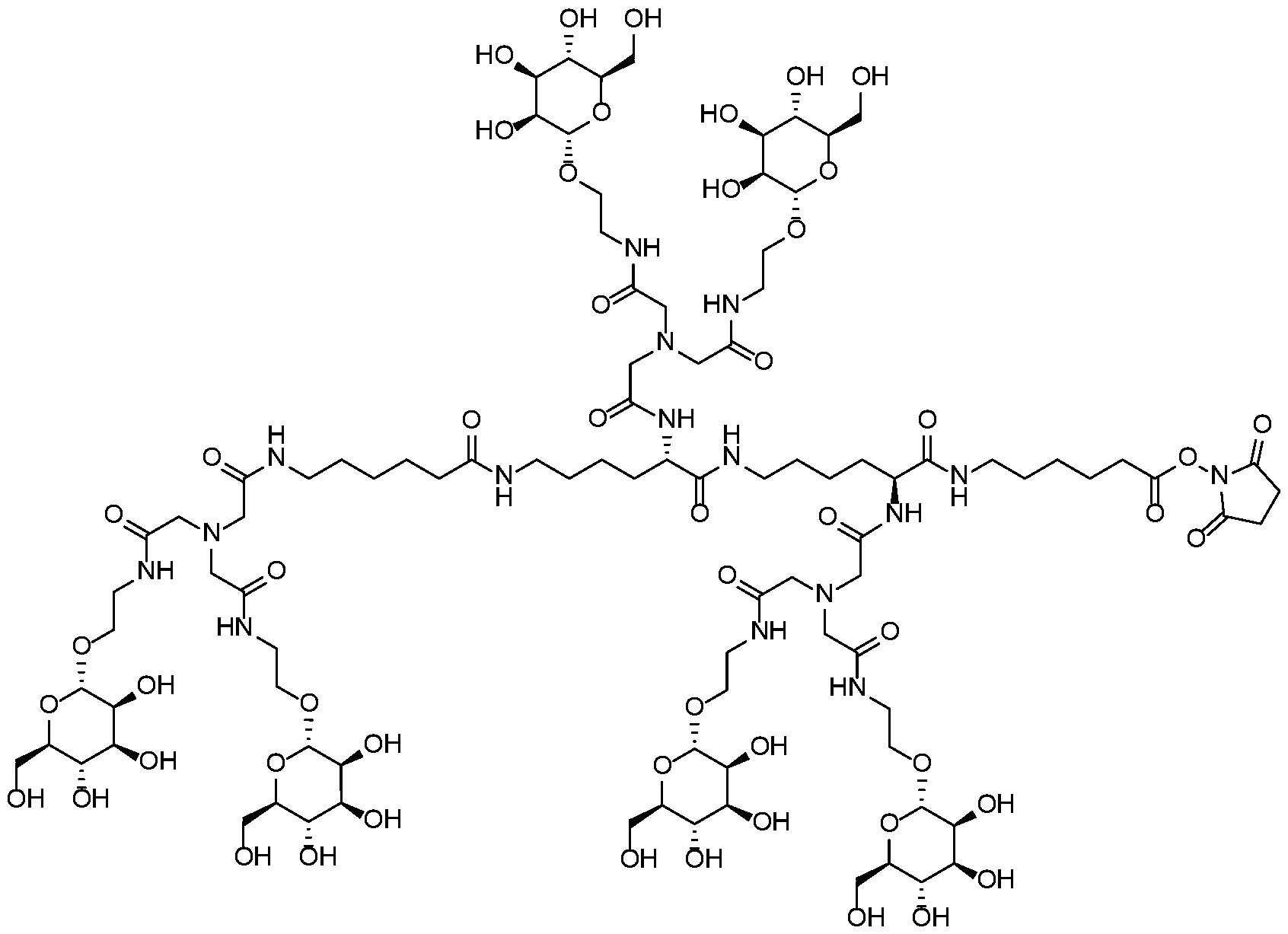
ML-29
Step 1. (S)-l 3-(carboxymethyl)-9-(methoxycarbonyl)-3, 1 l-dioxo-l-phenyl-2-oxa-4, 10, 13- triazapentadecan-15-oic acid
To a solution of H-Lys(Z)-OCH3 HC1 (500mg, 1.51 lmmol) in DMF (5.04mL) at it was added 2-(2,6-dioxomorpholin-4-yl)acetic acid (288mg, 1.663mmol) and TEA (253 pL,
1.814mmol). After stirring for lhr, the reaction was completed, and the title compound was used without further purification. LC-MS Method A: m/z = 467.83 (z = 1); tR = 0.80min.
Step 2. methyl N6-[(benzyloxy)carbonyl]-N2-(bis[2-({2-[(a-D-mannopyranosyl)oxy]
ethyl}amino)-2-oxoethyl]glycyl}-L-lysinate
To a solution of (S)-13-(carboxymethyl)-9-(methoxycarbonyl)-3,l l-dioxo-l-phenyl-2- oxa-4,10, 13-triazapentadecan-15-oic acid (obtained in the previous step) was added a solution of 2-aminoethyl a-D-mannopyranoside (l .Og, 4.49mmol) in DMF (lOmL), HOBt (688mg, 4.49mmol), EDC (861mg, 4.49mmol) and DIPEA (785pL, 4.49mmol). After stirring overnight,
the reaction mixture was concentrated. The title material was isolated by chromatography (120g C18 reverse phase gel column, gradient 0-40%AcCN-water in 30min, flow 85mL/min). UPLC- MS Method A: m/z = 878.43 (z = 1); tR = 2.86min.
Step 3. N6-[(benzyloxy)carbonyl]-N2-{bis[2-({2-[(a-D-mannopyranosyl)oxy]ethyl}amino)-2- oxoethyl ] glycyl}-L-lysine
To a solution of methyl N6-[(benzyloxy)carbonyl]-N2-{bis[2-({2-[(a-D- mannopyranosyl)oxy] ethyl }amino)-2-oxoethyl]glycyl}-L4ysinate (866mg, 0.986mmol) in ThO (4.93mL) was added NaOCH3 (3.94mL, 3.94mmol). As after stirring overnight, the reaction was complete, and the pH of the resulting solution was adjusted to ~ 6.0 and then freeze-dried to give the title compound. UPLC-MS Method A: m/z = 864.4 (z = 1); tR = 2.64min.
Step 4. benzyl (S)-6-(6-{[(benzyloxy)carbonyl]amino}-2-[(tert-butoxycarbonyl)amino] hexanamido )hexanoate
To a mixture of 6-(benzyloxy)-6-oxohexan-l-aminium 4-methylbenzenesulfonate (1.55g, 3.94mmol), Boc-Lys(Z)-OH (l.OOg, 2.63mmol), HOBt (644mg, 4.21mmol) in DMF (13mL) was added EDC (806mg, 4.21mmol) and DIPEA (735pL, 4.21mmol). After stirring overnight, the reaction mixture was concentrated, and the title material was isolated by chromatography (120g Cl 8 reverse phase gel column, gradient 0-80% AcCN/water in 25min followed by hold). UPLC- MS Method A: m/z = 584.48 (z = 1); tR = 1.31min.
Step 5. benzyl (S)-6-(2-amino-6-{[(benzyloxy)carbonyl]amino}hexanamido)hexanoate
To a solution of benzyl (S)-6-(6-{[(benzyloxy)carbonyl]amino}-2-[(tert-butoxycarbonyl) amino]hexanamido)hexanoate (1.244g, 2.131mmol) in DCM (7.10mL) was added TFA
(7.94mL, 107mmol). After stirring for 3hr, the reaction mixture was concentrated. The residue was dissolved in DCM (lOOmL) and washed with saturated NaHCCh. The organic layer was separated, dried over NaiSCL, and concentrated to give the title compound. LC-MS Method A: m/z = 484.38 (z = 1); tR = 0.99min.
Step 6. (S)-l l-(4-{[ (benzyloxy)carbonyl] amino}butyl)-l 5-(carboxymethyl)-3, 10, 13-trioxo-l- phenyl-2-oxa-9, 12, 15-triazaheptadecan-l 7-oic acid
To a solution of benzyl (S)-6-(2-amino-6-{[(benzyloxy)carbonyl]amino}hexanamido) hexanoate (971mg, 2.008mmol) in DMF (lO.OmL) was added 2-(2,6-dioxomorpholino)acetic acid (417mg, 2.409mmol). After stirring for lhr, the reaction was complete, and the title compound was used without further purification. UPLC-MS Method A: m/z = 657.343 (z = 1); tR = 3.41min.
Step 7. benzyl (S)-10-(4-{[(benzyloxy)carbonyl]amino}butyl)-l-[(a-D-mannopyranosyl)oxy]-6-
[2-({2-[(a-D-mannopyranosyl)oxy]ethyl}amino)-2-oxoethyl]-4,8, 1 l-trioxo-3, 6,9, 12- tetraazaoctadecan-18-oate
To the aforementioned solution of (S)-l l-(4-{[(benzyloxy)carbonyl]amino} butyl)-15- (carboxymethyl)-3,10,13-trioxo-l-phenyl-2-oxa-9,12,15-triazaheptadecan-17-oic acid (from Step 6) was added a solution of 2-aminoethyl a-D-mannopyranoside (1.35g, 6.02mmol) in DMF (lO.OmL), HOBt (1.23g, 8.03mmol), EDC (1.16g, 6.02mmol) and DIPEA (2.104mL,
12.05mmol). After stirring overnight, the reaction mixture was concentrated. The title material was isolated by chromatography (120 g C-18 reverse phase gel column, gradient 0-40% AcCN- water over 30min, flow rate 85mL/min). UPLC-MS Method A: m/z = 1067.540 (z = 1); tR = 2.91min.
Step 8. methyl (S)-10-(4-{[(benzyloxy)carbonyl]amino}butyl)-l-[(a-D-mannopyranosyl)oxy]-6- [2-({2-[(a-D-mannopyranosyl)oxy] ethyl}amino)-2-oxoethyl] -4,8, 1 l-trioxo-3, 6,9, 12- tetraazaoctadecan-18-oate
To a solution of benzyl (S)-10-(4-{[(benzyloxy)carbonyl]amino}butyl)-l-[(a-D- mannopyranosyl)oxy]-6-[2-({2-[(a-D-mannopyranosyl)oxy]ethyl}amino)-2-oxoethyl]-4,8,l l- trioxo-3,6,9,12-tetraazaoctadecan-18-oate (1.66g, 1.556mmol) in MeOH (16mL) was added NaOCEE (14mg, 0.078mmol, 30% in MeOH). After stirring overnight, the reaction mixture was concentrated to give the title compound, which was used without further purification. LC-MS Method A: m/z = 991.09 (z = 1); tR = 0.76min.
Step 9. methyl (S)-10-(4-aminobutyl)-l-[(a-D-mannopyranosyl)oxy]-6-[2-({2-[(a-D- mannopyranosyl)oxy] ethyl }amino)-2-oxoethyl J-4, 8, 1 l-trioxo-3, 6, 9, 12-tetraazaoctadecan-18- oate
The pH of a solution of methyl (S)-10-(4-{[(benzyloxy)carbonyl]amino}butyl)-l-[(a-D- mannopyranosyl)oxy]-6-[2-({2-[(a-D-mannopyranosyl)oxy]ethyl}amino)-2-oxoethyl]-4,8,l l- trioxo-3,6,9,12-tetraazaoctadecan-18-oate (from Step 8) in ¾0 (150mL) was adjusted pH to ~7. To this solution was added Pearlman's catalyst (109mg, 0.156mmol). The resulting suspension was shaken on a Parr shaker under 344.74kPa of ¾ overnight. The catalyst was filtered off through a cake of CELITE®, and the filtrate was freeze-dried to give the title compound.
UPLC-MS Method A: m/z = 857.485 (z = 1); tR = 2.00min.
Step 10. methyl (10S,17S)-10-(4-{[(benzyloxy)carbonyl]amino}butyl)-17-(2-{bis[2-({2-[(a-D- mannopyranosyl)oxy]ethyl}amino)-2-oxoethyl]amino}acetamido)-l-[(a-D-mannopyranosyl) oxy]-6-[2-( {2-[(a-D-mannopyranosyl)oxyJ ethyl}amino)-2-oxoethyl] -4, 8,11, 18-tetraoxo- 3, 6, 9, 12, 19-pentaazapentacosan-25-oate
To a solution of N6-[(benzyloxy)carbonyl]-N2-{bis[2-({2-[(a-D-mannopyranosyl)oxy] ethyl}amino)-2-oxoethyl]glycyl}-L-lysine (300mg, 0.309mmol) and methyl (S)-10-(4- aminobutyl)-l-[(a-D-mannopyranosyl)oxy]-6-[2-({2-[(a-D-mannopyranosyl) oxy] ethyl }amino)- 2-oxoethyl]-4,8,l l-trioxo-3,6,9,12-tetraazaoctadecan-18-oate (264mg, 0.309mmol) in DMF (4.4mL) was added HOBt (95mg, 0.617mmol), EDC (118mg, 0.617mmol) and DIPEA (216 pL, 1.235mmol). After stirring overnight, the reaction mixture was concentrated. The title compound was isolated by chromatography (40g C18 reverse phase gel column, gradient 0-40% AcCN/water over 30min., flow rate 40mL/min). UPLC-MS Method A: m/z = 1703.00 (z = 1); tR = 2.74min.
Step 11. methyl (10S,17S)-10-(4-aminobutyl)-17-(2-{bis[2-({2-[(a-D-mannopyranosyl)oxy]ethyl} amino)-2-oxoethyl]amino}acetamido)-l-[(a-D-mannopyranosyl)oxy]-6-[2-( { 2-[(a-D - mannopyranosyl)oxy] ethyl}amino)-2-oxoethyl] -4,8, 11 , 18-tetraoxo-3, 6,9, 12, 19- pentaazapentacosan-25-oate
A mixture of methyl (10S,17S)-10-(4-{[(benzyloxy)carbonyl]amino}butyl)-17-(2-{bis[2- ({2-[(a-D-mannopyranosyl)oxy]ethyl}amino)-2-oxoethyl]amino}acetamido)-l-[(a-D- mannopyranosyl)oxy]-6-[2-({2-[(a-D-mannopyranosyl)oxy]ethyl}amino)-2-oxoethyl]-4,8,l l,18- tetraoxo-3,6,9,12,19-pentaazapentacosan-25-oate (296mg, 0.174mmol) and Pearlman's catalyst (37mg, 0.052mmol) in EhO (20mL) was shaken on a Parr shaker under 344.74kPa of Eh overnight. The catalyst was filtered off through a cake of CELITE®, and the filtrate was freeze- dried to give the title compound. UPLC-MS Method A: m/z = 1568.89 (z = 1); tR = 1.96min.
Step 12. methyl (21S,28S)~21 ,28-bis(2-{bis[2-({2-[(a-D-mannopyranosyl)oxy] ethyl}amino)-2- oxoethyl] amino}acetamido)-l-[(a-D-mannopyranosyl)oxy] -6-[2-( { 2-[(a-D-mannopyranosyl ) oxy] ethyl }amino)-2-oxoethyl ]-4, 8, 15, 22, 29-pentaoxo-3, 6, 9,16,23,3 O-hexaazahexatriacontan-36- oate
To a solution of 6-(2-{bis[2-oxo-2-({2-[(a-D-mannopyranosyl)oxy]ethyl}amino)ethyl] amino}acetamido)hexanoic acid (55mg, 0.077mmol) and methyl (10S,17S)-10-(4-aminobutyl)- 17-(2-{bis[2-({2-[(a-D-mannopyranosyl)oxy]ethyl}amino)-2-oxoethyl]amino} acetamido)-l- [(a-D-mannopyranosyl)oxy]-6-[2-({2-[(a-D-mannopyranosyl)oxy]ethyl}amino)-2-oxoethyl]- 4,8,1 l,18-tetraoxo-3, 6, 9,12, 19-pentaazapentacosan-25-oate (lOOmg, 0.064mmol) in DMF (3.0mL) was added HOBt (20mg, 0.128mmol), DIPEA (45pL, 0.255mmol) and EDC (24mg, 0.128mmol). After stirring overnight, the reaction mixture was concentrated. The title material was isolated by chromatography (C8 reverse phase gel 10pm lOOA, size 250x50mm; solvent A=water/0.05%TFA, solvent B=AcCN/0.05%TF A, Flow=85mL/min, gradient solvent B in
solvent A 0-30% in 30min). UPLC-MS Method A: m/z = 1133.67 (z = 2); tR = 2.22min.
Step 13. (2 IS, 28S)-21, 28-bis(2-(bis[2-( { 2-[(a-D-mannopyranosyl)oxy]ethyl}amino)-2-oxoethyl '] amino}acetamido)-l-[(a-D-mannopyranosyl)oxy]-6-[2-( { 2-[(a-D-mannopyranosyl)oxy] ethyl '} amino)-2-oxoethyl] -4,8, 15,22,29-pentaoxoS, 6,9, 16,23 ,30-hexaazahexatriacontan-36-oic acid To a solution of methyl (21S,28S)-21,28-bis(2-{bis[2-({2-[(a-D-mannopyranosyl)oxy] ethyl}amino)-2-oxoethyl]amino}acetamido)-l-[(a-D-mannopyranosyl)oxy]-6-[2-({2-[(a-D- mannopyranosyl)oxy]ethyl}amino)-2-oxoethyl]-4,8,15,22,29-pentaoxo-3,6,9,16,23,30-hexaaza- hexatriacontan-36-oate (94mg, 0.041mmol) in ThO (l.OmL) was added NaOH (207mL,
0.207mmol, 1M). After stirring for lhr, the pH of the reaction mixture was adjusted to 6.5 and the resulting solution was freeze-dried to give the title compound. UPLC-MS Method A: m/z =
1126.66 (z = 2); tR = 2.29min.
Step 14. 2, 5-dioxopyrrolidin-l-yl (2 IS, 28S)-21, 28-bis(2-(bis[ 2-( {2-[(a-D-mannopyranosyl)oxy] ethyl}amino)-2-oxoethyl]amino}acetamido)-l-[(a-D-mannopyranosyl)oxy]-6-(2-( (2-[ (a-D- mannopyranosyl)oxy]ethyl)amino}-2-oxoethyl)-4, 8, 15, 22,29-pentaoxo-3, 6, 9,16, 23,30- hexaazahexatriacontan-36-oate
To a solution of (21S,28S)-21,28-bis(2-{bis[2-({2-[(a-D-mannopyranosyl)oxy]ethyl} amino)-2-oxoethyl]amino}acetamido)-l-[(a-D-mannopyranosyl)oxy]-6-[2-({2-[(a-D- mannopyranosyl)oxy]ethyl}amino)-2-oxoethyl]-4,8,15,22,29-pentaoxo-3,6,9,16,23,30- hexaazahexatriacontan-36-oic acid (121mg, 0.054mmol) in DMF (1.075mL) at 0°C was added TSTU (24mg, 0.081mmol) and DIPEA (14pL, 0.081mmol). After stirred for lhr, the reaction mixture was added dropwise to a mixture of ether/acetone (v/v = 1/1, 20mL). The precipitate was collected by centrifugation and dried to give the title compound. UPLC-MS Method A: m/z = 1175.170 (z = 2); tR = 2.42min.
EXAMPLE 30: 2, 5-dioxopyrrolidin-l-yl (21S,28S)-21,28-bis(2-{bis[2-({2-[(a-L- fucopyranosyl)oxy] ethyl} amino)-2-oxoethyl] amino} acetamido)-l - [(a-L-fucopyranosyl)oxy] - 6-(2-({2-[(a-L-fucopyranosyl)oxy]ethyl)amino}-2-oxoethyl)-4,8,15,22,29-pentaoxo- 3,6,9,16,23,30-hexaazahexatriacontan-36-oate (ML-30)

ML-30
The title compound was prepared using procedures analogous to those described for ML- 29 substituting 6-aminoethyl a-L-fucopyranoside for 6-aminoethyl a-D-mannopyranoside in Step 2, 6-aminoethyl a-L-fucopyranoside for 6-aminoethyl a-D-mannopyranoside in Step 7, and 6-(2-{bis[2-oxo-2-({2-[(a-L-fucopyranosyl)oxy]ethyl}amino) ethyl]amino}acetamido)hexanoic acid for 6-(2-{bis[2-oxo-2-({2-[(a-D-mannopyranosyl) oxy]ethyl}amino)ethyl]amino} acetamido)hexanoic acid in Step 12, respectively. UPLC-MS Method A: m/z = 1126.685 (z =
2); tR = 2.86min.
EXAMPLE 31: 2,5-dioxopyrrolidin-l-yl (14S,17S)-14-(2-{bis[2-({2-[(a-L-fucopyranosyl) oxy] ethyl} amino)-2-oxoethyl] amino} acetamido)- 17- [4-(2- {bis [2-({2- [(a-L-fucopyranosyl) oxy] ethyl} amino)-2-oxoethyl] amino} acetamido)butyl] - 1- [(a-L-fucopyr anosyl)oxy] -6- [2-({2- [(a-L-fucopyranosyl)oxy]ethyl}amino)-2-oxoethyl]-4,8,15,18-tetraoxo-3,6,9,16,19- pentaazapentacosan-25-oate (ML-31)

ML-31
Step 1. bis[2-({2-[( a -L-fucopyranosyl)oxy]ethyl}amino)-2-oxoethyl] glycine
To a solution of 2-(2,6-dioxomorpholino)acetic acid (200mg, 1.155mmol) in DMF (5.776mL) at 0°C was added TSTU (348mg, 1.155mmol) and, after 5min, DIPEA (202pL,
1.155mmol). After stirring for 45min, to the reaction mixture was added 2-aminoethyl a-L- fucopyranoside hydrobromide (666mg, 2.310mmol) and DIPEA (1.21 lmL, 6.93mmol). After stirring overnight, the reaction mixture was concentrated. The title material was isolated by chromatography (40g S1O2, flow rate 35mL/min, gradient solvent A - solvent B of 0-100% solvent B in 20min followed by hold, solvent A was EtOAc/MeOH/AcCN/tEO (v/v/v/v =
6/1/1/1), and solvent B was EtOAc/MeOH/AcCN/tEO (v/v/v/v = 2/1/1/1). UPLC-MS Method A: m/z = 570.287 (z = 1); tR = 1.17min.
Step 2. 2,5-dioxopyrrolidin-l-yl (14S,17S)-14-(2-(bis[2-({2-[(a-L-fucopyranosyl)oxy]ethyl} amino)-2-oxoethyl]amino}acetamido)-17-[4-(2-{bis[2-({2-[(a-L-fucopyranosyl)oxy] ethyl} amino)-2-oxoethyl] amino}acetamido)butyl] -l-[ (a-L-fucopyranosyl)oxy] -6-[2-( { 2-[(a-L - fucopyranosyl)oxy] ethyl}amino)-2-oxoethyl] -4,8, 15, 18-tetraoxo-3, 6,9, 16, 19- pentaazapentacosan-25-oate
The title compound was prepared using procedures analogous to those described for ML- 7 substituting bis[2-({2-[(a-L-fucopyranosyl)oxy]ethyl}amino)-2-oxoethyl]glycine for 6-[(2,5- Dioxopyrrolidin-l-yl)oxy]-N-(2-{[a-D-mannopyranosyl-(l 3)-[a-D-mannopyranosyl-(l 6)]- a-D-mannopyranosyl]oxy}ethyl)-6-oxohexanamide in Step D. UPLC-MS Method A: m/z = 1070.61 (z = 2); tR = 3.43min.
EXAMPLE 32: 2,5-dioxopyrrolidin-l-yl (14S,19S)-14,19-bis{[6-(bis{2-[(a-D- mannopyranosyl)oxy]ethyl}amino)-6-oxohexyl] carbamoyl}-l-[(a-D-mannopyranosyl)oxy]- 3-{2-[(a-D-mannopyranosyl)oxy]ethyl}-4, 11,16, 21, 24-pentaoxo-3, 10, 15, 20,23- pentaazanonacosan-29-oate (ML-32)

The title compound was prepared using procedures analogous to those described for ML- 1 substituting H-Gly-yGlu-Glu-OH for H-Glu-Asp-OH in Step 1 and 6-amino-N,N-bis{2-[(a-D- mannopyranosyl)oxy]ethyl}hexanamide for 2-aminoethyl a-D-mannopyranoside in Step 2, respectively. UPLC-MS Method A: m/z = 1066.996 (z = 2); tR = 4.01min.
EXAMPLE 33: 2,5-dioxopyrrolidin-l-yl (12S,15S,18S)-15,18-bis(3-{[6-(bis{2-[(a-D- mannopyranosyl)oxy]ethyl}amino)-6-oxohexyl]amino}-3-oxopropyl)-l-[(a-D- mannopyranosyl)oxy]-3-{2-[(a-D-mannopyranosyl)oxy]ethyl}-12-isobutyl-4,ll,14,17,20- pentaoxo-3,10,13,16,19-pentaazapentacosan-25-oate (ML-33)

ML-33
The title compound was prepared using procedures analogous to those described for ML- 4 substituting 6-amino-N,N-bis{2-[(a-D-mannopyranosyl)oxy]ethyl}hexanamide for 6-amino-N- [2-({a-D-mannopyranosyl-(l 3)-[a-D-mannopyranosyl-(l 6)]-a-D-mannopyranosyl}oxy) ethyljhexanamide in Step 2. UPLC-MS Method A: m/z = 1095.042 (z = 2); tR = 3.96min.
EXAMPLE 34: 2,5-dioxopyrrolidin-l-yl (17S,22S)-l-[(a-L-fucopyranosyl)oxy]-17,22-bis[(6- {[2-({2-[(a-L-fucopyranosyl)oxy]ethyl}amino)-2-oxoethyl] [2-oxo-2-({2-[(a-D- mannopyranosyl)oxy]ethyl}amino)ethyl]amino}-6-oxohexyl)carbamoyl]-4,7,14,19,24,27- hexaoxo-6-[2-oxo-2-({2-[(a-D-mannopyranosyl)oxy]ethyl}amino)ethyl]-3,6,13, 18,23,26- hexaazadotriacontan-32-oate (ML-34)

ML-34
Step 1. tert-butyl N-{[(9H-fluoren-9-yl)methoxy]carbonyl}-N-[2-({2-[(a-L-fucopyranosyl)oxy] ethyl }amino)-2-oxoethyl ]glycinate
To a solution of Fmoc-N-(tert-butyloxycarbonylmethyl)-glycine (4.98g, 12.1 lmmol) in
DMF (25mL) at 0°C was added EDC (3.48g, 18.17mmol), HOBt (557mg, 3.63mmol) and, after 30min, 2-aminoethyl a-L-fucopyranoside (2.761g, 13.32mmol). The mixture was gradually warmed up to rt and stirred overnight. The reaction mixture was concentrated, and the residue was purified by column chromatography on 240g C18 reverse phase silica gel, eluting with AcCN/FhO (gradient from 0% to 50% in 20 CV), to give the title compound. UPLC-MS Method A: m/z = 601.347 (z = 1); tR = 4.35.
Step 2. N-{[ (9H-fluoren-9-yl)methoxy]carbonyl}-N-[2-( {2-[(a-L-fucopyranosyl)oxy] ethyl} amino)-2-oxoethyl] glycine
To a solution of tert-butyl N-{[(9H-fluoren-9-yl)methoxy]carbonyl}-N-[2-({2-[(a-L- fucopyranosyl)oxy]ethyl}amino)-2-oxoethyl]glycinate (2. lOg, 3.50mmol) in DCM (20mL) at rt was added TFA (20mL, 260mmol). After stirring at 0°C for 3hr, the reaction mixture was concentrated. The residue was purified by column chromatography on 130g Cl 8 reverse phase
silica gel, eluting with ACCN/H2O (gradient from 0% to 45% in 20 CV), to give the title compound. UPLC-MS Method A: m/z = 545.29 (z = 1); tR = 3.31min.
Step 3. (9H-fluoren-9-yl)methyl [2-({2-[(a-L-fucopyranosyl)oxy] ethyl}amino)-2-oxoethyl] [2- oxo-2-({2-[(a-D-mannopyranosyl)oxy]ethyl}amino)ethyl] carbamate
To a solution of N-{[(9H-fluoren-9-yl)methoxy]carbonyl}-N-[2-({2-[(a-L- fucopyranosyl)oxy]ethyl}amino)-2-oxoethyl]glycine (1.57g, 2.88mmol) in DMF (25mL) at 0°C was added EDC (829mg, 4.32mmol), HOBt (132mg, 0.865mmol) and, after 30min, 2- aminoethyl a-D-mannopyranoside (772mg, 3.46mmol). The mixture then was gradually warmed up to rt and stirred overnight. The reaction mixture was concentrated, and the residue was purified by column chromatography on 240g Cl 8 reverse phase silica gel, eluting with
AcCN/FhO (gradient from 0% to 40% in 20 CV), to give the title compound. UPLC-MS Method A: m/z = 750.394 (z = 1); tR = 2.87min.
Step 4. N-{2-[(a-L-fucopyranosyl)oxy]ethyl}-2-{[2-oxo-2-( {2-[(a-D-mannopyranosyl)oxy] ethyl} amino) ethyl] amino}acetamide
To a solution of (9H-fluoren-9-yl)methyl [2-({2-[(a-L-fucopyranosyl)oxy]ethyl}amino)- 2-oxoethyl][2-oxo-2-({2-[(a-D-mannopyranosyl)oxy]ethyl}amino)ethyl]carbamate (4.00g, 5.34mmol) in DMF (60mL) was added piperidine (3.42mL, 34.5mmol). After stirring at rt for 30min, the mixture was concentrated, and the residue was purified by column chromatography on 130g Cl 8 reverse phase silica gel, eluting with AcCN/FhO (gradient from 0% to 30% in 10 CV), to give the title compound. UPLC-MS Method A: m/z = 528.264 (z = 1); tR = l. lOmin.
Step 5. benzyl (6-{[2-({2-[(a-L-fucopyranosyl)oxy]ethyl}amino)-2-oxoethyl] [2-oxo-2-({2-[(a-D- mannopyranosyl)oxy]ethyl}amino)ethyl]amino}-6-oxohexyl)carbamate
To a solution of N-{2-[(a-L-fucopyranosyl)oxy]ethyl}-2-{[2-oxo-2-({2-[(a-D- mannopyranosyl)oxy]ethyl}amino)ethyl]amino}acetamide (2.70g, 5.12mmol) in DMF (40mL) at 0°C was added 2,5-dioxopyrrolidin-l-yl 6-{[(benzyloxy)carbonyl]amino}hexanoate (2.41g, 6.19mmol) in DMF (20mL) portionwise over a period of 15min and then TEA (1.077mL, 7.73mmol) dropwise over a period of lOmin. After stirring at rt for 48hr, the mixture was concentrated, and the residue was purified by column chromatography on 240g Cl 8 reverse phase silica gel, eluting with AcCN/FbO (gradient from 0% to 60% in 20 CV), to give the title compound. UPLC-MS Method A: m/z = 775.392 (z = 1); tR = 2.85min.
Step 6. 6-amino-N-[2-( { 2-[(a-L-fucopyranosyl)oxy]ethyl}amino)-2-oxoethyl ]-N-[2-oxo-2-( {2- [(a-D-mannopyranosyl)oxy]ethyl}amino)ethyl]hexanamide
To a solution of benzyl (6-{[2-({2-[(a-L-fucopyranosyl)oxy]ethyl}amino)-2-oxoethyl][2-
oxo-2-({2-[(a-D-mannopyranosyl)oxy]ethyl}amino)ethyl]amino}-6-oxohexyl) carbamate (1.85g, 2.388mmol) in H2O (35mL) was added Pd/C (254mg, 0.239mmol). The resulting solution was degassed and stirred under Eh at rt for 6hr. The catalyst was filtered off through a cake of CELITE®, and the filtrate was freeze-dried to give the title compound. EIPLC-MS Method A: m/z = 641.353 (z = 1); tR = l. lOmin.
Step 7. 2,5-dioxopyrrolidin-l-yl (17S,22S)-l-[(a-L-fucopyranosyl)oxy]-17,22-bis[(6-{[2-({2-[(a- L-fucopyranosyl)oxy] ethyl }amino)-2-oxoethyl / [ 2-oxo-2-( (2-[ ( a-D-mannopyranosyl)oxy] ethyl } amino) ethyl] amino} -6-oxohexyl) carbamoyl] -4, 7, 14, 19, 24,27 -hexaoxo-6-[2-oxo-2-( {2-[(a-D- mannopyranosyl)oxy] ethyl}amino) ethyl] -3, 6, 13, 18,23,26-hexaazadotriacontan-32-oate
The title compound was prepared using procedures analogous to those described for ML-
1 substituting H-Gly-yGlu-Glu-OH for H-Glu-Asp-OH in Step 1 and 6-amino-N-[2-({2-[(a-L- fucopyranosyl)oxy]ethyl}amino)-2-oxoethyl]-N-[2-oxo-2-({2-[(a-D-mannopyranosyl)oxy] ethyl }amino)ethyl]hexanamide for 2-aminoethyl a-D-mannopyranoside in Step 2, respectively. UPLC-MS Method A: m/z = 1214.115 (z = 2); tR = 2.01min.
EXAMPLE 35: 2,5-dioxopyrrolidin-l-yl (14S,19S)-19-[(6-{bis[2-({2-[(a-L-fucopyranosyl) oxy] ethyl} amino)-2-oxoethyl] amino} -6-oxohexyl) carbamoyl] - 14- {[6-(bis {2- [(a-D- mannopyranosyl)oxy]ethyl}amino)-6-oxohexyl]carbamoyl}-4,ll,16,21,24-pentaoxo-l-[(a-D- mannopyranosyl)oxy]-3-{2-[(a-D-mannopyranosyl)oxy]ethyl}-3,10,15,20,23- pentaazanonacosan-29-oate (ML-35)

Step 1. benzyl [5-(2-{bis[2-({2-[(a-L-fucopyranosyl)oxy]ethyl}amino)-2-oxoethyl] amino} acetamido )pentyl ] carbamate
To a solution of 13-(carboxymethyl)-3,l l-dioxo-l-phenyl-2-oxa-4,10,13- triazapentadecan-15-oic acid (l.OOg, 2.442mmol) in DMF (30mL) at 0°C was added EDC ( 1.41 g, 7.33mmol), HOBt (224mg, 1.465mmol) and after 30min, 2-aminoethyl a-L- fucopyranoside (1.22g, 5.86mmol). The mixture then was gradually warmed up to rt, stirred overnight, and then concentrated. The residue was purified by column chromatography on 150g Cl 8 reverse phase silica gel, eluting with AcCN/ThO (gradient from 0% to 50% in 25 CV), to give the title compound. UPLC-MS Method A: m/z = 788.453 (z = 1); tR = 2.99min.
Step 2. 2,2'-({2-[(5-aminopentyl)amino]-2-oxoethyl}azanediyl)bis(N-{2-[(a-L-fucopyranosyl) oxy] ethyl}acetamide)
To a solution of benzyl [5-(2-{bis[2-({2-[(a-L-fucopyranosyl)oxy]ethyl}amino)-2- oxoethyl]amino}acetamido)pentyl]carbamate (1.4 lg, 1.788mmol) in ThO (20mL) was added Pd/C (190mg, 0.179mmol). The resulting mixture was degassed and stirred under ¾ at rt for
4hr. The catalyst was filtered off through a cake of CELITE®, and the filtrate was freeze-dried to give the title compound. EIPLC-MS Method A: m/z = 654.39 (z = 1); tR = 1.06min.
Step 3. 2,5-dioxopyrrolidin-l-yl (14S,19S)-19-[(6-(bis[2-({2-[(a-L-fucopyranosyl)oxy]ethyl} amino)-2-oxoethyl]amino}-6-oxohexyl)carbamoyl ]-14-{[ 6-(bis{2-[(a-D-mannopyranosyl)oxy] ethyl }amino)-6-oxohexyl ]carbamoyl}-4, 11, 16,21, 24-pentaoxo-l-[ ( '/-D-mtu it lopyrcu losyl ) oxy/ -3-
{2-[(a-D-mannopyranosyl)oxy]ethyl}-3, 10, 15,20,23-pentaazanonacosan-29-oate
The title compound was prepared using procedures analogous to those described for ML- 5 substituting 2,2'-({2-[(5-aminopentyl)amino]-2-oxoethyl}azanediyl)bis(N-{2-[(a-L- fucopyranosyl)oxy]ethyl}acetamide) for 6-amino-N-[2-({a-D-mannopyranosyl-(l 3)-[a-D- mannopyranosyl-(l 6)]-a-D-mannopyranosyl}oxy)ethyl]hexanamide in Step 4. EIPLC-MS Method A: m/z = 1122.603 (z = 2); tR = 2.07min.
EXAMPLE 36: 2,5-dioxopyrrolidin-l-yl (S)-28-((S)-21-[6-(2-{bis[2-({2-[(a-D- mannopyranosyl)oxy]ethyl}amino)-2-oxoethyl]amino}acetamido) hexanamido]-l-[(a-D- mannopyranosyl)oxy]-6-[2-({2-[(a-D-mannopyranosyl)oxy]ethyl}amino)-2-oxoethyl]-4,8,15- trioxo-3,6,9,16-tetraazadocosan-22-amido)-l-[(a-D-mannopyranosyl)oxy]-6-[2-({2-[(a-D- mannopyranosyl)oxy]ethyl}amino)-2-oxoethyl]-4,8,15,22,29-pentaoxo-3,6,9,16, 23,30- hexaazahexatriacontan-36-oate (ML-36)

ML-36
The title compound was prepared using procedures analogous to those described for ML- 7 substituting 2,5-dioxopyrrolidin-l-yl 6-(2-{bis[2-({2-[(a-D-mannopyranosyl)oxy]ethyl} amino)-2-oxoethyl]amino}acetamido)hexanoate for 6-[(2,5-dioxopyrrolidin-l-yl)oxy]-N-(2-{[a- D-mannopyranosyl-(l 3)-[a-D-mannopyranosyl-(l 6)]-a-D-mannopyranosyl]oxy} ethyl)-6- oxohexanamide in Step 4. UPLC-MS Method A: m/z = 1288.2451 (z = 2); tR = 3.53min.
EXAMPLE 37: 2,5-dioxopyrrolidin-l-yl (S)-l-[(a-L-fucopyranosyl)oxy]-28-{(S)-l-[(a-L- fucopyranosyl)oxy]-21-[6-(2-{[2-({2-[(a-L-fucopyranosyl) oxy]ethyl}amino)-2-oxoethyl][2- oxo-2-({2-[(a-D-mannopyranosyl)oxy]ethyl}amino)ethyl] amino}acetamido)hexanamido]- 4,8, 15-trioxo-6-[2-oxo-2-({2-[(a-D-mannopyranosyl)oxy] ethyl} amino)ethyl]-3,6,9,16- tetraazadocosan-22-amido}-4,8,15,22,29-pentaoxo-6-[2-oxo-2-({2-[(a-D-mannopyranosyl)
oxy] ethyl} amino)ethyl] -3, 6, 9,16,23,30-hexaazahexatriacontan-36-oate (ML-37)

ML-37
The title compound was prepared using procedures analogous to those described for ML- 7 substituting 2, 5-di ox opyrrolidin-l-yl 6-(2-{[2-({2-[(a-L-fucopyranosyl)oxy]ethyl} amino)-2- oxoethyl][2-oxo-2-({2-[(a-D-mannopyranosyl)oxy]ethyl}amino)ethyl]amino}acetamido) hexanoate for 6-[(2,5-dioxopyrrolidin-l-yl)oxy]-N-(2-{[a-D-mannopyranosyl-(l 3)-[a-D- mannopyranosyl-(l 6)]-a-D-mannopyranosyl]oxy}ethyl)-6-oxohexanamide in Step 4. UPLC- MS Method A: m/z = 1264.2667 (z = 2); tR = 3.85min.
EXAMPLE 38: 2,5-dioxopyrrolidin-l-yl (7S,12S,17S,22S,27S)-l-[(a-L-fucopyranosyl)oxy]- 7,12,17,22,27-pentakis({2-[(a-L-fucopyranosyl)oxy]ethyl} carbamoyl)-4,9,14,19,24,29- hexaoxo-3,8,13,18,23,28-hexaazatetratriacontan-34-oate (ML-38)

ML-38
The title compound was prepared using procedures analogous to those described for ML- 1 substituting isoGlu-isoGlu-isoGlu-isoGlu-isoGlu for H-Glu-Asp-OH in Step 1 and 2- aminoethyl a-L-fucopyranoside for 2-aminoethyl a-D-mannopyranoside in Step 2, respectively. UPLC-MS Method A: m/z = 1012.975 (z = 2); tR = 2.00min.
EXAMPLE 39: 2,5-dioxopyrrolidin-l-yl (14S,19S,24S)-14,19,24-tris{[6-(bis{2-[(a-D- mannopyranosyl)oxy]ethyl}amino)-6-oxohexyl]carbamoyl}-l-[(a-D-mannopyranosyl)oxy]- 3-{2-[(a-D-mannopyranosyl)oxy]ethyl}-4, 11,16, 21, 26-pentaoxo-3, 10, 15, 20,25- pentaazahentriacontan-31-oate (ML-39)

ML-39
The title compound was prepared using procedures analogous to those described for ML- 1 substituting isoGlu-isoGlu-isoGlu for H-Glu-Asp-OH in Step 1 and 6-amino-N,N-bis{2-[(a-D- mannopyranosyl)oxy]ethyl}hexanamide for 2-aminoethyl a-D-mannopyranoside in Step 2, respectively. UPLC-MS Method A: m/z = 1365.14 (z = 2); tR = 4.16min.
EXAMPLE 40: 2,5-dioxopyrrolidin-l-yl (7S,14S,17S, 20S)-17,20-bis({3-{[(S)-5-{bis[2-({2- [(a-D-mannopyranosyl)oxy]ethyl}amino)-2-oxoethyl] amino}-6-({2-[(a-D-mannopyranosyl) oxy]ethyl}amino)-6-oxohexyl]amino}-3-oxopropyl)-l-[(a-D-mannopyranosyl)oxy]-6-[2-({2- [(a-D-mannopyranosyl)oxy]ethyl}amino)-2-oxoethyl]-7-({2-[(a-D-mannopyranosyl)oxy] ethyl}carbamoyl)-14-isobutyl-4,13,16,19,22-pentaoxo-3,6,12, 15^18^21-hexaazaheptacosan-
27-oate (ML-40)

ML-40
Step 1. N6-[ (benzyloxy)carbonyl]-N-[2-(a-D-mannopyranosyloxy)ethyl]-N2,N2-bis[2-( (2-[ (a-D- mannopyranosyl)oxy] ethyl}amino)-2-oxoethyl] -L-lysinamide
To a solution of N6-[(benzyloxy)carbonyl]-N2,N2-bis(carboxymethyl)-L-lysine (l.Og,
2.52mmol) in DMF (15mL) at rt was added a solution of 2-aminoethyl a-D-mannopyranoside (2.48g, 11. lOmmol) in ThO (2mL) and HOBt (1.78g, 11.60mmol). The mixture was cooled to 0°C and EDC (2.23g, 11.60mmol) was added. After stirring at 0°C for 1.5hr, the resulting solution was stirred at rt for 48hr. The mixture was concentrated, and the residue was purified on 120g Cl 8 reverse phase silica gel column, eluting with 0-30% AcCN in ThO. The desired fractions were combined and freeze-dried to afford the title compound. UPLC-MS Method D: m/z = 1012.32 (z = 1); tR= 3.78min.
Step 2. N-{2-[ ( a-D-mannopyranosyl)oxy]ethyl}-N2,N2-bis[ 2-( (2-[ ( a-D-mannopyranosyl)oxy]
ethyl}amino)-2-oxoethyl]-L-lysinamide
To a solution of N6-[(benzyloxy)carbonyl]-N-{2-[(a-D-mannopyranosyl)oxy] ethyl}- N2,N2-bis[2-({2-[(a-D-mannopyranosyl)oxy]ethyl}amino)-2-oxoethyl]-L-lysinamide (700mg, 0.69mmol) in H2O (15mL) was added Pd/C (150mg, 0.14mmol). The mixture was stirred under H2 at rt for 16hr. The catalyst was filtered off through CELITE®, and the filtrate was freeze- dried to afford the title product. EIPLC-MS Method D: m/z = 878.28 (z = 1); tR = 3.64min.
Step 3. 2,5-dioxopyrrolidin-l-yl (7S,14S, 17S,20S)-17,20-bis({3-{[(S)-5-{bis[2-({2-[(a-D- mannopyranosyl)oxy] ethyl}amino)-2-oxoethyl] amino}-6-({2-[(a-D-mannopyranosyl)oxy] ethyl} amino)-6-oxohexyl]amino}-3-oxopropyl)-l-[(a-D-mannopyranosyl)oxy]-6-[2-( { 2-[(a-D - mannopyranosyl)oxy] ethyl }amino)-2-oxoethyl /- 7 -( (2-[ ( a-D-mannopyranosyl)oxy] ethyl } carbamoyl)-l 4-isobutyl-4, 13, 16, 19, 22-pentaoxo-3, 6, 12, 15, 18, 2 l-hexaazaheptacosan-27-oate
The title compound was prepared using procedures analogous to those described for ML- 4 substituting N-{2-[(a-D-mannopyranosyl)oxy]ethyl}-N2,N2-bis[2-({2-[(a-D-mannopyranosyl) oxy]ethyl}amino)-2-oxoethyl]-L-lysinamide for 2-({a-D-mannopyranosyl-(l 3)-[a-D- mannopyranosyl-(l 6)]-a-D-mannopyranosyl}oxy)ethan-l -amine in Step 2. EIPLC-MS Method A: m/z = 1597.674 (z = 2); tR = 4.01min.
EXAMPLE 41: 2,5-dioxopyrrolidin-l-yl (7S,14S,17S, 20S)-17,20-bis({3-{[(S)-5-{bis[2-({2- [(a-D-glucopyranosyl)oxy]ethyl}amino)-2-oxoethyl] amino}-6-({2-[(a-D-glucopyranosyl) oxy]ethyl}amino)-6-oxohexyl]amino}-3-oxopropyl)-l-[(a-D-glucopyranosyl)oxy]-6-[2-({2- [(a-D-glucopyranosyl)oxy]ethyl}amino)-2-oxoethyl]-7-({2-[(a-D-glucopyranosyl)oxy]ethyl} carbamoyl)-14-isobutyl-4,13,16,19,22-pentaoxo-3,6,12,15,18,21-hexaazaheptacosan-27-oate (ML-41)

ML-41
The title compound was prepared using procedures analogous to those described for ML- 40 substituting 2-aminoethyl a-D-glucopyranoside for 2-aminoethyl a-D-mannopyranoside in Step 1. UPLC-MS Method A: m/z = 1597.710 (z = 2); tR = l.l lmin.
EXAMPLE 42: 2,5-dioxopyrrolidin-l-yl (7S,24S,27S)-24-(6-{[(S)-5-{bis[2-({2-[(a-L- fucopyranosyl)oxy]ethyl}amino)-2-oxoethyl]amino}-6-({2-[(a-L-fucopyranosyl)oxy]ethyl} amino)-6-oxohexyl]amino}-6-oxohexanamido)-l-[(a-L-fucopyranosyl) oxy]-27-{(S)-l-[(a-L- fucopyranosyl)oxy]-6-[2-({2-[(a-L-fucopyranosyl)oxy]ethyl}amino)-2-oxoethyl]-7-({2-[(a-L- fucopyranosyl)oxy]ethyl}carbamoyl)-4,13,18-trioxo-3,6,12,19-tetraazatricosan-23-yl}-6-[2- ({2-[(a-L-fucopyranosyl)oxy]ethyl}amino)-2-oxoethyl]-7-({2-[(a-L-fucopyranosyl)oxy]ethyl}
carbamoyl)-4,13,18,25,28-pentaoxo-3,6,12,19,26,29-hexaazapentatriacontan-35-oate

42)

ML-42
Step 1. N6-[(benzyloxy)carbonyl]-N-[2-(a-L-fucopyranosyloxy)ethyl]-N2,N2-bis[2-({2-[(a-L- fucopyranosyl)oxy] ethyl}amino)-2-oxoethyl] -L-lysinamide
To a solution of N6-[(benzyloxy)carbonyl]-N2,N2-bis(carboxymethyl)-L-lysine (600mg, 1.514mmol) in DMF (20mL) at it was added a solution of 2-aminoethyl a-L-fucopyranoside (1.19g, 5.75mmol) in H2O (2mL) and DMAP (758mg, 6.21mmol). The mixture was cooled to 0°C and EDC (1.39g, 7.27mmol) was added. After stirring at 0°C for 1.5hr, the resulting solution was stirred at rt for 16hr. The mixture was concentrated, and the residue was purified on 50g C18 reverse phase silica gel column, eluting with EtOAc/MeOH/ AcCN/FhO (v/v/v/v = 4/1/1/1), to give an enriched material, which was further purified on HPLC (C4 column, 250x50mm, 27%-33% AcCN with 0.1%TFA in water with 0.1% TFA over 30min) to give the
title compound. UPLC-MS Method D: m/z = 964.529 (z = 1); tR= 2.52min.
Step 2. N-{2-[ ( a-L-fucopyranosyl)oxy]ethyl}-N2,N2-bis[ 2-( (2-[ ( a-L-fucopyranosyl)oxy] ethyl } amino)-2-oxoethyl] -L-lysinamide
To a solution of N6-[(benzyloxy)carbonyl]-N-{2-[(a-L-fucopyranosyl)oxy] ethyl}- N2,N2-bis[2-({2-[(a-L-fucopyranosyl)oxy]ethyl}amino)-2-oxoethyl]-L-lysinamide (3.0g, 3.11mmol) in EbO (50mL) was added Pd(OH)2 (219mg, 0.311mmol). The mixture was degassed and shaken on a Parr shaker under 344.74kPa Eh at rt overnight. The catalyst was filtered off through CELITE®, and the filtrate was freeze-dried to afford the title product. UPLC Method D: m/z = 830.54 (z = 1); tR = 1.09min.
Step 3. benzyl (S)-6-{[5-(bis[2-({2-[(a-L-fucopyranosyl)oxy]ethyl}amino)-2-oxoethyl]amino}-6- ({2-[(a-L-fucopyranosyl)oxy]ethyl}amino)-6-oxohexyl]amino}-6-oxohexanoate
To a solution of N-{2-[(a-L-fucopyranosyl)oxy]ethyl}-N2,N2-bis[2-({2-[(a-L- fucopyranosyl)oxy]ethyl}amino)-2-oxoethyl]-L-lysinamide (2.66g, 3.21mmol) and 6- (benzyloxy)-6-oxohexanoic acid (909mg, 3.85mmol) in DMF (16mL) was added sequentially DIPEA (1.679mL, 9.62mmol), HOBt (589mg, 3.85mmol) and EDC (737mg, 3.85mmol). After stirring overnight, the reaction mixture was concentrated, and the residue was purified on 120g SiCh column (flow rate lOOmL/min, gradient solvent A - solvent B of 0-100% solvent B in 30min followed by hold, where solvent A was EtOAc, and solvent B was EtOAc/MeOH/AcCN/ H2O (v/v/v/v = 6/1/1/1), to give the title compound. UPLC-MS Method A: m/z = 1048.6133 (z = 1); tR = 2.72.
Step 4. (S)-6-{[5-(bis[2-({2-[(a-L-fucopyranosyl)oxy]ethyl}amino)-2-oxoethyl]amino}-6-({2-[(a- L-fucopyranosyl)oxy]ethyl}amino)-6-oxohexyl]amino}-6-oxohexanoic acid
To a solution of benzyl (S)-6-{[5-{bis[2-({2-[(a-L-fucopyranosyl)oxy]ethyl} amino)-2- oxoethyl]amino}-6-({2-[(a-L-fucopyranosyl)oxy]ethyl}amino)-6-oxohexyl]amino}-6- oxohexanoate (2.4g, 2.290mmol) in H2O (23mL) and added aq. NaOH (687pL, 3.43mmol, 5.0M). After stirring overnight, the reaction mixture was neutralized to pH ~ 6 with 1M HC1 and freeze-dried to give the title compound. UPLC-MS Method A: m/z = 958.5002 (z = 1); tR = 1.71min.
Step 5. benzyl (7S,24S,27S)-24-(6-{[(S)-5-{bis[2-({2-[(a-L-fucopyranosyl)oxy]ethyl}amino)-2- oxoethyl]amino}-6-({2-[(a-L-fucopyranosyl)oxy]ethyl}amino)-6-oxohexyl]amino}-6- oxohexanamido)-l-[(a-L-fucopyranosyl)oxy]-27-{(S)-l-[(a-L-fucopyranosyl)oxy]-6-[2-( { 2-[(a - L-fucopyranosyl)oxy] ethyl}amino)-2-oxoethyl] -7-({2-[(a-L-fucopyranosyl)oxy] ethyl}
carbamoyl)-4, 13, 18-trioxo-3, 6, 12, 19-tetraazatricosan-23-yl}-6-[2-( { 2-[(a-L-fucopyranosyl)oxy }
ethyl }amino)-2-oxoethyl /- 7 -( {2-[ ( a-L-fucopyranosyl)oxy]ethyl}carbamoyl)-4, 13,18, 25, 28- pentaoxo-3, 6, 12, 19,26, 29-hexaazapentatriacontan-35-oate
To a solution of (S)-6-{[5-{bis[2-({2-[(a-L-fucopyranosyl)oxy]ethyl}amino)-2-oxoethyl] amino}-6-({2-[(a-L-fucopyranosyl)oxy]ethyl}amino)-6-oxohexyl]amino}-6-oxohexanoic acid (501mg, 0.523mmol) and benzyl 6-((S)-6-amino-2-[(S)-2,6-diaminohexan-amido)hexanamido] hexanoate (50mg, 0.105mmol) in DMF (5.0mL) was added DIPEA (183 mΐ, 1.047mmol), HOBt (48.1mg, 0.314mmol) and EDC (lOOmg, 0.523mmol). After stirring overnight, the reaction mixture was concentrated, and the residue was purified on C18 column (ISCO- C18, 130g, flow rate = 70mL/min; gradient 0-50% AcCN in EhO in 40min followed by hold) to give the title compound. UPLC-MS Method A: m/z = 1649.4575 (z = 2); tR = 2.48min.
Step 5. 2 ,5-dioxopyrrolidin-l-yl (7S,24S,27S)-24-(6-{[(S)-5-{bis[2-({2-[(a-L-fucopyranosyl) oxy]ethyl}amino)-2-oxoethyl]amino}-6-({2-[(a-L-fucopyranosyl)oxy]ethyl}amino)-6- oxohexyl]amino}-6-oxohexanamido)-l-[ (a-L-fucopyranosyl)oxy] -27-{(S)-l-[(a-L-fucopyranosyl) oxy]-6-[2-( { 2-[(a-L-fucopyranosyl)oxy]ethyl}amino)-2-oxoethyl]-7-( { 2-[(a-L-fucopyranosyl ) oxy]ethyl}carbamoyl)-4, 13, 18-trioxo-3, 6, 12, 19-tetraazatricosan-23-yl}-6-[2-( { 2-[(a-L - fucopyranosyl)oxy] ethyl}amino)-2-oxoethyl] -7-({2-[(a-L-fucopyranosyl)oxy] ethyl} carbamoyl) - 4, 13, 18, 25, 28-pentaoxo-3, 6, 12, 19,26, 29-hexaazapentatriacontan-35-oate
The title compound was prepared using procedures analogous to those described for ML- 1 substituting benzyl (7S,24S,27S)-24-(6-{[(S)-5-{bis[2-({2-[(a-L-fucopyranosyl)oxy]ethyl} amino)-2-oxoethyl]amino}-6-({2-[(a-L-fucopyranosyl)oxy]ethyl}amino)-6-oxohexyl] amino}-6- oxohexanamido)-l-[(a-L-fucopyranosyl)oxy]-27-{(S)-l-[(a-L-fucopyranosyl)oxy]-6-[2-({2-[(a- L-fucopyranosyl)oxy]ethyl}amino)-2-oxoethyl]-7-({2-[(a-L-fucopyranosyl)oxy]ethyl} carbamoyl)-4,13,18-trioxo-3,6,12,19-tetraazatricosan-23-yl}-6-[2-({2-[(a-L-fucopyranosyl)oxy] ethyl}amino)-2-oxoethyl]-7-({2-[(a-L-fucopyranosyl)oxy]ethyl}carbamoyl)-4,13,18,25,28- pentaoxo-3,6,12,19,26,29-hexaazapentatriacontan-35-oate for benzyl 6-{[(S)-5-{[(S)-l,5-dioxo- l,5-bis({2-[(a-D-mannopyranosyl)oxy]ethyl}amino)pentan-2-yl]amino}-l,5-dioxo-l-({2-[(a-D- mannopyranosyl)oxy]ethyl}amino)pentan-2-yl]amino}-6-oxohexanoate in Step 3. UPLC-MS Method A: m/z = 1653.3778 (z = 2); tR = 2.29min.
EXAMPLE 43: 2,5-dioxopyrrolidin-l-yl (21S,24S)-l-[(a-D-mannopyranosyl)oxy]-24-{l-[(a- D-mannopyranosyl)oxy]-4,8,15-trioxo-6-(2-oxo-2-{[2-({a-D-mannopyranosyl-(l 3)-[a-D- mannopyranosyl-(l 6)]-a-D-mannopyranosyl}oxy)ethyl] amino} ethyl)-3, 6,9,16-tetra- azaicosan-20-yl}-21-[6-(2-{[2-({2-[(a-D-mannopyranosyl)oxy] ethyl}amino)-2-oxoethyl](2-
oxo-2-{[2-({a-D-mannopyranosyl-(l 3)-[a-D-mannopyranosyl-(l 6)]-a-D-manno- pyranosyl}oxy)ethyl]amino}ethyl)amino}acetamido) exanamido]-4,8,15,22,25-pentaoxo-6- (2-oxo-2-{[2-({a-D-mannopyranosyl-(l 3)-[a-D-mannopyranosyl-(l 6)]-a-D-manno- pyranosyl}oxy)ethyl]amino}ethyl)-3,6,9,16,23,26-hexaazadotriacontan-32-oate (ML-43)

ML-43
The title compound was prepared using procedures analogous to those described for ML- 23 substituting 6-amino-N-[2-({a-D-mannopyranosyl-(l 3)-[a-D-mannopyranosyl-(l 6)]-a- D-mannopyranosyl}oxy)ethyl]hexanamide and 2-aminoethyl a-D-mannopyranoside for bis{2-
[(2,3,4,6-tetra-0-acetyl-a-D-mannopyranosyl)oxy]ethyl}amine and 2-aminoethyl a-L- fucopyranoside in Step 1 and Step 2, respectively. UPLC-MS Method A: m/z = 1774.77 (z = 2); tR = 4.22min. EXAMPLE 44: 2,5-dioxopyrrolidin-l-yl (22S,29S, 36S,43S)-22, 29,36, 43-tetrakis(2-{bis[2- ({2-[(a-D-mannopyranosyl)oxy]ethyl}amino)-2-oxoethyl]amino} acetamido)-l-[(a-D- mannopyranosyl)oxy] -6- [2-({2- [(a-D-mannopyr anosyl) oxy] ethyl} amino)-2-oxoethyl] - 4,8,16,23,30,37,44-heptaoxo-3,6,9,17,24,31,38,45-octaazahenpentacontan-51-oate (ML-44)

ML-44
Step 1. methyl (10S,17S,24S)-10-(4-{[(benzyloxy)carbonyl]amino}butyl)-17,24-bis(2-{bis[2-({2- [(a-D-mannopyranosyl)oxy]ethyl}amino)-2-oxoethyl]amino}acetamido)-l-[(a-D- mannopyranosyl)oxy] -6-[ 2-( (2-[ ( a-D-mannopyranosyl)oxy] ethyl }amino)-2-oxoethyl /- 4, 8, 11,18, 25-pentaoxo-3, 6, 9, 12,19, 26-hexaazadotriacontan-32-oate
To a solution of N6-[(benzyloxy)carbonyl]-N2-{bis[2-({2-[(a-D-mannopyranosyl)oxy] ethyl}amino)-2-oxoethyl]glycyl}-L-lysine (lOOmg, 0.103mmol) and methyl (10S,17S)-10-(4- aminobutyl)-17-(2-{bis[2-({2-[(a-D-mannopyranosyl)oxy]ethyl} amino)-2-oxoethyl]amino} acetamido)- 1 - [(a-D-mannopyranosyl)oxy] -6- [2-( { 2- [(a-D-mannopyranosyl)oxy] ethyl } amino)-2- oxoethyl]-4,8, l l,18-tetraoxo-3,6,9, 12,19-pentaazapentacosan-25-oate (161mg, 0.103mmol,mL- 29 Step 11) in DMF (5.144mL) was added HOBt (31.5mg, 0.206mmol), DIPEA (53.9 pL, 0.309mmol) and EDC (29.6mg, 0.154mmol). After stirring overnight, the reaction mixture was concentrated, and the residue was purified by reverse-phase chromatography on C-8 phase (C8 reverse phase gel 10pm lOOA, size 250x50mm; solvent A = water/0.05%TF A, solvent B = AcCN/0.05%TFA), Flow rate = 85mL/min, gradient B in A 0-30% in 30min) to give the title compound. UPLC-MS Method A: m/z = 1207.6863 (z = 2); tR = 3.75min.
Step 2. methyl (10S,17S,24S)-10-(4-aminobutyl)-17,24-bis(2-{bis[2-({2-[(a-D-mannopyranosyl) oxy]ethyl}amino)-2-oxoethyl]amino}acetamido)-l-[(a-D-mannopyranosyl)oxy]-6-[2-( { 2-[(a-D - mannopyranosyl)oxy] ethyl}amino)-2-oxoethyl] -4,8, 11 , 18,25-pentaoxo-3, 6,9, 12, 19,26- hexaazadotriacontan-32-oate
A mixture of methyl (10S, 17S,24S)-10-(4-{[(benzyloxy)carbonyl]amino}butyl)-17,24- bis(2-{bis[2-({2-[(a-D-mannopyranosyl)oxy]ethyl}amino)-2-oxoethyl]amino}acetamido)-l-[(a- D-mannopyranosyl)oxy]-6-[2-({2-[(a-D-mannopyranosyl)oxy]ethyl}amino)-2-oxoethyl]- 4,8, 11,18, 25-pentaoxo-3, 6, 9, 12,19, 26-hexaazadotriacontan-32-oate (80mg, 0.033mmol) in FbO (8.3mL) and Pd(OH)2 (4.7mg, 6.63 pmol) was degassed and shaken on a Parr shaker at
344.74kPa of Fh overnight. The catalyst was removed by filtration, and the filtrate was freeze- dried to give the title compound. UPLC-MS Method A: m/z = 1 141.1532 (z = 2); tR = 3.90min. Step 3. methyl (10S,17S,24S,31S)-10-(4-{[(benzyloxy)carbonyl]amino}butyl)-17 ,24,31-tris(2- {bis[2-( (2-[ (a-D-mannopyranosyl)oxy]ethyl}amino)-2-oxoethyl]amino}acetamido)-l-[(a-D- mannopyranosytyoxy] -6-[ 2-( (2-[ ( a-D-mannopyranosyl)oxy] ethyl }amino)-2-oxoethyl /- 4, 8, 11, 18, 25, 32-hexaoxo-3, 6, 9, 12, 19, 26, 33-heptaazanonatriacontan-39-oate
To a stirred solution of methyl (10S, 17S,24S)-10-(4-aminobutyl)-17,24-bis(2-{bis[2-({2- [(a-D-mannopyranosyl)oxy]ethyl}amino)-2-oxoethyl]amino}acetamido)-l-[(a-D- mannopyranosyl)oxy]-6-[2-({2-[(a-D-mannopyranosyl)oxy]ethyl}amino)-2-oxoethyl]-4,8, l l,
18,25-pentaoxo-3,6,9,12, 19,26-hexaazadotriacontan-32-oate (84mg, 0.037mmol), N6-[(benzyl oxy)carbonyl]-N2-{bis[2-({2-[(a-D-mannopyranosyl)oxy]ethyl}amino)-2-oxoethyl] glycyl}-L- lysine (41.4mg, 0.048mmol) in DMF (1.473mL) was added HOBt (7mg, 0.048mmol), DIPEA (19.30 mΐ, 0.11 lmmol), and EDC (9.2mg, 0.048mmol). After stirring at rt overnight, the reaction mixture was concentrated, and the residue was purified by reverse-phase chromatography C8 reverse phase gel IOmM 100A, size 250x50mm; solvent A=water/0.05%TFA, solvent B = AcCN/0.05%TFA, Flow=85mL/min, gradient B in A 0-30% in 30min) to give the title compound. UPLC-MS Method A: m/z = 1563.8967 (z = 2); tR = 2.95min.
Step 4. methyl (10S,17S,24S,31S)-10-(4-aminobutyl)-17,24,31-tris(2-{bis[2-({2-[(a-D- mannopyranosyl)oxy]ethyl}amino)-2-oxoethyl]amino}acetamido)-l-[(a-D-mannopyranosyl) oxy]-6-[2-( (2-[(a-D-mannopyranosyl)oxyJ ethyl}amino)-2-oxoethyl] -4, 8,11, 18, 25, 32-hexaoxo- 3, 6, 9, 12, 19,26, 33-heptaazanonatriacontan-39-oate
A mixture of methyl (10S, 17S,24S,31 S)-10-(4-{[(benzyloxy)carbonyl]amino} butyl)- 17,24,3 l-tris(2-{bis[2-({2-[(a-D-mannopyranosyl)oxy]ethyl}amino)-2-oxoethyl]amino} acetamido)- 1 - [(a-D-mannopyranosyl)oxy] -6- [2-( { 2- [(a-D-mannopyranosyl)oxy] ethyl } amino)-2- oxoethyl]-4,8, l l,18,25,32-hexaoxo-3,6,9,12, 19,26,33-heptaazanonatriacontan-39-oate (90mg, 0.029mmol) and Pd(OH)2 (4.0mg, 5.76 pmol) was shaken on a Parr shaker at 344.74kPa of Fh overnight. The catalyst was filtered out, and the filtrate was freeze-dried to give the title compound. UPLC-MS Method A: m/z = 1496.8593 (z = 2); tR = 3.39min.
Step 5. methyl (21S,28S,35S,42S)-21,28,35,42-tetrakis(2-{bis[2-({2-[(a-D-mannopyranosyl)oxy] ethyl}amino)-2-oxoethyl]amino}acetamido)-l-[(a-D-mannopyranosyl)oxy]-6-[2-( { 2-[(a-D - mannopyranosyl)oxy] ethyl }amino)-2-oxoethyl ]-4, 8, 15, 22, 29, 36, 43-heptaoxo-3, 6, 9,16,23,30,37, 44-octaazapentacontan-50-oate
To a solution of methyl (10S,17S,24S,31 S)-10-(4-aminobutyl)-17,24,31-tris(2-{bis[2- ({2-[(a-D-mannopyranosyl)oxy]ethyl}amino)-2-oxoethyl]amino}acetamido)-l-[(a-D- mannopyranosyl)oxy]-6-[2-({2-[(a-D-mannopyranosyl)oxy]ethyl}amino)-2-oxoethyl]-4,8, l l,18, 25,32-hexaoxo-3,6,9, 12,19,26,33-heptaazanonatriacontan-39-oate (79mg, 0.026mmol), 6-(2- {bis[2-({2-[(a-D-mannopyranosyl)oxy]ethyl}amino)-2-oxoethyl]amino}acetamido)hexanoic acid (22.64mg, 0.032mmol) in DMF (1.320mL) was added HOBt (6.07mg, 0.040mmol), DIPEA (13.83 pL, 0.079mmol) and EDC (6.58mg, 0.034mmol). After stirring overnight, the reaction mixture was concentrated, and the residue was purified by reverse-phase chromatography on C8 reverse phase gel 10pm 100A, size 250x50mm; solvent A=water/0.05%TFA, solvent
B=AcCN/0.05%TFA, Flow=85mL/min, gradient B in A 1-30% in 30min) to give the title
compound. UPLC-MS Method A: m/z = 1844.9913 (z = 2); tR = 4.06min.
Step 6. (2 IS, 28S, 35S, 42S)-21,28, 35, 42-tetrakis(2-{bis[2-( {2-[ (a-D-mannopyranosyl)oxy] ethyl} amino)-2-oxoethyl]amino}acetamido)-l-[(a-D-mannopyranosyl)oxy]-6-[2-( { 2-[(a-D - mannopyranosyl)oxy] ethyl }amino)-2-oxoethyl ]-4, 8, 15, 22, 29, 36, 43-heptaoxo-3, 6, 9,16,23,30,
37, 44-octaazapentacontan-50-oic acid
To a solution of methyl (21 S,28S,35S,42S)-21,28,35,42-tetrakis(2-{bis[2-({2-[(a-D- mannopyranosyl)oxy]ethyl}amino)-2-oxoethyl]amino}acetamido)-l-[(a-D-mannopyranosyl) oxy]-6-[2-({2-[(a-D-mannopyranosyl)oxy]ethyl}amino)-2-oxoethyl]-4,8,15,22,29,36,43- heptaoxo-3,6,9,16,23,30,37,44-octaazapentacontan-50-oate (69mg, 0.019mmol) in ThO
(1.871mL) was added NaOH (187 mΐ, 0.187mmol, 1.0 M). After 30min, the reaction mixture was diluted with ThO (lOmL), the pH was adjusted to ~ 6.5, and freeze-dried to give the title compound. UPLC-MS Method A: 1838.0414 (z = 2); tR = 4.31min.
Step 7. 2, 5-dioxopyrrolidin-l-yl (22S, 29S,36S, 43S)-22, 29,36, 43-tetrakis(2-{bis[ 2-( { 2-[(a-D - mannopyranosyl)oxy]ethyl}amino)-2-oxoethyl]amino}acetamido)-l-[(a-D-mannopyranosyl) oxy]-6-[2-( (2-[(a-D-mannopyranosyl)oxyJ ethyl}amino)-2-oxoethyl] -4, 8,16,23,30, 37, 44- heptaoxo-3, 6, 9, 17,24,31, 38, 45-octaazahenpentacontan-51-oate
To a solution of (21 S,28S,35S,42S)-21,28,35,42-tetrakis(2-{bis[2-({2-[(a-D- mannopyranosyl)oxy]ethyl}amino)-2-oxoethyl]amino}acetamido)-l-[(a-D-mannopyranosyl) oxy]-6-[2-({2-[(a-D-mannopyranosyl)oxy]ethyl}amino)-2-oxoethyl]-4,8,15,22,29,36,43- heptaoxo-3,6,9,16,23,30,37,44-octaazapentacontan-50-oic acid (85mg, 0.023mmol) in DMF (1.5mL) at 0°C was added TSTU (7.0mg, 0.023mmol) and TEA (6.5 mΐ, 0.046mmol). After stirring for 40min, the reaction mixture was poured into a mixture of ether-acetone (v/v = 1 : 1, 30mL). The precipitate was collected by centrifugation and dried to give the title compound. UPLC-MS Method A: m/z = 1886.4711 (z = 2); tR = 4.23min.
EXAMPLE 45: 2, 5-dioxopyrrolidin-l-yl (21S,24S)-21[6-(2-{bis[2-(bis{2-[(a-D-manno- pyranosyl)oxy] ethyl} amino)-2-oxoethyl] amino} acetamido) hexanamido] -6- [2-(bis {2- [(a-D- mannopyranosyl)oxy]ethyl}amino)-2-oxoethyl]-24-(6-[2-(bis{2-[(a-D-mannopyranosyl)oxy] ethyl}amino)-2-oxoethyl] - 1- [(a-D-mannopyranosyl)oxy] -3- {2- [(a-D-mannopyranosyl)oxy] ethyl}-4,8,15-trioxo-3,6,9,16-tetraazaicosan-20-yl)-l-[(a-D-mannopyranosyl)oxy]-3-{2-[(a-
D-mannopyranosyl)oxy]ethyl}-4,8,15,22,25-pentaoxo-3,6,9,16, 23,26-hexaazadotriacontan- 32-oate (ML-45)

ML-45
Step 1. benzyl 6-(2-{bis[2-(bis{2-[(2,3,4,6-tetra-0-acetyl-a-D-mannopyranosyl)oxy]ethyl} amino) -2-oxoethyl]amino}cetamido)hexanoate
To a solution of bis{2-[(2,3,4,6-tetra-0-acetyl-a-D-mannopyranosyl)oxy]ethyl} amine
(8.15g, 10.65mmol) and 2,2'-[(2-{[6-(benzyloxy)-6-oxohexyl]amino}-2-oxoethyl)azanediyl] diacetic acid (1.4g, 3.55mmol) in DMF (35.5mL) was added DIPEA (3.72mL, 21.30mmol) followed by HOBt (1.63 lg, 10.65mmol) and, after 5min, EDC (2.041g, 10.65mmol). After
stirring overnight, the reaction mixture was concentrated. The residue was dissolved in EtOAc (lOOmL), washed with 1M HC1 (lOOmL), saturated NaHCCb (lOOmL), and brine (lOOmL). The organic layer was separated, dried over INfeSCL and concentrated. The residue was purified on 120g S1O2 column, flow rate lOOmL/min, gradient 0-100% solvent A - solvent B in 30min followed by hold, where solvent A was pure EtOAc and solvent B was 5%MeOH/EtOAc, to give the title compound. UPLC-MS Method A: m/z = 1889.7793 (z = 1); tR = 4.48min.
Step 2. 6-(2-{bis[2-(bis{2-[ (a-D-mannopyranosyl)oxy] ethyl}amino)-2-oxoethyl] amino} cetamido)hexanoic acid
To a solution of benzyl 6-(2-{bis[2-(bis{2-[(2,3,4,6-tetra-0-acetyl-a-D-mannopyranosyl) oxy]ethyl}amino)-2-oxoethyl]amino}cetamido)hexanoate (4.95g, 2.62mmol) in MeOH (26mL) was added NaOCEE (142mg, 2.62mmol). After stirring for 3hr, UPLC-MS analysis of an aliquot of the reaction mixture indicated the complete removal of acetate groups and concommitant transesterification of benzyl ester to methyl ester. The reaction mixture was concentrated, and the residue was dissolved in H2O (26mL), to which was added aq. NaOH (2.62mL, 2.62mmol, 1M). After 2hr, the pH of the reaction mixture was adjusted with 1M HC1 to ~ 6. The resulting solution was freeze-dried to give the title compound. UPLC-MS Method A: m/z = 1127.5343 (z = 1); tR = 3.87min.
Step 3. benzyl (2 lS,24S)-21 [6-(2-{bis[2-(bis{2-[(a-D-mannopyranosyl)oxy] ethyl}amino)-2- oxoethyl ] amino}acetamido)hexanamido ]-6-[ 2-(bis{2-[ ( a-D-mannopyranosyl)oxy] ethyl jamino)- 2-oxoethyl] -24-(6-[2-(bis{2-[(a-D-mannopyranosyl)oxy] ethyl}amino)-2-oxoethyl] -l-[(a-D- mannopyranosyl)oxy]-3-{2-[ (a-D-mannopyranosyl)oxy]ethyl}-4,8, 15-trioxo-3, 6,9, 16- tetraazaicosan-20-yl)-l-[(a-D-mannopyranosyl)oxy]-3-{2-[(a-D-mannopyranosyl)oxy] ethyl}- 4,8, 15,22,25-pentaoxo-3, 6,9, 16,23,26-hexaazadotriacontan-32-oate
To a solution of benzyl 6-{(S)-6-amino-2-[(S)-2,6-diaminohexanamido]hexanamido} hexanoate (72mg, 0.094mmol) and 6-(2-{bis[2-(bis{2-[(a-D-mannopyranosyl)oxy]ethyl}amino)- 2-oxoethyl]amino}cetamido)hexanoic acid (633mg, 0.468mmol) in DMF (2.0mL) was added DIPEA (164 pL, 0.937mmol), HOBt (71.7mg, 0.468mmol), and EDC (90mg, 0.468mmol).
After stirring overnight, the mixture was concentrated, and the residue was purified on reverse- phase C18 silica gel (120g), flow rate = 60mL/min, gradient 0-40%AcCN/water over 50min to give the title compound.
Step 4. 2,5-dioxopyrrolidin-l-yl (2 lS,24S)-21 [6-(2-{bis[2-(bis{2-[(a-D-mannopyranosyl)oxy] ethyl}amino)-2-oxoethyl]amino}acetamido)hexanamido]-6-[2-(bis{2-[(a-D-mannopyranosyl) oxy] ethyl }amino)-2-oxoethyl ]-24-( 6-[ 2-(bis{2-[ ( a-D-mannopyranosyl)oxy] ethyl }amino)-2-
oxoethyl]-l-[(a-D-mannopyranosyl)oxy]-3-{2-[ (a-D-mannopyranosyl)oxy]ethyl}-4, 8, 15-trioxo- 3, 6, 9,16-tetraazaicosan-20-yl)-l-[(a-D-mannopyranosyl)oxy]-3-{2-[(a-D-mannopyranosyl)oxy] ethyl}-4, 8, 15, 22, 25-pentaoxo-3, 6, 9, 16, 23,26-hexaazadotriacontan-32-oate
The title compound was prepared using procedures analogous to those described for ML- 1 substituting benzyl (21S,24S)-21[6-(2-{bis[2-(bis{2-[(a-D-mannopyranosyl)oxy]ethyl}amino)- 2-oxoethyl] amino } acetamido)hexanamido] -6- [2-(bi s { 2- [(a-D-mannopyranosyl)oxy] ethyl } amino)-2-oxoethyl]-24-(6-[2-(bis{2-[(a-D-mannopyranosyl)oxy]ethyl}amino)-2-oxoethyl]-l- [(a-D-mannopyranosyl)oxy]-3-{2-[(a-D-mannopyranosyl)oxy]ethyl}-4,8,15-trioxo-3,6,9,16- tetraazaicosan-20-yl)-l-[(a-D-mannopyranosyl)oxy]-3-{2-[(a-D-mannopyranosyl)oxy] ethyl}- 4,8,15,22,25-pentaoxo-3,6,9,16,23,26-hexaazadotriacontan-32-oate for benzyl 6-{[(S)-5-{[(S)- l,5-dioxo-l,5-bis({2-[(a-D-mannopyranosyl)oxy]ethyl}amino)pentan-2-yl]amino}-l,5-dioxo-l- ({2-[(a-D-mannopyranosyl)oxy]ethyl}amino)pentan-2-yl]amino}-6-oxohexanoate in Step 3. UPLC-MS Method A: m/z = 1271.2062 (z = 3); tR = 4.31min.
EXAMPLE 46: 2,5-dioxopyrrolidin-l-yl (7S,19S,22S)-7-(bis{2-[(a-D-mannopyranosyl)oxy] ethyl}carbamoyl)-19-(5-{[(S)-l,5-bis(bis{2-[(a-D-mannopyranosyl) oxy]ethyl}amino)-l,5- dioxopentan-2-yl]amino}-5-oxopentanamido)-22-[4-(5-{[(S)-l,5-bis(bis {2-[(a-D- mannopyranosyl)oxy]ethyl}amino)-l,5-dioxopentan-2-yl]amino}-5-oxopentanamido) butyl]-l-[(a-D-mannopyranosyl)oxy]-3-{2-[(a-D-mannopyranosyl)oxy]ethyl}-4,9,13,20,23- pentaoxo-3,8,14,21,24-pentaazatriacontan-30-oate (ML-46)

ML-46
The title compound was prepared using procedures analogous to those described for ML- 45 substituting Z-Glu-OH for 2,2'-[(2-{[6-(benzyloxy)-6-oxohexyl]amino}-2-oxoethyl) azanediyljdi acetic acid in Step 1.
EXAMPLE 47: Synthesis of IOC-1
To a 20mL scintillation vial containing human insulin (400mg, 0.069mmol) at rt was added DMSO (4.0mL) and TEA (67.2pL, 0.482mmol). The mixture was stirred gently until the human insulin dissolved. In a separate vial, linker ML-1 (205mg, 0.186mmol) was dissolved in DMSO (2.0mL) at rt. To the solution containing human insulin was added the solution of ML-1 in three equal portions in 20~30min intervals. The reaction was quenched by adding 2-
aminoethanol ( 125 pL, 2.066mmol). After stirring at rt for 15min, the resulting mixture was carefully diluted with cold H2O (70mL) at 0°C. The pH of the resulting mixture was adjusted to a final pH of 2.5 using IN HC1 (or 0. IN NaOH). The resulting solution was purified by reverse phase prepare HPLC (C8 column; Buffer A: 0.05-0.1% TFA in deionized water; Buffer B: 0.05- 0.1% TFA in AcCN). The combined desired fractions were lyophilized. The solids were dissolved in water, and the pH was adjusted to 7 using 0.1N NaOH solution to provide a solution of IOC-1. UPLC-MS Method A: tR = 3.64min; m/z = 1946.61 (z = 4).
EXAMPLES 48 through 55, Conjugates IOC-8 to IOC-15, as listed in Table 1, were prepared according to procedures analogous to those described above for EXAMPLE 47, IOC- 1, with the appropriate linkers.
Table 1

EXAMPLE 56: Synthesis of IOC-2
To a solution of NA1-Trifluoroacetyl Human Insulin (90mg, 0.015mmol; prepared according to the procedures disclosed in W02015/051052 A2) in DMSO (1.5mL) at rt was added TEA (21pL, 0.152mmol) and a solution of ML-2 (48.9mg, 0.046mmol) in DMSO (300pL). After stirring at rt for 4hrs, the mixture was added to AcCN (42mL). The precipitate was collected through centrifugation. The collected solids were dissolved in water (5mL, pH = 3.00), and the mixture was cooled down to 0°C, to which a solution of NH4OH (5mL, 28% in water) was added. The mixture was stirred at 0°C for 2hr and then diluted with water (20mL, pH = 3.00). The volume of the resulting solution was concentrated and reduced to 7.5mL, and was further diafiltrated with water (lOOmL, pH = 3.00) to final volume about 7.5mL, which was purified by HPLC to give the IOC-2. UPLC-MS Method A: tR = 3.46min; m/z = 1929.296 (z =
4).
EXAMPLE 57: Synthesis of IOC-6
To a solution of NA1-Trifluoroacetyl Human Insulin (lOOmg, 0.017mmol; prepared according to the procedures disclosed in W02015/051052 A2) in DMSO (2mL) at rt was added TEA (24pL, 0.169mmol) and a solution of ML-6 (50.1mg, 0.041mmol) in DMSO (750pL).
After stirring at rt for 2.5hrs, the mixture was added to AcCN (42mL). The precipitate was collected through centrifugation. The collected solids were dissolved in water (5mL, pH = 3.00), and the mixture was cooled down to 0°C, to which a solution of ME OH (5mL, 28% in water) was added. The mixture was stirred at 0°C for 2hr and then diluted with water (20mL, pH = 3.00). The volume of the resulting solution was concentrated and reduced to 5mL, and was further diafiltrated with water (lOOmL, pH = 3.00) to final volume about 7.5mL, which was purified by HPLC to give the IOC-6. UPLC Method A: tR = 3.49min; m/z = 1609.155 (z = 5).
EXAMPLE 58: Synthesis of IOC-16
Human insulin (800mg, 0.138mmol) was dissolved in aqueous Na2C03 (6.85mL, 0.1M) and AcCN (4.6mL). The pH of the resulting solution was adjusted to 10.5, to which ML-16 (300mg, 0.207mmol) in DMSO (2.25mL) in 4 portions over 80min, the reaction mixture was quenched by adding 2-aminoethanol (41.7pL, 0.689mmol). After stirring at rt for 15min, the reaction mixture was diluted with ¾0 and pH was adjusted to about 2.5 using 1.0N HC1 solution, concentrated. The resulting solution was purified on HPLC (C4, 50x250mm, gradient 24-28.5% AcCN in ¾0 with 0.1% TFA over 25min, flow rate 85mL/min). The combined desired fractions were lyophilized. The solids were dissolved in water and the pH adjusted to 7 using 0.1N NaOH solution to provide a solution of IOC-16. UPLC-MS Method A: tR =
3.71min; m/z = 1786.7 (z = 4).
EXAMPLES 59 through 102, Conjugates IOC-3 to IOC-5, IOC-7, IOC-19, IOC-23 to IOC-25, and IOC-27 to IOC-62 as listed in Table 2, were prepared according to procedures analogous to those described above for EXAMPLE 58, IOC-16, with the appropriate linkers.
Table 2


EXAMPLE 103 and EXAMPLE 104: Synthesis of IOC-17 and IOC-18
IOC-16 (100.6mg, 0.014mmol) was dissolved in 1ml DMSO at rt. To this solution was added TEA (14.25mg, 0.141mmol). 6-[(2,5-dioxopyrrolidin-l-yl)oxy]-N-[2-(a-D-mannopyrano- syloxy)ethyl]-6-oxohexanamide (10.7mg, 0.024mmol; prepared according to the procedures disclosed in W02015/051052 A2) was dissolved in 500pL DMSO and added to the reaction mixture in 3 portions over 60min. The reaction mixture was quenched by adding 2-amino- ethanol (8.5pL, 0.141mmol). After stirring at rt for 15min, the reaction mixture was diluted with EhO (30mL), and pH was adjusted to about 2.5 using 1.0N HC1 solution, concentrated. The resulting solution was purified by ion exchange chromatography. The desired fraction for the first eluting isomer (IOC-18) and the second eluting isomer (IOC-17) were collected. Both isomers were concentrated, then further purified by HPLC (C4, gradient 24-30% AcCN in ¾0 with 0.1% TFA over 30min, flow rate 85mL/min) respectively. The combined desired fractions were lyophilized. Then the solids were dissolved in water, and the pH was adjusted to 7 using O.IN NaOH solution to provide a solution of IOC-18, UPLC-MS Method A: tR = 3.94min; m/z = 1952.9 (z = 4) and a solution of IOC-17, UPLC-MS Method A: tR = 3.69min; m/z = 1869.7 (z = 4), respectively.
EXAMPLE 105: Synthesis of IOC-20
NA1-Fmoc insulin (50mg, 0.00829mmol; prepared according to the procedures disclosed in W02015/051052 A2) and linker ML-17 (57.5mg, 0.041mmol) were warmed up to rt for
30min. To the N^-Fmoc insulin (50mg, 0.00829mmol) in DMSO (l.OmL) in a 20mL vial was added TEA (10pL, 0.072mmol). ML-17 (57.5mg, 0.041mmol) in DMSO (580pL) was added in to the reaction vial in two equal portions at 60min interval. The reaction was quenched by adding 2-aminoethanol (75pL, 1.244mmol) and stirred at rt for 30min. The mixture was diluted into FhO (10 mL) at 0°C. The pH of the reaction mixture is adjusted to be about 2.5 using IN HC1.
The crude product was first purified by ion exchange chromatography. The desired fractions were concentrated lyophilized overnight and then further purified by reverse phase prepare HPLC (C-4 column). The combined desired fractions were lyophilized. The solids were dissolved in water, and the pH adjusted to 7 using 0.1N NaOH solution to provide a solution of IOC-20. UPLC-MS Method A: tR = 3.95min; m/z = 1671.406 (z = 5).
EXAMPLE 106: Synthesis of IOC-22
To a solution of IOC-16 (lOOmg, 0.014mmol) in water (8mL) at rt with the pH adjusted to 6.5 using 0. IN NaOH solution was added ML-16 (24.3mg, 0.017mmol) in DMSO (l.OmL) in portions over 25min, while the pH of reaction mixture was maintained at 6.5 using 0.1N NaOH solution. The reaction mixture was stirred at rt for 5hrs and quenched by adding 2-aminoethanol (4.2pL, 0.07mmol). After stirring at rt for 15min, the reaction mixture was diluted with ¾0 (lOmL), and the pH was adjusted to about 2.5 using 1.0N HC1 solution. The resulting mixture was purified by ion exchange chromatography. The desired fractions were combined and concentrated. The resulting mixture was purified on HPLC (C4 column, gradient 24-28% AcCN in H2O with 0.1% TFA over 30min, flow rate 85mL/min). The combined desired fractions were lyophilized. The solids were dissolved in water, and the pH adjusted to 7 using 0. IN NaOH solution to provide a solution of IOC-22. UPLC-MS Method A: tR = 3.45min; m/z = 1696.762 (z = 5).
EXAMPLE 107: Synthesis of IOC-26
To a solution of NA1/NB1-Acetyl human insulin (152mg, 0.026mmol; prepared according to the procedures disclosed in WO 2016/081670 A2) and TEA (54pL, 0.387mmol) in DMSO (2mL) at rt was added a solution of ML-20 in DMSO (440pL) in portions over 45min. The reaction was quenched by adding 2-aminoethanol (7.8pL, 0.13mmol). After stirring at rt for 15min, the reaction mixture was diluted with H2O (15mL) and the pH was adjusted to about 2.5 using 1.0N HC1 solution. The resulting mixture was purified by HPLC (C8 column, gradient 26-
32% AcCN in H2O with 0.1% TFA over 30min, flow rate 85mL/min). The combined desired fractions were lyophilized. The solids were dissolved in water, and the pH adjusted to 7 using O.IN NaOH solution to provide a solution of IOC-26. UPLC-MS Method A: tR = 3.53min; m/z = 1871.934 (z = 4).
EXAMPLE 108: Synthesis of NA1/NB1-Tetrakis(dimethyl) human insulin
Human insulin (lOOmg, 0.017mmol) was dissolved in water (5mL) and adjusted to pH~4.0 by acetic acid solution, then formaldehyde (9.6pL, 0.129mmol) was added, followed by addition of a freshly prepared solution of sodium cyanoborohydride (8.7mg, 0.138mmol) in water (lmL). lmL DMSO was added, and the pH was adjusted to pH~4.0 by acetic acid. The mixture was gently stirred. After completion of the reaction about lhr, the mixture was carefully acidified by dropwise addition of IN HC1 to pH~2.9. The mixture was purified by ion exchange chromatography. The desired fractions were combined, concentrated, then further purified by HPLC (C8, 50x250 mm, gradient 28-36% AcCN in H2O with 0.1% TFA over 25min, flow rate 85 mL/min). The combined desired fractions were lyophilized to produce the title compound. UPLC-MS Method A: tR = 3.55min, m/z = 1466.605 (z = 4).
EXAMPLE 109: Synthesis of IOC-31
NA1/NB1-Tetrakis(dimethyl) human insulin (105mg, 0.018mmol) was dissolved in aqueous Na2C03 (1.28mL, 0.1M) and AcCN (0.8mL). The pH of the resulting solution was adjusted to 10.8, followed by addition of a solution of ML-5 (41mg, 0.018mmol) in DMSO (390pL) in portions in 45min. The reaction progress was monitored by UPLC-MS. The reaction mixture was diluted with H2O (15mL), and pH was adjusted to about 2.5 using 1.0N HC1 solution. The resulting mixture was purified by ion exchange chromatography. The desired fractions were combined, concentrated, then further purified by HPLC (C8 column, gradient 26- 33% AcCN in H2O with 0.1% TFA over 25min, flow rate 85mL/min). The combined desired fractions were lyophilized. The solids were dissolved in water, and the pH adjusted to 7 using O.IN NaOH solution to provide a solution of IOC-31. UPLC-MS Method A: tR = 3.32min; m/z = 1600.563 (z = 5).
Binding Assays
Insulin Receptor Phosphorylation Assays
CHO cells stably expressing human IR(B) were in grown in in F12 cell media containing
10% FBS and antibiotics (G418, Penicillin/Strepavidin) for at least 8hr, and then serum starved by switching to F12 media containing 0.5% BSA (insulin-free) in place of FBS for overnight growth. Cells were harvested and frozen in aliquots for use in the MSD pIR assay. Briefly, the frozen cells were plated in either 96-well (40,000 cells/well, Methods A) or 384-well (10,000 cells/well, Method B) clear tissue culture plates and allowed to recover. IOC molecules at the appropriate concentrations were added and the cells incubated for 8min at 37°C. The media was aspirated and chilled MSD cell lysis buffer was added as per MSD kit instructions. The cells were lysed on ice for 40min and the lysate then mixed for lOmin at rt. The lysate was transferred to the MSD kit pIR detection plates. The remainder of the assay was carried out following the MSD kit recommended protocol.
Insulin Receptor Binding Assays
Two competition binding assays were utilized to determine IOC affinity for the human insulin receptor type B (IR(B)) against the endogenous ligand, insulin, labeled with 125[I].
Method C: IR binding assay was a whole cell binding method using CHO cells overexpressing human IR(B). The cells were grown in F12 media containing 10% FBS and antibiotics (G418, Penicillin/Strepavidin), plated at 40,000 cells/well in a 96-well tissue culture plate for at least 8hrs. The cells were then serum starved by switching to DMEM media containing 1% BSA (insulin-free) overnight. The cells were washed twice with chilled DMEM media containing 1% BSA (insulin-free) followed by the addition of IOC molecules at appropriate concentration in 90pL of the same media. The cells were incubated on ice for 60min. The 125[I]-insulin (10pL) was added at 0.015nm final concentration and incubated on ice for 4hrs. The cells were gently washed three times with chilled media and lysed with 30pL of Cell Signaling lysis buffer (cat #9803) with shaking for lOmin at rt. The lysate was added to scintillation liquid and counted to determine 125[I]-insulin binding to IR and the titration effects of IOC molecules on this interaction.
Method D: IR binding assay was run in a scintillation proximity assay (SPA) in 384-well format using cell membranes prepared from CHO cells overexpressing human IR(B) grown in F12 media containing 10% FBS and antibiotics (G418, Penicillin/Strepavidin). Cell membranes were prepared in 50mM Tris buffer, pH 7.8 containing 5mM MgCh. The assay buffer contained 50mM Tris buffer, pH 7.5, 150mM NaCl, ImM CaCh, 5mgCb, 0.1% BSA and protease inhibitors (Complete-Mini-Roche). Cell membranes were added to WGA PVT PEI SPA beads (5mg/mL final concentration) followed by addition of IOC molecules at appropriate
concentrations. After 5-15min incubation at rt, 125[I]-insulin was added at 0.015nm final
concentration for a final total volume of 50pL. The mixture was incubated with shaking at rt for 1 to 12 hours followed by scintillation counting to determine 125[I]-insulin binding to IR and the titration effects of IOC molecules on this interaction.
Human Macrophage Mannose Receptor 1 (MRC1) Binding Assays
The competition binding assay for Human macrophage mannose receptor 1 (MRC1) utilized a ligand, mannosylated-BSA labeled with the DELFIA Eu-Nl-ITC reagent, as reported in the literature. Assay was performed either in a 96-well plate with 100 pL well volume (Method E) or in a 384-well plate with 25 pL well volume (Method F). Anti-MRCl antibody (2ng/pl) in PBS containing 1% stabilizer BSA was added to a Protein G plate that had been washed three times with lOOpl of 50mM Tris buffer, pH 7.5 containing lOOmM NaCl, 5mM CaCh, ImM MgCh and 0.1% Tween-20 (wash buffer). The antibody was incubated in the plate for lhr at rt with shaking. The plate was washed with wash buffer 3-5 times followed by addition of MRCl (2 ng/pl final concentration) in PBS containing 1% stabilizer BSA. The plate was incubated at rt with gentle shaking for lhr. The plate was washed three times with wash buffer. The IOC molecules in 12.5pL (or 50pL depending on plate format) buffer at appropriate concentrations were added followed by 12.5pL (or 50pL) Eu-mannosylated-BSA (O.lnm final concentration) in 50mM Tris, pH 7.5 containing lOOmM NaCl, 5mM CaCh, ImM MgCh and 0.2% stabilizer BSA. The plate was incubated for 2hrs at rt with shaking followed by washing three times with wash buffer. Perkin Elmer Eu-inducer reagent was added and incubated for 30min at rt prior to detection of the Eu signal (Excitation = 340nm: Emission = 615nm).
The following table lists conjugates that were prepared using appropriate intermediates following one of the General Methods described above. These conjugates were characterized using UPLC Method E or UPLC Method G noted by an asterisk (*) or UPLC Method F noted by a dagger (†), exhibiting either four charged, i.e. [(M+4)/4], (or five charged, i.e. [(M+5)/5j) species of parent compound at certain retention time ¾). The in vitro biological activities towards insulin receptor (IR) were measured by either ligand competition assays or functional phosphorylation assays, as described above, labeled as following: Method A: IR phosphorylation assay based on 96-well; Method B: IR phosphorylation assay based on 384-well with automated liquid dispense; Method C: cell-based IR binding assay; Method D: SPA IR binding assay method E; Method E: MRCl assay was performed in a 96-well plate; Method F: MRCl assay was performed in a 384-well plate. The results are shown in Table 3.
Table 3


The effect of Methyl a-d-Mannopyranoside (aMM) on PK and PD of IOCs in non diabetic minipigs was evaluated.
Male Yucatan miniature pigs, non-diabetic, instrumented with two Jugular vein vascular access ports (VAP), were used in these studies. Animals are fasted overnight prior to the study. On the day of the study, animals are restrained in slings, and VAPs accessed for infusion and sampling. At t = -60min, a constant infusion of PBS (n=3) or 21.2% a-methyl mannose (aMM) (n=3) is started, at a rate of 2.67mL/kg/hr. This infusion was maintained for the duration of the study. At t = Omin, and after collecting a baseline blood sample for plasma glucose
measurement, animals were administered IOC as a single bolus IV. Sampling continued for 90minutes, with final readouts of plasma glucose and compound levels.
IOCs were formulated at 17-69nmol/mL in NaCl (87mM), phenol (21mM), dibasic sodium phosphate (26.5mM), Osmolality = 275 mOsm, pH = 7.4; QS with Water for Injection.
Time points for sample collection: -60min, Omin, lmin, 2min, 4min, 6min, 8min, lOmin, 15min, 20min, 25min, 30min, 35min, 45min, 60min, and 90min.
Blood was collected in K3-EDTA tubes, supplemented with 10pg/ml aprotinin, and kept on an ice bath until processing, within 3 Omin of collection. After centrifugation at 3000rpm, 4°C, for 8min, plasma was collected and aliquoted for glucose measurement using a Beckman
Coulter AU480 Chemistry analyzer and for compound levels measurement by LC-MS.
Glucose results were expressed as % changes over baseline values at t = Omin and are shown for IOC-1, IOC-2, IOC-4, IOC-6, IOC-10, IOC-11, IOC-12, IOC-13, IOC-14, IOC- 22, IOC-24, IOC-26, IOC-27, IOC-28, IOC-41, IOC-42, IOC-43, IOC-45, IOC-46, IOC-47, IOC-48, IOC-49, IOC-54, IOC-55, IOC-56, IOC-58, IOC-59, and IOC-61, in Figures 1-28, respectively.
It will be appreciated that various of the above-discussed and other features and functions, or alternatives thereof, may be desirably combined into many other different systems or applications. It will also be appreciated that various presently unforeseen or unanticipated alternatives, modifications, variations or improvements therein may be subsequently made by those skilled in the art, which are also intended to be encompassed by the following claims.
Claims
1. A conjugate comprising an insulin or insulin analog molecule covalently attached to at least one linear glycosylated amino acid oligomer.
2. The conjugate according to claim 1, wherein the at least one linear glycosylated amino acid oligomer comprises at least two monomeric amino acid units.
3. The conjugate according to claim 1, wherein conjugate comprises a first conjugation site and a second conjugation site.
4. The conjugate according to claim 3, wherein the first conjugation site is conjugated to a first linear glycosylated amino acid oligomer and the second conjugation site is conjugated to a second linear glycosylated amino acid oligomer.
5. The conjugate according to claim 3, wherein the first conjugation site is conjugated to a linear glycosylated amino acid oligomer and the second conjugation site is conjugated to a saccharide.
6. The conjugate according to claim 5, wherein the linear glycosylated amino acid oligomer comprises a saccharide is selected from monosaccharide, bisaccharide, trisaccharide, tetrasaccharide, and branched trisaccharide.
7. The conjugate according to claim 5, wherein the saccharide is selected from fucose, mannose, glucosamine, glucose, bimannose, trimannose, tetramannose, and branched trimannose,
8. The conjugate according to claim 3, wherein the first conjugation site is conjugated to a linear glycosylated amino acid oligomer and the second conjugation site is unconjugated.
9. A conjugate having the general formula (I):

wherein
(a) the insulin or insulin analog is selected from human insulin, porcine insulin, insulin lispro, insulin aspart, insulin glulisine, insulin glargine, insulin detemir, GlyA21 human insulin, GlyA3 human insulin, LysA22 human insulin, LysB3 human insulin, HisA8 human insulin, GlyA21 ArgA22 human insulin, DesB30 human insulin, LysA9 DesB30 human insulin, GlyA21 DesB30 human insulin, LysA22 DesB30 human insulin, LysB3 DesB30 human insulin, LysAl ArgB29 DesB30 human insulin, LysA5 ArgB29 DesB30 human insulin, LysA9 ArgB29 DesB30 human insulin, LysAlO ArgB29 DesB30 human insulin, LysA13 ArgB29 DesB30 human insulin, LysA14 ArgB29 DesB30 human insulin, LysAl 5 ArgB29 DesB30 human insulin, LysAl 8 ArgB29 DesB30 human insulin, LysA22 ArgB29 DesB30 human insulin,
LysAl GlyA21 ArgB29 DesB30 human insulin, GlyA21 ArgB29 DesB30 human insulin, LysBl ArgB29 DesB30 human insulin, LysB3 ArgB29 DesB30 human insulin, LysB4 ArgB29 DesB30 human insulin, LysBl 6 ArgB29 DesB30 human insulin, LysBl 7 ArgB29 DesB30 human insulin, LysB25 ArgB29 DesB30 human insulin, GlyA21 ArgB31 ProB32 ArgB33 ProB34 ArgB35 human insulin, GlyA21 ArgA22 ArgB31 ProB32 ArgB33 human insulin, and insulin analogs that comprise
(i) an A chain polypeptide sequence comprising a sequence of Xil X2E X3CCX4 X5 X6CS Xv X8 X9LE XioYC X11X12 (SEQ ID NO: 3) and
(ii) a B chain polypeptide sequence comprising a sequence of X13VX14X15HLCGSHL VEALX16X17VCGERGFX18YTX19X20X21X22X23X24X25X26 (SEQ ID NO: 4)
wherein:
Xi is glycine (G) or lysine (K);
X2 is valine (V), glycine (G), or lysine (K);
X3 is glutamine (Q) or lysine (K);
X4 is threonine (T), histidine (H), or lysine (K);
X5 is serine (S) or lysine (K);
Cό is isoleucine (I) or lysine (K);
X7 is leucine (L) or lysine (K);
X8 is tyrosine (Y) or lysine (K);
X9 is glutamine (Q) or lysine (K);
X10 is asparagine (N) or lysine (K);
X11 is asparagine (N), glycine (G), or lysine (K);
X12 is arginine (R), lysine (K), or absent;
Xi3 is phenylalanine (F) or lysine (K);
Xi4 is asparagine (N) or lysine (K);
Xi5 is glutamine (Q) or lysine (K);
Xi6 is tyrosine (Y) or lysine (K);
Xi7 is leucine (L) or lysine (K);
Xi8 is phenylalanine (F) or lysine (K);
Xi9 is proline (P) or lysine (K):
X20 is lysine (K), proline (P), arginine (R), or is absent;
X21 is threonine (T) or absent;
X22 is arginine (R) if X21 is threonine (T), or absent;
X23 is proline (P) if X22 is arginine (R), or absent;
X24 is arginine (R) if X23 is proline (P), or absent;
X25 is proline (P) if X24 is arginine (R), or absent; and
X26 is arginine (R) if X25 is proline (P), or absent,
with the proviso that at least one of Xi, X3, X5, Xe, X7, Xs, X9, X10, X12, X13, X14, X15, Xi6, Xn, Xi8, and Xi9 is a lysine (K) and when X19 is lysine (K) then X20 is absent or if X20 is present then at least one of Xi, X3, X4, X5, Xe, X7, Xs, X9, X10, X11, X12, X13, X14, X15, Xi6, and X17 is lysine (K), or X4 is histidine (H), or Xu is glycine (G); or at least one of X12 or X21 is present;
(b) the spacer T is covalently linked to the amino group at position A1 of the insulin or insulin analog molecule; position B1 of the insulin or insulin analog molecule; position B29 of the insulin or insulin analog molecule; or other lysine residue of the insulin or insulin analog molecule;
(c) occurrence of spacer T is selected independently from the group consisting of a covalent bond or a bivalent, straight or branched, saturated or unsaturated, optionally substituted Ci-30 hydrocarbon chain wherein one or more methylene units of T are optionally and
independently replaced by -0-, -S-, -N(R)-, -C(O)-, -C(0)0-, -OC(O)-, -N(R)C(0)-,
-C(0)N(R)-, -S(O)-, -S(0)2-, -N(R)S02-, -S02N(R)-, a heterocyclic group, an aryl group, or a heteroaryl group;
(d) each occurrence of R is independently hydrogen, a suitable protecting group, or
an acyl moiety, arylalkyl moiety, aliphatic moiety, aryl moiety, heteroaryl moiety, or heteroaliphatic moiety;
1X1
(e) each occurrence of 1 - 1 is independently an optionally substituted monomeric amino acid unit selected from the group consisting of aspartic acid and glutamic acid, where either a-carboxylic acid or side chain carboxylic acid group or both carboxylic acids are conjugated to a sugar, or lysine, where either a-amino group or e-amino group or both amino groups are conjugated to a sugar;
(f) each occurrence of B is a sugar-containing moiety having a valence v that is independently 0, 1, 2, 3, or 4;
(h) n is the number of individual, independently selected monomeric amino acid units
, and is selected from 0, 1, 2, 3, or 4.
10. The conjugate according to claim 9, wherein each T is independently selected
O O O O from the group consisting of


11. The conjugate according to claim 9, wherein the conjugate prepared using a reagent having a formula selected from the group consisting of ML-1, ML-2, ML-3, ML-4, ML-5, ML-6, ML-7, ML-8, ML-9, ML-10, ML-11, ML-12, ML-13, ML-14, ML-15, ML-16, ML-17, ML-18, ML-19, ML-20, ML-21, ML-22, ML-23, ML-24, ML-25, ML-26, ML-27, ML-28, ML-29, ML-30, ML-31, ML-32, ML-33, ML-34, ML-35, ML-36, ML-37, ML-38,
ML-39, ML-40, ML-41, ML-42, ML-43, ML-44, ML-45, and ML-46
12. The conjugate according to claim 9, wherein the conjugate has a formula selected from the group consisting of IOC-1, IOC-2, IOC-3, IOC-4, IOC-5, IOC-6, IOC-7, IOC-8, IOC-9, IOC-10, IOC-11, IOC-12, IOC-13, IOC-14, IOC-15, IOC-16, IOC-17, IOC-18, IOC- 19, IOC-20, IOC-21, IOC-22, IOC-23, IOC-24, IOC-25, IOC-26, IOC-27, IOC-28, IOC-29, IOC-30, IOC-31, IOC-32, IOC-33, IOC-34, IOC-35, IOC-36, IOC-37, IOC-38, IOC-39,
IOC-40, IOC-41, IOC-42, IOC-43, IOC-44, IOC-45, IOC-46, IOC-47, IOC-48, IOC-49,
IOC-50, IOC-51, IOC-52, IOC-53, IOC-54, IOC-55, IOC-56, IOC-57, IOC-58, IOC-59,
IOC-60, IOC-61, and IOC-62
13. Use of the conjugate according to any one of claim 1 to claim 12 for the manufacture of a medicament to treat diabetes.
14. Use of the conjugate according to any one of claim 1 to claim 12 for the manufacture of a medicament to treat a Type I diabetes, Type II diabetes, gestational diabetes, impaired glucose tolerance, or prediabetes.
15. A composition comprising the conjugate according to any one of claim 1 to claim 12 and a pharmaceutically acceptable carrier.
16. Use of the composition according to claim 15 for the treatment of diabetes.
17. The use according to claim 16, wherein the diabetes is Type I diabetes, Type II diabetes, or gestational diabetes.
18. A method for treating a subject who has diabetes, comprising:
administering to the subject an effective amount of the composition according to claim 15 for treating the diabetes.
19. The method according to claim 18, wherein the diabetes is Type I diabetes, Type II diabetes, or gestational diabetes.
20. A composition comprising the insulin analog conjugate according to any one of claim 1 to claim 12, wherein the conjugate is characterized as having a ratio of EC50 or IP as determined by a functional insulin receptor phosphorylation assay to the IC50 or IP as determined by a competition binding assay at the macrophage mannose receptor that is about 0.5: 1 to about 1 : 100; about 1 : 1 to about 1 :50; about 1 : 1 to about 1 :20; or about 1 : 1 to about 1 : 10; and a pharmaceutically acceptable carrier.
21. A method for treating a subject who has diabetes, comprising:
administering to the subject the composition of claim 20, wherein the administering treats the diabetes.
22. The method of claim 21, wherein the diabetes is Type I diabetes, Type II diabetes, or gestational diabetes.
Priority Applications (2)
| Application Number | Priority Date | Filing Date | Title |
|---|---|---|---|
| EP20818633.8A EP3980052A4 (en) | 2019-06-06 | 2020-06-01 | GLUCOSE-SENSITIVE INSULIN CONJUGATES |
| US17/614,680 US12427187B2 (en) | 2019-06-06 | 2020-06-01 | Glucose-responsive insulin conjugates |
Applications Claiming Priority (4)
| Application Number | Priority Date | Filing Date | Title |
|---|---|---|---|
| US201962858080P | 2019-06-06 | 2019-06-06 | |
| US62/858,080 | 2019-06-06 | ||
| US201962931504P | 2019-11-06 | 2019-11-06 | |
| US62/931,504 | 2019-11-06 |
Publications (1)
| Publication Number | Publication Date |
|---|---|
| WO2020247297A1 true WO2020247297A1 (en) | 2020-12-10 |
Family
ID=73653301
Family Applications (1)
| Application Number | Title | Priority Date | Filing Date |
|---|---|---|---|
| PCT/US2020/035503 Ceased WO2020247297A1 (en) | 2019-06-06 | 2020-06-01 | Glucose-responsive insulin conjugates |
Country Status (3)
| Country | Link |
|---|---|
| US (1) | US12427187B2 (en) |
| EP (1) | EP3980052A4 (en) |
| WO (1) | WO2020247297A1 (en) |
Citations (4)
| Publication number | Priority date | Publication date | Assignee | Title |
|---|---|---|---|---|
| US20020013269A1 (en) * | 1988-12-23 | 2002-01-31 | Per Balschmidt | Human insulin analogues |
| US20110098439A1 (en) * | 2007-08-15 | 2011-04-28 | Novo Nordisk A/S | Insulins with an acyl moiety comprising repeating units of alkylene glycol containing amino acids |
| WO2015051052A2 (en) * | 2013-10-04 | 2015-04-09 | Merck Sharp & Dohme Corp. | Glucose-responsive insulin conjugates |
| US20180110863A1 (en) * | 2015-04-08 | 2018-04-26 | Merck Sharp & Dohme Corp. | Glucose-responsive insulin conjugates |
Family Cites Families (18)
| Publication number | Priority date | Publication date | Assignee | Title |
|---|---|---|---|---|
| US5304473A (en) | 1991-06-11 | 1994-04-19 | Eli Lilly And Company | A-C-B proinsulin, method of manufacturing and using same, and intermediates in insulin production |
| WO1995016708A1 (en) | 1993-12-17 | 1995-06-22 | Novo Nordisk A/S | Proinsulin-like compounds |
| EP0741188A3 (en) | 1995-05-05 | 1999-07-14 | Eli Lilly And Company | Single chain insulin with high bioactivity |
| KR100449454B1 (en) | 2000-10-02 | 2004-09-21 | 이현철 | Vector for Curing Diabetes Mellitus Containing Gene of Single-chain Insulin Analog |
| EP1692168B1 (en) | 2003-12-03 | 2011-07-20 | Novo Nordisk A/S | Single-chain insulin |
| JP2008533100A (en) | 2005-03-18 | 2008-08-21 | ノボ ノルディスク アクティーゼルスカブ | PEGylated single chain insulin |
| US20090069216A1 (en) | 2006-02-21 | 2009-03-12 | Novo Nordisk A/S | Single-Chain Insulin Analogues and Pharmaceutical Formulations Thereof |
| DE602007009496D1 (en) | 2006-02-27 | 2010-11-11 | Novo Nordisk As | INSULIN DERIVATIVES |
| WO2007104737A1 (en) | 2006-03-13 | 2007-09-20 | Novo Nordisk A/S | Acylated single chain insulin |
| JP2009530243A (en) | 2006-03-13 | 2009-08-27 | ノボ・ノルデイスク・エー/エス | Acylated single chain insulin |
| WO2007104736A2 (en) | 2006-03-13 | 2007-09-20 | Novo Nordisk A/S | Acylated single chain insulin |
| WO2007104734A1 (en) | 2006-03-13 | 2007-09-20 | Novo Nordisk A/S | Acylated single chain insulin |
| EP2249853A4 (en) | 2008-01-30 | 2012-12-26 | Univ Indiana Res & Tech Corp | PEPTIDE PRODRUGS BASED ON ESTERS |
| EP2296692A4 (en) | 2008-04-22 | 2012-06-06 | Univ Case Western Reserve | INSULIN ANALOGUES SPECIFIC TO ISOFORMS |
| JP5789515B2 (en) | 2008-12-19 | 2015-10-07 | インディアナ ユニバーシティー リサーチ アンド テクノロジー コーポレーションIndiana University Research And Technology Corporation | Insulin analogue |
| AU2009335715B2 (en) | 2008-12-19 | 2016-09-15 | Indiana University Research And Technology Corporation | Amide-based insulin prodrugs |
| BRPI1007457A2 (en) | 2009-01-28 | 2015-08-25 | Smartcells Inc | Conjugate, extended release formulation, and pump distribution system. |
| WO2018175272A1 (en) * | 2017-03-23 | 2018-09-27 | Merck Sharp & Dohme Corp. | Glucose responsive insulin comprising a tri-valent sugar cluster for treatment of diabetes |
-
2020
- 2020-06-01 EP EP20818633.8A patent/EP3980052A4/en active Pending
- 2020-06-01 WO PCT/US2020/035503 patent/WO2020247297A1/en not_active Ceased
- 2020-06-01 US US17/614,680 patent/US12427187B2/en active Active
Patent Citations (4)
| Publication number | Priority date | Publication date | Assignee | Title |
|---|---|---|---|---|
| US20020013269A1 (en) * | 1988-12-23 | 2002-01-31 | Per Balschmidt | Human insulin analogues |
| US20110098439A1 (en) * | 2007-08-15 | 2011-04-28 | Novo Nordisk A/S | Insulins with an acyl moiety comprising repeating units of alkylene glycol containing amino acids |
| WO2015051052A2 (en) * | 2013-10-04 | 2015-04-09 | Merck Sharp & Dohme Corp. | Glucose-responsive insulin conjugates |
| US20180110863A1 (en) * | 2015-04-08 | 2018-04-26 | Merck Sharp & Dohme Corp. | Glucose-responsive insulin conjugates |
Non-Patent Citations (3)
| Title |
|---|
| HU ET AL.: "Towards the next generation of biomedicines by site-selective conjugation", CHEMICAL SOCIETY REVIEWS, vol. 45, no. Iss. 6, 21 January 2016 (2016-01-21), pages 1691 - 1719, XP002772944 * |
| SATO ET AL.: "Glycoinsulins: Dendritic Sialyloligosaccharide-Displaying Insulins Showing a Prolonged Blood-Sugar-Lowering Activity", J. AM. CHEM. SOC., vol. 126, no. 43, 7 October 2004 (2004-10-07), pages 14013 - 14022, XP055078017, DOI: 10.1021/ja046426l * |
| See also references of EP3980052A4 * |
Also Published As
| Publication number | Publication date |
|---|---|
| EP3980052A1 (en) | 2022-04-13 |
| US20220233647A1 (en) | 2022-07-28 |
| US12427187B2 (en) | 2025-09-30 |
| EP3980052A4 (en) | 2023-08-23 |
Similar Documents
| Publication | Publication Date | Title |
|---|---|---|
| EP3660040B1 (en) | Insulin receptor partial agonists | |
| EP3922260A2 (en) | Insulin receptor partial agonists and glp-1 analogues | |
| US11413352B2 (en) | Conjugate based systems for controlled insulin delivery | |
| EP4262745B1 (en) | Pharmaceutical composition of glp-1/glp-2 dual agonists | |
| WO2017205309A1 (en) | Insulin receptor partial agonists | |
| EP3980052A1 (en) | Glucose-responsive insulin conjugates | |
| EP4436610A1 (en) | Glucose-responsive insulin conjugates comprising a tetra-valent sugar cluster for treatment of diabetes | |
| US20220273770A1 (en) | Glucose-responsive insulin conjugates | |
| US20260021190A1 (en) | Glucose-responsive insulin conjugates comprising a penta-valent sugar cluster for treatment of diabetes | |
| US11820805B2 (en) | Conjugate based systems for controlled insulin delivery | |
| HK40095698A (en) | Pharmaceutical composition of glp-1/glp-2 dual agonists | |
| HK40095698B (en) | Pharmaceutical composition of glp-1/glp-2 dual agonists |
Legal Events
| Date | Code | Title | Description |
|---|---|---|---|
| 121 | Ep: the epo has been informed by wipo that ep was designated in this application |
Ref document number: 20818633 Country of ref document: EP Kind code of ref document: A1 |
|
| NENP | Non-entry into the national phase |
Ref country code: DE |
|
| WWE | Wipo information: entry into national phase |
Ref document number: 2020818633 Country of ref document: EP |
|
| WWG | Wipo information: grant in national office |
Ref document number: 17614680 Country of ref document: US |