WO2020263187A1 - Compounds for treatment of eye disorders - Google Patents

Compounds for treatment of eye disorders Download PDF

Info

Publication number
WO2020263187A1
WO2020263187A1 PCT/SG2020/050363 SG2020050363W WO2020263187A1 WO 2020263187 A1 WO2020263187 A1 WO 2020263187A1 SG 2020050363 W SG2020050363 W SG 2020050363W WO 2020263187 A1 WO2020263187 A1 WO 2020263187A1
Authority
WO
WIPO (PCT)
Prior art keywords
alkyl
groups
substituted
group
pharmaceutically acceptable
Prior art date
Legal status (The legal status is an assumption and is not a legal conclusion. Google has not performed a legal analysis and makes no representation as to the accuracy of the status listed.)
Ceased
Application number
PCT/SG2020/050363
Other languages
French (fr)
Inventor
Srinivasaraghavan KANNAN
Hong Hwa Lim
Chandra Shekhar Verma
Uttam SURANA
Current Assignee (The listed assignees may be inaccurate. Google has not performed a legal analysis and makes no representation or warranty as to the accuracy of the list.)
Sinopsee Therapeutics
Original Assignee
Sinopsee Therapeutics
Priority date (The priority date is an assumption and is not a legal conclusion. Google has not performed a legal analysis and makes no representation as to the accuracy of the date listed.)
Filing date
Publication date
Priority to US17/596,976 priority Critical patent/US20220242863A1/en
Priority to MX2022000103A priority patent/MX2022000103A/en
Priority to CN202080053620.5A priority patent/CN114450285B/en
Priority to KR1020227002304A priority patent/KR20220054286A/en
Priority to EP20830624.1A priority patent/EP3990457A4/en
Priority to JP2021577361A priority patent/JP7664861B2/en
Priority to AU2020301057A priority patent/AU2020301057A1/en
Priority to CA3144228A priority patent/CA3144228A1/en
Priority to BR112021026366A priority patent/BR112021026366A2/en
Application filed by Sinopsee Therapeutics filed Critical Sinopsee Therapeutics
Publication of WO2020263187A1 publication Critical patent/WO2020263187A1/en
Priority to IL289221A priority patent/IL289221A/en
Anticipated expiration legal-status Critical
Ceased legal-status Critical Current

Links

Classifications

    • CCHEMISTRY; METALLURGY
    • C07ORGANIC CHEMISTRY
    • C07DHETEROCYCLIC COMPOUNDS
    • C07D471/00Heterocyclic compounds containing nitrogen atoms as the only ring hetero atoms in the condensed system, at least one ring being a six-membered ring with one nitrogen atom, not provided for by groups C07D451/00 - C07D463/00
    • C07D471/02Heterocyclic compounds containing nitrogen atoms as the only ring hetero atoms in the condensed system, at least one ring being a six-membered ring with one nitrogen atom, not provided for by groups C07D451/00 - C07D463/00 in which the condensed system contains two hetero rings
    • C07D471/04Ortho-condensed systems
    • AHUMAN NECESSITIES
    • A61MEDICAL OR VETERINARY SCIENCE; HYGIENE
    • A61KPREPARATIONS FOR MEDICAL, DENTAL OR TOILETRY PURPOSES
    • A61K31/00Medicinal preparations containing organic active ingredients
    • A61K31/33Heterocyclic compounds
    • A61K31/395Heterocyclic compounds having nitrogen as a ring hetero atom, e.g. guanethidine or rifamycins
    • A61K31/435Heterocyclic compounds having nitrogen as a ring hetero atom, e.g. guanethidine or rifamycins having six-membered rings with one nitrogen as the only ring hetero atom
    • A61K31/44Non condensed pyridines; Hydrogenated derivatives thereof
    • A61K31/4427Non condensed pyridines; Hydrogenated derivatives thereof containing further heterocyclic ring systems
    • A61K31/444Non condensed pyridines; Hydrogenated derivatives thereof containing further heterocyclic ring systems containing a six-membered ring with nitrogen as a ring heteroatom, e.g. amrinone
    • AHUMAN NECESSITIES
    • A61MEDICAL OR VETERINARY SCIENCE; HYGIENE
    • A61KPREPARATIONS FOR MEDICAL, DENTAL OR TOILETRY PURPOSES
    • A61K31/00Medicinal preparations containing organic active ingredients
    • A61K31/33Heterocyclic compounds
    • A61K31/395Heterocyclic compounds having nitrogen as a ring hetero atom, e.g. guanethidine or rifamycins
    • A61K31/495Heterocyclic compounds having nitrogen as a ring hetero atom, e.g. guanethidine or rifamycins having six-membered rings with two or more nitrogen atoms as the only ring heteroatoms, e.g. piperazine or tetrazines
    • A61K31/496Non-condensed piperazines containing further heterocyclic rings, e.g. rifampin, thiothixene or sparfloxacin
    • AHUMAN NECESSITIES
    • A61MEDICAL OR VETERINARY SCIENCE; HYGIENE
    • A61KPREPARATIONS FOR MEDICAL, DENTAL OR TOILETRY PURPOSES
    • A61K31/00Medicinal preparations containing organic active ingredients
    • A61K31/33Heterocyclic compounds
    • A61K31/395Heterocyclic compounds having nitrogen as a ring hetero atom, e.g. guanethidine or rifamycins
    • A61K31/495Heterocyclic compounds having nitrogen as a ring hetero atom, e.g. guanethidine or rifamycins having six-membered rings with two or more nitrogen atoms as the only ring heteroatoms, e.g. piperazine or tetrazines
    • A61K31/4965Non-condensed pyrazines
    • A61K31/497Non-condensed pyrazines containing further heterocyclic rings
    • AHUMAN NECESSITIES
    • A61MEDICAL OR VETERINARY SCIENCE; HYGIENE
    • A61KPREPARATIONS FOR MEDICAL, DENTAL OR TOILETRY PURPOSES
    • A61K31/00Medicinal preparations containing organic active ingredients
    • A61K31/33Heterocyclic compounds
    • A61K31/395Heterocyclic compounds having nitrogen as a ring hetero atom, e.g. guanethidine or rifamycins
    • A61K31/495Heterocyclic compounds having nitrogen as a ring hetero atom, e.g. guanethidine or rifamycins having six-membered rings with two or more nitrogen atoms as the only ring heteroatoms, e.g. piperazine or tetrazines
    • A61K31/4985Pyrazines or piperazines ortho- or peri-condensed with heterocyclic ring systems
    • AHUMAN NECESSITIES
    • A61MEDICAL OR VETERINARY SCIENCE; HYGIENE
    • A61KPREPARATIONS FOR MEDICAL, DENTAL OR TOILETRY PURPOSES
    • A61K31/00Medicinal preparations containing organic active ingredients
    • A61K31/33Heterocyclic compounds
    • A61K31/395Heterocyclic compounds having nitrogen as a ring hetero atom, e.g. guanethidine or rifamycins
    • A61K31/495Heterocyclic compounds having nitrogen as a ring hetero atom, e.g. guanethidine or rifamycins having six-membered rings with two or more nitrogen atoms as the only ring heteroatoms, e.g. piperazine or tetrazines
    • A61K31/505Pyrimidines; Hydrogenated pyrimidines, e.g. trimethoprim
    • A61K31/519Pyrimidines; Hydrogenated pyrimidines, e.g. trimethoprim ortho- or peri-condensed with heterocyclic rings
    • AHUMAN NECESSITIES
    • A61MEDICAL OR VETERINARY SCIENCE; HYGIENE
    • A61KPREPARATIONS FOR MEDICAL, DENTAL OR TOILETRY PURPOSES
    • A61K31/00Medicinal preparations containing organic active ingredients
    • A61K31/33Heterocyclic compounds
    • A61K31/395Heterocyclic compounds having nitrogen as a ring hetero atom, e.g. guanethidine or rifamycins
    • A61K31/535Heterocyclic compounds having nitrogen as a ring hetero atom, e.g. guanethidine or rifamycins having six-membered rings with at least one nitrogen and one oxygen as the ring hetero atoms, e.g. 1,2-oxazines
    • A61K31/53751,4-Oxazines, e.g. morpholine
    • A61K31/53771,4-Oxazines, e.g. morpholine not condensed and containing further heterocyclic rings, e.g. timolol
    • AHUMAN NECESSITIES
    • A61MEDICAL OR VETERINARY SCIENCE; HYGIENE
    • A61PSPECIFIC THERAPEUTIC ACTIVITY OF CHEMICAL COMPOUNDS OR MEDICINAL PREPARATIONS
    • A61P27/00Drugs for disorders of the senses
    • AHUMAN NECESSITIES
    • A61MEDICAL OR VETERINARY SCIENCE; HYGIENE
    • A61PSPECIFIC THERAPEUTIC ACTIVITY OF CHEMICAL COMPOUNDS OR MEDICINAL PREPARATIONS
    • A61P27/00Drugs for disorders of the senses
    • A61P27/02Ophthalmic agents
    • AHUMAN NECESSITIES
    • A61MEDICAL OR VETERINARY SCIENCE; HYGIENE
    • A61PSPECIFIC THERAPEUTIC ACTIVITY OF CHEMICAL COMPOUNDS OR MEDICINAL PREPARATIONS
    • A61P35/00Antineoplastic agents
    • CCHEMISTRY; METALLURGY
    • C07ORGANIC CHEMISTRY
    • C07DHETEROCYCLIC COMPOUNDS
    • C07D487/00Heterocyclic compounds containing nitrogen atoms as the only ring hetero atoms in the condensed system, not provided for by groups C07D451/00 - C07D477/00
    • C07D487/02Heterocyclic compounds containing nitrogen atoms as the only ring hetero atoms in the condensed system, not provided for by groups C07D451/00 - C07D477/00 in which the condensed system contains two hetero rings
    • C07D487/04Ortho-condensed systems

Definitions

  • the present invention relates to the field of pharmaceuticals, and in particular to compounds which are inhibitors of angiogenesis.
  • Compounds of the invention may be useful in the treatment of: angiogenesis and angiogenesis-related disorders, such as eye disorders (e.g. macular degeneration and diabetic retinopathy).
  • eye disorders e.g. macular degeneration and diabetic retinopathy.
  • Macular degeneration "MD" is a disease that affects a layer of cells in the eye known as the retinal pigment epithelium, which lies underneath the retina.
  • the retinal pigment epithelium acts as a wall or barrier and is responsible for passing oxygen, sugar and other essentials up to the retina and moving waste products down to the blood vessels underneath (these vessels are called the choroid).
  • the RPE also acts as a barrier between the choroid and the retina.
  • dry MD geographic atrophy
  • Wet macular degeneration occurs when the RPE cells fail to stop choroidal blood vessels from growing under the retina. This growth is called choroidal neovascularisation or CNV.
  • Diabetic retinopathy is a microvascular complication of diabetes which can occur in the eye. There are multiple categories and classifications of diabetic retinopathy, for example the earlier stage of nonproliferative diabetic retinopathy (NPDR) and the advanced stage of proliferative diabetic retinopathy (PDR) associated with abnormal blood vessel growth.
  • NPDR nonproliferative diabetic retinopathy
  • PDR proliferative diabetic retinopathy
  • Diabetic macular edema is also included within its scope.
  • DME is a manifestation of diabetic retinopathy that occurs across all severity levels of both NPDR and PDR and represents the most common cause of vision loss in patients. DME arises from diabetes-
  • VEGFa is believed to play a significant role in the formation of blood vessels that grow abnormally and leak beneath the macula.
  • the three main receptor tyrosine kinases (RTKs) responsible for abnormal blood vessel growth in the context of MD are PDGFRa, PDGFRb and VEGFR2. These receptor tyrosine kinases are high affinity cell surface receptors for polypeptide growth factors such as VEGFa. Accordingly, it is believed that the compounds which can distinguish between "diseased" and normal cells may exhibit a wider therapeutic window than compounds or agents that do not.
  • the present invention is based on the surprising finding that a compound of formula I as defined herein displays high selectivity towards the receptor tyrosine kinases (RTKs) PDGFRa, PDGFRb and VEGFR2.
  • compounds of formula I are believed to be particularly well suited for therapeutic application to patients with macular degeneration as they may be able to inhibit proliferation of only "diseased" cells; i.e. with high density of receptor tyrosine kinases. It is believed that the compounds of the present invention may be effective in blocking the sprouting of abnormal blood vessel formation, and accordingly be advantageous for treating MD and/or diabetic retinopathy.
  • the present invention therefore provides the following numbered clauses.
  • X 1 and X 2 each independently represent N or CR a
  • R a independently represents H, NH 2 , halo, C 1-5 alkyl, C 1-5 alkoxy, C 2-5 alkenyl and C 2-5 alkynyl (which latter four groups are unsubstituted or substituted by one or more halo substituents);
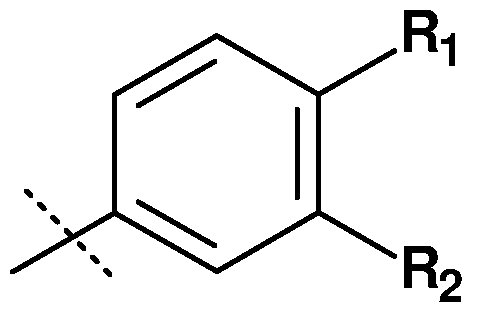
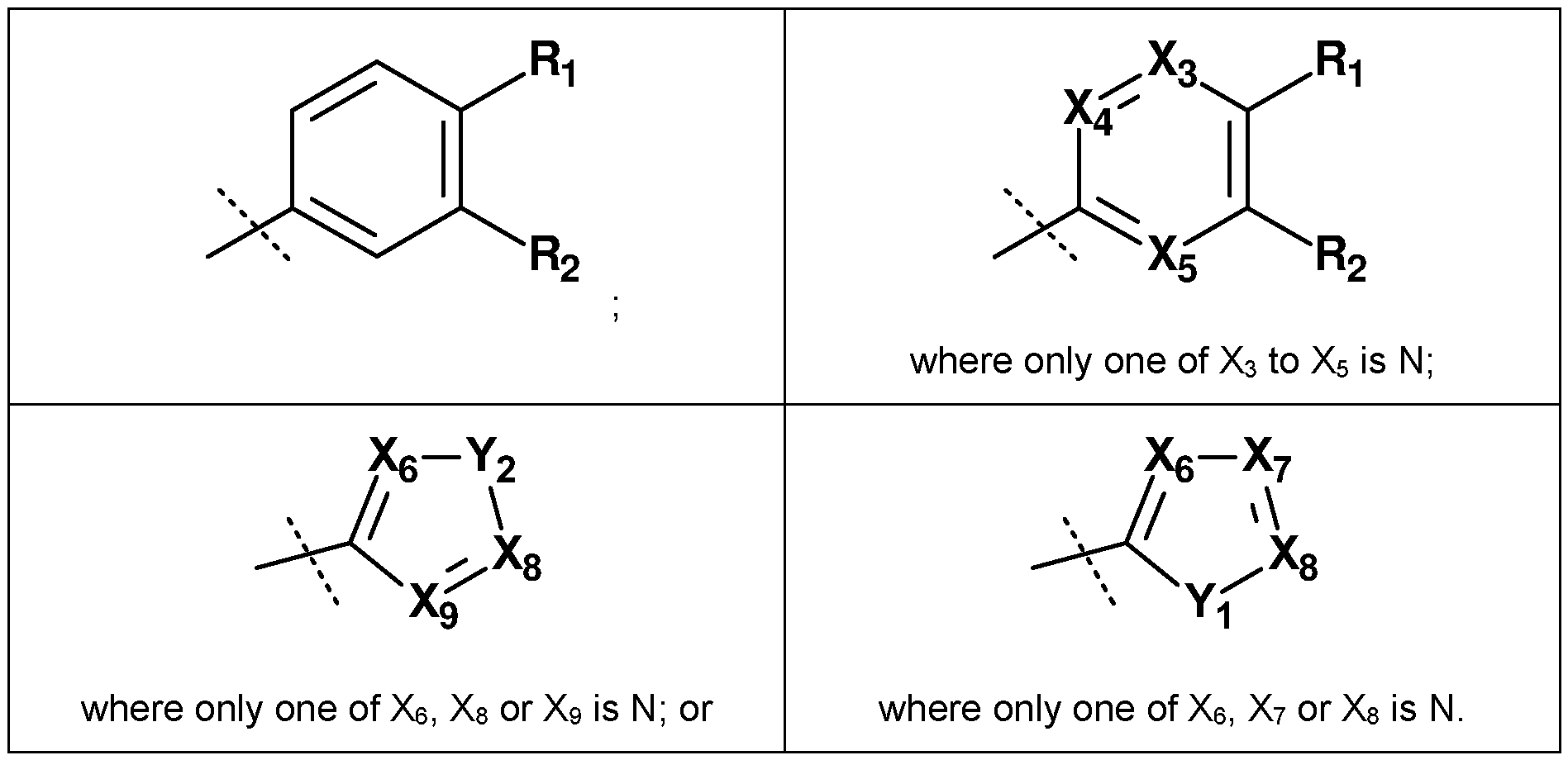
  • A is selected from the group consisting of:
  • the dotted line represents the point of attachment to the rest of the molecule
  • each R 1 to R 5 is independently selected from halo, C 1-5 alkyl, C 1-5 alkoxy, C 2-5 alkenyl, C 2-5 alkynyl, which latter four groups are unsubstituted or substituted by one or more halo substituents;
  • X 3 represents N, CH or CR 3 , where R 3 is as defined above, X 4 represents N, CH or CR 4 , where R 4 is as defined above, X 5 represents N, CH or CR 5 , where R 5 is as defined above, provided that only one or two of X 3 to X 5 is N;
  • each X 6 to X 9 independently represents N, CH or CR 6 , where each R 6 is independently selected from C 1-5 alkyl, C 1-5 alkoxy, C 2-5 alkenyl, C 2-5 alkynyl, which four groups are unsubstituted or substituted by one or more halo substituents;
  • R 1 to R 6 may be piperazine, methylpiperazine or ethylpiperazine, each of which may be connected to the rest of the moiety A via a carbon or nitrogen atom in the piperazine ring;
  • Y 1 represent NR N , O or S;
  • Y 2 represents NR N , NR Y O or S
  • R N represents H, C 1-5 alkyl, C 2-5 alkenyl, C 2-5 alkynyl, which latter three groups are unsubstituted or substituted by one or more halo substituents;
  • R Y represents piperazine, methylpiperazine or ethylpiperazine, each of which is connected to the nitrogen atom in Y 2 via a carbon atom in the piperazine ring;
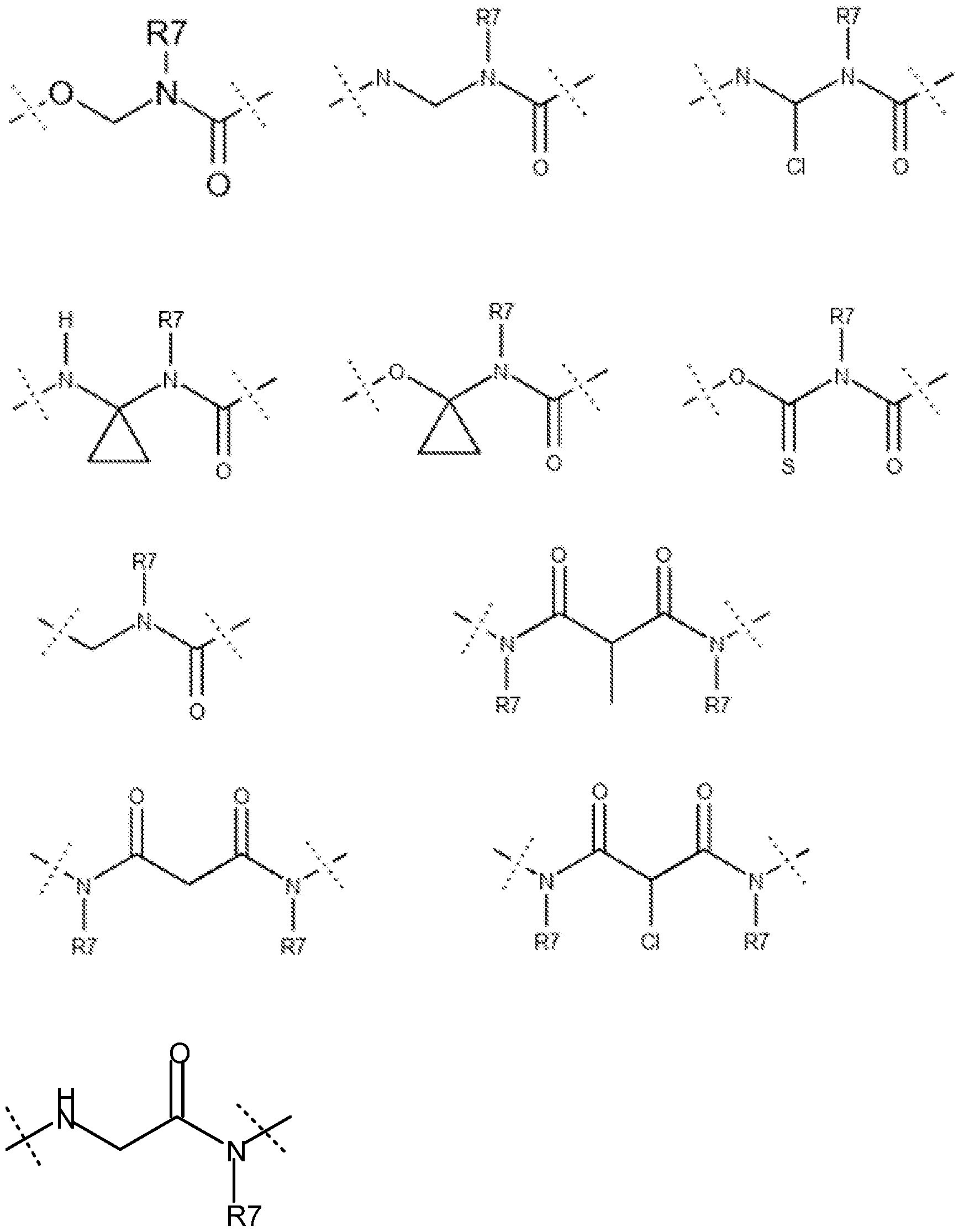
  • L is a linking group of the formula: -M-(CR L R M ) a -C(O)-NR 7 -;
  • M represents a covalent bond, O or NH
  • R L and R M each independently represent H, methyl, ethyl, fluoro or chloro, or R L and R M together with the carbon atom to which they are attached, form a C 3 or C 4 cycloalkyl ring, carbonyl or thiocarbonyl group;
  • a 0 or 1
  • R 7 and R 7’ represent H or an optionally substituted alkyl group
  • R N and R O each independently represent H, methyl, ethyl, fluoro or chloro;
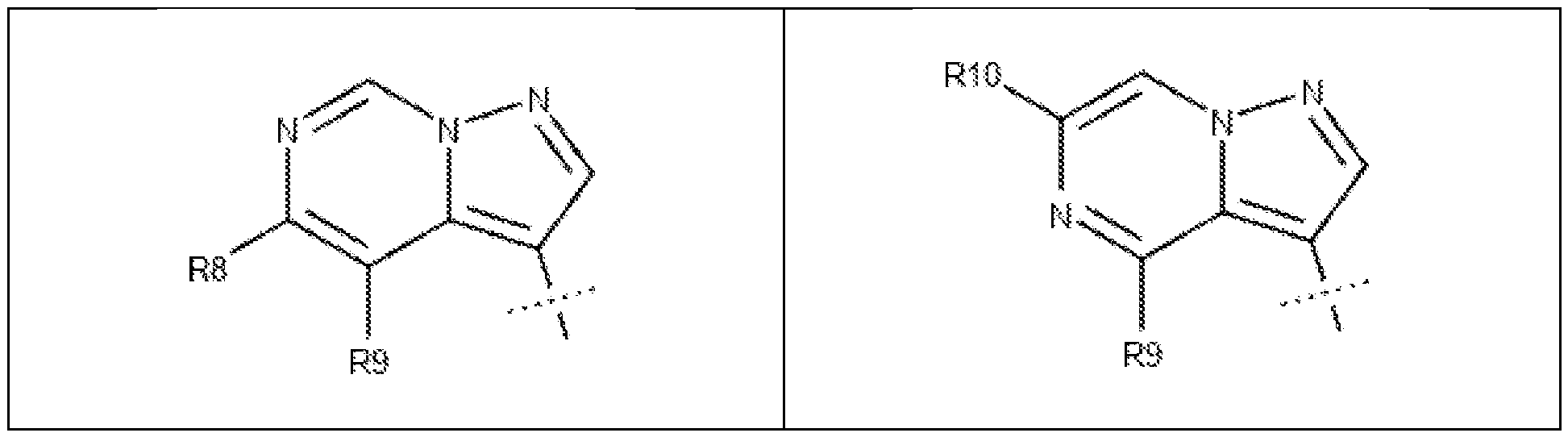
  • Z represents a heterocycle selected from the group consisting of:
  • the dotted line represents the point of attachment to the rest of the molecule, and Z is attached to the rest of the molecule via a covalent bond, or via a -O- or–NH- group;
  • each of R 8 to R 10 are independently selected from H, hydroxy, C 1 to C 5 alkyl, C 1 to C 5 alkoxy (which latter two groups are unsubstituted or substituted by one or more halo groups), OC(O)R 11 , C(O)OR 12 , C 2 to C 5 alkynyl (which is unsubstituted or substituted by one or more halo groups) or NR 13 R 14 , and O-(C 1-4 alkyleneyl)-O-C 1-4 alkyl,
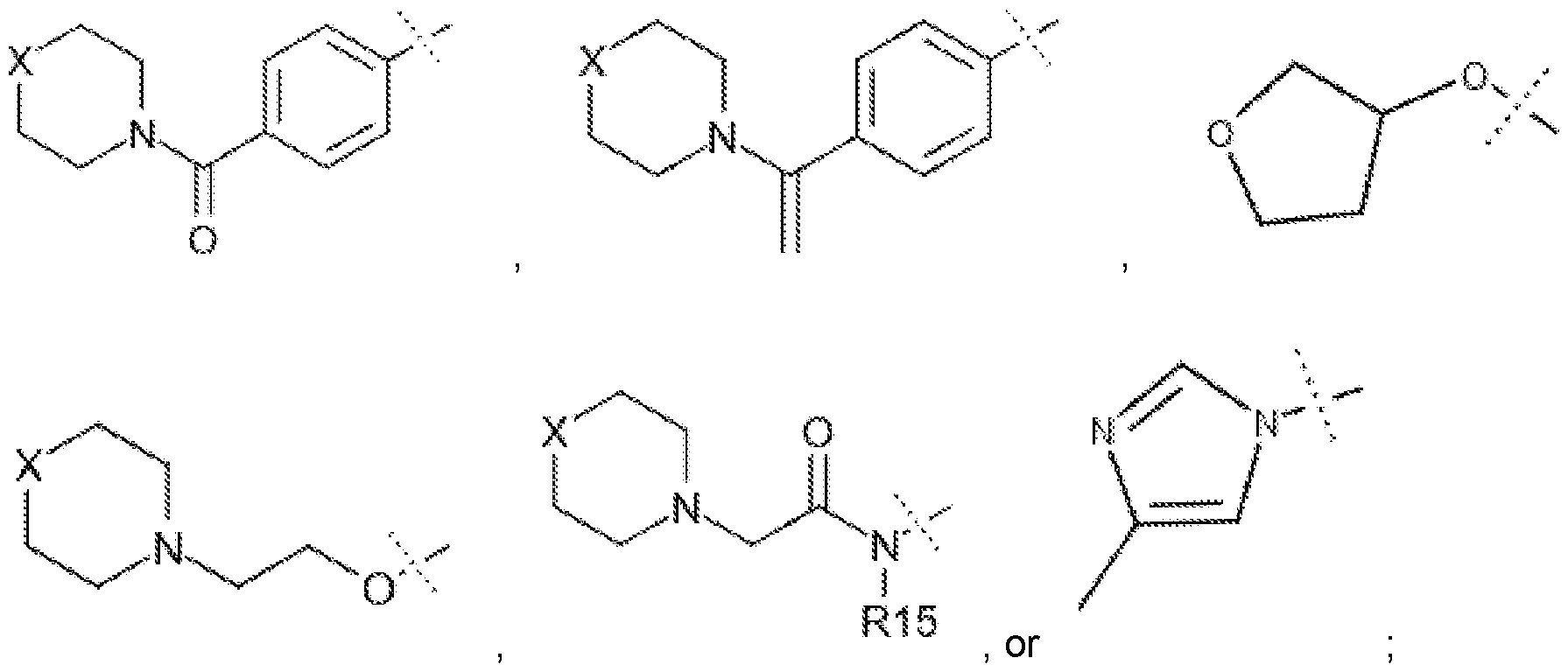
  • R 8 to R 10 may be a group of the formula:
  • R X represents H or C 1-4 alkyl
  • R 11 and R 12 each independently represent, at each occurrence, optionally substituted alkyl
  • R 13 and R 14 each independently represent, at each occurrence, H or optionally substituted alkyl
  • R 15 represents H or C 1-2 alkyl
  • Z is not an optionally substituted heteroaryl selected from optionally substituted tetrazolyl or optionally substituted imidazopyridinyl.
  • R a independently represents H, NH 2 , F, Cl, or C 1-3 alkyl, which C 1-3 alkyl group is unsubstituted or substituted by one, two or three fluoro or chloro substituents,
  • R a is H or F.
  • X 1 is selected from N and CH
  • X 2 is selected from CH and CF.
  • each R 1 to R 5 independently represents halo, C 1-3 alkyl, C 1-3 alkoxy, C 2-3 alkenyl and C 2-3 alkynyl (which four groups are unsubstituted or substituted by one or more halo substituents), optionally wherein each R 1 to R 5 independently represents fluoro, chloro, methyl or ethyl, which methyl and ethyl groups may be unsubstituted or substituted by one, two or three fluoro or chloro groups. 5.
  • a compound according to Clause 1 or 2 or a pharmaceutically acceptable salt, solvate or derivative thereof, wherein:
  • Y 1 and Y 2 independently represent O, NC 1-3 alkyl or NH; and/or
  • R 6 independently represents C 1-3 alkyl, C 1-3 alkoxy, C 2-3 alkenyl and C 2-3 alkynyl (which four groups are unsubstituted or substituted by one or more halo substituents),
  • Y 1 and Y 2 independently represent O, NMe or NH, and/or
  • R 6 independently represents fluoro, chloro, methyl or ethyl, which methyl and ethyl groups may be unsubstituted or substituted by one, two or three fluoro or chloro groups. 6.
  • each R 8 to R 10 independently represents H, hydroxy, Me, C 1-2 alkoxy (which is unsubstituted or substituted by one or more halo groups), OC(O)R 11 , C(O)OR 12 , C 2 to C 3 alkynyl (which is substituted by one or more halo groups), O-(C 1-2 alkyleneyl)-O-C 1-2 alkyl, or NR 13 R 14 ,
  • R 11 and R 12 each independently represent methyl or ethyl
  • R 13 and R 14 each independently represent H, methyl or ethyl
  • one of R 8 to R 10 represents a group of the formula
  • X represents O, NH, or N-C 1-2 alkyl
  • R 15 represents methyl
  • R 8 to R 10 when any of R 8 to R 10 is a C 1 to C 5 alkyl group, it is an unsubstituted methyl group;
  • R 9 and R 10 when present, are H, and
  • R 8 is selected from H and , where X is O or NH.
  • R 1 is selected from Cl and CH
  • R 2 is CF 3 ,
  • X 3 and X 5 are CH
  • X 4 is N
  • X 8 and X 9 are CH
  • Y 2 are selected from N-CH 3 and O. 13.
  • M represents O or NH
  • R L and R M each independently represent H, methyl or chloro, or R L and R M together represent thiocarbonyl or cyclopropyl; and/or
  • a pharmaceutical composition comprising a compound of formula I as defined in any one of Clauses 1 to 18 or a pharmaceutically acceptable salt, solvate or derivative thereof.
  • 23. A compound according to Clause 1, or a pharmaceutically acceptable salt, solvate or derivative thereof, wherein:
  • X 1 and X 2 each independently represent N or CR a
  • R a independently represents H, NH 2 , halo, C 1-5 alkyl, C 1-5 alkoxy, C 2-5 alkenyl and C 2-5 alkynyl (which latter four groups are unsubstituted or substituted by one or more halo substituents);
  • A is selected from the group consisting of:
  • the dotted line represents the point of attachment to the rest of the molecule
  • each R 1 to R 5 is independently selected from halo, C 1-5 alkyl, C 1-5 alkoxy, C 2-5 alkenyl, C 2-5 alkynyl, which latter four groups are unsubstituted or substituted by one or more halo substituents;
  • X 3 represents N, CH or CR 3 , where R 3 is as defined above, X 4 represents N, CH or CR 4 , where R 4 is as defined above, X 5 represents N, CH or CR 5 , where R 5 is as defined above, provided that only one or two of X 3 to X 5 is N;
  • each X 6 to X 9 independently represents N, CH or CR 6 , where each R 6 is independently selected from C 1-5 alkyl, C 1-5 alkoxy, C 2-5 alkenyl, C 2-5 alkynyl, which four groups are unsubstituted or substituted by one or more halo substituents;
  • Y 1 and Y 2 each independently represent NR N , O or S;
  • R N represents H, C 1-5 alkyl, C 2-5 alkenyl, C 2-5 alkynyl, which latter three groups are unsubstituted or substituted by one or more halo substituents;
  • L is a linking group of the formula: -M-(CR L R M ) a -C(O)-NR 7 -; or
  • M represents a covalent bond, O or NH
  • R L and R M each independently represent H, methyl, ethyl, fluoro or chloro, or R L and R M together form a C 3 or C 4 cycloalkyl ring, carbonyl or thiocarbonyl group;
  • a 0 or 1
  • R 7 and R 7’ represent H or an optionally substituted alkyl group
  • Z represents a heterocycle selected from the group consisting of:
  • the dotted line represents the point of attachment to the rest of the molecule, and Z is attached to the rest of the molecule via a covalent bond, or via a -O- or–NH- group;
  • each of R 8 to R 10 are independently selected from H, Me, C 1 to C 5 alkoxy which is unsubstituted or substituted by one or more halo groups, OC(O)R 11 , C(O)OR 12 , C 2 to C 5
  • alkynyl substituted by one or more halo groups or NR 13 R 14 , and one of R 8 to R 10 may be a
  • R 11 and R 12 each independently represent, at each occurrence, optionally substituted alkyl
  • R 13 and R 14 each independently represent, at each occurrence, H or optionally substituted alkyl
  • Z is not an optionally substituted heteroaryl selected from optionally substituted tetrazolyl or optionally substituted imidazopyridinyl.
  • the invention also provides the following numbered statements. 1.
  • X 1 and X 2 each independently represent N or CR a
  • R a independently represents H, NH 2 , halo, C 1-5 alkyl, C 1-5 alkoxy, C 2-5 alkenyl and C 2-5 alkynyl (which latter four groups are unsubstituted or substituted by one or more halo substituents);
  • A is selected from the group consisting of:
  • the dotted line represents the point of attachment to the rest of the molecule
  • each R 1 to R 5 is independently selected from halo, C 1-5 alkyl, C 1-5 alkoxy, C 2-5 alkenyl, C 2-5 alkynyl, which latter four groups are unsubstituted or substituted by one or more halo substituents;
  • X 3 represents N, CH or CR 3 , where R 3 is as defined above, X 4 represents N, CH or CR 4 , where R 4 is as defined above, X 5 represents N, CH or CR 5 , where R 5 is as defined above, provided that only one or two of X 3 to X 5 is N;
  • each X 6 to X 9 independently represents N, CH or CR 6 , where each R 6 is independently selected from C 1-5 alkyl, C 1-5 alkoxy, C 2-5 alkenyl, C 2-5 alkynyl, which four groups are unsubstituted or substituted by one or more halo substituents;
  • Y 1 and Y 2 each independently represent NR N , O or S;
  • R N represents H, C 1-5 alkyl, C 2-5 alkenyl, C 2-5 alkynyl, which latter three groups are unsubstituted or substituted by one or more halo substituents;
  • L is a linking group of the formula: -M-(CR L R M ) a -C(O)-NR 7 -; or
  • M represents a covalent bond, O or NH
  • R L and R M each independently represent H, methyl, ethyl, fluoro or chloro, or R L and R M together form a C 3 or C 4 cycloalkyl ring, carbonyl or thiocarbonyl group;
  • a 0 or 1
  • R 7 and R 7’ represent H or an optionally substituted alkyl group
  • Z represents a heterocycle selected from the group consisting of:
  • the dotted line represents the point of attachment to the rest of the molecule, and Z is attached to the rest of the molecule via a covalent bond, or via a -O- or–NH- group, optionally where Z is attached to the rest of the molecule via a covalent bond;
  • each of R 8 to R 10 are independently selected from H, Me, C 1 to C 5 alkoxy which is unsubstituted or substituted by one or more halo groups, OC(O)R 11 , C(O)OR 12 , C 2 to C 5 alkynyl substituted by one or more halo groups or NR 13 R 14 , and one of R 8 to R 10 may be a
  • A represents O or NH
  • R 11 and R 12 each independently represent, at each occurrence, optionally substituted alkyl
  • R 13 and R 14 each independently represent, at each occurrence, H or optionally substituted alkyl
  • Z is not an optionally substituted heteroaryl selected from optionally substituted tetrazolyl or optionally substituted imidazopyridinyl.
  • R a independently represents H, NH 2 , F, Cl, or C 1-3 alkyl, which C 1-3 alkyl group is unsubstituted or substituted by one, two or three fluoro or chloro substituents,
  • each R 1 to R 5 independently represents halo, C 1-3 alkyl, C 1-3 alkoxy, C 2-3 alkenyl and C 2-3 alkynyl (which four groups are unsubstituted or substituted by one or more halo substituents), preferably wherein each R 1 to R 5 independently represents fluoro, chloro, methyl or ethyl, which methyl and ethyl groups may be unsubstituted or substituted by one, two or three fluoro or chloro groups. 4.
  • a compound according to Statement 1 or 2 or a pharmaceutically acceptable salt, solvate or derivative thereof, wherein:
  • Y 1 and Y 2 independently represent O, NC 1-3 alkyl or NH; and/or
  • R 6 independently represents C 1-3 alkyl, C 1-3 alkoxy, C 2-3 alkenyl and C 2-3 alkynyl (which four groups are unsubstituted or substituted by one or more halo substituents),
  • Y 1 and Y 2 independently represent O, NMe or NH, and/or
  • R 6 independently represents fluoro, chloro, methyl or ethyl, which methyl and ethyl groups may be unsubstituted or substituted by one, two or three fluoro or chloro groups.
  • a compound according to Statement 3 or a pharmaceutically acceptable salt, solvate or derivative thereof, wherein each of R 1 to R 5 and R 6 independently represents methyl, trifluoromethyl, fluoro or chloro. 5.
  • each R 8 to R 10 independently represents H, Me, C 1-2 alkoxy which is unsubstituted or substituted by one or more halo groups, OC(O)R 11 , C(O)OR 12 , C 2 to C 3 alkynyl substituted by one or more halo groups, or NR 13 R 14 ,
  • R 11 and R 12 each independently represent methyl or ethyl
  • R 13 and R 14 each independently represent H, methyl or ethyl
  • one of R 8 to R 10 represents a group of the formula
  • A represents O or NH, and the remaining two of R 8 to R 10 are as defined in part (a). 6.
  • M represents O or NH
  • R L and R M each independently represent H, methyl or chloro, or R L and R M together represent thiocarbonyl or cyclopropyl; and/or
  • a nd or a pharmaceutically acceptable or a salt, solvate or derivative thereof.
  • a method of treating one or more of macular degeneration, diabetic retinopathy, cancer e.g. prostate cancer, colon cancer, rectal cancer, colorectal cancer, acute myeloid
  • cancer e.g. prostate cancer, colon cancer, rectal cancer, colorectal cancer, acute myeloid leukaemia or chronic myelomonocytic leukaemia
  • a pharmaceutical composition comprising a compound of formula I as defined in any one of Statements 1 to 12 or a pharmaceutically acceptable salt, solvate or derivative thereof.
  • Drawings Figure 1 represents Western-blot analysis result of the compounds of Examples 1 and 2 in relation to inhibition of PDGFRb and p-SHP2 signalling in HEK293 cells expressing PDGFRb.
  • Figure 2 illustrates the effect of the compounds of Examples 1 to 4 on Ba/F3 cells expressing PDGFR. Results for imatinib and quizartinib are provided as positive controls.
  • Figure 3 illustrates the effect of the compounds of Examples 5 to 7 on Ba/F3 cells expressing Flt3 kinase. Results for imatinib (negative control) and quizartinib (positive control) are also provided.
  • Figure 4 shows the ability of a compound according to the invention to prevent choroid damage in vivo.
  • compounds of formula I described herein, including pharmaceutically acceptable salts, solvates and derivatives thereof are potent inhibitors of angiogenesis.
  • the compounds of the invention are useful in the treatment of angiogenesis and angiogenesis-related diseases or disorders such as eye disorders, particularly macular degeneration (e.g. age-related macular degeneration) and diabetic retinopathy.
  • macular degeneration e.g. age-related macular degeneration
  • diabetic retinopathy e.g. diabetic retinopathy
  • X 1 and X 2 each independently represent N or CR a
  • R a independently represents H, NH 2 , halo, C 1-5 alkyl, C 1-5 alkoxy, C 2-5 alkenyl and C 2-5 alkynyl (which latter four groups are unsubstituted or substituted by one or more halo substituents);
  • A is selected from the group consisting of:
  • the dotted line represents the point of attachment to the rest of the molecule
  • each R 1 to R 5 is independently selected from halo, C 1-5 alkyl, C 1-5 alkoxy, C 2-5 alkenyl, C 2-5 alkynyl, which latter four groups are unsubstituted or substituted by one or more halo substituents;
  • X 3 represents N, CH or CR 3 , where R 3 is as defined above, X 4 represents N, CH or CR 4 , where R 4 is as defined above, X 5 represents N, CH or CR 5 , where R 5 is as defined above, provided that only one or two of X 3 to X 5 is N;
  • each X 6 to X 9 independently represents N, CH or CR 6 , where each R 6 is independently selected from C 1-5 alkyl, C 1-5 alkoxy, C 2-5 alkenyl, C 2-5 alkynyl, which four groups are unsubstituted or substituted by one or more halo substituents;
  • R 1 to R 6 may be piperazine, methylpiperazine or ethylpiperazine, each of which may be connected to the rest of the moiety A via a carbon or nitrogen atom in the piperazine ring;
  • Y 1 represent NR N , O or S;
  • Y 2 represents NR N , NR Y O or S
  • R N represents H, C 1-5 alkyl, C 2-5 alkenyl, C 2-5 alkynyl, which latter three groups are unsubstituted or substituted by one or more halo substituents;
  • R Y represents piperazine, methylpiperazine or ethylpiperazine, each of which is connected to the nitrogen atom in Y 2 via a carbon atom in the piperazine ring;
  • L is a linking group of the formula: -M-(CR L R M ) a -C(O)-NR 7 -;
  • M represents a covalent bond, O or NH
  • R L and R M each independently represent H, methyl, ethyl, fluoro or chloro, or R L and R M together form a C 3 or C 4 cycloalkyl ring, carbonyl or thiocarbonyl group;
  • a 0 or 1
  • R 7 and R 7’ represent H or an optionally substituted alkyl group
  • R N and R O each independently represent H, methyl, ethyl, fluoro or chloro;
  • Z represents a heterocycle selected from the group consisting of:
  • the dotted line represents the point of attachment to the rest of the molecule, and Z is attached to the rest of the molecule via a covalent bond, or via a -O- or–NH- group;
  • each of R 8 to R 10 are independently selected from H, hydroxy, C 1 to C 5 alkyl, C 1 to C 5 alkoxy, (which latter two groups are unsubstituted or substituted by one or more halo groups), OC(O)R 11 , C(O)OR 12 , C 2 to C 5 alkynyl (which is unsubstituted or substituted by one or more halo groups) or NR 13 R 14 , and O-(C 1-4 alkyleneyl)-O-C 1-4 alkyl,
  • R 8 to R 10 may be a group of the formula:
  • R X represents H or C 1-4 alkyl
  • R 11 and R 12 each independently represent, at each occurrence, optionally substituted alkyl
  • R 13 and R 14 each independently represent, at each occurrence, H or optionally substituted alkyl
  • R 15 represents H or C 1-2 alkyl
  • Z is not an optionally substituted heteroaryl selected from optionally substituted tetrazolyl or optionally substituted imidazopyridinyl.
  • the word“comprising” may be interpreted as requiring the features mentioned, but not limiting the presence of other features. Alternatively, the word “comprising” may also relate to the situation where only the components/features listed are intended to be present (e.g. the word“comprising” may be replaced by the phrases“consists of” or“consists essentially of”). It is explicitly contemplated that both the broader and narrower interpretations can be applied to all aspects and embodiments of the present invention. In other words, the word“comprising” and synonyms thereof may be replaced by
  • Alkyl refers to monovalent alkyl groups which may be straight chained or branched and preferably have from 1 to 10 carbon atoms or more preferably 1 to 6 carbon atoms. Examples of such alkyl groups include methyl, ethyl, n-propyl, iso-propyl, n-butyl, iso-butyl, n-hexyl, and the like. As used herein, C 1 -C 5 alkyl refers to an alkyl group having 1 to 5 carbon atoms.
  • Alkylene refers to divalent alkyl groups preferably having from 1 to 10 carbon atoms and more preferably 1 to 6 carbon atoms. Examples of such alkylene groups include methylene (-CH 2 -), ethylene (-CH 2 CH 2 -), and the propylene isomers (e.g., -CH 2 CH 2 CH 2 - and – CH(CH 3 )CH 2 -), and the like.
  • Alkenyl refers to a monovalent alkenyl group which may be straight chained or branched and preferably have from 2 to 10 carbon atoms and more preferably 2 to 6 carbon atoms and have at least 1 and preferably from 1-2, carbon to carbon, double bonds.
  • C 2 -C 5 alkylenyl refers to an alkylenyl group having 2 to 5 carbon atoms.
  • Alkynyl refers to alkynyl groups preferably having from 2 to 10 carbon atoms and more preferably 2 to 6 carbon atoms and having at least 1, and preferably from 1-2, carbon to carbon, triple bonds.
  • alkynyl groups examples include ethynyl (-Co CH), propargyl (-CH 2 Co CH), pent-2-ynyl (-CH 2 CoCCH 2 -CH 3 ), and the like.
  • C 2 -C 5 alkynyl refers to an alkynyl group having 2 to 5 carbon atoms.
  • Alkoxy refers to the group alkyl-O- where the alkyl group is as described above. Examples include, methoxy, ethoxy, n-propoxy, iso-propoxy, n-butoxy, tert-butoxy, sec-butoxy, n- pentoxy, n-hexoxy, 1,2-dimethylbutoxy, and the like.
  • C 1 -C 5 alkoxy refers to an alkoxy group having 1 to 5 carbon atoms.
  • Halo or “halogen” refers to fluoro, chloro, bromo and iodo.
  • Haloalkyl refers to an alkyl group wherein the alkyl group is substituted by one or more halo group as described above.
  • haloalkenyl haloalkynyl
  • haloalkoxy are likewise defined.
  • Aryl refers to an unsaturated aromatic carbocyclic group having a single ring (eg. phenyl) or multiple condensed rings (eg.
  • heteroaryl refers to a monovalent aromatic heterocyclic group which fulfils the Hückel criteria for aromaticity (ie. contains 4n + 2 p electrons) and preferably has from 2 to 10 carbon atoms and 1 to 4 heteroatoms selected from oxygen, nitrogen, selenium, and sulfur within the ring (and includes oxides of sulfur, selenium and nitrogen).
  • Such heteroaryl groups can have a single ring (eg. pyridyl, pyrrolyl or N-oxides thereof or furyl) or multiple condensed rings (eg.
  • heteroaryl groups include, but are not limited to, oxazole, pyrrole, imidazole, pyrazole, pyridine, pyrazine, pyrimidine, pyridazine, indolizine, isoindole, indole, indazole, purine, isoquinoline, quinoline, phthalazine, naphthylpyridine, quinoxaline, quinazoline, cinnoline, pteridine, carbazole, carboline, phenanthridine, acridine, phenanthroline, isothiazole, phenazine, isoxazole, isothiazole, phenoxazine, phenothiazine, thiazole, thiadiazoles, oxadiazol
  • a group may or may not be further substituted or fused (so as to form a condensed polycyclic group) with one or more groups selected from hydroxyl, acyl, alkyl, alkoxy, alkenyl, alkenyloxy, alkynyl, alkynyloxy, amino, aminoacyl, thio, arylalkyl, arylalkoxy, aryl, aryloxy, carboxyl, acylamino, cyano, halogen, nitro, phosphono, sulfo, phosphorylamino, phosphinyl, heteroaryl, heteroarylalkyl, heteroaryloxy, heterocyclyl, heterocyclylalkyl, heterocyclyloxy, oxyacyl, oxime, oxime ether, hydrazone, oxyacylamino, oxysulfonylamino, aminoacyloxy, trihalomethyl, trialkyl, alkoxy, alkenyl, alken
  • references herein (in any aspect or embodiment of the invention) to compounds of formula I includes references to such compounds per se, to tautomers of such compounds, as well as to pharmaceutically acceptable salts or solvates, or pharmaceutically functional derivatives of such compounds.
  • Pharmaceutically acceptable salts that may be mentioned include acid addition salts and base addition salts.
  • Such salts may be formed by conventional means, for example by reaction of a free acid or a free base form of a compound of formula I with one or more equivalents of an appropriate acid or base, optionally in a solvent, or in a medium in which the salt is insoluble, followed by removal of said solvent, or said medium, using standard techniques (e.g. in vacuo, by freeze-drying or by filtration). Salts may also be prepared by exchanging a counter-ion of a compound of formula I in the form of a salt with another counter-ion, for example using a suitable ion exchange resin.
  • suitable ion exchange resin examples include acid addition salts derived from mineral acids and organic acids, and salts derived from metals such as sodium, magnesium, or preferably, potassium and calcium.
  • acid addition salts include acid addition salts formed with acetic, 2,2- dichloroacetic, adipic, alginic, aryl sulphonic acids (e.g. benzenesulphonic, naphthalene-2- sulphonic, naphthalene-1,5-disulphonic and p-toluenesulphonic), ascorbic (e.g.
  • L-glutamic L-glutamic
  • a-oxoglutaric glycolic, hippuric, hydrobromic, hydrochloric, hydriodic, isethionic
  • lactic e.g. (+)-L-lactic and ( ⁇ )-DL-lactic
  • lactobionic maleic, malic (e.g.
  • salts are salts derived from mineral acids such as hydrochloric, hydrobromic, phosphoric, metaphosphoric, nitric and sulphuric acids; from organic acids, such as tartaric, acetic, citric, malic, lactic, fumaric, benzoic, glycolic, gluconic, succinic, arylsulphonic acids; and from metals such as sodium, magnesium, or preferably, potassium and calcium.
  • mineral acids such as hydrochloric, hydrobromic, phosphoric, metaphosphoric, nitric and sulphuric acids
  • organic acids such as tartaric, acetic, citric, malic, lactic, fumaric, benzoic, glycolic, gluconic, succinic, arylsulphonic acids
  • metals such as sodium, magnesium, or preferably, potassium and calcium.
  • Preferred solvates are solvates formed by the incorporation into the solid state structure (e.g.
  • solvating solvent examples include water, alcohols (such as ethanol, isopropanol and butanol) and dimethylsulphoxide.
  • Solvates can be prepared by recrystallising the compounds of the invention with a solvent or mixture of solvents containing the solvating solvent. Whether or not a solvate has been formed in any given instance can be determined by subjecting crystals of the compound to analysis using well known and standard techniques such as thermogravimetric analysis (TGE), differential scanning calorimetry (DSC) and X-ray crystallography.
  • TGE thermogravimetric analysis
  • DSC differential scanning calorimetry
  • X-ray crystallography X-ray crystallography
  • solvates are hydrates, and examples of hydrates include hemihydrates, monohydrates and dihydrates.
  • solvates and the methods used to make and characterise them see Bryn et al., Solid-State Chemistry of Drugs, Second Edition, published by SSCI, Inc of West Lafayette, IN, USA, 1999, ISBN 0-967-06710-3.
  • “Pharmaceutically functional derivatives” of compounds of formula I as defined herein includes ester derivatives and/or derivatives that have, or provide for, the same biological function and/or activity as any relevant compound of the invention. Thus, for the purposes of this invention, the term also includes prodrugs of compounds of formula I.
  • prodrug of a relevant compound of formula I includes any compound that, following oral or parenteral administration, is metabolised in vivo to form that compound in an experimentally-detectable amount, and within a predetermined time (e.g. within a dosing interval of between 6 and 24 hours (i.e. once to four times daily)).
  • Prodrugs of compounds of formula I may be prepared by modifying functional groups present on the compound in such a way that the modifications are cleaved, in vivo when such prodrug is administered to a mammalian subject. The modifications typically are achieved by synthesizing the parent compound with a prodrug substituent.
  • Prodrugs include compounds of formula I wherein a hydroxyl, amino, sulfhydryl, carboxyl or carbonyl group in a compound of formula I is bonded to any group that may be cleaved in vivo to regenerate the free hydroxyl, amino, sulfhydryl, carboxyl or carbonyl group, respectively.
  • prodrugs include, but are not limited to, esters and carbamates of hydroxyl functional groups, esters groups of carboxyl functional groups, N-acyl derivatives and N- Mannich bases.
  • General information on prodrugs may be found e.g. in Bundegaard, H. “Design of Prodrugs” p. I-92, Elsevier, New York-Oxford (1985).
  • Compounds of formula I, as well as pharmaceutically acceptable salts, solvates and pharmaceutically functional derivatives of such compounds are, for the sake of brevity, hereinafter referred to together as the“compounds of formula I”.
  • Compounds of formula I may contain double bonds and may thus exist as E (entadel) and Z (zusammen) geometric isomers about each individual double bond. All such isomers and mixtures thereof are included within the scope of the invention.
  • Compounds of formula I may exist as regioisomers and may also exhibit tautomerism. All tautomeric forms and mixtures thereof are included within the scope of the invention.
  • Compounds of formula I may contain one or more asymmetric carbon atoms and may therefore exhibit optical and/or diastereoisomerism. Diastereoisomers may be separated using conventional techniques, e.g. chromatography or fractional crystallisation.
  • the various stereoisomers may be isolated by separation of a racemic or other mixture of the compounds using conventional, e.g. fractional crystallisation or HPLC, techniques.
  • the desired optical isomers may be made by reaction of the appropriate optically active starting materials under conditions which will not cause racemisation or epimerisation (i.e. a‘chiral pool’ method), by reaction of the appropriate starting material with a‘chiral auxiliary’ which can subsequently be removed at a suitable stage, by derivatisation (i.e. a resolution, including a dynamic resolution), for example with a homochiral acid followed by separation of the diastereomeric derivatives by conventional means such as chromatography, or by reaction with an appropriate chiral reagent or chiral catalyst all under
  • isotopically labelled when used herein includes references to compounds of formula I in which there is a non-natural isotope (or a non-natural distribution of isotopes) at one or more positions in the compound. References herein to "one or more positions in the compound” will be understood by those skilled in the art to refer to one or more of the atoms of the compound of formula I.
  • isotopically labelled includes references to compounds of formula I that are isotopically enriched at one or more positions in the compound.
  • the isotopic labelling or enrichment of the compound of formula I may be with a radioactive or non-radioactive isotope of any of hydrogen, carbon, nitrogen, oxygen, sulfur, fluorine, chlorine, bromine and/or iodine.
  • Particular isotopes that may be mentioned in this respect include 2 H, 3 H, 11 C, 13 C, 14 C, 13 N, 15 N, 15 O, 17 O, 18 O, 35 S, 18 F, 37 CI, 77 Br, 82 Br and 125 l).
  • compounds of formula I When the compound of formula I is labelled or enriched with a radioactive or nonradioactive isotope, compounds of formula I that may be mentioned include those in which at least one atom in the compound displays an isotopic distribution in which a radioactive or non- radioactive isotope of the atom in question is present in levels at least 10% (e.g. from 10% to 5000%, particularly from 50% to 1000% and more particularly from 100% to 500%) above the natural level of that radioactive or non-radioactive isotope.
  • the compound of formula I in the above-mentioned aspect of the invention may be utilised in a method of medical treatment.
  • a method of treatment of angiogenesis or an angiogenesis-related disease or disorder, particularly macular degeneration and diabetic retinopathy, comprises the administration of an effective amount of a compound of formula I.
  • Compounds of formula I include a linker group of formula: -M-(CR L R M ) a -C(O)-NR 7 -;
  • M represents a covalent bond, O or NH
  • R L and R M each independently represent H, methyl, ethyl, fluoro or chloro, or R L and R M together form a C 3 or C 4 cycloalkyl ring, carbonyl or thiocarbonyl group;
  • a 0 or 1
  • R 7 and R 7’ represent H or an optionally substituted alkyl group
  • R N and R O each independently represent H, methyl, ethyl, fluoro or chloro;
  • the linker may be oriented in each of the two possible configurations, i.e. either end of the linker may be attached to moiety A or the six-membered ring containing X 1 and X 2 .
  • the left hand part of the linker as drawn herein is attached to the six-membered ring containing X 1 and X 2 .
  • the left hand part of the linker is attached to moiety A.
  • the linker group L may be of formula:
  • Compounds of formula I having such linkers are believed to be particularly suitable for treating eye diseases or disorders related to angiogenesis, for example macular degeneration (e.g. AMD) and diabetic retinopathy.
  • macular degeneration e.g. AMD
  • diabetic retinopathy e.g. AMD
  • L is a linker group having one of the below formula:
  • the linker is selected from linkers having one of the below formula:
  • X 1 and X 2 each independently represent N or CR a , where R a independently represents H, NH 2 , halo, C 1-5 alkyl, C 1-5 alkoxy, C 2-5 alkenyl and C 2-5 alkynyl (which latter four groups are unsubstituted or substituted by one or more halo substituents).
  • R a independently represents H, NH 2 , F, Cl, or C 1-3 alkyl, which C 1-3 alkyl group is unsubstituted or substituted by one, two or three fluoro or chloro substituents.
  • R a is H or F.
  • X 1 is selected from N and CH
  • X 2 is selected from CH and CF.
  • A is selected from the group consisting of:
  • the dotted line represents the point of attachment to the rest of the molecule
  • each R 1 to R 5 is independently selected from halo, C 1-5 alkyl, C 1-5 alkoxy, C 2-5 alkenyl, C 2-5 alkynyl, which latter four groups are unsubstituted or substituted by one or more halo substituents;
  • X 3 represents N, CH or CR 3 , where R 3 is as defined above, X 4 represents N, CH or CR 4 , where R 4 is as defined above, X 5 represents N, CH or CR 5 , where R 5 is as defined above, provided that only one or two of X 3 to X 5 is N;
  • each X 6 to X 9 independently represents N, CH or CR 6 , where each R 6 is independently selected from C 1-5 alkyl, C 1-5 alkoxy, C 2-5 alkenyl, C 2-5 alkynyl, which four groups are unsubstituted or substituted by one or more halo substituents;
  • each R 1 to R 6 may be piperazine, methylpiperazine or ethylpiperazine, each of which may be connected to the rest of the moiety A via a carbon or nitrogen atom in the piperazine ring.
  • each R 1 to R 5 independently represents halo, C 1-3 alkyl, C 1-3 alkoxy, C 2-3 alkenyl and C 2-3 alkynyl (which four groups are unsubstituted or substituted by one or more halo substituents).
  • each R 1 to R 5 independently represents fluoro, chloro, methyl or ethyl, which methyl and ethyl groups may be unsubstituted or substituted by one, two or three fluoro or chloro groups.
  • each R 6 independently represents C 1-3 alkyl, C 1-3 alkoxy, C 2-3 alkenyl and C 2-3 alkynyl (which four groups are unsubstituted or substituted by one or more halo substituents.
  • each R 6 independently represents fluoro, chloro, methyl or ethyl, which methyl and ethyl groups may be unsubstituted or substituted by one, two or three fluoro or chloro groups.
  • each of R 1 to R 5 and R 6 independently represents methyl, trifluoromethyl, fluoro or chloro.
  • R 1 represents piperazine, methylpiperazine or ethylpiperazine, each of which may be connected to the rest of the moiety A via a carbon or nitrogen atom in the piperazine ring, and R 2 to R 6 do not represent piperazine, methylpiperazine or ethylpiperazine.
  • Y 1 represent NR N , O or S;
  • Y 2 represents NR N , NR Y O or S
  • R N represents H, C 1-5 alkyl, C 2-5 alkenyl, C 2-5 alkynyl, which latter three groups are unsubstituted or substituted by one or more halo substituents;
  • R Y represents piperazine, methylpiperazine or ethylpiperazine, each of which is connected to the nitrogen atom in Y 2 via a carbon atom in the piperazine ring.
  • Y 1 and Y 2 each independently represent NR N , O or S, where R N represents H, C 1-5 alkyl, C 2-5 alkenyl, C 2-5 alkynyl, which latter three groups are unsubstituted or substituted by one or more halo substituents.
  • Y 1 and Y 2 independently represent O, NC 1-3 alkyl or NH.
  • Y 1 and Y 2 independently represent O, NMe or NH.
  • Y 1 and Y 2 are not S.
  • R Y represents piperazine, methylpiperazine or ethylpiperazine
  • the piperazine, methylpiperazine or ethylpiperazine moiety is bonded to the nitrogen atom in Y 2 via a carbon atom in the piperazine ring.
  • A is selected from the group consisting of:
  • A is selected from the group consisting of:
  • A is selected from:
  • R 1 is selected from methyl and chlorine
  • R 2 is CF 3 ;
  • X 3 and X 5 are CH;
  • X 4 is N
  • X 6 is N
  • Y 2 is O or N-CH 3 ;
  • X 8 is C-CF 3 ;
  • X 9 is CH.
  • Z represents a heterocycle selected from the group consisting of:
  • the dotted line represents the point of attachment to the rest of the molecule, and Z is attached to the rest of the molecule via a covalent bond, or via a -O- or–NH- group;
  • each of R 8 to R 10 are independently selected from H, hydroxy, C 1 to C 5 alkyl, C 1 to C 5 alkoxy (which latter two groups are unsubstituted or substituted by one or more halo groups), OC(O)R 11 , C(O)OR 12 , C 2 to C 5 alkynyl (which is unsubstituted or substituted by one or more halo groups) or NR 13 R 14 , and O-(C 1-4 alkyleneyl)-O-C 1-4 alkyl,
  • R 8 to R 10 may be a group of the formula:
  • R X represents H or C 1-4 alkyl
  • R 11 and R 12 each independently represent, at each occurrence, optionally substituted alkyl
  • R 13 and R 14 each independently represent, at each occurrence, H or optionally substituted alkyl
  • R 15 represents H or C 1-2 alkyl.
  • the alkyl group for each of R 8 to R 10 may be a methyl group.
  • the C 2 to C 5 alkynyl group for each of R 8 to R 10 may be a C 2 to C 5 alkynyl group which is substituted by one or more halo groups.
  • Z represents a heterocycle selected from the group consisting of:
  • Z represents a heterocycle selected from:
  • Z represents a heterocycle selected from:
  • each R 8 to R 10 independently represents H, hydroxy, Me, C 1-2 alkoxy (which is unsubstituted or substituted by one or more halo groups), OC(O)R 11 , C(O)OR 12 , C 2 to C 3 alkynyl (which is substituted by one or more halo groups), O- (C 1-2 alkyleneyl)-O-C 1-2 alkyl, or NR 13 R 14 , where
  • R 11 and R 12 each independently represent methyl or ethyl
  • R 13 and R 14 each independently represent H, methyl or ethyl.
  • one of R 8 to R 10 represents a group of the formula
  • X represents O, NH, or N-C 1-2 alkyl
  • R 15 represents methyl
  • each of R 8 to R 10 are independently selected from H, hydroxy, Me, C 1 to C 5 alkoxy (which is unsubstituted or substituted by one or more halo groups), OC(O)R 11 , C(O)OR 12 , C 2 to C 5 alkynyl (which is substituted by one or more halo groups) or NR 13 R 14 , and O-(C 1-4 alkyleneyl)-O-C 1-4 alkyl,
  • R 8 to R 10 may be a group of the formula:
  • each R 8 to R 10 are independently selected from H, Me, C 1 to C 5 alkoxy which is unsubstituted or substituted by one or more halo groups, OC(O)R 11 , C(O)OR 12 , C 2 to C 5 alkynyl (which is substituted by one or more halo groups) or
  • NR 13 R 14 and one of R 8 to R 10 may be a group of the formula
  • X represents O or NH
  • R 11 and R 12 each independently represent, at each occurrence, optionally substituted alkyl
  • R 13 and R 14 each independently represent, at each occurrence, H or optionally substituted alkyl.
  • R 9 and R 10 (when present) are H.
  • one of R 8 to R 10 represents a group of the formula
  • R 8 to R 10 may be a
  • Z is linked to the rest of the molecule via a covalent bond.
  • M represents O or NH. In other embodiments of the invention M represents a covalent bond.
  • when Z is linked to the rest of the molecule via a covalent bond then M is–O- or–NH-. In some embodiments of the invention, when Z is linked to the rest of the molecule via a–O- or–NH- group, then M is a covalent bond.
  • R L and R M each independently represent H, methyl or chloro, or R L and R M together represent thiocarbonyl or cyclopropyl. In some embodiments of the invention a represents 1. In some embodiments of the invention, R 7 and R 7’ represent H.
  • Z is not an optionally substituted heteroaryl selected from optionally substituted tetrazolyl or optionally substituted imidazopyridinyl.
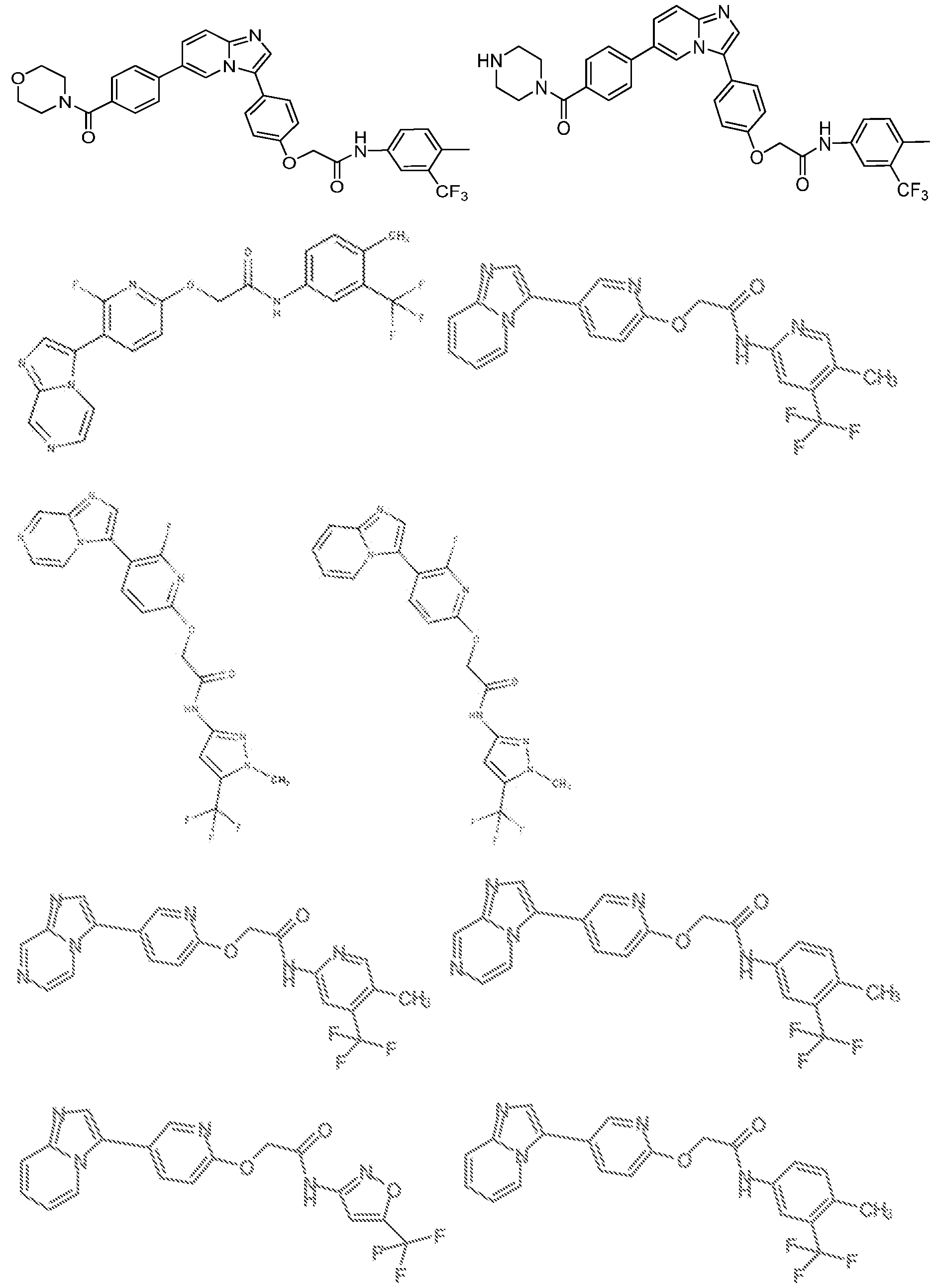
  • the invention also provides the following compounds, as well as pharmaceutically acceptable salts, solvates and derivatives thereof.
  • the invention also provides the following compounds, as well as pharmaceutically acceptable salts, solvates and derivatives thereof. ⁇
  • MD is intended to include age- related macular degeneration (AMD), but does not exclude macular degeneration in patients who are not elderly. Accordingly, AMD and MD as referred to herein may be used interchangeably.
  • MD is a disease that affects a special layer of cells in the eye called the retinal pigment epithelium. This layer of cells is underneath the retina.
  • the retinal pigment epithelium (RPE) is like a wall or barrier and is responsible for passing oxygen, sugar and other essentials up to the retina and moving waste products down to the blood vessels underneath (these vessels are called the choroid).
  • the RPE also acts as a barrier between the choroid and the retina. When RPE cells die, the retinal cells above them also die, leading
  • diabetic retinopathy refers to a microvascular complication of diabetes. This complication can occur in the eye. Accordingly, “diabetic retinopathy” is intended to include all categories and classification, for example the earlier stage of nonproliferative diabetic retinopathy (NPDR) and the advanced stage of proliferative diabetic retinopathy (PDR) associated with abnormal blood vessel growth. Diabetic macular edema (DME) is also included within its scope. DME is a manifestation of diabetic retinopathy that occurs across all severity levels of both NPDR and PDR and represents the most common cause of vision loss in patients.
  • NPDR nonproliferative diabetic retinopathy
  • PDR proliferative diabetic retinopathy
  • DME Diabetic macular edema
  • DME is a manifestation of diabetic retinopathy that occurs across all severity levels of both NPDR and PDR and represents the most common cause of vision loss in patients.
  • DME arises from diabetes-induced breakdown of the blood- retinal barrier (BRB), with consequent vascular leakage of fluid and circulating proteins into the neural retina.
  • BRB blood- retinal barrier
  • the extravasation of fluid into the neural retina leads to abnormal retinal thickening and often cystoid edema of the macula.
  • VEGFa is believed to play a significant role in the formation of blood vessels that grow abnormaly and leak beneath the macula.
  • the constant exposure of endothelial cells to pro-angiogenic factors, such as VEGFa result in the formation of immature, semi-differentiated and fragile blood vessels which have a tendency to leak and bleed.
  • the present invention is based on the discovery that a compound of formula I as defined herein displays high selectivity towards the receptor tyrosine kinases (RTKs) PDGFRa, PDGFRb and VEGFR2, the three main RTKs responsible for abnormal blood vessel growth in the context of MD.
  • RTKs receptor tyrosine kinases
  • These receptor tyrosine kinases are high affinity cell surface receptors for polypeptide growth factors such as VEGFa. Accordingly, it is postulated that the compounds of the present invention may exhibit a wider therapeutic window than compounds or agents that do not distinguish between "diseased" and normal cells.
  • This selectivity means the compounds of formula I, as well as pharmaceutically acceptable salt, solvate or prodrug thereof, may be particularly well suited for therapeutic application to patients with macular degeneration as they may be able to inhibit proliferation of only "diseased" cells; i.e. with high density of
  • the present compounds may be effective in blocking the sprouting of abnormal blood vessel formation, and accordingly be advantageous for treating MD and/or diabetic retinopathy.
  • the disease pathology of MD and/or diabetic retinopathy can be multi-factorial.
  • different therapies may be combined (i.e. combination therapies).
  • therapeutic agent “other therapeutic agent”, “another therapeutic agent”, “second therapeutic agent” and the like, as used herein is intended to include other therapeutic compounds or treatments which may be used in combination with the compound according to the present invention.
  • compounds of formula I may be administered alone (i.e.
  • compounds of formula I may be administered in combination with another therapeutic agent (e.g. another therapeutic agent for the treatment of an angiogenesis-related disease or disorder).
  • compounds of formula I may be administered as an adjuvant therapy after surgical treatment or as a neoadjuvant therapy before the main treatment (e.g. surgery) of the angiogenesis-related disorder or disease, either as a stand-alone compound or in combination with another therapeutic agent (e.g. another therapeutic agent for the treatment of an angiogenesis-related disease or disorder).
  • Second or other therapeutic agents useful in the treatment of eye disorders such as MD and/or diabetic retinopathy include, but are not limited to, angiogenesis inhibitors, vascular endothelial growth factor (VEGF) inhibitors, other receptor tyrosine kinase inhibitors, photodynamic therapy, laser photocoagulation, as well as other MD or AMD and/or diabetic retinopathy specific treatments.
  • VEGF vascular endothelial growth factor
  • a compound of formula I or a pharmaceutically acceptable salt, solvate or prodrug may be administered in combination with one or more VEGF inhibitors such as avastin, lucentis and/or macugen.
  • treatment includes references to therapeutic or palliative treatment of patients in need of such treatment, as well as to the prophylactic treatment and/or diagnosis of patients which are susceptible to the relevant disease states.
  • patient and“patients” include references to mammalian (e.g. human) patients.
  • subject or “patient” are well-recognized in the art, and, are used interchangeably herein to refer to a mammal, including dog, cat, rat, mouse, monkey, cow, horse, goat, sheep, pig, camel, and, most preferably, a human.
  • the subject is a subject in need of treatment or a subject with a disease or disorder.
  • the subject can be a normal subject.
  • the term does not denote a particular age or sex. Thus, adult and newborn subjects, whether male or female, are intended to be covered.
  • the term“effective amount” refers to an amount of a compound, which confers a therapeutic effect on the treated patient (e.g. sufficient to treat or prevent the disease).
  • the effect may be objective (i.e. measurable by some test or marker) or subjective (i.e. the subject gives an indication of or feels an effect).
  • the identity of two or more substituents in a compound of formula I may be the same, the actual identities of the respective substituents are not in any way interdependent.
  • Compounds of formula I may be administered by any suitable route, but may particularly be administered orally, intravenously, intramuscularly, cutaneously, subcutaneously, transmucosally (e.g.
  • sublingually or buccally rectally, transdermally, nasally, pulmonarily (e.g. tracheally or bronchially), topically, local ocular (i.e. subconjunctival, intravitreal, retrobulbar, intracameral), by any other parenteral route, in the form of a pharmaceutical preparation comprising the compound in a pharmaceutically acceptable dosage form.
  • local ocular i.e. subconjunctival, intravitreal, retrobulbar, intracameral
  • intravenous cutaneous, subcutaneous, nasal, intramuscular or intraperitoneal administration.
  • the compound of formula I When a compound of formula I is used to treat an eye disease or disorder, the compound of formula I is typically administered topically to the eye by or local ocular administration.
  • the compound of formula I or a pharmaceutically acceptable salt, solvate or prodrug is injected directly to the eye, and in particular the vitreous of the eye.
  • the compound, composition or combination of the invention can be administered to the vitreous of the eye using any intravitreal or transscleral administration technique.
  • the compound, composition or combination can be administered to the vitreous of the eye by intravitreal injection.
  • Intravitreal injection typically involves administering a compound of the
  • injectables for such use can be prepared in conventional forms, either as a liquid solution or suspension or in a solid form suitable for preparation as a solution or suspension in a liquid prior to injection, or as an emulsion.
  • Carriers can include, for example, water, saline (e.g., normal saline (NS), phosphate-buffered saline (PBS), balanced saline solution (BSS)), sodium lactate Ringer's solution, dextrose, glycerol, ethanol, and the like; and if desired, minor amounts of auxiliary substances, such as wetting or emulsifying agents, buffers, and the like can be added.
  • saline e.g., normal saline (NS), phosphate-buffered saline (PBS), balanced saline solution (BSS)
  • sodium lactate Ringer's solution sodium lactate Ringer's solution
  • dextrose dextrose
  • glycerol glycerol
  • ethanol ethanol
  • auxiliary substances such as wetting or emulsifying agents, buffers, and the like
  • Proper fluidity can be maintained, for example, by using a coating such as lecithin,
  • the compound, composition or combination can be dissolved in a pharmaceutically effective carrier and be injected into the vitreous of the eye with a fine gauge hollow bore needle (e.g., 30 gauge, 1/2 or 3/8 inch needle) using a temporal approach (e.g., about 3 to about 4 mm posterior to the limbus for human eye to avoid damaging the lens).
  • a compound of formula I or a pharmaceutically acceptable salt, solvate or prodrug thereof may be formulated in a saline solution and injected into the vitreous of the eye.
  • intravitreal administration is a likely form of administration to the eye, the present invention also includes other modes of administration including topical or intravenous administration.
  • solutions or suspensions of the compound, composition or combinations of the invention may be formulated as eye drops, or as a membranous ocular patch, which is applied directly to the surface of the eye.
  • Topical application typically involves administering the compound of the invention in an amount between 0.1 ng and 100 mg.
  • the compound of formula (I) or a pharmaceutically acceptable salt, solvate or prodrug is provided on the surface of the eye.
  • the compound may be provided on the surface of the eye as an eye drop, in particular as an eye drop composition or combination.
  • the compound, composition or combinations of the invention can be administered to the surface of the eye using any known administration technique. For example, the compound or combinations can be administered to the surface of the eye by dripping the formulation onto the eye.
  • Compounds of formula I will generally be administered as a pharmaceutical formulation in admixture with a pharmaceutically acceptable adjuvant, diluent or carrier, which may be selected with due regard to the intended route of administration and standard pharmaceutical practice.
  • a pharmaceutically acceptable adjuvant diluent or carrier
  • Such pharmaceutically acceptable carriers may be chemically inert to the active compounds and may have no detrimental side effects or toxicity under the conditions of use.
  • Suitable pharmaceutical formulations may be found in, for example, Remington The Science and Practice of Pharmacy, 19th ed., Mack Printing Company, Easton, Pennsylvania (1995).
  • a parenterally acceptable aqueous solution may be employed, which is pyrogen free and has requisite pH, isotonicity, and stability. Suitable solutions will be well known to the skilled person, with numerous methods being described in the literature.
  • any pharmaceutical formulation used in accordance with the present invention will depend on various factors, such as the severity of the condition to be treated, the particular patient to be treated, as well as the compound(s) which is/are employed. In any event, the amount of compound of formula I in the formulation may be determined routinely by the skilled person.
  • a solid oral composition such as a tablet or capsule may contain from 1 to 99 % (w/w) active ingredient; from 0 to 99% (w/w) diluent or filler; from 0 to 20% (w/w) of a disintegrant; from 0 to 5% (w/w) of a lubricant; from 0 to 5% (w/w) of a flow aid; from 0 to 50% (w/w) of a granulating agent or binder; from 0 to 5% (w/w) of an antioxidant; and from 0 to 5% (w/w) of a pigment.
  • a controlled release tablet may in addition contain from 0 to 90 % (w/w) of a release-controlling polymer.
  • a parenteral formulation (such as a solution or suspension for injection or a solution for infusion) may contain from 1 to 50 % (w/w) active ingredient; and from 50% (w/w) to 99% (w/w) of a liquid or semisolid carrier or vehicle (e.g. a solvent such as water); and 0-20% (w/w) of one or more other excipients such as buffering agents, antioxidants, suspension stabilisers, tonicity adjusting agents and preservatives.
  • a liquid or semisolid carrier or vehicle e.g. a solvent such as water
  • one or more other excipients such as buffering agents, antioxidants, suspension stabilisers, tonicity adjusting agents and preservatives.
  • compounds of formula I may be administered at varying therapeutically effective doses to a patient in need thereof.
  • the dose administered to a mammal, particularly a human, in the context of the present invention should be sufficient to effect a therapeutic response in the mammal over a reasonable timeframe.
  • the selection of the exact dose and composition and the most appropriate delivery regimen will also be influenced by inter alia the pharmacological properties of the formulation, the nature and severity of the condition being treated, and the physical condition and mental acuity of the recipient, as well as the potency of the specific compound, the age, condition, body weight, sex and response of the patient to be treated, and the stage/severity of the disease.
  • Administration may be continuous or intermittent (e.g. by bolus injection).
  • the dosage may also be determined by the timing and frequency of administration. In the case of oral or parenteral administration the dosage can vary from about 0.01 mg to about 1000 mg per day of a compound of formula I.
  • Protecting groups may be removed in accordance with techniques that are well known to those skilled in the art and as described hereinafter. For example, protected compounds/intermediates described hereinafter may be converted chemically to unprotected compounds using standard deprotection techniques. The type of chemistry involved will dictate the need, and type, of protecting groups as well as the sequence for accomplishing the synthesis. The use of protecting groups is fully described in“Protective Groups in Organic Chemistry”, edited by J W F McOmie, Plenum Press (1973), and“Protective Groups in Organic Synthesis”, 3 rd edition, T.W. Greene & P.G.M. Wutz, Wiley-Interscience (1999).
  • the term“functional groups” means, in the case of unprotected functional groups, hydroxy-, thiolo-, amino function, carboxylic acid and, in the case of protected functional groups, lower alkoxy, N-, O-, S- acetyl, carboxylic acid ester. Also disclosed herein are compounds of formula I where the linker group is of formula:
  • cancers such as prostate cancer, colon cancer, rectal cancer, colorectal cancer, acute myeloid leukaemia or chronic myelomonocytic leukaemia.
  • Compounds having linkers of the following formula may also be useful in the treatment of cancers such as prostate cancer, colon cancer, rectal cancer, colorectal cancer, acute myeloid leukaemia or chronic myelomonocytic leukaemia.
  • Second or other therapeutic agents useful in the treatment of cancers such as prostate cancer, colon cancer, rectal cancer, colorectal cancer, acute myeloid leukaemia or chronic myelomonocytic leukaemia include therapeutic agents useful in the treatment of hyperproliferative diseases or disorders, for example chemotherapy drugs.
  • Human Embryonic kidney cells (HEK293) were constructed to express human PDGFRWT under the control of constitutive CMV promoter. Cells were grown in the presence of 20 ng/ml PDGF (the ligand for the PDGFRb) to activate the PDGFRb. Different concentrations of the compounds of Examples 1 and 2 were added to study their effect on the PDGFRb- mediated signaling. Autophosphorylation of PDGFRb and Shp2 phosphorylation were monitored by Western blotting and were used as the markers for PDGFRb signaling. b-Actin was used as an internal control. Results are shown in Figure 1. It is clear that both Examples 1 and 2 are able to inhibit PDGFRb signaling. Cell Viability by MTS assay
  • MTS Cell Proliferation Assay Kit is a colorimetric method for sensitive quantification of viable cells in proliferation and cytotoxicity assay. The method is based on the reduction of MTS
  • BA/F3 cells expressing the receptor tyrosine kinase were cultured in standard culture conditions in a 96- well microtiter plate (final volume of 200 ml/well) in the absence or presence of the compound to be tested and were incubated for 20-48 hrs.
  • MTS Reagent (20 ml/well) was added into each well & incubated for 0.5-4 hours at 37°C in standard culture conditions. Absorbance at 490 nm was recorded using a plate reader.
  • in vitro kinase assays were performed on respective enzymes purified from Sf9 insect cells or E. coli as recombinant GST-fusion proteins or His-tagged proteins.
  • the assay for all protein kinases contained 70 mM HEPES- NaOH pH 7.5, 3 mM MgCl 2 , 3 mM MnCl 2 , 3 ⁇ M Na-orthovanadate, 1.2 mM DTT, ATP (variable amounts, corresponding to the apparent ATP-Km of the respective kinase, [g-33P]- ATP (approx. 9 x 1005 cpm per well), protein kinase and the peptide substrate.
  • the IC 50 data for the tested compounds is provided in Table 2 below (a dash indicates that a compound was not tested).
  • L represents an IC 50 of less than 500 nM
  • M represents an IC 50 of between 500 nM and 5000 nM
  • H represents an IC 50 of more than 5000 nM
  • the result indicates the concentration of compound required to reduce cell viability to 50%.
  • FIG. 4 illustrates the efficacy of a compound of the present invention in Laser CNVmouse model for wet-AMD.
  • CNV Cirroid Neo- Vascularization
  • FIG. 4 In vivo testing of a test compound according to the invention in CNV (Choroid Neo- Vascularization)-laser mouse model was performed. Eyes of young mice were treated with laser to create choroid damage which results in the leakage of blood vessels (shown as light areas of Figure 4). In each mouse, one eye was injected with a predetermined amount of test compound while the other eye remained untreated to serve as‘treatment (-)’ control. Mouse eyes were imaged intermittently for two weeks.
  • the efficacy of the test compound is indicated by its ability to prevent the leakage of the blood vessels (reduction or disappearance of the light areas).
  • the efficacy of the compound was very similar to the efficacy of the marketed product Eylea (Aflibercept).
  • L represents an IC 50 of less than 500 nM
  • M represents an IC 50 of between 500 nM and 5000 nM
  • H represents an IC 50 of more than 5000 nM
  • the result indicates the concentration of compound required to reduce cell viability to 50%.

Landscapes

  • Health & Medical Sciences (AREA)
  • Chemical & Material Sciences (AREA)
  • Organic Chemistry (AREA)
  • Public Health (AREA)
  • Veterinary Medicine (AREA)
  • Medicinal Chemistry (AREA)
  • Pharmacology & Pharmacy (AREA)
  • Life Sciences & Earth Sciences (AREA)
  • Animal Behavior & Ethology (AREA)
  • General Health & Medical Sciences (AREA)
  • Epidemiology (AREA)
  • Nuclear Medicine, Radiotherapy & Molecular Imaging (AREA)
  • General Chemical & Material Sciences (AREA)
  • Chemical Kinetics & Catalysis (AREA)
  • Engineering & Computer Science (AREA)
  • Bioinformatics & Cheminformatics (AREA)
  • Ophthalmology & Optometry (AREA)
  • Pharmaceuticals Containing Other Organic And Inorganic Compounds (AREA)
  • Nitrogen Condensed Heterocyclic Rings (AREA)
  • Plural Heterocyclic Compounds (AREA)

Abstract

Compounds of formula I as defined herein, or pharmaceutically acceptable salts, solvates or derivatives thereof, are potent inhibitors of angiogenesis and accordingly are of use in the treatment and prevention of various angiogenesis-related disorders such as cancer.

Description

 
1. COMPOUNDS FOR TREATMENT OF EYE DISORDERS Field of Invention
The present invention relates to the field of pharmaceuticals, and in particular to compounds which are inhibitors of angiogenesis. Compounds of the invention may be useful in the treatment of: angiogenesis and angiogenesis-related disorders, such as eye disorders (e.g. macular degeneration and diabetic retinopathy). Background The listing or discussion of a prior-published document in this specification should not necessarily be taken as an acknowledgement that the document is part of the state of the art or is common general knowledge. Macular degeneration "MD" is a disease that affects a layer of cells in the eye known as the retinal pigment epithelium, which lies underneath the retina. The retinal pigment epithelium (RPE) acts as a wall or barrier and is responsible for passing oxygen, sugar and other essentials up to the retina and moving waste products down to the blood vessels underneath (these vessels are called the choroid). The RPE also acts as a barrier between the choroid and the retina. When RPE cells die, the retinal cells above them also die, leading to patches of‘missing’ retina. This is commonly called geographic atrophy or "dry" MD, which is a slow form of the disease that causes a gradual loss of vision. "Wet" macular degeneration occurs when the RPE cells fail to stop choroidal blood vessels from growing under the retina. This growth is called choroidal neovascularisation or CNV. The rapidly growing vessels are fragile with leaky walls and they ooze fluid and blood under the retina. This leads to scarring and severe loss of central vision, which if left untreated, becomes permanent. In the context of the present invention it will be appreciated that the term "macular degeneration" particularly refers to "wet" MD also known as neovascular or exudative AMD., but also includes“dry” MD. Diabetic retinopathy is a microvascular complication of diabetes which can occur in the eye. There are multiple categories and classifications of diabetic retinopathy, for example the earlier stage of nonproliferative diabetic retinopathy (NPDR) and the advanced stage of proliferative diabetic retinopathy (PDR) associated with abnormal blood vessel growth. Diabetic macular edema (DME) is also included within its scope. DME is a manifestation of diabetic retinopathy that occurs across all severity levels of both NPDR and PDR and represents the most common cause of vision loss in patients. DME arises from diabetes-  
induced breakdown of the blood-retinal barrier (BRB), with consequent vascular leakage of fluid and circulating proteins into the neural retina. The extravasation of fluid into the neural retina leads to abnormal retinal thickening and often cystoid edema of the macula. In wet AMD and diabetic retinopathy, VEGFa is believed to play a significant role in the formation of blood vessels that grow abnormally and leak beneath the macula. The constant exposure of endothelial cells to pro-angiogenic factors, such as VEGFa, result in the formation of immature, semi-differentiated and fragile blood vessels which have a tendency to leak and bleed. The three main receptor tyrosine kinases (RTKs) responsible for abnormal blood vessel growth in the context of MD are PDGFRa, PDGFRb and VEGFR2. These receptor tyrosine kinases are high affinity cell surface receptors for polypeptide growth factors such as VEGFa. Accordingly, it is believed that the compounds which can distinguish between "diseased" and normal cells may exhibit a wider therapeutic window than compounds or agents that do not. Summary of the Invention Without wanting to be bound by theory, the present invention is based on the surprising finding that a compound of formula I as defined herein displays high selectivity towards the receptor tyrosine kinases (RTKs) PDGFRa, PDGFRb and VEGFR2. As such, compounds of formula I are believed to be particularly well suited for therapeutic application to patients with macular degeneration as they may be able to inhibit proliferation of only "diseased" cells; i.e. with high density of receptor tyrosine kinases. It is believed that the compounds of the present invention may be effective in blocking the sprouting of abnormal blood vessel formation, and accordingly be advantageous for treating MD and/or diabetic retinopathy. The present invention therefore provides the following numbered clauses.
1. A compound of formula I:
Figure imgf000003_0001
 
wherein: X1 and X2 each independently represent N or CRa
Ra independently represents H, NH2, halo, C1-5 alkyl, C1-5 alkoxy, C2-5 alkenyl and C2-5 alkynyl (which latter four groups are unsubstituted or substituted by one or more halo substituents); A is selected from the group consisting of:
Figure imgf000004_0001
 
Figure imgf000005_0001
where:
the dotted line represents the point of attachment to the rest of the molecule;
each R1 to R5 is independently selected from halo, C1-5 alkyl, C1-5 alkoxy, C2-5 alkenyl, C2-5 alkynyl, which latter four groups are unsubstituted or substituted by one or more halo substituents;
X3 represents N, CH or CR3, where R3 is as defined above, X4 represents N, CH or CR4, where R4 is as defined above, X5 represents N, CH or CR5, where R5 is as defined above, provided that only one or two of X3 to X5 is N;
each X6 to X9 independently represents N, CH or CR6, where each R6 is independently selected from C1-5 alkyl, C1-5 alkoxy, C2-5 alkenyl, C2-5 alkynyl, which four groups are unsubstituted or substituted by one or more halo substituents;
wherein in any moiety A, one of R1 to R6 may be piperazine, methylpiperazine or ethylpiperazine, each of which may be connected to the rest of the moiety A via a carbon or nitrogen atom in the piperazine ring; Y1 represent NRN, O or S;
Y2 represents NRN, NRY O or S;
RN represents H, C1-5 alkyl, C2-5 alkenyl, C2-5 alkynyl, which latter three groups are unsubstituted or substituted by one or more halo substituents;
RY represents piperazine, methylpiperazine or ethylpiperazine, each of which is connected to the nitrogen atom in Y2 via a carbon atom in the piperazine ring; L is a linking group of the formula: -M-(CRLRM)a-C(O)-NR7-;
-M-(CRLRM)a-NR7’-C(O)-; or  
-M-C(O)-(CRNRO)-C(O)-M- where M represents a covalent bond, O or NH;
RL and RM each independently represent H, methyl, ethyl, fluoro or chloro, or RL and RM together with the carbon atom to which they are attached, form a C3 or C4 cycloalkyl ring, carbonyl or thiocarbonyl group;
a represents 0 or 1;
R7 and R7’ represent H or an optionally substituted alkyl group;
RN and RO each independently represent H, methyl, ethyl, fluoro or chloro; Z represents a heterocycle selected from the group consisting of:
Figure imgf000006_0001
 
Figure imgf000007_0002
where:
the dotted line represents the point of attachment to the rest of the molecule, and Z is attached to the rest of the molecule via a covalent bond, or via a -O- or–NH- group;
each of R8 to R10 are independently selected from H, hydroxy, C1 to C5 alkyl, C1 to C5 alkoxy (which latter two groups are unsubstituted or substituted by one or more halo groups), OC(O)R11, C(O)OR12, C2 to C5 alkynyl (which is unsubstituted or substituted by one or more halo groups) or NR13R14, and O-(C1-4 alkyleneyl)-O-C1-4 alkyl,
and one of R8 to R10 may be a group of the formula:
Figure imgf000007_0001
where X represents O, NRX,
RX represents H or C1-4 alkyl,
R11 and R12 each independently represent, at each occurrence, optionally substituted alkyl; R13 and R14 each independently represent, at each occurrence, H or optionally substituted alkyl;
R15 represents H or C1-2 alkyl; or
a pharmaceutically acceptable salt, solvate or derivative thereof,  
Figure imgf000008_0001
provided that when X1 and X2 are both CH, L is , and A is
Figure imgf000008_0002
, then Z is not an optionally substituted heteroaryl selected from optionally substituted tetrazolyl or optionally substituted imidazopyridinyl. 2. A compound according to Clause 1, or a pharmaceutically acceptable salt, solvate or derivative thereof, wherein Ra independently represents H, NH2, F, Cl, or C1-3 alkyl, which C1-3 alkyl group is unsubstituted or substituted by one, two or three fluoro or chloro substituents,
optionally wherein Ra is H or F. 3. A compound according to Clause 1 or 2, wherein X1 is selected from N and CH, and X2 is selected from CH and CF. 4. A compound according to any one of Clauses 1 to 3, or a pharmaceutically acceptable salt, solvate or derivative thereof, wherein:
each R1 to R5 independently represents halo, C1-3 alkyl, C1-3 alkoxy, C2-3 alkenyl and C2-3 alkynyl (which four groups are unsubstituted or substituted by one or more halo substituents), optionally wherein each R1 to R5 independently represents fluoro, chloro, methyl or ethyl, which methyl and ethyl groups may be unsubstituted or substituted by one, two or three fluoro or chloro groups. 5. A compound according to Clause 1 or 2, or a pharmaceutically acceptable salt, solvate or derivative thereof, wherein:
Y1 and Y2 independently represent O, NC1-3 alkyl or NH; and/or
R6 independently represents C1-3 alkyl, C1-3 alkoxy, C2-3 alkenyl and C2-3 alkynyl (which four groups are unsubstituted or substituted by one or more halo substituents),
optionally wherein Y1 and Y2 independently represent O, NMe or NH, and/or  
R6 independently represents fluoro, chloro, methyl or ethyl, which methyl and ethyl groups may be unsubstituted or substituted by one, two or three fluoro or chloro groups. 6. A compound according to Clause 4, or a pharmaceutically acceptable salt, solvate or derivative thereof, wherein each of R1 to R5 and R6 independently represents methyl, trifluoromethyl, fluoro or chloro. 7. A compound according to any one of the preceding Clauses, or a pharmaceutically acceptable salt, solvate or derivative thereof, wherein:
(a) each R8 to R10 independently represents H, hydroxy, Me, C1-2 alkoxy (which is unsubstituted or substituted by one or more halo groups), OC(O)R11, C(O)OR12, C2 to C3 alkynyl (which is substituted by one or more halo groups), O-(C1-2 alkyleneyl)-O-C1-2 alkyl, or NR13R14,
R11 and R12 each independently represent methyl or ethyl,
R13 and R14 each independently represent H, methyl or ethyl; or
(b) one of R8 to R10 represents a group of the formula
,
Figure imgf000009_0001
or ;
where X represents O, NH, or N-C1-2 alkyl,
R15 represents methyl,
and the remaining two of R8 to R10 are as defined in part (a). 8. A compound according to any one of the preceding Clauses, or a pharmaceutically acceptable salt, solvate or derivative thereof, wherein Z represents a heterocycle selected from:
Figure imgf000010_0002
9. A compound according to any one of the preceding Clauses, or a pharmaceutically acceptable salt, solvate or derivative thereof, wherein:
(a) when any of R8 to R10 is a C1 to C5 alkyl group, it is an unsubstituted methyl group; and/or
(b) when any of R8 to R10 is a C2 to C5 alkynyl group, it is a C2 to C5 alkynyl group which is substituted by one or more halo groups. 10. A compound according to any one of the preceding Clauses, wherein:
R9 and R10, when present, are H, and
R8 is selected from H and , where X is O or NH.
Figure imgf000010_0001
11. A compound according to any one of any one of the preceding Clauses, or a pharmaceutically acceptable salt, solvate or derivative thereof, wherein A is selected from the group consisting of:
Figure imgf000010_0003
  12. A compound according to Clause 11, wherein A is selected from the group consisting
Figure imgf000011_0001
and where when present:
R1 is selected from Cl and CH,
R2 is CF3,
X3 and X5 are CH,
X4 is N,
X6 is N,
X8 and X9 are CH,
Y2 are selected from N-CH3 and O. 13. A compound according to any one of the preceding Clauses, or a pharmaceutically acceptable salt, solvate or derivative thereof, wherein:
M represents O or NH; and/or
RL and RM each independently represent H, methyl or chloro, or RL and RM together represent thiocarbonyl or cyclopropyl; and/or
a represents 1. 14. A compound according to any one of the preceding Clauses, or a pharmaceutically acceptable salt, solvate or derivative thereof, wherein L represents:  
Figure imgf000012_0001
where the dotted lines represent the point of attachment to the rest of the molecule. 15. A compound according to Clause 1 which is selected from:
Figure imgf000012_0002
 
Figure imgf000013_0001
or a pharmaceutically acceptable salt, solvate or derivative thereof.  
16. A compound according to any one of Clauses 1 to 13, or a pharmaceutically acceptable salt, solvate or derivative thereof, wherein L is selected from:
Figure imgf000014_0001
.,
optionally wherein L is selected from  
Figure imgf000015_0001
and . 17. A compound according to any one of Clauses 1 to 13, or a pharmaceutically acceptable salt, solvate or derivative thereof, wherein L is:
Figure imgf000015_0002
. 18. A compound according to Clause 1 which is selected from:
Figure imgf000015_0003
Figure imgf000016_0001
 
Figure imgf000017_0001
or a pharmaceutically acceptable salt, solvate or derivative thereof. 19. Use of a compound of formula I as defined in any one of Clauses 1 to 18, or a pharmaceutically acceptable salt, solvate or derivative thereof, in the manufacture of a medicament to treat one or more of macular degeneration, diabetic retinopathy, and angiogenesis. 20. A method of treating one or more of macular degeneration, diabetic retinopathy, and angiogenesis, which method comprises administering a therapeutically effective amount of a compound of formula as defined in any one of Clauses 1 to 18 or a pharmaceutically acceptable salt, solvate or derivative thereof. 21. A compound of formula I as defined in any one of Clauses 1 to 18 or a pharmaceutically acceptable salt, solvate or derivative thereof, for use in treating one or more of macular degeneration, diabetic retinopathy, and angiogenesis.   22. A pharmaceutical composition comprising a compound of formula I as defined in any one of Clauses 1 to 18 or a pharmaceutically acceptable salt, solvate or derivative thereof. 23. A compound according to Clause 1, or a pharmaceutically acceptable salt, solvate or derivative thereof, wherein:
X1 and X2 each independently represent N or CRa
Ra independently represents H, NH2, halo, C1-5 alkyl, C1-5 alkoxy, C2-5 alkenyl and C2-5 alkynyl (which latter four groups are unsubstituted or substituted by one or more halo substituents); A is selected from the group consisting of:
Figure imgf000018_0001
 
Figure imgf000019_0001
where:
the dotted line represents the point of attachment to the rest of the molecule;
each R1 to R5 is independently selected from halo, C1-5 alkyl, C1-5 alkoxy, C2-5 alkenyl, C2-5 alkynyl, which latter four groups are unsubstituted or substituted by one or more halo substituents;
X3 represents N, CH or CR3, where R3 is as defined above, X4 represents N, CH or CR4, where R4 is as defined above, X5 represents N, CH or CR5, where R5 is as defined above, provided that only one or two of X3 to X5 is N;
each X6 to X9 independently represents N, CH or CR6, where each R6 is independently selected from C1-5 alkyl, C1-5 alkoxy, C2-5 alkenyl, C2-5 alkynyl, which four groups are unsubstituted or substituted by one or more halo substituents;
Y1 and Y2 each independently represent NRN, O or S;
RN represents H, C1-5 alkyl, C2-5 alkenyl, C2-5 alkynyl, which latter three groups are unsubstituted or substituted by one or more halo substituents; L is a linking group of the formula: -M-(CRLRM)a-C(O)-NR7-; or  
-M-(CRLRM)a-NR7’-C(O)-; where M represents a covalent bond, O or NH;
RL and RM each independently represent H, methyl, ethyl, fluoro or chloro, or RL and RM together form a C3 or C4 cycloalkyl ring, carbonyl or thiocarbonyl group;
a represents 0 or 1;
R7 and R7’ represent H or an optionally substituted alkyl group; Z represents a heterocycle selected from the group consisting of:
Figure imgf000020_0001
where:
the dotted line represents the point of attachment to the rest of the molecule, and Z is attached to the rest of the molecule via a covalent bond, or via a -O- or–NH- group;
each of R8 to R10 are independently selected from H, Me, C1 to C5 alkoxy which is unsubstituted or substituted by one or more halo groups, OC(O)R11, C(O)OR12, C2 to C5  
alkynyl substituted by one or more halo groups or NR13R14, and one of R8 to R10 may be a
group of the formula  
Figure imgf000021_0001
where X represents O or NH
R11 and R12 each independently represent, at each occurrence, optionally substituted alkyl; R13 and R14 each independently represent, at each occurrence, H or optionally substituted alkyl; ,
Figure imgf000021_0002
provided that when X1 and X2 are both CH, L is , and A is
Figure imgf000021_0003
, then Z is not an optionally substituted heteroaryl selected from optionally substituted tetrazolyl or optionally substituted imidazopyridinyl. The invention also provides the following numbered statements. 1. A compound of formula I:
Figure imgf000021_0004
wherein: X1 and X2 each independently represent N or CRa  
Ra independently represents H, NH2, halo, C1-5 alkyl, C1-5 alkoxy, C2-5 alkenyl and C2-5 alkynyl (which latter four groups are unsubstituted or substituted by one or more halo substituents); A is selected from the group consisting of:
Figure imgf000022_0001
 
Figure imgf000023_0001
where:
the dotted line represents the point of attachment to the rest of the molecule;
each R1 to R5 is independently selected from halo, C1-5 alkyl, C1-5 alkoxy, C2-5 alkenyl, C2-5 alkynyl, which latter four groups are unsubstituted or substituted by one or more halo substituents;
X3 represents N, CH or CR3, where R3 is as defined above, X4 represents N, CH or CR4, where R4 is as defined above, X5 represents N, CH or CR5, where R5 is as defined above, provided that only one or two of X3 to X5 is N;
each X6 to X9 independently represents N, CH or CR6, where each R6 is independently selected from C1-5 alkyl, C1-5 alkoxy, C2-5 alkenyl, C2-5 alkynyl, which four groups are unsubstituted or substituted by one or more halo substituents;
Y1 and Y2 each independently represent NRN, O or S;
RN represents H, C1-5 alkyl, C2-5 alkenyl, C2-5 alkynyl, which latter three groups are unsubstituted or substituted by one or more halo substituents; L is a linking group of the formula: -M-(CRLRM)a-C(O)-NR7-; or
-M-(CRLRM)a-NR7’-C(O)-; where M represents a covalent bond, O or NH;
RL and RM each independently represent H, methyl, ethyl, fluoro or chloro, or RL and RM together form a C3 or C4 cycloalkyl ring, carbonyl or thiocarbonyl group;
a represents 0 or 1;
R7 and R7’ represent H or an optionally substituted alkyl group;  
Z represents a heterocycle selected from the group consisting of:
Figure imgf000024_0002
where:
the dotted line represents the point of attachment to the rest of the molecule, and Z is attached to the rest of the molecule via a covalent bond, or via a -O- or–NH- group, optionally where Z is attached to the rest of the molecule via a covalent bond;
each of R8 to R10 are independently selected from H, Me, C1 to C5 alkoxy which is unsubstituted or substituted by one or more halo groups, OC(O)R11, C(O)OR12, C2 to C5 alkynyl substituted by one or more halo groups or NR13R14, and one of R8 to R10 may be a
group of the formula
Figure imgf000024_0001
;
where A represents O or NH
R11 and R12 each independently represent, at each occurrence, optionally substituted alkyl; R13 and R14 each independently represent, at each occurrence, H or optionally substituted alkyl; or  
a pharmaceutically acceptable salt, solvate or derivative thereof,
Figure imgf000025_0001
provided that when X1 and X2 are both CH, L is , and A is
Figure imgf000025_0002
, then Z is not an optionally substituted heteroaryl selected from optionally substituted tetrazolyl or optionally substituted imidazopyridinyl. 2. A compound according to Statement 1, or a pharmaceutically acceptable salt, solvate or derivative thereof, wherein Ra independently represents H, NH2, F, Cl, or C1-3 alkyl, which C1-3 alkyl group is unsubstituted or substituted by one, two or three fluoro or chloro substituents,
preferably wherein Ra is H or F. 3. A compound according to Statement 1 or 2, or a pharmaceutically acceptable salt, solvate or derivative thereof, wherein:
each R1 to R5 independently represents halo, C1-3 alkyl, C1-3 alkoxy, C2-3 alkenyl and C2-3 alkynyl (which four groups are unsubstituted or substituted by one or more halo substituents), preferably wherein each R1 to R5 independently represents fluoro, chloro, methyl or ethyl, which methyl and ethyl groups may be unsubstituted or substituted by one, two or three fluoro or chloro groups. 4. A compound according to Statement 1 or 2, or a pharmaceutically acceptable salt, solvate or derivative thereof, wherein:
Y1 and Y2 independently represent O, NC1-3 alkyl or NH; and/or
R6 independently represents C1-3 alkyl, C1-3 alkoxy, C2-3 alkenyl and C2-3 alkynyl (which four groups are unsubstituted or substituted by one or more halo substituents),
preferably wherein Y1 and Y2 independently represent O, NMe or NH, and/or
R6 independently represents fluoro, chloro, methyl or ethyl, which methyl and ethyl groups may be unsubstituted or substituted by one, two or three fluoro or chloro groups.  
4. A compound according to Statement 3, or a pharmaceutically acceptable salt, solvate or derivative thereof, wherein each of R1 to R5 and R6 independently represents methyl, trifluoromethyl, fluoro or chloro. 5. A compound according to any one of the preceding Statements, or a pharmaceutically acceptable salt, solvate or derivative thereof, wherein:
(a) each R8 to R10 independently represents H, Me, C1-2 alkoxy which is unsubstituted or substituted by one or more halo groups, OC(O)R11, C(O)OR12, C2 to C3 alkynyl substituted by one or more halo groups, or NR13R14,
R11 and R12 each independently represent methyl or ethyl,
R13 and R14 each independently represent H, methyl or ethyl; or
(b) one of R8 to R10 represents a group of the formula
Figure imgf000026_0001
where A represents O or NH, and the remaining two of R8 to R10 are as defined in part (a). 6. A compound according to any one of the preceding Statements, or a pharmaceutically acceptable salt, solvate or derivative thereof, wherein Z represents a heterocycle selected from:
Figure imgf000026_0002
7. A compound according to any one of any one of the preceding Statements, or a pharmaceutically acceptable salt, solvate or derivative thereof, wherein A is selected from the group consisting of:  
Figure imgf000027_0002
8. A compound according to any one of the preceding Statements, or a pharmaceutically acceptable salt, solvate or derivative thereof, wherein:
M represents O or NH; and/or
RL and RM each independently represent H, methyl or chloro, or RL and RM together represent thiocarbonyl or cyclopropyl; and/or
a represents 1. 9. A compound according to any one of the preceding Statements, or a pharmaceutically acceptable salt, solvate or derivative thereof, wherein L represents:
Figure imgf000027_0001
where the dotted lines represent the point of attachment to the rest of the molecule. 10. A compound according to Statement 9 which is selected from  
Figure imgf000028_0001
 
Figure imgf000029_0002
or a pharmaceutically acceptable salt, solvate or derivative thereof. 11. A compound according to any one of Statements 1 to 8, or a pharmaceutically acceptable salt, solvate or derivative thereof, wherein L is selected from:
Figure imgf000029_0001
 
Figure imgf000030_0001
 
Figure imgf000031_0001
 
,
a
Figure imgf000032_0001
nd , or a pharmaceutically acceptable or a salt, solvate or derivative thereof. 13. Use of a compound of formula I as defined in any one of Statements 1 to 12, or a pharmaceutically acceptable salt, solvate or derivative thereof, in the manufacture of a medicament to treat one or more of macular degeneration, diabetic retinopathy, cancer (e.g. prostate cancer, colon cancer, rectal cancer, colorectal cancer, acute myeloid leukaemia or chronic myelomonocytic leukaemia) and angiogenesis. 14. A method of treating one or more of macular degeneration, diabetic retinopathy, cancer (e.g. prostate cancer, colon cancer, rectal cancer, colorectal cancer, acute myeloid  
leukaemia or chronic myelomonocytic leukaemia) and angiogenesis, which method comprises administering a therapeutically effective amount of a compound of formula as defined in any one of Statements 1 to 12 or a pharmaceutically acceptable salt, solvate or derivative thereof. 15. A compound of formula I as defined in any one of Statements 1 to 12 or a pharmaceutically acceptable salt, solvate or derivative thereof, for use in treating one or more of macular degeneration, diabetic retinopathy, cancer (e.g. prostate cancer, colon cancer, rectal cancer, colorectal cancer, acute myeloid leukaemia or chronic myelomonocytic leukaemia) and angiogenesis. 16. A pharmaceutical composition comprising a compound of formula I as defined in any one of Statements 1 to 12 or a pharmaceutically acceptable salt, solvate or derivative thereof. Drawings Figure 1 represents Western-blot analysis result of the compounds of Examples 1 and 2 in relation to inhibition of PDGFRb and p-SHP2 signalling in HEK293 cells expressing PDGFRb. Figure 2 illustrates the effect of the compounds of Examples 1 to 4 on Ba/F3 cells expressing PDGFR. Results for imatinib and quizartinib are provided as positive controls. Figure 3 illustrates the effect of the compounds of Examples 5 to 7 on Ba/F3 cells expressing Flt3 kinase. Results for imatinib (negative control) and quizartinib (positive control) are also provided. Figure 4 shows the ability of a compound according to the invention to prevent choroid damage in vivo. Description It has surprisingly been found that compounds of formula I described herein, including pharmaceutically acceptable salts, solvates and derivatives thereof, are potent inhibitors of angiogenesis. The compounds of the invention are useful in the treatment of angiogenesis and angiogenesis-related diseases or disorders such as eye disorders, particularly macular degeneration (e.g. age-related macular degeneration) and diabetic retinopathy.   Thus, according to a first aspect of the invention there is provided a compound of formula I:
Figure imgf000034_0001
wherein: X1 and X2 each independently represent N or CRa
Ra independently represents H, NH2, halo, C1-5 alkyl, C1-5 alkoxy, C2-5 alkenyl and C2-5 alkynyl (which latter four groups are unsubstituted or substituted by one or more halo substituents); A is selected from the group consisting of:
Figure imgf000034_0002
 
Figure imgf000035_0001
where:
the dotted line represents the point of attachment to the rest of the molecule;
each R1 to R5 is independently selected from halo, C1-5 alkyl, C1-5 alkoxy, C2-5 alkenyl, C2-5 alkynyl, which latter four groups are unsubstituted or substituted by one or more halo substituents;
X3 represents N, CH or CR3, where R3 is as defined above, X4 represents N, CH or CR4, where R4 is as defined above, X5 represents N, CH or CR5, where R5 is as defined above, provided that only one or two of X3 to X5 is N;
each X6 to X9 independently represents N, CH or CR6, where each R6 is independently selected from C1-5 alkyl, C1-5 alkoxy, C2-5 alkenyl, C2-5 alkynyl, which four groups are unsubstituted or substituted by one or more halo substituents;  
wherein in any moiety A, one of R1 to R6 may be piperazine, methylpiperazine or ethylpiperazine, each of which may be connected to the rest of the moiety A via a carbon or nitrogen atom in the piperazine ring; Y1 represent NRN, O or S;
Y2 represents NRN, NRY O or S;
RN represents H, C1-5 alkyl, C2-5 alkenyl, C2-5 alkynyl, which latter three groups are unsubstituted or substituted by one or more halo substituents;
RY represents piperazine, methylpiperazine or ethylpiperazine, each of which is connected to the nitrogen atom in Y2 via a carbon atom in the piperazine ring; L is a linking group of the formula: -M-(CRLRM)a-C(O)-NR7-;
-M-(CRLRM)a-NR7’-C(O)-; or
-M-C(O)-(CRNRO)-C(O)-M- where M represents a covalent bond, O or NH;
RL and RM each independently represent H, methyl, ethyl, fluoro or chloro, or RL and RM together form a C3 or C4 cycloalkyl ring, carbonyl or thiocarbonyl group;
a represents 0 or 1;
R7 and R7’ represent H or an optionally substituted alkyl group;
RN and RO each independently represent H, methyl, ethyl, fluoro or chloro; Z represents a heterocycle selected from the group consisting of:
Figure imgf000036_0001
 
Figure imgf000037_0001
where:
the dotted line represents the point of attachment to the rest of the molecule, and Z is attached to the rest of the molecule via a covalent bond, or via a -O- or–NH- group;
each of R8 to R10 are independently selected from H, hydroxy, C1 to C5 alkyl, C1 to C5 alkoxy, (which latter two groups are unsubstituted or substituted by one or more halo groups), OC(O)R11, C(O)OR12, C2 to C5 alkynyl (which is unsubstituted or substituted by one or more halo groups) or NR13R14, and O-(C1-4 alkyleneyl)-O-C1-4 alkyl,
and one of R8 to R10 may be a group of the formula:
 
Figure imgf000038_0001
, , or ;
where X represents O, NRX,
RX represents H or C1-4 alkyl,
R11 and R12 each independently represent, at each occurrence, optionally substituted alkyl; R13 and R14 each independently represent, at each occurrence, H or optionally substituted alkyl;
R15 represents H or C1-2 alkyl; or
a pharmaceutically acceptable salt, solvate or derivative thereof,
Figure imgf000038_0002
provided that when X1 and X2 are both CH, L is , and A is
Figure imgf000038_0003
, then Z is not an optionally substituted heteroaryl selected from optionally substituted tetrazolyl or optionally substituted imidazopyridinyl. In embodiments herein, the word“comprising” may be interpreted as requiring the features mentioned, but not limiting the presence of other features. Alternatively, the word “comprising” may also relate to the situation where only the components/features listed are intended to be present (e.g. the word“comprising” may be replaced by the phrases“consists of” or“consists essentially of”). It is explicitly contemplated that both the broader and narrower interpretations can be applied to all aspects and embodiments of the present invention. In other words, the word“comprising” and synonyms thereof may be replaced by  
the phrase“consisting of” or the phrase“consists essentially of” or synonyms thereof and vice versa. "Alkyl" refers to monovalent alkyl groups which may be straight chained or branched and preferably have from 1 to 10 carbon atoms or more preferably 1 to 6 carbon atoms. Examples of such alkyl groups include methyl, ethyl, n-propyl, iso-propyl, n-butyl, iso-butyl, n-hexyl, and the like. As used herein, C1-C5 alkyl refers to an alkyl group having 1 to 5 carbon atoms. "Alkylene" refers to divalent alkyl groups preferably having from 1 to 10 carbon atoms and more preferably 1 to 6 carbon atoms. Examples of such alkylene groups include methylene (-CH2-), ethylene (-CH2CH2-), and the propylene isomers (e.g., -CH2CH2CH2- and – CH(CH3)CH2-), and the like. "Alkenyl" refers to a monovalent alkenyl group which may be straight chained or branched and preferably have from 2 to 10 carbon atoms and more preferably 2 to 6 carbon atoms and have at least 1 and preferably from 1-2, carbon to carbon, double bonds. Examples include ethenyl (-CH=CH2), n-propenyl (-CH2CH=CH2), iso-propenyl (-C(CH3)=CH2), but-2- enyl (-CH2CH=CHCH3), and the like. As used herein, C2-C5 alkylenyl refers to an alkylenyl group having 2 to 5 carbon atoms. "Alkynyl" refers to alkynyl groups preferably having from 2 to 10 carbon atoms and more preferably 2 to 6 carbon atoms and having at least 1, and preferably from 1-2, carbon to carbon, triple bonds. Examples of alkynyl groups include ethynyl (-Cº CH), propargyl (-CH2Cº CH), pent-2-ynyl (-CH2CºCCH2-CH3), and the like. As used herein, C2-C5 alkynyl refers to an alkynyl group having 2 to 5 carbon atoms. "Alkoxy" refers to the group alkyl-O- where the alkyl group is as described above. Examples include, methoxy, ethoxy, n-propoxy, iso-propoxy, n-butoxy, tert-butoxy, sec-butoxy, n- pentoxy, n-hexoxy, 1,2-dimethylbutoxy, and the like. As used herein, C1-C5 alkoxy refers to an alkoxy group having 1 to 5 carbon atoms. "Halo" or "halogen" refers to fluoro, chloro, bromo and iodo. "Haloalkyl" refers to an alkyl group wherein the alkyl group is substituted by one or more halo group as described above. The terms "haloalkenyl", "haloalkynyl" and "haloalkoxy" are likewise defined.   "Aryl" refers to an unsaturated aromatic carbocyclic group having a single ring (eg. phenyl) or multiple condensed rings (eg. naphthyl or anthryl), preferably having from 6 to 14 carbon atoms. Examples of aryl groups include phenyl, naphthyl and the like. "Heteroaryl" refers to a monovalent aromatic heterocyclic group which fulfils the Hückel criteria for aromaticity (ie. contains 4n + 2 p electrons) and preferably has from 2 to 10 carbon atoms and 1 to 4 heteroatoms selected from oxygen, nitrogen, selenium, and sulfur within the ring (and includes oxides of sulfur, selenium and nitrogen). Such heteroaryl groups can have a single ring (eg. pyridyl, pyrrolyl or N-oxides thereof or furyl) or multiple condensed rings (eg. indolizinyl, benzoimidazolyl, coumarinyl, quinolinyl, isoquinolinyl or benzothienyl). Examples of heteroaryl groups include, but are not limited to, oxazole, pyrrole, imidazole, pyrazole, pyridine, pyrazine, pyrimidine, pyridazine, indolizine, isoindole, indole, indazole, purine, isoquinoline, quinoline, phthalazine, naphthylpyridine, quinoxaline, quinazoline, cinnoline, pteridine, carbazole, carboline, phenanthridine, acridine, phenanthroline, isothiazole, phenazine, isoxazole, isothiazole, phenoxazine, phenothiazine, thiazole, thiadiazoles, oxadiazole, oxatriazole, tetrazole, thiophene, benzo[b]thiophene, triazole, imidazopyridine and the like. In this specification "optionally substituted" is taken to mean that a group may or may not be further substituted or fused (so as to form a condensed polycyclic group) with one or more groups selected from hydroxyl, acyl, alkyl, alkoxy, alkenyl, alkenyloxy, alkynyl, alkynyloxy, amino, aminoacyl, thio, arylalkyl, arylalkoxy, aryl, aryloxy, carboxyl, acylamino, cyano, halogen, nitro, phosphono, sulfo, phosphorylamino, phosphinyl, heteroaryl, heteroarylalkyl, heteroaryloxy, heterocyclyl, heterocyclylalkyl, heterocyclyloxy, oxyacyl, oxime, oxime ether, hydrazone, oxyacylamino, oxysulfonylamino, aminoacyloxy, trihalomethyl, trialkylsilyl, pentafluoroethyl, trifluoromethoxy, difluoromethoxy, trifluoromethanethio, trifluoroethenyl, mono- and di-alkylamino, mono-and di-(substituted alkyl)amino, mono- and di-arylamino, mono- and di-heteroarylamino, mono- and di-heterocyclyl amino, and unsymmetric di- substituted amines having different substituents selected from alkyl, aryl, heteroaryl and heterocyclyl, and the like, and may also include a bond to a solid support material, (for example, substituted onto a polymer resin). For instance, an "optionally substituted amino" group may include amino acid and peptide residues.  
When a moiety is disclosed herein as being substituted buy“one or more” groups, said moiety maybe substituted by one or more groups, such as one, two or three groups. In certain embodiments of the invention, said moiety may be substituted by one or two groups. In certain embodiments of the invention, said moiety may be substituted by a single group. References herein (in any aspect or embodiment of the invention) to compounds of formula I includes references to such compounds per se, to tautomers of such compounds, as well as to pharmaceutically acceptable salts or solvates, or pharmaceutically functional derivatives of such compounds. Pharmaceutically acceptable salts that may be mentioned include acid addition salts and base addition salts. Such salts may be formed by conventional means, for example by reaction of a free acid or a free base form of a compound of formula I with one or more equivalents of an appropriate acid or base, optionally in a solvent, or in a medium in which the salt is insoluble, followed by removal of said solvent, or said medium, using standard techniques (e.g. in vacuo, by freeze-drying or by filtration). Salts may also be prepared by exchanging a counter-ion of a compound of formula I in the form of a salt with another counter-ion, for example using a suitable ion exchange resin. Examples of pharmaceutically acceptable salts include acid addition salts derived from mineral acids and organic acids, and salts derived from metals such as sodium, magnesium, or preferably, potassium and calcium. Examples of acid addition salts include acid addition salts formed with acetic, 2,2- dichloroacetic, adipic, alginic, aryl sulphonic acids (e.g. benzenesulphonic, naphthalene-2- sulphonic, naphthalene-1,5-disulphonic and p-toluenesulphonic), ascorbic (e.g. L-ascorbic), L-aspartic, benzoic, 4-acetamidobenzoic, butanoic, (+) camphoric, camphor-sulphonic, (+)- (1S)-camphor-10-sulphonic, capric, caproic, caprylic, cinnamic, citric, cyclamic, dodecylsulphuric, ethane-1,2-disulphonic, ethanesulphonic, 2-hydroxyethanesulphonic, formic, fumaric, galactaric, gentisic, glucoheptonic, gluconic (e.g. D-gluconic), glucuronic (e.g. D-glucuronic), glutamic (e.g. L-glutamic), a-oxoglutaric, glycolic, hippuric, hydrobromic, hydrochloric, hydriodic, isethionic, lactic (e.g. (+)-L-lactic and (±)-DL-lactic), lactobionic, maleic, malic (e.g. (-)-L-malic), malonic, (±)-DL-mandelic, metaphosphoric, methanesulphonic, 1-hydroxy-2-naphthoic, nicotinic, nitric, oleic, orotic, oxalic, palmitic, pamoic, phosphoric, propionic, L-pyroglutamic, salicylic, 4-amino-salicylic, sebacic, stearic, succinic, sulphuric, tannic, tartaric (e.g.(+)-L-tartaric), thiocyanic, undecylenic and valeric acids.   Particular examples of salts are salts derived from mineral acids such as hydrochloric, hydrobromic, phosphoric, metaphosphoric, nitric and sulphuric acids; from organic acids, such as tartaric, acetic, citric, malic, lactic, fumaric, benzoic, glycolic, gluconic, succinic, arylsulphonic acids; and from metals such as sodium, magnesium, or preferably, potassium and calcium. As mentioned above, also encompassed by formula I are any solvates of the compounds and their salts. Preferred solvates are solvates formed by the incorporation into the solid state structure (e.g. crystal structure) of the compounds of the invention of molecules of a non-toxic pharmaceutically acceptable solvent (referred to below as the solvating solvent). Examples of such solvents include water, alcohols (such as ethanol, isopropanol and butanol) and dimethylsulphoxide. Solvates can be prepared by recrystallising the compounds of the invention with a solvent or mixture of solvents containing the solvating solvent. Whether or not a solvate has been formed in any given instance can be determined by subjecting crystals of the compound to analysis using well known and standard techniques such as thermogravimetric analysis (TGE), differential scanning calorimetry (DSC) and X-ray crystallography. The solvates can be stoichiometric or non-stoichiometric solvates. Particularly preferred solvates are hydrates, and examples of hydrates include hemihydrates, monohydrates and dihydrates. For a more detailed discussion of solvates and the methods used to make and characterise them, see Bryn et al., Solid-State Chemistry of Drugs, Second Edition, published by SSCI, Inc of West Lafayette, IN, USA, 1999, ISBN 0-967-06710-3. “Pharmaceutically functional derivatives” of compounds of formula I as defined herein includes ester derivatives and/or derivatives that have, or provide for, the same biological function and/or activity as any relevant compound of the invention. Thus, for the purposes of this invention, the term also includes prodrugs of compounds of formula I. The term“prodrug” of a relevant compound of formula I includes any compound that, following oral or parenteral administration, is metabolised in vivo to form that compound in an experimentally-detectable amount, and within a predetermined time (e.g. within a dosing interval of between 6 and 24 hours (i.e. once to four times daily)).  
Prodrugs of compounds of formula I may be prepared by modifying functional groups present on the compound in such a way that the modifications are cleaved, in vivo when such prodrug is administered to a mammalian subject. The modifications typically are achieved by synthesizing the parent compound with a prodrug substituent. Prodrugs include compounds of formula I wherein a hydroxyl, amino, sulfhydryl, carboxyl or carbonyl group in a compound of formula I is bonded to any group that may be cleaved in vivo to regenerate the free hydroxyl, amino, sulfhydryl, carboxyl or carbonyl group, respectively. Examples of prodrugs include, but are not limited to, esters and carbamates of hydroxyl functional groups, esters groups of carboxyl functional groups, N-acyl derivatives and N- Mannich bases. General information on prodrugs may be found e.g. in Bundegaard, H. “Design of Prodrugs” p. I-92, Elsevier, New York-Oxford (1985). Compounds of formula I, as well as pharmaceutically acceptable salts, solvates and pharmaceutically functional derivatives of such compounds are, for the sake of brevity, hereinafter referred to together as the“compounds of formula I”. Compounds of formula I may contain double bonds and may thus exist as E (entgegen) and Z (zusammen) geometric isomers about each individual double bond. All such isomers and mixtures thereof are included within the scope of the invention. Compounds of formula I may exist as regioisomers and may also exhibit tautomerism. All tautomeric forms and mixtures thereof are included within the scope of the invention. Compounds of formula I may contain one or more asymmetric carbon atoms and may therefore exhibit optical and/or diastereoisomerism. Diastereoisomers may be separated using conventional techniques, e.g. chromatography or fractional crystallisation. The various stereoisomers may be isolated by separation of a racemic or other mixture of the compounds using conventional, e.g. fractional crystallisation or HPLC, techniques. Alternatively the desired optical isomers may be made by reaction of the appropriate optically active starting materials under conditions which will not cause racemisation or epimerisation (i.e. a‘chiral pool’ method), by reaction of the appropriate starting material with a‘chiral auxiliary’ which can subsequently be removed at a suitable stage, by derivatisation (i.e. a resolution, including a dynamic resolution), for example with a homochiral acid followed by separation of the diastereomeric derivatives by conventional means such as chromatography, or by reaction with an appropriate chiral reagent or chiral catalyst all under  
conditions known to the skilled person. All stereoisomers and mixtures thereof are included within the scope of the invention. Further embodiments of the invention that may be mentioned include those in which the compound of formula I is isotopically labelled. However, other, particular embodiments of the invention that may be mentioned include those in which the compound of formula I is not isotopically labelled. The term "isotopically labelled", when used herein includes references to compounds of formula I in which there is a non-natural isotope (or a non-natural distribution of isotopes) at one or more positions in the compound. References herein to "one or more positions in the compound" will be understood by those skilled in the art to refer to one or more of the atoms of the compound of formula I. Thus, the term "isotopically labelled" includes references to compounds of formula I that are isotopically enriched at one or more positions in the compound. The isotopic labelling or enrichment of the compound of formula I may be with a radioactive or non-radioactive isotope of any of hydrogen, carbon, nitrogen, oxygen, sulfur, fluorine, chlorine, bromine and/or iodine. Particular isotopes that may be mentioned in this respect include 2H, 3H, 11C, 13C, 14C, 13N, 15N, 15O, 17O, 18O, 35S, 18F, 37CI, 77Br, 82Br and 125l). When the compound of formula I is labelled or enriched with a radioactive or nonradioactive isotope, compounds of formula I that may be mentioned include those in which at least one atom in the compound displays an isotopic distribution in which a radioactive or non- radioactive isotope of the atom in question is present in levels at least 10% (e.g. from 10% to 5000%, particularly from 50% to 1000% and more particularly from 100% to 500%) above the natural level of that radioactive or non-radioactive isotope. The compound of formula I in the above-mentioned aspect of the invention may be utilised in a method of medical treatment. Thus, according to further aspects of the invention, there is provided:
(a) a compound of formula I for use in medicine;
(b) a compound of formula I for use in the treatment or prevention of angiogenesis or an angiogenesis-related disease or disorder, particularly macular degeneration and diabetic retinopathy;  
(c) use of a compound of formula I for the preparation of a medicament for the treatment of angiogenesis or an angiogenesis-related disease or disorder, particularly macular degeneration and diabetic retinopathy, ; and
(d) a method of treatment of angiogenesis or an angiogenesis-related disease or disorder, particularly macular degeneration and diabetic retinopathy, , which method comprises the administration of an effective amount of a compound of formula I. Compounds of formula I include a linker group of formula: -M-(CRLRM)a-C(O)-NR7-;
-M-(CRLRM)a-NR7’-C(O)-; or
-M-C(O)-(CRNRO)-C(O)-M- where M represents a covalent bond, O or NH;
RL and RM each independently represent H, methyl, ethyl, fluoro or chloro, or RL and RM together form a C3 or C4 cycloalkyl ring, carbonyl or thiocarbonyl group;
a represents 0 or 1;
R7 and R7’ represent H or an optionally substituted alkyl group;
RN and RO each independently represent H, methyl, ethyl, fluoro or chloro; For the avoidance of doubt, the linker may be oriented in each of the two possible configurations, i.e. either end of the linker may be attached to moiety A or the six-membered ring containing X1 and X2. In some embodiments of the invention, the left hand part of the linker as drawn herein is attached to the six-membered ring containing X1 and X2. In other embodiments of the invention the left hand part of the linker is attached to moiety A. In some embodiments of the invention, the linker group L may be of formula:
Figure imgf000045_0001
Compounds of formula I having such linkers are believed to be particularly suitable for treating eye diseases or disorders related to angiogenesis, for example macular degeneration (e.g. AMD) and diabetic retinopathy.  
Other linker groups useful in compounds of formula I include linkers having the following formula:
Figure imgf000046_0001
and .  
In some embodiments of the invention, L is a linker group having one of the below formula:
O
.
Figure imgf000047_0001
In some embodiments of the invention, the linker is selected from linkers having one of the below formula:
Figure imgf000047_0002
 
Figure imgf000048_0001
. X1 and X2 each independently represent N or CRa, where Ra independently represents H, NH2, halo, C1-5 alkyl, C1-5 alkoxy, C2-5 alkenyl and C2-5 alkynyl (which latter four groups are unsubstituted or substituted by one or more halo substituents). In some embodiments of the invention, Ra independently represents H, NH2, F, Cl, or C1-3 alkyl, which C1-3 alkyl group is unsubstituted or substituted by one, two or three fluoro or chloro substituents. In particular embodiments of the invention, Ra is H or F. In some embodiments of the invention, X1 is selected from N and CH, and X2 is selected from CH and CF. A is selected from the group consisting of:
Figure imgf000048_0002
 
Figure imgf000049_0001
where for each moiety A:
the dotted line represents the point of attachment to the rest of the molecule;
each R1 to R5 is independently selected from halo, C1-5 alkyl, C1-5 alkoxy, C2-5 alkenyl, C2-5 alkynyl, which latter four groups are unsubstituted or substituted by one or more halo substituents;
X3 represents N, CH or CR3, where R3 is as defined above, X4 represents N, CH or CR4, where R4 is as defined above, X5 represents N, CH or CR5, where R5 is as defined above, provided that only one or two of X3 to X5 is N;
each X6 to X9 independently represents N, CH or CR6, where each R6 is independently selected from C1-5 alkyl, C1-5 alkoxy, C2-5 alkenyl, C2-5 alkynyl, which four groups are unsubstituted or substituted by one or more halo substituents;  
wherein in any moiety A, one of R1 to R6 may be piperazine, methylpiperazine or ethylpiperazine, each of which may be connected to the rest of the moiety A via a carbon or nitrogen atom in the piperazine ring. In some embodiments of the invention, each R1 to R5 independently represents halo, C1-3 alkyl, C1-3 alkoxy, C2-3 alkenyl and C2-3 alkynyl (which four groups are unsubstituted or substituted by one or more halo substituents). In some embodiments of the invention, each R1 to R5 independently represents fluoro, chloro, methyl or ethyl, which methyl and ethyl groups may be unsubstituted or substituted by one, two or three fluoro or chloro groups. In some embodiments of the invention, each R6 independently represents C1-3 alkyl, C1-3 alkoxy, C2-3 alkenyl and C2-3 alkynyl (which four groups are unsubstituted or substituted by one or more halo substituents. In some embodiments of the invention, each R6 independently represents fluoro, chloro, methyl or ethyl, which methyl and ethyl groups may be unsubstituted or substituted by one, two or three fluoro or chloro groups. In some embodiments of the invention, each of R1 to R5 and R6 independently represents methyl, trifluoromethyl, fluoro or chloro. In some embodiments of the invention, R1 represents piperazine, methylpiperazine or ethylpiperazine, each of which may be connected to the rest of the moiety A via a carbon or nitrogen atom in the piperazine ring, and R2 to R6 do not represent piperazine, methylpiperazine or ethylpiperazine. Y1 represent NRN, O or S;
Y2 represents NRN, NRY O or S;
RN represents H, C1-5 alkyl, C2-5 alkenyl, C2-5 alkynyl, which latter three groups are unsubstituted or substituted by one or more halo substituents;
RY represents piperazine, methylpiperazine or ethylpiperazine, each of which is connected to the nitrogen atom in Y2 via a carbon atom in the piperazine ring. In some embodiments, Y1 and Y2 each independently represent NRN, O or S, where RN represents H, C1-5 alkyl, C2-5 alkenyl, C2-5 alkynyl, which latter three groups are unsubstituted or substituted by one or more halo substituents. In some embodiments of the invention, Y1 and Y2 independently represent O, NC1-3 alkyl or NH. In some embodiments of the invention, Y1 and Y2 independently represent O, NMe or NH.  
In some embodiments of the invention Y1 and Y2 are not S. In some embodiments of the invention in which RY represents piperazine, methylpiperazine or ethylpiperazine, the piperazine, methylpiperazine or ethylpiperazine moiety is bonded to the nitrogen atom in Y2 via a carbon atom in the piperazine ring. In some embodiments of the invention, A is selected from the group consisting of:
Figure imgf000051_0001
In some embodiments of the invention, A is selected from the group consisting of:
Figure imgf000051_0002
 
In some embodiments of the invention, A is selected from:
Figure imgf000052_0001
, and , where
R1 is selected from methyl and chlorine;
R2 is CF3;
X3 and X5 are CH;
X4 is N;
X6 is N;
Y2 is O or N-CH3;
X8 is C-CF3; and
X9 is CH.
Z represents a heterocycle selected from the group consisting of:
Figure imgf000052_0002
 
Figure imgf000053_0002
where in each moiety Z:
the dotted line represents the point of attachment to the rest of the molecule, and Z is attached to the rest of the molecule via a covalent bond, or via a -O- or–NH- group;
each of R8 to R10 are independently selected from H, hydroxy, C1 to C5 alkyl, C1 to C5 alkoxy (which latter two groups are unsubstituted or substituted by one or more halo groups), OC(O)R11, C(O)OR12, C2 to C5 alkynyl (which is unsubstituted or substituted by one or more halo groups) or NR13R14, and O-(C1-4 alkyleneyl)-O-C1-4 alkyl,
and one of R8 to R10 may be a group of the formula:
Figure imgf000053_0001
where X represents O, NRX,
RX represents H or C1-4 alkyl,
R11 and R12 each independently represent, at each occurrence, optionally substituted alkyl;
R13 and R14 each independently represent, at each occurrence, H or optionally substituted alkyl;
R15 represents H or C1-2 alkyl. In any embodiment of the invention, the alkyl group for each of R8 to R10 may be a methyl group.  
In any embodiment of the invention described herein, the C2 to C5 alkynyl group for each of R8 to R10 may be a C2 to C5 alkynyl group which is substituted by one or more halo groups. In some embodiments of the invention, Z represents a heterocycle selected from the group consisting of:
Figure imgf000054_0001
In some embodiments of the invention, Z represents a heterocycle selected from:
Figure imgf000054_0002
In some embodiments of the invention, Z represents a heterocycle selected from:  
Figure imgf000055_0002
In some embodiments of the invention, each R8 to R10 independently represents H, hydroxy, Me, C1-2 alkoxy (which is unsubstituted or substituted by one or more halo groups), OC(O)R11, C(O)OR12, C2 to C3 alkynyl (which is substituted by one or more halo groups), O- (C1-2 alkyleneyl)-O-C1-2 alkyl, or NR13R14, where
R11 and R12 each independently represent methyl or ethyl,
R13 and R14 each independently represent H, methyl or ethyl. In other embodiments of the invention, one of R8 to R10 represents a group of the formula
,
Figure imgf000055_0001
where X represents O, NH, or N-C1-2 alkyl,
R15 represents methyl,
and the remaining two of R8 to R10 are as defined above.   In some embodiments of the invention, each of R8 to R10 are independently selected from H, hydroxy, Me, C1 to C5 alkoxy (which is unsubstituted or substituted by one or more halo groups), OC(O)R11, C(O)OR12, C2 to C5 alkynyl (which is substituted by one or more halo groups) or NR13R14, and O-(C1-4 alkyleneyl)-O-C1-4 alkyl,
or one of R8 to R10 may be a group of the formula:
Figure imgf000056_0001
and the remaining two of R8 to R10, as well as R11 to R14, are as defined above. In some embodiments of the invention, each R8 to R10 are independently selected from H, Me, C1 to C5 alkoxy which is unsubstituted or substituted by one or more halo groups, OC(O)R11, C(O)OR12, C2 to C5 alkynyl (which is substituted by one or more halo groups) or
NR13R14, and one of R8 to R10 may be a group of the formula
Figure imgf000056_0002
where:
X represents O or NH
R11 and R12 each independently represent, at each occurrence, optionally substituted alkyl;
R13 and R14 each independently represent, at each occurrence, H or optionally substituted alkyl. In some embodiments of the invention, R9 and R10 (when present) are H. Thus, when one of R8 to R10 represents a group of the formula
 
Figure imgf000057_0001
,
for example when one of R8 to R10 may be a
Figure imgf000057_0002
group of the formula
Figure imgf000057_0003
; this group may be present as R8, and R9 and R10 (when present) may be H. In some embodiments of the invention, Z is linked to the rest of the molecule via a covalent bond. In some embodiments of the invention, M represents O or NH. In other embodiments of the invention M represents a covalent bond. In some embodiments of the invention, when Z is linked to the rest of the molecule via a covalent bond, then M is–O- or–NH-. In some embodiments of the invention, when Z is linked to the rest of the molecule via a–O- or–NH- group, then M is a covalent bond. In some embodiments of the invention, RL and RM each independently represent H, methyl or chloro, or RL and RM together represent thiocarbonyl or cyclopropyl. In some embodiments of the invention a represents 1. In some embodiments of the invention, R7 and R7’ represent H.  
Figure imgf000058_0001
In formula I, when X1 and X2 are both CH, L is , and A is
Figure imgf000058_0002
, then Z is not an optionally substituted heteroaryl selected from optionally substituted tetrazolyl or optionally substituted imidazopyridinyl. The invention also provides the following compounds, as well as pharmaceutically acceptable salts, solvates and derivatives thereof.
Figure imgf000058_0003
 
Figure imgf000059_0001
The invention also provides the following compounds, as well as pharmaceutically acceptable salts, solvates and derivatives thereof. 
Figure imgf000060_0001
 
Figure imgf000061_0001
In this specification, the term "macular degeneration" or "MD" is intended to include age- related macular degeneration (AMD), but does not exclude macular degeneration in patients who are not elderly. Accordingly, AMD and MD as referred to herein may be used interchangeably. MD is a disease that affects a special layer of cells in the eye called the retinal pigment epithelium. This layer of cells is underneath the retina. The retinal pigment epithelium (RPE) is like a wall or barrier and is responsible for passing oxygen, sugar and other essentials up to the retina and moving waste products down to the blood vessels underneath (these vessels are called the choroid). The RPE also acts as a barrier between the choroid and the retina. When RPE cells die, the retinal cells above them also die, leading  
to patches of ‘missing’ retina. This is commonly called geographic atrophy or "dry" MD, which is a slow form of the disease that causes a gradual loss of vision. "Wet" macular degeneration occurs when the RPE cells fail to stop choroidal blood vessels from growing under the retina. This growth is called choroidal neovascularisation or CNV. The rapidly growing vessels are fragile with leaky walls and they ooze fluid and blood under the retina. This leads to scarring and severe loss of central vision, which if left untreated, becomes permanent. In the context of the present invention it will be appreciated that the term "macular degeneration" particularly refers to "wet" MD also known as neovascular or exudative AMD. As used herein, the term "diabetic retinopathy" refers to a microvascular complication of diabetes. This complication can occur in the eye. Accordingly, "diabetic retinopathy" is intended to include all categories and classification, for example the earlier stage of nonproliferative diabetic retinopathy (NPDR) and the advanced stage of proliferative diabetic retinopathy (PDR) associated with abnormal blood vessel growth. Diabetic macular edema (DME) is also included within its scope. DME is a manifestation of diabetic retinopathy that occurs across all severity levels of both NPDR and PDR and represents the most common cause of vision loss in patients. DME arises from diabetes-induced breakdown of the blood- retinal barrier (BRB), with consequent vascular leakage of fluid and circulating proteins into the neural retina. The extravasation of fluid into the neural retina leads to abnormal retinal thickening and often cystoid edema of the macula. In wet AMD and diabetic retinopathy, VEGFa is believed to play a significant role in the formation of blood vessels that grow abnormaly and leak beneath the macula. The constant exposure of endothelial cells to pro-angiogenic factors, such as VEGFa, result in the formation of immature, semi-differentiated and fragile blood vessels which have a tendency to leak and bleed. Without wanting to be bound by theory, the present invention is based on the discovery that a compound of formula I as defined herein displays high selectivity towards the receptor tyrosine kinases (RTKs) PDGFRa, PDGFRb and VEGFR2, the three main RTKs responsible for abnormal blood vessel growth in the context of MD. These receptor tyrosine kinases are high affinity cell surface receptors for polypeptide growth factors such as VEGFa. Accordingly, it is postulated that the compounds of the present invention may exhibit a wider therapeutic window than compounds or agents that do not distinguish between "diseased" and normal cells. This selectivity means the compounds of formula I, as well as pharmaceutically acceptable salt, solvate or prodrug thereof, may be particularly well suited for therapeutic application to patients with macular degeneration as they may be able to inhibit proliferation of only "diseased" cells; i.e. with high density of  
receptor tyrosine kinases. It is believed that the present compounds may be effective in blocking the sprouting of abnormal blood vessel formation, and accordingly be advantageous for treating MD and/or diabetic retinopathy. The disease pathology of MD and/or diabetic retinopathy can be multi-factorial. In the treatment of MD and/or diabetic retinopathy, different therapies may be combined (i.e. combination therapies). The term "therapeutic agent", "other therapeutic agent", "another therapeutic agent", "second therapeutic agent" and the like, as used herein is intended to include other therapeutic compounds or treatments which may be used in combination with the compound according to the present invention. Thus, in accordance with the invention, compounds of formula I may be administered alone (i.e. as a monotherapy, such as a monotherapy of an angiogenesis-related disease or disorder). In alternative embodiments of the invention, however, compounds of formula I may be administered in combination with another therapeutic agent (e.g. another therapeutic agent for the treatment of an angiogenesis-related disease or disorder). In yet another embodiment of the invention, compounds of formula I may be administered as an adjuvant therapy after surgical treatment or as a neoadjuvant therapy before the main treatment (e.g. surgery) of the angiogenesis-related disorder or disease, either as a stand-alone compound or in combination with another therapeutic agent (e.g. another therapeutic agent for the treatment of an angiogenesis-related disease or disorder). Second or other therapeutic agents useful in the treatment of eye disorders such as MD and/or diabetic retinopathy include, but are not limited to, angiogenesis inhibitors, vascular endothelial growth factor (VEGF) inhibitors, other receptor tyrosine kinase inhibitors, photodynamic therapy, laser photocoagulation, as well as other MD or AMD and/or diabetic retinopathy specific treatments. For example, a compound of formula I or a pharmaceutically acceptable salt, solvate or prodrug may be administered in combination with one or more VEGF inhibitors such as avastin, lucentis and/or macugen.
For the avoidance of doubt, in the context of the present invention, the term“treatment” includes references to therapeutic or palliative treatment of patients in need of such treatment, as well as to the prophylactic treatment and/or diagnosis of patients which are susceptible to the relevant disease states.  
The terms“patient” and“patients” include references to mammalian (e.g. human) patients. As used herein the terms "subject" or "patient" are well-recognized in the art, and, are used interchangeably herein to refer to a mammal, including dog, cat, rat, mouse, monkey, cow, horse, goat, sheep, pig, camel, and, most preferably, a human. In some embodiments, the subject is a subject in need of treatment or a subject with a disease or disorder. However, in other embodiments, the subject can be a normal subject. The term does not denote a particular age or sex. Thus, adult and newborn subjects, whether male or female, are intended to be covered. The term“effective amount” refers to an amount of a compound, which confers a therapeutic effect on the treated patient (e.g. sufficient to treat or prevent the disease). The effect may be objective (i.e. measurable by some test or marker) or subjective (i.e. the subject gives an indication of or feels an effect). For the avoidance of doubt, in cases in which the identity of two or more substituents in a compound of formula I may be the same, the actual identities of the respective substituents are not in any way interdependent. Compounds of formula I may be administered by any suitable route, but may particularly be administered orally, intravenously, intramuscularly, cutaneously, subcutaneously, transmucosally (e.g. sublingually or buccally), rectally, transdermally, nasally, pulmonarily (e.g. tracheally or bronchially), topically, local ocular (i.e. subconjunctival, intravitreal, retrobulbar, intracameral), by any other parenteral route, in the form of a pharmaceutical preparation comprising the compound in a pharmaceutically acceptable dosage form. Particular modes of administration that may be mentioned include oral, topical, local ocular (i.e. subconjunctival, intravitreal, retrobulbar, intracameral), intravenous, cutaneous, subcutaneous, nasal, intramuscular or intraperitoneal administration. When a compound of formula I is used to treat an eye disease or disorder, the compound of formula I is typically administered topically to the eye by or local ocular administration. Thus, in an embodiment, the compound of formula I or a pharmaceutically acceptable salt, solvate or prodrug is injected directly to the eye, and in particular the vitreous of the eye. The compound, composition or combination of the invention can be administered to the vitreous of the eye using any intravitreal or transscleral administration technique. For example, the compound, composition or combination can be administered to the vitreous of the eye by intravitreal injection. Intravitreal injection typically involves administering a compound of the  
invention or a pharmaceutically acceptable salt, solvate or prodrug in a total amount between 0.1 ng to 10 mg per dose. Injectables for such use can be prepared in conventional forms, either as a liquid solution or suspension or in a solid form suitable for preparation as a solution or suspension in a liquid prior to injection, or as an emulsion. Carriers can include, for example, water, saline (e.g., normal saline (NS), phosphate-buffered saline (PBS), balanced saline solution (BSS)), sodium lactate Ringer's solution, dextrose, glycerol, ethanol, and the like; and if desired, minor amounts of auxiliary substances, such as wetting or emulsifying agents, buffers, and the like can be added. Proper fluidity can be maintained, for example, by using a coating such as lecithin, by maintaining the required particle size in the case of dispersion and by using surfactants. By way of example, the compound, composition or combination can be dissolved in a pharmaceutically effective carrier and be injected into the vitreous of the eye with a fine gauge hollow bore needle (e.g., 30 gauge, 1/2 or 3/8 inch needle) using a temporal approach (e.g., about 3 to about 4 mm posterior to the limbus for human eye to avoid damaging the lens). In an embodiment, a compound of formula I or a pharmaceutically acceptable salt, solvate or prodrug thereof may be formulated in a saline solution and injected into the vitreous of the eye. Although intravitreal administration is a likely form of administration to the eye, the present invention also includes other modes of administration including topical or intravenous administration. For example, solutions or suspensions of the compound, composition or combinations of the invention may be formulated as eye drops, or as a membranous ocular patch, which is applied directly to the surface of the eye. Topical application typically involves administering the compound of the invention in an amount between 0.1 ng and 100 mg. In another embodiment, the compound of formula (I) or a pharmaceutically acceptable salt, solvate or prodrug is provided on the surface of the eye. The compound may be provided on the surface of the eye as an eye drop, in particular as an eye drop composition or combination. The compound, composition or combinations of the invention can be administered to the surface of the eye using any known administration technique. For example, the compound or combinations can be administered to the surface of the eye by dripping the formulation onto the eye.  
Compounds of formula I will generally be administered as a pharmaceutical formulation in admixture with a pharmaceutically acceptable adjuvant, diluent or carrier, which may be selected with due regard to the intended route of administration and standard pharmaceutical practice. Such pharmaceutically acceptable carriers may be chemically inert to the active compounds and may have no detrimental side effects or toxicity under the conditions of use. Suitable pharmaceutical formulations may be found in, for example, Remington The Science and Practice of Pharmacy, 19th ed., Mack Printing Company, Easton, Pennsylvania (1995). For parenteral administration, a parenterally acceptable aqueous solution may be employed, which is pyrogen free and has requisite pH, isotonicity, and stability. Suitable solutions will be well known to the skilled person, with numerous methods being described in the literature. A brief review of methods of drug delivery may also be found in e.g. Langer, Science (1990) 249, 1527. Otherwise, the preparation of suitable formulations may be achieved routinely by the skilled person using routine techniques and/or in accordance with standard and/or accepted pharmaceutical practice. The amount of compound of formula I in any pharmaceutical formulation used in accordance with the present invention will depend on various factors, such as the severity of the condition to be treated, the particular patient to be treated, as well as the compound(s) which is/are employed. In any event, the amount of compound of formula I in the formulation may be determined routinely by the skilled person. For example, a solid oral composition such as a tablet or capsule may contain from 1 to 99 % (w/w) active ingredient; from 0 to 99% (w/w) diluent or filler; from 0 to 20% (w/w) of a disintegrant; from 0 to 5% (w/w) of a lubricant; from 0 to 5% (w/w) of a flow aid; from 0 to 50% (w/w) of a granulating agent or binder; from 0 to 5% (w/w) of an antioxidant; and from 0 to 5% (w/w) of a pigment. A controlled release tablet may in addition contain from 0 to 90 % (w/w) of a release-controlling polymer. A parenteral formulation (such as a solution or suspension for injection or a solution for infusion) may contain from 1 to 50 % (w/w) active ingredient; and from 50% (w/w) to 99% (w/w) of a liquid or semisolid carrier or vehicle (e.g. a solvent such as water); and 0-20% (w/w) of one or more other excipients such as buffering agents, antioxidants, suspension stabilisers, tonicity adjusting agents and preservatives.  
Depending on the disorder, and the patient, to be treated, as well as the route of administration, compounds of formula I may be administered at varying therapeutically effective doses to a patient in need thereof. However, the dose administered to a mammal, particularly a human, in the context of the present invention should be sufficient to effect a therapeutic response in the mammal over a reasonable timeframe. One skilled in the art will recognize that the selection of the exact dose and composition and the most appropriate delivery regimen will also be influenced by inter alia the pharmacological properties of the formulation, the nature and severity of the condition being treated, and the physical condition and mental acuity of the recipient, as well as the potency of the specific compound, the age, condition, body weight, sex and response of the patient to be treated, and the stage/severity of the disease. Administration may be continuous or intermittent (e.g. by bolus injection). The dosage may also be determined by the timing and frequency of administration. In the case of oral or parenteral administration the dosage can vary from about 0.01 mg to about 1000 mg per day of a compound of formula I. In any event, the medical practitioner, or other skilled person, will be able to determine routinely the actual dosage, which will be most suitable for an individual patient. The above- mentioned dosages are exemplary of the average case; there can, of course, be individual instances where higher or lower dosage ranges are merited, and such are within the scope of this invention. Other compounds of formula I may be prepared in accordance with techniques that are well known to those skilled in the art, for example as described hereinafter in the examples section. Compounds of the invention may be isolated from their reaction mixtures using conventional techniques (e.g. recrystallisation, column chromatography, preparative HPLC, etc.). In the processes described hereinafter, the functional groups of intermediate compounds may need to be protected by protecting groups. The protection and deprotection of functional groups may take place before or after a reaction in the above-mentioned schemes.  
Protecting groups may be removed in accordance with techniques that are well known to those skilled in the art and as described hereinafter. For example, protected compounds/intermediates described hereinafter may be converted chemically to unprotected compounds using standard deprotection techniques. The type of chemistry involved will dictate the need, and type, of protecting groups as well as the sequence for accomplishing the synthesis. The use of protecting groups is fully described in“Protective Groups in Organic Chemistry”, edited by J W F McOmie, Plenum Press (1973), and“Protective Groups in Organic Synthesis”, 3rd edition, T.W. Greene & P.G.M. Wutz, Wiley-Interscience (1999). As used herein, the term“functional groups” means, in the case of unprotected functional groups, hydroxy-, thiolo-, amino function, carboxylic acid and, in the case of protected functional groups, lower alkoxy, N-, O-, S- acetyl, carboxylic acid ester. Also disclosed herein are compounds of formula I where the linker group is of formula:
Figure imgf000068_0001
. Compounds of formula I comprising these linker groups may be useful in the treatment of eye diseases and disorders in accordance with the invention. Such compounds may also be  
suitable for treating cancers such as prostate cancer, colon cancer, rectal cancer, colorectal cancer, acute myeloid leukaemia or chronic myelomonocytic leukaemia. Compounds having linkers of the following formula may also be useful in the treatment of cancers such as prostate cancer, colon cancer, rectal cancer, colorectal cancer, acute myeloid leukaemia or chronic myelomonocytic leukaemia.
Figure imgf000069_0001
.  
Second or other therapeutic agents useful in the treatment of cancers such as prostate cancer, colon cancer, rectal cancer, colorectal cancer, acute myeloid leukaemia or chronic myelomonocytic leukaemia include therapeutic agents useful in the treatment of hyperproliferative diseases or disorders, for example chemotherapy drugs. Examples of second or other therapeutic agents which can be used alongside a compound of formula I in the treatment of cancer include actinomycin, all-trans retinoic acid, azacitidine, azathioprine, bleomycin, bortezomib, carboplatin, capecitabine, cisplatin, chlorambucil, cyclophosphamide, cytarabine, daunorubicin, docetaxel, doxifluridine, doxorubicin, epirubicin, epothilone, etoposide, fluorouracil, gemcitabine, hydroxyurea, idarubicin, imatinib, irinotecan, mechlorethamine, mercaptopurine, methotrexate, mitoxantrone, oxaliplatin, paclitaxel, pemetrexed, teniposide, tioguanine, topotecan, valrubicin, vemurafenib, vinblastine, vincristine, vindesine, Avastin (bevacizumab), bevacizumab, Camptosar (irinotecan hydrochloride), cetuximab, Cyramza (ramucirumab), Erbitux (cetuximab), 5-FU (fluorouracil injection), Fusilev (leucovorin calcium), Ipilimumab, irinotecan hydrochloride, Keytruda (pembrolizumab), leucovorin calcium, Lonsurf (trifluridine and tipiracil hydrochloride), Mvasi (bevacizumab), nivolumab, Opdivo (nivolumab), panitumumab, pembrolizumab, ramucirumab, regorafenib, Stivarga (regorafenib), trifluridine and tipiracil hydrochloride, Vectibix (panitumumab), Yervoy (ipilimumab), Zaltrap (ziv-aflibercept), abiraterone acetate, apalutamide, bicalutamide, cabazitaxel, Casodex (bicalutamide), degarelix, Eligard (leuprolide acetate), enzalutamide, Erleada (apalutamide), Firmagon (degarelix), flutamide, goserelin acetate, Jevtana (cabazitaxel), leuprolide acetate, Lupron (leuprolide acetate), Lupron Depot, (leuprolide acetate), mitoxantrone hydrochloride, Nilandron (nilutamide), Provenge (sipuleucel-T), radium 223 dichloride, Xofigo (radium 223 dichloride), Xtandi (enzalutamide), Zoladex (goserelin acetate), and Zytiga (abiraterone acetate). The below examples illustrate the invention and are not to be construed as limitative. Examples Compounds of the examples were prepared by the synthetic routes shown. Example 1
Figure imgf000070_0001
 
LCMS (ESI) m/z = 417.05 [M+H]+; HPLC: RT 5.52, Purity: 95.17%; 1H NMR (400 MHz, DMSO-d6) d = 11.00 (s, 1H), 8.46 (d, J = 6.9 Hz, 1H), 8.38 (d, J = 2.0 Hz, 1H), 8.07 (dd, J = 2.2, 8.6 Hz, 1H), 7.75 (s, 1H), 7.65 (d, J = 9.4 Hz, 1H), 7.26 - 7.33 (m, 1H), 7.12 (d, J = 8.4 Hz, 1H), 6.92 - 6.98 (m, 2H), 5.01 (s, 2H), 3.88 (s, 3H).
Example 2
Figure imgf000071_0001
LCMS (ESI) m/z = 429.00 [M+H]+; HPLC: RT 7.70, Purity: 99.29%; 1H NMR (400 MHz, DMSO-d6) d = 11.12 (br s, 1H), 9.14 (d, J = 1.5 Hz, 1H), 8.56 (dd, J = 1.2, 4.6 Hz, 1H), 8.45 - 8.49 (m, 2H), 8.33 (s, 1H), 8.15 (dd, J = 2.4, 8.3 Hz, 1H), 8.05 (s, 1H), 7.91 (d, J = 4.4 Hz, 1H), 7.16 (d, J = 8.8 Hz, 1H), 5.11 (s, 2H), 2.38 (s, 3H). Example 4
Figure imgf000071_0002
 
LCMS (ESI) m/z = 428.20 [M+H]+; HPLC: RT 7.88, Purity: 98.07%; 1H NMR (400 MHz, DMSO-d6) d = 10.41 (s, 1H), 9.14 (s, 1H), 8.56 (d, J = 4.9 Hz, 1H), 8.50 (d, J = 2.0 Hz, 1H), 8.16 (dd, J = 2.5, 8.4 Hz, 1H), 8.03 - 8.07 (m, 2H), 7.92 (d, J = 4.4 Hz, 1H), 7.73 (d, J = 8.4 Hz, 1H), 7.39 (d, J = 8.4 Hz, 1H), 7.18 (d, J = 8.9 Hz, 1H), 5.03 (s, 2H), 2.38 (s, 3H). Example 5
Figure imgf000072_0001
LCMS (ESI) m/z = 427.30 [M+H]+; HPLC: RT 6.22, Purity: 99.78%; 1H NMR (400 MHz, DMSO-d6) d = 10.40 (s, 1H), 8.48 (d, J = 6.9 Hz, 1H), 8.41 (d, J = 2.0 Hz, 1H), 8.09 (dd, J = 2.5, 8.4 Hz, 1H), 8.05 (d, J = 2.0 Hz, 1H), 7.79 (s, 1H), 7.73 (d, J = 8.4 Hz, 1H), 7.67 (d, J = 8.9 Hz, 1H), 7.38 (d, J = 8.4 Hz, 1H), 7.36 - 7.41 (m, 1H), 7.15 (d, J = 8.9 Hz, 1H), 6.98 (t, J = 6.9 Hz, 1H), 5.02 (s, 2H), 2.38 (s, 3H). Example 6
Figure imgf000072_0002
 
Example 8
Figure imgf000073_0001
LCMS (ESI) m/z = 428.20 [M+H]+; HPLC: RT 5.85, Purity: 99.51%; 1H NMR (400 MHz, CHLOROFORM-d) d = 8.80 (br s, 1H), 8.57 (s, 1H), 8.38 (d, J = 2.0 Hz, 1H), 8.25 (s, 1H), 8.20 (d, J = 6.8 Hz, 1H), 7.86 (dd, J = 2.2, 8.6 Hz, 1H), 7.65 - 7.77 (m, 2H), 7.12 (d, J = 8.3 Hz, 1H), 6.86 (t, J = 6.4 Hz, 1H), 5.07 (s, 2H), 2.44 (s, 3H). Example 9
Figure imgf000073_0002
LCMS (ESI) m/z = 418.20 [M+H]+; HPLC: RT 7.00, Purity: 98.45%; 1H NMR (400 MHz, DMSO-d6) d = 11.01 (s, 1H), 9.14 (s, 1H), 8.55 (d, J = 4.9 Hz, 1H), 8.47 (d, J = 2.5 Hz, 1H), 8.14 (dd, J = 2.5, 8.9 Hz, 1H), 8.05 (s, 1H), 7.92 (d, J = 4.9 Hz, 1H), 7.15 (d, J = 8.4 Hz, 1H), 6.96 (s, 1H), 5.02 (s, 2H), 3.88 (s, 3H). Examples 10 to 19  
Further compounds were produced by analogous methods and are listed in Table 1 below.
Figure imgf000074_0001
 
Figure imgf000075_0001
Table 1
 
Example 12
Figure imgf000076_0001
LCMS (ESI) m/z = 475.00 [M+1]+; 1H NMR (400 MHz, CDCl3) d ppm: 9.19 (s, 1H), 8.80 (s, 1H), 8.70 (s, 1H), 8.45 (d, 1H, J = 2.8 Hz), 8.35 (s, 1H), 8.13 (d, 1H, J = 4.4 Hz), 7.94 (d, 1H, J = 4.4 Hz), 7.87-7.89 (m, 2H), 7.09 (d, 1H, J = 8.4 Hz), 1.80-1.83 (m, 2H), 1.35-1.38 (m, 2H)
Example 13
Figure imgf000076_0002
LCMS (ESI) m/z = 463.2 [M+1]+; 1H NMR (400 MHz, DMSO-d6) d ppm: 11.46 (s, 1H), 9.12 (s, 1H), 8.72 (s, 1H), 8.53 (d, 1H, J = 3.6 Hz), 8.50 (s, 1H), 8.43 (d, 1H, J = 2.0 Hz), 8.14 (m, 1H), 8.03 (s, 1H), 7.90 (d, 1H, J = 4.4 Hz), 7.13 (d, 1H, J = 4.4 Hz), 5.53 (q, 1H, J = 6.80 Hz), 1.60 (d, 1H, J = 6.80 Hz).  
Example 14
Figure imgf000077_0001
LCMS (ESI) m/z = 412.05 [M+1]+ ; 1H NMR (400 MHz, DMSO-d6) d ppm: 10.17 (s, 1H), 9.06 (s, 1H), 8.81 (s, 1H), 8.16 (s, 1H), 8.08 (d, 1H, J = 4.4 Hz), 7.80-7.95 (m, 4H), 7.81 (s, 1H), 7.38 (d, 1H, J = 8.0 Hz), 6.75 (d, 1H, J = 8.8 Hz), 2.39 (s, 3H)
Example 15
Figure imgf000077_0002
LCMS (ESI) m/z = 426.05 [M+1]+; 1H NMR (400 MHz, DMSO-d6) d ppm: 10.31 (s, 1H), 9.06 (s, 1H), 8.48 (d, 1H, J = 4.4 Hz), 8.05 (s, 1H), 7.85-7.88 (m, 2H), 7.75 (d, 1H, J = 7.6 Hz), 7.46 (d, 1H, J = 8.4 Hz), 7.36 (d, 1H, J = 8.4 Hz), 6.78 (d, 1H, J = 8.4 Hz), 6.49 (t, 1H, J = 6.0 Hz), 3.97 (d, 1H, J = 6.0 Hz), 2.37 (s, 3H)  
Example 16
Figure imgf000078_0001
LCMS: 96.13%, m/z=448.2 [M+2H]+; 1H NMR (DMSO-d6, 400 MHz): d 11.14-11.23 (m, 1H), 9.08 (d, J=1.34 Hz, 1H), 8.72 (s, 1H), 8.54-8.59 (m, 1H), 8.50 (dd, J=1.41, 4.71 Hz, 1H), 7.85-7.91 (m, 2H), 7.47 (d, J=8.68 Hz, 2H), 6.80 (d, J=8.68 Hz, 2H), 6.51 (t, J=6.42 Hz, 1H), 4.12 (d, J=6.48 Hz, 2H);
Example 17
Figure imgf000078_0002
LCMS: 98.08%, m/z=416.2 [M+H]+; 1H NMR (DMSO-d6, 400 MHz): d 10.84 (s, 1H), 9.06 (d, J=1.34 Hz, 1H), 8.48 (dd, J=1.41, 4.71 Hz, 1H), 7.84-7.88 (m, 2H), 7.44 (d, J=8.56 Hz, 2H), 6.98 (s, 1H), 6.76 (d, J=8.56 Hz, 2H), 6.41-6.47 (m, 1H), 3.97 (d, J=6.36 Hz, 2H), 3.87 (s, 3H).  
Example 18
Figure imgf000079_0001
LCMS: 99.27%, m/z=434.2 [M+H]+; 1H NMR (DMSO-d6, 400 MHz): d 10.90 (s, 1H), 9.09- 9.11 (m, 1H), 8.19-8.22 (m, 1H), 7.85-7.90 (m, 2H), 7.33-7.39 (m, 1H), 6.99 (s, 1H), 6.76- 6.81 (m, 1H), 6.57-6.63 (m, 2H), 4.00 (d, J=6.48 Hz, 2H), 3.88 (s, 3H); Activity Data
Compounds of the Examples were tested in various assays as described below. Determination of activity in HEK293 cell line model
Human Embryonic kidney cells (HEK293) were constructed to express human PDGFRWT under the control of constitutive CMV promoter. Cells were grown in the presence of 20 ng/ml PDGF (the ligand for the PDGFRb) to activate the PDGFRb. Different concentrations of the compounds of Examples 1 and 2 were added to study their effect on the PDGFRb- mediated signaling. Autophosphorylation of PDGFRb and Shp2 phosphorylation were monitored by Western blotting and were used as the markers for PDGFRb signaling. b-Actin was used as an internal control. Results are shown in Figure 1. It is clear that both Examples 1 and 2 are able to inhibit PDGFRb signaling. Cell Viability by MTS assay
The effect of the compounds on cell viability were determined using MTS assay. MTS Cell Proliferation Assay Kit is a colorimetric method for sensitive quantification of viable cells in proliferation and cytotoxicity assay. The method is based on the reduction of MTS  
tetrazolium compound by viable cells to generate a colored formazan product that is soluble in cell culture media. BA/F3 cells expressing the receptor tyrosine kinase (either PDGFR [MTS Assay 1] or Flt3 [MTS Assay 2]) were cultured in standard culture conditions in a 96- well microtiter plate (final volume of 200 ml/well) in the absence or presence of the compound to be tested and were incubated for 20-48 hrs. MTS Reagent (20 ml/well) was added into each well & incubated for 0.5-4 hours at 37°C in standard culture conditions. Absorbance at 490 nm was recorded using a plate reader. Results are shown in Figures 2 and 3 and Table 2 (where IC50 indicates the concentration of compound required to reduce cell viability to 50%). It is clear that the compounds of Examples 1 to 7 have potent anti-tumour activity, with at least Examples 1, 3 and 4 having improved activity when compared to the imatinib and quizartinib controls. In vitro activity and selectivity assay
To determine the inhibitory activity of compounds, in vitro kinase assays were performed on respective enzymes purified from Sf9 insect cells or E. coli as recombinant GST-fusion proteins or His-tagged proteins. The assay for all protein kinases contained 70 mM HEPES- NaOH pH 7.5, 3 mM MgCl2, 3 mM MnCl2, 3 µM Na-orthovanadate, 1.2 mM DTT, ATP (variable amounts, corresponding to the apparent ATP-Km of the respective kinase, [g-33P]- ATP (approx. 9 x 1005 cpm per well), protein kinase and the peptide substrate. The IC50 data for the tested compounds is provided in Table 2 below (a dash indicates that a compound was not tested). L represents an IC50 of less than 500 nM
M represents an IC50 of between 500 nM and 5000 nM
H represents an IC50 of more than 5000 nM
For the MTS Assay, the result indicates the concentration of compound required to reduce cell viability to 50%.
Figure imgf000080_0001
 
Figure imgf000081_0001
Table 2: IC50 assay results Effect on capillary formation in vivo Figure 4 illustrates the efficacy of a compound of the present invention in Laser CNVmouse model for wet-AMD. In vivo testing of a test compound according to the invention in CNV (Choroid Neo- Vascularization)-laser mouse model was performed. Eyes of young mice were treated with laser to create choroid damage which results in the leakage of blood vessels (shown as light areas of Figure 4). In each mouse, one eye was injected with a predetermined amount of test compound while the other eye remained untreated to serve as‘treatment (-)’ control. Mouse eyes were imaged intermittently for two weeks. The efficacy of the test compound is indicated by its ability to prevent the leakage of the blood vessels (reduction or disappearance of the light areas). The efficacy of the compound was very similar to the efficacy of the marketed product Eylea (Aflibercept). Reference Example 1: Additional assay results
Figure imgf000081_0002
 
Figure imgf000082_0001
Table 3: Additional IC50 assay results In Table 3:
L represents an IC50 of less than 500 nM
M represents an IC50 of between 500 nM and 5000 nM
H represents an IC50 of more than 5000 nM
For the MTS Assay, the result indicates the concentration of compound required to reduce cell viability to 50%.

Claims

1. A compound of formula I:
Figure imgf000083_0001
wherein: X1 and X2 each independently represent N or CRa
Ra independently represents H, NH2, halo, C1-5 alkyl, C1-5 alkoxy, C2-5 alkenyl and C2-5 alkynyl (which latter four groups are unsubstituted or substituted by one or more halo substituents); A is selected from the group consisting of:
Figure imgf000083_0002
 
Figure imgf000084_0001
where:
the dotted line represents the point of attachment to the rest of the molecule;
each R1 to R5 is independently selected from halo, C1-5 alkyl, C1-5 alkoxy, C2-5 alkenyl, C2-5 alkynyl, which latter four groups are unsubstituted or substituted by one or more halo substituents;
X3 represents N, CH or CR3, where R3 is as defined above, X4 represents N, CH or CR4, where R4 is as defined above, X5 represents N, CH or CR5, where R5 is as defined above, provided that only one or two of X3 to X5 is N;
each X6 to X9 independently represents N, CH or CR6, where each R6 is independently selected from C1-5 alkyl, C1-5 alkoxy, C2-5 alkenyl, C2-5 alkynyl, which four groups are unsubstituted or substituted by one or more halo substituents;  
wherein in any moiety A, one of R1 to R6 may be piperazine, methylpiperazine or ethylpiperazine, each of which may be connected to the rest of the moiety A via a carbon or nitrogen atom in the piperazine ring; Y1 represent NRN, O or S;
Y2 represents NRN, NRY O or S;
RN represents H, C1-5 alkyl, C2-5 alkenyl, C2-5 alkynyl, which latter three groups are unsubstituted or substituted by one or more halo substituents;
RY represents piperazine, methylpiperazine or ethylpiperazine, each of which is connected to the nitrogen atom in Y2 via a carbon atom in the piperazine ring; L is a linking group of the formula: -M-(CRLRM)a-C(O)-NR7-;
-M-(CRLRM)a-NR7’-C(O)-; or
-M-C(O)-(CRNRO)-C(O)-M- where M represents a covalent bond, O or NH;
RL and RM each independently represent H, methyl, ethyl, fluoro or chloro, or RL and RM together with the carbon atom to which they are attached, form a C3 or C4 cycloalkyl ring, carbonyl or thiocarbonyl group;
a represents 0 or 1;
R7 and R7’ represent H or an optionally substituted alkyl group;
RN and RO each independently represent H, methyl, ethyl, fluoro or chloro; Z represents a heterocycle selected from the group consisting of:
Figure imgf000085_0001
 
Figure imgf000086_0001
where:
the dotted line represents the point of attachment to the rest of the molecule, and Z is attached to the rest of the molecule via a covalent bond, or via a -O- or–NH- group;
each of R8 to R10 are independently selected from H, hydroxy, C1 to C5 alkyl, C1 to C5 alkoxy (which latter two groups are unsubstituted or substituted by one or more halo groups), OC(O)R11, C(O)OR12, C2 to C5 alkynyl (which is unsubstituted or substituted by one or more halo groups) or NR13R14, and O-(C1-4 alkyleneyl)-O-C1-4 alkyl,
and one of R8 to R10 may be a group of the formula:
 
Figure imgf000087_0001
, , or ;
where X represents O, NRX,
RX represents H or C1-4 alkyl,
R11 and R12 each independently represent, at each occurrence, optionally substituted alkyl; R13 and R14 each independently represent, at each occurrence, H or optionally substituted alkyl;
R15 represents H or C1-2 alkyl; or
a pharmaceutically acceptable salt, solvate or derivative thereof,
Figure imgf000087_0002
provided that when X1 and X2 are both CH, L is , and A is
Figure imgf000087_0003
, then Z is not an optionally substituted heteroaryl selected from optionally substituted tetrazolyl or optionally substituted imidazopyridinyl.
2. A compound according to Claim 1, or a pharmaceutically acceptable salt, solvate or derivative thereof, wherein Ra independently represents H, NH2, F, Cl, or C1-3 alkyl, which C1-3 alkyl group is unsubstituted or substituted by one, two or three fluoro or chloro substituents,
optionally wherein Ra is H or F.  
3. A compound according to Claim 1 or 2, wherein X1 is selected from N and CH, and X2 is selected from CH and CF. 4. A compound according to any one of Claims 1 to 3, or a pharmaceutically acceptable salt, solvate or derivative thereof, wherein:
each R1 to R5 independently represents halo, C1-3 alkyl, C1-3 alkoxy, C2-3 alkenyl and C2-3 alkynyl (which four groups are unsubstituted or substituted by one or more halo substituents), optionally wherein each R1 to R5 independently represents fluoro, chloro, methyl or ethyl, which methyl and ethyl groups may be unsubstituted or substituted by one, two or three fluoro or chloro groups. 5. A compound according to Claim 1 or 2, or a pharmaceutically acceptable salt, solvate or derivative thereof, wherein:
Y1 and Y2 independently represent O, NC1-3 alkyl or NH; and/or
R6 independently represents C1-3 alkyl, C1-3 alkoxy, C2-3 alkenyl and C2-3 alkynyl (which four groups are unsubstituted or substituted by one or more halo substituents),
optionally wherein Y1 and Y2 independently represent O, NMe or NH, and/or
R6 independently represents fluoro, chloro, methyl or ethyl, which methyl and ethyl groups may be unsubstituted or substituted by one, two or three fluoro or chloro groups. 6. A compound according to Claim 4, or a pharmaceutically acceptable salt, solvate or derivative thereof, wherein each of R1 to R5 and R6 independently represents methyl, trifluoromethyl, fluoro or chloro. 7. A compound according to any one of the preceding Claims, or a pharmaceutically acceptable salt, solvate or derivative thereof, wherein:
(a) each R8 to R10 independently represents H, hydroxy, Me, C1-2 alkoxy (which is unsubstituted or substituted by one or more halo groups), OC(O)R11, C(O)OR12, C2 to C3 alkynyl (which is substituted by one or more halo groups), O-(C1-2 alkyleneyl)-O-C1-2 alkyl, or NR13R14,
R11 and R12 each independently represent methyl or ethyl,
R13 and R14 each independently represent H, methyl or ethyl; or
(b) one of R8 to R10 represents a group of the formula  
,
Figure imgf000089_0001
or ;
where X represents O, NH, or N-C1-2 alkyl,
R15 represents methyl,
and the remaining two of R8 to R10 are as defined in part (a). 8. A compound according to any one of the preceding Claims, or a pharmaceutically acceptable salt, solvate or derivative thereof, wherein Z represents a heterocycle selected from:
Figure imgf000089_0002
9. A compound according to any one of the preceding Claims, or a pharmaceutically acceptable salt, solvate or derivative thereof, wherein:
(a) when any of R8 to R10 is a C1 to C5 alkyl group, it is an unsubstituted methyl group; and/or
(b) when any of R8 to R10 is a C2 to C5 alkynyl group, it is a C2 to C5 alkynyl group which is substituted by one or more halo groups. 10. A compound according to any one of the preceding Claims, wherein:
R9 and R10, when present, are H, and  
R8 is selected from H and , where X is O or NH.
Figure imgf000090_0001
11. A compound according to any one of any one of the preceding Claims, or a pharmaceutically acceptable salt, solvate or derivative thereof, wherein A is selected from the group consisting of:
Figure imgf000090_0002
12. A compound according to Claim 11, wherein A is selected from the group consisting of:
Figure imgf000090_0003
and where when present:  
R1 is selected from Cl and CH,
R2 is CF3,
X3 and X5 are CH,
X4 is N,
X6 is N,
X8 and X9 are CH,
Y2 are selected from N-CH3 and O.
13. A compound according to any one of the preceding Claims, or a pharmaceutically acceptable salt, solvate or derivative thereof, wherein:
M represents O or NH; and/or
RL and RM each independently represent H, methyl or chloro, or RL and RM together represent thiocarbonyl or cyclopropyl; and/or
a represents 1.
14. A compound according to any one of the preceding Claims, or a pharmaceutically acceptable salt, solvate or derivative thereof, wherein L represents:
Figure imgf000091_0001
where the dotted lines represent the point of attachment to the rest of the molecule.
15. A compound according to Claim 1 which is selected from:
Figure imgf000091_0002
 
Figure imgf000092_0001
 
and
Figure imgf000093_0001
or a pharmaceutically acceptable salt, solvate or derivative thereof.
16. A compound according to any one of Claims 1 to 13, or a pharmaceutically acceptable salt, solvate or derivative thereof, wherein L is selected from:
 
Figure imgf000094_0001
., optionally wherein L is selected from
Figure imgf000094_0002
 
Figure imgf000095_0001
and .
17. A compound according to any one of Claims 1 to 13, or a pharmaceutically acceptable salt, solvate or derivative thereof, wherein L is:
Figure imgf000095_0002
.
18. A compound according to Claim 1 which is selected from:
Figure imgf000095_0003
Figure imgf000096_0001
 
Figure imgf000097_0001
or a pharmaceutically acceptable salt, solvate or derivative thereof.
19. Use of a compound of formula I as defined in any one of Claims 1 to 18, or a pharmaceutically acceptable salt, solvate or derivative thereof, in the manufacture of a medicament to treat one or more of macular degeneration, diabetic retinopathy, and angiogenesis.
20. A method of treating one or more of macular degeneration, diabetic retinopathy, and angiogenesis, which method comprises administering a therapeutically effective amount of a compound of formula as defined in any one of Claims 1 to 18 or a pharmaceutically acceptable salt, solvate or derivative thereof.
21. A compound of formula I as defined in any one of Claims 1 to 18 or a pharmaceutically acceptable salt, solvate or derivative thereof, for use in treating one or more of macular degeneration, diabetic retinopathy, and angiogenesis.
22. A pharmaceutical composition comprising a compound of formula I as defined in any one of Claims 1 to 18 or a pharmaceutically acceptable salt, solvate or derivative thereof.
23. A compound according to Claim 1, or a pharmaceutically acceptable salt, solvate or derivative thereof, wherein:
X1 and X2 each independently represent N or CRa  
Ra independently represents H, NH2, halo, C1-5 alkyl, C1-5 alkoxy, C2-5 alkenyl and C2-5 alkynyl (which latter four groups are unsubstituted or substituted by one or more halo substituents); A is selected from the group consisting of:
Figure imgf000098_0001
 
Figure imgf000099_0001
where:
the dotted line represents the point of attachment to the rest of the molecule;
each R1 to R5 is independently selected from halo, C1-5 alkyl, C1-5 alkoxy, C2-5 alkenyl, C2-5 alkynyl, which latter four groups are unsubstituted or substituted by one or more halo substituents;
X3 represents N, CH or CR3, where R3 is as defined above, X4 represents N, CH or CR4, where R4 is as defined above, X5 represents N, CH or CR5, where R5 is as defined above, provided that only one or two of X3 to X5 is N;
each X6 to X9 independently represents N, CH or CR6, where each R6 is independently selected from C1-5 alkyl, C1-5 alkoxy, C2-5 alkenyl, C2-5 alkynyl, which four groups are unsubstituted or substituted by one or more halo substituents;
Y1 and Y2 each independently represent NRN, O or S;
RN represents H, C1-5 alkyl, C2-5 alkenyl, C2-5 alkynyl, which latter three groups are unsubstituted or substituted by one or more halo substituents; L is a linking group of the formula: -M-(CRLRM)a-C(O)-NR7-; or
-M-(CRLRM)a-NR7’-C(O)-; where M represents a covalent bond, O or NH;
RL and RM each independently represent H, methyl, ethyl, fluoro or chloro, or RL and RM together form a C3 or C4 cycloalkyl ring, carbonyl or thiocarbonyl group;
a represents 0 or 1;
R7 and R7’ represent H or an optionally substituted alkyl group;  
Z represents a heterocycle selected from the group consisting of:
Figure imgf000100_0002
where:
the dotted line represents the point of attachment to the rest of the molecule, and Z is attached to the rest of the molecule via a covalent bond, or via a -O- or–NH- group;
each of R8 to R10 are independently selected from H, Me, C1 to C5 alkoxy which is unsubstituted or substituted by one or more halo groups, OC(O)R11, C(O)OR12, C2 to C5 alkynyl substituted by one or more halo groups or NR13R14, and one of R8 to R10 may be a
group of the formula  
Figure imgf000100_0001
where X represents O or NH
R11 and R12 each independently represent, at each occurrence, optionally substituted alkyl; R13 and R14 each independently represent, at each occurrence, H or optionally substituted alkyl; ,  
Figure imgf000101_0001
provided that when X1 and X2 are both CH, L is , and A is
Figure imgf000101_0002
, then Z is not an optionally substituted heteroaryl selected from optionally substituted tetrazolyl or optionally substituted imidazopyridinyl.
 
PCT/SG2020/050363 2019-06-25 2020-06-25 Compounds for treatment of eye disorders Ceased WO2020263187A1 (en)

Priority Applications (10)

Application Number Priority Date Filing Date Title
CA3144228A CA3144228A1 (en) 2019-06-25 2020-06-25 Compounds for treatment of eye disorders
MX2022000103A MX2022000103A (en) 2019-06-25 2020-06-25 COMPOUNDS FOR THE TREATMENT OF EYE DISORDERS.
CN202080053620.5A CN114450285B (en) 2019-06-25 2020-06-25 Compounds for treating eye disorders
KR1020227002304A KR20220054286A (en) 2019-06-25 2020-06-25 Compounds for the treatment of eye disorders
EP20830624.1A EP3990457A4 (en) 2019-06-25 2020-06-25 Compounds for treatment of eye disorders
US17/596,976 US20220242863A1 (en) 2019-06-25 2020-06-25 Compounds for treatment of eye disorders
AU2020301057A AU2020301057A1 (en) 2019-06-25 2020-06-25 Compounds for treatment of eye disorders
JP2021577361A JP7664861B2 (en) 2019-06-25 2020-06-25 Compounds for the treatment of eye disorders
BR112021026366A BR112021026366A2 (en) 2019-06-25 2020-06-25 Compounds for treating eye disorders
IL289221A IL289221A (en) 2019-06-25 2021-12-21 Compounds for treatment of eye disorders

Applications Claiming Priority (2)

Application Number Priority Date Filing Date Title
SG10201905890P 2019-06-25

Publications (1)

Publication Number Publication Date
WO2020263187A1 true WO2020263187A1 (en) 2020-12-30

Family

ID=74062096

Family Applications (2)

Application Number Title Priority Date Filing Date
PCT/SG2020/050362 Ceased WO2020263186A1 (en) 2019-06-25 2020-06-25 Compounds for treatment of cancer
PCT/SG2020/050363 Ceased WO2020263187A1 (en) 2019-06-25 2020-06-25 Compounds for treatment of eye disorders

Family Applications Before (1)

Application Number Title Priority Date Filing Date
PCT/SG2020/050362 Ceased WO2020263186A1 (en) 2019-06-25 2020-06-25 Compounds for treatment of cancer

Country Status (11)

Country Link
US (2) US20220242863A1 (en)
EP (2) EP3990457A4 (en)
JP (2) JP7664861B2 (en)
KR (1) KR20220054286A (en)
CN (2) CN114466847A (en)
AU (2) AU2020301057A1 (en)
BR (1) BR112021026366A2 (en)
CA (2) CA3144228A1 (en)
IL (2) IL289201A (en)
MX (2) MX2022000103A (en)
WO (2) WO2020263186A1 (en)

Cited By (2)

* Cited by examiner, † Cited by third party
Publication number Priority date Publication date Assignee Title
US12419865B2 (en) 2018-12-06 2025-09-23 Arisan Therapeutics Inc. Compounds for the treatment of arenavirus infection
WO2026028053A2 (en) 2024-07-27 2026-02-05 Assia Chemical Industries Ltd. Process for the preparation of tovorafenib

Families Citing this family (1)

* Cited by examiner, † Cited by third party
Publication number Priority date Publication date Assignee Title
CN113354576B (en) * 2021-06-28 2022-08-12 黑龙江立科新材料有限公司 Preparation method of ortho alkoxy substituted pyridine compound

Citations (7)

* Cited by examiner, † Cited by third party
Publication number Priority date Publication date Assignee Title
WO2006014325A2 (en) * 2004-07-02 2006-02-09 Exelixis, Inc. C-met modulators and method of use
WO2006091671A1 (en) * 2005-02-24 2006-08-31 Eli Lilly And Company Imidazo (1, 2-a) pyridine compounds as vegf-r2 inhibitors
WO2006108640A1 (en) * 2005-04-14 2006-10-19 Novartis Ag Phenylacetamides suitable as protein kinase inhibitors
WO2008046802A1 (en) * 2006-10-16 2008-04-24 Novartis Ag Phenylacetamides useful as protein kinase inhibitors
WO2015031613A1 (en) * 2013-08-30 2015-03-05 Ambit Biosciences Corporation Biaryl acetamide compounds and methods of use thereof
WO2015043492A1 (en) * 2013-09-26 2015-04-02 Sunshine Lake Pharma Co., Ltd. Substituted urea derivatives and uses thereof in medicine
WO2019132782A1 (en) * 2017-12-29 2019-07-04 Agency For Science, Technology And Research Compounds for treating eye diseases and methods thereof

Family Cites Families (13)

* Cited by examiner, † Cited by third party
Publication number Priority date Publication date Assignee Title
US7078423B2 (en) * 2002-07-18 2006-07-18 Inotek Pharmaceuticals Corporation 5-Aryltetrazole compounds, compositions thereof, and uses therefor
CN101083985A (en) * 2004-09-21 2007-12-05 幸讬制药公司 Compounds for inflammation and immune-related uses
KR100787131B1 (en) * 2006-07-04 2007-12-21 한국생명공학연구원 Compounds that inhibit HIF-1 activity, preparation method thereof, and pharmaceutical composition containing the same as an active ingredient
WO2008112695A2 (en) * 2007-03-12 2008-09-18 Irm Llc Pyrazolo [3,4-d] pyrimidines and 1, 2, 5, 6-tetraaza- as- indacenes as protein kinase inhibitors for cancer treatment
PT2585470T (en) * 2010-06-23 2017-03-06 Hanmi Science Co Ltd Novel fused pyrimidine derivatives for inhibition of tyrosine kinase activity
JP2016502502A (en) * 2012-10-05 2016-01-28 カドモン コーポレイション,リミティド ライアビリティ カンパニー Treatment of eye diseases
GB2508652A (en) * 2012-12-07 2014-06-11 Agency Science Tech & Res Heterocyclic piperazine derivatives
CN105294680A (en) * 2014-06-25 2016-02-03 中国药科大学 VEGFR-2 irreversible inhibitor and use thereof
WO2016004254A1 (en) * 2014-07-01 2016-01-07 The Regents Of The University Of California Combined modulation of ire1
CN104876912B (en) * 2015-04-08 2017-07-21 苏州云轩医药科技有限公司 Wnt signal path inhibitor and its application
KR102128018B1 (en) * 2017-05-12 2020-06-30 한국화학연구원 pyrazolopyrimidine derivatives, preparation method thereof, and pharmaceutical composition for use in preventing or treating cancer, autoimmune disease and brain disease containing the same as an active ingredient
CN108948002A (en) * 2017-05-19 2018-12-07 厦门大学 Five yuan and hexa-atomic nitrogen heteroaromatic rings class compound, preparation method, Pharmaceutical composition and its application
CN111574521A (en) 2019-02-18 2020-08-25 深圳市塔吉瑞生物医药有限公司 Substituted aromatic fused ring derivatives, compositions and uses thereof

Patent Citations (7)

* Cited by examiner, † Cited by third party
Publication number Priority date Publication date Assignee Title
WO2006014325A2 (en) * 2004-07-02 2006-02-09 Exelixis, Inc. C-met modulators and method of use
WO2006091671A1 (en) * 2005-02-24 2006-08-31 Eli Lilly And Company Imidazo (1, 2-a) pyridine compounds as vegf-r2 inhibitors
WO2006108640A1 (en) * 2005-04-14 2006-10-19 Novartis Ag Phenylacetamides suitable as protein kinase inhibitors
WO2008046802A1 (en) * 2006-10-16 2008-04-24 Novartis Ag Phenylacetamides useful as protein kinase inhibitors
WO2015031613A1 (en) * 2013-08-30 2015-03-05 Ambit Biosciences Corporation Biaryl acetamide compounds and methods of use thereof
WO2015043492A1 (en) * 2013-09-26 2015-04-02 Sunshine Lake Pharma Co., Ltd. Substituted urea derivatives and uses thereof in medicine
WO2019132782A1 (en) * 2017-12-29 2019-07-04 Agency For Science, Technology And Research Compounds for treating eye diseases and methods thereof

Non-Patent Citations (1)

* Cited by examiner, † Cited by third party
Title
See also references of EP3990457A4 *

Cited By (2)

* Cited by examiner, † Cited by third party
Publication number Priority date Publication date Assignee Title
US12419865B2 (en) 2018-12-06 2025-09-23 Arisan Therapeutics Inc. Compounds for the treatment of arenavirus infection
WO2026028053A2 (en) 2024-07-27 2026-02-05 Assia Chemical Industries Ltd. Process for the preparation of tovorafenib

Also Published As

Publication number Publication date
JP7664861B2 (en) 2025-04-18
KR20220054286A (en) 2022-05-02
CA3144228A1 (en) 2020-12-30
AU2020301057A1 (en) 2022-01-27
IL289221A (en) 2022-02-01
BR112021026366A2 (en) 2022-03-03
EP3990457A4 (en) 2023-09-13
JP2022542645A (en) 2022-10-06
MX2022000103A (en) 2022-04-27
CN114450285B (en) 2024-04-09
CA3144226A1 (en) 2020-12-30
AU2020307293A1 (en) 2022-01-27
CN114450285A (en) 2022-05-06
MX2022000099A (en) 2022-04-27
EP3990457A1 (en) 2022-05-04
JP2022543343A (en) 2022-10-12
IL289201A (en) 2022-02-01
US20220315587A1 (en) 2022-10-06
EP3990458A1 (en) 2022-05-04
EP3990458A4 (en) 2025-01-08
US20220242863A1 (en) 2022-08-04
WO2020263186A1 (en) 2020-12-30
CN114466847A (en) 2022-05-10

Similar Documents

Publication Publication Date Title
US11666550B2 (en) CDC7 kinase inhibitors and uses thereof
CN112689629B (en) Pyridazine compounds for inhibiting Nav1.8
US12065412B2 (en) CFTR regulators and methods of use thereof
WO2020263187A1 (en) Compounds for treatment of eye disorders
WO2017112947A1 (en) Cftr regulators and methods of use thereof
US20170027889A1 (en) Use of catecholamines and related compounds as anti-angiogenic agents
CN107849038A (en) S1PR2 antagonists and application thereof
EP3881840A1 (en) Sortilin antagonists for use inthe treatment of diabetic retinopathy
CA3037116A1 (en) Methods for treating ocular disease using inhibitors of csf-1r
JPH10101566A (en) Retinal protective agent
US20210061800A1 (en) Compounds for treating eye diseases and methods thereof
AU2015360438C1 (en) 1 -amino-triazolo(1,5-a)pyridine-substituted urea derivative and uses thereof
CN121265611A (en) New application of PRC2 inhibitor
BR112019021140B1 (en) COMPOSITION AND USE OF A LYN KINASE ACTIVATOR AND A TRPM8 AGONIST

Legal Events

Date Code Title Description
121 Ep: the epo has been informed by wipo that ep was designated in this application

Ref document number: 20830624

Country of ref document: EP

Kind code of ref document: A1

ENP Entry into the national phase

Ref document number: 3144228

Country of ref document: CA

ENP Entry into the national phase

Ref document number: 2021577361

Country of ref document: JP

Kind code of ref document: A

NENP Non-entry into the national phase

Ref country code: DE

REG Reference to national code

Ref country code: BR

Ref legal event code: B01A

Ref document number: 112021026366

Country of ref document: BR

ENP Entry into the national phase

Ref document number: 2020301057

Country of ref document: AU

Date of ref document: 20200625

Kind code of ref document: A

ENP Entry into the national phase

Ref document number: 2020830624

Country of ref document: EP

Effective date: 20220125

ENP Entry into the national phase

Ref document number: 112021026366

Country of ref document: BR

Kind code of ref document: A2

Effective date: 20211223

WWC Wipo information: continuation of processing after refusal or withdrawal

Ref document number: 783784

Country of ref document: NZ