WO2021002275A1 - 226Ra含有溶液の精製方法、226Raターゲットの製造方法および225Acの製造方法 - Google Patents
226Ra含有溶液の精製方法、226Raターゲットの製造方法および225Acの製造方法 Download PDFInfo
- Publication number
- WO2021002275A1 WO2021002275A1 PCT/JP2020/025059 JP2020025059W WO2021002275A1 WO 2021002275 A1 WO2021002275 A1 WO 2021002275A1 JP 2020025059 W JP2020025059 W JP 2020025059W WO 2021002275 A1 WO2021002275 A1 WO 2021002275A1
- Authority
- WO
- WIPO (PCT)
- Prior art keywords
- solution
- containing solution
- carrier
- ions
- electrodeposition
- Prior art date
- Legal status (The legal status is an assumption and is not a legal conclusion. Google has not performed a legal analysis and makes no representation as to the accuracy of the status listed.)
- Ceased
Links
Images

Classifications
-
- B—PERFORMING OPERATIONS; TRANSPORTING
- B01—PHYSICAL OR CHEMICAL PROCESSES OR APPARATUS IN GENERAL
- B01D—SEPARATION
- B01D59/00—Separation of different isotopes of the same chemical element
- B01D59/50—Separation involving two or more processes covered by different groups selected from groups B01D59/02, B01D59/10, B01D59/20, B01D59/22, B01D59/28, B01D59/34, B01D59/36, B01D59/38, B01D59/44
-
- G—PHYSICS
- G21—NUCLEAR PHYSICS; NUCLEAR ENGINEERING
- G21G—CONVERSION OF CHEMICAL ELEMENTS; RADIOACTIVE SOURCES
- G21G4/00—Radioactive sources
- G21G4/04—Radioactive sources other than neutron sources
- G21G4/06—Radioactive sources other than neutron sources characterised by constructional features
- G21G4/08—Radioactive sources other than neutron sources characterised by constructional features specially adapted for medical application
-
- A—HUMAN NECESSITIES
- A61—MEDICAL OR VETERINARY SCIENCE; HYGIENE
- A61K—PREPARATIONS FOR MEDICAL, DENTAL OR TOILETRY PURPOSES
- A61K33/00—Medicinal preparations containing inorganic active ingredients
- A61K33/24—Heavy metals; Compounds thereof
- A61K33/244—Lanthanides; Compounds thereof
-
- A—HUMAN NECESSITIES
- A61—MEDICAL OR VETERINARY SCIENCE; HYGIENE
- A61K—PREPARATIONS FOR MEDICAL, DENTAL OR TOILETRY PURPOSES
- A61K51/00—Preparations containing radioactive substances for use in therapy or testing in vivo
-
- A—HUMAN NECESSITIES
- A61—MEDICAL OR VETERINARY SCIENCE; HYGIENE
- A61P—SPECIFIC THERAPEUTIC ACTIVITY OF CHEMICAL COMPOUNDS OR MEDICINAL PREPARATIONS
- A61P35/00—Antineoplastic agents
-
- B—PERFORMING OPERATIONS; TRANSPORTING
- B01—PHYSICAL OR CHEMICAL PROCESSES OR APPARATUS IN GENERAL
- B01D—SEPARATION
- B01D15/00—Separating processes involving the treatment of liquids with solid sorbents; Apparatus therefor
- B01D15/08—Selective adsorption, e.g. chromatography
- B01D15/10—Selective adsorption, e.g. chromatography characterised by constructional or operational features
- B01D15/22—Selective adsorption, e.g. chromatography characterised by constructional or operational features relating to the construction of the column
-
- B—PERFORMING OPERATIONS; TRANSPORTING
- B01—PHYSICAL OR CHEMICAL PROCESSES OR APPARATUS IN GENERAL
- B01D—SEPARATION
- B01D15/00—Separating processes involving the treatment of liquids with solid sorbents; Apparatus therefor
- B01D15/08—Selective adsorption, e.g. chromatography
- B01D15/26—Selective adsorption, e.g. chromatography characterised by the separation mechanism
- B01D15/36—Selective adsorption, e.g. chromatography characterised by the separation mechanism involving ionic interaction, e.g. ion-exchange, ion-pair, ion-suppression or ion-exclusion
- B01D15/361—Ion-exchange
- B01D15/363—Anion-exchange
-
- B—PERFORMING OPERATIONS; TRANSPORTING
- B01—PHYSICAL OR CHEMICAL PROCESSES OR APPARATUS IN GENERAL
- B01D—SEPARATION
- B01D15/00—Separating processes involving the treatment of liquids with solid sorbents; Apparatus therefor
- B01D15/08—Selective adsorption, e.g. chromatography
- B01D15/42—Selective adsorption, e.g. chromatography characterised by the development mode, e.g. by displacement or by elution
- B01D15/424—Elution mode
-
- B—PERFORMING OPERATIONS; TRANSPORTING
- B01—PHYSICAL OR CHEMICAL PROCESSES OR APPARATUS IN GENERAL
- B01D—SEPARATION
- B01D59/00—Separation of different isotopes of the same chemical element
- B01D59/22—Separation by extracting
- B01D59/26—Separation by extracting by sorption, i.e. absorption, adsorption, persorption
-
- B—PERFORMING OPERATIONS; TRANSPORTING
- B01—PHYSICAL OR CHEMICAL PROCESSES OR APPARATUS IN GENERAL
- B01D—SEPARATION
- B01D59/00—Separation of different isotopes of the same chemical element
- B01D59/28—Separation by chemical exchange
- B01D59/30—Separation by chemical exchange by ion exchange
-
- C—CHEMISTRY; METALLURGY
- C01—INORGANIC CHEMISTRY
- C01F—COMPOUNDS OF THE METALS BERYLLIUM, MAGNESIUM, ALUMINIUM, CALCIUM, STRONTIUM, BARIUM, RADIUM, THORIUM, OR OF THE RARE-EARTH METALS
- C01F13/00—Compounds of radium
-
- C—CHEMISTRY; METALLURGY
- C01—INORGANIC CHEMISTRY
- C01F—COMPOUNDS OF THE METALS BERYLLIUM, MAGNESIUM, ALUMINIUM, CALCIUM, STRONTIUM, BARIUM, RADIUM, THORIUM, OR OF THE RARE-EARTH METALS
- C01F15/00—Compounds of thorium
-
- C—CHEMISTRY; METALLURGY
- C01—INORGANIC CHEMISTRY
- C01G—COMPOUNDS CONTAINING METALS NOT COVERED BY SUBCLASSES C01D OR C01F
- C01G99/00—Subject matter not provided for in other groups of this subclass
-
- C—CHEMISTRY; METALLURGY
- C25—ELECTROLYTIC OR ELECTROPHORETIC PROCESSES; APPARATUS THEREFOR
- C25C—PROCESSES FOR THE ELECTROLYTIC PRODUCTION, RECOVERY OR REFINING OF METALS; APPARATUS THEREFOR
- C25C1/00—Electrolytic production, recovery or refining of metals by electrolysis of solutions
- C25C1/22—Electrolytic production, recovery or refining of metals by electrolysis of solutions of metals not provided for in groups C25C1/02 - C25C1/20
-
- C—CHEMISTRY; METALLURGY
- C25—ELECTROLYTIC OR ELECTROPHORETIC PROCESSES; APPARATUS THEREFOR
- C25D—PROCESSES FOR THE ELECTROLYTIC OR ELECTROPHORETIC PRODUCTION OF COATINGS; ELECTROFORMING; APPARATUS THEREFOR
- C25D1/00—Electroforming
-
- C—CHEMISTRY; METALLURGY
- C25—ELECTROLYTIC OR ELECTROPHORETIC PROCESSES; APPARATUS THEREFOR
- C25D—PROCESSES FOR THE ELECTROLYTIC OR ELECTROPHORETIC PRODUCTION OF COATINGS; ELECTROFORMING; APPARATUS THEREFOR
- C25D3/00—Electroplating: Baths therefor
- C25D3/02—Electroplating: Baths therefor from solutions
- C25D3/54—Electroplating: Baths therefor from solutions of metals not provided for in groups C25D3/04 - C25D3/50
-
- G—PHYSICS
- G21—NUCLEAR PHYSICS; NUCLEAR ENGINEERING
- G21G—CONVERSION OF CHEMICAL ELEMENTS; RADIOACTIVE SOURCES
- G21G1/00—Arrangements for converting chemical elements by electromagnetic radiation, corpuscular radiation or particle bombardment, e.g. producing radioactive isotopes
- G21G1/001—Recovery of specific isotopes from irradiated targets
-
- G—PHYSICS
- G21—NUCLEAR PHYSICS; NUCLEAR ENGINEERING
- G21G—CONVERSION OF CHEMICAL ELEMENTS; RADIOACTIVE SOURCES
- G21G1/00—Arrangements for converting chemical elements by electromagnetic radiation, corpuscular radiation or particle bombardment, e.g. producing radioactive isotopes
- G21G1/04—Arrangements for converting chemical elements by electromagnetic radiation, corpuscular radiation or particle bombardment, e.g. producing radioactive isotopes outside nuclear reactors or particle accelerators
- G21G1/06—Arrangements for converting chemical elements by electromagnetic radiation, corpuscular radiation or particle bombardment, e.g. producing radioactive isotopes outside nuclear reactors or particle accelerators by neutron irradiation
-
- G—PHYSICS
- G21—NUCLEAR PHYSICS; NUCLEAR ENGINEERING
- G21G—CONVERSION OF CHEMICAL ELEMENTS; RADIOACTIVE SOURCES
- G21G4/00—Radioactive sources
- G21G4/04—Radioactive sources other than neutron sources
-
- B—PERFORMING OPERATIONS; TRANSPORTING
- B01—PHYSICAL OR CHEMICAL PROCESSES OR APPARATUS IN GENERAL
- B01D—SEPARATION
- B01D2253/00—Adsorbents used in seperation treatment of gases and vapours
- B01D2253/20—Organic adsorbents
- B01D2253/206—Ion exchange resins
-
- G—PHYSICS
- G21—NUCLEAR PHYSICS; NUCLEAR ENGINEERING
- G21G—CONVERSION OF CHEMICAL ELEMENTS; RADIOACTIVE SOURCES
- G21G1/00—Arrangements for converting chemical elements by electromagnetic radiation, corpuscular radiation or particle bombardment, e.g. producing radioactive isotopes
- G21G1/001—Recovery of specific isotopes from irradiated targets
- G21G2001/0089—Actinium
-
- G—PHYSICS
- G21—NUCLEAR PHYSICS; NUCLEAR ENGINEERING
- G21G—CONVERSION OF CHEMICAL ELEMENTS; RADIOACTIVE SOURCES
- G21G1/00—Arrangements for converting chemical elements by electromagnetic radiation, corpuscular radiation or particle bombardment, e.g. producing radioactive isotopes
- G21G1/001—Recovery of specific isotopes from irradiated targets
- G21G2001/0094—Other isotopes not provided for in the groups listed above
Definitions
- the present invention relates to a method for purifying a 226 Ra-containing solution, a method for producing a 226 Ra target, and a method for producing 225 Ac.
- RI internal therapy is performed in which a drug containing a radioisotope (RI) is selectively taken into a lesion such as a tumor for treatment.
- RI radioisotope
- alpha rays have a characteristic that the effect of unnecessary exposure on surrounding normal cells is small because the range is short.
- 225 Ac which is one of the alpha ray emitting nuclides, is a radionuclide having a half-life of 10 days, and is expected as a therapeutic nuclide in cancer treatment in recent years.
- Patent Document 1 discloses a method for separating and purifying the 225 Ac component from a solution containing 226 Ra ions and 225 Ac ions, which is obtained by dissolving the 226 Ra target after irradiation.
- the present invention has been made in view of the above circumstances, and is a method for efficiently and easily purifying a 226 Ra-containing solution obtained when 225 Ac is produced from a 226 Ra target, obtained by the purification method. It is an object of the present invention to provide a method for producing a 226 Ra target using the purified 226 Ra-containing solution obtained, and a method for producing 225 Ac including these methods.
- One aspect of the present invention is an adsorption step in which the 226 Ra-containing solution (a) is brought into contact with a carrier having a function of selectively adsorbing divalent cations under alkaline conditions, and the 226 Ra ions are adsorbed on the carrier.
- Another aspect of the present invention is the electrodeposition solution preparation step (R4) of preparing an electrodeposition solution using the purified 226 Ra-containing solution (b) obtained by the method for purifying the 226 Ra-containing solution described above.
- This is a method for producing a 226 Ra target, which comprises an electrodeposition step (R5) of electrodepositing a 226 Ra-containing substance on a substrate using the electrodeposition solution.
- the 226 Ra target produced by the method of 226 Ra target according to the charged particles by using the accelerator by irradiating at least one selected from the photon and neutron 225
- a method for producing 225 Ac which comprises an irradiation step (A1) for producing Ac.
- the purification method of the 226 Ra-containing solution of the present invention can be purified 226 Ra-containing solution obtained during the production of 225 Ac from 226 Ra target efficiently and conveniently.
- the purified 226 Ra-containing solution obtained by the purification method can be used to efficiently produce a 226 Ra target. Further, it is possible to obtain the 225 Ac efficiently and stably by 225 Ac manufacturing method of containing these methods.
- FIG. 1 shows a flow chart showing an outline of a method for purifying a 226 Ra-containing solution according to the present invention, a method for producing a 226 Ra target, and a method for producing 225 Ac.
- the method for purifying a 226 Ra-containing solution of the present invention (hereinafter, also referred to as “purification method (X)”) is a carrier having a function of selectively adsorbing a 226 Ra-containing solution (a) (hereinafter, referred to as “purification method (X)”).
- R2 elution step
- 226 Ra ions can be concentrated to reduce impurities.
- the solution obtained by the purification method (X) is referred to as a purification 226 Ra-containing solution (b).
- 226 Ra-containing solution (a) is not particularly limited as long as a solution containing 226 Ra ion, preferably an aqueous solution, containing 226 Ra ions.
- the 226 Ra-containing solution (a) is more preferably an alkaline aqueous solution, and the pH is preferably 8 or more, more preferably 9 or more.
- the alkaline aqueous solution include an ammonium aqueous solution, a sodium hydroxide aqueous solution, and a potassium hydroxide aqueous solution.
- the 226 Ra-containing solution (a) As the 226 Ra-containing solution (a), a solution that has undergone an irradiation step (A1), a dissolution step (A2), and a separation step (A3) in the manufacturing method for producing 225 Ac, which will be described later, that is, charged particles and photons using an accelerator. And a solution after separating the 225 Ac component from the solution in which the 226 Ra target irradiated with at least one selected from neutrons may be used.
- ⁇ Adsorption step (R1)> In the adsorption step (R1), the 226 Ra-containing solution (a) is brought into contact with the carrier (i) under alkaline conditions to adsorb 226 Ra ions on the carrier (i).
- the carrier (i) is not particularly limited as long as it can form a complex with a metal ion under alkaline conditions and elute the metal ion under acidic conditions, and is, for example, a carrier (i) having a divalent cation exchange group.
- a carrier (i) having a divalent cation exchange group can be mentioned.
- Specific examples of the divalent cation exchange group include a carrier having an iminodiacetic acid group, a polyamine group, and a methylglycan group, and an iminodiacetic acid group is preferable.
- the carrier having a divalent cation exchange group is not particularly limited as long as the divalent cation exchange group is retained on a solid phase carrier such as a resin.
- a more preferable example is a styrenedivinylbenzene copolymer having an iminodiacetic acid group.
- resins having such iminodiacetic acid groups include “Cherex” series manufactured by Bio-Rad, "Diaion” series manufactured by Mitsubishi Chemical Corporation, and “Amberlite” series manufactured by Dow Chemical Corporation. Specific examples thereof include “Cherex100” manufactured by Bio-Rad (particle size: 50 to 100 mesh, ionic type: Na type, Fe type).
- the carrier (i) may be used by filling the tube.
- the tube is not particularly limited as long as it can be filled with the carrier (i) and has flexibility, but is preferably a flexible tube made of rubber, resin or the like, and more preferably a medical tube.
- the length can be made longer than that of a general glass column, that is, the number of theoretical plates can be increased, so that the adsorption efficiency of 226 Ra ions can be increased.
- the carrier (i) through which a radioactive substance ( 226 Ra-containing solution) has been passed can be easily disposed of while being filled in the tube without radioactively contaminating other instruments or devices.
- ⁇ Elution step (R2)> 226 Ra ions are eluted from the carrier (i) under acidic conditions. Specifically, by passing an inorganic acid through the carrier (i), the 226 Ra ions adsorbed on the carrier (i) can be eluted.
- the inorganic acid is not particularly limited as long as it can dissolve the 226 Ra component adsorbed on the carrier (i) to form an ion, and examples thereof include hydrochloric acid and nitric acid.
- the concentration of the inorganic acid is preferably 0.1 to 12 mol / L because the 226 Ra ions can be efficiently eluted from the carrier and the anions derived from the inorganic acid can be efficiently removed in a later step. It is more preferably 0.3 to 5 mol / L, further preferably 0.5 to 2 mol / L, and particularly preferably 0.7 to 1.5 mol / L.
- the purification method (X) of the present invention may further include an anion exchange step (R3) in which a solution containing 226 Ra ions eluted in the elution step (R2) is passed through an anion exchange resin. ..
- the anion exchange resin is not particularly limited as long as an anion derived from an inorganic acid (for example, chloride ion) can be exchanged with a hydroxide ion, but a strongly basic anion exchange resin is preferable, and a quaternary ammonium is preferable. A resin having a salt is more preferable. Examples of commercially available products of such anion exchange resins include "Monosphere” series manufactured by Dove Chemical Co., Ltd., "AG” series manufactured by Bio-Rad, and more specifically, "Monosphere 550A". (Particle size: 590 ⁇ 50 mesh, ionic type: OH type) and the like.
- the anion exchange resin may be used by filling the tube in the same manner as the carrier (i).
- Examples of the tube that can be used include the same tube as the tube filled with the carrier (i) described above.
- the purification method (X) may include a step of washing the carrier (i) between the steps (R1) and the step (R2). Specifically, water may be passed through the carrier (i). By doing so, the proportion of impurities contained in the purified 226 Ra-containing solution (b) can be reduced.
- the method for producing the 226 Ra target of the present invention includes an electrodeposition solution preparation step (R4) for preparing an electrodeposition solution using the purified 226 Ra-containing solution (b) obtained by the purification method (X), and the electrodeposition solution. It is characterized by including an electrodeposition step (R5) in which a 226 Ra-containing substance is electrodeposited on a substrate using a liquid.
- the method for producing a 226 Ra target of the present invention is a carrier having a function of selectively adsorbing a divalent cation of a 226 Ra-containing solution (c) that has undergone an electrodeposition step (R5) (hereinafter, “carrier (ii)”).
- the solution obtained by the purification method (Y) is referred to as a purification 226 Ra-containing solution (d).
- Electrodeposition liquid preparation process (R4) the electrodeposition solution is prepared using the purified 226 Ra-containing solution (b). At this time, the purified 226 Ra-containing solution (d) obtained by the purification method (Y) is used. An electrodeposition solution may be prepared by mixing with the purified 226 Ra-containing solution (b). As a result, the recovery rate of 226 Ra can be further increased, and 226 Ra can be recovered more efficiently.
- Electrodeposition described later by adding a buffer or an acid to the purified 226 Ra-containing solution (b) or the mixture of the purified 226 Ra-containing solution (b) and the purified 226 Ra-containing solution (d), if necessary.
- the electrodeposition solution used in the step (R5) can be prepared.
- the buffer examples include chloride salts such as ammonium chloride; carbonates such as ammonium carbonate, sodium carbonate, potassium carbonate, calcium carbonate and magnesium carbonate; and hydrogen carbonates such as ammonium hydrogen carbonate, sodium hydrogen carbonate and potassium hydrogen carbonate.
- Acetates such as ammonium acetate, sodium acetate, potassium acetate; succinates such as monosodium succinate, disodium succinate, monopotassium succinate, dipotassium succinate, monoammonium succinate, diammonium succinate; benzoate
- benzoates such as sodium acetate, potassium benzoate, and ammonium benzoate. Among these, it is easy to maintain the pH of the electrodeposited solution in the desired range described later, and 226 Ra ions can be more efficiently produced. Ammonium acetate is preferable from the viewpoint that it can be electrodeposited on the substrate.
- Examples of the acid include an inorganic acid and a carboxylic acid having 2 to 6 carbon atoms.
- examples of the inorganic acid include nitric acid, hydrochloric acid and boric acid.
- examples of the carboxylic acid having 2 to 6 carbon atoms include acetic acid, succinic acid, and benzoic acid.
- the acid is preferably a monovalent or divalent acid from the viewpoint of improving the yield of 225 Ac.
- the pH of the electrodeposited solution is preferably 4 to 7, more preferably 5 to 6, from the viewpoint that 226 Ra ions can be electrodeposited on the substrate more efficiently.
- the pH of the electrodeposited solution can be kept within the above range by appropriately adding a buffer or an acid.
- the electrodeposition liquid may contain components that have been used in conventional electroplating and the like, if necessary, as long as the effects of the present invention are not impaired.
- the other components one kind may be used, or two or more kinds may be used.
- Electrodeposition step (R5) the 226 Ra-containing substance is electrodeposited on the base material using the electrodeposition solution prepared in the electrodeposition solution preparation step (R4).
- Examples of the 226 Ra-containing substance include 226 Ra metal or 226 Ra salt.
- the obtained 226 Ra target can be reused in the irradiation step (A1) in the method for producing 225 Ac described later.
- the metals used for the base material include aluminum, copper, titanium, silver, gold, iron, nickel, niobium and alloys containing these metals (eg, phosphorus bronze, brass, nickel silver, beryllium copper, Corson alloy, stainless steel). ). Further, as the base material, these metals may be plated on the conductive support.
- the accelerator and the like are unlikely to be adversely affected even when at least one kind of irradiation selected from charged particles, photons and neutrons using an accelerator is performed, and the metal derived from the base material is used during irradiation or target dissolution.
- a gold plate is preferable because it can suppress mixing and 226 Ra ions can be electrodeposited on the substrate more efficiently.
- the electrodeposition step (R5) can be performed according to a known method. Specifically, the 226 Ra-containing substance is electrodeposited on the base material by energizing the electrodeposition liquid.
- the power source for energizing is not particularly limited, and a DC power source, an AC power source, a pulse power source, a PR pulse power source, or the like can be used.
- pulse power supplies and pulse power supplies can be used because they can improve the diffusion of 226 Ra ions, facilitate uniform electrodeposition of 226 Ra-containing substances, suppress heat generation, and can be electrodeposited with a small power source. It is preferable to use a PR pulse power supply.
- the temperature during the electrodeposition step (R5) (temperature of the electrodeposited liquid) is not particularly limited, and examples thereof include a temperature of about 10 to 80 ° C.
- ⁇ Adsorption step (R6)> the 226 Ra-containing solution (c) containing the residual 226 Ra ions that has undergone the electrodeposition step (R5) is brought into contact with the carrier (ii) under alkaline conditions to bring the 226 Ra ions to the carrier ( ii) Adsorb to.
- the carrier (ii) the same carrier (i) as that used in the adsorption step (R1) in the purification method (X) can be used, and the carrier (ii) is tubed in the same manner as in the purification method (X). You may use it by filling it in.
- ⁇ Elution step (R7) In the elution step (R7), 226 Ra ions are eluted from the carrier (ii) under acidic conditions. Specifically, by passing an inorganic acid through the carrier (ii), the 226 Ra ions adsorbed on the carrier (ii) can be eluted.
- the same inorganic acid as that used in the elution step (R2) can be used, and the concentration of the inorganic acid can be the same.
- the purification method (Y) may further include an anion exchange step (R8) in which a solution containing 226 Ra ions eluted in the elution step (R7) is passed through an anion exchange resin.
- the electrodeposition solution is prepared in the electrodeposition solution preparation step (R4) and electrodeposited.
- anions such as chloride ions
- the electrodeposition solution preparation step (R4) it may affect the electrodeposition efficiency of 226 Ra ions. Therefore, treating the solution containing the 226 Ra ions eluted in the elution step (R7) in the anion exchange step (R8) exchanges the anions derived from the inorganic acid with hydroxide ions. It can be reduced, and when it is used again as the electrodeposition solution in the electrodeposition step (R4), the electrodeposition rate of 226 Ra can be improved, which is preferable.
- the purification method (Y) may include a step of washing the carrier (ii) between the steps (R6) and the step (R7). Specifically, water may be passed through the carrier (ii). By doing so, the proportion of impurities contained in the purified 226 Ra-containing solution (d) is reduced.
- Method for producing 225 Ac of the present invention the irradiation of irradiating the 226 Ra target produced by the method of 226 Ra target of the present invention described above, the charged particles by using the accelerator, at least one selected from the photon and neutron It is characterized by including a step (A1).
- the method for producing 225 Ac of the present invention is a colloid by alkalizing the dissolution step (A2) for dissolving the 226 Ra target irradiated in the irradiation step (A1) and the dissolution liquid obtained in the dissolution step (A2). It is preferable to further include a separation step (A3) for separating the converted 225 Ac component.
- ⁇ Irradiation step (A1)> the 226 Ra target 226 Ra targets prepared by the production method of the present invention described above, the charged particles by using the accelerator, by irradiating at least one particle selected from the photon and neutron The reaction produces 225 Ac.
- the particles protons, deuterons, ⁇ particles or ⁇ -rays are preferable, and protons are more preferable.
- the irradiation method and irradiation conditions known methods and conditions can be adopted.
- ⁇ Melting step (A2)> In the dissolution step (A2), the 226 Ra target irradiated in the irradiation step (A1) is dissolved in an acidic solution. As a result, a solution containing 226 Ra ions and 225 Ac ions is obtained.
- Examples of the acidic solution include those capable of dissolving 225 Ac and 226 Ra as ions, and specific examples thereof include aqueous solutions of inorganic acids such as hydrochloric acid and nitric acid, preferably hydrochloric acid.
- 225 are dissolved in water Ac as 225 Ac ions, in alkaline conditions, hydroxide actinium (225 Ac (OH) 3), and the colloid of the aqueous solution.
- the colloidal actinium hydroxide can be collected on the filter by filtering with a membrane filter or the like and separated from the solution.
- the 226 Ra component exists as an ion in the solution to which the alkaline solution is added, and is separated from the 225 Ac component by the separation step (A3) to obtain the 226 Ra-containing solution (a).
- the obtained 226 Ra-containing solution (a) is supplied to the adsorption step (R1) in the purification method (X).
- a 225 Ac-containing solution is obtained by dissolving the 225 Ac separated in the separation step (A3) with an acidic solution.
- the obtained 225 Ac-containing solution may be further purified by a known method, if necessary.
- the actinium hydroxide separated in the separation step (A3) can be dissolved using an acidic solution.
- the acidic solution used for dissolution is not particularly limited as long as it can dissolve actinium hydroxide as an ion, and for example, the same solution used in the dissolution step (A2) can be used.
- the concentration is preferably 1 to 6 mol / L, more preferably 2 to 5 mol / L from the viewpoint of easily dissolving actinium hydroxide as an ion and easily adsorbing 226 Ra on the carrier. ..
- a solution containing 225 Ac ions dissolved in an acidic solution can be purified, for example, by a solid-phase extraction method.
- the solid-phase extraction agent used in the solid-phase extraction method is not particularly limited as long as it can be eluted under predetermined conditions after capturing 225 Ac ions, and is represented by, for example, the formula (1). Examples include those containing the above compounds.
- m and n are independently 0 or 1, preferably 1, and R 1 , R 2 , R 3 and R 4 are independently from 8 or more and 12 or less carbon atoms. It is a straight-chain or branched-chain alkyl group, preferably an octyl group or 2-ethylhexyl independently.
- Such a solid-phase extractant is commercially available as "DGA resin" manufactured by eichrom, for example.
- a 225 Ac-containing solution is passed through a solid-phase extractant to capture 225 Ac ions and the like in the solid-phase extractant.
- the trapped unnecessary 226 Ra is eluted by passing the liquid through the solid-phase extractant with an inorganic acid such as hydrochloric acid.
- the concentration of the inorganic acid is set to a relatively high concentration so that 225 Ac does not elute.
- 225 Ac ions can be eluted from the solid-phase extractant by passing a relatively low concentration of inorganic acid.
- the generated actinium hydroxide was filtered using a membrane filter at a flow rate of 1 to 2 mL / min, and the 226 Ra-containing solution (a-1) was recovered.
- the radioactivity of the obtained 226 Ra-containing solution (a-1) was measured with a germanium semiconductor detector manufactured by EURISYS MESURES.
- Chelex 100 manufactured by Bio-Rad, particle size: 50 to 100 mesh, ion type: Na type, usage amount: 3 mL.
- 10 mL of water was passed through Chelex 100 at a flow rate of 1 to 2 mL / min, and the eluate was merged with the waste liquid (W1).
- Monosphere 550A (manufactured by Dove Chemical Co., Ltd., particle size: 590 ⁇ 50 mesh, ionic type: OH type, usage amount: 20 mL) is washed in the order of hydrochloric acid, water, sodium hydroxide, and water, and then the inner diameter is 3 Fill a medical tube (Extension tube, manufactured by Yakko Co., Ltd., 3.2 x 4.4 x 500 mm (4 mL), MS-FL) with a diameter of .2 mm, an outer diameter of 4.4 mm, and a length of 200 cm. was connected to a filled tube.
- Extension tube manufactured by Yakko Co., Ltd., 3.2 x 4.4 x 500 mm (4 mL), MS-FL
- the radioactivity of the obtained purified 226 Ra-containing solution (b-1) was measured with a germanium semiconductor detector.
- the radioactivity of the waste liquid (W1), Chelex, and Monosphere 550A materials was also measured in order to investigate the distribution amount of the remaining 226 Ra.
- the same operation was performed twice in total (Examples 1 and 2), and the mass balance of 226 Ra for each was calculated. The results are shown in Table 1.
- Impurities other than 226 Ra can be removed by passing the 226 Ra-containing solution (a-1) through Chelex 100 as in Examples 1 and 2. .. Further, most of the chloride ions can be removed by these adsorption step (R1), elution step (R2) and anion exchange step (R3).
- a DGA resin (DGA normal resin manufactured by eichrom, 1 mL cartridge) was connected to the membrane filter. 6 mL of 4 mol / L nitric acid was passed through the membrane filter and the DGA resin in this order at a flow velocity of 1 to 2 mL / min, and the eluate was used as a waste liquid (W2).
- the radioactivity of the solution after the dissolution step (A2) was measured with a germanium semiconductor detector.
- the radioactivity of the waste liquid (W2), the membrane filter, and the DGA resin material was also measured with a germanium semiconductor detector in order to investigate the amount of residual 226 Ra distributed.
- the same operation was performed a total of 3 times (Examples 3 to 5), and the mass balance of each 226 Ra was calculated. The results are shown in Table 2.
- the radioactivity of the obtained 225 Ac-containing solution was measured with a germanium semiconductor detector.
- the radioactivity of the waste liquid (W3), the membrane filter, and the DGA resin material was also measured with a germanium semiconductor detector in order to investigate the distribution amount of the remaining 225 Ac.
- the same operation was performed a total of 3 times (Examples 6 to 8), and the results are shown in Table 3.
- a part of 226 Ra contained in the solution after the dissolution step (A2) was sampled and measured, and the value was converted into the total amount of liquid and calculated.
Landscapes
- Chemical & Material Sciences (AREA)
- Chemical Kinetics & Catalysis (AREA)
- Organic Chemistry (AREA)
- Health & Medical Sciences (AREA)
- Engineering & Computer Science (AREA)
- Life Sciences & Earth Sciences (AREA)
- General Chemical & Material Sciences (AREA)
- Physics & Mathematics (AREA)
- Inorganic Chemistry (AREA)
- Metallurgy (AREA)
- Materials Engineering (AREA)
- Electrochemistry (AREA)
- General Engineering & Computer Science (AREA)
- High Energy & Nuclear Physics (AREA)
- Analytical Chemistry (AREA)
- Medicinal Chemistry (AREA)
- Pharmacology & Pharmacy (AREA)
- Animal Behavior & Ethology (AREA)
- General Health & Medical Sciences (AREA)
- Public Health (AREA)
- Veterinary Medicine (AREA)
- Geology (AREA)
- Epidemiology (AREA)
- Nuclear Medicine, Radiotherapy & Molecular Imaging (AREA)
- Optics & Photonics (AREA)
- Treatment Of Liquids With Adsorbents In General (AREA)
- Solid-Sorbent Or Filter-Aiding Compositions (AREA)
- Treatment Of Water By Ion Exchange (AREA)
- Medicines That Contain Protein Lipid Enzymes And Other Medicines (AREA)
- Compounds Of Alkaline-Earth Elements, Aluminum Or Rare-Earth Metals (AREA)
Abstract
Description
本発明の226Ra含有溶液の精製方法(以下「精製方法(X)」ともいう。)は、226Ra含有溶液(a)を、二価陽イオンを選択的に吸着する機能を有する担体(以下「担体(i)」ともいう。)にアルカリ条件下で接触させて、226Raイオンを担体(i)に吸着させる吸着工程(R1)と、酸性条件下で担体(i)から226Raイオンを溶離させる溶離工程(R2)とを含むことを特徴とする。これにより、226Raイオンを濃縮して不純物を低減することができる。精製方法(X)により得られた溶液を精製226Ra含有溶液(b)と称する。
吸着工程(R1)では、226Ra含有溶液(a)を、担体(i)にアルカリ条件下で接触させて、226Raイオンを担体(i)に吸着させる。
溶離工程(R2)では、酸性条件下で、担体(i)から226Raイオンを溶離させる。具体的には、担体(i)に無機酸を通液することで、担体(i)に吸着させた226Raイオンを溶離することができる。
本発明の精製方法(X)は、さらに、溶離工程(R2)で溶離された226Raイオンを含有する溶液を陰イオン交換樹脂に通液する陰イオン交換工程(R3)を含んでいてもよい。
精製方法(X)において、工程(R1)と工程(R2)との間に担体(i)を洗浄する工程を含んでいてもよい。具体的には、担体(i)に水を通液することが挙げられる。そうすることで、精製226Ra含有溶液(b)に含まれる不純物の割合を低減できる。
本発明の226Raターゲットの製造方法は、精製方法(X)により得られた精製226Ra含有溶液(b)を用いて電着液を調製する電着液調製工程(R4)と、該電着液を用いて226Ra含有物質を基材に電着させる電着工程(R5)とを含むことを特徴とする。
電着液調製工程(R4)では、精製226Ra含有溶液(b)を用いて電着液を調製するが、この際、精製方法(Y)により得られた精製226Ra含有溶液(d)を精製226Ra含有溶液(b)と混合して電着液を調製してもよい。これにより、226Raの回収率をさらに高めることができ、より効率的に226Raを回収できる。
酸は、225Acの収量を向上させる等の点から、1価又は2価の酸であることが好ましい。
電着工程(R5)では、電着液調製工程(R4)にて調製した電着液を用いて226Ra含有物質を基材に電着させる。
また、基材としては、これらの金属が導電性の支持体にめっきされていてもよい。
吸着工程(R6)では、電着工程(R5)を経た、残留226Raイオンを含有する226Ra含有溶液(c)を担体(ii)にアルカリ条件下で接触させて、226Raイオンを担体(ii)に吸着させる。
溶離工程(R7)では、酸性条件下で、担体(ii)から226Raイオンを溶離させる。具体的には、担体(ii)に無機酸を通液することで、担体(ii)に吸着させた226Raイオンを溶離することができる。
精製方法(Y)は、さらに、溶離工程(R7)で溶離された226Raイオンを含有する溶液を陰イオン交換樹脂に通液する陰イオン交換工程(R8)を含んでいてもよい。
精製方法(Y)において、工程(R6)と工程(R7)の間に担体(ii)を洗浄する工程を含んでいてもよい。具体的には、担体(ii)に水を通液することが挙げられる。そうすることで、精製226Ra含有溶液(d)に含まれる不純物の割合が減少する。
本発明の225Acの製造方法は、前述した本発明の226Raターゲットの製造方法により製造された226Raターゲットに、加速器を用いて荷電粒子、光子及び中性子から選ばれる少なくとも1種を照射する照射工程(A1)を含むことを特徴とする。本発明の225Acの製造方法は、照射工程(A1)で照射された226Raターゲットを溶解する溶解工程(A2)と、溶解工程(A2)で得られた溶解液をアルカリ化することによりコロイド化した225Ac成分を分離する分離工程(A3)をさらに含むことが好ましい。
照射工程(A1)では、前述した本発明の226Raターゲットの製造方法により製造された226Raターゲットに、加速器を用いて荷電粒子、光子及び中性子から選ばれる少なくとも1種の粒子を照射して核反応により225Acを生成させる。粒子としては、陽子、重陽子、α粒子又はγ線が好ましく、陽子がより好ましい。
なお、照射方法および照射条件については、公知の方法および条件を採用することができる。
溶解工程(A2)では、照射工程(A1)で照射された226Raターゲットを酸性溶液に溶解する。これにより、226Raイオンおよび225Acイオンを含有する溶解液が得られる。
分離工程(A3)では、溶解工程(A2)で得られた溶解液をアルカリ化することによりコロイド化した225Ac成分を分離する。
分離工程(A3)で分離された225Acを酸性溶液で溶解することにより、225Ac含有溶液が得られる。得られた225Ac含有溶液は、必要に応じて、公知の方法により、さらに精製処理してもよい。
分離工程(A3)で分離された水酸化アクチニウムは、酸性溶液を用いて溶解することができる。溶解に使用する酸性溶液としては、水酸化アクチニウムをイオンとして溶解することができるものであれば特に限定されず、例えば、溶解工程(A2)で使用したものと同じものを使用することができる。また、濃度としては好ましくは1~6mol/L、より好ましくは2~5mol/Lであることが、水酸化アクチニウムをイオンとして溶解しやすい点や、担体が226Raを吸着しやすくなる観点から好ましい。
酸性溶液で溶解された225Acイオンを含有する溶液を、例えば、固相抽出法により精製することができる。固相抽出法に用いられる固相抽出剤としては、225Acイオンを捕捉した後、所定の条件下で溶離することができるものであれば特に限定されないが、例えば、式(1)で表される化合物を含むものが挙げられる。

<評価項目1.精製方法(X)における226Raの物質収支>
照射済みの226Raターゲット(大きさ:Φ10mm、厚み:2~3mm、226Ra質量:0.3~1mg)を1mol/Lの塩酸5mLで溶解した後、メンブレンフィルターで濾過して不溶物を除去した。濾液に28質量%アンモニア水(関東化学(株)製、製品名:アンモニア水(25.0~27.9%)原子吸光分析用)1mLを添加してpH10~12にし、水酸化アクチニウムのコロイドを生成させた。次いで、生成した水酸化アクチニウムをメンブレンフィルターを用いて流速1~2mL/minで濾過して、226Ra含有溶液(a-1)を回収した。得られた226Ra含有溶液(a-1)についてEURISYS MESURES社製のゲルマニウム半導体検出器で放射能測定を行った。
同様の操作を合計2回行い(実施例1,2)、それぞれの226Raの物質収支を算出した。結果を表1に示す。
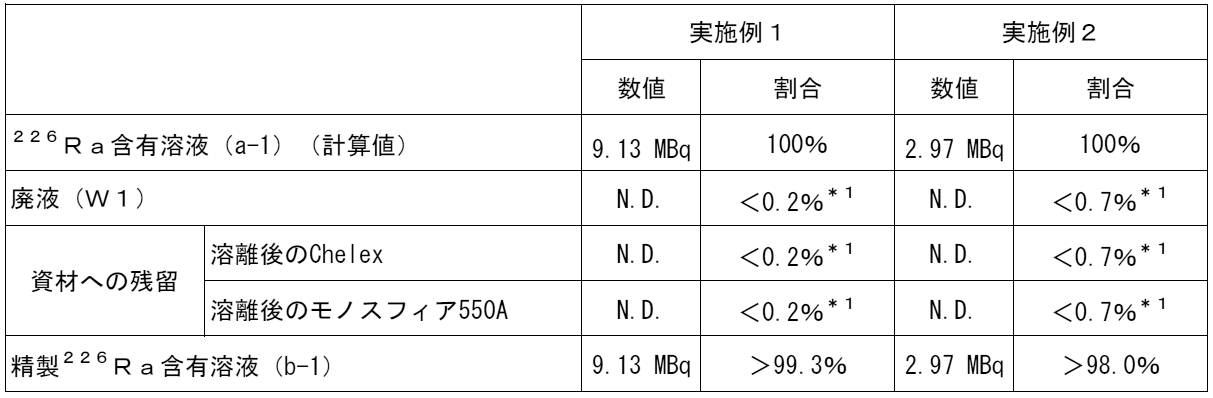
なお、表1中に記載されている*1の値は、実測値はN.D.であったが、0.02MBq未満の測定の可否が不明なため、最大0.02MBq検出したとして計算した。
<評価項目2.溶解工程(A2)および分離工程(A3)を経た226Raの物質収支>
照射済みの226Raターゲット(大きさ:Φ10mm、厚み:2~3mm、226Ra質量:0.3~1mg)を1mol/Lの塩酸を5mLで溶解した後、メンブレンフィルターで濾過して不溶物を除去した。濾液に28質量%アンモニア水(関東化学(株)製、製品名:アンモニア水(25.0~27.9%)原子吸光分析用)1mLを添加してpH10~12にし、水酸化アクチニウムのコロイドを生成させた。次いで、生成した水酸化アクチニウムをメンブレンフィルターを用いて流速1~2mL/minで濾過して、226Ra含有溶液(a-2)を得た。
次に、DGAレジンをメンブレンフィルターから外し、8mol/L塩酸6mLをDGAレジンに流速1~2mL/minで通液して、その溶出液を廃液(W3)とした。その後、0.01mol/L塩酸10mLをDGAレジンに流速1~2mL/minで通液し、225Ac含有溶液を得た。

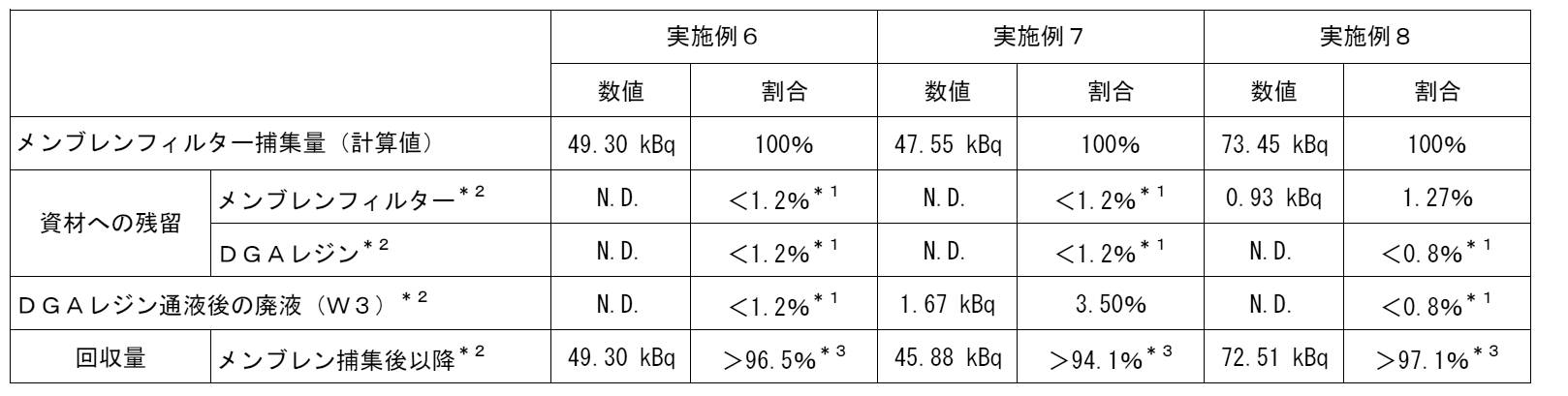
表2中の分離工程(A3)後の廃液(W2)を含まない226Ra含有溶液(a-2)については、下記の計算式(2)から算出した。
表3中に記載されている*2の値は、分離工程(A3)後の225Acメンブレンフィルター捕集量の算出のために用いている。
表3中のメンブレンフィルター捕集量は、下記の計算式(3)から算出した。
Claims (12)
- 226Ra含有溶液(a)を、二価陽イオンを選択的に吸着する機能を有する担体にアルカリ条件下で接触させて、226Raイオンを前記担体に吸着させる吸着工程(R1)と、
酸性条件下で前記担体から226Raイオンを溶離させる溶離工程(R2)と
を含む、226Ra含有溶液の精製方法。 - 前記担体が、二価の陽イオン交換基を有する、請求項1に記載の226Ra含有溶液の精製方法。
- 前記担体が、イミノジ酢酸基を含む、請求項1または2に記載の226Ra含有溶液の精製方法。
- さらに、前記溶離工程(R2)で溶離された226Raイオンを含有する溶液を陰イオン交換樹脂に通液する陰イオン交換工程(R3)を含む、請求項1~3のいずれか一項に記載の226Ra含有溶液の精製方法。
- 前記226Ra含有溶液(a)が、加速器を用いて荷電粒子、光子及び中性子から選ばれる少なくとも1種を照射した226Raターゲットを溶解した溶解液から225Ac成分を分離した後の溶液である、請求項1~4のいずれか一項に記載の226Ra含有溶液の精製方法。
- 前記担体がチューブに充填されている、請求項1~5のいずれか一項に記載の226Ra含有溶液の精製方法。
- 請求項1~6のいずれか一項に記載の精製方法により得られた精製226Ra含有溶液(b)を用いて電着液を調製する電着液調製工程(R4)と、
該電着液を用いて226Ra含有物質を基材に電着させる電着工程(R5)と
を含む、226Raターゲットの製造方法。 - 前記電着工程(R5)を経た226Ra含有溶液(c)を、二価陽イオンを選択的に吸着する機能を有する担体にアルカリ条件下で接触させて、226Raイオンを前記担体に吸着させる吸着工程(R6)と、
酸性条件下で前記担体から226Raイオンを溶離させる溶離工程(R7)と
を含む精製方法をさらに含み、
該精製方法により得られた精製226Ra含有溶液(d)を前記精製226Ra含有溶液(b)と混合し、前記電着液調製工程(R4)で電着液を調製する、請求項7に記載の226Raターゲットの製造方法。 - さらに、前記溶離工程(R7)で溶離された226Raイオンを含有する溶液を陰イオン交換樹脂に通液する陰イオン交換工程(R8)を含む、請求項8に記載の226Raターゲットの製造方法。
- 請求項7~9のいずれか一項に記載の製造方法により製造された226Raターゲットに、加速器を用いて荷電粒子、光子及び中性子から選ばれる少なくとも1種を照射して225Acを生成する照射工程(A1)を含む、225Acの製造方法。
- 前記照射工程(A1)で照射された226Raターゲットを溶解する溶解工程(A2)と、
前記溶解工程(A2)で得られた溶解液をアルカリ化することによりコロイド化した225Ac成分を分離する分離工程(A3)と、
をさらに含む、請求項10に記載の225Acの製造方法。 - 二価陽イオンを選択的に吸着する機能を有する担体または陰イオン交換樹脂が充填されており、226Ra含有溶液を精製するために用いられるチューブ。
Priority Applications (10)
| Application Number | Priority Date | Filing Date | Title |
|---|---|---|---|
| EP20835047.0A EP3996111A4 (en) | 2019-07-02 | 2020-06-25 | METHOD OF PURIFYING SOLUTION CONTAINING 226RA, METHOD OF MANUFACTURING A 226RA TARGET, AND METHOD OF MANUFACTURING 225AC |
| CN202080047091.8A CN114040813B (zh) | 2019-07-02 | 2020-06-25 | 含226Ra溶液的纯化方法、226Ra靶的制造方法及225Ac的制造方法 |
| KR1020217041820A KR102490805B1 (ko) | 2019-07-02 | 2020-06-25 | 226Ra 함유 용액의 정제 방법, 226Ra 타깃의 제조 방법, 및 225Ac의 제조 방법 |
| KR1020237001728A KR102832517B1 (ko) | 2019-07-02 | 2020-06-25 | 226Ra 함유 용액의 정제 방법, 226Ra 타깃의 제조 방법, 및 225Ac의 제조 방법 |
| US17/622,390 US12179149B2 (en) | 2019-07-02 | 2020-06-25 | Method for purifying 226Ra-containing solution, method for producing 226Ra target, and method for producing 225Ac |
| CA3144593A CA3144593A1 (en) | 2019-07-02 | 2020-06-25 | Method for purifying 226ra-containing solution, method for producing 226ra target, and method for producing 225ac |
| JP2021529990A JP7154414B2 (ja) | 2019-07-02 | 2020-06-25 | 226Ra含有溶液の精製方法、226Raターゲットの製造方法および225Acの製造方法 |
| AU2020298961A AU2020298961B2 (en) | 2019-07-02 | 2020-06-25 | METHOD FOR PURIFYING 226Ra-CONTAINING SOLUTION, METHOD FOR PRODUCING 226Ra TARGET, AND METHOD FOR PRODUCING 225Ac |
| US17/846,398 US11551826B2 (en) | 2019-07-02 | 2022-06-22 | Method for producing 225Ac |
| JP2022160430A JP7515547B2 (ja) | 2019-07-02 | 2022-10-04 | 226Ra含有溶液の精製方法、226Raターゲットの製造方法および225Acの製造方法 |
Applications Claiming Priority (2)
| Application Number | Priority Date | Filing Date | Title |
|---|---|---|---|
| JP2019-123673 | 2019-07-02 | ||
| JP2019123673 | 2019-07-02 |
Related Child Applications (2)
| Application Number | Title | Priority Date | Filing Date |
|---|---|---|---|
| US17/622,390 A-371-Of-International US12179149B2 (en) | 2019-07-02 | 2020-06-25 | Method for purifying 226Ra-containing solution, method for producing 226Ra target, and method for producing 225Ac |
| US17/846,398 Continuation US11551826B2 (en) | 2019-07-02 | 2022-06-22 | Method for producing 225Ac |
Publications (1)
| Publication Number | Publication Date |
|---|---|
| WO2021002275A1 true WO2021002275A1 (ja) | 2021-01-07 |
Family
ID=74101023
Family Applications (1)
| Application Number | Title | Priority Date | Filing Date |
|---|---|---|---|
| PCT/JP2020/025059 Ceased WO2021002275A1 (ja) | 2019-07-02 | 2020-06-25 | 226Ra含有溶液の精製方法、226Raターゲットの製造方法および225Acの製造方法 |
Country Status (8)
| Country | Link |
|---|---|
| US (2) | US12179149B2 (ja) |
| EP (1) | EP3996111A4 (ja) |
| JP (2) | JP7154414B2 (ja) |
| KR (2) | KR102490805B1 (ja) |
| CN (1) | CN114040813B (ja) |
| AU (1) | AU2020298961B2 (ja) |
| CA (1) | CA3144593A1 (ja) |
| WO (1) | WO2021002275A1 (ja) |
Cited By (6)
| Publication number | Priority date | Publication date | Assignee | Title |
|---|---|---|---|---|
| WO2022014555A1 (ja) * | 2020-07-17 | 2022-01-20 | 日本メジフィジックス株式会社 | 225Ac溶液の製造方法 |
| JPWO2022149535A1 (ja) * | 2021-01-08 | 2022-07-14 | ||
| WO2022149578A1 (ja) | 2021-01-08 | 2022-07-14 | 日本メジフィジックス株式会社 | Ac-225溶液の製造方法およびAc-225溶液を用いた医薬の製造方法 |
| US11594345B2 (en) * | 2019-11-29 | 2023-02-28 | Ion Beam Applications | Method for producing Ac-225 from Ra-226 |
| RU2852721C1 (ru) * | 2021-01-08 | 2025-12-15 | Нихон Меди-Физикс Ко., Лтд. | СПОСОБ ПОЛУЧЕНИЯ РАСТВОРА Ac-225 и СПОСОБ ПОЛУЧЕНИЯ ЛЕКАРСТВЕННОГО ПРЕПАРАТА С ИСПОЛЬЗОВАНИЕМ РАСТВОРА Ac-225 |
| WO2026063503A1 (ja) * | 2024-09-20 | 2026-03-26 | 日本メジフィジックス株式会社 | Ac-225溶液の製造方法および該溶液を用いたAc-225標識錯体の製造方法 |
Citations (4)
| Publication number | Priority date | Publication date | Assignee | Title |
|---|---|---|---|---|
| JPH11262661A (ja) * | 1998-03-19 | 1999-09-28 | Unitika Ltd | ラジウム吸着剤、その製造方法及びそれを用いたラジウム含有廃水の処理方法 |
| JP2007508531A (ja) * | 2003-10-13 | 2007-04-05 | アクチニウム ファーマシューティカルズ,インコーポレイティド | ラジウム標的及びその製造法 |
| JP2009527731A (ja) | 2006-02-21 | 2009-07-30 | アクチニウム ファーマシューティカルズ,インコーポレイティド | 放射線照射226Ra標的から225Acを精製する方法 |
| JP2015114315A (ja) * | 2013-12-06 | 2015-06-22 | 株式会社 環境浄化研究所 | 晶析を利用したストロンチウム除去方法 |
Family Cites Families (12)
| Publication number | Priority date | Publication date | Assignee | Title |
|---|---|---|---|---|
| JPS5969151A (ja) * | 1982-10-13 | 1984-04-19 | Unitika Ltd | 球状イオン交換樹脂とその製造法及び吸着処理法 |
| JP2928505B1 (ja) | 1998-03-03 | 1999-08-03 | ユニチカ株式会社 | ラジウム吸着剤とその製造方法 |
| JP3832961B2 (ja) | 1998-03-10 | 2006-10-11 | ユニチカ株式会社 | ラジウム吸着剤の再生方法 |
| ATE238603T1 (de) | 1998-06-02 | 2003-05-15 | Europ Economic Community | Verfahren zur erzeugung von ac-225 durch protonbestrahlung von ra-226 |
| JPWO2002076919A1 (ja) * | 2001-03-26 | 2004-10-21 | 株式会社日本触媒 | 溶解性金属触媒と陰イオン交換樹脂を用いた反応方法、その溶解性金属触媒の回収方法及び再利用方法 |
| JP4347783B2 (ja) * | 2004-11-04 | 2009-10-21 | 日鉱金属株式会社 | 廃触媒からの白金及びレニウムの回収方法 |
| WO2008028664A1 (en) | 2006-09-08 | 2008-03-13 | Actinium Pharmaceuticals, Inc. | Method for the purification of radium from different sources |
| DE102007041361A1 (de) * | 2007-08-30 | 2009-03-05 | Lanxess Deutschland Gmbh | Adsorption von Radionukliden |
| JP5883849B2 (ja) * | 2010-04-29 | 2016-03-15 | バクスター・インターナショナル・インコーポレイテッドBaxter International Incorp0Rated | 陰イオン交換樹脂を用いる二価カチオン結合タンパク質の精製方法 |
| JP6009218B2 (ja) | 2011-05-24 | 2016-10-19 | ローム アンド ハース エレクトロニック マテリアルズ エルエルシーRohm and Haas Electronic Materials LLC | アルファ粒子放射体除去 |
| JPWO2015041218A1 (ja) * | 2013-09-17 | 2017-03-02 | 株式会社カネカ | 新規抗体精製方法及びそれから得られる抗体(NovelAntibodyPurificationMethodandAntibodyobtainedtherefrom)、並びに陽イオン交換基を用いた新規抗体精製法及びそれから得られる抗体(NovelAntibodyPurificationmethodusingCationExchangerandAntibodyobtainedtherefrom) |
| GB201600154D0 (en) | 2016-01-05 | 2016-02-17 | Bayer As | Isotope preparation method |
-
2020
- 2020-06-25 KR KR1020217041820A patent/KR102490805B1/ko active Active
- 2020-06-25 US US17/622,390 patent/US12179149B2/en active Active
- 2020-06-25 KR KR1020237001728A patent/KR102832517B1/ko active Active
- 2020-06-25 JP JP2021529990A patent/JP7154414B2/ja active Active
- 2020-06-25 CN CN202080047091.8A patent/CN114040813B/zh active Active
- 2020-06-25 WO PCT/JP2020/025059 patent/WO2021002275A1/ja not_active Ceased
- 2020-06-25 EP EP20835047.0A patent/EP3996111A4/en active Pending
- 2020-06-25 CA CA3144593A patent/CA3144593A1/en active Pending
- 2020-06-25 AU AU2020298961A patent/AU2020298961B2/en active Active
-
2022
- 2022-06-22 US US17/846,398 patent/US11551826B2/en active Active
- 2022-10-04 JP JP2022160430A patent/JP7515547B2/ja active Active
Patent Citations (4)
| Publication number | Priority date | Publication date | Assignee | Title |
|---|---|---|---|---|
| JPH11262661A (ja) * | 1998-03-19 | 1999-09-28 | Unitika Ltd | ラジウム吸着剤、その製造方法及びそれを用いたラジウム含有廃水の処理方法 |
| JP2007508531A (ja) * | 2003-10-13 | 2007-04-05 | アクチニウム ファーマシューティカルズ,インコーポレイティド | ラジウム標的及びその製造法 |
| JP2009527731A (ja) | 2006-02-21 | 2009-07-30 | アクチニウム ファーマシューティカルズ,インコーポレイティド | 放射線照射226Ra標的から225Acを精製する方法 |
| JP2015114315A (ja) * | 2013-12-06 | 2015-06-22 | 株式会社 環境浄化研究所 | 晶析を利用したストロンチウム除去方法 |
Cited By (16)
| Publication number | Priority date | Publication date | Assignee | Title |
|---|---|---|---|---|
| US11594345B2 (en) * | 2019-11-29 | 2023-02-28 | Ion Beam Applications | Method for producing Ac-225 from Ra-226 |
| WO2022014555A1 (ja) * | 2020-07-17 | 2022-01-20 | 日本メジフィジックス株式会社 | 225Ac溶液の製造方法 |
| KR20220101191A (ko) * | 2021-01-08 | 2022-07-19 | 니혼 메디피직스 가부시키가이샤 | Ac-225 용액의 제조 방법 및 Ac-225 용액을 사용한 의약의 제조 방법 |
| US11752223B2 (en) | 2021-01-08 | 2023-09-12 | Nihon Medi-Physics Co., Ltd. | Method for producing Ac-225 solution and method for producing medicine using Ac-225 solution |
| WO2022149535A1 (ja) * | 2021-01-08 | 2022-07-14 | 日本メジフィジックス株式会社 | Ra-226の回収方法、Ra-226溶液の製造方法及びAc-225溶液の製造方法 |
| JP7154465B1 (ja) * | 2021-01-08 | 2022-10-17 | 日本メジフィジックス株式会社 | Ac-225溶液の製造方法およびAc-225溶液を用いた医薬の製造方法 |
| JP2022188190A (ja) * | 2021-01-08 | 2022-12-20 | 日本メジフィジックス株式会社 | Ac-225溶液の製造方法およびAc-225溶液を用いた医薬の製造方法 |
| KR102500942B1 (ko) * | 2021-01-08 | 2023-02-17 | 니혼 메디피직스 가부시키가이샤 | Ac-225 용액의 제조 방법 및 Ac-225 용액을 사용한 의약의 제조 방법 |
| JPWO2022149535A1 (ja) * | 2021-01-08 | 2022-07-14 | ||
| WO2022149578A1 (ja) | 2021-01-08 | 2022-07-14 | 日本メジフィジックス株式会社 | Ac-225溶液の製造方法およびAc-225溶液を用いた医薬の製造方法 |
| RU2852721C1 (ru) * | 2021-01-08 | 2025-12-15 | Нихон Меди-Физикс Ко., Лтд. | СПОСОБ ПОЛУЧЕНИЯ РАСТВОРА Ac-225 и СПОСОБ ПОЛУЧЕНИЯ ЛЕКАРСТВЕННОГО ПРЕПАРАТА С ИСПОЛЬЗОВАНИЕМ РАСТВОРА Ac-225 |
| RU2854877C1 (ru) * | 2021-01-08 | 2026-01-21 | Нихон Меди-Физикс Ко., Лтд. | СПОСОБ ИЗВЛЕЧЕНИЯ Ra-226, СПОСОБ ПРОИЗВОДСТВА РАСТВОРА Ra-226 И СПОСОБ ПРОИЗВОДСТВА РАСТВОРА Ac-225 |
| JP7804946B2 (ja) | 2021-01-08 | 2026-01-23 | 日本メジフィジックス株式会社 | Ra-226の回収方法、Ra-226溶液の製造方法及びAc-225溶液の製造方法 |
| US12618122B2 (en) | 2021-01-08 | 2026-05-05 | Nihon Medi-Physics Co., Ltd. | Recovery method of Ra-226, production method of Ra-226 solution, and Ac-225 solution production method of Ac-225 solution |
| JP7846599B2 (ja) | 2021-01-08 | 2026-04-15 | 日本メジフィジックス株式会社 | Ac-225溶液の製造方法およびAc-225溶液を用いた医薬の製造方法 |
| WO2026063503A1 (ja) * | 2024-09-20 | 2026-03-26 | 日本メジフィジックス株式会社 | Ac-225溶液の製造方法および該溶液を用いたAc-225標識錯体の製造方法 |
Also Published As
| Publication number | Publication date |
|---|---|
| CN114040813B (zh) | 2024-06-21 |
| EP3996111A4 (en) | 2022-09-07 |
| JP2022188189A (ja) | 2022-12-20 |
| US20220328207A1 (en) | 2022-10-13 |
| AU2020298961A1 (en) | 2022-02-03 |
| JP7515547B2 (ja) | 2024-07-12 |
| JP7154414B2 (ja) | 2022-10-17 |
| CA3144593A1 (en) | 2021-01-07 |
| CN114040813A (zh) | 2022-02-11 |
| KR102832517B1 (ko) | 2025-07-14 |
| US11551826B2 (en) | 2023-01-10 |
| JPWO2021002275A1 (ja) | 2021-01-07 |
| KR20220025734A (ko) | 2022-03-03 |
| KR102490805B1 (ko) | 2023-01-20 |
| KR20230016250A (ko) | 2023-02-01 |
| US20220367081A1 (en) | 2022-11-17 |
| EP3996111A1 (en) | 2022-05-11 |
| AU2020298961B2 (en) | 2026-02-19 |
| US12179149B2 (en) | 2024-12-31 |
Similar Documents
| Publication | Publication Date | Title |
|---|---|---|
| JP7515547B2 (ja) | 226Ra含有溶液の精製方法、226Raターゲットの製造方法および225Acの製造方法 | |
| JP7515553B2 (ja) | 226Raターゲットの製造方法、225Acの製造方法及び226Raターゲット製造用電着液 | |
| JP2002513946A (ja) | パラジウム−103の生産 | |
| JP4877863B2 (ja) | キレート交換樹脂を用いた放射性銅の分離方法 | |
| JP7804946B2 (ja) | Ra-226の回収方法、Ra-226溶液の製造方法及びAc-225溶液の製造方法 | |
| HK40066319A (zh) | 含226ra溶液的纯化方法、226ra靶的制造方法及225ac的制造方法 | |
| AU2021309611A1 (en) | Method for producing 225Ac solution | |
| RU2854877C1 (ru) | СПОСОБ ИЗВЛЕЧЕНИЯ Ra-226, СПОСОБ ПРОИЗВОДСТВА РАСТВОРА Ra-226 И СПОСОБ ПРОИЗВОДСТВА РАСТВОРА Ac-225 | |
| HK40065339A (en) | Method for producing 226ra target, method for producing 225ac, and electrodeposition liquid for production of 226ra target | |
| Al Rayyes et al. | Routine simultaneous production of no-carrier-added high purity 64Cu and 67Ga | |
| Das et al. | Separation of carrier-free tellurium from bulk amounts of tin |
Legal Events
| Date | Code | Title | Description |
|---|---|---|---|
| 121 | Ep: the epo has been informed by wipo that ep was designated in this application |
Ref document number: 20835047 Country of ref document: EP Kind code of ref document: A1 |
|
| ENP | Entry into the national phase |
Ref document number: 2021529990 Country of ref document: JP Kind code of ref document: A |
|
| ENP | Entry into the national phase |
Ref document number: 3144593 Country of ref document: CA |
|
| NENP | Non-entry into the national phase |
Ref country code: DE |
|
| ENP | Entry into the national phase |
Ref document number: 2020298961 Country of ref document: AU Date of ref document: 20200625 Kind code of ref document: A |
|
| ENP | Entry into the national phase |
Ref document number: 2020835047 Country of ref document: EP Effective date: 20220202 |