WO2021007065A1 - Process for removing strontium ions from bodily fluids using metallate ion exchange compositions - Google Patents
Process for removing strontium ions from bodily fluids using metallate ion exchange compositions Download PDFInfo
- Publication number
- WO2021007065A1 WO2021007065A1 PCT/US2020/040217 US2020040217W WO2021007065A1 WO 2021007065 A1 WO2021007065 A1 WO 2021007065A1 US 2020040217 W US2020040217 W US 2020040217W WO 2021007065 A1 WO2021007065 A1 WO 2021007065A1
- Authority
- WO
- WIPO (PCT)
- Prior art keywords
- ion
- value
- total metal
- metallate
- zero
- Prior art date
- Legal status (The legal status is an assumption and is not a legal conclusion. Google has not performed a legal analysis and makes no representation as to the accuracy of the status listed.)
- Ceased
Links
Classifications
-
- A—HUMAN NECESSITIES
- A61—MEDICAL OR VETERINARY SCIENCE; HYGIENE
- A61M—DEVICES FOR INTRODUCING MEDIA INTO, OR ONTO, THE BODY; DEVICES FOR TRANSDUCING BODY MEDIA OR FOR TAKING MEDIA FROM THE BODY; DEVICES FOR PRODUCING OR ENDING SLEEP OR STUPOR
- A61M1/00—Suction or pumping devices for medical purposes; Devices for carrying-off, for treatment of, or for carrying-over, body-liquids; Drainage systems
- A61M1/14—Dialysis systems; Artificial kidneys; Blood oxygenators ; Reciprocating systems for treatment of body fluids, e.g. single needle systems for hemofiltration or pheresis
- A61M1/28—Peritoneal dialysis ; Other peritoneal treatment, e.g. oxygenation
- A61M1/287—Dialysates therefor
-
- A—HUMAN NECESSITIES
- A61—MEDICAL OR VETERINARY SCIENCE; HYGIENE
- A61M—DEVICES FOR INTRODUCING MEDIA INTO, OR ONTO, THE BODY; DEVICES FOR TRANSDUCING BODY MEDIA OR FOR TAKING MEDIA FROM THE BODY; DEVICES FOR PRODUCING OR ENDING SLEEP OR STUPOR
- A61M1/00—Suction or pumping devices for medical purposes; Devices for carrying-off, for treatment of, or for carrying-over, body-liquids; Drainage systems
- A61M1/14—Dialysis systems; Artificial kidneys; Blood oxygenators ; Reciprocating systems for treatment of body fluids, e.g. single needle systems for hemofiltration or pheresis
- A61M1/16—Dialysis systems; Artificial kidneys; Blood oxygenators ; Reciprocating systems for treatment of body fluids, e.g. single needle systems for hemofiltration or pheresis with membranes
- A61M1/1678—Dialysis systems; Artificial kidneys; Blood oxygenators ; Reciprocating systems for treatment of body fluids, e.g. single needle systems for hemofiltration or pheresis with membranes intracorporal
-
- A—HUMAN NECESSITIES
- A61—MEDICAL OR VETERINARY SCIENCE; HYGIENE
- A61M—DEVICES FOR INTRODUCING MEDIA INTO, OR ONTO, THE BODY; DEVICES FOR TRANSDUCING BODY MEDIA OR FOR TAKING MEDIA FROM THE BODY; DEVICES FOR PRODUCING OR ENDING SLEEP OR STUPOR
- A61M1/00—Suction or pumping devices for medical purposes; Devices for carrying-off, for treatment of, or for carrying-over, body-liquids; Drainage systems
- A61M1/14—Dialysis systems; Artificial kidneys; Blood oxygenators ; Reciprocating systems for treatment of body fluids, e.g. single needle systems for hemofiltration or pheresis
- A61M1/16—Dialysis systems; Artificial kidneys; Blood oxygenators ; Reciprocating systems for treatment of body fluids, e.g. single needle systems for hemofiltration or pheresis with membranes
- A61M1/1694—Dialysis systems; Artificial kidneys; Blood oxygenators ; Reciprocating systems for treatment of body fluids, e.g. single needle systems for hemofiltration or pheresis with membranes with recirculating dialysing liquid
- A61M1/1696—Dialysis systems; Artificial kidneys; Blood oxygenators ; Reciprocating systems for treatment of body fluids, e.g. single needle systems for hemofiltration or pheresis with membranes with recirculating dialysing liquid with dialysate regeneration
-
- A—HUMAN NECESSITIES
- A61—MEDICAL OR VETERINARY SCIENCE; HYGIENE
- A61M—DEVICES FOR INTRODUCING MEDIA INTO, OR ONTO, THE BODY; DEVICES FOR TRANSDUCING BODY MEDIA OR FOR TAKING MEDIA FROM THE BODY; DEVICES FOR PRODUCING OR ENDING SLEEP OR STUPOR
- A61M1/00—Suction or pumping devices for medical purposes; Devices for carrying-off, for treatment of, or for carrying-over, body-liquids; Drainage systems
- A61M1/14—Dialysis systems; Artificial kidneys; Blood oxygenators ; Reciprocating systems for treatment of body fluids, e.g. single needle systems for hemofiltration or pheresis
- A61M1/28—Peritoneal dialysis ; Other peritoneal treatment, e.g. oxygenation
-
- A—HUMAN NECESSITIES
- A61—MEDICAL OR VETERINARY SCIENCE; HYGIENE
- A61M—DEVICES FOR INTRODUCING MEDIA INTO, OR ONTO, THE BODY; DEVICES FOR TRANSDUCING BODY MEDIA OR FOR TAKING MEDIA FROM THE BODY; DEVICES FOR PRODUCING OR ENDING SLEEP OR STUPOR
- A61M1/00—Suction or pumping devices for medical purposes; Devices for carrying-off, for treatment of, or for carrying-over, body-liquids; Drainage systems
- A61M1/34—Filtering material out of the blood by passing it through a membrane, i.e. hemofiltration or diafiltration
- A61M1/3472—Filtering material out of the blood by passing it through a membrane, i.e. hemofiltration or diafiltration with treatment of the filtrate
- A61M1/3486—Biological, chemical treatment, e.g. chemical precipitation; treatment by absorbents
-
- A—HUMAN NECESSITIES
- A61—MEDICAL OR VETERINARY SCIENCE; HYGIENE
- A61M—DEVICES FOR INTRODUCING MEDIA INTO, OR ONTO, THE BODY; DEVICES FOR TRANSDUCING BODY MEDIA OR FOR TAKING MEDIA FROM THE BODY; DEVICES FOR PRODUCING OR ENDING SLEEP OR STUPOR
- A61M1/00—Suction or pumping devices for medical purposes; Devices for carrying-off, for treatment of, or for carrying-over, body-liquids; Drainage systems
- A61M1/36—Other treatment of blood in a by-pass of the natural circulatory system, e.g. temperature adaptation, irradiation ; Extra-corporeal blood circuits
- A61M1/3679—Other treatment of blood in a by-pass of the natural circulatory system, e.g. temperature adaptation, irradiation ; Extra-corporeal blood circuits by absorption
-
- A—HUMAN NECESSITIES
- A61—MEDICAL OR VETERINARY SCIENCE; HYGIENE
- A61M—DEVICES FOR INTRODUCING MEDIA INTO, OR ONTO, THE BODY; DEVICES FOR TRANSDUCING BODY MEDIA OR FOR TAKING MEDIA FROM THE BODY; DEVICES FOR PRODUCING OR ENDING SLEEP OR STUPOR
- A61M1/00—Suction or pumping devices for medical purposes; Devices for carrying-off, for treatment of, or for carrying-over, body-liquids; Drainage systems
- A61M1/36—Other treatment of blood in a by-pass of the natural circulatory system, e.g. temperature adaptation, irradiation ; Extra-corporeal blood circuits
- A61M1/3687—Chemical treatment
-
- B—PERFORMING OPERATIONS; TRANSPORTING
- B01—PHYSICAL OR CHEMICAL PROCESSES OR APPARATUS IN GENERAL
- B01D—SEPARATION
- B01D15/00—Separating processes involving the treatment of liquids with solid sorbents; Apparatus therefor
- B01D15/08—Selective adsorption, e.g. chromatography
- B01D15/26—Selective adsorption, e.g. chromatography characterised by the separation mechanism
- B01D15/36—Selective adsorption, e.g. chromatography characterised by the separation mechanism involving ionic interaction, e.g. ion-exchange, ion-pair, ion-suppression or ion-exclusion
- B01D15/361—Ion-exchange
- B01D15/362—Cation-exchange
-
- B—PERFORMING OPERATIONS; TRANSPORTING
- B01—PHYSICAL OR CHEMICAL PROCESSES OR APPARATUS IN GENERAL
- B01D—SEPARATION
- B01D69/00—Semi-permeable membranes for separation processes or apparatus characterised by their form, structure or properties; Manufacturing processes specially adapted therefor
- B01D69/02—Semi-permeable membranes for separation processes or apparatus characterised by their form, structure or properties; Manufacturing processes specially adapted therefor characterised by their properties
-
- B—PERFORMING OPERATIONS; TRANSPORTING
- B01—PHYSICAL OR CHEMICAL PROCESSES OR APPARATUS IN GENERAL
- B01D—SEPARATION
- B01D69/00—Semi-permeable membranes for separation processes or apparatus characterised by their form, structure or properties; Manufacturing processes specially adapted therefor
- B01D69/08—Hollow fibre membranes
-
- B—PERFORMING OPERATIONS; TRANSPORTING
- B01—PHYSICAL OR CHEMICAL PROCESSES OR APPARATUS IN GENERAL
- B01D—SEPARATION
- B01D69/00—Semi-permeable membranes for separation processes or apparatus characterised by their form, structure or properties; Manufacturing processes specially adapted therefor
- B01D69/10—Supported membranes; Membrane supports
- B01D69/108—Inorganic support material
-
- B—PERFORMING OPERATIONS; TRANSPORTING
- B01—PHYSICAL OR CHEMICAL PROCESSES OR APPARATUS IN GENERAL
- B01J—CHEMICAL OR PHYSICAL PROCESSES, e.g. CATALYSIS OR COLLOID CHEMISTRY; THEIR RELEVANT APPARATUS
- B01J39/00—Cation exchange; Use of material as cation exchangers; Treatment of material for improving the cation exchange properties
- B01J39/02—Processes using inorganic exchangers
-
- B—PERFORMING OPERATIONS; TRANSPORTING
- B01—PHYSICAL OR CHEMICAL PROCESSES OR APPARATUS IN GENERAL
- B01J—CHEMICAL OR PHYSICAL PROCESSES, e.g. CATALYSIS OR COLLOID CHEMISTRY; THEIR RELEVANT APPARATUS
- B01J39/00—Cation exchange; Use of material as cation exchangers; Treatment of material for improving the cation exchange properties
- B01J39/08—Use of material as cation exchangers; Treatment of material for improving the cation exchange properties
- B01J39/09—Inorganic material
-
- B—PERFORMING OPERATIONS; TRANSPORTING
- B01—PHYSICAL OR CHEMICAL PROCESSES OR APPARATUS IN GENERAL
- B01J—CHEMICAL OR PHYSICAL PROCESSES, e.g. CATALYSIS OR COLLOID CHEMISTRY; THEIR RELEVANT APPARATUS
- B01J39/00—Cation exchange; Use of material as cation exchangers; Treatment of material for improving the cation exchange properties
- B01J39/08—Use of material as cation exchangers; Treatment of material for improving the cation exchange properties
- B01J39/10—Oxides or hydroxides
-
- B—PERFORMING OPERATIONS; TRANSPORTING
- B01—PHYSICAL OR CHEMICAL PROCESSES OR APPARATUS IN GENERAL
- B01J—CHEMICAL OR PHYSICAL PROCESSES, e.g. CATALYSIS OR COLLOID CHEMISTRY; THEIR RELEVANT APPARATUS
- B01J47/00—Ion-exchange processes in general; Apparatus therefor
- B01J47/12—Ion-exchange processes in general; Apparatus therefor characterised by the use of ion-exchange material in the form of ribbons, filaments, fibres or sheets, e.g. membranes
-
- B—PERFORMING OPERATIONS; TRANSPORTING
- B01—PHYSICAL OR CHEMICAL PROCESSES OR APPARATUS IN GENERAL
- B01J—CHEMICAL OR PHYSICAL PROCESSES, e.g. CATALYSIS OR COLLOID CHEMISTRY; THEIR RELEVANT APPARATUS
- B01J47/00—Ion-exchange processes in general; Apparatus therefor
- B01J47/12—Ion-exchange processes in general; Apparatus therefor characterised by the use of ion-exchange material in the form of ribbons, filaments, fibres or sheets, e.g. membranes
- B01J47/127—Ion-exchange processes in general; Apparatus therefor characterised by the use of ion-exchange material in the form of ribbons, filaments, fibres or sheets, e.g. membranes in the form of filaments or fibres
-
- B—PERFORMING OPERATIONS; TRANSPORTING
- B01—PHYSICAL OR CHEMICAL PROCESSES OR APPARATUS IN GENERAL
- B01D—SEPARATION
- B01D2325/00—Details relating to properties of membranes
- B01D2325/12—Adsorbents being present on the surface of the membranes or in the pores
-
- B—PERFORMING OPERATIONS; TRANSPORTING
- B01—PHYSICAL OR CHEMICAL PROCESSES OR APPARATUS IN GENERAL
- B01D—SEPARATION
- B01D2325/00—Details relating to properties of membranes
- B01D2325/42—Ion-exchange membranes
Definitions
- This invention relates to an extracorporeal or intracorporeal processes for removing Sr 2+ ions from bodily fluids.
- the blood or other bodily fluid is either contacted directly with a metallate ion exchange composition which is capable of selectively removing the toxins from the blood or the other bodily fluid or that fluid is first contacted with a dialysis solution which is then contacted with the metallate ion exchange composition.
- a metallate ion exchange composition which is capable of selectively removing the toxins from the blood or the other bodily fluid or that fluid is first contacted with a dialysis solution which is then contacted with the metallate ion exchange composition.
- Middle molecular weight toxins having a molecular weight of 300 to 10,000 can also be present and are difficult to effectively remove.
- the art shows a number of ways to treat blood containing such toxins.
- the classic method is of course dialysis. Dialysis is defined as the removal of substances from a liquid by diffusion across a semipermeable membrane into a second liquid. Dialysis of blood outside of the body (hemodialysis) is the basis of the "artificial kidney.”
- the artificial kidney treatment procedure generally used today is similar to that developed by Kolff in the early 1940s. Since the 1940s there have been a number of disclosures which deal with improvements on artificial kidneys or artificial livers.
- US 4,261,828 discloses an apparatus for the detoxification of blood.
- the apparatus comprises a housing filled with an adsorbent such as charcoal or a resin and optionally an enzyme carrier.
- an adsorbent such as charcoal or a resin and optionally an enzyme carrier.
- the adsorbent may be coated with a coating which is permeable for the substances to be adsorbed yet prevent the direct contact between the corpuscular blood components and the adsorbents.
- US 4,581,141 discloses a composition for use in dialysis which contains a surface adsorptive substance, water, a suspending agent, urease, a calcium-loaded cation exchanger, an aliphatic carboxylic acid resin and a metabolizable organic acid buffer.
- the calcium loaded cation exchanger can be a calcium-exchanged zeolite.
- EP 0046971 A1 discloses that zeolite W can be used in hemodialysis to remove ammonia.
- CA 2542968C discloses natural zeolites for the removal of toxins, including for removal of radioactive Sr 2+ and Cs + from fallout, from the gastrointestinal tract.
- US 5,536,412 discloses hemofiltration and plasma filtration devices in which blood flows through the interior of a hollow fiber membrane and during the flow of blood, a sorbent suspension is circulated against the exterior surfaces of the hollow fiber membrane. Another step involves having the plasma fraction of the blood alternately exit and re- enter the interior of the membrane thereby effectuating removal of toxins.
- the sorbent can be activated charcoal along with an ion-exchanger such as a zeolite or a cation-exchange resin.
- microporous ion exchangers that are essentially insoluble in fluids, such as bodily fluids (especially blood), have been developed, namely the zirconium-based silicates and titanium-based silicates of US 5,888,472, US 5,891,417 and US 6,579,460.
- zirconium-based silicates and titanium-based silicates of US 5,888,472, US 5,891,417 and US 6,579,460.
- the use of these zirconium-based silicate or titanium-based silicate microporous ion exchangers to remove toxic ammonium cations from blood or dialysate is described in US 6,814,871, US 6,099,737, and US 6,332,985.
- compositions were also selective in potassium ion exchange and could remove potassium ions from bodily fluids to treat the disease hyperkalemia, which is discussed in patents US 8,802,152, US 8,808,750, US 8,877,255, US 9,457,050, US 9,662,352, US 9,707,255, US 9,844,567, US 9,861,658, US 2015/0225249, US 20016/0000825, US 2016/0038538, US 2016/0271174 and US 2018/0214479. Ex-vivo applications of these materials, for instance in dialysis, are described in US 9,943,637.
- Strontium exposure most often occurs in an industrial setting. Strontium is used in the ceramics, glass, pyrotechnics, and paint industries, as well as in the fabrication of fluorescent lights and some medications. Inhalation is a common exposure route. Radioactive strontium is encountered in the nuclear industry as a major waste product of nuclear fission. Major environmental releases of radioactive strontium have occurred in the Chernobyl nuclear accident in 1986 and in 2011 during the tsunami that destroyed part of the nuclear power plant in Fukushima, Japan. Radioactive strontium in the environment is dangerous, since the chemistry of Sr 2+ is very similar to that of Ca 2+ and is transmitted through the environment in a similar manner, ending up in plants that would be consumed by animals and humans.
- Exposure to elevated strontium levels can cause problems in the body, often associated with the bones. It can cause anemia, bone marrow damage, interfere with blood clotting ability, and especially in the case of the radioactive strontium exposure, may cause cancer, such as leukemia (Chem. Pharm. Bull., 60, 1258-1263, 2012). Attempts to inhibit the uptake of radioactive 90 Sr by use of stable strontium in dietary supplements resulted in diminished growth, improper bone mineralization, induced rickets and inhibition of intestinal calcium absorption (Science, 174, 949-951, 1971).
- Diethylenetriaminepentaacetic acid was most effective in enhancing urinary excretion, along with ethylenediaminetetraacetic acid (EDTA) and cyclohexanediaminetetraacetic acid (CDTA), while 18-crown-6 decreased urinary Sr excretion. Only ascorbic acid enhanced fecal Sr excretion. CDTA, DTPA and tartaric acid were most effective in removing Sr from tissues.
- these chelating agents were often administered in the Ca form to counter Ca removal by analogous sodium forms due to the lack of selectivity of the agents for Sr vs Ca. Removal of Ca can induce a tetany-like reaction causing involuntary muscle contractions, essentially inducing hypocalcemia.
- the chelating agent acetylaminopropylidinediphosphonic acid (APDA) also suffered from lack of specificity for Sr, also removing Ca inducing and inducing hypocalcemia (Health Phys., 76, 489-494, 1999). This resulted in the use of the Ca form of the chelate, which was tested via intraperitoneal injection and oral ingestion. The injected chelate reduced Sr levels by 35% after a first injection, but was much less effective on subsequent injections, suggesting the chelate could not remove absorbed Sr in various tissues and bone.
- APDA acetylaminopropylidinediphosphonic acid
- Aluminum phosphate gels consumed with breakfast have been shown to inhibit the absorption of 85 Sr from the gastrointestinal tract (Int. J. Appl. Radiat. Isot., 779-782, 1967).
- a composite material consisting of hydrophilic porous polymer beads with phosphonic acid groups was tested for inhibition of strontium absorption and while successfully removing Sr, was found to have higher selectivity for calcium (Chem. Pharm. Bull., 60, 1258-1263, 2012).
- the ion-exchange material To remove Sr 2+ directly from blood and gastrointestinal fluids, the ion-exchange material must be stable in these media.
- Materials that fall into this category include titanium, zirconium and tin oxides and silicates, see for example, US 5,888,472 and US 6,099,737.
- Sodium nonatitanate is also disclosed to selectively collect 82 Sr 2+ via extraction from irradiated targets by ion exchange.
- the 82 Sr-containing ion-exchanger is then used as a source of 82 Rb for Positron Emission Tomography, a medical diagnostic tool.
- Amorphous titanium and tin silicate ion-exchangers for removal of heavy metals from aqueous solutions are disclosed in US 5053139, which focus on Pb 2+ removal from drinking water.
- a small pore titanium silicate with the same topology as the mineral zorite, ETS-4, is disclosed in CA 1,328,099 that claims to be proficient in removing dications, including Hg 2+ and Pb 2+ from aqueous solutions.
- the test conditions for Hg 2+ uptake are ambiguous since the amounts of ion-exchanger used in the tests are not disclosed. Remediation of Sr 2+ and healthcare applications are not mentioned.
- a titanogermanosilicate ion exchanger that is an intergrowth of the pharmacosiderite and sitinakite structures disclosed in US 5,935,552 is tested for Cs + uptake in concentrated hydroxide solution and does not anticipate application in the healthcare, medical or pharmaceutical field.
- a list of possible applications is given, but healthcare, pharmaceutical and medical applications are not anticipated.
- Titanium oxide (US 5,821,186) and zirconium oxide (US 6,602,919) ion-exchangers are proposed for remediation of Sr 2+ and Cs + radioactive waste, but there is no demonstration of efficacy in removing these cations from any medium, no patent claims to the removal of Cs + and Sr 2+ , nor any mention of medical applications involving Sr 2+ .
- US 9,744,518 discloses amorphous titanium silicates to remove Sr 2+ cations from waste streams, but there is no anticipation of treating bodily fluids to remove Sr 2+ .
- US 6,479,427 discloses titanium silicates and niobium-doped titanium silicates effective for removing Pu 4+ , Cs + and Sr 2+ from waste streams, focusing on radioactive waste. There is no anticipation of application in the remediation of Sr 2+ from bodily fluids.
- ion exchangers which are essentially insoluble in fluids, such as bodily fluids (especially blood) or dialysis solutions. These ion exchangers have an empirical formula on an anhydrous basis of:
- A is an exchangeable cation selected from the group consisting of potassium ion, sodium ion, rubidium ion, cesium ion, calcium
- compositions are essentially insoluble in bodily fluids (at neutral and mildly acidic or basic pH), they can be orally ingested in order to remove toxins in the gastrointestinal system as well as used to remove toxins from blood, specifically, Sr 2+ .
- this invention relates to a process for removing Sr 2+ from fluids selected from the group consisting of a bodily fluid, a dialysate solution and mixtures thereof, the process comprising contacting the fluid containing the toxins with an ion exchanger at ion exchange conditions thereby removing the toxins from the fluid, the metallate ion exchanger selected from the group consisting of zirconium metallate, titanium metallate, tin metallate, a multinary metallate containing two or more of zirconium, titanium or tin, or mixtures thereof, the composite metallate having an empirical formula on an anhydrous basis of: A m Zr a Ti b Sn c M d Si x O y where A is an exchangeable cation selected from the group consisting of potassium ion, sodium ion, rubidium ion, cesium ion, calcium ion, magnesium ion, hydronium ion or mixtures thereof, M is at
- the apparatus is configured to contact a bodily fluid or a dialysate solution to remove Sr 2+ ions.
- the apparatus of the present invention that contains the above described metallate ion exchanger may be a sorption filter on a wearable device or a device that is remote to the individual.
- the metallate ion exchanger may be supported or embedded in a porous biocompatible matrix, including polymers and porous and mesoporous metal oxides and silicates. Natural or biopolymers such as cross-linked
- carbohydrates or proteins are in particular contemplated as the useful polymers for the present invention. This and other objects and embodiments will become more clear in a detailed description of the invention.
- compositions are identified as zirconium metallate, titanium metallate, tin metallate, multinary metallate containing two or more of zirconium, titanium or tin or mixtures thereof. They are further identified by their composite empirical formula (on an anhydrous basis) which is:
- A is an exchangeable cation selected from the group consisting of potassium ion, sodium ion, rubidium ion, cesium ion, calcium ion, magnesium ion, hydronium ion or mixtures thereof
- M is an optional octahedrally coordinated framework metal selected from the group consisting of hafnium (4+) or niobium (5+) or both
- “a” is the mole fraction of total metal that is Zr and has a value from zero to
- 1,“b” is the mole fraction of total metal that is Ti and has a value from zero to
- “c” is the mole fraction of total metal that is Sn and has a value from zero to 1
- “d” is the mole fraction of total metal that is M and has a value from zero to less than 1, where a + b + c +
- the zirconium metallates, titanium metallates, tin metallates, multinary metallates containing two or more of zirconium, titanium or tin and mixtures thereof are prepared by a hydrothermal crystallization of a reaction mixture prepared by combining a reactive source of at least one of zirconium, titanium, or tin, optionally one or more M metal, optionally a Si source and at least one alkali metal and water.
- the alkali metal acts as a templating agent.
- Any zirconium compound, which can be hydrolyzed to zirconium oxide or zirconium hydroxide, can be used.
- titanium metal sources include, but are not limited to titanium alkoxides, titanium tetrachloride, titanium trichloride and titanium dioxide.
- tin metal include tin tetrachloride and tin isopropoxide.
- the sources of silica include colloidal silica, fumed silica, tetraethylorthosilicate and sodium silicate.
- Alkali sources include potassium hydroxide, sodium hydroxide, rubidium hydroxide, cesium hydroxide, sodium carbonate, potassium carbonate, rubidium carbonate, cesium carbonate, sodium halide, potassium halide, rubidium halide, and cesium halide.
- the M metals sources include the M metal oxides, alkoxides, halide salts, acetate salts, nitrate salts and sulfate salts. Specific examples of the M metal sources include, niobium isopropoxide, hydrous niobium oxide, hafnium isopropoxide, hafnium chloride, and hafnium oxychloride.
- Sources of hydroxide include quaternary ammonium hydroxides ROH, specific examples of which are tetramethylammonium hydroxide, hexamethonium dihydroxide, tetraethylammonium hydroxide, tetrapropylammonium hydroxide and tetrabutylammonium hydroxide.
- ROH quaternary ammonium hydroxides
- the hydrothermal process used to prepare the zirconium metallate, titanium metallate, tin metallate, multinary metallate or mixtures thereof ion exchange compositions of this invention involves forming a reaction mixture which in terms of molar ratios of the oxides is expressed by the formula:
- the reaction mixture is prepared by mixing the desired sources of zirconium, titanium or tin, optionally quaternary ammonium hydroxide, optionally silicon and optionally M metal, and alkali metal in any order to give the desired mixture. It is also necessary that the mixture have a basic pH and preferably a pH of at least 8. The basicity of the mixture is controlled by adding excess alkali hydroxide, quaternary ammonium hydroxide and/or basic compounds of the other constituents of the mixture. Having formed the reaction mixture, it is next reacted at a temperature of 100 °C to 200 °C for a period of 1 to 30 days in a sealed reaction vessel under autogenous pressure.
- This framework often results in a microporous structure having an intracrystalline pore system with uniform pore diameters, i.e., the pore sizes are crystallographically regular. The diameter of the pores can vary considerably from 3 ⁇ and larger.
- the framework of this composition may be layered or amorphous.
- the ion exchange compositions of this invention will contain some of the alkali metal templating agent in the pores, between layers or in other charge balancing positions. These metals are described as exchangeable cations, meaning that they can be exchanged with other (secondary) A' cations.
- the A exchangeable cations can be exchanged with A' cations selected from other alkali metal cations (K + , Na + , Rb + , Cs + ), alkaline earth cations (Mg 2+ , Ca 2+ ), hydronium ion or mixtures thereof. It is understood that the A' cation is different from the A cation.
- the methods used to exchange one cation for another are well known in the art and involve contacting the exchange compositions with a solution containing the desired cation (at molar excess) at exchange conditions.
- Exchange conditions include a temperature of 25° C to 100° C and a time of 20 minutes to 2 hours.
- the particular cation (or mixture thereof), which is present in the final product will depend on the particular use of the composition and the specific composition being used.
- One specific composition is an ion exchanger where the A' cation is a mixture of Na + , Ca 2+ and H + ions.
- the quaternary ammonium cation may be incorporated into the product.
- quaternary ammonium cations will often be displaced by the alkali cations that have a higher affinity for incorporation into the products of this invention.
- any quaternary ammonium ion that may be present must be removed from the product. This can often be accomplished by the ion exchange processes mentioned in the previous paragraph.
- the quaternary ammonium ion may be trapped in a pore and it may not be possible to remove the quaternary ammonium cation by ion exchange; a calcination will be required.
- a calcination consists of heating the sample to a temperature or 500– 600 °C for 2– 24 hours in flowing air or flowing nitrogen followed by flowing air.
- the sample can be ion exchanged to the desired A’ cation composition, as described above. It is also within the scope of the invention that these ion exchange compositions can be used in powder form or can be formed into various shapes by means well known in the art. Examples of these various shapes include pills, extrudates, spheres, pellets and irregularly shaped particles. This has previously been demonstrated in US 6,579,460 and US 6,814,871, which are incorporated by reference.
- compositions have particular utility in adsorbing various metal toxins, specifically Sr 2+ , from fluids selected from bodily fluids, dialysate solutions, and mixtures thereof.
- bodily fluids will include but not be limited to blood (including whole blood, blood plasma and other blood components) and gastrointestinal fluids.
- bodily is meant any mammalian body including but not limited to humans, cows, pigs, sheep, monkeys, gorillas, horses, dogs, etc.
- the instant process is particularly suited for removing toxins from a human body.
- hemoperfusion which involves packing the above described ion exchange composition into a column through which blood is flowed.
- One such system is described in U.S. Pat. No.
- the ion exchange composition is preferably formed into desired shapes such as spheres. Additionally, the ion exchange composition particles can be coated with compounds, such as cellulose derivatives, which are compatible with the blood but nonpermeable for corpuscular blood components. In one specific case, spheres of the desired ion exchange compositions described above can be packed into hollow fibers thereby providing a semipermeable membrane. It should also be pointed out that more than one type of ion- exchange composition can be mixed and used in the process in order to enhance the efficiency of the process. Another way of carrying out the process is to prepare a suspension or slurry of the molecular sieve adsorbent by means known in the art such as described is U.S. Pat. No.
- the apparatus described in the '412 patent can also be used to carry out the process.
- the process basically involves passing a fluid, e.g. blood, containing the metal toxins through the interior of a hollow fiber and during said passing, circulating a sorbent suspension against the exterior surfaces of the hollow fiber membrane.
- intermittent pulses of positive pressure are applied to the sorbent solution so that the fluid alternately exits and reenters the interior of the hollow fiber membrane thereby removing toxins from the fluid.
- Another type of dialysis is peritoneal dialysis.
- peritoneal dialysis the peritoneal cavity or the abdominal cavity (abdomen) is filled via a catheter inserted into the peritoneal cavity with a dialysate fluid or solution which contacts the peritoneum. Toxins and excess water flow from the blood through the peritoneum, which is a membrane that surrounds the outside of the organs in the abdomen, into the dialysate fluid. The dialysate remains in the body for a time (dwell time) sufficient to remove the toxins. After the required dwell time, the dialysate is removed from the peritoneal cavity through the catheter.
- peritoneal dialysis There are two types of peritoneal dialysis. In continuous ambulatory peritoneal dialysis (CAPD), dialysis is carried out throughout the day.
- CAPD continuous ambulatory peritoneal dialysis
- the process involves maintaining the dialysate solution in the peritoneal cavity and periodically removing the spent dialysate (containing toxins) and refilling the cavity with a fresh dialysate solution that must be used for each exchange.
- the second type is automated peritoneal dialysis or APD.
- APD automated peritoneal dialysis
- a dialysate solution is exchanged by a device at night while the patient sleeps.
- a fresh dialysate solution must be used for each exchange.
- the zirconium metallates, titanium metallates, tin metallates or multinary metallates of the present invention can be used to regenerate the dialysate solutions used in peritoneal dialysis, thereby further decreasing the amount of dialysate that is needed to cleanse the blood and/or the amount of time needed to carry out the exchange.
- This regeneration is carried out by any of the means described above for conventional dialysis.
- the dialysate from the peritoneal cavity i.e.
- first dialysate which has taken up metal toxins transferred across the peritoneum is now contacted with a membrane and a second dialysate solution and metal toxins are transferred across a membrane, thereby purifying the first dialysate solution, i.e. a purified dialysate solution.
- the second dialysate solution containing the metal toxins is flowed through at least one adsorption bed containing at least one of the ion exchangers described above, thereby removing the metal toxins and yielding a purified second dialysate solution. It is usually preferred to continuously circulate the second dialysate solution through the adsorbent bed until the toxic metal ions have been removed, i.e., Sr 2+ .
- the first dialysate solution be circulated through the peritoneal cavity, thereby increasing the toxic metal removal efficiency and decreasing the total dwell time.
- a direct contacting process can also be carried out in which the first dialysate solution is introduced into the peritoneal cavity and then flowed through at least one bed containing at least one ion exchanger. As described above, this can be carried out as CAPD or APD.
- the composition of the dialysate solution can be varied in order to ensure a proper electrolyte balance in the body. This is well known in the art along with various apparatus for carrying out the dialysis.
- the zirconium metallates, titanium metallates, tin metallates and multinary metallates can also be formed into pills or other shapes which can be ingested orally and pick up toxins in the gastrointestinal fluid as the ion exchanger passes through the intestines and is finally excreted.
- the shaped articles may be coated with various coatings which will not dissolve in the stomach, but dissolve in the intestines.
- the ion exchange compositions of this invention may also be supported, ideally in a porous network including insertion into or binding to a blood compatible porous network such as in a sorption filter as disclosed in US 9033908B2.
- the porous network may consist of natural or synthetic polymers and biopolymers and mesoporous metal oxides and silicates.
- Natural polymers (biopolymers) that are suitable may comprise a cross-linked carbohydrate or protein, made of oligomeric and polymeric carbohydrates or proteins.
- the biopolymer is preferably a polysaccharide. Examples of polysaccharides include a-glucans having 1, 3-, 1, 4- and/or 1, 6- linkages.
- starch family including amylose, amylopectin and dextrins, is especially preferred, but pullulan, elsinan, reuteran and other a-glucans, are also suitable, although the proportion of 1, 6-linkages is preferably below 70%, more preferably below 60%.
- Suitable polysaccharides include ß-1, 4-glucans (cellulose), ß-1, 3-glucans, xyloglucans, glucomannans, galactans and galactomannans (guar and locust bean gum), other gums including heterogeneous gums like xanthan, ghatti, carrageenans, alginates, pectin, ß-2, 1- and ß-2, 6- fructans (inulin and Ievan), etc.
- a preferred cellulose is carboxymethylcellulose (CMC, e. g. AKUCELL from AKZO Nobel).
- Carbohydrates which can thus be used are carbohydrates consisting only of C, H and O atoms such as, for instance, glucose, fructose, sucrose, maltose, arabinose, mannose, galactose, lactose and oligomers and polymers of these sugars, cellulose, dextrins such as maltodextrin, agarose, amylose, amylopectin and gums, e. g. guar.
- oligomeric carbohydrates with a degree of polymerization (DP) from DP2 on or polymeric carbohydrates from DP50 on are used.
- starch amylopectin
- cellulose cellulose and gums or derivates hereof which can be formed by phosphorylation or oxidation.
- the starch may be a cationic or anionic modified starches.
- suitable starches examples include corn starch, potato starch, rice starch, tapioca starch, banana starch, and manioc starch.
- Other polymers can also be used (e. g. caprolactone).
- the biopolymer is preferably a cationic starch, most preferably an oxidized starch (for instance C6 oxidized with hypochlorite).
- the oxidation level may be freely chosen to suit the application of the sorbent material. Very suitably, the oxidation level is between 5 and 55%, most preferably between 25 and 35%, still more preferably between 28% and 32%.
- Most preferably the oxidized starch is crosslinked.
- a preferred crosslinking agent is diepoxide.
- the crosslinking level may be freely chosen to suit the application of the sorbent material. Very suitably, the crosslinking level is between 0.1 and 25%, more preferably between 1 and 5%, and most preferably between 2.5 and 3.5%.
- Proteins which can be used include albumin, ovalbumin, casein, myosin, actin, globulin, hemoglobin, myoglobin, gelatin and small peptides. In the case of proteins, proteins obtained from hydrolysates of vegetable or animal material can also be used. Particularly preferred protein polymers are gelatin or a derivative of gelatin.
- compositions are synthesized with a variety of exchangeable cations ("A"), it is preferred to exchange the cation with secondary cations (A') which are more compatible with blood or do not adversely affect the blood.
- preferred cations are sodium, calcium, hydronium and magnesium.
- Preferred compositions are those containing sodium and calcium or sodium, calcium and hydronium ions. The relative amount of sodium and calcium can vary considerably and depends on the ion exchange composition and the concentration of these ions in the blood.
- the x-ray patterns presented in the following examples were obtained using standard x-ray powder diffraction techniques. The radiation source was a high-intensity, x-ray tube operated at 45 kV and 35 mA.
- the diffraction pattern from the copper K-alpha radiation was obtained by appropriate computer-based techniques.
- Flat compressed powder samples were continuously scanned at 2° to 56° (2q).
- Interplanar spacings (d) in Angstrom units were obtained from the position of the diffraction peaks expressed as q where q is the Bragg angle as observed from digitized data.
- Intensities were determined from the integrated area of diffraction peaks after subtracting background,“I o ” being the intensity of the strongest line or peak, and“I” being the intensity of each of the other peaks.
- the determination of the parameter 2q is subject to both human and mechanical error, which in combination can impose an uncertainty of ⁇ 0.4° on each reported value of 2q. This uncertainty is, of course, also manifested in the reported values of the d-spacings, which are calculated from the 2q values. This imprecision is general throughout the art and is not sufficient to preclude the differentiation of the present crystalline materials from each other and from the compositions of the prior art.
- the relative intensities of the d-spacings are indicated by the notations vs, s, m, and w which represent very strong, strong, medium, and weak, respectively. In terms of 100 x I/Io, the above designations are defined as:
- the purity of a synthesized product may be assessed with reference to its x-ray powder diffraction pattern.
- a sample is stated to be pure, it is intended only that the x-ray pattern of the sample is free of lines attributable to crystalline impurities, not that there are no amorphous materials present.
- the products disclosed in the following examples not synthesized in the Na + form were sodium ion-exchanged prior to testing.
- a three-stage ion-exchange with NaCl was employed.
- the ion-exchange procedure consisted of exposing 5-10 g of product to be tested to 500 mL of 1-2 M NaCl exchange solution. Three ion-exchanges were performed at 75°C, stirring for 1.5 hours for each exchange step. Exchanged solids were isolated via filtration or centrifugation, washed thoroughly with deionized water and dried. Acid treatment procedure Several of the test candidates were selected to undergo an acid treatment. A 5 wt. % nitric acid solution was used targeting 2-3 g test material in 100 g exchange solution. Acid wash was performed in a three-stage exchange procedure at 75°C for 1.5 hours each stage. Exchanged materials were isolated via filtration, washed thoroughly with deionized water and dried at 80°C.
- a Teflon beaker was charged with 650.00 g TEAOH (35%) and stirred with a high- speed stirrer. Next, 53.05 g TEOS (98%) was added fast dropwise with stirring. The reaction mixture was stirred for an hour to hydrolyze the TEOS, resulting in a clear solution. Then 12.76 g SnCl 4 *5 H 2 O was dissolved in 25.00 g de-ionized water. This solution was added slow dropwise to the reaction mixture over a period of 40 minutes. The reaction mixture was stirred vigorously for an additional 20 minutes and then placed in a Teflon bottle and stirred overnight.
- a solution was prepared by dissolving 40.69 g NaOH pellets (Fisher) in 1141.37g de- ionized water. With vigorous overhead stirring using a high-speed mechanical stirrer
- the product was characterized by powder X-ray diffraction, exhibiting both zorite and sitinakite components. Representative diffraction lines for the product are shown in Table 4, Example 5A. The described procedure was repeated to produce a duplicate sample, the representative diffraction lines for this material are shown in Table 4, Example 5B.
- a solution was prepared by dissolving 29.07g NaOH pellets (Fisher) in 815.27 g deionized water. With vigorous overhead stirring using a high-speed mechanical stirrer, 49.13 g colloidal silica (Ludox TM AS-40, 40% SiO 2 ) was added slowly but with a single pour. After an hour of mixing, 106.53g of Ti(OiPr) 4 (97%) was added quickly via a single pour to the colloidal translucent suspension immediately forming a precipitate. The reaction mixture was homogenized for an additional 5 minutes and loaded into a 2L autoclave. The material was digested for 24 hours at 200°C under static conditions.
- the product was isolated by centrifugation, washed 3 times with deionized water and dried in a 100°C oven overnight.
- the product was characterized by X-ray diffraction, which identified the product as titanium silicate sitinakite. Representative x-ray diffraction lines for the product are shown in Table 5. Table 5
- a series of sodium tin silicates were prepared as follows. To a Teflon beaker, 36.16 g colloidal silica (Ludox AS-40, 40% SiO 2 ) was added and placed under a high-speed stirrer. Then a solution was prepared by dissolving 19.26 g NaOH pellets in 90.00 g de-ionized water. This solution was added to the colloidal silica with vigorous stirring. The white reaction mixture was homogenized for 20 minutes post-addition. Separately, 21.10 g
- a Teflon beaker equipped with a high-speed stirrer was charged with 42.61g colloidal silica (Ludox AS-40, 40 % SiO 2 ).
- a solution was prepared by dissolving 29.28 g NaOH pellets in 163.38 g de-ionized water. This solution was added fast dropwise to the colloidal silica with vigorous stirring, forming a creamy, brilliant white reaction mixture.
- a solution was prepared by dissolving 14.73g SnCl 4 *5H 2 O in 200 g de-ionized water. This solution was added in a single pour with vigorous stirring. The brilliant white reaction mixture was stirred for an additional 20 minutes.
- the homogenous white gel was loaded into a 600cc stirred autoclave and digested for 72 hours at 200°C, stirred at 250 rpm.
- the solid products were isolated by centrifugation, washed with de-ionized water and dried at room temperature.
- Powder X-ray diffraction identified the product as SnSi-1. Representative x-ray diffraction lines are shown in Table 7. Elemental analysis yielded the empirical formula Na 4.45 SnSi 4.13 O 12.5 . Table 7
- the solid products were isolated by centrifugation, washed with de-ionzed water and dried at room temperature.
- the product was identified as Ti-umbite by powder x-ray diffraction. Representative diffraction lines are shown in Table 8 below. Elemental analysis yielded the empirical composition K1.79TiSi2.60. The products were sodium ion-exchanged before they were tested.
- a Teflon beaker under a high-speed stirrer was charged with 69.15 g colloidal silica (Ludox AS-40, 40% SiO 2 ).
- a solution was prepared by dissolving 74.25 g KOH (87.7%) in 257.16 g de-ionized water. This solution was added to the colloidal silica in a single pour with vigorous stirring, forming a white suspension that turned clear after 20 minutes of homogenization.
- 49.45g of zirconium acetate solution (22.1 wt% ZrO 2 ) was added fast dropwise and the reaction mixture allowed to homogenize.
- the reaction mixture was loaded into a 600 cc stirred autoclave and digested for 36 hours at 200°C, stirring at 250 RPM.
- the solid product was isolated by centrifugation, washed with water, and dried at room temperature.
- the product was identified as Zr-umbite via powder x-ray diffraction. Representative x-ray diffraction lines are shown in Table 9. Elemental analysis yielded the empirical composition K 2.33 ZrSi 3.47 O 10.1 *1.66 H 2 O. A portion of product was ion- exchanged with NaCl before testing.
- a solution was prepared by dissolving 15.00 g SnCl 4 *5H 2 O dissolved with 90.00 g de-ionized water in a Teflon beaker placed under a high-speed stirrer.
- a clear silicate solution was prepared by dissolving 6.11 g NaOH pellets in 74.54 g de-ionized water to which 9.35 g Na-silicate solution (6.69% Na, 13.5% Si) was added.
- the silicate solution was added very slowly, via addition funnel over 30 minutes, to the tin chloride solution with vigorous stirring.
- the creamy white reaction mixture was homogenized for 1 hour.
- the reaction mixture was transferred to a sealed Teflon bottle and aged for 4 days with stirring.
- the solid product was isolated by filtration, washed with de-ionized water and dried at room temperature. Powder X-ray diffraction showed the product to be amorphous.
- This sample has the sitinakite structure with the anhydrous composition
- Example 16 Sr 2+ removal from solution
- the samples disclosed in Examples 1 - 15 were tested to determine their ability to adsorb Sr 2+ by determining the distributions (K d ) for each of the metals between adsorption on the solid vs. remaining in the solution state.
- the Sr 2+ test solutions were prepared by dissolving strontium nitrate in tap water. These solutions were analyzed by ICP and was found to contain 24.2 or 27.1 ppm Sr 2+ .
- 200 mg of ion-exchanger is placed in a 30 ml borosilicate vial to which 20 ml of Sr 2+ -containing test solution is added using a 20 ml syringe.
- the loaded vial is sealed with a cap and placed in a Bohdan shaker and shaken vigorously for 24 hours at room temperature.
- the solution/solid suspension is removed from the vial using a syringe. Solids were separated from the solution by pushing the syringe contents through a 0.45um Nylon filter.
- the solution was collected in a plastic vial and sent for chemical analysis via ICP or ICP/mass spec.
- the detection level for Sr 2+ was 80 ppb. It was assumed that the disappearance of the metals from solution were due to adsorption by the solid.
- the K d value for the distribution was calculated using the following formula:
- V volume of waste simulant (mL)
- the criterion for including an ion-exchanger in this application is that it had to remove at least 95% of the test metal from solution when evaluated in the test above.
- a K d 1900 corresponds to 95% removal of the metal cation, so the K d had to be higher than 1900.
- a first embodiment of the invention is a process for removing Sr 2+ toxins from bodily fluids comprising contacting the fluid containing the toxins with an ion exchanger to remove the toxins from the fluid by ion exchange between the ion exchanger and the bodily fluid, the ion exchanger selected from zirconium metallate, titanium metallate, tin metallate, multinary metallate containing more than one of zirconium, titanium and tin, and mixtures thereof, the metallates respectively having an empirical formula on an anhydrous basis of:
- A is an exchangeable cation comprising potassium ion, sodium ion, rubidium ion, cesium ion, calcium ion, magnesium ion, hydronium ion or mixtures thereof
- M is at least one framework metal selected from the group consisting of hafnium (4+) or niobium (5+)
- “a” is a mole fraction of total metal that is Zr and has a value from zero to 1
- “b” is a mole fraction of total metal that is Ti and has a value from zero to
- “c” is a mole fraction of total metal that is Sn and has a value from zero to 1
- “d” is a mole fraction of total metal that is M and has a value from zero to less than 1, where a + b + c +
- An embodiment of the invention is one, any or all of prior embodiments in this paragraph up through the first embodiment in this paragraph wherein the bodily fluid is selected from the group consisting of whole blood, blood plasma, or other component of blood, gastrointestinal fluids and dialysate solution containing blood, blood plasma, other component of blood or gastrointestinal fluids.
- An embodiment of the invention is one, any or all of prior embodiments in this paragraph up through the first embodiment in this paragraph where M is hafnium (+4) or niobium (+5).
- An embodiment of the invention is one, any or all of prior embodiments in this paragraph up through the first embodiment in this paragraph where A is a mixture of calcium and sodium.
- An embodiment of the invention is one, any or all of prior embodiments in this paragraph up through the first embodiment in this paragraph wherein the ion exchanger is packed into hollow fibers incorporated into a membrane.
- An embodiment of the invention is one, any or all of prior embodiments in this paragraph up through the first embodiment in this paragraph wherein the ion exchanger is contained on particles coated with a coating comprising a cellulose derivative composition.
- An embodiment of the invention is one, any or all of prior embodiments in this paragraph up through the first embodiment in this paragraph wherein the process is a hemoperfusion process wherein the bodily fluid is passed through a column containing the ion exchanger.
- An embodiment of the invention is one, any or all of prior embodiments in this paragraph up through the first embodiment in this paragraph wherein a dialysate solution is introduced into a peritoneal cavity and then is flowed through at least one adsorbent bed containing at least one of the ion exchanger.
- An embodiment of the invention is one, any or all of prior embodiments in this paragraph up through the first embodiment in this paragraph wherein the ion exchanger is formed into a shaped article to be ingested orally, followed by ion exchange between the ion exchanger and the Sr 2+ toxins contained in a gastrointestinal fluid in a mammal’s intestines and then by excretion of the ion exchanger containing the toxins.
- An embodiment of the invention is one, any or all of prior embodiments in this paragraph up through the first embodiment in this paragraph wherein the shaped article is coated with a coating that is not dissolved by conditions within a stomach.
- a second embodiment of the invention is a composition
- a composition comprising a combination of a bodily fluid, a dialysate solution or a mixture of the bodily fluid and the dialysate solution the combination further comprising an ion exchanger selected from zirconium metallate, titanium metallate, tin metallate, multinary metallate containing more than one of zirconium, titanium and tin, and mixtures thereof, the metallates respectively having an empirical formula on an anhydrous basis of
- A is an exchangeable cation comprising potassium ion, sodium ion, rubidium ion, cesium ion, calcium ion, magnesium ion, hydronium ion or mixtures thereof
- M is at least one framework metal selected from the group consisting of hafnium (4+) or niobium (5+)
- “a” is a mole fraction of total metal that is Zr and has a value from zero to 1
- “b” is a mole fraction of total metal that is Ti and has a value from zero to
- “c” is a mole fraction of total metal that is Sn and has a value from zero to 1
- “d” is a mole fraction of total metal that is M and has a value from zero to less than 1, where a + b + c +
- a third embodiment of the invention is an apparatus comprising a matrix containing a support material for an ion exchanger selected from zirconium metallate, titanium metallate, tin metallate, multinary metallate containing more than one of zirconium, titanium and tin, and mixtures thereof, the metallates respectively having an empirical formula on an anhydrous basis of
- A is an exchangeable cation comprising potassium ion, sodium ion, rubidium ion, cesium ion, calcium ion, magnesium ion, hydronium ion or mixtures thereof
- M is at least one framework metal selected from the group consisting of hafnium (4+) or niobium (5+)
- “a” is a mole fraction of total metal that is Zr and has a value from zero to 1
- “b” is a mole fraction of total metal that is Ti and has a value from zero to
- “c” is a mole fraction of total metal that is Sn and has a value from zero to 1
- “d” is a mole fraction of total metal that is M and has a value from zero to less than 1, where a + b + c +
- An embodiment of the invention is one, any or all of prior embodiments in this paragraph up through the third embodiment in this paragraph wherein the matrix comprises a porous network comprising biocompatible polymers and metal oxides and silicates.
- An embodiment of the invention is one, any or all of prior embodiments in this paragraph up through the third embodiment in this paragraph wherein the biocompatible polymers comprise cross-linked carbohydrates or proteins.
- An embodiment of the invention is one, any or all of prior embodiments in this paragraph up through the third embodiment in this paragraph wherein the biocompatible polymer is a polysaccaride selected from a-glucans having 1,3-, 1,4- or 1,6- linkages.
- an embodiment of the invention is one, any or all of prior embodiments in this paragraph up through the third embodiment in this paragraph wherein the biocompatible polymer is a carbohydrate selected from glucose, fructose, sucrose, maltose, arabinose, mannose, galactose, lactose and oligomers and polymers comprising one or more of the carbohydrates.
- the biocompatible polymer comprises a protein selected from albumin, ovalbumin, casein, myosin, actin, globulin, hemoglobin, myoglobin, gelatin and small peptides.
Landscapes
- Health & Medical Sciences (AREA)
- Chemical & Material Sciences (AREA)
- Heart & Thoracic Surgery (AREA)
- Chemical Kinetics & Catalysis (AREA)
- Vascular Medicine (AREA)
- Life Sciences & Earth Sciences (AREA)
- Biomedical Technology (AREA)
- Engineering & Computer Science (AREA)
- Urology & Nephrology (AREA)
- General Health & Medical Sciences (AREA)
- Veterinary Medicine (AREA)
- Hematology (AREA)
- Anesthesiology (AREA)
- Animal Behavior & Ethology (AREA)
- Public Health (AREA)
- Emergency Medicine (AREA)
- Organic Chemistry (AREA)
- Inorganic Chemistry (AREA)
- Cardiology (AREA)
- Analytical Chemistry (AREA)
- Biodiversity & Conservation Biology (AREA)
- Cell Biology (AREA)
- Molecular Biology (AREA)
- General Chemical & Material Sciences (AREA)
- Solid-Sorbent Or Filter-Aiding Compositions (AREA)
Abstract
A process for removing Sr2+ toxins from bodily fluids is disclosed. The process involves contacting the bodily fluid with an ion exchanger to remove the metal toxins in the bodily fluid, including blood and gastrointestinal fluid. Alternatively, blood can be contacted with a dialysis solution which is then contacted with the ion exchanger. The ion exchangers are represented by the following empirical formula: AmZraTibSncMdSixOy. A composition comprising the above ion exchange compositions in combination with bodily fluids or dialysis solution is also disclosed. The ion exchange compositions may be supported by porous networks of biocompatible polymers such as carbohydrates or proteins.
Description
PROCESS FOR REMOVING STRONTIUM IONS FROM BODILY FLUIDS USING METALLATE ION EXCHANGE COMPOSITIONS
FIELD OF THE INVENTION This invention relates to an extracorporeal or intracorporeal processes for removing Sr2+ ions from bodily fluids. The blood or other bodily fluid is either contacted directly with a metallate ion exchange composition which is capable of selectively removing the toxins from the blood or the other bodily fluid or that fluid is first contacted with a dialysis solution which is then contacted with the metallate ion exchange composition. BACKGROUND OF THE INVENTION In mammals, e.g., humans, when the kidneys and/or liver fail to remove metabolic waste products from the body, most of the other organs of the body also soon fail. Accordingly, extensive efforts have been made to discover safe and effective methods for removing toxins from patients' blood by extracorporeal treatment of the blood. Many methods have been proposed for removing small molecular toxins, protein-bound molecules or larger molecules thought to be responsible for the coma and illness of hepatic failure. Some of these toxic compounds have been identified as urea, creatine, ammonia, phenols, mercaptans, short chain fatty acids, aromatic amino acids, false neural transmitters (octopamine), neural inhibitors (glutamate) and bile salts. Among these, phenols and mercaptans, along with bilirubin and bacterial endotoxins, also occur as strong protein-bound toxins and are thus more difficult to effectively remove from the blood. Middle molecular weight toxins having a molecular weight of 300 to 10,000 can also be present and are difficult to effectively remove. The art shows a number of ways to treat blood containing such toxins. The classic method is of course dialysis. Dialysis is defined as the removal of substances from a liquid by diffusion across a semipermeable membrane into a second liquid. Dialysis of blood outside of the body (hemodialysis) is the basis of the "artificial kidney." The artificial kidney treatment procedure generally used today is similar to that developed by Kolff in the early 1940s. Since the 1940s there have been a number of disclosures which deal with improvements on artificial kidneys or artificial livers. Thus, US 4,261,828 discloses an apparatus for the
detoxification of blood. The apparatus comprises a housing filled with an adsorbent such as charcoal or a resin and optionally an enzyme carrier. To prevent direct contact between the blood and the adsorbent, the adsorbent may be coated with a coating which is permeable for the substances to be adsorbed yet prevent the direct contact between the corpuscular blood components and the adsorbents. US 4,581,141 discloses a composition for use in dialysis which contains a surface adsorptive substance, water, a suspending agent, urease, a calcium-loaded cation exchanger, an aliphatic carboxylic acid resin and a metabolizable organic acid buffer. The calcium loaded cation exchanger can be a calcium-exchanged zeolite. EP 0046971 A1 discloses that zeolite W can be used in hemodialysis to remove ammonia. CA 2542968C discloses natural zeolites for the removal of toxins, including for removal of radioactive Sr2+ and Cs+ from fallout, from the gastrointestinal tract. US 5,536,412 discloses hemofiltration and plasma filtration devices in which blood flows through the interior of a hollow fiber membrane and during the flow of blood, a sorbent suspension is circulated against the exterior surfaces of the hollow fiber membrane. Another step involves having the plasma fraction of the blood alternately exit and re- enter the interior of the membrane thereby effectuating removal of toxins. The sorbent can be activated charcoal along with an ion-exchanger such as a zeolite or a cation-exchange resin.
These strategies can also be applied to removing Sr2+ from the blood. However, there are problems associated with the adsorbents disclosed in the above patents when it comes to treating blood and gastrointestinal fluids. For example, charcoal does not remove any water, phosphate, sodium or other ions. Zeolites have the disadvantage that they can partially dissolve in the dialysis solution, allowing aluminum and/or silicon to enter the blood. Additionally, zeolites can adsorb sodium, calcium and potassium ions from the blood thereby requiring that these ions be added back into the blood. Gastrointestinal fluids may also attack Al in zeolites, releasing Al and some Si into the digestive tract.
More recently, examples of microporous ion exchangers that are essentially insoluble in fluids, such as bodily fluids (especially blood), have been developed, namely the zirconium-based silicates and titanium-based silicates of US 5,888,472, US 5,891,417 and US 6,579,460. The use of these zirconium-based silicate or titanium-based silicate microporous ion exchangers to remove toxic ammonium cations from blood or dialysate is described in US 6,814,871, US 6,099,737, and US 6,332,985. Additionally, it was found that some of these compositions were also selective in potassium ion exchange and could remove potassium ions from bodily fluids to treat the disease hyperkalemia, which is discussed in patents US 8,802,152, US 8,808,750, US 8,877,255, US
9,457,050, US 9,662,352, US 9,707,255, US 9,844,567, US 9,861,658, US 2015/0225249, US 20016/0000825, US 2016/0038538, US 2016/0271174 and US 2018/0214479. Ex-vivo applications of these materials, for instance in dialysis, are described in US 9,943,637.
Strontium exposure most often occurs in an industrial setting. Strontium is used in the ceramics, glass, pyrotechnics, and paint industries, as well as in the fabrication of fluorescent lights and some medications. Inhalation is a common exposure route. Radioactive strontium is encountered in the nuclear industry as a major waste product of nuclear fission. Major environmental releases of radioactive strontium have occurred in the Chernobyl nuclear accident in 1986 and in 2011 during the tsunami that destroyed part of the nuclear power plant in Fukushima, Japan. Radioactive strontium in the environment is dangerous, since the chemistry of Sr2+ is very similar to that of Ca2+ and is transmitted through the environment in a similar manner, ending up in plants that would be consumed by animals and humans.
Exposure to elevated strontium levels can cause problems in the body, often associated with the bones. It can cause anemia, bone marrow damage, interfere with blood clotting ability, and especially in the case of the radioactive strontium exposure, may cause cancer, such as leukemia (Chem. Pharm. Bull., 60, 1258-1263, 2012). Attempts to inhibit the uptake of radioactive 90Sr by use of stable strontium in dietary supplements resulted in diminished growth, improper bone mineralization, induced rickets and inhibition of intestinal calcium absorption (Science, 174, 949-951, 1971).
Chelation therapy has been attempted to remove Sr via excretion in urine and feces. Difficulty finding Sr selective chelating agents has been a problem. A study of 12 chelating agents, including various carboxylates, the cryptand 18-crown-6 and DMSA, 2,3-dimercaptosuccinic acid, in which the agents were administered by intraperitoneal injection to mice who had ingested Sr 10 minutes prior (Arch. Environ. Contamin. Toxicol. 18, 612-616, 1989). Diethylenetriaminepentaacetic acid (DTPA) was most effective in enhancing urinary excretion, along with ethylenediaminetetraacetic acid (EDTA) and cyclohexanediaminetetraacetic acid (CDTA), while 18-crown-6 decreased urinary Sr excretion. Only ascorbic acid enhanced fecal Sr excretion. CDTA, DTPA and tartaric acid were most effective in removing Sr from tissues. However, these chelating agents were often administered in the Ca form to counter Ca removal by analogous sodium forms due to the lack of selectivity of the agents for Sr vs Ca. Removal of Ca can induce a tetany-like reaction causing involuntary muscle contractions, essentially inducing hypocalcemia. The chelating agent acetylaminopropylidinediphosphonic acid (APDA) also
suffered from lack of specificity for Sr, also removing Ca inducing and inducing hypocalcemia (Health Phys., 76, 489-494, 1999). This resulted in the use of the Ca form of the chelate, which was tested via intraperitoneal injection and oral ingestion. The injected chelate reduced Sr levels by 35% after a first injection, but was much less effective on subsequent injections, suggesting the chelate could not remove absorbed Sr in various tissues and bone. Rats that orally ingested of Ca- APDA, both at the time of Sr exposure and 10 minutes after Sr exposure, showed significantly reduced Sr absorption as most of the Sr was excreted through the gastrointestinal tract. However, the absorption in some tissues such as the liver, kidneys and spleen was not significantly different from the control. Aluminum phosphate gels consumed with breakfast have been shown to inhibit the absorption of 85Sr from the gastrointestinal tract (Int. J. Appl. Radiat. Isot., 779-782, 1967). Sodium alginate addition to the diet was also shown to reduce strontium absorption without significantly interfering with Ca absorption (Nature, 216, 1005-1007, 1967; Biomedical and Environmental Sciences, 4, 273-282, 1991). A composite material consisting of hydrophilic porous polymer beads with phosphonic acid groups was tested for inhibition of strontium absorption and while successfully removing Sr, was found to have higher selectivity for calcium (Chem. Pharm. Bull., 60, 1258-1263, 2012).
To remove Sr2+ directly from blood and gastrointestinal fluids, the ion-exchange material must be stable in these media. Materials that fall into this category include titanium, zirconium and tin oxides and silicates, see for example, US 5,888,472 and US 6,099,737. A sodium nonatitanate ion-exchanger is disclosed in US 5,885,925 that enumerates the metals and the applications for which the ion-exchanger may be useful, including Sr2+ for mining and nuclear applications. There is no anticipation of utility in the healthcare, medical or pharmaceutical field. In fact, the conditions under which the ion-exchange testing were conducted included basic conditions, pH = 9.95 to 11.4, and acidic conditions, pH = 2.3. These conditions are very different than the pH of blood, which is 7.4. Sodium nonatitanate is also disclosed to selectively collect 82Sr2+ via extraction from irradiated targets by ion exchange. The 82Sr-containing ion-exchanger is then used as a source of 82Rb for Positron Emission Tomography, a medical diagnostic tool. There is no anticipated use of the nonatitante for Sr2+ removal from the body. Amorphous titanium and tin silicate ion-exchangers for removal of heavy metals from aqueous solutions are disclosed in US 5053139, which focus on Pb2+ removal from drinking water. Removal of Pb2+, Hg2+, Cr3+ and Cd2+ is demonstrated, but there is no anticipation of utility for Sr2+ removal at all, much less in the healthcare, medical or pharmaceutical fields. Synthesis from concentrated sol gel precursors
yielded poorly crystalline to amorphous titanium silicate materials focused on removal of Cs+ and Sr2+ in radioactive waste applications. A temperature study revealed these materials to be precursors to the titanium silicate sitinakite. In the conclusion, it is suggested that these amorphous titanium silicates may find utility in removing Sr2+ and Cs+ sea and mine waters, blood plasma, and liquid radioactive wastes (RSC, Adv., 5, 72562, 2015). A small pore titanium silicate with the same topology as the mineral zorite, ETS-4, is disclosed in CA 1,328,099 that claims to be proficient in removing dications, including Hg2+ and Pb2+from aqueous solutions. However, the test conditions for Hg2+ uptake are ambiguous since the amounts of ion-exchanger used in the tests are not disclosed. Remediation of Sr2+ and healthcare applications are not mentioned. A titanogermanosilicate ion exchanger that is an intergrowth of the pharmacosiderite and sitinakite structures disclosed in US 5,935,552 is tested for Cs+ uptake in concentrated hydroxide solution and does not anticipate application in the healthcare, medical or pharmaceutical field. A titanosilicate disclosed in US 6,482,380B1 claims to be selective for remediation of divalent ions from aqueous and hydrocarbon streams, but only a single data point for Sr2+ is disclosed without the test conditions. A list of possible applications is given, but healthcare, pharmaceutical and medical applications are not anticipated. Titanium oxide (US 5,821,186) and zirconium oxide (US 6,602,919) ion-exchangers are proposed for remediation of Sr2+ and Cs+ radioactive waste, but there is no demonstration of efficacy in removing these cations from any medium, no patent claims to the removal of Cs+ and Sr2+, nor any mention of medical applications involving Sr2+. US 9,744,518 discloses amorphous titanium silicates to remove Sr2+ cations from waste streams, but there is no anticipation of treating bodily fluids to remove Sr2+. US 6,479,427 discloses titanium silicates and niobium-doped titanium silicates effective for removing Pu4+, Cs+ and Sr2+ from waste streams, focusing on radioactive waste. There is no anticipation of application in the remediation of Sr2+ from bodily fluids.
Applicants have developed a process which uses metallate ion exchangers which are essentially insoluble in fluids, such as bodily fluids (especially blood) or dialysis solutions. These ion exchangers have an empirical formula on an anhydrous basis of:
AmZraTibSncMdSixOy where A is an exchangeable cation selected from the group consisting of potassium ion, sodium ion, rubidium ion, cesium ion, calcium ion, magnesium ion, hydronium ion or mixtures thereof, M is at least one framework metal selected from the group consisting of hafnium (4+) or niobium
(5+),“m” has a value from 0.10 to 9,“a” has a value from zero to 1,“b” has a value from zero to 1,“c” has a value from zero to 1,“d” has a value from zero to less than 1, a + b + c + d = 1 and a + b + c > 0, "x" has a value from 0 to 6, and "y" has a value from 2.1 to 19. Since these compositions are essentially insoluble in bodily fluids (at neutral and mildly acidic or basic pH), they can be orally ingested in order to remove toxins in the gastrointestinal system as well as used to remove toxins from blood, specifically, Sr2+. SUMMARY OF THE INVENTION As stated, this invention relates to a process for removing Sr2+ from fluids selected from the group consisting of a bodily fluid, a dialysate solution and mixtures thereof, the process comprising contacting the fluid containing the toxins with an ion exchanger at ion exchange conditions thereby removing the toxins from the fluid, the metallate ion exchanger selected from the group consisting of zirconium metallate, titanium metallate, tin metallate, a multinary metallate containing two or more of zirconium, titanium or tin, or mixtures thereof, the composite metallate having an empirical formula on an anhydrous basis of: AmZraTibSncMdSixOy where A is an exchangeable cation selected from the group consisting of potassium ion, sodium ion, rubidium ion, cesium ion, calcium ion, magnesium ion, hydronium ion or mixtures thereof, M is at least one framework metal selected from the group consisting of hafnium (4+) or niobium (5+),“m” is the mole ratio of A to total metal (total metal = Zr + Ti + Sn + M) and has a value from 0.10 to 9,“a” is the mole fraction of the total metal that is Ti and has a value from zero to 1,“b” is the mole fraction of total metal that is Zr and has a value from zero to 1,“c” is the mole fraction of total metal that is Sn and has a value from zero to 1,“d” is the mole fraction of total metal that is M and has a value from zero to less than 1, where a + b + c + d = 1 and a + b + c > 0, "x" has a value from 0 to 6, and "y" has a value from 2.1 to 19.
Another embodiment of the invention is a combination of a bodily fluid or dialysate solution and a metallate ion exchanger selected from zirconium metallate, titanium metallate, tin metallate, a multinary metallate containing at least two or more of zirconium, titanium or tin, or mixtures thereof, the composite metallate having an empirical formula on an anhydrous basis of:
AmZraTibSncMdSixOy where A is an exchangeable cation selected from the group consisting of potassium ion, sodium ion, rubidium ion, cesium ion, calcium ion, magnesium ion, hydronium ion or mixtures thereof, M is at least one framework metal selected from the group consisting of hafnium (4+) or niobium (5+),“m” is the mole ratio of A to total metal (total metal = Zr + Ti + Sn + M) and has a value from 0.10 to 9,“a” is the mole fraction of total metal that is Zr and has a value from zero to 1,“b” is the mole fraction of total metal that is Ti and has a value from zero to 1,“c” is the mole fraction of total metal that is Sn and has a value from zero to 1,“d” is the mole fraction of total metal that is M and has a value from zero to less than 1, where a + b + c + d = 1 and a + b + c > 0, "x" is the mole ratio of Si to total metal and has a value from 0 to 6, and "y" is the mole ratio of O to total metal and has a value from 2.1 to 19.
Another embodiment of the invention is an apparatus incorporating a metallate ion exchanger selected from zirconium metallate, titanium metallate, tin metallate, a multinary metallate containing at least two or more of zirconium, titanium or tin, or mixtures thereof, the composite metallate having an empirical formula on an anhydrous basis of: AmZraTibSncMdSixOy where A is an exchangeable cation selected from the group consisting of potassium ion, sodium ion, rubidium ion, cesium ion, calcium ion, magnesium ion, hydronium ion or mixtures thereof, M is at least one framework metal selected from the group consisting of hafnium (4+) or niobium (5+),“m” is the mole ratio of A to total metal (total metal = Zr + Ti + Sn + M) and has a value from 0.10 to 9,“a” is the mole fraction of total metal that is Zr and has a value from zero to 1,“b” is the mole fraction of total metal that is Ti and has a value from zero to 1,“c” is the mole fraction of total metal that is Sn and has a value from zero to 1,“d” is the mole fraction of total metal that is M and has a value from zero to less than 1, where a + b + c + d = 1 and a + b + c > 0, "x" is the mole ratio of Si to total metal and has a value from 0 to 6, and "y" is the mole ratio of O to total metal and has a value from 2.1 to 19. The apparatus is configured to contact a bodily fluid or a dialysate solution to remove Sr2+ ions. The apparatus of the present invention that contains the above described metallate ion exchanger may be a sorption filter on a wearable
device or a device that is remote to the individual. The metallate ion exchanger may be supported or embedded in a porous biocompatible matrix, including polymers and porous and mesoporous metal oxides and silicates. Natural or biopolymers such as cross-linked
carbohydrates or proteins are in particular contemplated as the useful polymers for the present invention. This and other objects and embodiments will become more clear in a detailed description of the invention.
DETAILED DESCRIPTION OF THE INVENTION As stated, applicants have developed a new process for removing toxins from fluids selected from bodily fluids and dialysate solution. One essential element of the instant process is an ion exchanger which has a large capacity and strong affinity, i.e., selectivity for Sr2+. These compositions are identified as zirconium metallate, titanium metallate, tin metallate, multinary metallate containing two or more of zirconium, titanium or tin or mixtures thereof. They are further identified by their composite empirical formula (on an anhydrous basis) which is:
AmZraTibSncMdSixOy The composition has a framework structure(s) composed of at least one of ZrO6/n, TiO6/n or SnO6/n octahedral units where n = 2 or 3 or both, optionally NbO6/n or HfO6/n octahedral units where n = 2 or 3 or both, and optionally SiO2 tetrahedral units. A is an exchangeable cation selected from the group consisting of potassium ion, sodium ion, rubidium ion, cesium ion, calcium ion, magnesium ion, hydronium ion or mixtures thereof, M is an optional octahedrally coordinated framework metal selected from the group consisting of hafnium (4+) or niobium (5+) or both, "m" is the mole ratio of A to total metal (total metal = Zr + Ti + Sn + M) and has a value from 0.10 to 9,“a” is the mole fraction of total metal that is Zr and has a value from zero to 1,“b” is the mole fraction of total metal that is Ti and has a value from zero to 1,“c” is the mole fraction of total metal that is Sn and has a value from zero to 1,“d” is the mole fraction of total metal that is M and has a value from zero to less than 1, where a + b + c + d = 1 and a + b + c > 0, "x" has a value from 0 to 6, and "y" has a value from 2.1 to 19.
The zirconium metallates, titanium metallates, tin metallates, multinary metallates containing two or more of zirconium, titanium or tin and mixtures thereof are prepared by a hydrothermal crystallization of a reaction mixture prepared by combining a reactive source of at least one of zirconium, titanium, or tin, optionally one or more M metal, optionally a Si source and at least one alkali metal and water. The alkali metal acts as a templating agent. Any zirconium compound, which can be hydrolyzed to zirconium oxide or zirconium hydroxide, can be used. Specific examples of these compounds include zirconium alkoxide, e.g., zirconium n-propoxide, zirconium hydroxide, zirconium acetate, zirconium oxychloride, zirconium chloride, zirconium phosphate and zirconium oxynitrate. Specific examples of titanium metal sources include, but are not limited to titanium alkoxides, titanium tetrachloride, titanium trichloride and titanium dioxide.
Specific examples of tin metal include tin tetrachloride and tin isopropoxide. The sources of silica include colloidal silica, fumed silica, tetraethylorthosilicate and sodium silicate. Alkali sources include potassium hydroxide, sodium hydroxide, rubidium hydroxide, cesium hydroxide, sodium carbonate, potassium carbonate, rubidium carbonate, cesium carbonate, sodium halide, potassium halide, rubidium halide, and cesium halide. The M metals sources include the M metal oxides, alkoxides, halide salts, acetate salts, nitrate salts and sulfate salts. Specific examples of the M metal sources include, niobium isopropoxide, hydrous niobium oxide, hafnium isopropoxide, hafnium chloride, and hafnium oxychloride. Sources of hydroxide include quaternary ammonium hydroxides ROH, specific examples of which are tetramethylammonium hydroxide, hexamethonium dihydroxide, tetraethylammonium hydroxide, tetrapropylammonium hydroxide and tetrabutylammonium hydroxide. Generally, the hydrothermal process used to prepare the zirconium metallate, titanium metallate, tin metallate, multinary metallate or mixtures thereof ion exchange compositions of this invention involves forming a reaction mixture which in terms of molar ratios of the oxides is expressed by the formula:
r R2/sO : p A2O : a ZrO2 : b TiO2 : c SnO2 : d MOq/2 : e SiO2 : f H2O where“R” is one or more quaternary ammonium cations,“s” is the charge on the quaternary ammonium cation and is either 1 to 2,“r” has a value of 0 to 25, "p" has a value from 0.25 to 25, "a" has a value from 0 to 1, "b" has a value from 0 to 1, "c" has a value from 0 to 1, a + b + c > 0, "d" has a value from 0 to less than 1, a + b + c + d = 1, "e" has a value from 0 to 12, and "f" has a value of 10 to 2500. The reaction mixture is prepared by mixing the desired sources of zirconium, titanium or tin, optionally quaternary ammonium hydroxide, optionally silicon and optionally M metal, and alkali metal in any order to give the desired mixture. It is also necessary that the mixture have a basic pH and preferably a pH of at least 8. The basicity of the mixture is controlled by adding excess alkali hydroxide, quaternary ammonium hydroxide and/or basic compounds of the other constituents of the mixture. Having formed the reaction mixture, it is next reacted at a temperature of 100 °C to 200 °C for a period of 1 to 30 days in a sealed reaction vessel under autogenous pressure. After the allotted time, the mixture is filtered to isolate the solid product which is washed with deionized water and dried in air. As stated, the compositions of this invention have a framework structure of either octahedral ZrO6/n units, TiO6/n units, SnO6/n units or combinations thereof, optionally octahedral MO6/n units, n = 2 or 3, and optionally tetrahedral SiO2 units. This framework often results in a microporous structure having
an intracrystalline pore system with uniform pore diameters, i.e., the pore sizes are crystallographically regular. The diameter of the pores can vary considerably from 3 Å and larger. On the other hand, the framework of this composition may be layered or amorphous. As synthesized, the ion exchange compositions of this invention will contain some of the alkali metal templating agent in the pores, between layers or in other charge balancing positions. These metals are described as exchangeable cations, meaning that they can be exchanged with other (secondary) A' cations. Generally, the A exchangeable cations can be exchanged with A' cations selected from other alkali metal cations (K+, Na+, Rb+, Cs+), alkaline earth cations (Mg2+, Ca2+), hydronium ion or mixtures thereof. It is understood that the A' cation is different from the A cation. The methods used to exchange one cation for another are well known in the art and involve contacting the exchange compositions with a solution containing the desired cation (at molar excess) at exchange conditions. Exchange conditions include a temperature of 25° C to 100° C and a time of 20 minutes to 2 hours. The particular cation (or mixture thereof), which is present in the final product will depend on the particular use of the composition and the specific composition being used. One specific composition is an ion exchanger where the A' cation is a mixture of Na+, Ca2+ and H+ ions. In certain instances, when a quaternary ammonium cation is used in the synthesis, usually as a hydroxide source, the quaternary ammonium cation may be incorporated into the product. Usually, this will not be the case because the quaternary ammonium cations will often be displaced by the alkali cations that have a higher affinity for incorporation into the products of this invention. However, any quaternary ammonium ion that may be present must be removed from the product. This can often be accomplished by the ion exchange processes mentioned in the previous paragraph. Sometimes the quaternary ammonium ion may be trapped in a pore and it may not be possible to remove the quaternary ammonium cation by ion exchange; a calcination will be required. Typically, a calcination consists of heating the sample to a temperature or 500– 600 °C for 2– 24 hours in flowing air or flowing nitrogen followed by flowing air. In this process the quaternary ammonium cation is decomposed and replaced by a residual proton. Once the calcination is completed, the sample can be ion exchanged to the desired A’ cation composition, as described above. It is also within the scope of the invention that these ion exchange compositions can be
used in powder form or can be formed into various shapes by means well known in the art. Examples of these various shapes include pills, extrudates, spheres, pellets and irregularly shaped particles. This has previously been demonstrated in US 6,579,460 and US 6,814,871, which are incorporated by reference. As stated, these compositions have particular utility in adsorbing various metal toxins, specifically Sr2+, from fluids selected from bodily fluids, dialysate solutions, and mixtures thereof. As used herein and in the claims, bodily fluids will include but not be limited to blood (including whole blood, blood plasma and other blood components) and gastrointestinal fluids. Also, by bodily is meant any mammalian body including but not limited to humans, cows, pigs, sheep, monkeys, gorillas, horses, dogs, etc. The instant process is particularly suited for removing toxins from a human body. There are a number of means for directly or indirectly contacting the fluids with the desired ion exchanger and thus, remove the toxins. One technique is hemoperfusion, which involves packing the above described ion exchange composition into a column through which blood is flowed. One such system is described in U.S. Pat. No.
4,261,828. As stated in the '828 patent, the ion exchange composition is preferably formed into desired shapes such as spheres. Additionally, the ion exchange composition particles can be coated with compounds, such as cellulose derivatives, which are compatible with the blood but nonpermeable for corpuscular blood components. In one specific case, spheres of the desired ion exchange compositions described above can be packed into hollow fibers thereby providing a semipermeable membrane. It should also be pointed out that more than one type of ion- exchange composition can be mixed and used in the process in order to enhance the efficiency of the process. Another way of carrying out the process is to prepare a suspension or slurry of the molecular sieve adsorbent by means known in the art such as described is U.S. Pat. No.
5,536,412. The apparatus described in the '412 patent can also be used to carry out the process. The process basically involves passing a fluid, e.g. blood, containing the metal toxins through the interior of a hollow fiber and during said passing, circulating a sorbent suspension against the exterior surfaces of the hollow fiber membrane. At the same time, intermittent pulses of positive pressure are applied to the sorbent solution so that the fluid alternately exits and reenters the interior of the hollow fiber membrane thereby removing toxins from the fluid.
Another type of dialysis is peritoneal dialysis. In peritoneal dialysis, the peritoneal cavity or the abdominal cavity (abdomen) is filled via a catheter inserted into the peritoneal cavity with a dialysate fluid or solution which contacts the peritoneum. Toxins and excess water flow from the blood through the peritoneum, which is a membrane that surrounds the outside of the organs in the abdomen, into the dialysate fluid. The dialysate remains in the body for a time (dwell time) sufficient to remove the toxins. After the required dwell time, the dialysate is removed from the peritoneal cavity through the catheter. There are two types of peritoneal dialysis. In continuous ambulatory peritoneal dialysis (CAPD), dialysis is carried out throughout the day. The process involves maintaining the dialysate solution in the peritoneal cavity and periodically removing the spent dialysate (containing toxins) and refilling the cavity with a fresh dialysate solution that must be used for each exchange. The second type is automated peritoneal dialysis or APD. In APD, a dialysate solution is exchanged by a device at night while the patient sleeps. In both types of dialyses, a fresh dialysate solution must be used for each exchange. The zirconium metallates, titanium metallates, tin metallates or multinary metallates of the present invention can be used to regenerate the dialysate solutions used in peritoneal dialysis, thereby further decreasing the amount of dialysate that is needed to cleanse the blood and/or the amount of time needed to carry out the exchange. This regeneration is carried out by any of the means described above for conventional dialysis. For example, in an indirect contacting process, the dialysate from the peritoneal cavity, i.e. first dialysate which has taken up metal toxins transferred across the peritoneum is now contacted with a membrane and a second dialysate solution and metal toxins are transferred across a membrane, thereby purifying the first dialysate solution, i.e. a purified dialysate solution. The second dialysate solution containing the metal toxins is flowed through at least one adsorption bed containing at least one of the ion exchangers described above, thereby removing the metal toxins and yielding a purified second dialysate solution. It is usually preferred to continuously circulate the second dialysate solution through the adsorbent bed until the toxic metal ions have been removed, i.e., Sr2+. It is also preferred that the first dialysate solution be circulated through the peritoneal cavity, thereby increasing the toxic metal removal efficiency and decreasing the total dwell time. A direct contacting process can also be carried out in which the first dialysate solution is introduced into the peritoneal cavity and then flowed through at least one bed containing at least
one ion exchanger. As described above, this can be carried out as CAPD or APD. The composition of the dialysate solution can be varied in order to ensure a proper electrolyte balance in the body. This is well known in the art along with various apparatus for carrying out the dialysis. The zirconium metallates, titanium metallates, tin metallates and multinary metallates can also be formed into pills or other shapes which can be ingested orally and pick up toxins in the gastrointestinal fluid as the ion exchanger passes through the intestines and is finally excreted. In order to protect the ion exchangers from the high acid content in the stomach, the shaped articles may be coated with various coatings which will not dissolve in the stomach, but dissolve in the intestines. The ion exchange compositions of this invention may also be supported, ideally in a porous network including insertion into or binding to a blood compatible porous network such as in a sorption filter as disclosed in US 9033908B2. The porous network may consist of natural or synthetic polymers and biopolymers and mesoporous metal oxides and silicates. Natural polymers (biopolymers) that are suitable may comprise a cross-linked carbohydrate or protein, made of oligomeric and polymeric carbohydrates or proteins. The biopolymer is preferably a polysaccharide. Examples of polysaccharides include a-glucans having 1, 3-, 1, 4- and/or 1, 6- linkages. Among these, the "starch family", including amylose, amylopectin and dextrins, is especially preferred, but pullulan, elsinan, reuteran and other a-glucans, are also suitable, although the proportion of 1, 6-linkages is preferably below 70%, more preferably below 60%. Other suitable polysaccharides include ß-1, 4-glucans (cellulose), ß-1, 3-glucans, xyloglucans, glucomannans, galactans and galactomannans (guar and locust bean gum), other gums including heterogeneous gums like xanthan, ghatti, carrageenans, alginates, pectin, ß-2, 1- and ß-2, 6- fructans (inulin and Ievan), etc. A preferred cellulose is carboxymethylcellulose (CMC, e. g. AKUCELL from AKZO Nobel). Carbohydrates which can thus be used are carbohydrates consisting only of C, H and O atoms such as, for instance, glucose, fructose, sucrose, maltose, arabinose, mannose, galactose, lactose and oligomers and polymers of these sugars, cellulose, dextrins such as maltodextrin, agarose, amylose, amylopectin and gums, e. g. guar. Preferably, oligomeric carbohydrates with a degree of polymerization (DP) from DP2 on or polymeric carbohydrates from DP50 on are used. These can be naturally occurring polymers such as starch
(amylose, amylopectin), cellulose and gums or derivates hereof which can be formed by phosphorylation or oxidation. The starch may be a cationic or anionic modified starches.
Examples of suitable (modified) starches that can be modified are corn starch, potato starch, rice starch, tapioca starch, banana starch, and manioc starch. Other polymers can also be used (e. g. caprolactone). In certain embodiments, the biopolymer is preferably a cationic starch, most preferably an oxidized starch (for instance C6 oxidized with hypochlorite). The oxidation level may be freely chosen to suit the application of the sorbent material. Very suitably, the oxidation level is between 5 and 55%, most preferably between 25 and 35%, still more preferably between 28% and 32%. Most preferably the oxidized starch is crosslinked. A preferred crosslinking agent is diepoxide. The crosslinking level may be freely chosen to suit the application of the sorbent material. Very suitably, the crosslinking level is between 0.1 and 25%, more preferably between 1 and 5%, and most preferably between 2.5 and 3.5%. Proteins which can be used include albumin, ovalbumin, casein, myosin, actin, globulin, hemoglobin, myoglobin, gelatin and small peptides. In the case of proteins, proteins obtained from hydrolysates of vegetable or animal material can also be used. Particularly preferred protein polymers are gelatin or a derivative of gelatin. As has also been stated, although the instant compositions are synthesized with a variety of exchangeable cations ("A"), it is preferred to exchange the cation with secondary cations (A') which are more compatible with blood or do not adversely affect the blood. For this reason, preferred cations are sodium, calcium, hydronium and magnesium. Preferred compositions are those containing sodium and calcium or sodium, calcium and hydronium ions. The relative amount of sodium and calcium can vary considerably and depends on the ion exchange composition and the concentration of these ions in the blood. The x-ray patterns presented in the following examples were obtained using standard x-ray powder diffraction techniques. The radiation source was a high-intensity, x-ray tube operated at 45 kV and 35 mA. The diffraction pattern from the copper K-alpha radiation was obtained by appropriate computer-based techniques. Flat compressed powder samples were continuously scanned at 2° to 56° (2q). Interplanar spacings (d) in Angstrom units were obtained from the position of the diffraction peaks expressed as q where q is the Bragg angle as observed from digitized data. Intensities were determined from the integrated area of
diffraction peaks after subtracting background,“Io” being the intensity of the strongest line or peak, and“I” being the intensity of each of the other peaks.
As will be understood by those skilled in the art the determination of the parameter 2q is subject to both human and mechanical error, which in combination can impose an uncertainty of ±0.4° on each reported value of 2q. This uncertainty is, of course, also manifested in the reported values of the d-spacings, which are calculated from the 2q values. This imprecision is general throughout the art and is not sufficient to preclude the differentiation of the present crystalline materials from each other and from the compositions of the prior art. In the x-ray patterns reported, the relative intensities of the d-spacings are indicated by the notations vs, s, m, and w which represent very strong, strong, medium, and weak, respectively. In terms of 100 x I/Io, the above designations are defined as:
w > 0-15; m > 15-60; s > 60-80 and vs > 80-100
In certain instances, the purity of a synthesized product may be assessed with reference to its x-ray powder diffraction pattern. Thus, for example, if a sample is stated to be pure, it is intended only that the x-ray pattern of the sample is free of lines attributable to crystalline impurities, not that there are no amorphous materials present.
In order to more fully illustrate the instant invention, the following examples are set forth. It is to be understood that the examples are only by way of illustration and are not intended as an undue limitation on the broad scope of the invention as set forth in the appended claims. Examples Na+ ion-exchange procedure
The products disclosed in the following examples not synthesized in the Na+ form were sodium ion-exchanged prior to testing. Typically, a three-stage ion-exchange with NaCl was employed. The ion-exchange procedure consisted of exposing 5-10 g of product to be tested to 500 mL of 1-2 M NaCl exchange solution. Three ion-exchanges were performed at 75°C, stirring for 1.5 hours for each exchange step. Exchanged solids were isolated via filtration or centrifugation, washed thoroughly with deionized water and dried. Acid treatment procedure
Several of the test candidates were selected to undergo an acid treatment. A 5 wt. % nitric acid solution was used targeting 2-3 g test material in 100 g exchange solution. Acid wash was performed in a three-stage exchange procedure at 75°C for 1.5 hours each stage. Exchanged materials were isolated via filtration, washed thoroughly with deionized water and dried at 80°C. Example 1
In a Teflon beaker equipped with a high-speed stirrer, 101.64 g KOH (87.8%) was dissolved in 191.03 g de-ionized water. To this solution, added 79.64 g colloidal silica (Ludox AS-40, 40% SiO2) in a single pour with vigorous stirring forming a translucent solution which turned clear after 2 hours of homogenization. To the clear solution, 77.69 g Ti(OiPr)4 (97%) was added dropwise over 6 minutes. The reaction mixture turned to a white, opaque colloidal-like suspension with an additional 20 minutes of stirring. The reaction mixture was loaded into a 600cc stirred autoclave and digested 120 hours at 175°C stirring at 250 rpm. The solid products were isolated by centrifugation, washed with de-ionized water and dried at room temperature. The product was identified as titanium silicate
pharmacosiderite via powder x-ray diffraction, accompanied by a slight K2TiSi3O9 impurity. Representative x-ray diffraction lines for the product are shown in Table 1, with asterisks indicating peaks associated with the K2TiSi3O9 impurity. Elemental analysis yielded the empirical formula K1.75TiSi1.06O5.0. A portion of this product was ion-exchanged with NaCl prior to testing.
Table 1


In a Teflon beaker equipped with a high-speed stirrer, 73.34 g KOH (87.7%) was dissolved in 254.43 g de-ionized water. To this solution, 68.27 g colloidal silica (Ludox AS- 40, 40% SiO2) was added over 10 minutes with vigorous stirring, forming a white
suspension. After 20 minutes of homogenization, 45.61g zirconium acetate solution (15% Zr in acetic acid) was added fast dropwise. After 10 minutes of homogenization, 5.35 g hydrous Nb2O5 (62.5 %) was added and the reaction mixture was stirred for an additional 5 minutes. The reaction mixture was loaded into a 600cc stirred autoclave and digested for 24 hours at 200°C stirring at 250 RPM. The solid product was isolated by centrifugation, washed with de-ionized water and dried in air. X-ray powder diffraction revealed the product to have the umbite structure. Representative diffraction lines for the product are shown below in Table 2. Elemental analysis yielded the empirical formula K2.15Zr0.81Nb0.19Si3.34O9.5. A portion of product was ion-exchanged with NaCl before use in testing. Table 2


A Teflon beaker was charged with 650.00 g TEAOH (35%) and stirred with a high- speed stirrer. Next, 53.05 g TEOS (98%) was added fast dropwise with stirring. The reaction mixture was stirred for an hour to hydrolyze the TEOS, resulting in a clear solution. Then 12.76 g SnCl4*5 H2O was dissolved in 25.00 g de-ionized water. This solution was added slow dropwise to the reaction mixture over a period of 40 minutes. The reaction mixture was stirred vigorously for an additional 20 minutes and then placed in a Teflon bottle and stirred overnight. The next day Na+ was added; 4.17 g NaCl was dissolved in 15.00 g de-ionized water and was added to the reaction mixture in a dropwise fashion. As the addition
proceeded, the previously clear solution gave way to a cloudy suspension. The reaction mixture was transferred to a Teflon bottle and digested at 100°C for 4 days. The solid product was isolated by centrifugation, washed with de-ionized water and dried at room temperature. Characterization by powder x-ray diffraction showed the Na-Sn-Silicate to be amorphous.
Example 4
A sodium nonatitanate, Na4Ti9O20, received from Honeywell, was employed.
Characterization of the sample by powder x-ray diffraction was consistent with sodium nonatitanate. Representative x-ray diffraction lines for the sample are given in Table 3 below.
Table 3

Example 5
A solution was prepared by dissolving 40.69 g NaOH pellets (Fisher) in 1141.37g de- ionized water. With vigorous overhead stirring using a high-speed mechanical stirrer
(600rpm), 68.79 g of colloidal silica (LudoxTM AS-40; 40% SiO2) was added slowly but with a single pour. After an hour of mixing, 149.15 g of Ti(OiPr)4 (97%) was added quickly via a
single pour to the colloidal translucent suspension immediately causing precipitate formation. The reaction mixture was homogenized for an additional 5 minutes and loaded into a Parr 2L stirred autoclave. The reaction mixture was digested for 24 hours at 200°C while stirring at 300 rpm, including a 4-hour heat-up from room temperature to 200°C. The product was isolated and washed 3 times with de-ionized water using centrifugation and dried in a 100°C oven overnight. The product was characterized by powder X-ray diffraction, exhibiting both zorite and sitinakite components. Representative diffraction lines for the product are shown in Table 4, Example 5A. The described procedure was repeated to produce a duplicate sample, the representative diffraction lines for this material are shown in Table 4, Example 5B.
Table 4

A solution was prepared by dissolving 29.07g NaOH pellets (Fisher) in 815.27 g deionized water. With vigorous overhead stirring using a high-speed mechanical stirrer, 49.13 g colloidal silica (LudoxTM AS-40, 40% SiO2) was added slowly but with a single pour. After an hour of mixing, 106.53g of Ti(OiPr)4 (97%) was added quickly via a single pour to the colloidal translucent suspension immediately forming a precipitate. The reaction mixture was homogenized for an additional 5 minutes and loaded into a 2L autoclave. The material was digested for 24 hours at 200°C under static conditions. The product was isolated by centrifugation, washed 3 times with deionized water and dried in a 100°C oven overnight. The product was characterized by X-ray diffraction, which identified the product as titanium silicate sitinakite. Representative x-ray diffraction lines for the product are shown in Table 5.
 Table 5

A series of sodium tin silicates were prepared as follows. To a Teflon beaker, 36.16 g colloidal silica (Ludox AS-40, 40% SiO2) was added and placed under a high-speed stirrer. Then a solution was prepared by dissolving 19.26 g NaOH pellets in 90.00 g de-ionized water. This solution was added to the colloidal silica with vigorous stirring. The white reaction mixture was homogenized for 20 minutes post-addition. Separately, 21.10 g
SnCl4*5H2O was dissolved in 83.48 g de-ionized water. This solution was added to the reaction mixture and mixed for an additional 20 minutes. The thin, white reaction mixture was split among four 125 mL Teflon-lined autoclaves and digested under static conditions at
200°C for 3 days and 7 days at autogenous pressures. The solid products were isolated via centrifugation, washed with de-ionized water and dried at room temperature. Powder X-ray diffraction was used to characterize the product. Representative x-ray diffraction lines are shown for the product in table 6A for the three day product and table 6B for the seven day product.
Table 6
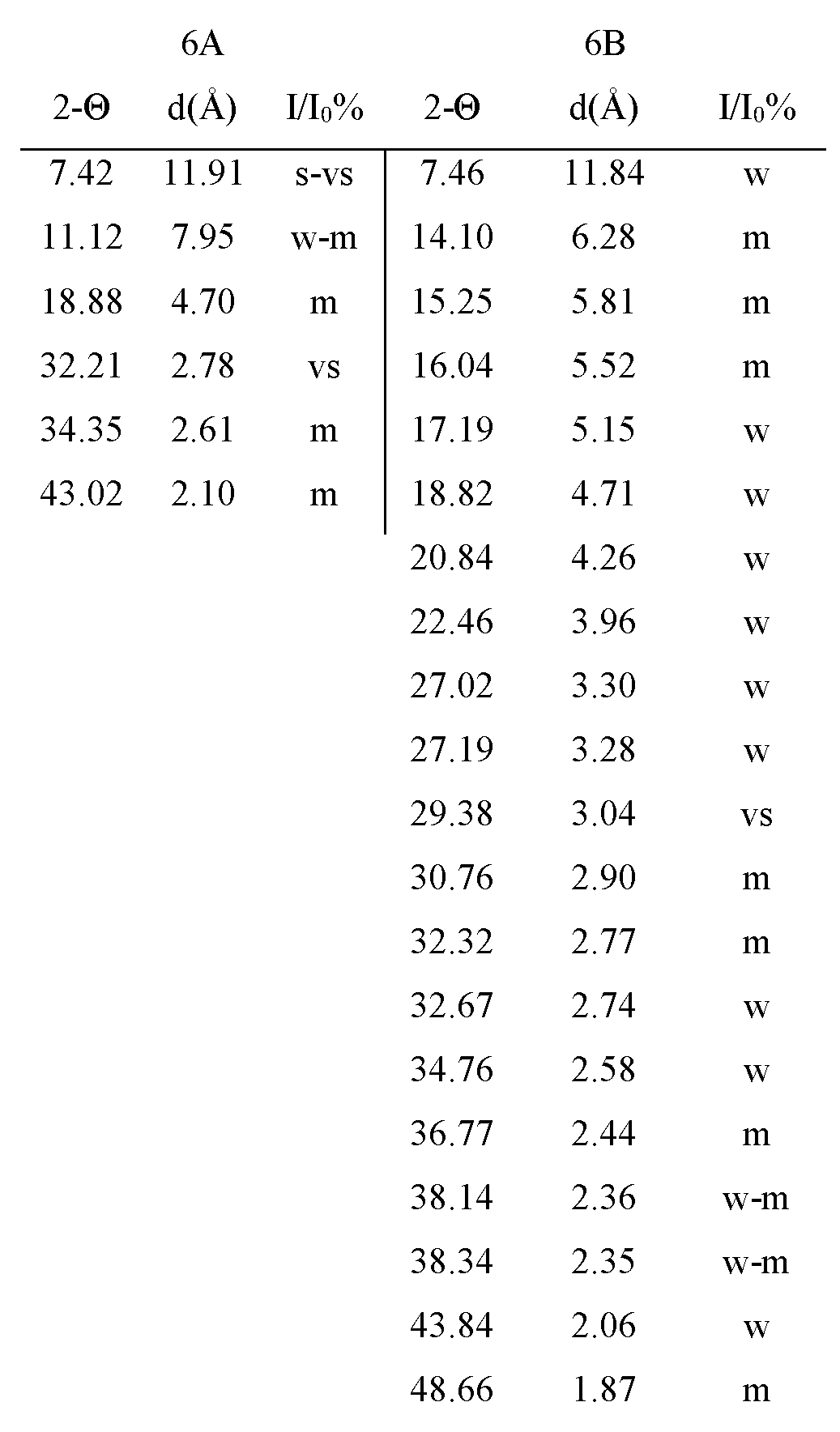
Example 8
A Teflon beaker equipped with a high-speed stirrer, was charged with 42.61g
colloidal silica (Ludox AS-40, 40 % SiO2). A solution was prepared by dissolving 29.28 g NaOH pellets in 163.38 g de-ionized water. This solution was added fast dropwise to the colloidal silica with vigorous stirring, forming a creamy, brilliant white reaction mixture. Separately, a solution was prepared by dissolving 14.73g SnCl4*5H2O in 200 g de-ionized water. This solution was added in a single pour with vigorous stirring. The brilliant white reaction mixture was stirred for an additional 20 minutes. The homogenous white gel was loaded into a 600cc stirred autoclave and digested for 72 hours at 200°C, stirred at 250 rpm. The solid products were isolated by centrifugation, washed with de-ionized water and dried at room temperature. Powder X-ray diffraction identified the product as SnSi-1. Representative x-ray diffraction lines are shown in Table 7. Elemental analysis yielded the empirical formula Na4.45SnSi4.13O12.5. Table 7

In a Teflon beaker, 19.54 g KOH (85.22%) was dissolved in 115.86 g de-ionized water using a Heidolph stirrer. Then 46.14 g colloidal silica (LUDOX AS-40, 40% SiO2) was added in a single pour and allowed to stir for 10 minutes. This was followed by the addition
of 30.0 g Ti(OiPr)4 (97%). A brilliant white gel resulted which was allowed to homogenize further. The homogenous gel was distributed among 3 Teflon-lined Parr reactors and digested quiescently at a temperature of 200°C for 46 hr at autogenous pressure. The solid products were isolated by centrifugation, washed with de-ionzed water and dried at room temperature. The product was identified as Ti-umbite by powder x-ray diffraction. Representative diffraction lines are shown in Table 8 below. Elemental analysis yielded the empirical composition K1.79TiSi2.60.The products were sodium ion-exchanged before they were tested.
Table 8


A Teflon beaker under a high-speed stirrer was charged with 69.15 g colloidal silica (Ludox AS-40, 40% SiO2). A solution was prepared by dissolving 74.25 g KOH (87.7%) in 257.16 g de-ionized water. This solution was added to the colloidal silica in a single pour with vigorous stirring, forming a white suspension that turned clear after 20 minutes of homogenization. To the clear solution, 49.45g of zirconium acetate solution (22.1 wt% ZrO2) was added fast dropwise and the reaction mixture allowed to homogenize. The reaction mixture was loaded into a 600 cc stirred autoclave and digested for 36 hours at 200°C, stirring at 250 RPM. The solid product was isolated by centrifugation, washed with water,
and dried at room temperature. The product was identified as Zr-umbite via powder x-ray diffraction. Representative x-ray diffraction lines are shown in Table 9. Elemental analysis yielded the empirical composition K2.33ZrSi3.47O10.1*1.66 H2O. A portion of product was ion- exchanged with NaCl before testing.
Table 9

In a teflon beaker placed under a high-speed stirrer, 15.39 g KOH (87.8%) was dissolved in 26.01g de-ionized water. Then added 14.47 g colloidal silica (Ludox AS-40, 40% SiO2) in a single pour with vigorous stirring. An initially translucent solution turned clear after 2 hours of homogenization. To the clear solution, 14.12g Ti(OiPr)4 (97%) was added dropwise over 7 minutes. The reaction mixture turned to a beige, opaque colloidal-like suspension after an additional 20 minutes of stirring. The reaction mixture was loaded into a
125 mL parr reactor and digested quiescently for 5 days at 150°C at autogenous pressure. The solid product was isolated by centrifugation, washed with de-ionized water and dried at room temperature. Powder X-ray diffraction identified the product as titanium silicate
pharmacosiderite. Representative diffraction lines for the product are shown in Table 10. Elemental analysis provided the empirical composition K1.45TiSi1.13Ox. A portion of the product was ion exchanged with NaCl before testing.
Table 10

A solution was prepared by dissolving 15.00 g SnCl4*5H2O dissolved with 90.00 g de-ionized water in a Teflon beaker placed under a high-speed stirrer. Separately, a clear silicate solution was prepared by dissolving 6.11 g NaOH pellets in 74.54 g de-ionized water to which 9.35 g Na-silicate solution (6.69% Na, 13.5% Si) was added. The silicate solution was added very slowly, via addition funnel over 30 minutes, to the tin chloride solution with vigorous stirring. The creamy white reaction mixture was homogenized for 1 hour. The reaction mixture was transferred to a sealed Teflon bottle and aged for 4 days with stirring. The solid product was isolated by filtration, washed with de-ionized water and dried at room temperature. Powder X-ray diffraction showed the product to be amorphous. Example 13
This UOP commercial sample, designated IE-910, has the sitinakite structure with anhydrous composition Na3.24Ti2.67Nb1.18Si2O13.9. Representative diffraction lines for the material are shown in Table 11 below.
Table 11

This sample is that of example 13 but has been additionally acid-washed, which leads to some ion-exchange. The anhydrous composition is HxNa1.56Nb1.14Ti2.60Si2O12.83. Powder x- ray diffraction on this sample identified it as having the sitinakite structure. Representative diffraction lines for the material are shown in Table 12 below.
Table 12

This sample has the sitinakite structure with the anhydrous composition
Na3.16Ti2.77Nb1.05Si2O13.74. Large batches of this material were prepared using the formulation:
0.95 Na2O :0.15 Nb2O5 : 0.75 TiO2 : 0.85 SiO2 : 129 H2O : 3.0 i-PrOH : 3.4 EtOH
A typical preparation used 50% NaOH solution, hydrous niobium pentoxide, Titanium isopropoxide, Ti(OiPr)4, tetraethylorthosilicate (TEOS) and deionized water. The NaOH solution was diluted with water into which the hydrous niobium pentoxide was slurried. Then TEOS was slowly added with vigorous stirring and the reaction mixture homogenized for an additional 15 minutes post-addition. Then Ti(OiPr)4 was slowly added and the reaction mixture homogenized further. The reaction mixture was transferred to a reactor and digested at 200°C for 24 hr at autogenous pressure. The product was isolated by filtration, washed with deionized water and dried. Representative diffraction lines for the material are shown in Table 13 below.
Table 13

The Kd value for the distribution was calculated using the following formula:

where: V = volume of waste simulant (mL)
Ac = concentration of cation absorbed on ion-exchanger (g/mL) W = mass of ion-exchanger evaluated (g)
Sc = concentration of cation in post reaction supernate (g/mL) Table 14 below summarizes the results of the uptake studies. Table 14. Sr2+ distribution
expressed as Kd values


While the following is described in conjunction with specific embodiments, it will be understood that this description is intended to illustrate and not limit the scope of the preceding description and the appended claims.
A first embodiment of the invention is a process for removing Sr2+ toxins from bodily fluids comprising contacting the fluid containing the toxins with an ion exchanger to remove the toxins from the fluid by ion exchange between the ion exchanger and the bodily fluid, the ion exchanger selected from zirconium metallate, titanium metallate, tin metallate, multinary metallate containing more than one of zirconium, titanium and tin, and mixtures thereof, the metallates respectively having an empirical formula on an anhydrous basis of:
AmZraTibSncMdSixOy
where A is an exchangeable cation comprising potassium ion, sodium ion, rubidium ion, cesium ion, calcium ion, magnesium ion, hydronium ion or mixtures thereof, M is at least one
framework metal selected from the group consisting of hafnium (4+) or niobium (5+),“m” is a mole ratio of A to total metal (total metal = Zr + Ti + Sn + M) and has a value from 0.10 to 9, “a” is a mole fraction of total metal that is Zr and has a value from zero to 1,“b” is a mole fraction of total metal that is Ti and has a value from zero to 1,“c” is a mole fraction of total metal that is Sn and has a value from zero to 1, where a + b + c > 0,“d” is a mole fraction of total metal that is M and has a value from zero to less than 1, where a + b + c + d = 1 and, "x" is a mole ratio of Si to total metal and has a value from 0 to 6, and "y" is a mole ratio of O to total metal and has a value from 2.1 to 19. An embodiment of the invention is one, any or all of prior embodiments in this paragraph up through the first embodiment in this paragraph wherein the bodily fluid is selected from the group consisting of whole blood, blood plasma, or other component of blood, gastrointestinal fluids and dialysate solution containing blood, blood plasma, other component of blood or gastrointestinal fluids. An embodiment of the invention is one, any or all of prior embodiments in this paragraph up through the first embodiment in this paragraph where M is hafnium (+4) or niobium (+5). An embodiment of the invention is one, any or all of prior embodiments in this paragraph up through the first embodiment in this paragraph where x = 0. An embodiment of the invention is one, any or all of prior embodiments in this paragraph up through the first embodiment in this paragraph where a + c + d = 0. An embodiment of the invention is one, any or all of prior embodiments in this paragraph up through the first embodiment in this paragraph where A is a mixture of calcium and sodium. An embodiment of the invention is one, any or all of prior embodiments in this paragraph up through the first embodiment in this paragraph wherein the ion exchanger is packed into hollow fibers incorporated into a membrane. An embodiment of the invention is one, any or all of prior embodiments in this paragraph up through the first embodiment in this paragraph wherein the ion exchanger is contained on particles coated with a coating comprising a cellulose derivative composition. An embodiment of the invention is one, any or all of prior embodiments in this paragraph up through the first embodiment in this paragraph wherein the process is a hemoperfusion process wherein the bodily fluid is passed through a column containing the ion exchanger. An embodiment of the invention is one, any or all of prior embodiments in this paragraph up through the first embodiment in this paragraph wherein a dialysate solution is introduced into a peritoneal cavity and then is flowed through at least one adsorbent bed containing at least one of the ion exchanger. An embodiment of the invention is one, any or all of prior embodiments in this paragraph up through the first embodiment in this paragraph
wherein the ion exchanger is formed into a shaped article to be ingested orally, followed by ion exchange between the ion exchanger and the Sr2+ toxins contained in a gastrointestinal fluid in a mammal’s intestines and then by excretion of the ion exchanger containing the toxins. An embodiment of the invention is one, any or all of prior embodiments in this paragraph up through the first embodiment in this paragraph wherein the shaped article is coated with a coating that is not dissolved by conditions within a stomach.
A second embodiment of the invention is a composition comprising a combination of a bodily fluid, a dialysate solution or a mixture of the bodily fluid and the dialysate solution the combination further comprising an ion exchanger selected from zirconium metallate, titanium metallate, tin metallate, multinary metallate containing more than one of zirconium, titanium and tin, and mixtures thereof, the metallates respectively having an empirical formula on an anhydrous basis of
AmZraTibSncMdSixOy
where A is an exchangeable cation comprising potassium ion, sodium ion, rubidium ion, cesium ion, calcium ion, magnesium ion, hydronium ion or mixtures thereof, M is at least one framework metal selected from the group consisting of hafnium (4+) or niobium (5+),“m” is a mole ratio of A to total metal (total metal = Zr + Ti + Sn + M) and has a value from 0.10 to 9, “a” is a mole fraction of total metal that is Zr and has a value from zero to 1,“b” is a mole fraction of total metal that is Ti and has a value from zero to 1,“c” is a mole fraction of total metal that is Sn and has a value from zero to 1, where a + b + c > 0,“d” is a mole fraction of total metal that is M and has a value from zero to less than 1, where a + b + c + d = 1 and, "x" is a mole ratio of Si to total metal and has a value from 0 to 6, and "y" is a mole ratio of O to total metal and has a value from 2.1 to 19. An embodiment of the invention is one, any or all of prior embodiments in this paragraph up through the second embodiment in this paragraph wherein the bodily fluid is whole blood, blood plasma, other blood component or gastrointestinal fluid.
A third embodiment of the invention is an apparatus comprising a matrix containing a support material for an ion exchanger selected from zirconium metallate, titanium metallate, tin metallate, multinary metallate containing more than one of zirconium, titanium and tin, and mixtures thereof, the metallates respectively having an empirical formula on an anhydrous basis of
AmZraTibSncMdSixOy
where A is an exchangeable cation comprising potassium ion, sodium ion, rubidium ion, cesium
ion, calcium ion, magnesium ion, hydronium ion or mixtures thereof, M is at least one framework metal selected from the group consisting of hafnium (4+) or niobium (5+),“m” is a mole ratio of A to total metal (total metal = Zr + Ti + Sn + M) and has a value from 0.10 to 9, “a” is a mole fraction of total metal that is Zr and has a value from zero to 1,“b” is a mole fraction of total metal that is Ti and has a value from zero to 1,“c” is a mole fraction of total metal that is Sn and has a value from zero to 1, where a + b + c > 0,“d” is a mole fraction of total metal that is M and has a value from zero to less than 1, where a + b + c + d = 1 and, "x" is a mole ratio of Si to total metal and has a value from 0 to 6, and "y" is a mole ratio of O to total metal and has a value from 2.1 to 19. An embodiment of the invention is one, any or all of prior embodiments in this paragraph up through the third embodiment in this paragraph wherein the matrix comprises a porous network comprising biocompatible polymers and metal oxides and silicates. An embodiment of the invention is one, any or all of prior embodiments in this paragraph up through the third embodiment in this paragraph wherein the biocompatible polymers comprise cross-linked carbohydrates or proteins. An embodiment of the invention is one, any or all of prior embodiments in this paragraph up through the third embodiment in this paragraph wherein the biocompatible polymer is a polysaccaride selected from a-glucans having 1,3-, 1,4- or 1,6- linkages. An embodiment of the invention is one, any or all of prior embodiments in this paragraph up through the third embodiment in this paragraph wherein the biocompatible polymer is a carbohydrate selected from glucose, fructose, sucrose, maltose, arabinose, mannose, galactose, lactose and oligomers and polymers comprising one or more of the carbohydrates. An embodiment of the invention is one, any or all of prior embodiments in this paragraph up through the third embodiment in this paragraph wherein the biocompatible polymer comprises a protein selected from albumin, ovalbumin, casein, myosin, actin, globulin, hemoglobin, myoglobin, gelatin and small peptides.
Without further elaboration, it is believed that using the preceding description that one skilled in the art can utilize the present invention to its fullest extent and easily ascertain the essential characteristics of this invention, without departing from the spirit and scope thereof, to make various changes and modifications of the invention and to adapt it to various usages and conditions. The preceding preferred specific embodiments are, therefore, to be construed as merely illustrative, and not limiting the remainder of the disclosure in any way whatsoever, and that it is intended to cover various modifications and equivalent arrangements included within the scope of the appended claims.
In the foregoing, all temperatures are set forth in degrees Celsius and, all parts and percentages are by weight, unless otherwise indicated.
Claims
WE CLAIM AS OUR INVENTION: 1. A process for removing Sr2+ toxins from bodily fluids selected from the group consisting of blood, gastrointestinal fluids and dialysate solution comprising contacting the fluid containing the toxins with a metallate ion exchanger at ion exchange conditions thereby removing the toxins from the fluid, the metallate ion exchanger selected from the group consisting of zirconium metallate, titanium metallate, tin metallate, multinary metallate containing more than one of zirconium, titanium and tin, and mixtures thereof, the metallates respectively having an empirical formula on an anhydrous basis of: AmZraTibSncMdSixOy where A is an exchangeable cation selected from the group consisting of potassium ion, sodium ion, rubidium ion, cesium ion, calcium ion, magnesium ion, hydronium ion or mixtures thereof, M is at least one framework metal selected from the group consisting of hafnium (4+) or niobium (5+),“m” is the mole ratio of A to total metal (total metal = Zr + Ti + Sn + M) and has a value from 0.10 to 9,“a” is the mole fraction of the total metal that is Zr and has a value from zero to 1,“b” is the mole fraction of the total metal that is Ti and has a value from zero to 1,“c” is the mole fraction of the total metal that is Sn and has a value from zero to 1, a + b + c > 0,“d” is the mole fraction of the total metal that is M and has a value from zero to less than 1, a + b + c + d = 1 and, "x" has a value from 0 to 6, and "y" has a value from 2.1 to 19.
2. The process of claim 1 wherein the bodily fluid is selected from whole blood, blood plasma, or other component of blood, gastrointestinal fluids and dialysate solution containing blood, blood plasma, other component of blood or gastrointestinal fluids.
3. The process of claim 1 wherein the ion exchanger is packed into hollow fibers incorporated into a membrane.
4. The process of claim 1 wherein said ion exchanger comprises particles coated with a coating comprising a cellulose derivative composition.
5. The process of claim 1 wherein said process is a hemoperfusion process wherein said bodily fluid is sent through a column containing said ion exchanger.
6. The process of claim 1 wherein said ion exchanger regenerates a dialysate solution.
7. The process of claim 1 wherein said ion exchanger is formed into a shaped article to be ingested orally and to pick up said toxins from a gastrointestinal fluid in a mammal’s intestines followed by excretion of said pill containing said toxins.
8. A composition comprising a combination of a bodily fluid, a dialysate solution or a mixture of said bodily fluid and said dialysate solution said combination further comprising an ion exchanger selected from zirconium metallate, titanium metallate, tin metallate, multinary metallate containing more than one of zirconium, titanium and tin, and mixtures thereof, the metallates respectively having an empirical formula on an anhydrous basis of: AmZraTibSncMdSixOy where A is an exchangeable cation comprising potassium ion, sodium ion, rubidium ion, cesium ion, calcium ion, magnesium ion, hydronium ion or mixtures thereof, M is at least one framework metal selected from the group consisting of hafnium (4+) or niobium (5+),“m” is a mole ratio of A to total metal (total metal = Zr + Ti + Sn + M) and has a value from 0.10 to 9,“a” is a mole fraction of total metal that is Zr and has a value from zero to 1,“b” is a mole fraction of total metal that is Ti and has a value from zero to 1,“c” is a mole fraction of total metal that is Sn and has a value from zero to 1, where a + b + c > 0,“d” is a mole fraction of total metal that is M and has a value from zero to less than 1, where a + b + c + d = 1 and, "x" is a mole ratio of Si to total metal and has a value from 0 to 6, and "y" is a mole ratio of O to total metal and has a value from 2.1 to 19.
9. The composition of claim 8 wherein said bodily fluid is whole blood, blood plasma, other blood component or gastrointestinal fluid.
10. An apparatus comprising a matrix containing a support material for an ion exchanger selected from zirconium metallate, titanium metallate, tin metallate, multinary metallate containing more than one of zirconium, titanium and tin, and mixtures thereof, the metallates respectively having an empirical formula on an anhydrous basis of:
AmZraTibSncMdSixOy where A is an exchangeable cation comprising potassium ion, sodium ion, rubidium ion, cesium ion, calcium ion, magnesium ion, hydronium ion or mixtures thereof, M is at least one framework metal selected from the group consisting of hafnium (4+) or niobium (5+),“m” is a mole ratio of A to total metal (Zr + Ti + Sn + M) and has a value from 0.10 to 9,“a” is a mole fraction of total metal that is Zr and has a value from zero to 1,“b” is a mole fraction of total metal that is Ti and has a value from zero to 1,“c” is a mole fraction of total metal that is Sn and has a value from zero to 1, where a + b + c > 0,“d” is a mole fraction of total metal that is M and has a value from zero to less than 1, where a + b + c + d = 1 and, "x" is a mole ratio of Si to total metal and has a value from 0 to 6, and "y" is a mole ratio of O to total metal and has a value from 2.1 to 19.
Priority Applications (1)
| Application Number | Priority Date | Filing Date | Title |
|---|---|---|---|
| EP20837665.7A EP3996767A4 (en) | 2019-07-09 | 2020-06-30 | METHOD FOR REMOVING STRONTIUM IONS FROM BODY FLUIDS USING METALLATE ION EXCHANGE COMPOSITIONS |
Applications Claiming Priority (2)
| Application Number | Priority Date | Filing Date | Title |
|---|---|---|---|
| US16/506,465 | 2019-07-09 | ||
| US16/506,465 US11577014B2 (en) | 2019-07-09 | 2019-07-09 | Process for removing strontium ions from bodily fluids using metallate ion exchange compositions |
Publications (1)
| Publication Number | Publication Date |
|---|---|
| WO2021007065A1 true WO2021007065A1 (en) | 2021-01-14 |
Family
ID=74101750
Family Applications (1)
| Application Number | Title | Priority Date | Filing Date |
|---|---|---|---|
| PCT/US2020/040217 Ceased WO2021007065A1 (en) | 2019-07-09 | 2020-06-30 | Process for removing strontium ions from bodily fluids using metallate ion exchange compositions |
Country Status (3)
| Country | Link |
|---|---|
| US (1) | US11577014B2 (en) |
| EP (1) | EP3996767A4 (en) |
| WO (1) | WO2021007065A1 (en) |
Citations (4)
| Publication number | Priority date | Publication date | Assignee | Title |
|---|---|---|---|---|
| US5536412A (en) * | 1992-02-06 | 1996-07-16 | Hemocleanse, Inc. | Hemofiltration and plasmafiltration devices and methods |
| WO2002096559A1 (en) * | 2001-05-31 | 2002-12-05 | Australian Nuclear Science & Technology Organisation | Inorganic ion exchangers for removing contaminant metal ions from liquid streams |
| US6579460B1 (en) * | 2001-03-13 | 2003-06-17 | Uop Llc | Process and composition for removing toxins from bodily fluids |
| US6616860B1 (en) * | 1999-02-16 | 2003-09-09 | Agency Of Industrial Science And Technology | Biopolymer composite ion-exchanger with high cesium selectivity and its manufacturing method |
Family Cites Families (30)
| Publication number | Priority date | Publication date | Assignee | Title |
|---|---|---|---|---|
| US4581141A (en) | 1978-02-27 | 1986-04-08 | Purdue Research Foundation | Dialysis material and method for removing uremic substances |
| DE2840655C2 (en) | 1978-09-19 | 1982-06-16 | Dr. Eduard Fresenius, Chemisch-pharmazeutische Industrie KG Apparatebau KG, 6380 Bad Homburg | Blood detoxification device |
| CA1191128A (en) | 1980-08-27 | 1985-07-30 | Union Carbide Corporation | Removal of uremic substances with zeolite ion- exchangers |
| IT1211145B (en) * | 1981-12-11 | 1989-09-29 | Agipnucleare S P A Comitato Na | PREPARATION PROCEDURE FOR INORGANIC ION EXCHANGERS ABASE OF TITANIUM COMPOUNDS AND THEIR USES. |
| CA1328099C (en) | 1988-12-06 | 1994-03-29 | Steven M. Kuznicki | Small-pored crystalline titanium molecular sieve zeolites |
| US5053139A (en) | 1990-12-04 | 1991-10-01 | Engelhard Corporation | Removal of heavy metals, especially lead, from aqueous systems containing competing ions utilizing amorphous tin and titanium silicates |
| WO1994019277A1 (en) | 1993-02-25 | 1994-09-01 | Sandia National Laboratories | Novel silico-titanates and their methods of making and using |
| US5935552A (en) | 1995-05-11 | 1999-08-10 | Uop Llc | Crystalline intergrowth molecular sieves |
| US5885925A (en) | 1995-10-20 | 1999-03-23 | Alliedsignal Inc. | Titania bound sodium titanate ion exchanger |
| US5821186A (en) | 1996-11-01 | 1998-10-13 | Lockheed Martin Energy Research Corporation | Method for preparing hydrous titanium oxide spherules and other gel forms thereof |
| US5888472A (en) | 1997-04-08 | 1999-03-30 | Uop Llc | Zirconium silicate molecular sieves and process using the same |
| US5891417A (en) | 1997-04-08 | 1999-04-06 | Uop Llc | Zirconium silicate and zirconium germanate molecular sieves and process using the same |
| US6332985B1 (en) | 1999-03-29 | 2001-12-25 | Uop Llc | Process for removing toxins from bodily fluids using zirconium or titanium microporous compositions |
| US6099737A (en) | 1999-03-29 | 2000-08-08 | Uop Llc | Process for removing toxins from blood using zirconium metallate or titanium metallate compositions |
| US6602919B1 (en) | 1999-09-17 | 2003-08-05 | Ut-Battelle Llc | Method for preparing hydrous zirconium oxide gels and spherules |
| US6482380B1 (en) | 2000-11-22 | 2002-11-19 | The United States Of America As Represented By The Department Of Energy | Silicotitanate molecular sieve and condensed phases |
| US6814871B1 (en) | 2001-07-13 | 2004-11-09 | Uop Llc | Process for removing pollutants from aqueous streams |
| AU2004285450B2 (en) | 2003-10-20 | 2010-01-14 | Gregory K. Frykman | Zeolite molecular sieves for the removal of toxins |
| WO2008075951A1 (en) * | 2006-12-21 | 2008-06-26 | Nederlandse Organisatie Voor Toegepast-Natuurwetenschappelijk Onderzoek Tno | Device for the removal of toxic substances from blood |
| US20100018926A1 (en) * | 2008-06-25 | 2010-01-28 | Chunqing Liu | Mixed Matrix Membranes Containing Ion-Exchanged Molecular Sieves |
| US20120070468A1 (en) * | 2010-09-16 | 2012-03-22 | Uop Llc | Removal of toxins from gastrointestinal fluids |
| SI2673237T2 (en) | 2011-02-11 | 2025-12-31 | Zs Pharma, Inc | Use of a zirconium silicate for the treatment of hyperkalemia |
| US9943637B2 (en) | 2012-06-11 | 2018-04-17 | ZS Pharma, Inc. | Microporous zirconium silicate and its method of production |
| CN104968336A (en) | 2012-07-11 | 2015-10-07 | Zs制药公司 | Microporous zirconium silicate for the treatment of hyperkalemia in hypercalcemic patients and improved calcium-containing compositions for the treatment of hyperkalemia |
| US10695365B2 (en) | 2012-10-22 | 2020-06-30 | ZS Pharma, Inc. | Microporous zirconium silicate for the treatment of hyperkalemia |
| CN104797263B (en) | 2012-10-22 | 2018-02-09 | Zs制药公司 | For treating the micropore zirconium silicate of potassemia |
| CN104903253A (en) | 2013-01-09 | 2015-09-09 | 巴斯夫公司 | Strontium and Cesium Specific Ion Exchange Media |
| US9233856B2 (en) | 2013-04-20 | 2016-01-12 | Uop Llc | Use of zeolitic materials for removing mercury (+2) ions from liquid streams |
| KR20160110356A (en) | 2013-11-08 | 2016-09-21 | 제트에스 파마, 인코포레이티드 | Microporous zirconium silicate for the treatment of hyperkalemia |
| US20160038538A1 (en) | 2013-11-08 | 2016-02-11 | ZS Pharma, Inc. | Microporous zirconium silicate for the treatment of hyperkalemia |
-
2019
- 2019-07-09 US US16/506,465 patent/US11577014B2/en active Active
-
2020
- 2020-06-30 WO PCT/US2020/040217 patent/WO2021007065A1/en not_active Ceased
- 2020-06-30 EP EP20837665.7A patent/EP3996767A4/en active Pending
Patent Citations (4)
| Publication number | Priority date | Publication date | Assignee | Title |
|---|---|---|---|---|
| US5536412A (en) * | 1992-02-06 | 1996-07-16 | Hemocleanse, Inc. | Hemofiltration and plasmafiltration devices and methods |
| US6616860B1 (en) * | 1999-02-16 | 2003-09-09 | Agency Of Industrial Science And Technology | Biopolymer composite ion-exchanger with high cesium selectivity and its manufacturing method |
| US6579460B1 (en) * | 2001-03-13 | 2003-06-17 | Uop Llc | Process and composition for removing toxins from bodily fluids |
| WO2002096559A1 (en) * | 2001-05-31 | 2002-12-05 | Australian Nuclear Science & Technology Organisation | Inorganic ion exchangers for removing contaminant metal ions from liquid streams |
Also Published As
| Publication number | Publication date |
|---|---|
| EP3996767A4 (en) | 2023-05-31 |
| US20210008267A1 (en) | 2021-01-14 |
| US11577014B2 (en) | 2023-02-14 |
| EP3996767A1 (en) | 2022-05-18 |
Similar Documents
| Publication | Publication Date | Title |
|---|---|---|
| US6332985B1 (en) | Process for removing toxins from bodily fluids using zirconium or titanium microporous compositions | |
| US6579460B1 (en) | Process and composition for removing toxins from bodily fluids | |
| US6099737A (en) | Process for removing toxins from blood using zirconium metallate or titanium metallate compositions | |
| CA2427985C (en) | Cartridges useful in cleaning dialysis solutions | |
| US20240307845A1 (en) | Process for removing lead ions from boldily fluids using metallate ion exchange compositions | |
| JP7510571B2 (en) | Process for removing ions from body fluids using small molecule metal chelators and metal acid ion exchange compositions | |
| US11964266B2 (en) | Process for removing cobalt, lead, cadmium and chromium ions from bodily fluids using metallate ion exchange compositions | |
| WO2002004086A1 (en) | Process for removing toxins from bodily fluids using zirconium or titanium microporous compositions | |
| US11484875B2 (en) | Process for removing mercury ions from bodily fluids using titanium metallate ion exchange compositions | |
| JP7503709B2 (en) | Removal of ions from body fluids | |
| US11577014B2 (en) | Process for removing strontium ions from bodily fluids using metallate ion exchange compositions | |
| JP2024544762A (en) | Adsorbents for dialysis and adsorption systems for regenerative dialysis | |
| Zakutevskyy et al. | Sorption of ammonium and phosphate ions from aqueous solutions by carbon and mineral sorbents |
Legal Events
| Date | Code | Title | Description |
|---|---|---|---|
| 121 | Ep: the epo has been informed by wipo that ep was designated in this application |
Ref document number: 20837665 Country of ref document: EP Kind code of ref document: A1 |
|
| ENP | Entry into the national phase |
Ref document number: 2020837665 Country of ref document: EP Effective date: 20220209 |