WO2021010141A1 - 水溶性クマリン系化合物又はその塩を含有する偏光発光膜、偏光発光板及び表示装置 - Google Patents
水溶性クマリン系化合物又はその塩を含有する偏光発光膜、偏光発光板及び表示装置 Download PDFInfo
- Publication number
- WO2021010141A1 WO2021010141A1 PCT/JP2020/025321 JP2020025321W WO2021010141A1 WO 2021010141 A1 WO2021010141 A1 WO 2021010141A1 JP 2020025321 W JP2020025321 W JP 2020025321W WO 2021010141 A1 WO2021010141 A1 WO 2021010141A1
- Authority
- WO
- WIPO (PCT)
- Prior art keywords
- group
- polarized light
- light emitting
- salt
- sulfamoyl
- Prior art date
- Legal status (The legal status is an assumption and is not a legal conclusion. Google has not performed a legal analysis and makes no representation as to the accuracy of the status listed.)
- Ceased
Links
- 0 *c1ccc(C=C(c2nc3ccccc3[n]2)C(O2)=O)c2c1 Chemical compound *c1ccc(C=C(c2nc3ccccc3[n]2)C(O2)=O)c2c1 0.000 description 1
Images
Classifications
-
- G—PHYSICS
- G02—OPTICS
- G02B—OPTICAL ELEMENTS, SYSTEMS OR APPARATUS
- G02B5/00—Optical elements other than lenses
- G02B5/30—Polarising elements
- G02B5/3025—Polarisers, i.e. arrangements capable of producing a definite output polarisation state from an unpolarised input state
- G02B5/3075—Polarisers, i.e. arrangements capable of producing a definite output polarisation state from an unpolarised input state for use in the UV
-
- C—CHEMISTRY; METALLURGY
- C09—DYES; PAINTS; POLISHES; NATURAL RESINS; ADHESIVES; COMPOSITIONS NOT OTHERWISE PROVIDED FOR; APPLICATIONS OF MATERIALS NOT OTHERWISE PROVIDED FOR
- C09B—ORGANIC DYES OR CLOSELY-RELATED COMPOUNDS FOR PRODUCING DYES, e.g. PIGMENTS; MORDANTS; LAKES
- C09B57/00—Other synthetic dyes of known constitution
- C09B57/02—Coumarine dyes
-
- C—CHEMISTRY; METALLURGY
- C09—DYES; PAINTS; POLISHES; NATURAL RESINS; ADHESIVES; COMPOSITIONS NOT OTHERWISE PROVIDED FOR; APPLICATIONS OF MATERIALS NOT OTHERWISE PROVIDED FOR
- C09B—ORGANIC DYES OR CLOSELY-RELATED COMPOUNDS FOR PRODUCING DYES, e.g. PIGMENTS; MORDANTS; LAKES
- C09B67/00—Influencing the physical, e.g. the dyeing or printing properties of dyestuffs without chemical reactions, e.g. by treating with solvents grinding or grinding assistants, coating of pigments or dyes; Process features in the making of dyestuff preparations; Dyestuff preparations of a special physical nature, e.g. tablets, films
- C09B67/0097—Dye preparations of special physical nature; Tablets, films, extrusion, microcapsules, sheets, pads, bags with dyes
-
- C—CHEMISTRY; METALLURGY
- C09—DYES; PAINTS; POLISHES; NATURAL RESINS; ADHESIVES; COMPOSITIONS NOT OTHERWISE PROVIDED FOR; APPLICATIONS OF MATERIALS NOT OTHERWISE PROVIDED FOR
- C09K—MATERIALS FOR MISCELLANEOUS APPLICATIONS, NOT PROVIDED FOR ELSEWHERE
- C09K11/00—Luminescent materials, e.g. electroluminescent or chemiluminescent
- C09K11/06—Luminescent materials, e.g. electroluminescent or chemiluminescent containing organic luminescent materials
-
- G—PHYSICS
- G02—OPTICS
- G02B—OPTICAL ELEMENTS, SYSTEMS OR APPARATUS
- G02B1/00—Optical elements characterised by the material of which they are made; Optical coatings for optical elements
- G02B1/10—Optical coatings produced by application to, or surface treatment of, optical elements
- G02B1/11—Anti-reflection coatings
- G02B1/113—Anti-reflection coatings using inorganic layer materials only
-
- G—PHYSICS
- G02—OPTICS
- G02B—OPTICAL ELEMENTS, SYSTEMS OR APPARATUS
- G02B5/00—Optical elements other than lenses
- G02B5/30—Polarising elements
-
- G—PHYSICS
- G02—OPTICS
- G02B—OPTICAL ELEMENTS, SYSTEMS OR APPARATUS
- G02B5/00—Optical elements other than lenses
- G02B5/30—Polarising elements
- G02B5/3025—Polarisers, i.e. arrangements capable of producing a definite output polarisation state from an unpolarised input state
-
- G—PHYSICS
- G02—OPTICS
- G02F—OPTICAL DEVICES OR ARRANGEMENTS FOR THE CONTROL OF LIGHT BY MODIFICATION OF THE OPTICAL PROPERTIES OF THE MEDIA OF THE ELEMENTS INVOLVED THEREIN; NON-LINEAR OPTICS; FREQUENCY-CHANGING OF LIGHT; OPTICAL LOGIC ELEMENTS; OPTICAL ANALOGUE/DIGITAL CONVERTERS
- G02F1/00—Devices or arrangements for the control of the intensity, colour, phase, polarisation or direction of light arriving from an independent light source, e.g. switching, gating or modulating; Non-linear optics
- G02F1/01—Devices or arrangements for the control of the intensity, colour, phase, polarisation or direction of light arriving from an independent light source, e.g. switching, gating or modulating; Non-linear optics for the control of the intensity, phase, polarisation or colour
- G02F1/13—Devices or arrangements for the control of the intensity, colour, phase, polarisation or direction of light arriving from an independent light source, e.g. switching, gating or modulating; Non-linear optics for the control of the intensity, phase, polarisation or colour based on liquid crystals, e.g. single liquid crystal display cells
- G02F1/133—Constructional arrangements; Operation of liquid crystal cells; Circuit arrangements
- G02F1/1333—Constructional arrangements; Manufacturing methods
- G02F1/1335—Structural association of cells with optical devices, e.g. polarisers or reflectors
- G02F1/1336—Illuminating devices
- G02F1/13362—Illuminating devices providing polarized light, e.g. by converting a polarisation component into another one
-
- C—CHEMISTRY; METALLURGY
- C09—DYES; PAINTS; POLISHES; NATURAL RESINS; ADHESIVES; COMPOSITIONS NOT OTHERWISE PROVIDED FOR; APPLICATIONS OF MATERIALS NOT OTHERWISE PROVIDED FOR
- C09K—MATERIALS FOR MISCELLANEOUS APPLICATIONS, NOT PROVIDED FOR ELSEWHERE
- C09K2211/00—Chemical nature of organic luminescent or tenebrescent compounds
- C09K2211/10—Non-macromolecular compounds
- C09K2211/1018—Heterocyclic compounds
- C09K2211/1025—Heterocyclic compounds characterised by ligands
- C09K2211/1029—Heterocyclic compounds characterised by ligands containing one nitrogen atom as the heteroatom
- C09K2211/1033—Heterocyclic compounds characterised by ligands containing one nitrogen atom as the heteroatom with oxygen
-
- C—CHEMISTRY; METALLURGY
- C09—DYES; PAINTS; POLISHES; NATURAL RESINS; ADHESIVES; COMPOSITIONS NOT OTHERWISE PROVIDED FOR; APPLICATIONS OF MATERIALS NOT OTHERWISE PROVIDED FOR
- C09K—MATERIALS FOR MISCELLANEOUS APPLICATIONS, NOT PROVIDED FOR ELSEWHERE
- C09K2211/00—Chemical nature of organic luminescent or tenebrescent compounds
- C09K2211/10—Non-macromolecular compounds
- C09K2211/1018—Heterocyclic compounds
- C09K2211/1025—Heterocyclic compounds characterised by ligands
- C09K2211/1029—Heterocyclic compounds characterised by ligands containing one nitrogen atom as the heteroatom
- C09K2211/1037—Heterocyclic compounds characterised by ligands containing one nitrogen atom as the heteroatom with sulfur
-
- C—CHEMISTRY; METALLURGY
- C09—DYES; PAINTS; POLISHES; NATURAL RESINS; ADHESIVES; COMPOSITIONS NOT OTHERWISE PROVIDED FOR; APPLICATIONS OF MATERIALS NOT OTHERWISE PROVIDED FOR
- C09K—MATERIALS FOR MISCELLANEOUS APPLICATIONS, NOT PROVIDED FOR ELSEWHERE
- C09K2211/00—Chemical nature of organic luminescent or tenebrescent compounds
- C09K2211/10—Non-macromolecular compounds
- C09K2211/1018—Heterocyclic compounds
- C09K2211/1025—Heterocyclic compounds characterised by ligands
- C09K2211/1044—Heterocyclic compounds characterised by ligands containing two nitrogen atoms as heteroatoms
-
- C—CHEMISTRY; METALLURGY
- C09—DYES; PAINTS; POLISHES; NATURAL RESINS; ADHESIVES; COMPOSITIONS NOT OTHERWISE PROVIDED FOR; APPLICATIONS OF MATERIALS NOT OTHERWISE PROVIDED FOR
- C09K—MATERIALS FOR MISCELLANEOUS APPLICATIONS, NOT PROVIDED FOR ELSEWHERE
- C09K2211/00—Chemical nature of organic luminescent or tenebrescent compounds
- C09K2211/10—Non-macromolecular compounds
- C09K2211/1018—Heterocyclic compounds
- C09K2211/1025—Heterocyclic compounds characterised by ligands
- C09K2211/1088—Heterocyclic compounds characterised by ligands containing oxygen as the only heteroatom
-
- G—PHYSICS
- G02—OPTICS
- G02F—OPTICAL DEVICES OR ARRANGEMENTS FOR THE CONTROL OF LIGHT BY MODIFICATION OF THE OPTICAL PROPERTIES OF THE MEDIA OF THE ELEMENTS INVOLVED THEREIN; NON-LINEAR OPTICS; FREQUENCY-CHANGING OF LIGHT; OPTICAL LOGIC ELEMENTS; OPTICAL ANALOGUE/DIGITAL CONVERTERS
- G02F1/00—Devices or arrangements for the control of the intensity, colour, phase, polarisation or direction of light arriving from an independent light source, e.g. switching, gating or modulating; Non-linear optics
- G02F1/01—Devices or arrangements for the control of the intensity, colour, phase, polarisation or direction of light arriving from an independent light source, e.g. switching, gating or modulating; Non-linear optics for the control of the intensity, phase, polarisation or colour
- G02F1/13—Devices or arrangements for the control of the intensity, colour, phase, polarisation or direction of light arriving from an independent light source, e.g. switching, gating or modulating; Non-linear optics for the control of the intensity, phase, polarisation or colour based on liquid crystals, e.g. single liquid crystal display cells
- G02F1/133—Constructional arrangements; Operation of liquid crystal cells; Circuit arrangements
- G02F1/1333—Constructional arrangements; Manufacturing methods
- G02F1/1335—Structural association of cells with optical devices, e.g. polarisers or reflectors
- G02F1/1336—Illuminating devices
- G02F1/133617—Illumination with ultraviolet light; Luminescent elements or materials associated to the cell
-
- G—PHYSICS
- G02—OPTICS
- G02F—OPTICAL DEVICES OR ARRANGEMENTS FOR THE CONTROL OF LIGHT BY MODIFICATION OF THE OPTICAL PROPERTIES OF THE MEDIA OF THE ELEMENTS INVOLVED THEREIN; NON-LINEAR OPTICS; FREQUENCY-CHANGING OF LIGHT; OPTICAL LOGIC ELEMENTS; OPTICAL ANALOGUE/DIGITAL CONVERTERS
- G02F1/00—Devices or arrangements for the control of the intensity, colour, phase, polarisation or direction of light arriving from an independent light source, e.g. switching, gating or modulating; Non-linear optics
- G02F1/01—Devices or arrangements for the control of the intensity, colour, phase, polarisation or direction of light arriving from an independent light source, e.g. switching, gating or modulating; Non-linear optics for the control of the intensity, phase, polarisation or colour
- G02F1/13—Devices or arrangements for the control of the intensity, colour, phase, polarisation or direction of light arriving from an independent light source, e.g. switching, gating or modulating; Non-linear optics for the control of the intensity, phase, polarisation or colour based on liquid crystals, e.g. single liquid crystal display cells
- G02F1/133—Constructional arrangements; Operation of liquid crystal cells; Circuit arrangements
- G02F1/1333—Constructional arrangements; Manufacturing methods
- G02F1/1335—Structural association of cells with optical devices, e.g. polarisers or reflectors
- G02F1/1336—Illuminating devices
- G02F1/133624—Illuminating devices characterised by their spectral emissions
Definitions
- the present invention relates to a novel polarized light emitting film containing a water-soluble coumarin compound or a salt thereof, and a dye-based polarized light emitting plate and a display device provided with the same.
- a polarizing plate having a light transmitting / shielding function is a basic component of a display device such as a liquid crystal display (Liquid Crystal Display) together with a liquid crystal having a light switching function.
- a display device such as a liquid crystal display (Liquid Crystal Display) together with a liquid crystal having a light switching function.
- the fields of application of this LCD are expanding from small devices such as calculators and watches in the early days to notebook computers, word processors, liquid crystal projectors, liquid crystal televisions, car navigation systems, indoor and outdoor measuring devices, and the like.
- the polarizing plate can also be applied to a lens having a polarizing function, for example, sunglasses having improved visibility, and in recent years, polarized glasses compatible with 3D televisions and the like.
- the polarizing film constituting the polarizing plate is produced by stretching and orienting a film of polyvinyl alcohol or a derivative thereof containing iodine or a dichroic dye, or dehydroxic acid or polyvinyl alcohol of a polyvinyl chloride film. It is produced by producing and orienting polyene by dehydrating the system film. Since the polarizing plate composed of such a conventional polarizing film contains a dichroic dye having a light absorbing action in the visible light region, the transmittance in the visible light region is lowered. For example, a commercially available general polarizing plate has a transmittance of 35 to 45% in the visible light region.
- Patent Documents 1 to 3 disclose techniques for emitting polarized light.
- these techniques have a special metal having a high rarity value as a material having an action of emitting polarized light (hereinafter, also referred to as "polarized light emitting action"), for example, a lanthanoid such as europium (Eu) or terbium (Tb). It is not suitable for mass production because it uses metal and it is very difficult to manufacture a polarizing film.
- a coumarin-based compound emits fluorescence.
- Patent Document 4 describes that a coumarin-based compound is used as a fluorescent whitening agent.
- Patent Document 5 describes that a coumarin-based compound is used as a dye to be dissolved in a liquid crystal for use in a guest-host type color display.
- Patent Documents 6 and 7 describe that a coumarin-based compound is used as a fluorescent dye to be dissolved in a liquid crystal.
- all of these documents relate to an oil-soluble dichroic coumarin compound that develops dichroism by driving a liquid crystal by applying a voltage, and do not disclose a water-soluble coumarin-based compound.
- Japanese Unexamined Patent Publication No. 2008-224854 Japanese Patent No. 5849255 Japanese Patent No. 5713360
- Japanese Patent Application Laid-Open No. 09-143383 Japanese Patent Application Laid-Open No. 09-87630 Japanese Unexamined Patent Publication No. 2004-29121 JP-A-2007-87995
- An object of the present invention is to provide a polarized light emitting film, a polarized light emitting plate and a display device having high transmittance in the visible light region and high durability in a harsh environment.
- the present inventors exhibit a polarized light emitting effect in the visible light region by irradiating a specific water-soluble coumarin compound or a salt thereof with light in the ultraviolet light region to visible light region, for example, light of 300 to 600 nm. I found. Further, the polarized light emitting film and the polarized light emitting plate containing such a compound or a salt thereof show a high transmittance in the visible light region while having a polarizing function in the visible light region, and are excellent even in a harsh environment. It was found to show durability. The present invention has been completed based on these findings.
- the present invention provides the following polarized light emitting film, polarized light emitting plate and display device. [1] The following formula (1)
- A represents a coumarin skeleton which may have a substituent, X represents a sulfo group or a carboxy group, and n represents an integer of 1 to 3).
- the water-soluble coumarin compound or a salt thereof has the following formula (2).
- R 2 represents a hydrocarbon group having 1 to 10 carbon atoms
- Q represents a sulfur atom, an oxygen atom or a nitrogen atom
- n represents an integer of 1 to 3
- the polarized light emitting film according to [1] which is a compound or a salt thereof.
- the water-soluble coumarin compound or a salt thereof has the following formula (3).
- a polarized light emitting plate comprising the polarized light emitting film according to any one of [1] to [5] and a transparent protective layer provided on at least one surface thereof.
- a display device including the polarized light emitting film according to any one of [1] to [5] or the polarized light emitting plate according to [6].
- the water-soluble coumarin-based compound having the above-mentioned specific structure or a salt thereof absorbs ultraviolet light or visible light and uses the energy to exhibit a polarized light emitting action in the visible light region, and thus is prepared by using these.
- the polarized light emitting film and the polarized light emitting plate have a polarized light emitting function in the visible light region. Therefore, it is possible to provide a novel polarized light emitting film and polarized light emitting plate having a polarized light emitting action in the visible light region without using a lanthanoid metal having a high rare value or the like.
- the polarized light emitting film and the polarized light emitting plate not only show high transmittance in the visible light region, but also show excellent durability against heat, humidity and the like. Therefore, the polarized light emitting film and the polarized light emitting plate can be applied to a display device such as a liquid crystal display, which is required to have high transmittance in the visible light region and high durability in a harsh environment.
- the present invention is not limited to the embodiments shown below.
- the numerical range represented by using “-” means a range including the numerical values before and after "-" as the lower limit value and the upper limit value.
- the compounds represented by the respective formulas and the compounds shown in the examples of the compounds are represented in the form of free acids (state in which no salt is formed), but the technical scope of the present invention includes. Those salts are also included. Further, unless otherwise specified, the description of "water-soluble coumarin-based compound or salt thereof” may be simply abbreviated as “water-soluble coumarin-based compound” for the sake of avoidance of complexity.
- A represents a coumarin skeleton which may have a substituent.
- substituent that the coumarin skeleton may have include a heterocyclic amino group, a fused ring heterocyclic amino group, an alkoxy group, an aryloxy group, an alkylcarbonylamino group, an arylcarbonylamino group and an alkylcarbonyloxy group.
- heterocyclic amino group examples include a 5- or 6-membered heterocyclic amino group containing 1 to 3 heteroatoms selected from the group consisting of nitrogen atom, oxygen atom and sulfur atom. Specific examples of such a heterocyclic amino group include, for example.
- 5-membered heteroalicyclic amino groups such as pyrrolidinylamino, tetrahydrofurylamino, tetrahydrothiophene-2-ylamino, tetrahydrothiophene-3-ylamino; 6-membered heteroalicyclic amino groups such as piperidinylamino, piperazinylamino, dioxane-2-ylamino, morpholinylamino, thiomorpholinylamino; 5-membered aromatic heterocyclic amino groups such as pyrroleamino, pyrazoleamino, imidazoleamino, triazoleamino, frillamino, thiophen-2-ylamino, thiophen-3-ylamino, oxazoleamino, thiazoleamino; or Examples thereof include a 6-membered aromatic heterocyclic amino group such as pyridylamino, pyrazilamino, pyridadiny
- one benzene ring is condensed with a 5- or 6-membered heterocyclic group containing 1 to 3 heteroatoms selected from the group consisting of a nitrogen atom, an oxygen atom and a sulfur atom.
- a fused heterocyclic amino group examples include, for example.
- Heterocyclic moieties such as benzpyrrole amino, benzpyrazoleamino, benzimidazoleamino, benzotriazoleamino, benzofuranylamino, benzothiophen-2-ylamino, benzothiophen-3-ylamino, benzoxazoleamino, and benzothiazoleamino are aromatic.
- Fused ring-type aromatic heterocyclic amino group which is a group 5-membered ring; or Examples thereof include a condensed aromatic heterocyclic amino group in which the heterocyclic portion of the heterocyclic portion such as quinolinylamino, cinnolinylamino, phthalazinylamino, quinazolinylamino, and quinoxalinylamino is an aromatic 6-membered ring.
- the heterocyclic group preferably has an aromatic ring as the heterocyclic portion.
- the hetero atom constituting the heterocycle is preferably selected from a nitrogen atom and a sulfur atom.
- alkoxy group linear, branched or cyclic alkoxy group, preferably C 1 -C 10 alkoxy group.
- C 1 -C 10 alkoxy groups for example, Methoxy, ethoxy, n- propoxy, n- butoxy, n- pentoxy, n- hexyloxy, n- heptoxy, n- octyloxy, n- Nonirokishi, n- linear C 1 -C 10 alkoxy group such as a decyloxy; Branched chains of isopropoxy, isobutoxy, sec-butoxy, t-butoxy, isoamyloxy, t-amyloxy, isohexyloxy, t-hexyloxy, isoheptoxy, t-heptoxy, isooctyloxy, t-octyloxy, 2-ethylhexyloxy, isononyloxy, isodesil
- C 3- C 10 alkoxy group in the form or Cyclopropoxy, cyclobutoxy, cyclopentoxy, cyclohexyloxy, and a C 3 -C 7 alkoxy group ring such cycloheptoxy.
- linear or branched alkoxy groups are preferable.
- the aryloxy group is preferably a C 6 -C 12 aryloxy group, as specific examples, for example, phenoxy, naphthyloxy, Bifenirokishi and the like.
- alkylcarbonylamino group a linear, branched or cyclic alkyl carbonyl amino groups, preferably C 1 -C 10 alkyl carbonyl amino group.
- Specific examples of the C 1- C 10 alkylcarbonylamino group include, for example.
- the aryl carbonyl amino group is preferably a C 6 -C 12 arylcarbonylamino group, as specific examples, for example, phenyl carbonylamino, naphthyl carbonylamino, biphenyl carbonylamino, and the like.
- alkylcarbonyloxy group a linear, branched or cyclic alkylcarbonyloxy group, preferably C 1 -C 10 alkylcarbonyloxy group.
- C 1 -C 10 alkylcarbonyloxy group for example, Methylcarbonyloxy, ethylcarbonyloxy, n-propylcarbonyloxy, n-butylcarbonyloxy, n-pentylcarbonyloxy, n-hexylcarbonyloxy, n-heptylcarbonyloxy, n-octylcarbonyloxy, n-nonylcarbonyloxy, linear C 1 -C 10 alkylcarbonyloxy group such as n- decyloxy; Isopropylcarbonyloxy, isobutylcarbonyloxy, sec-butylcarbonyloxy, t-butylcarbonyloxy, isoamylcarbonyloxy, t-amy
- the arylcarbonyloxy group is preferably a C 6 -C 12 arylcarbonyloxy group, as specific examples, for example, phenyl carbonyloxy, naphthyl carbonyloxy, biphenyl carbonyloxy and the like.
- alkyl group linear, branched or cyclic alkylcarbonyl groups, preferably C 1 -C 10 alkyl group.
- C 1- C 10 alkylcarbonyl group include, for example. Linear such as methylcarbonyl, ethylcarbonyl, n-propylcarbonyl, n-butylcarbonyl, n-pentylcarbonyl, n-hexylcarbonyl, n-heptylcarbonyl, n-octylcarbonyl, n-nonylcarbonyl, n-decylcarbonyl, etc.
- C 1- C 10 alkylcarbonyl group Isopropylcarbonyl, isobutylcarbonyl, sec-butylcarbonyl, t-butylcarbonyl, isoamylcarbonyl, t-amylcarbonyl, isohexylcarbonyl, t-hexylcarbonyl, isoheptylcarbonyl, t-heptylcarbonyl, isooctylcarbonyl, t-octylcarbonyl , 2-ethylhexyl carbonyl, isononyl carbonyl, branched C 3 -C 10 alkyl group, such as isodecyl carbonyl; or Cyclic C 3- C 7 alkylcarbonyl groups such as cyclopropylcarbonyl, cyclobutylcarbonyl, cyclopentylcarbonyl, cyclohexylcarbonyl, cycloheptylcarbonyl and the like can
- the aryl group is preferably a C 6 -C 12 arylcarbonyl group, as specific examples, for example, phenylcarbonyl (benzoyl), naphthylcarbonyl, biphenylcarbonyl or the like.
- alkylcarbamoyl group examples include a linear, branched or cyclic monoalkylcarbamoyl group or a dialkylcarbamoyl group.
- the mono-alkylcarbamoyl group preferably a mono-C 1 -C 10 alkylcarbamoyl groups, specific examples include, for example, Linearity such as methylcarbamoyl, ethylcarbamoyl, n-propylcarbamoyl, n-butylcarbamoyl, n-pentylcarbamoyl, n-hexylcarbamoyl, n-heptylcarbamoyl, n-octylcarbamoyl, n-nonylcarbamoyl, n-decylcarbamoyl, etc.
- Mono C 1- C 10 alkylcarbamoyl group Isopropylcarbamoyl, isobutylcarbamoyl, sec-butylcarbamoyl, t-butylcarbamoyl, isoamylcarbamoyl, t-amylcarbamoyl, isohexylcarbamoyl, t-hexylcarbamoyl, isoheptylcarbamoyl, t-heptylcarbamoyl, isooctylcarbamoyl, t-octylcarbamoyl , 2-Ethylhexyl carbamoyl, isononyl carbamoyl, isodecylcarbamoyl and other branched mono-C 3- C 10 alkylcarbamoyl groups; or Cyclic mono-C 3- C 7 alkylcarbamoyl groups
- Dialkylcarbamoyl groups are preferably di-C 1 -C 10 alkylcarbamoyl groups, specific examples include, for example, Dimethylcarbamoyl, diethylcarbamoyl, di-n-propylcarbamoyl, di-n-butylcarbamoyl, di-n-pentylcarbamoyl, di-n-hexylcarbamoyl, di-n-heptylcarbamoyl, di-n-octylcarbamoyl, di- n- Noni carbamoyl, di -n- deci di C 1 -C 10 alkylcarbamoyl groups having two straight-chain alkyl group of carbamoyl and the like; Diisopropylcarbamoyl, diisobutylcarbamoyl, di-sec-butylcarbamoyl, dit-butylcarbamo
- Di cyclopropylcarbamoyl, di cyclobutylcarbamoyl, di cyclopentylcarbamoyl, dicyclohexyl carbamoyl include di C 3 -C 7 alkylcarbamoyl group having two cyclic alkyl group such as di-cyclo heptylcarbamoyl. Among these, a linear or branched dialkylcarbamoyl group is preferable, and a linear dialkylcarbamoyl group is more preferable.
- arylcarbamoyl group examples include a monoarylcarbamoyl group and a diarylcarbamoyl group.
- Mono arylcarbamoyl group is preferably a mono-C 6 -C 12 arylcarbamoyl groups, and specific examples include, for example, phenylcarbamoyl, naphthylcarbamoyl, biphenylene butylcarbamoyl and the like.
- the di-arylcarbamoyl group preferably a di-C 6 -C 12 arylcarbamoyl groups, and specific examples include, for example, di-phenylcarbamoyl, dinaphthyl carbamoyl, di (biphenyl) carbamoyl and the like.
- alkoxycarbonyl group a linear, branched or cyclic alkoxycarbonyl group, preferably C 1 -C 10 alkoxycarbonyl group.
- C 1 -C 10 alkoxycarbonyl group For example, methoxycarbonyl, ethoxycarbonyl, n-propoxycarbonyl, n-butoxycarbonyl, n-pentoxycarbonyl, n-hexyloxycarbonyl, n-heptoxycarbonyl, n-octyloxycarbonyl, n-nonyloxycarbonyl, n- linear C 1 -C 10 alkoxycarbonyl groups such as de white alkoxycarbonyl; Isopropoxycarbonyl, isobutoxycarbonyl, sec-butoxycarbonyl, t-butoxycarbonyl, isoamyloxycarbonyl, t-amyloxycarbonyl, isohexyloxycarbonyl, t-hexy
- the aryloxycarbonyl group is preferably a C 6 -C 12 aryloxycarbonyl group, and specific examples include, for example, phenoxycarbonyl, naphthoquinone Ciro alkoxycarbonyl, biphenylene butyloxycarbonyl, and the like.
- alkylsulfonylamino group a linear, branched or cyclic alkyl sulfonylamino groups, preferably C 1 -C 10 alkylsulfonylamino group.
- C 1- C 10 alkylsulfonylamino group include, for example, Methylsulfonylamino, ethylsulfonylamino, n-propylsulfonylamino, n-butylsulfonylamino, n-pentylsulfonylamino, n-hexylsulfonylamino, n-heptylsulfonylamino, n-octylsulfonylamino, n-nonylsulfonylamino, linear C 1 -C 10 alkylsulfonylamino group such as n- decyl s
- the arylsulfonylamino group is preferably a C 6 -C 12 arylsulfonyl group, as specific examples, for example, phenylsulfonylamino, toluenesulfonyl amino, naphthylsulfonyl amino, biphenyl sulfonylamino like.
- alkyl sulfamoyl group examples include a linear, branched chain or cyclic monoalkyl sulfamoyl group or a dialkyl sulfamoyl group.
- the monoalkyl sulfamoyl group is preferably a mono-C 1- C 10 alkyl sulfamoyl group, and specific examples thereof include, for example, monoalkyl sulfamoyl groups.
- Cyclic mono-C 3- C 7 alkyl sulfamoyl groups such as cyclopropyl sulfamoyl, cyclobutyl sulfamoyl, cyclopentyl sulfamoyl, cyclohexyl sulfamoyl, cycloheptyl sulfamoyl and the like can be mentioned.
- a linear or branched monoalkyl sulfamoyl group is preferable, and a linear monoalkyl sulfamoyl group is more preferable.
- Dialkylsulfamoyl group preferably a di-C 1 -C 10 alkylsulfamoyl group, as specific examples, for example, Dimethyl sulfamoyl, diethyl sulfamoyl, di-n-propyl sulfamoyl, di-n-butyl sulfamoyl, di-n-pentyl sulfamoyl, di-n-hexyl sulfamoyl, di-n- Di-C 1- C 10 alkyl having two linear alkyl groups such as heptyl sulfamoyl, di-n-octyl sulfamoyl, di-n-nonyl sulfamoyl, di-n-decyl sulfamoyl, etc.
- Sulfamoyl group Diisopropyl sulfamoyl, diisobutyl sulfamoyl, di-sec-butyl sulfamoyl, di-t-butyl sulfamoyl, diisoamyl sulfamoyl, di-t-amyl sulfamoyl, diisohexyl sulfamoyl, Di-t-hexyl sulfamoyl, diisoheptyl sulfamoyl, di-t-heptyl sulfamoyl, diisooctyl sulfamoyl, di-t-octyl sulfamoyl, di- (2-ethylhexyl) sulfamoyl, diisononyl sulfamoyl, di-C 3 -C 10 alkylsulfam
- aryl sulfamoyl group examples include a monoaryl sulfamoyl group and a diaryl sulfamoyl group.
- the monoaryl sulfamoyl group is preferably a mono-C 6- C 12 aryl sulfamoyl group, and specific examples thereof include phenyl sulfamoyl, naphthyl sulfamoyl, biphenyl sulfamoyl and the like.
- Diaryl sulfamoyl group is preferably a di-C 6 -C 12 aryl sulfamoyl group, and specific examples include, for example, diphenyl sulfamoyl, dinaphthyl Rusuru sulfamoyl, di (biphenyl) sulfamoyl etc. ..
- alkylsulfonyl group examples include linear, branched, or cyclic alkylsulfonyl groups, preferably C 1 -C 12 alkylsulfonyl group.
- C 1 -C 12 alkylsulfonyl group for example, Methylsulfonyl, ethylsulfonyl, n-propylsulfonyl, n-butylsulfonyl, n-pentylsulfonyl, n-hexylsulfonyl, n-heptylsulfonyl, n-octylsulfonyl, n-nonylsulfonyl, n-decylsulfonyl, n-undecyl sulfonyl, linear C 1 -C 12 alkylsulfonyl group such as n- dodecyls
- the arylsulfonyl group is preferably a C 6 -C 12 arylsulfonyl group, as specific examples, for example, phenylsulfonyl, naphthylsulfonyl, biphenyl sulfonyl, and the like.
- alkylthio group straight chain, branched chain or cyclic alkylthio groups, preferably C 1 -C 10 alkylthio group.
- C 1 -C 10 alkylthio group for example, Linear C 1- C 10 alkylthio groups such as methylthio, ethylthio, n-propylthio, n-butylthio, n-pentylthio, n-hexylthio, n-heptylthio, n-octylthio, n-nonylthio, n-decylthio; Isopropylthio, Isobutylthio, sec-butylthio, t-butylthio, isoamylthio, t-amylthio, isohexylthio, t-hexylthio, isoheptylthio, t-heptylthio;
- the arylthio group is preferably a C 6 -C 12 arylthio group, as specific examples, for example, phenylthio, naphthylthio, biphenyl thio, and the like.
- alkyl ureido group examples include a linear, branched chain or cyclic monoalkyl ureido group or a dialkyl ureido group.
- the monoalkyl ureido group is preferably a mono-C 1- C 10 alkyl ureido group, and specific examples thereof include, for example.
- Linear products such as methyl ureido, ethyl ureido, n-propyl ureido, n-butyl ureido, n-pentyl ureido, n-hexyl ureido, n-heptyl ureido, n-octyl ureido, n-nonyl ureido, n-decyl ureido, etc.
- C 1- C 10 alkyl ureido group Isopropyl ureido, isobutyl ureido, sec-butyl ureido, t-butyl ureido, isoamyl ureido, t-amyl ureido, isohexyl ureido, t-hexyl ureido, isoheptyl ureido, t-heptyl ureido, isooctyl ureido, t-octyl ureido, Branched-chain mono-C 3- C 10 alkyl butyl groups such as 2-ethylhexyl ureide, isononyl ureido, and isodecyl ureide; or Cyclic mono-C 3- C 7 alkyl ureido groups such as cyclopropyl ureido, cyclobutyl
- the dialkyl ureido group is preferably a di-C 1- C 10 alkyl ureido group, and specific examples thereof include, for example. Dimethyl ureido, diethyl ureido, di-n-propyl ureido, di-n-butyl ureido, di-n-pentyl ureido, di-n-hexyl ureido, di-n-heptyl ureido, di-n-octyl ureido, di- A di-C 1- C 10 alkyl ureido group having two linear alkyl groups such as n-nonyl ureido and di-n-decyl ureido; Diisopropyl ureido, diisobutyl ureido, di-sec-butyl ureido, di-t-butyl ureido, diisoamyl urei
- cyclic di-C 3- C 7 alkyl ureido groups having two rings such as dicyclopropyl ureido, dicyclobutyl ureido, dicyclopentyl ureido, dicyclohexyl ureido, and dicycloheptyl ureido.
- a linear or branched dialkyl ureido group is preferable, and a linear dialkyl ureido group is more preferable.
- aryl ureido group examples include a monoaryl ureido group and a diaryl ureido group.
- the monoaryl ureido group is preferably a mono-C 6- C 12 aryl ureido group, and specific examples thereof include phenyl ureido, naphthyl ureido, and biphenyl ureido.
- Diaryl ureido group is preferably a di-C 6 -C 12 arylureido group, as specific examples, for example, diphenyl ureido, dinaphthyl roux Reid, di (biphenyl) ureido, and the like.
- alkoxycarbonylamino group a linear, branched or cyclic alkoxycarbonyl amino groups, preferably C 1 -C 10 alkoxycarbonylamino group.
- C 1 -C 10 alkoxycarbonylamino group for example, Methoxycarbonylamino, ethoxycarbonylamino, n-propoxycarbonylamino, n-butoxycarbonylamino, n-pentoxycarbonylamino, n-hexyloxycarbonylamino, n-heptoxycarbonylamino, n-octyloxycarbonylamino, n- Noni butyloxycarbonyl amino, n- de white alkoxycarbonyl linear C 1 -C 10 alkoxycarbonylamino group of the amino or the like; Isopropoxycarbonylamino, isobutoxycarbonylamino, sec-butoxycarbonylamino, t-butoxycarbonylamino
- 3- C 10 alkoxycarbonylamino group or Cycloalkyl propoxycarbonylamino, cyclo-butoxycarbonylamino, cyclopentoxy carbonylamino, cyclohexyloxy carbonyl amino, C 3 -C 7 alkoxycarbonylamino group ring such as cyclopropyl f script butoxycarbonylamino.
- a linear or branched-chain alkoxycarbonylamino group is preferable, and a linear alkoxycarbonylamino group is more preferable.
- aryloxycarbonylamino group preferably a C 6 -C 12 aryloxycarbonylamino group, as specific examples, for example, phenyl carbonylamino, naphthyl carbonylamino, biphenyl carbonylamino, and the like.
- alkylamino group examples include a linear, branched or cyclic monoalkylamino group or a dialkylamino group.
- the monoalkylamino group is preferably a mono-C 1- C 10 alkyl amino group, and specific examples thereof include, for example.
- Linear monos such as methylamino, ethylamino, n-propylamino, n-butylamino, n-pentylamino, n-hexylamino, n-heptylamino, n-octylamino, n-nonylamino, n-decylamino, etc.
- C 1- C 10 alkylamino group Isopropylamino, isobutylamino, sec-butylamino, t-butylamino, isoamylamino, t-amylamino, isohexylamino, t-hexylamino, isoheptylamino, t-heptylamino, isooctylamino, t-octylamino, Branched chain mono C 3- C 10 alkylamino groups such as 2-ethylhexylamino, isononylamino, isodesylamino; or Cyclic mono-C 3- C 7 alkylamino groups such as cyclopropylamino, cyclobutylamino, cyclopentylamino, cyclohexylamino and cycloheptylamino can be mentioned.
- a linear or branched monoalkylamino group is preferable
- the dialkylamino group is preferably a diC 1- C 10 alkylamino group, and specific examples thereof include, for example. Dimethylamino, diethylamino, di-n-propylamino, di-n-butylamino, di-n-pentylamino, di-n-hexylamino, di-n-heptylamino, di-n-octylamino, di-n - nonylamino, di C 1 -C 10 alkylamino group having two linear alkyl groups such as di -n- decylamino; Diisopropylamino, diisobutylamino, di-sec-butylamino, dit-butylamino, diisoamylamino, dit-amylamino, diisohexylamino, dit-hexylamino, diisoheptylamino, dit -DiC 3- C 10 alkyla
- a cyclic alkyl group such as a di-cycloheptylamino has two.
- a linear or branched dialkylamino group is preferable, and a linear dialkylamino group is more preferable.
- arylamino group examples include a monoarylamino group and a diarylamino group.
- Mono-arylamino group preferably a mono C 6 -C 12 arylamino group, as specific examples, for example, phenylamino (anilino), naphthylamino, biphenyl amino, and the like.
- Diarylamino group is preferably a di-C 6 -C 12 arylamino group, as specific examples, for example, diphenylamino, dinaphthylamino, di (biphenyl) amino, and the like.
- halogen atom examples include a fluorine atom, a chlorine atom, a bromine atom, an iodine atom and the like, and a fluorine atom, a chlorine atom or a bromine atom is preferable.
- X represents a sulfo group or a carboxy group, and is preferably a sulfo group.
- n represents an integer of 1 to 3, and is preferably 1.
- the sulfo group or carboxy group can be attached to any part of the coumarin skeleton which may have a substituent represented by A, if chemically possible, and the desired polarization can be attached to any part. It has a luminescent effect. However, in many cases, it binds to the substituents of the coumarin skeleton described above.
- the water-soluble coumarin-based compound represented by the above formula (1) or a salt thereof is preferably a compound represented by the above formula (2) or a salt thereof.
- R 2 represents a hydrocarbon group having 1 to 10 carbon atoms
- Q represents a sulfur atom, an oxygen atom or a nitrogen atom
- n represents an integer of 1 to 3.
- hydrocarbon group having 1 to 10 carbon atoms examples include a linear hydrocarbon group such as a methyl group, an ethyl group, an n-butyl group and an n-octyl group, an iso-butyl group and a tert-butyl group.
- examples thereof include cyclic hydrocarbon groups such as a branched hydrocarbon group, a cyclohexyl group, and a cycloheptyl group.
- Q is preferably selected from nitrogen and sulfur atoms. Further, n is preferably 1.
- the sulfo group can be bonded to any part of the coumarin skeleton and the condensed heterocycle bonded to the coumarin skeleton if chemically possible, and the sulfo group has a desired polarized light emitting action even if it is bonded to any part. However, in many cases, it replaces the hydrogen atom of the benzene ring of the condensed heterocycle that binds to the coumarin skeleton.
- the preferred substitution position is the 5-position or 6-position when Q of the benzo-condensed heterocycle is 1-position and N is 3-position.
- the water-soluble coumarin-based compound represented by the above formula (1) is more preferably the compound represented by the above formula (3) or a salt thereof.
- R 2 represents a hydrocarbon group having 1 to 10 carbon atoms.
- the hydrocarbon group having 1 to 10 carbon atoms may be the same as that described in the section of the formula (2).
- the sulfo group can be attached to any part of the coumarin skeleton and the benzimidazole ring attached to the coumarin skeleton if chemically possible, and the sulfo group has a desired polarized light emitting action even if it is attached to any part. However, in many cases, it replaces the hydrogen atom of the benzene ring in the benzimidazole ring.
- the preferred substitution position is the 5-position or 6-position when NH of the benzimidazole ring is 1-position and N is 3-position.
- the salt of the water-soluble coumarin compound represented by the above formulas (1) to (3) is an inorganic cation or an organic free acid of the water-soluble coumarin compound represented by the above formulas (1) to (3). It means the state of forming a salt together with cations.
- the inorganic cations include alkali metals such as lithium, sodium, each cations potassium, or ammonium (NH 4 +), and the like.
- examples of the organic cation include organic ammonium represented by the following formula (4).
- Z 1 to Z 4 independently represent a hydrogen atom, an alkyl group, a hydroxyalkyl group or a hydroxyalkoxyalkyl group, and at least one of Z 1 to Z 4 is a hydrogen atom. It is a group other than.
- Z 1 to Z 4 are, for example, C 1- C 6 alkyl groups such as methyl, ethyl, butyl, pentyl, hexyl, etc., preferably C 1- C 4 alkyl groups; Hydroxy C 1- C 6 alkyl groups such as hydroxymethyl, 2-hydroxyethyl, 3-hydroxypropyl, 2-hydroxypropyl, 4-hydroxybutyl, 3-hydroxybutyl, 2-hydroxybutyl, preferably hydroxy C 1- C.
- each cation such as sodium, potassium, lithium, monoethanolamine, diethanolamine, triethanolamine, monoisopropanolamine, diisopropanolamine, triisopropanolamine, and ammonium is more preferable.
- Each inorganic cation of lithium, ammonium or sodium is particularly preferred.
- the water-soluble coumarin compounds represented by the formulas (1) to (3) according to the embodiment of the present invention have at least one coumarin skeleton in the molecule and do not have an azo bond. .. Since the water-soluble coumarin-based compound has a coumarin skeleton, it exhibits a luminescent effect when irradiated with ultraviolet light and visible light, particularly light of 300 to 600 nm. On the other hand, since the water-soluble coumarin compound does not have an azo bond in the molecule, the absorption of light due to the azo bond is suppressed. Due to such a specific structure, these water-soluble coumarin compounds absorb ultraviolet light and visible light, and utilize the energy to exhibit the light emitting action of polarized light in the visible light region and in the visible light region. It can provide high transmittance.
- water-soluble coumarin compounds represented by the formulas (1) to (3) can be synthesized by carrying out the following synthetic reactions.
- the water-soluble coumarin compound represented by the above formulas (1) to (3) or a salt thereof can be produced according to a known method for sulfonate or carboxylation.
- the coumarin compound is reacted with fuming sulfuric acid, water or saline solution is added to the obtained reaction solution, and the precipitated solid is separated by filtration or the like. Then, by washing and drying the separated solid as necessary, a water-soluble coumarin-based compound represented by the formulas (1) to (3) or a salt thereof can be synthesized.
- the compound to be sulfonated or carboxylated is a water-insoluble coumarin-based compound having a coumarin skeleton and capable of having the above-mentioned substituents, and commercially available compounds may be used, or according to a known method. It may be synthesized.
- the present invention also includes a polarized light emitting film containing a water-soluble coumarin-based compound represented by the above formulas (1) to (3) or a salt thereof.
- the polarized light emitting film contains a base material containing a water-soluble coumarin-based compound represented by any of the above formulas (1) to (3) or a salt thereof.
- a base material is preferably a film obtained by forming a film of a hydrophilic polymer capable of adsorbing the water-soluble coumarin compound or a salt thereof.
- the hydrophilic polymer is not particularly limited, and examples thereof include polyvinyl alcohol-based resins, amylose-based resins, starch-based resins, cellulosic resins, and polyacrylate-based resins.
- polyvinyl alcohol-based resins or derivatives thereof are preferable from the viewpoints of adsorptivity, processability, orientation, etc. of dyes such as water-soluble coumarin-based compounds.
- the derivative of the polyvinyl alcohol-based resin any derivative generally known in this art can be used.
- unsaturated carboxylic acids such as crotonic acid, acrylic acid, methacrylic acid, maleic acid, vinyl sulfonic acid, acrylic sulfonic acid, methacrylic sulfonic acid, p? Styl sulfonic acid, 2? acrylamide? 2?
- unsaturated carboxylic acids such as crotonic acid, acrylic acid, methacrylic acid, maleic acid, vinyl sulfonic acid, acrylic sulfonic acid, methacrylic sulfonic acid, p? Styl sulfonic acid, 2? acrylamide? 2?
- unsaturated sulfonic acids such as methylpropane sulfonic acid and (meth) acryloyloxyethyl sulfonic acid
- modified polyvinyl alcohol-based resins obtained by copolymerizing olefins such as ethylene and propylene with vinyl alcohol.
- the shape of the base material is not particularly limited, and can be produced in any shape such as a film shape, a sheet shape, a flat plate shape, a curved plate shape, and a hemispherical shape.
- the thickness of the base material is usually 10 ⁇ m to 100 ⁇ m, preferably 20 ⁇ m to 80 ⁇ m.
- the base material may contain one or more water-soluble coumarin compounds represented by any of the above formulas (1) to (3) or salts thereof.
- the blending ratio of the water-soluble coumarin compound or a salt thereof contained in the base material is preferably adjusted to be within a preferable range described later, but is not particularly limited. ..
- the polarization performance of the polarized light emitting film is not only the blending ratio of the coumarin compound contained in the polarized light emitting film, but also the degree of swelling of the base material that adsorbs the compound, the stretching ratio, the dyeing time, the dyeing temperature, the pH at the time of dyeing, and the salt. It changes due to various factors such as the influence of.
- the blending ratio of the coumarin compound contained in the polarizing light emitting film is determined according to the degree of swelling of the substrate, the temperature at the time of dyeing, the time, the pH, the type of salt, the concentration of salt, and the stretching ratio. be able to. Such adjustment of the blending ratio can be appropriately adjusted based on the description described later.
- the polarized light emitting film is water-soluble represented by any of the above formulas (1) to (3) for the purpose of adjusting the transmittance, emission color, etc. within a range that does not interfere with the polarized light emitting function of the polarized light emitting film. It may further contain one or more organic dyes or fluorescent dyes other than coumarin compounds or salts thereof.
- the other organic dye or fluorescent dye is not particularly limited, but is polarized by a compound having high dichroism or emission brightness and represented by any of the formulas (1) to (3) or a salt thereof. Dyes that have little effect on the light emitting function are preferable. Such dyes are, for example, C.I. I. Direct. Yellow12, C.I. I. Direct. Yellow28, C.I. I. Direct.
- organic dyes may be in the form of free acids, alkali metal salts (eg Na salt, K salt, and Li salt), ammonium salts, or salts of amines.
- a polarized light emitting film having a desired polarized light emitting film having a neutral gray hue and a polarized light emitting film having a polarization function at a specific wavelength for example, color polarized light emitting for a liquid crystal projector.
- the type of dye to be blended differs depending on the application, such as (film) and other color-polarized light emitting films used in sunglasses and the like. Therefore, the blending ratio of the other organic dyes is not particularly limited, but generally, it is added to 1 part by mass of the coumarin compound represented by any of the above formulas (1) to (3) or a salt thereof. On the other hand, it is preferable to contain these dyes in the range of 0.01 to 10 parts by mass as a whole.
- the method for producing the polarized light emitting film will be described.
- the method for producing a polarizing light emitting film according to the present invention is not limited to this, but mainly includes a step of preparing a base material, immersing the base material in a swelling liquid, and stretching the base material by swelling.
- the step and the swollen base material are at least one of the water-soluble coumarin compounds represented by any of the above formulas (1) to (3) or salts thereof, and optionally other organic dyes or fluorescent dyes (
- polarizing dye a dyeing solution containing (hereinafter sometimes referred to as "polarizing dye") and adsorbing the polarizing dye on the base material and the step of immersing the adsorbed base material in a solution containing boric acid to carry out polarization
- a base material for containing a water-soluble coumarin compound represented by any of the above formulas (1) to (3) or a salt thereof, and optionally another organic dye or fluorescent dye is prepared.
- the base material may be, for example, a commercially available film made of a polyvinyl alcohol-based resin or a derivative thereof, or may be produced by forming a film of a polyvinyl alcohol-based resin.
- the film-forming method of the polyvinyl alcohol-based resin is not particularly limited, and for example, a method of melt-extruding a hydrous polyvinyl alcohol, a casting film-forming method, a wet film-forming method, and a gel film-forming method (the polyvinyl alcohol aqueous solution is once cooled).
- a known film-forming method can be adopted, such as a method of extracting and removing the solvent after gelation), a cast film-forming method (flowing a polyvinyl alcohol aqueous solution on a substrate and drying), and a method using a combination thereof.
- the swelling treatment is preferably carried out by immersing the base material in a swelling solution at 20 to 50 ° C. for 30 seconds to 10 minutes, and the swelling solution is preferably water.
- the draw ratio of the base material with the swelling liquid is preferably adjusted to 1.00 to 1.50 times, more preferably 1.10 to 1.35 times.
- the substrate obtained by performing the swelling treatment as described above is adsorbed and impregnated with at least one type of polarizing dye containing the water-soluble coumarin compound or a salt thereof.
- the implementation of this step is not particularly limited as long as it is a method of adsorbing and impregnating the base material with the polarizing dye, but for example, the base material may be immersed in a dyeing solution (dyeing aqueous solution) containing the polarizing dye. preferable. It can also be adsorbed by applying a dyeing solution to the substrate.
- the concentration of the polarizing dye in the dyeing solution is not particularly limited as long as the polarizing dye is sufficiently adsorbed in the substrate, but is, for example, 0.0001 to 3% by mass in the dyeing solution. Is preferable, and 0.001 to 1% by mass is more preferable.
- the temperature of the dyeing solution in the polarizing dye adsorption / impregnation step is preferably 5 to 80 ° C, more preferably 20 to 50 ° C, and particularly preferably 40 to 50 ° C.
- the time for immersing the substrate in the dyeing solution can be appropriately adjusted, and is preferably adjusted between 30 seconds and 20 minutes, more preferably between 1 and 10 minutes.
- the water-soluble coumarin compound represented by any of the above formulas (1) to (3) or a salt thereof may be used alone or in combination of two or more. It may be used together. Since the water-soluble coumarin compounds represented by any of the above formulas (1) to (3) or salts thereof have different emission colors, light emission generated by containing two or more of these compounds in the base material. The color can be appropriately adjusted to the desired color. Further, if necessary, the dyeing solution may further contain one or more of the above-mentioned other organic dyes or fluorescent dyes.
- the dyeing solution may further contain a dyeing aid, if necessary, in addition to the polarizing dye.
- the dyeing aid include sodium carbonate, sodium hydrogencarbonate, sodium chloride, sodium sulfate (Glauber's salt), anhydrous sodium sulfate, sodium tripolyphosphate and the like, and sodium sulfate is preferable.
- the content of the dyeing aid can be arbitrarily adjusted depending on the time of immersion and the temperature of the dyeing solution based on the dyeability of the polarizing dye used, but it should be 0.1 to 10% by mass in the dyeing solution. Is preferable, and 0.1 to 2% by mass is more preferable.
- a preliminary cleaning step can be optionally performed in order to remove the dyeing solution adhering to the surface of the base material in the step.
- a preliminary cleaning step By carrying out the pre-cleaning step, it is possible to suppress the transfer of the organic dye remaining on the surface of the base material into the liquid to be treated next.
- water is generally used as the cleaning liquid.
- cleaning method it is preferable to immerse the dyed base material in the cleaning liquid.
- cleaning can also be performed by applying a cleaning liquid to the substrate.
- the washing time is not particularly limited, but is preferably 1 to 300 seconds, and more preferably 1 to 60 seconds.
- the temperature of the cleaning liquid in the pre-cleaning step needs to be a temperature at which the material constituting the base material does not dissolve, and the cleaning treatment is generally performed at 5 to 40 ° C. Even if there is no pre-cleaning step, the pre-cleaning step can be omitted because it does not have a particularly large effect on the performance of the polarizing light emitting film.
- the polarizing dye in the substrate can be crosslinked.
- a method for cross-linking the polarizing dye in the base material it is preferable to immerse the base material in a treatment solution containing a cross-linking agent.
- the treatment solution may be applied or coated on the substrate.
- the treatment solution it is preferable to use a solution containing boric acid.
- the solvent in the treatment solution is not particularly limited, but water is preferable.
- the concentration of boric acid in the treatment solution is preferably 0.1 to 15% by mass, more preferably 0.1 to 10% by mass.
- the temperature of the treatment solution is preferably 30 to 80 ° C, more preferably 40 to 75 ° C.
- the treatment time of this cross-linking step is preferably 30 seconds to 10 minutes, more preferably 1 to 6 minutes.
- the method for producing a polarized light emitting film includes this cross-linking step, so that the obtained polarized light emitting film emits polarized light having high brightness and high degree of polarization. This is an excellent action that cannot be expected from the function of boric acid, which has been used in the prior art for the purpose of improving water resistance or light transmission.
- a fixing treatment may be further performed with an aqueous solution containing a cationic polymer compound.
- the fixing process makes it possible to immobilize the polarizing dye.
- the cationic polymer compound for example, cationic ion, dicyanamide and formalin polymerization condensate as dicyan, dicyandiamide / diethylenetriamine polycondensate as polyamine, epichlorohydrin / dimethylamine addition polymer as polycation, Dimethyldialylammonnium chloride / ion dioxide ion copolymer, diallylamine salt polymer, dimethyldiallylammonium chloride polymer, allylamine salt polymer, dialkylaminoethyl acrylate quaternary salt polymer and the like are used.
- the stretching step is carried out.
- the stretching step is performed by uniaxially stretching the base material in a certain direction.
- the stretching method may be either a wet stretching method or a dry stretching method.
- the draw ratio is preferably 3 times or more and less than 10 times, more preferably 5 to 9 times.
- the stretching heating medium is an air medium
- the humidity is preferably in an atmosphere of 20 to 95% RH.
- the method for heating the base material include, but are not limited to, an inter-roll zone stretching method, a roll heating stretching method, a hot pressure stretching method, and an infrared heating stretching method.
- the dry stretching step may be carried out by one-step stretching or by two or more steps of multi-step stretching.
- the stretching treatment is performed while immersing the base material in a solution containing at least one cross-linking agent.
- the cross-linking agent for example, boric acid in the above-mentioned cross-linking agent step can be used, and preferably, the stretching treatment can be performed in the treatment solution used in the cross-linking step.
- the stretching temperature is preferably 40 to 70 ° C, more preferably 45 to 60 ° C.
- the stretching time is usually 30 seconds to 20 minutes, preferably 2 to 7 minutes.
- the wet stretching step may be carried out by one-step stretching or by two or more steps of multi-step stretching.
- the stretching treatment may be optionally performed before the polarizing dye adsorption / impregnation step, and in this case, the dye orientation can also be performed at the time of dyeing.
- the cross-linking agent may precipitate or foreign matter may adhere to the surface of the base material, so that the cleaning step of cleaning the surface of the base material can be performed.
- the washing time is preferably 1 second to 5 minutes.
- a cleaning method it is preferable to immerse the base material in a cleaning liquid.
- the cleaning liquid can be applied to the base material or cleaned by coating. Water is preferable as the cleaning liquid.
- the cleaning treatment may be carried out in one step or in two or more steps.
- the temperature of the washing solution in the washing step is not particularly limited, but is usually 5 to 50 ° C., preferably 10 to 40 ° C., and may be room temperature.
- the solvent of the solution or treatment liquid used in each of the above-mentioned steps in addition to the above-mentioned water, for example, dimethyl sulfoxide, N-methylpyrrolidone, methanol, ethanol, propanol, isopropyl alcohol, glycerin, ethylene glycol, propylene glycol, diethylene glycol. , Alcohols such as triethylene glycol, tetraethylene glycol or trimethylolpropane, amines such as ethylenediamine and diethylenetriamine and the like.
- the solvent of the solution or the treatment liquid is not limited to these, but is most preferably water. Further, the solvent of these solutions or the treatment liquid may be used alone or as a mixture of two or more kinds.
- the drying treatment can be carried out by natural drying. Further, in order to further improve the drying efficiency, it can be performed by compression with a roll, removal of moisture on the surface with an air knife, a water absorbing roll, or the like, and further, it is also possible to perform air-blowing drying.
- the temperature of the drying treatment is preferably 20 to 100 ° C, more preferably 60 to 100 ° C.
- the drying time is preferably 30 seconds to 20 minutes, more preferably 5 to 10 minutes.
- a polarized light emitting film can be produced according to the method exemplified above. Further, the water-soluble coumarin-based compound represented by any of the formulas (1) to (3) or a salt thereof is oriented by a method of mixing and aligning with the liquid crystal or a coating method of sharing, so that various colors can be obtained. For example, a polarized light emitting film having a neutral gray can be produced.
- the polarized light emitting plate includes a transparent protective layer together with the above polarized light emitting film, and typically has a transparent protective layer on at least one surface of the above polarized light emitting film.
- the transparent protective layer is used to improve the water resistance and handleability of the polarizing light emitting film. Therefore, it is preferable that the transparent protective layer does not affect the polarized light emitting function exhibited by the polarized light emitting film.
- the transparent protective layer is preferably a transparent protective layer having excellent optical transparency and mechanical strength. Further, the transparent protective layer preferably has a layer shape capable of maintaining the shape of the polarizing light emitting film.
- the transparent protective layer is also preferably excellent in thermal stability, moisture shielding property and the like, in addition to transparency and mechanical strength.
- the material for forming such a transparent protective layer include a cellulose acetate film, an acrylic film, a fluorofilm such as an ethylene tetrafluoride / propylene hexafluoride copolymer, a polyester resin, a polyolefin resin, or the like. Examples thereof include polyamide resins, and preferably triacetyl cellulose (TAC) films and cycloolefin films are used.
- TAC triacetyl cellulose
- the thickness of the transparent protective layer is preferably in the range of 1 ⁇ m to 200 ⁇ m, more preferably in the range of 10 ⁇ m to 150 ⁇ m, and particularly preferably in the range of 40 ⁇ m to 100 ⁇ m.
- the polarizing light emitting plate having the transparent protective layer is not particularly limited, but can be produced, for example, by superimposing the transparent protective layer on the polarized light emitting film and laminating with a known formulation.
- the polarized light emitting plate may further include an adhesive layer for adhering the transparent protective layer to the polarized light emitting film between the transparent protective layer and the polarized light emitting film.
- the adhesive forming the adhesive layer is not particularly limited, and examples thereof include polyvinyl alcohol-based adhesives, urethane emulsion-based adhesives, acrylic adhesives, polyester-isocyanate-based adhesives, and the like, and polyvinyl alcohol is preferable.
- a system adhesive is used.
- a polarized light emitting plate can be produced by adhering the transparent protective layer and the polarized light emitting film with an adhesive and then drying or heat-treating at an appropriate temperature.
- the polarized light emitting plate may appropriately include various known functional layers such as an antireflection layer, an antiglare layer, and a further transparent protective layer, and these layers are typically exposed to the transparent protective layer. Provided on the surface.
- a method of applying a material having various functionalities to, for example, the exposed surface of the transparent protective layer is preferable. It is also possible to attach a layer or film having such a function to the exposed surface of the transparent protective layer, for example, via an adhesive or an adhesive.
- the further transparent protective layer examples include a hard coat layer such as an acrylic type, a urethane type, and a polysiloxane type.
- an antireflection layer can be provided on the exposed surface of the transparent protective layer.
- a substance such as silicon dioxide or titanium oxide is vapor-deposited or sputtered on the exposed surface of the transparent protective layer, or a fluorine-based substance is thinly applied on the exposed surface of the transparent protective layer.
- the polarized light emitting plate may be further provided with a support, if necessary. Since such a support has a polarizing light emitting plate attached to it, it is preferable that the support has a flat surface portion. Further, from the viewpoint of optical application, it is preferable that it is transparent.
- the transparent support is divided into an inorganic support and an organic support.
- the inorganic support include a support made of an inorganic material such as soda glass, borosilicate glass, quartz, sapphire, and spinel.
- the organic support include a support made of an organic material such as acrylic, polycarbonate, polyethylene terephthalate, polyethylene naphthalate, and cycloolefin polymer.
- the thickness and size of the support are not particularly limited and can be appropriately determined. Further, it is preferable that the polarized light emitting plate having the support is provided with an antireflection layer on one or both of the support surface and the polarized light emitting plate surface in order to further improve the single transmittance.
- a transparent adhesive (adhesive) agent may be applied to the flat surface portion of the support, and then the polarized light emitting plate may be attached to the coated surface.
- the adhesive or pressure-sensitive adhesive to be used is not particularly limited, and commercially available ones can be used, and an acrylic ester-based adhesive or pressure-sensitive adhesive is preferable.
- the polarized light emitting plate may be a circularly polarized light emitting plate or an elliptically polarized light emitting plate by attaching a retardation plate.
- a retardation plate generally include, but are not limited to, those having a retardation value of 1 / 4 ⁇ with respect to the absorption wavelength or emission wavelength of light and those having a retardation value of 1 / 2 ⁇ . ..
- phase difference value of 1 / 4 ⁇ By having a phase difference value of 1 / 4 ⁇ , it functions as a circular polarizing plate or a circularly polarized light emitting plate for that wavelength, and by having a phase difference value of 1 / 2 ⁇ , polarized light can be converted in the direction of 90 °. Etc. can be used. In this way, various functional layers, supports, etc. can be further provided on the polarizing light emitting plate, and such polarized light emitting plates can be used, for example, in liquid crystal projectors, calculators, watches, notebook computers, word processors, liquid crystal televisions, and the like. It can be used for various products such as car navigation systems, indoor and outdoor measuring instruments and indicators, lenses, and glasses.
- the polarized light emitting film and the polarized light emitting plate exhibit a high polarized light emitting action and a high transmittance in the visible light region, and also exhibit a polarizing function in the ultraviolet light region or the visible light region.
- the polarized light emitting film and the polarized light emitting plate show excellent durability against heat, humidity, light, etc., their performance can be maintained even in a harsh environment, and the conventional iodine-based It has higher durability than polarizing plates.
- the polarized light emitting film and the polarized light emitting plate according to the preferred embodiment of the present invention are liquid crystal displays, for example, televisions, wearable terminals, tablets, which are required to have high transmittance in the visible light region and high durability in a harsh environment. It can be applied to various display devices such as terminals, smartphones, in-vehicle monitors, digital signage used outdoors or indoors, and smart windows.
- a display device including the polarized light emitting film or the polarized light emitting plate is also included in the present invention.
- the display device since the display device exhibits a polarized light emitting action by irradiating light in the ultraviolet light region to the visible light region, for example, light of 300 to 600 nm, display can be performed by utilizing this action. ..
- the display device according to the embodiment of the present invention also has a high transmittance in the visible light region, there is no decrease in the transmittance in the visible light region as in the conventional polarizing plate, or there is a decrease in the transmittance. However, the decrease in transmittance is significantly smaller than that of the conventional polarizing plate.
- Conventional polarizing plates for example, iodine-based polarizing plates or dye-based polarizing plates containing other dye compounds, have a transmittance of about 35 to 45% corrected for luminosity factor.
- the conventional polarizing plate has both a vertical axis and a horizontal axis as a light absorption axis, but absorbs incident light on either the vertical axis or the horizontal axis. That is, polarization is generated by absorbing light on one axis and transmitting light on the other axis. In such a case, since the light on one axis is absorbed and does not pass through, the transmittance is inevitably 50% or less.
- the dichroic dye is oriented by stretching a film containing the dichroic dye to produce a polarizing plate, but in this manufacturing method, the dichroic dye is not necessarily 100% oriented. It does not contain a component that slightly absorbs the light transmission axis. In addition, interfacial reflection is generated by the surface reflection of this substance. Therefore, a polarizing plate having a high transmittance has not been obtained. That is, a high degree of polarization could not be achieved without lowering the transmittance.
- the polarized light emitting film or the polarized light emitting plate according to the embodiment of the present invention has a light absorption band in the vicinity of 300 to 600 nm, particularly 350 to 500 nm.
- a display device using a polarized light emitting film or a polarized light emitting plate according to an embodiment of the present invention can obtain higher brightness than a display device such as a liquid crystal display using a conventional polarizing plate.
- the display device using the polarized light emitting film or the polarized light emitting plate according to the embodiment of the present invention has high transparency, for example, a substantially transparent display can be obtained even though it is a liquid crystal display.
- the display device can be a transparent liquid crystal display having no light loss, particularly a see-through display.
- the display device can polarize even ultraviolet light invisible to the human eye, it can be applied to a liquid crystal display capable of displaying by ultraviolet light. ..
- a liquid crystal display capable of displaying by ultraviolet light.
- recognizing an image or the like displayed by light in an ultraviolet region by a computer or the like it is possible to manufacture a simple and highly secure liquid crystal display that can be visually recognized only when irradiated with ultraviolet light.
- the display device since the display device exhibits a polarized light emitting action by irradiating ultraviolet light and a liquid crystal display using the polarized light emission can be manufactured, the display device is not a normal liquid crystal display using visible light, but ultraviolet light. It is also possible to realize a liquid crystal display using light. That is, even in a dark space without light, it is possible to manufacture a light emitting liquid crystal display on which characters, images, etc. are displayed as long as it is a space that can be irradiated with ultraviolet light.
- the liquid crystal display portion that can be displayed by the light in the visible light region and the liquid crystal display portion by the light displayed by the polarized light emitting action by the ultraviolet light. It is also possible to produce a display in which There have been two displays capable of different displays, but there is no display capable of different displays in the ultraviolet light region and the visible light region by different light sources even though they are the same liquid crystal panel. .. From this, the display device according to the present invention can produce a new display by having the above-mentioned polarized light emitting film or polarized light emitting plate.
- the liquid crystal cell is not limited to, for example, a TN liquid crystal cell, an STN liquid crystal cell, a VA liquid crystal cell, an IPS liquid crystal cell, etc.
- the liquid crystal display can be used in any liquid crystal display mode. It can be used. Since the polarized light emitting film or the polarized light emitting plate containing the water-soluble coumarin compound or a salt thereof has high durability, it can also be used for an in-vehicle or outdoor display liquid crystal display or the like.
- the polarized light emitting plate also includes a neutral gray polarizing plate.
- the modular gray polarizing plate is excellent in polarization light emitting performance, and further has a feature that it does not cause discoloration or deterioration of polarization performance even in a high temperature and high humidity state inside or outdoors.
- a polyvinyl alcohol film having a thickness of 75 ⁇ m (VF-PS # 7500 manufactured by Kuraray Co., Ltd.) was immersed in water at 40 ° C. for 3 minutes to swell the film.
- the film obtained by swelling was added to an aqueous solution at 45 ° C. containing 1.0 part of the water-soluble coumarin compound of the above formula (5), 1.0 part of sardine, and 1000 parts of water obtained in Synthesis Example 1.
- the film was impregnated with the coumarin compound of the formula (5) by immersing for a minute.
- the film containing the water-soluble coumarin compound of the formula (5) was immersed in a 3% aqueous boric acid solution at 50 ° C. for 5 minutes and stretched 5 times. The stretched film was washed with water at room temperature for 20 seconds while maintaining a tense state, and then dried to prepare a polarized light emitting film.
- a polyvinyl alcohol adhesive (an aqueous solution of 4 parts by weight of NH-264 manufactured by Japan Vam & Poval Co., Ltd. and 100 parts by weight of water) was used on both sides of the obtained polarized light emitting film, and triacetyl cellulose containing no ultraviolet light absorber was used.
- Example 3 In the preparation of the polarized light emitting film of Example 1, the swollen polyvinyl alcohol film is immersed in an aqueous solution at 45 ° C. containing the water-soluble coumarin-based compound of the above formula (5), and the water-soluble coumarin-based compound of the formula (5) is immersed.
- the polarized light emitting plate according to the present invention was produced in the same manner except that the immersion time was changed from 3 minutes to 1 minute in the step of impregnating the film. This polarized light emitting plate was used as the measurement sample of Example 3.
- Example 1 In Example 1, instead of the water-soluble coumarin-based compound represented by the above formula (5), the C.I. I. A measurement sample was prepared by performing the same operation as in Example 1 except that Direct Yellow 4 was used.
- Example 2 In Example 1, the same operation as in Example 1 was performed except that the compound represented by the following formula (8) was used instead of the water-soluble coumarin compound represented by the above formula (5), and the measurement sample was measured. Was produced.
- Example 3 (Comparative Example 3) In Example 1, instead of the water-soluble coumarin-based compound represented by the above formula (5), C.I. has a maximum absorption wavelength close to that of the compound of the above formula (5). I. A measurement sample was prepared by performing the same operation as in Example 1 except that Direct Orange 39 was used.
- the single-unit transmittance Ts, parallel-position transmittance Tp, and orthogonal-position transmittance Tc of each measurement sample are measured by a spectrophotometer (Hitachi). It was measured using "U-4100") manufactured by Mfg. Co., Ltd.
- the simple substance transmittance Ts is the transmittance of each wavelength when each measurement sample is measured by one sheet.
- the parallel transmittance Tp was measured by preparing two identical measurement samples obtained in each Example and each Comparative Example, and superimposing the two measurement samples so that the absorption axis directions were parallel to each other. The spectral transmittance of each wavelength.
- the orthogonal position transmittance Tc is a spectral transmittance measured by superimposing two measurement samples so that their absorption axes are orthogonal to each other. Each transmittance measurement was performed over a wavelength band of 220 to 780 nm.
- B Calculation of polarization degree ⁇
- the polarization degree ⁇ of each measurement sample was calculated by substituting the parallel transmittance Tp and the orthogonal transmittance Tc into the following formula (I). The higher the value of ⁇ , the better the degree of polarization.
- the luminosity factor corrected single transmittance Ys of each measurement sample is JIS Z 8722: 2009 for the above single transmittance Ts obtained at predetermined wavelength intervals d ⁇ (here, 5 nm) in the wavelength region of 400 to 700 nm in the visible light region. It is the transmittance corrected to the luminosity factor according to. Specifically, it was calculated by substituting the single transmittance Ts into the following formula (II).
- P ⁇ represents the spectral distribution of standard light (C light source)
- y ⁇ represents the two-degree visual field color matching function.
- the luminosity factor correction polarization degree ⁇ y was measured using a numerical value calculated by a spectrophotometer (“U-4100” manufactured by Hitachi, Ltd.).
- Table 1 shows the single transmittance (Ts), parallel transmittance (Tp), and orthogonal position transmittance at wavelengths indicating the maximum polarization degree of the measurement samples obtained in Examples 1 to 3 and Comparative Examples 1 to 3, respectively.
- the rate (Tc) and the degree of polarization ( ⁇ ), the single transmittance (Ys) corrected to the luminosity, and the degree of polarization ( ⁇ y) corrected to the luminosity are shown.
- the unit of each of the above rates and degrees is%.
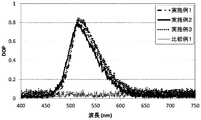
- FIG. 1 shows a graph of the DOP value for each wavelength for the measurement samples obtained in Examples 1 to 3 and Comparative Example 1, respectively.
- the measurement samples obtained in Examples 1 to 3 each show a high DOP value around 510 nm, indicating that they exhibit polarized light emission.
- the measurement sample obtained in Comparative Example 1 has a remarkably low DOP and does not exhibit polarized light emission.
- the DOPs of Comparative Example 2 and Comparative Example 3 did not show polarized light emission as in Comparative Example 1.
- Table 2 below shows the wavelength and DOP value showing the highest DOP value of the measurement samples obtained in Examples 1 to 3, respectively.
- the samples of Examples 1 to 3 prepared using the water-soluble coumarin-based compound having the structure of the above formula (1) have a polarized light emitting function in the visible light region, and are the same. It can be seen that the region functions as a polarized light emitting film (polarized light emitting plate). Further, the samples of Examples 1 to 3 show a transmittance (luminosity correction transmittance Ys) of 85% or more in the visible light region, and transmit in the same region while having a polarization function in the visible light region. It was found that it was a polarized light emitting plate (polarized light emitting film) having a high rate. Further, as shown in FIG.
- the measurement samples of Examples 1 to 3 show a high DOP value in the wavelength region of 450 to 600 nm and have the highest DOP in the vicinity of 510 nm, and thus are visible. It was found that light was emitted over a wide wavelength band in the light region, and the light emission was polarized, that is, it had a polarized light emitting action. Further, it was found that the DOP value showed a high value regardless of the transmittance (Ts) and the degree of polarization ( ⁇ ), and emitted light having polarization independent of the absorption anisotropy of light. On the other hand, the measurement samples of Comparative Examples 1 to 3 had extremely low DOP values at each wavelength. From this, it was found that even if the dichroic dyes used in the conventional dye-based polarizing plates as in Comparative Examples 1 to 3 were used, the polarized light emitting effect was not exhibited.
- the polarized light emitting film or the polarized light emitting plate containing the water-soluble coumarin compound or a salt thereof not only has a polarizing function but also exhibits a polarized light emitting action. Further, such a polarized light emitting film and a polarized light emitting plate have high transmittance in the visible light region and have excellent durability. Therefore, a display device manufactured by using such a polarized light emitting film or a polarized light emitting plate has high transmittance in the visible light region and can display an image by polarized light emission for a long period of time.
- a television, a personal computer, a tablet terminal, and further , Transparent display (see-through display), etc. can be applied to a wide range of applications. Further, since the polarized light emitting film produced by using the above-mentioned coumarin compound or a salt thereof can emit light by ultraviolet light, it can be applied to a display or a medium requiring high security.
Landscapes
- Chemical & Material Sciences (AREA)
- Physics & Mathematics (AREA)
- Organic Chemistry (AREA)
- General Physics & Mathematics (AREA)
- Optics & Photonics (AREA)
- Engineering & Computer Science (AREA)
- Materials Engineering (AREA)
- Nonlinear Science (AREA)
- Chemical Kinetics & Catalysis (AREA)
- Crystallography & Structural Chemistry (AREA)
- Mathematical Physics (AREA)
- Inorganic Chemistry (AREA)
- Polarising Elements (AREA)
- Devices For Indicating Variable Information By Combining Individual Elements (AREA)
- Liquid Crystal (AREA)
- Compositions Of Macromolecular Compounds (AREA)
- Organic Low-Molecular-Weight Compounds And Preparation Thereof (AREA)
- Plural Heterocyclic Compounds (AREA)
- Electroluminescent Light Sources (AREA)
Abstract
Description
クマリン系化合物は蛍光を発光する事が知られており、例えば、特許文献4では、蛍光増白剤にクマリン系化合物を使用することが記載されている。また、特許文献5では、ゲスト-ホスト方式のカラーディスプレイに用いるための液晶に溶解させる染料としてクマリン系化合物を使用することが記載されている。また、特許文献6及び7には、液晶に溶解させる蛍光染料としてクマリン系化合物を使用することが記載されている。しかしながら、これらの文献は、いずれも液晶に電圧をかけて駆動させることにより二色性を発現させる油溶性二色性クマリン化合物に関するものであり、水溶性クマリン系化合物を開示するものではない。また、クマリン系化合物を、二色性染料として、偏光膜及び偏光板、或いは偏光発光膜及び偏光発光板に応用した例は存在しなかった。
[1]
下記式(1)
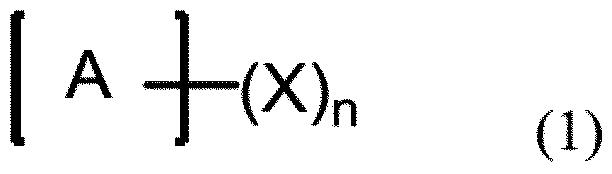
[2]
前記水溶性クマリン系化合物又はその塩が、下記式(2)
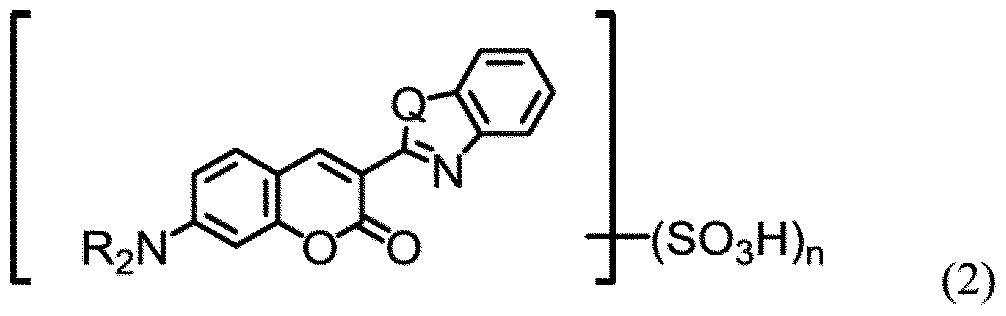
[3]
前記水溶性クマリン系化合物又はその塩が、下記式(3)

[4]
更に、前記水溶性クマリン系化合物又はその塩以外の有機染料又は蛍光染料の1種類以上を含有する、[1]~[3]のいずれか一項に記載の偏光発光膜。
[5]
前記水溶性クマリン系化合物又はその塩と、任意選択で前記有機染料又は蛍光染料とを、ポリビニルアルコール樹脂又はその誘導体からなる基材中に含有する、[1]~[4]のいずれか一項に記載の偏光発光膜。
[6]
[1]~[5]のいずれか一項に記載の偏光発光膜と、その少なくとも一方の面に設けられる透明保護層とを含む、偏光発光板。
[7]
[1]~[5]のいずれか一項に記載の偏光発光膜又は[6]に記載の偏光発光板を備える表示装置。
以下において、「~」を用いて表される数値範囲は、「~」の前後に記載される数値を下限値及び上限値として含む範囲を意味する。
また、特に言及されない限り、各式で表される化合物及び各化合物例に示される化合物は、遊離酸の形態(塩を形成していない状態)で表すが、本発明の技術的範囲には、それらの塩も含まれる。また、特に言及されない限り、煩雑さを避けるため、便宜上「水溶性クマリン系化合物又はその塩」の記載は、単に「水溶性クマリン系化合物」と略記する場合がある。
本発明の実施形態に係る水溶性クマリン系化合物は、上記式(1)で表される。
ピロリジニルアミノ、テトラヒドロフリルアミノ、テトラヒドロチオフェン-2-イルアミノ、テトラヒドロチオフェン-3-イルアミノ等の5員複素脂環式アミノ基;
ピペリジニルアミノ、ピペラジニルアミノ、ジオキサン-2-イルアミノ、モルホリニルアミノ、チオモルホリニルアミノ等の6員複素脂環式アミノ基;
ピロールアミノ、ピラゾールアミノ、イミダゾールアミノ、トリアゾールアミノ、フリルアミノ、チオフェン-2-イルアミノ、チオフェン-3-イルアミノ、オキサゾールアミノ、チアゾールアミノ等の5員芳香族複素環式アミノ基;又は、
ピリジルアミノ、ピラジルアミノ、ピリダジニルアミノ、トリアジニルアミノ等の6員芳香族複素環式アミノ基等が挙げられる。
前記複素環基は、複素環部分が芳香族環であることが好ましい。また、複素環を構成するヘテロ原子としては窒素原子及び硫黄原子から選択されることが好ましい。
フタラニルアミノ等の複素環部分が脂環式5員環である縮環型複素脂環式アミノ基;
ベンゾピラニルアミノ等の複素環部分が脂環式6員環である縮環型複素脂環式アミノ基;
ベンズピロールアミノ、ベンズピラゾールアミノ、ベンズイミダゾールアミノ、ベンゾトリアゾールアミノ、ベンゾフラニルアミノ、ベンゾチオフェン-2-イルアミノ、ベンゾチオフェン-3-イルアミノ、ベンゾキサゾールアミノ、ベンゾチアゾールアミノ等の複素環部分が芳香族5員環である縮環型芳香族複素環式アミノ基;又は、
キノリニルアミノ、シンノリニルアミノ、フタラジニルアミノ、キナゾリニルアミノ、キノキサリニルアミノ等の複素環部分が芳香族6員環である縮環型芳香族複素環式アミノ基等が挙げられる。
前記複素環基は、複素環部分が芳香族環であることが好ましい。また、複素環を構成するヘテロ原子としては窒素原子及び硫黄原子から選択されることが好ましい。
メトキシ、エトキシ、n-プロポキシ、n-ブトキシ、n-ペントキシ、n-ヘキシロキシ、n-ヘプトキシ、n-オクチロキシ、n-ノニロキシ、n-デシロキシ等の直鎖状のC1-C10アルコキシ基;
イソプロポキシ、イソブトキシ、sec-ブトキシ、t-ブトキシ、イソアミロキシ、t-アミロキシ、イソヘキシロキシ、t-ヘキシロキシ、イソヘプトキシ、t-ヘプトキシ、イソオクチロキシ、t-オクチロキシ、2-エチルヘキシロキシ、イソノニロキシ、イソデシロキシ等の分岐鎖状のC3-C10アルコキシ基;又は、
シクロプロポキシ、シクロブトキシ、シクロペントキシ、シクロヘキシロキシ、シクロヘプトキシ等の環状のC3-C7アルコキシ基が挙げられる。これらの中でも、直鎖状又は分岐鎖状のアルコキシ基が好ましい。
メチルカルボニルアミノ、エチルカルボニルアミノ、n-プロピルカルボニルアミノ、n-ブチルカルボニルアミノ、n-ペンチルカルボニルアミノ、n-ヘキシルカルボニルアミノ、n-ヘプチルカルボニルアミノ、n-オクチルカルボニルアミノ、n-ノニルカルボニルアミノ、n-デシルカルボニルアミノ等の直鎖状のC1-C10アルキルカルボニルアミノ基;
イソプロピルカルボニルアミノ、イソブチルカルボニルアミノ、sec-ブチルカルボニルアミノ、t-ブチルカルボニルアミノ、イソアミルカルボニルアミノ、t-アミルカルボニルアミノ、イソヘキシルカルボニルアミノ、t-ヘキシルカルボニルアミノ、イソヘプチルカルボニルアミノ、t-ヘプチルカルボニルアミノ、イソオクチルカルボニルアミノ、t-オクチルカルボニルアミノ、2-エチルヘキシルカルボニルアミノ、イソノニルカルボニルアミノ、イソデシルカルボニルアミノ等の分岐鎖状のC3-C10アルキルカルボニルアミノ基;又は
シクロプロピルカルボニルアミノ、シクロブチルカルボニルアミノ、シクロペンチルカルボニルアミノ、シクロヘキシルカルボニルアミノ、シクロヘプチルカルボニルアミノ等の環状のC3-C7アルキルカルボニルアミノ基が挙げられる。これらの中でも、直鎖状又は分岐鎖状のアルキルカルボニルアミノ基が好ましく、直鎖状のアルキルカルボニルアミノ基がより好ましい。
メチルカルボニルオキシ、エチルカルボニルオキシ、n-プロピルカルボニルオキシ、n-ブチルカルボニルオキシ、n-ペンチルカルボニルオキシ、n-ヘキシルカルボニルオキシ、n-ヘプチルカルボニルオキシ、n-オクチルカルボニルオキシ、n-ノニルカルボニルオキシ、n-デシルカルボニルオキシ等の直鎖状のC1-C10アルキルカルボニルオキシ基;
イソプロピルカルボニルオキシ、イソブチルカルボニルオキシ、sec-ブチルカルボニルオキシ、t-ブチルカルボニルオキシ、イソアミルカルボニルオキシ、t-アミルカルボニルオキシ、イソヘキシルカルボニルオキシ、t-ヘキシルカルボニルオキシ、イソヘプチルカルボニルオキシ、t-ヘプチルカルボニルオキシ、イソオクチルカルボニルオキシ、t-オクチルカルボニルオキシ、2-エチルヘキシルカルボニルオキシ、イソノニルカルボニルオキシ、イソデシルカルボニルオキシ等の分岐鎖状のC3-C10アルキルカルボニルオキシ基;又は、
シクロプロピルカルボニルオキシ、シクロブチルカルボニルオキシ、シクロペンチルカルボニルオキシ、シクロヘキシルカルボニルオキシ、シクロヘプチルカルボニルオキシ等の環状のC3-C7アルキルカルボニルオキシ基が挙げられる。これらの中でも、直鎖状又は分岐鎖のアルキルカルボニルオキシ基が好ましく、直鎖状のアルキルカルボニルオキシ基がより好ましい。
メチルカルボニル、エチルカルボニル、n-プロピルカルボニル、n-ブチルカルボニル、n-ペンチルカルボニル、n-ヘキシルカルボニル、n-ヘプチルカルボニル、n-オクチルカルボニル、n-ノニルカルボニル、n-デシルカルボニル等の直鎖状のC1-C10アルキルカルボニル基;
イソプロピルカルボニル、イソブチルカルボニル、sec-ブチルカルボニル、t-ブチルカルボニル、イソアミルカルボニル、t-アミルカルボニル、イソヘキシルカルボニル、t-ヘキシルカルボニル、イソヘプチルカルボニル、t-ヘプチルカルボニル、イソオクチルカルボニル、t-オクチルカルボニル、2-エチルヘキシルカルボニル、イソノニルカルボニル、イソデシルカルボニル等の分岐鎖状のC3-C10アルキルカルボニル基;又は、
シクロプロピルカルボニル、シクロブチルカルボニル、シクロペンチルカルボニル、シクロヘキシルカルボニル、シクロヘプチルカルボニル等の環状のC3-C7アルキルカルボニル基が挙げられる。これらの中でも、直鎖状又は分岐鎖状のアルキルカルボニル基が好ましく、直鎖状のアルキルカルボニル基がより好ましい。
メチルカルバモイル、エチルカルバモイル、n-プロピルカルバモイル、n-ブチルカルバモイル、n-ペンチルカルバモイル、n-ヘキシルカルバモイル、n-ヘプチルカルバモイル、n-オクチルカルバモイル、n-ノニルカルバモイル、n-デシルカルバモイル等の直鎖状のモノC1-C10アルキルカルバモイル基;
イソプロピルカルバモイル、イソブチルカルバモイル、sec-ブチルカルバモイル、t-ブチルカルバモイル、イソアミルカルバモイル、t-アミルカルバモイル、イソヘキシルカルバモイル、t-ヘキシルカルバモイル、イソヘプチルカルバモイル、t-ヘプチルカルバモイル、イソオクチルカルバモイル、t-オクチルカルバモイル、2-エチルヘキシルカルバモイル、イソノニルカルバモイル、イソデシルカルバモイル等の分岐鎖状のモノC3-C10アルキルカルバモイル基;又は、
シクロプロピルカルバモイル、シクロブチルカルバモイル、シクロペンチルカルバモイル、シクロヘキシルカルバモイル、シクロヘプチルカルバモイル等の環状のモノC3-C7アルキルカルバモイル基が挙げられる。これらの中でも、直鎖状又は分岐鎖状のモノアルキルカルバモイル基が好ましく、直鎖状のモノアルキルカルバモイル基がより好ましい。
ジメチルカルバモイル、ジエチルカルバモイル、ジ-n-プロピルカルバモイル、ジ-n-ブチルカルバモイル、ジ-n-ペンチルカルバモイル、ジ-n-ヘキシルカルバモイル、ジ-n-ヘプチルカルバモイル、ジ-n-オクチルカルバモイル、ジ-n-ノニルカルバモイル、ジ-n-デシルカルバモイル等の直鎖状アルキル基を2つ有するジC1-C10アルキルカルバモイル基;
ジイソプロピルカルバモイル、ジイソブチルカルバモイル、ジ-sec-ブチルカルバモイル、ジ-t-ブチルカルバモイル、ジイソアミルカルバモイル、ジ-t-アミルカルバモイル、ジイソヘキシルカルバモイル、ジ-t-ヘキシルカルバモイル、ジイソヘプチルカルバモイル、ジ-t-ヘプチルカルバモイル、ジイソオクチルカルバモイル、ジ-t-オクチルカルバモイル、ジ-(2-エチルヘキシル)カルバモイル、ジイソノニルカルバモイル、ジイソデシルカルバモイル等の分岐鎖状のアルキル基を2つ有するジC3-C10アルキルカルバモイル基;又は、
ジシクロプロピルカルバモイル、ジシクロブチルカルバモイル、ジシクロペンチルカルバモイル、ジシクロヘキシルカルバモイル、ジシクロヘプチルカルバモイル等の環状アルキル基を2つ有するジC3-C7アルキルカルバモイル基が挙げられる。これらの中でも、直鎖状又は分岐鎖状のジアルキルカルバモイル基が好ましく、直鎖状のジアルキルカルバモイル基がより好ましい。
例えば、メトキシカルボニル、エトキシカルボニル、n-プロポキシカルボニル、n-ブトキシカルボニル、n-ペントキシカルボニル、n-ヘキシロキシカルボニル、n-ヘプトキシカルボニル、n-オクチロキシカルボニル、n-ノニロキシカルボニル、n-デシロキシカルボニル等の直鎖状のC1-C10アルコキシカルボニル基;
イソプロポキシカルボニル、イソブトキシカルボニル、sec-ブトキシカルボニル、t-ブトキシカルボニル、イソアミロキシカルボニル、t-アミロキシカルボニル、イソヘキシロキシカルボニル、t-ヘキシロキシカルボニル、イソヘプトキシカルボニル、t-ヘプトキシカルボニル、イソオクチロキシカルボニル、t-オクチロキシカルボニル、2-エチルヘキシロキシカルボニル、イソノニロキシカルボニル、イソデシロキシカルボニル等の分岐鎖状のC3-C10アルコキシカルボニル基;又は、
シクロプロポキシカルボニル、シクロブトキシカルボニル、シクロペントキシカルボニル、シクロヘキシロキシカルボニル、シクロヘプトキシカルボニル等の環状のC3-C7アルコキシカルボニル基が挙げられる。これらの中でも、直鎖状又は分岐鎖状のアルコキシカルボニル基が好ましく、直鎖状のアルコキシカルボニル基がより好ましい。
メチルスルホニルアミノ、エチルスルホニルアミノ、n-プロピルスルホニルアミノ、n-ブチルスルホニルアミノ、n-ペンチルスルホニルアミノ、n-ヘキシルスルホニルアミノ、n-ヘプチルスルホニルアミノ、n-オクチルスルホニルアミノ、n-ノニルスルホニルアミノ、n-デシルスルホニルアミノ等の直鎖状のC1-C10アルキルスルホニルアミノ基;
イソプロピルスルホニルアミノ、イソブチルスルホニルアミノ、sec-ブチルスルホニルアミノ、t-ブチルスルホニルアミノ、イソアミルスルホニルアミノ、t-アミルスルホニルアミノ、イソヘキシルスルホニルアミノ、t-ヘキシルスルホニルアミノ、イソヘプチルスルホニルアミノ、t-ヘプチルスルホニルアミノ、イソオクチルスルホニルアミノ、t-オクチルスルホニルアミノ、2-エチルヘキシルスルホニルアミノ、イソノニルスルホニルアミノ、イソデシルスルホニルアミノ等の分岐鎖状のC3-C10アルキルスルホニルアミノ基;又は、
シクロプロピルスルホニルアミノ、シクロブチルスルホニルアミノ、シクロペンチルスルホニルアミノ、シクロヘキシルスルホニルアミノ、シクロヘプチルスルホニルアミノ等の環状のC3-C7アルキルスルホニルアミノ基が挙げられる。これらの中でも、直鎖状又は分岐鎖状のアルキルスルホニルアミノ基が好ましく、直鎖状のアルキルスルホニルアミノ基がより好ましい。
メチルスルファモイル、エチルスルファモイル、n-プロピルスルファモイル、n-ブチルスルファモイル、n-ペンチルスルファモイル、n-ヘキシルスルファモイル、n-ヘプチルスルファモイル、n-オクチルスルファモイル、n-ノニルスルファモイル、n-デシルスルファモイル等の直鎖状のモノC1-C10アルキルスルファモイル基;
イソプロピルスルファモイル、イソブチルスルファモイル、sec-ブチルスルファモイル、t-ブチルスルファモイル、イソアミルスルファモイル、t-アミルスルファモイル、イソヘキシルスルファモイル、t-ヘキシルスルファモイル、イソヘプチルスルファモイル、t-ヘプチルスルファモイル、イソオクチルスルファモイル、t-オクチルスルファモイル、2-エチルヘキシルスルファモイル、イソノニルスルファモイル、イソデシルスルファモイル等の分岐鎖状のモノC3-C10アルキルスルファモイル基;又は、
シクロプロピルスルファモイル、シクロブチルスルファモイル、シクロペンチルスルファモイル、シクロヘキシルスルファモイル、シクロヘプチルスルファモイル等の環状のモノC3-C7アルキルスルファモイル基が挙げられる。これらの中でも、直鎖状又は分岐鎖状のモノアルキルスルファモイル基が好ましく、直鎖状のモノアルキルスルファモイル基がより好ましい。
ジメチルスルファモイル、ジエチルスルファモイル、ジ-n-プロピルスルファモイル、ジ-n-ブチルスルファモイル、ジ-n-ペンチルスルファモイル、ジ-n-ヘキシルスルファモイル、ジ-n-ヘプチルスルファモイル、ジ-n-オクチルスルファモイル、ジ-n-ノニルスルファモイル、ジ-n-デシルスルファモイル等の直鎖状のアルキル基を2つ有するジC1-C10アルキルスルファモイル基;
ジイソプロピルスルファモイル、ジイソブチルスルファモイル、ジ-sec-ブチルスルファモイル、ジ-t-ブチルスルファモイル、ジイソアミルスルファモイル、ジ-t-アミルスルファモイル、ジイソヘキシルスルファモイル、ジ-t-ヘキシルスルファモイル、ジイソヘプチルスルファモイル、ジ-t-ヘプチルスルファモイル、ジイソオクチルスルファモイル、ジ-t-オクチルスルファモイル、ジ-(2-エチルヘキシル)スルファモイル、ジイソノニルスルファモイル、ジイソデシルスルファモイル等の分岐鎖状のアルキル基を2つ有するジC3-C10アルキルスルファモイル基;又は、
ジシクロプロピルスルファモイル、ジシクロブチルスルファモイル、ジシクロペンチルスルファモイル、ジシクロヘキシルスルファモイル、ジシクロヘプチルスルファモイル等の環状のアルキル基を2つ有するジC3-C7アルキルスルファモイル基が挙げられる。これらの中でも、直鎖状又は分岐鎖状のジアルキルスルファモイル基が好ましく、直鎖状のジアルキルスルファモイル基がより好ましい。
メチルスルホニル、エチルスルホニル、n-プロピルスルホニル、n-ブチルスルホニル、n-ペンチルスルホニル、n-ヘキシルスルホニル、n-ヘプチルスルホニル、n-オクチルスルホニル、n-ノニルスルホニル、n-デシルスルホニル、n-ウンデシルスルホニル、n-ドデシルスルホニル等の直鎖状のC1-C12アルキルスルホニル基;
イソプロピルスルホニル、イソブチルスルホニル、sec-ブチルスルホニル、t-ブチルスルホニル、イソアミルスルホニル、t-アミルスルホニル、イソヘキシルスルホニル、t-ヘキシルスルホニル、イソヘプチルスルホニル、t-ヘプチルスルホニル、イソオクチルスルホニル、t-オクチルスルホニル、2-エチルヘキシルスルホニル、イソノニルスルホニル、イソデシルスルホニル、イソウンデシルスルホニル、t-ウンデシルスルホニル、イソドデシルスルホニル、t-ドデシルスルホニル等の分岐鎖状のC3-C12アルキルスルホニル基;又は、
シクロプロピルスルホニル、シクロブチルスルホニル、シクロペンチルスルホニル、シクロヘキシルスルホニル、シクロヘプチルスルホニル等の環状のC3-C7アルキルスルホニル基が挙げられる。これらの中でも、直鎖状又は分岐鎖状のアルキルスルホニル基が好ましく、直鎖状のアルキルスルホニル基がより好ましい。
メチルチオ、エチルチオ、n-プロピルチオ、n-ブチルチオ、n-ペンチルチオ、n-ヘキシルチオ、n-ヘプチルチオ、n-オクチルチオ、n-ノニルチオ、n-デシルチオ等の直鎖状のC1-C10アルキルチオ基;
イソプロピルチオ、イソブチルチオ、sec-ブチルチオ、t-ブチルチオ、イソアミルチオ、t-アミルチオ、イソヘキシルチオ、t-ヘキシルチオ、イソヘプチルチオ、t-ヘプチルチオ、イソオクチルチオ、t-オクチルチオ、2-エチルヘキシルチオ、イソノニルチオ、イソデシルチオ等の分岐鎖状のC3-C10アルキルチオ基;又は、
シクロプロピルチオ、シクロブチルチオ、シクロペンチルチオ、シクロヘキシルチオ、シクロヘプチルチオ等の環状のC3-C7アルキルチオ基が挙げられる。これらの中でも、直鎖状又は分岐鎖状のアルキルチオ基が好ましく、直鎖状のアルキルチオ基がより好ましい。
メチルウレイド、エチルウレイド、n-プロピルウレイド、n-ブチルウレイド、n-ペンチルウレイド、n-ヘキシルウレイド、n-ヘプチルウレイド、n-オクチルウレイド、n-ノニルウレイド、n-デシルウレイド等の直鎖状のモノC1-C10アルキルウレイド基;
イソプロピルウレイド、イソブチルウレイド、sec-ブチルウレイド、t-ブチルウレイド、イソアミルウレイド、t-アミルウレイド、イソヘキシルウレイド、t-ヘキシルウレイド、イソヘプチルウレイド、t-ヘプチルウレイド、イソオクチルウレイド、t-オクチルウレイド、2-エチルヘキシルウレイド、イソノニルウレイド、イソデシルウレイド等の分岐鎖状のモノC3-C10アルキルウレイド基;又は、
シクロプロピルウレイド、シクロブチルウレイド、シクロペンチルウレイド、シクロヘキシルウレイド、シクロヘプチルウレイド等の環状のモノC3-C7アルキルウレイド基が挙げられる。これらの中でも、直鎖状又は分岐鎖状のアルキルウレイド基が好ましく、直鎖状のアルキルウレイド基が挙げられる。
ジメチルウレイド、ジエチルウレイド、ジ-n-プロピルウレイド、ジ-n-ブチルウレイド、ジ-n-ペンチルウレイド、ジ-n-ヘキシルウレイド、ジ-n-ヘプチルウレイド、ジ-n-オクチルウレイド、ジ-n-ノニルウレイド、ジ-n-デシルウレイド等の直鎖状のアルキル基を2つ有するジC1-C10アルキルウレイド基;
ジイソプロピルウレイド、ジイソブチルウレイド、ジ-sec-ブチルウレイド、ジ-t-ブチルウレイド、ジイソアミルウレイド、ジ-t-アミルウレイド、ジイソヘキシルウレイド、ジ-t-ヘキシルウレイド、ジイソヘプチルウレイド、ジ-t-ヘプチルウレイド、ジイソオクチルウレイド、ジ-t-オクチルウレイド、ジ-(2-エチルヘキシル)ウレイド、ジイソノニルウレイド、ジイソデシルウレイド等の分岐鎖状のアルキル基を2つ有するジC3-C10アルキルウレイド基;又は、
ジシクロプロピルウレイド、ジシクロブチルウレイド、ジシクロペンチルウレイド、ジシクロヘキシルウレイド、ジシクロヘプチルウレイド等の環を2つ有する環状のジC3-C7アルキルウレイド基が挙げられる。これらの中でも、直鎖状又は分岐鎖状のジアルキルウレイド基が好ましく、直鎖状のジアルキルウレイド基がより好ましい。
メトキシカルボニルアミノ、エトキシカルボニルアミノ、n-プロポキシカルボニルアミノ、n-ブトキシカルボニルアミノ、n-ペントキシカルボニルアミノ、n-ヘキシロキシカルボニルアミノ、n-ヘプトキシカルボニルアミノ、n-オクチロキシカルボニルアミノ、n-ノニロキシカルボニルアミノ、n-デシロキシカルボニルアミノ等の直鎖状のC1-C10アルコキシカルボニルアミノ基;
イソプロポキシカルボニルアミノ、イソブトキシカルボニルアミノ、sec-ブトキシカルボニルアミノ、t-ブトキシカルボニルアミノ、イソアミロキシカルボニルアミノ、t-アミロキシカルボニルアミノ、イソヘキシロキシカルボニルアミノ、t-ヘキシロキシカルボニルアミノ、イソヘプトキシカルボニルアミノ、t-ヘプトキシカルボニルアミノ、イソオクチロキシカルボニルアミノ、t-オクチロキシカルボニルアミノ、2-エチルヘキシロキシカルボニルアミノ、イソノニロキシカルボニルアミノ、イソデシロキシカルボニルアミノ等の分岐鎖状のC3-C10アルコキシカルボニルアミノ基;又は、
シクロプロポキシカルボニルアミノ、シクロブトキシカルボニルアミノ、シクロペントキシカルボニルアミノ、シクロヘキシロキシカルボニルアミノ、シクロヘプトキシカルボニルアミノ等の環状のC3-C7アルコキシカルボニルアミノ基が挙げられる。これらの中でも、直鎖状又は分岐鎖状のアルコキシカルボニルアミノ基が好ましく、直鎖状のアルコキシカルボニルアミノ基がより好ましい。
メチルアミノ、エチルアミノ、n-プロピルアミノ、n-ブチルアミノ、n-ペンチルアミノ、n-ヘキシルアミノ、n-ヘプチルアミノ、n-オクチルアミノ、n-ノニルアミノ、n-デシルアミノ等の直鎖状のモノC1-C10アルキルアミノ基;
イソプロピルアミノ、イソブチルアミノ、sec-ブチルアミノ、t-ブチルアミノ、イソアミルアミノ、t-アミルアミノ、イソヘキシルアミノ、t-ヘキシルアミノ、イソヘプチルアミノ、t-ヘプチルアミノ、イソオクチルアミノ、t-オクチルアミノ、2-エチルヘキシルアミノ、イソノニルアミノ、イソデシルアミノ等の分岐鎖状のモノC3-C10アルキルアミノ基;又は、
シクロプロピルアミノ、シクロブチルアミノ、シクロペンチルアミノ、シクロヘキシルアミノ、シクロヘプチルアミノ等の環状モノC3-C7アルキルアミノ基が挙げられる。これらの中でも、直鎖状又は分岐鎖状のモノアルキルアミノ基が好ましく、直鎖状のモノアルキルアミノ基がより好ましい。
ジメチルアミノ、ジエチルアミノ、ジ-n-プロピルアミノ、ジ-n-ブチルアミノ、ジ-n-ペンチルアミノ、ジ-n-ヘキシルアミノ、ジ-n-ヘプチルアミノ、ジ-n-オクチルアミノ、ジ-n-ノニルアミノ、ジ-n-デシルアミノ等の直鎖状のアルキル基を2つ有するジC1-C10アルキルアミノ基;
ジイソプロピルアミノ、ジイソブチルアミノ、ジ-sec-ブチルアミノ、ジ-t-ブチルアミノ、ジイソアミルアミノ、ジ-t-アミルアミノ、ジイソヘキシルアミノ、ジ-t-ヘキシルアミノ、ジイソヘプチルアミノ、ジ-t-ヘプチルアミノ、ジイソオクチルアミノ、ジ-t-オクチルアミノ、ジ-(2-エチルヘキシル)アミノ、ジイソノニルアミノ、ジイソデシルアミノ等の分岐鎖状のアルキル基を2つ有するジC3-C10アルキルアミノ基;又は、
ジシクロプロピルアミノ、ジシクロブチルアミノ、ジシクロペンチルアミノ、ジシクロヘキシルアミノ、ジシクロヘプチルアミノ等の環状のアルキル基を2つ有するジC3-C7アルキルアミノ基が挙げられる。これらの中でも、直鎖状又は分岐鎖状のジアルキルアミノ基が好ましく、直鎖状のジアルキルアミノ基がより好ましい。
スルホ基又はカルボキシ基は、化学的に可能であれば、Aで示される置換基を有してもよいクマリン骨格の何れの個所にも結合し得、いずれの箇所に結合しても所望の偏光発光作用を有する。ただし、多くの場合、上述したクマリン骨格が有する置換基に結合する。
上記式(2)中、R2は炭素数1~10の炭化水素基を表し、Qは硫黄原子、酸素原子又は窒素原子を表し、nは1~3の整数を表す。
スルホ基は、化学的に可能であれば、クマリン骨格及びこれに結合する縮合複素環の何れの個所にも結合し得、いずれの箇所に結合しても所望の偏光発光作用を有する。ただし、多くの場合、クマリン骨格に結合する縮合複素環のベンゼン環の水素原子を置換する。好ましい置換位置は、ベンゾ縮合複素環のQを1位、Nを3位としたとき、5位又は6位である。
スルホ基は、化学的に可能であれば、クマリン骨格及びこれに結合するベンゾイミダゾール環の何れの個所にも結合し得、いずれの箇所に結合しても所望の偏光発光作用を有する。ただし、多くの場合、ベンゾイミダゾール環中のベンゼン環の水素原子を置換する。好ましい置換位置は、ベンゾイミダゾール環のNHを1位、Nを3位としたとき、5位又は6位である。
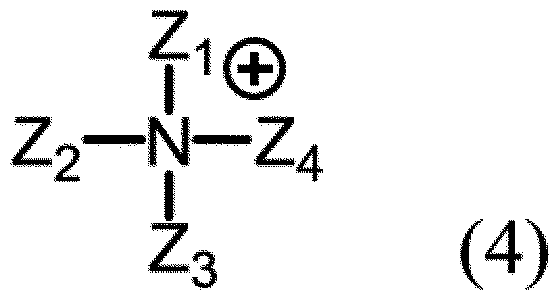
メチル、エチル、ブチル、ペンチル、ヘキシル等のC1-C6アルキル基、好ましくはC1-C4アルキル基;
ヒドロキシメチル、2-ヒドロキシエチル、3-ヒドロキシプロピル、2-ヒドロキシプロピル、4-ヒドロキシブチル、3-ヒドロキシブチル、2-ヒドロキシブチル等のヒドロキシC1-C6アルキル基、好ましくはヒドロキシC1-C4アルキル基;又は、
ヒドロキシエトキシメチル、2-ヒドロキシエトキシエチル、3-ヒドロキシエトキシプロピル、3-ヒドロキシエトキシブチル、2-ヒドロキシエトキシブチル等のヒドロキシC1-C6アルコキシC1-C6アルキル基、好ましくはヒドロキシC1-C4アルコキシC1-C4アルキル基等が挙げられる。
上記式(1)~(3)で表される水溶性クマリン系化合物またはその塩を含有する偏光発光膜も本願発明に含まれる。
本発明の好ましい実施形態では、偏光発光膜は、上記式(1)~(3)のいずれかで表される水溶性クマリン系化合物又はその塩を含有する基材を含む。このような基材は、上記水溶性クマリン系化合物またはその塩を吸着し得る親水性高分子を製膜して得られるフィルム等が好ましい。当該親水性高分子は、特に限定されるものではないが、例えば、ポリビニルアルコール系樹脂、アミロース系樹脂、デンプン系樹脂、セルロース系樹脂及びポリアクリル酸塩系樹脂が挙げられる。このような樹脂の中でも、水溶性クマリン系化合物等の染料の吸着性、加工性、配向性等の観点から、ポリビニルアルコール系樹脂又はその誘導体が好ましい。ポリビニルアルコール系樹脂の誘導体としては、この技術分野で一般的に知られている如何なるものを使用することができる。これに限定されないが、例えば、クロトン酸、アクリル酸、メタクリル酸、マレイン酸等の不飽和カルボン酸、ビニルスルホン酸、アクリルスルホン酸、メタクリルスルホン酸、p?スチレンスルホン酸、2?アクリルアミド?2?メチルプロパンスルホン酸、(メタ)アクリロイルオキシエチルスルホン酸等の不飽和スルホン酸、或いはエチレン、プロピレン等のオレフィンをビニルアルコールと共重合した変性ポリビニルアルコール系樹脂を挙げることができる。基材の形状は、特に限定されるものではなく、例えば、フィルム状、シート状、平板状、曲板状及び半球状等、任意の形状に作製することができる。また、基材の厚さは、通常、10μm~100μmであり、好ましくは20μm~80μmである。基材には、上記式(1)~(3)のいずれかで表される水溶性クマリン系化合物又はその塩が単独で又は複数含有されていてもよい。
上記偏光発光膜の製造方法について説明する。本発明に係る偏光発光膜の製造方法は、これに限定されるものではないが、主に、基材を準備する工程と、基材を膨潤液に浸漬させ、当該基材を膨潤により延伸させる工程と、膨潤させた基材を少なくとも1種の上記式(1)~(3)のいずれかで表される水溶性クマリン系化合物又はその塩、及び任意選択で他の有機染料又は蛍光染料(以下、総じて、「偏光色素」ということがある)を含む染色溶液に含浸させ、基材に偏光色素を吸着させる工程と、吸着させた基材を、ホウ酸を含有する溶液に浸漬し、偏光色素を基材中で架橋させる工程と、偏光色素を架橋させた基材を一定の方向に一軸延伸して、偏光色素を一定の方向に配向させる延伸工程と、必要に応じて、延伸させた基材を、洗浄液で洗浄する洗浄工程と、洗浄させた基材を乾燥させる乾燥工程を含んでいる。
上記式(1)~(3)のいずれかで表される水溶性クマリン系化合物又はその塩、及び任意選択で他の有機染料又は蛍光染料を含有させるための基材を準備する。当該基材は、例えば、市販のポリビニルアルコール系樹脂又はその誘導体からなるフィルムを用いてもよく、ポリビニルアルコール系樹脂を製膜することにより作製してもよい。ポリビニルアルコール系樹脂の製膜方法は特に限定されるものではなく、例えば、含水ポリビニルアルコールを溶融押出する方法、流延製膜法、湿式製膜法、ゲル製膜法(ポリビニルアルコール水溶液を一旦冷却ゲル化した後、溶媒を抽出除去)、キャスト製膜法(ポリビニルアルコール水溶液を基盤上に流し、乾燥)、及びこれらの組み合わせによる方法等、公知の製膜方法を採用することができる。
次に、上述の基材に、膨潤処理を施す。膨潤処理は20~50℃の膨潤液に、基材を30秒~10分間浸漬させて行うことが好ましく、膨潤液は水が好ましい。膨潤液による基材の延伸倍率は、1.00~1.50倍に調整することが好ましく、1.10~1.35倍に調整することがより好ましい。
続いて、上記のような膨潤処理を施して得られた基材に、上記水溶性クマリン系化合物又はその塩を含む少なくとも1種の偏光色素を吸着及び含浸させる。この工程の実施は、偏光色素を基材に吸着及び含浸させる方法であれば特に限定されるものではないが、例えば、基材を、偏光色素を含む染色溶液(染色水溶液)に浸漬させることが好ましい。また、基材に染色溶液を塗布することによって吸着させることもできる。染色溶液中の偏光色素の濃度は、基材中に偏光色素が十分に吸着されればよく、特に限定されるものではないが、例えば、染色溶液中に0.0001~3質量%であることが好ましく、0.001~1質量%であることがより好ましい。
偏光色素吸着・含浸工程又は予備洗浄工程の後、基材中の偏光色素を架橋させることができる。基材中の偏光色素を架橋させる方法は、架橋剤を含む処理溶液に基材を浸漬させることが好ましい。一方で、当該処理溶液を基材に塗布又は塗工してもよい。処理溶液としては、ホウ酸を含有する溶液を使用することが好ましい。処理溶液中の溶媒は、特に限定されるものではないが、水が好ましい。処理溶液中のホウ酸の濃度は、0.1~15質量%であることが好ましく、0.1~10質量%であることがより好ましい。処理溶液の温度は、30~80℃が好ましく、40~75℃がより好ましい。また、この架橋工程の処理時間は30秒~10分が好ましく、1~6分がより好ましい。本発明の好ましい実施形態において、偏光発光膜の製造方法は、この架橋工程を有することにより、得られる偏光発光膜は、高輝度、かつ高偏光度の偏光した光を発光する。このことは、従来技術において、耐水性又は光透過性を改善する目的で使用されていたホウ酸の機能からは全く予期し得ない優れた作用である。また、架橋工程においては、必要に応じて、カチオン系高分子化合物を含む水溶液で、フィックス処理をさらに併せて行ってもよい。フィックス処理により、偏光色素の固定化が可能となる。このとき、カチオン系高分子化合物として、例えば、カチオンイオン、ジシアン系としてジシアンアミドとホルマリン重合縮合物、ポリアミン系としてジシアンジアミド・ジエチレントリアミン重縮合物、ポリカチオン系としてエピクロロヒドリン・ジメチルアミン付加重合物、ジメチルジアリルアモンニウムクロライド・二酸化イオン共重合物、ジアリルアミン塩重合物、ジメチルジアリルアンモニウムクロライド重合物、アリルアミン塩の重合物、ジアルキルアミノエチルアクリレート四級塩重合物等が使用される。
架橋工程を行った後、延伸工程を実施する。延伸工程は、基材を一定の方向に一軸延伸することにより行われる。延伸方法は、湿式延伸法又は乾式延伸法のいずれであってもよい。延伸倍率は、3倍以上10倍未満が好ましく、5~9倍がより好ましい。
延伸工程を実施した後には、基材の表面に架橋剤の析出又は異物が付着することがあるため、基材の表面を洗浄する洗浄工程を行うことができる。洗浄時間は1秒~5分が好ましい。洗浄方法は、基材を洗浄液に浸漬することが好ましい。一方で、洗浄液を基材に塗布又は塗工によって洗浄することもできる。洗浄液としては、水が好ましい。洗浄処理は一段階で実施しても、2段階以上の多段処理で実施してもよい。洗浄工程の洗浄溶の温度は、特に限定されるものではないが、通常、5~50℃、好ましくは10~40℃であり、常温であってよい。
洗浄工程の後、基材の乾燥工程を行う。乾燥処理は、自然乾燥により行うことができる。また、より乾燥効率を高めるため、ロールによる圧縮やエアーナイフ又は吸水ロール等による表面の水分除去等により行うことが可能であり、さらには、送風乾燥を行うことも可能である。乾燥処理の温度は、20~100℃であることが好ましく、60~100℃であることがより好ましい。乾燥時間は、30秒~20分であることが好ましく、5~10分であることがより好ましい。
上記偏光発光膜を含む偏光発光板も本願発明に含まれる。
本発明の好ましい実施形態において、偏光発光板は、上記の偏光発光膜と共に透明保護層を含み、典型的には、上記の偏光発光膜の少なくとも一方の面に透明保護層を有している。透明保護層は、偏光発光膜の耐水性や取扱性等を向上させるために使用される。そのため、透明保護層は、偏光発光膜が示す偏光発光機能に何ら影響を与えないものが好ましい。
上記偏光発光膜又は偏光発光板を含む表示装置も本願発明に含まれる。
本発明の実施形態において、表示装置は、紫外光領域~可視光領域の光、例えば300~600nmの光を照射することによって偏光発光作用を示すため、この作用を利用して表示が可能となる。本発明の実施形態による表示装置はまた、可視光領域で高い透過率を有しているため、従来の偏光板のような可視光領域の透過率の低下がないか、透過率の低下があっても、従来の偏光板よりも透過率の低下は著しく小さい。従来の偏光板、例えば、ヨウ素系偏光板又は他の染料化合物を含有する染料系偏光板は、視感度補正された透過率が35~45%程度である。その理由としては、従来の偏光板は、光の吸収軸として縦軸と横軸の両方を有しているが、縦軸又は横軸の一方で入射した光を吸収する。すなわち、一方の軸では光を吸収し、他方の軸では光を透過することによって偏光が生じる。このような場合、一方の軸での光は吸収されて透過しないことから、必然的に透過率は50%以下になってしまう。また、従来の偏光板は二色性染料を含有するフィルムを延伸することで二色性染料を配向させて偏光板を作製しているが、この製法では、必ずしも二色性染料が100%配向せず、光の透過軸に対しても若干吸収する成分が含まれる。また、この物質の表面反射によって界面反射が発生している。このため、透過率が高い偏光板は得られていない。すなわち、透過率を低下させなければ高い偏光度を実現することができなかった。それに対して、本発明の実施形態による偏光発光膜又は偏光発光板は、300~600nm、特に350~500nm付近に光の吸収帯域がある。すなわち、紫外光領域及び短波長側の可視光領域で光を吸収し、可視光領域で偏光した光を発光する偏光発光作用を示す。一方で、可視光領域では視感度に影響する帯域の吸収が少ないため、透過率の低下が著しく抑えられ、可視光領域での透過率は非常に高くなる。また、可視光領域では、偏光発光作用を示すため、従来の偏光板を用いるよりも光の損失はなく、従来の偏光板のような透過率の低下は非常に少ない。このことから、本発明の実施形態による偏光発光膜又は偏光発光板を使用した表示装置、例えば、液晶ディスプレイは、従来の偏光板を用いた液晶ディスプレイなどの表示装置よりも高い輝度が得られる。また、本発明の実施形態による偏光発光膜又は偏光発光板を使用した表示装置は、透明性が高いことから、例えば、液晶ディスプレイでありながら、ほぼ透明なディスプレイが得られる。また、文字、画像等の表示時には偏光発光が透過するように設計できることから、透明な液晶ディスプレイでありながらも表示可能なディスプレイが得られる、すなわち、透明なディスプレイに文字等が表示可能なディスプレイが得られる。而して、本発明の実施形態によれば、表示装置は、光損失がない透明な液晶ディスプレイ、特に、シースルーディスプレイとすることができる。
(水溶性クマリン系化合物の合成:合成例1)
市販品の3-(2-ベンゾイミダゾリル)-7-(ジエチルアミノ)クマリン3.3部を98%硫酸45部と30%発煙硫酸10部の混合溶液に加え、25℃で24時間撹拌した。得られた反応液を水300部に添加し、析出した固体をろ過により分離し、更にアセトン100部にて洗浄することにより、ウェットケーキ10.0部を得た。このウェットケーキを80℃の熱風乾燥機で乾燥することにより下記式(5)で表される水溶性クマリン系化合物3.0部を合成した。
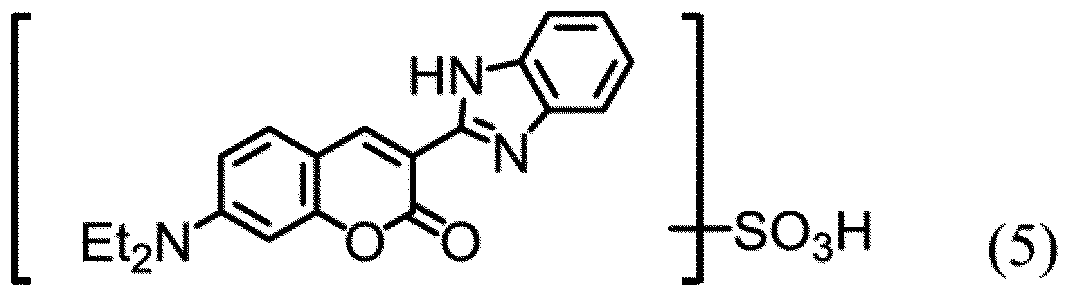
厚さ75μmのポリビニルアルコールフィルム(クラレ社製VF-PS#7500)を40℃の水に3分間浸漬して、フィルムを膨潤させた。膨潤して得られたフィルムを、合成例1で得られた上記式(5)の水溶性クマリン系化合物1.0部、芒硝1.0部及び水1000部を含む45℃の水溶液に、3分間浸漬して式(5)のクマリン系化合物をフィルムに含侵させた。式(5)の水溶性クマリン系化合物を含有するフィルムを3%ホウ酸水溶液中に50℃で5分間浸漬し、5倍に延伸した。延伸したフィルムを、緊張状態を保ったまま常温の水で20秒間水洗し、次いで乾燥して偏光発光膜を作製した。得られた偏光発光膜の両面に、ポリビニルアルコール接着剤(日本酢ビ・ポバール社製NH-26 4重量部、水100重量部の水溶液)を用いて、紫外光吸収剤を含有しないトリアセチルセルロースフィルム(富士フィルム社製ZRD-60)(厚さ:60μm)をラミネートし、偏光発光板を作製した。この偏光発光板を実施例1の測定試料とした。
(水溶性クマリン系化合物の合成:合成例2)
上記合成例1において、3-(2-ベンゾイミダゾリル)-7-(ジエチルアミノ)クマリン3.3部の代わりに、市販品の3-(2-ベンゾチアゾリル)-7-(ジエチルアミノ)クマリン3.5部を使用する以外は合成例1と同様の操作を行い、下記式(6)で表される本発明に係る水溶性クマリン系化合物2.9部を合成した。

(偏光発光膜及び偏光発光板の作製)
次いで、上記式(6)で表される水溶性クマリン系化合物を使用して、実施例1と同様の操作を行い、偏光発光板を作製した。この偏光発光板を実施例2の測定試料とした。
上記実施例1の偏光発光膜の作製において、膨潤したポリビニルアルコールフィルムを、上記式(5)の水溶性クマリン系化合物を含む45℃の水溶液に浸漬して式(5)の水溶性クマリン系化合物をフィルムに含侵させる工程で、浸漬時間を3分から1分に変更した以外は同様にして、本発明に係る偏光発光板を作製した。この偏光発光板を実施例3の測定試料とした。
上記実施例1において、上記式(5)で表される水溶性クマリン系化合物の代わりに、下記式(7)で示されるC.I.Direct Yellow 4を用いた以外は実施例1と同様の操作を行い、測定試料を作製した。

上記実施例1において、上記式(5)で表される水溶性クマリン系化合物の代わりに、下記式(8)で示される化合物を用いた以外は実施例1と同様の操作を行い、測定試料を作製した。
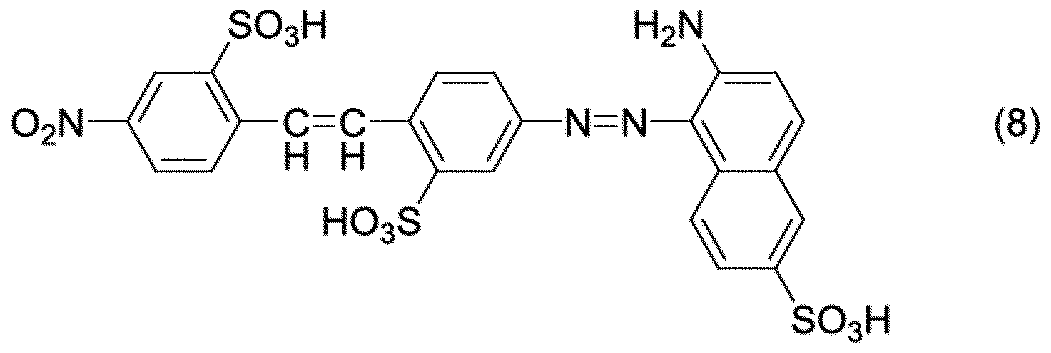
上記実施例1において、上記式(5)で表される水溶性クマリン系化合物の代わりに、上記式(5)の化合物に近い波長に極大吸収波長を有するC.I.Direct Orange 39を用いた以外は実施例1と同様の操作を行い、測定試料を作製した。
実施例1~3および比較例1~3で得られた各測定試料の評価を次のようにして行った。
各測定試料の単体透過率Ts、平行位透過率Tp、および直交位透過率Tcを、分光光度計(日立製作所社製「U-4100」)を用いて測定した。ここで、単体透過率Tsは、各測定試料を1枚で測定した際の各波長の透過率である。平行位透過率Tpは、各実施例および各比較例で得られた同一の測定試料を2枚用意し、この2枚の測定試料をその吸収軸方向が平行となるように重ね合せて測定した各波長の分光透過率である。直交位透過率Tcは、2枚の測定試料をその吸収軸が直交するように重ね合せて測定した分光透過率である。各透過率の測定は、220~780nmの波長帯域にわたって行った。
(b)偏光度ρの算出
各測定試料の偏光度ρを、以下の式(I)に、平行透過率Tpおよび直交透過率Tcを代入して算出した。ρの値が高いほど偏光度が優れていることを示す。

(c)視感度補正単体透過率Ys、及び視感度補正偏光度ρy
各測定試料の視感度補正単体透過率Ysは、可視光領域における400~700nmの波長領域で、所定波長間隔dλ(ここでは5nm)おきに求めた上記単体透過率Tsについて、JIS Z 8722:2009に従って視感度に補正した透過率である。具体的には、上記単体透過率Tsを下記の式(II)に代入して算出した。なお、下記式(II)中、Pλは標準光(C光源)の分光分布を表し、yλは2度視野等色関数を表す。また、視感度補正偏光度ρyは分光光度計(日立製作所社製「U-4100」)で算出される数値を用いて測定した。

各測定試料の偏光発光強度及び発光した光の偏光度については、発光分光光度計(東京インスツルメンツ社製分光ポラリメーターPoxi-Spectra)を用いて一般的に知られているストークスパラメータ法によって測定した。375nmの光を測定試料に入射した時に発光分光光度計より得られる発光強度(S0)において最大発光波長の発光強度を1とし、各波長の比率を算出し、その各波長の強度比率(Sr0)と、分光光度計より得られる発光した光の直線偏光度(DOLP)を用いて、式(III)を用いて発光に基づく偏光度(DOP)を算出した。

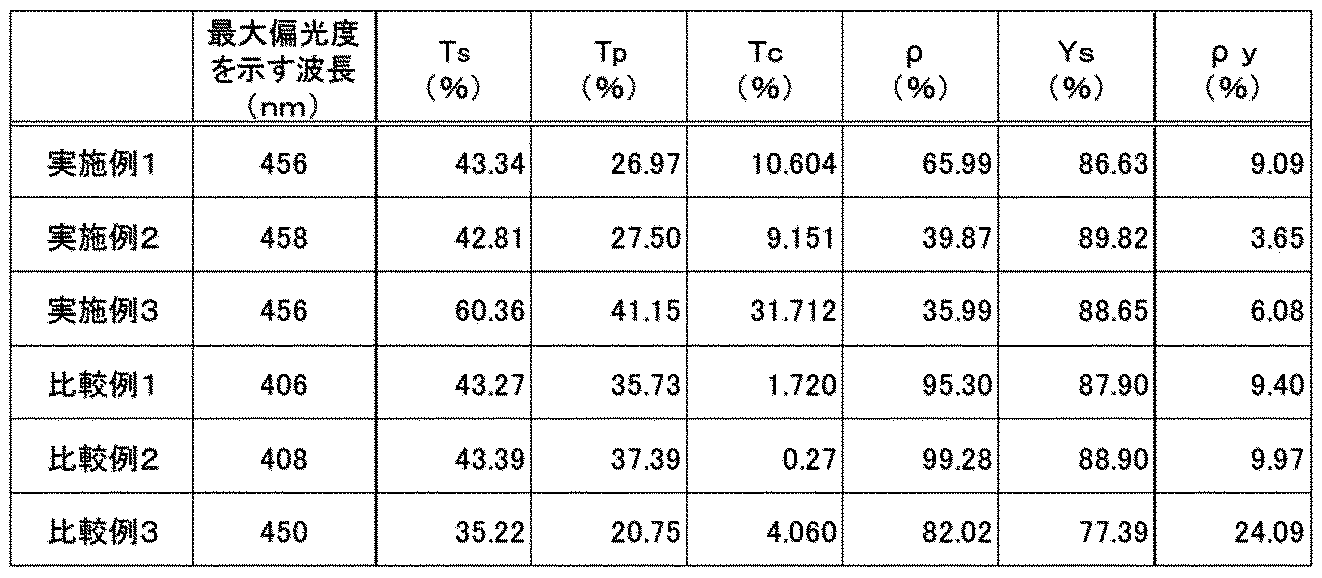

実施例1~3の試料について、以下の2つの条件で耐久性試験を実施した。
1)105℃、1000時間
2)60℃、相対湿度90%、1000時間
その結果、いずれもDOP値の変化は観察されなかった。このことから、実施例1~3の試料は、苛酷な環境下においても高い耐久性を有していることが分かる。
Claims (7)
- 下記式(1)

(式(1)中、Aは置換基を有してもよいクマリン骨格を表し、Xはスルホ基又はカルボキシ基を表し、nは1~3の整数を表す。)で表される水溶性クマリン系化合物又はその塩を含有する、偏光発光膜。 - 前記水溶性クマリン系化合物又はその塩が、下記式(2)
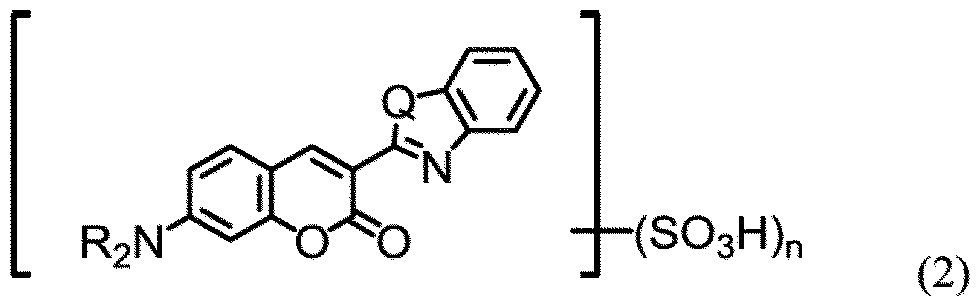
(式(2)中、R2は炭素数1~10の炭化水素基を表し、Qは硫黄原子、酸素原子又は窒素原子を表し、nは1~3の整数を表す。)で表される化合物又はその塩である、請求項1に記載の偏光発光膜。 - 前記水溶性クマリン系化合物又はその塩が、下記式(3)

(式(3)中、R2は炭素数1~10の炭化水素基を表す。)で表される化合物又はその塩である、請求項1に記載の偏光発光膜。 - 前記水溶性クマリン系化合物又はその塩以外の有機染料又は蛍光染料の1種類以上をさらに含有する、請求項1~3のいずれか一項に記載の偏光発光膜。
- 前記水溶性クマリン系化合物又はその塩と、任意選択で前記有機染料又は蛍光染料とを、ポリビニルアルコール樹脂又はその誘導体からなる基材中に含有する、請求項1~4のいずれか一項に記載の偏光発光膜。
- 請求項1~5のいずれか一項に記載の偏光発光膜と、その少なくとも一方の面に透明保護層とを備える、偏光発光板。
- 請求項1~5のいずれか一項に記載の偏光発光膜又は請求項6に記載の偏光発光板を備える、表示装置。
Priority Applications (4)
| Application Number | Priority Date | Filing Date | Title |
|---|---|---|---|
| EP20840725.4A EP3998502B1 (en) | 2019-07-12 | 2020-06-26 | Polarized light-emitting film containing water-soluble coumarin compound or salt thereof, polarized light-emitting plate, and display device |
| US17/620,801 US12292589B2 (en) | 2019-07-12 | 2020-06-26 | Polarized light-emitting film containing water-soluble coumarin compound or salt thereof, polarized light-emitting plate, and display device |
| CN202080045812.1A CN114026199B (zh) | 2019-07-12 | 2020-06-26 | 含有水溶性香豆素系化合物或其盐的偏光发光膜、偏光发光板及显示装置 |
| JP2021532761A JP7496824B2 (ja) | 2019-07-12 | 2020-06-26 | 水溶性クマリン系化合物又はその塩を含有する偏光発光膜、偏光発光板及び表示装置 |
Applications Claiming Priority (2)
| Application Number | Priority Date | Filing Date | Title |
|---|---|---|---|
| JP2019-130397 | 2019-07-12 | ||
| JP2019130397 | 2019-07-12 |
Publications (1)
| Publication Number | Publication Date |
|---|---|
| WO2021010141A1 true WO2021010141A1 (ja) | 2021-01-21 |
Family
ID=74210641
Family Applications (1)
| Application Number | Title | Priority Date | Filing Date |
|---|---|---|---|
| PCT/JP2020/025321 Ceased WO2021010141A1 (ja) | 2019-07-12 | 2020-06-26 | 水溶性クマリン系化合物又はその塩を含有する偏光発光膜、偏光発光板及び表示装置 |
Country Status (6)
| Country | Link |
|---|---|
| US (1) | US12292589B2 (ja) |
| EP (1) | EP3998502B1 (ja) |
| JP (1) | JP7496824B2 (ja) |
| CN (1) | CN114026199B (ja) |
| TW (1) | TWI850417B (ja) |
| WO (1) | WO2021010141A1 (ja) |
Citations (16)
| Publication number | Priority date | Publication date | Assignee | Title |
|---|---|---|---|---|
| JPS5145708B1 (ja) * | 1968-10-12 | 1976-12-04 | ||
| JPS5713360B2 (ja) | 1976-05-18 | 1982-03-16 | ||
| JPS5849255B2 (ja) | 1980-02-08 | 1983-11-02 | 工業技術院長 | 眼底写真判読装置 |
| JPH0987630A (ja) | 1995-09-28 | 1997-03-31 | Toshiba Corp | 二色性色素化合物及び液晶表示装置 |
| JPH09143383A (ja) | 1995-11-27 | 1997-06-03 | Nippon Kayaku Co Ltd | 水溶性クマリン系蛍光増白剤、それを含む水性液状組成物および紙、パルプの蛍光増白法 |
| JP2001174809A (ja) * | 1999-12-15 | 2001-06-29 | Asahi Kasei Corp | 面状偏光発光体 |
| JP2001174636A (ja) * | 1999-12-17 | 2001-06-29 | Asahi Kasei Corp | 蛍光偏光板 |
| JP2003232919A (ja) * | 2002-02-07 | 2003-08-22 | Konica Corp | 偏光板及びその製造方法、並びに光学要素 |
| JP2004029121A (ja) | 2002-06-21 | 2004-01-29 | Citizen Watch Co Ltd | 液晶表示装置 |
| JP2006045314A (ja) * | 2004-08-03 | 2006-02-16 | Fuji Electric Holdings Co Ltd | 蛍光性陰イオンおよび蛍光性陽イオンからなる塩およびそれを用いた色変換膜 |
| JP2007087995A (ja) | 2005-09-20 | 2007-04-05 | Susumu Sato | 発光ダイオード用色度及び輝度調整用液晶フィルタ |
| JP2008224854A (ja) | 2007-03-09 | 2008-09-25 | Tama Tlo Kk | 偏光発光素子および偏光素子 |
| KR20150024547A (ko) * | 2013-08-27 | 2015-03-09 | 동우 화인켐 주식회사 | 광 루미네선스 코팅 조성물 및 이를 이용한 광 루미네선스 필름 |
| JP2017165896A (ja) * | 2016-03-17 | 2017-09-21 | 日本化薬株式会社 | クマリン化合物又はそれらの塩、並びにこれを含んだ顔料組成物 |
| JP2020091477A (ja) * | 2018-11-22 | 2020-06-11 | 日本化薬株式会社 | 光学制御システム |
| JP2020091478A (ja) * | 2018-11-22 | 2020-06-11 | 日本化薬株式会社 | 偏光発光素子、偏光発光板、並びにそれを用いた表示装置 |
Family Cites Families (6)
| Publication number | Priority date | Publication date | Assignee | Title |
|---|---|---|---|---|
| JP5713360B2 (ja) | 2010-03-09 | 2015-05-07 | 国立大学法人 奈良先端科学技術大学院大学 | 円偏光発光性希土類錯体 |
| CN101906184A (zh) * | 2010-06-07 | 2010-12-08 | 吕军 | 一种荧光编码微球的制备方法及其产品 |
| JP5849255B2 (ja) | 2011-12-09 | 2016-01-27 | 国立大学法人 奈良先端科学技術大学院大学 | 円偏光発光性希土類錯体 |
| FR3034097A1 (fr) * | 2015-03-23 | 2016-09-30 | Commissariat Energie Atomique | Procede pour augmenter le rendement quantique interne de photoluminescence de nanocristaux, en particulier de nanocristaux d'agins2-zns |
| KR20170105924A (ko) * | 2016-03-11 | 2017-09-20 | 동우 화인켐 주식회사 | 접착제 조성물, 이를 이용한 편광판 및 표시장치 |
| GB201716931D0 (en) * | 2017-10-16 | 2017-11-29 | Illumina Cambridge Ltd | New fluorescent compounds and their use as biomarkers |
-
2020
- 2020-06-26 WO PCT/JP2020/025321 patent/WO2021010141A1/ja not_active Ceased
- 2020-06-26 EP EP20840725.4A patent/EP3998502B1/en active Active
- 2020-06-26 JP JP2021532761A patent/JP7496824B2/ja active Active
- 2020-06-26 CN CN202080045812.1A patent/CN114026199B/zh active Active
- 2020-06-26 US US17/620,801 patent/US12292589B2/en active Active
- 2020-07-06 TW TW109122763A patent/TWI850417B/zh active
Patent Citations (16)
| Publication number | Priority date | Publication date | Assignee | Title |
|---|---|---|---|---|
| JPS5145708B1 (ja) * | 1968-10-12 | 1976-12-04 | ||
| JPS5713360B2 (ja) | 1976-05-18 | 1982-03-16 | ||
| JPS5849255B2 (ja) | 1980-02-08 | 1983-11-02 | 工業技術院長 | 眼底写真判読装置 |
| JPH0987630A (ja) | 1995-09-28 | 1997-03-31 | Toshiba Corp | 二色性色素化合物及び液晶表示装置 |
| JPH09143383A (ja) | 1995-11-27 | 1997-06-03 | Nippon Kayaku Co Ltd | 水溶性クマリン系蛍光増白剤、それを含む水性液状組成物および紙、パルプの蛍光増白法 |
| JP2001174809A (ja) * | 1999-12-15 | 2001-06-29 | Asahi Kasei Corp | 面状偏光発光体 |
| JP2001174636A (ja) * | 1999-12-17 | 2001-06-29 | Asahi Kasei Corp | 蛍光偏光板 |
| JP2003232919A (ja) * | 2002-02-07 | 2003-08-22 | Konica Corp | 偏光板及びその製造方法、並びに光学要素 |
| JP2004029121A (ja) | 2002-06-21 | 2004-01-29 | Citizen Watch Co Ltd | 液晶表示装置 |
| JP2006045314A (ja) * | 2004-08-03 | 2006-02-16 | Fuji Electric Holdings Co Ltd | 蛍光性陰イオンおよび蛍光性陽イオンからなる塩およびそれを用いた色変換膜 |
| JP2007087995A (ja) | 2005-09-20 | 2007-04-05 | Susumu Sato | 発光ダイオード用色度及び輝度調整用液晶フィルタ |
| JP2008224854A (ja) | 2007-03-09 | 2008-09-25 | Tama Tlo Kk | 偏光発光素子および偏光素子 |
| KR20150024547A (ko) * | 2013-08-27 | 2015-03-09 | 동우 화인켐 주식회사 | 광 루미네선스 코팅 조성물 및 이를 이용한 광 루미네선스 필름 |
| JP2017165896A (ja) * | 2016-03-17 | 2017-09-21 | 日本化薬株式会社 | クマリン化合物又はそれらの塩、並びにこれを含んだ顔料組成物 |
| JP2020091477A (ja) * | 2018-11-22 | 2020-06-11 | 日本化薬株式会社 | 光学制御システム |
| JP2020091478A (ja) * | 2018-11-22 | 2020-06-11 | 日本化薬株式会社 | 偏光発光素子、偏光発光板、並びにそれを用いた表示装置 |
Non-Patent Citations (1)
| Title |
|---|
| See also references of EP3998502A4 |
Also Published As
| Publication number | Publication date |
|---|---|
| US12292589B2 (en) | 2025-05-06 |
| EP3998502B1 (en) | 2025-11-05 |
| US20230019461A1 (en) | 2023-01-19 |
| CN114026199B (zh) | 2023-12-26 |
| TW202112769A (zh) | 2021-04-01 |
| EP3998502A1 (en) | 2022-05-18 |
| EP3998502A4 (en) | 2023-08-09 |
| TWI850417B (zh) | 2024-08-01 |
| JP7496824B2 (ja) | 2024-06-07 |
| CN114026199A (zh) | 2022-02-08 |
| JPWO2021010141A1 (ja) | 2021-01-21 |
Similar Documents
| Publication | Publication Date | Title |
|---|---|---|
| US11802208B2 (en) | Stilbene-based compound or salt thereof, and polarizing film, polarizing plate, and display device | |
| JP7287889B2 (ja) | 偏光発光素子、偏光発光板、表示装置及び偏光発光素子の製造方法 | |
| WO2025205667A1 (ja) | 染料系偏光膜、並びにこれを用いた偏光板および表示装置 | |
| JPWO2016152498A1 (ja) | 偏光素子、および、偏光板 | |
| JP7824088B2 (ja) | 水溶性ナフタルイミド系化合物又はその塩を含有する偏光膜、偏光発光膜、偏光発光板及び表示装置 | |
| JP7406458B2 (ja) | 水溶性ペリレン系二色性蛍光染料、又はその塩を用いた偏光機能を有する偏光発光膜、偏光発光板及び表示装置 | |
| JP7496824B2 (ja) | 水溶性クマリン系化合物又はその塩を含有する偏光発光膜、偏光発光板及び表示装置 | |
| JP7479136B2 (ja) | 偏光発光素子、偏光発光板、並びにそれを用いた表示装置 | |
| JP7336964B2 (ja) | 光学制御システム | |
| JP7288298B2 (ja) | 表示装置 | |
| JP2025098653A (ja) | 偏光発光膜、偏光発光板及び表示装置 | |
| JP2024129254A (ja) | 偏光発光膜、偏光発光板及び表示装置 | |
| WO2021010340A1 (ja) | 発光性化合物又はその塩、ならびにこれを用いた偏光発光素子、偏光発光板、及び表示装置 | |
| JP2025150796A (ja) | アゾ化合物又はその塩、並びにそれらを含有する偏光膜、偏光板及び表示装置 | |
| JP7556855B2 (ja) | 発光性化合物又はその塩、並びにこれを含む偏光発光素子、偏光発光板、及び表示装置 | |
| JP7556856B2 (ja) | 発光性化合物又はその塩、並びにこれを含む偏光発光素子、偏光発光板、及び表示装置 | |
| TW202128887A (zh) | 偏光發光元件、偏光發光板及顯示裝置 | |
| WO2025205663A1 (ja) | アゾ化合物又はその塩、並びにそれらを含有する偏光膜、偏光板及び表示装置 | |
| WO2024043261A1 (ja) | アゾ化合物又はその塩、並びにそれらを含有する偏光膜、偏光板及び液晶表示装置 | |
| TW202111087A (zh) | 使用發光性化合物或其鹽而得之偏光發光元件、偏光發光板及顯示裝置 |
Legal Events
| Date | Code | Title | Description |
|---|---|---|---|
| 121 | Ep: the epo has been informed by wipo that ep was designated in this application |
Ref document number: 20840725 Country of ref document: EP Kind code of ref document: A1 |
|
| ENP | Entry into the national phase |
Ref document number: 2021532761 Country of ref document: JP Kind code of ref document: A |
|
| NENP | Non-entry into the national phase |
Ref country code: DE |
|
| ENP | Entry into the national phase |
Ref document number: 2020840725 Country of ref document: EP Effective date: 20220214 |
|
| WWG | Wipo information: grant in national office |
Ref document number: 17620801 Country of ref document: US |
|
| WWG | Wipo information: grant in national office |
Ref document number: 2020840725 Country of ref document: EP |