WO2021011515A1 - Compositions for removing etch residues, methods of using and use thereof - Google Patents
Compositions for removing etch residues, methods of using and use thereof Download PDFInfo
- Publication number
- WO2021011515A1 WO2021011515A1 PCT/US2020/041881 US2020041881W WO2021011515A1 WO 2021011515 A1 WO2021011515 A1 WO 2021011515A1 US 2020041881 W US2020041881 W US 2020041881W WO 2021011515 A1 WO2021011515 A1 WO 2021011515A1
- Authority
- WO
- WIPO (PCT)
- Prior art keywords
- acid
- composition
- weight
- approximately
- alkanolamine
- Prior art date
- Legal status (The legal status is an assumption and is not a legal conclusion. Google has not performed a legal analysis and makes no representation as to the accuracy of the status listed.)
- Ceased
Links
Classifications
-
- C—CHEMISTRY; METALLURGY
- C09—DYES; PAINTS; POLISHES; NATURAL RESINS; ADHESIVES; COMPOSITIONS NOT OTHERWISE PROVIDED FOR; APPLICATIONS OF MATERIALS NOT OTHERWISE PROVIDED FOR
- C09K—MATERIALS FOR MISCELLANEOUS APPLICATIONS, NOT PROVIDED FOR ELSEWHERE
- C09K13/00—Etching, surface-brightening or pickling compositions
-
- C—CHEMISTRY; METALLURGY
- C11—ANIMAL OR VEGETABLE OILS, FATS, FATTY SUBSTANCES OR WAXES; FATTY ACIDS THEREFROM; DETERGENTS; CANDLES
- C11D—DETERGENT COMPOSITIONS; USE OF SINGLE SUBSTANCES AS DETERGENTS; SOAP OR SOAP-MAKING; RESIN SOAPS; RECOVERY OF GLYCEROL
- C11D7/00—Compositions of detergents based essentially on non-surface-active compounds
- C11D7/22—Organic compounds
- C11D7/32—Organic compounds containing nitrogen
- C11D7/3218—Alkanolamines or alkanolimines
-
- C—CHEMISTRY; METALLURGY
- C11—ANIMAL OR VEGETABLE OILS, FATS, FATTY SUBSTANCES OR WAXES; FATTY ACIDS THEREFROM; DETERGENTS; CANDLES
- C11D—DETERGENT COMPOSITIONS; USE OF SINGLE SUBSTANCES AS DETERGENTS; SOAP OR SOAP-MAKING; RESIN SOAPS; RECOVERY OF GLYCEROL
- C11D7/00—Compositions of detergents based essentially on non-surface-active compounds
- C11D7/22—Organic compounds
- C11D7/26—Organic compounds containing oxygen
- C11D7/265—Carboxylic acids or salts thereof
-
- G—PHYSICS
- G03—PHOTOGRAPHY; CINEMATOGRAPHY; ANALOGOUS TECHNIQUES USING WAVES OTHER THAN OPTICAL WAVES; ELECTROGRAPHY; HOLOGRAPHY
- G03F—PHOTOMECHANICAL PRODUCTION OF TEXTURED OR PATTERNED SURFACES, e.g. FOR PRINTING, FOR PROCESSING OF SEMICONDUCTOR DEVICES; MATERIALS THEREFOR; ORIGINALS THEREFOR; APPARATUS SPECIALLY ADAPTED THEREFOR
- G03F7/00—Photomechanical, e.g. photolithographic, production of textured or patterned surfaces, e.g. printing surfaces; Materials therefor, e.g. comprising photoresists; Apparatus specially adapted therefor
- G03F7/26—Processing photosensitive materials; Apparatus therefor
- G03F7/42—Stripping or agents therefor
- G03F7/422—Stripping or agents therefor using liquids only
- G03F7/425—Stripping or agents therefor using liquids only containing mineral alkaline compounds; containing organic basic compounds, e.g. quaternary ammonium compounds; containing heterocyclic basic compounds containing nitrogen
-
- G—PHYSICS
- G03—PHOTOGRAPHY; CINEMATOGRAPHY; ANALOGOUS TECHNIQUES USING WAVES OTHER THAN OPTICAL WAVES; ELECTROGRAPHY; HOLOGRAPHY
- G03F—PHOTOMECHANICAL PRODUCTION OF TEXTURED OR PATTERNED SURFACES, e.g. FOR PRINTING, FOR PROCESSING OF SEMICONDUCTOR DEVICES; MATERIALS THEREFOR; ORIGINALS THEREFOR; APPARATUS SPECIALLY ADAPTED THEREFOR
- G03F7/00—Photomechanical, e.g. photolithographic, production of textured or patterned surfaces, e.g. printing surfaces; Materials therefor, e.g. comprising photoresists; Apparatus specially adapted therefor
- G03F7/26—Processing photosensitive materials; Apparatus therefor
- G03F7/42—Stripping or agents therefor
- G03F7/422—Stripping or agents therefor using liquids only
- G03F7/426—Stripping or agents therefor using liquids only containing organic halogen compounds; containing organic sulfonic acids or salts thereof; containing sulfoxides
-
- H—ELECTRICITY
- H10—SEMICONDUCTOR DEVICES; ELECTRIC SOLID-STATE DEVICES NOT OTHERWISE PROVIDED FOR
- H10P—GENERIC PROCESSES OR APPARATUS FOR THE MANUFACTURE OR TREATMENT OF DEVICES COVERED BY CLASS H10
- H10P70/00—Cleaning of wafers, substrates or parts of devices
- H10P70/20—Cleaning during device manufacture
- H10P70/27—Cleaning during device manufacture during, before or after processing of conductive materials, e.g. polysilicon or amorphous silicon layers
- H10P70/273—Cleaning during device manufacture during, before or after processing of conductive materials, e.g. polysilicon or amorphous silicon layers the processing being a delineation of conductive layers, e.g. by RIE
-
- C—CHEMISTRY; METALLURGY
- C11—ANIMAL OR VEGETABLE OILS, FATS, FATTY SUBSTANCES OR WAXES; FATTY ACIDS THEREFROM; DETERGENTS; CANDLES
- C11D—DETERGENT COMPOSITIONS; USE OF SINGLE SUBSTANCES AS DETERGENTS; SOAP OR SOAP-MAKING; RESIN SOAPS; RECOVERY OF GLYCEROL
- C11D2111/00—Cleaning compositions characterised by the objects to be cleaned; Cleaning compositions characterised by non-standard cleaning or washing processes
- C11D2111/10—Objects to be cleaned
- C11D2111/14—Hard surfaces
- C11D2111/22—Electronic devices, e.g. PCBs or semiconductors
Definitions
- This disclosed and claimed subject matter relates to a post etch residue cleaning composition and method for use thereof in microelectronics manufacturing.
- the polymeric organic substance is a photoresist material. This is a material which will form an etch mask upon development after exposure to light. In subsequent processing steps, at least a portion of the photoresist is removed from the surface of the substrate.
- One common method of removing photoresist from a substrate is by wet chemical means.
- the wet chemical compositions are formulated to remove the photoresist from the substrate with compatible to any metallic circuitry, the inorganic substrate and the substrate itself.
- Another method of removing photoresist is by a dry ash method where the photoresist is removed by plasma ashing.
- the residues remaining on the substrate after plasma ash may be the photoresist itself or a combination of the photoresist, underlying substrate and/or etch gases. These residues are often referred to as sidewall polymers, veils or fences.
- RIE reactive ion etching
- complex semiconductor devices require multiple layers of back end of line interconnect wiring and utilize RIE to produce vias, metal lines and trench structures.
- Vias are used through the interlayer dielectric to provide contact between one level of silicon, silicide or metal wiring and the next level of wiring.
- Metal lines are conductive structures used as device interconnects.
- Trench structures are used in the formation of metal line structures.
- metal lines and trench structures typically expose metals and alloys such as Al, A1 and Cu alloys, Cu, Ti, TiN, Ta, TaN, W, TiW, silicon or a silicide such as a silicide of tungsten, titanium or cobalt.
- the RIE process typically leaves a residue or a complex mixture that may include re-sputtered oxide material, organic materials from photoresist, and/or antireflective coating materials used to lithographically define the vias, metal lines and/or trench structures.
- Removal of these plasma etching residues is accomplished by exposing the substrates to a formulated solution.
- Conventional cleaning formulations typically contain a hydroxlyamine, an alkanolamine, water and a corrosion inhibitor.
- a hydroxlyamine typically contains a hydroxlyamine, an alkanolamine, water and a corrosion inhibitor.
- one composition is disclosed in U.S. Pat. No. 5,279,771 where the plasma etching residues left by plasma etching was cleaned by a cleaning solution of water, alkanolamine, and hydroxylamine.
- Another example disclosed in U.S. Pat. No. 5,419,779 is a plasma etch residue cleaning solution of water, alkanolamine, hydroxylamine and catechol.
- the disclosed and claimed subject matter is directed to a cleaning composition that contains alpha hydroxy acid and is useful for removing plasma post etch residues from a substrate.
- the composition comprises:
- composition includes:
- the composition consists essentially of (i) an alkanolamine having two or more or more than two alkanol groups (R-OH where R is an alkyl group); (ii) alpha hydroxy acid and (iii) water in varying concentrations.
- R-OH alkanol groups
- the combined amounts of (i), (ii) and (iii) do not equal 100% by weight, and can include other ingredients (e.g ., additional solvent(s), common additives and/or impurities) that do not materially change the effectiveness of the composition.
- the composition consists essentially of (i) an alkanolamine having two or more or more than two alkanol groups (R-OH where R is an alkyl group); (ii) alpha hydroxy acid, (iii) water and (iv) a corrosion inhibitor in varying concentrations.
- R-OH alkanol groups
- a corrosion inhibitor in varying concentrations.
- the combined amounts of (i), (ii) and (iii) do not equal 100% by weight, and can include other ingredients (e.g., additional solvent(s), common additives and/or impurities) that do not materially change the effectiveness of the composition.
- the composition consists of (i) an alkanolamine having two or more or more than two alkanol groups (R-OH where R is an alkyl group); (ii) alpha hydroxy acid and (iii) water in varying concentrations.
- the combined amounts of (i), (ii) and (iii) equal approximately 100% by weight but may include other small and/or trace amounts of impurities that are present in such small quantities that they do not materially change the effectiveness of the composition.
- the composition can contain 2% by weight or less of impurities.
- the composition can contain 1% by weight or less than of impurities.
- the composition can contain 0.05% by weight or less than of impurities.
- the composition consists essentially of (i) an alkanolamine having two or more or more than two alkanol groups (R-OH where R is an alkyl group); (ii) alpha hydroxy acid, (iii) water and (iv) a corrosion inhibitor in varying concentrations.
- the combined amounts of (i), (ii), (iii) and (iv) equal approximately 100% by weight but may include other small and/or trace amounts of impurities that are present in such small quantities that they do not materially change the effectiveness of the composition.
- the composition can contain 2% by weight or less of impurities.
- the composition can contain 1% by weight or less than of impurities.
- the composition can contain 0.05% by weight or less than of impurities.
- the composition includes (i) between approximately 5% by weight and approximately 50% weight of an alkanolamine having two or more or more than two alkanol groups; (ii) between 25% by weight and approximately 70% by weight of an alkanolamines having one alkanol group; (iii) an alpha hydroxy acid; and (iv) water.
- the composition includes (v) catechol.
- the composition includes (vi) gallic acid.
- the composition includes both of (v) catechol and (vi) gallic acid.
- the composition includes (vii) a corrosion inhibitor.
- the alkanolamine having two or more or more than two alkanol groups comprises triethanolamine.
- the alkanolamine having two or more or more than two alkanol groups consists essentially of triethanolamine.
- the alkanolamine having two or more or more than two alkanol groups consists of triethanolamine.
- the composition includes between approximately 10% by weight and approximately 40% weight of triethanolamine.
- the composition includes between approximately 20% by weight and approximately 30% weight of triethanolamine.
- the composition includes approximately 20% by weight of triethanolamine.
- the alkanolamine having one alkanol groups comprises monoethanolamine.
- the alkanolamine having one alkanol groups consists essentially of monoethanolamine.
- the alkanolamine having one alkanol groups consists of monoethanolamine.
- the composition includes between approximately 20% by weight and approximately 50% weight of monoethanolamine.
- the composition includes between approximately 35% by weight and approximately 50% weight of monoethanolamine.
- the composition includes between approximately 35% by weight and approximately 45% weight of monoethanolamine.
- the composition includes approximately 35% by weight of monoethanolamine.
- the alkanolamine having one alkanol groups comprises 2-(2-aminoethoxy)ethanol.
- the alkanolamine having one alkanol groups consists essentially of 2-(2-aminoethoxy)ethanol.
- the alkanolamine having one alkanol groups consists of 2-(2-aminoethoxy)ethanol.
- the composition includes between approximately 20% by weight and approximately 50% weight of 2-(2-aminoethoxy)ethanol.
- the composition includes between approximately 35% by weight and approximately 50% weight of 2-(2-aminoethoxy)ethanol.
- the composition includes between approximately 35% by weight and approximately 45% weight of 2-(2-aminoethoxy)ethanol.
- the composition includes approximately 35% by weight of 2-(2-aminoethoxy)ethanol.
- the alkanolamine having one alkanol groups comprises N-methylethanolamine.
- the alkanolamine having one alkanol groups consists essentially of N-methylethanolamine.
- the alkanolamine having one alkanol groups consists of N-methylethanolamine.
- the composition includes between approximately 20% by weight and approximately 50% weight of N- methylethanolamine.
- the composition includes between approximately 35% by weight and approximately 50% weight of N-methylethanolamine.
- the composition includes between approximately 35% by weight and approximately 45% weight of N-methylethanolamine.
- the composition includes approximately 35% by weight of N-methylethanolamine.
- the alkanolamine having one alkanol groups comprises monoisopropylamine.
- the alkanolamine having one alkanol groups consists essentially of monoisopropylamine.
- the alkanolamine having one alkanol groups consists of monoisopropylamine.
- the composition includes between approximately 20% by weight and approximately 50% weight of monoisopropylamine.
- the composition includes between approximately 35% by weight and approximately 50% weight of monoisopropylamine.
- the composition includes between approximately 35% by weight and approximately 45% weight of monoisopropylamine.
- the composition includes approximately 35% by weight of monoisopropylamine.
- the alpha hydroxy acid is selected from the group of glycolic acid, lactic acid, tartaric acid, citric acid, malic acid, gluconic acid, glyceric acid, mandelic acid, tartronic acid, saccharic acid and dihydroxymalonic acid and mixtures thereof.
- the alpha hydroxy acid consists of gluconic acid.
- the composition includes between approximately 2.5% by weight and approximately 25% weight of the alpha hydroxy acid.
- the composition includes between approximately 5% by weight and approximately 20% weight of the alpha hydroxy acid.
- the composition includes between approximately 10% by weight and approximately 15% weight of the alpha hydroxy acid.
- the composition includes approximately 15% weight of the alpha hydroxy acid. In a further aspect, the composition includes approximately 10% weight of the alpha hydroxy acid. In a further aspect, the alpha hydroxy acid comprises gluconic acid. In a further aspect the alpha hydroxy acid consists essentially of gluconic acid. In a further aspect, the composition includes between approximately 2.5% by weight and approximately 25% weight of gluconic acid. In a further aspect, the composition includes between approximately 5% by weight and approximately 20% weight of gluconic acid. In a further aspect, the composition includes between approximately 10% by weight and approximately 15% weight of gluconic acid. In a further aspect, the composition includes approximately 15% weight of gluconic acid. In a further aspect, the composition includes approximately 10% weight of gluconic acid.
- the composition includes approximately
- composition 10% by weight and approximately 40% by weight of water. In a further aspect, the composition includes between approximately 12% by weight and approximately 35% weight of water. In a further aspect, the composition includes between approximately 13% by weight and approximately 30% weight of water.
- the composition includes approximately
- the composition includes approximately 2% weight of gallic acid. In a further aspect, the composition includes approximately 3% weight of gallic acid. In a further aspect, the composition includes between approximately 5% by weight and 10% by weight in combination of catechol and gallic acid. In a further aspect, the composition includes approximately 5% by weight in combination of catechol and gallic acid. In a further aspect, the composition includes approximately 6% by weight in combination of catechol and gallic acid. In a further aspect, the composition includes approximately 7% by weight in combination of catechol and gallic acid. In a further aspect, the composition includes approximately 8% by weight in combination of catechol and gallic acid. In a further aspect, the composition includes approximately 9% by weight in combination of catechol and gallic acid. In a further aspect, the composition includes approximately 9% by weight in combination of catechol and gallic acid. In a further aspect, the composition includes approximately 9% by weight in combination of catechol and gallic acid.
- the composition includes (i) approximately 20% by weight of triethanolamine and (ii) between approximately 35% by weight and approximately 45% weight of monoethanolamine. [0026] In another embodiment, the composition includes (i) approximately 20% by weight of triethanolamine, (ii) between approximately 35% by weight and approximately 45% weight of monoethanolamine and (iii) approximately 10% weight of gluconic acid.
- the composition includes (i) approximately 20% by weight of triethanolamine, (ii) between approximately 35% by weight and approximately 45% weight of monoethanolamine, (iii) approximately 10% weight of gluconic acid and (iv) approximately 9% by weight in combination of catechol and gallic acid.
- the above-compositions may have a pH of about 9 or greater, such as, 9-14 or 10-12 or any pH in a range having the beginning and end-points of 9, 10, 11, 12, 13 or 14. Additional basic components may optionally be added to adjust the pH, if needed.
- components that may be added to adjust the pH include amines, such as primary, secondary, tertiary or quaternary amines, or primary, secondary, tertiary or quaternary ammonium compounds.
- ammonium salts may alternatively or additionally be included in the compositions.
- bases that may be added include quaternary ammonium hydroxides in which all of the alkyl groups are the same, such as, tetramethylammonium hydroxide, tetraethyl ammonium hydroxide, and/or tetrabutylammonium hydroxide and so on.
- the amount of a material added to adjust the pH may be added in a weight percent range having start and end points selected from the following group of numbers: 0, 0.1, 0.2, 0.3, 0.5, 0.8, 1, 2, 3, 4, 5, 6, 7, 8, 9, 10, 11, 12, 14, 15, 17 and 20.
- Examples of ranges of base, if added to the composition, may be from about 0.1% to about 15% weight percent and, or from about 0.5 to about 10%, or from about from 1 to about 20%, or from about 1 to about 8%, or from about 0.5 to about 5%, or from about 1 to about 7%, or from about 0.5 to about 7% by weight of the composition.
- compositions may be free or substantially free of any added primary, secondary, tertiary or quaternary amines, and/or primary, secondary, tertiary or quaternary ammonium hydroxides and/or any added ammonium salts in any combination.
- the disclosed and claimed subject matter further includes a method of removing residues from a microelectronic device or semiconductor substrate comprising the steps of contacting the substrate containing residues with a cleaning composition of disclosed and claimed subject matter.
- microelectronic device corresponds to semiconductor substrates including wafers, flat panel displays, phase change memory devices, solar panels and other products including solar substrates, photovoltaics, and microelectromechanical systems (MEMS), manufactured for use in microelectronic, integrated circuit, or computer chip applications.
- Solar substrates include, but are not limited to, silicon, amorphous silicon, polycrystalline silicon, monocrystalline silicon, CdTe, copper indium selenide, copper indium sulfide, and gallium arsenide on gallium.
- the solar substrates may be doped or undoped. It is to be understood that the term “microelectronic device” is not meant to be limiting in any way and includes any substrate that will eventually become a microelectronic device or microelectronic assembly.
- low-k dielectric material corresponds to any material used as a dielectric material in a layered microelectronic device, wherein the material has a dielectric constant less than about 3.5.
- the low-k dielectric materials include low-polarity materials such as silicon-containing organic polymers, silicon-containing hybrid organic/inorganic materials, organosilicate glass (OSG), TEOS, fluorinated silicate glass (FSG), silicon dioxide, and carbon-doped oxide (CDO) glass. It is to be appreciated that the low-k dielectric materials may have varying densities and varying porosities.
- barrier material corresponds to any material used in the art to seal the metal lines, e.g ., copper interconnects, to minimize the diffusion of said metal, e.g. , copper, into the dielectric material.
- Preferred barrier layer materials include tantalum, titanium, ruthenium, hafnium, and other refractory metals and their nitrides and silicides.
- “Substantially free” is defined herein as less than 0.1 wt%, or less than 0.01 wt%, and most preferably less than 0.001 wt% or less than 0.0001 wt%, or less than 1 ppb. “Substantially free” also includes 0.0000 wt% and 0 ppb. The term“free of’ means 0.0000 wt% or 0 ppb.
- compositions wherein specific components of the composition are discussed in reference to wt% ranges including a zero lower limit, it will be understood that such components may be present or absent in various specific embodiments of the composition, and that in instances where such components are present, they may be present at concentrations as low as 0.001 wt%, based on the total weight of the composition in which such components are employed.
- This disclosed and claimed subject matter provides a composition and method comprising the use of the same for selectively removing residues such as ashed photoresist and/or processing residues from microelectronic devices.
- typical contaminants to be removed may include, one or more of the following examples, alone or in any combination, organic compounds such as exposed and ashed photoresist material, ashed photoresist residue, UV- or X-ray-hardened photoresist, C— F-containing polymers, low and high molecular weight polymers, and other organic etch residues; inorganic compounds such as metal oxides, ceramic particles from chemical mechanical planarization (CMP) slurries and other inorganic etch residues; metal containing compounds such as organometallic residues and metal organic compounds; ionic and neutral, light and heavy inorganic (metal) species, moisture, and insoluble materials, including particles generated by processing such as planarization and etching processes
- the ashed photoresist and/or processing residues are typically present on a semiconductor substrate (microelectronic device) that also includes one or more of the following materials in any combination: metal (such as copper, aluminum), silicon, silicate and/or interlevel dielectric material such as deposited silicon oxides and derivatized silicon oxides such as HSQ, MSQ, FOX, TEOS and Spin-On Glass, and/or high-k materials, such as hafnium silicate, hafnium oxide, barium strontium titanium (BST), Ta?Os, and T1O2, wherein both the photoresist and/or residues and the metal, silicon, silicide, interlevel dielectric materials and/or high-k materials will come in contact with the cleaning composition.
- metal such as copper, aluminum
- silicon silicon
- silicate and/or interlevel dielectric material such as deposited silicon oxides and derivatized silicon oxides such as HSQ, MSQ, FOX, TEOS and Spin-On Glass
- high-k materials such as
- the composition disclosed herein may exhibit minimal etch rates of certain dielectric materials such as silicon oxide.
- the composition and method disclosed herein each provides for selectively removing residues without significantly attacking one or more of the following: metal(s), silicon, silicon dioxide, interlevel dielectric materials, and/or high-k materials.
- the composition disclosed herein may be suitable for structures containing sensitive low k-films.
- the substrate may contain one or more metals, such as, but not limited to, copper, copper alloy, aluminum, aluminum alloy, titanium, titanium nitride, tantalum, tantalum nitride, tungsten, and titanium/tungsten, one or more of which are not attacked by the cleaning composition.
- compositions of this disclosed and claimed subj ect matter comprise alkanolamine having at least two R-OH groups, alpha hydroxy acid, water and other optional components.
- the composition comprises at least one alkanolamine having at least two R-OH groups or mixtures of two or more alkanolamines having at least two R-OH groups.
- the compositions may further comprise one or more additional alkanolamines having one R-OH groups as long as the composition comprises at least one alkanolamine having at least two R-OH groups.
- the alkanol group is defined as R-OH where R is a straight chained, branched or cyclic alkyl having any number of carbons, but preferably from 1 to 20, or 1 to 15, or 1 to 10, or 1 to 7, or 1 to 5 or 1 to 4 carbons.
- the alkanolamines useful in the compositions of this disclosed and claimed subject matter having two or more alkanol groups comprise three or more alkanol groups.
- Alkanolamines useful in the composition of this disclosed and claimed subject matter are preferably miscible in water.
- alkanolamines useful in this disclosed and claimed subject matter that have more than 1 alkanol group include, but are not limited to, N-methyl diethanolamine, N-ethyl diethanolamine, diethanolamine, triethanolamine (TEA), tertiarybutyldiethanol amine, and mixtures thereof. At least one alkanolamine having more than one alkanol group will be present in the compositions of this disclosed and claimed subject matter . Mixtures of two or more alkanolamines having more than one alkanol group may be used.
- Alkanolamines having one alkanol group may be present in the compositions of this disclosed and claimed subject matter .
- alkanolamines having one alkanol group that can be used in combination with the alkanolamines having two or more alkanol groups include monoethanolamine (MEA), N-methyl ethanolamine, N-ethyl ethanolamine, N, N- dimethylethanolamine, N, N-diethylethanolamine, isopropanolamine, 2-amino- 1-propanol, 3-amino-l- propanol, 2-amino-l-butanol, isobutanolamine, 2-amino-2-ethoxypropanol, 2-amino-2-ethoxy ethanol.
- MEA monoethanolamine
- N-methyl ethanolamine N-ethyl ethanolamine
- N N- dimethylethanolamine
- N N-diethylethanolamine
- isopropanolamine 2-amino- 1-propanol, 3-
- the total amount of alkanolamines may comprise an amount in a range having start and end points selected from the following list of wt% values: 5, 10, 20, 30, 40, 45, 48, 50, 55, 57, 59, 60, 62, 64, 66, 68, 70, 72, 74, 76, 78, 80, 85 and 88.
- the composition may comprise from about 10% to about 85%, or from about 20% to about 80%, or from about 30% to about 78%, or from about 45% to about 78%, or from about 45% to about 80%, or from about 50% to about 85% by weight of the composition of the one or two or more or three or more of alkanolamines.
- the first alkanolamine may be present in a wt% equal to or greater than the second alkanolamine, or the first alkanolamine may be present in a wt% that is less than the second alkanolamine.
- the first alkanolamine may be less than one-third of the total of the alkanolamines in the composition.
- the second alkanolamine may be less than one-third of the total of the alkanolamines in the composition.
- Each of the first and second alkanolamines may comprise an amount in a range or ranges independently defined having start and end points selected from the following list of wt % values: 2, 5, 7, 10, 12, 15, 17, 18, 20, 22, 23, 25, 27, 30, 33, 35, 38, 40, 42, 45, 48, 50, 52, 55, 57, 59, 62, 65, 67 and 70.
- the first alkanolamine or second alkanolamine may be present in amounts independently selected from the following ranges in any combination including both ranges may be the same: from about 2% to about 70%, or from about 2% to about 65%, or from about 2% to about 60%, or from about 2% to about 55%, or from about 2% to about 40%, or from about 5% to about 55%, or from about 7% to about 45%, or from about 5% to about 35%, or from about 20% to about 50%, or from about 15% to about 45%, or from about 35% to about 60%, or from about 15% to about 55%, or from about 25% to about 65%, or from about 10% to about 50%, or from about 7% to about 52% by weight of the composition.
- an optional third and/or fourth or more (each of which may or may not have one or more than one alkanol groups) alkanolamine may be present in the compositions of this disclosed and claimed subject matter .
- the composition may comprise an amount of the third alkanolamine in a range having start and end points selected from the following list of wt% values: 0, 0.5, 1, 1.5, 2, 5, 7, 10, 12, 15, 17, 18, 20, 22, 23, 25, 27, 30, 33, 35, 38, and 40.
- the composition may comprise from about 0% to about 40%, or from about 0.5% to about 40%, or from about 0.5% to about 20%, or from about 0.5% to about 15%, or from about 1% to about 10%, or from about 1% to about 7% by weight of the composition of the third alkanolamine.
- the fourth alkanolamine if present may be present in a range having start and end points selected from the following list of wt% values: 0, 0.5, 1, 1.5, 2, 5, 7, 10, 12, 15, 17, 18, 20, 22, 23, 25, 27, 30, 33, 35, 38, and 40.
- the composition may comprise from about 0% to about 40%, or from about 0.5% to about 40%, or from about 0.5% to about 20%, or from about 0.5% to about 15%, or from about 1% to about 10%, or from about 1% to about 7% by weight of the composition of the fourth alkanolamine.
- the two or more alkanolamines may comprise alkanolamines having one or more than one alkanol groups and/or ether groups or other groups therein in any combination.
- the second alkanolamine may comprises alkanolamines having one alkanol group therein.
- the first and second alkanolamines may comprise alkanolamines having more than one alkanol groups or the first alkanolamine may comprise more than two alkanol groups therein and the second alkanolamine may comprise one or more than one alkanol groups therein.
- the third alkanolamine may comprise an alkanolamine having one or more alkanol groups and/or the third alkanolamine may comprise an alkanolamine having an ether group therein.
- alkanolamines with one alkanol group therein include monoethanolamine (MEA), methanolamine, N-methyl ethanolamine, N-ethyl ethanolamine, N, N- dimethylethanolamine, N, N-diethylethanolamine, isopropanolamine, 2-amino- 1-propanol, 3- amino-l-propanol, 2-amino-l-butanol, isobutanolamine,2-amino-2-ethoxypropanol and 2-amino- 2-ethoxy ethanol.
- 2-amino-2-ethoxypropanol and 2-amino-2-ethoxy ethanol have a single alkanol group, and also have an ether group.
- alkanolamines with more than one alkanol group therein include N- methyl diethanolamine, N-ethyl diethanolamine, diethanolamine, triethanol amine (TEA), and tertiarybutyldi ethanol amine.
- alkanolamines with more than two alkanol group therein include triethanol amine (TEA).
- Examples of an alkanolamine comprising an ether include aminoethoxy ethanol
- compositions of this disclosed and claimed subject matter comprise one or more a-hydroxy carboxylic acids (a.k.a. alpha-hydroxy carboxylic acids and/or alpha-hydroxy acids).
- the a-hydroxy carboxylic acids may comprise more than one acid group (-COOH).
- a- Hydroxy carboxylic acids may have the following structure:
- R 1 and R 2 can independently be H, an aromatic or non-aromatic and/or saturated or unsaturated carbon ring; or a straight-chain, branched or cyclic alkyl.
- the rings may be heterocyclic or may be substituted thereon with groups containing heteroatoms, and the alkyl groups (for example, Ci-Cio) may also contain therein or be substituted thereon with groups containing heteroatoms; or there may be no heteroatoms in or on R 1 and/or R 2 .
- R 1 is an alkyl group having one or more additional -OH groups substituted thereon, and R 2 is H.
- R 1 and/or R 2 may also be or contain one or more additional acid groups, for the a-hydroxy carboxylic acids having more than one acid groups, such as citric acid, tartronic acid, saccharic acid, tartaric acid and dihydroxymalonic acid.
- R 1 and R 2 may be combined to form an aromatic or non-aromatic and/or saturated or unsaturated carbon ring; or a straight-chain, branched or cyclic alkyl group.
- Examples of a-hydroxy carboxylic acids useful in the compositions of this disclosed and claimed subject matter include glycolic acid, lactic acid, tartaric acid, citric acid, malic acid, gluconic acid, glyceric acid, mandelic acid, tartronic acid, saccharic acid and dihydroxymalonic acid and mixtures thereof.
- compositions of this disclosed and claimed subject matter may comprise one or more a-hydroxy carboxylic acids in an amount in a range having start and end points selected from the following list of wt% values: 0.5, 1, 2, 3, 4, 5, 7, 10, 12, 14, 15, 17, 18, 20, 22, 25, 27, 30, 33, 35, 38 and 40, for example, from about 0.5% to about 40% by weight, or from about 1% to about 35% by weight, or from about 2% to about 30% by weight, or from about 3% to about 27% by weight, or from about 4% to about 25% by weight, or from about 5% to about 30% by weight of a-hydroxy carboxylic acids (neat).
- start and end points selected from the following list of wt% values: 0.5, 1, 2, 3, 4, 5, 7, 10, 12, 14, 15, 17, 18, 20, 22, 25, 27, 30, 33, 35, 38 and 40, for example, from about 0.5% to about 40% by weight, or from about 1% to about 35% by weight, or from about 2% to about 30% by weight, or from about 3% to about 27% by weight, or from about
- the cleaning compositions of the present disclosed and claimed subject matter are aqueous-based and thus comprise water.
- water functions in various ways, such as, to dissolve one or more solid components of the residue, as a carrier of the components, as an aid in the removal of metallic residue, as a viscosity modifier of the composition, and as a diluent.
- the water employed in the cleaning composition is de-ionized (DI) water.
- water may comprise an amount in a range having start and end points selected from the following list of wt% values: 5, 10, 13, 15, 17, 18, 20, 22, 25, 27, 30, 33, 35, 38, 40, 42, 45 and 50, for example, from about 5% to about 50% by weight, or from about 10% to about 40% by weight, or about 10% to about 30% by weight, or from about 5% to about 30% by weight, or from about 5% to about 25% by weight, or from about 10% to about 25% by weight of water. Still other preferred embodiments of the present disclosed and claimed subject matter could include water in an amount to achieve the desired wt% of the other ingredients. [0068] IV.
- Optional Corrosion Inhibitor selected from the following list of wt% values: 5, 10, 13, 15, 17, 18, 20, 22, 25, 27, 30, 33, 35, 38, 40, 42, 45 and 50, for example, from about 5% to about 50% by weight, or from about 10% to about 40% by weight, or about 10% to about 30% by weight, or from about 5% to about 30% by weight, or from about 5% to about
- compositions of the present disclosed and claimed subject matter optionally comprise one or more than one corrosion inhibitors.
- the corrosion inhibitors useful in this disclosed and claimed subject matter may be phenol, derivatives of phenol or mixtures thereof.
- the phenolic derivatives as corrosion inhibitors useful in this disclosed and claimed subject matter include catechol, t-butyl catechol, resorcinol, pyrogallol, p-benzenediol, m-benzenediol, o-benzenediol, 1,2,3-benzenetriol, 1,2,4-benzenetriol, and 1,3,5-benzenetriol, gallic acid, and derivatives of gallic acid, cresol, xylenol, salicyl alcohol, p-hydroxybenzyl alcohol, o-hydroxybenzyl alcohol, p- hydroxyphenethyl alcohol, p-aminophenol, m-aminophenol, diaminophenol, p-hydroxybenzoic acid, o-hydroxybenzoic acid, 2,4-
- the phenolic derivative compound(s) useful in this disclosed and claimed subject matter may have at least two hydroxyl groups.
- the phenolic derivatives as corrosion inhibitors useful in this disclosed and claimed subject matter may be gallic acid, and derivatives of gallic acid and mixtures thereof.
- the derivatives of gallic acid include methyl gallate, phenyl gallate, 3,4,5 triacetoxygallic acid, trimethyl gallic acid methyl ester, ethyl gallate, and gallic acid anhydride and mixtures thereof.
- the corrosion-inhibitors may be triazole compounds, alone or in combination with other corrosion inhibitors including the phenol and derivatives of phenol corrosion inhibitors.
- Exemplary triazole compounds include benzotri azole, o-tolyltriazole, m-tolyltriazole, p- tolyltri azole, carboxy benzotri azole, 1-hydroxybenzotriazole, nitrobenzotri azole and dihydroxypropylbenzotriazole and mixtures thereof.
- the corrosion inhibitor is a triazole and is at least one of benzotri azole, o-tolyltriazole, m-tolyltriazole, and p- tolyltriazole and mixtures thereof.
- Alternative corrosion inhibitors that may be used in the composition of this disclosed and claimed subject matter comprise at least one polyfunctional organic acid that are not a-hydroxy acids, alone or in combination with one or more other corrosion inhibitors.
- polyfunctional organic acid refers to an acid or a multi-acid that has more than one carboxylate group, including but not limited to, (i) dicarboxylate acids (such as oxalic acid, malonic acid, malic acid, tartaric acid, succinic acid e/a/.); dicarboxylic acids with aromatic moieties (such as phthalic acid el a/ ), methyliminodiacetic acid, nitrolotriacetic acid (NT A) and combinations thereof; (ii) tricarboxylic acids (such as propane-1, 2, 3-tricarboxylic acid, el a/ ), (hydroxyethyl)ethylenediaminetriacetic acid (HEDTA), tricarboxylic acids with aromatic moieties (
- Preferred polyfunctional organic acids include, for example, those that have at least three carboxylic acid groups.
- Polyfunctional organic acids having at least three carboxylic acid groups are highly miscible with water.
- examples of such acids include tricarboxylic acids (e.g., 2-methylpropane- 1 ,2,3 -triscarboxylic, benzene- 1 ,2,3 -tricarboxylic [hemimellitic], propane- 1,2,3- tricarboxylic [tricarballylic], l,cis-2,3-propenetricarboxylic acid [aconitic], and the like), tetracarboxylic acids (e.g., butane-1, 2, 3, 4-tetracarboxylic, cyclopentanetetra-l,2,3,4-carboxylic, benzene-1, 2, 4, 5-tetracarboxylic [pyromellitic], and the like), pentacarboxlyic acids (e.g, benzenepentacar
- Another type of corrosion inhibitor that may be used in the compositions of this disclosed and claimed subject matter alone or in addition to one or more of the other corrosion inhibitors include amino acids.
- amino acids useful in the composition of this disclosed and claimed subject matter include glycine, histidine, lysine, alanine, leucine, threonine, serine, valine, aspartic acid, glutamic acid, arginine.
- Still other amino acids that may be used in the compositions of this disclosed and claimed subject matter include cysteine, asparagine, glutamine, isoleucine, methionine, phenylalanine, proline, tryptophan, and tyrosine.
- Some preferred amino acids include glycine, alanine, valine, leucine, isoleucine, histidine. Mixtures of amino acids may also be used.
- the total amount of the one or more corrosion inhibitors in the cleaning composition of the present disclosed and claimed subject matter may be in a range having start and end points selected from the following list of weight wt% values: 0, 0.1, 0.2, 0.5, 1, 1.5, 2, 3, 4, 5, 6, 7, 8, 10, 12, 15, 20, for example, from about 0.1% to about 15%, or from about 0.1% to about 10%, or from about 0.1% to about 8%, or from about 0.5% to about 15%, or from about 0.5% to about 10%, or from about 1% to about 12%, or from about 1% to about 10%, or from about 1% to about 8% by weight of the composition.
- compositions of this disclosed and claimed subject matter will be free of or substantially free of any or all of the above-listed additional types of corrosion inhibitors or any one or more of the individual corrosion inhibitors, in any combination, added to the composition.
- compositions of this disclosed and claimed subject matter may comprise additional organic acids (different from the types of a-hydroxy carboxylic acids listed above), including hydroxybutyric acid, hydroxypentanoic acid, formic acid, oxalic acid, malonic acid, ascorbic acid, succinic acid, glutaric acid maleic acid, and salicylic acid.
- additional organic acids different from the types of a-hydroxy carboxylic acids listed above
- hydroxybutyric acid hydroxypentanoic acid
- formic acid oxalic acid
- malonic acid ascorbic acid
- succinic acid glutaric acid maleic acid
- salicylic acid included in any combination, or substantially free of, or free of all additional organic acids.
- compositions of this disclosed and claimed subject matter may be substantially free of, or free of formic acid or malonic acid or the compositions of this disclosed and claimed subject matter may be substantially free of, or free of formic acid, glutaric acid and malonic acid.
- additional organic acids may be present from about 0.1 to 10% by weight.
- the etching compositions of the present disclosed and claimed subject matter may comprise a water-miscible solvent.
- water-miscible organic solvents that can be employed are N-methylpyrrolidone (NMP), l-methoxy-2-propyl acetate (PGMEA), ethylene glycol, propylene glycol, butyl di glycol, 1,4-butanediol, tripropylene glycol methyl ether, propylene glycol propyl ether, di ethylene gycol n-butyl ether ( e.g ., commercially available under the trade designation Dowanol DB ® ), hexyloxypropylamine, poly(oxyethylene)diamine, dimethylsulfoxide, tetrahydrofurfuryl alcohol, glycerol, alcohols, sulfoxides, or mixtures thereof.
- Preferred solvents are alcohols, diols, or mixtures thereof.
- the water- miscible organic solvent may comprise a glycol ether.
- glycol ethers include ethylene glycol monomethyl ether, ethylene glycol monoethyl ether, ethylene glycol monobutyl ether, ethylene glycol dimethyl ether, ethylene glycol diethyl ether, diethylene glycol monomethyl ether, diethylene glycol monoethyl ether, diethylene glycol monopropyl ether, diethylene glycol monoisopropyl ether, diethylene glycol monobutyl ether, diethylene glycol monoisobutyl either, diethylene glycol monobenzyl ether, diethylene glycol dimethyl ether, diethylene glycol diethyl ether, triethylene glycol monomethyl ether, triethylene glycol dimethyl ether, polyethylene glycol monomethyl ether, diethylene glycol methyl ethyl ether, triethylene glycol ethylene glycol monomethyl ether acetate, ethylene glycol ethers, ethylene glycol monomethyl ether, diethylene glycol
- the amount of water-miscible organic solvent in the composition may be in a range having start and end points selected from the following list of wt% values: 0, 0.1, 0.5, 1, 5, 7, 12, 15, 20, 25, 30, 50, 65 and 70.
- ranges of solvent include from about 0.5% to about 80% by weight; or from about 0.5% to about 65% by weight; or from about 1% to about 50% by weight; or from about 0.1% to about 30% by weight 0.5% to about 25% by weight; or from about 0.5% to about 15% by weight; or from about 1% to about 7% by weight; or from about 0.1% to about 12% by weight of the composition.
- the solvents may support the cleaning action and protect the wafer surfaces.
- compositions of this disclosed and claimed subject matter will be free of, or substantially free of, any or all of the above-listed water-miscible organic solvents in any combination, or all water-miscible organic solvents added to the composition.
- compositions may comprise or be substantially free of or free of any or all of hydroxylamine, oxidizer, surfactants, chemical modifiers, dyes, biocides, chelating agents, corrosion inhibitors, added acids, and/or added bases.
- Some embodiments may comprise hydroxyquinoline or be free or substantially free of hydroxyquinoline.
- compositions of this disclosed and claimed subject matter may be free of or substantially free of at least one or more than one in any combination, or all of the following, or free of any additional of the following if already present in the composition: sulfur- containing compounds, bromine-containing compounds, chlorine-containing compounds, iodine- containing compounds, fluorine-containing compounds, halogen-containing compounds, phosphorus- containing compounds, metal-containing compounds, hydroxylamine or derivatives of hydroxylamine, including N,N-diethyl hydroxylamine (DEHA), isopropylhydroxylamine, or salts of hydroxylamine, such as hydroxylammonium chloride, hydroxylammonium sulfate, sodium- containing compounds, calcium-containing compounds, alkyl thiols, organic silanes, halide-containing compound, oxidizing agents, peroxides, buffer species, polymers, inorganic acids, amides, metal hydroxides, ammonium hydroxides,
- compositions of this disclosed and claimed subj ect matter may have a pH of about
- Additional basic components may optionally be added to adjust the pH, if needed.
- components that may be added to adjust the pH include amines, such as primary, secondary, tertiary or quaternary amines, or primary, secondary, tertiary or quaternary ammonium compounds.
- ammonium salts may be included in the compositions.
- bases examples include quaternary ammonium hydroxides in which all of the alkyl groups are the same, such as, tetramethylammonium hydroxide, tetraethylammonium hydroxide, and/or tetrabutylammonium hydroxide and so on.
- a base is added in an amount to provide the desired pH.
- the amount added may be in a weight percent range having start and end points selected from the following group of numbers: 0, 0.1, 0.2, 0.3, 0.5, 0.8, 1, 2, 3, 4, 5, 6, 7, 8, 9, 10, 11, 12, 14, 15, 17 and 20.
- ranges of base if added to the composition of this disclosed and claimed subject matter , may be from about 0.1% to about 15% weight percent and, or from about 0.5 to about 10%, or from about from 1 to about 20%, or from about 1 to about 8%, or from about 0.5 to about 5%, or from about 1 to about 7%, or from about 0.5 to about 7% by weight of the composition.
- compositions may be free or substantially free of any added primary, secondary, tertiary or quaternary amines, and/or primary, secondary, tertiary or quaternary ammonium hydroxides and/or any added ammonium salts in any combination.
- the method described herein may be conducted by exposing or otherwise contacting (e.g ., dipping or spraying one at a time or with a plurality of substrates into a bath that is sized to receive the plurality of substrates) a substrate having an organic or metal-organic polymer, inorganic salt, oxide, hydroxide, or complex or combination thereof present as a film or residue with the described composition.
- a substrate having an organic or metal-organic polymer, inorganic salt, oxide, hydroxide, or complex or combination thereof present as a film or residue with the described composition.
- the actual conditions, e.g ., temperature, time, etc. depend on the nature and the thickness of the material to be removed.
- the substrate is contacted or dipped into a vessel containing the cleaning composition of this disclosed and claimed subject matter at a temperature ranging from about 20 °C to about 90 °C, or from about 20 °C to about 80 °C, or from about 40 °C to about 80 °C.
- Typical time periods for exposure of the substrate to the composition may range from, for example, 0.1 to 90 minutes, or 1 to 60 minutes, or 1 to 30 minutes.
- the substrate may be rinsed and then dried. Drying is typically carried out under an inert atmosphere and may include spinning.
- a deionized water rinse or rinse containing deionized water with other additives may be employed before, during, and/or after contacting the substrate with the composition described herein.
- Materials removed with the compositions described herein include ashed photoresists and processing residues known in the art by such names as sidewall polymers, veils, fences etch residue, ash residue and the like.
- the photoresist is exposed, developed, etched and ashed prior to contact with the composition described herein.
- the compositions disclosed herein typically are compatible with low-k films such as HSQ (FOx), MSQ, SiLK, etc.
- the formulations may be effective in stripping ashed photoresists including positive and negative photoresists and plasma etch residues such as organic residues, organometallic residues, inorganic residues, metallic oxides, or photoresist complexes at low temperatures with very low corrosion of tungsten, aluminum, copper, titanium containing substrates.
- the compositions are also compatible with a variety of high dielectric constant materials.
- the etch rates provided by the compositions and methods of this disclosed and claimed subject matter may be less than about 5 A/min, or less than about 4 A/min, or less than about 3 A/min, or less than about 2 A/min, or less than about 1.5 A/min, or less than about 1 A/min, which may be provided at processing temperatures of less 90 °C.
- compositions disclosed herein were prepared by mixing the components together in a vessel at room temperature until all solids have dissolved.
- Etch rate (“ER”) measurements were conducted at 20 minutes of exposure at 70 °C or 75 °C.
- the wafers had a blanker layer of a known thickness deposited upon it.
- the initial thickness of the wafer was determined using the CDE ResMap 273 Four Point Probe. After determining the initial thickness, test wafers were immersed in the exemplary compositions. After 20 minutes, the test wafers were removed from the test solution, rinsed with N-methyl-2-pyrrolidone solvent first and then rinsed for three minutes with deionized water and completely dried under nitrogen. The thickness of each wafer was measured, and if necessary, the procedure was repeated on the test wafer. The etch rates were then obtained from the thickness change divided by the processing time.
- the cleaning tests were carried out on patterned wafers. Some cleaning tests were carried on three kinds of patterned wafers: (i) 400 nm AlCu metal line with SiON, (ii) 4pm AlCu metal line and (iii) Ti-containing vias for evaluating cleaning performance of different solutions. The substrates were immersed into the solutions with stirring of 400 rpm at 60 °C, 20 minutes for all substrates. Some cleaning tests were carried out on two kinds of patterned wafers: (i) 400 nm AlCu metal lines, (ii) 4 pm AlCu metal pads. The substrates were immersed into the solutions with stirring of 400 rpm at 75 °C, 10 minutes for 400 nm AlCu metal lines and 30 minutes for 4 pm AlCu metal pads.
- the wafer(s) were rinsed with deionized water and dried with nitrogen gas.
- the wafers were cleaved to provide an edge then examined using a Hitachi SU-8010 scanning electron microscopy (SEM) on a variety of pre-determined locations on the wafer and the results were visually interpreted.
- SEM scanning electron microscopy
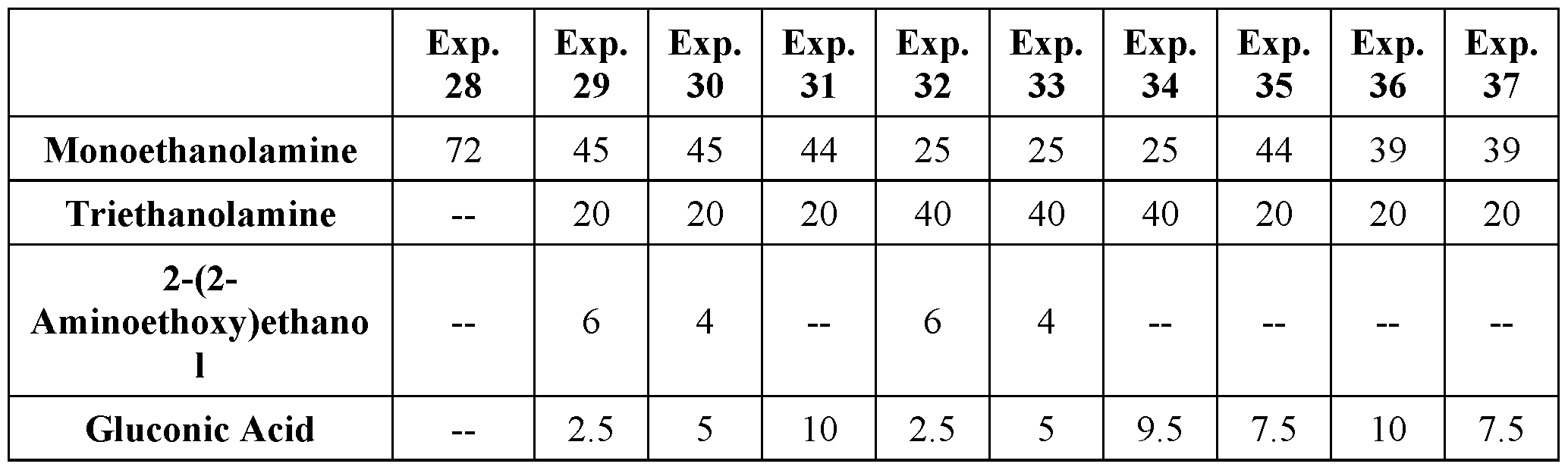
- Table 1 shows that the addition of gluconic acid into alkanolamine solution containing trietchanolamine resulted in a decrease in AlCu etch rates and those formulations could clean the post etch residues on the pattern wafers without etching AlCu metal substrates.
- Table 2 shows that different alkanolamines, other than MEA, had an effect on AlCu etch rates.
- the addition of catechol and gallic acid in the formulations increased AlCu etch rates.
- the addition of catechol had greater effect than gallic acid and showed increased AlCu etch on pattern wafers.
- Table 3 shows the effects of adding citric acid in the formulations on the AlCu etch rates and cleaning performance. As demonstrated, the addition of citric acid could lower AlCu etch rates without an effect on cleaning performance.
- Table 3 Effect of Citric Acid Addition on AlCu Etch Rates and Cleaning Performance
- Table 4 shows that formulations containing lactic acid had higher Alcu etch rates than those formulations containing gluconic acid. The addition of citric acid decreased AlCu etch rates in these formulations. These formulations could clean the post etch residues on the patterned wafers.
- Table 5 demonstrates that the addition of gluconic acid to formulations including triethanolamine and monoethanolamine causes the Ti etch rates to increase. Further, it was also demonstrated that the addition of triammonium citrate in the formulations decreased Ti etch rates.
- Table 6 demonstrates that the addition of gallic acid or catechol in the formulations containing gluconic acid decreased Ti etch rates.
- the variation of traiammonium citrate and gluconic acid concentration is also demonstrated to have an effect on AlCu etch rates.
- Table 7 provides a summary of cleaning test performed at 60 °C for 20 minutes on different substrates. As shown in Table 7, all the formulations had good cleaning on Ti-containing vias which Ti-containing residues were deposited on the sidewalls. In addition, depending on formulation, ALCu metal line substrates could be cleaned without AlCu corrosion.
Landscapes
- Chemical & Material Sciences (AREA)
- Organic Chemistry (AREA)
- Engineering & Computer Science (AREA)
- Wood Science & Technology (AREA)
- Life Sciences & Earth Sciences (AREA)
- Chemical Kinetics & Catalysis (AREA)
- Oil, Petroleum & Natural Gas (AREA)
- Physics & Mathematics (AREA)
- General Physics & Mathematics (AREA)
- Emergency Medicine (AREA)
- Health & Medical Sciences (AREA)
- Materials Engineering (AREA)
- Detergent Compositions (AREA)
- Cleaning Or Drying Semiconductors (AREA)
- Preventing Corrosion Or Incrustation Of Metals (AREA)
Abstract
Description




Claims


Priority Applications (5)
| Application Number | Priority Date | Filing Date | Title |
|---|---|---|---|
| US17/597,530 US20220251480A1 (en) | 2019-07-15 | 2020-07-14 | Compositions for removing etch residues, methods of using and use thereof |
| CN202080051185.2A CN114127230A (en) | 2019-07-15 | 2020-07-14 | Composition for removing etching residues, method for using same and use thereof |
| EP20840212.3A EP3999621A4 (en) | 2019-07-15 | 2020-07-14 | COMPOSITIONS FOR REMOVING ETCH RESIDUES, METHODS OF USE THEREOF AND USE THEREOF |
| JP2022502569A JP7566003B2 (en) | 2019-07-15 | 2020-07-14 | Composition for removing etching residues, method of use thereof and use thereof |
| KR1020227004396A KR102886380B1 (en) | 2019-07-15 | 2020-07-14 | Composition for removing etching residue, method of use and purpose thereof |
Applications Claiming Priority (2)
| Application Number | Priority Date | Filing Date | Title |
|---|---|---|---|
| US201962874477P | 2019-07-15 | 2019-07-15 | |
| US62/874,477 | 2019-07-15 |
Publications (1)
| Publication Number | Publication Date |
|---|---|
| WO2021011515A1 true WO2021011515A1 (en) | 2021-01-21 |
Family
ID=74209986
Family Applications (1)
| Application Number | Title | Priority Date | Filing Date |
|---|---|---|---|
| PCT/US2020/041881 Ceased WO2021011515A1 (en) | 2019-07-15 | 2020-07-14 | Compositions for removing etch residues, methods of using and use thereof |
Country Status (7)
| Country | Link |
|---|---|
| US (1) | US20220251480A1 (en) |
| EP (1) | EP3999621A4 (en) |
| JP (1) | JP7566003B2 (en) |
| KR (1) | KR102886380B1 (en) |
| CN (1) | CN114127230A (en) |
| TW (1) | TWI850424B (en) |
| WO (1) | WO2021011515A1 (en) |
Cited By (2)
| Publication number | Priority date | Publication date | Assignee | Title |
|---|---|---|---|---|
| CN116631862A (en) * | 2022-02-11 | 2023-08-22 | 南亚科技股份有限公司 | Method for manufacturing semiconductor element |
| EP4077764A4 (en) * | 2019-12-20 | 2024-01-17 | Versum Materials US, LLC | CO/CU SELECTIVE WET ETCHING AGENT |
Citations (5)
| Publication number | Priority date | Publication date | Assignee | Title |
|---|---|---|---|---|
| JPH09244263A (en) * | 1996-03-11 | 1997-09-19 | Fuji Hanto Electron Technol Kk | Photoresist removing solution |
| JPH11174690A (en) * | 1997-12-10 | 1999-07-02 | Tokuyama Sekiyu Kagaku Kk | Sidewall removal solution |
| US5997658A (en) * | 1998-01-09 | 1999-12-07 | Ashland Inc. | Aqueous stripping and cleaning compositions |
| US20050106492A1 (en) * | 2001-08-31 | 2005-05-19 | Shigeru Yokoi | Photoresist stripping solution and a method of stripping photoresists using the same |
| US20140109931A1 (en) * | 2012-10-23 | 2014-04-24 | Air Products And Chemicals Inc. | Cleaning Formulations |
Family Cites Families (20)
| Publication number | Priority date | Publication date | Assignee | Title |
|---|---|---|---|---|
| US5563119A (en) * | 1995-01-26 | 1996-10-08 | Ashland Inc. | Stripping compositions containing alkanolamine compounds |
| US6268323B1 (en) | 1997-05-05 | 2001-07-31 | Arch Specialty Chemicals, Inc. | Non-corrosive stripping and cleaning composition |
| EP1125168A1 (en) | 1998-05-18 | 2001-08-22 | Advanced Technology Materials, Inc. | Stripping compositions for semiconductor substrates |
| KR100360397B1 (en) * | 1999-11-26 | 2002-11-18 | 삼성전자 주식회사 | Resist removing composition and resist removing method using the same |
| CN100529014C (en) * | 2002-10-22 | 2009-08-19 | Ekc技术公司 | Aqueous phosphoric acid compositions for cleaning semiconductor devices |
| US7922823B2 (en) * | 2005-01-27 | 2011-04-12 | Advanced Technology Materials, Inc. | Compositions for processing of semiconductor substrates |
| US20070179072A1 (en) * | 2006-01-30 | 2007-08-02 | Rao Madhukar B | Cleaning formulations |
| CN101432412A (en) * | 2006-03-28 | 2009-05-13 | 乔治洛德方法研究和开发液化空气有限公司 | Cleaning solutions containing preservative compounds for post-CMP cleaning processes |
| US20080139436A1 (en) * | 2006-09-18 | 2008-06-12 | Chris Reid | Two step cleaning process to remove resist, etch residue, and copper oxide from substrates having copper and low-K dielectric material |
| SG175559A1 (en) * | 2006-09-25 | 2011-11-28 | Advanced Tech Materials | Compositions and methods for the removal of photoresist for a wafer rework application |
| JP2009075285A (en) * | 2007-09-20 | 2009-04-09 | Fujifilm Corp | Semiconductor device stripping liquid and stripping method |
| WO2010048139A2 (en) * | 2008-10-21 | 2010-04-29 | Advanced Technology Materials, Inc. | Copper cleaning and protection formulations |
| CN101899369B (en) * | 2009-06-01 | 2015-10-21 | 3M创新有限公司 | Engine washing composition and the method for cleaner engines |
| US8889609B2 (en) * | 2011-03-16 | 2014-11-18 | Air Products And Chemicals, Inc. | Cleaning formulations and method of using the cleaning formulations |
| US9158202B2 (en) * | 2012-11-21 | 2015-10-13 | Dynaloy, Llc | Process and composition for removing substances from substrates |
| US10073351B2 (en) | 2014-12-23 | 2018-09-11 | Versum Materials Us, Llc | Semi-aqueous photoresist or semiconductor manufacturing residue stripping and cleaning composition with improved silicon passivation |
| CN113214920A (en) * | 2015-03-31 | 2021-08-06 | 弗萨姆材料美国有限责任公司 | Cleaning preparation |
| EP3502225B1 (en) * | 2017-12-22 | 2021-09-01 | Versum Materials US, LLC | Photoresist stripper |
| US11180697B2 (en) * | 2018-11-19 | 2021-11-23 | Versum Materials Us, Llc | Etching solution having silicon oxide corrosion inhibitor and method of using the same |
| KR102952187B1 (en) * | 2019-06-19 | 2026-04-14 | 버슘머트리얼즈 유에스, 엘엘씨 | Cleaning composition for semiconductor substrates |
-
2020
- 2020-07-14 EP EP20840212.3A patent/EP3999621A4/en not_active Withdrawn
- 2020-07-14 KR KR1020227004396A patent/KR102886380B1/en active Active
- 2020-07-14 JP JP2022502569A patent/JP7566003B2/en active Active
- 2020-07-14 US US17/597,530 patent/US20220251480A1/en not_active Abandoned
- 2020-07-14 WO PCT/US2020/041881 patent/WO2021011515A1/en not_active Ceased
- 2020-07-14 CN CN202080051185.2A patent/CN114127230A/en active Pending
- 2020-07-14 TW TW109123675A patent/TWI850424B/en active
Patent Citations (5)
| Publication number | Priority date | Publication date | Assignee | Title |
|---|---|---|---|---|
| JPH09244263A (en) * | 1996-03-11 | 1997-09-19 | Fuji Hanto Electron Technol Kk | Photoresist removing solution |
| JPH11174690A (en) * | 1997-12-10 | 1999-07-02 | Tokuyama Sekiyu Kagaku Kk | Sidewall removal solution |
| US5997658A (en) * | 1998-01-09 | 1999-12-07 | Ashland Inc. | Aqueous stripping and cleaning compositions |
| US20050106492A1 (en) * | 2001-08-31 | 2005-05-19 | Shigeru Yokoi | Photoresist stripping solution and a method of stripping photoresists using the same |
| US20140109931A1 (en) * | 2012-10-23 | 2014-04-24 | Air Products And Chemicals Inc. | Cleaning Formulations |
Non-Patent Citations (1)
| Title |
|---|
| See also references of EP3999621A4 * |
Cited By (3)
| Publication number | Priority date | Publication date | Assignee | Title |
|---|---|---|---|---|
| EP4077764A4 (en) * | 2019-12-20 | 2024-01-17 | Versum Materials US, LLC | CO/CU SELECTIVE WET ETCHING AGENT |
| US12110436B2 (en) | 2019-12-20 | 2024-10-08 | Versum Materials Us, Llc | Co/Cu selective wet etchant |
| CN116631862A (en) * | 2022-02-11 | 2023-08-22 | 南亚科技股份有限公司 | Method for manufacturing semiconductor element |
Also Published As
| Publication number | Publication date |
|---|---|
| TWI850424B (en) | 2024-08-01 |
| JP7566003B2 (en) | 2024-10-11 |
| TW202113057A (en) | 2021-04-01 |
| JP2022541219A (en) | 2022-09-22 |
| KR20220035164A (en) | 2022-03-21 |
| KR102886380B1 (en) | 2025-11-13 |
| EP3999621A1 (en) | 2022-05-25 |
| CN114127230A (en) | 2022-03-01 |
| US20220251480A1 (en) | 2022-08-11 |
| EP3999621A4 (en) | 2023-08-16 |
Similar Documents
| Publication | Publication Date | Title |
|---|---|---|
| US10233413B2 (en) | Cleaning formulations | |
| US7879783B2 (en) | Cleaning composition for semiconductor substrates | |
| US11091727B2 (en) | Post etch residue cleaning compositions and methods of using the same | |
| KR102952187B1 (en) | Cleaning composition for semiconductor substrates | |
| KR20120106928A (en) | Cleaning formulations and method of using the cleaning formulations | |
| EP1610185A2 (en) | Composition and method using same for removing residue from a substrate | |
| JP2009224793A (en) | Composition for stripping and cleaning and use thereof | |
| US12298669B2 (en) | Composition comprising three alkanolamines and a hydroxylamine for removing etch residues | |
| KR102886380B1 (en) | Composition for removing etching residue, method of use and purpose thereof | |
| US7682458B2 (en) | Aqueous based residue removers comprising fluoride | |
| KR102321217B1 (en) | Post etch residue cleaning compositions and methods of using the same |
Legal Events
| Date | Code | Title | Description |
|---|---|---|---|
| 121 | Ep: the epo has been informed by wipo that ep was designated in this application |
Ref document number: 20840212 Country of ref document: EP Kind code of ref document: A1 |
|
| ENP | Entry into the national phase |
Ref document number: 2022502569 Country of ref document: JP Kind code of ref document: A |
|
| NENP | Non-entry into the national phase |
Ref country code: DE |
|
| ENP | Entry into the national phase |
Ref document number: 20227004396 Country of ref document: KR Kind code of ref document: A |
|
| ENP | Entry into the national phase |
Ref document number: 2020840212 Country of ref document: EP Effective date: 20220215 |
|
| WWW | Wipo information: withdrawn in national office |
Ref document number: 2020840212 Country of ref document: EP |