WO2021013014A1 - 资源配置方法、信息传输方法及相关设备 - Google Patents
资源配置方法、信息传输方法及相关设备 Download PDFInfo
- Publication number
- WO2021013014A1 WO2021013014A1 PCT/CN2020/102132 CN2020102132W WO2021013014A1 WO 2021013014 A1 WO2021013014 A1 WO 2021013014A1 CN 2020102132 W CN2020102132 W CN 2020102132W WO 2021013014 A1 WO2021013014 A1 WO 2021013014A1
- Authority
- WO
- WIPO (PCT)
- Prior art keywords
- resource
- side link
- information
- target
- transmission
- Prior art date
- Legal status (The legal status is an assumption and is not a legal conclusion. Google has not performed a legal analysis and makes no representation as to the accuracy of the status listed.)
- Ceased
Links
Images




Classifications
-
- H—ELECTRICITY
- H04—ELECTRIC COMMUNICATION TECHNIQUE
- H04W—WIRELESS COMMUNICATION NETWORKS
- H04W28/00—Network traffic management; Network resource management
- H04W28/02—Traffic management, e.g. flow control or congestion control
- H04W28/0252—Traffic management, e.g. flow control or congestion control per individual bearer or channel
-
- H—ELECTRICITY
- H04—ELECTRIC COMMUNICATION TECHNIQUE
- H04W—WIRELESS COMMUNICATION NETWORKS
- H04W72/00—Local resource management
- H04W72/20—Control channels or signalling for resource management
- H04W72/23—Control channels or signalling for resource management in the downlink direction of a wireless link, i.e. towards a terminal
-
- H—ELECTRICITY
- H04—ELECTRIC COMMUNICATION TECHNIQUE
- H04L—TRANSMISSION OF DIGITAL INFORMATION, e.g. TELEGRAPHIC COMMUNICATION
- H04L5/00—Arrangements affording multiple use of the transmission path
- H04L5/003—Arrangements for allocating sub-channels of the transmission path
- H04L5/0044—Allocation of payload; Allocation of data channels, e.g. PDSCH or PUSCH
-
- H—ELECTRICITY
- H04—ELECTRIC COMMUNICATION TECHNIQUE
- H04L—TRANSMISSION OF DIGITAL INFORMATION, e.g. TELEGRAPHIC COMMUNICATION
- H04L5/00—Arrangements affording multiple use of the transmission path
- H04L5/003—Arrangements for allocating sub-channels of the transmission path
- H04L5/0053—Allocation of signalling, i.e. of overhead other than pilot signals
-
- H—ELECTRICITY
- H04—ELECTRIC COMMUNICATION TECHNIQUE
- H04L—TRANSMISSION OF DIGITAL INFORMATION, e.g. TELEGRAPHIC COMMUNICATION
- H04L5/00—Arrangements affording multiple use of the transmission path
- H04L5/003—Arrangements for allocating sub-channels of the transmission path
- H04L5/0053—Allocation of signalling, i.e. of overhead other than pilot signals
- H04L5/0055—Physical resource allocation for ACK/NACK
-
- H—ELECTRICITY
- H04—ELECTRIC COMMUNICATION TECHNIQUE
- H04L—TRANSMISSION OF DIGITAL INFORMATION, e.g. TELEGRAPHIC COMMUNICATION
- H04L5/00—Arrangements affording multiple use of the transmission path
- H04L5/0091—Signalling for the administration of the divided path, e.g. signalling of configuration information
- H04L5/0094—Indication of how sub-channels of the path are allocated
-
- H—ELECTRICITY
- H04—ELECTRIC COMMUNICATION TECHNIQUE
- H04W—WIRELESS COMMUNICATION NETWORKS
- H04W72/00—Local resource management
- H04W72/12—Wireless traffic scheduling
- H04W72/1263—Mapping of traffic onto schedule, e.g. scheduled allocation or multiplexing of flows
-
- H—ELECTRICITY
- H04—ELECTRIC COMMUNICATION TECHNIQUE
- H04W—WIRELESS COMMUNICATION NETWORKS
- H04W72/00—Local resource management
- H04W72/20—Control channels or signalling for resource management
-
- H—ELECTRICITY
- H04—ELECTRIC COMMUNICATION TECHNIQUE
- H04W—WIRELESS COMMUNICATION NETWORKS
- H04W92/00—Interfaces specially adapted for wireless communication networks
- H04W92/16—Interfaces between hierarchically similar devices
- H04W92/18—Interfaces between hierarchically similar devices between terminal devices
-
- H—ELECTRICITY
- H04—ELECTRIC COMMUNICATION TECHNIQUE
- H04L—TRANSMISSION OF DIGITAL INFORMATION, e.g. TELEGRAPHIC COMMUNICATION
- H04L5/00—Arrangements affording multiple use of the transmission path
- H04L5/0001—Arrangements for dividing the transmission path
- H04L5/0003—Two-dimensional division
- H04L5/0005—Time-frequency
- H04L5/0007—Time-frequency the frequencies being orthogonal, e.g. OFDM(A) or DMT
- H04L5/0012—Hopping in multicarrier systems
-
- H—ELECTRICITY
- H04—ELECTRIC COMMUNICATION TECHNIQUE
- H04W—WIRELESS COMMUNICATION NETWORKS
- H04W88/00—Devices specially adapted for wireless communication networks, e.g. terminals, base stations or access point devices
- H04W88/02—Terminal devices
- H04W88/04—Terminal devices adapted for relaying to or from another terminal or user
Definitions
- the present disclosure relates to the field of communication technology, and in particular to a resource configuration method, information transmission method and related equipment.
- the embodiments of the present disclosure provide a resource configuration method, an information transmission method, and related equipment to provide a method for obtaining an uplink for transmitting sidelink information to a control node when a user equipment performs sidelink services based on a PC5 interface. Resource approach.
- embodiments of the present disclosure provide a resource configuration method applied to a control node, and the method includes:
- the target side link information includes at least one of first side link information and second side link information
- the first side link information is the side link between the first terminal and the second terminal
- the corresponding side link information is transmitted, where the second side link information is side link information corresponding to side link transmission between the first terminal and the control node.
- the embodiments of the present disclosure also provide an information transmission method applied to the first terminal, and the method includes:
- the target side link information includes at least one of first side link information and second side link information
- the first side link information is the side link between the first terminal and the second terminal.
- the side link information corresponding to the link transmission is the side link information corresponding to the side link transmission between the first terminal and the control node.
- control node includes:
- a configuration module configured to configure resources for target side link information transmission for the first terminal
- the target side link information includes at least one of first side link information and second side link information
- the first side link information is the side link between the first terminal and the second terminal
- the corresponding side link information is transmitted, where the second side link information is side link information corresponding to side link transmission between the first terminal and the control node.
- the embodiments of the present disclosure also provide a terminal.
- the terminal is the first terminal and includes:
- the determining module is used to determine the target resource used for target sidelink information transmission
- a transmission module configured to transmit the target sidelink information on the target resource
- the target side link information includes at least one of first side link information and second side link information
- the first side link information is the side link between the first terminal and the second terminal.
- the side link information corresponding to the link transmission is the side link information corresponding to the side link transmission between the first terminal and the control node.
- the embodiments of the present disclosure also provide a control node, including a processor, a memory, and a computer program stored on the memory and running on the processor, the computer program being executed by the processor When realizing the steps of the resource configuration method provided in the first aspect.
- the embodiments of the present disclosure also provide a terminal, including a processor, a memory, and a computer program stored on the memory and capable of running on the processor.
- a terminal including a processor, a memory, and a computer program stored on the memory and capable of running on the processor.
- the computer program is executed by the processor, The steps of the information transmission method provided by the above-mentioned second invention are implemented.
- embodiments of the present disclosure also provide a computer-readable storage medium on which a computer program is stored, and when the computer program is executed by a processor, the resource configuration method provided in the first aspect is implemented Or the steps of implementing the information transmission method provided by the second invention.
- the first terminal is configured with resources for target side link information transmission; wherein, the target side link information includes at least one of the first side link information and the second side link information Item, the first side link information is side link information corresponding to the side link transmission between the first terminal and the second terminal, and the second side link information is the side link information between the first terminal and the control node
- the side-link transmission corresponding side-link information provides a way to obtain uplink resources for transmitting side-link information to the control node when the user equipment performs side-link services based on the PC5 interface, thereby improving Obtain the efficiency of resources used for target side link information transmission.
- Figure 1a is a schematic diagram of uplink and downlink communication and sidelink communication provided by an embodiment of the present disclosure
- Fig. 1b is a schematic diagram of HARQ-ACK based on uplink feedback provided by an embodiment of the present disclosure
- Fig. 1c is a schematic diagram of HARQ-ACK feedback based on sidelink provided by an embodiment of the present disclosure
- Figure 1d is a schematic diagram of a sending UE reporting HARQ-ACK according to an embodiment of the present disclosure
- Fig. 1e is a schematic diagram of receiving HARQ-ACK reported by a UE according to an embodiment of the present disclosure
- Figure 1f is a schematic diagram of UCI multiplexing provided by an embodiment of the present disclosure.
- Figure 2 is a structural diagram of a network system applicable to the embodiments of the present disclosure
- Figure 3 is a flowchart of a resource configuration method provided by an embodiment of the present disclosure
- Figure 5 is a structural diagram of a control node provided by an embodiment of the present disclosure.
- Figure 6 is a structural diagram of a terminal provided by an embodiment of the present disclosure.
- FIG. 7 is a structural diagram of a control node provided by another embodiment of the present disclosure.
- FIG. 8 is a structural diagram of a terminal provided by another embodiment of the present disclosure.
- Hybrid automatic retransmission Hybrid Automatic Repeat Request, HARQ
- the control node and the UE communicate through the Uu interface and use the uplink and downlink (ie Uplink and Downlink), and the UE and the UE use the PC5 interface and use the side link (ie Sidelink, also called For direct link, secondary link, side link or side link, etc.) communication, as shown in Figure 1a.
- uplink and downlink ie Uplink and Downlink
- side link ie Sidelink, also called For direct link, secondary link, side link or side link, etc.
- the UE can use the physical uplink control channel (PUCCH) or the physical uplink shared channel (Physical Uplink Control Channel, PUCCH) according to its own reception and decoding status.
- the HARQ-ACK information ie, NACK or ACK
- PUSCH Uplink Shared Channel
- the UE sends sidelink control information (Sidelink Control Information, SCI) through the Physical Sidelink Control Channel (PSCCH), and schedules the physical sidelink shared channel (PSSCH). Transmit to send Sidelink data.
- SCI Sidelink Control Information
- PSCCH Physical Sidelink Control Channel
- PSSCH physical sidelink shared channel
- the HARQ feedback mechanism is also introduced in NR Sidelink technology: After Sidelink receives the Sidelink data, the UE can feed back the Sidelink HARQ-ACK information to indicate the success or failure of the Sidelink transmission , The HARQ response is sent through the Physical Sidelink Feedback Channel (PSFCH).
- PSFCH Physical Sidelink Feedback Channel
- Sidelink transmission may not be carried out between the control node and the UE, but on the Sidelink between the UE and the UE, as shown in Figure 1c. Therefore, the control node cannot directly know whether the transmission of the Sidelink data packet is successful, and the UE needs to send the Sidelink HARQ-ACK information to the control node, so that the control node can further determine whether the transmission on the Sidelink is successful, and finally determine whether the next step is
- the sending UE needs to be scheduled to retransmit on Sidelink.
- the UE that reports the Sidelink information may be a sending UE or a receiving UE.
- the so-called sending UE and receiving UE refer to the UE that sends and receives the Sidelink transmission corresponding to the Sidelink information. It should be noted that a Sidelink UE may be a sending or receiving UE. For example, the UE sends Sidelink data at time a1, and receives Sidelink data from other UEs at time a2.
- FIG. 1d An example of sending the UE to report the Sidelink HARQ-ACK information to the control node can be shown in Figure 1d.
- the control node schedules UE1 to send a transport block (Transport Block, TB) to UE2 on Sidelink.
- UE2 receives the TB but cannot successfully solve it, so it feeds back a NACK on the PSFCH.
- UE1 maps the Sidelink NACK to Uu NACK and sends it to the control node on the target resource.
- the control node After receiving the NACK, the control node knows that the transmission of the TB has failed, and therefore sends a scheduling signaling to schedule UE1 to retransmit the TB on Sidelink.
- FIG. 1e An example of receiving UE reporting Sidelink HARQ-ACK information to the control node can be shown in Figure 1e.
- the Sidelink receiving UE determines the Sidelink HARQ-ACK information according to the received Sidelink transmission and decoding, if there is a Uu connection between the Sidelink receiving UE and the control node and the corresponding target resource is allocated, the Sidelink HARQ can be directly assigned to the target resource.
- the ACK information is sent to the control node, and may not be sent to the sending UE through the PSFCH at this time.
- UE2 transmits NACK to UE1 and adds square brackets to indicate that this step may or may not exist.
- ⁇ resource allocation modes There are two resource allocation modes in Sidelink, namely, scheduled resource allocation (ie, Scheduled Resource Allocation) mode and autonomous resource selection (ie, Autonomous Resource Selection) mode.
- scheduled resource allocation ie, Scheduled Resource Allocation
- autonomous resource selection ie, Autonomous Resource Selection
- the former is controlled by the control node and allocates resources for each UE, and the latter is independently selected by the UE.
- two resource allocation modes may also be performed at the same time.
- control node can be a base station, an integrated access backhaul node (Integrated Access Backhaul, IAB), user equipment, relay equipment (i.e. Relay) or road side unit (Road Side Unit, RSU), etc., or some Other network facilities similar to RSU or IAB.
- IAB integrated access backhaul node
- Relay relay equipment
- RSU road side unit
- control nodes can support Sidelink and Uu links at the same time.
- Uplink Control Information (UCI) information :
- the uplink control information fed back by the UE is collectively referred to as UCI.
- UCI An important part of UCI is HARQ-ACK information.
- the above UCI can also include channel state information ( Channel State InFormation (CSI) report, scheduling request (Scheduling, SR), etc.
- CSI Channel State InFormation
- SR scheduling request
- UCI can be transmitted on PUCCH resources or PUSCH resources, where PUCCH resources can support 5 formats (ie Format), and different formats have different characteristics.
- PUCCH Format0 carries 1 or 2 bits UCI in the form of a sequence, the time domain occupies 1 or 2 symbols, and the frequency domain occupies 1 resource block (Resource Block, RB).
- the HARQ-ACK information transmitted by Sidelink can be transmitted on the PSFCH channel, and the CSI transmitted by Sidelink can be transmitted on the PSSCH.
- PSFCH currently supports the PUCCH Format 0 sequence basis (but the amount of time-frequency domain resources that may be occupied is different, Or introduce other new features, or introduce other new Format), so it can be called PSFCH Format0. It should be noted that this is not limited to PSFCH Format0, and can also be called other names according to actual conditions.
- the HARQ-ACK information of the uplink information transmitted on the uplink can be called Uu HARQ-ACK information
- the HARQ-ACK information transmitted on the Sidelink can be called Sidelink HARQ-ACK. information.
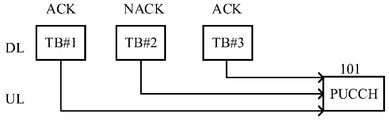
- the HARQ-ACK information corresponding to a TB is 1 bit. If the bit is 1, it means ACK, and if it is 0, it means NACK. If the control node sends multiple TBs, and the control node instructs the UE to send the HARQ-ACK information corresponding to these TBs to the control node on the same resource, the UE can transfer these TBs in a manner (such as a codebook) specified by the protocol.
- the HARQ-ACK information is multiplexed into a new HARQ-ACK information (for example, a bitmap (ie, Bitmap)), and reported to the control node.
- the control node sends 3 TBs, where TB#1 and TB#3 are successfully decoded by the UE, and TB#2 fails to decode, the value of the HARQ-ACK information bits corresponding to the 3 TBs They are 1, 1 and 0, which represent ACK, ACK, and NACK, respectively.
- the control node instructs the UE to send the HARQ-ACK information bits corresponding to these 3 TBs on the same PUCCH, and the UE multiplexes the 3 HARQ-ACK information bits into a Bitmap 101 and sends it to the control node.
- NR supports two uplink semi-persistent scheduling grant uplink transmission (i.e. Configured UL Grant) methods: the first type (i.e. Type 1) and the second type (i.e. Type 2).
- Configured UL Grant Type1 resources can be semi-statically configured through radio resource control (Radio Resource Control, RRC) signaling. After receiving the configuration, the user equipment can use the configuration according to its own service arrival and configuration conditions For transmission, there is no need for Downlink Control Information (DCI) for dynamic scheduling.
- RRC Radio Resource Control
- Configured UL Grant Type 2 resources can be semi-statically configured through RRC signaling, and the user equipment cannot directly use the configuration after receiving the configuration. After the control node further activates the configuration through DCI, the user equipment can activate DCI according to the configuration Use this authorized resource. The control node may also deactivate the configuration through DCI, and the user equipment that receives the deactivated DCI will stop the authorized resource.
- a Configured UL Grant usually corresponds to periodic resources that can be used for the UE to send signals, and each period includes multiple transmission opportunities (ie, Transmission Occasion). Compared with conventional dynamic scheduling (ie, Dynamic Grant), Configured UL Grant can reduce signaling overhead and interaction procedures, and ensure low latency requirements.
- the control node configures Sidelink resources without additional signaling for activation and/or deactivation.
- the configured user equipment can use these resources according to the incoming packet status.
- This resource configuration can be but not limited to being called Configured Sidelink Grant Type1.
- Control node signaling configures Sidelink resources, and additional signaling is needed to activate and/or deactivate the resources.
- This resource configuration can be, but is not limited to, called Configured Sidelink Grant Type 2.
- control node can configure multiple Configured Sidelink Grants for the user equipment.
- Figure 2 is a structural diagram of a network system applicable to an embodiment of the present disclosure. As shown in Figure 2, it includes a first terminal device 11, a second terminal device 12, and a control node 13, where the first terminal Both the device 11 and the second terminal device 12 can be mobile phones, tablet computers (Personal Computer), laptop computers (Laptop Computer), personal digital assistants (Personal Digital Assistant, PDA), mobile Internet devices (Mobile Internet Device, MID) ) Or user-side devices such as wearable devices (Wearable Devices) and vehicle-mounted terminals. It should be noted that the specific types of the first terminal device 11 and the second terminal device 12 are not limited in the embodiments of the present disclosure.
- the control node 13 may be a base station, such as a macro station, LTE eNB, 5G NR NB, gNB, etc.; the control node 13 may also be a small station, such as a low power node (LPN) pico, femto, etc., or The control node 13 can be an access point (Access Point, AP), or the control node 13 can be an IAB, user equipment, relay device, or RSU, etc.; the base station can also be a central unit (CU) and its management and control A network node composed of multiple TRPs. It should be noted that the specific type of the control node 13 is not limited in the embodiment of the present disclosure.
- control node 13 may support scheduling Sidelink transmission through a Sidelink link or support scheduling Sidelink transmission through a Uu link, and may also support scheduling Sidelink transmission through a Sidelink and Uu link at the same time.
- the transmission in the embodiment of the present disclosure may include sending or receiving.
- FIG. 3 is a flowchart of a resource configuration method provided by an embodiment of the present disclosure. As shown in FIG. 3, it includes the following steps:
- Step 301 Configure resources for target sidelink information transmission for the first terminal
- the target side link information includes at least one of first side link information and second side link information
- the first side link information is the side link between the first terminal and the second terminal
- the corresponding side link information is transmitted, where the second side link information is side link information corresponding to side link transmission between the first terminal and the control node.
- the aforementioned side link information may include at least one of HARQ-ACK information, CSI, and SR corresponding to side link transmission.
- the above-mentioned resources used for transmission of the target sidelink information may include at least one of PUCCH resources and PUSCH resources;
- the foregoing resources used for target side link information transmission may include at least one of PSFCH resources and PSSCH resources.
- the control node of the fourth generation (4 th -Generation, 4G) when the base station or a long term evolution (Long Term Evolution, LTE) base station may schedule or NR sidelink LTE Sidelink.
- the resources of the transmission codebook are LTE PUCCH or PUSCH resources.
- the Configured Sidelink Grant Type 1 can be configured for the LTE Sidelink UE.
- the resource used for target sidelink information transmission corresponding to the Configured Sidelink Grant may be the PUCCH or PUSCH of LTE.
- the control node may schedule or NR Sidelink LTE Sidelink.
- the Configured Sidelink Grant Type 2 can be configured to the LTE Sidelink UE, and the DCI can be activated and deactivated.
- the Configured Sidelink Grant Type 1 and/or Configured Sidelink Grant Type 2 can be configured to the NR Sidelink UE.
- the resource used for target sidelink information transmission corresponding to the Configured Sidelink Grant Type may be PUCCH or PUSCH of NR.
- the above-mentioned resource used for the transmission of the target sidelink information It can be used for multiplexing transmission of the first side link information and the uplink information.
- the control node configures resources for target side link information transmission for the first terminal, which may include high-level signaling (for example, RRC signaling, System Information Block (System Information Block, SIB)) and other high-level signaling At least one item in) for the first terminal to configure resources for target sidelink information transmission and/or through scheduling signaling (for example, DCI signaling, sidelink control information (Sidelink Control Information, SCI) signaling, etc.) ) Instruct the first terminal to use resources for target side link information transmission. In this way, the first terminal can transmit the foregoing target sidelink information based on the resource configured by the control node for target sidelink information transmission.
- high-level signaling for example, RRC signaling, System Information Block (System Information Block, SIB)
- SIB System Information Block
- control node configures resources for the first terminal for target sidelink information transmission, which may be explicitly configured for the first terminal to be used for target sidelink information transmission, or it may be implicitly configured for the first terminal.
- a terminal configures resources used for target sidelink information transmission.
- first terminal may be a sending terminal or a receiving terminal.
- the first terminal is configured with resources for target side link information transmission; wherein, the target side link information includes at least one of the first side link information and the second side link information Item, the first side link information is side link information corresponding to the side link transmission between the first terminal and the second terminal, and the second side link information is the side link information between the first terminal and the control node
- the side-link transmission corresponding side-link information provides a way to obtain uplink resources for transmitting side-link information to the control node when the user equipment performs side-link services based on the PC5 interface, thereby improving Obtain the efficiency of resources used for target side link information transmission.
- the configuration of the resource used for target sidelink information transmission for the first terminal includes:
- the resource configuration information is used to indicate resources used for transmission of the target side link information.
- control node may send resource configuration information to the first terminal through high-level signaling or scheduling signaling, where the above-mentioned resource configuration information may indicate the resource used for the target sidelink information transmission.
- the resource configuration information may include at least one of the following: resource information, offset information, period information, and association information.
- the resource information may include at least one of the following: at least one resource set identifier, at least one resource identifier, the number of bits that the resource can carry, resource format, frequency hopping mode, time domain resources occupied, frequency domain resources occupied , Time domain position, frequency domain position, number of resources occupied, sequence, spreading code, cyclic shift, starting point of time window, period of time window, duration of time window.
- the aforementioned number of resources occupied may be, for example, the total number of occupied resource blocks (Resource Block, RB), the total number of occupied resource elements (Resource Element, RE), and so on.
- the above-mentioned cyclic shift for example, the initial cyclic shift m 0 and the cyclic shift amount m cs .
- the period information may include at least one of the following:
- the first resource is a feedback resource for obtaining the target sidelink information.
- the aforementioned first resource may include PSFCH resources or PSSCH resources.
- PSFCH resources or PSSCH resources For example, if UE#1 sends a Sidelink transmission to UE#2 and UE#3, and receives HARQ-ACK information about the data on PSFCH resource #2 and PSFCH resource #3, then PSFCH resource #2 and PSFCH resource # 3 belongs to the first resource mentioned above.
- the UE can pass ⁇ and Configured Sidelink.
- the Grant period determines the period of the resource and/or resource set used for the target side link information transmission.
- the UE can determine the period for the target sidechain through ⁇ and the period of the first resource Channel information transmission resource and/or resource set cycle.
- the association information may include at least one of the following:
- the above-mentioned association relationship between the resource used for transmission of the target sidelink information and the second resource may include the ratio of the resource used for transmission of the target sidelink information to the second resource, which is used for the At least one of the association relationship between the identifier of the resource used for target side link information transmission and the identifier of the second resource.
- the foregoing association relationship between the resources used for the target side link information transmission and the side link transmission may include at least one of the ratio of the resources used for the target side link information transmission and the side link transmission, and so on.
- the foregoing association relationship between the resources used for the target sidelink information transmission and the sending terminal may include the ratio of the resources used for the target sidelink information transmission to the sending terminal, and the value used for the target sidelink information transmission. At least one of the association relationship between the identification of the resource and the identification of the occurrence terminal.
- the foregoing association relationship between the resource used for the target sidelink information transmission and the receiving terminal may include the ratio of the resource used for the target sidelink information transmission to the receiving terminal, and the value used for the target sidelink information transmission. At least one of the association relationship between the identifier of the resource and the identifier of the receiving terminal.
- the association relationship between the resource used for transmission of the target sidelink information and the receiving terminal may include:
- the terminal identifier (such as the receiving terminal identifier) can be the ID assigned by the control node to the terminal, or the terminal ID predefined by the protocol, the terminal ID pre-configured by the manufacturer, or the terminal based on high-level information (such as application layer ID, The ID of the IP layer, the ID of the MAC layer, etc.) generated by the terminal, or the ID generated by the terminal according to the control node configuration or protocol agreement or some pre-configured method/rule, or the unique identifier associated with the terminal.
- high-level information such as application layer ID, The ID of the IP layer, the ID of the MAC layer, etc.
- association relationship may include at least one of the following:
- the ratio of the resources used for the target side link information transmission to the side link transmission is the ratio of the resources used for the target side link information transmission to the side link transmission
- the ratio of the resource used for transmission of the target sidelink information to the sending terminal is the ratio of the resource used for transmission of the target sidelink information to the sending terminal
- the ratio of the resource used for the target side link information transmission to the receiving terminal is the ratio of the resource used for the target side link information transmission to the receiving terminal.
- the aforementioned ratio may include, but is not limited to, at least one of a number ratio, a frequency domain density ratio, and a time domain symbol ratio.
- the above number ratio may be that the resource used for the target side link information transmission corresponds to A side link transmissions
- the above frequency domain density ratio may be the FDM number corresponding to the resource used for the target side link information transmission as
- the above-mentioned time-domain symbol ratio may be that the resource used for the target side-link information transmission corresponds to side-link transmission occupying C symbols, and the above-mentioned A, B and C are all positive integers.
- the offset information may include an offset value between a reference point and a resource used for transmission of the target sidelink information. It should be noted that the above offset information may include one or more different offsets.
- the aforementioned reference point may include at least one of the following: system frame, direct connection frame, and activation signaling of the second type of configured sidelink authorization (ie, Configured Sidelink Grant Type 2) corresponding to the target sidelink information,
- the deactivation signaling of the second type of configuration side link authorization i.e. Configured Sidelink Grant Type 2) corresponding to the target side link information
- the first type of configuration side link authorization i.e. Configured Sidelink Grant Type 2 corresponding to the target side link information
- Sidelink Grant Type 1 configuration time
- Configured Sidelink Grant corresponding to the target sidelink information PSFCH corresponding to the target sidelink information
- Sidelink transmission corresponding to the target sidelink information
- scheduling signaling etc.
- the system frame number 0 ie SFN0
- the direct frame number 0 Direct Frame Number 0, DFN0
- the first terminal can determine the target sidelink information transmission based on the reference point and the offset. Resources.
- resources configured for side link information corresponding to different side link transmission types may be different.
- the above-mentioned different sidelink transmission types can be understood as sidelink transmissions corresponding to different schedules, for example, sidelink transmissions corresponding to dynamic scheduling or sidelinks corresponding to configured sidelink grants (i.e., Configured Sidelink Grant) It can also be understood as the side link transmission corresponding to different configuration grant types (ie Configured Grant Type), for example, the side link transmission corresponding to Configured Grant Type 1 or the side link transmission corresponding to Configured Grant Type 2; also understandable For different configuration authorization IDs (i.e. Configured Grant ID) corresponding side link transmission.
- different resources may be configured for side link information corresponding to side link transmission corresponding to dynamic scheduling and side link information corresponding to side link transmission corresponding to Configure Sidelink Grant; or they may be configured respectively.
- the side link information corresponding to the side link transmission corresponding to Grant Type 1 and the side link information corresponding to the side link transmission corresponding to the Configured Grant Type 2 are configured with different resources; the side link transmission corresponding to different Configured Grant IDs can also be configured separately The corresponding side link information configures different resources.
- the flexibility of resource configuration can be used to improve resource utilization and reduce resource waste.
- the resources configured by the side link information corresponding to the above different side link transmission types may also be the same.
- control node may configure at least two resource sets corresponding to different transmission bits (ie, Bit) numbers or different transmission bit number intervals, and/or may configure at least two resources corresponding to different transmission bit numbers or For different transmission bit number intervals, because the configured different resource sets and/or different resources have different transmission capabilities, the terminal can select appropriate resources from the target sidelink information to be transmitted based on the target sidelink information that needs to be fed back.
- transmission bits ie, Bit
- the terminal can select appropriate resources from the target sidelink information to be transmitted based on the target sidelink information that needs to be fed back.
- two resource sets can be configured for a Configured Sidelink Grant, namely Set1 and Set2, where the number of information bits that can be carried by all resources in Set1 is in interval 1, and the number of information bits that can be carried by all resources in Set2 is in Within interval 2.
- the corresponding Set can be selected according to the size of the Sidelink information. For example, the UE needs to feed back the Sidelink information bit number for the Sidelink transmission on the Configured Sidelink Grant on the interval 1. Then select Set1 to report.
- two resources may be configured for a Configured Sidelink Grant, namely resource 1 and resource 2, the number of information bits that resource 1 can carry is within interval 1, and the number of information bits that resource 2 can carry is within interval 2.
- the corresponding resource can be selected according to the size of the Sidelink information. For example, the UE needs to feed back the Sidelink information for the Sidelink transmission on the Configured Sidelink Grant with the number of bits in the interval 1.
- resource sets there may be some resource sets corresponding to different transmission bit numbers or different transmission bit number intervals, and there may be some resource sets corresponding to the same transmission bit number or the same transmission bit number intervals.
- three resource sets can be configured for a Configured Sidelink Grant, namely Set1, Set2, and Set3.
- the number of information bits that can be carried by all resources in Set1 and Set2 is within interval 1, and the information Bit that can be carried by all resources in Set3 The number is in interval 2.
- three resources can be configured for a Configured Sidelink Grant, namely resource 1, resource 2 and resource 3.
- the number of information bits that can be carried by resource 1 is in interval 1, and the number of information bits that can be carried by resource 2 and resource 3 is in the interval. 2 within.
- the resource configured for the first terminal to transmit target sidelink information may include at least one of the following:
- the resources of the first type include at least one of a physical uplink control channel PUCCH resource and a physical sidelink feedback channel PSFCH resource.
- the control node may configure at least one PUCCH resource set (ie PUCCH Resource Set) and at least At least one item of one PSFCH resource set (ie PSFCH Resource Set) and/or at least one item of at least one PUCCH resource (ie PUCCH Resource) and at least one PSFCH resource (ie PSFCH Resource) is configured to the first terminal.
- PUCCH Resource Set L1 (or Sidelink PUCCH Resource Set) is used for the target Sidelink information, that is, the PUCCH Resource Set L included in the PUCCH Resource Set L is used for the target Sidelink information.
- the PUCCH Resource Set Y1 configured for the UE contains at least one PUCCH Resource, where PUCCH Resource Z1 (or Sidelink PUCCH Resource) is used for target Sidelink information, and other PUCCH Resources are used for uplink information reporting, where Y1 Both and Z1 are positive integers.
- the configuration of the resource for the first terminal to transmit target sidelink information includes at least one of the following:
- the fourth resource used for transmission of the target side link information through the first scheduling signaling, where the fourth resource includes at least one resource set of the second type and at least one resource of the second type At least one of
- the resources of the second type include at least one of a physical uplink shared channel PUSCH resource and a physical side link shared channel PSSCH resource.
- the aforementioned configuration authorization may include at least one of Configured UL Grant and Configured Sidelink Grant.
- the foregoing first scheduling signaling may include DCI signaling or SCI signaling.
- the aforementioned at least one resource set of the second type may include at least one PUSCH resource set and/or at least one PSSCH resource set.
- the aforementioned at least one resource of the second type may include at least one PUSCH resource and/or at least one PSSCH resource.
- control node may configure at least one configuration grant (ie, Configured Grant) for target sidelink information transmission only for the first terminal.
- Configured Grant ie, Configured Grant
- control node may indicate to the first terminal at least one configuration grant (ie, Configured Grant) for target sidelink information transmission only through the first scheduling signaling.
- configuration grant ie, Configured Grant
- control node may first configure at least one configuration authorization for the transmission of the target sidelink information for the first terminal, and then indicate to the first terminal through the first scheduling signaling to Configuration authorization for target side link information transmission.
- control node may only indicate to the first terminal at least one terminal through the first scheduling signaling when the resource used for the target sidelink information transmission is the channel PUCCH resource and/or PSFCH resource. At least one of a resource set of the second type and at least one resource of the second type.
- control node may first configure at least one configuration authorization for the transmission of the target sidelink information for the first terminal, and then indicate to the first terminal through the first scheduling signaling to Resources for transmission of target sidelink information.
- control node may explicitly or implicitly indicate to the first terminal the fourth resource used for the transmission of the target sidelink information through the first scheduling signaling, which is not limited in this embodiment .
- control node may also configure at least one of PUCCH Resource Set and PUCCH Resource for NR to the first terminal, and the first terminal may select at least one of the configured PUCCH Resource Set and PUCCH Resource for NR. In the item, determine the resource used for target side link information transmission.
- the foregoing target side link information may be transmitted on the fourth resource in the form of a MAC (Media Access Control, Media Access Control) CE (Control Element, control element).
- MAC Media Access Control
- Control Element Control element
- different information can be divided into different MAC CEs.
- uplink information corresponds to MAC CE1
- first The side link information corresponds to MAC CE2.
- the configuration of the resource used for target sidelink information transmission for the first terminal may include:
- the second scheduling signaling is scheduling signaling used to schedule side link transmission corresponding to the target side link information
- the fifth resource includes at least one of at least one resource set and at least one resource .
- control node may explicitly or implicitly indicate the fifth resource used for the transmission of the target side link information to the first terminal through the second scheduling signaling, where the above second scheduling signaling It can include DCI signaling or SCI signaling, which can improve the flexibility of resource configuration.
- the fifth resource may include a resource determined according to the first target parameter
- the first target parameter may include at least one of the following:
- the number of the second scheduling signaling is the number of the second scheduling signaling.
- the time domain resources occupied by the second scheduling signaling for example, the time at which the second scheduling signaling is located.
- the time domain resources occupied by the second scheduling signaling may be the Slot occupied by the second scheduling signaling, the number of time domain symbols of the second scheduling signaling, the start symbol of the second scheduling signaling, or the second scheduling signaling. The end symbol of scheduling signaling.
- time slot where the second scheduling signaling is located is time slot n
- the control node and the receiving end can understand that there is scheduling signaling in time slot n.
- the above-mentioned fifth resource may be determined according to the time domain resources occupied by the second scheduling signaling.
- the fifth resource may be the closest resource at the time of the second scheduling signaling, or the fifth resource may be determined according to the second scheduling signaling.
- the other terminals may refer to A terminal other than the above-mentioned first terminal.
- the fifth resource may be a resource that has passed the target offset time k after the time n of the second scheduling signaling, and the first terminal may use the resource corresponding to the time n+k to transmit the foregoing target sidelink information.
- the foregoing fifth resource may be determined according to a reference signal in the second scheduling signaling, and different reference signal sequences correspond to different resources, so that the fifth resource may be determined according to the reference signal in the second scheduling signaling.
- the foregoing fifth resource may be determined according to the scrambling code of the second scheduling signaling or the scrambling code of the reference signal of the second scheduling signaling, and different scrambling code sequences correspond to different resources, so that the fifth resource can be determined according to the scrambling code.
- the identifiers carried in the above second scheduling signaling may include terminal identifiers, group identifiers, resource identifiers and service identifiers, HARQ process identifiers, carrier identifiers, bandwidth part (Bandwidth Part, BWP) identifiers, configured grant identifiers, connection identifiers, and priority At least one of identification, resource pool identification, sub-channel identification, Sidelink information feedback resource identification, transmission type identification, resource scheduling type identification, transmission mode identification, delay identification, ratio identification, and location identification.
- BWP bandwidth part
- the foregoing resource of the second scheduling signaling for example, the position of a certain control channel element (CCE) of the scheduling signaling.
- CCE control channel element
- the resource range where the second scheduling signaling is located for example, a control resource set (Control Resource Set, CORESET) where the second scheduling signaling is located.
- a control resource set Control Resource Set, CORESET
- the number of the foregoing second scheduling signaling may include a downlink assignment index (Downlink Assignment Index, DAI) or a sidelink assignment index (SAI) of the second scheduling signaling.
- DAI Downlink Assignment Index
- SAI sidelink assignment index
- at least one of the position of a certain CCE in the scheduling signaling and the size of the CORESET can be brought into a preset formula to calculate the target resource.
- DAI or SAI can be brought into a preset formula to calculate the target resource.
- control node implicitly indicates the resource for transmitting the target sidelink information to the first terminal through the second scheduling signaling, which can save resource overhead.
- the second scheduling signaling may carry the identifier of the fifth resource.
- control node explicitly indicates to the first terminal at least one resource identifier and/or at least one resource set identifier for the target sidelink information through the second scheduling signaling, so that the first terminal can be based on the resource identifier Quickly determine the resources used to transmit target sidelink information.
- the second scheduling signaling carries a PUCCH ID
- the first terminal reports target side link information based on the PUCCH corresponding to the PUCCH ID.
- the second scheduling signaling may carry identifiers of N fifth resources, where N is the number of receiving terminals or transmitting terminals.
- the second scheduling signaling carries N PUCCH IDs, so that the receiving UE can receive the second scheduling signaling according to its own ID and PUCCH
- the ID association relationship determines its PUCCH and uses the determined PUCCH to report; or after the sending UE receives the second scheduling signaling, according to the association relationship between the receiving UE’s ID and PUCCH ID, it reports from the PUCCH corresponding to different receiving UEs. Different receiving UE information.
- the second scheduling signaling is used to activate the Configure the activation signaling of the second type of side link authorization.
- the second type of sidelink authorization is Configured Sidelink Grant Type2.
- the configuration used to activate the second type of side link can be used
- the authorized activation signaling indicates the resources used to transmit the target sidelink information.
- control node carries a resource identifier in the scheduling signaling for activating Configured Sidelink Grant Type 2 to instruct the first terminal to use the resource corresponding to the identifier to transmit target sidelink information.
- control node carries a resource set identifier in the scheduling signaling for activating Configured Sidelink Grant Type2, indicating that the first terminal can use the resource to transmit target sidelink information in the resource set corresponding to the identifier.
- control node carries a resource identifier and a resource set identifier in the scheduling signaling for activating Configured Sidelink Grant Type 2 to instruct the first terminal to transmit the target on the resource corresponding to the resource identifier in the resource set corresponding to the resource set identifier Side link information.
- the activation signaling used to activate the second type of side link authorization is used to indicate the resources used to transmit the target side link information, which can save signaling overhead.
- the embodiment of the present disclosure provides an information transmission method, which is applied to a first terminal.
- FIG. 4 is a flowchart of an information transmission method provided by an embodiment of the present disclosure. As shown in FIG. 4, it includes the following steps:
- Step 401 Determine a target resource used for target sidelink information transmission
- Step 402 Transmit the target sidelink information on the target resource
- the target side link information includes at least one of first side link information and second side link information
- the first side link information is the side link between the first terminal and the second terminal.
- the side link information corresponding to the link transmission is the side link information corresponding to the side link transmission between the first terminal and the control node.
- the aforementioned side link information may include at least one of HARQ-ACK information, CSI, and SR corresponding to side link transmission.
- the target resource may include at least one of the PUCCH resource and the PUSCH resource; in the case where the target sidelink information is transmitted through the side link below, the aforementioned target resource may include at least one of PSFCH resources and PSSCH resources.
- the first terminal may determine the target resource according to the resource indicated by the high-level signaling, or determine the target resource according to the resource indicated by the scheduling signaling, which may be the resource indicated from the high-level signaling according to the scheduling signaling.
- the target resource may also be determined according to protocol predefined, pre-configured, negotiated between terminals, or resources indicated by other terminals, where the other terminal may refer to a terminal other than the first terminal.
- first terminal may be a sending terminal or a receiving terminal.
- the above-mentioned target resource can be used for multiplexing and transmitting the first Side link information and uplink information.
- the embodiment of the present disclosure determines the target resource used for target side link information transmission; transmits the target side link information on the target resource; wherein, the target side link information includes first side link information and At least one item of the second side link information, the first side link information is side link information corresponding to side link transmission between the first terminal and the second terminal, and the second side link The information is sidelink information corresponding to sidelink transmission between the first terminal and the control node.
- the determining the target resource used for target sidelink information transmission may include:
- a target resource used for target side link information transmission is determined.
- the foregoing resource configuration information may be pre-defined by a protocol, control node configuration, pre-configuration, negotiation between terminals, or indicated by other terminals, and the foregoing other terminals may refer to terminals other than the foregoing first terminal.
- resource configuration information when configured by the control node, it may be configured by the control node through high-level signaling (for example, RRC signaling), or may be configured by the control node through scheduling signaling (for example, DCI signaling). Or SCI signaling) instructions, this embodiment does not limit this.
- high-level signaling for example, RRC signaling
- scheduling signaling for example, DCI signaling
- the first terminal can transmit target sidelink information on this resource; or if the resource configuration information indicates multiple If the target side link information is transmitted, the first terminal may select a resource from a plurality of resources used for target side link information transmission, and transmit the target side link information on the selected resource.
- the resource configuration information may include at least one of the following: resource information, offset information, period information, and association information.
- the resource information includes at least one of the following: at least one resource set identifier, at least one resource identifier, the number of bits that the resource can carry, resource format, frequency hopping mode, occupied time domain resources, occupied frequency domain resources, Time domain position, frequency domain position, number of resources occupied, sequence, spreading code, cyclic shift, start point of time window, period of time window, duration of time window.
- the number of resources occupied above may be, for example, the total number of RBs occupied, the total number of REs occupied, and so on.
- the above-mentioned cyclic shift for example, the initial cyclic shift m 0 and the cyclic shift amount m cs .
- the target resource when the transmission corresponding to the target sidelink information is associated with a time window, there is a target resource for the transmission of the target sidelink information in the associated time window, that is, the target resource may be located in the aforementioned time window Inside.
- the period information may include at least one of the following:
- the first resource is a feedback resource for obtaining the target sidelink information.
- the aforementioned first resource may include PSFCH resources or PSSCH resources.
- PSFCH resources or PSSCH resources For example, if UE#1 sends a Sidelink transmission to UE#2 and UE#3, and receives HARQ-ACK information about the data on PSFCH resource #2 and PSFCH resource #3, then PSFCH resource #2 and PSFCH resource # 3 belongs to the first resource mentioned above.
- the UE can pass ⁇ and Configured Sidelink.
- the Grant period determines the period of the resource and/or resource set used for the target side link information transmission.
- the UE can determine the period for the target sidechain through ⁇ and the period of the first resource Channel information transmission resource and/or resource set cycle.
- the association information may include at least one of the following:
- the above-mentioned association relationship between the resource used for transmission of the target sidelink information and the second resource may include the ratio of the resource used for transmission of the target sidelink information to the second resource, which is used for the At least one of the association relationship between the identifier of the resource used for target side link information transmission and the identifier of the second resource.
- the foregoing association relationship between the resources used for the target side link information transmission and the side link transmission may include at least one of the ratio of the resources used for the target side link information transmission and the side link transmission, and so on.
- the foregoing association relationship between the resources used for the target sidelink information transmission and the sending terminal may include the ratio of the resources used for the target sidelink information transmission to the sending terminal, and the value used for the target sidelink information transmission. At least one of the association relationship between the identification of the resource and the identification of the occurrence terminal.
- the foregoing association relationship between the resource used for the target sidelink information transmission and the receiving terminal may include the ratio of the resource used for the target sidelink information transmission to the receiving terminal, and the value used for the target sidelink information transmission. At least one of the association relationship between the identifier of the resource and the identifier of the receiving terminal.
- the association relationship between the resource used for transmission of the target sidelink information and the receiving terminal may include:
- the terminal identifier (such as the receiving terminal identifier) can be the ID assigned by the control node to the terminal, or the terminal ID predefined by the protocol, the terminal ID pre-configured by the manufacturer, or the terminal based on high-level information (such as application layer ID, The ID of the IP layer, the ID of the MAC layer, etc.) generated by the terminal, or the ID generated by the terminal according to the control node configuration or protocol agreement or some pre-configured method/rule, or the unique identifier associated with the terminal.
- high-level information such as application layer ID, The ID of the IP layer, the ID of the MAC layer, etc.
- association relationship may include at least one of the following:
- the ratio of the resources used for the target side link information transmission to the side link transmission is the ratio of the resources used for the target side link information transmission to the side link transmission
- the ratio of the resource used for transmission of the target sidelink information to the sending terminal is the ratio of the resource used for transmission of the target sidelink information to the sending terminal
- the ratio of the resource used for the target side link information transmission to the receiving terminal is the ratio of the resource used for the target side link information transmission to the receiving terminal.
- the aforementioned ratio may include, but is not limited to, at least one of a number ratio, a frequency domain density ratio, and a time domain symbol ratio.
- the above number ratio may be that the resource used for the target side link information transmission corresponds to A side link transmissions
- the above frequency domain density ratio may be the FDM number corresponding to the resource used for the target side link information transmission as
- the above-mentioned time-domain symbol ratio may be that the resource used for the target side-link information transmission corresponds to side-link transmission occupying C symbols, and the above-mentioned A, B and C are all positive integers.
- the offset information may include an offset value between a reference point and a resource used for transmission of the target sidelink information. It should be noted that the above offset information may include one or more different offsets.
- the aforementioned reference point may include at least one of the following: system frame, direct connection frame, and activation signaling of the second type of configured sidelink authorization (ie, Configured Sidelink Grant Type 2) corresponding to the target sidelink information,
- the deactivation signaling of the second type of configuration side link authorization i.e. Configured Sidelink Grant Type 2) corresponding to the target side link information
- the first type of configuration side link authorization i.e. Configured Sidelink Grant Type 2 corresponding to the target side link information
- Sidelink Grant Type 1 configuration time
- Configured Sidelink Grant corresponding to the target sidelink information
- PSFCH corresponding to the target sidelink information
- Sidelink transmission corresponding to the target sidelink information
- scheduling signaling etc.
- the system frame number 0 ie SFN0
- the direct frame number 0 Direct Frame Number 0, DFN0
- the time when the scheduling signaling is transmitted ie SFN0
- the direct frame number 0 Direct Frame Number 0, DFN0
- the determining the target resource used for target sidelink information transmission according to the obtained resource configuration information may include:
- the target resource used for the transmission of the target side link information is determined.
- the aforementioned scheduling signaling may include DCI signaling or SCI signaling.
- the above resource configuration information can indicate multiple resources, and the first terminal can flexibly select the target resource for target sidelink information transmission from the multiple resources based on the scheduling signaling, which can improve the target sidelink information. Flexibility in the choice of target resources for transmission.
- scheduling signaling may explicitly indicate to the first terminal the target resource used for target side link information transmission.
- the scheduling signaling may carry the identifier of the target resource; it may also implicitly indicate to the first terminal.
- the terminal indicates the target resource used for target side link information transmission.
- the target resource includes a resource selected from a sixth resource according to a second target parameter
- the sixth resource is the resource indicated by the resource configuration information, and the second target parameter includes at least one of the following:
- the reference signal carried by the scheduling signaling
- the number of the scheduling signaling is the number of the scheduling signaling.
- the time domain resources occupied by the second scheduling signaling for example, the time at which the second scheduling signaling is located.
- the time domain resources occupied by the second scheduling signaling may be the Slot occupied by the second scheduling signaling, the number of time domain symbols of the second scheduling signaling, the start symbol of the second scheduling signaling, or the second scheduling signaling. The end symbol of scheduling signaling.
- the above-mentioned target resource may be determined according to the time domain resource occupied by the scheduling signaling.
- the target resource may be the closest resource at the time of the scheduling signaling, or the target resource may be the time domain resource and target occupied by the scheduling signaling.
- the resource determined by the offset time, where the target offset time may be pre-defined by the protocol, configured by the control node, pre-configured, negotiated between terminals, or indicated by other terminals.
- the other terminals may refer to terminals other than the first terminal. .
- the target resource may be a resource that has passed the target offset time k after the time n at which the signaling is scheduled, and the first terminal may use the resource corresponding to the time n+k to transmit the foregoing target sidelink information.
- the identifiers carried in the above second scheduling signaling may include terminal identifiers, group identifiers, resource identifiers and service identifiers, HARQ process identifiers, carrier identifiers, bandwidth part (Bandwidth Part, BWP) identifiers, configured grant identifiers, connection identifiers, and priority At least one of identification, resource pool identification, sub-channel identification, Sidelink information feedback resource identification, transmission type identification, resource scheduling type identification, transmission mode identification, delay identification, ratio identification, and location identification.
- BWP bandwidth part
- the receiving UE may determine the target PUCCH according to the correspondence between its own identifier and the PUCCH identifier, and use the determined target PUCCH to report the target side link information.
- the sending UE after receiving the scheduling signaling, the sending UE reports the target side link information on the indicated PUCCH according to the association relationship between the receiving UE identifier and the PUCCH identifier.
- the resource of the aforementioned scheduling signaling for example, the position of a certain CCE of the scheduling signaling.
- the resource range where the above scheduling signaling is located for example, CORESET where the scheduling signaling is located.
- the number of the foregoing second scheduling signaling may include DAI or SAI of the second scheduling signaling.
- the scheduling signaling is used to activate the second Class configuration side link authorization activation signaling.
- the corresponding side link in the case where the target side link information is the side link corresponding to the second type of configuration side link authorization, the corresponding side link can be used to activate the second type of side link.
- the activation signaling of the link authorization indicates the resources used to transmit the target side link information.
- the target resource includes a resource selected from the seventh resource according to the first information
- the seventh resource is the resource indicated by the resource configuration information, and the first information includes at least one of the following:
- the data amount of the target side link information is the data amount of the target side link information
- the information type of the target side link information is the information type of the target side link information
- the state of the link used to transmit the target side link information is the state of the link used to transmit the target side link information.
- the foregoing information types may include, but are not limited to, HARQ-ACK information, CSI, or SR. For example, if reporting CSI selects resource 1, reporting HARQ-ACK information selects resource 2, and reporting SR selects resource 3.
- the transmission requirements of the above-mentioned side link transmission may include at least one of communication distance (that is, Communication Range), reliability (that is, Relaibility), data rate (that is, Data Rate), and bearer size (that is, Payload).
- the QoS of the above-mentioned side link transmission may include PC5 5G Service Quality Indicator (PC5 5G QoS Identifier, PQI), PC5 flow bit rate (i.e. PC5 Flow Bit Rates) and PC5 link aggregation bit rate (i.e. PC5 Link Aggregated Bit Rates), etc. At least one of.
- PC5 5G Service Quality Indicator PC5 5G QoS Identifier, PQI
- PC5 flow bit rate i.e. PC5 Flow Bit Rates
- PC5 link aggregation bit rate i.e. PC5 Link Aggregated Bit Rates
- the above-mentioned target resource is determined according to the state of the link used to transmit the target sidelink information. For example, if the UE is at the edge of a cell or the Uu link is of poor quality, select long PUCCH format (ie Long PUCCH Format) resources or occupy Resources with a large number of resources, for example, the frequency domain occupies multiple RBs, or the total number of occupied REs exceeds a target preset value.
- select long PUCCH format ie Long PUCCH Format
- the embodiment of the present disclosure selects the target resource from the seventh resource according to the first information to transmit the target side link information, which can improve the reliability of the target side link information transmission.
- the target resource includes the following items:
- M resources closest to the first reference point, M is a positive integer
- the cycle is the resource of the least common multiple of the cycle authorized by the configuration side link;
- the cycle is the resource of the greatest common divisor of the cycle authorized by the configuration side link.
- the above-mentioned first reference point and the second reference point can be set reasonably according to actual requirements.
- the aforementioned first reference point or second reference point may include at least one of the following: system frames, direct frames, and the second type of configuration sidelink grant corresponding to the target sidelink information (ie, Configured Sidelink Grant Type 2)
- the activation signaling of the second type of configuration sidelink authorization ie Configured Sidelink Grant Type 2) corresponding to the target sidelink information
- the deactivation signaling of the first type of configuration sidelink corresponding to the target sidelink information Road authorization ie, Configured Sidelink Grant Type 1 configuration time
- Configured Sidelink Grant corresponding to the target sidelink information PSFCH corresponding to the target sidelink information
- Sidelink transmission corresponding to the target sidelink information
- the system frame number 0 ie SFN0
- the direct frame number 0 Direct Frame Number 0, DFN0
- the time when the scheduling signaling is transmitted ie SFN0
- the direct frame number 0 Direct Frame Number 0, DFN0
- the foregoing target offset value may be pre-defined by a protocol, configured by a control node, pre-configured, negotiated between terminals, or indicated by other terminals, and the foregoing other terminals may refer to terminals other than the foregoing first terminal.
- the M resources closest to the first reference point may be considered as resources for feeding back the HARQ-ACK information of the Configured Sidelink Grant.
- the offset relative to the second reference point may be considered to be a fixed value, such as 0, or it may be considered to be used to feed back the HARQ-ACK of the Configured Sidelink Grant.
- the most recent resource of the information is used for reporting, and the target offset value is the offset value between the most recent resource and the second reference point at this time.
- the period of the target resource or the target resource set can be considered to be the same as the period of the Configured Sidelink Grant, or the period of the target resource or the target resource set can be considered configured.
- the least common multiple of multiple Configured Sidelink Grant cycles, or the cycle of the target resource or target resource set is considered to be the greatest common divisor of multiple configured Sidelink Grant cycles.
- the resources with the same cycle as the cycle authorized by the configuration sidelink can be resources with the same cycle as the maximum cycle among multiple Configured Sidelink Grant cycles, or A resource whose period is the same as the minimum period among multiple Configured Sidelink Grant periods, or a resource whose period is the same as any one of multiple Configured Sidelink Grant periods.
- one or at least two resources may be included in a period, which is not limited in this embodiment.
- the target resource includes the following items:
- the transmission position of the first redundancy version RV of 0 from the first target moment is offset by the resource of the first offset time, where the transmission position includes at least one of a transmission timing and a frequency domain position;
- the first target time is the first preset time or the time when the configuration of the side link authorization of the first type configuration takes effect or the time when the sidelink transmission of the first type configuration side link authorization is first generated Or the time when the Sidelink information corresponding to the first Sidelink transmission is acquired on the sidelink authorization of the first type of configuration.
- the moment when the Sidelink transmission is generated for the first time on the sidelink authorization of the first type configuration includes the transmission timing when the Sidelink transmission is generated for the first time on the sidelink authorization of the first type configuration or the sidelink of the first type configuration
- the period in which the Sidelink transmission was generated for the first time on authorization, i is a positive integer.
- the above-mentioned first type of configuration sidelink authorization is also Configured Sidelink Grant Type1.
- the above transmission timing is also Transmission Occasion.
- the aforementioned redundancy version is also known as Redundancy Version.
- the first preset time, the first offset time, the second offset time, or the third offset time may be pre-defined by a protocol, configured by a control node, pre-configured, negotiated between terminals, or indicated by other terminals.
- the other terminals may be Refers to terminals other than the aforementioned first terminal.
- this embodiment is to determine the target resource corresponding to the i-th period as an example for description.
- the relative relationship between the target resource and the corresponding period is similar to that of the i-th period.
- the relative relationship of the target resources is the same.
- the end time of period 1 is t1, t1+K10 is the target resource 1 corresponding to the Sidelink transmission on period 1. If the end time is tn for the subsequent period n, then the sidelink transmission on period n corresponds to the target resource n and tn The interval is also K10.
- the target resource includes the following items:
- the transmission timing of the first redundancy version with RV of 0 is offset by the resource of the fifth offset time
- the last transmission position of the j-th period from the second target moment is offset by the resource of the seventh offset time, where the transmission position includes at least one of a transmission timing and a frequency domain position;
- the second target time is the time when the side link authorization of the second type of configuration is activated, and j is a positive integer.
- the moment when the side link authorization for the second type of configuration is activated may include the moment when the side link authorization for the second type of configuration is last activated.
- the time at which the sidelink authorization for the second type configuration is activated may be the most recent activation of the multiple sidechains for the second type configuration.
- the moment of any type 2 configuration side link authorization in the road authorization can also be the time when the target type 2 configuration side link authorization of multiple second type configuration side link authorizations was activated recently, where the target first
- the second type of configuration sidelink authorization can be an authorization for sidelink transmission.
- the foregoing second type of configuration sidelink authorization is also Configured Sidelink Grant Type2.
- the fourth, fifth, sixth, or seventh offset time may be pre-defined by a protocol, configured by a control node, pre-configured, negotiated between terminals, or indicated by other terminals, and the other terminals may be Refers to terminals other than the aforementioned first terminal.
- this embodiment is to determine the target resource corresponding to the jth period as an example for description.
- the relative relationship between the target resource and the corresponding period is similar to that of the jth period.
- the relative relationship of the target resources is the same.
- the end time of period 1 is t1, t1+K11 is the target resource 1 corresponding to the Sidelink information on period 1. If the end time of the subsequent period n is tn, then the sidelink information on period n corresponds to the target resource n and tn The interval is also K11.
- the resource used for the first sidelink information (also referred to as the first Sidelink information) is PUCCH
- the resource used for the target sidelink information can be configured in at least one of the following ways:
- Manner 1 Configure at least one PUCCH Resource Set for the first sidelink information.
- the UE may also send Uu feedback information on the PUCCH Resource Set 4.
- the UE will not send Uu feedback information on the PUCCH Resource Set 4, or through control node configuration or pre-configuration or protocol definition or scheduling to ensure that the resource used for the Uu feedback information is different from the PUCCH Resource Set 4 Resources overlap.
- Manner 2 Configure at least one PUCCH Resource for the first Sidelink information.
- the configured PUCCH Resource Set0 contains 32 PUCCH Resources, of which two PUCCH resources, such as PUCCH Resource 30 and PUCCH Resource 31 (or Sidelink PUCCH Resource) are used for the first Sidelink information, and PUCCH Resource 0 to PUCCH Resource 29 are used. Report on Uu’s feedback.
- the UE may also send Uu feedback information on the PUCCH Resource 30 and/or PUCCH Resource 31.
- the UE will not send Uu feedback information on PUCCH Resource 30 and PUCCH Resource 31, or through control node configuration or pre-configuration or protocol definition or scheduling to ensure that the resources used for Uu feedback information are different from PUCCH Resource 30 and PUCCH Resource31 overlaps.
- Method 3 Configure PUCCH Resource Set and PUCCH Resource for NR.
- the UE can be configured with up to 4 PUCCH Resource Sets, and each Set contains up to 8 or 32 PUCCH Resources, which are configured by the control node or pre-configured or defined by the protocol or used for scheduling. PUCCH resource and or PUCCH resource set for reporting the first sidelink information.
- control node is configured or pre-configured or defined by a protocol or through scheduling to ensure that the resource used for the feedback information of the Uu does not overlap with the configured PUCCH resource used for the first Sidelink information.
- the UE may also send Uu feedback information on the same PUCCH Resource Set and/or Resource.
- the base station sends DCI to schedule Sidelink transmission, and indicates in the DCI that PUCCH Resource1 is used for the Sidelink information report corresponding to the Sidelink transmission.
- the UE uses PUCCH Resource1 for the Sidelink information report corresponding to the Sidelink transmission.
- the UE does not send Uu feedback information on PUCCH Resource1, or through control node configuration or pre-configuration or protocol definition or scheduling to ensure that the resource used for Uu feedback information does not overlap with the PUCCH Resource1.
- the PUCCH resource dedicated to the Sidelink information report can be configured in the foregoing manner, thereby avoiding multiplexing with uplink information.
- the resource used for the first Sidelink information is PSFCH
- the resource used for the first Sidelink information can be configured in at least one of the following ways:
- Manner 1 Configure at least one PSFCH Resource Set for the first Sidelink information.
- the UE will not send the second Sidelink information on PSFCH Resource Set4, or ensure that the resources used for the second Sidelink information do not overlap with the resources on PSFCH Resource Set4 through control node configuration or preconfiguration or protocol definition or scheduling. .
- the UE may also send the second Sidelink information on the PSFCH Resource Set4.
- Manner 2 Configure at least one PSFCH Resource Set for the first Sidelink information.
- PSFCH Resource Set0 contains 32 PSFCH Resources
- PSFCH Resource30 and PSFCH Resource31 are used for the first Sidelink information
- PSFCH Resource0 to PSFCH Resource29 are used for the second Sidelink information report.
- the UE will not send the second Sidelink information on PSFCH Resource30 and PSFCH Resource31, or through control node configuration or preconfiguration or protocol definition or scheduling to ensure that the resources used for the second Sidelink information do not overlap with PSFCH Resource30 and PSFCH Resource31 .
- the UE may also send the second Sidelink information on the PSFCH Resource30 and/or PSFCH Resource31.
- the control node configuration or pre-configuration or protocol definition or scheduling guarantees the resource discrepancy configuration for the second Sidelink information
- the PSFCH resources used for the first Sidelink information overlap.
- the base station sends DCI to schedule Sidelink transmission, and indicates in the DCI that PSFCH Resource1 is used for the Sidelink information report corresponding to the Sidelink transmission.
- the UE uses PSFCH Resource1 for the Sidelink information report corresponding to the Sidelink transmission.
- the UE does not send the second Sidelink information on the PSFCH Resource1, or ensures that the resource used for the second Sidelink information does not overlap with the PSFCH Resource1 through configuration or preconfiguration or protocol definition or scheduling of the control node.
- the UE may also send the second Sidelink information on PSFCH Resource1.
- the PSFCH dedicated to the first Sidelink information report can be configured in the above-mentioned manner to avoid multiplexing the first Sidelink information and the second Sidelink information.
- Example 2 Configure PUSCH or PSSCH
- the resource used for Sidelink information is PUSCH
- the resource used for the first Sidelink information can be configured in at least one of the following ways:
- Manner 1 Configure at least one Configured UL Grant for the first Sidelink information.
- the UE may send the first Sidelink information on the configured Transmission Occasion of the UL Grant.
- Manner 2 The scheduling signaling used to schedule the Sidelink transmission carries PUSCH resource information.
- the UE may send the first Sidelink information on the PUSCH resource corresponding to the scheduling signaling.
- the PUSCH resource dedicated to the first Sidelink information report can be configured in the foregoing manner, thereby avoiding multiplexing the Sidelink information and the uplink information.
- the resource used for the first Sidelink information is the PSSCH
- the resource used for the first Sidelink information can be configured in at least one of the following ways:
- Manner 1 Configure at least one Configured Sidelink Grant for the first Sidelink information.
- the UE may send the first Sidelink information on the configured Transmission Occasion of the Configured Sidelink Grant.
- Manner 2 The PSSCH resource information is carried in the scheduling signaling used to schedule the Sidelink transmission.
- the UE may send the first Sidelink information on the PSSCH resource corresponding to the scheduling signaling.
- the PSSCH resource dedicated to the first Sidelink information report can be configured in the foregoing manner, thereby multiplexing the first Sidelink information and the second Sidelink information.
- the resources may be periodic.
- Example 3 Configure and/or indicate resources
- RNTI radio network temporary identity
- the UE finds that its RNTI is SL-RNTI after receiving the scheduling signaling, and thus knows that it is the scheduling signaling for scheduling Sidelink transmission, based on the scheduling signaling in The resources are allocated for Sidelink transmission, that is, Sidelink transmission or Sidelink reception.
- the scheduling signaling used for scheduling Sidelink transmission includes at least one resource identifier for the target Sidelink information.
- the UE can use the resource indicated by the scheduling signaling to report the HARQ-ACK information to the control node.
- SL-CG-RNTI the RNTI used to activate the Configured Sidelink Grant Type 2 scheduling signaling.
- the UE finds that its RNTI is SL-CG-RNTI after receiving the scheduling signaling, and knows that it is activating the Configured Sidelink Grant Type 2 scheduling signaling based on This scheduling signaling activates Configured Sidelink Grant Type 2.
- the UE may perform Sidelink transmission in the activated Configured Sidelink Grant Type2, that is, Sidelink transmission or Sidelink reception.
- the scheduling signaling for activating Configured Sidelink Grant Type 2 may include at least one resource identifier for the target Sidelink information.
- the UE uses the activated Configured Sidelink Grant Type 2 to perform Sidelink transmission, it can obtain or determine the HARQ-ACK information for the Sidelink transmission, and use the resource indicated by the scheduling signaling to report the HARQ-ACK information to the control node.
- the resource configuration information includes PUCCH Resource Set x, which includes m PUCCH Resources, and the control node sends scheduling signaling to indicate PUCCH Resource y, instructing the UE to send Sidelink information on PUCCH Resource y.
- the scheduling signaling used to activate the Configured Sidelink Grant Type 2 may carry a PUCCH ID, and the UE uses the PUCCH corresponding to the PUCCH ID to report the target Sidelink information.
- the second scheduling signaling carries the PUCCH field, which indicates N PUCCHs, so that the receiving UE can, after receiving the second scheduling signaling, Determine its PUCCH according to its own ID and use the determined PUCCH to report; or after the sending UE receives the second scheduling signaling, according to the ID of the receiving UE, report the Sidelink information for the receiving UE on the indicated PUCCH.
- determining the PUCCH according to the ID of the receiving UE may include determining the PUCCH according to the association relationship between the ID of the receiving UE and the PUCCH ID, or determining the PUCCH according to the ID of the receiving UE and the location of each PUCCH in the PUCCH domain.
- the UE with the smallest UE ID corresponds to the PUCCH with the smallest ID among the N PUCCH IDs
- the UE with the second smallest UE ID corresponds to the second ID among the N PUCCH IDs.
- Small PUCCH and so on.
- the PUCCH field carried in the second scheduling signaling is a bitmap of N bits, each bit corresponds to 1 PUCCH, the UE with the smallest UE ID corresponds to the PUCCH corresponding to the first bit in the bitmap, and the UE with the second smallest ID The UE corresponds to the PUCCH corresponding to the second bit in the bitmap, and so on. It should be noted that in this case, the ordering of the N PUCCHs in the bitmap may not be ordered according to the ID size.
- the manner of configuring the PSFCH and indicating the PSFCH is the same as the manner of configuring the PUCCH and indicating the PUCCH described above. To avoid repetition, details are not described here.
- Case 4 Configure PUSCH and indicate PUSCH.
- the resource configuration information contains the resource allocation of the Sidelink information when the Sidelink information is in the PUSCH, which can include m optional resource allocation schemes, the control node sends scheduling signaling to indicate resource allocation y, instructs the UE to use resource allocation y and send the target through PUSCH Sidelink information.
- the manner of configuring the PSSCH and indicating the PSSCH is the same as the manner of configuring the PUSCH and indicating the PUSCH described above. To avoid repetition, details are not described here.
- this embodiment determines a target resource corresponding to one or more Sidelink transmissions through configuration and/or instructions, that is, the Sidelink information corresponding to the one or more Sidelink transmissions is sent on the target resource.
- the foregoing multiple Sidelink transmissions may correspond to the same sending UE, or the foregoing multiple Sidelink transmissions may correspond to the same receiving UE; or the foregoing multiple Sidelink transmissions may correspond to the same corresponding to the same sending UE and the same receiving UE.
- UE1 sends 4 TBs to UE2. If UE2 receives 4 TBs and decodes them, and the corresponding HARQ-ACKs are NACK, ACK, ACK and NACK respectively, UE2 directly
- the HARQ-ACK information corresponding to 4 TBs is multiplexed and sent on the target resource, that is, NACK, ACK, ACK, and NACK multiplexed information is sent on the target resource.
- UE2 sends the HARQ-ACK information corresponding to 4 TBs to UE1, and UE1 multiplexes the HARQ-ACK information corresponding to 4 TBs on the target resource, that is, sends NACK, ACK, ACK and NACK multiplexing on the target resource After the information.
- the resource configuration information may include offset information, where the offset information may include one or more offset values with different meanings.
- the above-mentioned offset information may include an offset value between a resource (such as a resource or a resource set) used for transmission of the target side link information and a reference point.
- the UE can use (Configured Sidelink Grant Type 2 activation signaling time n1+K-SL-1) corresponding time resource or resource set) report target sidelink information.
- the K-SL-1 value can be different.
- the UE can use (Configured Sidelink Grant time n2+K-SL-2) The corresponding time resource or resource set reports the target side link information.
- the configured Sidelink Grant time n2 may be the beginning or end of every L cycles, where L is a positive integer.
- the offset information includes the time difference between the resource used for transmission of the target sidelink information and its corresponding PSFCH, and is represented by K-SL-3, if it is used to feed back the HARQ- for Sidelink transmission
- the PSFCH time of the ACK information is n3, and the UE uses (PSFCH time n3+K-SL-3) corresponding time resources or resource sets to report the target sidelink information.
- the UE can use (the time of Sidelink transmission n4 +K-SL-4) The corresponding time resource or resource set reports target side link information.
- resources determined by multiple Configured Sidelink Grants based on the offset may overlap or be the same.
- the related content included in the period information can be referred to the foregoing description.
- the target resource period is P0
- a target resource corresponds to the Sidelink transmission position in one or more periods related to the target resource, that is, Sidelink information corresponding to multiple Sidelink transmissions can be sent on the target resource, where the above
- the sidelink transmission position may be a position actually used for Sidelink transmission, or a candidate position for Sidelink transmission (ie Candidate Occasion).
- the target resource period is 1ms.
- the foregoing multiple Sidelink transmissions may correspond to the same sending UE, or the foregoing multiple Sidelink transmissions may correspond to the same receiving UE; or the foregoing multiple Sidelink transmissions may correspond to the same corresponding to the same sending UE and the same receiving UE.
- UE1 sends 4 TBs to UE2. If UE2 receives 4 TBs and decodes them, and the corresponding HARQ-ACKs are NACK, ACK, ACK, and NACK, UE2 directly The HARQ-ACK information corresponding to 4 TBs is multiplexed and sent on the target resource, that is, NACK, ACK, ACK, and NACK multiplexed information is sent on the target resource.
- UE2 sends the HARQ-ACK information corresponding to 4 TBs to UE1, and UE1 multiplexes the HARQ-ACK information corresponding to 4 TBs on the target resource, that is, sends NACK, ACK, ACK and NACK multiplexing on the target resource After the information.
- a Configured Sidelink Grant is P
- the control node configures a PUCCH resource with a period of P* ⁇ to report the HARQ-ACK information corresponding to the transmission on the Configured Sidelink Grant.
- the target UE transmits a TB and receives the ACK from the UE in the Configured Sidelink Grant period 1, and the target UE transmits a TB in the period 2 and the receiving UE feeds back the NACK.
- the target UE sends the control node on the corresponding PUCCH Report the corresponding sidelink information that is transmitted in these two cycles, namely NACK and ACK, which correspond to cycle 2 and cycle 1, or report ACK and NACK, which correspond to cycle 1 and cycle 2, respectively.
- Example 6 Indicate resources by activating DCI
- Configured Sidelink Grant For Configured Sidelink Grant, the high-level configuration of Configured Sidelink Grant includes corresponding resource configuration information.
- control node may indicate the resource used for target sidelink information transmission through activation signaling.
- the activation signaling may include at least one PUCCH identifier and/or at least one resource set identifier.
- the UE may determine the target resource in at least one of the following ways:
- Method 1 When the resource information of the resources of the Configured Sidelink Grant is not included, the J resources closest to the reference point are considered to be the resources used to feed back the HARQ-ACL information of the Configured Sidelink Grant.
- J can be pre-defined by a protocol, configured by a control node, pre-configured, negotiated between terminals, or indicated by other terminals, and the aforementioned other terminals can refer to terminals other than the aforementioned first terminal.
- J 1
- the nearest resource after the transmission period is used for reporting.
- the offset relative to the reference point is considered to be a fixed value, such as 0, or the latest resource is considered to be used to feed back the HARQ-ACK information of the Configured Sidelink Grant for reporting ,
- the offset value is the offset value between the nearest resource and the reference point at this time.
- the offset value is considered to be 0, after the UE transmits on the Configured Sidelink Grant, the resource at the end of the period in which the transmission is located is used for reporting.
- Method 3 When the cycle information of the target resource of Configured Sidelink Grant is not included, the cycle of the target resource or target resource set is considered to be the same as the Configured Sidelink Grant cycle, or the cycle of the target resource or target resource set is considered to be multiple Configured Sidelink Grants The least common multiple of the period, or the period of the target resource or target resource set is considered to be the greatest common divisor of multiple configured Sidelink Grant periods.
- Example 7 Send UE report
- the control node sends scheduling signaling to UE1, and the scheduling signaling includes resource allocation when UE1 performs multicast transmission to N receiving UEs.
- the UE1 uses the PUCCH corresponding to the PUCCH ID to report to the control node N HARQ-ACK information fed back by the UE.
- UE1 can separately perform a call on each receiving UE according to the association relationship between the PUCCH ID and the identifier of the receiving UE.
- the HARQ-ACK information fed back by the receiving UE is reported on the corresponding PUCCH.
- Example 8 Receive UE report
- the UE1 performs multicast transmission to N receiving UEs, and the control node sends scheduling signaling to N receiving UEs.
- the scheduling signaling indicates the resources for receiving the multicast transmission.
- N receiving UEs use the PUCCH corresponding to the PUCCH ID to report their HARQ-ACK information to the control node.
- the PUCCH corresponding to each PUCCH ID corresponds to a receiving UE, and the receiving UE respectively sets the corresponding PUCCH on the corresponding PUCCH according to the association relationship between the PUCCH ID and the identifier of the receiving UE. Report the HARQ-ACK information for the multicast transmission.
- One target resource corresponds to one Sidelink information feedback resource corresponding to Sidelink transmission, for example, one PSFCH Format 0 corresponds to one PUCCH Format 0.
- the resource configuration information used to send the Sidelink information includes target resource information.
- the resource configuration information includes a target resource ID, indicating that the Sidelink information is sent to the control node on the target resource corresponding to the ID.
- resource configuration information is configured for Sidelink transmission, which carries a target resource ID.
- the Sidelink information corresponding to the Sidelink transmission is sent to the control node on the target resource corresponding to the ID.
- control node 500 includes:
- the configuration module 501 is configured to configure resources for target sidelink information transmission for the first terminal
- the target side link information includes at least one of first side link information and second side link information
- the first side link information is the side link between the first terminal and the second terminal
- the corresponding side link information is transmitted, where the second side link information is side link information corresponding to side link transmission between the first terminal and the control node.
- the configuration of the resource used for target sidelink information transmission for the first terminal includes:
- the resource configuration information is used to indicate resources used for transmission of the target side link information.
- the resource configuration information includes at least one of the following: resource information, offset information, period information, and association information.
- the resource information includes at least one of the following: at least one resource set identifier, at least one resource identifier, the number of bits that the resource can carry, resource format, frequency hopping mode, occupied time domain resources, occupied frequency domain resources, Time domain position, frequency domain position, number of resources occupied, sequence, spreading code, cyclic shift, start point of time window, period of time window, duration of time window.
- the period information includes at least one of the following:
- the first resource is a feedback resource for obtaining the target sidelink information.
- the associated information includes at least one of the following:
- the association relationship between the resource used for the target sidelink information transmission and the receiving terminal includes:
- association relationship includes at least one of the following:
- the ratio of the resources used for the target side link information transmission to the side link transmission is the ratio of the resources used for the target side link information transmission to the side link transmission
- the ratio of the resource used for transmission of the target sidelink information to the sending terminal is the ratio of the resource used for transmission of the target sidelink information to the sending terminal
- the ratio of the resource used for the target side link information transmission to the receiving terminal is the ratio of the resource used for the target side link information transmission to the receiving terminal.
- the resources configured for side link information corresponding to different side link transmission types are different.
- the configuration of the resource for the first terminal to transmit target sidelink information includes at least one of the following:
- the resources of the first type include at least one of a physical uplink control channel PUCCH resource and a physical sidelink feedback channel PSFCH resource.
- the configuration module is specifically used for at least one of the following:
- the fourth resource used for transmission of the target side link information through the first scheduling signaling, where the fourth resource includes at least one resource set of the second type and at least one resource of the second type At least one of
- the resources of the second type include at least one of a physical uplink shared channel PUSCH resource and a physical side link shared channel PSSCH resource.
- the configuration module is specifically used for:
- the second scheduling signaling is scheduling signaling used to schedule side link transmission corresponding to the target side link information
- the fifth resource includes at least one of at least one resource set and at least one resource .
- the fifth resource includes a resource determined according to a first target parameter
- the first target parameter includes at least one of the following:
- the identifier carried by the second scheduling signaling is the identifier carried by the second scheduling signaling.
- the second scheduling signaling carries the identifier of the fifth resource.
- the second scheduling signaling is used to activate the Configure the activation signaling of the second type of side link authorization.
- the second scheduling signaling carries identifiers of N fifth resources, and N is the number of receiving terminals or transmitting terminals.
- control node 500 provided by the embodiment of the present disclosure can implement each process implemented by the control node in the foregoing method embodiment, and to avoid repetition, details are not described herein again.
- control node 500 and the configuration module 501 are configured to configure resources for the transmission of target side link information for the first terminal; wherein, the target side link information includes the first side link information and the second side link information. At least one item of side link information, the first side link information is side link information corresponding to side link transmission between the first terminal and the second terminal, and the second side link information is the The side link transmission between the first terminal and the control node corresponds to side link information. Provides a way to obtain uplink resources for transmitting sidelink information to the control node when the user equipment performs sidelink services based on the PC5 interface, thereby improving the acquisition of resources for target sidelink information transmission s efficiency.
- the terminal 600 includes:
- the determining module 601 is configured to determine a target resource used for target sidelink information transmission
- the transmission module 602 is configured to transmit the target sidelink information on the target resource
- the target side link information includes at least one of first side link information and second side link information
- the first side link information is the side link between the first terminal and the second terminal.
- the side link information corresponding to the link transmission is the side link information corresponding to the side link transmission between the first terminal and the control node.
- the determining module is specifically configured to:
- a target resource used for target side link information transmission is determined.
- the resource configuration information includes at least one of the following: resource information, offset information, period information, and association information.
- the resource information includes at least one of the following: at least one resource set identifier, at least one resource identifier, the number of bits that the resource can carry, resource format, frequency hopping mode, occupied time domain resources, occupied frequency domain resources, Time domain position, frequency domain position, number of resources occupied, sequence, spreading code, cyclic shift, start point of time window, period of time window, duration of time window.
- the period information includes at least one of the following:
- the first resource is a feedback resource for obtaining the target sidelink information.
- the associated information includes at least one of the following:
- the association relationship between the resource used for the target sidelink information transmission and the receiving terminal includes:
- association relationship includes at least one of the following:
- the ratio of the resources used for the target side link information transmission to the side link transmission is the ratio of the resources used for the target side link information transmission to the side link transmission
- the ratio of the resource used for transmission of the target sidelink information to the sending terminal is the ratio of the resource used for transmission of the target sidelink information to the sending terminal
- the ratio of the resource used for the target side link information transmission to the receiving terminal is the ratio of the resource used for the target side link information transmission to the receiving terminal.
- the determining the target resource used for target sidelink information transmission according to the obtained resource configuration information includes:
- the target resource used for the transmission of the target side link information is determined.
- the target resource includes a resource selected from a sixth resource according to a second target parameter
- the sixth resource is the resource indicated by the resource configuration information, and the second target parameter includes at least one of the following:
- the reference signal carried by the scheduling signaling
- the scrambling code carried in the scheduling signaling is the scrambling code carried in the scheduling signaling.
- the scheduling signaling is used to activate the second Class configuration side link authorization activation signaling.
- the target resource includes a resource selected from the seventh resource according to the first information
- the seventh resource is the resource indicated by the resource configuration information, and the first information includes at least one of the following:
- the data amount of the target side link information is the data amount of the target side link information
- the information type of the target side link information is the information type of the target side link information
- the state of the link used to transmit the target side link information is the state of the link used to transmit the target side link information.
- the target resource includes the following items:
- M resources closest to the first reference point, M is a positive integer
- the cycle is the resource of the least common multiple of the cycle authorized by the configuration side link;
- the cycle is the resource of the greatest common divisor of the cycle authorized by the configuration side link.
- the target resource includes the following items:
- the transmission position of the first redundancy version RV of 0 from the first target moment is offset by the resource of the first offset time, where the transmission position includes at least one of a transmission timing and a frequency domain position;
- the first target moment is the first preset moment or the moment when the side link authorization of the first type configuration takes effect, and i is a positive integer.
- the target resource includes the following items:
- the transmission timing of the first redundancy version with RV of 0 is offset by the resource of the fifth offset time
- the last transmission position of the j-th period from the second target moment is offset by the resource of the seventh offset time, where the transmission position includes at least one of a transmission timing and a frequency domain position;
- the second target moment is the moment when the second type of authorization of the configuration side link is activated, and j is a positive integer.
- the terminal 600 provided in the embodiment of the present disclosure can implement each process implemented by the terminal in the foregoing method embodiment, and to avoid repetition, details are not described herein again.
- the determining module 601 is configured to determine the target resource used for transmission of target sidelink information; the transmission module 602 is configured to transmit the target sidelink information on the target resource; wherein, The target side link information includes at least one of first side link information and second side link information, and the first side link information is the side link between the first terminal and the second terminal The corresponding side link information is transmitted, where the second side link information is side link information corresponding to side link transmission between the first terminal and the control node.
- FIG. 7 is a structural diagram of a control node provided by another embodiment of the present disclosure.
- the control node 700 includes a processor 701, a memory 702, a bus interface 703, and a transceiver 704, where the processor 701, the memory 702, and the transceiver 704 are all connected to the bus interface 703.
- control node 700 further includes: a computer program stored in the memory 702 and capable of running on the processor 701, and the computer program is executed by the processor 701 to implement each process of the above resource configuration method embodiment , And can achieve the same technical effect, in order to avoid repetition, I will not repeat it here.
- FIG. 8 is a structural diagram of another terminal provided by an embodiment of the present disclosure.
- the terminal 800 includes but is not limited to: a radio frequency unit 801, a network module 802, an audio output unit 803, an input unit 804, a sensor 805, a display unit 806, a user input unit 807, an interface unit 808, a memory 809, a processor 810, and power supply 811 and other components.
- the terminal structure shown in FIG. 8 does not constitute a limitation on the terminal, and the terminal may include more or fewer components than shown in the figure, or combine some components, or arrange different components.
- terminals include, but are not limited to, mobile phones, tablet computers, notebook computers, palmtop computers, vehicle-mounted terminals, wearable devices, and pedometers.
- the processor 810 is configured to determine a target resource used for target sidelink information transmission
- the radio frequency unit 801 is configured to transmit the target sidelink information on the target resource
- the target side link information includes at least one of first side link information and second side link information
- the first side link information is the side link between the first terminal and the second terminal.
- the side link information corresponding to the link transmission is the side link information corresponding to the side link transmission between the first terminal and the control node.
- the radio frequency unit 801 can be used for receiving and sending signals in the process of sending and receiving information or talking. Specifically, after receiving downlink data from the base station, it is processed by the processor 810; Uplink data is sent to the base station.
- the radio frequency unit 801 includes, but is not limited to, an antenna, at least one amplifier, a transceiver, a coupler, a low noise amplifier, a duplexer, and the like.
- the radio frequency unit 801 can also communicate with the network and other devices through a wireless communication system.
- Terminal through the network module 802 provides wireless broadband Internet access for users, such as helping users send and receive email, browse the web and access streaming media and so on.
- the audio output unit 803 can convert the audio data received by the radio frequency unit 801 or the network module 802 or stored in the memory 809 into audio signals and output them as sounds. Moreover, the audio output unit 803 may also provide audio output related to a specific function performed by the terminal 800 (for example, call signal reception sound, message reception sound, etc.).
- the audio output unit 803 includes a speaker, a buzzer, a receiver, and the like.
- the input unit 804 is used to receive audio or video signals.
- the input unit 804 may include a graphics processing unit (GPU) 8041 and a microphone 8042.
- the graphics processor 8041 is configured to monitor images of still pictures or videos obtained by an image capture device (such as a camera) in the video capture mode or the image capture mode. Data is processed.
- the processed image frame may be displayed on the display unit 806.
- the image frame processed by the graphics processor 8041 may be stored in the memory 809 (or other storage medium) or sent via the radio frequency unit 801 or the network module 802.
- the microphone 8042 can receive sound, and can process such sound into audio data.
- the processed audio data can be converted into a format that can be sent to the mobile communication base station via the radio frequency unit 801 for output in the case of a telephone call mode.
- the terminal 800 further includes at least one sensor 805, such as a light sensor, a motion sensor, and other sensors.
- the light sensor includes an ambient light sensor and a proximity sensor.
- the ambient light sensor can adjust the brightness of the display panel 8061 according to the brightness of the ambient light.
- the proximity sensor can close the display panel 8061 and/or when the terminal 800 is moved to the ear. Or backlight.
- the accelerometer sensor can detect the magnitude of acceleration in various directions (usually three-axis), and can detect the magnitude and direction of gravity when stationary, and can be used to identify terminal posture (such as horizontal and vertical screen switching, related games, Magnetometer posture calibration), vibration recognition related functions (such as pedometer, tap), etc.; sensor 805 can also include fingerprint sensor, pressure sensor, iris sensor, molecular sensor, gyroscope, barometer, hygrometer, thermometer, infrared Sensors, etc., will not be repeated here.
- the display unit 806 is used to display information input by the user or information provided to the user.
- the display unit 806 may include a display panel 8061, and the display panel 8061 may be configured in the form of a liquid crystal display (LCD), an organic light-emitting diode (OLED), etc.
- LCD liquid crystal display
- OLED organic light-emitting diode
- the user input unit 807 can be used to receive inputted number or character information and generate key signal input related to user settings and function control of the terminal.
- the user input unit 807 includes a touch panel 8071 and other input devices 8072.
- the touch panel 8071 also called a touch screen, can collect user touch operations on or near it (for example, the user uses any suitable objects or accessories such as fingers, stylus, etc.) on the touch panel 8071 or near the touch panel 8071. operating).
- the touch panel 8071 may include two parts: a touch detection device and a touch controller.
- the touch detection device detects the user's touch position, detects the signal brought by the touch operation, and transmits the signal to the touch controller; the touch controller receives the touch information from the touch detection device, converts it into contact coordinates, and then sends it To the processor 810, the command sent by the processor 810 is received and executed.
- the touch panel 8071 can be implemented in multiple types such as resistive, capacitive, infrared, and surface acoustic wave.
- the user input unit 807 may also include other input devices 8072.
- other input devices 8072 may include, but are not limited to, a physical keyboard, function keys (such as volume control buttons, switch buttons, etc.), trackball, mouse, and joystick, which will not be repeated here.
- the touch panel 8071 can be overlaid on the display panel 8061.
- the touch panel 8071 detects a touch operation on or near it, it transmits it to the processor 810 to determine the type of the touch event.
- the type of event provides corresponding visual output on the display panel 8061.
- the touch panel 8071 and the display panel 8061 are used as two independent components to realize the input and output functions of the terminal, in some embodiments, the touch panel 8071 and the display panel 8061 can be integrated. Realize the input and output functions of the terminal, which are not limited here.
- the interface unit 808 is an interface for connecting an external device with the terminal 800.
- the external device may include a wired or wireless headset port, an external power source (or battery charger) port, a wired or wireless data port, a memory card port, a port for connecting a device with an identification module, audio input/output (I/O) port, video I/O port, headphone port, etc.
- the interface unit 808 can be used to receive input (for example, data information, power, etc.) from an external device and transmit the received input to one or more elements in the terminal 800 or can be used to communicate between the terminal 800 and the external device. Transfer data between.
- the memory 809 can be used to store software programs and various data.
- the memory 809 may mainly include a program storage area and a data storage area.
- the program storage area may store an operating system, an application program required by at least one function (such as a sound playback function, an image playback function, etc.), etc.; Data (such as audio data, phone book, etc.) created by the use of mobile phones.
- the memory 809 may include a high-speed random access memory, and may also include a non-volatile memory, such as at least one magnetic disk storage device, a flash memory device, or other volatile solid-state storage devices.
- the processor 810 is the control center of the terminal. It uses various interfaces and lines to connect the various parts of the entire terminal. It executes by running or executing software programs and/or modules stored in the memory 809, and calling data stored in the memory 809. Various functions of the terminal and processing data, so as to monitor the terminal as a whole.
- the processor 810 may include one or more processing units; optionally, the processor 810 may integrate an application processor and a modem processor, where the application processor mainly processes the operating system, user interface, and application programs, etc.
- the adjustment processor mainly deals with wireless communication. It can be understood that the foregoing modem processor may not be integrated into the processor 810.
- the terminal 800 may also include a power source 811 (such as a battery) for supplying power to various components.
- a power source 811 such as a battery
- the power source 811 may be logically connected to the processor 810 through a power management system, so as to manage charging, discharging, and power consumption management through the power management system. And other functions.
- the terminal 800 includes some functional modules not shown, which will not be repeated here.
- an embodiment of the present disclosure further provides a terminal, including a processor 810, a memory 809, and a computer program stored on the memory 809 and running on the processor 810.
- a terminal including a processor 810, a memory 809, and a computer program stored on the memory 809 and running on the processor 810.
- the computer program is executed by the processor 810,
- Each process of the foregoing information transmission method embodiment is implemented, and the same technical effect can be achieved. To avoid repetition, details are not described here.
- the embodiments of the present disclosure also provide a computer-readable storage medium on which a computer program is stored, and when the computer program is executed by a processor, each process of the foregoing resource configuration method embodiment or information transmission method embodiment is implemented, And can achieve the same technical effect, in order to avoid repetition, I will not repeat them here.
- the computer-readable storage medium such as read-only memory (Read-Only Memory, ROM), random access memory (Random Access Memory, RAM), magnetic disk or optical disk, etc.
- the method of the above embodiments can be implemented by means of software plus the necessary general hardware platform. Of course, it can also be implemented by hardware, but in many cases the former is better. ⁇
- the technical solution of the present disclosure essentially or the part that contributes to the related technology can be embodied in the form of a software product, and the computer software product is stored in a storage medium (such as ROM/RAM, magnetic disk, optical disk). ) Includes several instructions to make a terminal (which can be a mobile phone, a computer, a server, an air conditioner, or a network device, etc.) execute the method described in each embodiment of the present disclosure.
Landscapes
- Engineering & Computer Science (AREA)
- Signal Processing (AREA)
- Computer Networks & Wireless Communication (AREA)
- Mobile Radio Communication Systems (AREA)
Abstract
Description
Claims (37)
- 一种资源配置方法,应用于控制节点,包括:为第一终端配置用于目标旁链路信息传输的资源;其中,所述目标旁链路信息包括第一旁链路信息和第二旁链路信息中的至少一项,所述第一旁链路信息为第一终端和第二终端之间旁链路传输对应的旁链路信息,所述第二旁链路信息为所述第一终端和控制节点之间旁链路传输对应的旁链路信息。
- 根据权利要求1所述的方法,其中,所述为第一终端配置用于目标旁链路信息传输的资源,包括:向所述第一终端发送资源配置信息;其中,所述资源配置信息用于指示用于所述目标旁链路信息传输的资源。
- 根据权利要求2所述的方法,其中,所述资源配置信息包括如下至少一项:资源信息,偏移信息,周期信息,关联信息。
- 根据权利要求3所述的方法,其中,所述资源信息包括如下至少一项:至少一个资源集标识,至少一个资源标识,资源可承载比特数,资源格式,跳频模式,占据的时域资源,占据的频域资源,时域位置,频域位置,占据的资源数量,序列,扩频码,循环移位,时间窗的起点,时间窗的周期,时间窗的时长。
- 根据权利要求3所述的方法,其中,所述周期信息包括如下至少一项:用于所述目标旁链路信息传输的资源集的周期;用于所述目标旁链路信息传输的资源的周期;用于所述目标旁链路信息传输的资源集的周期和配置旁链路授权的周期的比值;用于所述目标旁链路信息传输的资源的周期和配置旁链路授权的周期的比值;用于所述目标旁链路信息传输的资源集的周期和第一资源的周期的比值;用于所述目标旁链路信息传输的资源的周期和第一资源的周期的比值;其中,所述第一资源为获取所述目标旁链路信息的反馈资源。
- 根据权利要求3所述的方法,其中,所述关联信息包括如下至少一项:用于所述目标旁链路信息传输的资源和第二资源的关联关系,所述第二资源为获取所述目标旁链路信息的反馈资源;用于所述目标旁链路信息传输的资源和旁链路传输的关联关系;用于所述目标旁链路信息传输的资源和发送终端的关联关系;用于所述目标旁链路信息传输的资源和接收终端的关联关系。
- 根据权利要求6所述的方法,其中:所述用于所述目标旁链路信息传输的资源和接收终端的关联关系,包括:用于所述目标旁链路信息传输的资源的标识和接收终端的标识的关联关系;和/或所述用于所述目标旁链路信息传输的资源和发送终端的关联关系,包括:用于所述目标旁链路信息传输的资源的标识和发送终端的标识的关联关系。
- 根据权利要求3所述的方法,其中,所述关联关系包括如下至少一项:用于所述目标旁链路信息传输的资源和第三资源的比值,所述第三资源为获取所述目标旁链路信息的反馈资源;用于所述目标旁链路信息传输的资源和旁链路传输的比值;用于所述目标旁链路信息传输的资源和发送终端的比值;用于所述目标旁链路信息传输的资源和接收终端的比值。
- 根据权利要求1所述的方法,其中,不同旁链路传输类型对应的旁链路信息所配置的资源不同。
- 根据权利要求1所述的方法,其中,配置的资源集中存在至少两个资源集对应不同的传输比特数或不同的传输比特数区间;和/或配置的资源中存在至少两个资源对应不同的传输比特数或不同的传输比特数区间。
- 根据权利要求1所述的方法,其中,在所述资源为第一类型的资源的情况下,所述为第一终端配置用于目标旁链路信息传输的资源,包括如下 至少一项:为所述第一终端配置用于所述目标旁链路信息传输的至少一个第一类型的资源集;为所述第一终端配置用于所述目标旁链路信息传输的至少一个第一类型的资源;其中,所述第一类型的资源包括物理上行链路控制信道PUCCH资源和物理旁链路反馈信道PSFCH资源中的至少一项。
- 根据权利要求1所述的方法,其中,在所述资源为第二类型的资源的情况下,所述为第一终端配置用于目标旁链路信息传输的资源,包括如下至少一项:为所述第一终端配置用于所述目标旁链路信息传输的至少一个配置授权;通过第一调度信令向所述第一终端指示用于所述目标旁链路信息传输的第四资源,所述第四资源包括至少一个第二类型的资源集和至少一个第二类型的资源中的至少一项;其中,所述第二类型的资源包括物理上行链路共享信道PUSCH资源和物理旁链路共享信道PSSCH资源中的至少一项。
- 根据权利要求1所述的方法,其中,所述为第一终端配置用于目标旁链路信息传输的资源,包括:通过第二调度信令向所述第一终端指示用于所述目标旁链路信息传输的第五资源;其中,所述第二调度信令为用于调度所述目标旁链路信息对应的旁链路传输的调度信令,所述第五资源包括至少一个资源集和至少一个资源中的至少一项。
- 根据权利要求13所述的方法,其中,所述第五资源包括根据第一目标参数确定的资源;其中,所述第一目标参数包括如下至少一项:所述第二调度信令所占据的时域资源;所述第二调度信令所携带的参考信号;所述第二调度信令的扰码;所述第二调度信令所携带的标识;所述第二调度信令的资源;所述第二调度信令所在的资源范围;所述第二调度信令的编号。
- 根据权利要求13所述的方法,其中,所述第二调度信令携带有所述第五资源的标识。
- 根据权利要求15所述的方法,其中,在所述目标旁链路信息为第二类配置旁链路授权对应的旁链路传输对应的旁链路信息的情况下,所述第二调度信令为用于激活所述配置第二类旁链路授权的激活信令。
- 根据权利要求15所述的方法,其中,所述第二调度信令携带有N个第五资源的标识,N为接收终端或发送终端的数量。
- 一种信息传输方法,应用于第一终端,包括:确定用于目标旁链路信息传输的目标资源;在所述目标资源上传输所述目标旁链路信息;其中,所述目标旁链路信息包括第一旁链路信息和第二旁链路信息中的至少一项,所述第一旁链路信息为所述第一终端和第二终端之间旁链路传输对应的旁链路信息,所述第二旁链路信息为所述第一终端和控制节点之间旁链路传输对应的旁链路信息。
- 根据权利要求18所述的方法,其中,所述确定用于目标旁链路信息传输的目标资源,包括:根据获取的资源配置信息,确定用于目标旁链路信息传输的目标资源。
- 根据权利要求19所述的方法,其中,所述资源配置信息包括如下至少一项:资源信息,偏移信息,周期信息,关联信息。
- 根据权利要求20所述的方法,其中,所述资源信息包括如下至少一项:至少一个资源集标识,至少一个资源标识,资源可承载比特数,资源格式,跳频模式,占据的时域资源,占据的频域资源,时域位置,频域位置,占据的资源数量,序列,扩频码,循环移位,时间窗的起点,时间窗的周期,时间窗的时长。
- 根据权利要求20所述的方法,其中,所述周期信息包括如下至少一 项:用于所述目标旁链路信息传输的资源集的周期;用于所述目标旁链路信息传输的资源的周期;用于所述目标旁链路信息传输的资源集的周期和配置旁链路授权的周期的比值;用于所述目标旁链路信息传输的资源的周期和配置旁链路授权的周期的比值;用于所述目标旁链路信息传输的资源集的周期和第一资源的周期的比值;用于所述目标旁链路信息传输的资源的周期和第一资源的周期的比值;其中,所述第一资源为获取所述目标旁链路信息的反馈资源。
- 根据权利要求20所述的方法,其中,所述关联信息包括如下至少一项:用于所述目标旁链路信息传输的资源和第二资源的关联关系,所述第二资源为获取所述目标旁链路信息的反馈资源;用于所述目标旁链路信息传输的资源和旁链路传输的关联关系;用于所述目标旁链路信息传输的资源和发送终端的关联关系;用于所述目标旁链路信息传输的资源和接收终端的关联关系。
- 根据权利要求23所述的方法,其中:所述用于所述目标旁链路信息传输的资源和接收终端的关联关系,包括:用于所述目标旁链路信息传输的资源的标识和接收终端的标识的关联关系;和/或用于所述目标旁链路信息传输的资源的标识和发送终端的标识的关联关系。
- 根据权利要求20所述的方法,其中,所述关联关系包括如下至少一项:用于所述目标旁链路信息传输的资源和第三资源的比值,所述第三资源为获取所述目标旁链路信息的反馈资源;用于所述目标旁链路信息传输的资源和旁链路传输的比值;用于所述目标旁链路信息传输的资源和发送终端的比值;用于所述目标旁链路信息传输的资源和接收终端的比值。
- 根据权利要求19所述的方法,其中,所述根据获取的资源配置信息,确定用于目标旁链路信息传输的目标资源,包括:根据获取的资源配置信息和调度信令,确定用于目标旁链路信息传输的目标资源。
- 根据权利要求26所述的方法,其中,所述目标资源包括根据第二目标参数从第六资源中选择的资源;其中,所述第六资源为所述资源配置信息所指示的资源,所述第二目标参数包括如下至少一项:所述调度信令所占据的时域资源;所述调度信令所携带的参考信号;所述调度信令携带的标识;所述调度信令携带的扰码;所述调度信令的资源;所述调度信令所在的资源范围;所述调度信令的编号。
- 根据权利要求26所述的方法,其中,在所述目标旁链路信息为第二类配置旁链路授权对应的旁链路传输对应的旁链路信息的情况下,所述调度信令为用于激活所述第二类配置旁链路授权的激活信令。
- 根据权利要求19所述的方法,其中,所述目标资源包括根据第一信息从第七资源中选择的资源;其中,所述第七资源为所述资源配置信息所指示的资源,所述第一信息包括如下至少一项:所述目标旁链路信息的数据量;所述目标旁链路信息的信息类型;所述目标旁链路信息对应的旁链路传输的传输要求;所述目标旁链路信息对应的旁链路传输的服务质量QoS;所述目标旁链路信息对应的旁链路传输的时延;所述目标旁链路信息对应的旁链路传输的数据量;所述目标旁链路信息对应的旁链路传输的优先级;用于传输所述目标旁链路信息的链路的状态。
- 根据权利要求18所述的方法,其中,在所述目标旁链路信息为配置旁链路授权对应的旁链路传输对应的旁链路信息的情况下,所述目标资源包括如下一项:距离第一参考点最近的M个资源,M为正整数;距离第二参考点偏移目标偏移值的资源;周期和所述配置旁链路授权的周期相同的资源;周期为所述配置旁链路授权的周期的最小公倍数的资源;周期是所述配置旁链路授权的周期的最大公约数的资源。
- 根据权利要求18所述的方法,其中,在所述目标旁链路信息为第一类配置旁链路授权对应的旁链路传输对应的旁链路信息的情况下,所述目标资源包括如下一项:从第一目标时刻起的第一个冗余版本RV为0的传输位置偏移第一偏移时间的资源,所述传输位置包括传输时机和频域位置中的至少一项;从第一目标时刻起的第i个周期的起点或终点偏移第二偏移时间的资源;从第一目标时刻起的第i个周期的最后一个传输时机偏移第三偏移时间的资源;其中,所述第一目标时刻为第一预设时刻或所述第一类配置旁链路授权生效的时刻,i为正整数。
- 根据权利要求18所述的方法,其中,在所述目标旁链路信息为第二类配置旁链路授权对应的旁链路传输对应的旁链路信息的情况下,所述目标资源包括如下一项:从第二目标时刻起偏移第四偏移时间的资源;从第二目标时刻起第一个冗余版本RV为0的传输时机偏移第五偏移时间的资源;从第二目标时刻起的第j个周期的起点或终点偏移第六偏移时间的资源;从第二目标时刻起的第j个周期的最后一个传输位置偏移第七偏移时间 的资源,所述传输位置包括传输时机和频域位置中的至少一项;其中,所述第二目标时刻为激活所述配置旁链路授权第二类的时刻,j为正整数。
- 一种控制节点,包括:配置模块,用于为第一终端配置用于目标旁链路信息传输的资源;其中,所述目标旁链路信息包括第一旁链路信息和第二旁链路信息中的至少一项,所述第一旁链路信息为第一终端和第二终端之间旁链路传输对应的旁链路信息,所述第二旁链路信息为所述第一终端和控制节点之间旁链路传输对应的旁链路信息。
- 一种终端,其中,所述终端为第一终端,包括:确定模块,用于确定用于目标旁链路信息传输的目标资源;传输模块,用于在所述目标资源上传输所述目标旁链路信息;其中,所述目标旁链路信息包括第一旁链路信息和第二旁链路信息中的至少一项,所述第一旁链路信息为所述第一终端和第二终端之间旁链路传输对应的旁链路信息,所述第二旁链路信息为所述第一终端和控制节点之间旁链路传输对应的旁链路信息。
- 一种控制节点,包括:处理器、存储器及存储在所述存储器上并可在所述处理器上运行的计算机程序,所述计算机程序被所述处理器执行时实现如权利要求1至17中任一项所述的资源配置方法的步骤。
- 一种终端,包括:处理器、存储器及存储在所述存储器上并可在所述处理器上运行的计算机程序,所述计算机程序被所述处理器执行时实现如权利要求18至32中任一项所述的信息传输方法的步骤。
- 一种计算机可读存储介质,其中,所述计算机可读存储介质上存储有计算机程序,所述计算机程序被处理器执行时实现如权利要求1至17中任一项所述的资源配置方法的步骤,或者实现如权利要求18至32中任一项所述的信息传输方法的步骤。
Priority Applications (6)
| Application Number | Priority Date | Filing Date | Title |
|---|---|---|---|
| EP20843611.3A EP4007356B1 (en) | 2019-07-24 | 2020-07-15 | Resource configuration method, information transmission method, and related equipments |
| KR1020227003729A KR102802149B1 (ko) | 2019-07-24 | 2020-07-15 | 자원 구성 방법, 정보 전송 방법 및 관련 장비 |
| JP2022504696A JP7481428B2 (ja) | 2019-07-24 | 2020-07-15 | リソース配置方法、情報伝送方法及び関連機器 |
| ES20843611T ES3047760T3 (en) | 2019-07-24 | 2020-07-15 | Resource configuration method, information transmission method, and related equipments |
| US17/578,788 US12414124B2 (en) | 2019-07-24 | 2022-01-19 | Resource configuration method, information transmission method, and related device |
| US19/282,066 US20250358825A1 (en) | 2019-07-24 | 2025-07-28 | Resource configuration method, information transmission method, and related device |
Applications Claiming Priority (2)
| Application Number | Priority Date | Filing Date | Title |
|---|---|---|---|
| CN201910673341.8 | 2019-07-24 | ||
| CN201910673341.8A CN111278050B (zh) | 2019-07-24 | 2019-07-24 | 一种资源配置方法、信息传输方法及相关设备 |
Related Child Applications (1)
| Application Number | Title | Priority Date | Filing Date |
|---|---|---|---|
| US17/578,788 Continuation US12414124B2 (en) | 2019-07-24 | 2022-01-19 | Resource configuration method, information transmission method, and related device |
Publications (1)
| Publication Number | Publication Date |
|---|---|
| WO2021013014A1 true WO2021013014A1 (zh) | 2021-01-28 |
Family
ID=71001562
Family Applications (1)
| Application Number | Title | Priority Date | Filing Date |
|---|---|---|---|
| PCT/CN2020/102132 Ceased WO2021013014A1 (zh) | 2019-07-24 | 2020-07-15 | 资源配置方法、信息传输方法及相关设备 |
Country Status (7)
| Country | Link |
|---|---|
| US (2) | US12414124B2 (zh) |
| EP (1) | EP4007356B1 (zh) |
| JP (1) | JP7481428B2 (zh) |
| KR (1) | KR102802149B1 (zh) |
| CN (1) | CN111278050B (zh) |
| ES (1) | ES3047760T3 (zh) |
| WO (1) | WO2021013014A1 (zh) |
Cited By (1)
| Publication number | Priority date | Publication date | Assignee | Title |
|---|---|---|---|---|
| JP2025521967A (ja) * | 2022-07-11 | 2025-07-10 | 維沃移動通信有限公司 | サイドリンクフィードバック処理方法、装置、端末及びネットワーク側機器 |
Families Citing this family (30)
| Publication number | Priority date | Publication date | Assignee | Title |
|---|---|---|---|---|
| CN111278050B (zh) | 2019-07-24 | 2021-11-02 | 维沃移动通信有限公司 | 一种资源配置方法、信息传输方法及相关设备 |
| CN115051779A (zh) * | 2019-10-12 | 2022-09-13 | 华为技术有限公司 | 通信方法及装置 |
| EP4091277A1 (en) * | 2020-01-16 | 2022-11-23 | Lenovo (Singapore) Pte. Ltd. | Retransmitting a transport block with sidelink feedback not enabled |
| US11832269B2 (en) * | 2020-05-22 | 2023-11-28 | Lg Electronics Inc. | Method and apparatus for determining sidelink resource in NR V2X |
| CN113890695B (zh) * | 2020-07-01 | 2023-09-15 | 维沃移动通信有限公司 | 传输处理方法、装置及终端 |
| CN113890697B (zh) | 2020-07-02 | 2023-04-18 | 维沃移动通信有限公司 | 旁链路辅助信息的通知方法、装置及电子设备 |
| CN113890701B (zh) * | 2020-07-03 | 2023-09-01 | 维沃移动通信有限公司 | 旁链路传输方法、传输装置和终端 |
| CN113891462B (zh) * | 2020-07-03 | 2023-06-20 | 维沃移动通信有限公司 | 副链路反馈资源配置方法、信息处理方法和设备 |
| CN113890698B (zh) | 2020-07-03 | 2023-06-02 | 维沃移动通信有限公司 | 旁链路传输方法、传输装置和通信设备 |
| WO2022015070A1 (en) * | 2020-07-15 | 2022-01-20 | Lg Electronics Inc. | Allocation of harq process identifiers to different user equipments or different destinations |
| WO2022011697A1 (zh) * | 2020-07-17 | 2022-01-20 | 华为技术有限公司 | 无线通信方法和无线通信装置 |
| CN114071765B (zh) * | 2020-08-05 | 2023-09-01 | 维沃移动通信有限公司 | 传输控制方法、装置及电子设备 |
| US12137437B2 (en) | 2020-08-05 | 2024-11-05 | Apple Inc. | Cellular sidelink communication using a sidelink control channel with frequency hopping and multi-beam diversity |
| CN114080009B (zh) * | 2020-08-17 | 2025-02-25 | 维沃移动通信有限公司 | 传输控制方法、装置及相关设备 |
| US12213135B2 (en) * | 2020-08-27 | 2025-01-28 | Qualcomm Incorporated | Resource mapping for a scheduling request on a physical sidelink feedback channel |
| CN114173368B (zh) * | 2020-09-10 | 2024-10-18 | 华为技术有限公司 | 一种服务质量QoS的监测方法 |
| CN114258127B (zh) * | 2020-09-25 | 2023-09-15 | 维沃移动通信有限公司 | 信息确定方法、信息发送方法、装置和设备 |
| CN114286288B (zh) * | 2020-09-28 | 2023-12-05 | 维沃移动通信有限公司 | 信息传输方法、资源选择方法、装置及电子设备 |
| CN114339656B (zh) * | 2020-09-29 | 2025-12-16 | 北京紫光展锐通信技术有限公司 | 辅链路资源处理方法及装置 |
| EP4250838A4 (en) | 2020-11-17 | 2024-01-03 | Guangdong Oppo Mobile Telecommunications Corp., Ltd. | WIRELESS COMMUNICATION METHOD, TERMINAL DEVICE AND NETWORK DEVICE |
| CN115175322B (zh) * | 2021-04-01 | 2026-02-03 | 维沃移动通信有限公司 | 旁链路资源推荐的方法、装置、设备及可读存储介质 |
| CN115173973B (zh) * | 2021-04-01 | 2024-08-06 | 维沃移动通信有限公司 | 旁链路资源推荐的方法、装置、设备及可读存储介质 |
| CN115278721A (zh) * | 2021-04-30 | 2022-11-01 | 华为技术有限公司 | 一种通信方法及装置 |
| US12256398B2 (en) * | 2021-05-10 | 2025-03-18 | Qualcomm Incorporated | Techniques for collecting sidelink channel feedback from a receiving UE |
| US12302310B2 (en) * | 2021-07-14 | 2025-05-13 | Qualcomm Incorporated | Cancellation of different sidelink channels |
| CN113692007A (zh) * | 2021-08-26 | 2021-11-23 | 安徽听见科技有限公司 | 数据传输方法、装置、系统、存储介质及终端设备 |
| CN117898015A (zh) * | 2021-09-24 | 2024-04-16 | 苹果公司 | Ue到nw侧链路中继中的多路径操作 |
| CN117220840A (zh) * | 2022-05-30 | 2023-12-12 | 中国移动通信有限公司研究院 | 反馈信息发送方法、反馈信息接收方法、终端及存储介质 |
| WO2024020851A1 (en) * | 2022-07-27 | 2024-02-01 | Lenovo (Beijing) Limited | Method and apparatus for time domain resource allocation indication for psschs scheduled by a single sci |
| CN120752985A (zh) * | 2023-06-08 | 2025-10-03 | Oppo广东移动通信有限公司 | 感知测量方法、装置、设备及存储介质 |
Citations (4)
| Publication number | Priority date | Publication date | Assignee | Title |
|---|---|---|---|---|
| CN109792594A (zh) * | 2018-12-29 | 2019-05-21 | 北京小米移动软件有限公司 | 直连通信的数据传输方法、装置、设备及系统 |
| CN109792326A (zh) * | 2018-12-29 | 2019-05-21 | 北京小米移动软件有限公司 | 直连通信的数据传输方法、装置、设备及系统 |
| CN109891981A (zh) * | 2019-01-09 | 2019-06-14 | 北京小米移动软件有限公司 | 资源分配方法及装置 |
| CN111278050A (zh) * | 2019-07-24 | 2020-06-12 | 维沃移动通信有限公司 | 一种资源配置方法、信息传输方法及相关设备 |
Family Cites Families (17)
| Publication number | Priority date | Publication date | Assignee | Title |
|---|---|---|---|---|
| CN102412880B (zh) | 2011-11-03 | 2014-02-05 | 电信科学技术研究院 | 多天线端口场景下的资源获取方法、配置方法及其设备 |
| ES2885127T3 (es) * | 2012-12-13 | 2021-12-13 | Ericsson Telefon Ab L M | Diseño de canal físico para D2D asistido por red |
| WO2016144574A1 (en) * | 2015-03-06 | 2016-09-15 | Interdigital Patent Holdings, Inc. | Methods, apparatus and systems for link adaptation for device-to-device (d2d) unicast communications |
| US10616864B2 (en) * | 2015-08-07 | 2020-04-07 | Sharp Kabushiki Kaisha | Allocating resources for wireless sidelink direct communications |
| CN109314953B (zh) * | 2016-03-30 | 2021-08-31 | 华为技术有限公司 | D2d通信方法及设备 |
| CN118510034A (zh) * | 2016-04-01 | 2024-08-16 | 北京三星通信技术研究有限公司 | 一种v2x通信中控制信道和数据信道发送方法和设备 |
| WO2017191917A1 (ko) * | 2016-05-02 | 2017-11-09 | 엘지전자 주식회사 | 무선 통신 시스템에서 sps 동작을 변경하는 방법 및 장치 |
| JP2018029323A (ja) | 2016-08-10 | 2018-02-22 | ソニー株式会社 | 通信装置及び通信方法 |
| WO2018030684A1 (ko) * | 2016-08-11 | 2018-02-15 | 한국전자통신연구원 | 통신 시스템에서 이동성 지원 방법 및 장치 |
| US10485000B2 (en) * | 2016-09-28 | 2019-11-19 | Sharp Kabushiki Kaisha | User equipment, base stations and methods |
| EP3606216A4 (en) * | 2017-03-24 | 2020-03-18 | Sony Corporation | COMMUNICATION DEVICE AND TERMINAL DEVICE |
| CN109309950B (zh) * | 2017-07-28 | 2020-06-30 | 维沃移动通信有限公司 | 寻呼消息盲检测方法、发送方法、相关设备和系统 |
| JP7215484B2 (ja) * | 2018-08-08 | 2023-01-31 | ソニーグループ株式会社 | 通信装置及び通信方法 |
| CN112771962B (zh) * | 2018-09-27 | 2024-10-18 | 交互数字专利控股公司 | 用于nr v2x的基于uu的侧向链路控制 |
| WO2020107410A1 (zh) | 2018-11-30 | 2020-06-04 | 北京小米移动软件有限公司 | 调度侧链路资源的请求方法、装置及存储介质 |
| CN111356161B (zh) * | 2018-12-20 | 2022-05-13 | 华为技术有限公司 | 无线网络通信方法、基站、终端及通信装置 |
| US12028835B2 (en) * | 2019-01-10 | 2024-07-02 | Beijing Xiaomi Mobile Software Co., Ltd. | Methods, apparatuses, user equipment and base stations for determining sidelink resource |
-
2019
- 2019-07-24 CN CN201910673341.8A patent/CN111278050B/zh active Active
-
2020
- 2020-07-15 EP EP20843611.3A patent/EP4007356B1/en active Active
- 2020-07-15 KR KR1020227003729A patent/KR102802149B1/ko active Active
- 2020-07-15 ES ES20843611T patent/ES3047760T3/es active Active
- 2020-07-15 WO PCT/CN2020/102132 patent/WO2021013014A1/zh not_active Ceased
- 2020-07-15 JP JP2022504696A patent/JP7481428B2/ja active Active
-
2022
- 2022-01-19 US US17/578,788 patent/US12414124B2/en active Active
-
2025
- 2025-07-28 US US19/282,066 patent/US20250358825A1/en active Pending
Patent Citations (4)
| Publication number | Priority date | Publication date | Assignee | Title |
|---|---|---|---|---|
| CN109792594A (zh) * | 2018-12-29 | 2019-05-21 | 北京小米移动软件有限公司 | 直连通信的数据传输方法、装置、设备及系统 |
| CN109792326A (zh) * | 2018-12-29 | 2019-05-21 | 北京小米移动软件有限公司 | 直连通信的数据传输方法、装置、设备及系统 |
| CN109891981A (zh) * | 2019-01-09 | 2019-06-14 | 北京小米移动软件有限公司 | 资源分配方法及装置 |
| CN111278050A (zh) * | 2019-07-24 | 2020-06-12 | 维沃移动通信有限公司 | 一种资源配置方法、信息传输方法及相关设备 |
Non-Patent Citations (2)
| Title |
|---|
| CATT: "On Mode 1 resource allocation in NR V2X", 3GPP DRAFT; R1-1906315, 3RD GENERATION PARTNERSHIP PROJECT (3GPP), MOBILE COMPETENCE CENTRE ; 650, ROUTE DES LUCIOLES ; F-06921 SOPHIA-ANTIPOLIS CEDEX ; FRANCE, vol. RAN WG1, no. Reno, USA; 20190513 - 20190517, 13 May 2019 (2019-05-13), Mobile Competence Centre ; 650, route des Lucioles ; F-06921 Sophia-Antipolis Cedex ; France, XP051727765 * |
| See also references of EP4007356A4 * |
Cited By (1)
| Publication number | Priority date | Publication date | Assignee | Title |
|---|---|---|---|---|
| JP2025521967A (ja) * | 2022-07-11 | 2025-07-10 | 維沃移動通信有限公司 | サイドリンクフィードバック処理方法、装置、端末及びネットワーク側機器 |
Also Published As
| Publication number | Publication date |
|---|---|
| CN111278050A (zh) | 2020-06-12 |
| KR102802149B1 (ko) | 2025-04-28 |
| ES3047760T3 (en) | 2025-12-04 |
| EP4007356B1 (en) | 2025-09-24 |
| JP7481428B2 (ja) | 2024-05-10 |
| JP2022542126A (ja) | 2022-09-29 |
| US20250358825A1 (en) | 2025-11-20 |
| US20220141866A1 (en) | 2022-05-05 |
| US12414124B2 (en) | 2025-09-09 |
| EP4007356C0 (en) | 2025-09-24 |
| KR20220030281A (ko) | 2022-03-10 |
| EP4007356A4 (en) | 2022-09-14 |
| EP4007356A1 (en) | 2022-06-01 |
| CN111278050B (zh) | 2021-11-02 |
Similar Documents
| Publication | Publication Date | Title |
|---|---|---|
| US12414124B2 (en) | Resource configuration method, information transmission method, and related device | |
| CN113573256B (zh) | 信息反馈、资源调度方法、终端及网络设备 | |
| KR102753238B1 (ko) | 사이드링크 정보 전송 방법, 단말 및 제어 노드 | |
| JP7454037B2 (ja) | サイドリンク情報の送信方法、受信方法、端末及び制御ノード | |
| JP7515505B2 (ja) | 指示方法、端末機器及びネットワーク側機器 | |
| US12192884B2 (en) | Information transmission method and terminal device | |
| WO2021027562A1 (zh) | 频域资源分配方法、网络侧设备及终端 | |
| CN112823482B (zh) | 混合自动重传请求反馈方法、装置和通信设备 | |
| WO2021155821A1 (zh) | Csi传输方法、触发csi传输的方法及相关设备 | |
| WO2022206993A1 (zh) | 传输处理方法、装置及相关设备 | |
| HK40065858B (zh) | 资源配置方法、信息传输方法及相关设备 | |
| HK40065858A (zh) | 资源配置方法、信息传输方法及相关设备 | |
| HK40069462A (zh) | 旁链路信息传输方法、终端和控制节点 | |
| HK40061128A (zh) | 指示方法、终端设备和网络侧设备 |
Legal Events
| Date | Code | Title | Description |
|---|---|---|---|
| 121 | Ep: the epo has been informed by wipo that ep was designated in this application |
Ref document number: 20843611 Country of ref document: EP Kind code of ref document: A1 |
|
| ENP | Entry into the national phase |
Ref document number: 2022504696 Country of ref document: JP Kind code of ref document: A |
|
| NENP | Non-entry into the national phase |
Ref country code: DE |
|
| ENP | Entry into the national phase |
Ref document number: 20227003729 Country of ref document: KR Kind code of ref document: A |
|
| WWE | Wipo information: entry into national phase |
Ref document number: 2020843611 Country of ref document: EP |
|
| ENP | Entry into the national phase |
Ref document number: 2020843611 Country of ref document: EP Effective date: 20220224 |
|
| WWG | Wipo information: grant in national office |
Ref document number: 2020843611 Country of ref document: EP |