WO2021015243A1 - 無機繊維、無機繊維製品、無機繊維製品の製造方法、無機繊維製造用組成物及び無機繊維の製造方法 - Google Patents
無機繊維、無機繊維製品、無機繊維製品の製造方法、無機繊維製造用組成物及び無機繊維の製造方法 Download PDFInfo
- Publication number
- WO2021015243A1 WO2021015243A1 PCT/JP2020/028459 JP2020028459W WO2021015243A1 WO 2021015243 A1 WO2021015243 A1 WO 2021015243A1 JP 2020028459 W JP2020028459 W JP 2020028459W WO 2021015243 A1 WO2021015243 A1 WO 2021015243A1
- Authority
- WO
- WIPO (PCT)
- Prior art keywords
- inorganic fiber
- weight
- producing
- transition metal
- composition
- Prior art date
- Legal status (The legal status is an assumption and is not a legal conclusion. Google has not performed a legal analysis and makes no representation as to the accuracy of the status listed.)
- Ceased
Links
Images


Classifications
-
- C—CHEMISTRY; METALLURGY
- C03—GLASS; MINERAL OR SLAG WOOL
- C03C—CHEMICAL COMPOSITION OF GLASSES, GLAZES OR VITREOUS ENAMELS; SURFACE TREATMENT OF GLASS; SURFACE TREATMENT OF FIBRES OR FILAMENTS MADE FROM GLASS, MINERALS OR SLAGS; JOINING GLASS TO GLASS OR OTHER MATERIALS
- C03C3/00—Glass compositions
- C03C3/04—Glass compositions containing silica
- C03C3/062—Glass compositions containing silica with less than 40% silica by weight
-
- C—CHEMISTRY; METALLURGY
- C03—GLASS; MINERAL OR SLAG WOOL
- C03C—CHEMICAL COMPOSITION OF GLASSES, GLAZES OR VITREOUS ENAMELS; SURFACE TREATMENT OF GLASS; SURFACE TREATMENT OF FIBRES OR FILAMENTS MADE FROM GLASS, MINERALS OR SLAGS; JOINING GLASS TO GLASS OR OTHER MATERIALS
- C03C13/00—Fibre or filament compositions
- C03C13/06—Mineral fibres, e.g. slag wool, mineral wool, rock wool
-
- C—CHEMISTRY; METALLURGY
- C03—GLASS; MINERAL OR SLAG WOOL
- C03B—MANUFACTURE, SHAPING, OR SUPPLEMENTARY PROCESSES
- C03B37/00—Manufacture or treatment of flakes, fibres, or filaments from softened glass, minerals, or slags
-
- C—CHEMISTRY; METALLURGY
- C03—GLASS; MINERAL OR SLAG WOOL
- C03C—CHEMICAL COMPOSITION OF GLASSES, GLAZES OR VITREOUS ENAMELS; SURFACE TREATMENT OF GLASS; SURFACE TREATMENT OF FIBRES OR FILAMENTS MADE FROM GLASS, MINERALS OR SLAGS; JOINING GLASS TO GLASS OR OTHER MATERIALS
- C03C13/00—Fibre or filament compositions
-
- C—CHEMISTRY; METALLURGY
- C03—GLASS; MINERAL OR SLAG WOOL
- C03C—CHEMICAL COMPOSITION OF GLASSES, GLAZES OR VITREOUS ENAMELS; SURFACE TREATMENT OF GLASS; SURFACE TREATMENT OF FIBRES OR FILAMENTS MADE FROM GLASS, MINERALS OR SLAGS; JOINING GLASS TO GLASS OR OTHER MATERIALS
- C03C3/00—Glass compositions
- C03C3/04—Glass compositions containing silica
- C03C3/076—Glass compositions containing silica with 40% to 90% silica, by weight
- C03C3/083—Glass compositions containing silica with 40% to 90% silica, by weight containing aluminium oxide or an iron compound
- C03C3/085—Glass compositions containing silica with 40% to 90% silica, by weight containing aluminium oxide or an iron compound containing an oxide of a divalent metal
- C03C3/087—Glass compositions containing silica with 40% to 90% silica, by weight containing aluminium oxide or an iron compound containing an oxide of a divalent metal containing calcium oxide, e.g. common sheet or container glass
-
- C—CHEMISTRY; METALLURGY
- C04—CEMENTS; CONCRETE; ARTIFICIAL STONE; CERAMICS; REFRACTORIES
- C04B—LIME, MAGNESIA; SLAG; CEMENTS; COMPOSITIONS THEREOF, e.g. MORTARS, CONCRETE OR LIKE BUILDING MATERIALS; ARTIFICIAL STONE; CERAMICS; REFRACTORIES; TREATMENT OF NATURAL STONE
- C04B35/00—Shaped ceramic products characterised by their composition; Ceramics compositions; Processing powders of inorganic compounds preparatory to the manufacturing of ceramic products
- C04B35/66—Monolithic refractories or refractory mortars, including those whether or not containing clay
Definitions
- the present invention relates to an inorganic fiber, an inorganic fiber product, a method for producing an inorganic fiber product, a composition for producing an inorganic fiber, and a method for producing an inorganic fiber.
- Inorganic fibers such as rock wool and glass wool are used in various industries such as steel, petrochemical, electric, automobile, building materials, and aerospace for various purposes such as refractory materials, heat insulating materials, and sealing materials. It is an indispensable material.
- slag-based rock wool containing steel slag is made by adding natural stones such as silica stone, silica sand, and genbuiwa as component adjusters to steel slag, melting them in a cupola or an electric furnace, and pouring the melt from the bottom of the furnace to rotate at high speed. It is made into fibers by a spinning method in which the fibers are applied to the body and a blowing method in which the fibers are made into fibers by compressed air.
- the heat resistance of conventional rock wool which is indicated by the heat shrinkage rate, is higher than that of general glass wool, but it has melted at about 800 ° C. Therefore, in the conventional rock wool, the heat resistance is improved by increasing the blending ratio of basalt containing iron oxide, converter slag, etc., and increasing the ratio of iron oxide in the fiber (Patent Documents 1 and 2). ).
- Patent Document 3 and 35 to 45 wt% of SiO 2, and Al 2 O 3 of 10-15% by weight, and 20 to 35 wt% CaO, 10 ⁇ 25 wt% of MgO
- a FeO and Fe 2 O 3 of 2 to 10 mass% in total containing, divalent molar ratio of Fe atoms to the sum of bivalent Fe atoms and trivalent Fe atoms than 0.8 and By doing so, rock wool having high heat resistance even if the iron oxide content is low is described.
- the present invention has been made in view of the above problems, and an object of the present invention is to produce inorganic fibers, inorganic fiber products, and inorganic fiber products having high heat resistance, a wide selection of raw materials, and high productivity.
- a composition for producing an inorganic fiber and a method for producing an inorganic fiber are provided.
- the present inventors have determined the molar basicity represented by the molar ratio of the total of CaO and MgO to the total of SiO 2 and Al 2 O 3 , and the transition metal compounds and SO 3 contained in the inorganic fiber.
- molar basicity represented by the molar ratio of the total of CaO and MgO to the total of SiO 2 and Al 2 O 3
- transition metal compounds and SO 3 contained in the inorganic fiber We have newly found that an inorganic fiber having high heat resistance can be obtained by setting the total amount within a predetermined range, and have arrived at the present invention.
- the problem is that the total amount Q of the transition metal compound and SO 3 is 0.5% by mass or more, and the total amount of CaO and MgO with respect to the total amount of SiO 2 and Al 2 O 3
- the molar basicity P represented by the molar ratio (mol% (CaO + MgO) / mol% (SiO 2 + Al 2 O 3 )) is 0.6 or more, and the following formula (1):-3.3 ⁇ P + 5. It is solved by satisfying 1 ⁇ Q (1).
- the transition metal compound may be at least one compound selected from the group containing Fe, Mn, Cu, Ni, Co, Zr, V, Nb, Mo, W, and Y.
- the heat shrinkage rate at 1110 ° C. is preferably 14% or less.
- the inorganic fiber has the following composition. SiO 2 : 25% by weight to 45% by weight Al 2 O 3 : 5% by weight to 25% by weight CaO: 15% by weight to 50% by weight MgO: 3% by weight to 20% by weight Transition metal compounds: 0.1% to 14% by weight SO 3 : 0.1% by weight to 10% by weight
- Na 2 O 0% by weight to 10% by weight
- K 2 O 0% by weight to 10% by weight
- Li 2 O comprising at least one selected from the group comprising Na 2 O and K 2 O, P 2 O 5 , Li 2 O, Na 2 O and K 2 O
- the total amount is preferably 3% by weight to 10% by weight.
- the above-mentioned problem is solved by including the above-mentioned inorganic fiber.
- the inorganic fiber product may be a heat insulating material or a refractory material.
- the above-mentioned problem is solved by molding the above-mentioned inorganic fiber.
- the problem is that the total amount Q of the transition metal compound and SO 3 is 0.5% by mass or more, and CaO and MgO with respect to the total of SiO 2 and Al 2 O 3
- the molar basicity P represented by the total molar ratio (mol% (CaO + MgO) / mol% (SiO 2 + Al 2 O 3 )) is 0.6 or more, and the following formula (1):-3.3 ⁇ It is solved by satisfying P + 5.1 ⁇ Q (1).
- the above-mentioned problem is solved by melting the above composition for producing an inorganic fiber and then converting it into a fiber to obtain an inorganic fiber.
- a method for producing an inorganic fiber, an inorganic fiber product, a method for producing an inorganic fiber product, a composition for producing an inorganic fiber, and a method for producing an inorganic fiber which have high heat resistance, a wide selection of raw materials, and high productivity. be able to.
- the present embodiment relates to the invention of an inorganic fiber, an inorganic fiber product, a method for producing an inorganic fiber product, a composition for producing an inorganic fiber, and a method for producing an inorganic fiber.
- ⁇ weight% to ⁇ % by weight means ⁇ % by weight or more and ⁇ % by weight or less.
- the content of each component is expressed in terms of oxide and can be measured by fluorescent X-ray analysis (XRF).
- XRF fluorescent X-ray analysis
- each component may not be contained as an oxide (SO 3 or Fe 2 O 3 ), but each component may be contained in the form of a compound such as sulfide (FeS). ..
- the inorganic fiber (mineral fiber) of the present embodiment is a fibrous substance mainly produced from various natural minerals such as silica stone and andesite, raw materials such as clay, slag and glass, or crushed materials thereof.
- Examples of the inorganic fiber include at least one selected from the group consisting of rock wool, stone wool, slag wool, mineral wool, glass wool, and mineral glass wool.
- the inorganic fiber of the present embodiment is preferably rock wool or slag wool from the viewpoint of heat resistance.
- the composition for producing an inorganic fiber is a composition that is a raw material for producing an inorganic fiber, and its state is not particularly limited and exists as a solidified product in which each component is mixed. Examples include a state, a state in which each component is melted, and a state in which each component exists as a powder.
- the inorganic fiber and the composition for producing an inorganic fiber of the present embodiment contain a transition metal compound such as SiO 2 , Al 2 O 3 , CaO, MgO, Fe 2 O 3 , SO 3 as an essential component, and are a transition metal.
- the total amount Q of the compound and SO 3 is 0.5% by mass or more, and the total molar ratio of CaO and MgO to the total of SiO 2 and Al 2 O 3 (mol% (CaO + MgO) / mol% (SiO 2 + Al 2 O 3) )),
- the molar basicity P is 0.6 or more, and the following formula (1): -3.3 ⁇ P + 5.1 ⁇ Q (1) or the following formula (1'): -3. Satisfy 3 ⁇ P + 5.1 ⁇ Q (1').
- the inorganic fiber and the composition for producing the inorganic fiber have a total amount Q of the transition metal compound and SO 3 of 0.5% by mass or more and a molar basicity P of 0.6 or more, and the following formula (2): It is preferable to satisfy ⁇ 7.5 ⁇ P + 11.0 ⁇ Q (2) or the following equation (2'): ⁇ 7.5 ⁇ P + 11.0 ⁇ Q (2 ′).
- the inorganic fiber and the composition for producing the inorganic fiber have a total amount Q of the transition metal compound and SO 3 of 2.5% by mass or more and a molar basicity P of 0.6 or more, and the following formula (3): It is more preferable to satisfy ⁇ 6.7 ⁇ P + 11.9 ⁇ Q (3) or the following equation (2'): ⁇ 6.7 ⁇ P + 11.9 ⁇ Q (3 ′).
- the total content Q of the transition metal compound and sulfur (SO 3 ) plays an important role in the heat resistance of the inorganic fiber.
- the lower limit of the total content Q (mass%) of the transition metal compound and sulfur is when the total of the components contained in the inorganic fiber is 100% by mass.
- it is 0.5% by mass or more, preferably 1.0% by mass or more, and more preferably 2.5% by mass or more.
- the amount of the transition metal compound in the raw material is reduced during melting and deposited as a metal at the bottom of the melting furnace, it is preferable to keep the amount of the transition metal compound low. Further, when the rock wool is made into fibers, if the amount of sulfur is large, the iron content used in the apparatus is eroded, so it is preferable to keep the amount of sulfur low.
- the upper limit of the total content Q (mass%) of the transition metal compound and sulfur is 15% by mass or less, preferably 12% by mass or less, and more preferably 10% by mass from the viewpoint of productivity. It is as follows.
- the molar basicity P is represented by the molar ratio of the total of CaO and MgO to the total of SiO 2 and Al 2 O 3 (mol% (CaO + MgO) / mol% (SiO 2 + Al 2 O 3 )).
- the molar basicity P is the sum of CaO and MgO (mol%) and the sum of SiO 2 and Al 2 O 3 when the total molar ratio of the components contained in rock wool is 100 mol%. Obtained by dividing by (mol%).
- the calculation of the molar ratio shall exclude the other trace components.
- the molar basicity P is the ratio of SiO 2 and Al 2 O 3 forming the glass skeleton of the inorganic fiber and CaO and MgO that divide the skeleton of the inorganic fiber, and is an index of the stability of the skeleton of the inorganic fiber.
- the molar basicity P is 0.4 to 2.0, preferably 0.5 to 1.7, and more preferably 0.6 to 1.6.
- the viscosity of the composition for producing an inorganic fiber becomes too high, and it does not melt properly, resulting in a decrease in productivity. If the molar basicity P is high, the glass skeleton becomes unstable, and atoms move and crystallize easily when heated. Therefore, even if the amount of the transition metal compound added is small, the heat resistance is good. It becomes. If the molar basicity P is too high, crystallization is likely to occur and brittleness may occur. Therefore, it is preferably within the above numerical range.
- the transition metal compound is at least one selected from the group containing Fe, Mn, Cu, Ni, Co, Zr, V, Nb, Mo, W and Y. It is a compound of the species. Compounds of Fe, Mn, Cu, Ni, Co, Zr, V, Nb, Mo, W, and Y react with sulfur in the process of manufacturing inorganic fibers and sulfides (FeS, MnS, CuS, NiS, CoS, etc.) ) Is formed.
- the inorganic fiber and the composition for producing the inorganic fiber have, for example, the following composition, but are not limited to this composition.
- SiO 2 25% by weight to 45% by weight, preferably 25% by weight to 40% by weight.
- Al 2 O 3 5% to 25% by weight, preferably 7% to 20% by weight
- CaO 15% to 50% by weight, preferably 20% to 46% by weight
- MgO 3% to 20% by weight, preferably 5% to 15% by weight
- Transition metal compounds Fe 2 O 3 , MnO, etc.
- Na 2 O 0% by weight to 10% by weight, preferably 0% by weight to 5% by weight, more preferably 0% by weight to 3% by weight, still more preferably 0% by weight to 2% by weight.
- K 2 O 0% by weight to 10% by weight, preferably 0% by weight to 5% by weight, more preferably 0% by weight to 3% by weight, still more preferably 0% by weight to 2% by weight.
- SO 3 0.1% by weight to 10% by weight, preferably 0.5% by weight to 6.1% by weight
- the viscosity may be adjusted with an alkali metal or phosphorus. Specifically, it contains at least one selected from the group containing P 2 O 5 , Li 2 O, Na 2 O and K 2 O, and from the viewpoint of productivity, P 2 O 5 + Li in terms of oxide. It is also possible to adjust the melt viscosity by increasing the content of 2 O + Na 2 O + K 2 O to 3% by weight to 10% by weight.
- the inorganic fiber and the composition for producing an inorganic fiber of the present embodiment have a crystallization peak temperature of 920 ° C. or lower, preferably 900 ° C. or lower, and more preferably 895 ° C. or lower.
- the crystallization peak temperature is the temperature at which the components constituting the inorganic fibers are crystallized.
- a differential thermal analyzer (DTA) or a differential scanning calorimetry (DSC) generates heat when the temperature rises. It can be obtained from the peak value.
- the crystallization peak temperature can be defined as, for example, the exothermic peak temperature when heated to 1000 ° C. at a heating rate of 20 ° C./min using a DTA (differential thermal analyzer).
- the temperature at which softening and deformation is higher than the crystallization peak temperature. That is, since microcrystals are present before the inorganic fibers are softened and deformed by heating, the softening does not proceed and the fibers do not bend or fuse even when exposed to a high temperature.
- the softening point is a temperature at which the inorganic fiber and the composition for producing the inorganic fiber start to be remarkably softened and deformed, and can be measured and obtained by, for example, the method specified in JIS R 3103-1: 2001. Is.
- the heat shrinkage rate of the composition for producing an inorganic fiber of the present embodiment is 14% or less, preferably 12% or less, more preferably 11% or less after heating at 1110 ° C., as measured by the method described in Examples. More preferably, it is 10% or less.
- Inorganic fibers are amorphous when unheated.
- amorphous is a state in which atoms do not have a regular arrangement like a crystal
- crystalline is a state in which atoms constituting a substance have spatial regularity and are adjacent to atoms 3 It is arranged periodically in a dimension and has a stable structure.
- Amorphous glass softens and deforms when heated from room temperature, but glass with a special composition called crystallized glass begins to change its state from amorphous to crystalline before it reaches the temperature at which it softens and deforms. Therefore, it changes into an aggregate of microcrystals without softening and deforming.
- the present inventors have focused on the importance of whether or not a crystalline state exists before softening and deforming the curvature and fusion of inorganic fibers.
- the value of the total content Q of the molar basicity P and the transition metal compound and sulfur (SO 3 ) is within the above-mentioned predetermined range, and is softened by heating. Since the presence of microcrystals before deformation does not proceed with softening, the fibers do not bend or fuse even when exposed to a high temperature of 1100 ° C. or higher.
- the method for producing an inorganic fiber according to the present embodiment has been conventionally used for producing an inorganic fiber, except that a composition for producing an inorganic fiber (inorganic fiber raw material) having the same composition as the above-mentioned composition of the inorganic fiber is used.
- a known method can be used.
- the method for producing an inorganic fiber according to the present embodiment is characterized in that an inorganic fiber is obtained by melting the composition for producing an inorganic fiber (melting step) and then fiberizing it (fibrization step). More specifically, in the method for producing an inorganic fiber of the present invention, the composition for producing an inorganic fiber is melted in a cupola, an electric furnace or the like, and then fiberized by spinning, blowing or the like to obtain an inorganic fiber.
- the inorganic fiber When the inorganic fiber is manufactured using an electric furnace, the range of raw materials is wider than that of the cupola, which is suitable. When an electric furnace is used, since air is not blown, sulfur components are likely to be contained in the inorganic fibers.
- the cupola blows air into the powder using coke as a heat source and a reducing agent. From the viewpoint of environmental protection, the cupola is equipped with a desulfurization device. In the method for producing an inorganic fiber of the present embodiment, since the transition metal compound is reacted with sulfur to form a sulfide, the release of the sulfur component into the environment is suppressed.
- the inorganic fibers of the present embodiment are collected in a cotton collecting chamber, and are defibrated and granulated according to the intended use to form granular cotton, or a binder is added and hardened in a curing furnace to adjust the density and thickness to a predetermined value. It is processed into inorganic fiber products (molded products, secondary products) such as boards, mats, felts, blankets, strips, and cylinders.
- Various inorganic fiber products can be obtained from the inorganic fibers of the present embodiment.
- second products can be obtained from the inorganic fibers of the present embodiment.
- Standard products such as molds, papers, felts, and wet felts impregnated with colloidal silica can be obtained.
- a standard product obtained by treating these standard products with colloid or the like can be obtained.
- amorphous materials (mastics, casters, coating materials, etc.) manufactured using a solvent such as water can also be obtained.
- a structure in which these standard products and irregular products are combined with various heating elements can also be obtained.
- the inorganic fibers of the present embodiment include refractory coating materials for protecting steel frames and the like, heat insulating materials for various buildings, covering materials for various pipes, heat treatment equipment, joints in furnaces such as industrial kilns and incinerators. Joint materials, sealing materials, packing materials, cushioning materials, heat insulating materials, fireproof materials, fireproof materials, heat insulating materials, protective materials, covering materials, filters, etc.
- Fiber-reinforced composite materials for example, fiber-reinforced cement, reinforcing fiber such as fiber-reinforced plastic, heat-resistant material, reinforcing fiber of refractory material, reinforcing fiber such as adhesive and coating material
- fiber-reinforced composite materials for example, fiber-reinforced cement, reinforcing fiber such as fiber-reinforced plastic, heat-resistant material, reinforcing fiber of refractory material, reinforcing fiber such as adhesive and coating material
- ⁇ Test 1 Evaluation of heat resistance and crystallization peak temperature> (Heat-resistant)
- Crystallization peak temperature The crystallization peak temperature of the sample was determined by the exothermic peak temperature when heated to 1000 ° C. at a heating rate of 20 ° C./min using a DTA (differential thermal analyzer).
- FIG. 1 is a graph in which the molar basicity P of each sample is plotted on the horizontal axis, and the total content Q of the transition metal compound (Fe 2 O 3 / MnO) and sulfur is plotted on the vertical axis.
- the upper figure of FIG. 1 is a graph obtained by extracting samples having a heat shrinkage rate of 14% or less at 1110 ° C.
- the lower figure of FIG. 1 is a graph obtained by extracting the melted product at 1110 ° C.
- the sample having excellent heat resistance has a total content Q of the transition metal compound and sulfur of 0.5% by mass or more, and P. And Q were shown to satisfy the following equation (1). -3.3 x P + 5.1 ⁇ Q (1)
- the upper figure of FIG. 2 is a graph obtained by extracting samples having a heat shrinkage rate of 12% or less at 1110 ° C. Further, the lower figure of FIG. 2 is a graph extracted from those having a heat shrinkage rate of more than 12% at 1110 ° C.
- the sample having better heat resistance has a total content Q of the transition metal compound and sulfur of 0.5% by mass or more.
- P and Q were shown to satisfy the following equation (2). -7.5 ⁇ P + 11.0 ⁇ Q (2)
- the upper figure of FIG. 3 is a graph obtained by extracting samples having a heat shrinkage rate of 10% or less at 1110 ° C. Further, the lower figure of FIG. 3 is a graph extracted from those having a heat shrinkage rate of more than 10% at 1110 ° C.
- the sample having further excellent heat resistance has a total content Q of the transition metal compound and sulfur of 2.5% by mass or more.
- P and Q were shown to satisfy the following equation (3). -6.7 x P + 11.9 ⁇ Q (3)
- FIG. 6 is a graph in which the crystallization peak temperature of each sample in Test 1 is plotted on the horizontal axis and the heat shrinkage rate at 1110 ° C. is plotted on the vertical axis. As shown in FIG. 6, it was found that the lower the crystallization peak temperature, the lower the heat shrinkage rate and the better the heat resistance.
- ⁇ Test 2 Measurement of melt viscosity> Samples having a molar basicity P of 0.4, 0.6, 1.6, and 1.8 were prepared, and the melt viscosity was measured. The measurement was carried out using a general ball-pulling viscometer, and the viscosity was obtained from the load when a platinum ball connected to a platinum wire was submerged in a melt at a constant temperature and pulled up at a predetermined speed.
- Viscosity when the raw material is melted is an index that greatly affects the manufacturability of inorganic fibers.
- the raw materials are melted in a cupola or an electric furnace, and then the melt at about 1500 ° C. is poured out from the lower part of the furnace and fiberized by a spinning method or a blowing method.
- the melt is stretched, in the process the melt is cooled. That is, in order to achieve good fibrosis, it is preferable that the viscosity of the melt increases slowly as the temperature decreases. Therefore, from the results of Test 2, in order to satisfactorily fiberize the inorganic fiber, it is preferable that the molar basicity P is in the range of 0.6 to 1.6 (0.6 ⁇ P ⁇ 1.6). It has been shown.
- ⁇ Test 2 Preparation of inorganic fiber>
- the inorganic fibers are actually produced and the heat resistance is measured with respect to the compositions for inorganic fibers described so far, and the relationship shown in FIGS. 1 to 3 is actually applied to the inorganic fibers. It was prepared and verified.
- the present invention is not limited thereto.
- the shrinkage rate shown in Table 6 is an average value of the shrinkage rate in the vertical direction and the shrinkage rate in the horizontal direction.
- FIG. 7 is a graph in which the morphologicality P of each sample is plotted on the horizontal axis, and the total content Q of the transition metal compound (Fe 2 O 3 / MnO) and sulfur is plotted on the vertical axis.
- the two broken lines in FIG. 7 show the following relational expressions shown in FIGS. 1 to 3. -3.3 x P + 5.1 ⁇ Q (1) -6.7 x P + 11.9 ⁇ Q (3)
Landscapes
- Chemical & Material Sciences (AREA)
- Engineering & Computer Science (AREA)
- Life Sciences & Earth Sciences (AREA)
- Organic Chemistry (AREA)
- Materials Engineering (AREA)
- Geochemistry & Mineralogy (AREA)
- General Chemical & Material Sciences (AREA)
- Chemical Kinetics & Catalysis (AREA)
- General Life Sciences & Earth Sciences (AREA)
- Ceramic Engineering (AREA)
- Manufacturing & Machinery (AREA)
- Structural Engineering (AREA)
- Glass Compositions (AREA)
- Inorganic Fibers (AREA)
Abstract
耐熱性が高く、原料の選択肢も広く、生産性が高い無機繊維及び無機繊維製品の製造方法の提供。 遷移金属化合物とSO3の合計量Qが0.5質量%以上、SiO2とAl2O3の合計に対するCaOとMgOの合計のモル比(mol%(CaO+MgO)/mol%(SiO2+Al2O3))で表されるモル塩基度Pが0.6以上であり、以下の式(1):-3.3×P+5.1≦Q(1)を満たすことを特徴とする無機繊維、該無機繊維を含む無機繊維製品である。
Description
本発明は、無機繊維、無機繊維製品、無機繊維製品の製造方法、無機繊維製造用組成物及び無機繊維の製造方法に関する。
ロックウールやグラスウールなどに代表される無機繊維は鉄鋼、石油、化学、電気、自動車、建材、航空宇宙など各産業界において耐火材、断熱材、シール材など、様々な用途で使用されており、必要不可欠な素材である。
従来、鉄鋼スラグを配合したスラグ系ロックウールは、鉄鋼スラグに成分調整剤として珪石、珪砂、玄武岩等の天然石を加え、キューポラあるいは電気炉で熔融させ、熔融物を炉下部より流し出し、高速回転体に当てて繊維化するスピニング法や、圧縮空気により繊維化するブローイング法により繊維化され、製造されている。
従来のロックウールは、加熱収縮率で示される耐熱性は、一般的なグラスウールより高いものの、800℃程度で熔融してしまっていた。そのため、従来のロックウールでは、酸化鉄を含む玄武岩や転炉スラグ等の配合割合を増やし、繊維中の酸化鉄の割合を増やす事で、耐熱性を高めていた(特許文献1及び特許文献2)。
しかし、ロックウール原料中の酸化鉄は、熔解時に一部が還元されてしまうため、熔解炉の底に金属鉄が堆積する。そのため、ロックウール原料中に鉄分が多いと、定期的に金属鉄を抜き取る作業の頻度が高くなってしまう。この事はロックウールの時間生産性を低める事になるため、生産面では、ロックウール原料中の酸化鉄の配合割合を極力低くする必要があった。
そのような観点から、特許文献3には、35~45質量%のSiO2と、10~15質量%のAl2O3と、20~35質量%のCaOと、10~25質量%のMgOと、合計で2~10質量%のFeO及びFe2O3と、を含有し、2価のFe原子及び3価のFe原子の合計に対する2価のFe原子のモル比を0.8以上とすることで、酸化鉄の含有量が少なくても、耐熱性が高いロックウールが記載されている。
特許文献3に記載のロックウールは、2価のFeと3価のFeのモル比を所定の範囲内に調整する必要があり、選択可能な原料が制限されていた。したがって、ロックウールなどの無機繊維において、酸化鉄の含有量が少なくても、耐熱性が高く、原料の選択肢を広げつつ、より一層生産性を高めることが望まれていた。
また、ロックウールなどの無機繊維の耐熱性を向上させる観点からFe以外の遷移金属の化合物を添加する場合においても、同様に生産性の低下や選択可能な原料が制限されるという新規な課題があることを発明者らは見出した。
本発明は、上記の課題に鑑みてなされたものであり、本発明の目的は、耐熱性が高く、原料の選択肢も広く、生産性が高い無機繊維、無機繊維製品、無機繊維製品の製造方法、無機繊維製造用組成物及び無機繊維の製造方法を提供することを目的とする。
本発明者らは、鋭意研究した結果、SiO2とAl2O3の合計に対するCaOとMgOの合計のモル比で表されるモル塩基度と、無機繊維に含まれる遷移金属化合物とSO3の合計量と、を所定の範囲内とすることで耐熱性が高い無機繊維が得られることを新たに見出し、本発明をするに至った。
したがって、前記課題は、本発明に係る無機繊維によれば、遷移金属化合物とSO3の合計量Qが0.5質量%以上、SiO2とAl2O3の合計に対するCaOとMgOの合計のモル比(mol%(CaO+MgO)/mol%(SiO2+Al2O3))で表されるモル塩基度Pが0.6以上であり、以下の式(1):-3.3×P+5.1≦Q(1)を満たすことにより解決される。
このとき、前記遷移金属化合物は、Fe、Mn、Cu、Ni、Co、Zr、V、Nb、Mo、W、Yを含む群から選択される少なくとも1種の化合物であるとよい。
このとき、1110℃における加熱収縮率が14%以下であるとよい。
このとき、1110℃における加熱収縮率が14%以下であるとよい。
このとき、無機繊維が以下の組成を有するとよい。
SiO2:25重量%~45重量%
Al2O3:5重量%~25重量%
CaO:15重量%~50重量%
MgO:3重量%~20重量%
遷移金属化合物:0.1重量%~14重量%
SO3:0.1重量%~10重量%
SiO2:25重量%~45重量%
Al2O3:5重量%~25重量%
CaO:15重量%~50重量%
MgO:3重量%~20重量%
遷移金属化合物:0.1重量%~14重量%
SO3:0.1重量%~10重量%
このとき、以下の成分をさらに有するとよい。
Na2O:0重量%~10重量%
K2O:0重量%~10重量%
Na2O:0重量%~10重量%
K2O:0重量%~10重量%
このとき、P2O5、Li2O、Na2O及びK2Oを含む群から選択される少なくとも1種以上を含み、P2O5、Li2O、Na2O及びK2Oの合計量が3重量%~10重量%であるとよい。
このとき、ロックウール、ストーンウール、スラグウール、ミネラルウール、グラスウール及びミネラルグラスウールからなる群より選択される少なくとも1種以上であるとよい。
前記課題は、本発明に係る無機繊維製品によれば、上記の無機繊維を含むことにより解決される。
このとき、無機繊維製品が断熱材又は耐火材であるとよい。
このとき、無機繊維製品が断熱材又は耐火材であるとよい。
前記課題は、本発明に係る無機繊維製品の製造方法によれば、上記の無機繊維を成形することにより解決される。
前記課題は、本発明に係る無機繊維製造用組成物によれば、遷移金属化合物とSO3の合計量Qが0.5質量%以上、SiO2とAl2O3の合計に対するCaOとMgOの合計のモル比(mol%(CaO+MgO)/mol%(SiO2+Al2O3))で表されるモル塩基度Pが0.6以上であり、以下の式(1):-3.3×P+5.1≦Q(1)を満たすことにより解決される。
前記課題は、本発明に係る無機繊維の製造方法によれば、上記の無機繊維製造用組成物を熔解し、次いで、繊維化することにより、無機繊維を得ることにより解決される。
本発明によれば、耐熱性が高く、原料の選択肢も広く、生産性が高い無機繊維、無機繊維製品、無機繊維製品の製造方法、無機繊維製造用組成物及び無機繊維の製造方法を提供することができる。
以下、本発明の実施形態(以下、本実施形態)について、図1乃至図7を参照しながら説明する。本実施形態は、無機繊維、無機繊維製品、無機繊維製品の製造方法、無機繊維製造用組成物及び無機繊維の製造方法の発明に関するものである。
<定義>
本願明細書において、○重量%~△重量%は、○重量%以上△重量%以下を意味する。
本願明細書において、各成分の含有量は、酸化物換算で表記され、蛍光X線分析(XRF)によって測定することが可能である。ここで、各成分の含有量が酸化物換算で表記されるとしても、必ずしも各成分が酸化物として含有されている必要はない。例えば、各成分(SやFe)が酸化物(SO3やFe2O3)として含まれるのではなく、各成分同士が硫化物(FeS)のように化合物の形態で含まれていてもよい。
本願明細書において、○重量%~△重量%は、○重量%以上△重量%以下を意味する。
本願明細書において、各成分の含有量は、酸化物換算で表記され、蛍光X線分析(XRF)によって測定することが可能である。ここで、各成分の含有量が酸化物換算で表記されるとしても、必ずしも各成分が酸化物として含有されている必要はない。例えば、各成分(SやFe)が酸化物(SO3やFe2O3)として含まれるのではなく、各成分同士が硫化物(FeS)のように化合物の形態で含まれていてもよい。
<無機繊維及び無機繊維製造用組成物>
本実施形態の無機繊維(鉱物繊維)は、主に珪石、安山岩等の各種天然鉱物、クレー、スラグ及びガラスなどの原料若しくは、これらを砕いたものから製造される繊維状物質である。無機繊維としては、ロックウール、ストーンウール、スラグウール、ミネラルウール、グラスウール、及びミネラルグラスウールからなる群より選択される少なくとも1種以上が例示される。本実施形態の無機繊維は、耐熱性の観点からロックウール又はスラグウールであると好適である。
本実施形態の無機繊維(鉱物繊維)は、主に珪石、安山岩等の各種天然鉱物、クレー、スラグ及びガラスなどの原料若しくは、これらを砕いたものから製造される繊維状物質である。無機繊維としては、ロックウール、ストーンウール、スラグウール、ミネラルウール、グラスウール、及びミネラルグラスウールからなる群より選択される少なくとも1種以上が例示される。本実施形態の無機繊維は、耐熱性の観点からロックウール又はスラグウールであると好適である。
ここで、無機繊維製造用組成物とは、無機繊維を製造する際の原料となる組成物であり、その状態は、特に限定されず、各成分が混合した固化物として存在しているである状態、各成分が熔融した状態、各成分が粉末として存在している状態などが例示される。
本実施形態の無機繊維及び無機繊維製造用組成物は、SiO2、Al2O3、CaO、MgO、Fe2O3等の遷移金属化合物、SO3を必須成分として含有しており、遷移金属化合物とSO3の合計量Qが0.5質量%以上、SiO2とAl2O3の合計に対するCaOとMgOの合計のモル比(mol%(CaO+MgO)/mol%(SiO2+Al2O3))で表されるモル塩基度Pが0.6以上であり、以下の式(1):-3.3×P+5.1≦Q(1)又は以下の式(1’):-3.3×P+5.1<Q(1’)を満たす。
また、無機繊維及び無機繊維製造用組成物は、遷移金属化合物とSO3の合計量Qが0.5質量%以上、モル塩基度Pが0.6以上であり、以下の式(2):-7.5×P+11.0≦Q(2)又は以下の式(2’):-7.5×P+11.0<Q(2’)を満たすと好適である。
さらに、無機繊維及び無機繊維製造用組成物は、遷移金属化合物とSO3の合計量Qが2.5質量%以上、モル塩基度Pが0.6以上であり、以下の式(3):-6.7×P+11.9≦Q(3)又は以下の式(2’):-6.7×P+11.9<Q(3’)を満たすとより好適である。
(遷移金属化合物と硫黄の含有量(Q))
遷移金属化合物と硫黄(SO3)の合計の含有量Qが、無機繊維の耐熱性に重要な役割を果たす。本実施形態の無機繊維及び無機繊維製造用組成物では、遷移金属化合物と硫黄の合計の含有量Q(質量%)の下限値は、無機繊維に含まれる成分の合計を100質量%としたときに、耐熱性の観点から0.5質量%以上、好ましくは、1.0質量%以上、より好ましくは2.5質量%以上である。
遷移金属化合物と硫黄(SO3)の合計の含有量Qが、無機繊維の耐熱性に重要な役割を果たす。本実施形態の無機繊維及び無機繊維製造用組成物では、遷移金属化合物と硫黄の合計の含有量Q(質量%)の下限値は、無機繊維に含まれる成分の合計を100質量%としたときに、耐熱性の観点から0.5質量%以上、好ましくは、1.0質量%以上、より好ましくは2.5質量%以上である。
ここで、原料中の遷移金属化合物は、熔解時に一部が還元されて熔解炉の底に金属として堆積してしまうため、遷移金属化合物の量を低く抑えることが好ましい。また、ロックウールを繊維化する際に、硫黄が多いと、装置に用いられている鉄分が侵食されてしまうため、硫黄の量を低く抑えることが好ましい。
具体的には、遷移金属化合物と硫黄の合計の含有量Q(質量%)の上限値は、生産性の観点から、15質量%以下、好ましくは、12質量%以下、より好ましくは10質量%以下である。
(モル塩基度(P))
モル塩基度Pは、SiO2とAl2O3の合計に対するCaOとMgOの合計のモル比(mol%(CaO+MgO)/mol%(SiO2+Al2O3))で表される。具体的には、モル塩基度Pは、ロックウールに含まれる成分のモル比の合計を100mol%としたときに、CaOとMgOの合計(mol%)を、SiO2とAl2O3の合計(mol%)で除して得られる。なお、その他の微量成分(不可避的不純物に相当)が含まれる場合には、モル比の計算では、当該その他の微量成分を除いて計算をするものとする。
モル塩基度Pは、SiO2とAl2O3の合計に対するCaOとMgOの合計のモル比(mol%(CaO+MgO)/mol%(SiO2+Al2O3))で表される。具体的には、モル塩基度Pは、ロックウールに含まれる成分のモル比の合計を100mol%としたときに、CaOとMgOの合計(mol%)を、SiO2とAl2O3の合計(mol%)で除して得られる。なお、その他の微量成分(不可避的不純物に相当)が含まれる場合には、モル比の計算では、当該その他の微量成分を除いて計算をするものとする。
モル塩基度Pは、無機繊維のガラス骨格を形成するSiO2とAl2O3と、無機繊維の骨格を分断するCaOとMgOの割合であり、無機繊維の骨格の安定性の指標である。本実施形態のロックウールでは、モル塩基度Pが0.4~2.0、好ましくは、0.5~1.7、より好ましくは0.6~1.6である。
モル塩基度Pが低いと、無機繊維製造用組成物の粘性が高くなりすぎ、適切に熔解しなくなり、生産性が低下してしまう。なお、モル塩基度Pが高いと、ガラス骨格が不安定となり、加熱されたときに原子が移動して結晶化しやすいため、添加する遷移金属化合物が少量であっても、耐熱性が良好なものとなる。なお、モル塩基度Pが高すぎると、結晶化が起こりやすく脆化してしまう可能性があるため、上記の数値範囲内とすることが好ましい。
本実施形態の無機繊維及び無機繊維製造用組成物において、遷移金属化合物は、Fe、Mn、Cu、Ni、Co、Zr、V、Nb、Mo、W、Yを含む群から選択される少なくとも1種の化合物である。Fe、Mn、Cu、Ni、Co、Zr、V、Nb、Mo、W、Yの化合物は、無機繊維の製造工程において、硫黄と反応して硫化物(FeS、MnS、CuS、NiS、CoSなど)を形成する。
無機繊維及び無機繊維製造用組成物は、例えば、以下の組成を有するが、この組成に限定されるものではない。
SiO2:25重量%~45重量%、好ましくは25重量%~40重量%
Al2O3:5重量%~25重量%、好ましくは7重量%~20重量%
CaO:15重量%~50重量%、好ましくは20重量%~46重量%
MgO:3重量%~20重量%、好ましくは5重量%~15重量%
遷移金属化合物(Fe2O3やMnOなど):0.1重量%~14重量%、好ましくは1重量%~12重量%
Na2O:0重量%~10重量%、好ましくは0重量%~5重量%、より好ましくは0重量%~3重量%、更に好ましくは0重量%~2重量%
K2O:0重量%~10重量%、好ましくは0重量%~5重量%、より好ましくは0重量%~3重量%、更に好ましくは0重量%~2重量%
SO3:0.1重量%~10重量%、好ましくは0.5重量%~6.1重量%
SiO2:25重量%~45重量%、好ましくは25重量%~40重量%
Al2O3:5重量%~25重量%、好ましくは7重量%~20重量%
CaO:15重量%~50重量%、好ましくは20重量%~46重量%
MgO:3重量%~20重量%、好ましくは5重量%~15重量%
遷移金属化合物(Fe2O3やMnOなど):0.1重量%~14重量%、好ましくは1重量%~12重量%
Na2O:0重量%~10重量%、好ましくは0重量%~5重量%、より好ましくは0重量%~3重量%、更に好ましくは0重量%~2重量%
K2O:0重量%~10重量%、好ましくは0重量%~5重量%、より好ましくは0重量%~3重量%、更に好ましくは0重量%~2重量%
SO3:0.1重量%~10重量%、好ましくは0.5重量%~6.1重量%
このとき、アルカリ金属又はリンによる粘度調整を行っても良い。具体的には、P2O5、Li2O、Na2O及びK2Oを含む群から選択される少なくとも1種以上を含み、生産性の観点から、酸化物換算でP2O5+Li2O+Na2O+K2Oの含有量を3重量%~10重量%と多くすることで、熔融粘度を調整することも可能である。
(結晶化ピーク温度)
本実施形態の無機繊維及び無機繊維製造用組成物は、結晶化ピーク温度が920℃以下、好ましくは900℃以下、より好ましくは895℃以下である。ここで、結晶化ピーク温度とは、無機繊維を構成する成分が結晶化する際の温度であり、例えば、示差熱分析装置(DTA)や示差走査熱量測定(DSC)によって、昇温時の発熱ピークの値から求めることができる。本実施形態において、結晶化ピーク温度は、例えば、DTA(示差熱分析装置)を用い、昇温速度20℃/分で1000℃まで加熱した際の発熱ピーク温度として定義することができる。
本実施形態の無機繊維及び無機繊維製造用組成物は、結晶化ピーク温度が920℃以下、好ましくは900℃以下、より好ましくは895℃以下である。ここで、結晶化ピーク温度とは、無機繊維を構成する成分が結晶化する際の温度であり、例えば、示差熱分析装置(DTA)や示差走査熱量測定(DSC)によって、昇温時の発熱ピークの値から求めることができる。本実施形態において、結晶化ピーク温度は、例えば、DTA(示差熱分析装置)を用い、昇温速度20℃/分で1000℃まで加熱した際の発熱ピーク温度として定義することができる。
本実施形態の無機繊維及び無機繊維製造用組成物は、軟化変形する温度(軟化点)が結晶化ピーク温度よりも高くなっている。つまり、無機繊維が加熱によって軟化変形するよりも前に、微結晶が存在することになるため、軟化が進行せず、高温にさらされても繊維の湾曲・融着が生じない。
ここで、軟化点とは、無機繊維及び無機繊維製造用組成物が顕著に軟化変形し始める温度であり、例えば、JIS R 3103-1:2001に規定される方法により測定して求めることが可能である。
(加熱収縮率)
本実施形態の無機繊維製造用組成物の加熱収縮率は、実施例記載の方法で測定したとき、1110℃の加熱後において、14%以下、好ましくは12%以下、より好ましくは11%以下、さらに好ましくは10%以下である。
本実施形態の無機繊維製造用組成物の加熱収縮率は、実施例記載の方法で測定したとき、1110℃の加熱後において、14%以下、好ましくは12%以下、より好ましくは11%以下、さらに好ましくは10%以下である。
(耐熱性発現のメカニズム)
無機繊維の繊維表面には、表面をできるだけ小さくしようとする表面張力が働いている。繊維が軟化して変形可能な状態になると、表面張力の影響で繊維が太くなったり、変形したりする。さらに繊維の軟化が進行すると繊維交点が融着して、最終的には熔融する。無機繊維及び無機繊維断熱材の耐熱性は、繊維形態が変化せずに繊維間に空隙を持つ断熱材としての形状を維持可能な温度が高い程、優れたものとなる。
無機繊維の繊維表面には、表面をできるだけ小さくしようとする表面張力が働いている。繊維が軟化して変形可能な状態になると、表面張力の影響で繊維が太くなったり、変形したりする。さらに繊維の軟化が進行すると繊維交点が融着して、最終的には熔融する。無機繊維及び無機繊維断熱材の耐熱性は、繊維形態が変化せずに繊維間に空隙を持つ断熱材としての形状を維持可能な温度が高い程、優れたものとなる。
無機繊維は、未加熱の状態は非晶質である。ここで、非晶質とは、結晶のように原子が規則的な配列を持たない状態であり、結晶質とは、物質を構成する原子が空間的に規則性を持ち、隣りあう原子と3次元で周期的に配列しており、安定な構造である。
非晶質のガラスは、室温から加熱すると軟化変形するが、結晶化ガラスと呼ばれる特殊な組成のガラスは、軟化変形する温度に到達する前に、状態が非晶質から結晶質に変化し始めるため、軟化変形することなく、微結晶の凝集体に変化する。
したがって、無機繊維の湾曲・融着は、軟化変形する前に結晶質状態が存在するか否かが重要であることに、本発明者らは着目した。具体的には、本実施形態の無機繊維では、モル塩基度P及び遷移金属化合物と硫黄(SO3)の合計の含有量Qの値が、上記の所定範囲内にあることで、加熱によって軟化変形する前に微結晶が存在することで軟化が進行せず、1100℃以上の高温にさらされても繊維の湾曲・融着が起きない。
<無機繊維の製造方法>
本実施形態に係る無機繊維の製造方法は、上述の無機繊維の組成と同様の組成の無機繊維製造用組成物(無機繊維原料)を用いる以外は、従来、無機繊維の製造に用いられている公知の方法を利用することができる。
本実施形態に係る無機繊維の製造方法は、上述の無機繊維の組成と同様の組成の無機繊維製造用組成物(無機繊維原料)を用いる以外は、従来、無機繊維の製造に用いられている公知の方法を利用することができる。
本実施形態に係る無機繊維の製造方法は、無機繊維製造用組成物を熔解し(熔解工程)、次いで、繊維化する(繊維化工程)ことにより、無機繊維を得ることを特徴とする。より詳細には、本発明の無機繊維の製造方法は、無機繊維製造用組成物を、キューポラ、電気炉等で熔解し、次いで、スピニング、ブローイング等により繊維化して、無機繊維を得る。
無機繊維の製造を電気炉用いて行う場合、キューポラよりも原料の幅が広がるため、好適である。電気炉を用いる場合には、送風を行わないため、無機繊維中に硫黄成分が含まれやすくなる。また、キューポラは、熱源及び還元剤としてコークスを用いて、粉体に送風する。環境保護の観点から、キューポラには、脱硫装置が備え付けられている。本実施形態の無機繊維の製造方法では、遷移金属化合物を硫黄と反応させて硫化物とするため、環境中に硫黄成分が放出されることが抑制される。
<無機繊維製品の製造方法>
本実施形態の無機繊維は、集綿室で集綿され、用途に応じて解繊・粒状化して粒状綿にしたり、バインダーを添加して硬化炉で固め、所定の密度・厚さに調整して、ボード状、マット状、フェルト状、ブランケット状、帯状、筒状などの無機繊維製品(成形品、二次製品)に加工される。
本実施形態の無機繊維は、集綿室で集綿され、用途に応じて解繊・粒状化して粒状綿にしたり、バインダーを添加して硬化炉で固め、所定の密度・厚さに調整して、ボード状、マット状、フェルト状、ブランケット状、帯状、筒状などの無機繊維製品(成形品、二次製品)に加工される。
<無機繊維製品>
本実施形態の無機繊維から、様々な無機繊維製品(二次製品)を得ることができる。例えば、バルク、ブランケット、ブロック、ロープ、ヤーン、紡織品、界面活性剤を塗布した無機繊維、ショット(未繊維化物)を低減または取り除いたショットレスバルクや、水等の溶媒を使用し製造するボード、モールド、ペーパー、フェルト、コロイダルシリカを含浸したウェットフェルト等の定形品が得られる。また、それら定形品をコロイド等で処理した定形品が得られる。また、水等の溶媒を使用し製造する不定形材料(マスチック、キャスター、コーティング材等)も得られる。また、これら定形品、不定形品と各種発熱体を組み合わせた構造体も得られる。
本実施形態の無機繊維から、様々な無機繊維製品(二次製品)を得ることができる。例えば、バルク、ブランケット、ブロック、ロープ、ヤーン、紡織品、界面活性剤を塗布した無機繊維、ショット(未繊維化物)を低減または取り除いたショットレスバルクや、水等の溶媒を使用し製造するボード、モールド、ペーパー、フェルト、コロイダルシリカを含浸したウェットフェルト等の定形品が得られる。また、それら定形品をコロイド等で処理した定形品が得られる。また、水等の溶媒を使用し製造する不定形材料(マスチック、キャスター、コーティング材等)も得られる。また、これら定形品、不定形品と各種発熱体を組み合わせた構造体も得られる。
本実施形態の無機繊維の具体的な用途として、鉄骨等を保護する耐火被覆材、各種建造物の断熱材、各種配管等のカバー材、熱処理装置、工業窯炉や焼却炉等の炉における目地材、耐火タイル、断熱レンガ、鉄皮、モルタル耐火物等の隙間を埋める目地材、シール材、パッキング材、クッション材、断熱材、耐火材、防火材、保温材、保護材、被覆材、ろ過材、フィルター材、絶縁材、充填材、補修材、耐熱材、不燃材、防音材、吸音材、摩擦材(例えばブレーキパット用添加材)、ガラス板・鋼板搬送用ロール、自動車触媒担体保持材、各種繊維強化複合材料(例えば繊維強化セメント、繊維強化プラスチック等の補強用繊維、耐熱材、耐火材の補強繊維、接着剤、コート材等の補強繊維)等が例示される。
以下、具体的実施例に基づいて本発明を具体的に説明するが、本発明はこれらに限定されるものではない。
<サンプルの作製>
表1~表4に示す組成で、試薬類を混合した(合計60~65g)。このとき、炭素(2~3g)を添加した。混合した試薬類をるつぼに入れ、電気炉で1500℃に加熱をして、熔融させた。1500℃まで昇温させ15~30分保持した後、熔融物を水に投入することで急冷、ガラス化させた。急冷して得られたガラスを乳鉢及びボールミルで粉砕し、300~400kgの荷重を掛けて一軸プレス成型することでペレット、すなわち無機繊維製造用組成物(サイズφ7mm×17mm)を作製した。
表1~表4に示す組成で、試薬類を混合した(合計60~65g)。このとき、炭素(2~3g)を添加した。混合した試薬類をるつぼに入れ、電気炉で1500℃に加熱をして、熔融させた。1500℃まで昇温させ15~30分保持した後、熔融物を水に投入することで急冷、ガラス化させた。急冷して得られたガラスを乳鉢及びボールミルで粉砕し、300~400kgの荷重を掛けて一軸プレス成型することでペレット、すなわち無機繊維製造用組成物(サイズφ7mm×17mm)を作製した。
<試験1:耐熱性及び結晶化ピーク温度の評価>
(耐熱性)
耐熱性の評価としてサンプルの加熱収縮率を測定した。具体的には、サンプルを電気炉内に設置し、ISO834の加熱曲線を模擬した昇温速度に沿って1110℃まで加熱した。各サンプルの径を加熱前後で測定し、その寸法変化により収縮率を測定した。具体的には、加熱収縮率(%)=(加熱前のサンプル径-加熱後のサンプル径)/加熱前のサンプル径×100で算出した。
(耐熱性)
耐熱性の評価としてサンプルの加熱収縮率を測定した。具体的には、サンプルを電気炉内に設置し、ISO834の加熱曲線を模擬した昇温速度に沿って1110℃まで加熱した。各サンプルの径を加熱前後で測定し、その寸法変化により収縮率を測定した。具体的には、加熱収縮率(%)=(加熱前のサンプル径-加熱後のサンプル径)/加熱前のサンプル径×100で算出した。
以下の議論では、前記の加熱条件で加熱した場合に、サンプルのペレットが熔融せずに適正に収縮率が測定できるものを耐熱性があると判断することにした。
(結晶化ピーク温度)
サンプルの結晶化ピーク温度は、DTA(示差熱分析装置)を用い、昇温速度20℃/分で1000℃まで加熱した際の発熱ピーク温度により求めた。
サンプルの結晶化ピーク温度は、DTA(示差熱分析装置)を用い、昇温速度20℃/分で1000℃まで加熱した際の発熱ピーク温度により求めた。
(試験1の結果)
試験1の結果を表1~表4及び図1~図6に示す。なお、以下に示す各表において、組成(質量%)の欄には、微量成分(不可避的不純物に相当)を「その他」としてまとめて表記し、組成(mol%)の欄では「その他」成分を除いて計算を行っている。
試験1の結果を表1~表4及び図1~図6に示す。なお、以下に示す各表において、組成(質量%)の欄には、微量成分(不可避的不純物に相当)を「その他」としてまとめて表記し、組成(mol%)の欄では「その他」成分を除いて計算を行っている。
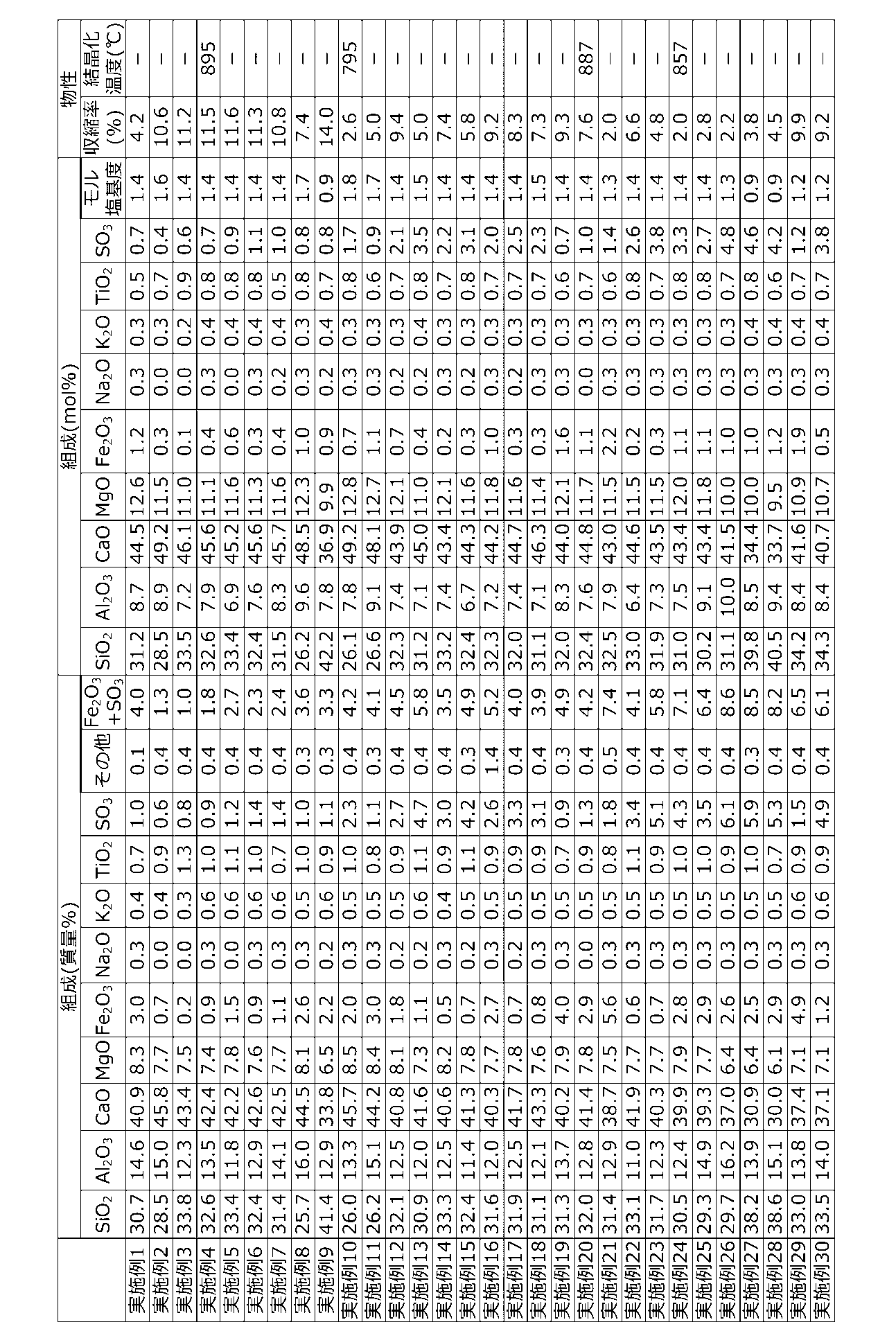
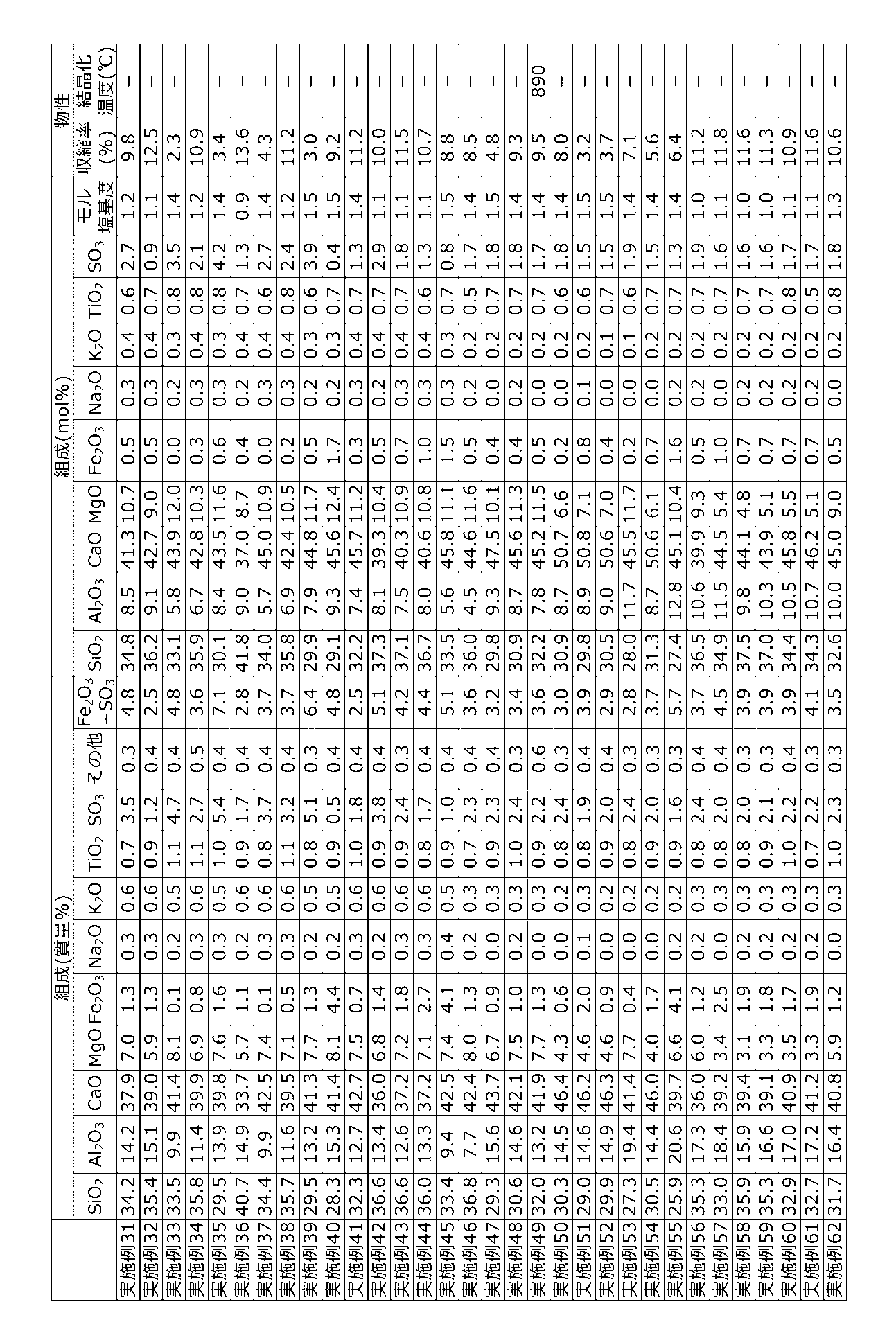


図1は、各サンプルのモル塩基度Pを横軸に、遷移金属化合物(Fe2O3/MnO)と硫黄の合計の含有量Qを縦軸にプロットしたグラフである。図1の上図は、各サンプルのうち、1110℃における加熱収縮率が14%以下のものを抽出したグラフである。また、図1の下図は、1110℃において熔融したものを抽出したグラフである。
図1に破線で示すように、耐熱性が優れたサンプル(1110℃における収縮率が14%以下)は、遷移金属化合物と硫黄の合計の含有量Qが0.5質量%以上であり、P及びQが、以下の式(1)を満たすことが示された。
-3.3×P+5.1≦Q (1)
-3.3×P+5.1≦Q (1)
図2の上図は、各サンプルのうち、1110℃における加熱収縮率が12%以下のものを抽出したグラフである。また、図2の下図は、1110℃における加熱収縮率が12%超のものを抽出したグラフである。
図2に破線で示すように、耐熱性がより優れたサンプル(1110℃における加熱収縮率が12%以下)は、遷移金属化合物と硫黄の合計の含有量Qが0.5質量%以上であり、P及びQが、以下の式(2)を満たすことが示された。
-7.5×P+11.0≦Q (2)
-7.5×P+11.0≦Q (2)
図3の上図は、各サンプルのうち、1110℃における加熱収縮率が10%以下のものを抽出したグラフである。また、図3の下図は、1110℃における加熱収縮率が10%超のものを抽出したグラフである。
図3に破線で示すように、耐熱性が更に優れたサンプル(1110℃における加熱収縮率が10%以下)は、遷移金属化合物と硫黄の合計の含有量Qが2.5質量%以上であり、P及びQが、以下の式(3)を満たすことが示された。
-6.7×P+11.9≦Q (3)
-6.7×P+11.9≦Q (3)
図4は、試験1の各サンプル(モル塩基度P=1.4)の遷移金属化合物と硫黄の合計の含有量Qを横軸に、結晶化ピーク温度を縦軸にプロットしたグラフである。図4に示されるように、遷移金属化合物と硫黄(SO3)の合計の含有量Qが高い程、結晶化ピーク温度が低下し、結晶化が促進されることわかった。
図5は、試験1の各サンプル(遷移金属化合物と硫黄の合計の含有量Q=4.2質量%)のモル塩基度Pを横軸に、結晶化ピーク温度を縦軸にプロットしたグラフである。図5に示されるように、モル塩基度Pが高い程、結晶化ピーク温度が低下し、結晶化が促進されることわかった。
図6は、試験1の各サンプルの結晶化ピーク温度を横軸に、1110℃における加熱収縮率を縦軸にプロットしたグラフである。図6に示されるように、結晶化ピーク温度が低い程、加熱収縮率が低く、耐熱性が向上することがわかった。
<試験2:熔融粘度の測定>
モル塩基度Pが0.4、0.6、1.6、1.8となるサンプルを作製し、熔融粘度を測定した。測定は一般的な球引上げ式粘度計を用いて行い、一定温度の熔融物の中に白金線に繋がった白金球を沈め、所定の速度で引き上げた際の荷重より粘度を求めた。
モル塩基度Pが0.4、0.6、1.6、1.8となるサンプルを作製し、熔融粘度を測定した。測定は一般的な球引上げ式粘度計を用いて行い、一定温度の熔融物の中に白金線に繋がった白金球を沈め、所定の速度で引き上げた際の荷重より粘度を求めた。
(試験2の結果)
試験2の結果を以下の表5に示す。モル塩基度Pが0.4と1.8のサンプルでは、1500℃から25~50℃下がった時点で測定できないほど粘度が上昇するのに対し、モル塩基度Pが0.6と1.6のサンプルでは、粘度が測定できなくなるまで100~200℃程度の温度幅があった。
試験2の結果を以下の表5に示す。モル塩基度Pが0.4と1.8のサンプルでは、1500℃から25~50℃下がった時点で測定できないほど粘度が上昇するのに対し、モル塩基度Pが0.6と1.6のサンプルでは、粘度が測定できなくなるまで100~200℃程度の温度幅があった。
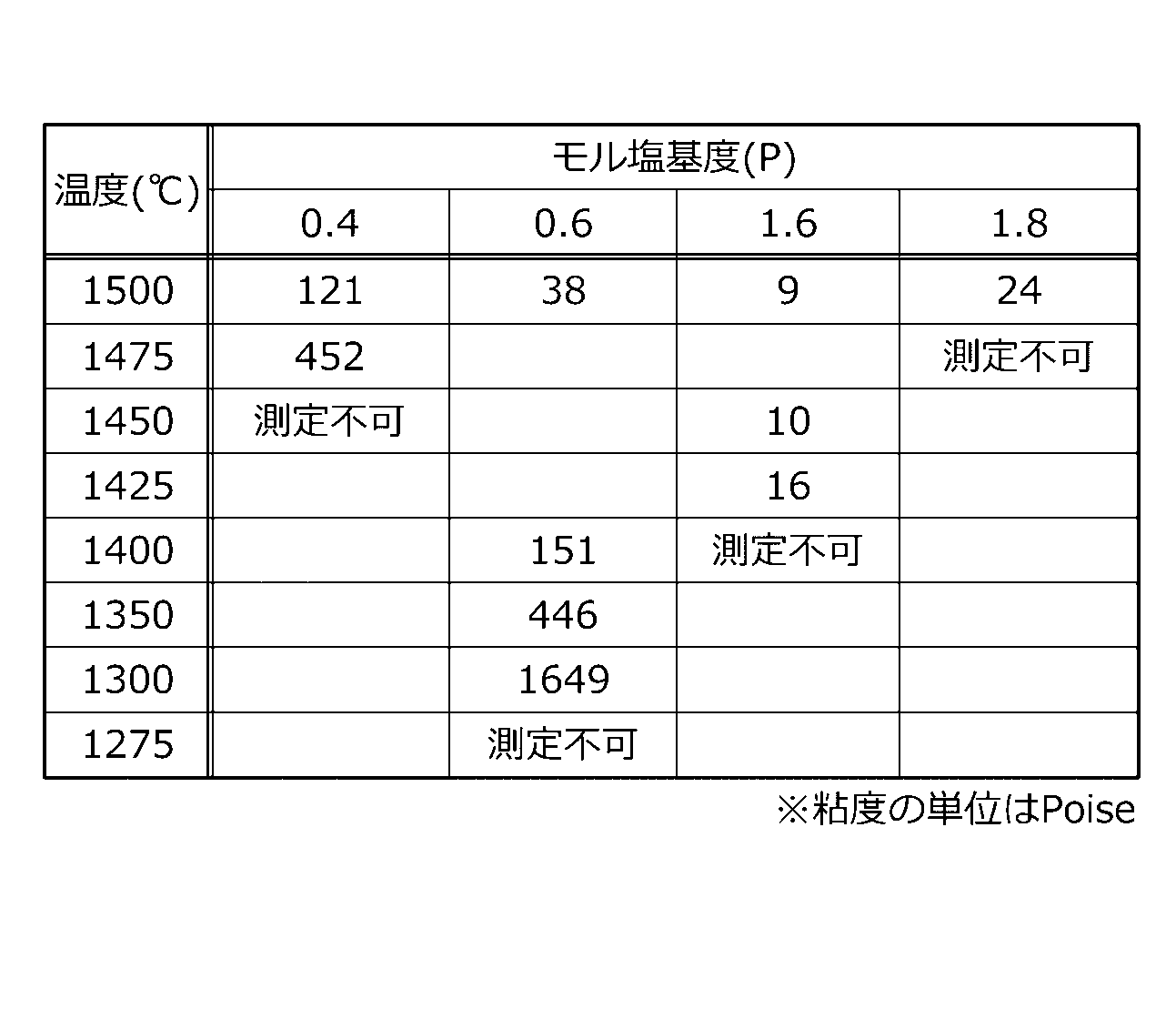
原料が熔融したときの粘性は、無機繊維の製造性に大きく影響する指標である。無機繊維の製造は、原料をキューポラや電気炉で熔融させた後、約1500℃の熔融物を炉下部より流し出し、スピニング法やブローイング法により繊維化する。繊維化の過程で熔融物は引き延ばされるが、その過程において熔融物は冷却される。つまり、良好に繊維化するためには熔融物の温度低下に伴う粘性増加が緩やかな方が好ましい。したがって、試験2の結果から、無機繊維を良好に繊維化するためには、モル塩基度Pが0.6~1.6の範囲(0.6≦P≦1.6)であると好ましいことが示された。
<試験1のまとめ>
以上の結果から、モル塩基度Pや、遷移金属化合物と硫黄(SO3)の合計の含有量Qがそれぞれ、ロックウールの耐熱性に影響を与えることが新たに見出された。具体的には、ロックウール及びロックウール製造用組成物において、モル塩基度Pと、遷移金属化合物と硫黄(SO3)の合計の含有量Qが、上記の所定範囲内にあることで、加熱によって軟化変形する前に微結晶が存在することになり、軟化が進行せず、1100℃以上の高温にさらされても繊維の湾曲・融着が起きないことが示された。
以上の結果から、モル塩基度Pや、遷移金属化合物と硫黄(SO3)の合計の含有量Qがそれぞれ、ロックウールの耐熱性に影響を与えることが新たに見出された。具体的には、ロックウール及びロックウール製造用組成物において、モル塩基度Pと、遷移金属化合物と硫黄(SO3)の合計の含有量Qが、上記の所定範囲内にあることで、加熱によって軟化変形する前に微結晶が存在することになり、軟化が進行せず、1100℃以上の高温にさらされても繊維の湾曲・融着が起きないことが示された。
<試験2:無機繊維の作製>
以下、具体的実施例に基づいて、これまでに記した無機繊維用組成物に関して実際に無機繊維を製造して耐熱性を測定し、図1~図3に示した関係を実際に無機繊維を作製して検証した。なお、本発明はこれらに限定されるものではない。
以下、具体的実施例に基づいて、これまでに記した無機繊維用組成物に関して実際に無機繊維を製造して耐熱性を測定し、図1~図3に示した関係を実際に無機繊維を作製して検証した。なお、本発明はこれらに限定されるものではない。
<繊維の作製>
表6に示す組成で、玄武岩等の天然石、スラグ、珪砂等の各種原料を電気炉またはキュポラに装入し、通常の繊維を製造する方法と同様の方法で原料を熔解した。その後、熔解した原料を炉下部より流出させ、スピニング法により繊維化した。繊維にはバインダーが付着しており、硬化炉を通すことで無機繊維成形体(嵩密度:0.08~0.12g/cm3)を得た。
表6に示す組成で、玄武岩等の天然石、スラグ、珪砂等の各種原料を電気炉またはキュポラに装入し、通常の繊維を製造する方法と同様の方法で原料を熔解した。その後、熔解した原料を炉下部より流出させ、スピニング法により繊維化した。繊維にはバインダーが付着しており、硬化炉を通すことで無機繊維成形体(嵩密度:0.08~0.12g/cm3)を得た。
<耐熱性の評価>
耐熱性の評価として繊維成形体の加熱収縮率を測定した。具体的には、50mm×50mmで裁断した成形体サンプルを電気炉内に設置し、ISO834の加熱曲線を模擬した昇温速度に沿って1110℃まで加熱した。サンプルの縦方向と横方向の長さを加熱前後で測定し、その寸法変化により収縮率を測定した。具体的には、加熱収縮率(%)=(加熱前のサンプル長さ-加熱後のサンプル長さ)/加熱前のサンプル長さ×100で算出した。なお、表6に示す収縮率は縦方向の収縮率と横方向の収縮率の平均値である。
耐熱性の評価として繊維成形体の加熱収縮率を測定した。具体的には、50mm×50mmで裁断した成形体サンプルを電気炉内に設置し、ISO834の加熱曲線を模擬した昇温速度に沿って1110℃まで加熱した。サンプルの縦方向と横方向の長さを加熱前後で測定し、その寸法変化により収縮率を測定した。具体的には、加熱収縮率(%)=(加熱前のサンプル長さ-加熱後のサンプル長さ)/加熱前のサンプル長さ×100で算出した。なお、表6に示す収縮率は縦方向の収縮率と横方向の収縮率の平均値である。
上記試験の結果を表6及び図7に示す。
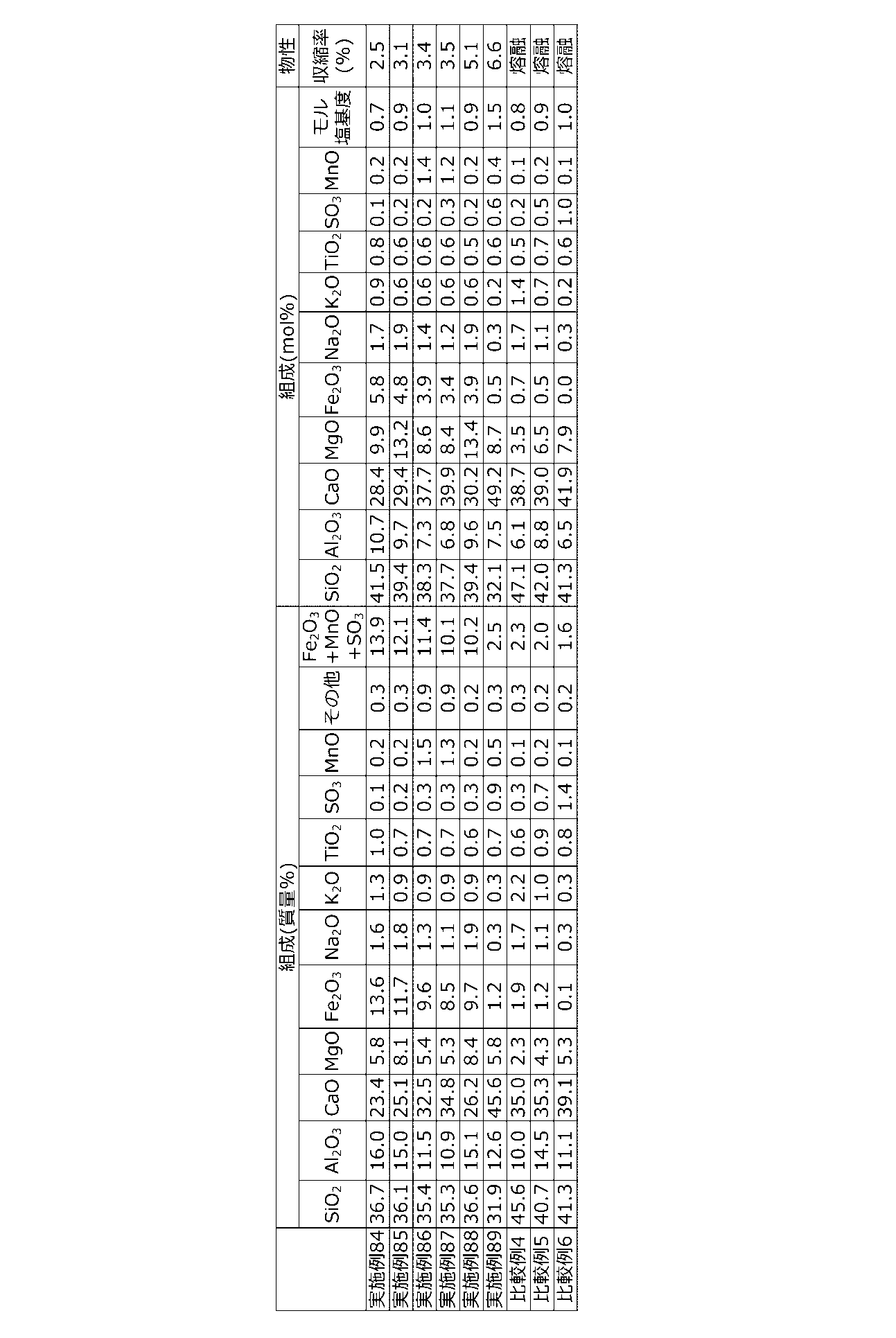
図7は、各サンプルのモル塩基度Pを横軸に、遷移金属化合物(Fe2O3/MnO)と硫黄の合計の含有量Qを縦軸にプロットしたグラフである。
また、図7の2つの破線は図1~図3に示した以下の関係式を示したものである.
-3.3×P+5.1≦Q (1)
-6.7×P+11.9≦Q (3)
また、図7の2つの破線は図1~図3に示した以下の関係式を示したものである.
-3.3×P+5.1≦Q (1)
-6.7×P+11.9≦Q (3)
図7に示されるように、繊維成形体で評価した結果は、図1~図3に示した無機繊維製造用組成物の結果と傾向が一致することが確認できた。即ち、上述した耐熱性と組成との関係が、無機繊維用組成物だけではなく、無機繊維においても成立することが確認できたことにより、蓋然性は極めて高いと思料されるものである。
Claims (12)
- 遷移金属化合物とSO3の合計量Qが0.5質量%以上、
SiO2とAl2O3の合計に対するCaOとMgOの合計のモル比(mol%(CaO+MgO)/mol%(SiO2+Al2O3))で表されるモル塩基度Pが0.6以上であり、
以下の式(1):-3.3×P+5.1≦Q (1)
を満たすことを特徴とする無機繊維。 - 前記遷移金属化合物は、Fe、Mn、Cu、Ni、Co、Zr、V、Nb、Mo、W、Yを含む群から選択される少なくとも1種の化合物であることを特徴とする請求項1に記載の無機繊維。
- 1110℃における加熱収縮率が14%以下であることを特徴とする請求項1又は2に記載の無機繊維。
- 以下の組成を有する請求項1乃至3のいずれか一項に記載の無機繊維。
SiO2:25重量%~45重量%
Al2O3:5重量%~25重量%
CaO:15重量%~50重量%
MgO:3重量%~20重量%
遷移金属化合物:0.1重量%~14重量%
SO3:0.1重量%~10重量% - 以下の成分をさらに有することを特徴とする請求項4に記載の無機繊維。
Na2O:0重量%~10重量%
K2O:0重量%~10重量% - P2O5、Li2O、Na2O及びK2Oを含む群から選択される少なくとも1種以上を含み、
P2O5、Li2O、Na2O及びK2Oの合計量が3重量%~10重量%であることを特徴とする請求項5に記載の無機繊維。 - ロックウール、ストーンウール、スラグウール、ミネラルウール、グラスウール及びミネラルグラスウールからなる群より選択される少なくとも1種以上であることを特徴とする請求項1乃至6のいずれか一項に記載の無機繊維。
- 請求項1乃至7のいずれか一項に記載の無機繊維を含むことを特徴とする無機繊維製品。
- 断熱材又は耐火材であることを特徴とする請求項8に記載の無機繊維製品。
- 請求項1乃至7のいずれか一項に記載の無機繊維を成形することを特徴とする無機繊維製品の製造方法。
- 遷移金属化合物とSO3の合計量Qが0.5質量%以上、
SiO2とAl2O3の合計に対するCaOとMgOの合計のモル比(mol%(CaO+MgO)/mol%(SiO2+Al2O3))で表されるモル塩基度Pが0.6以上であり、
以下の式(1):-3.3×P+5.1≦Q (1)
を満たすことを特徴とする無機繊維製造用組成物。 - 請求項11に記載の無機繊維製造用組成物を熔解し、次いで、繊維化することにより、無機繊維を得る無機繊維の製造方法。
Priority Applications (4)
| Application Number | Priority Date | Filing Date | Title |
|---|---|---|---|
| CN202080053218.7A CN114174235B (zh) | 2019-07-25 | 2020-07-22 | 无机纤维、无机纤维制品、无机纤维制品的制造方法、无机纤维制造用组合物和无机纤维的制造方法 |
| EP20842976.1A EP4005987A4 (en) | 2019-07-25 | 2020-07-22 | INORGANIC FIBER, INORGANIC FIBER PRODUCT, METHOD FOR MAKING AN INORGANIC FIBER PRODUCT, COMPOSITION FOR MAKING AN INORGANIC FIBER, AND METHOD FOR MAKING AN INORGANIC FIBER |
| MYPI2021007908A MY198331A (en) | 2019-07-25 | 2020-07-22 | Inorganic Fiber, Inorganic Fiber Product, Method of Manufacturing Inorganic Fiber Product, Composition for Manufacturing Inorganic Fiber, and Method of Manufacturing Inorganic Fiber |
| JP2021534077A JP7250137B2 (ja) | 2019-07-25 | 2020-07-22 | 無機繊維、無機繊維製品、無機繊維製品の製造方法、無機繊維製造用組成物及び無機繊維の製造方法 |
Applications Claiming Priority (2)
| Application Number | Priority Date | Filing Date | Title |
|---|---|---|---|
| JP2019-136956 | 2019-07-25 | ||
| JP2019136956 | 2019-07-25 |
Publications (1)
| Publication Number | Publication Date |
|---|---|
| WO2021015243A1 true WO2021015243A1 (ja) | 2021-01-28 |
Family
ID=74194227
Family Applications (1)
| Application Number | Title | Priority Date | Filing Date |
|---|---|---|---|
| PCT/JP2020/028459 Ceased WO2021015243A1 (ja) | 2019-07-25 | 2020-07-22 | 無機繊維、無機繊維製品、無機繊維製品の製造方法、無機繊維製造用組成物及び無機繊維の製造方法 |
Country Status (5)
| Country | Link |
|---|---|
| EP (1) | EP4005987A4 (ja) |
| JP (1) | JP7250137B2 (ja) |
| CN (1) | CN114174235B (ja) |
| MY (1) | MY198331A (ja) |
| WO (1) | WO2021015243A1 (ja) |
Cited By (2)
| Publication number | Priority date | Publication date | Assignee | Title |
|---|---|---|---|---|
| CN114956542A (zh) * | 2022-01-23 | 2022-08-30 | 烟台华正科信新材科技有限公司 | 玄武岩鳞片 |
| CN115140931A (zh) * | 2022-08-12 | 2022-10-04 | 烟台华正科信新材科技有限公司 | 一种采用原矿制备玄武岩鳞片的方法 |
Citations (4)
| Publication number | Priority date | Publication date | Assignee | Title |
|---|---|---|---|---|
| JPS5187517A (ja) * | 1975-01-30 | 1976-07-31 | Nippon Asbestos Co Ltd | |
| JP2002512817A (ja) * | 1998-05-06 | 2002-05-08 | イソベール・サン−ゴバン | 鉱滓綿組成物 |
| WO2012176799A1 (ja) * | 2011-06-21 | 2012-12-27 | ニチアス株式会社 | ロックウール、その製造方法及び無機繊維フェルト |
| JP2016515995A (ja) * | 2013-04-15 | 2016-06-02 | ケーシーシー コーポレーション | 体液に対する溶解性に優れたミネラルウール繊維製造用組成物及びそれにより製造されたミネラルウール繊維 |
Family Cites Families (4)
| Publication number | Priority date | Publication date | Assignee | Title |
|---|---|---|---|---|
| US4720295A (en) * | 1986-10-20 | 1988-01-19 | Boris Bronshtein | Controlled process for making a chemically homogeneous melt for producing mineral wool insulation |
| JPH09202645A (ja) * | 1996-01-22 | 1997-08-05 | Nichias Corp | ロックウール |
| CN107555777B (zh) * | 2015-10-13 | 2019-06-18 | 张勇 | 利用赤泥生产无机纤维的工艺方法 |
| US9796635B1 (en) * | 2016-06-22 | 2017-10-24 | Usg Interiors, Llc | Large diameter slag wool, composition and method of making same |
-
2020
- 2020-07-22 MY MYPI2021007908A patent/MY198331A/en unknown
- 2020-07-22 CN CN202080053218.7A patent/CN114174235B/zh active Active
- 2020-07-22 JP JP2021534077A patent/JP7250137B2/ja active Active
- 2020-07-22 EP EP20842976.1A patent/EP4005987A4/en active Pending
- 2020-07-22 WO PCT/JP2020/028459 patent/WO2021015243A1/ja not_active Ceased
Patent Citations (4)
| Publication number | Priority date | Publication date | Assignee | Title |
|---|---|---|---|---|
| JPS5187517A (ja) * | 1975-01-30 | 1976-07-31 | Nippon Asbestos Co Ltd | |
| JP2002512817A (ja) * | 1998-05-06 | 2002-05-08 | イソベール・サン−ゴバン | 鉱滓綿組成物 |
| WO2012176799A1 (ja) * | 2011-06-21 | 2012-12-27 | ニチアス株式会社 | ロックウール、その製造方法及び無機繊維フェルト |
| JP2016515995A (ja) * | 2013-04-15 | 2016-06-02 | ケーシーシー コーポレーション | 体液に対する溶解性に優れたミネラルウール繊維製造用組成物及びそれにより製造されたミネラルウール繊維 |
Non-Patent Citations (1)
| Title |
|---|
| See also references of EP4005987A4 * |
Cited By (2)
| Publication number | Priority date | Publication date | Assignee | Title |
|---|---|---|---|---|
| CN114956542A (zh) * | 2022-01-23 | 2022-08-30 | 烟台华正科信新材科技有限公司 | 玄武岩鳞片 |
| CN115140931A (zh) * | 2022-08-12 | 2022-10-04 | 烟台华正科信新材科技有限公司 | 一种采用原矿制备玄武岩鳞片的方法 |
Also Published As
| Publication number | Publication date |
|---|---|
| EP4005987A1 (en) | 2022-06-01 |
| JP7250137B2 (ja) | 2023-03-31 |
| JPWO2021015243A1 (ja) | 2021-01-28 |
| MY198331A (en) | 2023-08-24 |
| CN114174235A (zh) | 2022-03-11 |
| CN114174235B (zh) | 2023-08-29 |
| EP4005987A4 (en) | 2023-08-23 |
Similar Documents
| Publication | Publication Date | Title |
|---|---|---|
| KR101299769B1 (ko) | 내화물이 라이닝 처리된 용융기에서의 고성능 유리 섬유의 제조 방법 및 이 방법에 따라 형성된 섬유 | |
| EP0513112B1 (en) | Mineral fibres | |
| KR20210096138A (ko) | 비탄성률이 향상된 고성능 섬유 유리 조성물 | |
| JP5158916B2 (ja) | ロックウール、その製造方法及び無機繊維フェルト | |
| KR20200090921A (ko) | 고성능 섬유유리 조성물 | |
| KR20210096140A (ko) | 향상된 탄성 계수를 갖는 고성능 섬유 유리 조성물 | |
| KR20170029573A (ko) | 생체 용해성 무기섬유 | |
| JP2017520505A (ja) | 糖含有ミネラルウールを含む複合材 | |
| KR20000029668A (ko) | 생용해성고온미네랄울 | |
| JP7250137B2 (ja) | 無機繊維、無機繊維製品、無機繊維製品の製造方法、無機繊維製造用組成物及び無機繊維の製造方法 | |
| Farouk et al. | Optimization of microstructure of basalt-based fibers intended for improved thermal and acoustic insulations | |
| JP6554269B2 (ja) | 生体溶解性無機繊維の製造方法 | |
| CN118894643A (zh) | 人造玻璃质纤维的制造方法 | |
| CN109160743A (zh) | 一种高强耐火岩棉及制备方法 | |
| JP7324868B2 (ja) | 無機繊維、無機繊維製品、無機繊維製品の製造方法、無機繊維製造用組成物及び無機繊維の製造方法 | |
| CN101341103A (zh) | 用于生产玻璃束的耐碱和耐酸玻璃组合物 | |
| JPH10273332A (ja) | 都市ゴミ焼却灰溶融スラグを主原料とした高強度ロッ クウールおよびその製造方法 | |
| JP6348843B2 (ja) | 生体溶解性無機繊維及びその組成物 | |
| JPH09202645A (ja) | ロックウール | |
| JP6212040B2 (ja) | 耐熱無機繊維 | |
| JP4090495B1 (ja) | ガラス短繊維および構造物 | |
| JPH0645472B2 (ja) | 耐熱性、耐アルカリ性、低pH性に優れた無機質繊維の製造方法 | |
| RU2740956C1 (ru) | Шихта для стеклокристаллического материала и стеклокристаллический материал | |
| RU2588510C2 (ru) | Сырье для получения базальтовых волокон | |
| JPWO2013132859A1 (ja) | 生理食塩水に可溶なSr/Ba含有無機繊維及びその組成物 |
Legal Events
| Date | Code | Title | Description |
|---|---|---|---|
| 121 | Ep: the epo has been informed by wipo that ep was designated in this application |
Ref document number: 20842976 Country of ref document: EP Kind code of ref document: A1 |
|
| ENP | Entry into the national phase |
Ref document number: 2021534077 Country of ref document: JP Kind code of ref document: A |
|
| NENP | Non-entry into the national phase |
Ref country code: DE |
|
| ENP | Entry into the national phase |
Ref document number: 2020842976 Country of ref document: EP Effective date: 20220225 |