WO2021020253A1 - 組成物、これを用いたステンレス鋼表面の粗化処理方法、ならびに粗化処理されたステンレス鋼およびその製造方法 - Google Patents
組成物、これを用いたステンレス鋼表面の粗化処理方法、ならびに粗化処理されたステンレス鋼およびその製造方法 Download PDFInfo
- Publication number
- WO2021020253A1 WO2021020253A1 PCT/JP2020/028359 JP2020028359W WO2021020253A1 WO 2021020253 A1 WO2021020253 A1 WO 2021020253A1 JP 2020028359 W JP2020028359 W JP 2020028359W WO 2021020253 A1 WO2021020253 A1 WO 2021020253A1
- Authority
- WO
- WIPO (PCT)
- Prior art keywords
- stainless steel
- roughened
- roughening
- composition
- jis
- Prior art date
- Legal status (The legal status is an assumption and is not a legal conclusion. Google has not performed a legal analysis and makes no representation as to the accuracy of the status listed.)
- Ceased
Links
Images
Classifications
-
- C—CHEMISTRY; METALLURGY
- C23—COATING METALLIC MATERIAL; COATING MATERIAL WITH METALLIC MATERIAL; CHEMICAL SURFACE TREATMENT; DIFFUSION TREATMENT OF METALLIC MATERIAL; COATING BY VACUUM EVAPORATION, BY SPUTTERING, BY ION IMPLANTATION OR BY CHEMICAL VAPOUR DEPOSITION, IN GENERAL; INHIBITING CORROSION OF METALLIC MATERIAL OR INCRUSTATION IN GENERAL
- C23F—NON-MECHANICAL REMOVAL OF METALLIC MATERIAL FROM SURFACE; INHIBITING CORROSION OF METALLIC MATERIAL OR INCRUSTATION IN GENERAL; MULTI-STEP PROCESSES FOR SURFACE TREATMENT OF METALLIC MATERIAL INVOLVING AT LEAST ONE PROCESS PROVIDED FOR IN CLASS C23 AND AT LEAST ONE PROCESS COVERED BY SUBCLASS C21D OR C22F OR CLASS C25
- C23F1/00—Etching metallic material by chemical means
- C23F1/10—Etching compositions
- C23F1/14—Aqueous compositions
- C23F1/16—Acidic compositions
- C23F1/28—Acidic compositions for etching iron group metals
-
- H—ELECTRICITY
- H01—ELECTRIC ELEMENTS
- H01M—PROCESSES OR MEANS, e.g. BATTERIES, FOR THE DIRECT CONVERSION OF CHEMICAL ENERGY INTO ELECTRICAL ENERGY
- H01M4/00—Electrodes
- H01M4/02—Electrodes composed of, or comprising, active material
- H01M4/64—Carriers or collectors
- H01M4/66—Selection of materials
- H01M4/665—Composites
- H01M4/667—Composites in the form of layers, e.g. coatings
-
- H—ELECTRICITY
- H01—ELECTRIC ELEMENTS
- H01M—PROCESSES OR MEANS, e.g. BATTERIES, FOR THE DIRECT CONVERSION OF CHEMICAL ENERGY INTO ELECTRICAL ENERGY
- H01M4/00—Electrodes
- H01M4/02—Electrodes composed of, or comprising, active material
- H01M4/64—Carriers or collectors
- H01M4/66—Selection of materials
- H01M4/669—Steels
-
- H—ELECTRICITY
- H01—ELECTRIC ELEMENTS
- H01M—PROCESSES OR MEANS, e.g. BATTERIES, FOR THE DIRECT CONVERSION OF CHEMICAL ENERGY INTO ELECTRICAL ENERGY
- H01M4/00—Electrodes
- H01M4/02—Electrodes composed of, or comprising, active material
- H01M4/64—Carriers or collectors
- H01M4/70—Carriers or collectors characterised by shape or form
-
- Y—GENERAL TAGGING OF NEW TECHNOLOGICAL DEVELOPMENTS; GENERAL TAGGING OF CROSS-SECTIONAL TECHNOLOGIES SPANNING OVER SEVERAL SECTIONS OF THE IPC; TECHNICAL SUBJECTS COVERED BY FORMER USPC CROSS-REFERENCE ART COLLECTIONS [XRACs] AND DIGESTS
- Y02—TECHNOLOGIES OR APPLICATIONS FOR MITIGATION OR ADAPTATION AGAINST CLIMATE CHANGE
- Y02E—REDUCTION OF GREENHOUSE GAS [GHG] EMISSIONS, RELATED TO ENERGY GENERATION, TRANSMISSION OR DISTRIBUTION
- Y02E60/00—Enabling technologies; Technologies with a potential or indirect contribution to GHG emissions mitigation
- Y02E60/10—Energy storage using batteries
Definitions
- the present invention relates to a composition, particularly a composition used for surface treatment of stainless steel, a method for roughening the surface of stainless steel, and the like.
- stainless steel has excellent durability and weather resistance, so in recent years, its development in various fields has been considered.
- stainless steel is being increasingly used in housings for electronic parts, battery current collector foils, and automobile parts.
- the surface of the stainless steel is roughened for the purpose of adhering a dielectric substance or an organic substance.
- the surface of the stainless steel is roughened for the purpose of promoting heat dissipation.
- Patent Document 2 a method for roughening the surface of stainless steel, a method combining wet peening and roughening treatment with a chemical solution has been found (for example, Patent Document 2), but according to these methods, a plurality of steps can be performed. Needed. Therefore, there is room for improvement in improving the efficiency of the roughening process.
- the roughening level is not always sufficient, and the treatment time and cost are increased because a complicated process is required. Therefore, a method has been desired that enables a sufficient roughening treatment to be efficiently applied to the surface of stainless steel in a simple process.
- the present inventors can efficiently roughen the surface of stainless steel with sufficient and few steps by using a composition having a specific composition. This has led to the completion of the present invention.
- the present invention is as follows.
- [1] A composition for roughening the surface of stainless steel. Containing 0.1 to 25% by mass based on the total amount of the composition, one or more selected from the group consisting of persulfate and persulfate.
- [2] The composition according to the above [1], wherein the persulfate contains an alkali metal salt of persulfate.
- [3] The composition according to the above [2], wherein the alkali metal salt of the persulfate contains at least one of sodium persulfate and potassium persulfate.
- composition according to any one of [1] to [3] above which comprises at least one selected from the group consisting of hydrochloric acid, sodium chloride, and potassium chloride as the compound that supplies the halide ion. ..
- composition according to any one of the above [1] to [4] which further contains water and has a pH value of ⁇ 1.5 or more and 4.0 or less.
- composition according to any one of [1] to [5] above further comprising copper ions.
- a method for roughening stainless steel which comprises a roughening step of roughening the surface of stainless steel using the composition according to any one of [1] to [6] above.
- the above-mentioned [7] to [9] wherein the maximum height (Rz) of the surface of the roughened stainless steel specified by JIS B 0601-2001 is 1.0 ⁇ m or more. Roughening treatment method for stainless steel.
- [17] A roughened stainless steel whose surface has been roughened using the composition according to any one of the above [1] to [6].
- [18] The roughened stainless steel according to the above [17], wherein the maximum height (Rz) of the surface of the roughened stainless steel specified by JIS B 0601-2001 is 1.0 ⁇ m or more.
- Chromium-nickel stainless steel containing SUS304, SUS316, SUS321, SUS347, and SUS329J1; Martensitic stainless steel (chrome stainless steel) containing SUS403, SUS410, SUS420J1, SUS420J2, SUS440A, SUS440B, and SUS440C; Ferritic stainless steel (chrome stainless steel) containing SUS405, SUS430, SUS434, SUS444, SUS447, SUSXM27; and Precipitation hardening system (chromium / nickel stainless steel) containing SUS630, SUS631, and SUH660; The roughened stainless steel according to any one of the above [17] to [21], which is one or more selected from the group consisting of.
- the stainless steel is defined by JIS G 4305 standard.
- Chromium-nickel stainless steel containing SUS304, SUS316, SUS321, SUS347, and SUS329J1; Martensitic stainless steel (chrome stainless steel) containing SUS403, SUS410, SUS420J1, SUS420J2, SUS440A, SUS440B, and SUS440C; Ferritic stainless steel (chrome stainless steel) containing SUS405, SUS430, SUS434, SUS444, SUS447, SUSXM27; and Precipitation hardening system (chromium / nickel stainless steel) containing SUS630, SUS631, and SUH660; The method for producing roughened stainless steel according to any one of the above [25] to [31], which is one or more selected from the group consisting of.
- the surface of stainless steel can be sufficiently roughened by an efficient method with a small number of steps.
- composition of the present invention is suitably used for a roughening treatment of a metal surface, that is, a treatment for roughening the metal surface and expanding unevenness.
- Targets for roughening treatment using the composition of the present invention include various metals and alloys, and preferred targets include various stainless steels, the details of which will be described later.
- the compositions of the present invention are one or more selected from the group consisting of 0.1 to 25% by mass of persulfate and persulfate, and 1 to 30% by mass of halides, based on the total amount of the composition. Contains ions.
- the composition is preferably water-soluble, and is particularly preferably an aqueous composition containing water, particularly ion-exchanged water or ultrapure water, in addition to the above-mentioned components.
- aqueous composition containing water, particularly ion-exchanged water or ultrapure water, in addition to the above-mentioned components.
- the composition of the present invention contains one or more selected from the group consisting of persulfate and persulfate. That is, in the composition, only one of persulfate and persulfate may be used, either persulfate or persulfate may be used, and one kind of persulfate may be used alone. Alternatively, two or more kinds may be used in combination.
- persulfate H 2 SO 5
- a known method for example, one produced by allowing a peroxide to act on sulfuric acid or chlorosulfuric acid can be used.
- persulfate for example, one produced by adding a compound containing a predetermined counterion to persulfate can be used. Further, as described in Registered Patent No. 3778238, it can be obtained by allowing sodium hydroxide to act on an electrolytic solution of ammonium sulfate.
- the persulfate is not particularly limited as long as it is a salt of persulfate, and examples thereof include a metal salt of persulfate and a salt of another inorganic compound. Among them, a metal salt of persulfate is preferable.
- an alkali metal salt and an alkaline earth metal salt are preferable, an alkali metal salt is more preferable, and more preferable specific examples are sodium persulfate, potassium persulfate, and potassium monosulfite compound salt ( 2KHSO 5 , KHSO 4 , K 2 SO 4 ; Ozon) and the like are mentioned, and among them, sodium persulfate and potassium persulfate are particularly preferable, and sodium persulfate is particularly preferable.
- the salt of the inorganic compound of persulfate include ammonium persulfate.
- the above-mentioned persulfate and persulfate are collectively referred to as a persulfate component.
- the content of the persulfuric component in the composition of the present invention is 0.1 to 25% by mass based on the total amount of the composition. Yes, preferably 1.0 to 25% by mass, more preferably 1.0 to 20% by mass or 2.0 to 22.5% by mass, and more preferably 2.0 to 15% by mass or It is 2.5 to 20% by mass, more preferably 3.0 to 16% by mass, and particularly preferably 4.0 to 12% by mass.
- the lower limit of the concentration of the persulfate component contained in the composition is, for example, 1.0% by mass, 1.5% by mass, 2.0% by mass, 2.5% by mass, 3.0% by mass, 3 It may be 5.5% by mass, 4.0% by mass, 4.5% by mass, 5.0% by mass, etc.
- the upper limit of the concentration of the persulfate component contained in the composition is, for example, 22.5. It may be mass%, 21 mass%, 20 mass%, 19 mass%, 18 mass%, 17 mass%, 16 mass%, 15 mass%, 14 mass%, 13 mass%, 12 mass% and the like.
- the solubility of the persulfate component is good and the roughening treatment efficiency is high. Can be achieved.
- the range of the content of the persulfate component may include the above-mentioned upper limit value and lower limit value (that is, a range below the upper limit value or above the lower limit value), and may not include the upper limit value and the lower limit value.
- Well that is, a range below the upper limit value or more than the lower limit value
- a peroxide different from the persulfate component (a compound having an —O—O— structure in the molecule; where O is (Representing an oxygen atom) can also be used with or in place of the persulfate component.
- the peroxide different from the persulfate component include peracetic acid, peracetate, percarbonate, percarbonate, perbenzoic acid, perbenzoate, metachloroperbenzoic acid and the like.
- the total content of the peroxide in the composition is preferably the same as the content of the persulfate component described above.
- Halide ion The type of halide ion contained in the composition of the present invention is not particularly limited, and is, for example, fluoride ion (F ⁇ ), chloride ion (Cl ⁇ ), bromide ion (Br ⁇ ), iodide. Although it may be an ion (I ⁇ ), a chloride ion is preferable from the viewpoint of efficiency of roughening treatment, ease of handling, and economy.
- the compound that supplies the halide ion is not particularly limited, but for example, a halide of an alkali metal such as hydrogen halide, sodium halide and potassium halide, or an alkaline earth metal such as calcium halide.
- Halides, ammonium halides, copper halides can be mentioned.
- hydrogen halides or halides of alkali metals are preferable from the viewpoint of more effectively and surely exerting the action and effect of the present invention, and are selected from the group consisting of hydrochloric acid (hydrogen chloride), sodium chloride, and potassium chloride. More preferably, it is one or more. These may be used alone or in combination of two or more.
- the content of halide ions in the composition of the present invention is 1 to 30% by mass, preferably 2.0 to 25% by mass, and more preferably 2.0 to 20% by mass based on the total amount of the composition. It is mass% or 3.0 to 20% by mass, more preferably 4.0 to 18% by mass or 5.0 to 15% by mass, and particularly preferably 5.0 to 17% by mass, 7.0. It is ⁇ 15% by mass, 7.0 ⁇ 12% by mass, 8.0 ⁇ 15% by mass, 8.0 ⁇ 12% by mass and the like.
- the range of the halide ion content may include the above-mentioned upper limit value and lower limit value (that is, a range below the upper limit value or above the lower limit value), and may not include the upper limit value and the lower limit value.
- the lower limit of the concentration of halide ions contained in the composition is, for example, 1.5% by mass, 2.0% by mass, 3.0% by mass, 4.0% by mass, 5.0% by mass, and 6. It may be 0.0% by mass, 7.0% by mass, 8.0% by mass, 9.0% by mass, etc.
- the upper limit of the concentration of halide ions contained in the composition is, for example, 27% by mass, It may be 25% by mass, 22% by mass, 20% by mass, 19% by mass, 18% by mass, 17% by mass, 16% by mass, 15% by mass, 14% by mass, 13% by mass, 12% by mass and the like.
- the composition of the present invention may contain water, preferably water.
- the water is not particularly limited, but is preferably water from which metal ions, organic impurities, particles and the like have been removed by distillation, ion exchange treatment, filter treatment, various adsorption treatments, etc., more preferably pure water, and ultrapure water. Especially preferable.
- the content of water in the composition of the present invention is not particularly limited, but is preferably 45 to 98.9% by mass, more preferably 55 to 97% by mass, and further preferably 65 to 95% by mass based on the total amount of the composition. %, Especially preferably 75 to 90% by mass.
- the composition of the present invention is preferably a dissolved solution, and preferably does not contain a component that is insoluble in the composition that is the dissolved solution, for example, solid particles such as abrasive particles.
- active ingredients other than the above-mentioned persulfate component, peroxide, and halide ion may be added.
- copper ions may be added to the composition as a component capable of causing a substitution reaction with nickel and chromium, which are components of stainless steel.
- the type of copper ion source is not particularly limited as long as it is a copper compound capable of supplying copper ions in the composition.
- the copper compound capable of supplying copper ions may be anhydrous or hydrate (for example, pentahydrate), such as copper sulfate such as cupric sulfate, cupric chloride and the like.
- Examples thereof include copper chloride, copper tetrafluoroborate, cupric bromide, cupric oxide, copper phosphate, copper acetate, copper formate, copper nitrate and the like.
- copper sulfate or copper chloride is preferable, cupric sulfate or cupric chloride is more preferable, and cupric sulfate is further preferable. These may be used alone or in combination of two or more.
- the content of copper ions that may be contained in the composition of the present invention is preferably 0.25 to 40% by mass, more preferably 1.0 to 30% by mass, based on the total amount of the composition. More preferably, it is 3.0 to 25% by mass, and particularly preferably 5.0 to 20% by mass.
- the copper compound and the compound that supplies the above-mentioned halide ion may overlap.
- the copper halide also corresponds to the above-mentioned halide ion source.
- copper chloride is preferable.
- Additives contained in the composition may contain additives in addition to the above-mentioned active components such as a persulfate component and a halide ion, as long as the effects of the present invention are exhibited.
- the additive include a heterocyclic nitrogen compound (azole compound), an organic solvent and the like. These may be used alone or in combination of two or more.
- examples of the additive include a surfactant and a pH adjuster, but it is preferable that these are not included in the composition of the present invention.
- the content of the additive that may be contained in the composition of the present invention is preferably 10% by mass or less, more preferably 5.0% by mass or less, and further preferably 5.0% by mass or less, based on the total amount of the composition. It is preferably 2.0% by mass or less, and particularly preferably 1.0% by mass or less.
- composition containing each of the above-mentioned components functions as follows in the roughening treatment of the stainless steel surface.
- Halide ions play a role in pitting the oxide film normally formed on the surface of stainless steel.
- the persulfuric component plays a role of oxidizing and ionizing the metal component of stainless steel in an acidic aqueous solution to cause a corrosion reaction. Roughened shape develops due to the irregular occurrence of corrosion reaction on stainless steel.
- a peroxide other than the persulfate component for example, peracetic acid, can play the same role as the persulfate component.
- the composition of the present invention is prepared by adding the above-mentioned persulfate component, halide ion supply component and water, and other components as necessary, and stirring until uniform.
- the properties of the composition are not particularly limited, but the pH value is preferably ⁇ 1.5 to 4.0, more preferably ⁇ 1.0 to 3.0, and even more preferably ⁇ . It is 0.75 to 2.5, and particularly preferably ⁇ 0.5 to 2.0.
- the pH value of the composition is, for example, less than 1.0.
- the pH value can be measured by the method described in Examples.
- a roughening step of roughening the surface of stainless steel using the above composition is performed.
- the roughening step performed in the present invention includes bringing the above-mentioned composition into contact with stainless steel.
- the method of contacting the composition with the stainless steel is not particularly limited, and for example, a method of immersing the stainless steel to be treated in the composition of the present invention and a method of dropping the composition of the present invention onto the stainless steel to be treated ( Single-wafer spin treatment), a method of spraying the composition of the present invention onto the stainless steel to be treated (spray treatment), and the like, and any method may be adopted.
- a method of spraying the composition of the present invention on stainless steel processed into a specific shape to obtain a roughened stainless steel or a dropping device, a spraying device or a spraying device of the composition of the present invention between stainless steel foil rolls.
- a dipping device is installed and the composition is supplied by passing in the vicinity of the device while the stainless steel foil is spread and moved from the roll on which the untreated stainless steel foil is wound by the roll-to-roll method. Then, a method of winding the roughened stainless steel foil to obtain a roll can be mentioned.
- the temperature of the roughening treatment is preferably 20 to 60 ° C., more preferably 25 to 55 ° C., and particularly preferably 30 to 50 ° C.
- the method for roughening the stainless steel of the present invention is excellent in that the surface of the stainless steel is roughened even at a temperature of, for example, 20 to 30 ° C. even if the temperature is not so high.
- the temperature of the roughening treatment refers to the temperature at which the composition is brought into contact with the surface of the stainless steel, particularly the liquid temperature of the composition that is brought into contact with the surface of the stainless steel.
- the roughening treatment time is preferably 30 seconds to 180 seconds, more preferably 30 seconds to 120 seconds, and further preferably 40 seconds to 100 seconds. Especially preferably, it is 50 seconds to 90 seconds.
- the method for roughening stainless steel of the present invention is excellent in that the roughening of stainless steel proceeds even if it does not take a very long time.
- the roughening treatment time refers to the time for contacting the composition with the stainless steel surface. For example, it is the time for immersing the stainless steel in the composition, the time from spraying the composition on the surface of the stainless steel to the time for removing the aqueous composition with water or the like.
- roughened stainless steel also referred to as roughened stainless steel in the present specification, roughened stainless steel foil (film or sheet) is also available.
- the maximum surface height (Rz) of (included in stainless steel) can be 1.0 ⁇ m or more, for example, 1.5 ⁇ m or more, or 2.0 ⁇ m or more.
- the maximum height (Rz) of the stainless steel surface is preferably 3.0 ⁇ m or more, or 4.0 ⁇ m or more, and more preferably 4.5 ⁇ m or more. It is more preferable that the size is 0.0 ⁇ m or more, and it is particularly preferable that the size is 5.5 ⁇ m or more.
- the upper limit of the maximum height (Rz) of the roughened stainless steel surface is not particularly limited, but for example, the value of Rz is 10.0 ⁇ m or less, 7.0 ⁇ m or less, and 5 It may be 0.0 ⁇ m or less.
- the maximum surface height (Rz) of the stainless steel (untreated stainless steel) that has not been roughened is not particularly limited, but is, for example, 0.1 to 2.0 ⁇ m. , 0.2 to 2.0 ⁇ m, 0.4 to 2.0 ⁇ m, or 1.0 to 1.5 ⁇ m.
- the maximum height (Rz) of the roughened stainless steel surface is set to be higher than the value of the maximum height (Rz) of the untreated stainless steel surface.
- the value can be as large as 0 ⁇ m or more, preferably 1.5 ⁇ m or more, or 2.0 ⁇ m or more, and more preferably 3.0 ⁇ m or more.
- the arithmetic mean roughness (Ra) of the surface of the roughened stainless steel can be 0.1 ⁇ m or more, for example, 0.2 ⁇ m or more. Is possible.
- the arithmetic mean roughness (Ra) of the surface of the roughened stainless steel is preferably 0.3 ⁇ m or more, more preferably 0.4 ⁇ m or more, and 0.6 ⁇ m. It is more preferable that the above can be achieved, and even more preferably 0.8 ⁇ m or more.
- the upper limit of the arithmetic mean roughness (Ra) of the surface of the roughened stainless steel is not particularly limited, but is, for example, 2.0 ⁇ m or less, 1.5 ⁇ m or less, or 1.0 ⁇ m or less. There may be.
- the arithmetic mean roughness (Ra) of the untreated stainless steel is not particularly limited, but is, for example, 0.01 to 0.3 ⁇ m or 0.05 to 0.3 ⁇ m.
- the arithmetic mean roughness (Ra) of the surface of the roughened stainless steel is 0.05 ⁇ m higher than the arithmetic mean roughness (Ra) of the flat surface of the untreated stainless steel.
- a large value preferably 0.1 ⁇ m or more, or 0.2 ⁇ m or more larger, and even more preferably 0.3 ⁇ m or more.
- the above-mentioned maximum height (Rz) and arithmetic mean roughness (Ra) are calculated according to JIS B 0601-2001.
- the device used for the measurement is not particularly limited, but for example, a laser microscope can be used.
- the etching rate of the stainless steel in the roughening treatment is not particularly limited, but is, for example, 0.1 ⁇ m / min or more, preferably 0.5 ⁇ m / min or more, and more preferably 0.7 ⁇ m / min or more. It is more preferably 1.0 ⁇ m / min or more, particularly preferably 1.2 ⁇ m / min or more, and particularly preferably 1.4 ⁇ m / min or more.
- a substantially one-step treatment that is, a roughening step of bringing the composition of the present invention into contact with the surface of the stainless steel to be treated, or necessary. It is possible to obtain stainless steel with enlarged surface irregularities only by further performing appropriate cleaning (for example, water cleaning) accordingly. Further, as described above, the treatment conditions in the roughening treatment are mild and the required time is short. Therefore, according to the present invention, the roughening treatment of stainless steel can be efficiently performed. For example, according to the present invention, which does not require a treatment such as wet peening for refining the crystals forming the surface of stainless steel, the surface of stainless steel can be rapidly roughened by a simpler method.
- the type of stainless steel to be roughened by the composition of the present invention is not particularly limited, and examples thereof include the following. That is, it is defined by the JIS G4305 standard. Chromium-nickel stainless steel containing SUS304, SUS316, SUS321, SUS347, and SUS329J1; Martensitic stainless steel (chrome stainless steel) containing SUS403, SUS410, SUS420J1, SUS420J2, SUS440A, SUS440B, and SUS440C; Ferritic stainless steel (chrome stainless steel) containing SUS405, SUS430, SUS434, SUS444, SUS447, SUSXM27; A precipitation hardening system (chromium / nickel stainless steel) containing SUS630, SUS631, and SUH660.
- the size, thickness, and shape of the stainless steel to be roughened are not particularly limited, and for example, it can be applied to stainless steel foil.
- the thickness of the stainless steel foil to be roughened is not particularly limited, but is, for example, 1 ⁇ m or more and 500 ⁇ m or less, preferably 10 ⁇ m or more and 100 ⁇ m or less.
- composition of the present invention it is possible to roughen the surface of a wide variety of stainless steels. Further, according to the composition of the present invention, even a robust stainless steel such as SUS444, which cannot be roughened by an aqueous composition containing hydrogen peroxide and hydrochloric acid as active components, can be roughened. ..
- the maximum height (Rz) on the surface of the roughened stainless steel is, for example, 0.5 ⁇ m or more, preferably 1.0 ⁇ m or more, and more preferably 1.5 ⁇ m or more. It is more preferably 2.0 ⁇ m or more, and particularly preferably 2.4 ⁇ m or more.
- the upper limit of the maximum height (Rz) of the roughened stainless steel surface is not particularly limited, but is, for example, 10.0 ⁇ m or less, 7.0 ⁇ m or less, 5.0 ⁇ m or less, and the like. Alternatively, it may be 4.0 ⁇ m or less.
- the arithmetic mean roughness (Ra) of the surface of the roughened stainless steel is, for example, 0.1 ⁇ m or more, preferably 0.15 ⁇ m or more, more preferably 0.2 ⁇ m or more, and 0.3 ⁇ m or more. Is more preferable, and 0.4 ⁇ m or more is even more preferable.
- the upper limit of the arithmetic mean roughness (Ra) of the surface of the roughened stainless steel is not particularly limited, but is, for example, 0.70 ⁇ m or less, preferably 0.50 ⁇ m or less.
- the method for producing stainless steel of the present invention has at least the above-mentioned roughening step. According to the method for producing stainless steel of the present invention, it is possible to produce stainless steel having a surface that is rougher than that before the roughening treatment, that is, has a surface in which irregularities are enlarged than the surface before the treatment.
- the stainless steel that is the target of the stainless steel manufacturing method of the present invention is described in the above [3.
- Stainless steel] is as described in the column.
- the maximum height (Rz) and arithmetic mean roughness (Ra) of the surface of the roughened stainless steel obtained by the method for producing stainless steel of the present invention are determined in the above [2. Roughening method for stainless steel] or [3.
- the roughened stainless steel obtained by the method for producing stainless steel of the present invention is, for example, a collector foil for batteries such as solid-state batteries and lithium-ion batteries, a solar cell base material, a flexible substrate for electronic devices, and a power storage device. It can be used as a substrate, a carrier such as an exhaust gas purification catalyst, an electromagnetic wave shielding member, and a heat radiating member.
- the roughened stainless steel foil obtained by the method for producing stainless steel of the present invention is suitably used as, for example, a current collector foil for a battery.
- Example 1 A stainless steel foil having a thickness of 20 ⁇ m, a length and a width of 30 mm ⁇ 30 mm, and a material of SUS444 was prepared.
- the Rz of the stainless steel foil and Ra of the stainless steel foil measured according to the above-mentioned "Measurement of Surface Roughness of Stainless Steel Foil" were 0.48 ⁇ m and Ra was 0.07 ⁇ m.
- a composition was prepared by adding 7% by mass (14 g) of sodium persulfate and 28% by mass (57 g) of a 35 wt% aqueous solution of hydrochloric acid to 129 ml of ultrapure water.
- the concentration of the halide ion (Cl ⁇ ) derived from hydrochloric acid was 10% by mass based on the total amount of the composition.
- the stainless steel foil was first immersed in the composition at a liquid temperature of 45 ° C. for 60 seconds. Then, the stainless steel foil after immersion was thoroughly washed with ultrapure water and then sufficiently dried to obtain a surface-treated foil.
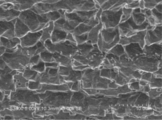
- the obtained surface-treated foil was observed according to the above-mentioned "Stainless steel foil surface observation”. The microscope image is shown in FIG. Further, when the maximum height of the surface of the obtained surface-treated foil was measured according to the above-mentioned "Measurement of surface roughness of stainless steel foil", the Rz value was 2.41 ⁇ m and the Ra value was 0.46 ⁇ m. .. The etching rate was 1.05 ⁇ m / min.
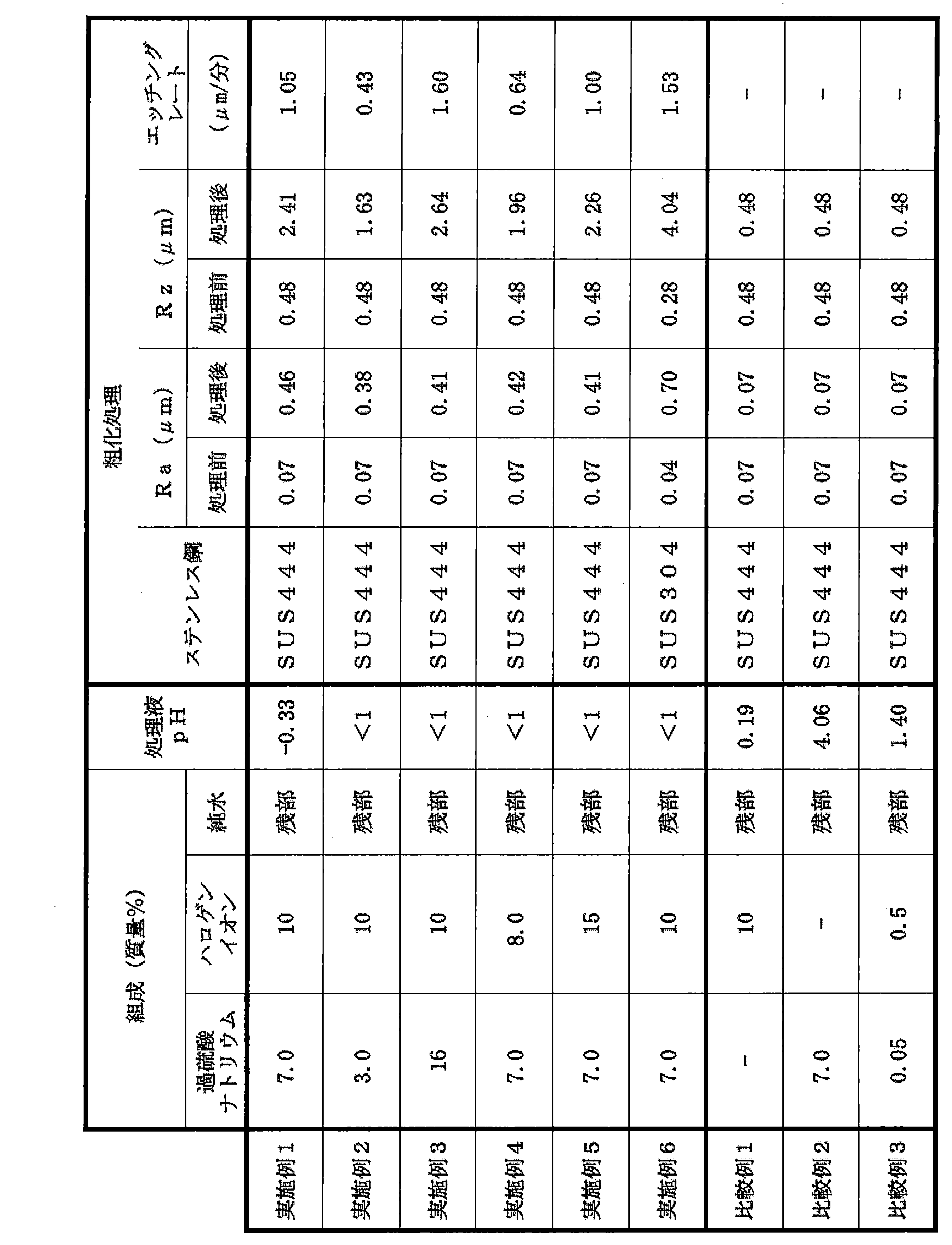
- Example 2 to 5 As shown in Table 1 below, sodium persulfate and chloride ions in the composition (Cl -) the exception that the concentration of similarly treating the surface of the stainless steel foil as in Example 1, the surface roughness and the etching The rate was measured. The values of Rz, Ra, and the etching rate are as shown in Table 1.
- Example 6 As shown in Table 1 below, the stainless steel foil to be roughened was changed, and the surface of the stainless steel foil was treated in the same manner as in Example 1 to measure the surface roughness and the etching rate. The values of Rz, Ra, and the etching rate are as shown in Table 1.
- a stainless steel foil having a thickness of 20 ⁇ m, a length and a width of 30 mm ⁇ 30 mm, and a material of SUS444 was prepared.
- a composition was prepared by adding 28% by mass (57 g) of a 35 wt% aqueous solution of hydrochloric acid to 143 ml of ultrapure water.
- the stainless steel foil was first immersed in the composition at a liquid temperature of 45 ° C. for 60 seconds. Then, the stainless steel foil after immersion was thoroughly washed with ultrapure water and then sufficiently dried to obtain a surface-treated foil. Further, when the maximum height of the surface of the obtained surface-treated foil was measured according to the above-mentioned "Measurement of surface roughness of stainless steel foil", it was not observed that the surface was roughened, and the values of Ra and Rz were not observed. Has not changed since before processing.
- the stainless steel foil was first immersed in the composition at a liquid temperature of 45 ° C. for 60 seconds. Then, the stainless steel foil after immersion was thoroughly washed with ultrapure water and then sufficiently dried to obtain a surface-treated foil.
- the maximum height of the surface of the obtained surface-treated foil was measured according to the above-mentioned "Measurement of surface roughness of stainless steel foil", it was not seen that the surface was roughened, and the values of Ra and Rz were treated. It hasn't changed since before.
- the aqueous composition in which the persulfate component and the halide ion are used in combination within a predetermined range enables efficient roughening treatment of stainless steel.
- the surface of stainless steel can be efficiently roughened with sufficient, few steps and a short time by using a composition having a specific composition. If stainless steel having a rough surface is used for a battery current collector foil, an automobile component housing, or the like, dielectric substances and organic substances can be effectively attached and retained. Further, as a member for dissipating heat, stainless steel having a roughened surface can be preferably used. Further, since efficient roughening is realized with a composition of a relatively small number of active ingredients, according to the present invention, it is possible to reduce the cost of stainless steel treatment. Therefore, the present invention has industrial applicability in the field of surface roughening treatment of material members, for example, stainless steel used in the above products.
Landscapes
- Chemical & Material Sciences (AREA)
- Chemical Kinetics & Catalysis (AREA)
- General Chemical & Material Sciences (AREA)
- Engineering & Computer Science (AREA)
- Materials Engineering (AREA)
- Electrochemistry (AREA)
- Mechanical Engineering (AREA)
- Metallurgy (AREA)
- Organic Chemistry (AREA)
- Composite Materials (AREA)
- ing And Chemical Polishing (AREA)
Abstract
Description
[1]ステンレス鋼の表面を粗化するための組成物であって、
過硫酸および過硫酸塩からなる群より選択される1種以上を、前記組成物の全量基準で0.1~25質量%含み、
ハロゲン化物イオンを、前記組成物の全量基準で、1~30質量%含む、組成物。
[2]前記過硫酸塩が、過硫酸のアルカリ金属塩を含む、上記[1]に記載の組成物。
[3]前記過硫酸のアルカリ金属塩が、過硫酸ナトリウムまたは過硫酸カリウムのいずれか1種以上を含む、上記[2]に記載の組成物。
[4]前記ハロゲン化物イオンを供給する化合物として、塩酸、塩化ナトリウム、および塩化カリウムからなる群より選択される1種以上を含む、上記[1]~[3]のいずれかに記載の組成物。
[5]水をさらに含み、pHの値が-1.5以上4.0以下である、上記[1]~[4]のいずれかに記載の組成物。
[6]銅イオンをさらに含む、上記[1]~[5]のいずれかに記載の組成物。
[8]前記粗化処理の温度が、20~60℃である、上記[7]に記載のステンレス鋼の粗化処理方法。
[9]前記粗化処理の時間が、30秒間~180秒間である、上記[7]又は[8]に記載のステンレス鋼の粗化処理方法。
[10]粗化処理されたステンレス鋼の表面のJIS B 0601-2001で規定される最大高さ(Rz)が1.0μm以上である、上記[7]~[9]のいずれかに記載のステンレス鋼の粗化処理方法。
[11]粗化処理されたステンレス鋼の表面のJIS B 0601-2001で規定される最大高さ(Rz)が5.0μm以下である、上記[7]~[10]のいずれかに記載のステンレス鋼の粗化処理方法。
[12]粗化処理されたステンレス鋼の表面のJIS B 0601-2001で規定される最大高さ(Rz)の値が、未処理のステンレス鋼の表面の最大高さ(Rz)の値よりも0.5μm以上大きい、[7]~[11]のいずれかに記載のステンレス鋼の粗化処理方法。
[13]粗化処理されたステンレス鋼の表面のJIS B 0601-2001で規定される算術平均粗さ(Ra)が0.1μm以上である、上記[7]~[12]のいずれかに記載のステンレス鋼の粗化処理方法。
[14]粗化処理されたステンレス鋼の表面のJIS B 0601-2001で規定される算術平均粗さ(Ra)が2.0μm以下である、上記[7]~[13]のいずれかに記載のステンレス鋼の粗化処理方法。
[15]粗化処理されたステンレス鋼の表面のJIS B 0601-2001で規定される算術平均粗さ(Ra)が、未処理のステンレス鋼の平面の算術平均粗さ(Ra)よりも0.05μm以上大きい、上記[7]~[14]のいずれかに記載のステンレス鋼の粗化処理方法。
[16]前記粗化処理における前記ステンレス鋼のエッチングレートが0.1μm/分以上である、上記[7]~[15]のいずれかに記載のステンレス鋼の粗化処理方法。
[18]粗化処理されたステンレス鋼の表面のJIS B 0601-2001で規定される最大高さ(Rz)が1.0μm以上である、上記[17]に記載の粗化ステンレス鋼。
[19]粗化処理されたステンレス鋼の表面のJIS B 0601-2001で規定される最大高さ(Rz)が5.0μm以下である、上記[17]又は[18]に記載の粗化ステンレス鋼。
[20]粗化処理されたステンレス鋼の表面のJIS B 0601-2001で規定される算術平均粗さ(Ra)が0.1μm以上である、上記[17]~[19]のいずれかに記載の粗化ステンレス鋼。
[21]粗化処理されたステンレス鋼の表面のJIS B 0601-2001で規定される算術平均粗さ(Ra)が2.0μm以下である、上記[17]~[20]のいずれかに記載の粗化ステンレス鋼。
[22]前記ステンレス鋼が、JIS G 4305規格にて定められる、
SUS304,SUS316,SUS321,SUS347,およびSUS329J1を含むクロム・ニッケルステンレス;
SUS403,SUS410,SUS420J1,SUS420J2,SUS440A,SUS440B,およびSUS440C,を含むマルテンサイト系ステンレス(クロムステンレス);
SUS405,SUS430,SUS434,SUS444,SUS447,SUSXM27を含むフェライト系ステンレス(クロムステンレス);および、
SUS630、SUS631、SUH660を含む析出硬化系(クロム・ニッケルステンレス);
からなる群より選択される1種以上である、上記[17]~[21]のいずれかに記載の粗化ステンレス鋼。
[23]前記ステンレス鋼が、ステンレス鋼箔である、上記[17]~[22]のいずれかに記載の粗化ステンレス鋼。
[24]上記[17]~[21]のいずれかに記載の粗化ステンレス鋼を含む、電池用集電箔、太陽電池基材、電子デバイス用フレキシブル基板、蓄電デバイス用基板、触媒担体、電磁波シールド部材、又は放熱部材。
[26]粗化処理されたステンレス鋼の表面のJIS B 0601-2001で規定される最大高さ(Rz)が1.0μm以上である、上記[25]に記載の粗化ステンレス鋼の製造方法。
[27]粗化処理されたステンレス鋼の表面のJIS B 0601-2001で規定される最大高さ(Rz)が5.0μm以下である、上記[25]又は[26]に記載の粗化ステンレス鋼の製造方法。
[28]粗化処理されたステンレス鋼の表面のJIS B 0601-2001で規定される算術平均粗さ(Ra)が0.1μm以上である、上記[25]~[27]のいずれかに記載の粗化ステンレス鋼の製造方法。
[29]粗化処理されたステンレス鋼の表面のJIS B 0601-2001で規定される算術平均粗さ(Ra)が2.0μm以下である、上記[25]~[28]のいずれかに記載の粗化ステンレス鋼の製造方法。
[30]粗化処理されたステンレス鋼の表面のJIS B 0601-2001で規定される算術平均粗さ(Ra)が、未処理のステンレス鋼の平面の算術平均粗さ(Ra)よりも0.05μm以上大きい、上記[25]~[29]のいずれかに記載の粗化ステンレス鋼の製造方法。
[31]前記粗化処理における前記ステンレス鋼のエッチングレートが0.1μm/分以上である、上記[25]~[30]のいずれかに記載の粗化ステンレス鋼の製造方法。
[32]前記ステンレス鋼が、JIS G 4305規格にて定められる、
SUS304,SUS316,SUS321,SUS347,およびSUS329J1を含むクロム・ニッケルステンレス;
SUS403,SUS410,SUS420J1,SUS420J2,SUS440A,SUS440B,およびSUS440Cを含むマルテンサイト系ステンレス(クロムステンレス);
SUS405,SUS430,SUS434,SUS444,SUS447,SUSXM27を含むフェライト系ステンレス(クロムステンレス);および、
SUS630、SUS631、SUH660を含む析出硬化系(クロム・ニッケルステンレス);
からなる群より選択される1種以上である、上記[25]~[31]のいずれかに記載の粗化ステンレス鋼の製造方法。
[33]前記ステンレス鋼が、ステンレス鋼箔である、上記[25]~[32]のいずれかに記載の粗化ステンレス鋼の製造方法。
[34]上記[25]~[33]のいずれかに記載の製造方法で製造された粗化ステンレス鋼を含む、電池用集電箔、太陽電池基材、電子デバイス用フレキシブル基板、蓄電デバイス用基板、触媒担体、電磁波シールド部材、又は放熱部材。
本発明の組成物は、金属表面の粗化処理、すなわち、金属表面を粗くして凹凸を拡大するための処理に好適に用いられる。本発明の組成物を用いて粗化処理を行う対象としては、各種金属および合金が挙げられるが、好ましい対象としては、詳細を後述する各種のステンレス鋼が挙げられる。
本発明の組成物は、いずれも組成物の全量基準で、0.1~25質量%の過硫酸および過硫酸塩からなる群より選択される1種以上と、1~30質量%のハロゲン化物イオンを含む。組成物は、好ましくは水溶性であり、上述の成分以外にも、水、特に、イオン交換水または超純水を含む、水性組成物であることが特に好ましい。
以下に、本発明の組成物(好ましくは水性組成物)の各成分について説明する。
本発明の組成物においては、過硫酸および過硫酸塩からなる群より選択される1種以上が含まれる。すなわち、組成物において、過硫酸あるいは過硫酸塩のいずれか一方のみを用いてもよく、過硫酸と、過硫酸塩のいずれかとを用いてもよく、さらに過硫酸塩は1種を単独で用いてもよく、2種以上を併用してもよい。
過硫酸(H2SO5)は、公知の手法、例えば、硫酸またはクロロ硫酸に過酸化物を作用させることにより、生成するものを用いることができる。
また、過硫酸塩は、例えば、過硫酸に所定の対イオンを含む化合物を添加して、生成するものを用いることができる。また、登録特許3778238号公報に記載されているように、硫酸アンモニウムの電解液に水酸化ナトリウムを作用させて得ることができる。
過硫酸の金属塩としては、アルカリ金属塩、アルカリ土類金属塩が好ましく、アルカリ金属塩がより好ましく、より好ましい具体例としては、過硫酸ナトリウム、過硫酸カリウム、モノ過硫酸水素カリウム複塩(2KHSO5・KHSO4・K2SO4;オキソン)等が挙げられ、なかでも、過硫酸ナトリウム、過硫酸カリウムがことさら好ましく、過硫酸ナトリウムが特に好ましい。
過硫酸の無機化合物の塩としては、例えば、過硫酸アンモニウムが挙げられる。
以下、本明細書においては、上述した過硫酸と過硫酸塩とをまとめて過硫酸成分ともいう。
組成物において、過硫酸成分の含有量(濃度)、特に過硫酸ナトリウムの含有量(濃度)が上述の範囲内であれば、過硫酸成分の溶解性が良好であるとともに、粗化処理の効率化を図ることができる。
なお、過硫酸成分の含有量の範囲は、上述の上限値と下限値を含んでいても良く(すなわち、上限値以下、あるいは下限値以上の範囲)、上限値と下限値は含まなくても良く(すなわち、上限値未満、あるいは下限値よりも多い範囲)、過硫酸成分の含有量の範囲以外の範囲についても同様である。
また、過硫酸成分と異なる過酸化物を用いる場合においても、組成物中の過酸化物の合計の含有量は、上述の過硫酸成分の含有量と同様であることが好ましい。
本発明の組成物に含まれるハロゲン化物イオンの種類は、特に限定されず、例えば、フッ化物イオン(F-)、塩化物イオン(Cl-)、臭化物イオン(Br-)、ヨウ化物イオン(I-)であってよいが、塩化物イオンが、粗化処理の効率、取扱い容易性、経済性の観点から、好ましい。
また、組成物に含まれるハロゲン化物イオンの濃度の下限値は、例えば、1.5質量%、2.0質量%、3.0質量%、4.0質量%、5.0質量%、6.0質量%、7.0質量%、8.0質量%、9.0質量%等であってもよく、組成物に含まれるハロゲン化物イオンの濃度の上限値は、例えば、27質量%、25質量%、22質量%、20質量%、19質量%、18質量%、17質量%、16質量%、15質量%、14質量%、13質量%、12質量%等であってもよい。 組成物において、ハロゲン化物イオンの含有量(濃度)が上述の範囲内であれば、粗化処理の効率化を図ることができる。
本発明の組成物は、水を含んでいてもよく、水を含むことが好ましい。水としては、特に限定されないが、蒸留、イオン交換処理、フイルター処理、各種吸着処理などによって、金属イオンや有機不純物、パーテイクルなどが除去されたものが好ましく、純水がより好ましく、超純水が特に好ましい。
なお、本発明の組成物は溶解液であることが好ましく、溶解液である組成物に対する非溶解性の成分、例えば、研磨粒子等の固形粒子は含有しないことが好ましい。
本発明の組成物には、上述の過硫酸成分、過酸化物、および、ハロゲン化物イオン以外の活性成分を加えても良い。例えば、ステンレス鋼の成分であるニッケルとクロムに対する置換反応を生じさせ得る成分として、銅イオンを組成物に添加してもよい。銅イオン源の種類については、組成物において銅イオンを供給できる銅化合物であれば、特に限定されるものではない。
例えば、銅イオンを供給できる銅化合物としては、無水物であってもよく水和物(例えば五水和物)であってもよい、硫酸第二銅等の硫酸銅、塩化第二銅等の塩化銅、テトラフルオロホウ酸銅、臭化第二銅、酸化第二銅、リン酸銅、酢酸銅、蟻酸銅、硝酸銅等が挙げられる。これらの中で、硫酸銅または塩化銅が好ましく、硫酸第二銅または塩化第二銅がより好ましく、硫酸第二銅がさらに好ましい。これらは、1種を単独で、又は、2種以上を組み合わせて用いられる。
本発明の組成物は、本発明の効果を発揮する範囲で、上述の過硫酸成分、ハロゲン化物イオン等の活性成分の他に、添加剤を含んでいてもよい。添加剤としては、例えば、複素環窒素化合物(アゾール系化合物)、有機溶剤等が挙げられる。これらは1種を単独で、又は、2種以上を組み合わせて用いられる。
また、添加剤として界面活性剤、pH調整剤等も挙げられるが、これらは本発明の組成物に含まれない方が好ましい。
本発明の組成物に含まれていてもよい添加剤の含有量は、組成物の全量を基準として、10質量%以下であることが好ましく、より好ましくは5.0質量%以下であり、さらに好ましくは、2.0質量%以下であり、特に好ましくは、1.0質量%以下である。
上述の各成分を含む組成物は、ステンレス鋼表面の粗化処理において、以下のように機能するものと考えられる。
ハロゲン化物イオンは、ステンレス鋼の表面に通常、形成されている酸化膜を孔食する役割を担う。
過硫酸成分は、酸性水溶液中でステンレス鋼の金属成分を酸化してイオン化させ、腐食反応を起こす役割を担う。腐食反応がステンレス鋼上で不規則に発現することにより、粗化形状が発現する。また、過硫酸成分以外の過酸化物、例えば、過酢酸も過硫酸成分と同様の役目を果たし得るものと考えられる。
組成物の性状については、特に限定されないが、pH値は、-1.5~4.0であることが好ましく、より好ましくは、-1.0~3.0であり、さらに好ましくは、-0.75~2.5であり、特に好ましくは、-0.5~2.0である。組成物のpH値は、例えば1.0未満である。pH値は、実施例に記載の方法で測定することができる。
本発明のステンレス鋼の粗化処理方法においては、上述の組成物を用いてステンレス鋼表面の粗化処理を行う粗化工程が行われる。
具体的には、本発明にて行われる粗化工程は、上述した組成物とステンレス鋼とを接触させることを含む。組成物とステンレス鋼の接触の方法は、特に限定されないが、例えば、本発明の組成物に処理対象のステンレス鋼を浸漬させる方法、本発明の組成物を処理対象のステンレス鋼に滴下する方法(枚葉スピン処理)、本発明の組成物を処理対象のステンレス鋼に噴霧する方法(スプレー処理)等が挙げられ、いずれの方法を採用してもよい。例えば、特定形状に加工されたステンレス鋼に本発明の組成物を噴霧して粗化処理されたステンレス鋼を得る方法や、ステンレス鋼箔ロール間に本発明の組成物の滴下装置、噴霧装置または浸漬装置を設置して、ロールtoロールの手法により、未処理のステンレス鋼箔が巻き付けられていたロールからステンレス鋼箔を広げて移動させる間に、上記装置の付近を通過させて組成物を供給し、粗化処理されたステンレス鋼箔を巻き取ってロールを得る方法などが挙げられる。
また、粗化工程においては、粗化処理の時間が、30秒間~180秒間であることが好ましく、30秒間~120秒間であることがより好ましく、40秒間~100秒間であることがさらに好ましく、50秒間~90秒間であることが特に好ましい。このように、さほど長時間でなくともステンレス鋼の粗化が進行する点で、本発明のステンレス鋼の粗化処理方法は優れている。ここで、粗化処理の時間とは、組成物とステンレス鋼表面とを接触させる時間のことをいう。例えば、ステンレス鋼を組成物に浸漬させている時間や、ステンレス鋼の表面に組成物を噴霧したときから、水等により水性組成物を除去するときまでの時間である。
また、粗化処理されたステンレス鋼表面の最大高さ(Rz)の上限値は、特に限定されるものではないが、例えば、Rzの値は10.0μm以下であり、7.0μm以下、5.0μm以下であってもよい。
なお、粗化処理が施されていない状態のステンレス鋼(未処理のステンレス鋼)の表面の最大高さ(Rz)は、特に限定されるものではないが、例えば、0.1~2.0μm、0.2~2.0μm、0.4~2.0μm、または1.0~1.5μmほどである。
また、粗化ステンレス鋼の表面の算術平均粗さ(Ra)の上限値は、特に限定されるものではないが、例えば、2.0μm以下であり、1.5μm以下、または1.0μm以下であってもよい。
なお、未処理のステンレス鋼の算術平均粗さ(Ra)は、特に限定されるものではないが、例えば、0.01~0.3μm、あるいは、0.05~0.3μmである。
例えば、ステンレス鋼の表面を形成する結晶の微細化のためのウェットピーニング等の処理が不要である本発明によれば、より簡便な方法で速やかにステンレス鋼の表面を粗化させることができる。
本発明の組成物による粗化処理の対象となるステンレス鋼の種類については、特に限定されないが、例えば、以下のものが挙げられる。
すなわち、JISG4305規格にて定められる、
SUS304,SUS316,SUS321,SUS347,およびSUS329J1を含むクロム・ニッケルステンレス;
SUS403,SUS410,SUS420J1,SUS420J2,SUS440A,SUS440B,およびSUS440C,を含むマルテンサイト系ステンレス(クロムステンレス);
SUS405,SUS430,SUS434,SUS444,SUS447,SUSXM27を含むフェライト系ステンレス(クロムステンレス);
SUS630、SUS631、SUH660を含む析出硬化系(クロム・ニッケルステンレス)等である。
また、粗化処理の対象となるステンレス鋼のサイズ、厚さ、形状は特に限定されず、例えば、ステンレス鋼箔に対して行うこともできる。粗化処理の対象となるステンレス鋼箔の厚さは、特に限定されるものではないが、例えば、1μm以上500μm以下であり、好ましくは、10μm以上100μm以下である。
また、粗化処理されたステンレス鋼表面の最大高さ(Rz)の上限値は、特に限定されるものではないが、例えば、10.0μm以下であり、7.0μm以下、5.0μm以下、または4.0μm以下であってもよい。
粗化ステンレス鋼の表面の算術平均粗さ(Ra)は、例えば、0.1μm以上であり、0.15μm以上であることが好ましく、0.2μm以上であることがより好ましく、0.3μm以上であることがさらに好ましく、0.4μm以上であることがことさら好ましい。
また、粗化ステンレス鋼の表面の算術平均粗さ(Ra)の上限値は、特に限定されるものではないが、例えば、0.70μm以下であり、好ましくは0.50μm以下である。
本発明のステンレス鋼の製造方法は、少なくとも、上述の粗化工程を有する。本発明のステンレス鋼の製造方法によれば、粗化処理の前よりも表面が粗い、すなわち、凹凸が処理前の表面よりも拡大された表面を有するステンレス鋼が製造できる。
本発明のステンレス鋼の製造方法の対象となるステンレス鋼は、上記[3.ステンレス鋼]の欄で述べたとおりである。
本発明のステンレス鋼の製造方法によって得られる粗化処理されたステンレス鋼表面の最大高さ(Rz)および算術平均粗さ(Ra)は、上記[2.ステンレス鋼の粗化処理方法]または[3.ステンレス鋼]の欄で述べたとおりである。
本発明のステンレス鋼の製造方法によって得られる粗化処理されたステンレス鋼は、例えば、固体電池やリチウムイオン電池などの電池用集電箔、太陽電池基材、電子デバイス用フレキシブル基板、蓄電デバイス用基板、排気ガス浄化触媒等の担体、電磁波シールド部材、及び放熱部材などの用途に用いることができる。本発明のステンレス鋼の製造方法によって得られる粗化処理されたステンレス鋼箔は、例えば、電池用集電箔として好適に用いられる。
原料のステンレス鋼箔、ならびに、実施例および比較例で得られた表面処理箔について、レーザー顕微鏡(株式会社キーエンス製、製品名「VK-X250」)を用いて、JIS B 0601-2001に準じた最大高さ(Rz)および算術平均粗さ(Ra)を測定した。
実施例および比較例で得られた表面処理箔について、走査型電子顕微鏡(株式会社日立ハイテクノロジーズ製、製品名「S-3400N」)を用いて、表面形状を観察した。
実施例および比較例における組成物のpH値は、25℃にて、pHメーター(株式会社堀場製作所製pHメーターF-52)を使用して測定した。
実施例および比較例で得られた表面処理箔について、組成物による処理前後のステンレス鋼箔の質量差(D)を、用いたステンレス鋼箔の面積S(組成物による処理面積)、ステンレス鋼箔の密度(ρ)、および、処理時間(T)で除することにより、E.R.の値(μm/分)を算出した。
すなわち、E.R.の値の算出は、下記式(1)の通りである。なお、式(1)により直接、算出されるE.R.の値の単位は(cm/分)であるが、(μm/分)の単位に変換した値を下記表1等に示した。

厚さが20μm、縦と横の長さが30mm×30mmであり、材質がSUS444であるステンレス鋼箔を準備した。上記「ステンレス鋼箔の表面粗さの測定」に従って測定した、当該ステンレス鋼箔のRzは、0.48μm、Raは、0.07μmであった。
129mlの超純水に、過硫酸ナトリウムを7質量%(14g)、塩酸の35wt%水溶液を28質量%(57g)、それぞれ添加した組成物を準備した。塩酸に由来するハロゲン化物イオン(Cl-)の濃度は、組成物全量基準で10質量%であった。
以下の表1に示すように、組成物における過硫酸ナトリウム及び塩化物イオン(Cl-)の濃度を変更した他、実施例1と同様にステンレス鋼箔の表面を処理し、表面粗さ及びエッチングレートを測定した。Rz、Ra、エッチングレートの値は、表1に記載したとおりである。
以下の表1に示すように、粗化処理の対象となるステンレス鋼箔を変更した他、実施例1と同様にステンレス鋼箔の表面を処理し、表面粗さ及びエッチングレートを測定した。Rz、Ra、エッチングレートの値は、表1に記載したとおりである。
厚さが20μm、縦と横の長さが30mm×30mmであり、材質がSUS444であるステンレス鋼箔を準備した。
143mlの超純水に、塩酸の35wt%水溶液を28質量%(57g)添加した組成物を準備した。
厚さが20μm、縦と横の長さが30mm×30mmであり、材質がSUS444であるステンレス鋼箔を準備した。
186mlの超純水に、過硫酸ナトリウムを7質量%(14g)添加した組成物を準備した。
以下の表1に示すように、組成物における過硫酸ナトリウム及び塩化物イオン(Cl-)の濃度を変更した他、上述の比較例と同様にステンレス鋼箔の表面を処理した。
その結果、表面が粗化されている様子が見られず、Ra、Rzの値は処理前から変化していなかった。
本発明によれば、特定の組成の組成物を用いることにより、ステンレス鋼の表面を、十分に、かつ少ない工程と短い時間で効率的に粗化させることができる。そしてこのように、表面を粗くしたステンレス鋼を、電池集電箔、自動車部品筐体等に用いれば、誘電物質や有機物を効果的に付着、および、保持させることができる。また放熱させるための部材においても、表面が粗化されたステンレス鋼が好適に用いられ得る。
また、比較的、少ない種類の活性成分の組成物で効率的な粗化が実現されるため、本発明によれば、ステンレス処理のコスト低減も可能にする。
よって本発明は、材料の部材、例えば上記製品にて用いられるステンレス鋼の表面の粗化処理の分野において、産業上の利用可能性がある。
Claims (34)
- ステンレス鋼の表面を粗化するための組成物であって、
過硫酸および過硫酸塩からなる群より選択される1種以上を、前記組成物の全量基準で0.1~25質量%含み、
ハロゲン化物イオンを、前記組成物の全量基準で、1~30質量%含む、
組成物。 - 前記過硫酸塩が、過硫酸のアルカリ金属塩を含む、請求項1に記載の組成物。
- 前記過硫酸のアルカリ金属塩が、過硫酸ナトリウムまたは過硫酸カリウムのいずれか1種以上を含む、請求項2に記載の組成物。
- 前記ハロゲン化物イオンを供給する化合物として、塩酸、塩化ナトリウム、および塩化カリウムからなる群より選択される1種以上を含む、請求項1~3のいずれかに記載の組成物。
- 水をさらに含み、pHの値が-1.5以上4.0以下である、請求項1~4のいずれかに記載の組成物。
- 銅イオンをさらに含む、請求項1~5のいずれかに記載の組成物。
- 請求項1~6のいずれかに記載の組成物を用いてステンレス鋼表面の粗化処理を行う粗化工程を含む、ステンレス鋼の粗化処理方法。
- 前記粗化処理の温度が、20~60℃である、請求項7に記載のステンレス鋼の粗化処理方法。
- 前記粗化処理の時間が、30秒間~180秒間である、請求項7又は8に記載のステンレス鋼の粗化処理方法。
- 粗化処理されたステンレス鋼の表面のJIS B 0601-2001で規定される最大高さ(Rz)が1.0μm以上である、請求項7~9のいずれかに記載のステンレス鋼の粗化処理方法。
- 粗化処理されたステンレス鋼の表面のJIS B 0601-2001で規定される最大高さ(Rz)が5.0μm以下である、請求項7~10のいずれかに記載のステンレス鋼の粗化処理方法。
- 粗化処理されたステンレス鋼の表面のJIS B 0601-2001で規定される最大高さ(Rz)の値が、未処理のステンレス鋼の表面の最大高さ(Rz)の値よりも0.5μm以上大きい、請求項7~11のいずれかに記載のステンレス鋼の粗化処理方法。
- 粗化処理されたステンレス鋼の表面のJIS B 0601-2001で規定される算術平均粗さ(Ra)が0.1μm以上である、請求項7~12のいずれかに記載のステンレス鋼の粗化処理方法。
- 粗化処理されたステンレス鋼の表面のJIS B 0601-2001で規定される算術平均粗さ(Ra)が2.0μm以下である、請求項7~13のいずれかに記載のステンレス鋼の粗化処理方法。
- 粗化処理されたステンレス鋼の表面のJIS B 0601-2001で規定される算術平均粗さ(Ra)が、未処理のステンレス鋼の平面の算術平均粗さ(Ra)よりも0.05μm以上大きい、請求項7~14のいずれかに記載のステンレス鋼の粗化処理方法。
- 前記粗化処理における前記ステンレス鋼のエッチングレートが0.1μm/分以上である、請求項7~15のいずれかに記載のステンレス鋼の粗化処理方法。
- 請求項1~6のいずれかに記載の組成物を用いて表面が粗化処理された、粗化ステンレス鋼。
- 粗化処理されたステンレス鋼の表面のJIS B 0601-2001で規定される最大高さ(Rz)が1.0μm以上である、請求項17に記載の粗化ステンレス鋼。
- 粗化処理されたステンレス鋼の表面のJIS B 0601-2001で規定される最大高さ(Rz)が5.0μm以下である、請求項17又は18に記載の粗化ステンレス鋼。
- 粗化処理されたステンレス鋼の表面のJIS B 0601-2001で規定される算術平均粗さ(Ra)が0.1μm以上である、請求項17~19のいずれかに記載の粗化ステンレス鋼。
- 粗化処理されたステンレス鋼の表面のJIS B 0601-2001で規定される算術平均粗さ(Ra)が2.0μm以下である、請求項17~20のいずれかに記載の粗化ステンレス鋼。
- 前記ステンレス鋼が、JIS G 4305規格にて定められる、
SUS304,SUS316,SUS321,SUS347,およびSUS329J1を含むクロム・ニッケルステンレス;
SUS403,SUS410,SUS420J1,SUS420J2,SUS440A,SUS440B,およびSUS440Cを含むマルテンサイト系ステンレス(クロムステンレス);
SUS405,SUS430,SUS434,SUS444,SUS447,SUSXM27を含むフェライト系ステンレス(クロムステンレス);および、
SUS630、SUS631、SUH660を含む析出硬化系(クロム・ニッケルステンレス);
からなる群より選択される1種以上である、請求項17~21のいずれかに記載の粗化ステンレス鋼。 - 前記ステンレス鋼が、ステンレス鋼箔である、請求項17~22のいずれかに記載の粗化ステンレス鋼。
- 請求項17~23のいずれかに記載の粗化ステンレス鋼を含む、電池用集電箔、太陽電池基材、電子デバイス用フレキシブル基板、蓄電デバイス用基板、触媒担体、電磁波シールド部材、又は放熱部材。
- 請求項1~6のいずれかに記載の組成物を用いてステンレス鋼表面の粗化処理を行う粗化工程を有する、表面が粗化処理された粗化ステンレス鋼の製造方法。
- 粗化処理されたステンレス鋼の表面のJIS B 0601-2001で規定される最大高さ(Rz)が1.0μm以上である、請求項25に記載の粗化ステンレス鋼の製造方法。
- 粗化処理されたステンレス鋼の表面のJIS B 0601-2001で規定される最大高さ(Rz)が5.0μm以下である、請求項25又は26に記載の粗化ステンレス鋼の製造方法。
- 粗化処理されたステンレス鋼の表面のJIS B 0601-2001で規定される算術平均粗さ(Ra)が0.1μm以上である、請求項25~27のいずれかに記載の粗化ステンレス鋼の製造方法。
- 粗化処理されたステンレス鋼の表面のJIS B 0601-2001で規定される算術平均粗さ(Ra)が2.0μm以下である、請求項25~28のいずれかに記載の粗化ステンレス鋼の製造方法。
- 粗化処理されたステンレス鋼の表面のJIS B 0601-2001で規定される算術平均粗さ(Ra)が、未処理のステンレス鋼の平面の算術平均粗さ(Ra)よりも0.05μm以上大きい、請求項25~29のいずれかに記載の粗化ステンレス鋼の製造方法。
- 前記粗化処理における前記ステンレス鋼のエッチングレートが0.1μm/分以上である、請求項25~30のいずれかに記載の粗化ステンレス鋼の製造方法。
- 前記ステンレス鋼が、JIS G 4305規格にて定められる、
SUS304,SUS316,SUS321,SUS347,およびSUS329J1を含むクロム・ニッケルステンレス;
SUS403,SUS410,SUS420J1,SUS420J2,SUS440A,SUS440B,およびSUS440Cを含むマルテンサイト系ステンレス(クロムステンレス);
SUS405,SUS430,SUS434,SUS444,SUS447,SUSXM27を含むフェライト系ステンレス(クロムステンレス);および、
SUS630、SUS631、SUH660を含む析出硬化系(クロム・ニッケルステンレス);
からなる群より選択される1種以上である、請求項25~31のいずれかに記載の粗化ステンレス鋼の製造方法。 - 前記ステンレス鋼が、ステンレス鋼箔である、請求項25~32のいずれかに記載の粗化ステンレス鋼の製造方法。
- 請求項25~33のいずれかに記載の製造方法で製造された粗化ステンレス鋼を含む、電池用集電箔、太陽電池基材、電子デバイス用フレキシブル基板、蓄電デバイス用基板、触媒担体、電磁波シールド部材、又は放熱部材。
Priority Applications (6)
| Application Number | Priority Date | Filing Date | Title |
|---|---|---|---|
| KR1020227003243A KR20220038075A (ko) | 2019-07-30 | 2020-07-22 | 조성물, 이것을 이용한 스테인리스강 표면의 조화처리방법, 그리고 조화처리된 스테인리스강 및 그의 제조방법 |
| US17/630,093 US20220251714A1 (en) | 2019-07-30 | 2020-07-22 | Composition, method for roughening stainless steel surface using same, roughened stainless steel, and method for producing said roughened stainless steel |
| JP2021536986A JP7673638B2 (ja) | 2019-07-30 | 2020-07-22 | 組成物、これを用いたステンレス鋼表面の粗化処理方法、ならびに粗化処理されたステンレス鋼およびその製造方法 |
| CN202080054240.3A CN114174557A (zh) | 2019-07-30 | 2020-07-22 | 组合物、使用其的不锈钢表面的粗糙化处理方法以及粗糙化处理过的不锈钢及其制造方法 |
| EP20846179.8A EP4006204A4 (en) | 2019-07-30 | 2020-07-22 | COMPOSITION, METHOD OF SURFACE Roughening STAINLESS STEEL USING THE SAME, Roughened STAINLESS STEEL, AND METHOD OF MAKING THE Roughened STAINLESS STEEL |
| US19/069,452 US20250198009A1 (en) | 2019-07-30 | 2025-03-04 | Composition, method for roughening stainless steel surface using same, roughened stainless steel, and method for producing said roughened stainless steel |
Applications Claiming Priority (2)
| Application Number | Priority Date | Filing Date | Title |
|---|---|---|---|
| JP2019139697 | 2019-07-30 | ||
| JP2019-139697 | 2019-07-30 |
Related Child Applications (2)
| Application Number | Title | Priority Date | Filing Date |
|---|---|---|---|
| US17/630,093 A-371-Of-International US20220251714A1 (en) | 2019-07-30 | 2020-07-22 | Composition, method for roughening stainless steel surface using same, roughened stainless steel, and method for producing said roughened stainless steel |
| US19/069,452 Division US20250198009A1 (en) | 2019-07-30 | 2025-03-04 | Composition, method for roughening stainless steel surface using same, roughened stainless steel, and method for producing said roughened stainless steel |
Publications (1)
| Publication Number | Publication Date |
|---|---|
| WO2021020253A1 true WO2021020253A1 (ja) | 2021-02-04 |
Family
ID=74228567
Family Applications (1)
| Application Number | Title | Priority Date | Filing Date |
|---|---|---|---|
| PCT/JP2020/028359 Ceased WO2021020253A1 (ja) | 2019-07-30 | 2020-07-22 | 組成物、これを用いたステンレス鋼表面の粗化処理方法、ならびに粗化処理されたステンレス鋼およびその製造方法 |
Country Status (6)
| Country | Link |
|---|---|
| US (2) | US20220251714A1 (ja) |
| EP (1) | EP4006204A4 (ja) |
| JP (1) | JP7673638B2 (ja) |
| KR (1) | KR20220038075A (ja) |
| CN (1) | CN114174557A (ja) |
| WO (1) | WO2021020253A1 (ja) |
Cited By (2)
| Publication number | Priority date | Publication date | Assignee | Title |
|---|---|---|---|---|
| WO2022131188A1 (ja) * | 2020-12-15 | 2022-06-23 | 三菱瓦斯化学株式会社 | 水性組成物、これを用いたステンレス鋼表面の粗化処理方法、ならびに粗化ステンレス鋼の製造方法 |
| WO2022131187A1 (ja) * | 2020-12-15 | 2022-06-23 | 三菱瓦斯化学株式会社 | ステンレス鋼表面の粗化処理方法、粗化ステンレス鋼製造方法、及び、これらの方法で用いられる水性組成物 |
Citations (7)
| Publication number | Priority date | Publication date | Assignee | Title |
|---|---|---|---|---|
| JPS5020951B1 (ja) * | 1970-06-08 | 1975-07-18 | ||
| JPS58124468U (ja) * | 1982-02-19 | 1983-08-24 | 日本電気株式会社 | パ−マロイエツチング液 |
| JPH04246177A (ja) * | 1991-01-30 | 1992-09-02 | Toppan Printing Co Ltd | リードフレームの部分メッキ粗面化処理方法 |
| JP3778238B2 (ja) | 1997-12-24 | 2006-05-24 | 三菱瓦斯化学株式会社 | 過硫酸ナトリウムの製造方法 |
| JP2011168017A (ja) | 2010-02-22 | 2011-09-01 | Nisshin Steel Co Ltd | ステンレス鋼板と熱可塑性樹脂組成物の成形体とが接合された複合体、およびその製造方法 |
| JP2012526200A (ja) * | 2009-05-06 | 2012-10-25 | マクダーミッド アキューメン インコーポレーテッド | 金属面に対する高分子材料の接着力改善方法 |
| JP2015183239A (ja) | 2014-03-25 | 2015-10-22 | 株式会社日立製作所 | ステンレス鋼の表面加工方法とそれを用いた熱交換器 |
Family Cites Families (13)
| Publication number | Priority date | Publication date | Assignee | Title |
|---|---|---|---|---|
| IT1312556B1 (it) * | 1999-05-03 | 2002-04-22 | Henkel Kgaa | Processo di decapaggio di acciaio inossidabile in assenza di acidonitrico ed in presenza di ioni cloruro |
| KR100777171B1 (ko) * | 2002-10-15 | 2007-11-16 | 헨켈 코만디트게젤샤프트 아우프 악티엔 | 강 및 스테인레스강을 위한 산세 또는 광택/부동태화 용액및 방법 |
| JP4864356B2 (ja) * | 2005-06-22 | 2012-02-01 | 新日本製鐵株式会社 | ステンレス鋼、チタンまたはチタン合金製固体高分子型燃料電池用セパレータとその製造方法およびセパレータのそり・ひねり評価方法 |
| CN101445931A (zh) * | 2007-07-06 | 2009-06-03 | 德普伊产品公司 | 微观结构移植物及其制造方法 |
| US20090008365A1 (en) * | 2007-07-06 | 2009-01-08 | Depuy Products, Inc. | Microtextured Implants and Methods of Making Same |
| JP5398549B2 (ja) * | 2008-01-15 | 2014-01-29 | 三菱製紙株式会社 | 銅または銅合金用のエッチング液、エッチング前処理液およびエッチング方法 |
| US20100252530A1 (en) * | 2009-04-03 | 2010-10-07 | E. I. Du Pont De Nemours And Company | Etchant composition and method |
| JP5051323B2 (ja) * | 2010-02-15 | 2012-10-17 | 三菱瓦斯化学株式会社 | 銅層及びモリブデン層を含む多層薄膜用エッチング液 |
| CN104149480B (zh) * | 2014-08-18 | 2015-10-21 | 兴科电子科技有限公司 | 一种无胶型、高结合力的不锈钢与塑料的复合体的制备方法 |
| CN104233302B (zh) * | 2014-09-15 | 2016-09-14 | 南通万德科技有限公司 | 一种蚀刻液及其应用 |
| KR101963179B1 (ko) * | 2015-07-30 | 2019-03-29 | 삼성디스플레이 주식회사 | 식각액 조성물 및 이를 이용한 박막 트랜지스터 기판의 제조방법 |
| CN105039987B (zh) * | 2015-08-18 | 2018-08-21 | 广东富行洗涤剂科技有限公司 | 一种不锈钢的蚀刻液组合物 |
| KR101715106B1 (ko) * | 2015-11-18 | 2017-03-10 | 두산중공업 주식회사 | 스테인리스 강의 결정입도 현출용 부식액 및 이를 이용한 스테인리스 강의 결정입도 현출방법 |
-
2020
- 2020-07-22 KR KR1020227003243A patent/KR20220038075A/ko not_active Ceased
- 2020-07-22 WO PCT/JP2020/028359 patent/WO2021020253A1/ja not_active Ceased
- 2020-07-22 EP EP20846179.8A patent/EP4006204A4/en active Pending
- 2020-07-22 CN CN202080054240.3A patent/CN114174557A/zh active Pending
- 2020-07-22 US US17/630,093 patent/US20220251714A1/en not_active Abandoned
- 2020-07-22 JP JP2021536986A patent/JP7673638B2/ja active Active
-
2025
- 2025-03-04 US US19/069,452 patent/US20250198009A1/en active Pending
Patent Citations (7)
| Publication number | Priority date | Publication date | Assignee | Title |
|---|---|---|---|---|
| JPS5020951B1 (ja) * | 1970-06-08 | 1975-07-18 | ||
| JPS58124468U (ja) * | 1982-02-19 | 1983-08-24 | 日本電気株式会社 | パ−マロイエツチング液 |
| JPH04246177A (ja) * | 1991-01-30 | 1992-09-02 | Toppan Printing Co Ltd | リードフレームの部分メッキ粗面化処理方法 |
| JP3778238B2 (ja) | 1997-12-24 | 2006-05-24 | 三菱瓦斯化学株式会社 | 過硫酸ナトリウムの製造方法 |
| JP2012526200A (ja) * | 2009-05-06 | 2012-10-25 | マクダーミッド アキューメン インコーポレーテッド | 金属面に対する高分子材料の接着力改善方法 |
| JP2011168017A (ja) | 2010-02-22 | 2011-09-01 | Nisshin Steel Co Ltd | ステンレス鋼板と熱可塑性樹脂組成物の成形体とが接合された複合体、およびその製造方法 |
| JP2015183239A (ja) | 2014-03-25 | 2015-10-22 | 株式会社日立製作所 | ステンレス鋼の表面加工方法とそれを用いた熱交換器 |
Non-Patent Citations (1)
| Title |
|---|
| See also references of EP4006204A4 |
Cited By (4)
| Publication number | Priority date | Publication date | Assignee | Title |
|---|---|---|---|---|
| WO2022131188A1 (ja) * | 2020-12-15 | 2022-06-23 | 三菱瓦斯化学株式会社 | 水性組成物、これを用いたステンレス鋼表面の粗化処理方法、ならびに粗化ステンレス鋼の製造方法 |
| WO2022131187A1 (ja) * | 2020-12-15 | 2022-06-23 | 三菱瓦斯化学株式会社 | ステンレス鋼表面の粗化処理方法、粗化ステンレス鋼製造方法、及び、これらの方法で用いられる水性組成物 |
| US12351922B2 (en) | 2020-12-15 | 2025-07-08 | Mitsubishi Gas Chemical Company, Inc. | Roughening treatment method for stainless steel surface, method for manufacturing roughened stainless steel, and aqueous composition used in said methods |
| US12590373B2 (en) | 2020-12-15 | 2026-03-31 | Mitsubishi Gas Chemical Company, Inc. | Aqueous composition, stainless steel surface roughening method using same, and method for manufacturing roughened stainless steel |
Also Published As
| Publication number | Publication date |
|---|---|
| JP7673638B2 (ja) | 2025-05-09 |
| JPWO2021020253A1 (ja) | 2021-02-04 |
| US20250198009A1 (en) | 2025-06-19 |
| US20220251714A1 (en) | 2022-08-11 |
| KR20220038075A (ko) | 2022-03-25 |
| CN114174557A (zh) | 2022-03-11 |
| EP4006204A4 (en) | 2023-06-21 |
| EP4006204A1 (en) | 2022-06-01 |
Similar Documents
| Publication | Publication Date | Title |
|---|---|---|
| JP6908207B2 (ja) | 水性組成物、これを用いたステンレス鋼表面の粗化処理方法、ならびに粗化処理されたステンレス鋼およびその製造方法 | |
| WO2022131188A1 (ja) | 水性組成物、これを用いたステンレス鋼表面の粗化処理方法、ならびに粗化ステンレス鋼の製造方法 | |
| US20250198009A1 (en) | Composition, method for roughening stainless steel surface using same, roughened stainless steel, and method for producing said roughened stainless steel | |
| US3756957A (en) | Solutions for chemical dissolution treatment of metallic materials | |
| WO2024058250A1 (ja) | 水性組成物、これを用いたステンレス鋼の製造方法ならびに薄膜化処理方法 | |
| WO2024058249A1 (ja) | ステンレス鋼の製造方法、軽量化処理方法、ステンレス鋼及び水性組成物 | |
| JP2005146358A (ja) | チタンまたはチタン合金のエッチング液 | |
| US12351922B2 (en) | Roughening treatment method for stainless steel surface, method for manufacturing roughened stainless steel, and aqueous composition used in said methods | |
| JP6100281B2 (ja) | ステンレス鋼の酸洗いにおける窒素化合物の使用 | |
| JP6255209B2 (ja) | 銅箔の防錆方法、防錆液、及び銅箔 | |
| WO2026014394A1 (ja) | 水性組成物、ステンレス鋼開孔箔およびその製造方法 | |
| WO2026014395A1 (ja) | 水性組成物、ステンレス鋼開孔箔およびその製造方法 | |
| WO2025094882A1 (ja) | アルミニウム開孔箔の製造方法 | |
| JP2025083171A (ja) | 被処理物の洗浄・処理方法及びこの方法により生成された生成剤を主成分とする緑地散布剤 | |
| JP4944507B2 (ja) | エッチング液 | |
| JP2004285417A (ja) | スズホイスカ防止剤、及びこれを用いたホイスカ防止性スズメッキ物の製造方法 |
Legal Events
| Date | Code | Title | Description |
|---|---|---|---|
| 121 | Ep: the epo has been informed by wipo that ep was designated in this application |
Ref document number: 20846179 Country of ref document: EP Kind code of ref document: A1 |
|
| ENP | Entry into the national phase |
Ref document number: 2021536986 Country of ref document: JP Kind code of ref document: A |
|
| ENP | Entry into the national phase |
Ref document number: 20227003243 Country of ref document: KR Kind code of ref document: A |
|
| NENP | Non-entry into the national phase |
Ref country code: DE |
|
| ENP | Entry into the national phase |
Ref document number: 2020846179 Country of ref document: EP Effective date: 20220228 |