WO2021024539A1 - 自動分析システム及びアラーム対処方法 - Google Patents
自動分析システム及びアラーム対処方法 Download PDFInfo
- Publication number
- WO2021024539A1 WO2021024539A1 PCT/JP2020/011662 JP2020011662W WO2021024539A1 WO 2021024539 A1 WO2021024539 A1 WO 2021024539A1 JP 2020011662 W JP2020011662 W JP 2020011662W WO 2021024539 A1 WO2021024539 A1 WO 2021024539A1
- Authority
- WO
- WIPO (PCT)
- Prior art keywords
- alarm
- management table
- charge
- person
- laboratory
- Prior art date
- Legal status (The legal status is an assumption and is not a legal conclusion. Google has not performed a legal analysis and makes no representation as to the accuracy of the status listed.)
- Ceased
Links
Images









Classifications
-
- G—PHYSICS
- G01—MEASURING; TESTING
- G01N—INVESTIGATING OR ANALYSING MATERIALS BY DETERMINING THEIR CHEMICAL OR PHYSICAL PROPERTIES
- G01N35/00—Automatic analysis not limited to methods or materials provided for in any single one of groups G01N1/00 - G01N33/00; Handling materials therefor
-
- G—PHYSICS
- G16—INFORMATION AND COMMUNICATION TECHNOLOGY [ICT] SPECIALLY ADAPTED FOR SPECIFIC APPLICATION FIELDS
- G16H—HEALTHCARE INFORMATICS, i.e. INFORMATION AND COMMUNICATION TECHNOLOGY [ICT] SPECIALLY ADAPTED FOR THE HANDLING OR PROCESSING OF MEDICAL OR HEALTHCARE DATA
- G16H40/00—ICT specially adapted for the management or administration of healthcare resources or facilities; ICT specially adapted for the management or operation of medical equipment or devices
- G16H40/20—ICT specially adapted for the management or administration of healthcare resources or facilities; ICT specially adapted for the management or operation of medical equipment or devices for the management or administration of healthcare resources or facilities, e.g. managing hospital staff or surgery rooms
-
- G—PHYSICS
- G08—SIGNALLING
- G08B—SIGNALLING SYSTEMS, e.g. PERSONAL CALLING SYSTEMS; ORDER TELEGRAPHS; ALARM SYSTEMS
- G08B21/00—Alarms responsive to a single specified undesired or abnormal condition and not otherwise provided for
- G08B21/18—Status alarms
-
- G—PHYSICS
- G16—INFORMATION AND COMMUNICATION TECHNOLOGY [ICT] SPECIALLY ADAPTED FOR SPECIFIC APPLICATION FIELDS
- G16H—HEALTHCARE INFORMATICS, i.e. INFORMATION AND COMMUNICATION TECHNOLOGY [ICT] SPECIALLY ADAPTED FOR THE HANDLING OR PROCESSING OF MEDICAL OR HEALTHCARE DATA
- G16H10/00—ICT specially adapted for the handling or processing of patient-related medical or healthcare data
- G16H10/40—ICT specially adapted for the handling or processing of patient-related medical or healthcare data for data related to laboratory analysis, e.g. patient specimen analysis
-
- G—PHYSICS
- G16—INFORMATION AND COMMUNICATION TECHNOLOGY [ICT] SPECIALLY ADAPTED FOR SPECIFIC APPLICATION FIELDS
- G16H—HEALTHCARE INFORMATICS, i.e. INFORMATION AND COMMUNICATION TECHNOLOGY [ICT] SPECIALLY ADAPTED FOR THE HANDLING OR PROCESSING OF MEDICAL OR HEALTHCARE DATA
- G16H40/00—ICT specially adapted for the management or administration of healthcare resources or facilities; ICT specially adapted for the management or operation of medical equipment or devices
- G16H40/60—ICT specially adapted for the management or administration of healthcare resources or facilities; ICT specially adapted for the management or operation of medical equipment or devices for the operation of medical equipment or devices
- G16H40/67—ICT specially adapted for the management or administration of healthcare resources or facilities; ICT specially adapted for the management or operation of medical equipment or devices for the operation of medical equipment or devices for remote operation
-
- G—PHYSICS
- G01—MEASURING; TESTING
- G01N—INVESTIGATING OR ANALYSING MATERIALS BY DETERMINING THEIR CHEMICAL OR PHYSICAL PROPERTIES
- G01N35/00—Automatic analysis not limited to methods or materials provided for in any single one of groups G01N1/00 - G01N33/00; Handling materials therefor
- G01N2035/00178—Special arrangements of analysers
- G01N2035/00326—Analysers with modular structure
-
- G—PHYSICS
- G01—MEASURING; TESTING
- G01N—INVESTIGATING OR ANALYSING MATERIALS BY DETERMINING THEIR CHEMICAL OR PHYSICAL PROPERTIES
- G01N35/00—Automatic analysis not limited to methods or materials provided for in any single one of groups G01N1/00 - G01N33/00; Handling materials therefor
- G01N35/00584—Control arrangements for automatic analysers
- G01N35/00722—Communications; Identification
- G01N2035/00891—Displaying information to the operator
- G01N2035/009—Displaying information to the operator alarms, e.g. audible
Definitions
- the present invention relates to an automatic analysis system including an automatic analyzer for analyzing a sample derived from a biological sample such as blood or urine, and an alarm coping method.
- An automatic analyzer that analyzes biological samples such as blood and urine is indispensable for current diagnosis because of its merits such as high reproducibility of analysis accuracy and quickness of analysis processing.
- a pretreatment device that performs pretreatment such as centrifugation of blood or dispensing of a sample to prepare a plurality of child samples is also used.
- a pretreatment device that performs pretreatment such as centrifugation of blood or dispensing of a sample to prepare a plurality of child samples is also used.
- Patent Document 1 discloses a technique for notifying a person in charge of an error and sharing who dealt with the error based on the information in which the person in charge has registered an error that can be dealt with when an error occurs. Further, Patent Document 2 describes information on registering an error that can be dealt with by the person in charge when an error occurs, information on the position of the person in charge and the device in which the error occurred, and a person in charge of confirming whether the person in charge is within working hours. A technique for notifying a person in charge of an error based on the information of the person's schedule is disclosed.
- An object of the present invention is that when an error occurs in an analyzer, a processing device, or the like in a clinical laboratory, an error occurs even when it is necessary to access a place other than the device in which the error occurred in order to deal with the error. It is to provide an automatic analysis system that can optimize the assignment of the person in charge of dealing with the error and shorten the time required to deal with the error.
- An automatic analysis system has a plurality of analyzers that analyze or pretreat a sample and are arranged in a clinical laboratory, and a management device that manages the plurality of analyzers.
- the management device includes an alarm information management table for registering information on alarms detected from a plurality of analyzers or management devices, a staff schedule management table for registering the schedule of laboratory technicians working in a clinical laboratory, and a plurality of control devices.
- the inspection engineer who deals with the alarm registers the information of the stop-by place prior to the device that generated the alarm.
- Occurrence is caused to the laboratory technician in the clinical laboratory based on the position information reference point indicating the position where the laboratory technician to deal with first stops and the position information based on the distance between the current position of the laboratory technician in the clinical laboratory. It is provided with an information processing device for prioritizing the detected alarm.
- the alarm coping method is an alarm coping method in a clinical laboratory in which a plurality of analyzers for analyzing or pretreating a sample are arranged and a plurality of laboratory technicians work.
- Person in charge of registering the schedule of the laboratory technician working in the clinical laboratory In order to deal with the schedule management table and the alarm generated from multiple analyzers or management devices, the technician who deals with the alarm generated the alarm.
- Alarm handling that registers information on the place to stop by prior to the device
- the stop-by position management table is stored in advance, the occurrence of an alarm is detected from multiple analyzers or management devices, and the alarm information that has been detected is managed as alarm information.
- This is an example of the alarm information management table.
- This is an example of the person in charge information management table.
- This is an example of the person in charge schedule management table.
- This is an example of a stop-by position management table for dealing with alarms.
- This is an example of a clinical laboratory map.
- This is an example of an alarm notification screen.
- This is an example of alarm notification processing logic This is an example of the alarm notification order determination processing logic.
- This is an example of the alarm information management table.
- This is an example of the person in charge schedule management table.
- This is an example of the alarm information management table.
- the information of the laboratory engineer in the clinical laboratory has a function of determining the notification order for notifying the optimum inspection engineer of the alarm in consideration of the position of the place to stop in to deal with the alarm, and notifying the inspection engineer judged to be the most suitable.
- Figure 1 is an example of a clinical laboratory.
- the clinical laboratory 101 which is an area for performing clinical tests, includes various devices, a storage, a workbench, and the like.
- analyzers 103 to 107, pretreatment devices 108, reagent storages 109 and 110, consumables storages 111 and 112, and a workbench 113 are arranged.
- An analyzer is an apparatus for performing a clinical examination, and may include both an apparatus that operates independently and an apparatus that operates in combination with a plurality of analyzers.
- the analyzers 106 and 107 operate independently, and the analyzers 103 to 105 operate in combination.
- the pretreatment device 108 is a device that automatically performs pretreatment for performing a clinical examination, and is connected to the analyzers 103 to 105, 107 by a transport mechanism, and the pretreated sample is transferred by the transport mechanism. It is transported to the analyzer.
- Reagent storages 109 and 110 store reagents necessary for performing analysis with an analyzer.
- the consumables storage 111, 112 stores consumables used by the analyzer and the pretreatment device.
- the workbench 113 provides a space for the laboratory technician to perform the opening work of the sample or the like carried into the clinical laboratory 101 and other work.
- the analyzers 103 to 105 and the pretreatment apparatus 108 may be referred to as analyzers in a broad sense.
- a plurality of laboratory technicians 114 to 117 are working in the clinical laboratory 101.
- the laboratory technician is the person in charge of preparing for clinical examinations and operating the analyzer and pretreatment device, and each laboratory technician holds one or more terminals.
- the analyzers 103 to 107, the pretreatment device 108, the reagent storages 109 and 110, and the consumable storages 111 and 112 have front surfaces, and the laboratory technician can perform clinical examination work and work to deal with alarms from the device. If you do, move to the front of them.
- the front position of the device or storage, which is the work position of the inspection engineer, is indicated by the triangle mark 118.
- the clinical laboratory 101 is connected to the devices and storages arranged in the clinical laboratory 101 and the terminal held by the laboratory technician via a network, and the management device 102 that manages the clinical laboratory work in the clinical laboratory 101. It is provided.
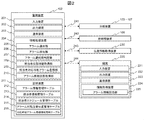
- FIG. 2 is a block diagram showing a schematic configuration of an automatic analysis system that manages clinical laboratory operations in the clinical laboratory 101.
- the terminal 220 is a terminal held by a laboratory technician working in the clinical laboratory 101.
- the analyzers 103 to 107, the pretreatment device 108, the terminal 220 carried by the inspection engineer, and the position information acquisition device 230 for acquiring the position information of the inspection engineer in the clinical laboratory 101 are the management devices 102.
- networks 241 to 244 are telecommunicationsally linked.
- the position information acquisition device 230 is a device for acquiring the location of the inspection engineer.
- the means for acquiring location information is not limited.
- the position information may be grasped by using a terminal carried by the inspection technician, or the position information of the inspection technician may be grasped by image analysis of the surveillance camera image.
- GPS Global Positioning System
- Beacon Beacon
- UWB Ultra Wide Band
- Wi-Fi positioning sonic positioning
- dead reckoning IMES (Indoor Messaging System)
- IMES Indoor Messaging System
- the management device 102 may be connected to an information system such as a clinical laboratory information system (LIS).
- LIS clinical laboratory information system
- the management device 102 includes an input device 201, an output device 202, a communication device 203, an information processing device 204, and a storage device 211.
- the input device 201 is a device such as a keyboard, a mouse, and a screen touch panel of the output device 202, in which an administrator or an inspection engineer inputs instructions and information.
- the output device 202 includes a monitor and a printer that display input information and other result information.
- the communication device 203 is a communication device for the management device 102 to communicate with other devices and terminals. For example, it is a communication device for connecting to a wired / wireless local area network, a wired / wireless global area network, a mobile phone network, or the like.
- the information processing device 204 is a computer that executes various applications of the management device 102.
- the storage device 211 is a storage device that stores programs and data executed by the information processing device 204, and can use, for example, a non-volatile memory such as an EEPROM or a flash memory, an HDD, or an SSD.
- the function of the management device 102 is realized in cooperation with other hardware by executing the program stored in the storage device 211 by the information processing device 204.
- a program executed by the information processing apparatus 204, a function thereof, or a means for realizing the function may be referred to as a "function", a "part", a “module”, or the like.
- the management device 102 can be realized by, for example, a PC (Personal Computer) or a server.
- the alarm notification unit 205, the alarm detection unit 206, the alarm notification order determination unit 207, the person in charge position information acquisition unit 208, the person in charge available alarm registration unit 209, and the alarm information response acquisition unit 210 are functions executed by the information processing device 204.
- the storage device 211 includes a program for the information processing device 204 to execute these functions, an alarm information management table 212 which is data, a person in charge information management table 213, a person in charge schedule management table 214, and an alarm handling stop-by position management.
- Table 215 and responseable alarm registration information management table 216 are stored. Details of these will be described later. It should be noted that the above describes the function of notifying the inspection technician of the alarm generated in the device in the clinical laboratory, which will be described as the present embodiment, and the function that the management device 102 can execute is not limited to this. Needless to say.
- the laboratory technician receives the notification of the alarm generated by the device in the clinical laboratory via the terminal 220.
- the inspection technician can view the alarm notified from the management device 102, respond to the alarm, and respond to the completion of the alarm response by the terminal 220.
- the input device 221, the output device 222, the communication device 223, and the information processing device 224 of the terminal 220 each have the same functions as those of the management device 102.
- the alarm information response unit 225 is a function executed by the information processing apparatus 224 in this embodiment.
- the terminal 220 is preferably a mobile terminal or a wearable terminal carried by an inspection engineer, for example, but a notebook type or desktop type PC may be used. The details of the alarm information response unit 225 will be described later.
- FIG. 3 is an example of the alarm information management table 212.
- the alarms generated by the analyzers 103 to 107, the pretreatment device 108, or the management device 102 are managed by the alarm information management table 212.
- the alarm detection unit 206 detects the occurrence of an alarm in the management device 102 or receives a notification of the occurrence of an alarm from another device via the network 241,242, the alarm detection unit 206 displays the alarm information in the alarm information management table 212. to register.
- Column 302 is an alarm management number, which is an identification number of an alarm generated in the clinical laboratory 101.
- Column 303 is an alarm occurrence date and time, and is an alarm occurrence date and time in the clinical laboratory 101.
- Column 304 is an alarm code, which is an identification number of an alarm type.
- Column 305 is an alarm occurrence location, and is an identification number representing an alarm occurrence location in the clinical laboratory 101.
- Column 306 is the name of the alarm generator, and in this case, it is the name of any of the analyzer, pretreatment device, and management device in the clinical laboratory 101 that generated the alarm.
- Column 307 is the content of the alarm, which is the content of the alarm generated in the clinical laboratory 101.
- Column 308 is an alarm coping method, and is a method for coping with the generated alarm.
- Column 309 is the person in charge of dealing with the alarm and the person in charge of dealing with the alarm. NULL is registered as the initial value.
- Column 310 is a comment, which is a comment of the person in charge of dealing with the alarm. NULL is registered as the initial value.
- the column 311 is a related alarm management number, and the alarm management number of the related alarm is registered, and NULL is registered when there is no related alarm such as a newly generated alarm.
- the column 312 is a completion flag, and when the person in charge of dealing with the alarm completes or gives up the action of the alarm, 1 indicating the completion of the action is registered. As the initial value, 0 indicating that the countermeasure is not completed is registered.
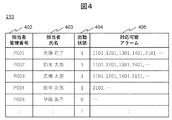
- FIG. 4 is an example of the person in charge information management table 213.
- the person in charge information management table 213 manages the name of the laboratory engineer working in the clinical laboratory 101, the attendance status, and the alarm code of the alarm that can be dealt with, and selects the laboratory engineer who can deal with the alarm generated in the clinical laboratory 101. Can be identified.
- Column 402 is the person in charge management number, which is the identification number of the laboratory technician working in the clinical laboratory 101.
- Column 403 is the name of the person in charge, and is the name of the laboratory technician working in the clinical laboratory 101.
- Column 404 identifies whether the laboratory technician working in the clinical laboratory 101 is at work or not. In this example, 1 is registered in the attendance state, 0 is registered in the absent state, and the initial value is 0.
- the management device 102 acquires the attendance information of the inspection technician and updates the attendance status of the column 404, for example, by detecting the login / log-off of the terminal when the inspection technician goes to work or other means.
- Column 405 is a response alarm, and an alarm code that the inspection technician can respond to is listed.
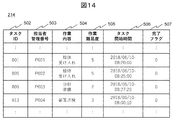
- FIG. 5 is an example of the person in charge schedule management table 214.
- the person in charge schedule management table 214 manages the tasks in the clinical laboratory 101 and the difficulty level of the tasks, and when an alarm occurs, the task that each laboratory technician is engaged in is grasped including the difficulty level.
- Column 502 is a task ID, which is a task identification number in the clinical laboratory 101.
- Column 503 is a person in charge management number, which is an identification number of an inspection technician who performs a task.
- Column 504 is a work content, that is, a task content.
- Column 505 is the work difficulty level. In this example, it is assumed that the task that takes time to complete the work has a higher difficulty level, and the task that can be completed in a short time has a lower difficulty level.
- the difficulty level is evaluated on a scale of 5 to 1, and the higher the score, the higher the difficulty level.
- Column 506 is the task start time, and the time when the inspection engineer started the task is registered. NULL is registered as the initial value when a new task is registered in the person in charge schedule management table 214, but when the management device 102 detects the task start time by the notification by the terminal of the inspection technician or other means. , Update the task start time in column 506.
- Column 507 is a completion flag and manages whether the inspection technician has completed the task. Although 0 indicating that the task has not been completed is registered in the initial value, 1 indicating task completion is registered when the management device 102 detects the task completion by the notification by the terminal possessed by the inspection engineer or other means.
- FIG. 6 is an example of the alarm handling stop-by position management table 215.
- the alarm handling stop-by position management table 215 manages the place where the inspection technician who deals with the alarm stops in advance of the device that generated the alarm for dealing with the alarm.
- Column 602 is an alarm code and an alarm identification number.
- Column 603 is an alarm description and is the content of the alarm.
- Column 604 is an alarm coping method, and is a method for coping with the alarm.
- Column 605 is an alarm handling stop position, and a place to stop in order to deal with the alarm is registered. If there is a place to stop by to deal with the alarm, an identification number indicating the position on the clinical laboratory 101 is registered, and if there is no place to stop by to deal with the alarm, NULL is registered.
- Column 606 is the name of the alarm handling stop-by position, and when the identification number is registered in the alarm handling stop-by position of column 605, the name of the corresponding place is registered.
- FIG. 7 is an example of the clinical laboratory map 701, and the position in the clinical laboratory 101 is specified by the identification number defined on the clinical laboratory map.
- the clinical laboratory map 701 is a map of the clinical laboratory 101. In this example, the clinical laboratory 101 is divided into blocks, and the position in the clinical laboratory 101 is specified by the identification number consisting of the X coordinate and the Y coordinate of the block. To do.
- the X coordinate of the clinical laboratory map 701 is defined as numerical values 1 to 11 from left to right, and the Y coordinate is defined as alphabetical A to E from top to bottom.
- the current position of the inspection engineer 117 is represented by the identification number 9E because the X coordinate is 9 and the Y coordinate is E.
- the area indicated by the hatching block 702 includes equipment / storage / workbench, etc., and the laboratory technician cannot move on it.
- the triangular mark 703 is the work position of the inspection engineer, the end point when the inspection engineer moves to the device or the like for work is the block marked with the triangular mark 703.
- the route for the inspection engineer 116 to move to the pretreatment device 108 is 4C, 4D, 4E, 3E, 2E, 1E, 1D, 1C, and the distance at that time is 7 because it requires 7 blocks of movement.
- the end point is set as the position of the hatching block.
- any one of the hatching blocks is designated as the end point.
- the block in which the numerical value of the X coordinate is the smallest and the alphabet of the Y coordinate is the closest to A may be specified.
- the block in which the management device 102 and the workbench 113 are arranged corresponds to the block in which the work position is not specified.
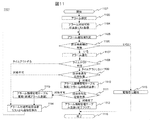
- the alarm notification processing logic 1101 shown in FIG. 11 will be described below.
- the alarm detection unit 206 detects the occurrence of the alarm or receives the notification of the occurrence of the alarm, and registers the information of the generated alarm in the alarm information management table 212 (columns 302 to 308). Using this registration as a trigger, the alarm notification order determination unit 207 executes the following steps.
- step 1104 for acquiring the list of persons in charge of alarm handling a list of inspection technicians who can handle the alarm newly registered in the alarm information management table 212 is acquired. From the person in charge information management table 213, among the person in charge information whose attendance status (column 404) is 1, the available alarm (column 405) is searched by using the alarm code (column 304) in the alarm information management table 212 as a key. By doing so, the list of persons in charge who can handle the alarm is acquired.
- the notification priority is calculated for each inspection engineer in the list of persons in charge of alarm handling created in step 1104. The details will be described later.
- step 1106 for determining the presence or absence of a candidate for a person in charge the presence or absence of an inspection engineer who is a candidate for a person in charge is checked for the list of persons in charge who can handle the alarm to which the notification priority is added, and the process branches depending on the result.
- the alarm notification order determination unit 207 causes the alarm notification unit 205 to notify the administrator of the clinical laboratory 101 of the occurrence of the alarm (step 1115). At this time, it is desirable to attach a list of inspection technicians who are at work.
- the administrator notification step 1115 is a process of notifying the administrator who has the right to decide the work of the clinical laboratory that there is no laboratory technician who can deal with the alarm.
- the administrator can forcibly determine the alarm handling person, and also updates the alarm handling person (column 309) in the alarm information management table 212.
- the administrator determines that the laboratory technician in the clinical laboratory cannot handle the problem, he / she can contact external support. The place where the manager is located does not matter whether inside or outside the clinical laboratory.
- the alarm notification unit 205 is made to notify the inspection engineer having the highest notification priority of the occurrence of the alarm (step 1107).
- the alarm notification unit 205 notifies the inspection engineer having the first priority in the list of persons in charge of handling alarms with an alarm. Using the communication device 203, the alarm is notified to the terminal 220 held by the inspection engineer having the first priority via the network 244.
- FIG. 8 is an alarm notification screen 801 displayed by the alarm information response unit 225 on the terminal 220 held by the inspection technician who has been notified of the occurrence of the alarm.
- the alarm notification unit 205 notifies the inspection engineer's terminal 220 of alarm-related information based on the information registered in the alarm information management table 212 (see FIG. 3) and the alarm response stop-by position management table 215 (see FIG. 6). To do.
- the alarm notification screen 801 displays information on the content of the alarm, the coping method, the alarm generator, the coping stop position, and the coping person in charge. At the stage of step 1107, the person in charge of dealing with the alarm has not been determined yet, so it is not displayed.
- the inspection technician notified of the occurrence of the alarm responds with the intention to deal with the alarm on the alarm notification screen 801.
- the button 802 is a “yes” button, and notifies the management device 102 of the intention to be in charge.
- the button 803 is a “no” button, and notifies the management device 102 of the intention not to be in charge.
- the button 804 is a "view comment” button, and is a button for transitioning to the past comment confirmation screen 1001. Details will be described later, but in this embodiment, when the alarm is started by another person in charge but ends in a malfunction, a comment can be left about the situation and the like. The laboratory technician may refer to this comment in deciding whether or not to deal with the alarm.
- the input to the buttons 802 to 804 is transmitted from the alarm information response unit 225 of the terminal 220 to the alarm information response acquisition unit 210 of the management device 102 via the network, and processing is performed according to the input content.
- the time-out of the communication from the management device 102 to the terminal 220 is determined, and the process is branched.
- the communication device 203 normally communicates, the communication device 203 receives a notification of the completion of the normal communication from the terminal 220. If the communication device 203 does not receive the notification of the completion of normal communication from the terminal 220 even after a certain period of time has elapsed, it is regarded as a timeout.
- the result of the time-out determination 1108 is "time-out"
- the notifier is excluded from the list of persons in charge of dealing with alarms (step 1114).
- the result of the time-out determination 1108 is "no time-out"
- the person in charge notification response acquisition process is performed (step 1109).
- the alarm notification order determination unit 207 receives the response of the intention to deal with the alarm from the inspection engineer who notified the alarm from the alarm information response acquisition unit 210, and branches the process. If the answer can be dealt with, the alarm information management table update (alarm coping person) 1110 is processed. On the other hand, if the answer cannot be dealt with, the notifier is excluded from the list of persons in charge of dealing with alarms (step 1114).
- Alarm information management table update (alarm coping person)
- the alarm notification order determination unit 207 sets the inspection engineer who answered the intention to deal with the notified alarm to the alarm coping person (column) in the alarm information management table 212. Register in 309). After that, wait until the person in charge of coping contacts you.
- FIG. 9 is an alarm handling response screen 901 displayed by the alarm information response unit 225 on the terminal 220 held by the inspection engineer who is in charge of the alarm.
- the comment field 902 is a comment box in which the inspection engineer dealing with the alarm can leave a comment. The comment can be entered arbitrarily, and it can be entered regardless of whether the action is completed or not.
- the button 903 is a “yes” button, and notifies the management device 102 that the response to the alarm is completed.
- the button 904 is an "impossible” button, and notifies the management device 102 of the intention to give up the response to the alarm (cannot be addressed).
- the button 905 is a "view comment” button, and is a button for transitioning to the past comment confirmation screen 1001.
- the input to the buttons 903 to 905 is transmitted from the alarm information response unit 225 of the terminal 220 to the alarm information response acquisition unit 210 of the management device 102 via the network, and processing is performed according to the input content.
- the alarm notification order determination unit 207 receives a response from the alarm information response acquisition unit 210 regarding the completion of the alarm response from the inspection engineer who is in charge of the alarm response, and branches the process. .. If the answer is the completion of the action, the process of updating the alarm information management table (completion flag) step 1112 is performed. On the other hand, if the answer cannot be dealt with (abandoned), the process of updating the alarm information management table (registering a new alarm) step 1113 is performed.
- the alarm notification order determination unit 207 updates the completion flag (column 312) of the alarm information management table 212 to 1 indicating the completion of the countermeasure. If a comment is described in the comment column 902 of the alarm response response screen 901, the described comment is registered in the comment (column 310) in the alarm information management table 212, and the response to the alarm is completed. ..
- the alarm information management table update (new alarm registration) step 1113 is a process to be performed when the person in charge of dealing with the alarm gives up dealing with the alarm in the person in charge of dealing with the person in charge 1111.
- the alarm notification order determination unit 207 registers the comment input in the comment field 902 of the alarm response response screen 901 in the comment (column 310) of the alarm information management table 212.
- 1 indicating the completion of the countermeasure is registered in the completion flag (column 312) of the alarm information management table 212.
- the alarm that cannot be dealt with is again assigned a new alarm management number (column 302) as a new alarm, and the alarm information is registered in the alarm information management table 212.
- the registered contents of columns 303 to 308 of the alarm information management table 212 of the alarm information to be re-registered are the same as the alarm information that cannot be dealt with (abandoned).
- the alarm management number of the alarm information that cannot be dealt with is registered in the related alarm management number (column 311). As a result, it is associated that the re-registered alarm information is the same as the alarm information that cannot be dealt with.
- the notification person exclusion 1114 process is performed from the alarm handling person in charge list.
- the notification person exclusion step 1114 is a process of excluding the inspection technician who is currently notifying from the list of persons in charge who can handle the alarm. That is, the inspection technician with the first notification priority is excluded from the list of persons in charge of handling alarms in order of notification priority. This step is executed when the alarm notification times out, when the notifier gives a response that cannot be dealt with, or when the person in charge of dealing gives an answer that cannot be dealt with. The notifier is excluded from the list of persons in charge of handling alarms, and the process proceeds to the alarm notification order determination step 1105 again.
- FIG. 12 is an alarm notification order determination processing logic 1201 executed by the alarm notification order determination unit 207.
- the alarm notification order determination processing logic 1201 is a flowchart showing an example of the alarm notification order determination step 1105 in the alarm notification processing logic 1101 (FIG. 11).
- Presence / absence of person in charge of alarm handling Step 1203 checks the presence / absence of an inspection engineer in the list of persons in charge of alarm handling, and branches the process. If there is no person in charge who can handle the alarm, the process ends. If there is a person in charge who can deal with the alarm, the process of the person in charge schedule score calculation step 1204 is performed.
- the task currently being worked is performed by using the person in charge management number as a key from the person in charge schedule management table 214 (FIG. 5). And the difficulty level thereof, and the person in charge schedule score s is calculated.
- the fact that the task is currently being worked can be determined by the fact that the task start time (column 506) is other than NULL and the completion flag (column 507) is registered as 0 indicating that the task has not been completed. Further, the work difficulty level is obtained from column 505. The value of the work difficulty level is used as it is as the person in charge schedule score s. Therefore, the higher the work difficulty, that is, the longer it takes to complete the task, the higher the score. If there is no task in progress, the score is 0.
- the person in charge position information score calculation step 1205 calculates the person in charge position information score p for each inspection technician in the list of persons in charge who can deal with the alarm, based on the current position information.
- the position information of the laboratory technician is acquired by the person in charge position information acquisition unit 208 from the position information acquisition device 230 as an identification number represented by the clinical laboratory map 701.
- the alarm code of the alarm currently occurring is used as a key to search the alarm response stop position management table 215 (FIG. 6), and the alarm response stop position registered in the column 605 is acquired as the position information reference point.
- the location of the device in which the alarm is occurring (the alarm occurrence location (column 305) in the alarm information management table 212 (FIG. 3)) is acquired as the location information reference point. .. Then, based on the acquired position information reference point and the current position information of the inspection engineer, the shortest route for the inspection engineer to reach the position information reference point is calculated. The number of blocks that the inspection technician passes through from the block where the current position is currently located to the block where the position information reference point is located is defined as the person in charge position information point p.
- the person-in-charge schedule score s and the person-in-charge position information point p are input, and the priority for notifying each inspection engineer in the alarm-handling person-in-charge list is the priority.
- m 1 is a weight for the person in charge schedule score s represented by a positive constant
- m 2 is a weight for the person in charge position information score represented by a positive constant.
- Sorting the list of persons in charge of dealing with alarms 1207 is a process of sorting the list of persons in charge of dealing with alarms in the order of notification priority.
- the notification priority score Pr is used as the notification priority of the person in charge of dealing with the alarm, the lower the score, the higher the priority, and the higher the score, the lower the priority. Therefore, the list of persons in charge of alarm handling is sorted in ascending order of the notification priority score Pr.
- FIG. 13 is alarm information 1301 in the alarm information management table 212 indicating that a pre-analysis failure alarm has occurred in the analyzer 103.
- the person in charge schedule management table 214 at this time is shown in FIG.
- the person in charge management number registered in column 503 corresponds to the inspection engineer shown in FIG. 1, P001 is inspection engineer 114, P002 is inspection engineer 115, P003 is inspection engineer 116, and P004 is inspection engineer 117. Suppose there is. The same applies to the following examples.
- the analysis device 103 starts the analysis operation in response to an instruction to start analysis from the operation screen of the analysis device 103 or the management device 102.
- the analyzer 103 performs a reset operation.
- the analyzer 103 notifies the management device 102 of an alarm of poor preparation before analysis via the network 241.
- the management device 102 receives an alarm from the analyzer 103 and registers it in the alarm information management table 212.
- the inspection technician who became the person in charge of dealing with the alarm needs to move to the analyzer 103 and deal with the alarm in order to identify the cause of the failure of the reset operation.
- the management device 102 uses the alarm code "1101" (column 304) registered in the alarm information 1301 as a key, and the alarm code that matches the available alarm (column 405) in the person in charge information management table 213 (FIG. 4). Get a list of contacts that contain. In this example, it is the inspection technician with the person in charge control numbers P001, P002, and P003 who can respond to the alarm of poor preparation before analysis.
- the management device 102 calculates the person in charge schedule score s of the inspection engineer who can deal with the alarm of poor preparation before analysis. From the difficulty level of the task currently being worked, which is grasped from the person in charge schedule management table 214 (FIG. 14), the person in charge schedule points s of the person in charge management numbers P001, P002, and P003 are 5 points and 5 points, respectively. There are two points.
- the position information score p of the person in charge of the inspection technician who can deal with the alarm of poor preparation before analysis is calculated.
- the alarm response stop position management table 215 (FIG. 6) is searched with the alarm code "1101"
- the alarm response stop position is NULL
- the position information reference point is the front position of the analyzer 103 in which the alarm is generated. It is 3C (see FIG. 7).
- the current positions of the laboratory technicians (114, 115, 116) with the person in charge control numbers P001, P002, and P003 are 10C, 8C, and 4C, respectively. Therefore, the person in charge position information points p of the person in charge management numbers P001, P002, and P003 are 7 points, 5 points, and 1 point, respectively.
- the notification priority score Pr is given by (Equation 1), and if m 1 and m 2 are 1 respectively, the alarm notification priority score Pr of the inspection engineer of the person in charge management numbers P001, P002, and P003 is each. 12 points, 10 points, 3 points. Since it is determined that the lower the notification priority score Pr, the higher the priority of the alarm notification, the inspection engineer 116 of the person in charge management number P003 is notified of the alarm of poor preparation before analysis.
- FIG. 15 is alarm information 1501 of the alarm information management table 212 indicating that an alarm of zero ALB reagent remaining amount has occurred in the analyzer 107.
- the person in charge schedule management table 214 at this time is shown in FIG.
- the analysis device 107 starts the analysis operation in response to an instruction to start analysis from the operation screen of the analysis device 107 or the management device 102.
- a zero reagent alarm occurs when the reagents required for analysis are low or zero. For example, when the remaining amount of ALB reagent becomes zero, an alarm of zero remaining amount of ALB reagent is generated, and the analyzer 107 notifies the management device 102 of the alarm of zero remaining amount of ALB reagent via the network 241.
- the management device 102 receives an alarm from the analyzer 107 and registers it in the alarm information management table 212.
- the inspection technician who has become the person in charge of dealing with the alarm needs to take out a new ALB reagent from the reagent storages 109 and 110 and put it into the analyzer 107.
- the management device 102 uses the alarm code “1201” (column 304) registered in the alarm information 1501 as a key, and the alarm code that matches the available alarm (column 405) in the person in charge information management table 213 (FIG. 4). Get a list of contacts that contain. In this example, it is the inspection technician with the person in charge control numbers P001, P002, and P003 who can respond to the alarm of zero remaining amount of ALB reagent.
- the management device 102 calculates the schedule score s of the person in charge of the inspection engineer who can deal with the alarm of the remaining amount of ALB reagent being zero. From the difficulty level of the task currently being worked on, which is grasped from the person in charge schedule management table 214 (FIG. 16), the person in charge schedule points s of the person in charge management numbers P001, P002, and P003 are 5 points each. 2 points, 2 points.
- the position information reference point is the front position of the reagent storage 109 7C. (See FIG. 7).
- the current positions of the laboratory technicians (114, 115, 116) with the person in charge control numbers P001, P002, and P003 are 10C, 8C, and 4C, respectively. Therefore, the person in charge position information points p of the person in charge management numbers P001, P002, and P003 are 3 points, 1 point, and 3 points, respectively.
- the notification priority score Pr is given by (Equation 1), and if m 1 and m 2 are 1 respectively, the alarm notification priority score Pr of the inspection engineer of the person in charge management numbers P001, P002, and P003 is each. 8 points, 3 points, 5 points. Since it is determined that the lower the notification priority score Pr, the higher the priority of the alarm notification, the inspection engineer 115 of the person in charge control number P002 is notified of the alarm that the total amount of ALB reagent is zero.
- FIG. 17 is a person in charge schedule management table 214 when the inspection technician 116 (person in charge management number P003) is in charge of dealing with the alarm that the barcode cannot be read.
- the task ID 017 is a task that was started before the inspection engineer 116 became the alarm handling person, and was completed in the record 1701 when the inspection engineer 116 replied to the management device 102 that he / she intends to become the alarm handling person. 2 indicating interruption is registered in the flag (column 507), and record 1702 indicating the alarm handling task of task ID 032 is newly registered as being worked.
- An alarm that the barcode cannot be read is a pretreatment device or analysis because the barcode attached to the test tube containing the sample has a bad attachment position or the barcode is dirty or rubbed. This is an alarm that occurs when the device cannot read it.
- a bar code reading error occurs, a sample with a bad bar code is not analyzed and is discharged to the sample container of the device. If the sample is not analyzed, the doctor's diagnosis will be delayed, so the laboratory engineer who became the person in charge of dealing with the alarm will move to the device where the alarm is occurring and check the sample whose barcode cannot be read. , It is necessary to take measures such as re-spinning the barcode and reissuing the barcode.
- the inspection engineer 116 of the person in charge management number P003 who became the person in charge of dealing with the alarm that the barcode cannot be read could not complete the handling of the alarm.
- the inspection engineer 116 presses the button 904 on the alarm handling response screen 901 of the terminal 220 to notify the management device 102 of giving up the alarm handling (see FIG. 9).
- a comment can be left in the comment field 902 for the person who will later become the person in charge of dealing with the alarm.
- the management device 102 receives a notification from the inspection engineer of the person in charge management number P003 to give up the handling of the alarm, and updates the alarm information management table 212.
- the alarm information management table 212 of FIG. 3 is a table in a state where the alarm has been updated. As shown in the alarm information 321, the comment from the inspection engineer 116 is registered in the comment (column 310), and 1 indicating the completion of the alarm response is registered in the completion flag (column 312). After that, the management device 102 newly adds an alarm whose barcode cannot be read to the alarm information management table 212. The alarm management number of the alarm information 321 is registered in the related alarm management number (column 311) of the newly added alarm information 322.
- the management device 102 uses the alarm code "2101" (column 304) registered in the alarm information 322 as a key, and the alarm code that matches the available alarm (column 405) in the person in charge information management table 213 (FIG. 4). Get a list of contacts that contain. In this example, it is the inspection technician with the person in charge control numbers P001, P003, and P004 who can respond to the alarm that the barcode cannot be read. Next, the related alarm management number (column 311) registered in the alarm information 322 is traced, and the person in charge of dealing with the past alarm is excluded. Therefore, it is the inspection technician with the person in charge control numbers P001 and P004 who can respond to the alarm that the barcode cannot be read.
- the management device 102 calculates the person in charge schedule score s, the person in charge position information point p, and the person in charge priority order point Pr for the inspection technician of the person in charge management numbers P001 and P004, and the barcode cannot be read. Determine an inspection technician to notify the alarm and notify the alarm.
- the inspection technician who has been notified of the alarm sees the alarm notification screen 801 through the terminal 220.
- the inspection technician can optionally press the "view comment" button of the button 804 to see the past comment confirmation screen 1001.
- FIG. 10 shows an example of the past comment confirmation screen 1001. You can see the comments left by the person in charge of dealing with the alarm in the past (in this example, the inspection engineer with the person in charge management number P003) for the notified alarm. By pressing the "back" button 1002, the screen transitions to the alarm notification screen 801 again.
- the past comment confirmation screen 1001 can be transitioned from either the alarm notification screen 801 (FIG. 8) or the alarm response response screen 901 (FIG. 9) in FIG.
- the "Back" button 1002 When the "Back" button 1002 is pressed, the screen transitions to the transition source screen.
- the comment displayed on the past comment confirmation screen 1001 is registered in the comment registered in the comment (column 310) of the alarm information management table 212 and the comment of the alarm information registered as the related alarm (column 310). It is a comment. Therefore, in this case, the comment registered in the comment (column 310) of the alarm information 321 and the alarm information 322 can be displayed on the past comment confirmation screen 1001 while the alarm of the alarm information 322 is being dealt with.
- the alarm information management table 212 the alarm information is traced until the related alarm management number (column 311) becomes NULL, using the related alarm management number (column 311) of the current alarm information as a key. Regarding the obtained related alarm information, all the registered comments (column 310) can be displayed on the past comment confirmation screen 1001.
- FIG. 18 is an extended alarm information management table 1801.
- the extended alarm information management table 1801 plays the same role as the alarm information management table 212, but is provided with an alarm subcode (column 1804) in which an identification number indicating that there are a plurality of alarm handling workers is registered. Has been done.
- the extended alarm information management table 1801 NULL is registered in the case of alarm information in which the number of coping workers is one.
- the alarm information for the plurality of alarm information is registered.
- the alarm information 1810 and the alarm information 1811 have the same alarm management number (column 302) and are caused by the same alarm, but this alarm is an alarm that requires two alarm handling workers.
- the alarm information 1810 of the alarm subcode 01 and the alarm information 1811 of the alarm subcode 02 are registered.
- the alarm information 1810 and the alarm information 1811 are treated as separate alarm information.
- FIG. 19 is the person in charge information management table 213 in this example.
- the available alarm column 405
- a code that combines an alarm code and an alarm subcode is registered.
- an alarm having an alarm code of "1401” and an alarm subcode of "01” is registered as an alarm "1401-01" in column 405.
- the reason why the available alarms are registered separately for each sub-alarm is that the skills required of the person in charge of dealing with the alarm are not the same when the number of alarm handling workers is multiple. For example, there may be a case where one person is an inspection engineer who is familiar with the alarm and one person is a work assistant to deal with the alarm.
- FIG. 20 is an extended alarm handling stop-by position management table 2001.
- the extended alarm handling stop position management table 2001 plays the same role as the alarm handling stop position management table 215, but the alarm subcode (column 2002) and the alarm handling work for registering the number of workers required for handling the alarm.
- the number of people (column 2003) is provided.
- the handling stop position (column 605, column 606) can be set for each alarm subcode.
- the analyzer After the analysis of the clinical test is completed, the analyzer temporarily stores the analyzed sample in the sample storage section inside the device. However, since the number of post-analytical samples that can be temporarily stored is limited, the analyzer will generate an alarm that the post-analytical sample is full when it is full. When the alarm for full sample after analysis occurs, the laboratory technician removes the sample after analysis from the analyzer and carries the sample after analysis to the workbench. Therefore, it is necessary to clean up the workbench in order to place the post-analysis sample carried from the analyzer, and to clean up the post-analysis sample after the post-analysis sample arrives at the workbench.
- the inspection engineer who removes the sample after analysis from the analyzer and the inspection engineer who cleans up the workbench and cleans up the sample after analysis are separated and the alarm is dealt with. There are two people in charge.
- the analyzer 107 When the alarm of the sample full after analysis occurs in the analyzer 107, the analyzer 107 notifies the management device 102 of the alarm of sample full after analysis (alarm code "1401") via the network 241.
- the management device 102 receives an alarm from the analyzer 107 and registers it in the extended alarm information management table 1801.
- the number of alarm handling workers (column 2003) of the alarm code 1401 is 2, so that the extended alarm information management table 1801 has two alarm information 1810, an alarm subcode 01 and an alarm subcode 02. , 1811 are registered. Since alarms with different alarm subcodes are managed as separate alarms, it is necessary to notify the two inspection engineers who are in charge of handling the alarm.
- the management device 102 uses the code that combines the alarm code “1401” (column 304) and the alarm subcode “01” (column 1802) registered in the alarm information 1810 as a key to the person in charge information management table 213 (FIG. 19). ) Acquires a list of persons in charge that includes an alarm code that matches the available alarm (column 405).
- the inspection engineer with the person in charge control numbers P001, P002, and P003 can respond to the alarm 1401-01.
- an inspection technician to notify the alarm is determined and the alarm is notified.
- the list of persons in charge including the alarm code matching the alarm 1401-02 is acquired.
- it is the inspection technician with the person in charge management numbers P001, P003, and P004 who can respond to the alarm 1401-02.
- an inspection technician to notify the alarm is determined and the alarm is notified.
- a method of registering an alarm that can be dealt with by a laboratory technician working in a clinical laboratory will be described with reference to the drawings of FIGS. 21 to 23.
- the method of this example can be used in addition to the method of registering an alarm for each inspection engineer by an administrator.
- FIG. 21 is a responseable alarm registration screen 2101 displayed on the terminal 220 of the inspection technician.
- the laboratory engineer working in the clinical laboratory 101 answers the question from the management device 102, and based on the answer, the alarm that the laboratory engineer can deal with is registered in the available alarm (column 405) in the person in charge information management table 213. Will be done.
- FIG. 21 shows an example of a question from the management device 102.
- the inspection technician who answers the question answers the question by selecting any one of the radio buttons 2102 to 2104.
- the button 2105 is a “next” button, and the alarm information response unit 225 of the terminal 220 notifies the management device 102 of the question number and its answer. After that, the following question is displayed on the available alarm registration screen 2101.
- the inspection technician repeats the answer as many times as the number of questions from the management device 102.
- the "Back" button 2106 is pressed, the previous question is displayed, and the answer to the previous question can be corrected.
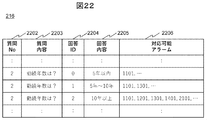
- FIG. 22 is a responseable alarm registration information management table 216.
- the management device 102 updates the responseable alarm of the inspection engineer based on the responseable alarm registration information management table 2201.
- Column 2202 is a question No. and is a question identification number.
- Column 2203 is the content of the question and is the content of the question.
- Column 2204 is an answer ID, which is an identification number of an option for answering a question.
- Column 2205 is the content of the answer and is the content of the answer to the question.
- Column 2206 is a response alarm, and is a list of alarms registered in the response alarm (column 405) of the person in charge information management table 213.
- FIG. 23 is the responseable alarm registration processing logic 2301.
- the responseable alarm registration processing logic 2301 is a flowchart executed by the person in charge of the management device 102, the responseable alarm registration unit 209.
- the inspection engineer starts the registration of the responseable alarm through the terminal 220.
- the inspection engineer notifies the management device 102 of starting registration of the coping alarm from the terminal 220, and the person-in-charge respondable alarm registration unit 209 starts transmitting a question for registering the coping alarm in the terminal 220.
- step 2304 the presence / absence of a question to be sent is checked, and the process is branched. If there is no question, the process ends. If there is a question, the question is displayed on the terminal 220 (step 2305).
- the alarm registration screen 2101 that can correspond to the terminal 220 is displayed.
- the inspection technician answers the question through the displayed responseable alarm registration screen 2101.
- the answer from the inspection engineer is acquired.
- the answer to the question from the terminal 220 includes a question No. and an answer ID representing the answer.
- the person in charge available alarm registration unit 209 refers to the available alarm registration information management table 216 based on the question number and answer ID received from the terminal 220, and takes action.
- the possible alarm is registered in the available alarm (column 405) of the person in charge information management table 213. If an alarm is already registered in the available alarm (column 405), the registered corresponding alarm and the logical sum of the available alarms obtained from the available alarm registration information management table 216 are registered. ..
- a laboratory technician working in a clinical laboratory can check an alarm occurring in the clinical laboratory 101 on his / her own terminal.
- FIG. 24 is an all-alarm confirmation screen 2401 displayed on the terminal 220 of the inspection technician.
- the laboratory technician in the clinical laboratory 101 can confirm the status of the alarms occurring in the laboratory in a list format through the all alarm confirmation screen 2401.
- Each of element 2402 to element 2405 is an element of a list representing an alarm, and describes an alarm content, an alarm generator name, an alarm handling status, and an alarm occurrence time.
- the name of the person in charge of alarm handling is displayed for the alarm handling status of elements 2402 to 2405.
- the element representing the alarm is added to the all alarm confirmation screen 2401 when a new alarm occurs, and the element of the corresponding alarm is deleted from the all alarm confirmation screen when the countermeasure of the alarm is completed. Since the alarm status changes from moment to moment, the all alarm confirmation screen 2401 is updated at regular intervals while the inspection technician is displaying the all alarm confirmation screen 2401.
- the inspection technician can confirm the details by tapping the alarm element for which he / she wants to confirm the details.
- the alarm tapped by the inspection technician is an alarm for which the person in charge of handling is determined as in the elements 2402 and 2403
- the screen transitions to the alarm handling response screen 901 (FIG. 9) as the detailed confirmation screen of the alarm.
- the inspection technician who opened the alarm response response screen 901 from the all alarm confirmation screen 2401 is not the person in charge of handling, the screen operation cannot be performed.
- the color of the buttons or the like may be lightened or may not be displayed.
- the management device 102 is checking the alarm details. Is notified that the alarm handling is completed, and the screen of the terminal 220 is changed to the all alarm confirmation screen 2401.
- the screen transitions to the alarm notification screen 801 as the detailed confirmation screen of the alarm (FIG. 8).
- the inspection technician can operate the alarm notification screen 801.
- the management device 102 registers the inspection technician as the alarm handling person, and shifts the screen of the terminal 220 to the alarm handling response screen 901.
- the alarm notification processing logic 1101 of FIG. 11 is being executed in the management device 102, interrupt processing is performed to end a series of processing for notifying the alarm, and the processing of the person in charge response response acquisition step 1111 is performed.
- the inspection engineer who has notified the alarm is notified that the person in charge of handling has been decided.
- the screen of the terminal 220 transitions to the all alarm confirmation screen 2401.
- the "view comment” button 804 is pressed, the screen of the terminal 220 transitions to the past comment confirmation screen 1001 (FIG. 10). If the alarm handling person is determined while the inspection technician is checking the alarm details on the alarm notification screen 801, the management device 102 tells the inspection technician who is checking the alarm details. Is notified, and the screen of the terminal 220 is changed to the all alarm confirmation screen 2401.
- the present invention has been described above with reference to Examples, the present invention is not limited to the above-mentioned Examples, and includes various modifications. Examples are for explaining the present invention in an easy-to-understand manner, and are not necessarily limited to those having all the configurations described. Further, it is possible to replace a part of the configuration of one embodiment with the configuration of another embodiment, and it is also possible to add the configuration of another embodiment to the configuration of one embodiment. Further, it is possible to add / delete / replace a part of the configuration of each embodiment with another configuration.
Landscapes
- Health & Medical Sciences (AREA)
- Engineering & Computer Science (AREA)
- Business, Economics & Management (AREA)
- General Health & Medical Sciences (AREA)
- Epidemiology (AREA)
- Medical Informatics (AREA)
- Primary Health Care (AREA)
- Public Health (AREA)
- General Business, Economics & Management (AREA)
- Biomedical Technology (AREA)
- General Physics & Mathematics (AREA)
- Physics & Mathematics (AREA)
- Emergency Management (AREA)
- Life Sciences & Earth Sciences (AREA)
- Chemical & Material Sciences (AREA)
- Analytical Chemistry (AREA)
- Biochemistry (AREA)
- Immunology (AREA)
- Pathology (AREA)
- Automatic Analysis And Handling Materials Therefor (AREA)
Abstract
Description
Pr=m1・s+m2・p ・・・(式1)
ここで、m1は正の定数で表される担当者スケジュール点数sに対する重み、m2は正の定数で表される担当者位置情報点数に対する重みである。この場合、通知優先度点数Prが小さいほど優先度が高く、大きいほど優先度が低くなる。
分析装置103で発生した分析前準備不良のアラームに対処する場合を例として、本実施例の自動分析システムの使用例を説明する。
分析装置107で発生したALB試薬残量ゼロのアラームに対処する場合を例として、本実施例の自動分析システムの使用例を説明する。
前処理装置108で発生したバーコード読み取り不可のアラームに対処するアラーム対処担当者となった検査技師116が、アラームの対処をあきらめる場合の例を説明する。
分析装置107で分析後検体満杯のアラームを通知する場合の例を説明する。
臨床検査室で勤務する検査技師が対処可能なアラームを登録する方法について、図21から図23の図面を用いて説明する。検査技師が対処可能なアラームを登録する方法として、管理者がそれぞれの検査技師に対してアラームを登録していく方法の他に、本例の方法を利用することができる。
本実施例の自動分析システムでは、臨床検査室で勤務する検査技師が、臨床検査室101内で発生しているアラームを、自己の端末で確認することができる。
Claims (15)
- 試料の分析または前処理を行い、臨床検査室に配置される複数の分析装置と、
前記複数の分析装置を管理する管理装置とを有し、
前記管理装置は、
前記複数の分析装置または前記管理装置から発生を検知したアラームの情報を登録するアラーム情報管理テーブルと、前記臨床検査室に勤務する検査技師のスケジュールを登録する担当者スケジュール管理テーブルと、前記複数の分析装置または前記管理装置から発生するアラームに対処するため、当該アラームに対処する検査技師が当該アラームを発生させた装置に先立って立ち寄る立寄場所の情報を登録するアラーム対処立寄位置管理テーブルとを記憶する記憶装置と、
前記担当者スケジュール管理テーブルから得られる、前記臨床検査室内にいる検査技師が現在実行しているタスクの情報と、前記アラーム情報管理テーブル及び前記アラーム対処立寄位置管理テーブルから特定される、当該アラームに対処する検査技師が最初に立ち寄る位置を示す位置情報基準点と前記臨床検査室内にいる検査技師の現在位置との距離に基づく位置情報とに基づき、前記臨床検査室内にいる検査技師に対して、前記発生を検知したアラームを通知する優先順位付けを行う情報処理装置と、を備える自動分析システム。 - 請求項1において、
前記記憶装置は、前記臨床検査室に勤務する検査技師が対応可能なアラームを登録する担当者情報管理テーブルと、
前記情報処理装置は、前記臨床検査室内にいる検査技師のうち、前記アラーム情報管理テーブル及び前記担当者情報管理テーブルに基づき、前記発生を検知したアラームを通知する候補とする検査技師を絞り込む自動分析システム。 - 請求項1において、
前記臨床検査室に勤務する検査技師は端末を保持しており、
前記情報処理装置は、前記優先順位付けにより最も高い優先度とされた検査技師の前記端末に対して、前記発生を検知したアラームを通知する自動分析システム。 - 請求項3において、
前記情報処理装置は、前記アラームを通知された検査技師の前記端末から当該アラームの対処を担当する意思の通知を受けて、前記記憶装置に記憶された前記アラーム情報管理テーブルに、前記アラームを通知された検査技師を当該アラームの対処担当者として登録する自動分析システム。 - 請求項4において、
前記アラームの対処担当者である検査技師は、前記端末に当該アラームの対処に関するコメントを入力でき、
前記情報処理装置は、前記アラームの対処担当者である検査技師の前記コメントの入力を受けて、前記記憶装置に記憶された前記アラーム情報管理テーブルに、前記コメントを登録する自動分析システム。 - 請求項5において、
前記情報処理装置は、前記アラームの対処担当者である検査技師の前記端末から当該アラームの対処を断念する意思の通知を受けて、前記記憶装置に記憶された前記アラーム情報管理テーブルに前記アラームの対処担当者が断念したアラームを新たなアラームとして登録し、当該新たなアラームの関連アラームとして前記アラームの対処担当者が断念したアラームを登録する自動分析システム。 - 請求項2において、
前記情報処理装置は、前記発生を検知したアラームがn人の対処担当者を要するアラームである場合、前記アラーム情報管理テーブルに、前記発生を検知したアラームの情報をn個のアラームとして登録し、前記n個のアラームのそれぞれについて、前記臨床検査室内にいる検査技師に対して、アラームを通知する優先順位付けを行う自動分析システム。 - 請求項7において、
前記担当者情報管理テーブルには、前記複数の分析装置または前記管理装置からのアラームがn人の対処担当者を要するアラームである場合、前記アラーム情報管理テーブルに登録される前記n個のアラームごとに、対応可能なアラームか否かが登録されている自動分析システム。 - 試料の分析または前処理を行う複数の分析装置が配置され、複数の検査技師が勤務する臨床検査室におけるアラーム対処方法であって、
前記臨床検査室に勤務する検査技師のスケジュールを登録する担当者スケジュール管理テーブルと、前記複数の分析装置から発生するアラームに対処するため、当該アラームに対処する検査技師が当該アラームを発生させた装置に先立って立ち寄る立寄場所の情報を登録するアラーム対処立寄位置管理テーブルとをあらかじめ記憶し、
前記複数の分析装置からアラームの発生を検知し、発生を検知したアラームの情報をアラーム情報管理テーブルに登録し、
前記担当者スケジュール管理テーブルから得られる、前記臨床検査室内にいる検査技師が現在実行しているタスクの情報と、前記アラーム情報管理テーブル及び前記アラーム対処立寄位置管理テーブルから特定される、当該アラームに対処する検査技師が最初に立ち寄る位置を示す位置情報基準点と前記臨床検査室内にいる検査技師の現在位置との距離に基づく位置情報とに基づき、前記臨床検査室内にいる検査技師に対して、前記発生を検知したアラームを通知する優先順位付けを行うアラーム対処方法。 - 請求項9において、
前記臨床検査室に勤務する検査技師が対応可能なアラームを登録する担当者情報管理テーブルをあらかじめ記憶し、
前記アラーム情報管理テーブル及び前記担当者情報管理テーブルから、前記発生を検知したアラームを通知する候補とする検査技師を絞り込むアラーム対処方法。 - 請求項9において、
前記臨床検査室に勤務する検査技師は端末を保持しており、
前記優先順位付けにより最も高い優先度とされた検査技師の前記端末に対して、前記発生を検知したアラームを通知するアラーム対処方法。 - 請求項11において、
前記アラームを通知された検査技師の前記端末から当該アラームの対処を担当する意思の通知を受けて、前記アラーム情報管理テーブルに、前記アラームを通知された検査技師を当該アラームの対処担当者として登録するアラーム対処方法。 - 請求項12において、
前記アラームの対処担当者である検査技師の前記端末から当該アラームの対処を断念する意思の通知を受けて、前記アラーム情報管理テーブルに、前記アラームの対処担当者が断念したアラームを新たなアラームとして登録し、当該新たなアラームの関連アラームとして前記アラームの対処担当者が断念したアラームを登録するアラーム対処方法。 - 請求項10において、
前記複数の分析装置からn人の対処担当者を要するアラームの発生を検知し、前記発生を検知したアラームの情報をn個のアラームとして前記アラーム情報管理テーブルに登録し、
前記n個のアラームのそれぞれについて、前記臨床検査室内にいる検査技師に対して、アラームを通知する優先順位付けを行うアラーム対処方法。 - 請求項14において、
前記担当者情報管理テーブルには、前記複数の分析装置からのアラームがn人の対処担当者を要するアラームである場合、前記アラーム情報管理テーブルに登録される前記n個のアラームごとに、対応可能なアラームか否かが登録されているアラーム対処方法。
Priority Applications (4)
| Application Number | Priority Date | Filing Date | Title |
|---|---|---|---|
| US17/628,601 US20220285014A1 (en) | 2019-08-07 | 2020-03-17 | Automatic analysis system and alarm handling method |
| CN202080055361.XA CN114174836B (zh) | 2019-08-07 | 2020-03-17 | 自动分析系统以及警报处置方法 |
| JP2021537575A JP7317970B2 (ja) | 2019-08-07 | 2020-03-17 | 自動分析システム及びアラーム対処方法 |
| EP20849959.0A EP4012417A4 (en) | 2019-08-07 | 2020-03-17 | AUTOMATIC ANALYSIS SYSTEM AND ALARM HANDLING PROCEDURE |
Applications Claiming Priority (2)
| Application Number | Priority Date | Filing Date | Title |
|---|---|---|---|
| JP2019145362 | 2019-08-07 | ||
| JP2019-145362 | 2019-08-07 |
Publications (1)
| Publication Number | Publication Date |
|---|---|
| WO2021024539A1 true WO2021024539A1 (ja) | 2021-02-11 |
Family
ID=74503359
Family Applications (1)
| Application Number | Title | Priority Date | Filing Date |
|---|---|---|---|
| PCT/JP2020/011662 Ceased WO2021024539A1 (ja) | 2019-08-07 | 2020-03-17 | 自動分析システム及びアラーム対処方法 |
Country Status (5)
| Country | Link |
|---|---|
| US (1) | US20220285014A1 (ja) |
| EP (1) | EP4012417A4 (ja) |
| JP (1) | JP7317970B2 (ja) |
| CN (1) | CN114174836B (ja) |
| WO (1) | WO2021024539A1 (ja) |
Cited By (5)
| Publication number | Priority date | Publication date | Assignee | Title |
|---|---|---|---|---|
| JP2022132159A (ja) * | 2021-02-26 | 2022-09-07 | エフ.ホフマン-ラ ロシュ アーゲー | 近接相互作用および音声コマンドによるトラブルシューティング |
| WO2023002747A1 (ja) * | 2021-07-21 | 2023-01-26 | 株式会社日立ハイテク | 検査室業務管理システム、業務管理サーバおよび業務管理方法 |
| WO2023013311A1 (ja) * | 2021-08-05 | 2023-02-09 | 株式会社日立ハイテク | 作業支援システム、及び、プログラム |
| WO2024009645A1 (ja) * | 2022-07-07 | 2024-01-11 | 株式会社日立ハイテク | 自動分析システム、及びアラーム管理方法 |
| WO2025033135A1 (ja) * | 2023-08-04 | 2025-02-13 | 株式会社日立ハイテク | 自動分析装置および自動分析システム |
Families Citing this family (1)
| Publication number | Priority date | Publication date | Assignee | Title |
|---|---|---|---|---|
| CN118138992B (zh) * | 2024-03-04 | 2024-09-13 | 山东中医药大学 | 一种基于物联网的实验室设备的使用监测设备系统 |
Citations (4)
| Publication number | Priority date | Publication date | Assignee | Title |
|---|---|---|---|---|
| JPH07260793A (ja) * | 1994-03-18 | 1995-10-13 | Hitachi Ltd | 自動分析装置 |
| JP2011064682A (ja) * | 2009-09-17 | 2011-03-31 | F Hoffmann La Roche Ag | 生体サンプルの分析システム、方法及びコンピュータプログラム製品 |
| JP2014194401A (ja) * | 2013-03-29 | 2014-10-09 | Sysmex Corp | 検体分析装置管理システム、検体分析装置用管理装置、及びコンピュータプログラム |
| JP2016024194A (ja) * | 2014-07-17 | 2016-02-08 | シスメックス株式会社 | 診断分析装置関連情報の集約方法および集約システム |
Family Cites Families (13)
| Publication number | Priority date | Publication date | Assignee | Title |
|---|---|---|---|---|
| US8044793B2 (en) * | 2001-03-01 | 2011-10-25 | Fisher-Rosemount Systems, Inc. | Integrated device alerts in a process control system |
| US20040167465A1 (en) * | 2002-04-30 | 2004-08-26 | Mihai Dan M. | System and method for medical device authentication |
| WO2004038560A2 (en) * | 2002-10-23 | 2004-05-06 | Capital Surini Group International | Systems and methods for clinical trials information management |
| JP2004280262A (ja) * | 2003-03-13 | 2004-10-07 | Matsushita Electric Ind Co Ltd | 携帯型危険報知装置、危険報知サーバ、危険度判定方法 |
| US8671146B2 (en) * | 2007-02-28 | 2014-03-11 | Microsoft Corporation | Presence aware notification for information technology management |
| EP3919915A1 (en) * | 2010-05-24 | 2021-12-08 | Hitachi High-Tech Corporation | Sample test automation system |
| CN103002399A (zh) * | 2011-09-16 | 2013-03-27 | 深圳市赛格导航科技股份有限公司 | 一种用于接处警的通信方法、系统、终端和位置服务平台 |
| CN103907027B (zh) * | 2011-10-31 | 2016-03-09 | 株式会社日立高新技术 | 自动分析系统 |
| JP6069042B2 (ja) * | 2013-03-12 | 2017-01-25 | 日本光電工業株式会社 | 医療用警報システムおよび医療警報用インジケータ |
| US20170161443A1 (en) * | 2014-12-05 | 2017-06-08 | Qwaltec, LLC | Hospital Operations System |
| US20170352256A1 (en) * | 2014-12-22 | 2017-12-07 | Technomirai Co., Ltd. | Digital find security system, method, and program |
| CN104992070A (zh) * | 2015-07-18 | 2015-10-21 | 李建 | 一种医学影像检查危急值自动识别报告系统 |
| JP6742396B2 (ja) * | 2016-02-25 | 2020-08-19 | 株式会社日立ハイテク | 自動分析装置 |
-
2020
- 2020-03-17 EP EP20849959.0A patent/EP4012417A4/en active Pending
- 2020-03-17 US US17/628,601 patent/US20220285014A1/en active Pending
- 2020-03-17 JP JP2021537575A patent/JP7317970B2/ja active Active
- 2020-03-17 CN CN202080055361.XA patent/CN114174836B/zh active Active
- 2020-03-17 WO PCT/JP2020/011662 patent/WO2021024539A1/ja not_active Ceased
Patent Citations (4)
| Publication number | Priority date | Publication date | Assignee | Title |
|---|---|---|---|---|
| JPH07260793A (ja) * | 1994-03-18 | 1995-10-13 | Hitachi Ltd | 自動分析装置 |
| JP2011064682A (ja) * | 2009-09-17 | 2011-03-31 | F Hoffmann La Roche Ag | 生体サンプルの分析システム、方法及びコンピュータプログラム製品 |
| JP2014194401A (ja) * | 2013-03-29 | 2014-10-09 | Sysmex Corp | 検体分析装置管理システム、検体分析装置用管理装置、及びコンピュータプログラム |
| JP2016024194A (ja) * | 2014-07-17 | 2016-02-08 | シスメックス株式会社 | 診断分析装置関連情報の集約方法および集約システム |
Non-Patent Citations (1)
| Title |
|---|
| See also references of EP4012417A4 * |
Cited By (13)
| Publication number | Priority date | Publication date | Assignee | Title |
|---|---|---|---|---|
| JP2022132159A (ja) * | 2021-02-26 | 2022-09-07 | エフ.ホフマン-ラ ロシュ アーゲー | 近接相互作用および音声コマンドによるトラブルシューティング |
| JP7393454B2 (ja) | 2021-02-26 | 2023-12-06 | エフ. ホフマン-ラ ロシュ アーゲー | 近接相互作用および音声コマンドによるトラブルシューティング |
| JP7653521B2 (ja) | 2021-07-21 | 2025-03-28 | 株式会社日立ハイテク | 検査室業務管理システム、業務管理サーバおよび業務管理方法 |
| WO2023002747A1 (ja) * | 2021-07-21 | 2023-01-26 | 株式会社日立ハイテク | 検査室業務管理システム、業務管理サーバおよび業務管理方法 |
| JPWO2023002747A1 (ja) * | 2021-07-21 | 2023-01-26 | ||
| EP4376013A4 (en) * | 2021-07-21 | 2025-07-09 | Hitachi High Tech Corp | LABORATORY OPERATION MANAGEMENT SYSTEM, OPERATION MANAGEMENT SERVER AND OPERATION MANAGEMENT METHOD |
| WO2023013311A1 (ja) * | 2021-08-05 | 2023-02-09 | 株式会社日立ハイテク | 作業支援システム、及び、プログラム |
| JP7656049B2 (ja) | 2021-08-05 | 2025-04-02 | 株式会社日立ハイテク | 作業支援システム、及び、プログラム |
| JPWO2023013311A1 (ja) * | 2021-08-05 | 2023-02-09 | ||
| JPWO2024009645A1 (ja) * | 2022-07-07 | 2024-01-11 | ||
| WO2024009645A1 (ja) * | 2022-07-07 | 2024-01-11 | 株式会社日立ハイテク | 自動分析システム、及びアラーム管理方法 |
| JP7783987B2 (ja) | 2022-07-07 | 2025-12-10 | 株式会社日立ハイテク | 自動分析システム、及びアラーム管理方法 |
| WO2025033135A1 (ja) * | 2023-08-04 | 2025-02-13 | 株式会社日立ハイテク | 自動分析装置および自動分析システム |
Also Published As
| Publication number | Publication date |
|---|---|
| CN114174836A (zh) | 2022-03-11 |
| EP4012417A1 (en) | 2022-06-15 |
| EP4012417A4 (en) | 2023-08-23 |
| US20220285014A1 (en) | 2022-09-08 |
| CN114174836B (zh) | 2025-05-30 |
| JP7317970B2 (ja) | 2023-07-31 |
| JPWO2021024539A1 (ja) | 2021-02-11 |
Similar Documents
| Publication | Publication Date | Title |
|---|---|---|
| JP7317970B2 (ja) | 自動分析システム及びアラーム対処方法 | |
| US6442440B1 (en) | Computer interface module having a flat menu | |
| JP5923088B2 (ja) | 生体試料を分析する分析システムおよび生体試料を処理するために用いられる分析システムにより実行される方法 | |
| JP5753792B2 (ja) | 自動分析装置 | |
| US11073525B2 (en) | Automatic analyzer | |
| EP2913787A1 (en) | Automatic analysis device | |
| AU2022203030A1 (en) | System of medical devices | |
| CN109387648B (zh) | 自动分析系统 | |
| JP7100620B2 (ja) | 自動分析システム | |
| JP7395710B2 (ja) | 管理装置および依頼方法 | |
| JP2011191204A (ja) | 臨床検査装置、臨床検査情報管理システム、及びコンピュータプログラム | |
| JP5346737B2 (ja) | 検体検査装置およびそれに用いる情報管理装置 | |
| JP5699059B2 (ja) | 自動分析システム | |
| CN117882140A (zh) | 生物样本的临床测试领域中的计算机实现的方法 | |
| Demirci | Measuring the operational performance of an artificial intelligence–based blood tube-labeling robot, NESLI | |
| JP7783987B2 (ja) | 自動分析システム、及びアラーム管理方法 | |
| EP4682543A1 (en) | Sample-processing system and program | |
| JP2006145429A (ja) | 臨床検査システム | |
| WO2025238818A1 (ja) | 検査装置および音声誘導方法 | |
| Ohlsén et al. | The History of the Data Systems AutoChemist®(ACH) and AutoChemist-PRISMA (PRISMA®): from 1964 to 1986 |
Legal Events
| Date | Code | Title | Description |
|---|---|---|---|
| 121 | Ep: the epo has been informed by wipo that ep was designated in this application |
Ref document number: 20849959 Country of ref document: EP Kind code of ref document: A1 |
|
| WWE | Wipo information: entry into national phase |
Ref document number: 2021537575 Country of ref document: JP |
|
| NENP | Non-entry into the national phase |
Ref country code: DE |
|
| ENP | Entry into the national phase |
Ref document number: 2020849959 Country of ref document: EP Effective date: 20220307 |
|
| WWG | Wipo information: grant in national office |
Ref document number: 202080055361.X Country of ref document: CN |