WO2021024921A1 - 表面処理剤 - Google Patents
表面処理剤 Download PDFInfo
- Publication number
- WO2021024921A1 WO2021024921A1 PCT/JP2020/029346 JP2020029346W WO2021024921A1 WO 2021024921 A1 WO2021024921 A1 WO 2021024921A1 JP 2020029346 W JP2020029346 W JP 2020029346W WO 2021024921 A1 WO2021024921 A1 WO 2021024921A1
- Authority
- WO
- WIPO (PCT)
- Prior art keywords
- group
- formula
- silane compound
- containing silane
- represented
- Prior art date
- Legal status (The legal status is an assumption and is not a legal conclusion. Google has not performed a legal analysis and makes no representation as to the accuracy of the status listed.)
- Ceased
Links
- 0 CCC(C1)C(C)C1*=N Chemical compound CCC(C1)C(C)C1*=N 0.000 description 2
- IXGIZSNQHRJDGU-YVMONPNESA-N CCC/C=C1/C2C=CCC12 Chemical compound CCC/C=C1/C2C=CCC12 IXGIZSNQHRJDGU-YVMONPNESA-N 0.000 description 1
- AMAJBSIEMVHWAK-UHFFFAOYSA-N CCOCCOCCONC Chemical compound CCOCCOCCONC AMAJBSIEMVHWAK-UHFFFAOYSA-N 0.000 description 1
Classifications
-
- C—CHEMISTRY; METALLURGY
- C09—DYES; PAINTS; POLISHES; NATURAL RESINS; ADHESIVES; COMPOSITIONS NOT OTHERWISE PROVIDED FOR; APPLICATIONS OF MATERIALS NOT OTHERWISE PROVIDED FOR
- C09D—COATING COMPOSITIONS, e.g. PAINTS, VARNISHES OR LACQUERS; FILLING PASTES; CHEMICAL PAINT OR INK REMOVERS; INKS; CORRECTING FLUIDS; WOODSTAINS; PASTES OR SOLIDS FOR COLOURING OR PRINTING; USE OF MATERIALS THEREFOR
- C09D5/00—Coating compositions, e.g. paints, varnishes or lacquers, characterised by their physical nature or the effects produced; Filling pastes
- C09D5/16—Antifouling paints; Underwater paints
- C09D5/1656—Antifouling paints; Underwater paints characterised by the film-forming substance
- C09D5/1662—Synthetic film-forming substance
-
- C—CHEMISTRY; METALLURGY
- C03—GLASS; MINERAL OR SLAG WOOL
- C03C—CHEMICAL COMPOSITION OF GLASSES, GLAZES OR VITREOUS ENAMELS; SURFACE TREATMENT OF GLASS; SURFACE TREATMENT OF FIBRES OR FILAMENTS MADE FROM GLASS, MINERALS OR SLAGS; JOINING GLASS TO GLASS OR OTHER MATERIALS
- C03C17/00—Surface treatment of glass, not in the form of fibres or filaments, by coating
- C03C17/28—Surface treatment of glass, not in the form of fibres or filaments, by coating with organic material
- C03C17/30—Surface treatment of glass, not in the form of fibres or filaments, by coating with organic material with silicon-containing compounds
-
- C—CHEMISTRY; METALLURGY
- C08—ORGANIC MACROMOLECULAR COMPOUNDS; THEIR PREPARATION OR CHEMICAL WORKING-UP; COMPOSITIONS BASED THEREON
- C08G—MACROMOLECULAR COMPOUNDS OBTAINED OTHERWISE THAN BY REACTIONS ONLY INVOLVING UNSATURATED CARBON-TO-CARBON BONDS
- C08G65/00—Macromolecular compounds obtained by reactions forming an ether link in the main chain of the macromolecule
- C08G65/002—Macromolecular compounds obtained by reactions forming an ether link in the main chain of the macromolecule from unsaturated compounds
- C08G65/005—Macromolecular compounds obtained by reactions forming an ether link in the main chain of the macromolecule from unsaturated compounds containing halogens
- C08G65/007—Macromolecular compounds obtained by reactions forming an ether link in the main chain of the macromolecule from unsaturated compounds containing halogens containing fluorine
-
- C—CHEMISTRY; METALLURGY
- C08—ORGANIC MACROMOLECULAR COMPOUNDS; THEIR PREPARATION OR CHEMICAL WORKING-UP; COMPOSITIONS BASED THEREON
- C08G—MACROMOLECULAR COMPOUNDS OBTAINED OTHERWISE THAN BY REACTIONS ONLY INVOLVING UNSATURATED CARBON-TO-CARBON BONDS
- C08G65/00—Macromolecular compounds obtained by reactions forming an ether link in the main chain of the macromolecule
- C08G65/02—Macromolecular compounds obtained by reactions forming an ether link in the main chain of the macromolecule from cyclic ethers by opening of the heterocyclic ring
- C08G65/32—Polymers modified by chemical after-treatment
- C08G65/329—Polymers modified by chemical after-treatment with organic compounds
- C08G65/336—Polymers modified by chemical after-treatment with organic compounds containing silicon
-
- C—CHEMISTRY; METALLURGY
- C08—ORGANIC MACROMOLECULAR COMPOUNDS; THEIR PREPARATION OR CHEMICAL WORKING-UP; COMPOSITIONS BASED THEREON
- C08L—COMPOSITIONS OF MACROMOLECULAR COMPOUNDS
- C08L71/00—Compositions of polyethers obtained by reactions forming an ether link in the main chain; Compositions of derivatives of such polymers
-
- C—CHEMISTRY; METALLURGY
- C09—DYES; PAINTS; POLISHES; NATURAL RESINS; ADHESIVES; COMPOSITIONS NOT OTHERWISE PROVIDED FOR; APPLICATIONS OF MATERIALS NOT OTHERWISE PROVIDED FOR
- C09D—COATING COMPOSITIONS, e.g. PAINTS, VARNISHES OR LACQUERS; FILLING PASTES; CHEMICAL PAINT OR INK REMOVERS; INKS; CORRECTING FLUIDS; WOODSTAINS; PASTES OR SOLIDS FOR COLOURING OR PRINTING; USE OF MATERIALS THEREFOR
- C09D171/00—Coating compositions based on polyethers obtained by reactions forming an ether link in the main chain; Coating compositions based on derivatives of such polymers
- C09D171/02—Polyalkylene oxides
-
- C—CHEMISTRY; METALLURGY
- C09—DYES; PAINTS; POLISHES; NATURAL RESINS; ADHESIVES; COMPOSITIONS NOT OTHERWISE PROVIDED FOR; APPLICATIONS OF MATERIALS NOT OTHERWISE PROVIDED FOR
- C09K—MATERIALS FOR MISCELLANEOUS APPLICATIONS, NOT PROVIDED FOR ELSEWHERE
- C09K3/00—Materials not provided for elsewhere
- C09K3/18—Materials not provided for elsewhere for application to surfaces to minimize adherence of ice, mist or water thereto; Thawing or antifreeze materials for application to surfaces
-
- C—CHEMISTRY; METALLURGY
- C09—DYES; PAINTS; POLISHES; NATURAL RESINS; ADHESIVES; COMPOSITIONS NOT OTHERWISE PROVIDED FOR; APPLICATIONS OF MATERIALS NOT OTHERWISE PROVIDED FOR
- C09D—COATING COMPOSITIONS, e.g. PAINTS, VARNISHES OR LACQUERS; FILLING PASTES; CHEMICAL PAINT OR INK REMOVERS; INKS; CORRECTING FLUIDS; WOODSTAINS; PASTES OR SOLIDS FOR COLOURING OR PRINTING; USE OF MATERIALS THEREFOR
- C09D5/00—Coating compositions, e.g. paints, varnishes or lacquers, characterised by their physical nature or the effects produced; Filling pastes
- C09D5/16—Antifouling paints; Underwater paints
Definitions
- This disclosure relates to surface treatment agents.
- fluorine-containing silane compounds can provide excellent water repellency, oil repellency, antifouling property, etc. when used for surface treatment of a base material.
- the layer obtained from the surface treatment agent containing a fluorine-containing silane compound (hereinafter, also referred to as “surface treatment layer”) is applied as a so-called functional thin film to various base materials such as glass, plastics, fibers, and building materials. ing.
- a perfluoropolyether group-containing silane compound having a perfluoropolyether group in the main molecular chain and a hydrolyzable group bonded to a Si atom at the end or end of the molecule is known.
- Patent Documents 1 and 2 a perfluoropolyether group-containing silane compound having a perfluoropolyether group in the main molecular chain and a hydrolyzable group bonded to a Si atom at the end or end of the molecule is known.
- the surface treatment layer as described above may be required to have even better friction durability.
- R F1 is, Rf 1 -R F -O q - a and; R F2 is -R f 2 p -RF -O q- ; Rf 1 is a C 1-16 alkyl group that may be independently substituted with one or more fluorine atoms at each appearance; Rf 2 is a C 1-6 alkylene group that may be substituted with one or more fluorine atoms; RF is a divalent fluoropolyester group; p is 0 or 1; q is 0 or 1 independently at each occurrence; X A is each independently a single bond or a 2-10 valent organic group; R Si is a group that has a Si atom attached to a hydrolyzable group independently at each appearance; ⁇ is an integer from 1 to 9; ⁇ is an integer from 1 to 9 independently of each other.
- R F is represented by R F11
- RF11 is the formula: - (OC 6 F 12) a - (OC 5 F 10) b - (OC 4 F 8) c - (OC 3 R Fa 6) d - (OC 2 F 4) e - (OCF 2) f -
- R Fa is a hydrogen atom, a fluorine atom or a chlorine atom independently at each appearance.
- a, b, c, d, e and f are independently integers from 0 to 200 at each occurrence, and the sum of a, b, c, d, e and f is 1 or more, and a. , B, c, d, e or f in parentheses, the order of existence of each repeating unit is arbitrary in the equation.
- R Si is independently generated in each appearance by the following formula (S11) or (S12): [During the ceremony: Z 1 is a divalent organic group independently at each appearance; R 21 is a hydroxyl group or a hydrolyzable group independently at each appearance; R 22 is an independent hydrogen atom or monovalent organic group at each appearance; p1 is an integer of 1 to 3 independently for each occurrence; q1 is an integer of 0 to 2 independently for each occurrence.
- R F is represented by R F21
- RF21 is the formula: - (OC 6 F 12) a - (OC 5 F 10) b - (OC 4 F 8) c - (OC 3 R Fa 6) d - (OC 2 F 4) e - (OCF 2) f - Represented by, a, b, c, d, e, f and R Fa have the same meaning as the description of RF11 , respectively, where RF21 consists of repeating units of the same type as RF11 ; R Si is independently generated in each appearance by the following formula (S2), (S3) or (S4): [During the ceremony: Z 1 , R 21 , R 22 , p1, and q1 are synonymous with equations (S11) and (S12); Re1 is independently a hydrogen atom, a hydroxyl group, or a monovalent organic group.
- R Si is represented by the formula (S12)
- R Si is represented by the formula (S3).
- the fluoropolyether group-containing silane compound (A) Rf 1 , Rf 2 , p, q, R F11 , X A , ⁇ , ⁇ , ⁇ , Z 1 , R 21 , R 22 , p 1 and q 1 And Rf 1 , Rf 2 , p, q, R F21 , X A , ⁇ , ⁇ , ⁇ , Z 1 , R 21 , R 22 , p 1 and q 1 of the fluoropolyether group-containing silane compound (B), respectively.
- Surface treatment agents unless they are exactly the same.
- [2] The surface treatment agent according to [1], wherein R Fa is a fluorine atom.
- R F11 and R F21 have the following formulas (f1), (f2), (f3), (f4) or (f5): -(OC 3 F 6 ) d- (f1) [In the formula, d is an integer from 1 to 200.
- c and d are independently integers from 0 to 30; e and f are independently integers from 1 to 200; The sum of c, d, e and f is an integer from 10 to 200; The order of existence of each repeating unit with the subscripts c, d, e or f in parentheses is arbitrary in the equation.
- R 6 is OCF 2 or OC 2 F 4 ;
- R 7 is a group selected from OC 2 F 4 , OC 3 F 6 , OC 4 F 8 , OC 5 F 10 and OC 6 F 12 , or two or three selected from these groups.
- a combination of groups; g is an integer from 2 to 100.
- e is an integer of 1 or more and 200 or less, and a, b, c, d and f are independently integers of 0 or more and 200 or less, and a, b, c, d and e.
- the sum of and f is at least 1, and the order of existence of each repeating unit in parentheses with a, b, c, d, e or f is arbitrary in the equation.
- f is an integer of 1 or more and 200 or less, and a, b, c, d and e are each independently an integer of 0 or more and 200 or less, and a, b, c, d and e.
- the sum of and f is at least 1, and the order of existence of each repeating unit in parentheses with a, b, c, d, e or f is arbitrary in the equation.
- the number-average molecular weight of R F1 and R F2 is in the range of 500 to 30,000, [1] to a surface treatment agent according to any one of [3].
- R F, e and f are each independently an integer from 1 to 200;
- X A C 1-20 alkylene group, - (CH 2) s5 -X 53 -, - (CH 2) s5 -X 53 - (CH 2) t5 - -X 54 -, or -X 54 - (CH 2) t5 - [During the ceremony: s5 is an integer from 1 to 20; X 53 is, -O -, - CONR 54 - , or -O-CONR 54 - a and; R 54 independently represents a hydrogen atom, a phenyl group or a C 1-6 alkyl group; t5 is an integer from 1 to 20; X 54 is, -C (O) O -, - CONR 54 -, or -O-CONR 54 - a], The surface treatment agent according to any one of [1] to [6] represented by.
- the fluoropolyether group-containing silane compound (A) is 5% by mass based on the total amount of the fluoropolyether group-containing silane compound (A) and the fluoropolyether group-containing silane compound (B).
- the fluoropolyether group-containing silane compound (A) is 5 to 95 with respect to the total amount of the fluoropolyether group-containing silane compound (A) and the fluoropolyether group-containing silane compound (B).
- the surface treatment agent according to any one of [1] to [10] which is contained in a mass%.
- R Si is represented by the formula (S11), and in the fluoropolyether group-containing silane compound (B), R Si is represented by the formulas (S2) and (S3). ) Or (S4), the surface treatment agent according to any one of [1] to [11].
- R Si is represented by the formula (S12), and in the fluoropolyether group-containing silane compound (B), R Si is the formula (S2) or ( The surface treatment agent according to any one of [1] to [11] represented by S4).
- the surface treatment agent of the present disclosure can contribute to the formation of a surface treatment layer having good friction durability.
- monovalent organic group means a carbon-containing monovalent group.
- the monovalent organic group is not particularly limited, but may be a hydrocarbon group or a derivative thereof.
- a hydrocarbon group derivative is a group having one or more N, O, S, Si, amide, sulfonyl, siloxane, carbonyl, carbonyloxy, etc. in the terminal or molecular chain of the hydrocarbon group.
- organic group it means a monovalent organic group.
- the "2 to 10 valent organic group” means a 2 to 10 valent group containing carbon.
- the 2 to 10 valent organic group is not particularly limited, and examples thereof include a 2 to 10 valent group obtained by removing 1 to 9 hydrogen atoms from the organic group.
- the divalent organic group is not particularly limited, and examples thereof include a divalent group obtained by desorbing one hydrogen atom from the organic group.
- hydrocarbon group means a group that contains carbon and hydrogen and has one hydrogen atom desorbed from the hydrocarbon.
- the hydrocarbon group is not particularly limited, but may be substituted with one or more substituents, such as C 1-20 hydrocarbon groups, for example, aliphatic hydrocarbon groups, aromatics. Hydrocarbon groups and the like can be mentioned.
- the "aliphatic hydrocarbon group” may be linear, branched or cyclic, and may be saturated or unsaturated. In addition, the hydrocarbon group may contain one or more ring structures.
- the substituent of the "hydrocarbon group” is not particularly limited, but may be substituted with, for example, a halogen atom, one or more halogen atoms, C 1-6 alkyl.
- Group, C 2-6 alkenyl group, C 2-6 alkynyl group, C 3-10 cycloalkyl group, C 3-10 unsaturated cycloalkyl group, 5-10 member heterocyclyl group, 5-10 member unsaturated heterocyclyl Groups include one or more groups selected from C 6-10 aryl groups and 5-10 membered heteroaryl groups.
- the surface treatment agents of the present disclosure include fluoropolyester group-containing silane compounds (A) and (B).
- the fluoropolyester group-containing silane compounds (A) and (B) are represented by the following formula (1) or (2): It is a fluoropolyester group-containing silane compound represented by.
- R F1 is Rf 1 ⁇ R F ⁇ O q ⁇ independently at each appearance.
- Rf 1 is a C 1-16 alkyl group that may be independently substituted with one or more fluorine atoms at each appearance.
- the "C 1-16 alkyl group" in the C 1-16 alkyl group which may be substituted with one or more fluorine atoms may be a straight chain or a branched chain, and is preferable. Is a linear or branched C 1-6 alkyl group, particularly a C 1-3 alkyl group, more preferably a linear C 1-6 alkyl group, particularly a C 1-3 alkyl group.
- the Rf 1 is preferably a one or more C 1-16 alkyl group substituted by fluorine atoms, more preferably CF 2 H-C 1-15 perfluoroalkylene group, more preferably Is a C 1-16 perfluoroalkyl group.
- the C 1-16 perfluoroalkyl group may be linear or branched, preferably a straight or branched C 1-6 perfluoroalkyl group, particularly C 1-.
- a 3 perfluoroalkyl group more preferably a straight chain C 1-6 perfluoroalkyl group, particularly a C 1-3 perfluoroalkyl group, specifically -CF 3 , -CF 2 CF 3 , or -CF. 2 CF 2 CF 3 .
- Rf 1 in later-described perfluoropolyether group-containing silane compound (A) is the same structure as Rf 1 in fluoropolyether group-containing silane compound (B).
- R F2 is ⁇ Rf 2 p ⁇ R F ⁇ O q ⁇ .
- Rf 2 is a C 1-6 alkylene group which may be substituted with one or more fluorine atoms.
- C 1-6 alkylene group in the C 1-6 alkylene group which may be substituted with one or more fluorine atoms may be a straight chain or a branched chain, and is preferable. Is a linear or branched C 1-3 alkylene group, more preferably a linear C 1-3 alkylene group.
- the Rf 2 is preferably a one or more C 1-6 alkylene group substituted with a fluorine atom, more preferably a C 1-6 perfluoroalkylene group, more preferably C 1- 3 Perfluoroalkylene group.
- the C 1-6 perfluoroalkylene group may be a straight chain or a branched chain, preferably a straight chain or a branched C 1-3 perfluoroalkylene group, and more preferably. is -CF 2 C 1-3 perfluoroalkyl group linear, specifically -, - CF 2 CF 2 - , or -CF 2 CF 2 CF 2 - it is.
- Rf 2 in the later-described perfluoropolyether group-containing silane compound (A) has the same structure as Rf 2 in the fluoropolyether group-containing silane compound (B).
- p is 0 or 1. In one embodiment, p is 0. In another embodiment p is 1.
- q is 0 or 1 independently at each appearance. In one embodiment, q is 0. In another embodiment q is 1.
- RF is a divalent fluoropolyether group independently at each appearance.
- ⁇ is an integer of 1 to 9
- ⁇ is an integer of 1 to 9.
- ⁇ and ⁇ can vary depending on the valence of X A.
- the sum of ⁇ and ⁇ is the same as the valence of X A.
- X A is a 10-valent organic group
- the sum of ⁇ and ⁇ is 10, for example, ⁇ is 9 and ⁇ is 1, ⁇ is 5 and ⁇ is 5, or ⁇ is 1 and ⁇ is 9. obtain.
- ⁇ and ⁇ are 1.
- ⁇ is an integer of 1 to 9. ⁇ can vary depending on the valence of X A. That is, ⁇ is a value obtained by subtracting 1 from the valence of X A.
- X A is mainly to provide the binding ability of the fluoropolyether part for providing water repellency and surface sliding property, etc. and (R F1 and R F2) and base section ( It is understood as a linker that connects R Si ). Therefore, the X A may be any one compound of the formula (1) and (2) can exist stably, may be a single bond, may be any group.
- X A is a single bond or a 2- to 10-valent organic group, respectively.
- X A in later-described perfluoropolyether group-containing silane compound (A) may be the same structure as the X A in fluoropolyether group-containing silane compound (B).
- X A is the fluoropolyether group-containing silane compound (A), which is different from the X A structure in fluoropolyether group-containing silane compound (B).
- 2-10 divalent organic groups represented by X A is preferably 2-8 monovalent organic group.
- the divalent to 10 valent organic group is preferably a 2 to 4 valent organic group, more preferably a divalent organic group.
- the divalent to 10 valent organic group is preferably a 3 to 8 valent organic group, more preferably a 3 to 6 valent organic group.
- X A is a single bond or divalent organic group, ⁇ is 1 and ⁇ is 1.
- X A is a single bond or divalent organic group and ⁇ is 1.
- X A is 3 to hexavalent organic group, alpha is 1, beta is 2-5.
- X A is 3 to hexavalent organic group, gamma is 2-5.
- X A is a trivalent organic group, ⁇ is 1 and ⁇ is 2.
- X A is a trivalent organic group and ⁇ is 2.
- X A is a single bond.
- X A is a divalent organic group.
- the X A for example, a single bond or the following formula: -(R 51 ) p5- (X 51 ) q5-
- R 51 represents a single bond,-(CH 2 ) s5- or o-, m- or p-phenylene group, which is- (CH 2 ) s5- in one embodiment and in one embodiment.
- s5 is an integer of 1 to 20, preferably an integer of 1 to 6, more preferably an integer of 1 to 3, and even more preferably 1 or 2.
- X 51 represents-(X 52 ) l5-, and represents X 52 is an independent -O-, -S-, o-, m- or p-phenylene group, -C (O)-, -C (O) O-, -Si (R) at each appearance.
- n5 - from represents a group selected from the group consisting, for example, -CONR 54 -, and -O-CONR 54 - represents a group selected from the group consisting of, as one aspect, -O -, - C (O ) -, - CONR 54 -, and -O-CONR 54 - represents a group selected from the group consisting of, R 53 independently represents a phenyl group, a C 1-6 alkyl group or a C 1-6 alkoxy group at each appearance, preferably a phenyl group or a C 1-6 alkyl group, more preferably a methyl group.
- R 54 independently represents a hydrogen atom, a phenyl group or a C 1-6 alkyl group (preferably a methyl group) at each appearance.
- m5 is an integer of 1 to 100, preferably an integer of 1 to 20, independently of each occurrence.
- n5 is an integer of 1 to 20, preferably an integer of 1 to 6, and more preferably an integer of 1 to 3, independently of each occurrence.
- l5 is an integer of 1 to 10, preferably an integer of 1 to 5, more preferably an integer of 1 to 3.
- p5 is 0 or 1 and q5 is 0 or 1 and
- at least one of p5 and q5 is 1, and the order of existence of each repeating unit in parentheses with p5 or q5 is arbitrary.
- X A (typically the hydrogen atom of X A ) is substituted with one or more substituents selected from fluorine atoms, C 1-3 alkyl groups and C 1-3 fluoroalkyl groups. May be. In preferred embodiments, X A is not substituted by these groups.
- the X A are each, independently, -(R 51 ) p5- (X 51 ) q5- R 52- Is.
- R 52 represents a single bond,-(CH 2 ) t5- or o-, m- or p-phenylene group, which is- (CH 2 ) t5- in one embodiment and single in one embodiment. It is a bond.
- t5 is an integer of 1 to 20, preferably an integer of 2 to 6, and more preferably an integer of 2 to 3.
- X A (typically the hydrogen atom of X A ) is substituted with one or more substituents selected from fluorine atoms, C 1-3 alkyl groups and C 1-3 fluoroalkyl groups. May be. In preferred embodiments, X A is not substituted by these groups.
- the X A are each, independently, Single bond, C 1-20 alkylene group, -R 51- X 53 -R 52- or-X 54 -R 52- [In the formula, R 51 and R 52 have the same meaning as above.
- X 53 is -O-, -S-, -C (O)-, -C (O) O-, -CONR 54 -, -O-CONR 54 -, -O- (CH 2 ) u4- CO-, -O- (CH 2) u4 -CONR 54 -, -Si (R 53 ) 2- , - (Si (R 53) 2 O) m5 -Si (R 53) 2 -, -O- (CH 2) u5 - ( Si (R 53) 2 O) m5 -Si (R 53) 2 -, -O- (CH 2) u5 -Si ( R 53) 2 -, -O- (CH 2) u5 -S
- u4 is an integer of 1 to 20, preferably an integer of 1 to 6, more preferably an integer of 1 to 3, for example 1,; u5 is an integer of 1 to 20, preferably an integer of 2 to 6, more preferably. It is an integer of 2 to 3.
- X 54 is -S-, -C (O)-, -C (O) O-, -CONR 54 -, -O-CONR 54 -, -O- (CH 2 ) u4- CO-, -O- (CH 2) u4 -CONR 54 -, -CONR 54 - (CH 2) u5 - (Si (R 54) 2 O) m5 -Si (R 54) 2 -, -CONR 54 - (CH 2) u5 -N (R 54) -, or -CONR 54 - (o-, m- or p- phenylene) -Si (R 54) 2 - (In the formula, each symbol has the same meaning as above.)
- the X A are each, independently, Single bond, C 1-20 alkylene group, - (CH 2) s5 -X 53 -, - (CH 2) s5 -X 53 - (CH 2) t5 - -X 54 -, or -X 54 - (CH 2) t5 - [During the ceremony, X 53 is, -O -, - C (O ) -, - CONR 54 -, - O-CONR 54 -, - O- (CH 2) u4 -CO-, or -O- (CH 2) u4 -CONR 54 - and, for example, -CONR 54 -, or -O-CONR 54 -, and, for example, -O -, - C (O ) -, - O- (CH 2) u4 -CO-, or -O - (CH 2) u4 -CONR 54 - and is, R 54 independently represents a hydrogen atom,
- u4 has the same meaning as above, s5 is an integer from 1 to 20 and X 54 is, -C (O) -, - C (O) O -, - CONR 54 -, or -O-CONR 54 - a and, t5 is an integer from 1 to 20. ] Can be.
- the X A are each, independently, C 1-20 alkylene group, - (CH 2) s5 -X 53 -, - (CH 2) s5 -X 53 - (CH 2) t5 - -X 54 -, or -X 54 - (CH 2) t5 - [During the ceremony, X 53 is, -O -, - C (O ) -, - CONR 54 -, - O-CONR 54 -, - O- (CH 2) u4 -CO-, or -O- (CH 2) u4 -CONR 54 - and, for example, -CONR 54 -, or -O-CONR 54 -, and, for example, -O -, - C (O ) -, - O- (CH 2) u4 -CO-, or -O - (CH 2) u4 -CONR 54 - and is, R 54 independently represents a hydrogen atom, a phenyl
- u4 has the same meaning as above, s5 is an integer from 1 to 20 and X 54 is, -C (O) -, - C (O) O -, - CONR 54 -, or -O-CONR 54 - a and, t5 is an integer from 1 to 20. ] Can be.
- the X A are each, independently, Single bond, C 1-20 alkylene group, -X 53 -, -X 53 - (CH 2) t5 -, - (CH 2) s5 -X 53 -, or - (CH 2) s5 -X 53 - (CH 2) t5 - [During the ceremony, X 53 is, -O -, - C (O ) -, - CONR 54 -, - O-CONR 54 -, - O- (CH 2) u4 -CO-, or -O- (CH 2) u4 -CONR 54 - and, for example, -CONR 54 -, or -O-CONR 54 -, and, for example, -O -, - C (O ) -, - O- (CH 2) u4 -CO-, or -O- (CH 2) u4 -CONR 54 - and is, R 54 independently represents a hydrogen atom,
- the X A are each, independently, Single bond, -C (O)-, C 1-20 alkylene group, -CONH- (CH 2 ) t5- , -(CH 2 ) s5- O- (CH 2 ) t5- , -(CH 2 ) s5- O- (CH 2 ) t5- CO-, -(CH 2 ) s5- O- (CH 2 ) t5- CO- (CH 2 ) s5- , -(CH 2 ) s5- O- (CH 2 ) t5- CONH-, -(CH 2 ) s5- O- (CH 2 ) t5- CONH- (CH 2 ) s5- , - (CH 2) s5 - ( Si (R 53) 2 O) m5 -Si (R 53) 2 - (CH 2) t5 -, - (CH 2) s5 -O- ( CH 2) u5
- - (C v H 2v) - can be linear, may be branched, for example, -CH 2 CH 2 -, - CH 2 CH 2 CH 2 -, - CH It can be (CH 3 )-,-CH (CH 3 ) CH 2- .
- Said X A are each independently a fluorine atom, C 1-3 (preferably, C 1-3 perfluoroalkyl group) alkyl and C 1-3 fluoroalkyl group one or more selected from It may be substituted with a substituent. In one embodiment, X A is unsubstituted.
- X A is the left side of each formula is bound to R F1 or R F2, the right side is attached to the R Si.
- X A are each independently be other than -O-C 1-6 alkylene group.
- R 41 is independently a hydrogen atom, a phenyl group, an alkyl group having 1 to 6 carbon atoms, or a C 1-6 alkoxy group, preferably a methyl group;
- D is -CH 2 O (CH 2 ) 2- , -CH 2 O (CH 2 ) 3- , -CF 2 O (CH 2 ) 3- , -(CH 2 ) 2- , -(CH 2 ) 3- , - (CH 2) 4 -, -CONH- (CH 2 ) 3- , -CON (CH 3 )-(CH 2 ) 3- , -CON (Ph)-(CH 2 ) 3- (In the formula, Ph means phenyl, the same applies below), and
- R 42 are each independently a hydrogen atom, an alkyl group or an alkoxy group C 1-6 of C 1-6, preferably methyl group or a methoxy group, more
- X A are each independently formula :-( R 16) x1 - (CFR 17) x2 - a group represented by - (CH 2) x3.
- x1, x2 and x3 are independently integers from 0 to 10, the sum of x1, x2 and x3 is 1 or more, and the order of existence of each repeating unit enclosed in parentheses is in the formula. Is optional.
- R 16 are each independently at each occurrence, an oxygen atom, a phenylene, carbazolylene, -NR 18 - (wherein, R 18 represents a hydrogen atom or an organic group) or a divalent organic group is there.
- R 16 is an oxygen atom or a divalent polar group.
- the "lower alkyl group” is, for example, an alkyl group having 1 to 6 carbon atoms, for example, methyl, ethyl, n-propyl, which may be substituted with one or more fluorine atoms.
- R 17 is independently a hydrogen atom, a fluorine atom or a lower fluoroalkyl group at each appearance, and is preferably a fluorine atom.
- the "lower fluoroalkyl group” is, for example, a fluoroalkyl group having 1 to 6 carbon atoms, preferably 1 to 3 carbon atoms, preferably a perfluoroalkyl group having 1 to 3 carbon atoms, and more preferably a trifluoromethyl group. It is a pentafluoroethyl group, more preferably a trifluoromethyl group.
- R Si is a group having a Si atom bonded to a hydrolyzable group independently at each appearance.
- the fluoropolyester group-containing silane compound (A) is represented by the formula (1) or (2).
- R F1 is, Rf 1 -R F -O q - a and;
- R F2 is -R f 2 p -RF -O q- ;
- R F is located at fluoropolyether group represented by R F11;
- R Si is independently generated in each appearance by the following formula (S11) or (S12): It is a compound represented by.
- the fluoropolyester group-containing silane compound (A) is represented by the following formulas (A1), (A2), (A3) or (A4).
- RF11 has the formula: - (OC 6 F 12) a - (OC 5 F 10) b - (OC 4 F 8) c - (OC 3 R Fa 6) d - (OC 2 F 4) e - (OCF 2) f - It is a fluoropolyether group represented by.
- R Fa is a hydrogen atom, a fluorine atom or a chlorine atom independently at each appearance.
- a, b, c, d, e and f are independently integers from 0 to 200, and the sum of a, b, c, d, e and f is 1 or more, and a, b,
- the order of existence of each repeating unit in parentheses with c, d, e or f is arbitrary in the equation.
- R Fa is preferably a hydrogen atom or a fluorine atom, and more preferably a fluorine atom.
- A, b, c, d, e and f are preferably independent integers from 0 to 100.
- the sum of a, b, c, d, e and f is preferably 5 or more, more preferably 10 or more, and may be, for example, 15 or more or 20 or more.
- the sum of a, b, c, d, e and f is preferably 200 or less, more preferably 100 or less, further preferably 60 or less, and may be, for example, 50 or less or 30 or less.
- repeating units may be linear or branched, but are preferably linear.
- -(OC 6 F 12 )- is- (OCF 2 CF 2 CF 2 CF 2 CF 2 CF 2 CF 2 )-,-(OCF (CF 3 ) CF 2 CF 2 CF 2 )-,-(OCF 2 CF (CF 3 ) CF 2 CF 2 CF 2 )-,-(OCF 2 CF 2 CF (CF 3 ) CF 2 CF 2 )-,-(OCF 2 CF 2 CF 2 CF (CF 3 ) CF 2 )-,-(OCF 2 CF 2 CF 2 CF (CF 3 ))-etc., But preferably-(OCF 2 CF 2 CF 2 CF 2 CF 2 CF 2 CF 2 )-.
- -(OC 3 F 6 )-(that is, R Fa is a fluorine atom in the above formula) is-(OCF 2 CF 2 CF 2 )-,-(OCF (CF 3 ) CF 2 )-and-( It may be any of OCF 2 CF (CF 3 ))-, but preferably-(OCF 2 CF 2 CF 2 )-.
- -(OC 2 F 4 )- may be any of-(OCF 2 CF 2 )-and-(OCF (CF 3 ))-, but preferably-(OCF 2 CF 2 )-. is there.
- RF11 is independently represented by the following formulas (f1), (f2), (f3), (f4) or (f5) in each appearance.
- -(OC 3 F 6 ) d- (f1) [In the formula, d is an integer from 1 to 200. ] - (OC 4 F 8) c - (OC 3 F 6) d - (OC 2 F 4) e - (OCF 2) f - (f2) [In the formula, c and d are independently integers of 0 or more and 30 or less, and e and f are independently integers of 1 or more and 200 or less.
- e is an integer of 1 or more and 200 or less, and a, b, c, d and f are independently integers of 0 or more and 200 or less, and a, b, c, d and e.
- the sum of and f is at least 1, and the order of existence of each repeating unit in parentheses with a, b, c, d, e or f is arbitrary in the equation.
- f is an integer of 1 or more and 200 or less, and a, b, c, d and e are each independently an integer of 0 or more and 200 or less, and a, b, c, d and e.
- the sum of and f is at least 1, and the order of existence of each repeating unit in parentheses with a, b, c, d, e or f is arbitrary in the equation.
- d is preferably an integer of 5 to 200, more preferably 10 to 100, still more preferably 15 to 50, for example 25 to 35.
- the above formula (f1) is preferably a group represented by-(OCF 2 CF 2 CF 2 ) d- or-(OCF (CF 3 ) CF 2 ) d- , and more preferably-(OCF 2).
- e and f are independently integers of preferably 5 or more and 200 or less, and more preferably 10 to 200.
- the sum of c, d, e and f is preferably 5 or more, more preferably 10 or more, and may be, for example, 15 or more or 20 or more.
- the above formula (f2) is preferably ⁇ (OCF 2 CF 2 CF 2 CF 2 ) c ⁇ (OCF 2 CF 2 CF 2 ) d ⁇ (OCF 2 CF 2 ) e ⁇ (OCF 2 ). It is a group represented by f ⁇ .
- the formula (f2) may be a group represented by ⁇ (OC 2 F 4 ) e ⁇ (OCF 2 ) f ⁇ .
- R 6 is preferably OC 2 F 4 .
- R 7 is preferably a group selected from OC 2 F 4 , OC 3 F 6 and OC 4 F 8 , or 2 or independently selected from these groups. It is a combination of three groups, more preferably a group selected from OC 3 F 6 and OC 4 F 8 .
- the combination of two or three groups independently selected from OC 2 F 4 , OC 3 F 6 and OC 4 F 8 is not particularly limited, but is, for example, -OC 2 F 4 OC 3 F 6- , -OC.
- g is preferably an integer of 3 or more, more preferably 5 or more.
- the above g is preferably an integer of 50 or less.
- OC 2 F 4 , OC 3 F 6 , OC 4 F 8 , OC 5 F 10 and OC 6 F 12 may be either linear or branched, preferably straight. It is a chain.
- the above formula (f3) is preferably ⁇ (OC 2 F 4 ⁇ OC 3 F 6 ) g ⁇ or ⁇ (OC 2 F 4 ⁇ OC 4 F 8 ) g ⁇ .
- e is preferably an integer of 1 or more and 100 or less, and more preferably 5 or more and 100 or less.
- the sum of a, b, c, d, e and f is preferably 5 or more, more preferably 10 or more, for example 10 or more and 100 or less.
- f is preferably an integer of 1 or more and 100 or less, and more preferably 5 or more and 100 or less.
- the sum of a, b, c, d, e and f is preferably 5 or more, more preferably 10 or more, for example 10 or more and 100 or less.
- the ratio of e to f (hereinafter referred to as “e / f ratio”) is 0.1 to 10, preferably 0.2 to 5, and more preferably 0.2 to 2. Yes, more preferably 0.2 to 1.5.
- e / f ratio the slipperiness, friction durability and chemical resistance (for example, durability against (human) sweat) of the surface treatment layer obtained from this compound are further improved.
- the smaller the e / f ratio the better the slipperiness and friction durability of the surface treatment layer.
- the e / f ratio to 0.1 or more, the stability of the compound can be further enhanced. The larger the e / f ratio, the better the stability of the compound.
- the e / f ratio is preferably 0.2 to 0.9, more preferably 0.2 to 0.85, and even more preferably 0.2 to 0.8.
- the e / f ratio is preferably 0.9 or more, more preferably 0.9 to 1.5.
- the fluoropolyether group-containing silane compound (A), the number average molecular weight of R F1 and R F2 portion, is not particularly limited, for example, 500 to 30,000, preferably from 1,500 to 30,000 , More preferably 2,000 to 10,000.
- the number average molecular weight of R F1 and R F2 is a value measured by 19 F-NMR.
- the fluoropolyether group-containing silane compound (A), the number average molecular weight of R F1 and R F2 portion 500 to 30,000, preferably 1,000 to 20,000, more preferably 2 It can be 000 to 15,000, even more preferably 2,000 to 10,000, for example 3,000 to 8,000.
- R Si is independently represented by the following formula (S11) or (S12) at the time of appearance.
- fluoropolyether group containing silane compound in (A) R Si is a group represented by the formula (S11).
- fluoropolyether group containing silane compound in (A) R Si is a group represented by the formula (S12).
- Z 1 is a divalent organic group independently at each appearance.
- Z 1 The structure described below as Z 1 is coupled to (SiR 21 p1 R 22 q1 ) on the right side.
- Z 1 is preferably a divalent organic group.
- Z 1 does not include those forming a siloxane bond with the Si atom to which Z 1 is attached.
- the divalent organic group in Z 1 is preferably a C 1-6 alkylene group,-(CH 2 ) z1- O- (CH 2 ) z2- (in the formula, z1 is an integer of 0 to 6, for example. It is an integer of 1 to 6, and z2 is an integer of 0 to 6, for example, an integer of 1 to 6, and preferably the sum of z1 and z2 is 1 or more.) Or- (CH 2 ) z3. -Phenylene- (CH 2 ) z4- (In the formula, z3 is an integer of 0 to 6, for example, an integer of 1 to 6, and z4 is an integer of 0 to 6, for example, an integer of 1 to 6, preferably.
- the C 1-6 alkylene group may be a straight chain or a branched chain, but is preferably a straight chain. These groups may be substituted with one or more substituents selected from, for example, a fluorine atom, a C 1-6 alkyl group, a C 2-6 alkenyl group, and a C 2-6 alkynyl group. However, it is preferably unsubstituted.
- Z 1 is a C 1-6 alkylene group or- (CH 2 ) z3 -phenylene- (CH 2 ) z4- , preferably -phenylene- (CH 2 ) z4- .
- Z 1 is such a group, light resistance, especially UV resistance, can be higher.
- z3 is an integer of 0 to 6 and z4 is an integer of 1 to 6.
- the Z 1 is a C 1-3 alkylene group. In one embodiment, Z 1 can be -CH 2 CH 2 CH 2- . In another embodiment, Z 1 can be -CH 2 CH 2- .
- Z 1 may have a structure represented by OZ 2 .
- Z 2 is a divalent organic group.
- OZ 2 is bonded to (SiR 21 p1 R 22 q1 ) on the right side.
- Z 2 may have a silicon atom and / or a siloxane bond.
- Z 2 may have the structure described as Z 1 .
- Z 2 is an alkylene group having 2 to 10 carbon atoms such as an ethylene group, a propylene group (trimethylene group, methylethylene group), a butylene group (tetramethylene group, methylpropylene group), and a hexamethylene group, and phenylene.
- An alkylene group having 2 to 8 carbon atoms including an arylene group having 6 to 8 carbon atoms (for example, an alkylene arylene group having 8 to 16 carbon atoms), a diorganosylylene group such as a dimethylsilylene group or a diethylsilylene group.
- alkylene groups having 3 to 10 carbon atoms alkylene groups having 2 to 6 carbon atoms including a phenylene group, alkylene groups having 2 to 6 carbon atoms including a dimethylsilylene group, and alkylene groups having 2 to 4 carbon atoms.
- an alkylene group having 2 to 6 carbon atoms including a residue, a linear or cyclic divalent or cyclic divalent organopolysiloxane residue having 2 to 10 silicon atoms, or 3 to 10 silicon atoms. It is a divalent group to which an alkylene group having 2 to 10 carbon atoms is bonded, and more preferably an alkylene group having 3 to 6 carbon atoms.
- Z 2 include the following groups.
- R 21 is a hydroxyl group or a hydrolyzable group independently at each appearance, preferably a hydrolyzable group.
- R 22 is an independent hydrogen atom or monovalent organic group at each appearance.
- Such a monovalent organic group is a monovalent organic group excluding the hydrolyzable group.
- the monovalent organic group is preferably a C 1-20 alkyl group, more preferably a C 1-6 alkyl group, and even more preferably a methyl group.
- p1 is an integer of 1 to 3 independently at each occurrence
- q1 is an integer of 0-2 independently at each appearance.
- the total of p1 and q1 is 3.
- p1 is preferably 2 or 3, and more preferably 3. That is, at least one R 21 exists for each (Z 1- SiR 21 p1 R 22 q1 ).
- the fluoropolyester group-containing silane compound (A) is represented by the formula (1).
- the fluoropolyester group-containing silane compound (A) is represented by the formula (2).
- the fluoropolyester group-containing silane compound (B) is represented by the formula (1) or (2).
- R F1 is, Rf 1 -R F -O q - a and;
- R F2 is -R f 2 p -RF -O q- ;
- R F is located at fluoropolyether group represented by R F21;
- R Si is independently generated in each appearance by the following formula (S2), (S3) or (S4): It is a compound represented by.
- the fluoropolyester group-containing silane compound (B) is represented by the following formulas (B11), (B21), (B12), (B22), (B13) or (B23).
- RF21 has the formula: - (OC 6 F 12) a - (OC 5 F 10) b - (OC 4 F 8) c - (OC 3 R Fa 6) d - (OC 2 F 4) e - (OCF 2) f - It is a fluoropolyether group represented by.
- a, b, c, d, e, f and R Fa have the same meaning as the respective symbols of the formulas (S11) and (S12).
- R F21 is composed of repeating units of R F11 and the like.
- the same kind of a repeating unit of the has a structure of repeating units constituting the R F11, the structure of the repeating units constituting the R F21 is the same structure, and repeatedly included in R F11 It means that the combination of units and the combination of repeating units included in RF21 are the same.
- a may have the same value or different values;
- b may have the same value or different values;
- c may have different values.
- the same value or different values; d may be the same value or different values; e may be the same value. They may have different values; f may be the same value or different values.
- the structure of the repeating units constituting the structure and R F11 of repeating units constituting the R F21 is the same, specifically described below.
- the repeating unit of RF21- (OC 6 F 12 ) - has the same structure as the repeating unit of RF 11- (OC 6 F 12 )-.
- the repeating unit of RF21- (OC 5 F 10 ) - has the same structure as the repeating unit of RF 11- (OC 5 F 10 )-.
- the repeating unit of RF21- (OC 4 F 8 ) - has the same structure as the repeating unit of RF 11- (OC 4 F 8 )-.
- the repeating unit of RF21- (OC 3 F 6 ) - has the same structure as the repeating unit of RF 11- (OC 3 F 6 )-.
- the repeating unit of RF21- (OC 2 F 4 ) - has the same structure as the repeating unit of RF 11- (OC 2 F 4 )-.
- the repeating unit of RF11- (OC 3 F 6 )- is represented by-(OCF 2 CF 2 CF 2 )-
- the repeating unit of RF 21- (OC 3 F 6 )- is-(OCF 2).
- R F11 is a repeating unit - when consisting of
- R F21 is a repeating unit - - (OC 3 F 6) (OC 3 F 6) - from now;
- R F11 is, the repeating unit - (OC 3 F 6)
- RF 21 consists of the repeating unit- (OC 3 F 6 )-and-(OC 2 F 4 )-;
- RF 11 is the repeating unit- ( When OC 2 F 4 )-and-(OCF 2 )-compose, R F21 consists of repeating units- (OC 2 F 4 )-and-(OCF 2 )-.
- a, b, c, d, e and f are the same, respectively.
- a, b, c, d, and e and f are the same, the ratio of the values in R F21 to the values in R F11, namely, "the value in the R F21" / "the value at R F11" is 0. It means that it is between 9 and 1.1, and specifically, it means that it is between 0.95 and 1.05.
- RF21 is represented by the following formula (f1'); RF11 is represented by the formula (f2).
- RF11 is represented by the formula (f2).
- R F21 is represented by the following equation (f2'); when R F11 is represented by the equation (f3), R F21 is represented by the following equation (f3'); R F11 is represented by the equation (f4). represented when the in, R F21 is 'is ;; R F11 is represented by, when represented by the formula (f4), R F21 is the formula (f5 following formula (f4)' represented by).
- R F21 is represented by the following equations (f1'), (f2'), (f3'), (f4') or (f5')
- the repeating units are the equations (f1) and (f2). ), (F3), (f4) or (f5), which is the same type of repeating unit.
- c and d are independently integers of 0 or more and 30 or less, and e and f are independently integers of 1 or more and 200 or less.
- the sum of c, d, e and f is 2 or more,
- the order of existence of each repeating unit with the subscripts c, d, e or f in parentheses is arbitrary in the equation.
- R 6 is OCF 2 or OC 2 F 4 and R 7 is a group selected from OC 2 F 4 , OC 3 F 6 , OC 4 F 8 , OC 5 F 10 and OC 6 F 12 , or is selected independently of these groups 2 Or a combination of three groups, g is an integer from 2 to 100.
- e is an integer of 1 or more and 200 or less, and a, b, c, d and f are independently integers of 0 or more and 200 or less, and a, b, c, d and e.
- the sum of and f is at least 1, and the order of existence of each repeating unit in parentheses with a, b, c, d, e or f is arbitrary in the equation.
- f is an integer of 1 or more and 200 or less, and a, b, c, d and e are each independently an integer of 0 or more and 200 or less, and a, b, c, d and e.
- the sum of and f is at least 1, and the order of existence of each repeating unit in parentheses with a, b, c, d, e or f is arbitrary in the equation.
- the e / f ratio is 0.1 to 10, preferably 0.2 to 5, more preferably 0.2 to 2, and even more preferably 0.2 to 1.5. Is.
- the e / f ratio of RF21 is preferably 0.2 to 0.9, more preferably 0.2 to 0.85, still more preferably 0.2 to 0.8. is there.
- the e / f ratio of RF21 is preferably 0.9 or more, more preferably 0.9 to 1.5.
- e / f ratio in R F21 is the same as e / f ratio in R F11.
- the e / f ratio is the same, the ratio of "e / f ratio R F21" to "e / f ratio R F11", i.e., "e / f ratio R F21” / "of R F11
- the "e / f ratio” means that it is between 0.9 and 1.1, specifically, it is between 0.95 and 1.05.
- e / f ratio in R F21 is different from the e / f ratio in R F11.
- the e / f ratio is different, the ratio of "e / f ratio R F21" to "e / f ratio R F11", i.e., "e / f ratio R F21” / "of R F11
- the "e / f ratio” is less than 0.9 or more than 1.1, and may be, for example, 0.87 or less, 0.86 or less, 1.3 or more, or 1.5 or more.
- the e / f ratio of RF11 and RF21 is preferably 0.2 to 0.9, more preferably 0.2 to 0.85, and even more preferably 0.2 to 0. It is 8.8.
- the e / f ratio of RF11 and RF21 is preferably 0.9 or more, more preferably 0.9 to 1.5.
- the fluoropolyether group-containing silane compound (B), the number average molecular weight of R F1 and R F2 portion is not particularly limited, for example, 500 to 30,000, preferably from 1,500 to 30,000 , More preferably 2,000 to 10,000.
- the number average molecular weight of R F1 and R F2 is a value measured by 19 F-NMR.
- the fluoropolyether group-containing silane compound (B), the number average molecular weight of R F1 and R F2 portion 500 to 30,000, preferably 1,000 to 20,000, more preferably 2 It can be 000 to 15,000, even more preferably 2,000 to 10,000, for example 3,000 to 8,000.
- the number average molecular weight of the R F21 is preferably the same as the number average molecular weight of R F11.
- the number average molecular weight is the same, the ratio of the number average molecular weight of R F21 to the number average molecular weight of R F11, i.e., the "number average molecular weight of R F21" / "number average molecular weight of R F11" is 0. It means that it is between 9 and 1.1, and specifically, it means that it is between 0.95 and 1.05.
- the number average molecular weight of the R F21 is different from the number-average molecular weight of R F11.
- the ratio of the number average molecular weight of R F21 to the number average molecular weight of R F11 i.e., the "number average molecular weight of R F21" / "number average molecular weight of R F11" is may be less than 0.9, 1 It may be more than 1.
- the same number average molecular weight means the ratio of the number average molecular weight of the fluoropolyether group-containing silane compound (B) to the number average molecular weight of the fluoropolyether group-containing silane compound (A), that is, "fluoropolyether group”. It means that "the number average molecular weight of the contained silane compound (B)” / "the number average molecular weight of the fluoropolyether group-containing silane compound (A)" is between 0.9 and 1.1. It means that it is between 0.95 and 1.05.
- the fluoropolyether group-containing silane compound (A) and the number average molecular weight of the R F1 and R F2 in (B) is in the range of 500 to 30,000, 1,500 to 30, It is more preferably in the range of 000, and even more preferably in the range of 2,000 to 10,000.
- the fluoropolyether group containing silane compound in (A) and (B), the number-average molecular weight of R F1 and R F2 portion 500 to 30,000, preferably from 1,000 to 20,000, It can be more preferably 2,000 to 15,000, even more preferably 2,000 to 10,000, for example 3,000 to 8,000.
- Fluoropolyether group-containing silane compound (B) R F21 in have the same number average molecular weight and R F11 in fluoropolyether group-containing silane compound (A);
- the e / f value of the fluoropolyether group-containing silane compound (B) is the same as the e / f value of the fluoropolyether group-containing silane compound (A).
- RF11 is independently represented by the following equations (f1), (f2), (f3), (f4) or (f5) in each appearance;
- RF11 is represented by the formula (f1)
- RF21 is represented by the formula (f1')
- RF21 is represented by the formula (f2')
- RF21 is represented by the formula (f3')
- RF11 is expressed by equation (f4)
- RF21 is expressed by equation (f4')
- RF21 is represented by the formula (f5');
- the e / f value of the fluoropolyether group-containing silane compound (B) is the same as the e / f value of the fluoro
- RF11 is independently represented by the following equations (f1), (f2), (f3), (f4) or (f5) in each appearance;
- RF11 is represented by the formula (f1)
- RF21 is represented by the formula (f1')
- RF21 is represented by the formula (f2')
- RF21 is represented by the formula (f3')
- RF11 is expressed by equation (f4)
- RF21 is expressed by equation (f4')
- RF21 is represented by the formula (f5');
- the e / f value of the fluoropolyether group-containing silane compound (B) is different from the e / f value of the fluoropolyether group-containing silane compound (A).
- Z 1, R 21, R 22, p1, and q1 are each, Z 1, R 21 in the formula (S11) and (S12), R 22, p1 , And q1 have the same meaning.
- Re1 is independently a hydrogen atom, a hydroxyl group, or a monovalent organic group.
- R e1 is a structure excluding the group represented by (Z 1 -SiR 21 p1 R 22 q1).
- Re1 is a hydroxyl group.
- Re1 is a monovalent organic group.
- the monovalent organic group is preferably a C 1-20 alkyl group, more preferably a C 1-6 alkyl group, and even more preferably a methyl group.
- the fluoropolyester group-containing silane compound (B) having such a structure, steric hindrance in bonding with the substrate can be reduced.
- steric hindrance may increase in the bond with the substrate. From this, by combining the fluoropolyether group-containing silane compound (A) and (B), the bond with the substrate can be particularly good, and a dense siloxane three-dimensional crosslink can be formed.
- Re1 is a monovalent organic group and has a structure excluding the group represented by —O— (SiR 21 p1 R 22 q1 ).
- Re1 is —O— (SiR 21 p1 R 22 q1 ).
- X A is a single bond
- R e1 is a monovalent organic group, and, - a group represented by (OR n1) n11 OR n2.
- R n1 is an alkylene group of C 2 -C 4, the alkylene group may be linear or may be branched.
- R n1 is, for example, an ethylene group.
- n11 is an integer from 1 to 10, and is, for example, 2.
- R n2 is a hydrogen atom or an alkyl group of C 1- C 4 , for example, a methyl group.
- R e1 for example,-(OCH 2 CH 2 ) n11 OCH 3 ,-(OCH 2 CH (CH 3 )) n11 OCH 3 ,-(OCH 2 CH 2 CH 2 CH 2 ) n11 OCH 3 Can be mentioned.
- the fluoropolyether group-containing silane compound (B), R Si is a group represented by formula (S2).
- the fluoropolyether group-containing silane compound (B), R Si is a group represented by the formula (S3).
- the fluoropolyether group-containing silane compound (B), R Si is a group represented by the formula (S4).
- the fluoropolyester group-containing silane compound (B) is represented by the formula (1).
- the fluoropolyester group-containing silane compound (B) is represented by the formula (2).
- R Si is represented by the formula (S12)
- R Si is represented by the formula (B).
- S3 Rf 1 , Rf 2 , p, q, R F11 , X A , ⁇ , ⁇ , ⁇ , Z 1 , R 21 , of the fluoropolyether group-containing silane compound (A).
- R 22 p1 and q1 and Rf 1 , Rf 2 , p, q, R F21 , X A , ⁇ , ⁇ , ⁇ , Z 1 , R 21 , R 22 of the fluoropolyether group-containing silane compound (B), Except when p1 and q1 are completely the same. That is, in the fluoropolyether group-containing silane compound (A), R Si is represented by the formula (S12), and in the fluoropolyether group-containing silane compound (B), R Si is represented by the formula (S3).
- fluoropolyether group-containing silane compound R F11 and fluoropolyether group containing silane compound (A) and R F21 of (B) are different", specifically, in the R F11 and R F21 Metropolitan , A is a different value, b is a different value, c is a different value, d is a different value, e is a different value, and f is a different value.
- fluoropolyether group-containing silane compound and R F11 of (A), and R F21 fluoropolyether group-containing silane compound (B) has a repeating unit of the same type.
- the fluoropolyether group-containing silane compound (A) is represented by the formula (1)
- R Si is represented by the formula (S12)
- the fluoropolyether group-containing silane compound (B) is represented by the formula (B).
- Rf 1 When represented by 1) and R Si is represented by the formula (S3), Rf 1 , q, R F11 , X A , ⁇ , ⁇ , ⁇ , and of the fluoropolyether group-containing silane compound (A). and Z 1, Rf 1 fluoropolyether group-containing silane compound (B), q, R F21 , X a, ⁇ , ⁇ , ⁇ , and in Z 1 Tokyo, but at least any one different.
- the fluoropolyether group-containing silane compound (A) is represented by the formula (2)
- R Si is represented by the formula (S12)
- the fluoropolyether group-containing silane compound (B) is represented by the formula (B).
- Rf 2 is represented by the formula (S3)
- Rf 2 is represented by the formula (S3)
- Rf 2 is represented by the formula (S3)
- Rf 2 is represented by the formula (S3)
- the Z 1, Rf 2, p fluoropolyether group-containing silane compound (B) q, R F21 , X a, ⁇ , ⁇ , ⁇ , and in Z 1 Tokyo, but at least any one different.
- R Si is represented by the formula (S12), and in the fluoropolyether group-containing silane compound (B), R Si is represented by the formula (S3).
- At least one of Rf 1 , Rf 2 , p, q, R F21 , X A , ⁇ , ⁇ , and Z 1 of (B) is different.
- R Si is represented by the formula (S12), and in the fluoropolyether group-containing silane compound (B), R Si is represented by the formula (S3). If represented by, and R F11, and X a fluoropolyether group-containing silane compound (a), in the R F21, and X a fluoropolyether group-containing silane compound (B), one at least one different ..
- R Si is represented by the formula (S11)
- R Si is represented by the formula (S2), It is represented by (S3) or (S4).
- R Si is represented by the formula (S11), and in the fluoropolyether group-containing silane compound (B), R Si is represented by the formula (S2). expressed.
- R Si is represented by the formula (S11), and in the fluoropolyether group-containing silane compound (B), R Si is represented by the formula (S3). expressed.
- R Si is represented by the formula (S11), and in the fluoropolyether group-containing silane compound (B), R Si is represented by the formula (S4). expressed.
- R Si is represented by the formula (S12), and in the fluoropolyether group-containing silane compound (B), R Si is represented by the formula (S2). expressed.
- R Si is represented by the formula (S12), and in the fluoropolyether group-containing silane compound (B), R Si is represented by the formula (S3). expressed.
- R Si is represented by the formula (S12), and in the fluoropolyether group-containing silane compound (B), R Si is represented by the formula (S4). expressed.
- the fluoropolyester group-containing silane compounds (A) and (B) are both represented by the formula (1).
- the fluoropolyester group-containing silane compounds (A) and (B) are both represented by the formula (2).
- both the fluoropolyether group-containing silane compound (A) and (B) are represented by the formula (1), and in the fluoropolyether group-containing silane compound (A), R Si is the formula (S11). It is a group represented by.
- both the fluoropolyether group-containing silane compound (A) and (B) are represented by the formula (2), and in the fluoropolyether group-containing silane compound (A), R Si is the formula (S11). It is a group represented by.
- both the fluoropolyether group-containing silane compound (A) and (B) are represented by the formula (1), and in the fluoropolyether group-containing silane compound (B), R Si is the formula (S2). It is a group represented by.
- both the fluoropolyether group-containing silane compound (A) and (B) are represented by the formula (1), and in the fluoropolyether group-containing silane compound (B), R Si is the formula (S3). It is a group represented by.
- both the fluoropolyether group-containing silane compound (A) and (B) are represented by the formula (1), and in the fluoropolyether group-containing silane compound (B), R Si is the formula (S4). It is a group represented by.
- both the fluoropolyether group-containing silane compound (A) and (B) are represented by the formula (1), and in the fluoropolyether group-containing silane compound (A), R Si is the formula (S12). In the fluoropolyether group-containing silane compound (B), R Si is a group represented by the formula (S2) or (S4).
- both the fluoropolyether group-containing silane compound (A) and (B) are represented by the formula (2), and in the fluoropolyether group-containing silane compound (A), R Si is the formula (S12). In the fluoropolyether group-containing silane compound (B), R Si is a group represented by the formula (S2) or (S4).
- p1 is preferably 2 or 3, and more preferably 3.
- the surface treatment agent of the present disclosure contains a fluoropolyether group-containing silane compound (A) and a fluoropolyether group-containing silane compound (B).
- the surface treatment agent of the present disclosure has water repellency, oil repellency, antifouling property (for example, prevents adhesion of stains such as fingerprints) and waterproofness (electronics) of the formed surface treatment layer. It can have surface slipperiness (or lubricity, for example, wiping off stains such as fingerprints, excellent touch to fingers), friction durability, transparency, etc. (preventing water from entering parts, etc.), and functions. It can be suitably used as a sex thin film.
- the fluoropolyether group-containing silane compound (A) contained in the surface treatment agent of the present disclosure there are 3 groups represented by (Z 1- SiR 21 p1 R 22 q1 ) at the C atom or Si atom which is a branching point. Is combined.
- a dense siloxane three-dimensional crosslink may not be formed in the bond with the substrate.
- fluoropolyether group-containing silane compound (B) having such a structure together with the fluoropolyether group-containing silane compound (A), a dense siloxane three-dimensional bridge can be formed.
- the surface treatment agent of the present disclosure, fluoropolyether group-containing silane compound and R F11 of (A), and R F21 fluoropolyether group-containing silane compound (B) has a repeating unit of the same type. This is considered to increase the compatibility between the fluoropolyester group-containing silane compound (A) and (B).
- the fluoropolyester group-containing silane compounds (A) and (B) can be easily mixed, and for example, both compounds can be mixed at an arbitrary ratio.
- the surface treatment agent of the present disclosure when used, it is possible to form a surface treatment layer having particularly good water repellency, oil repellency, friction durability and the like. In particular, it is possible to form a surface treatment layer having particularly good water repellency, oil repellency, friction durability, etc., as compared with the case where a surface treatment agent containing only a fluoropolyether group-containing silane compound (A) or (B) is used. It becomes.
- the fluoropolyether group-containing silane compound (A) is preferably contained in an amount of 5% by mass or more based on the total amount of the fluoropolyether group-containing silane compound (A) and the fluoropolyether group-containing silane compound (B). It is more preferably contained in an amount of 10% by mass or more, further preferably contained in an amount of 20% by mass or more, and may be contained in an amount of 40% by mass or more, 60% by mass or more, or 65% by mass or more. It may be contained in an amount of 70% by mass or more; it is preferably contained in an amount of 95% by mass or less, more preferably 90% by mass or less, further preferably 85% by mass or less, and 80% by mass or less.
- the condensation reaction in which the silane cuprin group is hydrolyzed to form a siloxane bond is promoted, and the friction durability can be improved by forming a dense network in the three-dimensional direction. ..
- the fluoropolyether group-containing silane compound (A) is contained in an amount of 5 to 95% by mass based on the total amount of the fluoropolyether group-containing silane compound (A) and the fluoropolyether group-containing silane compound (B). It may be contained in an amount of 10 to 90% by mass, may be contained in an amount of 20 to 90% by mass, may be contained in an amount of 40 to 90% by mass, or may be contained in an amount of 60 to 90% by mass. , 70-90% by mass may be contained.
- the fluoropolyether group-containing silane compound (A) is 65 to 95 mass by mass with respect to the total amount of the fluoropolyether group-containing silane compound (A) and the fluoropolyether group-containing silane compound (B). % May be included.
- the compound represented by the above formula (1) or (2) can be obtained, for example, by the method described in Patent Document 2, Japanese Patent Application Laid-Open No. 2008-297275 and the like.
- the compound represented by the formula (2) preferably 0.1 mol, based on the total of the compound represented by the formula (1) and the compound represented by the formula (2). % Or more and 35 mol% or less.
- the lower limit of the content of the compound represented by the formula (2) with respect to the total of the compound represented by the formula (1) and the compound represented by the formula (2) is preferably 0.1 mol%, more preferably 0.1 mol%. It can be 0.2 mol%, even more preferably 0.5 mol%, even more preferably 1 mol%, particularly preferably 2 mol%, and particularly 5 mol%.
- the upper limit of the content of the compound represented by the formula (2) with respect to the total of the compound represented by the formula (1) and the compound represented by the formula (2) is preferably 35 mol%, more preferably 30 mol. %, More preferably 20 mol%, even more preferably 15 mol% or 10 mol%.
- the compound represented by the formula (2) is preferably 0.1 mol% or more and 30 mol% or less, more preferably 0.1 mol% or more and 30 mol% or less, based on the total of the compound represented by the formula (1) and the compound represented by the formula (2).
- 0.1 mol% or more and 20 mol% or less more preferably 0.2 mol% or more and 10 mol% or less, still more preferably 0.5 mol% or more and 10 mol% or less, particularly preferably 1 mol% or more and 10 mol% or less.
- it is 2 mol% or more and 10 mol% or less or 5 mol% or more and 10 mol% or less.
- the surface treatment agent of the present disclosure is a (non-reactive) fluoropolyether compound, preferably a perfluoro (poly) ether compound, which can be understood as a solvent or a fluorine-containing oil (hereinafter collectively referred to as "fluorine-containing oil”).
- fluorine-containing oil a fluorine-containing oil
- Silicone compounds (non-reactive) that can be understood as silicone oils (hereinafter referred to as "silicone oils"), catalysts, surfactants, polymerization inhibitors, sensitizers and the like may be further contained.
- solvent examples include aliphatic hydrocarbons such as hexane, cyclohexane, heptane, octane, nonane, decane, undecane, dodecane and mineral spirit; aromatic hydrocarbons such as benzene, toluene, xylene, naphthalene and solventnaphtha.
- aliphatic hydrocarbons such as hexane, cyclohexane, heptane, octane, nonane, decane, undecane, dodecane and mineral spirit
- aromatic hydrocarbons such as benzene, toluene, xylene, naphthalene and solventnaphtha.
- the fluorine-containing oil is not particularly limited, and examples thereof include a compound represented by the following general formula (3) (perfluoro (poly) ether compound).
- Rf 5 represents an alkyl group having 1 to 16 carbon atoms (preferably a perfluoroalkyl group having C 1-16 ) which may be substituted with one or more fluorine atoms
- Rf 6 is Represents an alkyl group having 1 to 16 carbon atoms (preferably a C 1-16 perfluoroalkyl group), a fluorine atom or a hydrogen atom which may be substituted with one or more fluorine atoms, where Rf 5 and Rf 6 are.
- each independently is a C 1-3 perfluoroalkyl group.
- a', b', c'and d' represent the number of four types of repeating units of perfluoro (poly) ether constituting the main skeleton of the polymer, and are integers of 0 or more and 300 or less independently of each other.
- A', b', c'and d' are at least 1, preferably 1 to 300, more preferably 20 to 300.
- the order of existence of each repeating unit in parentheses with the subscripts a', b', c'or d' is arbitrary in the equation.
- -(OC 3 F 6 )- may be any of-(OCF 2 CF 2 CF 2 )-,-(OCF (CF 3 ) CF 2 )-and (OCF 2 CF (CF 3 ))-.
- -(OC 2 F 4 )- may be any of-(OCF 2 CF 2 )-and (OCF (CF 3 ))-, but is preferably-(OCF 2 CF 2 )-.
- the compound (one or a mixture of two or more) represented by any of the following general formulas (3a) and (3b) is used. It may be).
- Rf 5 and Rf 6 are as described above; in equation (3a), b "is an integer between 1 and 100; in equation (3b), a" and b “are independent of each other. Is an integer of 0 or more and 30 or less, and c "and d" are independently integers of 1 or more and 300 or less.
- the subscripts a ", b", c ", d" are added and enclosed in parentheses. The order of existence of each repeating unit is arbitrary in the equation.
- the fluorine-containing oil may be a compound represented by the general formula Rf 3- F (in the formula, Rf 3 is a C 5-16 perfluoroalkyl group). Further, it may be a chlorotrifluoroethylene oligomer.
- the fluorine-containing oil may have an average molecular weight of 500 to 10,000.
- the molecular weight of the fluorine-containing oil can be measured using GPC.
- the fluorine-containing oil may be contained in, for example, 0 to 50% by mass, preferably 0 to 30% by mass, and more preferably 0 to 5% by mass with respect to the composition (for example, a surface treatment agent) of the present disclosure.
- the compositions of the present disclosure are substantially free of fluorinated oils.
- substantially free of fluorinated oil means that it may contain no fluorinated oil or may contain a very small amount of fluorinated oil.
- the fluorinated oil contributes to improving the surface slipperiness of the layer formed by the composition of the present disclosure.
- the silicone oil for example, a linear or cyclic silicone oil having a siloxane bond of 2,000 or less can be used.
- the linear silicone oil may be a so-called straight silicone oil or a modified silicone oil.
- the straight silicone oil include dimethyl silicone oil, methyl phenyl silicone oil, and methyl hydrogen silicone oil.
- the modified silicone oil include those obtained by modifying straight silicone oil with alkyl, aralkyl, polyether, higher fatty acid ester, fluoroalkyl, amino, epoxy, carboxyl, alcohol and the like.
- Examples of the cyclic silicone oil include cyclic dimethylsiloxane oil.
- such silicone oil is a total of 100 parts by mass of the above-mentioned fluoropolyether group-containing silane compound of the present disclosure (in the case of two or more kinds, the total of these, and so on. ), For example, 0 to 300 parts by mass, preferably 50 to 200 parts by mass.
- Silicone oil contributes to improving the surface slipperiness of the surface treatment layer.
- the catalyst examples include acids (for example, acetic acid, trifluoroacetic acid, etc.), bases (for example, ammonia, triethylamine, diethylamine, etc.), transition metals (for example, Ti, Ni, Sn, etc.) and the like.
- acids for example, acetic acid, trifluoroacetic acid, etc.
- bases for example, ammonia, triethylamine, diethylamine, etc.
- transition metals for example, Ti, Ni, Sn, etc.
- the catalyst promotes hydrolysis and dehydration condensation of the fluoropolyether group-containing silane compound of the present disclosure, and promotes the formation of a layer formed by the composition of the present disclosure (for example, a surface treatment agent).
- examples of other components include tetraethoxysilane, methyltrimethoxysilane, 3-aminopropyltrimethoxysilane, 3-glycidoxypropyltrimethoxysilane, methyltriacetoxysilane, and the like.
- composition of the present disclosure can be used as a surface treatment agent for surface treatment of a base material.
- the surface treatment agent of the present disclosure can be made into pellets by impregnating a porous substance such as a porous ceramic material or metal fiber, for example, steel wool into a cotton-like material.
- the pellet can be used, for example, for vacuum deposition.
- the article of the present disclosure includes a base material and a layer (surface treatment layer) formed from the surface treatment agent of the present disclosure on the surface of the base material.
- the substrates that can be used in the present disclosure include, for example, glass, resin (natural or synthetic resin, for example, general plastic material, plate-like, film, or other form), metal, ceramics, and the like. It can be composed of any suitable material such as semiconductors (silicon, germanium, etc.), fibers (textiles, non-woven fabrics, etc.), fur, leather, wood, ceramics, stones, building materials, and the like.
- the material constituting the surface of the base material may be a material for the optical member, for example, glass or transparent plastic.
- some layer (or film), such as a hard coat layer or an antireflection layer may be formed on the surface (outermost layer) of the base material.
- the antireflection layer either a single-layer antireflection layer or a multi-layer antireflection layer may be used.
- the article to be manufactured is an optical glass component for a touch panel
- a thin film using a transparent electrode such as indium tin oxide (ITO) or indium zinc oxide is provided on a part of the surface of the base material (glass).
- the base material is an insulating layer, an adhesive layer, a protective layer, a decorative frame layer (I-CON), an atomized film layer, a hard coating film layer, a polarizing film, a phase difference film, etc., depending on the specific specifications thereof.
- the base material is an insulating layer, an adhesive layer, a protective layer, a decorative frame layer (I-CON), an atomized film layer, a hard coating film layer, a polarizing film, a phase difference film, etc., depending on the specific specifications thereof.
- I-CON decorative frame layer
- an atomized film layer atomized film layer
- a hard coating film layer a polarizing film
- a phase difference film etc.
- the shape of the base material is not particularly limited. Further, the surface region of the base material on which the surface treatment layer should be formed may be at least a part of the surface of the base material, and may be appropriately determined according to the use of the article to be manufactured, specific specifications and the like.
- a base material at least its surface portion may be made of a material originally having a hydroxyl group.
- a material include glass, and examples thereof include metals (particularly base metals) in which a natural oxide film or a thermal oxide film is formed on the surface, ceramics, semiconductors, and the like.
- the hydroxyl group is introduced to the surface of the base material by applying some pretreatment to the base material. Can be increased or increased. Examples of such pretreatment include plasma treatment (for example, corona discharge) and ion beam irradiation.
- the plasma treatment can introduce or increase hydroxyl groups on the surface of the base material, and can also be suitably used for cleaning the surface of the base material (removing foreign substances and the like).
- an interfacial adsorbent having a carbon-carbon unsaturated bond group is previously subjected to a monomolecular film on the surface of the substrate by the LB method (Langmuir-Bloget method), the chemical adsorption method, or the like. Examples thereof include a method of forming the morphology and then cleaving the unsaturated bond in an atmosphere containing oxygen, nitrogen and the like.
- the base material may have at least its surface portion made of a silicone compound having one or more reactive groups, for example, a Si—H group, or a material containing an alkoxysilane.
- a layer of the above-mentioned surface treatment agent of the present disclosure is formed on the surface of such a base material, and this layer is post-treated as necessary to form a layer from the surface treatment agent of the present disclosure.
- the layer formation of the surface treatment agent of the present disclosure can be carried out by applying the above composition to the surface of the base material so as to cover the surface.
- the coating method is not particularly limited. For example, a wet coating method and a dry coating method can be used.
- wet coating methods include dip coating, spin coating, flow coating, spray coating, roll coating, gravure coating and similar methods.
- dry coating methods include vapor deposition (usually vacuum vapor deposition), sputtering, CVD and similar methods.
- vapor deposition method usually, vacuum vapor deposition method
- CVD method include plasma-CVD, optical CVD, thermal CVD and similar methods.
- the surface treatment agents of the present disclosure can be diluted with a solvent before being applied to the surface of the substrate.
- a solvent for example, perfluoroaliphatic hydrocarbons having 5-12 carbon atoms (eg, perfluorohexane, perfluoromethylcyclohexane and).
- perfluoro-1,3-dimethylcyclohexane polyfluoro aromatic hydrocarbons (e.g., bis (trifluoromethyl) benzene); polyfluoro aliphatic hydrocarbons (e.g., C 6 F 13 CH 2 CH 3 ( e.g., Asahi Glass Asahiclean (registered trademark) AC-6000), 1,1,2,2,3,3,4-heptafluorocyclopentane (for example, Zeorora (registered trademark) H manufactured by Nippon Zeon Co., Ltd.); Hydrofluoroether (HFE) (for example, perfluoropropylmethyl ether (C 3 F 7 OCH 3 )) (for example, Novec 7000 manufactured by Sumitomo 3M Co., Ltd.), perfluorobutyl methyl ether (C 4 F 9 OCH 3) (For example, Novec (trademark) 7100 manufactured by Sumitomo 3M Co., Ltd.), perfluorobuty
- solvents can be used alone or It can be used as a mixture of two or more kinds.
- a hydrocarbon ether is preferable, and a perfluorobutyl methyl ether (C 4 F 9 OCH 3 ) and / or a perfluoro butyl ethyl ether (C 4 F 9 OC 2 H) is preferable. 5 ) is particularly preferable.
- the surface treatment agent of the present disclosure may be subjected to the dry coating method as it is, or may be diluted with the above-mentioned solvent and then subjected to the dry coating method.
- the layer formation of the surface treatment agent is preferably carried out so that the surface treatment agent of the present disclosure is present in the layer together with a catalyst for hydrolysis and dehydration condensation.
- a catalyst may be added to the diluted solution of the surface treatment agent of the present disclosure immediately after diluting the surface treatment agent of the present disclosure with a solvent and immediately before applying to the surface of the substrate.
- the surface treatment agent of the present disclosure to which a catalyst has been added is directly vapor-deposited (usually vacuum-deposited), or the surface treatment agent of the present disclosure is catalyst-added to a metal porous body such as iron or copper.
- a vapor deposition (usually vacuum vapor deposition) treatment may be performed using a pellet-like substance impregnated with.
- any suitable acid or base can be used as the catalyst.
- the acid catalyst for example, acetic acid, formic acid, trifluoroacetic acid and the like can be used.
- the base catalyst for example, ammonia, organic amines and the like can be used.
- a layer derived from the surface treatment agent of the present disclosure is formed on the surface of the base material, and the article of the present disclosure is manufactured.
- the resulting layer has both high surface slipperiness and high friction durability.
- the above layer has water repellency, oil repellency, stain resistance (for example, prevents adhesion of stains such as fingerprints), and waterproof property, depending on the composition of the surface treatment agent used. It can have (preventing water from entering electronic parts, etc.), surface slipperiness (or lubricity, for example, wiping off stains such as fingerprints, and excellent tactile sensation to fingers), and is suitable as a functional thin film. Can be used.
- the present disclosure further relates to an optical material having a cured product of the composition of the present disclosure in the outermost layer.
- optical material preferably include a wide variety of optical materials in addition to optical materials related to displays and the like as exemplified below: for example, cathode ray tubes (CRTs; for example, personal computer monitors), liquid crystal displays, plasma displays, organic EL. Display, inorganic thin film EL dot matrix display, rear projection type display, fluorescent display tube (VFD), electric field emission display (FED; Field Mission Display) and other displays or protective plates for those displays, or antireflection film on their surface. Processed.
- CTRs cathode ray tubes
- LCD liquid crystal displays
- plasma displays organic EL.
- Display inorganic thin film EL dot matrix display
- rear projection type display fluorescent display tube (VFD), electric field emission display (FED; Field Mission Display) and other displays or protective plates for those displays, or antireflection film on their surface.
- VFD fluorescent display tube
- FED Field Mission Display
- the article having the layer obtained by the present disclosure is not particularly limited, but may be an optical member.
- optical components include: lenses such as eyeglasses; front protective plates for displays such as PDPs and LCDs, antireflection plates, polarizing plates, anti-glare plates; for devices such as mobile phones and personal digital assistants. Touch panel sheet; Blu-ray (registered trademark) disc, DVD disc, CD-R, MO or other optical disc surface; Optical fiber; Clock display surface, etc.
- the article having a layer obtained by the present disclosure may be a medical device or a medical material.
- the article having the layer obtained by the present disclosure may be the interior / exterior of an automobile, for example, a headlight cover, a side mirror, a side window, an interior decorative film, a center console, an instrument panel, a camera lens cover, or the like.
- the thickness of the above layer is not particularly limited.
- the thickness of the layer is preferably in the range of 1 to 50 nm, 1 to 30 nm, preferably 1 to 15 nm from the viewpoint of optical performance, surface slipperiness, friction durability and antifouling property. ..
- compositions of the present disclosure for example, a surface treatment agent
- a surface treatment agent for example, a surface treatment agent
- the uses, usage methods, manufacturing methods of articles, etc. of the compositions of the present disclosure are not limited to those exemplified above.
- Compound (A) (M ⁇ 21, n ⁇ 35) (Note that the average composition, but contained repeating units 0.42 units of (repeating units 0.27 amino OCF 2 CF 2 CF 2 CF 2 ) and (OCF 2 CF 2 CF 2) , trace Also, the compound (A') having -C (CH 2 CH 2 CH 2 Si (OCH 3 ) 3 ) 3 at both ends is omitted from the total of the compound (A) and the compound (A').
- Compound (B) (M ⁇ 21, n ⁇ 35) (Note that the average composition, but contained repeating units 0.44 units of (repeating units 0.30 amino OCF 2 CF 2 CF 2 CF 2 ) and (OCF 2 CF 2 CF 2) , trace Also, the compound (B') having -N (CH 2 CH 2 CH 2 Si (OCH 3 ) 3 ) 2 at both ends is added to the total of the compound (B) and the compound (B').
- Compound (C) (M ⁇ 26, n ⁇ 24) (Note that the average composition, but contained repeating units 0.65 units of (repeating units of 1.23 amino OCF 2 CF 2 CF 2 CF 2 ) and (OCF 2 CF 2 CF 2) , trace Also, the compound (C') having -C (CH 2 CH 2 CH 2 Si (OCH 3 ) 3 ) 3 at both ends is the total of the compound (C) and the compound (C').
- Compound (D) (M ⁇ 26, n ⁇ 24) (Note that the average composition, but contained 0.69 or repeating units (repeating units 1.35 amino OCF 2 CF 2 CF 2 CF 2 ) and (OCF 2 CF 2 CF 2) , trace Also, the compound (D') having -N (CH 2 CH 2 CH 2 Si (OCH 3 ) 3 ) 2 at both ends is the total of the compound (D) and the compound (D').
- Compound (F) (M ⁇ 21, n ⁇ 35) (Note that the average composition, but contained repeating units of 0.40 units of (repeating units 0.34 amino OCF 2 CF 2 CF 2 CF 2 ) and (OCF 2 CF 2 CF 2) , trace Also, the compound (F') having -N (CH 2 CH 2 CH 2 Si (OCH 3 ) 3 ) 2 at both ends is the total of the compound (F) and the compound (F').
- Compound (G) (M ⁇ 26, n ⁇ 24) (Note that the average composition, but contained repeating units 0.70 units of (repeating units 1.32 amino OCF 2 CF 2 CF 2 CF 2 ) and (OCF 2 CF 2 CF 2) , trace Also, the compound (G') having -Si (CH 2 CH 2 CH 2 Si (OCH 3 ) 3 ) 3 at both ends is the total of the compound (G) and the compound (G').
- Compound (I) (M ⁇ 26, n ⁇ 28) (Note that the average composition, but contained repeating units 2.53 units of (repeating units 2.21 amino OCF 2 CF 2 CF 2 CF 2 ) and (OCF 2 CF 2 CF 2) , trace Also, the compound (I') having -C [(OCH 2 CH 2 ) 2 OCH 3 ] (CH 2 CH 2 CH 2 Si (OCH 3 ) 3 ) 2 at both ends is the compound (I').
- Compound (K) (M ⁇ 26, n ⁇ 28) (Note that the average composition, contained repeating units 1.75 of (repeating units 1.20 amino OCF 2 CF 2 CF 2 CF 2 ) and (OCF 2 CF 2 CF 2) . Furthermore, Compound (K') having Si (OCH 3 ) 3 at both ends was contained in an amount of 4.8 mol% based on the total of compound (K) and compound (K').)
- the above compound (A) was dissolved in hydrofluoroether (Novec HFE-7200, manufactured by 3M Ltd.) so as to have a solid content concentration of 0.1% by mass to prepare a diluted solution (1).
- the above compound (B) was dissolved in hydrofluoroether (Novec HFE-7200, manufactured by 3M Ltd.) so as to have a solid content concentration of 0.1% by mass to prepare a diluted solution (2).
- the above compound (C) was dissolved in hydrofluoroether (Novec HFE-7200, manufactured by 3M Ltd.) so as to have a solid content concentration of 0.1% by mass to prepare a diluted solution (3).
- the above compound (D) was dissolved in hydrofluoroether (Novec HFE-7200, manufactured by 3M Ltd.) so as to have a solid content concentration of 0.1% by mass to prepare a diluted solution (4).
- the above compound (E) was dissolved in hydrofluoroether (Novec HFE-7200, manufactured by 3M Ltd.) so as to have a solid content concentration of 0.1% by mass to prepare a diluted solution (5).
- the above compound (F) was dissolved in hydrofluoroether (Novec HFE-7200, manufactured by 3M Ltd.) so as to have a solid content concentration of 0.1% by mass to prepare a diluted solution (6).
- the above compound (G) was dissolved in hydrofluoroether (Novec HFE-7200, manufactured by 3M Ltd.) so as to have a solid content concentration of 0.1% by mass to prepare a diluted solution (7).
- the above compound (I) was dissolved in hydrofluoroether (Novec HFE-7200, manufactured by 3M Ltd.) so as to have a solid content concentration of 0.1% by mass to prepare a diluted solution (8).
- the above compound (A) was dissolved in hydrofluoroether (Novec HFE-7200, manufactured by 3M Ltd.) so as to have a solid content concentration of 20.0% by mass to prepare a diluted solution (9).
- the above compound (G) was dissolved in hydrofluoroether (Novec HFE-7200, manufactured by 3M Ltd.) so as to have a solid content concentration of 20.0% by mass to prepare a diluted solution (10).
- the above compound (H) was dissolved in hydrofluoroether (Novec HFE-7200, manufactured by 3M Ltd.) so as to have a solid content concentration of 20.0% by mass to prepare a diluted solution (11).
- the above compound (J) was dissolved in hydrofluoroether (Novec HFE-7200, manufactured by 3M Ltd.) so as to have a solid content concentration of 20.0% by mass to prepare a diluted solution (12).
- the above compound (K) was dissolved in hydrofluoroether (Novec HFE-7200, manufactured by 3M Ltd.) so as to have a solid content concentration of 20.0% by mass to prepare a diluted solution (13).
- Diluted solutions (1) to (8) were mixed at the ratios shown in Table 1 below to prepare surface treatment agents 1 to 12.
- Surface treatment agents 1 to 4 are examples, and surface treatment agents 5 to 12 are comparative examples.
- Diluted solutions (9) to (13) were mixed at the ratios shown in Table 3 below to prepare surface treatment agents 13 to 21.
- the surface treatment agents 13 to 15 are examples, and the surface treatment agents 16 to 21 are comparative examples.
- the surface treatment agent of the present disclosure can be suitably used for forming a surface treatment layer on a wide variety of base materials, particularly the surface of an optical member that is required to have transparency.
Landscapes
- Chemical & Material Sciences (AREA)
- Organic Chemistry (AREA)
- Engineering & Computer Science (AREA)
- Chemical Kinetics & Catalysis (AREA)
- Materials Engineering (AREA)
- Polymers & Plastics (AREA)
- Health & Medical Sciences (AREA)
- Medicinal Chemistry (AREA)
- Life Sciences & Earth Sciences (AREA)
- General Chemical & Material Sciences (AREA)
- Wood Science & Technology (AREA)
- Combustion & Propulsion (AREA)
- Geochemistry & Mineralogy (AREA)
- Polyethers (AREA)
- Paints Or Removers (AREA)
- Materials Applied To Surfaces To Minimize Adherence Of Mist Or Water (AREA)
- Surface Treatment Of Glass (AREA)
- Compositions Of Macromolecular Compounds (AREA)
Abstract
Description
[1] 下記式(1)または(2):
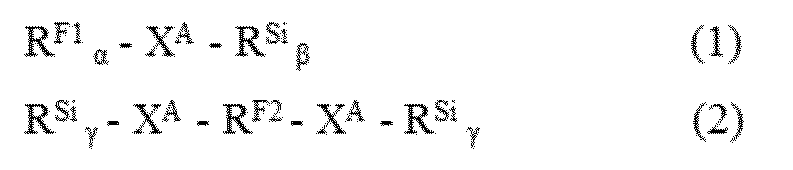
RF1は、Rf1-RF-Oq-であり;
RF2は、-Rf2 p-RF-Oq-であり;
Rf1は、各出現においてそれぞれ独立して、1個またはそれ以上のフッ素原子により置換されていてもよいC1-16アルキル基であり;
Rf2は、1個またはそれ以上のフッ素原子により置換されていてもよいC1-6アルキレン基であり;
RFは、2価のフルオロポリエーテル基であり;
pは、0または1であり;
qは、各出現においてそれぞれ独立して、0または1であり;
XAは、それぞれ独立して、単結合または2~10価の有機基であり;
RSiは、各出現においてそれぞれ独立して、加水分解可能な基に結合したSi原子を有する基であり;
αは、1~9の整数であり;
βは、1~9の整数であり;
γは、それぞれ独立して、1~9の整数である。]
で表される、フルオロポリエーテル基含有シラン化合物(A)、および、フルオロポリエーテル基含有シラン化合物(B)を含み、
前記フルオロポリエーテル基含有シラン化合物(A)において、
RFが、RF11で表され、
RF11が、式:
-(OC6F12)a-(OC5F10)b-(OC4F8)c-(OC3RFa 6)d-(OC2F4)e-(OCF2)f-
[式中、RFaは、各出現においてそれぞれ独立して、水素原子、フッ素原子または塩素原子であり、
a、b、c、d、eおよびfは、各出現においてそれぞれ独立して、0~200の整数であって、a、b、c、d、eおよびfの和は1以上であり、a、b、c、d、eまたはfを付して括弧でくくられた各繰り返し単位の存在順序は式中において任意である。]
で表されるフルオロポリエーテル基であり;
RSiが、各出現においてそれぞれ独立して、下記式(S11)または(S12):
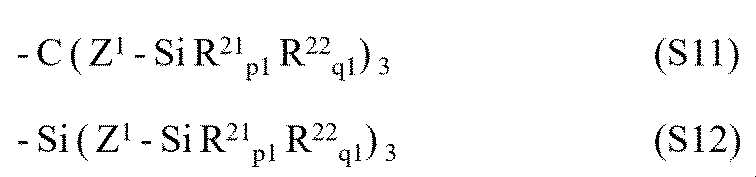
Z1は、各出現においてそれぞれ独立して、2価の有機基であり;
R21は、各出現においてそれぞれ独立して、水酸基または加水分解可能な基であり;
R22は、各出現においてそれぞれ独立して、水素原子または1価の有機基であり;
p1は、各出現においてそれぞれ独立して、1~3の整数であり;
q1は、各出現においてそれぞれ独立して、0~2の整数である。]で表され、
前記フルオロポリエーテル基含有シラン化合物(B)において、
RFが、RF21で表され、
RF21が、式:
-(OC6F12)a-(OC5F10)b-(OC4F8)c-(OC3RFa 6)d-(OC2F4)e-(OCF2)f-
で表され、a、b、c、d、e、fおよびRFaは、それぞれRF11の記載と同意義であり、ただし、RF21は、RF11と同種の繰り返し単位からなり;
RSiが、各出現においてそれぞれ独立して、下記式(S2)、(S3)または(S4):
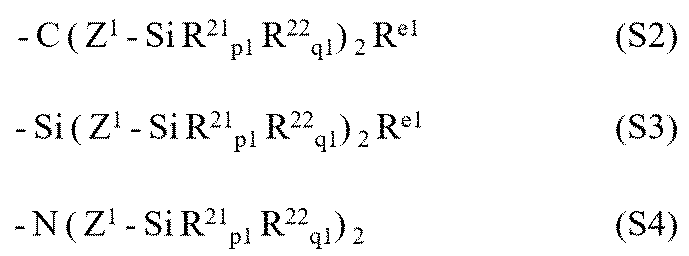
Z1、R21、R22、p1、およびq1は、式(S11)および(S12)と同意義であり;
Re1は、それぞれ独立して、水素原子、水酸基、または1価の有機基である。]
で表され、
ただし、フルオロポリエーテル基含有シラン化合物(A)において、RSiが式(S12)で表され、かつ、フルオロポリエーテル基含有シラン化合物(B)において、RSiが式(S3)で表される場合であって、フルオロポリエーテル基含有シラン化合物(A)のRf1、Rf2、p、q、RF11、XA、α、β、γ、Z1、R21、R22、p1およびq1と、フルオロポリエーテル基含有シラン化合物(B)のRf1、Rf2、p、q、RF21、XA、α、β、γ、Z1、R21、R22、p1およびq1とがそれぞれ完全に同一である場合を除く、表面処理剤。
[2] RFaは、フッ素原子である、[1]に記載の表面処理剤。
[3] RF11およびRF21が、下記式(f1)、(f2)、(f3)、(f4)または(f5):
-(OC3F6)d- (f1)
[式中、dは1~200の整数である。]
-(OC4F8)c-(OC3F6)d-(OC2F4)e-(OCF2)f- (f2)
[式中、cおよびdは、それぞれ独立して、0~30の整数であり;
eおよびfは、それぞれ独立して、1~200の整数であり;
c、d、eおよびfの和は、10~200の整数であり;
添字c、d、eまたはfを付して括弧でくくられた各繰り返し単位の存在順序は、式中において任意である。]
-(R6-R7)g- (f3)
[式中、R6は、OCF2またはOC2F4であり;
R7は、OC2F4、OC3F6、OC4F8、OC5F10およびOC6F12から選択される基であるか、あるいは、これらの基から選択される2または3つの基の組み合わせであり;
gは、2~100の整数である。]
-(OC6F12)a-(OC5F10)b-(OC4F8)c-(OC3F6)d-(OC2F4)e-(OCF2)f- (f4)
[式中、eは、1以上200以下の整数であり、a、b、c、dおよびfは、それぞれ独立して0以上200以下の整数であって、a、b、c、d、eおよびfの和は少なくとも1であり、また、a、b、c、d、eまたはfを付して括弧でくくられた各繰り返し単位の存在順序は式中において任意である。]
-(OC6F12)a-(OC5F10)b-(OC4F8)c-(OC3F6)d-(OC2F4)e-(OCF2)f- (f5)
[式中、fは、1以上200以下の整数であり、a、b、c、dおよびeは、それぞれ独立して0以上200以下の整数であって、a、b、c、d、eおよびfの和は少なくとも1であり、また、a、b、c、d、eまたはfを付して括弧でくくられた各繰り返し単位の存在順序は式中において任意である。]
で表される基である、[1]または[2]に記載の表面処理剤。
[4] RF1およびRF2の数平均分子量が、500~30,000の範囲にある、[1]~[3]のいずれか1つに記載の表面処理剤。
[5] RFにおいて、eおよびfは、それぞれ独立して、1~200の整数であり;
fに対するeの比が、0.1~10の範囲にある、[1]~[4]のいずれか1つに記載の表面処理剤。
[6] α、βおよびγが、1である、[1]~[5]のいずれか1つに記載の表面処理剤。
[7] XAが、
C1-20アルキレン基、
-(CH2)s5-X53-、
-(CH2)s5-X53-(CH2)t5-
-X54-、または
-X54-(CH2)t5-
[式中:
s5が、1~20の整数であり;
X53が、-O-、-CONR54-、または-O-CONR54-であり;
R54は、それぞれ独立して、水素原子、フェニル基またはC1-6アルキル基を表し;
t5が、1~20の整数であり;
X54が、-C(O)O-、-CONR54-、または-O-CONR54-である]、
で表される、[1]~[6]のいずれか1つに記載の表面処理剤。
[8] Z1が、
C1-6アルキレン基、
-(CH2)z1-O-(CH2)z2-(式中、z1およびz2は、各出現においてそれぞれ独立して、0~6の整数)または、
-(CH2)z3-フェニレン-(CH2)z4-(式中、z3およびz4は、各出現においそれぞれ独立して0~6の整数)である、[1]~[7]のいずれか1つに記載の表面処理剤。
[9] p1が、3である、[1]~[8]のいずれか1つに記載の表面処理剤。
[10] 前記フルオロポリエーテル基含有シラン化合物(A)は、前記フルオロポリエーテル基含有シラン化合物(A)と前記フルオロポリエーテル基含有シラン化合物(B)との合計量に対して、5質量%以上含まれる、[1]~[9]のいずれか1つに記載の表面処理剤。
[11] 前記フルオロポリエーテル基含有シラン化合物(A)は、前記フルオロポリエーテル基含有シラン化合物(A)と前記フルオロポリエーテル基含有シラン化合物(B)との合計量に対して、5~95質量%含まれる、[1]~[10]のいずれか1つに記載の表面処理剤。
[12] 前記フルオロポリエーテル基含有シラン化合物(B)において、RSiが式(S2)で表される、[1]~[11]のいずれか1つに記載の表面処理剤。
[13] 前記フルオロポリエーテル基含有シラン化合物(B)において、RSiが式(S3)で表される、[1]~[11]のいずれか1つに記載の表面処理剤。
[14] 前記フルオロポリエーテル基含有シラン化合物(B)において、RSiが式(S4)で表される、[1]~[11]のいずれか1つに記載の表面処理剤。
[15] 前記フルオロポリエーテル基含有シラン化合物(A)において、RSiが式(S11)で表され、前記フルオロポリエーテル基含有シラン化合物(B)において、RSiが式(S2)、(S3)または(S4)で表される、[1]~[11]のいずれか1つに記載の表面処理剤。
[16] 前記フルオロポリエーテル基含有シラン化合物(A)において、RSiが式(S12)で表され、前記フルオロポリエーテル基含有シラン化合物(B)において、RSiが式(S2)、または(S4)で表される、[1]~[11]のいずれか1つに記載の表面処理剤。
[17] 含フッ素オイル、シリコーンオイル、および触媒から選択される1種またはそれ以上の他の成分をさらに含有する、[1]~[16]のいずれか1つに記載の表面処理剤。
[18] さらに溶媒を含む、[1]~[17]のいずれか1つに記載の表面処理剤。
[19] 防汚性コーティング剤または防水性コーティング剤として使用される、[1]~[18]のいずれか1つに記載の表面処理剤。
[20] 真空蒸着用である、[1]~[19]のいずれか1つに記載の表面処理剤。
[21] [1]~[20]のいずれか1つに記載の表面処理剤を含有するペレット。
[22] 基材と、該基材の表面に、[1]~[20]のいずれか1つに記載の表面処理剤より形成された層とを含む物品。
[23] 光学部材である、[22]に記載の物品。
また、「2~10価の有機基」とは、炭素を含有する2~10価の基を意味する。かかる2~10価の有機基としては、特に限定されないが、有機基からさらに1~9個の水素原子を脱離させた2~10価の基が挙げられる。例えば、2価の有機基としては、特に限定されるものではないが、有機基からさらに1個の水素原子を脱離させた2価の基が挙げられる。
以下、本開示の表面処理剤について説明する。
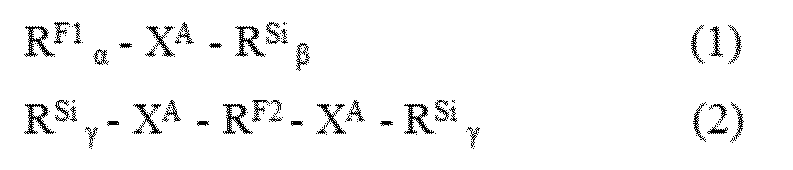
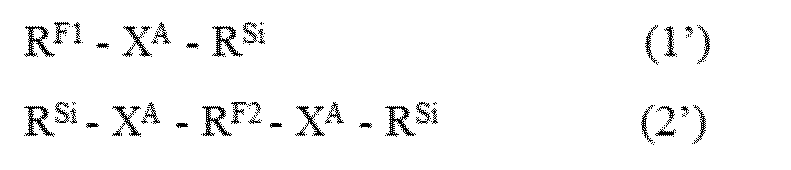
-(R51)p5-(X51)q5-
で表される2価の有機基が挙げられる。
式中:
R51は、単結合、-(CH2)s5-またはo-、m-もしくはp-フェニレン基を表し、一の態様においては、-(CH2)s5-であり、一の態様においては、単結合であり、
s5は、1~20の整数、好ましくは1~6の整数、より好ましくは1~3の整数、さらにより好ましくは1または2であり、
X51は、-(X52)l5-を表し、
X52は、各出現においてそれぞれ独立して、-O-、-S-、o-、m-もしくはp-フェニレン基、-C(O)-、-C(O)O-、-Si(R53)2-、-(Si(R53)2O)m5-Si(R53)2-、-CONR54-、-O-CONR54-、-NR54-および-(CH2)n5-からなる群から選択される基を表し、例えば、-CONR54-、および-O-CONR54-からなる群から選択される基を表し、一の態様としては、-O-、-C(O)-、-CONR54-、および-O-CONR54-からなる群から選択される基を表し、
R53は、各出現においてそれぞれ独立して、フェニル基、C1-6アルキル基またはC1-6アルコキシ基を表し、好ましくはフェニル基またはC1-6アルキル基であり、より好ましくはメチル基であり、
R54は、各出現においてそれぞれ独立して、水素原子、フェニル基またはC1-6アルキル基(好ましくはメチル基)を表し、
m5は、各出現において、それぞれ独立して、1~100の整数、好ましくは1~20の整数であり、
n5は、各出現において、それぞれ独立して、1~20の整数、好ましくは1~6の整数、より好ましくは1~3の整数であり、
l5は、1~10の整数、好ましくは1~5の整数、より好ましくは1~3の整数であり、
p5は、0または1であり、
q5は、0または1であり、
ここに、p5およびq5の少なくとも一方は1であり、p5またはq5を付して括弧でくくられた各繰り返し単位の存在順序は任意である。
ここに、XA(典型的にはXAの水素原子)は、フッ素原子、C1-3アルキル基およびC1-3フルオロアルキル基から選択される1個またはそれ以上の置換基により置換されていてもよい。好ましい態様において、XAは、これらの基により置換されていない。
-(R51)p5-(X51)q5-R52-
である。R52は、単結合、-(CH2)t5-またはo-、m-もしくはp-フェニレン基を表し、一の態様においては-(CH2)t5-であり、一の態様においては、単結合である。t5は、1~20の整数、好ましくは2~6の整数、より好ましくは2~3の整数である。ここに、XA(典型的にはXAの水素原子)は、フッ素原子、C1-3アルキル基およびC1-3フルオロアルキル基から選択される1個またはそれ以上の置換基により置換されていてもよい。好ましい態様において、XAは、これらの基により置換されていない。
単結合、
C1-20アルキレン基、
-R51-X53-R52-、または
-X54-R52-
[式中、R51およびR52は、上記と同意義であり、
X53は、
-O-、
-S-、
-C(O)-、
-C(O)O-、
-CONR54-、
-O-CONR54-、
-O-(CH2)u4-CO-、
-O-(CH2)u4-CONR54-、
-Si(R53)2-、
-(Si(R53)2O)m5-Si(R53)2-、
-O-(CH2)u5-(Si(R53)2O)m5-Si(R53)2-、
-O-(CH2)u5-Si(R53)2-O-Si(R53)2-CH2CH2-Si(R53)2-O-Si(R53)2-、
-O-(CH2)u5-Si(OCH3)2OSi(OCH3)2-、
-CONR54-(CH2)u5-(Si(R53)2O)m5-Si(R53)2-、
-CONR54-(CH2)u5-N(R54)-、または
-CONR54-(o-、m-またはp-フェニレン)-Si(R53)2-
(式中、R53、R54およびm5は、上記と同意義であり、
u4は、1~20の整数、好ましくは1~6の整数、より好ましくは1~3の整数、例えば1であり;u5は1~20の整数、好ましくは2~6の整数、より好ましくは2~3の整数である。)を表し、
X54は、
-S-、
-C(O)-、
-C(O)O-、
-CONR54-、
-O-CONR54-、
-O-(CH2)u4-CO-、
-O-(CH2)u4-CONR54-、
-CONR54-(CH2)u5-(Si(R54)2O)m5-Si(R54)2-、
-CONR54-(CH2)u5-N(R54)-、または
-CONR54-(o-、m-またはp-フェニレン)-Si(R54)2-
(式中、各記号は、上記と同意義である。)
を表す。]
であり得る。
単結合、
C1-20アルキレン基、
-(CH2)s5-X53-、
-(CH2)s5-X53-(CH2)t5-
-X54-、または
-X54-(CH2)t5-
[式中、
X53は、-O-、-C(O)-、-CONR54-、-O-CONR54-、-O-(CH2)u4-CO-、または-O-(CH2)u4-CONR54-であり、例えば、-CONR54-、または-O-CONR54-であり、例えば、-O-、-C(O)-、-O-(CH2)u4-CO-、または-O-(CH2)u4-CONR54-であり、
R54は、各出現においてそれぞれ独立して、水素原子、フェニル基またはC1-6アルキル基を表し、好ましくは、水素原子またはメチル基を表し、
u4は、上記と同意義であり、
s5は、1~20の整数であり、
X54は、-C(O)-、-C(O)O-、-CONR54-、または-O-CONR54-であり、
t5は、1~20の整数である。]
であり得る。
C1-20アルキレン基、
-(CH2)s5-X53-、
-(CH2)s5-X53-(CH2)t5-
-X54-、または
-X54-(CH2)t5-
[式中、
X53は、-O-、-C(O)-、-CONR54-、-O-CONR54-、-O-(CH2)u4-CO-、または-O-(CH2)u4-CONR54-であり、例えば、-CONR54-、または-O-CONR54-であり、例えば、-O-、-C(O)-、-O-(CH2)u4-CO-、または-O-(CH2)u4-CONR54-であり、
R54は、各出現においてそれぞれ独立して、水素原子、フェニル基またはC1-6アルキル基を表し、好ましくは、水素原子またはメチル基を表し、
u4は、上記と同意義であり、
s5は、1~20の整数であり、
X54は、-C(O)-、-C(O)O-、-CONR54-、または-O-CONR54-であり、
t5は、1~20の整数である。]
であり得る。
単結合、
C1-20アルキレン基、
-X53-、
-X53-(CH2)t5-、
-(CH2)s5-X53-、または
-(CH2)s5-X53-(CH2)t5-
[式中、
X53は、-O-、-C(O)-、-CONR54-、-O-CONR54-、-O-(CH2)u4-CO-、または-O-(CH2)u4-CONR54-であり、例えば-CONR54-、または-O-CONR54-であり、例えば、-O-、-C(O)-、-O-(CH2)u4-CO-、または-O-(CH2)u4-CONR54-であり、
R54は、各出現においてそれぞれ独立して、水素原子、フェニル基またはC1-6アルキル基を表し、好ましくは、水素原子またはメチル基を表し、
u4は、上記と同意義であり、
s5は、1~20の整数であり、
t5は、1~20の整数である。]
であり得る。
単結合、
-C(O)-、
C1-20アルキレン基、
-CONH-(CH2)t5-、
-(CH2)s5-O-(CH2)t5-、
-(CH2)s5-O-(CH2)t5-CO-、
-(CH2)s5-O-(CH2)t5-CO-(CH2)s5-、
-(CH2)s5-O-(CH2)t5-CONH-、
-(CH2)s5-O-(CH2)t5-CONH-(CH2)s5-、
-(CH2)s5-(Si(R53)2O)m5-Si(R53)2-(CH2)t5-、
-(CH2)s5-O-(CH2)u5-(Si(R53)2O)m5-Si(R53)2-(CH2)t5-、または
-(CH2)s5-O-(CH2)t5-Si(R53)2-(CH2)u5-Si(R53)2-(CvH2v)-
[式中、R53、m5、s5、t5およびu5は、上記と同意義であり、vは1~20の整数、好ましくは2~6の整数、より好ましくは2~3の整数である。]
である。
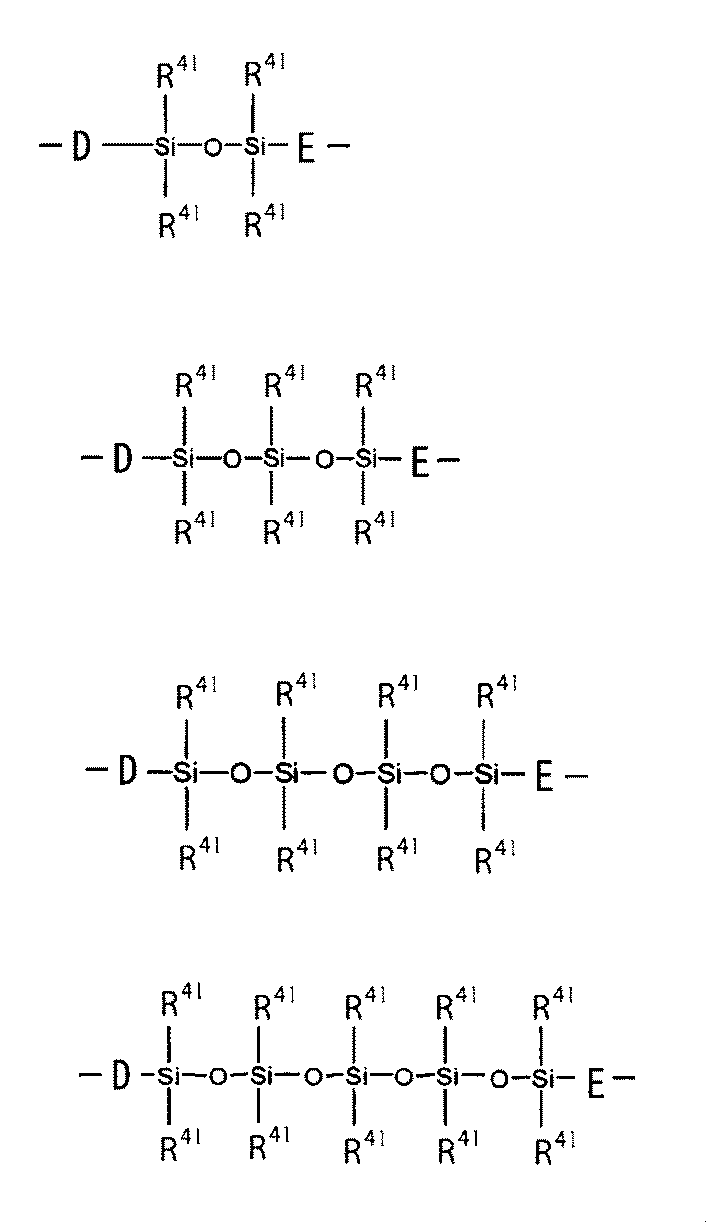
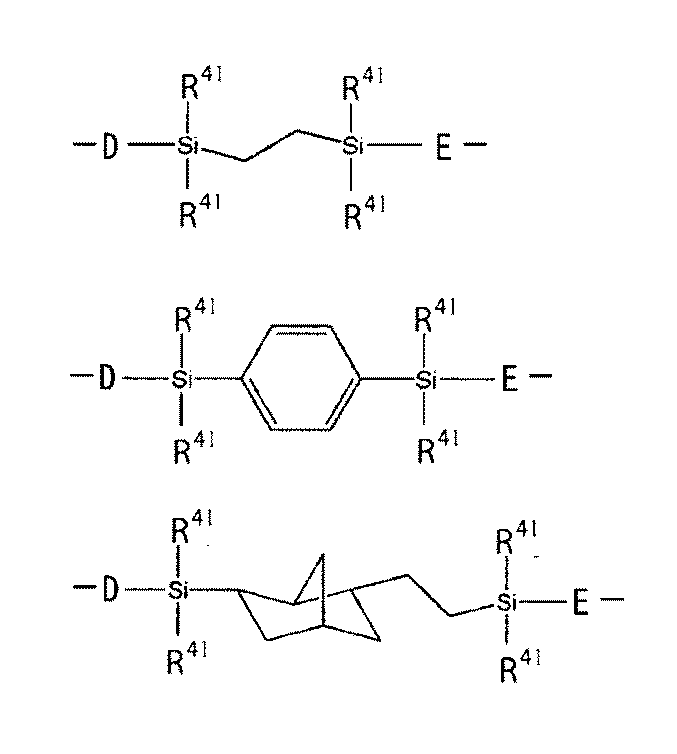
Dは、
-CH2O(CH2)2-、
-CH2O(CH2)3-、
-CF2O(CH2)3-、
-(CH2)2-、
-(CH2)3-、
-(CH2)4-、
-CONH-(CH2)3-、
-CON(CH3)-(CH2)3-、
-CON(Ph)-(CH2)3-(式中、Phはフェニルを意味する、以下において同様)、および

から選択される基であり、
Eは、-(CH2)n-(nは2~6の整数)であり、
Dは、分子主鎖のRF1またはRF2に結合し、Eは、RSiに結合する。]
単結合、
-CH2OCH2-、
-CH2O(CH2)2-、
-CH2O(CH2)3-、
-CH2O(CH2)4-、
-CH2O(CH2)5-、
-CH2O(CH2)6-、
-CH2O(CH2)3Si(CH3)2OSi(CH3)2(CH2)2-、
-CH2O(CH2)3Si(CH3)2OSi(CH3)2OSi(CH3)2(CH2)2-、
-CH2O(CH2)3Si(CH3)2O(Si(CH3)2O)2Si(CH3)2(CH2)2-、
-CH2O(CH2)3Si(CH3)2O(Si(CH3)2O)3Si(CH3)2(CH2)2-、
-CH2O(CH2)3Si(CH3)2O(Si(CH3)2O)10Si(CH3)2(CH2)2-、
-CH2O(CH2)3Si(CH3)2O(Si(CH3)2O)20Si(CH3)2(CH2)2-、
-CH2OCF2CHFOCF2-、
-CH2OCF2CHFOCF2CF2-、
-CH2OCF2CHFOCF2CF2CF2-、
-CH2OCH2CF2CF2OCF2-、
-CH2OCH2CF2CF2OCF2CF2-、
-CH2OCH2CF2CF2OCF2CF2CF2-、
-CH2OCH2CF2CF2OCF(CF3)CF2OCF2-、
-CH2OCH2CF2CF2OCF(CF3)CF2OCF2CF2-、
-CH2OCH2CF2CF2OCF(CF3)CF2OCF2CF2CF2-、
-CH2OCH2CHFCF2OCF2-、
-CH2OCH2CHFCF2OCF2CF2-、
-CH2OCH2CHFCF2OCF2CF2CF2-、
-CH2OCH2CHFCF2OCF(CF3)CF2OCF2-、
-CH2OCH2CHFCF2OCF(CF3)CF2OCF2CF2-、
-CH2OCH2CHFCF2OCF(CF3)CF2OCF2CF2CF2-、
-CH2OCF2CHFOCF2CF2CF2-C(O)NH-CH2-、
-CH2OCH2(CH2)7CH2Si(OCH3)2OSi(OCH3)2(CH2)2Si(OCH3)2OSi(OCH3)2(CH2)2-、
-CH2OCH2CH2CH2Si(OCH3)2OSi(OCH3)2(CH2)3-、
-CH2OCH2CH2CH2Si(OCH2CH3)2OSi(OCH2CH3)2(CH2)3-、
-CH2OCH2CH2CH2Si(OCH3)2OSi(OCH3)2(CH2)2-、
-CH2OCH2CH2CH2Si(OCH2CH3)2OSi(OCH2CH3)2(CH2)2-、
-(CH2)2-Si(CH3)2-(CH2)2-、
-CH2-、
-(CH2)2-、
-(CH2)3-、
-(CH2)4-、
-(CH2)5-、
-(CH2)6-、
-CH2O-CH2-CO-、
-CH2O-CH2-CO-CH2-、
-CH2O-CH2-CO-(CH2)2-、
-CO-、
-CONH-、
-CONH-CH2-、
-CONH-(CH2)2-、
-CONH-(CH2)3-、
-CONH-(CH2)4-、
-CONH-(CH2)5-、
-CONH-(CH2)6-、
-CON(CH3)-(CH2)-、
-CON(CH3)-(CH2)2-、
-CON(CH3)-(CH2)3-、
-CON(CH3)-(CH2)4-、
-CON(CH3)-(CH2)5-、
-CON(CH3)-(CH2)6-、
-CON(Ph)-(CH2)-、
-CON(Ph)-(CH2)2-、
-CON(Ph)-(CH2)3-、
-CON(Ph)-(CH2)4-、
-CON(Ph)-(CH2)5-、
-CON(Ph)-(CH2)6-、
-CONH-(CH2)NH(CH2)3-、
-CONH-(CH2)2NH(CH2)3-、
-CONH-(CH2)3NH(CH2)3-、
-CONH-(CH2)4NH(CH2)3-、
-CONH-(CH2)5NH(CH2)3-、
-CONH-(CH2)6NH(CH2)3-、
-CH2O-CH2-CONH-CH2-、
-CH2O-CH2-CONH-(CH2)2-、
-CH2O-CONH-(CH2)-、
-CH2O-CONH-(CH2)2-、
-CH2O-CONH-(CH2)3-、
-CH2O-CONH-(CH2)4-、
-CH2O-CONH-(CH2)5-、
-CH2O-CONH-(CH2)6-、
-S-(CH2)3-、
-(CH2)2S(CH2)3-、
-CONH-(CH2)3Si(CH3)2OSi(CH3)2(CH2)2-、
-CONH-(CH2)3Si(CH3)2OSi(CH3)2OSi(CH3)2(CH2)2-、
-CONH-(CH2)3Si(CH3)2O(Si(CH3)2O)2Si(CH3)2(CH2)2-、
-CONH-(CH2)3Si(CH3)2O(Si(CH3)2O)3Si(CH3)2(CH2)2-、
-CONH-(CH2)3Si(CH3)2O(Si(CH3)2O)10Si(CH3)2(CH2)2-、
-CONH-(CH2)3Si(CH3)2O(Si(CH3)2O)20Si(CH3)2(CH2)2-、
-C(O)O-(CH2)-、
-C(O)O-(CH2)2-、
-C(O)O-(CH2)3-、
-C(O)O-(CH2)4-、
-C(O)O-(CH2)5-、
-C(O)O-(CH2)6-、
-CH2-O-(CH2)3-Si(CH3)2-(CH2)2-Si(CH3)2-(CH2)2-、
-CH2-O-(CH2)3-Si(CH3)2-(CH2)2-Si(CH3)2-CH(CH3)-、
-CH2-O-(CH2)3-Si(CH3)2-(CH2)2-Si(CH3)2-(CH2)3-、
-CH2-O-(CH2)3-Si(CH3)2-(CH2)2-Si(CH3)2-CH(CH3)-CH2-、
-OCH2-、
-O(CH2)2-、
-O(CH2)3-、
-OCFHCF2-、
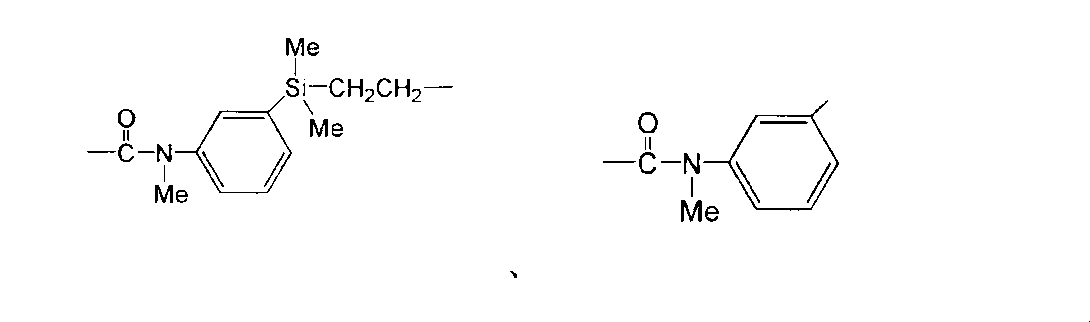
などが挙げられる。
フルオロポリエーテル基含有シラン化合物(A)は、式(1)または(2)で表され、
RF1は、Rf1-RF-Oq-であり;
RF2は、-Rf2 p-RF-Oq-であり;
RFが、RF11で表されるフルオロポリエーテル基であり;
RSiが、各出現においてそれぞれ独立して、下記式(S11)または(S12):


-(OC6F12)a-(OC5F10)b-(OC4F8)c-(OC3RFa 6)d-(OC2F4)e-(OCF2)f-
で表されるフルオロポリエーテル基である。
上記式中:
RFaは、各出現においてそれぞれ独立して、水素原子、フッ素原子または塩素原子であり、
a、b、c、d、eおよびfは、それぞれ独立して、0~200の整数であって、a、b、c、d、eおよびfの和は1以上であり、a、b、c、d、eまたはfを付して括弧でくくられた各繰り返し単位の存在順序は式中において任意である。
-(OC3F6)d- (f1)
[式中、dは、1~200の整数である。]
-(OC4F8)c-(OC3F6)d-(OC2F4)e-(OCF2)f- (f2)
[式中、cおよびdは、それぞれ独立して0以上30以下の整数であり、eおよびfは、それぞれ独立して1以上200以下の整数であり、
c、d、eおよびfの和は2以上であり、
添字c、d、eまたはfを付して括弧でくくられた各繰り返し単位の存在順序は、式中において任意である。]
-(R6-R7)g- (f3)
[式中、R6は、OCF2またはOC2F4であり、
R7は、OC2F4、OC3F6、OC4F8、OC5F10およびOC6F12から選択される基であるか、あるいは、これらの基から独立して選択される2または3つの基の組み合わせであり、
gは、2~100の整数である。]
-(OC6F12)a-(OC5F10)b-(OC4F8)c-(OC3F6)d-(OC2F4)e-(OCF2)f- (f4)
[式中、eは、1以上200以下の整数であり、a、b、c、dおよびfは、それぞれ独立して0以上200以下の整数であって、a、b、c、d、eおよびfの和は少なくとも1であり、また、a、b、c、d、eまたはfを付して括弧でくくられた各繰り返し単位の存在順序は式中において任意である。]
-(OC6F12)a-(OC5F10)b-(OC4F8)c-(OC3F6)d-(OC2F4)e-(OCF2)f- (f5)
[式中、fは、1以上200以下の整数であり、a、b、c、dおよびeは、それぞれ独立して0以上200以下の整数であって、a、b、c、d、eおよびfの和は少なくとも1であり、また、a、b、c、d、eまたはfを付して括弧でくくられた各繰り返し単位の存在順序は式中において任意である。]


フルオロポリエーテル基含有シラン化合物(B)は、式(1)または(2)で表され、
RF1は、Rf1-RF-Oq-であり;
RF2は、-Rf2 p-RF-Oq-であり;
RFが、RF21で表されるフルオロポリエーテル基であり;
RSiが、各出現においてそれぞれ独立して、下記式(S2)、(S3)または(S4):
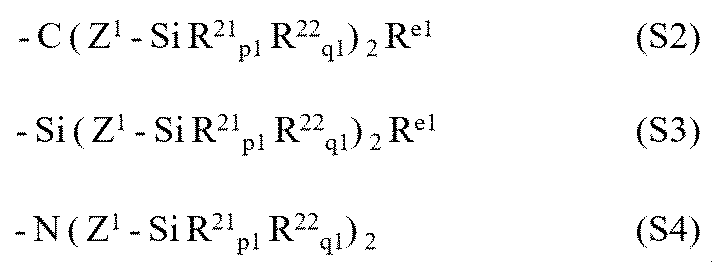
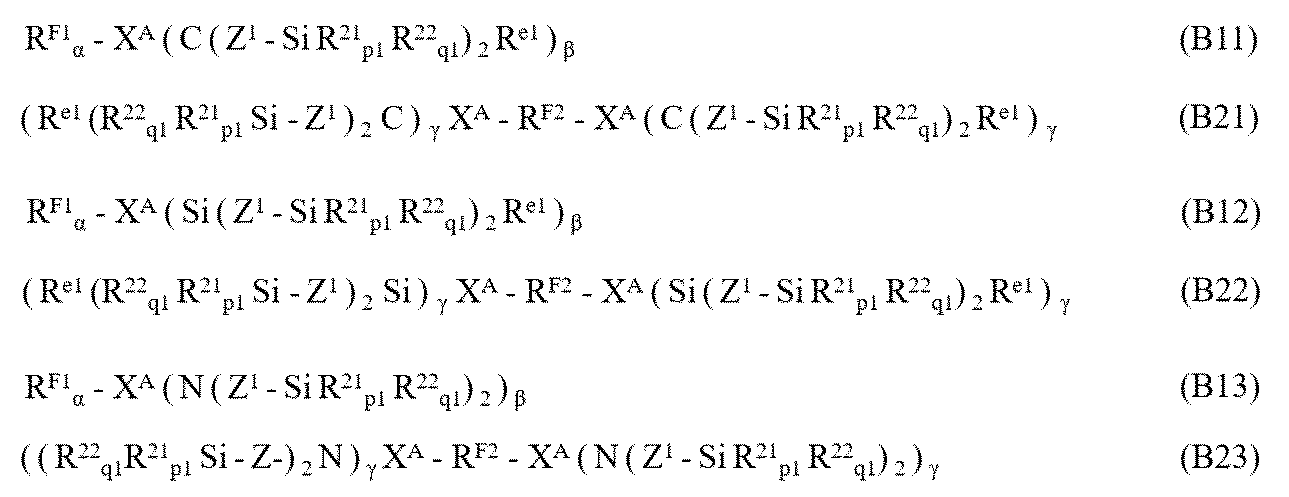
-(OC6F12)a-(OC5F10)b-(OC4F8)c-(OC3RFa 6)d-(OC2F4)e-(OCF2)f-
で表されるフルオロポリエーテル基である。
上記式中、a、b、c、d、e、fおよびRFaは、式(S11)および(S12)の各符号と同意義である。
RF21の繰り返し単位-(OC6F12)-は、RF11の繰り返し単位-(OC6F12)-と同じ構造である。RF21の繰り返し単位-(OC5F10)-は、RF11の繰り返し単位-(OC5F10)-と同じ構造である。RF21の繰り返し単位-(OC4F8)-は、RF11の繰り返し単位-(OC4F8)-と同じ構造である。RF21の繰り返し単位-(OC3F6)-は、RF11の繰り返し単位-(OC3F6)-と同じ構造である。RF21の繰り返し単位-(OC2F4)-は、RF11の繰り返し単位-(OC2F4)-と同じ構造である。
例えば、RF11の繰り返し単位-(OC3F6)-が-(OCF2CF2CF2)-で表されるとき、RF21の繰り返し単位-(OC3F6)-は-(OCF2CF2CF2)-で表され;RF11の繰り返し単位-(OC3F6)-が-(OCF(CF3)CF2)-で表されるとき、RF21の繰り返し単位-(OC3F6)-は-(OCF(CF3)CF2)-で表され;RF11の繰り返し単位-(OC3F6)-が-(OCF2CF(CF3))-で表されるとき、RF21の繰り返し単位-(OC3F6)-は-(OCF2CF(CF3))-で表される。RF11の繰り返し単位-(OC2F4)-が-(OCF2CF2)-で表されるとき、RF21の繰り返し単位-(OC2F4)-は-(OCF2CF2)-で表され;RF11の繰り返し単位-(OC2F4)-が-(OCF(CF3))-で表されるとき、RF21の繰り返し単位-(OC2F4)-は-(OCF(CF3))-で表される。
例えば、RF11が、繰り返し単位-(OC3F6)-からなるとき、RF21は、繰り返し単位-(OC3F6)-からなり;RF11が、繰り返し単位-(OC3F6)-と-(OC2F4)-とからなるとき、RF21は、繰り返し単位-(OC3F6)-と-(OC2F4)-とからなり;RF11が、繰り返し単位-(OC2F4)-と-(OCF2)-とからなるとき、RF21は、繰り返し単位-(OC2F4)-と-(OCF2)-とからなる。
-(OC3F6)d- (f1’)
[式中、dは、1~200の整数である。]
-(OC4F8)c-(OC3F6)d-(OC2F4)e-(OCF2)f- (f2’)
[式中、cおよびdは、それぞれ独立して0以上30以下の整数であり、eおよびfは、それぞれ独立して1以上200以下の整数であり、
c、d、eおよびfの和は2以上であり、
添字c、d、eまたはfを付して括弧でくくられた各繰り返し単位の存在順序は、式中において任意である。]
-(R6-R7)g- (f3’)
[式中、R6は、OCF2またはOC2F4であり、
R7は、OC2F4、OC3F6、OC4F8、OC5F10およびOC6F12から選択される基であるか、あるいは、これらの基から独立して選択される2または3つの基の組み合わせであり、
gは、2~100の整数である。]
-(OC6F12)a-(OC5F10)b-(OC4F8)c-(OC3F6)d-(OC2F4)e-(OCF2)f- (f4’)
[式中、eは、1以上200以下の整数であり、a、b、c、dおよびfは、それぞれ独立して0以上200以下の整数であって、a、b、c、d、eおよびfの和は少なくとも1であり、また、a、b、c、d、eまたはfを付して括弧でくくられた各繰り返し単位の存在順序は式中において任意である。]
-(OC6F12)a-(OC5F10)b-(OC4F8)c-(OC3F6)d-(OC2F4)e-(OCF2)f- (f5’)
[式中、fは、1以上200以下の整数であり、a、b、c、dおよびeは、それぞれ独立して0以上200以下の整数であって、a、b、c、d、eおよびfの和は少なくとも1であり、また、a、b、c、d、eまたはfを付して括弧でくくられた各繰り返し単位の存在順序は式中において任意である。]
フルオロポリエーテル基含有シラン化合物(B)におけるRF21は、フルオロポリエーテル基含有シラン化合物(A)におけるRF11と同じ数平均分子量を有し;
フルオロポリエーテル基含有シラン化合物(B)におけるe/f値は、フルオロポリエーテル基含有シラン化合物(A)におけるe/f値と同じである。
RF11は、各出現においてそれぞれ独立して、下記式(f1)、(f2)、(f3)、(f4)または(f5)で表され;
RF11が、式(f1)で表されるとき、RF21は式(f1’)で表され;
RF11が、式(f2)で表されるとき、RF21は式(f2’)で表され;
RF11が、式(f3)で表されるとき、RF21は式(f3’)で表され;
RF11が、式(f4)で表されるとき、RF21は式(f4’)で表され;
RF11が、式(f5)で表されるとき、RF21は式(f5’)で表され;
フルオロポリエーテル基含有シラン化合物(B)におけるRF21は、フルオロポリエーテル基含有シラン化合物(A)におけるRF11と同じ数平均分子量を有し;
フルオロポリエーテル基含有シラン化合物(B)におけるe/f値は、フルオロポリエーテル基含有シラン化合物(A)におけるe/f値と同じである。
RF11は、各出現においてそれぞれ独立して、下記式(f1)、(f2)、(f3)、(f4)または(f5)で表され;
RF11が、式(f1)で表されるとき、RF21は式(f1’)で表され;
RF11が、式(f2)で表されるとき、RF21は式(f2’)で表され;
RF11が、式(f3)で表されるとき、RF21は式(f3’)で表され;
RF11が、式(f4)で表されるとき、RF21は式(f4’)で表され;
RF11が、式(f5)で表されるとき、RF21は式(f5’)で表され;
フルオロポリエーテル基含有シラン化合物(B)におけるe/f値は、フルオロポリエーテル基含有シラン化合物(A)におけるe/f値と異なる。
なお、Re1は(Z1-SiR21 p1R22 q1)で表される基を除く構造である。
このような構造を有するフルオロポリエーテル基含有シラン化合物(B)を用いることにより、基材との結合において立体障害が小さくなり得る。一方で、上述したフルオロポリエーテル基含有シラン化合物(A)では、基材との結合において立体障害が大きくなり得る。このことから、フルオロポリエーテル基含有シラン化合物(A)と(B)とを組み合わせることにより、基材との結合が特に良好となり得、稠密なシロキサン3次元架橋を形成し得る。
ここで、「フルオロポリエーテル基含有シラン化合物(A)のRF11とフルオロポリエーテル基含有シラン化合物(B)のRF21とが異なる」とは、具体的には、RF11とRF21とにおいて、aが異なる値である、bが異なる値である、cが異なる値である、dが異なる値である、eが異なる値である、およびfが異なる値である、の少なくとも何れか1つであることを意味する。なお、フルオロポリエーテル基含有シラン化合物(A)のRF11と、フルオロポリエーテル基含有シラン化合物(B)のRF21とが、同種の繰り返し単位を有する。
一方で、フルオロポリエーテル基含有シラン化合物(B)では、分岐点であるC原子、Si原子またはN原子に(Z1-SiR21 p1R22 q1)で表される基が2つ結合している。このような構造をするフルオロポリエーテル基含有シラン化合物(B)を、フルオロポリエーテル基含有シラン化合物(A)とともに用いることによって、稠密なシロキサン3次元架橋を形成し得る。
さらに、本開示の表面処理剤では、フルオロポリエーテル基含有シラン化合物(A)のRF11と、フルオロポリエーテル基含有シラン化合物(B)のRF21とが、同種の繰り返し単位を有する。このことにより、フルオロポリエーテル基含有シラン化合物(A)と(B)との相溶性が高くなると考えられる。その結果、フルオロポリエーテル基含有シラン化合物(A)と(B)との混合が容易になり得、例えば、両化合物を任意の割合で混合し得る。
これらのことから、本開示の表面処理剤を用いると、撥水性、撥油性、摩擦耐久性等の特に良好な表面処理層の形成が可能となり得る。特に、フルオロポリエーテル基含有シラン化合物(A)または(B)のみを含む表面処理剤を用いた場合よりも、撥水性、撥油性、摩擦耐久性等の特に良好な表面処理層の形成が可能となる。
本開示の表面処理剤は、溶媒、含フッ素オイルとして理解され得る(非反応性の)フルオロポリエーテル化合物、好ましくはパーフルオロ(ポリ)エーテル化合物(以下、まとめて「含フッ素オイル」と言う)、シリコーンオイルとして理解され得る(非反応性の)シリコーン化合物(以下、「シリコーンオイル」と言う)、触媒、界面活性剤、重合禁止剤、増感剤等をさらに含み得る。
Rf5-(OC4F8)a’-(OC3F6)b’-(OC2F4)c’-(OCF2)d’-Rf6 ・・・(3)
式中、Rf5は、1個またはそれ以上のフッ素原子により置換されていてもよい炭素数1~16アルキル基(好ましくは、C1―16のパーフルオロアルキル基)を表し、Rf6は、1個またはそれ以上のフッ素原子により置換されていてもよい炭素数1~16アルキル基(好ましくは、C1-16パーフルオロアルキル基)、フッ素原子または水素原子を表し、Rf5およびRf6は、より好ましくは、それぞれ独立して、C1-3パーフルオロアルキル基である。
a’、b’、c’およびd’は、ポリマーの主骨格を構成するパーフルオロ(ポリ)エーテルの4種の繰り返し単位数をそれぞれ表し、互いに独立して0以上300以下の整数であって、a’、b’、c’およびd’の和は少なくとも1、好ましくは1~300、より好ましくは20~300である。添字a’、b’、c’またはd’を付して括弧でくくられた各繰り返し単位の存在順序は、式中において任意である。これら繰り返し単位のうち、-(OC4F8)-は、-(OCF2CF2CF2CF2)-、-(OCF(CF3)CF2CF2)-、-(OCF2CF(CF3)CF2)-、-(OCF2CF2CF(CF3))-、-(OC(CF3)2CF2)-、-(OCF2C(CF3)2)-、-(OCF(CF3)CF(CF3))-、-(OCF(C2F5)CF2)-および(OCF2CF(C2F5))-のいずれであってもよいが、好ましくは-(OCF2CF2CF2CF2)-である。-(OC3F6)-は、-(OCF2CF2CF2)-、-(OCF(CF3)CF2)-および(OCF2CF(CF3))-のいずれであってもよく、好ましくは-(OCF2CF2CF2)-である。-(OC2F4)-は、-(OCF2CF2)-および(OCF(CF3))-のいずれであってもよいが、好ましくは-(OCF2CF2)-である。
Rf5-(OCF2CF2CF2)b”-Rf6 ・・・(3a)
Rf5-(OCF2CF2CF2CF2)a”-(OCF2CF2CF2)b”-(OCF2CF2)c”-(OCF2)d”-Rf6 ・・・(3b)
これら式中、Rf5およびRf6は上記の通りであり;式(3a)において、b”は1以上100以下の整数であり;式(3b)において、a”およびb”は、それぞれ独立して0以上30以下の整数であり、c”およびd”はそれぞれ独立して1以上300以下の整数である。添字a”、b”、c”、d”を付して括弧でくくられた各繰り返し単位の存在順序は、式中において任意である。
以下、本開示の物品について説明する。
化合物(A):
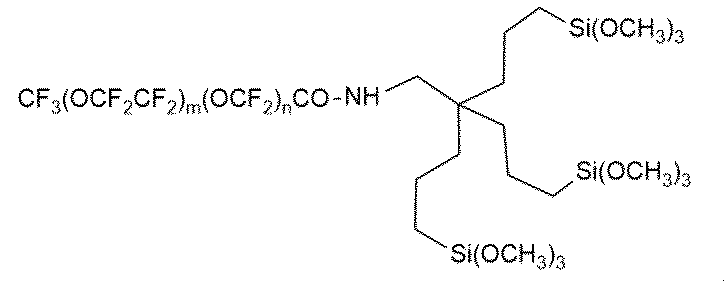
(なお、平均組成としては、(OCF2CF2CF2CF2)の繰り返し単位が0.27個および(OCF2CF2CF2)の繰り返し単位が0.42個含まれていたが、微量のため省略した。また、両末端に-C(CH2CH2CH2Si(OCH3)3)3を有する化合物(A’)が、化合物(A)および化合物(A’)の合計に対して3.2モル%含まれていた。)
化合物(B):

(なお、平均組成としては、(OCF2CF2CF2CF2)の繰り返し単位が0.30個および(OCF2CF2CF2)の繰り返し単位が0.44個含まれていたが、微量のため省略した。また、両末端に-N(CH2CH2CH2Si(OCH3)3)2を有する化合物(B’)が、、化合物(B)および化合物(B’)の合計に対して3.0モル%含まれていた。)
化合物(C):
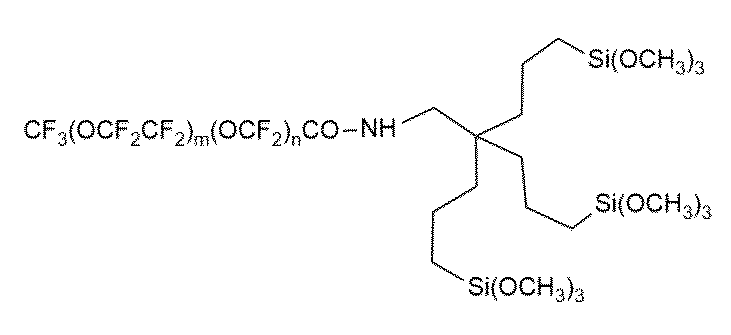
(なお、平均組成としては、(OCF2CF2CF2CF2)の繰り返し単位が1.23個および(OCF2CF2CF2)の繰り返し単位が0.65個含まれていたが、微量のため省略した。また、両末端に-C(CH2CH2CH2Si(OCH3)3)3を有する化合物(C’)が、化合物(C)および化合物(C’)の合計に対して7.9モル%含まれていた。)
化合物(D):

(なお、平均組成としては、(OCF2CF2CF2CF2)の繰り返し単位が1.35個および(OCF2CF2CF2)の繰り返し単位が0.69個含まれていたが、微量のため省略した。また、両末端に-N(CH2CH2CH2Si(OCH3)3)2を有する化合物(D’)が、化合物(D)および化合物(D’)の合計に対して8.1モル%含まれていた。)
化合物(E):

(なお、平均組成としては、(OCF2CF2CF2CF2)の繰り返し単位が0.31個および(OCF2CF2CF2)の繰り返し単位が0.44個含まれていたが、微量のため省略した。また、両末端に-C(CH2CH2CH2Si(OCH3)3)3を有する化合物(E’)が、化合物(E)および化合物(E’)の合計に対して3.8モル%含まれていた。)
化合物(F):
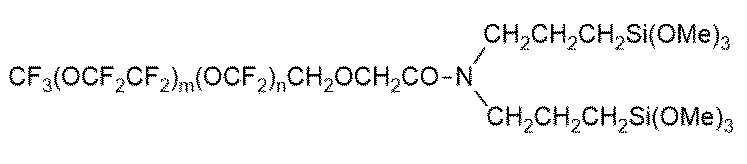
(なお、平均組成としては、(OCF2CF2CF2CF2)の繰り返し単位が0.34個および(OCF2CF2CF2)の繰り返し単位が0.40個含まれていたが、微量のため省略した。また、両末端に-N(CH2CH2CH2Si(OCH3)3)2を有する化合物(F’)が、化合物(F)および化合物(F’)の合計に対して3.9モル%含まれていた。)
化合物(G):
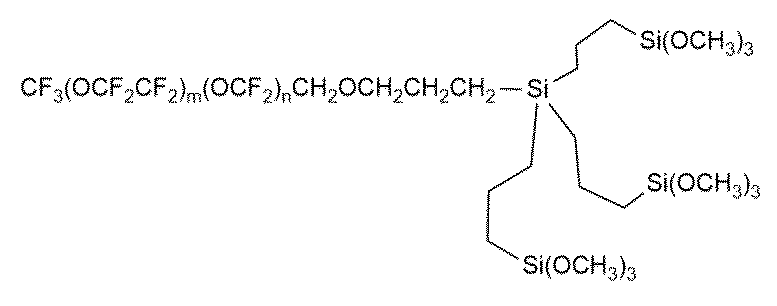
(m≒26、n≒24)
(なお、平均組成としては、(OCF2CF2CF2CF2)の繰り返し単位が1.32個および(OCF2CF2CF2)の繰り返し単位が0.70個含まれていたが、微量のため省略した。また、両末端に-Si(CH2CH2CH2Si(OCH3)3)3を有する化合物(G’)が、化合物(G)および化合物(G’)の合計に対して8.0モル%含まれていた。)
化合物(H):

(なお、平均組成としては、(OCF2CF2CF2CF2)の繰り返し単位が1.22個および(OCF2CF2CF2)の繰り返し単位が1.76個含まれていたが、微量のため省略した。また、両末端に-C(OH)(CH2CH2CH2Si(OCH3)3)2を有する化合物(H’)が、化合物(H)および化合物(H’)の合計に対して6.5モル%含まれていた。)
化合物(I):
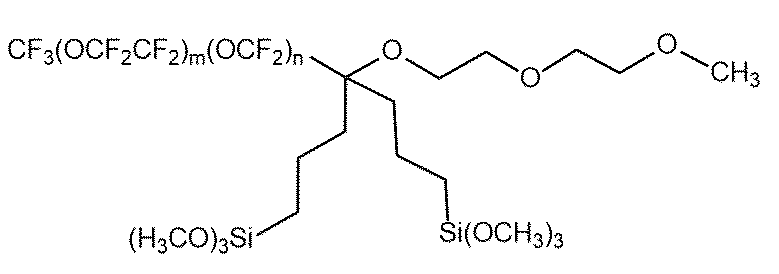
(なお、平均組成としては、(OCF2CF2CF2CF2)の繰り返し単位が2.21個および(OCF2CF2CF2)の繰り返し単位が2.53個含まれていたが、微量のため省略した。また、両末端に-C[(OCH2CH2)2OCH3](CH2CH2CH2Si(OCH3)3)2を有する化合物(I’)が、化合物(I)および化合物(I’)の合計に対して6.2モル%含まれていた。)
化合物(J):

(なお、平均組成としては、(OCF2CF2CF2CF2)の繰り返し単位が1.25個および(OCF2CF2CF2)の繰り返し単位が2.03個含まれていたが、微量のため省略した。また、両末端に-N(CH2CH2CH2Si(OCH3)3)2を有する化合物(J’)が、化合物(J)および化合物(J’)の合計に対して7.8モル%含まれていた。)
化合物(K):

(なお、平均組成としては、(OCF2CF2CF2CF2)の繰り返し単位が1.20個および(OCF2CF2CF2)の繰り返し単位が1.75個含まれていた。また、両末端にSi(OCH3)3を有する化合物(K’)が、化合物(K)および化合物(K’)の合計に対して4.8モル%含まれていた。)
希釈液(1)~(8)を、下記表1に示す割合で混合して、表面処理剤1~12を調製した。表面処理剤1~4が実施例であり、表面処理剤5~12が比較例である。

表面処理剤1~12を、スピンコーターを用いて、化学強化ガラス(コーニング社製、「ゴリラ」ガラス、厚さ0.7mm)上に塗布した。
スピンコートの条件は、300回転/分で3秒間、2000回転/分で30秒であった。
塗布後のガラスを、大気下、恒温槽内で150℃30分間加熱し、硬化膜を形成した。
表面処理剤1~12を用いて得られた表面処理層の特性を以下のように評価した。結果を下記表2に示す。
(初期評価)
まず、初期評価として、表面処理層形成後、その表面に未だ何も触れていない状態で、水の静的接触角を測定した。
ラビングテスター(新東科学社製)を用いて、下記条件で2500回擦る毎に耐水接触角を測定し、15000回もしくは100°未満となるまで試験を続けた。試験環境条件は25℃、湿度40%RHであった。
消しゴム:Raber Eraser(Minoan社製)
接地面積:6mmφ
移動距離(片道):30mm
移動速度:3,600mm/分
荷重:1kg/6mmφ
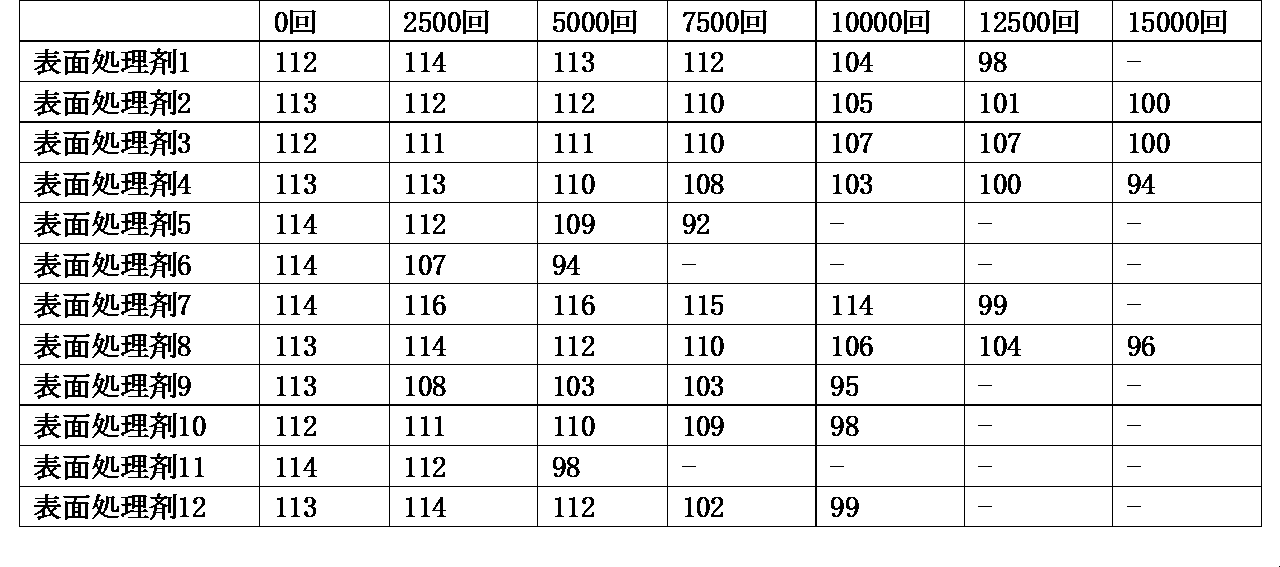
希釈液(9)~(13)を、下記表3に示す割合で混合して、表面処理剤13~21を調製した。表面処理剤13~15が実施例であり、表面処理剤16~21が比較例である。

表面処理剤13~21を、真空蒸着法を用いて、化学強化ガラス(コーニング社製、「ゴリラ」ガラス、厚さ0.7mm)上に塗布した。
真空蒸着法の条件は、抵抗加熱式蒸着機(シンクロン製)、チャンバーサイズ 1900mmφ、真空度5.0E-05、電流値240A、電圧10V、基材温度40℃であった。
塗布後のガラスを、大気下、恒温槽内で150℃30分間加熱し、硬化膜を形成した。
表面処理剤13~21を用いて得られた表面処理層の特性を評価した。静的接触角の測定および耐消しゴム摩擦性試験は、表面処理剤1~12と同様に行った。結果を下記表4に示す。
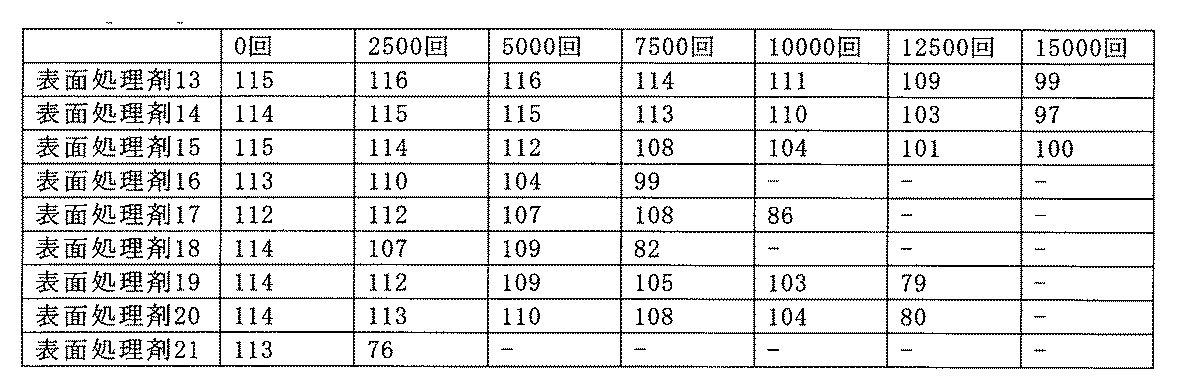
Claims (23)
- 下記式(1)または(2):

RF1は、Rf1-RF-Oq-であり;
RF2は、-Rf2 p-RF-Oq-であり;
Rf1は、各出現においてそれぞれ独立して、1個またはそれ以上のフッ素原子により置換されていてもよいC1-16アルキル基であり;
Rf2は、1個またはそれ以上のフッ素原子により置換されていてもよいC1-6アルキレン基であり;
RFは、2価のフルオロポリエーテル基であり;
pは、0または1であり;
qは、各出現においてそれぞれ独立して、0または1であり;
XAは、それぞれ独立して、単結合または2~10価の有機基であり;
RSiは、各出現においてそれぞれ独立して、加水分解可能な基に結合したSi原子を有する基であり;
αは、1~9の整数であり;
βは、1~9の整数であり;
γは、それぞれ独立して、1~9の整数である。]
で表される、フルオロポリエーテル基含有シラン化合物(A)、および、フルオロポリエーテル基含有シラン化合物(B)を含み、
前記フルオロポリエーテル基含有シラン化合物(A)において、
RFが、RF11で表され、
RF11が、式:
-(OC6F12)a-(OC5F10)b-(OC4F8)c-(OC3RFa 6)d-(OC2F4)e-(OCF2)f-
[式中、RFaは、各出現においてそれぞれ独立して、水素原子、フッ素原子または塩素原子であり、
a、b、c、d、eおよびfは、各出現においてそれぞれ独立して、0~200の整数であって、a、b、c、d、eおよびfの和は1以上であり、a、b、c、d、eまたはfを付して括弧でくくられた各繰り返し単位の存在順序は式中において任意である。]
で表されるフルオロポリエーテル基であり;
RSiが、各出現においてそれぞれ独立して、下記式(S11)または(S12):

Z1は、各出現においてそれぞれ独立して、2価の有機基であり;
R21は、各出現においてそれぞれ独立して、水酸基または加水分解可能な基であり;
R22は、各出現においてそれぞれ独立して、水素原子または1価の有機基であり;
p1は、各出現においてそれぞれ独立して、1~3の整数であり;
q1は、各出現においてそれぞれ独立して、0~2の整数である。]で表され、
前記フルオロポリエーテル基含有シラン化合物(B)において、
RFが、RF21で表され、
RF21が、式:
-(OC6F12)a-(OC5F10)b-(OC4F8)c-(OC3RFa 6)d-(OC2F4)e-(OCF2)f-
で表され、a、b、c、d、e、fおよびRFaは、それぞれRF11の記載と同意義であり、ただし、RF21は、RF11と同種の繰り返し単位からなり;
RSiが、各出現においてそれぞれ独立して、下記式(S2)、(S3)または(S4):

Z1、R21、R22、p1、およびq1は、式(S11)および式(S12)と同意義であり;
Re1は、それぞれ独立して、水素原子、水酸基、または1価の有機基である。]
で表され、
ただし、フルオロポリエーテル基含有シラン化合物(A)において、RSiが式(S12)で表され、かつ、フルオロポリエーテル基含有シラン化合物(B)において、RSiが式(S3)で表される場合であって、フルオロポリエーテル基含有シラン化合物(A)のRf1、Rf2、p、q、RF11、XA、α、β、γ、Z1、R21、R22、p1およびq1と、フルオロポリエーテル基含有シラン化合物(B)のRf1、Rf2、p、q、RF21、XA、α、β、γ、Z1、R21、R22、p1およびq1とがそれぞれ完全に同一である場合を除く、表面処理剤。 - RFaは、フッ素原子である、請求項1に記載の表面処理剤。
- RF11およびRF21が、下記式(f1)、(f2)、(f3)、(f4)または(f5):
-(OC3F6)d- (f1)
[式中、dは1~200の整数である。]
-(OC4F8)c-(OC3F6)d-(OC2F4)e-(OCF2)f- (f2)
[式中、cおよびdは、それぞれ独立して、0~30の整数であり;
eおよびfは、それぞれ独立して、1~200の整数であり;
c、d、eおよびfの和は、10~200の整数であり;
添字c、d、eまたはfを付して括弧でくくられた各繰り返し単位の存在順序は、式中において任意である。]
-(R6-R7)g- (f3)
[式中、R6は、OCF2またはOC2F4であり;
R7は、OC2F4、OC3F6、OC4F8、OC5F10およびOC6F12から選択される基であるか、あるいは、これらの基から選択される2または3つの基の組み合わせであり;
gは、2~100の整数である。]
-(OC6F12)a-(OC5F10)b-(OC4F8)c-(OC3F6)d-(OC2F4)e-(OCF2)f- (f4)
[式中、eは、1以上200以下の整数であり、a、b、c、dおよびfは、それぞれ独立して0以上200以下の整数であって、a、b、c、d、eおよびfの和は少なくとも1であり、また、a、b、c、d、eまたはfを付して括弧でくくられた各繰り返し単位の存在順序は式中において任意である。]
-(OC6F12)a-(OC5F10)b-(OC4F8)c-(OC3F6)d-(OC2F4)e-(OCF2)f- (f5)
[式中、fは、1以上200以下の整数であり、a、b、c、dおよびeは、それぞれ独立して0以上200以下の整数であって、a、b、c、d、eおよびfの和は少なくとも1であり、また、a、b、c、d、eまたはfを付して括弧でくくられた各繰り返し単位の存在順序は式中において任意である。]
で表される基である、請求項1または2に記載の表面処理剤。 - RF1およびRF2の数平均分子量が、500~30,000の範囲にある、請求項1~3のいずれか1項に記載の表面処理剤。
- RFにおいて、eおよびfは、それぞれ独立して、1~200の整数であり;
fに対するeの比が、0.1~10の範囲にある、請求項1~4のいずれか1項に記載の表面処理剤。 - α、βおよびγが、1である、請求項1~5のいずれか1項に記載の表面処理剤。
- XAが、
C1-20アルキレン基、
-(CH2)s5-X53-、
-(CH2)s5-X53-(CH2)t5-
-X54-、または
-X54-(CH2)t5-
[式中:
s5が、1~20の整数であり;
X53が、-O-、-CONR54-、または-O-CONR54-であり;
R54は、それぞれ独立して、水素原子、フェニル基またはC1-6アルキル基を表し;
t5が、1~20の整数であり;
X54が、-C(O)O-、-CONR54-、または-O-CONR54-である]、
で表される、請求項1~6のいずれか1項に記載の表面処理剤。 - Z1が、
C1-6アルキレン基、
-(CH2)z1-O-(CH2)z2-(式中、z1およびz2は、各出現においてそれぞれ独立して、0~6の整数)または、
-(CH2)z3-フェニレン-(CH2)z4-(式中、z3およびz4は、各出現においそれぞれ独立して0~6の整数)である、請求項1~7のいずれか1項に記載の表面処理剤。 - p1が、3である、請求項1~8のいずれか1項に記載の表面処理剤。
- 前記フルオロポリエーテル基含有シラン化合物(A)は、前記フルオロポリエーテル基含有シラン化合物(A)と前記フルオロポリエーテル基含有シラン化合物(B)との合計量に対して、5質量%以上含まれる、請求項1~9のいずれか1項に記載の表面処理剤。
- 前記フルオロポリエーテル基含有シラン化合物(A)は、前記フルオロポリエーテル基含有シラン化合物(A)と前記フルオロポリエーテル基含有シラン化合物(B)との合計量に対して、5~95質量%含まれる、請求項1~10のいずれか1項に記載の表面処理剤。
- 前記フルオロポリエーテル基含有シラン化合物(B)において、RSiが式(S2)で表される、請求項1~11のいずれか1項に記載の表面処理剤。
- 前記フルオロポリエーテル基含有シラン化合物(B)において、RSiが式(S3)で表される、請求項1~11のいずれか1項に記載の表面処理剤。
- 前記フルオロポリエーテル基含有シラン化合物(B)において、RSiが式(S4)で表される、請求項1~11のいずれか1項に記載の表面処理剤。
- 前記フルオロポリエーテル基含有シラン化合物(A)において、RSiが式(S11)で表され、前記フルオロポリエーテル基含有シラン化合物(B)において、RSiが式(S2)、(S3)または(S4)で表される、請求項1~11のいずれか1項に記載の表面処理剤。
- 前記フルオロポリエーテル基含有シラン化合物(A)において、RSiが式(S12)で表され、前記フルオロポリエーテル基含有シラン化合物(B)において、RSiが式(S2)、または(S4)で表される、請求項1~11のいずれか1項に記載の表面処理剤。
- 含フッ素オイル、シリコーンオイル、および触媒から選択される1種またはそれ以上の他の成分をさらに含有する、請求項1~16のいずれか1項に記載の表面処理剤。
- さらに溶媒を含む、請求項1~17のいずれか1項に記載の表面処理剤。
- 防汚性コーティング剤または防水性コーティング剤として使用される、請求項1~18のいずれか1項に記載の表面処理剤。
- 真空蒸着用である、請求項1~19のいずれか1項に記載の表面処理剤。
- 請求項1~20のいずれか1項に記載の表面処理剤を含有するペレット。
- 基材と、該基材の表面に、請求項1~20のいずれか1項に記載の表面処理剤より形成された層とを含む物品。
- 光学部材である、請求項22に記載の物品。
Priority Applications (4)
| Application Number | Priority Date | Filing Date | Title |
|---|---|---|---|
| EP20850270.8A EP4008696B1 (en) | 2019-08-02 | 2020-07-30 | Surface treatment agent |
| KR1020227003538A KR102687494B1 (ko) | 2019-08-02 | 2020-07-30 | 표면 처리제 |
| CN202080054377.9A CN114206986B (zh) | 2019-08-02 | 2020-07-30 | 表面处理剂 |
| US17/590,068 US12351682B2 (en) | 2019-08-02 | 2022-02-01 | Surface-treating agent |
Applications Claiming Priority (4)
| Application Number | Priority Date | Filing Date | Title |
|---|---|---|---|
| JP2019143001 | 2019-08-02 | ||
| JP2019-143001 | 2019-08-02 | ||
| JP2020-006168 | 2020-01-17 | ||
| JP2020006168 | 2020-01-17 |
Related Child Applications (1)
| Application Number | Title | Priority Date | Filing Date |
|---|---|---|---|
| US17/590,068 Continuation US12351682B2 (en) | 2019-08-02 | 2022-02-01 | Surface-treating agent |
Publications (1)
| Publication Number | Publication Date |
|---|---|
| WO2021024921A1 true WO2021024921A1 (ja) | 2021-02-11 |
Family
ID=73452934
Family Applications (1)
| Application Number | Title | Priority Date | Filing Date |
|---|---|---|---|
| PCT/JP2020/029346 Ceased WO2021024921A1 (ja) | 2019-08-02 | 2020-07-30 | 表面処理剤 |
Country Status (7)
| Country | Link |
|---|---|
| US (1) | US12351682B2 (ja) |
| EP (1) | EP4008696B1 (ja) |
| JP (1) | JP6791430B1 (ja) |
| KR (1) | KR102687494B1 (ja) |
| CN (1) | CN114206986B (ja) |
| TW (1) | TWI874432B (ja) |
| WO (1) | WO2021024921A1 (ja) |
Families Citing this family (5)
| Publication number | Priority date | Publication date | Assignee | Title |
|---|---|---|---|---|
| KR20240095305A (ko) * | 2021-11-12 | 2024-06-25 | 에이지씨 가부시키가이샤 | 조성물, 표면 처리제, 코팅액, 물품, 및 물품의 제조 방법 |
| JP2025038262A (ja) * | 2022-02-09 | 2025-03-19 | Agc株式会社 | 表面処理剤、コーティング液、物品及び物品の製造方法 |
| JP2023122564A (ja) * | 2022-02-22 | 2023-09-01 | ダイキン工業株式会社 | 表面処理剤 |
| EP4650412A1 (en) * | 2023-01-13 | 2025-11-19 | Unimatec Co., Ltd. | Surface modifier |
| CN121219383A (zh) * | 2023-07-31 | 2025-12-26 | 大金工业株式会社 | 表面处理剂 |
Citations (12)
| Publication number | Priority date | Publication date | Assignee | Title |
|---|---|---|---|---|
| JP2008297275A (ja) | 2007-06-01 | 2008-12-11 | Shin Etsu Chem Co Ltd | パーフルオロポリエーテル変性アミノシラン及び表面処理剤並びに該アミノシランの硬化被膜を有する物品 |
| JP2014218639A (ja) | 2012-11-05 | 2014-11-20 | ダイキン工業株式会社 | パーフルオロ(ポリ)エーテル基含有シラン化合物 |
| JP2015168785A (ja) * | 2014-03-07 | 2015-09-28 | ダイキン工業株式会社 | パーフルオロ(ポリ)エーテル基含有シラン化合物を含む組成物 |
| JP2015199906A (ja) * | 2014-03-31 | 2015-11-12 | 信越化学工業株式会社 | フルオロポリエーテル基含有ポリマー変性シラン、表面処理剤及び物品 |
| WO2017022437A1 (ja) * | 2015-07-31 | 2017-02-09 | ダイキン工業株式会社 | パーフルオロ(ポリ)エーテル基含有シラン化合物 |
| WO2017038832A1 (ja) * | 2015-09-01 | 2017-03-09 | 旭硝子株式会社 | 含フッ素エーテル化合物、含フッ素エーテル組成物、コーティング液および物品 |
| WO2017038830A1 (ja) * | 2015-09-01 | 2017-03-09 | 旭硝子株式会社 | 含フッ素エーテル化合物、含フッ素エーテル組成物、コーティング液および物品 |
| JP2017133003A (ja) * | 2016-01-26 | 2017-08-03 | ダイキン工業株式会社 | 表面処理剤 |
| WO2018047695A1 (ja) * | 2016-09-08 | 2018-03-15 | ダイキン工業株式会社 | パーフルオロ(ポリ)エーテル基含有シラン化合物を含む組成物 |
| JP2018111816A (ja) * | 2017-01-12 | 2018-07-19 | ダイキン工業株式会社 | パーフルオロ(ポリ)エーテル基含有化合物を含む表面処理剤 |
| JP2019035069A (ja) * | 2017-08-16 | 2019-03-07 | Agc株式会社 | 含フッ素エーテル化合物の製造方法 |
| WO2020040037A1 (ja) * | 2018-08-20 | 2020-02-27 | Agc株式会社 | 膜付き基材の製造方法 |
Family Cites Families (13)
| Publication number | Priority date | Publication date | Assignee | Title |
|---|---|---|---|---|
| DE19606011B4 (de) * | 1996-02-17 | 2006-11-23 | Degussa Ag | Verwendung einer Zubereitung zur Herstellung einer Antifouling-Beschichtung |
| JP2016017176A (ja) | 2014-07-11 | 2016-02-01 | ダイキン工業株式会社 | 表面処理剤 |
| JP2016171176A (ja) | 2015-03-12 | 2016-09-23 | 株式会社東芝 | 半導体装置およびその製造方法 |
| EP3085749B1 (en) | 2015-04-20 | 2017-06-28 | Shin-Etsu Chemical Co., Ltd. | Fluoropolyether-containing polymer-modified silane, surface treating agent, and treated article |
| JP6107891B2 (ja) * | 2015-06-25 | 2017-04-05 | ダイキン工業株式会社 | パーフルオロ(ポリ)エーテル基含有シラン化合物を含む表面処理剤 |
| EP3556551A4 (en) * | 2016-12-13 | 2020-07-22 | Daikin Industries, Ltd. | STAIN-INSENSITIVE ARTICLE |
| KR102526826B1 (ko) | 2017-03-15 | 2023-04-27 | 에이지씨 가부시키가이샤 | 함불소 에테르 조성물, 코팅액 및 물품 |
| CN107082879B (zh) * | 2017-05-04 | 2020-08-28 | 龙岩思康新材料有限公司 | 一种抗指纹剂及其制备方法 |
| WO2018216404A1 (ja) | 2017-05-23 | 2018-11-29 | 信越化学工業株式会社 | 含フッ素コーティング剤組成物及び該組成物を含有する表面処理剤並びに物品 |
| US11681079B2 (en) | 2017-10-31 | 2023-06-20 | Daikin Industries, Ltd. | Surface treatment composition |
| WO2019088133A1 (ja) | 2017-10-31 | 2019-05-09 | ダイキン工業株式会社 | 硬化性組成物 |
| EP3882370B1 (en) * | 2018-11-13 | 2024-01-10 | Agc Inc. | Substrate with water repellent oil repellent layer, vapor deposition material, and method for producing substrate with water repellent oil repellent layer |
| CN109651941B (zh) * | 2018-12-13 | 2021-11-23 | 苏州东杏表面技术有限公司 | 一种基于有机硅改性耐磨型双疏涂层及其制备方法 |
-
2020
- 2020-07-30 JP JP2020129196A patent/JP6791430B1/ja active Active
- 2020-07-30 KR KR1020227003538A patent/KR102687494B1/ko active Active
- 2020-07-30 CN CN202080054377.9A patent/CN114206986B/zh active Active
- 2020-07-30 EP EP20850270.8A patent/EP4008696B1/en active Active
- 2020-07-30 WO PCT/JP2020/029346 patent/WO2021024921A1/ja not_active Ceased
- 2020-07-31 TW TW109126052A patent/TWI874432B/zh active
-
2022
- 2022-02-01 US US17/590,068 patent/US12351682B2/en active Active
Patent Citations (13)
| Publication number | Priority date | Publication date | Assignee | Title |
|---|---|---|---|---|
| JP2008297275A (ja) | 2007-06-01 | 2008-12-11 | Shin Etsu Chem Co Ltd | パーフルオロポリエーテル変性アミノシラン及び表面処理剤並びに該アミノシランの硬化被膜を有する物品 |
| JP2014218639A (ja) | 2012-11-05 | 2014-11-20 | ダイキン工業株式会社 | パーフルオロ(ポリ)エーテル基含有シラン化合物 |
| JP2015168785A (ja) * | 2014-03-07 | 2015-09-28 | ダイキン工業株式会社 | パーフルオロ(ポリ)エーテル基含有シラン化合物を含む組成物 |
| JP2015199906A (ja) * | 2014-03-31 | 2015-11-12 | 信越化学工業株式会社 | フルオロポリエーテル基含有ポリマー変性シラン、表面処理剤及び物品 |
| WO2017022437A1 (ja) * | 2015-07-31 | 2017-02-09 | ダイキン工業株式会社 | パーフルオロ(ポリ)エーテル基含有シラン化合物 |
| JP2017082194A (ja) | 2015-07-31 | 2017-05-18 | ダイキン工業株式会社 | パーフルオロ(ポリ)エーテル基含有シラン化合物 |
| WO2017038830A1 (ja) * | 2015-09-01 | 2017-03-09 | 旭硝子株式会社 | 含フッ素エーテル化合物、含フッ素エーテル組成物、コーティング液および物品 |
| WO2017038832A1 (ja) * | 2015-09-01 | 2017-03-09 | 旭硝子株式会社 | 含フッ素エーテル化合物、含フッ素エーテル組成物、コーティング液および物品 |
| JP2017133003A (ja) * | 2016-01-26 | 2017-08-03 | ダイキン工業株式会社 | 表面処理剤 |
| WO2018047695A1 (ja) * | 2016-09-08 | 2018-03-15 | ダイキン工業株式会社 | パーフルオロ(ポリ)エーテル基含有シラン化合物を含む組成物 |
| JP2018111816A (ja) * | 2017-01-12 | 2018-07-19 | ダイキン工業株式会社 | パーフルオロ(ポリ)エーテル基含有化合物を含む表面処理剤 |
| JP2019035069A (ja) * | 2017-08-16 | 2019-03-07 | Agc株式会社 | 含フッ素エーテル化合物の製造方法 |
| WO2020040037A1 (ja) * | 2018-08-20 | 2020-02-27 | Agc株式会社 | 膜付き基材の製造方法 |
Non-Patent Citations (1)
| Title |
|---|
| See also references of EP4008696A4 |
Also Published As
| Publication number | Publication date |
|---|---|
| US12351682B2 (en) | 2025-07-08 |
| EP4008696B1 (en) | 2025-06-04 |
| JP2021107524A (ja) | 2021-07-29 |
| US20220153929A1 (en) | 2022-05-19 |
| KR20220031655A (ko) | 2022-03-11 |
| TWI874432B (zh) | 2025-03-01 |
| CN114206986B (zh) | 2024-07-26 |
| KR102687494B1 (ko) | 2024-07-24 |
| TW202112987A (zh) | 2021-04-01 |
| EP4008696A4 (en) | 2023-08-02 |
| JP6791430B1 (ja) | 2020-11-25 |
| EP4008696A1 (en) | 2022-06-08 |
| CN114206986A (zh) | 2022-03-18 |
Similar Documents
| Publication | Publication Date | Title |
|---|---|---|
| JP6791430B1 (ja) | 表面処理剤 | |
| TWI785376B (zh) | 表面處理劑 | |
| JP6844728B2 (ja) | フルオロポリエーテル基含有化合物 | |
| WO2020241282A1 (ja) | 表面処理剤 | |
| JP6801804B2 (ja) | フルオロポリエーテル基含有化合物 | |
| JP6911963B2 (ja) | フルオロポリエーテル基含有化合物 | |
| JP6897834B2 (ja) | フルオロポリエーテル基含有化合物 | |
| EP3889205B1 (en) | Polyether group-containing compound | |
| JP6908166B2 (ja) | 表面処理剤 | |
| TWI872287B (zh) | 表面處理劑 | |
| JP6838671B2 (ja) | フルオロポリエーテル基含有化合物 | |
| WO2022158319A1 (ja) | 表面処理剤 | |
| TWI851958B (zh) | 包含具有氟聚醚基之矽烷化合物的組成物 | |
| TWI849374B (zh) | 表面處理用液狀組成物 | |
| KR20240137059A (ko) | 표면 처리제 |
Legal Events
| Date | Code | Title | Description |
|---|---|---|---|
| 121 | Ep: the epo has been informed by wipo that ep was designated in this application |
Ref document number: 20850270 Country of ref document: EP Kind code of ref document: A1 |
|
| ENP | Entry into the national phase |
Ref document number: 20227003538 Country of ref document: KR Kind code of ref document: A |
|
| NENP | Non-entry into the national phase |
Ref country code: DE |
|
| ENP | Entry into the national phase |
Ref document number: 2020850270 Country of ref document: EP Effective date: 20220302 |
|
| WWG | Wipo information: grant in national office |
Ref document number: 2020850270 Country of ref document: EP |