WO2021026615A1 - A method for treatment of crops - Google Patents

A method for treatment of crops Download PDF

Info

Publication number
WO2021026615A1
WO2021026615A1 PCT/AU2020/050850 AU2020050850W WO2021026615A1 WO 2021026615 A1 WO2021026615 A1 WO 2021026615A1 AU 2020050850 W AU2020050850 W AU 2020050850W WO 2021026615 A1 WO2021026615 A1 WO 2021026615A1
Authority
WO
WIPO (PCT)
Prior art keywords
approximately
crop
formulation
solution
wob
Prior art date
Legal status (The legal status is an assumption and is not a legal conclusion. Google has not performed a legal analysis and makes no representation as to the accuracy of the status listed.)
Ceased
Application number
PCT/AU2020/050850
Other languages
French (fr)
Inventor
Sarah Bliss
Current Assignee (The listed assignees may be inaccurate. Google has not performed a legal analysis and makes no representation or warranty as to the accuracy of the list.)
WOBELEA Pty Ltd
Original Assignee
WOBELEA Pty Ltd
Priority date (The priority date is an assumption and is not a legal conclusion. Google has not performed a legal analysis and makes no representation as to the accuracy of the date listed.)
Filing date
Publication date
Priority claimed from AU2019902943A external-priority patent/AU2019902943A0/en
Application filed by WOBELEA Pty Ltd filed Critical WOBELEA Pty Ltd
Priority to AU2020329083A priority Critical patent/AU2020329083B2/en
Priority to US17/634,187 priority patent/US12490743B2/en
Priority to BR112022002700A priority patent/BR112022002700A2/en
Priority to EP20852922.2A priority patent/EP4013227A4/en
Publication of WO2021026615A1 publication Critical patent/WO2021026615A1/en
Anticipated expiration legal-status Critical
Ceased legal-status Critical Current

Links

Classifications

    • AHUMAN NECESSITIES
    • A01AGRICULTURE; FORESTRY; ANIMAL HUSBANDRY; HUNTING; TRAPPING; FISHING
    • A01NPRESERVATION OF BODIES OF HUMANS OR ANIMALS OR PLANTS OR PARTS THEREOF; BIOCIDES, e.g. AS DISINFECTANTS, AS PESTICIDES OR AS HERBICIDES; PEST REPELLANTS OR ATTRACTANTS; PLANT GROWTH REGULATORS
    • A01N59/00Biocides, pest repellants or attractants, or plant growth regulators containing elements or inorganic compounds
    • A01N59/02Sulfur; Selenium; Tellurium; Compounds thereof
    • AHUMAN NECESSITIES
    • A01AGRICULTURE; FORESTRY; ANIMAL HUSBANDRY; HUNTING; TRAPPING; FISHING
    • A01NPRESERVATION OF BODIES OF HUMANS OR ANIMALS OR PLANTS OR PARTS THEREOF; BIOCIDES, e.g. AS DISINFECTANTS, AS PESTICIDES OR AS HERBICIDES; PEST REPELLANTS OR ATTRACTANTS; PLANT GROWTH REGULATORS
    • A01N25/00Biocides, pest repellants or attractants, or plant growth regulators, characterised by their forms, or by their non-active ingredients or by their methods of application, e.g. seed treatment or sequential application; Substances for reducing the noxious effect of the active ingredients to organisms other than pests
    • A01N25/12Powders or granules
    • AHUMAN NECESSITIES
    • A01AGRICULTURE; FORESTRY; ANIMAL HUSBANDRY; HUNTING; TRAPPING; FISHING
    • A01NPRESERVATION OF BODIES OF HUMANS OR ANIMALS OR PLANTS OR PARTS THEREOF; BIOCIDES, e.g. AS DISINFECTANTS, AS PESTICIDES OR AS HERBICIDES; PEST REPELLANTS OR ATTRACTANTS; PLANT GROWTH REGULATORS
    • A01N25/00Biocides, pest repellants or attractants, or plant growth regulators, characterised by their forms, or by their non-active ingredients or by their methods of application, e.g. seed treatment or sequential application; Substances for reducing the noxious effect of the active ingredients to organisms other than pests
    • A01N25/30Biocides, pest repellants or attractants, or plant growth regulators, characterised by their forms, or by their non-active ingredients or by their methods of application, e.g. seed treatment or sequential application; Substances for reducing the noxious effect of the active ingredients to organisms other than pests characterised by the surfactants
    • AHUMAN NECESSITIES
    • A01AGRICULTURE; FORESTRY; ANIMAL HUSBANDRY; HUNTING; TRAPPING; FISHING
    • A01NPRESERVATION OF BODIES OF HUMANS OR ANIMALS OR PLANTS OR PARTS THEREOF; BIOCIDES, e.g. AS DISINFECTANTS, AS PESTICIDES OR AS HERBICIDES; PEST REPELLANTS OR ATTRACTANTS; PLANT GROWTH REGULATORS
    • A01N37/00Biocides, pest repellants or attractants, or plant growth regulators containing organic compounds containing a carbon atom having three bonds to hetero atoms with at the most two bonds to halogen, e.g. carboxylic acids
    • A01N37/10Aromatic or araliphatic carboxylic acids, or thio analogues thereof; Derivatives thereof
    • AHUMAN NECESSITIES
    • A01AGRICULTURE; FORESTRY; ANIMAL HUSBANDRY; HUNTING; TRAPPING; FISHING
    • A01NPRESERVATION OF BODIES OF HUMANS OR ANIMALS OR PLANTS OR PARTS THEREOF; BIOCIDES, e.g. AS DISINFECTANTS, AS PESTICIDES OR AS HERBICIDES; PEST REPELLANTS OR ATTRACTANTS; PLANT GROWTH REGULATORS
    • A01N43/00Biocides, pest repellants or attractants, or plant growth regulators containing heterocyclic compounds
    • A01N43/34Biocides, pest repellants or attractants, or plant growth regulators containing heterocyclic compounds having rings with one nitrogen atom as the only ring hetero atom
    • A01N43/36Biocides, pest repellants or attractants, or plant growth regulators containing heterocyclic compounds having rings with one nitrogen atom as the only ring hetero atom five-membered rings
    • A01N43/38Biocides, pest repellants or attractants, or plant growth regulators containing heterocyclic compounds having rings with one nitrogen atom as the only ring hetero atom five-membered rings condensed with carbocyclic rings
    • AHUMAN NECESSITIES
    • A01AGRICULTURE; FORESTRY; ANIMAL HUSBANDRY; HUNTING; TRAPPING; FISHING
    • A01PBIOCIDAL, PEST REPELLANT, PEST ATTRACTANT OR PLANT GROWTH REGULATORY ACTIVITY OF CHEMICAL COMPOUNDS OR PREPARATIONS
    • A01P1/00Disinfectants; Antimicrobial compounds or mixtures thereof
    • AHUMAN NECESSITIES
    • A01AGRICULTURE; FORESTRY; ANIMAL HUSBANDRY; HUNTING; TRAPPING; FISHING
    • A01PBIOCIDAL, PEST REPELLANT, PEST ATTRACTANT OR PLANT GROWTH REGULATORY ACTIVITY OF CHEMICAL COMPOUNDS OR PREPARATIONS
    • A01P3/00Fungicides
    • AHUMAN NECESSITIES
    • A23FOODS OR FOODSTUFFS; TREATMENT THEREOF, NOT COVERED BY OTHER CLASSES
    • A23BPRESERVATION OF FOODS, FOODSTUFFS OR NON-ALCOHOLIC BEVERAGES; CHEMICAL RIPENING OF FRUIT OR VEGETABLES
    • A23B7/00Preservation of fruit or vegetables; Chemical ripening of fruit or vegetables
    • A23B7/14Preserving or ripening with chemicals not covered by group A23B7/08 or A23B7/10
    • A23B7/153Preserving or ripening with chemicals not covered by group A23B7/08 or A23B7/10 in the form of liquids or solids
    • A23B7/154Organic compounds; Microorganisms; Enzymes
    • AHUMAN NECESSITIES
    • A23FOODS OR FOODSTUFFS; TREATMENT THEREOF, NOT COVERED BY OTHER CLASSES
    • A23BPRESERVATION OF FOODS, FOODSTUFFS OR NON-ALCOHOLIC BEVERAGES; CHEMICAL RIPENING OF FRUIT OR VEGETABLES
    • A23B7/00Preservation of fruit or vegetables; Chemical ripening of fruit or vegetables
    • A23B7/14Preserving or ripening with chemicals not covered by group A23B7/08 or A23B7/10
    • A23B7/153Preserving or ripening with chemicals not covered by group A23B7/08 or A23B7/10 in the form of liquids or solids
    • A23B7/157Inorganic compounds

Definitions

  • the present invention relates to a method of the treatment of crops and more particularly a method for preparing and applying a formulation, preferably in the form of a spray to the growing crop, for control of pathogen growth and to provide crop protection from pathogenic attack.
  • the formulation may also be applied as a fruit and vegetable wash to remove harmful pathogens from surface of produce and extend shelf life and safety of the packed or stored produce as a post harvest application.
  • Pathogen infections can result in significant losses to agricultural crops caused by pre harvest damage, killing them outright or weakening them so as to decrease yields and render the plants, fruit or grains susceptible to primary and secondary infections.
  • Post harvest infections also results in significant loss of agricultural products during storage, processing and handling.
  • pathogen strains are found to have developed separate mechanisms of resistance to two or more unrelated fungicides and is termed ‘multiple resistance’.
  • strains of Botrytis cinerea are known to have become resistant to both benzimidazole and dicarboximide fungicides.
  • a method of treating crops including fruit, vegetables and grain, to provide protection against selected pathogens.
  • a method of treating crops including fruit, vegetables and grain, to control pathogen growth.
  • the pathogens may include plant pathogens, as well as bacterial, fungal and human pathogens.
  • the present invention provides a method for treating crops comprising the steps of: producing a dry composition comprising; a metabisulphite, a benzoate salt, and a cellulose additive; preparing said dry composition as a formulation; and applying the prepared formulation to a crop, wherein said treatment is for prevention or reduction of crop damage by plant pathogens, or to reduce bacterial, fungal or human pathogens on said crop.
  • the present invention provides a method for treating crops comprising the steps of: providing a dry composition comprising: a metabisulphite, a benzoate salt, and a cellulose additive; preparing said dry composition as a formulation; applying the crop with a fungicide; and applying the formulation to the crop, wherein said treatment is for prevention or reduction of crop damage by plant pathogens or to reduce bacterial, fungal or human pathogens on said crop.
  • dry composition as used herein is meant a mixture of components in a form substantially free of moisture.
  • the dry composition may be in powder or any other suitable physical form.
  • a dry composition according to the invention may be presented in unit dosage form, for example in a sachet.
  • plant pathogen as used herein is meant an organism which is capable of causing harm or disease to a crop, wherein the plant pathogen may include pathogens which are also capable of causing harm or disease to a humans or animals.
  • metabisulphite is selected from any suitable metabisulphite salt.
  • the metabisulphite salt is a sodium metabisulphite.
  • the metabisulphite salt is a potassium metabisulphite.
  • the metabisulphite is in the physical form of a powder.
  • the benzoate salt is selected from any suitable benzoate salt.
  • the benzoate salt is a sodium benzoate.
  • the benzoate is a potassium benzoate.
  • the benzoate salt is in the physical form of a powder.
  • the dry composition comprises sodium metabisulphite blended with sodium benzoate at a ratio of approximately between 20:80 and 30:70 w/w, together with a cellulose additive.
  • the dry composition comprises sodium metabisulphite blended with sodium benzoate at a ratio of approximately between 22:78 and 29:71 w/w, together with a cellulose additive.
  • the dry composition includes a cellulose additive at approximately between 0.5 to 3% by weight of the dry composition. In a further preferred embodiment the dry composition includes a cellulose additive at approximately between 0.8 to 2.0% by weight of the dry composition. In a further preferred embodiment the dry composition comprises a cellulose additive at approximately between 1.0 to 1.5% by weight of the dry composition.
  • formulation as used herein is meant a mixture comprising the ‘dry composition’ being further blended with a surfactant, additional additive or solution.
  • the blending technique includes any method of mechanical or hand mixing, or any other suitable form of agitation to achieve a substantially evenly distributed formulation.
  • the blending may be performed by a V blender, double blender, bin blender, drum blender, paddle blender, cement or concrete mixers, twin shaft mixers, or any other suitable blender or mixer.
  • cellulose additive as used herein is meant any additional component containing cellulose.
  • the cellulose additive may be selected from alpha cellulose, cellulose, cellulose crystalline; cellulose gel, hydroxycellulose, microcrystalline cellulose, plastics, cellulosic, and sulfite cellulose.
  • the cellulose additive is CAS # 9000-34-6.
  • the formulation comprises a dry composition being further blended with a surfactant, other suitable additive or solution.
  • the formulation comprises a dry composition being further blended with a surfactant at a ratio of approximately between 0.5% to 10% w/w. of the final formulation.
  • the formulation comprises a dry composition being further blended with a surfactant at a ratio of approximately between 0.8% to 8% w/w of the final formulation.
  • the formulation comprises a dry composition being further blended with a surfactant at a ratio of approximately between 1.0% to 6% w/w of the final formulation.
  • the surfactant (otherwise referred to as wetting agents) optionally used in the present invention is selected from any suitable surfactant, said surfactant being suitable for human and/or animal consumption.
  • the surfactant is selected from a non-ionic surfactant and an ionic surfactant.
  • a ‘non-ionic surfactant’ as used herein is meant an organic compound containing covalently bonded oxygen-containing hydrophilic groups, bound to hydrophobic parent structures.
  • an ‘ionic surfactant’ as used herein is meant a chemical compound containing a positively and/or negatively charged, polar functional ground bound to a hydrophobic parent structure.
  • Ionic surfactants include anionic, cationic and zwitterionic molecules.
  • the surfactant is selected from polyethylene glycol, polyethylene oxide, dipropylene glycol and polysorbate 80.
  • polyethylene glycol as used herein is meant a polyether organic compound preferably having a molecular weight less than 100,000 g/mol.
  • polyethylene oxide as used herein, is meant a polymer preferably having a molecular weight equal to or greater than 100,000 g/mol.
  • an ‘organic compound’ is meant a chemical compound, the molecules of which contain the element carbon.
  • the organic compound may be a hydrocarbon.
  • a ‘hydrocarbon’ is meant an organic compound containing, inter alia, the elements carbon and hydrogen.
  • the dry composition is capable of being stored for approximately up to 24 months prior to further blending/formulation or being administered to crops.
  • the formulation may be diluted to produce a solution, prior to being administered to crops.
  • the formulation may be diluted with an aqueous mixture to produce a solution.
  • the formulation may be diluted with water to produce a solution used to wash crops.
  • the aqueous mixture may be of any suitable type.
  • aqueous mixture as used herein is meant a water based solvent or a solvent including at least approximately 50% water.
  • the aqueous mixture is water.
  • the formulation is diluted with a solution no earlier than approximately 14 days prior to being administered the crops.
  • the solution has a pH of between approximately 2.0 to 7.5. In a further preferred embodiment, the solution has a pH of between approximately 3.0 to 6.5. In a particularly preferred embodiment, the solution has a pH of between approximately 4.0 and 6.0.
  • the solution is applied to a crop as either a pre-harvest spray or a post harvest wash.
  • the solution is applied to the crop as a pre harvest spray.
  • a crop as used herein is meant any food product suitable for human or animal consumption, or a tree, vine or other plant upon which the food product is grown.
  • the crop includes fruits, vegetables, grains, grasses and seeds.
  • the crop includes grapes and other fruit, vegetables or grains suitable for the production of wine or other beverages.
  • the crop includes berries, stone fruits, citrus fruits, tropical fruits, melons, drupes, pomes or any other edible fruit.
  • the crop includes tropical vegetables, bulb vegetables, brassica vegetables, fruiting vegetables, leafy vegetables, legumes, pulses, root and tuber vegetables, stalk and stem vegetables, cereal grains, tree nuts and herbs, including lettuce, garlic and pistachios.
  • the crop includes seeds and seedlings of flowering crops, fruits and vegetables.
  • the crop to be treated is selected from apples, pears, cherries or grapes.
  • the solution is applied to a crop upon expression of pathogens or at any combination of the following stages of crop maturation:
  • a fungicide is applied between approximately 2 to 12 hours prior to the solution.
  • the fungicide contains an active ingredient which is applied at a rate of between approximately 5 to 25 ppm.
  • the grape vine varieties may be selected from the group consisting of Vitis Vinifera, Vitis labrusca, Vitis riparia, Vitis rotundifolia, Vitis rupestris, Vitis aestivalis, Vitis mustangensis. Vitis coignetiae, Vitis californica, Vitis vulpina, Vitis amurensis, Muscadinia rotundifolia and vitis romanetii.
  • the grape vine varieties may be a cultivar or hybrid of any aforementioned species.
  • the crop may be a fruit that is susceptible to stem end rots, such as cherries.
  • the formulation of the present invention may be as a spray pre-harvest to help prevent or reduce stem end rots, and/or used after harvest to prevent or reduce stem end rots.
  • the solution is applied at no later than 3 days prior to harvest. In a further preferred embodiment, the solution is further applied upon expression of botrytis and at any combination of the following stages of grape maturation: approximately 10% flower crop; approximately 10% cap fall; approximately 30% cap fall; approximately end of flowering; approximately berry size approximately 4 mm; approximately bunch closure; and approximately veraison.
  • a fungicide is applied between approximately 2 to 12 hours prior to the solution.
  • the fungicide contains an active ingredient which is applied at a rate of between approximately 5 to 25 ppm.
  • the applied solution has a concentration of approximately between 1 g/L to 8g/L. In a further preferred embodiment the applied solution has a concentration of approximately between 2g/L to 6.5g/L. In a further preferred embodiment the applied solution has a concentration of approximately between 3.5g/L to 4.5g/L. In a further preferred embodiment the applied solution has a concentration of approximately between 3.75 g/L to 4.25 g/L. In a preferred embodiment the applied solution has a concentration of between approximately 2g/L and approximately 8g/L. In a particularly preferred embodiment, the applied solution has a concentration of 2g/L, 4g/L or 8g/L.
  • the applied solution results in a reduction of growth of crop pathogens.
  • the applied solution results in a reduction of growth of crop pathogens selected from the group consisting of Botrytis cinerea, Xanthomonas spp E. coli, Monilina fructicola and Penicillium spp.
  • the applied solution results in a reduction of growth of the crop pathogen Xanthomonas campestris.
  • the applied solution results in reducing growth of the crop pathogen Erwinia Carotovora.
  • the applied solution is delivered at a rate between approximately 500 - 1600 L/Ha.
  • the applied solution is delivered at a temperature of not more than approximately 30’C.
  • the applied solution is applied at a humidity of less than approximately 75%.
  • the applied solution may be applied at the above rates and delivery conditions for all growing crops described herein, from seedling through to harvest.
  • use of the applied solution results in very low levels of residue of sulphites and the benzoates in the resulting crop and products thereof. These levels may be well below the limits for food safety standards.
  • sulphite residue in the resulting wine, juice or pomace may be less than approximately 100 mg/L, more preferably less than 10 mg/L, more preferably between approximately 3 and 5 mg/L.
  • the maximum permitted levels of sulphites in wines varies from 200 to 300 mg/kg depending on the type of wine and residual sugar level.
  • benzoate residue in the resulting wine, juice or pomace may be less than approximately 100mg/L, more preferably less than 50 mg/L, more preferably between approximately 1 and 50 mg/L.
  • the maximum permitted level of benzoates in wines is 400 mg/kg.
  • the applied solution may be used in a run to waste washing facility as a post harvest bacteriacide/disinfectant on produce such as fruit, vegetables and nuts.
  • capacity may be dosed through automatic control, preferably at rates of approximately 2g/L or 4g/L.
  • the contact time is not less than approximately 2 minutes and not more than approximately 60 minutes.
  • the applied solution may be used in a recirculating washing facility as a post harvest bacteriacide/disinfectant on produce as fruit, vegetables and nuts.
  • capacity may be dosed through automatic control, preferably at rates of approximately 2g/L or 4g/L.
  • the contact time is not less than approximately 2 minutes and not more than approximately 60 minutes.
  • the applied solution may be used in conjunction with a filtration system.
  • the crop is treated with a solution of the composition, as described herein, post harvest.
  • the solution applied post harvest has a concentration of approximately between 1 g/L to 8g/L.
  • the solution applied post harvest has a concentration of approximately between 2g/L to 6.5g/L.
  • the solution applied post harvest has a concentration of approximately between 3.5g/L to 4.5g/L.
  • the solution applied post harvest has a concentration of approximately between 3.75g/L to 4.25g/L.
  • the applied solution results in approximately between 10% to 30% reduction in Botrytis cinerea growth compared to an untreated crop. In a further preferred embodiment the applied solution results in approximately between 15 to 25% reduction in Botrytis cinerea growth compared to an untreated crop. In a particularly preferred embodiment the applied solution results in approximately between 17% to 23% reduction in Botrytis cinerea growth compared to an untreated crop.
  • the applied solution results in approximately greater than 50% reduction in Xanthomonas sp growth compared to an untreated crop. In a more preferred embodiment, the applied solution results in approximately greater than 75% reduction in Xanthomonas sp growth compared to an untreated crop. In a particularly preferred embodiment, the applied solution results in approximately greater than 90% reduction in Xanthomonas sp growth compared to an untreated crop.
  • the applied solution results in approximately greater than 60% reduction in growth of E. coli compared to an untreated crop. In a more preferred embodiment the applied solution results in approximately greater than 70% reduction in growth of E. coli compared to an untreated crop. In a particular preferred embodiment the applied solution results in approximately greater than 80% reduction in growth of E. coli compared to an untreated crop.
  • the untreated crop may be a sample of an untreated crop.
  • the applied solution results in no substantial effect on the growth rate of Saccharomyces cerevisae and Schizosaccharomyces pombe species.
  • the fungicide contains a halogen based active ingredient.
  • the halogen based fungicide contains an active ingredient selected from bromochlorodimethylhydantoin (BCDMH), Chlorine, Bromine, an active ingredient which releases a halogen, an active ingredient which releases hypobromous acid and/or hypochlorous acid, an active ingredient which releases chlorine and/or bromine, or a fungicide containing any suitable combination thereof.
  • BCDMH bromochlorodimethylhydantoin
  • the fungicide is applied as a solution containing the halogen based active ingredient at a concentration of approximately between 1 to 100 ppm. In a further embodiment the fungicide is applied as a solution containing the halogen based active ingredient at a concentration of approximately between 2 to 50 ppm. In a preferred embodiment the fungicide is applied as a solution containing the halogen based active ingredient at a concentration of approximately between 5 to 10 ppm.
  • the crop is treated with both the formulation and fungicide pre harvest. In a further embodiment the crop is treated with both the formulation and fungicide pre harvest and the crop is further treated with the formulation post harvest. In a further embodiment the crop is treated with both the formulation and fungicide pre harvest and the crop is further treated with both the formulation and fungicide post harvest.
  • the crop is treated with both the formulation and fungicide post harvest. In an alternative preferred embodiment the crop is treated with both the formulation and fungicide post harvest and the crop is treated with the formulation pre harvest.
  • Figure 1 shows the necrosis of the untreated control at 15DAAB - Grapevine cv. Sauvignon Blanc, as described in Example 10.
  • Figure 2 shows grapevine cv. Sauvignon Blanc following two applications of WOB NP1 at the lowest application rate of 35 + 119.6 g ai/100 L (15DAAB), as described in Example 10.
  • Figure 3a shows necrosis of tissue on grapevine cv. Sauvignon Blanc following two applications of WOB NP1 at 70 + 239.2 g ai/100 L (15DAAB), as described in Example 10.
  • Figure 3b shows necrosis (as indicated by circled regions) of tissue on grapevine cv. Sauvignon Blanc following two applications of WOB NP1 at 70 + 239.2 g ai/100 L (15DAAB), as described in Example 10.
  • Figure 4a shows necrosis of tissue on grapevine cv. Sauvignon Blanc following two applications of WOB NP1 at 140 + 478.4 g ai/100 L (15DAAB), as described in Example 10.
  • Figure 4b shows necrosis (as indicated by circled regions) of tissue on grapevine cv. Sauvignon Blanc following two applications of WOB NP1 at 140 + 478.4 g ai/100 L (15DAAB), as described in Example 10.
  • Figure 5a shows necrosis of tissue on grapevine cv. Sauvignon Blanc following two applications of WOB NP1 at 280 + 956.8 g ai/100 L (15DAAB), as described in Example 10.
  • Figure 5b shows necrosis (as indicated by circled regions) of tissue on grapevine cv. Sauvignon Blanc following two applications of WOB NP1 at 280 + 956.8 g ai/100 L (15DAAB), as described in Example 10.
  • Figure 6a shows necrosis studies, leaf damage and bunch residue 114DAB as described in Example 11.
  • Photograph 1 Untreated control bunches.
  • Photograph 2 Untreated leaves.
  • Photograph 3 WOB NP1 (35.0+119.6 g ai/100 L) bunches.
  • Photograph 4 WOB NP1 (35.0+119.6 g ai/100 L) leaves.
  • Figure 6b shows necrosis studies, leaf damage (as indicated by circled regions) and bunch residue 114DAB as described in Example 11.
  • Photograph 1 Untreated control bunches.
  • Photograph 2 Untreated leaves.
  • Photograph 3 WOB NP1 (35.0+119.6 g ai/100 L) bunches.
  • Photograph 4 WOB NP1 (35.0+119.6 g ai/100 L) leaves.
  • Figure 7a shows necrosis studies, as described in Example 11. (Clockwise from top left) Photograph 5: WOB NP1 (70.0+239.2 g ai/100 L) bunches. Photograph 6: WOB NP1 (70.0+239.2 g ai/100 L) leaves. Photograph 7: WOB NP1 (140.0+478.4 g ai/100 L) bunches. Photograph 8: WOB NP1 (140.0+478.4 g ai/100 L) leaves.
  • Figure 7b shows necrosis studies, as described in Example 11.
  • Photograph 5 WOB NP1 (70.0+239.2 g ai/100 L) bunches.
  • Photograph 6 WOB NP1 (70.0+239.2 g ai/100 L) leaves with leaf damage as indicated by circled regions.
  • Photograph 7 WOB NP1 (140.0+478.4 g ai/100 L) bunches.
  • Photograph 8 WOB NP1 (140.0+478.4 g ai/100 L) leaves with leaf damage as indicated by circled regions.
  • Figure 8a shows necrosis studies, as described in Example 11. (Clockwise from top left) Photograph 9: WOB NP1 (280.0+956.8 g ai/100 L) bunches. Photograph 10: WOB NP1 (280.0+956.8 g ai/100 L) leaves. Photograph 11: Standard control program bunches. Photograph 12: Standard control program leaves.
  • Figure 8b shows necrosis studies, as described in Example 11.
  • Photograph 9 WOB NP1 (280.0+956.8 g ai/100 L) bunches.
  • Photograph 10 WOB NP1 (280.0+956.8 g ai/100 L) leaves with leaf damage as indicated by circled regions.
  • Photograph 11 Standard control program bunches.
  • Photograph 12 Standard control program leaves.
  • Figure 12 shows Log 10 of cfu/g+1 of E. coli on apples washed with either water, WOB NP1, BCDMH or BCDMH + WOB NP1.
  • Figure 13 shows Incidence of rots after storage on pears washed with either water, WOB NP1 , BCDMH or BCDMH + WOB NP1.
  • Figure 14 shows Incidence of rots after storage on apples washed with either water, WOB NP1 , BCDMH or BCDMH + WOB NP1.
  • WOB NP 1 and WOB PH1 were prepared according to the general method of Example 1, wherein sodium sulphite is substituted for sodium metabisulphite in the case of WOB PH 1.
  • the method of Example 1 was further modified whereby the sodium benzoate added was in the form of a prill bead rather than a powder.
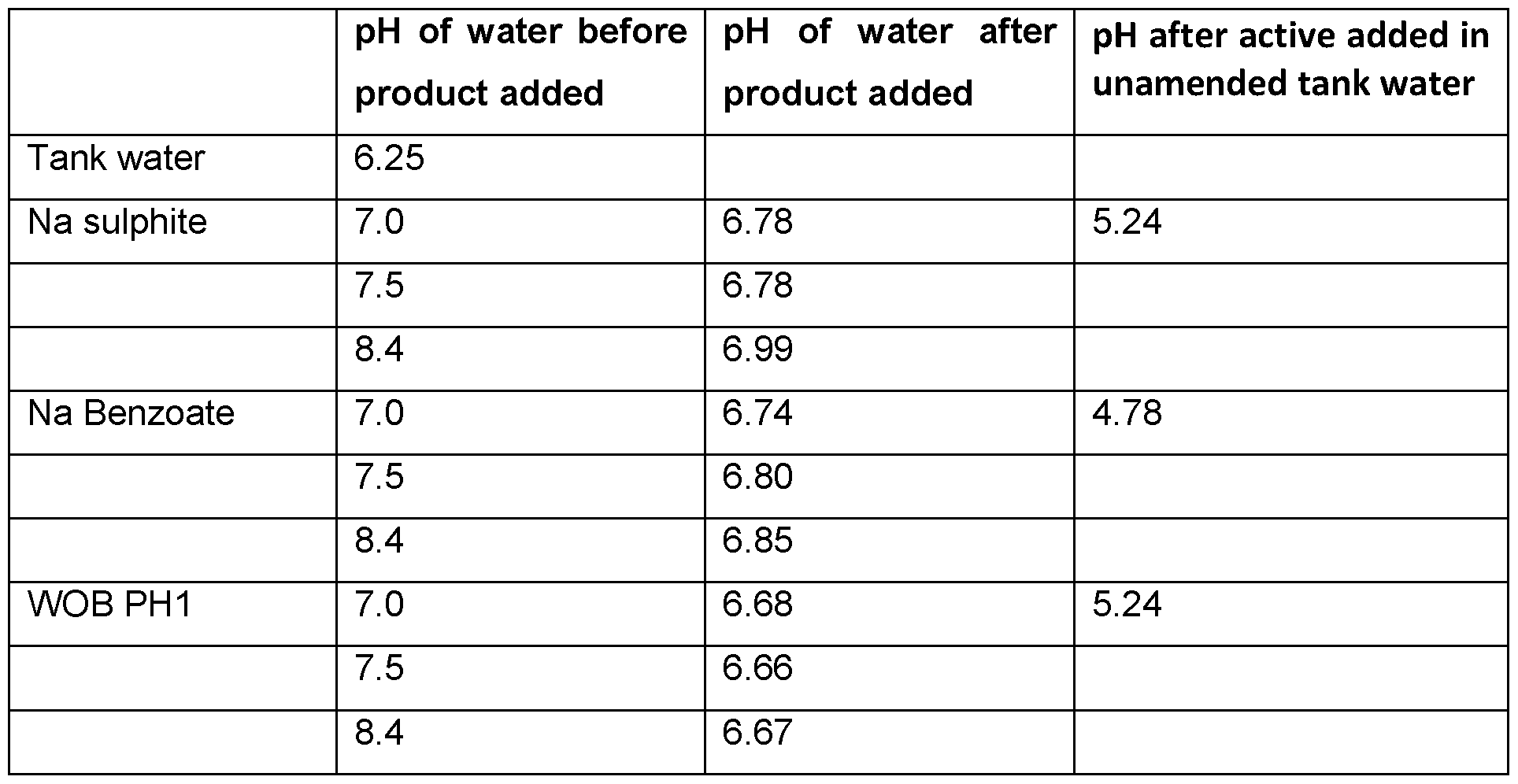
  • the water used throughout the projects is rainwater held in the dark in a plastic tank with stable pH value of 6.25. Controls were set up by replacing actives with tank water only.
  • Tank water pH 6.25 was adjusted to the respective pH levels prior to adding the actives to determine the change in pH caused by the actives.
  • Tank water was adjusted to pH 4.0, 5.5, and 7.0 before adding sodium benzoate, sodium metabisulphite and WOB NP1, each at 0.8%.
  • Tank water was adjusted to pH 7.0, 7.5 and 8.4 before adding sodium benzoate, sodium sulphite and WOB PH1, each at 0.8%.
  • Table 1 Recorded pH of Sodium metabisulphite, sodium benzoate and WOB NP1 in tank water (pH range 4.0-7.0).
  • the fungal and bacterial pathogens Erwinia carotovora (bacterial) and Botrytis cinerea (fungal) were cultured on to Nutrient Agar (NA) and potato dextrose agar (PDA), respectively and incubated at ambient temperature until sporulating or well grown.
  • NA Nutrient Agar
  • PDA potato dextrose agar
  • the plates were incubated at ambient temperature (14-25°C). Inhibition zones were measured at 24 hours, 48 hours and 7 days.
  • Table 10 Sodium sulphite activity on the growth of B. cinerea. Table 11. Sodium benzoate activity on the growth of E. carotovora.
  • Table 12 Sodium benzoate activity on the growth of B. cinerea. Table 13. WOB PH1 activity on the growth of E. carotovora.
  • WOB NP 1 and WOB PH 1 products were prepared, according to the general method of Example 1 , wherein the sodium benzoate added was is the form of a powder rather than a prill bead of Example 4. These products were subsequently prepared as a liquid formulation according to the method of Example 2.
  • Table 18 Sodium benzoate activity on the growth of B. cinerea (unadjusted water pH).
  • Table 31 The
  • This trial was set up to determine the efficacy of a formulation comprising WOB-NP1 as a curative against the fungal pathogen, Botrytis cinerea, and two bacteria strains, E.coli and Xanthomonas sp.
  • WOB NP1 The effect of WOB NP1 on two wild type yeasts, Saccharomyces cerevisae and Shizosaccharomyces pombe were also further investigated.
  • the organisms were transferred from culture collection mother cultures to fresh media and checked for purity.
  • PDA Potato Dextrose Agar
  • a formulation was prepared according to the method described in Example 1 (referred to as WOB NP1). Prior to adding formulation to plates, pH readings of the WOB NP1 solutions were taken over a 30 min period to determine stability of the product in solution.
  • WOB NP1 A prepared in 2015, just prior to testing in November 2015 and WOB NP1 B prepared two years prior in November 2013, being stored at room temperature in dry conditions until testing.
  • Exposure time to the products was 5 mins after which 50mI_ was applied to each of the replicate plates and spread evenly across the agar surface using sterile disposable hockey sticks.
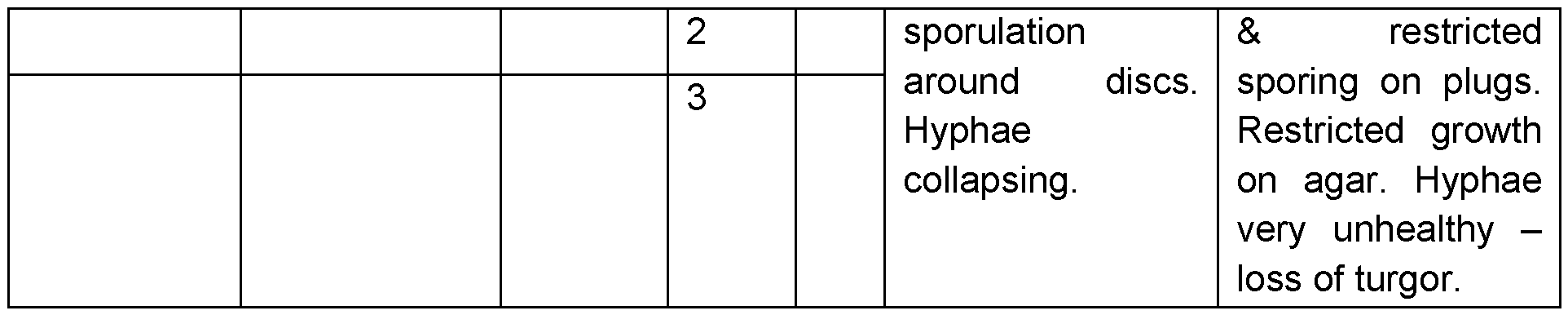
  • Table 34 Qualitative assessment of response of organisms to products WOB NP1 A and WOB NP1 B.
  • Example 10 Growth studies for control of Botrytis cinerea in grapevines cv. Sauvignon Blanc A trial was conducted within a commercial vineyard to evaluate WOB NP1 for the control of botrytis ( Botrytis cinerea ) and for crop safety in grapevines cv. Sauvignon Blanc.
  • a WOB NP1 formulation was prepared according to the method described in Examples 1 and 2.
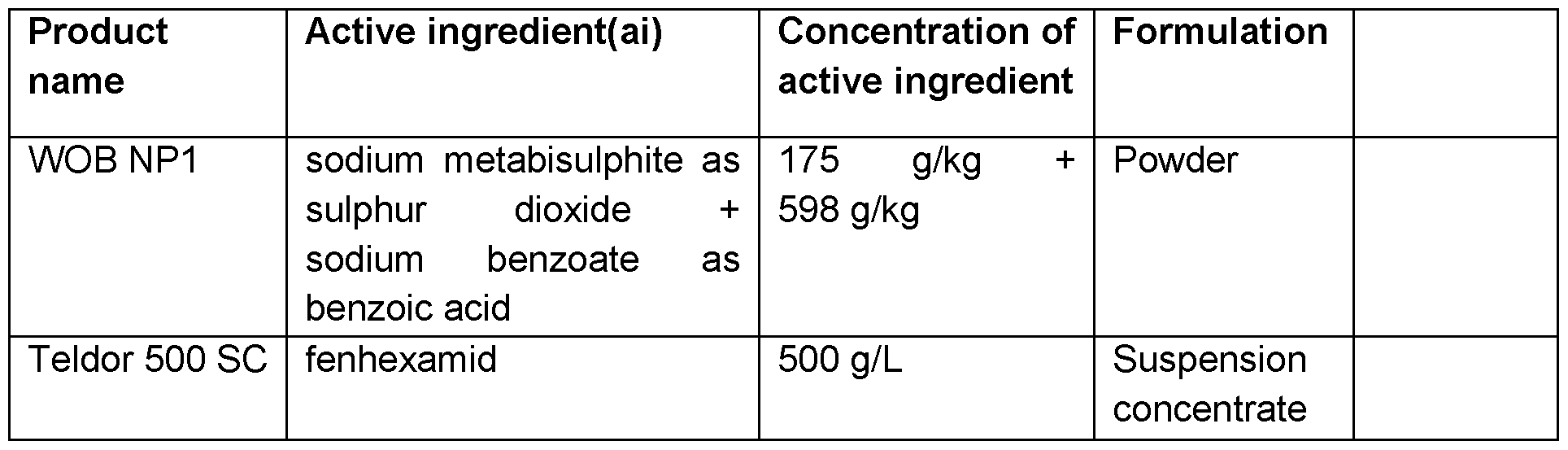
  • WOB NP1 (comprising active ingredients sodium metabisulphite + sodium benzoate) was applied at 35 + 119.6, 70 + 239.2, 140 + 478.4 and 280 + 956.8 g ai/100 L and compared with Teldor 500 SC at 50 g ai/100 L and an untreated control.
  • Table 35 Products used in the study for control of Botrytis cinerea.
  • Table 36 Treatment levels and application schedule summary.
  • Treatments were applied as six dilute foliar sprays just prior to the point of run-off in spray volumes from 700-900 L/ha, commencing at the BBCH 61 (10% flowering) crop stage.
  • WOB NP1 at 70 + 239.2, 140 + 478.4 and 280 + 956.8 g ai/100 L caused some phototoxicity to grapevine leaves but phytotoxicity was absent in grape bunches. Necrotic spotting was observed on leaves sprayed with WOB NP1 at 70 + 239.2, 140 + 478.4 and 280 + 956.8 g ai/100 L with the most severe damage at the highest rate of WOB
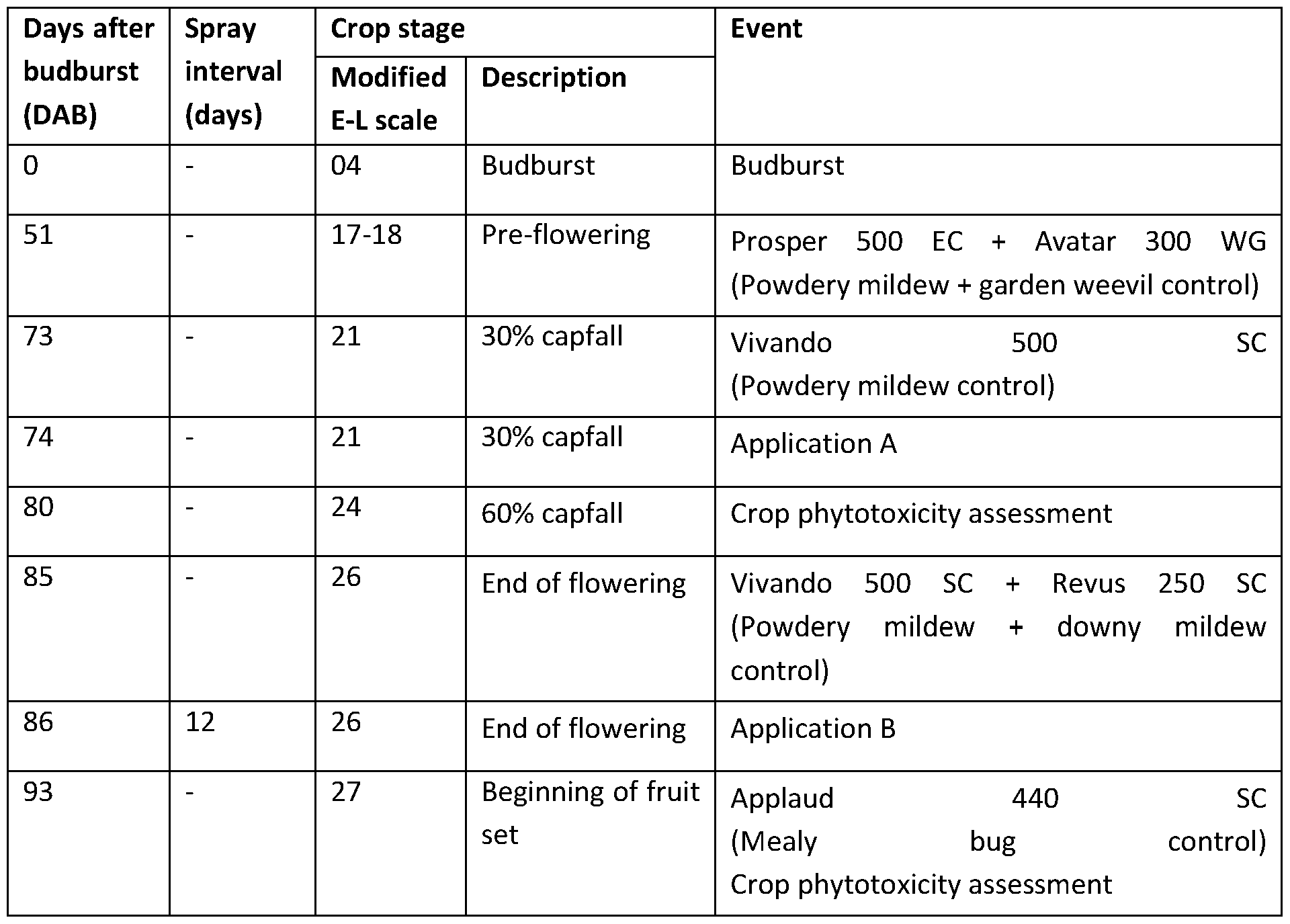
  • Table 37 Outlining the chronology of events stages of application of the WOB NP-1 formulation on the grape vine test subjects.
  • Table 38 and 39 describe details of the application spray and conditions at each time point throughout the application schedule.
  • Table 42 Describes the methods used to assess the crops including methods of statistical analysis for results observed. Botrytis assessment
  • PESINC pest incidence
  • PESSEV pest severity Rating
  • Example 11 Growth control of Botrytis cinerea in grapevines cv. Cabernet Sauvignon
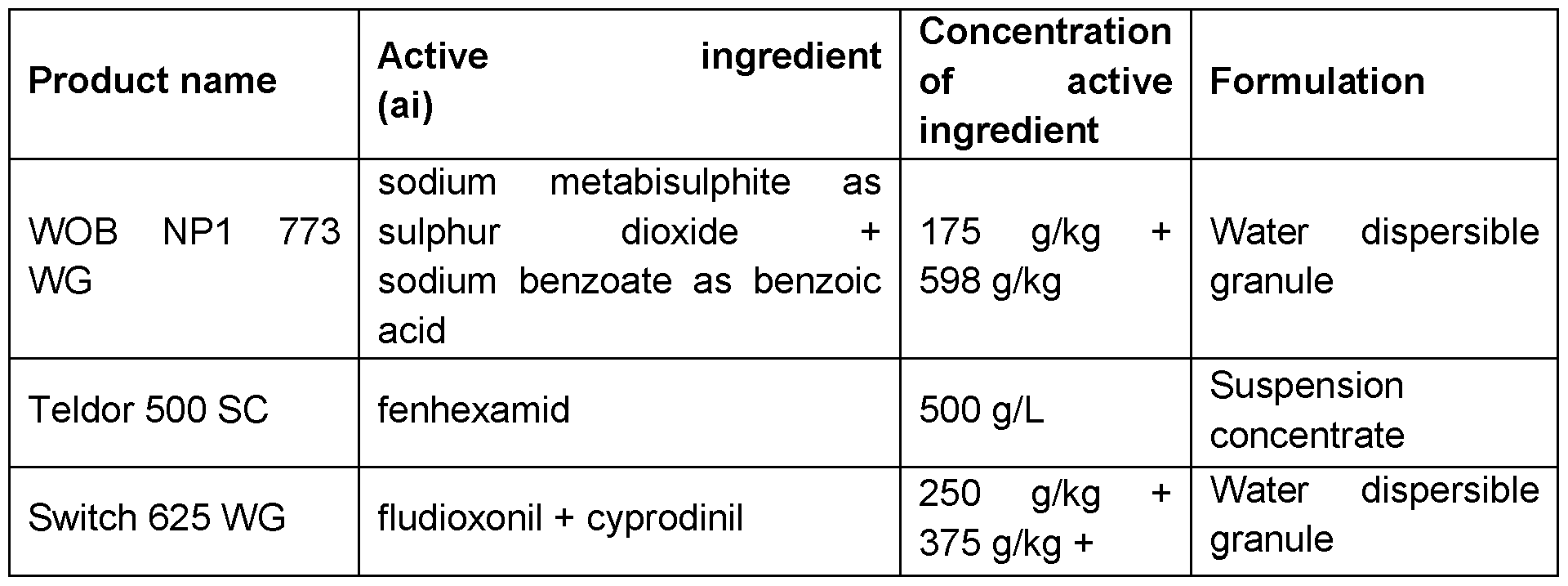
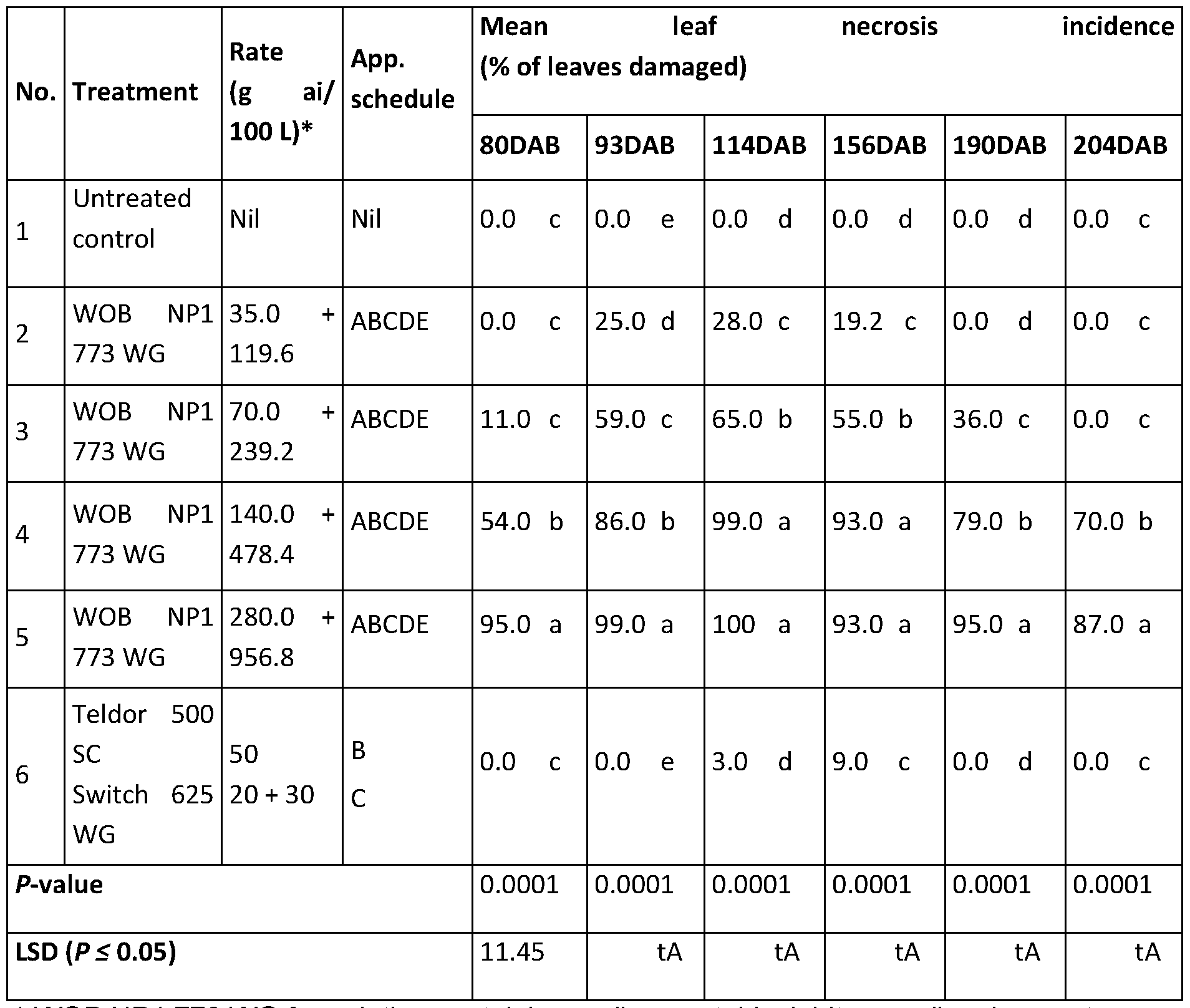
  • Formulations comprising sodium metabisulphite and sodium benzoate (WOB NP1 773 WG)were applied as dilute canopy sprays to grapevines cv. Cabernet Sauvignon for the control of grey mould ( Botrytis cinerea).
  • WOB NP1 773 WG was applied at 30% capfall, the end of flowering, when berries were 4 m , during bunch closure and at veraison.
  • the standard grey mould control program of Teldor 500 SC applied at end of flowering followed by Switch 625 WG when berries were 4 mm diameter was used for comparison. Crop safety was assessed during flowering, at fruit set, just prior to bunch closure, at early and late veraison and just prior to harvest.
  • WOB NP1 caused necrosis and browning of the leaf margins, with the area damaged increasing significantly with rate and with subsequent applications.
  • the lower rate of WOB NP1 showed up to 28% of leaves damaged with a severity of 0.3% LAD (leaf area damaged), whilst the high rate showed 100% of the leaves damaged with up to 10.9% LAD. No visible damage was seen on bunches, however higher rates of WOB NP1 left residues on bunches.
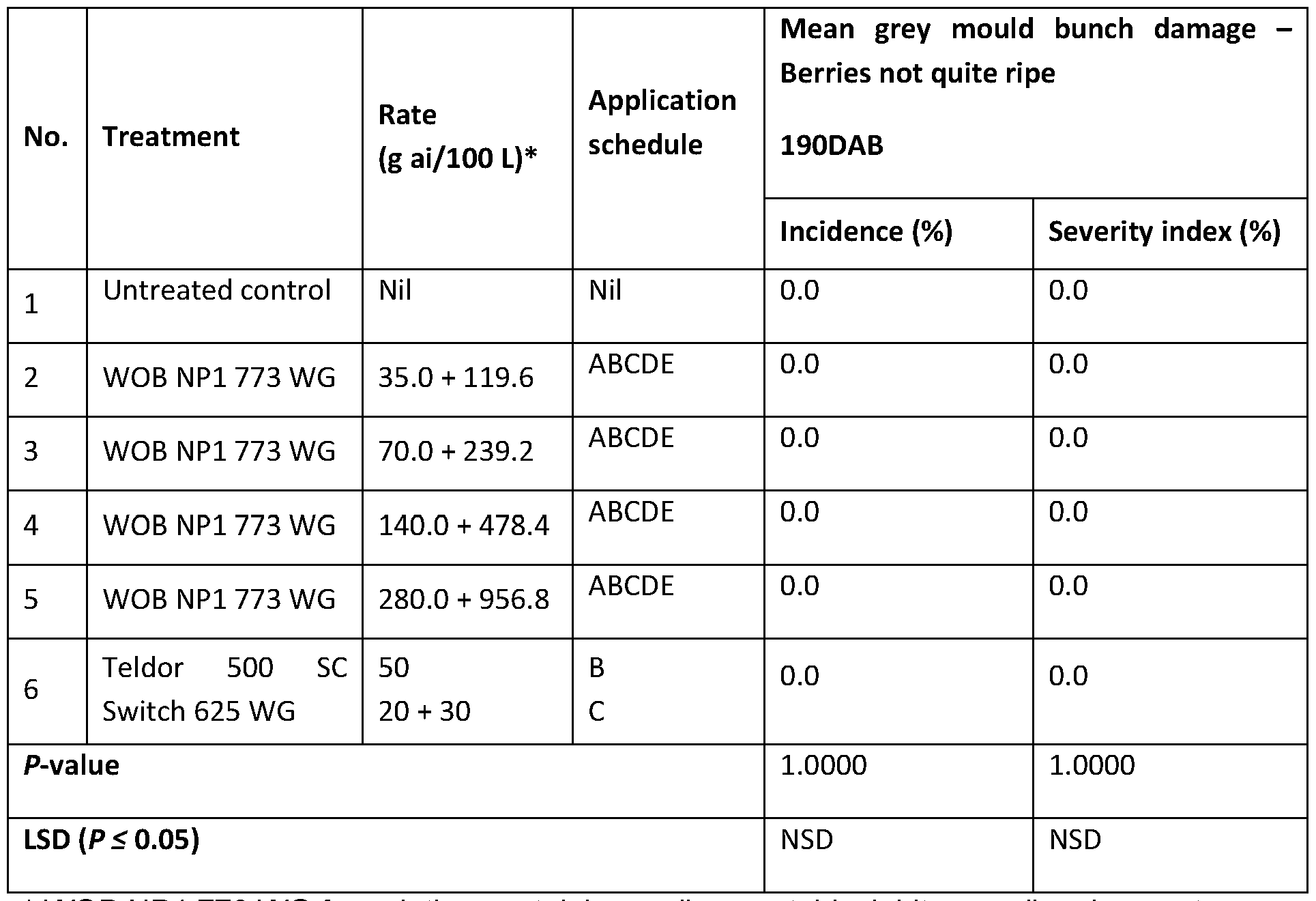
  • the test site was chosen as all fruit from the previous season was rejected due to high levels of grey mould.
  • Grey mould was first seen in the untreated control ten days after commercial harvest, when 8.7% of bunches were damaged by grey mould at a severity index of 2.2%. No grey mould was observed in any treatment, providing no dose response to WOB NP1 rates. All rates of WOB NP1 were equivalent to the standard spray program for the control of grey mould.
  • Table 48 Products employed in the study for growth control of Botrytis cinerea in grapevines cv. Cabernet Sauvignon Table 49. Treatment schedule employed in the growth control of Botrytis cinerea study.
  • Damage severity index (%) ⁇ (Frequency x damage rating) x 100/[total # (eg. 100) x max. rating (i.e. 10)]
  • Damage severity index (%) ⁇ (Frequency x damage rating) x 100/[total # (eg. 100) x max. rating (i.e. 10)]
  • WOB NP1 at 200, 400 and 800 g/100 L was applied in a five spray program commencing at early flowering for the control of bacterial spot ( Xanthomonas campestris) and brown rot (Monilinia fructicola) and penicillin mould (Penicillium spp.) in cherries cv. Regina.
  • These treatments were compared with an industry standard program including Bavistin 500 SC at 50 ml/100 L, Polyram 700 OF and Tilt 250 SC applied on three occasions during flowering only, an industry standard program followed by two applications of WOB NP1 at rates of 200, 400 or 800 g/100 L prior to harvest and an untreated control. All sprayed treatments were applied as dilute sprays to the point of run-off.
  • Table 59 Mean percentage of healthy green fruit stalk and post harvest penicillin mould infections twenty two days after harvest (22DAH).
  • Example 13 Post harvest treatment for growth control of pathogens on cherries, cv. Regina Fruit obtained from the studies discussed in Example 6 were also used to evaluate WOB NP1 at 400, 240 and 160 g/100 L when used as a post harvest treatment.
  • WOB NP1 a formulation comprising the active ingredients sodium metabisulphite and sodium benzoate
  • BCDMH a formulation comprising the active ingredient Bromochloro dimethyl hydantoin and a process where fruit where dipped with WOBNP1, BCDMH + WOBNP1 + BCDMH.
  • the fruit had previously been washed and stored at 0°C in air for approximately 4 months. Before the trial the fruit were wounded slightly by tipping once from one crate into another. Any fruit with rots or other disorders were removed at this time.
  • the fruit were inoculated with PenicHlium expansum and a mixture of 4 strains of E. coli. Inoculation was achieved by dipping each crate of fruit in a 1001 tank of inoculum suspension. Separate tanks were used for apples and pears and the concentration of inoculum determined before and after dipping.
  • the apple inoculum contained an average of 5.7 x 10³ cfu/ml of P. expansum and 1.81 x 10⁶ cfu/ml of E. coli.
  • the Pear inoculum contained an average of 4.8 x 10³ cfu/ml P. expansum and 2.09 x 10⁶ cfu/ml of E. coli.
  • Each batch of fruit was drenched for a contact time of 2 minutes then allowed to drain at room temperature for 2 hours before returning to storage at 0°C.
  • Microbiological testing was done on a bulked 25g sample taken from 4 fruit for each replicate. Each 25g sample was added to 250 ml of sterile 0.1% neutralized bacteriological peptone (pH 7.0-7.4) and stomached for 2 minutes. One ml of stomached samples was plated onto E. coli/coliform and Yeast and Mould Petrifilm plates (3M Microbiology Products) and incubated at 37°C and 20°C respectively before assessing, according to the manufacturer’s instructions.
  • Results were analyzed by Analysis of Variance using GenStat for Windows 11th Edition (Lawes Agricultural Trust, lACR-Rothamsted) and significance determined using LSDs at the 5% level. Microbiological tests Pears
  • WOB NP1 (formulation comprising sodium metabisulphite and sodium benzoate, WOB NP1)
  • BCDMH (formulation comprising the active ingredient BromoChloroDimethylHydantoin) + WOB NP1 significantly reduced the level of contamination by fungi compared to the unwashed sample while BCDMH and water did not (Fig 9). There were no significant differences in the levels of fungi between WOB NP1 and BCDMH + WOB NP1 , or between BCDMH and water (Fig 9).
  • WOB NP1 and WOB NP1 + BCDMH were significantly better at reducing Penicillium rots and “total” rots on apples than washing with just water, while BCDMH was not significantly different to water. Other rots were at very low incidences in all treatments (Fig 14).
  • the wine grapes to be treated as treatment 2 received six applications of WOB NP1 at a nominal rate of 212.8 g a.i./100L sodium metabisulphite (equivalent to 140 g a.i./100L sulfur dioxide) and 478.4 g a.i./100L sodium benzoate; the actual application rates were 230.4 g a.i./100L sodium metabisulphite (equivalent to 155.3 g a.i./100L sulfur dioxide) and 513.6 g a.i./100L sodium benzoate.
  • the wine grapes to be treated as treatment 3 received six applications of WOB NP1 at a nominal rate of 425.6 g a.i./100L sodium metabisulphite (equivalent to 280 g a.i./100L sulfur dioxide) and 956.8 g a.i./100L sodium benzoate; the actual application rates were 460.8 g a.i./100L sodium metabisulphite (equivalent to 310.6 g a.i./100L sulfur dioxide) and 1027.2 g a.i./100L sodium benzoate.
  • Table 66 Treatment table.
  • Application B 80% capfall
  • Application C pre bunch closure
  • Application D pre bunch closure to veraison
  • Application E Veraison
  • Test site 1 (Tasmania)
  • Test site 2 (Western Australia) A minimum of 1 kg of grape bunches were sampled for residue samples from the treated plots at 0, 1, 2 and 3 days after last application (DALA). 2 DALA coincided with normal commercial harvest (NCH). Samples from the untreated control were collected at 2 DALA (NCH) to coincide with sampling from the treated plots. A minimum of 5 kg of grape bunches were sampled for processing samples from the treated plots at 0, 1, 2 and 3 days after last application (DA LA). 2 DALA coincided with normal commercial harvest (NCH). Samples from the untreated control were collected at 2 DALA (NCH) to coincide with sampling from the treated plots. These were for processing into wine, juice and pomace.
  • Grape study samples were analysed as whole commodity without caps and stems. Samples were partially defrosted and prepared as per AWRI SOP6 - Preparation of fresh, frozen and dried fruit and vegetables and plant material. Approximately 500g of berries were subsampled from all bunches in the sample and added to a Retsch Grindmix and homogenised for twenty seconds. Processing study samples were subsampled to generate an approximately 1 kg and 800 g subsamples of grapes for juicing and/or vinification respectively.
  • Vinification subsamples were thawed overnight then manually crushed and the must added to a 1L glass fermentation vessel to which approximately 50mg/L sulfur dioxide, as potassium metabisulphite, and 200 mg/L diammonium phosphate solution was added.
  • the must was then inoculated with rehydrated active dried wine yeast, AWRI 796, and fermented on skins at 25oC, with daily mixing of the skin and liquid. After 7 days, the ferment was pressed twice, each time at approx. 19Nm for 2 minutes, with mixing of the marc between pressings.
  • the wine was returned to the original vessel and allowed to ferment to dryness ( ⁇ 1 g/L residual sugar) at 25oC. Once fermentation was established as complete using Clnitest strips and the wine were racked from the gross lees and a 200 ml_ subsample taken and stored at approx. 4°C prior to analysis. The wine study samples were centrifuged prior to analysis to improve clarification.
  • Juice and pomace samples were generated by thawing the samples overnight then pressing the grapes at 19 Nm for two minutes, missing and repeating the processing. Juicing samples were taken. The pomace samples were taken for analysis and moisture content determination. Pomace was subsampled and added to a Retsch Grindomix and homogenised for twenty (20) seconds or until the sample was considered homogenous. A subsample of homogenate was taken for analysis and a further 250 g taken as a backup.
  • the analytical procedure used for determination of benzoic acid in the wine, juice and pomace study samples was performed using liquid chromatography with tandem mass spectrometry (LC/MS/MS).
  • LC/MS/MS liquid chromatography with tandem mass spectrometry
  • a 15 g subsample of a sample homogenate was weighed into a 50 ml_ centrifuge and 0.05ml_ of surrogate standard solution (12.5 pg/mL d5-atrazine) added.
  • 15ml_ of acetonitrile (1% acetic acid) was added and the tube shaken for approx. 2 minutes then cooled in a laboratory freezer for 15 minutes.
  • Magnesium sulphate (6g) and sodium acetate (1.5g) was added with 2 glass beads and the sample shaken for a further 1 minute.
  • the extract was centrifuged and a 6 ml_ aliquot of supernatant was taken and added to a 15 ml_ dispersive solid-phase extraction (dSPE) tube containing 400 mg primary-secondary amine and 1200mg magnesium sulphate. The sample tube was shaken for 1 minute then centrifuged.
  • dSPE dispersive solid-phase extraction
  • pomace samples 3 g sample was taken and rehydrated with 12 ml_ of MilliQ water prior to extraction as above, except the dSPE tube contained 400mg primary-secondary amine, 400mg C18 and 1200 mg magnesium sulphate.
  • the free sulfur determination is based on the reaction between free sulfur in an acidic medium with a mixture of pararosanline and formaldehyde to give a pink colour which is measured at 575nm.
  • the method requires two tests to be analysed concurrently, one with pyruvic acid (FS02A) and one without (FS02B).
  • a third method (FS02C) is sued to determine the solpe (m).
  • the free S02 is calculated by the following formula:
  • FS02 m (FS02A - FS02B) - Blank
  • the total sulfur determination is performed by diluting with pH 8 buffer, stabilizing, then taking a zero measurement.
  • DTNB reagent is then added, which reacts with a free sulfhydryl group to yield a mixed disulphide and 2-nitro-5-thiobenzoic acid product. This yellow product is measured at 412 nm.
  • Benzoic acid results for ‘dry weight’ are based on a calculation using residue results from the ‘wet weight’ then adjusted for the moisture content of the sample. Benzoic acid results reported as ⁇ LoD and ⁇ LoQ for ‘dry weight’ are based entirely on the calculated ‘wet weight’ result. Table 69. The residual benzoic acid and sulfur dioxide remaining in grapes at study site 1

Landscapes

  • Life Sciences & Earth Sciences (AREA)
  • Engineering & Computer Science (AREA)
  • General Health & Medical Sciences (AREA)
  • Zoology (AREA)
  • Wood Science & Technology (AREA)
  • Health & Medical Sciences (AREA)
  • Environmental Sciences (AREA)
  • Plant Pathology (AREA)
  • Pest Control & Pesticides (AREA)
  • Agronomy & Crop Science (AREA)
  • Dentistry (AREA)
  • Chemical & Material Sciences (AREA)
  • Chemical Kinetics & Catalysis (AREA)
  • Toxicology (AREA)
  • General Chemical & Material Sciences (AREA)
  • Inorganic Chemistry (AREA)
  • Microbiology (AREA)
  • Food Science & Technology (AREA)
  • Polymers & Plastics (AREA)
  • Mycology (AREA)
  • Agricultural Chemicals And Associated Chemicals (AREA)

Abstract

The present invention provides a method for treating crops in field or in a processing facility comprising the steps of producing a dry composition comprising a metabisulphite, a benzoate salt and a cellulose additive; preparing said dry composition as a formulation; and applying the formulation to a crop, wherein said treatment is for prevention or reduction of crop damage by plant pathogens, or reduction of bacterial, fungal or human pathogens.

Description

A METHOD FOR TREATMENT OF CROPS
Field of the Invention
The present invention relates to a method of the treatment of crops and more particularly a method for preparing and applying a formulation, preferably in the form of a spray to the growing crop, for control of pathogen growth and to provide crop protection from pathogenic attack. The formulation may also be applied as a fruit and vegetable wash to remove harmful pathogens from surface of produce and extend shelf life and safety of the packed or stored produce as a post harvest application.
Background of the Invention
Pathogen infections can result in significant losses to agricultural crops caused by pre harvest damage, killing them outright or weakening them so as to decrease yields and render the plants, fruit or grains susceptible to primary and secondary infections. Post harvest infections also results in significant loss of agricultural products during storage, processing and handling.
When fruit, vegetables and grains are to be eaten or processed it is essential that any treatment given to them does not lead to residues which exceed safe limits. Significant variation in allowable residues may exist between local and overseas markets.
Many pathogen treatments may produce residues, although very small, leave the treated product in breach of the law of the country to which it has been exported. Further, some current treatments also result in harm to select beneficial microorganisms present on the surface of the crop.
Further, some pathogen strains are found to have developed separate mechanisms of resistance to two or more unrelated fungicides and is termed ‘multiple resistance’. For example, strains of Botrytis cinerea are known to have become resistant to both benzimidazole and dicarboximide fungicides.
Despite a number of chemical agents having been developed for treating crops, there remains a need for the development of further methods of treatment, in particular in the development of bacteriacide and disinfectant control agents which are highly toxic to harmful pathogens yet safe for humans, crops and/or animals.
There exists a need to overcome, or at least alleviate, one or more of the difficulties or deficiencies associated with the prior art.
Summary of the Invention
According to the invention there is provided a method of treating crops, including fruit, vegetables and grain, to provide protection against selected pathogens. There is further provided a method of treating crops, including fruit, vegetables and grain, to control pathogen growth. The pathogens may include plant pathogens, as well as bacterial, fungal and human pathogens.
In one aspect, the present invention provides a method for treating crops comprising the steps of: producing a dry composition comprising; a metabisulphite, a benzoate salt, and a cellulose additive; preparing said dry composition as a formulation; and applying the prepared formulation to a crop, wherein said treatment is for prevention or reduction of crop damage by plant pathogens, or to reduce bacterial, fungal or human pathogens on said crop.
In a second aspect, the present invention provides a method for treating crops comprising the steps of: providing a dry composition comprising: a metabisulphite, a benzoate salt, and a cellulose additive; preparing said dry composition as a formulation; applying the crop with a fungicide; and applying the formulation to the crop, wherein said treatment is for prevention or reduction of crop damage by plant pathogens or to reduce bacterial, fungal or human pathogens on said crop. Detailed description
By a ‘dry composition’ as used herein is meant a mixture of components in a form substantially free of moisture. For example, the dry composition may be in powder or any other suitable physical form. A dry composition according to the invention may be presented in unit dosage form, for example in a sachet.
By ‘plant pathogen’ as used herein is meant an organism which is capable of causing harm or disease to a crop, wherein the plant pathogen may include pathogens which are also capable of causing harm or disease to a humans or animals.
In a preferred embodiment the metabisulphite is selected from any suitable metabisulphite salt. In a particularly preferred embodiment the metabisulphite salt is a sodium metabisulphite. In an alternatively preferred embodiment the metabisulphite salt is a potassium metabisulphite.
Preferably, the metabisulphite is in the physical form of a powder.
In a preferred embodiment, the benzoate salt is selected from any suitable benzoate salt. In a particularly preferred embodiment the benzoate salt is a sodium benzoate. In an alternative embodiment the benzoate is a potassium benzoate.
Preferably, the benzoate salt is in the physical form of a powder.
In a preferred embodiment, the dry composition comprises sodium metabisulphite blended with sodium benzoate at a ratio of approximately between 20:80 and 30:70 w/w, together with a cellulose additive. In a particularly preferred embodiment the dry composition comprises sodium metabisulphite blended with sodium benzoate at a ratio of approximately between 22:78 and 29:71 w/w, together with a cellulose additive.
In a preferred embodiment, the dry composition includes a cellulose additive at approximately between 0.5 to 3% by weight of the dry composition. In a further preferred embodiment the dry composition includes a cellulose additive at approximately between 0.8 to 2.0% by weight of the dry composition. In a further preferred embodiment the dry composition comprises a cellulose additive at approximately between 1.0 to 1.5% by weight of the dry composition. By ‘formulation’ as used herein is meant a mixture comprising the ‘dry composition’ being further blended with a surfactant, additional additive or solution.
By ‘blended’ as used herein is meant any suitable form of mixing to form a substantially evenly distributed formulation. Preferably, the blending technique includes any method of mechanical or hand mixing, or any other suitable form of agitation to achieve a substantially evenly distributed formulation.
In a preferred embodiment the blending may be performed by a V blender, double blender, bin blender, drum blender, paddle blender, cement or concrete mixers, twin shaft mixers, or any other suitable blender or mixer.
By a ‘cellulose additive’ as used herein is meant any additional component containing cellulose. For example, the cellulose additive may be selected from alpha cellulose, cellulose, cellulose crystalline; cellulose gel, hydroxycellulose, microcrystalline cellulose, plastics, cellulosic, and sulfite cellulose.
In a preferred embodiment the cellulose additive is CAS # 9000-34-6.
In a preferred embodiment the formulation comprises a dry composition being further blended with a surfactant, other suitable additive or solution. In a particularly preferred embodiment the formulation comprises a dry composition being further blended with a surfactant at a ratio of approximately between 0.5% to 10% w/w. of the final formulation. In a particularly preferred embodiment the formulation comprises a dry composition being further blended with a surfactant at a ratio of approximately between 0.8% to 8% w/w of the final formulation. In a particularly preferred embodiment the formulation comprises a dry composition being further blended with a surfactant at a ratio of approximately between 1.0% to 6% w/w of the final formulation.
The surfactant (otherwise referred to as wetting agents) optionally used in the present invention is selected from any suitable surfactant, said surfactant being suitable for human and/or animal consumption. Preferably the surfactant is selected from a non-ionic surfactant and an ionic surfactant. By a ‘non-ionic surfactant’ as used herein is meant an organic compound containing covalently bonded oxygen-containing hydrophilic groups, bound to hydrophobic parent structures.
By an ‘ionic surfactant’ as used herein is meant a chemical compound containing a positively and/or negatively charged, polar functional ground bound to a hydrophobic parent structure. Ionic surfactants include anionic, cationic and zwitterionic molecules.
Preferably the surfactant is selected from polyethylene glycol, polyethylene oxide, dipropylene glycol and polysorbate 80.
By a ‘polyethylene glycol’ as used herein is meant a polyether organic compound preferably having a molecular weight less than 100,000 g/mol. By a ‘polyethylene oxide’ as used herein, is meant a polymer preferably having a molecular weight equal to or greater than 100,000 g/mol.
By an ‘organic compound’ is meant a chemical compound, the molecules of which contain the element carbon. In a preferred embodiment, the organic compound may be a hydrocarbon. By a ‘hydrocarbon’ is meant an organic compound containing, inter alia, the elements carbon and hydrogen.
In a preferred embodiment, the dry composition is capable of being stored for approximately up to 24 months prior to further blending/formulation or being administered to crops.
In a preferred embodiment the formulation may be diluted to produce a solution, prior to being administered to crops. In a further preferred embodiment the formulation may be diluted with an aqueous mixture to produce a solution. In a particularly preferred embodiment the formulation may be diluted with water to produce a solution used to wash crops.
The aqueous mixture may be of any suitable type. By “aqueous mixture” as used herein is meant a water based solvent or a solvent including at least approximately 50% water. In a preferred embodiment, the aqueous mixture is water. Preferably the formulation is diluted with a solution no earlier than approximately 14 days prior to being administered the crops.
In a preferred embodiment, the solution has a pH of between approximately 2.0 to 7.5. In a further preferred embodiment, the solution has a pH of between approximately 3.0 to 6.5. In a particularly preferred embodiment, the solution has a pH of between approximately 4.0 and 6.0.
Preferably the solution is applied to a crop as either a pre-harvest spray or a post harvest wash. In a particularly preferred embodiment the solution is applied to the crop as a pre harvest spray.
By ‘a crop’ as used herein is meant any food product suitable for human or animal consumption, or a tree, vine or other plant upon which the food product is grown. In a preferred embodiment the crop includes fruits, vegetables, grains, grasses and seeds.
In a particularly preferred embodiment the crop includes grapes and other fruit, vegetables or grains suitable for the production of wine or other beverages. In a further preferred embodiment the crop includes berries, stone fruits, citrus fruits, tropical fruits, melons, drupes, pomes or any other edible fruit. In a further preferred embodiment the crop includes tropical vegetables, bulb vegetables, brassica vegetables, fruiting vegetables, leafy vegetables, legumes, pulses, root and tuber vegetables, stalk and stem vegetables, cereal grains, tree nuts and herbs, including lettuce, garlic and pistachios. In a further preferred embodiment the crop includes seeds and seedlings of flowering crops, fruits and vegetables.
In a particularly preferred embodiment the crop to be treated is selected from apples, pears, cherries or grapes.
In an embodiment, the solution is applied to a crop upon expression of pathogens or at any combination of the following stages of crop maturation:
Bud-swell;
(20% to 30%) bloom and early petal-fall stages;
One month to harvest;
Two weeks to harvest. In an alternative preferred embodiment, a fungicide is applied between approximately 2 to 12 hours prior to the solution. In a further preferred embodiment the fungicide contains an active ingredient which is applied at a rate of between approximately 5 to 25 ppm.
In a more preferred embodiment, the grape vine varieties may be selected from the group consisting of Vitis Vinifera, Vitis labrusca, Vitis riparia, Vitis rotundifolia, Vitis rupestris, Vitis aestivalis, Vitis mustangensis. Vitis coignetiae, Vitis californica, Vitis vulpina, Vitis amurensis, Muscadinia rotundifolia and vitis romanetii. In a further preferred embodiment the grape vine varieties may be a cultivar or hybrid of any aforementioned species.
In a preferred embodiment, the crop may be a fruit that is susceptible to stem end rots, such as cherries. In this embodiment, the formulation of the present invention may be as a spray pre-harvest to help prevent or reduce stem end rots, and/or used after harvest to prevent or reduce stem end rots.
In a preferred embodiment, the solution is applied at no later than 3 days prior to harvest. In a further preferred embodiment, the solution is further applied upon expression of botrytis and at any combination of the following stages of grape maturation: approximately 10% flower crop; approximately 10% cap fall; approximately 30% cap fall; approximately end of flowering; approximately berry size approximately 4 mm; approximately bunch closure; and approximately veraison.
In an alternative preferred embodiment, a fungicide is applied between approximately 2 to 12 hours prior to the solution. In a further preferred embodiment the fungicide contains an active ingredient which is applied at a rate of between approximately 5 to 25 ppm.
In a preferred embodiment the applied solution has a concentration of approximately between 1 g/L to 8g/L. In a further preferred embodiment the applied solution has a concentration of approximately between 2g/L to 6.5g/L. In a further preferred embodiment the applied solution has a concentration of approximately between 3.5g/L to 4.5g/L. In a further preferred embodiment the applied solution has a concentration of approximately between 3.75 g/L to 4.25 g/L. In a preferred embodiment the applied solution has a concentration of between approximately 2g/L and approximately 8g/L. In a particularly preferred embodiment, the applied solution has a concentration of 2g/L, 4g/L or 8g/L.
In a preferred embodiment the applied solution results in a reduction of growth of crop pathogens. In a preferred embodiment, the applied solution results in a reduction of growth of crop pathogens selected from the group consisting of Botrytis cinerea, Xanthomonas spp E. coli, Monilina fructicola and Penicillium spp. In a further embodiment the applied solution results in a reduction of growth of the crop pathogen Xanthomonas campestris. In a further preferred embodiment the applied solution results in reducing growth of the crop pathogen Erwinia Carotovora.
Preferably, the applied solution is delivered at a rate between approximately 500 - 1600 L/Ha. Preferably the applied solution is delivered at a temperature of not more than approximately 30’C. Preferably the applied solution is applied at a humidity of less than approximately 75%.
In a preferred embodiment the applied solution may be applied at the above rates and delivery conditions for all growing crops described herein, from seedling through to harvest.
In a preferred embodiment use of the applied solution results in very low levels of residue of sulphites and the benzoates in the resulting crop and products thereof. These levels may be well below the limits for food safety standards.
For example, when the solution of the present invention is used on grape vines, as hereinbefore described, sulphite residue in the resulting wine, juice or pomace may be less than approximately 100 mg/L, more preferably less than 10 mg/L, more preferably between approximately 3 and 5 mg/L. In Australia, the maximum permitted levels of sulphites in wines varies from 200 to 300 mg/kg depending on the type of wine and residual sugar level.
For example, when the solution of the present invention is used on grape vines, as hereinbefore described, benzoate residue in the resulting wine, juice or pomace may be less than approximately 100mg/L, more preferably less than 50 mg/L, more preferably between approximately 1 and 50 mg/L. In Australia, the maximum permitted level of benzoates in wines is 400 mg/kg. In a preferred embodiment the applied solution may be used in a run to waste washing facility as a post harvest bacteriacide/disinfectant on produce such as fruit, vegetables and nuts. In this embodiment, capacity may be dosed through automatic control, preferably at rates of approximately 2g/L or 4g/L. Preferably the contact time is not less than approximately 2 minutes and not more than approximately 60 minutes.
In a preferred embodiment the applied solution may be used in a recirculating washing facility as a post harvest bacteriacide/disinfectant on produce as fruit, vegetables and nuts. In this embodiment, capacity may be dosed through automatic control, preferably at rates of approximately 2g/L or 4g/L. Preferably the contact time is not less than approximately 2 minutes and not more than approximately 60 minutes.
In a preferred embodiment, the applied solution may be used in conjunction with a filtration system.
In an alternative preferred embodiment the crop is treated with a solution of the composition, as described herein, post harvest. In a preferred embodiment the solution applied post harvest has a concentration of approximately between 1 g/L to 8g/L. In a further preferred embodiment the solution applied post harvest has a concentration of approximately between 2g/L to 6.5g/L. In a further preferred embodiment the solution applied post harvest has a concentration of approximately between 3.5g/L to 4.5g/L. In a further preferred embodiment the solution applied post harvest has a concentration of approximately between 3.75g/L to 4.25g/L.
In a preferred embodiment the applied solution results in approximately between 10% to 30% reduction in Botrytis cinerea growth compared to an untreated crop. In a further preferred embodiment the applied solution results in approximately between 15 to 25% reduction in Botrytis cinerea growth compared to an untreated crop. In a particularly preferred embodiment the applied solution results in approximately between 17% to 23% reduction in Botrytis cinerea growth compared to an untreated crop.
In a preferred embodiment, the applied solution results in approximately greater than 50% reduction in Xanthomonas sp growth compared to an untreated crop. In a more preferred embodiment, the applied solution results in approximately greater than 75% reduction in Xanthomonas sp growth compared to an untreated crop. In a particularly preferred embodiment, the applied solution results in approximately greater than 90% reduction in Xanthomonas sp growth compared to an untreated crop.
In a preferred embodiment, the applied solution results in approximately greater than 60% reduction in growth of E. coli compared to an untreated crop. In a more preferred embodiment the applied solution results in approximately greater than 70% reduction in growth of E. coli compared to an untreated crop. In a particular preferred embodiment the applied solution results in approximately greater than 80% reduction in growth of E. coli compared to an untreated crop.
Where this analysis is performed in a laboratory rather than in situ, the untreated crop may be a sample of an untreated crop.
In a further preferred embodiment, the applied solution results in no substantial effect on the growth rate of Saccharomyces cerevisae and Schizosaccharomyces pombe species.
In an embodiment the fungicide contains a halogen based active ingredient. In a preferred embodiment the halogen based fungicide contains an active ingredient selected from bromochlorodimethylhydantoin (BCDMH), Chlorine, Bromine, an active ingredient which releases a halogen, an active ingredient which releases hypobromous acid and/or hypochlorous acid, an active ingredient which releases chlorine and/or bromine, or a fungicide containing any suitable combination thereof.
By ‘bromochlorodimethylhydantoin (BCDMH)’ as used herein is meant 1-Bromo-3-chloro- 5,5-dimethylhydantoin, 3-Bromo-1-chloro-3-chloro-5,5-dimethylhydantoin or any combination or mixture thereof.
In a preferred embodiment the fungicide is applied as a solution containing the halogen based active ingredient at a concentration of approximately between 1 to 100 ppm. In a further embodiment the fungicide is applied as a solution containing the halogen based active ingredient at a concentration of approximately between 2 to 50 ppm. In a preferred embodiment the fungicide is applied as a solution containing the halogen based active ingredient at a concentration of approximately between 5 to 10 ppm.
In an embodiment the crop is treated with both the formulation and fungicide pre harvest. In a further embodiment the crop is treated with both the formulation and fungicide pre harvest and the crop is further treated with the formulation post harvest. In a further embodiment the crop is treated with both the formulation and fungicide pre harvest and the crop is further treated with both the formulation and fungicide post harvest.
In an alternative embodiment the crop is treated with both the formulation and fungicide post harvest. In an alternative preferred embodiment the crop is treated with both the formulation and fungicide post harvest and the crop is treated with the formulation pre harvest.
The present invention will now be more fully described with reference to the accompanying Examples and drawings. It should be understood, however, that the description following is illustrative only and should not be taken in any way as a restriction on the generality of the invention described above.
Brief Description of the Drawings/Figures
Figure 1 shows the necrosis of the untreated control at 15DAAB - Grapevine cv. Sauvignon Blanc, as described in Example 10.
Figure 2 shows grapevine cv. Sauvignon Blanc following two applications of WOB NP1 at the lowest application rate of 35 + 119.6 g ai/100 L (15DAAB), as described in Example 10.
Figure 3a shows necrosis of tissue on grapevine cv. Sauvignon Blanc following two applications of WOB NP1 at 70 + 239.2 g ai/100 L (15DAAB), as described in Example 10.
Figure 3b shows necrosis (as indicated by circled regions) of tissue on grapevine cv. Sauvignon Blanc following two applications of WOB NP1 at 70 + 239.2 g ai/100 L (15DAAB), as described in Example 10.
Figure 4a shows necrosis of tissue on grapevine cv. Sauvignon Blanc following two applications of WOB NP1 at 140 + 478.4 g ai/100 L (15DAAB), as described in Example 10.
Figure 4b shows necrosis (as indicated by circled regions) of tissue on grapevine cv. Sauvignon Blanc following two applications of WOB NP1 at 140 + 478.4 g ai/100 L (15DAAB), as described in Example 10. Figure 5a shows necrosis of tissue on grapevine cv. Sauvignon Blanc following two applications of WOB NP1 at 280 + 956.8 g ai/100 L (15DAAB), as described in Example 10.
Figure 5b shows necrosis (as indicated by circled regions) of tissue on grapevine cv. Sauvignon Blanc following two applications of WOB NP1 at 280 + 956.8 g ai/100 L (15DAAB), as described in Example 10.
Figure 6a shows necrosis studies, leaf damage and bunch residue 114DAB as described in Example 11. (Clockwise from top left) Photograph 1: Untreated control bunches. Photograph 2: Untreated leaves. Photograph 3: WOB NP1 (35.0+119.6 g ai/100 L) bunches. Photograph 4: WOB NP1 (35.0+119.6 g ai/100 L) leaves.
Figure 6b shows necrosis studies, leaf damage (as indicated by circled regions) and bunch residue 114DAB as described in Example 11. (Clockwise from top left) Photograph 1: Untreated control bunches. Photograph 2: Untreated leaves. Photograph 3: WOB NP1 (35.0+119.6 g ai/100 L) bunches. Photograph 4: WOB NP1 (35.0+119.6 g ai/100 L) leaves.
Figure 7a shows necrosis studies, as described in Example 11. (Clockwise from top left) Photograph 5: WOB NP1 (70.0+239.2 g ai/100 L) bunches. Photograph 6: WOB NP1 (70.0+239.2 g ai/100 L) leaves. Photograph 7: WOB NP1 (140.0+478.4 g ai/100 L) bunches. Photograph 8: WOB NP1 (140.0+478.4 g ai/100 L) leaves.
Figure 7b shows necrosis studies, as described in Example 11. (Clockwise from top left) Photograph 5: WOB NP1 (70.0+239.2 g ai/100 L) bunches. Photograph 6: WOB NP1 (70.0+239.2 g ai/100 L) leaves with leaf damage as indicated by circled regions. Photograph 7: WOB NP1 (140.0+478.4 g ai/100 L) bunches. Photograph 8: WOB NP1 (140.0+478.4 g ai/100 L) leaves with leaf damage as indicated by circled regions.
Figure 8a shows necrosis studies, as described in Example 11. (Clockwise from top left) Photograph 9: WOB NP1 (280.0+956.8 g ai/100 L) bunches. Photograph 10: WOB NP1 (280.0+956.8 g ai/100 L) leaves. Photograph 11: Standard control program bunches. Photograph 12: Standard control program leaves.
Figure 8b shows necrosis studies, as described in Example 11. (Clockwise from top left) Photograph 9: WOB NP1 (280.0+956.8 g ai/100 L) bunches. Photograph 10: WOB NP1 (280.0+956.8 g ai/100 L) leaves with leaf damage as indicated by circled regions. Photograph 11: Standard control program bunches. Photograph 12: Standard control program leaves.
Figure 9 shows Log10 of cfu/g+1 of fungi on pears washed with either water, WOB NP1, BCDMH or BCDMH + WOB NP1. LSD = 1.166.
Figure 10 shows Log10 of cfu/g+1 of E. coli on pears washed with either water, WOB NP1, BCDMH or BCDMH + WOB NP1 LSD = 0.593.
Figure 11 shows Log10 of cfu/g+1 of fungi on apples washed with either water, WOB NP1 , BCDMH or BCDMH + WOB NP1 LSD = 0.869.
Figure 12 shows Log 10 of cfu/g+1 of E. coli on apples washed with either water, WOB NP1, BCDMH or BCDMH + WOB NP1. One obvious outlier was removed from the unwashed data prior to analysis. LSD = 1.352.
Figure 13 shows Incidence of rots after storage on pears washed with either water, WOB NP1 , BCDMH or BCDMH + WOB NP1.
Figure 14 shows Incidence of rots after storage on apples washed with either water, WOB NP1 , BCDMH or BCDMH + WOB NP1.
Example 1 - Preparation of the dry formulation
25kg of sodium metabisulphite is combined with 67kg of a sodium benzoate powder and then 1kg of Diacel 150 (CAS # 9000-34-6) is further added. The resulting mixture is then blended by addition to a cement mixer. The resulting mixture is then blended by addition to a cement mixer (100L capacity revolving drum mixer with a 880W 1440RPM electric motor). The mixture is blended for 10 minutes, allowed to stand for 10 minutes and further blended for an additional 10 minutes. The described process provides 93kg of the dry composition.
Example 2 - Preparation of a formulation comprising a surfactant
To 93kg of the dry composition is added 5kg of polyethylene glycol and the resulting composition is blended by addition to a cement mixer (100L capacity revolving drum mixer with a 880W 1440RPM electric motor). The mixture is blended for 10 minutes, allowed to stand for 10 minutes and further blended for an additional 10 minutes. The described process provides of 98kg of the desired formulation.
40 g of the pre-prepared formulation is added to 10L of water and mixed with agitation and the resulting dispersion is allowed to stand for 10 minutes to ensure the powder formulation is dissolved.
Example 3 - pH study for diluted ‘dry compositions’
Preparation of products
WOB NP 1 and WOB PH1 were prepared according to the general method of Example 1, wherein sodium sulphite is substituted for sodium metabisulphite in the case of WOB PH 1. The method of Example 1 was further modified whereby the sodium benzoate added was in the form of a prill bead rather than a powder.
The water used throughout the projects is rainwater held in the dark in a plastic tank with stable pH value of 6.25. Controls were set up by replacing actives with tank water only.
Products were dissolved in tank water before application to the agar plants. Tank water (pH 6.25) was adjusted to the respective pH levels prior to adding the actives to determine the change in pH caused by the actives.
Tank water was adjusted to pH 4.0, 5.5, and 7.0 before adding sodium benzoate, sodium metabisulphite and WOB NP1, each at 0.8%.
Tank water was adjusted to pH 7.0, 7.5 and 8.4 before adding sodium benzoate, sodium sulphite and WOB PH1, each at 0.8%. Table 1. Recorded pH of Sodium metabisulphite, sodium benzoate and WOB NP1 in tank water (pH range 4.0-7.0).
Figure imgf000016_0001
Table 2. Recorded pH of Sodium sulphite, sodium benzoate and WOB NP1 in tank water (pH range 7.0-8.4).
Figure imgf000016_0002
Example 4 - In vitro studies for inhibition of crop pathogens (Study 1 - diluted dry formulation)
Preparation of test media
The fungal and bacterial pathogens Erwinia carotovora (bacterial) and Botrytis cinerea (fungal) were cultured on to Nutrient Agar (NA) and potato dextrose agar (PDA), respectively and incubated at ambient temperature until sporulating or well grown.
Multiple plates of PDA were inoculated with B. cinerea and allowed to sporulate. Multiple plates of NA were inoculated with E. carotovora and allowed to grow into a thick lawn.
Curative activity:
Plates of PDA and NA were inoculated with fungal spores and bacterial cells, respectively, and allowed to grow into a lawn covering the agar surfaces. Three replicates were used for each product and each pH. Following the results from the preliminary tests, pH 4.0 and 7.0 were selected for all further product pH tests.
When the lawns were well grown and sporulating in the case of the fungal pathogen, five discs soaked with 200uL of each product (sodium metabisulphite, sodium benzoate, WOB NP1, sodium sulphite, and WOB PH1) at appropriate pH levels were laid onto the sporulating surface or cell lawn surface for the fungal pathogen and the bacterial pathogen, respectively.
The plates were incubated at ambient temperature (14-25°C). Inhibition zones were measured at 24 hours, 48 hours and 7 days.
Preventative activity:
Plates of agar containing each product (Na metabisulphite, Na Benzoate, WOB NP1 of Example 3) and (Na sulphite, Na Benzoate, WOB PH1) at concentrations equivalent to 0.8% concentration were made up and poured into sterile disposal Petri dishes. Three replicates for each product and pH (4.0 and 7.0) were used. Sterile agar discs covered with bacterial cells or fungal hyphae and spores were cut from respective plates of B. cinerea and E. carotovora. Three discs were each laid culture surface down onto the amended agar surface, incubated at ambient temperatures (14- 25°C) and observed for inhibition zones at 24 hours, 48 hours and 7 days.
Table 3. Sodium metabisulphite activity on the growth of E. carotovora.
Figure imgf000018_0001
Table 4. Sodium metabisulphite activity on the growth of B. cinerea.
Figure imgf000018_0002
Figure imgf000019_0001
Table 5. Sodium benzoate activity on the growth of E. carotovora.
Figure imgf000019_0002
Table 6. Sodium benzoate activity on the growth of B. cinerea.
Figure imgf000019_0003
Figure imgf000020_0003
Table 7. WOB NP1 activity on the growth of E. carotovora.
Figure imgf000020_0001
Table 8. WOB NP1 activity on the growth of B. cinerea.
Figure imgf000020_0002
Table 9. Sodium sulphite activity on the growth of E. carotovora.
Figure imgf000021_0001
Table 10. Sodium sulphite activity on the growth of B. cinerea.
Figure imgf000021_0002
Table 11. Sodium benzoate activity on the growth of E. carotovora.
Figure imgf000022_0001
Table 12. Sodium benzoate activity on the growth of B. cinerea.
Figure imgf000022_0002
Table 13. WOB PH1 activity on the growth of E. carotovora.
Figure imgf000023_0001
Table 14. WOB PH1 activity on the growth of B. cinerea.
Figure imgf000023_0002
The observed results for the two products as (WOB NP1 and WOB PH1) were not as expected. Both WOB products were observed to have little or no effect on curative or preventative inhibition of E. carotovora and B. cinerea pathogen growth. Example 5 - In vitro studies for inhibition of crop pathogens (Study 2 - liquid formulation, unadjusted water pH)
Further WOB NP 1 and WOB PH 1 products were prepared, according to the general method of Example 1 , wherein the sodium benzoate added was is the form of a powder rather than a prill bead of Example 4. These products were subsequently prepared as a liquid formulation according to the method of Example 2.
Water was used unmodified and agars were made up of the 6 products using them at the pH resulting after dissolving to 0.8% concertation. Curative and preventative plates were prepared as described for Example 4 except that pHs were as dissolved (tank water not adjusted prior to dissolving/diluting product).
Table 15. Sodium metabisulphite activity on the growth of E. carotovora (unadjusted water pH)
Figure imgf000024_0001
Table 16. Sodium metabisulphite activity on the growth of B. cinerea (unadjusted water pH).
Figure imgf000025_0001
Table 17. Sodium benzoate activity on the growth of E. carotovora (unadjusted water pH).
Figure imgf000025_0002
Figure imgf000026_0001
Table 18. Sodium benzoate activity on the growth of B. cinerea (unadjusted water pH).
Figure imgf000026_0002
Table 19. WOB NP1 (liquid formulation) activity on the growth of E. carotovora (unadjusted water pH).
Figure imgf000026_0003
Table 20. WOB NP1 (liquid formulation) activity on the growth of E. carotovora( unadjusted water pH).
Figure imgf000027_0001
Example 6 - In vitro studies for inhibition of crop pathogens (Study 3 - storage effects)
The curative and preventative experiments were repeated according to the method of Example 5 using the liquid WOB NP1 and WOB PH 1 formulations and the solid actives sodium metabisulphite, sodium benzoate and sodium sulphite.
The liquid WOB formulations were divided into 3 aliquots; one was used immediately - time zero; one stored at ambient temperate (15-27°C) for one week and experiments repeated; one kept refrigerated (5oC) for one week and experiments repeated. The bottles used for storage of the aliquots did not allow light penetration into the product. Table 21. WOB NP1 dissolved in sterile water and applied at t=0, activity on the growth of E. carofovora(unadjusted water pH).
Figure imgf000028_0001
Table 22. WOB NP1 dissolved in sterile water and applied at t=0, activity on the growth of B. cinerea (unadjusted water pH).
Figure imgf000028_0002
Table 23. WOB PH1 dissolved in sterile water and applied at t=0, activity on the growth of E. carofovora(unadjusted water pH).
Figure imgf000029_0001
Table 24. WOB PH1 dissolved in sterile water and applied at t=0, activity on the growth of B. cinerea (unadjusted water pH).
Figure imgf000029_0002
Table 25. WOB NP1 dissolved in sterile water and applied at t=7 days with storage at 5°C, activity on the growth of E. carotovora (unadjusted water pH).
Figure imgf000030_0001
Table 26. WOB NP1 dissolved in sterile water and applied at t=7 days with storage at 5°C, activity on the growth of B. cinerea (unadjusted water pH).
Figure imgf000030_0002
Table 27. WOB PH1 dissolved in sterile water and applied at t=7 days with storage at 5°C, activity on the growth of E. carotovora (unadjusted water pH).
Figure imgf000031_0001
Table 28. WOB PH1 dissolved in sterile water and applied at t=7 days with storage at 5°C, activity on the growth of B. cinerea (unadjusted water pH).
Figure imgf000031_0002
Table 29. WOB NP1 dissolved in sterile water and applied at t=7 days with storage at ambient temperature (15-27°C), activity on the growth of E. carotovora (unadjusted water pH).
Figure imgf000032_0001
Table 30. WOB NP1 dissolved in sterile water and applied at t=7 days with storage at ambient temperature (15-27°C), activity on the growth of B. cinerea (unadjusted water pH).
Figure imgf000032_0002
Table 31. WOB PH1 dissolved in sterile water and applied at t=7 days with storage at ambient temperature (15-27°C), activity on the growth of E. carotovora (unadjusted water pH).
Figure imgf000033_0001
Table 32. WOB PH1 dissolved in sterile water and applied at t=7 days with storage at ambient temperature (15-27°C), activity on the growth of B. cinerea (unadjusted water pH).
Figure imgf000033_0002
Example 9 - In vitro studies for inhibition of crop pathogens (Study 3 - varied fungal pathogens)
This trial was set up to determine the efficacy of a formulation comprising WOB-NP1 as a curative against the fungal pathogen, Botrytis cinerea, and two bacteria strains, E.coli and Xanthomonas sp.
The effect of WOB NP1 on two wild type yeasts, Saccharomyces cerevisae and Shizosaccharomyces pombe were also further investigated.
The organisms were transferred from culture collection mother cultures to fresh media and checked for purity.
Preparation of test medium
20ml_ of Potato Dextrose Agar (PDA) agar was poured into Petri plates to give the thickness of agar necessary to take 600pl_s of product in each well. Botrytis cinerea, Saccharomyces cerevisae and Shizosaccharomyces pombe were cultured on PDA and grown until sporulating or growing freely across the medium.
Preparation of products
A formulation was prepared according to the method described in Example 1 (referred to as WOB NP1). Prior to adding formulation to plates, pH readings of the WOB NP1 solutions were taken over a 30 min period to determine stability of the product in solution.
Two identical solutions of WOB-NP1, originating from separate yet identical dry composition batches (WOB-NP1 A and WOB-NP1 B), were produced at 4g/L (4% v/v) in boiled water.
Table 33. pH recordings prior to inoculation.
Figure imgf000034_0001
Preparation of cell/spores for trials:
Sterile boiled water was added to the surface of the Botrytis cinerea lawn plates and rubbed gently with sterile hockey sticks to loosen cells (conidia). A known volume - 1 ml_ - of Botrytis cinerea conidia or yeast cells was lifted aseptically from the culture plates and dispersed by shaking gently into 9ml_ of 1% peptone water. Serial dilutions were carried out until haemocytometer counts showed between 103 and 104 colony forming units (cfus) per ml_. Two x 300pLs were added to each of the wells in each plate for the respective organisms. The plates were incubated at 22°C and observed for reactions between the product and organism at 24 and 10 days. The reaction would be zones of inhibition for the yeast cells or fungal hyphae dying or growing away from the product.
Trials were carried out using direct immersion in product as a curative, using the WOB NP1 formulation A and B, with sterile boiled water as a control tested against Botrytis cinerea conidia (spores), E. coli and Xanthomonas species in triplicate on potato dextrose agar (PDA) and nutrient agar (NA). WOB NP1 A prepared in 2015, just prior to testing in November 2015 and WOB NP1 B prepared two years prior in November 2013, being stored at room temperature in dry conditions until testing.
Exposure time to the products was 5 mins after which 50mI_ was applied to each of the replicate plates and spread evenly across the agar surface using sterile disposable hockey sticks.
The plates incubated inverted at 22°C and counts were read at 48 hours. The above method was followed to make another set of plates where the spores/cells were exposed to the products for 48 hours.
Table 34. Qualitative assessment of response of organisms to products WOB NP1 A and WOB NP1 B.
Figure imgf000035_0001
Figure imgf000036_0001
Example 10 - Growth studies for control of Botrytis cinerea in grapevines cv. Sauvignon Blanc A trial was conducted within a commercial vineyard to evaluate WOB NP1 for the control of botrytis ( Botrytis cinerea ) and for crop safety in grapevines cv. Sauvignon Blanc. A WOB NP1 formulation was prepared according to the method described in Examples 1 and 2. WOB NP1 (comprising active ingredients sodium metabisulphite + sodium benzoate) was applied at 35 + 119.6, 70 + 239.2, 140 + 478.4 and 280 + 956.8 g ai/100 L and compared with Teldor 500 SC at 50 g ai/100 L and an untreated control.
MATERIALS AND METHODS
Table 35. Products used in the study for control of Botrytis cinerea.
Figure imgf000036_0002
Table 36. Treatment levels and application schedule summary.
Figure imgf000036_0003
Figure imgf000037_0001
* WOB NP1 773 WG formulation containing sodium metabisulphite + sodium benzoate.
Treatments were applied as six dilute foliar sprays just prior to the point of run-off in spray volumes from 700-900 L/ha, commencing at the BBCH 61 (10% flowering) crop stage.
At an assessment conducted three days after application F (3DAAF), although all WOB NP1 treatments appeared to reduce the incidence of botrytis in grapevine bunches, only WOB NP1 at 280 + 956.8 g ai/100 L had significantly less botrytis than the untreated control. The incidence of botrytis was less in bunches sprayed with Teldor when compared with each of the WOB NP1 treatments (Table 40).
At 3DAAF, the severity of botrytis was significantly less in all WOB NP1 treatments when compared with an untreated control. Disease severity in bunches sprayed with WOB NP1 at 70 + 239.2 and 280 + 956.8 g ai/100 L was also statistically comparable with Teldor (Table 40).
At 15DAAB, WOB NP1 at 70 + 239.2, 140 + 478.4 and 280 + 956.8 g ai/100 L caused some phototoxicity to grapevine leaves but phytotoxicity was absent in grape bunches. Necrotic spotting was observed on leaves sprayed with WOB NP1 at 70 + 239.2, 140 + 478.4 and 280 + 956.8 g ai/100 L with the most severe damage at the highest rate of WOB
NP1 (Table 41, Figures 1-5b).
Table 37. Outlining the chronology of events stages of application of the WOB NP-1 formulation on the grape vine test subjects.
Figure imgf000037_0002
Figure imgf000038_0001
Application details - spray
Table 38 and 39 describe details of the application spray and conditions at each time point throughout the application schedule.
Table 38. Outlining specifics of the application spray and conditions at application time points A, B and C.
Figure imgf000038_0002
Figure imgf000039_0001
Table 39. Outlining specifics of the application spray and conditions at application time points D, E and F.
Figure imgf000039_0002
Figure imgf000040_0001
Results
Table 40. Botrytis incidence and seventy at three days after application F (3DAAF)
Figure imgf000040_0002
*WOB NP1 formulation containing sodium metabisulphite + sodium Denzoate.
Means followed by the same letter are not significantly different (P = 0.05, LSD)
DAA# = Days after application timing Table 41. Grapevine bunch crop safety
Figure imgf000041_0001
*WOB NP1 formulation containing sodium metabisulphite + sodium benzoate.
DAA# = Days after application timing
NSD = No significant difference due to a P-value > 0.05
Table 42. Describes the methods used to assess the crops including methods of statistical analysis for results observed. Botrytis assessment
Figure imgf000041_0002
Figure imgf000042_0001
Table 43. Botrytis incidence and severity at three days after application F (3DAAF)
Figure imgf000042_0002
Figure imgf000043_0001
Means followed by same letter do not significantly differ (P=.05, LSD)
Mean comparisons performed only when AOV Treatment P(F) is significant at mean comparison OSL
Part Rated
BUNCH = bunch P = Pest is Part Rated
Rating Type PESINC = pest incidence PESSEV = pest severity Rating Unit % = percent
%AREA = percent of area BUNCH = bunch PLOT = total plot
Table 44. Grapevine bunch crop safety profile
Figure imgf000043_0002
Figure imgf000044_0001
*WOB NP1 formulation containing sodium metabisulphite + sodium benzoate formulation Means followed by same letter or symbol do not significantly differ (P=.05, LSD)
Mean comparisons performed only when AOV Treatment P(F) is significant at mean comparison OSL
Could not calculate LSD (% mean diff) for columns 3, 4, 5, 6, 7 because error mean square = 0
Part Assessed BUNCH = bunch
C = Crop is Part Rated
Assessment Type
PHYGEN = phytotoxicity - general / injury Assessment Unit %AREA = percent of area VINE = vine PLOT = total plot
Table 45. Botrytis incidence and severity at three days after application F (3DAAF)
Figure imgf000044_0002
Figure imgf000045_0001
**WOB NP1 formulation containing sodium metabisulphite + sodium benzoate. Part Rated BUNCH = bunch P = Pest is Part Rated Rating Type
PESINC = pest incidence PESSEV = pest severity Rating Unit
% = percent
%AREA = percent of area BUNCH = bunch PLOT = total plot
Table 46. Meteorological details (part 1 of 2) throughout study period.
Figure imgf000046_0001
*mm = recorded rainfall at the corresponding time point. Table 47. Meteorological details (part 2 of 2) throughout study period.
Figure imgf000047_0001
mm = recorded rainfal at the corresponding time point.
Example 11 -Growth control of Botrytis cinerea in grapevines cv. Cabernet Sauvignon
Formulations comprising sodium metabisulphite and sodium benzoate (WOB NP1 773 WG)were applied as dilute canopy sprays to grapevines cv. Cabernet Sauvignon for the control of grey mould ( Botrytis cinerea). WOB NP1 773 WG was applied at 30% capfall, the end of flowering, when berries were 4 m , during bunch closure and at veraison. The standard grey mould control program of Teldor 500 SC applied at end of flowering followed by Switch 625 WG when berries were 4 mm diameter was used for comparison. Crop safety was assessed during flowering, at fruit set, just prior to bunch closure, at early and late veraison and just prior to harvest. WOB NP1 caused necrosis and browning of the leaf margins, with the area damaged increasing significantly with rate and with subsequent applications. The lower rate of WOB NP1 showed up to 28% of leaves damaged with a severity of 0.3% LAD (leaf area damaged), whilst the high rate showed 100% of the leaves damaged with up to 10.9% LAD. No visible damage was seen on bunches, however higher rates of WOB NP1 left residues on bunches.
The test site was chosen as all fruit from the previous season was rejected due to high levels of grey mould. Grey mould was first seen in the untreated control ten days after commercial harvest, when 8.7% of bunches were damaged by grey mould at a severity index of 2.2%. No grey mould was observed in any treatment, providing no dose response to WOB NP1 rates. All rates of WOB NP1 were equivalent to the standard spray program for the control of grey mould. Table 48. Products employed in the study for growth control of Botrytis cinerea in grapevines cv. Cabernet Sauvignon
Figure imgf000048_0001
Table 49. Treatment schedule employed in the growth control of Botrytis cinerea study.
Figure imgf000049_0001
*WOB NP1 773 WG formulation containing sodium metabisulphite + sodium benzoate. Table 50. Chronology of events throughout the growth control of Botrytis cinerea study.
Figure imgf000049_0002
Figure imgf000050_0001
RESULTS
Table 51. Crop safety - bunch damage
Figure imgf000050_0002
** WOB NP1 773 WG formulation containing sodium metabisulphi e + sodium benzoate. DAB = Days after budburst NSD = No significant difference due to a p-value > 0.05
Table 52. Crop safety - leaf necrosis incidence
Figure imgf000051_0001
* WOB NP1 773 WG formulation containing sodium metabisulphite + sodium benzoate. DAB = Days after budburst
Means followed by the same letter are not significantly different (p = 0.05, LSD). tA = Original plot means are presented with analysis of variance and letters of separation from data transformed using y = Arcsine square root percent (x) Table 53. Crop safety - leaf necrosis severity
Figure imgf000052_0002
Figure imgf000052_0001
sodium benzoate.
DAB = Days after budburst
Means followed by the same letter are not significantly different (p = 0.05, LSD). tL = Original plot means are presented with analysis of variance and letters of separation from data transformed using y = Log (x + 1) tS = Original plot means are presented with analysis of variance and letters of separation from data transformed using y = SORT (x + 0.5) tA = Original plot means are presented with analysis of variance and letters of separation from data transformed using y = Arcsine square root percent (x) Table 54. Grey mould incidence and severity - Berries not quite ripe
Figure imgf000053_0001
* WOB NP1 773 WG formulation containing sodium metabisulphite + sodium benzoate.
DAB = Days after budburst
Damage severity index (%) = å (Frequency x damage rating) x 100/[total # (eg. 100) x max. rating (i.e. 10)]
NSD = No significant difference due to a p-value > 0.05
Table 55. Grey mould incidence and severity - Harvest ripe
Figure imgf000053_0002
Figure imgf000054_0001
* WOB NP1 773 WG formulation containing sodium metabisulphite + sodium benzoate.
DAB = Days after budburst
Means followed by the same letter are not significantly different (p = 0.05, LSD)
Damage severity index (%) = å (Frequency x damage rating) x 100/[total # (eg. 100) x max. rating (i.e. 10)]
Table 56. Grey mould incidence and severity - Berries overripe
Figure imgf000054_0002
* WOB NP1 773 WG formulation containing sodium metabisulphite + sodium benzoate. DAB = Days after budburst Example 12 - Growth control of pathogens on cherries, cv. Regina
WOB NP1 at 200, 400 and 800 g/100 L was applied in a five spray program commencing at early flowering for the control of bacterial spot ( Xanthomonas campestris) and brown rot (Monilinia fructicola) and penicillin mould (Penicillium spp.) in cherries cv. Regina. These treatments were compared with an industry standard program including Bavistin 500 SC at 50 ml/100 L, Polyram 700 OF and Tilt 250 SC applied on three occasions during flowering only, an industry standard program followed by two applications of WOB NP1 at rates of 200, 400 or 800 g/100 L prior to harvest and an untreated control. All sprayed treatments were applied as dilute sprays to the point of run-off.
Table 57. Treatment protocol
Figure imgf000055_0001
Table 58. Chronology of Events
Figure imgf000056_0001
Table 59. Mean percentage of healthy green fruit stalk and post harvest penicillin mould infections twenty two days after harvest (22DAH).
Figure imgf000056_0002
Figure imgf000057_0001
Example 13 - Post harvest treatment for growth control of pathogens on cherries, cv. Regina Fruit obtained from the studies discussed in Example 6 were also used to evaluate WOB NP1 at 400, 240 and 160 g/100 L when used as a post harvest treatment. The use of WOB NP1 as a post harvest wash was investigated using both WOB NP1 and the industry standard program as a pre-harvest wash, as discussed in Example 6. Table 60. Post harvest treatment product information
Figure imgf000057_0002
Table 61. Treatment protocol
Figure imgf000057_0003
Figure imgf000058_0001
Table 62. Chronology of Events
Figure imgf000059_0001
Table 63. Mean percentage of healthy green fruit stalk and post harvest penicillin mould infections twenty two days after harvest (22DAH)
Figure imgf000059_0002
Figure imgf000060_0001
' DAH - Days after harvest.
Example 14 - Efficacy of WOB NP1 and BCDMH on Apples and Pears
Studies performed to determine pathogen growth inhibition by WOB NP1, a formulation comprising the active ingredients sodium metabisulphite and sodium benzoate, and BCDMH a formulation comprising the active ingredient Bromochloro dimethyl hydantoin and a process where fruit where dipped with WOBNP1, BCDMH + WOBNP1 + BCDMH.
Eight replicates of apples cv Jonagold and pears cv Beurre Bose were used for each treatment. The fruit were contained in 36 litre plastic produce crates stacked on pallets in groups of 8.
The fruit had previously been washed and stored at 0°C in air for approximately 4 months. Before the trial the fruit were wounded slightly by tipping once from one crate into another. Any fruit with rots or other disorders were removed at this time.
The fruit were inoculated with PenicHlium expansum and a mixture of 4 strains of E. coli. Inoculation was achieved by dipping each crate of fruit in a 1001 tank of inoculum suspension. Separate tanks were used for apples and pears and the concentration of inoculum determined before and after dipping. The apple inoculum contained an average of 5.7 x 10³ cfu/ml of P. expansum and 1.81 x 10⁶ cfu/ml of E. coli. The Pear inoculum contained an average of 4.8 x 10³ cfu/ml P. expansum and 2.09 x 10⁶ cfu/ml of E. coli.
Fruit were then allowed to dry overnight at 0°C. Prior to treatment a sample of fruit was taken (unwashed control). Four apples or pears were selected from 4 different crates on each pallet and stored at 0°C in sealed plastic bags.
Each batch of fruit was drenched for a contact time of 2 minutes then allowed to drain at room temperature for 2 hours before returning to storage at 0°C.
After drying overnight a sub-sample of 4 fruit was removed from each of 4 replicates of each treatment. These were stored in sealed plastic bags at 0°C. Microbiological testing was carried out the same day.
Microbiological testing was done on a bulked 25g sample taken from 4 fruit for each replicate. Each 25g sample was added to 250 ml of sterile 0.1% neutralized bacteriological peptone (pH 7.0-7.4) and stomached for 2 minutes. One ml of stomached samples was plated onto E. coli/coliform and Yeast and Mould Petrifilm plates (3M Microbiology Products) and incubated at 37°C and 20°C respectively before assessing, according to the manufacturer’s instructions.
Following the drenching treatment and 24 hours drying pallets were stacked in groups of 2 and wrapped in plastic film to maintain high humidity. They were stored at 0°C for approximately 3 months. Including the previous storage there was a total storage time of 7 months. Fruit were removed from cold storage on 9/10 (pears) and 12/10 (apples) and placed in a 21 °C room for 3 days (pears) or 3.5 days (apples) to allow rots to develop before assessing. Fruit were assessed visually and scored for the occurrence of Penicillium rots and “other” rots. Table 64. SUMMARY MICROBIOLOGICAL PRODUCE TESTS
Figure imgf000062_0001
*Average of 4 replicates
Table 65. SUMMARY OF POST-STORAGE ROT ASSESSMENTS
Figure imgf000062_0002
* Average of 8 replicates
RESULTS
Results were analyzed by Analysis of Variance using GenStat for Windows 11th Edition (Lawes Agricultural Trust, lACR-Rothamsted) and significance determined using LSDs at the 5% level. Microbiological tests Pears
For pears WOB NP1 (formulation comprising sodium metabisulphite and sodium benzoate, WOB NP1) and BCDMH (formulation comprising the active ingredient BromoChloroDimethylHydantoin) + WOB NP1 significantly reduced the level of contamination by fungi compared to the unwashed sample while BCDMH and water did not (Fig 9). There were no significant differences in the levels of fungi between WOB NP1 and BCDMH + WOB NP1 , or between BCDMH and water (Fig 9).
Three treatments (WOB NP1, BCDMH and BCDMH + WOB NP1)reduced the levels of E. coli on pears to zero. There was no significant difference between water and unwashed (Fig 10).
Apples
For apples only the BCDMH + WOB NP1 treatment significantly reduced the level of contamination by fungi compared to the unwashed sample (Fig 11). There were no significant differences in the levels of fungi or E. coli between any of the treatments (Fig 11 and 12). Bozul, BCDMH + WOB NP1 or water significantly reduced the level of contamination with E. coli compared to the unwashed treatment (Fig 12).
Post Storage Rot Assessments Pears
For pears, all sanitizer treatments were significantly better than water in reducing Penicillium rots. For “other” rots only WOB NP1 was significantly better than water, while for “total” rots only WOB NP1 or WOB NP1 plus BCDMH were better (Fig 13).
Apples
WOB NP1 and WOB NP1 + BCDMH were significantly better at reducing Penicillium rots and “total” rots on apples than washing with just water, while BCDMH was not significantly different to water. Other rots were at very low incidences in all treatments (Fig 14).
Example 15 - Residue study
This study was conducted to determine the presence and persistence of sulfur dioxide and benzoic acid residues in wine grapes and processed commodities (wine, juice and pomace) following six applications of WOB NP1 (prepared according to the method of Example 1 and 2).
The wine grapes to be treated as treatment 2 received six applications of WOB NP1 at a nominal rate of 212.8 g a.i./100L sodium metabisulphite (equivalent to 140 g a.i./100L sulfur dioxide) and 478.4 g a.i./100L sodium benzoate; the actual application rates were 230.4 g a.i./100L sodium metabisulphite (equivalent to 155.3 g a.i./100L sulfur dioxide) and 513.6 g a.i./100L sodium benzoate. The wine grapes to be treated as treatment 3 received six applications of WOB NP1 at a nominal rate of 425.6 g a.i./100L sodium metabisulphite (equivalent to 280 g a.i./100L sulfur dioxide) and 956.8 g a.i./100L sodium benzoate; the actual application rates were 460.8 g a.i./100L sodium metabisulphite (equivalent to 310.6 g a.i./100L sulfur dioxide) and 1027.2 g a.i./100L sodium benzoate.
Table 66. Treatment table.
Figure imgf000064_0002
Figure imgf000064_0001
Application A; 5% capfall;
Application B: 80% capfall Application C: pre bunch closure Application D: pre bunch closure to veraison Application E: Veraison
Application F: 2 days before commercial harvest Table 67. Test site 1 (Tasmania)
Figure imgf000065_0001
Table 68. Test site 2 (Western Australia)
Figure imgf000065_0002
A minimum of 1 kg of grape bunches were sampled for residue samples from the treated plots at 0, 1, 2 and 3 days after last application (DALA). 2 DALA coincided with normal commercial harvest (NCH). Samples from the untreated control were collected at 2 DALA (NCH) to coincide with sampling from the treated plots. A minimum of 5 kg of grape bunches were sampled for processing samples from the treated plots at 0, 1, 2 and 3 days after last application (DA LA). 2 DALA coincided with normal commercial harvest (NCH). Samples from the untreated control were collected at 2 DALA (NCH) to coincide with sampling from the treated plots. These were for processing into wine, juice and pomace. The analytical phase of the study was conducted by The Australian Wine Research Institute (AWRI) at their Urrbrae, South Australia facilities. Frozen samples of grapes were processed in accordance with AWRI SOP6 - Preparation of fresh, frozen and dried fruit and vegetables and plant materials, and Vinification of fresh and frozen grapes. Samples of juice, wine and pomace were stored frozen prior to analysis or analysed within 14 days of generation. Samples were prepared and analysed as outlined below.
Grape study samples were analysed as whole commodity without caps and stems. Samples were partially defrosted and prepared as per AWRI SOP6 - Preparation of fresh, frozen and dried fruit and vegetables and plant material. Approximately 500g of berries were subsampled from all bunches in the sample and added to a Retsch Grindmix and homogenised for twenty seconds. Processing study samples were subsampled to generate an approximately 1 kg and 800 g subsamples of grapes for juicing and/or vinification respectively.
Vinification subsamples were thawed overnight then manually crushed and the must added to a 1L glass fermentation vessel to which approximately 50mg/L sulfur dioxide, as potassium metabisulphite, and 200 mg/L diammonium phosphate solution was added. The must was then inoculated with rehydrated active dried wine yeast, AWRI 796, and fermented on skins at 25oC, with daily mixing of the skin and liquid. After 7 days, the ferment was pressed twice, each time at approx. 19Nm for 2 minutes, with mixing of the marc between pressings.
The wine was returned to the original vessel and allowed to ferment to dryness (< 1 g/L residual sugar) at 25oC. Once fermentation was established as complete using Clnitest strips and the wine were racked from the gross lees and a 200 ml_ subsample taken and stored at approx. 4°C prior to analysis. The wine study samples were centrifuged prior to analysis to improve clarification.
Juice and pomace samples were generated by thawing the samples overnight then pressing the grapes at 19 Nm for two minutes, missing and repeating the processing. Juicing samples were taken. The pomace samples were taken for analysis and moisture content determination. Pomace was subsampled and added to a Retsch Grindomix and homogenised for twenty (20) seconds or until the sample was considered homogenous. A subsample of homogenate was taken for analysis and a further 250 g taken as a backup.
Juice and wine study sample were analysed with no further preparation.
Analytical Method - benzoic acid
The analytical procedure used for determination of benzoic acid in the wine, juice and pomace study samples was performed using liquid chromatography with tandem mass spectrometry (LC/MS/MS). For grape and juice samples, a 15 g subsample of a sample homogenate was weighed into a 50 ml_ centrifuge and 0.05ml_ of surrogate standard solution (12.5 pg/mL d5-atrazine) added. 15ml_ of acetonitrile (1% acetic acid) was added and the tube shaken for approx. 2 minutes then cooled in a laboratory freezer for 15 minutes. Magnesium sulphate (6g) and sodium acetate (1.5g) was added with 2 glass beads and the sample shaken for a further 1 minute.
The extract was centrifuged and a 6 ml_ aliquot of supernatant was taken and added to a 15 ml_ dispersive solid-phase extraction (dSPE) tube containing 400 mg primary-secondary amine and 1200mg magnesium sulphate. The sample tube was shaken for 1 minute then centrifuged.
A 0.2 ml_ aliquot of the supernatant was added to a 2 ml_ amber vial and diluted with 0.8 mL 25% methanol/0.005% formic acid/0.01% EDTA solution and mixed. The final extract was then analysed using an Agilent 1290 liquid chromatography (LC) with a 6460A tandem mass spectrometer (MS/MS).
For pomace samples, 3 g sample was taken and rehydrated with 12 ml_ of MilliQ water prior to extraction as above, except the dSPE tube contained 400mg primary-secondary amine, 400mg C18 and 1200 mg magnesium sulphate.
For wine samples a 15 ml_ aliquot of wine was taken and the procedure as outlined for grape study samples followed with the exception that a 1 ml_ aliquot was taken from the centrifuged dSPE tube and evaporated to dryness in a TurboVap then reconstituted using 0.1 mL methanol, vortexed and 0.1 mL 25% methanol/0.005% formic acid/0.01% EDTA solution. The final extract was added to a 2 mL amber vial containing a 0.3 mL insert then analysed using an Agilent 1290 liquid chromatograph (LC) with a 6460A tandem mass spectrometer (MS/MS).
Analytical Methods - sulfur dioxide
The free sulfur determination is based on the reaction between free sulfur in an acidic medium with a mixture of pararosanline and formaldehyde to give a pink colour which is measured at 575nm. The method requires two tests to be analysed concurrently, one with pyruvic acid (FS02A) and one without (FS02B). A third method (FS02C) is sued to determine the solpe (m). The free S02 is calculated by the following formula:
FS02 = m (FS02A - FS02B) - Blank
The total sulfur determination is performed by diluting with pH 8 buffer, stabilizing, then taking a zero measurement. DTNB reagent is then added, which reacts with a free sulfhydryl group to yield a mixed disulphide and 2-nitro-5-thiobenzoic acid product. This yellow product is measured at 412 nm.
All samples, both wine and juice (including grape and pomace as juice), were centrifuged at 3500 rpm for 5 minutes prior to analysis, and were analysed as close to room temperature as possible. Samples volume of 7ml_ of each sample was sued for analysis.
Tabulated below is a summary of residue results applicable for the harvest interval range for wine grapes treated with the formulation under test. Results are reported in mg/kg, or less than the limit of quantification (<LoQ) or limit of detection (<LoD) as appropriate.
Benzoic acid results for ‘dry weight’ are based on a calculation using residue results from the ‘wet weight’ then adjusted for the moisture content of the sample. Benzoic acid results reported as <LoD and <LoQ for ‘dry weight’ are based entirely on the calculated ‘wet weight’ result. Table 69. The residual benzoic acid and sulfur dioxide remaining in grapes at study site 1
O
0
Figure imgf000069_0001
1DALA days after last application *D denotes duplicate LoD: limit of detection (0.100 mg/kg) LoQ: limit of quantitation (0.200 mg/kg)
Table 70. The residual benzoic acid and sulfur dioxide remaining in grapes at study site 2
Figure imgf000070_0001
1DALA days after last application *D denotes duplicate LoD: limit of detection (0.100 mg/kg) LoQ: limit of quantitation (0.200 mg/kg)
Table 71. The residual benzoic acid and sulfur dioxide remaining in grapes at study site 3
Figure imgf000071_0001
1DALA days after last application *D denotes duplicate LoD: limit of detection (0.100 mg/kg) LoQ: limit of quantitation (0.200 mg/kg)
Table 72. The residual benzoic acid and sulfur dioxide remaining in wine at study site 2
Figure imgf000072_0001
Figure imgf000072_0002
1DALA days after last application *D denotes duplicate LoD: limit of detection (0.100 mg/kg) LoQ: limit of quantitation (0.200 mg/kg)
Table 73. The residual benzoic acid and sulfur dioxide remaining in juice at study site 1
Figure imgf000073_0001
Figure imgf000073_0002
1DALA days after last application *D denotes duplicate LoD: limit of detection (0.100 mg/kg) LoQ: limit of quantitation (0.200 mg/kg)
Table 74. The residual benzoic acid and sulfur dioxide remaining in juice at study site 2
Figure imgf000074_0001
Figure imgf000074_0002
1DALA days after last application *D denotes duplicate LoD: limit of detection (0.100 mg/kg) LoQ: limit of quantitation (0.200 mg/kg)
Table 75. The residual benzoic acid and sulfur dioxide remaining in pomace at study site 1
Figure imgf000075_0001
1DALA days after last application *D denotes duplicate LoD: limit of detection (0.100 mg/kg) LoQ: limit of quantitation (0.200 mg/kg)
Table 76. The residual benzoic acid and sulfur dioxide remaining in pomace at study site 1
Figure imgf000076_0001
1DALA days after last application *D denotes duplicate LoD: limit of detection (0.100 mg/kg) LoQ: limit of quantitation (0.200 mg/kg)
Finally, it is to be understood that various alterations, modifications and/or additions may be made without departing from the spirit of the present invention as outlined herein.

Claims

THE CLAIMS DEFINING THE INVENTION ARE AS FOLLOWS:
1. A method for treating crops comprising the steps of: producing a dry composition comprising: a metabisulphite, a benzoate salt, and a cellulose additive; preparing said dry composition as a formulation; and applying the formulation to a crop, wherein said treatment is for prevention of crops damage by plant pathogens or to reduce bacterial, fungal or human pathogens on said crop.
2. A method according to claim 1, wherein the dry composition comprises a metabisulphite and benzoate salt blended at a ratio of approximately between 20:80 and 30:70w/w.
3. A method according to claim 1 or 2, wherein the metabisulphite is selected from sodium metabisulphite and potassium metabisulphite.
4. A method according to claims 1 to 3, wherein the benzoate salt is selected from sodium benzoate and potassium benzoate.
5. A method according to any one of claims 1 to 4, wherein the cellulose additive is present at approximately between 0.5% to 3% by weight of the dry composition.
6. A method according to any one of claims 1 to 4, wherein the cellulose additive is present at approximately between 0.8% to 2% by weight of the dry composition.
7. A method according to any one of claims 1 to 4, wherein the cellulose additive is present at approximately between 1.0% to 1.5% by weight of the dry composition.
8. A method according to any one of claims 1 to 7, wherein the cellulose additive has a particle size between approximately 20 pm to 2500 pm.
9. A method according to any one of claims 1 to 8, wherein the benzoate salt and/or the metabisulphite is in the form of a powder.
10. A method according to anyone of claims 1 to 9, wherein the formulation comprises a dry composition being further blended with a surfactant.
11. A method according to claim 10, wherein the formulation comprises a dry composition and a surfactant blended such that the surfactant is present at approximately between 0.5% to 10% w/w of the final formulation.
12. A method according to claim 10, wherein the formulation comprises a dry composition and a surfactant blended such that the surfactant is present at approximately between 0.8% to 8% w/w of the final formulation.
13. A method according to claim 10, wherein the formulation comprises a dry composition and a surfactant blended such that the surfactant is present at approximately between 1.0 to 6% w/w of the final formulation.
14. A method according to any one of claims 10 to 13, wherein the surfactant is selected from the group consisting of a non-ionic surfactant and ionic surfactant.
15. A method according to claim 14, wherein the surfactant is a non-ionic surfactant selected from the group consisting of polyethylene glycol, polyethylene oxide, dipropylene glycol and polysorbate 80.
16. A method according to any one of claims 1 to 15, wherein the dry composition is capable of being stored for approximately 24 months prior to further blending or being administered to crops.
17. A method according to any one of claims 1 to 16, wherein the formulation is diluted to produce a solution.
18. A method according to claim 17, wherein the formulation is diluted with an aqueous mixture to produce the solution.
19. A method according to claim 18, wherein the formulation is diluted with water to produce the solution.
20. A method according to any one of claims 17 to 19, wherein the applied solution has a concentration of approximately between 1 g/L to 8g/L.
21. A method according to any one of claims 17 to 19, wherein the applied solution has a concentration of approximately between 2g/L to 6.5g/L.
22. A method according to any one of claims 17 to 19, wherein the applied solution has a concentration of approximately between 3.5g/L to 4.5g/L.
23. A method according to any one of claims 17 to 19, wherein the applied solution has a concentration of approximately between 3.75g/L to 4.25g/L.
24. A method according to any one of claims 17 to 23, wherein the solution is prepared no earlier than 14 days prior to application.
25. A method according to any one of claims 17 to 24, wherein the solution has a pH of between approximately 2.0 and 7.5.
26. A method according to claim 25, wherein the solution has a pH of between approximately 3.0 and 6.5.
27. A method according to claim 26, wherein the solution has a pH of between approximately 4.0 and 6.0.
28. A method according to any one of claims 17 to 27, wherein the solution is applied to the crop as either a pre-harvest spray or a post-harvest wash.
29. A method according to any one of claims 1 to 28, wherein the crop treated is selected from fruits, vegetables, grains, grasses and seeds.
30. A method according to claim 29, wherein the crop to be treated is selected from berries, stone fruits, citrus fruits, tropical fruits, melons, drupes, pomes or any other edible fruit.
31. A method according to claim 30, wherein the crop to be treated is selected from apples, pears, cherries or grapes.
32. A method according to claim 31, wherein the crop treated is a grape selected from the species Vitis Vinifera, Vitis labrusca, Vitis riparia, Vitis rotundifolia, Vitis rupestris, Vitis aestivalis, Vitis mustangensis. Vitis coignetiae, Vitis californica, Vitis vulpina, Vitis amurensis, Muscadinia rotundifolia and vitis romanetii.
33. A method according to claim 32, wherein the crop treated includes a cultivar or hybrid species.
34. A method according to claim 33, wherein the formulation is further applied upon expression of botrytis and at any combination of the following stages of grape maturation: approximately 10% flower crop; approximately 30% cap fall; approximately end of flowering; approximately berry size approximately 4 mm; approximately bunch closure; and approximately veraison.
35. A method according to any one of claims 29 to 31, wherein the formulation is applied to the crop upon expression of pathogens or at any combination of the following stages of crop maturation:
Bud-swell;
(20% to 30%) bloom and early petal-fall stages;
One month to harvest; and Two weeks to harvest.
36. A method according to any one of claims 1 to 35, wherein the formulation is applied at no later than 3 days prior to harvest.
37. A method according to any one of claims 1 to 36, wherein the crop is further treated with a solution of the composition post harvest.
38. A method according to claim 37, wherein the post harvest treatment solution has a concentration approximately between 1 g/L and 8g/L.
39. A method according to any one of claims 1 to 33, wherein the crop is treated with a solution of the composition post harvest.
40. A method according to claim 39, wherein the post harvest treatment solution has a concentration approximately between 1 g/L and 8g/L.
41. A method according to any one of claims 1 to 40, wherein the applied formulation results in reducing growth of crop pathogens selected from the group consisting of Botrytis cinerea, Xanthomonas spp, E. coli, Monilina fructicola and Penicillium spp.
42. A method according to any one of claims 1 to 41, wherein the applied formulation results in reducing growth of the crop pathogen Enwinia Carotovora.
43. A method according to claim 41, wherein the applied formulation results in approximately between 10% to 30% reduction in Botrytis cinerea growth compared to an untreated crop.
44. A method according to claim 43, wherein the applied formulation results in approximately between 15 to 25% reduction in Botrytis cinerea growth compared to an untreated crop.
45. A method according to claims 1 to 41, wherein the applied formulation results in approximately greater than 50% reduction in Xanthomonas spp growth compared to an untreated crop.
46. A method according to claim 45, wherein the applied formulation results in approximately greater than 75% reduction in Xanthomonas spp growth compared to an untreated crop.
47. A method according to claim 47, wherein the applied formulation results in approximately greater than 90% reduction in Xanthomonas spp growth compared to an untreated crop.
48. A method according to any one of claims 1 to 41, wherein the applied formulation results in approximately greater than 60% reduction in growth of E. coli compared to an untreated crop.
49. A method according to claim 48, wherein the applied formulation results in approximately greater than 70% reduction in growth of E. coli compared to an untreated crop.
50. A method according to claim 49, wherein the applied formulation results in approximately greater than 80% reduction in growth of E. coli compared to an untreated crop.
51. A method according to any one of claims 1 to 50, wherein the applied formulation results in substantially no effect on the growth rate of Saccharomyces cerevisae and/or Schizosaccharomyces pombe species.
52. A method for treating crops comprising the steps of: providing a dry composition comprising: a metabisulphite, a benzoate salt, and a cellulose additive; preparing said dry composition as a formulation; applying the formulation to the crop, and applying a fungicide to the crop; wherein said treatment is for prevention or reduction of crop damage by plant pathogens or to reduce bacterial, fungal or human pathogens on said crop.
53. A method according to claim 52, wherein the fungicide contains a halogen based active ingredient.
54. A method according to claim 53, wherein the halogen based fungicide includes an active ingredient selected from BCDMH, chlorine, bromine, an active ingredient which releases a halogen, an active ingredient which releases hypobromous acid and/or hypochlorous acid, an active ingredient which releases chlorine and/or bromine, or any suitable combination thereof.
55. A method according to any one of claims 52 to 54, wherein the formulation is diluted to produce a solution.
56. A method according to claim 55, wherein the formulation is diluted with an aqueous mixture to produce the solution.
57. A method according to claim 56, wherein the formulation is diluted with water to produce the solution.
58. A method according to any one of claims 55 to 57, wherein the solution has a concentration of approximately between 1 g/L to 8g/L.
59. A method according to any one of claims 52 to 58, wherein the method results in reducing growth of crop pathogens selected from the group consisting of Botrytis cinerea, Xanthomonas spp, E. coli, Monilina fructicola and Penicillium spp.
60. A method according to any one of claims 52 to 59, wherein the crop is treated with both the formulation and fungicide pre harvest.
61. A method according to any one of claims 60, wherein the crop is further treated with the formulation post harvest.
62. A method according to any one of claims 52 to 61 , wherein the crop is treated with both the formulation and fungicide post harvest.
63. A method according to claim 62, wherein the crop is treated with the formulation pre harvest.
64. A method according to any one of claims 55 to 63, wherein the applied solution has a concentration approximately between 1 g/L and 8g/L.
65. A method according to any one of claims 53 to 64, applied fungicide contains a halogen based active ingredient at a concentration of between 1 to 100 ppm.
66. A method according to any one of claims 53 to 65, wherein the fungicide is applied sequentially before the formulation.
PCT/AU2020/050850 2019-08-14 2020-08-14 A method for treatment of crops Ceased WO2021026615A1 (en)

Priority Applications (4)

Application Number Priority Date Filing Date Title
AU2020329083A AU2020329083B2 (en) 2019-08-14 2020-08-14 A method for treatment of crops
US17/634,187 US12490743B2 (en) 2019-08-14 2020-08-14 Method for treatment of crops
BR112022002700A BR112022002700A2 (en) 2019-08-14 2020-08-14 METHOD FOR TREATMENT OF CROPS
EP20852922.2A EP4013227A4 (en) 2019-08-14 2020-08-14 A method for treatment of crops

Applications Claiming Priority (2)

Application Number Priority Date Filing Date Title
AU2019902943 2019-08-14
AU2019902943A AU2019902943A0 (en) 2019-08-14 A method for treatment of crops

Publications (1)

Publication Number Publication Date
WO2021026615A1 true WO2021026615A1 (en) 2021-02-18

Family

ID=74569343

Family Applications (1)

Application Number Title Priority Date Filing Date
PCT/AU2020/050850 Ceased WO2021026615A1 (en) 2019-08-14 2020-08-14 A method for treatment of crops

Country Status (5)

Country Link
US (1) US12490743B2 (en)
EP (1) EP4013227A4 (en)
AU (1) AU2020329083B2 (en)
BR (1) BR112022002700A2 (en)
WO (1) WO2021026615A1 (en)

Citations (2)

* Cited by examiner, † Cited by third party
Publication number Priority date Publication date Assignee Title
WO2009135252A1 (en) * 2008-05-06 2009-11-12 Wobelea Pty Limited Treatment of fruit or vegetables
US20120277276A1 (en) * 2006-05-18 2012-11-01 William Bliss Treatment of edible crops

Family Cites Families (2)

* Cited by examiner, † Cited by third party
Publication number Priority date Publication date Assignee Title
GB8808646D0 (en) * 1988-04-13 1988-05-18 Sampson M J Improvements in plant health
US6841572B2 (en) 2003-02-20 2005-01-11 H&I Agritech Environmentally safe fungicide and bactericide formulations

Patent Citations (2)

* Cited by examiner, † Cited by third party
Publication number Priority date Publication date Assignee Title
US20120277276A1 (en) * 2006-05-18 2012-11-01 William Bliss Treatment of edible crops
WO2009135252A1 (en) * 2008-05-06 2009-11-12 Wobelea Pty Limited Treatment of fruit or vegetables

Non-Patent Citations (3)

* Cited by examiner, † Cited by third party
Title
BEERY KYLE E., MICHAEL R. LADISCH: "Chemistry and properties of starch-based desiccants", MICROBIAL TECHNOLOGY, vol. 28, no. 7-8, 1 January 2001 (2001-01-01), pages 573 - 581, XP055792099 *
BLISS, W.R.D: "Post harvest treatment of produce", PROCEEDINGS OF THE AUSTRALASIAN POSTHARVEST HORTICULTURE CONFERENCE : SCIENCE AND TECHNOLOGY FOR THE FRESH FOOD REVOLUTION; MELBOURNE, AUSTRALIA; 18-22 SEPTEMBER 1995, DEPARTMENT OF NATURAL RESOURCES AND ENVIRONMENT; INSTITUTE FOR HORTICULTURAL DEVEL, 1 January 1996 (1996-01-01) - 22 September 1995 (1995-09-22), Victoria, Australia, pages 387 - 392, XP009535488, ISBN: 0-7306-6590-9 *
See also references of EP4013227A4 *

Also Published As

Publication number Publication date
AU2020329083A1 (en) 2022-03-17
AU2020329083B2 (en) 2025-12-18
US12490743B2 (en) 2025-12-09
EP4013227A4 (en) 2023-09-06
US20220361504A1 (en) 2022-11-17
BR112022002700A2 (en) 2022-07-19
EP4013227A1 (en) 2022-06-22

Similar Documents

Publication Publication Date Title
Paladines-Quezada et al. Influence of methyl jasmonate and benzothiadiazole on the composition of grape skin cell walls and wines
Ivanišević et al. The impact of cluster thinning and leaf removal timing on the grape quality and concentration of monomeric anthocyanins in Cabernet-Sauvignon and Probus (Vitis vinifera L.) wines
Ayala-Zavala et al. Bio-preservation of fresh-cut tomatoes using natural antimicrobials
Khalil Improved yield, fruit quality, and shelf life in ‘Flame Seedless’ grapevine with pre-harvest foliar applications of forchlorfenuron, gibberellic acid, and abscisic acid
Batukaev et al. The effect of foliar fertilizing on ecological optimization of the application of fungicides on the productivity and phenolic complex composition of grapes
Stockert et al. Nitrogen status and fermentation dynamics for Merlot on two rootstocks
Ayogu et al. Identification of grape berry indigenous epiphytic yeasts with in vitro and in vivo antagonistic activity towards pathogenic fungi
US20260041097A1 (en) Plant priming compositions and methods of use thereof
Dobrowolska-Iwanek et al. Wine of cool-climate areas in South Poland
Keskin et al. Effects of cane-girdling and cluster and berry thinning on berry organic acids of four Vitis vinifera L. table grape cultivars
Maia et al. The control of isariopsis leaf spot and downy mildew in grapevine cv. Isabel with the essential oil of lemon grass and the activity of defensive enzymes in response to the essential oil
CN110177865A (en) The biological control of phytopathogenic microorganisms
Sabir et al. Pre‐and postharvest chitosan coatings extend the physicochemical and bioactive qualities of minimally processed ‘Crimson Seedless’ grapes during cold storage
Belous et al. Effect of plant growth regulators on biochemical compounds of tangerine (Citrus unshiu marc.).
Omar et al. Effect of cluster tipping on yield, cluster composition and quality of Ruby Seedless grapevines
AU2020329083B2 (en) A method for treatment of crops
Bhattacharjee et al. Advances in Application of Unexploited Plant Bio-regulators for Fruit Production: A Review.
Abd El-Khalek Effectiveness of gum arabic, potassium salts and their incorporation in the control of postharvest diseases and maintaining quality of ‘Washington’navel oranges during long term cold storage
Shokri Heydari et al. Effect of pre-harvest salicylic acid and iron treatments on postharvest quality of peach fruits
Kok A comparative study on effects of reflective mulch as an alternative to some other preharvest applications to improve phenolic compounds profile and anthocyanin accumulation of cv. Syrah wine grape (v. Vinifera L.)
Garde-Cerdán et al. Application of methyl jasmonate and methyl jasmonate+ urea in Tempranillo vines: Influence on grape phenolic compounds
de Medeiros Câmara et al. Rootstock influence on the performance of field-grown grapevines (Vitis vinifera) during autumn-winter harvest
Silué et al. Use of medicinal plant extracts and chitosan as an alternative to chemicals to control mango postharvest anthracnose
Thomidis et al. Influence of boron applications on preharvest and postharvest nectarine fruit rot caused by brown rot
Landolt Effects of pruning level and canopy management practices on berry maturation rate and harvest parameters of Syrah wine grapes

Legal Events

Date Code Title Description
121 Ep: the epo has been informed by wipo that ep was designated in this application

Ref document number: 20852922

Country of ref document: EP

Kind code of ref document: A1

NENP Non-entry into the national phase

Ref country code: DE

REG Reference to national code

Ref country code: BR

Ref legal event code: B01A

Ref document number: 112022002700

Country of ref document: BR

ENP Entry into the national phase

Ref document number: 2020329083

Country of ref document: AU

Date of ref document: 20200814

Kind code of ref document: A

ENP Entry into the national phase

Ref document number: 2020852922

Country of ref document: EP

Effective date: 20220314

REG Reference to national code

Ref country code: BR

Ref legal event code: B01E

Ref document number: 112022002700

Country of ref document: BR

Free format text: APRESENTE A TRADUCAO SIMPLES DA FOLHA DE ROSTO DA CERTIDAO DE DEPOSITO DA PRIORIDADE REIVINDICADA; OU DECLARACAO DE QUE OS DADOS DO PEDIDO INTERNACIONAL ESTAO FIELMENTE CONTIDOS NA PRIORIDADE REIVINDICADA, CONTENDO TODOS OS DADOS IDENTIFICADORES (NUMERO DA PRIORIDADE, DATA, DEPOSITANTE E INVENTORES), CONFORME O ARTIGO 15 DA PORTARIA INPI NO 39 DE 23/08/2021 .

ENP Entry into the national phase

Ref document number: 112022002700

Country of ref document: BR

Kind code of ref document: A2

Effective date: 20220211

WWD Wipo information: divisional of initial pct application

Ref document number: 824250

Country of ref document: NZ