WO2021029325A1 - 矯正具 - Google Patents
矯正具 Download PDFInfo
- Publication number
- WO2021029325A1 WO2021029325A1 PCT/JP2020/030225 JP2020030225W WO2021029325A1 WO 2021029325 A1 WO2021029325 A1 WO 2021029325A1 JP 2020030225 W JP2020030225 W JP 2020030225W WO 2021029325 A1 WO2021029325 A1 WO 2021029325A1
- Authority
- WO
- WIPO (PCT)
- Prior art keywords
- region
- orthodontic appliance
- force
- orthotic
- orthodontic
- Prior art date
- Legal status (The legal status is an assumption and is not a legal conclusion. Google has not performed a legal analysis and makes no representation as to the accuracy of the status listed.)
- Ceased
Links
Images

Classifications
-
- A—HUMAN NECESSITIES
- A61—MEDICAL OR VETERINARY SCIENCE; HYGIENE
- A61F—FILTERS IMPLANTABLE INTO BLOOD VESSELS; PROSTHESES; DEVICES PROVIDING PATENCY TO, OR PREVENTING COLLAPSING OF, TUBULAR STRUCTURES OF THE BODY, e.g. STENTS; ORTHOPAEDIC, NURSING OR CONTRACEPTIVE DEVICES; FOMENTATION; TREATMENT OR PROTECTION OF EYES OR EARS; BANDAGES, DRESSINGS OR ABSORBENT PADS; FIRST-AID KITS
- A61F5/00—Orthopaedic methods or devices for non-surgical treatment of bones or joints; Nursing devices ; Anti-rape devices
- A61F5/01—Orthopaedic devices, e.g. long-term immobilising or pressure directing devices for treating broken or deformed bones such as splints, casts or braces
- A61F5/0102—Orthopaedic devices, e.g. long-term immobilising or pressure directing devices for treating broken or deformed bones such as splints, casts or braces specially adapted for correcting deformities of the limbs or for supporting them; Ortheses, e.g. with articulations
- A61F5/0104—Orthopaedic devices, e.g. long-term immobilising or pressure directing devices for treating broken or deformed bones such as splints, casts or braces specially adapted for correcting deformities of the limbs or for supporting them; Ortheses, e.g. with articulations without articulation
- A61F5/0111—Orthopaedic devices, e.g. long-term immobilising or pressure directing devices for treating broken or deformed bones such as splints, casts or braces specially adapted for correcting deformities of the limbs or for supporting them; Ortheses, e.g. with articulations without articulation for the feet or ankles
- A61F5/0113—Drop-foot appliances
-
- A—HUMAN NECESSITIES
- A61—MEDICAL OR VETERINARY SCIENCE; HYGIENE
- A61F—FILTERS IMPLANTABLE INTO BLOOD VESSELS; PROSTHESES; DEVICES PROVIDING PATENCY TO, OR PREVENTING COLLAPSING OF, TUBULAR STRUCTURES OF THE BODY, e.g. STENTS; ORTHOPAEDIC, NURSING OR CONTRACEPTIVE DEVICES; FOMENTATION; TREATMENT OR PROTECTION OF EYES OR EARS; BANDAGES, DRESSINGS OR ABSORBENT PADS; FIRST-AID KITS
- A61F5/00—Orthopaedic methods or devices for non-surgical treatment of bones or joints; Nursing devices ; Anti-rape devices
- A61F5/01—Orthopaedic devices, e.g. long-term immobilising or pressure directing devices for treating broken or deformed bones such as splints, casts or braces
- A61F5/0102—Orthopaedic devices, e.g. long-term immobilising or pressure directing devices for treating broken or deformed bones such as splints, casts or braces specially adapted for correcting deformities of the limbs or for supporting them; Ortheses, e.g. with articulations
- A61F5/0104—Orthopaedic devices, e.g. long-term immobilising or pressure directing devices for treating broken or deformed bones such as splints, casts or braces specially adapted for correcting deformities of the limbs or for supporting them; Ortheses, e.g. with articulations without articulation
-
- A—HUMAN NECESSITIES
- A61—MEDICAL OR VETERINARY SCIENCE; HYGIENE
- A61F—FILTERS IMPLANTABLE INTO BLOOD VESSELS; PROSTHESES; DEVICES PROVIDING PATENCY TO, OR PREVENTING COLLAPSING OF, TUBULAR STRUCTURES OF THE BODY, e.g. STENTS; ORTHOPAEDIC, NURSING OR CONTRACEPTIVE DEVICES; FOMENTATION; TREATMENT OR PROTECTION OF EYES OR EARS; BANDAGES, DRESSINGS OR ABSORBENT PADS; FIRST-AID KITS
- A61F5/00—Orthopaedic methods or devices for non-surgical treatment of bones or joints; Nursing devices ; Anti-rape devices
- A61F5/01—Orthopaedic devices, e.g. long-term immobilising or pressure directing devices for treating broken or deformed bones such as splints, casts or braces
- A61F5/0102—Orthopaedic devices, e.g. long-term immobilising or pressure directing devices for treating broken or deformed bones such as splints, casts or braces specially adapted for correcting deformities of the limbs or for supporting them; Ortheses, e.g. with articulations
- A61F5/0104—Orthopaedic devices, e.g. long-term immobilising or pressure directing devices for treating broken or deformed bones such as splints, casts or braces specially adapted for correcting deformities of the limbs or for supporting them; Ortheses, e.g. with articulations without articulation
- A61F5/0111—Orthopaedic devices, e.g. long-term immobilising or pressure directing devices for treating broken or deformed bones such as splints, casts or braces specially adapted for correcting deformities of the limbs or for supporting them; Ortheses, e.g. with articulations without articulation for the feet or ankles
-
- A—HUMAN NECESSITIES
- A61—MEDICAL OR VETERINARY SCIENCE; HYGIENE
- A61F—FILTERS IMPLANTABLE INTO BLOOD VESSELS; PROSTHESES; DEVICES PROVIDING PATENCY TO, OR PREVENTING COLLAPSING OF, TUBULAR STRUCTURES OF THE BODY, e.g. STENTS; ORTHOPAEDIC, NURSING OR CONTRACEPTIVE DEVICES; FOMENTATION; TREATMENT OR PROTECTION OF EYES OR EARS; BANDAGES, DRESSINGS OR ABSORBENT PADS; FIRST-AID KITS
- A61F5/00—Orthopaedic methods or devices for non-surgical treatment of bones or joints; Nursing devices ; Anti-rape devices
- A61F5/01—Orthopaedic devices, e.g. long-term immobilising or pressure directing devices for treating broken or deformed bones such as splints, casts or braces
- A61F2005/0197—Orthopaedic devices, e.g. long-term immobilising or pressure directing devices for treating broken or deformed bones such as splints, casts or braces with spring means
-
- A—HUMAN NECESSITIES
- A61—MEDICAL OR VETERINARY SCIENCE; HYGIENE
- A61F—FILTERS IMPLANTABLE INTO BLOOD VESSELS; PROSTHESES; DEVICES PROVIDING PATENCY TO, OR PREVENTING COLLAPSING OF, TUBULAR STRUCTURES OF THE BODY, e.g. STENTS; ORTHOPAEDIC, NURSING OR CONTRACEPTIVE DEVICES; FOMENTATION; TREATMENT OR PROTECTION OF EYES OR EARS; BANDAGES, DRESSINGS OR ABSORBENT PADS; FIRST-AID KITS
- A61F5/00—Orthopaedic methods or devices for non-surgical treatment of bones or joints; Nursing devices ; Anti-rape devices
- A61F5/01—Orthopaedic devices, e.g. long-term immobilising or pressure directing devices for treating broken or deformed bones such as splints, casts or braces
- A61F5/0102—Orthopaedic devices, e.g. long-term immobilising or pressure directing devices for treating broken or deformed bones such as splints, casts or braces specially adapted for correcting deformities of the limbs or for supporting them; Ortheses, e.g. with articulations
- A61F5/0104—Orthopaedic devices, e.g. long-term immobilising or pressure directing devices for treating broken or deformed bones such as splints, casts or braces specially adapted for correcting deformities of the limbs or for supporting them; Ortheses, e.g. with articulations without articulation
- A61F5/0118—Orthopaedic devices, e.g. long-term immobilising or pressure directing devices for treating broken or deformed bones such as splints, casts or braces specially adapted for correcting deformities of the limbs or for supporting them; Ortheses, e.g. with articulations without articulation for the arms, hands or fingers
Definitions
- the present invention relates to an orthodontic appliance.
- Patent Document 1 discloses a foot straightening device capable of lifting the tip of the foot upward without blocking the movement of the foot.
- the technology that the urging force is such that the foot can move to some extent and the toe can be lowered by itself against the urging force if the function of lowering the toe is not impaired is also disclosed. Has been done.
- a fixed type orthodontic appliance that uses a hard or semi-rigid material such as metal or plastic has a feeling of strangeness due to contact with the skin when the orthodontic appliance is worn, and a hard part when moving the body. Not only physical and mental pain of the patient such as pain and bad appearance due to this, but also many problems such as poor detachability and difficulty in eating have been pointed out by the caregiver.
- the orthosis for correction described in Patent Document 1 has a problem that it takes time and effort to wear the two wearing bodies and the stretching body because the two wearing bodies are brought close to each other by the stretchable body.
- the stretchable body is made of an elastically stretchable material typified by a rubber band, and its urging force is such that the foot can move to some extent, so that the correction site is not sufficiently fixed. There is a problem that the required corrective force cannot be obtained.
- the present invention improves the problems of the prior art and achieves both the corrective force required for body deformation and functional improvement and the ability to follow the friction, pressure, etc. between the corrective part and the corrective tool that occur during operation. It is intended to provide a straightening tool that is easy to wear and does not spoil the appearance at the time of wearing, and in addition, has an appropriate fixing force and straightening force maintained for a long period of time and can be used continuously. ..
- the orthodontic appliance has a region B that exerts an orthodontic force when the orthodontic appliance is attached, and the region B acts on an arbitrary orthodontic portion with a region B1 that covers the orthodontic portion and the orthodontic force.
- the structure is composed of a region B2 which is a support region for making the region B2 and a region B3 connecting the region B1 and the region B2, and the structure used for the region B is a woven structure having elasticity and when a load of 100 N / 5 cm is applied.
- An orthodontic appliance having an elongation rate of 1.0% or more and 20% or less in the warp and / or weft directions.
- the straightening tool according to (1) further comprising a region A that covers the periphery of the straightening portion, and the region A is composed of at least one or more elastic structures.
- the elongation recovery rate after 50 times of elongation at a load of 100 N / 5 cm of the woven fabric structure used for the region B is 80% to 100% in the warp direction and / or the weft direction (1).
- the orthodontic tool according to (2) (4) The orthodontic appliance according to any one of (1) to (3), wherein the spring constant of the woven fabric structure used in the regions B1 and B3 is 10 N / mm or more and 100 N / mm or less. ..
- the orthodontic appliance according to any one of (1) to (7) used as an orthosis for rehabilitation.
- the fixing force and the straightening force required for the deformation and functional improvement of the body are compatible with the followability to the friction, swing, compression, etc. between the straightening part and the straightening tool that occur during operation. , It is easy to wear, it does not spoil the appearance at the time of wearing, and in addition, it is possible to provide a straightening tool that can be used continuously by maintaining an appropriate fixing force and straightening force for a long period of time.
- the orthosis according to the present invention can be suitably used for orthoses such as upper limb orthosis for rehabilitation, trunk orthosis, and lower limb orthosis for the purpose of preventing body deformation, improving function, and improving activities of daily living.
- orthoses such as upper limb orthosis for rehabilitation, trunk orthosis, and lower limb orthosis for the purpose of preventing body deformation, improving function, and improving activities of daily living.
- the scope of application is not limited to these.
- the orthodontic appliance is a device for exhibiting a corrective force for inducing a normal state of the body for the purpose of preventing deformation of the body, improving the function, and improving the movement of daily life, and is used for treatment. It can be used for rehabilitation and so on.
- it can be used as an orthosis such as an upper limb orthosis, a trunk orthosis or a lower limb orthosis to be attached to an upper limb, a trunk or a lower limb.
- an orthosis such as an upper limb orthosis, a trunk orthosis or a lower limb orthosis to be attached to an upper limb, a trunk or a lower limb.
- the orthodontic appliance according to the present invention is composed of a region B that exerts an orthodontic force when the orthodontic appliance is worn.
- the orthodontic appliance of the preferred embodiment is composed of an area A that covers the periphery of the orthodontic portion and an area B that exhibits orthodontic force when the orthodontic appliance is worn.
- the area A that covers the periphery of the correction site is adjacent to the area B and has a function for comfortably wearing as a correction tool.
- the structure is not particularly limited, but a knitted fabric material is preferably used in order to impart elasticity.
- the knitted fabric material includes a warp knitting material and a circular knitting material, and any of them may be used as long as it has good elasticity.
- the thread used may be either short fiber or long fiber.
- the material of the yarn is not limited to natural fibers and synthetic fibers, and various fibers can be used. Specifically, synthetic fibers such as polyester and polyamide, cellulose fibers such as rayon and cotton, and natural fibers such as wool and silk can be appropriately used.
- the above materials may be mixed and used by knitting, inserting, aligning and the like. Further, in order to impart elasticity, it is preferable to mix elastic fibers, which are elastic materials, with the above material.
- the elastic fiber to be mixed polyurethane elastic fiber, polyester elastomer fiber, PTT-based composite processed yarn (side-by-side bimetal yarn containing polytrimethylene terephthalate as a main component) and the like can be used.
- the area A is not particularly limited as long as it can cover the periphery of the correction site, and the periphery of the correction site (correction site and / or its periphery) between the body side of the correction site and at least a part of the area B.
- the contact with the corrected part can be softened.
- the orthodontic appliance when the orthodontic appliance is for the lower limbs, it is preferable that the orthodontic appliance has a sock-like shape and can cover the orthodontic portion inside at least a part of the regions B1 to B3.
- the upper limbs it is preferable to have a long glove-like shape that can cover the correction site inside at least a part of the areas B1 to B3.
- a shirt-like shape that can cover the corrected area inside at least a part of the areas B1 to B3 is preferable.
- Region B has a function of exerting corrective force on the corrective part when the corrective tool is attached.
- the region B is composed of a region B1 that covers the correction portion, a region B2 that is a support region for applying a correction force, and a region B3 that connects the region B1 and the region B2 to an arbitrary correction portion.
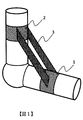
- FIG. 1 is a conceptual diagram showing an embodiment of region B of the present invention. The region A in FIG. 1 is not shown.
- the region B1 (1) has a function of covering and fixing the corrected portion so that the corrected portion does not move in any direction other than the desired correction direction.
- Region B2 (2) has a function as a fulcrum for maintaining the corrective force without reducing the corrective force such as deviation, tearing, and excessive elongation with respect to the desired corrective force.
- the area B3 (3) has a function of connecting the area B1 (1) and the area B2 (2) and setting a desired correction force by adjusting the connection length or the like in order to exert a correction force.
- the method of connecting the region B1 and the region B2 can be appropriately selected as long as the desired corrective force is satisfied. Specifically, sewing with a sewing machine or the like, a hook-and-loop fastener, a cloth tape, a snap button, or the like is used.
- the correction site is an action to promote correction to the original normal position or to improve the function of body deformation such as equinus, contracture, scoliosis, etc. and functional deterioration such as walking. It is a part.
- the part that causes the symptom that is, the deformation of the body or the functional deterioration such as walking, and even if it does not cause the symptom, the symptom is indirectly improved by acting. It may be a part that can be formed.
- region B For the structure of region B, a woven structure is used from the viewpoint of fixing force and dimensional stability for expressing corrective force.
- the woven fabric structure used for the region B has elasticity, and the elongation rate when the load is 100 N / 5 cm, that is, the elongation rate when stretched and measured at a load of 100 N / 5 cm is the warp direction and the weft direction, or the elongation rate thereof. It is 1.0% to 20% in either direction, more preferably 2.0% to 20%, and even more preferably 3.0% to 20%.
- the elongation rate within the above range, the correction site is not excessively fixed. Further, by appropriately extending the woven fabric structure, the friction between the straightening portion and the straightening tool is reduced, and the straightening portion swings during operation and reaches the portion covered by the region B that occurs when the straightening force acts.
- the woven structure receives the force applied by the wearer during operation, which makes it easier to move the muscles, which is preferable because it is effective in recovering the function and improving the daily operation.
- the woven structure of the woven structure is not particularly limited as long as it satisfies the range specified in the present invention, but for applications such as plain weave, twill weave, satin weave, and double weave combining these structures. It can be selected as appropriate.
- the yarn used may be either short fiber or long fiber as long as it satisfies the range specified in the present invention.
- the material of the yarn is not limited to natural fibers, synthetic fibers, etc. as long as it satisfies the range specified in the present invention, and various fibers can be used.
- synthetic fibers such as polyester fibers and polyamide fibers, cellulose fibers such as rayon and cotton, and natural fibers such as wool and silk can be appropriately used.
- the above materials may be mixed and used by knitting, inserting, aligning and the like.
- elastic fibers which are elastic materials, with the above materials.
- the elastic fiber to be mixed polyurethane elastic fiber, polyester elastomer fiber, PTT-based composite processed yarn (side-by-side bimetal yarn containing polytrimethylene terephthalate as a main component) and the like can be used, but dimensional stability and high elasticity can be used. Polyester elastomer fibers are more preferable from the viewpoint that the elasticity of the above can be easily obtained.
- the fineness of the fiber used in the region B is preferably 30 decitex to 1500 decitex, and more preferably 50 decitex to 1000 decitex.
- the fineness of the elastic fiber is preferably 50 decitex to 1500 decitex, and more preferably 156 decitex to 1000 decitex.
- the fineness of the non-elastic fiber, which is another fiber, is preferably 30 decitex to 1000 decitex, and more preferably 50 decitex to 500 decitex.
- elastic fibers as a part of the thread used as described above. Specifically, by using elastic fibers for at least a part of either one or both of the warp and weft, the dimensional stability of the woven fabric and the elasticity of the elastic fibers and the goodness after elongation are obtained. It has a high degree of recovery, and the fixing force, dimensional stability, and followability to movement can be appropriately adjusted to exert a corrective force on the corrective site.
- the ratio of the elastic fibers used is appropriately determined within the range in which the desired characteristics can be obtained, but the warp or weft, or the entire woven fabric is preferably about 30% by weight to 70% by weight.
- the elongation rate can be adjusted by appropriately adjusting the crimp ratio.
- the desired extensibility can be obtained. It is preferably 10% or more and 30% or less.
- the crimp ratio of the inelastic fibers is preferably 5% or more and 30% or less. As a result, when the elastic fiber is stretched, the inelastic fiber also follows the crimp rate, and the excessive stretching by the elastic fiber can be stopped.
- the crimp rate of the elastic fiber in that case is also appropriately set according to the desired characteristics, but is preferably 0% or more and 5% or less.
- the weaving density of the textile structure used in the present invention is preferably 20 threads / inch (2.54 cm) to 150 threads / inch (2.54 cm), respectively, in terms of warp and weft densities, and 30 threads / inch (2). It is more preferably .54 cm) to 100 lines / inch (2.54 cm).
- the elongation recovery rate after repeated 50 times elongation of the woven fabric structure used in the above region B at a load of 100 N / 5 cm is preferably 80% to 100% in the warp direction, the weft direction, or any of the directions. % To 100% is more preferable, and 90% to 100% is more preferable.
- the extension recovery rate after 50 times of repetition within the above range, the force to return to the original correction position acts appropriately against the force applied by the wearer during operation, and the appropriate correction position is maintained. It is preferable because it is effective in sagging, recovering functions, and improving daily movements.
- the straightening tool of the present invention can be used continuously, and it is more effective for functional recovery and improvement of daily movement.
- the spring constant of the structure used for the region B1 and the region B3 is preferably 10 N / mm or more and 100 N / mm or less in the warp direction, the weft direction, or any one of them, preferably 20 N. It is more preferably / mm or more and 100 N / mm or less, and more preferably 30 N / mm or more and 100 N / mm or less.
- the elastic fibers are used as a part of the yarn to be used. Specifically, by using elastic fibers for at least a part of either one or both of the warp threads and the weft threads, the elastic fibers have elasticity and good recovery after elongation, and the elastic fibers are provided.
- the desired spring constant can be obtained by adjusting the proportion of.
- the weave structure is not particularly limited, but a weave such as a plain weave, a twill weave, a satin weave, or a double weave in which these structures are combined can be appropriately selected depending on the intended use.
- polyurethane elastic fiber polyurethane elastic fiber, polyester elastomer fiber, PTT-based composite processed yarn (side-by-side bimetal yarn containing polytrimethylene terephthalate as a main component) and the like can be used, but highly elastic elasticity can be obtained. Polyester elastic fibers are more preferable because they are easy to use.
- the most preferable woven structure in the present invention consists of inelastic fibers in which either the warp or the weft has a crimp ratio of 10% or more and 30% or less, and at least a part of the other has a crimp ratio of 0% or more and 5% or less. It is a plain woven fabric made of elastic fibers having.
- the weaving density is preferably 30 yarns / inch (2.54 cm) to 100 yarns / inch (2.54 cm) in terms of warp yarn density and weft yarn density.
- the fineness is preferably 50 decitex to 500 decitex for inelastic fibers and 156 decitex to 1000 decitex for elastic fibers.
- the orthodontic appliance of the present invention is provided with a mechanism in the area B1 or / and the area B2 that can arbitrarily adjust the tightening force when worn.
- a mechanism in the area B1 or / and the area B2 that can arbitrarily adjust the tightening force when worn.
- the area B1 and / and the area B2 do not deviate or come off from a predetermined position, and the area B1 is corrected. It becomes possible to stably cover and grip the portion, and in the region B2, the regions B1 and B3 preferably act as a support for exhibiting a corrective force.
- the adjusting mechanism is not particularly limited, but a belt, a hook, a cloth tape, a button, a buckle, or the like can be appropriately selected depending on the application.
- the orthodontic appliance of the present invention has a mechanism that can be opened and closed when worn.
- the mechanism that can be opened and closed when worn is a mechanism that opens and closes so as to widen the opening when the orthodontic appliance of the present invention is attached and detached, and that allows the opening and closing of a place that is not normally opened when attached and detached to facilitate attachment and detachment.
- the place where the mechanism that can be opened and closed is provided is not particularly limited as long as it does not impair the straightening function and can be easily attached and detached, and is any of areas A (when area A is used), areas B1 to 3 or a connection thereof. It can be installed in any part.
- the opening / closing mechanism is not particularly limited, but can be appropriately selected depending on the application, such as a line fastener, a fastener such as a hook-and-loop fastener, a cloth tape, a button such as a snap button, and a button such as a tack button.
- the orthodontic tool of the present invention may use only the area B in the area B as long as it satisfies the desired characteristics such as corrective force and detachability. Further, in the area A and the area B, they may be used as separate members or partially connected as long as they satisfy the desired characteristics such as corrective force and detachability. Above all, it is more preferable that the region A and the region B are connected and integrally formed. Since the area A and the area B are connected and integrally formed, it can be worn in the same manner as general clothing without any trouble when worn. This reduces the burden on the wearer and the caregiver, enables the corrective tool of the present invention to be used continuously, and is more effective in recovering functions and improving daily movements.
- the connection method is not particularly limited, but can be appropriately selected depending on the application such as sewing and adhesion.
- the orthosis thus obtained has the corrective force necessary for body deformation and functional improvement, and has the ability to follow the friction and pressure between the corrective part and the corrective tool that occur during movement, and is continuous. Since it can be used, is easy to wear, and does not impair the appearance when worn, it can be suitably used for orthoses such as upper limb orthoses, trunk orthoses, and lower limb orthoses.
- the wearing application is not only suitable as an orthosis for daily life, but also extremely useful as an orthosis for rehabilitation.
- Fineness was measured based on JIS L 1013: 2010 8.3.1 Positive quantity fineness (method A).
- Elongation rate LA (%) [(L1-L) / L] x 100 L: Grab interval (mm) Grasp interval (mm) when extended to L1: 100N (3) Stretch recovery rate after 50 stretches at a load of 100 N / 5 cm
- JIS L 1096: 2010 8.15.1 JIS strip method (A method) It was measured. That is, five 5 cm ⁇ 30 cm test pieces were collected in each of the vertical and horizontal directions.
- the grip interval was marked as 200 m (Lb), and the test piece was fixed to the grip after removing slack and tension.
- Elongation recovery rate LB (%) [Lb- (Lb1-Lb) / Lb] ⁇ 100 (4) Spring constant
- JIS-K-6400-2 2012E method, using a static load deflection tester for seats (FGS-TV special manufactured by Nidec-Shimpo Co., Ltd., 2-axis manual running specification) with R30
- the center of the pressurizing jig of the elliptical plate (minor axis 250 mm ⁇ major axis ⁇ 300 mm) is aligned with the center position of the cloth, the contact position is set to the initial position (0N), and the test is started.
- the pressure was applied to a load of 200 N or more at a pressurizing speed of 270 mm / min, and the slopes of the graph tangents between the load under a load of 200 N and the sinking amount [mm] were measured for each of the five samples, and the average was calculated.
- Example 1 A tricot knitted fabric in which two types of fibers, 54 decitex polyester fibers and 156 decitex polyurethane fibers, were interwoven as elastic fibers was used in region A.
- region B a polyester fiber of 167 decitex, which is an inelastic yarn, is used as the warp, and a polyester elastomer "Hytrel" (registered trademark) monofilament of 480 decitex, which is an elastic yarn, is used as the weft, and the warp density is 39 threads / inch ( A plain woven fabric having a weft density of 43 threads / inch (2.54 cm) was produced (2.54 cm). The obtained woven fabric was heat-treated at a temperature of 180 ° C.
- a woven fabric structure having a warp density of 45 threads / inch (2.54 cm) and a weft density of 46 threads / inch (2.54 cm).
- the crimp rates of the warp and weft were 20% and 3%, respectively.
- the obtained woven fabric structure had an elongation rate of 5% and a weft of 5% and an elongation recovery rate of 85% and a weft of 95% at a load of 100 N / 5 cm, and a spring constant of 50 N / mm.
- a sock-type orthodontic appliance was produced using the fabrics of regions A and B.
- FIG. 2 is a side view of the orthodontic appliance.
- Area A (4) has a sock shape that covers from one foot to the knee.
- Region B1 (1) covers the circumference of the metatarsal bone of the foot so that the width direction of the foot and the weft direction of the obtained woven structure are aligned
- region B2 (2) covers the circumference of the knee including the popliteal fossa.
- the area B3 (3) is a woven fabric in which the longitudinal direction of the area B3 is obtained from both sides of the area B2 (2) centered on the kneecap side to the outside of the thumb and the outside of the little finger of the metatarsal bone of the area B1 (1). They were connected so as to be aligned with the weft direction of the structure.
- the B1 side was a hook-and-loop fastener (TRUSCO's "Magic Tape” (registered trademark) TMSH-1005-W), and the B2 side was sewn with a sewing machine to connect the area B3 to the areas B1 and B2.
- connection length was adjusted so that the knees were covered at an angle suitable for walking so that the orientation of the legs and the body was 90 ° in the relaxed state.
- the part other than the instep part is connected, and in the area B2, the part other than the popliteal fossa is connected to the area A by sewing with a sewing machine, and in each of the areas B1 and B2, the circumferential ends are bonded by the hook-and-loop fastener. This made it possible to adjust to the desired tightening force.
- the orthodontic force was 5, the feeling of oppression was 5, and the friction was 5, and as an orthodontic appliance, the fixing force and the orthodontic force necessary for body deformation and functional improvement, and during operation It is excellent because it has both the ability to follow the friction, rocking, and pressure between the orthodontic part and the orthodontic appliance, and it also has sufficient recovery when deformed, and the orthodontic appliance can be used continuously. It showed performance. Also, when I put on my shoes with orthodontic braces, I was able to put on my shoes according to the size of my feet. Moreover, since it is sock-like, it is easy to put on and take off, and it is easy to adjust the position of the area B3.
- Example 2 A sock-type orthodontic appliance similar to that of Example 1 was used except that both ends of the region B3 were connected to the region B1 and the region B2 by sewing with a sewing machine, respectively.
- the orthodontic force was 5, the feeling of oppression was 5, and the friction was 5, and as an orthodontic appliance, the fixing force and the orthodontic force necessary for body deformation and functional improvement, and during operation It is excellent because it has both the ability to follow the friction, rocking, and pressure between the orthodontic part and the orthodontic appliance, and it also has sufficient recovery when deformed, and the orthodontic appliance can be used continuously. It showed performance. Also, when I put on my shoes with orthodontic braces, I was able to put on my shoes according to the size of my feet. Further, since the position and size of the area B3 have been adjusted in advance, it was easy to attach and detach.
- Example 3 A sock-type orthodontic appliance similar to that of Example 1 was used except that the region B3 was connected to the region A on the front side of the ankle by sewing with a sewing machine.
- the orthodontic force was 5, the feeling of oppression was 5, and the friction was 5, and as an orthodontic appliance, the fixing force and the orthodontic force necessary for body deformation and functional improvement, and during operation It is excellent because it has both the ability to follow the friction, rocking, and pressure between the orthodontic part and the orthodontic appliance, and it also has sufficient recovery when deformed, and the orthodontic appliance can be used continuously. It showed performance. Also, when I put on my shoes with orthodontic braces, I was able to put on my shoes according to the size of my feet. In addition, it is easy to put on and take off, and the area B3 comes to fit the foot, and the appearance of wearing is further improved.
- Example 4 A sock-type orthodontic appliance similar to that of Example 1 was used except that the region B3 was connected to the region B1 and the region B2 so as to cross the front side of the foot.
- the orthodontic force was 5, the feeling of oppression was 5, and the friction was 5, and as an orthodontic appliance, the fixing force and the orthodontic force necessary for body deformation and functional improvement, and during operation It is excellent because it has both the ability to follow the friction, rocking, and pressure between the orthodontic part and the orthodontic appliance, and it also has sufficient recovery when deformed, and the orthodontic appliance can be used continuously. It showed performance. Also, when I put on my shoes with orthodontic braces, I was able to put on my shoes according to the size of my feet. It was also easy to put on and take off.
- Example 5 A sock-type orthodontic appliance similar to that of Example 4 was used except that the region B3 was connected to the region A on the front side of the ankle by sewing with a sewing machine.
- the orthodontic force was 5, the feeling of oppression was 5, and the friction was 5, and as an orthodontic appliance, the fixing force and the orthodontic force necessary for body deformation and functional improvement, and during operation It is excellent because it has both the ability to follow the friction, rocking, and pressure between the orthodontic part and the orthodontic appliance, and it also has sufficient recovery when deformed, and the orthodontic appliance can be used continuously. It showed performance. Also, when I put on my shoes with orthodontic braces, I was able to put on my shoes according to the size of my feet. In addition, it is easy to put on and take off, and the area B3 comes to fit the foot, and the appearance of wearing is further improved.
- Example 6 Area A was not used, and the same cloth as in Example 1 was used for area B to prepare an orthodontic appliance for the ankle foot.
- Area B1 (1) covers the circumference of the metatarsal bone of the foot so that the width direction of the foot and the weft direction of the obtained woven structure are aligned
- region B2 (2) covers the circumference of the knee including the patella.
- the outside of the knee and the outside of the small finger of the bone are connected so that the longitudinal direction of the region B3 is aligned with the weft direction of the obtained woven structure, and the connection length is such that the direction of the foot and the body is relaxed.
- Area B2 was adjusted so that the knee was covered at an angle suitable for walking so as to be 90 °.
- the peripheral end portions are adhered by a hook-and-loop fastener so that the desired tightening force can be adjusted.
- the orthodontic force was 5
- the feeling of oppression was 5
- the friction was 3, and as an orthodontic appliance, the fixing force and the orthodontic force necessary for body deformation and functional improvement, and during operation It is excellent because it has both the ability to follow the friction, rocking, and pressure between the orthodontic part and the orthodontic appliance, and it also has sufficient recovery when deformed, and the orthodontic appliance can be used continuously. It showed performance. Also, when I put on my shoes with orthodontic braces, I was able to put on my shoes according to the size of my feet.
- the commercially available rubber band had an elongation rate of 70% and a latitude of 25% at a load of 100 N / 5 cm, an elongation recovery rate of 95% and a latitude of 80%, and a spring constant of 5 N / mm.
- the orthodontic force was 1, the feeling of oppression was 5, and the rubbing was 5, and as the orthodontic appliance, the elongation rate at a load of 100 N / 5 cm in the area B was excessively large, and the body The fixing force and correction force required for deformation and functional improvement were insufficient and unsuitable.
- a shoehorn-type ankle foot orthosis made of a polypropylene sheet having a thickness of 3 mm was used as a corrective tool.
- the polypropylene sheet had an elongation rate of 0.5% and a weft of 0.5% at a load of 100 N / 5 cm, an elongation recovery rate of 30% and a latitude of 30%, and a spring constant of 150 N / mm.
Landscapes
- Health & Medical Sciences (AREA)
- Nursing (AREA)
- Orthopedic Medicine & Surgery (AREA)
- Engineering & Computer Science (AREA)
- Biomedical Technology (AREA)
- Heart & Thoracic Surgery (AREA)
- Vascular Medicine (AREA)
- Life Sciences & Earth Sciences (AREA)
- Animal Behavior & Ethology (AREA)
- General Health & Medical Sciences (AREA)
- Public Health (AREA)
- Veterinary Medicine (AREA)
- Orthopedics, Nursing, And Contraception (AREA)
- Rehabilitation Tools (AREA)
- Footwear And Its Accessory, Manufacturing Method And Apparatuses (AREA)
Abstract
Description
(1)矯正具であって、前記矯正具を装着時に矯正力を発現する領域Bを有し、前記領域Bは、任意の矯正部位に対し、矯正部位を被覆する領域B1と矯正力を作用させるための支持領域である領域B2と、前記領域B1と領域B2を連結する領域B3からなり、かつ、領域Bに用いる構造体は伸縮性を有する織物構造体であり、荷重100N/5cm時の伸長率が、経方向および緯方向または、そのいずれかの方向で1.0%以上20%以下である矯正具。
(2)さらに前記矯正部位の周辺を覆う領域Aを有し、前記領域Aは少なくとも1種以上、伸縮性を有する構造体からなる(1)記載の矯正具。
(3)前記領域Bに用いる織物構造体の荷重100N/5cmにおける50回伸長後の伸長回復率が、経方向および緯方向または、そのいずれかの方向で80%~100%である(1)または(2)に記載の矯正具。
(4)前記領域B1と領域B3に用いる織物構造体のバネ定数が、10N/mm以上100N/mm以下であることを特徴とする、(1)~(3)のいずれかに記載の矯正具。
(5)前記領域B1または/および領域B2が着用時に緊締力を任意に調整できる機構を備えている(1)~(4)のいずれかに記載の矯正具。
(6)
着用時に開閉可能な機構を備えている(1)~(5)のいずれかに記載の矯正具。
(7)前記領域Aと領域Bが連結されて一体的に形成されている(1)~(6)のいずれかに記載の矯正具。
(8)リハビリテーション用の装具として用いられる(1)~(7)のいずれかに記載の矯正具。
(9)上肢装具である(1)~(8)のいずれかに記載の矯正具。
(10)体幹装具である(1)~(8)のいずれかに記載の矯正具。
(11)下肢装具である(1)~(8)のいずれかに記載の矯正具。
繊度は、JIS L 1013:2010 8.3.1 正量繊度(A法)に基づき測定した。
領域Bに用いる織物構造体の伸長率はJIS L 1096:2010 8.14.1 JIS法のストリップ法(A法)に準じて測定した。すなわち、5cm×30cmの試験片を経、緯方向にそれぞれ5枚ずつ採取した。自動記録装置付定速伸長形引張試験機を用い、つかみ間隔を20cmとし、試験片のたるみや張力を除いてつかみに固定した。引張速度200mm/分で100Nまで伸ばし、その時のつかみ間隔を測り、次の式により伸長率LA(%)を求め、5枚の平均で表した。
伸長率LA(%)=[(L1-L)/L]×100
L :つかみ間隔(mm)
L1:100Nまで伸ばした時のつかみ間隔(mm)
(3)荷重100N/5cmにおける50回伸長後の伸長回復率
領域Bに用いる織物構造体の伸長回復率はJIS L 1096:2010 8.15.1 JIS法のストリップ法(A法)を参考に測定した。すなわち、5cm×30cmの試験片をタテ、ヨコ方向にそれぞれ5枚ずつ採取した。自動記録装置付定速伸長形引張試験機を用い、つかみ間隔を200m(Lb)として印を付け、試験片のたるみや張力を除いて、つかみに固定した。引張速度200mm/分で別に求めた伸長率(前項LA)の値まで伸ばして、1分放置した後、同じ速度で元の位置まで戻し、3分間放置する。この操作を50回繰り返した後、荷重を取り除き、3分間放置した後、試験片のたるみや張力を除いて、印間の長さ(Lb1)を測定し、次式により伸長回復率LB(%)を求め、5枚の平均で表した。
伸長回復率LB(%)=[Lb-(Lb1-Lb)/Lb]×100
(4)バネ定数
JIS-K-6400-2:2012E法を参考とし、シート用静荷重撓み試験機(日本電産シンポ株式会社製FGS-TV特、2軸手動走行仕様)を用い、R30付き楕円板(短径250mm×長径φ300mm)の加圧治具の中心を布帛の中心位置に合わせ、接する位置を初期位置(0N)とし、試験を開始する。加圧速度270mm/分で、200N以上の荷重まで加圧し、200N荷重時の荷重と沈み込み量[mm]とのグラフ接線の傾きをそれぞれ5つのサンプルについて測定し、その平均を算出した。
作製した矯正具を矯正が必要な片足に着用して、1時間歩行した状態で、矯正力、圧迫感、擦れの3項目を評価した。評価は着用者による官能評価で実施し、5、3、1の3段階で評価した。
5:矯正された状態が保持され、力を入れた際に、領域Bが若干追従する。
5:歩行中に領域Bが覆う部分で違和感はあるが、気にならない。
5:歩行中に領域Bの周辺で痛みを感じない。
JIS L 1096:2010 8.6.1(A法)に基づき測定した。試料を平らな台上に置き、不自然なしわや張力を除いて、異なる5カ所について1inch(2.54cm)間に存在する経糸および緯糸の本数を数え、それぞれの平均値を算出した。
織物から抜き出した経糸及び緯糸について、JIS L1096 8.7b法に準じて実施した。20本の糸について測定し、その平均値で示した。
領域Aに54デシテックスのポリエステル繊維と弾性繊維として156デシテックスのポリウレタン繊維の2種類の繊維を交編したトリコット編地を使用した。領域Bには、経糸として、非弾性糸である167デシテックスのポリエステル繊維、緯糸として、弾性糸である480デシテックスのポリエステルエラストマー“ハイトレル”(登録商標)モノフィラメントを用いて、経糸密度39本/inch(2.54cm)、緯糸密度43本/inch(2.54cm)の平織物を作製した。得られた織物を180℃の温度で2分間、熱処理を行い、経糸密度45本/inch(2.54cm)、緯糸密度46本/inch(2.54cm)の織物構造体を得た。経糸、緯糸のクリンプ率はそれぞれ20%、3%であった。
領域B3の両端をそれぞれ領域B1、領域B2にミシンによる縫い付けで連結させた以外は実施例1と同様のソックスタイプの矯正具を用いた。
領域B3を足首前側で領域Aにミシンによる縫い付けで連結させた以外は実施例1と同様のソックスタイプの矯正具を用いた。
領域B3を足の前側でクロスするように領域B1と領域B2に連結させた以外は実施例1と同様のソックスタイプの矯正具を用いた。
領域B3を足首の前側で領域Aにミシンによる縫い付けで連結させた以外は実施例4と同様のソックスタイプの矯正具を用いた。
領域Aは用いず、領域Bには、実施例1と同様の布帛を用いて、短下肢用の矯正具を作製した。領域B1(1)は足の中足骨周囲を足の幅方向と得られた織物構造体の緯方向が揃うように覆い、領域B2(2)は、膝窩を含む、膝の周囲を、膝の周方向と得られた織物構造体の緯方向が揃うように覆い、領域B3(3)は領域B2(2)の膝頭側を中心とした両側面から、領域B1(1)の中足骨の親指外側と小指外側までを、領域B3の長手方向が得られた織物構造体の緯方向と揃うように、連結し、その連結長は、力を抜いた状態で足と体の向きが90°となるように、領域B2は膝部が歩行に適する角度で覆われるよう調整した。領域B1とB2のそれぞれにおいて、周方向端部を面ファスナーにより接着させることで、所望の緊締力に調整できるようにした。
領域Bに市販のゴムバンドを使用したことと、領域B1(1)は足の中足骨周囲を足の幅方向とゴムバンドのタテ方向が揃うように、覆い、領域B2(2)は、膝窩を含む、膝の周囲を、膝の周方向とゴムバンドの経方向が揃うように、覆い、領域B3(3)は領域B2(2)の膝頭側を中心とした両側面から、領域B1(1)の中足骨の親指外側と小指外側までを、領域B3の長手方向がゴムバンドの緯方向と揃うように、連結した以外は実施例1と同様のソックスタイプの矯正具を用いた。市販のゴムバンドは、荷重100N/5cm時の伸長率が、経70%、緯25%、伸長回復率は経95%、緯80%、バネ定数は5N/mmであった。
厚さ3mmのポリプロピレン製シートを用いて作製されたシューホーン型の短下肢装具を矯正具として用いた。ポリプロピレン製シートは、荷重100N/5cm時の伸長率が、経0.5%、緯0.5%、伸長回復率は経30%、緯30%、バネ定数は150N/mmであった。
厚さ3mmのステンレス板を支柱にした、両側支柱型の短下肢装具を矯正具として用いた。ステンレス板は、荷重100N/5cm時の伸長率が、経0%、緯0%、伸長回復率、バネ定数は、前記測定条件では、測定不能であった。

2.領域B2
3.領域B3
4.領域A
Claims (10)
- 矯正具であって、前記矯正具を装着時に矯正力を発現する領域Bを有し、前記領域Bは、任意の矯正部位に対し、矯正部位を被覆する領域B1と矯正力を作用させるための支持領域である領域B2と、前記領域B1と領域B2を連結する領域B3からなり、かつ、領域Bに用いる構造体は伸縮性を有する織物構造体であり、荷重100N/5cm時の伸長率が、経方向および緯方向または、そのいずれかの方向で1.0%以上20%以下である矯正具。
- さらに前記矯正部位の周辺を覆う領域Aを有し、前記領域Aは少なくとも1種以上、伸縮性を有する構造体からなる請求項1記載の矯正具。
- 前記領域Bに用いる織物構造体の荷重100N/5cmにおける50回伸長後の伸長回復率が、経方向および緯方向または、そのいずれかの方向で80%~100%である請求項1または2に記載の矯正具。
- 前記領域B1と領域B3に用いる織物構造体のバネ定数が、10N/mm以上100N/mm以下であることを特徴とする、請求項1~3のいずれかに記載の矯正具。
- 前記領域B1または/および領域B2が着用時に緊締力を任意に調整できる機構を備えている請求項1~4のいずれかに記載の矯正具。
- 着用時に開閉可能な機構を備えている請求項1~5のいずれかに記載の矯正具。
- 前記領域Aと領域Bが連結されて一体的に形成されている請求項1~6のいずれかに記載
の矯正具。 - 上肢装具である請求項1~7のいずれかに記載の矯正具。
- 体幹装具である請求項1~7のいずれかに記載の矯正具。
- 下肢装具である請求項1~7のいずれかに記載の矯正具。
Priority Applications (6)
| Application Number | Priority Date | Filing Date | Title |
|---|---|---|---|
| CA3147405A CA3147405A1 (en) | 2019-08-09 | 2020-08-06 | Orthotic |
| US17/631,060 US20220280321A1 (en) | 2019-08-09 | 2020-08-06 | Orthotic |
| EP20851565.0A EP4011348A4 (en) | 2019-08-09 | 2020-08-06 | SHOE INSOLE |
| CN202080052722.5A CN114144147A (zh) | 2019-08-09 | 2020-08-06 | 矫正器具 |
| JP2020544312A JP7415932B2 (ja) | 2019-08-09 | 2020-08-06 | 矯正具 |
| KR1020227002454A KR102898881B1 (ko) | 2019-08-09 | 2020-08-06 | 교정 도구 |
Applications Claiming Priority (2)
| Application Number | Priority Date | Filing Date | Title |
|---|---|---|---|
| JP2019147629 | 2019-08-09 | ||
| JP2019-147629 | 2019-08-09 |
Publications (1)
| Publication Number | Publication Date |
|---|---|
| WO2021029325A1 true WO2021029325A1 (ja) | 2021-02-18 |
Family
ID=74569550
Family Applications (1)
| Application Number | Title | Priority Date | Filing Date |
|---|---|---|---|
| PCT/JP2020/030225 Ceased WO2021029325A1 (ja) | 2019-08-09 | 2020-08-06 | 矯正具 |
Country Status (7)
| Country | Link |
|---|---|
| US (1) | US20220280321A1 (ja) |
| EP (1) | EP4011348A4 (ja) |
| JP (1) | JP7415932B2 (ja) |
| KR (1) | KR102898881B1 (ja) |
| CN (1) | CN114144147A (ja) |
| CA (1) | CA3147405A1 (ja) |
| WO (1) | WO2021029325A1 (ja) |
Citations (3)
| Publication number | Priority date | Publication date | Assignee | Title |
|---|---|---|---|---|
| JPH09313553A (ja) | 1996-05-27 | 1997-12-09 | Hiroshi Okumura | 足の矯正用装具 |
| JP2017186726A (ja) * | 2016-03-30 | 2017-10-12 | 東レ株式会社 | 衣類 |
| JP2018011903A (ja) * | 2016-07-22 | 2018-01-25 | 佐直 清 | 下肢用サポータ |
Family Cites Families (11)
| Publication number | Priority date | Publication date | Assignee | Title |
|---|---|---|---|---|
| JP2005279153A (ja) * | 2004-03-31 | 2005-10-13 | Undo Kagaku Kenkyusho Kk | 歩行矯正器 |
| JP4642524B2 (ja) * | 2005-03-30 | 2011-03-02 | 株式会社ワコール | 股付き衣類 |
| JP5321893B2 (ja) * | 2008-04-22 | 2013-10-23 | 株式会社コーポレーションパールスター | 外反母趾矯正用具 |
| EP2316288B1 (en) * | 2008-07-18 | 2013-09-11 | Mizuno Corporation | Sportswear |
| JP5499249B2 (ja) * | 2009-06-03 | 2014-05-21 | 株式会社コーポレーションパールスター | 矯正ストラップ及びこれを有する足矯正靴下 |
| JP2011038230A (ja) * | 2009-08-18 | 2011-02-24 | Okamoto Kk | 膝保護用衣服 |
| TWI533814B (zh) * | 2010-01-22 | 2016-05-21 | Kowa Co | Elbow support belt |
| JP5548949B2 (ja) * | 2010-06-15 | 2014-07-16 | 株式会社コーポレーションパールスター | 矯正ストラップ及びこれを用いた足矯正具 |
| JP5758838B2 (ja) * | 2012-04-25 | 2015-08-05 | 東レ株式会社 | ストレッチ織物 |
| WO2017173441A1 (en) * | 2016-04-01 | 2017-10-05 | Ortho 360, Llc | Orthotic ankle garment, and method for stabilizing the lower leg of a wearer |
| JP2019081986A (ja) * | 2017-10-31 | 2019-05-30 | 美津濃株式会社 | 衣服 |
-
2020
- 2020-08-06 JP JP2020544312A patent/JP7415932B2/ja active Active
- 2020-08-06 CN CN202080052722.5A patent/CN114144147A/zh active Pending
- 2020-08-06 EP EP20851565.0A patent/EP4011348A4/en active Pending
- 2020-08-06 US US17/631,060 patent/US20220280321A1/en active Pending
- 2020-08-06 WO PCT/JP2020/030225 patent/WO2021029325A1/ja not_active Ceased
- 2020-08-06 KR KR1020227002454A patent/KR102898881B1/ko active Active
- 2020-08-06 CA CA3147405A patent/CA3147405A1/en active Pending
Patent Citations (3)
| Publication number | Priority date | Publication date | Assignee | Title |
|---|---|---|---|---|
| JPH09313553A (ja) | 1996-05-27 | 1997-12-09 | Hiroshi Okumura | 足の矯正用装具 |
| JP2017186726A (ja) * | 2016-03-30 | 2017-10-12 | 東レ株式会社 | 衣類 |
| JP2018011903A (ja) * | 2016-07-22 | 2018-01-25 | 佐直 清 | 下肢用サポータ |
Non-Patent Citations (1)
| Title |
|---|
| See also references of EP4011348A4 |
Also Published As
| Publication number | Publication date |
|---|---|
| JPWO2021029325A1 (ja) | 2021-02-18 |
| CN114144147A (zh) | 2022-03-04 |
| EP4011348A1 (en) | 2022-06-15 |
| EP4011348A4 (en) | 2023-08-16 |
| KR102898881B1 (ko) | 2025-12-12 |
| KR20220044722A (ko) | 2022-04-11 |
| US20220280321A1 (en) | 2022-09-08 |
| CA3147405A1 (en) | 2021-02-18 |
| JP7415932B2 (ja) | 2024-01-17 |
Similar Documents
| Publication | Publication Date | Title |
|---|---|---|
| US5154690A (en) | Supporter | |
| CN106061440B (zh) | 护膝及膝关节保护方法 | |
| EP1974704B1 (en) | Compression device | |
| CN105963106B (zh) | 膝关节减压机构 | |
| WO2020075354A1 (ja) | 動作補助作業着 | |
| JP7420139B2 (ja) | 下肢矯正具 | |
| EA033765B1 (ru) | Бандаж голеностопного сустава | |
| JP6924056B2 (ja) | 衣類 | |
| KR101557385B1 (ko) | 손관절 서포터 | |
| JP2018201846A (ja) | 下肢用サポータ | |
| US20100100024A1 (en) | Anti-slip Mechanism, Garment, and Methods | |
| JP7415932B2 (ja) | 矯正具 | |
| JP6270800B2 (ja) | タイツ | |
| JP2010057852A (ja) | 足関節装具 | |
| JP2019081986A (ja) | 衣服 | |
| JP2024151728A (ja) | 下肢着用具 | |
| JP7187499B2 (ja) | 衣類 | |
| JP7737876B2 (ja) | インナーウェア | |
| CN114126435A (zh) | 可穿戴管状纺织制品 | |
| CN215875135U (zh) | 一种脚踝康复装置 | |
| CN214128957U (zh) | 一种足下垂牵引装置 | |
| KR20190020490A (ko) | 자세교정용 기능성 의류 | |
| JP2024018079A (ja) | 織物 | |
| JP2021186896A (ja) | 身体動作アシスト装置用装着衣 | |
| JP2020199024A (ja) | 股関節用サポーター |
Legal Events
| Date | Code | Title | Description |
|---|---|---|---|
| ENP | Entry into the national phase |
Ref document number: 2020544312 Country of ref document: JP Kind code of ref document: A |
|
| 121 | Ep: the epo has been informed by wipo that ep was designated in this application |
Ref document number: 20851565 Country of ref document: EP Kind code of ref document: A1 |
|
| ENP | Entry into the national phase |
Ref document number: 3147405 Country of ref document: CA |
|
| NENP | Non-entry into the national phase |
Ref country code: DE |
|
| ENP | Entry into the national phase |
Ref document number: 2020851565 Country of ref document: EP Effective date: 20220309 |