WO2021033535A1 - 人毛繊維処理剤 - Google Patents
人毛繊維処理剤 Download PDFInfo
- Publication number
- WO2021033535A1 WO2021033535A1 PCT/JP2020/029844 JP2020029844W WO2021033535A1 WO 2021033535 A1 WO2021033535 A1 WO 2021033535A1 JP 2020029844 W JP2020029844 W JP 2020029844W WO 2021033535 A1 WO2021033535 A1 WO 2021033535A1
- Authority
- WO
- WIPO (PCT)
- Prior art keywords
- human hair
- mass
- hair fiber
- less
- fiber treatment
- Prior art date
- Legal status (The legal status is an assumption and is not a legal conclusion. Google has not performed a legal analysis and makes no representation as to the accuracy of the status listed.)
- Ceased
Links
Classifications
-
- A—HUMAN NECESSITIES
- A41—WEARING APPAREL
- A41G—ARTIFICIAL FLOWERS; WIGS; MASKS; FEATHERS
- A41G3/00—Wigs
- A41G3/0075—Processes or apparatus for making wigs
-
- A—HUMAN NECESSITIES
- A41—WEARING APPAREL
- A41G—ARTIFICIAL FLOWERS; WIGS; MASKS; FEATHERS
- A41G3/00—Wigs
- A41G3/0083—Wigs characterised by their hair filaments
-
- D—TEXTILES; PAPER
- D06—TREATMENT OF TEXTILES OR THE LIKE; LAUNDERING; FLEXIBLE MATERIALS NOT OTHERWISE PROVIDED FOR
- D06M—TREATMENT, NOT PROVIDED FOR ELSEWHERE IN CLASS D06, OF FIBRES, THREADS, YARNS, FABRICS, FEATHERS OR FIBROUS GOODS MADE FROM SUCH MATERIALS
- D06M13/00—Treating fibres, threads, yarns, fabrics or fibrous goods made from such materials, with non-macromolecular organic compounds; Such treatment combined with mechanical treatment
- D06M13/10—Treating fibres, threads, yarns, fabrics or fibrous goods made from such materials, with non-macromolecular organic compounds; Such treatment combined with mechanical treatment with compounds containing oxygen
- D06M13/12—Aldehydes; Ketones
- D06M13/127—Mono-aldehydes, e.g. formaldehyde; Monoketones
-
- D—TEXTILES; PAPER
- D06—TREATMENT OF TEXTILES OR THE LIKE; LAUNDERING; FLEXIBLE MATERIALS NOT OTHERWISE PROVIDED FOR
- D06M—TREATMENT, NOT PROVIDED FOR ELSEWHERE IN CLASS D06, OF FIBRES, THREADS, YARNS, FABRICS, FEATHERS OR FIBROUS GOODS MADE FROM SUCH MATERIALS
- D06M13/00—Treating fibres, threads, yarns, fabrics or fibrous goods made from such materials, with non-macromolecular organic compounds; Such treatment combined with mechanical treatment
- D06M13/322—Treating fibres, threads, yarns, fabrics or fibrous goods made from such materials, with non-macromolecular organic compounds; Such treatment combined with mechanical treatment with compounds containing nitrogen
- D06M13/325—Amines
-
- D—TEXTILES; PAPER
- D06—TREATMENT OF TEXTILES OR THE LIKE; LAUNDERING; FLEXIBLE MATERIALS NOT OTHERWISE PROVIDED FOR
- D06M—TREATMENT, NOT PROVIDED FOR ELSEWHERE IN CLASS D06, OF FIBRES, THREADS, YARNS, FABRICS, FEATHERS OR FIBROUS GOODS MADE FROM SUCH MATERIALS
- D06M13/00—Treating fibres, threads, yarns, fabrics or fibrous goods made from such materials, with non-macromolecular organic compounds; Such treatment combined with mechanical treatment
- D06M13/322—Treating fibres, threads, yarns, fabrics or fibrous goods made from such materials, with non-macromolecular organic compounds; Such treatment combined with mechanical treatment with compounds containing nitrogen
- D06M13/35—Heterocyclic compounds
- D06M13/355—Heterocyclic compounds having six-membered heterocyclic rings
-
- D—TEXTILES; PAPER
- D06—TREATMENT OF TEXTILES OR THE LIKE; LAUNDERING; FLEXIBLE MATERIALS NOT OTHERWISE PROVIDED FOR
- D06M—TREATMENT, NOT PROVIDED FOR ELSEWHERE IN CLASS D06, OF FIBRES, THREADS, YARNS, FABRICS, FEATHERS OR FIBROUS GOODS MADE FROM SUCH MATERIALS
- D06M13/00—Treating fibres, threads, yarns, fabrics or fibrous goods made from such materials, with non-macromolecular organic compounds; Such treatment combined with mechanical treatment
- D06M13/322—Treating fibres, threads, yarns, fabrics or fibrous goods made from such materials, with non-macromolecular organic compounds; Such treatment combined with mechanical treatment with compounds containing nitrogen
- D06M13/35—Heterocyclic compounds
- D06M13/355—Heterocyclic compounds having six-membered heterocyclic rings
- D06M13/358—Triazines
-
- D—TEXTILES; PAPER
- D06—TREATMENT OF TEXTILES OR THE LIKE; LAUNDERING; FLEXIBLE MATERIALS NOT OTHERWISE PROVIDED FOR
- D06M—TREATMENT, NOT PROVIDED FOR ELSEWHERE IN CLASS D06, OF FIBRES, THREADS, YARNS, FABRICS, FEATHERS OR FIBROUS GOODS MADE FROM SUCH MATERIALS
- D06M15/00—Treating fibres, threads, yarns, fabrics, or fibrous goods made from such materials, with macromolecular compounds; Such treatment combined with mechanical treatment
- D06M15/19—Treating fibres, threads, yarns, fabrics, or fibrous goods made from such materials, with macromolecular compounds; Such treatment combined with mechanical treatment with synthetic macromolecular compounds
- D06M15/37—Macromolecular compounds obtained otherwise than by reactions only involving carbon-to-carbon unsaturated bonds
- D06M15/39—Aldehyde resins; Ketone resins; Polyacetals
- D06M15/41—Phenol-aldehyde or phenol-ketone resins
-
- D—TEXTILES; PAPER
- D06—TREATMENT OF TEXTILES OR THE LIKE; LAUNDERING; FLEXIBLE MATERIALS NOT OTHERWISE PROVIDED FOR
- D06M—TREATMENT, NOT PROVIDED FOR ELSEWHERE IN CLASS D06, OF FIBRES, THREADS, YARNS, FABRICS, FEATHERS OR FIBROUS GOODS MADE FROM SUCH MATERIALS
- D06M15/00—Treating fibres, threads, yarns, fabrics, or fibrous goods made from such materials, with macromolecular compounds; Such treatment combined with mechanical treatment
- D06M15/19—Treating fibres, threads, yarns, fabrics, or fibrous goods made from such materials, with macromolecular compounds; Such treatment combined with mechanical treatment with synthetic macromolecular compounds
- D06M15/37—Macromolecular compounds obtained otherwise than by reactions only involving carbon-to-carbon unsaturated bonds
- D06M15/39—Aldehyde resins; Ketone resins; Polyacetals
- D06M15/423—Amino-aldehyde resins
-
- D—TEXTILES; PAPER
- D06—TREATMENT OF TEXTILES OR THE LIKE; LAUNDERING; FLEXIBLE MATERIALS NOT OTHERWISE PROVIDED FOR
- D06M—TREATMENT, NOT PROVIDED FOR ELSEWHERE IN CLASS D06, OF FIBRES, THREADS, YARNS, FABRICS, FEATHERS OR FIBROUS GOODS MADE FROM SUCH MATERIALS
- D06M15/00—Treating fibres, threads, yarns, fabrics, or fibrous goods made from such materials, with macromolecular compounds; Such treatment combined with mechanical treatment
- D06M15/19—Treating fibres, threads, yarns, fabrics, or fibrous goods made from such materials, with macromolecular compounds; Such treatment combined with mechanical treatment with synthetic macromolecular compounds
- D06M15/37—Macromolecular compounds obtained otherwise than by reactions only involving carbon-to-carbon unsaturated bonds
- D06M15/643—Macromolecular compounds obtained otherwise than by reactions only involving carbon-to-carbon unsaturated bonds containing silicon in the main chain
- D06M15/6436—Macromolecular compounds obtained otherwise than by reactions only involving carbon-to-carbon unsaturated bonds containing silicon in the main chain containing amino groups
-
- D—TEXTILES; PAPER
- D06—TREATMENT OF TEXTILES OR THE LIKE; LAUNDERING; FLEXIBLE MATERIALS NOT OTHERWISE PROVIDED FOR
- D06M—TREATMENT, NOT PROVIDED FOR ELSEWHERE IN CLASS D06, OF FIBRES, THREADS, YARNS, FABRICS, FEATHERS OR FIBROUS GOODS MADE FROM SUCH MATERIALS
- D06M15/00—Treating fibres, threads, yarns, fabrics, or fibrous goods made from such materials, with macromolecular compounds; Such treatment combined with mechanical treatment
- D06M15/19—Treating fibres, threads, yarns, fabrics, or fibrous goods made from such materials, with macromolecular compounds; Such treatment combined with mechanical treatment with synthetic macromolecular compounds
- D06M15/37—Macromolecular compounds obtained otherwise than by reactions only involving carbon-to-carbon unsaturated bonds
- D06M15/643—Macromolecular compounds obtained otherwise than by reactions only involving carbon-to-carbon unsaturated bonds containing silicon in the main chain
- D06M15/65—Macromolecular compounds obtained otherwise than by reactions only involving carbon-to-carbon unsaturated bonds containing silicon in the main chain containing epoxy groups
-
- D—TEXTILES; PAPER
- D06—TREATMENT OF TEXTILES OR THE LIKE; LAUNDERING; FLEXIBLE MATERIALS NOT OTHERWISE PROVIDED FOR
- D06M—TREATMENT, NOT PROVIDED FOR ELSEWHERE IN CLASS D06, OF FIBRES, THREADS, YARNS, FABRICS, FEATHERS OR FIBROUS GOODS MADE FROM SUCH MATERIALS
- D06M15/00—Treating fibres, threads, yarns, fabrics, or fibrous goods made from such materials, with macromolecular compounds; Such treatment combined with mechanical treatment
- D06M15/19—Treating fibres, threads, yarns, fabrics, or fibrous goods made from such materials, with macromolecular compounds; Such treatment combined with mechanical treatment with synthetic macromolecular compounds
- D06M15/37—Macromolecular compounds obtained otherwise than by reactions only involving carbon-to-carbon unsaturated bonds
- D06M15/643—Macromolecular compounds obtained otherwise than by reactions only involving carbon-to-carbon unsaturated bonds containing silicon in the main chain
- D06M15/65—Macromolecular compounds obtained otherwise than by reactions only involving carbon-to-carbon unsaturated bonds containing silicon in the main chain containing epoxy groups
- D06M15/652—Macromolecular compounds obtained otherwise than by reactions only involving carbon-to-carbon unsaturated bonds containing silicon in the main chain containing epoxy groups comprising amino groups
-
- D—TEXTILES; PAPER
- D06—TREATMENT OF TEXTILES OR THE LIKE; LAUNDERING; FLEXIBLE MATERIALS NOT OTHERWISE PROVIDED FOR
- D06P—DYEING OR PRINTING TEXTILES; DYEING LEATHER, FURS OR SOLID MACROMOLECULAR SUBSTANCES IN ANY FORM
- D06P3/00—Special processes of dyeing or printing textiles, or dyeing leather, furs, or solid macromolecular substances in any form, classified according to the material treated
- D06P3/02—Material containing basic nitrogen
- D06P3/04—Material containing basic nitrogen containing amide groups
- D06P3/30—Material containing basic nitrogen containing amide groups furs feathers, dead hair, furskins, pelts
- D06P3/3008—Material containing basic nitrogen containing amide groups furs feathers, dead hair, furskins, pelts using acid dyes
-
- D—TEXTILES; PAPER
- D06—TREATMENT OF TEXTILES OR THE LIKE; LAUNDERING; FLEXIBLE MATERIALS NOT OTHERWISE PROVIDED FOR
- D06M—TREATMENT, NOT PROVIDED FOR ELSEWHERE IN CLASS D06, OF FIBRES, THREADS, YARNS, FABRICS, FEATHERS OR FIBROUS GOODS MADE FROM SUCH MATERIALS
- D06M2101/00—Chemical constitution of the fibres, threads, yarns, fabrics or fibrous goods made from such materials, to be treated
- D06M2101/02—Natural fibres, other than mineral fibres
- D06M2101/10—Animal fibres
- D06M2101/12—Keratin fibres or silk
-
- D—TEXTILES; PAPER
- D06—TREATMENT OF TEXTILES OR THE LIKE; LAUNDERING; FLEXIBLE MATERIALS NOT OTHERWISE PROVIDED FOR
- D06M—TREATMENT, NOT PROVIDED FOR ELSEWHERE IN CLASS D06, OF FIBRES, THREADS, YARNS, FABRICS, FEATHERS OR FIBROUS GOODS MADE FROM SUCH MATERIALS
- D06M2200/00—Functionality of the treatment composition and/or properties imparted to the textile material
- D06M2200/10—Repellency against liquids
- D06M2200/12—Hydrophobic properties
-
- D—TEXTILES; PAPER
- D06—TREATMENT OF TEXTILES OR THE LIKE; LAUNDERING; FLEXIBLE MATERIALS NOT OTHERWISE PROVIDED FOR
- D06M—TREATMENT, NOT PROVIDED FOR ELSEWHERE IN CLASS D06, OF FIBRES, THREADS, YARNS, FABRICS, FEATHERS OR FIBROUS GOODS MADE FROM SUCH MATERIALS
- D06M2200/00—Functionality of the treatment composition and/or properties imparted to the textile material
- D06M2200/50—Modified hand or grip properties; Softening compositions
Definitions
- the present invention relates to a human hair fiber treatment agent that semi-permanently or permanently deforms the shape of a human hair fiber planted on a wig or a human hair fiber as a hair bundle.
- wigs using artificial hair have high heat resistance and can easily form curls on straight hair or straighten curled hair with a heating device such as a curl iron (hereinafter, “shape imparting”. (Hereinafter referred to as “property”), and maintaining the curl or straight shape formed by a heating device even under high temperature and high humidity conditions such as bathing and hair washing (hereinafter referred to as "shape persistence").
- shape imparting hereinafter referred to as "property”
- shape persistence high temperature and high humidity conditions
- wigs using artificial hair are also superior in that they are stiffer and stronger than human hair.
- wigs using artificial hair have drawbacks. Since the surface is smooth, the wig has a strong luster and the texture is unnatural, so it is difficult to achieve the original purpose of wigs to dress naturally.
- the advantage of wigs using human hair is that the texture and luster are close to those of natural hair, and a natural appearance can be obtained when worn. Many people who wear wigs do not want to know that they are wearing a wig, so it is a great advantage to get a natural appearance.
- Patent Document 1 by mixing human hair with polyester fibers having specific physical characteristics, hair that has improved the defects of human hair having poor shape sustainability without impairing the excellent properties of human hair. Fiber bundles for hair are disclosed. Further, in Patent Document 2, by blending the regenerated collagen fiber and human hair, the accumulation of fritz, which is a defect of human hair products, is improved, and the permanent wave performance, which is a defect of the regenerated collagen fiber, is also provided. Headdress products are disclosed.
- Patent Document 1 International Publication No. 2005/037000 Pamphlet
- Patent Document 2 Japanese Unexamined Patent Publication No. 2007-177370
- the present invention is a human hair fiber treatment agent for treating human hair fibers separated from the human head and partially artificially fixed in the longitudinal direction, and the following components (A) are included in the composition.
- the present invention provides a human hair fiber treatment agent containing ⁇ (C) and having a content (A) of 1% by mass or more.
- R 1 to R 3 may be the same or different, and may be a hydrogen atom, a hydroxymethylamino group, a hydroxyl group, a halogen atom, a phenyl group, a linear or branched alkyl group having 1 or more and 6 or less carbon atoms. An alkenyl group, or a linear or branched alkoxy group or alkenyloxy group having 1 to 6 carbon atoms is shown.
- the present invention provides a method for treating human hair fibers, which comprises the following step (i). (i) A step of immersing human hair fibers separated from the human head and artificially fixed in a part in the longitudinal direction in the above-mentioned human hair fiber treatment agent under heating.
- the present invention provides a method for producing a wig, which comprises a step of treating the human hair fibers planted on the wig by the above-mentioned human hair fiber treatment method.
- Patent Document 1 human hair used in wigs and other headdress products begins with the removal of cuticles by chemical treatment in order to give them a uniform shape and color, and undergoes many treatment processes such as decolorization and dyeing. During that time, it may be damaged (Patent Document 1), and it is known that there is a problem in durability (Patent Document 2).
- Patent Documents 1 and 2 are a mixture of human hair and artificial hair, there are still drawbacks derived from artificial hair, such as unnatural appearance and poor feel. It was not enough in terms of the natural appearance.
- the present invention relates to a human hair fiber treatment agent and a human hair fiber treatment method for producing a wig or a hair bundle having excellent shape durability and durability while maintaining the natural appearance of human hair.
- the present inventor can not only impart shape persistence to human hair fibers by treating the human hair fibers or hair bundles implanted in the wig with a composition containing a specific aldehyde compound and a specific melamine derivative.
- a composition containing a specific aldehyde compound and a specific melamine derivative We have found that the strength of human hair fibers can also be improved, thereby improving durability, and as a result, the treated human hair fibers satisfy all of shape durability, natural luster, good feel, and high durability. , Completed the invention.
- a wig or a hair bundle having excellent shape durability and durability while maintaining the natural appearance and feel of human hair.
- the human hair fiber separated from the human head and artificially fixed in a part in the longitudinal direction refers to hair that has been cut and collected from the human head and then transplanted into a wig, or the hair thereof.
- the "wig” in the present invention includes a full wig that covers the entire head and a partial wig that is worn on a part of the head.
- the "hair bundle” in the present invention also includes a hair extension.
- Component (A): Formaldehyde or its hydrate Ingredient (A) is formaldehyde or a hydrate thereof.
- formaldehyde hydrate include formaldehyde monohydrate (methanediol). Of these, formaldehyde is preferable from the viewpoint of imparting high shape durability and durability to the treated human hair fiber.
- the content of the component (A) in the human hair fiber treatment agent of the present invention is 1% by mass or more, preferably 2.5% by mass, from the viewpoint of imparting high shape durability and strength to the treated human hair fiber. % Or more, more preferably 5% by mass or more, and in addition to the above viewpoint, from the viewpoint of formulation compatibility, preferably 60% by mass or less, more preferably 50% by mass or less, still more preferably 40% by mass or less. , Even more preferably 35% by mass or less, and even more preferably 30% by mass or less. That is, the content of the component (A) in the human hair fiber treatment agent of the present invention is preferably 1 to 1 from the viewpoint of imparting high shape durability and strength to the treated human hair fiber and from the viewpoint of formulation compatibility. It is 60% by mass, more preferably 1 to 50% by mass, still more preferably 2.5 to 40% by mass, still more preferably 5 to 35% by mass, still more preferably 5 to 30% by mass.
- Component (B) Specific melamine derivative
- the component (B) is a melamine derivative represented by the general formula (1).
- R 1 to R 3 may be the same or different, and may be a hydrogen atom, a hydroxymethylamino group, a hydroxyl group, a halogen atom, a phenyl group, a linear or branched alkyl group having 1 or more and 6 or less carbon atoms.
- An alkenyl group, or a linear or branched alkoxy group or alkenyloxy group having 1 to 6 carbon atoms is shown.
- the melamine derivative of the component (B) at least one selected from melamine and trimethylolpropane is preferable, and melamine is more preferable, from the viewpoint of imparting high shape durability and durability to the treated human hair fiber.
- the component (B) can be used alone or in combination of two or more.
- the content of the component (B) in the human hair fiber treatment agent of the present invention is preferably 0.1% by mass or more, more preferably 1% by mass, from the viewpoint of imparting high shape persistence and strength to the treated human hair fiber.
- % Or more more preferably 2.5% by mass or more, still more preferably 5% by mass or more, and in addition to the above viewpoint, from the viewpoint of improving the feel of the human hair fiber surface, preferably 60% by mass or less, more It is preferably 50% by mass or less, still more preferably 40% by mass or less, even more preferably 35% by mass or less, and even more preferably 30% by mass or less.
- the content of the component (B) in the human hair fiber treatment agent of the present invention is from the viewpoint of imparting high shape durability and strength to the treated human hair fiber and from the viewpoint of improving the feel of the human hair fiber surface.
- the molar ratio (A) / (B) of the component (A) to the component (B) applied to the human hair fiber by the human hair fiber treatment agent of the present invention is the component (A) formed in the human hair fiber and the component. From the viewpoint of further improving the shape sustainability and strength of the human hair fiber after treatment by the condensate with (B), it is preferably 0.005 or more, more preferably 0.01 or more, still more preferably 0.05 or more. More preferably 0.1 or more, still more preferably 0.5 or more, even more preferably 0.75 or more, and from the viewpoint of good feel, preferably less than 5, more preferably 4 or less, still more preferably 3 or less, still more.
- the molar ratio (A) / (B) of the component (A) to the component (B) is determined by the condensate of the component (A) and the component (B) formed in the human hair fiber, and the treated human hair. From the viewpoint of further improving the shape durability and strength of the fiber and from the viewpoint of good feel, it is preferably 0.005 or more and less than 5, more preferably 0.01 to 4, still more preferably 0.05 to 3, and even more preferably 0.1. It is ⁇ 2.5, even more preferably 0.1-2, even more preferably 0.5-1.75, even more preferably 0.75 ⁇ 1.5.
- the human hair fiber treatment agent of the present invention uses (C) water as a medium.
- the content of the component (C) in the human hair fiber treatment agent of the present invention is preferably 10% by mass or more, more preferably 20% by mass or more, still more preferably 30% by mass or more, still more preferably 40% by mass or more. It is preferably 99% by mass or less, more preferably 97% by mass or less, still more preferably 95% by mass or less, still more preferably 90% by mass or less. That is, the content of the component (C) in the human hair fiber treatment agent of the present invention is preferably 10 to 99% by mass, more preferably 20 to 97% by mass, still more preferably 30 to 95% by mass, and even more preferably. Is 40-90% by mass.
- a lower alcohol having 1 to 3 carbon atoms such as methanol and ethanol can be used in combination.
- the content of the lower alcohol having 1 to 3 carbon atoms in the human hair fiber treatment agent of the present invention is preferably 60 mass by mass from the viewpoint of imparting high shape durability and durability to the treated human hair fiber. % Or less, more preferably 40% by mass or less, still more preferably 30% by mass or less, still more preferably 20% by mass or less, still more preferably 15% by mass or less, still more preferably 10% by mass or less. Further, it is preferably 0.1% by mass or more.
- the human hair fiber treatment agent of the present invention preferably further contains glutaraldehyde from the viewpoint of further improving the shape persistence of human hair fibers.
- the content of glutaraldehyde in the human hair fiber treatment agent of the present invention is preferably 0.001% by mass or more, more preferably 0.05% by mass or more, still more preferably 0.1% by mass or more, still more preferably 0.5% by mass or more, further. More preferably 1.0% by mass or more, and preferably 30% by mass or less, more preferably 20% by mass or less, still more preferably 15% by mass or less, still more preferably 10% by mass or less, still more preferably 5% by mass. It is as follows.
- the content of glutaraldehyde in the human hair fiber treatment agent of the present invention is preferably 0.001 to 30% by mass, more preferably 0.05 to 20% by mass, still more preferably 0.1 to 15% by mass, still more preferably 0.5. It is ⁇ 10% by mass, and even more preferably 1.0 to 5% by mass.
- the human hair fiber treatment agent of the present invention preferably contains a cationic surfactant from the viewpoint of improving the feel of the human hair fiber after treatment and further improving the effect of the present invention.
- the cationic surfactant is preferably a monolong-chain alkyl quaternary ammonium salt having one alkyl group having 8 to 24 carbon atoms and three alkyl groups having 1 to 4 carbon atoms.
- At least one mono-long chain alkyl quaternary ammonium salt is selected from the compounds represented by the following general formula.
- R 4 is a saturated or unsaturated linear or branched alkyl group having 8 to 22 carbon atoms, R 8- CO-NH- (CH 2 ) m- or R 8- CO-O- (CH). 2 ) m- (R 8 indicates a saturated or unsaturated linear or branched alkyl chain having 7 to 21 carbon atoms, and m indicates an integer of 1 to 4), R 5 , R 6 and R. 7 is independently an alkyl group having 1 to 4 carbon atoms, a hydroxyl alkyl group having 1 to 4 carbon atoms, X - represents chloride, bromide, a methosulphate ion or ethosulfate ion. ]
- Suitable cationic surfactants include, for example, long-chain quaternary ammonium compounds such as cetyltrimethylammonium chloride, myristyltrimethylammonium chloride, behentrimonium chloride, cetyltrimethylammonium bromide, stearamidopropyltrimonium chloride. These can be used alone or as a mixture thereof.
- the content of the cationic surfactant in the human hair fiber treatment agent of the present invention is preferably 0.05% by mass or more from the viewpoint of improving the feel of the human hair fiber after treatment and further improving the effect of the present invention. It is more preferably 0.1% by mass or more, preferably 10% by mass or less, and more preferably 5% by mass or less.
- the human hair fiber treatment agent of the present invention preferably contains silicone from the viewpoint of improving the feel of the human hair fiber after treatment and improving the cohesiveness.
- silicone one or more selected from dimethylpolysiloxane and amino-modified silicone are preferable.
- any cyclic or acyclic dimethylpolysiloxane polymer can be used, and examples thereof include SH200 series, BY22-019, BY22-020, BY11-026, B22-029, BY22-034, BY22. -050A, BY22-055, BY22-060, BY22-083, FZ-4188 (all by Toray Dow Corning Co., Ltd.), KF-9088, KM-900 series, MK-15H, MK-88 (all by Shin-Etsu Chemical) Industrial Co., Ltd.).
- any silicone having an amino group or an ammonium group can be used.
- an amino-modified silicone oil in which all or a part of the terminal hydroxyl groups are terminally sealed with a methyl group or the like and a terminal seal are used.
- An example is amodimethicone that has not been stopped.
- preferable amino-modified silicones include compounds represented by the following formulas.
- R ' represents a hydrogen atom, a hydroxyl group or R X
- R X represents a monovalent hydrocarbon group having a substituted or unsubstituted carbon atoms 1 ⁇
- J is R X
- OR X or hydroxyl group R "indicates a divalent hydrocarbon group having 1 to 8 carbon atoms
- a indicates a number of 0 to 3
- b and c indicate the sum of the numbers.
- the number is 10 or more and less than 20000, preferably 20 or more and less than 3000, more preferably 30 or more and less than 1000, and further preferably 40 or more and less than 800.
- suitable commercially available amino-modified silicone products include SF8452C, SS3551 (all from Toray Dow Corning Co., Ltd.), KF-8004, KF-867S, KF-8015 (all from Shin-Etsu Chemical Co., Ltd.), etc.
- Examples include amodimethicone emulsions such as amino-modified silicone oil, SM8704C, SM8904, BY22-079, FZ-4671, and FZ4672 (all by Toray Dow Corning Co., Ltd.).
- the content of silicone in the human hair fiber treatment agent of the present invention is preferably 0.1% by mass or more, more preferably 0.2, from the viewpoint of improving the feel of the human hair fiber after treatment and further improving the effect of the present invention. It is mass% or more, more preferably 0.5 mass% or more, preferably 20 mass% or less, more preferably 10 mass% or less, still more preferably 5 mass% or less.
- the human hair fiber treatment agent of the present invention preferably contains a cationic polymer from the viewpoint of improving the feel of human hair fibers after treatment.
- the cationic polymer refers to a cation group or a polymer having a group that can be ionized into the cation group, and also includes an amphoteric polymer that becomes cationic as a whole. That is, an aqueous solution containing an amino group or an ammonium group in the side chain of the polymer chain or containing a diallyl quaternary ammonium salt as a constituent unit, for example, a cationized cellulose derivative, a cationic starch, a cationized guar gum derivative, or a diallyl quaternary ammonium salt.
- Examples thereof include a polymer or copolymer of an ammonium salt and a quaternary polyvinylpyrrolidone derivative.
- diallyl quaternary ammonium is used from the viewpoint of improving the softness, smoothness and finger passage during rinsing and shampooing, the cohesiveness and moisturizing properties during drying, and the stability of the agent.
- One or more selected from polymers containing a salt as a constituent unit, a quaternary polyvinylpyrrolidone derivative, and a cationized cellulose derivative are preferable, and a polymer or copolymer of a diallyl quaternary ammonium salt and a cationized cellulose derivative are selected.
- One kind or two or more kinds are more preferable.
- diallyl quaternary ammonium salt polymers or copolymers include dimethyldiallyl ammonium chloride polymer (polyquaternium-6, for example, Marcourt 100; Lubrizol Advanced Materials), dimethyldialylammonium chloride /.
- Acrylic acid copolymer Polyquaternium-22, eg, Marcourt 280, 295; Lubrizole Advanced Materials
- Dimethyldialylammonium chloride / acrylamide polymer Polyquaternium-7, eg, Marcourt 550; Lubrizole Advanced Materials. Materials Co., Ltd.) and the like.
- suitable quaternized polyvinylpyrrolidone derivatives include polymers obtained by polymerizing vinylpyrrolidone copolymer and dimethylaminoethyl methacrylate (polyquaternium 11, for example, Gaffcut 734, Gaffcut 755, Gaffcut 755N (Ashland)). ).
- suitable cationized cellulose include polymers obtained by adding glycidyltrimethylammonium chloride to hydroxycellulose (polyquaternium 10, for example, Leoguard G, GP (above, Lion), polymers JR-125, JR-400, and the same. JR-30M, LR-400, LR-30M (above, Amercol) and hydroxyethyl cellulose dimethyldiallylammonium chloride (polyquaternium-4, for example, Cellcoat H-100, L-200 (above, Axonobel)) ) Etc. can be mentioned.
- the content of the cationic polymer in the human hair fiber treatment agent of the present invention is preferably 0.001% by mass or more, more preferably 0.01% by mass or more, still more preferably 0.01% by mass or more, from the viewpoint of improving the feel of the human hair fiber after treatment. It is 0.05% by mass or more, preferably 20% by mass or less, and more preferably 10% by mass or less.
- the human hair fiber treatment agent of the present invention may contain an antioxidant such as ascorbic acid; a pH adjuster such as sodium hydroxide, potassium hydroxide, phosphoric acid and hydrochloric acid.
- an antioxidant such as ascorbic acid
- a pH adjuster such as sodium hydroxide, potassium hydroxide, phosphoric acid and hydrochloric acid.
- the pH of the human hair fiber treatment agent of the present invention is preferably 6.0 or more, more preferably 6.5 or more, still more preferably 7.0 or more, and relative to human hair fibers, from the viewpoint of improving the permeability to human hair fibers. From the viewpoint of suppressing damage, it is preferably 12.0 or less, more preferably 11.5 or less, and further preferably 11.0 or less.
- the pH in the present invention is a value at 25 ° C. That is, the pH of the human hair fiber treatment agent of the present invention is preferably 6.0 to 12.0, more preferably 6.5 to 11.5, from the viewpoint of improving the permeability to human hair fibers and suppressing damage to human hair fibers. More preferably, it is 7.0 to 11.0.
- [Human hair fiber treatment method] By treating the human hair fiber by the method including the following step (i) using the human hair fiber treatment agent of the present invention, it is possible to impart shape durability and high durability to the human hair fiber. (i) A step of immersing human hair fibers separated from the human head and artificially fixed in a part in the longitudinal direction in the human hair fiber treatment agent of the present invention under heating.
- the human hair fibers immersed in the human hair fiber treatment agent may be dry or wet.
- the amount of the human hair fiber treatment agent for immersing the human hair fiber is a bath ratio to the mass of the human hair fiber (mass of the human hair fiber treatment agent / mass of the human hair fiber), and is preferably 2 or more, more preferably 3.
- the above is more preferably 5 or more, even more preferably 10 or more, even more preferably 20 or more, and preferably 500 or less, more preferably 250 or less, still more preferably 100 or less. That is, the bath ratio is preferably 2 to 500, more preferably 3 to 250, still more preferably 5 to 100, even more preferably 10 to 100, and even more preferably 20 to 100.
- the human hair fibers may be fixed in advance with curlers or the like, and then immersed in the human hair fiber treatment agent of the present invention under heating. By doing so, it is possible to simultaneously impart a desired shape to the human hair fiber in addition to shape durability and high durability.
- Immersion of human hair fibers in the human hair fiber treatment agent in step (i) is performed under heating, and this heating is performed by heating the human hair fiber treatment agent.
- This heating may be performed by immersing the human hair fiber in the heated human hair fiber treatment agent, but it is performed by immersing the human hair fiber in the low temperature human hair fiber treatment agent and then heating the hair fiber. May be good.
- the temperature of the human hair fiber treatment agent increases the interaction between the component (A) and the component (B) and the protein in the human hair fiber, and the temperature of the component (A) and the component (B) in the human hair fiber.
- the temperature is preferably 50 ° C. or higher, more preferably 60 ° C.
- the temperature is preferably less than 100 ° C., more preferably 99 ° C. or lower, in order to prevent the hair fibers from being entangled with each other and lowering the operability in the subsequent steps.
- the immersion time in the step (i) is appropriately selected depending on the heating temperature used, but is preferably 15 minutes or more from the viewpoint of permeating and diffusing the human hair fiber treatment agent into the human hair fiber to cause sufficient polymerization. It is preferably 30 minutes or more, more preferably 1 hour or more, and for suppressing human hair fiber damage, preferably 48 hours or less, more preferably 24 hours or less, still more preferably 12 hours or less.
- Step (i) is preferably performed in an environment where evaporation of water is suppressed.
- a specific means for suppressing the evaporation of water there is a method of covering the container of the human hair fiber treatment agent in which the human hair fiber is immersed with a film-like substance made of a material that does not allow water vapor to pass through, a cap, a lid, or the like. Be done.
- the human hair fibers may or may not be rinsed, but rinsing is preferable from the viewpoint of preventing deterioration of the feel of the human hair fibers due to the excess polymer.
- step (ii) Step of immersing human hair fibers in a post-crosslinking agent containing components (D) and (C)
- the content of the component (D) in the post-crosslinking agent is preferably 0.01% by mass or more, more preferably 0.1% by mass or more, further preferably 1% by mass or more, and preferably 60% by mass or less, more preferably. It is 40% by mass, more preferably 20% by mass or less. That is, the content of the component (D) in the post-crosslinking agent is preferably 0.01 to 60% by mass, more preferably 0.1 to 40% by mass, and further preferably 1 to 20% by mass.
- the post-crosslinking agent can contain a pH adjuster such as sodium hydroxide, potassium hydroxide, phosphoric acid, hydrochloric acid, and an organic acid.
- a pH adjuster such as sodium hydroxide, potassium hydroxide, phosphoric acid, hydrochloric acid, and an organic acid.
- the post-crosslinking agent does not contain the melamine derivative of the component (B) or the resorcin derivative of the component (E) described later.
- the pH of the post-crosslinking agent is preferably 6.0 or less, more preferably 5.0 or less, still more preferably 4.5 or less from the viewpoint of improving the permeability to human hair fibers, and also from the viewpoint of suppressing damage to human hair fibers. Therefore, it is preferably 0 or more, more preferably 0.5 or more, and further preferably 1 or more. That is, the pH of the post-crosslinking agent is preferably 0 to 6.0, more preferably 0.5 to 5.0, and further preferably 1 to 1 from the viewpoint of improving the permeability to human hair fibers and suppressing damage to human hair fibers. It is 4.5.
- the temperature of the post-crosslinking agent used in step (ii) increases the interaction between the condensates of the components (A) and (B) produced in the human hair fibers and the proteins in the human hair fibers, and the temperature of the present invention increases.
- the temperature is preferably 40 ° C. or higher, more preferably 60 ° C. or higher, still more preferably 80 ° C. or higher, and the treatment agent during heating boils violently to human hair fibers.
- the temperature is preferably less than 100 ° C, more preferably 99 ° C or lower.
- the human hair fibers immersed in the post-crosslinking agent may be dry or wet.
- the amount of the post-crosslinking agent for immersing the human hair fiber is a bath ratio to the mass of the human hair fiber (mass of the post-crosslinking agent / mass of the human hair fiber treated in step (i)), preferably 2 or more. It is more preferably 3 or more, still more preferably 5 or more, even more preferably 10 or more, even more preferably 20 or more, and preferably 500 or less, more preferably 250 or less, still more preferably 100 or less. That is, the bath ratio is preferably 2 to 500, more preferably 3 to 250, still more preferably 5 to 100, even more preferably 10 to 100, and even more preferably 20 to 100.
- the immersion time of the human hair fiber in the post-crosslinking agent is preferably 1 minute or more, more preferably 3 minutes or more, still more preferably 5 because the post-crosslinking agent permeates and diffuses into the human hair fiber. It is more than a minute, preferably 5 hours or less, more preferably 3 hours or less, still more preferably 1 hour or less.
- step (i) or (ii) the following step (iii) may be further performed, and by performing the step (iii), the feel of the human hair fiber surface can be remarkably improved.
- step (iii) Step of immersing human hair fibers in the surface finishing agent (I) containing the components (E) and (C): Resorcin derivative represented by the general formula (2)
- a 1 to A 4 may be the same or different, hydrogen atom, hydroxyl group, halogen atom, carboxyl group or salt thereof, sulfonic acid group or salt thereof, linear or branched chain having 1 to 6 carbon atoms. Indicates an alkyl group or an alkenyl group of the above, or a linear or branched alkoxy group or an alkenyloxy group having 1 to 6 carbon atoms.
- Examples of the preferable component (E) in this case include resorcin, 2-methylresorcin, 4-chlororesorcin, pyrogallol and the like.
- the content of the component (E) in the surface finishing agent (I) is preferably 1% by mass or more, more preferably 2.5% by mass or more, still more preferably 5% by mass, from the viewpoint of improving the feel of the human hair fiber surface. Above, more preferably 10% by mass or more, even more preferably 20% by mass or more, and preferably 98% by mass or less, more preferably 97% by mass or less, still more preferably 95% by mass or less, still more preferably. It is 93% by mass or less, and more preferably 80% by mass or less.
- the surface finishing agent (I) can contain a pH adjusting agent such as sodium hydroxide, potassium hydroxide, phosphoric acid, hydrochloric acid, and an organic acid.
- a pH adjusting agent such as sodium hydroxide, potassium hydroxide, phosphoric acid, hydrochloric acid, and an organic acid.
- the surface finishing agent (I) does not contain the melamine derivative of the component (B) or the formaldehyde derivative of the component (D).
- the pH of the surface finishing agent (I) is preferably 7.0 or less, more preferably 6.8 or less, still more preferably 6.5 or less, from the viewpoint of improving the permeability to human hair fibers, and also causes damage to human hair fibers. From the viewpoint of suppression, it is preferably 0 or more, more preferably 0.5 or more, and further preferably 1.0 or more. That is, the pH of the surface finishing agent (I) is preferably 0 to 7.0, more preferably 0.5 to 6.8, still more preferably, from the viewpoint of improving the permeability to human hair fibers and suppressing damage to human hair fibers. Is 1.0 to 6.5.
- the temperature of the surface finishing agent (I) used in the step (iii) is preferably 0 ° C. or higher from the viewpoint of efficiently permeating and diffusing the surface finishing agent (I) into the human hair fiber and further enhancing the effect of improving the feel. , More preferably 20 ° C. or higher, further preferably 40 ° C. or higher, and preferably 80 ° C. or lower, more preferably 60 ° C. or lower.
- the human hair fibers immersed in the surface finishing agent (I) may be dry or wet.
- the amount of the surface finishing agent for immersing the human hair fiber is a bath ratio to the mass of the human hair fiber (mass of the surface finishing agent (I) / mass of the human hair fiber), and is preferably 2 or more, more preferably 3 or more. , More preferably 5 or more, even more preferably 10 or more, even more preferably 20 or more, and preferably 500 or less, more preferably 250 or less, still more preferably 100 or less. That is, the bath ratio is preferably 2 to 500, more preferably 3 to 250, still more preferably 5 to 100, even more preferably 10 to 100, and even more preferably 20 to 100.
- the immersion time of the human hair fiber in the surface finishing agent (I) in the step (iii) is preferably 1 hour or more, more preferably 3 hours because the surface finishing agent (I) permeates and diffuses into the human hair fiber. Above, more preferably 6 hours or more, even more preferably 24 hours or more, and preferably 1 month or less, more preferably 2 weeks or less, still more preferably 10 days or less, still more preferably 168 hours or less. is there.
- the decolorization and hair dyeing treatments may be performed before or after the above-mentioned steps (i) to (iii), and in each of the steps (i) to (iii). You may go in the meantime. It is also possible to add multiple treatments in combination, and when adding both bleaching and hair dyeing, which treatment should be performed first, except that bleaching must be performed before hair dyeing. It is also possible to perform another treatment between decolorization and hair dyeing.
- the surface finish for imparting hydrophobicity and reducing friction is performed after the above-mentioned step (i), or after the step (ii) when the treatment with a cross-linking agent is also performed after the step (ii). Furthermore, when surface finishing for improving the feel of step (iii) is also performed, it is necessary to perform it after step (iii), and in particular, by further performing it after step (iii), more Good results can be obtained. Further, if the surface finish for imparting hydrophobicity and reducing friction is performed at a stage after steps (i), (ii) or (iii) as described above, the treatment sequence with decolorization and hair dyeing is , Not particularly limited.
- Decolorization is performed by immersing human hair fibers in a decolorizing agent composition containing an alkaline agent, an oxidizing agent and water.
- the decolorizing agent composition is usually a two-dosage form, the first agent containing an alkaline agent and water, and the second agent containing an oxidizing agent and water.
- the two agents are usually stored separately and mixed before dipping the human hair fibers.
- Suitable alkaline agents include, for example, ammonia and salts thereof; alkanolamines (monoethanolamine, isopropanolamine, 2-amino-2-methylpropanol, 2-aminobutanol, etc.) and salts thereof; alcandiamine (1,3). -Propanediamine, etc.) and salts thereof; and carbonates (guanidine carbonate, sodium carbonate, potassium carbonate, sodium hydrogencarbonate, potassium hydrogencarbonate, etc.); and mixtures thereof, but are not limited thereto.
- alkanolamines monoethanolamine, isopropanolamine, 2-amino-2-methylpropanol, 2-aminobutanol, etc.
- alcandiamine (1,3). -Propanediamine, etc. and salts thereof
- carbonates guanidine carbonate, sodium carbonate, potassium carbonate, sodium hydrogencarbonate, potassium hydrogencarbonate, etc.
- the content of the alkaline agent in the decolorizing agent composition is preferably 0.1% by mass or more, more preferably 0.5% by mass or more, still more preferably 1% by mass. % Or more, preferably 15% by mass or less, more preferably 10% by mass or less, still more preferably 7.5% by mass or less.
- Suitable oxidizing agents include, but are not limited to, hydrogen peroxide, urea peroxide, melamine peroxide and sodium bromate. Among these oxidizing agents, hydrogen peroxide is preferable.
- the content of the oxidizing agent in the decolorizing agent composition is preferably 1% by mass or more, more preferably 2% by mass or more, and preferably 15% by mass or less, more preferably 12% by mass or less, still more preferably. It is 9% by mass or less.
- the pH of the second agent at 25 ° C. is preferably 2 or more, more preferably 2.5 or more, and preferably 6 or less, more preferably 4 or less. is there. This pH can be adjusted with a suitable buffer.
- the pH of the decolorizing agent composition at 25 ° C. is preferably 6 or more, more preferably 6.5 or more, still more preferably 6.8 or more, and preferably 11 or less, more preferably 10.5 or less, still more preferably 10 or less. ..
- Hair dyeing is performed by immersing human hair fibers in the hair dye composition.
- the hair dye composition contains a dye, and can optionally contain an alkaline agent, an acid, an oxidizing agent, or the like.
- the dye include a direct dye, an oxidation dye, and a combination thereof.
- direct dye is not particularly limited, and any direct dye suitable for hair dyeing can be used.
- direct dyes include anionic dyes, nitro dyes, disperse dyes, cationic dyes, and dyes having an azophenol structure selected from the group consisting of HC Red 18, HC Blue 18 and HC Yellow 16 below, and these. Examples include salts, as well as mixtures thereof.
- cationic dyes include basic blue 6, basic blue 7, basic blue 9, basic blue 26, basic blue 41, basic blue 99, basic brown 4, basic brown 16, basic brown 17, natural brown 7, and basic green 1.
- Basic Orange 31, Basic Red 2, Basic Red 12, Basic Red 22, Basic Red 51, Basic Red 76, Basic Violet 1, Basic Violet 2, Basic Violet 3, Basic Violet 10, Basic Violet 14, Basic Yellow 57 and Basic Examples include, but are not limited to, Yellow 87 and mixtures thereof.
- Basic Red 51, Basic Orange 31, Basic Yellow 87 and mixtures thereof are particularly preferred.
- anionic dyes include acid black 1, acid blue 1, acid blue 3, food blue 5, acid blue 7, acid blue 9, acid blue 74, acid orange 3, acid orange 4, acid orange 6, and acid orange 7.
- Acid Orange 10 Acid Red 1, Acid Red 14, Acid Red 18, Acid Red 27, Acid Red 33, Acid Red 50, Acid Red 52, Acid Red 73, Acid Red 87, Acid Red 88, Acid Red 92, Acid Red 155, Acid Red 180, Acid Violet 2, Acid Violet 9, Acid Violet 43, Acid Violet 49, Acid Yellow 1, Acid Yellow 10, Acid Yellow 23, Acid Yellow 3, Food Yellow No.8, D & C Brown No.1 , D & C Green No.5, D & C Green No.8, D & C Orange No.4, D & C Orange No.10, D & C Orange No.11, D & C Red No.21, D & C Red No.27, D & C Red No.33, D & C Violet 2, D & C Yellow No.7, D & C Yellow No.8, D & C Yellow No.10, FD & C Red 2, FD & C Red
- the preferred anionic dyes are Acid Black 1, Acid Red 52, Acid Violet 2, Acid Violet 43, Acid Red 33, Acid Orange 4, Acid Orange 7, Acid Red 27, Acid Yellow 3 and Acid Yellow 10 and theirs. It is salt. More preferred anionic dyes are Acid Red 52, Acid Violet 2, Acid Red 33, Acid Orange 4 and Acid Yellow 10, and salts and mixtures thereof.
- nitro dyes examples include HC Blue No. 2, HC Blue No. 4, HC Blue No. 5, HC Blue No. 6, HC Blue No. 7, HC Blue No. 8, HC Blue No. 9, and HC. Blue No.10, HC Blue No.11, HC Blue No.12, HC Blue No.13, HC Brown No.1, HC Brown No.2, HC Green No.1, HC Orange No.1, HC Orange No.
- disperse dye examples include, but are not limited to, Disperse Blue 1, Disperse Black 9, Disperse Violet 1 and mixtures thereof.
- direct dyes can be used alone or in combination of two or more, and direct dyes having different ionic properties can also be used in combination.
- the content of the direct dye in the hair dye composition is preferably 0.001% by mass or more, more preferably 0.01% by mass or more, still more preferably 0.05% by mass or more, from the viewpoint of obtaining sufficient hair dyeability. From the viewpoint of compoundability, it is preferably 10% by mass or less, more preferably 7.5% by mass or less, still more preferably 5.0% by mass or less, still more preferably 3.0% by mass or less.
- the hair dye composition contains only a direct dye as a dye, no oxidant is required to dye the human hair fibers, but if you want to lighten the color of the human hair fibers, add an oxidant to the composition. It can also be contained.
- the hair dye composition contains an oxidative dye
- the first agent contains an oxidative dye intermediate (precursor and coupler) and an alkaline agent
- the second agent is an oxidant such as hydrogen peroxide.
- the two agents are usually stored separately and mixed before dipping the human hair fibers.
- the oxidation dye intermediate is not particularly limited, and any known precursor or coupler usually used for hair dye products can be preferably used.
- Precursors include, for example, paraphenylene diamine, toluene-2,5-diamine, 2-chloro-paraphenylene diamine, N-methoxyethyl-paraphenylene diamine, N-phenylparaphenylene diamine, N, N-bis (2-).
- couplers examples include metaphenylenediamine, 2,4-diaminophenoxyethanol, 2-amino-4- (2-hydroxyethylamino) anisole, 2,4-diamino-5-methylphenetol, and 2,4-diamino-.
- the contents of the precursor and the coupler in the hair dye composition are preferably 0.01% by mass or more, more preferably 0.1% by mass or more, and preferably 10% by mass or less, more preferably 7.5% by mass or less, respectively. , More preferably 5% by mass or less.
- the hair dye composition contains an oxidative dye, it further contains an alkaline agent.
- alkaline agents include, for example, ammonia and salts thereof; alkanolamines (monoethanolamine, isopropanolamine, 2-amino-2-methylpropanol, 2-aminobutanol, etc.) and salts thereof; alcandiamine (1,3). -Propanediamine, etc.) and salts thereof; and carbonates (guanidine carbonate, sodium carbonate, potassium carbonate, sodium hydrogencarbonate, potassium hydrogencarbonate, etc.); and mixtures thereof, but are not limited thereto.
- the content of the alkaline agent in the hair dye composition is preferably 0.1% by mass or more, more preferably 0.5% by mass or more, still more preferably 1% by mass or more, and preferably 15% by mass or less, more preferably. Is 10% by mass or less, more preferably 7.5% by mass or less.
- the composition containing the oxidant is stored separately from the composition containing the oxidative dye (first agent), and before the human hair fibers are immersed.
- Suitable oxidizing agents include, but are not limited to, hydrogen peroxide, urea peroxide, melamine peroxide and sodium bromate. Among these oxidizing agents, hydrogen peroxide is preferable.
- the content of the oxidizing agent in the hair dye composition is preferably 1% by mass or more, more preferably 2% by mass or more, and preferably 15% by mass or less, more preferably 12% by mass or less, still more preferably. Is 9% by mass or less.
- the pH of the second agent at 25 ° C. is preferably 2 or more, more preferably 2.5 or more, and preferably 6 or less, more preferably 4 or less. Is. This pH can be adjusted with a suitable buffer.
- the pH of the hair dye composition obtained by mixing the first agent and the second agent at 25 ° C. is preferably 6 or more, more preferably 6.5 or more, still more preferably 6.8 or more, and preferably 11 or less. It is more preferably 10.5 or less, still more preferably 10 or less.
- the hair dye composition contains an oxidative dye, it can further contain the direct dye exemplified above.
- the hair dye composition can preferably further contain the following surfactants, conditioning components and the like, and can preferably take the form of a solution, emulsion, cream, paste and mousse.
- the temperature of the hair dye composition is preferably 0 ° C. or higher, more preferably 10 ° C. or higher, from the viewpoint of efficiently permeating and diffusing the hair dye composition into the human hair fiber and further enhancing the effect of hair dyeing. It is more preferably 20 ° C. or higher, preferably 90 ° C. or lower, and more preferably 80 ° C. or lower.
- the surface finish (II) contains the following component (F) and water.
- F Epoxyaminosilane copolymer which is a reaction product of the following compounds (a) to (d)
- Ether c) Aminopropyltrialkoxysilane
- Component (F): Epoxy aminosilane copolymer Epoxy aminosilane copolymer
- the epoxy aminosilane copolymer of the component (F) is a reaction product of the compounds (a) to (d) shown below.
- the compound (a) is a polysiloxane containing at least two oxylanyl groups or oxetanyl groups, and examples thereof include those represented by the following general formula (5).
- R represents a hydrocarbon group having 1 to 6 carbon atoms which may contain a hetero atom and which has an oxylanyl group or an oxetanyl group at the terminal, and x represents a number of 1 to 1000.
- Compound (b) is a polyether containing at least two oxylanyl groups or oxetanyl groups, and examples thereof include those represented by the following general formula (6).
- R has the same meaning as described above, y is 1 to 100, z is 0 to 100, and y + z is 1 to 200. ]
- R includes oxylanylmethyl group (glycidyl group), oxylanylmethoxy group (glycidyloxy group), oxylanylmethoxypropyl group (glycidyloxypropyl group), oxetanylmethyl group, oxetanylmethoxy group, oxetanylmethoxypropyl group, Examples thereof include 3-ethyloxetanylmethyl group, and among them, a hydrocarbon group having an oxylanyl group and which may contain a heterooxygen atom and having 1 to 4 carbon atoms is preferable, and an oxylanylmethyl group (glycidyl group) and an oxyla are preferable. At least one selected from a nylmethoxy group (glycidyloxy group) and an oxylanylmethoxypropyl group (glycidyloxypropyl group)
- Compound (c) is aminopropyltrialkoxysilane.
- alkoxy group in the compound (c) include those having 1 to 6 carbon atoms, preferably those having 2 to 4 carbon atoms, and more preferably those having 3 carbon atoms, and among them, an isopropoxy group is preferable.
- Examples of the compound (c) include aminopropyltrimethoxysilane, aminopropyltriethoxysilane, aminopropyltripropoxysilane, aminopropyltriisopropoxysilane, aminopropyltributoxysilane, and aminopropyltritert-butoxysilane. However, aminopropyltriisopropoxysilane is preferable.
- Compound (c) can be used alone or in combination of two or more.
- Compound (d) is a compound selected from the group consisting of the following primary and secondary amines.
- -Primary amines methylamine, ethylamine, propyleneamine, ethanolamine, isopropylamine, butylamine, isobutylamine, hexylamine, dodecylamine, oleylamine, aniline, aminopropyltrimethylsilane, aminopropyltriethylsilane, aminomorpholin, aminoethyl Dimethylamine, aminoethyldiethylamine, aminoethyldibutylamine, aminopropyldimethylamine, aminopropyldibutylamine, aminopropyldibutylamine, benzylamine, naphthylamine, 3-amino-9-ethylcarbazole, 1-aminoheptafluorohexane, 2,2 , 3,3,4,4,5,5,6,6,7,7,8,8,8,
- primary amines are preferred, and at least one selected from aminopropyldiethylamine, aminopropyldimethylamine, and aminopropyldibutylamine is even more preferred.
- Compound (d) can be used alone or in combination of two or more.
- the reactions of compounds (a) to (d) are carried out by refluxing in a solvent such as isopropanol for a certain period of time.
- a solvent such as isopropanol
- the molar ratio of the oxylanyl group or the oxetanyl group of the compounds (a) and (b) to the amino group of the compound (c) is preferably 1 or more, more preferably 1.1 or more, still more preferably 1.2 or more, and also. It is preferably 4 or less, more preferably 3.9 or less, and further preferably 3.8 or less.
- Ingredients (F) include those having the INCI name of Polysilicone-29, and examples of commercial products thereof are Silsoft CLX-E (effective content 15% by mass, dipropylene) of Momentive Performance Materials. (Including glycol and water).
- the content of the component (F) in the surface finishing agent (II) is preferably 0.01% by mass or more, more preferably 0.05% by mass or more, and further preferably 0.10% by mass from the viewpoint of imparting sufficient hydrophobicity to human hair fibers. % Or more, more preferably 0.20% by mass or more, and preferably 5.00% by mass or less, more preferably 4.00% by mass or less, still more preferably 3.00% by mass or less, still more preferably 2.00% by mass or less.
- the pH of the surface finishing agent (II) at 25 ° C. is preferably in the following range from the viewpoint of increasing the reaction rate of the trialkoxysilane portion of the component (F) in the acidic region or the basic region.
- the surface finishing agent (II) is in an acidic region, it is preferably 1 or more, more preferably 1.5 or more, still more preferably 2 or more, preferably 5 or less, more preferably 4.0 or less, still more preferably 3.5 or less. Is.
- the surface finishing agent (II) is used as a basic region, it is preferably 7 or more, more preferably 7.5 or more, still more preferably 8.0 or more, preferably 11 or less, more preferably 10.5 or less, still more preferable. Is less than 10.
- the surface finishing agent (II) can appropriately contain a pH adjusting agent.
- a pH adjuster as an alkaline agent, alkanolamine such as monoethanolamine, isopropanolamine, 2-amino-2-methylpropanol, 2-aminobutanol or a salt thereof; alkanediamine such as 1,3-propanediamine or a salt thereof. Salts; carbonates such as guanidine carbonate, sodium carbonate, potassium carbonate, sodium hydrogen carbonate, potassium hydrogen carbonate and the like; hydroxides such as sodium hydroxide and potassium hydroxide can be used.
- inorganic acids such as hydrochloric acid and phosphoric acid
- hydrochlorides such as monoethanolamine hydrochloride
- phosphates such as monopotassium dihydrogen phosphate and disodium monohydrogen phosphate
- organic acids such as lactic acid and malic acid. Acids and the like can be used.
- the amount of the surface finishing agent (II) for immersing the human hair fiber is a bath ratio (mass of the surface finishing agent (II) / mass of the human hair fiber) to the mass of the human hair fiber, and is preferably 2 or more, more preferably. It is 5 or more, more preferably 10 or more, preferably 100 or less, more preferably 50 or less, still more preferably 20 or less.
- the human hair fiber treatment method By treating the human hair fiber by the above-mentioned human hair fiber treatment method, it is possible to produce a wig or a hair bundle having excellent shape durability and durability while maintaining the natural appearance of the human hair. Further, by treating the human hair fiber by the human hair fiber treatment method of the present invention, it is possible to produce a human hair fiber for hair extension having excellent shape durability and durability while maintaining the natural appearance of the human hair. In addition, a hair extension can be produced using the fiber.
- a treatment agent capable of producing a wig or a hair bundle having excellent shape durability and durability while maintaining the natural appearance and feel of human hair and a treatment method using the treatment agent, the following Aspects are preferred.
- [Treatment agent 1] A human hair fiber treatment agent for treating human hair fibers separated from the human head and artificially fixed in a part in the longitudinal direction, and the following components (A) to (C) are contained in the composition.
- a human hair fiber treatment agent containing 7.0 to 11 in pH.
- Treatment agent kit 1 A human hair fiber treatment agent kit for treating human hair fibers separated from the human head and artificially fixed in a part in the longitudinal direction, after treatment agent 1 and a pH of 1.0 to 4.5.
- Treatment agent kit 1' In the treatment agent kit 1, a human hair fiber treatment agent kit further containing the components (E) and (C) and containing a surface finishing agent having a pH of 1.0 to 6.5. (E) Resorcin 20-60% by mass (C) Remaining amount of water
- a human hair fiber treatment method including the following step (i).
- (i) Human hair fibers separated from the human head and partially artificially fixed in the longitudinal direction are used as a human hair fiber treatment agent under heating at 90 to 99 ° C. for 1 to 3 hours (human hair).
- Step of immersing at a bath ratio of fiber treatment agent mass) / (human hair fiber mass) 20 to 100
- the human hair fiber treatment agent contains components (A) to (C) in its composition, and its pH is It is 7.0 to 11.0.
- Step (ii) A human hair fiber treatment method in which the following step (ii) is further performed after the step (i) of the treatment method 1.
- the human hair fibers treated in step (i) were treated with a post-crosslinking agent at a temperature of 90 to 99 ° C. for 1 to 3 hours (post-crosslinking agent mass) / (step (i)).
- Step of dipping at a bath ratio of human hair fiber mass) 20 to 100
- the post-crosslinking agent contains components (D) and (C) and has a pH of 1.0 to 4.5.
- [Processing method 1''] A human hair fiber treatment method in which the following step (iii) is further performed after the step (ii) of the treatment method 1'.
- the surface finishing agent (I) contains components (E) and (C), and its pH is 1.0 to 6.5. Is.
- R 1 to R 3 may be the same or different, and may be a hydrogen atom, a hydroxymethylamino group, a hydroxyl group, a halogen atom, a phenyl group, a linear or branched alkyl group having 1 or more and 6 or less carbon atoms. An alkenyl group, or a linear or branched alkoxy group or alkenyloxy group having 1 to 6 carbon atoms is shown.
- the content of the component (A) is preferably 2.5% by mass or more, more preferably 5% by mass or more, and preferably 60% by mass or less, more preferably 50% by mass or less, still more preferably 40% by mass or less.
- the human hair fiber treatment agent according to ⁇ 1> further preferably 35% by mass or less, still more preferably 30% by mass or less.
- ⁇ 3> The human hair fiber treatment agent according to ⁇ 1> or ⁇ 2>, wherein the component (B) is at least one selected from melamine and trimethylolpropane, more preferably melamine.
- the content of the component (B) is preferably 0.1% by mass or more, more preferably 1% by mass or more, still more preferably 2.5% by mass or more, still more preferably 5% by mass or more, and preferably 60% by mass or more.
- the molar ratio (A) / (B) of the component (A) to the component (B) is preferably 0.005 or more, more preferably 0.01 or more, still more preferably 0.05 or more, even more preferably 0.1 or more, still more preferably 0.5. Above, more preferably 0.75 or more, and preferably less than 5, more preferably 4 or less, still more preferably 3 or less, even more preferably 2.5 or less, even more preferably 2 or less, still more preferably 1.75.
- the human hair fiber treatment agent according to any one of ⁇ 1> to ⁇ 4>, which is even more preferably 1.5 or less.
- the content of the component (C) is preferably 10% by mass or more, more preferably 20% by mass or more, further preferably 30% by mass or more, still more preferably 40% by mass or more, and preferably 99% by mass or less.
- ⁇ 7> The human hair fiber treatment agent according to any one of ⁇ 1> to ⁇ 6>, which further contains glutaraldehyde.
- the content of glutaraldehyde is preferably 0.001% by mass or more, more preferably 0.05% by mass or more, still more preferably 0.1% by mass or more, still more preferably 0.5% by mass or more, still more preferably 1.0% by mass or more. Further preferably, it is preferably 30% by mass or less, more preferably 20% by mass or less, further preferably 15% by mass or less, still more preferably 10% by mass or less, still more preferably 5% by mass or less, according to ⁇ 7>.
- Human hair fiber treatment agent is preferably 0.001% by mass or more, more preferably 0.05% by mass or more, still more preferably 0.1% by mass or more, still more preferably 0.5% by mass or more, still more preferably 1.0% by mass or more. Further preferably, it is preferably 30% by mass or less, more preferably 20% by mass or less, further preferably 15% by mass or less, still more preferably 10% by mass or less, still more preferably 5% by mass or less, according to ⁇ 7>.
- Human hair fiber treatment agent
- the pH at 25 ° C. is preferably 6.0 or more, more preferably 6.5 or more, still more preferably 7.0 or more, and preferably 12.0 or less, more preferably 11.5 or less, still more preferably 11.0 or less, ⁇ 1> to The human hair fiber treatment agent according to any one of ⁇ 8>.
- a human hair fiber treatment method including the following step (i). (i) The human hair fiber separated from the human head and partially artificially fixed in the longitudinal direction is applied to the human hair fiber treatment agent according to any one of ⁇ 1> to ⁇ 9> under heating. Immersion step
- the bath ratio (mass of human hair fiber treatment agent) / (mass of human hair fiber) when immersing human hair fiber in the human hair fiber treatment agent is preferably 2 or more, more preferably 3 or more, still more preferably 5 or more.
- the human hair fiber treatment method according to ⁇ 10> further preferably 10 or more, still more preferably 20 or more, preferably 500 or less, more preferably 250 or less, still more preferably 100 or less.
- the temperature of the human hair fiber treatment agent for immersing the human hair fiber is preferably 50 ° C. or higher, more preferably 60 ° C. or higher, further preferably 80 ° C. or higher, and preferably less than 100 ° C., more preferably 99 ° C.
- the immersion time of the human hair fiber in the human hair fiber treatment agent is preferably 15 minutes or more, more preferably 30 minutes or more, further preferably 1 hour or more, and preferably 48 hours or less, more preferably 24 hours.
- the human hair fiber treatment method according to any one of ⁇ 10> to ⁇ 12>, which is more preferably 12 hours or less.
- the human hair fiber treatment method according to any one of ⁇ 10> to ⁇ 13>, wherein the following step (ii) is further performed after the step (i).
- Step of immersing human hair fibers in a post-crosslinking agent containing components (D) and (C) (D): Formaldehyde, formaldehyde hydrate, glyoxic acid, glyoxic acid hydrate, glyoxate , Glyoxal, glyoxal hydrate, glutaraldehyde, and at least one formaldehyde derivative selected from glutaraldehyde hydrate (C): water
- the content of the component (D) in the post-crosslinking agent is preferably 0.01% by mass or more, more preferably 0.1% by mass or more, still more preferably 1% by mass or more, and preferably 60% by mass or less, more preferably.
- the human hair fiber treatment method according to ⁇ 14> which is 40% by mass, more preferably 20% by mass or less.
- the pH of the post-crosslinking agent at 25 ° C. is preferably 6.0 or less, more preferably 5.0 or less, still more preferably 4.5 or less, and preferably 0 or more, more preferably 0.5 or more, still more preferably 1 or more.
- the temperature of the post-crosslinking agent is preferably 40 ° C. or higher, more preferably 60 ° C. or higher, further preferably 80 ° C. or higher, and preferably less than 100 ° C., more preferably 99 ° C. or lower, ⁇ 14> to The human hair fiber treatment method according to any one of ⁇ 16>.
- the bath ratio (mass of post-crosslinking agent / mass of human hair fibers treated in step (i)) when immersing human hair fibers in the post-crosslinking agent is preferably 2 or more, more preferably 3 or more, still more preferably. Is 5 or more, more preferably 10 or more, even more preferably 20 or more, and preferably 500 or less, more preferably 250 or less, still more preferably 100 or less, any of ⁇ 14> to ⁇ 17>.
- the immersion time of the human hair fiber in the post-crosslinking agent is preferably 1 minute or more, more preferably 3 minutes or more, further preferably 5 minutes or more, and preferably 5 hours or less, more preferably 3 hours or less.
- the human hair fiber treatment method according to any one of ⁇ 10> to ⁇ 19>, wherein the following step (iii) is further performed after the step (i) or (ii).
- step (iii) Step of immersing human hair fibers in the surface finishing agent (I) containing the components (E) and (C): Resorcin derivative represented by the general formula (2)
- a 1 to A 4 may be the same or different, hydrogen atom, hydroxyl group, halogen atom, carboxyl group or salt thereof, sulfonic acid group or salt thereof, linear or branched chain having 1 to 6 carbon atoms. Indicates an alkyl group or an alkenyl group of the above, or a linear or branched alkoxy group or an alkenyloxy group having 1 to 6 carbon atoms.
- ⁇ 21> The human hair fiber treatment method according to ⁇ 20>, wherein the component (E) is at least one selected from resorcin, 2-methylresorcin, 4-chlororesorcin and pyrogallol.
- the content of the component (E) in the surface finishing agent (I) is preferably 1% by mass or more, more preferably 2.5% by mass or more, further preferably 5% by mass or more, still more preferably 10% by mass or more, and further. More preferably 20% by mass or more, and preferably 98% by mass or less, more preferably 97% by mass or less, still more preferably 95% by mass or less, still more preferably 93% by mass or less, still more preferably 80% by mass. % Or less, the human hair fiber treatment method according to ⁇ 20> or ⁇ 21>.
- the pH of the surface finishing agent (I) at 25 ° C. is preferably 7.0 or less, more preferably 6.8 or less, still more preferably 6.5 or less, and preferably 0 or more, more preferably 0.5 or more, still more preferably 1.0 or more.
- the human hair fiber treatment method according to any one of ⁇ 20> to ⁇ 22>.
- the temperature of the surface finishing agent (I) is preferably 0 ° C. or higher, more preferably 20 ° C. or higher, further preferably 40 ° C. or higher, and preferably 80 ° C. or lower, more preferably 60 ° C. or lower.
- the bath ratio (mass of surface finishing agent / mass of human hair fibers) when immersing human hair fibers in the surface finishing agent (I) is preferably 2 or more, more preferably 3 or more, still more preferably 5 or more.
- the immersion time of the human hair fiber in the surface finishing agent (I) is preferably 1 hour or longer, more preferably 3 hours or longer, still more preferably 6 hours or longer, still more preferably 24 hours or longer, and preferably 24 hours or longer.
- the human hair fiber treatment method according to any one of ⁇ 20> to ⁇ 25>, which is 1 month or less, more preferably 2 weeks or less, further preferably 10 days or less, and even more preferably 168 hours or less.
- the human hair fiber treatment method according to any one of ⁇ 10> to ⁇ 26>, wherein the following step (iv) is further performed after the step (i), (ii) or (iii).
- the content of the component (F) in the surface finishing agent (II) is preferably 0.01% by mass or more, more preferably 0.05% by mass or more, still more preferably 0.10% by mass or more, still more preferably 0.20% by mass or more.
- the pH of the surface finishing agent (II) at 25 ° C. is preferably 1 or more, more preferably 1.5 or more, still more preferably 2 or more, preferably 5 or less, more preferably 4.0 or less, still more preferably 3.5 or less.
- the human hair fiber treatment method according to any one of ⁇ 27> to ⁇ 29>.
- the pH of the surface finishing agent (II) at 25 ° C. is preferably 7 or more, more preferably 7.5 or more, still more preferably 8.0 or more, preferably 11 or less, more preferably 10.5 or less, still more preferably 10 or less.
- the human hair fiber treatment method according to any one of ⁇ 27> to ⁇ 29>.
- the bath ratio of the surface finishing agent (II) to the mass of the human hair fiber is preferably 2 or more, more preferably 5 or more, still more preferably 10 or more.
- a method for producing a wig which comprises a step of treating human hair fibers for wigs by the human hair fiber treatment method according to any one of ⁇ 10> to ⁇ 32>.
- a human hair fiber treatment agent kit for treating human hair fibers separated from the human head and artificially fixed in a part in the longitudinal direction, and the human hair fiber treatment agent according to ⁇ 34> A human hair fiber treatment agent kit containing components (D) and (C) and a post-crosslinking agent having a pH of 1.0 to 4.5. (D) Glyoxylic acid or formaldehyde 1 to 20% by mass (C) Remaining amount of water
- the human hair fiber treatment agent kit according to ⁇ 35> further comprising a surface finishing agent (I) containing the components (E) and (C) and having a pH of 1.0 to 6.5.
- a surface finishing agent (I) containing the components (E) and (C) and having a pH of 1.0 to 6.5.
- a human hair fiber treatment method including the following step (i).
- (i) Human hair fibers separated from the human head and partially artificially fixed in the longitudinal direction are applied to a human hair fiber treatment agent under heating at 90 to 99 ° C. for 1 to 3 hours (human).
- Step of immersing at a bath ratio of hair fiber treatment agent mass) / (human hair fiber mass) 20 to 100
- the human hair fiber treatment agent contains components (A) to (C) in its composition and its pH. Is 7.0 to 11.0.
- the human hair fiber treatment method according to ⁇ 37>, wherein the following step (ii) is further performed after the step (i).
- the post-crosslinking agent contains components (D) and (C) and has a pH of 1.0 to 4.5.
- the human hair fiber treatment method according to ⁇ 38>, wherein the following step (iii) is further performed after the step (ii).
- the surface finishing agent (I) contains components (E) and (C), and its pH is 1.0 to 6.5. Is.
- Examples 1 to 6 and Comparative Examples 1 to 4 treatment with a human hair fiber treatment agent
- the treatment agents shown in Table 1 were prepared, and the following treatments were performed to evaluate the shape durability, surface feel, and durability of each.
- the results are also shown in Table 1.
- the pH of each composition was measured by measuring the prepared composition at room temperature (25 ° C.) as it was with a pH meter (F-52, manufactured by HORIBA).
- ⁇ Treatment with human hair fiber treatment agent > 1.
- a 25 cm long bundle of 0.5 g of caucasian hair (untreated hair / almost straight hair with very slight waviness) was dipped in 40 g of human hair fiber treatment agent in a container, and the mouth of the container was covered with a wrap. It was sealed and heated in an oven set at 90 ° C. (forced convection dryer with stainless steel window; SOFW-450 manufactured by AS ONE) for 1 hour.
- the container containing the hair bundle was removed from the oven and returned to room temperature. 3. 3.
- the hair bundle (straight hair) treated with ⁇ treatment with a human hair fiber treatment agent> with tap water at 30 ° C. for 30 seconds, the wet hair bundle was wrapped around a plastic rod having a diameter of 14 mm and fixed with a clip. 2.
- the entire rod was covered with a wrap, sealed, and heated in an oven set at 90 ° C. for 1 hour. 3.
- the tufts were removed from the oven and warmed to room temperature. 4.
- the hair bundle was removed from the rod, rinsed with running tap water at 30 ° C for 30 seconds, and whipped with an evaluation shampoo for 60 seconds. 5.
- ⁇ Durability> The durability was evaluated using the hair bundle immediately after the evaluation of ⁇ shape persistence>, and the tensile elastic modulus (Young's modulus) was used as an index of the durability of the human hair fiber.
- the evaluation was performed according to the following procedure. 1.
- Five human hair fibers were cut from the root of the hair bundle.
- a 3 cm human hair fiber piece was collected from the vicinity of the middle of the root and the tip of each human hair fiber, and a total of 10 3 cm human hair fiber pieces were obtained.
- the human hair fiber pieces were placed in a room at 20 ° C. and 60% RH, and the humidity was adjusted for 24 hours. 2.
- the human hair fiber piece was set in the "MTT690 automatic fiber tensile tester" manufactured by DIA-STRON limited, and automatic measurement was started, and the tensile elastic modulus (Young's modulus) when the human hair fiber was wet was determined.
- Examples 7 to 14 and Comparative Examples 5 to 8 treatment with human hair fiber treatment agent + treatment with post-treatment agent
- the treatment agents shown in Table 2 were prepared, the following treatments were performed, and shape durability, surface feel, and durability were evaluated according to the same methods and criteria as in Examples 1 to 6.
- the results are also shown in Table 2.
- the pH of each composition was measured by measuring the prepared composition at room temperature (25 ° C.) as it was with a pH meter (F-52, manufactured by HORIBA).
- ⁇ Treatment with human hair fiber treatment agent 1.
- 1. Immerse 0.5 g of Caucasian straight hair (untreated hair) and a 25 cm long hair bundle in 40 g of human hair fiber treatment agent in a container, cover the mouth of the container with a wrap, seal it, and put it in an oven set at 90 ° C. The mixture was heated for the time shown in Table 2.
- 2. The container containing the hair bundle was removed from the oven and returned to room temperature. 3. 3. Remove the hair bundle from the container, rinse it with tap water at 30 ° C for 30 seconds, whisk it with an evaluation shampoo for 60 seconds, rinse it with tap water at 30 ° C for 30 seconds, drain it lightly with a towel, and then drain the hair bundle.
- Examples 15 to 17 treatment with human hair fiber treatment agent + treatment with post-crosslinking agent
- the treatment agents shown in Table 3 were prepared, the following treatments were performed, and shape durability, surface feel, and durability were evaluated according to the same methods and criteria as in Examples 1 to 6.
- the results are also shown in Table 3.
- the pH of each composition was measured by measuring the prepared composition at room temperature (25 ° C.) as it was with a pH meter (F-52, manufactured by HORIBA).
- ⁇ Treatment with human hair fiber treatment agent 1.
- Immerse 0.5 g of Caucasian straight hair (untreated hair) and a 25 cm long hair bundle in 40 g of human hair fiber treatment agent in a container cover the mouth of the container with a wrap, seal it, and put it in an oven set at 90 ° C. Heated for 2 hours.
- the container containing the hair bundle was removed from the oven and returned to room temperature.
- Example 18 Treatment with human hair fiber treatment agent + Treatment with surface finish agent (I)
- the treatment agents shown in Table 4 were prepared, the following treatments were performed, and shape durability, surface feel, and durability were evaluated according to the same methods and criteria as in Examples 1 to 6.
- the results are also shown in Table 4.
- the pH of each composition was measured by measuring the prepared composition at room temperature (25 ° C.) as it was with a pH meter (F-52, manufactured by HORIBA).
- ⁇ Treatment with human hair fiber treatment agent 1.
- Immerse 0.5 g of Caucasian straight hair (untreated hair) and a 25 cm long hair bundle in 40 g of human hair fiber treatment agent in a container cover the mouth of the container with a wrap, seal it, and put it in an oven set at 90 ° C. Heated for 2 hours.
- the container containing the hair bundle was removed from the oven and returned to room temperature.
- Example 19 Treatment with human hair fiber treatment agent + post-crosslinking agent + treatment with surface finish agent (II)
- the treatment agents shown in Table 5 were prepared, the following treatments were carried out, and shape durability, surface feel, durability, and hydrophobicity were evaluated according to the following methods and criteria. The results are also shown in Table 5.
- the pH of each composition was measured by measuring the prepared composition at room temperature (25 ° C.) as it was with a pH meter (F-52, manufactured by HORIBA).
- Evaluation methods A trial test was conducted by three monitors of wig users, and sensory evaluation was performed on shape durability, surface feel, durability, and hydrophobicity. After preparing two 100% human hair wigs of the same manufacturer and the same model number, the following treatment was performed on only one of them with the treatment agents shown in Table 5. Then, the untreated product was tried for 3 weeks, and the treated product was tried for 3 weeks, and each item (shape durability, surface feel, durability, hydrophobicity) was evaluated on a 5-point scale (5 is the best, 1 is the lowest). Was done. The results are shown in Tables 6 and 7.
- ⁇ Treatment with human hair fiber treatment agent 1.
- 1. Immerse 100% human hair wig (200 g; 150 g of human hair fiber) in 1000 g of human hair fiber treatment agent in a container, cover the mouth of the container with a wrap, seal it, and place it in an oven set at 90 ° C. Heated for hours.
- 2. The container containing the 100% human hair wig was removed from the oven and returned to room temperature.
- 3. Remove the 100% human hair wig from the container, rinse it with tap water at 30 ° C for 30 seconds, whisk it with an evaluation shampoo for 60 seconds, rinse it with tap water at 30 ° C for 30 seconds, and drain it lightly with a towel.
- 100% human hair wig was dried with a warm air dryer (Nobby White NB3000 manufactured by Tescom Co., Ltd.). 4. Continue to 3. The 100% human hair wig was placed in a container and then immersed in 1000 g of a cross-linking agent. The mouth of the container was covered with a wrap, sealed, and heated in an oven set at 90 ° C. for 1 hour. 5. The container containing the 100% human hair wig was removed from the oven and returned to room temperature. 6. Remove the 100% human hair wig from the container, rinse it with tap water at 30 ° C for 30 seconds, whisk it with an evaluation shampoo for 60 seconds, rinse it with tap water at 30 ° C for 30 seconds, and drain it lightly with a towel.
- a warm air dryer Nobby White NB3000 manufactured by Tescom Co., Ltd.
- 100% human hair wig was dried with a warm air dryer (Nobby White NB3000 manufactured by Tescom Co., Ltd.). 7. Continue to 6. The 100% human hair wig was sprayed with 50 g of surface finishing agent (II) and dried with a warm air dryer (Nobby White NB3000 manufactured by Tescom Co., Ltd.). 8. Remove the 100% human hair wig from the container, rinse it with tap water at 30 ° C for 30 seconds, whisk it with an evaluation shampoo for 60 seconds, rinse it with tap water at 30 ° C for 30 seconds, and drain it lightly with a towel. , 100% human hair wig was dried with a warm air dryer (Nobby White NB3000 manufactured by Tescom Co., Ltd.).
- Example 20 Additional treatment with decolorizing agent composition>
- the human hair fibers can be decolorized by additionally performing the following steps before or after any of the treatments in Examples 1 to 19. 1. 1. A 25 cm long hair bundle of 0.5 g of human hair fiber is immersed in 40 g of the decolorizing agent composition 1 in a container and allowed to stand for 2 hours. 2. 2. Remove the hair bundle from the container, rinse it with running tap water at 30 ° C for 30 seconds, drain it lightly with a towel, and then dry the hair bundle with a warm air dryer (Nobby White NB3000 manufactured by Tescom Co., Ltd.).
- a warm air dryer Nobby White NB3000 manufactured by Tescom Co., Ltd.
- Decolorizing agent composition 1 (mass%) Strong ammonia water (28% by mass) 2.70 Ammonium bicarbonate 4.70 Stealtrimonium chloride (Kao Corporation, Coatamine 86W) 8.00 1-Hydroxyethylidene-1,1-diphosphonic acid (60% by mass) (Diquest 2010cs) 0.05 Hydrogen peroxide solution (35% by mass) 10.90 Remaining water pH: 9.5
- Example 21 Human hair fibers can be dyed by additionally performing the following steps before or after any of the treatments in Examples 1 to 19.
- Hair dye compositions 1 to 4 are a mixture of the first agent and the second agent in a ratio of 1: 1) in which 0.5 g of human hair fibers and a 25 cm long hair bundle are placed in a container. ) Immerse in 40g and let stand for 2 hours.
- 2. Remove the hair bundle from the container, rinse it with running tap water at 30 ° C for 30 seconds, drain it lightly with a towel, and then dry the hair bundle with a warm air dryer (Nobby White NB3000 manufactured by Tescom Co., Ltd.).
- a warm air dryer Nobby White NB3000 manufactured by Tescom Co., Ltd.
- Hair dye composition 1 (1st agent) (% by mass) Cetearyl alcohol 10.8 Ores-5 5.0 Oleic acid 2.5 Cocamide MEA 4.6 Sodium lauryl sulfate 1.7 Propylene glycol monostearate 0.6 Anhydrous sodium sulfite 0.5 Ammonia water (28% by mass) 6.5 Toluene-2,5-diamine sulfate 1.3 Resorcin 0.5 Metaaminophenol 0.2 2,4-Diaminophenoxyethanol hydrochloride 0.02 Remaining amount of purified water
- Hair dye composition 2 (mass%) Acid Red 33 0.5 Hydrochloric acid pH adjustment amount Purified water remaining amount pH4.0
- Hair dye composition 3 (mass%) Amodimethicone 1.50 Hydroxyethyl cellulose 1.40 Fragrance 0.30 Acid Red 52 0.55 Basic Red 51 0.28 HC Red 3 0.01 Remaining water
- Hair dye composition 4 (1st agent) (% by mass) Ammonium chloride 0.25 Monoethanolamine 0.80 Fragrance / fragrance 0.30 p-toluenediamine 0.55 Resorcinol 0.28 m-phenylenediamine 0.01 Remaining water pH: 6.8
- Example 22 ⁇ Treatment with surface finishing agent (II)>
- the surface finishing agent (II) shown in Tables 8 and 9 is applied to the treated human hair fibers in Examples 1 to 18 according to the bath ratio in the table, and then completely dried using a dryer without rinsing.
- the pH in the table is a value measured at room temperature (25 ° C.) using a pH meter F-52 manufactured by HORIBA, Ltd. as it is without diluting the composition.
Landscapes
- Engineering & Computer Science (AREA)
- Textile Engineering (AREA)
- Chemical & Material Sciences (AREA)
- Chemical Kinetics & Catalysis (AREA)
- Treatments For Attaching Organic Compounds To Fibrous Goods (AREA)
- Cosmetics (AREA)
Abstract
ヒトの頭部から分離され長手方向の一部が人工的に固定された人毛繊維を処理するための人毛繊維処理剤であって、その組成中に以下の成分(A)~(C)を含有し、成分(A)の含有量が1質量%以上である人毛繊維処理剤。 (A):ホルムアルデヒド又はその水和物 (B):一般式(1)で表されるメラミン誘導体〔R1~R3は、水素原子、ヒドロキシメチルアミノ基、水酸基、ハロゲン原子、フェニル基、炭素数1以上6以下の直鎖若しくは分岐鎖のアルキル基若しくはアルケニル基、又は炭素数1以上6以下の直鎖若しくは分岐鎖のアルコキシ基若しくはアルケニルオキシ基を示す。〕 (C):水
Description
本発明は、かつらに植毛された人毛繊維、又は毛束としての人毛繊維の形状を半永久的又は永久的に変形する人毛繊維処理剤に関する。
従来、かつらに使用する繊維として、人工毛を用いたものと人毛を用いたものが広く知られている。
人工毛を用いたかつらの利点としては、耐熱性が高くカールアイロンなどの熱器具により容易にストレート毛に対してカールを形成したりカール毛をストレート化したりすることができ(以下、「形状付与性」という)、また、入浴や洗髪等の高温多湿の条件下においても熱器具で形成したカール又はストレートの形状を保持する(以下、「形状持続性」という)ことが挙げられる。更に、人工毛を用いたかつらは、人毛に比べて剛直で強度が高いという点でも優れている。一方で人工毛を用いたかつらには欠点があり、表面が平滑なため光沢が強く、風合いが不自然であるため、自然に髪を装うというかつら本来の目的が達成されづらい。
人毛を用いたかつらの利点としては、風合いや光沢が自毛に近く、装着時に自然な外観が得られることが挙げられる。かつらを装着する人の多くは、装着していることを周囲に知られたくないという事情があるため、自然な外観が得られることは大きな利点である。
例えば、特許文献1には、人毛と特定の物性を有するポリエステル系繊維とを混合することで、人毛の優れた特性を損なうことなく、形状持続性に劣る人毛の欠点を改善した毛髪用繊維束が開示されている。また、特許文献2には、再生コラーゲン繊維と人毛とをブレンドすることで、人毛製品の欠点であるフリッツの蓄積が改善されると共に、再生コラーゲン繊維の欠点であるパーマネントウェーブ性能を併せ持った頭飾製品が開示されている。
(特許文献1)国際公開第2005/037000号パンフレット
(特許文献2)特開2007-177370号公報
(特許文献2)特開2007-177370号公報
本発明は、ヒトの頭部から分離され長手方向の一部が人工的に固定された人毛繊維を処理するための人毛繊維処理剤であって、その組成中に以下の成分(A)~(C)を含有し、成分(A)の含有量が1質量%以上である人毛繊維処理剤を提供するものである。
(A):ホルムアルデヒド又はその水和物
(B):一般式(1)で表されるメラミン誘導体
(A):ホルムアルデヒド又はその水和物
(B):一般式(1)で表されるメラミン誘導体

〔式中、R1~R3は、同一でも異なってもよく、水素原子、ヒドロキシメチルアミノ基、水酸基、ハロゲン原子、フェニル基、炭素数1以上6以下の直鎖若しくは分岐鎖のアルキル基若しくはアルケニル基、又は炭素数1以上6以下の直鎖若しくは分岐鎖のアルコキシ基若しくはアルケニルオキシ基を示す。〕
(C):水
(C):水
更に本発明は、下記工程(i)を含む人毛繊維処理方法を提供するものである。
(i)ヒトの頭部から分離され長手方向の一部が人工的に固定された人毛繊維を、上記の人毛繊維処理剤に、加熱下で浸漬するステップ
(i)ヒトの頭部から分離され長手方向の一部が人工的に固定された人毛繊維を、上記の人毛繊維処理剤に、加熱下で浸漬するステップ
更に本発明は、上記の人毛繊維処理方法によって、かつらに植毛された人毛繊維を処理する工程を含む、かつらの製造方法を提供するものである。
現在、かつら等の頭飾製品に使用されている人毛は、均一な形状や色を付与するために、キューティクルを化学処理により除去することに始まり、脱色、染色など多くの処理工程を経るため、その間に損傷する場合があり(特許文献1)、耐久性に問題があることが知られている(特許文献2)。
また、近年では、美意識の高まりから見た目を重視する人が増え、更に、より耐久性のあるかつらが求められるようになっている。
しかしながら、特許文献1及び2に記載の技術は、人毛と人工毛とを混合したものである以上、見た目が不自然であることや感触に劣るという人工毛に由来する欠点は依然として存在しており、見た目の自然さという点において十分とはいえないものであった。
したがって本発明は、人毛の自然な見た目を保持したまま、形状持続性、耐久性に優れるかつらや毛束を製造するための人毛繊維処理剤及び人毛繊維処理方法に関する。
本発明者は、かつらに植毛された人毛繊維又は毛束を特定のアルデヒド化合物と特定のメラミン誘導体を含有する組成物で処理すると、人毛繊維に形状持続性を与えることができるばかりでなく、人毛繊維の強度も向上でき、それにより耐久性も向上し、その結果、処理された人毛繊維が形状持続性、自然な光沢、感触の良さ、高い耐久性の全てを満たすことを見出し、発明を完成した。
本発明によれば、人毛の自然な見た目及び感触の良さを保持したまま、形状持続性、耐久性に優れるかつらや毛束を製造することができる。
本発明において、ヒトの頭部から分離され長手方向の一部が人工的に固定された人毛繊維とは、ヒトの頭部から切断・採取された後、かつらに植毛された髪や、その一端を束ねてなる毛束をいう。また、本発明における「かつら」には、全頭を覆うフルウィッグのほか、頭部の一部に装着する部分ウィッグも含まれる。また、本発明における「毛束」には、ヘアエクステンションも含まれる。
〔成分(A):ホルムアルデヒド又はその水和物〕
成分(A)は、ホルムアルデヒド又はその水和物である。ホルムアルデヒドの水和物としてはホルムアルデヒド一水和物(メタンジオール)が挙げられる。処理後の人毛繊維により高い形状持続性と耐久性を付与する観点から、これらのうちホルムアルデヒドが好ましい。
成分(A)は、ホルムアルデヒド又はその水和物である。ホルムアルデヒドの水和物としてはホルムアルデヒド一水和物(メタンジオール)が挙げられる。処理後の人毛繊維により高い形状持続性と耐久性を付与する観点から、これらのうちホルムアルデヒドが好ましい。
本発明の人毛繊維処理剤中における成分(A)の含有量は、処理後の人毛繊維により高い形状持続性と強度を付与する観点から、1質量%以上であって、好ましくは2.5質量%以上、より好ましくは5質量%以上であり、また、上述の観点に加え、処方適合性の観点から、好ましくは60質量%以下、より好ましくは50質量%以下、更に好ましくは40質量%以下、更により好ましくは35質量%以下、更により好ましくは30質量%以下である。
すなわち、本発明の人毛繊維処理剤中における成分(A)の含有量は、処理後の人毛繊維により高い形状持続性と強度を付与する観点及び処方適合性の観点から、好ましくは1~60質量%、より好ましくは1~50質量%、更に好ましくは2.5~40質量%、更により好ましくは5~35質量%、更により好ましくは5~30質量%である。
すなわち、本発明の人毛繊維処理剤中における成分(A)の含有量は、処理後の人毛繊維により高い形状持続性と強度を付与する観点及び処方適合性の観点から、好ましくは1~60質量%、より好ましくは1~50質量%、更に好ましくは2.5~40質量%、更により好ましくは5~35質量%、更により好ましくは5~30質量%である。
〔成分(B):特定のメラミン誘導体〕
成分(B)は、一般式(1)で表されるメラミン誘導体である。
成分(B)は、一般式(1)で表されるメラミン誘導体である。

〔式中、R1~R3は、同一でも異なってもよく、水素原子、ヒドロキシメチルアミノ基、水酸基、ハロゲン原子、フェニル基、炭素数1以上6以下の直鎖若しくは分岐鎖のアルキル基若しくはアルケニル基、又は炭素数1以上6以下の直鎖若しくは分岐鎖のアルコキシ基若しくはアルケニルオキシ基を示す。〕
成分(B)のメラミン誘導体としては、処理後の人毛繊維により高い形状持続性と耐久性を付与する観点から、メラミン、トリメチロールメラミンから選ばれる少なくとも1種が好ましく、メラミンがより好ましい。成分(B)は単独で又は2種類以上を組み合わせて用いることができる。
本発明の人毛繊維処理剤中における成分(B)の含有量は、処理後の人毛繊維により高い形状持続性と強度を付与する観点から、好ましくは0.1質量%以上、より好ましくは1質量%以上、更に好ましくは2.5質量%以上、更により好ましくは5質量%以上であり、また、上記の観点に加え、人毛繊維表面の感触を向上させる観点から、好ましくは60質量%以下、より好ましくは50質量%以下、更に好ましくは40質量%以下、更により好ましくは35質量%以下、更により好ましくは30質量%以下である。
すなわち、本発明の人毛繊維処理剤中における成分(B)の含有量は、処理後の人毛繊維により高い形状持続性と強度を付与する観点及び人毛繊維表面の感触を向上させる観点から、好ましくは0.1~60質量%、より好ましくは1~50質量%、更に好ましくは2.5~40質量%、更により好ましくは5~35質量%、更により好ましくは5質量%以上30質量%以下である。
すなわち、本発明の人毛繊維処理剤中における成分(B)の含有量は、処理後の人毛繊維により高い形状持続性と強度を付与する観点及び人毛繊維表面の感触を向上させる観点から、好ましくは0.1~60質量%、より好ましくは1~50質量%、更に好ましくは2.5~40質量%、更により好ましくは5~35質量%、更により好ましくは5質量%以上30質量%以下である。
本発明の人毛繊維処理剤により人毛繊維に適用される成分(B)に対する成分(A)のモル比(A)/(B)は、人毛繊維内で形成する成分(A)と成分(B)との縮合物により、処理後の人毛繊維の形状持続性と強度をより一層優れたものとする観点から、好ましくは0.005以上、より好ましくは0.01以上、更に好ましくは0.05以上、更により好ましくは0.1以上、更により好ましくは0.5以上、更により好ましくは0.75以上であり、また、良好な感触の観点から、好ましくは5未満、より好ましくは4以下、更に好ましくは3以下、更により好ましくは2.5以下、更により好ましくは2以下、更により好ましくは1.75以下、更により好ましくは1.5以下である。
すなわち、成分(B)に対する成分(A)のモル比(A)/(B)は、人毛繊維内で形成する成分(A)と成分(B)との縮合物により、処理後の人毛繊維の形状持続性と強度をより一層優れたものとする観点及び良好な感触の観点から、好ましくは0.005以上5未満、より好ましくは0.01~4、更に好ましくは0.05~3、更により好ましくは0.1~2.5、更により好ましくは0.1~2、更により好ましくは0.5~1.75、更により好ましくは0.75~1.5である。
すなわち、成分(B)に対する成分(A)のモル比(A)/(B)は、人毛繊維内で形成する成分(A)と成分(B)との縮合物により、処理後の人毛繊維の形状持続性と強度をより一層優れたものとする観点及び良好な感触の観点から、好ましくは0.005以上5未満、より好ましくは0.01~4、更に好ましくは0.05~3、更により好ましくは0.1~2.5、更により好ましくは0.1~2、更により好ましくは0.5~1.75、更により好ましくは0.75~1.5である。
〔成分(C):水〕
本発明の人毛繊維処理剤は、(C)水を媒体とする。本発明の人毛繊維処理剤中における成分(C)の含有量は、好ましくは10質量%以上、より好ましくは20質量%以上、更に好ましくは30質量%以上、更により好ましくは40質量%以上であり、また好ましくは99質量%以下、より好ましくは97質量%以下、更に好ましくは95質量%以下、更により好ましくは90質量%以下である。
すなわち、本発明の人毛繊維処理剤中における成分(C)の含有量は、好ましくは10~99質量%、より好ましくは20~97質量%、更に好ましくは30~95質量%、更により好ましくは40~90質量%である。
本発明の人毛繊維処理剤は、(C)水を媒体とする。本発明の人毛繊維処理剤中における成分(C)の含有量は、好ましくは10質量%以上、より好ましくは20質量%以上、更に好ましくは30質量%以上、更により好ましくは40質量%以上であり、また好ましくは99質量%以下、より好ましくは97質量%以下、更に好ましくは95質量%以下、更により好ましくは90質量%以下である。
すなわち、本発明の人毛繊維処理剤中における成分(C)の含有量は、好ましくは10~99質量%、より好ましくは20~97質量%、更に好ましくは30~95質量%、更により好ましくは40~90質量%である。
必要に応じ、メタノール、エタノール等の炭素数1~3の低級アルコールを併用することもできる。この場合、本発明の人毛繊維処理剤中の炭素数1~3の低級アルコールの含有量は、処理後の人毛繊維により高い形状持続性と耐久性を付与する観点から、好ましくは60質量%以下、より好ましくは40質量%以下、更に好ましくは30質量%以下、更により好ましくは20質量%以下、更に好ましくは15質量%以下、更により好ましくは10質量%以下である。また、0.1質量%以上であることが好ましい。
本発明の人毛繊維処理剤は、人毛繊維の形状持続性をより向上する観点から、更にグルタルアルデヒドを含有することが好ましい。本発明の人毛繊維処理剤中におけるグルタルアルデヒドの含有量は、好ましくは0.001質量%以上、より好ましくは0.05質量%以上、更に好ましくは0.1質量%以上、更により好ましくは0.5質量%以上、更により好ましくは1.0質量%以上であり、また好ましくは30質量%以下、より好ましくは20質量%以下、更に好ましくは15質量%以下、更により好ましくは10質量%以下、更により好ましくは5質量%以下である。
すなわち、本発明の人毛繊維処理剤中におけるグルタルアルデヒドの含有量は、好ましくは0.001~30質量%、より好ましくは0.05~20質量%、更に好ましくは0.1~15質量%、更により好ましくは0.5~10質量%、更により好ましくは1.0~5質量%である。
すなわち、本発明の人毛繊維処理剤中におけるグルタルアルデヒドの含有量は、好ましくは0.001~30質量%、より好ましくは0.05~20質量%、更に好ましくは0.1~15質量%、更により好ましくは0.5~10質量%、更により好ましくは1.0~5質量%である。
本発明の人毛繊維処理剤は、処理後の人毛繊維の感触を改善し、本願発明の効果を一層向上させる観点から、カチオン性界面活性剤を含有することが好ましい。カチオン性界面活性剤は1個の炭素数8~24のアルキル基及び3個の炭素数1~4のアルキル基を有するモノ長鎖アルキル四級アンモニウム塩が好ましい。
好ましくは、少なくとも1種のモノ長鎖アルキル四級アンモニウム塩は、下記一般式で表される化合物から選択される。

〔式中、R4は炭素数8~22の飽和若しくは不飽和の直鎖若しくは分岐鎖のアルキル基、R8-CO-NH-(CH2)m-又はR8-CO-O-(CH2)m-(R8は炭素数7~21の飽和又は不飽和の直鎖又は分岐鎖のアルキル鎖を示し、mは1~4の整数を示す)を示し、R5、R6及びR7は独立して、炭素数1~4のアルキル基、炭素数1~4のヒドロキシルアルキル基を示し、X-は塩化物イオン、臭化物イオン、メトサルフェートイオン又はエトサルフェートイオンを示す。〕
好適なカチオン性界面活性剤としては、例えば、セチルトリメチルアンモニウムクロリド、ミリスチルトリメチルアンモニウムクロリド、ベヘントリモニウムクロリド、セチルトリメチルアンモニウムブロミド、ステアラミドプロピルトリモニウムクロリド等の長鎖四級アンモニウム化合物が挙げられ、これらは単独で使用することもでき、これらの混合物として使用することもできる。
本発明の人毛繊維処理剤中におけるカチオン性界面活性剤の含有量は、処理後の人毛繊維の感触を改善し、本願発明の効果を一層向上させる観点から、好ましくは0.05質量%以上、より好ましくは0.1質量%以上であり、また、好ましくは10質量%以下、より好ましくは5質量%以下である。
また、本発明の人毛繊維処理剤は、処理後の人毛繊維の感触を改善し、まとまりを良くする観点からシリコーンを含むことが好ましい。シリコーンとしてはジメチルポリシロキサン、アミノ変性シリコーンから選ばれる1種以上が好ましい。
ジメチルポリシロキサンとしては、いずれの環状又は非環状のジメチルポリシロキサンポリマーを用いることもでき、その例としてSH200シリーズ、BY22-019、BY22-020、BY11-026、B22-029、BY22-034、BY22-050A、BY22-055、BY22-060、BY22-083、FZ-4188(いずれも東レ・ダウコーニング株式会社)、KF-9088、KM-900シリーズ、MK-15H、MK-88(いずれも信越化学工業株式会社)が挙げられる。
アミノ変性シリコーンとしては、アミノ基又はアンモニウム基を有するあらゆるシリコーンを用いることができ、その例として、全部又は一部の末端ヒドロキシル基がメチル基等で末端封止されたアミノ変性シリコーンオイル及び末端封止されていないアモジメチコンが挙げられる。処理後の人毛繊維の感触を改善し、まとまりを良くする観点から、好ましいアミノ変性シリコーンとして、例えば次式で示される化合物が挙げられる。

〔式中、R'は水素原子、水酸基又はRXを示し、RXは置換又は非置換の炭素数1~20の一価炭化水素基を示し、JはRX、R"-(NHCH2CH2)aNH2、ORX又は水酸基を示し、R"は炭素数1~8の二価炭化水素基を示し、aは0~3の数を示し、b及びcはその和が数平均で、10以上20000未満、好ましくは20以上3000未満、より好ましくは30以上1000未満、更に好ましくは40以上800未満となる数を示す。〕
好適なアミノ変性シリコーンの市販品の具体例としては、SF8452C、SS3551(いずれも東レ・ダウコーニング株式会社)、KF-8004、KF-867S、KF-8015(いずれも信越化学工業株式会社)等のアミノ変性シリコーンオイル、SM8704C、SM8904、BY22-079、FZ-4671、FZ4672(いずれも東レ・ダウコーニング株式会社)等のアモジメチコンエマルションが挙げられる。
本発明の人毛繊維処理剤中におけるシリコーンの含有量は、処理後の人毛繊維の感触を改善し、本願発明の効果を一層向上させる観点から、好ましくは0.1質量%以上、より好ましくは0.2質量%以上、更に好ましくは0.5質量%以上であり、また、好ましくは20質量%以下、より好ましくは10質量%以下、更に好ましくは5質量%以下である。
また、本発明の人毛繊維処理剤は、処理後の人毛繊維の感触を改善する観点からカチオン性ポリマーを含有することが好ましい。
カチオン性ポリマーは、カチオン基又はカチオン基にイオン化され得る基を有するポリマーをいい、全体としてカチオン性となる両性ポリマーも含まれる。すなわち、ポリマー鎖の側鎖にアミノ基若しくはアンモニウム基を含むか、又はジアリル4級アンモニウム塩を構成単位として含む水溶液のもの、例えばカチオン化セルロース誘導体、カチオン性澱粉、カチオン化グアーガム誘導体、ジアリル4級アンモニウム塩の重合体又は共重合体、4級化ポリビニルピロリドン誘導体等が挙げられる。これらのうち、すすぎ時やシャンプー時の感触の柔らかさ、滑らかさ及び指の通り易さ、乾燥時のまとまり易さ及び保湿性という効果及び剤の安定性を向上させる観点から、ジアリル4級アンモニウム塩を構成単位として含むポリマー、4級化ポリビニルピロリドン誘導体、カチオン化セルロース誘導体から選ばれる1種又は2種以上が好ましく、ジアリル4級アンモニウム塩の重合体又は共重合体、カチオン化セルロース誘導体から選ばれる1種又は2種以上がより好ましい。
好適なジアリル4級アンモニウム塩の重合体又は共重合体の具体例としては、塩化ジメチルジアリルアンモニウム重合体(ポリクオタニウム-6、例えばマーコート100;ルーブリゾール・アドバンスト・マテリアルズ社)、塩化ジメチルジアリルアンモニウム/アクリル酸共重合体(ポリクオタニウム-22、例えばマーコート280、同295;ルーブリゾール・アドバンスト・マテリアルズ社)、塩化ジメチルジアリルアンモニウム/アクリルアミド共重合体(ポリクオタニウム-7、例えばマーコート550;ルーブリゾール・アドバンスト・マテリアルズ社)等が挙げられる。
好適な4級化ポリビニルピロリドン誘導体の具体例としては、ビニルピロリドンコポリマーとジメチルアミノエチルメタクリレートとを重合して得られるポリマー(ポリクオタニウム11、例えばガフカット734、ガフカット755、ガフカット755N(以上、アシュランド社))が挙げられる。
好適なカチオン化セルロースの具体例としては、ヒドロキシセルロースにグリシジルトリメチルアンモニウムクロライドを付加したポリマー(ポリクオタニウム10、例えばレオガードG、同GP(以上、ライオン社)、ポリマーJR-125、同JR-400、同JR-30M、同LR-400、同LR-30M(以上、アマーコール社))や、ヒドロキシエチルセルロースジメチルジアリルアンモニウムクロリド(ポリクオタニウム-4、例えばセルコートH-100、同L-200(以上、アクゾノーベル社))等が挙げられる。
本発明の人毛繊維処理剤中におけるカチオン性ポリマーの含有量は、処理後の人毛繊維の感触を改善する観点から、好ましくは0.001質量%以上、より好ましくは0.01質量%以上、更に好ましくは0.05質量%以上であり、また、好ましくは20質量%以下、より好ましくは10質量%以下である。
更に、本発明の人毛繊維処理剤には、アスコルビン酸等の酸化防止剤;水酸化ナトリウム、水酸化カリウム、リン酸、塩酸等のpH調整剤を含有することができる。
本発明の人毛繊維処理剤のpHは、人毛繊維への浸透性を向上させる観点から、好ましくは6.0以上、より好ましくは6.5以上、更に好ましくは7.0以上であり、また、人毛繊維に対するダメージを抑制する観点から、好ましくは12.0以下、より好ましくは11.5以下、更に好ましくは11.0以下である。なお、本発明におけるpHは25℃のときの値である。
すなわち、本発明の人毛繊維処理剤のpHは、人毛繊維への浸透性を向上させる観点及び人毛繊維に対するダメージを抑制する観点から、好ましくは6.0~12.0、より好ましくは6.5~11.5、更に好ましくは7.0~11.0である。
すなわち、本発明の人毛繊維処理剤のpHは、人毛繊維への浸透性を向上させる観点及び人毛繊維に対するダメージを抑制する観点から、好ましくは6.0~12.0、より好ましくは6.5~11.5、更に好ましくは7.0~11.0である。
〔人毛繊維処理方法〕
本発明の人毛繊維処理剤を用いて、下記工程(i)を含む方法で人毛繊維を処理することにより、人毛繊維に形状持続性と高い耐久性を付与することができる。
(i)ヒトの頭部から分離され長手方向の一部が人工的に固定された人毛繊維を、本発明の人毛繊維処理剤に、加熱下で浸漬するステップ
本発明の人毛繊維処理剤を用いて、下記工程(i)を含む方法で人毛繊維を処理することにより、人毛繊維に形状持続性と高い耐久性を付与することができる。
(i)ヒトの頭部から分離され長手方向の一部が人工的に固定された人毛繊維を、本発明の人毛繊維処理剤に、加熱下で浸漬するステップ
工程(i)において、人毛繊維処理剤に浸漬する人毛繊維は、乾燥していても濡れていてもよい。人毛繊維を浸漬する人毛繊維処理剤の量は、人毛繊維の質量に対する浴比で(人毛繊維処理剤の質量/人毛繊維の質量)で、好ましくは2以上、より好ましくは3以上、更に好ましくは5以上、更により好ましくは10以上、更により好ましくは20以上であり、また好ましくは500以下、より好ましくは250以下、更に好ましくは100以下である。
すなわち、上記浴比は、好ましくは2~500、より好ましくは3~250、更に好ましくは5~100、更により好ましくは10~100、更により好ましくは20~100である。
すなわち、上記浴比は、好ましくは2~500、より好ましくは3~250、更に好ましくは5~100、更により好ましくは10~100、更により好ましくは20~100である。
また、工程(i)では、あらかじめ人毛繊維をカーラー等で固定し、次いで、加熱下で、本発明の人毛繊維処理剤に浸漬してもよい。このようにすることで、人毛繊維に対し、形状持続性と高い耐久性に加え、所望の形状を同時に付与することができる。
工程(i)における人毛繊維処理剤への人毛繊維の浸漬は、加熱下において行われ、この加熱は人毛繊維処理剤を加温することで行われる。なお、この加熱は、加熱状態の人毛繊維処理剤に人毛繊維を浸漬することで行ってもよいが、低温の人毛繊維処理剤に人毛繊維を浸漬した後加熱することで行ってもよい。人毛繊維処理剤の温度は、成分(A)、成分(B)と人毛繊維内のタンパク質との相互作用を大きくし、また人毛繊維内において成分(A)と成分(B)との縮合反応を促進することで本発明の効果を得るため、好ましくは50℃以上、より好ましくは60℃以上、更に好ましくは80℃以上であり、また、加熱中の処理剤が激しく沸騰して人毛繊維同士が絡まり、以降の工程での操作性が低下するのを防ぐため、好ましくは100℃未満、より好ましくは99℃以下である。
工程(i)における浸漬時間は、使用する加熱温度によって適宜選ばれるが、人毛繊維処理剤を人毛繊維内に浸透・拡散させ、十分な重合を起こす観点から、好ましくは15分以上、より好ましくは30分以上、更に好ましくは1時間以上であり、また、人毛繊維ダメージ抑制のため、好ましくは48時間以下、より好ましくは24時間以下、更に好ましくは12時間以下である。
工程(i)は、水分の蒸発が抑制される環境下で行われることが好ましい。水分の蒸発を抑制する具体的手段としては、人毛繊維が浸漬されている人毛繊維処理剤の容器を、水蒸気を透過しない素材でできたフィルム状物質、キャップ、フタ等で覆う方法が挙げられる。
工程(i)の後、人毛繊維をすすいでもよく、またすすがなくてもよいが、余剰の重合物による人毛繊維感触低下を防ぐ観点から、すすぐ方が好ましい。
これらの処理によって、人毛繊維内に成分(A)及び(B)が浸透し、人毛繊維内タンパク質との相互作用を生じるものと思われる。また、人毛繊維内において成分(A)と成分(B)との縮合物が生成する。このため、本発明の方法により処理された人毛繊維の形状は、洗浄しても崩れない。
工程(i)の後で、更に下記工程(ii)を行ってもよく、これにより人毛繊維の形状持続性をより向上させることができる。
(ii)成分(D)及び(C)を含有する後架橋剤に人毛繊維を浸漬するステップ
(D):ホルムアルデヒド、ホルムアルデヒドの水和物、グリオキシル酸、グリオキシル酸の水和物、グリオキシル酸塩、グリオキサール、グリオキサールの水和物、グルタルアルデヒド、及びグルタルアルデヒドの水和物から選ばれる少なくとも1種のホルムアルデヒド誘導体
(C):水
(ii)成分(D)及び(C)を含有する後架橋剤に人毛繊維を浸漬するステップ
(D):ホルムアルデヒド、ホルムアルデヒドの水和物、グリオキシル酸、グリオキシル酸の水和物、グリオキシル酸塩、グリオキサール、グリオキサールの水和物、グルタルアルデヒド、及びグルタルアルデヒドの水和物から選ばれる少なくとも1種のホルムアルデヒド誘導体
(C):水
後架橋剤中における成分(D)の含有量は、好ましくは0.01質量%以上、より好ましくは0.1質量%以上、更に好ましくは1質量%以上であり、また好ましくは60質量%以下、より好ましくは40質量%、更に好ましくは20質量%以下である。
すなわち、後架橋剤中における成分(D)の含有量は、好ましくは0.01~60質量%、より好ましくは0.1~40質量%、更に好ましくは1~20質量%である。
すなわち、後架橋剤中における成分(D)の含有量は、好ましくは0.01~60質量%、より好ましくは0.1~40質量%、更に好ましくは1~20質量%である。
更に、後架橋剤には、水酸化ナトリウム、水酸化カリウム、リン酸、塩酸、有機酸等のpH調整剤を含有することができる。一方で、人毛繊維の表面感触を向上させる観点から、後架橋剤には、成分(B)のメラミン誘導体や、後述の成分(E)のレゾルシン誘導体を含まないことが好ましい。
後架橋剤のpHは、人毛繊維への浸透性を向上させる観点から、好ましくは6.0以下、より好ましくは5.0以下、更に好ましくは4.5以下であり、また、人毛繊維に対するダメージを抑制する観点から、好ましくは0以上、より好ましくは0.5以上、更に好ましくは1以上である。
すなわち、後架橋剤のpHは、人毛繊維への浸透性を向上させる観点及び人毛繊維に対するダメージを抑制する観点から、好ましくは0~6.0、より好ましくは0.5~5.0、更に好ましくは1~4.5である。
すなわち、後架橋剤のpHは、人毛繊維への浸透性を向上させる観点及び人毛繊維に対するダメージを抑制する観点から、好ましくは0~6.0、より好ましくは0.5~5.0、更に好ましくは1~4.5である。
工程(ii)において用いる後架橋剤の温度は、人毛繊維内に生成した成分(A)、成分(B)の縮合物と人毛繊維内のタンパク質との相互作用を大きくし、本発明の効果(形状持続性・強度)を高める観点から、好ましくは40℃以上、より好ましくは60℃以上、更に好ましくは80℃以上であり、また、加熱中の処理剤が激しく沸騰して人毛繊維同士が絡まり、以降の工程での操作性が低下するのを防ぐ観点から、好ましくは100℃未満、より好ましくは99℃以下である。
工程(ii)において、後架橋剤に浸漬する人毛繊維は、乾燥していても濡れていてもよい。人毛繊維を浸漬する後架橋剤の量は、人毛繊維の質量に対する浴比で(後架橋剤の質量/工程(i)で処理された人毛繊維の質量)で、好ましくは2以上、より好ましくは3以上、更に好ましくは5以上、更により好ましくは10以上、更により好ましくは20以上であり、また好ましくは500以下、より好ましくは250以下、更に好ましくは100以下である。
すなわち、上記浴比は、好ましくは2~500、より好ましくは3~250、更に好ましくは5~100、更により好ましくは10~100、更により好ましくは20~100である。
すなわち、上記浴比は、好ましくは2~500、より好ましくは3~250、更に好ましくは5~100、更により好ましくは10~100、更により好ましくは20~100である。
工程(ii)において後架橋剤への人毛繊維の浸漬時間は、後架橋剤を人毛繊維内に浸透・拡散させるため、好ましくは1分以上、より好ましくは3分以上、更に好ましくは5分以上であり、また、好ましくは5時間以下、より好ましくは3時間以下、更に好ましくは1時間以下である。
また、前記工程(i)又は(ii)の後に、更に、下記工程(iii)を行ってもよく、工程(iii)を行うことにより、人毛繊維表面の感触を著しく向上させることができる。
(iii)成分(E)及び(C)を含有する表面仕上げ剤(I)に人毛繊維を浸漬するステップ
(E):一般式(2)で表されるレゾルシン誘導体
(iii)成分(E)及び(C)を含有する表面仕上げ剤(I)に人毛繊維を浸漬するステップ
(E):一般式(2)で表されるレゾルシン誘導体

〔式中、A1~A4は、同一でも異なってもよく、水素原子、水酸基、ハロゲン原子、カルボキシル基若しくはその塩、スルホン酸基若しくはその塩、炭素数1~6の直鎖若しくは分岐鎖のアルキル基若しくはアルケニル基、又は炭素数1~6の直鎖若しくは分岐鎖のアルコキシ基若しくはアルケニルオキシ基を示す。〕
(C):水
(C):水
この場合の好ましい成分(E)としては、例えば、レゾルシン、2-メチルレゾルシン、4-クロロレゾルシン、ピロガロール等が挙げられる。表面仕上げ剤(I)中における成分(E)の含有量は、人毛繊維表面の感触を向上させる観点から、好ましくは1質量%以上、より好ましくは2.5質量%以上、更に好ましくは5質量%以上、更により好ましくは10質量%以上、更により好ましくは20質量%以上であり、また好ましくは98質量%以下、より好ましくは97質量%以下、更に好ましくは95質量%以下、更により好ましくは93質量%以下、更により好ましくは80質量%以下である。
更に、表面仕上げ剤(I)には、水酸化ナトリウム、水酸化カリウム、リン酸、塩酸、有機酸等のpH調整剤を含有することができる。一方で、人毛繊維の表面感触を向上させる観点から、表面仕上げ剤(I)には、成分(B)のメラミン誘導体や、成分(D)のホルムアルデヒド誘導体を含まないことが好ましい。
表面仕上げ剤(I)のpHは、人毛繊維への浸透性を向上させる観点から、好ましくは7.0以下、より好ましくは6.8以下、更に好ましくは6.5以下であり、また、人毛繊維に対するダメージを抑制する観点から、好ましくは0以上、より好ましくは0.5以上、更に好ましくは1.0以上である。
すなわち、表面仕上げ剤(I)のpHは、人毛繊維への浸透性を向上させる観点及び人毛繊維に対するダメージを抑制する観点から、好ましくは0~7.0、より好ましくは0.5~6.8、更に好ましくは1.0~6.5である。
すなわち、表面仕上げ剤(I)のpHは、人毛繊維への浸透性を向上させる観点及び人毛繊維に対するダメージを抑制する観点から、好ましくは0~7.0、より好ましくは0.5~6.8、更に好ましくは1.0~6.5である。
工程(iii)において用いる表面仕上げ剤(I)の温度は、表面仕上げ剤(I)を人毛繊維内部に効率よく浸透・拡散させ、感触向上の効果をより高める観点から、好ましくは0℃以上、より好ましくは20℃以上、更に好ましくは40℃以上であり、また、好ましくは80℃以下、より好ましくは60℃以下である。
工程(iii)において、表面仕上げ剤(I)に浸漬する人毛繊維は、乾燥していても濡れていてもよい。人毛繊維を浸漬する表面仕上げ剤の量は、人毛繊維の質量に対する浴比で(表面仕上げ剤(I)の質量/人毛繊維の質量)で、好ましくは2以上、より好ましくは3以上、更に好ましくは5以上、更により好ましくは10以上、更により好ましくは20以上であり、また好ましくは500以下、より好ましくは250以下、更に好ましくは100以下である。
すなわち、上記浴比は、好ましくは2~500、より好ましくは3~250、更に好ましくは5~100、更により好ましくは10~100、更により好ましくは20~100である。
すなわち、上記浴比は、好ましくは2~500、より好ましくは3~250、更に好ましくは5~100、更により好ましくは10~100、更により好ましくは20~100である。
工程(iii)において表面仕上げ剤(I)への人毛繊維の浸漬時間は、表面仕上げ剤(I)を人毛繊維内に浸透・拡散させるため、好ましくは1時間以上、より好ましくは3時間以上、更に好ましくは6時間以上、更により好ましくは24時間以上であり、また、好ましくは1か月以下、より好ましくは2週間以下、更に好ましくは10日以下、更により好ましくは168時間以下である。
〔更に追加してもよい処理〕
本発明の人毛繊維処理方法は、前述の工程(i)~(iii)に加え、さらに、脱色、染毛、及び疎水性付与・低摩擦化のための表面仕上げから選ばれる1以上の各処理を追加して行ってもよい。
本発明の人毛繊維処理方法は、前述の工程(i)~(iii)に加え、さらに、脱色、染毛、及び疎水性付与・低摩擦化のための表面仕上げから選ばれる1以上の各処理を追加して行ってもよい。
この際、脱色、及び染毛の各処理は、前述の工程(i)~(iii)の前に行っても、後に行ってもよく、また、工程(i)~(iii)の各工程の間に行ってもよい。また、複数の処理を組み合わせて追加することもでき、脱色と染毛の両方を追加する場合には、染毛の前に脱色を行う必要があることを除けば、どの処理を先に行ってもよく、脱色と染毛の間に別の処理を行うこともできる。
一方、疎水性付与・低摩擦化のための表面仕上げは、前述の工程(i)の後に、又は工程(ii)の後架橋剤による処理も併せて行う場合には工程(ii)の後に、更に工程(iii)の感触向上のための表面仕上げも併せて行う場合には工程(iii)の後に、行う必要があり、なかでも、工程(iii)の後に更に追加して行うことによって、より良好な結果を得ることができる。また、疎水性付与・低摩擦化のための表面仕上げは、上記のとおり工程(i)、(ii)又は(iii)の後の段階で行うのであれば、脱色、染毛との処理順序は、特に限定されない。
(脱色)
脱色は、アルカリ剤、酸化剤及び水を含有する脱色剤組成物に人毛繊維を浸漬することによって行われる。脱色剤組成物は通常2剤型であり、第1剤はアルカリ剤及び水を含有し、第2剤は酸化剤及び水を含有する。この2剤は、通常、別々に保管され、人毛繊維を浸漬する前に混合される。
脱色は、アルカリ剤、酸化剤及び水を含有する脱色剤組成物に人毛繊維を浸漬することによって行われる。脱色剤組成物は通常2剤型であり、第1剤はアルカリ剤及び水を含有し、第2剤は酸化剤及び水を含有する。この2剤は、通常、別々に保管され、人毛繊維を浸漬する前に混合される。
好適なアルカリ剤としては、例えば、アンモニア及びその塩;アルカノールアミン(モノエタノールアミン、イソプロパノールアミン、2-アミノ-2-メチルプロパノール、2-アミノブタノール等)及びこれらの塩;アルカンジアミン(1,3-プロパンジアミン等)及びその塩;並びに炭酸塩(炭酸グアニジン、炭酸ナトリウム、炭酸カリウム、炭酸水素ナトリウム、炭酸水素カリウム等);並びにこれらの混合物が挙げられるが、これらに限定されない。
脱色剤組成物(2剤型の場合、第1剤と第2剤の混合物)中におけるアルカリ剤の含有量は、好ましくは0.1質量%以上、より好ましくは0.5質量%以上、更に好ましくは1質量%以上であり、また、好ましくは15質量%以下、より好ましくは10質量%以下、更に好ましくは7.5質量%以下である。
好適な酸化剤としては、例えば、過酸化水素、過酸化尿素、過酸化メラミン及び臭素酸ナトリウムが挙げられるが、これらに限定されない。これらの酸化剤の中でも過酸化水素が好ましい。
脱色剤組成物中における酸化剤の含有量は、好ましくは1質量%以上、より好ましくは2質量%以上であり、また、好ましくは15質量%以下、より好ましくは12質量%以下、更に好ましくは9質量%以下である。
第1剤と第2剤を別々に保管する場合、第2剤の25℃におけるpHは、好ましくは2以上、より好ましくは2.5以上であり、また、好ましくは6以下、より好ましくは4以下である。このpHは好適な緩衝剤で調整することができる。脱色剤組成物の25℃におけるpHは、好ましくは6以上、より好ましくは6.5以上、更に好ましくは6.8以上であり、また、好ましくは11以下、より好ましくは10.5以下、更に好ましくは10以下である。
(染毛)
染毛は、染毛剤組成物に人毛繊維を浸漬することによって行われる。染毛剤組成物は、染料を含有し、任意にアルカリ剤又は酸、酸化剤等を含有することができる。染料としては、直接染料、酸化染料及びこれらの組合せが挙げられる。
染毛は、染毛剤組成物に人毛繊維を浸漬することによって行われる。染毛剤組成物は、染料を含有し、任意にアルカリ剤又は酸、酸化剤等を含有することができる。染料としては、直接染料、酸化染料及びこれらの組合せが挙げられる。
直接染料の種類は特に限定されず、染毛に適した任意の直接染料を使用することができる。直接染料の例としては、アニオン染料、ニトロ染料、分散染料、カチオン染料、並びに下記のHCレッド18、HCブルー18及びHCイエロー16からなる群より選択されるアゾフェノール構造を有する染料、並びにこれらの塩、並びにこれらの混合物が挙げられる。

カチオン染料としては、例えば、ベーシックブルー6、ベーシックブルー7、ベーシックブルー9、ベーシックブルー26、ベーシックブルー41、ベーシックブルー99、ベーシックブラウン4、ベーシックブラウン16、ベーシックブラウン17、ナチュラルブラウン7、ベーシックグリーン1、ベーシックオレンジ31、ベーシックレッド2、ベーシックレッド12、ベーシックレッド22、ベーシックレッド51、ベーシックレッド76、ベーシックバイオレット1、ベーシックバイオレット2、ベーシックバイオレット3、ベーシックバイオレット10、ベーシックバイオレット14、ベーシックイエロー57及びベーシックイエロー87並びにこれらの混合物が挙げられるが、これらに限定されない。ベーシックレッド51、ベーシックオレンジ31、ベーシックイエロー87及びこれらの混合物が特に好ましい。
アニオン染料としては、例えば、アシッドブラック1、アシッドブルー1、アシッドブルー3、フードブルー5、アシッドブルー7、アシッドブルー9、アシッドブルー74、アシッドオレンジ3、アシッドオレンジ4、アシッドオレンジ6、アシッドオレンジ7、アシッドオレンジ10、アシッドレッド1、アシッドレッド14、アシッドレッド18、アシッドレッド27、アシッドレッド33、アシッドレッド50、アシッドレッド52、アシッドレッド73、アシッドレッド87、アシッドレッド88、アシッドレッド92、アシッドレッド155、アシッドレッド180、アシッドバイオレット2、アシッドバイオレット9、アシッドバイオレット43、アシッドバイオレット49、アシッドイエロー1、アシッドイエロー10、アシッドイエロー23、アシッドイエロー3、フードイエローNo.8、D&CブラウンNo.1、D&CグリーンNo.5、D&CグリーンNo.8、D&CオレンジNo.4、D&CオレンジNo.10、D&CオレンジNo.11、D&CレッドNo.21、D&CレッドNo.27、D&CレッドNo.33、D&Cバイオレット2、D&CイエローNo.7、D&CイエローNo.8、D&CイエローNo.10、FD&Cレッド2、FD&Cレッド40、FD&CレッドNo.4、FD&CイエローNo.6、FD&Cブルー1、フードブラック1、フードブラック2、並びにこれらのアルカリ金属塩(ナトリウム塩、カリウム塩等)及びこれらの混合物が挙げられるが、これらに限定されない。
これらの中でも好ましいアニオン染料は、アシッドブラック1、アシッドレッド52、アシッドバイオレット2、アシッドバイオレット43、アシッドレッド33、アシッドオレンジ4、アシッドオレンジ7、アシッドレッド27、アシッドイエロー3及びアシッドイエロー10並びにこれらの塩である。より好ましいアニオン染料は、アシッドレッド52、アシッドバイオレット2、アシッドレッド33、アシッドオレンジ4及びアシッドイエロー10並びにこれらの塩及び混合物である。
ニトロ染料としては、例えば、HCブルーNo.2、HCブルーNo.4、HCブルーNo.5、HCブルーNo.6、HCブルーNo.7、HCブルーNo.8、HCブルーNo.9、HCブルーNo.10、HCブルーNo.11、HCブルーNo.12、HCブルーNo.13、HCブラウンNo.1、HCブラウンNo.2、HCグリーンNo.1、HCオレンジNo.1、HCオレンジNo.2、HCオレンジNo.3、HCオレンジNo.5、HCレッドBN、HCレッドNo.1、HCレッドNo.3、HCレッドNo.7、HCレッドNo.8、HCレッドNo.9、HCレッドNo.10、HCレッドNo.11、HCレッドNo.13、HCレッドNo.54、HCレッドNo.14、HCバイオレットBS、HCバイオレットNo.1、HCバイオレットNo.2、HCイエローNo.2、HCイエローNo.4、HCイエローNo.5、HCイエローNo.6、HCイエローNo.7、HCイエローNo.8、HCイエローNo.9、HCイエローNo.10、HCイエローNo.11、HCイエローNo.12、HCイエローNo.13、HCイエローNo.14、HCイエローNo.15、2-アミノ-6-クロロ-4-ニトロフェノール、ピクラミン酸、1,2-ジアミノ-4-ニトロベンゾール、1,4-ジアミノ-2-ニトロベンゾール、3-ニトロ-4-アミノフェノール、1-ヒドロキシ-2-アミノ-3-ニトロベンゾール及び2-ヒドロキシエチルピクラミン酸並びにこれらの混合物が挙げられるが、これらに限定されない。
分散染料としては、例えば、ディスパースブルー1、ディスパースブラック9及びディスパースバイオレット1及びこれらの混合物が挙げられるが、これらに限定されない。
これらの直接染料は、単独で又は2種以上を組み合わせて使用することができ、イオン性が異なる直接染料を併用することもできる。
染毛剤組成物中における直接染料の含有量は、十分な染毛性を得る観点から、好ましくは0.001質量%以上、より好ましくは0.01質量%以上、更に好ましくは0.05質量%以上であり、また、配合性の観点から、好ましくは10質量%以下、より好ましくは7.5質量%以下、更に好ましくは5.0質量%以下、更に好ましくは3.0質量%以下である。
染毛剤組成物が染料として直接染料のみを含む場合は、人毛繊維を染色するために酸化剤は不要であるが、人毛繊維の色を明るくしたい場合は、酸化剤を組成物中に含有させることもできる。
染毛剤組成物が酸化染料を含む場合、通常は2剤型となり、第1剤は、酸化染料中間体(プレカーサー及びカプラー)及びアルカリ剤を含み、第2剤は過酸化水素等の酸化剤を含む。この2剤は、通常、別々に保管され、人毛繊維を浸漬する前に混合される。
酸化染料中間体としては、特に制限はなく、染毛製品に通常使用されている公知のいずれかのプレカーサー及びカプラーを好適に使用することができる。
プレカーサーとしては、例えば、パラフェニレンジアミン、トルエン-2,5-ジアミン、2-クロロ-パラフェニレンジアミン、N-メトキシエチル-パラフェニレンジアミン、N-フェニルパラフェニレンジアミン、N,N-ビス(2-ヒドロキシエチル)-パラフェニレンジアミン、2-(2-ヒドロキシエチル)-パラフェニレンジアミン、2,6-ジメチル-パラフェニレンジアミン、4,4’-ジアミノジフェニルアミン、1,3-ビス(N-(2-ヒドロキシエチル)-N-(4-アミノフェニル)アミノ)-2-プロパノール、PEG-3,3,2’-パラフェニレンジアミン、パラアミノフェノール、パラメチルアミノフェノール、3-メチル-4-アミノフェノール、2-アミノメチル-4-アミノフェノール、2-(2-ヒドロキシエチルアミノメチル)-4-アミノフェノール、オルトアミノフェノール、2-アミノ-5-メチルフェノール、2-アミノ-6-メチルフェノール、2-アミノ-5-アセトアミドフェノール、3,4-ジアミノ安息香酸、5-アミノサリチル酸、2,4,5,6-テトラアミノピリミジン、2,5,6-トリアミノ-4-ヒドロキシピリミジン、4,5-ジアミノ-1-(4’-クロロベンジル)ピラゾール、4,5-ジアミノ-1-ヒドロキシエチルピラゾール並びにこれらの物質の塩及びこれらの混合物が挙げられるが、これらに限定されない。
カプラーとしては、例えば、メタフェニレンジアミン、2,4-ジアミノフェノキシエタノール、2-アミノ-4-(2-ヒドロキシエチルアミノ)アニソール、2,4-ジアミノ-5-メチルフェネトール、2,4-ジアミノ-5-(2-ヒドロキシエトキシ)トルエン、2,4-ジメトキシ-1,3-ジアミノベンゼン、2,6-ビス(2-ヒドロキシエチルアミノ)トルエン、2,4-ジアミノ-5-フルオロトルエン、1,3-ビス(2,4-ジアミノフェノキシ)プロパン、メタアミノフェノール、2-メチル-5-アミノフェノール、2-メチル-5-(2-ヒドロキシエチルアミノ)フェノール、2,4-ジクロロ-3-アミノフェノール、2-クロロ-3-アミノ-6-メチルフェノール、2-メチル-4-クロロ-5-アミノフェノール、N-シクロペンチル-メタアミノフェノール、2-メチル-4-メトキシ-5-(2-ヒドロキシエチルアミノ)フェノール、2-メチル-4-フルオロ-5-アミノフェノール、パラアミノオルトクレゾール、レゾルシン、2-メチルレゾルシン、4-クロロレゾルシン、1-ナフトール、1,5-ジヒドロキシナフタレン、1,7-ジヒドロキシナフタレン、2,7-ジヒドロキシナフタレン、2-イソプロピル-5-メチルフェノール、4-ヒドロキシインドール、5-ヒドロキシインドール、6-ヒドロキシインドール、7-ヒドロキシインドール、6-ヒドロキシベンゾモルホリン、3,4-メチレンジオキシフェノール、2-ブロモ-4,5-メチレンジオキシフェノール、3,4-メチレンジオキシアニリン、1-(2-ヒドロキシエチル)アミノ-3,4-メチレンジオキシベンゼン、2,6-ジヒドロキシ-3,4-ジメチルピリジン、2,6-ジメトキシ-3,5-ジアミノピリジン、2,3-ジアミノ-6-メトキシピリジン、2-メチルアミノ-3-アミノ-6-メトキシピリジン、2-アミノ-3-ヒドロキシピリジン、2,6-ジアミノピリジン並びにこれらの物質の塩及びこれらの混合物が挙げられるが、これらに限定されない。
染毛剤組成物中におけるプレカーサー及びカプラーの含有量は、それぞれ、好ましくは0.01質量%以上、より好ましくは0.1質量%以上であり、また、好ましくは10質量%以下、より好ましくは7.5質量%以下、更に好ましくは5質量%以下である。
染毛剤組成物が酸化染料を含む場合には、更にアルカリ剤を含む。好適なアルカリ剤としては、例えば、アンモニア及びその塩;アルカノールアミン(モノエタノールアミン、イソプロパノールアミン、2-アミノ-2-メチルプロパノール、2-アミノブタノール等)及びこれらの塩;アルカンジアミン(1,3-プロパンジアミン等)及びその塩;並びに炭酸塩(炭酸グアニジン、炭酸ナトリウム、炭酸カリウム、炭酸水素ナトリウム、炭酸水素カリウム等);並びにこれらの混合物が挙げられるが、これらに限定されない。
染毛剤組成物中におけるアルカリ剤の含有量は、好ましくは0.1質量%以上、より好ましくは0.5質量%以上、更に好ましくは1質量%以上であり、また、好ましくは15質量%以下、より好ましくは10質量%以下、更に好ましくは7.5質量%以下である。
染毛剤組成物が酸化染料を含む場合における酸化剤を含む組成物(第2剤)は、酸化染料を含む組成物(第1剤)とは別に保管され、人毛繊維を浸漬する前に混合される。好適な酸化剤としては、例えば、過酸化水素、過酸化尿素、過酸化メラミン及び臭素酸ナトリウムが挙げられるが、これらに限定されない。これらの酸化剤の中でも過酸化水素が好ましい。
染毛剤組成物中における酸化剤の含有量は、好ましくは1質量%以上、より好ましくは2質量%以上であり、また、好ましくは15質量%以下、より好ましくは12質量%以下、更に好ましくは9質量%以下である。
第1剤と第2剤を別々に保管を行う場合、第2剤の25℃におけるpHは、好ましくは2以上、より好ましくは2.5以上であり、また、好ましくは6以下、より好ましくは4以下である。このpHは好適な緩衝剤で調整することができる。第1剤と第2剤を混合してなる染毛剤組成物の25℃におけるpHは、好ましくは6以上、より好ましくは6.5以上、更に好ましくは6.8以上であり、また、好ましくは11以下、より好ましくは10.5以下、更に好ましくは10以下である。
染毛剤組成物が酸化染料を含む場合、前に例示した直接染料を更に含むこともできる。
染毛剤組成物は、好適には、更に以下に示す界面活性剤、コンディショニング成分等を含むことができ、好適には、溶液、エマルション、クリーム、ペースト及びムースの形態をとることができる。
染毛剤組成物の温度は、染毛剤組成物を人毛繊維内部に効率よく浸透・拡散させ、染毛の効果をより高める観点から、好ましくは0℃以上、より好ましくは10℃以上、更に好ましくは20℃以上であり、また、好ましくは90℃以下、より好ましくは80℃以下である。
(疎水性付与・低摩擦化のための表面仕上げ)
疎水性付与・低摩擦化のための表面仕上げは、前述の工程(i)の後の段階で、工程(ii)の後架橋剤による処理を行う場合には工程(ii)の後の段階で、工程(iii)の感触向上のための表面仕上げを行う場合には工程(iii)の後の段階で、以下に示す表面仕上げ剤(II)に人毛繊維を浸漬することによって行われる。
疎水性付与・低摩擦化のための表面仕上げは、前述の工程(i)の後の段階で、工程(ii)の後架橋剤による処理を行う場合には工程(ii)の後の段階で、工程(iii)の感触向上のための表面仕上げを行う場合には工程(iii)の後の段階で、以下に示す表面仕上げ剤(II)に人毛繊維を浸漬することによって行われる。
表面仕上げ剤(II)は、以下の成分(F)及び水を含有する。
(F) 以下の化合物(a)~(d)の反応産物であるエポキシアミノシランコポリマー
(a) 少なくとも二つのオキシラニル基又はオキセタニル基を有するポリシロキサン
(b) 少なくとも二つのオキシラニル基又はオキセタニル基を有するポリエーテル
(c) アミノプロピルトリアルコキシシラン
(d) 以下の第一級及び第二級アミンからなる群より選択される化合物
・第一級アミン:メチルアミン、エチルアミン、プロピレンアミン、エタノールアミン、イソプロピルアミン、ブチルアミン、イソブチルアミン、ヘキシルアミン、ドデシルアミン、オレイルアミン、アニリン、アミノプロピルトリメチルシラン、アミノプロピルトリエチルシラン、アミノモルホリン、アミノプロピルジエチルアミン、ベンジルアミン、ナフチルアミン、3-アミノ-9-エチルカルバゾール、1-アミノヘプタフロロヘキサン、2,2,3,3,4,4,5,5,6,6,7,7,8,8,8-ペンタデカフルオロ-1-オクタンアミン
・第二級アミン:メチルエチルアミン、メチルオクタデシルアミン、ジエタノールアミン、ジベンジルアミン、ジヘキシルアミン、ジシクロヘキシルアミン、ピペリジン、ピロリジンフタルイミド、ポリマーアミン
(F) 以下の化合物(a)~(d)の反応産物であるエポキシアミノシランコポリマー
(a) 少なくとも二つのオキシラニル基又はオキセタニル基を有するポリシロキサン
(b) 少なくとも二つのオキシラニル基又はオキセタニル基を有するポリエーテル
(c) アミノプロピルトリアルコキシシラン
(d) 以下の第一級及び第二級アミンからなる群より選択される化合物
・第一級アミン:メチルアミン、エチルアミン、プロピレンアミン、エタノールアミン、イソプロピルアミン、ブチルアミン、イソブチルアミン、ヘキシルアミン、ドデシルアミン、オレイルアミン、アニリン、アミノプロピルトリメチルシラン、アミノプロピルトリエチルシラン、アミノモルホリン、アミノプロピルジエチルアミン、ベンジルアミン、ナフチルアミン、3-アミノ-9-エチルカルバゾール、1-アミノヘプタフロロヘキサン、2,2,3,3,4,4,5,5,6,6,7,7,8,8,8-ペンタデカフルオロ-1-オクタンアミン
・第二級アミン:メチルエチルアミン、メチルオクタデシルアミン、ジエタノールアミン、ジベンジルアミン、ジヘキシルアミン、ジシクロヘキシルアミン、ピペリジン、ピロリジンフタルイミド、ポリマーアミン
〔成分(F):エポキシアミノシランコポリマー〕
成分(F)のエポキシアミノシランコポリマーは、以下に示す化合物(a)~(d)の反応産物である。
成分(F)のエポキシアミノシランコポリマーは、以下に示す化合物(a)~(d)の反応産物である。
<化合物(a)、(b)>
化合物(a)は、少なくとも二つのオキシラニル基又はオキセタニル基を含有するポリシロキサンであり、例えば、次の一般式(5)で表されるものが挙げられる。
化合物(a)は、少なくとも二つのオキシラニル基又はオキセタニル基を含有するポリシロキサンであり、例えば、次の一般式(5)で表されるものが挙げられる。

〔式中、Rは末端にオキシラニル基又はオキセタニル基を有する、ヘテロ原子を含んでもよい炭素数1~6の炭化水素基を示し、xは1~1000の数を示す。〕
化合物(b)は、少なくとも二つのオキシラニル基又はオキセタニル基を含有するポリエーテルであり、例えば、次の一般式(6)で表されるものが挙げられる。

〔式中、Rは前記と同じ意味を示し、yは1~100、zは0~100であってy+zが1~200となる数を示す。〕
一般式(5)及び(6)において、Rが含んでもよいヘテロ原子としては酸素原子が好ましい。Rとしてはオキシラニルメチル基(グリシジル基)、オキシラニルメトキシ基(グリシジルオキシ基)、オキシラニルメトキシプロピル基(グリシジルオキシプロピル基)、オキセタニルメチル基、オキセタニルメトキシ基、オキセタニルメトキシプロピル基、3-エチルオキセタニルメチル基等が挙げられ、なかでも、オキシラニル基を有する、ヘテロ酸素原子を含んでもよい炭素数1~4の炭化水素基が好ましく、オキシラニルメチル基(グリシジル基)、オキシラニルメトキシ基(グリシジルオキシ基)、オキシラニルメトキシプロピル基(グリシジルオキシプロピル基)から選ばれる少なくとも1種が更に好ましい。
<化合物(c)>
化合物(c)は、アミノプロピルトリアルコキシシランである。化合物(c)におけるアルコキシ基としては、炭素数1~6のものが挙げられ、炭素数2~4のもの、更には炭素数3のものが好ましく、なかでもイソプロポキシ基が好ましい。化合物(c)としては、アミノプロピルトリメトキシシラン、アミノプロピルトリエトキシシラン、アミノプロピルトリプロポキシシラン、アミノプロピルトリイソプロポキシシラン、アミノプロピルトリブトキシシラン、アミノプロピルトリtert-ブトキシシランが挙げられ、なかでもアミノプロピルトリイソプロポキシシランが好ましい。化合物(c)は、いずれかを単独で又は2種以上を組み合わせて使用することができる。
化合物(c)は、アミノプロピルトリアルコキシシランである。化合物(c)におけるアルコキシ基としては、炭素数1~6のものが挙げられ、炭素数2~4のもの、更には炭素数3のものが好ましく、なかでもイソプロポキシ基が好ましい。化合物(c)としては、アミノプロピルトリメトキシシラン、アミノプロピルトリエトキシシラン、アミノプロピルトリプロポキシシラン、アミノプロピルトリイソプロポキシシラン、アミノプロピルトリブトキシシラン、アミノプロピルトリtert-ブトキシシランが挙げられ、なかでもアミノプロピルトリイソプロポキシシランが好ましい。化合物(c)は、いずれかを単独で又は2種以上を組み合わせて使用することができる。
<化合物(d)>
化合物(d)は、以下の第一級及び第二級アミンからなる群より選択される化合物である。
・第一級アミン:メチルアミン、エチルアミン、プロピレンアミン、エタノールアミン、イソプロピルアミン、ブチルアミン、イソブチルアミン、ヘキシルアミン、ドデシルアミン、オレイルアミン、アニリン、アミノプロピルトリメチルシラン、アミノプロピルトリエチルシラン、アミノモルホリン、アミノエチルジメチルアミン、アミノエチルジエチルアミン、アミノエチルジブチルアミン、アミノプロピルジメチルアミン、アミノプロピルジエチルアミン、アミノプロピルジブチルアミン、ベンジルアミン、ナフチルアミン、3-アミノ-9-エチルカルバゾール、1-アミノヘプタフロロヘキサン、2,2,3,3,4,4,5,5,6,6,7,7,8,8,8-ペンタデカフルオロ-1-オクタンアミン
・第二級アミン:メチルエチルアミン、メチルオクタデシルアミン、ジエタノールアミン、ジベンジルアミン、ジヘキシルアミン、ジシクロヘキシルアミン、ピペリジン、ピロリジンフタルイミド、ポリマーアミン
化合物(d)は、以下の第一級及び第二級アミンからなる群より選択される化合物である。
・第一級アミン:メチルアミン、エチルアミン、プロピレンアミン、エタノールアミン、イソプロピルアミン、ブチルアミン、イソブチルアミン、ヘキシルアミン、ドデシルアミン、オレイルアミン、アニリン、アミノプロピルトリメチルシラン、アミノプロピルトリエチルシラン、アミノモルホリン、アミノエチルジメチルアミン、アミノエチルジエチルアミン、アミノエチルジブチルアミン、アミノプロピルジメチルアミン、アミノプロピルジエチルアミン、アミノプロピルジブチルアミン、ベンジルアミン、ナフチルアミン、3-アミノ-9-エチルカルバゾール、1-アミノヘプタフロロヘキサン、2,2,3,3,4,4,5,5,6,6,7,7,8,8,8-ペンタデカフルオロ-1-オクタンアミン
・第二級アミン:メチルエチルアミン、メチルオクタデシルアミン、ジエタノールアミン、ジベンジルアミン、ジヘキシルアミン、ジシクロヘキシルアミン、ピペリジン、ピロリジンフタルイミド、ポリマーアミン
これらのうち、第一級アミンが好ましく、アミノプロピルジエチルアミン、アミノプロピルジメチルアミン、アミノプロピルジブチルアミンから選ばれる少なくとも1種が更に好ましい。化合物(d)は、いずれかを単独で又は2種以上を組み合わせて使用することができる。
化合物(a)~(d)の反応は、例えば、イソプロパノール等の溶媒中で一定時間還流することによって行われる。ここで、化合物(a)及び(b)のオキシラニル基又はオキセタニル基の化合物(c)のアミノ基に対するモル比は、好ましくは1以上、より好ましくは1.1以上、更に好ましくは1.2以上であり、また、好ましくは4以下、より好ましくは3.9以下、更に好ましくは3.8以下である。
成分(F)としては、ポリシリコーン-29のINCI名を有するものが挙げられ、その市販品の例としては、モメンティブ・パフォーマンス・マテリアルズ社のSilsoft CLX-E(有効分15質量%、ジプロピレングリコール及び水を含む)が挙げられる。
表面仕上げ剤(II)中における成分(F)の含有量は、人毛繊維に十分な疎水性を与える観点から、好ましくは0.01質量%以上、より好ましくは0.05質量%以上、更に好ましくは0.10質量%以上、更に好ましくは0.20質量%以上であり、また、好ましくは5.00質量%以下、より好ましくは4.00質量%以下、更に好ましくは3.00質量%以下、更に好ましくは2.00質量%以下である。
〔pH調整剤〕
表面仕上げ剤(II)の25℃におけるpHは、酸性領域又は塩基性領域において成分(F)のトリアルコキシシラン部の反応速度を高める観点から、以下の範囲が好ましい。表面仕上げ剤(II)を酸性領域とする場合は、好ましくは1以上、より好ましくは1.5以上、更に好ましくは2以上であって、好ましくは5以下、より好ましくは4.0以下、更に好ましくは3.5以下である。また、表面仕上げ剤(II)を塩基性領域とする場合は、好ましくは7以上、より好ましくは7.5以上、更に好ましくは8.0以上であって、好ましくは11以下、より好ましくは10.5以下、更に好ましくは10以下である。表面仕上げ剤(II)のpHを上記範囲に調整するために、表面仕上げ剤(II)には、適宜pH調整剤を含有することができる。pH調整剤としては、アルカリ剤として、モノエタノールアミン、イソプロパノールアミン、2-アミノ-2-メチルプロパノール、2-アミノブタノール等のアルカノールアミン又はその塩;1,3-プロパンジアミン等のアルカンジアミン又はその塩;炭酸グアニジン、炭酸ナトリウム、炭酸カリウム、炭酸水素ナトリウム、炭酸水素カリウム等の炭酸塩;水酸化ナトリウム、水酸化カリウム等の水酸化物等を使用することができる。また、酸剤として、塩酸、リン酸等の無機酸、塩酸モノエタノールアミン等の塩酸塩;リン酸二水素一カリウム、リン酸一水素二ナトリウム等のリン酸塩、乳酸、リンゴ酸等の有機酸等を使用することができる。
表面仕上げ剤(II)の25℃におけるpHは、酸性領域又は塩基性領域において成分(F)のトリアルコキシシラン部の反応速度を高める観点から、以下の範囲が好ましい。表面仕上げ剤(II)を酸性領域とする場合は、好ましくは1以上、より好ましくは1.5以上、更に好ましくは2以上であって、好ましくは5以下、より好ましくは4.0以下、更に好ましくは3.5以下である。また、表面仕上げ剤(II)を塩基性領域とする場合は、好ましくは7以上、より好ましくは7.5以上、更に好ましくは8.0以上であって、好ましくは11以下、より好ましくは10.5以下、更に好ましくは10以下である。表面仕上げ剤(II)のpHを上記範囲に調整するために、表面仕上げ剤(II)には、適宜pH調整剤を含有することができる。pH調整剤としては、アルカリ剤として、モノエタノールアミン、イソプロパノールアミン、2-アミノ-2-メチルプロパノール、2-アミノブタノール等のアルカノールアミン又はその塩;1,3-プロパンジアミン等のアルカンジアミン又はその塩;炭酸グアニジン、炭酸ナトリウム、炭酸カリウム、炭酸水素ナトリウム、炭酸水素カリウム等の炭酸塩;水酸化ナトリウム、水酸化カリウム等の水酸化物等を使用することができる。また、酸剤として、塩酸、リン酸等の無機酸、塩酸モノエタノールアミン等の塩酸塩;リン酸二水素一カリウム、リン酸一水素二ナトリウム等のリン酸塩、乳酸、リンゴ酸等の有機酸等を使用することができる。
人毛繊維を浸漬する表面仕上げ剤(II)の量は、人毛繊維の質量に対する浴比(表面仕上げ剤(II)の質量/人毛繊維の質量)で、好ましくは2以上、より好ましくは5以上、更に好ましくは10以上であり、また好ましくは100以下、より好ましくは50以下、更に好ましくは20以下である。
以上の人毛繊維処理方法によって、人毛繊維を処理することにより、人毛の自然な見た目を保持したまま、形状持続性、耐久性に優れるかつら又は毛束を製造することができる。
また、本発明の人毛繊維処理方法によって人毛繊維を処理することにより、人毛の自然な見た目を保持したまま、形状持続性、耐久性に優れるヘアエクステンション用人毛繊維を製造することができ、また、当該繊維を用いてヘアエクステンションを製造することができる。
また、本発明の人毛繊維処理方法によって人毛繊維を処理することにより、人毛の自然な見た目を保持したまま、形状持続性、耐久性に優れるヘアエクステンション用人毛繊維を製造することができ、また、当該繊維を用いてヘアエクステンションを製造することができる。
また、人毛の自然な見た目及び感触の良さを保持したまま、形状持続性、耐久性に優れるかつら又は毛束を製造することができる処理剤及び該処理剤を使用した処理方法として、以下の態様が好ましい。
[処理剤1]
ヒトの頭部から分離され長手方向の一部が人工的に固定された人毛繊維を処理するための人毛繊維処理剤であって、その組成中に以下の成分(A)~(C)を含有しpHが7.0~11である人毛繊維処理剤。
(A) ホルムアルデヒド 1.5~15質量%
(B) メラミン 4.2~42質量%
(C) 水 残量
ヒトの頭部から分離され長手方向の一部が人工的に固定された人毛繊維を処理するための人毛繊維処理剤であって、その組成中に以下の成分(A)~(C)を含有しpHが7.0~11である人毛繊維処理剤。
(A) ホルムアルデヒド 1.5~15質量%
(B) メラミン 4.2~42質量%
(C) 水 残量
[処理剤キット1]
ヒトの頭部から分離され長手方向の一部が人工的に固定された人毛繊維を処理するための人毛繊維処理剤キットであって、処理剤1と、pHが1.0~4.5である後架橋剤とを含み、該後架橋剤が成分(D)及び(C)を含有するものである、人毛繊維処理剤キット。
(D) グリオキシル酸又はホルムアルデヒド1~20質量%
(C) 水 残量
ヒトの頭部から分離され長手方向の一部が人工的に固定された人毛繊維を処理するための人毛繊維処理剤キットであって、処理剤1と、pHが1.0~4.5である後架橋剤とを含み、該後架橋剤が成分(D)及び(C)を含有するものである、人毛繊維処理剤キット。
(D) グリオキシル酸又はホルムアルデヒド1~20質量%
(C) 水 残量
[処理剤キット1']
処理剤キット1において、更に成分(E)及び(C)を含有しpHが1.0~6.5である表面仕上げ剤を含む、人毛繊維処理剤キット。
(E) レゾルシン 20~60質量%
(C) 水 残量
処理剤キット1において、更に成分(E)及び(C)を含有しpHが1.0~6.5である表面仕上げ剤を含む、人毛繊維処理剤キット。
(E) レゾルシン 20~60質量%
(C) 水 残量
[処理方法1]
下記工程(i)を含む人毛繊維処理方法。
(i) ヒトの頭部から分離され長手方向の一部が人工的に固定された人毛繊維を人毛繊維処理剤に、90~99℃の加熱下で、1~3時間、(人毛繊維処理剤質量)/(人毛繊維質量)=20~100の浴比で浸漬するステップ
前記人毛繊維処理剤は、その組成中に成分(A)~(C)を含有し、そのpHは7.0~11.0である。
(A) ホルムアルデヒド 1.5~15質量%
(B) メラミン 4.2~42質量%
(C) 水 残量
下記工程(i)を含む人毛繊維処理方法。
(i) ヒトの頭部から分離され長手方向の一部が人工的に固定された人毛繊維を人毛繊維処理剤に、90~99℃の加熱下で、1~3時間、(人毛繊維処理剤質量)/(人毛繊維質量)=20~100の浴比で浸漬するステップ
前記人毛繊維処理剤は、その組成中に成分(A)~(C)を含有し、そのpHは7.0~11.0である。
(A) ホルムアルデヒド 1.5~15質量%
(B) メラミン 4.2~42質量%
(C) 水 残量
[処理方法1']
処理方法1の工程(i)の後、更に下記工程(ii)を行う人毛繊維処理方法。
(ii) 工程(i)で処理された人毛繊維を後架橋剤に、90~99℃の温度下で、1~3時間、(後架橋剤質量)/(工程(i)で処理された人毛繊維質量)=20~100の浴比で浸漬するステップ
前記後架橋剤は、成分(D)及び(C)を含有し、そのpHは1.0~4.5である。
(D) グリオキシル酸又はホルムアルデヒド 1~20質量%
(C) 水 残量
処理方法1の工程(i)の後、更に下記工程(ii)を行う人毛繊維処理方法。
(ii) 工程(i)で処理された人毛繊維を後架橋剤に、90~99℃の温度下で、1~3時間、(後架橋剤質量)/(工程(i)で処理された人毛繊維質量)=20~100の浴比で浸漬するステップ
前記後架橋剤は、成分(D)及び(C)を含有し、そのpHは1.0~4.5である。
(D) グリオキシル酸又はホルムアルデヒド 1~20質量%
(C) 水 残量
[処理方法1'']
処理方法1'の工程(ii)の後、更に下記工程(iii)を行う人毛繊維処理方法。
(iii) 工程(ii)で処理された人毛繊維を表面仕上げ剤(I)に、20~90℃の温度下で、24~168時間、(表面仕上げ剤(I)の質量)/(工程(ii)で処理された人毛繊維質量)=20~100の浴比で浸漬するステップ
前記表面仕上げ剤(I)は、成分(E)及び(C)を含有し、そのpHは1.0~6.5である。
(E) レゾルシン20~60質量%
(C) 水 残量
処理方法1'の工程(ii)の後、更に下記工程(iii)を行う人毛繊維処理方法。
(iii) 工程(ii)で処理された人毛繊維を表面仕上げ剤(I)に、20~90℃の温度下で、24~168時間、(表面仕上げ剤(I)の質量)/(工程(ii)で処理された人毛繊維質量)=20~100の浴比で浸漬するステップ
前記表面仕上げ剤(I)は、成分(E)及び(C)を含有し、そのpHは1.0~6.5である。
(E) レゾルシン20~60質量%
(C) 水 残量
以上述べた実施形態に関し、以下に本発明の好ましい態様を更に開示する。
<1>
ヒトの頭部から分離され長手方向の一部が人工的に固定された人毛繊維を処理するための人毛繊維処理剤であって、その組成中に以下の成分(A)~(C)を含有し、成分(A)の含有量が1質量%以上である人毛繊維処理剤。
(A):ホルムアルデヒド又はその水和物
(B):一般式(1)で表されるメラミン誘導体
ヒトの頭部から分離され長手方向の一部が人工的に固定された人毛繊維を処理するための人毛繊維処理剤であって、その組成中に以下の成分(A)~(C)を含有し、成分(A)の含有量が1質量%以上である人毛繊維処理剤。
(A):ホルムアルデヒド又はその水和物
(B):一般式(1)で表されるメラミン誘導体

〔式中、R1~R3は、同一でも異なってもよく、水素原子、ヒドロキシメチルアミノ基、水酸基、ハロゲン原子、フェニル基、炭素数1以上6以下の直鎖若しくは分岐鎖のアルキル基若しくはアルケニル基、又は炭素数1以上6以下の直鎖若しくは分岐鎖のアルコキシ基若しくはアルケニルオキシ基を示す。〕
(C):水
(C):水
<2>
成分(A)の含有量が、好ましくは2.5質量%以上、より好ましくは5質量%以上であり、また、好ましくは60質量%以下、より好ましくは50質量%以下、更に好ましくは40質量%以下、更により好ましくは35質量%以下、更により好ましくは30質量%以下である、<1>に記載の人毛繊維処理剤。
成分(A)の含有量が、好ましくは2.5質量%以上、より好ましくは5質量%以上であり、また、好ましくは60質量%以下、より好ましくは50質量%以下、更に好ましくは40質量%以下、更により好ましくは35質量%以下、更により好ましくは30質量%以下である、<1>に記載の人毛繊維処理剤。
<3>
成分(B)が、好ましくはメラミン及びトリメチロールメラミンから選ばれる少なくとも1種、より好ましくはメラミンである、<1>又は<2>に記載の人毛繊維処理剤。
成分(B)が、好ましくはメラミン及びトリメチロールメラミンから選ばれる少なくとも1種、より好ましくはメラミンである、<1>又は<2>に記載の人毛繊維処理剤。
<4>
成分(B)の含有量が、好ましくは0.1質量%以上、より好ましくは1質量%以上、更に好ましくは2.5質量%以上、更により好ましくは5質量%以上であり、また、好ましくは60質量%以下、より好ましくは50質量%以下、更に好ましくは40質量%以下、更により好ましくは35質量%以下、更により好ましくは30質量%以下である、<1>~<3>のいずれか1項に記載の人毛繊維処理剤。
成分(B)の含有量が、好ましくは0.1質量%以上、より好ましくは1質量%以上、更に好ましくは2.5質量%以上、更により好ましくは5質量%以上であり、また、好ましくは60質量%以下、より好ましくは50質量%以下、更に好ましくは40質量%以下、更により好ましくは35質量%以下、更により好ましくは30質量%以下である、<1>~<3>のいずれか1項に記載の人毛繊維処理剤。
<5>
成分(B)に対する成分(A)のモル比(A)/(B)が、好ましくは0.005以上、より好ましくは0.01以上、更に好ましくは0.05以上、更により好ましくは0.1以上、更により好ましくは0.5以上、更により好ましくは0.75以上であり、また、好ましくは5未満、より好ましくは4以下、更に好ましくは3以下、、更により好ましくは2.5以下、更により好ましくは2以下、更により好ましくは1.75以下、更により好ましくは1.5以下である、<1>~<4>のいずれか1項に記載の人毛繊維処理剤。
成分(B)に対する成分(A)のモル比(A)/(B)が、好ましくは0.005以上、より好ましくは0.01以上、更に好ましくは0.05以上、更により好ましくは0.1以上、更により好ましくは0.5以上、更により好ましくは0.75以上であり、また、好ましくは5未満、より好ましくは4以下、更に好ましくは3以下、、更により好ましくは2.5以下、更により好ましくは2以下、更により好ましくは1.75以下、更により好ましくは1.5以下である、<1>~<4>のいずれか1項に記載の人毛繊維処理剤。
<6>
成分(C)の含有量が、好ましくは10質量%以上、より好ましくは20質量%以上、更に好ましくは30質量%以上、更により好ましくは40質量%以上であり、また好ましくは99質量%以下、より好ましくは97質量%以下、更に好ましくは95質量%以下、更により好ましくは90質量%以下である、<1>~<5>のいずれか1項に記載の人毛繊維処理剤。
成分(C)の含有量が、好ましくは10質量%以上、より好ましくは20質量%以上、更に好ましくは30質量%以上、更により好ましくは40質量%以上であり、また好ましくは99質量%以下、より好ましくは97質量%以下、更に好ましくは95質量%以下、更により好ましくは90質量%以下である、<1>~<5>のいずれか1項に記載の人毛繊維処理剤。
<7>
好ましくは、更にグルタルアルデヒドを含有する、<1>~<6>のいずれか1項に記載の人毛繊維処理剤。
好ましくは、更にグルタルアルデヒドを含有する、<1>~<6>のいずれか1項に記載の人毛繊維処理剤。
<8>
グルタルアルデヒドの含有量が、好ましくは0.001質量%以上、より好ましくは0.05質量%以上、更に好ましくは0.1質量%以上、更により好ましくは0.5質量%以上、更により好ましくは1.0質量%以上であり、また好ましくは30質量%以下、より好ましくは20質量%以下、更に好ましくは15質量%以下、更により好ましくは10質量%以下、更により好ましくは5質量%以下である、<7>に記載の人毛繊維処理剤。
グルタルアルデヒドの含有量が、好ましくは0.001質量%以上、より好ましくは0.05質量%以上、更に好ましくは0.1質量%以上、更により好ましくは0.5質量%以上、更により好ましくは1.0質量%以上であり、また好ましくは30質量%以下、より好ましくは20質量%以下、更に好ましくは15質量%以下、更により好ましくは10質量%以下、更により好ましくは5質量%以下である、<7>に記載の人毛繊維処理剤。
<9>
25℃におけるpHが、好ましくは6.0以上、より好ましくは6.5以上、更に好ましくは7.0以上であり、また、好ましくは12.0以下、より好ましくは11.5以下、更に好ましくは11.0以下である、<1>~<8>のいずれか1項に記載の人毛繊維処理剤。
25℃におけるpHが、好ましくは6.0以上、より好ましくは6.5以上、更に好ましくは7.0以上であり、また、好ましくは12.0以下、より好ましくは11.5以下、更に好ましくは11.0以下である、<1>~<8>のいずれか1項に記載の人毛繊維処理剤。
<10>
下記工程(i)を含む人毛繊維処理方法。
(i)ヒトの頭部から分離され長手方向の一部が人工的に固定された人毛繊維を、<1>~<9>のいずれかに記載の人毛繊維処理剤に、加熱下で浸漬するステップ
下記工程(i)を含む人毛繊維処理方法。
(i)ヒトの頭部から分離され長手方向の一部が人工的に固定された人毛繊維を、<1>~<9>のいずれかに記載の人毛繊維処理剤に、加熱下で浸漬するステップ
<11>
人毛繊維処理剤に人毛繊維を浸漬する際の浴比(人毛繊維処理剤質量)/(人毛繊維質量)が、好ましくは2以上、より好ましくは3以上、更に好ましくは5以上、更により好ましくは10以上、更により好ましくは20以上であり、また好ましくは500以下、より好ましくは250以下、更に好ましくは100以下である、<10>に記載の人毛繊維処理方法。
人毛繊維処理剤に人毛繊維を浸漬する際の浴比(人毛繊維処理剤質量)/(人毛繊維質量)が、好ましくは2以上、より好ましくは3以上、更に好ましくは5以上、更により好ましくは10以上、更により好ましくは20以上であり、また好ましくは500以下、より好ましくは250以下、更に好ましくは100以下である、<10>に記載の人毛繊維処理方法。
<12>
人毛繊維を浸漬する人毛繊維処理剤の温度が、好ましくは50℃以上、より好ましくは60℃以上、更に好ましくは80℃以上であり、また、好ましくは100℃未満、より好ましくは99℃以下である、<10>又は<11>に記載の人毛繊維処理方法。
人毛繊維を浸漬する人毛繊維処理剤の温度が、好ましくは50℃以上、より好ましくは60℃以上、更に好ましくは80℃以上であり、また、好ましくは100℃未満、より好ましくは99℃以下である、<10>又は<11>に記載の人毛繊維処理方法。
<13>
人毛繊維の人毛繊維処理剤への浸漬時間が、好ましくは15分以上、より好ましくは30分以上、更に好ましくは1時間以上であり、また、好ましくは48時間以下、より好ましくは24時間以下、更に好ましくは12時間以下である、<10>~<12>のいずれか1項に記載の人毛繊維処理方法。
人毛繊維の人毛繊維処理剤への浸漬時間が、好ましくは15分以上、より好ましくは30分以上、更に好ましくは1時間以上であり、また、好ましくは48時間以下、より好ましくは24時間以下、更に好ましくは12時間以下である、<10>~<12>のいずれか1項に記載の人毛繊維処理方法。
<14>
好ましくは、工程(i)の後、更に下記工程(ii)を行う、<10>~<13>のいずれか1項に記載の人毛繊維処理方法。
(ii)成分(D)及び(C)を含有する後架橋剤に人毛繊維を浸漬するステップ
(D):ホルムアルデヒド、ホルムアルデヒドの水和物、グリオキシル酸、グリオキシル酸の水和物、グリオキシル酸塩、グリオキサール、グリオキサールの水和物、グルタルアルデヒド、及びグルタルアルデヒドの水和物から選ばれる少なくとも1種のホルムアルデヒド誘導体
(C):水
好ましくは、工程(i)の後、更に下記工程(ii)を行う、<10>~<13>のいずれか1項に記載の人毛繊維処理方法。
(ii)成分(D)及び(C)を含有する後架橋剤に人毛繊維を浸漬するステップ
(D):ホルムアルデヒド、ホルムアルデヒドの水和物、グリオキシル酸、グリオキシル酸の水和物、グリオキシル酸塩、グリオキサール、グリオキサールの水和物、グルタルアルデヒド、及びグルタルアルデヒドの水和物から選ばれる少なくとも1種のホルムアルデヒド誘導体
(C):水
<15>
後架橋剤中における成分(D)の含有量が、好ましくは0.01質量%以上、より好ましくは0.1質量%以上、更に好ましくは1質量%以上であり、また好ましくは60質量%以下、より好ましくは40質量%、更に好ましくは20質量%以下である、<14>に記載の人毛繊維処理方法。
後架橋剤中における成分(D)の含有量が、好ましくは0.01質量%以上、より好ましくは0.1質量%以上、更に好ましくは1質量%以上であり、また好ましくは60質量%以下、より好ましくは40質量%、更に好ましくは20質量%以下である、<14>に記載の人毛繊維処理方法。
<16>
後架橋剤の25℃におけるpHが、好ましくは6.0以下、より好ましくは5.0以下、更に好ましくは4.5以下であり、また、好ましくは0以上、より好ましくは0.5以上、更に好ましくは1以上である、<14>又は<15>に記載の人毛繊維処理方法。
後架橋剤の25℃におけるpHが、好ましくは6.0以下、より好ましくは5.0以下、更に好ましくは4.5以下であり、また、好ましくは0以上、より好ましくは0.5以上、更に好ましくは1以上である、<14>又は<15>に記載の人毛繊維処理方法。
<17>
後架橋剤の温度が、好ましくは40℃以上、より好ましくは60℃以上、更に好ましくは80℃以上であり、また、好ましくは100℃未満、より好ましくは99℃以下である、<14>~<16>のいずれか1項に記載の人毛繊維処理方法。
後架橋剤の温度が、好ましくは40℃以上、より好ましくは60℃以上、更に好ましくは80℃以上であり、また、好ましくは100℃未満、より好ましくは99℃以下である、<14>~<16>のいずれか1項に記載の人毛繊維処理方法。
<18>
後架橋剤に人毛繊維を浸漬する際の浴比(後架橋剤の質量/工程(i)で処理された人毛繊維の質量)が、好ましくは2以上、より好ましくは3以上、更に好ましくは5以上、更により好ましくは10以上、更により好ましくは20以上であり、また、好ましくは500以下、より好ましくは250以下、更に好ましくは100以下である、<14>~<17>のいずれか1項に記載の人毛繊維処理方法。
後架橋剤に人毛繊維を浸漬する際の浴比(後架橋剤の質量/工程(i)で処理された人毛繊維の質量)が、好ましくは2以上、より好ましくは3以上、更に好ましくは5以上、更により好ましくは10以上、更により好ましくは20以上であり、また、好ましくは500以下、より好ましくは250以下、更に好ましくは100以下である、<14>~<17>のいずれか1項に記載の人毛繊維処理方法。
<19>
後架橋剤への人毛繊維の浸漬時間が、好ましくは1分以上、より好ましくは3分以上、更に好ましくは5分以上であり、また、好ましくは5時間以下、より好ましくは3時間以下、更に好ましくは1時間以下である、<14>~<18>のいずれか1項に記載の人毛繊維処理方法。
後架橋剤への人毛繊維の浸漬時間が、好ましくは1分以上、より好ましくは3分以上、更に好ましくは5分以上であり、また、好ましくは5時間以下、より好ましくは3時間以下、更に好ましくは1時間以下である、<14>~<18>のいずれか1項に記載の人毛繊維処理方法。
<20>
好ましくは、工程(i)又は(ii)の後、更に下記工程(iii)を行う、<10>~<19>のいずれか1項に記載の人毛繊維処理方法。
(iii)成分(E)及び(C)を含有する表面仕上げ剤(I)に人毛繊維を浸漬するステップ
(E):一般式(2)で表されるレゾルシン誘導体
好ましくは、工程(i)又は(ii)の後、更に下記工程(iii)を行う、<10>~<19>のいずれか1項に記載の人毛繊維処理方法。
(iii)成分(E)及び(C)を含有する表面仕上げ剤(I)に人毛繊維を浸漬するステップ
(E):一般式(2)で表されるレゾルシン誘導体

〔式中、A1~A4は、同一でも異なってもよく、水素原子、水酸基、ハロゲン原子、カルボキシル基若しくはその塩、スルホン酸基若しくはその塩、炭素数1~6の直鎖若しくは分岐鎖のアルキル基若しくはアルケニル基、又は炭素数1~6の直鎖若しくは分岐鎖のアルコキシ基若しくはアルケニルオキシ基を示す。〕
(C):水
(C):水
<21>
成分(E)が、レゾルシン、2-メチルレゾルシン、4-クロロレゾルシン及びピロガロールから選ばれる1種以上である、<20>に記載の人毛繊維処理方法。
成分(E)が、レゾルシン、2-メチルレゾルシン、4-クロロレゾルシン及びピロガロールから選ばれる1種以上である、<20>に記載の人毛繊維処理方法。
<22>
表面仕上げ剤(I)中における成分(E)の含有量が、好ましくは1質量%以上、より好ましくは2.5質量%以上、更に好ましくは5質量%以上、更により好ましくは10質量%以上、更により好ましくは20質量%以上であり、また、好ましくは98質量%以下、より好ましくは97質量%以下、更に好ましくは95質量%以下、更により好ましくは93質量%以下、更により好ましくは80質量%以下である、<20>又は<21>に記載の人毛繊維処理方法。
表面仕上げ剤(I)中における成分(E)の含有量が、好ましくは1質量%以上、より好ましくは2.5質量%以上、更に好ましくは5質量%以上、更により好ましくは10質量%以上、更により好ましくは20質量%以上であり、また、好ましくは98質量%以下、より好ましくは97質量%以下、更に好ましくは95質量%以下、更により好ましくは93質量%以下、更により好ましくは80質量%以下である、<20>又は<21>に記載の人毛繊維処理方法。
<23>
表面仕上げ剤(I)の25℃におけるpHが、好ましくは7.0以下、より好ましくは6.8以下、更に好ましくは6.5以下であり、また、好ましくは0以上、より好ましくは0.5以上、更に好ましくは1.0以上である、<20>~<22>のいずれか1項に記載の人毛繊維処理方法。
表面仕上げ剤(I)の25℃におけるpHが、好ましくは7.0以下、より好ましくは6.8以下、更に好ましくは6.5以下であり、また、好ましくは0以上、より好ましくは0.5以上、更に好ましくは1.0以上である、<20>~<22>のいずれか1項に記載の人毛繊維処理方法。
<24>
表面仕上げ剤(I)の温度が、好ましくは0℃以上、より好ましくは20℃以上、更に好ましくは40℃以上であり、また、好ましくは80℃以下、より好ましくは60℃以下である、<20>~<23>のいずれか1項に記載の人毛繊維処理方法。
表面仕上げ剤(I)の温度が、好ましくは0℃以上、より好ましくは20℃以上、更に好ましくは40℃以上であり、また、好ましくは80℃以下、より好ましくは60℃以下である、<20>~<23>のいずれか1項に記載の人毛繊維処理方法。
<25>
表面仕上げ剤(I)に人毛繊維を浸漬する際の浴比(表面仕上げ剤の質量/人毛繊維の質量)が、好ましくは2以上、より好ましくは3以上、更に好ましくは5以上、更により好ましくは10以上、更により好ましくは20以上であり、また好ましくは500以下、より好ましくは250以下、更に好ましくは100以下である、<20>~<24>のいずれか1項に記載の人毛繊維処理方法。
表面仕上げ剤(I)に人毛繊維を浸漬する際の浴比(表面仕上げ剤の質量/人毛繊維の質量)が、好ましくは2以上、より好ましくは3以上、更に好ましくは5以上、更により好ましくは10以上、更により好ましくは20以上であり、また好ましくは500以下、より好ましくは250以下、更に好ましくは100以下である、<20>~<24>のいずれか1項に記載の人毛繊維処理方法。
<26>
表面仕上げ剤(I)への人毛繊維の浸漬時間が、好ましくは1時間以上、より好ましくは3時間以上、更に好ましくは6時間以上、更により好ましくは24時間以上であり、また、好ましくは1か月以下、より好ましくは2週間以下、更に好ましくは10日以下、更により好ましくは168時間以下である、<20>~<25>のいずれか1項に記載の人毛繊維処理方法。
表面仕上げ剤(I)への人毛繊維の浸漬時間が、好ましくは1時間以上、より好ましくは3時間以上、更に好ましくは6時間以上、更により好ましくは24時間以上であり、また、好ましくは1か月以下、より好ましくは2週間以下、更に好ましくは10日以下、更により好ましくは168時間以下である、<20>~<25>のいずれか1項に記載の人毛繊維処理方法。
<27>
好ましくは、工程(i)、(ii)又は(iii)の後で、更に下記工程(iv)を行う、<10>~<26>のいずれか1項に記載の人毛繊維処理方法。
(iv)成分(F)及び(C)を含有する表面仕上げ剤(II)に人毛繊維を浸漬するステップ
(F):以下の化合物(a)~(d)の反応産物であるエポキシアミノシランコポリマー
(a) 少なくとも二つのオキシラニル基又はオキセタニル基を有するポリシロキサン
(b) 少なくとも二つのオキシラニル基又はオキセタニル基を有するポリエーテル
(c) アミノプロピルトリアルコキシシラン
(d) 以下の第一級及び第二級アミンからなる群より選択される化合物
・第一級アミン:メチルアミン、エチルアミン、プロピレンアミン、エタノールアミン、イソプロピルアミン、ブチルアミン、イソブチルアミン、ヘキシルアミン、ドデシルアミン、オレイルアミン、アニリン、アミノプロピルトリメチルシラン、アミノプロピルトリエチルシラン、アミノモルホリン、アミノプロピルジエチルアミン、ベンジルアミン、ナフチルアミン、3-アミノ-9-エチルカルバゾール、1-アミノヘプタフロロヘキサン、2,2,3,3,4,4,5,5,6,6,7,7,8,8,8-ペンタデカフルオロ-1-オクタンアミン
・第二級アミン:メチルエチルアミン、メチルオクタデシルアミン、ジエタノールアミン、ジベンジルアミン、ジヘキシルアミン、ジシクロヘキシルアミン、ピペリジン、ピロリジンフタルイミド、ポリマーアミン
(C):水
好ましくは、工程(i)、(ii)又は(iii)の後で、更に下記工程(iv)を行う、<10>~<26>のいずれか1項に記載の人毛繊維処理方法。
(iv)成分(F)及び(C)を含有する表面仕上げ剤(II)に人毛繊維を浸漬するステップ
(F):以下の化合物(a)~(d)の反応産物であるエポキシアミノシランコポリマー
(a) 少なくとも二つのオキシラニル基又はオキセタニル基を有するポリシロキサン
(b) 少なくとも二つのオキシラニル基又はオキセタニル基を有するポリエーテル
(c) アミノプロピルトリアルコキシシラン
(d) 以下の第一級及び第二級アミンからなる群より選択される化合物
・第一級アミン:メチルアミン、エチルアミン、プロピレンアミン、エタノールアミン、イソプロピルアミン、ブチルアミン、イソブチルアミン、ヘキシルアミン、ドデシルアミン、オレイルアミン、アニリン、アミノプロピルトリメチルシラン、アミノプロピルトリエチルシラン、アミノモルホリン、アミノプロピルジエチルアミン、ベンジルアミン、ナフチルアミン、3-アミノ-9-エチルカルバゾール、1-アミノヘプタフロロヘキサン、2,2,3,3,4,4,5,5,6,6,7,7,8,8,8-ペンタデカフルオロ-1-オクタンアミン
・第二級アミン:メチルエチルアミン、メチルオクタデシルアミン、ジエタノールアミン、ジベンジルアミン、ジヘキシルアミン、ジシクロヘキシルアミン、ピペリジン、ピロリジンフタルイミド、ポリマーアミン
(C):水
<28>
成分(F)が、好ましくはポリシリコーン-29である、<27>に記載の人毛繊維処理方法。
成分(F)が、好ましくはポリシリコーン-29である、<27>に記載の人毛繊維処理方法。
<29>
表面仕上げ剤(II)中における成分(F)の含有量が、好ましくは0.01質量%以上、より好ましくは0.05質量%以上、更に好ましくは0.10質量%以上、更に好ましくは0.20質量%以上であり、また、好ましくは5.00質量%以下、より好ましくは4.00質量%以下、更に好ましくは3.00質量%以下、更に好ましくは2.00質量%以下である、<27>又は<28>に記載の人毛繊維処理方法。
表面仕上げ剤(II)中における成分(F)の含有量が、好ましくは0.01質量%以上、より好ましくは0.05質量%以上、更に好ましくは0.10質量%以上、更に好ましくは0.20質量%以上であり、また、好ましくは5.00質量%以下、より好ましくは4.00質量%以下、更に好ましくは3.00質量%以下、更に好ましくは2.00質量%以下である、<27>又は<28>に記載の人毛繊維処理方法。
<30>
表面仕上げ剤(II)の25℃におけるpHが、好ましくは1以上、より好ましくは1.5以上、更に好ましくは2以上であって、好ましくは5以下、より好ましくは4.0以下、更に好ましくは3.5以下である、<27>~<29>のいずれか1項に記載の人毛繊維処理方法。
表面仕上げ剤(II)の25℃におけるpHが、好ましくは1以上、より好ましくは1.5以上、更に好ましくは2以上であって、好ましくは5以下、より好ましくは4.0以下、更に好ましくは3.5以下である、<27>~<29>のいずれか1項に記載の人毛繊維処理方法。
<31>
表面仕上げ剤(II)の25℃におけるpHが、好ましくは7以上、より好ましくは7.5以上、更に好ましくは8.0以上であって、好ましくは11以下、より好ましくは10.5以下、更に好ましくは10以下である、<27>~<29>のいずれか1項に記載の人毛繊維処理方法。
表面仕上げ剤(II)の25℃におけるpHが、好ましくは7以上、より好ましくは7.5以上、更に好ましくは8.0以上であって、好ましくは11以下、より好ましくは10.5以下、更に好ましくは10以下である、<27>~<29>のいずれか1項に記載の人毛繊維処理方法。
<32>
表面仕上げ剤(II)の人毛繊維の質量に対する浴比(表面仕上げ剤(II)の質量/人毛繊維の質量)が、好ましくは2以上、より好ましくは5以上、更に好ましくは10以上であり、また好ましくは100以下、より好ましくは50以下、更に好ましくは20以下である、<27>~<31>のいずれか1項に記載の人毛繊維処理方法。
表面仕上げ剤(II)の人毛繊維の質量に対する浴比(表面仕上げ剤(II)の質量/人毛繊維の質量)が、好ましくは2以上、より好ましくは5以上、更に好ましくは10以上であり、また好ましくは100以下、より好ましくは50以下、更に好ましくは20以下である、<27>~<31>のいずれか1項に記載の人毛繊維処理方法。
<33>
<10>~<32>のいずれか1項に記載の人毛繊維処理方法によって、かつら用人毛繊維を処理する工程を含む、かつらの製造方法。
<10>~<32>のいずれか1項に記載の人毛繊維処理方法によって、かつら用人毛繊維を処理する工程を含む、かつらの製造方法。
<34>
ヒトの頭部から分離され長手方向の一部が人工的に固定された人毛繊維を処理するための人毛繊維処理剤であって、その組成中に以下の成分(A)~(C)を含有しpHが7.0~11である人毛繊維処理剤。
(A) ホルムアルデヒド 1.5~15質量%
(B) メラミン 4.2~42質量%
(C) 水 残量
ヒトの頭部から分離され長手方向の一部が人工的に固定された人毛繊維を処理するための人毛繊維処理剤であって、その組成中に以下の成分(A)~(C)を含有しpHが7.0~11である人毛繊維処理剤。
(A) ホルムアルデヒド 1.5~15質量%
(B) メラミン 4.2~42質量%
(C) 水 残量
<35>
ヒトの頭部から分離され長手方向の一部が人工的に固定された人毛繊維を処理するための人毛繊維処理剤キットであって、<34>に記載の人毛繊維処理剤と、成分(D)及び(C)を含有しpHが1.0~4.5である後架橋剤とを含む、人毛繊維処理剤キット。
(D) グリオキシル酸又はホルムアルデヒド1~20質量%
(C) 水 残量
ヒトの頭部から分離され長手方向の一部が人工的に固定された人毛繊維を処理するための人毛繊維処理剤キットであって、<34>に記載の人毛繊維処理剤と、成分(D)及び(C)を含有しpHが1.0~4.5である後架橋剤とを含む、人毛繊維処理剤キット。
(D) グリオキシル酸又はホルムアルデヒド1~20質量%
(C) 水 残量
<36>
好ましくは、更に、成分(E)及び(C)を含有しpHが1.0~6.5である表面仕上げ剤(I)を含む、<35>に記載の人毛繊維処理剤キット。
(E) レゾルシン 20~60質量%
(C) 水 残量
好ましくは、更に、成分(E)及び(C)を含有しpHが1.0~6.5である表面仕上げ剤(I)を含む、<35>に記載の人毛繊維処理剤キット。
(E) レゾルシン 20~60質量%
(C) 水 残量
<37>
下記工程(i)を含む人毛繊維処理方法。
(i) ヒトの頭部から分離され長手方向の一部が人工的に固定された人毛繊維を、人毛繊維処理剤に、90~99℃の加熱下で、1~3時間、(人毛繊維処理剤質量)/(人毛繊維質量)=20~100の浴比で浸漬するステップ
前記人毛繊維処理剤は、その組成中に成分(A)~(C)を含有し、そのpHは7.0~11.0である。
(A) ホルムアルデヒド 1.5~15質量%
(B) メラミン 4.2~42質量%
(C) 水 残量
下記工程(i)を含む人毛繊維処理方法。
(i) ヒトの頭部から分離され長手方向の一部が人工的に固定された人毛繊維を、人毛繊維処理剤に、90~99℃の加熱下で、1~3時間、(人毛繊維処理剤質量)/(人毛繊維質量)=20~100の浴比で浸漬するステップ
前記人毛繊維処理剤は、その組成中に成分(A)~(C)を含有し、そのpHは7.0~11.0である。
(A) ホルムアルデヒド 1.5~15質量%
(B) メラミン 4.2~42質量%
(C) 水 残量
<38>
好ましくは、工程(i)の後、更に下記工程(ii)を行う、<37>に記載の人毛繊維処理方法。
(ii) 工程(i)で処理された人毛繊維を後架橋剤に、90~90℃の温度下で、1~3時間、(後架橋剤質量)/(工程(i)で処理された人毛繊維質量)=20~100の浴比で浸漬するステップ
前記後架橋剤は、成分(D)及び(C)を含有し、そのpHは1.0~4.5である。
(D) グリオキシル酸又はホルムアルデヒド 1~20質量%
(C) 水 残量
好ましくは、工程(i)の後、更に下記工程(ii)を行う、<37>に記載の人毛繊維処理方法。
(ii) 工程(i)で処理された人毛繊維を後架橋剤に、90~90℃の温度下で、1~3時間、(後架橋剤質量)/(工程(i)で処理された人毛繊維質量)=20~100の浴比で浸漬するステップ
前記後架橋剤は、成分(D)及び(C)を含有し、そのpHは1.0~4.5である。
(D) グリオキシル酸又はホルムアルデヒド 1~20質量%
(C) 水 残量
<39>
好ましくは、工程(ii)の後、更に下記工程(iii)を行う、<38>に記載の人毛繊維処理方法。
(iii) 工程(ii)で処理された人毛繊維を表面仕上げ剤(I)に、20~90℃の温度下で、24~168時間、(表面仕上げ剤(I)の質量)/(工程(ii)で処理された人毛繊維質量)=20~100の浴比で浸漬するステップ
前記表面仕上げ剤(I)は、成分(E)及び(C)を含有し、そのpHは1.0~6.5である。
(E) レゾルシン20~60質量%
(C) 水 残量
好ましくは、工程(ii)の後、更に下記工程(iii)を行う、<38>に記載の人毛繊維処理方法。
(iii) 工程(ii)で処理された人毛繊維を表面仕上げ剤(I)に、20~90℃の温度下で、24~168時間、(表面仕上げ剤(I)の質量)/(工程(ii)で処理された人毛繊維質量)=20~100の浴比で浸漬するステップ
前記表面仕上げ剤(I)は、成分(E)及び(C)を含有し、そのpHは1.0~6.5である。
(E) レゾルシン20~60質量%
(C) 水 残量
実施例1~6、比較例1~4(人毛繊維処理剤による処理)
表1に示す処理剤を調製し、以下の処理を行い、それぞれの形状持続性、表面感触のよさ、耐久性を評価した。この結果を表1に併せて示す。なお、各組成物のpHは、調製した組成物を室温(25℃)において、そのままpHメーター(HORIBA社製、F-52)で測定した。
表1に示す処理剤を調製し、以下の処理を行い、それぞれの形状持続性、表面感触のよさ、耐久性を評価した。この結果を表1に併せて示す。なお、各組成物のpHは、調製した組成物を室温(25℃)において、そのままpHメーター(HORIBA社製、F-52)で測定した。
<人毛繊維処理剤による処理>
1.コーカシアン毛(未処理毛 / ほぼ直毛だがごくわずかなうねりがある)0.5gの長さ25cmの毛束を、容器に入れた人毛繊維処理剤40gに浸漬し、容器の口をラップで覆って密閉して90℃設定のオーブン(ステンレス窓付強制対流乾燥器;アズワン社製、SOFW-450)にて1時間加熱した。
2.毛束の入った容器をオーブンから取り出し、室温に戻した。
3.毛束を容器から取り出し、水道水の30℃流水にて30秒すすぎ、評価用シャンプーで60秒泡立て、水道水の30℃流水にて30秒すすぎ、タオルで軽く水気を切った後、毛束を温風ドライヤー(テスコム社製、Nobby ホワイトNB3000)で乾かした。この時点で、毛束は直毛のままであった。
1.コーカシアン毛(未処理毛 / ほぼ直毛だがごくわずかなうねりがある)0.5gの長さ25cmの毛束を、容器に入れた人毛繊維処理剤40gに浸漬し、容器の口をラップで覆って密閉して90℃設定のオーブン(ステンレス窓付強制対流乾燥器;アズワン社製、SOFW-450)にて1時間加熱した。
2.毛束の入った容器をオーブンから取り出し、室温に戻した。
3.毛束を容器から取り出し、水道水の30℃流水にて30秒すすぎ、評価用シャンプーで60秒泡立て、水道水の30℃流水にて30秒すすぎ、タオルで軽く水気を切った後、毛束を温風ドライヤー(テスコム社製、Nobby ホワイトNB3000)で乾かした。この時点で、毛束は直毛のままであった。
<評価用シャンプーの処方>
成分 (質量%)
ラウレス硫酸ナトリウム 15.5
ラウラミドDEA 1.5
安息香酸ナトリウム 0.5
EDTA-2Na 0.3
リン酸 pH7に調整する量
イオン交換水 バランス
合計 100.0
成分 (質量%)
ラウレス硫酸ナトリウム 15.5
ラウラミドDEA 1.5
安息香酸ナトリウム 0.5
EDTA-2Na 0.3
リン酸 pH7に調整する量
イオン交換水 バランス
合計 100.0
<形状持続性>
1.<人毛繊維処理剤による処理>を施した毛束(直毛)を30℃の水道水で30秒間濡らした後、濡れた毛束を直径14mmのプラスチック製ロッドに巻き付け、クリップで固定した。
2.ロッドの全体をラップで覆って密封し、90℃設定のオーブンにて1時間加熱した。
3.毛束をオーブンから取り出し、室温に戻した。
4.毛束をロッドから外し、水道水の30℃流水にて30秒すすぎ、評価用シャンプーで60秒泡立てた。
5.水道水の30℃流水にて30秒すすぎ、30℃の水道水中に無限浴比で60秒浸漬した後、毛束の根本を持って静かに水中から引き上げ、軽く振動を与えて水を切った。
6.毛束を実験室中に2時間吊して静置し、乾燥させ、クシを通した後、毛束を吊して真横から写真を撮った。写真をもとに、毛束の最もカールの強い部分の曲率半径(r)と曲率(1/r)を求めた。
1.<人毛繊維処理剤による処理>を施した毛束(直毛)を30℃の水道水で30秒間濡らした後、濡れた毛束を直径14mmのプラスチック製ロッドに巻き付け、クリップで固定した。
2.ロッドの全体をラップで覆って密封し、90℃設定のオーブンにて1時間加熱した。
3.毛束をオーブンから取り出し、室温に戻した。
4.毛束をロッドから外し、水道水の30℃流水にて30秒すすぎ、評価用シャンプーで60秒泡立てた。
5.水道水の30℃流水にて30秒すすぎ、30℃の水道水中に無限浴比で60秒浸漬した後、毛束の根本を持って静かに水中から引き上げ、軽く振動を与えて水を切った。
6.毛束を実験室中に2時間吊して静置し、乾燥させ、クシを通した後、毛束を吊して真横から写真を撮った。写真をもとに、毛束の最もカールの強い部分の曲率半径(r)と曲率(1/r)を求めた。
(評価基準)
未処理毛の曲率を1/r0、上記の手順6で測定した曲率を1/rとして、次式に従って求められる曲率増加率(I)(%)を形状持続性と定義した(ロッドに巻いて加熱して付与したカール形状が、洗髪後も強いカールとして持続していればいるほど、Iが大きくなる。Iが大きいほど一度付与した形状の持ちがよい、すなわち形状持続性が高い)。
I=[(1/r)/(1/r0)]×100 [%]
未処理毛の曲率を1/r0、上記の手順6で測定した曲率を1/rとして、次式に従って求められる曲率増加率(I)(%)を形状持続性と定義した(ロッドに巻いて加熱して付与したカール形状が、洗髪後も強いカールとして持続していればいるほど、Iが大きくなる。Iが大きいほど一度付与した形状の持ちがよい、すなわち形状持続性が高い)。
I=[(1/r)/(1/r0)]×100 [%]
<表面感触のよさ>
感触の評価は<形状持続性>の評価直後の毛束を用い、手で触れた際の感触の滑らかさについて、専門パネラー5名が下記基準によって評価し、5名の平均値を四捨五入した数値を評価結果とした。
(評価基準)
5:未処理毛に比べてきわめて滑らかな手触りである
4:未処理毛に比べて滑らかな手触りである
3:未処理毛に比べてわずかに滑らかな手触りである
2:未処理毛に比べてごくわずかに滑らかな手触りである
1:未処理毛の手触りと変わらない
感触の評価は<形状持続性>の評価直後の毛束を用い、手で触れた際の感触の滑らかさについて、専門パネラー5名が下記基準によって評価し、5名の平均値を四捨五入した数値を評価結果とした。
(評価基準)
5:未処理毛に比べてきわめて滑らかな手触りである
4:未処理毛に比べて滑らかな手触りである
3:未処理毛に比べてわずかに滑らかな手触りである
2:未処理毛に比べてごくわずかに滑らかな手触りである
1:未処理毛の手触りと変わらない
<耐久性>
耐久性の評価は<形状持続性>の評価直後の毛束を用いて行い、人毛繊維の耐久性の指標としては引張弾性率(ヤング率)を用いた。評価は、以下の手順で行った。
1.毛束の根本から、人毛繊維5本を切り取った。それぞれの人毛繊維の根本と毛先の中間付近から3cmの人毛繊維片を採取し、合計で10個の3cmの人毛繊維片を得た。人毛繊維片を20℃60%RHの部屋に置き、24時間調湿した。
2.人毛繊維片をDIA-STRON limited社製「MTT690 繊維自動引張り試験機」にセットして自動測定を開始し、人毛繊維が濡れた状態での引張弾性率(ヤング率)を求めた。表に示す引張弾性率(ヤング率)は、N=5の測定結果の平均によって求めた。数値が高いほど、強度に優れ、耐久性にも優れることを示す。
耐久性の評価は<形状持続性>の評価直後の毛束を用いて行い、人毛繊維の耐久性の指標としては引張弾性率(ヤング率)を用いた。評価は、以下の手順で行った。
1.毛束の根本から、人毛繊維5本を切り取った。それぞれの人毛繊維の根本と毛先の中間付近から3cmの人毛繊維片を採取し、合計で10個の3cmの人毛繊維片を得た。人毛繊維片を20℃60%RHの部屋に置き、24時間調湿した。
2.人毛繊維片をDIA-STRON limited社製「MTT690 繊維自動引張り試験機」にセットして自動測定を開始し、人毛繊維が濡れた状態での引張弾性率(ヤング率)を求めた。表に示す引張弾性率(ヤング率)は、N=5の測定結果の平均によって求めた。数値が高いほど、強度に優れ、耐久性にも優れることを示す。
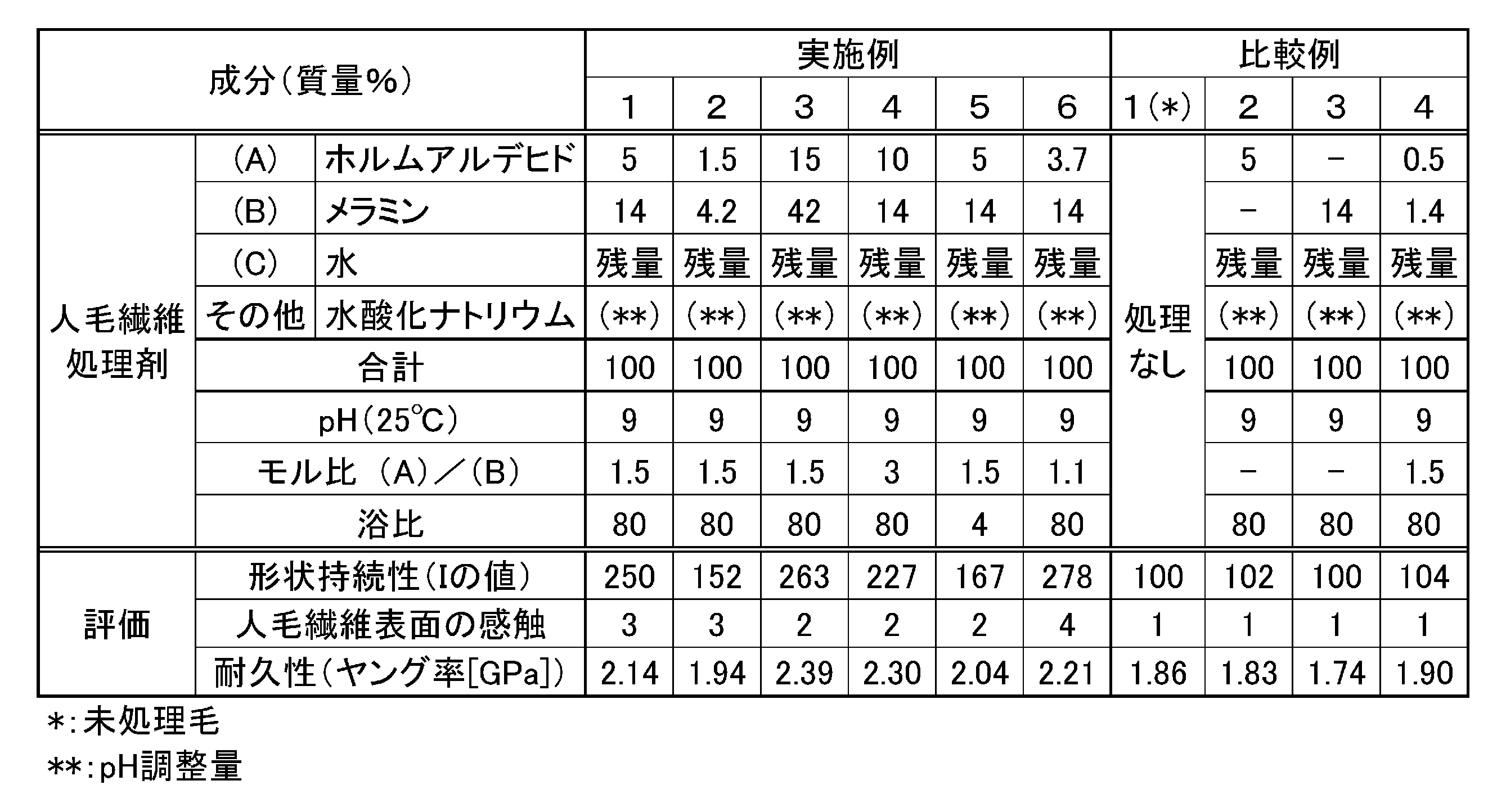
実施例7~14、比較例5~8(人毛繊維処理剤による処理+後処理剤による処理)
表2に示す処理剤を調製し、以下の処理を行い、実施例1~6と同様の方法及び基準に従って、形状持続性、表面感触のよさ、耐久性を評価した。この結果を表2に併せて示す。なお、各組成物のpHは、調製した組成物を室温(25℃)において、そのままpHメーター(HORIBA社製、F-52)で測定した。
表2に示す処理剤を調製し、以下の処理を行い、実施例1~6と同様の方法及び基準に従って、形状持続性、表面感触のよさ、耐久性を評価した。この結果を表2に併せて示す。なお、各組成物のpHは、調製した組成物を室温(25℃)において、そのままpHメーター(HORIBA社製、F-52)で測定した。
<人毛繊維処理剤による処理>
1.コーカシアン直毛(未処理毛)0.5gの長さ25cmの毛束を、容器に入れた人毛繊維処理剤40gに浸漬し、容器の口をラップで覆って密閉して90℃設定のオーブンにて表2に記載の時間加熱した。
2.毛束の入った容器をオーブンから取り出し、室温に戻した。
3.毛束を容器から取り出し、水道水の30℃流水にて30秒すすぎ、評価用シャンプーで60秒泡立て、水道水の30℃流水にて30秒すすぎ、タオルで軽く水気を切った後、毛束を温風ドライヤー(テスコム社製、Nobby ホワイトNB3000)で乾かした。この時点で、毛束は直毛のままであった。
4.引き続き3.の毛束を、容器に入れた後架橋剤40gに浸漬し、容器の口をラップで覆って密閉して90℃設定のオーブンにて1時間加熱した。
5.毛束の入った容器をオーブンから取り出し、室温に戻した。
6.毛束を容器から取り出し、水道水の30℃流水にて30秒すすぎ、評価用シャンプーで60秒泡立て、水道水の30℃流水にて30秒すすぎ、タオルで軽く水気を切った後、毛束を温風ドライヤー(テスコム社製、Nobby ホワイトNB3000)で乾かした。この時点で、毛束は直毛のままであった。
1.コーカシアン直毛(未処理毛)0.5gの長さ25cmの毛束を、容器に入れた人毛繊維処理剤40gに浸漬し、容器の口をラップで覆って密閉して90℃設定のオーブンにて表2に記載の時間加熱した。
2.毛束の入った容器をオーブンから取り出し、室温に戻した。
3.毛束を容器から取り出し、水道水の30℃流水にて30秒すすぎ、評価用シャンプーで60秒泡立て、水道水の30℃流水にて30秒すすぎ、タオルで軽く水気を切った後、毛束を温風ドライヤー(テスコム社製、Nobby ホワイトNB3000)で乾かした。この時点で、毛束は直毛のままであった。
4.引き続き3.の毛束を、容器に入れた後架橋剤40gに浸漬し、容器の口をラップで覆って密閉して90℃設定のオーブンにて1時間加熱した。
5.毛束の入った容器をオーブンから取り出し、室温に戻した。
6.毛束を容器から取り出し、水道水の30℃流水にて30秒すすぎ、評価用シャンプーで60秒泡立て、水道水の30℃流水にて30秒すすぎ、タオルで軽く水気を切った後、毛束を温風ドライヤー(テスコム社製、Nobby ホワイトNB3000)で乾かした。この時点で、毛束は直毛のままであった。

実施例15~17(人毛繊維処理剤による処理+後架橋剤による処理)
表3に示す処理剤を調製し、以下の処理を行い、実施例1~6と同様の方法及び基準に従って、形状持続性、表面感触のよさ、耐久性を評価した。この結果を表3に併せて示す。なお、各組成物のpHは、調製した組成物を室温(25℃)において、そのままpHメーター(HORIBA社製、F-52)で測定した。
表3に示す処理剤を調製し、以下の処理を行い、実施例1~6と同様の方法及び基準に従って、形状持続性、表面感触のよさ、耐久性を評価した。この結果を表3に併せて示す。なお、各組成物のpHは、調製した組成物を室温(25℃)において、そのままpHメーター(HORIBA社製、F-52)で測定した。
<人毛繊維処理剤による処理>
1.コーカシアン直毛(未処理毛)0.5gの長さ25cmの毛束を、容器に入れた人毛繊維処理剤40gに浸漬し、容器の口をラップで覆って密閉して90℃設定のオーブンにて2時間加熱した。
2.毛束の入った容器をオーブンから取り出し、室温に戻した。
3.毛束を容器から取り出し、水道水の30℃流水にて30秒すすぎ、評価用シャンプーで60秒泡立て、水道水の30℃流水にて30秒すすぎ、タオルで軽く水気を切った後、毛束を温風ドライヤー(テスコム社製、Nobby ホワイトNB3000)で乾かした。この時点で、毛束は直毛のままであった。
4.引き続き3.の毛束を、容器に入れた後架橋剤40gに浸漬し、容器の口をラップで覆って密閉して90℃設定のオーブンにて1時間加熱した。
5.毛束の入った容器をオーブンから取り出し、室温に戻した。
6.毛束を容器から取り出し、水道水の30℃流水にて30秒すすぎ、評価用シャンプーで60秒泡立て、水道水の30℃流水にて30秒すすぎ、タオルで軽く水気を切った後、毛束を温風ドライヤー(テスコム社製、Nobby ホワイトNB3000)で乾かした。この時点で、毛束は直毛のままであった。
1.コーカシアン直毛(未処理毛)0.5gの長さ25cmの毛束を、容器に入れた人毛繊維処理剤40gに浸漬し、容器の口をラップで覆って密閉して90℃設定のオーブンにて2時間加熱した。
2.毛束の入った容器をオーブンから取り出し、室温に戻した。
3.毛束を容器から取り出し、水道水の30℃流水にて30秒すすぎ、評価用シャンプーで60秒泡立て、水道水の30℃流水にて30秒すすぎ、タオルで軽く水気を切った後、毛束を温風ドライヤー(テスコム社製、Nobby ホワイトNB3000)で乾かした。この時点で、毛束は直毛のままであった。
4.引き続き3.の毛束を、容器に入れた後架橋剤40gに浸漬し、容器の口をラップで覆って密閉して90℃設定のオーブンにて1時間加熱した。
5.毛束の入った容器をオーブンから取り出し、室温に戻した。
6.毛束を容器から取り出し、水道水の30℃流水にて30秒すすぎ、評価用シャンプーで60秒泡立て、水道水の30℃流水にて30秒すすぎ、タオルで軽く水気を切った後、毛束を温風ドライヤー(テスコム社製、Nobby ホワイトNB3000)で乾かした。この時点で、毛束は直毛のままであった。
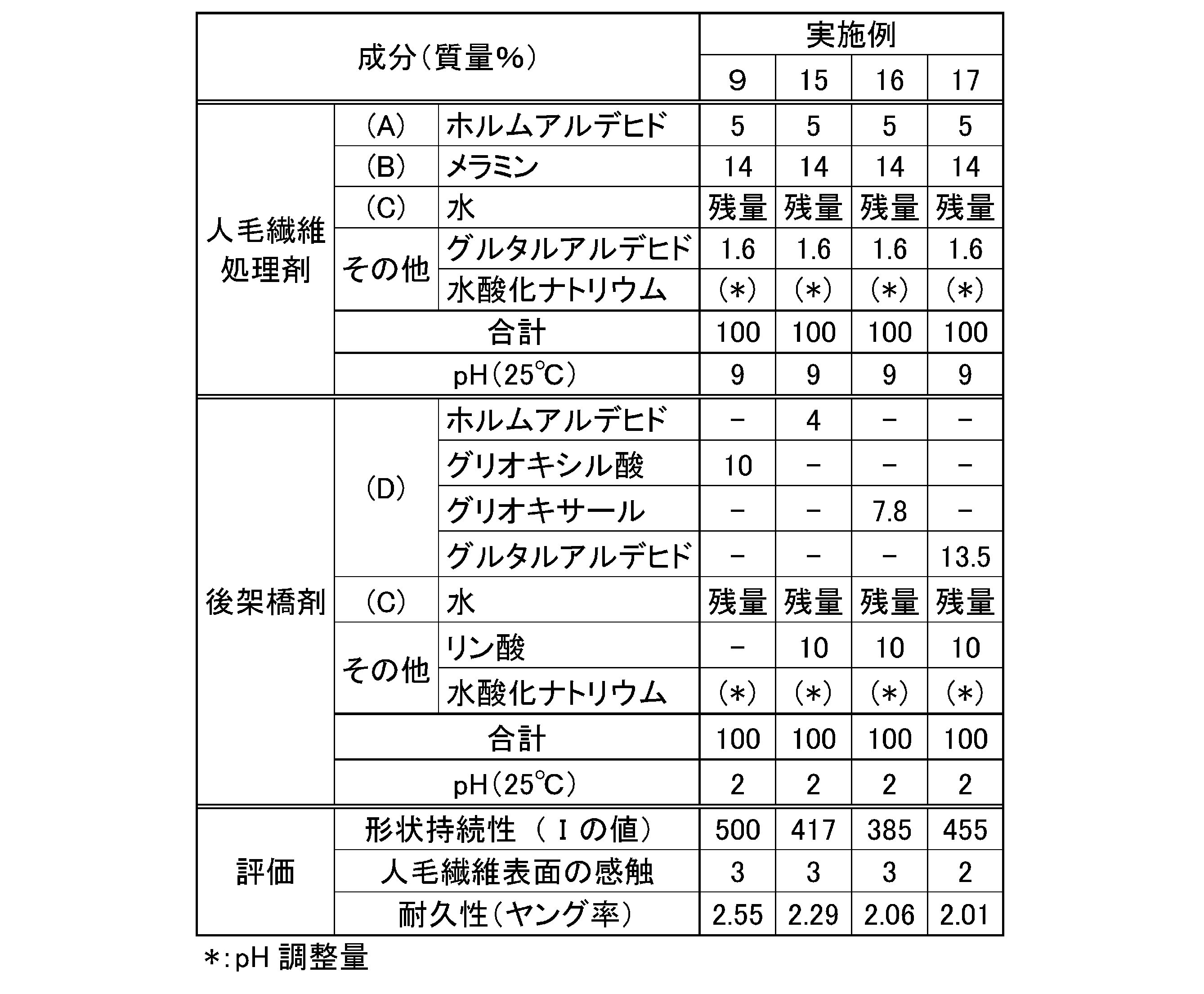
実施例18(人毛繊維処理剤による処理+表面仕上げ剤(I)による処理)
表4に示す処理剤を調製し、以下の処理を行い、実施例1~6と同様の方法及び基準に従って、形状持続性、表面感触のよさ、耐久性を評価した。この結果を表4に併せて示す。なお、各組成物のpHは、調製した組成物を室温(25℃)において、そのままpHメーター(HORIBA社製、F-52)で測定した。
表4に示す処理剤を調製し、以下の処理を行い、実施例1~6と同様の方法及び基準に従って、形状持続性、表面感触のよさ、耐久性を評価した。この結果を表4に併せて示す。なお、各組成物のpHは、調製した組成物を室温(25℃)において、そのままpHメーター(HORIBA社製、F-52)で測定した。
<人毛繊維処理剤による処理>
1.コーカシアン直毛(未処理毛)0.5gの長さ25cmの毛束を、容器に入れた人毛繊維処理剤40gに浸漬し、容器の口をラップで覆って密閉して90℃設定のオーブンにて2時間加熱した。
2.毛束の入った容器をオーブンから取り出し、室温に戻した。
3.毛束を容器から取り出し、水道水の30℃流水にて30秒すすぎ、評価用シャンプーで60秒泡立て、水道水の30℃流水にて30秒すすぎ、タオルで軽く水気を切った後、毛束を温風ドライヤー(テスコム社製、Nobby ホワイトNB3000)で乾かした。この時点で、毛束は直毛のままであった。
4.引き続き3.の毛束を、容器に入れた後架橋剤40gに浸漬し、容器の口をラップで覆って密閉して90℃設定のオーブンにて1時間加熱した。
5.毛束の入った容器をオーブンから取り出し、室温に戻した。
6.毛束を容器から取り出し、水道水の30℃流水にて30秒すすぎ、評価用シャンプーで60秒泡立て、水道水の30℃流水にて30秒すすぎ、タオルで軽く水気を切った後、毛束を温風ドライヤー(テスコム社製、Nobby ホワイトNB3000)で乾かした。この時点で、毛束は直毛のままであった。
7.引き続き3.の毛束を、容器に入れた表面仕上げ剤(I)40gに浸漬し、容器の口をラップで覆って密閉して40℃設定のオーブンにて72時間加熱した。
8.毛束の入った容器をオーブンから取り出し、室温に戻した。
9.毛束を容器から取り出し、水道水の30℃流水にて30秒すすぎ、評価用シャンプーで60秒泡立て、水道水の30℃流水にて30秒すすぎ、タオルで軽く水気を切った後、毛束を温風ドライヤー(テスコム社製、Nobby ホワイトNB3000)で乾かした。この時点で、毛束は直毛のままであった。
1.コーカシアン直毛(未処理毛)0.5gの長さ25cmの毛束を、容器に入れた人毛繊維処理剤40gに浸漬し、容器の口をラップで覆って密閉して90℃設定のオーブンにて2時間加熱した。
2.毛束の入った容器をオーブンから取り出し、室温に戻した。
3.毛束を容器から取り出し、水道水の30℃流水にて30秒すすぎ、評価用シャンプーで60秒泡立て、水道水の30℃流水にて30秒すすぎ、タオルで軽く水気を切った後、毛束を温風ドライヤー(テスコム社製、Nobby ホワイトNB3000)で乾かした。この時点で、毛束は直毛のままであった。
4.引き続き3.の毛束を、容器に入れた後架橋剤40gに浸漬し、容器の口をラップで覆って密閉して90℃設定のオーブンにて1時間加熱した。
5.毛束の入った容器をオーブンから取り出し、室温に戻した。
6.毛束を容器から取り出し、水道水の30℃流水にて30秒すすぎ、評価用シャンプーで60秒泡立て、水道水の30℃流水にて30秒すすぎ、タオルで軽く水気を切った後、毛束を温風ドライヤー(テスコム社製、Nobby ホワイトNB3000)で乾かした。この時点で、毛束は直毛のままであった。
7.引き続き3.の毛束を、容器に入れた表面仕上げ剤(I)40gに浸漬し、容器の口をラップで覆って密閉して40℃設定のオーブンにて72時間加熱した。
8.毛束の入った容器をオーブンから取り出し、室温に戻した。
9.毛束を容器から取り出し、水道水の30℃流水にて30秒すすぎ、評価用シャンプーで60秒泡立て、水道水の30℃流水にて30秒すすぎ、タオルで軽く水気を切った後、毛束を温風ドライヤー(テスコム社製、Nobby ホワイトNB3000)で乾かした。この時点で、毛束は直毛のままであった。

実施例19(人毛繊維処理剤による処理+後架橋剤+表面仕上げ剤(II)による処理)
表5に示す処理剤を調製し、以下の処理を行い、下記の方法及び基準に従って、形状持続性、表面感触のよさ、耐久性、疎水性を評価した。この結果を表5に併せて示す。なお、各組成物のpHは、調製した組成物を室温(25℃)において、そのままpHメーター(HORIBA社製、F-52)で測定した。
表5に示す処理剤を調製し、以下の処理を行い、下記の方法及び基準に従って、形状持続性、表面感触のよさ、耐久性、疎水性を評価した。この結果を表5に併せて示す。なお、各組成物のpHは、調製した組成物を室温(25℃)において、そのままpHメーター(HORIBA社製、F-52)で測定した。
評価方法:
ウィッグユーザーのモニター3名による試用テストを実施し、形状持続性、表面感触のよさ、耐久性、疎水性に関する官能評価を行った。同一メーカー、同一型番の人毛100%ウィッグを2つ準備した上で、1つのみに表5に示す処理剤で以下の処理を行った。そして処理なし品を3週間、処理あり品を3週間、それぞれ試用し、各項目(形状持続性、表面感触のよさ、耐久性、疎水性)について5段階評価(5が最良、1が最低)を行った。
この結果を表6及び7に示す。
ウィッグユーザーのモニター3名による試用テストを実施し、形状持続性、表面感触のよさ、耐久性、疎水性に関する官能評価を行った。同一メーカー、同一型番の人毛100%ウィッグを2つ準備した上で、1つのみに表5に示す処理剤で以下の処理を行った。そして処理なし品を3週間、処理あり品を3週間、それぞれ試用し、各項目(形状持続性、表面感触のよさ、耐久性、疎水性)について5段階評価(5が最良、1が最低)を行った。
この結果を表6及び7に示す。
<人毛繊維処理剤による処理>
1.人毛100%ウィッグ(200g;うち人毛繊維は150g)を、容器に入れた人毛繊維処理剤1000gに浸漬し、容器の口をラップで覆って密閉して90℃設定のオーブンにて1時間加熱した。
2.人毛100%ウィッグの入った容器をオーブンから取り出し、室温に戻した。
3.人毛100%ウィッグを容器から取り出し、水道水の30℃流水にて30秒すすぎ、評価用シャンプーで60秒泡立て、水道水の30℃流水にて30秒すすぎ、タオルで軽く水気を切った後、人毛100%ウィッグを温風ドライヤー(テスコム社製、Nobby ホワイトNB3000)で乾かした。
4.引き続き3.の人毛100%ウィッグを、容器に入れた後架橋剤1000gに浸漬し、容器の口をラップで覆って密閉して90℃設定のオーブンにて1時間加熱した。
5.人毛100%ウィッグの入った容器をオーブンから取り出し、室温に戻した。
6.人毛100%ウィッグを容器から取り出し、水道水の30℃流水にて30秒すすぎ、評価用シャンプーで60秒泡立て、水道水の30℃流水にて30秒すすぎ、タオルで軽く水気を切った後、人毛100%ウィッグを温風ドライヤー(テスコム社製、Nobby ホワイトNB3000)で乾かした。
7.引き続き6.の人毛100%ウィッグに、表面仕上げ剤(II)50gをスプレー噴霧し、温風ドライヤー(テスコム社製、Nobby ホワイトNB3000)で乾かした。
8.人毛100%ウィッグを容器から取り出し、水道水の30℃流水にて30秒すすぎ、評価用シャンプーで60秒泡立て、水道水の30℃流水にて30秒すすぎ、タオルで軽く水気を切った後、人毛100%ウィッグを温風ドライヤー(テスコム社製、Nobby ホワイトNB3000)で乾かした。
1.人毛100%ウィッグ(200g;うち人毛繊維は150g)を、容器に入れた人毛繊維処理剤1000gに浸漬し、容器の口をラップで覆って密閉して90℃設定のオーブンにて1時間加熱した。
2.人毛100%ウィッグの入った容器をオーブンから取り出し、室温に戻した。
3.人毛100%ウィッグを容器から取り出し、水道水の30℃流水にて30秒すすぎ、評価用シャンプーで60秒泡立て、水道水の30℃流水にて30秒すすぎ、タオルで軽く水気を切った後、人毛100%ウィッグを温風ドライヤー(テスコム社製、Nobby ホワイトNB3000)で乾かした。
4.引き続き3.の人毛100%ウィッグを、容器に入れた後架橋剤1000gに浸漬し、容器の口をラップで覆って密閉して90℃設定のオーブンにて1時間加熱した。
5.人毛100%ウィッグの入った容器をオーブンから取り出し、室温に戻した。
6.人毛100%ウィッグを容器から取り出し、水道水の30℃流水にて30秒すすぎ、評価用シャンプーで60秒泡立て、水道水の30℃流水にて30秒すすぎ、タオルで軽く水気を切った後、人毛100%ウィッグを温風ドライヤー(テスコム社製、Nobby ホワイトNB3000)で乾かした。
7.引き続き6.の人毛100%ウィッグに、表面仕上げ剤(II)50gをスプレー噴霧し、温風ドライヤー(テスコム社製、Nobby ホワイトNB3000)で乾かした。
8.人毛100%ウィッグを容器から取り出し、水道水の30℃流水にて30秒すすぎ、評価用シャンプーで60秒泡立て、水道水の30℃流水にて30秒すすぎ、タオルで軽く水気を切った後、人毛100%ウィッグを温風ドライヤー(テスコム社製、Nobby ホワイトNB3000)で乾かした。


実施例20 <脱色剤組成物による追加処理>
実施例1~19におけるいずれかの処理の前又は後に、以下の工程を追加して行うことにより、人毛繊維を脱色することができる。
1.人毛繊維0.5gの長さ25cmの毛束を、容器に入れた40gの脱色剤組成物1に浸漬し、2時間静置する。
2.毛束を容器から取り出し、水道水の30℃流水にて30秒すすぎ、タオルで軽く水気を切った後、毛束を温風ドライヤー(テスコム社製、Nobby ホワイトNB3000)で乾かす。
実施例1~19におけるいずれかの処理の前又は後に、以下の工程を追加して行うことにより、人毛繊維を脱色することができる。
1.人毛繊維0.5gの長さ25cmの毛束を、容器に入れた40gの脱色剤組成物1に浸漬し、2時間静置する。
2.毛束を容器から取り出し、水道水の30℃流水にて30秒すすぎ、タオルで軽く水気を切った後、毛束を温風ドライヤー(テスコム社製、Nobby ホワイトNB3000)で乾かす。
脱色剤組成物1
(質量%)
強アンモニア水(28質量%) 2.70
重炭酸アンモニウム 4.70
ステアルトリモニウムクロリド(花王社製、コータミン 86W) 8.00
1-ヒドロキシエチリデン-1,1-ジホスホン酸(60質量%)
(ディクエスト2010cs) 0.05
過酸化水素水(35質量%) 10.90
水 残量
pH:9.5
(質量%)
強アンモニア水(28質量%) 2.70
重炭酸アンモニウム 4.70
ステアルトリモニウムクロリド(花王社製、コータミン 86W) 8.00
1-ヒドロキシエチリデン-1,1-ジホスホン酸(60質量%)
(ディクエスト2010cs) 0.05
過酸化水素水(35質量%) 10.90
水 残量
pH:9.5
実施例21 <染毛剤組成物による追加処理>
実施例1~19におけるいずれかの処理の前又は後に、以下の工程を追加して行うことにより、人毛繊維を染色することができる。
1.人毛繊維0.5gの長さ25cmの毛束を、容器に入れた染毛剤組成物1~4(染毛剤組成物1及び4は第1剤と第2剤を1:1で混合して使用)40gに浸漬し、2時間静置する。
2.毛束を容器から取り出し、水道水の30℃流水にて30秒すすぎ、タオルで軽く水気を切った後、毛束を温風ドライヤー(テスコム社製、Nobby ホワイトNB3000)で乾かす。
実施例1~19におけるいずれかの処理の前又は後に、以下の工程を追加して行うことにより、人毛繊維を染色することができる。
1.人毛繊維0.5gの長さ25cmの毛束を、容器に入れた染毛剤組成物1~4(染毛剤組成物1及び4は第1剤と第2剤を1:1で混合して使用)40gに浸漬し、2時間静置する。
2.毛束を容器から取り出し、水道水の30℃流水にて30秒すすぎ、タオルで軽く水気を切った後、毛束を温風ドライヤー(テスコム社製、Nobby ホワイトNB3000)で乾かす。
染毛剤組成物1
(第1剤) (質量%)
セテアリルアルコール 10.8
オレス-5 5.0
オレイン酸 2.5
コカミドMEA 4.6
ラウリル硫酸ナトリウム 1.7
モノステアリン酸プロピレングリコール 0.6
無水亜硫酸ナトリウム 0.5
アンモニア水(28質量%) 6.5
トルエン-2,5-ジアミン硫酸塩 1.3
レゾルシン 0.5
メタアミノフェノール 0.2
2,4-ジアミノフェノキシエタノール塩酸塩 0.02
精製水 残量
(第1剤) (質量%)
セテアリルアルコール 10.8
オレス-5 5.0
オレイン酸 2.5
コカミドMEA 4.6
ラウリル硫酸ナトリウム 1.7
モノステアリン酸プロピレングリコール 0.6
無水亜硫酸ナトリウム 0.5
アンモニア水(28質量%) 6.5
トルエン-2,5-ジアミン硫酸塩 1.3
レゾルシン 0.5
メタアミノフェノール 0.2
2,4-ジアミノフェノキシエタノール塩酸塩 0.02
精製水 残量
(第2剤) (質量%)
過酸化水素水(35質量%) 17.1
セテアリルアルコール 1.7
ラウリル硫酸ナトリウム 0.2
リン酸 0.3
サリチル酸 0.01
精製水 残量
過酸化水素水(35質量%) 17.1
セテアリルアルコール 1.7
ラウリル硫酸ナトリウム 0.2
リン酸 0.3
サリチル酸 0.01
精製水 残量
染毛剤組成物2
(質量%)
アシッドレッド33 0.5
塩酸 pH調整量
精製水 残量
pH4.0
(質量%)
アシッドレッド33 0.5
塩酸 pH調整量
精製水 残量
pH4.0
染毛剤組成物3
(質量%)
アモジメチコン 1.50
ヒドロキシエチルセルロース 1.40
香料 0.30
アシッドレッド52 0.55
ベーシックレッド51 0.28
HCレッド3 0.01
水 残量
(質量%)
アモジメチコン 1.50
ヒドロキシエチルセルロース 1.40
香料 0.30
アシッドレッド52 0.55
ベーシックレッド51 0.28
HCレッド3 0.01
水 残量
染毛剤組成物4
(第1剤) (質量%)
塩化アンモニウム 0.25
モノエタノールアミン 0.80
フレグランス/香料 0.30
p-トルエンジアミン 0.55
レゾルシノール 0.28
m-フェニレンジアミン 0.01
水 残量
pH:6.8
(第1剤) (質量%)
塩化アンモニウム 0.25
モノエタノールアミン 0.80
フレグランス/香料 0.30
p-トルエンジアミン 0.55
レゾルシノール 0.28
m-フェニレンジアミン 0.01
水 残量
pH:6.8
(第2剤) (質量%)
過酸化水素 6.00
水 残量
pH:3.4
過酸化水素 6.00
水 残量
pH:3.4
実施例22 <表面仕上げ剤(II)による処理>
実施例1~18における処理後の人毛繊維に、表8及び9に示す表面仕上げ剤(II)を表中の浴比に従い塗布した後、洗い流さずに、ドライヤーを用いて完全に乾燥させることにより、人毛繊維に疎水性を付与すると共に低摩擦化することができ、しかも処理後の長期にわたってこれらの効果を持続することができる。
表中のpHは、室温(25℃)において、組成物を希釈等することなくそのまま、堀場製作所社製のpHメーター F-52を用いて測定した値である。
実施例1~18における処理後の人毛繊維に、表8及び9に示す表面仕上げ剤(II)を表中の浴比に従い塗布した後、洗い流さずに、ドライヤーを用いて完全に乾燥させることにより、人毛繊維に疎水性を付与すると共に低摩擦化することができ、しかも処理後の長期にわたってこれらの効果を持続することができる。
表中のpHは、室温(25℃)において、組成物を希釈等することなくそのまま、堀場製作所社製のpHメーター F-52を用いて測定した値である。


Claims (9)
- ヒトの頭部から分離され長手方向の一部が人工的に固定された人毛繊維を処理するための人毛繊維処理剤であって、その組成中に以下の成分(A)~(C)を含有し、成分(A)の含有量が1質量%以上である人毛繊維処理剤。
(A):ホルムアルデヒド又はその水和物
(B):一般式(1)で表されるメラミン誘導体

(C):水 - 成分(A)の含有量が1質量%以上60質量%以下である、請求項1に記載の人毛繊維処理剤。
- 成分(B)の含有量が0.1質量%以上60質量%以下である、請求項1又は2に記載の人毛繊維処理剤。
- 下記工程(i)を含む人毛繊維処理方法。
(i)ヒトの頭部から分離され長手方向の一部が人工的に固定された人毛繊維を、請求項1~3のいずれかに記載の人毛繊維処理剤に、加熱下で浸漬するステップ - 人毛繊維処理剤に人毛繊維を浸漬する際の浴比が、(人毛繊維処理剤質量)/(人毛繊維質量)=2以上である請求項4に記載の人毛繊維処理方法。
- 工程(i)の後、更に下記工程(ii)を行う、請求項4又は5に記載の人毛繊維処理方法。
(ii)成分(D)及び(C)を含有する後架橋剤に人毛繊維を浸漬するステップ
(D):ホルムアルデヒド、ホルムアルデヒドの水和物、グリオキシル酸、グリオキシル酸の水和物、グリオキシル酸塩、グリオキサール、グリオキサールの水和物、グルタルアルデヒド、及びグルタルアルデヒドの水和物から選ばれる少なくとも1種のホルムアルデヒド誘導体
(C):水 - 工程(i)又は(ii)の後で、更に下記工程(iii)を行う、請求項4~6のいずれか1項に記載の人毛繊維処理方法。
(iii)成分(E)及び(C)を含有する表面仕上げ剤(I)に人毛繊維を浸漬するステップ
(E):一般式(2)で表されるレゾルシン誘導体

(C):水 - 工程(i)、(ii)又は(iii)の後で、更に下記工程(iv)を行う、請求項4~7のいずれか1項に記載の人毛繊維処理方法。
(iv)成分(F)及び(C)を含有する表面仕上げ剤(II)に人毛繊維を浸漬するステップ
(F):以下の化合物(a)~(d)の反応産物であるエポキシアミノシランコポリマー
(a) 少なくとも二つのオキシラニル基又はオキセタニル基を有するポリシロキサン
(b) 少なくとも二つのオキシラニル基又はオキセタニル基を有するポリエーテル
(c) アミノプロピルトリアルコキシシラン
(d) 以下の第一級及び第二級アミンからなる群より選択される化合物
・第一級アミン:メチルアミン、エチルアミン、プロピレンアミン、エタノールアミン、イソプロピルアミン、ブチルアミン、イソブチルアミン、ヘキシルアミン、ドデシルアミン、オレイルアミン、アニリン、アミノプロピルトリメチルシラン、アミノプロピルトリエチルシラン、アミノモルホリン、アミノプロピルジエチルアミン、ベンジルアミン、ナフチルアミン、3-アミノ-9-エチルカルバゾール、1-アミノヘプタフロロヘキサン、2,2,3,3,4,4,5,5,6,6,7,7,8,8,8-ペンタデカフルオロ-1-オクタンアミン
・第二級アミン:メチルエチルアミン、メチルオクタデシルアミン、ジエタノールアミン、ジベンジルアミン、ジヘキシルアミン、ジシクロヘキシルアミン、ピペリジン、ピロリジンフタルイミド、ポリマーアミン
(C):水 - 請求項4~8のいずれか1項に記載の人毛繊維処理方法によって、かつらに植毛された人毛繊維を処理する工程を含む、かつらの製造方法。
Priority Applications (3)
| Application Number | Priority Date | Filing Date | Title |
|---|---|---|---|
| EP20853796.9A EP4018864A4 (en) | 2019-08-21 | 2020-08-04 | AGENTS FOR TREATING HUMAN HAIR FIBERS |
| US17/636,822 US20220273061A1 (en) | 2019-08-21 | 2020-08-04 | Human hair fiber treatment agent |
| CN202080059137.8A CN114341423B (zh) | 2019-08-21 | 2020-08-04 | 人发纤维处理剂 |
Applications Claiming Priority (2)
| Application Number | Priority Date | Filing Date | Title |
|---|---|---|---|
| JP2019-151580 | 2019-08-21 | ||
| JP2019151580 | 2019-08-21 |
Publications (1)
| Publication Number | Publication Date |
|---|---|
| WO2021033535A1 true WO2021033535A1 (ja) | 2021-02-25 |
Family
ID=74660904
Family Applications (1)
| Application Number | Title | Priority Date | Filing Date |
|---|---|---|---|
| PCT/JP2020/029844 Ceased WO2021033535A1 (ja) | 2019-08-21 | 2020-08-04 | 人毛繊維処理剤 |
Country Status (5)
| Country | Link |
|---|---|
| US (1) | US20220273061A1 (ja) |
| EP (1) | EP4018864A4 (ja) |
| JP (1) | JP2021036086A (ja) |
| CN (1) | CN114341423B (ja) |
| WO (1) | WO2021033535A1 (ja) |
Families Citing this family (2)
| Publication number | Priority date | Publication date | Assignee | Title |
|---|---|---|---|---|
| WO2026014544A1 (ja) * | 2024-07-12 | 2026-01-15 | 花王株式会社 | 頭飾製品用繊維染色剤組成物 |
| JP2026012159A (ja) * | 2024-07-12 | 2026-01-23 | 花王株式会社 | 再生コラーゲン繊維用染色剤組成物 |
Citations (7)
| Publication number | Priority date | Publication date | Assignee | Title |
|---|---|---|---|---|
| JPH0959873A (ja) * | 1995-08-11 | 1997-03-04 | Toyobo Co Ltd | 防皺性に優れた獣毛繊維製品及びその製造法 |
| WO2005037000A1 (ja) | 2003-10-17 | 2005-04-28 | Kaneka Corporation | カール特性の改善された毛髪用繊維およびそれからなる頭飾製品 |
| JP2006016310A (ja) * | 2004-06-30 | 2006-01-19 | Kao Corp | 毛髪化粧料 |
| JP2007177370A (ja) | 2005-12-28 | 2007-07-12 | Kaneka Corp | 再生コラーゲン繊維と人毛からなる頭髪用繊維束及び頭飾製品 |
| JP2011503059A (ja) * | 2007-11-02 | 2011-01-27 | モメンティブ パフォーマンス マテリアルズ インコーポレイテッド | エポキシ化合物とアミノシランの反応産物を含有するパーソナルケア組成物 |
| JP2016532650A (ja) * | 2013-10-07 | 2016-10-20 | ザ プロクター アンド ギャンブル カンパニー | 還元糖を伴う毛髪を真っ直ぐにさせる方法 |
| JP2019006769A (ja) * | 2017-06-22 | 2019-01-17 | 花王株式会社 | 毛髪変形処理方法 |
Family Cites Families (7)
| Publication number | Priority date | Publication date | Assignee | Title |
|---|---|---|---|---|
| JPH04333660A (ja) * | 1991-05-10 | 1992-11-20 | Kanegafuchi Chem Ind Co Ltd | 再生コラーゲン繊維の処理法 |
| BRPI0305777B1 (pt) * | 2002-08-14 | 2018-04-03 | Givaudan Sa | Composição compreendendo um tensoativo e um material encapsulado em uma cápsula, e, cápsulas |
| GB2408516A (en) * | 2003-11-28 | 2005-06-01 | Avecia Ltd | Fibres treated with antimicrobial agents |
| KR101262657B1 (ko) * | 2012-10-22 | 2013-05-15 | (주)동일캔바스엔지니어링 | 수분 흡착 휄트 및 이의 제조 방법 |
| JP6316790B2 (ja) * | 2014-12-05 | 2018-04-25 | 花王株式会社 | 毛髪変形処理剤 |
| JP2017218397A (ja) * | 2016-06-03 | 2017-12-14 | 花王株式会社 | 毛髪処理方法 |
| JP7281914B2 (ja) * | 2018-02-15 | 2023-05-26 | 花王株式会社 | 人毛繊維処理剤 |
-
2020
- 2020-08-04 WO PCT/JP2020/029844 patent/WO2021033535A1/ja not_active Ceased
- 2020-08-04 JP JP2020132543A patent/JP2021036086A/ja active Pending
- 2020-08-04 EP EP20853796.9A patent/EP4018864A4/en not_active Withdrawn
- 2020-08-04 CN CN202080059137.8A patent/CN114341423B/zh active Active
- 2020-08-04 US US17/636,822 patent/US20220273061A1/en not_active Abandoned
Patent Citations (7)
| Publication number | Priority date | Publication date | Assignee | Title |
|---|---|---|---|---|
| JPH0959873A (ja) * | 1995-08-11 | 1997-03-04 | Toyobo Co Ltd | 防皺性に優れた獣毛繊維製品及びその製造法 |
| WO2005037000A1 (ja) | 2003-10-17 | 2005-04-28 | Kaneka Corporation | カール特性の改善された毛髪用繊維およびそれからなる頭飾製品 |
| JP2006016310A (ja) * | 2004-06-30 | 2006-01-19 | Kao Corp | 毛髪化粧料 |
| JP2007177370A (ja) | 2005-12-28 | 2007-07-12 | Kaneka Corp | 再生コラーゲン繊維と人毛からなる頭髪用繊維束及び頭飾製品 |
| JP2011503059A (ja) * | 2007-11-02 | 2011-01-27 | モメンティブ パフォーマンス マテリアルズ インコーポレイテッド | エポキシ化合物とアミノシランの反応産物を含有するパーソナルケア組成物 |
| JP2016532650A (ja) * | 2013-10-07 | 2016-10-20 | ザ プロクター アンド ギャンブル カンパニー | 還元糖を伴う毛髪を真っ直ぐにさせる方法 |
| JP2019006769A (ja) * | 2017-06-22 | 2019-01-17 | 花王株式会社 | 毛髪変形処理方法 |
Non-Patent Citations (1)
| Title |
|---|
| See also references of EP4018864A4 |
Also Published As
| Publication number | Publication date |
|---|---|
| US20220273061A1 (en) | 2022-09-01 |
| JP2021036086A (ja) | 2021-03-04 |
| CN114341423A (zh) | 2022-04-12 |
| EP4018864A1 (en) | 2022-06-29 |
| CN114341423B (zh) | 2024-05-14 |
| EP4018864A4 (en) | 2023-09-06 |
Similar Documents
| Publication | Publication Date | Title |
|---|---|---|
| JP7281913B2 (ja) | 人毛繊維処理剤 | |
| JP7281914B2 (ja) | 人毛繊維処理剤 | |
| US20250305210A1 (en) | Fiber-treating agent | |
| JP2017218397A (ja) | 毛髪処理方法 | |
| CN114341423B (zh) | 人发纤维处理剂 | |
| WO2022138680A1 (ja) | 繊維処理剤 | |
| WO2022138677A1 (ja) | 繊維処理剤 | |
| EP4268651A1 (en) | Fiber-treating agent | |
| JP2022159180A (ja) | 繊維処理剤 | |
| CN116710610B (zh) | 纤维处理剂 | |
| US20250347050A1 (en) | Fiber-treating agent | |
| CN117120686A (zh) | 纤维处理剂 | |
| CN116783347A (zh) | 纤维处理剂 |
Legal Events
| Date | Code | Title | Description |
|---|---|---|---|
| 121 | Ep: the epo has been informed by wipo that ep was designated in this application |
Ref document number: 20853796 Country of ref document: EP Kind code of ref document: A1 |
|
| NENP | Non-entry into the national phase |
Ref country code: DE |
|
| ENP | Entry into the national phase |
Ref document number: 2020853796 Country of ref document: EP Effective date: 20220321 |
|
| WWW | Wipo information: withdrawn in national office |
Ref document number: 2020853796 Country of ref document: EP |