WO2021039741A1 - 塗装用樹脂組成物及び成形品 - Google Patents
塗装用樹脂組成物及び成形品 Download PDFInfo
- Publication number
- WO2021039741A1 WO2021039741A1 PCT/JP2020/031889 JP2020031889W WO2021039741A1 WO 2021039741 A1 WO2021039741 A1 WO 2021039741A1 JP 2020031889 W JP2020031889 W JP 2020031889W WO 2021039741 A1 WO2021039741 A1 WO 2021039741A1
- Authority
- WO
- WIPO (PCT)
- Prior art keywords
- resin
- coating
- resin composition
- mass
- component
- Prior art date
- Legal status (The legal status is an assumption and is not a legal conclusion. Google has not performed a legal analysis and makes no representation as to the accuracy of the status listed.)
- Ceased
Links
Images


Classifications
-
- C—CHEMISTRY; METALLURGY
- C08—ORGANIC MACROMOLECULAR COMPOUNDS; THEIR PREPARATION OR CHEMICAL WORKING-UP; COMPOSITIONS BASED THEREON
- C08F—MACROMOLECULAR COMPOUNDS OBTAINED BY REACTIONS ONLY INVOLVING CARBON-TO-CARBON UNSATURATED BONDS
- C08F212/00—Copolymers of compounds having one or more unsaturated aliphatic radicals, each having only one carbon-to-carbon double bond, and at least one being terminated by an aromatic carbocyclic ring
- C08F212/02—Monomers containing only one unsaturated aliphatic radical
- C08F212/04—Monomers containing only one unsaturated aliphatic radical containing one ring
- C08F212/06—Hydrocarbons
- C08F212/08—Styrene
- C08F212/10—Styrene with nitriles
-
- C—CHEMISTRY; METALLURGY
- C09—DYES; PAINTS; POLISHES; NATURAL RESINS; ADHESIVES; COMPOSITIONS NOT OTHERWISE PROVIDED FOR; APPLICATIONS OF MATERIALS NOT OTHERWISE PROVIDED FOR
- C09D—COATING COMPOSITIONS, e.g. PAINTS, VARNISHES OR LACQUERS; FILLING PASTES; CHEMICAL PAINT OR INK REMOVERS; INKS; CORRECTING FLUIDS; WOODSTAINS; PASTES OR SOLIDS FOR COLOURING OR PRINTING; USE OF MATERIALS THEREFOR
- C09D133/00—Coating compositions based on homopolymers or copolymers of compounds having one or more unsaturated aliphatic radicals, each having only one carbon-to-carbon double bond, and at least one being terminated by only one carboxyl radical, or of salts, anhydrides, esters, amides, imides, or nitriles thereof; Coating compositions based on derivatives of such polymers
- C09D133/18—Homopolymers or copolymers of nitriles
- C09D133/20—Homopolymers or copolymers of acrylonitrile
-
- C—CHEMISTRY; METALLURGY
- C09—DYES; PAINTS; POLISHES; NATURAL RESINS; ADHESIVES; COMPOSITIONS NOT OTHERWISE PROVIDED FOR; APPLICATIONS OF MATERIALS NOT OTHERWISE PROVIDED FOR
- C09D—COATING COMPOSITIONS, e.g. PAINTS, VARNISHES OR LACQUERS; FILLING PASTES; CHEMICAL PAINT OR INK REMOVERS; INKS; CORRECTING FLUIDS; WOODSTAINS; PASTES OR SOLIDS FOR COLOURING OR PRINTING; USE OF MATERIALS THEREFOR
- C09D169/00—Coating compositions based on polycarbonates; Coating compositions based on derivatives of polycarbonates
-
- C—CHEMISTRY; METALLURGY
- C08—ORGANIC MACROMOLECULAR COMPOUNDS; THEIR PREPARATION OR CHEMICAL WORKING-UP; COMPOSITIONS BASED THEREON
- C08F—MACROMOLECULAR COMPOUNDS OBTAINED BY REACTIONS ONLY INVOLVING CARBON-TO-CARBON UNSATURATED BONDS
- C08F212/00—Copolymers of compounds having one or more unsaturated aliphatic radicals, each having only one carbon-to-carbon double bond, and at least one being terminated by an aromatic carbocyclic ring
- C08F212/02—Monomers containing only one unsaturated aliphatic radical
- C08F212/04—Monomers containing only one unsaturated aliphatic radical containing one ring
- C08F212/06—Hydrocarbons
- C08F212/12—Monomers containing a branched unsaturated aliphatic radical or a ring substituted by an alkyl radical
-
- C—CHEMISTRY; METALLURGY
- C08—ORGANIC MACROMOLECULAR COMPOUNDS; THEIR PREPARATION OR CHEMICAL WORKING-UP; COMPOSITIONS BASED THEREON
- C08F—MACROMOLECULAR COMPOUNDS OBTAINED BY REACTIONS ONLY INVOLVING CARBON-TO-CARBON UNSATURATED BONDS
- C08F255/00—Macromolecular compounds obtained by polymerising monomers on to polymers of hydrocarbons as defined in group C08F10/00
- C08F255/02—Macromolecular compounds obtained by polymerising monomers on to polymers of hydrocarbons as defined in group C08F10/00 on to polymers of olefins having two or three carbon atoms
- C08F255/06—Macromolecular compounds obtained by polymerising monomers on to polymers of hydrocarbons as defined in group C08F10/00 on to polymers of olefins having two or three carbon atoms on to ethylene-propylene-diene terpolymers
-
- C—CHEMISTRY; METALLURGY
- C08—ORGANIC MACROMOLECULAR COMPOUNDS; THEIR PREPARATION OR CHEMICAL WORKING-UP; COMPOSITIONS BASED THEREON
- C08F—MACROMOLECULAR COMPOUNDS OBTAINED BY REACTIONS ONLY INVOLVING CARBON-TO-CARBON UNSATURATED BONDS
- C08F279/00—Macromolecular compounds obtained by polymerising monomers on to polymers of monomers having two or more carbon-to-carbon double bonds as defined in group C08F36/00
- C08F279/02—Macromolecular compounds obtained by polymerising monomers on to polymers of monomers having two or more carbon-to-carbon double bonds as defined in group C08F36/00 on to polymers of conjugated dienes
- C08F279/04—Vinyl aromatic monomers and nitriles as the only monomers
-
- C—CHEMISTRY; METALLURGY
- C08—ORGANIC MACROMOLECULAR COMPOUNDS; THEIR PREPARATION OR CHEMICAL WORKING-UP; COMPOSITIONS BASED THEREON
- C08L—COMPOSITIONS OF MACROMOLECULAR COMPOUNDS
- C08L25/00—Compositions of, homopolymers or copolymers of compounds having one or more unsaturated aliphatic radicals, each having only one carbon-to-carbon double bond, and at least one being terminated by an aromatic carbocyclic ring; Compositions of derivatives of such polymers
- C08L25/02—Homopolymers or copolymers of hydrocarbons
- C08L25/04—Homopolymers or copolymers of styrene
- C08L25/08—Copolymers of styrene
- C08L25/12—Copolymers of styrene with unsaturated nitriles
-
- C—CHEMISTRY; METALLURGY
- C09—DYES; PAINTS; POLISHES; NATURAL RESINS; ADHESIVES; COMPOSITIONS NOT OTHERWISE PROVIDED FOR; APPLICATIONS OF MATERIALS NOT OTHERWISE PROVIDED FOR
- C09D—COATING COMPOSITIONS, e.g. PAINTS, VARNISHES OR LACQUERS; FILLING PASTES; CHEMICAL PAINT OR INK REMOVERS; INKS; CORRECTING FLUIDS; WOODSTAINS; PASTES OR SOLIDS FOR COLOURING OR PRINTING; USE OF MATERIALS THEREFOR
- C09D125/00—Coating compositions based on homopolymers or copolymers of compounds having one or more unsaturated aliphatic radicals, each having only one carbon-to-carbon double bond, and at least one being terminated by an aromatic carbocyclic ring; Coating compositions based on derivatives of such polymers
- C09D125/02—Homopolymers or copolymers of hydrocarbons
- C09D125/04—Homopolymers or copolymers of styrene
- C09D125/08—Copolymers of styrene
- C09D125/12—Copolymers of styrene with unsaturated nitriles
-
- C—CHEMISTRY; METALLURGY
- C09—DYES; PAINTS; POLISHES; NATURAL RESINS; ADHESIVES; COMPOSITIONS NOT OTHERWISE PROVIDED FOR; APPLICATIONS OF MATERIALS NOT OTHERWISE PROVIDED FOR
- C09D—COATING COMPOSITIONS, e.g. PAINTS, VARNISHES OR LACQUERS; FILLING PASTES; CHEMICAL PAINT OR INK REMOVERS; INKS; CORRECTING FLUIDS; WOODSTAINS; PASTES OR SOLIDS FOR COLOURING OR PRINTING; USE OF MATERIALS THEREFOR
- C09D7/00—Features of coating compositions, not provided for in group C09D5/00; Processes for incorporating ingredients in coating compositions
- C09D7/40—Additives
- C09D7/48—Stabilisers against degradation by oxygen, light or heat
-
- C—CHEMISTRY; METALLURGY
- C09—DYES; PAINTS; POLISHES; NATURAL RESINS; ADHESIVES; COMPOSITIONS NOT OTHERWISE PROVIDED FOR; APPLICATIONS OF MATERIALS NOT OTHERWISE PROVIDED FOR
- C09D—COATING COMPOSITIONS, e.g. PAINTS, VARNISHES OR LACQUERS; FILLING PASTES; CHEMICAL PAINT OR INK REMOVERS; INKS; CORRECTING FLUIDS; WOODSTAINS; PASTES OR SOLIDS FOR COLOURING OR PRINTING; USE OF MATERIALS THEREFOR
- C09D7/00—Features of coating compositions, not provided for in group C09D5/00; Processes for incorporating ingredients in coating compositions
- C09D7/40—Additives
- C09D7/65—Additives macromolecular
-
- C—CHEMISTRY; METALLURGY
- C08—ORGANIC MACROMOLECULAR COMPOUNDS; THEIR PREPARATION OR CHEMICAL WORKING-UP; COMPOSITIONS BASED THEREON
- C08L—COMPOSITIONS OF MACROMOLECULAR COMPOUNDS
- C08L2205/00—Polymer mixtures characterised by other features
- C08L2205/02—Polymer mixtures characterised by other features containing two or more polymers of the same C08L -group
- C08L2205/025—Polymer mixtures characterised by other features containing two or more polymers of the same C08L -group containing two or more polymers of the same hierarchy C08L, and differing only in parameters such as density, comonomer content, molecular weight, structure
-
- C—CHEMISTRY; METALLURGY
- C08—ORGANIC MACROMOLECULAR COMPOUNDS; THEIR PREPARATION OR CHEMICAL WORKING-UP; COMPOSITIONS BASED THEREON
- C08L—COMPOSITIONS OF MACROMOLECULAR COMPOUNDS
- C08L2205/00—Polymer mixtures characterised by other features
- C08L2205/03—Polymer mixtures characterised by other features containing three or more polymers in a blend
- C08L2205/035—Polymer mixtures characterised by other features containing three or more polymers in a blend containing four or more polymers in a blend
Definitions
- the present invention relates to a coating resin composition suitable for producing a coating molded product as a base side molded product that is coated on the surface thereof to give a coating molded product having a good appearance.
- a molded product made of a thermoplastic resin composition containing a rubber-reinforced vinyl resin such as ABS resin has excellent impact resistance and the like, and is therefore used in a wide range of fields such as vehicles, home appliances, and building materials.
- a spoiler which is an automobile part, is manufactured by coating the surface of a resin molded product.
- Resin molded products (molded products for painting) that have streamlined parts such as spoilers may have residual strain, and when painting is applied to this, defective phenomena called "cracks" or "armpits" occur on the painted surface. It could occur.
- Cross is a phenomenon in which, after painting a resin molded product, the solvent of the paint permeates from the surface to the inside in the portion of the molded product where there is residual strain, and the resin deteriorates to generate cracks. Is a phenomenon in which the coating film is cured before the volatiles of the solvent are released from the inside of the cracks during the drying of the coating film, leaving traces of bubbles.
- Patent Document 1 describes from [A] an aromatic vinyl compound, a vinyl cyanide compound, a (meth) acrylic acid ester, an acid anhydride-based monomer, and a maleimide-based compound in the presence of the rubbery polymer (a).
- a copolymerized resin (A1) obtained by polymerizing at least two kinds of monomers (b) selected from the above group, or selected from the group of the copolymerized resin (A1) and the monomer (b).
- a mixture containing at least two kinds of carbon oxide copolymers, and the content of the mixture [B] is 3 to 70 parts by weight when the rubber reinforced resin [A] is 100 parts by weight.
- a thermoplastic resin composition for coating is disclosed.
- a thermoplastic resin composition composed of (A) polyamide resin, (B) styrene resin and (C) olefin resin, and a molded product obtained from the resin composition is a molded product.
- the coating adhesion is 10 squares or less and the breaking strength of the painted molded product is 350 J / m or more in a grid test using 100 squares of 1 mm x 1 mm.
- Thermoplastic resin compositions are disclosed.
- Patent Document 3 describes a rubber-reinforced vinyl resin [A] 84.9 to 98.9 parts by mass, a polyester resin [B] 1 to 8 parts by mass, and an ethylene / (meth) acrylic acid ester / carbon monoxide copolymer.
- Patent Document 4 contains an aromatic polycarbonate resin (A), a rubbery polymer / aromatic vinyl / vinyl cyanide copolymer (B-1), and a polyolefin resin (C) as resin components.
- An aromatic polycarbonate resin molded product obtained by injection molding an aromatic polycarbonate resin composition obtained by injection molding under the conditions of an injection rate of 10 to 100 cm 3 / s and a surface advancing coefficient of 40 to 200 cm 3 / s ⁇ cm is disclosed.
- Patent Document 5 describes a rubber-reinforced vinyl resin composed of (A) a rubbery portion derived from an ethylene / ⁇ -olefin rubbery polymer and a resin portion containing a structural unit derived from an aromatic vinyl compound.
- (B) Polyolefin resin and (C) Polycarbonate resin and the content ratio of rubber reinforced vinyl resin (A), polyolefin resin (B) and polycarbonate resin (C) is 100% by mass of the total of these. , 3 to 40% by mass, 1 to 20% by mass, and 40 to 91% by mass of the coating resin composition, respectively.
- An object of the present invention is to provide a coating resin composition that can be a coating molded product that suppresses defects such as peeling of a coating film and gives a coating molded product having an excellent appearance. Even if a molded product (base side molded product) is manufactured by an injection molding method that tends to generate residual strain and then painted, coating defects such as cracks and armpits are suppressed, and the coating has a good appearance. It is an object of the present invention to provide a coating resin composition suitable for producing a base-side molded article that gives a molded article. Another object of the present invention is to provide a coating resin composition that provides a coating molded product having excellent impact resistance and heat resistance.
- a rubber-reinforced vinyl-based resin containing a thermoplastic resin wherein the thermoplastic resin is composed of (A) a rubbery portion derived from a rubbery polymer and a resin portion containing a structural unit derived from an aromatic vinyl compound. (B) A coating resin composition containing an olefin-based resin modified with a polar functional group containing an oxygen atom. 2.
- Item 2 The coating resin composition according to Item 1, wherein the content ratio of the component (B) is 0.1 to 15% by mass when the total amount of the thermoplastic resin is 100% by mass.
- 3. Item 2.
- the coating resin composition according to Item 1 or 2 wherein the polar functional group contained in the component (B) is an acid anhydride group. 4.
- the above-mentioned thermoplastic resin further contains an aromatic vinyl-based copolymer (excluding the above-mentioned component (A)) containing a structural unit derived from an aromatic vinyl compound.
- the coating resin composition described. 6 The coating resin composition according to any one of Items 1 to 5, wherein the thermoplastic resin further contains a polycarbonate resin. 7.
- 8. Item 2. The molded product according to Item 7, wherein the molded product is an automobile part.
- the coating resin composition of the present invention it is possible to produce a coating molded product that suppresses defects such as peeling of the coating film and gives a coating molded product having an excellent appearance. Further, for example, even if a molded product (base side molded product) is manufactured by an injection molding method that tends to generate residual strain and then painted, the coating film has excellent adhesion and coating defects (cracks, It is suitable for the production of a base-side molded product that suppresses armpits and the like and gives a coated molded product having a good appearance. Further, according to the coating resin composition of the present invention, it is possible to produce a molded article for coating having excellent impact resistance and heat resistance.
- test piece used for the peeling test in [Example] (1) is a bottom view, and (2) is a sectional view taken along line XX in (1). It is a perspective view of the test piece used for the coating test in [Example]. 2 is a plan view (1), a side view (2), and a sectional view taken along line YY (3) of the test piece in FIG. It is a figure explaining the crack formed in the coating film of the coating test piece obtained by the coating test in [Example].
- (meth) acrylic refers to acrylic and methacrylic
- (meth) acrylate refers to acrylate and methacrylate
- (meth) acryloyl group refers to acryloyl group and methacrylic group
- (Meta) allyl group means an allyl group and a methacrylic group
- (co) polymer means a homopolymer and a copolymer.
- the coating resin composition of the present invention is a thermoplastic resin composition containing a thermoplastic resin (hereinafter, also referred to as “thermoplastic resin (X)”) that requires the following components (A) and (B). is there.
- thermoplastic resin (X) thermoplastic resin
- thermoplastic resin (X) thermoplastic resin
- thermoplastic resin (X) is derived from the above-mentioned components (A) and (B). And, if necessary, other thermoplastic resins (described later) can be further included. In addition, the coating resin composition of the present invention may contain an additive (described later).
- the component (A) is preferably a graft resin in which the rubbery portion (a1) and the resin portion (a2) are chemically bonded.
- this graft resin will be described in detail.
- the rubbery polymer forming the rubbery portion (a1) may be a homopolymer or a copolymer as long as it is rubbery (has rubber elasticity) at 25 ° C. Further, as the rubbery polymer, either a diene-based polymer (hereinafter referred to as "diene-based rubbery polymer”) or a non-diene-based polymer (hereinafter referred to as “non-diene-based rubbery polymer”) is used. May be good. Further, these rubbery polymers may be crosslinked polymers or non-crosslinked polymers.
- diene-based rubber polymer examples include homopolymers such as polybutadiene, polyisoprene, and polychloroprene; styrene / butadiene copolymer, styrene / butadiene / styrene copolymer, acrylonitrile / butadiene copolymer, and acrylonitrile / styrene.
- Styrene-butadiene copolymer rubber such as butadiene copolymer; styrene / isoprene copolymer rubber such as styrene / isoprene copolymer, styrene / isoprene / styrene copolymer, acrylonitrile / styrene / isoprene copolymer, etc. Can be mentioned.
- These copolymers may be block copolymers or random copolymers.
- the non-diene rubber polymer is a structural unit derived from an ethylene / ⁇ -olefin copolymer; urethane rubber; acrylic rubber; silicone rubber; silicone / acrylic IPN rubber; and a conjugated diene compound.
- examples thereof include a hydrogenated polymer obtained by hydrogenating a (co) polymer containing (however, the hydrogenation rate is 80% or more).
- These copolymers may be block copolymers or random copolymers.
- the non-diene rubber polymer is preferably an ethylene / ⁇ -olefin copolymer, and the ethylene / ⁇ -olefin copolymer has a structural unit derived from ethylene and a structure derived from ⁇ -olefin. It may be any of a copolymer composed of units, a structural unit derived from ethylene, a structural unit derived from ⁇ -olefin, and a copolymer composed of structural units derived from other monomers.
- ⁇ -olefins examples include propylene, 1-butene, 1-pentene, 1-hexene, 4-methyl-1-pentene, 1-heptene, 1-octene, 1-decene, 1-dodecene, 1-hexadecene, 1-. Eikosen and the like can be mentioned. These ⁇ -olefins can be used alone or in combination of two or more. The number of carbon atoms of the ⁇ -olefin is preferably 3 to 20, more preferably 3 to 12, and even more preferably 3 to 8. Examples of other monomers include non-conjugated diene compounds such as alkenylnorbornene, cyclic diene, and aliphatic diene.
- ethylene / ⁇ -olefin copolymer a copolymer composed of a structural unit derived from ethylene, a structural unit derived from ⁇ -olefin, and a structural unit derived from another monomer is preferable.
- the component (A) is a rubber-reinforced vinyl composed of a rubbery portion (a1) derived from a diene-based rubbery polymer and a resin moiety (a2) containing a structural unit derived from an aromatic vinyl compound. It is preferable to contain a rubber-based resin (hereinafter referred to as "rubber-reinforced vinyl-based resin (A1)”), and further, a rubbery portion (a1) derived from an ethylene / ⁇ -olefin rubbery polymer and an aromatic vinyl compound.
- rubber-reinforced vinyl-based resin (hereinafter, referred to as "rubber-reinforced vinyl-based resin (A2)) composed of a resin portion (a2) containing a structural unit derived from.
- the resin portion (a2) constituting the component (A) includes a structural unit derived from an aromatic vinyl compound (hereinafter, referred to as "structural unit (u1)").
- the aromatic vinyl compound is not particularly limited as long as it is a compound having at least one vinyl bond and at least one aromatic ring. However, it shall not have a substituent such as a functional group.
- Examples thereof include styrene, ⁇ -methylstyrene, o-methylstyrene, p-methylstyrene, ⁇ -methylstyrene, ethylstyrene, p-tert-butylstyrene, vinyltoluene, vinylxylene, vinylnaphthalene and the like. Of these, styrene and ⁇ -methylstyrene are preferable.
- the resin portion (a2) may contain only one type of the structural unit (u1), or may contain two or more types. Further, the resin portion (a2) is composed of the structural unit (u1) and a structural unit derived from a vinyl-based monomer other than the aromatic vinyl compound (hereinafter, referred to as “structural unit (u2)”). It may be.
- Examples of other vinyl-based compounds forming the structural unit (u2) include vinyl cyanide compounds, (meth) acrylic acid ester compounds, maleimide-based compounds, carboxy group-containing unsaturated compounds, unsaturated acid anhydrides, and aminos. Examples thereof include group-containing unsaturated compounds, amide group-containing unsaturated compounds, hydroxy group-containing unsaturated compounds, and oxazoline group-containing unsaturated compounds.
- vinyl cyanide compound examples include acrylonitrile, methacrylonitrile, etacrylonitrile, ⁇ -ethylacrylonitrile, ⁇ -isopropylacrylonitrile, and the like.
- Examples of the (meth) acrylic acid ester compound include methyl (meth) acrylic acid, ethyl (meth) acrylic acid, n-propyl (meth) acrylic acid, isopropyl (meth) acrylic acid, and n-butyl (meth) acrylic acid.
- Isobutyl (meth) acrylate, sec-butyl (meth) acrylate, tert-butyl (meth) acrylate, hexyl (meth) acrylate, n-octyl (meth) acrylate, 2-ethylhexyl (meth) acrylate, Cyclohexyl (meth) acrylate, phenyl (meth) acrylate, benzyl (meth) acrylate and the like can be mentioned.
- maleimide-based compound examples include maleimide, N-methylmaleimide, N-isopropylmaleimide, N-butylmaleimide, N-dodecylmaleimide, N-phenylmaleimide, N- (2-methylphenyl) maleimide, and N- (4-methyl).
- examples thereof include phenyl) maleimide, N- (2,6-dimethylphenyl) maleimide, N- (2,6-diethylphenyl) maleimide, N-benzylmaleimide, N-naphthylmaleimide, and N-cyclohexylmaleimide.
- Examples of the unsaturated acid anhydride include maleic anhydride, itaconic anhydride, citraconic anhydride, 2,3-dimethylmaleic anhydride and the like.
- Examples of the carboxy group-containing unsaturated compound include (meth) acrylic acid, etacrylic acid, maleic acid, fumaric acid, itaconic acid, crotonic acid, and cinnamic acid.
- amino group-containing unsaturated compound examples include aminoethyl acrylate, propylaminoethyl acrylate, dimethylaminomethyl acrylate, diethylaminomethyl acrylate, 2-dimethylaminoethyl acrylate, aminoethyl methacrylate, and propylaminoethyl methacrylate.
- Examples of the amide group-containing unsaturated compound include acrylamide, N-methylacrylamide, methacrylamide, and N-methylmethacrylamide.
- hydroxy group-containing unsaturated compound examples include hydroxymethyl (meth) acrylate, 2-hydroxyethyl (meth) acrylate, 2-hydroxypropyl (meth) acrylate, 3-hydroxypropyl (meth) acrylate, and (meth).
- hydroxy groups such as 2-hydroxybutyl acrylate, 3-hydroxybutyl (meth) acrylate, 4-hydroxybutyl (meth) acrylate, polyethylene glycol mono (meth) acrylate, polypropylene glycol mono (meth) acrylate () Meta) Acrylic acid ester; o-hydroxystyrene, m-hydroxystyrene, p-hydroxystyrene, o-hydroxy- ⁇ -methylstyrene, m-hydroxy- ⁇ -methylstyrene, p-hydroxy- ⁇ -methylstyrene, 2- Hydroxymethyl- ⁇ -methylstyrene, 3-hydroxymethyl- ⁇ -methylstyrene, 4-hydroxymethyl- ⁇ -methylstyrene, 4-hydroxymethyl-1-vinylnaphthalene, 7-hydroxymethyl-1-vinylnaphthalene, 8- Hydroxymethyl-1-vinylnaphthalene, 4-hydroxymethyl-1-isopropenylnaphthalene, 7-
- epoxy group-containing unsaturated compound examples include glycidyl (meth) acrylate, 3,4-oxycyclohexyl (meth) acrylate, vinyl glycidyl ether, allyl glycidyl ether, metallicyl glycidyl ether, monoglycidyl maleate, and diglycidyl maleate.
- Examples of the oxazoline group-containing unsaturated compound include vinyl oxazoline, 4-methyl-2-vinyl-2-oxazoline, 5-methyl-2-vinyl-2-oxazoline, and 2-vinyl-4,4-dimethyl-2-oxazoline. , 2-Isopropenyl-2-oxazoline, 4-methyl-2-isopropenyl-2-oxazoline, 5-methyl-2-isopropenyl-2-oxazoline, 2-isopropenyl-4,4-dimethyl-2-oxazoline And so on.
- the structural unit (u2) may contain only one type of the structural unit (u2), or may contain two or more types.
- the structural unit (u2) preferably includes a structural unit derived from a vinyl cyanide compound from the viewpoint of appearance, mechanical strength and chemical resistance of the molded product for coating.
- the content ratio of the structural unit (u1) and the structural unit (u2) is preferably 40, respectively, when the total of both is 100% by mass. It is ⁇ 90% by mass and 10-60% by mass, more preferably 50-85% by mass and 15-50% by mass, still more preferably 60-80% by mass and 20-40% by mass.
- the graft ratio is preferably 20% or more, more preferably 30% or more, still more preferably 35 to 65, from the viewpoint of the appearance and mechanical strength of the molded article for coating. %.
- S is an insoluble matter obtained by adding 1 g of the component (A) to 20 ml of acetone, shaking it with a shaker for 2 hours, and then centrifuging to separate the insoluble matter and the soluble matter.
- T is the mass (g) of the rubbery portion (a1) derived from the rubbery polymer contained in the component (A) of 1 g.
- the mass of the rubbery portion (a1) can be obtained by a method of calculating from a polymerization formula and a polymerization conversion rate, a method of obtaining by an infrared absorption spectrum (IR), or the like.
- the component (A) contained in the thermoplastic resin (X) may be only one kind or two or more kinds.
- a combination of two or more kinds of rubber reinforced vinyl resin (A1), a combination of two or more kinds of rubber reinforced vinyl resin (A2), or a combination of rubber reinforced vinyl resin (A1) and (A2). be able to.
- the ratios thereof are preferably 100% by mass when the total of the two is 100% by mass from the viewpoint of coatability. , 20-60% by mass and 40-80% by mass, more preferably 30-50% by mass and 50-70% by mass.
- the graft resin polymerizes a monomer component containing an aromatic vinyl compound by emulsion polymerization, suspension polymerization, solution polymerization or bulk polymerization in the presence of a rubbery polymer. It can be said that it is manufactured by this.
- the reaction product by this method usually includes a graft resin as the component (A) and a resin in which the rubbery portion and the resin portion are not chemically bonded.
- the latter resin is a component (D) described later, and when the reaction product is used as a production raw material, the obtained coating resin composition contains the components (A) and (D).
- the component (B) mainly contains a structural unit derived from an olefin (hereinafter, referred to as “structural unit (v1)”) and is composed of a polar functional group containing an oxygen atom (hereinafter, referred to as “oxygen atom-containing polar functional group”). It is a modified olefin resin.
- the oxygen atom-containing polar functional group include a hydroxy group, a carboxy group, an acid anhydride group, an ester group, an epoxy group, an amide group, a nitro group, an oxazoline group, a sulfonic acid group, a sulfonamide group and a phosphoric acid group. ..
- the type and total number of oxygen atom-containing polar functional groups contained in the component (B) are not particularly limited.
- the oxygen atom-containing polar functional group preferably contains an acid anhydride group.
- the component (B) may further contain a functional group containing no oxygen atom.
- a copolymer including a structural unit (v1) and a structural unit derived from a monomer having an oxygen atom-containing polar functional group hereinafter, referred to as “structural unit (v2)”.
- structural unit (v2) a structural unit derived from a monomer having an oxygen atom-containing polar functional group
- structural unit (v2) examples thereof include a coalesced resin (hereinafter referred to as “modified resin (B1)”), a composite resin in which at least a part of the surface of a non-modified olefin resin is coated with a (co) polymer containing a structural unit (v2).
- the modified resin (B1) is preferable.
- Examples of the olefin forming the structural unit (v1) contained in the modified resin (B1) include ethylene, propylene, 1-butene, 2-butene, isobutylene, 1-pentene, 2-pentene and 2-methyl-1-butene. , 3-Methyl-1-butene, 2,3-dimethyl-2-butene, 1-butene, 1-hexene, 1-octene, 1-nonen, 1-decene and the like.
- the structural unit (v1) contained in the modified resin (B1) may be only one type or two or more types. When the structural unit (v1) contained in the modified resin (B1) is only one type, it is preferably a structural unit derived from propylene.
- the modified resin (B1) contains a plurality of structural units (v1)
- the combination thereof is exemplified by olefins: ethylene and propylene; ethylene and 1-butene; ethylene and 4-methyl-1-pentene; ethylene. And 1-hexene; propylene and 4-methyl-1-pentene; 1-butene and 4-methyl-1-pentene; 1-hexene and 4-methyl-1-pentene; ethylene and 1-octene; propylene and 1-butene Included are 4-methyl-1-pentene, 1-octene and the like.
- the monomer having an oxygen atom-containing polar functional group forming the structural unit (v2) contained in the modified resin (B1) forms the structural unit (u2) that may be contained in the component (A).
- the structural unit (v2) contained in the modified resin (B1) may be only one type, or may be two or more types.
- the content ratio of the structural unit (v2) contained in the modified resin (B1) is preferably 1 to 20% by mass, more preferably 5 from the viewpoint of dispersibility and coatability of the modified resin (B1) in the composition. It is ⁇ 15% by mass.
- the modified resin (B1) is preferably a copolymer having a hydrophobic segment composed of a structural unit (v1) and a hydrophilic segment composed of a structural unit (v2).
- the component (B) contained in the thermoplastic resin (X) may be only one type, or may be two or more types.
- the content ratio of the component (B) contained in the thermoplastic resin (X) is preferably 100% by mass when the total amount of the thermoplastic resin (X) is 100% by mass from the viewpoint of coatability and molded appearance (peeling). Is 0.1 to 15% by mass, more preferably 0.2 to 12% by mass, further preferably 0.3 to 9% by mass, still more preferably 0.4 to 6% by mass, and particularly preferably 0.5 to 0.5 to It is 3% by mass.
- thermoplastic resin (X) which is the main component of the coating resin composition of the present invention may contain other thermoplastic resins.
- Other thermoplastic resins are resins that do not contain a rubbery portion and are not contained in the component (A), and are vinyl-based (co) polymers containing structural units derived from vinyl-based monomers. (Excluding non-modified polyolefin resin), polycarbonate resin, non-modified polyolefin resin, modified polyolefin resin not contained in component (B), polyester resin, polyamide resin and the like can be mentioned.
- thermoplastic resin (X) contains another thermoplastic resin
- the upper limit of the content ratio of the other thermoplastic resin to the whole of the thermoplastic resin (X) is preferably 90% by mass, more preferably. It is 88% by mass.
- the component (C) is not particularly limited as long as it is a polycarbonate resin having a carbonate bond in the main chain, and may be aromatic polycarbonate or aliphatic polycarbonate. Further, it may be an aliphatic carbonate containing an aromatic ring. In the present invention, aromatic polycarbonate is preferable from the viewpoint of impact resistance, heat resistance, etc. before and after painting. Even if the terminal of this component (C) is modified to an R-CO- group or an R'-O-CO- group (R and R'both indicate an organic group). Good.
- aromatic polycarbonate examples include those obtained by transesterification (transesterification reaction) of an aromatic dihydroxy compound and carbonic acid diester by melting, those obtained by an interfacial polycondensation method using phosgene, and pyridine and phosgene. Those obtained by the pyridine method using the reaction product or the like can be used.
- the aromatic dihydroxy compound may be a compound having two hydroxy groups in the molecule, and may be dihydroxybenzene such as hydroquinone or resorcinol, 4,4'-biphenol, 2,2-bis (4-hydroxyphenyl) propane ( Hereinafter referred to as "bisphenol A”), 2,2-bis (3,5-dibromo-4-hydroxyphenyl) propane, 2,2-bis (4-hydroxyphenyl-3-methylphenyl) propane, 2,2 -Bis (3-tert-butyl-4-hydroxyphenyl) propane, 2,2-bis (3,5-dimethyl-4-hydroxyphenyl) propane, bis (4-hydroxyphenyl) methane, 1,1-bis ( p-Hydroxyphenyl) ethane, 2,2-bis (p-hydroxyphenyl) butane, 2,2-bis (p-hydroxyphenyl) pentane, 1,1-bis (p-hydroxyphenyl) cyclohexane, 1,1- Bis (p-hydroxyphenyl)
- a compound having a hydrocarbon group between two benzene rings is preferable.
- the hydrocarbon group may be a halogen-substituted hydrocarbon group.
- the benzene ring may be one in which a hydrogen atom bonded to a carbon atom constituting the benzene ring is replaced with a halogen atom. Therefore, examples of the above compounds include bisphenol A, 2,2-bis (3,5-dibromo-4-hydroxyphenyl) propane, 2,2-bis (4-hydroxyphenyl-3-methylphenyl) propane, and 2,2.
- Examples of the carbonic acid diester used for obtaining the aromatic polycarbonate by the transesterification reaction include dimethyl carbonate, diethyl carbonate, di-tert-butyl carbonate, diphenyl carbonate, ditrill carbonate and the like. These can be used alone or in combination of two or more.
- the average molecular weight and molecular weight distribution of the component (C) are not particularly limited as long as the composition has molding processability.
- the molecular weight of this component (C) is a viscosity average molecular weight (Mv) converted from the solution viscosity measured at 25 ° C. using methylene chloride as a solvent, preferably 10,000 to 50,000, more preferably 15,000. It is 30,000, more preferably 17,500 to 27,000.
- MFR melt mass flow rate
- ISO 1133 of the above component (C) is preferably 1 to 70 g / 10 minutes, more preferably 2. Under the conditions of a temperature of 240 ° C. and a load of 10 kg. It is 5 to 50 g / 10 minutes, more preferably 4 to 30 g / 10 minutes.
- the component (C) contained in the thermoplastic resin (X) may be only one type, or may be two or more types.
- the content ratio of the component (C) is preferably 400 to 700 parts by mass, assuming that the content of the component (A) is 100 parts by mass. It is preferably 500 to 600 parts by mass.
- the content ratio of the component (B) is preferably 5 to 110 parts by mass, assuming that the content of the component (A) is 100 parts by mass. More preferably, it is 7 to 80 parts by mass.
- component (D) examples include aromatic vinyl compounds, vinyl cyanide compounds, (meth) acrylic acid ester compounds, maleimide compounds, unsaturated acid anhydrides, carboxy group-containing unsaturated compounds, and amino group-containing unsaturated compounds.
- the component (D) preferably contains a structural unit derived from an aromatic vinyl compound, a vinyl cyanide compound, a (meth) acrylic acid ester compound, a maleimide-based compound, an unsaturated acid anhydride, and a carboxy group.
- acrylonitrile / styrene copolymer acrylonitrile / ⁇ -methylstyrene copolymer, acrylonitrile / styrene / ⁇ -methylstyrene copolymer, acrylonitrile / styrene / methyl methacrylate copolymer, acrylonitrile / ⁇ - It is a copolymer of methylstyrene / methyl methacrylate copolymer, acrylonitrile / styrene / N-phenylmaleimide copolymer, styrene / methyl methacrylate copolymer, styrene / N-phenylmaleimide copolymer and the like.
- the component (D) is particularly preferably a copolymer composed of a structural unit derived from an aromatic vinyl compound and a structural unit derived from a vinyl cyanide compound (hereinafter, "aromatic vinyl-based copolymer”).
- (D1) ") a copolymer consisting of a structural unit derived from an aromatic vinyl compound and a structural unit derived from a maleimide compound, and a structural unit derived from an aromatic vinyl compound, derived from a vinyl cyanide compound. It is a copolymer composed of a structural unit and a structural unit derived from a maleimide-based compound.
- the preferable composition of the aromatic vinyl-based copolymer (D1) is shown below from the viewpoint of coatability.
- the content ratios of the structural unit derived from the aromatic vinyl compound and the structural unit derived from the vinyl cyanide compound are preferably 60 to 90% by mass and 10 to 40% by mass, respectively, when the total of both is 100% by mass. %, More preferably 63 to 80% by mass and 20 to 37% by mass, still more preferably 65 to 75% by mass and 25 to 35% by mass, and particularly preferably 67 to 73% by mass and 27 to 33% by mass.
- the component (D) contained in the thermoplastic resin (X) may be only one type, or may be two or more types.
- the content ratio of the component (D) is preferably 40 to 320 parts by mass, assuming that the content of the component (A) is 100 parts by mass. It is preferably 100 to 320 parts by mass.
- the content ratio of the component (B) is preferably 1 to 110 parts by mass, assuming that the content of the component (A) is 100 parts by mass. More preferably, it is 2 to 80 parts by mass.
- the content ratio of the component (B) is preferably 1 to 55 parts by mass, assuming that the content of the component (A) is 100 parts by mass. , More preferably 2 to 45 parts by mass.
- the non-modified polyolefin resin is preferably a non-modified (co) polymer composed of at least one structural unit derived from an ⁇ -olefin having 2 or more carbon atoms.
- a particularly preferable non-modified polyolefin resin is a polyolefin resin composed of at least one structural unit derived from an ⁇ -olefin having 2 to 10 carbon atoms.
- Examples of the ⁇ -olefin include ethylene, propylene, butene-1, penten-1, hexene-1, 3-methylbutene-1, 4-methylpentene-1, 3-methylhexene-1, and the like. Of these, ethylene, propylene, butene-1, 3-methylbutene-1, and 4-methylpentene-1 are preferable, and propylene is particularly preferable.
- non-modified polyolefin resin examples include polyethylene, polypropylene, ethylene / propylene copolymer, polybutene-1, ethylene / butene-1 copolymer and the like.
- the non-modified polyolefin resin may be crystalline or amorphous. Preferably, it has a crystallinity of 20% or more by X-ray diffraction at room temperature.
- the molecular weight of the non-modified polyolefin resin is not particularly limited, but the MFR (temperature 190 ° C., load 2.16 kg) conforming to ISO 1133 is preferably 0 from the viewpoint of the appearance and mechanical strength of the molded product for coating. .1 to 50 g / 10 minutes, more preferably 0.5 to 30 g / 10 minutes, and those having a molecular weight corresponding to each value are preferable.
- the polyester resin is not particularly limited as long as it is a resin having an ester bond in the main chain of the molecule.
- the polyester resin is preferably a saturated polyester resin. This saturated polyester resin may be a homopolyester or a copolymerized polyester.
- Examples of the homopolyester include polyalkylene terephthalates such as polyethylene terephthalate (PET), polypropylene terephthalate (PPT), polybutylene terephthalate (PBT), polyhexamethylene terephthalate, polycyclohexane-1,4-dimethylterephthalate, and polyneopentyl terephthalate;
- Examples thereof include polyalkylene naphthalates such as polyethylene isophthalate, polyethylene naphthalate, polybutylene naphthalate, and polyhexamethylene naphthalate.
- Examples of the copolymerized polyester include copolymerized polyesters mainly containing an alkylene terephthalate unit and / or an alkylene naphthalate unit.
- the ratio of the rubbery portion (a1) constituting the component (A) to the thermoplastic resin (X) is preferably 1 to 50 mass by mass from the viewpoint of fluidity (molding processability) and impact resistance. %, More preferably 3 to 40% by mass, still more preferably 5 to 30% by mass, and particularly preferably 7 to 21% by mass.
- the coating resin composition of the present invention may contain additives as described above.
- additives include fillers, plasticizers, antioxidants, UV absorbers, antioxidants, flame retardants, stabilizers, weather resistant agents, light stabilizers, heat stabilizers, antistatic agents, water repellents, and repellents.
- examples include oil agents, antibacterial agents, preservatives, colorants (pigments, dyes, etc.).
- the filler has a shape such as a lump, a fibrous (linear), or a scaly shape, and a composition containing a fibrous or scaly filler is one of the preferable embodiments. ..
- fibrous filler examples include wallastnite, glass fiber, glass fiber milled fiber, carbon fiber, carbon fiber milled fiber, zinc oxide whiskers, aluminum borate whiskers, potassium titanate whiskers and the like.
- scaly filler examples include glass flakes, mica, talc and the like.
- the resin composition for coating of the present invention can be produced by kneading the raw material components using various extruders, Banbury mixers, kneaders, rolls, feeder ruders, etc., and can be made into pellets having a predetermined shape or the like. it can.
- the set temperature of the equipment at the time of kneading is selected depending on the type and amount of the raw material components, but is usually 180 ° C. to 300 ° C.
- the method of using the raw material components is not particularly limited, and each component may be mixed and kneaded all at once, or may be divided and kneaded in multiple stages.
- the molded product of the present invention is characterized by containing a resin composition for coating.
- the molded product of the present invention uses an injection molding method, an injection compression molding method, a press molding method, an extrusion molding method, a coextrusion molding method, a sheet extrusion molding method, a deformed extrusion molding method, a vacuum molding method, and the like. It can be produced by subjecting it to a conventionally known molding method such as a blow molding method, a compression molding method, a cast molding method, or a roll molding method.
- the resin composition for coating of the present invention has high productivity and is also suitable for an injection molding method which tends to generate residual strain when a large-sized molded product is formed.
- the molded product of the present invention is excellent in shape stability and appearance of the molded product by suppressing defects such as peeling, and is also excellent in impact resistance. In addition, it has a thermal deformation temperature of 70 ° C. or higher and is excellent in heat resistance. Further, the molded product of the present invention is used as a base-side molded product for painting, and when the surface thereof is painted, a painted molded product having excellent adhesion of the coating film and a painted appearance can be obtained. Can be done.
- the method for forming a coating film on the molded product of the present invention is not particularly limited, and conventionally known coating methods such as spray coating, electrostatic coating, powder coating, and electrodeposition coating can be applied.
- the paint used for painting is not particularly limited and may be either a liquid paint or a powder paint, but is preferably a liquid paint, and particularly preferably an oil-based paint.
- the base resin includes acrylic resin, phenol resin, alkyd resin, aminoalkyd resin, vinyl chloride resin, silicone resin, fluororesin, unsaturated polyester resin, epoxy resin, polyurethane resin, melamine resin, acrylic urethane resin, and acrylic melamine. Examples include resins and polyester melamine resins.
- the thickness of the coating film in the obtained coating molded product is usually 10 to 100 ⁇ m from the viewpoint of the appearance of the coating, although it depends on the type of coating material and the like.
- the above-mentioned coated molded product has excellent adhesion of the coating film to the molded product of the present invention as a base material, has a good appearance, and suppresses coating defects such as cracks and armpits. Furthermore, even if water or a cleaning agent comes into contact with this coating molded product, the coating film does not peel off or deteriorate. Therefore, the painted molded product may be used in either a closed environment or outdoors, and is particularly suitable as an automobile part (interior product or exterior product).
- Rubber-reinforced vinyl-based resin ABS resin and AES resin were used as raw material resins containing rubber-reinforced vinyl-based resin.
- ABS resin (P-1) In the flask, 54 parts of polybutadiene rubber latex (average particle size 270 nm) in terms of solid content and styrene / butadiene copolymer rubber latex (content of styrene unit 25%, average particle size 550 nm) in terms of solid content 6 In addition, 150 parts of ion-exchanged water, 7 parts of styrene, 3 parts of acrylonitrile, and 0.2 parts of t-dodecyl mercaptan were further added to raise the temperature in the flask to 60 ° C., and then 0.2 parts of sodium pyrophosphate and sulfuric acid.
- a solution prepared by dissolving 0.01 part of ferrous styrene and 0.4 part of glucose in 20 parts of ion-exchanged water was added, and 0.1 part of cumenhydroperoxide was further added to start polymerization, and the warm bath temperature was adjusted. It was kept at 70 ° C. After polymerization for 1 hour, 22 parts of styrene, 8 parts of acrylonitrile, 0.5 part of t-dodecyl mercaptan, and 0.2 part of cumene hydroperoxide were continuously added over 2 hours, and further polymerized for 1 hour. The reaction was completed.
- ABS resin (P-2) This is a resin composition obtained by emulsion polymerization of styrene and acrylonitrile in the presence of polybutadiene rubber having a gel content of 86% and an average particle size of 290 nm.
- the graft ratio of the diene-based rubber reinforced vinyl-based resin contained in this resin composition is 53%, the content of polybutadiene rubber contained in the diene-based rubber reinforced resin is 60%, the acrylonitrile unit amount is 10%, and the styrene unit amount is. It was 30%.
- the ungrafted acrylonitrile-styrene copolymer (acetone-soluble component) contains acrylonitrile units and styrene units at 25% and 75%, respectively, and its ultimate viscosity [ ⁇ ] (measured at 30 ° C. in methyl ethyl ketone). ) was 0.37 dl / g.
- AES resin Ethylene propylene having a ethylene unit amount of 63%, a propylene unit amount of 32%, a dicyclopentadiene unit amount of 5%, and a Mooney viscosity (ML 1 + 4 , 100 ° C.) of 33 in a toluene solvent. It is a resin composition obtained by polymerizing styrene and acrylonitrile in the presence of a dicyclopentadiene copolymer rubber.
- the graft ratio of the ethylene / ⁇ -olefin rubber reinforced vinyl resin contained in this resin composition is 60%, and that of the ethylene / propylene / dicyclopentadiene copolymer rubber contained in the ethylene / ⁇ -olefin rubber reinforced resin.
- the content was 30%, the acrylonitrile unit amount was 24.5%, and the styrene unit amount was 45.5%.
- the ungrafted acrylonitrile-styrene copolymer (acetone-soluble component) contains acrylonitrile units and styrene units at 35% and 65%, respectively, and its ultimate viscosity [ ⁇ ] (measured at 30 ° C. in methyl ethyl ketone). ) was 0.4 dl / g.
- Acrylonitrile-styrene copolymer (Q-1) An acrylonitrile-styrene copolymer containing 24% and 76% of acrylonitrile units and styrene units, respectively, and having a polystyrene-equivalent weight average molecular weight of 142,000 by GPC.
- the ultimate viscosity [ ⁇ ] (measured in methyl ethyl ketone at 30 ° C.) is 0.058 dl / g.
- the melt viscosity at 160 ° C. is 6000 mPa ⁇ s, and the acid value according to JIS K 0070 is 52.
- Polycarbonate resin (S-1) As a raw material for the component (C), polycarbonate "NOVAREX 7022PJ” (trade name) manufactured by Mitsubishi Engineering Plastics Co., Ltd. was used.
- the viscosity average molecular weight (Mv) is 18,700, and the MFR (temperature 240 ° C., load 10 kg) is 7.7 g / 10 minutes.
- Ethylene / acrylic acid ester / carbon monoxide copolymer (T-1) An ethylene / acrylic acid ester / carbon monoxide copolymer "Elvaloi HP661" (trade name) manufactured by Mitsui / DuPont Polychemical Co., Ltd. was used.
- the MFR (temperature 190 ° C., load 2.16 kg) according to ISO 1133 is 12 g / 10 minutes.
- Polybutylene terephthalate resin (T-2) A polybutylene terephthalate "Juranex 200FP” (trade name) manufactured by Wintech Polymer Ltd. was used.
- Polypropylene resin (T-3) Polypropylene "Novatec FY4" (trade name) manufactured by Japan Polypropylene Corporation was used.
- the MFR (temperature 190 ° C., load 2.16 kg) according to ISO 1133 is 5.0 g / 10 minutes.
- Phenolic antioxidant (U-3) 2- [1- (2-Hydroxy-3,5-di-tert-pentylphenyl) ethyl] -4,6-di-tert-pentylphenyl acrylate "Smilizer GS” (trade name) manufactured by Sumitomo Chemical Co., Ltd. was used. .. 1-8-4. Wallast Night (U-4) The wallast night "SH-800" (trade name) manufactured by Kinsei Matek Co., Ltd. was used. 1-8-5. Talc (U-5) The talc "Micro Ace P-3RC51" (trade name) manufactured by Nippon Tarku Co., Ltd. was used.
- Paintability Using an injection molding machine " ⁇ -150" (model name) manufactured by FANUC, test pieces 5 shown in FIGS. 2 and 3 were obtained. The resin temperature at the time of injection molding was 260 ° C., the mold temperature was 25 ° C., and the injection speed was 20 mm / s. Next, a test piece (painting test piece) for evaluation of coatability is prepared according to the following procedure, and the presence or absence of coating defects such as armpits or cracks indicated by reference numeral 7 in FIG. 4 on the surface thereof is checked. The paintability was judged based on the following evaluation criteria by visual observation. (1) Condition adjustment The test piece 5 shown in FIG. 2 was left in a constant temperature bath adjusted to 23 ° C.
- Comparative Examples 1-1 to 1-3 are examples that do not contain the component (B) according to the present invention, and the coatability was not good.
- Examples 1-1 to 1-9 are examples having the configuration of the present invention, and defects such as peeling of the coating film were suppressed, and a coated molded product having an excellent appearance was obtained.
- Example 1-7 is an example in which the component (B) according to the present invention is contained in a preferable ratio, and a molded product for coating having excellent impact resistance and heat resistance was obtained.
- Comparative Examples 2-1 to 2-3 are examples that do not contain the component (B) according to the present invention, and the coatability was not good.
- Examples 2-1 to 2-13 are examples having the configuration of the present invention, and defects such as peeling of the coating film were suppressed, and a coated molded product having an excellent appearance was obtained.
- Example 2-8 is an example in which the component (B) according to the present invention is contained in a preferable ratio, and is used for coating with good fluidity, excellent moldability, and excellent impact resistance and heat resistance. A molded product was obtained.
- the molded product obtained from the resin composition for coating of the present invention is used for applications requiring impact resistance, heat resistance, molded appearance, coating property, etc., for example, glazing of vehicle window members, bonnets, pillars, trunk lids, etc.
- Vehicle exterior parts such as canopies, spoilers, trims, cup holders, bezels for in-vehicle devices, vehicle interior parts such as instrument panels, (mobile) phones, smartphones, PDA, (portable) DVD players, (portable) personal computers, ( Housing and parts of electrical and electronic equipment such as (portable) game machines, (portable) touch panels, cameras, OA-related parts such as printers and copy machines, lighting equipment parts, signboards, display boards, window frames, sashes, makeup Building material parts such as boards, pachinko stands, toys such as figures and plastic models, interior parts or exterior parts of industrial or industrial robots, interior parts or exterior parts of vehicles (airplanes, ships, etc.) that require good appearance by painting decoration Suitable for parts and the like.
Landscapes
- Chemical & Material Sciences (AREA)
- Organic Chemistry (AREA)
- Life Sciences & Earth Sciences (AREA)
- Engineering & Computer Science (AREA)
- Materials Engineering (AREA)
- Wood Science & Technology (AREA)
- Health & Medical Sciences (AREA)
- Chemical Kinetics & Catalysis (AREA)
- Medicinal Chemistry (AREA)
- Polymers & Plastics (AREA)
- Compositions Of Macromolecular Compounds (AREA)
- Laminated Bodies (AREA)
Abstract
Description
車両分野において、例えば、自動車部品であるスポイラーは、樹脂成形品の表面に塗装を施して製造される。スポイラー等の流線形状部を備える樹脂成形品(塗装用成形品)は、残留歪を有することがあり、これに塗装を行うと、塗装面に「クラック」や「ワキ」と呼ばれる不良現象が発生することがあった。「クラック」は、樹脂成形品に塗装した後、塗料の溶剤が、成形品の残留歪を有する部分において表面から内部に浸透し、樹脂が劣化して亀裂が発生する現象であり、「ワキ」はその塗膜の乾燥中に、溶剤の揮発物が亀裂の内部から放出される前に塗膜が硬化し、気泡の跡が残る現象である。「クラック」や「ワキ」の抑制を目的として、残留歪を有する樹脂成形品に塗装を行う場合には、事前に、樹脂成形品を熱処理したり、樹脂成形品の表面処理を行ったりすることがあるが、経済的ではないため、成形材料の改良が盛んに検討されている。
特許文献1には、〔A〕ゴム質重合体(a)の存在下に、芳香族ビニル化合物、シアン化ビニル化合物、(メタ)アクリル酸エステル、酸無水物系単量体及びマレイミド系化合物からなる群から選ばれた少なくとも2種の単量体(b)を重合して得られる共重合樹脂(A1)、又は該共重合樹脂(A1)と該単量体(b)の群から選ばれる少なくとも1種を重合して得られる(共)重合樹脂(A2)との配合物から構成されてなるゴム強化樹脂と、〔B〕メルトフローレート値の異なるエチレン、(メタ)アクリル酸エステル及び一酸化炭素共重合体の少なくとも2種を含有する混合物と、を含み、混合物〔B〕の含有量が、ゴム強化樹脂〔A〕を100重量部とした場合に、3~70重量部である被塗装用熱可塑性樹脂組成物が開示されている。
特許文献2には、(A)ポリアミド樹脂、(B)スチレン系樹脂および(C)オレフィン系樹脂からなる熱可塑性樹脂組成物であって、該樹脂組成物から得られる成形品が、成形品の塗膜密着性が、1mm×1mmの升100升による碁盤目試験において、塗膜の剥離数が10升以下であり、塗装を施した成形品の破壊強度が、350J/m以上である塗装用熱可塑性樹脂組成物が開示されている。
特許文献3には、ゴム強化ビニル系樹脂〔A〕84.9~98.9質量部、ポリエステル樹脂〔B〕1~8質量部およびエチレン・(メタ)アクリル酸エステル・一酸化炭素共重合体〔C〕0.1~7.1質量部(ただし、〔A〕+〔B〕+〔C〕=100質量部)から成る塗装用樹脂組成物が開示されている。
特許文献4には、樹脂成分として、芳香族ポリカーボネート樹脂(A)、ゴム質重合体/芳香族ビニル/シアン化ビニル系共重合体(B-1)、及びポリオレフィン系樹脂(C)を含有してなる芳香族ポリカーボネート樹脂組成物を、射出率10~100cm3/s、かつ、面進行係数40~200cm3/s・cmの条件で射出成形してなる芳香族ポリカーボネート樹脂成形体が開示されている。
また、特許文献5には、(A)エチレン・α-オレフィン系ゴム質重合体に由来するゴム質部分と、芳香族ビニル化合物に由来する構造単位を含む樹脂部分とからなるゴム強化ビニル系樹脂、(B)ポリオレフィン樹脂、及び、(C)ポリカーボネート樹脂を含有し、ゴム強化ビニル系樹脂(A)、ポリオレフィン樹脂(B)及びポリカーボネート樹脂(C)の含有割合が、これらの合計を100質量%とした場合に、それぞれ、3~40質量%、1~20質量%及び40~91質量%である塗装用樹脂組成物が開示されている。
1.熱可塑性樹脂を含有し、該熱可塑性樹脂は、(A)ゴム質重合体に由来するゴム質部分と、芳香族ビニル化合物に由来する構造単位を含む樹脂部分とからなるゴム強化ビニル系樹脂、及び、(B)酸素原子を含む極性官能基により変性されたオレフィン系樹脂を含む塗装用樹脂組成物。
2.上記成分(B)の含有割合が、上記熱可塑性樹脂の全量を100質量%とした場合に、0.1~15質量%である上記項1に記載の塗装用樹脂組成物。
3.上記成分(B)に含まれる上記極性官能基が酸無水物基である上記項1又は2に記載の塗装用樹脂組成物。
4.上記成分(A)の形成に用いた上記ゴム質重合体がジエン系ゴム質重合体を含む上記項1乃至3のいずれか一項に記載の塗装用樹脂組成物。
5.上記熱可塑性樹脂が、更に、芳香族ビニル化合物に由来する構造単位を含む芳香族ビニル系共重合体(但し、上記成分(A)を除く)を含む上記項1乃至4のいずれか一項に記載の塗装用樹脂組成物。
6.上記熱可塑性樹脂が、更に、ポリカーボネート樹脂を含む上記項1乃至5のいずれか一項に記載の塗装用樹脂組成物。
7.上記項1乃至6のいずれか一項に記載の塗装用樹脂組成物を含有する成形品。
8.上記成形品が自動車用部品である上記項7に記載の成形品。
また、本発明の塗装用樹脂組成物によれば、耐衝撃性及び耐熱性に優れた塗装用成形品を製造することができる。
(A)ゴム質重合体に由来するゴム質部分(以下、「ゴム質部分(a1)」ともいう)と、芳香族ビニル化合物に由来する構造単位を含む樹脂部分(以下、「樹脂部分(a2)」ともいう)とからなるゴム強化ビニル系樹脂
(B)酸素原子を含む極性官能基により変性されたオレフィン系樹脂
上記熱可塑性樹脂(X)は、上記の成分(A)及び(B)からなるものであってよいし、必要に応じて、更に、他の熱可塑性樹脂(後述)を含むことができる。また、本発明の塗装用樹脂組成物は、添加剤(後述)を含有することができる。
α-オレフィンとしては、プロピレン、1-ブテン、1-ペンテン、1-ヘキセン、4-メチル-1-ペンテン、1-ヘプテン、1-オクテン、1-デセン、1-ドデセン、1-ヘキサデセン、1-エイコセン等が挙げられる。これらのα-オレフィンは、単独で又は二種以上を組み合わせて用いることができる。α-オレフィンの炭素原子数は、好ましくは3~20、より好ましくは3~12、更に好ましくは3~8である。
他の単量体としては、アルケニルノルボルネン、環状ジエン、脂肪族ジエン等の非共役ジエン化合物が挙げられる。
上記エチレン・α-オレフィン系共重合体としては、エチレンに由来する構造単位と、α-オレフィンに由来する構造単位と、他の単量体に由来する構造単位とからなる共重合体が好ましく、エチレンに由来する構造単位と、α-オレフィンに由来する構造単位と、5-エチリデン-2-ノルボルネン等のアルケニルノルボルネン、又は、ジシクロペンタジエン等の環状ジエンに由来する構造単位とからなる共重合体がより好ましい。
上記カルボキシ基含有不飽和化合物としては、(メタ)アクリル酸、エタクリル酸、マレイン酸、フマル酸、イタコン酸、クロトン酸、桂皮酸等が挙げられる。
上記アミド基含有不飽和化合物としては、アクリルアミド、N-メチルアクリルアミド、メタクリルアミド、N-メチルメタクリルアミド等が挙げられる。
上記構造単位(u2)は、塗装用成形品の外観、機械的強度及び耐薬品性の観点から、シアン化ビニル化合物に由来する構造単位を含むことが好ましい。
上記グラフト率は、下記式により求めることができる。
グラフト率(%)={(S-T)/T}×100
上記式中、Sは、1gの成分(A)をアセトン20mlに投入し、振とう機により2時間振とうした後、遠心分離し、不溶分と可溶分とを分離して得られる不溶分の質量(g)であり、Tは、1gの成分(A)に含まれる、ゴム質重合体に由来するゴム質部分(a1)の質量(g)である。このゴム質部分(a1)の質量は、重合処方及び重合転化率から算出する方法、赤外線吸収スペクトル(IR)により求める方法等により得ることができる。
例えば、ゴム強化ビニル系樹脂(A1)の二種以上の組み合わせ、ゴム強化ビニル系樹脂(A2)の二種以上の組み合わせ、又は、ゴム強化ビニル系樹脂(A1)及び(A2)の組み合わせとすることができる。
上記変性樹脂(B1)に含まれる構造単位(v1)は、一種のみであってよいし、二種以上であってもよい。上記変性樹脂(B1)に含まれる構造単位(v1)が一種のみの場合、プロピレンに由来する構造単位であることが好ましい。
また、上記変性樹脂(B1)が複数の構造単位(v1)を含む場合、その組み合わせをオレフィンどうしで例示すると、エチレン及びプロピレン;エチレン及び1-ブテン;エチレン及び4-メチル-1-ペンテン;エチレン及び1-ヘキセン;プロピレン及び4-メチル-1-ペンテン;1-ブテン及び4-メチル-1-ペンテン;1-ヘキセン及び4-メチル-1-ペンテン;エチレン及び1-オクテン;プロピレン及び1-ブテン;4-メチル-1-ペンテン及び1-オクテン等が挙げられる。
上記変性樹脂(B1)に含まれる構造単位(v2)は、一種のみであってよいし、二種以上であってもよい。
上記熱可塑性樹脂(X)が、他の熱可塑性樹脂を含有する場合、熱可塑性樹脂(X)の全体に対する、他の熱可塑性樹脂の含有割合の上限は、好ましくは90質量%、より好ましくは88質量%である。
また、上記成分(C)のISO 1133に準ずるメルトマスフローレート(以下、「MFR」ともいう)は、温度240℃及び荷重10kgの条件下、好ましくは1~70g/10分、より好ましくは2.5~50g/10分、更に好ましくは4~30g/10分である。
また、上記非変性ポリオレフィン樹脂の分子量は、特に限定されないが、塗装用成形品の外観及び機械的強度の観点から、ISO 1133に準ずるMFR(温度190℃、荷重2.16kg)は、好ましくは0.1~50g/10分、より好ましくは0.5~30g/10分であり、各値に相当する分子量を有するものが好ましい。
上記共重合ポリエステルとしては、アルキレンテレフタレート単位及び/又はアルキレンナフタレート単位を主として含有する共重合ポリエステル等が挙げられる。
得られた塗装成形品における塗装皮膜の厚さは、塗料の種類等によるが、塗装外観の観点から、通常、10~100μmである。
下記の実施例及び比較例で用いた原料は、以下の通りである。尚、グラフト率の測定は、上記記載の方法に準じて行った。
ゴム強化ビニル系樹脂を含む原料樹脂として、ABS樹脂及びAES樹脂を用いた。
フラスコ内に、ポリブタジエンゴムラテックス(平均粒子径270nm)を固形分換算で54部、スチレン・ブタジエン系共重合体ゴムラテックス(スチレン単位の含率25%、平均粒子径550nm)を固形分換算で6部加え、イオン交換水150部、スチレン7部、アクリロニトリル3部、t-ドデシルメルカプタン0.2部を更に加えてフラスコ内温度を60℃に昇温した後、ピロリン酸ナトリウム0.2部、硫酸第一鉄7水和物0.01部、ブドウ糖0.4部をイオン交換水20部に溶解した溶液を加え、クメンハイドロパーオキサイド0.1部を更に加えて重合を開始し、温浴温度を70℃に保った。1時間重合させた後、スチレン22部、アクリロニトリル8部、t-ドデシルメルカプタン0.5部、クメンハイドロパーオキサイド0.2部を2時間かけて連続的に添加し、更に、1時間重合させて反応を完結させた。得られた共重合体ラテックスに硫酸を加えて凝固し、水洗、乾燥し、パウダー状の樹脂組成物を得た。得られた樹脂組成物に含まれるジエン系ゴム強化ビニル系樹脂のグラフト率は33%、未グラフトのアクリロニトリル・スチレン共重合体(アセトン可溶分)の極限粘度[η](メチルエチルケトン中、30℃で測定)は0.21dl/gであった。
ゲル分率86%、平均粒子径290nmのポリブタジエンゴムの存在下、スチレン及びアクリロニトリルを乳化重合して得られた樹脂組成物である。この樹脂組成物に含まれるジエン系ゴム強化ビニル系樹脂のグラフト率は53%であり、ジエン系ゴム強化樹脂に含まれるポリブタジエンゴムの含量は60%、アクリロニトリル単位量は10%、スチレン単位量は30%であった。また、未グラフトのアクリロニトリル・スチレン共重合体(アセトン可溶分)は、アクリロニトリル単位及びスチレン単位を、それぞれ、25%及び75%で含み、その極限粘度[η](メチルエチルケトン中、30℃で測定)は、0.37dl/gであった。
トルエン溶媒中、エチレン単位量が63%であり、プロピレン単位量が32%であり、ジシクロペンタジエン単位量が5%であり、ムーニー粘度(ML1+4、100℃)が33であるエチレン・プロピレン・ジシクロペンタジエン共重合ゴムの存在下、スチレン及びアクリロニトリルを重合して得られた樹脂組成物である。この樹脂組成物に含まれるエチレン・α-オレフィン系ゴム強化ビニル系樹脂のグラフト率は60%であり、エチレン・α-オレフィン系ゴム強化樹脂に含まれるエチレン・プロピレン・ジシクロペンタジエン共重合ゴムの含量は30%、アクリロニトリル単位量は24.5%、スチレン単位量は45.5%であった。また、未グラフトのアクリロニトリル・スチレン共重合体(アセトン可溶分)は、アクリロニトリル単位及びスチレン単位を、それぞれ、35%及び65%で含み、その極限粘度[η](メチルエチルケトン中、30℃で測定)は、0.4dl/gであった。
1-2-1.アクリロニトリル・スチレン共重合体(Q-1)
アクリロニトリル単位及びスチレン単位を、それぞれ、24%及び76%で含み、GPCによるポリスチレン換算の重量平均分子量が142000のアクリロニトリル・スチレン共重合体である。極限粘度[η](メチルエチルケトン中、30℃で測定)は、0.058dl/gである。
アクリロニトリル単位及びスチレン単位を、それぞれ、32%及び68%で含み、GPCによるポリスチレン換算の重量平均分子量が71200のアクリロニトリル・スチレン共重合体である。極限粘度[η](メチルエチルケトン中、30℃で測定)は、0.041dl/gである。
アクリロニトリル単位及びスチレン単位を、それぞれ、33%及び67%で含み、GPCによるポリスチレン換算の重量平均分子量が116000のアクリロニトリル・スチレン共重合体である。極限粘度[η](メチルエチルケトン中、30℃で測定)は、0.053dl/gである。
アクリロニトリル単位及びα-メチルスチレン単位を、それぞれ、25%及び75%で含むアクリロニトリル・α-メチルスチレン共重合体である。極限粘度[η](メチルエチルケトン中、30℃で測定)は、0.40dl/gである。
成分(B)用の原料として、三洋化成社製無水マレイン酸変性ポリプロピレン「ユーメックス1010」(商品名)を用いた。160℃における溶融粘度は6000mPa・sであり、JIS K 0070に準ずる酸価は52である。
成分(C)用の原料として、三菱エンジニアリングプラスチックス社製ポリカーボネート「NOVAREX 7022PJ」(商品名)を用いた。粘度平均分子量(Mv)は、18,700であり、MFR(温度240℃、荷重10kg)は、7.7g/10分である。
三井・デュポンポリケミカル社製エチレン・アクリル酸エステル・一酸化炭素共重合体「エルバロイHP661」(商品名)を用いた。ISO 1133に準ずるMFR(温度190℃、荷重2.16kg)は、12g/10分である。
ウィンテックポリマー社製ポリブチレンテレフタレート「ジュラネックス200FP」(商品名)を用いた。
日本ポリプロ社製ポリプロピレン「ノバテックFY4」(商品名)を用いた。ISO 1133に準ずるMFR(温度190℃、荷重2.16kg)は、5.0g/10分である。
添加剤として、以下の酸化防止剤及び充填剤を用いた。
1-8-1.リン系酸化防止剤(U-1)
ADEKA社製ジステアリルペンタエリスリトールジフォスファイト「アデカスタブPEP-8」(商品名)を用いた。
1-8-2.リン系酸化防止剤(U-2)
ADEKA社製トリス(2,4-ジ-tert-ブチルフェニル)ホスファイト「アデカスタブ2112」(商品名)を用いた。
1-8-3.フェノール系酸化防止剤(U-3)
住友化学社製2-[1-(2-ヒドロキシ-3,5-ジ-tert-ペンチルフェニル)エチル]-4,6-ジ-tert-ペンチルフェニルアクリレート「スミライザーGS」(商品名)を用いた。
1-8-4.ワラストナイト(U-4)
キンセイマテック社製ワラストナイト「SH-800」(商品名)を用いた。
1-8-5.タルク(U-5)
日本タルク社製タルク「ミクロエース P-3RC51」(商品名)を用いた。
実施例及び比較例で調製した塗装用樹脂組成物を射出成形に供し、評価項目に応じた形状及びサイズを有する試験片又は塗装試験片を得た。その後、各種評価を行った。
ISO 179に準じて、シャルピー衝撃強さを、温度23℃の条件で測定した。
2-2.耐熱性
ISO 75に準じて、熱変形温度を、荷重1.80MPaの条件で測定した。
FANUC社製の射出成形機「α-150」(型式名)を用い、ゲートを利用した凸部2を有する板状試験片を得た。射出成形時の樹脂温度は260℃、金型温度は50℃、射出速度は80mm/sであった。
次いで、板状試験片の凸部2の左右2箇所に切り込み3(切り込みの長さ:2mm)を入れ、図1で示される、成形外観評価用の試験片1を得た。図中の寸法は、次の通りである。L=150mm、W=70mm、T=3mm、L1=45mm、L0=6mm、W1=3mm、T0=2mmである。そして、凸部2をペンチで挟み、図1(2)の矢示する方向へ引っ張り、その際、試験片1の表面に剥離が生じるか否かを目視観察し、以下の評価基準に基づいて成形外観を判定した。
<成形外観の評価>
A:凸部2の近傍に剥離は発生しなかった。
B:凸部2の近傍の一部に剥離が発生した。
C:凸部2の近傍一帯に剥離が発生した。
FANUC社製の射出成形機「α-150」(型式名)を用い、図2及び図3に示す試験片5を得た。射出成形時の樹脂温度は260℃、金型温度は25℃、射出速度は20mm/sであった。次いで、以下の手順に従って、塗装性評価用の試験片(塗装試験片)を作製し、その表面における、ワキ、又は、図4の符号7で示されるクラック等の塗装不良の発生の有無を、目視観察し、以下の評価基準に基づいて塗装性を判定した。
(1)状態調節
図2に示す試験片5を、23℃に調節された恒温槽内に12時間以上放置して状態調節を行った。
(2)塗装
図2及び図3に示す試験片5の符号Pで示される面に、アクリル樹脂系塗料主剤80部、合成樹脂塗料用シンナー85部及び硬化剤10部からなる塗装用塗料の吹き付け塗装(塗膜厚さ:20~30μm)を行い、23℃で5分間放置した。
(3)乾燥
その後、80℃で、30分間乾燥し、塗装試験片を得た。
5:ワキの発生は全く確認されなかった。
4:1~5個のワキが確認された。
3:6~10個のワキが確認された。
2:11~20個のワキが確認された。
1:21個以上のワキが確認された。
<塗装不良(クラック)の評価>
5:クラックの発生は全く確認されなかった。
4:塗装試験片表面のエッジ部分に限り、幅が100μm未満、長さ1cm未満のクラックが1箇所以上で確認された。
3:塗装試験片表面のエッジ部分に限り、幅が100μm未満、長さ1cm以上のクラックが1箇所以上で確認された。
2:塗装試験片表面のエッジ部分に限り、幅が100μm以上のクラックが1箇所以上で確認された。
1:塗装試験片表面の場所を問わず、クラックが1箇所以上で確認された。
上記の、塗装試験片で観察したワキ及びクラックに関する評価結果の合計点から平均を算出して、総合評価を行った。
A:4.0点を超えて5.0点以下。
B:3.0点を超えて4.0点以下。
C:2.0点を超えて3.0点以下。
D:2.0点以下。
実施例1-1~1-9及び比較例1-1~1-3
表1及び表2に記載の各原料を、所定の割合で、ヘンシェルミキサーにて混合した後、この混合物を、プラスチック工学研究所社製2軸押出機「SBTN-32」(型式名)に供給して溶融混練(シリンダー設定温度:200℃~240℃)し、熱可塑性樹脂組成物からなるペレット(塗装用樹脂組成物)を得た。そして、このペレットを用いて、ISO 1133に準じて、メルトマスフローレートを、温度220℃及び荷重98Nの条件で測定し、流動性(成形加工性)の評価を行った。また、上記の各種評価を行い、これらの結果を表1及び表2に併記した。
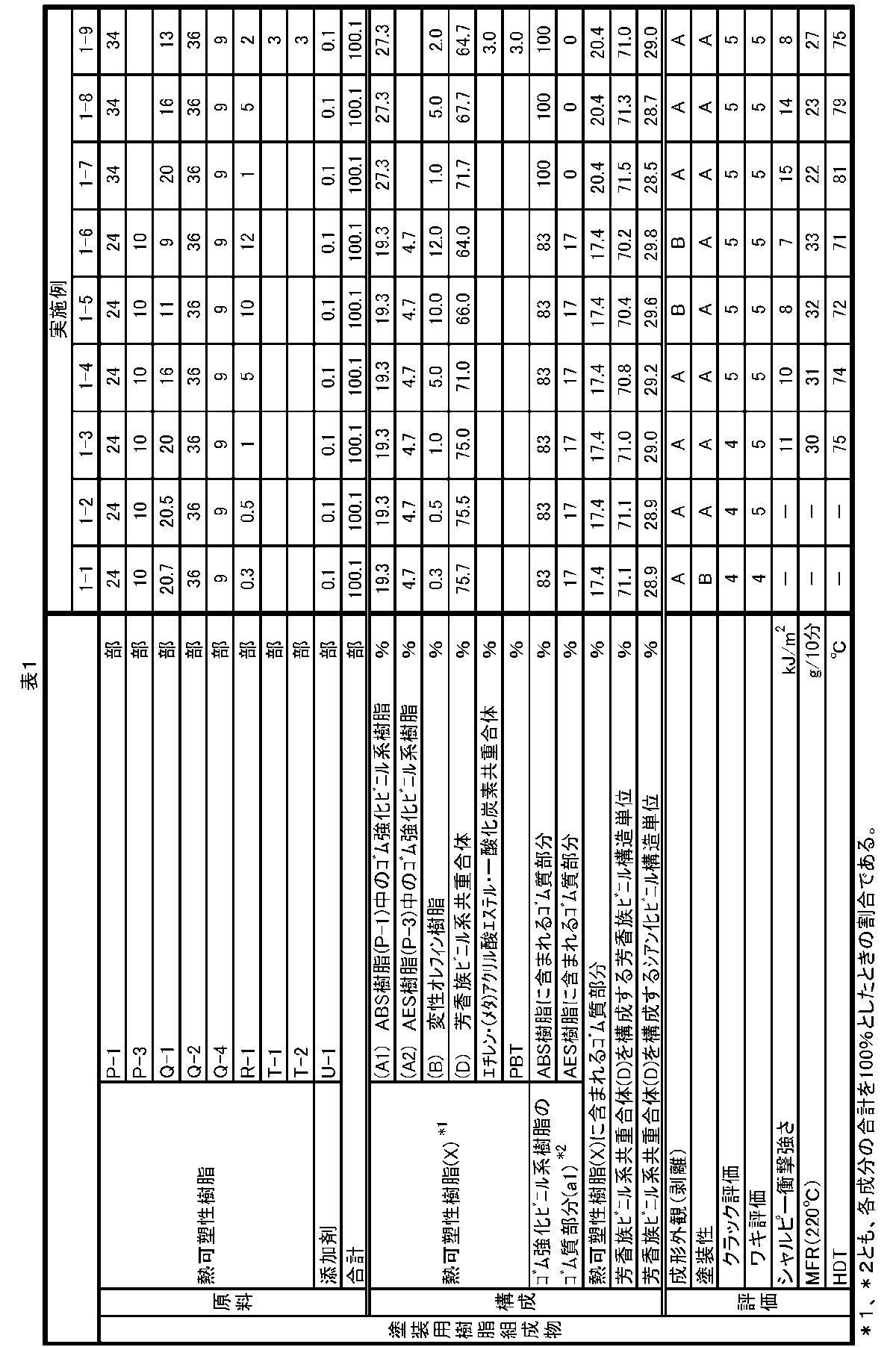
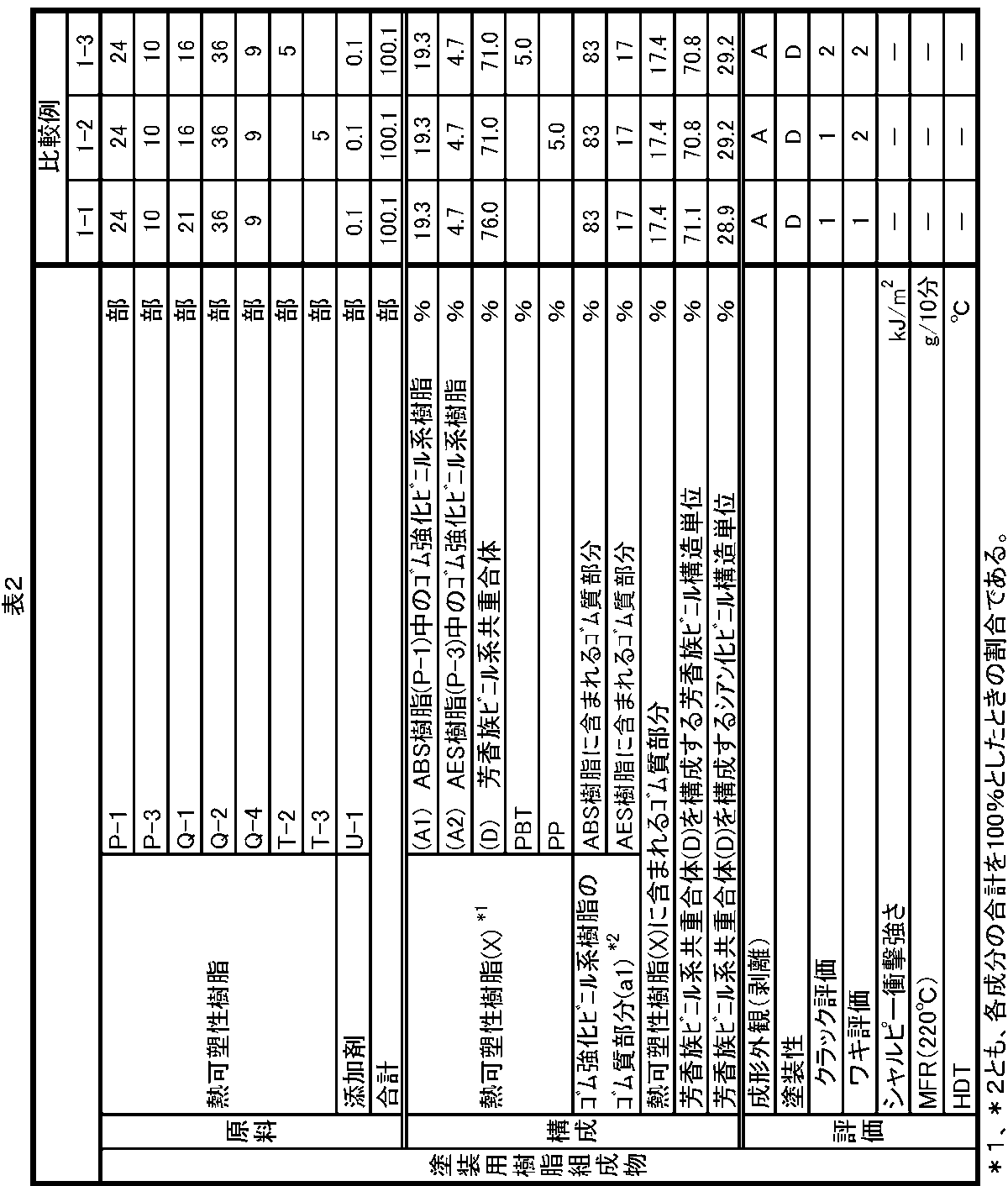
比較例1-1~1-3は、本発明に係る成分(B)を含まない例であり、塗装性が良好ではなかった。一方、実施例1-1~1-9は、本発明の構成を有する例であり、塗装皮膜の剥離等の不具合が抑制されて外観に優れる塗装成形品が得られた。このうち、特に、実施例1-7は、本発明に係る成分(B)が好ましい割合で含まれる例であり、耐衝撃性及び耐熱性に優れる塗装用成形品が得られた。
実施例2-1~2-13及び比較例2-1~2-3
表3及び表4に記載の各原料を、所定の割合で、ヘンシェルミキサーにて混合した後、この混合物を、プラスチック工学研究所社製2軸押出機「SBTN-32」(型式名)に供給して溶融混練(シリンダー設定温度:220℃~260℃)し、熱可塑性樹脂組成物からなるペレット(塗装用樹脂組成物)を得た。そして、このペレットを用いて、ISO 1133に準じて、メルトマスフローレートを、温度240℃及び荷重98Nの条件で測定し、流動性(成形加工性)の評価を行った。また、上記の各種評価を行い、これらの結果を表3及び表4に併記した。
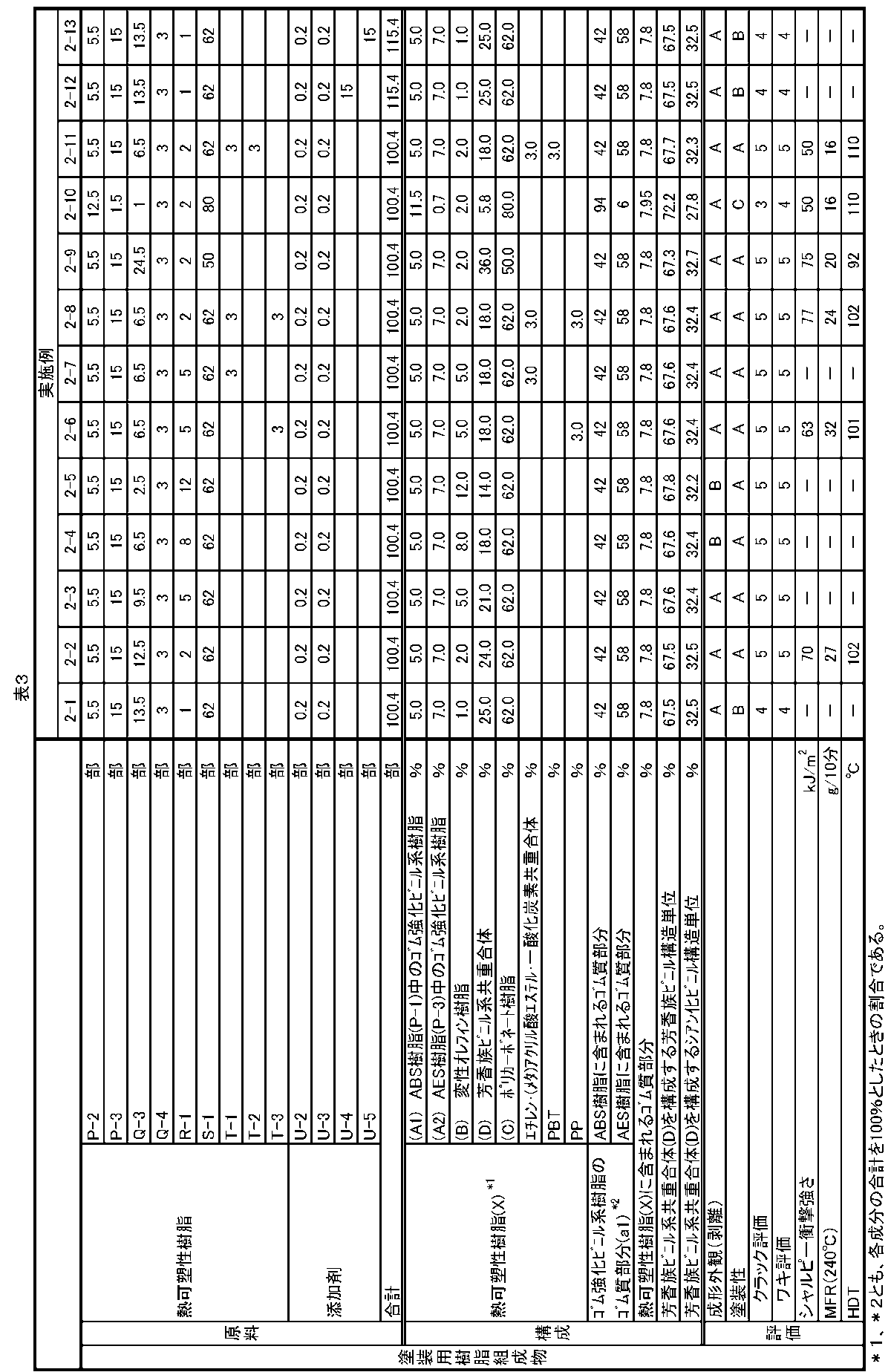
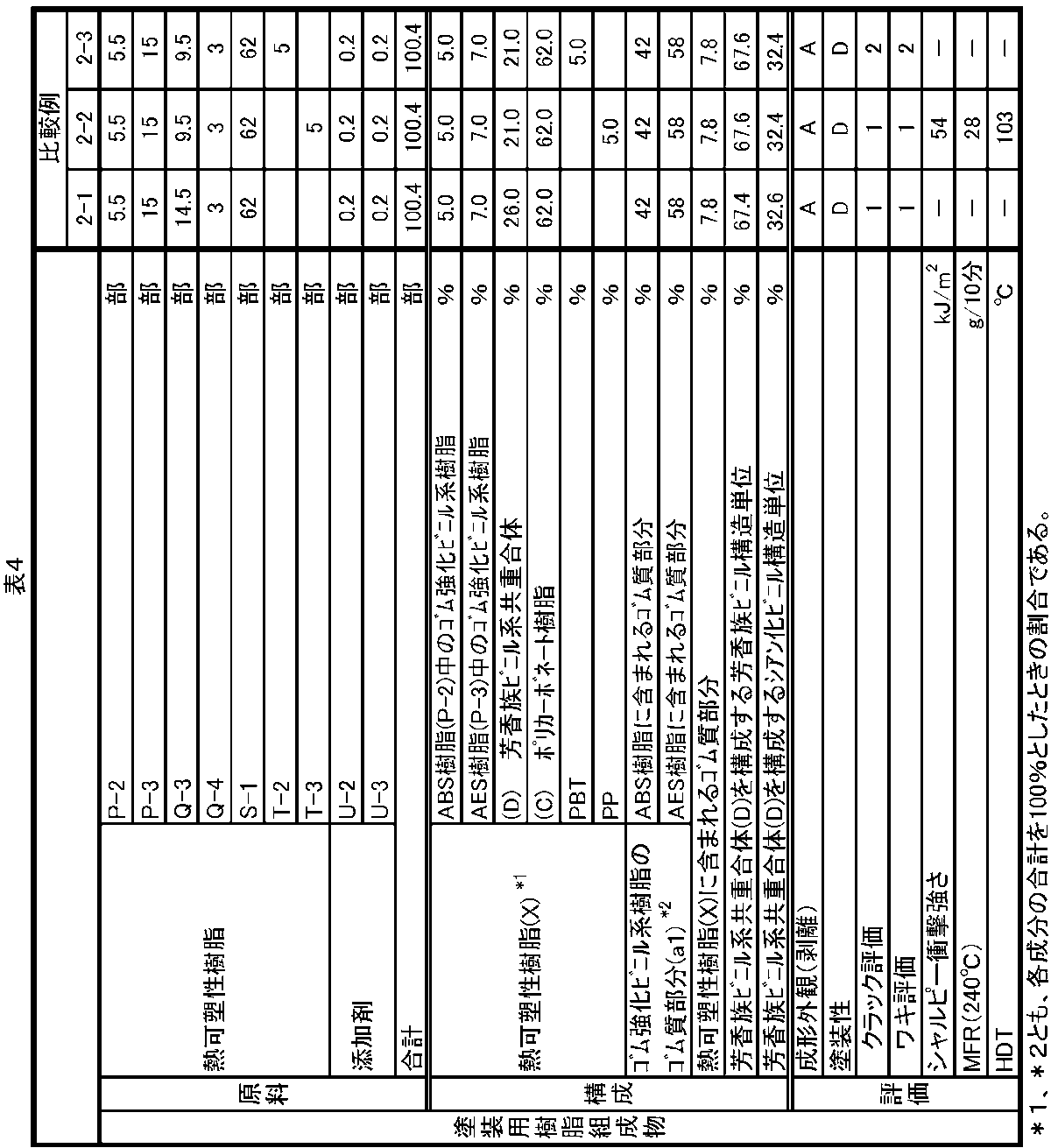
比較例2-1~2-3は、本発明に係る成分(B)を含まない例であり、塗装性が良好ではなかった。一方、実施例2-1~2-13は、本発明の構成を有する例であり、塗装皮膜の剥離等の不具合が抑制されて外観に優れる塗装成形品が得られた。このうち、特に、実施例2-8は、本発明に係る成分(B)が好ましい割合で含まれる例であり、流動性が良好で成形性に優れ、耐衝撃性及び耐熱性に優れる塗装用成形品が得られた。
Claims (8)
- 熱可塑性樹脂を含有し、該熱可塑性樹脂は、(A)ゴム質重合体に由来するゴム質部分と、芳香族ビニル化合物に由来する構造単位を含む樹脂部分とからなるゴム強化ビニル系樹脂、及び、(B)酸素原子を含む極性官能基により変性されたオレフィン系樹脂を含む塗装用樹脂組成物。
- 前記成分(B)の含有割合が、前記熱可塑性樹脂の全量を100質量%とした場合に0.1~15質量%である請求項1に記載の塗装用樹脂組成物。
- 前記成分(B)に含まれる前記極性官能基が酸無水物基である請求項1又は2に記載の塗装用樹脂組成物。
- 前記成分(A)の形成に用いた前記ゴム質重合体がジエン系ゴム質重合体を含む請求項1乃至3のいずれか一項に記載の塗装用樹脂組成物。
- 前記熱可塑性樹脂が、更に、芳香族ビニル化合物に由来する構造単位を含む芳香族ビニル系共重合体(但し、前記成分(A)を除く)を含む請求項1乃至4のいずれか一項に記載の塗装用樹脂組成物。
- 前記熱可塑性樹脂が、更に、ポリカーボネート樹脂を含む請求項1乃至5のいずれか一項に記載の塗装用樹脂組成物。
- 請求項1乃至6のいずれか一項に記載の塗装用樹脂組成物を含有する成形品。
- 前記成形品が自動車用部品である請求項7に記載の成形品。
Priority Applications (6)
| Application Number | Priority Date | Filing Date | Title |
|---|---|---|---|
| JP2021542902A JP7669275B2 (ja) | 2019-08-26 | 2020-08-24 | 塗装用樹脂組成物及び成形品 |
| US17/637,745 US20220282116A1 (en) | 2019-08-26 | 2020-08-24 | Coating resin composition, and molded product |
| CN202080044967.3A CN113993955A (zh) | 2019-08-26 | 2020-08-24 | 涂装用树脂组合物和成型品 |
| MX2022002109A MX2022002109A (es) | 2019-08-26 | 2020-08-24 | Composicion de resina de recubrimiento y producto moldeado. |
| EP20857698.3A EP4023726A4 (en) | 2019-08-26 | 2020-08-24 | Coating resin composition, and molded product |
| CA3148520A CA3148520A1 (en) | 2019-08-26 | 2020-08-24 | Coating resin composition, and molded product |
Applications Claiming Priority (2)
| Application Number | Priority Date | Filing Date | Title |
|---|---|---|---|
| JP2019-154139 | 2019-08-26 | ||
| JP2019154139 | 2019-08-26 |
Publications (1)
| Publication Number | Publication Date |
|---|---|
| WO2021039741A1 true WO2021039741A1 (ja) | 2021-03-04 |
Family
ID=74685884
Family Applications (1)
| Application Number | Title | Priority Date | Filing Date |
|---|---|---|---|
| PCT/JP2020/031889 Ceased WO2021039741A1 (ja) | 2019-08-26 | 2020-08-24 | 塗装用樹脂組成物及び成形品 |
Country Status (7)
| Country | Link |
|---|---|
| US (1) | US20220282116A1 (ja) |
| EP (1) | EP4023726A4 (ja) |
| JP (1) | JP7669275B2 (ja) |
| CN (1) | CN113993955A (ja) |
| CA (1) | CA3148520A1 (ja) |
| MX (1) | MX2022002109A (ja) |
| WO (1) | WO2021039741A1 (ja) |
Cited By (1)
| Publication number | Priority date | Publication date | Assignee | Title |
|---|---|---|---|---|
| JP2022153289A (ja) * | 2021-03-29 | 2022-10-12 | 日本エイアンドエル株式会社 | 熱可塑性樹脂組成物 |
Families Citing this family (1)
| Publication number | Priority date | Publication date | Assignee | Title |
|---|---|---|---|---|
| WO2022122754A1 (en) * | 2020-12-11 | 2022-06-16 | Sabic Global Technologies B.V. | Thermoplastic composition with good plating performance |
Citations (9)
| Publication number | Priority date | Publication date | Assignee | Title |
|---|---|---|---|---|
| JPH11172189A (ja) * | 1997-12-10 | 1999-06-29 | Nisshin Steel Co Ltd | 水性防錆組成物、防錆処理鋼材およびその製造方法 |
| JP2003327779A (ja) | 2002-05-13 | 2003-11-19 | Techno Polymer Co Ltd | 被塗装用熱可塑性樹脂組成物 |
| JP2007327011A (ja) | 2006-06-09 | 2007-12-20 | Kaneka Corp | 塗装用熱可塑性樹脂組成物及び、塗装を施した成形品 |
| JP2011256366A (ja) | 2010-05-11 | 2011-12-22 | Techno Polymer Co Ltd | 塗装用樹脂組成物及びそれを使用した成形品 |
| JP2014184720A (ja) | 2013-02-19 | 2014-10-02 | Mitsubishi Engineering Plastics Corp | 芳香族ポリカーボネート樹脂成形体 |
| WO2015068385A1 (ja) * | 2013-11-05 | 2015-05-14 | 三井化学株式会社 | 変性プロピレン・α-オレフィン共重合体とその製造方法、それを含むコーティング材、成形用樹脂組成物およびホットメルト組成物 |
| CN105968970A (zh) * | 2016-05-27 | 2016-09-28 | 南通好的防腐装备有限公司 | 高耐温、高粘接交联聚乙烯粘弹性复合涂料及制备方法 |
| JP2016538370A (ja) * | 2013-11-08 | 2016-12-08 | ダウ グローバル テクノロジーズ エルエルシー | 下塗り剤不要塗料組成物、その製造方法、及びそれを含む物品 |
| JP2019019238A (ja) | 2017-07-18 | 2019-02-07 | テクノUmg株式会社 | 塗装用樹脂組成物及び成形品 |
Family Cites Families (15)
| Publication number | Priority date | Publication date | Assignee | Title |
|---|---|---|---|---|
| JP3563792B2 (ja) * | 1994-12-16 | 2004-09-08 | テクノポリマー株式会社 | 熱可塑性樹脂組成物 |
| JP3563526B2 (ja) * | 1996-03-19 | 2004-09-08 | 日本ポリオレフィン株式会社 | ポリオレフィン系樹脂組成物及びその塗装体 |
| JP3148149B2 (ja) * | 1997-04-25 | 2001-03-19 | カワサキ ケミカル ホールディング シーオー.,アイエヌシー. | ポリカーボネート/ポリオレフィン系樹脂組成物およびその製造方法、ならびに成形体 |
| JP3662716B2 (ja) * | 1997-06-26 | 2005-06-22 | 三井・デュポンポリケミカル株式会社 | スチレン系重合体組成物 |
| JP3539191B2 (ja) * | 1998-03-16 | 2004-07-07 | 東洋インキ製造株式会社 | 難燃性樹脂組成物及び成形品 |
| JP2000026694A (ja) * | 1998-07-10 | 2000-01-25 | Techno Polymer Kk | 熱可塑性樹脂組成物 |
| JP2000073501A (ja) * | 1998-08-27 | 2000-03-07 | Denki Kagaku Kogyo Kk | 積層成形雨樋 |
| JP2001146533A (ja) * | 1999-09-09 | 2001-05-29 | Asahi Kasei Corp | 高耐衝撃性熱可塑性樹脂組成物 |
| JP4244776B2 (ja) * | 2003-10-16 | 2009-03-25 | ユーエムジー・エービーエス株式会社 | 塗膜付き樹脂成形品からの熱可塑性樹脂の回収方法、熱可塑性樹脂組成物及び熱可塑性樹脂成形品 |
| JP2006131810A (ja) * | 2004-11-08 | 2006-05-25 | Techno Polymer Co Ltd | 粘着剤及び粘着フィルム |
| JP5242093B2 (ja) * | 2006-08-03 | 2013-07-24 | テクノポリマー株式会社 | 熱可塑性樹脂組成物及び成形品 |
| US8742015B2 (en) * | 2006-08-03 | 2014-06-03 | Techno Polymer Co., Ltd. | Thermoplastic resin composition and molded article |
| JP6146890B2 (ja) * | 2010-08-27 | 2017-06-14 | テクノポリマー株式会社 | 軋み音を低減した熱可塑性樹脂組成物製接触用部品 |
| JP2017043811A (ja) * | 2015-08-28 | 2017-03-02 | 浩記 吹田 | めっき用下地剤、めっき物、およびめっき方法 |
| JP2017201040A (ja) * | 2017-08-07 | 2017-11-09 | テクノポリマー株式会社 | 熱可塑性樹脂組成物製嵌合品 |
-
2020
- 2020-08-24 US US17/637,745 patent/US20220282116A1/en active Pending
- 2020-08-24 EP EP20857698.3A patent/EP4023726A4/en active Pending
- 2020-08-24 WO PCT/JP2020/031889 patent/WO2021039741A1/ja not_active Ceased
- 2020-08-24 CA CA3148520A patent/CA3148520A1/en active Pending
- 2020-08-24 MX MX2022002109A patent/MX2022002109A/es unknown
- 2020-08-24 JP JP2021542902A patent/JP7669275B2/ja active Active
- 2020-08-24 CN CN202080044967.3A patent/CN113993955A/zh active Pending
Patent Citations (9)
| Publication number | Priority date | Publication date | Assignee | Title |
|---|---|---|---|---|
| JPH11172189A (ja) * | 1997-12-10 | 1999-06-29 | Nisshin Steel Co Ltd | 水性防錆組成物、防錆処理鋼材およびその製造方法 |
| JP2003327779A (ja) | 2002-05-13 | 2003-11-19 | Techno Polymer Co Ltd | 被塗装用熱可塑性樹脂組成物 |
| JP2007327011A (ja) | 2006-06-09 | 2007-12-20 | Kaneka Corp | 塗装用熱可塑性樹脂組成物及び、塗装を施した成形品 |
| JP2011256366A (ja) | 2010-05-11 | 2011-12-22 | Techno Polymer Co Ltd | 塗装用樹脂組成物及びそれを使用した成形品 |
| JP2014184720A (ja) | 2013-02-19 | 2014-10-02 | Mitsubishi Engineering Plastics Corp | 芳香族ポリカーボネート樹脂成形体 |
| WO2015068385A1 (ja) * | 2013-11-05 | 2015-05-14 | 三井化学株式会社 | 変性プロピレン・α-オレフィン共重合体とその製造方法、それを含むコーティング材、成形用樹脂組成物およびホットメルト組成物 |
| JP2016538370A (ja) * | 2013-11-08 | 2016-12-08 | ダウ グローバル テクノロジーズ エルエルシー | 下塗り剤不要塗料組成物、その製造方法、及びそれを含む物品 |
| CN105968970A (zh) * | 2016-05-27 | 2016-09-28 | 南通好的防腐装备有限公司 | 高耐温、高粘接交联聚乙烯粘弹性复合涂料及制备方法 |
| JP2019019238A (ja) | 2017-07-18 | 2019-02-07 | テクノUmg株式会社 | 塗装用樹脂組成物及び成形品 |
Non-Patent Citations (1)
| Title |
|---|
| See also references of EP4023726A4 |
Cited By (1)
| Publication number | Priority date | Publication date | Assignee | Title |
|---|---|---|---|---|
| JP2022153289A (ja) * | 2021-03-29 | 2022-10-12 | 日本エイアンドエル株式会社 | 熱可塑性樹脂組成物 |
Also Published As
| Publication number | Publication date |
|---|---|
| CN113993955A (zh) | 2022-01-28 |
| MX2022002109A (es) | 2022-03-17 |
| JPWO2021039741A1 (ja) | 2021-03-04 |
| JP7669275B2 (ja) | 2025-04-28 |
| EP4023726A4 (en) | 2023-08-30 |
| US20220282116A1 (en) | 2022-09-08 |
| CA3148520A1 (en) | 2021-03-04 |
| EP4023726A1 (en) | 2022-07-06 |
Similar Documents
| Publication | Publication Date | Title |
|---|---|---|
| US10577499B2 (en) | Reinforced polycarbonate composition with improved impact performance | |
| US10227486B2 (en) | Contacting part made of thermoplastic resin composition with reduced squeaking noises | |
| US4945005A (en) | Thermoplastic compositions and articles made therefrom | |
| US10189982B2 (en) | Contacting component and structure containing said contacting component | |
| US20050260361A1 (en) | Polyester composition | |
| JP7163283B2 (ja) | 熱可塑性樹脂組成物及び成形体 | |
| JP7669275B2 (ja) | 塗装用樹脂組成物及び成形品 | |
| JP7017333B2 (ja) | 塗装用樹脂組成物及び成形品 | |
| AU617315B2 (en) | Thermoplastic compositions and articles made therefrom | |
| US20220259419A1 (en) | Thermoplastic resin composition and molded article formed thereof | |
| JP6770955B2 (ja) | 耐熱分解性に優れたポリカーボネート樹脂組成物 | |
| KR20190078370A (ko) | 폴리카보네이트계 수지 조성물 | |
| WO2018051870A1 (ja) | 熱可塑性樹脂組成物およびその成形体 | |
| JP3194813B2 (ja) | サンドイッチ樹脂成形物 | |
| JPH04307237A (ja) | 塗装樹脂成形品及びその製造方法 |
Legal Events
| Date | Code | Title | Description |
|---|---|---|---|
| 121 | Ep: the epo has been informed by wipo that ep was designated in this application |
Ref document number: 20857698 Country of ref document: EP Kind code of ref document: A1 |
|
| ENP | Entry into the national phase |
Ref document number: 2021542902 Country of ref document: JP Kind code of ref document: A |
|
| ENP | Entry into the national phase |
Ref document number: 3148520 Country of ref document: CA |
|
| NENP | Non-entry into the national phase |
Ref country code: DE |
|
| ENP | Entry into the national phase |
Ref document number: 2020857698 Country of ref document: EP Effective date: 20220328 |