WO2021044945A1 - 油脂組成物 - Google Patents
油脂組成物 Download PDFInfo
- Publication number
- WO2021044945A1 WO2021044945A1 PCT/JP2020/032430 JP2020032430W WO2021044945A1 WO 2021044945 A1 WO2021044945 A1 WO 2021044945A1 JP 2020032430 W JP2020032430 W JP 2020032430W WO 2021044945 A1 WO2021044945 A1 WO 2021044945A1
- Authority
- WO
- WIPO (PCT)
- Prior art keywords
- oil
- tea extract
- fat composition
- oils
- fats
- Prior art date
- Legal status (The legal status is an assumption and is not a legal conclusion. Google has not performed a legal analysis and makes no representation as to the accuracy of the status listed.)
- Ceased
Links
Classifications
-
- A—HUMAN NECESSITIES
- A23—FOODS OR FOODSTUFFS; TREATMENT THEREOF, NOT COVERED BY OTHER CLASSES
- A23D—EDIBLE OILS OR FATS, e.g. MARGARINES, SHORTENINGS OR COOKING OILS
- A23D7/00—Edible oil or fat compositions containing an aqueous phase, e.g. margarines
- A23D7/005—Edible oil or fat compositions containing an aqueous phase, e.g. margarines characterised by ingredients other than fatty acid triglycerides
-
- A—HUMAN NECESSITIES
- A23—FOODS OR FOODSTUFFS; TREATMENT THEREOF, NOT COVERED BY OTHER CLASSES
- A23L—FOODS, FOODSTUFFS OR NON-ALCOHOLIC BEVERAGES, NOT OTHERWISE PROVIDED FOR; PREPARATION OR TREATMENT THEREOF
- A23L2/00—Non-alcoholic beverages; Dry compositions or concentrates therefor; Preparation or treatment thereof
- A23L2/52—Adding ingredients
-
- A—HUMAN NECESSITIES
- A23—FOODS OR FOODSTUFFS; TREATMENT THEREOF, NOT COVERED BY OTHER CLASSES
- A23D—EDIBLE OILS OR FATS, e.g. MARGARINES, SHORTENINGS OR COOKING OILS
- A23D7/00—Edible oil or fat compositions containing an aqueous phase, e.g. margarines
- A23D7/005—Edible oil or fat compositions containing an aqueous phase, e.g. margarines characterised by ingredients other than fatty acid triglycerides
- A23D7/0053—Compositions other than spreads
-
- A—HUMAN NECESSITIES
- A23—FOODS OR FOODSTUFFS; TREATMENT THEREOF, NOT COVERED BY OTHER CLASSES
- A23D—EDIBLE OILS OR FATS, e.g. MARGARINES, SHORTENINGS OR COOKING OILS
- A23D7/00—Edible oil or fat compositions containing an aqueous phase, e.g. margarines
- A23D7/005—Edible oil or fat compositions containing an aqueous phase, e.g. margarines characterised by ingredients other than fatty acid triglycerides
- A23D7/0056—Spread compositions
-
- A—HUMAN NECESSITIES
- A23—FOODS OR FOODSTUFFS; TREATMENT THEREOF, NOT COVERED BY OTHER CLASSES
- A23D—EDIBLE OILS OR FATS, e.g. MARGARINES, SHORTENINGS OR COOKING OILS
- A23D9/00—Other edible oils or fats, e.g. shortenings or cooking oils
- A23D9/007—Other edible oils or fats, e.g. shortenings or cooking oils characterised by ingredients other than fatty acid triglycerides
-
- A—HUMAN NECESSITIES
- A23—FOODS OR FOODSTUFFS; TREATMENT THEREOF, NOT COVERED BY OTHER CLASSES
- A23F—COFFEE; TEA; THEIR SUBSTITUTES; MANUFACTURE, PREPARATION, OR INFUSION THEREOF
- A23F3/00—Tea; Tea substitutes; Preparations thereof
- A23F3/16—Tea extraction; Tea extracts; Treating tea extract; Making instant tea
-
- A—HUMAN NECESSITIES
- A23—FOODS OR FOODSTUFFS; TREATMENT THEREOF, NOT COVERED BY OTHER CLASSES
- A23L—FOODS, FOODSTUFFS OR NON-ALCOHOLIC BEVERAGES, NOT OTHERWISE PROVIDED FOR; PREPARATION OR TREATMENT THEREOF
- A23L23/00—Soups; Sauces; Preparation or treatment thereof
-
- A—HUMAN NECESSITIES
- A23—FOODS OR FOODSTUFFS; TREATMENT THEREOF, NOT COVERED BY OTHER CLASSES
- A23L—FOODS, FOODSTUFFS OR NON-ALCOHOLIC BEVERAGES, NOT OTHERWISE PROVIDED FOR; PREPARATION OR TREATMENT THEREOF
- A23L7/00—Cereal-derived products; Malt products; Preparation or treatment thereof
- A23L7/10—Cereal-derived products
- A23L7/117—Flakes or other shapes of ready-to-eat type; Semi-finished or partly-finished products therefor
- A23L7/122—Coated, filled, multilayered or hollow ready-to-eat cereals
-
- A—HUMAN NECESSITIES
- A23—FOODS OR FOODSTUFFS; TREATMENT THEREOF, NOT COVERED BY OTHER CLASSES
- A23L—FOODS, FOODSTUFFS OR NON-ALCOHOLIC BEVERAGES, NOT OTHERWISE PROVIDED FOR; PREPARATION OR TREATMENT THEREOF
- A23L7/00—Cereal-derived products; Malt products; Preparation or treatment thereof
- A23L7/10—Cereal-derived products
- A23L7/161—Puffed cereals, e.g. popcorn or puffed rice
- A23L7/191—After-treatment of puffed cereals, e.g. coating or salting
-
- C—CHEMISTRY; METALLURGY
- C11—ANIMAL OR VEGETABLE OILS, FATS, FATTY SUBSTANCES OR WAXES; FATTY ACIDS THEREFROM; DETERGENTS; CANDLES
- C11B—PRODUCING, e.g. BY PRESSING RAW MATERIALS OR BY EXTRACTION FROM WASTE MATERIALS, REFINING OR PRESERVING FATS, FATTY SUBSTANCES, e.g. LANOLIN, FATTY OILS OR WAXES; ESSENTIAL OILS; PERFUMES
- C11B5/00—Preserving by using additives, e.g. anti-oxidants
- C11B5/0085—Substances of natural origin of unknown constitution, f.i. plant extracts
-
- A—HUMAN NECESSITIES
- A23—FOODS OR FOODSTUFFS; TREATMENT THEREOF, NOT COVERED BY OTHER CLASSES
- A23L—FOODS, FOODSTUFFS OR NON-ALCOHOLIC BEVERAGES, NOT OTHERWISE PROVIDED FOR; PREPARATION OR TREATMENT THEREOF
- A23L27/00—Spices; Flavouring agents or condiments; Artificial sweetening agents; Table salts; Dietetic salt substitutes; Preparation or treatment thereof
- A23L27/60—Salad dressings; Mayonnaise; Ketchup
-
- A—HUMAN NECESSITIES
- A23—FOODS OR FOODSTUFFS; TREATMENT THEREOF, NOT COVERED BY OTHER CLASSES
- A23V—INDEXING SCHEME RELATING TO FOODS, FOODSTUFFS OR NON-ALCOHOLIC BEVERAGES AND LACTIC OR PROPIONIC ACID BACTERIA USED IN FOODSTUFFS OR FOOD PREPARATION
- A23V2002/00—Food compositions, function of food ingredients or processes for food or foodstuffs
-
- A—HUMAN NECESSITIES
- A23—FOODS OR FOODSTUFFS; TREATMENT THEREOF, NOT COVERED BY OTHER CLASSES
- A23V—INDEXING SCHEME RELATING TO FOODS, FOODSTUFFS OR NON-ALCOHOLIC BEVERAGES AND LACTIC OR PROPIONIC ACID BACTERIA USED IN FOODSTUFFS OR FOOD PREPARATION
- A23V2250/00—Food ingredients
- A23V2250/20—Natural extracts
- A23V2250/21—Plant extracts
- A23V2250/214—Tea
Definitions
- the present invention relates to an oil / fat composition having improved oxidative stability, a food containing the same, and a method for producing the same.
- fats and oils deteriorate like other substances.
- peroxidative substances generated by the oxidation of fats and oils are known to not only impair the flavor but also be harmful to the human body, and suppress oxidation. By doing so, it is possible to provide health-friendly fats and oils.
- Oxidative stability of food is one of the important functions because it may directly or indirectly affect the setting of the expiration date depending on the type. Therefore, various methods have been attempted to improve the oxidative stability of foods. Further, fats and oils are one of the important compositions in foods, but since fats and oils are easily oxidized, improvement of the oxidative stability of fats and oils is a particularly important issue in foods containing fats and oils.
- Antioxidants are generally added to improve the oxidative stability of fats and oils and foods containing fats and oils.
- As the antioxidant an oil-soluble antioxidant that can be easily dispersed in fats and oils is used, but its antioxidant capacity is relatively low in comparison with a water-soluble antioxidant. Therefore, a water-soluble antioxidant substance may be dispersed in fats and oils for use.
- tea extract is an effective additive, and several methods have been disclosed in which the tea extract is dispersed in fats and oils to improve the oxidative stability of fats and oils or foods containing a large amount of fats and oils.
- Patent Document 1 As a method for improving the dispersibility of tea extract in fats and oils, for example, in Patent Document 1, tea leaves crushed to an average particle size of about 15 microns in a dry state are added to edible oil, and the mixture is added to a wet ultrafine grinder. Disclosed is a method of further finely pulverizing tea leaves to a particle size of 1 to 10 microns to promote the transfer of tea leaf components to edible oil, and then removing the tea leaf fine powder to obtain an oily solution. ing. Further, in Patent Document 2, it is a green tea extract that is recovered by combining extracts extracted from green tea leaves a plurality of times using a hydrous organic solvent having a concentration [volume / volume] of 60% or more and different concentrations.
- the green tea extract containing a hexane-soluble component derived from green tea in a proportion of 10% by mass or more with respect to catechin has a specific gravity of at least one of medium-chain fatty acid triglyceride and castor oil of 0.95 g / cm3 or more.
- a method for producing a catechin-dispersed fat and oil which comprises adding the fat and oil to the above fat and oil, heating to 100 to 130 ° C., and grinding.
- Patent Document 3 discloses an antioxidant composition characterized by dissolving 0.1 to 30 parts by weight of catechins in 70 to 99.9 parts by weight of a diglycerin fatty acid ester.
- Patent Document 4 As a method for dissolving a tea extract in a polar solvent, in Patent Document 4, a lipophilic antioxidant obtained by emulsifying a lipophilic antioxidant, a water-soluble antioxidant and an oil-soluble antioxidant into a water-in-oil type with a lipophilic emulsifier. Is disclosed. In Patent Document 5, catechins, which are water-soluble antioxidant components derived from natural substances, polyglycerin fatty acid esters having an HLB of 14 to 16 and water as aqueous phase components, and 6 to 12 carbon atoms as oil phase components.
- An oil-soluble antioxidant which is an emulsion containing a fatty acid triglyceride and a polyglycerin condensed ricinoleic acid ester and has an average particle size of emulsion particles of catechins of 40 to 120 nm and can be transparently dispersed in fats and oils is disclosed.
- Patent Document 6 (a) a step of dissolving green tea extract powder having a polyphenol content of 80 wt% or more in ethanol or propylene glycol; (b) the dissolved green tea extract having an HLB value of 3.5 to 3.5, respectively.
- a method for producing an oil-soluble antioxidant which comprises a step of emulsifying while sequentially adding the emulsifiers (A), (B), and (C) of 4.0, 3.0 to 3.5, and 2 or less. It is disclosed.
- Patent Document 7 a. It contains 0.04-50% by weight of the hydrophilic natural antioxidant by mixing at least one hydrophilic natural antioxidant in a highly polar oil at a temperature of 5-200 ° C. Steps to obtain a mixture of the antioxidant and the oil, b.
- the step of mixing the mixture of the above-mentioned antioxidant and oil into edible oil so that the hydrophilic natural antioxidant has a concentration of 10 to 1000 ppm based on the weight, a stable state in the oxidation reaction of the edible oil is maintained.
- the water-soluble tea polyphenol content is 300 wt ppm to 600 wt ppm
- the emulsifier content is 200 wt ppm to 800 wt ppm
- the emulsifier content is 1.5 times or less the water-soluble tea polyphenol content.
- a method for producing edible vegetable oils and fats (excluding fats and oils having a diglyceride content of 15% by weight or more), wherein the following A / N value is 2.9 or more, and an aqueous solution in which a water-soluble tea polyphenol is dissolved is used.
- a method for producing an edible vegetable oil or fat, which is characterized by being added to the oil or fat in a solution state is disclosed.
- Japanese Unexamined Patent Publication No. 63-1354843 Japanese Unexamined Patent Publication No. 2010-041965 Japanese Patent Application No. 2015-033781 Japanese Unexamined Patent Publication No. 2002-142673 Japanese Unexamined Patent Publication No. 2013-159730 Japanese Unexamined Patent Publication No. 2000-204370 Japanese Patent Application No. 2015-188374 International Publication No. 2013/172348
- an object of the present invention is to provide an edible oil / fat containing a tea extract, which improves oxidative stability and has a good flavor without increasing the blending amount of the tea extract. It is to be.
- the present inventors have added acids together in a manufacturing method in which a tea extract, which is originally sparingly soluble in fats and oils, is added to fats and oils in a solution state using an aqueous medium.
- the present invention has been completed by finding that edible oils and fats having improved oxidative stability and good flavor can be obtained by blending them.
- the present invention is (1) an oil / fat composition containing 50 mass ppm to 1000 mass ppm of tea extract and 0.1 to 5 times as much acid as the tea extract.
- Foods using any of the oil and fat compositions of (1) to (3) (5) The method for producing an oil / fat composition according to any one of (1) to (3), which is prepared by mixing an oil phase and the following aqueous phase.
- Aqueous phase An aqueous solution in which a tea extract and acids are dissolved (6)
- the method for producing an oil / fat composition according to (5) which contains 1 to 5 times as much water as the tea extract in the aqueous phase.
- a method for improving the oxidative stability of an oil / fat composition wherein the aqueous phase dispersed in the oil / fat composition contains a tea extract and acids in the production of the oil / fat composition.
- the tea extract and the acids are stably dispersed in the fat and oil composition of the present invention.
- the oil and fat composition of the present invention can be efficiently and stably dispersed in foods.
- the oxidative stability can be improved without increasing the blending amount of the tea extract.
- the effect as a stabilizer of acids on the polyphenols contained in the tea extract is considered.
- the fat and oil composition of the present invention contains 50 mass ppm to 1000 mass ppm of tea extract and 0.1 to 5 times as much acid as the tea extract.
- the tea extract include tea leaves such as green tea, oolong tea, and black tea, or extracts of processed products thereof, which are extracted with water, alcohol, or the like. It is preferable to use a green tea extract, and a commercially available green tea extract can be used.
- the acids organic acids and / or inorganic acids can be used.
- phosphoric acids are preferably used, and examples thereof include orthophosphoric acid, diphosphoric acid (pyrophosphoric acid), and metaphosphoric acid.
- the tea extract content of the oil and fat composition of the present invention is preferably 80 mass ppm to 800 mass ppm, more preferably 100 mass ppm to 600 mass ppm, and further preferably 150 mass ppm to 400 mass ppm. .. If the amount is too small, the effect of improving the oxidative stability cannot be obtained, and if the amount is too large, the effect on the flavor becomes large, which is not preferable.
- the content of the acids of the present invention is 0.1 to 5 times the amount of the tea extract. The amount is preferably 0.1 to 4 times, more preferably 0.1 to 3 times, still more preferably 0.12 to 3 times. If the amount of the acids to be added to the tea extract is too small, the effect of improving the oxidative stability cannot be obtained, which is not preferable.
- oils and fats that can be used in the oil and fat composition of the present invention are rapeseed oil, soybean oil, sunflower seed oil, cottonseed oil, peanut oil, rice bran oil, corn oil, saflower oil, olive oil, capoc oil, sesame oil, evening primrose oil, and palm.
- an oil-soluble emulsifier is dissolved in the oil phase in order to maintain good dispersion stability.
- the oil-soluble emulsifier is an emulsifier that dissolves in fats and oils, and in the present invention, it refers to an emulsifier having an HLB of 7 or less.
- the oil-soluble emulsifier one or more selected from polyglycerin ester, sugar ester, sorbitan ester, and monoglycerin fatty acid ester is desirable, more preferably polyglycerin ester, sugar ester, and distilled monoglyceride are preferable, and polyglycerin ester is particularly preferable.
- polyglycerin-condensed ricinoleic acid ester is most preferable.
- the polyglycerin condensed ricinoleic acid ester may be abbreviated as PGPR.
- the amount of the oil-soluble emulsifier in the oil phase is preferably 0.1 to 50 times the amount of the tea extract, more preferably 0.3 to 30 times the amount of the tea extract, and even more preferably the amount of the tea extract.
- the amount is 0.5 to 25 times.
- the taste may be deteriorated due to the flavor derived from the emulsifier, or unintended emulsification may be inhibited, which may impair the quality of the food.
- the oil and fat composition of the present invention is preferably adjusted so that the average particle size of the aqueous phase containing the tea extract is 1000 nm or less. It is more preferably 500 nm or less, still more preferably 300 nm or less. Adjusting the average particle size to 1000 nm or less is preferable because the tea extract can be stably dispersed. If the average particle size exceeds 1000 nm, the dispersion stability may deteriorate, which is not preferable. In the present invention, the average particle size is obtained by a dynamic light scattering method. Further, when the average particle size exceeds 1000 nm, it is difficult to analyze by the dynamic light scattering method, so that it is obtained by the laser diffraction method.
- the method for producing the oil and fat composition of the present invention is not limited as long as the above-mentioned oil and fat composition can be obtained, but a production method for producing by mixing an aqueous solution in which a tea extract and an acid are dissolved in an oil phase can be exemplified. ..
- the tea extract and the acids do not need to be dissolved in the same aqueous solution.
- Aqueous phase Aqueous solution in which tea extract and acids are dissolved
- the aqueous phase contains 1 to 5 times as much water as the tea extract. More preferably, the tea extract is 1 to 4.5 times in the aqueous phase, more preferably 1 to 4 times the tea extract in the aqueous phase, and even more preferably 1 of the tea extract in the aqueous phase. It contains ⁇ 3 times, most preferably 1-2 times as much water as the tea extract in the aqueous phase.
- a mixer and a stirrer can be used for mixing the oil phase and the aqueous phase, and the device is not particularly limited, but a device capable of preventing air from being mixed during mixing and stirring is preferable.
- a mixed emulsifying device such as a high-pressure homogenizer can be exemplified.
- the oil and fat composition of the present invention contains a tea extract and acids and has good dispersion stability, so that good oxidative stability can be obtained.
- the evaluation of the fat and oil composition according to the present invention can be carried out by obtaining a judgment index regarding the oxidative stability of the fat and oil by a CDM (Conductmetric Evaluation Method) test.
- the CDM test can be performed using a dedicated test device (ransimat). Specific measurement methods will be described in Examples. Both are accelerated tests that test at a temperature higher than expected.
- the oil and fat composition of the present invention can adjust the tea extract to a wide concentration range, it can be used for all kinds of foods.
- Seasonings such as dressing and mayonnaise, fillings and spreads such as pizza sauce, cooked products such as margarine, shortening, and retort curry, roux such as stew and curry, frozen foods such as fried food, cooking bread, sausage, etc.
- Processed meats, paste products such as spreads, or foods obtained by cooking using them, rice crackers such as fried rice crackers, snack foods such as potato chips, corn snacks and pretzels, cold confectionery, ice mix and other flavors
- Examples include sweets and Japanese sweets.
- Preferred embodiments include rice crackers, corn snacks (coating oils), fillings and spreads, sauces, soups, beverages, cooked rice binding-suppressing oils and fats, and frozen confectionery, which are less heated during production.
- the oil and fat composition of the present invention contains a tea extract as an essential component, but other antioxidants may also be contained in combination as long as the effects of the present invention are not impaired.
- other antioxidants include oil-soluble tocopherols, yamamomo extracts, grape seed-derived polyphenols, and water-soluble antioxidants such as ascorbic acid and its derivatives, gallic acid and its derivatives. Antioxidants may be used in combination.
- the oil / fat composition of the present invention may contain arbitrary components such as colorants, antifoaming agents, and fragrances in addition to emulsifiers and antioxidants, as long as the effects of the present invention are not impaired.
- the total amount of the optional components to be blended is preferably 5% by mass or less, more preferably 3% by mass or less, and most preferably 1% by mass or less in the oil / fat composition of the present invention.
- the oil phase portion was prepared according to the formulation described in each oil phase column of Tables 1 and 2.
- the aqueous phase portion was prepared according to the formulation described in each aqueous phase column of Tables 1 and 2.
- the oil phase portion was set to 25 ° C., and the aqueous phase portion was blended while stirring with a homomixer (TK homomixer MARKII: manufactured by Primix Corporation) at 8000 rpm. In this state, the mixture was stirred for 10 minutes to obtain each fat and oil composition.
- TK homomixer MARKII manufactured by Primix Corporation
- citric acid anhydrous
- metaphosphoric acid mass 37%) manufactured by Fujifilm Wako Pure Chemical Industries, Ltd.
- DL-malic acid manufactured by Fujifilm Wako Pure Chemical Industries, Ltd. was used.
- Average particle size of aqueous phase The average particle size was determined by the dynamic light scattering method. Further, those having a particle size exceeding 1000 nm were determined by a laser diffraction method.
- Oxidative stability evaluation of fats and oils composition CDM test of "stability test" of standard fat analysis test method (2.5.1.2-1996) (Definition: Clean air is sent while heating the sample at 120 ° C. in a reaction vessel. Volatile decomposition products generated by oxidation are discharged. The CDM value was calculated and evaluated by collecting it in water (meaning the time to the turning point where the conductivity of water changes abruptly).
- the rate of increase (%) of the CDM value with respect to the acid-free group containing the same amount of tea extract and not containing acids was obtained and the effects were compared (for example, in the case of Example 1, Comparative Example 3 containing the same amount of tea extract). Calculate the rate of increase in the CDM value for). Those having an extension effect of 10% or more with respect to the CDM value containing the same amount of tea extract and not containing acids were regarded as acceptable.
- Evaluation of astringency and miscellaneous taste of fat and oil composition The flavors of the fats and oils obtained in Examples and Comparative Examples were evaluated. The flavor evaluation was carried out by four skilled panels, and the flavor evaluation points were decided by agreement. If the flavor evaluation score is 1 or more, it is judged to be acceptable.
- Test example 1 An oil and fat composition was prepared according to the formulation shown in Table 1 and (preparation method), and evaluated according to (evaluation method). The results are shown in Table 1.
- the oxidative stability of the fat and oil composition could be improved as compared with the case where the tea extract was added alone.
- the effect was more effective as the amount of tea extract blended was larger.
- the combined use of acids and tea extract tended to reduce astringency and unpleasant taste.
- palm olein was confirmed with palm olein.
- citric acid which is an organic acid, as the acid. Therefore, it was found that organic acids can be used as acids. It was also found that citric acid can be used as an organic acid.
- Test example 2 An oil and fat composition was prepared according to the formulation shown in Table 2 and (Adjustment method), and evaluated according to (Evaluation method). The results are shown in Table 2. The amount of metaphosphoric acid blended was described by converting from a lump of metaphosphoric acid (37%) to 100% purity.
- the effect of improving the oxidative stability varied depending on the amount of the acid compounded in the tea extract, and a 0.1 to 5 times amount was appropriate. It was found that the oxidative stability was not improved by the acids alone. The effect was also obtained by using DL-malic acid, which is an organic acid, as the acid. The effect was also obtained by using metaphosphoric acid, which is an inorganic acid, as the acid. Therefore, it was found that DL-malic acid can be used as an organic acid. Therefore, it was found that an inorganic acid can be used as an acid. It was also found that metaphosphoric acid can be used as an inorganic acid.
- the glass bottle is stored in a dark place at 60 ° C. for 28 days.
- the peroxide value (POV) is measured and the flavor is evaluated.
- the evaluation item of flavor was the deteriorated odor of fats and oils, and the sensory evaluation was performed on a 10-point scale by four panelists. Oils and fats having an evaluation score of 5 or more on the 21st day of storage were judged to be good.
- Sensory evaluation Deteriorated odor of fats and oils: The larger the number, the weaker the deteriorated odor, and the smaller the number, the stronger the deteriorated odor. The evaluation results are shown in Table 3.
- the POV and flavor could be maintained well as compared with Comparative Example 7, which had the same tea extract content.
- the quality of the tea extract was equal to or higher than that of Comparative Example 9 in which the amount of the tea extract was doubled.
- good results were obtained in terms of astringency and miscellaneous taste.
- citric acid (Examples 5, 11, 12, 13), which is an organic acid
- DL-malic acid (Example 16)
- metaphosphoric acid Example 17
- the above effect was also obtained by using it.
- the application using the fat composition of Examples 5, 11 to 13, 16 and 17 had better POV and flavor as compared with the application using the fat composition of Comparative Example 7 having the same tea extract content. I was able to maintain it.
- the quality of the tea extract was equal to or higher than that of Comparative Example 9 in which the amount of the tea extract was doubled.
- good results were obtained in terms of astringency and miscellaneous taste.
- the acids used are citric acid (Examples 5, 11, 12, 13), which is an organic acid, DL-malic acid (Example 16), and metaphosphoric acid (Example 17), which is an inorganic acid. ), The above effect was obtained by using any of the acids.
Landscapes
- Chemical & Material Sciences (AREA)
- Life Sciences & Earth Sciences (AREA)
- Engineering & Computer Science (AREA)
- Food Science & Technology (AREA)
- Polymers & Plastics (AREA)
- Oil, Petroleum & Natural Gas (AREA)
- Health & Medical Sciences (AREA)
- Nutrition Science (AREA)
- Botany (AREA)
- Chemical Kinetics & Catalysis (AREA)
- Wood Science & Technology (AREA)
- Organic Chemistry (AREA)
- Edible Oils And Fats (AREA)
- Fats And Perfumes (AREA)
Abstract
あらゆる食品に利用可能な、酸化安定性が向上し、かつ風味良好な食用油脂を提供することを課題とする。油脂中に茶抽出物と共に酸類を安定的に分散させることで、茶抽出物の配合量を増やすことなく、酸化安定性を向上できる。
Description
本発明は、酸化安定性の向上を実現した油脂組成物及びそれを含有する食品並びにその製造方法に関する。
高齢化・医療費の増加等、健康問題に対する社会的関心の高まりにより、健康に配慮した製品の提供が求められており、食品の調理に欠かすことができない油脂についても同様の要求がある。
一方、近年の環境意識の高まりから、食品廃棄の削減が求められたり、災害の多発から長期保存食の要望が高まりつつある。つまりは、食品及びその原材料の賞味期限の延長が社会から求められている。
一方、近年の環境意識の高まりから、食品廃棄の削減が求められたり、災害の多発から長期保存食の要望が高まりつつある。つまりは、食品及びその原材料の賞味期限の延長が社会から求められている。
油脂は他の物質同様に劣化することが知られており、例えば油脂の酸化で生じる過酸化物質は、風味を損なわせるだけでなく、人体に有害であることが知られており、酸化を抑制することで、健康に配慮した油脂を提供することができる。
食品の酸化安定性は、その種類によっては直接又は間接的に、賞味期限の設定に影響する場合があるため、重要な機能の一つである。そのため、いろいろな方法で食品の酸化安定性の向上が試みられている。また食品において油脂は重要な組成物の一つであるが、油脂は酸化を被り易いため、油脂の酸化安定性の向上は油脂を含有する食品において特に重要な課題である。
油脂や油脂を含有する食品の酸化安定性の向上には、抗酸化剤の添加が一般的に行われている。該抗酸化剤としては、油脂への分散が容易な油溶性の抗酸化剤が用いられているが、水溶性の抗酸化物質との対比で比較的抗酸化能が低い。そのため、水溶性の抗酸化物質を油脂に分散させて用いる場合もある。水溶性の抗酸化剤として、茶抽出物は有効な添加物であり、これを油脂へ分散させ、油脂または油脂を多く含有する食品の酸化安定性を向上させる方法が幾つか開示されている。
茶抽出物の油脂中への分散性を改善する方法として、たとえば、特許文献1では、乾燥状態で平均粒径約15ミクロンまで粉砕した茶葉を食用油に加え、その混合物を湿式超微粒摩砕機により、さらに茶葉が粒径1~10ミクロンになるまで微細粉化処理を行って、茶葉成分の食用油への移行を促進し、その後茶葉微粉末を除去して油性溶液を得る製法が開示されている。また、特許文献2では、有機溶剤の濃度[容積/容積]が60%以上で濃度が異なる含水有機溶剤を用いて緑茶葉から複数回抽出した抽出液を合わせて回収される緑茶抽出物であって、緑茶由来ヘキサン可溶分をカテキンに対して10質量%以上の割合で含有する前記緑茶抽出物を、中鎖脂肪酸トリグリセリド及びひまし油のうちの少なくとも1種の比重が0.95g/c m3以上の油脂に添加して100~130℃に加熱し、磨砕することを特徴とするカテキン分散油脂の製造方法が開示されている。さらに、特許文献3では、カテキン類0.1~30重量部をジグリセリン脂肪酸エステル70~99.9重量部に溶解することを特徴とする抗酸化剤組成物が開示されている。
茶抽出物を極性溶媒に溶解する方法として、特許文献4では、没食子酸、水溶性抗酸化剤および油溶性抗酸化剤を親油性乳化剤で油中水型に乳化してなる親油性酸化防止剤が開示されている。特許文献5では、水相成分として天然物由来の水溶性の抗酸化成分であるカテキン類とHLBが14~16であるポリグリセリン脂肪酸エステルと水、油相成分として炭素数が6~12である脂肪酸トリグリセライドとポリグリセリン縮合リシノレイン酸エステルを含有した乳化物であって、カテキン類の乳化物粒子の平均粒子径が40~120nmである、油脂中に透明に分散可能な油溶性酸化防止剤が開示されている。特許文献6では、(イ)ポリフェノールの含量が80wt%以上の緑茶抽出物粉末を、エタノール又はプロピレングリコールに溶解する段階;(ロ)溶解された緑茶抽出物に、HLB値がそれぞれ3.5~4.0、3.0~3.5、2以下である乳化剤(A)、(B)、(C)を順次的に加えながら乳化する段階を含んでなる油溶性抗酸化剤の製造方法が開示されている。特許文献7では、a.少なくとも1種類の親水性の天然酸化防止剤を、5~200℃の温度状態にある高い極性を有する油中に混合することによって親水性の天然酸化防止剤を0.04~50重量%含有している酸化防止剤と油との混合物を得る工程、b.上記酸化防止剤と油との混合物を、食用油中に当該親水性の天然酸化防止剤が重量を基準として10~1000ppmの濃度を有するように混合する工程によって食用油の酸化反応における安定状態を改善する方法が開示されている。特許文献8では、水溶性茶ポリフェノール含有量が300重量ppm~600重量ppm、乳化剤含有量が200重量ppm~800重量ppm、該乳化剤含有量が該水溶性茶ポリフェノール含有量の1.5倍以下、及び下記A/Nの値が2.9以上である、食用植物油脂(ただし、ジグリセリド含量が15重量%以上の油脂を除く)の製造方法であって、水溶性茶ポリフェノールを溶解した水溶液を、溶液状態で油脂に添加することを特徴とする食用植物油脂の製造方法が開示されている。
これらの従来技術は、何れも抗酸化物質である茶抽出物或いは茶ポリフェノールを油脂に分散させることで、その機能を十分に発揮させ油脂の抗酸化性を改善することを目的としている。
一方、茶抽出物にはそれ自体が渋みや雑味を有するため、油脂及び油脂を配合する食品において、過剰な配合は食品自体の食味を損なうという問題がある。つまり、理想的に茶抽出物のみを油脂に分散し、抗酸化力が付与できたとしても、茶抽出物を配合すること自体で風味が低下してしまう場合がある。
一方、茶抽出物にはそれ自体が渋みや雑味を有するため、油脂及び油脂を配合する食品において、過剰な配合は食品自体の食味を損なうという問題がある。つまり、理想的に茶抽出物のみを油脂に分散し、抗酸化力が付与できたとしても、茶抽出物を配合すること自体で風味が低下してしまう場合がある。
かかる従来技術を認識した上で、本発明の目的は、茶抽出物が含まれる油脂において、茶抽出物の配合量を増やすことなく、酸化安定性を向上し、かつ風味良好な食用油脂を提供することである。
本発明者らは、上記課題を解決するために鋭意検討を重ねた結果、本来油脂に難溶性である茶抽出物を、水性媒体を用いて溶液状態で油脂に添加する製法において、酸類を共に配合することで、酸化安定性が向上し、かつ風味良好な食用油脂が得られることを見出し、本発明を完成させた。
すなわち、本発明は
(1) 茶抽出物を50質量ppm~1000質量ppm、茶抽出物に対し0.1~5倍量の酸類を含有する油脂組成物、
(2) 水相の平均粒子径が1000nm以下である、(1)の油脂組成物、
(3) 茶抽出物を80質量ppm~800質量ppm含有する、(1)または(2)のの油脂組成物、
(4) (1)~(3)のいずれかの油脂組成物を使用した食品、
(5) 油相および下記水相を混合して作製する、(1)~(3)のいずれかの油脂組成物の製造方法、
水相:茶抽出物および酸類を溶解した水溶液
(6) 水相中に茶抽出物の1~5倍の水を含有する、(5)の油脂組成物の製造方法、
(7) 油脂組成物の製造において、油脂組成物中に分散させる水相に、茶抽出物および酸類を含有させる、油脂組成物の酸化安定性向上方法、である。
(1) 茶抽出物を50質量ppm~1000質量ppm、茶抽出物に対し0.1~5倍量の酸類を含有する油脂組成物、
(2) 水相の平均粒子径が1000nm以下である、(1)の油脂組成物、
(3) 茶抽出物を80質量ppm~800質量ppm含有する、(1)または(2)のの油脂組成物、
(4) (1)~(3)のいずれかの油脂組成物を使用した食品、
(5) 油相および下記水相を混合して作製する、(1)~(3)のいずれかの油脂組成物の製造方法、
水相:茶抽出物および酸類を溶解した水溶液
(6) 水相中に茶抽出物の1~5倍の水を含有する、(5)の油脂組成物の製造方法、
(7) 油脂組成物の製造において、油脂組成物中に分散させる水相に、茶抽出物および酸類を含有させる、油脂組成物の酸化安定性向上方法、である。
本発明によれば、あらゆる食品に利用可能な、酸化安定性が向上し、かつ風味良好な食用油脂を提供することができる。
好ましい態様として、本発明の油脂組成物には、茶抽出物と酸類が安定的に分散している。また本発明の油脂組成物は、食品にも、効率的に安定分散が可能である。
好ましい態様として、本発明の油脂組成物には、茶抽出物と酸類が安定的に分散している。また本発明の油脂組成物は、食品にも、効率的に安定分散が可能である。
以下、本発明について詳細に説明する。
本発明では、酸類を配合することで、茶抽出物の配合量を増やすことなく、酸化安定性を向上させることができる。
推測ではあるが、茶抽出物に含まれるポリフェノールに対する、酸類の安定剤としての効果が考えられる。
推測ではあるが、茶抽出物に含まれるポリフェノールに対する、酸類の安定剤としての効果が考えられる。
本発明の油脂組成物は、茶抽出物を50質量ppm~1000質量ppm含有し、茶抽出物に対し0.1~5倍量の酸類を含有する。
茶抽出物としては、緑茶、ウーロン茶、紅茶等の茶葉またはその加工品の抽出物であり、水またはアルコール等で抽出したものが例示できる。緑茶抽出物を使用することが好ましく、市販緑茶抽出物が使用できる。
酸類としては、有機酸及び/又は無機酸が使用できる。
無機酸としては、リン酸類を使用することが好ましく、オルトリン酸や二リン酸(ピロリン酸)、メタリン酸などが例示できる。
茶抽出物としては、緑茶、ウーロン茶、紅茶等の茶葉またはその加工品の抽出物であり、水またはアルコール等で抽出したものが例示できる。緑茶抽出物を使用することが好ましく、市販緑茶抽出物が使用できる。
酸類としては、有機酸及び/又は無機酸が使用できる。
無機酸としては、リン酸類を使用することが好ましく、オルトリン酸や二リン酸(ピロリン酸)、メタリン酸などが例示できる。
本発明の油脂組成物の茶抽出物含有量は、好ましくは、80質量ppm~800質量ppm、より好ましくは、100質量ppm~600質量ppm、さらに好ましくは、150質量ppm~400質量ppmである。少なすぎると、酸化安定性の向上効果が得られず、多すぎると、風味への影響が大きくなるため、好ましくない。
本発明の酸類の含有量は、茶抽出物に対し0.1~5倍量である。好ましくは、0.1~4倍量、より好ましくは0.1~3倍量、さらに好ましくは0.12~3倍量である。茶抽出物に対する酸類の配合量が少なすぎると、酸化安定性の向上効果が得られないため、好ましくない。
本発明の酸類の含有量は、茶抽出物に対し0.1~5倍量である。好ましくは、0.1~4倍量、より好ましくは0.1~3倍量、さらに好ましくは0.12~3倍量である。茶抽出物に対する酸類の配合量が少なすぎると、酸化安定性の向上効果が得られないため、好ましくない。
本発明の油脂組成物に使用可能な油脂類は、ナタネ油、大豆油、ヒマワリ種子油、綿実油、落花生油、米糠油、コーン油、サフラワー油、オリーブ油、カポック油、胡麻油、月見草油、パーム油、パーム核油、ヤシ油、中鎖トリグリセリド(MCT)、シア脂、サル脂等の植物性油脂、乳脂、牛脂、ラード、魚油、鯨油等の動物性油脂、藻類油、ならびに、それらの硬化油、分別油、硬化分別油、分別硬化油、エステル交換等を施した加工油脂、さらにこれらの混合油脂等が例示できる。作業性の点から、好ましくはパームオレイン、ナタネ油、大豆油、ヒマワリ種子油等に例示される常温で液状の油脂を用いることが好ましい。
本発明の油脂組成物は、分散安定性を良好に保つため、油相中に油溶性乳化剤が溶解していることが好ましい。なお、油溶性乳化剤とは、油脂に溶解する乳化剤であり、本発明ではHLBが7以下の乳化剤を指す。油溶性乳化剤としては、ポリグリセリンエステル、シュガーエステル、ソルビタンエステル、モノグリセリン脂肪酸エステルから選ばれる1以上が望ましく、より望ましくはポリグリセリンエステル、シュガーエステル、蒸留モノグリセリドが好ましく、特にポリグリセリンエステルが好ましく、そのうちポリグリセリン縮合リシノレイン酸エステルが最も好ましい。なお、ポリグリセリン縮合リシノレイン酸エステルはPGPR と略称されることがある。油相における油溶性乳化剤の量は、好ましくは茶抽出物に対し0.1~50倍量、より好ましくは茶抽出物に対し0.3~30倍量、さらに好ましくは、茶抽出物に対し0.5~25倍量である。適当な乳化剤を適当な量使用することで、茶抽出物の分散安定性を向上し、茶抽出物含有油脂組成物の機能を発揮させることができる。乳化剤を過剰に使用した場合、本発明の油脂組成物を食品に用いた際に、乳化剤由来の風味による食味の低下や、意図しない乳化の阻害を生じ、食品の品質を損なう場合がある。
本発明の油脂組成物は、茶抽出物を含む水相の平均粒子径が1000nm以下となるように調整することが好ましい。より好ましくは、500nm以下、さらに好ましくは、300nm以下である。平均粒子径を1000nm以下に調整することで、茶抽出物が安定的に分散できるため好ましい。平均粒子径が1000nmを超えると、分散安定性が悪化する場合があるため好ましくない。本発明では、動的光散乱法によって平均粒子径を求める。また、平均粒子径が1000nmを超えるものにおいては、動的光散乱法による分析が困難であるため、レーザー回折法にて求める。
本発明の油脂組成物の製造方法は、前記した油脂組成物が得ることができれば制限はないが、茶抽出物と酸類を溶解した水溶液を油相中に混合して作製する製造方法が例示できる。なお、茶抽出物と酸類は同一水溶液中に溶解させる必要は無い。
本発明の油脂組成物の製造方法は、好ましくは、油相及び下記水相を混合して作製する製造方法が例示できる。
水相:茶抽出物及び酸類を溶解した水溶液
水相:茶抽出物及び酸類を溶解した水溶液
前記茶抽出物及び酸類を溶解した水溶液の好ましい態様として、水相中に茶抽出物の1~5倍の水を含有する。より好ましくは、水相中に茶抽出物の1~4.5倍、さらに好ましくは、水相中に茶抽出物の1~4倍、さらにより好ましくは、水相中に茶抽出物の1~3倍、最も好ましくは、水相中に茶抽出物の1~2倍の水を含有する。
油相と水相の混合には、混合機、撹拌装置が使用でき、装置には特に制限はないが、混合、攪拌中に空気の混入が防止できる装置が好ましい。高圧ホモゲナイザーなどの混合乳化装置が例示できる。
本発明の油脂組成物は茶抽出物と酸類を含有し、分散安定性も良好であるため、良好な酸化安定性を得ることができる。本発明に係る油脂組成物の評価は、CDM(Conductmetric Determination Method)試験によって、油脂の酸化安定性に関する判断指標を得ることによって行なうことができる。CDMの測定値が大きいほど、酸化安定性が優れている。CDM試験は専用の試験機器(ランシマット)を用いて行うことができる。具体的な測定方法は実施例に記載する。いずれも、想定される使用態様よりも高い温度で試験する加速テストである。
本発明の油脂組成物は、茶抽出物を幅広い濃度範囲に調整できるため、あらゆる食品に利用することができる。ドレッシングやマヨネーズ等の調味料、ピザソース等の呈味系のフィリングやスプレッド類、マーガリンやショートニング、レトルトカレー等の調理品、シチューやカレー等のルー、唐揚げ等の冷凍食品、調理パン、ソーセージ等の加工肉類、はんぺんなどの練り製品、またはそれらを用いて調理して得られた食品、揚げ煎餅等の米菓、ポテトチップスやコーンスナック・プレッツェル等のスナック食品、冷菓やアイスミックスその他呈味を感じる菓子・和菓子などが例示できる。
好ましい態様として、製造時に加熱が少ない米菓やコーンスナック(塗布油)、フィリングやスプレッド類、ソース類、スープ類、飲料類、米飯用結着抑制油脂、氷菓等が例示される。
好ましい態様として、製造時に加熱が少ない米菓やコーンスナック(塗布油)、フィリングやスプレッド類、ソース類、スープ類、飲料類、米飯用結着抑制油脂、氷菓等が例示される。
本発明の油脂組成物は、茶抽出物を必須成分として含有するが、他の酸化防止剤も本発明の効果を阻害しない範囲内において、併用して含有していても良い。他の酸化防止剤としては、油溶性のトコフェロールや、ヤマモモ抽出物、ブドウ種子由来のポリフェノール類、およびアスコルビン酸やその誘導体、没食子酸やその誘導体などの水溶性の抗酸化物質が例示でき、かかる酸化防止剤を組み合わせて使用しても良い。
本発明の油脂組成物には、本発明の効果を損なわない範囲内において、乳化剤や酸化防止剤の他に、着色料や消泡剤、香料等の任意成分を配合しても良い。かかる任意成分の配合量は、本発明の油脂組成物中、好ましくは合計で5質量%以下、より好ましくは3質量%以下、最も好ましくは1質量%以下である。
以下に本発明の実施例を示し、本発明をより詳細に説明する。なお、例中、%及び部はいずれも質量基準を意味する。
○試験例1.~試験例2.
(調製方法)
表1~表2各々の油相欄に記載された配合に従い油相部を調製した。同様に表1~表2各々の水相欄に記載された配合に従い水相部を調製した。
油相部を25℃とし、ホモミクサー(TKホモミクサーMARKII:プライミクス(株)製)にて8000rpmで攪拌しながら、水相部を配合した。この状態で、10分間攪拌し、各油脂組成物を得た。
表1~表2各々の油相欄に記載された配合に従い油相部を調製した。同様に表1~表2各々の水相欄に記載された配合に従い水相部を調製した。
油相部を25℃とし、ホモミクサー(TKホモミクサーMARKII:プライミクス(株)製)にて8000rpmで攪拌しながら、水相部を配合した。この状態で、10分間攪拌し、各油脂組成物を得た。
(使用した原材料・添加物)
・油脂として、不二製油株式会社製「菜種白絞油」又はパームオレイン「パームエースN」を用いた。
・PGPRには、阪本薬品工業株式会社製ポリグリセリン縮合リシノレイン酸エステル「CRS-75」を用いた。
・茶抽出物には、太陽化学株式会社製、商品名:サンフェノン90S、ポリフェノール含量80%以上を用いた。
・酸類として、扶桑化学工業株式会社製クエン酸(無水)、富士フイルム和光純薬株式会社製メタりん酸塊状(37%)
富士フイルム和光純薬株式会社製DL-リンゴ酸 を使用した。
・油脂として、不二製油株式会社製「菜種白絞油」又はパームオレイン「パームエースN」を用いた。
・PGPRには、阪本薬品工業株式会社製ポリグリセリン縮合リシノレイン酸エステル「CRS-75」を用いた。
・茶抽出物には、太陽化学株式会社製、商品名:サンフェノン90S、ポリフェノール含量80%以上を用いた。
・酸類として、扶桑化学工業株式会社製クエン酸(無水)、富士フイルム和光純薬株式会社製メタりん酸塊状(37%)
富士フイルム和光純薬株式会社製DL-リンゴ酸 を使用した。
(評価方法)
水相の平均粒子径:
動的光散乱法によって平均粒子径を求めた。また、粒子径が1000nmを超えるものは、レーザー回折法にて求めた。
油脂組成物の酸化安定性評価:
基準油脂分析試験法(2.5.1.2-1996)の「安定性試験」のCDM試験(定義:試料を反応容器で120℃で加熱しながら、清浄空気を送り込む。酸化により生成した揮発性分解物を水中に捕集し、水の伝導率が急激に変化する折曲点までの時間をいう)により、CDM値を求め評価した。
茶抽出物を同量含み酸類を含まない、酸類未配合区に対するCDM値の上昇率(%)を求め効果を対比した(例えば、実施例1の場合、チャ抽出物を同量含む比較例3に対するCDM値の上昇率を算出)。
茶抽出物を同量含み酸類を含まないCDM値に対し、10%以上の延長効果を有したものを合格とした。
油脂組成物の渋み・雑味の評価:
実施例及び比較例で得られた油脂について風味評価を行った。
風味評価は熟練したパネル4名で行い、合意により風味評価点を決定した。風味評価点が1点以上の場合、合格と判断した。
2点:渋み・雑味を感じない。
1点:比較例1と異なる風味であるが、明確な渋み・雑味は感じられない。
0点:渋み・雑味が感じられる。
水相の平均粒子径:
動的光散乱法によって平均粒子径を求めた。また、粒子径が1000nmを超えるものは、レーザー回折法にて求めた。
油脂組成物の酸化安定性評価:
基準油脂分析試験法(2.5.1.2-1996)の「安定性試験」のCDM試験(定義:試料を反応容器で120℃で加熱しながら、清浄空気を送り込む。酸化により生成した揮発性分解物を水中に捕集し、水の伝導率が急激に変化する折曲点までの時間をいう)により、CDM値を求め評価した。
茶抽出物を同量含み酸類を含まない、酸類未配合区に対するCDM値の上昇率(%)を求め効果を対比した(例えば、実施例1の場合、チャ抽出物を同量含む比較例3に対するCDM値の上昇率を算出)。
茶抽出物を同量含み酸類を含まないCDM値に対し、10%以上の延長効果を有したものを合格とした。
油脂組成物の渋み・雑味の評価:
実施例及び比較例で得られた油脂について風味評価を行った。
風味評価は熟練したパネル4名で行い、合意により風味評価点を決定した。風味評価点が1点以上の場合、合格と判断した。
2点:渋み・雑味を感じない。
1点:比較例1と異なる風味であるが、明確な渋み・雑味は感じられない。
0点:渋み・雑味が感じられる。
試験例1.
表1記載の配合と、(調製方法)に従い油脂組成物を作製し、(評価方法)に従い評価を行なった。結果を表1に示す。
表1記載の配合と、(調製方法)に従い油脂組成物を作製し、(評価方法)に従い評価を行なった。結果を表1に示す。

茶抽出物と酸類を共に配合することで、チャ抽出物を単独で添加するよりも、油脂組成物の酸化安定性を向上することができた。その効果は茶抽出物配合量が多い程有効であった。
また、酸類とチャ抽出物を併用した方が、渋みや雑味も低減する傾向にあった。パームオレインでも同様の効果が確認できた。
酸類として有機酸であるクエン酸を使用することで前記効果が得られた。
よって酸類として有機酸が使用可能であることがわかった。また有機酸としてクエン酸が使用可能であることがわかった。
また、酸類とチャ抽出物を併用した方が、渋みや雑味も低減する傾向にあった。パームオレインでも同様の効果が確認できた。
酸類として有機酸であるクエン酸を使用することで前記効果が得られた。
よって酸類として有機酸が使用可能であることがわかった。また有機酸としてクエン酸が使用可能であることがわかった。
試験例2.
表2記載の配合と、(調整方法)に従い油脂組成物を作製し、(評価方法)に従い評価を行った。結果を表2に示す。メタりん酸配合量は、メタりん酸塊状(37%)から純度100%に換算して記載した。
表2記載の配合と、(調整方法)に従い油脂組成物を作製し、(評価方法)に従い評価を行った。結果を表2に示す。メタりん酸配合量は、メタりん酸塊状(37%)から純度100%に換算して記載した。
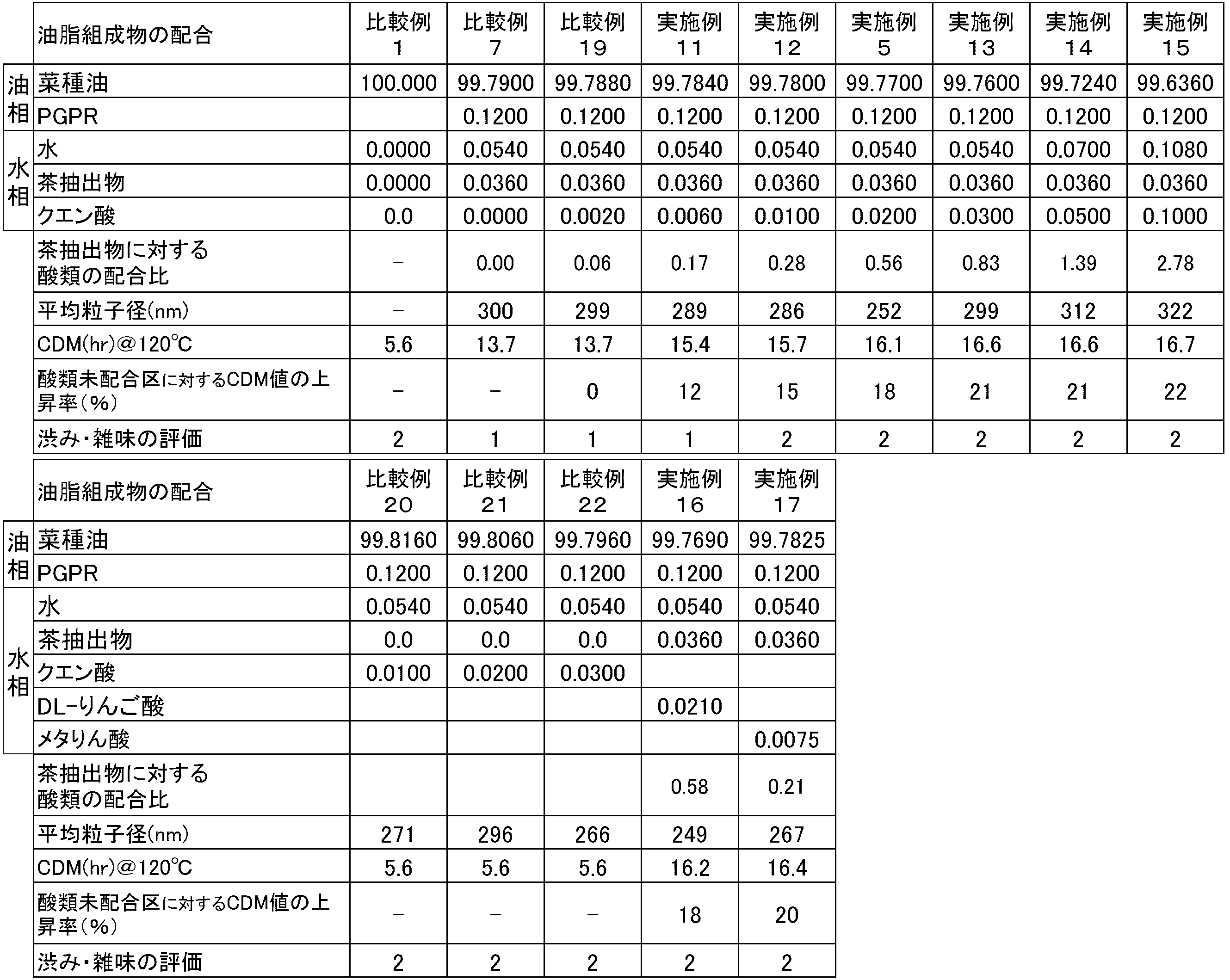
茶抽出物に対する酸類の配合量に応じ、酸化安定性の改善効果は変動し、0.1~5倍量が適切であった。
酸類のみでは酸化安定性は向上しないことがわかった。
酸類として有機酸であるDL-りんご酸を使用することでも効果が得られた。
酸類として無機酸であるメタりん酸を使用することでも効果が得られた。
よって有機酸としてDL-りんご酸が使用可能であることがわかった。
よって酸類として無機酸が使用可能であることがわかった。また無機酸としてメタりん酸が使用可能であることがわかった。
酸類のみでは酸化安定性は向上しないことがわかった。
酸類として有機酸であるDL-りんご酸を使用することでも効果が得られた。
酸類として無機酸であるメタりん酸を使用することでも効果が得られた。
よって有機酸としてDL-りんご酸が使用可能であることがわかった。
よって酸類として無機酸が使用可能であることがわかった。また無機酸としてメタりん酸が使用可能であることがわかった。
○油脂のみの保存試験結果(60℃静置)
(油脂組成物の酸化安定性の評価)
作製品の渋み・雑味 風味評価は熟練したパネル4名で行い、合意により風味評価点を決定した。風味評価点が1点以上の場合、合格と判断した。
2点:渋み・雑味を感じない。
1点:比較例1と異なる風味であるが、明確な渋み・雑味は感じられない。
0点:渋み・雑味が感じられる。
・菜種油調整品 80gを100mlガラス瓶に入れ、密封する。
・該ガラス瓶を、暗所60℃にて28日間保存する。
・保存後に、過酸化物価(POV)の測定及び、風味評価を行う。風味の評価項目を油脂の劣化臭とし、4名のパネラ-による10段階での官能評価により行った。
保存21日目の段階で評価点数5以上の評価となった油脂を良好と判断した。
官能評価 油脂劣化臭:数字が大きい方が劣化臭が弱く、数字が小さい方が劣化臭が強い。
評価結果を表3に示す。
(油脂組成物の酸化安定性の評価)
作製品の渋み・雑味 風味評価は熟練したパネル4名で行い、合意により風味評価点を決定した。風味評価点が1点以上の場合、合格と判断した。
2点:渋み・雑味を感じない。
1点:比較例1と異なる風味であるが、明確な渋み・雑味は感じられない。
0点:渋み・雑味が感じられる。
・菜種油調整品 80gを100mlガラス瓶に入れ、密封する。
・該ガラス瓶を、暗所60℃にて28日間保存する。
・保存後に、過酸化物価(POV)の測定及び、風味評価を行う。風味の評価項目を油脂の劣化臭とし、4名のパネラ-による10段階での官能評価により行った。
保存21日目の段階で評価点数5以上の評価となった油脂を良好と判断した。
官能評価 油脂劣化臭:数字が大きい方が劣化臭が弱く、数字が小さい方が劣化臭が強い。
評価結果を表3に示す。
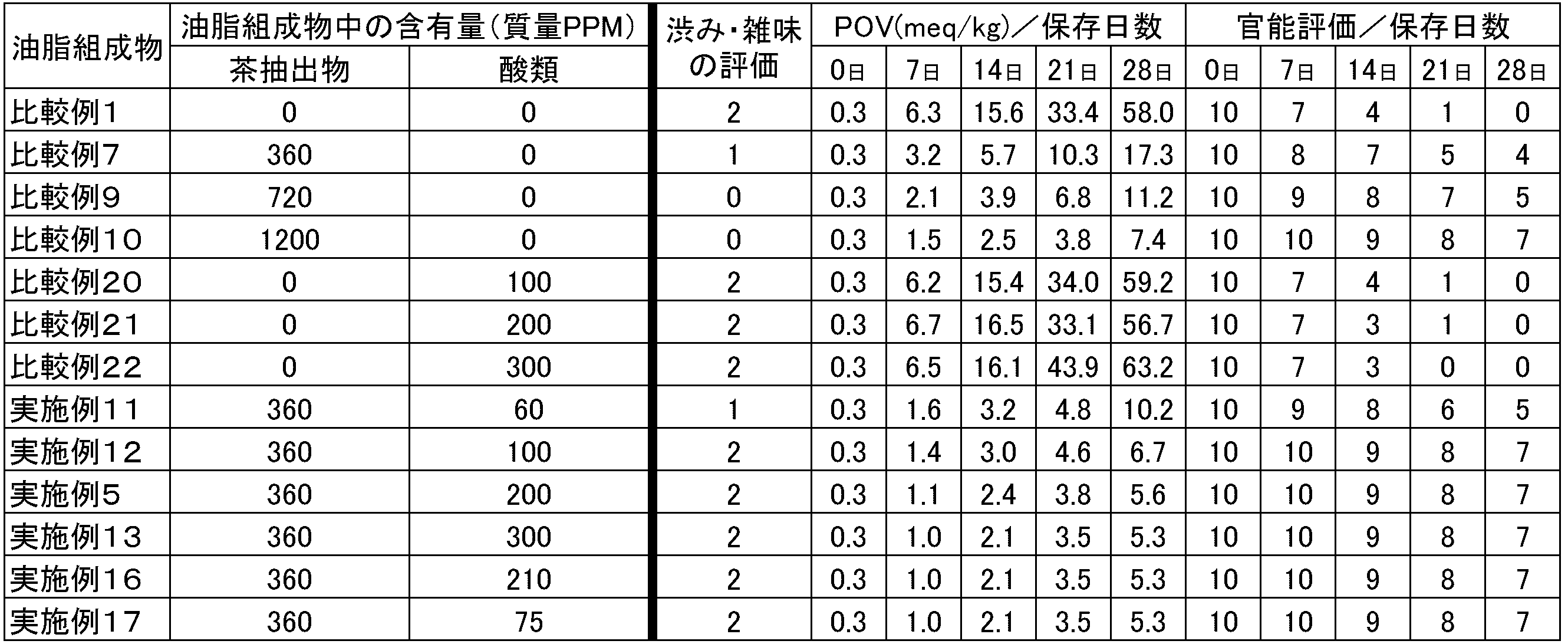
実施例は、茶抽出物含量が同等な、比較例7と対比すると、POV及び風味が良好に維持できた。実施例は茶抽出物が2倍量の比較例9と比較すると同等以上の品質となった。また、渋み雑味の点でも良好な結果が得られた。
使用する酸類として、有機酸であるクエン酸(実施例5、11、12、13)、DL-りんご酸(実施例16)、無機酸であるメタりん酸(実施例17)、何れの酸類を使用することでも前記効果が得られた。
使用する酸類として、有機酸であるクエン酸(実施例5、11、12、13)、DL-りんご酸(実施例16)、無機酸であるメタりん酸(実施例17)、何れの酸類を使用することでも前記効果が得られた。
○アプリケーション評価(米菓スプレーにて保存試験)
(米菓の作製法と評価方法)
市販の米菓(ノンオイル、着味無し)80部に対し、作製した各油脂組成物 20部をスプレーにて被覆し、米菓を作製した。
米菓の風味評価を行った。評価結果を表4に示す。
作製品の渋み・雑味 風味評価は熟練したパネル4名で行い、合意により風味評価点を決定した。風味評価点が1点以上の場合、合格と判断した。
2点:渋み・雑味を感じない。
1点:比較例1と異なる風味であるが、明確な渋み・雑味は感じられない。
0点:渋み・雑味が感じられる。
米菓をアルミ蒸着袋に入れ、60℃暗所にて保存し、経時的に米菓からヘキサンにて抽出した油脂のPOVを測定した。
また、保存後の風味を評価した。風味の評価項目を油脂の劣化臭とし、4名のパネラ-による10段階での官能評価により行った。保存7日目の段階で評価点数6以上の評価となった油脂を良好と判断した。
官能評価 油脂劣化臭:数字が大きい方が劣化臭が弱く、数字が小さい方が劣化臭が強かった。
(米菓の作製法と評価方法)
市販の米菓(ノンオイル、着味無し)80部に対し、作製した各油脂組成物 20部をスプレーにて被覆し、米菓を作製した。
米菓の風味評価を行った。評価結果を表4に示す。
作製品の渋み・雑味 風味評価は熟練したパネル4名で行い、合意により風味評価点を決定した。風味評価点が1点以上の場合、合格と判断した。
2点:渋み・雑味を感じない。
1点:比較例1と異なる風味であるが、明確な渋み・雑味は感じられない。
0点:渋み・雑味が感じられる。
米菓をアルミ蒸着袋に入れ、60℃暗所にて保存し、経時的に米菓からヘキサンにて抽出した油脂のPOVを測定した。
また、保存後の風味を評価した。風味の評価項目を油脂の劣化臭とし、4名のパネラ-による10段階での官能評価により行った。保存7日目の段階で評価点数6以上の評価となった油脂を良好と判断した。
官能評価 油脂劣化臭:数字が大きい方が劣化臭が弱く、数字が小さい方が劣化臭が強かった。

実施例5、11~13、16、17の油脂組成物を使用したアプリケーションは、茶抽出物含量が同等な比較例7の油脂組成物を使用したアプリケーションと比較して、POV及び風味が良好に維持できた。実施例は茶抽出物が2倍量の比較例9と比較すると同等以上の品質となった。また、渋み雑味の点でも良好な結果が得られた。油脂のみと同様の結果が得られた。
油脂のみと同様に、使用する酸類として、有機酸であるクエン酸(実施例5、11、12、13)、DL-りんご酸(実施例16)、無機酸であるメタりん酸(実施例17)、何れの酸類を使用することでも前記効果が得られた。
油脂のみと同様に、使用する酸類として、有機酸であるクエン酸(実施例5、11、12、13)、DL-りんご酸(実施例16)、無機酸であるメタりん酸(実施例17)、何れの酸類を使用することでも前記効果が得られた。
本発明により、茶抽出物が含まれる油脂において、茶抽出物の配合量を増やすことなく、あらゆる食品に利用可能な、酸化安定性が向上し、かつ風味良好な食用油脂を提供することができる。
Claims (7)
- 茶抽出物を50質量ppm~1000質量ppm、茶抽出物に対し0.1~5倍量の酸類を含有する油脂組成物。
- 水相の平均粒子径が1000nm以下である、請求項1に記載の油脂組成物。
- 茶抽出物を80質量ppm~800質量ppm含有する、請求項1又は請求項2に記載のに記載の油脂組成物。
- 請求項1~請求項3のいずれか1項に記載の油脂組成物を使用した食品。
- 油相及び下記水相を混合して作製する、請求項1~請求項3のいずれか1項に記載の油脂組成物の製造方法。
水相:茶抽出物及び酸類を溶解した水溶液 - 水相中に茶抽出物の1~5倍の水を含有する、請求項5に記載の油脂組成物の製造方法。
- 油脂組成物の製造において、油脂組成物中に分散させる水相に、茶抽出物及び酸類を含有させる、油脂組成物の酸化安定性向上方法。
Priority Applications (4)
| Application Number | Priority Date | Filing Date | Title |
|---|---|---|---|
| JP2021543729A JP7647561B2 (ja) | 2019-09-02 | 2020-08-27 | 油脂組成物 |
| EP20860159.1A EP4026432A4 (en) | 2019-09-02 | 2020-08-27 | Oil/fat composition |
| US17/639,584 US20220295810A1 (en) | 2019-09-02 | 2020-08-27 | Oil and fat composition |
| KR1020227006436A KR102939855B1 (ko) | 2019-09-02 | 2020-08-27 | 유지 조성물 |
Applications Claiming Priority (2)
| Application Number | Priority Date | Filing Date | Title |
|---|---|---|---|
| JP2019159671 | 2019-09-02 | ||
| JP2019-159671 | 2019-09-02 |
Publications (1)
| Publication Number | Publication Date |
|---|---|
| WO2021044945A1 true WO2021044945A1 (ja) | 2021-03-11 |
Family
ID=74852903
Family Applications (1)
| Application Number | Title | Priority Date | Filing Date |
|---|---|---|---|
| PCT/JP2020/032430 Ceased WO2021044945A1 (ja) | 2019-09-02 | 2020-08-27 | 油脂組成物 |
Country Status (5)
| Country | Link |
|---|---|
| US (1) | US20220295810A1 (ja) |
| EP (1) | EP4026432A4 (ja) |
| JP (1) | JP7647561B2 (ja) |
| KR (1) | KR102939855B1 (ja) |
| WO (1) | WO2021044945A1 (ja) |
Citations (11)
| Publication number | Priority date | Publication date | Assignee | Title |
|---|---|---|---|---|
| JPS63135483A (ja) | 1986-11-26 | 1988-06-07 | Sankyo Co Ltd | 抗酸化剤 |
| JP2000204370A (ja) | 1998-12-29 | 2000-07-25 | Nong Sim Co Ltd | 緑茶抽出物を用いた油溶性抗酸化剤の製造方法 |
| JP2002142673A (ja) | 2000-11-17 | 2002-05-21 | T Hasegawa Co Ltd | 油脂調理食品の親油性酸化防止剤およびその製造方法 |
| JP2010041965A (ja) | 2008-08-13 | 2010-02-25 | Ito En Ltd | カテキン分散油脂及びその製造方法 |
| JP2013159730A (ja) | 2012-02-07 | 2013-08-19 | Ogawa & Co Ltd | 油溶性酸化防止剤及びその製造方法 |
| WO2013172348A1 (ja) | 2012-05-16 | 2013-11-21 | 不二製油株式会社 | 食用油脂及びそれを含有する食品並びにその製造方法 |
| JP2015015907A (ja) * | 2013-07-09 | 2015-01-29 | 不二製油株式会社 | 冷菓用油脂 |
| JP2015037381A (ja) | 2009-03-18 | 2015-02-26 | 株式会社豊田中央研究所 | 筋細胞の出力装置及び筋細胞の出力評価方法 |
| JP2015084719A (ja) * | 2013-10-31 | 2015-05-07 | 不二製油株式会社 | 加熱調理用油脂 |
| JP2015116189A (ja) * | 2013-11-13 | 2015-06-25 | 不二製油株式会社 | 高度多価不飽和脂肪酸含有油脂およびそれを含有する食品ならびにその製造法 |
| JP2015188374A (ja) | 2014-03-28 | 2015-11-02 | 公益財団法人東洋食品研究所 | 養液栽培方法および養液栽培に使用する菌株 |
Family Cites Families (7)
| Publication number | Priority date | Publication date | Assignee | Title |
|---|---|---|---|---|
| JP2000229118A (ja) | 1999-02-09 | 2000-08-22 | Nisshin Oil Mills Ltd:The | 消臭・酸化防止用茶抽出物含有組成物 |
| WO2001096506A1 (fr) * | 2000-06-12 | 2001-12-20 | Fuji Oil Company, Limited | Procede servant a produire de la graisse |
| WO2008140065A2 (en) * | 2007-05-08 | 2008-11-20 | Fujifilm Corporation | Emulsion-containing composition, food and topical product, and method of preventing coagulation of polyphenol compound |
| KR101598667B1 (ko) | 2013-09-30 | 2016-02-29 | 주식회사 엘지화학 | 유리-폴리머 복합 기재 및 그 제조방법 |
| WO2016175169A1 (ja) * | 2015-04-27 | 2016-11-03 | 不二製油グループ本社株式会社 | 長鎖多価不飽和脂肪酸含有油脂の製造方法 |
| CN106889206B (zh) * | 2015-12-18 | 2021-05-04 | 丰益(上海)生物技术研发中心有限公司 | 一种煎炸专用油 |
| WO2017149701A1 (ja) * | 2016-03-02 | 2017-09-08 | 不二製油グループ本社株式会社 | 油脂組成物 |
-
2020
- 2020-08-27 KR KR1020227006436A patent/KR102939855B1/ko active Active
- 2020-08-27 JP JP2021543729A patent/JP7647561B2/ja active Active
- 2020-08-27 WO PCT/JP2020/032430 patent/WO2021044945A1/ja not_active Ceased
- 2020-08-27 US US17/639,584 patent/US20220295810A1/en not_active Abandoned
- 2020-08-27 EP EP20860159.1A patent/EP4026432A4/en active Pending
Patent Citations (11)
| Publication number | Priority date | Publication date | Assignee | Title |
|---|---|---|---|---|
| JPS63135483A (ja) | 1986-11-26 | 1988-06-07 | Sankyo Co Ltd | 抗酸化剤 |
| JP2000204370A (ja) | 1998-12-29 | 2000-07-25 | Nong Sim Co Ltd | 緑茶抽出物を用いた油溶性抗酸化剤の製造方法 |
| JP2002142673A (ja) | 2000-11-17 | 2002-05-21 | T Hasegawa Co Ltd | 油脂調理食品の親油性酸化防止剤およびその製造方法 |
| JP2010041965A (ja) | 2008-08-13 | 2010-02-25 | Ito En Ltd | カテキン分散油脂及びその製造方法 |
| JP2015037381A (ja) | 2009-03-18 | 2015-02-26 | 株式会社豊田中央研究所 | 筋細胞の出力装置及び筋細胞の出力評価方法 |
| JP2013159730A (ja) | 2012-02-07 | 2013-08-19 | Ogawa & Co Ltd | 油溶性酸化防止剤及びその製造方法 |
| WO2013172348A1 (ja) | 2012-05-16 | 2013-11-21 | 不二製油株式会社 | 食用油脂及びそれを含有する食品並びにその製造方法 |
| JP2015015907A (ja) * | 2013-07-09 | 2015-01-29 | 不二製油株式会社 | 冷菓用油脂 |
| JP2015084719A (ja) * | 2013-10-31 | 2015-05-07 | 不二製油株式会社 | 加熱調理用油脂 |
| JP2015116189A (ja) * | 2013-11-13 | 2015-06-25 | 不二製油株式会社 | 高度多価不飽和脂肪酸含有油脂およびそれを含有する食品ならびにその製造法 |
| JP2015188374A (ja) | 2014-03-28 | 2015-11-02 | 公益財団法人東洋食品研究所 | 養液栽培方法および養液栽培に使用する菌株 |
Non-Patent Citations (4)
| Title |
|---|
| "Stability Test", STANDARD METHODS FOR THE ANALYSIS OF FATS, OILS, AND RELATED MATERIALS, 1996 |
| BAN L. ET AL.: "Identification of Ingredients for Stabilizing Frying Oil Through a New Screening Method", J. AM. OIL CHEM. SOC., vol. 93, 2016, pages 1183 - 1190, XP036047786, DOI: 10.1007/s11746-016-2862-1 * |
| FUKASAWA RYO ET AL.: "Anti-oxidative effects of rooibos tea extract on autoxidation and thermal oxidation of lipids", J. OLEO SCI., vol. 58, no. 6, 2009, pages 275 - 283, XP055801102 * |
| See also references of EP4026432A4 |
Also Published As
| Publication number | Publication date |
|---|---|
| EP4026432A1 (en) | 2022-07-13 |
| US20220295810A1 (en) | 2022-09-22 |
| KR102939855B1 (ko) | 2026-03-13 |
| EP4026432A4 (en) | 2023-10-04 |
| JP7647561B2 (ja) | 2025-03-18 |
| JPWO2021044945A1 (ja) | 2021-03-11 |
| KR20220053573A (ko) | 2022-04-29 |
Similar Documents
| Publication | Publication Date | Title |
|---|---|---|
| JP6027749B2 (ja) | 油溶性酸化防止剤及びその製造方法 | |
| JP5652557B2 (ja) | 食用油脂及びそれを含有する食品並びにその製造方法 | |
| AU2018202247B2 (en) | Fat containing polyunsaturated fatty acid | |
| WO2009013757A1 (en) | Composition for protecting oils and fat | |
| JP2015116188A (ja) | 多価不飽和脂肪酸含有食用植物油脂 | |
| JP6680418B1 (ja) | 油脂組成物 | |
| JP6459161B2 (ja) | 製菓用油脂及びそれを利用した食品 | |
| Alamer et al. | Utilizing phenolic-enriched sunflower Oleogels and Emulgels as fat replacers: impact on burger oxidative stability, texture, and sensory attributes | |
| JP7342855B2 (ja) | 油脂組成物の製造方法 | |
| JP7647561B2 (ja) | 油脂組成物 | |
| JP6774045B1 (ja) | 油脂組成物 | |
| JP6303719B2 (ja) | 持続性のある風味の付与方法 | |
| JP7836150B2 (ja) | 劣化風味のマスキング方法、及び食品組成物 | |
| JP2019176788A (ja) | フライ麺臭のマスキング剤、フライ麺臭のマスキング方法及び即席フライ麺製品。 | |
| JP2020048488A (ja) | 調味料の製造方法 | |
| JP2014023462A (ja) | きな粉入り豆乳スプレッド | |
| JP2026054874A (ja) | 油溶性酸化防止剤組成物 | |
| WO2022065348A1 (ja) | 水中油型乳化調味料、及びその製造方法 | |
| JP2020110068A (ja) | 分離液状調味料の胡麻油の風味増強方法、及び分離液状調味料 |
Legal Events
| Date | Code | Title | Description |
|---|---|---|---|
| 121 | Ep: the epo has been informed by wipo that ep was designated in this application |
Ref document number: 20860159 Country of ref document: EP Kind code of ref document: A1 |
|
| ENP | Entry into the national phase |
Ref document number: 2021543729 Country of ref document: JP Kind code of ref document: A |
|
| NENP | Non-entry into the national phase |
Ref country code: DE |
|
| ENP | Entry into the national phase |
Ref document number: 2020860159 Country of ref document: EP Effective date: 20220404 |