WO2021045150A1 - 1,3-ブチレングリコール製品 - Google Patents
1,3-ブチレングリコール製品 Download PDFInfo
- Publication number
- WO2021045150A1 WO2021045150A1 PCT/JP2020/033418 JP2020033418W WO2021045150A1 WO 2021045150 A1 WO2021045150 A1 WO 2021045150A1 JP 2020033418 W JP2020033418 W JP 2020033418W WO 2021045150 A1 WO2021045150 A1 WO 2021045150A1
- Authority
- WO
- WIPO (PCT)
- Prior art keywords
- butylene glycol
- less
- ppm
- column
- glycol product
- Prior art date
- Legal status (The legal status is an assumption and is not a legal conclusion. Google has not performed a legal analysis and makes no representation as to the accuracy of the status listed.)
- Ceased
Links
Images

Classifications
-
- A—HUMAN NECESSITIES
- A61—MEDICAL OR VETERINARY SCIENCE; HYGIENE
- A61K—PREPARATIONS FOR MEDICAL, DENTAL OR TOILETRY PURPOSES
- A61K8/00—Cosmetics or similar toiletry preparations
- A61K8/18—Cosmetics or similar toiletry preparations characterised by the composition
- A61K8/30—Cosmetics or similar toiletry preparations characterised by the composition containing organic compounds
- A61K8/33—Cosmetics or similar toiletry preparations characterised by the composition containing organic compounds containing oxygen
- A61K8/34—Alcohols
- A61K8/345—Alcohols containing more than one hydroxy group
-
- A—HUMAN NECESSITIES
- A61—MEDICAL OR VETERINARY SCIENCE; HYGIENE
- A61Q—SPECIFIC USE OF COSMETICS OR SIMILAR TOILETRY PREPARATIONS
- A61Q19/00—Preparations for care of the skin
- A61Q19/007—Preparations for dry skin
-
- C—CHEMISTRY; METALLURGY
- C07—ORGANIC CHEMISTRY
- C07C—ACYCLIC OR CARBOCYCLIC COMPOUNDS
- C07C29/00—Preparation of compounds having hydroxy or O-metal groups bound to a carbon atom not belonging to a six-membered aromatic ring
- C07C29/132—Preparation of compounds having hydroxy or O-metal groups bound to a carbon atom not belonging to a six-membered aromatic ring by reduction of an oxygen containing functional group
- C07C29/136—Preparation of compounds having hydroxy or O-metal groups bound to a carbon atom not belonging to a six-membered aromatic ring by reduction of an oxygen containing functional group of >C=O containing groups, e.g. —COOH
- C07C29/14—Preparation of compounds having hydroxy or O-metal groups bound to a carbon atom not belonging to a six-membered aromatic ring by reduction of an oxygen containing functional group of >C=O containing groups, e.g. —COOH of a —CHO group
- C07C29/141—Preparation of compounds having hydroxy or O-metal groups bound to a carbon atom not belonging to a six-membered aromatic ring by reduction of an oxygen containing functional group of >C=O containing groups, e.g. —COOH of a —CHO group with hydrogen or hydrogen-containing gases
-
- C—CHEMISTRY; METALLURGY
- C07—ORGANIC CHEMISTRY
- C07C—ACYCLIC OR CARBOCYCLIC COMPOUNDS
- C07C29/00—Preparation of compounds having hydroxy or O-metal groups bound to a carbon atom not belonging to a six-membered aromatic ring
- C07C29/74—Separation; Purification; Use of additives, e.g. for stabilisation
- C07C29/76—Separation; Purification; Use of additives, e.g. for stabilisation by physical treatment
- C07C29/80—Separation; Purification; Use of additives, e.g. for stabilisation by physical treatment by distillation
-
- C—CHEMISTRY; METALLURGY
- C07—ORGANIC CHEMISTRY
- C07C—ACYCLIC OR CARBOCYCLIC COMPOUNDS
- C07C31/00—Saturated compounds having hydroxy or O-metal groups bound to acyclic carbon atoms
- C07C31/18—Polyhydroxylic acyclic alcohols
- C07C31/20—Dihydroxylic alcohols
- C07C31/207—1,4-Butanediol; 1,3-Butanediol; 1,2-Butanediol; 2,3-Butanediol
-
- A—HUMAN NECESSITIES
- A61—MEDICAL OR VETERINARY SCIENCE; HYGIENE
- A61K—PREPARATIONS FOR MEDICAL, DENTAL OR TOILETRY PURPOSES
- A61K2800/00—Properties of cosmetic compositions or active ingredients thereof or formulation aids used therein and process related aspects
- A61K2800/10—General cosmetic use
-
- A—HUMAN NECESSITIES
- A61—MEDICAL OR VETERINARY SCIENCE; HYGIENE
- A61Q—SPECIFIC USE OF COSMETICS OR SIMILAR TOILETRY PREPARATIONS
- A61Q19/00—Preparations for care of the skin
Definitions
- This disclosure relates to 1,3-butylene glycol products.
- This application claims the priority of Japanese Patent Application No. 2019-162351 and Japanese Patent Application No. 2019-162352 filed in Japan on September 5, 2019, and Japanese Patent Application No. 2020-001084 filed in Japan on January 7, 2020. And the contents are used here.
- 1,3-butylene glycol is a colorless, transparent, odorless liquid, has properties such as low volatility, low toxicity, and high hygroscopicity, and has excellent chemical stability. For this reason, 1,3-butylene glycol has a wide range of uses, including raw materials for various synthetic resins and surfactants, as well as cosmetics, hygroscopic agents, high boiling point solvents, and antifreeze materials. Particularly in recent years, attention has been paid to the fact that 1,3-butylene glycol has excellent properties as a moisturizer, and the demand in the cosmetics industry is expanding.
- the 1,3-butylene glycol obtained by the conventional production method sometimes had an odor due to the influence of by-products. Further, even if it is transparent immediately after production, it may be colored with time, which has been a problem when it is stored for a long period of time.
- the cosmetics When using cosmetics or storing them after use, the cosmetics will be exposed to the air. In addition, when manufacturing cosmetics, the work is generally performed in an air atmosphere, and the cosmetics may be heated for the purpose of sterilization or the like. When 1,3-butylene glycol obtained by a conventional method is used in cosmetics, coloring may occur due to the presence of air or the influence of heating.
- 1,3-butylene glycol obtained by the conventional production method has a problem that the acid concentration (acidity) increases after a long period of time in a state of containing water.
- the cause of the increase in acid concentration was not clear, but it was thought to be related to the by-products contained in the crude 1,3-butylene glycol.
- Cosmetics generally contain water, and it takes a long time from manufacturing to actual use by general consumers.
- the liquid properties of cosmetics are strictly adjusted from the viewpoint of storage stability and the like.
- 1,3-butylene glycol obtained by a conventional method is used in cosmetics, there is a high possibility that the liquid balance of the cosmetics will be lost due to an increase in acid concentration, and the effect that should be exhibited originally will be lost.
- the increase in acid concentration may cause rough skin of the user.
- even cosmetics that do not contain water may increase their acid concentration by absorbing moisture during use or storage.
- the 1,3-butylene glycol products obtained from these purification methods still contain by-products and have a problem of having an odor.
- coloring occurs with time.
- acid concentration increases with time when water is contained.
- an object of the present disclosure is to provide a high-purity 1,3-butylene glycol product which is colorless and odorless, is less likely to be colored with time, and is less likely to cause an increase in acid concentration with time even in a state containing water. To do.
- the inventors of the present disclosure have found that one of the causes of the increase in the acid concentration of the 1,3-butylene glycol product obtained by the conventional production method is 1,3-butylene glycol.
- by-products contained in the product were hydrolyzed in the presence of water to produce organic acids (eg acetic acid).
- organic acids eg acetic acid.
- Sample introduction temperature 250 ° C
- Carrier gas Gas flow rate of helium column: 1 mL / min
- Detector and detection temperature Hydrogen flame ionization detector (FID), 280 ° C
- the area ratio of the peak appearing in the relative retention time in the range of 2.3 to 2.4 is preferably 1000 ppm or less.
- the above 1,3-butylene glycol product preferably has a peak area ratio of 100 ppm or less that appears in the relative retention time range of 1.35 to 1.45.
- the above 1,3-butylene glycol product preferably has an APHA of 60 or less after being held at 180 ° C. for 3 hours in an air atmosphere.
- the 1,3-butylene glycol product preferably has an acid concentration (acetic acid equivalent) of 0.002% by weight or less after holding a 90% by weight aqueous solution at 100 ° C. for 1 week.
- the 1,3-butylene glycol in the above 1,3-butylene glycol product is preferably a reduced product of at least one compound selected from the group consisting of acetaldehyde, paraaldol, and aldoxane.
- the present disclosure also provides a moisturizer containing a 1,3-butylene glycol product.
- the present disclosure also provides cosmetics containing the moisturizer.
- the 1,3-butylene glycol products of the present disclosure are colorless and odorless, are less likely to be colored over time, and are less likely to increase in acid concentration over time even when they contain water, so that they are used in cosmetics, moisturizers, etc. Suitable for applications.
- the first aspect of the 1,3-butylene glycol product according to the present disclosure is the relative retention time when the relative retention time of the peak of 1,3-butylene glycol is 1.0 in the gas chromatography analysis under the following conditions. Is characterized in that the area ratio of the peak appearing in the range of 1.6 to 1.8 is 2000 ppm or less.
- the second aspect of the 1,3-butylene glycol product according to the present disclosure is the relative retention time when the relative retention time of the peak of 1,3-butylene glycol is 1.0 in the gas chromatography analysis under the following conditions.
- the characteristic is that the area ratio of the peak appearing in the range of 2.3 to 2.4 is 1000 ppm or less, and the area ratio of the peak appearing in the relative holding time range of 1.35 to 1.45 is 100 ppm or less.
- the first aspect and the second aspect of the 1,3-butylene glycol product according to the present disclosure may be collectively referred to as "the 1,3-butylene glycol product of the present disclosure”.
- Analytical column A column in which the stationary phase is dimethylpolysiloxane (thickness 1.0 ⁇ m ⁇ length 30 m ⁇ inner diameter 0.25 mm) Temperature rise conditions: After raising the temperature from 80 ° C. to 120 ° C. at 5 ° C./min, the temperature is raised to 160 ° C. at 2 ° C./min and held for 2 minutes. Further, the temperature is raised to 230 ° C. at 10 ° C./min and held at 230 ° C. for 18 minutes. Sample introduction temperature: 250 ° C Carrier gas: Gas flow rate of helium column: 1 mL / min Detector and detection temperature: Hydrogen flame ionization detector (FID), 280 ° C
- FID Hydrogen flame ionization detector
- the "area ratio" of a peak means the ratio of the area of a specific peak to the sum of the areas of all the peaks appearing in the chart. Further, all peaks appear when, for example, when the relative retention time of the peak of 1,3-butylene glycol is 1.0, the analysis is continued until the relative retention time reaches 7.8 and then stopped. Means all of the peaks. When the area ratio of the peak is in the above range, the generation of odor and the coloring due to aging tend to be reduced.
- the relative retention time is 1.6 to 1 when the relative retention time of the peak of 1,3-butylene glycol in the gas chromatography analysis under the above conditions is 1.0.
- the area ratio of the peak appearing in the range of .8 is, for example, preferably 2000 ppm or less, more preferably 1000 ppm or less, still more preferably 600 ppm or less, still more preferably 400 ppm or less, and particularly preferably 200 ppm or less.
- the lower limit of the area ratio may be, for example, 10 ppm, 20 ppm, 50 ppm, or 100 ppm.
- the main component is considered to be a trimer hydride of the raw material (acetaldehyde). That is, the 1,3-butylene glycol product of the present disclosure preferably has a low content of by-products such as the hydride.
- the relative retention time is 2.3 to 2 when the relative retention time of the peak of 1,3-butylene glycol in the gas chromatography analysis under the above conditions is 1.0.
- the area ratio of the peak appearing in the range of .4 is, for example, preferably 1000 ppm or less, more preferably 500 ppm or less, further preferably 250 ppm or less, still more preferably 200 ppm or less, still more preferably 150 ppm or less, still more preferably 100 ppm.
- it is particularly preferably 50 ppm or less, and most preferably 20 ppm or less.
- Examples of the component corresponding to the peak having a relative retention time in the range of 2.3 to 2.4 when the relative retention time of the peak of 1,3-butylene glycol is 1.0 include 1,3-butylene.
- An acetal form of glycol and acetaldol can be mentioned.
- the acetal form is a by-product having a boiling point higher than that of 1,3-butylene glycol. That is, the 1,3-butylene glycol product of the present disclosure preferably has a low content of the acetal compound as a by-product.
- the relative retention time is 1.35 to 1 when the relative retention time of the peak of 1,3-butylene glycol in the gas chromatography analysis under the above conditions is 1.0.
- the area ratio of the peak appearing in the range of .45 is, for example, preferably 100 ppm or less, more preferably 50 ppm or less, still more preferably 20 ppm or less, and particularly preferably 10 ppm or less.
- the area ratio of the peak is in the above range, the generation of odor and the increase in acid concentration with time in a state containing water tend to be reduced.
- the components corresponding to the peaks whose relative retention time appears in the range of 1.35 to 1.45 include, for example, acetic acid and 1,3. -Esters with butylene glycol can be mentioned. That is, the 1,3-butylene glycol product of the present disclosure preferably has a low content of the ester as a by-product.
- the area ratio of the peak of 1,3-butylene glycol in the gas chromatography analysis under the above conditions is preferably, for example, 99.5% or more, more preferably 99. It is 7.7% or more, more preferably 99.8% or more, and particularly preferably 99.9% or more.
- the area ratio of the peak is in the above range, the generation of odor, coloring with time, and increase in acid concentration with time in a state containing water tend to be reduced.
- the Hazen color number (APHA) of the 1,3-butylene glycol product of the present disclosure after being held at 180 ° C. for 3 hours in an air atmosphere is not particularly limited, but is preferably 60 or less, more preferably 60 or less, for example. It is 40 or less, more preferably 30 or less.
- the APHA after holding at 100 ° C. for 75 days in an air atmosphere is not particularly limited, but is preferably 40 or less, more preferably 30 or less, still more preferably 20 or less, and particularly preferably 15 or less.
- the lower limit may be, for example, 1, 3, 5, or 10.
- the APHA of the 1,3-butylene glycol product of the present disclosure is not particularly limited, but is preferably 20 or less, more preferably 10 or less, for example. , More preferably 5 or less.
- the lower limit of APHA may be, for example, 1 or 2.
- the ratio of APHA after holding at 180 ° C. for 3 hours to APHA before holding [(APHA after holding at 180 ° C. for 3 hours) / (APHA before holding) ] is not particularly limited, but is preferably 15 or less, and more preferably 12 or less. Further, the above ratio may be 1 or more, and may be 2 or more, or 5 or more.
- the ratio of APHA after holding at 100 ° C. for 75 days to APHA before holding [(APHA after holding at 100 ° C. for 75 days) / (APHA before holding). ]
- APHA after holding at 100 ° C. for 75 days APHA before holding
- the acid concentration (acetic acid equivalent) after holding the 90% by weight aqueous solution at 100 ° C. for 1 week is not particularly limited, but may be, for example, 0.002% by weight or less. It is preferably more preferably 0.0015% by weight or less, further preferably 0.001% by weight or less, and particularly preferably 0.0005% by weight or less.
- the lower limit of the acid concentration may be, for example, 0.00005% by weight or 0.0001% by weight.
- the 90% by weight aqueous solution means an aqueous solution prepared by mixing a 1,3-butylene glycol product and water (for example, pure water) so that the 1,3-butylene glycol product is 90% by weight.
- the acid concentration (acetic acid equivalent) of the 90% by weight aqueous solution is preferably within the above range.
- the acid concentration after retention / (acid concentration before retention) ⁇ 100 (%)] is not particularly limited, but is preferably 200% or less, more preferably 150% or less, still more preferably 120% or less.
- the 1,3-butylene glycol in the 1,3-butylene glycol product of the present disclosure is, for example, (1) a reduced product of acetoaldoles, (2) a hydrolyzate of 1,3-butylene oxide, and (3) erythritol. Selective hydrocracked product, (4) Selective water addition to butadiene, (5) N-butanol-3-one hydride, (6) 1-butanol-3-one hydride, (7) Examples thereof include hydrides of 3-hydroxy-1-butanoic acid, (8) hydrides of ⁇ -butyrolactone, and (9) hydrides of diketen.
- the 1,3-butylene glycol of the present disclosure may be one or a mixture of two or more of the above (1) to (9).
- the 1,3-butylene glycol in the 1,3-butylene glycol product of the present disclosure is preferably (1) a reduced form of acetaldehydes.
- the reduced form of acetaldehyde is preferably a liquid phase reduced form of acetaldehyde from the viewpoint of the yield of 1,3-butylene glycol.
- the reason is that acetaldols have a high boiling point, acetaldols are heat-unstable, and easily undergo a dehydration reaction at high temperatures to become crotonaldehyde, etc., and further, dehydration reactions at high temperatures.
- the reduction reaction (hydrogenation reaction) is due to the fact that the former reaction rate is high.
- 1,3-butylene glycol as a reduced form of acetaldehyde can be rephrased as 1,3-butylene glycol obtained by a method of reducing acetaldehyde with hydrogen.
- 1,3-butylene glycol as a liquid phase reducer of acetaldehyde can be rephrased as 1,3-butylene glycol obtained by a method of hydrogen reducing acetaldehyde in the liquid phase.
- 1,3-butylene glycol as a hydrolyzate of 1,3-butylene oxide can be rephrased as 1,3-butylene glycol obtained by hydrolyzing 1,3-butylene oxide.
- 1,3-butylene glycol when 1,3-butylene glycol is produced, by-products are produced in the production process.
- 1,3-butylene glycol is produced by hydrogen reduction of acetaldehydes, a low boiling point substance (low boiling point compound) having an unsaturated bond such as acetaldehyde, butylaldehyde, crotonaldehyde, acetone, or methyl vinyl ketone, or
- condensates eg, acetaldehyde trimer
- hydrides of the condensate condensates of 1,3-butylene glycol and the low boiling point (eg, 1,3-butylene glycol and acetalaldehyde).
- Acetal form etc.
- acetal forms of crotonaldehyde and 1,3-butylene glycol, acetal forms of acetaldehyde and 1,3-butylene glycol, acetal forms of acetaldehyde and acetaldehyde and acetaldehyde trimeric hydrides are by-produced. ..
- acetic acid contained as an impurity in acetaldehyde as a raw material acetic acid used for neutralizing caustic soda used in the production of acetaldehyde, and a condensate of 1,3-butylene glycol. (Ester form of acetic acid and 1,3-butylene glycol) is produced as a by-product.
- these by-products can have properties as color-causing substances, odor-causing substances, and even acidic-causing substances.
- the acetal body is a color-causing substance, an odor-causing substance, or an acidic-causing substance, and it is possible that the acetal body has all the properties, but it has a strong property as an odor-causing substance. it is conceivable that. Specifically, although the acetal body itself is unlikely to be an odor-causing substance, there is a possibility that an odor-causing substance may be generated due to aging or heating. In addition, the acetal form may generate acetaldehyde by hydrolysis, which can be said to be a coloring-causing substance because it is an odor-causing substance and has an oxidation (coloring) promoting action.
- the color-causing substance is defined as including not only a substance that actually has a hue itself but also a substance that changes to a substance having a hue over time.
- An odor-causing substance is defined as a substance that includes not only a substance that actually emits an odor but also a substance that changes into a substance that emits an odor over time.
- An acid-causing substance is defined as a substance whose acid concentration increases with time when it contains water.
- the ester is a color-causing substance, an odor-causing substance, or an acidic-causing substance, and it is possible that the ester has all properties, but both properties as an odor-causing substance and an acidic-causing substance. It is considered that the substance has a strong color. This is because acetic acid is generated when the ester is hydrolyzed by water.
- 1,3-butylene glycol When 1,3-butylene glycol is produced, there are a wide variety of by-products in the production process, which correspond to coloring-causing substances, odor-causing substances, or acidic-causing substances, in addition to the acetal and ester forms. It is thought to contain by-products.
- the above-mentioned acetaldehyde trimer hydride may correspond to any of a color-causing substance, an odor-causing substance, and an acidic-causing substance.
- the relative retention time of the peak of 1,3-butylene glycol is 1.0
- the relative retention time of the acetaldehyde is considered to correspond to the peak appearing in the range of 1.6 to 1.8.
- 1,3-butylene glycol products in which the amount of trimer hydride is reduced to a certain extent (for example, the peak area ratio is 2000 ppm or less) are colorless and odorless, are less likely to be colored over time, and further add water. It has a feature that the acid concentration does not easily increase with time even in the state of containing.
- the ester compound, which is considered to be one of the peak components appearing in the relative retention time in the range of 1.35 to 1.45, has a certain degree (for example, the former peak area ratio is 1000 ppm or less and the latter area ratio is 100 ppm or less).
- the reduced 1,3-butylene glycol products have similar characteristics. Further, the 1,3-butylene glycol product in which all of the acetaldehyde trimer hydride, the acetal form, and the ester form are reduced has the above-mentioned characteristics.
- Hydrogenated raw materials containing acetaldehyde are used for the production of 1,3-butylene glycol.
- the acetaldols are not particularly limited as long as they are compounds that become 1,3-butylene glycol by hydrogen reduction, and are, for example, acetaldol, its cyclized dimer paraaldol, and a kind of cyclic trimer of acetaldehyde. Examples thereof include aldoxane and a mixture thereof.
- the method for producing acetaldehydes is not particularly limited.
- acetaldehyde and paraaldol are not particularly limited.
- Even those obtained by the aldol condensation reaction of acetaldehyde in the presence of a basic catalyst can be obtained by thermal decomposition of aldoxane or the like. It may be a thing.
- the crude reaction solution containing acetaldehydes obtained by the above reaction may be neutralized with an acid and used for the production of 1,3-butylene glycol.
- reaction crude liquid may contain acetaldehyde, crotonaldehyde, other aldehyde components, low boiling point substances, high boiling point substances such as aldehyde dimers and trimmers, water, salts and the like.
- a compound having a boiling point lower than that of 1,3-butylene glycol may be referred to as a "low boiling point substance”
- a compound having a boiling point higher than that of 1,3-butylene glycol may be referred to as a "high boiling point substance”.
- the crude reaction solution may be subjected to pretreatment such as dealcohol distillation, dehydration distillation, desalting, demineralization, etc. to remove by-products such as unreacted acetaldehyde and crotonaldehyde. ..
- pretreatment method include distillation, adsorption, ion exchange, heating to a high boiling point, decomposition and the like.
- various distillation methods such as reduced pressure, normal pressure, pressure, azeotrope, extraction, and reaction can be used.
- the content of acetaldehyde in the hydrogenated raw material is not particularly limited, but is preferably 50% by weight or more (for example, 50 to 99% by weight), and more preferably 60% by weight or more (for example, 60 to 98% by weight). ), More preferably 65 to 98% by weight, particularly preferably 80 to 95% by weight, and most preferably 85 to 95% by weight.
- impurities contained in the crude 1,3-butylene glycol tend to be reduced.
- the hydrogenated raw material may or may not contain water, but it is preferable to contain it from the viewpoint of the purity of the 1,3-butylene glycol product.
- the content of water in the hydrogenated raw material is not particularly limited, but is, for example, 2% by weight or more, more preferably 5% by weight or more, still more preferably 10% by weight or more, and particularly preferably 15% by weight or more.
- the upper limit may be, for example, 50% by weight, 40% by weight, or 35% by weight.
- the acetal form of 1,3-butylene glycol and acetaldehyde contained in the obtained crude 1,3-butylene glycol, and the ester of acetic acid and 1,3-butylene glycol Due to the reduction of various by-products, including the body, the final 1,3-butylene glycol product tends to be more pure. This is because the acetal form is hydrolyzed to 1,3-butylene glycol due to the hydrogenation raw material containing water to some extent, and the symbiotic acetaldol is reduced to 1,3-butylene glycol. Due to becoming. Further, it is caused by the fact that the hydrogenated raw material contains water to some extent, so that the ester is hydrolyzed to 1,3-butylene glycol.
- crude 1,3-butylene glycol is obtained by reducing a hydrogenated raw material containing acetaldehydes in the presence of a hydrogenated catalyst.
- the hydrogenated catalyst examples include Raney nickel and the like.
- the hydrogenated catalyst can be used by suspending or filling it, but it is preferable to suspend or use it.
- the amount of the hydrogenated catalyst used is not particularly limited, but is preferably 1 to 30 parts by weight, more preferably 4 to 25 parts by weight, still more preferably 8 to 20 parts by weight, based on 100 parts by weight of the hydrogenated raw material. , Particularly preferably 12 to 18 parts by weight.
- the amount of hydrogen used in the reduction reaction is not particularly limited, but is preferably 0.5 to 40 parts by weight, more preferably 1 to 30 parts by weight, still more preferably 4 to 20 parts by weight, based on 100 parts by weight of the hydrogenated raw material. It is by weight, particularly preferably 8 to 12 parts by weight.
- the pressure (total pressure) in the reaction system in the reduction reaction is not particularly limited, but is preferably 150 to 500 atm, more preferably 180 to 450 atm, still more preferably 200 to 400 atm, and particularly preferably 250 to 350 atm.
- the ratio of the hydrogen pressure (partial pressure of hydrogen) to the total pressure in the reaction system is not particularly limited, but is preferably 80% or more (80 to 100%) of the total pressure, and more preferably 85 to 99. It is 9%, more preferably 90 to 99.5%, and particularly preferably 95 to 99%.
- the hydrogen pressure (partial pressure of hydrogen) in the reaction system is not particularly limited, but is preferably 100 to 500 atm, more preferably 150 to 450 atm, still more preferably 150 to 400 atm, and particularly preferably 200 to 350 atm.
- the reaction temperature in the reduction reaction is not particularly limited, but is preferably 110 to 140 ° C, more preferably 120 to 140 ° C, for example.
- the reaction time (residence time) in the reduction reaction is not particularly limited, but is preferably, for example, 30 to 300 minutes, more preferably 80 to 280 minutes, and even more preferably 120 to 250 minutes.
- the acetoaldoles can be converted to 1,3-butylene glycol.
- the reaction rate hydrogenation rate
- the acetalization reaction of 1,3-butylene glycol and acetaldehyde tends to be reduced, and the 1,3-butylene glycol product of the present disclosure having high purity tends to be obtained. This tendency is particularly strongly influenced by the hydrogen pressure in the reduction reaction.
- the reaction rate (reduction rate) from acetaldehydes to 1,3-butylene glycol is remarkably improved, and as a result, 1,3-butylene glycol and aceto
- the acetal form with aldol is reduced, and a high-purity 1,3-butylene glycol product can be obtained.
- hydrogenation of the carboxylic acid portion of the ester form proceeds rapidly to become an alcohol.
- the ester of acetic acid and 1,3-butylene glycol is reduced, and a high-purity 1,3-butylene glycol product can be obtained.
- This reaction can be carried out in a batch system, a semi-batch system, or a continuous system.
- the crude 1,3-butylene glycol obtained by hydrogenation of the hydrogenated raw material is subjected to, for example, a dehydration step, a desalting step, a dehigh boiling point distillation step, an alkali reaction step, a dealkali step, and a distillation step.
- 1,3-butylene glycol product can be obtained.
- the content of the high boiling point of the crude 1,3-butylene glycol is not particularly limited, but is preferably 0.1 to 20% by weight, more preferably 1 to 15% by weight, and further preferably 2 to 2 to 20% by weight. It is 10% by weight.
- the content of the high boiling point substance in the crude 1,3-butylene glycol is within the above range, the amount of by-products contained in the finally obtained 1,3-butylene glycol product tends to be reduced.
- the content of the high boiling point in the crude 1,3-butylene glycol after the dehigh boiling point distillation step is 1.0% by weight or less, preferably 0.5% by weight or less.
- FIG. 1 is a flow sheet of an apparatus showing an example of an embodiment for obtaining the 1,3-butylene glycol product of the present disclosure.
- A is a dehydration tower and is related to the dehydration process.
- B is a desalination tower and is related to the desalination process.
- C is a dehigh boiling point distillation column and is related to the dehigh boiling point distillation step.
- D is an alkaline reactor and is related to the alkaline reaction step.
- E is a dealkali tower and is related to the dealkali step.
- F is a product distillation column and is related to the distillation process.
- A-1, B-1, C-1, E-1, and F-1 are capacitors.
- A-2, C-2, and F-2 are reboilers.
- the crude 1,3-butylene glycol (corresponding to "X-1") obtained by hydrogenation of the hydrogenated raw material is supplied to the dehydration column A.
- the dehydration column A water is distilled from the top of the column by distillation, and a crude 1,3-butylene glycol stream containing 1,3-butylene glycol is obtained from the bottom of the column.
- the crude 1,3-butylene glycol flow is supplied to the desalting column B.
- the desalting column B a crude 1,3-butylene glycol flow after desalting is obtained from the top of the column by distillation, and salts, high boiling point substances and the like are discharged from the bottom of the column.
- the crude 1,3-butylene glycol flow after desalting is supplied to the dehigh boiling point distillation column C.
- the dehigh boiling point distillation column C the high boiling point is discharged from the bottom of the column.
- a crude 1,3-butylene glycol flow after the dehigh boiling point is obtained from the top of the column.
- the crude 1,3-butylene glycol distilled by the dehigh boiling point distillation column C is supplied to an alkaline reactor (for example, a flow tube type reactor) D and subjected to base treatment.
- 0.05 to 10% by weight, preferably 0.1 to 1.0% by weight, of the base is added to the crude 1,3-butylene glycol flow after the dehigh boiling point. ..
- the amount of the base added exceeds 10% by weight, the base tends to precipitate in the distillation column, piping, etc., causing clogging.
- decomposition reactions of high boiling point compounds may occur, and by-products tend to be generated on the contrary. If it is less than 0.05% by weight, the effect of decomposing by-products is small, which is not preferable.
- the base added in the alkali reactor D or upstream thereof is not particularly limited, but for example, an alkali metal compound is preferable.
- the alkali metal compound include caustic soda, caustic potash, (heavy) sodium carbonate, and (heavy) potassium carbonate, but from the viewpoint of reducing by-products contained in the finally obtained 1,3-butylene glycol product. , Caustic soda, caustic potash are preferred.
- a solid base may be added as it is, but it is preferable to add the base as an aqueous solution in order to promote contact with the target liquid in terms of operation.
- the above-mentioned bases may be used alone or in combination of two or more.
- the reaction temperature in the alkaline reactor D is not particularly limited, but is preferably 90 to 140 ° C, more preferably 110 to 130 ° C, for example. If the reaction temperature is less than 90 ° C, a long reaction residence time is required, which increases the reactor capacity and is uneconomical. If the reaction temperature exceeds 140 ° C, the final 1,3-butylene is obtained. The increase in coloration of glycol products.
- the reaction residence time is, for example, preferably 5 to 120 minutes, more preferably 10 to 30 minutes. If the reaction residence time is less than 5 minutes, the reaction will be insufficient and the quality of the finally obtained 1,3-butylene glycol product will deteriorate, and if the reaction residence time exceeds 120 minutes, a large reactor will be required. This is disadvantageous from the viewpoint of economic efficiency because the equipment cost is high.
- the reaction crude liquid flow is supplied to the de-alkali column (thin film evaporator) E, and bases and the like are removed from the bottom of the column by evaporation.
- a crude 1,3-butylene glycol flow after debasement can be obtained from the top of the de-alkali tower E.
- the evaporator used in the dealkalizing column E a natural flow type thin film evaporator and a forced stirring type thin film evaporator having a short residence time are suitable for the purpose of suppressing the thermal history to the process fluid.
- the top of the column is evaporated under a reduced pressure of 100 torr or less, preferably 5 to 20 torr.
- the temperature of the evaporator is preferably 90 to 120 ° C., for example.
- a crude 1,3-butylene glycol stream containing a low boiling point distilled from the top of the column is supplied to the product distillation column F.
- Examples of the product distillation column F include a perforated plate tower, a bubble bell tower, etc., but a filling tower with low pressure loss filled with sluzer packing, Melapack (both are trade names of Sumitomo Heavy Industries, Ltd.), etc. More preferred. This is because 1,3-butylene glycol is thermally decomposed at a high temperature (for example, 150 ° C. or higher) to produce a low boiling point product, so that the distillation temperature is lowered. This is also because the same effect occurs when the heat history (residence time) of 1,3-butylene glycol is long.
- the reboiler to be adopted is preferably one having a short residence time of the fluid on the process side, for example, a thin film evaporator such as a natural flow type thin film evaporator or a forced stirring type thin film evaporator.
- the theoretical plate number is preferably 10 to 20 stages, for example.
- the charging liquid is preferably supplied from the top of the column to a position 20 to 70% of the height of the column.
- the pressure at the top of the column is preferably 100 torr or less, more preferably 5 to 20 torr.
- the reflux ratio is preferably, for example, 0.5 to 2.0.
- the moisturizers of the present disclosure include the above 1,3-butylene glycol products. Therefore, it is excellent in moisturizing performance, has no coloring or odor, is less likely to be colored with time, and is less likely to cause an increase in acid concentration with time even in a state containing water.
- the moisturizer of the present disclosure may contain a component other than the above-mentioned 1,3-butylene glycol product, for example, a moisturizer component other than the above-mentioned 1,3-butylene glycol product.
- the content of the above 1,3-butylene glycol product is, for example, 10% by weight or more, preferably 30% by weight or more, more preferably 50% by weight or more, still more preferably 80% by weight or more. Particularly preferably, it is 90% by weight or more, and may be composed only of the above-mentioned 1,3-butylene glycol products.
- the cosmetics disclosed in this disclosure include the above moisturizers.
- the blending amount of the above 1,3-butylene glycol product in the cosmetics of the present disclosure may be an amount capable of exhibiting moisturizing performance according to the type and form of the cosmetics.
- the blending amount of the 1,3-butylene glycol product in the cosmetics of the present disclosure is, for example, 0.01 to 40% by weight, preferably 0.1 to 30% by weight, more preferably 0.2 to 20% by weight, and further. It is preferably 0.5 to 15% by weight, particularly preferably 1 to 10% by weight.
- the cosmetics of the present disclosure include, for example, other moisturizers; oils such as vegetable oils, hydrocarbon oils, higher fatty acids, higher alcohols, silicones; anionic surfactants, cationic surfactants.
- Surfactants such as agents, amphoteric surfactants, nonionic surfactants; preservatives, metal ion blockers, thickeners, powders, UV absorbers, UV blockers, fragrances, pH adjusters; vitamins, It may contain a medicinal ingredient such as a skin activator, a blood circulation promoter, a whitening agent, an antibacterial agent, an anti-inflammatory agent, a physiologically active ingredient, and the like.
- the cosmetics disclosed in the present disclosure can be skin cosmetics such as lotions, milky lotions, creams, gels, packs and masks, and hair cosmetics such as shampoos, conditioners and hair restorers. It can also be used as a sunscreen cosmetic or a make-up cosmetic. It can also be a drug or a quasi-drug containing a medical ingredient.
- the cosmetics disclosed in the present disclosure can be produced by a method known per se.
- Example 1 A method for producing 1,3-butylene glycol will be described with reference to FIG.
- 100 parts of an acetoaldole solution containing 30% by weight of water as a raw material a mixed solution of 70 parts of acetoaldole and 30 parts of water
- 10 parts of hydrogen was charged into a liquid phase hydrogen reduction reactor, and 15 parts of lane nickel was added as a catalyst.
- the reactor was maintained at 135 ° C. and 300 atm for liquid phase hydrogen reduction.
- the liquid after the reaction was neutralized with caustic soda after separating the catalyst, and alcohols were removed to obtain crude 1,3-butylene glycol (1).
- crude 1,3-butylene glycol (2) was charged into the desalting tower B.
- salt, a high boiling point substance, and a part of 1,3-butylene glycol were discharged as an evaporation residue from the bottom of the column (corresponding to "X-3" in FIG. 1).
- the amount of the evaporation residue discharged was 5 parts with respect to 100 parts of the charged liquid amount.
- crude 1,3-butylene glycol (3) containing 1,3-butylene glycol, a low boiling point substance, and a part of a high boiling point substance was obtained from the top of the column.
- crude 1,3-butylene glycol (3) was charged into the dehigh boiling point distillation column C.
- a high boiling point and a part of 1,3-butylene glycol were discharged from the bottom of the column (corresponding to "X-4" in FIG. 1).
- the discharge amount was 20 parts with respect to 100 parts of the charged liquid amount.
- 80 parts of crude 1,3-butylene glycol (4) containing a low boiling point substance was obtained from the top of the column.
- crude 1,3-butylene glycol (4) was charged into the alkaline reactor D.
- the reaction crude liquid discharged from the alkali reactor D was charged into the dealkali tower E.
- the de-alkali column E caustic soda, a high boiling point substance, and a part of 1,3-butylene glycol were discharged from the bottom of the column (corresponding to "X-5" in FIG. 1).
- the discharge amount was 10 parts with respect to 100 parts of the charged liquid amount.
- 90 parts of crude 1,3-butylene glycol (5) containing 1,3-butylene glycol and a low boiling point substance was obtained from the top of the column.
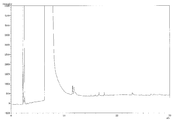
- the peak in the relative retention time range of 2.3 to 2.4 was below the detection limit (10 ppm or less). It was. In addition, the peak with a relative holding time in the range of 1.35 to 1.45 was also below the detection limit (10 ppm or less). The area ratio of the peaks appearing in the relative retention time in the range of 1.6 to 1.8 was 130 ppm.
- the time-dependent coloring test 1 was performed, the APHA was 21 after holding at 180 ° C. for 3 hours in an air atmosphere. Moreover, when the time-dependent coloring test 2 was performed, the APHA was 10 after being kept at 100 ° C.
- the APHA was 80 after holding at 180 ° C. for 3 hours in an air atmosphere. Moreover, when the time-dependent coloring test 2 was performed, the APHA was 46 after being kept at 100 ° C. for 75 days in an air atmosphere. The APHA before performing these tests was 4. Furthermore, the score of the odor test was 2.
- Sample introduction and temperature Split sample introduction method, 250 ° C Split gas flow rate and carrier gas: 23 mL / min, helium column gas flow rate and carrier gas: 1 mL / min, helium detector and temperature: flame ionization detector (FID), 280 ° C.
- Injection sample 0.2 ⁇ L 80 wt% 1,3-butylene glycol product aqueous solution
- time-dependent coloring test 1 The target 1,3-butylene glycol product was placed in a wide-mouthed bottle, sealed tightly, and kept in a constant temperature bath set at 180 ° C. for 3 hours. Using a color difference meter (“ZE6000” manufactured by Nippon Denshoku Kogyo Co., Ltd.), the Hazen color number (APHA) of the 1,3-butylene glycol product after holding was measured using a quartz cell having an optical path length of 10 mm.
- ZE6000 manufactured by Nippon Denshoku Kogyo Co., Ltd.
- Acid concentration (% by weight) titration (ml) x F x A x (100 / sample amount (g))
- F 1.0 (factor of 0.01N sodium hydroxide aqueous solution)
- Analytical column A column in which the stationary phase is dimethylpolysiloxane (thickness 1.0 ⁇ m ⁇ length 30 m ⁇ inner diameter 0.25 mm)
- Temperature rise conditions After raising the temperature from 80 ° C. to 120 ° C. at 5 ° C./min, the temperature is raised to 160 ° C. at 2 ° C./min and held for 2 minutes. Further, the temperature is raised to 230 ° C. at 10 ° C./min and held at 230 ° C. for 18 minutes.
- Analytical column A column in which the stationary phase is dimethylpolysiloxane (thickness 1.0 ⁇ m ⁇ length 30 m ⁇ inner diameter 0.25 mm)
- Temperature rise conditions After raising the temperature from 80 ° C. to 120 ° C. at 5 ° C./min, the temperature is raised to 160 ° C. at 2 ° C./min and held for 2 minutes. Further, the temperature is raised to 230 ° C. at 10 ° C./min and held at 230 ° C. for 18 minutes.
- Analytical column A column in which the stationary phase is dimethylpolysiloxane (thickness 1.0 ⁇ m ⁇ length 30 m ⁇ inner diameter 0.25 mm)
- Temperature rise conditions After raising the temperature from 80 ° C. to 120 ° C. at 5 ° C./min, the temperature is raised to 160 ° C. at 2 ° C./min and held for 2 minutes. Further, the temperature is raised to 230 ° C. at 10 ° C./min and held at 230 ° C. for 18 minutes.
- the 1,3 according to [4], wherein the component corresponding to the peak having a relative retention time in the range of 1.35 to 1.45 contains an ester of acetic acid and 1,3-butylene glycol. -Butylene glycol products.
- the area ratio of the peak of 1,3-butylene glycol in the gas chromatography analysis under the above conditions is 99.5% or more, 99.7% or more, 99.8% or more, or 99.9% or more.
- the 1,3-butylene glycol product according to any one of [1] to [7].
- the APHA after holding at 180 ° C.
- the APHA after holding at 100 ° C. for 75 days in an air atmosphere is 40 or less, 30 or less, 20 or less, or 15 or less, and the lower limit is 1, 3, 5, or 10. [1] ] To [9], the 1,3-butylene glycol product according to any one of. [11] The 1,3-butylene glycol product according to any one of [1] to [10], wherein the APHA is 20 or less, 10 or less, or 5 or less, and the lower limit is 1 or 2.
- the ratio of APHA after holding at 180 ° C. for 3 hours to APHA before holding [(APHA after holding at 180 ° C. for 3 hours) / (APHA before holding)] is 15 or less or 12 or less.
- the ratio of APHA after holding at 100 ° C. for 75 days to APHA before holding [(APHA after holding at 100 ° C. for 75 days) / (APHA before holding)] is 10 or less or 7 or less.
- the acid concentration (acetic acid equivalent) after holding the 90% by weight aqueous solution at 100 ° C. for 1 week is 0.002% by weight or less, 0.0015% by weight or less, 0.001% by weight or less, or 0.0005% by weight.
- the acid concentration (in terms of acetic acid) of the 90 wt% aqueous solution the ratio to the acid concentration after holding at 100 ° C. for 1 week before holding the acid concentration [(acid concentration after holding at 100 ° C.
- Product. [16] The 1,3-butylene glycol product according to any one of [1] to [15], which is a reduced form of acetaldehydes.
- 1,3-butylene glycol in a 1,3-butylene glycol product is a reduced form of at least one compound selected from the group consisting of acetaldehyde, paraaldol, and aldoxane, [1] to [16]. ], The 1,3-butylene glycol product according to any one of the above.
- the 1,3-butylene glycol products of the present disclosure are colorless and odorless, are less likely to be colored over time, and are less likely to increase in acid concentration over time even when they contain water, so that they are used in cosmetics, moisturizers, etc. Suitable for applications.
Landscapes
- Organic Chemistry (AREA)
- Chemical & Material Sciences (AREA)
- Health & Medical Sciences (AREA)
- Life Sciences & Earth Sciences (AREA)
- Veterinary Medicine (AREA)
- Animal Behavior & Ethology (AREA)
- General Health & Medical Sciences (AREA)
- Public Health (AREA)
- Dermatology (AREA)
- Emergency Medicine (AREA)
- Birds (AREA)
- Epidemiology (AREA)
- Organic Low-Molecular-Weight Compounds And Preparation Thereof (AREA)
- Cosmetics (AREA)
Abstract
Description
1,3-ブチレングリコールのピークの相対保持時間を1.0としたとき、
相対保持時間が1.6~1.8の範囲に現れるピークの面積率が2000ppm以下である、1,3-ブチレングリコール製品を提供する。
(ガスクロマトグラフィー分析の条件)
分析カラム:固定相がジメチルポリシロキサンであるカラム(膜厚1.0μm×長さ30m×内径0.25mm)
昇温条件:5℃/分で80℃から120℃まで昇温した後、2℃/分で160℃まで昇温し2分保持する。さらに、10℃/分で230℃まで昇温し、230℃で18分保持する。
試料導入温度:250℃
キャリアガス:ヘリウム
カラムのガス流量:1mL/分
検出器及び検出温度:水素炎イオン化検出器(FID)、280℃
本開示に係る1,3-ブチレングリコール製品の第一の態様は、下記条件のガスクロマトグラフィー分析において、1,3-ブチレングリコールのピークの相対保持時間を1.0としたとき、相対保持時間が1.6~1.8の範囲に現れるピークの面積率が2000ppm以下であることを特徴とする。本開示に係る1,3-ブチレングリコール製品の第二の態様は、下記条件のガスクロマトグラフィー分析において、1,3-ブチレングリコールのピークの相対保持時間を1.0としたとき、相対保持時間が2.3~2.4の範囲に現れるピークの面積率が1000ppm以下であり、相対保持時間が1.35~1.45の範囲に現れるピークの面積率が100ppm以下であることを特徴とする。本開示に係る1,3-ブチレングリコール製品の第一の態様及び第二の態様を合わせて、以下、「本開示の1,3-ブチレングリコール製品」と称する場合がある。
分析カラム:固定相がジメチルポリシロキサンであるカラム(膜厚1.0μm×長さ30m×内径0.25mm)
昇温条件:5℃/分で80℃から120℃まで昇温した後、2℃/分で160℃まで昇温し2分保持する。さらに、10℃/分で230℃まで昇温し、230℃で18分保持する。
試料導入温度:250℃
キャリアガス:ヘリウム
カラムのガス流量:1mL/分
検出器及び検出温度:水素炎イオン化検出器(FID)、280℃
本開示の保湿剤は、上記の1,3-ブチレングリコール製品を含む。そのため、保湿性能に優れるとともに、着色や臭いがなく、また経時による着色が生じにくく、さらに水を含む状態においても経時による酸濃度の上昇が生じにくい。本開示の保湿剤は、上記の1,3-ブチレングリコール製品以外の成分、例えば、上記の1,3-ブチレングリコール製品以外の保湿剤成分等を含んでいてもよい。本開示の保湿剤において、上記の1,3-ブチレングリコール製品の含有量は、例えば10重量%以上、好ましくは30重量%以上、より好ましくは50重量%以上、さらに好ましくは80重量%以上、特に好ましくは90重量%以上であり、上記の1,3-ブチレングリコール製品のみで構成されていてもよい。
図1を用いて1,3-ブチレングリコールの製造方法を説明する。
原料として30重量%の水を含むアセトアルドール溶液100部(アセトアルドール70部と水30部の混合溶液)に対し、水素10部を液相水素還元用反応器に仕込み、触媒としてラネーニッケルを15部加え、該反応器を135℃、300atmに保持して液相水素還元を行った。反応後の液は触媒を分離した後、苛性ソーダで中和し、アルコール類を除去して粗1,3-ブチレングリコール(1)を得た。
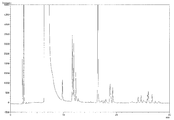
株式会社ダイセル製13ブチレングリコール(品番:13BGO)について、後述の条件にてガスクロマトグラフィー分析を行った結果、相対保持時間が2.3~2.4の範囲に現れるピークの面積率は1137ppmであった。また、相対保持時間が1.35~1.45の範囲に現れるピークの面積率は135ppmであった。また、相対保持時間が1.6~1.8の範囲に現れるピークの面積率は1010ppmであった。後述の水分添加加熱試験を行ったところ、酸濃度は0.0024重量%であり、加熱前の酸濃度の0.0005重量%から大幅に増加したことがわかった。経時着色試験1を行ったところ、空気雰囲気下、180℃で3時間保持した後のAPHAは80であった。また、経時着色試験2を行ったところ、空気雰囲気下、100℃で75日保持した後のAPHAは46であった。なお、これらの試験を行う前のAPHAは4であった。さらに、臭気試験の点数は2であった。
以下の条件で、対象となる1,3-ブチレングリコール製品のガスクロマトグラフィー分析を行った。実施例1における1,3-ブチレングリコールのガスクロマトグラフィー分析のチャートを図2に示す。また、比較例1における1,3-ブチレングリコールのガスクロマトグラフィー分析のチャートを図3に示す。
(ガスクロマトグラフィー分析の条件)
分析装置:島津 GC2010
分析カラム:Agilent J&W GC カラム - DB-1(固定相がジメチルポリシロキサンであるカラム、膜厚1.0μm×長さ30m×内径0.25mm、アジレント・テクノロジー株式会社製)
昇温条件:5℃/分で80℃から120℃まで昇温した後、2℃/分で160℃まで昇温し2分保持する。さらに、10℃/分で230℃まで昇温し、230℃で18分保持する。
試料導入及び温度:スプリット試料導入法、250℃
スプリットのガス流量及びキャリアガス:23mL/分、ヘリウム
カラムのガス流量及びキャリアガス:1mL/分、ヘリウム
検出器及び温度:水素炎イオン化検出器(FID)、280℃
注入試料:0.2μLの80重量%1,3-ブチレングリコール製品水溶液
対象となる1,3-ブチレングリコール製品を広口瓶に入れて密栓し、180℃に設定した恒温槽に3時間保持した。色差計(日本電色工業社製「ZE6000」)を用い、光路長10mmの石英セルを使用して保持後の1,3-ブチレングリコール製品のハーゼン色数(APHA)を測定した。
対象となる1,3-ブチレングリコール製品を広口瓶に入れて密栓し、100℃に設定した恒温槽に75日保持した。色差計(日本電色工業社製「ZE6000」)を用い、光路長10mmの石英セルを使用して保持後の1,3-ブチレングリコール製品のハーゼン色数(APHA)を測定した。
対象となる1,3-ブチレングリコール製品を90重量%の水溶液に調整し、100℃で1週間保持した後のものをサンプルとして、以下の手法により酸濃度分析を行った。なお、保持前の酸濃度分析は、100℃で1週間保持する前の1,3-ブチレングリコール製品を対象としたこと以外は同様にして行った。
(酸濃度分析)
電位差自動滴定装置(京都電子工業製AT-510)を用いて電位差滴定法によって測定した。サンプル50gを蒸留水50gで希釈し、撹拌しながら0.01Nの水酸化ナトリウム水溶液を自動終点停止するまでビュレットから滴定した。次いで、下記式に基づいて酢酸換算の酸濃度を算出した。
酸濃度(重量%)=滴定量(ml)×F×A×(100/サンプル量(g))
F:1.0(0.01N水酸化ナトリウム水溶液のファクター)
A:0.0006(1mlの水酸化ナトリウム水溶液に相当する酢酸のグラム数)
対象となる1,3-ブチレングリコール製品(100ml)を広口試薬瓶(内容積:100ml)に入れ、密栓し室温にて約120分静置した後、栓を開け、300ml広口ビーカーに移し、その中に純水100mlを入れて合計200mlとし、広口ビーカーを手で揺らすことにより撹拌し、速やかに臭いを嗅ぎ、以下の評価にて点数を付けた。
1:臭いを感じない
2:僅かに臭気がある
[1] 1,3-ブチレングリコール製品。
[2] 下記条件のガスクロマトグラフィー分析において、
1,3-ブチレングリコールのピークの相対保持時間を1.0としたとき、
相対保持時間が1.6~1.8の範囲に現れるピークの面積率が、2000ppm以下、1000ppm以下、600ppm以下、400ppm以下、若しくは200ppm以下であるか、又は、前記ピークの面積率の下限は、10ppm、20ppm、50ppm、若しくは100ppmである、[1]に記載の1,3-ブチレングリコール製品。
(ガスクロマトグラフィー分析の条件)
分析カラム:固定相がジメチルポリシロキサンであるカラム(膜厚1.0μm×長さ30m×内径0.25mm)
昇温条件:5℃/分で80℃から120℃まで昇温した後、2℃/分で160℃まで昇温し2分保持する。さらに、10℃/分で230℃まで昇温し、230℃で18分保持する。
試料導入温度:250℃
キャリアガス:ヘリウム
カラムのガス流量:1mL/分
検出器及び検出温度:水素炎イオン化検出器(FID)、280℃
[3] 下記条件のガスクロマトグラフィー分析において、
1,3-ブチレングリコールのピークの相対保持時間を1.0としたとき、
相対保持時間が2.3~2.4の範囲に現れるピークの面積率が、1000ppm以下、500ppm以下、250ppm以下、200ppm以下、150ppm以下、100ppm以下、50ppm以下、又は20ppm以下である、[1]又は[2]に記載の1,3-ブチレングリコール製品。
(ガスクロマトグラフィー分析の条件)
分析カラム:固定相がジメチルポリシロキサンであるカラム(膜厚1.0μm×長さ30m×内径0.25mm)
昇温条件:5℃/分で80℃から120℃まで昇温した後、2℃/分で160℃まで昇温し2分保持する。さらに、10℃/分で230℃まで昇温し、230℃で18分保持する。
試料導入温度:250℃
キャリアガス:ヘリウム
カラムのガス流量:1mL/分
検出器及び検出温度:水素炎イオン化検出器(FID)、280℃
[4] 下記条件のガスクロマトグラフィー分析において、
1,3-ブチレングリコールのピークの相対保持時間を1.0としたとき、
相対保持時間が1.35~1.45の範囲に現れるピークの面積率が、100ppm以下、50ppm以下、20ppm以下、又は10ppm以下である、[1]~[3]のいずれか一つに記載の1,3-ブチレングリコール製品。
(ガスクロマトグラフィー分析の条件)
分析カラム:固定相がジメチルポリシロキサンであるカラム(膜厚1.0μm×長さ30m×内径0.25mm)
昇温条件:5℃/分で80℃から120℃まで昇温した後、2℃/分で160℃まで昇温し2分保持する。さらに、10℃/分で230℃まで昇温し、230℃で18分保持する。
試料導入温度:250℃
キャリアガス:ヘリウム
カラムのガス流量:1mL/分
検出器及び検出温度:水素炎イオン化検出器(FID)、280℃
[5]前記1.6~1.8の範囲に現れるピークに該当する成分が、原料(アセトアルデヒド)の三量体の水素化物を含む、[2]に記載の1,3-ブチレングリコール製品。
[6]前記2.3~2.4の範囲に現れるピークに該当する成分が、1,3-ブチレングリコールとアセトアルドールとのアセタール体を含む、[3]に記載の1,3-ブチレングリコール製品。
[7]前記相対保持時間が1.35~1.45の範囲に現れるピークに該当する成分が、酢酸と1,3-ブチレングリコールとのエステル体を含む、[4]に記載の1,3-ブチレングリコール製品。
[8] 前記条件のガスクロマトグラフィー分析における1,3-ブチレングリコールのピークの面積率が、99.5%以上、99.7%以上、99.8%以上、又は99.9%以上である、[1]~[7]のいずれか一つに記載の1,3-ブチレングリコール製品。
[9] 空気雰囲気下、180℃で3時間保持した後のAPHAが、60以下、40以下、又は30以下であり、下限が、1、3、5、又は10である、[1]~[8]のいずれか一つに記載の1,3-ブチレングリコール製品。
[10] 空気雰囲気下、100℃で75日保持した後のAPHAが、40以下、30以下、20以下、又は15以下であり、下限が、1、3、5、又は10である、[1]~[9]のいずれか一つに記載の1,3-ブチレングリコール製品。
[11] APHAが、20以下、10以下、又は5以下であり、下限が、1又は2である、[1]~[10]のいずれか一つに記載の1,3-ブチレングリコール製品。
[12] 180℃で3時間保持した後のAPHAの、保持前のAPHAに対する比率[(180℃3時間保持後のAPHA)/(保持前のAPHA)]が、15以下又は12以下であり、1以上、2以上、又は5以上である、[1]~[11]のいずれか一つに記載の1,3-ブチレングリコール製品。
[13] 100℃で75日間保持した後のAPHAの、保持前のAPHAに対する比率[(100℃75日間保持後のAPHA)/(保持前のAPHA)]が、10以下又は7以下であり、1以上又は2以上である、[1]~[12]のいずれか一つに記載の1,3-ブチレングリコール製品。
[14] 90重量%水溶液を100℃で1週間保持した後の酸濃度(酢酸換算)が0.002重量%以下、0.0015重量%以下、0.001重量%以下、又は0.0005重量%以下であり、前記酸濃度の下限が、0.00005重量%又は0.0001重量%である、[1]~[13]のいずれか一つに記載の1,3-ブチレングリコール製品。
[15] 90重量%水溶液の酸濃度(酢酸換算)について、100℃で1週間保持した後の酸濃度の保持前の、酸濃度に対する比率[(100℃1週間保持後の酸濃度)/(保持前の酸濃度)×100(%)]が、200%以下、150%以下、又は120%以下である、[1]~[14]のいずれか一つに記載の1,3-ブチレングリコール製品。
[16] アセトアルドール類の還元体である、[1]~[15]のいずれか一つに記載の1,3-ブチレングリコール製品。
[17] 1,3-ブチレングリコール製品における1,3-ブチレングリコールが、アセトアルドール、パラアルドール、及びアルドキサンからなる群より選択される少なくとも1つの化合物の還元体である、[1]~[16]のいずれか一つに記載の1,3-ブチレングリコール製品。
[18] [1]~[17]のいずれか一つに記載の1,3-ブチレングリコール製品を含む保湿剤。
[19] [18]に記載の保湿剤を含む化粧料。
B:脱塩塔
C:脱高沸点物蒸留塔
D:アルカリ反応器
E:脱アルカリ塔
F:製品蒸留塔
A-1、B-1、C-1、E-1、F-1:コンデンサー
A-2、C-2、F-2:リボイラー
X-1:粗1,3-ブチレングリコール
X-2:水(排水)
X-3:塩、高沸点物、及び1,3-ブチレングリコールの一部
X-4:高沸点物及び1,3-ブチレングリコールの一部
X-5:苛性ソーダ、高沸点物、及び1,3-ブチレングリコールの一部
X-6:低沸点物及び1,3-ブチレングリコールの一部
Y:1,3-ブチレングリコール製品
Claims (9)
- 下記条件のガスクロマトグラフィー分析において、
1,3-ブチレングリコールのピークの相対保持時間を1.0としたとき、
相対保持時間が1.6~1.8の範囲に現れるピークの面積率が2000ppm以下である、1,3-ブチレングリコール製品。
(ガスクロマトグラフィー分析の条件)
分析カラム:固定相がジメチルポリシロキサンであるカラム(膜厚1.0μm×長さ30m×内径0.25mm)
昇温条件:5℃/分で80℃から120℃まで昇温した後、2℃/分で160℃まで昇温し2分保持する。さらに、10℃/分で230℃まで昇温し、230℃で18分保持する。
試料導入温度:250℃
キャリアガス:ヘリウム
カラムのガス流量:1mL/分
検出器及び検出温度:水素炎イオン化検出器(FID)、280℃ - さらに、相対保持時間が2.3~2.4の範囲に現れるピークの面積率が1000ppm以下であることを特徴とする請求項1に記載の1,3-ブチレングリコール製品。
- さらに、相対保持時間が1.35~1.45の範囲に現れるピークの面積率が100ppm以下であることを特徴とする請求項1に記載の1,3-ブチレングリコール製品。
- さらに、相対保持時間が1.35~1.45の範囲に現れるピークの面積率が100ppm以下であることを特徴とする請求項2に記載の1,3-ブチレングリコール製品。
- 空気雰囲気下、180℃で3時間保持した後のAPHAが60以下である請求項1~4の何れか1項に記載の1,3-ブチレングリコール製品。
- 90重量%水溶液を100℃で1週間保持した後の酸濃度(酢酸換算)が0.002重量%以下である請求項1~5の何れか1項に記載の1,3-ブチレングリコール製品。
- 1,3-ブチレングリコール製品における1,3-ブチレングリコールが、アセトアルドール、パラアルドール、及びアルドキサンからなる群より選択される少なくとも1つの化合物の還元体である請求項1~6の何れか1項に記載の1,3-ブチレングリコール製品。
- 請求項1~7の何れか1項に記載の1,3-ブチレングリコール製品を含む保湿剤。
- 請求項8に記載の保湿剤を含む化粧料。
Priority Applications (7)
| Application Number | Priority Date | Filing Date | Title |
|---|---|---|---|
| KR1020247022084A KR20240110101A (ko) | 2019-09-05 | 2020-09-03 | 1,3-부틸렌 글리콜 제품 |
| CN202411548146.XA CN119552058A (zh) | 2019-09-05 | 2020-09-03 | 1,3-丁二醇制品 |
| KR1020227010746A KR102682294B1 (ko) | 2019-09-05 | 2020-09-03 | 1,3-부틸렌 글리콜 제품 |
| EP20861176.4A EP4026824A4 (en) | 2019-09-05 | 2020-09-03 | 1,3-BUTYLENE GLYCOL PRODUCT |
| US17/640,387 US12458571B2 (en) | 2019-09-05 | 2020-09-03 | 1,3-butylene glycol product |
| CN202080062393.2A CN114341090A (zh) | 2019-09-05 | 2020-09-03 | 1,3-丁二醇制品 |
| US19/364,623 US20260042724A1 (en) | 2019-09-05 | 2025-10-21 | 1,3-butylene glycol product |
Applications Claiming Priority (6)
| Application Number | Priority Date | Filing Date | Title |
|---|---|---|---|
| JP2019-162351 | 2019-09-05 | ||
| JP2019-162352 | 2019-09-05 | ||
| JP2019162352A JP6804602B1 (ja) | 2019-09-05 | 2019-09-05 | 1,3−ブチレングリコール製品 |
| JP2019162351A JP6804601B1 (ja) | 2019-09-05 | 2019-09-05 | 1,3−ブチレングリコール製品 |
| JP2020-001084 | 2020-01-07 | ||
| JP2020001084A JP6979473B2 (ja) | 2020-01-07 | 2020-01-07 | 1,3−ブチレングリコール製品 |
Related Child Applications (2)
| Application Number | Title | Priority Date | Filing Date |
|---|---|---|---|
| US17/640,387 A-371-Of-International US12458571B2 (en) | 2019-09-05 | 2020-09-03 | 1,3-butylene glycol product |
| US19/364,623 Continuation-In-Part US20260042724A1 (en) | 2019-09-05 | 2025-10-21 | 1,3-butylene glycol product |
Publications (1)
| Publication Number | Publication Date |
|---|---|
| WO2021045150A1 true WO2021045150A1 (ja) | 2021-03-11 |
Family
ID=74852204
Family Applications (3)
| Application Number | Title | Priority Date | Filing Date |
|---|---|---|---|
| PCT/JP2020/033416 Ceased WO2021045148A1 (ja) | 2019-09-05 | 2020-09-03 | 1,3-ブチレングリコール製品 |
| PCT/JP2020/033417 Ceased WO2021045149A1 (ja) | 2019-09-05 | 2020-09-03 | 1,3-ブチレングリコール製品 |
| PCT/JP2020/033418 Ceased WO2021045150A1 (ja) | 2019-09-05 | 2020-09-03 | 1,3-ブチレングリコール製品 |
Family Applications Before (2)
| Application Number | Title | Priority Date | Filing Date |
|---|---|---|---|
| PCT/JP2020/033416 Ceased WO2021045148A1 (ja) | 2019-09-05 | 2020-09-03 | 1,3-ブチレングリコール製品 |
| PCT/JP2020/033417 Ceased WO2021045149A1 (ja) | 2019-09-05 | 2020-09-03 | 1,3-ブチレングリコール製品 |
Country Status (5)
| Country | Link |
|---|---|
| US (3) | US12521328B2 (ja) |
| EP (3) | EP4026825A4 (ja) |
| KR (6) | KR102682257B1 (ja) |
| CN (7) | CN117105744A (ja) |
| WO (3) | WO2021045148A1 (ja) |
Cited By (3)
| Publication number | Priority date | Publication date | Assignee | Title |
|---|---|---|---|---|
| WO2022244791A1 (ja) | 2021-05-18 | 2022-11-24 | Khネオケム株式会社 | 製品1,3-ブチレングリコール |
| WO2022255436A1 (ja) | 2021-06-04 | 2022-12-08 | Khネオケム株式会社 | 製品1,3-ブチレングリコール |
| EP4083010A4 (en) * | 2019-12-28 | 2024-03-13 | Daicel Corporation | 1,3-BUTYLENE GLYCOL PRODUCT |
Families Citing this family (1)
| Publication number | Priority date | Publication date | Assignee | Title |
|---|---|---|---|---|
| WO2021045148A1 (ja) | 2019-09-05 | 2021-03-11 | 株式会社ダイセル | 1,3-ブチレングリコール製品 |
Citations (13)
| Publication number | Priority date | Publication date | Assignee | Title |
|---|---|---|---|---|
| JPS6165834A (ja) * | 1984-09-07 | 1986-04-04 | Daicel Chem Ind Ltd | 1,3−ブチレングリコ−ルの精製法 |
| JPS62246529A (ja) * | 1986-03-24 | 1987-10-27 | Daicel Chem Ind Ltd | 1,3−ブチレングリコ−ルの製造方法 |
| JPH07258129A (ja) | 1994-03-17 | 1995-10-09 | Daicel Chem Ind Ltd | 1,3−ブチレングリコ−ルの精製方法 |
| WO2000007969A1 (en) | 1998-08-07 | 2000-02-17 | Daicel Chemical Industries, Ltd. | 1,3-butylene glycol of high purity and method for producing the same |
| JP2001213822A (ja) | 2000-02-04 | 2001-08-07 | Daicel Chem Ind Ltd | 1,3−ブチレングリコールの製造方法 |
| JP2001213824A (ja) | 2000-02-04 | 2001-08-07 | Daicel Chem Ind Ltd | 精製1,3−ブチレングリコールの製造方法 |
| JP2001213828A (ja) | 2000-02-04 | 2001-08-07 | Daicel Chem Ind Ltd | 1,3−ブチレングリコールの精製方法 |
| JP2001213825A (ja) | 2000-02-04 | 2001-08-07 | Daicel Chem Ind Ltd | 高純度1,3−ブチレングリコール |
| JP2003096006A (ja) * | 2001-09-26 | 2003-04-03 | Kyowa Yuka Co Ltd | 1,3−ブチレングリコールおよびその製造方法 |
| JP2007517882A (ja) * | 2004-01-08 | 2007-07-05 | セラニーズ・インターナショナル・コーポレーション | 1,3−ブチレングリコールを製造するための方法 |
| JP2019162351A (ja) | 2018-03-20 | 2019-09-26 | 株式会社三洋物産 | 遊技機 |
| JP2019162352A (ja) | 2018-03-20 | 2019-09-26 | 株式会社三洋物産 | 遊技機 |
| JP2020001084A (ja) | 2018-06-29 | 2020-01-09 | 富士ゼロックス株式会社 | インパクトプレス装置、製造装置、及び製造方法 |
Family Cites Families (19)
| Publication number | Priority date | Publication date | Assignee | Title |
|---|---|---|---|---|
| JPH07969Y2 (ja) | 1986-09-24 | 1995-01-18 | ワイケイケイ株式会社 | スライドフアスナ−用上止め具取付け装置 |
| US6900360B2 (en) | 2000-02-04 | 2005-05-31 | Daicel Chemical Industries, Ltd. | High-purity 1,3-butylen glycol, process for producing 1,3-butylene glycol, and process for producing by-product butanol and butyl acetate |
| JP2001288131A (ja) | 2000-02-04 | 2001-10-16 | Daicel Chem Ind Ltd | 精製1,3−ブチレングリコールの製造方法 |
| EP1211234A3 (en) * | 2000-11-29 | 2003-11-26 | Samsung Electronics Co., Ltd. | Process for preparing 1,3-alkandiols from 3-hydroxyesters |
| US20090112026A1 (en) | 2007-10-29 | 2009-04-30 | Carter Technologies | Formation of hydroxycarbonyl compounds |
| JP5170382B2 (ja) | 2007-11-07 | 2013-03-27 | 学校法人東京理科大学 | 不斉触媒アルドール反応生成物の製造方法 |
| CN101665409A (zh) | 2008-09-04 | 2010-03-10 | 中国科学院兰州化学物理研究所 | 离子液体催化合成1,3-二元醇或其环状缩醛的方法 |
| JP2010209002A (ja) | 2009-03-11 | 2010-09-24 | Daicel Chem Ind Ltd | 3−フラアルデヒド誘導体の製造法 |
| EP3865569B1 (en) | 2009-04-30 | 2023-10-04 | Genomatica, Inc. | Organisms for the production of 1,3-butanediol |
| US20150298101A1 (en) | 2012-11-13 | 2015-10-22 | Daicel Corporation | Method for producing 3-hydroxytetrahydrofuran and method for producing 1, 3-butane diol |
| JP6155842B2 (ja) | 2013-05-22 | 2017-07-05 | Dic株式会社 | ノボラック型フェノール樹脂の製造方法及びフォトレジスト組成物。 |
| KR101575717B1 (ko) | 2014-10-01 | 2015-12-08 | 김진우 | 2,3-부탄디올의 정제방법 |
| WO2016066873A1 (es) | 2014-10-30 | 2016-05-06 | Abengoa Research, S.L. | Óxidos mixtos que comprenden magnesio y boro, y su uso como catalizadores para producir precursores de butadieno |
| CN104651243B (zh) * | 2015-02-03 | 2018-02-16 | 温州大学 | 膜醭毕赤酵母及其在手性合成(r)‑1,3‑丁二醇中的应用 |
| JP6402055B2 (ja) | 2015-03-05 | 2018-10-10 | アサヌマ コーポレーション株式会社 | 睫用化粧料 |
| JP6863679B2 (ja) | 2015-09-24 | 2021-04-21 | 群栄化学工業株式会社 | 溶液、その製造方法、エポキシ樹脂組成物及び積層板 |
| BR112018010977B1 (pt) | 2015-12-03 | 2021-09-08 | Lyondellbasell Acetyls, Llc. | Processo para a produção de ácido acético |
| WO2021045148A1 (ja) * | 2019-09-05 | 2021-03-11 | 株式会社ダイセル | 1,3-ブチレングリコール製品 |
| CN117700302A (zh) | 2019-12-24 | 2024-03-15 | 株式会社力森诺科 | 1,3-丁二醇的制造方法 |
-
2020
- 2020-09-03 WO PCT/JP2020/033416 patent/WO2021045148A1/ja not_active Ceased
- 2020-09-03 CN CN202310921957.9A patent/CN117105744A/zh active Pending
- 2020-09-03 EP EP20861663.1A patent/EP4026825A4/en active Pending
- 2020-09-03 CN CN202510047404.4A patent/CN119977761A/zh active Pending
- 2020-09-03 US US17/640,514 patent/US12521328B2/en active Active
- 2020-09-03 CN CN202080062379.2A patent/CN114340586A/zh active Pending
- 2020-09-03 KR KR1020227010744A patent/KR102682257B1/ko active Active
- 2020-09-03 CN CN202510045961.2A patent/CN119977760A/zh active Pending
- 2020-09-03 WO PCT/JP2020/033417 patent/WO2021045149A1/ja not_active Ceased
- 2020-09-03 KR KR1020247022084A patent/KR20240110101A/ko active Pending
- 2020-09-03 US US17/640,701 patent/US20220323322A1/en active Pending
- 2020-09-03 KR KR1020247022081A patent/KR20240110099A/ko active Pending
- 2020-09-03 KR KR1020227010746A patent/KR102682294B1/ko active Active
- 2020-09-03 EP EP20859960.5A patent/EP4026823A4/en active Pending
- 2020-09-03 CN CN202411548146.XA patent/CN119552058A/zh active Pending
- 2020-09-03 EP EP20861176.4A patent/EP4026824A4/en active Pending
- 2020-09-03 KR KR1020247022083A patent/KR20240110100A/ko active Pending
- 2020-09-03 CN CN202080062225.3A patent/CN114341089A/zh active Pending
- 2020-09-03 KR KR1020227010745A patent/KR102682260B1/ko active Active
- 2020-09-03 CN CN202080062393.2A patent/CN114341090A/zh active Pending
- 2020-09-03 US US17/640,387 patent/US12458571B2/en active Active
- 2020-09-03 WO PCT/JP2020/033418 patent/WO2021045150A1/ja not_active Ceased
Patent Citations (13)
| Publication number | Priority date | Publication date | Assignee | Title |
|---|---|---|---|---|
| JPS6165834A (ja) * | 1984-09-07 | 1986-04-04 | Daicel Chem Ind Ltd | 1,3−ブチレングリコ−ルの精製法 |
| JPS62246529A (ja) * | 1986-03-24 | 1987-10-27 | Daicel Chem Ind Ltd | 1,3−ブチレングリコ−ルの製造方法 |
| JPH07258129A (ja) | 1994-03-17 | 1995-10-09 | Daicel Chem Ind Ltd | 1,3−ブチレングリコ−ルの精製方法 |
| WO2000007969A1 (en) | 1998-08-07 | 2000-02-17 | Daicel Chemical Industries, Ltd. | 1,3-butylene glycol of high purity and method for producing the same |
| JP2001213822A (ja) | 2000-02-04 | 2001-08-07 | Daicel Chem Ind Ltd | 1,3−ブチレングリコールの製造方法 |
| JP2001213824A (ja) | 2000-02-04 | 2001-08-07 | Daicel Chem Ind Ltd | 精製1,3−ブチレングリコールの製造方法 |
| JP2001213828A (ja) | 2000-02-04 | 2001-08-07 | Daicel Chem Ind Ltd | 1,3−ブチレングリコールの精製方法 |
| JP2001213825A (ja) | 2000-02-04 | 2001-08-07 | Daicel Chem Ind Ltd | 高純度1,3−ブチレングリコール |
| JP2003096006A (ja) * | 2001-09-26 | 2003-04-03 | Kyowa Yuka Co Ltd | 1,3−ブチレングリコールおよびその製造方法 |
| JP2007517882A (ja) * | 2004-01-08 | 2007-07-05 | セラニーズ・インターナショナル・コーポレーション | 1,3−ブチレングリコールを製造するための方法 |
| JP2019162351A (ja) | 2018-03-20 | 2019-09-26 | 株式会社三洋物産 | 遊技機 |
| JP2019162352A (ja) | 2018-03-20 | 2019-09-26 | 株式会社三洋物産 | 遊技機 |
| JP2020001084A (ja) | 2018-06-29 | 2020-01-09 | 富士ゼロックス株式会社 | インパクトプレス装置、製造装置、及び製造方法 |
Non-Patent Citations (1)
| Title |
|---|
| See also references of EP4026824A4 |
Cited By (5)
| Publication number | Priority date | Publication date | Assignee | Title |
|---|---|---|---|---|
| EP4083010A4 (en) * | 2019-12-28 | 2024-03-13 | Daicel Corporation | 1,3-BUTYLENE GLYCOL PRODUCT |
| WO2022244791A1 (ja) | 2021-05-18 | 2022-11-24 | Khネオケム株式会社 | 製品1,3-ブチレングリコール |
| EP4177240A4 (en) * | 2021-05-18 | 2024-05-22 | KH Neochem Co., Ltd. | Product 1,3-butylene glycol |
| WO2022255436A1 (ja) | 2021-06-04 | 2022-12-08 | Khネオケム株式会社 | 製品1,3-ブチレングリコール |
| EP4345087A4 (en) * | 2021-06-04 | 2024-11-20 | KH Neochem Co., Ltd. | PRODUCT 1,3-BUTYLENE GLYCOL |
Also Published As
| Publication number | Publication date |
|---|---|
| CN114341089A (zh) | 2022-04-12 |
| CN119977760A (zh) | 2025-05-13 |
| KR20220054406A (ko) | 2022-05-02 |
| KR20240110101A (ko) | 2024-07-12 |
| US20220323322A1 (en) | 2022-10-13 |
| CN114341090A (zh) | 2022-04-12 |
| KR102682294B1 (ko) | 2024-07-09 |
| WO2021045149A1 (ja) | 2021-03-11 |
| CN119977761A (zh) | 2025-05-13 |
| EP4026823A1 (en) | 2022-07-13 |
| WO2021045148A1 (ja) | 2021-03-11 |
| US20220296481A1 (en) | 2022-09-22 |
| CN117105744A (zh) | 2023-11-24 |
| KR20240110100A (ko) | 2024-07-12 |
| KR20220054407A (ko) | 2022-05-02 |
| KR20220054405A (ko) | 2022-05-02 |
| KR102682260B1 (ko) | 2024-07-08 |
| US20220362118A1 (en) | 2022-11-17 |
| CN119552058A (zh) | 2025-03-04 |
| EP4026825A4 (en) | 2023-11-29 |
| US12521328B2 (en) | 2026-01-13 |
| CN114340586A (zh) | 2022-04-12 |
| KR102682257B1 (ko) | 2024-07-08 |
| KR20240110099A (ko) | 2024-07-12 |
| EP4026825A1 (en) | 2022-07-13 |
| US12458571B2 (en) | 2025-11-04 |
| EP4026824A1 (en) | 2022-07-13 |
| EP4026823A4 (en) | 2022-11-23 |
| EP4026824A4 (en) | 2023-11-29 |
Similar Documents
| Publication | Publication Date | Title |
|---|---|---|
| JP2025148555A (ja) | 1,3-ブチレングリコール製品、及び1,3-ブチレングリコールの製造方法 | |
| JP6979544B2 (ja) | 1,3−ブチレングリコール製品 | |
| JP6804602B1 (ja) | 1,3−ブチレングリコール製品 | |
| JP6804601B1 (ja) | 1,3−ブチレングリコール製品 | |
| WO2021045149A1 (ja) | 1,3-ブチレングリコール製品 | |
| JP6890709B2 (ja) | 1,3−ブチレングリコール製品 | |
| JP6890708B2 (ja) | 1,3−ブチレングリコール製品 | |
| US20260042724A1 (en) | 1,3-butylene glycol product | |
| WO2026018555A1 (ja) | 1,3-ブチレングリコール製品 | |
| WO2026018557A1 (ja) | 1,3-ブチレングリコール製品 | |
| WO2026018556A1 (ja) | 1,3-ブチレングリコール製品 |
Legal Events
| Date | Code | Title | Description |
|---|---|---|---|
| 121 | Ep: the epo has been informed by wipo that ep was designated in this application |
Ref document number: 20861176 Country of ref document: EP Kind code of ref document: A1 |
|
| NENP | Non-entry into the national phase |
Ref country code: DE |
|
| ENP | Entry into the national phase |
Ref document number: 20227010746 Country of ref document: KR Kind code of ref document: A |
|
| ENP | Entry into the national phase |
Ref document number: 2020861176 Country of ref document: EP Effective date: 20220405 |
|
| WWG | Wipo information: grant in national office |
Ref document number: 17640387 Country of ref document: US |