WO2021054068A1 - ポリオレフィン系塗料組成物 - Google Patents
ポリオレフィン系塗料組成物 Download PDFInfo
- Publication number
- WO2021054068A1 WO2021054068A1 PCT/JP2020/032245 JP2020032245W WO2021054068A1 WO 2021054068 A1 WO2021054068 A1 WO 2021054068A1 JP 2020032245 W JP2020032245 W JP 2020032245W WO 2021054068 A1 WO2021054068 A1 WO 2021054068A1
- Authority
- WO
- WIPO (PCT)
- Prior art keywords
- acid
- mass
- parts
- coating composition
- modified polyolefin
- Prior art date
- Legal status (The legal status is an assumption and is not a legal conclusion. Google has not performed a legal analysis and makes no representation as to the accuracy of the status listed.)
- Ceased
Links
Classifications
-
- C—CHEMISTRY; METALLURGY
- C09—DYES; PAINTS; POLISHES; NATURAL RESINS; ADHESIVES; COMPOSITIONS NOT OTHERWISE PROVIDED FOR; APPLICATIONS OF MATERIALS NOT OTHERWISE PROVIDED FOR
- C09D—COATING COMPOSITIONS, e.g. PAINTS, VARNISHES OR LACQUERS; FILLING PASTES; CHEMICAL PAINT OR INK REMOVERS; INKS; CORRECTING FLUIDS; WOODSTAINS; PASTES OR SOLIDS FOR COLOURING OR PRINTING; USE OF MATERIALS THEREFOR
- C09D193/00—Coating compositions based on natural resins; Coating compositions based on derivatives thereof
- C09D193/04—Rosin
-
- C—CHEMISTRY; METALLURGY
- C09—DYES; PAINTS; POLISHES; NATURAL RESINS; ADHESIVES; COMPOSITIONS NOT OTHERWISE PROVIDED FOR; APPLICATIONS OF MATERIALS NOT OTHERWISE PROVIDED FOR
- C09D—COATING COMPOSITIONS, e.g. PAINTS, VARNISHES OR LACQUERS; FILLING PASTES; CHEMICAL PAINT OR INK REMOVERS; INKS; CORRECTING FLUIDS; WOODSTAINS; PASTES OR SOLIDS FOR COLOURING OR PRINTING; USE OF MATERIALS THEREFOR
- C09D123/00—Coating compositions based on homopolymers or copolymers of unsaturated aliphatic hydrocarbons having only one carbon-to-carbon double bond; Coating compositions based on derivatives of such polymers
- C09D123/26—Coating compositions based on homopolymers or copolymers of unsaturated aliphatic hydrocarbons having only one carbon-to-carbon double bond; Coating compositions based on derivatives of such polymers modified by chemical after-treatment
- C09D123/30—Coating compositions based on homopolymers or copolymers of unsaturated aliphatic hydrocarbons having only one carbon-to-carbon double bond; Coating compositions based on derivatives of such polymers modified by chemical after-treatment by oxidation
-
- C—CHEMISTRY; METALLURGY
- C09—DYES; PAINTS; POLISHES; NATURAL RESINS; ADHESIVES; COMPOSITIONS NOT OTHERWISE PROVIDED FOR; APPLICATIONS OF MATERIALS NOT OTHERWISE PROVIDED FOR
- C09D—COATING COMPOSITIONS, e.g. PAINTS, VARNISHES OR LACQUERS; FILLING PASTES; CHEMICAL PAINT OR INK REMOVERS; INKS; CORRECTING FLUIDS; WOODSTAINS; PASTES OR SOLIDS FOR COLOURING OR PRINTING; USE OF MATERIALS THEREFOR
- C09D151/00—Coating compositions based on graft polymers in which the grafted component is obtained by reactions only involving carbon-to-carbon unsaturated bonds; Coating compositions based on derivatives of such polymers
- C09D151/06—Coating compositions based on graft polymers in which the grafted component is obtained by reactions only involving carbon-to-carbon unsaturated bonds; Coating compositions based on derivatives of such polymers grafted on to homopolymers or copolymers of aliphatic hydrocarbons containing only one carbon-to-carbon double bond
-
- C—CHEMISTRY; METALLURGY
- C08—ORGANIC MACROMOLECULAR COMPOUNDS; THEIR PREPARATION OR CHEMICAL WORKING-UP; COMPOSITIONS BASED THEREON
- C08F—MACROMOLECULAR COMPOUNDS OBTAINED BY REACTIONS ONLY INVOLVING CARBON-TO-CARBON UNSATURATED BONDS
- C08F255/00—Macromolecular compounds obtained by polymerising monomers on to polymers of hydrocarbons as defined in group C08F10/00
- C08F255/02—Macromolecular compounds obtained by polymerising monomers on to polymers of hydrocarbons as defined in group C08F10/00 on to polymers of olefins having two or three carbon atoms
-
- C—CHEMISTRY; METALLURGY
- C09—DYES; PAINTS; POLISHES; NATURAL RESINS; ADHESIVES; COMPOSITIONS NOT OTHERWISE PROVIDED FOR; APPLICATIONS OF MATERIALS NOT OTHERWISE PROVIDED FOR
- C09D—COATING COMPOSITIONS, e.g. PAINTS, VARNISHES OR LACQUERS; FILLING PASTES; CHEMICAL PAINT OR INK REMOVERS; INKS; CORRECTING FLUIDS; WOODSTAINS; PASTES OR SOLIDS FOR COLOURING OR PRINTING; USE OF MATERIALS THEREFOR
- C09D145/00—Coating compositions based on homopolymers or copolymers of compounds having no unsaturated aliphatic radicals in a side chain, and having one or more carbon-to-carbon double bonds in a carbocyclic or in a heterocyclic system; Coating compositions based on derivatives of such polymers
-
- C—CHEMISTRY; METALLURGY
- C09—DYES; PAINTS; POLISHES; NATURAL RESINS; ADHESIVES; COMPOSITIONS NOT OTHERWISE PROVIDED FOR; APPLICATIONS OF MATERIALS NOT OTHERWISE PROVIDED FOR
- C09D—COATING COMPOSITIONS, e.g. PAINTS, VARNISHES OR LACQUERS; FILLING PASTES; CHEMICAL PAINT OR INK REMOVERS; INKS; CORRECTING FLUIDS; WOODSTAINS; PASTES OR SOLIDS FOR COLOURING OR PRINTING; USE OF MATERIALS THEREFOR
- C09D5/00—Coating compositions, e.g. paints, varnishes or lacquers, characterised by their physical nature or the effects produced; Filling pastes
-
- C—CHEMISTRY; METALLURGY
- C09—DYES; PAINTS; POLISHES; NATURAL RESINS; ADHESIVES; COMPOSITIONS NOT OTHERWISE PROVIDED FOR; APPLICATIONS OF MATERIALS NOT OTHERWISE PROVIDED FOR
- C09D—COATING COMPOSITIONS, e.g. PAINTS, VARNISHES OR LACQUERS; FILLING PASTES; CHEMICAL PAINT OR INK REMOVERS; INKS; CORRECTING FLUIDS; WOODSTAINS; PASTES OR SOLIDS FOR COLOURING OR PRINTING; USE OF MATERIALS THEREFOR
- C09D5/00—Coating compositions, e.g. paints, varnishes or lacquers, characterised by their physical nature or the effects produced; Filling pastes
- C09D5/002—Priming paints
-
- C—CHEMISTRY; METALLURGY
- C09—DYES; PAINTS; POLISHES; NATURAL RESINS; ADHESIVES; COMPOSITIONS NOT OTHERWISE PROVIDED FOR; APPLICATIONS OF MATERIALS NOT OTHERWISE PROVIDED FOR
- C09D—COATING COMPOSITIONS, e.g. PAINTS, VARNISHES OR LACQUERS; FILLING PASTES; CHEMICAL PAINT OR INK REMOVERS; INKS; CORRECTING FLUIDS; WOODSTAINS; PASTES OR SOLIDS FOR COLOURING OR PRINTING; USE OF MATERIALS THEREFOR
- C09D7/00—Features of coating compositions, not provided for in group C09D5/00; Processes for incorporating ingredients in coating compositions
- C09D7/20—Diluents or solvents
-
- C—CHEMISTRY; METALLURGY
- C09—DYES; PAINTS; POLISHES; NATURAL RESINS; ADHESIVES; COMPOSITIONS NOT OTHERWISE PROVIDED FOR; APPLICATIONS OF MATERIALS NOT OTHERWISE PROVIDED FOR
- C09D—COATING COMPOSITIONS, e.g. PAINTS, VARNISHES OR LACQUERS; FILLING PASTES; CHEMICAL PAINT OR INK REMOVERS; INKS; CORRECTING FLUIDS; WOODSTAINS; PASTES OR SOLIDS FOR COLOURING OR PRINTING; USE OF MATERIALS THEREFOR
- C09D7/00—Features of coating compositions, not provided for in group C09D5/00; Processes for incorporating ingredients in coating compositions
- C09D7/40—Additives
- C09D7/60—Additives non-macromolecular
- C09D7/61—Additives non-macromolecular inorganic
-
- C—CHEMISTRY; METALLURGY
- C09—DYES; PAINTS; POLISHES; NATURAL RESINS; ADHESIVES; COMPOSITIONS NOT OTHERWISE PROVIDED FOR; APPLICATIONS OF MATERIALS NOT OTHERWISE PROVIDED FOR
- C09D—COATING COMPOSITIONS, e.g. PAINTS, VARNISHES OR LACQUERS; FILLING PASTES; CHEMICAL PAINT OR INK REMOVERS; INKS; CORRECTING FLUIDS; WOODSTAINS; PASTES OR SOLIDS FOR COLOURING OR PRINTING; USE OF MATERIALS THEREFOR
- C09D7/00—Features of coating compositions, not provided for in group C09D5/00; Processes for incorporating ingredients in coating compositions
- C09D7/40—Additives
- C09D7/60—Additives non-macromolecular
- C09D7/63—Additives non-macromolecular organic
-
- C—CHEMISTRY; METALLURGY
- C09—DYES; PAINTS; POLISHES; NATURAL RESINS; ADHESIVES; COMPOSITIONS NOT OTHERWISE PROVIDED FOR; APPLICATIONS OF MATERIALS NOT OTHERWISE PROVIDED FOR
- C09D—COATING COMPOSITIONS, e.g. PAINTS, VARNISHES OR LACQUERS; FILLING PASTES; CHEMICAL PAINT OR INK REMOVERS; INKS; CORRECTING FLUIDS; WOODSTAINS; PASTES OR SOLIDS FOR COLOURING OR PRINTING; USE OF MATERIALS THEREFOR
- C09D7/00—Features of coating compositions, not provided for in group C09D5/00; Processes for incorporating ingredients in coating compositions
- C09D7/40—Additives
- C09D7/65—Additives macromolecular
-
- C—CHEMISTRY; METALLURGY
- C08—ORGANIC MACROMOLECULAR COMPOUNDS; THEIR PREPARATION OR CHEMICAL WORKING-UP; COMPOSITIONS BASED THEREON
- C08K—Use of inorganic or non-macromolecular organic substances as compounding ingredients
- C08K3/00—Use of inorganic substances as compounding ingredients
- C08K3/18—Oxygen-containing compounds, e.g. metal carbonyls
- C08K3/20—Oxides; Hydroxides
- C08K3/22—Oxides; Hydroxides of metals
- C08K2003/2237—Oxides; Hydroxides of metals of titanium
-
- C—CHEMISTRY; METALLURGY
- C08—ORGANIC MACROMOLECULAR COMPOUNDS; THEIR PREPARATION OR CHEMICAL WORKING-UP; COMPOSITIONS BASED THEREON
- C08K—Use of inorganic or non-macromolecular organic substances as compounding ingredients
- C08K3/00—Use of inorganic substances as compounding ingredients
- C08K3/30—Sulfur-, selenium- or tellurium-containing compounds
- C08K2003/3045—Sulfates
-
- C—CHEMISTRY; METALLURGY
- C08—ORGANIC MACROMOLECULAR COMPOUNDS; THEIR PREPARATION OR CHEMICAL WORKING-UP; COMPOSITIONS BASED THEREON
- C08K—Use of inorganic or non-macromolecular organic substances as compounding ingredients
- C08K5/00—Use of organic ingredients
- C08K5/01—Hydrocarbons
Definitions
- the present invention relates to a coating composition having good coating storage stability, adhesion to a polyolefin substrate, chemical resistance, and weather resistance.
- Patent Document 1 discloses a primer coating composition using an acid-modified chlorinated polyolefin and a dispersed resin.
- Patent Document 2 discloses an aqueous coating composition using an acid-modified polyolefin and a kumaron resin or an indene resin.
- the primer coating composition described in Patent Document 1 uses an acid-modified chlorinated polyolefin as a resin component for a primer, which causes environmental problems and cannot be said to have sufficient chemical resistance. Further, the aqueous dispersion described in Patent Document 2 cannot be said to have sufficient water resistance and chemical resistance. Further, it cannot be said that the tack fire having many double bonds such as kumaron resin or inden resin has sufficient weather resistance.
- An object of the present invention is to be used as a primer for a polypropylene base material used for automobile bumpers and the like, and has excellent adhesion as compared with conventional bumper primers and chemical resistance such as water resistance, gashole resistance and fuel resistance. It is an object of the present invention to provide a coating composition having good storage stability and weather resistance of the coating material.
- the present inventors have excellent adhesion and chemical resistance by blending a specific tack fire together with an acid-modified polyolefin having crystallinity, and the storage stability and weather resistance of the paint. We have found that a coating film having good properties can be obtained, and have reached the present invention.
- the present invention has the following configuration.
- the acid-modified polyolefin (A) has crystalline property
- the tack fire (B) is 25 to 400 parts by mass with respect to 100 parts by mass of the acid-modified polyolefin (A).
- It contains the hydrocarbon solvent (C), and preferably contains 200 to 3000 parts by mass of the hydrocarbon solvent (C) with respect to 100 parts by mass of the acid-modified polyolefin (A), and is preferably an ester solvent (D1) or a ketone. It is preferable to contain at least one of the system solvent (D2).
- the acid value of the acid-modified polyolefin (A) is preferably 5 to 40 mgKOH / g-resin, and the weight average molecular weight is preferably 20,000 to 180,000.
- Primer paint for polyolefin base material containing the paint composition according to any of the above.
- a coating film having excellent chemical resistance and adhesion such as water resistance, gasohol resistance, fuel resistance, etc.
- a coating composition having good storage stability and weather resistance can be obtained. Be done.
- the acid-modified polyolefin (A) at least one of polyethylene, polypropylene and a propylene- ⁇ -olefin copolymer is grafted with at least one of ⁇ , ⁇ -unsaturated carboxylic acid and its acid anhydride.
- the one obtained by the above is preferable.
- Examples of ⁇ -olefins have 2 or more carbon atoms.
- the propylene- ⁇ -olefin copolymer is a copolymer of propylene as a main component and ⁇ -olefin.
- ⁇ -olefin for example, one or several kinds of ethylene, 1-butene, 1-heptene, 1-octene, 4-methyl-1-pentene, vinyl acetate and the like can be used, and among them, ethylene and 1-. Butene is preferred.
- the ratio of the propylene component to the ⁇ -olefin component of the propylene- ⁇ -olefin copolymer is not limited, but the propylene component is preferably 50 mol% or more, and more preferably 70 mol% or more.
- the coating composition of the present invention has good adhesion, chemical resistance and storage stability of the coating material. Further, even if the ethylene component content is 30 mol% or less, the coating composition of the present invention sufficiently exhibits adhesion, chemical resistance and storage stability of the paint, and the ethylene component content is 9 mol% or less. It doesn't matter.
- an acid functional group is polymerized.
- the acid functional group at least one of ⁇ , ⁇ -unsaturated carboxylic acid and its derivative can be used, and as the derivative of ⁇ , ⁇ -unsaturated carboxylic acid, acid anhydride is preferable.
- examples of at least one of ⁇ , ⁇ -unsaturated carboxylic acid and its acid anhydride include maleic acid, itaconic acid, citraconic acid and their acid anhydrides. Among these, acid anhydride is preferable, and maleic anhydride is more preferable.
- Specific examples thereof include acid-modified polypropylene, acid-modified propylene-ethylene copolymer, acid-modified propylene-butene copolymer, and acid-modified propylene-ethylene-butene copolymer. Two or more types can be used in combination.
- the weight average molecular weight (Mw) of the acid-modified polyolefin (A) is preferably in the range of 10,000 to 200,000. More preferably, it is in the range of 20,000 to 180,000. More preferably, it is in the range of 40,000 to 160,000. If it is 10,000 or more, the chemical resistance is good. On the other hand, when it is 200,000 or less, the paint storage stability is good.
- the acid value of the acid-modified polyolefin (A) is preferably in the range of 5 to 40 mgKOH / g-resin from the viewpoint of adhesiveness to the polyolefin resin base material. More preferably, it is in the range of 10 to 30 mgKOH / g-resin. When it is 5 mgKOH / g-resin or more, the storage stability of the paint is good. On the other hand, when it is 40 mgKOH / g-resin or less, the chemical resistance is excellent.
- the acid-modified polyolefin (A) of the present invention is crystalline. Since it is crystalline, it has excellent adhesion and chemical resistance compared to amorphous. Crystallinity refers to those that are heated from -100 ° C to 250 ° C at 20 ° C / min using a differential scanning calorimeter (DSC) and show a clear melting peak in the heating process.
- DSC differential scanning calorimeter
- the melting point (Tm) of the acid-modified polyolefin (A) is preferably 40 ° C. or higher, more preferably 50 ° C. or higher, and even more preferably 60 ° C. or higher.
- Tm melting point
- the temperature is 40 ° C. or higher, the adhesion and chemical resistance are improved. Further, it is preferably 120 ° C. or lower, more preferably 100 ° C. or lower, still more preferably 90 ° C. or lower. When the temperature is 120 ° C. or lower, the paint storage stability is good.
- the heat of fusion ( ⁇ H) of the acid-modified polyolefin (A) is preferably 5 J / g or more, more preferably 10 J / g or more. If it is 5 J / g or more, the adhesion and chemical resistance are good. Further, it is preferably 60 J / g or less, and more preferably 50 J / g or less. When it is 60 J / g or less, the paint storage stability is good.
- the acid-modified polyolefin (A) is preferably one that is not substantially chlorinated. If it is substantially chlorinated, it is not only an environmental problem, but it may also reduce chemical resistance.
- the fact that the chlorine content is not substantially chlorinated means that the chlorine content is 5 wt% or less, more preferably 3 wt% or less, further preferably 1 wt% or less, and particularly preferably 0 wt%.
- the method for producing the acid-modified polyolefin (A) is not particularly limited, and for example, a radical graft reaction (that is, a radical species is generated for a polymer serving as a main chain, and the radical species is used as a polymerization initiation point to form an unsaturated carboxylic acid (Reaction of graft polymerization of acid anhydride), and the like.
- a radical graft reaction that is, a radical species is generated for a polymer serving as a main chain, and the radical species is used as a polymerization initiation point to form an unsaturated carboxylic acid (Reaction of graft polymerization of acid anhydride), and the like.
- the radical generator is not particularly limited, but is not particularly limited, but is di-tert-butylperoxyphthalate, tert-butylhydroperoxide, dicumyl peroxide, benzoyl peroxide, tert-butylperoxybenzoate, tert-butylperoxy-2- Organic peroxides such as ethyl hexanoate, tert-butyl peroxypivalate, methyl ethyl ketone peroxide, di-tert-butyl peroxide, lauroyl peroxide, and azonitriles such as azobisisobutyronitrile and azobisisopropionitrile. Kind and the like. Of these, it is preferable to use an organic peroxide.
- Tacky fire is also called a tackifier and is an additive added for the purpose of improving adhesive strength.
- it is an amorphous oligomer having a weight average molecular weight of several hundreds to several thousand, and is a thermoplastic resin that is liquid or solid at room temperature.
- those including petroleum resin-based tack fire, hydrocarbon resin-based tack fire, rosin-based tack fire, terpene-based tack fire, and the like can be mentioned. From the viewpoint of weather resistance, hydrogenated tackfire is preferable.
- a double bond refers to an unsaturated carbon bond. Unsaturated carbon bonds in aromatic rings are counted as double bonds, for example, the number of double bonds of benzene is 3.
- the tack fire (B) of the present invention has a double bond equivalent of 40 or more or does not contain a double bond.
- the double bond equivalent is more preferably 60 or more, still more preferably 80 or more, and particularly preferably 100 or more.
- the coating film tends to be less likely to be discolored even when the composition of the present invention is applied to the base material as a paint and exposed to light or rain outdoors for a long time as a coating film.
- the weather resistance is particularly good.
- the upper limit is not particularly limited, but is preferably 2000 or less from the viewpoint of storage stability.
- a tack fire that does not contain a double bond can be particularly preferably used in terms of weather resistance.
- the double bond equivalent in the molecule can be controlled, for example, by a hydrogenation reaction.
- the tack fire (B) may contain a hydroxyl group or a carboxylic acid group.
- the molecular weight at this time uses the weight average molecular weight, and the number of double bonds in the molecule is measured by the nuclear magnetic resonance spectral method.
- the softening point of the tack fire (B) is not particularly limited, but at 60 ° C. or higher from the viewpoint of applicability to desired application applications, good compounding characteristics, coatability, and adhesion. It is preferably present, more preferably 70 to 170 ° C.
- the weight average molecular weight (Mw) of the tack fire (B) is preferably 100 or more, more preferably 500 or more, and further preferably 700 or more. Further, it is preferably 2000 or less, more preferably 1500 or less, still more preferably 1200 or less, and particularly preferably 1000 or less. When it is 100 or more, the adhesion of the paint becomes good. On the other hand, when it is 2000 or less, the storage stability of the paint tends to be good. The above range is also preferable when the tack fire (B) does not contain a double bond.
- the acid value of the tack fire (B) is not particularly limited, but is preferably 30 mgKOH / g-resin or less, and more preferably 20 mgKOH / g-resin or less. If it exceeds the above value, a problem may occur in the storage stability of the paint. Further, although not particularly limited, it is preferably 1 mgKOH / g-resin or more, and more preferably 3 mgKOH / g-resin or more from the viewpoint of adhesion.
- the hydroxyl value of the tack fire (B) is not particularly limited, and is preferably 5 mgKOH / g-resin or more, more preferably 10 mgKOH / g-resin or more, and further preferably 15 mgKOH / g-resin or more. When it is more than the above value, the adhesion of the paint becomes good. Further, it is preferably 200 mgKOH / g-resin or less, more preferably 150 mgKOH / g-resin or less, and further preferably 100 mgKOH / g-resin or less. When it is less than the above value, the storage stability of the paint becomes good.
- the content of the tackfire (B) in the coating composition of the present invention is preferably 25 parts by mass or more with respect to 100 parts by mass of the acid-modified polyolefin (A). It is preferably 30 parts by mass or more, more preferably 60 parts by mass or more, and further preferably 100 parts by mass or more. When it is 25 parts by mass or more, the paint storage stability is good. Further, it is preferably 450 parts by mass or less, more preferably 350 parts by mass or less, further preferably 300 parts by mass or less, and particularly preferably 200 parts by mass or less. When it is 400 parts by mass or less, adhesion and chemical resistance are exhibited well.
- the coating composition of the present invention may contain a pigment.
- the pigment include titanium oxide, calcium carbonate, barium sulfate, talc, carbon black and the like. These can be used alone or in combination of two or more.
- the total amount of the pigment is preferably 50 to 500 parts by mass, and more preferably 75 to 350 parts by mass with respect to 100 parts by mass of the acid-modified polyolefin (A).
- the coating composition contains a hydrocarbon solvent (C) and can further contain at least one of an ester solvent (D1) and a ketone solvent (D2).
- the hydrocarbon solvent (C) is preferably contained in an amount of 200 parts by mass or more, more preferably 300 parts by mass or more, and further preferably 400 parts by mass or more with respect to 100 parts by mass of the acid-modified polyolefin (A). Further, it is preferably 3000 parts by mass or less, and more preferably 2500 parts by mass or less. More preferably, it is 1800 parts by mass or less. By keeping it within the above range, excellent paint storage stability can be exhibited.
- hydrocarbon solvent (C) examples include toluene, xylene, aromatic hydrocarbon solvents such as Solvesso® 100, aliphatic hydrocarbon solvents such as hexane and heptane, cyclohexane, cyclohexene, methylcyclohexane and ethyl.
- hydrocarbon solvent (C) examples include toluene, xylene, aromatic hydrocarbon solvents such as Solvesso® 100, aliphatic hydrocarbon solvents such as hexane and heptane, cyclohexane, cyclohexene, methylcyclohexane and ethyl.
- alicyclic hydrocarbon solvents such as cyclohexane
- xylene or cyclohexane is preferable.
- a combination of xylene, Solvesso® 100 and cyclohexane is preferred.
- the total amount of the ester solvent (D1) and the ketone solvent (D2) is preferably 20 parts by mass or more, more preferably 50 parts by mass or more, based on 100 parts by mass of the acid-modified polyolefin (A). preferable. Further, it is preferably 500 parts by mass or less, more preferably 400 parts by mass or less, and further preferably 200 parts by mass or less. By keeping it within the above range, excellent paint storage stability can be exhibited.
- ester solvent (D1) examples include methyl acetate, ethyl acetate, propyl acetate, isopropyl acetate, butyl acetate, isobutyl acetate, amyl acetate and the like. Of these, ethyl acetate is preferable.
- ketone solvent (D2) examples include acetone, methyl ethyl ketone, methyl isobutyl ketone, and methyl amyl ketone, and methyl ethyl ketone is particularly preferable. It is also possible to combine two or more of the ester solvent (D1) and the ketone solvent (D2).
- an alcohol solvent (E) to the paint composition.
- the paint storage stability can be further improved.
- the amount is preferably 5 parts by mass or more, more preferably 10 parts by mass or more, based on 100 parts by mass of the acid-modified polyolefin (A). Further, it is preferably 70 parts by mass or less, and more preferably 50 parts by mass or less. Within the above range, extremely excellent paint storage stability can be exhibited.
- the alcohol solvent (E) include methanol, ethanol, normal propyl alcohol, isopropyl alcohol, normal butanol, isobutanol, 2-butanol and the like.
- the coating composition of the present invention is composed of an acid-modified polyolefin (A) and a tack fire (B), and can be diluted as necessary to provide the coating composition of the present invention.
- the coating composition of the present invention is preferably a solvent-based coating composition. That is, when the total solvent contained in the coating composition is 100% by mass, the total of the hydrocarbon solvent (C), the ester solvent (D1), the ketone solvent (D2) and the alcohol solvent (E) is It is preferably 90% by mass or more, more preferably 95% by mass or more, further preferably 99% by mass or more, and may be 100% by mass or more. Since it is substantially a solvent-based coating composition, excellent water resistance and chemical resistance can be exhibited.
- the viscosity of the coating composition at the time of coating is not particularly limited, but the coating workability is good when the viscosity is within the range of 10 to 300 mPa ⁇ sec, more preferably 15 to 200 mPa ⁇ sec. , Suitable from the viewpoint of finished appearance.
- the coating composition proposed in the present invention may contain an acrylic resin, an alkyd resin, a urethane resin, or the like as long as the effects of the present invention are not impaired.
- the coating composition of the present invention is useful as a primer for a polyolefin substrate.
- a polypropylene base material is preferable.
- the liquid containing the resin was centrifuged to separate and purify the acid-modified propylene-butene copolymer graft-polymerized with maleic anhydride, (poly) maleic anhydride and a low molecular weight substance. Then, it was dried under reduced pressure at 70 ° C. for 5 hours to obtain an acid-modified propylene-butene copolymer (acid value 14 mgKOH / g-resin, weight average molecular weight 90,000, Tm 70 ° C.).
- the acid-modified polyolefin produced by this production example was designated as A-1.
- Production example 5 An acid-modified propylene-butene copolymer (acid value 14 mgKOH /) was produced in the same manner as in Production Example 1 except that the amount of maleic anhydride charged was changed to 5 parts by mass and the di-tert-butyl peroxide was changed to 10 parts by mass. g-resin, weight average molecular weight 20,000, Tm 70 ° C.) was obtained. The acid-modified polyolefin produced by this production example was designated as A-5.
- ⁇ Chlorinated polyolefin> In a 500 ml four-necked flask equipped with a water-cooled reflux condenser and a stirrer, 100 parts by mass of amorphous chlorinated polyolefin (A-6) having a weight average molecular weight of 70,000 and a chlorine content of 30 wt%. 280 parts by mass of cyclohexane and 120 parts by mass of butyl acetate were charged, the temperature was raised to 70 ° C. with stirring, and stirring was continued for 1 hour to obtain an A-6 solution.
- A-6 amorphous chlorinated polyolefin
- a B 1-1 solution was obtained by adding 100 parts by mass of rosin-based tack fire (B1-1), 50 parts by mass of Solvesso (registered trademark) 100, and 50 parts by mass of cyclohexane, and stirring at room temperature for 2 hours.
- a B 1-2 solution was obtained by charging 100 parts by mass of a rosin-based tack fire (B1-2), 50 parts by mass of a Flask so 100, and 50 parts by mass of cyclohexane, and stirring at room temperature for 2 hours.
- terpene-based tack fire (B 1-3) solution In a 500 ml four-necked flask equipped with a water-cooled reflux condenser and a stirrer, a weight average molecular weight of 910, a softening point of 115 ° C., a hydroxyl value of 37 mgKOH / g-resin, an acid value of 12 mgKOH / g-resin or less, and a double bond equivalent of 910.
- a B1-3 solution was obtained by charging 100 parts by mass of a terpene-based tack fire (B1-3), 50 parts by mass of a Flask so 100, and 50 parts by mass of cyclohexane, and stirring at room temperature for 2 hours.
- B1-3 terpene-based tack fire
- ⁇ Preparation example of rosin-based tack fire (B 1-4) solution> A 500 ml four-necked flask equipped with a water-cooled reflux condenser and a stirrer has a weight average molecular weight of 850, a softening point of 100 ° C., a hydroxyl value of 40 mgKOH / g-resin, an acid value of 13 mgKOH / g-resin or less, and a double bond.
- a B 1-4 solution was obtained by charging 100 parts by mass of a non-rosin-based tack fire (B1-4), 50 parts by mass of a flask 100, and 50 parts by mass of cyclohexane, and stirring at room temperature for 2 hours.
- a B2-1 solution was obtained by charging 100 parts by mass of a rosin-based tack fire (B2-1) having an equivalent value of 35, 50 parts by mass of a Flask so 100, and 50 parts by mass of cyclohexane, and stirring at room temperature for 2 hours.
- B2-1 rosin-based tack fire
- terpene-based tack fire (B 2-2) solution A 500 ml four-necked flask equipped with a water-cooled reflux condenser and a stirrer has a weight average molecular weight of 620, a softening point of 90 ° C., a hydroxyl value of 26 mgKOH / g-resin, an acid value of 3 mgKOH / g-resin or less, and a double bond equivalent.
- a B2-2 solution was obtained by charging 30 parts by mass of a terpene-based tack fire (B2-2), 50 parts by mass of a Flask so 100, and 50 parts by mass of cyclohexane, and stirring at room temperature for 2 hours.
- Acid value [absorbance (I) x (f) x 2 x molecular weight of potassium hydroxide x 1000 (mg) / molecular weight of succinic anhydride] Molecular weight of succinic anhydride: 100.07 Molecular weight of potassium hydroxide: 56.11
- Tuck Fire Weight Average Molecular Weight (Mw)
- Mn number average molecular weight
- Mw weight average molecular weight
- GPC HLC-8320 manufactured by Tosoh Corporation
- tetrahydrofuran as a solvent
- TSKgel G7000 ⁇ 1 As a solvent
- TSKgel G4000 ⁇ 2 As an apparatus, GPC HLC-8320 (manufactured by Tosoh Corporation), tetrahydrofuran as a solvent
- TSKgel G7000 ⁇ 1 As a solvent
- TSKgel G4000 ⁇ 2 all manufactured by Tosoh Corporation
- the melting point of the acid-modified polyolefin (A) in the present invention is measured at a rate of 20 ° C./min using a differential scanning calorimeter (hereinafter, DSC, manufactured by TA Instruments Japan, Q-2000). It is a value measured from the top temperature of the melting peak when the temperature is melted, the resin is converted into a cooling resin, and the temperature is melted again.
- DSC differential scanning calorimeter
- the softening point of the tack fire (B) in the present invention was measured according to JIS K 2207 (1996).
- Example 1 The coating composition shown in Example 1 was prepared as follows. Add 40 parts by mass of xylene and the pigment having the mass ratio shown in Table 1 to 500 parts by mass (A-1, 100 parts by mass) of the A-1 solution, and use a bead mill until the evaluation by the grind meter is 10 ⁇ m or less. A pigment dispersion was obtained by dispersing in. Example 1 is obtained by adding a B-1 solution to a pigment dispersion (A-1, 100 parts by mass) so that B-1 becomes 100 parts by mass, and then mixing 110 parts by mass of cyclohexane and 105 parts by mass of methyl ethyl ketone. The coating composition shown in the above was obtained.
- Examples 2-8 Acid-modified polyolefin (A), tack fire (B), hydrocarbon solvent (C), ester solvent (D1), ketone solvent (D2), and alcohol solvent (E) are mixed in the ratio shown in Table 1. Then, the coating compositions shown in Examples 2 to 8 were prepared by mixing the other parts in the same procedure as in Example 1. The ester solvent (D1), the ketone solvent (D2), and the alcohol solvent (E) were added to the pigment dispersion.
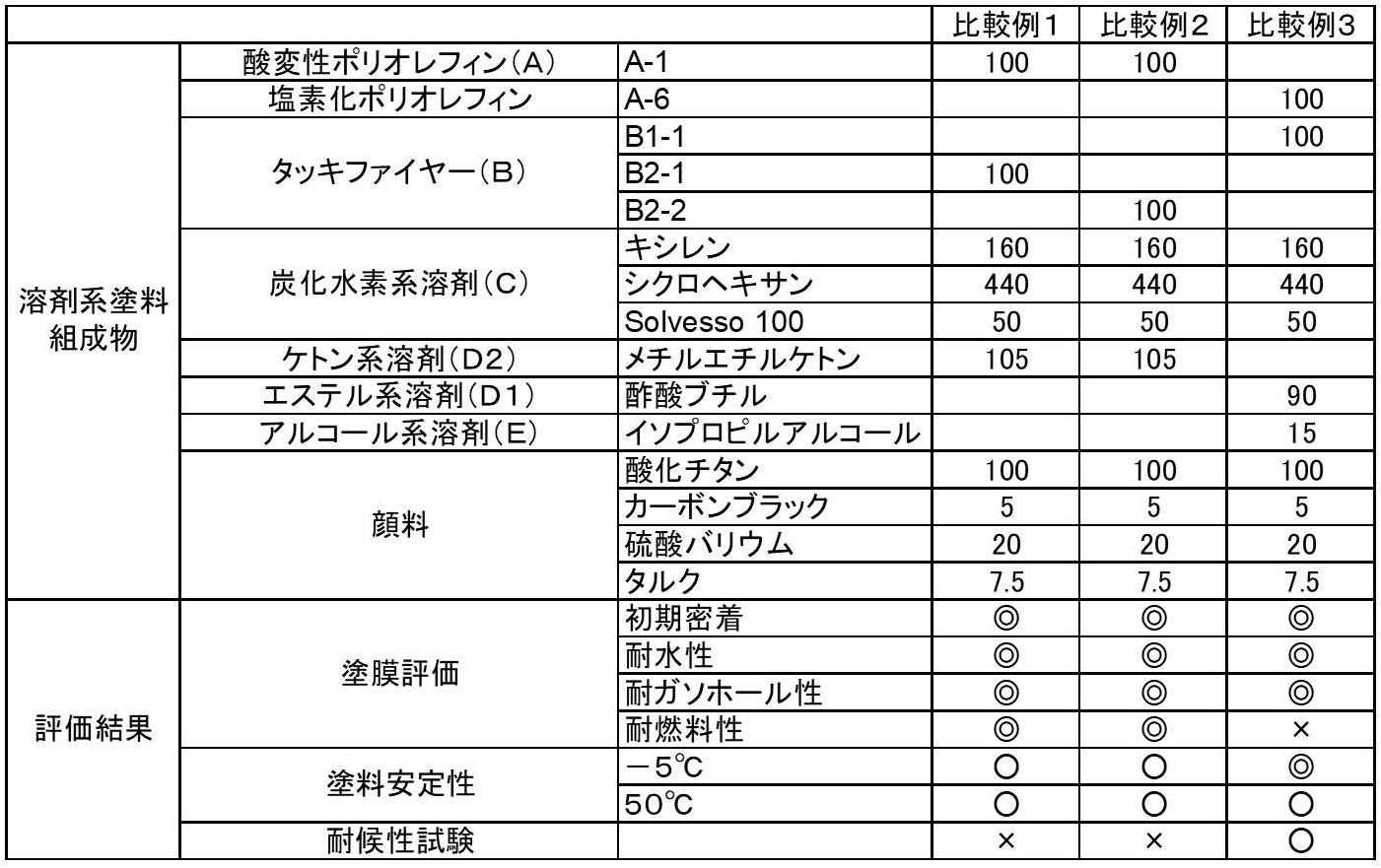
- Comparative Examples 1 to 5 Acid-modified polyolefin (A), tack fire (B), hydrocarbon solvent (C), ester solvent (D1), ketone solvent (D2), and alcohol solvent (E) are mixed in the ratio shown in Table 2. Then, the coating compositions shown in Comparative Examples 1 to 5 were prepared by mixing the other parts in the same procedure as in Example 1. The ester solvent (D1), the ketone solvent (D2), and the alcohol solvent (E) were added to the pigment dispersion.
- Paint Stability The following items were evaluated with respect to the paint stability of the paint compositions prepared in Examples or Comparative Examples. The results are shown in Tables 1 and 2.
- the viscosity (outflow time) of the coating composition produced in Examples or Comparative Examples was measured with a Ford cup, and the coating composition was allowed to stand at ⁇ 5 ° C. and 50 ° C. for 10 days to adjust the appearance and viscosity of the coating composition. evaluated. Viscosity was measured with a Ford cup (No. 4, 25 ° C.). Evaluation Criteria ⁇ : There was no whelk or gelation, and the increase in outflow time (thickening) was within 5 seconds as compared with before standing for 10 days. ⁇ : There was no whelk or gelation, and the thickening was more than 5 seconds and within 10 seconds. ⁇ : There was no whelk or gelation, but the thickening was more than 10 seconds. X: Whelk or gelation occurred.
- the solvent composition at the time of coating was adjusted by blending 30 parts by mass of Solvesso 100 and 30 parts by mass of toluene with respect to 100 parts by mass of the coating composition obtained in Examples or Comparative Examples.
- the adjusted coating composition will be referred to as a diluted coating composition.
- the polypropylene base material was degreased with isopropyl alcohol to prepare a test plate.
- the diluted coating composition prepared above was spray-coated on the test plate so as to have a dry film thickness of 10 ⁇ m.
- As a coloring base paint Retan (registered trademark) PG White (trade name, manufactured by Kansai Paint Co., Ltd.) was spray-coated on the diluted coating composition surface of the test plate so as to have a dry film thickness of 50 ⁇ m. Then, it was heated in an oven at 80 ° C. for 30 minutes to obtain a test coating plate on which a laminated coating film was formed.
- Various coating film performance tests shown below were performed on the test coating plate.
- Coating film performance test An evaluation test was conducted for each of the following items with respect to the test coating plate prepared as described above. The results are shown in Tables 1 and 2.
- a test solution was prepared based on the test alcohol-added fuel solution specified in ISO1817.
- the test solution was 25.35% by mass of 2,2,4-trimethylpentane, 42.25% by mass of toluene, 12.68% by mass of diisobutylene, 15.0% by mass of methanol, and 4.22% by mass of ethanol. %, 0.5% by mass of water, and 20 ppm of formic acid.
- the test coating plate was immersed in this test solution at 25 ° C. for 120 minutes. Then, the test coating plates were dried by heating in an oven at 80 ° C.
- the coating film of the prepared test coating plate was subjected to an accelerated weather resistance test using a sunshine weather meter (Suga tester). Irradiation temperature is 63 ° C ⁇ 3 ° C, humidity is 50 ⁇ 5%, sample surface irradiance is 78.5 W / m 2 , light wavelength range is 300 to 400 nm, irradiation time is 200 hours, and rainfall conditions are 60 minutes cycle 12 minutes. The test was conducted. The evaluation criteria are as follows. ⁇ : No discoloration is observed on the coating film. ⁇ : Slight discoloration of the coating film is observed. ⁇ : Moderate discoloration of the coating film is observed. X: The coating film is significantly discolored.
- the coating composition according to the present invention can form a coating film having excellent chemical resistance such as water resistance, gasohol resistance, and fuel resistance. Therefore, it is useful as a primer for polypropylene base materials used in automobile bumpers and the like.
Landscapes
- Chemical & Material Sciences (AREA)
- Organic Chemistry (AREA)
- Life Sciences & Earth Sciences (AREA)
- Wood Science & Technology (AREA)
- Materials Engineering (AREA)
- Engineering & Computer Science (AREA)
- Chemical Kinetics & Catalysis (AREA)
- General Chemical & Material Sciences (AREA)
- Health & Medical Sciences (AREA)
- Polymers & Plastics (AREA)
- Medicinal Chemistry (AREA)
- Inorganic Chemistry (AREA)
- Paints Or Removers (AREA)
Abstract
Description
(a)酸変性ポリオレフィン(A)が結晶性を有する
(b)タッキファイヤー(B)は、式:二重結合当量=重量平均分子量/分子中の二重結合の数、によって定義される二重結合当量が40以上であるか、または二重結合を含有しない。
本発明において酸変性ポリオレフィン(A)としては、ポリエチレン、ポリプロピレン及びプロピレン-α-オレフィン共重合体の少なくとも1種に、α,β-不飽和カルボン酸及びその酸無水物の少なくとも1種をグラフトすることにより得られるものが好ましい。
-2-エチルヘキサノエート、tert-ブチルパーオキシピバレート、メチルエチルケトンパーオキサイド、ジ-tert-ブチルパーオキサイド、ラウロイルパーオキサイド等の有機過酸化物、アゾビスイソブチロニトリル、アゾビスイソプロピオニトリル等のアゾニトリル類等が挙げられる。なかでも有機過酸化物を使用することが好ましい。
タッキファイヤーは、粘着付与剤とも呼ばれ、粘着力向上を目的として添加される添加剤である。一般的には、重量平均分子量が数百~数千の無定型オリゴマーで、常温で液状又は固形の熱可塑性樹脂である。例えば、石油樹脂系タッキファイヤー、炭化水素樹脂系タッキファイヤー、ロジン系タッキファイヤー、テルペン系タッキファイヤー等を含むものが挙げられる。耐候性の点から、上記したタッキファイヤーに水素添加したものが好ましいものとして挙げられる。
本発明の塗料組成物は、酸変性ポリオレフィン(A)、タッキファイヤー(B)により構成され、必要に応じて希釈することにより、本発明の塗料組成物を提供することができる。
製造例1
1Lオートクレーブに、メタロセン触媒により重合されたプロピレン-ブテン共重合体(プロピレン成分76モル%および、1-ブテン成分24モル%)を100質量部、トルエン150質量部及び無水マレイン酸9質量部、ジ-tert-ブチルパーオキサイド4質量部を加え、140℃まで昇温した後、更に3時間撹拌した。その後、得られた反応液を冷却後、多量のメチルエチルケトンが入った容器に注ぎ、樹脂を析出させた。その後、当該樹脂を含有する液を遠心分離することにより、無水マレイン酸がグラフト重合した酸変性プロピレン-ブテン共重合体と(ポリ)無水マレイン酸および低分子量物とを分離、精製した。その後、減圧下70℃で5時間乾燥させることにより、酸変性プロピレン-ブテン共重合体(酸価14mgKOH/g-resin、重量平均分子量90,000、Tm70℃)を得た。この製造例により作製した酸変性ポリオレフィンをA-1とした。
無水マレイン酸の仕込み量を30質量部、ジ-tert-ブチルパーオキサイドを3質量部に変更した以外は製造例1と同様にすることにより、酸変性プロピレン-ブテン共重合体(酸価40mgKOH/g-resin、重量平均分子量90,000、Tm70℃)を得た。この製造例により作製した酸変性ポリオレフィンをA-2とした。
無水マレイン酸の仕込み量を3質量部、ジ-tert-ブチルパーオキサイドを7質量部に変更した以外は製造例1と同様にすることにより、酸変性プロピレン-ブテン共重合体(酸価5mgKOH/g-resin、重量平均分子量90,000、Tm70℃)を得た。この製造例により作製した酸変性ポリオレフィンをA-3とした。
無水マレイン酸の仕込み量を12質量部、ジ-tert-ブチルパーオキサイドを3質量部に変更した以外は製造例1と同様にすることにより、酸変性プロピレン-ブテン共重合体(酸価14mgKOH/g-resin、重量平均分子量180,000、Tm70℃)を得た。この製造例により作製した酸変性ポリオレフィンをA-4とした。
無水マレイン酸の仕込み量を5質量部、ジ-tert-ブチルパーオキサイドを10質量部に変更した以外は製造例1と同様にすることにより、酸変性プロピレン-ブテン共重合体(酸価14mgKOH/g-resin、重量平均分子量20,000、Tm70℃)を得た。この製造例により作製した酸変性ポリオレフィンをA-5とした。
水冷還流凝縮器と撹拌機を備えた500mlの四つ口フラスコに、A-1を100質量部に対してシクロヘキサンを280質量部、キシレンを120質量部仕込み、撹拌しながら70℃まで昇温し、1時間撹拌することでA-1溶液を得た。
水冷還流凝縮器と撹拌機を備えた500mlの四つ口フラスコに、重量平均分子量70,000、塩素含有率30wt%であり、非晶性の塩素化ポリオレフィン(A-6)を100質量部、シクロヘキサンを280質量部および酢酸ブチルを120質量部仕込み、撹拌しながら70℃まで昇温し、撹拌を1時間続けることでA-6溶液を得た。
水冷還流凝縮器と撹拌機を備えた500mlの四つ口フラスコに、重量平均分子量850、軟化点100℃、水酸基価23mgKOH/g-resin、酸価10mgKOH/g-resin以下、二重結合当量142のロジン系タッキファイヤー(B1-1)を100質量部、Solvesso(登録商標) 100を50質量部、シクロヘキサンを50質量部仕込み、室温で2時間撹拌することでB 1-1溶液を得た。
水冷還流凝縮器と撹拌機を備えた500mlの四つ口フラスコに、重量平均分子量980、軟化点120℃、水酸基価31mgKOH/g-resin、酸価12mgKOH/g-resin以下、二重結合当量327のロジン系タッキファイヤー(B1-2)を100質量部、Solvesso 100を50質量部、シクロヘキサンを50質量部仕込み、室温で2時間撹拌することでB 1-2溶液を得た。
水冷還流凝縮器と撹拌機を備えた500mlの四つ口フラスコに、重量平均分子量910、軟化点115℃、水酸基価37mgKOH/g-resin、酸価12mgKOH/g-resin以下、二重結合当量910のテルペン系タッキファイヤー(B1-3)を100質量部、Solvesso 100を50質量部、シクロヘキサンを50質量部仕込み、室温で2時間撹拌することでB 1-3溶液を得た。
水冷還流凝縮器と撹拌機を備えた500mlの四つ口フラスコに、重量平均分子量850、軟化点100℃、水酸基価40mgKOH/g-resin、酸価13mgKOH/g-resin以下、二重結合を有さないロジン系タッキファイヤー(B1-4)を100質量部、Solvesso 100を50質量部、シクロヘキサンを50質量部仕込み、室温で2時間撹拌することでB 1-4溶液を得た。
水冷還流凝縮器と撹拌機を備えた500mlの四つ口フラスコに、重量平均分子量950、軟化点120℃、水酸基価30mgKOH/g―resin、酸価1.0mgKOH/g-resin以下、二重結合当量が35のロジン系タッキファイヤー(B2-1)を100質量部、Solvesso 100を50質量部、シクロヘキサンを50質量部仕込み、室温で2時間撹拌することでB2-1溶液を得た。
水冷還流凝縮器と撹拌機を備えた500mlの四つ口フラスコに、重量平均分子量620、軟化点90℃、水酸基価26mgKOH/g―resin、酸価3mgKOH/g-resin以下、二重結合当量が30のテルペン系タッキファイヤー(B2-2)を100質量部、Solvesso 100を50質量部、シクロヘキサンを50質量部仕込み、室温で2時間撹拌することでB2-2溶液を得た。
本発明における酸変性ポリオレフィン(A)の酸価(mgKOH/g-resin)は、FT-IR(島津製作所社製、FT-IR8200PC)を使用して、無水マレイン酸(東京化成製)のクロロホルム溶液によって作成した検量線から得られる係数(f)、酸変性ポリオレフィン溶液における無水コハク酸のカルボニル(C=O)結合の伸縮ピーク(1780cm-1)の吸光度(I)を用いて下記式により算出した値である。
酸価(mgKOH/g-resin)=[吸光度(I)×(f)×2×水酸化カリウムの分子量×1000(mg)/無水コハク酸の分子量]
無水コハク酸の分子量:100.07 水酸化カリウムの分子量:56.11
タッキファイヤー(B)の酸価は、JIS K 5601-2-1:1999(ISO 3682:1993)に従い測定した。
本発明における酸変性ポリオレフィン(A)の重量平均分子量は日本ウォーターズ社製ゲル浸透クロマトグラフAlliance e2695(以下、GPC、標準物質:ポリスチレン樹脂、移動相:テトラヒドロフラン、カラム:Shodex KF―806 + KF―803、カラム温度:40℃、流速:1.0ml/分、検出器:フォトダイオードアレイ検出器(波長254nm=紫外線))によって測定した値である。
本発明におけるタッキファイヤー(B)の重量平均分子量は、GPC測定から求めた。測定は以下の条件で行った。そして、市販の単分散標準ポリスチレンを用いた検量線から、数平均分子量(Mn)および重量平均分子量(Mw)を求めた。装置として、GPC HLC-8320(東ソー株式会社製)、溶剤としてテトラヒドロフラン、カラムとしてTSKgel G7000×1、TSKgel G4000×2、TSKgel G2000×1(すべて東ソー社製)、流速1.0ml/分、試料:20mg/mL テトラヒドロフラン溶液で室温にて、検出器:フォトダイオードアレイ検出器(波長254nm=紫外線)を用いて測定した値である。
本発明における酸変性ポリオレフィン(A)の融点は示差走査熱量計(以下、DSC、ティー・エー・インスツルメント・ジャパン製、Q-2000)を用いて、20℃/分の速度で昇温融解、冷却樹脂化して、再度昇温融解した際の融解ピークのトップ温度から測定した値である。
本発明におけるタッキファイヤー(B)の軟化点は、JIS K 2207(1996)に従い測定した。
実施例1
実施例1に示す塗料組成物は、以下の通りに作製した。A-1溶液500質量部(A-1、100質量部)に対して、キシレン40質量部、さらに表1に示す質量比の顔料を添加し、グラインドメーターによる評価が10μm以下になるまで、ビーズミルで分散することで顔料分散液を得た。顔料分散液(A-1、100質量部)に、B-1が100質量部になるようB-1溶液を加え、次いでシクロヘキサン110質量部、メチルエチルケトン105質量部を混合することで、実施例1に示す塗料組成物を得た。
酸変性ポリオレフィン(A)、タッキファイヤー(B)、炭化水素系溶剤(C)、エステル系溶剤(D1)、ケトン系溶剤(D2)、およびアルコール系溶剤(E)を表1に示す割合で混合し、それ以外は実施例1と同様の手順で混合することにより、実施例2~8に示す塗料組成物を作製した。エステル系溶剤(D1)、ケトン系溶剤(D2)、アルコール系溶剤(E)は、顔料分散液に添加した。
酸変性ポリオレフィン(A)、タッキファイヤー(B)、炭化水素系溶剤(C)、エステル系溶剤(D1)、ケトン系溶剤(D2)、およびアルコール系溶剤(E)を表2に示す割合で混合し、それ以外は実施例1と同様の手順で混合することにより、比較例1~5に示す塗料組成物を作製した。エステル系溶剤(D1)、ケトン系溶剤(D2)、アルコール系溶剤(E)は、顔料分散液に添加した。
実施例または比較例で作製した塗料組成物の塗料安定性に関し、以下の項目について評価した。結果を表1と表2に示す。
評価基準
◎:ツブやゲル化がなく、10日間静置する前と比べて流出時間の増加(増粘)が5秒以内であった。
○:ツブやゲル化がなく、増粘が5秒を超え10秒以内であった。
△:ツブやゲル化はないが、増粘が10秒超であった。
×:ツブやゲル化が生じた。
実施例または比較例で得られた塗料組成物100質量部に対して、30質量部のSolvesso 100と30質量部のトルエンを配合することで、塗装時の溶剤組成に調整した。以下、調整後の塗料組成物を希釈塗料組成物と記載する。
上記通り作成した試験塗板に関し、以下の各項目について評価試験を行った。結果を表1と表2に示す。
各試験塗板の素地に達するようにカッターで切り込みを入れ、大きさ1mm×1mmの碁盤目を100個作った。その表面に粘着セロハンテープを貼着し、20℃においてそのテープを急激に剥離した後の碁盤目塗膜の残存数を調べた。
評価基準
◎:100個残存
○:99~90個残存
△:89~41個残存
×:40個以下残存
各試験塗板を40℃の温水に10日間浸漬後、塗膜表面を観察した。
評価基準
◎:外観に全く変化がなく、非常に良好である。
○:外観にほぼ変化がなく、良好である。
×:塗膜が膨潤し、フクレ等の異常が確認される。
各試験塗板を、ガソリン/エタノール=90/10重量比の試験液中に20℃で浸し、120分経過時のふくれ、剥がれの塗面状態を観察し、下記の基準で評価した。
直径3mm未満のふくれとは、塗面においてふくれの最大の直径が3mm未満ということである。
評価基準
◎:全く異常がない。
○:ふくれはなく3mm未満の剥がれが生じている、
直径3mm未満のふくれかつ3mm未満の剥がれが生じている、又は
剥がれはなく直径3mm未満のふくれが生じている。
×:直径3mm以上のふくれ、又は直径3mm以上の剥がれが生じている。
ISO1817に指定される試験用アルコール添加燃料液にもとづき、試験液を調製した。試験液は、2,2,4-トリメチルペンタンを25.35質量%、トルエンを42.25質量%、ジイソブチレンを12.68質量%、メタノールを15.0質量%、エタノールを4.22質量%、水を0.5質量%、ギ酸を20ppm含有する。試験塗板をこの試験液中に25℃で120分浸した。その後、80℃のオーブンで30分間加熱して試験塗板を乾燥させ、各試験塗板に素地に達するようにカッターで切り込みを入れ、大きさ1mm×1mmの碁盤目を100個作った。その表面に粘着セロハンテープを貼着し、20℃においてそのテープを急激に剥離した後の碁盤目塗膜の残存数を調べた。
評価基準
◎:100個残存
〇:99~90個残存
△:89~41個残存
×:40個以下残存
作製した試験塗板の塗膜を、サンシャインウェザーメーター(スガ試験機)を用い、促進耐候性試験を行った。照射温度は63℃±3℃、湿度は50±5%、試料面放射照度は78.5W/m2、光波長範囲300~400nm、照射時間200時間、降雨条件は60分周期12分降雨として試験を行った。
評価基準は以下の通りである。
◎:塗膜に変色が認められない。
○:塗膜の変色が僅かに認められる。
△:塗膜の変色が中程度認められる。
×:塗膜が著しく変色している。

Claims (8)
- 酸変性ポリオレフィン(A)およびタッキファイヤー(B)を含有し、下記(a)および(b)を満たす塗料組成物。
(a)酸変性ポリオレフィン(A)が結晶性を有する
(b)タッキファイヤー(B)は、式:二重結合当量=重量平均分子量/分子中の二重結合の数、によって定義される二重結合当量が40以上であるか、または二重結合を含有しない。 - 酸変性ポリオレフィン(A)100質量部に対して、タッキファイヤー(B)が25~450質量部である請求項1に記載の塗料組成物。
- 炭化水素系溶剤(C)を含有し、酸変性ポリオレフィン(A)100質量部に対して、炭化水素溶剤(C)を200~3000質量部含有する請求項1または2に記載の塗料組成物。
- エステル系溶剤(D1)またはケトン系溶剤(D2)の少なくとも一方を含む請求項1~3のいずれかに記載の塗料組成物。
- 酸変性ポリオレフィン(A)の酸価が5~40 mgKOH/g-resinである請求項1~4のいずれかに記載の塗料組成物。
- 酸変性ポリオレフィン(A)の重量平均分子量が10,000~200,000である請求項1~5のいずれかに記載の塗料組成物。
- さらにアルコール系溶剤(E)を含む請求項1~6のいずれかに記載の塗料組成物。
- 請求項1~7のいずれかに記載の塗料組成物を含有するポリオレフィン基材用プライマー塗料。
Priority Applications (5)
| Application Number | Priority Date | Filing Date | Title |
|---|---|---|---|
| US17/760,921 US12338358B2 (en) | 2019-09-19 | 2020-08-26 | Polyolefin-based coating composition |
| CN202080064950.4A CN114402045A (zh) | 2019-09-19 | 2020-08-26 | 聚烯烃系涂料组合物 |
| EP20865974.8A EP4032956B1 (en) | 2019-09-19 | 2020-08-26 | Polyolefin-based coating composition |
| KR1020227011012A KR102939485B1 (ko) | 2019-09-19 | 2020-08-26 | 폴리올레핀계 도료 조성물 |
| JP2021546566A JP7540443B2 (ja) | 2019-09-19 | 2020-08-26 | ポリオレフィン系塗料組成物 |
Applications Claiming Priority (2)
| Application Number | Priority Date | Filing Date | Title |
|---|---|---|---|
| JP2019-170662 | 2019-09-19 | ||
| JP2019170662 | 2019-09-19 |
Publications (1)
| Publication Number | Publication Date |
|---|---|
| WO2021054068A1 true WO2021054068A1 (ja) | 2021-03-25 |
Family
ID=74883456
Family Applications (1)
| Application Number | Title | Priority Date | Filing Date |
|---|---|---|---|
| PCT/JP2020/032245 Ceased WO2021054068A1 (ja) | 2019-09-19 | 2020-08-26 | ポリオレフィン系塗料組成物 |
Country Status (7)
| Country | Link |
|---|---|
| US (1) | US12338358B2 (ja) |
| EP (1) | EP4032956B1 (ja) |
| JP (1) | JP7540443B2 (ja) |
| KR (1) | KR102939485B1 (ja) |
| CN (1) | CN114402045A (ja) |
| TW (1) | TW202116939A (ja) |
| WO (1) | WO2021054068A1 (ja) |
Cited By (1)
| Publication number | Priority date | Publication date | Assignee | Title |
|---|---|---|---|---|
| JP2022170878A (ja) * | 2021-04-30 | 2022-11-11 | 株式会社コバヤシ | めっき用プライマー組成物 |
Citations (5)
| Publication number | Priority date | Publication date | Assignee | Title |
|---|---|---|---|---|
| JP2003165944A (ja) * | 2001-11-30 | 2003-06-10 | Toyo Kasei Kogyo Co Ltd | プライマー用組成物 |
| WO2015068385A1 (ja) * | 2013-11-05 | 2015-05-14 | 三井化学株式会社 | 変性プロピレン・α-オレフィン共重合体とその製造方法、それを含むコーティング材、成形用樹脂組成物およびホットメルト組成物 |
| WO2016080297A1 (ja) * | 2014-11-17 | 2016-05-26 | 三井化学株式会社 | コーティング剤、加飾フィルムおよび成形体 |
| WO2018135418A1 (ja) * | 2017-01-20 | 2018-07-26 | 東洋紡株式会社 | ポリオレフィン系塗料組成物 |
| WO2018221331A1 (ja) * | 2017-05-31 | 2018-12-06 | 三井化学株式会社 | 組成物、コーティング剤、接着剤及び積層体 |
Family Cites Families (14)
| Publication number | Priority date | Publication date | Assignee | Title |
|---|---|---|---|---|
| JPH08318558A (ja) * | 1995-05-24 | 1996-12-03 | Arakawa Chem Ind Co Ltd | 熱可塑性樹脂成形体およびその製造法 |
| JP2001072723A (ja) * | 1999-09-07 | 2001-03-21 | Nippon Paper Industries Co Ltd | 変性ポリオレフィン樹脂組成物 |
| JP4441151B2 (ja) * | 2000-09-29 | 2010-03-31 | 日本製紙株式会社 | 変性ポリオレフィン樹脂と変性ポリオレフィン樹脂組成物及びその用途 |
| FR2874927B1 (fr) * | 2004-09-03 | 2012-03-23 | Kansai Paint Co Ltd | Compositions de peintures, procedes d'application de ces peintures et pieces revetues de ces peintures. |
| JP4717463B2 (ja) | 2005-02-18 | 2011-07-06 | ユニチカ株式会社 | 水性分散体および積層体 |
| EP1970419B1 (en) * | 2005-12-28 | 2018-11-14 | Mitsui Chemicals, Inc. | Coating material |
| JP2013010248A (ja) | 2011-06-29 | 2013-01-17 | Nippon Bee Chemical Co Ltd | 複層塗膜の形成方法 |
| JP5370796B1 (ja) | 2012-03-22 | 2013-12-18 | Dic株式会社 | 粘着テープ |
| JP2016011417A (ja) * | 2014-06-04 | 2016-01-21 | ユニチカ株式会社 | 塗料用バインダー |
| JP2018511495A (ja) * | 2015-03-31 | 2018-04-26 | ダウ グローバル テクノロジーズ エルエルシー | 回転成形法のための噴霧乾燥ポリオレフィンエラストマー粉末 |
| JP6652968B2 (ja) * | 2015-05-15 | 2020-02-26 | 住友化学株式会社 | 水性分散体混合物 |
| KR102461571B1 (ko) * | 2016-02-12 | 2022-10-31 | 도요보 가부시키가이샤 | 저에너지 표면 기재용 접착제 조성물 |
| JP6831230B2 (ja) | 2016-12-15 | 2021-02-17 | 昭和電工株式会社 | 硬化性粘着剤組成物、及び粘着シート |
| JP7342851B2 (ja) | 2018-03-06 | 2023-09-12 | 東洋紡エムシー株式会社 | ポリオレフィン系接着剤組成物 |
-
2020
- 2020-08-26 CN CN202080064950.4A patent/CN114402045A/zh active Pending
- 2020-08-26 WO PCT/JP2020/032245 patent/WO2021054068A1/ja not_active Ceased
- 2020-08-26 KR KR1020227011012A patent/KR102939485B1/ko active Active
- 2020-08-26 US US17/760,921 patent/US12338358B2/en active Active
- 2020-08-26 EP EP20865974.8A patent/EP4032956B1/en active Active
- 2020-08-26 JP JP2021546566A patent/JP7540443B2/ja active Active
- 2020-08-27 TW TW109129245A patent/TW202116939A/zh unknown
Patent Citations (5)
| Publication number | Priority date | Publication date | Assignee | Title |
|---|---|---|---|---|
| JP2003165944A (ja) * | 2001-11-30 | 2003-06-10 | Toyo Kasei Kogyo Co Ltd | プライマー用組成物 |
| WO2015068385A1 (ja) * | 2013-11-05 | 2015-05-14 | 三井化学株式会社 | 変性プロピレン・α-オレフィン共重合体とその製造方法、それを含むコーティング材、成形用樹脂組成物およびホットメルト組成物 |
| WO2016080297A1 (ja) * | 2014-11-17 | 2016-05-26 | 三井化学株式会社 | コーティング剤、加飾フィルムおよび成形体 |
| WO2018135418A1 (ja) * | 2017-01-20 | 2018-07-26 | 東洋紡株式会社 | ポリオレフィン系塗料組成物 |
| WO2018221331A1 (ja) * | 2017-05-31 | 2018-12-06 | 三井化学株式会社 | 組成物、コーティング剤、接着剤及び積層体 |
Non-Patent Citations (1)
| Title |
|---|
| See also references of EP4032956A4 * |
Cited By (2)
| Publication number | Priority date | Publication date | Assignee | Title |
|---|---|---|---|---|
| JP2022170878A (ja) * | 2021-04-30 | 2022-11-11 | 株式会社コバヤシ | めっき用プライマー組成物 |
| JP7772354B2 (ja) | 2021-04-30 | 2025-11-18 | 株式会社コバヤシ | めっき用プライマー組成物 |
Also Published As
| Publication number | Publication date |
|---|---|
| JP7540443B2 (ja) | 2024-08-27 |
| KR102939485B1 (ko) | 2026-03-13 |
| EP4032956B1 (en) | 2025-05-21 |
| KR20220064982A (ko) | 2022-05-19 |
| JPWO2021054068A1 (ja) | 2021-03-25 |
| US12338358B2 (en) | 2025-06-24 |
| EP4032956C0 (en) | 2025-05-21 |
| TW202116939A (zh) | 2021-05-01 |
| EP4032956A4 (en) | 2023-10-11 |
| CN114402045A (zh) | 2022-04-26 |
| EP4032956A1 (en) | 2022-07-27 |
| US20220348783A1 (en) | 2022-11-03 |
Similar Documents
| Publication | Publication Date | Title |
|---|---|---|
| JP6569827B2 (ja) | ポリオレフィン系塗料組成物 | |
| JP5844891B2 (ja) | コーティング剤、加飾フィルムおよび成形体 | |
| WO2018168753A1 (ja) | 塩素化ポリオレフィン系樹脂組成物 | |
| US12071499B2 (en) | Modified polyolefin resin and dispersion composition thereof | |
| JP7540443B2 (ja) | ポリオレフィン系塗料組成物 | |
| WO2019082903A1 (ja) | 変性ポリオレフィン樹脂組成物及びその製造方法 | |
| WO2022054727A1 (ja) | ポリオレフィン系塗料組成物 | |
| KR102790048B1 (ko) | 변성 폴리올레핀 수지, 및 이의 용도 및 제조 방법 | |
| JP4164632B2 (ja) | プライマー用組成物 | |
| US8158715B2 (en) | Binder resin composition | |
| HK40071096A (en) | Polyolefin-based coating composition | |
| JP6780314B2 (ja) | 低温衝撃性が良好な樹脂組成物 | |
| JP2004161952A (ja) | バインダー樹脂組成物及びその用途 | |
| JP2002241669A (ja) | 塗料または接着剤用の樹脂溶液組成物 | |
| JP7362028B2 (ja) | 変性ポリオレフィン樹脂 | |
| JP2019156887A (ja) | 水性分散体 | |
| WO2023190213A1 (ja) | 水性分散体組成物 | |
| JP2022121905A (ja) | 樹脂組成物 |
Legal Events
| Date | Code | Title | Description |
|---|---|---|---|
| 121 | Ep: the epo has been informed by wipo that ep was designated in this application |
Ref document number: 20865974 Country of ref document: EP Kind code of ref document: A1 |
|
| ENP | Entry into the national phase |
Ref document number: 2021546566 Country of ref document: JP Kind code of ref document: A |
|
| NENP | Non-entry into the national phase |
Ref country code: DE |
|
| ENP | Entry into the national phase |
Ref document number: 20227011012 Country of ref document: KR Kind code of ref document: A |
|
| ENP | Entry into the national phase |
Ref document number: 2020865974 Country of ref document: EP Effective date: 20220419 |
|
| WWG | Wipo information: grant in national office |
Ref document number: 202217012086 Country of ref document: IN |
|
| WWG | Wipo information: grant in national office |
Ref document number: 2020865974 Country of ref document: EP |
|
| WWG | Wipo information: grant in national office |
Ref document number: 17760921 Country of ref document: US |