WO2021054466A1 - リチウムイオン二次電池用正極活物質およびリチウムイオン二次電池 - Google Patents
リチウムイオン二次電池用正極活物質およびリチウムイオン二次電池 Download PDFInfo
- Publication number
- WO2021054466A1 WO2021054466A1 PCT/JP2020/035588 JP2020035588W WO2021054466A1 WO 2021054466 A1 WO2021054466 A1 WO 2021054466A1 JP 2020035588 W JP2020035588 W JP 2020035588W WO 2021054466 A1 WO2021054466 A1 WO 2021054466A1
- Authority
- WO
- WIPO (PCT)
- Prior art keywords
- positive electrode
- active material
- electrode active
- particles
- secondary battery
- Prior art date
- Legal status (The legal status is an assumption and is not a legal conclusion. Google has not performed a legal analysis and makes no representation as to the accuracy of the status listed.)
- Ceased
Links
Images

Classifications
-
- H—ELECTRICITY
- H01—ELECTRIC ELEMENTS
- H01M—PROCESSES OR MEANS, e.g. BATTERIES, FOR THE DIRECT CONVERSION OF CHEMICAL ENERGY INTO ELECTRICAL ENERGY
- H01M4/00—Electrodes
- H01M4/02—Electrodes composed of, or comprising, active material
- H01M4/36—Selection of substances as active materials, active masses, active liquids
- H01M4/48—Selection of substances as active materials, active masses, active liquids of inorganic oxides or hydroxides
- H01M4/52—Selection of substances as active materials, active masses, active liquids of inorganic oxides or hydroxides of nickel, cobalt or iron
- H01M4/525—Selection of substances as active materials, active masses, active liquids of inorganic oxides or hydroxides of nickel, cobalt or iron of mixed oxides or hydroxides containing iron, cobalt or nickel for inserting or intercalating light metals, e.g. LiNiO2, LiCoO2 or LiCoOxFy
-
- C—CHEMISTRY; METALLURGY
- C01—INORGANIC CHEMISTRY
- C01G—COMPOUNDS CONTAINING METALS NOT COVERED BY SUBCLASSES C01D OR C01F
- C01G53/00—Compounds of nickel
- C01G53/80—Compounds containing nickel, with or without oxygen or hydrogen, and containing one or more other elements
- C01G53/82—Compounds containing nickel, with or without oxygen or hydrogen, and containing two or more other elements
-
- C—CHEMISTRY; METALLURGY
- C01—INORGANIC CHEMISTRY
- C01G—COMPOUNDS CONTAINING METALS NOT COVERED BY SUBCLASSES C01D OR C01F
- C01G53/00—Compounds of nickel
- C01G53/40—Complex oxides containing nickel and at least one other metal element
- C01G53/42—Complex oxides containing nickel and at least one other metal element containing alkali metals, e.g. LiNiO2
- C01G53/44—Complex oxides containing nickel and at least one other metal element containing alkali metals, e.g. LiNiO2 containing manganese
- C01G53/50—Complex oxides containing nickel and at least one other metal element containing alkali metals, e.g. LiNiO2 containing manganese of the type (MnO2)n-, e.g. Li(NixMn1-x)O2 or Li(MyNixMn1-x-y)O2
-
- H—ELECTRICITY
- H01—ELECTRIC ELEMENTS
- H01M—PROCESSES OR MEANS, e.g. BATTERIES, FOR THE DIRECT CONVERSION OF CHEMICAL ENERGY INTO ELECTRICAL ENERGY
- H01M10/00—Secondary cells; Manufacture thereof
- H01M10/05—Accumulators with non-aqueous electrolyte
- H01M10/052—Li-accumulators
- H01M10/0525—Rocking-chair batteries, i.e. batteries with lithium insertion or intercalation in both electrodes; Lithium-ion batteries
-
- H—ELECTRICITY
- H01—ELECTRIC ELEMENTS
- H01M—PROCESSES OR MEANS, e.g. BATTERIES, FOR THE DIRECT CONVERSION OF CHEMICAL ENERGY INTO ELECTRICAL ENERGY
- H01M4/00—Electrodes
- H01M4/02—Electrodes composed of, or comprising, active material
- H01M4/36—Selection of substances as active materials, active masses, active liquids
- H01M4/48—Selection of substances as active materials, active masses, active liquids of inorganic oxides or hydroxides
- H01M4/50—Selection of substances as active materials, active masses, active liquids of inorganic oxides or hydroxides of manganese
- H01M4/502—Selection of substances as active materials, active masses, active liquids of inorganic oxides or hydroxides of manganese for non-aqueous cells
-
- H—ELECTRICITY
- H01—ELECTRIC ELEMENTS
- H01M—PROCESSES OR MEANS, e.g. BATTERIES, FOR THE DIRECT CONVERSION OF CHEMICAL ENERGY INTO ELECTRICAL ENERGY
- H01M4/00—Electrodes
- H01M4/02—Electrodes composed of, or comprising, active material
- H01M4/36—Selection of substances as active materials, active masses, active liquids
- H01M4/48—Selection of substances as active materials, active masses, active liquids of inorganic oxides or hydroxides
- H01M4/50—Selection of substances as active materials, active masses, active liquids of inorganic oxides or hydroxides of manganese
- H01M4/505—Selection of substances as active materials, active masses, active liquids of inorganic oxides or hydroxides of manganese of mixed oxides or hydroxides containing manganese for inserting or intercalating light metals, e.g. LiMn2O4 or LiMn2OxFy
-
- C—CHEMISTRY; METALLURGY
- C01—INORGANIC CHEMISTRY
- C01P—INDEXING SCHEME RELATING TO STRUCTURAL AND PHYSICAL ASPECTS OF SOLID INORGANIC COMPOUNDS
- C01P2002/00—Crystal-structural characteristics
- C01P2002/50—Solid solutions
- C01P2002/52—Solid solutions containing elements as dopants
-
- C—CHEMISTRY; METALLURGY
- C01—INORGANIC CHEMISTRY
- C01P—INDEXING SCHEME RELATING TO STRUCTURAL AND PHYSICAL ASPECTS OF SOLID INORGANIC COMPOUNDS
- C01P2002/00—Crystal-structural characteristics
- C01P2002/60—Compounds characterised by their crystallite size
-
- C—CHEMISTRY; METALLURGY
- C01—INORGANIC CHEMISTRY
- C01P—INDEXING SCHEME RELATING TO STRUCTURAL AND PHYSICAL ASPECTS OF SOLID INORGANIC COMPOUNDS
- C01P2004/00—Particle morphology
- C01P2004/50—Agglomerated particles
-
- C—CHEMISTRY; METALLURGY
- C01—INORGANIC CHEMISTRY
- C01P—INDEXING SCHEME RELATING TO STRUCTURAL AND PHYSICAL ASPECTS OF SOLID INORGANIC COMPOUNDS
- C01P2004/00—Particle morphology
- C01P2004/51—Particles with a specific particle size distribution
-
- C—CHEMISTRY; METALLURGY
- C01—INORGANIC CHEMISTRY
- C01P—INDEXING SCHEME RELATING TO STRUCTURAL AND PHYSICAL ASPECTS OF SOLID INORGANIC COMPOUNDS
- C01P2004/00—Particle morphology
- C01P2004/60—Particles characterised by their size
- C01P2004/61—Micrometer sized, i.e. from 1-100 micrometer
-
- C—CHEMISTRY; METALLURGY
- C01—INORGANIC CHEMISTRY
- C01P—INDEXING SCHEME RELATING TO STRUCTURAL AND PHYSICAL ASPECTS OF SOLID INORGANIC COMPOUNDS
- C01P2006/00—Physical properties of inorganic compounds
- C01P2006/12—Surface area
-
- C—CHEMISTRY; METALLURGY
- C01—INORGANIC CHEMISTRY
- C01P—INDEXING SCHEME RELATING TO STRUCTURAL AND PHYSICAL ASPECTS OF SOLID INORGANIC COMPOUNDS
- C01P2006/00—Physical properties of inorganic compounds
- C01P2006/14—Pore volume
-
- C—CHEMISTRY; METALLURGY
- C01—INORGANIC CHEMISTRY
- C01P—INDEXING SCHEME RELATING TO STRUCTURAL AND PHYSICAL ASPECTS OF SOLID INORGANIC COMPOUNDS
- C01P2006/00—Physical properties of inorganic compounds
- C01P2006/16—Pore diameter
-
- H—ELECTRICITY
- H01—ELECTRIC ELEMENTS
- H01M—PROCESSES OR MEANS, e.g. BATTERIES, FOR THE DIRECT CONVERSION OF CHEMICAL ENERGY INTO ELECTRICAL ENERGY
- H01M4/00—Electrodes
- H01M4/02—Electrodes composed of, or comprising, active material
- H01M2004/021—Physical characteristics, e.g. porosity, surface area
-
- H—ELECTRICITY
- H01—ELECTRIC ELEMENTS
- H01M—PROCESSES OR MEANS, e.g. BATTERIES, FOR THE DIRECT CONVERSION OF CHEMICAL ENERGY INTO ELECTRICAL ENERGY
- H01M4/00—Electrodes
- H01M4/02—Electrodes composed of, or comprising, active material
- H01M2004/026—Electrodes composed of, or comprising, active material characterised by the polarity
- H01M2004/028—Positive electrodes
-
- Y—GENERAL TAGGING OF NEW TECHNOLOGICAL DEVELOPMENTS; GENERAL TAGGING OF CROSS-SECTIONAL TECHNOLOGIES SPANNING OVER SEVERAL SECTIONS OF THE IPC; TECHNICAL SUBJECTS COVERED BY FORMER USPC CROSS-REFERENCE ART COLLECTIONS [XRACs] AND DIGESTS
- Y02—TECHNOLOGIES OR APPLICATIONS FOR MITIGATION OR ADAPTATION AGAINST CLIMATE CHANGE
- Y02E—REDUCTION OF GREENHOUSE GAS [GHG] EMISSIONS, RELATED TO ENERGY GENERATION, TRANSMISSION OR DISTRIBUTION
- Y02E60/00—Enabling technologies; Technologies with a potential or indirect contribution to GHG emissions mitigation
- Y02E60/10—Energy storage using batteries
Definitions
- the present invention relates to a positive electrode active material for a lithium ion secondary battery made of a lithium transition metal-containing composite oxide, and a lithium ion secondary battery using the positive electrode active material for a lithium ion secondary battery as a positive electrode material.
- This lithium ion secondary battery is composed of a negative electrode, a positive electrode, a non-aqueous electrolyte, a solid electrolyte, and the like, and the active material used as the material for the negative electrode and the positive electrode includes a material capable of desorbing and inserting lithium.
- the non-aqueous electrolyte includes a non-aqueous electrolyte solution obtained by dissolving the supporting salt lithium salt in an organic solvent
- the solid electrolyte includes an inorganic or organic solid electrolyte that is nonflammable and has lithium ion conductivity. is there.
- the lithium ion secondary battery using a lithium transition metal-containing composite oxide having a layered rock salt type or spinel type crystal structure as a positive electrode material has a high energy because a 4V class voltage can be obtained.
- Research and development and practical application are being promoted as a battery having a density.
- Lithium cobalt composite oxide (LiCoO 2 ), which is relatively easy to synthesize, lithium nickel composite oxide (LiNiO 2 ) using nickel, which is cheaper than cobalt, and lithium nickel manganese cobalt, are used as positive electrode materials for lithium ion secondary batteries.
- Composite oxide LiNi 1/3 Mn 1/3 Co 1/3 O 2
- lithium manganese composite oxide using manganese LiMn 2 O 4
- lithium nickel manganese composite oxide LiNi 0.5 Mn 0.
- a positive electrode active material composed of a lithium transition metal-containing composite oxide such as 5 O 2 has been proposed.
- lithium transition metal-containing composite oxides at least nickel, manganese, and as transition metals containing lithium nickel manganese cobalt composite oxide (LiNi 1/3 Mn 1/3 Co 1/3 O 2), and
- the ternary positive electrode active material made of lithium nickel manganese cobalt-containing composite oxide (NMC) containing cobalt has excellent thermal stability, high capacity, good cycle characteristics of battery capacity, and low resistance. It is attracting attention as a material that can obtain high output.
- the lithium nickel manganese cobalt composite oxide is a compound having a layered rock salt type crystal structure like the lithium cobalt composite oxide and the lithium nickel composite oxide.
- the emphasis is on increasing the output by reducing the internal resistance.
- high output is required at a high level by further reducing internal resistance.
- the particle size is small and the particle size distribution is narrow. It is important that it is composed of particles. Particles with a small particle size have a large specific surface area, can sufficiently secure a reaction area with an electrolyte when used as a positive electrode active material, have a thin positive electrode, and are between the positive electrode and the negative electrode of lithium ions. The moving distance of the can be shortened. Therefore, it is possible to reduce the positive electrode resistance by using particles having a small particle size. Further, by using particles having a narrow particle size distribution, the voltage applied to the particles can be made uniform in the electrode, so that it is possible to suppress a decrease in battery capacity due to selective deterioration of the particles.
- the particle structure of the lithium transition metal-containing composite oxide In order to further improve the output characteristics, research and development are also underway to improve the particle structure of the lithium transition metal-containing composite oxide. For example, in order to improve the output characteristics, it is considered effective to form a space in which the electrolyte can penetrate inside the positive electrode active material. By adopting such a structure, the reaction area with the electrolyte can be increased as compared with the positive electrode active material having a solid structure having the same particle size, so that the positive electrode resistance can be significantly reduced. It will be possible. It is known that the positive electrode active material inherits the particle properties of the transition metal-containing composite hydroxide that is the precursor thereof. That is, in order to obtain a positive electrode active material having a space, it is necessary to appropriately control the particle size, particle size distribution, particle structure, etc. of the secondary particles of the transition metal-containing composite hydroxide which is the precursor thereof. You will need it.
- Japanese Patent Application Laid-Open No. 2012-246199 and WO2012 / 131818 are described by a crystallization reaction clearly separated into two stages, a nuclear formation step mainly for nuclear formation and a particle growth step mainly for particle growth.
- a method for producing transition metal-containing composite hydroxide particles as a precursor of a positive electrode active material is disclosed. In these methods, the pH value and the reaction atmosphere in the nucleation step and the particle growth step are appropriately adjusted, so that the particle size distribution is narrow with a small particle size, and the central part having a low density composed of fine primary particles and the plate shape.
- transition metal-containing composite hydroxide particles composed of a high-density outer shell composed of needle-shaped primary particles are obtained, and the positive electrode active material obtained from such composite hydroxide particles has a hollow structure. It has a large contact area with the electrolytic solution, which makes it possible to improve the output characteristics.
- the pH value of an aqueous solution for nucleation containing at least a metal compound containing a transition metal and an ammonium ion feeder is 12.0 or more and 14.0 or less.
- the pH value of the nucleation step of controlling and nucleating and the aqueous solution for particle growth containing the generated nuclei is lower than the pH value of the nucleation step and is 10.5 or more and 12.0 or less. It is equipped with a particle growth step that controls and grows so that the nucleation step and the initial stage of the particle growth step are set to a non-oxidizing atmosphere, and after switching to an oxidizing atmosphere at a predetermined timing in the particle growing step, the atmosphere is changed again.
- a method for producing a transition metal-containing composite hydroxide particle which comprises performing an atmosphere control for switching to a non-oxidizing atmosphere at least once. According to this method, it has a small particle size, a narrow particle size distribution, and a central portion formed by agglomeration of plate-like or needle-like primary particles, and is formed by agglomeration of fine primary particles on the outside of the central portion. It is said that it is possible to obtain transition metal-containing composite hydroxide particles having two laminated structures in which the formed low-density layer and the high-density layer formed by aggregating plate-shaped primary particles are alternately laminated.
- the positive electrode active material using these transition metal-containing composite hydroxide particles as precursors has a small particle size, a narrow particle size distribution, and a hollow structure or a multilayer structure having a space portion. Therefore, in a secondary battery using these positive electrode active materials, it is possible to improve the battery capacity, output characteristics, and cycle characteristics at the same time.
- an object of the present invention is to provide a positive electrode active material for a lithium ion secondary battery capable of exhibiting excellent output characteristics when used in a lithium ion secondary battery. ..
- the lithium transition metal-containing composite oxide particles are composed of secondary particles in which primary particles are aggregated.
- the secondary particles are 50% cumulative diameter d50 obtained from particle size distribution measurement values of 3.0 ⁇ m or more and 7.0 ⁇ m or less, BET specific surface area of 1.8 m 2 / g or more and 5.5 m 2 / g or less, Pore peak diameter of 0.01 ⁇ m or more and 0.30 ⁇ m or less in the pore portion obtained by the mercury intrusion method, and Log differential pore volume [dV / d (logD)] of 0.2 ml / g or more and 0.6 ml / g or less in the range of the pore peak diameter of 0.01 ⁇ m or more and 0.30 ⁇ m or less.
- the concentration of the additive element M is measured at a plurality of locations by cross-sectional STEM or TEM-EDX analysis for each of the plurality of primary particles having a primary particle diameter in the range of 0.1 ⁇ m or more and 1.0 ⁇ m or less. Then, when the coefficient of variation of the concentration of the additive element M, which is the value obtained by dividing the standard deviation of the concentration of the additive element M by the average concentration of the additive element M, is calculated, the coefficient of variation is 1.5 or less. ..
- the 50% cumulative diameter d50 of the secondary particles is preferably 4.0 ⁇ m or more and 6.0 ⁇ m or less.
- the value of d90 / d10 of the secondary particles is preferably 1.0 or more and 2.0 or less.
- the secondary particles have an agglomerate portion, one or more communication holes communicating with the outer peripheral portion of the agglomeration portion, and two or more space portions existing inside the agglomeration portion and communicating with the communication hole. Is preferable.
- the number of the communication holes is preferably two or more. It is preferable that the two or more space portions communicate with the communication hole or another space portion.
- the additive element M is preferably one or more selected from Mg, Al, Si, Ti, Zr, Nb, Mo, and W.
- the additive element M is preferably W.
- the lithium ion secondary battery according to the embodiment of the present invention includes a positive electrode, a negative electrode, a separator, and a non-aqueous electrolyte (non-aqueous electrolyte secondary battery), or includes a positive electrode, a negative electrode, and a solid electrolyte (solid electrolyte secondary).
- non-aqueous electrolyte secondary battery or includes a positive electrode, a negative electrode, and a solid electrolyte (solid electrolyte secondary).
- solid electrolyte secondary solid electrolyte secondary
- the lithium ion secondary battery to which the positive electrode active material for the lithium ion secondary battery according to the embodiment of the present invention is applied can provide high output characteristics, and thus its industrial significance is very high. large.
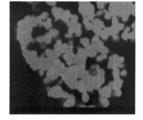
- FIG. 1 is an SEM photograph of a cross section of secondary particles constituting the positive electrode active material for a lithium ion secondary battery according to the first embodiment of the present invention.
- FIG. 2 is an SEM photograph of a cross section of secondary particles constituting the positive electrode active material for a lithium ion secondary battery of Comparative Example 1.
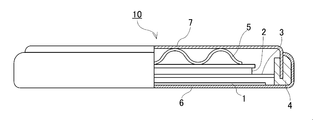
- FIG. 3 is a schematic cross-sectional view of a 2032 type coin-shaped battery used for battery evaluation.
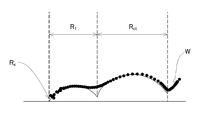
- FIG. 4 is a graph showing a measurement example of impedance evaluation.
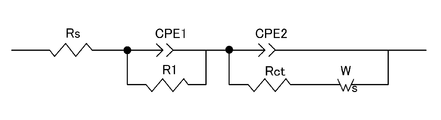
- FIG. 5 is a schematic explanatory diagram of the equivalent circuit used in the analysis.
- positive electrode active material for lithium ion secondary battery
- positive electrode active material is a lithium transition metal-containing composite oxide particle (hereinafter referred to as “positive electrode active material”). It is characterized by being composed of (referred to as "composite oxide particles") and satisfying the following requirements (1) to (7).
- the value of u indicating an excess amount of lithium (Li) is in the range of ⁇ 0.05 or more and 0.5 or less. It is preferably in the range of 0 or more and 0.50 or less, and more preferably in the range of 0 or more and 0.35 or less.
- the value of u is less than ⁇ 0.05, the positive electrode resistance of the secondary battery becomes large, so that it may not be possible to improve the output characteristics. If it exceeds 0.5, not only the initial discharge capacity decreases, but also the positive electrode resistance may increase.
- Nickel (Ni) is an element that contributes to high potential and high capacity of secondary batteries, and the value of x indicating its content is in the range of 0.3 or more and 0.9 or less. It is preferably in the range of 0.4 or more and 0.7 or less, and more preferably in the range of 0.4 or more and 0.6 or less. If the value of x is less than 0.3, it may not be possible to sufficiently improve the energy density of the secondary battery using this positive electrode active material. If the value of x exceeds 0.9, the content of other elements that improve the output characteristics and durability characteristics decreases, and there is a possibility that the characteristics as a positive electrode active material cannot be sufficiently obtained.
- Manganese (Mn) is an element that contributes to the improvement of thermal stability, and the value of y indicating its content is in the range of 0 or more and 0.5 or less. It is preferably in the range of 0.1 or more and 0.4 or less. If the value of y exceeds 0.5, Mn may elute from the positive electrode active material during high temperature operation, and the charge / discharge cycle characteristics may deteriorate.
- Co Co is an element that contributes to the improvement of charge / discharge cycle characteristics and output characteristics, and the value of z indicating its content is in the range of 0 or more and 0.5 or less. It is preferably in the range of 0.1 or more and 0.4 or less. If the value of z exceeds 0.5, the initial discharge capacity of the secondary battery using this positive electrode active material may decrease.
- the positive electrode active material of the present invention can contain the following additive element M.
- the additive element M include magnesium (Mg), aluminum (Al), silicon (Si), calcium (Ca), titanium (Ti), vanadium (V), chromium (Cr), zirconium (Zr), and niobium (Nb). , Molybdenum (Mo), Hafnium (Hf), Titanium (Ta), and Titanium (W).
- the additive element M is preferably at least one selected from the group consisting of Mg, Al, Si, Ti, Zr, Nb, Mo, and W, and more preferably W.
- the value of t indicating the content of the additive element M is in the range of more than 0 and 0.05 or less. It is preferably in the range of 0.001 or more and 0.03 or less. When the value of t exceeds 0.05, the metal elements that contribute to the Redox reaction decrease, so that the battery capacity of the secondary battery decreases.
- the additive element M may be dispersed inside the composite oxide particles, or may cover the surface of the composite oxide particles. In any case, it is preferable to control the content of the additive element M so as to be within the above range.
- the composite oxide particles of the present invention are preferably composed of a lithium nickel manganese cobalt-containing composite oxide (NMC) containing Ni, Mn, and Co as a main transition metal.
- NMC lithium nickel manganese cobalt-containing composite oxide
- M is Mg, Al, Si, Ca, Ti, V, Cr, Zr, It is preferable to have a composition of one or more additive elements selected from Nb, Mo, Hf, Ta, and W).
- composition of the positive electrode active material can be confirmed by inductively coupled plasma emission spectrometry, Rietveld analysis of the parameters obtained by powder X-ray diffraction, and the like.
- the positive electrode active material of the present invention has the composition of the above general formula (A) or general formula (B), it is a layered rock salt type and has a hexagonal crystal structure.
- the composite oxide particles are composed of secondary particles formed by aggregating a plurality of primary particles.
- the secondary particles have an agglomerate portion, one or more communication holes communicating with the outer peripheral portion of the agglomeration portion, and two or more space portions existing inside the agglomeration portion and communicating with the communication hole. Is preferable.
- the two or more space portions communicate with the communication hole or another space portion.
- the number of the communication holes is also preferably two or more.
- the composite oxide particles have such a secondary particle structure, it is possible to easily realize the particle properties of the positive electrode active material of the present invention, which will be described later.
- each of the two or more internal space portions can directly communicate with the communication holes on the outer peripheral portion. Alternatively, it can communicate with the communication hole on the outer peripheral portion through another communication hole.
- the electrolyte sufficiently penetrates into the space inside the particle through the communication hole on the outer periphery, so that lithium can be desorbed and inserted not only on the surface of the particle but also inside the particle. Therefore, a sufficient reaction field is secured, and the internal resistance of the battery can be significantly reduced.
- a lithium ion secondary battery is constructed by using a positive electrode active material having such a structure as a positive electrode material, it is possible to further improve the output characteristics.
- the secondary particles have a 50% cumulative diameter d50 determined from a particle size distribution measurement value of 3.0 ⁇ m or more and 7.0 ⁇ m or less.
- the 50% cumulative diameter d50 of the secondary particles is preferably 4.0 ⁇ m or more and 6.5 ⁇ m or less, and more preferably 4.0 ⁇ m or more and 6.0 ⁇ m or less.
- the 50% cumulative diameter d50 is a particle size (total volume is 100) in which the cumulative volume obtained from the volume integrated value measured by the laser light diffraction scattering type particle size analyzer is 50% of the total volume of all particles.
- the cumulative curve of the particle size distribution is obtained in%, the particle size at the point where this cumulative curve is 50%).
- the d50 of the particles constituting the positive electrode active material is within the above range, not only the battery capacity per unit volume of the secondary battery using this positive electrode active material can be increased, but also the safety and output characteristics are improved. can do.
- the 50% cumulative diameter d50 is less than 3.0 ⁇ m, the filling property of the positive electrode active material may decrease and the battery capacity per unit volume may not be increased. If the 50% cumulative diameter d50 exceeds 7.0 ⁇ m, the reaction area of the positive electrode active material is reduced and the interface with the electrolyte is reduced, which may make it difficult to improve the output characteristics.
- the secondary particles have a BET specific surface area of 1.8 m 2 / g or more and 5.5 m 2 / g or less.
- the BET specific surface area is preferably 2.0 m 2 / g or more and 5.0 m 2 / g or less, and more preferably 2.5 m 2 / g or more and 4.5 m 2 / g or less.
- the BET specific surface area of the secondary particles is an index showing the particle properties (contact area with the electrolyte) of the positive electrode active material.
- the secondary particles have an agglomerate portion, one or more communication holes communicating with the outer peripheral portion of the agglomeration portion, and two or more space portions existing inside the agglomeration portion and communicating with the communication hole.
- the BET specific surface area represents the surface area including the communication holes (openings) existing in the outer peripheral portion of the secondary particles and the fine cavities (spaces) inside the secondary particles.
- the BET specific surface area is measured by the BET method by adsorbing nitrogen gas.
- the BET specific surface area of the secondary particles is less than 1.8 m 2 / g, a sufficient reaction area with the electrolyte cannot be secured when a secondary battery is constructed using this positive electrode active material, and the output It may not improve the properties sufficiently. If the BET specific surface area of the secondary particles exceeds 5.5 m 2 / g, the reaction area between the positive electrode active material and the electrolyte becomes too large, and the durability of the secondary battery may decrease.
- the secondary particles have a pore peak diameter of 0.01 ⁇ m or more and 0.30 ⁇ m or less in the pore portion obtained by the mercury intrusion method.
- the pore peak diameter is preferably 0.02 ⁇ m or more and 0.28 ⁇ m or less, and more preferably 0.05 ⁇ m or more and 0.25 ⁇ m or less.
- the pore peak diameter is defined as the diameter in which the pore peak exists in the pore distribution plot obtained by obtaining the pore distribution plot of the secondary particles by the mercury intrusion method.
- the pore peak diameter of the secondary particles is an index showing the particle properties (average pore diameter) of the positive electrode active material. More specifically, when the pore peak diameter of the secondary particles constituting the positive electrode active material is in the above range, it means that the particles are the positive electrode active material having pores.
- the pore peak diameter of the secondary particles is less than 0.01 ⁇ m, the particle strength cannot be maintained because the pore diameter is small, and the particles may be crushed and the battery performance may be impaired. If the pore peak diameter of the secondary particles exceeds 0.30 ⁇ m, when a secondary battery is constructed using this positive electrode active material, a sufficient reaction area with the electrolyte cannot be sufficiently secured, and the output characteristics are sufficiently exhibited. It may not be.
- the secondary particles are 0.2 ml / g or more and 0.6 ml / in the range of the pore peak diameter of 0.01 ⁇ m or more and 0.30 ⁇ m or less. It has a log differential pore volume [dV / d (logD)] of g or less.
- the log differential pore volume is preferably 0.2 ml / g or more and 0.6 ml / g or less, and more preferably 0.25 ml / g or more and 0.5 ml / g or less.
- the log differential pore volume [dV / d (logD)] at the pore peak diameter is an index showing the particle properties (volume of all cavities) of the positive electrode active material. More specifically, the log differential pore volume [dV / d (logD)] at the pore peak diameter is the respective pore diameter based on the pore distribution plot of the secondary particles obtained by the mercury intrusion method. It is a value in the pore peak diameter in the log differential pore volume distribution obtained by dividing the difference pore volume dV obtained in the above by the difference value d (logD) treated as a logarithm of the pore diameter.
- the log differential pore volume [dV / d (logD)] is in the above range in the secondary particles constituting the positive electrode active material, an appropriate amount of space is formed inside the particles, which is sufficient. It means that the reaction area can be obtained.
- the coefficient of variation (CV) indicating the variation of the concentration of the additive element M in the primary particles constituting the secondary particles is 1.5. It is as follows.
- the coefficient of variation (CV) is preferably 1.3 or less, and more preferably 1.2 or less.
- the coefficient of variation of the concentration of the additive element M is an index showing the variation in the concentration of the additive element M in the grain in the primary particle and in the entire primary particle including the grain boundary.
- the coefficient of variation of the concentration of the additive element M is obtained as follows. First, the positive electrode active material is sliced with a focused ion beam device (FIB), an ion milling device, or the like to expose the cross section of the secondary particles. Using a scanning transmission electron microscope (STEM) or a transmission electron microscope (TEM), two connected primary particles having a primary particle size in the range of 0.1 ⁇ m or more and 1.0 ⁇ m or less in the cross section of the secondary particle. By irradiating each of the two primary particles with electron beams at a plurality of locations and performing energy dispersive X-ray analyzer (EDX) analysis on the characteristic X-ray energy of the generated additive element M, respectively. The concentration of the additive element M at the above location is determined.
- FIB focused ion beam device
- TEM transmission electron microscope
- TEM transmission electron microscope
- the average concentration of the additive element M ( ⁇ ) and the standard deviation ( ⁇ ) of the concentration of the additive element M are obtained.
- CV coefficient of variation
- the coefficient of variation (CV) of the concentration of the additive element M exceeds 1.5, the distribution of the additive element M in the primary particles and / or the secondary particles is biased, and the positive electrode active material is used. In the next battery, battery performance such as battery capacity and output characteristics may be impaired.
- [(d90-d10) / d50] which is an index indicating the spread of the particle size distribution of the secondary particles, is preferably 1.0 or less. It is more preferably 0.7 or less, still more preferably 0.6 or less. Since the positive electrode active material composed of secondary particles having such a narrow particle size distribution has a small proportion of fine particles and coarse particles, a secondary battery using this has all of safety, cycle characteristics, and output characteristics. It will be excellent.
- the lower limit of [(d90-d10) / d50] is preferably about 0.3.
- d10 and d90 in the index [(d90-d10) / d50] indicating the spread of the particle size distribution are the same as in the case of d50 described above, and d90 sets the volume of each particle as the particle size.
- the particle size is cumulative from the smaller side of the particle size, and the cumulative volume is 90% of the total volume of all particles.
- D10 is the cumulative volume of each particle from the smaller particle size side, and the cumulative volume is the total volume of all particles. It means a particle size that is 10% of the volume.
- the ratio of the value of d90 to the value of d10 obtained from the measured value of the particle size distribution for the secondary particles (d90 / d10) is 1.0 or more and 2.0. It is preferably 1.2 or more and 1.8 or less, more preferably 1.2 or more.
- the value of d90 / d10 of the secondary particles constituting the positive electrode active material is in this range, not only the battery capacity per unit volume of the secondary battery using this positive electrode active material can be increased, but also the battery capacity is safe. The properties and output characteristics can also be improved. If the value of d90 / d10 of the secondary particles exceeds 2.0, the reaction area of the positive electrode active material is reduced and the interface with the electrolyte is reduced, which may make it difficult to improve the output characteristics. ..
- the crystallite diameter obtained from the X-ray diffraction pattern of the (003) plane is arbitrary, but for the composite oxide particles constituting the positive electrode active material of the present invention, half of the peak of the (003) plane by X-ray diffraction.
- the crystallite diameter of the primary particle is determined from the value range using the Scheller formula, the crystallite diameter is preferably in the range of 300 ⁇ to 1500 ⁇ , more preferably in the range of 400 ⁇ to 1300 ⁇ , and further preferably in the range of 700 ⁇ to 1250 ⁇ . In range.
- a positive electrode active material having a crystallite diameter in such a range has extremely high crystallinity, can reduce the positive electrode resistance of a secondary battery, and can improve its output characteristics.
- the crystallite diameter of the (003) plane is less than 300 ⁇ , the primary particles are fine, and the pores existing between the primary particles in the positive electrode active material are too fine, and the electrolyte invades into the positive electrode active material. As a result, the reaction area with the electrolyte is reduced, and the output characteristics of the secondary battery are lowered.
- the crystallite diameter of the (003) plane exceeds 1500 ⁇ , the primary particles become too coarse, the proportion of pores in the secondary particles is extremely reduced, and the invasion path of the electrolyte is reduced. The reaction area of the secondary battery is reduced, and the output characteristics of the secondary battery are lowered.
- the positive electrode active material of the present invention is not limited by the production method as long as it has the above-mentioned composition, crystal structure, particle structure, and particle properties. ..
- the positive electrode active material of the present invention by producing the positive electrode active material of the present invention by the production method described below, it is possible to easily produce the positive electrode active material having the above-mentioned composition, crystal structure, particle structure, and particle properties. ..
- the positive electrode active material of the present invention switches between an oxidizing atmosphere and a non-oxidizing atmosphere during the crystallization step to prepare a transition metal-containing composite hydroxide such as a nickel manganese cobalt-containing composite hydroxide. Then, it is obtained by mixing the composite hydroxide or heat-treated particles obtained by heat-treating the composite hydroxide with a lithium compound, and firing the obtained lithium mixture.
- a transition metal-containing composite hydroxide such as a nickel manganese cobalt-containing composite hydroxide.
- the composite oxide particles are lithium nickel manganese cobalt-containing composite oxide particles as an example.
- Crystallization step An appropriate amount of water, sodium hydroxide aqueous solution and ammonia water is supplied into the reaction vessel, the pH value is 11 or more and 13 or less based on the liquid temperature of 25 ° C., and the ammonium ion concentration is 9 g / L or more and 15 g / L or less.
- a pre-reaction aqueous solution adjusted to be.
- a compound of nickel sulfate, manganese sulfate, cobalt sulfate, and additive element M has a molar ratio of each metal element (Ni, Co, Mn, M) according to the above formula (A).
- Nickel sulfate, manganese sulfate, and cobalt sulfate should be used to suppress the fluctuation coefficient of the additive element M that dissolves inside the particles and to eliminate the local co-precipitation of the additive element M around the transition metal element.
- Dissolve in water so that the molar ratio of each metal element (Ni, Co, Mn) satisfies the above formula (A) adjust and add a raw material aqueous solution of 1.0 mol / L or more and 3.0 mol / L or less. It is more preferable to separately prepare an aqueous solution containing the compound of the element M and add it to the raw material aqueous solution so that the amount of the added element M added satisfies the above formula (A).
- nucleation is performed by supplying the raw material aqueous solution to the pre-reaction aqueous solution while blowing a gas having an oxygen concentration of 2% by volume or less, such as argon gas or nitrogen, in a non-oxidizing atmosphere.
- a gas having an oxygen concentration of 2% by volume or less such as argon gas or nitrogen
- an acid such as sulfuric acid is added to adjust the pH value so that the pH value is 10 or more and 12 or less based on the liquid temperature of 25 ° C. and is smaller than the pH value in the nucleation step.
- Form an aqueous solution for particle growth After confirming that the pH value has reached a predetermined value, the above-mentioned raw material aqueous solution is supplied to grow nuclei (particles) generated in the nucleation step.
- the aqueous solution containing the compound of the additive element M is separately prepared, the aqueous solution containing the compound of the additive element M is added only in the particle growth step or only in a specific stage of the particle growth step. You can also do it.
- crystallization in a non-oxidizing atmosphere having an oxygen concentration of 2% by volume or less is continued from the start of the particle growth step while stirring with a stirrer for a certain period of time.
- a micro-nano bubble generator is used to circulate bubbles of gas having an oxidizing atmosphere consisting of ultrafine air or oxygen in the reaction vessel, and the reaction atmosphere is adjusted to the oxygen concentration. Is adjusted to an oxidizing atmosphere of 21% by volume or more, and the switching operation 1 is performed. After the start of the switching operation 1, crystallization is performed while maintaining an oxidizing atmosphere and stirring with a stirrer for a certain period of time.
- a micro-nano bubble generator is used to circulate ultrafine gas bubbles having a non-oxidizing atmosphere in the reaction vessel, and the reaction atmosphere has an oxygen concentration of 2% by volume or less.
- a gas bubble having an extremely fine oxidizing atmosphere is circulated in the reaction vessel using a micro-nano bubble generator, and the reaction atmosphere has an oxygen concentration of 21% by volume or more.
- a micro-nano bubble generator is used to circulate ultrafine gas bubbles having a non-oxidizing atmosphere in the reaction vessel, and the reaction atmosphere has an oxygen concentration of 2% by volume or less.
- a micro-nano bubble generator is used as a device for switching and maintaining the reaction atmosphere of the aqueous solution for particle growth.
- the diameter of the bubbles (micro-nano bubbles) produced by the micro-nano bubble generator is 0.01 mm or less, and since the buoyancy is small, the bubbles stay in the water for a long time, so that the reaction atmosphere is switched between the non-oxidizing atmosphere gas and the oxidizing atmosphere gas. Can be done quickly and its oxygen concentration can be lower or higher.
- the time of each stage in the particle growth step is 2nd stage ⁇ 4th stage ⁇ 1st stage ⁇ 3rd stage ⁇ 5th stage.
- the crystallization time of the entire particle growth step is preferably 8 hours or less.
- switching operations 5 and 6 can be performed to provide a sixth step in an oxidizing atmosphere and a seventh step in a non-oxidizing atmosphere.
- switching operations 7 and 8 can be performed to provide an eighth step in an oxidizing atmosphere and a ninth step in a non-oxidizing atmosphere.
- switching operations 9 and 10 may be performed to provide a tenth step in an oxidizing atmosphere and an eleventh step in a non-oxidizing atmosphere.
- the time of each stage in the particle growth step is: 2nd stage ⁇ 4th stage ⁇ 6th stage ⁇ 8th stage ⁇ 10th stage ⁇ 1st stage ⁇ 3rd stage ⁇ 5th stage ⁇ 7th stage Step ⁇ 9th stage ⁇ 11th stage.
- a micro-nano bubble generator is used as a device for switching and maintaining the reaction atmosphere of the aqueous solution for particle growth.
- the obtained product is washed with water, filtered and dried to obtain predetermined nickel-cobalt-manganese-containing composite hydroxide particles.
- the particle growth step it is desirable to appropriately supply an aqueous solution of sodium hydroxide and an aqueous solution of ammonia through this step to maintain the pH value and the ammonium ion concentration of the aqueous solution for particle growth within the above-mentioned ranges.
- the composite hydroxide particles obtained by such a crystallization step have a particle structure in which a low-density layer and a high-density layer are mutually laminated around a high-density central portion.
- the composite hydroxide particles having such a particle structure as a precursor, the agglomerated portion, one or more communication holes communicating with the outer peripheral portion of the agglomerated portion, and the inside of the agglomerated portion are present and the communication is performed.
- Composite oxide particles having a particle structure having two or more spaces communicating with the pores can be easily obtained.
- the mixing step is a step of mixing a lithium compound with the above-mentioned composite hydroxide particles or heat-treated particles obtained by heat-treating the composite hydroxide particles to obtain a lithium mixture.
- (Li / Me) is 0.95 or more and 1.5 or less, preferably 1.0 or more and 1.5 or less, more preferably 1.0 or more and 1.35 or less, and further preferably 1.0 or more and 1.2 or less.
- the composite hydroxide particles and the lithium compound are mixed so as to be. That is, since Li / Me does not change before and after the firing step, the composite hydroxide and the lithium compound are mixed so that Li / Me in the mixing step becomes Li / Me of the target positive electrode active material. Is required.
- the lithium compound used in the mixing step is not particularly limited, but it is preferable to use lithium hydroxide, lithium nitrate, lithium carbonate, or a mixture thereof from the viewpoint of easy availability. In particular, considering ease of handling and stability of quality, it is preferable to use lithium hydroxide or lithium carbonate.
- a general mixer can be used for mixing.
- a shaker mixer a radige mixer, a Julia mixer, a V blender and the like can be used.
- Temporary firing step When lithium hydroxide or lithium carbonate is used as the lithium compound, the lithium mixture is placed at a temperature lower than the firing temperature described later and at 350 ° C. or higher after the mixing step and before the firing step. It is also possible to carry out a calcining step of calcining at a temperature of 800 ° C. or lower, preferably 450 ° C. or lower and 750 ° C. or lower. As a result, Li can be sufficiently diffused in the composite hydroxide particles, and more uniform composite oxide particles can be obtained.
- the holding time at the above temperature is preferably 1 hour or more and 10 hours or less, and more preferably 3 hours or more and 6 hours or less.
- the atmosphere in the calcining step is preferably an oxidizing atmosphere as in the firing step described later, and more preferably an atmosphere having an oxygen concentration of 18% by volume or more and 100% by volume or less.
- the calcination step is a step of firing the lithium mixture obtained in the mixing step under predetermined conditions, diffusing Li into the composite hydroxide and reacting the mixture to obtain composite oxide particles.
- the furnace used in the firing step is not particularly limited as long as it can heat the lithium mixture in the atmosphere or an oxygen stream.
- an electric furnace that does not generate gas is preferable, and either a batch type or a continuous type electric furnace can be preferably used. The same applies to the furnaces used in the heat treatment step and the calcining step.
- the calcination temperature of the lithium mixture is set to 720 ° C. or higher and 980 ° C. or lower. If the firing temperature is less than 720 ° C., the composite hydroxide particles and Li do not sufficiently react with each other, excess Li and unreacted composite hydroxide remain, and the obtained positive electrode active material has insufficient crystallinity. It becomes a thing. On the other hand, when the firing temperature exceeds 980 ° C., the communication holes and spaces in the composite oxide particles are crushed, the BET specific surface area of the finally obtained positive electrode active material (secondary particles) is lowered, and the pores are reduced. It may lead to a decrease in the peak diameter and the log differential pore volume at the pore peak diameter. In addition, the particles of the positive electrode active material are violently sintered, causing abnormal grain growth, and the proportion of amorphous coarse particles increases.
- the firing temperature of the mixture is preferably set to 730 ° C. or higher and 970 ° C. or lower, and more preferably 750 ° C. or higher and 970 ° C. or lower.
- the rate of temperature rise in the firing step is preferably set to 1 ° C./min or more and 10 ° C./min or less, and more preferably 3 ° C./min or more and 8 ° C./min or less. Further, during the firing step, it is more preferable that the temperature near the melting point of the lithium compound is set to 0.3 ° C./min or more and 6 ° C./min or less by lowering the heating rate. Thereby, the composite hydroxide particles and the lithium compound can be reacted more uniformly.
- the holding time at the above-mentioned firing temperature is preferably at least 2 hours, and more preferably 3 hours or more and 20 hours or less. If the holding time at the calcination temperature is less than 2 hours, Li does not sufficiently diffuse in the composite oxide particles, excess Li and unreacted composite oxide particles remain, and the obtained positive electrode active material becomes crystalline. It may be inadequate.
- the atmosphere at the time of firing is preferably an oxidizing atmosphere, more preferably an atmosphere having an oxygen concentration of 18% by volume or more and 100% by volume or less, and an oxygen concentration of 50% by volume or more and 100% by volume or less. It is more preferable to have the atmosphere of. It is particularly preferable to create a mixed atmosphere of oxygen having the above oxygen concentration and an inert gas. That is, firing is preferably performed in the atmosphere or an oxygen stream. If the oxygen concentration is less than 18% by volume, the crystallinity of the positive electrode active material may be insufficient.
- the secondary particles constituting the positive electrode active material obtained by the firing step may be aggregated or slightly sintered. In such a case, it is preferable to crush the agglomerate or the sintered body. Thereby, the average particle size and the particle size distribution of the obtained positive electrode active material can be adjusted in a suitable range.
- crushing mechanical energy is applied to an agglomerate composed of a plurality of secondary particles generated by sintering necking between particles during firing to separate the secondary particles themselves with almost no destruction. It means an operation to loosen agglomerates.
- a known means can be used, for example, a pin mill or a hammer mill can be used. At this time, it is preferable to control the crushing force within an appropriate range so as not to destroy the secondary particles themselves.
- the BET specific surface area of the positive electrode active material (secondary particles), the pore peak diameter, the log differential pore volume at the pore peak diameter, and the particle size distribution measurement value. It becomes possible to control the 50% cumulative diameter d50 obtained from the above, and finally, the positive electrode active material of the present invention having predetermined particle properties can be easily obtained.
- the lithium-ion secondary battery of the present invention can have the same configuration as a general non-aqueous electrolyte secondary battery, which includes components such as a positive electrode, a negative electrode, a separator, and a non-aqueous electrolyte. ..
- the lithium ion secondary battery of the present invention can have the same configuration as a general solid electrolyte secondary battery including components such as a positive electrode, a negative electrode, and a solid electrolyte. That is, the present invention can be widely applied from a non-aqueous electrolyte secondary battery to an all-solid-state lithium ion secondary battery as long as it is a secondary battery that charges and discharges by removing and inserting lithium ions.
- the embodiments described below are merely examples, and the present invention is applied to a lithium ion secondary battery in which various modifications and improvements have been made based on the embodiments described in the present specification. It is possible.
- a positive electrode of a lithium ion secondary battery is produced as follows.
- a conductive material and a binder are mixed with the positive electrode active material of the present invention, and if necessary, a solvent such as activated carbon and viscosity adjustment is added, and these are kneaded to prepare a positive electrode mixture paste.
- the mixing ratio of each of the positive electrode mixture pastes is also an important factor in determining the performance of the lithium ion secondary battery.
- the solid content of the positive electrode mixture excluding the solvent is 100 parts by mass
- the content of the positive electrode active material is 60 parts by mass or more and 95 parts by mass or less, as in the case of the positive electrode of a general lithium ion secondary battery.
- the content of the conductive material can be 1 part by mass or more and 20 parts by mass or less
- the content of the binder can be 1 part by mass or more and 20 parts by mass or less.
- the obtained positive electrode mixture paste is applied to the surface of a current collector made of aluminum foil, for example, and dried to disperse the solvent. If necessary, pressurization may be performed by a roll press or the like in order to increase the electrode density. In this way, a sheet-shaped positive electrode can be produced.
- the sheet-shaped positive electrode can be cut into an appropriate size according to the target battery and used for manufacturing the battery.
- the method for producing the positive electrode is not limited to the above-exemplified method, and other methods may be used.
- the conductive material for example, graphite (natural graphite, artificial graphite, expanded graphite, etc.) or a carbon black material such as acetylene black or Ketjen black can be used.
- the binder serves to hold the active material particles together, for example, polyvinylidene fluoride (PVDF), polytetrafluoroethylene (PTFE), fluororubber, ethylene propylene diene rubber, styrene butadiene, cellulose resin, or poly.
- PVDF polyvinylidene fluoride
- PTFE polytetrafluoroethylene
- fluororubber ethylene propylene diene rubber
- styrene butadiene styrene butadiene
- cellulose resin or poly.
- Acrylic acid can be used.
- a solvent that disperses the positive electrode active material, the conductive material, and activated carbon and dissolves the binder can be added to the positive electrode mixture.
- the solvent specifically, an organic solvent such as N-methyl-2-pyrrolidone can be used.
- activated carbon can be added to the positive electrode mixture in order to increase the electric double layer capacity.
- Negative electrode A metallic lithium, a lithium alloy, or the like can be used for the negative electrode. Further, a negative electrode mixture prepared by mixing a binder with a negative electrode active material capable of occluding and desorbing lithium ions and adding an appropriate solvent to form a paste is applied to the surface of a metal leaf current collector such as copper. , Dried, and if necessary, compressed to increase the electrode density can be used.
- the negative electrode active material examples include lithium-containing substances such as metallic lithium and lithium alloys, organic compound calcined substances such as natural graphite, artificial graphite, and phenolic resin that can occlude and desorb lithium ions, and carbon substances such as coke.
- the powdery substance of the above can be used.
- a fluororesin such as PVDF can be used as in the positive electrode
- the solvent for dispersing these negative electrode active materials and the binder N-methyl-2-pyrrolidone or the like can be used.
- An organic solvent can be used.
- a separator is arranged so as to be sandwiched between a positive electrode and a negative electrode in a lithium ion secondary battery, and has a function of separating the positive electrode and the negative electrode and holding an electrolyte.
- a separator for example, a thin film such as polyethylene or polypropylene, which has a large number of fine pores, can be used, but is not particularly limited as long as it has the above-mentioned function. It is also possible to use a solid electrolyte.
- Non-aqueous electrolyte As the non-aqueous electrolyte used in the secondary battery, a non-aqueous electrolyte solution obtained by dissolving a lithium salt as a supporting salt in an organic solvent is used.
- organic solvent used in the non-aqueous electrolyte solution examples include cyclic carbonates such as ethylene carbonate, propylene carbonate, butylene carbonate and trifluoropropylene carbonate; chain carbonates such as diethyl carbonate, dimethyl carbonate, ethylmethyl carbonate and dipropyl carbonate; tetrahydrofuran. , 2-Methyltetrahydrofuran, ether compounds such as dimethoxyethane; sulfur compounds such as ethylmethylsulfone and butanesulton; phosphorus compounds such as triethyl phosphate and trioctyl phosphate, etc., alone or in admixture of two or more. Can be used.
- LiPF 6 LiBF 4 , LiClO 4 , LiAsF 6 , LiN (CF 3 SO 2 ) 2 , and a composite salt thereof can be used.
- the non-aqueous electrolyte solution may contain a radical scavenger, a surfactant, a flame retardant, and the like.
- Solid electrolytes such as all-solid-state lithium-ion secondary batteries
- Solid electrolytes used in secondary batteries have the property of being able to withstand high voltages.
- Solid electrolytes include inorganic solid electrolytes and organic solid electrolytes.
- an oxide containing oxygen (O) and having lithium ion conductivity and electron insulating property for example, Li 1.3 Al 0.3 Ti 1.7 (PO 4 ) 3 , Li 3 PO 4 , Li 3 PO 4 N X , LiBO 2 N X , LiNbO 3 , LiTaO 3 , Li 2 SiO 3 , Li 4 SiO 4- Li 3 PO 4 , Li 4 SiO 4- Li 3 VO 4 , Li 2 O-B 2 O 3- P 2 O 5 , Li 2 O-SiO 2 , Li 2 O-B 2 O 3- ZnO, Li 1 + X Al X Ti 2-X (PO 4 ) 3 (0 ⁇ X ⁇ 1) ), Li 1 + X Al X Ge 2-X (PO 4 ) 3 (0 ⁇ X ⁇ 1), LiTi 2 (PO 4 ) 3 , Li 3X La 2 / 3-X TiO 3 (0 ⁇ X ⁇ 2/3) , Li 5 La 3 Ta2O 12 , Li
- Examples of the sulfide solid electrolyte include sulfides containing sulfur (S) and having lithium ion conductivity and electron insulating properties, for example, Li 2 S-SiS 2 , Li 2 SP 2 S 5 , LiI. -Li 2 S-SiS 2 , LiI-Li 2 SP 2 S 5 , LiI-Li 2 SB 2 S 3 , Li 3 PO 4- Li 2 S-Si 2 S, Li 3 PO 4- Li 2 S-SiS 2 , LiPO 4 -Li 2 S-SiS, LiI-Li 2 SP 2 O 5 , LiI-Li 3 PO 4- P 2 S 5 and the like can be used.
- S sulfur
- Li 2 SP 2 S 5 LiI. -Li 2 S-SiS 2
- LiI-Li 2 SP 2 S 5 LiI-Li 2 SB 2 S 3
- Li 3 N, LiI, etc. Li 3 N-LiI-LiOH.
- organic solid electrolyte a polymer compound exhibiting ionic conductivity can be used.
- polyethylene oxide, polypropylene oxide, copolymers thereof and the like can be used.
- the organic solid electrolyte may contain a supporting salt (lithium salt).
- the solid electrolyte can be mixed in the positive electrode material in order to ensure contact between the electrolyte and the positive electrode active material.
- the configuration of the lithium ion secondary battery is not particularly limited, and the configuration of the non-aqueous electrolyte secondary battery includes a positive electrode, a negative electrode, a separator, a non-aqueous electrolyte, and the like, and a solid electrolyte secondary.
- the next battery may have a configuration including a positive electrode, a negative electrode, a solid electrolyte, and the like.
- the shape of the secondary battery is not particularly limited, and various shapes such as a cylindrical shape and a laminated shape can be adopted.
- a positive electrode and a negative electrode are laminated via a separator to form an electrode body, and the obtained electrode body is impregnated with a non-aqueous electrolyte to form a positive electrode body that communicates with a positive electrode current collector and the outside.
- a lithium ion secondary battery is completed by connecting the terminals and the negative electrode current collector and the negative electrode terminals communicating with the outside using a current collecting lead or the like and sealing the battery case.
- the lithium ion secondary battery of the present invention uses the positive electrode active material of the present invention as the positive electrode material, and therefore has excellent output characteristics and durability characteristics.
- the lithium ion secondary battery of the present invention has excellent output characteristics and durability characteristics, and power tools and environmental vehicles that require these characteristics at a high level are required. It can be suitably used as a power source for the above.
- the pH value of the reaction aqueous solution is measured by a pH controller, and the pH value of the reaction aqueous solution in each step is adjusted by adjusting the supply amount of the sodium hydroxide aqueous solution based on the measured value.
- the fluctuation range of was controlled within the range of ⁇ 0.2.
- Example 1 Production of composite hydroxide [Nucleation step] First, 17 L of water was placed in the reaction vessel and the temperature in the vessel was set to 40 ° C. while stirring. At this time, a micro-nano bubble generator made of a ceramic porous body (Noritake Co., Ltd. Limited, micro-nano bubble high-efficiency gas-liquid reactor) was used to circulate ultrafine nitrogen gas bubbles in the reaction vessel for 1 hour. The reaction atmosphere was a non-oxidizing atmosphere having an oxygen concentration of 2% by volume or less.
- W was used as the additive element M.
- Sodium tungstate dihydrate was dissolved in water to prepare an aqueous sodium tungstate solution.
- the raw material aqueous solution was supplied to the pre-reaction aqueous solution at 115 ml / min to form an aqueous solution for the nucleation step, and nucleation was performed for 1 minute.
- a 25% by mass aqueous sodium hydroxide solution and a 25% by mass aqueous ammonia solution were supplied in a timely manner to maintain the pH value and ammonium ion concentration of the nucleation aqueous solution within the above ranges.
- a micro-nano bubble generator is used to circulate ultrafine nitrogen gas bubbles, and the oxygen concentration is 2% by volume or less from the start of the particle growth process. Crystallization in a sexual atmosphere was continued for 35 minutes.
- ultrafine air bubbles are circulated in the reaction vessel using a micro-nano bubble generator to change the reaction atmosphere to an oxidizing atmosphere with an oxygen concentration of 21% by volume. Adjusted (switching operation 1). After the start of the switching operation 1, 20-minute crystallization was performed while maintaining an oxidizing atmosphere and stirring with a stirrer.
- ultrafine nitrogen bubbles are circulated in the reaction vessel using a micro-nano bubble generator to create a reaction atmosphere.
- the oxygen concentration was adjusted to a non-oxidizing atmosphere of 2% by volume or less (switching operation 2). After the start of the switching operation 2, 65-minute crystallization was performed while maintaining a non-oxidizing atmosphere and stirring with a stirrer.
- ultrafine air bubbles are circulated in the reaction vessel using a micro-nano bubble generator, and an oxidizing atmosphere having an oxygen concentration of 21% by volume is used. Adjusted to (switching operation 3). After the start of the switching operation 3, 40-minute crystallization was performed while maintaining an oxidizing atmosphere and stirring with a stirrer.
- the fifth step while stopping the supply of the sodium tungstate aqueous solution, while continuing the supply of the raw material aqueous solution, ultrafine nitrogen bubbles are circulated in the reaction vessel using a micro-nano bubble generator to create a reaction atmosphere.
- the oxygen concentration was adjusted to a non-oxidizing atmosphere of 2% by volume or less (switching operation 4). After the start of the switching operation 4, 110-minute crystallization was performed while maintaining a non-oxidizing atmosphere and stirring with a stirrer.
- the particle growth process was completed by stopping the supply of all the aqueous solutions including the raw material aqueous solution.
- the obtained product was washed with water, filtered and dried to obtain composite hydroxide particles.
- the particle growth step 25% by mass sodium hydroxide aqueous solution and 25% by mass ammonia water were appropriately supplied through this step, and the pH value and ammonium ion concentration of the particle growth aqueous solution were maintained within the above ranges.
- This lithium mixture is heated to 965 ° C. in an oxygen (oxygen concentration: 100% by volume) atmosphere at a heating rate of 1.3 ° C./min and held at this temperature for 3 hours to be calcined and cooled to room temperature. (Baking process).
- This positive electrode active material was crushed in order to eliminate agglutination or slight sintering of the obtained lithium transition metal-containing composite oxide particles (crushing step).
- composition Evaluation of positive electrode active material [Composition] The composition of this positive electrode active material was analyzed by analysis using an ICP emission spectroscopic analyzer (ICPE-9000, manufactured by Shimadzu Corporation).
- BET specific surface area The BET specific surface area of the positive electrode active material (secondary particles) was determined using an independent 4-station type specific surface area / pore distribution measuring device (QUADRASORB SI manufactured by Cantachrome Instruments).
- the positive electrode active material of the present invention is formed of secondary particles in which a plurality of primary particles are aggregated, has about 6 communication holes on the outer peripheral portion of the secondary particles, and is secondary particles. It was confirmed that there are about eight spaces inside the space, and that the communication holes on the outer periphery and the voids inside are connected.
- a cross section of the positive electrode active material (secondary particles) was processed into flakes using an ion milling apparatus (JEOL Ltd., cryoion slicer, IB-09060CIS).
- a TEM JEM-ARM200F manufactured by Nippon Denshi Co., Ltd.
- a total of 10 locations arbitrarily selected from the entire primary particle including the inside of the particle and the grain boundary are irradiated with an electron beam, and the energy of the generated W characteristic X-ray is converted to EDX (Thermofisher Scientific Co., Ltd., NSS).
- Table 1 shows a graph of the measurement results of the W concentration by TEM-EDX analysis on the obtained primary particles.
- the average concentration ( ⁇ ) of W was 1.0
- the standard deviation ( ⁇ ) of the concentration of W was 1.1
- the coefficient of variation (CV) of the concentration of W was 1.1.
- a 2032 type coin-shaped battery was produced in a glove box having an Ar atmosphere with a dew point controlled at ⁇ 60 ° C.
- a lithium metal having a diameter of 14 mm and a thickness of 1 mm is used for the negative electrode 2 of the 2032 type coin-shaped battery, and ethylene carbonate (EC) and diethyl carbonate (DEC) using 1 M LiClO 4 as a supporting electrolyte are used as the non-aqueous electrolyte solution.
- EC ethylene carbonate
- DEC diethyl carbonate
- 1 M LiClO 4 1 M LiClO 4
- separator 3 a polyethylene porous membrane having a film thickness of 25 ⁇ m was used. In this way, a 2032 type coin-shaped battery 10 having a gasket 4 and a wave washer 5 and a positive electrode can 6 and a negative electrode can 7 was assembled.
- the positive electrode resistance is measured by the impedance measurement method, charging a 2032 type coin-shaped battery at 3.8 V, and measuring by the AC impedance method using a frequency response analyzer and a potentiogalvanostat (manufactured by Solartron, 1255B).
- the impedance spectrum shown in No. 4 was obtained. In the obtained impedance spectrum, two semicircles are observed in the high frequency region and the intermediate frequency region, and a straight line is observed in the low frequency region. Therefore, the equivalent circuit shown in FIG. 5 is constructed to analyze the positive interface resistance. did.
- Rs is a bulk resistance
- R 1 is a positive electrode coating resistance
- R ct is an electrolytic solution / positive electrode interface resistance
- W is a Warburg component
- CPE1 and CPE2 are constant phase elements.
- the positive electrode interfacial resistance the positive electrode active material of Comparative Example 1 described later is used as a reference, and the resistance reduction rate with respect to this is shown.
- Table 2 shows the overall composition and characteristics of the obtained positive electrode active material and the characteristics of the obtained lithium ion secondary battery. Table 1 also shows Examples 2 to 5, Comparative Example 1, and Comparative Example 2 with respect to these.
- Example 2 A positive electrode active material was obtained and evaluated in the same manner as in Example 1 except that the lithium mixture was heated to 915 ° C. and held at this temperature for 3 hours for firing.
- Example 4 A positive electrode active material was obtained and evaluated in the same manner as in Example 1 except that the lithium mixture was calcined at 985 ° C.
- Example 5 A positive electrode active material was obtained and evaluated in the same manner as in Example 1 except that the lithium mixture was calcined at 885 ° C.
- FIG. 2 shows the particle structure of the obtained positive electrode active material. It is formed from secondary particles in which a plurality of primary particles are aggregated, has one communication hole in the outer peripheral portion of the secondary particle, has one space inside the secondary particle, and has a communication hole in the outer peripheral portion. It was confirmed that it had a hollow structure in which the internal voids were connected.
- Example 2 A positive electrode active material was obtained and evaluated in the same manner as in Example 1 except that the lithium mixture was calcined at 815 ° C.
- Negative electrode can 10 Coin-type battery
Landscapes
- Chemical & Material Sciences (AREA)
- Chemical Kinetics & Catalysis (AREA)
- Electrochemistry (AREA)
- General Chemical & Material Sciences (AREA)
- Inorganic Chemistry (AREA)
- Engineering & Computer Science (AREA)
- Organic Chemistry (AREA)
- Materials Engineering (AREA)
- Manufacturing & Machinery (AREA)
- Battery Electrode And Active Subsutance (AREA)
- Secondary Cells (AREA)
- Inorganic Compounds Of Heavy Metals (AREA)
Abstract
Description
複合酸化物粒子は、一般式(A):Li1+uNixMnyCozMtO2(ただし、-0.05≦u≦0.5、x+y+z+t=1、0.3≦x≦0.9、0≦y≦0.5、0≦z≦0.5、0≦t≦0.1、Mは、Mg、Al、Si、Ca、Ti、V、Cr、Zr、Nb、Mo、Hf、Ta、およびWから選択される1種以上の添加元素)で表される組成、および、層状岩塩型構造の結晶構造を有するリチウム遷移金属含有複合酸化物粒子からなり、
該リチウム遷移金属含有複合酸化物粒子は、一次粒子が凝集した二次粒子により構成され、
前記二次粒子は、
3.0μm以上7.0μm以下の粒度分布測定値から求めた50%累積径d50、
1.8m2/g以上5.5m2/g以下のBET比表面積、
水銀圧入法により得られた細孔部分における、0.01μm以上0.30μm以下の細孔ピーク径、および、
前記0.01μm以上0.30μm以下の細孔ピーク径の範囲における、0.2ml/g以上0.6ml/g以下のlog微分細孔容積〔dV/d(logD)〕、
を有し、および、
前記一次粒子のうち、0.1μm以上1.0μm以下の範囲にある一次粒子径を有する複数の一次粒子のそれぞれについて、断面STEMあるいはTEM-EDX分析によって複数箇所について前記添加元素Mの濃度を測定し、該添加元素Mの濃度の標準偏差を該添加元素Mの平均濃度で除した値である該添加元素Mの濃度の変動係数を算出した場合に、該変動係数が1.5以下である。
本発明の実施形態の一例に係るリチウムイオン二次電池用正極活物質(以下、「正極活物質」という)は、リチウム遷移金属含有複合酸化物粒子(以下、「複合酸化物粒子」という)からなり、下記の要件(1)~(7)を具備することを特徴とする。
複合酸化物粒子は、一般式(A):Li1+uNixMnyCozMtO2(ただし、-0.05≦u≦0.5、x+y+z+t=1、0.3≦x≦0.9、0≦y≦0.5、0≦z≦0.5、0<t≦0.1、Mは、Mg、Al、Si、Ca、Ti、V、Cr、Zr、Nb、Mo、Hf、Ta、およびWから選択される1種以上の添加元素)で表される組成を有する。
本発明の正極活物質では、複合酸化物粒子は、複数の一次粒子が凝集して形成された二次粒子から構成される。
本発明の正極活物質において、前記二次粒子は、3.0μm以上7.0μm以下の粒度分布測定値から求めた50%累積径d50を有する。該二次粒子の50%累積径d50は、4.0μm以上6.5μm以下であることが好ましく、4.0μm以上6.0μm以下であることがより好ましい。
本発明の正極活物質において、前記二次粒子は、1.8m2/g以上5.5m2/g以下のBET比表面積を有する。BET比表面積は、2.0m2/g以上5.0m2/g以下であることが好ましく、2.5m2/g以上4.5m2/g以下であることがより好ましい。
本発明の正極活物質において、前記二次粒子は、水銀圧入法により得られた細孔部分における、0.01μm以上0.30μm以下の細孔ピーク径を有する。該細孔ピーク径は、0.02μm以上0.28μm以下であることが好ましく、0.05μm以上0.25μm以下であることがより好ましい。
本発明の正極活物質において、前記二次粒子は、前記0.01μm以上0.30μm以下の細孔ピーク径の範囲における、0.2ml/g以上0.6ml/g以下のlog微分細孔容積〔dV/d(logD)〕を有する。該log微分細孔容積は、0.2ml/g以上0.6ml/g以下であることが好ましく、0.25ml/g以上0.5ml/g以下であることがより好ましい。
本発明の正極活物質において、前記二次粒子を構成する前記一次粒子内における添加元素Mの濃度のばらつきを示す変動係数(CV)は、1.5以下である。該変動係数(CV)は、1.3以下であることが好ましく、1.2以下であることがさらに好ましい。
任意であるが、本発明の正極活物質において、前記二次粒子の粒度分布の広がりを示す指標である〔(d90-d10)/d50〕は、好ましくは1.0以下、より好ましくは0.7以下、さらに好ましくは0.6以下である。このような粒度分布が狭い二次粒子からなる正極活物質は、微細粒子や粗大粒子の割合が少ないため、これを用いた二次電池は、安全性、サイクル特性、および出力特性のいずれにも優れたものとなる。
任意であるが、本発明の正極活物質において、前記二次粒子についての前記粒度分布測定値から求めたd10の値に対するd90の値の比(d90/d10)は、1.0以上2.0以下であることが好ましく、1.2以上1.8以下であることがより好ましい。
任意であるが、本発明の正極活物質を構成する複合酸化物粒子について、X線回折による(003)面のピークの半価幅からシェラー式を用いて一次粒子の結晶子径を求めた場合に、その結晶子径が、好ましくは300Å~1500Åの範囲、より好ましくは400Å~1300Åの範囲、さらに好ましくは700Å~1250Åの範囲にある。このような範囲の結晶子径を有する正極活物質は、結晶性がきわめて高く、二次電池の正極抵抗を低減させ、かつ、その出力特性を向上させることができる。
本発明の正極活物質は、上述した組成、結晶構造、粒子構造、および粒子性状を具備している限り、その製造方法により限定されることはない。
反応槽内に水と水酸化ナトリウム水溶液とアンモニア水を適量供給し、pH値が液温25℃基準で11以上13以下、アンモニウムイオン濃度が9g/L以上15g/L以下となるように調整した反応前水溶液を準備する。一方、硫酸ニッケル、硫酸マンガン、硫酸コバルト、および添加元素Mの化合物(硫酸塩、ナトリウム塩など)を、それぞれの金属元素(Ni、Co、Mn、M)のモル比が上記式(A)を満たすように水に溶解し、1.0mol/L以上3.0mol/L以下の原料水溶液を調整することが望ましい。粒子内部に固溶させる添加元素Mの変動係数を抑えて、遷移金属元素の周辺に局所的に添加元素Mが共沈することを解消するためには、硫酸ニッケル、硫酸マンガン、および硫酸コバルトを、それぞれの金属元素(Ni、Co、Mn)のモル比が上記式(A)を満たすように水に溶解し、1.0mol/L以上3.0mol/L以下の原料水溶液を調整し、添加元素Mの化合物を含んだ水溶液を別に準備して、添加元素Mの添加量が上記式(A)を満たすように、前記原料水溶液に添加することがより好ましい。
混合工程は、上述した複合水酸化物粒子、あるいは、該複合水酸化物粒子に熱処理を加えた熱処理粒子に、リチウム化合物を混合して、リチウム混合物を得る工程である。
リチウム化合物として、水酸化リチウムや炭酸リチウムを使用する場合には、混合工程後、焼成工程の前に、リチウム混合物を、後述する焼成温度よりも低温、かつ、350℃以上800℃以下、好ましくは450℃以下750℃以下の温度で仮焼する仮焼工程を行うこともできる。これにより、複合水酸化物粒子中に、Liを十分に拡散させることができ、より均一な複合酸化物粒子を得ることができる。
焼成工程は、混合工程で得られたリチウム混合物を所定条件の下で焼成し、複合水酸化物中にLiを拡散させて反応させ、複合酸化物粒子を得る工程である。
リチウム混合物の焼成温度は、720℃以上980℃以下に設定される。焼成温度が720℃未満では、複合水酸化物粒子とLiが十分に反応せず、余剰のLiや未反応の複合水酸化物が残存したり、得られる正極活物質の結晶性が不十分なものとなったりする。一方、焼成温度が980℃を超えると、複合酸化物粒子内の連通孔や空間部が潰れて、最終的に得られる正極活物質(二次粒子)のBET比表面積の低下、並びに、細孔ピーク径および該細孔ピーク径におけるlog微分細孔容積の低下を招く可能性がある。また、正極活物質の粒子間が激しく焼結して、異常粒成長が引き起こされ、不定形な粗大粒子の割合が増加することとなる。
焼成時間のうち、上述した焼成温度での保持時間は、少なくとも2時間とすることが好ましく、3時間以上20時間以下とすることがより好ましい。焼成温度における保持時間が2時間未満では、複合酸化物粒子中にLiが十分に拡散せず、余剰のLiや未反応の複合酸化物粒子が残存したり、得られる正極活物質の結晶性が不十分なものとなったりするおそれがある。
焼成時の雰囲気は、酸化性雰囲気とすることが好ましく、酸素濃度が18容量%以上100容量%以下の雰囲気とすることがより好ましく、酸素濃度が50容量%以上100容量%以下の雰囲気とすることがさらに好ましい。上記酸素濃度の酸素と不活性ガスの混合雰囲気とすることが特に好ましい。すなわち、焼成は、大気ないしは酸素気流中で行うことが好ましい。酸素濃度が18容量%未満では、正極活物質の結晶性が不十分なものとなるおそれがある。
焼成工程によって得られた正極活物質を構成する二次粒子は、凝集または軽度の焼結が生じている場合がある。このような場合には、凝集体または焼結体を解砕することが好ましい。これによって、得られる正極活物質の平均粒径や粒度分布を好適な範囲に調整することができる。なお、解砕とは、焼成時に粒子間の焼結ネッキングなどにより生じた複数の二次粒子からなる凝集体に、機械的エネルギーを投入して、二次粒子自体をほとんど破壊することなく分離させて、凝集体をほぐす操作を意味する。
本発明のリチウムイオン二次電池は、正極、負極、セパレーター、および非水電解質などの構成部材を備える、一般的な非水電解質二次電池と同様の構成を採ることができる。あるいは、本発明のリチウムイオン二次電池は、正極、負極、および固体電解質などの構成部材を備える、一般的な固体電解質二次電池と同様の構成を採ることができる。すなわち、本発明は、リチウムイオンの脱離および挿入により、充放電を行う二次電池であれば、非水電解液二次電池から全固体リチウムイオン二次電池まで広く適用可能である。なお、以下に説明する実施形態は例示にすぎず、本発明は、本明細書に記載されている実施形態に基づいて、種々の変更、改良を施した形態のリチウムイオン二次電池に適用することが可能である。
a)正極
本発明の正極活物質を用いて、たとえば、以下のようにして、リチウムイオン二次電池の正極を作製する。
負極には、金属リチウムやリチウム合金などを使用することができる。また、リチウムイオンを吸蔵および脱離できる負極活物質に、結着剤を混合し、適当な溶剤を加えてペースト状にした負極合材を、銅などの金属箔集電体の表面に塗布し、乾燥し、必要に応じて電極密度を高めるべく圧縮して形成したものを使用することができる。
セパレーターは、リチウムイオン二次電池において、正極と負極との間に挟み込んで配置されるものであり、正極と負極とを分離し、電解質を保持する機能を有する。このようなセパレーターとしては、たとえば、ポリエチレンやポリプロピレンなどの薄い膜で、微細な孔を多数有する膜を用いることができるが、上記機能を有するものであれば、特に限定されることはない。また、固体電解質を用いることも可能である。
非水電解質二次電池に用いられる非水電解質には、支持塩であるリチウム塩を有機溶媒に溶解してなる非水電解液などが用いられる。
リチウムイオン二次電池の構成は、特に限定されず、非水電解質二次電池における、正極、負極、セパレーター、非水電解質などからなる構成や、固体電解質二次電池における、正極、負極、固体電解質などからなる構成を採りうる。また、二次電池の形状は、特に限定されず、円筒形や積層形など、種々の形状に採ることができる。
本発明のリチウムイオン二次電池は、上述したように、本発明の正極活物質を正極材料として用いているため、出力特性や耐久特性に優れる。
本発明のリチウムイオン二次電池は、上述のように、出力特性や耐久特性に優れており、これらの特性が高いレベルで要求される電動工具や環境自動車の電源に好適に利用することができる。
a)複合水酸化物の製造
[核生成工程]
はじめに、反応槽内に、水を17L入れて撹拌しながら、槽内温度を40℃に設定した。この際、セラミック多孔体製のマイクロナノバブル発生機(株式会社ノリタケカンパニーリミテド製、マイクロナノバブル高効率気液反応装置)を用いて、反応槽内に極微細な窒素ガスの気泡を1時間流通させ、反応雰囲気を、酸素濃度が2容量%以下の非酸化性雰囲気とした。続いて、反応槽内に、25質量%水酸化ナトリウム水溶液と25質量%アンモニア水を適量供給し、pH値が、液温25℃基準で12.6、アンモニウムイオン濃度が10g/Lとなるように調整することで反応前水溶液を形成した。
核生成終了後、すべての水溶液の供給を一旦停止するとともに、硫酸を加えて、pH値が液温25℃基準で11.0となるように調整することで、粒子成長用水溶液を形成した。pH値が所定の値になったことを確認した後、核生成工程と同様の100ml/分と一定の割合で、原料水溶液を供給し、核生成工程で生成した核(粒子)を成長させた。なお、タングステン酸ナトリウム水溶液は、10ml/分と一定の割合で、第3段階および第4段階において、原料水溶液と同時に供給した。
得られた複合水酸化物を、Li/Meが1.10となるように、シェーカーミキサー装置を用いて水酸化リチウムと十分に混合し、リチウム混合物を得た(混合工程)。
[組成]
ICP発光分光分析装置(株式会社島津製作所製、ICPE-9000)を用いた分析により、この正極活物質の組成を分析した。
レーザー光回折散乱式粒度分析計(マイクロトラック・ベル株式会社製、マイクロトラックMT3300EXII)を用いて、正極活物質(二次粒子)の粒度分布測定値から求めた50%累積径d50、10%累積径d10、90%累積径d90を測定した。
独立4ステーション型比表面積・細孔分布測定装置(カンタクローム・インスツルメンツ社製、QUADRASORB SI)を用いて、正極活物質(二次粒子)のBET比表面積を求めた。
自動水銀ポリシメーター細孔分布測定装置(マイクロメリティックス社製、AutoPore IV9520)により、水銀圧入法による、正極活物質(二次粒子)の細孔ピーク径および該細孔ピーク径におけるlog微分細孔容積を求めた。
正極活物質の一部を樹脂に埋め込み、クロスセクションポリシャ(日本電子株式会社製、IB-19530CP)加工によって断面観察可能な状態とした上で、SEM(FE-SEM:日本電子株式会社製、JSM-6360LA)により観察した。図1に示すように、本発明の正極活物質は、複数の一次粒子が凝集した二次粒子より形成され、二次粒子の外周部に連通孔を6個程度有し、かつ、二次粒子の内部に空間部を8個程度有し、かつ、外周部の連通孔と内部の空隙部とが繋がっていることを確認した。
イオンミリング装置(日本電子株式会社製、クライオイオンスライサ、IB-09060CIS)を用いて、正極活物質(二次粒子)の断面を薄片加工した。TEM(日本電子株式会社製、JEM―ARM200F)を用いて、前記二次粒子の断面において、約0.5μmの一次粒子(粒界を挟んだ連結する2個)を狙い、それぞれの一次粒子の粒内および粒界を含む一次粒子全体から任意に選択した計10箇所に対して、電子線照射を行い、発生したWの特性X線のエネルギーをEDX(サーモフィッシャー・サイエンティフィック社製、NSS)を用いて分析して、それぞれの一次粒子全体における、Wの平均濃度(μ)、Wの濃度の標準偏差(σ)、および、Wの濃度の変動係数(CV)を解析した。表1に、得られた一次粒子についてのTEM-EDX分析によるWの濃度の測定結果のグラフを示す。
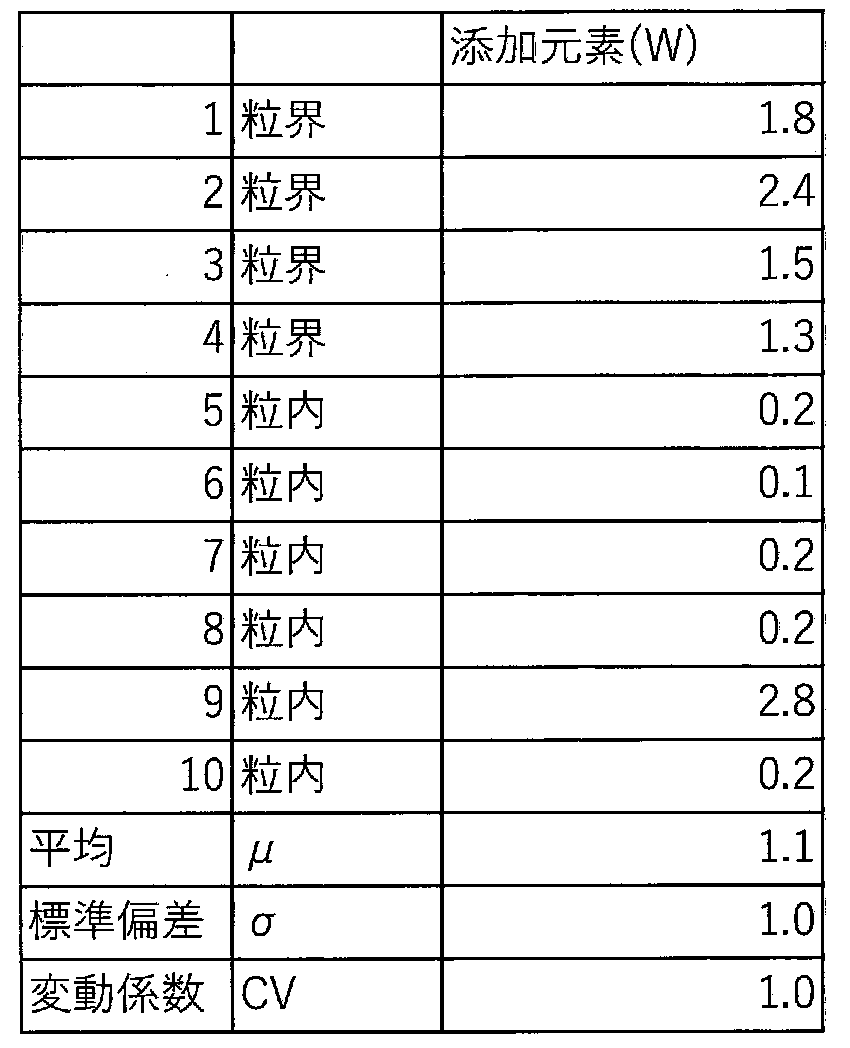
図3に示すような2032型コイン形電池10を作成した。具体的には、上述のようにして得られた正極活物質:52.5mgと、アセチレンブラック:15mgと、PTFE:7.5mgを混合し、100MPaの圧力で、直径11mm、厚さ100μmにプレス成形し、正極1を作製した。
[正極抵抗]
正極抵抗の測定は、インピーダンス測定法を用い、2032型コイン形電池を3.8Vで充電し、周波数応答アナライザおよびポテンショガルバノスタット(ソーラトロン製、1255B)を使用して交流インピーダンス法により測定し、図4に示すインピーダンススペクトルを得た。得られたインピーダンススペクトルには、高周波領域と中間周波領域とに2つの半円が観測され、低周波領域に直線が観察されることから、図5に示す等価回路を組んで正極界面抵抗を解析した。ここで、Rsはバルク抵抗、R1は正極被膜抵抗、Rctは電解液/正極界面抵抗、Wはワーブルグ成分、CPE1、CPE2は定相要素を示す。なお、正極界面抵抗については、後述する比較例1の正極活物質を基準とし、これに対する抵抗減少率を示す。
リチウム混合物を915℃まで昇温し、この温度で3時間保持することにより焼成したこと以外は、実施例1と同様にして、正極活物質を得るとともに、その評価を行った。
それぞれの金属元素のモル比が、Ni:Mn:Co:W=5.0:2.0:3.0:0.07となるように、タングステン酸ナトリウム水溶液を調製したことと以外は、実施例2と同様にして、正極活物質を得るとともに、その評価を行った。
リチウム混合物を985℃で焼成したこと以外は、実施例1と同様にして、正極活物質を得るとともに、その評価を行った。
リチウム混合物を885℃で焼成したこと以外は、実施例1と同様にして、正極活物質を得るとともに、その評価を行った。
晶析工程において、核生成工程および粒子成長工程の切替操作1までをすべて酸素濃度が21容量%の酸化性雰囲気に調整して晶析し、それ以降を酸素濃度が2容量%以下の非酸化性雰囲気に調整して、複合水酸化物を得たこと以外は実施例1と同様にして、正極活物質を得るとともに、その評価を行った。図2に得られた正極活物質の粒子構造を示す。複数の一次粒子が凝集した二次粒子より形成され、二次粒子外周部に連通孔を1個有し、かつ、二次粒子内部に空間部を1個有し、かつ外周部の連通孔と内部の空隙部とが繋がっている中空構造からなることを確認した。
リチウム混合物を815℃で焼成したこと以外は、実施例1と同様にして、正極活物質を得るとともに、その評価を行った。
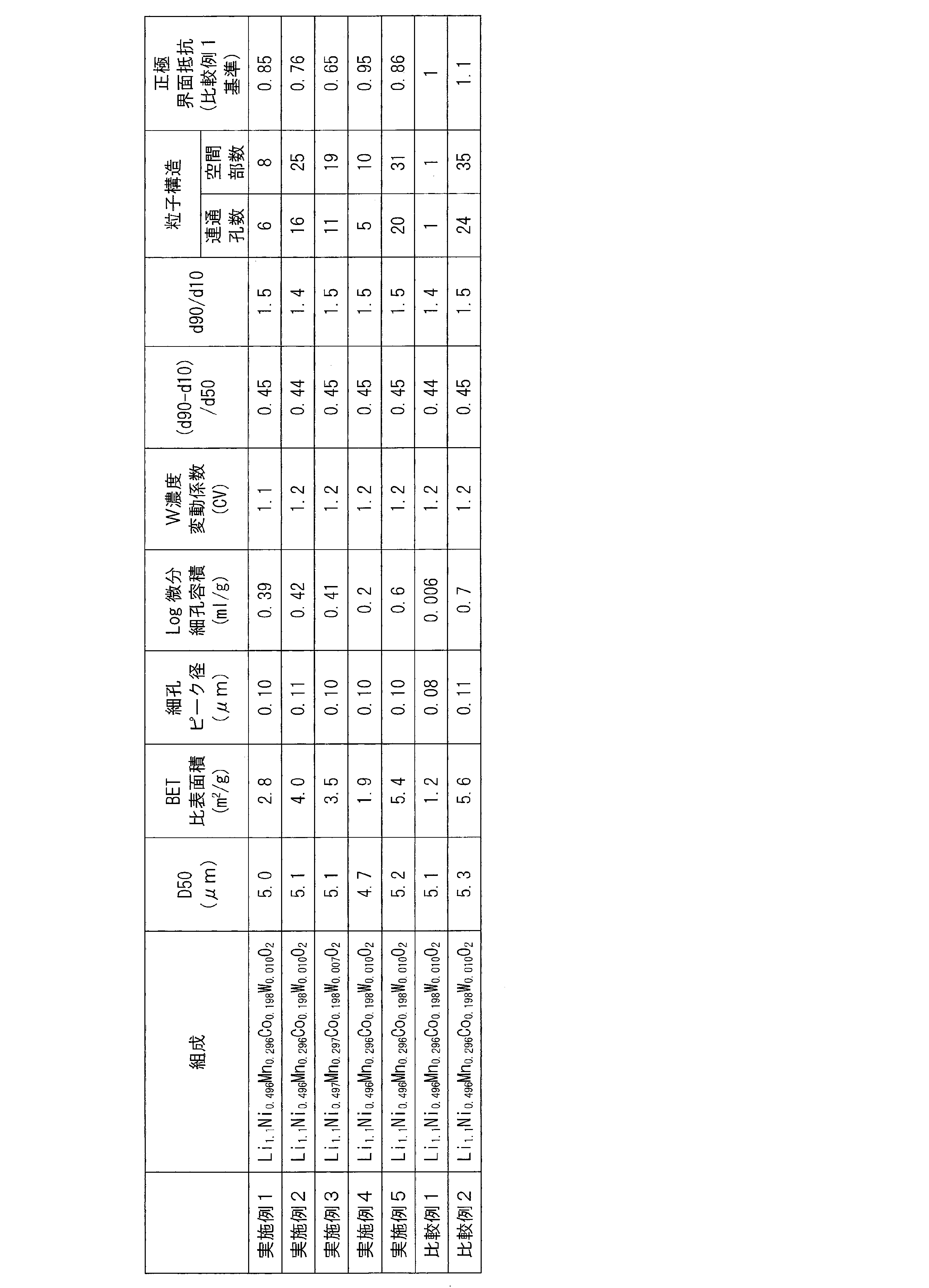
2 負極
3 セパレーター
4 ガスケット
5 ウェーブワッシャー
6 正極缶
7 負極缶
10 コイン形電池
Claims (8)
- 複合酸化物粒子は、一般式(A):Li1+uNixMnyCozMtO2(ただし、-0.05≦u≦0.5、x+y+z+t=1、0.3≦x≦0.9、0≦y≦0.5、0≦z≦0.5、0≦t≦0.1、Mは、Mg、Al、Si、Ca、Ti、V、Cr、Zr、Nb、Mo、Hf、Ta、およびWから選択される1種以上の添加元素)で表される組成、および、層状岩塩型構造の結晶構造を有するリチウム遷移金属含有複合酸化物粒子からなり、
該リチウム遷移金属含有複合酸化物粒子は、一次粒子が凝集した二次粒子により構成され、
前記二次粒子は、
3.0μm以上7.0μm以下の粒度分布測定値から求めた50%累積径d50、
1.8m2/g以上5.5m2/g以下のBET比表面積、
水銀圧入法により得られた細孔部分における、0.01μm以上0.30μm以下の細孔ピーク径、および、
前記0.01μm以上0.30μm以下の細孔ピーク径の範囲における、0.2ml/g以上0.6ml/g以下のlog微分細孔容積〔dV/d(logD)〕、
を有し、および、
前記一次粒子のうち、0.1μm以上1.0μm以下の範囲にある一次粒子径を有する複数の一次粒子のそれぞれについて、断面STEMあるいはTEM-EDX分析によって複数箇所について前記添加元素Mの濃度を測定し、該添加元素Mの濃度の標準偏差を該添加元素Mの平均濃度で除した値である該添加元素Mの濃度の変動係数を算出した場合に、該変動係数が1.5以下である、
リチウムイオン二次電池用正極活物質。 - 前記二次粒子の前記50%累積径d50は、4.0μm以上6.0μm以下である、請求項1に記載のリチウムイオン二次電池用正極活物質。
- 前記二次粒子の粒度分布の広がりを示す指標である〔(d90-d10)/d50〕(ただし、d10は粒度分布測定値から求めた10%累積径であり、d90は粒度分布測定値から求めた90%累積径である)が1.0以下である、請求項1または2に記載のリチウムイオン二次電池用正極活物質。
- 前記二次粒子のd90/d10の値(ただし、d10は粒度分布測定値から求めた10%累積径であり、d90は粒度分布測定値から求めた90%累積径である)が、1.0以上2.0以下である、請求項1~3のいずれかに記載のリチウムイオン二次電池用正極活物質。
- 前記二次粒子は、凝集部と、該凝集部の外周部を連通する1個以上の連通孔と、該凝集部の内側に存在し、前記連通孔と連通する2個以上の空間部を有する、請求項1~4のいずれかに記載のリチウムイオン二次電池用正極活物質。
- 前記添加元素Mは、Mg、Al、Si、Ti、Zr、Nb、Mo、およびWからなる群より選ばれる少なくとも1種である、請求項1~5のいずれかに記載のリチウムイオン二次電池用正極活物質。
- 前記添加元素Mは、Wからなる、請求項1~5のいずれかに記載のリチウムイオン二次電池用正極活物質。
- 正極、負極、セパレーター、および非水電解質、あるいは、正極、負極、および固体電解質を備え、前記正極に用いられる正極活物質として、請求項1~7のいずれかに記載のリチウムイオン二次電池用正極活物質が用いられている、リチウムイオン二次電池。
Priority Applications (5)
| Application Number | Priority Date | Filing Date | Title |
|---|---|---|---|
| EP20866052.2A EP4032860A4 (en) | 2019-09-19 | 2020-09-18 | ACTIVE MATERIAL OF POSITIVE ELECTRODE FOR LITHIUM-ION SECONDARY BATTERY AND LITHIUM-ION SECONDARY BATTERY |
| JP2021546998A JP7588594B2 (ja) | 2019-09-19 | 2020-09-18 | リチウムイオン二次電池用正極活物質およびリチウムイオン二次電池 |
| US17/761,772 US12315924B2 (en) | 2019-09-19 | 2020-09-18 | Positive electrode active material for lithium ion secondary battery and lithium ion secondary battery |
| CN202080065824.0A CN114514636B (zh) | 2019-09-19 | 2020-09-18 | 锂离子二次电池用正极活性物质以及锂离子二次电池 |
| JP2023220488A JP2024038149A (ja) | 2019-09-19 | 2023-12-27 | リチウムイオン二次電池用正極活物質およびリチウムイオン二次電池 |
Applications Claiming Priority (2)
| Application Number | Priority Date | Filing Date | Title |
|---|---|---|---|
| JP2019170443 | 2019-09-19 | ||
| JP2019-170443 | 2019-09-19 |
Publications (1)
| Publication Number | Publication Date |
|---|---|
| WO2021054466A1 true WO2021054466A1 (ja) | 2021-03-25 |
Family
ID=74883621
Family Applications (1)
| Application Number | Title | Priority Date | Filing Date |
|---|---|---|---|
| PCT/JP2020/035588 Ceased WO2021054466A1 (ja) | 2019-09-19 | 2020-09-18 | リチウムイオン二次電池用正極活物質およびリチウムイオン二次電池 |
Country Status (5)
| Country | Link |
|---|---|
| US (1) | US12315924B2 (ja) |
| EP (1) | EP4032860A4 (ja) |
| JP (2) | JP7588594B2 (ja) |
| CN (1) | CN114514636B (ja) |
| WO (1) | WO2021054466A1 (ja) |
Cited By (1)
| Publication number | Priority date | Publication date | Assignee | Title |
|---|---|---|---|---|
| EP4459713A4 (en) * | 2021-12-27 | 2025-07-16 | Panasonic Ip Man Co Ltd | POSITIVE ELECTRODE ACTIVE MATERIAL FOR NONAQUEOUS ELECTROLYTE SECONDARY BATTERY |
Families Citing this family (1)
| Publication number | Priority date | Publication date | Assignee | Title |
|---|---|---|---|---|
| JP7588594B2 (ja) * | 2019-09-19 | 2024-11-22 | 住友金属鉱山株式会社 | リチウムイオン二次電池用正極活物質およびリチウムイオン二次電池 |
Citations (11)
| Publication number | Priority date | Publication date | Assignee | Title |
|---|---|---|---|---|
| WO2012131881A1 (ja) | 2011-03-28 | 2012-10-04 | 住友金属鉱山株式会社 | ニッケルマンガン複合水酸化物粒子とその製造方法、非水系電解質二次電池用正極活物質とその製造方法、および非水系電解質二次電池 |
| JP2012246199A (ja) | 2011-05-30 | 2012-12-13 | Sumitomo Metal Mining Co Ltd | マンガン複合水酸化物粒子、非水系電解質二次電池用正極活物質、および非水系電解質二次電池と、それらの製造方法 |
| WO2014181891A1 (ja) | 2013-05-10 | 2014-11-13 | 住友金属鉱山株式会社 | 遷移金属複合水酸化物粒子とその製造方法、非水電解質二次電池用正極活物質とその製造方法および非水電解質二次電池 |
| WO2015170561A1 (ja) * | 2014-05-07 | 2015-11-12 | エリーパワー株式会社 | 非水電解質二次電池用正極、非水電解質二次電池 |
| WO2016084346A1 (ja) * | 2014-11-28 | 2016-06-02 | 三洋電機株式会社 | 非水電解質二次電池用正極及び非水電解質二次電池 |
| JP2017004635A (ja) * | 2015-06-05 | 2017-01-05 | プライムアースEvエナジー株式会社 | 非水電解液二次電池および非水電解液二次電池の正極活物質 |
| JP2017224496A (ja) * | 2016-06-15 | 2017-12-21 | 株式会社東芝 | 非水電解質電池、電池モジュール及び車両 |
| WO2018088320A1 (ja) * | 2016-11-08 | 2018-05-17 | 本田技研工業株式会社 | 非水系電解質二次電池用電極及びこれを備える非水系電解質二次電池 |
| JP2018104276A (ja) | 2016-12-27 | 2018-07-05 | 住友金属鉱山株式会社 | 遷移金属含有複合水酸化物粒子およびその製造方法、並びに、非水電解質二次電池用正極活物質およびその製造方法 |
| CN109873142A (zh) * | 2019-02-22 | 2019-06-11 | 东莞理工学院 | 电极活性材料、正极及其制备方法和锂电池 |
| JP2019119662A (ja) * | 2018-01-11 | 2019-07-22 | 住友金属鉱山株式会社 | 遷移金属含有複合水酸化物粒子とその製造方法、非水電解質二次電池用正極活物質とその製造方法、および非水電解質二次電池 |
Family Cites Families (8)
| Publication number | Priority date | Publication date | Assignee | Title |
|---|---|---|---|---|
| JP6596978B2 (ja) * | 2015-06-26 | 2019-10-30 | 住友金属鉱山株式会社 | 遷移金属複合水酸化物粒子とその製造方法、非水電解質二次電池用正極活物質とその製造方法、および非水電解質二次電池 |
| JP6187655B2 (ja) * | 2015-08-25 | 2017-08-30 | 日亜化学工業株式会社 | 非水電解液二次電池用正極活物質及びその製造方法 |
| TWI658635B (zh) * | 2016-01-22 | 2019-05-01 | 日商旭化成股份有限公司 | Lithium ion secondary battery |
| TWI628680B (zh) * | 2016-01-22 | 2018-07-01 | 旭化成股份有限公司 | 非水系鋰型蓄電元件 |
| KR102176633B1 (ko) * | 2017-02-28 | 2020-11-09 | 주식회사 엘지화학 | 리튬 이차전지용 양극 활물질, 그 제조방법 및 이를 포함하는 리튬 이차전지 |
| EP3694028B1 (en) | 2017-10-04 | 2024-10-09 | Kabushiki Kaisha Toshiba | Electrode, nonaqueous electrolyte battery, and battery pack |
| JP7035540B2 (ja) | 2018-01-11 | 2022-03-15 | 住友金属鉱山株式会社 | 遷移金属含有複合水酸化物粒子とその製造方法、非水電解質二次電池用正極活物質とその製造方法、および非水電解質二次電池 |
| JP7588594B2 (ja) * | 2019-09-19 | 2024-11-22 | 住友金属鉱山株式会社 | リチウムイオン二次電池用正極活物質およびリチウムイオン二次電池 |
-
2020
- 2020-09-18 JP JP2021546998A patent/JP7588594B2/ja active Active
- 2020-09-18 EP EP20866052.2A patent/EP4032860A4/en active Pending
- 2020-09-18 WO PCT/JP2020/035588 patent/WO2021054466A1/ja not_active Ceased
- 2020-09-18 CN CN202080065824.0A patent/CN114514636B/zh active Active
- 2020-09-18 US US17/761,772 patent/US12315924B2/en active Active
-
2023
- 2023-12-27 JP JP2023220488A patent/JP2024038149A/ja active Pending
Patent Citations (11)
| Publication number | Priority date | Publication date | Assignee | Title |
|---|---|---|---|---|
| WO2012131881A1 (ja) | 2011-03-28 | 2012-10-04 | 住友金属鉱山株式会社 | ニッケルマンガン複合水酸化物粒子とその製造方法、非水系電解質二次電池用正極活物質とその製造方法、および非水系電解質二次電池 |
| JP2012246199A (ja) | 2011-05-30 | 2012-12-13 | Sumitomo Metal Mining Co Ltd | マンガン複合水酸化物粒子、非水系電解質二次電池用正極活物質、および非水系電解質二次電池と、それらの製造方法 |
| WO2014181891A1 (ja) | 2013-05-10 | 2014-11-13 | 住友金属鉱山株式会社 | 遷移金属複合水酸化物粒子とその製造方法、非水電解質二次電池用正極活物質とその製造方法および非水電解質二次電池 |
| WO2015170561A1 (ja) * | 2014-05-07 | 2015-11-12 | エリーパワー株式会社 | 非水電解質二次電池用正極、非水電解質二次電池 |
| WO2016084346A1 (ja) * | 2014-11-28 | 2016-06-02 | 三洋電機株式会社 | 非水電解質二次電池用正極及び非水電解質二次電池 |
| JP2017004635A (ja) * | 2015-06-05 | 2017-01-05 | プライムアースEvエナジー株式会社 | 非水電解液二次電池および非水電解液二次電池の正極活物質 |
| JP2017224496A (ja) * | 2016-06-15 | 2017-12-21 | 株式会社東芝 | 非水電解質電池、電池モジュール及び車両 |
| WO2018088320A1 (ja) * | 2016-11-08 | 2018-05-17 | 本田技研工業株式会社 | 非水系電解質二次電池用電極及びこれを備える非水系電解質二次電池 |
| JP2018104276A (ja) | 2016-12-27 | 2018-07-05 | 住友金属鉱山株式会社 | 遷移金属含有複合水酸化物粒子およびその製造方法、並びに、非水電解質二次電池用正極活物質およびその製造方法 |
| JP2019119662A (ja) * | 2018-01-11 | 2019-07-22 | 住友金属鉱山株式会社 | 遷移金属含有複合水酸化物粒子とその製造方法、非水電解質二次電池用正極活物質とその製造方法、および非水電解質二次電池 |
| CN109873142A (zh) * | 2019-02-22 | 2019-06-11 | 东莞理工学院 | 电极活性材料、正极及其制备方法和锂电池 |
Non-Patent Citations (1)
| Title |
|---|
| See also references of EP4032860A4 |
Cited By (1)
| Publication number | Priority date | Publication date | Assignee | Title |
|---|---|---|---|---|
| EP4459713A4 (en) * | 2021-12-27 | 2025-07-16 | Panasonic Ip Man Co Ltd | POSITIVE ELECTRODE ACTIVE MATERIAL FOR NONAQUEOUS ELECTROLYTE SECONDARY BATTERY |
Also Published As
| Publication number | Publication date |
|---|---|
| JP2024038149A (ja) | 2024-03-19 |
| US20220384804A1 (en) | 2022-12-01 |
| US12315924B2 (en) | 2025-05-27 |
| EP4032860A1 (en) | 2022-07-27 |
| JP7588594B2 (ja) | 2024-11-22 |
| EP4032860A4 (en) | 2023-11-22 |
| JPWO2021054466A1 (ja) | 2021-03-25 |
| CN114514636A (zh) | 2022-05-17 |
| CN114514636B (zh) | 2024-03-26 |
Similar Documents
| Publication | Publication Date | Title |
|---|---|---|
| JP7660064B2 (ja) | リチウムイオン二次電池用正極活物質およびリチウムイオン二次電池 | |
| JP6888297B2 (ja) | 非水系電解質二次電池用正極活物質とその製造方法 | |
| JP2021147314A (ja) | 遷移金属複合水酸化物粒子、遷移金属複合水酸化物粒子の製造方法、リチウムイオン二次電池用正極活物質、及びリチウムイオン二次電池 | |
| JP7347061B2 (ja) | リチウムイオン二次電池用正極活物質およびリチウムイオン二次電池 | |
| JP7235130B2 (ja) | リチウムイオン二次電池用正極活物質およびリチウムイオン二次電池 | |
| CN111094188A (zh) | 金属复合氢氧化物及其制造方法、非水电解质二次电池用正极活性物质及其制造方法、以及使用其的非水电解质二次电池 | |
| JP2021051880A (ja) | リチウムイオン二次電池用正極活物質およびリチウムイオン二次電池 | |
| JP7183813B2 (ja) | ニッケルマンガンコバルト含有複合水酸化物およびその製造方法、リチウムイオン二次電池用正極活物質およびその製造方法、並びに、リチウムイオン二次電池 | |
| JP7183815B2 (ja) | ニッケルマンガンコバルト含有複合水酸化物およびその製造方法、リチウムイオン二次電池用正極活物質およびその製造方法、並びに、リチウムイオン二次電池 | |
| JP7488021B2 (ja) | 金属複合水酸化物とその製造方法、リチウムイオン二次電池用正極活物質とその製造方法、及び、それを用いたリチウムイオン二次電池 | |
| JP7102973B2 (ja) | リチウムイオン二次電池用の正極活物質とその製造方法、およびチウムイオン二次電池 | |
| JP2024001041A (ja) | リチウムイオン二次電池用正極活物質、リチウムイオン二次電池 | |
| JP2021012807A (ja) | ニッケルマンガンコバルト含有複合水酸化物およびその製造方法、リチウムイオン二次電池用正極活物質およびその製造方法、並びに、リチウムイオン二次電池 | |
| JP7183812B2 (ja) | ニッケルマンガンコバルト含有複合水酸化物およびその製造方法、リチウムイオン二次電池用正極活物質およびその製造方法、並びに、リチウムイオン二次電池 | |
| JP2024038149A (ja) | リチウムイオン二次電池用正極活物質およびリチウムイオン二次電池 | |
| JP7347062B2 (ja) | リチウムイオン二次電池用正極活物質およびリチウムイオン二次電池 | |
| WO2021054469A1 (ja) | リチウムイオン二次電池用正極活物質およびリチウムイオン二次電池 | |
| JP7183814B2 (ja) | ニッケルマンガンコバルト含有複合水酸化物およびその製造方法、リチウムイオン二次電池用正極活物質およびその製造方法、並びに、リチウムイオン二次電池 | |
| JP7031150B2 (ja) | 非水系電解質二次電池用正極活物質、非水系電解質二次電池用正極活物質の製造方法、および該正極活物質を用いた非水系電解質二次電池 |
Legal Events
| Date | Code | Title | Description |
|---|---|---|---|
| 121 | Ep: the epo has been informed by wipo that ep was designated in this application |
Ref document number: 20866052 Country of ref document: EP Kind code of ref document: A1 |
|
| ENP | Entry into the national phase |
Ref document number: 2021546998 Country of ref document: JP Kind code of ref document: A |
|
| NENP | Non-entry into the national phase |
Ref country code: DE |
|
| ENP | Entry into the national phase |
Ref document number: 2020866052 Country of ref document: EP Effective date: 20220419 |
|
| WWG | Wipo information: grant in national office |
Ref document number: 17761772 Country of ref document: US |