WO2021059689A1 - ハイドロゲル - Google Patents
ハイドロゲル Download PDFInfo
- Publication number
- WO2021059689A1 WO2021059689A1 PCT/JP2020/027635 JP2020027635W WO2021059689A1 WO 2021059689 A1 WO2021059689 A1 WO 2021059689A1 JP 2020027635 W JP2020027635 W JP 2020027635W WO 2021059689 A1 WO2021059689 A1 WO 2021059689A1
- Authority
- WO
- WIPO (PCT)
- Prior art keywords
- hydrogel
- mass
- meth
- water
- monomer
- Prior art date
- Legal status (The legal status is an assumption and is not a legal conclusion. Google has not performed a legal analysis and makes no representation as to the accuracy of the status listed.)
- Ceased
Links
Images

Classifications
-
- C—CHEMISTRY; METALLURGY
- C08—ORGANIC MACROMOLECULAR COMPOUNDS; THEIR PREPARATION OR CHEMICAL WORKING-UP; COMPOSITIONS BASED THEREON
- C08J—WORKING-UP; GENERAL PROCESSES OF COMPOUNDING; AFTER-TREATMENT NOT COVERED BY SUBCLASSES C08B, C08C, C08F, C08G or C08H
- C08J3/00—Processes of treating or compounding macromolecular substances
- C08J3/02—Making solutions, dispersions, lattices or gels by other methods than by solution, emulsion or suspension polymerisation techniques
- C08J3/03—Making solutions, dispersions, lattices or gels by other methods than by solution, emulsion or suspension polymerisation techniques in aqueous media
- C08J3/075—Macromolecular gels
-
- C—CHEMISTRY; METALLURGY
- C08—ORGANIC MACROMOLECULAR COMPOUNDS; THEIR PREPARATION OR CHEMICAL WORKING-UP; COMPOSITIONS BASED THEREON
- C08F—MACROMOLECULAR COMPOUNDS OBTAINED BY REACTIONS ONLY INVOLVING CARBON-TO-CARBON UNSATURATED BONDS
- C08F2/00—Processes of polymerisation
- C08F2/46—Polymerisation initiated by wave energy or particle radiation
- C08F2/48—Polymerisation initiated by wave energy or particle radiation by ultraviolet or visible light
-
- A—HUMAN NECESSITIES
- A61—MEDICAL OR VETERINARY SCIENCE; HYGIENE
- A61B—DIAGNOSIS; SURGERY; IDENTIFICATION
- A61B5/00—Measuring for diagnostic purposes; Identification of persons
- A61B5/24—Detecting, measuring or recording bioelectric or biomagnetic signals of the body or parts thereof
- A61B5/25—Bioelectric electrodes therefor
- A61B5/263—Bioelectric electrodes therefor characterised by the electrode materials
- A61B5/268—Bioelectric electrodes therefor characterised by the electrode materials containing conductive polymers, e.g. PEDOT:PSS polymers
-
- A—HUMAN NECESSITIES
- A61—MEDICAL OR VETERINARY SCIENCE; HYGIENE
- A61K—PREPARATIONS FOR MEDICAL, DENTAL OR TOILETRY PURPOSES
- A61K8/00—Cosmetics or similar toiletry preparations
- A61K8/02—Cosmetics or similar toiletry preparations characterised by special physical form
- A61K8/0208—Tissues; Wipes; Patches
-
- A—HUMAN NECESSITIES
- A61—MEDICAL OR VETERINARY SCIENCE; HYGIENE
- A61K—PREPARATIONS FOR MEDICAL, DENTAL OR TOILETRY PURPOSES
- A61K8/00—Cosmetics or similar toiletry preparations
- A61K8/02—Cosmetics or similar toiletry preparations characterised by special physical form
- A61K8/0212—Face masks
-
- A—HUMAN NECESSITIES
- A61—MEDICAL OR VETERINARY SCIENCE; HYGIENE
- A61K—PREPARATIONS FOR MEDICAL, DENTAL OR TOILETRY PURPOSES
- A61K8/00—Cosmetics or similar toiletry preparations
- A61K8/02—Cosmetics or similar toiletry preparations characterised by special physical form
- A61K8/04—Dispersions; Emulsions
- A61K8/042—Gels
-
- A—HUMAN NECESSITIES
- A61—MEDICAL OR VETERINARY SCIENCE; HYGIENE
- A61K—PREPARATIONS FOR MEDICAL, DENTAL OR TOILETRY PURPOSES
- A61K8/00—Cosmetics or similar toiletry preparations
- A61K8/18—Cosmetics or similar toiletry preparations characterised by the composition
- A61K8/30—Cosmetics or similar toiletry preparations characterised by the composition containing organic compounds
- A61K8/33—Cosmetics or similar toiletry preparations characterised by the composition containing organic compounds containing oxygen
- A61K8/34—Alcohols
- A61K8/345—Alcohols containing more than one hydroxy group
-
- A—HUMAN NECESSITIES
- A61—MEDICAL OR VETERINARY SCIENCE; HYGIENE
- A61K—PREPARATIONS FOR MEDICAL, DENTAL OR TOILETRY PURPOSES
- A61K8/00—Cosmetics or similar toiletry preparations
- A61K8/18—Cosmetics or similar toiletry preparations characterised by the composition
- A61K8/72—Cosmetics or similar toiletry preparations characterised by the composition containing organic macromolecular compounds
- A61K8/81—Cosmetics or similar toiletry preparations characterised by the composition containing organic macromolecular compounds obtained by reactions involving only carbon-to-carbon unsaturated bonds
- A61K8/8141—Compositions of homopolymers or copolymers of compounds having one or more unsaturated aliphatic radicals, each having only one carbon-to-carbon double bond, and at least one being terminated by only one carboxyl radical, or of salts, anhydrides, esters, amides, imides or nitriles thereof; Compositions of derivatives of such polymers
- A61K8/8158—Homopolymers or copolymers of amides or imides, e.g. (meth) acrylamide; Compositions of derivatives of such polymers
-
- A—HUMAN NECESSITIES
- A61—MEDICAL OR VETERINARY SCIENCE; HYGIENE
- A61K—PREPARATIONS FOR MEDICAL, DENTAL OR TOILETRY PURPOSES
- A61K8/00—Cosmetics or similar toiletry preparations
- A61K8/18—Cosmetics or similar toiletry preparations characterised by the composition
- A61K8/72—Cosmetics or similar toiletry preparations characterised by the composition containing organic macromolecular compounds
- A61K8/81—Cosmetics or similar toiletry preparations characterised by the composition containing organic macromolecular compounds obtained by reactions involving only carbon-to-carbon unsaturated bonds
- A61K8/817—Compositions of homopolymers or copolymers of compounds having one or more unsaturated aliphatic radicals, each having only one carbon-to-carbon double bond, and at least one being terminated by a single or double bond to nitrogen or by a heterocyclic ring containing nitrogen; Compositions or derivatives of such polymers, e.g. vinylimidazol, vinylcaprolactame, allylamines (Polyquaternium 6)
- A61K8/8176—Homopolymers of N-vinyl-pyrrolidones. Compositions of derivatives of such polymers
-
- A—HUMAN NECESSITIES
- A61—MEDICAL OR VETERINARY SCIENCE; HYGIENE
- A61K—PREPARATIONS FOR MEDICAL, DENTAL OR TOILETRY PURPOSES
- A61K9/00—Medicinal preparations characterised by special physical form
- A61K9/0002—Galenical forms characterised by the drug release technique; Application systems commanded by energy
- A61K9/0009—Galenical forms characterised by the drug release technique; Application systems commanded by energy involving or responsive to electricity, magnetism or acoustic waves; Galenical aspects of sonophoresis, iontophoresis, electroporation or electroosmosis
-
- A—HUMAN NECESSITIES
- A61—MEDICAL OR VETERINARY SCIENCE; HYGIENE
- A61Q—SPECIFIC USE OF COSMETICS OR SIMILAR TOILETRY PREPARATIONS
- A61Q19/00—Preparations for care of the skin
-
- C—CHEMISTRY; METALLURGY
- C08—ORGANIC MACROMOLECULAR COMPOUNDS; THEIR PREPARATION OR CHEMICAL WORKING-UP; COMPOSITIONS BASED THEREON
- C08F—MACROMOLECULAR COMPOUNDS OBTAINED BY REACTIONS ONLY INVOLVING CARBON-TO-CARBON UNSATURATED BONDS
- C08F2/00—Processes of polymerisation
- C08F2/44—Polymerisation in the presence of compounding ingredients, e.g. plasticisers, dyestuffs, fillers
-
- C—CHEMISTRY; METALLURGY
- C08—ORGANIC MACROMOLECULAR COMPOUNDS; THEIR PREPARATION OR CHEMICAL WORKING-UP; COMPOSITIONS BASED THEREON
- C08F—MACROMOLECULAR COMPOUNDS OBTAINED BY REACTIONS ONLY INVOLVING CARBON-TO-CARBON UNSATURATED BONDS
- C08F271/00—Macromolecular compounds obtained by polymerising monomers on to polymers of nitrogen-containing monomers as defined in group C08F26/00
- C08F271/02—Macromolecular compounds obtained by polymerising monomers on to polymers of nitrogen-containing monomers as defined in group C08F26/00 on to polymers of monomers containing heterocyclic nitrogen
-
- C—CHEMISTRY; METALLURGY
- C09—DYES; PAINTS; POLISHES; NATURAL RESINS; ADHESIVES; COMPOSITIONS NOT OTHERWISE PROVIDED FOR; APPLICATIONS OF MATERIALS NOT OTHERWISE PROVIDED FOR
- C09J—ADHESIVES; NON-MECHANICAL ASPECTS OF ADHESIVE PROCESSES IN GENERAL; ADHESIVE PROCESSES NOT PROVIDED FOR ELSEWHERE; USE OF MATERIALS AS ADHESIVES
- C09J7/00—Adhesives in the form of films or foils
- C09J7/30—Adhesives in the form of films or foils characterised by the adhesive composition
-
- C—CHEMISTRY; METALLURGY
- C09—DYES; PAINTS; POLISHES; NATURAL RESINS; ADHESIVES; COMPOSITIONS NOT OTHERWISE PROVIDED FOR; APPLICATIONS OF MATERIALS NOT OTHERWISE PROVIDED FOR
- C09J—ADHESIVES; NON-MECHANICAL ASPECTS OF ADHESIVE PROCESSES IN GENERAL; ADHESIVE PROCESSES NOT PROVIDED FOR ELSEWHERE; USE OF MATERIALS AS ADHESIVES
- C09J9/00—Adhesives characterised by their physical nature or the effects produced, e.g. glue sticks
- C09J9/02—Electrically-conducting adhesives
-
- A—HUMAN NECESSITIES
- A61—MEDICAL OR VETERINARY SCIENCE; HYGIENE
- A61K—PREPARATIONS FOR MEDICAL, DENTAL OR TOILETRY PURPOSES
- A61K2800/00—Properties of cosmetic compositions or active ingredients thereof or formulation aids used therein and process related aspects
- A61K2800/10—General cosmetic use
-
- A—HUMAN NECESSITIES
- A61—MEDICAL OR VETERINARY SCIENCE; HYGIENE
- A61K—PREPARATIONS FOR MEDICAL, DENTAL OR TOILETRY PURPOSES
- A61K2800/00—Properties of cosmetic compositions or active ingredients thereof or formulation aids used therein and process related aspects
- A61K2800/40—Chemical, physico-chemical or functional or structural properties of particular ingredients
- A61K2800/54—Polymers characterized by specific structures/properties
-
- C—CHEMISTRY; METALLURGY
- C08—ORGANIC MACROMOLECULAR COMPOUNDS; THEIR PREPARATION OR CHEMICAL WORKING-UP; COMPOSITIONS BASED THEREON
- C08J—WORKING-UP; GENERAL PROCESSES OF COMPOUNDING; AFTER-TREATMENT NOT COVERED BY SUBCLASSES C08B, C08C, C08F, C08G or C08H
- C08J2333/00—Characterised by the use of homopolymers or copolymers of compounds having one or more unsaturated aliphatic radicals, each having only one carbon-to-carbon double bond, and only one being terminated by only one carboxyl radical, or of salts, anhydrides, esters, amides, imides, or nitriles thereof; Derivatives of such polymers
- C08J2333/24—Homopolymers or copolymers of amides or imides
- C08J2333/26—Homopolymers or copolymers of acrylamide or methacrylamide
-
- C—CHEMISTRY; METALLURGY
- C08—ORGANIC MACROMOLECULAR COMPOUNDS; THEIR PREPARATION OR CHEMICAL WORKING-UP; COMPOSITIONS BASED THEREON
- C08J—WORKING-UP; GENERAL PROCESSES OF COMPOUNDING; AFTER-TREATMENT NOT COVERED BY SUBCLASSES C08B, C08C, C08F, C08G or C08H
- C08J2339/00—Characterised by the use of homopolymers or copolymers of compounds having one or more unsaturated aliphatic radicals, each having only one carbon-to-carbon double bond, and at least one being terminated by a single or double bond to nitrogen or by a heterocyclic ring containing nitrogen; Derivatives of such polymers
- C08J2339/04—Homopolymers or copolymers of monomers containing heterocyclic rings having nitrogen as ring member
- C08J2339/06—Homopolymers or copolymers of N-vinyl-pyrrolidones
-
- C—CHEMISTRY; METALLURGY
- C08—ORGANIC MACROMOLECULAR COMPOUNDS; THEIR PREPARATION OR CHEMICAL WORKING-UP; COMPOSITIONS BASED THEREON
- C08J—WORKING-UP; GENERAL PROCESSES OF COMPOUNDING; AFTER-TREATMENT NOT COVERED BY SUBCLASSES C08B, C08C, C08F, C08G or C08H
- C08J2433/00—Characterised by the use of homopolymers or copolymers of compounds having one or more unsaturated aliphatic radicals, each having only one carbon-to-carbon double bond, and only one being terminated by only one carboxyl radical, or of salts, anhydrides, esters, amides, imides, or nitriles thereof; Derivatives of such polymers
- C08J2433/24—Homopolymers or copolymers of amides or imides
- C08J2433/26—Homopolymers or copolymers of acrylamide or methacrylamide
-
- C—CHEMISTRY; METALLURGY
- C08—ORGANIC MACROMOLECULAR COMPOUNDS; THEIR PREPARATION OR CHEMICAL WORKING-UP; COMPOSITIONS BASED THEREON
- C08J—WORKING-UP; GENERAL PROCESSES OF COMPOUNDING; AFTER-TREATMENT NOT COVERED BY SUBCLASSES C08B, C08C, C08F, C08G or C08H
- C08J2439/00—Characterised by the use of homopolymers or copolymers of compounds having one or more unsaturated aliphatic radicals, each having only one carbon-to-carbon double bond, and at least one being terminated by a single or double bond to nitrogen or by a heterocyclic ring containing nitrogen; Derivatives of such polymers
- C08J2439/04—Homopolymers or copolymers of monomers containing heterocyclic rings having nitrogen as ring member
- C08J2439/06—Homopolymers or copolymers of N-vinyl-pyrrolidones
-
- C—CHEMISTRY; METALLURGY
- C08—ORGANIC MACROMOLECULAR COMPOUNDS; THEIR PREPARATION OR CHEMICAL WORKING-UP; COMPOSITIONS BASED THEREON
- C08K—Use of inorganic or non-macromolecular organic substances as compounding ingredients
- C08K5/00—Use of organic ingredients
- C08K5/04—Oxygen-containing compounds
- C08K5/05—Alcohols; Metal alcoholates
- C08K5/053—Polyhydroxylic alcohols
-
- C—CHEMISTRY; METALLURGY
- C09—DYES; PAINTS; POLISHES; NATURAL RESINS; ADHESIVES; COMPOSITIONS NOT OTHERWISE PROVIDED FOR; APPLICATIONS OF MATERIALS NOT OTHERWISE PROVIDED FOR
- C09J—ADHESIVES; NON-MECHANICAL ASPECTS OF ADHESIVE PROCESSES IN GENERAL; ADHESIVE PROCESSES NOT PROVIDED FOR ELSEWHERE; USE OF MATERIALS AS ADHESIVES
- C09J2400/00—Presence of inorganic and organic materials
- C09J2400/20—Presence of organic materials
- C09J2400/26—Presence of textile or fabric
- C09J2400/263—Presence of textile or fabric in the substrate
-
- C—CHEMISTRY; METALLURGY
- C09—DYES; PAINTS; POLISHES; NATURAL RESINS; ADHESIVES; COMPOSITIONS NOT OTHERWISE PROVIDED FOR; APPLICATIONS OF MATERIALS NOT OTHERWISE PROVIDED FOR
- C09J—ADHESIVES; NON-MECHANICAL ASPECTS OF ADHESIVE PROCESSES IN GENERAL; ADHESIVE PROCESSES NOT PROVIDED FOR ELSEWHERE; USE OF MATERIALS AS ADHESIVES
- C09J2433/00—Presence of (meth)acrylic polymer
Definitions
- the present invention relates to a hydrogel.
- Hydrogel is basically a polymer that has a high affinity for water and swells in an aqueous solvent. Hydrogels have various properties such as water absorption, swelling, moisturizing properties, adhesiveness, and conductivity, depending on their use. Utilizing these properties, civil engineering, agriculture, food, medical care, etc. It is used in a wide range of fields such as cosmetics and electricity.
- Patent Document 1 discloses an adhesive gel (hydrogel having adhesiveness) containing a polyhydric alcohol and water in a matrix of a hydrophilic polymer and an acrylamide polymer.
- This adhesive gel has the characteristics that it can be suitably attached to the surface of a living body while maintaining its adhesiveness even when the water content is reduced, and has low skin irritation and flexibility.
- Patent Document 2 describes a non-crosslinked water-soluble polymer having a weight average molecular weight of 4000 to 15,000,000 in a polymer matrix in which acrylamide as a polymerizable monomer and a crosslinkable monomer are copolymerized.
- An adhesive gel characterized by having adhesive strength and 90 degree peel strength against a biaxially stretched polyester film of 0.196 to 1.96 N / 0.02 m has been disclosed. This adhesive gel has low skin irritation, has high adhesiveness, has low film peeling strength with respect to a biaxially stretched polyester film, and has stable releasability.
- Hydrogels are preferably applied to the skin with less odor, less skin irritation, and flexibility.
- hydrogels are generally used repeatedly, they are sticky when used repeatedly so that the stickiness to the skin surface is maintained even if they are reapplied (hereinafter, also simply referred to as "repeated stickiness").
- Patent Documents 1 and 2 do not work on improving the repeated adhesiveness of the gel.
- An object of the present invention is to provide a hydrogel having excellent adhesiveness repeatedly and being hard to tear.
- the present inventors have found that the above problems can be solved by selecting the constituent components of the hydrogel and setting the tensile strength within a certain range.
- the present invention has a polymer matrix formed from a copolymer of an acrylic monomer and a crosslinkable monomer, a water-soluble polymer, water, and a polyhydric alcohol.
- Hydrogels are provided, which are characterized by having a tensile strength of 0.5 N / 20 mm to 3.0 N / 20 mm.
- the method for producing a hydrogel which contains an acrylic monomer, a crosslinkable monomer, a water-soluble polymer, water, and a polyhydric alcohol, and crosslinks the hydrogel.
- Hydro is characterized by having a step of irradiating a polymerizable solution having a sex monomer content of 0.03% by mass to 0.05% by mass with ultraviolet rays having a peak intensity of 70 to 150 mW / cm 2.
- a method for producing a gel is provided.
- FIG. 1 A schematic plan view of an embodiment of the gel sheet
- B a schematic cross-sectional view of the gel sheet of FIG. 1 (A) in line 1B-1B.
- hydrogel The hydrogel of the present invention (hereinafter, also simply referred to as “hydrogel” or “gel”) is a polymer matrix formed from a copolymer of an acrylic monomer and a crosslinkable monomer, and water-soluble. It has a polypolymer, water, and a polyhydric alcohol, and has a tensile strength of 0.5 N / 20 mm to 3.0 N / 20 mm.
- the acrylic monomer is a monofunctional monomer having one polymerizable carbon-carbon double bond in the molecule and is a non-crosslinked monomer.
- the acrylic monomer is not particularly limited, but a water-soluble monomer such as a (meth) acrylamide-based monomer or a (meth) acrylic acid ester is preferable, and a (meth) acrylamide-based monomer is more preferable.
- the (meth) acrylamide-based monomer examples include (meth) acrylamide; N, N-dialkyl (meth) acrylamide such as N, N-dimethyl (meth) acrylamide and N, N-diethyl (meth) acrylamide; N-alkyl (meth) acrylamide such as N-isopropyl (meth) acrylamide, N-methyl (meth) acrylamide, N-ethyl (meth) acrylamide, N-propyl (meth) acrylamide; N-hydroxyethyl (meth) acrylamide, N-hydroxyalkyl (meth) acrylamide such as N-hydroxymethyl (meth) acrylamide; N-ethoxymethyl (meth) acrylamide, N-propoxymethyl (meth) acrylamide, N-butoxymethyl (meth) acrylamide, N-isobutoxy Methyl (meth) acrylamide, N-pentoxymethyl (meth) acrylamide, N-he
- One or more selected from the group consisting of salts is preferable, but the present invention is not limited thereto.
- (meth) acrylic acid ester examples include (meth) acrylic acid alkyl esters having an alkyl group having 1 to 18 carbon atoms, such as methyl (meth) acrylic acid, ethyl (meth) acrylic acid, and (meth) acrylic acid.
- N-propyl acid isopropyl (meth) acrylate, n-butyl (meth) acrylate, isobutyl (meth) acrylate, tert-butyl (meth) acrylate, n-hexyl (meth) acrylate, (meth) acrylic N-octyl acid, isooctyl (meth) acrylate, 2-ethylhexyl (meth) acrylate, n-nonyl (meth) acrylate, isononyl (meth) acrylate, n-pentyl (meth) acrylate, (meth) acrylic (Meta) acrylic acid alkyl esters such as n-decyl acid, isodecyl (meth) acrylate, n-lauryl (meth) acrylate, tridecyl (meth) acrylate, n-stearyl (meth) acrylate; (meth) acrylic Alicycl
- the aryl group may be bonded to the hydroxyalkyl group via an ether bond
- (meth) acrylic acid (meth) acrylic acid.
- the hydrogel may or may not contain acrylic acid as an acrylic monomer.
- acrylic acid By leaving an appropriate amount of acrylic acid in the hydrogel, the hardness can be increased while maintaining the conventional adhesive strength of the hydrogel.
- the amount of acrylic acid in the hydrogel is preferably small, for example, 5% by mass or less, preferably 1% by mass or less, based on the hydrogel.
- acrylic acid is not added to the hydrogel.
- the amount of the acrylic monomer added is in the range of 98.5% by mass to 99.97% by mass with respect to the total amount of the polymer matrix in terms of forming a hydrogel, being difficult to tear, and being hard. It is preferably inside.
- the content of the structural unit derived from the acrylic monomer in the polymer matrix is preferably in the range of 98.5% by mass to 99.97% by mass.
- the amount of the acrylic monomer added is 99.5% by mass to 99.85% by mass with respect to the total amount of the polymer matrix from the viewpoint of forming a hydrogel, being difficult to tear, and being hard. Is more preferable.
- the content of the structural unit derived from the acrylic monomer in the polymer matrix is more preferably in the range of 99.5% by mass to 99.85% by mass.
- the amount of the acrylic monomer added should be in the range of 2% by mass to 60% by mass with respect to the hydrogel in terms of forming the hydrogel, being difficult to tear, and being hard. Is preferable.
- the content of the acrylic monomer in the hydrogel is preferably 2% by mass or more.
- the content of the acrylic monomer in the hydrogel is preferably 60% by mass or less in terms of allowing the movement of ions in the hydrogel.
- the content of the polymer matrix in the hydrogel is more preferably 5% by mass to 50% by mass, more preferably 10% by mass to 40% by mass, and further preferably in the range of 13% by mass to 35% by mass. Is inside.
- the content of the structural unit derived from the crosslinkable monomer in the hydrogel is preferably in the range of 0.01% by mass to 0.1% by mass, and 0.03% by mass to 0.05. It is more preferably in the range of mass%.
- the crosslinkable monomer it is preferable to use a monomer having two or more carbon-carbon double bonds having polymerizability in the molecule.
- a monomer having two or more carbon-carbon double bonds having polymerizability in the molecule Specifically, methylenebis (meth) acrylamide, ethylenebis (meth) acrylamide, (poly) ethylene glycol di (meth) acrylate, (poly) propylene glycol di (meth) acrylate, glycerin di (meth) acrylate, glycerin tri
- polyfunctional (meth) acrylamide such as meta) acrylate or polyfunctional (meth) acrylic acid ester, tetraaryloxyethane, diallyl ammonium chloride, etc., and these can be used alone or in combination of two or more. ..
- crosslinkable monomer having two or more polymerizable double bonds in the molecule the crosslinkable monomer having two or more (meth) acryloyl groups or vinyl groups described in Japanese Patent No. 2803886 and having two or more (meth) acryloyl groups or vinyl groups.
- Polyglycerin derivatives which are polyfunctional compounds having a molecular weight of 400 or more, can also be used.
- the polyfunctional (meth) acrylamide, the polyfunctional (meth) acrylic acid ester, and the polyglycerin derivative are included in the acrylic monomer.
- the amount of the crosslinkable monomer added is in the range of 0.02% by mass to 1.5% by mass with respect to the total amount of the polymer matrix in terms of adhesive strength, repeated adhesiveness, resistance to tearing, and hardness. It is preferably inside.
- the amount of the crosslinkable monomer added is 0.02% by mass or more, the crosslink density is maintained, the shape stability is good, and at the same time, the cohesive force of the gel is improved and the adhesive force is sufficiently increased. Can be done. Further, at the time of peeling, the gel sheet can be smoothly peeled from the adherend, it is difficult to tear, and the gel sheet is easy to handle.
- the addition amount of the crosslinkable monomer is 1.5% by mass or less, high adhesive strength and / or repeated adhesiveness can be maintained, and a flexible gel can be obtained.
- the content of the structural unit derived from the crosslinkable monomer in the polymer matrix is preferably in the range of 0.02% by mass to 1.5% by mass.
- the amount of the crosslinkable monomer added is in the range of 0.01% by mass to 0.1% by mass with respect to the hydrogel from the viewpoint of the adhesive strength of the gel sheet, the repeated adhesiveness, the handleability and the like. It is preferable, and it is more preferable that it is in the range of 0.03% by mass to 0.05% by mass.
- the content of the structural unit derived from the crosslinkable monomer in the hydrogel is preferably in the range of 0.01% by mass to 0.1% by mass, and 0.03% by mass to 0.05. It is more preferably in the range of mass%.
- the amount of acrylic monomer added as a constituent monomer of the polymer matrix is 98.5% by mass to 99.97 with respect to the total amount of the polymer matrix.
- the amount of the crosslinkable monomer added is preferably in the range of 0.03% by mass to 1.5% by mass, and the amount of the acrylic monomer added is 99.5% by mass. More preferably, it is in the range of mass% to 99.85% by mass, and the amount of the crosslinkable monomer added is in the range of 0.15% by mass to 0.5% by mass.
- the content of the structural unit derived from the acrylic monomer in the polymer matrix is in the range of 98.5% by mass to 99.97% by mass in terms of repeatability, resistance to tearing, and hardness.
- the content of the structural unit derived from the crosslinkable monomer is preferably in the range of 0.03% by mass to 1.5% by mass, and the structural unit derived from the acrylic monomer in the polymer matrix.
- the content of is in the range of 99.5% by mass to 99.85% by mass, and the content of the structural unit derived from the crosslinkable monomer is in the range of 0.15% by mass to 0.5% by mass. Is more preferable.
- the copolymer of the acrylic monomer and the crosslinkable monomer does not contain any additional monomer constituting the copolymer other than the acrylic monomer and the crosslinkable monomer. , Such additional monomers may be included.
- the water-soluble polymer is added for the purpose of imparting adhesive force to the adherend, repeated adhesiveness, and cohesive force (hardness) of the gel to the hydrogel.
- the water-soluble polymer is preferably a non-ionic water-soluble polymer having no ionic group in the molecule.
- the water-soluble polymer include one or more selected from the group consisting of polyN-vinylpyrrolidone (PVP), polyethylene oxide (PEO), polyvinyl alcohol (PVA), and polyvinyl alcohol partial saponification. It is mentioned, preferably PVP.
- the content of the water-soluble polymer in the hydrogel is not particularly limited, but is preferably in the range of 0.1% by mass to 13% by mass, and 0.5% by mass to 12% by mass with respect to the hydrogel. It is more preferably in the range of 0.5% by mass to 10% by mass.
- the content of water in the hydrogel is not particularly limited, but is preferably 10 to 60% by mass, more preferably 10 to 45% by mass, and 15 to 30% by mass with respect to the hydrogel. Is even more preferable. If the water content is too low, the water content of the hydrogel with respect to the equilibrium water content becomes low, the hygroscopicity of the hydrogel becomes strong, and the hydrogel may deteriorate (for example, swell) over time. Further, if the water content is too large, the water content of the hydrogel with respect to the equilibrium water content becomes large, which may cause shrinkage of the hydrogel or change in physical properties due to drying.
- Polyhydric alcohol is added to impart wettability to the hydrogel.
- the polyhydric alcohol is not particularly limited, and for example, diols such as ethylene glycol, triethylene glycol, 1,6-hexanediol, 1,9-nonanediol, propylene glycol and butanediol; glycerin, pentaerythritol, sorbitol and the like.
- diols such as ethylene glycol, triethylene glycol, 1,6-hexanediol, 1,9-nonanediol, propylene glycol and butanediol
- glycerin pentaerythritol, sorbitol and the like.
- examples of the trihydric or higher polyhydric alcohols polyhydric alcohol condensates such as polyethylene glycol, polypropylene glycol and polyglycerin
- polyhydric alcohol modified products such as polyoxyethylene glycerin.
- polyhydric alcohols it is preferable to use a polyhydric alcohol that is liquid in the operating temperature range of hydrogel (for example, around 20 ° C. when used indoors), and specifically, ethylene glycol, triethylene glycol, and propylene.
- ethylene glycol triethylene glycol
- propylene One or more selected from the group consisting of glycol, polypropylene glycol, polyethylene glycol, polyglycerin and glycerin are suitable.
- the content of the polyhydric alcohol in the hydrogel is not particularly limited, but is preferably in the range of 20 to 70% by mass, more preferably in the range of 25 to 65% by mass with respect to the hydrogel. ..
- the content of the polyhydric alcohol is preferably higher than the content of water, but may be less than or equal to the content of water. If the content of the polyhydric alcohol is too low, the moisturizing power and plasticity of the obtained hydrogel will be poor, the evaporation of water will be remarkable, and the hydrogel will not be stable over time and will not be flexible, so it will be sufficiently adherent. Sex may not be obtained.
- the content of the above-mentioned polyhydric alcohol is too large, the amount of the polyhydric alcohol that can be retained by the polymer matrix is exceeded, and the polyhydric alcohol bleeds out from the surface of the hydrogel, resulting in physical property fluctuations. Since sufficient adhesiveness may not be obtained, it is appropriately set in consideration of these balances.
- hydrogel of the present invention can contain an electrolyte as needed, whereby conductivity can be imparted to the hydrogel.
- the electrolyte is not particularly limited, and for example, alkali metal halides such as sodium halide, lithium halide and potassium halide; alkaline earth metals halide such as magnesium halide and calcium halide; and other metal halides and the like. Can be mentioned. Further, as the electrolyte, various metals such as hypochlorite, chlorite, chlorate, perchlorate, hydrochloride, sulfate, carbonate, nitrate and phosphate are also preferably used.
- alkali metal halides such as sodium halide, lithium halide and potassium halide
- alkaline earth metals halide such as magnesium halide and calcium halide
- other metal halides and the like can be mentioned.
- various metals such as hypochlorite, chlorite, chlorate, perchlorate, hydrochloride, sulfate, carbonate, nitrate and phosphate are also preferably used.
- the electrolytes include inorganic salts such as ammonium salts and various complex salts; salts of monovalent organic carboxylic acids such as acetic acid, benzoic acid and lactic acid; salts of polyvalent organic carboxylic acids such as tartrate; phthalic acid, succinic acid and adipine. Monovalent or divalent or higher salts of polyvalent carboxylic acids such as acids and citric acids; metal salts of organic acids such as sulfonic acid and amino acids; organic ammonium salts and the like are also suitable.
- inorganic salts such as ammonium salts and various complex salts
- salts of monovalent organic carboxylic acids such as acetic acid, benzoic acid and lactic acid
- salts of polyvalent organic carboxylic acids such as tartrate
- phthalic acid succinic acid and adipine.
- Monovalent or divalent or higher salts of polyvalent carboxylic acids such as acids and citric acids
- metal salts of organic acids such as sulfonic acid and
- the content of the electrolyte in the hydrogel is preferably 0.05 to 10% by mass, preferably 0.1 to 6% by mass, based on the hydrogel. More preferred. If the content of the electrolyte is too low, the impedance becomes high and the conductivity cannot be said to be good. Further, the impedance decreases as the content of the electrolyte increases, but if the content of the electrolyte is too large, the impedance no longer decreases, which is wasteful in terms of cost.
- a base such as sodium hydroxide may be appropriately added to the hydrogel for the purpose of adjusting the pH.
- hydrogel according to the present embodiment may contain an amphipathic polymer such as polyacrylic acid or a salt thereof, if necessary, for the purpose of enhancing the adhesive strength.
- amphipathic polymers include a copolymer of acrylic acid and methacrylic acid, a polymer containing acrylamide of N-alkylsulfonic acid as a constituent unit, and the like. Any of these may be used alone, or a plurality of types may be used in combination.
- the copolymer of acrylic acid and methacrylic acid preferably has a copolymerization ratio (molar ratio) of acrylic acid and methacrylic acid of 9: 1 to 1: 9.
- the content of the copolymer of acrylic acid and methacrylic acid is preferably 0.03 to 3% by mass, more preferably 0.2 to 2% by mass, based on the hydrogel. ..
- the copolymer of acrylic acid and methacrylic acid can be produced by, for example, a method such as radical polymerization, redox reaction, or light irradiation.
- a method such as radical polymerization, redox reaction, or light irradiation.
- commercially available products such as Julimer AC-20H and AC-20L (trade name) manufactured by Toagosei Co., Ltd. and FL-200 (trade name) manufactured by Nippon Shokubai Co., Ltd. are available. It can also be used.
- the weight average molecular weight of the polymer containing acrylamide N-alkylsulfonic acid as a constituent unit is not particularly limited, but in order to make the compounding solution easy to prepare and the obtained hydrogel to exhibit the optimum adhesive strength. It is preferably 7 million or less. Further, it is preferably 500,000 or more in order to obtain a cohesive gel.
- the content of the polymer containing acrylamide N-alkylsulfonic acid as a structural unit is preferably 0.1 to 40% by mass, more preferably 0.4 to 15% by mass with respect to the hydrogel.
- the polymer containing acrylamide N-alkylsulfonic acid as a structural unit may be a copolymer with another polymer.
- Examples of the commercially available copolymer include a copolymer of acrylic acid and acrylamide N-alkylsulfonic acid.
- a copolymer of acrylic acid and acrylamide methylpropane sulfonic acid Alonbis AH-305 (trade name) manufactured by Toagosei Co., Ltd.) or the like can be used.
- the hydrogel may contain other additives, if necessary.
- additives include rust preventives, fungicides, antioxidants, defoamers, stabilizers, surfactants, colorants and the like.
- the hydrogel of the present invention has a tensile strength of 0.5N / 20mm to 3.0N / 20mm.
- the tensile strength is determined by cutting a hydrogel into 120 mm ⁇ 20 mm ⁇ 0.4 mm to make a test piece, and in an environment of a temperature of 23 ⁇ 5 ° C. and a humidity of 55% ⁇ 10%, a tensile tester (Orientec Co., Ltd.)
- the tensile strength [N / 20 mm] when the test piece was pulled under the condition of a tensile speed of 20 mm / min was measured using a Tencilon (registered trademark) universal testing machine (RTE-1210) manufactured by Tensiron (registered trademark).
- the tensile strength of the hydrogel is less than 0.5 N / 20 mm, it may be torn at the time of peeling. If the tensile strength of the hydrogel exceeds 3.0 N / 20 mm, the strength of the gel will increase, but the adhesiveness may decrease.
- a hydrogel can be obtained by uniformly dispersing each material other than the above-mentioned water and a polymerization initiator in water, and heating or irradiating the dispersion with ultraviolet rays to carry out polymerization cross-linking.
- the dispersion includes not only a state in which the solute is dispersed in water without being mixed with water, but also a dissolution in which the solute is mixed with water to form a uniform phase mixture.
- the polymerization initiator may be either a thermal polymerization initiator or a photopolymerization initiator, and a known thermal polymerization initiator or photopolymerization initiator for polymerizing an acrylic monomer can be used.
- the content of the polymerization initiator is not particularly limited, but is 0.01% by mass or more with respect to the dispersion liquid (also referred to as the monomer compounding liquid) which is the composition before polymerization minus the polymerization initiator. It is preferably 1% by mass or less.
- integrated irradiation dose of ultraviolet rays is preferably varies depending on the content or the like of the polymerization initiator is in the range of, for example, 800mJ / cm 2 ⁇ 10000mJ / cm 2, 2000mJ More preferably, it is in the range of / cm 2 to 10000 mJ / cm 2.
- the reaction rate of the acrylic monomer can be appropriately adjusted to be, for example, 99.8% or more.
- the amount of ultraviolet irradiation is not particularly limited, but it is preferable to irradiate ultraviolet rays having a peak intensity of 70 to 150 mW / cm 2. Peak intensity improves adhesiveness function by increasing the low molecular weight component of the hydrogel in the gel If it is 70 mW / cm 2 above, with the 150 mW / cm 2 or less, easily obtained appropriate molecular weight components.
- the hydrogel can be formed into a desired shape such as a sheet by pouring a monomer compounding solution into a container having a desired shape such as a bottomed container having a substantially rectangular cross section and polymerizing the hydrogel by irradiation with ultraviolet rays or the like.
- the shape of the hydrogel sheet formed into a sheet can be any shape according to the purpose, and examples thereof include, but are not limited to, a substantially rectangular shape and a substantially circular shape.
- the sheet-shaped hydrogel is referred to as a "hydrogel sheet” or simply a "gel sheet".
- an intermediate base material is embedded along the in-plane direction.
- the in-plane direction of the hydrogel means an arbitrary direction in a plane orthogonal to the thickness direction of the hydrogel. Having an intermediate base material leads to reinforcement of hydrogel, improvement of shape retention at the time of cutting, and the like.
- the intermediate base material it can be composed of a non-woven fabric or a woven fabric.
- non-woven fabric and the woven fabric natural fibers such as cellulose, silk and linen, synthetic fibers such as polyester, nylon, rayon, polyethylene, polypropylene and polyurethane, or blends thereof can be used, and if necessary, A binder may be used, and further, coloring may be performed if necessary.
- natural fibers such as cellulose, silk and linen
- synthetic fibers such as polyester, nylon, rayon, polyethylene, polypropylene and polyurethane, or blends thereof
- a binder may be used, and further, coloring may be performed if necessary.
- the method for producing the non-woven fabric is not particularly limited, and examples thereof include a dry method, a wet method, a spunbond method, a melt blown method, an airlaid method, a chemical bond method, a thermal bond method, a needle punching method, and a water flow confounding method. It is more preferable to adopt a manufacturing method according to the basis weight and the material and to have no uneven basis weight for controlling the position of the intermediate base material.
- the woven fabric is not particularly limited, such as plain weave, tricot, and Russell, and can be appropriately selected.
- the basis weight of the woven fabric or the non-woven fabric is not particularly limited as long as it can obtain predetermined physical properties as an intermediate base material, but is preferably 10 to 40 g / m 2 and 10 to 28 g / m 2, for example. More preferably, it is m 2. If the basis weight of the woven fabric or non-woven fabric is too small, it will not be possible to reinforce the gel sheet, or the uneven basis weight will increase, and the permeability of the liquid during gel sheet production will change depending on the location. The position may fluctuate. In addition, if the basis weight is too large, the intermediate base material becomes hard, which may impair the followability of the hydrogel to the skin and adversely affect the conductivity. Will be done.
- the gel sheet may be reinforced in the same manner as when the basis weight is too small. Since there is a possibility that it will not be possible or the position of the intermediate base material will fluctuate, it will be set appropriately in consideration of these. It is preferably in the range of 0.05 mm to 2.0 mm. Further, it is more preferably 0.05 mm to 0.5 mm, and particularly preferably 0.08 mm to 0.3 mm.
- the thickness of the hydrogel of the present invention is selected in consideration of the fact that if it is too thick, the shear stress will decrease and if it is too thin, the cohesive force will decrease. It is preferably in the range of 0.2 mm to 2.0 mm. In particular, it is more preferably 0.3 mm to 1.5 mm, and even more preferably 0.5 mm to 1.5 mm.
- the storage elastic modulus (at a frequency of 0.1 Hz) of the hydrogel of the present invention is not particularly limited, but a preferable lower limit is 2000 Pa and a preferable upper limit is 9000 Pa. If the storage elastic modulus is less than the lower limit, the gel becomes too soft, which leads to easy tearing of the gel, poor handleability and shape stability, and deterioration of workability when processing into a specific shape. Is a concern. If the storage elastic modulus exceeds the upper limit, the gel becomes too hard, and the handleability and workability can be improved, but the adhesive strength may be too low.
- a more preferable lower limit of the storage elastic modulus of the hydrogel of the present invention is 3000 Pa, and a more preferable lower limit of 4000 Pa.
- a more preferable upper limit of the storage elastic modulus of the hydrogel is 8000 Pa, and a more preferable upper limit is 7000 Pa.
- the adhesive strength of the hydrogel of the present invention to the bakelite plate is not particularly limited, but the preferable lower limit is 1N / 20mm and the preferable upper limit is 15N / 20mm. If the adhesive strength is less than the above lower limit, the adhesive strength to the skin is insufficient, and the gel may fall off from the element when it is used as an electrode. If the adhesive strength exceeds the above upper limit, the adhesive strength to the skin is too strong and may cause pain or redness when peeled off.
- the more preferable lower limit of the adhesive strength of the hydrogel of the present invention to the bakelite plate is 2N / 20 mm, and the more preferable lower limit is 3N / 20 mm.
- the more preferable upper limit of the adhesive force of the hydrogel of the present invention to the bakelite plate is 9N / 20 mm, and the more preferable upper limit is 7N / 20 mm.
- the manufacturing process of the hydrogel sheet provided with the intermediate base material is not particularly limited as the detailed conditions differ depending on the composition of the gel material, the material of the intermediate base material, the thickness, and the like.
- the intermediate base material is held in the air with a certain amount of tension applied so as to minimize the deformation of the intermediate base material in the vertical direction, and the monomer compounding solution is applied to the upper and lower sides of the intermediate base material.
- a method or the like in which a monomer compounding solution is poured onto the intermediate base material and further polymerized by light irradiation or the like can be appropriately adopted.
- the intermediate base material or the gel material may be rolled and then taken out and appropriately cut into a sheet.
- FIG. 1 (A) shows a schematic plan view of an embodiment of the gel sheet
- FIG. 1 (B) shows a cross-sectional view of the gel sheet of FIG. 1 (A) in line 1B-1B
- the gel sheet 1 includes a gel material 10 composed of the hydrogel of the present invention and an intermediate base material 12 embedded in the gel material 10. The details of the intermediate base material 12 are as described above.
- the base film 14 is provided on one side of the gel sheet 1, and the top film 16 is provided on the back surface of the surface on which the base film 14 is provided. However, the base film 14 and the top film 16 may be omitted. Good.
- a resin film made of a resin such as polyester, polyolefin, polystyrene, or polyurethane, paper, or paper laminated with the above resin film can be used.
- the surface of the base film 14 in contact with the gel sheet 1 is subjected to a mold release treatment.
- the mold release treatment method include silicone coating, and a baking-type silicone coating that is crosslinked and cured by heat or ultraviolet rays is particularly preferable.
- a biaxially stretched PET (polyethylene terephthalate) film, an OPP (stretched polypropylene) film and the like are particularly preferable.
- the top film 16 it is possible to use basically the same material as the base film, but when the top film is provided and the top film is irradiated with ultraviolet rays or the like to be polymerized, light is emitted. It is preferable to select a film made of a material that does not block light so as not to interfere with the polymerization.
- the hydrogel of the present invention is excellent in flexibility and water retention, it can be used in a wide range of fields such as medical care, cosmetics, food, chemistry, civil engineering, agriculture, bioengineering, and sports.
- it can be used as a medical electrode hydrogel, a cooling gel, a cosmetic face mask, a cell culture medium, or the like.
- it can be used as a medical electrode hydrogel which is arranged between an electrode made of a conductive material and a skin surface.
- the present invention may also have the following configurations.
- a hydrogel having a polymer matrix formed from a copolymer of an acrylic monomer and a crosslinkable monomer, a water-soluble polymer, water, and a polyhydric alcohol.
- a hydrogel characterized by having a tensile strength of 0.5 to 3.0 N / 20 mm.
- the polyhydric alcohol contains one or more selected from the group consisting of ethylene glycol, triethylene glycol, propylene glycol, polypropylene glycol, polyethylene glycol, polyglycerin and glycerin [1] to [12].
- the electrolyte is alkali metal halide, alkaline earth metal halide, hypochlorite of metal, chlorite of metal, chlorate of metal, perchlorate of metal, hydrochloride of metal.
- the hydrogel according to any one of [1] to [15], which comprises a divalent or higher valent salt; a metal salt of sulfonic acid or an amino acid, and one or more of organic ammonium salts.
- Example 2 Production of hydrogel (Example 1)
- the obtained compounding solution is dropped onto a silicone-coated base film and passed through a certain clearance to spread the solution uniformly, and an intermediate base material (nonwoven fabric) is placed on the compounding solution.
- An intermediate base material (nonwoven fabric) is placed on the compounding solution.
- a hydrogel sheet having a thickness of 0.75 mm according to Example 1 was obtained by irradiating this with ultraviolet rays at a peak illuminance of 130 mW / cm 2 and an energy amount of 3000 mJ / cm 2 using a metal halide lamp.
- Example 2 The preparation was carried out in the same manner as in Example 1 except that the mass% of each component and the thickness of the gel were changed as shown in Table 1. Using each of these compounding solutions, a hydrogel was produced in the same manner as in Example 1. In Example 5, an acrylic acid-acrylamide methylpropane sulfonic acid copolymer (Aronbis AH-305X, manufactured by Toagosei Co., Ltd.) was added in an amount of 0.5% by mass as an amphipathic polymer. In Example 8, the thickness of the gel was 0.9 mm.
- Example 2 A compounding solution was prepared in the same manner as in Example 1 except that the mass% of each component was changed as shown in Table 1.
- a hydrogel was produced in the same manner as in Example 1 except that the metal halide lamp was irradiated with infrared rays having a peak illuminance of 50 mW / cm 2 and an energy amount of 3000 mJ / cm 2.
- Example 5 A compounding solution was prepared in the same manner as in Example 1 except that the mass% of each component was changed as shown in Table 1. Using each of these compounding solutions, a hydrogel was produced in the same manner as in Example 1. In Example 5, an acrylic acid-acrylamide methylpropane sulfonic acid copolymer (Aronbis AH-305X, manufactured by Toagosei Co., Ltd.) was added in an amount of 1% by mass as an amphipathic polymer.
- Alignbis AH-305X acrylic acid-acrylamide methylpropane sulfonic acid copolymer
- Impedance evaluation Hydrogel was cut into 20 mm x 20 mm, the top film was peeled off, and the gel surface (layer A) that appeared was attached to stainless steel SUS304 to make another one, and each was the other base film.
- the gel surfaces (layer B) that appeared after peeling off were bonded together to form a test piece.
- an input voltage of 10 V, a resistor of 1 M ⁇ , and a current of 1 kHz and 10 Hz are applied to this test piece, the voltage applied between the SUS plates is read by an oscilloscope (Tektronix; TDS3014), and the following equation (1) (Ohm's law) is used.
- the electrode impedance value was obtained from.
- E / I ⁇ ⁇ ⁇ (1)
- is the impedance value ( ⁇ ) of the electrode, E is the voltage value (V) read by the oscilloscope, and I is the current 10 ( ⁇ A) applied to the electrode.
- Adhesive strength evaluation (adhesive strength evaluation for bakelite board)
- the hydrogel was cut into 120 mm ⁇ 20 mm, the base film was peeled off, a bakelite plate was attached to the gel surface, and a 2 kg crimping roller was reciprocated once to obtain a test piece.
- a rheometer (manufactured by Sun Scientific Co., Ltd., CR-500DX) was used for the measurement, and the measurement conditions were an angle of 90 degrees and a speed of 300 mm / min according to JIS-Z0237; 2009.
- the stress value (N / 20 mm) at a predetermined peeling point (30, 40, 50, 60, 70 mm) is measured from the measurement start point, and the average value is calculated from the values of 3 tests (15 points in total), and this value is obtained.
- the hydrogel was cut into 120 mm ⁇ 20 mm, and a synthetic paper coated with an inorganic filler was attached to the gel surface that appeared after peeling off the top film in order to make a handle at the time of measurement, and used as a test piece. Then, 5 subjects (men and women in their 20s to 50s) were admitted to the measurement room in an environment of a temperature of 23 ⁇ 5 ° C. and a humidity of 55% ⁇ 10% 15 minutes before application. The test piece was attached to the inside of each subject's forearm with as little hair as possible, and maintained in that state for 30 minutes.
- a rheometer manufactured by Sun Scientific Co., Ltd., CR-500DX was used for the measurement, and the measurement conditions were an angle of 180 degrees and a speed of 1000 mm / min.
- the stress value (N / 20 mm) at a predetermined peeling point (30, 40, 50, 60, 70 mm) is measured from the measurement start point, and the average value is calculated from the values of the two tests (10 points in total), and this value is obtained.
- the initial adhesive strength (I) of the hydrogel to the skin was defined as the initial adhesive strength (I) of the hydrogel to the skin.
- the ratio (II) / (I) of the adhesive force to the initial adhesive force to the skin after being applied 20 times to the skin was calculated.
- a value of 0.8 or more was evaluated as A
- a value of 0.7 or more and less than 0.8 was evaluated as B
- a value of 0.7 or more and less than 0.7 was evaluated as C.
- the storage elastic modulus of the hydrogel was measured. Specifically, a viscoelasticity measuring device (MR-102, manufactured by Anton Pearl Co., Ltd.) was used to measure viscoelasticity with a strain amount of 1% at a frequency of 23 ° C. and 0.1 Hz. For the jig, a 25 ⁇ gel piece was attached to a 25 ⁇ SUS parallel plate and pressed to a load point of 1N, and then the storage elastic modulus was calculated at 0.1 Hz. The higher the storage elastic modulus, the more the index of hardness indicating elasticity.
- MR-102 viscoelasticity measuring device
- the hydrogel of this example has excellent adhesiveness repeatedly and is hard to tear.
Landscapes
- Health & Medical Sciences (AREA)
- Chemical & Material Sciences (AREA)
- Life Sciences & Earth Sciences (AREA)
- Veterinary Medicine (AREA)
- General Health & Medical Sciences (AREA)
- Public Health (AREA)
- Animal Behavior & Ethology (AREA)
- Organic Chemistry (AREA)
- Epidemiology (AREA)
- Medicinal Chemistry (AREA)
- Birds (AREA)
- Dispersion Chemistry (AREA)
- Polymers & Plastics (AREA)
- Chemical Kinetics & Catalysis (AREA)
- Engineering & Computer Science (AREA)
- Biomedical Technology (AREA)
- Heart & Thoracic Surgery (AREA)
- Bioinformatics & Cheminformatics (AREA)
- Physics & Mathematics (AREA)
- Biophysics (AREA)
- Pathology (AREA)
- Pharmacology & Pharmacy (AREA)
- Medical Informatics (AREA)
- Molecular Biology (AREA)
- Surgery (AREA)
- Emergency Medicine (AREA)
- Dermatology (AREA)
- Compositions Of Macromolecular Compounds (AREA)
- Materials For Medical Uses (AREA)
Abstract
Description
本発明のハイドロゲル(以下、単に「ハイドロゲル」又は「ゲル」ともいう)は、アクリル系単量体と架橋性単量体との共重合体から形成される高分子マトリックスと、水溶性高分子と、水と、多価アルコールとを有し、引張強度が0.5N/20mm~3.0N/20mmである。
アクリル系単量体の添加量は、ハイドロゲルを構成する点、千切れ難さ、及び硬さの点から、高分子マトリックス総量に対して、99.5質量%~99.85質量%であることがより好ましい。同様に、高分子マトリックスにおけるアクリル系単量体に由来する構造単位の含有量は、99.5質量%~99.85質量%の範囲内であることがより好ましい。
さらに、アクリル系単量体の添加量は、ハイドロゲルを構成する点、千切れ難さ、及び硬さの点から、ハイドロゲルに対して、2質量%~60質量%の範囲内であることが好ましい。ハイドロゲルにおけるアクリル系単量体の含有量は2質量%以上であることが好ましい。ハイドロゲル中のイオンの移動を許容する点で、ハイドロゲルにおけるアクリル系単量体の含有量は60質量%以下であることが好ましい。ハイドロゲル中の高分子マトリックスの含有量は、より好ましくは5質量%~50質量%であり、より好ましくは10質量%~40質量%であり、さらに好ましくは13質量%~35質量%の範囲内である。同様に、ハイドロゲルにおける架橋性単量体に由来する構造単位の含有量は、0.01質量%~0.1質量%の範囲内であることが好ましく、0.03質量%~0.05質量%の範囲内であることがより好ましい。
水溶性高分子としては、例えばポリN-ビニルピロリドン(PVP)、ポリエチレンオキサイド(PEO)、ポリビニルアルコール(PVA)、及びポリビニルアルコール部分鹸化物からなる群から選択される1種又は2種以上などが挙げられ、好ましくはPVPである。
ハイドロゲルは、上述の水以外の各材料と、重合開始剤とを水に均一分散し、分散液を加熱又は紫外線照射等を行うことにより重合架橋して得ることができる。なお、分散には、溶質が水と混合せずに水中に分散された状態のみならず、溶質が水と混合して均一な相の混合物を形成する溶解も含まれる。
本発明のハイドロゲルは、面内方向に沿って、中間基材が埋め込まれることが好ましい。ここでハイドロゲルの面内方向とは、ハイドロゲルの厚さ方向と直交する平面内の任意の方向を示すものとする。中間基材を有することにより、ハイドロゲルの補強、裁断時の保形性の改善等につながる。中間基材の具体的な態様として、不織布又は織布から構成することができる。不織布及び織布の材質は、セルロース、絹、麻等の天然繊維や、ポリエステル、ナイロン、レーヨン、ポリエチレン、ポリプロピレン、ポリウレタン等の合成繊維、又はそれらの混紡が使用可能であり、必要に応じて、バインダーを用いても良く、さらに、必要に応じて着色しても良い。
[1]アクリル系単量体と架橋性単量体との共重合体から形成される高分子マトリックスと、水溶性高分子と、水と、多価アルコールとを有するハイドロゲルであって、
引張強度が0.5~3.0N/20mmであることを特徴とするハイドロゲル。
[2]水溶性高分子がポリビニルピロリドンである[1]に記載のハイドロゲル。
[3]アクリル系単量体がアクリルアミド系単量体である[1]又は[2]に記載のハイドロゲル。
[4]アクリル系単量体に由来する構造単位の含有率が高分子マトリックス総量に対して98.5質量%~99.97質量%の範囲内である[1]~[3]のいずれか1項に記載のハイドロゲル。
[5]架橋性単量体に由来する構造単位の含有率が高分子マトリックス総量に対して0.02質量%~1.5質量%である[1]~[4]のいずれか1項に記載のハイドロゲル。
[7]ハイドロゲル中のアクリル酸の濃度が5質量%以下である[1]~[6]のいずれか1項に記載のハイドロゲル。
[8]ハイドロゲル中のアクリル酸の濃度が1質量%以下である[1]~[7]のいずれか1項に記載のハイドロゲル。
[9]水溶性高分子が、ポリN-ビニルピロリドン、ポリエチレンオキサイド、ポリビニルアルコール、及びポリビニルアルコール部分鹸化物からなる群から選択される1種又は2種以上を含む[1]~[8]のいずれか1項に記載のハイドロゲル。
[10]水溶性高分子の含有量が0.1質量%~13質量%である[1]~[9]のいずれか1項に記載のハイドロゲル。
[12]水の含有量が10質量%~60質量%である[1]~[11]のいずれか1項に記載のハイドロゲル。
[13]多価アルコールが、エチレングリコール、トリエチレングリコール、プロピレングリコール、ポリプロピレングリコール、ポリエチレングリコール、ポリグリセリン
及びグリセリンからなる群から選択される1種又は2種以上を含む[1]~[12]のいずれか1項に記載のハイドロゲル。
[14]多価アルコールの含有量が20質量%~70質量%である[1]~[13]のいずれか1項に記載のハイドロゲル。
[15]電解質をさらに含む[1]~[14]のいずれか1項に記載のハイドロゲル。
[17]電解質の含有量が0.05質量%~6質量%である[15]又は[16]に記載のハイドロゲル。
[18]ハイドロゲル中の高分子マトリックスの含有量が5質量%~50質量%である[1]~[17]のいずれか1項に記載のハイドロゲル。
[19]面内方向に沿って、中間基材が埋め込まれる[1]~[18]のいずれか1項に記載のハイドロゲル。
[20]前記中間基材が不織布である[19]に記載のハイドロゲル。
[21]厚みが0.5~1.5mmである[1]~[20]のいずれか1項に記載のハイドロゲル。
[23]導電材料から構成される電極と皮膚表面との間に配置して用いられる医療用電極ハイドロゲルであって、[1]~[22]のいずれか1項に記載のハイドロゲルからなる医療用電極ハイドロゲル。
[24][1]~[22]のいずれか1項に記載のハイドロゲルの製造方法であって、アクリル系単量体、架橋性単量体、水溶性高分子、水、及び多価アルコールを含有し、かつ該架橋性単量体の含有率が0.03~0.05質量%の重合性溶液に対して、ピーク強度が70~150mW/cm2の紫外線を照射する工程を有することを特徴とするハイドロゲルの製造方法。
実施例1のハイドロゲルの調製
(1)モノマー配合液の調製
撹拌・混合容器を使用して、表1に示すとおり、非架橋性モノマーとしてアクリルアミドを20質量%、架橋性モノマーとしてメチレンビスアクリルアミドを0.04質量%、水溶性高分子としてポリビニルピロリドン(クリージャスK-90、第一工業製薬株式会社製)を0.5質量%、イオン交換水18質量%を混合し、撹拌して均一に溶解させた後に、保湿剤としてグリセリンを58質量%添加し、前記と同様に均一になるまで撹拌した。次に、電解質として塩化ナトリウムを2.5質量%、その他添加剤としてクエン酸、安息香酸Na、光重合開始剤、界面活性剤を合わせて0.96質量%添加し、完全溶解するまで撹拌した。均一になるまで攪拌し、透明なモノマー配合液を得た。
(実施例1)
得られた配合液を、シリコーンコーティングされたベースフィルム上に滴下し、一定のクリアランスを通過させることで、液を均一に押し広げ、中間基材(不織布)を載せて、さらにその上に配合液を滴下し、その上から同じくシリコーンコーティングされたトップフィルムを被せて、液を均一に押し広げ、厚さが0.75mmになるように固定した。これにメタルハライドランプを使用してピーク照度130mW/cm2、エネルギー量3000mJ/cm2で紫外線照射を行うことにより、実施例1の厚さ0.75mmのハイドロゲルシートを得た。
各成分の質量%及びゲルの厚みを表1に示すように変更した以外は、実施例1と同様に調製した。これらの各配合液を用いて、実施例1と同様にしてハイドロゲルを製造した。なお、実施例5では、両親媒性高分子として、アクリル酸-アクリルアミドメチルプロパンスルホン酸共重合体(アロンビスAH-305X、東亞合成社製)を0.5質量%添加した。
実施例8では、ゲルの厚みを0.9mmとした。
撹拌・混合容器を使用して、表1に示すとおり、非架橋性モノマーとしてアクリル酸を14.4質量%、tert-ブチルアクリルアミドスルホン酸(TBAS)を9.6質量%、架橋性モノマーとしてメチレンビスアクリルアミドを0.04質量%、水溶性高分子としてポリビニルピロリドン(クリージャスK-90、第一工業製薬株式会社製)を3質量%混合し、さらに50質量%NaOH溶液を8.0質量%添加してpH4~5に調整し、イオン交換水を17.3質量%混合した。その後、保湿剤としてグリセリンを44質量%添加し、前記と同様に均一になるまで撹拌した。次に、電解質として塩化ナトリウムを0.5質量%、その他添加剤としてクエン酸、安息香酸Na、光重合開始剤、界面活性剤、N-ビニル-2-カプロラクタムを合わせて3.16質量%添加し、完全溶解するまで撹拌した。均一になるまで攪拌し、透明な配合液を得た。得られた配合液を用いて、実施例1と同様の製造方法で、比較例1のハイドロゲルを製造した。
各成分の質量%を表1に示すように変更した以外は、実施例1と同様に配合液を調製した。この配合液を用いて、メタルハライドランプのピーク照度50mW/cm2、エネルギー量3000mJ/cm2の赤外線照射を行ったこと以外は、実施例1と同様にしてハイドロゲルを製造した。
各成分の質量%を表1に示すように変更した以外は、実施例1と同様に配合液を調製した。これらの各配合液を用いて、実施例1と同様にしてハイドロゲルを製造した。
なお、実施例5では、両親媒性高分子として、アクリル酸-アクリルアミドメチルプロパンスルホン酸共重合体(アロンビスAH-305X、東亞合成社製)を1質量%添加した。
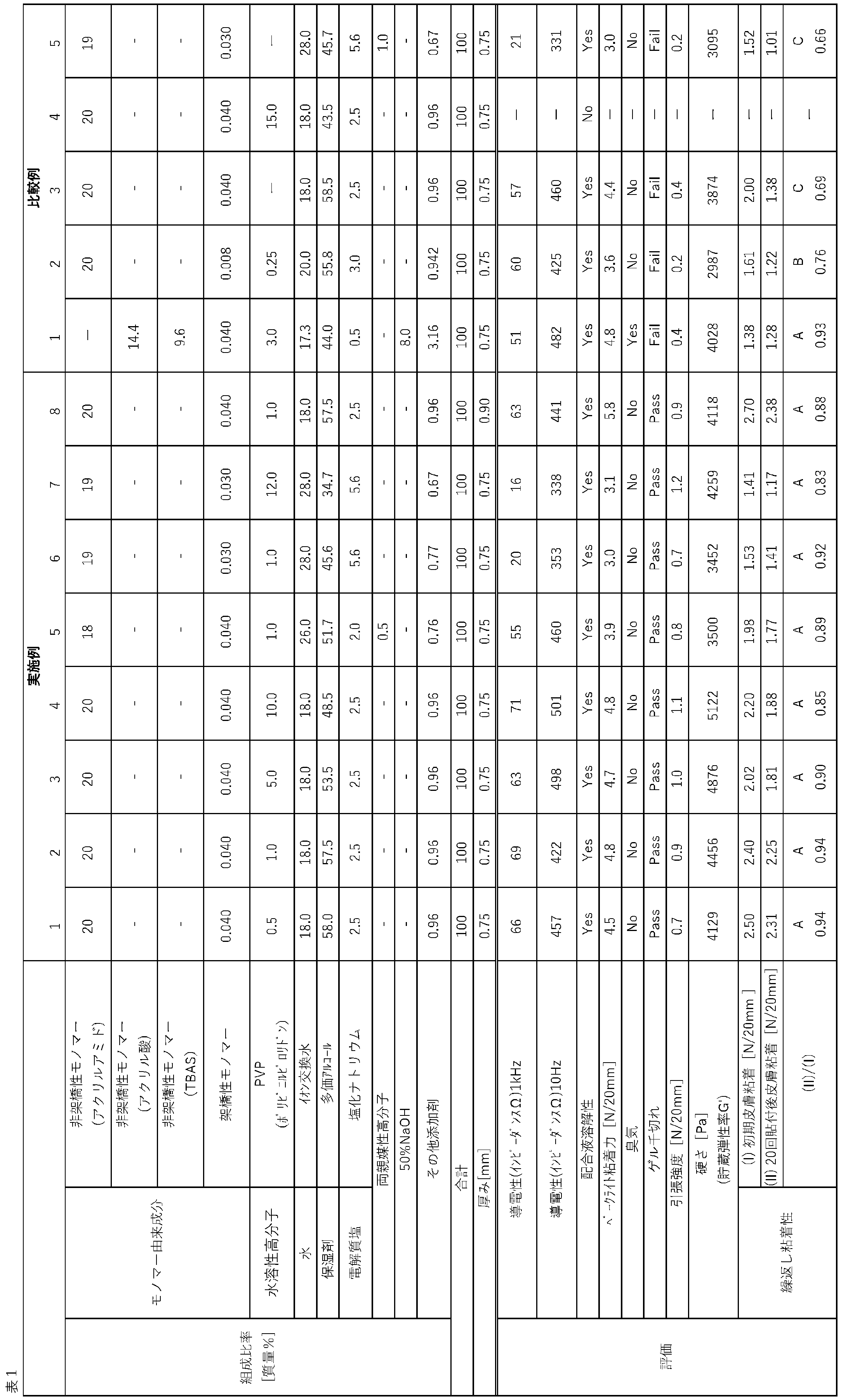
得られた実施例1~8及び比較例1~5のハイドロゲルを、以下の各項目で評価した。
ハイドロゲルを20mm×20mmに切り出し、トップフィルムを剥がして現れたゲル面(A層)をステンレス鋼SUS304に貼付け、もう1つ同じものを作成し、それぞれもう一方のベースフィルムを剥がして現れたゲル面(B層)同士を貼り合せ試験片とした。この試験片に入力電圧10V、抵抗1MΩ、1kHz及び10Hzの電流を印加したとき、SUS板間にかかる電圧をオシロスコープ(Tektronix社製;TDS3014)で読み取り、以下の式(1)(オームの法則)により電極インピーダンス値を求めた。
|Z|は電極のインピーダンス値(Ω)であり、Eはオシロスコープで読み取った電圧値(V)であり、Iは電極に印加した電流10(μA)である。
表1に記載した実施例及び比較例のハイドロゲルの製造のために調製した配合液を外観を目視により判断し、完全溶解している場合をYes、一部でも不溶物が残った場合をNoとした。
(ベークライト板に対する粘着力評価)
ハイドロゲルを120mm×20mmに切り出し、ベースフィルムを剥がして現れたゲル面にベークライト板を貼り付けて、2kgの圧着ローラーを1往復して圧着し試験片とした。測定にはレオメーター(サン科学社製、CR-500DX)を用い、JIS-Z0237;2009に準じて測定条件は、角度90度、速度300mm/分で行った。測定開始点から所定の引き剥がし時点(30、40、50、60、70mm)における応力値(N/20mm)を測定し、3試験(計15点)の値から平均値を算出し、この値をハイドロゲルの粘着力とした。測定環境としては、温度23±5℃、湿度55%±10%の環境下で実施した。
ハイドロゲルを120mm×20mmに切り出し、トップフィルムを剥がして現れたゲル面に測定時の持ち手を作るために無機フィラーをコーティングした合成紙を貼り付け、試験片とした。その後、被験者5名(20代~50代の男女)を、貼付15分前に温度23±5℃、湿度55%±10%の環境下の測定室に入室させた。上記試験片を各被験者の前腕内側のなるべく体毛の少ない部分に貼付し、その状態で30分間維持した。測定にはレオメーター(サン科学社製、CR-500DX)を用い、測定条件は、角度180度、速度1000mm/分で行った。測定開始点から所定の引き剥がし時点(30、40、50、60、70mm)における応力値(N/20mm)を測定し、2試験(計10点)の値から平均値を算出し、この値をハイドロゲルの皮膚に対する初期粘着力(I)とした。
上記の皮膚に対する初期粘着力評価に用いた試験片と同じものを、5名の各被験者の前腕内側に貼付し、1分間隔で引き剥がしと貼付を20回繰り返し、測定開始点から20回引き剥がし時点(30、40、50、60、70mm)における応力値(N/20mm)を、レオメーター(サン科学社製、CR-500DX)で測定し、2試験(計10点)の値から平均値を算出し、この値をハイドロゲルの皮膚に対する20回貼付後の粘着力(II)とした。
繰り返し粘着性の指標として、皮膚に対する20回貼付後粘着力の皮膚に対する初期粘着力に対する比(II)/(I)を計算した。0.8以上をA、0.7以上0.8未満をB、0.7未満をCと評価した。
実施例及び比較例の各ハイドロゲルに、訓練されたパネルがゲルの表面の匂いを嗅ぎ、臭気を感じなかった場合をNo、臭気を感じた場合をYesとした。
実施例及び比較例の各ハイドロゲルに、訓練されたパネルが50mm×50mmにカットしたゲルを腕内側に貼付し、貼付後3分後に引き剥がし、皮膚にゲルが残らなかった場合をPass、一部でもゲルが残った場合をFailとした。
ハイドロゲルを120mm×20mm×0.4mmに切り出して試験片とし、温度23±5℃、湿度55%±10%の環境下で、引張試験機(オリエンテック社製、テンシロン(登録商標)万能試験機 RTE-1210)を用いて、引張速度20mm/minの条件で試験片を引っ張ったときの引張強度[N/20mm]を測定した。
ハイドロゲルの貯蔵弾性率を測定した。具体的には、粘弾性測定装置(アントンパール社製、MR-102)を用い、23℃、0.1Hzの周波数における歪量1%の粘弾性測定を行った。冶具は25φのSUS製パラレルプレートに25φのゲル片を貼り合わせ、1Nになる荷重点まで押し当てた後、0.1Hzにて貯蔵弾性率を算出した。貯蔵弾性率が高いほど、弾性を示す硬さの指標となる。
結果を表1に示す。比較例4のハイドロゲルはゲルを作製する際、調整する配合液粘度が高くなりすぎると共に水溶性高分子が凝集し、均一溶解が困難であり、結果として均一なゲルが得られなかった。実施例1~8のハイドロゲルの引張強度は比較例1~3,5のハイドロゲルの引張強度よりも高く、実施例1~8のハイドロゲルは硬さがあるが、千切れにくいことが判明した。実施例1~8のハイドロゲルは繰返し粘着性にも優れていた。また、実施例1~8のハイドロゲルはアクリル酸をモノマーとして含有しないため、臭気が生じなかった。比較例1~5のハイドロゲルでは千切れが発生し、繰返し粘着性が低いことが確認された。
Claims (11)
- アクリル系単量体と架橋性単量体との共重合体から形成される高分子マトリックスと、水溶性高分子と、水と、多価アルコールとを有するハイドロゲルであって、
引張強度が0.5~3.0N/20mmであることを特徴とするハイドロゲル。 - 水溶性高分子がポリビニルピロリドンである請求項1に記載のハイドロゲル。
- アクリル系単量体がアクリルアミド系単量体である請求項1又は2に記載のハイドロゲル。
- 架橋性単量体に由来する構造単位の含有率が0.01質量%~0.1質量%である請求項1~3のいずれか1に記載のハイドロゲル。
- 水溶性高分子の含有量が0.1質量%~13質量%である請求項1~3のいずれか1項に記載のハイドロゲル。
- 面内方向に沿って、中間基材が埋め込まれる請求項1~5のいずれか1項に記載のハイドロゲル。
- 前記中間基材が不織布である請求項6に記載のハイドロゲル。
- 厚みが0.2mm~2.0mmである請求項1~7のいずれか1項に記載のハイドロゲル。
- 貯蔵弾性率が2000Pa~9000Paである請求項1~8のいずれか1項に記載のハイドロゲル。
- 導電材料から構成される電極と皮膚表面との間に配置して用いられる医療用電極ハイドロゲルであって、請求項1~9のいずれか1項に記載のハイドロゲルからなる医療用電極ハイドロゲル。
- 請求項1~9のいずれか1項に記載のハイドロゲルの製造方法であって、アクリル系単量体、架橋性単量体、水溶性高分子、水、及び多価アルコールを含有し、かつ該架橋性単量体の含有率が0.03質量%~0.05質量%の重合性溶液に対して、ピーク強度が70~150mW/cm2の紫外線を照射する工程を有することを特徴とするハイドロゲルの製造方法。
Priority Applications (4)
| Application Number | Priority Date | Filing Date | Title |
|---|---|---|---|
| US17/761,038 US20220340719A1 (en) | 2019-09-27 | 2020-07-16 | Hydrogel |
| JP2021548368A JP7231753B2 (ja) | 2019-09-27 | 2020-07-16 | ハイドロゲル |
| EP20870086.4A EP4035739A4 (en) | 2019-09-27 | 2020-07-16 | HYDROGEL |
| CN202080064696.8A CN114402014B (zh) | 2019-09-27 | 2020-07-16 | 水凝胶 |
Applications Claiming Priority (2)
| Application Number | Priority Date | Filing Date | Title |
|---|---|---|---|
| JP2019-177030 | 2019-09-27 | ||
| JP2019177030 | 2019-09-27 |
Publications (1)
| Publication Number | Publication Date |
|---|---|
| WO2021059689A1 true WO2021059689A1 (ja) | 2021-04-01 |
Family
ID=75165979
Family Applications (1)
| Application Number | Title | Priority Date | Filing Date |
|---|---|---|---|
| PCT/JP2020/027635 Ceased WO2021059689A1 (ja) | 2019-09-27 | 2020-07-16 | ハイドロゲル |
Country Status (6)
| Country | Link |
|---|---|
| US (1) | US20220340719A1 (ja) |
| EP (1) | EP4035739A4 (ja) |
| JP (1) | JP7231753B2 (ja) |
| CN (1) | CN114402014B (ja) |
| TW (1) | TWI766323B (ja) |
| WO (1) | WO2021059689A1 (ja) |
Cited By (2)
| Publication number | Priority date | Publication date | Assignee | Title |
|---|---|---|---|---|
| WO2023276950A1 (ja) * | 2021-06-29 | 2023-01-05 | 東亞合成株式会社 | 医療用処置材及びその製造方法 |
| WO2023276951A1 (ja) * | 2021-06-29 | 2023-01-05 | 東亞合成株式会社 | 医療用処置材及びその製造方法 |
Families Citing this family (2)
| Publication number | Priority date | Publication date | Assignee | Title |
|---|---|---|---|---|
| CN113441116B (zh) * | 2021-06-25 | 2023-05-16 | 苏州浩微生物医疗科技有限公司 | 一种水凝胶微球、制备方法及其应用 |
| CN117164892B (zh) | 2023-10-10 | 2024-11-05 | 吉林大学 | 一种一体式多相水凝胶及其制备方法和在柔性可拉伸超级电容器中的应用 |
Citations (6)
| Publication number | Priority date | Publication date | Assignee | Title |
|---|---|---|---|---|
| JP2803886B2 (ja) | 1990-03-09 | 1998-09-24 | リンテック株式会社 | 導電性ゲルおよびこれを用いた電極用パッド |
| JP2003096431A (ja) * | 2001-09-25 | 2003-04-03 | Sekisui Plastics Co Ltd | 粘着性ゲル |
| JP2012062354A (ja) * | 2010-09-14 | 2012-03-29 | Sekisui Plastics Co Ltd | 粘着性ハイドロゲル、粘着性ハイドロゲル製造用組成物及びゲルシート |
| JP2012144581A (ja) * | 2011-01-06 | 2012-08-02 | Sekisui Plastics Co Ltd | 粘着性ハイドロゲル及びその製造方法、粘着性ハイドロゲル製造用組成物及びゲルシート |
| JP2012153884A (ja) * | 2011-01-06 | 2012-08-16 | Sekisui Plastics Co Ltd | 粘着性ハイドロゲル用組成物とその用途 |
| WO2018062029A1 (ja) * | 2016-09-30 | 2018-04-05 | 積水化成品工業株式会社 | ゲルシート |
Family Cites Families (5)
| Publication number | Priority date | Publication date | Assignee | Title |
|---|---|---|---|---|
| US20030212416A1 (en) * | 2002-03-29 | 2003-11-13 | The Procter & Gamble Company | Hydrogel adhesives with enhanced cohesiveness, and peel force for use on hair or fiber-populated surfaces |
| US20060258788A1 (en) * | 2005-05-13 | 2006-11-16 | Scott Coggins | Polymeric hydrogel compositions |
| JP5827584B2 (ja) * | 2012-03-09 | 2015-12-02 | 積水化成品工業株式会社 | 粘着性ハイドロゲル及びその用途 |
| EP3521021B1 (en) * | 2016-09-30 | 2023-08-09 | Sekisui Kasei Co., Ltd. | Medical-electrode hydrogel |
| JP2020019842A (ja) * | 2018-07-30 | 2020-02-06 | 積水化成品工業株式会社 | ハイドロゲル |
-
2020
- 2020-07-16 US US17/761,038 patent/US20220340719A1/en active Pending
- 2020-07-16 WO PCT/JP2020/027635 patent/WO2021059689A1/ja not_active Ceased
- 2020-07-16 EP EP20870086.4A patent/EP4035739A4/en active Pending
- 2020-07-16 JP JP2021548368A patent/JP7231753B2/ja active Active
- 2020-07-16 CN CN202080064696.8A patent/CN114402014B/zh active Active
- 2020-07-30 TW TW109125810A patent/TWI766323B/zh active
Patent Citations (6)
| Publication number | Priority date | Publication date | Assignee | Title |
|---|---|---|---|---|
| JP2803886B2 (ja) | 1990-03-09 | 1998-09-24 | リンテック株式会社 | 導電性ゲルおよびこれを用いた電極用パッド |
| JP2003096431A (ja) * | 2001-09-25 | 2003-04-03 | Sekisui Plastics Co Ltd | 粘着性ゲル |
| JP2012062354A (ja) * | 2010-09-14 | 2012-03-29 | Sekisui Plastics Co Ltd | 粘着性ハイドロゲル、粘着性ハイドロゲル製造用組成物及びゲルシート |
| JP2012144581A (ja) * | 2011-01-06 | 2012-08-02 | Sekisui Plastics Co Ltd | 粘着性ハイドロゲル及びその製造方法、粘着性ハイドロゲル製造用組成物及びゲルシート |
| JP2012153884A (ja) * | 2011-01-06 | 2012-08-16 | Sekisui Plastics Co Ltd | 粘着性ハイドロゲル用組成物とその用途 |
| WO2018062029A1 (ja) * | 2016-09-30 | 2018-04-05 | 積水化成品工業株式会社 | ゲルシート |
Non-Patent Citations (1)
| Title |
|---|
| See also references of EP4035739A4 |
Cited By (2)
| Publication number | Priority date | Publication date | Assignee | Title |
|---|---|---|---|---|
| WO2023276950A1 (ja) * | 2021-06-29 | 2023-01-05 | 東亞合成株式会社 | 医療用処置材及びその製造方法 |
| WO2023276951A1 (ja) * | 2021-06-29 | 2023-01-05 | 東亞合成株式会社 | 医療用処置材及びその製造方法 |
Also Published As
| Publication number | Publication date |
|---|---|
| EP4035739A4 (en) | 2023-11-01 |
| JP7231753B2 (ja) | 2023-03-01 |
| TWI766323B (zh) | 2022-06-01 |
| CN114402014B (zh) | 2024-03-22 |
| JPWO2021059689A1 (ja) | 2021-04-01 |
| US20220340719A1 (en) | 2022-10-27 |
| CN114402014A (zh) | 2022-04-26 |
| TW202112954A (zh) | 2021-04-01 |
| EP4035739A1 (en) | 2022-08-03 |
Similar Documents
| Publication | Publication Date | Title |
|---|---|---|
| JP7231753B2 (ja) | ハイドロゲル | |
| JP6754840B2 (ja) | 皮膚貼着用ゲルシート | |
| TWI499651B (zh) | Adhesive hydrogel composition and its use | |
| JP6682643B2 (ja) | 医療用電極ハイドロゲル | |
| JP5827584B2 (ja) | 粘着性ハイドロゲル及びその用途 | |
| EP2542636A1 (en) | Adhesive composition | |
| WO2020026715A1 (ja) | ハイドロゲル | |
| JP7241672B2 (ja) | ハイドロゲルシート | |
| JP6937428B2 (ja) | ハイドロゲル | |
| JP2021147543A (ja) | ハイドロゲル | |
| JP6599823B2 (ja) | ゲルシート | |
| JP7005568B2 (ja) | ゲルシート | |
| JP7797625B2 (ja) | ハイドロゲル | |
| JP2015003977A (ja) | 粘着性ゲルシート、電極および粘着性ゲルシートの製造方法 | |
| JPWO2019188936A1 (ja) | ハイドロゲル | |
| JP2024048322A (ja) | 粘着性ハイドロゲル、積層体、及び医療用外用材 |
Legal Events
| Date | Code | Title | Description |
|---|---|---|---|
| 121 | Ep: the epo has been informed by wipo that ep was designated in this application |
Ref document number: 20870086 Country of ref document: EP Kind code of ref document: A1 |
|
| ENP | Entry into the national phase |
Ref document number: 2021548368 Country of ref document: JP Kind code of ref document: A |
|
| NENP | Non-entry into the national phase |
Ref country code: DE |
|
| WWE | Wipo information: entry into national phase |
Ref document number: 2020870086 Country of ref document: EP |
|
| ENP | Entry into the national phase |
Ref document number: 2020870086 Country of ref document: EP Effective date: 20220428 |