WO2021060443A1 - 非対称分岐型分解性ポリエチレングリコール誘導体 - Google Patents
非対称分岐型分解性ポリエチレングリコール誘導体 Download PDFInfo
- Publication number
- WO2021060443A1 WO2021060443A1 PCT/JP2020/036199 JP2020036199W WO2021060443A1 WO 2021060443 A1 WO2021060443 A1 WO 2021060443A1 JP 2020036199 W JP2020036199 W JP 2020036199W WO 2021060443 A1 WO2021060443 A1 WO 2021060443A1
- Authority
- WO
- WIPO (PCT)
- Prior art keywords
- group
- polyethylene glycol
- oligopeptide
- glycol derivative
- formula
- Prior art date
- Legal status (The legal status is an assumption and is not a legal conclusion. Google has not performed a legal analysis and makes no representation as to the accuracy of the status listed.)
- Ceased
Links
Classifications
-
- C—CHEMISTRY; METALLURGY
- C08—ORGANIC MACROMOLECULAR COMPOUNDS; THEIR PREPARATION OR CHEMICAL WORKING-UP; COMPOSITIONS BASED THEREON
- C08G—MACROMOLECULAR COMPOUNDS OBTAINED OTHERWISE THAN BY REACTIONS ONLY INVOLVING UNSATURATED CARBON-TO-CARBON BONDS
- C08G65/00—Macromolecular compounds obtained by reactions forming an ether link in the main chain of the macromolecule
- C08G65/02—Macromolecular compounds obtained by reactions forming an ether link in the main chain of the macromolecule from cyclic ethers by opening of the heterocyclic ring
- C08G65/32—Polymers modified by chemical after-treatment
- C08G65/329—Polymers modified by chemical after-treatment with organic compounds
- C08G65/333—Polymers modified by chemical after-treatment with organic compounds containing nitrogen
- C08G65/3332—Polymers modified by chemical after-treatment with organic compounds containing nitrogen containing carboxamide group
- C08G65/33324—Polymers modified by chemical after-treatment with organic compounds containing nitrogen containing carboxamide group acyclic
-
- A—HUMAN NECESSITIES
- A61—MEDICAL OR VETERINARY SCIENCE; HYGIENE
- A61K—PREPARATIONS FOR MEDICAL, DENTAL OR TOILETRY PURPOSES
- A61K47/00—Medicinal preparations characterised by the non-active ingredients used, e.g. carriers or inert additives; Targeting or modifying agents chemically bound to the active ingredient
- A61K47/50—Medicinal preparations characterised by the non-active ingredients used, e.g. carriers or inert additives; Targeting or modifying agents chemically bound to the active ingredient the non-active ingredient being chemically bound to the active ingredient, e.g. polymer-drug conjugates
- A61K47/51—Medicinal preparations characterised by the non-active ingredients used, e.g. carriers or inert additives; Targeting or modifying agents chemically bound to the active ingredient the non-active ingredient being chemically bound to the active ingredient, e.g. polymer-drug conjugates the non-active ingredient being a modifying agent
- A61K47/62—Medicinal preparations characterised by the non-active ingredients used, e.g. carriers or inert additives; Targeting or modifying agents chemically bound to the active ingredient the non-active ingredient being chemically bound to the active ingredient, e.g. polymer-drug conjugates the non-active ingredient being a modifying agent the modifying agent being a protein, peptide or polyamino acid
- A61K47/64—Drug-peptide, drug-protein or drug-polyamino acid conjugates, i.e. the modifying agent being a peptide, protein or polyamino acid which is covalently bonded or complexed to a therapeutically active agent
- A61K47/641—Branched, dendritic or hypercomb peptides
-
- A—HUMAN NECESSITIES
- A61—MEDICAL OR VETERINARY SCIENCE; HYGIENE
- A61K—PREPARATIONS FOR MEDICAL, DENTAL OR TOILETRY PURPOSES
- A61K47/00—Medicinal preparations characterised by the non-active ingredients used, e.g. carriers or inert additives; Targeting or modifying agents chemically bound to the active ingredient
- A61K47/50—Medicinal preparations characterised by the non-active ingredients used, e.g. carriers or inert additives; Targeting or modifying agents chemically bound to the active ingredient the non-active ingredient being chemically bound to the active ingredient, e.g. polymer-drug conjugates
- A61K47/51—Medicinal preparations characterised by the non-active ingredients used, e.g. carriers or inert additives; Targeting or modifying agents chemically bound to the active ingredient the non-active ingredient being chemically bound to the active ingredient, e.g. polymer-drug conjugates the non-active ingredient being a modifying agent
- A61K47/56—Medicinal preparations characterised by the non-active ingredients used, e.g. carriers or inert additives; Targeting or modifying agents chemically bound to the active ingredient the non-active ingredient being chemically bound to the active ingredient, e.g. polymer-drug conjugates the non-active ingredient being a modifying agent the modifying agent being an organic macromolecular compound, e.g. an oligomeric, polymeric or dendrimeric molecule
- A61K47/59—Medicinal preparations characterised by the non-active ingredients used, e.g. carriers or inert additives; Targeting or modifying agents chemically bound to the active ingredient the non-active ingredient being chemically bound to the active ingredient, e.g. polymer-drug conjugates the non-active ingredient being a modifying agent the modifying agent being an organic macromolecular compound, e.g. an oligomeric, polymeric or dendrimeric molecule obtained otherwise than by reactions only involving carbon-to-carbon unsaturated bonds, e.g. polyureas or polyurethanes
- A61K47/60—Medicinal preparations characterised by the non-active ingredients used, e.g. carriers or inert additives; Targeting or modifying agents chemically bound to the active ingredient the non-active ingredient being chemically bound to the active ingredient, e.g. polymer-drug conjugates the non-active ingredient being a modifying agent the modifying agent being an organic macromolecular compound, e.g. an oligomeric, polymeric or dendrimeric molecule obtained otherwise than by reactions only involving carbon-to-carbon unsaturated bonds, e.g. polyureas or polyurethanes the organic macromolecular compound being a polyoxyalkylene oligomer, polymer or dendrimer, e.g. PEG, PPG, PEO or polyglycerol
-
- A—HUMAN NECESSITIES
- A61—MEDICAL OR VETERINARY SCIENCE; HYGIENE
- A61K—PREPARATIONS FOR MEDICAL, DENTAL OR TOILETRY PURPOSES
- A61K47/00—Medicinal preparations characterised by the non-active ingredients used, e.g. carriers or inert additives; Targeting or modifying agents chemically bound to the active ingredient
- A61K47/50—Medicinal preparations characterised by the non-active ingredients used, e.g. carriers or inert additives; Targeting or modifying agents chemically bound to the active ingredient the non-active ingredient being chemically bound to the active ingredient, e.g. polymer-drug conjugates
- A61K47/51—Medicinal preparations characterised by the non-active ingredients used, e.g. carriers or inert additives; Targeting or modifying agents chemically bound to the active ingredient the non-active ingredient being chemically bound to the active ingredient, e.g. polymer-drug conjugates the non-active ingredient being a modifying agent
- A61K47/62—Medicinal preparations characterised by the non-active ingredients used, e.g. carriers or inert additives; Targeting or modifying agents chemically bound to the active ingredient the non-active ingredient being chemically bound to the active ingredient, e.g. polymer-drug conjugates the non-active ingredient being a modifying agent the modifying agent being a protein, peptide or polyamino acid
- A61K47/64—Drug-peptide, drug-protein or drug-polyamino acid conjugates, i.e. the modifying agent being a peptide, protein or polyamino acid which is covalently bonded or complexed to a therapeutically active agent
-
- A—HUMAN NECESSITIES
- A61—MEDICAL OR VETERINARY SCIENCE; HYGIENE
- A61K—PREPARATIONS FOR MEDICAL, DENTAL OR TOILETRY PURPOSES
- A61K47/00—Medicinal preparations characterised by the non-active ingredients used, e.g. carriers or inert additives; Targeting or modifying agents chemically bound to the active ingredient
- A61K47/50—Medicinal preparations characterised by the non-active ingredients used, e.g. carriers or inert additives; Targeting or modifying agents chemically bound to the active ingredient the non-active ingredient being chemically bound to the active ingredient, e.g. polymer-drug conjugates
- A61K47/51—Medicinal preparations characterised by the non-active ingredients used, e.g. carriers or inert additives; Targeting or modifying agents chemically bound to the active ingredient the non-active ingredient being chemically bound to the active ingredient, e.g. polymer-drug conjugates the non-active ingredient being a modifying agent
- A61K47/62—Medicinal preparations characterised by the non-active ingredients used, e.g. carriers or inert additives; Targeting or modifying agents chemically bound to the active ingredient the non-active ingredient being chemically bound to the active ingredient, e.g. polymer-drug conjugates the non-active ingredient being a modifying agent the modifying agent being a protein, peptide or polyamino acid
- A61K47/65—Peptidic linkers, binders or spacers, e.g. peptidic enzyme-labile linkers
-
- C—CHEMISTRY; METALLURGY
- C08—ORGANIC MACROMOLECULAR COMPOUNDS; THEIR PREPARATION OR CHEMICAL WORKING-UP; COMPOSITIONS BASED THEREON
- C08G—MACROMOLECULAR COMPOUNDS OBTAINED OTHERWISE THAN BY REACTIONS ONLY INVOLVING UNSATURATED CARBON-TO-CARBON BONDS
- C08G65/00—Macromolecular compounds obtained by reactions forming an ether link in the main chain of the macromolecule
- C08G65/02—Macromolecular compounds obtained by reactions forming an ether link in the main chain of the macromolecule from cyclic ethers by opening of the heterocyclic ring
- C08G65/32—Polymers modified by chemical after-treatment
- C08G65/329—Polymers modified by chemical after-treatment with organic compounds
- C08G65/333—Polymers modified by chemical after-treatment with organic compounds containing nitrogen
-
- C—CHEMISTRY; METALLURGY
- C07—ORGANIC CHEMISTRY
- C07K—PEPTIDES
- C07K5/00—Peptides containing up to four amino acids in a fully defined sequence; Derivatives thereof
- C07K5/04—Peptides containing up to four amino acids in a fully defined sequence; Derivatives thereof containing only normal peptide links
- C07K5/06—Dipeptides
- C07K5/06008—Dipeptides with the first amino acid being neutral
- C07K5/06078—Dipeptides with the first amino acid being neutral and aromatic or cycloaliphatic
-
- C—CHEMISTRY; METALLURGY
- C08—ORGANIC MACROMOLECULAR COMPOUNDS; THEIR PREPARATION OR CHEMICAL WORKING-UP; COMPOSITIONS BASED THEREON
- C08G—MACROMOLECULAR COMPOUNDS OBTAINED OTHERWISE THAN BY REACTIONS ONLY INVOLVING UNSATURATED CARBON-TO-CARBON BONDS
- C08G2230/00—Compositions for preparing biodegradable polymers
-
- C—CHEMISTRY; METALLURGY
- C08—ORGANIC MACROMOLECULAR COMPOUNDS; THEIR PREPARATION OR CHEMICAL WORKING-UP; COMPOSITIONS BASED THEREON
- C08G—MACROMOLECULAR COMPOUNDS OBTAINED OTHERWISE THAN BY REACTIONS ONLY INVOLVING UNSATURATED CARBON-TO-CARBON BONDS
- C08G81/00—Macromolecular compounds obtained by interreacting polymers in the absence of monomers, e.g. block polymers
-
- C—CHEMISTRY; METALLURGY
- C08—ORGANIC MACROMOLECULAR COMPOUNDS; THEIR PREPARATION OR CHEMICAL WORKING-UP; COMPOSITIONS BASED THEREON
- C08G—MACROMOLECULAR COMPOUNDS OBTAINED OTHERWISE THAN BY REACTIONS ONLY INVOLVING UNSATURATED CARBON-TO-CARBON BONDS
- C08G83/00—Macromolecular compounds not provided for in groups C08G2/00 - C08G81/00
- C08G83/002—Dendritic macromolecules
- C08G83/003—Dendrimers
Definitions
- the present invention relates to a branched degradable polyethylene glycol derivative that decomposes intracellularly and is used for modifying biological substances.
- bio-related substances such as hormones, cytokines, antibodies, and enzymes are usually rapidly excreted from the body by glomerular filtration in the kidney and uptake by macrophages in the liver and spleen when administered into the body. It ends up. Therefore, the half-life in blood is short, and it is often difficult to obtain a sufficient pharmacological effect.
- hydrophilic polymers such as sugar chains and polyethylene glycol, albumin, and the like.
- modification with polyethylene glycol has effects such as reduction of toxicity and antigenicity of biorelated substances and improvement of solubility of poorly water-soluble drugs.
- Bio-related substances modified with polyethylene glycol are covered with a hydration layer formed by ether bonds of polyethylene glycol and hydrogen bonds with water molecules, which increases the molecular size and thus avoids glomerular filtration in the kidneys. be able to. Furthermore, it is known that the interaction with opsonin and the cell surface constituting each tissue is reduced, and the transfer to each tissue is reduced. Polyethylene glycol is an excellent material that prolongs the half-life of biological substances in the blood, and it has been found that the higher the molecular weight, the higher the effect. So far, many studies have been conducted on bio-related substances modified with high molecular weight polyethylene glycol having a molecular weight of 40,000 or more, and the results have been obtained that the half-life in blood can be significantly extended.
- Polyethylene glycol is regarded as the optimum standard among modifiers used to improve the performance of biological substances, and currently, multiple polyethylene glycol modified preparations have been put on the market and are used in medical practice.
- EMA European Medicines Agency
- Non-Patent Document 2 when a large excess amount of polyethylene glycol was administered alone to an animal for a long period of time as compared with the usual dose of a polyethylene glycol modified preparation, no vacuole was observed at a molecular weight of 20,000, and the molecular weight was 40,000. Occurrence of vacuoles has been confirmed in. As one of the means for suppressing vacuoles, it is conceivable to reduce the molecular weight of polyethylene glycol, but if the molecular weight is reduced, there arises a problem that the half-life of biological substances in blood cannot be sufficiently improved.
- Patent Document 1 describes a polyethylene glycol derivative having a sulfide bond or a peptide bond site that is cleaved in a living body. There is a description that the polyethylene glycol derivative is decomposed in vivo to a molecular weight suitable for excretion from the kidney. However, no specific data on degradation have been shown, and there is no data that renal excretion was promoted. Furthermore, there is no description about cell vacuoles.
- Patent Document 2 describes a polyethylene glycol derivative having an acetal moiety that can be hydrolyzed in a low pH environment in a living body. There is a description that the polyethylene glycol derivative is decomposed in vivo to a molecular weight suitable for excretion from the kidney. However, there is no specific data that the excretion from the kidney was promoted, and there is no description about cell vacuoles. Further, it is known that these acetal sites capable of hydrolysis are gradually decomposed even in blood, and it is expected that the half-life of the modified biological substance in blood cannot be sufficiently improved.
- Non-Patent Document 3 describes a polyethylene glycol derivative having an oligopeptide site that is degraded by an enzyme.
- the oligopeptide is introduced as a linker between the anticancer agent and polyethylene glycol, and it has been reported that the oligopeptide is decomposed by an enzyme specifically expressed around the tumor to efficiently release the anticancer agent.
- the purpose is the release of anti-cancer agents, not the degradability of polyethylene glycol for the purpose of suppressing cell vacuoles.
- Non-Patent Document 4 describes a hydrogel using a crosslinked molecule having an oligopeptide site that is decomposed by an enzyme and a multi-branched polyethylene glycol derivative.
- the oligopeptide is used as a cross-linking molecule that connects multi-branched polyethylene glycol derivatives, and can further impart enzymatic degradability to the hydrogel.
- the purpose is to prepare a degradable hydrogel, not to impart degradability to polyethylene glycol for the purpose of suppressing cell vacuoles.
- Patent Document 3 describes a branched polyethylene glycol derivative having an oligopeptide as a skeleton.
- the oligopeptide is used as the basic skeleton of the polyethylene glycol derivative, and does not impart enzymatic degradability.
- oligopeptides are characterized by containing amino acids such as lysine and aspartic acid that have amino and carboxyl groups in their side chains, and the purpose is to synthesize branched polyethylene glycol derivatives that utilize them in the reaction. is there. It is not a polyethylene glycol derivative intended to suppress cell vacuoles.
- polyethylene glycol derivatives used for modifying bio-related substances generally have a linear type and a branched type, and in Non-Patent Document 5, the branched type is significantly more bio-related than the linear type. There is a description that it prolongs the half-life in blood. In recent years, most of the polyethylene glycol modified preparations on the market have adopted the branched type. However, there have been no reports on branched polyethylene glycol derivatives that suppress cell vacuoles in this field.
- An object of the present invention is to provide a high molecular weight branched polyethylene glycol derivative that does not cause cell vacuoles. More specifically, a branched degradable polyethylene glycol derivative that can be effectively used for modifying a biological substance, is stable in the blood in the living body, and is decomposed in the cell is industrially used. It is to be provided by a manufacturing method that can be produced in Japan.
- the present inventors have invented a branched degradable polyethylene glycol derivative having an oligopeptide that decomposes intracellularly.
- the present invention provides a branched degradable polyethylene glycol derivative represented by the following formula (1).
- a branched degradable polyethylene glycol derivative represented by the following formula (1) which has an oligopeptide that decomposes intracellularly in the molecule.
- k 1 and k 2 are independently 1 to 12, j 1 and j 2 are independently 45 to 950, respectively, R is a hydrogen atom, and the number of carbon atoms is 1 which is substituted or not substituted.
- X is an active ester group, an active carbonate group, an aldehyde group, an isocyanate group, an isothiocyanate group, an epoxy group, a maleimide group, a vinylsulfonyl group, an acrylic group, a sulfonyloxy group, a carboxy group, a thiol group, a dithiopyridyl group,
- the branched type according to any one of [1] to [5], which is selected from the group consisting of an ⁇ -haloacetyl group, an alkynyl group, an allyl group, a vinyl group, an amino group, an oxyamino group, a hydrazide group and an azide group.
- Degradable polyethylene glycol derivative is an active ester group, an active carbonate group, an aldehyde group, an isocyanate group, an isothiocyanate group, an epoxy group, a maleimide group, a vinylsulfony
- the present invention also provides, as another embodiment, a branched degradable polyethylene glycol derivative represented by the following formula (2).
- a branched degradable polyethylene glycol derivative represented by the following formula (2) [6] A branched degradable polyethylene glycol derivative represented by the following formula (2).
- k 1 and k 2 are independently 1 to 12, j 1 and j 2 are independently 45 to 950, respectively, R is a hydrogen atom, and the number of carbon atoms is 1 which is substituted or not substituted. It is an alkyl group of ⁇ 4, a substituted aryl group, an aralkyl group or a heteroalkyl group, W is an oligopeptide of 5 to 47 residues having a symmetrical structure centered on glutamate or lysine, and a is 2 to 8.
- X is a functional group capable of reacting with a bio-related substance, and L 1 and L 2 are independently single-bonded or divalent spacers, respectively.
- Q is a residue of glutamic acid or lysine
- Z is a 2-5 residue degradable oligopeptide consisting of neutral amino acids excluding cysteine.
- L 1 and L 2 independently contain a single bond, a urethane bond, an amide bond, an ether bond, a thioether bond, a secondary amino group, a urea bond, or a bond and / or group thereof.
- X is an active ester group, an active carbonate group, an aldehyde group, an isocyanate group, an isothiocyanate group, an epoxy group, a maleimide group, a substituted maleimide group, a vinylsulfonyl group, an acrylic group, a substituted sulfonate group, a sulfonyloxy group and a carboxy group.
- the branched degradable polyethylene glycol derivative of the present invention is stable in blood in vivo and has an oligopeptide in its structure that is degraded by intracellular enzymes. Therefore, the branched degradable polyethylene glycol derivative is stable in blood and can impart a half-life in blood equivalent to that of a conventional non-degradable polyethylene glycol derivative to a biological substance. Furthermore, when the branched degradable polyethylene glycol derivative is taken up into cells, the oligopeptide site is rapidly degraded, so that it is possible to suppress the generation of cell vacuoles, which has been a problem until now. it can. Further, by limiting the oligopeptide to be introduced into polyethylene glycol to an oligopeptide having glycine as a C-terminal amino acid, impurities generated in the production process can be reduced and industrial production becomes possible.
- branched degradable polyethylene glycol derivative according to the present invention is represented by the following formula (1).
- k 1 and k 2 are independently 1 to 12, j 1 and j 2 are independently 45 to 950, respectively, and R is a hydrogen atom, substituted or unsubstituted carbon. It is an alkyl group of numbers 1 to 12, a substituted aryl group, an aralkyl group or a heteroalkyl group, Z is an oligopeptide that is decomposed by an intracellular enzyme, X is a functional group that can react with a bio-related substance, and L. 1 and L 2 are independently single-bonded or divalent spacers, respectively.
- the total molecular weight of the polyethylene glycol derivative of the formula (1) of the present invention is usually 4,000 to 160,000, preferably 10,000 to 120,000, and more preferably 20,000 to 80,000. Is.
- the polyethylene glycol derivative of the formula (1) of the present invention has a total molecular weight of 20,000 or more.
- the molecular weight referred to here is a number average molecular weight (Mn).
- K 1 and k 2 in the formula (1) are usually 1 to 12 independently of each other, preferably 1 to 6 independently of each other, and more preferably 1 to 2 independently of each other.
- J 1 and j 2 in the formula (1) are the number of repeating units of polyethylene glycol, respectively, and are usually 45 to 950 independently, preferably 110 to 690 independently, and more preferably 110 to 690, respectively. It is 220 to 480 independently.
- R in the formula (1) is a hydrogen atom, an alkyl group having 1 to 12 carbon atoms which is not substituted or substituted, a substituted aryl group, an aralkyl group or a heteroalkyl group.
- a "heteroalkyl group” is an alkyl group containing 1 to 5 heteroatoms selected from nitrogen, oxygen and sulfur atoms.
- R is preferably a hydrogen atom or an alkyl group having 1 to 3 carbon atoms, more preferably a hydrogen atom, a methyl group or an ethyl group, and further preferably a hydrogen atom.
- L 1 and L 2 in the formula (1) are independently single-bonded or divalent spacers, respectively, but these spacers are not particularly limited as long as they are groups capable of forming a covalent bond, but are preferable. Is a phenylene group, an amide bond, an ether bond, a thioether bond, a urethane bond, a secondary amino group, a carbonyl group, a urea bond, or an alkylene group which may contain these bonds and / or a group, more preferably.
- s in the equation indicates an integer of 0 to 10, preferably an integer of 0 to 6, and more preferably an integer of 0 to 3. Further, in (z2) to (z11), s in the equation may be the same or different.
- L 1 in the formula (1) is a single bond or group (I) (z2), (z3), (z4), (z6), (z7), (z8), (z9), (z10), The combination of (z2) and (z6) is preferable, and the combination of single bond, (z3), (z6), (z9), (z10), (z2) and (z6) is more preferable.
- L 2 in the formula (1) is (z1), (z2), (z3), (z4), (z5), (z6), (z7), (z8), (z11) of the group (I). Is preferable, and (z3), (z5), and (z11) are more preferable.
- Z in the formula (1) is not particularly limited as long as it is an oligopeptide that is stable in the blood in the living body and decomposed by an intracellular enzyme, but is 2 to 8 residues consisting of neutral amino acids excluding cysteine.
- the oligopeptide of the group is preferable, an oligopeptide of 2 to 6 residues consisting of a neutral amino acid excluding cysteine is more preferable, and an oligopeptide of 2 to 4 residues consisting of a neutral amino acid excluding cysteine is further preferable.
- Z in the formula (1) may be an oligopeptide composed of an amino acid having an amino group or a carboxyl group in the side chain, specifically, a neutral amino acid containing no lysine, aspartic acid or glutamic acid. preferable.
- the amino acid used here is an ⁇ -amino acid and is basically L-type.
- Z in the formula (1) is an oligopeptide composed of a neutral amino acid containing no cysteine. It is desirable to have.
- Z in the formula (1) is preferably an oligopeptide having glycine as a C-terminal amino acid.
- glycine glycine
- achiral glycine as the C-terminal amino acid of the oligopeptide, a high-purity target product without by-products of the stereoisomer can be obtained.
- Z in the formula (1) is an oligopeptide having at least one hydrophobic neutral amino acid having a hydropathy index of 2.5 or more, specifically, phenylalanine, leucine, valine, and isoleucine. Is preferable, and an oligopeptide having phenylalanine is more preferable.
- the hydropathy index which is created by Kyte and Doolittle and quantitatively indicates the hydrophobicity of amino acids, indicates that the larger the value, the more hydrophobic the amino acid (Kyte J & Doolittle RF, 1982, J Mol. Biol, 157: 105-132.).
- Z in the formula (1) may be an oligopeptide having 2 to 8 residues consisting of neutral amino acids excluding cysteine, which is stable in the blood in the living body and has the ability to be decomposed by intracellular enzymes.
- Alanin-glycine glycine-glycine-glycine, phenylalanine-glycine, etc., preferably glycine-phenylalanine-leucine-glycine, glycine-glycine-phenylalanine-glycine, glycine-phenylalanine-glycine, glycine-glycine, valine-citrulin.
- valine-alanine-glycine valine-alanine-glycine, phenylalanine-glycine, more preferably glycine-phenylalanine-leucine-glycine, glycine-phenylalanine-glycine, valine-citrulin-glycine, valine-alanine-glycine, and even more preferably.
- X in the formula (1) is particularly limited as long as it is a functional group that forms a covalent bond by reacting with a functional group existing in a biorelated substance such as a physiologically active protein, peptide, antibody, or nucleic acid to be chemically modified.
- a biorelated substance such as a physiologically active protein, peptide, antibody, or nucleic acid to be chemically modified.
- the "functional group capable of reacting with a bio-related substance” represented by X in the formula (1) is a functional group such as an amino group, a mercapto group, an aldehyde group, a carboxy group, an unsaturated bond or an azido group possessed by the bio-related substance. It is not particularly limited as long as it is a functional group capable of chemically bonding with.
- Alkinyl group allyl group, vinyl group, amino group, oxyamino group, hydrazide group and azide group, more preferably active ester group, active carbonate group, aldehyde group, maleimide group, oxyamino group and amino group. Yes, particularly preferably an active ester group, an active carbonate group, an aldehyde group, a maleimide group and an oxyamino group.
- such functional groups X can be classified into the following groups (II), group (III), group (IV), group (V), group (VI) and group (VII). it can.
- Group (II) Functional groups capable of reacting with amino groups of biological substances The following (a), (b), (c), (d), (e), (f), (g), (j) ), Or the group represented by (k).
- Group (III) Functional groups capable of reacting with mercapto groups of bio-related substances The following (a), (b), (c), (d), (e), (f), (g), (h) ), (I), (j), (k), or (l).
- Group (IV) Functional groups capable of reacting with aldehyde groups contained in biological substances Examples thereof include groups represented by (h), (m), (n), or (p) below.
- Group (V) Functional group capable of reacting with a carboxyl group possessed by a biological substance Examples thereof include groups represented by (h), (m), (n), or (p) below.
- Group (VI) Functional groups capable of reacting with unsaturated bonds of bio-related substances Examples thereof include groups represented by (h), (m), or (o) below.
- Group (VII) Functional groups capable of reacting with azide groups possessed by biological substances Examples thereof include the groups represented by (l) below.
- W 1 in the formula represents a halogen atom such as a chlorine atom (Cl), a bromine atom (Br) or an iodine atom (I), preferably Br, or I, more preferably I. ..
- Y 1 and Y 3 in the formula independently represent a hydrogen atom or a hydrocarbon group having 1 to 5 carbon atoms, preferably 1 carbon atom. It is a hydrocarbon group of ⁇ 5. Specific examples of the hydrocarbon group having 1 to 5 carbon atoms include a methyl group, an ethyl group, a propyl group, an isopropyl group, a butyl group, a tertiary butyl group and the like, and a methyl group or an ethyl group is preferable. is there.
- Y 2 in the formula represents a hydrocarbon group having 1 to 10 carbon atoms which may contain a fluorine atom, and specifically, a methyl group, an ethyl group, a propyl group, and the like.
- Isopropyl group butyl group, tertiary butyl group, hexyl group, nonyl group, vinyl group, phenyl group, benzyl group, 4-methylphenyl group, trifluoromethyl group, 2,2,2-trifluoroethyl group, 4- Examples thereof include a (trifluoromethoxy) phenyl group, preferably a methyl group, a vinyl group, a 4-methylphenyl group, or a 2,2,2-trifluoroethyl group.
- the active ester group is an ester group having an alkoxy group having a high desorption ability.
- the alkoxy group having high desorption ability include an alkoxy group derived from nitrophenol, N-hydroxysuccinimide, pentafluorophenol and the like.
- the active ester group is preferably an ester group having an alkoxy group derived from N-hydroxysuccinimide.
- the active carbonate group is a carbonate group having an alkoxy group having a high desorption ability.
- the alkoxy group having high desorption ability include an alkoxy group derived from nitrophenol, N-hydroxysuccinimide, pentafluorophenol and the like.
- the active carbonate group is preferably a carbonate group having an alkoxy group derived from nitrophenol or N-hydroxysuccinimide.
- the substituted maleimide group is a maleimide group in which a hydrocarbon group is bonded to one carbon atom of the double bond of the maleimide group.
- a hydrocarbon group include a methyl group, an ethyl group, a propyl group, an isopropyl group, a butyl group, a tertiary butyl group and the like, and a methyl group or an ethyl group is preferable.
- the substituted sulfonate group is a sulfonate group in which a hydrocarbon group which may contain a fluorine atom is bonded to the sulfur atom of the sulfonate group.
- a hydrocarbon group which may contain a fluorine atom
- the hydrocarbon group that may contain a fluorine atom include a methyl group, an ethyl group, a propyl group, an isopropyl group, a butyl group, a tertiary butyl group, a hexyl group, a nonyl group, a vinyl group, and a phenyl group.
- Benzyl group 4-methylphenyl group, trifluoromethyl group, 2,2,2-trifluoroethyl group, 4- (trifluoromethoxy) phenyl group and the like, preferably methyl group, vinyl group, 4- It is a methylphenyl group or a 2,2,2-trifluoroethyl group.
- branched degradable polyethylene glycol derivative of the formula (1) of the present invention include the following branched degradable polyethylene glycol derivatives.
- k 1 and k 2 are 1 to 2 independently of each other; j 1 and j 2 are 220-480, respectively;
- R is a hydrogen atom;
- Z is a 2-8 residue oligopeptide consisting of neutral amino acids excluding cysteine (eg, phenylalanine-glycine);
- X is an active ester group (eg, N-succinimidyloxycarbonyl group), an aldehyde group (eg, N- (formylethyl) carbamoyl group), a carboxyl group, a maleimide group (eg, N- (N-maleimi)).
- L 1 and L 2 are alkylene groups (eg, propylene groups) that may independently contain a secondary amino group and / or a carbonyl group;
- the branched degradable polyethylene glycol derivative represented by the formula (1) can be produced, for example, by the following steps.
- a in Reaction 1 is a leaving group, and R, j 1 , k 1 , and k 2 are synonymous with the above.
- a in the formula (3) is a leaving group, and is not particularly limited as long as it is a leaving group having a reactivity in the coupling reaction.
- Chloromethanesulfonate group and the like are examples of the following groups.
- reaction 1 the polyethylene glycol derivative represented by the formula (3) and the compound represented by the formula (4) are coupled in an anhydrous solvent in the presence of a strong base catalyst, and the polyethylene represented by the formula (5) is reacted. This is a step of obtaining a glycol derivative.
- the strong base catalyst in the coupling reaction is not particularly limited as long as it is a strong base catalyst in which the reaction proceeds, and examples thereof include potassium hydroxide, sodium hydroxide, sodium methoxide, and sodium ethoxide.
- the anhydrous solvent in the coupling reaction is not particularly limited as long as it is a solvent that does not react with the compounds represented by the formulas (3) and (4), and for example, tetrahydrofuran, acetonitrile, DMF, dichloromethane, chloroform and the like can be used. Examples include aprotic polar solvents and mixtures thereof. It is preferable to purify and remove impurities produced as a by-product in the reaction, compounds remaining unconsumed in the reaction, and a strong base catalyst. Purification is not particularly limited, but purification can be performed by extraction, recrystallization, adsorption treatment, reprecipitation, column chromatography, supercritical extraction and the like.
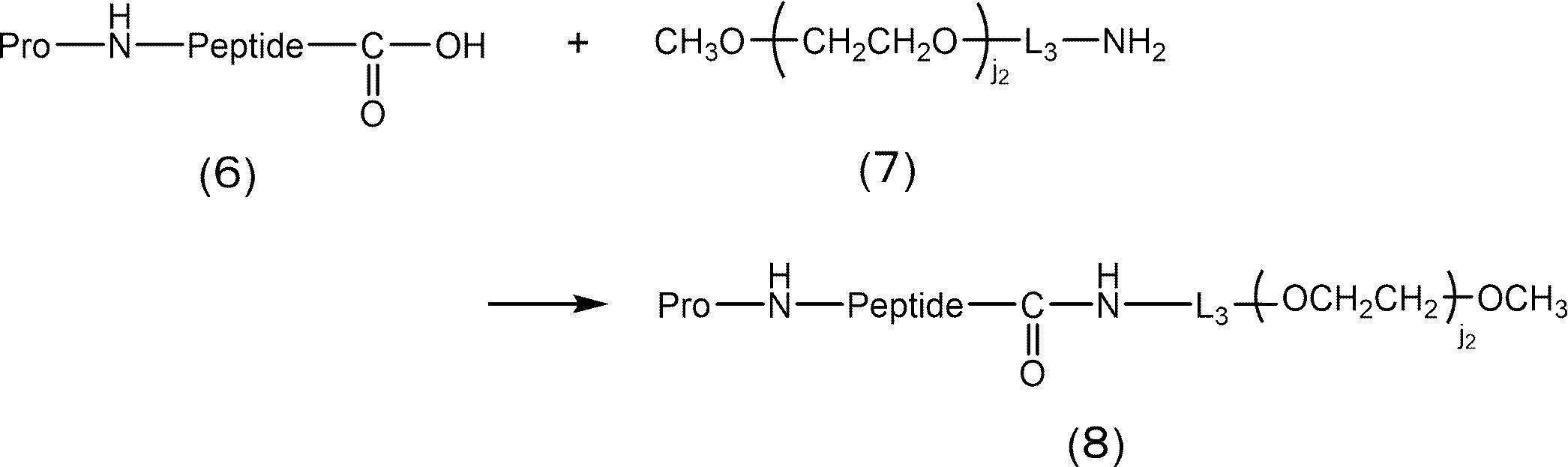
- Pro in Reaction 2 is a protecting group
- Peptide is an oligopeptide
- L 3 is a single bond or divalent spacer synonymous with L 1 and L 2
- j 2 is synonymous with the above.
- Pro in Reaction 2 is a protecting group, where the protecting group is a component that prevents or prevents the reaction of a specific chemically reactive functional group in the molecule under certain reaction conditions.
- Protecting groups vary depending on the type of chemically reactive functional group protected, the conditions used and the presence of other functional or protecting groups in the molecule. Specific examples of protecting groups can be found in many common books, such as "Wuts, P. G. M .; Greene, T. W. Protective Groups in Organic Synthesis, 4th ed .; Wiley. -Interscience: New York, 2007 ”. Further, the functional group protected by the protecting group can be regenerated by deprotecting, that is, chemically reacting with the reaction conditions suitable for each protecting group. Typical deprotection conditions for protecting groups are described in the aforementioned literature.
- the protecting group for the N-terminal amino group of the oligopeptide is not particularly limited, and examples thereof include an acyl-based protecting group and a carbamate-based protecting group, specifically, a trifluoroacetyl group and 9-fluorenylmethyloxycarbonyl. Examples include a group (Fmoc), a tert-butyloxycarbonyl group and the like.
- the condensation reaction is not particularly limited, but a reaction using a condensing agent is desirable.
- a condensing agent such as dicyclohexylcarbodiimide (DCC) or 1-ethyl-3- (3-dimethylaminopropyl) carbodiimide hydrochloride (EDC) may be used alone, or N-hydroxysuccinimide may be used alone. It may be used in combination with a reagent such as (NHS), 1-hydroxybenzotriazole (HOBt), 1-hydroxy-7-azabenzotriazole (HOAt).
- NHS 1-hydroxybenzotriazole
- HOAt 1-hydroxy-7-azabenzotriazole
- HATU HATU
- HBTU HBTU
- TATU TATU
- TBTU TBTU
- COMU 4- (4,6-dimethoxy-1,3,5-triazine-2-yl) -4-methylmorpholinium chloride n-hydrate.
- a condensing agent such as (DMT-MM) may be used.
- a base such as triethylamine or dimethylaminopyridine may be used.
- Impurities produced as a by-product in the reaction, or oligopeptides and condensing agents remaining unconsumed in the reaction are preferably purified and removed. Purification is not particularly limited, but can be purified by extraction, recrystallization, adsorption treatment, reprecipitation, column chromatography, supercritical extraction and the like.
- Peptide, L 3 and j 2 are synonymous with the above.
- the deprotection 3 is a step of deprotecting the protecting group of the polyethylene glycol derivative represented by the formula (8) obtained in the reaction 2 to obtain the polyethylene glycol derivative represented by the formula (9).
- the deprotection reaction can be a conventionally known method, it is necessary to use the conditions divalent spacer oligopeptide or L 3 is not decomposed. Further, this step can also be carried out as a part of the step of reaction 2.
- Impurities produced by the deprotection reaction are preferably purified and removed. Purification is not particularly limited, but can be purified by extraction, recrystallization, adsorption treatment, reprecipitation, column chromatography, supercritical extraction and the like.
- K 3 in Reaction 4 is an integer from 1 to 6, and Peptide, j 2 and L 3 are synonymous with the above.
- K 3 in the formula (8) is an integer of 1 to 6, preferably an integer of 2 to 4.
- Reaction 4 is a step of reacting the terminal amino group of the polyethylene glycol derivative represented by the formula (9) obtained by deprotection 3 with the compound represented by the formula (10) in the presence of a base catalyst to convert it into a carboxyl group. Is.
- Purification is not particularly limited, but can be purified by extraction, recrystallization, adsorption treatment, reprecipitation, column chromatography, supercritical extraction and the like.
- Peptide, L 3 , k 3 , and j 2 in Reaction 5 are synonymous with the above.
- the polyethylene glycol derivative represented by the formula (11) obtained in the reaction 4 was reacted with the compound represented by the formula (12) in the presence of a base catalyst, and the active ester group was introduced into the reaction 5 according to the formula (13). It is a step of obtaining the polyethylene glycol derivative represented, and this step can also be carried out as a part of the step of Reaction 4.
- Peptide, R, L 3 , j 1 , j 2 , k 1 , k 2 , and k 3 in Reaction 6 are synonymous with the above.
- Impurities produced by the reaction or polyethylene glycol derivatives remaining unconsumed in the reaction are preferably purified and removed. Purification is not particularly limited, but purification can be performed by extraction, recrystallization, adsorption treatment, reprecipitation, column chromatography, supercritical extraction and the like.
- the desired product when it is desired to convert the terminal carboxyl group of the polyethylene glycol derivative represented by the formula (15) into a maleimide group, the desired product can be obtained by subjecting it to a condensation reaction with N- (2-aminoethyl) maleimide in the presence of a base catalyst. Obtainable.
- N- (9-H-fluorolen-9-ylmethoxycarbonyl) -1,2-ethanediamine and a base It can be obtained by conducting a condensation reaction in the presence of a catalyst and then performing a deprotection reaction.
- reaction reagents are low molecular weight reagents and have significantly different solubility from polyethylene glycol derivatives which are high molecular weight polymers, they can be easily removed by general purification methods such as extraction and crystallization.
- branched degradable polyethylene glycol derivative represented by the following formula (2) is provided.
- k 1 and k 2 are independently 1 to 12, j 1 and j 2 are independently 45 to 950, respectively, and R is a hydrogen atom, substituted or unsubstituted carbon. It is an alkyl group of numbers 1 to 4, a substituted aryl group, an aralkyl group or a heteroalkyl group, W is an oligopeptide having a symmetrical structure centered on glutamate or lysine and has a symmetric structure of 5 to 47 residues, and a is 2 to 8.
- X is a functional group capable of reacting with a bio-related substance
- L 1 and L 2 are independently single-bonded or divalent spacers, respectively.
- the total molecular weight of the polyethylene glycol derivative of the formula (2) of the present invention is usually 4,000 to 160,000, preferably 10,000 to 120,000, and more preferably 20,000 to 80,000. Is.
- the polyethylene glycol derivative of the formula (2) of the present invention has a total molecular weight of 20,000 or more.
- the molecular weight referred to here is a number average molecular weight (Mn).
- K 1 and k 2 in the formula (2) are usually 1 to 12 independently of each other, preferably 1 to 6 independently of each other, and more preferably 1 to 2 independently of each other.
- J 1 and j 2 in the formula (2) are the number of repeating units of polyethylene glycol, respectively, and are usually 45 to 950 independently of each other, preferably 110 to 690 independently of each other, and more preferably 110 to 690, respectively. It is 220 to 480 independently.
- W in the formula (2) is an oligopeptide having a symmetrical structure centered on glutamic acid or lysine, with 5 to 47 residues, preferably 5 to 27 residues, more preferably 5 to 19 residues, and is in vivo.
- the amino acids that make up the oligopeptide are those other than glutamic acid or lysine that make up the central part, except for cysteine. It preferably consists of sex amino acids.
- the oligopeptide having a symmetrical structure centered on glutamate or lysine is a peptide having the same peptide as the ⁇ -position carboxyl group and ⁇ -position carboxyl group of glutamate or the ⁇ -position amino group and ⁇ -position amino group of lysine. It means a bound compound, and is an oligopeptide in which a pair of peptides centered on glutamate or lysine has a symmetrical structure.
- the composition ratio (number of neutral amino acids / number of glutamic acid) between the number of neutral amino acids and the number of glutamic acid or lysine in the oligopeptide is usually 2 to 10, preferably 2 to 8, and even more preferably. It is 2 to 6.
- the amino acids that make up W are basically L-type.
- Q is a residue of glutamic acid or lysine
- Z is a 2-5 residue degradable oligopeptide consisting of neutral amino acids excluding cysteine.
- a in the formula (2) is the number of polyethylene glycol chains bound to the oligopeptide represented by W, usually 2 to 8, preferably 2 or 4 or 8, and more preferably 2. Or 4.
- R, X, L 1 , L 2 and Z in (w1) to (w2) are as described in the above formula (1).
- branched degradable polyethylene glycol derivative of the formula (2) of the present invention include the following branched degradable polyethylene glycol derivatives.
- k 1 and k 2 are 1 to 2 independently of each other; j 1 and j 2 are 220-480, respectively;
- R is a hydrogen atom;
- W is a 5-9 residue oligopeptide with a symmetrical structure centered on glutamic acid or lysine (eg, glycine-phenylalanine-glutamic acid-phenylalanine-glycine); a is 2 or 4;
- X is the carboxyl group;
- L 1 and L 2 are alkylene groups (eg, propylene group, pentylene group) which may independently contain an ether bond, a secondary amino group and / or a carbonyl group;
- a branched degradable polyethylene glycol derivative of the formula (2) are alkylene groups (eg, propylene group, pentylene group) which may independently contain an
- the branched degradable polyethylene glycol derivative of the present invention can be produced, for example, by the following steps when Q is a residue of glutamic acid.
- Reaction 7 has two carboxyls, an amino group of the polyethylene glycol derivative represented by the formula (9) obtained by deprotection 3 and a glutamate derivative in which the amino group represented by the formula (17) is protected by a protecting group.
- This is a step of bonding groups by a condensation reaction to obtain a branched polyethylene glycol derivative represented by the formula (18), which has a structure in which two degradable polyethylene glycol chains are linked by glutamate residues.
- a reaction using a condensing agent is desirable, and in order to accelerate the reaction, a base such as triethylamine or dimethylaminopyridine may be used.
- the protecting group for the amino group of glutamic acid is not particularly limited, and examples thereof include an acyl-based protecting group and a carbamate-based protecting group, and specific examples thereof include a trifluoroacetyl group, a 9-fluorenylmethyloxycarbonyl group and a t-. Examples include a butyloxycarbonyl group.
- Impurities produced as a by-product in the reaction or polyethylene glycol derivatives remaining unconsumed in the reaction are preferably purified and removed. Purification is not particularly limited, but can be purified by extraction, recrystallization, adsorption treatment, reprecipitation, column chromatography, supercritical extraction and the like.
- the deprotection 8 is a step of deprotecting the protecting group of the polyethylene glycol derivative represented by the formula (18) obtained in the reaction 7 to obtain the polyethylene glycol derivative represented by the formula (19).
- the reaction and purification are possible under the same conditions as the deprotection 3.
- the purification techniques described in JP-A-2014-208786 and JP-A-2011-79934 are used. Can be done.
- the amino group of the polyethylene glycol derivative represented by the formula (19) obtained by deprotection 8 and the glutamate derivative in which the amino group represented by the formula (17) is protected by a protecting group are two carboxyls.
- the reaction and purification are possible under the same conditions as in Reaction 2.
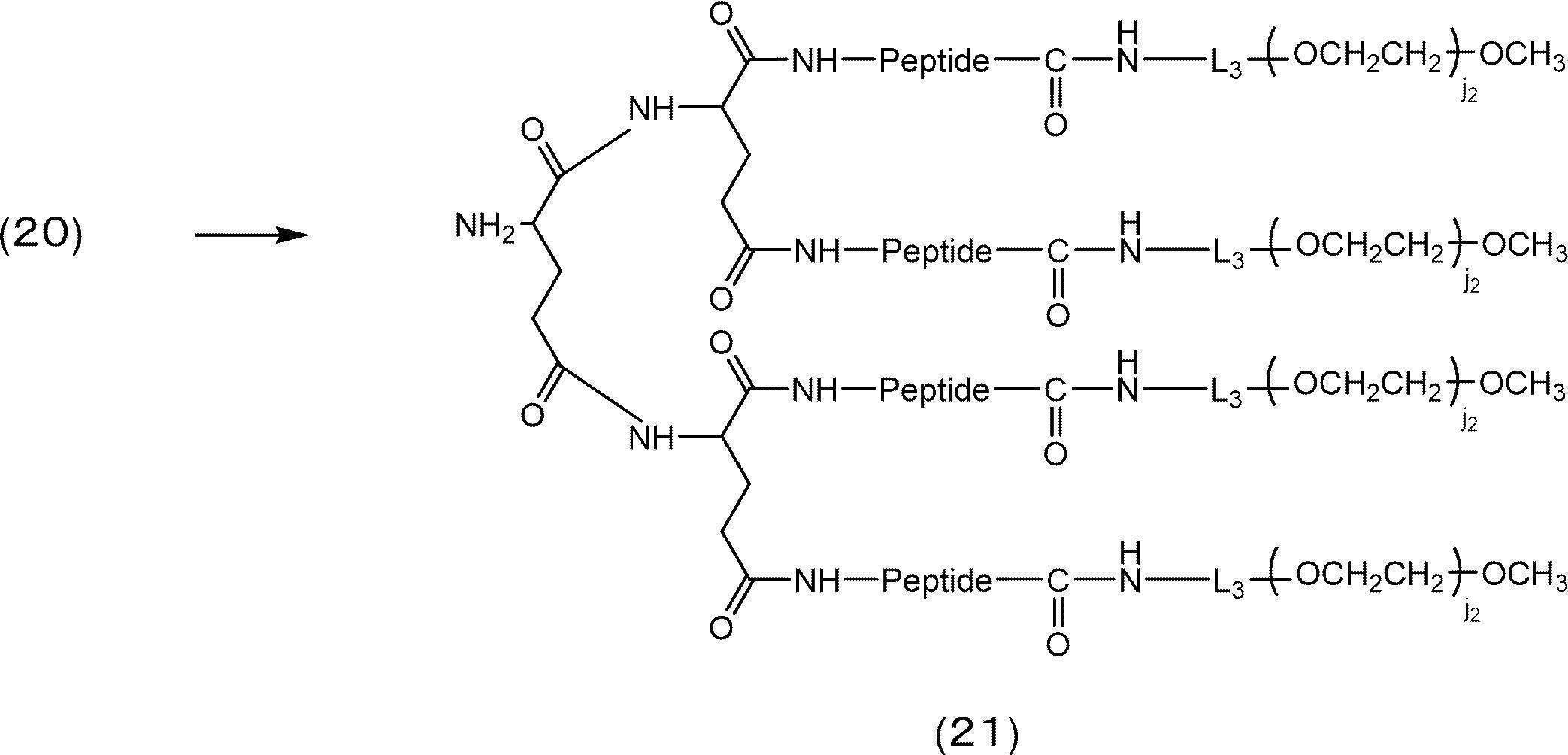
- the deprotection 10 is a step of deprotecting the protecting group of the polyethylene glycol derivative represented by the formula (20) obtained in the reaction 9 to obtain the polyethylene glycol derivative represented by the formula (21).
- the reaction and purification are possible under the same conditions as the deprotection 8. Further, this step can also be carried out in a series of steps of reaction 9.
- Peptide, L 3 , j 2 and k 3 in Reaction 11 are synonymous with the above.
- a tetrabranched polyethylene glycol derivative represented by the formula (21) obtained by deprotection 10 is used as a raw material.
- a 4-branched polyethylene glycol derivative represented by the following formula (24) can be obtained.
- Peptide, L 3 , j 2 and k 3 of the formula (24) are synonymous with the above.
- Peptide, L 3 , j 2 and k 3 in Reaction 12 are synonymous with the above.
- reaction 12 the hydroxyl group of the bifurcated polyethylene glycol derivative represented by the formula (23) obtained in the reaction 11 was reacted with the compound represented by the formula (25), and the active carbonate group was introduced into the reaction 12 (26). It is a step of obtaining the bifurcated polyethylene glycol derivative represented by the above, and this step can be carried out as a part of the affirmation of the reaction 11, and the reaction and purification can be carried out under the same conditions as the reaction 5.
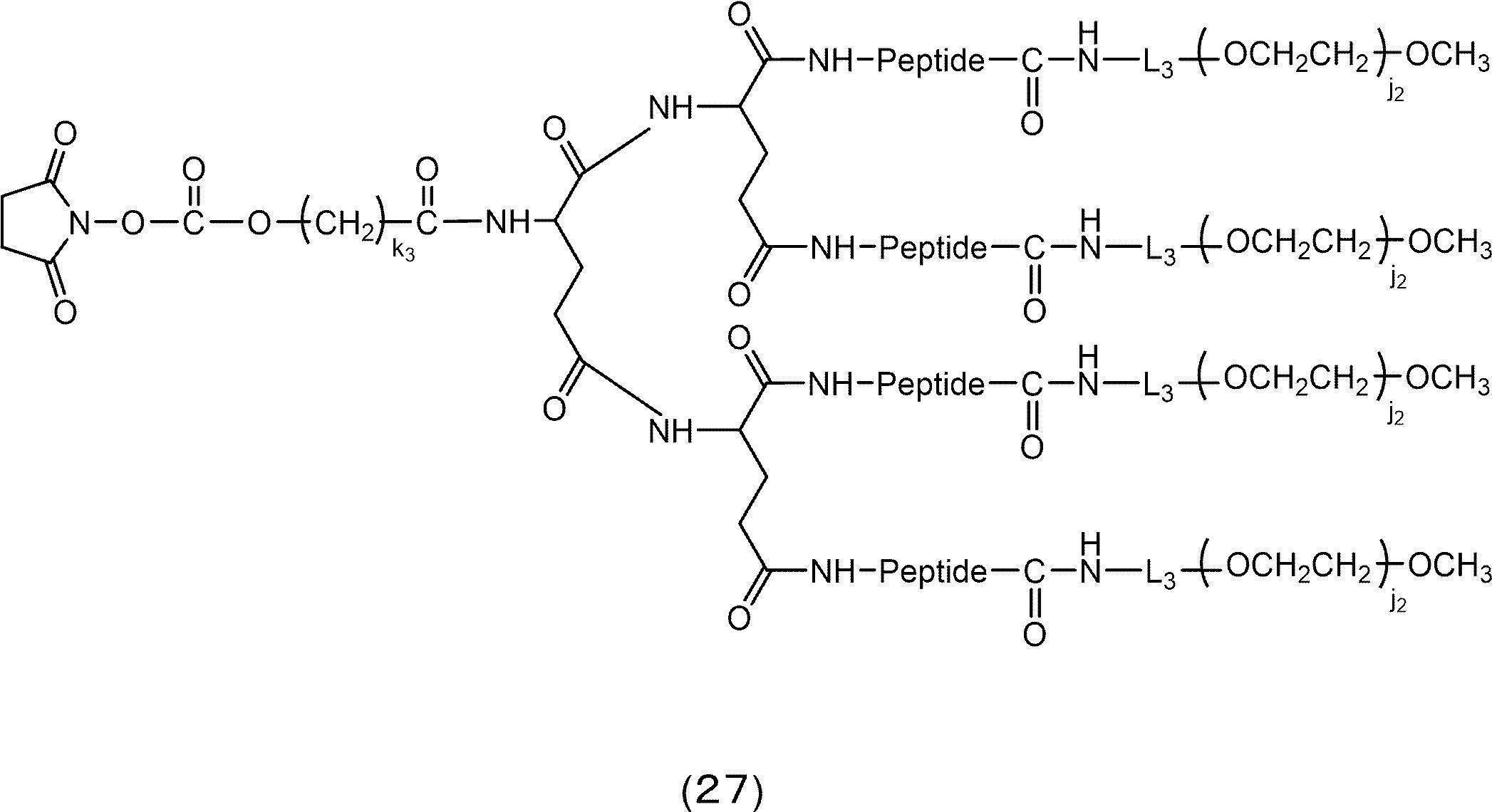
- Peptide, L 3 , j 2 and k 3 of the formula (27) are synonymous with the above.
- Peptide, R, L 3 , j 1 , j 2 , k 1 , k 2 and k 3 in Reaction 13 are synonymous with the above.
- Peptide, R, L 3 , j 1 , j 2 , k 1 , k 2 and k 3 in formula (29) are synonymous with the above.
- the terminal carboxyl group of the branched polyethylene glycol derivative represented by the formula (28) or the formula (29) into a maleimide group it is condensed with N- (2-aminoethyl) maleimide in the presence of a base catalyst. By reacting, the desired product can be obtained.
- N- (9-H-fluorolen-9-ylmethoxycarbonyl) -1, 2 -It can be obtained by conducting a condensation reaction with ethanediamine in the presence of a base catalyst and then performing a deprotection reaction.
- reaction reagents are low molecular weight reagents and have significantly different solubility from polyethylene glycol derivatives which are high molecular weight polymers, they can be easily removed by general purification methods such as extraction and crystallization. ..
- the branched degradable polyethylene glycol obtained through the above steps is required to be stable in blood and have the ability to decompose only intracellularly.
- the following tests can be carried out to evaluate the stability of branched degradable polyethylene glycol in blood and its degradability in cells.
- all the evaluation samples were unified to the polyethylene glycol derivative having one amino group.
- the test method for evaluating the stability of the branched degradable polyethylene glycol derivative in blood is not particularly limited, and examples thereof include tests using sera of mice, rats, humans and the like.
- the polyethylene glycol derivative is dissolved in serum to a concentration of 1 to 10 mg / mL, incubated at 37 ° C. for 96 hours, and then the polyethylene glycol derivative contained in the serum is recovered and GPC is measured.
- the decomposition rate can be evaluated with.
- the decomposition rate is calculated from the peak area% of the GPC membrane of the polyethylene glycol derivative before the stability test and the peak area% of the GPC membrane of the polyethylene glycol derivative after the stability test. Specifically, the following formula is used.
- Decomposition rate (Peak area% before test-Peak area% after test) ⁇ Peak area% before test x 100
- the test method for evaluating the intracellular degradability of the branched degradable polyethylene glycol derivative is not particularly limited, but for example, a medium containing the branched degradable polyethylene glycol derivative is used in the cells.
- Examples include a test for culturing.
- the cells and medium used here are not particularly limited, but specifically, a polyethylene glycol derivative is dissolved in RPMI-1640, which is a medium, so as to have a concentration of 1 to 20 mg / mL, and this medium is used.
- RPMI-1640 which is a medium, so as to have a concentration of 1 to 20 mg / mL, and this medium is used.
- the decomposition rate is calculated by using the peak area% of the GPC membrane of the polyethylene glycol derivative before and after the test, as in the stability test. For example, suppose that the peak area% of the GPC membrane of the branched degradable polyethylene glycol derivative before the degradability test using cells was 95%, and the peak area% of the GPC membrane after the test was 5%.
- Non-Patent Document 2 describes that the vacuolation of cells by high molecular weight polyethylene glycol is related to the accumulation of polyethylene glycol in tissues.
- the test method for evaluating the accumulation of the degradable polyethylene glycol derivative in cells is not particularly limited, but can be evaluated based on the above-mentioned intracellular degradability.
- the 1 H-NMR obtained in the following examples was obtained from JNM-ECP400 or JNM-ECA600 manufactured by JEOL Datum Co., Ltd.
- the deuterated solvent using CDCl 3 and d 6-DMSO containing tetramethylsilane (TMS) as D 2 O, or internal standard.
- TMS tetramethylsilane
- the molecular weight and terminal functional group purity of the obtained polyethylene glycol derivative were calculated using liquid chromatography (GPC and HPLC).
- GPC and HPLC liquid chromatography
- “HLC-8320GPC EcoSEC” manufactured by Tosoh Corporation was used for GPC
- "ALLIANCE" manufactured by WATERS Co., Ltd. was used for HPLC.
- Average molecular weight 20,000, "SUNBRIGHT MEH-20T" (manufactured by Nichiyu Co., Ltd.) (10 g) was dissolved in toluene (40 g), dehydrated by reflux at 110 ° C. for 1 hour, cooled to 40 ° C., and triethylamine (80 mg). ), Methanesulfonyl chloride (84 mg) was added, and the mixture was reacted at 40 ° C. for 3 hours. After completion of the reaction, the mixture was diluted with toluene (100 g), hexane (100 g) was added, and the mixture was stirred at room temperature for 30 minutes to precipitate the product.
- the precipitate was collected by suction filtration using a 5A filter paper, dissolved in ethyl acetate (200 g), hexane (100 g) was added, and the mixture was stirred at room temperature for 15 minutes to precipitate the product.
- the precipitate was collected by suction filtration using a 5A filter paper, washed with hexane (100 g), suction filtered using a 5A filter paper, and vacuum dried to obtain compound (p1). Yield 8.9g.
- Example 1-4 The compound (p4) (6.0 g), sodium acetate (49 mg), and glutaric anhydride (51 mg) obtained in Example 1-4 were dissolved in toluene (25 g), and the mixture was dissolved in toluene (25 g) at 40 ° C. for 7 hours in a nitrogen atmosphere. It was reacted. After completion of the reaction, the mixture was diluted with toluene (20 g), suction filtered using a 5A filter paper, hexane (30 g) was added to the obtained filtrate, and the mixture was stirred at room temperature for 15 minutes to precipitate the product. The precipitate was collected by suction filtration using a 5A filter paper.
- the obtained precipitate was dissolved in ethyl acetate (100 g), hexane (50 g) was added, and the mixture was stirred at room temperature for 15 minutes to precipitate the product.
- the precipitate was collected by suction filtration using a 5A filter paper, washed with hexane (50 g), suction filtered using a 5A filter paper, and vacuum dried to obtain the above compound (p5). Yield 4.8g.
- Example 1-5 The compound (p5) (4.5 g) and N-hydroxysuccinimide (103 mg) obtained in Example 1-5 were dissolved in toluene (25 g). Then, dicyclohexylcarbodiimide (139 mg) was added, and the mixture was reacted at 40 ° C. under a nitrogen atmosphere for 3 hours. After completion of the reaction, toluene (50 g) was added to dilute the mixture, suction filtration was performed using a 5A filter paper, hexane (50 g) was added to the obtained filtrate, and the mixture was stirred at room temperature for 15 minutes to precipitate the product. It was.
- the concentrate was dissolved in ethyl acetate (100 g), hexane (50 g) was added, and the mixture was stirred at room temperature for 15 minutes to precipitate the product.
- the precipitate was collected by suction filtration using a 5A filter paper, then dissolved again in ethyl acetate (100 g), hexane (50 g) was added, and the mixture was stirred at room temperature for 15 minutes to precipitate the product.
- suction filtration using 5A filter paper to collect the precipitate it is washed with hexane (50 g) containing 2,6-di-tert-butyl-p-cresol (BHT) (10 mg) and 5A filter paper.
- BHT 2,6-di-tert-butyl-p-cresol
- Example 1-7 The compound (p7) (300 mg) obtained in Example 1-7 was dissolved in acetonitrile (2 g). Then, N-hydroxysuccinimide (6 mg) and dicyclohexylcarbodiimide (6 mg) were added, and the mixture was reacted at 40 ° C. under a nitrogen atmosphere for 3 hours. Then, triethylamine (3 mg) and N- (2-aminoethyl) maleimide hydrochloride (5 mg) were added, and the mixture was reacted at 40 ° C. under a nitrogen atmosphere for 3 hours.
- Example 1-7 The compound (p7) (800 mg) obtained in Example 1-7 was dissolved in toluene (7 g) by heating at 40 ° C., then 3-aminopropionaldehyde diethyl acetal (9 mg) was added, and the temperature was 50 ° C. The reaction was carried out in a nitrogen atmosphere for 2 hours. After completion of the reaction, ethyl acetate (100 g) was added, the mixture was stirred until uniform, hexane (50 g) was added, and the mixture was stirred at room temperature for 15 minutes to precipitate the product.
- Example 5-1 The compound (p11) (600 mg) obtained in Example 5-1 was dissolved in a phosphate buffer solution (6.0 g) adjusted to pH 1.90, and reacted at room temperature in a nitrogen atmosphere for 3 hours. After the reaction, a 0.1N aqueous sodium hydroxide solution was added to adjust the pH to 6.5, and then sodium chloride (1.5 g) was added and dissolved. A 0.1N aqueous sodium hydroxide solution was added to the obtained solution to adjust the pH to 7.10, then chloroform (10 g) containing BHT (2 mg) was added, and the mixture was stirred at room temperature for 20 minutes to form an organic layer. The product was extracted in.
- chloroform (20 g) containing BHT (4 mg) was added to the aqueous layer again, and the mixture was stirred at room temperature for 20 minutes to extract the product into the organic layer. ..
- the organic layers obtained in the first and second extractions were combined and concentrated at 40 ° C., the obtained concentrate was dissolved in ethyl acetate (50 g), hexane (30 g) was added, and the mixture was stirred at room temperature for 15 minutes. The product was precipitated.
- the reaction solution was diluted with toluene (80 g), hexane (40 g) was added, and the mixture was stirred at room temperature for 15 minutes to precipitate the product.
- suction filtration using 5A filter paper to collect the precipitate it was dissolved again in toluene (100 g), hexane (50 g) was added, and the mixture was stirred at room temperature for 15 minutes to precipitate the product.
- suction filtration using a 5A filter paper to collect the precipitate the mixture was washed with hexane (50 g) containing BHT (10 mg), suction filtered using a 5A filter paper, and vacuum dried to obtain the above compound (p13). Obtained. Yield 1.6g.
- ⁇ -Caprolactone (114 mg) was dissolved in 1N NaOH (0.8 mL) and reacted for 2 hours to prepare an aqueous 6-hydroxycaproic acid solution (0.88 M). Further, the compound (p13) (1.5 g) obtained in Example 6-1 was dissolved in acetonitrile (6 g). Then, the above 6-hydroxycaproic acid aqueous solution (80 ⁇ L), diisopropylethylamine (15 mg) and DMT-MM (16 mg) were added, and the mixture was reacted at room temperature in a nitrogen atmosphere for 1 hour. After completion of the reaction, the reaction solution was concentrated at 40 ° C., and chloroform (30 g) was added to the obtained concentrate to dissolve it.
- a saturated aqueous sodium hydrogen carbonate solution (15 g) was added, and the mixture was washed by stirring at room temperature for 15 minutes. After separating the aqueous layer and the organic layer, a saturated aqueous sodium hydrogen carbonate solution (15 g) was added to the organic layer again, and the mixture was washed by stirring at room temperature for 15 minutes to recover the organic layer.
- Magnesium sulfate (5 g) was added to the obtained chloroform solution, and the mixture was stirred for 30 minutes to dehydrate, and then suction filtration was performed using a 5A filter paper.
- the obtained filtrate was concentrated at 40 ° C., ethyl acetate (50 g) was added to the concentrate and stirred to make it uniform, then hexane (25 g) was added, and the mixture was stirred at room temperature for 15 minutes to produce the product. Was precipitated.
- the precipitate was collected by suction filtration using a 5A filter paper, then dissolved again in ethyl acetate (50 g), hexane (25 g) was added, and the mixture was stirred at room temperature for 15 minutes to precipitate the product.
- Example 6-2 The compound (p14) (500 mg) obtained in Example 6-2 was dissolved in dichloromethane (3.5 g). Then, di (N-succinimidyl) (51 mg) and pyridine (20 mg) were added, and the mixture was reacted at room temperature in a nitrogen atmosphere for 8 hours. After completion of the reaction, the reaction solution was washed with 5% saline (5 g), magnesium sulfate (0.1 g) was added, the mixture was stirred at 25 ° C. for 30 minutes, and then suction filtration was performed using a 5A filter paper.
- the obtained filtrate was concentrated, ethyl acetate (100 g) was added to the concentrate to dissolve it, hexane (50 g) was added, and the mixture was stirred at room temperature for 15 minutes to precipitate the product. After suction filtration using a 5A filter paper to collect the precipitate, the mixture was washed with hexane (25 g) containing BHT (5 mg), suction filtered using a 5A filter paper, and vacuum dried to obtain the above compound (p15). It was. Yield 286 mg.
- Active carbonate purity is 91% ( 1 1 H-NMR) 1 H-NMR (CDCl 3) : 1.38ppm (m, 2H, Succinimide-OCO-CH 2 -CH 2 - CH 2 -CH 2 -CH 2 -CO-NH -), 1.59ppm (m, 2H, succinimide-OCO-CH 2 -CH 2 -CH 2 - CH 2 -CH 2 -CO-NH -), 1.75ppm (m, 6H), 1.85ppm (m, 1H), 2.13ppm (m, 2H , succinimide-OCO-CH 2 -CH 2 -CH 2 -CH 2 - CH 2 -CO-NH -), 2.83ppm (s, 4H, -CO- CH 2 -CH 2 -CO -), 3.01ppm (m, 1H), 3.19ppm ( m, 6H), 3.38ppm (s, 6H, -CO-NH-CH 2 -CH 2 -CH 2
- the concentrate was dissolved in ethyl acetate (100 g), hexane (50 g) was added, and the mixture was stirred at room temperature for 15 minutes to precipitate the product. After suction filtration using a 5A filter paper to collect the precipitate, the mixture was washed with hexane (20 g) containing BHT (4 mg), suction filtered using a 5A filter paper, and vacuum dried to obtain the above compound (p16). Obtained. Yield 242 mg.
- Example 8 Stability test in serum 1 mL of mouse or human serum was added to a 1.5 mL Eppendorf tube, and the compound (p8) which is a branched degradable polyethylene glycol derivative obtained in Example 2 was prepared in Comparative Example 1-2.
- the compound (p18), which is a non-degradable polyethylene glycol derivative obtained in the above, and methoxyPEGamine 40 kDa were added at a concentration of 5.0 mg / mL, respectively. After incubation at 37 ° C. for 96 hours, 200 ⁇ L was sampled, acetonitrile was added thereto, and the mixture was stirred with vortex for 1 minute to precipitate proteins in serum, centrifuged, and the supernatant was recovered.
- the compound (p8) which is a branched degradable polyethylene glycol derivative is decomposed in serum like the compound (p18) which is a non-degradable polyethylene glycol derivative and methoxyPEGamine 40 kDa. I could't. That is, it was shown that the degradable polyethylene glycol derivative is stable in blood.
- Example 9 Degradability test using cells Using 10 mL of medium RPMI-1640 (10% FBS Pn / St), RAW264.7 was seeded on a 100 mm dish in 10 ⁇ 106 cells, cultured at 37 ° C. for 24 hours, and then obtained in Example 2.
- the cells After culturing, the cells are dissolved in 1% SDS solution, diluted with PBS, acetonitrile is added thereto, and the mixture is stirred with vortex for 1 minute to precipitate proteins in the cell lysate, centrifuged, and then above. Qing was recovered. Next, in order to remove hydrophobic substances such as fatty acids, hexane was added to the recovery liquid, the mixture was stirred with a vortex for 1 minute, centrifuged, and the lower layer was recovered. This solution was concentrated under vacuum conditions to recover the polyethylene glycol derivative from the cells.
- the branched degradable polyethylene glycol derivative of the present invention is a high molecular weight polyethylene glycol derivative that does not cause cell vacuoles, and can be effectively used for modifying bio-related substances in the blood in the living body. It is stable and is degraded intracellularly.
Landscapes
- Health & Medical Sciences (AREA)
- Chemical & Material Sciences (AREA)
- Life Sciences & Earth Sciences (AREA)
- Medicinal Chemistry (AREA)
- Bioinformatics & Cheminformatics (AREA)
- Engineering & Computer Science (AREA)
- General Health & Medical Sciences (AREA)
- Proteomics, Peptides & Aminoacids (AREA)
- Organic Chemistry (AREA)
- Veterinary Medicine (AREA)
- Epidemiology (AREA)
- Animal Behavior & Ethology (AREA)
- Public Health (AREA)
- Pharmacology & Pharmacy (AREA)
- Molecular Biology (AREA)
- Chemical Kinetics & Catalysis (AREA)
- Polymers & Plastics (AREA)
- General Chemical & Material Sciences (AREA)
- Genetics & Genomics (AREA)
- Biophysics (AREA)
- Biochemistry (AREA)
- Polyethers (AREA)
- Medicinal Preparation (AREA)
- Peptides Or Proteins (AREA)
- Other Resins Obtained By Reactions Not Involving Carbon-To-Carbon Unsaturated Bonds (AREA)
- Biological Depolymerization Polymers (AREA)
Abstract
Description
[1]細胞内にて分解するオリゴペプチドを分子内に有する下式(1)で示される分岐型の分解性ポリエチレングリコール誘導体。

[6]下式(2)で示される分岐型の分解性ポリエチレングリコール誘導体。


本発明に係る分岐型の分解性ポリエチレングリコール誘導体は、下式(1)で示される。


式(1)中のL2は、群(I)の(z1)、(z2)、(z3)、(z4)、(z5)、(z6)、(z7)、(z8)、(z11)が好ましく、(z3)、(z5)、(z11)がより好ましい。
具体的には、活性エステル基、活性カーボネート基、アルデヒド基、イソシアネート基、イソチオシアネート基、エポキシ基、カルボキシ基、メルカプト基、マレイミド基、置換マレイミド基、ヒドラジド基、ジチオピリジル基、置換スルホネート基、ビニルスルホニル基、アミノ基、オキシアミノ基(H2N-O-基)、ヨードアセトアミド基、アルキルカルボニル基、アルケニル基(例えば、アリル基、ビニル基)、アルキニル基、置換アルキニル基(例えば、後記の炭素数1~5の炭化水素基で置換されたアルキニル基)、アジド基、アクリル基、スルホニルオキシ基(例えば、アルキルスルホニルオキシ基)、α-ハロアセチル基などが挙げられ、好ましくは、活性エステル基、活性カーボネート基、アルデヒド基、イソシアネート基、イソチオシアネート基、エポキシ基、マレイミド基、置換マレイミド基、ビニルスルホニル基、アクリル基、スルホニルオキシ基(例えば、炭素数1~5のアルキル-スルホニルオキシ基)、置換スルホネート基、カルボキシ基、メルカプト基、ピリジルジチオ基、α-ハロアセチル基、アルキニル基、置換アルキニル基(例えば、後記の炭素数1~5の炭化水素基で置換された炭素数2~5のアルキニル基)、アリル基、ビニル基、アミノ基、オキシアミノ基、ヒドラジド基およびアジド基であり、より好ましくは活性エステル基、活性カーボネート基、アルデヒド基、マレイミド基、オキシアミノ基およびアミノ基であり、特に好ましくは活性エステル基、活性カーボネート基、アルデヒド基、マレイミド基およびオキシアミノ基である。
下記の (a)、(b)、(c)、(d)、(e)、(f)、(g)、(j)、または(k)で示される基が挙げられる。
下記の(a)、(b)、(c)、(d)、(e)、(f)、(g)、(h)、(i)、(j)、(k)、または(l)で示される基が挙げられる。
下記の(h)、(m)、(n)、または(p)で示される基が挙げられる。
下記の(h)、(m)、(n)、または(p)で示される基が挙げられる。
下記の(h)、(m)、または(o)で示される基が挙げられる。
下記の(l)で示される基が挙げられる。

[分岐型の分解性ポリエチレングリコール誘導体(1-1)]
k1およびk2が、それぞれ独立して1~2であり;
j1およびj2が、それぞれ独立して220~480であり;
Rが、水素原子であり;
Zが、システインを除く中性アミノ酸からなる2~8残基のオリゴペプチド(例、フェニルアラニン-グリシン)であり;
Xが、活性エステル基(例、N-スクシンイミジルオキシカルボニル基)、アルデヒド基(例、N-(ホルミルエチル)カルバモイル基)、カルボキシル基、マレイミド基(例、N-(N-マレイミジルエチルカルボニルアミノエチル)カルバモイル基)およびアミノ基(例、N-(アミノエチル)カルバモイル基)よりなる群から選択され;
L1およびL2が、それぞれ独立して、2級アミノ基および/またはカルボニル基を含んでいてもよいアルキレン基(例、プロピレン基)である;
式(1)の分岐型の分解性ポリエチレングリコール誘導体。

前記カップリング反応における無水溶媒としては、式(3)および式(4)で表される化合物と反応しない溶媒であれば特に制限は無いが、例えば、テトラヒドロフラン、アセトニトリル、DMF、ジクロロメタン、クロロホルム等の非プロトン性極性溶媒、及びこれらの混合物が挙げられる。
反応で副生した不純物、また反応で消費されずに残存した化合物、強塩基触媒の精製除去を行うのが好ましい。精製は特に制限されないが、抽出、再結晶、吸着処理、再沈殿、カラムクロマトグラフィー、超臨界抽出などで精製することができる。


群(VIII):


[分岐型の分解性ポリエチレングリコール誘導体(2-1)]
k1およびk2が、それぞれ独立して1~2であり;
j1およびj2が、それぞれ独立して220~480であり;
Rが、水素原子であり;
Wが、グルタミン酸またはリジンを中心とした対称構造の5~9残基のオリゴペプチド(例、グリシン-フェニルアラニン-グルタミン酸-フェニルアラニン-グリシン)であり;
aが、2または4であり;
Xが、カルボキシル基であり;
L1およびL2が、それぞれ独立して、エーテル結合、2級アミノ基および/またはカルボニル基を含んでいてもよいアルキレン基(例、プロピレン基、ペンチレン基)である;
式(2)の分岐型の分解性ポリエチレングリコール誘導体。

前記反応2と同様に、縮合剤を用いた反応が望ましく、反応を促進するため、トリエチルアミンやジメチルアミノピリジン等の塩基を用いても良い。
グルタミン酸のアミノ基の保護基は、特に制限は無いが、例えばアシル系保護基およびカーバメート系保護基が挙げられ、具体的にはトリフルオロアセチル基、9-フルオレニルメチルオキシカルボニル基およびt-ブチルオキシカルボニル基等が挙げられる。
反応で副生した不純物、または反応で消費されず残存したポリエチレングリコール誘導体などは、精製除去を行うのが好ましい。精製は、特に制限されないが、抽出、再結晶、吸着処理、再沈殿、カラムクロマトグラフィー、超臨界抽出等で精製することができる。

式(19)で表されるポリエチレングリコール誘導体の中から、分子量や官能基の異なるポリエチレングリコール不純物を除去する手法としては、特開2014-208786、特開2011-79934に記載の精製技術を用いることができる。





なお、これらの評価においてポリエチレングリコール誘導体が有する官能基の種類による影響を考慮し、評価試料はすべて、アミノ基を1つ有したポリエチレングリコール誘導体に統一して試験を実施した。
分解率 = (試験前のピーク面積% - 試験後のピーク面積%) ÷ 試験前のピーク面積% × 100
例えば、安定性試験前の分岐型の分解性ポリエチレングリコール誘導体のGPCメインフラクションのピーク面積%が95%であり、試験後のGPCメインフラクションのピーク面積%が90%だったとすると、分解率は以下のように算出される。
分解率 = (95-90)÷95×100 = 5.26(%)
分岐型の分解性ポリエチレングリコール誘導体は、血中で分解してしまうと、目的とする血中半減期を得ることができないため、安定性試験において、96時間後の分解率は、10%以下が好ましく、5%以下がさらに好ましい。
例えば、細胞を用いた分解性試験前の分岐型の分解性ポリエチレングリコール誘導体のGPCメインフラクションのピーク面積%が95%であり、試験後のGPCメインフラクションのピーク面積%が5%だったとすると、分解率は以下のように算出される。
分解率 = (95-5)÷95×100 = 94.7(%)
分岐型の分解性ポリエチレングリコール誘導体は、細胞内で効率よく分解されないと、目的とする細胞の空胞を抑制できないため、分解性試験において、96時間後の分解率は、90%以上が好ましく、95%以上がさらに好ましい。


1H-NMR(CDCl3):3.08ppm(s、3H、-O-SO2-CH 3 )3.38ppm(s、3H、-O-CH2-CH2-(O-CH2-CH2)j-O-CH 3 )、3.64ppm(m、約1,900H、-O-CH2-CH2-(O-CH 2 -CH 2 )j-O-CH3)

1H-NMR(d6-DMSO):2.72ppm(t、2H、-NH-CH 2 -CH2-(O-CH2-CH2)j-O-CH3)3.24ppm(s、3H、-NH-CH2-CH2-(O-CH2-CH2)j-O-CH 3 )、3.48ppm(m、約1,900H、-CH 2 -NH-CH2-CH 2 -(O-CH 2 -CH 2 )j-O-CH3)、5.52ppm(broad、1H、-NH-CH2-COOH)

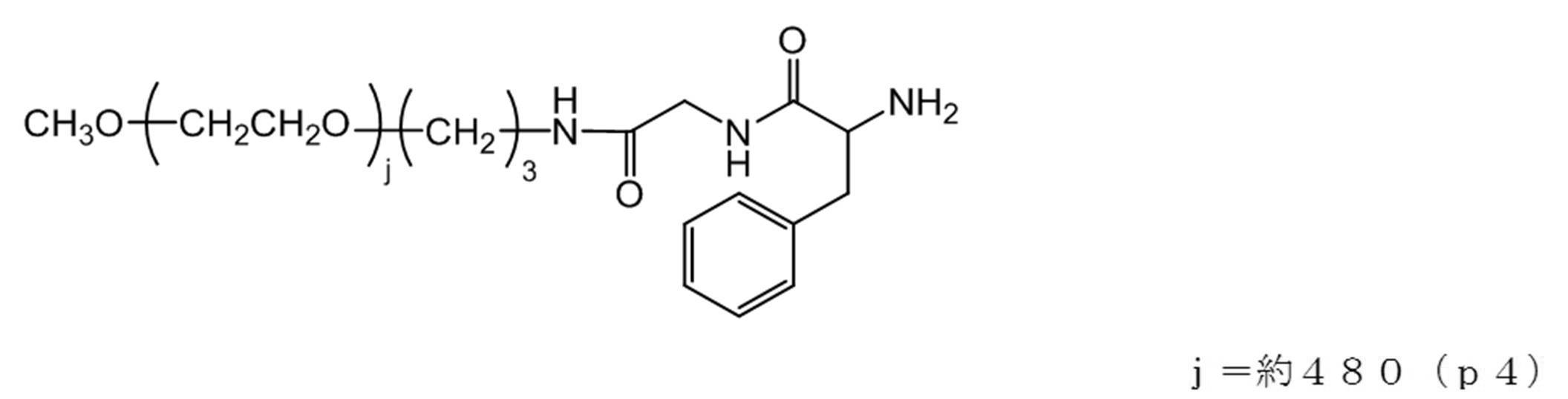
1H-NMR(d6-DMSO):1.62ppm(m、2H、-CO-NH-CH2-CH 2 -CH2-O-(CH2-CH2-O)j-CH3)、2.80ppm(m、1H、-NH-CO-CH-CH 2 -C6H5)、3.04ppm(m、1H、-NH-CO-CH-CH 2 -C6H5)、3.10ppm(m、2H、-CO-NH-CH 2 -CH2-CH2-O-(CH2-CH2-O)j-CH3)、3.24ppm(s、3H、-CO-NH-CH2-CH2-CH2-O-(CH2-CH2-O)j-CH 3 )、3.48ppm(m、約1,900H、-CO-NH-CH2-CH2-CH2-O-(CH 2 -CH 2 -O)j-CH3)、4.20ppm(m、4H)、7.33ppm(m、9H)、7.66ppm(m、4H、Ar)、7.88ppm(d、2H、Ar)、8.27ppm(t、1H)
HPLC:アミン純度92%。
1H-NMR(d6-DMSO):1.62ppm(m、2H、-CO-NH-CH2-CH 2 -CH2-O-(CH2-CH2-O)j-CH3)、1.64ppm(broad、1H)、2.59ppm(dd、1H、-NH-CO-CH-CH 2 -C6H5)、2.98ppm(dd、1H、-NH-CO-CH-CH 2 -C6H5)、3.10ppm(q、2H、-CO-NH-CH 2 -CH2-CH2-O-(CH2-CH2-O)j-CH3)、3.24ppm(s、3H、-CO-NH-CH2-CH2-CH2-O-(CH2-CH2-O)j-CH 3 )、3.48ppm(m、約1,900H、-CO-NH-CH2-CH2-CH2-O-(CH 2 -CH 2 -O)j-CH3)、7.24ppm(m、6H、-NH-CO-CH-CH2-C 6 H 5 、-NH-)、7.73ppm(t、1H)、8.12ppm(broad、1H)

1H-NMR(d6-DMSO):1.62ppm(m、2H、-CO-NH-CH2-CH 2 -CH2-O-(CH2-CH2-O)j-CH3)、1.64ppm(broad、1H)、2.05ppm(dd、2H、-NH-CO-CH2-CH 2 -CH2-COOH)2.30ppm(m、4H、-NH-CO-CH 2 -CH2-CH 2 -COOH)、2.59ppm(dd、1H、-NH-CO-CH-CH 2 -C6H5)、2.98ppm(dd、1H、-NH-CO-CH-CH 2 -C6H5)、3.10ppm(q、2H、-CO-NH-CH 2 -CH2-CH2-O-(CH2-CH2-O)j-CH3)、3.24ppm(s、3H、-CO-NH-CH2-CH2-CH2-O-(CH2-CH2-O)j-CH 3 )、3.48ppm(m、約1,900H、-CO-NH-CH2-CH2-CH2-O-(CH 2 -CH 2 -O)j-CH3)、7.24ppm(m、6H、-NH-CO-CH-CH2-C 6 H 5 、-NH-)、7.73ppm(t、1H)、8.12ppm(broad、1H)

活性エステル純度は98%(1H-NMR)。
1H-NMR(d6-DMSO):1.62ppm(m、2H、-CO-NH-CH2-CH 2 -CH2-O-(CH2-CH2-O)j-CH3)、1.64ppm(broad、1H)、2.05ppm(dd、2H、-NH-CO-CH2-CH 2 -CH2-CO-)、2.30ppm(m、4H、-NH-CO-CH 2 -CH2-CH 2 -COO-)、2.59ppm(dd、1H、-NH-CO-CH-CH 2 -C6H5)、2.72ppm(s、4H、-CO-CH 2 -CH 2 -CO-)、2.98ppm(dd、1H、-NH-CO-CH-CH 2 -C6H5)、3.10ppm(q、2H、-CO-NH-CH 2 -CH2-CH2-O-(CH2-CH2-O)j-CH3)、3.24ppm(s、3H、-CO-NH-CH2-CH2-CH2-O-(CH2-CH2-O)j-CH 3 )、3.48ppm(m、約1,900H、-CO-NH-CH2-CH2-CH2-O-(CH 2 -CH 2 -O)j-CH3)、7.24ppm(m、6H、-NH-CO-CH-CH2-C 6 H 5 、-NH-)、7.73ppm(t、1H)、8.12ppm(broad、1H)
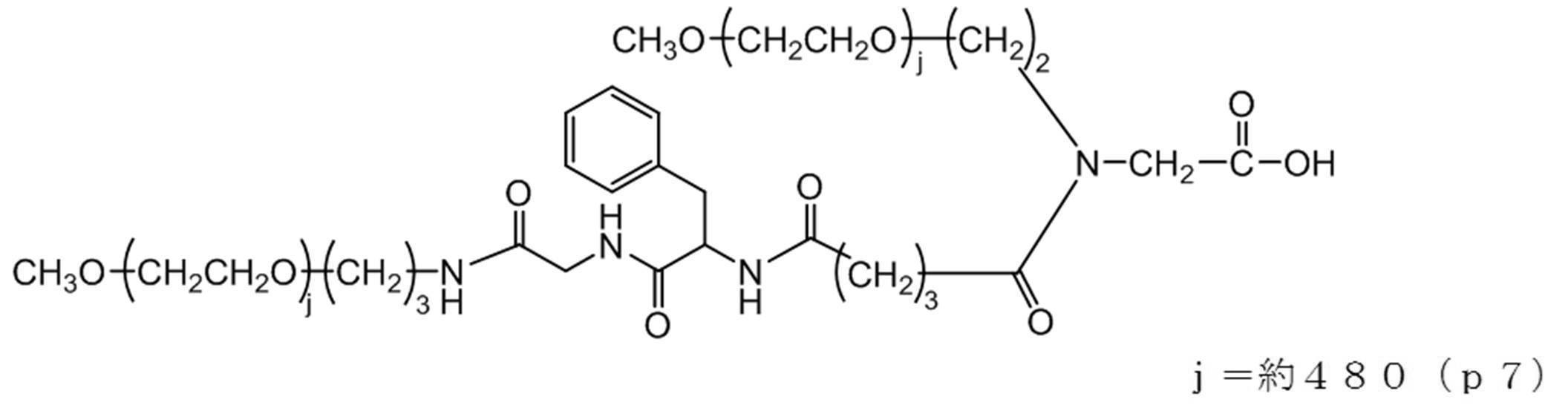
HPLC:カルボン酸純度は95%。
1H-NMR(d6-DMSO):1.62ppm(m、2H、CO-NH-CH2-CH 2 -CH2-O-(CH2-CH2-O)j-CH3)、1.64ppm(broad、1H)、2.05ppm(dd、2H、-NH-CO-CH2-CH 2 -CH2-CO-)、2.30ppm(m、4H、-NH-CO-CH 2 -CH2-CH 2 -CO-)、2.59ppm(dd、1H、-NH-CO-CH-CH 2 -C6H5)、2.98ppm(dd、1H、-NH-CO-CH-CH 2 -C6H5)、3.24ppm(s、3H、-NH-CH2-CH2-(O-CH2-CH2)j-O-CH 3 )、3.48ppm(m、約3,800H、-CH2-NH-CH2-CH2-(O-CH 2 -CH 2 )j-O-CH3)、4.61ppm(-CH 2 -COOH)、7.24ppm(m、6H、-NH-CO-CH-CH2-C 6 H 5 、-NH-)、7.73ppm(t、1H)、8.12ppm(broad、1H))

HPLC:アミン純度は93%。
1H-NMR(d6-DMSO):1.62ppm(m、2H、CO-NH-CH2-CH 2 -CH2-O-(CH2-CH2-O)j-CH3)、1.64ppm(broad、1H)、2.05ppm(dd、2H、-NH-CO-CH2-CH 2 -CH2-CO-)、2.30ppm(m、4H、-NH-CO-CH 2 -CH2-CH 2 -CO-)、2.59ppm(dd、1H、-NH-CO-CH-CH 2 -C6H5)、2.76ppm(m、2H、-NH-CH2-CH 2 -NH2)、2.98ppm(dd、1H、-NH-CO-CH-CH 2 -C6H5)、3.24ppm(s、3H、-NH-CH2-CH2-(O-CH2-CH2)j-O-CH 3 )、3.48ppm(m、約3,800H、-CH2-NH-CH2-CH2-(O-CH 2 -CH 2 )j-O-CH3)、7.24ppm(m、6H、-NH-CO-CH-CH2-C 6 H 5 、-NH-)、7.73ppm(t、1H)、7.80ppm(broad、1H)、8.12ppm(broad、1H)

1H-NMR(d6-DMSO):1.62ppm(m、2H、CO-NH-CH2-CH 2 -CH2-O-(CH2-CH2-O)j-CH3)、1.64ppm(broad、1H)、2.05ppm(dd、2H、-NH-CO-CH2-CH 2 -CH2-CO-)、2.30ppm(m、4H、-NH-CO-CH 2 -CH2-CH 2 -CO-)、2.59ppm(dd、1H、-NH-CO-CH-CH 2 -C6H5)、2.66ppm(t、2H、-NH-CO-CH 2 -CH2-Maleimide)、2.98ppm(dd、1H、-NH-CO-CH-CH 2 -C6H5)、3.24ppm(s、3H、-NH-CH2-CH2-(O-CH2-CH2)j-O-CH 3 )、3.48ppm(m、約3,800H、-CH2-NH-CH2-CH2-(O-CH 2 -CH 2 )j-O-CH3)、4.76ppm(t、2H、-NH-CO-CH2-CH 2 -Maleimide)、6.98ppm(s、2H、-CO-CH-CH-CO-)、7.24ppm(m、6H、-NH-CO-CH-CH2-C 6 H 5 、-NH-)、7.73ppm(t、1H)、7.80ppm(broad、1H)、8.01ppm(broad,1H)、8.12ppm(broad、1H)

1H-NMR(d6-DMSO):1.62ppm(m、2H、CO-NH-CH2-CH 2 -CH2-O-(CH2-CH2-O)j-CH3)、1.64ppm(broad、1H)、2.05ppm(dd、2H、-NH-CO-CH2-CH 2 -CH2-CO-)、2.30ppm(m、4H、-NH-CO-CH 2 -CH2-CH 2 -CO-)、2.59ppm(dd、1H、-NH-CO-CH-CH 2 -C6H5)、2.72ppm(s、4H、-CO-CH 2 -CH 2 -CO-)、2.98ppm(dd、1H、-NH-CO-CH-CH 2 -C6H5)、3.24ppm(s、3H、-NH-CH2-CH2-(O-CH2-CH2)j-O-CH 3 )、3.48ppm(m、約3,800H、-CH2-NH-CH2-CH2-(O-CH 2 -CH 2 )j-O-CH3)、4.61ppm(-CH 2 -OCO-Succinimide)、7.24ppm(m、6H、-NH-CO-CH-CH2-C 6 H 5 、-NH-)、7.73ppm(t、1H)、8.12ppm(broad、1H)
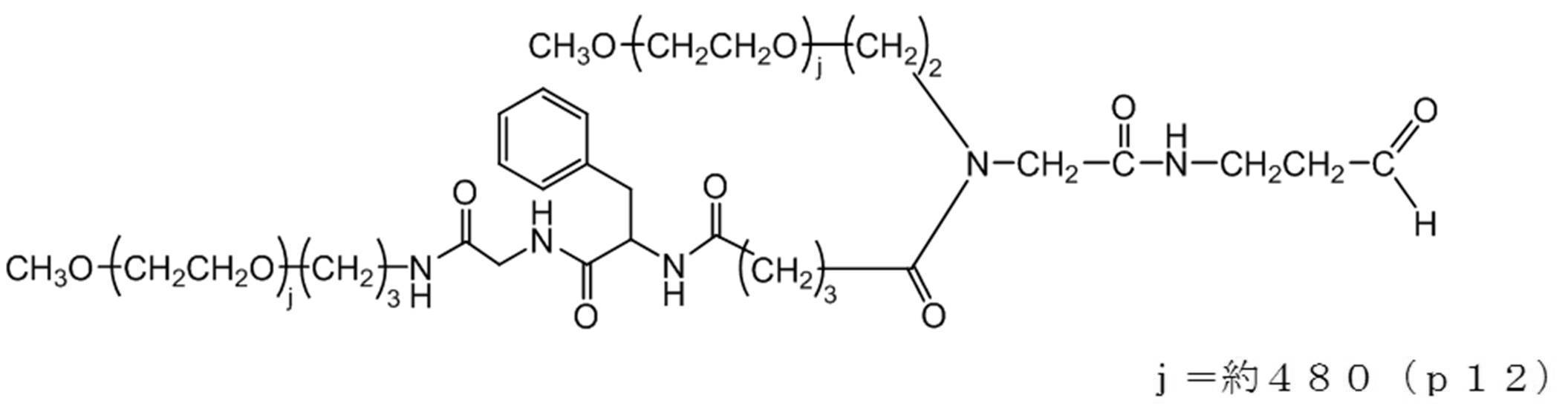

1H-NMR(d6-DMSO):1.20ppm(t、6H(CH 3 -CH2-O)2-CH-)1.62ppm(m、2H、CO-NH-CH2-CH 2 -CH2-O-(CH2-CH2-O)j-CH3)、1.64ppm(broad、1H)、1.85ppm(dd、2H、-NH-CH2-CH 2 -CH-(O-CH2-CH3)2)、2.05ppm(dd、2H、-NH-CO-CH2-CH 2 -CH2-CO-)、2.30ppm(m、4H、-NH-CO-CH 2 -CH2-CH 2 -CO-)、2.59ppm(dd、1H、-NH-CO-CH-CH 2 -C6H5)、2.98ppm(dd、1H、-NH-CO-CH-CH 2 -C6H5)、3.24ppm(s、3H、-NH-CH2-CH2-(O-CH2-CH2)j-O-CH 3 )、3.48ppm(m、約3,800H、-CH2-NH-CH2-CH2-(O-CH 2 -CH 2 )j-O-CH3)、3.91ppm(-CH 2 -CO-NH-CH2-CH2-CH-(O-CH2-CH3)2)、4.55ppm(t、1H、-CH-(O-CH2-CH3)2)7.24ppm(m、6H、-NH-CO-CH-CH2-C 6 H 5 、-NH-)、7.73ppm(t、1H)、8.12ppm(broad、1H)

1H-NMR(d6-DMSO):1.62ppm(m、2H、CO-NH-CH2-CH 2 -CH2-O-(CH2-CH2-O)j-CH3)、1.64ppm(broad、1H)、2.05ppm(dd、2H、-NH-CO-CH2-CH 2 -CH2-CO-)、2.30ppm(m、4H、-NH-CO-CH 2 -CH2-CH 2 -CO-)、2.59ppm(dd、1H、-NH-CO-CH-CH 2 -C6H5)、2.66ppm(dd、2H、-CO-NH-CH2-CH 2 -CHO)、2.98ppm(dd、1H、-NH-CO-CH-CH 2 -C6H5)、3.24ppm(s、3H、-NH-CH2-CH2-(O-CH2-CH2)j-O-CH 3 )、3.48ppm(m、約3,800H、-CH2-NH-CH2-CH2-(O-CH 2 -CH 2 )j-O-CH3)、3.91ppm(s、2H、-CH 2 -CO-NH-CH2-CH2-CHO)7.24ppm(m、6H、-NH-CO-CH-CH2-C 6 H 5 、-NH-)、7.73ppm(t、1H)、8.12ppm(broad、1H)、9.72ppm(s、1H、-CO-NH-CH2-CH2-CHO)
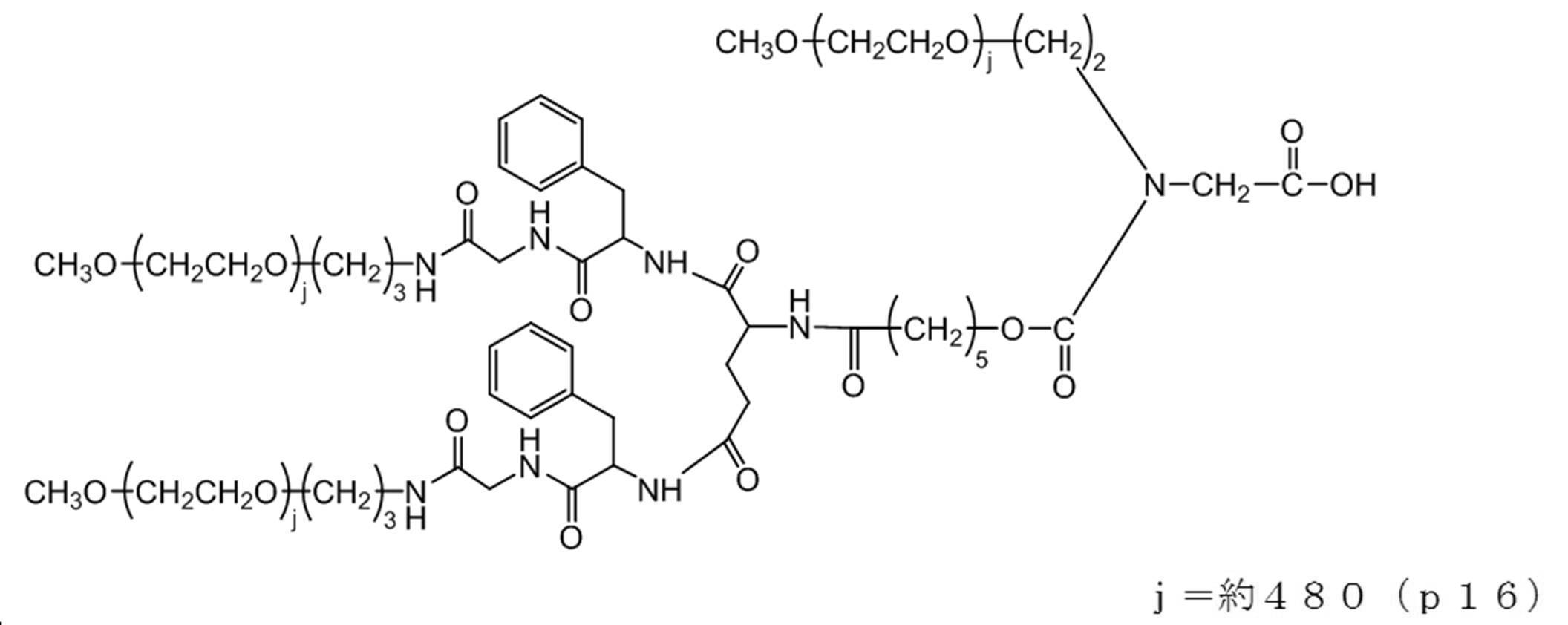

HPLC:アミン純度92%。
1H-NMR(d6-DMSO):1.54ppm(m、2H、-NH-CO-CH(NH2)-CH 2 -CH2-)、1.62ppm(m、4H、-CO-NH-CH2-CH 2 -CH2-)、1.97ppm(m、2H、-NH-CO-CH(NH2)-CH2-CH 2 -)、2.74ppm(dd、1H、-CO-NH-CH-CH 2 -C6H5)、2.81ppm(dd、1H、-CO-NH-CH-CH 2 -C6H5)、3.11ppm(m、11H)、3.24ppm(s、6H、-CO-NH-CH2-CH2-CH2-O-(CH2-CH2-O)j-CH 3 )、3.64ppm(m、約3,800H、-CO-NH-CH2-CH2-CH2-O-(CH 2 -CH 2 -O)j-CH3)、4.49ppm(m、1H、-CO-NH-CH-CH2-C6H5)、4.57ppm(m、1H、-CO-NH-CH-CH2-C6H5)、7.25ppm(m、10H、-CO-NH-CH-CH2-C 6 H 5 )、7.74ppm(m、2H)、8.44ppm(m、2H)、8.61ppm(m、2H)

1H-NMR(CDCl3):1.37ppm(m、2H、HO-CH2-CH2-CH 2 -CH2-CH2-CO-NH-)、1.55ppm(m、4H、HO-CH2-CH 2 -CH2-CH 2 -CH2-CO-NH-)、1.77ppm(m、4H、-CO-NH-CH2-CH 2 -CH2-O-(CH2-CH2-O)j-CH3)、1.85ppm(m、1H)、2.01ppm(m、2H、HO-CH2-CH2-CH2-CH2-CH 2 -CO-NH-)、3.01ppm(m、1H)、3.24ppm(m、8H)、3.38ppm(s、6H、-CO-NH-CH2-CH2-CH2-O-(CH2-CH2-O)j-CH 3 )、3.64ppm(m、約3,800H、-CO-NH-CH2-CH2-CH2-O-(CH 2 -CH 2 -O)j-CH3)、4.03ppm(m、4H)、4.14ppm(m、1H)、4.48ppm(m、2H、-CO-NH-CH-CH2-C6H5)、6.95ppm(broad、1H)、7.00ppm(broad、1H)、7.26ppm(m、10H、-CO-NH-CH-CH2-C 6 H 5 )、7.66ppm(broad、1H)、8.29ppm(broad、1H)

1H-NMR(CDCl3):1.38ppm(m、2H、Succinimide-OCO-CH2-CH2-CH 2 -CH2-CH2-CO-NH-)、1.59ppm(m、2H、Succinimide-OCO-CH2-CH2-CH2-CH 2 -CH2-CO-NH-)、1.75ppm(m、6H)、1.85ppm(m、1H)、2.13ppm(m、2H、Succinimide-OCO-CH2-CH2-CH2-CH2-CH 2 -CO-NH-)、2.83ppm(s、4H、-CO-CH 2 -CH 2 -CO-)、3.01ppm(m、1H)、3.19ppm(m、6H)、3.38ppm(s、6H、-CO-NH-CH2-CH2-CH2-O-(CH2-CH2-O)j-CH 3 )、3.64ppm(m、約3,800H、-CO-NH-CH2-CH2-CH2-O-(CH 2 -CH 2 -O)j-CH3)、4.03ppm(m、3H)、4.18ppm(m、1H)、4.31ppm(t、2H、Succinimide-OCO-CH 2 -CH2-CH2-CH2-CH2-CO-NH-)、4.50ppm(m、2H、-CO-NH-CH-CH2-C6H5)、6.98ppm(broad、1H)、7.15ppm(broad、1H)、7.26ppm(m、10H、-CO-NH-CH-CH2-C 6 H 5 )、7.81ppm(broad、1H)、8.37ppm(broad、1H)
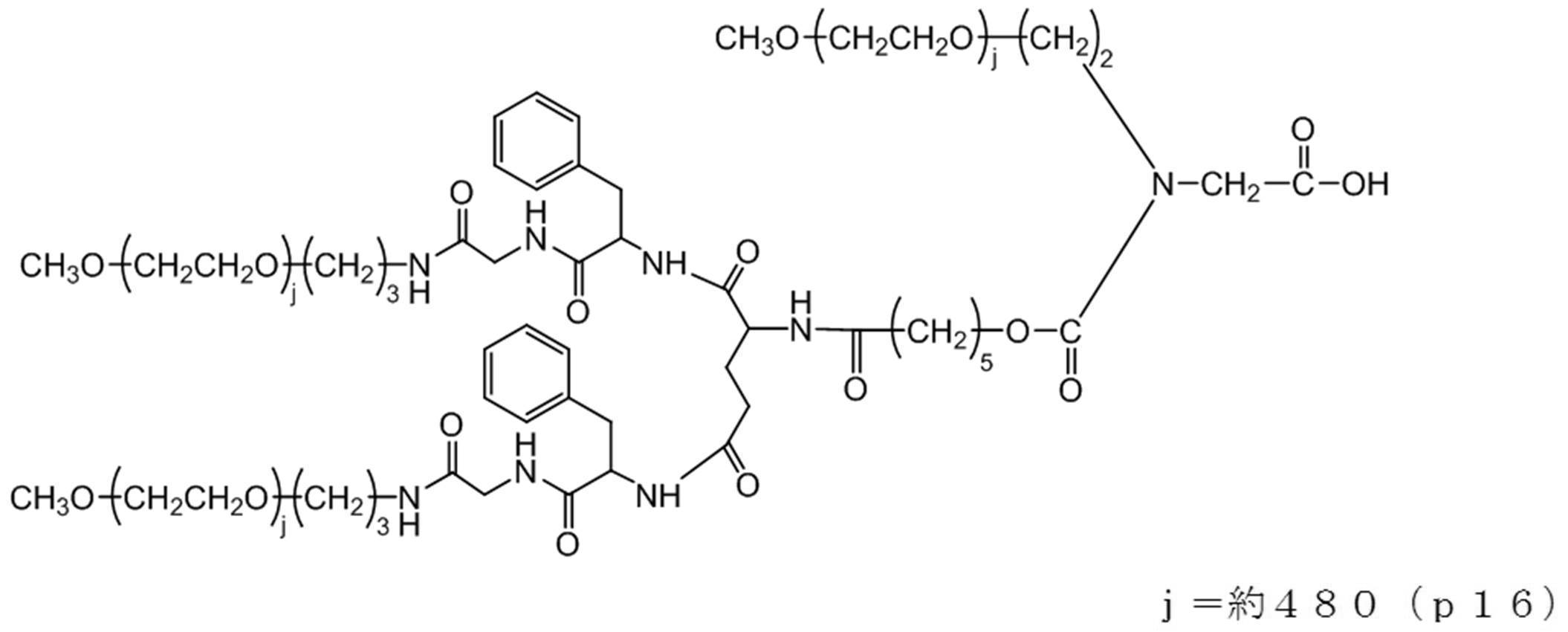
HPLC:カルボン酸純度は90%
1H-NMR(d6-DMSO):1.29ppm(m、2H、-NH-CO-CH2-CH2-CH 2 -CH2-CH2-OCO-)、1.58ppm(m、4H、-NH-CO-CH2-CH 2 -CH2-CH 2 -CH2-OCO-)、1.75ppm(m、6H)、1.85ppm(m、1H)、2.13ppm(m、2H、-NH-CO-CH 2 -CH2-CH2-CH2-CH2-OCO-)、3.01ppm(m、1H)、3.19ppm(m、6H)、3.38ppm(s、6H、-CO-NH-CH2-CH2-CH2-O-(CH2-CH2-O)j-CH 3 )、3.64ppm(m、約5,700H、-CO-NH-CH2-CH2-CH2-O-(CH 2 -CH 2 -O)j-CH3)、3.90ppm(t、2H、-NH-CO-CH2-CH2-CH2-CH2-CH 2 -OCO-)4.03ppm(m、3H)、4.18ppm(m、1H)、4.37ppm(s、2H、-CH 2 -COOH)4.50ppm(m、2H、-CO-NH-CH-CH2-C6H5)、6.98ppm(broad、1H)、7.15ppm(broad、1H)、7.26ppm(m、10H、-CO-NH-CH-CH2-C 6 H 5 )、7.81ppm(broad、1H)、8.37ppm(broad、1H)


HPLC:カルボン酸純度は93%。
1H-NMR(d6-DMSO):1.73ppm(m、2H、-CO-NH-CH2-CH 2 -CH2-(O-CH2-CH2)j-)、2.03ppm(m、2H、-NH-CO-CH2-CH 2 -CH2-CO-N-)、2.34ppm(t、4H、-NH-CO-CH 2 -CH2-CH 2 -CO-N-)、3.40ppm(s、6H、-(O-CH2-CH2)j-O-CH 3 )、3.55ppm(m、約3,800H、-CH2-(O-CH 2 -CH 2 )j-O-CH3)、4.61ppm(s、2H、-CH 2 -COOH)、7.70ppm(broad、1H、-CH2-NH-CO-CH2-CH2-CH2-CO-)
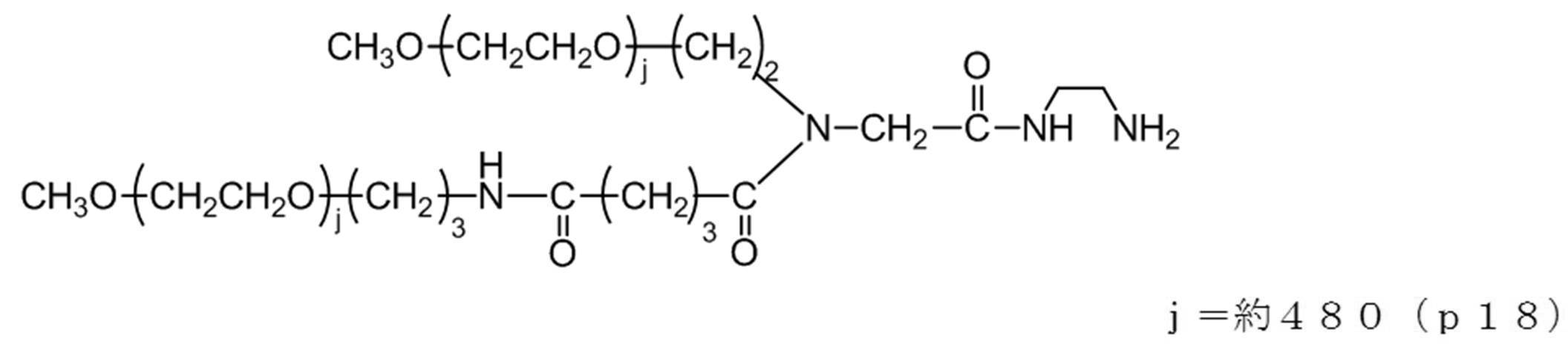
HPLC:アミン純度は90%。
1H-NMR(d6-DMSO):1.73ppm(m、2H、-CO-NH-CH2-CH 2 -CH2-(O-CH2-CH2)j-)、2.03ppm(m、2H、-NH-CO-CH2-CH 2 -CH2-CO-N-)、2.34ppm(t、4H、-NH-CO-CH 2 -CH2-CH 2 -CO-N-)、2.76ppm(m、2H、-CH2-CO-NH-CH2-CH 2 -NH2)、3.40ppm(s、6H、-(O-CH2-CH2)j-O-CH 3 )、3.55ppm(m、約3,800H、-CH2-(O-CH 2 -CH 2 )j-O-CH3)、3.66ppm(m、2H、-CH2-CO-NH-CH 2 -CH2-NH2)、3.91ppm(s、2H、-N-CH 2 -CO-NH-)、7.70ppm(broad、1H、-CH2-NH-CO-CH2-CH2-CH2-CO-)、7.83ppm(broad、1H、-CH2-CO-NH-CH2-CH2-NH2)
血清中での安定性試験
1.5mLのエッペンドルフチューブに、マウスまたはヒト血清1mLを加え、実施例2で得られた分岐型の分解性ポリエチレングリコール誘導体である化合物(p8)、比較例1-2で得られた非分解性ポリエチレングリコール誘導体である化合物(p18)、およびメトキシPEGアミン40kDaをそれぞれ5.0mg/mLの濃度になるように添加した。37℃で96時間インキュベ-ション後、200μLをサンプリングし、そこにアセトニトリルを添加し、ボルテックスにて1分間撹拌し、血清中のたんぱく質を析出させ、遠心分離後、上清を回収した。次に脂肪酸等の疎水性物質を除去するため、回収液にヘキサンを添加し、ボルテックスにて1分間撹拌し、遠心分離後、下層を回収した。この溶液を真空条件にて濃縮し、血清中からポリエチレングリコール誘導体の回収を行った。その後、GPC分析を行い、分解性ポリエチレングリコール誘導体の分解率を算出した。
分解率は以下の式にて算出した。
分解率 = (試験前の40kDaのピーク面積% - 試験後の40kDaのピーク面積%) ÷ (試験前の40kDaのピーク面積%) × 100
結果を表1に示す。

細胞を用いた分解性試験
培地RPMI-1640(10%FBS Pn/St)10mLを用いて、100mmディッシュにRAW264.7を10×106cell播種し、37℃で24時間培養後、実施例2で得られた分岐型の分解性ポリエチレングリコール誘導体である化合物(p8)、比較例1-2で得られた非分解性のポリエチレングリコール誘導体である化合物(p18)およびメトキシPEGアミン40kDaを10mg/mLの濃度になるよう溶解した培地にそれぞれ交換し、37℃で96時間培養した。培養後、細胞を1%SDS溶液にて溶解し、PBSにて希釈し、そこにアセトニトリルを添加し、ボルテックスにて1分間撹拌し、細胞溶解液中のたんぱく質を析出させ、遠心分離後、上清を回収した。次に脂肪酸等の疎水性物質を除去するため、回収液にヘキサンを添加し、ボルテックスにて1分間撹拌し、遠心分離後、下層を回収した。この溶液を真空条件にて濃縮し、細胞内からポリエチレングリコール誘導体の回収を行った。
また、細胞培養に使用した培地中での分解を確認するため、各種ポリエチレングリコール誘導体を10mg/mLの濃度になるよう溶解した培地のみで37℃で96時間培養し、上記と同操作にてポリエチレングリコール誘導体の回収を行った。
その後、回収した各種ポリエチレングリコール誘導体のGPC分析を行い、実施例8と同じ計算式にて分岐型の分解性ポリエチレングリコール誘導体の分解率を算出した。
結果を表2に示す。
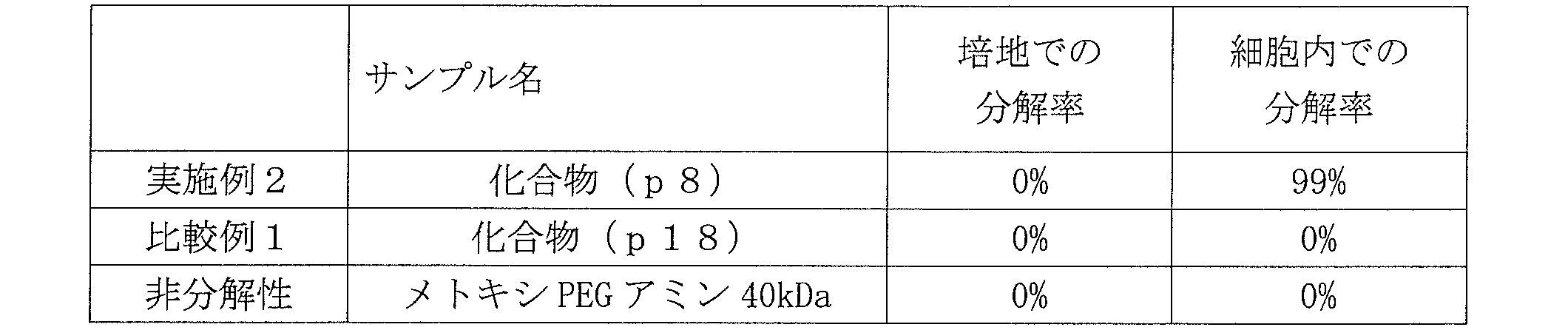
Claims (12)
- 細胞内にて分解するオリゴペプチドを分子内に有する下式(1)で示される分岐型の分解性ポリエチレングリコール誘導体。

- Zのオリゴペプチドが、システインを除く中性アミノ酸からなる2~8残基の分解性オリゴペプチドである請求項1記載の分岐型の分解性ポリエチレングリコール誘導体。
- Zのオリゴペプチドが、C末端のアミノ酸にグリシンを有するペプチドである請求項1~2のいずれか1項記載の分岐型の分解性ポリエチレングリコール誘導体。
- Zのオリゴペプチドが、ハイドロパシー指標が2.5以上である疎水性のアミノ酸を少なくとも1つ有するオリゴペプチドである請求項1~3のいずれか1項記載の分岐型の分解性ポリエチレングリコール誘導体。
- L1及びL2がそれぞれ独立して、単結合、ウレタン結合、アミド結合、エーテル結合、チオエーテル結合、2級アミノ基、ウレア結合、またはこれら結合および/または基を含んだアルキレン基である請求項1~4のいずれか1項記載の分岐型の分解性ポリエチレングリコール誘導体。
- Xが活性エステル基、活性カーボネート基、アルデヒド基、イソシアネート基、イソチオシアネート基、エポキシ基、マレイミド基、ビニルスルホニル基、アクリル基、スルホニルオキシ基、カルボキシ基、チオール基、ジチオピリジル基、α-ハロアセチル基、アルキニル基、アリル基、ビニル基、アミノ基、オキシアミノ基、ヒドラジド基およびアジド基よりなる群から選択される、請求項1~5のいずれか1項記載の分岐型の分解性ポリエチレングリコール誘導体。
- 下式(2)で示される分岐型の分解性ポリエチレングリコール誘導体。

- Wのグルタミン酸またはリジンを中心とした対称構造のオリゴペプチドが、以下のw1またはw2の構造を有するオリゴペプチドである請求項7記載の分岐型の分解性ポリエチレングリコール誘導体。


- Zの分解性オリゴペプチドが、C末端のアミノ酸としてグリシンを有するオリゴペプチドである請求項8の分岐型の分解性ポリエチレングリコール誘導体。
- Zの分解性オリゴペプチドが、ハイドロパシー指標が2.5以上である疎水性の中性アミノ酸を少なくとも1つ有するオリゴペプチドである請求項8~9のいずれか1項記載の分岐型の分解性ポリエチレングリコール誘導体。
- L1及びL2がそれぞれ独立して、単結合、ウレタン結合、アミド結合、エーテル結合、チオエーテル結合、2級アミノ基、ウレア結合、またはこれらの結合および/または基を含んでいてもよいアルキレン基である請求項7~10のいずれか1項記載の分岐型の分解性ポリエチレングリコール誘導体。
- Xが活性エステル基、活性カーボネート基、アルデヒド基、イソシアネート基、イソチオシアネート基、エポキシ基、マレイミド基、ビニルスルホニル基、アクリル基、スルホニルオキシ基、カルボキシ基、チオール基、ジチオピリジル基、α-ハロアセチル基、アルキニル基、アリル基、ビニル基、アミノ基、オキシアミノ基、ヒドラジド基およびアジド基よりなる群から選択される、請求項7~11のいずれか1項記載の分岐型の分解性ポリエチレングリコール誘導体。
Priority Applications (5)
| Application Number | Priority Date | Filing Date | Title |
|---|---|---|---|
| EP20869451.3A EP4036150A4 (en) | 2019-09-26 | 2020-09-25 | ASYMMETRICALLY BRANCHED, DEGRADABLE POLYETHYLENE GLYCOL DERIVATIVE |
| CN202080067267.6A CN114423776A (zh) | 2019-09-26 | 2020-09-25 | 非对称支链型分解性聚乙二醇衍生物 |
| CA3156055A CA3156055A1 (en) | 2019-09-26 | 2020-09-25 | ASYMETRICALLY BRANCHED POLYETHYLENE GLYCOL DERIVATIVE, DEGRADABLE |
| KR1020227013571A KR102923259B1 (ko) | 2019-09-26 | 2020-09-25 | 비대칭 분기형 분해성 폴리에틸렌글리콜 유도체 |
| US17/763,516 US12403199B2 (en) | 2019-09-26 | 2020-09-25 | Asymmetrically branched degradable polyethylene glycol derivative |
Applications Claiming Priority (2)
| Application Number | Priority Date | Filing Date | Title |
|---|---|---|---|
| JP2019176251 | 2019-09-26 | ||
| JP2019-176251 | 2019-09-26 |
Publications (1)
| Publication Number | Publication Date |
|---|---|
| WO2021060443A1 true WO2021060443A1 (ja) | 2021-04-01 |
Family
ID=75166223
Family Applications (1)
| Application Number | Title | Priority Date | Filing Date |
|---|---|---|---|
| PCT/JP2020/036199 Ceased WO2021060443A1 (ja) | 2019-09-26 | 2020-09-25 | 非対称分岐型分解性ポリエチレングリコール誘導体 |
Country Status (7)
| Country | Link |
|---|---|
| US (1) | US12403199B2 (ja) |
| EP (1) | EP4036150A4 (ja) |
| JP (1) | JP7587788B2 (ja) |
| KR (1) | KR102923259B1 (ja) |
| CN (1) | CN114423776A (ja) |
| CA (1) | CA3156055A1 (ja) |
| WO (1) | WO2021060443A1 (ja) |
Cited By (1)
| Publication number | Priority date | Publication date | Assignee | Title |
|---|---|---|---|---|
| WO2021136481A1 (en) | 2020-01-03 | 2021-07-08 | Mediatek Inc. | Video processing method with sample adaptive offset filtering disabled across virtual boundary in reconstructed frame and associated video processing apparatus |
Citations (6)
| Publication number | Priority date | Publication date | Assignee | Title |
|---|---|---|---|---|
| WO2005108463A2 (en) * | 2004-05-03 | 2005-11-17 | Nektar Therapeutics Al, Corporation | Branched polyethylen glycol derivates comprising an acetal or ketal branching point |
| WO2006088248A1 (ja) * | 2005-02-18 | 2006-08-24 | Nof Corporation | ポリオキシアルキレン誘導体 |
| JP2009527581A (ja) * | 2006-02-21 | 2009-07-30 | ネクター セラピューティックス エイエル,コーポレイション | 分割型の分解性重合体とそれから生成される複合体 |
| JP2011079934A (ja) | 2009-10-06 | 2011-04-21 | Nof Corp | カルボキシル基含有ポリオキシエチレン誘導体の精製方法 |
| JP2014208786A (ja) | 2013-03-27 | 2014-11-06 | 日油株式会社 | アミノ基を一つ有するポリエチレングリコールの精製方法 |
| JP2019176251A (ja) | 2018-03-27 | 2019-10-10 | 株式会社日立情報通信エンジニアリング | 認証システム及び認証方法 |
Family Cites Families (5)
| Publication number | Priority date | Publication date | Assignee | Title |
|---|---|---|---|---|
| CN104725628B (zh) | 2014-10-01 | 2018-04-17 | 厦门赛诺邦格生物科技股份有限公司 | 一种含可降解基团的单一官能化支化聚乙二醇、制备方法及其生物相关物质 |
| CN106421806B (zh) * | 2016-11-14 | 2019-10-18 | 四川大学 | 一种逐级响应纳米自组装树枝状前药及制备方法和应用 |
| JP7249591B2 (ja) * | 2018-03-29 | 2023-03-31 | 日油株式会社 | 分解性ポリエチレングリコール結合体 |
| CN113677736B (zh) * | 2019-03-29 | 2024-08-02 | 日油株式会社 | 分支型分解性聚乙二醇衍生物 |
| EP3950703A4 (en) * | 2019-03-29 | 2023-01-04 | NOF Corporation | Branched degradable polyethylene glycol binder |
-
2020
- 2020-09-25 KR KR1020227013571A patent/KR102923259B1/ko active Active
- 2020-09-25 CA CA3156055A patent/CA3156055A1/en active Pending
- 2020-09-25 US US17/763,516 patent/US12403199B2/en active Active
- 2020-09-25 EP EP20869451.3A patent/EP4036150A4/en active Pending
- 2020-09-25 CN CN202080067267.6A patent/CN114423776A/zh active Pending
- 2020-09-25 WO PCT/JP2020/036199 patent/WO2021060443A1/ja not_active Ceased
- 2020-09-25 JP JP2020160392A patent/JP7587788B2/ja active Active
Patent Citations (6)
| Publication number | Priority date | Publication date | Assignee | Title |
|---|---|---|---|---|
| WO2005108463A2 (en) * | 2004-05-03 | 2005-11-17 | Nektar Therapeutics Al, Corporation | Branched polyethylen glycol derivates comprising an acetal or ketal branching point |
| WO2006088248A1 (ja) * | 2005-02-18 | 2006-08-24 | Nof Corporation | ポリオキシアルキレン誘導体 |
| JP2009527581A (ja) * | 2006-02-21 | 2009-07-30 | ネクター セラピューティックス エイエル,コーポレイション | 分割型の分解性重合体とそれから生成される複合体 |
| JP2011079934A (ja) | 2009-10-06 | 2011-04-21 | Nof Corp | カルボキシル基含有ポリオキシエチレン誘導体の精製方法 |
| JP2014208786A (ja) | 2013-03-27 | 2014-11-06 | 日油株式会社 | アミノ基を一つ有するポリエチレングリコールの精製方法 |
| JP2019176251A (ja) | 2018-03-27 | 2019-10-10 | 株式会社日立情報通信エンジニアリング | 認証システム及び認証方法 |
Non-Patent Citations (10)
| Title |
|---|
| "PEGylated Protein Drugs: Basic Science and Clinical Applications", 2009, BIRKHAUSER: BASEL |
| DANIEL G. RUDMANN ET AL., TOXICOL. PATHOL., vol. 41, 2013, pages 970 - 983 |
| FRANCESCO M VERONESE ET AL., BIOCONJUGATE CHEM., vol. 16, 2005, pages 775 - 784 |
| HARRIS, J. M.: "Poly (Ethylene Glycol) Chemistry", 1992, PLENUM PRESS |
| HERMANSON, G. T.: "Bioconjugate Techniques", 2008, ACADEMIC PRESS |
| JIYUAN YANG ET AL., MARCOMOL. BIOSCI., vol. 10, no. 4, 2010, pages 445 - 454 |
| KYTE JDOOLITTLE RF, J MOL BIOL, vol. 157, 1982, pages 105 - 132 |
| See also references of EP4036150A4 |
| WUTS, P. G. M.GREENE, T. W.: "Protective Groups in Organic Synthesis", 2007, WILEY-INTERSCIENCE |
| YULIA VUGMEYSTERANG ET AL., BIOCONJUGATE CHEM., vol. 23, 2012, pages 1452 - 1462 |
Cited By (1)
| Publication number | Priority date | Publication date | Assignee | Title |
|---|---|---|---|---|
| WO2021136481A1 (en) | 2020-01-03 | 2021-07-08 | Mediatek Inc. | Video processing method with sample adaptive offset filtering disabled across virtual boundary in reconstructed frame and associated video processing apparatus |
Also Published As
| Publication number | Publication date |
|---|---|
| CN114423776A (zh) | 2022-04-29 |
| US20220339290A1 (en) | 2022-10-27 |
| EP4036150A1 (en) | 2022-08-03 |
| KR20220069994A (ko) | 2022-05-27 |
| JP2021055080A (ja) | 2021-04-08 |
| EP4036150A4 (en) | 2023-12-27 |
| KR102923259B1 (ko) | 2026-02-04 |
| JP7587788B2 (ja) | 2024-11-21 |
| US12403199B2 (en) | 2025-09-02 |
| CA3156055A1 (en) | 2021-04-01 |
Similar Documents
| Publication | Publication Date | Title |
|---|---|---|
| JP7411189B2 (ja) | 分岐型分解性ポリエチレングリコール結合体 | |
| JP7249591B2 (ja) | 分解性ポリエチレングリコール結合体 | |
| JP7587788B2 (ja) | 非対称分岐型分解性ポリエチレングリコール誘導体 | |
| KR102668424B1 (ko) | 분해성 폴리에틸렌글리콜 유도체 | |
| WO2020203625A1 (ja) | 分岐型分解性ポリエチレングリコール誘導体 | |
| JP7629606B2 (ja) | マルチアーム型分解性ポリエチレングリコール誘導体 |
Legal Events
| Date | Code | Title | Description |
|---|---|---|---|
| 121 | Ep: the epo has been informed by wipo that ep was designated in this application |
Ref document number: 20869451 Country of ref document: EP Kind code of ref document: A1 |
|
| ENP | Entry into the national phase |
Ref document number: 3156055 Country of ref document: CA |
|
| NENP | Non-entry into the national phase |
Ref country code: DE |
|
| ENP | Entry into the national phase |
Ref document number: 20227013571 Country of ref document: KR Kind code of ref document: A |
|
| ENP | Entry into the national phase |
Ref document number: 2020869451 Country of ref document: EP Effective date: 20220426 |
|
| WWG | Wipo information: grant in national office |
Ref document number: 202247023016 Country of ref document: IN |
|
| WWG | Wipo information: grant in national office |
Ref document number: 17763516 Country of ref document: US |