WO2021061842A1 - Variant nucleic acid libraries for single domain antibodies - Google Patents
Variant nucleic acid libraries for single domain antibodies Download PDFInfo
- Publication number
- WO2021061842A1 WO2021061842A1 PCT/US2020/052306 US2020052306W WO2021061842A1 WO 2021061842 A1 WO2021061842 A1 WO 2021061842A1 US 2020052306 W US2020052306 W US 2020052306W WO 2021061842 A1 WO2021061842 A1 WO 2021061842A1
- Authority
- WO
- WIPO (PCT)
- Prior art keywords
- nucleic acid
- antibody
- instances
- seq
- acid library
- Prior art date
- Legal status (The legal status is an assumption and is not a legal conclusion. Google has not performed a legal analysis and makes no representation as to the accuracy of the status listed.)
- Ceased
Links
Classifications
-
- C—CHEMISTRY; METALLURGY
- C12—BIOCHEMISTRY; BEER; SPIRITS; WINE; VINEGAR; MICROBIOLOGY; ENZYMOLOGY; MUTATION OR GENETIC ENGINEERING
- C12N—MICROORGANISMS OR ENZYMES; COMPOSITIONS THEREOF; PROPAGATING, PRESERVING, OR MAINTAINING MICROORGANISMS; MUTATION OR GENETIC ENGINEERING; CULTURE MEDIA
- C12N15/00—Mutation or genetic engineering; DNA or RNA concerning genetic engineering, vectors, e.g. plasmids, or their isolation, preparation or purification; Use of hosts therefor
- C12N15/09—Recombinant DNA-technology
- C12N15/10—Processes for the isolation, preparation or purification of DNA or RNA
- C12N15/102—Mutagenizing nucleic acids
- C12N15/1027—Mutagenizing nucleic acids by DNA shuffling, e.g. RSR, STEP, RPR
-
- C—CHEMISTRY; METALLURGY
- C07—ORGANIC CHEMISTRY
- C07K—PEPTIDES
- C07K16/00—Immunoglobulins [IG], e.g. monoclonal or polyclonal antibodies
- C07K16/18—Immunoglobulins [IG], e.g. monoclonal or polyclonal antibodies against material from animals or humans
- C07K16/28—Immunoglobulins [IG], e.g. monoclonal or polyclonal antibodies against material from animals or humans against receptors, cell surface antigens or cell surface determinants
- C07K16/2803—Immunoglobulins [IG], e.g. monoclonal or polyclonal antibodies against material from animals or humans against receptors, cell surface antigens or cell surface determinants against the immunoglobulin superfamily
-
- A—HUMAN NECESSITIES
- A61—MEDICAL OR VETERINARY SCIENCE; HYGIENE
- A61P—SPECIFIC THERAPEUTIC ACTIVITY OF CHEMICAL COMPOUNDS OR MEDICINAL PREPARATIONS
- A61P31/00—Antiinfectives, i.e. antibiotics, antiseptics, chemotherapeutics
- A61P31/12—Antivirals
-
- A—HUMAN NECESSITIES
- A61—MEDICAL OR VETERINARY SCIENCE; HYGIENE
- A61P—SPECIFIC THERAPEUTIC ACTIVITY OF CHEMICAL COMPOUNDS OR MEDICINAL PREPARATIONS
- A61P35/00—Antineoplastic agents
-
- C—CHEMISTRY; METALLURGY
- C07—ORGANIC CHEMISTRY
- C07K—PEPTIDES
- C07K16/00—Immunoglobulins [IG], e.g. monoclonal or polyclonal antibodies
- C07K16/005—Immunoglobulins [IG], e.g. monoclonal or polyclonal antibodies constructed by phage libraries
-
- C—CHEMISTRY; METALLURGY
- C07—ORGANIC CHEMISTRY
- C07K—PEPTIDES
- C07K16/00—Immunoglobulins [IG], e.g. monoclonal or polyclonal antibodies
- C07K16/18—Immunoglobulins [IG], e.g. monoclonal or polyclonal antibodies against material from animals or humans
- C07K16/28—Immunoglobulins [IG], e.g. monoclonal or polyclonal antibodies against material from animals or humans against receptors, cell surface antigens or cell surface determinants
- C07K16/2803—Immunoglobulins [IG], e.g. monoclonal or polyclonal antibodies against material from animals or humans against receptors, cell surface antigens or cell surface determinants against the immunoglobulin superfamily
- C07K16/2809—Immunoglobulins [IG], e.g. monoclonal or polyclonal antibodies against material from animals or humans against receptors, cell surface antigens or cell surface determinants against the immunoglobulin superfamily against the T-cell receptor (TcR)-CD3 complex
-
- C—CHEMISTRY; METALLURGY
- C07—ORGANIC CHEMISTRY
- C07K—PEPTIDES
- C07K16/00—Immunoglobulins [IG], e.g. monoclonal or polyclonal antibodies
- C07K16/18—Immunoglobulins [IG], e.g. monoclonal or polyclonal antibodies against material from animals or humans
- C07K16/28—Immunoglobulins [IG], e.g. monoclonal or polyclonal antibodies against material from animals or humans against receptors, cell surface antigens or cell surface determinants
- C07K16/286—Immunoglobulins [IG], e.g. monoclonal or polyclonal antibodies against material from animals or humans against receptors, cell surface antigens or cell surface determinants against neuromediator receptors, e.g. serotonin receptor, dopamine receptor
-
- C—CHEMISTRY; METALLURGY
- C07—ORGANIC CHEMISTRY
- C07K—PEPTIDES
- C07K16/00—Immunoglobulins [IG], e.g. monoclonal or polyclonal antibodies
- C07K16/18—Immunoglobulins [IG], e.g. monoclonal or polyclonal antibodies against material from animals or humans
- C07K16/28—Immunoglobulins [IG], e.g. monoclonal or polyclonal antibodies against material from animals or humans against receptors, cell surface antigens or cell surface determinants
- C07K16/2869—Immunoglobulins [IG], e.g. monoclonal or polyclonal antibodies against material from animals or humans against receptors, cell surface antigens or cell surface determinants against hormone receptors
-
- C—CHEMISTRY; METALLURGY
- C07—ORGANIC CHEMISTRY
- C07K—PEPTIDES
- C07K16/00—Immunoglobulins [IG], e.g. monoclonal or polyclonal antibodies
- C07K16/18—Immunoglobulins [IG], e.g. monoclonal or polyclonal antibodies against material from animals or humans
- C07K16/28—Immunoglobulins [IG], e.g. monoclonal or polyclonal antibodies against material from animals or humans against receptors, cell surface antigens or cell surface determinants
- C07K16/2896—Immunoglobulins [IG], e.g. monoclonal or polyclonal antibodies against material from animals or humans against receptors, cell surface antigens or cell surface determinants against molecules with a "CD"-designation, not provided for elsewhere
-
- C—CHEMISTRY; METALLURGY
- C12—BIOCHEMISTRY; BEER; SPIRITS; WINE; VINEGAR; MICROBIOLOGY; ENZYMOLOGY; MUTATION OR GENETIC ENGINEERING
- C12N—MICROORGANISMS OR ENZYMES; COMPOSITIONS THEREOF; PROPAGATING, PRESERVING, OR MAINTAINING MICROORGANISMS; MUTATION OR GENETIC ENGINEERING; CULTURE MEDIA
- C12N15/00—Mutation or genetic engineering; DNA or RNA concerning genetic engineering, vectors, e.g. plasmids, or their isolation, preparation or purification; Use of hosts therefor
- C12N15/09—Recombinant DNA-technology
- C12N15/10—Processes for the isolation, preparation or purification of DNA or RNA
- C12N15/1034—Isolating an individual clone by screening libraries
- C12N15/1037—Screening libraries presented on the surface of microorganisms, e.g. phage display, E. coli display
-
- C—CHEMISTRY; METALLURGY
- C12—BIOCHEMISTRY; BEER; SPIRITS; WINE; VINEGAR; MICROBIOLOGY; ENZYMOLOGY; MUTATION OR GENETIC ENGINEERING
- C12N—MICROORGANISMS OR ENZYMES; COMPOSITIONS THEREOF; PROPAGATING, PRESERVING, OR MAINTAINING MICROORGANISMS; MUTATION OR GENETIC ENGINEERING; CULTURE MEDIA
- C12N15/00—Mutation or genetic engineering; DNA or RNA concerning genetic engineering, vectors, e.g. plasmids, or their isolation, preparation or purification; Use of hosts therefor
- C12N15/09—Recombinant DNA-technology
- C12N15/10—Processes for the isolation, preparation or purification of DNA or RNA
- C12N15/1034—Isolating an individual clone by screening libraries
- C12N15/1068—Template (nucleic acid) mediated chemical library synthesis, e.g. chemical and enzymatical DNA-templated organic molecule synthesis, libraries prepared by non ribosomal polypeptide synthesis [NRPS], DNA/RNA-polymerase mediated polypeptide synthesis
-
- C—CHEMISTRY; METALLURGY
- C12—BIOCHEMISTRY; BEER; SPIRITS; WINE; VINEGAR; MICROBIOLOGY; ENZYMOLOGY; MUTATION OR GENETIC ENGINEERING
- C12N—MICROORGANISMS OR ENZYMES; COMPOSITIONS THEREOF; PROPAGATING, PRESERVING, OR MAINTAINING MICROORGANISMS; MUTATION OR GENETIC ENGINEERING; CULTURE MEDIA
- C12N15/00—Mutation or genetic engineering; DNA or RNA concerning genetic engineering, vectors, e.g. plasmids, or their isolation, preparation or purification; Use of hosts therefor
- C12N15/09—Recombinant DNA-technology
- C12N15/10—Processes for the isolation, preparation or purification of DNA or RNA
- C12N15/1034—Isolating an individual clone by screening libraries
- C12N15/1093—General methods of preparing gene libraries, not provided for in other subgroups
-
- C—CHEMISTRY; METALLURGY
- C40—COMBINATORIAL TECHNOLOGY
- C40B—COMBINATORIAL CHEMISTRY; LIBRARIES, e.g. CHEMICAL LIBRARIES
- C40B40/00—Libraries per se, e.g. arrays, mixtures
- C40B40/04—Libraries containing only organic compounds
- C40B40/06—Libraries containing nucleotides or polynucleotides, or derivatives thereof
- C40B40/08—Libraries containing RNA or DNA which encodes proteins, e.g. gene libraries
-
- C—CHEMISTRY; METALLURGY
- C40—COMBINATORIAL TECHNOLOGY
- C40B—COMBINATORIAL CHEMISTRY; LIBRARIES, e.g. CHEMICAL LIBRARIES
- C40B50/00—Methods of creating libraries, e.g. combinatorial synthesis
- C40B50/06—Biochemical methods, e.g. using enzymes or whole viable microorganisms
-
- A—HUMAN NECESSITIES
- A61—MEDICAL OR VETERINARY SCIENCE; HYGIENE
- A61K—PREPARATIONS FOR MEDICAL, DENTAL OR TOILETRY PURPOSES
- A61K39/00—Medicinal preparations containing antigens or antibodies
- A61K2039/505—Medicinal preparations containing antigens or antibodies comprising antibodies
-
- C—CHEMISTRY; METALLURGY
- C07—ORGANIC CHEMISTRY
- C07K—PEPTIDES
- C07K2317/00—Immunoglobulins specific features
- C07K2317/20—Immunoglobulins specific features characterized by taxonomic origin
- C07K2317/22—Immunoglobulins specific features characterized by taxonomic origin from camelids, e.g. camel, llama or dromedary
-
- C—CHEMISTRY; METALLURGY
- C07—ORGANIC CHEMISTRY
- C07K—PEPTIDES
- C07K2317/00—Immunoglobulins specific features
- C07K2317/50—Immunoglobulins specific features characterized by immunoglobulin fragments
- C07K2317/56—Immunoglobulins specific features characterized by immunoglobulin fragments variable (Fv) region, i.e. VH and/or VL
-
- C—CHEMISTRY; METALLURGY
- C07—ORGANIC CHEMISTRY
- C07K—PEPTIDES
- C07K2317/00—Immunoglobulins specific features
- C07K2317/50—Immunoglobulins specific features characterized by immunoglobulin fragments
- C07K2317/56—Immunoglobulins specific features characterized by immunoglobulin fragments variable (Fv) region, i.e. VH and/or VL
- C07K2317/565—Complementarity determining region [CDR]
-
- C—CHEMISTRY; METALLURGY
- C07—ORGANIC CHEMISTRY
- C07K—PEPTIDES
- C07K2317/00—Immunoglobulins specific features
- C07K2317/50—Immunoglobulins specific features characterized by immunoglobulin fragments
- C07K2317/56—Immunoglobulins specific features characterized by immunoglobulin fragments variable (Fv) region, i.e. VH and/or VL
- C07K2317/569—Single domain, e.g. dAb, sdAb, VHH, VNAR or nanobody®
-
- C—CHEMISTRY; METALLURGY
- C07—ORGANIC CHEMISTRY
- C07K—PEPTIDES
- C07K2317/00—Immunoglobulins specific features
- C07K2317/70—Immunoglobulins specific features characterized by effect upon binding to a cell or to an antigen
- C07K2317/75—Agonist effect on antigen
-
- C—CHEMISTRY; METALLURGY
- C07—ORGANIC CHEMISTRY
- C07K—PEPTIDES
- C07K2317/00—Immunoglobulins specific features
- C07K2317/70—Immunoglobulins specific features characterized by effect upon binding to a cell or to an antigen
- C07K2317/76—Antagonist effect on antigen, e.g. neutralization or inhibition of binding
-
- C—CHEMISTRY; METALLURGY
- C07—ORGANIC CHEMISTRY
- C07K—PEPTIDES
- C07K2317/00—Immunoglobulins specific features
- C07K2317/90—Immunoglobulins specific features characterized by (pharmaco)kinetic aspects or by stability of the immunoglobulin
- C07K2317/92—Affinity (KD), association rate (Ka), dissociation rate (Kd) or EC50 value
-
- C—CHEMISTRY; METALLURGY
- C07—ORGANIC CHEMISTRY
- C07K—PEPTIDES
- C07K2317/00—Immunoglobulins specific features
- C07K2317/90—Immunoglobulins specific features characterized by (pharmaco)kinetic aspects or by stability of the immunoglobulin
- C07K2317/94—Stability, e.g. half-life, pH, temperature or enzyme-resistance
-
- Y—GENERAL TAGGING OF NEW TECHNOLOGICAL DEVELOPMENTS; GENERAL TAGGING OF CROSS-SECTIONAL TECHNOLOGIES SPANNING OVER SEVERAL SECTIONS OF THE IPC; TECHNICAL SUBJECTS COVERED BY FORMER USPC CROSS-REFERENCE ART COLLECTIONS [XRACs] AND DIGESTS
- Y02—TECHNOLOGIES OR APPLICATIONS FOR MITIGATION OR ADAPTATION AGAINST CLIMATE CHANGE
- Y02A—TECHNOLOGIES FOR ADAPTATION TO CLIMATE CHANGE
- Y02A50/00—TECHNOLOGIES FOR ADAPTATION TO CLIMATE CHANGE in human health protection, e.g. against extreme weather
- Y02A50/30—Against vector-borne diseases, e.g. mosquito-borne, fly-borne, tick-borne or waterborne diseases whose impact is exacerbated by climate change
Definitions
- Antibodies possess the capability to bind with high specificity and affinity to biological targets.
- the design of therapeutic antibodies is challenging due to balancing of immunological effects with efficacy.
- Single domain antibodies such as VHH antibodies have several beneficial characteristics.
- compositions and methods for generation of antibodies such as VHH antibodies for use in therapeutics.
- antibodies or antibody fragments comprising a CDRH1 comprising an amino acid sequence at least about 90% identical to that set forth in SEQ ID NOs: 152 or 155, a CDRH2 comprising an amino acid sequence at least about 90% identical to that set forth in SEQ ID NOs: 153 or 156, and a CDRH3 comprising an amino acid sequence at least about 90% identical to that set forth in SEQ ID NOs: 154 or 157.
- antibodies or antibody fragments further comprising a CDRL1 comprising an amino acid sequence at least about 90% identical to that set forth in SEQ ID NOs: 158 or 161, a CDRL2 comprising an amino acid sequence at least about 90% identical to that set forth in SEQ ID NOs: 159 or 162, and a CDRL3 comprising an amino acid sequence at least about 90% identical to that set forth in SEQ ID NOs: 160 or 163.
- nucleic acid libraries comprising: a plurality of sequences comprising nucleic acids that when translated encode for an antibody or antibody fragment, wherein each sequence of the plurality of sequences comprises a variant sequence encoding for a CDR1, CDR2, or CDR3 on a variable region of a heavy chain (VH) or a CDR1, CDR2, or CDR3 on a variable region of a light chain (VL); wherein the library comprises at least 30,000 variant sequences; and wherein the antibody or antibody fragments bind to its antigen with a KD of less than 100 nM.
- nucleic acid libraries wherein the antibody is a single domain antibody. Further provided herein are nucleic acid libraries, wherein the single domain antibody is a VHH antibody. Further provided herein are nucleic acid libraries, wherein the antibody binds to TIGIT. Further provided herein are nucleic acid libraries, wherein the variable region of the heavy chain when translated comprises an amino acid sequence at least about 90% identical to that set forth in SEQ ID NOs: 84-100. Further provided herein are nucleic acid libraries, wherein the variable region of the light chain when translated comprises an amino acid sequence at least about 90% identical to that set forth in SEQ ID NOs: 101-117.
- nucleic acid libraries wherein the CDR1, CDR2, or CDR3 on the variable region of the heavy chain comprises an amino acid sequence at least about 90% identical to that set forth in any one of SEQ ID NOs: 67-83 or 118-128. Further provided herein are nucleic acid libraries, wherein the CDR1, CDR2, or CDR3 on the variable region of the light chain comprises an amino acid sequence at least about 90% identical to that set forth in any one of SEQ ID NOs: 129-137. Further provided herein are nucleic acid libraries, wherein the antibody binds to CD47. Further provided herein are nucleic acid libraries, wherein the antibody binds to CD3 epsilon.
- nucleic acid libraries wherein the variable region of the heavy chain when translated comprises an amino acid sequence at least about 90% identical to that set forth in SEQ ID NOs: 138-141. Further provided herein are nucleic acid libraries, wherein the variable region of the light chain when translated comprises an amino acid sequence at least about 90% identical to that set forth in SEQ ID NOs: 142-145. Further provided herein are nucleic acid libraries, wherein the nucleic acid library comprises at least 50,000 variant sequences. Further provided herein are nucleic acid libraries, wherein the nucleic acid library comprises at least 100,000 variant sequences. Further provided herein are nucleic acid libraries, wherein the nucleic acid library comprises at least 10 5 non-identical nucleic acids. Further provided herein are nucleic acid libraries, wherein the nucleic acid library has a theoretical diversity of at least 10 9 sequences.
- nucleic acid libraries comprising: a plurality of sequences comprising nucleic acids that when translated encode for a single domain antibody, wherein each sequence of the plurality of sequences comprises a variant sequence encoding for CDR1, CDR2, or CDR3 on a variable region of a heavy chain (VH); wherein the library comprises at least 30,000 variant sequences; and wherein the antibody or antibody fragments bind to its antigen with a K D of less than 100 nM.
- nucleic acid libraries wherein a length of the VH when translated is about 90 to about 100 amino acids.
- nucleic acid libraries, wherein a length of the VH when translated is about 100 to about 400 amino acids.
- nucleic acid libraries wherein a length of the VH is about 270 to about 300 base pairs. Further provided herein are nucleic acid libraries, wherein a length of the VH is about 300 to about 1200 base pairs. Further provided herein are nucleic acid libraries, wherein the single domain antibody is a VHH antibody. Further provided herein are nucleic acid libraries , wherein the antibody binds to TIGIT. Further provided herein are nucleic acid libraries, wherein the CDR1, CDR2, or CDR3 on the variable region of the heavy chain comprises an amino acid sequence at least about 90% identical to that set forth in any one of SEQ ID NOs: 67-83 or 118- 128.
- nucleic acid libraries wherein the variable region of the heavy chain when translated comprises an amino acid sequence at least about 90% identical to that set forth in any one of SEQ ID NOs: 84-100. Further provided herein are nucleic acid libraries, wherein the CDR3 on the variable region of the heavy chain comprises an amino acid sequence at least about 90% identical to that set forth in any one of SEQ ID NOs: 101-117. Further provided herein are nucleic acid libraries, wherein the antibody binds to CD47. Further provided herein are nucleic acid libraries, wherein the antibody binds to CD3 epsilon. Further provided herein are nucleic acid libraries, wherein the variable region of the heavy chain when translated comprises an amino acid sequence at least about 90% identical to that set forth in SEQ ID NOs: 138-141.
- nucleic acid libraries wherein the nucleic acid library comprises at least 50,000 variant sequences. Further provided herein are nucleic acid libraries, wherein the nucleic acid library comprises at least 100,000 variant sequences. Further provided herein are nucleic acid libraries, wherein the nucleic acid library comprises at least 10 5 non-identical nucleic acids. Further provided herein are nucleic acid libraries, wherein the nucleic acid library has a theoretical diversity of at least 10 9 sequences.
- nucleic acid library encoding for a single domain antibody comprising: (a) providing predetermined sequences encoding for: i. a first plurality of polynucleotides, wherein each polynucleotide of the first plurality of polynucleotides encodes for at least 1000 variant sequences encoding for CDR1 on a heavy chain; ii. a second plurality of polynucleotides, wherein each polynucleotide of the second plurality of polynucleotides encodes for at least 1000 variant sequences encoding for CDR2 on a heavy chain; iii.
- each polynucleotide of the third plurality of polynucleotides encodes for at least 1000 variant sequences encoding for CDR3 on a heavy chain; and (b) mixing the first plurality of polynucleotides, the second plurality of polynucleotides, and the third plurality of polynucleotides to form the nucleic acid library of variant nucleic acids encoding for the single domain antibody, and wherein at least about 70% of the variant nucleic acids encode for a single domain antibody that binds to its antigen with a KD of less than 100 nM.
- methods for generating a nucleic acid library wherein the single domain antibody comprises one heavy chain variable domain. Further provided herein are methods for generating a nucleic acid library, wherein the single domain antibody is a VHH antibody. Further provided herein are methods for generating a nucleic acid library, wherein the single domain antibody binds to TIGIT. Further provided herein are methods for generating a nucleic acid library, wherein the single domain antibody comprises an amino acid sequence at least about 90% identical to that set forth in any one of SEQ ID NOs: 84-100 or 138-141. Further provided herein are methods for generating a nucleic acid library, wherein the single domain antibody binds to CD47.
- nucleic acid library comprises at least 50,000 variant sequences. Further provided herein are methods for generating a nucleic acid library, wherein the nucleic acid library comprises at least 100,000 variant sequences. Further provided herein are methods for generating a nucleic acid library, wherein the nucleic acid library comprises at least 10 5 non-identical nucleic acids. Further provided herein are methods for generating a nucleic acid library, wherein the nucleic acid library comprises at least one sequence encoding for the single domain antibody that binds to an antigen with a KD of less than 75 nM.
- nucleic acid library comprises at least one sequence encoding for the single domain antibody that binds to an antigen with a KD of less than 50 nM. Further provided herein are methods for generating a nucleic acid library, wherein the nucleic acid library comprises at least one sequence encoding for the single domain antibody that binds to an antigen with a KD of less than 25 nM. Further provided herein are methods for generating a nucleic acid library, wherein the nucleic acid library comprises at least one sequence encoding for the single domain antibody that binds to an antigen with a KD of less than 10 nM. Further provided herein are methods for generating a nucleic acid library, wherein the nucleic acid library has a theoretical diversity of at least 10 9 sequences.
- Figure 1 presents a diagram of steps demonstrating an exemplary process workflow for gene synthesis as disclosed herein.
- Figure 2 illustrates an example of a computer system.
- Figure 3 is a block diagram illustrating an architecture of a computer system.
- Figure 4 is a diagram demonstrating a network configured to incorporate a plurality of computer systems, a plurality of cell phones and personal data assistants, and Network Attached Storage (NAS).
- NAS Network Attached Storage
- Figure 5 is a block diagram of a multiprocessor computer system using a shared virtual address memory space.
- FIG. 6-7 depicts a graph of TIGIT affinity distribution for the VHH libraries, depicting either the affinity threshold from 20 to 4000 (FIG. 6) or the affinity threshold from 20 to 1000 (FIG. 7).
- 51 variants were ⁇ 100 nM and 90 variants were ⁇ 200 nM.
- Figure 8 depicts graphs of CDR3 counts per length for ‘VHH library,’ ‘VHH shuffle’ library, and ‘VHH hShuffle library.’
- FIG. 9 depicts a graph of a TIGIT:CD155 blockade assay for TIGIT VHH Fc binders. Concentration of the TIGIT VHH Fc binders in nanomolar (nM) is on the x-axis and relative HRP signal is on the y-axis.
- Figure 10 depicts a graph of CD47 affinity distribution of the CD47 VHH Fc binders.
- Affinity threshold (monovalent KD) is on the x-axis and count is on the y-axis for ‘VHH ratio’ library (horizontal bars), ‘VHH shuffle’ library (black bars), and ‘VHH hShuffle’ library (dotted bars).
- Figure 11 depicts a graph of CD47-SIRPalpha inhibition assay for CD47 VHH Fc binders. Concentration of the CD47 VHH Fc binders in nanomolar (nM) is on the x-axis and relative HRP signal is on the y-axis.
- Figures 12A-12B depict graphs of FACS analysis (FIG. 12A) and graphs of a dose curve and specificity (FIG. 12B) of GLP1R-43-77.
- Figures 13A-13B depict graphs of FACS analysis (FIG. 13A) and graphs of a dose curve and cAMP activity (FIG. 13B) of CRTH2-41-51.
- Figures 14A-14B depict graphs of a dose curve (FIG. 14A) and FACS analysis (FIG. 14B) of CRTH2-44-59.
- Figures 15A-15E depict FACS analysis plots of cell binding as measured by mean fluorescence intensity (MFI) vs. 8-point titrations with CRTH2R IgG using CRTH2-74, CRTH2- 24, CRTH2-28, CRTH2-39, CRTH2-19, CRTH2-9, CRTH2-8, CRTH2-27, CRTH2-45, CRTH2- 35, CRTH2-50, CRTH2-66, CRTH2-57, CRTH2-32, CRTH2-15, CRTH2-25, CRTH2-42, CRTH2- 55, CRTH2-60, and CRTH2-70.
- MFI mean fluorescence intensity
- Figure 16A depicts an example gated dot plot showing CRTH2-27 binding at 100 nM.
- Figure 16B depicts an example APC histogram showing CRTH2-27 binding at 100 nM.
- Figure 17A depicts binding analysis as in previous figures using comparator antibody gPCR-51.
- Figure 17B depicts binding analysis as in previous figures using comparator antibody gPCR-52.
- Figures 18A-18B depict IgG binding curves with CRTH2-9, CRTH2-27, CRTH2-50, CRTH2-32, and CRTH2-42, which have functional effects in cAMP assays.
- Figure 19A depicts results of CRTH2R cAMP assays across all antibodies tested at 300, 100, and 33 nM.
- Figure 19B depicts results of CRTH2R cAMP assays across all antibodies tested at 33 nM.
- Figure 20 indicates the negative allosteric effect seen in five of the CRTH2R IgGs (CRTH2-9, CRTH2-27, CRTH2-50, CRTH2-32, and CRTH2-42).
- Figures 21A-21C depict control experiments of allosteric modulators, showing comparator antibody 52 is a positive allosteric modulator.
- Figures 22A-22D depict activity of CRTH2R in b-arrestin recruitment assays of CRTH2R IgGs.
- Figure 23 depicts a schema of libraries generated herein.
- Figure 24 depicts a schema of design of phage-displayed hyperimmune libraries generated herein.
- Figures 25A-25B depict heavy chain CDR length distribution of the hyperimmune libraries as assessed by next generation sequencing.
- Figure 25A depicts a graph of CDR3 counts per length.
- Figure 25B depicts graphs of CDRH1, CDRH2, and CDRH3 lengths.
- Figure 26 depicts a schema of the workflow of selection of soluble protein targets.
- Figures 27A-27D depict graphs of data from hTIGIT ELISA after Round 3 and Round
- Figures 27E-27F depict schemas of CDRH3 length, yield, and affinity (K D ) for the hTIGIT immunoglobulins.
- Figures 28A-28D depict graphs of data from human CD3 epsilon (hCD3) and cyno CD3 epsilon (cCD3) ELISA after Round 4 and Round 5 of panning.
- Figures 28E-28L depict graphs of cross-reactive human CD3 epsilon (hCD3) and cyno CD3 epsilon (cCD3) immunoglobulins.
- Figures 29A-29G depict graphs of titration of human CD3 on CD8+, CD3+, and CD3- T cells.
- Figures 30A-30F depict graphs of binding affinity for the CRTH2R immunoglobulins CRTH2-48-03 (FIG. 30A), CRTH2-48-21 (FIG. 30B), and CRTH2-48-27 (FIG. 30C) and cAMP assays for CRTH2-48-03 (FIG. 30D), CRTH2-48-21 (FIG. 30E), and CRTH2-48-27 (FIG. 30F).
- Figures 31A-31B depict graphs of a dose curve (FIG. 31A) and FACS analysis (FIG. 31B) of A2AR-90-007.
- nucleic acid encompasses double- or triple-stranded nucleic acids, as well as single-stranded molecules.
- nucleic acid strands need not be coextensive (i.e., a double-stranded nucleic acid need not be double-stranded along the entire length of both strands).
- Nucleic acid sequences, when provided, are listed in the 5’ to 3’ direction, unless stated otherwise. Methods described herein provide for the generation of isolated nucleic acids. Methods described herein additionally provide for the generation of isolated and purified nucleic acids.
- a “nucleic acid” as referred to herein can comprise at least 5, 10, 20, 30, 40, 50, 60, 70, 80, 90, 100, 125, 150, 175, 200, 225, 250, 275, 300, 325, 350, 375, 400, 425, 450, 475, 500, 600, 700, 800, 900, 1000, 1100, 1200, 1300, 1400, 1500, 1600, 1700, 1800, 1900, 2000, or more bases in length.
- polypeptide-segments encoding nucleotide sequences, including sequences encoding non-ribosomal peptides (NRPs), sequences encoding non-ribosomal peptide- synthetase (NRPS) modules and synthetic variants, polypeptide segments of other modular proteins, such as antibodies, polypeptide segments from other protein families, including non coding DNA or RNA, such as regulatory sequences e.g. promoters, transcription factors, enhancers, siRNA, shRNA, RNAi, miRNA, small nucleolar RNA derived from microRNA, or any functional or structural DNA or RNA unit of interest.
- NRPs non-ribosomal peptides
- NRPS non-ribosomal peptide- synthetase
- synthetic variants polypeptide segments of other modular proteins, such as antibodies, polypeptide segments from other protein families, including non coding DNA or RNA, such as regulatory sequences e.g. promoters, transcription factors, enhancers,
- polynucleotides coding or non-coding regions of a gene or gene fragment, intergenic DNA, loci (locus) defined from linkage analysis, exons, introns, messenger RNA (mRNA), transfer RNA, ribosomal RNA, short interfering RNA (siRNA), short-hairpin RNA (shRNA), micro-RNA (miRNA), small nucleolar RNA, ribozymes, complementary DNA (cDNA), which is a DNA representation of mRNA, usually obtained by reverse transcription of messenger RNA (mRNA) or by amplification; DNA molecules produced synthetically or by amplification, genomic DNA, recombinant polynucleotides, branched polynucleotides, plasmids, vectors, isolated DNA of any sequence, isolated RNA of any sequence, nucleic acid probes, and primers.
- cDNA encoding for a gene or gene fragment referred herein may comprise at least one region encoding for exon sequences
- the antibodies are single domain antibodies. Methods, compositions, and systems described herein for the optimization of antibodies comprise a ratio-variant approach that mirror the natural diversity of antibody sequences.
- libraries of optimized antibodies comprise variant antibody sequences.
- the variant antibody sequences are designed comprising variant CDR regions.
- the variant antibody sequences comprising variant CDR regions are generated by shuffling the natural CDR sequences in a llama, humanized, or chimeric framework.
- such libraries are synthesized, cloned into expression vectors, and translation products (antibodies) evaluated for activity.
- fragments of sequences are synthesized and subsequently assembled.
- expression vectors are used to display and enrich desired antibodies, such as phage display.
- the phage vector is a Fab phagemid vector. Selection pressures used during enrichment in some instances includes binding affinity, toxicity, immunological tolerance, stability, or other factor.
- Such expression vectors allow antibodies with specific properties to be selected (“panning”), and subsequent propagation or amplification of such sequences enriches the library with these sequences.
- Panning rounds can be repeated any number of times, such as 1, 2, 3, 4, 5, 6, 7, or more than 7 rounds.
- each round of panning involves a number of washes.
- each round of panning involves at least or about 1, 2, 3, 4, 5, 6, 7, 8, 9, 10, 11, 12, 13, 14, 15, 16, or more than 16 washes.
- Described herein are methods and systems of in-silico library design. Libraries as described herein, in some instances, are designed based on a database comprising a variety of antibody sequences.
- the database comprises a plurality of variant antibody sequences against various targets.
- the database comprises at least 100, 500, 1000, 1500, 2000, 2500, 3000, 3500, 4000, 4500, 5000, or more than 5000 antibody sequences.
- An exemplary database is an iCAN database.
- the database comprises naive and memory B-cell receptor sequences. In some instances, the naive and memory B-cell receptor sequences are human, mouse, or primate sequences.
- the naive and memory B- cell receptor sequences are human sequences.
- the database is analyzed for position specific variation.
- antibodies described herein comprise position specific variations in CDR regions.
- the CDR regions comprise multiple sites for variation.
- the CDR is CDR1, CDR2, or CDR3 of a variable heavy chain. In some instances, the CDR is CDR1, CDR2, or CDR3 of a variable light chain. In some instances, the libraries comprise multiple variants encoding for CDR1, CDR2, or CDR3. In some instances, the libraries as described herein encode for at least 50, 100, 200, 300, 400, 500, 1000, 1200, 1500, 1700, 2000, 2500, 3000, 3500, 4000, 4500, 5000, or more than 5000 CDR1 sequences. In some instances, the libraries as described herein encode for at least 50, 100, 200, 300, 400, 500, 1000, 1200, 1500,
- the libraries as described herein encode for at least 50, 100, 200, 300, 400, 500, 1000, 1200, 1500, 1700, 2000, 2500, 3000, 3500, 4000, 4500, 5000, or more than 5000 CDR3 sequences.
- In-silico antibodies libraries are in some instances synthesized, assembled, and enriched for desired sequences.
- the CDR1 variants, the CDR2 variants, and the CDR3 variants are shuffled to generate a diverse library.
- the diversity of the libraries generated by methods described herein have a theoretical diversity of at least or about 10 7 , 10 8 , 10 9 , 10 10 , 10 11 , 10 12 , 10 13 , 10 14 , 10 15 , 10 16 , 10 17 , 10 18 , or more than 10 18 sequences.
- the library has a final library diversity of at least or about 10 7 , 10 8 , 10 9 , 10 10 , 10 11 , 10 12 , 10 13 , 10 14 , 10 15 , 10 16 , 10 17 , 10 18 , or more than 10 18 sequences.
- sequences generated by methods described herein comprise at least 1, 2, 3, 4, 5, 6, 7, 8, 9, 10, 11, 12, 13, 14, 15, 16, or more than 16 mutations from the germline sequence. In some instances, sequences generated comprise no more than 1, 2, 3, 4, 5, 6, 7, 8, 9, 10, 11, 12, 13, 14, 15, 16, or no more than 18 mutations from the germline sequence. In some instances, sequences generated comprise about 1, 2, 3, 4, 5, 6, 7, 8, 9, 10, 11, 12, 13, 14, 15, 16, or about 18 mutations relative to the germline sequence.
- the antibody is a single domain antibody.
- the single domain antibody comprises one heavy chain variable domain.
- the single domain antibody is a VHH antibody.
- the term antibody will be understood to include proteins having the characteristic two-armed, Y-shape of a typical antibody molecule as well as one or more fragments of an antibody that retain the ability to specifically bind to an antigen.
- Exemplary antibodies include, but are not limited to, a monoclonal antibody, a polyclonal antibody, a bi-specific antibody, a multispecific antibody, a grafted antibody, a human antibody, a humanized antibody, a synthetic antibody, a chimeric antibody, a camelized antibody, a single-chain Fvs (scFv) (including fragments in which the VL and VH are joined using recombinant methods by a synthetic or natural linker that enables them to be made as a single protein chain in which the VL and VH regions pair to form monovalent molecules, including single chain Fab and scFab), a single chain antibody, a Fab fragment (including monovalent fragments comprising the VL, VH, CL, and CHI domains
- the libraries disclosed herein comprise nucleic acids encoding for an antibody, wherein the antibody is a Fv antibody, including Fv antibodies comprised of the minimum antibody fragment which contains a complete antigen-recognition and antigen binding site.
- the Fv antibody consists of a dimer of one heavy chain and one light chain variable domain in tight, non-covalent association, and the three hypervariable regions of each variable domain interact to define an antigen-binding site on the surface of the VH- VL dimer.
- the six hypervariable regions confer antigen-binding specificity to the antibody.
- a single variable domain (or half of an Fv comprising only three hypervariable regions specific for an antigen, including single domain antibodies isolated from camelid animals comprising one heavy chain variable domain such as VHH antibodies or nanobodies) has the ability to recognize and bind antigen.
- the libraries disclosed herein comprise nucleic acids encoding for an antibody, wherein the antibody is a single-chain Fv or scFv, including antibody fragments comprising a VH, a VL, or both a VH and VL domain, wherein both domains are present in a single polypeptide chain.
- the Fv polypeptide further comprises a polypeptide linker between the VH and VL domains allowing the scFv to form the desired structure for antigen binding.
- a scFv is linked to the Fc fragment or a VHH is linked to the Fc fragment (including minibodies).
- the antibody comprises immunoglobulin molecules and immunologically active fragments of immunoglobulin molecules, e.g., molecules that contain an antigen binding site.
- Immunoglobulin molecules are of any type (e.g., IgG, IgE, IgM, IgD, IgA and IgY), class (e.g., IgG 1, IgG 2, IgG 3, IgG 4, IgA 1 and IgA 2) or subclass.
- type e.g., IgG, IgE, IgM, IgD, IgA and IgY
- class e.g., IgG 1, IgG 2, IgG 3, IgG 4, IgA 1 and IgA 2 or subclass.
- libraries comprise immunoglobulins that are adapted to the species of an intended therapeutic target.
- these methods include “mammalization” and comprises methods for transferring donor antigen-binding information to a less immunogenic mammal antibody acceptor to generate useful therapeutic treatments.
- the mammal is mouse, rat, equine, sheep, cow, primate ( e.g chimpanzee, baboon, gorilla, orangutan, monkey), dog, cat, pig, donkey, rabbit, and human.
- primate e.g chimpanzee, baboon, gorilla, orangutan, monkey
- dog cat
- pig donkey
- rabbit and human.
- provided herein are libraries and methods for felinization and caninization of antibodies.
- “Humanized” forms of non-human antibodies can be chimeric antibodies that contain minimal sequence derived from the non-human antibody.
- a humanized antibody is generally a human antibody (recipient antibody) in which residues from one or more CDRs are replaced by residues from one or more CDRs of a non-human antibody (donor antibody).
- the donor antibody can be any suitable non-human antibody, such as a mouse, rat, rabbit, chicken, or non-human primate antibody having a desired specificity, affinity, or biological effect.
- selected framework region residues of the recipient antibody are replaced by the corresponding framework region residues from the donor antibody.
- Humanized antibodies may also comprise residues that are not found in either the recipient antibody or the donor antibody. In some instances, these modifications are made to further refine antibody performance.
- Caninization can comprise a method for transferring non-canine antigen-binding information from a donor antibody to a less immunogenic canine antibody acceptor to generate treatments useful as therapeutics in dogs.
- caninized forms of non-canine antibodies provided herein are chimeric antibodies that contain minimal sequence derived from non-canine antibodies.
- caninized antibodies are canine antibody sequences (“acceptor” or “recipient” antibody) in which hypervariable region residues of the recipient are replaced by hypervariable region residues from a non-canine species (“donor” antibody) such as mouse, rat, rabbit, cat, dogs, goat, chicken, bovine, horse, llama, camel, dromedaries, sharks, non human primates, human, humanized, recombinant sequence, or an engineered sequence having the desired properties.
- donor antibody such as mouse, rat, rabbit, cat, dogs, goat, chicken, bovine, horse, llama, camel, dromedaries, sharks, non human primates, human, humanized, recombinant sequence, or an engineered sequence having the desired properties.
- donor antibody such as mouse, rat, rabbit, cat, dogs, goat, chicken, bovine, horse, llama, camel, dromedaries, sharks, non human primates, human, humanized, recombinant sequence, or an
- the caninized antibody may also comprise at least a portion of an immunoglobulin constant region (Fc) of a canine antibody.
- Fc immunoglobulin constant region
- felinization can comprise a method for transferring non-feline antigen-binding information from a donor antibody to a less immunogenic feline antibody acceptor to generate treatments useful as therapeutics in cats.
- felinized forms of non-feline antibodies provided herein are chimeric antibodies that contain minimal sequence derived from non-feline antibodies.
- felinized antibodies are feline antibody sequences (“acceptor” or “recipient” antibody) in which hypervariable region residues of the recipient are replaced by hypervariable region residues from a non-feline species (“donor” antibody) such as mouse, rat, rabbit, cat, dogs, goat, chicken, bovine, horse, llama, camel, dromedaries, sharks, non human primates, human, humanized, recombinant sequence, or an engineered sequence having the desired properties.
- donor antibody such as mouse, rat, rabbit, cat, dogs, goat, chicken, bovine, horse, llama, camel, dromedaries, sharks, non human primates, human, humanized, recombinant sequence, or an engineered sequence having the desired properties.
- donor antibody such as mouse, rat, rabbit, cat, dogs, goat, chicken, bovine, horse, llama, camel, dromedaries, sharks, non human primates, human, humanized, recombinant sequence, or an
- the felinized antibody may also comprise at least a portion of an immunoglobulin constant region (Fc) of a felinize antibody.
- Fc immunoglobulin constant region
- Exemplary antibody mimetics include, but are not limited to, anticalins, affilins, affibody molecules, affimers, affitins, alphabodies, avimers, atrimers, DARPins, fynomers, Kunitz domain-based proteins, monobodies, anticalins, knottins, armadillo repeat protein-based proteins, and bicyclic peptides.
- Libraries described herein comprising nucleic acids encoding for an antibody comprise variations in at least one region of the antibody.
- Exemplary regions of the antibody for variation include, but are not limited to, a complementarity-determining region (CDR), a variable domain, or a constant domain.
- CDR complementarity-determining region
- the CDR is CDR1, CDR2, or CDR3. In some instances, the CDR is a heavy domain including, but not limited to, CDRH1, CDRH2, and CDRH3. In some instances, the CDR is a light domain including, but not limited to, CDRLl, CDRL2, and CDRL3.
- variable domain is variable domain, light chain (VL) or variable domain, heavy chain (VH).
- CDR1, CDR2, or CDR3 is of a variable domain, light chain (VL).
- CDR1, CDR2, or CDR3 of a variable domain, light chain (VL) can be referred to as CDRLl, CDRL2, or CDRL3, respectively.
- CDR1, CDR2, or CDR3 of a variable domain, heavy chain (VH) can be referred to as CDRH1, CDRH2, or CDRH3, respectively.
- the VL domain comprises kappa or lambda chains.
- the constant domain is constant domain, light chain (CL) or constant domain, heavy chain (CH).
- libraries comprising nucleic acids encoding for an antibody comprising variation in at least one region of the antibody, wherein the region is the CDR region.
- the antibody is a single domain antibody comprising one heavy chain variable domain such as a VHH antibody.
- the VHH antibody comprises variation in one or more CDR regions.
- the VHH libraries described herein comprise at least or about 100, 200, 300, 400, 500, 600, 700, 800, 900, 1000, 1200, 1400, 1600, 1800, 2000, 2400,
- the libraries comprise at least 2000 sequences of a CDR1, at least 1200 sequences for CDR2, and at least 1600 sequences for CDR3. In some instances, each sequence is non-identical.
- Libraries as described herein may comprise varying lengths of a CDRH1, CDRH2, CDRH3, CDRLl, CDRL2, CDRL3, or combinations thereof of amino acids when translated.
- the length of the CDRH1, CDRH2, CDRH3, CDRLl, CDRL2, CDRL3, or combinations thereof of amino acids when translated is at least or about 5, 6, 7, 8, 9, 10, 11, 12, 13, 14, 15, 16, 17, 18, 19, 20, 21, 22, 23, 24, 25, 26, 27, 28, 29, 30, or more than 30 amino acids.
- Libraries comprising nucleic acids encoding for antibodies having variant CDR sequences as described herein comprise various lengths of amino acids when translated.
- the length of each of the amino acid fragments or average length of the amino acid synthesized may be at least or about 15, 20, 25, 30, 35, 40, 45, 50, 55, 60, 65, 70, 75, 80, 85, 90, 95, 100, 105, 110, 115, 120, 125, 130, 135, 140, 145, 150, or more than 150 amino acids.
- the length of the amino acid is about 15 to 150, 20 to 145, 25 to 140, 30 to 135, 35 to 130, 40 to 125, 45 to 120, 50 to 115, 55 to 110, 60 to 110, 65 to 105, 70 to 100, or 75 to 95 amino acids. In some instances, the length of the amino acid is about 22 amino acids to about 75 amino acids. In some instances, the antibodies comprise at least or about 100, 200, 300, 400, 500, 600, 700, 800, 900, 1000, 2000, 3000, 4000, 5000, or more than 5000 amino acids. In some instances, the library is a VHH library. In some instances, the library is an antibody library.
- Libraries as described herein encoding for a VHH antibody comprise variant CDR sequences that are shuffled to generate a library with a theoretical diversity of at least or about 10 7 ,
- the library has a final library diversity of at least or about 10 7 , 10 8 , 10 9 , 10 10 , 10 11 , 10 12 , 10 13 , 10 14 , 10 15 , 10 16 , 10 17 , 10 18 , or more than 10 18 sequences.
- the library has a final library diversity of at least or about 10 7 , 10 8 , 10 9 , 10 10 , 10 11 , 10 12 , 10 13 , 10 14 , 10 15 , 10 16 , 10 17 , 10 18 , or more than 10 18 sequences.
- Libraries as described herein encoding for an antibody or immunoglobulin comprise variant CDR sequences that are shuffled to generate a library with a theoretical diversity of at least or about 10 7 , 10 8 , 10 9 , 10 10 , 10 11 , 10 12 , 10 13 , 10 14 , 10 15 , 10 16 , 10 17 , 10 18 , or more than 10 18 sequences.
- the library has a final library diversity of at least or about 10 7 , 10 8 ,
- Methods described herein provide for synthesis of libraries comprising nucleic acids encoding an antibody or immunoglobulin, wherein each nucleic acid encodes for a predetermined variant of at least one predetermined reference nucleic acid sequence.
- the predetermined reference sequence is a nucleic acid sequence encoding for a protein
- the variant library comprises sequences encoding for variation of at least a single codon such that a plurality of different variants of a single residue in the subsequent protein encoded by the synthesized nucleic acid are generated by standard translation processes.
- the antibody library comprises varied nucleic acids collectively encoding variations at multiple positions.
- the variant library comprises sequences encoding for variation of at least a single codon of a CDRH1, CDRH2, CDRH3, CDRL1, CDRL2, CDRL3, VL, or VH domain. In some instances, the variant library comprises sequences encoding for variation of multiple codons of a CDRH1, CDRH2, CDRH3, CDRL1, CDRL2, CDRL3, VL, or VH domain. In some instances, the variant library comprises sequences encoding for variation of multiple codons of framework element 1 (FW1), framework element 2 (FW2), framework element 3 (FW3), or framework element 4 (FW4). An exemplary number of codons for variation include, but are not limited to, at least or about 1, 5,
- the at least one region of the antibody for variation is from heavy chain V-gene family, heavy chain D-gene family, heavy chain J-gene family, light chain V-gene family, or light chain J-gene family.
- the light chain V-gene family comprises immunoglobulin kappa (IGK) gene or immunoglobulin lambda (IGL).
- the fragments comprise the CDRH1, CDRH2, CDRH3, CDRL1, CDRL2, CDRL3, VL, or VH domain.
- the fragments comprise framework element 1 (FW1), framework element 2 (FW2), framework element 3 (FW3), or framework element 4 (FW4).
- the antibody libraries are synthesized with at least or about 2 fragments, 3 fragments, 4 fragments, 5 fragments, or more than 5 fragments.
- each of the nucleic acid fragments or average length of the nucleic acids synthesized may be at least or about 50, 75, 100, 125, 150, 175, 200, 225, 250, 275, 300, 325, 350, 375, 400, 425, 450, 475, 500, 525, 550, 575, 600, or more than 600 base pairs. In some instances, the length is about 50 to 600, 75 to 575, 100 to 550, 125 to 525, 150 to 500, 175 to 475, 200 to 450, 225 to 425, 250 to 400, 275 to 375, or 300 to 350 base pairs.
- Libraries comprising nucleic acids encoding for antibodies or immunoglobulins as described herein comprise various lengths of amino acids when translated.
- the length of each of the amino acid fragments or average length of the amino acid synthesized may be at least or about 15, 20, 25, 30, 35, 40, 45, 50, 55, 60, 65, 70, 75, 80, 85, 90, 95, 100, 105, 110, 115, 120, 125, 130, 135, 140, 145, 150, or more than 150 amino acids.
- the length of the amino acid is about 15 to 150, 20 to 145, 25 to 140, 30 to 135, 35 to 130, 40 to 125, 45 to 120, 50 to 115, 55 to 110, 60 to 110, 65 to 105, 70 to 100, or 75 to 95 amino acids. In some instances, the length of the amino acid is about 22 amino acids to about 75 amino acids. In some instances, the antibodies comprise at least or about 100, 200, 300, 400, 500, 600, 700, 800, 900, 1000, 2000, 3000, 4000, 5000, or more than 5000 amino acids.
- a number of variant sequences for the at least one region of the antibody for variation are de novo synthesized using methods as described herein. In some instances, a number of variant sequences is de novo synthesized for CDRH1, CDRH2, CDRH3, CDRL1, CDRL2, CDRL3, VL, VH, or combinations thereof. In some instances, a number of variant sequences is de novo synthesized for framework element 1 (FW1), framework element 2 (FW2), framework element 3 (FW3), or framework element 4 (FW4). The number of variant sequences may be at least or about
- the number of variant sequences is at least or about 500, 600, 700, 800, 900, 1000, 2000, 3000, 4000, 5000, 6000, 7000, 8000, or more than 8000 sequences. In some instances, the number of variant sequences is about 10 to 500, 25 to 475, 50 to 450, 75 to 425, 100 to 400, 125 to 375, 150 to 350, 175 to 325, 200 to 300, 225 to 375, 250 to 350, or 275 to 325 sequences.
- Variant sequences for the at least one region of the antibody vary in length or sequence.
- the at least one region that is de novo synthesized is for CDRH1, CDRH2, CDRH3, CDRL1, CDRL2, CDRL3, VL, VH, or combinations thereof.
- the at least one region that is de novo synthesized is for framework element 1 (FW1), framework element 2 (FW2), framework element 3 (FW3), or framework element 4 (FW4).
- the variant sequence comprises at least or about 1, 2, 3, 4, 5, 6, 7, 8, 9, 10, 15, 20, 25, 30, 35, 40, 45, 50, or more than 50 variant nucleotides or amino acids as compared to wild-type.
- the variant sequence comprises at least or about 1, 2, 3, 4, 5, 6, 7, 8, 9, 10, 15,
- the variant sequence comprises at least or about 1, 2, 3, 4, 5, 6, 7, 8, 9, 10, 15, 20, 25, 30, 35, 40, 45, or 50 less nucleotides or amino acids as compared to wild-type.
- the libraries comprise at least or about 10 1 , 10 2 , 10 3 , 10 4 , 10 5 , 10 6 , 10 7 , 10 8 , 10 9 , 10 10 , or more than 10 10 variants.
- antibody libraries may be used for screening and analysis.
- antibody libraries are assayed for library displayability and panning.
- displayability is assayed using a selectable tag.
- tags include, but are not limited to, a radioactive label, a fluorescent label, an enzyme, a chemiluminescent tag, a colorimetric tag, an affinity tag or other labels or tags that are known in the art.
- the tag is histidine, polyhistidine, myc, hemagglutinin (HA), or FLAG. For example, as seen in FIG. 2B.
- antibody libraries are assayed by sequencing using various methods including, but not limited to, single-molecule real-time (SMRT) sequencing, Polony sequencing, sequencing by ligation, reversible terminator sequencing, proton detection sequencing, ion semiconductor sequencing, nanopore sequencing, electronic sequencing, pyrosequencing, Maxam- Gilbert sequencing, chain termination (e.g., Sanger) sequencing, +S sequencing, or sequencing by synthesis.
- SMRT single-molecule real-time
- Polony sequencing sequencing by ligation
- reversible terminator sequencing proton detection sequencing
- ion semiconductor sequencing nanopore sequencing
- electronic sequencing pyrosequencing
- Maxam- Gilbert sequencing Maxam- Gilbert sequencing
- chain termination e.g., Sanger sequencing
- +S sequencing e.g., +S sequencing, or sequencing by synthesis.
- antibody libraries are displayed on the surface of a cell or phage.
- antibody libraries are enriched for sequences with a desired activity using phage display.
- the antibody libraries are assayed for functional activity, structural stability (e.g., thermal stable or pH stable), expression, specificity, or a combination thereof.
- the antibody libraries are assayed for antibody capable of folding.
- a region of the antibody is assayed for functional activity, structural stability, expression, specificity, folding, or a combination thereof.
- a VH region or VL region is assayed for functional activity, structural stability, expression, specificity, folding, or a combination thereof.
- Antibodies or IgGs generated by methods as described herein comprise improved binding affinity.
- the antibody comprises a binding affinity (e.g., K D ) of less than 1 nM, less than 1.2 nM, less than 2 nM, less than 5 nM, less than 10 nM, less than 11 nm, less than 13.5 nM, less than 15 nM, less than 20 nM, less than 25 nM, or less than 30 nM.
- the antibody comprises a K D of less than 400 nM, less than 350 nM, less than 300 nM, less than 250 nM, less than 200 nM, less than 150 nm, less than 100 nM, less than 50 nM, less than 25 nM, less than 15 nM, or less than 10 nM.
- the antibody comprises a K D of less than 1 nM. In some instances, the antibody comprises a K D of less than 1.2 nM. In some instances, the antibody comprises a K D of less than 2 nM. In some instances, the antibody comprises a K D of less than 5 nM. In some instances, the antibody comprises a K D of less than 10 nM. In some instances, the antibody comprises a K D of less than 13.5 nM. In some instances, the antibody comprises a K D of less than 15 nM. In some instances, the antibody comprises a K D of less than 20 nM. In some instances, the antibody comprises a K D of less than 25 nM. In some instances, the antibody comprises a K D of less than 30 nM.
- the affinity of antibodies or IgGs generated by methods as described herein is at least or about 1.5x, 2.
- the affinity of antibodies or IgGs generated by methods as described herein is at least or about 1.5x, 2.
- the comparator antibody is an antibody with similar structure, sequence, or antigen target.
- Methods as described herein, in some instances, result in increased yield of antibodies or IgGs.
- the yield is at least or about 5, 10, 15, 20, 25, 30, 35, 40, 45, 50, 55, 60, 65, 70, 75, 80, or more than 80 micrograms (ug).
- the yield is in a range of about 5 to about 80, about 10 to about 75, about 15 to about 60, about 20 to about 50, or about 30 to about 40 micrograms (ug).
- libraries comprising nucleic acids encoding for antibody comprising binding domains, wherein the libraries have improved specificity, stability, expression, folding, or downstream activity.
- libraries described herein are used for screening and analysis.
- libraries comprising nucleic acids encoding for antibody comprising binding domains, wherein the nucleic acid libraries are used for screening and analysis.
- screening and analysis comprises in vitro , in vivo , or ex vivo assays.
- Cells for screening include primary cells taken from living subjects or cell lines. Cells may be from prokaryotes (e.g., bacteria and fungi) or eukaryotes (e.g., animals and plants). Exemplary animal cells include, without limitation, those from a mouse, rabbit, primate, and insect.
- cells for screening include a cell line including, but not limited to, Chinese Hamster Ovary (CHO) cell line, human embryonic kidney (HEK) cell line, or baby hamster kidney (BHK) cell line.
- CHO Chinese Hamster Ovary
- HEK human embryonic kidney
- BHK baby hamster kidney
- nucleic acid libraries described herein may also be delivered to a multicellular organism.
- Exemplary multicellular organisms include, without limitation, a plant, a mouse, rabbit, primate, and insect.
- Nucleic acid libraries described herein may be screened for various pharmacological or pharmacokinetic properties.
- the libraries are screened using in vitro assays, in vivo assays, or ex vivo assays.
- in vitro pharmacological or pharmacokinetic properties that are screened include, but are not limited to, binding affinity, binding specificity, and binding avidity.
- Exemplary in vivo pharmacological or pharmacokinetic properties of libraries described herein that are screened include, but are not limited to, therapeutic efficacy, activity, preclinical toxicity properties, clinical efficacy properties, clinical toxicity properties, immunogenicity, potency, and clinical safety properties.
- nucleic acid libraries wherein the nucleic acid libraries may be expressed in a vector.
- Expression vectors for inserting nucleic acid libraries disclosed herein may comprise eukaryotic or prokaryotic expression vectors.
- Exemplary expression vectors include, without limitation, mammalian expression vectors: pSF-CMV-NEO-NH2-PPT-3XFLAG, pSF- CM V -NEO-COOH-3 XFL AG, pSF-CMV-PURO-NH2-GST-TEV, pSF-OXB20-COOH-TEV- FLAG(R)-6His, pCEP4 pDEST27, pSF-CMV-Ub-KrYFP, pSF-CMV-FMDV-daGFP, pEFla- mCherry-Nl Vector, pEFla-tdTomato Vector, pSF-CMV-FMDV-Hygro, pSF-CMV-PGK-Puro,
- nucleic acid libraries that are expressed in a vector to generate a construct comprising an antibody.
- a size of the construct varies.
- the construct comprises at least or about 500, 600, 700, 800, 900, 1000, 1100, 1300,
- 1400 1500, 1600, 1700, 1800, 2000, 2400, 2600, 2800, 3000, 3200, 3400, 3600, 3800, 4000, 4200,4400, 4600, 4800, 5000, 6000, 7000, 8000, 9000, 10000, or more than 10000 bases.
- a the construct comprises a range of about 300 to 1,000, 300 to 2,000, 300 to 3,000, 300 to 4,000, 300 to 5,000, 300 to 6,000, 300 to 7,000, 300 to 8,000, 300 to 9,000, 300 to 10,000, 1,000 to 2,000, 1,000 to 3,000, 1,000 to 4,000, 1,000 to 5,000, 1,000 to 6,000, 1,000 to 7,000, 1,000 to 8,000, 1,000 to 9,000, 1,000 to 10,000, 2,000 to 3,000, 2,000 to 4,000, 2,000 to 5,000, 2,000 to 6,000, 2,000 to 7,000, 2,000 to 8,000, 2,000 to 9,000, 2,000 to 10,000, 3,000 to 4,000, 3,000 to
- reporter genes include, but are not limited to, acetohydroxyacid synthase (AHAS), alkaline phosphatase (AP), beta galactosidase (LacZ), beta glucoronidase (GUS), chloramphenicol acetyltransf erase (CAT), green fluorescent protein (GFP), red fluorescent protein (RFP), yellow fluorescent protein (YFP), cyan fluorescent protein (CFP), cerulean fluorescent protein, citrine fluorescent protein, orange fluorescent protein , cherry fluorescent protein, turquoise fluorescent protein, blue fluorescent protein, horseradish peroxidase (HRP), luciferase (Luc), nopaline synthase (NOS), octopine synthase (OCS), luciferase, and derivatives thereof.
- AHAS acetohydroxyacid synthase
- AP alkaline phosphatase
- LacZ beta galactosidase
- GUS beta glucoronidase
- CAT chloramphenicol acety
- Methods to determine modulation of a reporter gene include, but are not limited to, fluorometric methods (e.g. fluorescence spectroscopy, Fluorescence Activated Cell Sorting (FACS), fluorescence microscopy), and antibiotic resistance determination.
- fluorometric methods e.g. fluorescence spectroscopy, Fluorescence Activated Cell Sorting (FACS), fluorescence microscopy
- antibiotic resistance determination e.g. antibiotic resistance determination.
- Exemplary diseases include, but are not limited to, cancer, inflammatory diseases or disorders, a metabolic disease or disorder, a cardiovascular disease or disorder, a respiratory disease or disorder, pain, a digestive disease or disorder, a reproductive disease or disorder, an endocrine disease or disorder, or a neurological disease or disorder.
- the cancer is a solid cancer or a hematologic cancer.
- the subject is a mammal.
- the subject is a mouse, rabbit, dog, or human.
- Subjects treated by methods described herein may be infants, adults, or children.
- Pharmaceutical compositions comprising antibodies or antibody fragments as described herein may be administered intravenously or subcutaneously.
- the disease or disorder is associated with TIGIT dysfunction. In some instances, the disease or disorder is associated with aberrant signaling via TIGIT. In some instances, the disease or disorder is associated with CD3 dysfunction. In some instances, the disease or disorder is associated with aberrant signaling via CD3. In some instances, the disease or disorder is cancer. In some instances, the disease or disorder is a viral infection.
- the protein is an ion channel, G protein-coupled receptor, tyrosine kinase receptor, an immune receptor, a membrane protein, or combinations thereof.
- the protein is a receptor.
- the protein is Glucagon-like peptide 1 (GLP1) receptor.
- the protein is Prostaglandin D2 receptor 2 (DP2 or CRTH2) receptor.
- the protein is an adenosine A2A receptor.
- the protein is T cell immunoreceptor with Ig and P ⁇ M domains (TIGIT).
- the protein is Cluster of Differentiation 47 (CD47).
- the protein is Cluster of Differentiation 3 epsilon (CD3e).
- antibodies or immunoglobulins wherein the antibody or immunoglobulin comprises a sequence at least or about 70%, 80%, 85%, 90%, 91%, 92%, 93%, 94%, 95%, 96%, 97%, 98%, 99%, or 100% sequence identity to any one of SEQ ID NOs: 1-151.
- the antibody or immunoglobulin sequence comprises at least or about 95% sequence identity to any one of SEQ ID NOs: 1-151. In some instances, the antibody or immunoglobulin sequence comprises at least or about 97% sequence identity to any one of SEQ ID NOs: 1-151. In some instances, the antibody or immunoglobulin sequence comprises at least or about 99% sequence identity to any one of SEQ ID NOs: 1-151. In some instances, the antibody or immunoglobulin sequence comprises at least or about 100% sequence identity to any one SEQ ID NOs:
- the antibody or immunoglobulin sequence comprises at least a portion having at least or about 1, 2, 3, 4, 5, 6, 7, 8, 9, 10, 12, 14, 16, 18, 20, 30, 40, 50, 60, 70, 80,
- the antibody or immunoglobulin sequence comprises complementarity determining regions (CDRs) comprising a sequence as set forth in Table 1A, Table 14B, Table 17, and Table 20.
- the antibody or immunoglobulin sequence comprises complementarity determining regions (CDRs) comprising at least or about 70%, 80%, 85%, 90%, 91%, 92%, 93%, 94%, 95%, 96%, 97%, 98%, 99%, or 100% sequence identity to any one of SEQ ID NOs: 46-83, 118-137, or 152-163.
- the antibody or immunoglobulin sequence comprises complementarity determining regions (CDRs) comprising at least or about 95% homology to any one of SEQ ID NOs: 46-83, 118-137, or 152-163. In some instances, the antibody or immunoglobulin sequence comprises complementarity determining regions (CDRs) comprising at least or about 97% homology to any one of SEQ ID NOs: 46-83, 118-137, or 152-163. In some instances, the antibody or immunoglobulin sequence comprises complementarity determining regions (CDRs) comprising at least or about 99% homology to any one of SEQ ID NOs: 46-83, 118-137, or 152-163.
- the antibody or immunoglobulin sequence comprises complementarity determining regions (CDRs) comprising at least or about 100% homology to any one of SEQ ID NOs: 46-83, 118-137, or 152-163. In some instances, the antibody or immunoglobulin sequence comprises complementarity determining regions (CDRs) comprising at least a portion having at least or about 3, 4, 5, 6, 7, 8, 9, 10, 12, 14, 16, or more than 16 amino acids of any one of SEQ ID NOs: 46-83, 118-137, or 152-163.
- the antibody or immunoglobulin sequence comprises a CDR1 comprising at least or about 70%, 80%, 85%, 90%, 91%, 92%, 93%, 94%, 95%, 96%, 97%, 98%, 99%, or 100% sequence identity to any one of SEQ ID NOs: 118-120, 129-131, 152, 155, 158, or
- the antibody or immunoglobulin sequence comprises CDR1 comprising at least or about 95% homology of any one of SEQ ID NOs: 118-120, 129-131, 152, 155, 158, or 161. In some instances, the antibody or immunoglobulin sequence comprises CDR1 comprising at least or about 97% homology to any one of SEQ ID NOs: 118-120, 129-131, 152, 155, 158, or 161. In some instances, the antibody or immunoglobulin sequence comprises CDR1 comprising at least or about 99% homology to any one of SEQ ID NOs: 118-120, 152, 155, 158, or 161.
- the antibody or immunoglobulin sequence comprises CDR1 comprising at least or about 100% homology to any one of SEQ ID NOs: 118-120, 129-131, 152, 155, 158, or 161. In some instances, the antibody or immunoglobulin sequence comprises CDR1 comprising at least a portion having at least or about 3, 4, 5, 6, 7, 8, 9, 10, 12, 14, 16, or more than 16 amino acids of any one of SEQ ID NOs: 118-120, 129-131, 152, 155, 158, or 161.
- the antibody or immunoglobulin sequence comprises a CDR2 comprising at least or about 70%, 80%, 85%, 90%, 91%, 92%, 93%, 94%, 95%, 96%, 97%, 98%, 99%, or 100% sequence identity to any one of SEQ ID NOs: 121-123, 132-134, 153, 156, 159, or
- the antibody or immunoglobulin sequence comprises CDR2 comprising at least or about 95% homology to any one of SEQ ID NOs: 121-123, 132-134, 153, 156, 159, or 162. In some instances, the antibody or immunoglobulin sequence comprises CDR2 comprising at least or about 97% homology to any one of SEQ ID NOs: 121-123, 132-134, 153, 156, 159, or 162. In some instances, the antibody or immunoglobulin sequence comprises CDR2 comprising at least or about 99% homology to any one of SEQ ID NOs: 121-123, 132-134, 153, 156, 159, or 162.
- the antibody or immunoglobulin sequence comprises CDR2 comprising at least or about 100% homology to any one of SEQ ID NOs: 121-123, 132-134, 153, 156, 159, or 162. In some instances, the antibody or immunoglobulin sequence comprises CDR2 comprising at least a portion having at least or about 3, 4, 5, 6, 7, 8, 9, 10, 12, 14, 16, or more than 16 amino acids of any one of SEQ ID NOs: 121-123, 132-134, 153, 156, 159, or 162.
- the antibody or immunoglobulin sequence comprises a CDR3 comprising at least or about 70%, 80%, 85%, 90%, 91%, 92%, 93%, 94%, 95%, 96%, 97%, 98%, 99%, or 100% sequence identity to any one of SEQ ID NOs: 46-83, 124-128, 154, 157, 160, or
- the antibody or immunoglobulin sequence comprises CDR3 comprising at least or about 95% homology to any one of SEQ ID NOs: 46-83, 124-128, 125-137, 154, 157, 160, or 163. In some instances, the antibody or immunoglobulin sequence comprises CDR3 comprising at least or about 97% homology to any one of SEQ ID NOs: 46-83, 124-128, 125-137, 124-128,
- the antibody or immunoglobulin sequence comprises CDR3 comprising at least or about 99% homology to any one of SEQ ID NOs: 46-83, 124-128, 125-137, 124-128, 154, 157, 160, or 163. In some instances, the antibody or immunoglobulin sequence comprises CDR3 comprising at least or about 100% homology to any one of SEQ ID NOs: 46-83, 124-128, 125-137, 124-128, 154, 157, 160, or 163.
- the antibody or immunoglobulin sequence comprises CDR3 comprising at least a portion having at least or about 3, 4, 5, 6, 7, 8, 9, 10, 12, 14, 16, or more than 16 amino acids of any one of SEQ ID NOs: 46-83, 124- 128, 125-137, 124-128, 154, 157, 160, or 163.
- the antibody or immunoglobulin sequence comprises a CDRH1 comprising at least or about 70%, 80%, 85%, 90%, 91%, 92%, 93%, 94%, 95%, 96%, 97%, 98%, 99%, or 100% sequence identity to any one of SEQ ID NOs: 152; a CDRH2 comprising at least or about 70%, 80%, 85%, 90%, 91%, 92%, 93%, 94%, 95%, 96%, 97%, 98%, 99%, or 100% sequence identity to any one of SEQ ID NOs: 153; and a CDRH3 comprising at least or about 70%, 80%, 85%, 90%, 91%, 92%, 93%, 94%, 95%, 96%, 97%, 98%, 99%, or 100% sequence identity to any one of SEQ ID NOs: 154.
- the antibody or immunoglobulin sequence comprises CDRH1 comprising at least or about 95%, 97%, 99%, or 100% homology to any one of SEQ ID NOs: 152; a CDRH2 comprising at least or about 95%, 97%, 99%, or 100% homology to any one of SEQ ID NOs: 153; and a CDRH3 comprising at least or about 95%, 97%, 99%, or 100% homology to any one of SEQ ID NOs: 154.
- the antibody or immunoglobulin sequence comprises CDRH1 comprising at least a portion having at least or about 3, 4, 5, 6, 7, 8, 9, 10, 12, 14, 16, or more than 16 amino acids of SEQ ID NO: 152; a CDRH2 comprising at least a portion having at least or about 3, 4, 5, 6, 7, 8, 9, 10, 12, 14, 16, or more than 16 amino acids of SEQ ID NO: 153; and a CDRH3 comprising at least a portion having at least or about 3, 4, 5, 6, 7,
- the antibody or immunoglobulin sequence comprises a CDRH1 comprising at least or about 70%, 80%, 85%, 90%, 91%, 92%, 93%, 94%, 95%, 96%, 97%, 98%, 99%, or 100% sequence identity to SEQ ID NO: 155; a CDRH2 comprising at least or about 70%, 80%, 85%, 90%, 91%, 92%, 93%, 94%, 95%, 96%, 97%, 98%, 99%, or 100% sequence identity to SEQ ID NO: 156; and a CDRH3 comprising at least or about 70%, 80%, 85%, 90%, 91%, 92%, 93%, 94%, 95%, 96%, 97%, 98%, 99%, or 100% sequence identity to SEQ ID NO: 157.
- the antibody or immunoglobulin sequence comprises CDRH1 comprising at least or about 95%, 97%, 99%, or 100% homology to SEQ ID NO: 155; a CDRH2 comprising at least or about 95%, 97%, 99%, or 100% homology to SEQ ID NO: 156; and a CDRH3 comprising at least or about 95%, 97%, 99%, or 100% homology to SEQ ID NO: 157.
- the antibody or immunoglobulin sequence comprises CDRH1 comprising at least a portion having at least or about 3, 4, 5, 6, 7, 8, 9, 10, 12, 14, 16, or more than 16 amino acids of SEQ ID NO: 155; a CDRH2 comprising at least a portion having at least or about 3, 4, 5, 6, 7, 8, 9, 10, 12, 14, 16, or more than 16 amino acids of SEQ ID NO: 156; and a CDRH3 comprising at least a portion having at least or about 3, 4, 5, 6, 7, 8, 9, 10, 12, 14, 16, or more than 16 amino acids of SEQ ID NO: 157.
- the antibody or immunoglobulin sequence comprises a CDRL1 comprising at least or about 70%, 80%, 85%, 90%, 91%, 92%, 93%, 94%, 95%, 96%, 97%, 98%, 99%, or 100% sequence identity to SEQ ID NO: 158; a CDRL2 comprising at least or about 70%, 80%, 85%, 90%, 91%, 92%, 93%, 94%, 95%, 96%, 97%, 98%, 99%, or 100% sequence identity to SEQ ID NO: 159; and a CDRL3 comprising at least or about 70%, 80%, 85%, 90%, 91%, 92%, 93%, 94%, 95%, 96%, 97%, 98%, 99%, or 100% sequence identity to SEQ ID NO: 160.
- a CDRL1 comprising at least or about 70%, 80%, 85%, 90%, 91%, 92%, 93%, 94%, 95%, 96%, 97%, 98%, 99%, or 100% sequence identity to SEQ ID NO: 160.
- the antibody or immunoglobulin sequence comprises CDRL1 comprising at least or about 95%, 97%, 99%, or 100% homology to SEQ ID NO: 158; a CDRL2 comprising at least or about 95%, 97%, 99%, or 100% homology to SEQ ID NO: 159; and a CDRL3 comprising at least or about 95%, 97%, 99%, or 100% homology to SEQ ID NO: 160.
- the antibody or immunoglobulin sequence comprises CDRL1 comprising at least a portion having at least or about 3, 4, 5, 6, 7, 8, 9, 10, 12, 14, 16, or more than 16 amino acids of SEQ ID NO: 158; a CDRL2 comprising at least a portion having at least or about 3, 4, 5, 6, 7, 8, 9, 10, 12, 14, 16, or more than 16 amino acids of SEQ ID NO: 159; and a CDRL3 comprising at least a portion having at least or about 3, 4, 5, 6, 7, 8, 9, 10, 12, 14, 16, or more than 16 amino acids of SEQ ID NO: 160.
- the antibody or immunoglobulin sequence comprises a CDRL1 comprising at least or about 70%, 80%, 85%, 90%, 91%, 92%, 93%, 94%, 95%, 96%, 97%, 98%, 99%, or 100% sequence identity to SEQ ID NO: 161; a CDRL2 comprising at least or about 70%, 80%, 85%, 90%, 91%, 92%, 93%, 94%, 95%, 96%, 97%, 98%, 99%, or 100% sequence identity to SEQ ID NO: 162; and a CDRL3 comprising at least or about 70%, 80%, 85%, 90%, 91%, 92%, 93%, 94%, 95%, 96%, 97%, 98%, 99%, or 100% sequence identity to SEQ ID NO: 163.
- a CDRL1 comprising at least or about 70%, 80%, 85%, 90%, 91%, 92%, 93%, 94%, 95%, 96%, 97%, 98%, 99%, or 100% sequence identity to SEQ ID NO: 163.
- the antibody or immunoglobulin sequence comprises CDRL1 comprising at least or about 95%, 97%, 99%, or 100% homology to SEQ ID NO: 161; a CDRL2 comprising at least or about 95%, 97%, 99%, or 100% homology to SEQ ID NO: 162; and a CDRL3 comprising at least or about 95%, 97%, 99%, or 100% homology to SEQ ID NO: 163.
- the antibody or immunoglobulin sequence comprises CDRL1 comprising at least a portion having at least or about 3, 4, 5, 6, 7, 8, 9, 10, 12, 14, 16, or more than 16 amino acids of SEQ ID NO: 161; a CDRL2 comprising at least a portion having at least or about 3, 4, 5, 6, 7, 8, 9, 10, 12, 14, 16, or more than 16 amino acids of SEQ ID NO: 162; and a CDRL3 comprising at least a portion having at least or about 3, 4, 5, 6, 7, 8, 9, 10, 12, 14, 16, or more than 16 amino acids of SEQ ID NO: 163.
- the antibody or immunoglobulin sequence comprises a CDRH1 comprising at least or about 70%, 80%, 85%, 90%, 91%, 92%, 93%, 94%, 95%, 96%, 97%, 98%, 99%, or 100% sequence identity to SEQ ID NO: 152; a CDRH2 comprising at least or about 70%, 80%, 85%, 90%, 91%, 92%, 93%, 94%, 95%, 96%, 97%, 98%, 99%, or 100% sequence identity to SEQ ID NO: 153; a CDRH3 comprising at least or about 70%, 80%, 85%, 90%, 91%, 92%, 93%, 94%, 95%, 96%, 97%, 98%, 99%, or 100% sequence identity to SEQ ID NO: 154, a CDRL1 comprising at least or about 70%, 80%, 85%, 90%, 91%, 92%, 93%, 94%, 95%, 96%, 97%, 98%, 99%, or 100% sequence identity to SEQ ID NO:
- the antibody or immunoglobulin sequence comprises CDRH1 comprising at least or about 95%, 97%, 99%, or 100% homology to SEQ ID NO: 152; a CDRH2 comprising at least or about 95%, 97%, 99%, or 100% homology to SEQ ID NO: 153; a CDRH3 comprising at least or about 95%, 97%, 99%, or 100% homology to SEQ ID NO: 154; a CDRL1 comprising at least or about 95%, 97%, 99%, or 100% homology to SEQ ID NO: 158; a CDRL2 comprising at least or about 95%, 97%, 99%, or 100% homology to SEQ ID NO: 159; and a CDRL3 comprising at least or about 95%, 97%, 99%, or 100% homology to SEQ ID NO: 160.
- the antibody or immunoglobulin sequence comprises CDRH1 comprising at least a portion having at least or about 3, 4, 5, 6, 7, 8, 9, 10, 12, 14, 16, or more than 16 amino acids of SEQ ID NO: 152; a CDRH2 comprising at least a portion having at least or about 3, 4, 5, 6, 7, 8, 9, 10, 12, 14, 16, or more than 16 amino acids of SEQ ID NO: 153; a CDRH3 comprising at least a portion having at least or about 3, 4, 5, 6, 7, 8, 9, 10, 12, 14, 16, or more than 16 amino acids of SEQ ID NO: 154; a CDRL1 comprising at least a portion having at least or about 3, 4, 5, 6, 7, 8, 9, 10, 12, 14, 16, or more than 16 amino acids of SEQ ID NO: 158; a CDRL2 comprising at least a portion having at least or about 3, 4, 5, 6, 7, 8, 9, 10, 12, 14, 16, or more than 16 amino acids of SEQ ID NO: 159; and a CDRL3 comprising at least a portion having at least or about 3, 4, 5, 6, 7, 8, 9, 10,
- the antibody or immunoglobulin sequence comprises a CDRH1 comprising at least or about 70%, 80%, 85%, 90%, 91%, 92%, 93%, 94%, 95%, 96%, 97%, 98%, 99%, or 100% sequence identity to SEQ ID NO: 152; a CDRH2 comprising at least or about 70%, 80%, 85%, 90%, 91%, 92%, 93%, 94%, 95%, 96%, 97%, 98%, 99%, or 100% sequence identity to SEQ ID NO: 153; a CDRH3 comprising at least or about 70%, 80%, 85%, 90%, 91%, 92%, 93%, 94%, 95%, 96%, 97%, 98%, 99%, or 100% sequence identity to SEQ ID NO: 154, a CDRL1 comprising at least or about 70%, 80%, 85%, 90%, 91%, 92%, 93%, 94%, 95%, 96%, 97%, 98%, 99%, or 100% sequence identity to SEQ ID NO:
- the antibody or immunoglobulin sequence comprises CDRH1 comprising at least or about 95%, 97%, 99%, or 100% homology to SEQ ID NO: 152; a CDRH2 comprising at least or about 95%, 97%, 99%, or 100% homology to SEQ ID NO: 153; a CDRH3 comprising at least or about 95%, 97%, 99%, or 100% homology to SEQ ID NO: 154; a CDRL1 comprising at least or about 95%, 97%, 99%, or 100% homology to SEQ ID NO: 161; a CDRL2 comprising at least or about 95%, 97%, 99%, or 100% homology to SEQ ID NO: 162; and a CDRL3 comprising at least or about 95%, 97%, 99%, or 100% homology to SEQ ID NO: 163.
- the antibody or immunoglobulin sequence comprises CDRH1 comprising at least a portion having at least or about 3, 4, 5, 6, 7, 8, 9, 10, 12, 14, 16, or more than 16 amino acids of SEQ ID NO: 152; a CDRH2 comprising at least a portion having at least or about 3, 4, 5, 6, 7, 8, 9, 10, 12, 14, 16, or more than 16 amino acids of SEQ ID NO: 153; a CDRH3 comprising at least a portion having at least or about 3, 4, 5, 6, 7, 8, 9, 10, 12, 14, 16, or more than 16 amino acids of SEQ ID NO: 154; a CDRL1 comprising at least a portion having at least or about 3, 4, 5, 6, 7, 8, 9, 10, 12, 14, 16, or more than 16 amino acids of SEQ ID NO: 161; a CDRL2 comprising at least a portion having at least or about 3, 4, 5, 6, 7, 8, 9, 10, 12, 14, 16, or more than 16 amino acids of SEQ ID NO: 162; and a CDRL3 comprising at least a portion having at least or about 3, 4, 5, 6, 7, 8, 9, 10,
- the antibody or immunoglobulin sequence comprises a CDRH1 comprising at least or about 70%, 80%, 85%, 90%, 91%, 92%, 93%, 94%, 95%, 96%, 97%, 98%, 99%, or 100% sequence identity to SEQ ID NO: 155; a CDRH2 comprising at least or about 70%, 80%, 85%, 90%, 91%, 92%, 93%, 94%, 95%, 96%, 97%, 98%, 99%, or 100% sequence identity to SEQ ID NO: 156; a CDRH3 comprising at least or about 70%, 80%, 85%, 90%, 91%, 92%, 93%, 94%, 95%, 96%, 97%, 98%, 99%, or 100% sequence identity to SEQ ID NO: 157, a CDRL1 comprising at least or about 70%, 80%, 85%, 90%, 91%, 92%, 93%, 94%, 95%, 96%, 97%, 98%, 99%, or 100% sequence identity to SEQ ID NO:
- the antibody or immunoglobulin sequence comprises CDRH1 comprising at least or about 95%, 97%, 99%, or 100% homology to SEQ ID NO: 155; a CDRH2 comprising at least or about 95%, 97%, 99%, or 100% homology to SEQ ID NO: 156; a CDRH3 comprising at least or about 95%, 97%, 99%, or 100% homology to SEQ ID NO: 157; a CDRL1 comprising at least or about 95%, 97%, 99%, or 100% homology to SEQ ID NO: 158; a CDRL2 comprising at least or about 95%, 97%, 99%, or 100% homology to SEQ ID NO: 159; and a CDRL3 comprising at least or about 95%, 97%, 99%, or 100% homology to SEQ ID NO: 160.
- the antibody or immunoglobulin sequence comprises CDRH1 comprising at least a portion having at least or about 3, 4, 5, 6, 7, 8, 9, 10, 12, 14, 16, or more than 16 amino acids of SEQ ID NO: 155; a CDRH2 comprising at least a portion having at least or about 3, 4, 5, 6, 7, 8, 9, 10, 12, 14, 16, or more than 16 amino acids of SEQ ID NO: 156; a CDRH3 comprising at least a portion having at least or about 3, 4, 5, 6, 7, 8, 9, 10, 12, 14, 16, or more than 16 amino acids of SEQ ID NO: 157; a CDRL1 comprising at least a portion having at least or about 3, 4, 5, 6, 7, 8, 9, 10, 12, 14, 16, or more than 16 amino acids of SEQ ID NO: 158; a CDRL2 comprising at least a portion having at least or about 3, 4, 5, 6, 7, 8, 9, 10, 12, 14, 16, or more than 16 amino acids of SEQ ID NO: 159; and a CDRL3 comprising at least a portion having at least or about 3, 4, 5, 6, 7, 8, 9, 10,
- the antibody or immunoglobulin sequence comprises a CDRH1 comprising at least or about 70%, 80%, 85%, 90%, 91%, 92%, 93%, 94%, 95%, 96%, 97%, 98%, 99%, or 100% sequence identity to SEQ ID NO: 155; a CDRH2 comprising at least or about 70%, 80%, 85%, 90%, 91%, 92%, 93%, 94%, 95%, 96%, 97%, 98%, 99%, or 100% sequence identity to SEQ ID NO: 156; a CDRH3 comprising at least or about 70%, 80%, 85%, 90%, 91%, 92%, 93%, 94%, 95%, 96%, 97%, 98%, 99%, or 100% sequence identity to SEQ ID NO: 157, a CDRL1 comprising at least or about 70%, 80%, 85%, 90%, 91%, 92%, 93%, 94%, 95%, 96%, 97%, 98%, 99%, or 100% sequence identity to SEQ ID NO:
- the antibody or immunoglobulin sequence comprises CDRH1 comprising at least or about 95%, 97%, 99%, or 100% homology to SEQ ID NO: 155; a CDRH2 comprising at least or about 95%, 97%, 99%, or 100% homology to SEQ ID NO: 156; a CDRH3 comprising at least or about 95%, 97%, 99%, or 100% homology to SEQ ID NO: 157; a CDRLl comprising at least or about 95%, 97%, 99%, or 100% homology to SEQ ID NO: 161; a CDRL2 comprising at least or about 95%, 97%, 99%, or 100% homology to SEQ ID NO: 162; and a CDRL3 comprising at least or about 95%, 97%, 99%, or 100% homology to SEQ ID NO: 163.
- the antibody or immunoglobulin sequence comprises CDRH1 comprising at least a portion having at least or about 3, 4, 5, 6, 7, 8, 9, 10, 12, 14, 16, or more than 16 amino acids of SEQ ID NO: 155; a CDRH2 comprising at least a portion having at least or about 3, 4, 5, 6, 7, 8, 9, 10, 12, 14, 16, or more than 16 amino acids of SEQ ID NO: 156; a CDRH3 comprising at least a portion having at least or about 3, 4, 5, 6, 7, 8, 9, 10, 12, 14, 16, or more than 16 amino acids of SEQ ID NO: 157; a CDRLl comprising at least a portion having at least or about 3, 4, 5, 6, 7, 8, 9, 10, 12, 14, 16, or more than 16 amino acids of SEQ ID NO: 161; a CDRL2 comprising at least a portion having at least or about 3, 4, 5, 6, 7, 8, 9, 10, 12, 14, 16, or more than 16 amino acids of SEQ ID NO: 162; and a CDRL3 comprising at least a portion having at least or about 3, 4, 5, 6, 7, 8, 9, 10,
- the CRTH2R antibody or immunoglobulin sequence comprises a heavy chain variable domain comprising at least or about 70%, 80%, 85%, 90%, 91%, 92%, 93%, 94%, 95%, 96%, 97%, 98%, 99%, or 100% sequence identity to any one of SEQ ID NOs: 1-23 or 126-148.
- the CRTH2R antibody or immunoglobulin sequence comprises a heavy chain variable domain comprising at least or about 95% sequence identity to any one of SEQ ID NOs: 1-23 or 126-148.
- the CRTH2R antibody or immunoglobulin sequence comprises a heavy chain variable domain comprising at least or about 97% sequence identity to any one of SEQ ID NOs: 1-23 or 126-148. In some instances, the CRTH2R antibody or immunoglobulin sequence comprises a heavy chain variable domain comprising at least or about 99% sequence identity to any one of SEQ ID NOs: 1-23 or 126-148. In some instances, the CRTH2R antibody or immunoglobulin sequence comprises a heavy chain variable domain comprising at least or about 100% sequence identity to any one of SEQ ID NOs: 1-23 or 126-148. In some instances, the CRTH2R antibody or immunoglobulin sequence comprises a heavy chain variable domain comprising at least a portion having at least or about 1, 2, 3, 4, 5, 6, 7, 8, 9, 10, 12,
- the CRTH2R antibody or immunoglobulin sequence comprises a light chain variable domain comprising at least or about 70%, 80%, 85%, 90%, 91%, 92%, 93%, 94%, 95%, 96%, 97%, 98%, 99%, or 100% sequence identity to any one of SEQ ID NOs: 24-45 or 149-151. In some instances, the CRTH2R antibody or immunoglobulin sequence comprises a light chain variable domain comprising at least or about 95% sequence identity to any one of SEQ ID NOs: 24-45 or 149-151.
- the CRTH2R antibody or immunoglobulin sequence comprises a light chain variable domain comprising at least or about 97% sequence identity to any one of SEQ ID NOs: 24-45 or 149-151. In some instances, the CRTH2R antibody or immunoglobulin sequence comprises a light chain variable domain comprising at least or about 99% sequence identity to any one of SEQ ID NOs: 24-45 or 149-151. In some instances, the CRTH2R antibody or immunoglobulin sequence comprises a light chain variable domain comprising at least or about 100% sequence identity to any one of SEQ ID NOs: 24-45 or 149-151. In some instances, the CRTH2R antibody or immunoglobulin sequence comprises a light chain variable domain comprising at least a portion having at least or about 1, 2, 3, 4, 5, 6, 7, 8, 9, 10, 12,
- the protein is TIGIT. Described herein, in some embodiments, are antibodies or immunoglobulins that bind to the TIGIT.
- the TIGIT antibody or immunoglobulin sequence comprises a heavy chain variable domain comprising at least or about 70%, 80%, 85%, 90%, 91%, 92%, 93%, 94%, 95%, 96%, 97%, 98%, 99%, or 100% sequence identity to any one of SEQ ID NOs: 84-100.
- the TIGIT antibody or immunoglobulin sequence comprises a heavy chain variable domain comprising at least or about 95% sequence identity to any one of SEQ ID NOs: 84-100.
- the TIGIT antibody or immunoglobulin sequence comprises a heavy chain variable domain comprising at least or about 97% sequence identity to any one of SEQ ID NOs: 84-100. In some instances, the TIGIT antibody or immunoglobulin sequence comprises a heavy chain variable domain comprising at least or about 99% sequence identity to any one of SEQ ID NOs: 84-100. In some instances, the TIGIT antibody or immunoglobulin sequence comprises a heavy chain variable domain comprising at least or about 100% sequence identity to any one of SEQ ID NOs: 84-100. In some instances, the TIGIT antibody or immunoglobulin sequence comprises a heavy chain variable domain comprising at least a portion having at least or about 1, 2, 3, 4, 5, 6, 7, 8, 9, 10, 12, 14, 16, 18, 20, 30, 40, 50, 60, 70,
- the TIGIT antibody or immunoglobulin sequence comprises a light chain variable domain comprising at least or about 70%, 80%, 85%, 90%, 91%, 92%, 93%, 94%, 95%, 96%, 97%, 98%, 99%, or 100% sequence identity to any one of SEQ ID NOs: 101-117. In some instances, the TIGIT antibody or immunoglobulin sequence comprises a light chain variable domain comprising at least or about 95% sequence identity to any one of SEQ ID NOs: 101-117.
- the TIGIT antibody or immunoglobulin sequence comprises a light chain variable domain comprising at least or about 97% sequence identity to any one of SEQ ID NOs: 101-117. In some instances, the TIGIT antibody or immunoglobulin sequence comprises a light chain variable domain comprising at least or about 99% sequence identity to any one of SEQ ID NOs: 101-117. In some instances, the TIGIT antibody or immunoglobulin sequence comprises a light chain variable domain comprising at least or about 100% sequence identity to any one of SEQ ID NOs: 101-117. In some instances, the TIGIT antibody or immunoglobulin sequence comprises a light chain variable domain comprising at least a portion having at least or about 1, 2, 3, 4, 5, 6, 7,
- the protein is CD3 epsilon. Described herein, in some embodiments, are antibodies or immunoglobulins that bind to the CD3.
- the CD3 antibody or immunoglobulin sequence comprises a heavy chain variable domain comprising at least or about 70%, 80%, 85%, 90%, 91%, 92%, 93%, 94%, 95%, 96%, 97%, 98%, 99%, or 100% sequence identity to any one of SEQ ID NOs: 138-141.
- the CD3 antibody or immunoglobulin sequence comprises a heavy chain variable domain comprising at least or about 95% sequence identity to any one of SEQ ID NOs: 138-141.
- the CD3 antibody or immunoglobulin sequence comprises a heavy chain variable domain comprising at least or about 97% sequence identity to any one of SEQ ID NOs: 138-141. In some instances, the CD3 antibody or immunoglobulin sequence comprises a heavy chain variable domain comprising at least or about 99% sequence identity to any one of SEQ ID NOs: 138-141. In some instances, the CD3 antibody or immunoglobulin sequence comprises a heavy chain variable domain comprising at least or about 100% sequence identity to any one of SEQ ID NOs: 138-141.
- the CD3 antibody or immunoglobulin sequence comprises a heavy chain variable domain comprising at least a portion having at least or about 1, 2, 3, 4, 5, 6, 7, 8, 9, 10, 12, 14, 16, 18, 20, 30, 40, 50, 60, 70, 80, 90, 100, 110, 120, 130, 140, 150, 160, 170, 180, 190, 200, 210, 220, 230, 240, 250, 260, 270, 280,
- the CD3 antibody or immunoglobulin sequence comprises a light chain variable domain comprising at least or about 70%, 80%, 85%, 90%, 91%, 92%, 93%, 94%, 95%, 96%, 97%, 98%, 99%, or 100% sequence identity to any one of SEQ ID NOs: 142-145. In some instances, the CD3 antibody or immunoglobulin sequence comprises a light chain variable domain comprising at least or about 95% sequence identity to any one of SEQ ID NOs: 142-145.
- the CD3 antibody or immunoglobulin sequence comprises a light chain variable domain comprising at least or about 97% sequence identity to any one of SEQ ID NOs: 142-145.
- the CD3 antibody or immunoglobulin sequence comprises a light chain variable domain comprising at least or about 99% sequence identity to any one of SEQ ID NOs: 142-145.
- the CD3 antibody or immunoglobulin sequence comprises a light chain variable domain comprising at least or about 100% sequence identity to any one of SEQ ID NOs: 142-145. In some instances, the CD3 antibody or immunoglobulin sequence comprises a light chain variable domain comprising at least a portion having at least or about 1, 2, 3, 4, 5, 6, 7, 8, 9, 10, 12, 14, 16,
- Variant nucleic acid libraries described herein may comprise a plurality of nucleic acids, wherein each nucleic acid encodes for a variant codon sequence compared to a reference nucleic acid sequence.
- each nucleic acid of a first nucleic acid population contains a variant at a single variant site.
- the first nucleic acid population contains a plurality of variants at a single variant site such that the first nucleic acid population contains more than one variant at the same variant site.
- the first nucleic acid population may comprise nucleic acids collectively encoding multiple codon variants at the same variant site.
- the first nucleic acid population may comprise nucleic acids collectively encoding up to 19 or more codons at the same position.
- the first nucleic acid population may comprise nucleic acids collectively encoding up to 60 variant triplets at the same position, or the first nucleic acid population may comprise nucleic acids collectively encoding up to 61 different triplets of codons at the same position.
- Each variant may encode for a codon that results in a different amino acid during translation.
- Table IB provides a listing of each codon possible (and the representative amino acid) for a variant site.
- Table IB List of codons and amino acids [00116]
- a nucleic acid population may comprise varied nucleic acids collectively encoding up to 20 codon variations at multiple positions. In such cases, each nucleic acid in the population comprises variation for codons at more than one position in the same nucleic acid. In some instances, each nucleic acid in the population comprises variation for codons at 1, 2, 3, 4, 5, 6, 7, 8,
- each variant long nucleic acid comprises variation for codons at 1, 2, 3, 4, 5, 6, 7, 8, 9,
- the variant nucleic acid population comprises variation for codons at 1, 2, 3, 4, 5, 6, 7, 8, 9, 10, 11, 12, 13, 14, 15, 16, 17, 18, 19, 20, 21, 22, 23, 24, 25, 26, 27, 28, 29, 30 or more codons in a single nucleic acid. In some instances, the variant nucleic acid population comprises variation for codons in at least about 10, 20, 30, 40, 50, 60, 70, 80, 90, 100 or more codons in a single long nucleic acid.
- a platform approach utilizing miniaturization, parallelization, and vertical integration of the end-to-end process from polynucleotide synthesis to gene assembly within nanowells on silicon to create a revolutionary synthesis platform.
- Devices described herein provide, with the same footprint as a 96-well plate, a silicon synthesis platform is capable of increasing throughput by a factor of up to 1,000 or more compared to traditional synthesis methods, with production of up to approximately 1,000,000 or more polynucleotides, or 10,000 or more genes in a single highly-parallelized run.
- Genomic information encoded in the DNA is transcribed into a message that is then translated into the protein that is the active product within a given biological pathway.
- a library with the desired variants available at the intended frequency in the right position available for testing — in other words, a precision library, enables reduced costs as well as turnaround time for screening.
- a drug itself can be optimized using methods described herein.
- a variant polynucleotide library encoding for a portion of the antibody is designed and synthesized.
- a variant nucleic acid library for the antibody can then be generated by processes described herein (e.g., PCR mutagenesis followed by insertion into a vector).
- the antibody is then expressed in a production cell line and screened for enhanced activity.
- Example screens include examining modulation in binding affinity to an antigen, stability, or effector function (e.g., ADCC, complement, or apoptosis).
- Exemplary regions to optimize the antibody include, without limitation, the Fc region, Fab region, variable region of the Fab region, constant region of the Fab region, variable domain of the heavy chain or light chain (VH or VL), and specific complementarity-determining regions (CDRs) of VH or VL.
- Nucleic acid libraries synthesized by methods described herein may be expressed in various cells associated with a disease state.
- Cells associated with a disease state include cell lines, tissue samples, primary cells from a subject, cultured cells expanded from a subject, or cells in a model system.
- Exemplary model systems include, without limitation, plant and animal models of a disease state.
- a variant nucleic acid library described herein is expressed in a cell associated with a disease state, or one in which a cell a disease state can be induced.
- an agent is used to induce a disease state in cells.
- Exemplary tools for disease state induction include, without limitation, a Cre/Lox recombination system, LPS inflammation induction, and streptozotocin to induce hypoglycemia.
- the cells associated with a disease state may be cells from a model system or cultured cells, as well as cells from a subject having a particular disease condition.
- Exemplary disease conditions include a bacterial, fungal, viral, autoimmune, or proliferative disorder (e.g., cancer).
- the variant nucleic acid library is expressed in the model system, cell line, or primary cells derived from a subject, and screened for changes in at least one cellular activity.
- Exemplary cellular activities include, without limitation, proliferation, cycle progression, cell death, adhesion, migration, reproduction, cell signaling, energy production, oxygen utilization, metabolic activity, and aging, response to free radical damage, or any combination thereof.
- Devices used as a surface for polynucleotide synthesis may be in the form of substrates which include, without limitation, homogenous array surfaces, patterned array surfaces, channels, beads, gels, and the like.
- substrates comprising a plurality of clusters, wherein each cluster comprises a plurality of loci that support the attachment and synthesis of polynucleotides.
- substrates comprise a homogenous array surface.
- the homogenous array surface is a homogenous plate.
- locus refers to a discrete region on a structure which provides support for polynucleotides encoding for a single predetermined sequence to extend from the surface.
- a locus is on a two dimensional surface, e.g., a substantially planar surface. In some instances, a locus is on a three- dimensional surface, e.g, a well, microwell, channel, or post. In some instances, a surface of a locus comprises a material that is actively functionalized to attach to at least one nucleotide for polynucleotide synthesis, or preferably, a population of identical nucleotides for synthesis of a population of polynucleotides. In some instances, polynucleotide refers to a population of polynucleotides encoding for the same nucleic acid sequence.
- a surface of a substrate is inclusive of one or a plurality of surfaces of a substrate.
- the average error rates for polynucleotides synthesized within a library described here using the systems and methods provided are often less than 1 in 1000, less than about 1 in 2000, less than about 1 in 3000 or less often without error correction.
- a substrate provides support for the synthesis of more than 50, 100,
- the surfaces provide support for the synthesis of more than 50, 100, 200, 400, 600, 800, 1000, 1200, 1400, 1600, 1800, 2,000; 5,000; 10,000; 20,000; 50,000; 100,000; 200,000; 300,000; 400,000; 500,000; 600,000; 700,000; 800,000; 900,000; 1,000,000; 1,200,000; 1,400,000; 1,600,000; 1,800,000; 2,000,000; 2,500,000; 3,000,000; 3,500,000; 4,000,000; 4,500,000; 5,000,000; 10,000,000 or more polynucleotides encoding for distinct sequences.
- at least a portion of the polynucleotides have an identical sequence or are configured to be synthesized with an identical sequence.
- the substrate provides a surface environment for the growth of polynucleotides having at least 80, 90, 100, 120, 150, 175, 200, 225, 250, 275, 300, 325, 350, 375, 400, 425, 450, 475, 500 bases or more.
- each locus supports the synthesis of a population of polynucleotides.
- each locus supports the synthesis of a population of polynucleotides having a different sequence than a population of polynucleotides grown on another locus.
- each polynucleotide sequence is synthesized with 1, 2, 3, 4, 5, 6, 7, 8, 9 or more redundancy across different loci within the same cluster of loci on a surface for polynucleotide synthesis.
- the loci of a substrate are located within a plurality of clusters.
- a substrate comprises at least 10, 500, 1000, 2000, 3000, 4000, 5000, 6000, 7000, 8000, 9000, 10000, 11000, 12000, 13000, 14000, 15000, 20000, 30000, 40000, 50000 or more clusters.
- a substrate comprises more than 2,000; 5,000; 10,000; 100,000; 200,000; 300,000; 400,000; 500,000; 600,000; 700,000; 800,000; 900,000; 1,000,000; 1,100,000; 1,200,000; 1,300,000; 1,400,000; 1,500,000; 1,600,000; 1,700,000; 1,800,000; 1,900,000; 2,000,000; 300,000; 400,000; 500,000; 600,000; 700,000; 800,000; 900,000; 1,000,000; 1,200,000; 1,400,000; 1,600,000; 1,800,000; 2,000,000; 2,500,000; 3,000,000; 3,500,000; 4,000,000; 4,500,000; 5,000,000; or 10,000,000 or more distinct loci.
- a substrate comprises about 10,000 distinct loci.
- each cluster includes 1, 2, 3, 4, 5, 6, 7, 8, 9, 10, 20, 30, 40, 50, 60, 70, 80, 90, 100, 120, 130, 150, 200, 300, 400, 500 or more loci. In some instances, each cluster includes about 50-500 loci. In some instances, each cluster includes about 100-200 loci. In some instances, each cluster includes about 100-150 loci. In some instances, each cluster includes about 109, 121, 130 or 137 loci. In some instances, each cluster includes about 19, 20, 61, 64 or more loci. Alternatively or in combination, polynucleotide synthesis occurs on a homogenous array surface.
- the number of distinct polynucleotides synthesized on a substrate is dependent on the number of distinct loci available in the substrate.
- the density of loci within a cluster or surface of a substrate is at least or about 1, 10, 25, 50, 65, 75, 100, 130, 150, 175, 200, 300, 400, 500, 1,000 or more loci per mm 2 .
- a substrate comprises 10- 500, 25-400, 50-500, 100-500, 150-500, 10-250, 50-250, 10-200, or 50-200 mm 2 .
- the distance between the centers of two adjacent loci within a cluster or surface is from about 10-500, from about 10-200, or from about 10-100 um.
- the distance between two centers of adjacent loci is greater than about 10, 20, 30, 40, 50, 60, 70, 80, 90 or 100 um. In some instances, the distance between the centers of two adjacent loci is less than about 200, 150, 100, 80, 70, 60, 50, 40, 30, 20 or 10 um. In some instances, each locus has a width of about 0.5, 1, 2, 3, 4, 5, 6, 7, 8, 9, 10, 20, 30, 40, 50, 60, 70, 80, 90 or 100 um. In some cases, each locus has a width of about 0.5-100, 0.5-50, 10-75, or 0.5-50 um.
- the density of clusters within a substrate is at least or about 1 cluster per 100 mm 2 , 1 cluster per 10 mm 2 , 1 cluster per 5 mm 2 , 1 cluster per 4 mm 2 , 1 cluster per 3 mm 2 , 1 cluster per 2 mm 2 , 1 cluster per 1 mm 2 , 2 clusters per 1 mm 2 , 3 clusters per 1 mm 2 , 4 clusters per 1 mm 2 , 5 clusters per 1 mm 2 , 10 clusters per 1 mm 2 , 50 clusters per 1 mm 2 or more.
- a substrate comprises from about 1 cluster per 10 mm 2 to about 10 clusters per 1 mm 2 .
- the distance between the centers of two adjacent clusters is at least or about 50, 100, 200, 500, 1000, 2000, or 5000 um. In some cases, the distance between the centers of two adjacent clusters is between about 50-100, 50-200, 50-300, 50-500, and 100-2000 um. In some cases, the distance between the centers of two adjacent clusters is between about 0.05-50, 0.05-10, 0.05-5, 0.05-4, 0.05-3, 0.05-2, 0.1-10, 0.2-10, 0.3-10, 0.4-10, 0.5-10, 0.5-5, or 0.5-2 mm. In some cases, each cluster has a cross section of about 0.5 to about 2, about 0.5 to about 1, or about 1 to about 2 mm.
- each cluster has a cross section of about 0.5, 0.6, 0.7, 0.8, 0.9, 1, 1.1, 1.2, 1.3, 1.4, 1.5, 1.6, 1.7, 1.8, 1.9 or 2 mm. In some cases, each cluster has an interior cross section of about 0.5, 0.6, 0.7, 0.8, 0.9, 1, 1.1, 1.15, 1.2, 1.3, 1.4, 1.5, 1.6, 1.7, 1.8, 1.9 or 2 mm.
- a substrate is about the size of a standard 96 well plate, for example between about 100 and about 200 mm by between about 50 and about 150 mm. In some instances, a substrate has a diameter less than or equal to about 1000, 500, 450, 400, 300, 250, 200, 150, 100 or 50 mm. In some instances, the diameter of a substrate is between about 25-1000, 25-800, 25- 600, 25-500, 25-400, 25-300, or 25-200 mm. In some instances, a substrate has a planar surface area of at least about 100; 200; 500; 1,000; 2,000; 5,000; 10,000; 12,000; 15,000; 20,000; 30,000; 40,000; 50,000 mm 2 or more. In some instances, the thickness of a substrate is between about 50- 2000, 50- 1000, 100-1000, 200-1000, or 250-1000 mm. [00132] Surface materials
- Substrates, devices, and reactors provided herein are fabricated from any variety of materials suitable for the methods, compositions, and systems described herein.
- substrate materials are fabricated to exhibit a low level of nucleotide binding.
- substrate materials are modified to generate distinct surfaces that exhibit a high level of nucleotide binding.
- substrate materials are transparent to visible and/or UV light.
- substrate materials are sufficiently conductive, e.g ., are able to form uniform electric fields across all or a portion of a substrate.
- conductive materials are connected to an electric ground.
- the substrate is heat conductive or insulated.
- a substrate comprises flexible materials.
- materials can include, without limitation: nylon, both modified and unmodified, nitrocellulose, polypropylene, and the like.
- a substrate comprises rigid materials.
- materials can include, without limitation: glass; fuse silica; silicon, plastics (for example polytetraflouroethylene, polypropylene, polystyrene, polycarbonate, and blends thereof, and the like); metals (for example, gold, platinum, and the like).
- the substrate, solid support or reactors can be fabricated from a material selected from the group consisting of silicon, polystyrene, agarose, dextran, cellulosic polymers, polyacrylamides, polydimethylsiloxane (PDMS), and glass.
- the substrates/solid supports or the microstructures, reactors therein may be manufactured with a combination of materials listed herein or any other suitable material known in the art.
- a substrate for the methods, compositions, and systems described herein, wherein the substrates have a surface architecture suitable for the methods, compositions, and systems described herein.
- a substrate comprises raised and/or lowered features.
- One benefit of having such features is an increase in surface area to support polynucleotide synthesis.
- a substrate having raised and/or lowered features is referred to as a three-dimensional substrate.
- a three-dimensional substrate comprises one or more channels.
- one or more loci comprise a channel.
- the channels are accessible to reagent deposition via a deposition device such as a material deposition device.
- reagents and/or fluids collect in a larger well in fluid communication one or more channels.
- a substrate comprises a plurality of channels corresponding to a plurality of loci with a cluster, and the plurality of channels are in fluid communication with one well of the cluster.
- a library of polynucleotides is synthesized in a plurality of loci of a cluster.
- substrates for the methods, compositions, and systems described herein wherein the substrates are configured for polynucleotide synthesis.
- the structure is configured to allow for controlled flow and mass transfer paths for polynucleotide synthesis on a surface.
- the configuration of a substrate allows for the controlled and even distribution of mass transfer paths, chemical exposure times, and/or wash efficacy during polynucleotide synthesis.
- the configuration of a substrate allows for increased sweep efficiency, for example by providing sufficient volume for a growing polynucleotide such that the excluded volume by the growing polynucleotide does not take up more than 50, 45, 40, 35, 30, 25, 20, 15, 14, 13, 12, 11, 10, 9, 8, 7, 6, 5, 4, 3, 2, 1%, or less of the initially available volume that is available or suitable for growing the polynucleotide.
- a three-dimensional structure allows for managed flow of fluid to allow for the rapid exchange of chemical exposure.
- segregation is achieved by differential functionalization of the surface generating active and passive regions for polynucleotide synthesis.
- differential functionalization is achieved by alternating the hydrophobicity across the substrate surface, thereby creating water contact angle effects that cause beading or wetting of the deposited reagents.
- Employing larger structures can decrease splashing and cross-contamination of distinct polynucleotide synthesis locations with reagents of the neighboring spots.
- a device such as a material deposition device, is used to deposit reagents to distinct polynucleotide synthesis locations.
- Substrates having three-dimensional features are configured in a manner that allows for the synthesis of a large number of polynucleotides (e.g ., more than about 10,000) with a low error rate (e.g, less than about 1:500, 1:1000, 1:1500, 1:2,000, 1:3,000, 1:5,000, or 1:10,000).
- a substrate comprises features with a density of about or greater than about 1, 5, 10, 20, 30, 40, 50, 60, 70, 80, 100, 110, 120, 130, 140, 150, 160, 170, 180, 190, 200, 300, 400 or 500 features per mm 2 .
- a well of a substrate may have the same or different width, height, and/or volume as another well of the substrate.
- a channel of a substrate may have the same or different width, height, and/or volume as another channel of the substrate.
- the diameter of a cluster or the diameter of a well comprising a cluster, or both is between about 0.05-50, 0.05-10, 0.05-5, 0.05-4, 0.05-3, 0.05-2, 0.05-1, 0.05-0.5, 0.05-0.1, 0.1-10, 0.2-10, 0.3-10, 0.4-10, 0.5-10, 0.5-5, or 0.5-2 mm.
- the diameter of a cluster or well or both is less than or about 5, 4, 3, 2, 1, 0.5, 0.1, 0.09, 0.08, 0.07, 0.06, or 0.05 mm. In some instances, the diameter of a cluster or well or both is between about 1.0 and 1.3 mm. In some instances, the diameter of a cluster or well, or both is about 1.150 mm. In some instances, the diameter of a cluster or well, or both is about 0.08 mm.
- the diameter of a cluster refers to clusters within a two-dimensional or three-dimensional substrate.
- the height of a well is from about 20-1000, 50-1000, 100- 1000, 200- 1000, 300-1000, 400-1000, or 500-1000 um. In some cases, the height of a well is less than about 1000, 900, 800, 700, or 600 um.
- a substrate comprises a plurality of channels corresponding to a plurality of loci within a cluster, wherein the height or depth of a channel is 5-500, 5-400, 5-300, 5- 200, 5-100, 5-50, or 10-50 um. In some cases, the height of a channel is less than 100, 80, 60, 40, or 20 um.
- the diameter of a channel, locus (e.g ., in a substantially planar substrate) or both channel and locus (e.g., in a three-dimensional substrate wherein a locus corresponds to a channel) is from about 1-1000, 1-500, 1-200, 1-100, 5-100, or 10-100 um, for example, about 90, 80, 70, 60, 50, 40, 30, 20 or 10 um. In some instances, the diameter of a channel, locus, or both channel and locus is less than about 100, 90, 80, 70, 60, 50, 40, 30, 20 or 10 um. In some instances, the distance between the center of two adjacent channels, loci, or channels and loci is from about 1-500, 1-200, 1-100, 5-200, 5-100, 5-50, or 5-30, for example, about 20 um. [00142] Surface Modifications
- the surface comprises various surface modifications.
- the surface modifications are employed for the chemical and/or physical alteration of a surface by an additive or subtractive process to change one or more chemical and/or physical properties of a substrate surface or a selected site or region of a substrate surface.
- surface modifications include, without limitation, (1) changing the wetting properties of a surface, (2) functionalizing a surface, i.e., providing, modifying or substituting surface functional groups, (3) defunctionalizing a surface, i.e., removing surface functional groups, (4) otherwise altering the chemical composition of a surface, e.g, through etching, (5) increasing or decreasing surface roughness, (6) providing a coating on a surface, e.g, a coating that exhibits wetting properties that are different from the wetting properties of the surface, and/or (7) depositing particulates on a surface.
- adhesion promoter facilitates structured patterning of loci on a surface of a substrate.
- exemplary surfaces for application of adhesion promotion include, without limitation, glass, silicon, silicon dioxide and silicon nitride.
- the adhesion promoter is a chemical with a high surface energy.
- a second chemical layer is deposited on a surface of a substrate.
- the second chemical layer has a low surface energy.
- surface energy of a chemical layer coated on a surface supports localization of droplets on the surface. Depending on the patterning arrangement selected, the proximity of loci and/or area of fluid contact at the loci are alterable.
- a substrate surface, or resolved loci, onto which nucleic acids or other moieties are deposited, e.g ., for polynucleotide synthesis are smooth or substantially planar ( e.g. , two-dimensional) or have irregularities, such as raised or lowered features (e.g, three- dimensional features).
- a substrate surface is modified with one or more different layers of compounds. Such modification layers of interest include, without limitation, inorganic and organic layers such as metals, metal oxides, polymers, small organic molecules and the like.
- resolved loci of a substrate are functionalized with one or more moieties that increase and/or decrease surface energy.
- a moiety is chemically inert. In some cases, a moiety is configured to support a desired chemical reaction, for example, one or more processes in a polynucleotide synthesis reaction.
- the surface energy, or hydrophobicity, of a surface is a factor for determining the affinity of a nucleotide to attach onto the surface.
- a method for substrate functionalization comprises: (a) providing a substrate having a surface that comprises silicon dioxide; and (b) silanizing the surface using, a suitable silanizing agent described herein or otherwise known in the art, for example, an organofunctional alkoxysilane molecule. Methods and functionalizing agents are described in U.S. Patent No. 5474796, which is herein incorporated by reference in its entirety.
- a substrate surface is functionalized by contact with a derivatizing composition that contains a mixture of silanes, under reaction conditions effective to couple the silanes to the substrate surface, typically via reactive hydrophilic moieties present on the substrate surface.
- Silanization generally covers a surface through self-assembly with organofunctional alkoxysilane molecules.
- a variety of siloxane functionalizing reagents can further be used as currently known in the art, e.g, for lowering or increasing surface energy.
- the organofunctional alkoxysilanes are classified according to their organic functions.
- Methods of the current disclosure for polynucleotide synthesis may include processes involving phosphoramidite chemistry.
- polynucleotide synthesis comprises coupling a base with phosphoramidite.
- Polynucleotide synthesis may comprise coupling a base by deposition of phosphoramidite under coupling conditions, wherein the same base is optionally deposited with phosphoramidite more than once, i.e., double coupling.
- Polynucleotide synthesis may comprise capping of unreacted sites. In some instances, capping is optional.
- Polynucleotide synthesis may also comprise oxidation or an oxidation step or oxidation steps.
- Polynucleotide synthesis may comprise deblocking, detritylation, and sulfurization. In some instances, polynucleotide synthesis comprises either oxidation or sulfurization. In some instances, between one or each step during a polynucleotide synthesis reaction, the device is washed, for example, using tetrazole or acetonitrile. Time frames for any one step in a phosphoramidite synthesis method may be less than about 2 min, 1 min, 50 sec, 40 sec, 30 sec, 20 sec and 10 sec.
- Polynucleotide synthesis using a phosphoramidite method may comprise a subsequent addition of a phosphoramidite building block (e.g ., nucleoside phosphoramidite) to a growing polynucleotide chain for the formation of a phosphite triester linkage.
- Phosphoramidite polynucleotide synthesis proceeds in the 3’ to 5’ direction.
- Phosphoramidite polynucleotide synthesis allows for the controlled addition of one nucleotide to a growing nucleic acid chain per synthesis cycle. In some instances, each synthesis cycle comprises a coupling step.
- Phosphoramidite coupling involves the formation of a phosphite triester linkage between an activated nucleoside phosphoramidite and a nucleoside bound to the substrate, for example, via a linker.
- the nucleoside phosphoramidite is provided to the device activated.
- the nucleoside phosphoramidite is provided to the device with an activator.
- nucleoside phosphoramidites are provided to the device in a 1.5, 2, 3, 4, 5, 6, 7, 8,
- nucleoside phosphoramidite is added in an anhydrous environment, for example, in anhydrous acetonitrile.
- the device is optionally washed.
- the coupling step is repeated one or more additional times, optionally with a wash step between nucleoside phosphoramidite additions to the substrate.
- a polynucleotide synthesis method used herein comprises 1, 2, 3 or more sequential coupling steps.
- the nucleoside bound to the device Prior to coupling, in many cases, the nucleoside bound to the device is de-protected by removal of a protecting group, where the protecting group functions to prevent polymerization.
- a common protecting group is 4,4’-dimethoxytrityl (DMT).
- phosphoramidite polynucleotide synthesis methods optionally comprise a capping step.
- a capping step the growing polynucleotide is treated with a capping agent.
- a capping step is useful to block unreacted substrate-bound 5’ -OH groups after coupling from further chain elongation, preventing the formation of polynucleotides with internal base deletions.
- phosphoramidites activated with lH-tetrazole may react, to a small extent, with the 06 position of guanosine. Without being bound by theory, upon oxidation with h /water, this side product, possibly via 06-N7 migration, may undergo depurination.
- the apurinic sites may end up being cleaved in the course of the final deprotection of the polynucleotide thus reducing the yield of the full-length product.
- the 06 modifications may be removed by treatment with the capping reagent prior to oxidation with F/water.
- inclusion of a capping step during polynucleotide synthesis decreases the error rate as compared to synthesis without capping.
- the capping step comprises treating the substrate-bound polynucleotide with a mixture of acetic anhydride and 1-methylimidazole. Following a capping step, the device is optionally washed.
- the device bound growing nucleic acid is oxidized.
- the oxidation step comprises the phosphite triester is oxidized into a tetracoordinated phosphate triester, a protected precursor of the naturally occurring phosphate diester internucleoside linkage.
- oxidation of the growing polynucleotide is achieved by treatment with iodine and water, optionally in the presence of a weak base (e.g ., pyridine, lutidine, collidine). Oxidation may be carried out under anhydrous conditions using, e.g. tert-Butyl hydroperoxide or (lS)-(+)- (lO-camphorsulfonyl)-oxaziridine (CSO).
- a capping step is performed following oxidation. A second capping step allows for device drying, as residual water from oxidation that may persist can inhibit subsequent coupling. Following oxidation, the device and growing polynucleotide is optionally washed.
- the step of oxidation is substituted with a sulfurization step to obtain polynucleotide phosphorothioates, wherein any capping steps can be performed after the sulfurization.
- Many reagents are capable of the efficient sulfur transfer, including but not limited to 3-(Dimethylaminomethylidene)amino)-3H-l,2,4-dithiazole-3-thione, DDTT, 3H-l,2-benzodithiol-3-one 1,1-dioxide, also known as Beaucage reagent, andN,N,N'N'- Tetraethylthiuram disulfide (TETD).
- DDTT 3-(Dimethylaminomethylidene)amino)-3H-l,2,4-dithiazole-3-thione
- DDTT 3H-l,2-benzodithiol-3-one 1,1-dioxide
- Beaucage reagent also known as Beaucage reagent
- the protected 5’ end of the device bound growing polynucleotide is removed so that the primary hydroxyl group is reactive with a next nucleoside phosphoramidite.
- the protecting group is DMT and deblocking occurs with trichloroacetic acid in dichloromethane. Conducting detritylation for an extended time or with stronger than recommended solutions of acids may lead to increased depurination of solid support-bound polynucleotide and thus reduces the yield of the desired full-length product.
- Methods and compositions of the disclosure described herein provide for controlled deblocking conditions limiting undesired depurination reactions.
- the device bound polynucleotide is washed after deblocking. In some instances, efficient washing after deblocking contributes to synthesized polynucleotides having a low error rate.
- Methods for the synthesis of polynucleotides typically involve an iterating sequence of the following steps: application of a protected monomer to an actively functionalized surface (e.g ., locus) to link with either the activated surface, a linker or with a previously deprotected monomer; deprotection of the applied monomer so that it is reactive with a subsequently applied protected monomer; and application of another protected monomer for linking.
- One or more intermediate steps include oxidation or sulfurization.
- one or more wash steps precede or follow one or all of the steps.
- Methods for phosphoramidite-based polynucleotide synthesis comprise a series of chemical steps.
- one or more steps of a synthesis method involve reagent cycling, where one or more steps of the method comprise application to the device of a reagent useful for the step.
- reagents are cycled by a series of liquid deposition and vacuum drying steps.
- substrates comprising three-dimensional features such as wells, microwells, channels and the like, reagents are optionally passed through one or more regions of the device via the wells and/or channels.
- Methods and systems described herein relate to polynucleotide synthesis devices for the synthesis of polynucleotides.
- the synthesis may be in parallel.
- at least or about at least 2, 3, 4, 5, 6, 7, 8, 9, 10, 11, 12, 13, 14, 15, 16, 17, 18, 19, 20, 21, 22, 23, 24, 25, 30, 35, 40, 45, 50, 100, 150, 200, 250, 300, 350, 400, 450, 500, 550, 600, 650, 700, 750, 800, 850, 900, 1000, 10000, 50000, 75000, 100000 or more polynucleotides can be synthesized in parallel.
- the total number polynucleotides that may be synthesized in parallel may be from 2-100000, 3-50000, 4- 10000, 5-1000, 6-900, 7-850, 8-800, 9-750, 10-700, 11-650, 12-600, 13-550, 14-500, 15-450, 16- 400, 17-350, 18-300, 19-250, 20-200, 21-150,22-100, 23-50, 24-45, 25-40, 30-35.
- the total number of polynucleotides synthesized in parallel may fall within any range bound by any of these values, for example 25-100.
- the total number of polynucleotides synthesized in parallel may fall within any range defined by any of the values serving as endpoints of the range.
- Total molar mass of polynucleotides synthesized within the device or the molar mass of each of the polynucleotides may be at least or at least about 10, 20, 30, 40, 50, 100, 250, 500,
- each of the polynucleotides or average length of the polynucleotides within the device may be at least or about at least 10, 15, 20, 25, 30, 35, 40, 45, 50, 100, 150, 200, 300, 400, 500 nucleotides, or more.
- the length of each of the polynucleotides or average length of the polynucleotides within the device may be at most or about at most 500, 400, 300, 200, 150, 100, 50, 45, 35, 30, 25, 20, 19, 18, 17, 16, 15, 14, 13, 12, 11, 10 nucleotides, or less.
- the length of each of the polynucleotides or average length of the polynucleotides within the device may fall from 10-500, 9-400, 11-300, 12-200, 13-150, 14-100, 15-50, 16-45, 17-40, 18-35, 19-25.
- each of the polynucleotides or average length of the polynucleotides within the device may fall within any range bound by any of these values, for example 100-300.
- the length of each of the polynucleotides or average length of the polynucleotides within the device may fall within any range defined by any of the values serving as endpoints of the range.
- Methods for polynucleotide synthesis on a surface allow for synthesis at a fast rate.
- at least 3, 4, 5, 6, 7, 8, 9, 10, 11, 12, 13, 14, 15, 16, 17, 18, 19, 20, 21, 22, 23, 24, 25, 26, 27, 28, 29, 30, 35, 40, 45, 50, 55, 60, 70, 80, 90, 100, 125, 150, 175, 200 nucleotides per hour, or more are synthesized.
- Nucleotides include adenine, guanine, thymine, cytosine, uridine building blocks, or analogs/modified versions thereof.
- libraries of polynucleotides are synthesized in parallel on substrate.
- a device comprising about or at least about 100; 1,000; 10,000; 30,000; 75,000; 100,000; 1,000,000; 2,000,000; 3,000,000; 4,000,000; or 5,000,000 resolved loci is able to support the synthesis of at least the same number of distinct polynucleotides, wherein polynucleotide encoding a distinct sequence is synthesized on a resolved locus.
- a library of polynucleotides is synthesized on a device with low error rates described herein in less than about three months, two months, one month, three weeks, 15, 14, 13, 12, 11, 10, 9, 8, 7, 6, 5, 4, 3, 2 days, 24 hours or less.
- nucleic acids assembled from a polynucleotide library synthesized with low error rate using the substrates and methods described herein are prepared in less than about three months, two months, one month, three weeks, 15, 14, 13, 12, 11, 10, 9, 8, 7, 6, 5, 4, 3, 2 days, 24 hours or less.
- methods described herein provide for generation of a library of nucleic acids comprising variant nucleic acids differing at a plurality of codon sites.
- a nucleic acid may have 1 site, 2 sites, 3 sites, 4 sites, 5 sites, 6 sites, 7 sites, 8 sites, 9 sites, 10 sites, 11 sites, 12 sites, 13 sites, 14 sites, 15 sites, 16 sites, 17 sites 18 sites, 19 sites, 20 sites, 30 sites, 40 sites, 50 sites, or more of variant codon sites.
- the one or more sites of variant codon sites may be adjacent. In some instances, the one or more sites of variant codon sites may not be adjacent and separated by 1, 2, 3, 4, 5, 6, 7, 8, 9, 10, or more codons.
- a nucleic acid may comprise multiple sites of variant codon sites, wherein all the variant codon sites are adjacent to one another, forming a stretch of variant codon sites. In some instances, a nucleic acid may comprise multiple sites of variant codon sites, wherein none the variant codon sites are adjacent to one another. In some instances, a nucleic acid may comprise multiple sites of variant codon sites, wherein some the variant codon sites are adjacent to one another, forming a stretch of variant codon sites, and some of the variant codon sites are not adjacent to one another.
- FIG. 1 illustrates an exemplary process workflow for synthesis of nucleic acids (e.g., genes) from shorter nucleic acids.
- the workflow is divided generally into phases: (1) de novo synthesis of a single stranded nucleic acid library, (2) joining nucleic acids to form larger fragments, (3) error correction, (4) quality control, and (5) shipment.
- an intended nucleic acid sequence or group of nucleic acid sequences is preselected. For example, a group of genes is preselected for generation.
- a predetermined library of nucleic acids is designed for de novo synthesis.
- Various suitable methods are known for generating high density polynucleotide arrays.
- a device surface layer is provided.
- chemistry of the surface is altered in order to improve the polynucleotide synthesis process. Areas of low surface energy are generated to repel liquid while areas of high surface energy are generated to attract liquids.
- the surface itself may be in the form of a planar surface or contain variations in shape, such as protrusions or microwells which increase surface area.
- high surface energy molecules selected serve a dual function of supporting DNA chemistry, as disclosed in International Patent Application Publication WO/2015/021080, which is herein incorporated by reference in its entirety.
- a deposition device such as a material deposition device, is designed to release reagents in a step wise fashion such that multiple polynucleotides extend, in parallel, one residue at a time to generate oligomers with a predetermined nucleic acid sequence 102.
- polynucleotides are cleaved from the surface at this stage.
- Cleavage includes gas cleavage, e.g., with ammonia or methylamine.
- the generated polynucleotide libraries are placed in a reaction chamber.
- the reaction chamber also referred to as “nanoreactor” is a silicon coated well, containing PCR reagents and lowered onto the polynucleotide library 103.
- a reagent is added to release the polynucleotides from the substrate.
- the polynucleotides are released subsequent to sealing of the nanoreactor 105. Once released, fragments of single stranded polynucleotides hybridize in order to span an entire long range sequence of DNA. Partial hybridization 105 is possible because each synthesized polynucleotide is designed to have a small portion overlapping with at least one other polynucleotide in the pool.
- a PCA reaction is commenced.
- the polynucleotides anneal to complementary fragments and gaps are filled in by a polymerase.
- Each cycle increases the length of various fragments randomly depending on which polynucleotides find each other. Complementarity amongst the fragments allows for forming a complete large span of double stranded DNA 106.
- the nanoreactor is separated from the device 107 and positioned for interaction with a device having primers for PCR 108. After sealing, the nanoreactor is subject to PCR 109 and the larger nucleic acids are amplified. After PCR 110, the nanochamber is opened 111, error correction reagents are added 112, the chamber is sealed 113 and an error correction reaction occurs to remove mismatched base pairs and/or strands with poor complementarity from the double stranded PCR amplification products 114. The nanoreactor is opened and separated 115. Error corrected product is next subject to additional processing steps, such as PCR and molecular bar coding, and then packaged 122 for shipment 123.
- additional processing steps such as PCR and molecular bar coding
- quality control measures are taken. After error correction, quality control steps include for example interaction with a wafer having sequencing primers for amplification of the error corrected product 116, sealing the wafer to a chamber containing error corrected amplification product 117, and performing an additional round of amplification 118. The nanoreactor is opened 119 and the products are pooled 120 and sequenced 121. After an acceptable quality control determination is made, the packaged product 122 is approved for shipment 123.
- a nucleic acid generated by a workflow such as that in FIG. 1 is subject to mutagenesis using overlapping primers disclosed herein.
- a library of primers are generated by in situ preparation on a solid support and utilize single nucleotide extension process to extend multiple oligomers in parallel.
- a deposition device such as a material deposition device, is designed to release reagents in a step wise fashion such that multiple polynucleotides extend, in parallel, one residue at a time to generate oligomers with a predetermined nucleic acid sequence 102.
- any of the systems described herein may be operably linked to a computer and may be automated through a computer either locally or remotely.
- the methods and systems of the disclosure may further comprise software programs on computer systems and use thereof.
- computerized control for the synchronization of the dispense/vacuum/refill functions such as orchestrating and synchronizing the material deposition device movement, dispense action and vacuum actuation are within the bounds of the disclosure.
- the computer systems may be programmed to interface between the user specified base sequence and the position of a material deposition device to deliver the correct reagents to specified regions of the substrate.
- the system such as shown in FIG. 2 can include a CPU 201, disk drives 203, optional input devices such as keyboard 215 and/or mouse 216 and optional monitor 207.
- Data communication can be achieved through the indicated communication medium to a server at a local or a remote location.
- the communication medium can include any means of transmitting and/or receiving data.
- the communication medium can be a network connection, a wireless connection or an internet connection. Such a connection can provide for communication over the World Wide Web. It is envisioned that data relating to the present disclosure can be transmitted over such networks or connections for reception and/or review by a party 222 as illustrated in FIG. 2.
- a high speed cache 304 can be connected to, or incorporated in, the processor 302 to provide a high speed memory for instructions or data that have been recently, or are frequently, used by processor 302.
- the processor 302 is connected to a north bridge 306 by a processor bus 308.
- the north bridge 306 is connected to random access memory (RAM) 310 by a memory bus 312 and manages access to the RAM 310 by the processor 302.
- the north bridge 306 is also connected to a south bridge 314 by a chipset bus 316.
- the south bridge 314 is, in turn, connected to a peripheral bus 318.
- the peripheral bus can be, for example, PCI, PCI-X, PCI Express, or other peripheral bus.
- the north bridge and south bridge are often referred to as a processor chipset and manage data transfer between the processor, RAM, and peripheral components on the peripheral bus 318.
- the functionality of the north bridge can be incorporated into the processor instead of using a separate north bridge chip.
- system 300 can include an accelerator card 322 attached to the peripheral bus 318.
- the accelerator can include field programmable gate arrays (FPGAs) or other hardware for accelerating certain processing.
- FPGAs field programmable gate arrays
- an accelerator can be used for adaptive data restructuring or to evaluate algebraic expressions used in extended set processing.
- the system 300 includes an operating system for managing system resources; non-limiting examples of operating systems include: Linux, WindowsTM, MACOSTM, BlackBerry OSTM, iOSTM, and other functionally-equivalent operating systems, as well as application software running on top of the operating system for managing data storage and optimization in accordance with example instances of the present disclosure.
- system 300 also includes network interface cards (NICs) 320 and 321 connected to the peripheral bus for providing network interfaces to external storage, such as Network Attached Storage (NAS) and other computer systems that can be used for distributed parallel processing.
- NICs network interface cards
- FIG. 4 is a diagram showing a network 400 with a plurality of computer systems 402a, and 402b, a plurality of cell phones and personal data assistants 402c, and Network Attached Storage (NAS) 404a, and 404b.
- systems 402a, 402b, and 402c can manage data storage and optimize data access for data stored in Network Attached Storage (NAS) 404a and 404b.
- a mathematical model can be used for the data and be evaluated using distributed parallel processing across computer systems 402a, and 402b, and cell phone and personal data assistant systems 402c.
- Computer systems 402a, and 402b, and cell phone and personal data assistant systems 402c can also provide parallel processing for adaptive data restructuring of the data stored in Network Attached Storage (NAS) 404a and 404b.
- FIG. 4 illustrates an example only, and a wide variety of other computer architectures and systems can be used in conjunction with the various instances of the present disclosure.
- a blade server can be used to provide parallel processing.
- Processor blades can be connected through a back plane to provide parallel processing.
- Storage can also be connected to the back plane or as Network Attached Storage (NAS) through a separate network interface.
- processors can maintain separate memory spaces and transmit data through network interfaces, back plane or other connectors for parallel processing by other processors.
- some or all of the processors can use a shared virtual address memory space.
- FIG. 5 is a block diagram of a multiprocessor computer system 500 using a shared virtual address memory space in accordance with an example instance.
- the system includes a plurality of processors 502a-f that can access a shared memory subsystem 504.
- the system incorporates a plurality of programmable hardware memory algorithm processors (MAPs) 506a-f in the memory subsystem 504.
- MAPs programmable hardware memory algorithm processors
- Each MAP 506a-f can comprise a memory 508a-f and one or more field programmable gate arrays (FPGAs) 510a-f.
- the MAP provides a configurable functional unit and particular algorithms or portions of algorithms can be provided to the FPGAs 510a-f for processing in close coordination with a respective processor.
- the MAPs can be used to evaluate algebraic expressions regarding the data model and to perform adaptive data restructuring in example instances.
- each MAP is globally accessible by all of the processors for these purposes.
- each MAP can use Direct Memory Access (DMA) to access an associated memory 508a-f, allowing it to execute tasks independently of, and asynchronously from the respective microprocessor 502a-f.
- DMA Direct Memory Access
- a MAP can feed results directly to another MAP for pipelining and parallel execution of algorithms.
- the above computer architectures and systems are examples only, and a wide variety of other computer, cell phone, and personal data assistant architectures and systems can be used in connection with example instances, including systems using any combination of general processors, co-processors, FPGAs and other programmable logic devices, system on chips (SOCs), application specific integrated circuits (ASICs), and other processing and logic elements.
- SOCs system on chips
- ASICs application specific integrated circuits
- all or part of the computer system can be implemented in software or hardware.
- Any variety of data storage media can be used in connection with example instances, including random access memory, hard drives, flash memory, tape drives, disk arrays, Network Attached Storage (NAS) and other local or distributed data storage devices and systems.
- NAS Network Attached Storage
- the computer system can be implemented using software modules executing on any of the above or other computer architectures and systems.
- the functions of the system can be implemented partially or completely in firmware, programmable logic devices such as field programmable gate arrays (FPGAs) as referenced in FIG. 3, system on chips (SOCs), application specific integrated circuits (ASICs), or other processing and logic elements.
- FPGAs field programmable gate arrays
- SOCs system on chips
- ASICs application specific integrated circuits
- the Set Processor and Optimizer can be implemented with hardware acceleration through the use of a hardware accelerator card, such as accelerator card 322 illustrated in FIG. 3
- Example 1 Functionalization of a device surface
- a device was functionalized to support the attachment and synthesis of a library of polynucleotides.
- the device surface was first wet cleaned using a piranha solution comprising 90% H2SO4 and 10% H2O2 for 20 minutes.
- the device was rinsed in several beakers with DI water, held under a DI water gooseneck faucet for 5 min, and dried with N2.
- the device was subsequently soaked in NH4OH (1 : 100; 3 mL:300 mL) for 5 min, rinsed with DI water using a handgun, soaked in three successive beakers with DI water for 1 min each, and then rinsed again with DI water using the handgun.
- the device was then plasma cleaned by exposing the device surface to O2.
- a SAMCO PC-300 instrument was used to plasma etch O2 at 250 watts for 1 min in downstream mode.
- the cleaned device surface was actively functionalized with a solution comprising N-(3- triethoxysilylpropyl)-4-hydroxybutyramide using a YES-1224P vapor deposition oven system with the following parameters: 0.5 to 1 torr, 60 min, 70 °C, 135 °C vaporizer.
- the device surface was resist coated using a Brewer Science 200X spin coater. SPRTM 3612 photoresist was spin coated on the device at 2500 rpm for 40 sec. The device was pre-baked for 30 min at 90 °C on a Brewer hot plate. The device was subjected to photolithography using a Karl Suss MA6 mask aligner instrument.
- the device was exposed for 2.2 sec and developed for 1 min in MSF 26A. Remaining developer was rinsed with the handgun and the device soaked in water for 5 min. The device was baked for 30 min at 100 °C in the oven, followed by visual inspection for lithography defects using a Nikon L200. A descum process was used to remove residual resist using the SAMCO PC-300 instrument to O2 plasma etch at 250 watts for 1 min.
- the device surface was passively functionalized with a 100 pL solution of perfluorooctyltrichlorosilane mixed with 10 pL light mineral oil.
- the device was placed in a chamber, pumped for 10 min, and then the valve was closed to the pump and left to stand for 10 min. The chamber was vented to air.
- the device was resist stripped by performing two soaks for 5 min in 500 mL NMP at 70 °C with ultrasoni cation at maximum power (9 on Crest system). The device was then soaked for 5 min in 500 mL isopropanol at room temperature with ultrasonication at maximum power.
- the device was dipped in 300 mL of 200 proof ethanol and blown dry with N2.
- Example 2 Synthesis of a 50-mer sequence on an oligonucleotide synthesis device [00185] A two dimensional oligonucleotide synthesis device was assembled into a flowcell, which was connected to a flowcell (Applied Biosystems (ABI394 DNA Synthesizer").
- the two- dimensional oligonucleotide synthesis device was uniformly functionalized with N-(3- TRIETHOXYSILYLPROPYL)-4-HYDROXYBUTYRAMIDE (Gelest) was used to synthesize an exemplary polynucleotide of 50 bp ("50-mer polynucleotide") using polynucleotide synthesis methods described herein.
- 50-mer polynucleotide 50 bp
- the sequence of the 50-mer was as described in SEQ ID NO.: 104.
- the synthesis was done using standard DNA synthesis chemistry (coupling, capping, oxidation, and deblocking) according to the protocol in Table 2 and an ABI synthesizer.
- the flow restrictor was removed from the ABI 394 synthesizer to enable faster flow. Without flow restrictor, flow rates for amidites (0.1M in ACN), Activator, (0.25M Benzoylthiotetrazole ("BTT"; 30-3070-xx from GlenResearch) in ACN), and Ox (0.02M 12 in 20% pyridine, 10% water, and 70% THF) were roughly ⁇ 100uL/sec, for acetonitrile (“ACN”) and capping reagents (1 : 1 mix of CapA and CapB, wherein CapA is acetic anhydride in THF/Pyridine and CapB is 16% 1-methylimidizole in THF), roughly ⁇ 200uL/sec, and for Deblock (3% dichloroacetic acid in toluene), roughly ⁇ 300uL/sec (compared to ⁇ 50uL/sec for all reagents with flow restrictor).
- ACN acetonitrile
- Deblock 3% dichloroacetic acid in to
- Example 3 Synthesis of a 100-mer sequence on an oligonucleotide synthesis device [00191] The same process as described in Example 2 for the synthesis of the 50-mer sequence was used for the synthesis of a 100-mer polynucleotide ("100-mer polynucleotide"; 5' CGGGATCCTTATCGTCATCGTCGTACAGATCCCGACCCATTTGCTGTCCACCAGTCATG CT AGCC AT ACC ATGATGATGATGATGATGAGAACCCCGCAT##TTTTTTTTTT3', where # denotes Thymidine-succinyl hexamide CED phosphoramidite (CLP-2244 from ChemGenes); SEQ ID NO.: 105) on two different silicon chips, the first one uniformly functionalized with N-(3- TRIETHOXYSILYLPROPYL)-4-HYDROXYBUTYRAMIDE and the second one functionalized with 5/95 mix of 11-acetoxyundecy
- Table 4 summarizes error characteristics for the sequences obtained from the polynucleotide samples from spots 1-10.
- VHH Ratio For the ‘ VHH Ratio’ library with tailored CDR diversity, 2391 VHH sequences (iCAN database) were aligned using Clustal Omega to determine the consensus at each position and the framework was derived from the consensus at each position. The CDRs of all of the 2391 sequences were analyzed for position-specific variation, and this diversity was introduced in the library design. For the ‘VHH Shuffle’ library with shuffled CDR diversity, the iCAN database was scanned for unique CDRs in the nanobody sequences.
- VHH-Fc demonstrate a range of affinities for TIGIT, with a low end of 12 nM KD and a high end of 1685 nM KD (data not shown).
- Table 5A provides specific values for the VHH-Fc clones for ELISA, Protein A (mg/ml), and KD (nM).
- 51 variants had affinity ⁇ 100 nM
- 90 variants had affinity ⁇ 200 nM.
- FIG. 8 shows data of CDR3 counts per length for the ‘VHH ratio’ library, the ‘VHH shuffle library,’ and the ‘VHH hShuffle library.’
- Table 5B shows number of TIGIT unique clones and TIGIT binders for the ‘VHH ratio’ library, the ‘VHH shuffle library,’ and the ‘VHH hShuffle library.’
- Table 5 A Table 5B. TIGIT unique clones and TIGIT binders
- VHH-Fc TIGIT clones Thermostability and competition analysis of the VHH-Fc TIGIT clones is seen in FIG. 9 and Table 6.
- 4 ug/mL TIGIT was immobilized and incubated with 0.05 - 100 nM VHH-Fc followed by incubation with 2 ug/mL biotin-CD155 and 1 :5000 streptavidin-HRP.
- CD47 VHH variants were also generated and analyzed.
- FIG. 10 shows the CD47 affinity distribution.
- Table 7 shows number of CD47 unique clones and TIGIT binders for the ‘VHH ratio’ library, the ‘VHH shuffle library,’ and the ‘VHH hShuffle library.’
- Table 8 shows the binding affinity of the CD47 VHH variants. As seen in Table 8, 8 CD47 VHH binders had an affinity less than 100 nM to hCD47 and 6 CD47 VHH binders had an affinity less than 100 nM to cCD47.
- a VHH library for GLP1R was developed similar to methods described in Example 4. Briefly, stable cell lines expressing GLP1R were generated, and target expression was confirmed by FACS. Cells expressing >80% of the target were then used for cell-based selections. Five rounds of cell-based selections were carried out against cells stably overexpressing the target of interest. 10 8 cells were used for each round of selection. Before selection on target expressing cells, phage from each round was first depleted on 10 8 CHO background cells. Stringency of selections was increased by increasing the number of washes in subsequent rounds of selections. The cells were then eluted from phage using trypsin, and the phage was amplified for the next round of panning. A total of 1000 clones from round 4 and round 5 are sequenced by NGS to identify unique clones for reformatting as VHH-Fc.
- a VHH library for CRTH2R was developed similar to methods described in Example 4. Briefly, stable cell lines expressing CRTH2R were generated, and target expression was confirmed by FACS. Cells expressing >80% of the target were then used for cell-based selections. Five rounds of cell-based selections were carried out against cells stably overexpressing the target of interest. 10 8 cells were used for each round of selection. Before selection on target expressing cells, phage from each round was first depleted on 10 8 CHO background cells. Stringency of selections was increased by increasing the number of washes in subsequent rounds of selections. The cells were then eluted from phage using trypsin, and the phage was amplified for the next round of panning. A total of 1000 clones from round 4 and round 5 are sequenced by NGS to identify unique clones for reformatting as VHH-Fc.
- binders out of the 175 unique CRTH2R VHH Fc binders had a target cell mean fluorescence intensity (MFI) value that was 2-fold over parental cells.
- MFI target cell mean fluorescence intensity
- Example 8 Antagonist activity using cAMP assay
- a library of CRTH2R IgG antibodies were assayed to determine antagonist function in PGD2-induced cAMP signals. Briefly, cells were pre-incubated with IgG (titration 1:3) for 1 hour at room temperature. Subsequently, cells were stimulated with PGD2 (0.59 nM) for 30 min at 37°C in the presence of forskolin, since CRTH2R is G3 ⁇ 4 coupled.
- CRTH2R IgG antibodies which resulted in more than a 20% antagonist activity at 33 nM, specifically CRTH2-74, CRTH2-24, CRTH2-28, CRTH2-19, CRTH2-45, CRTH2-9, CRTH2- 8, CRTH2-15, CRTH2-42, CRTH2-60, and CRTH2-70.
- Example 9 Allosteric modulation of PGD2-induced cAMP signal
- CRTH2R IgG antibodies were assayed for allosteric activity. Allosteric modulation was determined by assaying CRTH2R IgG antibodies in PGD2-induced cAMP signal. Briefly, cells were re-incubated with no IgG antibody or 100 nM CRTH2R IgG antibody. Subsequently, cells were stimulated with PGD2 at various concentrations in the presence of forskolin followed by assay for cAMP activity.
- Results of the cAMP assays is seen in FIG. 20.
- a right- ward shift the PGD2 dose response curve (and increase in IC50 value) indicates a negative allosteric effect.
- five of the CRTH2R IgG (CRTH2- 9, CRTH2-27, CRTH2-50, CRTH2-32, and CRTH2- 42) caused an IC50 fold difference of >2.0 compared with PGD2 alone, suggesting they are negative allosteric modulators.
- Example 10 Agonist activity of PGD2-induced cAMP signal
- CRTH2R IgG antibodies were assayed for agonist function. Agonist activity was determined by assaying CRTH2R IgG antibodies described in Example 7 in PGD2-induced cAMP signal.
- CRTH2R IgG antibodies included CRTH2-74, CRTH2-24, CRTH2-28, CRTH2- 39, CRTH2-19, CRTH2-9, CRTH2-8, CRTH2-27, CRTH2-45, CRTH2-35, CRTH2-50, CRTH2- 66, CRTH2-57, CRTH2-32, CRTH2-15, CRTH2-25, CRTH2-42, CRTH2-55, CRTH2-60, and CRTH2-70.
- Treatment stimulations were performed for 30 min at 37 °C. cAMP assays were then performed (data not shown).
- Example 11 Control experiments showing allosteric modulators [00221] Allosteric modulation was determined for a known CRTH2R antagonist (small molecule OC000459) and two control antibodies. Experiments were performed similar to those described in Example 9. Briefly, cells were treated with OC000459, comparator CRTH2R AB51 antibody, or comparator CRTH2R AB52 antibody. Cells were then stimulated with PGD2 in the presence of forskolin.
- Results are shown in FIGS. 21A - 21C.
- OC000459 causes a strong right-ward shift of the curve and a 459-fold increase in the IC50 value (FIG. 21A).
- Incubation with CRTH2R AB51 caused no change in IC50 value (FIG. 21B).
- Incubation with the comparator antibody #52 caused a 3.5-fold decrease in the IC50 value, indicating it is a positive allosteric modulator, i.e. it has agonistic effects (FIG. 21C).
- Example 12 CRTH2R b-arrestin recruitment assay for antagonist modulation
- Antagonist modulation by nine CRTH2R IgG antibodies was determined.
- the nine CRTH2R IgG antibodies included CRTH2-9, CRTH2-27, CRTH2-50, CRTH2-32, CRTH2-42, CRTH2-74, CRTH2-55, CRTH2-28, and CRTH2-39.
- the antagonist function of these nine antibodies as compared to OC000459 was determined using a PGD2-induced b-arrestin recruitment. Results, including a positive control using small molecule OC000459, are shown in
- FIGS. 22A-22D are identical to FIGS. 22A-22D.
- Example 13 CRTH2R b-arrestin recruitment assay for allosteric modulation
- Allosteric modulation by nine CRTH2R IgGs were determined.
- the nine CRTH2R IgGs included CRTH2-9, CRTH2-27, CRTH2-50, CRTH2-32, CRTH2-42, CRTH2-74, CRTH2- 55, CRTH2-28, and CRTH2-39.
- the allosteric modulation of these nine antibodies as compared to OC000459 was determined using a PGD2-induced b-arrestin recruitment.
- a hyperimmune immunoglobulin (IgG) library was created using similar methods as described in Example 4. Briefly, the hyperimmune IgG library was generated from analysis of databases of human naive and memory B-cell receptor sequences consisting of more than 37 million unique IgH sequences from each of 3 healthy donors. More than two million CDRH3 sequences were gathered from the analysis and individually constructed using methods similar to Examples 1-3. Any duplicate CDREB’s and potential liability motifs that frequently pose problems in development were removed during the library synthesis step. These CDRH3 sequence diversities were then combinatorially assembled and incorporated onto the DP47 human framework to construct a highly functional antibody Fab library with 1 x 10 10 size. A schematic of the design can be seen in FIG. 24.
- the heavy chain CDR length distribution of the hyperimmune antibody libraries were assessed by next generation sequencing (NGS).
- NGS next generation sequencing
- the data of CDR length distribution is shown in FIGS. 25A-25B.
- selection of soluble protein targets undergo five rounds of selection involving a PBST wash three times in Round 1, a PBST wash five times in Round 2, a PBST wash seven times in Round 3, a PBST wash nine times in Round 4, and a PBST wash twelve times in Round 5.
- a non-fat milk block was used. See FIG. 26.
- FIGS. 27A-27F and Table 16 show ELISA data from Round 3 and Round 4.
- FIGS. 27E-27F show data of CDRH3 length, yield (ug), and KD (nM) for the hTIGIT IgGs analyzed.
- hTIGIT immunoglobulins Seventeen non-identical hTIGIT immunoglobulins were identified with monovalent affinity ranging from 16 nM to over 300 nM. Most of these immunoglobulins expressed well and produced over 20 ug purified protein at 1 ml expression volume. Sequences for hTIGIT immunoglobulins are seen in Table 17.
- CD3 epsilon (CD3e) IgGs were analyzed. Data is seen in FIGS. 28A-28L and Tables 19A-19B.
- FIGS. 28A-28F show ELISA data from Round 4 and Round 5.
- FIGS. 28G-28L show data of cross-reactivity of human CD3 epsilon and cyno CD3 epsilon immunoglobulins.
- hCD3 epsilon and cyno CD3 epsilon immunoglobulins were identified including five that are human/cyno CD3 epsilon cross-reactive immunoglobulins.
- One of the human/cyno CD3 epsilon cross-reactive antibody, CD3-56-05 binds to human and cyno CD3 epsilon with 67 and 107 nM affinity, respectively.
- Sequences for hCD3 epsilon and cCD3 epsilon immunoglobulins are seen in Table 20.
- CD3 epsilon sequences [00237] A CRTH2R hyperimmune immunoglobulin library was generated. Briefly, five rounds of cell-based selections were carried out against cells stably overexpressing the target of interest. 10 8 cells were used for each round of selection. Before selection on target expressing cells, phage from each round was first depleted on 10 8 CHO background cells. Stringency of selections was increased by increasing the number of washes in subsequent rounds of selections. The cells were then eluted from phage using trypsin, and the phage gets amplified for the next round of panning.
- CRTH2R immunoglobulins were assessed for binding affinity and allosteric modulator function of PGD2-induced cAMP. As seen in FIGS. 30A-30F, three specific CRTH2R immunoglobulins were identified with sub nanomolar to single digit nanomolar cell binding affinities to hCRTH2R and had inhibitory activities in the allosteric cAMP assay. The sequences for the three CRTH2R immunoglobulins CRTH2-48-3, CRTH2-48-21, and CRTH2-48-27 are seen in Table 21.
- Example 15 Hyperimmune immunoglobulin library for A2A Receptor
- a hyperimmune immunoglobulin (IgG) library was created using similar methods as described in Examples 4 and 14. Briefly, the hyperimmune IgG library was generated from analysis of databases of human naive and memory B-cell receptor sequences consisting of more than 37 million unique IgH sequences from each of 3 healthy donors. More than two million CDRH3 sequences were gathered from the analysis and individually constructed using methods similar to Examples 1-3. The CDRH3 sequences were incorporated into the VHH hShuffle library described in Example 4. The final library diversity was determined to be 1.3 x 10 10 .
- This Example shows generation of a VHH library for the A2AR with high affinity and K D values in the sub-nanomolar range.
Landscapes
- Health & Medical Sciences (AREA)
- Chemical & Material Sciences (AREA)
- Organic Chemistry (AREA)
- Life Sciences & Earth Sciences (AREA)
- Genetics & Genomics (AREA)
- Immunology (AREA)
- Molecular Biology (AREA)
- Biochemistry (AREA)
- General Health & Medical Sciences (AREA)
- Engineering & Computer Science (AREA)
- Biophysics (AREA)
- Medicinal Chemistry (AREA)
- Biomedical Technology (AREA)
- Proteomics, Peptides & Aminoacids (AREA)
- Biotechnology (AREA)
- Zoology (AREA)
- Wood Science & Technology (AREA)
- Bioinformatics & Cheminformatics (AREA)
- General Engineering & Computer Science (AREA)
- Microbiology (AREA)
- Plant Pathology (AREA)
- Physics & Mathematics (AREA)
- Crystallography & Structural Chemistry (AREA)
- Chemical Kinetics & Catalysis (AREA)
- General Chemical & Material Sciences (AREA)
- Neurology (AREA)
- Virology (AREA)
- Bioinformatics & Computational Biology (AREA)
- Endocrinology (AREA)
- Veterinary Medicine (AREA)
- Public Health (AREA)
- Animal Behavior & Ethology (AREA)
- Pharmacology & Pharmacy (AREA)
- Nuclear Medicine, Radiotherapy & Molecular Imaging (AREA)
- Oncology (AREA)
- Communicable Diseases (AREA)
- Peptides Or Proteins (AREA)
- Medicines Containing Antibodies Or Antigens For Use As Internal Diagnostic Agents (AREA)
- Preparation Of Compounds By Using Micro-Organisms (AREA)
- Micro-Organisms Or Cultivation Processes Thereof (AREA)
Abstract
Description


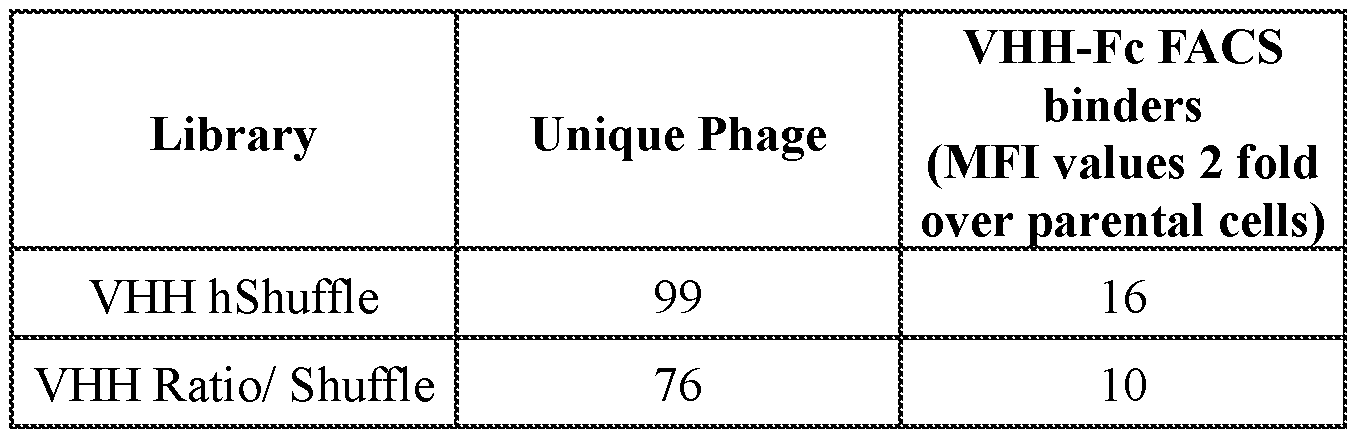



Claims
Priority Applications (8)
| Application Number | Priority Date | Filing Date | Title |
|---|---|---|---|
| KR1020227013217A KR20220069046A (en) | 2019-09-23 | 2020-09-23 | Variant Nucleic Acid Libraries for Single Domain Antibodies |
| CN202080081338.8A CN115023440B (en) | 2019-09-23 | 2020-09-23 | Antibodies that bind to CD3ε |
| JP2022518367A JP2022548783A (en) | 2019-09-23 | 2020-09-23 | Single domain antibody variant nucleic acid library |
| EP20867522.3A EP4034564A4 (en) | 2019-09-23 | 2020-09-23 | VARIANT NUCLEIC ACID LIBRARIES FOR SINGLE DOMAIN ANTIBODIES |
| CA3155630A CA3155630A1 (en) | 2019-09-23 | 2020-09-23 | Variant nucleic acid libraries for single domain antibodies |
| AU2020355027A AU2020355027A1 (en) | 2019-09-23 | 2020-09-23 | Antibodies that bind CD3 Epsilon |
| IL291516A IL291516A (en) | 2019-09-23 | 2022-03-20 | Variant nucleic acid libraries for single domain antibodies |
| JP2024206582A JP2025037968A (en) | 2019-09-23 | 2024-11-27 | Single domain antibody variant nucleic acid library |
Applications Claiming Priority (6)
| Application Number | Priority Date | Filing Date | Title |
|---|---|---|---|
| US201962904620P | 2019-09-23 | 2019-09-23 | |
| US62/904,620 | 2019-09-23 | ||
| US201962935603P | 2019-11-14 | 2019-11-14 | |
| US62/935,603 | 2019-11-14 | ||
| US201962945761P | 2019-12-09 | 2019-12-09 | |
| US62/945,761 | 2019-12-09 |
Publications (1)
| Publication Number | Publication Date |
|---|---|
| WO2021061842A1 true WO2021061842A1 (en) | 2021-04-01 |
Family
ID=75167094
Family Applications (1)
| Application Number | Title | Priority Date | Filing Date |
|---|---|---|---|
| PCT/US2020/052306 Ceased WO2021061842A1 (en) | 2019-09-23 | 2020-09-23 | Variant nucleic acid libraries for single domain antibodies |
Country Status (9)
| Country | Link |
|---|---|
| US (2) | US12173282B2 (en) |
| EP (1) | EP4034564A4 (en) |
| JP (2) | JP2022548783A (en) |
| KR (1) | KR20220069046A (en) |
| CN (1) | CN115023440B (en) |
| AU (1) | AU2020355027A1 (en) |
| CA (1) | CA3155630A1 (en) |
| IL (1) | IL291516A (en) |
| WO (1) | WO2021061842A1 (en) |
Cited By (8)
| Publication number | Priority date | Publication date | Assignee | Title |
|---|---|---|---|---|
| WO2023154533A3 (en) * | 2022-02-14 | 2023-11-23 | Twist Bioscience Corporation | Combinatorial dna assembly for multispecific antibodies |
| EP4034566A4 (en) * | 2019-09-23 | 2024-01-24 | Twist Bioscience Corporation | VARIANT NUCLEIC ACID LIBRARIES FOR CRTH2 |
| US11919953B2 (en) | 2020-07-15 | 2024-03-05 | Amgen Inc. | TIGIT and CD112R blockade |
| US12134656B2 (en) | 2021-11-18 | 2024-11-05 | Twist Bioscience Corporation | Dickkopf-1 variant antibodies and methods of use |
| US12173282B2 (en) | 2019-09-23 | 2024-12-24 | Twist Bioscience, Inc. | Antibodies that bind CD3 epsilon |
| US12202905B2 (en) | 2021-01-21 | 2025-01-21 | Twist Bioscience Corporation | Methods and compositions relating to adenosine receptors |
| US12331427B2 (en) | 2019-02-26 | 2025-06-17 | Twist Bioscience Corporation | Antibodies that bind GLP1R |
| US12570750B2 (en) | 2019-12-09 | 2026-03-10 | Twist Bioscience Corporation | Antibodies that bind adenosine A2A receptors and methods of use thereof to treat cancer and neurological diseases |
Families Citing this family (26)
| Publication number | Priority date | Publication date | Assignee | Title |
|---|---|---|---|---|
| TWI707038B (en) | 2013-08-05 | 2020-10-11 | 美商扭轉生物科技有限公司 | De novo synthesized gene libraries |
| WO2016126882A1 (en) | 2015-02-04 | 2016-08-11 | Twist Bioscience Corporation | Methods and devices for de novo oligonucleic acid assembly |
| US9981239B2 (en) | 2015-04-21 | 2018-05-29 | Twist Bioscience Corporation | Devices and methods for oligonucleic acid library synthesis |
| KR20180050411A (en) | 2015-09-18 | 2018-05-14 | 트위스트 바이오사이언스 코포레이션 | Oligonucleotide mutant library and its synthesis |
| CN108698012A (en) | 2015-09-22 | 2018-10-23 | 特韦斯特生物科学公司 | Flexible substrates for nucleic acid synthesis |
| WO2018057526A2 (en) | 2016-09-21 | 2018-03-29 | Twist Bioscience Corporation | Nucleic acid based data storage |
| CN110892485B (en) | 2017-02-22 | 2024-03-22 | 特韦斯特生物科学公司 | Nucleic acid-based data storage |
| WO2018231864A1 (en) | 2017-06-12 | 2018-12-20 | Twist Bioscience Corporation | Methods for seamless nucleic acid assembly |
| JP7169999B2 (en) | 2017-06-12 | 2022-11-11 | ツイスト バイオサイエンス コーポレーション | Methods for Seamless Nucleic Acid Assembly |
| AU2018328847A1 (en) | 2017-09-11 | 2020-04-23 | Twist Bioscience Corporation | GPCR binding proteins and synthesis thereof |
| WO2019079769A1 (en) | 2017-10-20 | 2019-04-25 | Twist Bioscience Corporation | Heated nanowells for polynucleotide synthesis |
| EP4715681A2 (en) | 2018-01-04 | 2026-03-25 | Atlas Data Storage, Inc. | Dna-based digital information storage |
| IL278771B2 (en) | 2018-05-18 | 2025-09-01 | Twist Bioscience Corp | Polynucleotides, reagents, and methods for nucleic acid hybridization |
| WO2020139871A1 (en) | 2018-12-26 | 2020-07-02 | Twist Bioscience Corporation | Highly accurate de novo polynucleotide synthesis |
| AU2020227802A1 (en) | 2019-02-26 | 2021-10-14 | Twist Bioscience Corporation | Variant nucleic acid libraries for antibody optimization |
| CA3144644A1 (en) | 2019-06-21 | 2020-12-24 | Twist Bioscience Corporation | Barcode-based nucleic acid sequence assembly |
| WO2021222316A2 (en) | 2020-04-27 | 2021-11-04 | Twist Bioscience Corporation | Variant nucleic acid libraries for coronavirus |
| US12391762B2 (en) | 2020-08-26 | 2025-08-19 | Twist Bioscience Corporation | Methods and compositions relating to GLP1R variants |
| CN117043171A (en) | 2020-08-28 | 2023-11-10 | 特韦斯特生物科学公司 | Apparatus and method for synthesis |
| US11970697B2 (en) | 2020-10-19 | 2024-04-30 | Twist Bioscience Corporation | Methods of synthesizing oligonucleotides using tethered nucleotides |
| US12258406B2 (en) * | 2021-03-24 | 2025-03-25 | Twist Bioscience Corporation | Antibodies that bind CD3 Epsilon |
| WO2022235584A1 (en) | 2021-05-03 | 2022-11-10 | Twist Bioscience Corporation | Variant nucleic acid libraries for glycans |
| WO2022271884A2 (en) | 2021-06-22 | 2022-12-29 | Twist Bioscience Corporation | Methods and compositions relating to covid antibody epitopes |
| WO2023023285A2 (en) | 2021-08-19 | 2023-02-23 | Twist Bioscience Corporation | Methods and compositions relating to covalently closed nucleic acids |
| EP4460516A2 (en) | 2022-01-03 | 2024-11-13 | Twist Bioscience Corporation | Bispecific sars-cov-2 antibodies and methods of use |
| CN121729490A (en) * | 2023-06-06 | 2026-03-24 | 艾恩塔斯有限公司 | Preparation of a library of bispecific binders expressed in eukaryotic cells |
Citations (5)
| Publication number | Priority date | Publication date | Assignee | Title |
|---|---|---|---|---|
| WO2007118214A2 (en) * | 2006-04-07 | 2007-10-18 | The Government Of The United States Of America As Represented By The Secretary, Department Of Health And Human Services | Antibody compositions and methods for treatment of neoplastic disease |
| WO2010141249A2 (en) * | 2009-06-02 | 2010-12-09 | Merck Sharp & Dohme Corp. | Generation, characterization and uses thereof of anti-notch3 antibodies |
| WO2011020529A2 (en) * | 2009-08-19 | 2011-02-24 | Merck Patent Gmbh | Antibodies for the detection of integrin complexes in ffpe material |
| WO2018170164A1 (en) * | 2017-03-15 | 2018-09-20 | Twist Bioscience Corporation | De novo synthesized combinatorial nucleic acid libraries |
| WO2019147831A1 (en) * | 2018-01-26 | 2019-08-01 | Regeneron Pharmaceuticals, Inc. | Anti-tmprss2 antibodies and antigen-binding fragments |
Family Cites Families (968)
| Publication number | Priority date | Publication date | Assignee | Title |
|---|---|---|---|---|
| US3549368A (en) | 1968-07-02 | 1970-12-22 | Ibm | Process for improving photoresist adhesion |
| US3920714A (en) | 1972-11-16 | 1975-11-18 | Weber Heinrich | Process for the production of polymeric hydrocarbons with reactive silyl side groups |
| GB1550867A (en) | 1975-08-04 | 1979-08-22 | Hughes Aircraft Co | Positioning method and apparatus for fabricating microcircuit devices |
| US4415732A (en) | 1981-03-27 | 1983-11-15 | University Patents, Inc. | Phosphoramidite compounds and processes |
| EP0090789A1 (en) | 1982-03-26 | 1983-10-05 | Monsanto Company | Chemical DNA synthesis |
| US4994373A (en) | 1983-01-27 | 1991-02-19 | Enzo Biochem, Inc. | Method and structures employing chemically-labelled polynucleotide probes |
| JPS59224123A (en) | 1983-05-20 | 1984-12-17 | Oki Electric Ind Co Ltd | Alignment mark for wafer |
| US5118605A (en) | 1984-10-16 | 1992-06-02 | Chiron Corporation | Polynucleotide determination with selectable cleavage sites |
| JPS61141761A (en) | 1984-12-12 | 1986-06-28 | Kanegafuchi Chem Ind Co Ltd | Curable composition |
| US5242794A (en) | 1984-12-13 | 1993-09-07 | Applied Biosystems, Inc. | Detection of specific sequences in nucleic acids |
| US6492107B1 (en) | 1986-11-20 | 2002-12-10 | Stuart Kauffman | Process for obtaining DNA, RNA, peptides, polypeptides, or protein, by recombinant DNA technique |
| US4613398A (en) | 1985-06-06 | 1986-09-23 | International Business Machines Corporation | Formation of etch-resistant resists through preferential permeation |
| US4981797A (en) | 1985-08-08 | 1991-01-01 | Life Technologies, Inc. | Process of producing highly transformable cells and cells produced thereby |
| US4726877A (en) | 1986-01-22 | 1988-02-23 | E. I. Du Pont De Nemours And Company | Methods of using photosensitive compositions containing microgels |
| US4808511A (en) | 1987-05-19 | 1989-02-28 | International Business Machines Corporation | Vapor phase photoresist silylation process |
| JPH07113774B2 (en) | 1987-05-29 | 1995-12-06 | 株式会社日立製作所 | Pattern formation method |
| US4988617A (en) | 1988-03-25 | 1991-01-29 | California Institute Of Technology | Method of detecting a nucleotide change in nucleic acids |
| US5700637A (en) | 1988-05-03 | 1997-12-23 | Isis Innovation Limited | Apparatus and method for analyzing polynucleotide sequences and method of generating oligonucleotide arrays |
| ATE143696T1 (en) | 1989-02-28 | 1996-10-15 | Canon Kk | PARTIALLY DOUBLE STRANDED OLIGONUCLEOTIDE AND METHOD FOR FORMING IT |
| US5556750A (en) | 1989-05-12 | 1996-09-17 | Duke University | Methods and kits for fractionating a population of DNA molecules based on the presence or absence of a base-pair mismatch utilizing mismatch repair systems |
| US5459039A (en) | 1989-05-12 | 1995-10-17 | Duke University | Methods for mapping genetic mutations |
| US6008031A (en) | 1989-05-12 | 1999-12-28 | Duke University | Method of analysis and manipulation of DNA utilizing mismatch repair systems |
| US5102797A (en) | 1989-05-26 | 1992-04-07 | Dna Plant Technology Corporation | Introduction of heterologous genes into bacteria using transposon flanked expression cassette and a binary vector system |
| US5527681A (en) | 1989-06-07 | 1996-06-18 | Affymax Technologies N.V. | Immobilized molecular synthesis of systematically substituted compounds |
| US5242974A (en) | 1991-11-22 | 1993-09-07 | Affymax Technologies N.V. | Polymer reversal on solid surfaces |
| US6309822B1 (en) | 1989-06-07 | 2001-10-30 | Affymetrix, Inc. | Method for comparing copy number of nucleic acid sequences |
| US5744101A (en) | 1989-06-07 | 1998-04-28 | Affymax Technologies N.V. | Photolabile nucleoside protecting groups |
| US6040138A (en) | 1995-09-15 | 2000-03-21 | Affymetrix, Inc. | Expression monitoring by hybridization to high density oligonucleotide arrays |
| US5143854A (en) | 1989-06-07 | 1992-09-01 | Affymax Technologies N.V. | Large scale photolithographic solid phase synthesis of polypeptides and receptor binding screening thereof |
| US6919211B1 (en) | 1989-06-07 | 2005-07-19 | Affymetrix, Inc. | Polypeptide arrays |
| CA2036946C (en) | 1990-04-06 | 2001-10-16 | Kenneth V. Deugau | Indexing linkers |
| US5494810A (en) | 1990-05-03 | 1996-02-27 | Cornell Research Foundation, Inc. | Thermostable ligase-mediated DNA amplifications system for the detection of genetic disease |
| US6087482A (en) | 1990-07-27 | 2000-07-11 | Isis Pharmaceuticals, Inc. | Heteroatomic oligonucleoside linkages |
| FI87886C (en) | 1990-09-06 | 1993-03-10 | Instrumentarium Oy | FAESTORGAN |
| DE69133559T2 (en) | 1990-09-27 | 2007-11-22 | Invitrogen Corp., Carlsbad | Direct cloning of PCR amplified nucleic acids |
| GB9025236D0 (en) | 1990-11-20 | 1991-01-02 | Secr Defence | Silicon-on porous-silicon;method of production |
| ES2155822T3 (en) | 1990-12-06 | 2001-06-01 | Affymetrix Inc | COMPOUNDS AND ITS USE IN A BINARY SYNTHESIS STRATEGY. |
| US6582908B2 (en) | 1990-12-06 | 2003-06-24 | Affymetrix, Inc. | Oligonucleotides |
| WO1992010588A1 (en) | 1990-12-06 | 1992-06-25 | Affymax Technologies N.V. | Sequencing by hybridization of a target nucleic acid to a matrix of defined oligonucleotides |
| US5455166A (en) | 1991-01-31 | 1995-10-03 | Becton, Dickinson And Company | Strand displacement amplification |
| US5137814A (en) | 1991-06-14 | 1992-08-11 | Life Technologies, Inc. | Use of exo-sample nucleotides in gene cloning |
| US5449754A (en) | 1991-08-07 | 1995-09-12 | H & N Instruments, Inc. | Generation of combinatorial libraries |
| US5474796A (en) | 1991-09-04 | 1995-12-12 | Protogene Laboratories, Inc. | Method and apparatus for conducting an array of chemical reactions on a support surface |
| US7150982B2 (en) | 1991-09-09 | 2006-12-19 | Third Wave Technologies, Inc. | RNA detection assays |
| US6759226B1 (en) | 2000-05-24 | 2004-07-06 | Third Wave Technologies, Inc. | Enzymes for the detection of specific nucleic acid sequences |
| US7045289B2 (en) | 1991-09-09 | 2006-05-16 | Third Wave Technologies, Inc. | Detection of RNA Sequences |
| US5846717A (en) | 1996-01-24 | 1998-12-08 | Third Wave Technologies, Inc. | Detection of nucleic acid sequences by invader-directed cleavage |
| US5994069A (en) | 1996-01-24 | 1999-11-30 | Third Wave Technologies, Inc. | Detection of nucleic acids by multiple sequential invasive cleavages |
| US5384261A (en) | 1991-11-22 | 1995-01-24 | Affymax Technologies N.V. | Very large scale immobilized polymer synthesis using mechanically directed flow paths |
| US5677195A (en) | 1991-11-22 | 1997-10-14 | Affymax Technologies N.V. | Combinatorial strategies for polymer synthesis |
| US5573905A (en) | 1992-03-30 | 1996-11-12 | The Scripps Research Institute | Encoded combinatorial chemical libraries |
| DE69322266T2 (en) | 1992-04-03 | 1999-06-02 | Perkin-Elmer Corp., Foster City, Calif. | SAMPLES COMPOSITION AND METHOD |
| JP2553322Y2 (en) | 1992-05-11 | 1997-11-05 | サンデン株式会社 | Filter feed mechanism of beverage brewing device |
| ATE152180T1 (en) | 1992-07-31 | 1997-05-15 | Behringwerke Ag | METHOD FOR INTRODUCING DEFINED SEQUENCES AT THE 3' END OF POLYNUCLEOTIDES |
| US5288514A (en) | 1992-09-14 | 1994-02-22 | The Regents Of The University Of California | Solid phase and combinatorial synthesis of benzodiazepine compounds on a solid support |
| JP3176444B2 (en) | 1992-10-01 | 2001-06-18 | 株式会社リコー | Aqueous ink and recording method using the same |
| DE4241045C1 (en) | 1992-12-05 | 1994-05-26 | Bosch Gmbh Robert | Process for anisotropic etching of silicon |
| US5368823A (en) | 1993-02-11 | 1994-11-29 | University Of Georgia Research Foundation, Inc. | Automated synthesis of oligonucleotides |
| US5395753A (en) | 1993-02-19 | 1995-03-07 | Theratech, Inc. | Method for diagnosing rheumatoid arthritis |
| WO1994024143A1 (en) | 1993-04-12 | 1994-10-27 | Northwestern University | Method of forming oligonucleotides |
| US7135312B2 (en) | 1993-04-15 | 2006-11-14 | University Of Rochester | Circular DNA vectors for synthesis of RNA and DNA |
| US5455239A (en) | 1993-08-05 | 1995-10-03 | Merck & Co. Inc. | 3-aryl of heteroaryl-7-heteroaralkylamido cephalosporin compounds, compositions and methods of use |
| US5482845A (en) | 1993-09-24 | 1996-01-09 | The Trustees Of Columbia University In The City Of New York | Method for construction of normalized cDNA libraries |
| CN1039623C (en) | 1993-10-22 | 1998-09-02 | 中国人民解放军军事医学科学院毒物药物研究所 | Pharmaceutical composition for preventing and treating motion sickness syndrome and preparation method thereof |
| DK1157743T3 (en) | 1993-10-28 | 2009-07-06 | Houston Advanced Res Ct | Microfabricated porous flow apparatus for discrete detection of binding reactions |
| US6893816B1 (en) | 1993-10-28 | 2005-05-17 | Houston Advanced Research Center | Microfabricated, flowthrough porous apparatus for discrete detection of binding reactions |
| US6027877A (en) | 1993-11-04 | 2000-02-22 | Gene Check, Inc. | Use of immobilized mismatch binding protein for detection of mutations and polymorphisms, purification of amplified DNA samples and allele identification |
| US5834252A (en) | 1995-04-18 | 1998-11-10 | Glaxo Group Limited | End-complementary polymerase reaction |
| US6015880A (en) | 1994-03-16 | 2000-01-18 | California Institute Of Technology | Method and substrate for performing multiple sequential reactions on a matrix |
| CA2186592C (en) | 1994-03-29 | 2008-02-19 | Helle Outtrup | Alkaline bacillus amylase |
| US5514789A (en) | 1994-04-21 | 1996-05-07 | Barrskogen, Inc. | Recovery of oligonucleotides by gas phase cleavage |
| SE512382C2 (en) | 1994-04-26 | 2000-03-06 | Ericsson Telefon Ab L M | Device and method for placing elongate elements against or adjacent to a surface |
| CA2159830C (en) | 1994-04-29 | 2001-07-03 | Applied Biosystems, Llc | System for real time detection of nucleic acid amplification products |
| US6287850B1 (en) | 1995-06-07 | 2001-09-11 | Affymetrix, Inc. | Bioarray chip reaction apparatus and its manufacture |
| JPH10507160A (en) | 1994-06-23 | 1998-07-14 | アフィマックス テクノロジーズ エヌ.ブイ. | Photoactive compounds and methods of using the same |
| US5641658A (en) | 1994-08-03 | 1997-06-24 | Mosaic Technologies, Inc. | Method for performing amplification of nucleic acid with two primers bound to a single solid support |
| US5530516A (en) | 1994-10-04 | 1996-06-25 | Tamarack Scientific Co., Inc. | Large-area projection exposure system |
| US6613560B1 (en) | 1994-10-19 | 2003-09-02 | Agilent Technologies, Inc. | PCR microreactor for amplifying DNA using microquantities of sample fluid |
| US6635226B1 (en) | 1994-10-19 | 2003-10-21 | Agilent Technologies, Inc. | Microanalytical device and use thereof for conducting chemical processes |
| US5556752A (en) | 1994-10-24 | 1996-09-17 | Affymetrix, Inc. | Surface-bound, unimolecular, double-stranded DNA |
| AU4283196A (en) | 1994-11-22 | 1996-06-17 | Complex Fluid Systems, Inc. | Non-aminic photoresist adhesion promoters for microelectronic applications |
| US5688642A (en) | 1994-12-01 | 1997-11-18 | The United States Of America As Represented By The Secretary Of The Navy | Selective attachment of nucleic acid molecules to patterned self-assembled surfaces |
| US6017434A (en) | 1995-05-09 | 2000-01-25 | Curagen Corporation | Apparatus and method for the generation, separation, detection, and recognition of biopolymer fragments |
| US5700642A (en) | 1995-05-22 | 1997-12-23 | Sri International | Oligonucleotide sizing using immobilized cleavable primers |
| US5830655A (en) | 1995-05-22 | 1998-11-03 | Sri International | Oligonucleotide sizing using cleavable primers |
| US5701256A (en) | 1995-05-31 | 1997-12-23 | Cold Spring Harbor Laboratory | Method and apparatus for biological sequence comparison |
| US6446682B1 (en) | 1995-06-06 | 2002-09-10 | James P. Viken | Auto-loading fluid exchanger and method of use |
| US5877280A (en) | 1995-06-06 | 1999-03-02 | The Mount Sinai School Of Medicine Of The City University Of New York | Thermostable muts proteins |
| US5707806A (en) | 1995-06-07 | 1998-01-13 | Genzyme Corporation | Direct sequence identification of mutations by cleavage- and ligation-associated mutation-specific sequencing |
| US5712126A (en) | 1995-08-01 | 1998-01-27 | Yale University | Analysis of gene expression by display of 3-end restriction fragments of CDNA |
| US5780613A (en) | 1995-08-01 | 1998-07-14 | Northwestern University | Covalent lock for self-assembled oligonucleotide constructs |
| US5854033A (en) | 1995-11-21 | 1998-12-29 | Yale University | Rolling circle replication reporter systems |
| US6352842B1 (en) | 1995-12-07 | 2002-03-05 | Diversa Corporation | Exonucease-mediated gene assembly in directed evolution |
| US6537776B1 (en) | 1999-06-14 | 2003-03-25 | Diversa Corporation | Synthetic ligation reassembly in directed evolution |
| CA2240346C (en) | 1995-12-15 | 2007-04-24 | Amersham Life Science, Inc. | Methods for the detection and removal of mutant sequences that arise during enzymatic amplification using mismatch repair systems |
| US5962271A (en) | 1996-01-03 | 1999-10-05 | Cloutech Laboratories, Inc. | Methods and compositions for generating full-length cDNA having arbitrary nucleotide sequence at the 3'-end |
| US5976846A (en) | 1996-01-13 | 1999-11-02 | Passmore; Steven E. | Method for multifragment in vivo cloning and mutation mapping |
| US6090606A (en) | 1996-01-24 | 2000-07-18 | Third Wave Technologies, Inc. | Cleavage agents |
| US6706471B1 (en) | 1996-01-24 | 2004-03-16 | Third Wave Technologies, Inc. | Detection of nucleic acid sequences by invader-directed cleavage |
| US7122364B1 (en) | 1998-03-24 | 2006-10-17 | Third Wave Technologies, Inc. | FEN endonucleases |
| US5985557A (en) | 1996-01-24 | 1999-11-16 | Third Wave Technologies, Inc. | Invasive cleavage of nucleic acids |
| US7432048B2 (en) | 1996-11-29 | 2008-10-07 | Third Wave Technologies, Inc. | Reactions on a solid surface |
| US7527928B2 (en) | 1996-11-29 | 2009-05-05 | Third Wave Technologies, Inc. | Reactions on a solid surface |
| US6274369B1 (en) | 1996-02-02 | 2001-08-14 | Invitrogen Corporation | Method capable of increasing competency of bacterial cell transformation |
| US6013440A (en) | 1996-03-11 | 2000-01-11 | Affymetrix, Inc. | Nucleic acid affinity columns |
| US6020481A (en) | 1996-04-01 | 2000-02-01 | The Perkin-Elmer Corporation | Asymmetric benzoxanthene dyes |
| US6706875B1 (en) | 1996-04-17 | 2004-03-16 | Affyemtrix, Inc. | Substrate preparation process |
| US5869245A (en) | 1996-06-05 | 1999-02-09 | Fox Chase Cancer Center | Mismatch endonuclease and its use in identifying mutations in targeted polynucleotide strands |
| US5863801A (en) | 1996-06-14 | 1999-01-26 | Sarnoff Corporation | Automated nucleic acid isolation |
| US6780982B2 (en) | 1996-07-12 | 2004-08-24 | Third Wave Technologies, Inc. | Charge tags and the separation of nucleic acid molecules |
| US5853993A (en) | 1996-10-21 | 1998-12-29 | Hewlett-Packard Company | Signal enhancement method and kit |
| AU5173598A (en) | 1996-11-08 | 1998-06-10 | Ikonos Corporation | Method for coating substrates |
| US5750672A (en) | 1996-11-22 | 1998-05-12 | Barrskogen, Inc. | Anhydrous amine cleavage of oligonucleotides |
| ES2375764T3 (en) | 1996-11-29 | 2012-03-06 | Third Wave Technologies, Inc. | ENDONUCLEASAS FEN-1, MIXTURES AND SCISSOR PROCEDURES. |
| JP4663824B2 (en) | 1996-12-31 | 2011-04-06 | ハイ スループット ジェノミクス インコーポレイテッド | Multiplexed molecular analyzer and method |
| ATE294229T1 (en) | 1997-02-12 | 2005-05-15 | Invitrogen Corp | METHOD FOR DRYING COMPETENT CELLS |
| US5882496A (en) | 1997-02-27 | 1999-03-16 | The Regents Of The University Of California | Porous silicon structures with high surface area/specific pore size |
| US6770748B2 (en) | 1997-03-07 | 2004-08-03 | Takeshi Imanishi | Bicyclonucleoside and oligonucleotide analogue |
| CA2284211A1 (en) | 1997-03-20 | 1998-09-24 | University Of Washington | Solvent for biopolymer synthesis, solvent microdroplets and methods of use |
| US6028189A (en) | 1997-03-20 | 2000-02-22 | University Of Washington | Solvent for oligonucleotide synthesis and methods of use |
| US6419883B1 (en) | 1998-01-16 | 2002-07-16 | University Of Washington | Chemical synthesis using solvent microdroplets |
| DE69838724T2 (en) | 1997-03-21 | 2008-10-30 | Stratagene California, La Jolla | POLYMERASE-IMPROVING FACTOR (PEF) -HOLDING EXTRACTS, PEF PROTEIN COMPLEXES, ISOLATED PEF PROTEIN, AND METHOD OF CLEANING AND IDENTIFICATION |
| US5922593A (en) | 1997-05-23 | 1999-07-13 | Becton, Dickinson And Company | Microbiological test panel and method therefor |
| US6969488B2 (en) | 1998-05-22 | 2005-11-29 | Solexa, Inc. | System and apparatus for sequential processing of analytes |
| DE69824586T2 (en) | 1997-06-26 | 2005-06-23 | PerSeptive Biosystems, Inc., Framingham | SAMPLE HIGH DENSITY SAMPLE FOR THE ANALYSIS OF BIOLOGICAL SAMPLES |
| GB9714716D0 (en) | 1997-07-11 | 1997-09-17 | Brax Genomics Ltd | Characterising nucleic acids |
| US5989872A (en) | 1997-08-12 | 1999-11-23 | Clontech Laboratories, Inc. | Methods and compositions for transferring DNA sequence information among vectors |
| US6027898A (en) | 1997-08-18 | 2000-02-22 | Transgenomic, Inc. | Chromatographic method for mutation detection using mutation site specifically acting enzymes and chemicals |
| US6794499B2 (en) | 1997-09-12 | 2004-09-21 | Exiqon A/S | Oligonucleotide analogues |
| US6136568A (en) | 1997-09-15 | 2000-10-24 | Hiatt; Andrew C. | De novo polynucleotide synthesis using rolling templates |
| EP1538206B1 (en) | 1997-09-16 | 2010-03-24 | Centocor, Inc. | Method for the complete chemical synthesis and assembly of genes and genomes |
| US6670127B2 (en) | 1997-09-16 | 2003-12-30 | Egea Biosciences, Inc. | Method for assembly of a polynucleotide encoding a target polypeptide |
| US5976842A (en) | 1997-10-30 | 1999-11-02 | Clontech Laboratories, Inc. | Methods and compositions for use in high fidelity polymerase chain reaction |
| US8182991B1 (en) | 1997-11-26 | 2012-05-22 | Third Wave Technologies, Inc. | FEN-1 endonucleases, mixtures and cleavage methods |
| US6408308B1 (en) | 1998-01-29 | 2002-06-18 | Incyte Pharmaceuticals, Inc. | System and method for generating, analyzing and storing normalized expression datasets from raw expression datasets derived from microarray includes nucleic acid probe sequences |
| US6287776B1 (en) | 1998-02-02 | 2001-09-11 | Signature Bioscience, Inc. | Method for detecting and classifying nucleic acid hybridization |
| US6251588B1 (en) | 1998-02-10 | 2001-06-26 | Agilent Technologies, Inc. | Method for evaluating oligonucleotide probe sequences |
| JP4503828B2 (en) | 1998-02-11 | 2010-07-14 | ユニバーシティー オブ ヒューストン | Method and apparatus for chemical and biochemical reactions using photogenerating reagents |
| US6375903B1 (en) | 1998-02-23 | 2002-04-23 | Wisconsin Alumni Research Foundation | Method and apparatus for synthesis of arrays of DNA probes |
| US6558928B1 (en) | 1998-03-25 | 2003-05-06 | Ulf Landegren | Rolling circle replication of padlock probes |
| US6284497B1 (en) | 1998-04-09 | 2001-09-04 | Trustees Of Boston University | Nucleic acid arrays and methods of synthesis |
| JP2002511276A (en) | 1998-04-13 | 2002-04-16 | アイシス・ファーマシューティカルス・インコーポレーテッド | Identification of Gene Targets for Modification by Oligonucleotides and Generation of Oligonucleotides for Gene Modification |
| US7321828B2 (en) | 1998-04-13 | 2008-01-22 | Isis Pharmaceuticals, Inc. | System of components for preparing oligonucleotides |
| US6376285B1 (en) | 1998-05-28 | 2002-04-23 | Texas Instruments Incorporated | Annealed porous silicon with epitaxial layer for SOI |
| US6274725B1 (en) | 1998-06-02 | 2001-08-14 | Isis Pharmaceuticals, Inc. | Activators for oligonucleotide synthesis |
| US6130045A (en) | 1998-06-11 | 2000-10-10 | Clontech Laboratories, Inc. | Thermostable polymerase |
| US6251595B1 (en) | 1998-06-18 | 2001-06-26 | Agilent Technologies, Inc. | Methods and devices for carrying out chemical reactions |
| DE69928995T2 (en) | 1998-06-22 | 2006-09-07 | Affymetrix, Inc., Santa Clara | Reagent and method for solid phase synthesis |
| US7399844B2 (en) | 1998-07-09 | 2008-07-15 | Agilent Technologies, Inc. | Method and reagents for analyzing the nucleotide sequence of nucleic acids |
| US6218118B1 (en) | 1998-07-09 | 2001-04-17 | Agilent Technologies, Inc. | Method and mixture reagents for analyzing the nucleotide sequence of nucleic acids by mass spectrometry |
| US20030022207A1 (en) | 1998-10-16 | 2003-01-30 | Solexa, Ltd. | Arrayed polynucleotides and their use in genome analysis |
| US6787308B2 (en) | 1998-07-30 | 2004-09-07 | Solexa Ltd. | Arrayed biomolecules and their use in sequencing |
| US6222030B1 (en) | 1998-08-03 | 2001-04-24 | Agilent Technologies, Inc. | Solid phase synthesis of oligonucleotides using carbonate protecting groups and alpha-effect nucleophile deprotection |
| US6951719B1 (en) | 1999-08-11 | 2005-10-04 | Proteus S.A. | Process for obtaining recombined nucleotide sequences in vitro, libraries of sequences and sequences thus obtained |
| US6991922B2 (en) | 1998-08-12 | 2006-01-31 | Proteus S.A. | Process for in vitro creation of recombinant polynucleotide sequences by oriented ligation |
| US6107038A (en) | 1998-08-14 | 2000-08-22 | Agilent Technologies Inc. | Method of binding a plurality of chemicals on a substrate by electrophoretic self-assembly |
| DE19940750A1 (en) | 1998-08-28 | 2000-06-21 | Febit Ferrarius Biotech Gmbh | Substrate for analysis includes microchannels with predetermined pattern of receptors deposited and immobilized under computer control by light- or liquid-induced polymerization |
| US6258454B1 (en) | 1998-09-01 | 2001-07-10 | Agilent Technologies Inc. | Functionalization of substrate surfaces with silane mixtures |
| US6458583B1 (en) | 1998-09-09 | 2002-10-01 | Agilent Technologies, Inc. | Method and apparatus for making nucleic acid arrays |
| US6461812B2 (en) | 1998-09-09 | 2002-10-08 | Agilent Technologies, Inc. | Method and multiple reservoir apparatus for fabrication of biomolecular arrays |
| CA2342838A1 (en) | 1998-09-15 | 2000-03-23 | Yale University | Molecular cloning using rolling circle amplification |
| AR021833A1 (en) | 1998-09-30 | 2002-08-07 | Applied Research Systems | METHODS OF AMPLIFICATION AND SEQUENCING OF NUCLEIC ACID |
| US6399516B1 (en) | 1998-10-30 | 2002-06-04 | Massachusetts Institute Of Technology | Plasma etch techniques for fabricating silicon structures from a substrate |
| US6309828B1 (en) | 1998-11-18 | 2001-10-30 | Agilent Technologies, Inc. | Method and apparatus for fabricating replicate arrays of nucleic acid molecules |
| GB9900298D0 (en) | 1999-01-07 | 1999-02-24 | Medical Res Council | Optical sorting method |
| WO2000042559A1 (en) | 1999-01-18 | 2000-07-20 | Maxygen, Inc. | Methods of populating data structures for use in evolutionary simulations |
| US6376246B1 (en) | 1999-02-05 | 2002-04-23 | Maxygen, Inc. | Oligonucleotide mediated nucleic acid recombination |
| WO2000042560A2 (en) | 1999-01-19 | 2000-07-20 | Maxygen, Inc. | Methods for making character strings, polynucleotides and polypeptides |
| US20070065838A1 (en) | 1999-01-19 | 2007-03-22 | Maxygen, Inc. | Oligonucleotide mediated nucleic acid recombination |
| AU2291700A (en) | 1999-01-19 | 2000-08-07 | Unilever Plc | Method for producing antibody fragments |
| US6251685B1 (en) | 1999-02-18 | 2001-06-26 | Agilent Technologies, Inc. | Readout method for molecular biological electronically addressable arrays |
| ATE334197T1 (en) | 1999-02-19 | 2006-08-15 | Febit Biotech Gmbh | METHOD FOR PRODUCING POLYMERS |
| ATE556149T1 (en) | 1999-02-23 | 2012-05-15 | Caliper Life Sciences Inc | MANIPULATION OF MICROPARTICLES IN MICROFLUIDIC SYSTEMS |
| EP1159285B1 (en) | 1999-03-08 | 2005-05-25 | Metrigen, Inc. | Methods and compositions for economically synthesizing and assembling long dna sequences |
| US6824866B1 (en) | 1999-04-08 | 2004-11-30 | Affymetrix, Inc. | Porous silica substrates for polymer synthesis and assays |
| US6284465B1 (en) | 1999-04-15 | 2001-09-04 | Agilent Technologies, Inc. | Apparatus, systems and method for locating nucleic acids bound to surfaces |
| US6469156B1 (en) | 1999-04-20 | 2002-10-22 | The United States Of America As Represented By The Department Of Health And Human Services | Rapid and sensitive method for detecting histoplasma capsulatum |
| US6221653B1 (en) | 1999-04-27 | 2001-04-24 | Agilent Technologies, Inc. | Method of performing array-based hybridization assays using thermal inkjet deposition of sample fluids |
| US6773676B2 (en) | 1999-04-27 | 2004-08-10 | Agilent Technologies, Inc. | Devices for performing array hybridization assays and methods of using the same |
| US6518056B2 (en) | 1999-04-27 | 2003-02-11 | Agilent Technologies Inc. | Apparatus, systems and method for assaying biological materials using an annular format |
| US6300137B1 (en) | 1999-04-28 | 2001-10-09 | Agilent Technologies Inc. | Method for synthesizing a specific, surface-bound polymer uniformly over an element of a molecular array |
| US6242266B1 (en) | 1999-04-30 | 2001-06-05 | Agilent Technologies Inc. | Preparation of biopolymer arrays |
| US6323043B1 (en) | 1999-04-30 | 2001-11-27 | Agilent Technologies, Inc. | Fabricating biopolymer arrays |
| US7276336B1 (en) | 1999-07-22 | 2007-10-02 | Agilent Technologies, Inc. | Methods of fabricating an addressable array of biopolymer probes |
| AU763168B2 (en) | 1999-05-01 | 2003-07-17 | Psimedica Limited | Derivatized porous silicon |
| DE60032259D1 (en) | 1999-05-06 | 2007-01-18 | Sinai School Medicine | Steganography based on DNA |
| US7056661B2 (en) | 1999-05-19 | 2006-06-06 | Cornell Research Foundation, Inc. | Method for sequencing nucleic acid molecules |
| US6593464B1 (en) | 1999-05-24 | 2003-07-15 | Invitrogen Corporation | Method for deblocking of labeled oligonucleotides |
| US6472147B1 (en) | 1999-05-25 | 2002-10-29 | The Scripps Research Institute | Methods for display of heterodimeric proteins on filamentous phage using pVII and pIX, compositions, vectors and combinatorial libraries |
| US6132997A (en) | 1999-05-28 | 2000-10-17 | Agilent Technologies | Method for linear mRNA amplification |
| US6815218B1 (en) | 1999-06-09 | 2004-11-09 | Massachusetts Institute Of Technology | Methods for manufacturing bioelectronic devices |
| US6709852B1 (en) | 1999-06-22 | 2004-03-23 | Invitrogen Corporation | Rapid growing microorganisms for biotechnology applications |
| JP2003510017A (en) | 1999-06-22 | 2003-03-18 | インビトロジェン コーポレイション | Improved primers and methods for nucleic acid detection and identification |
| DE19928410C2 (en) | 1999-06-22 | 2002-11-28 | Agilent Technologies Inc | Device housing with a device for operating a laboratory microchip |
| US6399394B1 (en) | 1999-06-30 | 2002-06-04 | Agilent Technologies, Inc. | Testing multiple fluid samples with multiple biopolymer arrays |
| US6465183B2 (en) | 1999-07-01 | 2002-10-15 | Agilent Technologies, Inc. | Multidentate arrays |
| US7504213B2 (en) | 1999-07-09 | 2009-03-17 | Agilent Technologies, Inc. | Methods and apparatus for preparing arrays comprising features having degenerate biopolymers |
| US6461816B1 (en) | 1999-07-09 | 2002-10-08 | Agilent Technologies, Inc. | Methods for controlling cross-hybridization in analysis of nucleic acid sequences |
| US6306599B1 (en) | 1999-07-16 | 2001-10-23 | Agilent Technologies Inc. | Biopolymer arrays and their fabrication |
| US6346423B1 (en) | 1999-07-16 | 2002-02-12 | Agilent Technologies, Inc. | Methods and compositions for producing biopolymeric arrays |
| US6201112B1 (en) | 1999-07-22 | 2001-03-13 | Agilent Technologies Inc. | Method for 3′ end-labeling ribonucleic acids |
| US6180351B1 (en) | 1999-07-22 | 2001-01-30 | Agilent Technologies Inc. | Chemical array fabrication with identifier |
| ATE542916T1 (en) | 1999-08-18 | 2012-02-15 | Illumina Inc | METHODS FOR GENERATING OLIGONUCLEOTIDE SOLUTIONS |
| US6262490B1 (en) | 1999-11-05 | 2001-07-17 | Advanced Semiconductor Engineering, Inc. | Substrate strip for use in packaging semiconductor chips |
| US7244559B2 (en) | 1999-09-16 | 2007-07-17 | 454 Life Sciences Corporation | Method of sequencing a nucleic acid |
| US6319674B1 (en) | 1999-09-16 | 2001-11-20 | Agilent Technologies, Inc. | Methods for attaching substances to surfaces |
| US7211390B2 (en) | 1999-09-16 | 2007-05-01 | 454 Life Sciences Corporation | Method of sequencing a nucleic acid |
| US6743585B2 (en) | 1999-09-16 | 2004-06-01 | Agilent Technologies, Inc. | Methods for preparing conjugates |
| US7078167B2 (en) | 1999-09-17 | 2006-07-18 | Agilent Technologies, Inc. | Arrays having background features and methods for using the same |
| US7122303B2 (en) | 1999-09-17 | 2006-10-17 | Agilent Technologies, Inc. | Arrays comprising background features that provide for a measure of a non-specific binding and methods for using the same |
| WO2001023610A2 (en) | 1999-09-29 | 2001-04-05 | Solexa Ltd. | Polynucleotide sequencing |
| DE19947495C2 (en) | 1999-10-01 | 2003-05-28 | Agilent Technologies Inc | Microfluidic microchip |
| WO2001027327A2 (en) | 1999-10-08 | 2001-04-19 | Protogene Laboratories, Inc. | Method and apparatus for performing large numbers of reactions using array assembly |
| US6232072B1 (en) | 1999-10-15 | 2001-05-15 | Agilent Technologies, Inc. | Biopolymer array inspection |
| US6451998B1 (en) | 1999-10-18 | 2002-09-17 | Agilent Technologies, Inc. | Capping and de-capping during oligonucleotide synthesis |
| US6171797B1 (en) | 1999-10-20 | 2001-01-09 | Agilent Technologies Inc. | Methods of making polymeric arrays |
| US7115423B1 (en) | 1999-10-22 | 2006-10-03 | Agilent Technologies, Inc. | Fluidic structures within an array package |
| US6387636B1 (en) | 1999-10-22 | 2002-05-14 | Agilent Technologies, Inc. | Method of shielding biosynthesis reactions from the ambient environment on an array |
| US6077674A (en) | 1999-10-27 | 2000-06-20 | Agilent Technologies Inc. | Method of producing oligonucleotide arrays with features of high purity |
| US6329210B1 (en) | 1999-10-29 | 2001-12-11 | Agilent Technologies, Inc. | Method and apparatus for high volume polymer synthesis |
| US6689319B1 (en) | 1999-10-29 | 2004-02-10 | Agilent Technologies, Ind. | Apparatus for deposition and inspection of chemical and biological fluids |
| US6406849B1 (en) | 1999-10-29 | 2002-06-18 | Agilent Technologies, Inc. | Interrogating multi-featured arrays |
| US20010055761A1 (en) | 1999-10-29 | 2001-12-27 | Agilent Technologies | Small scale dna synthesis using polymeric solid support with functionalized regions |
| US8268605B2 (en) | 1999-10-29 | 2012-09-18 | Agilent Technologies, Inc. | Compositions and methods utilizing DNA polymerases |
| US6428957B1 (en) | 1999-11-08 | 2002-08-06 | Agilent Technologies, Inc. | Systems tools and methods of assaying biological materials using spatially-addressable arrays |
| US6440669B1 (en) | 1999-11-10 | 2002-08-27 | Agilent Technologies, Inc. | Methods for applying small volumes of reagents |
| US7041445B2 (en) | 1999-11-15 | 2006-05-09 | Clontech Laboratories, Inc. | Long oligonucleotide arrays |
| US6446642B1 (en) | 1999-11-22 | 2002-09-10 | Agilent Technologies, Inc. | Method and apparatus to clean an inkjet reagent deposition device |
| US6582938B1 (en) | 2001-05-11 | 2003-06-24 | Affymetrix, Inc. | Amplification of nucleic acids |
| US6800439B1 (en) | 2000-01-06 | 2004-10-05 | Affymetrix, Inc. | Methods for improved array preparation |
| US20010039014A1 (en) | 2000-01-11 | 2001-11-08 | Maxygen, Inc. | Integrated systems and methods for diversity generation and screening |
| EP1118661A1 (en) | 2000-01-13 | 2001-07-25 | Het Nederlands Kanker Instituut | T cell receptor libraries |
| AU2001237965A1 (en) | 2000-01-25 | 2001-08-07 | Affymetrix, Inc. | Method, system and computer software for providing a genomic web portal |
| US6587579B1 (en) | 2000-01-26 | 2003-07-01 | Agilent Technologies Inc. | Feature quality in array fabrication |
| US6406851B1 (en) | 2000-01-28 | 2002-06-18 | Agilent Technologies, Inc. | Method for coating a substrate quickly and uniformly with a small volume of fluid |
| US7198939B2 (en) | 2000-01-28 | 2007-04-03 | Agilent Technologies, Inc. | Apparatus for interrogating an addressable array |
| US6458526B1 (en) | 2000-01-28 | 2002-10-01 | Agilent Technologies, Inc. | Method and apparatus to inhibit bubble formation in a fluid |
| US6235483B1 (en) | 2000-01-31 | 2001-05-22 | Agilent Technologies, Inc. | Methods and kits for indirect labeling of nucleic acids |
| GB0002389D0 (en) | 2000-02-02 | 2000-03-22 | Solexa Ltd | Molecular arrays |
| US6403314B1 (en) | 2000-02-04 | 2002-06-11 | Agilent Technologies, Inc. | Computational method and system for predicting fragmented hybridization and for identifying potential cross-hybridization |
| US6833450B1 (en) | 2000-03-17 | 2004-12-21 | Affymetrix, Inc. | Phosphite ester oxidation in nucleic acid array preparation |
| US6365355B1 (en) | 2000-03-28 | 2002-04-02 | The Regents Of The University Of California | Chimeric proteins for detection and quantitation of DNA mutations, DNA sequence variations, DNA damage and DNA mismatches |
| US20020025561A1 (en) | 2000-04-17 | 2002-02-28 | Hodgson Clague Pitman | Vectors for gene-self-assembly |
| US7776021B2 (en) | 2000-04-28 | 2010-08-17 | The Charles Stark Draper Laboratory | Micromachined bilayer unit for filtration of small molecules |
| US6716634B1 (en) | 2000-05-31 | 2004-04-06 | Agilent Technologies, Inc. | Increasing ionization efficiency in mass spectrometry |
| US7163660B2 (en) | 2000-05-31 | 2007-01-16 | Infineon Technologies Ag | Arrangement for taking up liquid analytes |
| WO2001094366A1 (en) | 2000-06-02 | 2001-12-13 | Blue Heron Biotechnology, Inc. | Methods for improving the sequence fidelity of synthetic double-stranded oligonucleotides |
| US7312043B2 (en) | 2000-07-10 | 2007-12-25 | Vertex Pharmaceuticals (San Diego) Llc | Ion channel assay methods |
| EP1322780A4 (en) | 2000-07-27 | 2005-08-03 | Univ Australian | COMBINATORY PROBES AND THEIR USE |
| EP1176151B1 (en) | 2000-07-28 | 2014-08-20 | Agilent Technologies, Inc. | Synthesis of polynucleotides using combined oxidation/deprotection chemistry |
| US6890760B1 (en) | 2000-07-31 | 2005-05-10 | Agilent Technologies, Inc. | Array fabrication |
| US7205400B2 (en) | 2000-07-31 | 2007-04-17 | Agilent Technologies, Inc. | Array fabrication |
| US6599693B1 (en) | 2000-07-31 | 2003-07-29 | Agilent Technologies Inc. | Array fabrication |
| US6613893B1 (en) | 2000-07-31 | 2003-09-02 | Agilent Technologies Inc. | Array fabrication |
| EP1598432A3 (en) | 2000-07-31 | 2006-06-07 | Agilent Technologies, Inc. | Array based methods for sythesizing nucleic acid mixtures |
| GB0018876D0 (en) | 2000-08-01 | 2000-09-20 | Applied Research Systems | Method of producing polypeptides |
| CA2421059A1 (en) | 2000-08-24 | 2002-02-28 | Maxygen, Inc. | Constructs and their use in metabolic pathway engineering |
| AU2001291540A1 (en) | 2000-09-08 | 2002-03-22 | University Technologies International, Inc. | Linker phosphoramidites for oligonucleotide synthesis |
| US6966945B1 (en) | 2000-09-20 | 2005-11-22 | Goodrich Corporation | Inorganic matrix compositions, composites and process of making the same |
| WO2002027029A2 (en) | 2000-09-27 | 2002-04-04 | Lynx Therapeutics, Inc. | Method for determining relative abundance of nucleic acid sequences |
| NO20004869D0 (en) | 2000-09-28 | 2000-09-28 | Torbjoern Rognes | Method for fast optimal local sequence alignment using parallel processing |
| US7097809B2 (en) | 2000-10-03 | 2006-08-29 | California Institute Of Technology | Combinatorial synthesis system |
| AU2001296809A1 (en) | 2000-10-10 | 2002-04-22 | Biotrove, Inc. | Apparatus for assay, synthesis and storage, and methods of manufacture, use, and manipulation thereof |
| US6693187B1 (en) | 2000-10-17 | 2004-02-17 | Lievre Cornu Llc | Phosphinoamidite carboxlates and analogs thereof in the synthesis of oligonucleotides having reduced internucleotide charge |
| DE10051396A1 (en) | 2000-10-17 | 2002-04-18 | Febit Ferrarius Biotech Gmbh | An integrated synthesis and identification of an analyte, comprises particles immobilized at a carrier to be coupled to receptors in a structured pattern to give receptor arrays for biochemical reactions |
| WO2002033669A1 (en) | 2000-10-18 | 2002-04-25 | Ultra Proizvodnja Elektronskih Naprav D.O.O. | System for payment data exchange and payment terminal device used therein |
| DE60125312T2 (en) | 2000-10-26 | 2007-06-06 | Agilent Technologies, Inc. (n.d. Ges. d. Staates Delaware), Santa Clara | microarray |
| US6905816B2 (en) | 2000-11-27 | 2005-06-14 | Intelligent Medical Devices, Inc. | Clinically intelligent diagnostic devices and methods |
| US20020155439A1 (en) | 2000-12-04 | 2002-10-24 | Ana Rodriguez | Method for generating a library of mutant oligonucleotides using the linear cyclic amplification reaction |
| CA2714353A1 (en) | 2000-12-05 | 2002-06-13 | Avecia Biotechnology Inc | Process for the preparation of phosphorothioate oligonucleotides |
| US6768005B2 (en) | 2000-12-20 | 2004-07-27 | Avecia Limited | Process |
| US20040253242A1 (en) | 2000-12-05 | 2004-12-16 | Bowdish Katherine S. | Rationally designed antibodies |
| DE10060433B4 (en) | 2000-12-05 | 2006-05-11 | Hahn-Schickard-Gesellschaft für angewandte Forschung e.V. | Method for producing a fluid component, fluid component and analysis device |
| US6660475B2 (en) | 2000-12-15 | 2003-12-09 | New England Biolabs, Inc. | Use of site-specific nicking endonucleases to create single-stranded regions and applications thereof |
| AUPR259301A0 (en) | 2001-01-18 | 2001-02-15 | Polymerat Pty Ltd | Polymers having co-continuous architecture |
| DK1385950T3 (en) | 2001-01-19 | 2008-11-03 | Centocor Inc | Computer controlled assembly of a polynucleotide encoding a target polypeptide |
| US6958217B2 (en) | 2001-01-24 | 2005-10-25 | Genomic Expression Aps | Single-stranded polynucleotide tags |
| US6879915B2 (en) | 2001-01-31 | 2005-04-12 | Agilent Technologies, Inc. | Chemical array fabrication and use |
| US7027930B2 (en) | 2001-01-31 | 2006-04-11 | Agilent Technologies, Inc. | Reading chemical arrays |
| US7166258B2 (en) | 2001-01-31 | 2007-01-23 | Agilent Technologies, Inc. | Automation-optimized microarray package |
| US20020164824A1 (en) | 2001-02-16 | 2002-11-07 | Jianming Xiao | Method and apparatus based on bundled capillaries for high throughput screening |
| WO2002072864A2 (en) | 2001-03-08 | 2002-09-19 | Applera Corporation | Reagents for oligonucleotide cleavage and deprotection |
| US6660338B1 (en) | 2001-03-08 | 2003-12-09 | Agilent Technologies, Inc. | Functionalization of substrate surfaces with silane mixtures |
| US7211654B2 (en) | 2001-03-14 | 2007-05-01 | Regents Of The University Of Michigan | Linkers and co-coupling agents for optimization of oligonucleotide synthesis and purification on solid supports |
| DK1370690T3 (en) | 2001-03-16 | 2012-07-09 | Kalim Mir | Arrays and methods for using them |
| US6610978B2 (en) | 2001-03-27 | 2003-08-26 | Agilent Technologies, Inc. | Integrated sample preparation, separation and introduction microdevice for inductively coupled plasma mass spectrometry |
| WO2002078947A1 (en) | 2001-04-02 | 2002-10-10 | Prolinx Incorporated | Sensor surfaces for detecting analytes |
| US20030022240A1 (en) | 2001-04-17 | 2003-01-30 | Peizhi Luo | Generation and affinity maturation of antibody library in silico |
| US6943036B2 (en) | 2001-04-30 | 2005-09-13 | Agilent Technologies, Inc. | Error detection in chemical array fabrication |
| WO2002090923A2 (en) | 2001-05-03 | 2002-11-14 | Sigma-Genosys, Ltd. | Methods for assembling protein microarrays |
| ATE403013T1 (en) | 2001-05-18 | 2008-08-15 | Wisconsin Alumni Res Found | METHOD FOR SYNTHESIS OF DNA SEQUENCES USING PHOTOLABILE LINKERS |
| WO2002094846A2 (en) | 2001-05-22 | 2002-11-28 | Parallel Synthesis Technologies, Inc. | Method for in situ, on-chip chemical synthesis |
| US6880576B2 (en) | 2001-06-07 | 2005-04-19 | Nanostream, Inc. | Microfluidic devices for methods development |
| US6613523B2 (en) | 2001-06-29 | 2003-09-02 | Agilent Technologies, Inc. | Method of DNA sequencing using cleavable tags |
| US6649348B2 (en) | 2001-06-29 | 2003-11-18 | Agilent Technologies Inc. | Methods for manufacturing arrays |
| US20040161741A1 (en) | 2001-06-30 | 2004-08-19 | Elazar Rabani | Novel compositions and processes for analyte detection, quantification and amplification |
| US6989267B2 (en) | 2001-07-02 | 2006-01-24 | Agilent Technologies, Inc. | Methods of making microarrays with substrate surfaces having covalently bound polyelectrolyte films |
| US6753145B2 (en) | 2001-07-05 | 2004-06-22 | Agilent Technologies, Inc. | Buffer composition and method for hybridization of microarrays on adsorbed polymer siliceous surfaces |
| US7205399B1 (en) | 2001-07-06 | 2007-04-17 | Sirna Therapeutics, Inc. | Methods and reagents for oligonucleotide synthesis |
| US7128876B2 (en) | 2001-07-17 | 2006-10-31 | Agilent Technologies, Inc. | Microdevice and method for component separation in a fluid |
| US6702256B2 (en) | 2001-07-17 | 2004-03-09 | Agilent Technologies, Inc. | Flow-switching microdevice |
| US7314599B2 (en) | 2001-07-17 | 2008-01-01 | Agilent Technologies, Inc. | Paek embossing and adhesion for microfluidic devices |
| US20030108903A1 (en) | 2001-07-19 | 2003-06-12 | Liman Wang | Multiple word DNA computing on surfaces |
| US8067556B2 (en) | 2001-07-26 | 2011-11-29 | Agilent Technologies, Inc. | Multi-site mutagenesis |
| EP1432980A4 (en) | 2001-08-10 | 2006-04-12 | Xencor Inc | Protein design automation for protein libraries |
| US7371580B2 (en) | 2001-08-24 | 2008-05-13 | Agilent Technologies, Inc. | Use of unstructured nucleic acids in assaying nucleic acid molecules |
| US6682702B2 (en) | 2001-08-24 | 2004-01-27 | Agilent Technologies, Inc. | Apparatus and method for simultaneously conducting multiple chemical reactions |
| JP2003101204A (en) | 2001-09-25 | 2003-04-04 | Nec Kansai Ltd | Wiring board, method of manufacturing wiring board, and electronic component |
| US20030082618A1 (en) | 2001-10-15 | 2003-05-01 | Guangshan Li | Methods for detecting genetic aberrations |
| US20050124022A1 (en) | 2001-10-30 | 2005-06-09 | Maithreyan Srinivasan | Novel sulfurylase-luciferase fusion proteins and thermostable sulfurylase |
| US6902921B2 (en) | 2001-10-30 | 2005-06-07 | 454 Corporation | Sulfurylase-luciferase fusion proteins and thermostable sulfurylase |
| US6858720B2 (en) | 2001-10-31 | 2005-02-22 | Agilent Technologies, Inc. | Method of synthesizing polynucleotides using ionic liquids |
| US6852850B2 (en) | 2001-10-31 | 2005-02-08 | Agilent Technologies, Inc. | Use of ionic liquids for fabrication of polynucleotide arrays |
| US7524950B2 (en) | 2001-10-31 | 2009-04-28 | Agilent Technologies, Inc. | Uses of cationic salts for polynucleotide synthesis |
| WO2003040410A1 (en) | 2001-11-02 | 2003-05-15 | Nimblegen Systems, Inc. | Detection of hybridization oligonucleotide microarray through covalently labeling microarray probe |
| ATE509272T1 (en) | 2001-11-09 | 2011-05-15 | 3Dbiosurfaces Technologies Llc | SUBSTRATES WITH HIGH SURFACE AREA FOR MICROARRAYS AND METHOD FOR PRODUCING SAME |
| US7482118B2 (en) | 2001-11-15 | 2009-01-27 | Third Wave Technologies, Inc. | Endonuclease-substrate complexes |
| ATE414767T1 (en) | 2001-11-22 | 2008-12-15 | Sloning Biotechnology Gmbh | NUCLEIC ACID LINKERS AND THEIR USE IN GENE SYNTHESIS |
| US20030099952A1 (en) | 2001-11-26 | 2003-05-29 | Roland Green | Microarrays with visible pattern detection |
| US6927029B2 (en) | 2001-12-03 | 2005-08-09 | Agilent Technologies, Inc. | Surface with tethered polymeric species for binding biomolecules |
| US20030143605A1 (en) | 2001-12-03 | 2003-07-31 | Si Lok | Methods for the selection and cloning of nucleic acid molecules free of unwanted nucleotide sequence alterations |
| AU2002357249A1 (en) | 2001-12-13 | 2003-07-09 | Blue Heron Biotechnology, Inc. | Methods for removal of double-stranded oligonucleotides containing sequence errors using mismatch recognition proteins |
| US6838888B2 (en) | 2001-12-13 | 2005-01-04 | Agilent Technologies, Inc. | Flow cell humidity sensor system |
| US7932070B2 (en) | 2001-12-21 | 2011-04-26 | Agilent Technologies, Inc. | High fidelity DNA polymerase compositions and uses therefor |
| US6846454B2 (en) | 2001-12-24 | 2005-01-25 | Agilent Technologies, Inc. | Fluid exit in reaction chambers |
| US6790620B2 (en) | 2001-12-24 | 2004-09-14 | Agilent Technologies, Inc. | Small volume chambers |
| US7282183B2 (en) | 2001-12-24 | 2007-10-16 | Agilent Technologies, Inc. | Atmospheric control in reaction chambers |
| US7025324B1 (en) | 2002-01-04 | 2006-04-11 | Massachusetts Institute Of Technology | Gating apparatus and method of manufacture |
| AU2003207448A1 (en) | 2002-01-04 | 2003-07-24 | Board Of Regents, The University Of Texas System | Proofreading, error deletion, and ligation method for synthesis of high-fidelity polynucleotide sequences |
| US6673552B2 (en) | 2002-01-14 | 2004-01-06 | Diversa Corporation | Methods for purifying annealed double-stranded oligonucleotides lacking base pair mismatches or nucleotide gaps |
| CA2473434A1 (en) | 2002-01-14 | 2003-07-24 | Diversa Corporation | Methods for making polynucleotides and purifying double-stranded polynucleotides |
| US20040009498A1 (en) | 2002-01-14 | 2004-01-15 | Diversa Corporation | Chimeric antigen binding molecules and methods for making and using them |
| US7141368B2 (en) | 2002-01-30 | 2006-11-28 | Agilent Technologies, Inc. | Multi-directional deposition in array fabrication |
| US7422851B2 (en) | 2002-01-31 | 2008-09-09 | Nimblegen Systems, Inc. | Correction for illumination non-uniformity during the synthesis of arrays of oligomers |
| US7037659B2 (en) | 2002-01-31 | 2006-05-02 | Nimblegen Systems Inc. | Apparatus for constructing DNA probes having a prismatic and kaleidoscopic light homogenizer |
| US7157229B2 (en) | 2002-01-31 | 2007-01-02 | Nimblegen Systems, Inc. | Prepatterned substrate for optical synthesis of DNA probes |
| US20040126757A1 (en) | 2002-01-31 | 2004-07-01 | Francesco Cerrina | Method and apparatus for synthesis of arrays of DNA probes |
| US7083975B2 (en) | 2002-02-01 | 2006-08-01 | Roland Green | Microarray synthesis instrument and method |
| US20030148291A1 (en) | 2002-02-05 | 2003-08-07 | Karla Robotti | Method of immobilizing biologically active molecules for assay purposes in a microfluidic format |
| US6728129B2 (en) | 2002-02-19 | 2004-04-27 | The Regents Of The University Of California | Multistate triple-decker dyads in three distinct architectures for information storage applications |
| US6958119B2 (en) | 2002-02-26 | 2005-10-25 | Agilent Technologies, Inc. | Mobile phase gradient generation microfluidic device |
| US6929951B2 (en) | 2002-02-28 | 2005-08-16 | Agilent Technologies, Inc. | Method and system for molecular array scanner calibration |
| US6770892B2 (en) | 2002-02-28 | 2004-08-03 | Agilent Technologies, Inc. | Method and system for automated focus-distance determination for molecular array scanners |
| US6914229B2 (en) | 2002-02-28 | 2005-07-05 | Agilent Technologies, Inc. | Signal offset for prevention of data clipping in a molecular array scanner |
| US20050084907A1 (en) | 2002-03-01 | 2005-04-21 | Maxygen, Inc. | Methods, systems, and software for identifying functional biomolecules |
| US6919181B2 (en) | 2002-03-25 | 2005-07-19 | Agilent Technologies, Inc. | Methods for generating ligand arrays |
| AU2003218470A1 (en) | 2002-04-01 | 2003-10-20 | Blue Heron Biotechnology, Inc. | Solid phase methods for polynucleotide production |
| EP1350853A1 (en) | 2002-04-05 | 2003-10-08 | ID-Lelystad, Instituut voor Dierhouderij en Diergezondheid B.V. | Detection of polymorphisms |
| US6773888B2 (en) | 2002-04-08 | 2004-08-10 | Affymetrix, Inc. | Photoactivatable silane compounds and methods for their synthesis and use |
| EP1501947B1 (en) | 2002-04-22 | 2008-07-16 | Genencor International, Inc. | Method of creating a library of bacterial clones with varying levels of gene expression |
| GB0209539D0 (en) | 2002-04-26 | 2002-06-05 | Avecia Ltd | Monomer Polymer and process |
| US7125523B2 (en) | 2002-04-29 | 2006-10-24 | Agilent Technologies, Inc. | Holders for arrays |
| US6946285B2 (en) | 2002-04-29 | 2005-09-20 | Agilent Technologies, Inc. | Arrays with elongated features |
| US6621076B1 (en) | 2002-04-30 | 2003-09-16 | Agilent Technologies, Inc. | Flexible assembly for transporting sample fluids into a mass spectrometer |
| US7094537B2 (en) | 2002-04-30 | 2006-08-22 | Agilent Technologies, Inc. | Micro arrays with structured and unstructured probes |
| WO2003093504A1 (en) | 2002-05-06 | 2003-11-13 | Noxxon Pharma Ag | Method for amplifying nucleic acids |
| US20030211478A1 (en) | 2002-05-08 | 2003-11-13 | Gentel Corporation | Transcription factor profiling on a solid surface |
| US7221785B2 (en) | 2002-05-21 | 2007-05-22 | Agilent Technologies, Inc. | Method and system for measuring a molecular array background signal from a continuous background region of specified size |
| US7273730B2 (en) | 2002-05-24 | 2007-09-25 | Invitrogen Corporation | Nested PCR employing degradable primers |
| US7888106B2 (en) | 2002-05-24 | 2011-02-15 | Roche Nimblegen, Inc. | Microarrays and method for running hybridization reaction for multiple samples on a single microarray |
| US7537936B2 (en) | 2002-05-31 | 2009-05-26 | Agilent Technologies, Inc. | Method of testing multiple fluid samples with multiple biopolymer arrays |
| US6789965B2 (en) | 2002-05-31 | 2004-09-14 | Agilent Technologies, Inc. | Dot printer with off-axis loading |
| US7078505B2 (en) | 2002-06-06 | 2006-07-18 | Agilent Technologies, Inc. | Manufacture of arrays with varying deposition parameters |
| US7919308B2 (en) | 2002-06-14 | 2011-04-05 | Agilent Technologies, Inc. | Form in place gaskets for assays |
| US7371348B2 (en) | 2002-06-14 | 2008-05-13 | Agilent Technologies | Multiple array format |
| US7351379B2 (en) | 2002-06-14 | 2008-04-01 | Agilent Technologies, Inc. | Fluid containment structure |
| US6939673B2 (en) | 2002-06-14 | 2005-09-06 | Agilent Technologies, Inc. | Manufacture of arrays with reduced error impact |
| US20070275411A1 (en) | 2006-05-25 | 2007-11-29 | Mcgall Glenn H | Silane mixtures |
| US7220573B2 (en) | 2002-06-21 | 2007-05-22 | Agilent Technologies, Inc. | Array assay devices and methods of using the same |
| US6713262B2 (en) | 2002-06-25 | 2004-03-30 | Agilent Technologies, Inc. | Methods and compositions for high throughput identification of protein/nucleic acid binding pairs |
| US7894998B2 (en) | 2002-06-26 | 2011-02-22 | Agilent Technologies, Inc. | Method for identifying suitable nucleic acid probe sequences for use in nucleic acid arrays |
| US7202358B2 (en) | 2002-07-25 | 2007-04-10 | Agilent Technologies, Inc. | Methods for producing ligand arrays |
| US7452712B2 (en) | 2002-07-30 | 2008-11-18 | Applied Biosystems Inc. | Sample block apparatus and method of maintaining a microcard on a sample block |
| US7101508B2 (en) | 2002-07-31 | 2006-09-05 | Agilent Technologies, Inc. | Chemical array fabrication errors |
| US6835938B2 (en) | 2002-07-31 | 2004-12-28 | Agilent Technologies, Inc. | Biopolymer array substrate thickness dependent automated focus-distance determination method for biopolymer array scanners |
| US7153689B2 (en) | 2002-08-01 | 2006-12-26 | Agilent Technologies, Inc. | Apparatus and methods for cleaning and priming droplet dispensing devices |
| US8946387B2 (en) | 2002-08-14 | 2015-02-03 | Macrogenics, Inc. | FcγRIIB specific antibodies and methods of use thereof |
| US7205128B2 (en) | 2002-08-16 | 2007-04-17 | Agilent Technologies, Inc. | Method for synthesis of the second strand of cDNA |
| US7563600B2 (en) | 2002-09-12 | 2009-07-21 | Combimatrix Corporation | Microarray synthesis and assembly of gene-length polynucleotides |
| WO2004029220A2 (en) | 2002-09-26 | 2004-04-08 | Kosan Biosciences, Inc. | Synthetic genes |
| WO2004029586A1 (en) | 2002-09-27 | 2004-04-08 | Nimblegen Systems, Inc. | Microarray with hydrophobic barriers |
| JP4471927B2 (en) | 2002-09-30 | 2010-06-02 | ニンブルゲン システムズ インコーポレイテッド | Array parallel loading method |
| CA2500783C (en) | 2002-10-01 | 2012-07-17 | Nimblegen Systems, Inc. | Microarrays having multiple oligonucleotides in single array features |
| US7129075B2 (en) | 2002-10-18 | 2006-10-31 | Transgenomic, Inc. | Isolated CEL II endonuclease |
| US8283148B2 (en) | 2002-10-25 | 2012-10-09 | Agilent Technologies, Inc. | DNA polymerase compositions for quantitative PCR and methods thereof |
| US20070059692A1 (en) | 2002-10-28 | 2007-03-15 | Xiaolian Gao | Array oligomer synthesis and use |
| US7422911B2 (en) | 2002-10-31 | 2008-09-09 | Agilent Technologies, Inc. | Composite flexible array substrate having flexible support |
| US7364896B2 (en) | 2002-10-31 | 2008-04-29 | Agilent Technologies, Inc. | Test strips including flexible array substrates and method of hybridization |
| US7390457B2 (en) | 2002-10-31 | 2008-06-24 | Agilent Technologies, Inc. | Integrated microfluidic array device |
| US6976384B2 (en) | 2002-10-31 | 2005-12-20 | Nanostream, Inc. | Parallel detection chromatography systems |
| US7402279B2 (en) | 2002-10-31 | 2008-07-22 | Agilent Technologies, Inc. | Device with integrated microfluidic and electronic components |
| US7629120B2 (en) | 2002-10-31 | 2009-12-08 | Rice University | Method for assembling PCR fragments of DNA |
| US20040086892A1 (en) | 2002-11-06 | 2004-05-06 | Crothers Donald M. | Universal tag assay |
| US7029854B2 (en) | 2002-11-22 | 2006-04-18 | Agilent Technologies, Inc. | Methods designing multiple mRNA transcript nucleic acid probe sequences for use in nucleic acid arrays |
| US7062385B2 (en) | 2002-11-25 | 2006-06-13 | Tufts University | Intelligent electro-optical nucleic acid-based sensor array and method for detecting volatile compounds in ambient air |
| ATE472556T1 (en) | 2002-12-02 | 2010-07-15 | Amgen Fremont Inc | ANTIBODIES DIRECTED AGAINST THE TUMOR NECROSIS FACTOR AND THEIR USES |
| US20040110133A1 (en) | 2002-12-06 | 2004-06-10 | Affymetrix, Inc. | Functionated photoacid generator for biological microarray synthesis |
| US7879580B2 (en) | 2002-12-10 | 2011-02-01 | Massachusetts Institute Of Technology | Methods for high fidelity production of long nucleic acid molecules |
| US7932025B2 (en) | 2002-12-10 | 2011-04-26 | Massachusetts Institute Of Technology | Methods for high fidelity production of long nucleic acid molecules with error control |
| US20060076482A1 (en) | 2002-12-13 | 2006-04-13 | Hobbs Steven E | High throughput systems and methods for parallel sample analysis |
| US6987263B2 (en) | 2002-12-13 | 2006-01-17 | Nanostream, Inc. | High throughput systems and methods for parallel sample analysis |
| US7247337B1 (en) | 2002-12-16 | 2007-07-24 | Agilent Technologies, Inc. | Method and apparatus for microarray fabrication |
| US20040191810A1 (en) | 2002-12-17 | 2004-09-30 | Affymetrix, Inc. | Immersed microarrays in conical wells |
| GB0229443D0 (en) | 2002-12-18 | 2003-01-22 | Avecia Ltd | Process |
| US7960157B2 (en) | 2002-12-20 | 2011-06-14 | Agilent Technologies, Inc. | DNA polymerase blends and uses thereof |
| DE10260805A1 (en) | 2002-12-23 | 2004-07-22 | Geneart Gmbh | Method and device for optimizing a nucleotide sequence for expression of a protein |
| US8232055B2 (en) | 2002-12-23 | 2012-07-31 | Agilent Technologies, Inc. | Comparative genomic hybridization assays using immobilized oligonucleotide features and compositions for practicing the same |
| WO2004056875A1 (en) | 2002-12-23 | 2004-07-08 | Wyeth | Antibodies against pd-1 and uses therefor |
| AU2003290117A1 (en) | 2002-12-23 | 2004-07-22 | Febit Biotech Gmbh | Photoactivatable two-stage protective groups for the synthesis of biopolymers |
| US7372982B2 (en) | 2003-01-14 | 2008-05-13 | Agilent Technologies, Inc. | User interface for molecular array feature analysis |
| US6809277B2 (en) | 2003-01-22 | 2004-10-26 | Agilent Technologies, Inc. | Method for registering a deposited material with channel plate channels, and switch produced using same |
| CA2513889A1 (en) | 2003-01-29 | 2004-08-19 | 454 Corporation | Double ended sequencing |
| US8073626B2 (en) | 2003-01-31 | 2011-12-06 | Agilent Technologies, Inc. | Biopolymer array reading |
| US7202264B2 (en) | 2003-01-31 | 2007-04-10 | Isis Pharmaceuticals, Inc. | Supports for oligomer synthesis |
| US6950756B2 (en) | 2003-02-05 | 2005-09-27 | Agilent Technologies, Inc. | Rearrangement of microarray scan images to form virtual arrays |
| US7413709B2 (en) | 2003-02-12 | 2008-08-19 | Agilent Technologies, Inc. | PAEK-based microfluidic device with integrated electrospray emitter |
| GB2398383B (en) | 2003-02-12 | 2005-03-09 | Global Genomics Ab | Method and means for nucleic acid sequencing |
| US7244513B2 (en) | 2003-02-21 | 2007-07-17 | Nano-Proprietary, Inc. | Stain-etched silicon powder |
| US7070932B2 (en) | 2003-02-25 | 2006-07-04 | Agilent Technologies, Inc. | Methods and devices for detecting printhead misalignment of an in situ polymeric array synthesis device |
| US7252938B2 (en) | 2003-02-25 | 2007-08-07 | Agilent Technologies, Inc. | Methods and devices for producing a polymer at a location of a substrate |
| JP2004268394A (en) | 2003-03-07 | 2004-09-30 | Canon Inc | INK JET RECORDING APPARATUS AND CONTROL METHOD THEREOF |
| US6977223B2 (en) | 2003-03-07 | 2005-12-20 | Massachusetts Institute Of Technology | Three dimensional microfabrication |
| US20050053968A1 (en) | 2003-03-31 | 2005-03-10 | Council Of Scientific And Industrial Research | Method for storing information in DNA |
| EP1613776A1 (en) | 2003-04-02 | 2006-01-11 | Blue Heron Biotechnology, Inc. | Error reduction in automated gene synthesis |
| US7534561B2 (en) | 2003-04-02 | 2009-05-19 | Agilent Technologies, Inc. | Nucleic acid array in situ fabrication methods and arrays produced using the same |
| US20040219663A1 (en) | 2003-04-30 | 2004-11-04 | Page Robert D. | Biopolymer array fabrication using different drop deposition heads |
| US7206439B2 (en) | 2003-04-30 | 2007-04-17 | Agilent Technologies, Inc. | Feature locations in array reading |
| US7269518B2 (en) | 2003-04-30 | 2007-09-11 | Agilent Technologies, Inc. | Chemical array reading |
| US6916113B2 (en) | 2003-05-16 | 2005-07-12 | Agilent Technologies, Inc. | Devices and methods for fluid mixing |
| US7695683B2 (en) | 2003-05-20 | 2010-04-13 | Fluidigm Corporation | Method and system for microfluidic device and imaging thereof |
| US7638275B2 (en) | 2003-05-30 | 2009-12-29 | The Board Of Trustees Of The University Of Illinois | Gene expression profiles that identify genetically elite cattle |
| US7276599B2 (en) | 2003-06-02 | 2007-10-02 | Isis Pharmaceuticals, Inc. | Oligonucleotide synthesis with alternative solvents |
| US8133670B2 (en) | 2003-06-13 | 2012-03-13 | Cold Spring Harbor Laboratory | Method for making populations of defined nucleic acid molecules |
| US6938476B2 (en) | 2003-06-25 | 2005-09-06 | Agilent Technologies, Inc. | Apparatus and methods for sensing fluid levels |
| US7534563B2 (en) | 2003-06-30 | 2009-05-19 | Agilent Technologies, Inc. | Methods for producing ligand arrays |
| US20050016851A1 (en) | 2003-07-24 | 2005-01-27 | Jensen Klavs F. | Microchemical method and apparatus for synthesis and coating of colloidal nanoparticles |
| US6843281B1 (en) | 2003-07-30 | 2005-01-18 | Agilent Techinologies, Inc. | Methods and apparatus for introducing liquids into microfluidic chambers |
| US7353116B2 (en) | 2003-07-31 | 2008-04-01 | Agilent Technologies, Inc. | Chemical array with test dependent signal reading or processing |
| WO2005014850A2 (en) | 2003-08-06 | 2005-02-17 | University Of Massachusetts | Systems and methods for analyzing nucleic acid sequences |
| US7028536B2 (en) | 2004-06-29 | 2006-04-18 | Nanostream, Inc. | Sealing interface for microfluidic device |
| US7348144B2 (en) | 2003-08-13 | 2008-03-25 | Agilent Technologies, Inc. | Methods and system for multi-drug treatment discovery |
| US7229497B2 (en) | 2003-08-26 | 2007-06-12 | Massachusetts Institute Of Technology | Method of preparing nanocrystals |
| US7427679B2 (en) | 2003-08-30 | 2008-09-23 | Agilent Technologies, Inc. | Precursors for two-step polynucleotide synthesis |
| US7585970B2 (en) | 2003-08-30 | 2009-09-08 | Agilent Technologies, Inc. | Method of polynucleotide synthesis using modified support |
| US7417139B2 (en) | 2003-08-30 | 2008-08-26 | Agilent Technologies, Inc. | Method for polynucleotide synthesis |
| US7385050B2 (en) | 2003-08-30 | 2008-06-10 | Agilent Technologies, Inc. | Cleavable linker for polynucleotide synthesis |
| US7193077B2 (en) | 2003-08-30 | 2007-03-20 | Agilent Technologies, Inc. | Exocyclic amine triaryl methyl protecting groups in two-step polynucleotide synthesis |
| US20050049796A1 (en) | 2003-09-03 | 2005-03-03 | Webb Peter G. | Methods for encoding non-biological information on microarrays |
| DK1664343T3 (en) | 2003-09-09 | 2014-08-11 | Integrigen Inc | METHODS AND COMPOSITIONS FOR GENERATING CHIMELY HUMAN ANTIBODY GENES |
| JP2007506429A (en) | 2003-09-23 | 2007-03-22 | アトム・サイエンシズ・インコーポレーテッド | Polymeric nucleic acid hybridization probe |
| US7488607B2 (en) | 2003-09-30 | 2009-02-10 | Agilent Technologies, Inc. | Electronically readable microarray with electronic addressing function |
| US7147362B2 (en) | 2003-10-15 | 2006-12-12 | Agilent Technologies, Inc. | Method of mixing by intermittent centrifugal force |
| US7075161B2 (en) | 2003-10-23 | 2006-07-11 | Agilent Technologies, Inc. | Apparatus and method for making a low capacitance artificial nanopore |
| US20050277125A1 (en) | 2003-10-27 | 2005-12-15 | Massachusetts Institute Of Technology | High-density reaction chambers and methods of use |
| US7169560B2 (en) | 2003-11-12 | 2007-01-30 | Helicos Biosciences Corporation | Short cycle methods for sequencing polynucleotides |
| US7276338B2 (en) | 2003-11-17 | 2007-10-02 | Jacobson Joseph M | Nucleotide sequencing via repetitive single molecule hybridization |
| DE10353887A1 (en) | 2003-11-18 | 2005-06-16 | Febit Ag | Highly parallel matrix-based DNA synthesizer |
| US7851192B2 (en) | 2004-11-22 | 2010-12-14 | New England Biolabs, Inc. | Modified DNA cleavage enzymes and methods for use |
| US7282705B2 (en) | 2003-12-19 | 2007-10-16 | Agilent Technologies, Inc. | Microdevice having an annular lining for producing an electrospray emitter |
| US20110059865A1 (en) | 2004-01-07 | 2011-03-10 | Mark Edward Brennan Smith | Modified Molecular Arrays |
| ES2432040T3 (en) | 2004-01-28 | 2013-11-29 | 454 Life Sciences Corporation | Nucleic acid amplification with continuous flow emulsion |
| US7084180B2 (en) | 2004-01-28 | 2006-08-01 | Velocys, Inc. | Fischer-tropsch synthesis using microchannel technology and novel catalyst and microchannel reactor |
| AU2005214329A1 (en) | 2004-02-12 | 2005-09-01 | Population Genetics Technologies Ltd | Genetic analysis by sequence-specific sorting |
| US7125488B2 (en) | 2004-02-12 | 2006-10-24 | Varian, Inc. | Polar-modified bonded phase materials for chromatographic separations |
| WO2005089110A2 (en) | 2004-02-27 | 2005-09-29 | President And Fellows Of Harvard College | Polynucleotide synthesis |
| WO2005093092A2 (en) | 2004-03-26 | 2005-10-06 | Bayer Healthcare Ag | Diagnostics and therapeutics for diseases associated with g-protein coupled receptor 44 (gpr44) |
| US7875463B2 (en) | 2004-03-26 | 2011-01-25 | Agilent Technologies, Inc. | Generalized pulse jet ejection head control model |
| US20050214778A1 (en) | 2004-03-29 | 2005-09-29 | Peck Bill J | Methods for in situ generation of nucleic acid arrays |
| US20050214779A1 (en) | 2004-03-29 | 2005-09-29 | Peck Bill J | Methods for in situ generation of nucleic acid arrays |
| US8825411B2 (en) | 2004-05-04 | 2014-09-02 | Dna Twopointo, Inc. | Design, synthesis and assembly of synthetic nucleic acids |
| EP1747294A2 (en) | 2004-05-11 | 2007-01-31 | Wyeth a Corporation of the State of Delaware | Novel polynucleotides related to oligonucleotide arrays to monitor gene expression |
| DK1773978T3 (en) | 2004-05-19 | 2014-05-26 | Univ Pittsburgh | Perfused, three-dimensional cell / tissue disease models |
| US7302348B2 (en) | 2004-06-02 | 2007-11-27 | Agilent Technologies, Inc. | Method and system for quantifying and removing spatial-intensity trends in microarray data |
| MXPA06014075A (en) | 2004-06-03 | 2007-03-15 | Novimmune Sa | Anti-cd3 antibodies and methods of use thereof. |
| US20060024711A1 (en) | 2004-07-02 | 2006-02-02 | Helicos Biosciences Corporation | Methods for nucleic acid amplification and sequence determination |
| MX2007000105A (en) | 2004-07-06 | 2007-07-18 | Bioren Inc | Look-through mutagenesis for developing altered polypeptides with enhanced properties. |
| US7811753B2 (en) | 2004-07-14 | 2010-10-12 | Ibis Biosciences, Inc. | Methods for repairing degraded DNA |
| US7276720B2 (en) | 2004-07-19 | 2007-10-02 | Helicos Biosciences Corporation | Apparatus and methods for analyzing samples |
| US20060012793A1 (en) | 2004-07-19 | 2006-01-19 | Helicos Biosciences Corporation | Apparatus and methods for analyzing samples |
| US20060019084A1 (en) | 2004-07-23 | 2006-01-26 | Pearson Laurence T | Monolithic composition and method |
| US20060024678A1 (en) | 2004-07-28 | 2006-02-02 | Helicos Biosciences Corporation | Use of single-stranded nucleic acid binding proteins in sequencing |
| ATE453716T1 (en) | 2004-08-03 | 2010-01-15 | Geneart Ag | METHOD FOR MODULATING GENE EXPRESSION BY CHANGING CPG CONTENT |
| WO2006073504A2 (en) | 2004-08-04 | 2006-07-13 | President And Fellows Of Harvard College | Wobble sequencing |
| WO2006018044A1 (en) | 2004-08-18 | 2006-02-23 | Agilent Technologies, Inc. | Microfluidic assembly with coupled microfluidic devices |
| US7034290B2 (en) | 2004-09-24 | 2006-04-25 | Agilent Technologies, Inc. | Target support with pattern recognition sites |
| US7943046B2 (en) | 2004-10-01 | 2011-05-17 | Agilent Technologies, Inc | Methods and systems for on-column protein delipidation |
| US20070122817A1 (en) | 2005-02-28 | 2007-05-31 | George Church | Methods for assembly of high fidelity synthetic polynucleotides |
| CA2584984A1 (en) | 2004-10-18 | 2006-04-27 | Codon Devices, Inc. | Methods for assembly of high fidelity synthetic polynucleotides |
| US7141807B2 (en) | 2004-10-22 | 2006-11-28 | Agilent Technologies, Inc. | Nanowire capillaries for mass spectrometry |
| US20060110744A1 (en) | 2004-11-23 | 2006-05-25 | Sampas Nicolas M | Probe design methods and microarrays for comparative genomic hybridization and location analysis |
| US8380441B2 (en) | 2004-11-30 | 2013-02-19 | Agilent Technologies, Inc. | Systems for producing chemical array layouts |
| US11268149B2 (en) | 2004-12-08 | 2022-03-08 | Cedars-Sinai Medical Center | Diagnosis and treatment of inflammatory bowel disease |
| US7977119B2 (en) | 2004-12-08 | 2011-07-12 | Agilent Technologies, Inc. | Chemical arrays and methods of using the same |
| US7439272B2 (en) | 2004-12-20 | 2008-10-21 | Varian, Inc. | Ultraporous sol gel monoliths |
| WO2006068625A1 (en) | 2004-12-22 | 2006-06-29 | National University Of Singapore | Novel snake toxin |
| US20070099196A1 (en) | 2004-12-29 | 2007-05-03 | Sakari Kauppinen | Novel oligonucleotide compositions and probe sequences useful for detection and analysis of micrornas and their target mRNAs |
| EP1848801A1 (en) | 2005-01-13 | 2007-10-31 | Codon Devices, Inc. | Composition and methods for protein design |
| US20060171855A1 (en) | 2005-02-03 | 2006-08-03 | Hongfeng Yin | Devices,systems and methods for multi-dimensional separation |
| US20090088679A1 (en) | 2005-02-07 | 2009-04-02 | Massachusetts Institute Of Technology | Electronically-Degradable Layer-by-Layer Thin Films |
| US7393665B2 (en) | 2005-02-10 | 2008-07-01 | Population Genetics Technologies Ltd | Methods and compositions for tagging and identifying polynucleotides |
| JP4641199B2 (en) | 2005-02-28 | 2011-03-02 | 国立感染症研究所長 | Apparatus for designing RNA interference polynucleotide mixture, method for producing RNA interference polynucleotide mixture, and program for designing RNA interference polynucleotide mixture |
| US20060203236A1 (en) | 2005-03-08 | 2006-09-14 | Zhenghua Ji | Sample cell |
| US20060286569A1 (en) | 2005-03-10 | 2006-12-21 | Bar-Or Yuval A | Method, apparatus, and system for authentication using labels containing nucleotide sequences |
| EP1623763A1 (en) | 2005-03-11 | 2006-02-08 | Agilent Technologies, Inc. | Chip with cleaning cavity |
| US7618777B2 (en) | 2005-03-16 | 2009-11-17 | Agilent Technologies, Inc. | Composition and method for array hybridization |
| US20060219637A1 (en) | 2005-03-29 | 2006-10-05 | Killeen Kevin P | Devices, systems and methods for liquid chromatography |
| WO2006116476A1 (en) | 2005-04-27 | 2006-11-02 | Sigma-Aldrich Co. | Activators for oligonucleotide and phosphoramidite synthesis |
| ATE474937T1 (en) | 2005-04-29 | 2010-08-15 | Synthetic Genomics Inc | AMPLIFICATION AND CLONING OF INDIVIDUAL DNA MOLECULES USING ROLLING CIRCLE AMPLIFICATION |
| US7572907B2 (en) | 2005-04-29 | 2009-08-11 | Agilent Technologies, Inc. | Methods and compounds for polynucleotide synthesis |
| US8945680B2 (en) | 2005-05-12 | 2015-02-03 | Hempel A/S | Method for the establishment of a crack resistant epoxy paint coat and paint compositions suitable for said method |
| US7396676B2 (en) | 2005-05-31 | 2008-07-08 | Agilent Technologies, Inc. | Evanescent wave sensor with attached ligand |
| AU2006259565B2 (en) | 2005-06-15 | 2011-01-06 | Complete Genomics, Inc. | Single molecule arrays for genetic and chemical analysis |
| US7919239B2 (en) | 2005-07-01 | 2011-04-05 | Agilent Technologies, Inc. | Increasing hybridization efficiencies |
| US8076064B2 (en) | 2005-07-09 | 2011-12-13 | Agilent Technologies, Inc. | Method of treatment of RNA sample |
| US7718365B2 (en) | 2005-07-09 | 2010-05-18 | Agilent Technologies, Inc. | Microarray analysis of RNA |
| ATE510930T1 (en) | 2005-08-02 | 2011-06-15 | Rubicon Genomics Inc | COMPOSITIONS AND METHODS FOR EDITING AND AMPLIFICATION OF DNA USING MULTIPLE ENZYMES IN A SINGLE REACTION |
| DE102005037351B3 (en) | 2005-08-08 | 2007-01-11 | Geneart Ag | In vitro method for directed evolution of proteins, useful e.g. in pharmaceutical development, uses expression system for performing translation, transcription and reverse transcription |
| EP1915446B1 (en) | 2005-08-11 | 2017-06-14 | Synthetic Genomics, Inc. | In vitro recombination method |
| US7749701B2 (en) | 2005-08-11 | 2010-07-06 | Agilent Technologies, Inc. | Controlling use of oligonucleotide sequences released from arrays |
| MY144014A (en) | 2005-08-11 | 2011-07-29 | Synthetic Genomics Inc | Method for in vitro recombination |
| US9404882B2 (en) | 2005-08-11 | 2016-08-02 | New Mexico Tech Research Foundation | Method of producing a multi-microchannel, flow-through element and device using same |
| US7805252B2 (en) | 2005-08-16 | 2010-09-28 | Dna Twopointo, Inc. | Systems and methods for designing and ordering polynucleotides |
| WO2007025059A1 (en) | 2005-08-26 | 2007-03-01 | Surmodics, Inc. | Silane coating compositions, coating systems, and methods |
| US20070196834A1 (en) | 2005-09-09 | 2007-08-23 | Francesco Cerrina | Method and system for the generation of large double stranded DNA fragments |
| CN101277758A (en) | 2005-09-14 | 2008-10-01 | Illumina公司 | Continuous Polymer Synthesizer |
| US20100233429A1 (en) | 2005-09-16 | 2010-09-16 | Yamatake Corporation | Substrate for Biochip, Biochip, Method for Manufacturing Substrate for Biochip and Method for Manufacturing Biochip |
| WO2007043963A1 (en) | 2005-10-13 | 2007-04-19 | Silex Microsystems Ab | Fabrication of inlet and outlet connections for microfluidic chips |
| US7759471B2 (en) | 2005-10-31 | 2010-07-20 | Agilent Technologies, Inc. | Monomer compositions for the synthesis of RNA, methods of synthesis, and methods of deprotection |
| US7368550B2 (en) | 2005-10-31 | 2008-05-06 | Agilent Technologies, Inc. | Phosphorus protecting groups |
| US8552174B2 (en) | 2005-10-31 | 2013-10-08 | Agilent Technologies, Inc. | Solutions, methods, and processes for deprotection of polynucleotides |
| US8202985B2 (en) | 2005-10-31 | 2012-06-19 | Agilent Technologies, Inc. | Monomer compositions for the synthesis of polynucleotides, methods of synthesis, and methods of deprotection |
| GB0522310D0 (en) | 2005-11-01 | 2005-12-07 | Solexa Ltd | Methods of preparing libraries of template polynucleotides |
| ES2402576T3 (en) | 2005-11-14 | 2013-05-06 | Bioren, Inc. | Antibody ultrahumanization by generation and selection of predicted mature cdr cohort and blast libraries |
| US7291471B2 (en) | 2005-11-21 | 2007-11-06 | Agilent Technologies, Inc. | Cleavable oligonucleotide arrays |
| GB0524069D0 (en) | 2005-11-25 | 2006-01-04 | Solexa Ltd | Preparation of templates for solid phase amplification |
| US8137936B2 (en) | 2005-11-29 | 2012-03-20 | Macevicz Stephen C | Selected amplification of polynucleotides |
| ES2394633T3 (en) | 2005-12-22 | 2013-02-04 | Keygene N.V. | Improved strategies for developing transcript profiles using high performance sequencing technologies |
| EP1989318B1 (en) | 2006-01-06 | 2014-07-30 | Agilent Technologies, Inc. | Reaction buffer composition for nucleic acid replication with packed dna polymerases |
| EP2363205A3 (en) | 2006-01-11 | 2014-06-04 | Raindance Technologies, Inc. | Microfluidic Devices And Methods Of Use In The Formation And Control Of Nanoreactors |
| US7544473B2 (en) | 2006-01-23 | 2009-06-09 | Population Genetics Technologies Ltd. | Nucleic acid analysis using sequence tokens |
| US20070207487A1 (en) | 2006-01-25 | 2007-09-06 | Emig Christopher J | Photoelectrochemical synthesis of high density combinatorial polymer arrays |
| US9274108B2 (en) | 2006-02-06 | 2016-03-01 | Massachusetts Institute Of Technology | Self-assembly of macromolecules on multilayered polymer surfaces |
| WO2007095171A2 (en) | 2006-02-14 | 2007-08-23 | Massachusetts Institute Of Technology | Absorbing film |
| US7807356B2 (en) | 2006-03-09 | 2010-10-05 | Agilent Technologies, Inc. | Labeled nucleotide composition |
| TW200806317A (en) | 2006-03-20 | 2008-02-01 | Wyeth Corp | Methods for reducing protein aggregation |
| US7572908B2 (en) | 2006-03-23 | 2009-08-11 | Agilent Technologies, Inc. | Cleavable linkers for polynucleotides |
| US7855281B2 (en) | 2006-03-23 | 2010-12-21 | Agilent Technologies, Inc. | Cleavable thiocarbonate linkers for polynucleotide synthesis |
| US20070231800A1 (en) | 2006-03-28 | 2007-10-04 | Agilent Technologies, Inc. | Determination of methylated DNA |
| WO2007123744A2 (en) | 2006-03-31 | 2007-11-01 | Solexa, Inc. | Systems and devices for sequence by synthesis analysis |
| US20070238106A1 (en) | 2006-04-07 | 2007-10-11 | Agilent Technologies, Inc. | Systems and methods of determining alleles and/or copy numbers |
| US20070238108A1 (en) | 2006-04-07 | 2007-10-11 | Agilent Technologies, Inc. | Validation of comparative genomic hybridization |
| US8058055B2 (en) | 2006-04-07 | 2011-11-15 | Agilent Technologies, Inc. | High resolution chromosomal mapping |
| US20070238104A1 (en) | 2006-04-07 | 2007-10-11 | Agilent Technologies, Inc. | Competitive oligonucleotides |
| JP5654749B2 (en) | 2006-04-11 | 2015-01-14 | ニユー・イングランド・バイオレイブス・インコーポレイテツド | Nucleic acid repair for improved amplification |
| JP2009538123A (en) | 2006-04-19 | 2009-11-05 | アプライド バイオシステムズ, エルエルシー | Reagents, methods and libraries for gel-free bead-based sequencing |
| US8383338B2 (en) | 2006-04-24 | 2013-02-26 | Roche Nimblegen, Inc. | Methods and systems for uniform enrichment of genomic regions |
| US20070259346A1 (en) | 2006-05-03 | 2007-11-08 | Agilent Technologies, Inc. | Analysis of arrays |
| US20070259347A1 (en) | 2006-05-03 | 2007-11-08 | Agilent Technologies, Inc. | Methods of increasing the effective probe densities of arrays |
| US20070259345A1 (en) | 2006-05-03 | 2007-11-08 | Agilent Technologies, Inc. | Target determination using compound probes |
| US20070259344A1 (en) | 2006-05-03 | 2007-11-08 | Agilent Technologies, Inc. | Compound probes and methods of increasing the effective probe densities of arrays |
| US20070281309A1 (en) | 2006-05-19 | 2007-12-06 | Massachusetts Institute Of Technology | Microfluidic-based Gene Synthesis |
| US20090087840A1 (en) | 2006-05-19 | 2009-04-02 | Codon Devices, Inc. | Combined extension and ligation for nucleic acid assembly |
| WO2008054543A2 (en) | 2006-05-20 | 2008-05-08 | Codon Devices, Inc. | Oligonucleotides for multiplex nucleic acid assembly |
| WO2007148337A2 (en) | 2006-06-19 | 2007-12-27 | Yeda Research And Development Co. Ltd. | Programmable iterated elongation: a method for manufacturing synthetic genes and combinatorial dna and protein libraries |
| AT503902B1 (en) | 2006-07-05 | 2008-06-15 | F Star Biotech Forsch & Entw | METHOD FOR MANIPULATING IMMUNE LOBULINS |
| AT503861B1 (en) | 2006-07-05 | 2008-06-15 | F Star Biotech Forsch & Entw | METHOD FOR MANIPULATING T-CELL RECEPTORS |
| US20080193772A1 (en) | 2006-07-07 | 2008-08-14 | Bio-Rad Laboratories, Inc | Mass spectrometry probes having hydrophobic coatiings |
| EP2049682A2 (en) | 2006-07-31 | 2009-04-22 | Illumina Cambridge Limited | Method of library preparation avoiding the formation of adaptor dimers |
| US7572585B2 (en) | 2006-07-31 | 2009-08-11 | Agilent Technologies, Inc. | Enzymatic labeling of RNA |
| US7524942B2 (en) | 2006-07-31 | 2009-04-28 | Agilent Technologies, Inc. | Labeled nucleotide composition |
| SI2056845T1 (en) | 2006-08-08 | 2018-02-28 | Rheinische Friedrich-Wilhelms-Universitaet Bonn | Structure and use of 5' phosphate oligonucleotides |
| DE102006039479A1 (en) | 2006-08-23 | 2008-03-06 | Febit Biotech Gmbh | Programmable oligonucleotide synthesis |
| EP2061909A2 (en) | 2006-08-24 | 2009-05-27 | Illumina Cambridge Limited | Method for retaining even coverage of short insert libraries |
| US8053191B2 (en) | 2006-08-31 | 2011-11-08 | Westend Asset Clearinghouse Company, Llc | Iterative nucleic acid assembly using activation of vector-encoded traits |
| US8415138B2 (en) | 2006-08-31 | 2013-04-09 | Agilent Technologies, Inc. | Apparatuses and methods for oligonucleotide preparation |
| US8097711B2 (en) | 2006-09-02 | 2012-01-17 | Agilent Technologies, Inc. | Thioether substituted aryl carbonate protecting groups |
| US20080311628A1 (en) | 2006-10-03 | 2008-12-18 | Ghc Technologies, Inc. | Methods and compositions for rapid amplification and capture of nucleic acid sequences |
| WO2008045380A2 (en) | 2006-10-04 | 2008-04-17 | Codon Devices, Inc. | Nucleic acid libraries and their design and assembly |
| US20080085511A1 (en) | 2006-10-05 | 2008-04-10 | Peck Bill J | Preparation of biopolymer arrays |
| JP2008097189A (en) | 2006-10-10 | 2008-04-24 | National Institute Of Advanced Industrial & Technology | Method for determining transcript specificity or gene specificity of a base sequence fragment |
| US20080085514A1 (en) | 2006-10-10 | 2008-04-10 | Peck Bill J | Methods and devices for array synthesis |
| US7867782B2 (en) | 2006-10-19 | 2011-01-11 | Agilent Technologies, Inc. | Nanoscale moiety placement methods |
| US7999087B2 (en) | 2006-11-15 | 2011-08-16 | Agilent Technologies, Inc. | 2′-silyl containing thiocarbonate protecting groups for RNA synthesis |
| WO2008063135A1 (en) | 2006-11-24 | 2008-05-29 | Agency For Science, Technology And Research | Apparatus for processing a sample in a liquid droplet and method of using the same |
| WO2008063134A1 (en) | 2006-11-24 | 2008-05-29 | Agency For Science, Technology And Research | Method of producing a pattern of discriminative wettability |
| US8242258B2 (en) | 2006-12-03 | 2012-08-14 | Agilent Technologies, Inc. | Protecting groups for RNA synthesis |
| WO2008068280A1 (en) | 2006-12-05 | 2008-06-12 | Ablynx N.V. | Peptides capable of binding to serum proteins |
| US7989396B2 (en) | 2006-12-05 | 2011-08-02 | The Board Of Trustees Of The Leland Stanford Junior University | Biomolecule immobilization on biosensors |
| US7862999B2 (en) | 2007-01-17 | 2011-01-04 | Affymetrix, Inc. | Multiplex targeted amplification using flap nuclease |
| US8314220B2 (en) | 2007-01-26 | 2012-11-20 | Agilent Technologies, Inc. | Methods compositions, and kits for detection of microRNA |
| US20080182296A1 (en) | 2007-01-31 | 2008-07-31 | Chanda Pranab K | Pcr-directed gene synthesis from large number of overlapping oligodeoxyribonucleotides |
| KR100827449B1 (en) | 2007-02-07 | 2008-05-07 | 삼성전자주식회사 | Substrate for oligomeric probe array, oligomer probe array, and method for preparing the photodegradable compound and the compound |
| WO2008115632A2 (en) | 2007-02-09 | 2008-09-25 | The Regents Of The University Of California | Method for recombining dna sequences and compositions related thereto |
| NZ579010A (en) | 2007-02-20 | 2012-03-30 | Anaptysbio Inc | Somatic hypermutation systems |
| JP2008218579A (en) | 2007-03-01 | 2008-09-18 | Denki Kagaku Kogyo Kk | Metal base circuit board |
| US9029085B2 (en) | 2007-03-07 | 2015-05-12 | President And Fellows Of Harvard College | Assays and other reactions involving droplets |
| US7651762B2 (en) | 2007-03-13 | 2010-01-26 | Varian, Inc. | Methods and devices using a shrinkable support for porous monolithic materials |
| WO2008124107A1 (en) | 2007-04-04 | 2008-10-16 | The Regents Of The University Of California | Compositions, devices, systems, and methods for using a nanopore |
| KR101625363B1 (en) | 2007-05-10 | 2016-05-30 | 애질런트 테크놀로지스, 인크. | Thiocarbon-protecting groups for rna synthesis |
| US20100286290A1 (en) | 2007-06-04 | 2010-11-11 | Jakob Schwalbe Lohmann | Enzyme activity assay using rolling circle amplification |
| US20090023190A1 (en) | 2007-06-20 | 2009-01-22 | Kai Qin Lao | Sequence amplification with loopable primers |
| US20080318334A1 (en) | 2007-06-20 | 2008-12-25 | Robotti Karla M | Microfluidic devices comprising fluid flow paths having a monolithic chromatographic material |
| US8194244B2 (en) | 2007-06-29 | 2012-06-05 | Intel Corporation | Solution sample plate with wells designed for improved Raman scattering signal detection efficiency |
| US7659069B2 (en) | 2007-08-31 | 2010-02-09 | Agilent Technologies, Inc. | Binary signaling assay using a split-polymerase |
| US8685642B2 (en) | 2007-07-30 | 2014-04-01 | Agilent Technologies, Inc. | Allele-specific copy number measurement using single nucleotide polymorphism and DNA arrays |
| US7979215B2 (en) | 2007-07-30 | 2011-07-12 | Agilent Technologies, Inc. | Methods and systems for evaluating CGH candidate probe nucleic acid sequences |
| US20090036664A1 (en) | 2007-07-31 | 2009-02-05 | Brian Jon Peter | Complex oligonucleotide primer mix |
| JP2010535502A (en) | 2007-08-07 | 2010-11-25 | エージェンシー フォー サイエンス,テクノロジー アンド リサーチ | Integrated microfluidic device for gene synthesis |
| EP2185285A4 (en) | 2007-08-14 | 2015-08-19 | Arcxis Biotechnologies Inc | Polymer microfluidic biochip fabrication |
| WO2009023257A1 (en) | 2007-08-15 | 2009-02-19 | Massachusetts Institute Of Technology | Microstructures for fluidic ballasting and flow control |
| US20090053704A1 (en) | 2007-08-24 | 2009-02-26 | Natalia Novoradovskaya | Stabilization of nucleic acids on solid supports |
| US9598737B2 (en) | 2012-05-09 | 2017-03-21 | Longhorn Vaccines And Diagnostics, Llc | Next generation genomic sequencing methods |
| US8877688B2 (en) | 2007-09-14 | 2014-11-04 | Adimab, Llc | Rationally designed, synthetic antibody libraries and uses therefor |
| EP2198000A4 (en) | 2007-09-17 | 2013-02-20 | Supramolecular nanostamping printing device | |
| US7790387B2 (en) | 2007-09-24 | 2010-09-07 | Agilent Technologies, Inc. | Thiocarbonate linkers for polynucleotides |
| US8003330B2 (en) | 2007-09-28 | 2011-08-23 | Pacific Biosciences Of California, Inc. | Error-free amplification of DNA for clonal sequencing |
| EP2053132A1 (en) | 2007-10-23 | 2009-04-29 | Roche Diagnostics GmbH | Enrichment and sequence analysis of geomic regions |
| US8617811B2 (en) | 2008-01-28 | 2013-12-31 | Complete Genomics, Inc. | Methods and compositions for efficient base calling in sequencing reactions |
| WO2009070665A1 (en) | 2007-11-27 | 2009-06-04 | Massachusetts Institute Of Technology | Near field detector for integrated surface plasmon resonance biosensor applications |
| WO2009076580A2 (en) | 2007-12-12 | 2009-06-18 | Thomas Jefferson University | Compositions and methods for the treatment and prevention of cardiovascular diseases |
| US9286439B2 (en) | 2007-12-17 | 2016-03-15 | Yeda Research And Development Co Ltd | System and method for editing and manipulating DNA |
| US20130338038A1 (en) | 2007-12-21 | 2013-12-19 | Pdl Biopharma, Inc. | Method of screening complex protein libraries to identify altered properties |
| WO2012044847A1 (en) | 2010-10-01 | 2012-04-05 | Life Technologies Corporation | Nucleic acid adaptors and uses thereof |
| EP2235217B1 (en) | 2008-01-09 | 2016-04-20 | Life Technologies Corporation | Method of making a paired tag library for nucleic acid sequencing |
| US7682809B2 (en) | 2008-01-11 | 2010-03-23 | Agilent Technologies, Inc. | Direct ATP release sequencing |
| WO2009092564A2 (en) | 2008-01-23 | 2009-07-30 | Roche Diagnostics Gmbh | Integrated instrument performing synthesis and amplification |
| WO2009131724A2 (en) | 2008-01-24 | 2009-10-29 | Massachusetts Institute Of Technology | Insulated nanogap devices and methods of use thereof |
| US20090194483A1 (en) | 2008-01-31 | 2009-08-06 | Robotti Karla M | Microfluidic device having monolithic separation medium and method of use |
| EP2255013B1 (en) | 2008-02-15 | 2016-06-08 | Synthetic Genomics, Inc. | Methods for in vitro joining and combinatorial assembly of nucleic acid molecules |
| WO2009113709A1 (en) | 2008-03-11 | 2009-09-17 | 国立大学法人東京大学 | Method of preparing dna fragment having sticky end |
| US20090230044A1 (en) | 2008-03-13 | 2009-09-17 | Agilent Technologies, Inc. | Microfluid Chip Cleaning |
| US20090238722A1 (en) | 2008-03-18 | 2009-09-24 | Agilent Technologies, Inc. | Pressure-Reinforced Fluidic Chip |
| US8906831B2 (en) | 2008-03-31 | 2014-12-09 | Pacific Biosciences Of California, Inc. | Single molecule loading methods and compositions |
| US20090246788A1 (en) | 2008-04-01 | 2009-10-01 | Roche Nimblegen, Inc. | Methods and Assays for Capture of Nucleic Acids |
| US8853185B2 (en) | 2008-04-09 | 2014-10-07 | Cornell University | Coferons and methods of making and using them |
| US8911948B2 (en) | 2008-04-30 | 2014-12-16 | Integrated Dna Technologies, Inc. | RNase H-based assays utilizing modified RNA monomers |
| JP4582224B2 (en) | 2008-05-02 | 2010-11-17 | ソニー株式会社 | Microbead manufacturing method and microbead |
| EP2113255A1 (en) | 2008-05-02 | 2009-11-04 | f-star Biotechnologische Forschungs- und Entwicklungsges.m.b.H. | Cytotoxic immunoglobulin |
| EP2636757B1 (en) | 2008-05-27 | 2016-11-23 | Dako Denmark A/S | Compositions and methods for detection of chromosomal aberrations with novel hybridization buffers |
| EP2310416A1 (en) | 2008-06-30 | 2011-04-20 | Morphotek, Inc. | Anti-gd2 antibodies and methods and uses related thereto |
| GB2461546B (en) | 2008-07-02 | 2010-07-07 | Argen X Bv | Antigen binding polypeptides |
| JP4667490B2 (en) | 2008-07-09 | 2011-04-13 | 三菱電機株式会社 | Cooker |
| WO2010014903A1 (en) | 2008-07-31 | 2010-02-04 | Massachusetts Institute Of Technology | Multiplexed olfactory receptor-based microsurface plasmon polariton detector |
| WO2010021936A1 (en) | 2008-08-16 | 2010-02-25 | The Board Of Trustees Of The Leland Stanford Junior University | Digital pcr calibration for high throughput sequencing |
| AU2009283194B2 (en) | 2008-08-22 | 2014-10-16 | Sangamo Therapeutics, Inc. | Methods and compositions for targeted single-stranded cleavage and targeted integration |
| US8808986B2 (en) | 2008-08-27 | 2014-08-19 | Gen9, Inc. | Methods and devices for high fidelity polynucleotide synthesis |
| US8034917B2 (en) | 2008-08-28 | 2011-10-11 | Agilent Technologies, Inc. | Primer-directed chromosome painting |
| EP2344678A4 (en) | 2008-09-05 | 2012-06-06 | Life Technologies Corp | Methods and systems for nucleic acid sequencing validation, calibration and normalization |
| US9249175B2 (en) | 2008-09-05 | 2016-02-02 | The Royal Institute For The Advancement Of Learning/Mcgill University | RNA monomers containing O-acetal levulinyl ester groups and their use in RNA microarrays |
| US8586310B2 (en) | 2008-09-05 | 2013-11-19 | Washington University | Method for multiplexed nucleic acid patch polymerase chain reaction |
| EP2326656B1 (en) | 2008-09-06 | 2017-01-25 | Chemgenes Corporation | Rna synthesis - phosphoramidites for synthetic rna in the reverse direction, and application in convenient introduction of ligands, chromophores and modifications of synthetic rna at the 3' - end |
| US8541569B2 (en) | 2008-09-06 | 2013-09-24 | Chemgenes Corporation | Phosphoramidites for synthetic RNA in the reverse direction, efficient RNA synthesis and convenient introduction of 3'-end ligands, chromophores and modifications of synthetic RNA |
| WO2010030776A1 (en) | 2008-09-10 | 2010-03-18 | Genscript Corporation | Homologous recombination-based dna cloning methods and compositions |
| US20100076183A1 (en) | 2008-09-22 | 2010-03-25 | Dellinger Douglas J | Protected monomer and method of final deprotection for rna synthesis |
| US8213015B2 (en) | 2008-09-25 | 2012-07-03 | Agilent Technologies, Inc. | Integrated flow cell with semiconductor oxide tubing |
| AU2009298501A1 (en) | 2008-09-30 | 2010-04-08 | Abbvie Inc. | Improved antibody libraries |
| US20100090341A1 (en) | 2008-10-14 | 2010-04-15 | Molecular Imprints, Inc. | Nano-patterned active layers formed by nano-imprint lithography |
| US20100301398A1 (en) | 2009-05-29 | 2010-12-02 | Ion Torrent Systems Incorporated | Methods and apparatus for measuring analytes |
| US9080211B2 (en) | 2008-10-24 | 2015-07-14 | Epicentre Technologies Corporation | Transposon end compositions and methods for modifying nucleic acids |
| CN102272363A (en) | 2008-11-06 | 2011-12-07 | 新加坡科技研究局 | Apparatus for biopolymer synthesis |
| WO2010054007A1 (en) * | 2008-11-07 | 2010-05-14 | Fabrus Llc | Combinatorial antibody libraries and uses thereof |
| US8357489B2 (en) | 2008-11-13 | 2013-01-22 | The Board Of Trustees Of The Leland Stanford Junior University | Methods for detecting hepatocellular carcinoma |
| WO2010062960A2 (en) | 2008-11-26 | 2010-06-03 | Cedars-Sinai Medical Center | METHODS OF DETERMINING RESPONSIVENESS TO ANTI-TNFα THERAPY IN INFLAMMATORY BOWEL DISEASE |
| SG171914A1 (en) | 2008-12-02 | 2011-07-28 | Chiralgen Ltd | Method for the synthesis of phosphorus atom modified nucleic acids |
| US8963262B2 (en) | 2009-08-07 | 2015-02-24 | Massachusettes Institute Of Technology | Method and apparatus for forming MEMS device |
| JO3382B1 (en) | 2008-12-23 | 2019-03-13 | Amgen Inc | Human cgrp receptor binding antibodies |
| TW201104253A (en) | 2008-12-31 | 2011-02-01 | Nat Health Research Institutes | Microarray chip and method of fabricating for the same |
| CA2751762A1 (en) | 2009-02-09 | 2010-08-12 | Helmholtz Zentrum Muenchen Deutsches Forschungszentrum Fuer Gesundheit U Nd Umwelt (Gmbh) | Repertoire of allo-restricted peptide-specific t cell receptor sequences and use thereof |
| US20100216648A1 (en) | 2009-02-20 | 2010-08-26 | Febit Holding Gmbh | Synthesis of sequence-verified nucleic acids |
| US8569046B2 (en) | 2009-02-20 | 2013-10-29 | Massachusetts Institute Of Technology | Microarray with microchannels |
| US20100260739A1 (en) | 2009-03-09 | 2010-10-14 | Bioatla, Llc | Mirac Proteins |
| US8709717B2 (en) | 2009-04-03 | 2014-04-29 | Illumina, Inc. | Generation of uniform fragments of nucleic acids using patterned substrates |
| JP2010248084A (en) | 2009-04-10 | 2010-11-04 | Invitrogen Japan Kk | Method of synthesizing oligonucleotide using novel cleaning solvent |
| US7862716B2 (en) | 2009-04-13 | 2011-01-04 | Sielc Technologies Corporation | HPLC schematic with integrated sample cleaning system |
| WO2010124734A1 (en) | 2009-04-29 | 2010-11-04 | Telecom Italia S.P.A. | Method and apparatus for depositing a biological fluid onto a substrate |
| WO2010127186A1 (en) | 2009-04-30 | 2010-11-04 | Prognosys Biosciences, Inc. | Nucleic acid constructs and methods of use |
| EP2248914A1 (en) | 2009-05-05 | 2010-11-10 | Max-Planck-Gesellschaft zur Förderung der Wissenschaften e.V. | The use of class IIB restriction endonucleases in 2nd generation sequencing applications |
| US9309557B2 (en) | 2010-12-17 | 2016-04-12 | Life Technologies Corporation | Nucleic acid amplification |
| US20100292102A1 (en) | 2009-05-14 | 2010-11-18 | Ali Nouri | System and Method For Preventing Synthesis of Dangerous Biological Sequences |
| US20100300882A1 (en) | 2009-05-26 | 2010-12-02 | General Electric Company | Devices and methods for in-line sample preparation of materials |
| EP2438195B1 (en) | 2009-06-02 | 2014-12-17 | The Regents of The University of California | Virus discovery by sequencing and assembly of virus-derived sirnas, mirnas, pirnas |
| US8309710B2 (en) | 2009-06-29 | 2012-11-13 | Agilent Technologies, Inc. | Use of N-alkyl imidazole for sulfurization of oligonucleotides with an acetyl disulfide |
| US8642755B2 (en) | 2009-06-30 | 2014-02-04 | Agilent Technologies, Inc. | Use of thioacetic acid derivatives in the sulfurization of oligonucleotides with phenylacetyl disulfide |
| GB0912909D0 (en) | 2009-07-23 | 2009-08-26 | Olink Genomics Ab | Probes for specific analysis of nucleic acids |
| US8329208B2 (en) | 2009-07-28 | 2012-12-11 | Methylation Sciences International Srl | Pharmacokinetics of S-adenosylmethionine formulations |
| DK2459743T3 (en) | 2009-07-30 | 2017-11-06 | Hoffmann La Roche | KIT OF OLIGONUCLEOTIDE PROBLEMS AS WELL AS PROCEDURES AND APPLICATIONS RELATED TO IT |
| EP3029141A1 (en) | 2009-08-20 | 2016-06-08 | Population Genetics Technologies Ltd. | Compositions and methods for intramolecular nucleic acid rearrangement |
| US8476598B1 (en) | 2009-08-31 | 2013-07-02 | Sionyx, Inc. | Electromagnetic radiation imaging devices and associated methods |
| US20110082055A1 (en) | 2009-09-18 | 2011-04-07 | Codexis, Inc. | Reduced codon mutagenesis |
| US20120184724A1 (en) | 2009-09-22 | 2012-07-19 | Agilent Technologies, Inc. | Protected monomers and methods of deprotection for rna synthesis |
| US20130053252A1 (en) | 2009-09-25 | 2013-02-28 | President & Fellows Of Harvard College | Nucleic acid amplification and sequencing by synthesis with fluorogenic nucleotides |
| US8975019B2 (en) | 2009-10-19 | 2015-03-10 | University Of Massachusetts | Deducing exon connectivity by RNA-templated DNA ligation/sequencing |
| WO2011056644A2 (en) | 2009-10-28 | 2011-05-12 | Centocor Ortho Biotech Inc. | Anti-glp-1r antibodies and their uses |
| US20120315670A1 (en) | 2009-11-02 | 2012-12-13 | Gen9, Inc. | Compositions and Methods for the Regulation of Multiple Genes of Interest in a Cell |
| US10207240B2 (en) | 2009-11-03 | 2019-02-19 | Gen9, Inc. | Methods and microfluidic devices for the manipulation of droplets in high fidelity polynucleotide assembly |
| US20110114549A1 (en) | 2009-11-13 | 2011-05-19 | Agilent Technolgies, Inc. | Microfluidic device comprising separation columns |
| WO2011066186A1 (en) | 2009-11-25 | 2011-06-03 | Gen9, Inc. | Methods and apparatuses for chip-based dna error reduction |
| US9216414B2 (en) | 2009-11-25 | 2015-12-22 | Gen9, Inc. | Microfluidic devices and methods for gene synthesis |
| US8500979B2 (en) | 2009-12-31 | 2013-08-06 | Intel Corporation | Nanogap chemical and biochemical sensors |
| US9217144B2 (en) | 2010-01-07 | 2015-12-22 | Gen9, Inc. | Assembly of high fidelity polynucleotides |
| US9758817B2 (en) | 2010-01-13 | 2017-09-12 | Agilent Technologies, Inc. | Method for identifying a nucleic acid in a sample |
| KR101230350B1 (en) | 2010-01-27 | 2013-02-06 | 주식회사 엘지화학 | Battery Pack of Excellent Structural Stability |
| KR20110094878A (en) | 2010-02-18 | 2011-08-24 | 삼성전자주식회사 | Composition for preparing oligomer array and method for preparing oligomer array |
| US20120027786A1 (en) | 2010-02-23 | 2012-02-02 | Massachusetts Institute Of Technology | Genetically programmable pathogen sense and destroy |
| GB201003036D0 (en) | 2010-02-23 | 2010-04-07 | Fermentas Uab | Restriction endonucleases and their applications |
| US8716467B2 (en) | 2010-03-03 | 2014-05-06 | Gen9, Inc. | Methods and devices for nucleic acid synthesis |
| WO2011109031A1 (en) | 2010-03-05 | 2011-09-09 | Synthetic Genomics, Inc. | Methods for cloning and manipulating genomes |
| WO2011112713A2 (en) | 2010-03-09 | 2011-09-15 | Toxcure, Inc. | Microneedle nasal delivery device |
| EP2542681B1 (en) | 2010-04-09 | 2019-02-27 | The Catholic University Of America | Protein and nucleic acid delivery vehicles, components and mechanisms thereof |
| WO2011143556A1 (en) | 2010-05-13 | 2011-11-17 | Gen9, Inc. | Methods for nucleotide sequencing and high fidelity polynucleotide synthesis |
| US9187777B2 (en) | 2010-05-28 | 2015-11-17 | Gen9, Inc. | Methods and devices for in situ nucleic acid synthesis |
| KR101339064B1 (en) | 2010-05-28 | 2014-01-06 | 한양대학교 에리카산학협력단 | Mehthod of decoding codes using a bio-chip and mehtod of determining whether a bar-code is forged using the same |
| GB2481425A (en) | 2010-06-23 | 2011-12-28 | Iti Scotland Ltd | Method and device for assembling polynucleic acid sequences |
| CN103097407A (en) | 2010-07-28 | 2013-05-08 | 英美偌科有限公司 | T cell receptors |
| EP2619327B1 (en) | 2010-09-21 | 2014-10-22 | Population Genetics Technologies LTD. | Increasing confidence of allele calls with molecular counting |
| US8715933B2 (en) | 2010-09-27 | 2014-05-06 | Nabsys, Inc. | Assay methods using nicking endonucleases |
| WO2012045001A2 (en) | 2010-09-30 | 2012-04-05 | Vanderbilt University | Influenza virus antibodies and immunogens and uses therefor |
| WO2012051327A2 (en) | 2010-10-12 | 2012-04-19 | Cornell University | Method of dual-adapter recombination for efficient concatenation of multiple dna fragments in shuffled or specified arrangements |
| EP2630264A4 (en) | 2010-10-22 | 2014-04-02 | Harvard College | ORTHOGONAL AMPLIFICATION AND ASSEMBLY OF NUCLEIC ACID SEQUENCES |
| EP2635679B1 (en) | 2010-11-05 | 2017-04-19 | Illumina, Inc. | Linking sequence reads using paired code tags |
| US10457935B2 (en) | 2010-11-12 | 2019-10-29 | Gen9, Inc. | Protein arrays and methods of using and making the same |
| US9295965B2 (en) | 2010-11-12 | 2016-03-29 | Gen9, Inc. | Methods and devices for nucleic acid synthesis |
| KR101962483B1 (en) | 2010-11-17 | 2019-03-29 | 추가이 세이야쿠 가부시키가이샤 | Multi-specific antigen-binding molecule having alternative function to function of blood coagulation factor VIII |
| CN110079588B (en) | 2010-12-17 | 2024-03-15 | 生命技术公司 | Methods, compositions, systems, instruments and kits for nucleic acid amplification |
| US9487807B2 (en) | 2010-12-27 | 2016-11-08 | Ibis Biosciences, Inc. | Compositions and methods for producing single-stranded circular DNA |
| US20120164633A1 (en) | 2010-12-27 | 2012-06-28 | Ibis Biosciences, Inc. | Digital droplet sequencing |
| MX344595B (en) | 2010-12-31 | 2016-12-20 | Bioatla Llc | Express humanization of antibodies. |
| WO2012133803A1 (en) | 2011-03-30 | 2012-10-04 | 独立行政法人 国立長寿医療研究センター | Membrane-separation-type culture device, membrane-separation-type culture kit, stem cell separation method using same, and separation membrane |
| US10131903B2 (en) | 2011-04-01 | 2018-11-20 | The Regents Of The University Of California | Microfluidic platform for synthetic biology applications |
| US9384920B1 (en) | 2011-04-04 | 2016-07-05 | Eric J. Bakulich | Locking knob |
| WO2012149171A1 (en) | 2011-04-27 | 2012-11-01 | The Regents Of The University Of California | Designing padlock probes for targeted genomic sequencing |
| US8722585B2 (en) | 2011-05-08 | 2014-05-13 | Yan Wang | Methods of making di-tagged DNA libraries from DNA or RNA using double-tagged oligonucleotides |
| US9074204B2 (en) | 2011-05-20 | 2015-07-07 | Fluidigm Corporation | Nucleic acid encoding reactions |
| US9752176B2 (en) | 2011-06-15 | 2017-09-05 | Ginkgo Bioworks, Inc. | Methods for preparative in vitro cloning |
| WO2012175643A2 (en) | 2011-06-21 | 2012-12-27 | Vib Vzw | Binding domains directed against gpcr:g protein complexes and uses derived thereof |
| US9487824B2 (en) | 2011-06-28 | 2016-11-08 | Igor Kutyavin | Methods and compositions for enrichment of nucleic acids in mixtures of highly homologous sequences |
| US20130045483A1 (en) | 2011-07-01 | 2013-02-21 | Whitehead Institute For Biomedical Research | Yeast cells expressing amyloid beta and uses therefor |
| WO2013019361A1 (en) | 2011-07-07 | 2013-02-07 | Life Technologies Corporation | Sequencing methods |
| US20130017978A1 (en) | 2011-07-11 | 2013-01-17 | Finnzymes Oy | Methods and transposon nucleic acids for generating a dna library |
| WO2013010062A2 (en) | 2011-07-14 | 2013-01-17 | Life Technologies Corporation | Nucleic acid complexity reduction |
| US8790651B2 (en) | 2011-07-21 | 2014-07-29 | Zoetis Llc | Interleukin-31 monoclonal antibody |
| US20150203839A1 (en) | 2011-08-26 | 2015-07-23 | Gen9, Inc. | Compositions and Methods for High Fidelity Assembly of Nucleic Acids |
| ES2737957T3 (en) | 2011-08-26 | 2020-01-17 | Gen9 Inc | Compositions and methods for high fidelity nucleic acid assembly |
| US20150120265A1 (en) | 2011-09-01 | 2015-04-30 | Genome Compiler Corporation | System for polynucleotide construct design, visualization and transactions to manufacture the same |
| US10752944B2 (en) | 2011-09-06 | 2020-08-25 | Gen-Probe Incorporated | Circularized templates for sequencing |
| US8840981B2 (en) | 2011-09-09 | 2014-09-23 | Eastman Kodak Company | Microfluidic device with multilayer coating |
| CN103945931B (en) | 2011-09-26 | 2017-03-22 | 基因技术股份公司 | Efficient small-volume nucleic acid synthesis |
| EP2766838A2 (en) | 2011-10-11 | 2014-08-20 | Life Technologies Corporation | Systems and methods for analysis and interpretation of nucleic acid sequence data |
| SG10201510189WA (en) | 2011-10-19 | 2016-01-28 | Nugen Technologies Inc | Compositions And Methods For Directional Nucleic Acid Amplification And Sequencing |
| US8987174B2 (en) | 2011-10-28 | 2015-03-24 | Prognosys Biosciences, Inc. | Methods for manufacturing molecular arrays |
| US8815782B2 (en) | 2011-11-11 | 2014-08-26 | Agilent Technologies, Inc. | Use of DNAzymes for analysis of an RNA sample |
| US8450107B1 (en) | 2011-11-30 | 2013-05-28 | The Broad Institute Inc. | Nucleotide-specific recognition sequences for designer TAL effectors |
| US20130137173A1 (en) | 2011-11-30 | 2013-05-30 | Feng Zhang | Nucleotide-specific recognition sequences for designer tal effectors |
| JP2013151468A (en) | 2011-11-30 | 2013-08-08 | Agilent Technologies Inc | Novel methods for synthesis and purification of oligomers |
| US9279154B2 (en) | 2011-12-21 | 2016-03-08 | Illumina, Inc. | Apparatus and methods for kinetic analysis and determination of nucleic acid sequences |
| WO2013093693A1 (en) | 2011-12-22 | 2013-06-27 | Rinat Neuroscience Corp. | Staphylococcus aureus specific antibodies and uses thereof |
| WO2013101783A2 (en) | 2011-12-30 | 2013-07-04 | Bio-Rad Laboratories, Inc. | Methods and compositions for performing nucleic acid amplification reactions |
| WO2013101896A1 (en) | 2011-12-30 | 2013-07-04 | Quest Diagnostics Investments Incorporated | Nucleic acid analysis using emulsion pcr |
| SG10201606285YA (en) | 2012-02-01 | 2016-09-29 | Synthetic Genomics Inc | Materials and methods for the synthesis of error-minimized nucleic acid molecules |
| US11177020B2 (en) | 2012-02-27 | 2021-11-16 | The University Of North Carolina At Chapel Hill | Methods and uses for molecular tags |
| EP2820155B1 (en) | 2012-02-28 | 2017-07-26 | Population Genetics Technologies Ltd. | Method for attaching a counter sequence to a nucleic acid sample |
| WO2013134881A1 (en) | 2012-03-14 | 2013-09-19 | Innovative Targeting Solutions Inc. | Generating targeted sequence diversity in fusion proteins |
| US9150853B2 (en) | 2012-03-21 | 2015-10-06 | Gen9, Inc. | Methods for screening proteins using DNA encoded chemical libraries as templates for enzyme catalysis |
| JP6238417B2 (en) | 2012-03-28 | 2017-11-29 | ケーシーアイ ライセンシング インコーポレイテッド | Vacuum system, dressing and method for facilitating separation of electronic and clinical components |
| US9732384B2 (en) | 2012-04-02 | 2017-08-15 | Lux Bio Group, Inc. | Apparatus and method for molecular separation, purification, and sensing |
| CN104380084A (en) | 2012-04-10 | 2015-02-25 | 普林斯顿大学理事会 | Ultra-sensitive sensor |
| US20150353921A9 (en) | 2012-04-16 | 2015-12-10 | Jingdong Tian | Method of on-chip nucleic acid molecule synthesis |
| US20130281308A1 (en) | 2012-04-24 | 2013-10-24 | Gen9, Inc. | Methods for sorting nucleic acids and preparative in vitro cloning |
| EP2841601B1 (en) | 2012-04-24 | 2019-03-06 | Gen9, Inc. | Methods for sorting nucleic acids and multiplexed preparative in vitro cloning |
| KR102023401B1 (en) | 2012-05-10 | 2019-11-04 | 바이오아트라, 엘엘씨 | Multi-specific monoclonal antibodies |
| US9968901B2 (en) | 2012-05-21 | 2018-05-15 | The Scripps Research Institute | Methods of sample preparation |
| CN107055468A (en) | 2012-06-01 | 2017-08-18 | 欧洲分子生物学实验室 | The high-capacity storage of digital information in DNA |
| US10308979B2 (en) | 2012-06-01 | 2019-06-04 | Agilent Technologies, Inc. | Target enrichment and labeling for multi-kilobase DNA |
| US9102936B2 (en) | 2012-06-11 | 2015-08-11 | Agilent Technologies, Inc. | Method of adaptor-dimer subtraction using a CRISPR CAS6 protein |
| JP2015521472A (en) | 2012-06-14 | 2015-07-30 | フレッド ハチンソン キャンサー リサーチ センター | Compositions and methods for sensitive mutation detection in nucleic acid molecules |
| CA2877823A1 (en) | 2012-06-25 | 2014-01-03 | Gen9, Inc. | Methods for nucleic acid assembly and high throughput sequencing |
| SG10201610861XA (en) | 2012-07-03 | 2017-02-27 | Integrated Dna Tech Inc | Tm-enhanced blocking oligonucleotides and baits for improved target enrichment and reduced off-target selection |
| US9255245B2 (en) | 2012-07-03 | 2016-02-09 | Agilent Technologies, Inc. | Sample probes and methods for sampling intracellular material |
| WO2014011800A1 (en) | 2012-07-10 | 2014-01-16 | Pivot Bio, Inc. | Methods for multipart, modular and scarless assembly of dna molecules |
| US9073962B2 (en) | 2012-07-12 | 2015-07-07 | Massachusetts Institute Of Technology | Methods of serial assembly of DNA bricks into larger structures |
| JP6239813B2 (en) | 2012-07-18 | 2017-11-29 | 株式会社Screenセミコンダクターソリューションズ | Substrate processing apparatus and substrate processing method |
| EP2875458A2 (en) | 2012-07-19 | 2015-05-27 | President and Fellows of Harvard College | Methods of storing information using nucleic acids |
| EP2877489A4 (en) | 2012-07-27 | 2016-04-13 | Univ Illinois | ENGINEERING OF LYMPHOCYTE T RECEPTORS |
| WO2014021938A1 (en) | 2012-08-02 | 2014-02-06 | The Board Of Trustees Of The Leland Stanford Junior University | Methods and apparatus for nucleic acid synthesis using oligo-templated polymerization |
| CA2880687C (en) | 2012-08-16 | 2023-09-19 | Synthetic Genomics, Inc. | Digital to biological converter |
| WO2014035693A2 (en) | 2012-08-31 | 2014-03-06 | The Scripps Research Institute | Methods and compositions related to modulators of eukaryotic cells |
| WO2014039587A1 (en) | 2012-09-05 | 2014-03-13 | Bio-Rad Laboratories, Inc. | Systems and methods for stabilizing droplets |
| EP3252174B1 (en) | 2012-10-15 | 2020-07-01 | Life Technologies Corporation | Compositions, methods, systems and kits for target nucleic acid enrichment |
| KR20140048733A (en) | 2012-10-16 | 2014-04-24 | 삼성전자주식회사 | Multiwell plate and method for analyzing target material using the same |
| US9410173B2 (en) | 2012-10-24 | 2016-08-09 | Clontech Laboratories, Inc. | Template switch-based methods for producing a product nucleic acid |
| EP2928500B1 (en) | 2012-12-04 | 2019-03-06 | Phosphorex Inc. | Microparticles and nanoparticles having negative surface charges |
| CN104837994A (en) | 2012-12-06 | 2015-08-12 | 安捷伦科技有限公司 | Molecular fabrication |
| EP2929048B1 (en) | 2012-12-06 | 2017-12-13 | Agilent Technologies, Inc. | Restriction enzyme-free target enrichment |
| WO2014092886A2 (en) | 2012-12-10 | 2014-06-19 | Agilent Technologies, Inc. | Pairing code directed assembly |
| EP3561072A1 (en) | 2012-12-10 | 2019-10-30 | Resolution Bioscience, Inc. | Methods for targeted genomic analysis |
| US20140310830A1 (en) | 2012-12-12 | 2014-10-16 | Feng Zhang | CRISPR-Cas Nickase Systems, Methods And Compositions For Sequence Manipulation in Eukaryotes |
| US20160010045A1 (en) | 2013-02-28 | 2016-01-14 | Nanyang Technological University | Method of manufacturing a device for supporting biological material growth and device therefrom |
| EP2964778B1 (en) | 2013-03-05 | 2019-10-09 | Agilent Technologies, Inc. | Detection of genomic rearrangements by sequence capture |
| US9580746B2 (en) | 2013-03-05 | 2017-02-28 | Agilent Technologies, Inc. | Synthesis of long fish probes |
| WO2014160059A1 (en) | 2013-03-13 | 2014-10-02 | Gen9, Inc. | Compositions and methods for synthesis of high fidelity oligonucleotides |
| WO2014160004A1 (en) | 2013-03-13 | 2014-10-02 | Gen9, Inc. | Compositions, methods and apparatus for oligonucleotides synthesis |
| WO2014144865A2 (en) | 2013-03-15 | 2014-09-18 | Genentech, Inc. | Anti-crth2 antibodies and methods of use |
| EP2970361B1 (en) | 2013-03-15 | 2023-02-15 | Gen9, Inc. | Compositions and methods for multiplex nucleic acids synthesis |
| US20140274741A1 (en) | 2013-03-15 | 2014-09-18 | The Translational Genomics Research Institute | Methods to capture and sequence large fragments of dna and diagnostic methods for neuromuscular disease |
| US20140274729A1 (en) | 2013-03-15 | 2014-09-18 | Nugen Technologies, Inc. | Methods, compositions and kits for generation of stranded rna or dna libraries |
| CN113337604A (en) | 2013-03-15 | 2021-09-03 | 莱兰斯坦福初级大学评议会 | Identification and use of circulating nucleic acid tumor markers |
| US10683536B2 (en) | 2013-04-02 | 2020-06-16 | Molecular Assemblies, Inc. | Reusable initiators for synthesizing nucleic acids |
| US9279149B2 (en) | 2013-04-02 | 2016-03-08 | Molecular Assemblies, Inc. | Methods and apparatus for synthesizing nucleic acids |
| US9771613B2 (en) | 2013-04-02 | 2017-09-26 | Molecular Assemblies, Inc. | Methods and apparatus for synthesizing nucleic acid |
| US20150293102A1 (en) | 2013-04-13 | 2015-10-15 | Jung-Uk Shim | Detecting low-abundant analyte in microfluidic droplets |
| ITRM20130278A1 (en) | 2013-05-10 | 2014-11-11 | Consiglio Nazionale Ricerche | PROCESS OF MANUFACTURE OF SELF-ASSEMBLED FILMS OF BLOCKED COPOLYMERS |
| AU2014301777B2 (en) | 2013-06-26 | 2017-03-30 | Xlifesc, Ltd. | High-stability T-cell receptor and preparation method and application thereof |
| US20150010953A1 (en) | 2013-07-03 | 2015-01-08 | Agilent Technologies, Inc. | Method for producing a population of oligonucleotides that has reduced synthesis errors |
| KR20150005062A (en) | 2013-07-04 | 2015-01-14 | 삼성전자주식회사 | Processor using mini-cores |
| US10421957B2 (en) | 2013-07-29 | 2019-09-24 | Agilent Technologies, Inc. | DNA assembly using an RNA-programmable nickase |
| EP3027771B1 (en) | 2013-07-30 | 2019-01-16 | Gen9, Inc. | Methods for the production of long length clonal sequence verified nucleic acid constructs |
| TWI707038B (en) | 2013-08-05 | 2020-10-11 | 美商扭轉生物科技有限公司 | De novo synthesized gene libraries |
| US9595180B2 (en) | 2013-08-07 | 2017-03-14 | Nike, Inc. | Activity recognition with activity reminders |
| CN104371019B (en) | 2013-08-13 | 2019-09-10 | 鸿运华宁(杭州)生物医药有限公司 | It is a kind of can with GLP-1R specifically bind antibody and its with the fused protein of GLP-1 |
| GB201314721D0 (en) | 2013-08-16 | 2013-10-02 | Almagen Ltd | A method of selectively masking one or more sites on a surface and a method of synthesising an array of molecules |
| EP3039161B1 (en) | 2013-08-30 | 2021-10-06 | Personalis, Inc. | Methods and systems for genomic analysis |
| EP3044228B1 (en) | 2013-09-14 | 2021-04-07 | Chemgenes Corporation | Highly efficient synthesis of long rna using reverse direction approach |
| WO2015040075A1 (en) | 2013-09-18 | 2015-03-26 | Genome Research Limited | Genomic screening methods using rna-guided endonucleases |
| US9422325B2 (en) | 2013-10-04 | 2016-08-23 | Trustees Of Tufts College | Glycosylation reactions using phenyl(trifluoroethyl)iodonium salts |
| JP2017504307A (en) | 2013-10-07 | 2017-02-09 | セルラー リサーチ, インコーポレイテッド | Method and system for digitally counting features on an array |
| EP3063301A4 (en) | 2013-10-29 | 2017-07-19 | Longhorn Vaccines and Diagnostics, LLC | Next generation genomic sequencing methods |
| EP3066120B1 (en) | 2013-11-04 | 2018-10-10 | INSERM (Institut National de la Santé et de la Recherche Médicale) | Synthetic single domain antibody |
| EP3073967A1 (en) | 2013-11-26 | 2016-10-05 | Xenco Medical, LLC | Lock and release implant delivery system |
| EP3943646A1 (en) | 2013-11-27 | 2022-01-26 | Gen9, Inc. | Libraries of nucleic acids and methods for making the same |
| AU2014358191B2 (en) | 2013-12-04 | 2020-12-24 | Chugai Seiyaku Kabushiki Kaisha | Antigen-binding molecules, the antigen-binding activity of which varies according to the concentration of compounds, and libraries of said molecules |
| WO2015081440A1 (en) | 2013-12-04 | 2015-06-11 | Innovative Targeting Solutions Inc. | G-protein coupled receptor agonists and methods |
| WO2015089053A1 (en) | 2013-12-09 | 2015-06-18 | Integrated Dna Technologies, Inc. | Long nucleic acid sequences containing variable regions |
| SG10202002334PA (en) | 2013-12-17 | 2020-05-28 | Genentech Inc | Methods of treating cancers using pd-1 axis binding antagonists and taxanes |
| GB2521387B (en) | 2013-12-18 | 2020-05-27 | Ge Healthcare Uk Ltd | Oligonucleotide data storage on solid supports |
| US10537889B2 (en) | 2013-12-31 | 2020-01-21 | Illumina, Inc. | Addressable flow cell using patterned electrodes |
| US9587268B2 (en) | 2014-01-29 | 2017-03-07 | Agilent Technologies Inc. | Fast hybridization for next generation sequencing target enrichment |
| WO2015120403A1 (en) | 2014-02-08 | 2015-08-13 | The Regents Of The University Of Colorado, A Body Corporate | Multiplexed linking pcr |
| WO2015134552A1 (en) | 2014-03-03 | 2015-09-11 | Swift Biosciences, Inc. | Enhanced adaptor ligation |
| JP2017511151A (en) | 2014-03-14 | 2017-04-20 | イムノコア リミテッド | TCR library |
| WO2015195178A2 (en) | 2014-03-27 | 2015-12-23 | Canon U.S. Life Sciences, Inc. | Integration of ex situ fabricated porous polymer monoliths into fluidic chips |
| US10190161B2 (en) | 2014-04-03 | 2019-01-29 | Stmicroelectronics S.R.L. | Apparatus and method for nucleic acid sequencing based on nanowire detectors |
| US20170037790A1 (en) | 2014-04-15 | 2017-02-09 | Volvo Construction Equipment Ab | Device for controlling engine and hydraulic pump of construction equipment and control method therefor |
| GB201407852D0 (en) | 2014-05-02 | 2014-06-18 | Iontas Ltd | Preparation of libraries od protein variants expressed in eukaryotic cells and use for selecting binding molecules |
| ES2876432T3 (en) | 2014-05-16 | 2021-11-12 | Illumina Inc | Nucleic acid synthesis techniques |
| US20150361422A1 (en) | 2014-06-16 | 2015-12-17 | Agilent Technologies, Inc. | High throughput gene assembly in droplets |
| US20150361423A1 (en) | 2014-06-16 | 2015-12-17 | Agilent Technologies, Inc. | High throughput gene assembly in droplets |
| US10472620B2 (en) | 2014-07-01 | 2019-11-12 | General Electric Company | Method, substrate and device for separating nucleic acids |
| US10870845B2 (en) | 2014-07-01 | 2020-12-22 | Global Life Sciences Solutions Operations UK Ltd | Methods for capturing nucleic acids |
| EP3167071B1 (en) | 2014-07-09 | 2020-10-07 | Gen9, Inc. | Compositions and methods for site-directed dna nicking and cleaving |
| ES3047792T3 (en) | 2014-07-14 | 2025-12-04 | Univ California | Crispr/cas transcriptional modulation |
| WO2016011174A1 (en) | 2014-07-15 | 2016-01-21 | Life Technologies Corporation | Compositions and methods for nucleic acid assembly |
| WO2016022557A1 (en) | 2014-08-05 | 2016-02-11 | Twist Bioscience Corporation | Cell free cloning of nucleic acids |
| AU2015315103B2 (en) | 2014-09-09 | 2022-01-27 | Igenomx International Genomics Corporation | Methods and compositions for rapid nucleic acid library preparation |
| US20170247756A1 (en) | 2014-10-03 | 2017-08-31 | Life Technologies Corporation | Genetic sequence verification compositions, methods and kits |
| CN107002078A (en) | 2014-10-09 | 2017-08-01 | 生命技术公司 | CRISPR oligonucleotides and gene clips |
| US10648103B2 (en) | 2014-10-10 | 2020-05-12 | Invitae Corporation | Universal blocking oligo system and improved hybridization capture methods for multiplexed capture reactions |
| JP2017538234A (en) | 2014-10-18 | 2017-12-21 | マリク、ギリクMALIK, Girik | Data storage system |
| WO2016065056A1 (en) | 2014-10-22 | 2016-04-28 | The Regents Of The University Of California | High definition microdroplet printer |
| US9890417B2 (en) | 2014-11-03 | 2018-02-13 | Agilent Technologies, Inc. | Signal amplification of fluorescence in situ hybridization |
| EP4632120A3 (en) * | 2014-11-11 | 2026-01-07 | Chugai Seiyaku Kabushiki Kaisha | Library of antigen-binding molecules including modified antibody variable region |
| US10233490B2 (en) | 2014-11-21 | 2019-03-19 | Metabiotech Corporation | Methods for assembling and reading nucleic acid sequences from mixed populations |
| CN104562213A (en) | 2014-12-26 | 2015-04-29 | 北京诺禾致源生物信息科技有限公司 | Amplification sublibrary and construction method thereof |
| WO2016126882A1 (en) | 2015-02-04 | 2016-08-11 | Twist Bioscience Corporation | Methods and devices for de novo oligonucleic acid assembly |
| WO2016126987A1 (en) | 2015-02-04 | 2016-08-11 | Twist Bioscience Corporation | Compositions and methods for synthetic gene assembly |
| US9834774B2 (en) | 2015-02-11 | 2017-12-05 | Agilent Technologies, Inc. | Methods and compositions for rapid seamless DNA assembly |
| US10253363B2 (en) | 2015-02-13 | 2019-04-09 | Vaccine Research Institute Of San Diego | Materials and methods to analyze RNA isoforms in transcriptomes |
| CN104734848A (en) | 2015-03-02 | 2015-06-24 | 郑州轻工业学院 | Recombinant DNA technology based information encrypting and hiding method and application |
| CA2981517A1 (en) | 2015-04-01 | 2016-10-06 | The Scripps Research Institute | Methods and compositions related to gpcr agonist polypeptides |
| EP3280723B1 (en) | 2015-04-08 | 2021-01-06 | Polyphor AG | Backbone-cyclized peptidomimetics |
| WO2016164779A1 (en) | 2015-04-10 | 2016-10-13 | University Of Washington | Integrated system for nucleic acid-based storage of digital data |
| EP3283512A4 (en) | 2015-04-17 | 2018-10-03 | Distributed Bio Inc | Method for mass humanization of non-human antibodies |
| US9981239B2 (en) | 2015-04-21 | 2018-05-29 | Twist Bioscience Corporation | Devices and methods for oligonucleic acid library synthesis |
| EP3288973B1 (en) | 2015-04-30 | 2021-10-20 | AbCheck s.r.o. | Method for mass humanization of rabbit antibodies |
| WO2016183100A1 (en) | 2015-05-11 | 2016-11-17 | Twist Bioscience Corporation | Compositions and methods for nucleic acid amplification |
| CN105061597B (en) | 2015-06-09 | 2016-04-27 | 北京东方百泰生物科技有限公司 | The monoclonal antibody of a kind of anti-PD-1 and preparation method thereof |
| EP3322812B1 (en) | 2015-07-13 | 2022-05-18 | President and Fellows of Harvard College | Methods for retrievable information storage using nucleic acids |
| CN108138230B (en) | 2015-07-21 | 2023-03-10 | 夸登特健康公司 | Locked Nucleic Acids for Capturing Fusion Genes |
| GB201513113D0 (en) | 2015-07-24 | 2015-09-09 | Genome Res Ltd | Nasal sampling methods |
| US10793851B2 (en) | 2015-08-04 | 2020-10-06 | The Regents Of The University Of Colorado, A Body Corporate | Multiplexed binary assembly and quantitative tracking of bacterial populations |
| KR20180050411A (en) | 2015-09-18 | 2018-05-14 | 트위스트 바이오사이언스 코포레이션 | Oligonucleotide mutant library and its synthesis |
| CN108698012A (en) | 2015-09-22 | 2018-10-23 | 特韦斯特生物科学公司 | Flexible substrates for nucleic acid synthesis |
| WO2017059399A1 (en) | 2015-10-01 | 2017-04-06 | University Of Washington | Multiplex pairwise assembly of dna oligonucleotides |
| US20170141793A1 (en) | 2015-11-13 | 2017-05-18 | Microsoft Technology Licensing, Llc | Error correction for nucleotide data stores |
| WO2017095958A1 (en) | 2015-12-01 | 2017-06-08 | Twist Bioscience Corporation | Functionalized surfaces and preparation thereof |
| KR102802241B1 (en) | 2015-12-04 | 2025-05-07 | 베링거 인겔하임 인터내셔날 게엠베하 | Biparatopic polypeptides that antagonize WNT signaling in tumor cells |
| PL3387152T3 (en) | 2015-12-08 | 2022-05-09 | Twinstrand Biosciences, Inc. | IMPROVED ADAPTERS, METHODS AND COMPOSITIONS FOR DUPLEX SEQUENCING |
| WO2017118761A1 (en) | 2016-01-08 | 2017-07-13 | Iontas Ltd | Binding members with altered diversity scaffold domains |
| GB201604492D0 (en) | 2016-03-16 | 2016-04-27 | Immatics Biotechnologies Gmbh | Transfected t-cells and t-cell receptors for use in immunotherapy against cancers |
| US11708574B2 (en) | 2016-06-10 | 2023-07-25 | Myriad Women's Health, Inc. | Nucleic acid sequencing adapters and uses thereof |
| KR102476915B1 (en) | 2016-06-10 | 2022-12-12 | 트위스트 바이오사이언스 코포레이션 | Systems and methods for automated annotation and screening of biological sequences |
| CN110088281A (en) | 2016-08-03 | 2019-08-02 | 特韦斯特生物科学公司 | Texturizing surfaces for polynucleotides synthesis |
| KR102212257B1 (en) | 2016-08-22 | 2021-02-04 | 트위스트 바이오사이언스 코포레이션 | De novo synthesized nucleic acid library |
| CA3035615A1 (en) | 2016-09-02 | 2018-03-08 | Lentigen Technology, Inc. | Compositions and methods for treating cancer with duocars |
| WO2018057526A2 (en) | 2016-09-21 | 2018-03-29 | Twist Bioscience Corporation | Nucleic acid based data storage |
| IL314890A (en) | 2016-11-18 | 2024-10-01 | Twist Bioscience Corp | Polynucleotide libraries with controlled stoichiometry and their synthesis |
| EP3554514A4 (en) | 2016-12-16 | 2020-08-05 | Twist Bioscience Corporation | VARIANT LIBRARIES OF THE IMMUNOLOGICAL SYNAPSE AND SYNTHESIS THEREOF |
| RS66900B1 (en) | 2016-12-21 | 2025-07-31 | Cephalon Llc | Antibodies that specifically bind to human il-15 and uses thereof |
| CN110892485B (en) | 2017-02-22 | 2024-03-22 | 特韦斯特生物科学公司 | Nucleic acid-based data storage |
| AU2018234629A1 (en) | 2017-03-15 | 2019-10-17 | Twist Bioscience Corporation | Variant libraries of the immunological synapse and synthesis thereof |
| PL3600281T3 (en) | 2017-03-23 | 2023-09-11 | QBiotics Pty Ltd | Combination therapy for the treatment or prevention of tumours |
| WO2018183918A1 (en) | 2017-03-30 | 2018-10-04 | Grail, Inc. | Enhanced ligation in sequencing library preparation |
| ES2893528T3 (en) | 2017-04-23 | 2022-02-09 | Illumina Cambridge Ltd | Compositions and methods to improve sample identification in indexed nucleic acid collections |
| CN110832087B (en) | 2017-05-08 | 2025-03-18 | 伊鲁米那股份有限公司 | Universal short adapter for indexing of polynucleotide samples |
| WO2018231864A1 (en) | 2017-06-12 | 2018-12-20 | Twist Bioscience Corporation | Methods for seamless nucleic acid assembly |
| JP7169999B2 (en) | 2017-06-12 | 2022-11-11 | ツイスト バイオサイエンス コーポレーション | Methods for Seamless Nucleic Acid Assembly |
| CN111133100A (en) | 2017-07-05 | 2020-05-08 | 加利福尼亚大学董事会 | Multiplexed receptor-ligand interaction screening |
| EP3656461A4 (en) | 2017-07-18 | 2021-03-03 | Investigaciones Forestales Bioforest S.A. | Method and device for asymmetric polarity inversion in electromembrane processes |
| AU2018328847A1 (en) | 2017-09-11 | 2020-04-23 | Twist Bioscience Corporation | GPCR binding proteins and synthesis thereof |
| WO2019079769A1 (en) | 2017-10-20 | 2019-04-25 | Twist Bioscience Corporation | Heated nanowells for polynucleotide synthesis |
| US20200299684A1 (en) | 2017-10-27 | 2020-09-24 | Twist Bioscience Corporation | Systems and methods for polynucleotide scoring |
| CN111386285B (en) | 2017-11-15 | 2024-08-27 | 诺和诺德股份有限公司 | Factor X binders that enhance FX activation |
| IL274780B2 (en) | 2017-11-20 | 2025-04-01 | Nantbio Inc | mRNA DISPLAY ANTIBODY LIBRARY AND METHODS |
| US11427867B2 (en) | 2017-11-29 | 2022-08-30 | Xgenomes Corp. | Sequencing by emergence |
| EP4715681A2 (en) | 2018-01-04 | 2026-03-25 | Atlas Data Storage, Inc. | Dna-based digital information storage |
| US10722916B2 (en) | 2018-01-19 | 2020-07-28 | Caulk Garbage Can LLC | Caulk gun attachment for wiping excess caulk |
| CN120399075A (en) * | 2018-03-14 | 2025-08-01 | 诺维莫尼公司 | Anti-CD3ε antibodies and their use methods |
| IL278771B2 (en) | 2018-05-18 | 2025-09-01 | Twist Bioscience Corp | Polynucleotides, reagents, and methods for nucleic acid hybridization |
| US20210147830A1 (en) | 2018-06-29 | 2021-05-20 | Thermo Fisher Scientific Geneart Gmbh | High throughput assembly of nucleic acid molecules |
| US10963953B2 (en) | 2018-10-10 | 2021-03-30 | Alliance Inspection Management, LLC | Reserve management for continuous bidding portal |
| US10969965B2 (en) | 2018-12-24 | 2021-04-06 | Western Digital Technologies, Inc. | Dynamic performance density tuning for data storage device |
| WO2020139871A1 (en) | 2018-12-26 | 2020-07-02 | Twist Bioscience Corporation | Highly accurate de novo polynucleotide synthesis |
| WO2020176362A1 (en) | 2019-02-25 | 2020-09-03 | Twist Bioscience Corporation | Compositions and methods for next generation sequencing |
| WO2020176678A1 (en) | 2019-02-26 | 2020-09-03 | Twist Bioscience Corporation | Variant nucleic acid libraries for glp1 receptor |
| AU2020227802A1 (en) | 2019-02-26 | 2021-10-14 | Twist Bioscience Corporation | Variant nucleic acid libraries for antibody optimization |
| US20220243195A1 (en) | 2019-06-21 | 2022-08-04 | Twist Bioscience Corporation | Barcode-based nucleic acid sequence assembly |
| CA3144644A1 (en) | 2019-06-21 | 2020-12-24 | Twist Bioscience Corporation | Barcode-based nucleic acid sequence assembly |
| EP4004232A4 (en) | 2019-07-22 | 2023-08-09 | Igenomx International Genomics Corporation | Methods and compositions for high throughput sample preparation using double unique dual indexing |
| WO2021046655A1 (en) | 2019-09-13 | 2021-03-18 | University Health Network | Detection of circulating tumor dna using double stranded hybrid capture |
| US12091777B2 (en) | 2019-09-23 | 2024-09-17 | Twist Bioscience Corporation | Variant nucleic acid libraries for CRTH2 |
| EP4034564A4 (en) | 2019-09-23 | 2023-12-13 | Twist Bioscience Corporation | VARIANT NUCLEIC ACID LIBRARIES FOR SINGLE DOMAIN ANTIBODIES |
| BR112022011235A2 (en) | 2019-12-09 | 2022-12-13 | Twist Bioscience Corp | LIBRARIES OF NUCLEIC ACID VARIANTS TO ADENOSINE RECEPTORS |
| WO2021222316A2 (en) | 2020-04-27 | 2021-11-04 | Twist Bioscience Corporation | Variant nucleic acid libraries for coronavirus |
| AU2021303409A1 (en) | 2020-07-07 | 2023-02-16 | Twist Bioscience Corporation | Devices and methods for light-directed polymer synthesis |
| US20220106586A1 (en) | 2020-08-25 | 2022-04-07 | Twist Bioscience Corporation | Compositions and methods for library sequencing |
| US12391762B2 (en) | 2020-08-26 | 2025-08-19 | Twist Bioscience Corporation | Methods and compositions relating to GLP1R variants |
| CN117043171A (en) | 2020-08-28 | 2023-11-10 | 特韦斯特生物科学公司 | Apparatus and method for synthesis |
| EP4225912A1 (en) | 2020-10-05 | 2023-08-16 | Twist Bioscience Corporation | Hybridization methods and reagents |
| US11970697B2 (en) | 2020-10-19 | 2024-04-30 | Twist Bioscience Corporation | Methods of synthesizing oligonucleotides using tethered nucleotides |
| US20220206001A1 (en) | 2020-10-22 | 2022-06-30 | Twist Bioscience Corporation | Methods and systems for detecting coronavirus |
| WO2022093811A1 (en) | 2020-10-26 | 2022-05-05 | Twist Bioscience Corporation | Libraries for next generation sequencing |
| US20220135690A1 (en) | 2020-11-03 | 2022-05-05 | Twist Bioscience Corporation | Methods and compositions relating to chemokine receptor variants |
| KR20230147617A (en) | 2021-01-21 | 2023-10-23 | 트위스트 바이오사이언스 코포레이션 | Methods and compositions related to adenosine receptors |
| WO2022178137A1 (en) | 2021-02-19 | 2022-08-25 | Twist Bioscience Corporation | Libraries for identification of genomic variants |
| US20220307010A1 (en) | 2021-03-24 | 2022-09-29 | Twist Bioscience Corporation | Variant nucleic acid libraries for tigit |
| US12258406B2 (en) | 2021-03-24 | 2025-03-25 | Twist Bioscience Corporation | Antibodies that bind CD3 Epsilon |
| US20220323924A1 (en) | 2021-03-24 | 2022-10-13 | Twist Bioscience Corporation | Electrochemical polynucleotide synthesis |
| CA3214947A1 (en) | 2021-04-09 | 2022-10-13 | Twist Bioscience Corporation | Libraries for mutational analysis |
| EP4334516A1 (en) | 2021-05-03 | 2024-03-13 | Twist Bioscience Corporation | Variant nucleic acid libraries for ion channels |
| WO2022235584A1 (en) | 2021-05-03 | 2022-11-10 | Twist Bioscience Corporation | Variant nucleic acid libraries for glycans |
| WO2022271884A2 (en) | 2021-06-22 | 2022-12-29 | Twist Bioscience Corporation | Methods and compositions relating to covid antibody epitopes |
| WO2023023183A2 (en) | 2021-08-17 | 2023-02-23 | Twist Bioscience Corporation | Sars-cov-2 antibodies and related compositions and methods of use |
| WO2023023190A2 (en) | 2021-08-17 | 2023-02-23 | Twist Bioscience Corporation | Single domain antibodies for sars-cov-2 |
| WO2023023285A2 (en) | 2021-08-19 | 2023-02-23 | Twist Bioscience Corporation | Methods and compositions relating to covalently closed nucleic acids |
| JP2024547018A (en) | 2021-10-18 | 2024-12-26 | ツイスト バイオサイエンス コーポレーション | Methods and compositions relating to sequential sequencing |
| WO2023076420A2 (en) | 2021-10-27 | 2023-05-04 | Twist Bioscience Corporation | Multispecific sars-cov-2 antibodies and methods of use |
| WO2023076419A2 (en) | 2021-10-27 | 2023-05-04 | Twist Bioscience Corporation | Sars-cov-2 antibodies and methods of use |
| KR20240101616A (en) | 2021-11-01 | 2024-07-02 | 트위스트 바이오사이언스 코포레이션 | Synthesis apparatus and method |
| US20230265179A1 (en) | 2021-11-18 | 2023-08-24 | Twist Bioscience Corporation | Cytokine variant antibodies and methods of use |
| EP4433085A2 (en) | 2021-11-18 | 2024-09-25 | Twist Bioscience Corporation | Dickkopf-1 variant antibodies and methods of use |
| WO2023102034A2 (en) | 2021-12-01 | 2023-06-08 | Twist Bioscience Corporation | Neuropilin-1 variant antibodies and methods of use |
| KR20240116520A (en) | 2021-12-08 | 2024-07-29 | 트위스트 바이오사이언스 코포레이션 | Nanoelectric devices and their uses |
| US20230323449A1 (en) | 2021-12-17 | 2023-10-12 | Twist Bioscience Corporation | Compositions and methods for detection of variants |
| EP4460516A2 (en) | 2022-01-03 | 2024-11-13 | Twist Bioscience Corporation | Bispecific sars-cov-2 antibodies and methods of use |
| US20230340461A1 (en) | 2022-02-14 | 2023-10-26 | Twist Bioscience Corporation | Combinatorial dna assembly for multispecific antibodies |
| WO2023172520A2 (en) | 2022-03-07 | 2023-09-14 | Twist Bioscience Corporation | Methylation-mediated adapter removal on nucleic acid sequences |
| AU2023245564A1 (en) | 2022-04-01 | 2024-11-14 | Twist Bioscience Corporation | Libraries for methylation analysis |
| CA3247883A1 (en) | 2022-04-07 | 2023-10-12 | Twist Bioscience Corporation | Substrate cleavage for nucleic acid synthesis |
| CA3249936A1 (en) | 2022-04-21 | 2023-10-26 | Atlas Data Storage, Inc. | CODECS FOR DNA DATA STORAGE |
-
2020
- 2020-09-23 EP EP20867522.3A patent/EP4034564A4/en active Pending
- 2020-09-23 CA CA3155630A patent/CA3155630A1/en active Pending
- 2020-09-23 KR KR1020227013217A patent/KR20220069046A/en active Pending
- 2020-09-23 JP JP2022518367A patent/JP2022548783A/en active Pending
- 2020-09-23 AU AU2020355027A patent/AU2020355027A1/en active Pending
- 2020-09-23 US US17/030,232 patent/US12173282B2/en active Active
- 2020-09-23 WO PCT/US2020/052306 patent/WO2021061842A1/en not_active Ceased
- 2020-09-23 CN CN202080081338.8A patent/CN115023440B/en active Active
-
2022
- 2022-03-20 IL IL291516A patent/IL291516A/en unknown
-
2024
- 2024-10-31 US US18/932,757 patent/US20250145987A1/en active Pending
- 2024-11-27 JP JP2024206582A patent/JP2025037968A/en active Pending
Patent Citations (5)
| Publication number | Priority date | Publication date | Assignee | Title |
|---|---|---|---|---|
| WO2007118214A2 (en) * | 2006-04-07 | 2007-10-18 | The Government Of The United States Of America As Represented By The Secretary, Department Of Health And Human Services | Antibody compositions and methods for treatment of neoplastic disease |
| WO2010141249A2 (en) * | 2009-06-02 | 2010-12-09 | Merck Sharp & Dohme Corp. | Generation, characterization and uses thereof of anti-notch3 antibodies |
| WO2011020529A2 (en) * | 2009-08-19 | 2011-02-24 | Merck Patent Gmbh | Antibodies for the detection of integrin complexes in ffpe material |
| WO2018170164A1 (en) * | 2017-03-15 | 2018-09-20 | Twist Bioscience Corporation | De novo synthesized combinatorial nucleic acid libraries |
| WO2019147831A1 (en) * | 2018-01-26 | 2019-08-01 | Regeneron Pharmaceuticals, Inc. | Anti-tmprss2 antibodies and antigen-binding fragments |
Non-Patent Citations (1)
| Title |
|---|
| See also references of EP4034564A4 * |
Cited By (9)
| Publication number | Priority date | Publication date | Assignee | Title |
|---|---|---|---|---|
| US12331427B2 (en) | 2019-02-26 | 2025-06-17 | Twist Bioscience Corporation | Antibodies that bind GLP1R |
| EP4034566A4 (en) * | 2019-09-23 | 2024-01-24 | Twist Bioscience Corporation | VARIANT NUCLEIC ACID LIBRARIES FOR CRTH2 |
| US12091777B2 (en) | 2019-09-23 | 2024-09-17 | Twist Bioscience Corporation | Variant nucleic acid libraries for CRTH2 |
| US12173282B2 (en) | 2019-09-23 | 2024-12-24 | Twist Bioscience, Inc. | Antibodies that bind CD3 epsilon |
| US12570750B2 (en) | 2019-12-09 | 2026-03-10 | Twist Bioscience Corporation | Antibodies that bind adenosine A2A receptors and methods of use thereof to treat cancer and neurological diseases |
| US11919953B2 (en) | 2020-07-15 | 2024-03-05 | Amgen Inc. | TIGIT and CD112R blockade |
| US12202905B2 (en) | 2021-01-21 | 2025-01-21 | Twist Bioscience Corporation | Methods and compositions relating to adenosine receptors |
| US12134656B2 (en) | 2021-11-18 | 2024-11-05 | Twist Bioscience Corporation | Dickkopf-1 variant antibodies and methods of use |
| WO2023154533A3 (en) * | 2022-02-14 | 2023-11-23 | Twist Bioscience Corporation | Combinatorial dna assembly for multispecific antibodies |
Also Published As
| Publication number | Publication date |
|---|---|
| US20250145987A1 (en) | 2025-05-08 |
| CA3155630A1 (en) | 2021-04-01 |
| CN115023440B (en) | 2025-09-12 |
| CN115023440A (en) | 2022-09-06 |
| IL291516A (en) | 2022-05-01 |
| JP2025037968A (en) | 2025-03-18 |
| JP2022548783A (en) | 2022-11-21 |
| AU2020355027A1 (en) | 2022-04-21 |
| US20210102195A1 (en) | 2021-04-08 |
| KR20220069046A (en) | 2022-05-26 |
| US12173282B2 (en) | 2024-12-24 |
| EP4034564A1 (en) | 2022-08-03 |
| EP4034564A4 (en) | 2023-12-13 |
Similar Documents
| Publication | Publication Date | Title |
|---|---|---|
| US20250145987A1 (en) | Antibodies that Bind CD3 Epsilon | |
| US12565715B2 (en) | Variant nucleic acid libraries for antibody optimization | |
| US12553151B2 (en) | Variant nucleic acid libraries for glycans | |
| US20220356468A1 (en) | Variant nucleic acid libraries for ion channels | |
| US12258406B2 (en) | Antibodies that bind CD3 Epsilon | |
| EP4314074A1 (en) | Variant nucleic acid libraries for tigit | |
| EP4034566A1 (en) | Variant nucleic acid libraries for crth2 | |
| WO2023023190A2 (en) | Single domain antibodies for sars-cov-2 | |
| WO2023076419A2 (en) | Sars-cov-2 antibodies and methods of use | |
| WO2023091609A2 (en) | Cytokine variant antibodies and methods of use | |
| EP4466284A2 (en) | Multispecific sars-cov-2 antibodies and methods of use | |
| AU2022390457A1 (en) | Dickkopf-1 variant antibodies and methods of use | |
| WO2023102034A2 (en) | Neuropilin-1 variant antibodies and methods of use | |
| WO2024064310A2 (en) | Variant nucleic acid libraries for tigit | |
| EP4680646A2 (en) | Variant nucleic acid libraries for bcma | |
| HK40081939A (en) | Antibodies that bind cd3 epsilon |
Legal Events
| Date | Code | Title | Description |
|---|---|---|---|
| 121 | Ep: the epo has been informed by wipo that ep was designated in this application |
Ref document number: 20867522 Country of ref document: EP Kind code of ref document: A1 |
|
| ENP | Entry into the national phase |
Ref document number: 2022518367 Country of ref document: JP Kind code of ref document: A Ref document number: 3155630 Country of ref document: CA |
|
| NENP | Non-entry into the national phase |
Ref country code: DE |
|
| ENP | Entry into the national phase |
Ref document number: 20227013217 Country of ref document: KR Kind code of ref document: A |
|
| ENP | Entry into the national phase |
Ref document number: 2020355027 Country of ref document: AU Date of ref document: 20200923 Kind code of ref document: A |
|
| ENP | Entry into the national phase |
Ref document number: 2020867522 Country of ref document: EP Effective date: 20220425 |
|
| WWG | Wipo information: grant in national office |
Ref document number: 202080081338.8 Country of ref document: CN |