WO2021066072A1 - ゴム組成物、ゴム-金属複合体、コンベヤベルト、ホース、クローラ及びタイヤ - Google Patents
ゴム組成物、ゴム-金属複合体、コンベヤベルト、ホース、クローラ及びタイヤ Download PDFInfo
- Publication number
- WO2021066072A1 WO2021066072A1 PCT/JP2020/037325 JP2020037325W WO2021066072A1 WO 2021066072 A1 WO2021066072 A1 WO 2021066072A1 JP 2020037325 W JP2020037325 W JP 2020037325W WO 2021066072 A1 WO2021066072 A1 WO 2021066072A1
- Authority
- WO
- WIPO (PCT)
- Prior art keywords
- rubber
- metal
- acid
- rubber composition
- mass
- Prior art date
- Legal status (The legal status is an assumption and is not a legal conclusion. Google has not performed a legal analysis and makes no representation as to the accuracy of the status listed.)
- Ceased
Links
Classifications
-
- C—CHEMISTRY; METALLURGY
- C08—ORGANIC MACROMOLECULAR COMPOUNDS; THEIR PREPARATION OR CHEMICAL WORKING-UP; COMPOSITIONS BASED THEREON
- C08L—COMPOSITIONS OF MACROMOLECULAR COMPOUNDS
- C08L9/00—Compositions of homopolymers or copolymers of conjugated diene hydrocarbons
- C08L9/06—Copolymers with styrene
-
- B—PERFORMING OPERATIONS; TRANSPORTING
- B60—VEHICLES IN GENERAL
- B60C—VEHICLE TYRES; TYRE INFLATION; TYRE CHANGING; CONNECTING VALVES TO INFLATABLE ELASTIC BODIES IN GENERAL; DEVICES OR ARRANGEMENTS RELATED TO TYRES
- B60C1/00—Tyres characterised by the chemical composition or the physical arrangement or mixture of the composition
-
- C—CHEMISTRY; METALLURGY
- C08—ORGANIC MACROMOLECULAR COMPOUNDS; THEIR PREPARATION OR CHEMICAL WORKING-UP; COMPOSITIONS BASED THEREON
- C08K—Use of inorganic or non-macromolecular organic substances as compounding ingredients
- C08K5/00—Use of organic ingredients
- C08K5/04—Oxygen-containing compounds
- C08K5/09—Carboxylic acids; Metal salts thereof; Anhydrides thereof
- C08K5/098—Metal salts of carboxylic acids
-
- B—PERFORMING OPERATIONS; TRANSPORTING
- B60—VEHICLES IN GENERAL
- B60C—VEHICLE TYRES; TYRE INFLATION; TYRE CHANGING; CONNECTING VALVES TO INFLATABLE ELASTIC BODIES IN GENERAL; DEVICES OR ARRANGEMENTS RELATED TO TYRES
- B60C9/00—Reinforcements or ply arrangement of pneumatic tyres
- B60C9/0007—Reinforcements made of metallic elements, e.g. cords, yarns, filaments or fibres made from metal
-
- C—CHEMISTRY; METALLURGY
- C08—ORGANIC MACROMOLECULAR COMPOUNDS; THEIR PREPARATION OR CHEMICAL WORKING-UP; COMPOSITIONS BASED THEREON
- C08F—MACROMOLECULAR COMPOUNDS OBTAINED BY REACTIONS ONLY INVOLVING CARBON-TO-CARBON UNSATURATED BONDS
- C08F212/00—Copolymers of compounds having one or more unsaturated aliphatic radicals, each having only one carbon-to-carbon double bond, and at least one being terminated by an aromatic carbocyclic ring
- C08F212/02—Monomers containing only one unsaturated aliphatic radical
- C08F212/04—Monomers containing only one unsaturated aliphatic radical containing one ring
- C08F212/06—Hydrocarbons
- C08F212/08—Styrene
-
- C—CHEMISTRY; METALLURGY
- C08—ORGANIC MACROMOLECULAR COMPOUNDS; THEIR PREPARATION OR CHEMICAL WORKING-UP; COMPOSITIONS BASED THEREON
- C08F—MACROMOLECULAR COMPOUNDS OBTAINED BY REACTIONS ONLY INVOLVING CARBON-TO-CARBON UNSATURATED BONDS
- C08F236/00—Copolymers of compounds having one or more unsaturated aliphatic radicals, at least one having two or more carbon-to-carbon double bonds
- C08F236/02—Copolymers of compounds having one or more unsaturated aliphatic radicals, at least one having two or more carbon-to-carbon double bonds the radical having only two carbon-to-carbon double bonds
- C08F236/04—Copolymers of compounds having one or more unsaturated aliphatic radicals, at least one having two or more carbon-to-carbon double bonds the radical having only two carbon-to-carbon double bonds conjugated
- C08F236/06—Butadiene
-
- B—PERFORMING OPERATIONS; TRANSPORTING
- B60—VEHICLES IN GENERAL
- B60C—VEHICLE TYRES; TYRE INFLATION; TYRE CHANGING; CONNECTING VALVES TO INFLATABLE ELASTIC BODIES IN GENERAL; DEVICES OR ARRANGEMENTS RELATED TO TYRES
- B60C9/00—Reinforcements or ply arrangement of pneumatic tyres
- B60C9/0007—Reinforcements made of metallic elements, e.g. cords, yarns, filaments or fibres made from metal
- B60C2009/0021—Coating rubbers for steel cords
-
- B—PERFORMING OPERATIONS; TRANSPORTING
- B62—LAND VEHICLES FOR TRAVELLING OTHERWISE THAN ON RAILS
- B62D—MOTOR VEHICLES; TRAILERS
- B62D55/00—Endless track vehicles
- B62D55/08—Endless track units; Parts thereof
- B62D55/18—Tracks
- B62D55/24—Tracks of continuously flexible type, e.g. rubber belts
- B62D55/244—Moulded in one piece, with either smooth surfaces or surfaces having projections, e.g. incorporating reinforcing elements
-
- C—CHEMISTRY; METALLURGY
- C08—ORGANIC MACROMOLECULAR COMPOUNDS; THEIR PREPARATION OR CHEMICAL WORKING-UP; COMPOSITIONS BASED THEREON
- C08K—Use of inorganic or non-macromolecular organic substances as compounding ingredients
- C08K2201/00—Specific properties of additives
- C08K2201/014—Additives containing two or more different additives of the same subgroup in C08K
-
- C—CHEMISTRY; METALLURGY
- C08—ORGANIC MACROMOLECULAR COMPOUNDS; THEIR PREPARATION OR CHEMICAL WORKING-UP; COMPOSITIONS BASED THEREON
- C08L—COMPOSITIONS OF MACROMOLECULAR COMPOUNDS
- C08L2203/00—Applications
- C08L2203/18—Applications used for pipes
-
- F—MECHANICAL ENGINEERING; LIGHTING; HEATING; WEAPONS; BLASTING
- F16—ENGINEERING ELEMENTS AND UNITS; GENERAL MEASURES FOR PRODUCING AND MAINTAINING EFFECTIVE FUNCTIONING OF MACHINES OR INSTALLATIONS; THERMAL INSULATION IN GENERAL
- F16L—PIPES; JOINTS OR FITTINGS FOR PIPES; SUPPORTS FOR PIPES, CABLES OR PROTECTIVE TUBING; MEANS FOR THERMAL INSULATION IN GENERAL
- F16L11/00—Hoses, i.e. flexible pipes
- F16L11/04—Hoses, i.e. flexible pipes made of rubber or flexible plastics
Definitions
- the present invention relates to rubber compositions, rubber-metal composites, conveyor belts, hoses, crawlers and tires.
- a reinforcing material such as a brass-plated steel cord coated with rubber
- an adhesion promoter is contained in the rubber in order to improve the adhesive force between the above-mentioned reinforcing material and natural rubber or synthetic rubber.
- an organic acid cobalt salt for example, cobalt stearate, cobalt naphthenate, tall oil fatty acid cobalt, cobalt boron metal soap
- Etc. a metal member
- Patent Document 1 discloses an adhesion promoter capable of exerting a high adhesive force between a rubber and a metal without containing cobalt, and a technique relating to a rubber composition and a tire using this adhesion promoter. There is. According to the technique of Patent Document 1, it is possible to realize a certain degree of adhesiveness between rubber and metal even when cobalt is not contained.
- Patent Document 1 when the accelerator disclosed in Patent Document 1 is used for a rubber-metal composite such as a tire or a conveyor belt, the adhesiveness between the rubber and the metal is not sufficient as compared with the case where cobalt is used. It has been desired to develop a technique capable of achieving better rubber-metal adhesion.
- an object of the present invention is to provide a rubber composition having excellent adhesiveness to a metal member even if it does not contain a cobalt salt.
- Another object of the present invention is to provide a rubber-metal composite, a conveyor belt, a hose, a crawler and a tire, which have excellent rubber-metal adhesion even if they do not contain a cobalt salt. ..
- the gist of the present invention for solving the above-mentioned problems is as follows.
- the rubber composition of the present invention is a rubber composition containing a rubber component, a rubber-metal adhesion promoter containing Bi, and an organic acid salt of a metal other than Bi.
- the content of the metal element other than Bi content of the metal element other than Bi / content of the Bi element
- the content of the rubber-metal adhesion promoter is more than 1.5 parts by mass with respect to 100 parts by mass of the rubber component, and is contained in the organic acid salt of a metal other than the Bi in the rubber composition. It is characterized in that the amount of substance of the metal element other than is 0.01 mol or more.
- the rubber-metal adhesion accelerator is represented by (1) an aliphatic carboxylic acid Bi salt having 2 to 25 carbon atoms and (2) the following formula (A). It is preferable to contain at least one selected from the compounds. This is because better adhesion to metal members can be realized.
- the metal other than Bi is preferably at least one selected from the group consisting of Zn, Al, Mo, Fe, Ti and Cu, and more preferably Zn. .. This is because better adhesion to metal members can be realized.
- the content of the organic acid salt of a metal other than Bi is preferably 0.05 parts by mass or more and 15 parts by mass or less with respect to 100 parts by mass of the rubber component. .. This is because deterioration of the rubber composition can be suppressed while achieving better adhesion to the metal member.
- the organic acid salt of a metal other than Bi is at least one selected from zinc 2-ethylhexanoate and zinc dimethacrylate. This is because better adhesion to metal members can be realized.
- the amount of substance of the Bi element in the rubber composition is more than 0.007 mol and less than 0.02 mol. This is because deterioration of the rubber composition can be suppressed while achieving better adhesion to the metal member.
- the content of the rubber-metal adhesion accelerator is preferably more than 1.5 parts by mass and 25 parts by mass or less with respect to 100 parts by mass of the rubber component. This is because deterioration of the rubber composition can be suppressed while achieving better adhesion to the metal member.
- the rubber composition of the present invention further contains a zinc compound other than the metal organic acid salt, and the total content of the zinc compound and the organic acid salt of Zn is 17% by mass with respect to 100 parts by mass of the rubber component. It is preferably 10 parts or more and 30 parts by mass or less. This is because deterioration of the rubber composition can be suppressed while achieving better adhesion to the metal member.
- the carboxylic acid in the (1) aliphatic carboxylic acid Bi salt having 2 to 25 carbon atoms is preferably an aliphatic monocarboxylic acid or an aliphatic dicarboxylic acid, and has a carbon number of carbons. It is more preferably a saturated aliphatic monocarboxylic acid of 2 to 20, and particularly preferably 2-ethylhexanoic acid, neodecanoic acid or octadecanoic acid. This is because better adhesion to metal members can be realized.
- Z in the compound represented by the formula (2) (A) has the structure of the formula (z-1). This is because better adhesion to metal members can be realized.
- (RCOO) in the compound represented by the above formula (2) (A) is a residue of a saturated aliphatic monocarboxylic acid having 2 to 20 carbon atoms. Is preferable, and it is more preferably a residue of 2-ethylhexanoic acid, a residue of neodecanoic acid, a residue of hexadecanoic acid, or a residue of octadecanoic acid. This is because better adhesion to metal members can be realized.
- the rubber-metal complex of the present invention is characterized by comprising the above-mentioned rubber composition of the present invention and a metal member.
- the metal member is galvanized. Better rubber-metal adhesion can be achieved.
- the conveyor belt of the present invention is characterized in that the rubber-metal composite of the present invention described above is used.
- excellent rubber-metal adhesiveness can be realized even if it does not contain a cobalt salt.
- the hose of the present invention is characterized by using the rubber-metal composite of the present invention described above.
- excellent rubber-metal adhesiveness can be realized even if it does not contain a cobalt salt.
- the crawler of the present invention is characterized by using the rubber-metal composite of the present invention described above.
- excellent rubber-metal adhesiveness can be realized even if it does not contain a cobalt salt.
- the tire of the present invention is characterized in that the rubber-metal composite of the present invention described above is used.
- excellent rubber-metal adhesiveness can be realized even if it does not contain a cobalt salt.
- the present invention it is possible to provide a rubber composition having excellent adhesiveness to a metal member even if it does not contain a cobalt salt. Further, according to the present invention, it is possible to provide a rubber-metal composite, a conveyor belt, a hose, a crawler and a tire having excellent rubber-metal adhesiveness without containing a cobalt salt.
- the rubber composition of the present invention is a rubber composition containing a rubber component, a rubber-metal adhesion promoter containing Bi, and an organic acid salt of a metal other than Bi.
- the content of the metal element other than Bi (content of the metal element other than Bi / content of the Bi element) in the rubber composition exceeds 14 in terms of molar ratio with respect to the content of the Bi element. It is 100 or less, and the content of the rubber-metal adhesion accelerator exceeds 1.5 parts by mass with respect to 100 parts by mass of the rubber component, and the organic acid salt of a metal other than Bi in the rubber composition.
- the amount of the substance of the metal element other than Bi contained in is 0.01 mol or more.
- a rubber-metal containing bismuth has been studied.
- a specific amount of an organic acid salt of a metal other than bismuth is contained, and the content of the organic acid salt of a metal other than Bi is optimized with respect to the content of the Bi element to promote rubber-metal adhesion.
- the synergistic effect of the agent and the organic acid salt of a metal other than Bi containing zinc organic acid has made it possible to improve the adhesiveness with an extremely excellent metal member.
- the reason why the content of the metal element other than Bi in the rubber composition needs to be more than 14 and 100 or less in terms of molar ratio with respect to the content of the Bi element is the content of the metal element other than Bi.
- the content of the metal element other than Bi is 14 or less, the content of the metal other than Bi is smaller than the Bi content, so that a sufficient synergistic effect cannot be obtained, while the content of the metal element other than Bi is contained.
- the amount / Bi element content exceeds 100, the Bi content is reduced and the effect of promoting adhesion to the metal member cannot be obtained. Therefore, in any case, sufficient adhesion to the metal is obtained. I can't get it.
- the content of the metal element other than Bi in the rubber composition is 27 to 38 in terms of the molar ratio with respect to the content of the Bi element.
- the rubber composition of the present invention contains a rubber component.
- the rubber component is not particularly limited, and a rubber component conventionally used in a rubber composition can be used.
- a rubber component conventionally used in a rubber composition
- natural rubber NR
- isoprene rubber IR
- butadiene rubber BR
- styrene butadiene rubber SBR
- styrene isoprene butadiene rubber SIBR
- EPDM acrylonitrile butadiene Rubber
- NBR acrylonitrile butadiene Rubber
- CR chloroprene rubber
- IIR modified products thereof and the like
- These rubber components may be used alone or in combination of two or more.
- the rubber component contains at least natural rubber from the viewpoint of easy elongation crystallization and excellent fracture characteristics.
- the content of the natural rubber in the rubber component is not particularly limited, but is preferably 10% by mass or more, and more preferably 20% by mass or more.
- the rubber component preferably contains the natural rubber and the styrene-butadiene rubber from the viewpoint of excellent fracture characteristics and workability. By containing these rubbers, the balance between the molding processability and the strength of the rubber composition can be improved. Further, the rubber component may include butadiene rubber in addition to the natural rubber and the styrene-butadiene rubber.
- the rubber composition of the present invention contains a rubber-metal adhesion promoter containing Bi in addition to the rubber components described above.
- a rubber-metal adhesion accelerator containing Bi as the rubber-metal adhesion accelerator together with an organic acid metal salt of a metal other than Bi, which will be described later, the adhesiveness with a metal member can be greatly improved. ..
- the rubber-metal adhesion accelerator is not particularly limited as long as it contains Bi, but from the viewpoint of obtaining better adhesion to a metal member, (1) the number of carbon atoms is 2 to 25. It is preferable to contain at least one selected from the aliphatic carboxylic acid Bi salt of (2) and the compound represented by the following formula (A). [(RCOO) x BiO] 3 Z ⁇ ⁇ ⁇ (A)
- (RCOO) is a residue of an aliphatic carboxylic acid having 2 to 25 carbon atoms
- x is an integer of (valence of M-1)
- Z is the following formula (z-1). It is a structure selected from (z-4).
- the amount of substance of the Bi element contained in the rubber composition is preferably 0.005 mol or more and less than 0.02 mol.
- the amount of substance of the Bi element contained in the rubber composition is more preferably 0.007 mol or more, and further preferably 0.01 mol or more.
- the amount of substance of the Bi element contained in the rubber composition is less than 0.02 mol, it is possible to suppress a decrease in adhesiveness to the metal member due to excessive addition.
- the amount of substance of the Bi element in the rubber composition is the total amount of bismuth metals obtained from all the components contained in the rubber composition. Therefore, when the Bi element is contained in the components other than the rubber-metal adhesion accelerator, the total amount is the sum of the amount of these Bi substances.
- the Bi salt of the aliphatic carboxylic acid having 2 to 25 carbon atoms in (1) (hereinafter, may be simply referred to as “the carboxylic acid Bi salt of (1)”) has 2 to 25 carbon atoms. It is a metal salt formed by a chemical reaction between an aliphatic carboxylic acid and Bi.
- the carboxylic acid Bi salt as the rubber-metal adhesion promoter, the adhesiveness to a metal member such as a steel cord, particularly the adhesiveness under moist heat conditions can be enhanced.
- the aliphatic carboxylic acid of the carboxylic acid Bi salt of the above (1) is an aliphatic carboxylic acid having 2 to 25 carbon atoms. From the viewpoint of compatibility between the carboxylic acid Bi salt of (1) and the rubber component and the adhesiveness between the rubber composition and the metal material, the aliphatic carboxylic acid has 2 or more carbon atoms. Further, from the viewpoint of the ease of synthesis of the carboxylic acid Bi salt (1) and the adhesiveness between the rubber composition and the metal material, the number of carbon atoms of the aliphatic carboxylic acid is 25 or less.
- the carbon number of the aliphatic carboxylic acid means the number of carbons of the carboxyl group of the aliphatic carboxylic acid.
- the carbon number of the aliphatic carboxylic acid of the carboxylic acid Bi salt of (1) is 2 or more, 3 or more, 4 or more, 5 or more, 6 or more, 7 or more, 8 or more, 9 or more, 10 or more, 11 or more. , 12 or more, 13 or more, 14 or more, 15 or more, 16 or more, 17 or more, 18 or more, 19 or more, 20 or more, 21 or more, 22 or more, 23 or more or 24 or more.
- the carbon number of the aliphatic carboxylic acid of the carboxylic acid Bi salt of (1) is 25 or less, 24 or less, 23 or less, 22 or less, 21 or less, 20 or less, 19 or less, 18 or less, 17 or less, 16 or less.
- the carbon number of the aliphatic carboxylic acid of the carboxylic acid Bi salt of the above (1) is preferably 8 to 18.
- the aliphatic carboxylic acid having 2 to 25 carbon atoms in the carboxylic acid Bi salt of (1) is not particularly limited, and examples thereof include an aliphatic monocarboxylic acid and an aliphatic dicarboxylic acid.
- examples of the aliphatic monocarboxylic acid include saturated or unsaturated aliphatic monocarboxylic acids.
- saturated aliphatic monocarboxylic acid include ethane acid, propanoic acid, butanoic acid, pentanoic acid, hexanoic acid, 2-ethylhexanoic acid, heptanic acid, octanoic acid, nonanoic acid, isononanoic acid, decanoic acid and neodecane.
- Acids dodecanoic acid, tetradecanoic acid, hexadecanoic acid, heptadecanoic acid, octadecanoic acid, eicosanoic acid, docosanoic acid, tetracosanoic acid, naphthenic acid and the like can be mentioned.
- Examples of the unsaturated aliphatic monocarboxylic acid include 9-hexadecenoic acid, cis-9-octadecenoic acid, 11-octadecenoic acid, cis, cis-9,12-octadecadienoic acid, 9,12, 15-Octadecatrienoic acid, 6,9,12-octadecatrienoic acid, 9,11,13-octadecatrienoic acid, abietic acid, 8,11-eicosadienoic acid, 5,8,11-eikosatrienoic acid, 5,8,11,14-Eikosatetraenoic acid, tung oil acid, linseed oil acid, soybean oil acid, resin acid, tall oil fatty acid, logonic acid, abietic acid, neoavietic acid, palastolic acid, pimalic acid, dehydroabietic acid Acids and the like can be mentioned.
- examples of the aliphatic dicarboxylic acid include saturated or unsaturated aliphatic dicarboxylic acids.
- examples of the saturated aliphatic dicarboxylic acid include oxalic acid, malonic acid, succinic acid, glutaric acid, adipic acid and the like.
- examples of the unsaturated aliphatic dicarboxylic acid include fumaric acid and maleic acid.
- the carboxylic acid in the aliphatic carboxylic acid Bi salt having 2 to 25 carbon atoms is a saturated monocarboxylic acid and an unsaturated aliphatic monocarboxylic acid, and a saturated aliphatic dicarboxylic acid and an unsaturated fat.
- the carboxylic acid in the aliphatic carboxylic acid Bi salt having 2 to 25 carbon atoms is less likely to affect the sulfur cross-linking of rubber, and is used for rubbers such as tires and belt conveyors.
- a saturated aliphatic monocarboxylic acid is preferable because a cured rubber product having less adverse effect on physical properties can be obtained.
- saturated aliphatic monocarboxylic acids a saturated aliphatic monocarboxylic acid having 2 to 20 carbon atoms is more preferable, and 2-ethylhexanoic acid, neodecanoic acid, hexadecanoic acid or octadecanoic acid is particularly preferable. preferable.
- Examples of the (1) aliphatic carboxylic acid Bi salt having 2 to 25 carbon atoms include 2-ethylhexanoic acid Bi, neodecanoic acid Bi, hexadecanoic acid Bi, and octadecanoic acid Bi.
- the method for obtaining the carboxylic acid Bi salt according to (1) is not particularly limited, and may be produced or purchased.
- Examples of the method for producing the carboxylic acid Bi salt according to (1) include the following production method 1 or production method 2.
- Production method 1 An aliphatic carboxylic acid having 2 to 25 carbon atoms and a type selected from Bi oxide (b-1), Bi hydroxide (b-2) and Bi carbonate (b-3). A method of directly reacting the above.
- the reaction temperature for reacting the aliphatic carboxylic acid having 2 to 25 carbon atoms and the Bi compounds (b-1) to (b-3) in the production method 1 shall be about 50 to 150 ° C. Can be done.
- the reaction time can be about 1 to 20 hours.
- Production method 2 An aliphatic carboxylic acid having 2 to 25 carbon atoms and sodium hydroxide are reacted in the presence of water to obtain a sodium salt of the aliphatic carboxylic acid, and then the sodium salt of the aliphatic carboxylic acid and Bi.
- the reaction temperature when the aliphatic carboxylic acid having 2 to 25 carbon atoms and sodium hydroxide are reacted in the presence of an organic solvent can be about 20 to 100 ° C., and the reaction time can be set to about 20 to 100 ° C.
- the reaction temperature at the time of reacting the sodium salt of the aliphatic carboxylic acid with the Bi compounds (c-1) to (c-3) can be about 20 to 100 ° C., and the reaction can be carried out. The time can be about 1 to 5 hours.
- the aqueous layer in the reaction system is separated, and then in the oil layer. By removing the solvent present in (1) by vacuum distillation, the carboxylic acid Bi salt of (1) can be obtained.
- the compound of (2) has the formula (A): has the structure represented by [(RCOO) x BiO] 3 Z.
- the rubber-metal adhesion accelerator By using the compound represented by the formula (2) (A) as the rubber-metal adhesion accelerator, the adhesiveness with a metal member such as a steel cord can be enhanced.
- the carbon number of the aliphatic carboxylic acid in the residue of the aliphatic carboxylic acid is determined. It is 25 or less.
- the carbon number of the aliphatic carboxylic acid means the number of carbons of the carboxyl group of the aliphatic carboxylic acid.
- (RCOO) in the compound represented by the above formula (2) (A) is a residue of a saturated aliphatic monocarboxylic acid having 2 to 20 carbon atoms, and that of 2-ethylhexanoic acid. More preferably, it is a residue, a neodecanoic acid residue, a hexadecanoic acid residue or an octadecanoic acid residue. This is because a cured rubber product that does not easily affect the sulfur cross-linking of rubber and has little adverse effect on the physical characteristics of rubber when used for tires, belt conveyors, etc. can be obtained.
- x in the compound represented by the above formula (2) (A) is an integer of (valence of M-1).
- Z in the compound represented by the formula (2) (A) has a structure selected from the following formulas (z-1) to (z-4).
- the structure represented by the formula (z-1) is obtained from the viewpoint of obtaining high adhesiveness between the rubber composition and the metal material. Is preferable.
- examples of the compound represented by the above formula (2) (A) include boron 2-ethylhexanoic acid Bi, boron neodecanoic acid Bi, boron hexadecanoic acid Bi, and boron octadecanoic acid Bi. These compounds may be used alone or in combination of two or more.
- the method for obtaining the compound represented by the above formula (2) (A) is not particularly limited.
- an aliphatic carboxylic acid having 2 to 25 carbon atoms a borate ester (d-1) of a lower alcohol having 1 to 5 carbon atoms, and a metaboric acid ester (d-) of a lower alcohol having 1 to 5 carbon atoms.
- An acid (e) capable of forming a volatile ester with a lower alcohol residue having 1 to 5 carbon atoms existing in (d-4) and a Bi compound (f) as a metal source are mixed. It can be produced by a method of heating and removing the resulting volatile ester.
- borate ester (d-1) of the lower alcohol examples include trimethyl borate, triethyl borate, tripropyl borate, and tributyl borate.
- metaboric acid ester (d-2) of the lower alcohol examples include trimethyl metaborate, triethyl metaborate, tripropyl metaborate, and tributyl metaborate.
- phosphoric acid ester (d-3) of the lower alcohol examples include methyl phosphate, ethyl phosphate, propyl phosphate, butyl phosphate and the like.
- Examples of the phosphite ester (d-4) of the lower alcohol include methyl phosphite, ethyl phosphite, propyl phosphite, butyl phosphite and the like.
- the Bi compound (f) which is the metal source for example, the above-mentioned Bi oxide (b-1), hydroxide (b-2), carbonate (b-3) and the like can be used.
- examples of the acid (e) include ethane acid, propionic acid, butanoic acid and the like.
- the proportion of the Bi compound (f) used as the metal source is, for example, 20 to 100 parts by mass per 100 parts by mass of the aliphatic carboxylic acid (a) having 2 to 25 carbon atoms.
- the proportion of the above (d) used is, for example, 10 to 50 parts by mass per 100 parts by mass of the aliphatic carboxylic acid (a) having 2 to 25 carbon atoms.
- the ratio of the acid (e) used is, for example, 10 to 50 parts by mass per 100 parts by mass of the aliphatic carboxylic acid (a) having 2 to 25 carbon atoms.
- the aliphatic carboxylic acid (a) having 2 to 25 carbon atoms and the number of carbon atoms present in the ester (d) are present.
- the reaction product is prepared.
- the esters (d-1) to (d-4) are added to the reaction system from which the water has been removed, and the reaction product and the esters (d-1) to (d-4) are added.
- the production method including the second step of reacting with) can prevent hydrolysis of the esters (d-1) to (d-4) by the water produced in the first step, and as a result, the above (2) is efficiently performed. ) It is preferable because the compound represented by the formula (A) can be produced.
- the aliphatic carboxylic acid (a) having 2 to 25 carbon atoms, the esters (d-1) to (d-4), the acid (e), and the Bi compound (f). ) can be reacted with, for example, 100 to 250 ° C, preferably 150 to 220 ° C.
- the reaction time can be, for example, 1 to 20 hours, preferably 1 to 5 hours.
- the content of the rubber-metal adhesion promoter in the rubber composition of the present invention is 1.5 parts by mass with respect to 100 parts by mass of the rubber component from the viewpoint of obtaining better adhesion to the metal member. It needs to be over.
- the content of the rubber-metal adhesion accelerator is preferably 2.0 parts by mass or more, and more preferably 3.5 parts by mass or more with respect to 100 parts by mass of the rubber component. It is preferably 4.6 parts by mass or more, and particularly preferably 6.0 parts by mass or more.
- the content of the rubber-metal adhesion promoter should be 25 parts by mass or less with respect to 100 parts by mass of the rubber component. Is preferable, and it is more preferably 16 parts by mass or less, and particularly preferably 10 parts by mass or less.
- the rubber composition of the present invention further contains an organic acid salt of a metal other than Bi, in addition to the rubber component and the rubber-metal adhesion promoter described above.
- an organic acid salt of a metal other than Bi in the rubber composition, the adhesiveness with the metal member can be greatly improved by the synergistic effect with the rubber-metal adhesion accelerator described above.
- the amount of substance of the metal element other than Bi contained in the organic acid salt of the metal other than Bi in the rubber composition is required to be 0.01 mol or more.
- the amount of substance of the metal element other than Bi contained in the organic acid salt of the metal other than Bi is 0.01 mol or more, excellent adhesiveness to the metal member can be realized.
- the amount of substance of the metal element other than Bi contained in the rubber composition is preferably 0.02 mol or more.
- the amount of substance of the Bi element contained in the rubber composition is 0.04 mol or less, it is preferable that the decrease in adhesiveness with the metal member due to excessive addition can be suppressed.
- the amount of substance of the metal element other than Bi in the rubber composition is the total amount of the metal other than Bi contained in the organic acid salt of the metal other than Bi. Therefore, when a plurality of organic acid salts of metals other than Bi are contained, the total amount of the metals contained therein is obtained.
- zinc dimethacrylate is not included in the "organic acid salts of metals other than Bi" in the present invention.
- a metal element is contained as a component other than the organic acid salt (for example, zinc oxide), the amount of substance of the metal element is not included.
- the organic acid salt of a metal other than Bi is a metal salt formed by a chemical reaction between a metal other than Bi and an organic acid.
- the organic acid salt metal of the metal other than Bi is not particularly limited as long as it is a metal other than Bi. From the viewpoint of further enhancing the adhesiveness between the rubber composition and the metal member, it is preferable to use at least one selected from the group consisting of Zn, Al, Mo, Fe, Ti and Cu as the metal, and it is preferable to use Zn, Al. It is more preferable to use at least one selected from the group consisting of and Mo.
- Examples of the organic acid used for the organic acid salt of a metal other than Bi include carboxylic acid and sulfonic acid, and it is preferable to use carboxylic acid.
- the carboxylic acid is preferably an aliphatic carboxylic acid, more preferably an aliphatic carboxylic acid having 2 to 25 carbon atoms. From the viewpoint of adhesiveness between the rubber composition and the metal material, the aliphatic carboxylic acid has 2 or more carbon atoms. Further, the number of carbon atoms of the aliphatic carboxylic acid is 25 or less from the viewpoint of the ease of synthesis of the carboxylic acid metal salt and the adhesiveness between the rubber composition and the metal material.
- the carbon number of the aliphatic carboxylic acid means the number of carbons of the carboxyl group of the aliphatic carboxylic acid.
- the carbon number of the aliphatic carboxylic acid used in the organic acid salt of a metal other than Bi is 2 or more, 3 or more, 4 or more, 5 or more, 6 or more, 7 or more, 8 or more, 9 or more, 10 or more. It can be 11 or more, 12 or more, 13 or more, 14 or more, 15 or more, 16 or more, 17 or more, 18 or more, 19 or more, 20 or more, 21 or more, 22 or more, 23 or more or 24 or more.
- the carbon number of the aliphatic carboxylic acid of the carboxylic acid Bi salt of (1) is 25 or less, 24 or less, 23 or less, 22 or less, 21 or less, 20 or less, 19 or less, 18 or less, 17 or less, 16 or less. , 15 or less, 14 or less, 13 or less, 12 or less, 11 or less, 10 or less, 9 or less, 8 or less, 7 or less, 6 or less, 5 or less, 4 or less or 3 or less.
- the aliphatic carboxylic acid used for the organic acid salt of a metal other than Bi is not particularly limited, and examples thereof include an aliphatic monocarboxylic acid and an aliphatic dicarboxylic acid.
- examples of the aliphatic monocarboxylic acid include saturated or unsaturated aliphatic monocarboxylic acids.
- saturated aliphatic monocarboxylic acid include ethane acid, propanoic acid, butanoic acid, pentanoic acid, hexanoic acid, 2-ethylhexanoic acid, heptanic acid, octanoic acid, nonanoic acid, isononanoic acid, decanoic acid and neodecane.
- Acids dodecanoic acid, tetradecanoic acid, hexadecanoic acid, heptadecanoic acid, octadecanoic acid, eicosanoic acid, docosanoic acid, tetracosanoic acid, naphthenic acid and the like can be mentioned.
- unsaturated aliphatic monocarboxylic acid include methacrylic acid, 9-hexadecenoic acid, cis-9-octadecenoic acid, 11-octadecenoic acid, cis, cis-9,12-octadecadienoic acid, and 9.
- examples of the aliphatic dicarboxylic acid include saturated or unsaturated aliphatic dicarboxylic acids.
- examples of the saturated aliphatic dicarboxylic acid include oxalic acid, malonic acid, succinic acid, glutaric acid, adipic acid and the like.
- examples of the unsaturated aliphatic dicarboxylic acid include dimethacrylic acid, fumaric acid, and maleic acid.
- the aliphatic carboxylic acid used for the organic acid salt of a metal other than Bi is less likely to affect the sulfur cross-linking of rubber among the above-mentioned ones, and adversely affects the physical properties of rubber when used for tires, belt conveyors and the like. Since a small amount of cured rubber can be obtained, it is preferably an aliphatic carboxylic acid having 2 to 20 carbon atoms, and particularly 2-ethylhexanoic acid, neodecanoic acid, hexadecanoic acid, octadecanoic acid or dimethacrylic acid. preferable.
- Examples of the organic acid salt of a metal other than Bi include zinc 2-ethylhexanoate, aluminum 2-ethylhexanoate, molybdenum 2-ethylhexanoate, iron 2-ethylhexanoate, and copper 2-ethylhexanoate.
- Examples thereof include molybdenum acid acid, iron octadecanoate, copper octadecanoate, zinc dimethacrylate, aluminum dimethacrylate, molybdenum dimethacrylate, iron dimethacrylate, and copper dimethacrylate.
- the method for obtaining an organic acid salt of a metal other than Bi is not particularly limited, and may be produced or purchased.
- Examples of the method for producing an organic acid salt of a metal other than Bi include the above-mentioned (1) carboxylic acid Bi salt production method 1 or production method 2.
- the content of the organic acid salt of a metal other than Bi in the rubber composition of the present invention is not particularly limited.
- it is preferably 0.05 parts by mass or more, more preferably 3 parts by mass or more, and 7 by mass with respect to 100 parts by mass of the rubber component. It is more preferably 5 parts by mass or more, and particularly preferably 10 parts by mass or more.
- the content of the organic acid salt of the metal other than Bi is preferably 15 parts by mass or less with respect to 100 parts by mass of the rubber component.
- the rubber composition of the present invention may contain a filler such as carbon black or silica in addition to the above-mentioned rubber component, a rubber-metal adhesion promoter containing Bi, and a zinc compound.
- a filler such as carbon black or silica
- a rubber-metal adhesion promoter containing Bi e.g., a zinc compound
- the filler By including the filler, the reinforcing property of the rubber composition can be enhanced.
- the type of carbon black is not particularly limited.
- any hard carbon produced by the oil furnace method can be used.
- the type of carbon black is not particularly limited, and for example, one or more carbon blacks such as GPF, FEF, SRF, HAF, ISAF, IISAF, and SAF grade can be used.
- the content thereof is preferably 20 to 100 parts by mass, more preferably 30 to 90 parts by mass, and 40 to 80 parts by mass with respect to 100 parts by mass of the rubber component. It is particularly preferable that it is by mass.
- the content of the carbon black is 20 parts by mass or more with respect to 100 parts by mass of the rubber component, more excellent reinforcing property of the rubber composition can be obtained, and the content of the carbon black is 100 parts by mass of the rubber component.
- it is 100 parts by mass or less with respect to the mass part deterioration of low heat generation and deterioration of grip force can be suppressed.
- silica is not particularly limited.
- wet silica hydrous silicic acid
- dry silica silicic anhydride
- calcium silicate aluminum silicate and the like
- the BET specific surface area (measured based on ISO 5794/1) of the wet silica is preferably 40 to 350 m 2 / g.
- Silica having a BET specific surface area in this range has an advantage that both rubber reinforcing property and dispersibility in a rubber component can be achieved at the same time. From this point of view, silica having a BET specific surface area of 80 to 300 m 2 / g is more preferable.
- silica for example, commercially available products such as “Nipsil AQ” and “Nipsil KQ” manufactured by Toso Silica Co., Ltd. and “Ultrasil VN3” manufactured by Evonik Industries can be used.
- the silica may be used alone or in combination of two or more.
- the content thereof is preferably 0.1 to 40 parts by mass, more preferably 1 to 30 parts by mass, and 5 to 30 parts by mass with respect to 100 parts by mass of the rubber component. It is particularly preferably 20 parts by mass.
- the content of the carbon black is 20 parts by mass or more with respect to 100 parts by mass of the rubber component, more excellent reinforcing property of the rubber composition can be obtained, and the content of the carbon black is 100 parts by mass of the rubber component.
- it is 100 parts by mass or less with respect to the mass part deterioration of low heat generation and deterioration of grip force can be suppressed.
- fillers other than the carbon black and the silica include aluminum hydroxide, clay, alumina, talc, mica, kaolin, glass balloon, glass beads, calcium carbonate, magnesium carbonate, magnesium hydroxide, magnesium oxide, and the like.
- examples thereof include titanium oxide, potassium titanate, and barium sulfate.
- the rubber composition according to the present invention includes the rubber component, a rubber-metal adhesion promoter containing Bi, an organic acid salt of a metal other than Bi, and a filler as an optional component, as well as a rubber composition.
- a known additive to be blended in the product may be blended as appropriate. Examples of such additives include zinc compounds, resins, vulcanization agents (crosslinking agents), vulcanization accelerators, vulcanization retardants, anti-aging agents, reinforcing agents, vulcanization aids, colorants, and flame retardants. , Lubricants, foaming agents, plasticizers, processing aids, antioxidants, scorch inhibitors, UV inhibitors, antistatic agents, anticoloring agents and oils. These may be used alone or in combination of two or more, respectively.
- the rubber composition according to the present invention can further contain a zinc compound that is not an organic acid salt.
- the zinc compound excludes the zinc-containing compound corresponding to the organic acid salt of Zn, which is a metal other than Bi described above.
- Zn a metal other than Bi described above.
- zinc metal alone, zinc white, zinc dimethacrylate and the like can be mentioned.
- the total content of the zinc compound and the organic acid salt of Zn is 17 parts by mass or more and 30 parts by mass or less with respect to 100 parts by mass of the rubber component. preferable.
- the flexibility of the rubber can be enhanced, and the adhesiveness of the rubber composition to the metal member can be further improved.
- the resin is not particularly limited, and various natural resins and synthetic resins can be used. From the viewpoint of further improving the adhesiveness of the rubber composition to the metal member, at least one selected from the group consisting of petroleum-based resin, coal-based resin, phenol-based resin, rosin-based resin and terpene-based resin should be used. Is preferable, and it is more preferable to use a phenolic resin.
- alkylphenols such as phenol, naphthol, cresol, xylenol, p-tert-butylphenol, p-octylphenol, and p-nonylphenol can be used. These compounds having a hydroxyl group may be used alone or in combination of two or more. Among these, it is preferable to contain at least phenol or ⁇ -naphthol.
- hexamethylol melamine hexamethoxymethyl melamine
- pentamethoxymethylol melamine hexaethoxymethyl melamine
- hexakiss? (Methoxymethyl) melamine, N, N ′′, N ′′? Trimethyl? N, N ′′, N ′′? Trimethylol melamine, N, N ′′, N ′′? Trimethylol melamine, N? Methylol melamine, N, N'? (Methoxymethyl) melamine, N, N ′′, N ′′? Tributyl? N, N ′′, N ′′?
- Further melamine derivatives such as trimethylolpropane can be used. Among these melamine derivatives, it is preferable to use hexamethoxymethylmelamine.
- the rubber composition of the present invention does not contain cobalt from the viewpoint of complying with environmentally friendly regulations.
- the content of the cobalt compound is based on 100 parts by mass of the rubber component. It is preferably 0.01 part by mass or less, and more preferably does not contain a cobalt compound except for unavoidable impurities.
- the method for preparing the rubber composition of the present invention is not particularly limited, and a known method can be used.
- a rubber component, a rubber-metal adhesion promoter, a zinc compound, and other optional components are added at the same time or in any order to form a kneader such as a Banbury mixer, a roll, or an internal mixer. Obtained by using and kneading.
- the use of the rubber composition according to the present invention is not particularly limited, and can be used for any rubber article such as a hose, a conveyor belt, a crawler, a tire and a sole.
- the rubber-metal complex of the present invention is characterized by comprising the above-mentioned rubber composition of the present invention and a metal member.
- the rubber-metal composite of the present invention of the present invention is excellent in adhesiveness between rubber and metal.
- the rubber-metal composite of the present invention may be in contact with the above-mentioned rubber composition of the present invention and a metal member.
- a part or all of a metal wire which is a metal member is covered with the rubber composition.
- It may be an embodiment in which a rubber layer made of a rubber composition is laminated on at least one surface side of a layer made of a metal wire.
- the metal member is a part made of metal, and can have various forms such as a metal wire, a metal spring, a metal plate, and a metal ring.
- the metal type of the metal member is not particularly limited, and can be appropriately selected depending on the intended use, such as steel, iron, copper, and gold.
- the metal member may or may not be plated.
- the type of plating is not particularly limited, and known plating such as brass plating, zinc plating, chrome plating, and nickel plating can be appropriately adopted.
- the metal member is a metal wire, it is preferably plated with one or more types selected from the group consisting of brass plating and galvanizing, and more preferably galvanized. This is because better adhesion between rubber and metal can be obtained.
- the method for producing the rubber-metal complex of the present invention is not particularly limited, and a known method can be appropriately adopted.
- the composite in a composite in which a metal wire is coated with a rubber composition, the composite can be obtained by vulcanizing the rubber composition in a state where the metal wire is coated with the rubber composition.
- the composite in a composite in which a rubber layer made of a rubber composition is laminated on at least one surface side of a layer made of a metal wire, for example, the composite is manufactured by the method for producing a laminated body described in International Publication No. 2017/056414. Can be obtained.
- the conveyor belt of the present invention is characterized in that the rubber-metal composite of the present invention described above is used.
- the rubber-metal adhesiveness is equal to or higher than that when the rubber composition containing the cobalt salt is used.
- the conveyor belt of the present invention is not particularly limited except that any of the above rubber compositions or composites is used, and known conveyor belt configurations and manufacturing methods can be adopted.
- the rubber-metal composite of the present invention is used on a conveyor belt, at least on the lower side of a metal reinforcing material (metal 1) made of a steel cord or the like, such as a drive pulley, a driven pulley, and a shape-retaining rotor. It can be used for the surface rubber (bottom cover rubber) on the inner peripheral side that comes into contact with the metal reinforcing material, and can also be used for the surface rubber (top cover rubber) on the outer peripheral side that comes into contact with the transported article on the upper side of the metal reinforcing material.
- the hose of the present invention is characterized by using the rubber-metal composite of the present invention described above.
- the rubber-metal adhesiveness is equal to or higher than that when the rubber composition containing the cobalt salt is used.
- the hose of the present invention is not particularly limited except that any of the above rubber compositions or composites is used, and known hose configurations and manufacturing methods can be adopted.
- the hose is a metal located between an inner rubber layer (inner tube rubber) located on the inner side in the radial direction, an outer surface rubber layer located on the outer side in the radial direction, and the inner surface rubber layer and the outer surface rubber layer. It is provided with a reinforcing layer.
- the above-mentioned rubber composition for rubber can be used for at least one of the inner surface rubber layer and the outer surface rubber layer.
- the crawler of the present invention is characterized by using the rubber-metal composite of the present invention described above.
- the rubber-metal adhesiveness is equal to or higher than that when the rubber composition containing the cobalt salt is used.
- the crawler of the present invention is not particularly limited except that any of the above rubber compositions or composites is used, and known crawler configurations and manufacturing methods can be adopted.
- the crawler comprises a steel cord, an intermediate rubber layer covering the steel cord, a core metal arranged on the intermediate rubber layer, and a main body rubber layer surrounding the intermediate rubber layer and the core metal. Further, it has a plurality of lugs on the ground contact surface side of the main body rubber layer.
- the above-mentioned rubber composition for rubber may be used for any part of the rubber crawler.
- the tire of the present invention is characterized in that the rubber-metal composite of the present invention described above is used.
- the rubber-metal adhesiveness is equal to or higher than that when the rubber composition containing the cobalt salt is used.
- the tire of the present invention is not particularly limited except that the rubber-metal composite of the present invention described above is used, and a known tire configuration and manufacturing method can be adopted.
- the application site of the metal-rubber complex of the present invention in a tire is not particularly limited and may be appropriately selected depending on the intended purpose. Examples thereof include carcass, belts and bead cores.
- a method for manufacturing the tire a conventional method can be used. For example, on a tire molding drum, a carcass and a belt (metal-rubber composite) made of an unvulcanized rubber composition and a metal cord, a tread made of an unvulcanized rubber composition, and other members usually used for tire manufacturing are placed. Stack them one by one and remove the drums to make green tires. Then, by heating and vulcanizing this green tire according to a conventional method, a desired tire (for example, a pneumatic tire) can be manufactured.
- the present invention will be described in more detail with reference to examples, but these examples are for the purpose of exemplifying the present invention and do not limit the present invention in any way.
- the blending amount means parts by mass unless otherwise specified.
- test piece A galvanized steel cord having a diameter of 0.39 mm was sandwiched between 1 mm sheets of the rubber composition obtained by the formulation shown in Table 1, and pressure vulcanized at 155 ° C. for 30 minutes for testing. I made a piece.
- RSS # 3 (classification of various grades of natural rubber according to international quality packaging standards) * 2: "JSR 1500" manufactured by JSR Corporation * 3: GPF grade carbon black, Asahi Carbon Co., Ltd. "Asahi # 55”, DBP absorption amount: 87cm 3 / 100g, nitrogen adsorption specific surface area: 26m 2 / g * 4: HAF grade carbon black, Asahi Carbon Co., Ltd. "Asahi # 70L”, DBP absorption amount: 75cm 3 / 100g, nitrogen adsorption specific surface area: 84m 2 / g * 5: A / O MIX, manufactured by Sankyo Yuka Kogyo Co., Ltd.
- the present invention it is possible to provide a rubber composition having excellent adhesiveness to a metal member even if it does not contain a cobalt salt. Further, according to the present invention, it is possible to provide a rubber-metal composite, a conveyor belt, a hose, a crawler and a tire having excellent rubber-metal adhesiveness without containing a cobalt salt.
Landscapes
- Chemical & Material Sciences (AREA)
- Health & Medical Sciences (AREA)
- Chemical Kinetics & Catalysis (AREA)
- Medicinal Chemistry (AREA)
- Polymers & Plastics (AREA)
- Organic Chemistry (AREA)
- Engineering & Computer Science (AREA)
- Mechanical Engineering (AREA)
- Compositions Of Macromolecular Compounds (AREA)
Abstract
コバルト塩を含有しなくとも、優れた金属部材との接着性を有するゴム組成物を提供することを目的とする。 上記課題を解決するべく、本発明は、ゴム成分と、Biを含有するゴム-金属接着促進剤と、Bi以外の金属の有機酸塩と、を含むゴム組成物であって、前記ゴム組成物中の、Bi元素の含有量に対するBi以外の金属元素の含有量(Bi以外の金属元素の含有量/Bi元素の含有量)が、モル比率で14超え且つ100以下であり、前記ゴム-金属接着促進剤の含有量が、前記ゴム成分100質量部に対して1.5質量部超えであり、前記ゴム組成物中の前記Bi以外の金属の有機酸塩に含まれる、Bi以外の金属元素の物質量が0.01mol以上であることを特徴とする。
Description
本発明は、ゴム組成物、ゴム-金属複合体、コンベヤベルト、ホース、クローラ及びタイヤに関するものである。
自動車用タイヤ、コンベヤベルト等の性能を高めるために、例えば真ちゅうでめっきされたスチールコード等の補強材を、ゴムによって被覆したものを使用している。また、上述した補強材と天然ゴムや合成ゴムとの接着力を向上させるため、ゴム中に接着促進剤を含有させることが知られている。この接着促進剤としては、スチールコード等の金属部材と、ゴムとの接着性を向上できる点から、有機酸コバルト塩( 例えば、ステアリン酸コバルト、ナフテン酸コバルト、トール油脂肪酸コバルト、コバルトホウ素金属石鹸等)等が一般的に使用されている。
しかしながら、近年、欧州の「化学物質の登録、評価、認可および制限」に関する規則(REACH規則)のように、環境規制の動きがあり、上述した接着促進剤として使用されている有機酸コバルト塩についても、REACH規則等の規制の候補に挙がっている。
そのため、非コバルト系の接着促進剤の開発が望まれている。
そのため、非コバルト系の接着促進剤の開発が望まれている。
例えば、特許文献1では、コバルトを含有せずとも、ゴム-金属間に高い接着力を奏することができる接着促進剤や、この接着促進剤を用いたゴム組成物及びタイヤに関する技術が開示されている。
特許文献1の技術によれば、コバルトを含有しない場合でも、ある程度のゴム-金属間の接着性を実現することが可能となった。
特許文献1の技術によれば、コバルトを含有しない場合でも、ある程度のゴム-金属間の接着性を実現することが可能となった。
しかしながら、特許文献1に開示された促進剤を、タイヤ、コンベヤベルト等のゴム-金属複合体へ用いた場合、コバルトを使用した場合に比べると、ゴム-金属間の接着性が十分ではなく、より優れたゴム-金属間の接着性を実現できる技術の開発が望まれていた。
そのため、本発明の目的は、コバルト塩を含有しなくとも、優れた金属部材との接着性を有するゴム組成物を提供することにある。
また、本発明の他の目的は、コバルト塩を含有しなくとも、優れたゴム-金属間の接着性を有する、ゴム-金属複合体、コンベヤベルト、ホース、クローラ及びタイヤを提供することにある。
また、本発明の他の目的は、コバルト塩を含有しなくとも、優れたゴム-金属間の接着性を有する、ゴム-金属複合体、コンベヤベルト、ホース、クローラ及びタイヤを提供することにある。
上述した課題を解決するための、本発明の要旨は以下の通りである。
本発明のゴム組成物は、ゴム成分と、Biを含有するゴム-金属接着促進剤と、Bi以外の金属の有機酸塩と、を含むゴム組成物であって、
前記ゴム組成物中の、Bi元素の含有量に対するBi以外の金属元素の含有量(Bi以外の金属元素の含有量/Bi元素の含有量)が、モル比率で14超え且つ100以下であり、
前記ゴム-金属接着促進剤の含有量が、前記ゴム成分100質量部に対して1.5質量部超えであり、前記ゴム組成物中の前記Bi以外の金属の有機酸塩に含まれる、Bi以外の金属元素の物質量が0.01mol以上であることを特徴とする。
上記構成を具えることによって、コバルト塩を含有しなくとも、金属部材との優れた接着性を実現できる。
また、本発明のゴム組成物では、前記ゴム-金属接着促進剤は、(1)炭素数が2~25の脂肪族カルボン酸Bi塩、及び、(2)下記式(A)で表される化合物、のうちから選択される少なくとも一種を含有すること好ましい。より優れた金属部材との接着性を実現できるためである。
さらに、本発明のゴム組成物では、前記Bi以外の金属は、Zn、Al、Mo、Fe、Ti及びCuからなる群より選択される少なくとも一種であることが好ましく、Znであることがより好ましい。より優れた金属部材との接着性を実現できるためである。
さらにまた、本発明のゴム組成物では、前記Bi以外の金属の有機酸塩の含有量が、前記ゴム成分100質量部に対して0.05質量部以上且つ15質量部以下であることが好ましい。より優れた金属部材との接着性を実現しつつ、ゴム組成物の劣化を抑制できるためである。
また、本発明のゴム組成物では前記Bi以外の金属の有機酸塩が、2-エチルヘキサン酸亜鉛及びジメタクリル酸亜鉛のうちから選択される少なくとも一種であることが好ましい。より優れた金属部材との接着性を実現できるためである。
さらに、本発明のゴム組成物では、前記ゴム組成物中の前記Bi元素の物質量が、0.007mol超え且つ0.02mol未満であることが好ましい。より優れた金属部材との接着性を実現しつつ、ゴム組成物の劣化を抑制できるためである。
さらにまた、本発明のゴム組成物では、前記ゴム-金属接着促進剤の含有量が、前記ゴム成分100質量部に対して1.5質量部超え且つ25質量部以下であることが好ましい。より優れた金属部材との接着性を実現しつつ、ゴム組成物の劣化を抑制できるためである。
また、本発明のゴム組成物では、金属有機酸塩以外の亜鉛化合物をさらに含み、該亜鉛化合物と前記Znの有機酸塩との合計含有量が、前記ゴム成分100質量部に対して17質量部以上且つ30質量部以下であることが好ましい。より優れた金属部材との接着性を実現しつつ、ゴム組成物の劣化を抑制できるためである。
また、本発明のゴム組成物では、前記(1)炭素数が2~25の脂肪族カルボン酸Bi塩におけるカルボン酸が、脂肪族モノカルボン酸又は脂肪族ジカルボン酸であることが好ましく、炭素数2~20の飽和の脂肪族モノカルボン酸であることがより好ましく、2-エチルヘキサン酸、ネオデカン酸又はオクタデカン酸であることが特に好ましい。より優れた金属部材との接着性を実現できるためである。
さらに、本発明のゴム組成物では、前記(2)式(A)で表される化合物におけるZが、前記式(z-1)の構造であることが好ましい。より優れた金属部材との接着性を実現できるためである。
さらにまた、本発明のゴム組成物では、前記(2)式(A)で表される化合物における(RCOO)が、炭素原子数2~20の飽和の脂肪族モノカルボン酸の残基であることが好ましく、2-エチルヘキサン酸の残基、ネオデカン酸の残基、ヘキサデカン酸の残基又はオクタデカン酸の残基であることがより好ましい。より優れた金属部材との接着性を実現できるためである。
本発明のゴム-金属複合体は、上述した本発明のゴム組成物と、金属部材と、を備えたことを特徴とする。
上記構成を具えることによって、コバルト塩を含有しなくとも、優れたゴム-金属間の接着性を実現できる。
上記構成を具えることによって、コバルト塩を含有しなくとも、優れたゴム-金属間の接着性を実現できる。
また、本発明のゴム-金属複合体では、前記金属部材は、亜鉛めっきが施されていることが好ましい。より優れたゴム-金属間の接着性を実現できる。
本発明のコンベヤベルトは、上述した本発明のゴム-金属複合体を用いたことを特徴とする。
上記構成を具えることによって、コバルト塩を含有しなくとも、優れたゴム-金属間の接着性を実現できる。
上記構成を具えることによって、コバルト塩を含有しなくとも、優れたゴム-金属間の接着性を実現できる。
本発明のホースは、上述した本発明のゴム-金属複合体を用いたことを特徴とする。
上記構成を具えることによって、コバルト塩を含有しなくとも、優れたゴム-金属間の接着性を実現できる。
上記構成を具えることによって、コバルト塩を含有しなくとも、優れたゴム-金属間の接着性を実現できる。
本発明のクローラは、上述した本発明のゴム-金属複合体を用いたことを特徴とする。
上記構成を具えることによって、コバルト塩を含有しなくとも、優れたゴム-金属間の接着性を実現できる。
上記構成を具えることによって、コバルト塩を含有しなくとも、優れたゴム-金属間の接着性を実現できる。
本発明のタイヤは、上述した本発明のゴム-金属複合体を用いたことを特徴とする。
上記構成を具えることによって、コバルト塩を含有しなくとも、優れたゴム-金属間の接着性を実現できる。
上記構成を具えることによって、コバルト塩を含有しなくとも、優れたゴム-金属間の接着性を実現できる。
本発明によれば、コバルト塩を含有しなくとも、優れた金属部材との接着性を有するゴム組成物を提供できる。
また、本発明によれば、コバルト塩を含有しなくとも、優れたゴム-金属間の接着性を有する、ゴム-金属複合体、コンベヤベルト、ホース、クローラ及びタイヤを提供できる。
また、本発明によれば、コバルト塩を含有しなくとも、優れたゴム-金属間の接着性を有する、ゴム-金属複合体、コンベヤベルト、ホース、クローラ及びタイヤを提供できる。
以下、本発明の実施形態について説明する。これらの記載は、本発明の例示を目的とするものであり、本発明を何ら限定するものではない。また、本発明では、2以上の実施形態を任意に組み合わせることができる。
<ゴム組成物>
本発明のゴム組成物は、ゴム成分と、Biを含有するゴム-金属接着促進剤と、Bi以外の金属の有機酸塩と、を含むゴム組成物である。
そして本発明は、前記ゴム組成物中の、Bi元素の含有量に対するBi以外の金属元素の含有量(Bi以外の金属元素の含有量/Bi元素の含有量)が、モル比率で14超え且つ100以下であり、前記ゴム-金属接着促進剤の含有量が、前記ゴム成分100質量部に対して1.5質量部超えであり、前記ゴム組成物中の前記Bi以外の金属の有機酸塩に含まれる、Bi以外の金属元素の物質量が0.01mol以上であることを特徴とする。
本発明のゴム組成物は、ゴム成分と、Biを含有するゴム-金属接着促進剤と、Bi以外の金属の有機酸塩と、を含むゴム組成物である。
そして本発明は、前記ゴム組成物中の、Bi元素の含有量に対するBi以外の金属元素の含有量(Bi以外の金属元素の含有量/Bi元素の含有量)が、モル比率で14超え且つ100以下であり、前記ゴム-金属接着促進剤の含有量が、前記ゴム成分100質量部に対して1.5質量部超えであり、前記ゴム組成物中の前記Bi以外の金属の有機酸塩に含まれる、Bi以外の金属元素の物質量が0.01mol以上であることを特徴とする。
本発明では、スチールコード等の金属部材と接着させるゴム組成物について、コバルト塩を含有しなくとも、優れた接着性を実現できる技術について、鋭意研究を重ねた結果、ビスマスを含有するゴム-金属接着促進剤に加えて、ビスマス以外の金属の有機酸塩を特定量含有させ、Bi元素の含有量に対するBi以外の金属の有機酸塩の含有量を適正化することによって、ゴム-金属接着促進剤と有機酸亜鉛を含むBi以外の金属の有機酸塩との相乗効果によって、極めて優れた金属部材との接着性向上を可能にした。
また、前記ゴム組成物中の、Bi元素の含有量に対するBi以外の金属元素の含有量が、モル比率で14超え且つ100以下となることを要する理由としては、Bi以外の金属元素の含有量/Bi元素の含有量が14以下の場合には、Bi含有量に対してBi以外の金属の含有量が少なくなるため、十分な相乗効果が得られず、一方、Bi以外の金属元素の含有量/Bi元素の含有量が100を超える場合には、Biの含有量が少なくなるため、金属部材との接着促進作用が得られないことから、いずれの場合も十分な金属との接着性が得られない。
同様の観点から、前記ゴム組成物中の、Bi元素の含有量に対するBi以外の金属元素の含有量がモル比率で、27~38であることが好ましい。
同様の観点から、前記ゴム組成物中の、Bi元素の含有量に対するBi以外の金属元素の含有量がモル比率で、27~38であることが好ましい。
なお、前記ゴム組成物中の、Bi元素の含有量及びBi以外の金属元素の含有量については、ゴム組成物に含まれる全成分から得られるBi元素の合計量及びBi以外の金属元素の合計含有量のことである。そのため、前記ゴム-金属接着促進剤や前記Bi以外の金属化合物以外の成分中に、Bi及びBi以外の金属が含有している場合には、これらのBi及びBi以外の金属の含有量を加えた合計量となる。
以下、本発明のゴム組成物成分について例示説明する。
(ゴム成分)
本発明のゴム組成物は、ゴム成分を含む。
前記ゴム成分については、特に限定されず、従来ゴム組成物において用いられるゴム成分を用いることができる。例えば、前記ゴム成分として、天然ゴム(NR)、イソプレンゴム(IR)、ブタジエンゴム(BR)、スチレンブタジエンゴム(SBR)、スチレンイソプレンブタジエンゴム(SIBR)、エチレンプロピレンジエンゴム(EPDM)、アクリロニトリルブタジエンゴム(NBR)、クロロプレンゴム(CR)、ブチルゴム(IIR)、これらの変性体等を用いることができる。これらのゴム成分は、1種単独で用いてもよいし、2種以上を組み合わせて用いてもよい。
(ゴム成分)
本発明のゴム組成物は、ゴム成分を含む。
前記ゴム成分については、特に限定されず、従来ゴム組成物において用いられるゴム成分を用いることができる。例えば、前記ゴム成分として、天然ゴム(NR)、イソプレンゴム(IR)、ブタジエンゴム(BR)、スチレンブタジエンゴム(SBR)、スチレンイソプレンブタジエンゴム(SIBR)、エチレンプロピレンジエンゴム(EPDM)、アクリロニトリルブタジエンゴム(NBR)、クロロプレンゴム(CR)、ブチルゴム(IIR)、これらの変性体等を用いることができる。これらのゴム成分は、1種単独で用いてもよいし、2種以上を組み合わせて用いてもよい。
その中でも、前記トレッド用ゴム組成物では、伸長結晶化し易く、破壊特性に優れる観点から、前記ゴム成分が少なくとも天然ゴムを含有することが好ましい。
前記ゴム成分中の天然ゴムの含有量は、特に限定はされないが、10質量%以上であることが好ましく、20質量%以上であることがより好ましい。
前記ゴム成分中の天然ゴムの含有量は、特に限定はされないが、10質量%以上であることが好ましく、20質量%以上であることがより好ましい。
また、前記ゴム成分は、破壊特性や、加工性に優れる観点からは、前記天然ゴム及び前記スチレンブタジエンゴムを含有することが好ましい。これらのゴムを含有することによって、ゴム組成物の成形加工性と強度とのバランスを向上できる。
さらに、前記ゴム成分は、前記天然ゴム及び前記スチレンブタジエンゴムに加えて、ブタジエンゴムを含むこともできる。
さらに、前記ゴム成分は、前記天然ゴム及び前記スチレンブタジエンゴムに加えて、ブタジエンゴムを含むこともできる。
(ゴム-金属接着促進剤)
本発明のゴム組成物は、上述したゴム成分に加えて、Biを含有するゴム-金属接着促進剤を含む。
前記ゴム-金属接着促進剤として、Biを含有するゴム-金属接着促進剤を、後述するBi以外の金属の有機酸金属塩と共に用いることによって、金属部材との接着性を大きく向上させることができる。
本発明のゴム組成物は、上述したゴム成分に加えて、Biを含有するゴム-金属接着促進剤を含む。
前記ゴム-金属接着促進剤として、Biを含有するゴム-金属接着促進剤を、後述するBi以外の金属の有機酸金属塩と共に用いることによって、金属部材との接着性を大きく向上させることができる。
ここで、前記ゴム-金属接着促進剤は、Biを含有するものであれば特に限定はされないが、より優れた金属部材との接着性を得る観点からは、(1)炭素数が2~25の脂肪族カルボン酸Bi塩、及び、(2)下記式(A)で表される化合物、のうちから選択される少なくとも一種を含有することが好ましい。
[(RCOO)xBiO]3Z ・・・(A)
ここで、(RCOO)は、炭素数2~25の脂肪族カルボン酸の残基であり、xは、(Mの価数-1)の整数であり、Zは、下記式(z-1)~(z-4)から選択される構造である。
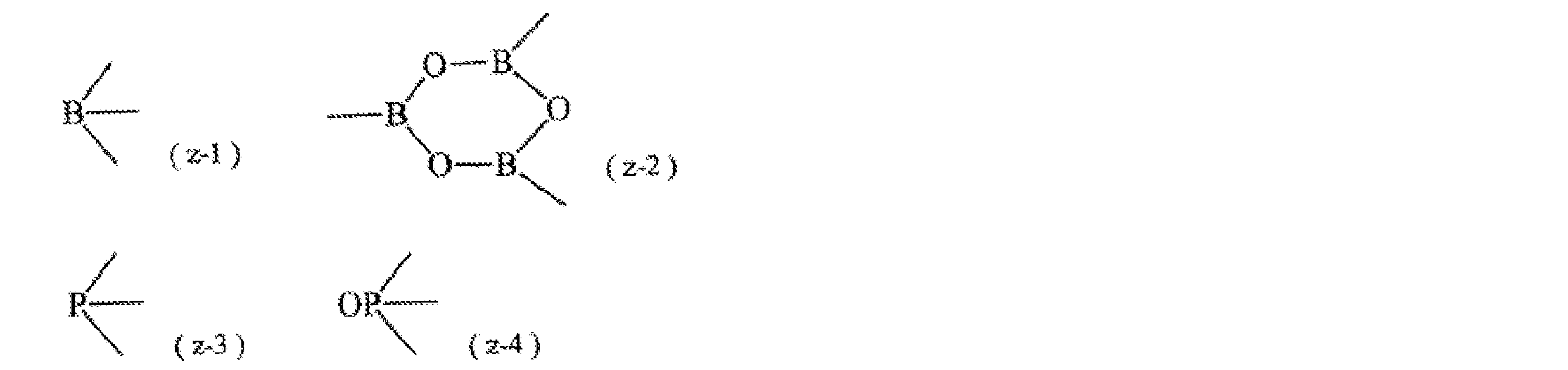
[(RCOO)xBiO]3Z ・・・(A)
ここで、(RCOO)は、炭素数2~25の脂肪族カルボン酸の残基であり、xは、(Mの価数-1)の整数であり、Zは、下記式(z-1)~(z-4)から選択される構造である。
また、本発明のゴム組成物では、ゴム組成物に含まれるBi元素の物質量が、0.005mol以上0.02mol未満であることが好ましい。
前記ゴム組成物に含まれるBi元素の物質量が0.005mol以上であることによって、金属部材との優れた接着性を実現できる。同様の観点から、前記ゴム組成物に含まれるBi元素の物質量は、0.007mol超えであることがより好ましく、0.01mol以上であることがさらに好ましい。一方、ゴム組成物に含まれるBi元素の物質量が0.02mol未満であることによって、過剰な添加による金属部材との接着性の低下を抑制できる。
なお、前記ゴム組成物中の、Bi元素の物質量については、ゴム組成物に含まれる全成分から得られるビスマス金属の合計量のことである。そのため、前記ゴム-金属接着促進剤以外の成分中に、Bi元素が含有している場合には、これらのBiの物質量を加えた合計量となる。
ここで、前記(1)の炭素数が2~25の脂肪族カルボン酸のBi塩(以下、単に「(1)のカルボン酸Bi塩」ということがある。)は、炭素数2~25の脂肪族カルボン酸とBiとの化学反応によって形成される金属塩である。ゴム-金属間接着促進剤として、カルボン酸Bi塩を用いることによって、スチールコード等の金属部材との接着性、特に湿熱条件下での接着性を高めることができる。
前記(1)のカルボン酸Bi塩の脂肪族カルボン酸は、炭素数2~25の脂肪族カルボン酸である。(1)のカルボン酸Bi塩と前記ゴム成分との相溶性や、ゴム組成物と金属材料との接着性の観点から、前記脂肪族カルボン酸の炭素数は、2以上である。また、(1)のカルボン酸Bi塩の合成の容易さや、ゴム組成物と金属材料との接着性の観点から、脂肪族カルボン酸の炭素数は、25以下である。ここで、本発明において、脂肪族カルボン酸の炭素数とは、脂肪族カルボン酸のカルボキシル基の炭素を含む数をいう。
また、前記(1)のカルボン酸Bi塩の脂肪族カルボン酸の炭素数は、2以上、3以上、4以上、5以上、6以上、7以上、8以上、9以上、10以上、11以上、12以上、13以上、14以上、15以上、16以上、17以上、18以上、19以上、20以上、21以上、22以上、23以上または24以上とすることができる。
また、前記(1)のカルボン酸Bi塩の脂肪族カルボン酸の炭素数は、25以下、24以下、23以下、22以下、21以下、20以下、19以下、18以下、17以下、16以下、15以下、14以下、13以下、12以下、11以下、10以下、9以下、8以下、7以下、6以下、5以下、4以下または3以下である。
さらに、ゴム組成物と金属材料との接着性の観点から、前記(1)のカルボン酸Bi塩の脂肪族カルボン酸の炭素数は、8~18であることが好ましい。
また、前記(1)のカルボン酸Bi塩の脂肪族カルボン酸の炭素数は、25以下、24以下、23以下、22以下、21以下、20以下、19以下、18以下、17以下、16以下、15以下、14以下、13以下、12以下、11以下、10以下、9以下、8以下、7以下、6以下、5以下、4以下または3以下である。
さらに、ゴム組成物と金属材料との接着性の観点から、前記(1)のカルボン酸Bi塩の脂肪族カルボン酸の炭素数は、8~18であることが好ましい。
前記(1)のカルボン酸Bi塩における炭素数2~25の脂肪族カルボン酸としては、特に限定されず、例えば、脂肪族モノカルボン酸又は脂肪族ジカルボン酸が挙げられる。
ここで、前記脂肪族モノカルボン酸については、例えば、飽和又は不飽和の脂肪族モノカルボン酸が挙げられる。
前記飽和の脂肪族モノカルボン酸としては、例えば、エタン酸、プロパン酸、ブタン酸、ペンタン酸、ヘキサン酸、2-エチルヘキサン酸、ヘプタン酸、オクタン酸、ノナン酸、イソノナン酸、デカン酸、ネオデカン酸、ドデカン酸、テトラデカン酸、ヘキサデカン酸、ヘプタデカン酸、オクタデカン酸、エイコサン酸、ドコサン酸、テトラコサン酸、ナフテン酸等が挙げられる。
また、前記不飽和の脂肪族モノカルボン酸としては、例えば、9-ヘキサデセン酸、cis-9-オクタデセン酸、11-オクタデセン酸、cis,cis-9,12-オクタデカジエン酸、9,12,15-オクタデカトリエン酸、6,9,12-オクタデカトリエン酸、9,11,13-オクタデカトリエン酸、エイコサン酸、8,11-エイコサジエン酸、5,8,11-エイコサトリエン酸、5,8,11,14-エイコサテトラエン酸、桐油酸、アマニ油酸、大豆油酸、樹脂酸、トール油脂肪酸、ロジン酸、アビエチン酸、ネオアビエチン酸、パラストリン酸、ピマール酸、デヒドロアビエチン酸等が挙げられる。
ここで、前記脂肪族ジカルボン酸については、例えば、飽和または不飽和の脂肪族ジカルボン酸等が挙げられる。
前記飽和の脂肪族ジカルボン酸としては、例えば、シュウ酸、マロン酸、コハク酸、グルタル酸、アジピン酸等が挙げられる。
また、前記不飽和の脂肪族ジカルボン酸としては、例えば、フマル酸、マレイン酸等が挙げられる。
前記飽和の脂肪族ジカルボン酸としては、例えば、シュウ酸、マロン酸、コハク酸、グルタル酸、アジピン酸等が挙げられる。
また、前記不飽和の脂肪族ジカルボン酸としては、例えば、フマル酸、マレイン酸等が挙げられる。
前記(1)炭素数が2~25の脂肪族カルボン酸Bi塩におけるカルボン酸は、飽和のモノカルボン酸及び不飽和の脂肪族モノカルボン酸、並びに、飽和の脂肪族ジカルボン酸及び不飽和の脂肪族ジカルボン酸からなる群より選択される一種以上である。
また、前記(1)炭素数が2~25の脂肪族カルボン酸Bi塩におけるカルボン酸は、これらの中でも、ゴムの硫黄架橋に影響を及ぼしにくく、タイヤや、ベルトコンベヤ等に用いた際のゴム物性に悪影響が少ないゴム硬化物が得られることから、飽和の脂肪族モノカルボン酸であることが好ましい。さらに、前記飽和の脂肪族モノカルボン酸の中でも、炭素原子数2~20の飽和の脂肪族モノカルボン酸であることがより好ましく、2-エチルヘキサン酸、ネオデカン酸、ヘキサデカン酸又はオクタデカン酸が特に好ましい。
また、前記(1)炭素数が2~25の脂肪族カルボン酸Bi塩におけるカルボン酸は、これらの中でも、ゴムの硫黄架橋に影響を及ぼしにくく、タイヤや、ベルトコンベヤ等に用いた際のゴム物性に悪影響が少ないゴム硬化物が得られることから、飽和の脂肪族モノカルボン酸であることが好ましい。さらに、前記飽和の脂肪族モノカルボン酸の中でも、炭素原子数2~20の飽和の脂肪族モノカルボン酸であることがより好ましく、2-エチルヘキサン酸、ネオデカン酸、ヘキサデカン酸又はオクタデカン酸が特に好ましい。
そして、前記(1)炭素数が2~25の脂肪族カルボン酸Bi塩としては、例えば、2-エチルヘキサン酸Bi、ネオデカン酸Bi、ヘキサデカン酸Bi、オクタデカン酸Bi等が挙げられる。
なお、前記(1)のカルボン酸Bi塩を得る方法については、特に限定されず、製造しても良いし、購入することも可能である。
前記(1)のカルボン酸Bi塩の製造方法としては、例えば、以下の製法1又は製法2が挙げられる。
前記(1)のカルボン酸Bi塩の製造方法としては、例えば、以下の製法1又は製法2が挙げられる。
製法1:炭素原子数2~25の脂肪族カルボン酸と、Biの酸化物(b-1)、Biの水酸化物(b-2)及びBiの炭酸塩(b-3)から選ばれる一種以上とを、直接反応させる方法。
なお、製法1における、炭素原子数2~25の脂肪族カルボン酸と、Bi化合物(b-1)~(b-3)とを反応させる際の反応温度は、50~150℃程度とすることができる。また、反応時間は1~20時間程度とすることができる。
なお、製法1における、炭素原子数2~25の脂肪族カルボン酸と、Bi化合物(b-1)~(b-3)とを反応させる際の反応温度は、50~150℃程度とすることができる。また、反応時間は1~20時間程度とすることができる。
製法2:炭素原子数2~25の脂肪族カルボン酸と水酸化ナトリウムとを水の存在下で反応させて脂肪族カルボン酸のナトリウム塩を得た後、該脂肪族カルボン酸のナトリウム塩とBiの硫酸塩(c-1)、Biの塩化物(c-2)及びBiの硝酸塩(c-3)から選ばれる一種以上とを反応させる方法。
なお、製法2における、炭素原子数2~25の脂肪族カルボン酸と水酸化ナトリウムとを有機溶剤の存在下で反応させる際の反応温度は、20~100℃程度とすることができ、反応時間は1~5時間程度とすることができる。また、製法2における、脂肪族カルボン酸のナトリウム塩と、Bi化合物(c-1)~(c-3)とを反応させる際の反応温度は、20~100℃程度とすることができ、反応時間は、1~5時間程度とすることができる。
さらに、製法2においては、脂肪族カルボン酸のナトリウム塩と、Bi化合物(c-1)~(c-3)とを反応させた後、反応系にある水層を分離し、その後、油層内に存在する溶剤を減圧蒸留により除去することで、前記(1)のカルボン酸Bi塩を得ることができる。
また、(2)の化合物は、式(A):[(RCOO)xBiO]3Zで表される構造を有するものである。ゴム-金属間接着促進剤として、(2)式(A)で表される化合物を用いることによって、スチールコード等の金属部材との接着性を高めることができる。
前記(2)の式(A)で表される化合物中の(RCOO)は、炭素数2~25の脂肪族カルボン酸の残基である。
前記式(A)で表される化合物とゴム成分との相溶性、及び、ゴム組成物と金属材料との接着性の観点から、前記脂肪族カルボン酸の残基における脂肪族カルボン酸の炭素数は、2以上である。また、前記式(A)で表される化合物の合成の容易さや、ゴム組成物と金属材料との接着性の観点から、前記脂肪族カルボン酸の残基における脂肪族カルボン酸の炭素数は、25以下である。
なお、前記脂肪族カルボン酸の炭素数とは、脂肪族カルボン酸のカルボキシル基の炭素を含む数をいう。
前記式(A)で表される化合物とゴム成分との相溶性、及び、ゴム組成物と金属材料との接着性の観点から、前記脂肪族カルボン酸の残基における脂肪族カルボン酸の炭素数は、2以上である。また、前記式(A)で表される化合物の合成の容易さや、ゴム組成物と金属材料との接着性の観点から、前記脂肪族カルボン酸の残基における脂肪族カルボン酸の炭素数は、25以下である。
なお、前記脂肪族カルボン酸の炭素数とは、脂肪族カルボン酸のカルボキシル基の炭素を含む数をいう。
なお、前記(2)式(A)で表される化合物中の(RCOO)における炭素数2~25の脂肪族カルボン酸については、上述した(1)炭素数が2~25の脂肪族カルボン酸Bi塩の脂肪族カルボン酸と同様である。また、前記(1)のカルボン酸Bi塩の脂肪族カルボン酸の中で説明した各実施形態も、残基(RCOO)を形成する炭素数2~25の脂肪族カルボン酸へ同様に適用し得る。
さらに、前記(2)式(A)で表される化合物における(RCOO)が、炭素原子数2~20の飽和の脂肪族モノカルボン酸の残基であることが好ましく、2-エチルヘキサン酸の残基、ネオデカン酸の残基、ヘキサデカン酸の残基又はオクタデカン酸の残基であることがより好ましい。
ゴムの硫黄架橋に影響を及ぼしにくく、タイヤや、ベルトコンベヤ等に用いた際のゴム物性に悪影響が少ないゴム硬化物が得られるためである。
ゴムの硫黄架橋に影響を及ぼしにくく、タイヤや、ベルトコンベヤ等に用いた際のゴム物性に悪影響が少ないゴム硬化物が得られるためである。
なお、前記(2)式(A)で表される化合物におけるxは、(Mの価数-1)の整数である。
また、前記(2)式(A)で表される化合物におけるZは、下記式(z-1)~式(z-4)から選択される構造である。
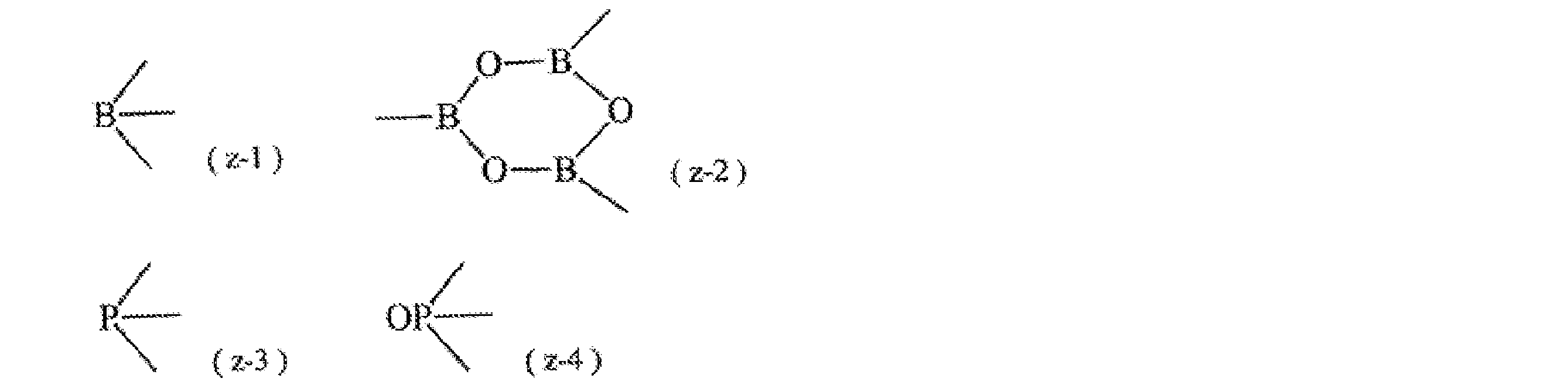
上記式(z-1)~式(z-4)の4つの構造の中でも、ゴム組成物と金属材料との高い接着性が得られる観点からは、式(z-1)で表される構造であることが好ましい。
ここで、前記(2)式(A)で表される化合物については、例えば、ホウ素2-エチルヘキサン酸Bi、ホウ素ネオデカン酸Bi、ホウ素ヘキサデカン酸Bi、ホウ素オクタデカン酸Bi等が挙げられる。これらの化合物は、一種単独で用いてもよいし、二種以上を併用することもできる。
なお、前記(2)式(A)で表される化合物を得る方法については、特に限定はされない。
例えば、炭素原子数2~25の脂肪族カルボン酸と、炭素原子数1~5の低級アルコールのホウ酸エステル(d-1)、炭素原子数1~5の低級アルコールのメタホウ酸エステル(d-2)、炭素原子数1~5の低級アルコールのリン酸エステル(d-3)又は炭素原子数1~5の低級アルコールの亜リン酸エステル(d-4)と、該エステル(d-1)~(d-4)中に存在している炭素原子数1~5の低級アルコール残基との揮発性エステルを生成可能な酸(e)と、金属源であるBi化合物(f)とを混合、加熱し、得られる揮発性エステルを除去する方法により製造することができる。
例えば、炭素原子数2~25の脂肪族カルボン酸と、炭素原子数1~5の低級アルコールのホウ酸エステル(d-1)、炭素原子数1~5の低級アルコールのメタホウ酸エステル(d-2)、炭素原子数1~5の低級アルコールのリン酸エステル(d-3)又は炭素原子数1~5の低級アルコールの亜リン酸エステル(d-4)と、該エステル(d-1)~(d-4)中に存在している炭素原子数1~5の低級アルコール残基との揮発性エステルを生成可能な酸(e)と、金属源であるBi化合物(f)とを混合、加熱し、得られる揮発性エステルを除去する方法により製造することができる。
なお、前記低級アルコールのホウ酸エステル(d-1)としては、例えば、ホウ酸トリメチル、ホウ酸トリエチル、ホウ酸トリプロピル、ホウ酸トリブチル等が挙げられる。前記低級アルコールのメタホウ酸エステル(d-2)としては、例えば、メタホウ酸トリメチル、メタホウ酸トリエチル、メタホウ酸トリプロピル、メタホウ酸トリブチル等が挙げられる。前記低級アルコールのリン酸エステル(d-3)としては、例えば、リン酸メチル、リン酸エチル、リン酸プロピル、リン酸ブチル等が挙げられる。前記低級アルコールの亜リン酸エステル(d-4)としては、例えば、亜リン酸メチル、亜リン酸エチル、亜リン酸プロピル、亜リン酸ブチル等が挙げられる。
また、前記金属源であるBi化合物(f)としては、例えば、上述したBiの酸化物(b-1)、水酸化物(b-2)、炭酸塩(b-3)等を使用することができる。
さらに、前記酸( e ) としては、例えば、エタン酸、プロパン酸、ブタン酸等が挙げられる。
また、前記金属源であるBi化合物(f)としては、例えば、上述したBiの酸化物(b-1)、水酸化物(b-2)、炭酸塩(b-3)等を使用することができる。
さらに、前記酸( e ) としては、例えば、エタン酸、プロパン酸、ブタン酸等が挙げられる。
前記金属源であるBi化合物(f)の使用割合としては、例えば、炭素原子数2~25の脂肪族カルボン酸(a)100質量部あたり20~100質量部である。また、前記(d)の使用割合としては、例えば、炭素原子数2~25の脂肪族カルボン酸(a)100質量部あたり10~50質量部である。そして、前記酸(e)の使用割合としては、例えば、炭素原子数2~25の脂肪族カルボン酸(a)100質量部あたり10~50質量部である。
また、前記(2)式(A)で表される化合物を得る方法の中でも、炭素原子数2~25の脂肪族カルボン酸(a)と、エステル(d)中に存在している炭素原子数1~5の低級アルコール残基との揮発性エステルを生成可能な酸(e)と、Bi化合物(f)とを混合し・加熱して反応物を得る第一工程の後、該反応物を含む反応系から水を除去した後、この水を除去した反応系に前記エステル(d-1)~(d-4)を加え、該反応物と該エステル(d-1)~(d-4)とを反応させる第二工程を含む製造方法が、第一工程で生成する水によるエステル(d-1)~(d-4)の加水分解を防止でき、その結果として、効率よく前記(2)式(A)で表される化合物を製造することができることから好ましい。
なお、前記製造方法において、炭素原子数2~25の脂肪族カルボン酸(a)と、前記エステル(d-1)~(d-4)と、前記酸(e)と、前記Bi化合物(f)とを反応させる温度は、例えば、100~250℃とすることができ、好ましくは、150~220℃である。また、反応させる時間は、例えば、1~20時間とすることができ、好ましくは、1~5時間である。
また、本発明のゴム組成物における前記ゴム-金属接着促進剤の含有量は、金属部材とのより優れた接着性を得る点からは、前記ゴム成分100質量部に対して1.5質量部超えであることを要する。同様の観点から、前記ゴム-金属接着促進剤の含有量は、前記ゴム成分100質量部に対して、2.0質量部以上であることが好ましく、3.5質量部以上であることがより好ましく、4.6質量部以上であることがさらに好ましく、6.0質量部以上であることが特に好ましい。また、過剰な前記ゴム-金属接着促進剤は接着性の低下が生じることから、前記ゴム-金属接着促進剤の含有量は、前記ゴム成分100質量部に対して、25質量部以下であることが好ましく、16質量部以下であることがより好ましく、10質量部以下が特に好ましい。
(Bi以外の金属の有機酸塩)
本発明のゴム組成物は、上述したゴム成分及びゴム-金属接着促進剤に加えて、Bi以外の金属の有機酸塩をさらに含む。
Bi以外の金属の有機酸塩をゴム組成物中に含有させることで、上述したゴム-金属接着促進剤との相乗効果によって、金属部材との接着性を大きく向上できる。
本発明のゴム組成物は、上述したゴム成分及びゴム-金属接着促進剤に加えて、Bi以外の金属の有機酸塩をさらに含む。
Bi以外の金属の有機酸塩をゴム組成物中に含有させることで、上述したゴム-金属接着促進剤との相乗効果によって、金属部材との接着性を大きく向上できる。
また、本発明のゴム組成物では、前記ゴム組成物中の前記Bi以外の金属の有機酸塩に含まれる、Bi以外の金属元素の物質量が0.01mol以上であることを要する。
前記Bi以外の金属の有機酸塩に含まれるBi以外の金属元素の物質量が0.01mol以上であることによって、金属部材との優れた接着性を実現できる。同様の観点から、前記ゴム組成物に含まれるBi以外の金属元素の物質量は、0.02mol以上であることが好ましい。一方、ゴム組成物に含まれるBi元素の物質量は、0.04mol以下であることによって、過剰な添加による金属部材との接着性の低下を抑制できる点で好ましい。
なお、前記ゴム組成物中の、Bi以外の金属元素の物質量については、前記Bi以外の金属の有機酸塩中に含まれるBi以外の金属の合計量のことである。そのため、前記Bi以外の金属の有機酸塩を複数含有する場合には、これらに含まれる金属の合計量となる。ただし、ジメタクリル酸亜鉛については、本発明での「Bi以外の金属の有機酸塩」には含まれないものとなる。また、有機酸塩以外の成分として、金属元素が含有している場合(例えば、亜鉛華等)には、その金属元素の物質量は含まれない。
ここで、前記Bi以外の金属の有機酸塩とは、Bi以外の金属と有機酸との化学反応によって形成される金属塩である。
前記Bi以外の金属の有機酸塩の金属については、Bi以外の金属であれば特に限定はされない。ゴム組成物と金属部材との接着性をより高める観点からは、前記金属として、Zn、Al、Mo、Fe、Ti及びCuからなる群より選択される少なくとも一種を用いることが好ましく、Zn、Al及びMoからなる群より選択される少なくとも一種を用いることがより好ましい。
前記Bi以外の金属の有機酸塩の金属については、Bi以外の金属であれば特に限定はされない。ゴム組成物と金属部材との接着性をより高める観点からは、前記金属として、Zn、Al、Mo、Fe、Ti及びCuからなる群より選択される少なくとも一種を用いることが好ましく、Zn、Al及びMoからなる群より選択される少なくとも一種を用いることがより好ましい。
前記Bi以外の金属の有機酸塩に用いられる有機酸としては、例えば、カルボン酸やスルホン酸が挙げられ、カルボン酸を用いることが好ましい。
また、前記カルボン酸については、脂肪族カルボン酸であることが好ましく、炭素数2~25の脂肪族カルボン酸であることがより好ましい。ゴム組成物と金属材料との接着性の観点から、前記脂肪族カルボン酸の炭素数は、2以上である。また、カルボン酸金属塩の合成の容易さや、ゴム組成物と金属材料との接着性の観点から、脂肪族カルボン酸の炭素数は、25以下である。なお、前記脂肪族カルボン酸の炭素数とは、脂肪族カルボン酸のカルボキシル基の炭素を含む数をいう。
また、前記カルボン酸については、脂肪族カルボン酸であることが好ましく、炭素数2~25の脂肪族カルボン酸であることがより好ましい。ゴム組成物と金属材料との接着性の観点から、前記脂肪族カルボン酸の炭素数は、2以上である。また、カルボン酸金属塩の合成の容易さや、ゴム組成物と金属材料との接着性の観点から、脂肪族カルボン酸の炭素数は、25以下である。なお、前記脂肪族カルボン酸の炭素数とは、脂肪族カルボン酸のカルボキシル基の炭素を含む数をいう。
また、前記Bi以外の金属の有機酸塩に用いられる脂肪族カルボン酸の炭素数は、2以上、3以上、4以上、5以上、6以上、7以上、8以上、9以上、10以上、11以上、12以上、13以上、14以上、15以上、16以上、17以上、18以上、19以上、20以上、21以上、22以上、23以上または24以上とすることができる。
また、前記(1)のカルボン酸Bi塩の脂肪族カルボン酸の炭素数は、25以下、24以下、23以下、22以下、21以下、20以下、19以下、18以下、17以下、16以下、15以下、14以下、13以下、12以下、11以下、10以下、9以下、8以下、7以下、6以下、5以下、4以下または3以下である。
また、前記(1)のカルボン酸Bi塩の脂肪族カルボン酸の炭素数は、25以下、24以下、23以下、22以下、21以下、20以下、19以下、18以下、17以下、16以下、15以下、14以下、13以下、12以下、11以下、10以下、9以下、8以下、7以下、6以下、5以下、4以下または3以下である。
前記Bi以外の金属の有機酸塩に用いられる脂肪族カルボン酸としては、特に限定されず、例えば、脂肪族モノカルボン酸や脂肪族ジカルボン酸が挙げられる。
ここで、前記脂肪族モノカルボン酸については、例えば、飽和又は不飽和の脂肪族モノカルボン酸が挙げられる。
前記飽和の脂肪族モノカルボン酸としては、例えば、エタン酸、プロパン酸、ブタン酸、ペンタン酸、ヘキサン酸、2-エチルヘキサン酸、ヘプタン酸、オクタン酸、ノナン酸、イソノナン酸、デカン酸、ネオデカン酸、ドデカン酸、テトラデカン酸、ヘキサデカン酸、ヘプタデカン酸、オクタデカン酸、エイコサン酸、ドコサン酸、テトラコサン酸、ナフテン酸等が挙げられる。
また、前記不飽和の脂肪族モノカルボン酸としては、例えば、メタクリル酸、9-ヘキサデセン酸、cis-9-オクタデセン酸、11-オクタデセン酸、cis,cis-9,12-オクタデカジエン酸、9,12,15-オクタデカトリエン酸、6,9,12-オクタデカトリエン酸、9,11,13-オクタデカトリエン酸、エイコサン酸、8,11-エイコサジエン酸、5,8,11-エイコサトリエン酸、5,8,11,14-エイコサテトラエン酸、桐油酸、アマニ油酸、大豆油酸、樹脂酸、トール油脂肪酸、ロジン酸、アビエチン酸、ネオアビエチン酸、パラストリン酸、ピマール酸、デヒドロアビエチン酸等が挙げられる。
ここで、前記脂肪族ジカルボン酸については、例えば、飽和または不飽和の脂肪族ジカルボン酸等が挙げられる。
前記飽和の脂肪族ジカルボン酸としては、例えば、シュウ酸、マロン酸、コハク酸、グルタル酸、アジピン酸等が挙げられる。
また、前記不飽和の脂肪族ジカルボン酸としては、例えば、ジメタクリル酸、フマル酸、マレイン酸等が挙げられる。
前記飽和の脂肪族ジカルボン酸としては、例えば、シュウ酸、マロン酸、コハク酸、グルタル酸、アジピン酸等が挙げられる。
また、前記不飽和の脂肪族ジカルボン酸としては、例えば、ジメタクリル酸、フマル酸、マレイン酸等が挙げられる。
また、前記Bi以外の金属の有機酸塩に用いられる脂肪族カルボン酸は、上述した中でも、ゴムの硫黄架橋に影響を及ぼしにくく、タイヤや、ベルトコンベヤ等に用いた際のゴム物性に悪影響が少ないゴム硬化物が得られることから、炭素原子数2~20の脂肪族カルボン酸であることが好ましく、2-エチルヘキサン酸、ネオデカン酸、ヘキサデカン酸、オクタデカン酸又はジメタクリル酸であることが特に好ましい。
そして、前記Bi以外の金属の有機酸塩としては、例えば、2-エチルヘキサン酸亜鉛、2-エチルヘキサン酸アルミニウム、2-エチルヘキサン酸モリブデン、2-エチルヘキサン酸鉄、2-エチルヘキサン酸銅、ネオデカン酸亜鉛、ネオデカン酸アルミニウム、ネオデカン酸モリブデン、ネオデカン酸鉄、ネオデカン酸銅、ヘキサデカン酸亜鉛、ヘキサデカン酸アルミニウム、ヘキサデカン酸モリブデン、ヘキサデカン酸鉄、ヘキサデカン酸銅、オクタデカン酸亜鉛、オクタデカン酸アルミニウム、オクタデカン酸モリブデン、オクタデカン酸鉄、オクタデカン酸銅、ジメタクリル酸亜鉛、ジメタクリル酸アルミニウム、ジメタクリル酸モリブデン、ジメタクリル酸鉄、ジメタクリル酸銅等が挙げられる。
なお、前記Bi以外の金属の有機酸塩を得る方法については、特に限定されず、製造しても良いし、購入することも可能である。
前記Bi以外の金属の有機酸塩の製造方法としては、例えば、上述した(1)のカルボン酸Bi塩の製法1又は製法2が挙げられる。
前記Bi以外の金属の有機酸塩の製造方法としては、例えば、上述した(1)のカルボン酸Bi塩の製法1又は製法2が挙げられる。
また、本発明のゴム組成物における前記Bi以外の金属の有機酸塩の含有量は、特に限定はされない。例えば、金属部材とのより優れた接着性を得る点からは、前記ゴム成分100質量部に対して0.05質量部以上であることが好ましく、3質量部以上であることがより好ましく、7.5質量部以上であることがさらに好ましく、10質量部以上であることが特に好ましい。また、ゴム組成物の劣化を抑制する観点からは、前記Bi以外の金属の有機酸塩の含有量は、前記ゴム成分100質量部に対して15質量部以下であることが好ましい。
(充填剤)
本発明のゴム組成物は、上述した、ゴム成分、Biを含有するゴム-金属接着促進剤及び亜鉛化合物に加えて、カーボンブラックやシリカ等の充填剤を含むこともできる。
前記充填剤を含むことによって、ゴム組成物の補強性を高めることができる。
本発明のゴム組成物は、上述した、ゴム成分、Biを含有するゴム-金属接着促進剤及び亜鉛化合物に加えて、カーボンブラックやシリカ等の充填剤を含むこともできる。
前記充填剤を含むことによって、ゴム組成物の補強性を高めることができる。
ここで、前記カーボンブラックの種類については、特に限定はされない。例えば、オイルファーネス法により製造された任意のハードカーボンを用いることができる。カーボンブラックの種類については、特に限定はされず、例えば、GPF、FEF、SRF、HAF、ISAF、IISAF、SAFグレード等のカーボンブラックを、一種以上用いることができる。
前記充填剤としてカーボンブラックを含む場合、その含有量は、前記ゴム成分100質量部に対して20~100質量部であることが好ましく、30~90質量部であることがより好ましく、40~80質量部であることが特に好ましい。前記カーボンブラックの含有量が記ゴム成分100質量部に対して、20質量部以上とすることで、ゴム組成物のより優れた補強性が得られ、前記カーボンブラックの含有量が記ゴム成分100質量部に対して、100質量部以下の場合には、低発熱性の悪化や、グリップ力の低下を抑えることができる。
また、前記シリカの種類については、特に限定はされない。例えば、湿式シリカ(含水ケイ酸)、乾式シリカ(無水ケイ酸)、ケイ酸カルシウム、ケイ酸アルミニウム等を用いることができる。また、これらの中でも、湿式シリカを用いることが好ましい。
さらに、前記湿式シリカのBET比表面積(ISO 5794/1に基づき測定する)は40~350m2/gであることが好ましい。BET比表面積がこの範囲であるシリカは、ゴム補強性とゴム成分中への分散性とを両立できるという利点がある。この観点から、BET比表面積が80~300m2/gであるシリカがより好ましい。このようなシリカとして、例えば、東ソー・シリカ(株)社製「ニプシルAQ」、「ニプシルKQ」、エボニック社製「Ultrasil VN3」等の市販品を用いることもできる。なお、前記シリカは一種類を用いてもよく二種類以上を組み合わせて用いてもよい。
さらに、前記湿式シリカのBET比表面積(ISO 5794/1に基づき測定する)は40~350m2/gであることが好ましい。BET比表面積がこの範囲であるシリカは、ゴム補強性とゴム成分中への分散性とを両立できるという利点がある。この観点から、BET比表面積が80~300m2/gであるシリカがより好ましい。このようなシリカとして、例えば、東ソー・シリカ(株)社製「ニプシルAQ」、「ニプシルKQ」、エボニック社製「Ultrasil VN3」等の市販品を用いることもできる。なお、前記シリカは一種類を用いてもよく二種類以上を組み合わせて用いてもよい。
前記充填剤としてシリカを含む場合、その含有量は、前記ゴム成分100質量部に対して0.1~40質量部であることが好ましく、1~30質量部であることがより好ましく、5~20質量部であることが特に好ましい。前記カーボンブラックの含有量が記ゴム成分100質量部に対して、20質量部以上とすることで、ゴム組成物のより優れた補強性が得られ、前記カーボンブラックの含有量が記ゴム成分100質量部に対して、100質量部以下の場合には、低発熱性の悪化や、グリップ力の低下を抑えることができる。
また、前記カーボンブラック及び前記シリカ以外の充填剤としては、例えば、水酸化アルミニウム、クレー、アルミナ、タルク、マイカ、カオリン、ガラスバルーン、ガラスビーズ、炭酸カルシウム、炭酸マグネシウム、水酸化マグネシウム、酸化マグネシウム、酸化チタン、チタン酸カリウム、硫酸バリウム等が挙げられる。
(その他の成分)
本発明に係るゴム組成物には、上述した、ゴム成分、Biを含有するゴム-金属接着促進剤、Bi以外の金属の有機酸塩、及び、任意成分としての充填剤に加えて、ゴム組成物に配合される公知の添加剤を適宜配合してもよい。
このような添加剤としては、例えば、亜鉛化合物、樹脂、加硫剤(架橋剤)、加硫促進剤、加硫遅延剤、老化防止剤、補強剤、加硫助剤、着色剤、難燃剤、滑剤、発泡剤、可塑剤、加工助剤、酸化防止剤、スコーチ防止剤、紫外線防止剤、帯電防止剤、着色防止剤およびオイルなどが挙げられる。これらは、それぞれ、一種単独で、または二種以上を組み合わせて用いてもよい。
本発明に係るゴム組成物には、上述した、ゴム成分、Biを含有するゴム-金属接着促進剤、Bi以外の金属の有機酸塩、及び、任意成分としての充填剤に加えて、ゴム組成物に配合される公知の添加剤を適宜配合してもよい。
このような添加剤としては、例えば、亜鉛化合物、樹脂、加硫剤(架橋剤)、加硫促進剤、加硫遅延剤、老化防止剤、補強剤、加硫助剤、着色剤、難燃剤、滑剤、発泡剤、可塑剤、加工助剤、酸化防止剤、スコーチ防止剤、紫外線防止剤、帯電防止剤、着色防止剤およびオイルなどが挙げられる。これらは、それぞれ、一種単独で、または二種以上を組み合わせて用いてもよい。
また、本発明に係るゴム組成物は、さらに有機酸塩ではない亜鉛化合物を含むことができる。この場合、ゴム組成物の金属部材との接着性をより高めることができる。
なお、前記亜鉛化合物については、亜鉛を含有する化合物のうち上述したBi以外の金属であるZnの有機酸塩に該当する化合物を除いたものである。例えば、亜鉛金属単体や、亜鉛華、ジメタクリル酸亜鉛等が挙げられる。
さらに、前記亜鉛化合物を含む場合には、前記亜鉛化合物と前記Znの有機酸塩との合計含有量が、前記ゴム成分100質量部に対して17質量部以上且つ30質量部以下であることが好ましい。
なお、前記亜鉛化合物については、亜鉛を含有する化合物のうち上述したBi以外の金属であるZnの有機酸塩に該当する化合物を除いたものである。例えば、亜鉛金属単体や、亜鉛華、ジメタクリル酸亜鉛等が挙げられる。
さらに、前記亜鉛化合物を含む場合には、前記亜鉛化合物と前記Znの有機酸塩との合計含有量が、前記ゴム成分100質量部に対して17質量部以上且つ30質量部以下であることが好ましい。
前記樹脂を含むことによって、ゴムの柔軟性を高めることができ、ゴム組成物の金属部材との接着性をより向上できる。
前記樹脂については、特に限定はされず、種々の天然樹脂及び合成樹脂を使用することができる。
ゴム組成物の金属部材との接着性をより向上できる点からは、石油系樹脂、石炭系樹脂、フェノール系樹脂、ロジン系樹脂及びテルペン系樹脂、からなる群より選択される少なくとも一種を用いることが好ましく、フェノール系樹脂を用いることがより好ましい。
前記樹脂については、特に限定はされず、種々の天然樹脂及び合成樹脂を使用することができる。
ゴム組成物の金属部材との接着性をより向上できる点からは、石油系樹脂、石炭系樹脂、フェノール系樹脂、ロジン系樹脂及びテルペン系樹脂、からなる群より選択される少なくとも一種を用いることが好ましく、フェノール系樹脂を用いることがより好ましい。
前記フェノール系樹脂については、フェノール、ナフトール、クレゾール、キシレノール、p-tert-ブチルフェノール、p-オクチルフェノール、p-ノニルフェノール等のアルキルフェノール類を使用できる。これらの水酸基を有する化合物は、単独で用いてもよく、二種以上を併用してもよい。これらの中でも、フェノール又はβ-ナフトールを少なくとも含有することが好ましい。
また、前記フェノール系樹脂を用いる場合には、硬化剤として、例えば、ヘキサメチロールメラミン、ヘキサメトキシメチルメラミン、ペンタメトキシメチロールメラミン、ヘキサエトキシメチルメラミン、ヘキサキス?(メトキシメチル)メラミン、N,N’,N’’?トリメチル?N,N’,N’’?トリメチロールメラミン、N,N’,N’’?トリメチロールメラミン、N?メチロールメラミン、N,N’?(メトキシメチル)メラミン、N,N’,N’’?トリブチル?N,N’,N’’?トリメチロールメラミン等のメラミン誘導体をさらに用いることができる。これらのメラミン誘導体の中でも、ヘキサメトキシメチルメラミンを用いることが好ましい。
なお、本発明のゴム組成物は、環境に配慮した規制に対応する点から、コバルトが添加されていないこと、具体的には、コバルト化合物の含有量が、前記ゴム成分100質量部に対して0.01質量部以下であることが好ましく、不可避不純物を除いて、コバルト化合物を含まないことがより好ましい。
本発明のゴム組成物の調製方法は特に限定されず、公知の方法を用いることができる。
例えば、ゴム成分と、ゴム-金属間接着促進剤と、亜鉛化合物と、その他の任意成分とを、同時にまたは任意の順序で添加して、バンバリーミキサー、ロール又はインターナルミキサー等の混練り機を用いて混練りすることによって得られる。
例えば、ゴム成分と、ゴム-金属間接着促進剤と、亜鉛化合物と、その他の任意成分とを、同時にまたは任意の順序で添加して、バンバリーミキサー、ロール又はインターナルミキサー等の混練り機を用いて混練りすることによって得られる。
本発明に係るゴム組成物の用途は、特に限定されず、例えば、ホース、コンベヤベルト、クローラ、タイヤ及び靴底など任意のゴム物品に用いることができる。
<ゴム-金属複合体>
本発明のゴム-金属複合体は、上述した本発明のゴム組成物と、金属部材と、を備えたことを特徴とする。
本発明のゴム組成物を備えることによって、本発明の本発明のゴム-金属複合体は、ゴム-金属間の接着性に優れる。
本発明のゴム-金属複合体は、上述した本発明のゴム組成物と、金属部材と、を備えたことを特徴とする。
本発明のゴム組成物を備えることによって、本発明の本発明のゴム-金属複合体は、ゴム-金属間の接着性に優れる。
本発明のゴム-金属複合体は、上述した本発明のゴム組成物と金属部材とが接していればよく、例えば、金属部材である金属ワイヤーの、一部又は全部をゴム組成物によって被覆していてもよいし、金属ワイヤーからなる層の少なくとも一面側にゴム組成物からなるゴム層が積層されるような実施形態でもよい。
前記金属部材については、金属から構成された部品のことであり、例えば、金属ワイヤーや、金属のバネ、金属の板、金属のリング等、種々の形態を有することができる。
また、前記金属部材の金属種については、特に限定はされず、スチール、鉄、銅、金等、用途に応じて適宜選択することができる。
また、前記金属部材の金属種については、特に限定はされず、スチール、鉄、銅、金等、用途に応じて適宜選択することができる。
前記金属部材については、めっきされていてもよいし、めっきされていなくてもよい。めっきの種類は特に限定されず、ブラスめっき、亜鉛めっき、クロムめっき、ニッケルめっきなど公知のめっきを適宜採用することができる。
前記金属部材が、金属ワイヤーである場合には、ブラスめっき及び亜鉛めっきからなる群より選択される1種以上のめっきがされていることが好ましく、亜鉛めっきが施されていることがより好ましい。ゴム-金属間の接着性のより優れた接着性が得られるためである。
前記金属部材が、金属ワイヤーである場合には、ブラスめっき及び亜鉛めっきからなる群より選択される1種以上のめっきがされていることが好ましく、亜鉛めっきが施されていることがより好ましい。ゴム-金属間の接着性のより優れた接着性が得られるためである。
本発明のゴム-金属複合体の製造方法は、特に限定されず、公知の方法を適宜採用することができる。例えば、金属ワイヤーをゴム組成物が被覆している複合体では、金属ワイヤーをゴム組成物で被覆した状態でゴム組成物を加硫することで複合体を得ることができる。また、例えば、金属ワイヤーからなる層の少なくとも一面側にゴム組成物からなるゴム層が積層されている複合体では、例えば、国際公開第2017/056414号に記載の積層体の製造方法によって複合体を得ることができる。
<コンベヤベルト>
本発明のコンベヤベルトは、上述した本発明のゴム-金属複合体を用いたことを特徴とする。これにより、コバルト塩を含有するゴム組成物を用いた場合と同等以上のゴム-金属間の接着性を有する。
本発明のコンベヤベルトは、上述した本発明のゴム-金属複合体を用いたことを特徴とする。これにより、コバルト塩を含有するゴム組成物を用いた場合と同等以上のゴム-金属間の接着性を有する。
なお、本発明のコンベヤベルトは、上記いずれかのゴム組成物または複合体を用いたこと以外は特に限定されず、公知のコンベヤベルトの構成や製造方法を採用し得る。
一実施形態においては、本発明のゴム-金属複合体を、コンベヤベルトのうち、少なくとも、スチールコード等からなる金属補強材(金属1)の下側の、駆動プーリー、従動プーリー、保形ローター等と接触する内周側の表層ゴム(下面カバーゴム)に用いることができ、また、金属補強材の上側の、輸送物品と接触する外周側の表層ゴム(上面カバーゴム)に用いることもできる。
一実施形態においては、本発明のゴム-金属複合体を、コンベヤベルトのうち、少なくとも、スチールコード等からなる金属補強材(金属1)の下側の、駆動プーリー、従動プーリー、保形ローター等と接触する内周側の表層ゴム(下面カバーゴム)に用いることができ、また、金属補強材の上側の、輸送物品と接触する外周側の表層ゴム(上面カバーゴム)に用いることもできる。
<ホース>
本発明のホースは、上述した本発明のゴム-金属複合体を用いたことを特徴とする。これにより、コバルト塩を含有するゴム組成物を用いた場合と同等以上のゴム-金属間の接着性を有する。
本発明のホースは、上述した本発明のゴム-金属複合体を用いたことを特徴とする。これにより、コバルト塩を含有するゴム組成物を用いた場合と同等以上のゴム-金属間の接着性を有する。
なお、本発明のホースは、上記いずれかのゴム組成物または複合体を用いたこと以外は特に限定されず、公知のホースの構成や製造方法を採用し得る。
一実施形態において、ホースは、径方向内側に位置する内面ゴム層(内管ゴム)と、径方向外側に位置する外面ゴム層と、上記内面ゴム層及び上記外面ゴム層の間に位置する金属補強層と、を備える。そして、一実施形態においては、上述のゴム用のゴム組成物を、内面ゴム層及び外面ゴム層の少なくともいずれかに用いることができる。
一実施形態において、ホースは、径方向内側に位置する内面ゴム層(内管ゴム)と、径方向外側に位置する外面ゴム層と、上記内面ゴム層及び上記外面ゴム層の間に位置する金属補強層と、を備える。そして、一実施形態においては、上述のゴム用のゴム組成物を、内面ゴム層及び外面ゴム層の少なくともいずれかに用いることができる。
<クローラ>
本発明のクローラは、上述した本発明のゴム-金属複合体を用いたことを特徴とする。これにより、コバルト塩を含有するゴム組成物を用いた場合と同等以上のゴム-金属間の接着性を有する。
本発明のクローラは、上述した本発明のゴム-金属複合体を用いたことを特徴とする。これにより、コバルト塩を含有するゴム組成物を用いた場合と同等以上のゴム-金属間の接着性を有する。
なお、本発明のクローラは、上記いずれかのゴム組成物または複合体を用いたこと以外は特に限定されず、公知のクローラの構成や製造方法を採用し得る。
一実施形態において、クローラは、スチールコードと、該スチールコードを被覆する中間ゴム層と、該中間ゴム層の上に配置された芯金と、前記中間ゴム層と芯金とを囲む本体ゴム層とを備え、更に、本体ゴム層の接地面側に複数のラグを有している。ここで、上述のゴム用のゴム組成物は、ゴムクローラのいずれの部位に用いてもよい。
一実施形態において、クローラは、スチールコードと、該スチールコードを被覆する中間ゴム層と、該中間ゴム層の上に配置された芯金と、前記中間ゴム層と芯金とを囲む本体ゴム層とを備え、更に、本体ゴム層の接地面側に複数のラグを有している。ここで、上述のゴム用のゴム組成物は、ゴムクローラのいずれの部位に用いてもよい。
<タイヤ>
本発明のタイヤは、上述した本発明のゴム-金属複合体を用いたことを特徴とする。これにより、コバルト塩を含有するゴム組成物を用いた場合と同等以上のゴム-金属間の接着性を有する。
本発明のタイヤは、上述した本発明のゴム-金属複合体を用いたことを特徴とする。これにより、コバルト塩を含有するゴム組成物を用いた場合と同等以上のゴム-金属間の接着性を有する。
本発明のタイヤは、上述した本発明のゴム-金属複合体を用いたこと以外は特に限定されず、公知のタイヤの構成や製造方法を採用し得る。
タイヤにおける本発明の金属-ゴム複合体の適用部位としては、特に制限はなく、目的に応じて適宜選択することができ、例えば、カーカス、ベルト、ビードコア等が挙げられる。
前記タイヤを製造する方法としては、慣用の方法を用いることができる。例えば、タイヤ成形用ドラム上に、未加硫ゴム組成物及び金属コードからなるカーカス及びベルト(金属-ゴム複合体)、未加硫ゴム組成物からなるトレッド等の通常タイヤ製造に用いられる部材を順次貼り重ね、ドラムを抜き去ってグリーンタイヤとする。次いで、このグリーンタイヤを常法に従って加熱加硫することにより、所望のタイヤ(例えば、空気入りタイヤ)を製造することができる。
タイヤにおける本発明の金属-ゴム複合体の適用部位としては、特に制限はなく、目的に応じて適宜選択することができ、例えば、カーカス、ベルト、ビードコア等が挙げられる。
前記タイヤを製造する方法としては、慣用の方法を用いることができる。例えば、タイヤ成形用ドラム上に、未加硫ゴム組成物及び金属コードからなるカーカス及びベルト(金属-ゴム複合体)、未加硫ゴム組成物からなるトレッド等の通常タイヤ製造に用いられる部材を順次貼り重ね、ドラムを抜き去ってグリーンタイヤとする。次いで、このグリーンタイヤを常法に従って加熱加硫することにより、所望のタイヤ(例えば、空気入りタイヤ)を製造することができる。
以下、実施例を挙げて本発明をさらに詳しく説明するが、これらの実施例は、本発明の例示を目的とするものであり、本発明を何ら限定するものではない。実施例において、配合量は、特に断らない限り、質量部を意味する。
(実施例1~5、比較例1~9、参考例)
表1及び2に示す配合に従い、通常のバンバリーミキサーを用いて混練し、ゴム組成物の各サンプルを得た。
表1及び2に示す配合に従い、通常のバンバリーミキサーを用いて混練し、ゴム組成物の各サンプルを得た。
(評価)
得られたゴム組成物の各サンプルについて、以下の評価を行った。評価結果は、表2に示す。
得られたゴム組成物の各サンプルについて、以下の評価を行った。評価結果は、表2に示す。
(1)試験片の作成
直径0.39mmの亜鉛メッキスチールコードを、表1に示す配合により得られたゴム組成物の1mmシートでサンドイッチし、155℃で30分間加圧加硫を行い、試験片を作成した。
直径0.39mmの亜鉛メッキスチールコードを、表1に示す配合により得られたゴム組成物の1mmシートでサンドイッチし、155℃で30分間加圧加硫を行い、試験片を作成した。
(2)ゴム-金属間の接着性(引抜力、ゴム被覆率)
上記(1)で作成した試験片から亜鉛メッキスチールコードを引き抜き、引抜力(N)とゴム被覆率(%)を測定した。なお、引抜試験の条件は、DIN22131に準拠して行った。
ゴム被覆率は、亜鉛メッキスチールコードの表面積に対する引き抜き後のスチールコード表面に残存するゴムの被覆面積の割合(%)として算出した。評価については、参考例のサンプル(コバルトを含有するサンプル)の引抜力、被覆率を、それぞれ100としたときの指数値とし表示し、数値が大きいほど接着力が大きく、良好なことを示す。
上記(1)で作成した試験片から亜鉛メッキスチールコードを引き抜き、引抜力(N)とゴム被覆率(%)を測定した。なお、引抜試験の条件は、DIN22131に準拠して行った。
ゴム被覆率は、亜鉛メッキスチールコードの表面積に対する引き抜き後のスチールコード表面に残存するゴムの被覆面積の割合(%)として算出した。評価については、参考例のサンプル(コバルトを含有するサンプル)の引抜力、被覆率を、それぞれ100としたときの指数値とし表示し、数値が大きいほど接着力が大きく、良好なことを示す。
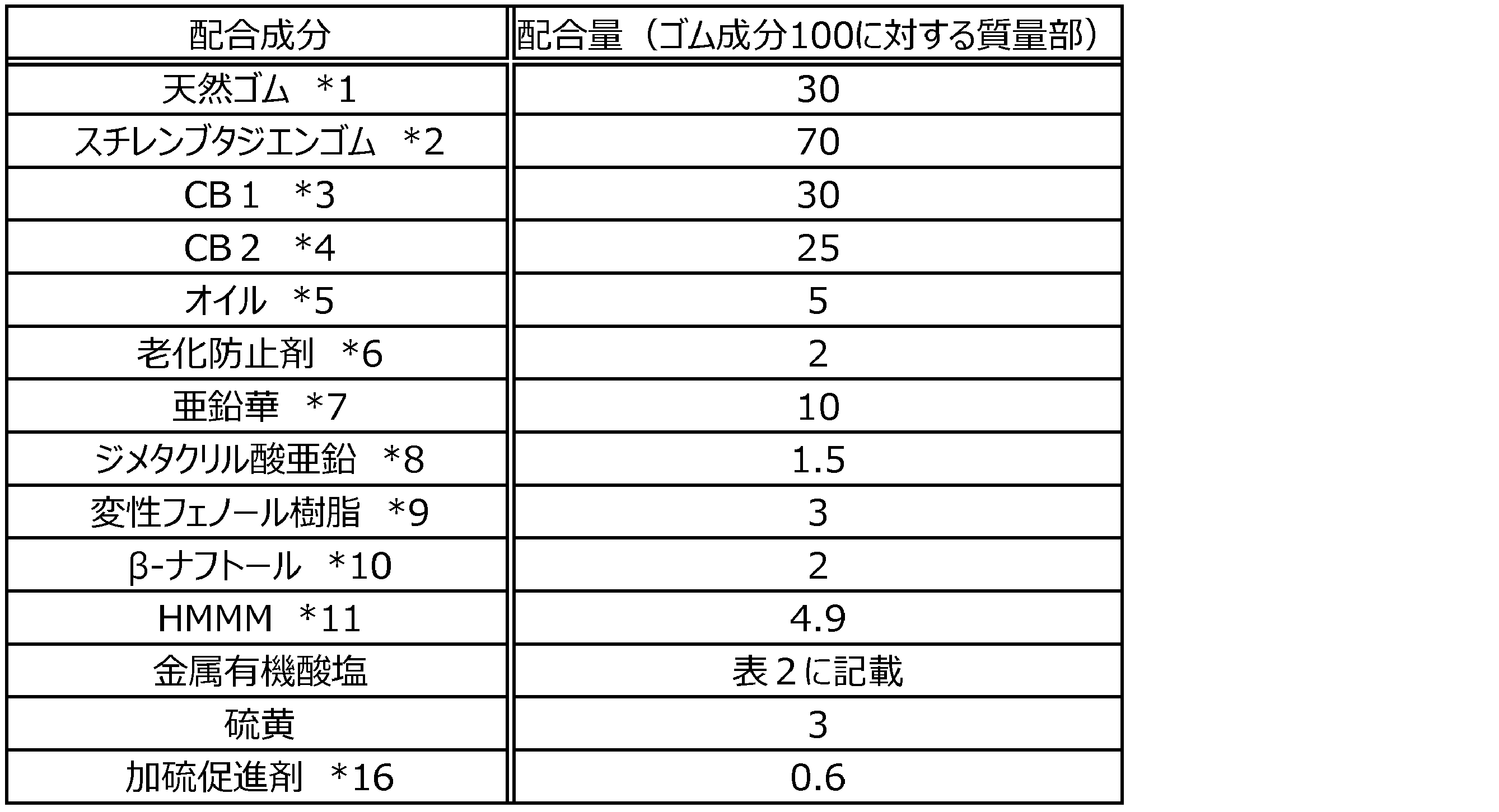

*1:RSS#3(天然ゴム各種等級品の国際品質包装標準による分類)
*2:JSR(株)製「JSR 1500」
*3:GPF級カーボンブラック、旭カーボン(株)製 「旭#55」、DBP吸収量:87cm3/100g、窒素吸着比表面積:26m2/g
*4:HAF級カーボンブラック、旭カーボン(株)製 「旭#70L」、DBP吸収量:75cm3/100g、窒素吸着比表面積:84m2/g
*5:A/O MIX、三共油化工業(株)製
*6:N-フェニル-N’-(1,3-ジメチルブチル)-p-フェニレンジアミン、大内新興化学工業(株)製「ノクラック 6C」
*7:ハクスイテック(株)製、商品名「3号亜鉛華」
*8: ジメタクリル酸亜鉛: 川口化学工業(株)製「アクターZMA」
*9:住友ベークライ製「スミライトレジン PR-12687」
*10:三井化学ファイン(株)製「βナフトール」
*11:ヘキサメトキシメチルメラミン、日本サイテックインダストリー(株)製「CYREZ964RPC」
*12:有機酸のコバルト塩中の有機酸の一部をホウ酸で置き換えた複合塩、OM Group Inc.製「マノボンドC22.5」、コバルト含有量:22.5質量%
*13:2-エチルヘキサン酸ビスマス、ビスマス含有量:27.2質量%
*14:2-エチルヘキサン酸亜鉛、亜鉛含有量:22.1質量%
*15:2-エチルヘキサン酸モリブデン、モリブデン:10.0質量%
*16:N-シクロヘキシル-2-ベンゾチアゾリルスルフェンアミド、大内新興化学工業株式会社製、商品名「ノクセラーCZ-G」
表2の結果からわかるように、従来接着プロモーターとして用いられてきたコバルト塩を含まない場合であっても、ゴム-金属接着促進剤と、Bi以外の金属の有機酸塩を配合したゴム組成物を用いてスチールコードを被覆した実施例1~5のサンプルについては、ゴム組成物中にゴム-金属接着促進剤のみを配合した比較例1及び2のサンプルに比べて、金属ワイヤー引抜後のゴム付き及び金属ワイヤー引き抜き力のいずれについても高い効果を示すことがわかる。
本発明によれば、コバルト塩を含有しなくとも、優れた金属部材との接着性を有するゴム組成物を提供できる。
また、本発明によれば、コバルト塩を含有しなくとも、優れたゴム-金属間の接着性を有する、ゴム-金属複合体、コンベヤベルト、ホース、クローラ及びタイヤを提供できる。
また、本発明によれば、コバルト塩を含有しなくとも、優れたゴム-金属間の接着性を有する、ゴム-金属複合体、コンベヤベルト、ホース、クローラ及びタイヤを提供できる。
Claims (21)
- ゴム成分と、Biを含有するゴム-金属接着促進剤と、Bi以外の金属の有機酸塩と、を含むゴム組成物であって、
前記ゴム組成物中の、Bi元素の含有量に対するBi以外の金属元素の含有量(Bi以外の金属元素の含有量/Bi元素の含有量)が、モル比率で14超え且つ100以下であり、
前記ゴム-金属接着促進剤の含有量が、前記ゴム成分100質量部に対して1.5質量部超えであり、前記ゴム組成物中の前記Bi以外の金属の有機酸塩に含まれる、Bi以外の金属元素の物質量が0.01mol以上であることを特徴とする、ゴム組成物。 - 前記ゴム-金属接着促進剤は、(1)炭素数が2~25の脂肪族カルボン酸Bi塩、及び、(2)下記式(A)で表される化合物、のうちから選択される少なくとも一種を含有することを特徴とする、請求項1に記載のゴム組成物。
[(RCOO)xBiO]3Z ・・・(A)
(式中、(RCOO)は、炭素数2~25の脂肪族カルボン酸の残基であり、xは、(Mの価数-1)の整数であり、Zは、下記式(z-1)~(z-4):
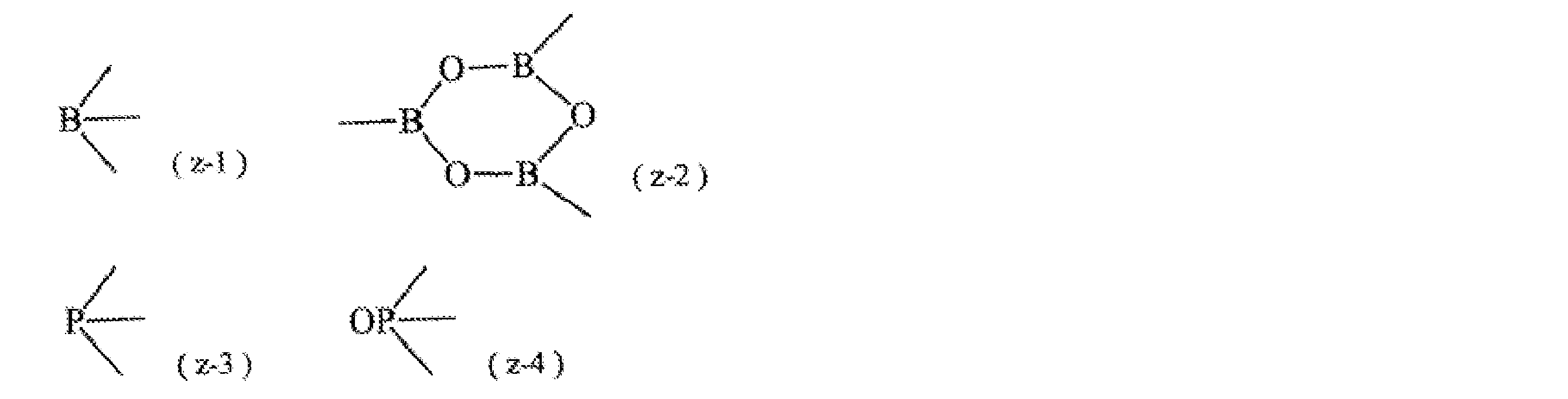
- 前記Bi以外の金属は、Zn、Al、Mo、Fe、Ti及びCuからなる群より選択される少なくとも一種であることを特徴とする、請求項1又は2に記載のゴム組成物。
- 前記Bi以外の金属は、Znであることを特徴とする、請求項3に記載のゴム組成物。
- 前記Bi以外の金属の有機酸塩の含有量が、前記ゴム成分100質量部に対して0.05質量部以上且つ15質量部以下であることを特徴とする、請求項1~4のいずれか1項に記載のゴム組成物。
- 前記Bi以外の金属の有機酸塩が、2-エチルヘキサン酸亜鉛及びジメタクリル酸亜鉛のうちから選択される少なくとも一種であることを特徴とする、請求項4に記載のゴム組成物。
- 前記ゴム組成物中の前記Bi元素の物質量が、0.007mol超え且つ0.02mol未満であることを特徴とする、請求項1~6のいずれか1項に記載のゴム組成物。
- 前記ゴム-金属接着促進剤の含有量が、前記ゴム成分100質量部に対して1.5質量部超え且つ25質量部以下であることを特徴とする、請求項1~7のいずれか1項に記載のゴム組成物。
- 有機酸塩ではない亜鉛化合物をさらに含み、該亜鉛化合物と前記Znの有機酸塩との合計含有量が、前記ゴム成分100質量部に対して17質量部以上且つ30質量部以下であることを特徴とする、請求項4に記載のゴム組成物。
- 前記(1)炭素数が2~25の脂肪族カルボン酸Bi塩におけるカルボン酸が、脂肪族モノカルボン酸又は脂肪族ジカルボン酸であることを特徴とする、請求項2に記載のゴム組成物。
- 前記(1)炭素数が2~25の脂肪族カルボン酸Bi塩におけるカルボン酸が、炭素数2~20の飽和の脂肪族モノカルボン酸であることを特徴とする、請求項10に記載のゴム組成物。
- 前記(1)炭素数が2~25の脂肪族カルボン酸Bi塩におけるカルボン酸が、2-エチルヘキサン酸、ネオデカン酸又はオクタデカン酸であることを特徴とする、請求項11に記載のゴム組成物。
- 前記(2)式(A)で表される化合物におけるZが、前記式(z-1)の構造であることを特徴とする、請求項2に記載のゴム組成物。
- 前記(2)式(A)で表される化合物における(RCOO)が、炭素原子数2~20の飽和の脂肪族モノカルボン酸の残基であることを特徴とする、請求項2に記載のゴム組成物。
- 前記(2)式(A)で表される化合物における(RCOO)が、2-エチルヘキサン酸の残基、ネオデカン酸の残基、ヘキサデカン酸の残基又はオクタデカン酸の残基であることを特徴とする、請求項14に記載のゴム組成物。
- 請求項1~15のいずれか1項に記載のゴム組成物と、金属部材と、を備えたことを特徴とする、ゴム-金属複合体。
- 前記金属部材は、亜鉛めっきが施されていることを特徴とする、請求項16に記載のゴム-金属複合体。
- 請求項16又は17に記載のゴム-金属複合体を用いたことを特徴とする、コンベヤベルト。
- 請求項16又は17に記載のゴム-金属複合体を用いたことを特徴とする、ホース。
- 請求項16又は17に記載のゴム-金属複合体を用いたことを特徴とする、クローラ。
- 請求項16又は17に記載のゴム-金属複合体を用いたことを特徴とする、タイヤ。
Priority Applications (3)
| Application Number | Priority Date | Filing Date | Title |
|---|---|---|---|
| EP20872159.7A EP4039741B1 (en) | 2019-09-30 | 2020-09-30 | Rubber composition, rubber-metal composite, conveyor belt, hose, crawler, and tire |
| US17/642,004 US20230002589A1 (en) | 2019-09-30 | 2020-09-30 | Rubber composition, rubber-metal composite, conveyor belt, hose, crawler, and tire |
| CN202080067984.9A CN114450337B (zh) | 2019-09-30 | 2020-09-30 | 橡胶组合物、橡胶-金属复合体、输送带、软管、履带、和轮胎 |
Applications Claiming Priority (4)
| Application Number | Priority Date | Filing Date | Title |
|---|---|---|---|
| JP2019-180382 | 2019-09-30 | ||
| JP2019-180395 | 2019-09-30 | ||
| JP2019180395A JP2021054972A (ja) | 2019-09-30 | 2019-09-30 | ゴム組成物、ゴム−金属複合体、コンベヤベルト、ホース、クローラ及びタイヤ |
| JP2019180382A JP2021054971A (ja) | 2019-09-30 | 2019-09-30 | ゴム組成物、ゴム−金属複合体、コンベヤベルト、ホース、クローラ及びタイヤ |
Publications (1)
| Publication Number | Publication Date |
|---|---|
| WO2021066072A1 true WO2021066072A1 (ja) | 2021-04-08 |
Family
ID=75337053
Family Applications (1)
| Application Number | Title | Priority Date | Filing Date |
|---|---|---|---|
| PCT/JP2020/037325 Ceased WO2021066072A1 (ja) | 2019-09-30 | 2020-09-30 | ゴム組成物、ゴム-金属複合体、コンベヤベルト、ホース、クローラ及びタイヤ |
Country Status (4)
| Country | Link |
|---|---|
| US (1) | US20230002589A1 (ja) |
| EP (1) | EP4039741B1 (ja) |
| CN (1) | CN114450337B (ja) |
| WO (1) | WO2021066072A1 (ja) |
Citations (4)
| Publication number | Priority date | Publication date | Assignee | Title |
|---|---|---|---|---|
| JP2011219507A (ja) * | 2010-04-02 | 2011-11-04 | Kaneka Corp | 硬化性組成物 |
| WO2016039375A1 (ja) | 2014-09-12 | 2016-03-17 | Dic株式会社 | ゴムと金属との接着促進剤、ゴム組成物及びタイヤ |
| JP2016515149A (ja) * | 2013-03-04 | 2016-05-26 | ニトロヘミー、アッシヤウ、ゲーエムベーハー | シリコーンゴム材料の製造用組成物 |
| WO2017056414A1 (ja) | 2015-09-30 | 2017-04-06 | 株式会社ブリヂストン | ホース用ゴム組成物、ホース用積層体及びホース |
Family Cites Families (5)
| Publication number | Priority date | Publication date | Assignee | Title |
|---|---|---|---|---|
| DE69130586T2 (de) * | 1990-05-01 | 1999-06-17 | R-Tech Ueno, Ltd., Osaka | Behandlung von Pankreaskrankheit mit 15-keto-Prostaglandin E-Derivaten |
| JP4311986B2 (ja) * | 2003-06-05 | 2009-08-12 | 日鉱金属株式会社 | ゴムと金属との接着促進剤、その製造方法、およびそれを含むゴム組成物 |
| JP4508730B2 (ja) * | 2004-06-08 | 2010-07-21 | 株式会社ブリヂストン | 亜鉛メッキスチールコードとゴムとの接着方法及びコンベアベルト |
| WO2010039375A1 (en) * | 2008-10-02 | 2010-04-08 | Exxonmobil Oil Corporation | Film composition with controlled properties |
| EP3192830B1 (en) * | 2014-09-12 | 2019-08-14 | DIC Corporation | Rubber metal adhesion promoter, rubber composition, and tire |
-
2020
- 2020-09-30 CN CN202080067984.9A patent/CN114450337B/zh active Active
- 2020-09-30 US US17/642,004 patent/US20230002589A1/en not_active Abandoned
- 2020-09-30 EP EP20872159.7A patent/EP4039741B1/en active Active
- 2020-09-30 WO PCT/JP2020/037325 patent/WO2021066072A1/ja not_active Ceased
Patent Citations (4)
| Publication number | Priority date | Publication date | Assignee | Title |
|---|---|---|---|---|
| JP2011219507A (ja) * | 2010-04-02 | 2011-11-04 | Kaneka Corp | 硬化性組成物 |
| JP2016515149A (ja) * | 2013-03-04 | 2016-05-26 | ニトロヘミー、アッシヤウ、ゲーエムベーハー | シリコーンゴム材料の製造用組成物 |
| WO2016039375A1 (ja) | 2014-09-12 | 2016-03-17 | Dic株式会社 | ゴムと金属との接着促進剤、ゴム組成物及びタイヤ |
| WO2017056414A1 (ja) | 2015-09-30 | 2017-04-06 | 株式会社ブリヂストン | ホース用ゴム組成物、ホース用積層体及びホース |
Non-Patent Citations (1)
| Title |
|---|
| See also references of EP4039741A4 |
Also Published As
| Publication number | Publication date |
|---|---|
| EP4039741A1 (en) | 2022-08-10 |
| EP4039741B1 (en) | 2024-11-20 |
| CN114450337B (zh) | 2023-10-24 |
| EP4039741A4 (en) | 2023-11-01 |
| CN114450337A (zh) | 2022-05-06 |
| US20230002589A1 (en) | 2023-01-05 |
Similar Documents
| Publication | Publication Date | Title |
|---|---|---|
| KR102326285B1 (ko) | 고무와 금속과의 접착촉진제, 고무 조성물 및 타이어 | |
| KR102273441B1 (ko) | 고무와 금속과의 접착촉진제, 고무 조성물 및 타이어 | |
| WO2022123869A1 (ja) | ゴム組成物、ゴム-金属複合体、ホース、コンベヤベルト、ゴムクローラ及びタイヤ | |
| US20240209192A1 (en) | Rubber composition, rubber-metal composite, tire, hose, and crawler | |
| JP7568496B2 (ja) | ゴム組成物、ゴム-金属複合体、ホース、コンベヤベルト、ゴムクローラ及びタイヤ | |
| EP4039741B1 (en) | Rubber composition, rubber-metal composite, conveyor belt, hose, crawler, and tire | |
| JP7360883B2 (ja) | ゴム組成物、複合体、ホース、コンベヤベルト、クローラおよびタイヤ | |
| JP2021054972A (ja) | ゴム組成物、ゴム−金属複合体、コンベヤベルト、ホース、クローラ及びタイヤ | |
| JP2021054971A (ja) | ゴム組成物、ゴム−金属複合体、コンベヤベルト、ホース、クローラ及びタイヤ | |
| JP7360882B2 (ja) | ゴム組成物、複合体、ホース、コンベヤベルト、クローラおよびタイヤ | |
| JP7397637B2 (ja) | 金属-ゴム複合体、コンベヤベルト、ホース、ゴムクローラ及びタイヤ | |
| JP2021053991A (ja) | ゴム−金属複合体、コンベヤベルト、ホース、クローラ、及びタイヤ | |
| JP2021053992A (ja) | ゴム−金属複合体、コンベヤベルト、ホース、クローラ、及びタイヤ |
Legal Events
| Date | Code | Title | Description |
|---|---|---|---|
| 121 | Ep: the epo has been informed by wipo that ep was designated in this application |
Ref document number: 20872159 Country of ref document: EP Kind code of ref document: A1 |
|
| NENP | Non-entry into the national phase |
Ref country code: DE |
|
| ENP | Entry into the national phase |
Ref document number: 2020872159 Country of ref document: EP Effective date: 20220502 |