WO2021067384A1 - Methods of treating animal proteins - Google Patents
Methods of treating animal proteins Download PDFInfo
- Publication number
- WO2021067384A1 WO2021067384A1 PCT/US2020/053454 US2020053454W WO2021067384A1 WO 2021067384 A1 WO2021067384 A1 WO 2021067384A1 US 2020053454 W US2020053454 W US 2020053454W WO 2021067384 A1 WO2021067384 A1 WO 2021067384A1
- Authority
- WO
- WIPO (PCT)
- Prior art keywords
- animal
- ppm
- protein
- limiting embodiments
- protein sources
- Prior art date
- Legal status (The legal status is an assumption and is not a legal conclusion. Google has not performed a legal analysis and makes no representation as to the accuracy of the status listed.)
- Ceased
Links
Classifications
-
- A—HUMAN NECESSITIES
- A23—FOODS OR FOODSTUFFS; TREATMENT THEREOF, NOT COVERED BY OTHER CLASSES
- A23J—PROTEIN COMPOSITIONS FOR FOODSTUFFS; WORKING-UP PROTEINS FOR FOODSTUFFS; PHOSPHATIDE COMPOSITIONS FOR FOODSTUFFS
- A23J3/00—Working-up of proteins for foodstuffs
- A23J3/04—Animal proteins
-
- A—HUMAN NECESSITIES
- A23—FOODS OR FOODSTUFFS; TREATMENT THEREOF, NOT COVERED BY OTHER CLASSES
- A23B—PRESERVATION OF FOODS, FOODSTUFFS OR NON-ALCOHOLIC BEVERAGES; CHEMICAL RIPENING OF FRUIT OR VEGETABLES
- A23B4/00—Preservation of meat, sausages, fish or fish products
- A23B4/14—Preserving with chemicals not covered by groups A23B4/02 or A23B4/12
- A23B4/18—Preserving with chemicals not covered by groups A23B4/02 or A23B4/12 in the form of liquids or solids
- A23B4/24—Inorganic compounds
-
- A—HUMAN NECESSITIES
- A23—FOODS OR FOODSTUFFS; TREATMENT THEREOF, NOT COVERED BY OTHER CLASSES
- A23J—PROTEIN COMPOSITIONS FOR FOODSTUFFS; WORKING-UP PROTEINS FOR FOODSTUFFS; PHOSPHATIDE COMPOSITIONS FOR FOODSTUFFS
- A23J1/00—Obtaining protein compositions for foodstuffs; Bulk opening of eggs and separation of yolks from whites
- A23J1/001—Obtaining protein compositions for foodstuffs; Bulk opening of eggs and separation of yolks from whites from waste materials, e.g. kitchen waste
- A23J1/002—Obtaining protein compositions for foodstuffs; Bulk opening of eggs and separation of yolks from whites from waste materials, e.g. kitchen waste from animal waste materials
-
- A—HUMAN NECESSITIES
- A23—FOODS OR FOODSTUFFS; TREATMENT THEREOF, NOT COVERED BY OTHER CLASSES
- A23K—FODDER
- A23K10/00—Animal feeding-stuffs
- A23K10/20—Animal feeding-stuffs from material of animal origin
- A23K10/26—Animal feeding-stuffs from material of animal origin from waste material, e.g. feathers, bones or skin
-
- A—HUMAN NECESSITIES
- A23—FOODS OR FOODSTUFFS; TREATMENT THEREOF, NOT COVERED BY OTHER CLASSES
- A23K—FODDER
- A23K20/00—Accessory food factors for animal feeding-stuffs
- A23K20/10—Organic substances
- A23K20/142—Amino acids; Derivatives thereof
- A23K20/147—Polymeric derivatives, e.g. peptides or proteins
Definitions
- animal proteins of the present disclosure can be treated with one or more base components in order to advantageously increase preservation and reduce deterioration of the animal protein.
- the animal proteins treated in accordance with the present disclosure can be used in combination with other components to form, for example, a pet food product.
- Pet food products provide a widespread means for feeding pets. With respect to manufactured pet food products, there has been heightened demand to incorporate natural ingredients with increased freshness and quality while also providing the convenience of prolonged shelf life. Freshness and reduced fermentation of raw ingredients, such as meats and viscera, have been achieved in various ways, for example, by reducing the temperature of the components in order to freeze or chill them. Other known methods include acidifying or decreasing the pH of the raw materials. For example, commercial products which decrease pH in order to reduce or prevent the growth of bacteria and preserve the raw materials are readily available. Improving both the quality and freshness of dry and wet animal proteins used in such pet food products results in improved product performance with pets due to increased palatability.
- the presently disclosed subject matter provides for processes for treating animal proteins.
- Such treated proteins can be used in combination with other components to form pet food products. It was surprisingly and advantageously found that increasing the pH of animal proteins using a base component resulted in reduced fermentation as well as increased freshness and quality of such raw materials. By increasing the pH of the raw materials in accordance with the present disclosure, spoilage and fermentation of the same can be favorably reduced or prevented. Further, the quality of pet food can be increased by obtaining fresher raw material due to such treated animal proteins, for example, as indicated by levels of biogenic amines. This increase in quality can impact palatability and additionally advantageously impact any side effects caused by biogenic amines.
- the present disclosure provides for methods of treating one or more protein sources.
- the method can include adding one or more base components to the one or more protein sources.
- the treated protein sources can have a histamine level of less than about 300 ppm.
- the treated protein sources can have a histamine level of from about 10 ppm to about 200 ppm.
- the present invention relates to a method of treating one or more protein sources, the method comprising adding one or more base components to the protein source, wherein the treated protein sources have a histamine level of less than about 300 ppm.
- the base component can include sodium hydroxide (NaOH). In certain non-limiting embodiments, the base component is sodium hydroxide (NaOH) alone. In certain non-limiting embodiments, the sodium hydroxide can be present in an amount of from about 0.25 wt% to about 0.5 wt%.
- the base component is added in the absence of the addition of an acid component.
- the one or more protein sources can include animal protein, animal-derived protein, or combinations thereof.
- the one or more protein sources can include viscera.
- the treated animal proteins can have a pH of from about 5 to about 8. In particular non-limiting embodiments, the treated animal proteins can have a pH of from about 6 to about 7.
- FIG. 1A depicts a graph illustrating the results of preservation testing by treating unground viscera with potassium hydroxide (KOH) as a base component at varying final concentrations in accordance with Example 1 and with certain non-limiting embodiments.
- Abscissa level of KOH, as expressed in wt%.
- Ordinate amount of histamine, as expressed in ppm.
- the amount of histamine (in ppm) is represented by the curve with the diamond shape.
- the pH value is represented by the curve with the square shape;
- FIG. IB depicts a graph illustrating the results of preservation testing by treating ground viscera with potassium hydroxide (KOH) as a base component at varying final concentrations in accordance with Example 1 and in with certain non-limiting embodiments.
- Abscissa level of KOH, as expressed in wt%.
- Ordinate amount of histamine, as expressed in ppm.
- the amount of histamine (in ppm) is represented by the curve with the diamond shape.
- the pH value is represented by the curve with the square shape;
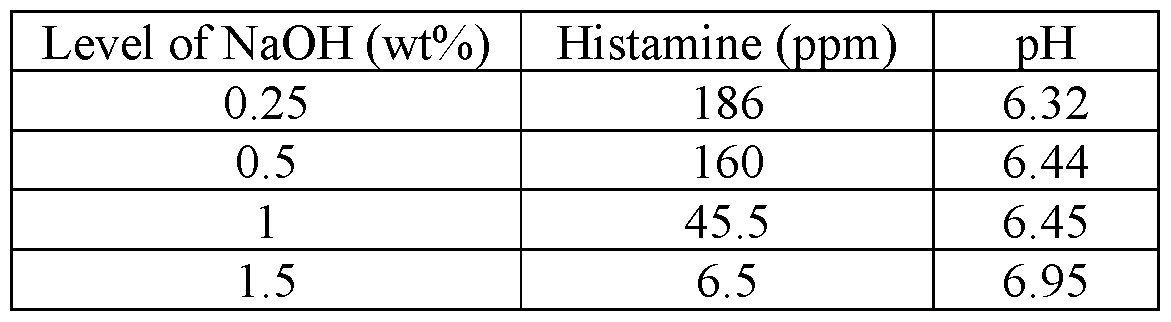
- FIG. 2A depicts a graph illustrating the results of preservation testing by treating unground viscera with sodium hydroxide (NaOH) as a base component at varying final concentrations in accordance with Example 1 and certain non-limiting embodiments.
- Abscissa level of KOH, as expressed in wt%.
- Ordinate amount of histamine, as expressed in ppm. The amount of histamine (in ppm) is represented by the curve with the diamond shape.
- the pH value is represented by the curve with the square shape;
- FIG. 2B depicts a graph illustrating the results of preservation testing by treating ground viscera with sodium hydroxide (NaOH) as a base component at varying final concentrations in accordance with Example 1 and certain non-limiting embodiments.
- Abscissa level of KOH, as expressed in wt%.
- Ordinate amount of histamine, as expressed in ppm. The amount of histamine (in ppm) is represented by the curve with the diamond shape.
- the pH value is represented by the curve with the square shape;
- FIG. 3 depicts a graph illustrating the results of preservation testing by treating poultry meal including viscera with sodium hydroxide (NaOH) as a base component at varying final concentrations and at various times in accordance with Example 2 and certain non limiting embodiments.
- Each bar on the abscissa of the graph illustrates the amount of histamine (in mg/kg) for each of the mentioned conditions.
- FIG. 4 depicts a graph illustrating the results of preservation testing by treating poultry meal including viscera with sodium hydroxide (NaOH) as a base component at varying final concentrations and at various times in accordance with Example 2 and certain non limiting embodiments.
- Each bar on the abscissa of the graph illustrates the amount of cadaverine (in mg/kg) for each of the mentioned conditions.
- animal proteins of the present disclosure can be treated with one or more base components. It was surprisingly and advantageously found that increasing the pH of animal proteins resulted in reduced or prevention of deterioration of the material.
- the animal proteins treated in accordance with the present disclosure can be used in combination with other components to form, for example, a pet food product.
- the term “about” or “approximately” means within an acceptable error range for the particular value as determined by one of ordinary skill in the art, which will depend in part on how the value is measured or determined, i.e., the limitations of the measurement system. For example, “about” can mean within three or more than three standard deviations, per the practice in the art. Alternatively, “about” can mean a range of up to 20%, preferably up to 10%, more preferably up to 5%, and more preferably still up to 1% of a given value. Also, particularly with respect to systems or processes, the term can mean within an order of magnitude, preferably within five-fold, and more preferably within two-fold, of a value.
- animal or “pet” refers to animals including, but not limited to, dogs, cats, and the like. Domestic dogs and cats are particular non-limiting examples of animals or pets.
- animal protein refers to animal-based sources of protein.
- animal protein includes, for example without limitation, meat (for example, pork, beef, or veal), poultry (for example, chicken), fish, organs (for example, liver, spleen, or heart), viscera (for example, viscera of chicken or pork), and combinations thereof.
- the terms “comprises,” “comprising,” or any other variation thereof, are intended to cover a non-exclusive inclusion, such that a process, method, article, or apparatus that comprises a list of elements does not include only those elements but can include other elements not expressly listed or inherent to such process, method, article, or apparatus.
- the term “nutritionally complete” refers to pet food products that contain all known required nutrients for the intended recipient of the pet food product, in all appropriate amounts and proportions based, for example, on recommendations of recognized and competent authorities in the field of animal nutrition. Such foods are therefore capable of serving as a source of dietary intake to maintain life, without the addition of supplemental nutritional sources.
- the term “nutritionally balanced”, as used herein, refers to pet food products that can be nutritionally complete. Alternatively, “nutritionally balanced”, as used herein, can refer to pet food products that are not nutritionally complete.
- palatability refers to being desirable to the palate or taste. Further, the terms “palatability” or “palatable” as used herein refer to the extent to which a pet food product appeals to the palate or taste of an animal. This is suitable measured by feeding tests, e.g., difference tests or ranking tests. In certain embodiments, “palatability” can mean a relative preference for one food product over another. For example, when an animal shows a preference for one of two or more food products, the preferred food product is more “palatable”, and has “enhanced palatability” or “increased palatability”.
- the relative palatability of one food product compared to one or more other food products can be determined, for example, in side-by-side, free-choice comparisons, e.g., by relative consumption of the food products, or other appropriate measures of preference indicative of palatability.
- pet food or “pet food composition” refer to a composition intended for ingestion by an animal or pet.
- Pet foods can include, without limitation, nutritionally balanced compositions suitable for daily feed as well as treats, which can be nutritionally balanced.
- protein source refers to the source of animal protein, animal-derived protein, or combinations thereof.
- viscera refers to intestines of the body. Viscera can additionally include other internal organs of the body, for example, the heart, stomach or lungs in natural proportions.
- weight percent is meant to refer to the quantity by weight of a constituent or component, for example, in the pet food composition as a percentage of the overall weight of the pet food composition.
- weight percent can also refer to the quantity by weight of a constituent or component, for example, in the hydrolysate composition as a percentage of the overall weight of the hydrolysate composition.
- weight percent “wt-%,” “wt.%”, and “wt%” are used interchangeably.
- animal proteins of the present disclosure can be treated according to processes disclosed herein.
- the pH of the animal proteins can be increased by one or more base components.
- Such treatment surprisingly and advantageously provided for reduced deterioration and increased preservation characteristics of the animal proteins.
- the one or more protein sources can include animal protein, animal-derived protein or combinations thereof.
- the one or more protein sources can include animal protein sources such as chicken or pork.
- the one or more protein sources can include, for example, trachea, kidney, liver, or viscera.
- the term “protein” refers to one or more proteins suitably provided by one or more of the raw materials.
- the protein may suitably be animal proteins, animal-derived proteins or any combination thereof.
- Animal proteins include any protein of animal origin (including vertebrate and invertebrate proteins), e.g., proteins derived from mammals, fowl, fish and insects.
- suitable animal proteins include those derived from chicken, turkey, beef, lamb, pork, venison, buffalo, duck, kangaroo, shell fish, crustaceans, salmon, tuna, whitefish, etc. They may suitably be derived from muscle meat, organs, tendons, bone, etc.
- the proteins may be in any suitable form, e.g., isolated or partially isolated; concentrated; ground, etc.
- the one or more protein sources can include one or more of pork trachea, pork kidney, poultry parts, chicken liver, chicken viscera, chicken necks, organs, turkey carcasses, or combinations thereof.
- the one or more protein sources can include, for example, liver of chicken, turkey, pork, beef, lamb or fish.
- a person of skill in the art will appreciate a wide variety of protein sources are suitable for use with the present disclosure.
- the one or more protein sources can include animal viscera, for example, viscera of poultry.
- animal viscera for example, viscera of poultry.
- Such raw materials can be prone to fermentation and deterioration.
- the state of the material can have an effect on the rate and occurrence of fermentation and deterioration.
- ground viscera can be more prone to fermentation and deterioration as compared to native or unground viscera, for example, as enzymes in a ground viscera can be mixed with bacteria and the substrate.
- the initial pH of the one or more protein sources can be from about 5 to about 7, from about 5 to about 6.5, or from about 5 to 6. In particular non-limiting embodiments, the initial pH of the one or more protein sources can be about 5, about 5.5, about 6, or about 6.5.
- an initial pH of the one or more protein sources can vary, for example, depending on the raw material and its state (e.g., ground or unground).
- the one or more protein sources can be cooled or chilled prior to treatment.
- water can be at least partially removed from the one or more protein sources.
- the one or more animal proteins can be mixed together.
- the one or more protein sources can be treated with one or more base components.
- the one or more base components can be used to increase the pH of the one or more protein sources.
- the one or more base components can include any suitable base compound.
- the one or more base components can include sodium hydroxide (NaOH) or potassium hydroxide (KOH).
- base components include sodium hydroxide (NaOH) only.
- the one or more base components can be added to the one or more protein sources at a final concentration of from about 0.1 wt% to about 5 wt%, from about 0.1 wt% to about 4 wt%; from about 0.1 wt% to about 3 wt%; from about 0.1 wt% to about 2 wt%; from about 0.1 wt% to about 2 wt%; from about 0.1 wt% to about 1.5 wt%; from about 0.1 wt% to about 1.0 wt% or from about 0.1 wt% to about 0.5 wt%.
- the one or more base components can be added to the one or more protein sources at a final concentration of from about 0.25 wt% to about 5 wt%, from about 0.25 wt% to about 4 wt%; from about 0.25 wt% to about 3 wt%; from about 0.25 wt% to about 2 wt%; from about 0.25 wt% to about 2 wt%; from about 0.25 wt% to about 1.5 wt%; from about 0.25 wt% to about 1.0 wt% or from about 0.25 wt% to about 0.5 wt%.
- the one or more base components can be added to the one or more protein sources at a final concentration of from about 0.5 wt% to about 5 wt%, from about 0.5 wt% to about 4 wt%; from about 0.5 wt% to about 3 wt%; from about 0.5 wt% to about 2 wt%; from about 0.5 wt% to about 2 wt%; from about 0.5 wt% to about 1.5 wt%; from about 0.5 wt% to about 1.0 wt%.
- the one or more base components can be added to the one or more protein sources at a final concentration of about 0.1% wt, about 0.25 wt%, about 0.5 wt%, about 0.75 wt%, about 1 wt%, about 1.2 wt%, about 1.4 wt%, about 1.5 wt%, or about 2 wt%.
- the one or more base components include from about 0.25 wt% to about 0.5 wt% sodium hydroxide (NaOH). In certain embodiments, the one or more base components include from about 0.25 wt% to about 0.5 wt% sodium hydroxide (NaOH) only.
- the pH of the one or more protein sources after treatment can be in a range of from about 5.1 to about 8, from about 6 to about 7.8, from about 6.5 to about 7.5, or from about 6 to about 7.
- the pH of the one or more protein sources after treatment can be about 6, about 6.5, about 7, about 7.2, about 7.5, or about 7.8.
- the one or more base components can be applied to the one or more protein sources homogenously.
- the one or more base components can be sprayed onto the one or more protein sources.
- Protein sources treated in accordance with the present disclosure surprisingly and advantageously provide for reduced or prevented deterioration of the material.
- By increasing the pH of the raw materials in accordance with the present disclosure spoilage and fermentation of the same can be favorably reduced or prevented.
- the quality of pet food can be increased by obtaining fresher raw material by increasing the pH in accordance with methods of the present disclosure. Such quality can impact palatability and additionally advantageously impact any side effects caused by biogenic amines.
- the treated protein sources can have a histamine level of from about 0 ppm to about 500 ppm, from about 10 ppm to about 300 ppm, from about 100 ppm to about 200 ppm, from about 10 ppm to about 200 ppm, or from about 10 ppm to about 150 ppm.
- the treated animal protein can have a histamine level of about 0 ppm, about 10 ppm, about 15 ppm, about 50 ppm, about 100 ppm, about 125 ppm, about 150 ppm, about 200 ppm, about 250 ppm, about 275 ppm, about 300 ppm, or about 500 ppm.
- the treated animal protein can have a histamine level of less than about 500 ppm, less than about 300 ppm, less than about 250 ppm, less than about 200 ppm, less than about 100 ppm, less than about 50 ppm, or less than about 25 ppm.
- the treated protein sources can have a histamine level of from about 0 mg/kg to about 200 mg/kg, from about 10 mg/kg to about 150 mg/kg, from about 100 mg/kg to about 150 mg/kg, from about 10 mg/kg to about 90 mg/kg, or from about 10 mg/kg to about 50 mg/kg.
- the treated animal protein can have a histamine level of about 0 mg/kg, about 1 mg/kg, about 5 mg/kg, about 10 mg/kg, about 15 mg/kg, about 25 mg/kg, about 50 mg/kg, about 100 mg/kg, about 125 mg/kg, about 150 mg/kg, or about 200 mg/kg.
- the treated animal protein can have a histamine level of less than about 200 mg/kg, less than about 150 mg/kg, less than about 100 mg/kg, less than about 90 mg/kg, less than about 50 mg/kg, less than about 25 mg/kg, less than about 15 mg/kg, less than about 10 mg/kg, less than about 5 mg/kg, less than about 2 mg/kg or less than about 1 mg/kg.
- a pet food composition is provided.
- the pet food composition can include one or more treated animal proteins in accordance with the present disclosure and optionally one or more additional ingredients, for example, dry ingredients, liquid ingredients, or combinations thereof.
- additional ingredients for example, dry ingredients, liquid ingredients, or combinations thereof.
- a method of manufacturing pet food compositions is provided.
- one or more dry ingredients can be mixed with one or more wet ingredients to form an emulsion or dough.
- the emulsion or dough can be heated under pressure to a predetermined temperature and gradually cooled.
- an emulsion can be formed which can be comminuted and heated to a predetermined temperature, and subsequently introduced into a processing zone. In the processing zone, the emulsion can be subjected to a predetermined pressure and discharged.
- a slurry can be introduced to a scraped heat exchanger at a predetermined pressure and heated to produce a heat-treated product having a certain temperature.
- one or more dry ingredients can be mixed with one or more wet ingredients, for example, water, to form a dough.
- the dough can be cooked during extrusion under conditions of elevated temperature, pressure, or combination thereof.
- the extruder can be provided with a die having a particular shape and the extrudate can be segmented into particles or pieces as the product is extruded.
- Animal proteins treated in accordance with the present disclosure can be used as raw materials along with other components to form a pet food product.
- the pet food composition can be used alone as a pet food product or in combination with other components to form a mixed pet food product.
- Any suitable pet food application can be used with the animal proteins of the present disclosure.
- animal proteins treated in accordance with the present disclosure can be suitable for use in dry, wet such as loaf or chunk in gravy, treats, bakery, or pillow-related pet food products.
- Analytical method for biogenic amine profile The principle consists in an acid extraction of the biogenic amines and the determination by high-performance liquid chromatography with fluorescence detection (HPLC-FLD) after o-Phthaldialdehyde (OP A) post-column derivatization. This protocol is adapted from AO AC International (Association of Official Analytical Chemists - International) volume 78, n°4, 1995 and AO AC International volume 81, n°5, 1998.
- AO AC International Association of Official Analytical Chemists - International
- the limit of quantification in the matrices is 2 mg/kg for histamine and 5 mg/kg for all the other biogenic amine.
- Analytical method for hexanal The principle consists in extracting the hexanal by using a Static Headspace extraction then analyzing by gas chromatography with flame-ionization detection (GC-FID) using an internal quantification.
- GC-FID flame-ionization detection
- EXAMPLE 1 Potassium Hydroxide (KOH) and Sodium Hydroxide (NaOH) Pre- Treatment Testing of Viscera (Varied final Concentrations)
- KOH potassium hydroxide
- NaOH sodium hydroxide
- KOH pre treatment was tested at a final concentration of 0 wt%, 0.5 wt%, 1 wt%, 1.2 wt%, 1.4 wt% and 1.5 wt% for unground animal viscera and at a final concentration of 0 wt%, 0.75 wt%, 1 wt%, 1.2 wt%, 1.4 wt% and 1.5 wt% for ground animal viscera.
- Sodium hydroxide (NaOH) pre treatment was tested at the following final concentrations 0 wt%, 0.25 wt%, 0.5 wt% and 1 wt% for unground animal viscera and at a final concentration of 0.25 wt%, 0.5 wt%, 1 wt% and 1.5 wt% for ground animal viscera.
- the level of histamine (ppm) and pH were measured for all samples. Histamine is a by-product from amino acid fermentation (histidine) can be used as a tracer of biogenic amines. A lower the level of histamine can indicate a fresher raw material.
- EXAMPLE 2 Sodium Hydroxide (NaOH) Pre-Treatment Testing (0.25 wt% and 0.5 wt% NaOH) of Poultry Meal Including Viscera
- Sodium hydroxide (NaOH) was tested in the pre-treatment of animal protein, i.e., poultry meal, at final concentrations of 0 wt%, 0.25 wt%, and 0.5 wt% over a period of time.
- the level of histamine (mg/kg) was measured at 1 hour, 5 hours, 12 hours, 20 hours, 24 hours, and 30 hours for each final concentration of sodium hydroxide (NaOH) pre-treatment. Viscera from standard chickens was removed from the slaughterhouse directly after conveying and screening.
- a homogeneous mixture of fresh viscera was separated into three containers with identical weights (i.e., “Control”; “NaOH added at 0.25 wt%”; and “NaOH added at 0.5 wt%”) promptly after slaughtering.
- soda at 80% by mass was added to each of the three containers.
- the three containers were then hand blended for 30 seconds.
- the containers were placed in a controlled room maintained at 20 °C for the duration of the testing. Samples were taken at the same time point (T0-T5) from each of the three containers as provided in Table 3 and stored immediately in a freezer. A total of 16 samples were tested.
- Control was tested at TO and all three containers (Control, 0.25 wt% NaOH, and 0.5 wt% NaOH) were tested at T1-T5. Agitation was performed on each container before each intermediate sampling step. After 30 hours of storage, all samples were dehydrated in the oven at 115°C for 24 hours prior to testing for hexanal (oxidation), biogenic amines, and sodium.
- results of hexanal, sodium, and biogenic amines testing are provided in Table 4.
- results of histamine levels (mg/kg) are provided in FIG. 3.
- results of cadaverine levels (mg/kg) are provided in FIG. 4.
- sodium hydroxide (NaOH) can be used to preserve animal protein.
- Sodium hydroxide (NaOH) at a final concentration of 0.5 wt% was more efficient in preservation of the animal protein and impacted the pH of the animal protein more as compared to sodium hydroxide (NaOH) at a final concentration of 0.25 wt%.
- the higher final concentration of sodium hydroxide (NaOH) at 0.5 wt% increased the pH of the material to a more basic level as compared to sodium hydroxide (NaOH) at a final concentration of 0.25 wt%.
- the histamine level of the material decreased in correlation with an increasing final concentration of sodium hydroxide (NaOH), i.e., from 0 wt%, 0.25 wt% to 0.5 wt%.
Landscapes
- Life Sciences & Earth Sciences (AREA)
- Chemical & Material Sciences (AREA)
- Polymers & Plastics (AREA)
- Engineering & Computer Science (AREA)
- Zoology (AREA)
- Food Science & Technology (AREA)
- Biochemistry (AREA)
- Health & Medical Sciences (AREA)
- Animal Husbandry (AREA)
- Nutrition Science (AREA)
- Biotechnology (AREA)
- Molecular Biology (AREA)
- Physiology (AREA)
- Biomedical Technology (AREA)
- Proteomics, Peptides & Aminoacids (AREA)
- Inorganic Chemistry (AREA)
- Chemical Kinetics & Catalysis (AREA)
- General Chemical & Material Sciences (AREA)
- Wood Science & Technology (AREA)
- Fodder In General (AREA)
- Peptides Or Proteins (AREA)
Abstract
Description




Claims
Priority Applications (11)
| Application Number | Priority Date | Filing Date | Title |
|---|---|---|---|
| US17/765,871 US20220346406A1 (en) | 2019-10-02 | 2020-09-30 | Methods of treating animal proteins |
| CA3151388A CA3151388A1 (en) | 2019-10-02 | 2020-09-30 | Methods of treating animal proteins |
| EP20872806.3A EP4037488A4 (en) | 2019-10-02 | 2020-09-30 | ANIMAL PROTEIN PROCESSING METHODS |
| KR1020227014873A KR20220075409A (en) | 2019-10-02 | 2020-09-30 | Methods for processing animal protein |
| BR112022005618A BR112022005618A2 (en) | 2019-10-02 | 2020-09-30 | ANIMAL PROTEIN TREATMENT METHODS |
| CN202080071586.4A CN114554861A (en) | 2019-10-02 | 2020-09-30 | Method for treating animal proteins |
| MX2022003777A MX2022003777A (en) | 2019-10-02 | 2020-09-30 | METHODS OF TREATMENT OF ANIMAL PROTEINS. |
| JP2022515847A JP7860664B2 (en) | 2019-10-02 | 2020-09-30 | Methods for processing animal protein |
| AU2020357938A AU2020357938A1 (en) | 2019-10-02 | 2020-09-30 | Methods of treating animal proteins |
| ZA2022/03145A ZA202203145B (en) | 2019-10-02 | 2022-03-16 | Methods of treating animal proteins |
| JP2025161837A JP2026004403A (en) | 2019-10-02 | 2025-09-29 | How animal protein is processed |
Applications Claiming Priority (2)
| Application Number | Priority Date | Filing Date | Title |
|---|---|---|---|
| EP19306262.7 | 2019-10-02 | ||
| EP19306262.7A EP3799721A1 (en) | 2019-10-02 | 2019-10-02 | Methods of treating animal proteins |
Publications (1)
| Publication Number | Publication Date |
|---|---|
| WO2021067384A1 true WO2021067384A1 (en) | 2021-04-08 |
Family
ID=68296411
Family Applications (1)
| Application Number | Title | Priority Date | Filing Date |
|---|---|---|---|
| PCT/US2020/053454 Ceased WO2021067384A1 (en) | 2019-10-02 | 2020-09-30 | Methods of treating animal proteins |
Country Status (11)
| Country | Link |
|---|---|
| US (1) | US20220346406A1 (en) |
| EP (2) | EP3799721A1 (en) |
| JP (1) | JP2026004403A (en) |
| KR (1) | KR20220075409A (en) |
| CN (1) | CN114554861A (en) |
| AU (1) | AU2020357938A1 (en) |
| BR (1) | BR112022005618A2 (en) |
| CA (1) | CA3151388A1 (en) |
| MX (1) | MX2022003777A (en) |
| WO (1) | WO2021067384A1 (en) |
| ZA (1) | ZA202203145B (en) |
Citations (4)
| Publication number | Priority date | Publication date | Assignee | Title |
|---|---|---|---|---|
| US20120213889A1 (en) * | 2009-10-09 | 2012-08-23 | Wen Chiang | Methods for enhancing animal digest palatability |
| US20130156887A1 (en) * | 2004-05-26 | 2013-06-20 | Norcape Biotechnology As | Hydrolysed marine protein product, process for the production thereof, and application |
| US20140134319A1 (en) * | 2011-09-22 | 2014-05-15 | Samsung Fine Chemicals Co., Ltd | Processed meat product without added phosphate, and method of producing same |
| US20140242215A1 (en) * | 2011-10-03 | 2014-08-28 | Specialites Pet Food | Animal digests having enhanced palatability for use in pet food |
Family Cites Families (20)
| Publication number | Priority date | Publication date | Assignee | Title |
|---|---|---|---|---|
| US1920222A (en) * | 1928-05-09 | 1933-08-01 | Atlantic Coast Fisheries Co | Process of treating comestibles |
| US3215540A (en) * | 1962-11-02 | 1965-11-02 | Rath Packing Company | Process of curing meat and composition therefor |
| SE366467B (en) * | 1973-02-19 | 1974-04-29 | T Kosuge | |
| US3968255A (en) * | 1974-04-08 | 1976-07-06 | General Foods Corporation | Method of preparing animal food of increased palatability |
| DK509681A (en) * | 1981-11-17 | 1983-05-18 | Matcon Radgivende Ing Firma | PROCEDURE FOR INCREASING SUSTAINABILITY AND WATER BONDING CAPACITY AND IMPROVING THE CONSISTENCY OF MEAT FROM MEATS |
| US5102987A (en) * | 1988-10-14 | 1992-04-07 | Nestec S.A. | Preparation of hydrolyzed protein having reduced α-chlorohydrin content |
| JP2957826B2 (en) * | 1992-12-01 | 1999-10-06 | 三慶株式会社 | Pretreatment agent for processing marine products and pretreatment method for marine products |
| KR100226098B1 (en) * | 1995-03-06 | 1999-10-15 | 가타야마 시스카 | Processed fish meat, fish meat material prepared by using the same, and process for producing processed fish meat |
| NO309673B1 (en) * | 1999-07-05 | 2001-03-12 | Norsk Hydro As | Gelled feed product, means for making the product and process for making said product |
| BRPI0411880A (en) * | 2003-06-24 | 2006-08-29 | Cargill Inc | peptone recovery |
| US20050058751A1 (en) * | 2003-07-21 | 2005-03-17 | Eugene Brotsky | Yield and shelf life for meats |
| US7862843B2 (en) * | 2004-01-14 | 2011-01-04 | Urthtech, Llc | Method of sanitizing a biological tissue |
| BE1016629A3 (en) * | 2005-06-06 | 2007-03-06 | Sfinc Nv | METHOD AND DEVICE FOR PROCESSING animal offal. |
| FR2960129B1 (en) * | 2010-05-20 | 2014-10-10 | Roquette Freres | PROCESS FOR THE PREPARATION OF ALKALINE HYDROLYSATES OF PLANT PROTEINS |
| FR2975259B1 (en) * | 2011-05-16 | 2014-01-31 | Roquette Freres | INDUSTRIAL PROCESS FOR THE PREPARATION OF ALKALINE HYDROLYSATES OF PLANT PROTEINS |
| JP6276286B2 (en) * | 2012-12-14 | 2018-02-07 | ヒルズ・ペット・ニュートリシャン・インコーポレーテッド | Anti-aging food for companion animals |
| FR3004725B1 (en) * | 2013-04-19 | 2016-01-08 | Ifremer | USE OF LACTOBACILLUS SAKEI FOR BIOPRESERVATION OF THE PRODUCTS OF THE SEA |
| EP2832237A1 (en) * | 2013-07-30 | 2015-02-04 | Tessenderlo Chemie NV | Method for producing hydrolysed keratinaceous material |
| CN104543970A (en) * | 2015-01-13 | 2015-04-29 | 浙江工业大学 | Deep processing method of low-value marine fish leftover protein hydrolysate |
| EP3422868B1 (en) * | 2016-03-02 | 2019-12-18 | Spécialités Pet Food | Palatable cat kibbles containing specific fat fractions |
-
2019
- 2019-10-02 EP EP19306262.7A patent/EP3799721A1/en active Pending
-
2020
- 2020-09-30 CN CN202080071586.4A patent/CN114554861A/en active Pending
- 2020-09-30 EP EP20872806.3A patent/EP4037488A4/en active Pending
- 2020-09-30 WO PCT/US2020/053454 patent/WO2021067384A1/en not_active Ceased
- 2020-09-30 KR KR1020227014873A patent/KR20220075409A/en not_active Ceased
- 2020-09-30 CA CA3151388A patent/CA3151388A1/en active Pending
- 2020-09-30 US US17/765,871 patent/US20220346406A1/en active Pending
- 2020-09-30 AU AU2020357938A patent/AU2020357938A1/en active Pending
- 2020-09-30 BR BR112022005618A patent/BR112022005618A2/en unknown
- 2020-09-30 MX MX2022003777A patent/MX2022003777A/en unknown
-
2022
- 2022-03-16 ZA ZA2022/03145A patent/ZA202203145B/en unknown
-
2025
- 2025-09-29 JP JP2025161837A patent/JP2026004403A/en not_active Abandoned
Patent Citations (4)
| Publication number | Priority date | Publication date | Assignee | Title |
|---|---|---|---|---|
| US20130156887A1 (en) * | 2004-05-26 | 2013-06-20 | Norcape Biotechnology As | Hydrolysed marine protein product, process for the production thereof, and application |
| US20120213889A1 (en) * | 2009-10-09 | 2012-08-23 | Wen Chiang | Methods for enhancing animal digest palatability |
| US20140134319A1 (en) * | 2011-09-22 | 2014-05-15 | Samsung Fine Chemicals Co., Ltd | Processed meat product without added phosphate, and method of producing same |
| US20140242215A1 (en) * | 2011-10-03 | 2014-08-28 | Specialites Pet Food | Animal digests having enhanced palatability for use in pet food |
Also Published As
| Publication number | Publication date |
|---|---|
| EP4037488A4 (en) | 2023-03-08 |
| EP3799721A1 (en) | 2021-04-07 |
| US20220346406A1 (en) | 2022-11-03 |
| AU2020357938A1 (en) | 2022-03-31 |
| MX2022003777A (en) | 2022-04-25 |
| JP2022550009A (en) | 2022-11-30 |
| JP2026004403A (en) | 2026-01-14 |
| CN114554861A (en) | 2022-05-27 |
| EP4037488A1 (en) | 2022-08-10 |
| CA3151388A1 (en) | 2021-04-08 |
| ZA202203145B (en) | 2023-11-29 |
| KR20220075409A (en) | 2022-06-08 |
| BR112022005618A2 (en) | 2022-07-12 |
Similar Documents
| Publication | Publication Date | Title |
|---|---|---|
| Duran et al. | Effects of slaughter methods on physical, biochemical and microbiological quality of rainbow trout Oncorhynchus mykiss and mirror carp Cyprinus carpio filleted in pre-, in-or post-rigor periods | |
| US20180360075A1 (en) | Cat food rolls | |
| US11291229B2 (en) | Meat analogs comprising thin flakes for food compositions | |
| US20240122205A1 (en) | Method for producing protein material | |
| EP2931061B1 (en) | Method of preparing a food composition | |
| US20220346406A1 (en) | Methods of treating animal proteins | |
| JP7860664B2 (en) | Methods for processing animal protein | |
| Tzikas et al. | Production of low-salt restructured Mediterranean horse mackerel (Trachurus mediterraneus) using microbial transglutaminase/caseinate system | |
| Palmeira et al. | Quality of semi-prepared products from rainbow trout waste (Onchorynchus mykiss) by using different technological strategics | |
| Vavrišínová et al. | LAUGHTER CHARACTERISTICS AND PHYSICAL TECHNOLOGICAL PARAMETERS OF VEAL FROM MALE CALVES OF HOLSTEIN AND SLOVAK SIMMENTAL BREEDS | |
| Aldrich | USA poultry meal: quality issues and concerns in pet foods. | |
| KR20260041395A (en) | Functional feed composition using animal protein sources and its manufacturing method | |
| Hedji et al. | Effect of packaging on the microbiological quality of chicken and fish viscera flour | |
| Fakolade et al. | A comparison study on the quality attributes of kilishi produced from camel, chevon and pork | |
| RU2694961C1 (en) | Fodder product for domestic animals | |
| RU2475039C2 (en) | Frozen natural fodder for cats and dogs | |
| Haščík et al. | Principal component analysis of sensory properties of chicken breast muscle supplemented with different feed additives. | |
| RU2781997C2 (en) | Meat analogues for feed compositions, containing thin plates | |
| RU2727653C1 (en) | Method for production of meat chips and composition for preparation thereof | |
| RU2726334C2 (en) | Method for preparation of small lump semi-products from reindeer by-product | |
| Pramila Umaraw et al. | Quality characteristics of edible byproducts compared to Longissimus dorsi muscle of Barbari kids. | |
| Akinwumi et al. | Proximate composition and organoleptic assessment of Snakehead (Parachanna obscura Gunther, 1861) smoke-dried with different processing materials | |
| AMBROSIADIS | Copyright© 2018 Z TZIKAS, N SOULTOS, I AMBROSIADIS, A LAZARIDOU, SP GEORGAKIS | |
| RU2520018C1 (en) | Method for production of raw products of poultry meat | |
| Zuber et al. | Rate and Extent of Troponin-T Degradation in Loins from Pigs Selected for Low and High Residual Feed Intake |
Legal Events
| Date | Code | Title | Description |
|---|---|---|---|
| 121 | Ep: the epo has been informed by wipo that ep was designated in this application |
Ref document number: 20872806 Country of ref document: EP Kind code of ref document: A1 |
|
| ENP | Entry into the national phase |
Ref document number: 2022515847 Country of ref document: JP Kind code of ref document: A |
|
| ENP | Entry into the national phase |
Ref document number: 3151388 Country of ref document: CA |
|
| ENP | Entry into the national phase |
Ref document number: 2020357938 Country of ref document: AU Date of ref document: 20200930 Kind code of ref document: A |
|
| NENP | Non-entry into the national phase |
Ref country code: DE |
|
| REG | Reference to national code |
Ref country code: BR Ref legal event code: B01A Ref document number: 112022005618 Country of ref document: BR |
|
| ENP | Entry into the national phase |
Ref document number: 20227014873 Country of ref document: KR Kind code of ref document: A |
|
| ENP | Entry into the national phase |
Ref document number: 2020872806 Country of ref document: EP Effective date: 20220502 |
|
| ENP | Entry into the national phase |
Ref document number: 112022005618 Country of ref document: BR Kind code of ref document: A2 Effective date: 20220324 |