WO2021070908A1 - 細胞凍結用組成物、細胞凍結方法、細胞培養方法、及び細胞凍結用キット - Google Patents
細胞凍結用組成物、細胞凍結方法、細胞培養方法、及び細胞凍結用キット Download PDFInfo
- Publication number
- WO2021070908A1 WO2021070908A1 PCT/JP2020/038136 JP2020038136W WO2021070908A1 WO 2021070908 A1 WO2021070908 A1 WO 2021070908A1 JP 2020038136 W JP2020038136 W JP 2020038136W WO 2021070908 A1 WO2021070908 A1 WO 2021070908A1
- Authority
- WO
- WIPO (PCT)
- Prior art keywords
- freezing
- cells
- composition
- cell
- cell freezing
- Prior art date
- Legal status (The legal status is an assumption and is not a legal conclusion. Google has not performed a legal analysis and makes no representation as to the accuracy of the status listed.)
- Ceased
Links
Images


Classifications
-
- A—HUMAN NECESSITIES
- A01—AGRICULTURE; FORESTRY; ANIMAL HUSBANDRY; HUNTING; TRAPPING; FISHING
- A01N—PRESERVATION OF BODIES OF HUMANS OR ANIMALS OR PLANTS OR PARTS THEREOF; BIOCIDES, e.g. AS DISINFECTANTS, AS PESTICIDES OR AS HERBICIDES; PEST REPELLANTS OR ATTRACTANTS; PLANT GROWTH REGULATORS
- A01N1/00—Preservation of bodies of humans or animals, or parts thereof
- A01N1/10—Preservation of living parts
- A01N1/12—Chemical aspects of preservation
- A01N1/122—Preservation or perfusion media
- A01N1/126—Physiologically active agents, e.g. antioxidants or nutrients
-
- A—HUMAN NECESSITIES
- A01—AGRICULTURE; FORESTRY; ANIMAL HUSBANDRY; HUNTING; TRAPPING; FISHING
- A01N—PRESERVATION OF BODIES OF HUMANS OR ANIMALS OR PLANTS OR PARTS THEREOF; BIOCIDES, e.g. AS DISINFECTANTS, AS PESTICIDES OR AS HERBICIDES; PEST REPELLANTS OR ATTRACTANTS; PLANT GROWTH REGULATORS
- A01N1/00—Preservation of bodies of humans or animals, or parts thereof
- A01N1/10—Preservation of living parts
- A01N1/12—Chemical aspects of preservation
- A01N1/122—Preservation or perfusion media
- A01N1/125—Freeze protecting agents, e.g. cryoprotectants or osmolarity regulators
-
- C—CHEMISTRY; METALLURGY
- C12—BIOCHEMISTRY; BEER; SPIRITS; WINE; VINEGAR; MICROBIOLOGY; ENZYMOLOGY; MUTATION OR GENETIC ENGINEERING
- C12N—MICROORGANISMS OR ENZYMES; COMPOSITIONS THEREOF; PROPAGATING, PRESERVING, OR MAINTAINING MICROORGANISMS; MUTATION OR GENETIC ENGINEERING; CULTURE MEDIA
- C12N1/00—Microorganisms; Compositions thereof; Processes of propagating, maintaining or preserving microorganisms or compositions thereof; Processes of preparing or isolating a composition containing a microorganism; Culture media therefor
- C12N1/04—Preserving or maintaining viable microorganisms
-
- C—CHEMISTRY; METALLURGY
- C12—BIOCHEMISTRY; BEER; SPIRITS; WINE; VINEGAR; MICROBIOLOGY; ENZYMOLOGY; MUTATION OR GENETIC ENGINEERING
- C12N—MICROORGANISMS OR ENZYMES; COMPOSITIONS THEREOF; PROPAGATING, PRESERVING, OR MAINTAINING MICROORGANISMS; MUTATION OR GENETIC ENGINEERING; CULTURE MEDIA
- C12N5/00—Undifferentiated human, animal or plant cells, e.g. cell lines; Tissues; Cultivation or maintenance thereof; Culture media therefor
- C12N5/06—Animal cells or tissues; Human cells or tissues
-
- C—CHEMISTRY; METALLURGY
- C12—BIOCHEMISTRY; BEER; SPIRITS; WINE; VINEGAR; MICROBIOLOGY; ENZYMOLOGY; MUTATION OR GENETIC ENGINEERING
- C12N—MICROORGANISMS OR ENZYMES; COMPOSITIONS THEREOF; PROPAGATING, PRESERVING, OR MAINTAINING MICROORGANISMS; MUTATION OR GENETIC ENGINEERING; CULTURE MEDIA
- C12N2500/00—Specific components of cell culture medium
- C12N2500/02—Atmosphere, e.g. low oxygen conditions
-
- C—CHEMISTRY; METALLURGY
- C12—BIOCHEMISTRY; BEER; SPIRITS; WINE; VINEGAR; MICROBIOLOGY; ENZYMOLOGY; MUTATION OR GENETIC ENGINEERING
- C12N—MICROORGANISMS OR ENZYMES; COMPOSITIONS THEREOF; PROPAGATING, PRESERVING, OR MAINTAINING MICROORGANISMS; MUTATION OR GENETIC ENGINEERING; CULTURE MEDIA
- C12N2523/00—Culture process characterised by temperature
Definitions
- the present invention relates to a cell freezing composition, a cell freezing method, a cell culture method, and a cell freezing kit.
- Patent Document 1 describes a cryopreservation medium composed of 90% fetal bovine serum and 10% DMSO (Patent Document 1, paragraph 0073, etc.).
- a cell freezing preservation solution containing an antifreeze agent such as DMSO is used as a cell culture medium. Place the cells in a cell freezing solution and store in a freezer. Freeze-stored cells are thawed, cultured and proliferated in large quantities.
- DMSO dimethyl methoxysulfoxide
- the present inventor diligently studied the environment in the cell freezing storage solution, and as a result, hydrogen water and / or hydrogen gas was added to the cell freezing storage solution to contain dissolved hydrogen, thereby freezing. We have found that the decrease in cell proliferation ability is suppressed in the cells after thawing, and have completed the present invention.
- Medium and Antifreeze and A composition for freezing cells which comprises.
- the redox potential of the cell freezing composition when measured at 25 ° C. under atmospheric pressure is ⁇ 700 mV or more and -100 mV or less.
- the pH of the cell freezing composition when measured at 25 ° C. under atmospheric pressure is 6.8 or more and 8.5 or less.
- a composition for freezing cells is provided.
- the step of preparing a mixture of the above cell freezing composition and cells, and The step of freezing the mixture to obtain a frozen product, and A cell freezing method is provided, including.
- the step of thawing the frozen product obtained by the above cell freezing method to obtain the thawed product, and The step of culturing the cells contained in the obtained melt and A cell culture method including the above is provided.
- a cell freezing kit including a storage container containing hydrogen water is provided.
- a cell freezing composition having excellent cell proliferation ability after freezing and thawing, a cell freezing method using the same, a cell culture method, and a cell freezing kit are provided.
- One of the cell freezing compositions of the present embodiment contains a medium, an antifreezing agent, and dissolved hydrogen.
- Dissolved hydrogen means hydrogen molecules that dissolve in the liquid.
- a dissolved hydrogen meter is used to show a dissolved hydrogen concentration of, for example, 0.1 ppm or more at 25 ° C. under atmospheric pressure, a state containing dissolved hydrogen is defined.
- the dissolved hydrogen concentration in the cell freezing composition is relatively high, the activity of the cells can be promoted at the time of mixing before the freezing operation, so that the damage to the cells during the freezing process can be reduced. it is conceivable that.
- the effect of dissolved hydrogen's ability to remove active oxygen is also considered.
- the cell freezing composition of the present embodiment it is possible to realize a cell freezing method in which cells having excellent cell proliferation ability after freezing and thawing, that is, cells having excellent MTT activity can be obtained, and a cell culture method using the cells.
- a cell freezing method and a cell culture method having an excellent cell growth rate can be realized.
- Such a method can be used for storage and transportation of organs, and is a useful method for medical technology such as regenerative medicine.
- the cell freezing composition is a hydrogen-containing cell freezing preservation solution used for freezing cells.
- a cell includes at least one or more of a single cell, a plurality of cells, a tissue in which cells are aggregated, or an organ (organ).
- cells used for cell freezing for example, animal cells or plant cells can be used.
- animal cells include invertebrate-derived cells such as insect cells, mammalian-derived cells such as human cells and mouse cells, bird-derived cells, amphibian-derived cells, reptile-derived cells, and vertebrate-derived cells such as fish-derived cells. And so on.
- mammalian-derived cells may be used.
- mammals include primates such as humans, mice, guinea pigs, rats, cows, horses, pigs, goats, dogs, rabbits and the like.
- Animal cells may be cells of any form such as primary cultured cells, established cells, passaged cells, cultured cells, somatic cells, stem cells, and tumor cells.
- Stem cells include adult stem cells, ES cells, and iPS cells.
- More specific cells include, for example, ES cells, iPS cells, mesenchymal cells, fibroblasts, muscle cells, osteoocytes, adipocytes, nerve cells, epithelial cells, their stem cells or progenitor cells, and them. Examples include cells that are induced to differentiate from.
- the cell may be an adherent cell or a floating cell.
- the cell freezing composition contains a medium.
- the medium can contain components necessary for cell life support.
- the medium is not particularly limited as long as it contains cell nutrients, and examples thereof include a freezing medium, a complete medium, a medium containing serum, and a serum-free medium. In the case of cells used for regenerative medicine, a serum-free medium may be used.
- a known basal medium may be used, and DMEM medium, EMEM medium, RPMI-1640 medium, ⁇ -MEM medium, F-12 medium, F-10 medium, M-199 medium, HAM medium, and the like.
- DMEM medium EMEM medium
- RPMI-1640 medium ⁇ -MEM medium
- F-12 medium F-10 medium
- M-199 medium M-199 medium
- HAM medium and the like.
- Examples include ERDF medium, L-15 medium, Williams E medium and the like. These may be used alone or in combination of two or more.
- the cell freezing composition contains an antifreezing agent. This makes it possible to protect cells from cell damage caused by ice crystals and osmotic action.
- the antifreeze agent is not particularly limited, and known ones may be used, and specific examples thereof include dimethyl sulfoxide (DMSO), hydroxyethyl starch (HES), ethylene glycol (EG), and glycerol. These may be used alone or in combination of two or more.
- DMSO dimethyl sulfoxide
- HES hydroxyethyl starch
- EG ethylene glycol
- glycerol glycerol
- the antifreeze concentration is appropriately selected according to the type of antifreeze, cell type, etc., but is, for example, 1% (v / v) to 15% (v / v) with respect to the entire medium. It may be preferably 5% (v / v) to 10% (v / v).
- the cell freezing composition may be configured to contain hydrogen water.
- Hydrogen water is water in which hydrogen is dissolved, and means water having a concentration of dissolved hydrogen equal to or higher than a predetermined value at 25 ° C. under atmospheric pressure.
- Hydrogen water is obtained by using raw water and preparing it using various methods such as pressure dissolution method, swirl flow method, ultrasonic method, and micropore method.
- the pressure dissolution method may be used.
- the dissolved hydrogen concentration and the dissolved oxygen concentration can be appropriately controlled.
- the pressure dissolution method can increase the dissolved hydrogen concentration in water while reducing the dissolved oxygen concentration.
- Distilled water ion-exchanged water, ultrapure water, or the like may be used as the raw water. These waters can be sterilized by heat treatment or filter treatment.
- the lower limit of the dissolved hydrogen concentration of hydrogen water when measured at 25 ° C. under atmospheric pressure is, for example, 0.1 ppm or more, preferably 0.2 ppm or more, and more preferably 0.3 ppm or more.
- the dissolved hydrogen concentration of the raw water placed in an open environment so as to come into contact with the atmosphere was usually 0.0 ppm at 25 ° C. under atmospheric pressure.
- the upper limit of the dissolved hydrogen concentration of hydrogen water may be, for example, 10.0 ppm or less, 5.0 ppm or less, preferably 2.0 ppm or less, 1.6 ppm or less, 1.5 ppm or less.
- the upper limit of the dissolved oxygen concentration of hydrogen water when measured at 25 ° C. under atmospheric pressure is, for example, 9.0 ppm or less, preferably 5.0 ppm or less, and more preferably 3.0 ppm or less.
- the lower limit of the dissolved oxygen concentration of hydrogen water is not particularly limited, but may be 0.0 ppm or more.
- Hydrogen water may contain fine bubbles such as ultrafine bubbles of 1 ⁇ m or less and microbubbles of more than 1 ⁇ m to 100 ⁇ m or less, but may be configured not to contain these fine bubbles.
- the cell freezing composition may contain one or more of appropriate serums and additives, if necessary, as long as the effects of the present invention are not impaired.
- additives include amino acids, non-essential amino acids, vitamins, low molecular weight compounds, sugars, proteins, buffers, inorganic salts, antibiotics, antibacterial agents, antioxidants, antifreeze agents, and the like. These may be used alone or in combination of two or more.
- animal serum for example, animal serum may be used, and specifically, human serum, fetal bovine serum (FBS), bovine serum, calf serum, goat serum, horse serum, pig serum, sheep serum, rabbit serum, etc.
- human serum fetal bovine serum (FBS), bovine serum, calf serum, goat serum, horse serum, pig serum, sheep serum, rabbit serum, etc.
- FBS fetal bovine serum
- bovine serum calf serum
- goat serum horse serum
- pig serum sheep serum
- rabbit serum etc.
- rat serum examples include rat serum and the like.
- buffer examples include PBS, HEPES, MES, HANK'S and the like.
- the method for preparing the cell freezing composition is not particularly limited, but it can be obtained by mixing each of the above components.
- the order in which the components are added can be changed as appropriate and is not limited.
- hydrogen water, a medium, and an antifreeze agent may be mixed, but an antifreeze agent may be added to a previously prepared mixed solution of hydrogen water and a medium.
- hydrogen gas may be added to the medium in advance and mixed with other components, or hydrogen gas may be added to the medium or a mixture of other components.
- the cell freezing composition obtained as described above has the following characteristics.
- the upper limit of the redox potential of the cell freezing composition when measured at 25 ° C. under atmospheric pressure is, for example, -100 mV or less, preferably -150 mV or less, and more preferably -200 mV or less.
- the lower limit of the redox potential of the cell freezing composition may be, for example, ⁇ 700 mV or higher, or ⁇ 600 mV or higher.
- the lower limit of the dissolved hydrogen concentration of the cell freezing composition when measured at 25 ° C. under atmospheric pressure is, for example, 0.1 ppm or more, preferably 0.2 ppm or more, and more preferably 0.3 ppm or more.
- the upper limit of the dissolved hydrogen concentration of the cell freezing composition may be, for example, 10.0 ppm or less, 5.0 ppm or less, preferably 2.0 ppm or less, 1.6 ppm or less, 1.5 ppm or less.
- the upper limit of the dissolved oxygen concentration of the cell freezing composition when measured at 25 ° C. under atmospheric pressure is, for example, 9.0 ppm or less, preferably 5.0 ppm or less, and more preferably 3.0 ppm or less. .. As a result, the cell proliferation ability after freezing and thawing can be enhanced.
- the lower limit of the dissolved oxygen concentration of the cell freezing composition is not particularly limited, but may be 0.0 ppm or more.
- the lower limit of the pH of the cell freezing composition when measured at 25 ° C. under atmospheric pressure is, for example, 6.8 or more, preferably 7.0 or more.
- the upper limit of the pH of the cell freezing composition is, for example, 8.5 or less, preferably 8.4 or less.
- a medium and an antifreezing agent are contained, and the oxidation-reduction of the cell freezing composition when measured at 25 ° C. under atmospheric pressure.
- Examples of cell freezing compositions have a potential of ⁇ 700 mV or more and -100 mV or less, and the pH of the cell freezing composition when measured at 25 ° C. under atmospheric pressure is 6.8 or more and 8.5 or less. Be done.
- the above-mentioned upper limit values and lower limit values may be appropriately combined and used.
- the cells frozen and thawed using the cell freezing composition can be treated. It is possible to suppress a decrease in cell proliferation ability after freezing and thawing.
- the oxidation-reduction potential, the dissolved hydrogen concentration, and the dissolved oxygen are selected. It is possible to control the concentration and pH. Among these, for example, use hydrogen water in a supersaturated state, saturated state or near-saturated state of dissolved hydrogen concentration, storage conditions of hydrogen water, time from preparation of cell freezing composition to addition of cells, etc. Is mentioned as an element for setting the oxidation-reduction potential, the dissolved hydrogen concentration, the dissolved oxygen concentration and the pH in a desired numerical range.
- the redox potential, dissolved hydrogen concentration, dissolved oxygen concentration and pH of the cell freezing composition are values measured under normal temperature (23 ° C.) and normal pressure, and are preferably values immediately before use for cell freezing. Immediately before means, for example, within 1 hour, preferably within 30 minutes, and more preferably within 15 minutes.
- the dissolved hydrogen concentration is preferably a value immediately before use for cell freezing because the concentration of the hydrogen water / cell freezing composition gradually decreases with the passage of time when the composition is in an open environment.
- Hydrogen water / cell freezing composition Can be prepared. Hydrogen gas can be added under pressure, for example, in a container such as an aluminum pouch, a resin bag, or a resin box. By setting the dissolved hydrogen concentration to the above upper limit value or less, a hydrogen water / cell freezing composition that does not affect frozen cells or the operator (human) can be prepared. In addition, the operator can prepare a hydrogen water / cell freezing composition having a predetermined dissolved hydrogen concentration near the site of the cell freezing operation.
- the hydrogen water / cell freezing composition having a predetermined dissolved hydrogen concentration can be prepared by the operator in the vicinity of the work site immediately before the cell freezing.
- a composition for cell freezing may be prepared by using hydrogen water produced in another facility stored and transported in a storage container.
- sterilized ones may be used as necessary.
- the cell freezing method includes a step of preparing a mixture of the above-mentioned cell freezing composition and cells, and a step of freezing the mixture to obtain a frozen product.
- the mixture is obtained, for example, by suspending the cells in a composition for freezing cells.
- Cells may be obtained, for example, by collecting subcultured cells.
- Adherent cells can be recovered as a precipitate by exfoliating from the surface in the cell container and centrifuging in a predetermined medium.
- Floating cells can be recovered as a precipitate by centrifuging the suspension in the culture vessel.
- the density of seeded cells varies depending on the type of cells and the like, but for example, about 1 ⁇ 10 3 cells / mL to about 1 ⁇ 10 9 cells / mL, more preferably about 1 ⁇ 10 4 cells / mL to about 1.
- ⁇ 10 7 may be cells / mL.
- Cell freezing may be performed according to a protocol for freezing cells.
- An example of the cell freezing protocol is shown below.
- (1) The cells are suspended in a culture medium, and the suspension is placed in a 15 mL conical tube.
- Serum and dimethyl sulfoxide (DMSO) are added so that the cell suspension, serum and dimethyl sulfoxide have a ratio of 7: 2: 1.
- the cells are cryopreserved.
- hydrogen water may be added to the suspension in the procedure (1), or may be added together with serum or the like in the procedure (2). Hydrogen water can be added in the procedure (1) because the concentrations of each component, serum, and DMSO in the suspension can be easily adjusted.
- the method for preparing the composition for cell freezing is not particularly limited, but is a method of mixing hydrogen water in the medium, a method of adding hydrogen water to the antifreeze agent, and a method of adding hydrogen water to the mixed solution containing the medium and the antifreeze agent.
- At least one of a method of adding hydrogen gas to the medium, a method of adding hydrogen gas to the antifreeze agent, and a method of adding hydrogen gas to the mixed solution containing the medium and the antifreeze agent can be used.
- components such as hydrogen water, a medium, and an antifreeze agent may be mixed, but an antifreeze agent or the like may be mixed with the mixed solution of the hydrogen water and the medium prepared in advance. Ingredients may be added.
- each component such as a medium or an antifreeze agent may be miscible with other components, or at least one or both of the medium and the antifreeze agent may be mixed.
- Hydrogen gas may be added to the mixed solution containing the mixture.
- the one immediately after preparation may be used, or hydrogen water stored in a closed container filled with hydrogen gas may be used.
- Hydrogen gas may be added in the atmosphere, or may be added under pressure in a closed space.
- the cooling rate may be cooled under mild conditions of about -1 ° C / min.
- the cells may be stored in an environment of, for example, ⁇ 80 ° C. or lower, preferably ⁇ 130 ° C. or lower, more preferably ⁇ 150 ° C. or lower.
- it can be stored in a liquid nitrogen storage container.
- the cell culture method includes a step of thawing the frozen product obtained by the cell freezing method to obtain a thawed product, and It comprises a step of culturing the cells contained in the obtained melt.
- Cell thawing depends on the cell freezing composition used for freezing and the type of cells, but is, for example, in an environment of 0 ° C. to 40 ° C., preferably about 36 ° C. to 37 ° C., for example, for 30 seconds to 10 minutes. Frozen material may be exposed.
- the frozen product may be immersed in a water bath at about 37 ° C. As a result, the cells in the frozen product can be appropriately thawed.
- Cell culture is performed on freeze-thawed cells.
- the culture conditions differ depending on the cell type to be cultured, and can be carried out under the conditions normally carried out.
- mammalian cells may be cultured at 37 ° C. in a 5% CO 2 atmosphere.
- the cell freezing kit of this embodiment will be described.
- the cell freezing kit contains a cell freezing composition or a component used for preparing the cell freezing composition for use in the cell freezing method.
- One of the cell freezing kits includes at least a storage container containing hydrogen water.
- the storage container may contain hydrogen water in the liquid phase and hydrogen gas in the gas phase. By filling the gas phase with hydrogen gas, the dissolved hydrogen concentration in hydrogen water can be maintained above a certain level.
- the storage temperature may be, for example, 0 ° C to 30 ° C, preferably 23 ° C to 27 ° C.
- the lower limit of the dissolved hydrogen concentration of hydrogen water when measured at 25 ° C. under atmospheric pressure immediately after opening from the storage container is, for example, 0.1 ppm or more, preferably 0.2 ppm or more, more preferably 0.3 ppm. That is all.
- the upper limit of the dissolved hydrogen concentration of the hydrogen water may be, for example, 10.0 ppm or less, 5.0 ppm or less, preferably 2.0 ppm or less, 1.6 ppm or less, 1.5 ppm or less.
- the storage container may be made of a material having a low hydrogen permeability or oxygen permeability, and for example, an aluminum bag may be used.
- the user can prepare a cell freezing composition using hydrogen water taken out from the storage container in the cell freezing kit. By using this, the cell proliferation ability after freezing and thawing can be enhanced.
- the storage container in the cell freezing kit may contain at least a mixture of hydrogen water and a medium. Even if hydrogen water is used as a mixed solution, the cell proliferation ability after freezing and thawing can be enhanced by the cell freezing composition containing hydrogen water.
- the cell freezing kit may include a protocol for freezing cells.
- the protocol describes the cell freezing procedure and freezing conditions using the cell freezing composition.
- the cell freezing kit may also further include a protocol for thawing cells.
- a composition for cell freezing which comprises. 2. 1. 1. The cell freezing composition according to the above. A cell freezing composition having an oxidation-reduction potential of ⁇ 700 mV or more and -100 mV or less when measured at 25 ° C. under atmospheric pressure. 3. 3. 1. 1. Or 2. The cell freezing composition according to the above. A cell freezing composition having a dissolved hydrogen concentration of 0.1 ppm or more and 1.6 ppm or less when measured at 25 ° C. under atmospheric pressure. 4. 1. 1. ⁇ 3. The cell freezing composition according to any one of the above. A cell freezing composition having a pH of 6.8 or more and 8.5 or less when measured at 25 ° C. under atmospheric pressure. 5.
- a cell freezing composition having a dissolved oxygen concentration of 5.0 ppm or less when measured at 25 ° C. under atmospheric pressure. 6. 1. 1. ⁇ 5. The cell freezing composition according to any one of the above.
- a composition for cell freezing, wherein the antifreeze agent comprises one or more selected from the group consisting of dimethyl sulfoxide (DMSO), hydroxyethyl starch (HES), ethylene glycol (EG), and glycerol. 7. 1. 1. ⁇ 6.
- DMSO dimethyl sulfoxide
- HES hydroxyethyl starch
- EG ethylene glycol
- glycerol glycerol
- the redox potential of the cell freezing composition when measured at 25 ° C. under atmospheric pressure is ⁇ 700 mV or more and -100 mV or less.
- the pH of the cell freezing composition when measured at 25 ° C. under atmospheric pressure is 6.8 or more and 8.5 or less.
- a cell freezing kit with a storage container containing hydrogen water 12. 11. The cell freezing kit described in A cell freezing kit in which the storage container contains at least a mixture of hydrogen water and a medium. 13. 11. Or 12. The cell freezing kit described in A cell freezing kit containing a protocol for freezing cells.
- Hydrogen water A was prepared using distilled water at an ambient temperature of 25 ° C. using a hydrogen water generator (Ultra Fine GALF manufactured by IDEC, pressure dissolution method). The distilled water used had a dissolved hydrogen concentration of 0.00 ppm and a dissolved oxygen concentration of 8 to 9 ppm. Immediately after preparation, the hydrogen water A had a dissolved hydrogen concentration of 1.5 ppm, a dissolved oxygen concentration of 2 ppm, a pH of 7.42, and an ORP: -476 mV. In hydrogen water A 15 minutes after the preparation, there was almost no change in the dissolved hydrogen concentration, the dissolved oxygen concentration, the pH, and the ORP values.
- Dissolved hydrogen concentration, atmospheric pressure, at 25 ° C., the dissolved hydrogen meter (Unisence Co., H 2 microsensor) was measured using a.
- Dissolved oxygen was measured at 25 ° C. under atmospheric pressure using a dissolved oxygen meter (CGS-5, manufactured by Central Scientific Co., Ltd.).
- the pH and OPR were measured at 25 ° C. under atmospheric pressure using a pH / ORP meter (Toko Kagaku Kenkyusho, TPX-999Si).
- Example 1 ⁇ Preparation of cell freezing composition, cell cryopreservation, thawing> (Example 1)
- Mouse-derived cells (MC3T3-E1, adherent cells) were prepared in a culture medium ( ⁇ ) so as to have a concentration of 5 ⁇ 10 5 cells / mL.
- the cells were suspended in MEM medium) and prepared in a 15 mL sterilized conical tube.
- Hydrogen water A immediately after preparation was added to 100 ⁇ L of the obtained cell solution to adjust the dissolved hydrogen concentration, and then sterilized ⁇ -MEM medium (manufactured by Gibco Co., Ltd., product name: Mem alpha basic (powerer)).
- Example 1 As the mixed solution, sterilized water was used instead of hydrogen water A, and a sample was obtained in the same manner as in Example 1 except that the mixed solution of the sterilized water and the ⁇ -MEM medium was used.
- the sterilized water used had a dissolved hydrogen concentration of 0.00 ppm and a dissolved oxygen concentration of 8 to 9 ppm.
- Example 2 A sample was obtained in the same manner as in Example 1 except that hydrogen water B stored in an aluminum bag was used instead of hydrogen water A.
- ⁇ MTT assay> The MTT activity value per cell number was measured according to the following procedure. Using the samples to be measured obtained in Examples and Comparative Examples, the culture medium ( ⁇ -MEM) was used so that the cells had a concentration of 5.0 ⁇ 10 5 cells / mL to 1.5 ⁇ 10 6 cells / mL. Medium) was added and mixed to prepare a solution. 100 ⁇ L of the mixed solution was seeded in 96 wells of a 96-well plate (manufactured by Corning Inc.) and cultured in a CO 2 incubator for 30 minutes under the conditions of 37 ° C. and a carbon dioxide concentration of 5%.
- a mixed solution of WST-8 and 1-Methoxyxy PMS was added to each well in an amount of 10 ⁇ L. Subsequently, the cells were cultured in a CO 2 incubator for 60 minutes under the conditions of 37 ° C. and a carbon dioxide concentration of 5%. After completion of the culture, the absorbance at 450 nm was measured using a microplate reader (manufactured by Molecular Device Co., Ltd., trade name: SpectraMax i3). The obtained absorbance value was taken as the cell viability (MTT activity value) of cell metabolism (respiration). The MTT activity values were measured in the same manner for 6 samples. The MTT activity value per cell number was calculated by dividing the obtained absorbance by the number of cells used. FIG. 1 shows the MTT activity value (average value of 6 samples) per cell number of Example 1 and Comparative Example 1. A hemocytometer was used to measure the number of cells.
- FIG. 2 shows a cell proliferation curve showing the relationship between the number of cells (mean value of 6 samples) and the number of days of culture in Example 1 and Comparative Example 1.
- the thawed cell preservation solution was transferred to a conical tube, centrifuged at 1,000 rpm for 3 minutes, and the supernatant was discarded. It was then suspended in the culture medium so as to 5.0 ⁇ 10 5 cells / mL ( ⁇ -MEM medium). 10 mL of the culture medium and the cell suspension were mixed in a separately prepared culture dish having a diameter of 100 mm.
- the cells were cultured in a CO 2 incubator under the conditions of 37 ° C. and a carbon dioxide concentration of 5%. After culturing, the cells were detached from the culture dish and the cells were collected. The number of collected cells was measured using a hemocytometer.
- Example 2 It was shown that by using the composition for cell freezing containing hydrogen water of Example 1, the MTT activity value of the cells after freezing and thawing was higher and the cell proliferation rate was increased as compared with Comparative Example 1. Example 2 also showed the same tendency as that of Example 1. Therefore, it was found that the cell proliferation rate after thawing was increased for the cells cryopreserved using the cell freezing composition regardless of the presence or absence of preparation of hydrogen water in Examples 1 and 2.
- Example 3 hydrogen gas was added to the medium in the atmosphere to prepare a hydrogen-containing medium.
- Example 5 the medium was sealed in an aluminum bag (manufactured by GL Sciences, CCK-1), and in a state of being pressurized at 0.04 to 0.2 MPa, hydrogen gas was added and rocked for 3 to 5 minutes or more. Then, a hydrogen-containing medium in which the dissolved hydrogen was supersaturated was prepared.
- Comparative Example 2 hydrogen gas was not added, that is, a hydrogen-containing medium was not used.
- Dissolved hydrogen concentration, atmospheric pressure, at 25 ° C., the dissolved hydrogen meter (Unisence Co., H 2 microsensor) was measured using a.
- the cell cryopreservation method using the cell freezing compositions of Examples 3 to 5 gave a result that the MTT activity value of the cells after freezing and thawing was higher than that of Comparative Example 2.
Landscapes
- Life Sciences & Earth Sciences (AREA)
- Health & Medical Sciences (AREA)
- Engineering & Computer Science (AREA)
- Zoology (AREA)
- Wood Science & Technology (AREA)
- General Health & Medical Sciences (AREA)
- Chemical & Material Sciences (AREA)
- Environmental Sciences (AREA)
- Dentistry (AREA)
- Genetics & Genomics (AREA)
- Organic Chemistry (AREA)
- Biomedical Technology (AREA)
- Biotechnology (AREA)
- Bioinformatics & Cheminformatics (AREA)
- General Engineering & Computer Science (AREA)
- Microbiology (AREA)
- Biochemistry (AREA)
- Cell Biology (AREA)
- Medicinal Chemistry (AREA)
- Tropical Medicine & Parasitology (AREA)
- Virology (AREA)
- Micro-Organisms Or Cultivation Processes Thereof (AREA)
- Physiology (AREA)
- Biophysics (AREA)
Abstract
本発明の細胞凍結用組成物は、培地と、凍結防止剤と、溶存水素と、を含むものである。
Description
本発明は、細胞凍結用組成物、細胞凍結方法、細胞培養方法、及び細胞凍結用キットに関する。
これまで細胞凍結技術について様々な開発がなされてきた。この種の技術として、例えば、特許文献1に記載の技術が知られている。特許文献1には、90%ウシ胎児血清および10%DMSOで構成される凍結保存培地が記載されている(特許文献1、段落0073等)。
しかしながら、本発明者が検討した結果、上記特許文献1に記載の凍結保存培地において、凍結融解後における細胞増殖能の点で改善の余地があることが判明した。
一般的な細胞凍結方法において、細胞培養用培地にDMSOなどの凍結防止剤を含む細胞凍結用保存液が使用される。細胞凍結用保存液に細胞を入れ、冷凍保存する。冷凍保存した細胞を融解、培養して大量に増殖させる。この通常の方法において、細胞凍結及び融解時に低温ストレス等のダメージを細胞が受けると、凍結融解後の細胞において、細胞生存活性や細胞増殖速度などの低減が起こり、細胞増殖能が低下することがあった。
本発明者は上記事情を踏まえて、細胞冷凍用保存液中の環境について鋭意検討した結果、細胞冷凍用保存液に水素水及び/又は水素ガスを添加して溶存水素を含ませることによって、凍結融解後の細胞において細胞増殖能の低下が抑制されることを見出し、本発明を完成するに至った。
本発明によれば、
培地と、
凍結防止剤と、
溶存水素と、
を含む、細胞凍結用組成物が提供される。
培地と、
凍結防止剤と、
溶存水素と、
を含む、細胞凍結用組成物が提供される。
また本発明によれば、
培地と、
凍結防止剤と、
を含む、細胞凍結用組成物であって、
大気圧下、25℃で測定したときの、当該細胞凍結用組成物の酸化還元電位が、-700mV以上-100mV以下であり、
大気圧下、25℃で測定したときの、当該細胞凍結用組成物のpHが、6.8以上8.5以下である、
細胞凍結用組成物が提供される。
培地と、
凍結防止剤と、
を含む、細胞凍結用組成物であって、
大気圧下、25℃で測定したときの、当該細胞凍結用組成物の酸化還元電位が、-700mV以上-100mV以下であり、
大気圧下、25℃で測定したときの、当該細胞凍結用組成物のpHが、6.8以上8.5以下である、
細胞凍結用組成物が提供される。
また本発明によれば、
上記の細胞凍結用組成物と細胞との混合物を準備する工程と、
前記混合物を凍結し、凍結物を得る工程と、
を含む、細胞凍結方法が提供される。
上記の細胞凍結用組成物と細胞との混合物を準備する工程と、
前記混合物を凍結し、凍結物を得る工程と、
を含む、細胞凍結方法が提供される。
また本発明によれば、
上記の細胞凍結方法により得られた凍結物を融解し、融解物を得る工程と、
得られた融解物中に含まれる細胞を培養する工程と、
を含む、細胞培養方法が提供される。
上記の細胞凍結方法により得られた凍結物を融解し、融解物を得る工程と、
得られた融解物中に含まれる細胞を培養する工程と、
を含む、細胞培養方法が提供される。
また本発明によれば、水素水を含む保存容器を備える、細胞凍結用キットが提供される。
本発明によれば、凍結融解後における細胞増殖能に優れた細胞凍結用組成物、それを用いた細胞凍結方法、細胞培養方法、及び細胞凍結用キットが提供される。
本実施形態の細胞凍結用組成物の概要を説明する。
本実施形態の細胞凍結用組成物の一つは、培地と、凍結防止剤と、溶存水素と、を含む。
本発明者の知見よれば、細胞の栄養素を含む細胞培養用培地と凍結防止剤とを含む細胞凍結用組成物に水素水及び/又は水素ガスを添加し溶存水素を含ませることによって、その細胞凍結用組成物中に含めた細胞を凍結、保存、融解した後、凍結融解後の細胞において、細胞生存活性や細胞増殖速度の増大が可能となるため、細胞増殖能の低下を抑制できることが見出された。
溶存水素とは、液中に溶解する水素分子を意味する。溶存水素計を用いて、大気圧下、25℃で、例えば、0.1ppm以上の溶存水素濃度を示す場合を、溶存水素を含む状態とする。
詳細なメカニズムは定かではないが、細胞凍結用組成物中の溶存水素濃度が比較的高くなると、凍結操作前の混合時に細胞の活性を促進できるため、凍結過程に細胞が受けるダメージを低減できる、と考えられる。また、細胞のダメージの低減の要因として、溶存水素の活性酸素除去能による効果も考えられる。
本実施形態の細胞凍結用組成物を用いることによって、凍結融解後における細胞増殖能、すなわちMTT活性に優れた細胞が得られる細胞凍結方法、その細胞を用いた細胞培養方法を実現できる。また、細胞増殖速度に優れた細胞凍結方法及び細胞培養方法を実現できる。
このような方法は、臓器の保管・搬送に用いることができ、再生医療などの医療技術に有益な方法である。
このような方法は、臓器の保管・搬送に用いることができ、再生医療などの医療技術に有益な方法である。
以下、本実施形態の細胞凍結用組成物の各成分について詳述する。
細胞凍結用組成物は、細胞を凍結するために用いる水素含有細胞凍結用保存液である。
細胞は、細胞単体、複数の細胞、細胞が集合した組織、或いは、臓器(器官)の少なくともいずれか一以上を含む。
細胞は、細胞単体、複数の細胞、細胞が集合した組織、或いは、臓器(器官)の少なくともいずれか一以上を含む。
細胞凍結に用いられる細胞として、例えば、動物細胞又は植物細胞を用いることができる。
動物細胞としては、例えば、昆虫細胞などの無脊椎動物由来細胞、ヒト細胞やマウス細胞などの哺乳動物由来細胞、鳥類由来細胞、両生類由来細胞、爬虫類由来細胞、魚類由来細胞などの脊椎動物由来細胞等が挙げられる。この中でも、哺乳動物由来細胞を用いてもよい。
哺乳動物としては、ヒトなどの霊長類、マウス、モルモット、ラット、ウシ、ウマ、ブタ、ヤギ、イヌ、ウサギ等が例示される。
哺乳動物としては、ヒトなどの霊長類、マウス、モルモット、ラット、ウシ、ウマ、ブタ、ヤギ、イヌ、ウサギ等が例示される。
動物細胞は、初代培養細胞、株化細胞、継代細胞、培養細胞、体細胞、幹細胞、腫瘍細胞などのいずれの形態の細胞であってもよい。幹細胞には、成体幹細胞、ES細胞、iPS細胞が含まれる。
より具体的な細胞としては、例えば、ES細胞、iPS細胞、間葉系細胞、線維芽細胞、筋細胞、骨細胞、脂肪細胞、神経細胞、上皮細胞、およびそれらの幹細胞又は前駆細胞、ならびにそれらから分化誘導される細胞等が挙げられる。細胞は、接着細胞でもよく、浮遊細胞であってもよい。
細胞凍結用組成物は、培地を含む。培地には細胞の生命維持に必要な成分を含めることができる。
培地は、細胞の栄養分を含むものであれば特に限定されないが、例えば、凍結用培地、完全培地、血清入り培地、無血清培地等が挙げられる。再生医療に用いる細胞の場合、無血清培地を用いてもよい。
培地の具体例は、公知の基礎培地を用いてもよく、DMEM培地、EMEM培地、RPMI-1640培地、α-MEM培地、F-12培地、F-10培地、M-199培地、HAM培地、ERDF培地、L-15培地、ウイリアムズE培地等が挙げられる。これらを単独で用いても2種以上を組み合わせて用いてもよい。
細胞凍結用組成物は、凍結防止剤を含む。これにより、氷晶や浸透圧作用による細胞損傷から細胞を保護することができる。
凍結防止剤として、特に限定されず、公知のものを用いてもよく、具体的には、ジメチルスルホキシド(DMSO)、ハイドロキシエチルスターチ(HES)、エチレングリコール(EG)、及びグリセロール等が挙げられる。これらを単独で用いても2種以上を組み合わせて用いてもよい。
凍結防止剤の濃度は、凍結防止剤の種類や細胞種などに応じて適切に選択されるが、培地全体に対して、例えば、1%(v/v)~15%(v/v)としてもよく、好ましくは5%(v/v)~10%(v/v)としてもよい。
細胞凍結用組成物は、水素水を含むように構成されてもよい。
水素水は、水素が溶解した水であり、大気圧下、25℃で、所定以上の溶存水素濃度を有する水を意味する。
水素水は、水素が溶解した水であり、大気圧下、25℃で、所定以上の溶存水素濃度を有する水を意味する。
水素水は、原水を使用し、加圧溶解方式、旋回流方式、超音波方式、微細孔方式などの各種の方法を用いて調製して得られる。この中でも、加圧溶解方式を用いてもよい。適当な方式を選択することで、溶存水素濃度、溶存酸素濃度を適切に制御できる。例えば、加圧溶解方式は、水中の溶存水素濃度を高める一方で、溶存酸素濃度を低減させることが可能である。
原水には、蒸留水、イオン交換水、超純水などを用いてもよい。これらの水は加熱処理やフィルター処理などの滅菌処理されたものを使用できる。
大気圧下、25℃で測定したときの、水素水の溶存水素濃度の下限は、例えば、0.1ppm以上、好ましくは0.2ppm以上、より好ましくは0.3ppm以上である。これに対して、大気と接触するように開放環境中に置かれた原水の溶存水素濃度は、通常、大気圧下、25℃で0.0ppmであった。一方、水素水の溶存水素濃度の上限は、例えば、10.0ppm以下、5.0ppm以下、好ましくは2.0ppm以下、1.6ppm以下、1.5ppm以下としてもよい。
大気圧下、25℃で測定したときの、水素水の溶存酸素濃度の上限は、例えば、9.0ppm以下であり、好ましくは5.0ppm以下、より好ましくは3.0ppm以下である。一方、水素水の溶存酸素濃度の下限は、特に限定されないが、0.0ppm以上でもよい。
水素水は、1μm以下のウルトラファインバブルや1μm超~100μm以下のマイクロバブルなどのファインバブルを含んでもよいが、これらのファインバブルを含まないように構成されてもよい。
細胞凍結用組成物は、上記の成分に加えて、本発明の効果を損なわない範囲において、必要に応じて適当な血清、添加物のいずれか1つ以上を含んでもよい。
添加物としては、例えば、アミノ酸、非必須アミノ酸、ビタミン、低分子化合物、糖類、タンパク質、緩衝剤、無機塩類、抗生物質、抗菌剤、抗酸化剤、凍結防止剤等が挙げられる。これらを単独で用いても2種以上を組み合わせて用いてもよい。
血清として、例えば、動物血清を用いてもよく、具体的には、ヒト血清、ウシ胎児血清(FBS)、ウシ血清、仔ウシ血清、ヤギ血清、ウマ血清、ブタ血清、ヒツジ血清、ウサギ血清、ラット血清等が挙げられる。
緩衝剤としては、例えば、PBS、HEPES、MES、HANK'Sなどが挙げられる。
細胞凍結用組成物の調製方法は、特に限定されないが、上記の各成分を混和することによって得られる。成分の添加する順番は、適宜変更可能であり、限定されない。例えば、水素水、培地、凍結防止剤を混和してもよいが、予め作製しておいた水素水と培地との混液に、凍結防止剤を添加してもよい。
あるいは、培地に予め水素ガスを添加したものを他の成分と混和してもよいし、培地や他の成分を混和したものに水素ガスを添加してもよい。
あるいは、培地に予め水素ガスを添加したものを他の成分と混和してもよいし、培地や他の成分を混和したものに水素ガスを添加してもよい。
以上により得られた細胞凍結用組成物は、次のような特性を有する。
大気圧下、25℃で測定したときの、細胞凍結用組成物の酸化還元電位の上限は、たとえば、-100mV以下、好ましくは-150mV以下、より好ましくは-200mV以下である。これにより、凍結融解後における細胞増殖能を高められる。一方、細胞凍結用組成物の酸化還元電位の下限は、たとえば、-700mV以上としてもよく、-600mV以上としてもよい。
大気圧下、25℃で測定したときの、細胞凍結用組成物の溶存水素濃度の下限は、たとえば、0.1ppm以上、好ましくは0.2ppm以上、より好ましくは0.3ppm以上である。これにより、凍結融解後における細胞増殖能を高められる。一方、細胞凍結用組成物の溶存水素濃度の上限は、例えば、10.0ppm以下、5.0ppm以下、好ましくは2.0ppm以下、1.6ppm以下、1.5ppm以下としてもよい。
大気圧下、25℃で測定したときの、細胞凍結用組成物の溶存酸素濃度の上限は、例えば、9.0ppm以下であり、好ましくは5.0ppm以下、より好ましくは3.0ppm以下である。これにより、凍結融解後における細胞増殖能を高められる。一方、細胞凍結用組成物の溶存酸素濃度の下限は、特に限定されないが、0.0ppm以上でもよい。
大気圧下、25℃で測定したときの、細胞凍結用組成物のpHの下限は、たとえば、6.8以上であり、好ましくは7.0以上である。一方、細胞凍結用組成物のpHの上限は、たとえば、8.5以下であり、好ましくは8.4以下である。pHを上記数値範囲内とすることで、細胞培養に適当な環境を実現できる。
また、本実施形態の細胞凍結用組成物の他の一つとしては、培地と、凍結防止剤と、を含み、大気圧下、25℃で測定したときの、細胞凍結用組成物の酸化還元電位が、-700mV以上-100mV以下であり、大気圧下、25℃で測定したときの、細胞凍結用組成物のpHが、6.8以上8.5以下を満たす細胞凍結用組成物が挙げられる。
このときの細胞凍結用組成物の酸化還元電位、pHの数値については、上述の上限値や下限値を適宜組み合わせて使用してよい。
このときの細胞凍結用組成物の酸化還元電位、pHの数値については、上述の上限値や下限値を適宜組み合わせて使用してよい。
本実施形態によれば、細胞凍結用組成物の酸化還元電位の数値範囲とpHの数値範囲のそれぞれを適切に調製することによって、その細胞凍結用組成物を用いて凍結・融解した細胞について、凍結融解後における細胞増殖能の低下を抑制できる。
本実施形態では、たとえば細胞凍結用組成物中に含まれる各成分の種類や配合量細胞凍結用組成物の調製方法等を適切に選択することにより、上記酸化還元電位、溶存水素濃度、溶存酸素濃度およびpHを制御することが可能である。これらの中でも、たとえば溶存水素濃度が過飽和状態、飽和状態又は飽和に近い状態の水素水を使用すること、水素水の保管条件、細胞凍結用組成物の調製後から細胞を添加するまでの時間などを適切に調整すること等が、上記酸化還元電位、溶存水素濃度、溶存酸素濃度およびpHを所望の数値範囲とするための要素として挙げられる。
細胞凍結用組成物の酸化還元電位、溶存水素濃度、溶存酸素濃度およびpHは、常温(23℃)常圧下で測定される値であり、細胞凍結に使用する直前の値であることが好ましい。直前とは、例えば、1時間以内、好ましくは30分以内、より好ましくは15分以内を意味する。
特に、溶存水素濃度は、水素水/細胞凍結用組成物が開放環境下にあると時間経過に応じて徐々に濃度が低下するため、細胞凍結に使用する直前の値であることが好ましい。
特に、溶存水素濃度は、水素水/細胞凍結用組成物が開放環境下にあると時間経過に応じて徐々に濃度が低下するため、細胞凍結に使用する直前の値であることが好ましい。
水の常温常圧の飽和水素濃度は1.6ppmだが、加圧条件下で、水及び/培地中に水素ガスを添加することによって、溶存水素濃度が過飽和状態の水素水/細胞凍結用組成物を調製できる。
水素ガスの添加は、加圧下、例えば、アルミパウチ、樹脂製袋や樹脂製ボックスなどの容器中で行うことが可能である。溶存水素濃度を上記上限値以下とすることで、凍結細胞や操作者(人間)への影響がない水素水/細胞凍結用組成物を調製できる。また、細胞凍結操作の現場近くで、操作者が所定の溶存水素濃度を有する水素水/細胞凍結用組成物を調製できる。
水素ガスの添加は、加圧下、例えば、アルミパウチ、樹脂製袋や樹脂製ボックスなどの容器中で行うことが可能である。溶存水素濃度を上記上限値以下とすることで、凍結細胞や操作者(人間)への影響がない水素水/細胞凍結用組成物を調製できる。また、細胞凍結操作の現場近くで、操作者が所定の溶存水素濃度を有する水素水/細胞凍結用組成物を調製できる。
所定の溶存水素濃度を有する水素水/細胞凍結用組成物については、操作者が、細胞凍結の直前に、作業現場近傍で調製することが可能である。
また、別の施設で製造された水素水を保存容器で保管、搬送されたものを使用して、細胞凍結用組成物を調製してもよい。
また、別の施設で製造された水素水を保存容器で保管、搬送されたものを使用して、細胞凍結用組成物を調製してもよい。
本実施形態の細胞凍結方法、細胞培養方法について説明する。
細胞の凍結、保管、冷却に使用する装置、器具、これらに使用する各種試薬や成分については、必要に応じて滅菌されたものを使用してよい。
細胞凍結方法は、上記の細胞凍結用組成物と細胞との混合物を準備する工程と、混合物を凍結し、凍結物を得る工程と、を含む。混合物は、たとえば、細胞凍結用組成物中に細胞を懸濁させることで得られる。
細胞は、たとえば、継代培養された細胞を回収することで得てもよい。接着細胞は、細胞容器中の表面から剥離し、所定の培地中で遠心分離することで、沈殿物として回収できる。浮遊細胞は、培養容器中の懸濁液を遠心分離することで、沈殿物として回収できる。
播種される細胞の密度は、細胞の種類などにより異なるが、たとえば、約1×10³細胞/mL~約1×109細胞/mL、より好ましくは約1×104細胞/mL~約1×107細胞/mLとしてもよい。
細胞凍結は、細胞を凍結するためのプロトコールに従って行われてもよい。
以下に、細胞凍結用プロトコールの一例を示す。
(1)細胞を培養培地に懸濁させ、その懸濁液を15mLのコニカルチューブに入れる。
(2)細胞懸濁液、血清、ジメチルスルホキシドが7:2:1の割合になるように、血清とジメチルスルホキシド(DMSO)を添加する。
(3)クライオチューブに、上記(2)で得られた混合液を1mL分注する。
(4)細胞を凍結保存する。
上記プロトコールにおいて、水素水は、手順(1)で懸濁液に添加してもよいし、手順(2)で血清などとともに添加してもよい。懸濁液中の各成分、血清、DMSOの濃度の調整が容易になることから、水素水を手順(1)で添加できる。
以下に、細胞凍結用プロトコールの一例を示す。
(1)細胞を培養培地に懸濁させ、その懸濁液を15mLのコニカルチューブに入れる。
(2)細胞懸濁液、血清、ジメチルスルホキシドが7:2:1の割合になるように、血清とジメチルスルホキシド(DMSO)を添加する。
(3)クライオチューブに、上記(2)で得られた混合液を1mL分注する。
(4)細胞を凍結保存する。
上記プロトコールにおいて、水素水は、手順(1)で懸濁液に添加してもよいし、手順(2)で血清などとともに添加してもよい。懸濁液中の各成分、血清、DMSOの濃度の調整が容易になることから、水素水を手順(1)で添加できる。
細胞凍結用組成物の調製方法は、特に限定されないが、培地に水素水を混合する方法、凍結防止剤に水素水を添加する方法、培地及び凍結防止剤を含む混液に水素水を添加する方法、培地に水素ガスを添加する方法、凍結防止剤に水素ガスを添加する方法、及び培地及び凍結防止剤を含む混液に水素ガスを添加する方法の少なくとも一方を用いることができる。
水素水を混合する方法の場合、水素水、培地、凍結防止剤などの成分を混和してもよいが、予め作製しておいた水素水と培地との混液に対して、凍結防止剤などの成分を添加してもよい。
水素ガスを添加する方法の場合、培地や凍結防止剤などの各成分に水素ガスを添加したものと、他の成分とを混和してもよいし、培地及び凍結防止剤の少なくとも一方又は両方を含む混液に水素ガスを添加してもよい。
水素水を混合する方法の場合、水素水、培地、凍結防止剤などの成分を混和してもよいが、予め作製しておいた水素水と培地との混液に対して、凍結防止剤などの成分を添加してもよい。
水素ガスを添加する方法の場合、培地や凍結防止剤などの各成分に水素ガスを添加したものと、他の成分とを混和してもよいし、培地及び凍結防止剤の少なくとも一方又は両方を含む混液に水素ガスを添加してもよい。
水素水は、調製直後のものを使用してもよいが、水素ガスが充填された密閉容器中に保管した水素水を使用してもよい。
水素ガスは、大気下中で添加してもよいが、密閉空間中加圧下で添加してもよい。
水素ガスは、大気下中で添加してもよいが、密閉空間中加圧下で添加してもよい。
細胞凍結は、冷却速度を-1℃/分程度の穏やかな条件で冷却してもよい。
細胞保存は、たとえば、-80℃以下、好ましくは-130℃以下、より好ましくは-150℃以下の環境下で保管してもよい。たとえば、液体窒素保存容器を用いて保管できる。
細胞培養方法は、細胞凍結方法により得られた凍結物を融解し、融解物を得る工程と、
得られた融解物中に含まれる細胞を培養する工程と、を含む。
得られた融解物中に含まれる細胞を培養する工程と、を含む。
細胞融解には、凍結に用いた細胞凍結用組成物や細胞の種類によって異なるが、たとえば、0℃~40℃、好ましくは約36℃~37℃の環境に、たとえば、30秒~10分間、凍結物を曝露してもよい。たとえば、凍結物を約37℃のウォーターバス中に浸漬させてもよい。これにより、凍結物中の細胞を適当に融解できる。
凍結融解した細胞について細胞培養を行う。
培養条件は、培養する細胞種により異なり、通常実施される条件で実施することができる。特に限定されないが、例えば、哺乳類の細胞を、5%CO2雰囲気下37℃で培養してもよい。
培養条件は、培養する細胞種により異なり、通常実施される条件で実施することができる。特に限定されないが、例えば、哺乳類の細胞を、5%CO2雰囲気下37℃で培養してもよい。
本実施形態の細胞凍結用キットについて説明する。
細胞凍結用キットは、細胞凍結方法に用いるための、細胞凍結用組成物あるいは、細胞凍結用組成物の調製に用いる成分を含むものである。
細胞凍結用キットの一つは、水素水を含む保存容器を少なくとも備えるものである。
保存容器は、液相に水素水を含み、気相に水素ガスを含んでもよい。気相を水素ガスで充填することによって、水素水中の溶存水素濃度を一定以上に保つことができる。保管温度は、たとえば、0℃~30℃、好ましくは23℃~27℃としてもよい。
保存容器は、液相に水素水を含み、気相に水素ガスを含んでもよい。気相を水素ガスで充填することによって、水素水中の溶存水素濃度を一定以上に保つことができる。保管温度は、たとえば、0℃~30℃、好ましくは23℃~27℃としてもよい。
保管容器からの開封直後の、大気圧下、25℃で測定したときの、水素水の溶存水素濃度の下限は、例えば、0.1ppm以上、好ましくは0.2ppm以上、より好ましくは0.3ppm以上である。一方、その水素水の溶存水素濃度の上限は、例えば、10.0ppm以下、5.0ppm以下、好ましくは2.0ppm以下、1.6ppm以下、1.5ppm以下としてもよい。
保管容器は、水素透過率や酸素透過率が低い材料で構成されていてもよく、たとえば、アルミニウムバックを用いてもよい。
ユーザーは、細胞凍結用キット中の保管容器から取り出した水素水を用いて、細胞凍結用組成物を調製できる。これを用いることによって、凍結融解後における細胞増殖能を高めることができる。
細胞凍結用キット中の保存容器は、少なくとも水素水と培地との混合液を含んでもよい。
水素水を混合液として使用しても、水素水を含む細胞凍結用組成物によって、凍結融解後における細胞増殖能を高めることができる。
水素水を混合液として使用しても、水素水を含む細胞凍結用組成物によって、凍結融解後における細胞増殖能を高めることができる。
細胞凍結用キットは、細胞を凍結するためのプロトコールを含んでもよい。
プロトコールには、細胞凍結用組成物を用いた細胞の凍結手順や凍結条件が記されている。
また、細胞凍結用キットは、細胞を融解するためのプロトコールをさらに含んでいてもよい。
プロトコールには、細胞凍結用組成物を用いた細胞の凍結手順や凍結条件が記されている。
また、細胞凍結用キットは、細胞を融解するためのプロトコールをさらに含んでいてもよい。
以上、本発明の実施形態について述べたが、これらは本発明の例示であり、上記以外の様々な構成を採用することができる。また、本発明は上述の実施形態に限定されるものではなく、本発明の目的を達成できる範囲での変形、改良等は本発明に含まれる。
以下、参考形態の例を付記する。
1. 培地と、
凍結防止剤と、
水素水と、
を含む、細胞凍結用組成物。
2. 1.に記載の細胞凍結用組成物であって、
大気圧下、25℃で測定したときの、当該細胞凍結用組成物の酸化還元電位が、-700mV以上-100mV以下である、細胞凍結用組成物。
3. 1.又は2.に記載の細胞凍結用組成物であって、
大気圧下、25℃で測定したときの、当該細胞凍結用組成物の溶存水素濃度が、0.1ppm以上1.6ppm以下である、細胞凍結用組成物。
4. 1.~3.のいずれか一つに記載の細胞凍結用組成物であって、
大気圧下、25℃で測定したときの、当該細胞凍結用組成物のpHが、6.8以上8.5以下である、細胞凍結用組成物。
5. 1.~4.のいずれか一つに記載の細胞凍結用組成物であって、
大気圧下、25℃で測定したときの、当該細胞凍結用組成物の溶存酸素濃度が、5.0ppm以下である、細胞凍結用組成物。
6. 1.~5.のいずれか一つに記載の細胞凍結用組成物であって、
前記凍結防止剤が、ジメチルスルホキシド(DMSO)、ハイドロキシエチルスターチ(HES)、エチレングリコール(EG)、及びグリセロールからなる群から選ばれる一又は二以上を含む、細胞凍結用組成物。
7. 1.~6.のいずれか一つに記載の細胞凍結用組成物であって、
細胞凍結に用いる細胞が動物細胞を含む、細胞凍結用組成物。
8. 培地と、
凍結防止剤と、
を含む、細胞凍結用組成物であって、
大気圧下、25℃で測定したときの、当該細胞凍結用組成物の酸化還元電位が、-700mV以上-100mV以下であり、
大気圧下、25℃で測定したときの、当該細胞凍結用組成物のpHが、6.8以上8.5以下である、
細胞凍結用組成物。
9. 1.~8.のいずれか一つに記載の細胞凍結用組成物と細胞との混合物を準備する工程と、
前記混合物を凍結し、凍結物を得る工程と、
を含む、細胞凍結方法。
10. 9.に記載の細胞凍結方法により得られた凍結物を融解し、融解物を得る工程と、
得られた融解物中に含まれる細胞を培養する工程と、
を含む、細胞培養方法。
11. 水素水を含む保存容器を備える、細胞凍結用キット。
12. 11.に記載の細胞凍結用キットであって、
前記保存容器が、少なくとも前記水素水と培地との混合液を含む、細胞凍結用キット。
13. 11.又は12.に記載の細胞凍結用キットであって、
細胞を凍結するためのプロトコールを含む、細胞凍結用キット。
1. 培地と、
凍結防止剤と、
水素水と、
を含む、細胞凍結用組成物。
2. 1.に記載の細胞凍結用組成物であって、
大気圧下、25℃で測定したときの、当該細胞凍結用組成物の酸化還元電位が、-700mV以上-100mV以下である、細胞凍結用組成物。
3. 1.又は2.に記載の細胞凍結用組成物であって、
大気圧下、25℃で測定したときの、当該細胞凍結用組成物の溶存水素濃度が、0.1ppm以上1.6ppm以下である、細胞凍結用組成物。
4. 1.~3.のいずれか一つに記載の細胞凍結用組成物であって、
大気圧下、25℃で測定したときの、当該細胞凍結用組成物のpHが、6.8以上8.5以下である、細胞凍結用組成物。
5. 1.~4.のいずれか一つに記載の細胞凍結用組成物であって、
大気圧下、25℃で測定したときの、当該細胞凍結用組成物の溶存酸素濃度が、5.0ppm以下である、細胞凍結用組成物。
6. 1.~5.のいずれか一つに記載の細胞凍結用組成物であって、
前記凍結防止剤が、ジメチルスルホキシド(DMSO)、ハイドロキシエチルスターチ(HES)、エチレングリコール(EG)、及びグリセロールからなる群から選ばれる一又は二以上を含む、細胞凍結用組成物。
7. 1.~6.のいずれか一つに記載の細胞凍結用組成物であって、
細胞凍結に用いる細胞が動物細胞を含む、細胞凍結用組成物。
8. 培地と、
凍結防止剤と、
を含む、細胞凍結用組成物であって、
大気圧下、25℃で測定したときの、当該細胞凍結用組成物の酸化還元電位が、-700mV以上-100mV以下であり、
大気圧下、25℃で測定したときの、当該細胞凍結用組成物のpHが、6.8以上8.5以下である、
細胞凍結用組成物。
9. 1.~8.のいずれか一つに記載の細胞凍結用組成物と細胞との混合物を準備する工程と、
前記混合物を凍結し、凍結物を得る工程と、
を含む、細胞凍結方法。
10. 9.に記載の細胞凍結方法により得られた凍結物を融解し、融解物を得る工程と、
得られた融解物中に含まれる細胞を培養する工程と、
を含む、細胞培養方法。
11. 水素水を含む保存容器を備える、細胞凍結用キット。
12. 11.に記載の細胞凍結用キットであって、
前記保存容器が、少なくとも前記水素水と培地との混合液を含む、細胞凍結用キット。
13. 11.又は12.に記載の細胞凍結用キットであって、
細胞を凍結するためのプロトコールを含む、細胞凍結用キット。
以下、本発明について実施例を参照して詳細に説明するが、本発明は、これらの実施例の記載に何ら限定されるものではない。
<水素水の調製>
(水素水A)
水素水発生装置(IDEC社製、Ultra Fine GALF、加圧溶解方式)を使用し、環境温度25℃で、蒸留水を用いて水素水Aを調製した。
使用した蒸留水は、溶存水素濃度:0.00ppm、溶存酸素濃度:8~9ppmであった。
調製直後の水素水Aは、溶存水素濃度:1.5ppm、溶存酸素濃度:2ppm、pH:7.42、ORP:-476mVであった。
なお、調製直後から15分経過後の水素水Aにおいて、溶存水素濃度、溶存酸素濃度、pH、及びORPの数値に変動は殆ど無かった。
(水素水A)
水素水発生装置(IDEC社製、Ultra Fine GALF、加圧溶解方式)を使用し、環境温度25℃で、蒸留水を用いて水素水Aを調製した。
使用した蒸留水は、溶存水素濃度:0.00ppm、溶存酸素濃度:8~9ppmであった。
調製直後の水素水Aは、溶存水素濃度:1.5ppm、溶存酸素濃度:2ppm、pH:7.42、ORP:-476mVであった。
なお、調製直後から15分経過後の水素水Aにおいて、溶存水素濃度、溶存酸素濃度、pH、及びORPの数値に変動は殆ど無かった。
溶存水素濃度は、大気圧下、25℃で、溶存水素計(ユニセンス社製、H2マイクロセンサー)を使用して測定した。
溶存酸素は、大気圧下、25℃で、溶存酸素計(セントラル科学社製、CGS-5)を使用して測定した。
pH、OPRは、大気圧下、25℃で、pH/ORPメータ(東興化学研究所性、TPX-999Si)を使用して測定した。
溶存酸素は、大気圧下、25℃で、溶存酸素計(セントラル科学社製、CGS-5)を使用して測定した。
pH、OPRは、大気圧下、25℃で、pH/ORPメータ(東興化学研究所性、TPX-999Si)を使用して測定した。
(水素水B)
得られた調製直後の水素水Aを、アルミニウムバック(ジーエルサイエンス社製、CCK-1)に封入し、バック内部に水素ガスを充填した状態で、大気圧下、25℃、2~4週間保管した。当該アルミニウムバックから取り出した直後のものを、水素水Bとして使用した。
保管した後、開封直後の水素水Bは、溶存水素濃度:1.5ppm、溶存酸素濃度:2ppm、pH:7.43、ORP:-525mVであった。
得られた調製直後の水素水Aを、アルミニウムバック(ジーエルサイエンス社製、CCK-1)に封入し、バック内部に水素ガスを充填した状態で、大気圧下、25℃、2~4週間保管した。当該アルミニウムバックから取り出した直後のものを、水素水Bとして使用した。
保管した後、開封直後の水素水Bは、溶存水素濃度:1.5ppm、溶存酸素濃度:2ppm、pH:7.43、ORP:-525mVであった。
<細胞凍結用組成物の調製、細胞凍結保存、融解>
(実施例1)
(1)細胞凍結用組成物の調製
マウス由来の細胞(ケー・エー・シー社製、MC3T3-E1、接着細胞)を、5×10⁵cells/mLの濃度となるように、培養培地(α-MEM培地)に懸濁し、細胞液を15mLの滅菌済みコニカルチューブ内で調製した。
得られた細胞液100μLに調製直後の水素水Aを添加して溶存水素濃度を調整した後、これに対して、滅菌したα-MEM培地(ギブコ社製、製品名:Mem alpha basic (powder))を混和し、表1の溶存水素濃度を有する混液900μLを、15mlの滅菌済みコニカルチューブ内に得た。
得られた混液700μL、FCS(仔牛血清、GEヘルスケア社製、製品名:ハイクローン Fetal Bovine Serum)200μL、及びDMSO(ジメチルスルホキシド、ナカライテスク社製、凍結防止剤)100μLを、容量1mLのクライオチューブに入れ、混和し、凍結前の細胞保存液(細胞凍結用組成物)を調製した。同様にして、細胞保存液中に細胞を含む細胞懸濁液が充填されたマイクロチューブを6本準備した。
(実施例1)
(1)細胞凍結用組成物の調製
マウス由来の細胞(ケー・エー・シー社製、MC3T3-E1、接着細胞)を、5×10⁵cells/mLの濃度となるように、培養培地(α-MEM培地)に懸濁し、細胞液を15mLの滅菌済みコニカルチューブ内で調製した。
得られた細胞液100μLに調製直後の水素水Aを添加して溶存水素濃度を調整した後、これに対して、滅菌したα-MEM培地(ギブコ社製、製品名:Mem alpha basic (powder))を混和し、表1の溶存水素濃度を有する混液900μLを、15mlの滅菌済みコニカルチューブ内に得た。
得られた混液700μL、FCS(仔牛血清、GEヘルスケア社製、製品名:ハイクローン Fetal Bovine Serum)200μL、及びDMSO(ジメチルスルホキシド、ナカライテスク社製、凍結防止剤)100μLを、容量1mLのクライオチューブに入れ、混和し、凍結前の細胞保存液(細胞凍結用組成物)を調製した。同様にして、細胞保存液中に細胞を含む細胞懸濁液が充填されたマイクロチューブを6本準備した。
(2)細胞凍結操作
各クライオチューブを、細胞凍結容器(コスモバイオ社製、ミスターフロスティー)を用いて-1℃/minで-80℃まで冷却させたのち、液体窒素を含む保存容器にて、-150℃以下に冷却して凍結した。凍結を確認した後、各マイクロチューブを、液体窒素を含む保存容器中で2週間保管した。
各クライオチューブを、細胞凍結容器(コスモバイオ社製、ミスターフロスティー)を用いて-1℃/minで-80℃まで冷却させたのち、液体窒素を含む保存容器にて、-150℃以下に冷却して凍結した。凍結を確認した後、各マイクロチューブを、液体窒素を含む保存容器中で2週間保管した。
(3)細胞融解操作
保存容器から各クライオチューブを取り出し、37℃の恒温槽中に3分間入れ、細胞保存液の融解を確認した。
保存容器から各クライオチューブを取り出し、37℃の恒温槽中に3分間入れ、細胞保存液の融解を確認した。
(4)活性評価、増殖評価
以上の(1)~(3)の操作によって、凍結、保存、融解した細胞保存液中に細胞を含む細胞懸濁液を、評価対象のサンプルとした。6つのクライオチューブの各々から、6つのサンプルを得た。
得られた各サンプルについて、下記のMTTアッセイ、融解後から7日間の細胞増殖変化を評価した。
以上の(1)~(3)の操作によって、凍結、保存、融解した細胞保存液中に細胞を含む細胞懸濁液を、評価対象のサンプルとした。6つのクライオチューブの各々から、6つのサンプルを得た。
得られた各サンプルについて、下記のMTTアッセイ、融解後から7日間の細胞増殖変化を評価した。
なお、上記の操作は、特に言及しない限り、大気圧、25℃の環境下で行った。
調製した直後の混液、調製した直後の凍結前細胞保存液、融解した直後の凍結後細胞保存液の各々について、溶存水素濃度、pH、ORPについて測定した。結果を表1に示す。
調製した直後の混液、調製した直後の凍結前細胞保存液、融解した直後の凍結後細胞保存液の各々について、溶存水素濃度、pH、ORPについて測定した。結果を表1に示す。
(比較例1)
混液として、水素水Aに代えて滅菌水を用い、その滅菌水とα-MEM培地との混液を使用した以外は、実施例1と同様にして、サンプルを得た。
使用した滅菌水は、溶存水素濃度:0.00ppm、溶存酸素濃度:8~9ppmであった。
混液として、水素水Aに代えて滅菌水を用い、その滅菌水とα-MEM培地との混液を使用した以外は、実施例1と同様にして、サンプルを得た。
使用した滅菌水は、溶存水素濃度:0.00ppm、溶存酸素濃度:8~9ppmであった。
(実施例2)
水素水Aに代えて、アルミニウムバックで保管した水素水Bを使用した以外は、実施例1と同様にして、サンプルを得た。
水素水Aに代えて、アルミニウムバックで保管した水素水Bを使用した以外は、実施例1と同様にして、サンプルを得た。

<MTTアッセイ>
以下の手順に従って、細胞数あたりのMTT活性値を測定した。
実施例・比較例で得られた測定対象のサンプルを用いて、細胞が5.0×10⁵cells/mL~1.5×106cells/mLの濃度となるように培養培地(α-MEM培地)を添加し、混和して溶液を調製した。
混和した溶液を100μLずつ、96ウェルプレート(コーニング社製)の96ウェルに播種し、37℃、二酸化炭素濃度5%の条件下、CO2インキュベーター中内で30分間培養した。
WST-8と1-Methoxy PMSとの混合溶液を、各ウェルに10μLずつ添加した。
引き続き、37℃、二酸化炭素濃度5%の条件下、CO2インキュベーター中内で60分間培養した。
培養終了後、マイクロプレートリーダー(モレキュラーデバイス社製、商品名:SpectraMax i3)を用いて、450nmの吸光度を測定した。得られた吸光度の値を、細胞の代謝(呼吸)の細胞生存活性(MTT活性値)とした。
6つのサンプルについて、同様にしてMTT活性値を測定した。
得られた吸光度を、用いた細胞数で除することで、細胞数あたりのMTT活性値を算出した。図1に、実施例1、比較例1の細胞数あたりのMTT活性値(6つのサンプルの平均値)を示す。
なお、細胞数の測定には、血球計算盤を用いた。
以下の手順に従って、細胞数あたりのMTT活性値を測定した。
実施例・比較例で得られた測定対象のサンプルを用いて、細胞が5.0×10⁵cells/mL~1.5×106cells/mLの濃度となるように培養培地(α-MEM培地)を添加し、混和して溶液を調製した。
混和した溶液を100μLずつ、96ウェルプレート(コーニング社製)の96ウェルに播種し、37℃、二酸化炭素濃度5%の条件下、CO2インキュベーター中内で30分間培養した。
WST-8と1-Methoxy PMSとの混合溶液を、各ウェルに10μLずつ添加した。
引き続き、37℃、二酸化炭素濃度5%の条件下、CO2インキュベーター中内で60分間培養した。
培養終了後、マイクロプレートリーダー(モレキュラーデバイス社製、商品名:SpectraMax i3)を用いて、450nmの吸光度を測定した。得られた吸光度の値を、細胞の代謝(呼吸)の細胞生存活性(MTT活性値)とした。
6つのサンプルについて、同様にしてMTT活性値を測定した。
得られた吸光度を、用いた細胞数で除することで、細胞数あたりのMTT活性値を算出した。図1に、実施例1、比較例1の細胞数あたりのMTT活性値(6つのサンプルの平均値)を示す。
なお、細胞数の測定には、血球計算盤を用いた。
<細胞増殖>
実施例・比較例で得られた測定対象のサンプルを用いて、下記の手順に従って、細胞を培養し、培養日数が7日までの細胞数を経時的に測定した。
図2に、実施例1,比較例1の、細胞数(6つのサンプルの平均値)と培養日数との関係を表す細胞増殖曲線を示す。
融解させた細胞保存液をコニカルチューブに移し、1,000rpmで3分間遠心し、上清を捨てた。その後、5.0×10⁵cells/mLになるように培養培地(α-MEM培地)に懸濁させた。別途用意した直径100mmの培養皿に培養培地10mLと細胞懸濁液を混和させた。
その後、37℃、二酸化炭素濃度5%の条件下、CO2インキュベーターにて培養をおこなった。培養後、培養皿から細胞を剥離させて、細胞を回収した。血球計算盤を用いて、回収した細胞数を計測した。
実施例・比較例で得られた測定対象のサンプルを用いて、下記の手順に従って、細胞を培養し、培養日数が7日までの細胞数を経時的に測定した。
図2に、実施例1,比較例1の、細胞数(6つのサンプルの平均値)と培養日数との関係を表す細胞増殖曲線を示す。
融解させた細胞保存液をコニカルチューブに移し、1,000rpmで3分間遠心し、上清を捨てた。その後、5.0×10⁵cells/mLになるように培養培地(α-MEM培地)に懸濁させた。別途用意した直径100mmの培養皿に培養培地10mLと細胞懸濁液を混和させた。
その後、37℃、二酸化炭素濃度5%の条件下、CO2インキュベーターにて培養をおこなった。培養後、培養皿から細胞を剥離させて、細胞を回収した。血球計算盤を用いて、回収した細胞数を計測した。
実施例1の水素水を含む細胞凍結用組成物を用いることによって、比較例1と比べて、凍結融解後における細胞のMTT活性値が高く、細胞増殖率が増大する結果が示された。実施例2も、実施例1と同様の傾向を示した。
したがって、実施例1、2の水素水の用事調製の有無にかかわらず細胞凍結用組成物を使用して凍結保存した細胞について、融解後における細胞増殖率が増大することが分かった。
したがって、実施例1、2の水素水の用事調製の有無にかかわらず細胞凍結用組成物を使用して凍結保存した細胞について、融解後における細胞増殖率が増大することが分かった。
(実施例3~5、比較例2)
(1')細胞凍結用組成物の調製
マウス由来の細胞(ケー・エー・シー社製、MC3T3-E1、接着細胞)を、5×10⁵cells/mLの濃度となるように、培養培地(α-MEM培地)に懸濁し、細胞液を15mLの滅菌済みコニカルチューブ内で調製した。
別途、水素ガスをα-MEM培地に加圧溶解させ、水素含有培地を調製した。
得られた細胞液100μLに、水素含有培地、及び通常のα-MEM培地を加えて、溶存水素濃度を所定の濃度となるように調製した混液を得た。
(1')細胞凍結用組成物の調製
マウス由来の細胞(ケー・エー・シー社製、MC3T3-E1、接着細胞)を、5×10⁵cells/mLの濃度となるように、培養培地(α-MEM培地)に懸濁し、細胞液を15mLの滅菌済みコニカルチューブ内で調製した。
別途、水素ガスをα-MEM培地に加圧溶解させ、水素含有培地を調製した。
得られた細胞液100μLに、水素含有培地、及び通常のα-MEM培地を加えて、溶存水素濃度を所定の濃度となるように調製した混液を得た。
実施例3,4では、大気下で、水素ガスを培地に添加して、水素含有培地を調製した。
実施例5では、培地をアルミニウムバック(ジーエルサイエンス社製、CCK-1)に封入し、0.04~0.2MPaで加圧した状態で、水素ガスを添加し、3~5分以上揺動させて、溶存水素が過飽和状態の水素含有培地を調製した。
比較例2では、水素ガスを添加せず、すなわち、水素含有培地を使用しなかった。
実施例5では、培地をアルミニウムバック(ジーエルサイエンス社製、CCK-1)に封入し、0.04~0.2MPaで加圧した状態で、水素ガスを添加し、3~5分以上揺動させて、溶存水素が過飽和状態の水素含有培地を調製した。
比較例2では、水素ガスを添加せず、すなわち、水素含有培地を使用しなかった。
得られた混液700μL、FCS(仔牛血清、GEヘルスケア社製、製品名:ハイクローン Fetal Bovine Serum)200μL、及びDMSO(ジメチルスルホキシド、ナカライテスク社製、凍結防止剤)100μLを、容量1mLのクライオチューブに入れ、混和し、表2の溶存水素濃度を有する凍結前の細胞保存液(細胞凍結用組成物)を調製した。
同様にして、細胞保存液中に細胞を含む細胞懸濁液が充填されたマイクロチューブを6本準備した。
同様にして、細胞保存液中に細胞を含む細胞懸濁液が充填されたマイクロチューブを6本準備した。
溶存水素濃度は、大気圧下、25℃で、溶存水素計(ユニセンス社製、H2マイクロセンサー)を使用して測定した。
(2)細胞凍結操作
各クライオチューブを、細胞凍結容器(コスモバイオ社製、ミスターフロスティー)を用いて-1℃/minで-80℃まで冷却させたのち、液体窒素を含む保存容器にて、-150℃以下に冷却して凍結した。凍結を確認した後、各マイクロチューブを、液体窒素を含む保存容器中で2週間保管した。
各クライオチューブを、細胞凍結容器(コスモバイオ社製、ミスターフロスティー)を用いて-1℃/minで-80℃まで冷却させたのち、液体窒素を含む保存容器にて、-150℃以下に冷却して凍結した。凍結を確認した後、各マイクロチューブを、液体窒素を含む保存容器中で2週間保管した。
(3)細胞融解操作
保存容器から各クライオチューブを取り出し、37℃の恒温槽中に3分間入れ、細胞保存液の融解を確認した。
保存容器から各クライオチューブを取り出し、37℃の恒温槽中に3分間入れ、細胞保存液の融解を確認した。
(4)活性評価、増殖評価
以上の(1')~(3)の操作によって、凍結、保存、融解した細胞保存液中に細胞を含む細胞懸濁液を、評価対象のサンプルとした。6つのクライオチューブの各々から、6つのサンプルを得た。
なお、比較例2において、上記(2)、(3)の凍結を行わなかったサンプル(参考例)も準備した。
得られた各サンプルについて、上記の<MTTアッセイ>を評価した。結果を表3、図3に示す。細胞数あたりのMTT活性値について、「凍結無し」のサンプル(参考例)を1.00に規格化した。
以上の(1')~(3)の操作によって、凍結、保存、融解した細胞保存液中に細胞を含む細胞懸濁液を、評価対象のサンプルとした。6つのクライオチューブの各々から、6つのサンプルを得た。
なお、比較例2において、上記(2)、(3)の凍結を行わなかったサンプル(参考例)も準備した。
得られた各サンプルについて、上記の<MTTアッセイ>を評価した。結果を表3、図3に示す。細胞数あたりのMTT活性値について、「凍結無し」のサンプル(参考例)を1.00に規格化した。
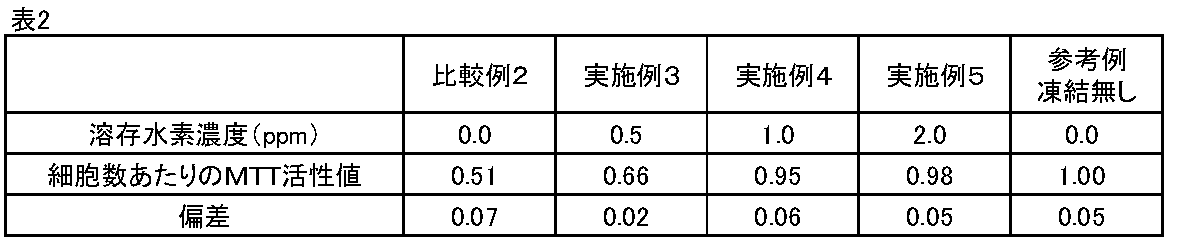
実施例3~5の細胞凍結用組成物を用いた細胞凍結保存方法は、比較例2と比べて、凍結融解後における細胞のMTT活性値が高い結果が得られた。
マウス由来の細胞(MC3T3-E1)に代えて、マウス由来の細胞(RAW 264.7)、又はヒト由来の細胞(THP-1)を使用した場合でも、上記の実施例1~2は、比較例1と比較して、上記の実施例3~5は、比較例2と比較して、凍結融解後における細胞のMTT活性値が高い結果が得られた。
この出願は、2019年10月8日に出願された日本出願特願2019-185161号を基礎とする優先権を主張し、その開示の全てをここに取り込む。
Claims (15)
- 培地と、
凍結防止剤と、
溶存水素と、
を含む、細胞凍結用組成物。 - 請求項1に記載の細胞凍結用組成物であって、
水素水を含む、細胞凍結用組成物。 - 請求項1又は2に記載の細胞凍結用組成物であって、
大気圧下、25℃で測定したときの、当該細胞凍結用組成物の溶存水素濃度が、0.1ppm以上10.0ppm以下である、細胞凍結用組成物。 - 請求項1~3のいずれか一項に記載の細胞凍結用組成物であって、
大気圧下、25℃で測定したときの、当該細胞凍結用組成物の酸化還元電位が、-700mV以上-100mV以下である、細胞凍結用組成物。 - 請求項1~4のいずれか一項に記載の細胞凍結用組成物であって、
大気圧下、25℃で測定したときの、当該細胞凍結用組成物のpHが、6.8以上8.5以下である、細胞凍結用組成物。 - 請求項1~5のいずれか一項に記載の細胞凍結用組成物であって、
大気圧下、25℃で測定したときの、当該細胞凍結用組成物の溶存酸素濃度が、5.0ppm以下である、細胞凍結用組成物。 - 請求項1~6のいずれか一項に記載の細胞凍結用組成物であって、
前記凍結防止剤が、ジメチルスルホキシド(DMSO)、ハイドロキシエチルスターチ(HES)、エチレングリコール(EG)、及びグリセロールからなる群から選ばれる一又は二以上を含む、細胞凍結用組成物。 - 請求項1~7のいずれか一項に記載の細胞凍結用組成物であって、
細胞凍結に用いる細胞が動物細胞を含む、細胞凍結用組成物。 - 培地と、
凍結防止剤と、
を含む、細胞凍結用組成物であって、
大気圧下、25℃で測定したときの、当該細胞凍結用組成物の酸化還元電位が、-700mV以上-100mV以下であり、
大気圧下、25℃で測定したときの、当該細胞凍結用組成物のpHが、6.8以上8.5以下である、
細胞凍結用組成物。 - 培地、凍結防止剤、及び溶存水素を含む細胞凍結用組成物と細胞との混合物を準備する工程と、
前記混合物を凍結し、凍結物を得る工程と、
を含む、細胞凍結方法。 - 請求項10に記載の細胞凍結方法であって、
前記細胞凍結用組成物を調製する方法は、前記培地に水素水を混合する方法、前記凍結防止剤に水素水を混合する方法、前記培地及び前記凍結防止剤を含む混液に水素水を添加する方法、前記培地に水素ガスを添加する方法、前記凍結防止剤に水素ガスを添加する方法、及び前記培地及び前記凍結防止剤を含む混液に水素ガスを添加する方法の少なくとも一方を用いる、細胞凍結方法。 - 請求項10又は11に記載の細胞凍結方法により得られた凍結物を融解し、融解物を得る工程と、
得られた融解物中に含まれる細胞を培養する工程と、
を含む、細胞培養方法。 - 水素水を含む保存容器を備える、細胞凍結用キット。
- 請求項13に記載の細胞凍結用キットであって、
前記保存容器が、少なくとも前記水素水と培地との混合液を含む、細胞凍結用キット。 - 請求項13又は14に記載の細胞凍結用キットであって、
細胞を凍結するためのプロトコールを含む、細胞凍結用キット。
Priority Applications (4)
| Application Number | Priority Date | Filing Date | Title |
|---|---|---|---|
| EP20874759.2A EP4042868A4 (en) | 2019-10-08 | 2020-10-08 | Composition for freezing cells, method for freezing cells, method for culturing cells, and kit for freezing cells |
| US17/766,430 US20230276789A1 (en) | 2019-10-08 | 2020-10-08 | Cell freezing composition, cell freezing method, cell culture method, and cell freezing kit |
| JP2021551703A JP7755997B2 (ja) | 2019-10-08 | 2020-10-08 | 細胞凍結用組成物、細胞凍結方法、細胞培養方法、及び細胞凍結用キット |
| KR1020227009632A KR102955672B1 (ko) | 2019-10-08 | 2020-10-08 | 세포 동결용 조성물, 세포 동결 방법, 세포 배양 방법, 및 세포 동결용 키트 |
Applications Claiming Priority (2)
| Application Number | Priority Date | Filing Date | Title |
|---|---|---|---|
| JP2019185161 | 2019-10-08 | ||
| JP2019-185161 | 2019-10-08 |
Publications (1)
| Publication Number | Publication Date |
|---|---|
| WO2021070908A1 true WO2021070908A1 (ja) | 2021-04-15 |
Family
ID=75437218
Family Applications (1)
| Application Number | Title | Priority Date | Filing Date |
|---|---|---|---|
| PCT/JP2020/038136 Ceased WO2021070908A1 (ja) | 2019-10-08 | 2020-10-08 | 細胞凍結用組成物、細胞凍結方法、細胞培養方法、及び細胞凍結用キット |
Country Status (4)
| Country | Link |
|---|---|
| US (1) | US20230276789A1 (ja) |
| EP (1) | EP4042868A4 (ja) |
| JP (1) | JP7755997B2 (ja) |
| WO (1) | WO2021070908A1 (ja) |
Cited By (1)
| Publication number | Priority date | Publication date | Assignee | Title |
|---|---|---|---|---|
| CN114984046A (zh) * | 2022-05-05 | 2022-09-02 | 山东鑫谷健康产业有限公司 | 富氢水组合物及其在缓解动物温度应激中的应用 |
Families Citing this family (1)
| Publication number | Priority date | Publication date | Assignee | Title |
|---|---|---|---|---|
| CN116649527B (zh) * | 2023-06-20 | 2024-06-21 | 佛山科学技术学院 | 一种提高相变阶段冷冻速率的氢气辅助速冻方法 |
Citations (5)
| Publication number | Priority date | Publication date | Assignee | Title |
|---|---|---|---|---|
| JP2005218885A (ja) * | 2004-02-03 | 2005-08-18 | Eito Notsuto Kk | 水素水製造装置、水素水製造方法および水素水 |
| JP2012512637A (ja) | 2008-12-18 | 2012-06-07 | ジーイー・ヘルスケア・ユーケイ・リミテッド | 細胞アッセイを行うための方法 |
| JP2016063804A (ja) * | 2013-12-27 | 2016-04-28 | 亀井 一郎 | ミトコンドリア活性化組成物 |
| WO2018143166A1 (ja) * | 2017-01-31 | 2018-08-09 | サラヤ株式会社 | 細胞の凍結保存組成物および凍結保存方法 |
| JP2019185161A (ja) | 2018-04-03 | 2019-10-24 | エヌ・ティ・ティ・コムウェア株式会社 | 情報入力支援システム、情報入力支援方法、情報処理装置、およびプログラム |
Family Cites Families (7)
| Publication number | Priority date | Publication date | Assignee | Title |
|---|---|---|---|---|
| JPH0819397A (ja) * | 1993-05-19 | 1996-01-23 | Takeda Chem Ind Ltd | 生理活性ペプチド製造方法およびその産生細胞 |
| JP2002253270A (ja) * | 2000-07-31 | 2002-09-10 | Takeda Chem Ind Ltd | 組換え蛋白質の製造方法 |
| WO2012011252A1 (ja) * | 2010-07-21 | 2012-01-26 | 有限会社ターナープロセス | ガス生成装置およびガス生成方法ならびにそれらを用いた装置および方法 |
| JP6132418B2 (ja) * | 2011-03-17 | 2017-05-24 | 克也 藤村 | 還元水の作製方法および還元水作製装置 |
| JP2018038480A (ja) * | 2016-09-05 | 2018-03-15 | 株式会社日幸製作所 | 皮膚改質キット、及びフェイシャルパック |
| CN109422812A (zh) * | 2017-08-31 | 2019-03-05 | 翟乾 | 单克隆抗体制备用试剂 |
| CN109221086A (zh) * | 2018-09-29 | 2019-01-18 | 阜阳师范学院 | 一种保护血细胞的中药提取物及其制备方法与用途 |
-
2020
- 2020-10-08 WO PCT/JP2020/038136 patent/WO2021070908A1/ja not_active Ceased
- 2020-10-08 JP JP2021551703A patent/JP7755997B2/ja active Active
- 2020-10-08 US US17/766,430 patent/US20230276789A1/en active Pending
- 2020-10-08 EP EP20874759.2A patent/EP4042868A4/en active Pending
Patent Citations (5)
| Publication number | Priority date | Publication date | Assignee | Title |
|---|---|---|---|---|
| JP2005218885A (ja) * | 2004-02-03 | 2005-08-18 | Eito Notsuto Kk | 水素水製造装置、水素水製造方法および水素水 |
| JP2012512637A (ja) | 2008-12-18 | 2012-06-07 | ジーイー・ヘルスケア・ユーケイ・リミテッド | 細胞アッセイを行うための方法 |
| JP2016063804A (ja) * | 2013-12-27 | 2016-04-28 | 亀井 一郎 | ミトコンドリア活性化組成物 |
| WO2018143166A1 (ja) * | 2017-01-31 | 2018-08-09 | サラヤ株式会社 | 細胞の凍結保存組成物および凍結保存方法 |
| JP2019185161A (ja) | 2018-04-03 | 2019-10-24 | エヌ・ティ・ティ・コムウェア株式会社 | 情報入力支援システム、情報入力支援方法、情報処理装置、およびプログラム |
Non-Patent Citations (1)
| Title |
|---|
| See also references of EP4042868A4 |
Cited By (1)
| Publication number | Priority date | Publication date | Assignee | Title |
|---|---|---|---|---|
| CN114984046A (zh) * | 2022-05-05 | 2022-09-02 | 山东鑫谷健康产业有限公司 | 富氢水组合物及其在缓解动物温度应激中的应用 |
Also Published As
| Publication number | Publication date |
|---|---|
| JPWO2021070908A1 (ja) | 2021-04-15 |
| KR20220076456A (ko) | 2022-06-08 |
| JP7755997B2 (ja) | 2025-10-17 |
| EP4042868A1 (en) | 2022-08-17 |
| EP4042868A4 (en) | 2023-10-25 |
| US20230276789A1 (en) | 2023-09-07 |
Similar Documents
| Publication | Publication Date | Title |
|---|---|---|
| JP7788486B2 (ja) | 治療的用途のためのフコシル化細胞の製造 | |
| Shivakumar et al. | DMSO‐and serum‐free cryopreservation of Wharton's jelly tissue isolated from human umbilical cord | |
| Lavasani et al. | Isolation of muscle-derived stem/progenitor cells based on adhesion characteristics to collagen-coated surfaces | |
| Ginis et al. | Evaluation of bone marrow-derived mesenchymal stem cells after cryopreservation and hypothermic storage in clinically safe medium | |
| Yamaguchi et al. | Mesenchymal stem cell spheroids exhibit enhanced in-vitro and in-vivo osteoregenerative potential | |
| Abaci et al. | Adaptation to oxygen deprivation in cultures of human pluripotent stem cells, endothelial progenitor cells, and umbilical vein endothelial cells | |
| AU2017339344B2 (en) | A method of isolating mesenchymal stem cells from umbilical cord amniotic membrane using a cell culture medium | |
| JP2013529917A (ja) | 化学的に定められている無血清細胞培養培地 | |
| CN101310009A (zh) | 细胞保存用水溶液 | |
| Popa et al. | Cryopreservation of cell laden natural origin hydrogels for cartilage regeneration strategies | |
| WO2021070908A1 (ja) | 細胞凍結用組成物、細胞凍結方法、細胞培養方法、及び細胞凍結用キット | |
| CN107114357A (zh) | 一种牙周膜干细胞的冻存液及其冻存方法 | |
| Wang et al. | Effect of skimmed pasteurized milk and H ank's balanced salt solution on viability and osteogenic differentiation of human periodontal ligament stem cells | |
| Li et al. | Drug-free in vitro activation combined with 3D-bioprinted adipose-derived stem cells restores ovarian function of rats with premature ovarian insufficiency | |
| Converse et al. | Wharton’s jelly matrix decellularization for tissue engineering applications | |
| KR102391629B1 (ko) | 펙틴과 알라닌을 이용한 세포 동결 보존용 조성물 및 이를 이용한 세포 동결 보존 방법 | |
| Gigout et al. | Low calcium levels in serum-free media maintain chondrocyte phenotype in monolayer culture and reduce chondrocyte aggregation in suspension culture | |
| Romanov et al. | Isolation of multipotent mesenchymal stromal cells from cryopreserved human umbilical cord tissue | |
| JP7285520B2 (ja) | 皮膚由来多能性前駆細胞の作製方法 | |
| CN106417253A (zh) | 一种骨骼肌干细胞的冻存液和冻存方法 | |
| JP2015534825A (ja) | 再生細胞の培養、保存、及び投与のための培地 | |
| KR102955672B1 (ko) | 세포 동결용 조성물, 세포 동결 방법, 세포 배양 방법, 및 세포 동결용 키트 | |
| Ozden Akkaya et al. | Comparison of proliferation and osteogenic differentiation potential of bovine adipose tissue and bone marrow derived stem cells | |
| JP2005095152A (ja) | 培養組織の保存方法 | |
| Todorov et al. | Comparative studies of different cryopreservation methods for mesenchymal stem cells derived from human fetal liver |
Legal Events
| Date | Code | Title | Description |
|---|---|---|---|
| 121 | Ep: the epo has been informed by wipo that ep was designated in this application |
Ref document number: 20874759 Country of ref document: EP Kind code of ref document: A1 |
|
| ENP | Entry into the national phase |
Ref document number: 2021551703 Country of ref document: JP Kind code of ref document: A |
|
| NENP | Non-entry into the national phase |
Ref country code: DE |
|
| ENP | Entry into the national phase |
Ref document number: 2020874759 Country of ref document: EP Effective date: 20220509 |