WO2021075322A1 - セルフレベリング材組成物 - Google Patents
セルフレベリング材組成物 Download PDFInfo
- Publication number
- WO2021075322A1 WO2021075322A1 PCT/JP2020/037962 JP2020037962W WO2021075322A1 WO 2021075322 A1 WO2021075322 A1 WO 2021075322A1 JP 2020037962 W JP2020037962 W JP 2020037962W WO 2021075322 A1 WO2021075322 A1 WO 2021075322A1
- Authority
- WO
- WIPO (PCT)
- Prior art keywords
- hemihydrate gypsum
- parts
- gypsum
- mass
- base material
- Prior art date
- Legal status (The legal status is an assumption and is not a legal conclusion. Google has not performed a legal analysis and makes no representation as to the accuracy of the status listed.)
- Ceased
Links
Classifications
-
- C—CHEMISTRY; METALLURGY
- C04—CEMENTS; CONCRETE; ARTIFICIAL STONE; CERAMICS; REFRACTORIES
- C04B—LIME, MAGNESIA; SLAG; CEMENTS; COMPOSITIONS THEREOF, e.g. MORTARS, CONCRETE OR LIKE BUILDING MATERIALS; ARTIFICIAL STONE; CERAMICS; REFRACTORIES; TREATMENT OF NATURAL STONE
- C04B28/00—Compositions of mortars, concrete or artificial stone, containing inorganic binders or the reaction product of an inorganic and an organic binder, e.g. polycarboxylate cements
- C04B28/14—Compositions of mortars, concrete or artificial stone, containing inorganic binders or the reaction product of an inorganic and an organic binder, e.g. polycarboxylate cements containing calcium sulfate cements
- C04B28/145—Calcium sulfate hemi-hydrate with a specific crystal form
- C04B28/147—Calcium sulfate hemi-hydrate with a specific crystal form beta-hemihydrate
-
- C—CHEMISTRY; METALLURGY
- C04—CEMENTS; CONCRETE; ARTIFICIAL STONE; CERAMICS; REFRACTORIES
- C04B—LIME, MAGNESIA; SLAG; CEMENTS; COMPOSITIONS THEREOF, e.g. MORTARS, CONCRETE OR LIKE BUILDING MATERIALS; ARTIFICIAL STONE; CERAMICS; REFRACTORIES; TREATMENT OF NATURAL STONE
- C04B28/00—Compositions of mortars, concrete or artificial stone, containing inorganic binders or the reaction product of an inorganic and an organic binder, e.g. polycarboxylate cements
- C04B28/14—Compositions of mortars, concrete or artificial stone, containing inorganic binders or the reaction product of an inorganic and an organic binder, e.g. polycarboxylate cements containing calcium sulfate cements
-
- C—CHEMISTRY; METALLURGY
- C04—CEMENTS; CONCRETE; ARTIFICIAL STONE; CERAMICS; REFRACTORIES
- C04B—LIME, MAGNESIA; SLAG; CEMENTS; COMPOSITIONS THEREOF, e.g. MORTARS, CONCRETE OR LIKE BUILDING MATERIALS; ARTIFICIAL STONE; CERAMICS; REFRACTORIES; TREATMENT OF NATURAL STONE
- C04B14/00—Use of inorganic materials as fillers, e.g. pigments, for mortars, concrete or artificial stone; Treatment of inorganic materials specially adapted to enhance their filling properties in mortars, concrete or artificial stone
- C04B14/02—Granular materials, e.g. microballoons
- C04B14/26—Carbonates
- C04B14/28—Carbonates of calcium
-
- C—CHEMISTRY; METALLURGY
- C04—CEMENTS; CONCRETE; ARTIFICIAL STONE; CERAMICS; REFRACTORIES
- C04B—LIME, MAGNESIA; SLAG; CEMENTS; COMPOSITIONS THEREOF, e.g. MORTARS, CONCRETE OR LIKE BUILDING MATERIALS; ARTIFICIAL STONE; CERAMICS; REFRACTORIES; TREATMENT OF NATURAL STONE
- C04B7/00—Hydraulic cements
- C04B7/02—Portland cement
-
- C—CHEMISTRY; METALLURGY
- C04—CEMENTS; CONCRETE; ARTIFICIAL STONE; CERAMICS; REFRACTORIES
- C04B—LIME, MAGNESIA; SLAG; CEMENTS; COMPOSITIONS THEREOF, e.g. MORTARS, CONCRETE OR LIKE BUILDING MATERIALS; ARTIFICIAL STONE; CERAMICS; REFRACTORIES; TREATMENT OF NATURAL STONE
- C04B7/00—Hydraulic cements
- C04B7/14—Cements containing slag
- C04B7/147—Metallurgical slag
- C04B7/153—Mixtures thereof with other inorganic cementitious materials or other activators
- C04B7/17—Mixtures thereof with other inorganic cementitious materials or other activators with calcium oxide containing activators
- C04B7/19—Portland cements
-
- C—CHEMISTRY; METALLURGY
- C04—CEMENTS; CONCRETE; ARTIFICIAL STONE; CERAMICS; REFRACTORIES
- C04B—LIME, MAGNESIA; SLAG; CEMENTS; COMPOSITIONS THEREOF, e.g. MORTARS, CONCRETE OR LIKE BUILDING MATERIALS; ARTIFICIAL STONE; CERAMICS; REFRACTORIES; TREATMENT OF NATURAL STONE
- C04B7/00—Hydraulic cements
- C04B7/32—Aluminous cements
-
- C—CHEMISTRY; METALLURGY
- C04—CEMENTS; CONCRETE; ARTIFICIAL STONE; CERAMICS; REFRACTORIES
- C04B—LIME, MAGNESIA; SLAG; CEMENTS; COMPOSITIONS THEREOF, e.g. MORTARS, CONCRETE OR LIKE BUILDING MATERIALS; ARTIFICIAL STONE; CERAMICS; REFRACTORIES; TREATMENT OF NATURAL STONE
- C04B2111/00—Mortars, concrete or artificial stone or mixtures to prepare them, characterised by specific function, property or use
- C04B2111/34—Non-shrinking or non-cracking materials
-
- C—CHEMISTRY; METALLURGY
- C04—CEMENTS; CONCRETE; ARTIFICIAL STONE; CERAMICS; REFRACTORIES
- C04B—LIME, MAGNESIA; SLAG; CEMENTS; COMPOSITIONS THEREOF, e.g. MORTARS, CONCRETE OR LIKE BUILDING MATERIALS; ARTIFICIAL STONE; CERAMICS; REFRACTORIES; TREATMENT OF NATURAL STONE
- C04B2111/00—Mortars, concrete or artificial stone or mixtures to prepare them, characterised by specific function, property or use
- C04B2111/60—Flooring materials
- C04B2111/62—Self-levelling compositions
-
- Y—GENERAL TAGGING OF NEW TECHNOLOGICAL DEVELOPMENTS; GENERAL TAGGING OF CROSS-SECTIONAL TECHNOLOGIES SPANNING OVER SEVERAL SECTIONS OF THE IPC; TECHNICAL SUBJECTS COVERED BY FORMER USPC CROSS-REFERENCE ART COLLECTIONS [XRACs] AND DIGESTS
- Y02—TECHNOLOGIES OR APPLICATIONS FOR MITIGATION OR ADAPTATION AGAINST CLIMATE CHANGE
- Y02P—CLIMATE CHANGE MITIGATION TECHNOLOGIES IN THE PRODUCTION OR PROCESSING OF GOODS
- Y02P40/00—Technologies relating to the processing of minerals
- Y02P40/10—Production of cement, e.g. improving or optimising the production methods; Cement grinding
Definitions
- the present invention relates to a self-leveling material composition used as a floor finishing base material or the like, and more particularly to a technique for providing a gypsum-based self-leveling material composition exhibiting characteristics excellent in workability.
- the self-leveling material composition (hereinafter, also referred to as self-leveling material or SL material) is kneaded with water to form a slurry, which flows naturally by simply flowing it on the floor to form a horizontal surface and harden. Therefore, it is widely used as a floor finishing base material.
- self-leveling materials include gypsum-based and cement-based materials specified by JASS 15M-103 (quality standard for self-leveling materials).
- the gypsum-based self-leveling material is a product with a smaller change in length than the cement-based self-leveling material. Specifically, it is a product with a length change of 0.05% or less specified by JASS 15M-103 (quality standard for self-leveling material). Since the length change is small, the gypsum-based self-leveling material has the following advantages over the cement-based self-leveling material. Specifically, there are advantages such as less trouble of cracking of the constructed SL material, excellent slurry fluidity, and short curing time.
- the curing time is set to 3 hours under normal conditions (temperature 20 ° C).
- the SL material is a base material, and in order to complete the floor surface, the SL material in the form of a slurry is poured onto the floor, the slurry is cured to some extent, and no footprints are left even if a person rides on the cured body.
- the time from when the slurry is poured until the next work can be performed is called "light walking time".
- the construction work is done using a gypsum-based SL material product with a set curing time, it will be possible to walk lightly within 4 hours under the temperature of 20 to 35 ° C from spring to autumn.
- the temperature is 10 ° C. or lower, light walking cannot be performed until 6 hours or more have passed, which causes a decrease in work efficiency.
- the "light walking time" becomes as long as 6 hours or more, the construction period will be shortened because the next SL material repair work and flow stop frame removal work cannot be performed on the day of SL material construction. It may be necessary for an extra day.
- the pot life means a time during which the SL material can be made into a slurry and poured on the floor to smoothly perform the slurry leveling work and the like. Generally, it is necessary to secure a pot life of 20 minutes or more from a series of work procedures. In addition, if the pot life is short, the basic performance required for gypsum SL material will not be fully exhibited, and there will be quality problems such as unevenness and wrinkles on the surface of the constructed SL material. Occurs.
- the technical subject of the present invention is that the required pot life is secured, and the temperature fluctuates greatly depending on the temperature, and it is particularly long when the work is carried out under low temperature conditions.
- a steam locomotive-based SL material with excellent workability which suppresses the time fluctuation caused by the temperature of the "light walking time”, suppresses the problem of efficiency reduction during construction caused by the temperature fluctuation. As far as the present inventors know, it has not been studied so far.
- an object of the present invention is to obtain the basic performance required for the SL material, which keeps the pot life stable without shortening the pot life and suppresses the fluctuation of the light walking time that occurs under low temperature conditions such as winter.
- An object of the present invention is to provide a gypsum-based self-leveling material that can be fully exerted and that solves the problem of a decrease in work efficiency caused by temperature fluctuations with a simple configuration.
- the present invention provides the following gypsum-based self-leveling material composition.
- a self-leveling material composition comprising hemihydrate gypsum as an essential component and an additive contained in a base material component which may contain at least one of an inorganic aggregate and cement as an optional component.
- the total of the base material components is 100 parts by mass
- the content of the hemihydrate gypsum is 55 to 100 parts by mass
- the hemihydrate gypsum contains ⁇ -type hemihydrate gypsum and ⁇ -type hemihydrate gypsum.
- ⁇ -type hemihydrate gypsum and ⁇ -type hemihydrate gypsum are 100 parts by mass
- the content of ⁇ -type hemihydrate gypsum is 70 to 95 parts by mass
- the content of ⁇ -type hemihydrate gypsum is 5.
- the content of the ⁇ -type hemihydrate gypsum is 20 parts by mass or less
- JASS 15M-103 self-leveling material.
- a gypsum-based self-leveling material composition characterized in that the length change specified in (Quality Standard) is 0.05% or less.
- the present invention provides the following constitution as a preferable form of the above-mentioned self-leveling material composition.
- the total of the base material components is 100 parts by mass
- the content of the hemihydrate gypsum is 55 to 100 parts by mass
- the content of the cement is 0 to 25 parts by mass
- the content of the inorganic aggregate is 0 to 30 parts by mass.
- the gypsum-based self-leveling material composition according to the above [1] wherein the amount is 0 to 30 parts by mass.
- the total amount of the hemihydrate gypsum is 100 parts by mass
- the content of the ⁇ -type hemihydrate gypsum is 80 to 90 parts by mass
- the content of the ⁇ -type hemihydrate gypsum is 10 to 20 parts by mass.
- the gypsum-based self-leveling material composition according to any one of the above [1] to [5]. [7] The gypsum-based self-leveling according to the above [1], wherein the content of the hemihydrate gypsum is 100 parts by mass and the optional component is not contained, when the total of the base material components is 100 parts by mass. Material composition.
- the fluctuation of the light walking time that occurs under low temperature conditions such as winter is suppressed to a small extent while maintaining a stable state without shortening the pot life while having a simple configuration.
- Sufficient functionality as an SL material suppresses the problem of deterioration of work efficiency during construction caused by temperature fluctuations, and realizes a remarkable improvement effect of work efficiency compared to conventional products.
- light walking in determining the "light walking time" of the SL material means that the slurry of the flowing SL material is hardened so that the SL material can be walked without leaving footprints on the surface. It means that the SL material has hardened to some extent.
- a durometer rubber hardness tester
- a durometer which is widely used for measuring the hardness of various rubbers and plastic products, is used in order to determine the state of the cured body capable of light walking even with an objective numerical value.
- the hardness of the surface of the cured product was measured using a durometer (type D, JIS K6253), and the degree to which the slurry of the flowed SL material was cured was objectively determined using the measured value as an index. ..
- the time when the surface hardness of the cured product becomes 55 points or more after the SL material is poured by the measurement of the durometer is defined as the "light walking time”.
- the powder state before kneading with water is called “self-leveling material composition” or “self-leveling material (SL material)” and is kneaded with water (kneading water).
- the one in a muddy state is called a "slurry”.
- the present inventors have reached the present invention as a result of diligent studies on the above-mentioned problems of the prior art.
- an additive such as a setting retarder or a water reducing agent has been added to a material for forming an SL material.
- the pot life that affects the basic quality of the SL material is not shortened, and the temperature is low such as in winter. It was not possible to obtain a product in which the light walking time, which would be long when the work was carried out in, was adjusted to conditions suitable for the work. Specifically, for example, it has not been possible to obtain a product in which the light walking time is shorter than that of the conventional product within 5 hours, preferably within 4 hours under a low temperature condition of about 10 ° C. ..
- ⁇ -type hemihydrate gypsum is used as the hemihydrate gypsum which is the main component of the base material constituting the gypsum-based SL material.
- Hemihydrate gypsum includes ⁇ -type hemihydrate gypsum and ⁇ -type hemihydrate gypsum, which have different firing methods.
- the ⁇ -type hemihydrate gypsum is manufactured by the wet method, the ⁇ -type hemihydrate gypsum is manufactured by the dry method, and the ⁇ -type hemihydrate gypsum has a standard mixed water amount specified by JIS R 9111 more than the ⁇ -type hemihydrate gypsum. It requires less water to cure than ⁇ -type hemihydrate gypsum. And, although it is considered that this is also the cause, the use of ⁇ -type hemihydrate gypsum has an advantage that the strength is increased when it is cured. For this reason, ⁇ -type hemihydrate gypsum has been used as the base material in the conventional gypsum-based SL material.
- the main component of the base material constituting the gypsum-based SL material is hemihydrate gypsum, which is the same as the conventional product, but surprisingly. It has been found that the above-mentioned technical problem of the present invention can be solved by an extremely simple means of using a hemihydrate gypsum as a base material in combination with an ⁇ -type hemihydrate gypsum and a ⁇ -type hemihydrate gypsum.
- ⁇ -type hemihydrate gypsum and ⁇ -type hemihydrate gypsum are 100 parts by mass
- ⁇ -type hemihydrate gypsum is used in the range of 70 to 95 parts by mass
- ⁇ -type hemihydrate is used.
- the gypsum is configured to be in the range of 5 to 30 parts by mass
- the content of ⁇ -type hemihydrate gypsum is configured to be 20 parts by mass or less.
- the fluctuation of the light walking time due to the temperature is larger than that of the conventional product. I found that it can be made much smaller.
- the construction work of the SL material can always be performed stably and efficiently regardless of the temperature change. Become.
- the spillover effect obtained by this on the improvement of work efficiency is extremely large. Even if ⁇ -type hemihydrate gypsum is used in the above range, it should not be inferior in strength after curing as compared with conventional SL material products made entirely of ⁇ -type hemihydrate gypsum. I also understood.
- the present inventors first examined the case where the composition of the base material components was entirely made of hemihydrate gypsum without using other materials.
- the light walking time is not affected by the pot life, for example, when the work is performed under low temperature conditions of 10 ° C. I found that it can be shortened.
- the viscosity of the slurry increases by using ⁇ -type hemihydrate gypsum together, but the degree of thickening can be suppressed within the practical range by adjusting the amount of ⁇ -type hemihydrate gypsum used together. I understood.
- the content of ⁇ -type hemihydrate gypsum is 70 to 95 parts by mass, and the ⁇ -type hemihydrate gypsum used in combination is used.
- the content is 5 to 30 parts by mass, while ensuring the pot life that affects the basic quality of SL material, the time becomes longer due to temperature fluctuations, which causes a decrease in work efficiency in winter. It was found that the walkable time can be shortened to the 4-hour range even under low temperature conditions.
- the composition of the base material is defined in the present invention as the amount of ⁇ -type hemihydrate gypsum, which is made entirely of hemihydrate gypsum without using other materials and is used in combination with ⁇ -type hemihydrate gypsum.
- the base material of the SL material is composed of a base material in which cement or an inorganic aggregate usually used together with hemihydrate gypsum is used in combination
- the present inventors lightly walk in the above-mentioned low temperature environment.
- a detailed study was conducted on the effect of shortening the possible time and the effect on thickening caused by the combined use of ⁇ -type hemihydrate gypsum to obtain the effect.
- Cement and inorganic aggregate are used as building materials for the purpose of improving strength and reducing costs.
- hemihydrate gypsum is the main component with 55 parts by mass or more, and cement or, for example, calcium carbonate is used as other components.
- Inorganic aggregate such as is blended and used as a base material. Therefore, the present inventors added cement to 65 parts by mass of hemihydrate gypsum in which 100 parts by mass of the base material component was composed of 90:10 of ⁇ -type hemihydrate gypsum and ⁇ -type hemihydrate gypsum.
- the effects on viscosity, pot life, and light walking time were examined. As a result, as described later, even when a base material containing cement in the range of 5 to 25 parts by mass and inorganic aggregate in the range of 10 to 30 parts is used, the same effect as described above can be obtained. all right.
- hemihydrate gypsum is the main component of the base material, and the composition of the hemihydrate gypsum is the ⁇ -type hemihydrate gypsum and ⁇ as defined in the present invention. If the compounding requirements with the type hemihydrate gypsum are satisfied, there is no problem in viscosity and pot life, and the light walking time under a low temperature condition of, for example, about 10 ° C. is preferably within 5 hours. It was found that a remarkable effect of shortening within 4 hours can be obtained.
- the base material component constituting the self-leveling material composition of the present invention is essential to contain semi-hydraulic gypsum, which is a water-hardening material, as a main component, and if necessary, cement, calcium carbonate, or the like can be used as an optional component. It can be configured to contain an inorganic aggregate.
- hemihydrate gypsum is used as the main component of the base material, and at that time, ⁇ -type hemihydrate gypsum is defined in the present invention in combination with ⁇ -type hemihydrate gypsum. It is to be used in a specific formulation.
- the SL material of the present invention is a gypsum-based SL material, and the gypsum-based SL material is a kneaded product with water as compared with a cement-based SL material containing a large amount of cement in the base material.
- the cured product of (slurry) has the advantages of less drying shrinkage and less cracking. Therefore, in the SL material of the present invention, it is essential that the composition of the base material is such that the content of hemihydrate gypsum is 55 parts by mass or more when the total of the base material components is 100 parts by mass. Make it a requirement.
- other base material materials that can be arbitrarily blended as needed without impairing the effects of the present invention are at least inorganic aggregates and cements. Either.
- the blending amount of these optional components is preferably such that the cement content is about 0 to 25 parts by mass and the content of the inorganic aggregate is about 0 to 30 parts by mass.
- the hemihydrate gypsum which is an essential component of the base material constituting the SL material of the present invention, is characterized by having a composition in which ⁇ -type hemihydrate gypsum is used in combination with ⁇ -type hemihydrate gypsum.
- the firing method is different between ⁇ -type hemihydrate gypsum and ⁇ -type hemihydrate gypsum.
- the ⁇ -type hemihydrate gypsum is produced by a wet method, and is obtained by firing dihydrate gypsum in water (including in steam).
- the ⁇ -type hemihydrate gypsum is produced by a dry method, and is obtained by firing dihydrate gypsum in the air.
- the conventional gypsum-based SL material has the advantage that the amount of water required for curing is small and the strength is high when cured, so ⁇ -type semi-water Gypsum was used.
- ⁇ -type hemihydrate gypsum was used in combination with the hemihydrate gypsum constituting the base material, and the total of ⁇ -type hemihydrate gypsum and ⁇ -type hemihydrate gypsum was 100 parts by mass.
- the content of ⁇ -type hemihydrate gypsum is 70 to 95 parts by mass, and the content of ⁇ -type hemihydrate gypsum is 5 to 30 parts by mass.
- the content of ⁇ -type hemihydrate gypsum is 80 to 90 parts by mass, and the content of ⁇ -type hemihydrate gypsum is 10 to 20 parts by mass.
- the amount of ⁇ -type hemihydrate gypsum constituting the base material is 100 parts by mass in total of the hemihydrate gypsum base material, the content of ⁇ -type hemihydrate gypsum is 20% by mass.
- the SL material of the present invention can realize excellent workability that could not be obtained by the conventional SL material, and at the same time, compared with the conventional product in which all of the SL material is composed of ⁇ -type hemihydrate gypsum. Therefore, it is not inferior in terms of strength after construction.
- the lower limit of the amount of ⁇ -type hemihydrate gypsum used in the base material is not particularly limited, but may be, for example, 3 parts by mass or more.
- Cement can be used as a base material component constituting the SL material of the present invention, if necessary.
- Cement that can be used as a base material includes the following.
- various cements such as ordinary Portland cement, early-strength Portland cement, moderate heat Portland cement, blast furnace cement, silica cement, fly ash cement, alumina cement and jet cement can be mentioned.
- the cement material selected from these can be appropriately used as an optional component of the base material constituting the SL material of the present invention.
- the cement is appropriately blended with the base material for the purpose of improving the water resistance of the floor finishing base material formed of the SL material, for example.
- the amount of cement to be blended when used as an optional component of the base material is, for example, about 5 to 25 parts by mass in 100 parts by mass of the base material component.
- an inorganic aggregate can be used as the base material constituting the SL material of the present invention.
- the inorganic aggregate that can be used as the material of the base material for example, calcium carbonate, which is widely used as a bulking material, can be used. Calcium carbonate is inexpensive, and by using it as a bulking material, it becomes possible to provide the target SL material at a low price.
- the blending amount may be, for example, about 10 to 30 parts by mass in 100 parts by mass of the base material component.
- the soap-based SL material of the present invention contains a water reducing agent (fluidizer or dispersant), a defoaming agent, and a thickening agent within a range not contrary to the intended purpose of the present invention.
- Additives such as an agent and a setting retarder are appropriately selected and blended as needed. It is preferable that these additives are blended in an amount of 5% or less with respect to the base material in total.
- the use of the water reducing agent is not particularly limited as long as it is commercially available. Usually, polycarboxylic acid-based, naphthalene-based and lignin-based water reducing agents can be used. In the case of SL material, a water reducing agent is usually used because it is necessary to obtain excellent fluidity with as little water as possible. At that time, if the amount used is too small, the effect cannot be obtained, and if it is too large, the inorganic aggregate used as an optional component may be separated, which may cause a decrease in the strength of the formed horizontal plane. So you need to be careful.
- the water reducing agent can also be added during the construction to prepare the slurry and used to adjust the flow value.
- the flow value can be increased by increasing the amount of ⁇ -type hemihydrate gypsum constituting the base material, but compared with ⁇ -type hemihydrate gypsum, it causes a delay in coagulation at low temperature and walks lightly. There is a large tendency for the possible time to become longer.
- the amount of ⁇ -type hemihydrate gypsum constituting the base material decreases, the flow value decreases, so that the amount of the water reducing agent used increases.
- defoaming agent for example, general-purpose ones such as polyether-based, silicone-based, alcohol-based, mineral oil-based, vegetable oil-based and nonionic surfactant can be appropriately used.
- caking retardant examples include citrates such as sodium citrate, succinates, acetates, malate, borates such as borosand, sucrose, hexametaphosphates, ethylenediamine tetraacetate, and diethylenetriamine-5acetic acid. , Distillate and proteolytic products can be used.
- the blending amount of the setting delay agent may be set to such an extent that the required setting delay function can be achieved.
- the slurry is increased so as to have a viscosity of a certain level or higher.
- a viscous agent may be blended.
- the thickener cellulose ether or the like can be used.
- the SL material of the present invention is prepared by adding water, thoroughly mixing and kneading to form a slurry (kneaded product), then pouring it onto the floor base surface, spreading, leaving, curing, and drying to obtain a floor finish base material.
- a slurry powdered product
- the floor base surface include metals such as mortar, cement, wood, plastic tiles or sheets, ceramics, and stainless steel. In this respect, there is no difference from the conventional SL material.
- the amount of water to be used is preferably about 35 to 70 parts by mass per 100 parts by mass of the base material. If the amount of water blended is small, sufficient fluidity cannot be obtained, spreading becomes difficult, and workability may decrease. On the contrary, if the amount of water blended is too large, the surface condition of the cured product is deteriorated due to the unevenness of the surface and the strength is lowered, which is not preferable.
- the SL material of the present invention is preferably one in which the flow value obtained when the slurry (slurry) is poured is adjusted to 190 mm or more, for example, 210 mm or more and 260 mm or less.
- Examples 1-1 to 1-5, Comparative Examples 1 and 2 As a base material, 65 parts of hemihydrate gypsum, 15 parts of ordinary Portland cement, and 20 parts of calcium carbonate as an inorganic aggregate were prepared. At this time, in Examples 1-1 to 1-5 and Comparative Examples 1 and 2, the contents of 65 parts of hemihydrate gypsum constituting the base material were as shown in Table 1, respectively. First, in Comparative Example 1, all of the hemihydrate gypsum used as the base material was ⁇ -type hemihydrate gypsum.
- a setting retarder, a swelling inhibitor, a thickener, and an antifoaming agent, which are made of the same material, are applied to seven types of base materials having different amounts of ⁇ -type hemihydrate gypsum in 1-5 and Comparative Example 2, respectively.
- 7 kinds of SL materials having different compositions were obtained according to a conventional method.
- ⁇ Viscosity> It was measured using a viscometer (trade name: Viscometer "VT-06", manufactured by Rion Co., Ltd.) in an environment of a temperature of 20 ° C. The results obtained in Table 1 are summarized.
- the target value of the viscosity of the slurry is set to 10 to 20 dPa ⁇ s from the viewpoint of workability when preparing the slurry.
- the pot life means the longest time that the slurry can be flowed as a slurry after preparation. Specifically, as described above, a slurry was prepared so that the flow value measured according to JASS15 M103 was 230 ⁇ 2 mm in an environment of 20 ° C., and the obtained slurry was used. The longest time during which the flow value of the slurry was able to secure 90% or more of the above-mentioned flow value indicated by the slurry at the time of preparation was defined as the pot life.
- the results obtained in Table 1 are summarized.
- the target pot life was set to 20 minutes or more in consideration of the procedure of the construction start work. If the pot life is 20 minutes or more, the worker can sufficiently, smoothly and stably start the construction work.
- the light walking time means the time during which a person can get on and perform the subsequent work after constructing the slurry.
- there are two conditions one is when the room temperature is kept at 10 ° C and the other is when the room temperature is kept at 20 ° C.
- the test was conducted. Specifically, after the slurry was constructed, the hardness of the surface of the construction surface was measured using a durometer (type D, JIS K 6253), and the measured value was used as an index to measure from the time of construction of the slurry.
- the "light walking time” was objectively evaluated and confirmed by measuring the time when the surface hardness became 55 points or more.
- the light walking time measured as described above is measured even under the low temperature condition of 10 ° C. in consideration of the work procedure that can be smoothly performed in one day of the slurry preparation, the slurry construction, and the next step.
- the goal was to keep the number within 5 hours.
- the slurries prepared using the compositions of Examples 1-1 to 1-5 and Comparative Example 2 all have a light walking time of Comparative Example 1. It was confirmed that it was shorter than the slurry and could be shortened without exceeding 5 hours even under low temperature conditions of 10 ° C. Furthermore, in the composition of hemihydrate gypsum, which is an essential component of the base material, by adjusting the compounding ratio ( ⁇ to ⁇ ratio) of ⁇ -type hemihydrate gypsum used in combination with ⁇ -type hemihydrate gypsum, under the condition of 10 ° C. The difference between the light walking time and the light walking time under the condition of 20 ° C. can be reduced.
- the difference was as much as 2 hours and 30 minutes, whereas in the slurries of Examples 1-3 to 1-5 and Comparative Example 2, the difference was shortened to 45 minutes to 30 minutes. I found that I could do it.
- the composition of the essential component of the base material is a combination of ⁇ -type hemihydrate gypsum and ⁇ -type hemihydrate gypsum, it is light against the temperature difference. It has little effect on the walkable time, and means that the next work can be started stably and efficiently after the slurry is applied.
- the content of ⁇ -type hemihydrate gypsum is 70 to 95 when the total of ⁇ -type hemihydrate gypsum and ⁇ -type hemihydrate gypsum is 100 parts as the hemihydrate gypsum constituting the base material.
- the essential requirement was that the content of ⁇ -type hemihydrate gypsum was 5 to 30 parts.
- the composition of 100 parts of hemihydrate gypsum is 70 to 90 parts of ⁇ -type hemihydrate gypsum and 10 to 10 parts of ⁇ -type hemihydrate gypsum. It is more preferable that the amount of ⁇ -type hemihydrate gypsum is 80 to 90 parts and the amount of ⁇ -type hemihydrate gypsum is 10 to 20 parts in terms of viscosity.
- Example 1-5 when the total amount of the base materials is 100 parts by mass, if the content of ⁇ -type hemihydrate gypsum is 20 parts by mass or less, ⁇ -type hemihydrate gypsum is used in combination. There is no problem that the viscosity becomes too high due to the gypsum. On the other hand, as shown in Comparative Example 2, if the content of ⁇ -type hemihydrate gypsum is more than 20 parts by mass, the viscosity becomes too high, which is not suitable for practical use.
- Example 3 Aggregate (calcium carbonate) was added in a fixed amount of 20 parts, and cement (ordinary Portland cement) was added in a stepwise manner in the range of 0 to 30 parts, and Examples 2-1 to 2-6 were compared.
- the compositions of Example 3 were prepared respectively. Specifically, a predetermined amount of a setting retarder, an expansion inhibitor, a thickener, and a defoaming agent are added to the above-mentioned seven types of substrates having different configurations in the same manner as in Example 1. Obtained SL material.
- evaluation was performed by the following method. First, 35 parts of water was added to 100 parts of the SL material to prepare a slurry for evaluation. In order to carry out the evaluation under the same conditions, when preparing the slurry, a water reducing agent was added so that the flow values were 230 ⁇ 2 mm in each case, and the fluidity was adjusted.
- inorganic aggregate calcium carbonate
- Example 2 a predetermined amount of a setting retarder, an expansion inhibitor, a thickener, and a defoaming agent are added to the five types of substrates having different configurations as described above to SL. I got the wood.
- evaluation was performed by the following method. First, 35 parts of water was added to 100 parts of the SL material to prepare a slurry for evaluation. In order to carry out the evaluation under the same conditions, when preparing the slurry, a water reducing agent was added so that the flow values were 230 ⁇ 2 mm in each case, and the fluidity was adjusted.
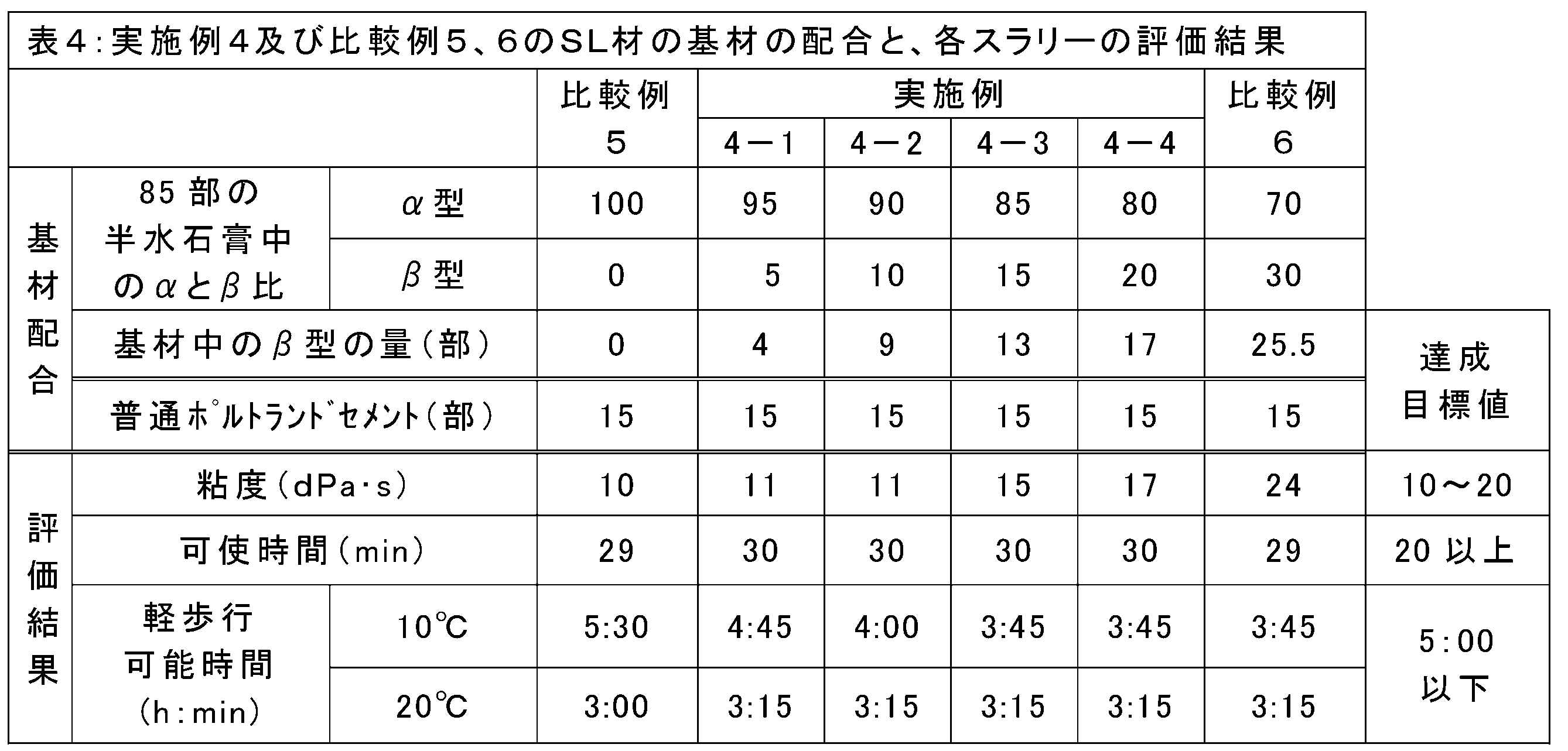
- Examples 4-1 to 4-4, Comparative Examples 5 and 6 cement is added to the base material in a fixed amount of 15 parts, and the mixing ratio ( ⁇ to ⁇ ratio) of ⁇ -type hemihydrate gypsum and ⁇ -type hemihydrate gypsum is stepped as shown in Table 4.
- the SL material was prepared in the same manner as in Example 1 using the modified hemihydrate gypsum. Then, the SL material obtained in the same manner as in Example 1 was evaluated. In all the tests, it was confirmed that the length change specified by JASS 15M-103 (quality standard for self-leveling material) was 0.05% or less.
- the obtained evaluation results are summarized in Table 4.
- the SL material was prepared using only hemihydrate gypsum without using cement or inorganic aggregate as the base material. Specifically, as the hemihydrate gypsum constituting the base material, ⁇ -type hemihydrate gypsum and ⁇ -type hemihydrate gypsum were used by gradually changing the compounding ratio as shown in Table 5, and Example 1 The SL material was prepared in the same manner as in the above. Then, the obtained SL material was evaluated in the same manner as in Example 1. In all the tests, it was confirmed that the length change specified by JASS 15M-103 (quality standard for self-leveling material) was 0.05% or less. The obtained evaluation results are summarized in Table 5.
- Comparative Example 8 in which 75 parts of ⁇ -type hemihydrate gypsum and 25 parts of ⁇ -type hemihydrate gypsum were blended improved the light walking time and had no problem with the pot life.
- the total amount of the materials was 100 parts by mass
- the content of ⁇ -type hemihydrate gypsum exceeded 20 parts by mass. Therefore, as another problem, compared with the composition of Comparative Example 7 in which ⁇ -type hemihydrate gypsum was not used in combination. It was found that there is a practical problem that the viscosity becomes more than double when it is made into a slurry.
- the SL material of the present invention requires that the content of ⁇ -type hemihydrate gypsum is 20 parts by mass or less when the total amount of the base materials is 100 parts by mass. From the results in Table 5, when the base material constituting the SL material of the present invention is composed only of hemihydrate gypsum, the total of ⁇ -type hemihydrate gypsum and the ⁇ -type hemihydrate gypsum is 100 parts, and ⁇ -type hemihydrate is used.
- the content of gypsum is 80 to 95 parts, the content of ⁇ -type hemihydrate gypsum is 5 to 20 parts, more preferably the content of ⁇ -type hemihydrate gypsum is 80 to 90 parts, and the content of ⁇ -type hemihydrate gypsum is 80 to 90 parts. It was found that it is effective to set the amount to 10 to 20 parts.
Landscapes
- Chemical & Material Sciences (AREA)
- Engineering & Computer Science (AREA)
- Ceramic Engineering (AREA)
- Materials Engineering (AREA)
- Structural Engineering (AREA)
- Organic Chemistry (AREA)
- Inorganic Chemistry (AREA)
- Chemical Kinetics & Catalysis (AREA)
- Civil Engineering (AREA)
- Crystallography & Structural Chemistry (AREA)
- Curing Cements, Concrete, And Artificial Stone (AREA)
Abstract
Description
[1]半水石膏を必須成分とし、任意成分として、無機骨材及びセメントの少なくともいずれかを含んでもよい基材成分に、添加剤を含有してなるセルフレベリング材組成物であって、前記基材成分の合計を100質量部とした場合に、前記半水石膏の含有量が55~100質量部であり、前記半水石膏は、α型半水石膏とβ型半水石膏とを含み、且つ、α型半水石膏とβ型半水石膏の合計を100質量部とした場合に、α型半水石膏の含有量が70~95質量部、β型半水石膏の含有量が5~30質量部であり、さらに、前記基材成分の合計を100質量部とした場合に、前記β型半水石膏の含有量は20質量部以下である、JASS 15M-103(セルフレベリング材の品質基準)で規定する長さ変化が、0.05%以下であることを特徴とするせっこう系セルフレベリング材組成物。
[2]前記基材成分の合計を100質量部とした場合に、前記半水石膏の含有量が55~100質量部、前記セメントの含有量が0~25質量部及び前記無機骨材の含有量が0~30質量部である上記[1]に記載のせっこう系セルフレベリング材組成物。
[3]前記セメントが、普通ポルトランドセメント、早強ポルトランドセメント、高炉セメント及びアルミナセメントからなる群から選ばれるいずれかである上記[1]又は[2]に記載のせっこう系セルフレベリング材組成物。
[4]前記基材の構成成分が、半水石膏とセメントである上記[1]~[3]のいずれかに記載のせっこう系セルフレベリング材組成物。
[5]前記無機骨材が、炭酸カルシウムである上記[1]~[3]のいずれかに記載のせっこう系セルフレベリング材組成物。
[6]前記半水石膏の合計を100質量部とした場合に、前記α型半水石膏の含有量が80~90質量部で、前記β型半水石膏の含有量が10~20質量部である上記[1]~[5]のいずれかに記載のせっこう系セルフレベリング材組成物。
[7]前記基材成分の合計を100質量部とした場合に、前記半水石膏の含有量が100質量部であり、前記任意成分を含まない上記[1]に記載のせっこう系セルフレベリング材組成物。
(基材成分)
本発明のセルフレベリング材組成物を構成する基材成分は、水硬性材料である半水石膏を主成分とすることを必須とし、必要に応じて、任意成分として、セメントや、炭酸カルシウムなどの無機骨材を配合した構成にすることができる。本発明のセルフレベリング材組成物において重要なことは、基材の主成分として、半水石膏を用い、その際に、α型半水石膏に併用してβ型半水石膏を本発明で規定する特定の配合で用いることである。まず、本発明では、基材成分100質量部中に、半水石膏を55質量部以上含むことを必須とし、必要に応じて基材材料に、セメントや、増量材として用いられている炭酸カルシウムなどの無機骨材を用いてもよいとし、基材中に含まれる半水石膏の量を他の材料の合計量よりも多く含む、せっこう系とした。本発明のSL材は、上記したようにせっこう系であり、せっこう系のSL材には、基材にセメントが多く含有されるセメント系のSL材と比較して、水との混練物(スラリー)の硬化体の乾燥収縮が少なく、ひび割れが少なくなるといった利点がある。このため、本発明のSL材では、基材の構成を、基材成分の合計を100質量部とした場合に、半水石膏の含有量が55質量部以上となるようにすることを必須の要件とする。そして、本発明者らの検討によれば、本発明の効果を損なうことなく、必要に応じて任意に配合させることが可能な他の基材材料(成分)は、無機骨材及びセメントの少なくともいずれかである。そして、これらの任意成分の配合量の範囲は、セメントの含有量は0~25質量部程度、無機骨材の含有量は0~30質量部程度であることが好ましい。
本発明のSL材を構成する基材の必須成分である半水石膏は、α型半水石膏にβ型半水石膏を併用した構成としたことを特徴とする。α型半水石膏とβ型半水石膏とは焼成方法が異なる。α型半水石膏は湿式法で製造され、二水石膏を水中(蒸気中を含む)で焼成して得られる。β型半水石膏は乾式法で製造され、二水石膏を大気中で焼成して得られる。先に述べた通り、従来のせっこう系のSL材では、硬化させるために必要になる水の量が少なくてすみ、硬化させた場合に強度が高くなるという利点があるため、α型半水石膏が使用されていた。これに対し、本発明のSL材では、基材を構成する半水石膏にβ型半水石膏を併用し、且つ、α型半水石膏とβ型半水石膏の合計を100質量部とした場合に、α型半水石膏の含有量が70~95質量部、β型半水石膏の含有量が5~30質量部となる比率で用いる。好ましくは、α型半水石膏の含有量が80~90質量部で、β型半水石膏の含有量が10~20質量部である。さらに、本発明のSL材では、基材を構成するβ型半水石膏の量を、半水石膏基材の合計を100質量部とした場合に、β型半水石膏の含有量を20質量部以下の範囲となるように構成する。上記構成としたことで、本発明のSL材は、従来のSL材によっては得られなかった優れた作業性を実現できると同時に、全てがα型半水石膏で構成されている従来製品と比べて、施工後における強度の点で劣ることがない。基材中におけるβ型半水石膏の使用量の下限は特に限定されないが、例えば、3質量部以上であればよい。
本発明のSL材を構成する基材成分には、必要に応じてセメントを用いることができる。基材材料に用いることができるセメントとしては、下記に挙げるようなものがある。例えば、普通ポルトランドセメント、早強ポルトランドセメント、中庸熱ポルトランドセメント、高炉セメント、シリカセメント、フライアッシュセメント、アルミナセメント及びジェットセメントなどの各種のセメントが挙げられる。そして、これらの中から選択したセメント材料を、本発明のSL材を構成する基材の任意成分として適宜に用いることができる。上記セメントは、例えば、SL材によって形成される床仕上げ下地材の耐水性向上などの目的で基材に適宜に配合される。基材の任意成分として用いる際のセメントの配合量としては、基材成分100質量部中に、例えば、5~25質量部程度とするとよい。
本発明のSL材を構成する基材には、必要に応じて無機骨材を用いることができる。基材の材料に用いることができる無機骨材としては、例えば、増量材として広く使用されている炭酸カルシウムなどを使用することができる。炭酸カルシウムは、価格が安く、これを増量材として用いることで、目的とするSL材を安価に提供することが可能になる。基材の任意成分として無機骨材を用いる場合の配合量は、例えば、基材成分100質量部中に、10~30質量部程度とするとよい。
本発明のせっこう系のSL材には、従来の製品と同様に、本発明の所期の目的に反しない範囲内で、減水剤(流動化剤又は分散剤)、消泡剤、増粘剤及び凝結遅延剤などの添加剤が、必要に応じて、適宜に選択されて配合されている。これらの添加剤は、総量で、基材に対して5%以下の量で配合することが好ましい。
本発明のSL材は、水を添加して、十分に混合・混練してスラリー(混練物)とした後に床下地面に流し込み、展延、放置、硬化、乾燥することにより、床仕上げ下地材を形成する。床下地面として、モルタル、セメント、木質、プラスチック製タイル若しくはシート、セラミックス、ステンレスなどの金属が例示できる。この点については、従来のSL材と何ら異なることはない。
基材として、半水石膏を65部、普通ポルトランドセメントを15部、無機骨材として炭酸カルシウムを20部用意した。この際、実施例1-1~1-5、比較例1、2では、基材を構成している半水石膏65部の内容を、それぞれ表1に示した通りとした。まず、比較例1では、基材に用いる半水石膏の全てをα型半水石膏とした。一方、実施例1-1~1-5及び比較例2では、半水石膏を、質量基準で100部として、α型半水石膏とβ型半水石膏との配合比率(αとβ比)が、表1に示したように、β型半水石膏の相対量が5~40部の間で段階的に増加するように調整した。そして、後述する検討結果で、スラリーの粘度が高くなり、SL材としての機能性や、施工の作業性に劣ったことから、α型半水石膏=60部、β型半水石膏=40部の配合比の例を比較例2とした。
上記のようにして得たSL材を用いて調整した各スラリーの物性値と、スラリーを施工した際における軽歩行可能時間を測定した。それぞれ下記の条件で測定した。なお、すべての試験において、JASS 15M-103(セルフレベリング材の品質基準)で規定する長さ変化が0.05%以下であることを確認した。評価結果を、表1にまとめて示した。また、表1中に、本発明の目標が達成されたと判断できる評価結果を「達成目標値」として掲載した。
温度20℃の環境下で、粘度測定器(商品名:ビスコテスタ「VT-06」、リオン社製)を用いて測定した。表1中に得られた結果をまとめて示した。本発明では、スラリーを調製する際の作業性の点から、スラリーの粘度の目標値を10~20dPa・sとした。
可使時間とは、スラリーを調製後、スラリーとして流せる最長の時間を意味する。具体的には、先に説明したようにして、20℃の環境下で、JASS15 M103に準じて測定したフロー値が230±2mmとなるようにスラリーを調製し、得られたスラリーを用い、当該スラリーのフロー値が、調製した際のスラリーが示した上記フロー値の90%以上の値を確保できている最長の時間を可使時間とした。表1中に得られた結果をまとめて示した。ここで、施工の開始作業の手順を考慮して、目標とする可使時間を20分以上とした。20分以上の可使時間があれば、作業者は、十分に、円滑に安定して施工の開始作業を行うことができる。
軽歩行可能時間とは、スラリーを施工後、人が乗ってその後の作業を行えるようになる時間を意味する。異なる構成の各スラリーについて、施工後における温度条件の違いが軽歩行可能時間に及ぼす影響を調べるため、室温を10℃に保った場合と、室温を20℃に保った場合の2条件で、それぞれ試験を行った。具体的には、スラリーを施工後、施工面の表面の硬度を、デュロメータ(タイプD、JIS K 6253)を用いて測定し、その測定値を指標として用い、スラリーの施工の時点から、測定した表面硬度が55ポイント以上となった時間を計測することで「軽歩行可能時間」を客観的に評価し、確認した。本発明では、スラリーの調製、スラリーの施工、次に行う工程の1日に円滑に行える作業手順を考慮して、10℃の低温の条件下でも、上記のようにして計測した軽歩行可能時間が5時間以内になるようにすることを目標とした。

先に述べた実施例1の結果から、基材を構成する半水石膏に、α型半水石膏を90部、β型半水石膏を10部で配合したもの(α:β=90:10)を用いた。そして、表2に示した通り、基材の構成を、必須成分である上記構成の半水石膏の量を50~80部の範囲で段階的に変えて、これに、基材成分として、無機骨材(炭酸カルシウム)を20部の一定量で加え、セメント(普通ポルトランドセメント)を0~30部の範囲で段階的に量を変えて加えて、実施例2-1~2-6、比較例3の組成物をそれぞれ調製した。具体的には、上記した構成が異なる7種の基材に、実施例1の場合と同様にして、それぞれ、所定量の凝結遅延剤、膨張抑制剤、増粘剤、消泡剤を添加してSL材を得た。
上記のようにして得たSL材の各スラリーの物性値と、スラリーを施工した際における軽歩行可能時間を、先に述べたと同様にして測定した。なお、すべての試験において、JASS 15M-103(セルフレベリング材の品質基準)で規定する長さ変化が0.05%以下であることを確認した。試験結果を表2にまとめて示した。

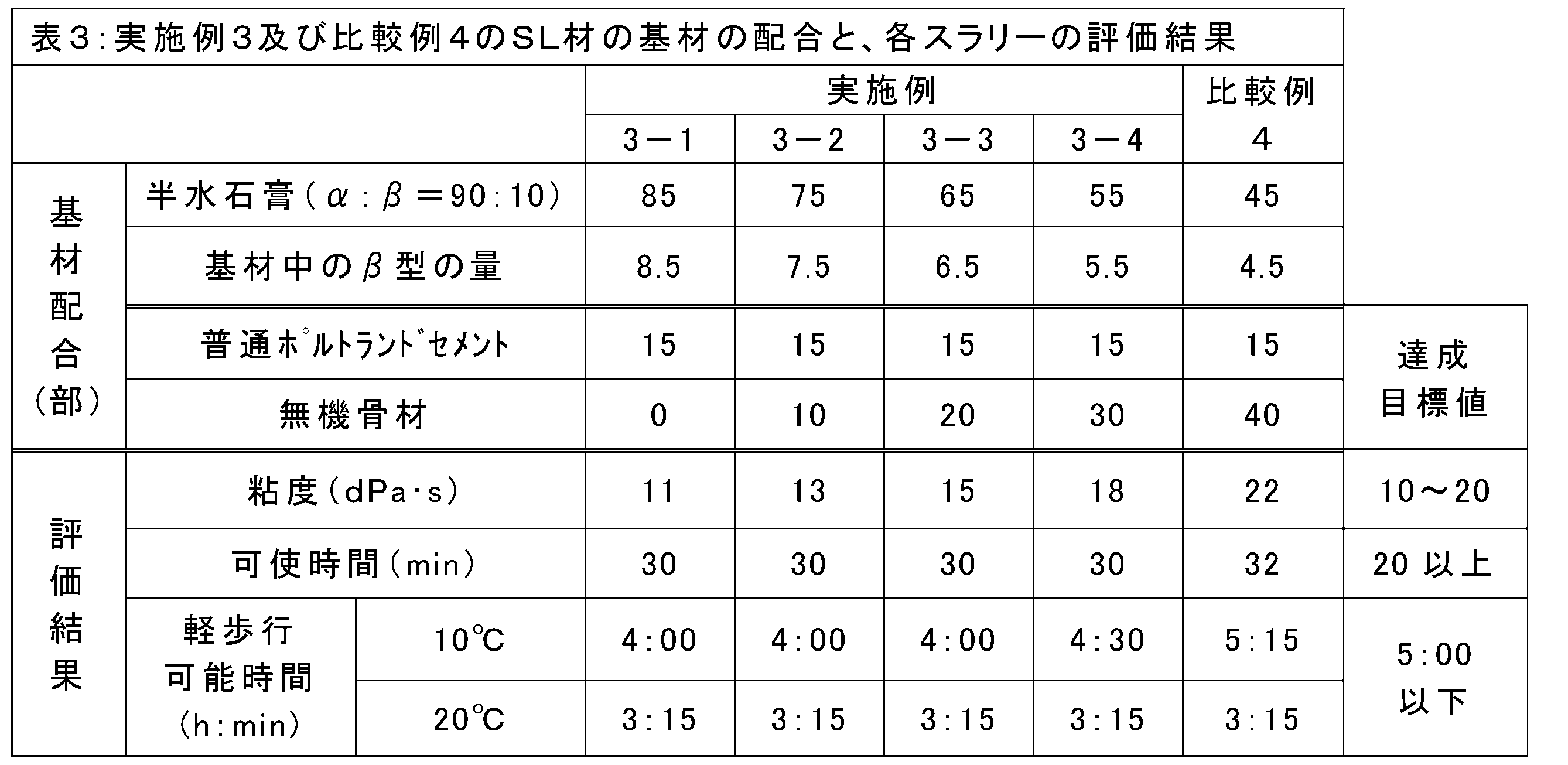
実施例1の結果から、基材を構成する半水石膏に、α型半水石膏を90部、β型半水石膏を10部で配合したもの(α:β=90:10)を用いた。そして、表3に示した通り、基材の構成を、上記構成の半水石膏の使用量を45~85部の範囲で段階的に変えて、これに、セメント(普通ポルトランドセメント)を15部の一定量で加え、さらに、無機骨材(炭酸カルシウム)を0~40部の範囲で段階的に量を変えて加え、実施例3-1~3-4、比較例4のSL材を調製した。具体的には、上記した構成が異なる5種の基材に、実施例1と同様にして、それぞれ、所定量の凝結遅延剤、膨張抑制剤、増粘剤、消泡剤を添加してSL材を得た。
上記のようにして得たSL材の各スラリーの物性値と、スラリーを施工した際における軽歩行可能時間を、先に述べたと同様にして測定した。なお、すべての試験において、JASS 15M-103(セルフレベリング材の品質基準)で規定する長さ変化が0.05%以下であることを確認した。試験結果を表3にまとめて示した。
本例では、基材材料に、セメントを15部の一定量で加えて、α型半水石膏とβ型半水石膏との配合比率(αとβ比)を表4に示したように段階的に変えた半水石膏を用いて、実施例1で行ったのと同様の方法でSL材を調製した。そして、実施例1と同様にして得られたSL材を評価した。なお、すべての試験において、JASS 15M-103(セルフレベリング材の品質基準)で規定する長さ変化が0.05%以下であることを確認した。得られた評価結果を表4にまとめて示した。
他の実施例の場合と異なり、本例では、基材材料にセメントや無機骨材を使用することなく、半水石膏のみを用いてSL材を調製した。具体的には、基材を構成する半水石膏として、α型半水石膏と、β型半水石膏とを、表5に示した通りに段階的に配合比を変えて用い、実施例1と同様の方法でSL材を調製した。そして、実施例1と同様にして、得られたSL材を評価した。なお、すべての試験において、JASS 15M-103(セルフレベリング材の品質基準)で規定する長さ変化が0.05%以下であることを確認した。得られた評価結果を表5にまとめて示した。

Claims (7)
- 半水石膏を必須成分とし、任意成分として、無機骨材及びセメントの少なくともいずれかを含んでもよい基材成分に、添加剤を含有してなるセルフレベリング材組成物であって、
前記基材成分の合計を100質量部とした場合に、前記半水石膏の含有量が55~100質量部であり、
前記半水石膏は、α型半水石膏とβ型半水石膏とを含み、且つ、α型半水石膏とβ型半水石膏の合計を100質量部とした場合に、α型半水石膏の含有量が70~95質量部、β型半水石膏の含有量が5~30質量部であり、さらに、前記基材成分の合計を100質量部とした場合に、前記β型半水石膏の含有量は20質量部以下である、
JASS 15M-103(セルフレベリング材の品質基準)で規定する長さ変化が、0.05%以下であることを特徴とするせっこう系セルフレベリング材組成物。 - 前記基材成分の合計を100質量部とした場合に、前記半水石膏の含有量が55~100質量部、前記セメントの含有量が0~25質量部及び前記無機骨材の含有量が0~30質量部である請求項1に記載のせっこう系セルフレベリング材組成物。
- 前記セメントが、普通ポルトランドセメント、早強ポルトランドセメント、高炉セメント及びアルミナセメントからなる群から選ばれるいずれかである請求項1又は2に記載のせっこう系セルフレベリング材組成物。
- 前記基材の構成成分が、半水石膏とセメントである請求項1~3のいずれか1項に記載のせっこう系セルフレベリング材組成物。
- 前記無機骨材が、炭酸カルシウムである請求項1~3のいずれか1項に記載のせっこう系セルフレベリング材組成物。
- 前記半水石膏の合計を100質量部とした場合に、前記α型半水石膏の含有量が80~90質量部で、前記β型半水石膏の含有量が10~20質量部である請求項1~5のいずれか1項に記載のせっこう系セルフレベリング材組成物。
- 前記基材成分の合計を100質量部とした場合に、前記半水石膏の含有量が100質量部であり、前記任意成分を含まない請求項1に記載のせっこう系セルフレベリング材組成物。
Priority Applications (5)
| Application Number | Priority Date | Filing Date | Title |
|---|---|---|---|
| CN202080071941.8A CN114585595B (zh) | 2019-10-15 | 2020-10-07 | 自流平材料组合物 |
| JP2021552343A JP7563763B2 (ja) | 2019-10-15 | 2020-10-07 | セルフレベリング材組成物 |
| EP20877706.0A EP4046976A4 (en) | 2019-10-15 | 2020-10-07 | SELF-LEVELING MATERIAL COMPOSITION |
| KR1020227008458A KR102800606B1 (ko) | 2019-10-15 | 2020-10-07 | 셀프 레벨링재 조성물 |
| PH1/2022/550868A PH12022550868A1 (en) | 2019-10-15 | 2020-10-07 | Self-leveling material composition |
Applications Claiming Priority (2)
| Application Number | Priority Date | Filing Date | Title |
|---|---|---|---|
| JP2019188315 | 2019-10-15 | ||
| JP2019-188315 | 2019-10-15 |
Publications (1)
| Publication Number | Publication Date |
|---|---|
| WO2021075322A1 true WO2021075322A1 (ja) | 2021-04-22 |
Family
ID=75538440
Family Applications (1)
| Application Number | Title | Priority Date | Filing Date |
|---|---|---|---|
| PCT/JP2020/037962 Ceased WO2021075322A1 (ja) | 2019-10-15 | 2020-10-07 | セルフレベリング材組成物 |
Country Status (7)
| Country | Link |
|---|---|
| EP (1) | EP4046976A4 (ja) |
| JP (1) | JP7563763B2 (ja) |
| KR (1) | KR102800606B1 (ja) |
| CN (1) | CN114585595B (ja) |
| PH (1) | PH12022550868A1 (ja) |
| TW (1) | TWI900500B (ja) |
| WO (1) | WO2021075322A1 (ja) |
Cited By (2)
| Publication number | Priority date | Publication date | Assignee | Title |
|---|---|---|---|---|
| CN115093189A (zh) * | 2022-06-27 | 2022-09-23 | 河南城建学院 | 一种石膏基自流平砂浆及其制备方法 |
| CN116041022A (zh) * | 2022-11-25 | 2023-05-02 | 深圳市青青源科技有限公司 | 一种高精度尺寸的自流平石膏及其制作方法 |
Citations (4)
| Publication number | Priority date | Publication date | Assignee | Title |
|---|---|---|---|---|
| JPS5359230A (en) * | 1976-11-10 | 1978-05-27 | Yoshino Gypsum Co | Method of producing plasterrhardened body for floor base |
| JPS55154365A (en) * | 1979-05-12 | 1980-12-01 | Kajima Corp | Fluid gypsum composition |
| CN102452826A (zh) * | 2010-10-19 | 2012-05-16 | 上海城建物资有限公司 | 低碳的自流平地面找平石膏配方 |
| CN110317032A (zh) * | 2018-03-29 | 2019-10-11 | 北新集团建材股份有限公司 | 一种高强度石膏基自流平砂浆及其制备方法 |
Family Cites Families (15)
| Publication number | Priority date | Publication date | Assignee | Title |
|---|---|---|---|---|
| JPS55126559A (en) * | 1979-03-24 | 1980-09-30 | Sumitomo Chemical Co | Gypsum composition having good swelling control effect for floor |
| US4661159A (en) * | 1985-11-13 | 1987-04-28 | Raymond Ortega | Cementitious floor underlayment |
| DE4008084A1 (de) * | 1990-03-14 | 1991-09-19 | Pro Mineral Ges | Verfahren zur herstellung von gipsfaserplatten, insbesondere von fussbodenplatten |
| US6241815B1 (en) * | 1999-08-10 | 2001-06-05 | United States Gypsum Company | Gypsum-cement system for construction materials |
| WO2003082767A1 (en) | 2002-03-27 | 2003-10-09 | United States Gypsum Company | Sprayable machinable media |
| US7504165B2 (en) * | 2005-06-14 | 2009-03-17 | United States Gypsum Company | High strength flooring compositions |
| US7588634B2 (en) * | 2006-09-20 | 2009-09-15 | United States Gypsum Company | Process for manufacturing ultra low consistency alpha- and beta- blend stucco |
| US7754007B2 (en) * | 2007-10-23 | 2010-07-13 | United States Gypsum Company | Gypsum mixtures for forming solids |
| US7651564B2 (en) * | 2008-04-10 | 2010-01-26 | Georgia-Pacific Gypsum Llc | Gypsum-based floor underlayment |
| GB0809526D0 (en) * | 2008-05-27 | 2008-07-02 | Dow Corning | Gypsum materials |
| WO2012077229A1 (ja) * | 2010-12-10 | 2012-06-14 | 吉野石膏株式会社 | 乾燥石膏組成物及び石膏系上塗り塗材 |
| KR101709120B1 (ko) * | 2015-11-17 | 2017-02-22 | 한일시멘트 (주) | 베타반수석고계 바닥용 모르타르 조성물. |
| CN109694228B (zh) * | 2017-10-23 | 2020-12-22 | 北新集团建材股份有限公司 | 一种石膏基自流平砂浆及其制备方法和石膏基自流平料浆 |
| JP2022059230A (ja) * | 2020-10-01 | 2022-04-13 | 井関農機株式会社 | 汎用コンバイン |
| JP7537340B2 (ja) * | 2021-03-30 | 2024-08-21 | 豊田合成株式会社 | ファーサイドエアバッグ装置 |
-
2020
- 2020-10-07 CN CN202080071941.8A patent/CN114585595B/zh active Active
- 2020-10-07 WO PCT/JP2020/037962 patent/WO2021075322A1/ja not_active Ceased
- 2020-10-07 EP EP20877706.0A patent/EP4046976A4/en active Pending
- 2020-10-07 JP JP2021552343A patent/JP7563763B2/ja active Active
- 2020-10-07 KR KR1020227008458A patent/KR102800606B1/ko active Active
- 2020-10-07 PH PH1/2022/550868A patent/PH12022550868A1/en unknown
- 2020-10-13 TW TW109135272A patent/TWI900500B/zh active
Patent Citations (4)
| Publication number | Priority date | Publication date | Assignee | Title |
|---|---|---|---|---|
| JPS5359230A (en) * | 1976-11-10 | 1978-05-27 | Yoshino Gypsum Co | Method of producing plasterrhardened body for floor base |
| JPS55154365A (en) * | 1979-05-12 | 1980-12-01 | Kajima Corp | Fluid gypsum composition |
| CN102452826A (zh) * | 2010-10-19 | 2012-05-16 | 上海城建物资有限公司 | 低碳的自流平地面找平石膏配方 |
| CN110317032A (zh) * | 2018-03-29 | 2019-10-11 | 北新集团建材股份有限公司 | 一种高强度石膏基自流平砂浆及其制备方法 |
Non-Patent Citations (1)
| Title |
|---|
| See also references of EP4046976A4 * |
Cited By (3)
| Publication number | Priority date | Publication date | Assignee | Title |
|---|---|---|---|---|
| CN115093189A (zh) * | 2022-06-27 | 2022-09-23 | 河南城建学院 | 一种石膏基自流平砂浆及其制备方法 |
| CN115093189B (zh) * | 2022-06-27 | 2023-05-23 | 河南城建学院 | 一种石膏基自流平砂浆及其制备方法 |
| CN116041022A (zh) * | 2022-11-25 | 2023-05-02 | 深圳市青青源科技有限公司 | 一种高精度尺寸的自流平石膏及其制作方法 |
Also Published As
| Publication number | Publication date |
|---|---|
| PH12022550868A1 (en) | 2023-03-27 |
| CN114585595B (zh) | 2023-02-17 |
| JP7563763B2 (ja) | 2024-10-08 |
| CN114585595A (zh) | 2022-06-03 |
| EP4046976A1 (en) | 2022-08-24 |
| TW202128593A (zh) | 2021-08-01 |
| JPWO2021075322A1 (ja) | 2021-04-22 |
| EP4046976A4 (en) | 2023-11-29 |
| KR102800606B1 (ko) | 2025-04-28 |
| TWI900500B (zh) | 2025-10-11 |
| KR20220047345A (ko) | 2022-04-15 |
Similar Documents
| Publication | Publication Date | Title |
|---|---|---|
| JP6830826B2 (ja) | 自己平滑性モルタル | |
| AU2006304216B2 (en) | Slump retention in cementitious compositions | |
| CN113860788A (zh) | 一种适用于磷酸镁水泥的复合缓凝剂 | |
| JP7034573B2 (ja) | 速硬性ポリマーセメント組成物及び速硬性ポリマーセメントモルタル | |
| WO2021075322A1 (ja) | セルフレベリング材組成物 | |
| JP5161062B2 (ja) | 高流動モルタル | |
| JP6518535B2 (ja) | 打重ね用のコンクリート | |
| JP4434330B2 (ja) | セメント | |
| JP5004294B2 (ja) | 高流動モルタル | |
| JP6783118B2 (ja) | セメント組成物及びその製造方法 | |
| JP4585905B2 (ja) | モルタル又はコンクリート | |
| JP3950641B2 (ja) | 急硬性セメント用急結剤の製造方法、および急硬性セメント組成物の製造方法 | |
| HK40066490A (zh) | 自流平材料组合物 | |
| JP2010100457A (ja) | 高温用グラウト組成物 | |
| JPH11199302A (ja) | 速硬性補修材 | |
| JP6320878B2 (ja) | 低温環境用セメント組成物 | |
| HK40066490B (zh) | 自流平材料组合物 | |
| JP2022111343A (ja) | グラウト | |
| JP5709046B2 (ja) | セメント組成物 | |
| JP4583220B2 (ja) | 超速硬コンクリートの流動性改善方法及び超速硬コンクリート用流動性改善剤 | |
| JP4587448B2 (ja) | 急硬促進剤用添加剤及びこれを含む急硬性混和材、急硬性組成物並びに急硬性セルフレベリング組成物 | |
| JPH0637319B2 (ja) | セメント組成物の硬化方法 | |
| JP5812836B2 (ja) | グラウト材組成物及びそれを用いてなるグラウト材 | |
| JP2025146457A (ja) | セメント組成物、及び、セルフレベリング材又は補修材 | |
| JP2018123025A (ja) | 自己平滑性モルタル |
Legal Events
| Date | Code | Title | Description |
|---|---|---|---|
| 121 | Ep: the epo has been informed by wipo that ep was designated in this application |
Ref document number: 20877706 Country of ref document: EP Kind code of ref document: A1 |
|
| ENP | Entry into the national phase |
Ref document number: 2021552343 Country of ref document: JP Kind code of ref document: A |
|
| ENP | Entry into the national phase |
Ref document number: 20227008458 Country of ref document: KR Kind code of ref document: A |
|
| NENP | Non-entry into the national phase |
Ref country code: DE |
|
| ENP | Entry into the national phase |
Ref document number: 2020877706 Country of ref document: EP Effective date: 20220516 |
|
| WWE | Wipo information: entry into national phase |
Ref document number: 522432258 Country of ref document: SA |
|
| WWR | Wipo information: refused in national office |
Ref document number: 1020227008458 Country of ref document: KR |
|
| WWC | Wipo information: continuation of processing after refusal or withdrawal |
Ref document number: 1020227008458 Country of ref document: KR |
|
| WWG | Wipo information: grant in national office |
Ref document number: 1020227008458 Country of ref document: KR |
|
| WWE | Wipo information: entry into national phase |
Ref document number: 522432258 Country of ref document: SA |