WO2021075480A1 - 紙用コーティング剤及びそれを用いた塗工紙 - Google Patents
紙用コーティング剤及びそれを用いた塗工紙 Download PDFInfo
- Publication number
- WO2021075480A1 WO2021075480A1 PCT/JP2020/038859 JP2020038859W WO2021075480A1 WO 2021075480 A1 WO2021075480 A1 WO 2021075480A1 JP 2020038859 W JP2020038859 W JP 2020038859W WO 2021075480 A1 WO2021075480 A1 WO 2021075480A1
- Authority
- WO
- WIPO (PCT)
- Prior art keywords
- ethylene
- paper
- coating agent
- vinyl alcohol
- vinyl
- Prior art date
- Legal status (The legal status is an assumption and is not a legal conclusion. Google has not performed a legal analysis and makes no representation as to the accuracy of the status listed.)
- Ceased
Links
Images


Classifications
-
- C—CHEMISTRY; METALLURGY
- C09—DYES; PAINTS; POLISHES; NATURAL RESINS; ADHESIVES; COMPOSITIONS NOT OTHERWISE PROVIDED FOR; APPLICATIONS OF MATERIALS NOT OTHERWISE PROVIDED FOR
- C09D—COATING COMPOSITIONS, e.g. PAINTS, VARNISHES OR LACQUERS; FILLING PASTES; CHEMICAL PAINT OR INK REMOVERS; INKS; CORRECTING FLUIDS; WOODSTAINS; PASTES OR SOLIDS FOR COLOURING OR PRINTING; USE OF MATERIALS THEREFOR
- C09D7/00—Features of coating compositions, not provided for in group C09D5/00; Processes for incorporating ingredients in coating compositions
- C09D7/40—Additives
- C09D7/60—Additives non-macromolecular
- C09D7/63—Additives non-macromolecular organic
-
- D—TEXTILES; PAPER
- D21—PAPER-MAKING; PRODUCTION OF CELLULOSE
- D21H—PULP COMPOSITIONS; PREPARATION THEREOF NOT COVERED BY SUBCLASSES D21C OR D21D; IMPREGNATING OR COATING OF PAPER; TREATMENT OF FINISHED PAPER NOT COVERED BY CLASS B31 OR SUBCLASS D21G; PAPER NOT OTHERWISE PROVIDED FOR
- D21H19/00—Coated paper; Coating material
- D21H19/10—Coatings without pigments
- D21H19/12—Coatings without pigments applied as a solution using water as the only solvent, e.g. in the presence of acid or alkaline compounds
-
- C—CHEMISTRY; METALLURGY
- C08—ORGANIC MACROMOLECULAR COMPOUNDS; THEIR PREPARATION OR CHEMICAL WORKING-UP; COMPOSITIONS BASED THEREON
- C08F—MACROMOLECULAR COMPOUNDS OBTAINED BY REACTIONS ONLY INVOLVING CARBON-TO-CARBON UNSATURATED BONDS
- C08F216/00—Copolymers of compounds having one or more unsaturated aliphatic radicals, each having only one carbon-to-carbon double bond, and at least one being terminated by an alcohol, ether, aldehydo, ketonic, acetal or ketal radical
- C08F216/02—Copolymers of compounds having one or more unsaturated aliphatic radicals, each having only one carbon-to-carbon double bond, and at least one being terminated by an alcohol, ether, aldehydo, ketonic, acetal or ketal radical by an alcohol radical
- C08F216/04—Acyclic compounds
- C08F216/06—Polyvinyl alcohol ; Vinyl alcohol
-
- C—CHEMISTRY; METALLURGY
- C08—ORGANIC MACROMOLECULAR COMPOUNDS; THEIR PREPARATION OR CHEMICAL WORKING-UP; COMPOSITIONS BASED THEREON
- C08F—MACROMOLECULAR COMPOUNDS OBTAINED BY REACTIONS ONLY INVOLVING CARBON-TO-CARBON UNSATURATED BONDS
- C08F297/00—Macromolecular compounds obtained by successively polymerising different monomer systems using a catalyst of the ionic or coordination type without deactivating the intermediate polymer
- C08F297/02—Macromolecular compounds obtained by successively polymerising different monomer systems using a catalyst of the ionic or coordination type without deactivating the intermediate polymer using a catalyst of the anionic type
-
- C—CHEMISTRY; METALLURGY
- C08—ORGANIC MACROMOLECULAR COMPOUNDS; THEIR PREPARATION OR CHEMICAL WORKING-UP; COMPOSITIONS BASED THEREON
- C08F—MACROMOLECULAR COMPOUNDS OBTAINED BY REACTIONS ONLY INVOLVING CARBON-TO-CARBON UNSATURATED BONDS
- C08F8/00—Chemical modification by after-treatment
- C08F8/12—Hydrolysis
-
- C—CHEMISTRY; METALLURGY
- C09—DYES; PAINTS; POLISHES; NATURAL RESINS; ADHESIVES; COMPOSITIONS NOT OTHERWISE PROVIDED FOR; APPLICATIONS OF MATERIALS NOT OTHERWISE PROVIDED FOR
- C09D—COATING COMPOSITIONS, e.g. PAINTS, VARNISHES OR LACQUERS; FILLING PASTES; CHEMICAL PAINT OR INK REMOVERS; INKS; CORRECTING FLUIDS; WOODSTAINS; PASTES OR SOLIDS FOR COLOURING OR PRINTING; USE OF MATERIALS THEREFOR
- C09D123/00—Coating compositions based on homopolymers or copolymers of unsaturated aliphatic hydrocarbons having only one carbon-to-carbon double bond; Coating compositions based on derivatives of such polymers
- C09D123/02—Coating compositions based on homopolymers or copolymers of unsaturated aliphatic hydrocarbons having only one carbon-to-carbon double bond; Coating compositions based on derivatives of such polymers not modified by chemical after-treatment
- C09D123/04—Homopolymers or copolymers of ethene
- C09D123/08—Copolymers of ethene
-
- C—CHEMISTRY; METALLURGY
- C09—DYES; PAINTS; POLISHES; NATURAL RESINS; ADHESIVES; COMPOSITIONS NOT OTHERWISE PROVIDED FOR; APPLICATIONS OF MATERIALS NOT OTHERWISE PROVIDED FOR
- C09D—COATING COMPOSITIONS, e.g. PAINTS, VARNISHES OR LACQUERS; FILLING PASTES; CHEMICAL PAINT OR INK REMOVERS; INKS; CORRECTING FLUIDS; WOODSTAINS; PASTES OR SOLIDS FOR COLOURING OR PRINTING; USE OF MATERIALS THEREFOR
- C09D129/00—Coating compositions based on homopolymers or copolymers of compounds having one or more unsaturated aliphatic radicals, each having only one carbon-to-carbon double bond, and at least one being terminated by an alcohol, ether, aldehydo, ketonic, acetal, or ketal radical; Coating compositions based on hydrolysed polymers of esters of unsaturated alcohols with saturated carboxylic acids; Coating compositions based on derivatives of such polymers
- C09D129/02—Homopolymers or copolymers of unsaturated alcohols
- C09D129/04—Polyvinyl alcohol; Partially hydrolysed homopolymers or copolymers of esters of unsaturated alcohols with saturated carboxylic acids
-
- C—CHEMISTRY; METALLURGY
- C09—DYES; PAINTS; POLISHES; NATURAL RESINS; ADHESIVES; COMPOSITIONS NOT OTHERWISE PROVIDED FOR; APPLICATIONS OF MATERIALS NOT OTHERWISE PROVIDED FOR
- C09D—COATING COMPOSITIONS, e.g. PAINTS, VARNISHES OR LACQUERS; FILLING PASTES; CHEMICAL PAINT OR INK REMOVERS; INKS; CORRECTING FLUIDS; WOODSTAINS; PASTES OR SOLIDS FOR COLOURING OR PRINTING; USE OF MATERIALS THEREFOR
- C09D153/00—Coating compositions based on block copolymers containing at least one sequence of a polymer obtained by reactions only involving carbon-to-carbon unsaturated bonds; Coating compositions based on derivatives of such polymers
- C09D153/005—Modified block copolymers
-
- C—CHEMISTRY; METALLURGY
- C09—DYES; PAINTS; POLISHES; NATURAL RESINS; ADHESIVES; COMPOSITIONS NOT OTHERWISE PROVIDED FOR; APPLICATIONS OF MATERIALS NOT OTHERWISE PROVIDED FOR
- C09D—COATING COMPOSITIONS, e.g. PAINTS, VARNISHES OR LACQUERS; FILLING PASTES; CHEMICAL PAINT OR INK REMOVERS; INKS; CORRECTING FLUIDS; WOODSTAINS; PASTES OR SOLIDS FOR COLOURING OR PRINTING; USE OF MATERIALS THEREFOR
- C09D5/00—Coating compositions, e.g. paints, varnishes or lacquers, characterised by their physical nature or the effects produced; Filling pastes
-
- C—CHEMISTRY; METALLURGY
- C09—DYES; PAINTS; POLISHES; NATURAL RESINS; ADHESIVES; COMPOSITIONS NOT OTHERWISE PROVIDED FOR; APPLICATIONS OF MATERIALS NOT OTHERWISE PROVIDED FOR
- C09D—COATING COMPOSITIONS, e.g. PAINTS, VARNISHES OR LACQUERS; FILLING PASTES; CHEMICAL PAINT OR INK REMOVERS; INKS; CORRECTING FLUIDS; WOODSTAINS; PASTES OR SOLIDS FOR COLOURING OR PRINTING; USE OF MATERIALS THEREFOR
- C09D7/00—Features of coating compositions, not provided for in group C09D5/00; Processes for incorporating ingredients in coating compositions
- C09D7/40—Additives
- C09D7/65—Additives macromolecular
-
- D—TEXTILES; PAPER
- D21—PAPER-MAKING; PRODUCTION OF CELLULOSE
- D21H—PULP COMPOSITIONS; PREPARATION THEREOF NOT COVERED BY SUBCLASSES D21C OR D21D; IMPREGNATING OR COATING OF PAPER; TREATMENT OF FINISHED PAPER NOT COVERED BY CLASS B31 OR SUBCLASS D21G; PAPER NOT OTHERWISE PROVIDED FOR
- D21H19/00—Coated paper; Coating material
- D21H19/10—Coatings without pigments
- D21H19/14—Coatings without pigments applied in a form other than the aqueous solution defined in group D21H19/12
- D21H19/20—Coatings without pigments applied in a form other than the aqueous solution defined in group D21H19/12 comprising macromolecular compounds obtained by reactions only involving carbon-to-carbon unsaturated bonds
-
- D—TEXTILES; PAPER
- D21—PAPER-MAKING; PRODUCTION OF CELLULOSE
- D21H—PULP COMPOSITIONS; PREPARATION THEREOF NOT COVERED BY SUBCLASSES D21C OR D21D; IMPREGNATING OR COATING OF PAPER; TREATMENT OF FINISHED PAPER NOT COVERED BY CLASS B31 OR SUBCLASS D21G; PAPER NOT OTHERWISE PROVIDED FOR
- D21H21/00—Non-fibrous material added to the pulp, characterised by its function, form or properties; Paper-impregnating or coating material, characterised by its function, form or properties
- D21H21/14—Non-fibrous material added to the pulp, characterised by its function, form or properties; Paper-impregnating or coating material, characterised by its function, form or properties characterised by function or properties in or on the paper
- D21H21/16—Sizing or water-repelling agents
-
- D—TEXTILES; PAPER
- D21—PAPER-MAKING; PRODUCTION OF CELLULOSE
- D21H—PULP COMPOSITIONS; PREPARATION THEREOF NOT COVERED BY SUBCLASSES D21C OR D21D; IMPREGNATING OR COATING OF PAPER; TREATMENT OF FINISHED PAPER NOT COVERED BY CLASS B31 OR SUBCLASS D21G; PAPER NOT OTHERWISE PROVIDED FOR
- D21H27/00—Special paper not otherwise provided for, e.g. made by multi-step processes
-
- D—TEXTILES; PAPER
- D21—PAPER-MAKING; PRODUCTION OF CELLULOSE
- D21H—PULP COMPOSITIONS; PREPARATION THEREOF NOT COVERED BY SUBCLASSES D21C OR D21D; IMPREGNATING OR COATING OF PAPER; TREATMENT OF FINISHED PAPER NOT COVERED BY CLASS B31 OR SUBCLASS D21G; PAPER NOT OTHERWISE PROVIDED FOR
- D21H27/00—Special paper not otherwise provided for, e.g. made by multi-step processes
- D21H27/001—Release paper
-
- C—CHEMISTRY; METALLURGY
- C08—ORGANIC MACROMOLECULAR COMPOUNDS; THEIR PREPARATION OR CHEMICAL WORKING-UP; COMPOSITIONS BASED THEREON
- C08F—MACROMOLECULAR COMPOUNDS OBTAINED BY REACTIONS ONLY INVOLVING CARBON-TO-CARBON UNSATURATED BONDS
- C08F2810/00—Chemical modification of a polymer
-
- C—CHEMISTRY; METALLURGY
- C08—ORGANIC MACROMOLECULAR COMPOUNDS; THEIR PREPARATION OR CHEMICAL WORKING-UP; COMPOSITIONS BASED THEREON
- C08K—Use of inorganic or non-macromolecular organic substances as compounding ingredients
- C08K5/00—Use of organic ingredients
- C08K5/01—Hydrocarbons
Definitions
- the present invention relates to a coating agent for paper containing an ethylene-vinyl alcohol copolymer.
- the present invention also relates to a coated paper using the coating agent and a method for producing the same.
- Vinyl alcohol-based polymers represented by polyvinyl alcohol are known as water-soluble synthetic polymers, and are raw materials for vinylon, which is a synthetic fiber, and a paper processing agent. , Fiber processing agents, adhesives, stabilizers for emulsion polymerization and suspension polymerization, inorganic binders, films and the like.
- PVA polyvinyl alcohol
- Fiber processing agents, adhesives, stabilizers for emulsion polymerization and suspension polymerization, inorganic binders, films and the like it is known that by applying PVA to paper, it is possible to enhance paper strength, make it water resistant, make it oil resistant, impart gas barrier properties, etc., and apply vinyl alcohol-based polymer to paper. Coated paper is widely used.
- the vinyl alcohol-based polymer is also used as an auxiliary agent used together with an additive for imparting functionality to paper, such as an inorganic binder and a dispersion stabilizer.
- PVA is used as a sealing layer (barrier layer) for the purpose of reducing voids between pulp fibers constituting the paper and improving the yield of silicone coated on the paper surface.
- System polymers are commonly used.
- partially saponified PVA is preferably used because it has excellent barrier properties.
- Patent Document 1 describes that both barrier properties and water resistance can be achieved by using a coating liquid containing ethylene-modified PVA and carboxymethyl cellulose.
- the coating liquid may not have sufficient viscosity stability. Further, due to the shear stress applied to the coating liquid at the time of preparation and coating, a large number of fibril-like precipitates are generated, and there is room for improvement in process passability.
- the present invention has been made based on the above circumstances, and an object of the present invention is to provide a coating agent capable of obtaining a coated paper having excellent viscosity stability and excellent barrier properties and water resistance. To do.
- the above problem is a coating for paper containing an ethylene-vinyl alcohol copolymer having an ethylene unit content of 1 mol% or more and less than 20 mol% and an ethylene unit block character of 0.90 to 0.99. It is solved by providing the agent.
- the coating agent may further contain a compound having a conjugated double bond and a molecular weight of 1000 or less in an amount of 0.000001 to 0.01 parts by mass with respect to 100 parts by mass of the ethylene-vinyl alcohol copolymer.
- the saponification degree of the ethylene-vinyl alcohol copolymer is 80 to 99.7 mol%.
- the ethylene-vinyl alcohol copolymer has a viscosity average degree of polymerization of 300 to 5000.
- the coating agent further contains ionomer.
- the above problem is also solved by providing a coating agent for paper containing an ethylene-vinyl alcohol copolymer and an ionomer having an ethylene unit content of 1 mol% or more and less than 20 mol%.
- the coating agent may further contain a compound having a conjugated double bond and a molecular weight of 1000 or less in an amount of 0.000001 to 0.01 parts by mass with respect to 100 parts by mass of the ethylene-vinyl alcohol copolymer.
- a compound having a conjugated double bond and a molecular weight of 1000 or less in an amount of 0.000001 to 0.01 parts by mass with respect to 100 parts by mass of the ethylene-vinyl alcohol copolymer.
- the saponification degree of the ethylene-vinyl alcohol copolymer is 80 to 99.7 mol%.
- the ethylene-vinyl alcohol copolymer has a viscosity average degree of polymerization of 300 to 5000.
- a coated paper on which the coating agent is applied is a preferred embodiment of the present invention. It is more preferable that the coated paper is a release paper base paper. It is also more preferable that the coated paper is oil resistant paper. A method for producing coated paper in which the coating agent is applied to paper is also a preferred embodiment of the present invention.
- the paper coating agent of the present invention containing the ethylene-vinyl alcohol copolymer having a specific structure is excellent in viscosity stability. Further, by using the coating agent, a coated paper having excellent barrier properties and water resistance, particularly a release paper and an oil resistant paper, is provided.
- the coating agent for paper of the present invention contains an ethylene-vinyl alcohol copolymer having an ethylene unit content of 1 mol% or more and less than 20 mol% and an ethylene unit block character of 0.90 to 0.99. It is a thing.
- the ethylene-vinyl alcohol copolymer contained in the coating agent for paper of the present invention has an ethylene unit content of 1 mol% or more and less than 20 mol%, and an ethylene unit block character of 0.90 to 0.99. It is characterized by being. This point will be described below.
- the block character of the ethylene unit is 0.90 to 0.99, which is a major feature of the ethylene-vinyl alcohol copolymer.
- the block character is preferably 0.93 or more, and more preferably 0.95 or more.
- the block character is 0.99 or less. When the block character is 0.99 or less, the water resistance of the obtained coated paper is improved.
- the block character is a numerical value representing the distribution of the ethylene unit and the vinyl alcohol unit generated by the saponification of the vinyl ester unit, and takes a value between 0 and 2. 0 indicates that the ethylene unit or vinyl alcohol unit is distributed completely in a block, and the alternation increases as the value increases, and 1 indicates that the ethylene unit and the vinyl alcohol unit are completely randomly present. 2 indicates that ethylene units and vinyl alcohol units are completely alternated.
- the block character is obtained by 13 C-NMR as follows. First, the ethylene-vinyl alcohol copolymer is saponified to a saponification degree of 99.9 mol% or more, thoroughly washed with methanol, and dried under reduced pressure at 90 ° C. for 2 days.
- the ethylene-vinyl alcohol copolymer having the block character of the ethylene unit defined above can be obtained by a special production method including a polymerization step and a saponification step described later.
- a special production method including a polymerization step and a saponification step described later.
- the ethylene-vinyl alcohol copolymer of the present invention will be described in more detail.
- the ethylene-vinyl alcohol copolymer of the present invention can be obtained by copolymerizing ethylene and vinyl ester to obtain an ethylene-vinyl ester copolymer, and then saponifying the ethylene-vinyl ester copolymer.
- the vinyl ester used include vinyl formate, vinyl acetate, vinyl propionate, vinyl valerate, vinyl caprate, vinyl laurate, vinyl stearate, vinyl benzoate, vinyl pivalate, vinyl versatic acid and the like. Of these, vinyl acetate is preferable.
- the ethylene unit content of the ethylene-vinyl alcohol copolymer of the present invention is 1 mol% or more and less than 20 mol%. When the content of ethylene units is less than 1 mol%, the water resistance of the obtained coated paper is lowered.
- the ethylene unit content is preferably 1.5 mol% or more, more preferably 2 mol% or more, and further preferably 2.5 mol% or more.
- the content of ethylene units is 20 mol% or more, the ethylene-vinyl alcohol copolymer becomes insoluble in water, which makes it difficult to prepare an aqueous solution.
- the ethylene unit content is preferably 15 mol% or less, more preferably 10 mol% or less, and further preferably 8.5 mol% or less.
- the content of ethylene units can be determined by the following method, for example, from 1 H-NMR of an ethylene-vinyl ester copolymer which is a precursor of an ethylene-vinyl alcohol copolymer or a revinegared product.
- the ethylene-vinyl ester copolymer of the sample was reprecipitated and purified three times or more using a mixed solution of n-hexane and acetone, and then dried under reduced pressure at 80 ° C. for 3 days to have an ethylene-vinyl ester copolymer for analysis. Make a coalescence.
- the obtained ethylene - vinyl ester copolymer dissolved in DMSO-d 6, performs 1 H-NMR (500MHz) determined at 80 ° C..
- the ethylene unit content was determined using the peak derived from the main chain methine of vinyl ester (4.7 to 5.2 ppm) and the peak derived from ethylene and the main chain methylene of vinyl ester (0.8 to 1.6 ppm). Can be calculated.
- the saponification degree of the ethylene-vinyl alcohol copolymer of the present invention is preferably 80 mol% or more, more preferably 85 mol% or more, and further preferably 90 mol% or more.
- the saponification degree is preferably 99.7 mol% or less, more preferably 99 mol% or less.
- the saponification degree of the ethylene-vinyl alcohol copolymer can be measured according to JIS K6726 (1994).
- the viscosity average degree of polymerization of the ethylene-vinyl alcohol copolymer of the present invention is preferably 300 or more, more preferably 500 or more, still more preferably 700 or more, and particularly preferably 900 or more.
- the viscosity average degree of polymerization is preferably 5000 or less, more preferably 4000 or less, still more preferably 3500 or less, and particularly preferably 2400 or less.
- the coating agent solution (preferably an aqueous solution) in which the ethylene-vinyl alcohol copolymer is dissolved has an appropriate viscosity and is easy to handle.
- the viscosity average degree of polymerization P can be measured according to JIS K6726 (1994). That is, the ethylene-vinyl alcohol copolymer of the present invention is re-saponified to a saponification degree of 99.5 mol% or more, purified, and then measured in water at 30 ° C. from the ultimate viscosity [ ⁇ ] (L / g). Can be obtained by.
- P ([ ⁇ ] ⁇ 10000 / 8.29) (1 / 0.62)
- the ethylene-vinyl alcohol copolymer of the present invention may contain a monomer unit other than the vinyl alcohol unit, the ethylene unit and the vinyl ester unit as long as the effect of the present invention is not impaired.
- Such other monomer units include ⁇ -olefins such as propylene, n-butyl, and isobutylene; acrylate and salts thereof; acrylate ester; methacrylic acid and salts thereof; methacrylic ester; acrylamide; N-methyl.
- Acrylamide derivatives such as acrylamide, N-ethyl acrylamide, N, N-dimethyl acrylamide, diacetone acrylamide, acrylamide propanesulfonic acid and its salts, acrylamide propyl dimethylamine and its salts or quaternary salts thereof, N-methylol acrylamide and its derivatives.
- Amid derivatives methyl vinyl ethers, ethyl vinyl ethers, n-propyl vinyl ethers, i-propyl vinyl ethers, n-butyl vinyl ethers, i-butyl vinyl ethers, t-butyl vinyl ethers, dodecyl vinyl ethers, stearyl vinyl ethers and other vinyl ethers; acrylonitrile, methacrylonitrile and the like.
- Nitrile vinyl halide such as vinyl chloride and vinyl fluoride; vinylidene halide such as vinylidene chloride and vinylidene fluoride; allyl compounds such as allyl acetate and allyl chloride; unsaturated dicarboxylic acids such as maleic acid, itaconic acid and fumaric acid. And a salt thereof or an ester thereof; a vinylsilyl compound such as vinyltrimethoxysilane; a unit derived from isopropenyl acetate and the like.
- the content of these other monomer units varies depending on the purpose and use of use, but is preferably 10 mol% or less, more preferably less than 5 mol%, and further preferably 1 It is less than mol%, particularly preferably less than 0.5 mol%.
- a preferred method for producing the ethylene-vinyl alcohol copolymer of the present invention is to react ethylene with vinyl ester to obtain an ethylene-vinyl ester copolymer, and then saponify the ethylene-vinyl ester copolymer.
- a method for producing a vinyl alcohol copolymer in which (a) a wide paddle blade is used in a polymerization tank to obtain an ethylene-vinyl ester copolymer, and the stirring power Pv per unit volume is 0.5.
- This method includes a step of contacting the solution containing the vinyl ester with the ethylene-containing gas while stirring so that the fluid number Fr is 0.05 to 0.2 at about 10 kW / m 3.
- the block character of the ethylene unit of the ethylene-vinyl alcohol copolymer can be within the above range.
- an ethylene-vinyl ester copolymer is obtained by reacting (copolymerizing) ethylene with vinyl ester.
- a method for copolymerizing ethylene and vinyl ester a solution polymerization method in which ethylene and vinyl ester are polymerized in an organic solvent such as alcohol is preferable.
- the alcohol include lower alcohols such as methanol and ethanol, and methanol is particularly preferable.
- the initiators used in the polymerization include 2,2'-azobis (isobutyronitrile), 2,2'-azobis (4-methoxy-2,4-dimethylvaleronitrile), and 2,2'-azobis (4-methoxy-2,4-dimethylvaleronitrile).
- examples thereof include azo-based initiators such as 2,4-dimethylvaleronitrile), benzoyl peroxide, and n-propylperoxydicarbonate, or known initiators such as peroxide-based initiators.
- a chain transfer agent may coexist for the purpose of adjusting the viscosity average degree of polymerization of the obtained ethylene-vinyl ester copolymer.
- the chain transfer agent include aldehydes such as acetaldehyde, propionaldehyde, butyraldehyde and benzaldehyde; ketones such as acetone, methyl ethyl ketone, hexanone and cyclohexanone; mercaptans such as 2-hydroxyethanethiol; thiocarboxylic acids such as thioacetic acid; trichloroethylene and perchloro. Examples thereof include halogenated hydrocarbons such as ethylene.
- aldehydes and ketones are preferably used.
- the amount of the chain transfer agent added is determined according to the chain transfer constant of the chain transfer agent to be added and the viscosity average degree of polymerization of the target ethylene-vinyl ester copolymer, but is usually 100 parts by mass of the vinyl ester used. It is 0.1 to 10 parts by mass with respect to.
- any of the continuous method, the semi-batch method and the batch method can be adopted, but the continuous method is preferable.
- the polymerization reactor include a continuous tank reactor, a batch reactor, a tube reactor and the like, but the continuous tank reactor is preferable.
- FIG. 1 is a schematic view of the polymerization apparatus used in Example 1.
- the apparatus is a continuous tank reactor, in which the polymerization tank 1 is connected to the heat exchanger 2 via the conduits 3 and 4.
- the vinyl ester and ethylene can come into countercurrent contact in the heat exchanger 2.
- a plurality of conduits 5, 6 and 7 are connected to the polymerization tank 1.
- the number and arrangement of conduits are not limited to the illustrated form.
- ethylene, a polymerization initiator and an organic solvent are supplied to the polymerization tank 1.
- the ratio of raw materials introduced into the polymerization tank per unit time is 0.1 to 20 parts by mass of ethylene, 1 to 100 parts by mass of organic solvent, and 0.00001 parts of polymerization initiator with respect to 100 parts by mass of vinyl ester. It is preferably about 1 part by mass. In some cases, vinyl esters and other monomers can also be supplied through these conduits.
- the reaction liquid in the polymerization tank 1 is continuously discharged from the reaction liquid outlet pipe 9 connected to the bottom of the polymerization tank 1.
- a stirrer 8 having a wide paddle blade as a stirring blade is installed in the polymerization tank 1. Using the wide paddle blade, the solution containing vinyl ester is brought into contact with an ethylene-containing gas while stirring to react ethylene with vinyl ester to obtain an ethylene-vinyl ester copolymer.
- FIG. 2 shows a schematic view of an example of a wide paddle blade used in the present invention. As shown in FIG. 2, it is a feature of the wide paddle blade to have a paddle with a wide width b.
- the width b of the wide paddle blade can be appropriately adjusted depending on the capacity of the polymerization tank 1, etc., but is preferably 1 to 10 m as described later.
- the wide paddle blade may be a single stage (for example, a max blend blade) or a multi-stage (for example, a full zone blade).
- the liquid level of the solution is near the upper end of the stirring blade during stirring of the solution containing the vinyl ester.
- Max Blend blades Suditomo Heavy Industries Process Equipment Co., Ltd.
- Full Zone blades Shinko Environmental Solutions Co., Ltd.
- Sunmerer blades Mitsubishi Heavy Industries, Ltd.
- Hi-Fi mixer blades Soken Kagaku Co., Ltd.
- Supermix Tsubasa Take Chemical Machinery Co., Ltd., Supermix MR203, Supermix MR205
- Bendleaf Tsubasa Haachiko Sangyo Co., Ltd.
- the ethylene pressure in the polymerization tank at the time of polymerization is preferably 0.01 to 0.9 MPa, more preferably 0.05 to 0.8 MPa, and even more preferably 0.1 to 0.7 MPa.
- the polymerization rate of the vinyl ester at the outlet of the polymerization tank is not particularly limited, but is usually preferably 10 to 90%, more preferably 15 to 85%.
- the polymerization temperature is not particularly limited, but is usually preferably 0 to 180 ° C, more preferably 20 to 160 ° C, and even more preferably 30 to 150 ° C.
- the stirring power Pv per unit volume of the solution containing vinyl ester is 0.5 to 10 kW / m 3.
- the stirring power is more preferably 1 kW / m 3 or more, and further preferably 1.5 kW / m 3 or more.
- the stirring power is more preferably 7 kW / m 3 or less, and further preferably 5 kW / m 3 or less.
- the stirring power Pv per unit volume of the solution containing vinyl ester is measured by the method described in Examples described later.
- the Froude number Fr is the ratio of the inertial force and gravity defined by the following equation, and is an index of the shape of the vortex on the liquid surface.
- Fr n 2 x d / g
- n Rotation speed of stirring blade (rps)
- d Stirring blade diameter (m)
- g Gravitational acceleration (m / s 2 )
- the Froude number Fr is 0.05 to 0.2.
- ethylene is appropriately absorbed by the vinyl ester, so that the block character of the ethylene unit is in the above range.
- Ethylene-vinyl alcohol copolymer It is considered that coalescence can be easily obtained.
- the Froude number Fr is more preferably 0.06 or more, and further preferably 0.07 or more.
- the Froude number Fr is more preferably 0.18 or less, and further preferably 0.15 or less.
- the rotation speed n of the stirring blade or the diameter d of the stirring blade may be appropriately changed.
- the stirring blade diameter d of the wide paddle blade may be adjusted so that the stirring power Pv and the Froude number Fr are within the above ranges, and is not particularly limited, but is preferably 0.5 to 5 m from the viewpoint of improving the ethylene absorption efficiency. ..
- the stirring blade diameter d is more preferably 0.75 m or more.
- the stirring blade diameter d is more preferably 4 m or less.
- the stirring blade diameter d is a value obtained by doubling the distance from the rotating shaft to the tip of the blade (the point farthest from the rotating shaft).
- the width b (length in the height direction) of the wide paddle blade (paddle) may be adjusted according to the capacity of the polymerization tank 1 and the like, and is not particularly limited, but 1 to 10 m is preferable from the viewpoint of improving the ethylene absorption efficiency.
- the width b is more preferably 1.5 m or more.
- the width b is more preferably 8 m or less.
- the ratio (b / d) of the width (width of the paddle) b to the stirring blade diameter d of the wide paddle blade is not particularly limited as long as it is determined by the shape of the polymerization tank 1, but is 1 or more from the viewpoint of improving the ethylene absorption efficiency. Is preferable. On the other hand, the ratio (b / d) is usually 2.5 or less.
- the shape of the polymerization tank 1 is not particularly limited, but usually a substantially columnar one is used.
- the wide paddle blades are arranged in a substantially columnar polymerization tank 1 so that the rotation axis of the polymerization tank 1 and the rotation axis of the wide paddle blade coincide with each other.
- the ratio (d / D) of the stirring blade diameter d (m) to the inner diameter D (m) of the polymerization tank is not particularly limited as long as it does not impair the effect of the present invention, and is appropriately used depending on the polymerization tank used. It may be adjusted, but it is usually 0.4 to 0.9.
- the capacity of the polymerization tank is not particularly limited, but is usually 1 to 200 kl.
- the rotation speed n of the stirring blade may be adjusted so that the stirring power Pv and the Froude number Fr are within the above ranges, and is not particularly limited, but 0.5 to 1.35 rps is preferable.
- the rotation speed n is less than 0.5 rps, supercooling of the polymerization solution tends to proceed near the heat transfer surface, so that a gel-like substance may be formed on the inner wall of the polymerization tank, which may make long-term operation difficult. ..
- the rotation speed n exceeds 1.35 rps, when a polymerization solution having a low viscosity is used, the solution may jump and adhere to the inner wall of the gas phase portion of the polymerization tank. When such deposits solidify and mix with the polymerization solution, foreign substances are formed, so stable operation may not be possible.
- the stirring power per unit volume which is an index of stirring strength
- the stirring power is affected by various factors such as the volume, viscosity and density of the reaction solution, the shape of the polymerization tank, and the shape and rotation speed of the stirring blade. Therefore, it is difficult to highly control the blocking property of ethylene units only by controlling the stirring power, and as a result, the ethylene chain is extended (blocking of ethylene units), and the obtained ethylene-vinyl alcohol copolymer weight is obtained.
- the block character of ethylene units in the coalescence was less than 0.90.
- the barrier property of the obtained coated paper cannot be said to be sufficient. Further, even when carboxymethyl cellulose was added to the ethylene-vinyl alcohol copolymer, there was still room for improvement in the effect of improving the barrier property, and the viscosity stability of the aqueous solution was also lowered. As a result of diligent studies on such problems, the inventors obtained a copolymer having a shorter ethylene chain (random positions of ethylene units) by advancing the polymerization reaction under specific conditions. We have succeeded in improving both the viscosity stability of the aqueous solution of the ethylene-vinyl alcohol copolymer and the barrier property of the obtained coated paper.
- the polymerization tank used in the polymerization step is connected to the heat exchanger via a pipe from the viewpoint that the block character of the ethylene unit can be controlled to a higher degree, and both ethylene and vinyl esters are used.
- a step of introducing an ethylene-containing gas existing in the gas phase portion of the polymerization tank into the heat exchanger and
- a step of supplying vinyl ester to the heat exchanger (d). ) Further including a step of bringing the vinyl ester into contact with the ethylene-containing gas in the heat exchanger and (e) a step of deriving the vinyl ester in which ethylene is dissolved from the heat exchanger and introducing it into the polymerization tank.
- the vinyl ester may be directly supplied to the polymerization tank without passing through the heat exchanger, but by absorbing ethylene in the vinyl ester in advance in the heat exchanger and then supplying it to the polymerization tank, vinyl is supplied. Since ethylene is efficiently absorbed by the ester, the block character of ethylene units is highly controlled. Although a part of the vinyl ester supplied to the polymerization tank can be brought into contact with the ethylene-containing gas in the heat exchanger, it is preferable that all of the supplied vinyl ester is brought into contact with the ethylene-containing gas in the heat exchanger. ..
- the heat exchanger used is not particularly limited, but a heat exchanger having a large surface area is preferable from the viewpoint of efficient absorption of ethylene.
- a vertical wet wall heat exchanger, a vertical wet wall multi-tube heat exchanger, a filling tower type or a heat exchanger in which a jacket and / or a coil is provided in a perforated plate or a bubble bell type absorber, and the like can be mentioned. ..
- a vertical wet wall multi-tube heat exchanger is more preferable.
- a vertical wet wall multi-tube heat exchanger is used as the heat exchanger 2.
- a vinyl ester introduction pipe 10 is connected to the heat exchanger 2, and vinyl ester is supplied to the upper part of the heat exchanger 2 through the vinyl ester introduction pipe 10.
- vinyl ester may be used alone, or a mixed solution containing the above-mentioned organic solvent and vinyl ester may be used, but the latter is preferable.
- Refrigerant pipes 11 and 12 are connected to the heat exchanger 2 shown in FIG.
- the position of the pipe is not limited to the illustrated form, but it is preferable that the refrigerant is supplied from the refrigerant pipe 12 connected to the lower part of the heat exchanger 2 and discharged from the refrigerant pipe 11 connected to the upper part of the heat exchanger 2. ..
- the cooling medium is not particularly limited, and an aqueous alcohol solution such as methanol, ethanol, ethylene glycol, or glycerin, an aqueous solution of salt or calcium chloride, freon, or the like can be used.
- An aqueous alcohol solution, particularly an aqueous solution of methanol, is preferably used because of ease of handling and cost.
- a gas discharge pipe 13 for discharging gas from the heat exchanger 2 is connected to the upper part of the heat exchanger 2.
- a mist separator (not shown) may be connected to the gas discharge pipe 13.
- the droplets in the discharged gas can be removed by a mist separator to recover or release mist-free ethylene.
- the mist separator is a device that separates droplets suspended in a gas by using an external force such as gravity, centrifugal force, or electrostatic force, or a shielding or sieving effect.
- Examples of the mist separator include a gravity settler, a cyclone, an electrostatic precipitator, a scrubber, a bag filter, and a packing layer. Of these, cyclones are preferable.
- the method of bringing the vinyl ester and the ethylene-containing gas into contact with each other in the heat exchanger 2 is not particularly limited.
- the former is preferable from the viewpoint of efficient ethylene absorption.
- two conduits 3 and 4 connect the polymerization tank 1 and the heat exchanger 2.
- the ethylene-containing gas is introduced from the polymerization tank 1 through the conduit 3 to the lower part of the heat exchanger 2, and the vinyl ester that has absorbed ethylene is introduced from the lower part of the heat exchanger 2 through the conduit 4 into the polymerization tank 1.
- Vinyl ester is supplied to the heat exchanger 2 through the introduction pipe 10.
- the vinyl ester introduced into the upper part of the heat exchanger 2 absorbs ethylene while passing through the heat exchanger 2.
- the ethylene-containing gas is introduced into the heat exchanger 2 through the conduit 3 connected to the lower part of the heat exchanger 2.
- the conduit 3 on the heat exchanger side is connected to the lower part of the heat exchanger 2, while the vinyl ester introduction pipe 10 is connected to the upper part of the heat exchanger 2.
- the ethylene-containing gas rises in the heat exchanger 2 while in countercurrent contact with the vinyl ester. As a result, ethylene in the gas dissolves in the vinyl ester.
- the vinyl ester that has absorbed ethylene is introduced into the polymerization tank 1 through the conduit 4.
- ethylene circulates in the polymerization tank 1, the heat exchanger 2, and the conduits 3 and 4. Since a part of ethylene is contained in the vinyl ester and discharged from the reaction solution lead-out pipe 9, it is replenished from the ethylene supply source connected to the polymerization tank 1 via at least one of the conduits 5, 6 and 7. ..
- the ethylene-vinyl alcohol copolymer is obtained by saponifying the ethylene-vinyl ester copolymer obtained in the polymerization step. At this time, it is preferable to saponify the ethylene-vinyl ester copolymer in an organic solvent by alcoholic decomposition or hydrolysis reaction in the presence of a catalyst.
- the catalyst used in the saponification step include basic catalysts such as sodium hydroxide, potassium hydroxide and sodium methoxyde; or acidic catalysts such as sulfuric acid, hydrochloric acid and p-toluenesulfonic acid.
- the organic solvent used in the saponification step is not particularly limited, and examples thereof include alcohols such as methanol and ethanol; esters such as methyl acetate and ethyl acetate; ketones such as acetone and methyl ethyl ketone; aromatic hydrocarbons such as benzene and toluene. These can be used alone or in combination of two or more. Above all, it is convenient and preferable to carry out the saponification reaction in the presence of sodium hydroxide, which is a basic catalyst, using methanol or a mixed solution of methanol and methyl acetate as a solvent.
- alcohols such as methanol and ethanol
- esters such as methyl acetate and ethyl acetate
- ketones such as acetone and methyl ethyl ketone
- aromatic hydrocarbons such as benzene and toluene.
- the amount of the saponification catalyst used is preferably 0.001 to 0.5 in terms of molar ratio to the vinyl ester unit in the ethylene-vinyl ester copolymer.
- the molar ratio is more preferably 0.002 or more.
- the molar ratio is more preferably 0.4 or less, and further preferably 0.3 or less.
- the crushing step and the drying step may be performed. Further, the crushing step may be divided into a preliminary crushing step and a main crushing step. After performing the saponification step, a washing step for removing impurities such as sodium acetate may be further performed if necessary.
- the coating agent for paper of the present invention preferably further contains a compound having a conjugated double bond and having a molecular weight of 1000 or less.
- a compound having a conjugated double bond and having a molecular weight of 1000 or less By using the compound, the stability and barrier property of the coating agent are improved.
- the mechanism is not clear, the intermolecular interaction between the ethylene-vinyl alcohol polymers is caused by the conjugated double bond site interacting with the ethylene unit of the ethylene-vinyl alcohol polymer in a polar solvent. It is presumed that this is due to the moderate inhibition of.
- the compound having a conjugated double bond and having a molecular weight of 1000 or less is a compound having a conjugated double bond between aliphatic double bonds or a compound having a conjugated double bond between an aliphatic double bond and an aromatic ring. It is preferable to have.
- the former is more preferable from the viewpoint of stability and barrier property of the coating agent.
- the molecular weight is 1000 or less, preferably 800 or less, and more preferably 500 or less.
- a compound having a conjugated double bond between aliphatic double bonds has a structure in which a carbon-carbon double bond and a carbon-carbon single bond are alternately connected, and is a carbon-carbon double bond.
- a compound having a conjugated double bond having two or more Specifically, a conjugated diene compound having a conjugated structure in which two carbon-carbon double bonds and one carbon-carbon single bond are alternately connected, three carbon-carbon double bonds, and two carbon-carbon double bonds.
- Conjugated triene compounds having a conjugated structure in which carbon-carbon single bonds are alternately linked (for example, 2,4,6-octatriene), and a larger number of carbon-carbon double bonds and carbon-carbon single bonds.
- conjugated polyene compounds having a conjugated structure formed by alternately connecting them examples thereof include conjugated polyene compounds having a conjugated structure formed by alternately connecting them.
- a conjugated diene compound is preferable from the viewpoint of stability and barrier property of the coating agent.
- the compound having a conjugated double bond and having a molecular weight of 1000 or less used in the present invention may have a plurality of conjugated double bonds independently in one molecule, for example, conjugated triene in the same molecule such as tung oil. Also included are compounds having three in.
- a compound having a conjugated double bond and having a molecular weight of 1000 or less may have a functional group other than the conjugated double bond.
- Other functional groups include, for example, a carboxy group and a salt thereof, a hydroxyl group, an ester group, a carbonyl group, an ether group, an amino group, a dialkylamino group, an imino group, an amide group, a cyano group, a diazo group, a nitro group, a mercapto group, and the like.
- Examples thereof include a sulfonic group, a sulfoxide group, a sulfide group, a thiol group, a sulfonic acid group and a salt thereof, a phosphoric acid group and a salt thereof, a polar group such as a halogen atom, and a non-polar group such as a phenyl group.
- a polar group is preferable as another functional group, and a carboxy group and a salt thereof, and a hydroxyl group are more preferable.
- the other functional group may be directly bonded to the carbon atom in the conjugated double bond, or may be bonded at a position away from the conjugated double bond.
- the multiple bond in the other functional group may be in a position capable of conjugating with the conjugated double bond, and for example, 1-phenyl-1,3-butadiene having a phenyl group, sorbic acid having a carboxy group, and the like are also mentioned. It is used as a compound having a conjugated double bond. Further, the compound having a conjugated double bond and having a molecular weight of 1000 or less may have a non-conjugated double bond or a non-conjugated triple bond.
- the compound having a conjugated double bond and a molecular weight of 1000 or less include 2,3-dimethyl-1,3-butadiene, 4-methyl-1,3-pentadiene, and 1-phenyl-1,3-butadiene.
- Sorbic acid, Milsen and other compounds having conjugated double bonds between aliphatic double bonds 2,4-diphenyl-4-methyl-1-pentene, ⁇ -methylstyrene polymer, 1,3-diphenyl- Examples thereof include compounds having an aliphatic double bond such as 1-butene and a conjugated double bond with an aromatic ring.
- the content of the compound having a conjugated double bond and having a molecular weight of 1000 or less in the paper coating agent is preferably 0.000001 to 0.01 parts by mass with respect to 100 parts by mass of the ethylene-vinyl alcohol copolymer. ..
- the content is more preferably 0.000002 parts by mass or more, and further preferably 0.000003 parts by mass or more.
- the content is more preferably 0.0075 parts by mass or less, further preferably 0.005 parts by mass or less, and particularly preferably 0.0025 parts by mass or less.
- the method for adding a compound having a conjugated double bond and having a molecular weight of 1000 or less is not particularly limited.
- Ethylene -A method of preparing an aqueous solution containing a vinyl alcohol copolymer and the above compound and then drying it 6) A method of preparing an aqueous solution containing an ethylene-vinyl alcohol copolymer and the above compound and using the aqueous solution for various purposes. , Etc. can be mentioned. Among these, the methods 2) and 6) are preferable from the viewpoint of easily adjusting the content of the above compound.
- the coating agent for paper is preferably a solution in which the ethylene-vinyl alcohol copolymer is dissolved, and more preferably an aqueous solution.
- the ionomer may be dissolved or dispersed in a solution in which the ethylene-vinyl alcohol copolymer is dissolved.
- the total amount of solids in the solution is usually 50% by mass or less, preferably 40% by mass or less, and more preferably 30% by mass or less.
- the aqueous solution in which the ethylene-vinyl alcohol copolymer used as the coating agent of the present invention is dissolved may contain alcohols such as methanol, ethylene glycol and glycerin, and water-soluble organic solvents such as cellosolve.
- the content of the organic solvent is preferably 100 parts by mass or less, more preferably 50 parts by mass or less, and further preferably 10 parts by mass or less with respect to 100 parts by mass of water. Is particularly preferably free of solvents other than water.
- the content of the ethylene-vinyl alcohol copolymer in the coating agent for paper is preferably 0.1 to 30% by mass. When the content is 0.1% by mass or more, the coating efficiency is more excellent. The content is more preferably 0.5% by mass or more, further preferably 2% by mass or more, and particularly preferably 5% by mass or more. On the other hand, when the content is 30% by mass or less, the coatability is more excellent. The content is more preferably 25% by mass or less.
- the paper coating agent of the present invention preferably contains an ionomer. Since the paper coating agent of the present invention contains ionomer, the barrier property of the bent portion formed when the coated paper obtained by using the paper coating agent is folded is excellent.
- the ionomer means a polymer compound having an intermolecular crosslinked structure or an aggregated structure due to ions.
- the ion is not particularly limited and may be a cation or an anion.
- a metal ion of Group 1 of the periodic table such as sodium ion and potassium ion; Group metal ions; metal ions of Group 12 of the periodic table such as zinc ions; organic cations such as organic ammonium ions; halide ions such as chloride ions and bromide ions.
- the polymer compound having an ionic functional group is not particularly limited, and examples thereof include a copolymer of an olefin and an unsaturated carboxylic acid and / or a derivative thereof.
- the olefin include ethylene, propylene and styrene, and ethylene is preferable.
- Examples of the unsaturated carboxylic acid include (meth) acrylic acid, maleic acid, fumaric acid, itaconic acid, crotonic acid, isocrotonic acid, citraconic acid, allylsuccinic acid, mesaconic acid, glutaconic acid, nadic acid, methylnadic acid, and tetrahydro. Examples thereof include phthalic acid and methylhexahydrophthalic acid, with acrylic acid and methaconic acid being preferred.
- Examples of the derivative of the unsaturated carboxylic acid include an unsaturated carboxylic acid ester, an unsaturated carboxylic acid anhydride, and a metal salt of the unsaturated carboxylic acid.
- polymer compound having an ionic functional group examples include ethylene- (meth) acrylic acid copolymer, ethylene- (meth) acrylic acid- (meth) acrylic acid ester copolymer, and ethylene- (meth).
- examples thereof include a styrene graft polymer of an acrylic acid copolymer.
- the content of ionomer in the paper coating agent is preferably 0.1% by mass or more, more preferably 0.5% by mass or more.
- the content is at least the lower limit value, the barrier property of the bent portion when the coated paper produced by using the coating agent for paper is bent is excellent.
- the content is preferably 30% by mass or less, more preferably 25% by mass or less, and further preferably 20% by mass or less.
- the barrier property of the flat surface portion of the coated paper produced by using the coating agent for paper is excellent.
- the mass ratio of ethylene-vinyl alcohol copolymer to ionomer in the paper coating agent (ethylene) is excellent from the viewpoint of excellent barrier property of the bent portion of the obtained coated paper.
- -Vinyl alcohol copolymer / ionomer is preferably 99/1 or less, more preferably 97/3 or less, still more preferably 94/6 or less, and particularly preferably 92/8 or less.
- the mass ratio (ethylene-vinyl alcohol copolymer / ionomer) is preferably 1/99 or more, more preferably 5/95 or more, from the viewpoint of excellent barrier property of the flat surface portion of the obtained coated paper. More preferably 25/75 or more, particularly preferably 50/50 or more, and most preferably 65/35 or more.
- a coating agent containing an ethylene-vinyl alcohol copolymer and an ionomer having an ethylene unit content of 1 mol% or more and less than 20 mol% is also preferably used for paper applications.
- the block character is not limited, the above-mentioned ethylene unit block character is predetermined as a preferred embodiment of the ethylene-vinyl alcohol copolymer and ionomer contained in the coating agent, and other preferred embodiments of the coating agent. It is the same as the coating agent containing the ethylene-vinyl alcohol copolymer in the range of. In addition, as a preferable embodiment of these coating agents, those described later can be mentioned.
- the coating agent of the present invention is, if necessary, a water resistant agent such as glioxal, urea resin, melamine resin, polyvalent metal salt, water-soluble polyamide resin; plasticizer such as glycols and glycerin; ammonia, caustic soda, sodium carbonate, etc. It may contain various additives such as a pH adjuster such as phosphoric acid; an antifoaming agent; a mold release agent; a surfactant; a colorant such as a pigment.
- a water resistant agent such as glioxal, urea resin, melamine resin, polyvalent metal salt, water-soluble polyamide resin
- plasticizer such as glycols and glycerin
- ammonia caustic soda, sodium carbonate, etc. It may contain various additives such as a pH adjuster such as phosphoric acid; an antifoaming agent; a mold release agent; a surfactant; a colorant such as a pigment.
- the coating agent of the present invention includes non-ethylene-vinyl alcohol copolymers such as unmodified PVA, carboxyl-modified PVA, sulfonic acid group-modified PVA, acrylamide-modified PVA, cationic group-modified PVA, and long-chain alkyl group-modified PVA.
- Modified PVA casein, raw starch (wheat, corn, rice, horse bell ⁇ , sweet potato, tapioca, sago palm), raw starch decomposition products (dextrin, etc.), starch derivatives (oxidized starch, etherified starch, esterified starch, cationization)
- Water-soluble polymers such as starch), seaweed polysaccharides (sodium alginate, carrageenan, agar (agarose, agaropectin), farcellan, etc.); styrene-butadiene copolymer latex, polyacrylic acid ester emulsion, vinyl acetate- Synthetic resin emulsions such as ethylene copolymer emulsions and vinyl acetate-acrylic acid ester copolymer emulsions may be contained within a range that does not impair the effects of the present invention.
- the coating agent of the present invention described above is a white or colored coating containing a coating agent for forming a sealing layer on a release paper base paper, a coating agent for forming an oil-resistant layer on oil-resistant paper, a clear coating agent, a pigment, and the like. It is used for various paper applications other than adhesives, such as agents, coating agents for forming an ink receiving layer in an inkjet recording material, and coating agents for forming an overcoat layer, a heat-sensitive color-developing layer, etc. in a heat-sensitive recording material.
- a preferred embodiment of the present invention is a coated paper in which the coating agent is applied to paper.
- the base paper used for the coating paper chemical pulp such as broadleaf kraft pulp and coniferous kraft pulp, mechanical pulp such as GP (crushed wood pulp), RGP (refiner ground pulp), and TMP (thermomechanical pulp) are used.
- GP crushed wood pulp
- RGP refiner ground pulp
- TMP thermomechanical pulp
- Known paper or synthetic paper obtained by papermaking can be used.
- high-quality paper, medium-quality paper, alkaline paper, glassin paper, semi-glassin paper, or paperboard used for corrugated cardboard, building materials, Manila balls, white balls, chip balls, etc. Can be used.
- the basis weight of the front paper may be adjusted depending on the intended use and is not particularly limited, but is usually 10 to 500 g / m 2 or less, preferably 40 to 200 g / m 2 .
- the paper used for the coated paper may contain organic or inorganic pigments and paper-making auxiliary chemicals such as a paper strength enhancer, a sizing agent, and a yield improver. Further, the paper used for the coated paper may be one that has been subjected to various surface treatments.
- the coating amount of the coating agent can be arbitrarily selected according to the properties of the paper to be coated, but is usually preferably about 0.1 to 30 g / m 2 in terms of solid content.
- the coating agent may be applied to the surface of the paper or may be impregnated to the inside. In the former case, the coating agent may be applied to one side of the paper or both sides. Since the coating agent of the present invention easily forms a film, a coating layer containing the ethylene-vinyl alcohol copolymer is formed in the vicinity of the surface of the paper even if the amount of coating is small, and the barrier property is improved. From the viewpoint of making more use of such characteristics, it is preferable to apply the coating agent to the surface of the paper.
- Examples of the method of applying a coating agent composed of a solution of the ethylene-vinyl alcohol copolymer to paper include a transfer method such as a simsizer and a gate roll coater, and an impregnation method such as a size press.
- the transfer method is preferable from the viewpoint that the coating layer is more easily formed.
- the coating agent of the present invention easily forms a film, even when the impregnation method is adopted, the permeation of the coating agent into the paper is suppressed, and the coating layer is efficiently formed in the vicinity of the surface. To. Therefore, the amount of coating is reduced, drying is facilitated, and the cost is reduced.
- the temperature of the coating agent at the time of coating is usually normal temperature to 100 ° C.
- the paper coated with the solution of the coating agent can be dried by a known method, for example, hot air, infrared rays, a heating cylinder, or a method in which these are combined.
- the drying temperature is usually normal temperature to 120 ° C.
- the barrier property can be further improved.
- the roll temperature is usually room temperature to 100 ° C., and the roll linear pressure is 20 to 300 kg / cm.
- the coated paper may have a layer other than the coating layer containing the ethylene-vinyl alcohol copolymer, such as a release layer described later.
- the coated paper obtained by applying the coating agent to paper is also used as special paper such as peeling base paper, oil-resistant paper, heat-sensitive paper, inkjet paper, pressure-sensitive paper, gas barrier paper, and other barrier paper.
- peeling atoms It is suitably used as paper and oil resistant paper.
- a peeling base paper made of the coated paper is a more preferred embodiment of the present invention.
- the coating agent plays a role of a sealant. That is, the release paper base paper obtained by applying the coating agent to the paper is formed by forming a sealing layer (barrier layer) on the base paper. Since the sealing layer formed by using the coating agent of the present invention has excellent barrier properties and water resistance, the penetration of the release agent described later into paper is suppressed. Further, even when a water-dispersible varnish or the like is used, the barrier property of the sealing layer is maintained.
- the sealing layer is formed on at least one surface of the paper.
- the amount of the coating agent applied can be arbitrarily selected according to the properties of the paper to be coated, but is preferably about 0.3 to 3 g / m 2 per side of the paper.
- the air permeability resistance of the release paper base paper measured by the Oken type slipperiness air permeability tester according to JIS P8117 (2009) is 20000 seconds or more.
- 30,000 seconds or more is more preferable, and 37,000 seconds or more is further preferable.
- a release paper having a release layer formed on the release base paper is a preferred embodiment of the release base paper.
- the release layer is formed on the sealing layer.
- the obtained release paper can be suitably used for adhesive labels, adhesive tapes, industrial adhesive papers, paper patterns and the like.
- a silicone resin is preferably used as the release layer.
- the release agent used for forming such a release layer include solvent-based silicones and non-solvent-based (emulsion-based, oligomer-based) silicones.
- the solvent contained in the release agent include organic solvents such as toluene.
- the release layer of the release paper of the present invention includes pigments, fluorescent whitening agents, dyed substances of fluorescent whitening agents, defoaming agents, mold release agents, and colorings generally used for papermaking. Chemicals such as agents and water retention agents can be appropriately contained.
- the coating of the release agent can be performed with equipment for general coated paper.
- the paper is divided into one layer or multiple layers by an on-machine coater or an off-machine coater provided with a coating device such as a blade coater, an air knife coater, a transfer roll coater, a rod metering size press coater, a curtain coater, and a wire bar coater.
- the coating agent can be applied.
- various heating and drying methods such as a heat rotating drum, hot air heating, gas heater heating, and infrared heater heating can be appropriately adopted.
- the amount of the release agent applied is usually 0.1 to 2 g / m 2 in terms of solid content.
- conjugated diene-based latex such as styrene-butadiene copolymer latex, methyl methacrylate-butadiene copolymer latex, and styrene-methyl methacrylate-butadiene copolymer latex; acrylic acid ester.
- acrylic latex such as polymer latex or copolymer latex of methacrylic acid ester; vinyl latex such as ethylene-vinyl acetate polymer latex, etc., and one or more of these may be appropriately selected. It can be selected and used.
- An oil-resistant paper made of the coated paper is also a more preferred embodiment of the present invention.
- a coating layer formed by applying the coating agent to at least one surface of the paper is formed.
- the oil-resistant paper on which such a coating layer is formed has both high oil resistance and water resistance.
- the above-mentioned method is adopted as a method of forming a sealing layer of the release paper base paper.
- the amount of the coating agent applied is usually 0.1 to 20 g / m 2 in terms of solid content.
- Viscosity average degree of polymerization and saponification of ethylene-vinyl alcohol copolymer The viscosity average degree of polymerization and the degree of saponification of the ethylene-vinyl alcohol copolymer were determined by the method described in JIS K6726 (1994).
- ⁇ 1 / ⁇ 0 was 5 or more and less than 10, and gelation and phase separation of the aqueous solution did not occur.
- Air permeability resistance The air permeability resistance of the coated paper was measured using a Wangken-type slipperiness air permeability tester according to JIS P8117 (2009).
- the value of air permeation resistance indicates the time for 100 mL of air to pass through a certain area. Therefore, the larger the value of the air permeation resistance, the more difficult it is for air to pass through, and the higher the sealing property.
- Oil resistance of the flat surface portion and the oil resistance of the bent portion were measured according to the following method.
- the oil resistance of the coated surface (flat surface) was measured based on T559 cm-02. The measurement was performed visually.
- the oil resistance (KIT value) of commercially available oil-resistant paper using fluororesin is usually 5th grade or higher, and the oil resistance that does not pose a problem in general use is 5th grade or higher. Therefore, the oil resistance of the coated paper is preferably 5th grade or higher, preferably 7th grade or higher, and further preferably 10th grade or higher in applications requiring higher oil resistance.
- FIG. 1 A schematic diagram of the polymerization apparatus used is shown in FIG.
- a 1% by mass methanol solution of-(4-methoxy-2,4-dimethylvaleronitrile) was introduced, respectively. Further, a vinyl acetate-containing liquid (vinyl acetate: 777 L / hr, methanol: 170 L / hr) was introduced into the polymerization tank 1 via the introduction pipe 10 and the heat exchanger 2. Further, the ethylene-containing gas was introduced from the polymerization tank 1 into the heat exchanger 2 via the conduit 3. The vinyl acetate-containing liquid absorbed ethylene by flowing down along the surface of the pipe, was poured into the polymerization tank 1 through the conduit 4, was mixed with the reaction liquid, and was subjected to continuous polymerization with ethylene.
- a vinyl acetate-containing liquid (vinyl acetate: 777 L / hr, methanol: 170 L / hr) was introduced into the polymerization tank 1 via the introduction pipe 10 and the heat exchanger 2.
- the ethylene-containing gas was introduced from the poly
- the polymerization liquid was continuously taken out from the conduit 9 so that the liquid level in the polymerization tank 1 became constant.
- the polymerization rate of vinyl acetate at the outlet of the polymerization tank 1 was adjusted to 30%.
- the stirring power Pv per unit volume was 2.2 kW / m 3 , and the Froude number Fr was adjusted to 0.13.
- the reaction solution was stirred with the entire blade (paddle) immersed in the reaction solution and the liquid surface and the upper end of the blade (paddle) being close to each other.
- the residence time of the reaction solution in the polymerization tank was 5 hours.
- the temperature at the outlet of the polymerization tank was 60 ° C.
- the unreacted vinyl acetate monomer was removed by introducing methanol vapor into the continuously taken out polymerization solution to obtain a methanol solution (concentration: 32% by mass) of the ethylene-vinyl acetate copolymer.
- a methanol solution (concentration: 32% by mass) of the ethylene-vinyl acetate copolymer obtained in the polymerization step is mixed with a methanol solution (concentration: 4% by mass) of sodium hydroxide as a saponification catalyst, and the ethylene-vinyl acetate copolymer weight is added. It was added so that the molar ratio of sodium hydroxide to the vinyl acetate unit in the coalescence was 0.012. Further, a methanol solution of sorbic acid (concentration: 10% by mass) was added to 100 parts by mass of the ethylene-vinyl acetate copolymer in terms of solid content in an amount of 0.00009 parts by mass, and the obtained mixture was mixed with a static mixer.
- A-1 ethylene-vinyl alcohol copolymer
- the content of ethylene unit of the obtained copolymer (A-1) is 2 mol%, the viscosity average degree of polymerization is 1700, the saponification degree is 98.5 mol%, and the block character of ethylene unit is. It was 0.95, and the content of sorbic acid was 0.00018 parts by mass with respect to 100 parts by mass of the ethylene-vinyl alcohol copolymer.
- Table 1 summarizes the polymerization conditions and saponification conditions at the time of production, the degree of polymerization and saponification of the obtained polymer, the ethylene unit and block character, and the types and contents of compounds containing a conjugated double bond.
- a vinyl acetate-containing liquid (vinyl acetate: 751 L / hr, methanol: 190 L / hr) was introduced into the polymerization tank 1 from the introduction pipe 7.
- the polymerization liquid was continuously taken out from the conduit 9 so that the liquid level in the polymerization tank 1 became constant.
- the polymerization rate at the outlet of the polymerization tank 1 was adjusted to 43%.
- the stirring power Pv was 2 kW / m 3 , and the Froude number Fr was adjusted to 0.18.
- the residence time of the reaction solution in the polymerization tank was 5 hours.
- the temperature at the outlet of the polymerization tank was 60 ° C.
- Example 1 (Preparation of coating agent for paper)
- the obtained ethylene-vinyl alcohol copolymer (A-1) powder (10 parts) is put into stirring water (90 parts, 20 ° C.) and heated to 95 ° C. to produce ethylene-vinyl.
- a coating agent (aqueous solution) in which the alcohol copolymer (A-1) was dissolved was obtained.
- the viscosity stability of the obtained coating agent was evaluated according to the above method. The results are shown in Table 2.
- a coated paper was obtained in the same manner as above except that the coating amount in terms of solid content of the coating agent was changed to 3.5 g / m 2 (total amount on both sides).
- the obtained coated paper was humidity-controlled at 20 ° C. and 65% RH for 72 hours, and then the physical characteristics of the coated paper were evaluated. The results are shown in Table 2.
- Example 1 except that the ethylene-vinyl alcohol copolymer (A-1) was changed to the ethylene-vinyl alcohol copolymers (A-2) to (A-6) or PVA-7 shown in Table 2.
- a coating agent and a coated paper were prepared in the same manner as in the above manner, and the physical properties of the coating agent and the coated paper were evaluated. The results are shown in Table 2.
- the copolymer (A-6) was insoluble in water, and an aqueous solution could not be obtained.
- Examples 4 to 7 The ethylene-vinyl alcohol copolymer (A-2) powder (10 parts) is put into stirring water (90 parts, 20 ° C.) and heated to 95 ° C. to obtain an ethylene-vinyl alcohol copolymer weight. An aqueous solution in which the coalescence (A-2) was dissolved was obtained. A copolymer (A-2) by mixing the aqueous solution, ionomer (Cemipearl (registered trademark) S-100 manufactured by Mitsui Chemicals, Inc., a sodium salt solution of an ethylene-acrylic acid copolymer) and water if necessary.
- Example 2 The evaluation of the obtained coating agent was carried out in the same manner as in Example 1. Further, a coated paper was prepared and its physical properties were evaluated in the same manner as in Example 1 except that the obtained coating agent was used. These results are shown in Table 2.
Landscapes
- Chemical & Material Sciences (AREA)
- Organic Chemistry (AREA)
- Life Sciences & Earth Sciences (AREA)
- Engineering & Computer Science (AREA)
- Materials Engineering (AREA)
- Wood Science & Technology (AREA)
- Chemical Kinetics & Catalysis (AREA)
- Health & Medical Sciences (AREA)
- Medicinal Chemistry (AREA)
- Polymers & Plastics (AREA)
- General Chemical & Material Sciences (AREA)
- Inorganic Chemistry (AREA)
- Addition Polymer Or Copolymer, Post-Treatments, Or Chemical Modifications (AREA)
- Paper (AREA)
Abstract
Description
本発明の紙用コーティング剤に含まれるエチレン-ビニルアルコール共重合体は、エチレン単位の含有率が1モル%以上20モル%未満であり、エチレン単位のブロックキャラクターが0.90~0.99であることを特徴とする。この点について、以下説明する。
エチレン単位のブロックキャラクターが0.90~0.99であることが、前記エチレン-ビニルアルコール共重合体の大きな特徴である。前記ブロックキャラクターが0.90以上であることにより、コーティング剤の粘度安定性が向上するとともに、得られる塗工紙のバリア性が向上する。当該ブロックキャラクターは、好適には0.93以上であり、より好適には0.95以上である。一方、前記ブロックキャラクターは0.99以下である。前記ブロックキャラクターが0.99以下であることにより、得られる塗工紙の耐水性が向上する。
η=(AE)/{2×(A)×(E)}
本発明のエチレン-ビニルアルコール共重合体は、エチレンとビニルエステルを共重合してエチレン-ビニルエステル共重合体を得た後に、当該エチレン-ビニルエステル共重合体をけん化することにより得られる。用いられるビニルエステルとしては、ギ酸ビニル、酢酸ビニル、プロピオン酸ビニル、バレリン酸ビニル、カプリン酸ビニル、ラウリン酸ビニル、ステアリン酸ビニル、安息香酸ビニル、ピバリン酸ビニル及びバーサティック酸ビニル等が挙げられ、中でも酢酸ビニルが好ましい。
本発明のエチレン-ビニルアルコール共重合体のエチレン単位の含有率は1モル%以上20モル%未満である。エチレン単位の含有率が1モル%未満の場合は、得られる塗工紙の耐水性が低下する。エチレン単位の含有率は、好適には1.5モル%以上であり、より好適には2モル%以上であり、さらに好適には2.5モル%以上である。一方、エチレン単位の含有率が20モル%以上の場合は、エチレン-ビニルアルコール共重合体が水に不溶となり、水溶液の調製が困難となる。エチレン単位の含有率は、好適には15モル%以下であり、より好適には10モル%以下であり、さらに好適には8.5モル%以下である。
本発明のエチレン-ビニルアルコール共重合体のけん化度は、好適には80モル%以上、より好適には85モル%以上であり、さらに好適には90モル%以上である。一方、けん化度は、好適には99.7モル%以下、より好適には99モル%以下である。けん化度が上記下限値以上の場合は、得られる塗工紙の耐水性がさらに向上する。一方、けん化度が上記上限値以下である場合は、得られる塗工紙のバリア性がさらに向上するうえに、前記エチレン-ビニルアルコール共重合体を安定に製造しやすい。前記エチレン-ビニルアルコール共重合体のけん化度はJIS K6726(1994年)に準じて測定できる。
本発明のエチレン-ビニルアルコール共重合体の粘度平均重合度は、好適には300以上、より好適には500以上、さらに好適には700以上、特に好適には900以上である。一方、粘度平均重合度は、好適には5000以下、より好適には4000以下、さらに好適には3500以下であり、特に好適には2400以下である。粘度平均重合度が上記下限値以上の場合は、得られる塗工紙の耐水性がさらに向上する。一方、粘度平均重合度が上記上限値以下の場合は、前記エチレン-ビニルアルコール共重合体が溶解したコーティング剤溶液(好適には水溶液)が適度な粘度を有するため、取り扱い易い。粘度平均重合度PはJIS K6726(1994年)に準じて測定できる。すなわち、本発明のエチレン-ビニルアルコール共重合体をけん化度99.5モル%以上に再けん化し、精製した後、30℃の水中で測定した極限粘度[η](L/g)から次式により求めることができる。
P=([η]×10000/8.29)(1/0.62)
本発明のエチレン-ビニルアルコール共重合体は、本発明の効果を損なわない範囲であれば、ビニルアルコール単位、エチレン単位及びビニルエステル単位以外の他の単量体単位を含有していてもよい。このような他の単量体単位としては、プロピレン、n-ブテン、イソブチレン等のα-オレフィン;アクリル酸及びその塩;アクリル酸エステル;メタクリル酸及びその塩;メタクリル酸エステル;アクリルアミド;N-メチルアクリルアミド、N-エチルアクリルアミド、N,N-ジメチルアクリルアミド、ジアセトンアクリルアミド、アクリルアミドプロパンスルホン酸及びその塩、アクリルアミドプロピルジメチルアミン及びその塩またはその4級塩、N-メチロールアクリルアミド及びその誘導体等のアクリルアミド誘導体;メタクリルアミド;N-メチルメタクリルアミド、N-エチルメタクリルアミド、メタクリルアミドプロパンスルホン酸及びその塩、メタクリルアミドプロピルジメチルアミン及びその塩またはその4級塩、N-メチロールメタクリルアミド及びその誘導体等のメタクリルアミド誘導体;メチルビニルエーテル、エチルビニルエーテル、n-プロピルビニルエーテル、i-プロピルビニルエーテル、n-ブチルビニルエーテル、i-ブチルビニルエーテル、t-ブチルビニルエーテル、ドデシルビニルエーテル、ステアリルビニルエーテル等のビニルエーテル;アクリロニトリル、メタクリロニトリル等のニトリル;塩化ビニル、フッ化ビニル等のハロゲン化ビニル;塩化ビニリデン、フッ化ビニリデン等のハロゲン化ビニリデン;酢酸アリル、塩化アリル等のアリル化合物;マレイン酸、イタコン酸、フマル酸等の不飽和ジカルボン酸及びその塩またはそのエステル;ビニルトリメトキシシラン等のビニルシリル化合物;酢酸イソプロペニルに由来する単位等が挙げられる。これらの他の単量体単位の含有率は、使用される目的や用途等によって異なるが、好適には10モル%以下であり、より好適には5モル%未満であり、さらに好適には1モル%未満であり、特に好適には0.5モル%未満である。
本発明のエチレン-ビニルアルコール共重合体の好適な製造方法は、エチレンとビニルエステルを反応させてエチレン-ビニルエステル共重合体を得た後に、該エチレン-ビニルエステル共重合体をけん化するエチレン-ビニルアルコール共重合体の製造方法であって、エチレン-ビニルエステル共重合体を得る際に、(a)重合槽内で、ワイドパドル翼を用いて、単位体積あたりの撹拌動力Pvが0.5~10kW/m3、フルード数Frが0.05~0.2となるようにビニルエステルを含む溶液を撹拌しながらエチレン含有ガスと接触させる工程を含む方法である。このような方法でビニルエステルを含む溶液とエチレン含有ガスを接触させることによって、前記エチレン-ビニルアルコール共重合体のエチレン単位のブロックキャラクターを上記範囲とすることが可能となる。以下、前記製造方法について詳細に説明する。
重合工程において、エチレンとビニルエステルを反応(共重合)させることによりエチレン-ビニルエステル共重合体を得る。エチレンとビニルエステルとを共重合させる方法としては、エチレンとビニルエステルをアルコール等の有機溶媒中で重合する溶液重合法が好ましい。上記アルコールとしては、メタノール、エタノール等の低級アルコールが挙げられ、メタノールが特に好ましい。重合に使用される開始剤としては、2,2'-アゾビス(イソブチロニトリル)、2,2’-アゾビス(4-メトキシ-2,4-ジメチルバレロニトリル)、2,2’-アゾビス(2,4-ジメチルバレロニトリル)、過酸化ベンゾイル、n-プロピルパーオキシジカーボネート等のアゾ系開始剤または過酸化物系開始剤等の公知の開始剤が挙げられる。
Fr=n2×d/g
n:撹拌翼の回転数(rps)
d:撹拌翼径(m)
g:重力加速度(m/s2)
重合工程で得られたエチレン-ビニルエステル共重合体をけん化することにより前記エチレン-ビニルアルコール共重合体を得る。このとき、前記エチレン-ビニルエステル共重合体を有機溶媒中において、触媒の存在下で加アルコール分解又は加水分解反応によってけん化することが好ましい。けん化工程で用いられる触媒としては、水酸化ナトリウム、水酸化カリウム、ナトリウムメトキシド等の塩基性触媒;または、硫酸、塩酸、p-トルエンスルホン酸等の酸性触媒が挙げられる。けん化工程で用いられる有機溶媒は特に限定されないが、メタノール、エタノール等のアルコール;酢酸メチル、酢酸エチル等のエステル;アセトン、メチルエチルケトン等のケトン;ベンゼン、トルエン等の芳香族炭化水素等が挙げられる。これらは1種を単独で、または2種以上を併用できる。中でも、メタノール、又はメタノールと酢酸メチルとの混合溶液を溶媒として用い、塩基性触媒である水酸化ナトリウムの存在下にけん化反応を行うのが簡便であり好ましい。けん化触媒の使用量は、エチレン-ビニルエステル共重合体中のビニルエステル単位に対するモル比で0.001~0.5が好ましい。当該モル比は、より好適には0.002以上である。一方、当該モル比は、より好適には0.4以下であり、さらに好適には0.3以下である。
本発明の紙用コーティング剤は、さらに共役二重結合を有する分子量1000以下の化合物を含有することが好ましい。前記化合物を用いることにより、コーティング剤の安定性やバリア性が向上する。そのメカニズムは定かではないが、極性溶媒中において共役二重結合部位が前記エチレン-ビニルアルコール共重合体のエチレン単位と相互作用することで、前記エチレン-ビニルアルコール共重合体同士の分子間相互作用を適度に阻害することに起因すると推定される。
前記紙用コーティング剤は、前記エチレン-ビニルアルコール共重合体が溶解した溶液であることが好ましく、水溶液であることがより好ましい。前記紙用コーティング剤が後述するアイオノマーを含む場合は、当該アイオノマーは、前記エチレン-ビニルアルコール共重合体が溶解した溶液に溶解していてもよいし、分散していてもよい。前記溶液中の固形分の合計量は、通常50質量%以下であり、好ましくは40質量%以下であり、より好ましくは30質量%以下である。
本発明の紙用コーティング剤は、アイオノマーを含むことが好ましい。本発明の紙用コーティング剤がアイオノマーを含むことにより、当該紙用コーティング剤を用いて得られる塗工紙を折り曲げた際に形成される折り曲げ部のバリア性が優れる。本発明においてアイオノマーとは、イオンによる分子間の架橋構造又は凝集構造を有する高分子化合物を意味する。例えば、イオン性官能基を有する高分子化合物であって、少なくとも一部のイオン性官能基がイオンによって結合又は相互作用することによって、前記高分子化合物同士が架橋又は凝集した構造を有するものが挙げられる。前記イオンは特に制限されず、陽イオンであっても陰イオンであってもよいが、例えばナトリウムイオン、カリウムイオン等の周期律表第1族の金属イオン;マグネシウムイオン等の周期律表第2族の金属イオン;亜鉛イオン等の周期律表第12族の金属イオン;有機アンモニウムイオン等の有機陽イオン;塩化物イオン、臭化物イオン等のハロゲン化物イオン等が挙げられる。前記イオン性官能基を有する高分子化合物は特に制限されず、例えば、オレフィンと、不飽和カルボン酸及び/又はその誘導体との共重合体が挙げられる。前記オレフィンとしては、例えばエチレン、プロピレン、スチレン等が挙げられ、中でもエチレンが好ましい。前記不飽和カルボン酸としては、例えば(メタ)アクリル酸、マレイン酸、フマル酸、イタコン酸、クロトン酸、イソクロトン酸、シトラコン酸、アリルコハク酸、メサコン酸、グルタコン酸、ナジック酸、メチルナジック酸、テトラヒドロフタル酸、メチルヘキサヒドロフタル酸等が挙げられ、中でもアクリル酸及びメタクリル酸が好ましい。前記不飽和カルボン酸の誘導体としては、例えば不飽和カルボン酸エステル、不飽和カルボン酸無水物、不飽和カルボン酸の金属塩等が挙げられる。前記イオン性官能基を有する高分子化合物として具体的には、エチレン-(メタ)アクリル酸共重合体、エチレン-(メタ)アクリル酸-(メタ)アクリル酸エステル共重合体、エチレン-(メタ)アクリル酸共重合体のスチレングラフト重合体等が挙げられる。
本発明の好適な実施態様は、前記コーティング剤が紙に塗工されてなる塗工紙である。当該塗工紙に用いられる基材の紙として、広葉樹クラフトパルプ、針葉樹クラフトパルプ等の化学パルプやGP(砕木パルプ)、RGP(リファイナーグランドパルプ)、TMP(サーモメカニカルパルプ)等の機械パルプ等を抄紙して得られる公知の紙または合成紙を用いることができる。また、上記紙として、上質紙、中質紙、アルカリ性紙、グラシン紙、セミグラシン紙、または段ボール用、建材用、マニラボール用、白ボール用、チップボール用等に用いられる板紙、白板紙等も用いることができる。前紙の坪量としては、用途によって調整すればよく特に限定されないが、通常10~500g/m2以下であり、好ましくは40~200g/m2である。なお、前記塗工紙に用いられる紙には、有機又は無機の顔料や、紙力増強剤、サイズ剤、歩留まり向上剤等の抄紙補助薬品が含まれてもよい。また、前記塗工紙に用いられる紙は各種表面処理が施されたものであってもよい。
前記塗工紙からなる剥離原紙が本発明のより好適な実施態様である。この剥離紙原紙の上に剥離層を形成する際に、前記コーティング剤が目止め剤の役割を担うことになる。つまり、前記コーティング剤を紙に塗工してなる剥離紙原紙は、基材の紙の上に目止め層(バリア層)が形成されてなるものである。本発明のコーティング剤を用いて形成される目止め層はバリア性及び耐水性に優れるため、後述する剥離剤の紙への浸透が抑制される。また、水分散性ワニス等を使用した場合でも、前記目止め層のバリア性が維持される。前記紙の少なくとも一面に前記目止め層が形成される。前記コーティング剤の塗工量は、塗工対象の紙の性状に応じて任意に選択することができるが、紙の片面当たり0.3~3g/m2程度が好ましい。
前記剥離原紙の上に剥離層が形成されてなる剥離紙が前記剥離原紙の好適な実施態様である。前記剥離層は前記目止め層の上に形成される。得られる剥離紙は、粘着ラベル、粘着テープ、工業用粘着紙、離型紙等に好適に用いることができる。前記剥離層としてシリコーン樹脂が好適に用いられる。このような剥離層を形成するために用いられる剥離剤として、溶媒系のシリコーン、非溶媒系(エマルジョン系、オリゴマー系)のシリコーンが挙げられる。剥離剤が含む溶媒としては、トルエン等の有機溶媒が挙げられる。
前記塗工紙からなる耐油紙も本発明のより好適な実施態様である。前記耐油紙において、前記紙の少なくとも一面に前記コーティング剤を塗工してなる塗工層が形成される。このような塗工層が形成された耐油紙は高い耐油性と耐水性とを併せ持つ。前記コーティング剤の塗工方法として、前記剥離紙原紙の目止め層を形成する方法として、上述した方法が採用される。前記コーティング剤の塗工量は固形分換算で通常0.1~20g/m2である。
エチレン-ビニルアルコール共重合体の粘度平均重合度及びけん化度は、JIS K6726(1994年)に記載の方法により求めた。
エチレン-ビニルアルコール共重合体をけん化度99.9モル%以上にけん化後、メタノールで十分に洗浄を行い、次いで90℃減圧乾燥を2日間した共重合体をDMSO-d6に溶解し、600MHzの13C-NMRを用いて、80℃で測定した。得られたスペクトルチャートからT.Moritani and H.Iwasaki,11,1251-1259,Macromolecules(1978)に記載の方法で帰属、算出したビニルアルコール・エチレンの2単位連鎖のモル分率(AE)、ビニルアルコール単位のモル分率(A)、エチレン単位のモル分率(E)を用いて下記式よりエチレン単位のブロックキャラクター(η)を求めた。
η=(AE)/{2×(A)×(E)}
コーティング剤の水溶液の30℃における初期粘度(η0)と当該水溶液を300mlのガラス製ビーカーにいれて30℃で1日間放置した後の粘度(η1)との比(η1/η0)を求め以下の基準で評価した。測定は、JISK6726(1994年)の回転粘度計法に準じてB型粘度計(回転数12rpm)を用い30℃で行った。
A:η1/η0が1以上5未満であり、水溶液のゲル化及び相分離は生じなかった。
B:η1/η0が5以上10未満であり、水溶液のゲル化及び相分離は生じなかった。
C:η1/η0が10以上であるか、又は水溶液がゲル化又は相分離した。
(1)透気抵抗度
塗工紙の透気抵抗度を、JIS P8117(2009年)に準じ王研式滑度透気度試験器を用いて測定した。透気抵抗度の値は、一定面積を空気100mLが通過する時間を示す。よって、透気抵抗度の値が大きいほど空気が通過し難く、目止め性が高いことを示す。
油性ペンにより塗工紙の片面に印字し、非印字面へのインクの裏抜けの程度を目視観察し、以下の基準で評価した。
A:裏抜け無し
B:一部裏抜けあり
C:全面に裏抜けあり
塗工紙の表面に、20℃のイオン交換水約0.1mlを滴下した後、指先でこすり、コーティング剤の溶出状態を観察し、以下の基準で評価した。
A:ヌメリ感がなし
B:ヌメリ感が有り、又はコーティング剤の一部が乳化した
C:コーティング剤の全部が乳化又は溶解した
耐油度測定用に作製した塗工紙について、以下の方法に従って平面部の耐油度、折り曲げ部の耐油度を測定した。
(平面部の耐油度)
TAPPINo.T559cm-02に基づいて塗工面(平面部)の耐油度を測定した。測定は目視により行った。なお、フッ素樹脂を用いた市販の耐油紙の耐油度(KIT値)は通常5級以上であり、一般的な使用において問題とならない耐油度は5級以上である。したがって、塗工紙の耐油度は5級以上であることが好ましく、より高い耐油性が求められる用途においては7級以上が好ましく、10級以上がさらに好ましい。
(折り曲げ部の耐油度)
塗工面が外面となるようにして塗工紙を2つに折り曲げ、その折り曲げ部分の上から幅1.0mm、深さ0.7mm、圧力2.5kgf/cm2・secの条件で押圧して完全に折り目を付け、その後、塗工紙を広げ、折り目部分の耐油度をTAPPINo.T559cm-02によって測定した。測定は目視により行った。折り曲げ部についても問題とならない耐油度は5級以上であるため、当該部分の耐油度は5級以上であることが好ましく、より高い耐油度を求められる用途においては7級以上が好ましく、10級以上がさらに好ましい。
重合時におけるエチレン、酢酸ビニル、メタノール及び開始剤のフィード量、重合率、撹拌翼の種類(A-6:アンカー翼、撹拌翼径(直径)d:1.7m、翼(パドル)幅b:0.85m、翼(パドル)幅bが小さいため、ワイドパドル翼に該当せず)、撹拌動力Pv、フルード数Fr並びにけん化時におけるエチレン-ビニルエステル共重合体溶液の濃度、水酸化ナトリウムのモル比並びに共役二重結合を含む化合物の種類及び添加量を変更したこと以外は、共重合体(A-1)と同様の方法によりエチレン-ビニルアルコール共重合体(共重合体(A-2)、(A-3)、(A-5)、(A-6))及びPVA(PVA-7)を製造した。製造時の重合条件及びけん化条件、得られた重合体の重合度、けん化度、エチレン単位及びブロックキャラクター、並びに共役二重結合を含有する化合物の種類及び含有量を表1にまとめて示す。
撹拌翼8として2段傾斜パドル翼[撹拌翼径(直径)d:1.5m、翼(パドル)幅b:0.88m]を備えた重合槽1[容量:7kl、槽内径D:1.8m]に、槽内エチレン圧力が0.61MPaとなるように導管5からエチレンを、9L/hrの速度で導管6から重合開始剤の2,2’-アゾビス-(4-メトキシ-2,4-ジメチルバレロニトリル)の1質量%メタノール溶液を、それぞれ導入した。また、導入管7から酢酸ビニル含有液(酢酸ビニル:751L/hr、メタノール:190L/hr)を重合槽1に導入した。重合槽1内の液面が一定になるように導管9から重合液を連続的に取り出した。重合槽1出口の重合率が43%になるよう調整した。また撹拌動力Pvは2kW/m3であり、フルード数Frは0.18となるように調整した。重合槽における反応液の滞留時間は5時間であった。重合槽出口の温度は60℃であった。連続的に取り出した重合液にメタノール蒸気を導入することで未反応の酢酸ビニルモノマーの除去を行い、エチレン-酢酸ビニル共重合体(A-4)のメタノール溶液(濃度40質量%)を得た。エチレン-ビニルエステル共重合体溶液の濃度及び水酸化ナトリウムのモル比を変更したこと以外は、共重合体(A-1)と同様の方法によりけん化工程を行うことによりエチレン-ビニルアルコール共重合体(A-4)を製造した。製造時の重合条件及びけん化条件、得られた重合体の重合度、けん化度、エチレン単位及びブロックキャラクター、並びに共役二重結合を含有する化合物の種類及び含有量を表1にまとめて示す。
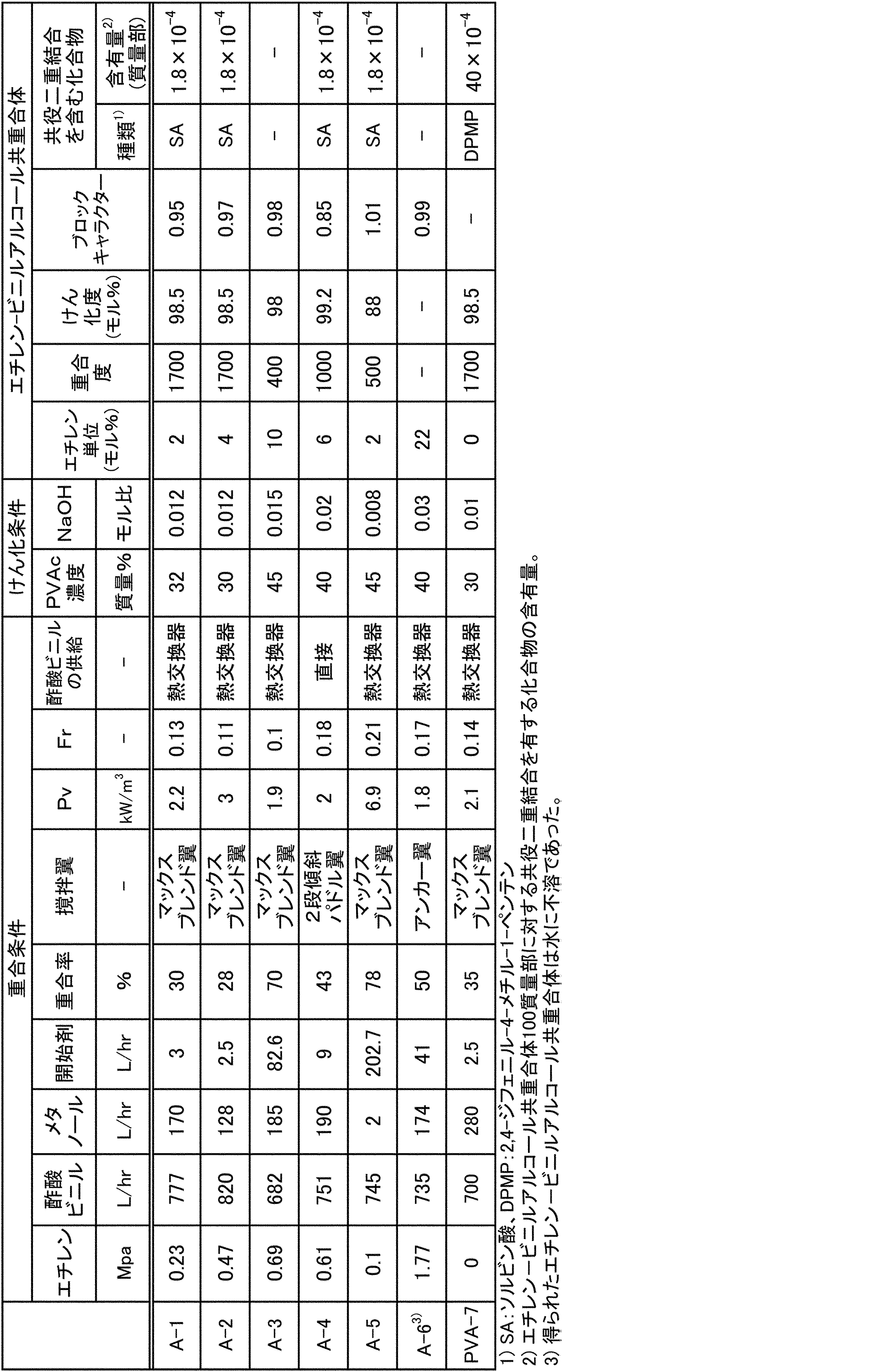
(紙用コーティング剤の作製)
得られたエチレン-ビニルアルコール共重合体(A-1)の粉体(10部)を撹拌している水(90部、20℃)に投入し、95℃まで加熱することにより、エチレン-ビニルアルコール共重合体(A-1)が溶解したコーティング剤(水溶液)を得た。得られたコーティング剤の粘度安定性を上述の方法に従って評価した。結果を表2に示す。
得られたコーティング剤を、試験用2-ロールサイズプレス機(熊谷理機工業製)を用いて、坪量70g/m2、透気抵抗度20secのPPC(Plain paper copier)用紙(上質紙)に、50℃にて100m/分の条件で塗工した後、100℃で5分間乾燥させることにより塗工紙を得た。前記コーティング剤の固形分換算の塗工量は0.8g/m2(両面の合計量)であった。得られた塗工紙を20℃、65%RHで72時間調湿後、塗工紙の物性を評価した。結果を表2に示す。
コーティング剤の固形分換算の塗工量を3.5g/m2(両面の合計量)に変更した以外は上記と同様にして塗工紙を得た。得られた塗工紙を20℃、65%RHで72時間調湿後、塗工紙の物性を評価した。結果を表2に示す。
エチレン-ビニルアルコール共重合体(A-1)を、表2に示されるエチレン-ビニルアルコール共重合体(A-2)~(A-6)またはPVA-7に変更した以外は、実施例1と同様にしてコーティング剤及び塗工紙を作製し、当該コーティング剤及び塗工紙の物性を評価した。その結果を表2に示す。なお、共重合体(A-6)は水に不溶であり、水溶液が得られなかった。
エチレン-ビニルアルコール共重合体(A-2)の粉体(10部)を撹拌している水(90部、20℃)に投入し、95℃まで加熱することにより、エチレン-ビニルアルコール共重合体(A-2)が溶解した水溶液を得た。当該水溶液、アイオノマー(三井化学社製ケミパール(登録商標)S-100、エチレン-アクリル酸共重合体のナトリウム塩水分散液)及び必要に応じて水を混合することにより、共重合体(A-2)が溶解した水溶液に前記アイオノマーが分散したコーティング剤を得た。このとき、コーティング剤の組成が表2に示されるとおりとなるように、前記水溶液、アイオノマー及び水の添加量を調整した。得られたコーティング剤の評価を実施例1と同様にして行った。また、得られたコーティング剤を用いた以外は実施例1と同様にして、塗工紙の作製及びその物性の評価を行った。これらの結果を表2に示す。
エチレン-ビニルアルコール共重合体(A-1)を共重合体(A-4)に変更し、カルボキシメチルセルロース(CMC)を共重合体(A-4)100質量部に対して、5質量部添加した以外は、実施例1と同様にして塗工紙を作製し、当該塗工紙の物性を評価した。その結果を表2に示す。
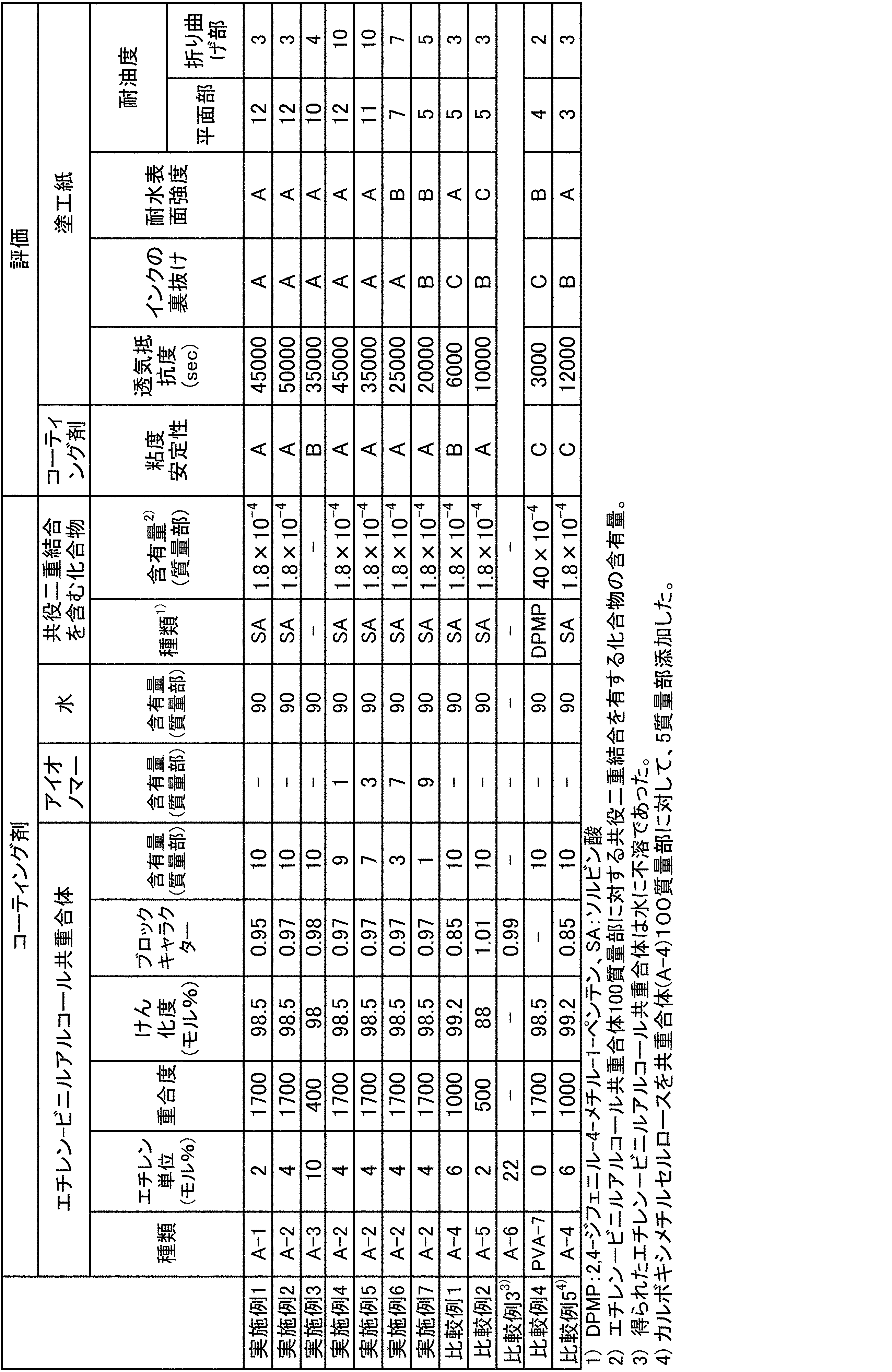
2 熱交換器
3~7 導管
8 撹拌機
9 反応液導出管
10 ビニルエステル導入管
11、12 冷媒管
13 気体排出管
21 マックスブレンド翼
22 スーパーミックス MR203
23 スーパーミックス MR205
24 フルゾーン翼
Claims (10)
- エチレン単位の含有率が1モル%以上20モル%未満であり、エチレン単位のブロックキャラクターが0.90~0.99であるエチレン-ビニルアルコール共重合体を含有する、紙用コーティング剤。
- 共役二重結合を有する分子量1000以下の化合物を、前記エチレン-ビニルアルコール共重合体100質量部に対して、0.000001~0.01質量部含有する、請求項1に記載の紙用コーティング剤。
- 前記エチレン-ビニルアルコール共重合体のけん化度が80~99.7モル%である、請求項1又は2に記載の紙用コーティング剤。
- 前記エチレン-ビニルアルコール共重合体の粘度平均重合度が300~5000である、請求項1~3のいずれかに記載の紙用コーティング剤。
- さらにアイオノマーを含有する、請求項1~4のいずれかに記載の紙用コーティング剤。
- エチレン単位の含有率が1モル%以上20モル%未満であるエチレン-ビニルアルコール共重合体及びアイオノマーを含有する、紙用コーティング剤。
- 請求項1~6のいずれかに記載のコーティング剤が紙に塗工された、塗工紙。
- 剥離紙原紙である、請求項7に記載の塗工紙。
- 耐油紙である、請求項7に記載の塗工紙。
- 請求項1~6のいずれかに記載のコーティング剤を紙に塗工する、塗工紙の製造方法。
Priority Applications (5)
| Application Number | Priority Date | Filing Date | Title |
|---|---|---|---|
| EP20876913.3A EP4047128A4 (en) | 2019-10-16 | 2020-10-15 | Coating agent for paper and coated paper using same |
| JP2021506346A JP6865334B1 (ja) | 2019-10-16 | 2020-10-15 | 紙用コーティング剤及びそれを用いた塗工紙 |
| KR1020227016267A KR102903172B1 (ko) | 2019-10-16 | 2020-10-15 | 종이용 코팅제 및 이것을 사용한 코팅지 |
| US17/769,529 US12247355B2 (en) | 2019-10-16 | 2020-10-15 | Coating agent for paper and coated paper using same |
| CN202080072149.4A CN114555885B (zh) | 2019-10-16 | 2020-10-15 | 纸用涂布剂和使用了其的涂布纸 |
Applications Claiming Priority (4)
| Application Number | Priority Date | Filing Date | Title |
|---|---|---|---|
| JP2019-189779 | 2019-10-16 | ||
| JP2019189779 | 2019-10-16 | ||
| JP2019-237551 | 2019-12-26 | ||
| JP2019237551 | 2019-12-26 |
Publications (1)
| Publication Number | Publication Date |
|---|---|
| WO2021075480A1 true WO2021075480A1 (ja) | 2021-04-22 |
Family
ID=75538077
Family Applications (1)
| Application Number | Title | Priority Date | Filing Date |
|---|---|---|---|
| PCT/JP2020/038859 Ceased WO2021075480A1 (ja) | 2019-10-16 | 2020-10-15 | 紙用コーティング剤及びそれを用いた塗工紙 |
Country Status (7)
| Country | Link |
|---|---|
| US (1) | US12247355B2 (ja) |
| EP (1) | EP4047128A4 (ja) |
| JP (1) | JP6865334B1 (ja) |
| KR (1) | KR102903172B1 (ja) |
| CN (1) | CN114555885B (ja) |
| TW (1) | TWI865628B (ja) |
| WO (1) | WO2021075480A1 (ja) |
Cited By (3)
| Publication number | Priority date | Publication date | Assignee | Title |
|---|---|---|---|---|
| JP2023077421A (ja) * | 2021-11-24 | 2023-06-05 | 三菱ケミカル株式会社 | 変性エチレン-ビニルアルコール系樹脂組成物、およびガスバリア材 |
| JP2023077420A (ja) * | 2021-11-24 | 2023-06-05 | 三菱ケミカル株式会社 | 変性エチレン-ビニルアルコール系樹脂組成物、およびガスバリア材 |
| WO2025089299A1 (ja) * | 2023-10-25 | 2025-05-01 | 三菱ケミカル株式会社 | 塗料組成物及び放射線遮蔽塗料組成物 |
Families Citing this family (2)
| Publication number | Priority date | Publication date | Assignee | Title |
|---|---|---|---|---|
| US11958954B2 (en) * | 2018-07-18 | 2024-04-16 | Kuraray Co., Ltd. | Multilayer structure |
| TW202402936A (zh) * | 2022-03-30 | 2024-01-16 | 日商三菱化學股份有限公司 | 乙烯-乙烯醇系共聚物組成物及其製造方法、使用其之熔融成形用材料、丸粒、以及多層結構體及其製造方法 |
Citations (6)
| Publication number | Priority date | Publication date | Assignee | Title |
|---|---|---|---|---|
| JPH1121788A (ja) | 1997-07-03 | 1999-01-26 | Kuraray Co Ltd | 紙用コーティング剤 |
| JP2001254292A (ja) * | 2000-03-08 | 2001-09-21 | Kuraray Co Ltd | 加工紙の製法 |
| JP2015516472A (ja) * | 2012-02-29 | 2015-06-11 | イー・アイ・デュポン・ドウ・ヌムール・アンド・カンパニーE.I.Du Pont De Nemours And Company | イオノマー−ポリ(ビニルアルコール)ブレンドおよびコーティング |
| US20160194514A1 (en) * | 2015-01-05 | 2016-07-07 | Avery Dennison Corporation | Inherently Printable Polymeric Material and Related Methods |
| JP2017043872A (ja) * | 2015-08-28 | 2017-03-02 | 株式会社クラレ | 紙用コーティング剤 |
| WO2019203216A1 (ja) * | 2018-04-17 | 2019-10-24 | 株式会社クラレ | エチレン-ビニルアルコール共重合体、その製造方法及びその用途 |
Family Cites Families (11)
| Publication number | Priority date | Publication date | Assignee | Title |
|---|---|---|---|---|
| US5240997A (en) * | 1991-01-18 | 1993-08-31 | Kuraray Co., Ltd. | Process for producing ethylene-vinyl alcohol copolymers |
| JP3675874B2 (ja) * | 1994-07-14 | 2005-07-27 | 株式会社クラレ | 水性エマルジョン |
| JP2004143309A (ja) * | 2002-10-25 | 2004-05-20 | Nippon Synthetic Chem Ind Co Ltd:The | ポリビニルアルコール系樹脂組成物およびそれを用いたインクジェット記録用媒体 |
| WO2009041358A1 (ja) * | 2007-09-27 | 2009-04-02 | Kuraray Co., Ltd. | ビニルアルコール系重合体を含む紙用塗工剤と、これを塗工した紙および感熱紙 |
| CA2739987C (en) | 2008-10-10 | 2017-01-03 | Dow Global Technologies Llc | Multilayer paper coating comprising biopolymer and water vapor barrier layers |
| EP3045480B1 (en) * | 2013-09-13 | 2021-06-16 | Kuraray Co., Ltd. | Vinyl alcohol polymer, thickening agent, stabilizer for emulsion polymerization, stabilizer for suspension polymerization, coating agent, coated article, sizing agent for fibers, sized yarn, and production method of textile |
| TWI662052B (zh) * | 2014-10-17 | 2019-06-11 | 日商可樂麗股份有限公司 | 乙烯醇系聚合物及其用途 |
| TWI757379B (zh) * | 2016-12-20 | 2022-03-11 | 日商三菱化學股份有限公司 | 乙烯-乙烯醇系共聚物樹脂組成物及多層結構體 |
| JP2019038935A (ja) * | 2017-08-24 | 2019-03-14 | 株式会社クラレ | ポリビニルアルコール組成物及びその用途 |
| EP3998291A4 (en) | 2019-07-08 | 2023-07-26 | Kuraray Co., Ltd. | Aqueous emulsion and adhesive using same |
| EP3998003A4 (en) | 2019-07-08 | 2023-07-26 | Kuraray Co., Ltd. | Water-based adhesive for paper straw, and paper straw in which same is used |
-
2020
- 2020-10-15 KR KR1020227016267A patent/KR102903172B1/ko active Active
- 2020-10-15 TW TW109135643A patent/TWI865628B/zh active
- 2020-10-15 JP JP2021506346A patent/JP6865334B1/ja active Active
- 2020-10-15 US US17/769,529 patent/US12247355B2/en active Active
- 2020-10-15 WO PCT/JP2020/038859 patent/WO2021075480A1/ja not_active Ceased
- 2020-10-15 EP EP20876913.3A patent/EP4047128A4/en active Pending
- 2020-10-15 CN CN202080072149.4A patent/CN114555885B/zh active Active
Patent Citations (6)
| Publication number | Priority date | Publication date | Assignee | Title |
|---|---|---|---|---|
| JPH1121788A (ja) | 1997-07-03 | 1999-01-26 | Kuraray Co Ltd | 紙用コーティング剤 |
| JP2001254292A (ja) * | 2000-03-08 | 2001-09-21 | Kuraray Co Ltd | 加工紙の製法 |
| JP2015516472A (ja) * | 2012-02-29 | 2015-06-11 | イー・アイ・デュポン・ドウ・ヌムール・アンド・カンパニーE.I.Du Pont De Nemours And Company | イオノマー−ポリ(ビニルアルコール)ブレンドおよびコーティング |
| US20160194514A1 (en) * | 2015-01-05 | 2016-07-07 | Avery Dennison Corporation | Inherently Printable Polymeric Material and Related Methods |
| JP2017043872A (ja) * | 2015-08-28 | 2017-03-02 | 株式会社クラレ | 紙用コーティング剤 |
| WO2019203216A1 (ja) * | 2018-04-17 | 2019-10-24 | 株式会社クラレ | エチレン-ビニルアルコール共重合体、その製造方法及びその用途 |
Non-Patent Citations (2)
| Title |
|---|
| See also references of EP4047128A4 |
| T. MORITANI, H. IWASAKI, MACROMOLECULES, vol. 11, 1978, pages 1251 - 1259 |
Cited By (3)
| Publication number | Priority date | Publication date | Assignee | Title |
|---|---|---|---|---|
| JP2023077421A (ja) * | 2021-11-24 | 2023-06-05 | 三菱ケミカル株式会社 | 変性エチレン-ビニルアルコール系樹脂組成物、およびガスバリア材 |
| JP2023077420A (ja) * | 2021-11-24 | 2023-06-05 | 三菱ケミカル株式会社 | 変性エチレン-ビニルアルコール系樹脂組成物、およびガスバリア材 |
| WO2025089299A1 (ja) * | 2023-10-25 | 2025-05-01 | 三菱ケミカル株式会社 | 塗料組成物及び放射線遮蔽塗料組成物 |
Also Published As
| Publication number | Publication date |
|---|---|
| JPWO2021075480A1 (ja) | 2021-04-22 |
| KR102903172B1 (ko) | 2025-12-23 |
| EP4047128A4 (en) | 2023-12-06 |
| JP6865334B1 (ja) | 2021-04-28 |
| US12247355B2 (en) | 2025-03-11 |
| CN114555885A (zh) | 2022-05-27 |
| TWI865628B (zh) | 2024-12-11 |
| US20230142880A1 (en) | 2023-05-11 |
| TW202117133A (zh) | 2021-05-01 |
| KR20220073849A (ko) | 2022-06-03 |
| CN114555885B (zh) | 2023-11-21 |
| EP4047128A1 (en) | 2022-08-24 |
Similar Documents
| Publication | Publication Date | Title |
|---|---|---|
| JP6865334B1 (ja) | 紙用コーティング剤及びそれを用いた塗工紙 | |
| KR102766694B1 (ko) | 에틸렌-비닐 알코올 공중합체, 그 제조 방법 및 그 용도 | |
| CN115298258B (zh) | 水分散液、水性乳液、涂布剂、涂敷纸、多层结构体、包装材料和粘接剂、以及水性乳液的制造方法 | |
| JP6799727B1 (ja) | エチレン−ビニルアルコール共重合体及びそれを用いた水溶液 | |
| JP6810307B1 (ja) | 紙ストロー用水性接着剤及びそれを用いた紙ストロー | |
| US20240309248A1 (en) | Resin material, aqueous solution, and adhesive | |
| JP3618142B2 (ja) | アセト酢酸エステル基含有ポリビニルアルコール系樹 脂組成物及びその用途 | |
| JP2017043872A (ja) | 紙用コーティング剤 | |
| JP2022088692A (ja) | 紙用塗工液 | |
| JPH0140158B2 (ja) | ||
| JPH0237371B2 (ja) |
Legal Events
| Date | Code | Title | Description |
|---|---|---|---|
| ENP | Entry into the national phase |
Ref document number: 2021506346 Country of ref document: JP Kind code of ref document: A |
|
| 121 | Ep: the epo has been informed by wipo that ep was designated in this application |
Ref document number: 20876913 Country of ref document: EP Kind code of ref document: A1 |
|
| NENP | Non-entry into the national phase |
Ref country code: DE |
|
| ENP | Entry into the national phase |
Ref document number: 20227016267 Country of ref document: KR Kind code of ref document: A |
|
| ENP | Entry into the national phase |
Ref document number: 2020876913 Country of ref document: EP Effective date: 20220516 |
|
| WWG | Wipo information: grant in national office |
Ref document number: 17769529 Country of ref document: US |