WO2021084800A1 - 樹脂組成物、及び樹脂成形品の製造方法 - Google Patents
樹脂組成物、及び樹脂成形品の製造方法 Download PDFInfo
- Publication number
- WO2021084800A1 WO2021084800A1 PCT/JP2020/025916 JP2020025916W WO2021084800A1 WO 2021084800 A1 WO2021084800 A1 WO 2021084800A1 JP 2020025916 W JP2020025916 W JP 2020025916W WO 2021084800 A1 WO2021084800 A1 WO 2021084800A1
- Authority
- WO
- WIPO (PCT)
- Prior art keywords
- resin composition
- resin
- lactic acid
- acid
- calcium carbonate
- Prior art date
- Legal status (The legal status is an assumption and is not a legal conclusion. Google has not performed a legal analysis and makes no representation as to the accuracy of the status listed.)
- Ceased
Links
Classifications
-
- B—PERFORMING OPERATIONS; TRANSPORTING
- B29—WORKING OF PLASTICS; WORKING OF SUBSTANCES IN A PLASTIC STATE IN GENERAL
- B29B—PREPARATION OR PRETREATMENT OF THE MATERIAL TO BE SHAPED; MAKING GRANULES OR PREFORMS; RECOVERY OF PLASTICS OR OTHER CONSTITUENTS OF WASTE MATERIAL CONTAINING PLASTICS
- B29B7/00—Mixing; Kneading
- B29B7/80—Component parts, details or accessories; Auxiliary operations
- B29B7/88—Adding charges, i.e. additives
- B29B7/90—Fillers or reinforcements, e.g. fibres
-
- C—CHEMISTRY; METALLURGY
- C08—ORGANIC MACROMOLECULAR COMPOUNDS; THEIR PREPARATION OR CHEMICAL WORKING-UP; COMPOSITIONS BASED THEREON
- C08G—MACROMOLECULAR COMPOUNDS OBTAINED OTHERWISE THAN BY REACTIONS ONLY INVOLVING UNSATURATED CARBON-TO-CARBON BONDS
- C08G63/00—Macromolecular compounds obtained by reactions forming a carboxylic ester link in the main chain of the macromolecule
- C08G63/02—Polyesters derived from hydroxycarboxylic acids or from polycarboxylic acids and polyhydroxy compounds
- C08G63/06—Polyesters derived from hydroxycarboxylic acids or from polycarboxylic acids and polyhydroxy compounds derived from hydroxycarboxylic acids
- C08G63/08—Lactones or lactides
-
- B—PERFORMING OPERATIONS; TRANSPORTING
- B29—WORKING OF PLASTICS; WORKING OF SUBSTANCES IN A PLASTIC STATE IN GENERAL
- B29B—PREPARATION OR PRETREATMENT OF THE MATERIAL TO BE SHAPED; MAKING GRANULES OR PREFORMS; RECOVERY OF PLASTICS OR OTHER CONSTITUENTS OF WASTE MATERIAL CONTAINING PLASTICS
- B29B11/00—Making preforms
- B29B11/14—Making preforms characterised by structure or composition
- B29B11/16—Making preforms characterised by structure or composition comprising fillers or reinforcement
-
- B—PERFORMING OPERATIONS; TRANSPORTING
- B29—WORKING OF PLASTICS; WORKING OF SUBSTANCES IN A PLASTIC STATE IN GENERAL
- B29B—PREPARATION OR PRETREATMENT OF THE MATERIAL TO BE SHAPED; MAKING GRANULES OR PREFORMS; RECOVERY OF PLASTICS OR OTHER CONSTITUENTS OF WASTE MATERIAL CONTAINING PLASTICS
- B29B7/00—Mixing; Kneading
- B29B7/30—Mixing; Kneading continuous, with mechanical mixing or kneading devices
- B29B7/34—Mixing; Kneading continuous, with mechanical mixing or kneading devices with movable mixing or kneading devices
- B29B7/38—Mixing; Kneading continuous, with mechanical mixing or kneading devices with movable mixing or kneading devices rotary
- B29B7/46—Mixing; Kneading continuous, with mechanical mixing or kneading devices with movable mixing or kneading devices rotary with more than one shaft
- B29B7/48—Mixing; Kneading continuous, with mechanical mixing or kneading devices with movable mixing or kneading devices rotary with more than one shaft with intermeshing devices, e.g. screws
-
- B—PERFORMING OPERATIONS; TRANSPORTING
- B29—WORKING OF PLASTICS; WORKING OF SUBSTANCES IN A PLASTIC STATE IN GENERAL
- B29B—PREPARATION OR PRETREATMENT OF THE MATERIAL TO BE SHAPED; MAKING GRANULES OR PREFORMS; RECOVERY OF PLASTICS OR OTHER CONSTITUENTS OF WASTE MATERIAL CONTAINING PLASTICS
- B29B7/00—Mixing; Kneading
- B29B7/30—Mixing; Kneading continuous, with mechanical mixing or kneading devices
- B29B7/58—Component parts, details or accessories; Auxiliary operations
- B29B7/72—Measuring, controlling or regulating
- B29B7/726—Measuring properties of mixture, e.g. temperature or density
-
- B—PERFORMING OPERATIONS; TRANSPORTING
- B29—WORKING OF PLASTICS; WORKING OF SUBSTANCES IN A PLASTIC STATE IN GENERAL
- B29B—PREPARATION OR PRETREATMENT OF THE MATERIAL TO BE SHAPED; MAKING GRANULES OR PREFORMS; RECOVERY OF PLASTICS OR OTHER CONSTITUENTS OF WASTE MATERIAL CONTAINING PLASTICS
- B29B7/00—Mixing; Kneading
- B29B7/80—Component parts, details or accessories; Auxiliary operations
- B29B7/82—Heating or cooling
-
- B—PERFORMING OPERATIONS; TRANSPORTING
- B29—WORKING OF PLASTICS; WORKING OF SUBSTANCES IN A PLASTIC STATE IN GENERAL
- B29B—PREPARATION OR PRETREATMENT OF THE MATERIAL TO BE SHAPED; MAKING GRANULES OR PREFORMS; RECOVERY OF PLASTICS OR OTHER CONSTITUENTS OF WASTE MATERIAL CONTAINING PLASTICS
- B29B9/00—Making granules
- B29B9/12—Making granules characterised by structure or composition
-
- B—PERFORMING OPERATIONS; TRANSPORTING
- B29—WORKING OF PLASTICS; WORKING OF SUBSTANCES IN A PLASTIC STATE IN GENERAL
- B29B—PREPARATION OR PRETREATMENT OF THE MATERIAL TO BE SHAPED; MAKING GRANULES OR PREFORMS; RECOVERY OF PLASTICS OR OTHER CONSTITUENTS OF WASTE MATERIAL CONTAINING PLASTICS
- B29B9/00—Making granules
- B29B9/16—Auxiliary treatment of granules
-
- B—PERFORMING OPERATIONS; TRANSPORTING
- B29—WORKING OF PLASTICS; WORKING OF SUBSTANCES IN A PLASTIC STATE IN GENERAL
- B29C—SHAPING OR JOINING OF PLASTICS; SHAPING OF MATERIAL IN A PLASTIC STATE, NOT OTHERWISE PROVIDED FOR; AFTER-TREATMENT OF THE SHAPED PRODUCTS, e.g. REPAIRING
- B29C45/00—Injection moulding, i.e. forcing the required volume of moulding material through a nozzle into a closed mould; Apparatus therefor
- B29C45/0013—Injection moulding, i.e. forcing the required volume of moulding material through a nozzle into a closed mould; Apparatus therefor using fillers dispersed in the moulding material, e.g. metal particles
-
- B—PERFORMING OPERATIONS; TRANSPORTING
- B29—WORKING OF PLASTICS; WORKING OF SUBSTANCES IN A PLASTIC STATE IN GENERAL
- B29C—SHAPING OR JOINING OF PLASTICS; SHAPING OF MATERIAL IN A PLASTIC STATE, NOT OTHERWISE PROVIDED FOR; AFTER-TREATMENT OF THE SHAPED PRODUCTS, e.g. REPAIRING
- B29C48/00—Extrusion moulding, i.e. expressing the moulding material through a die or nozzle which imparts the desired form; Apparatus therefor
- B29C48/022—Extrusion moulding, i.e. expressing the moulding material through a die or nozzle which imparts the desired form; Apparatus therefor characterised by the choice of material
-
- B—PERFORMING OPERATIONS; TRANSPORTING
- B29—WORKING OF PLASTICS; WORKING OF SUBSTANCES IN A PLASTIC STATE IN GENERAL
- B29C—SHAPING OR JOINING OF PLASTICS; SHAPING OF MATERIAL IN A PLASTIC STATE, NOT OTHERWISE PROVIDED FOR; AFTER-TREATMENT OF THE SHAPED PRODUCTS, e.g. REPAIRING
- B29C48/00—Extrusion moulding, i.e. expressing the moulding material through a die or nozzle which imparts the desired form; Apparatus therefor
- B29C48/03—Extrusion moulding, i.e. expressing the moulding material through a die or nozzle which imparts the desired form; Apparatus therefor characterised by the shape of the extruded material at extrusion
- B29C48/07—Flat, e.g. panels
- B29C48/08—Flat, e.g. panels flexible, e.g. films
-
- B—PERFORMING OPERATIONS; TRANSPORTING
- B29—WORKING OF PLASTICS; WORKING OF SUBSTANCES IN A PLASTIC STATE IN GENERAL
- B29C—SHAPING OR JOINING OF PLASTICS; SHAPING OF MATERIAL IN A PLASTIC STATE, NOT OTHERWISE PROVIDED FOR; AFTER-TREATMENT OF THE SHAPED PRODUCTS, e.g. REPAIRING
- B29C48/00—Extrusion moulding, i.e. expressing the moulding material through a die or nozzle which imparts the desired form; Apparatus therefor
- B29C48/16—Articles comprising two or more components, e.g. co-extruded layers
- B29C48/18—Articles comprising two or more components, e.g. co-extruded layers the components being layers
- B29C48/21—Articles comprising two or more components, e.g. co-extruded layers the components being layers the layers being joined at their surfaces
-
- B—PERFORMING OPERATIONS; TRANSPORTING
- B29—WORKING OF PLASTICS; WORKING OF SUBSTANCES IN A PLASTIC STATE IN GENERAL
- B29C—SHAPING OR JOINING OF PLASTICS; SHAPING OF MATERIAL IN A PLASTIC STATE, NOT OTHERWISE PROVIDED FOR; AFTER-TREATMENT OF THE SHAPED PRODUCTS, e.g. REPAIRING
- B29C48/00—Extrusion moulding, i.e. expressing the moulding material through a die or nozzle which imparts the desired form; Apparatus therefor
- B29C48/25—Component parts, details or accessories; Auxiliary operations
- B29C48/30—Extrusion nozzles or dies
- B29C48/305—Extrusion nozzles or dies having a wide opening, e.g. for forming sheets
-
- B—PERFORMING OPERATIONS; TRANSPORTING
- B29—WORKING OF PLASTICS; WORKING OF SUBSTANCES IN A PLASTIC STATE IN GENERAL
- B29C—SHAPING OR JOINING OF PLASTICS; SHAPING OF MATERIAL IN A PLASTIC STATE, NOT OTHERWISE PROVIDED FOR; AFTER-TREATMENT OF THE SHAPED PRODUCTS, e.g. REPAIRING
- B29C48/00—Extrusion moulding, i.e. expressing the moulding material through a die or nozzle which imparts the desired form; Apparatus therefor
- B29C48/25—Component parts, details or accessories; Auxiliary operations
- B29C48/36—Means for plasticising or homogenising the moulding material or forcing it through the nozzle or die
- B29C48/395—Means for plasticising or homogenising the moulding material or forcing it through the nozzle or die using screws surrounded by a cooperating barrel, e.g. single screw extruders
- B29C48/40—Means for plasticising or homogenising the moulding material or forcing it through the nozzle or die using screws surrounded by a cooperating barrel, e.g. single screw extruders using two or more parallel screws or at least two parallel non-intermeshing screws, e.g. twin screw extruders
-
- B—PERFORMING OPERATIONS; TRANSPORTING
- B29—WORKING OF PLASTICS; WORKING OF SUBSTANCES IN A PLASTIC STATE IN GENERAL
- B29C—SHAPING OR JOINING OF PLASTICS; SHAPING OF MATERIAL IN A PLASTIC STATE, NOT OTHERWISE PROVIDED FOR; AFTER-TREATMENT OF THE SHAPED PRODUCTS, e.g. REPAIRING
- B29C48/00—Extrusion moulding, i.e. expressing the moulding material through a die or nozzle which imparts the desired form; Apparatus therefor
- B29C48/25—Component parts, details or accessories; Auxiliary operations
- B29C48/36—Means for plasticising or homogenising the moulding material or forcing it through the nozzle or die
- B29C48/49—Means for plasticising or homogenising the moulding material or forcing it through the nozzle or die using two or more extruders to feed one die or nozzle
-
- B—PERFORMING OPERATIONS; TRANSPORTING
- B29—WORKING OF PLASTICS; WORKING OF SUBSTANCES IN A PLASTIC STATE IN GENERAL
- B29C—SHAPING OR JOINING OF PLASTICS; SHAPING OF MATERIAL IN A PLASTIC STATE, NOT OTHERWISE PROVIDED FOR; AFTER-TREATMENT OF THE SHAPED PRODUCTS, e.g. REPAIRING
- B29C48/00—Extrusion moulding, i.e. expressing the moulding material through a die or nozzle which imparts the desired form; Apparatus therefor
- B29C48/25—Component parts, details or accessories; Auxiliary operations
- B29C48/92—Measuring, controlling or regulating
-
- B—PERFORMING OPERATIONS; TRANSPORTING
- B32—LAYERED PRODUCTS
- B32B—LAYERED PRODUCTS, i.e. PRODUCTS BUILT-UP OF STRATA OF FLAT OR NON-FLAT, e.g. CELLULAR OR HONEYCOMB, FORM
- B32B27/00—Layered products comprising a layer of synthetic resin
- B32B27/06—Layered products comprising a layer of synthetic resin as the main or only constituent of a layer, which is next to another layer of the same or of a different material
- B32B27/08—Layered products comprising a layer of synthetic resin as the main or only constituent of a layer, which is next to another layer of the same or of a different material of synthetic resin
-
- B—PERFORMING OPERATIONS; TRANSPORTING
- B32—LAYERED PRODUCTS
- B32B—LAYERED PRODUCTS, i.e. PRODUCTS BUILT-UP OF STRATA OF FLAT OR NON-FLAT, e.g. CELLULAR OR HONEYCOMB, FORM
- B32B27/00—Layered products comprising a layer of synthetic resin
- B32B27/18—Layered products comprising a layer of synthetic resin characterised by the use of special additives
- B32B27/20—Layered products comprising a layer of synthetic resin characterised by the use of special additives using fillers, pigments, thixotroping agents
-
- B—PERFORMING OPERATIONS; TRANSPORTING
- B32—LAYERED PRODUCTS
- B32B—LAYERED PRODUCTS, i.e. PRODUCTS BUILT-UP OF STRATA OF FLAT OR NON-FLAT, e.g. CELLULAR OR HONEYCOMB, FORM
- B32B27/00—Layered products comprising a layer of synthetic resin
- B32B27/32—Layered products comprising a layer of synthetic resin comprising polyolefins
-
- B—PERFORMING OPERATIONS; TRANSPORTING
- B32—LAYERED PRODUCTS
- B32B—LAYERED PRODUCTS, i.e. PRODUCTS BUILT-UP OF STRATA OF FLAT OR NON-FLAT, e.g. CELLULAR OR HONEYCOMB, FORM
- B32B27/00—Layered products comprising a layer of synthetic resin
- B32B27/36—Layered products comprising a layer of synthetic resin comprising polyesters
-
- C—CHEMISTRY; METALLURGY
- C08—ORGANIC MACROMOLECULAR COMPOUNDS; THEIR PREPARATION OR CHEMICAL WORKING-UP; COMPOSITIONS BASED THEREON
- C08J—WORKING-UP; GENERAL PROCESSES OF COMPOUNDING; AFTER-TREATMENT NOT COVERED BY SUBCLASSES C08B, C08C, C08F, C08G or C08H
- C08J5/00—Manufacture of articles or shaped materials containing macromolecular substances
- C08J5/18—Manufacture of films or sheets
-
- C—CHEMISTRY; METALLURGY
- C08—ORGANIC MACROMOLECULAR COMPOUNDS; THEIR PREPARATION OR CHEMICAL WORKING-UP; COMPOSITIONS BASED THEREON
- C08K—Use of inorganic or non-macromolecular organic substances as compounding ingredients
- C08K3/00—Use of inorganic substances as compounding ingredients
- C08K3/18—Oxygen-containing compounds, e.g. metal carbonyls
- C08K3/20—Oxides; Hydroxides
- C08K3/22—Oxides; Hydroxides of metals
-
- C—CHEMISTRY; METALLURGY
- C08—ORGANIC MACROMOLECULAR COMPOUNDS; THEIR PREPARATION OR CHEMICAL WORKING-UP; COMPOSITIONS BASED THEREON
- C08K—Use of inorganic or non-macromolecular organic substances as compounding ingredients
- C08K3/00—Use of inorganic substances as compounding ingredients
- C08K3/18—Oxygen-containing compounds, e.g. metal carbonyls
- C08K3/24—Acids; Salts thereof
- C08K3/26—Carbonates; Bicarbonates
-
- C—CHEMISTRY; METALLURGY
- C08—ORGANIC MACROMOLECULAR COMPOUNDS; THEIR PREPARATION OR CHEMICAL WORKING-UP; COMPOSITIONS BASED THEREON
- C08K—Use of inorganic or non-macromolecular organic substances as compounding ingredients
- C08K9/00—Use of pretreated ingredients
- C08K9/02—Ingredients treated with inorganic substances
-
- C—CHEMISTRY; METALLURGY
- C08—ORGANIC MACROMOLECULAR COMPOUNDS; THEIR PREPARATION OR CHEMICAL WORKING-UP; COMPOSITIONS BASED THEREON
- C08L—COMPOSITIONS OF MACROMOLECULAR COMPOUNDS
- C08L101/00—Compositions of unspecified macromolecular compounds
- C08L101/16—Compositions of unspecified macromolecular compounds the macromolecular compounds being biodegradable
-
- C—CHEMISTRY; METALLURGY
- C08—ORGANIC MACROMOLECULAR COMPOUNDS; THEIR PREPARATION OR CHEMICAL WORKING-UP; COMPOSITIONS BASED THEREON
- C08L—COMPOSITIONS OF MACROMOLECULAR COMPOUNDS
- C08L67/00—Compositions of polyesters obtained by reactions forming a carboxylic ester link in the main chain; Compositions of derivatives of such polymers
- C08L67/04—Polyesters derived from hydroxycarboxylic acids, e.g. lactones
-
- B—PERFORMING OPERATIONS; TRANSPORTING
- B29—WORKING OF PLASTICS; WORKING OF SUBSTANCES IN A PLASTIC STATE IN GENERAL
- B29B—PREPARATION OR PRETREATMENT OF THE MATERIAL TO BE SHAPED; MAKING GRANULES OR PREFORMS; RECOVERY OF PLASTICS OR OTHER CONSTITUENTS OF WASTE MATERIAL CONTAINING PLASTICS
- B29B7/00—Mixing; Kneading
- B29B7/30—Mixing; Kneading continuous, with mechanical mixing or kneading devices
- B29B7/34—Mixing; Kneading continuous, with mechanical mixing or kneading devices with movable mixing or kneading devices
- B29B7/38—Mixing; Kneading continuous, with mechanical mixing or kneading devices with movable mixing or kneading devices rotary
- B29B7/40—Mixing; Kneading continuous, with mechanical mixing or kneading devices with movable mixing or kneading devices rotary with single shaft
- B29B7/42—Mixing; Kneading continuous, with mechanical mixing or kneading devices with movable mixing or kneading devices rotary with single shaft with screw or helix
-
- B—PERFORMING OPERATIONS; TRANSPORTING
- B29—WORKING OF PLASTICS; WORKING OF SUBSTANCES IN A PLASTIC STATE IN GENERAL
- B29B—PREPARATION OR PRETREATMENT OF THE MATERIAL TO BE SHAPED; MAKING GRANULES OR PREFORMS; RECOVERY OF PLASTICS OR OTHER CONSTITUENTS OF WASTE MATERIAL CONTAINING PLASTICS
- B29B9/00—Making granules
- B29B9/02—Making granules by dividing preformed material
- B29B9/06—Making granules by dividing preformed material in the form of filamentary material, e.g. combined with extrusion
-
- B—PERFORMING OPERATIONS; TRANSPORTING
- B29—WORKING OF PLASTICS; WORKING OF SUBSTANCES IN A PLASTIC STATE IN GENERAL
- B29K—INDEXING SCHEME ASSOCIATED WITH SUBCLASSES B29B, B29C OR B29D, RELATING TO MOULDING MATERIALS OR TO MATERIALS FOR MOULDS, REINFORCEMENTS, FILLERS OR PREFORMED PARTS, e.g. INSERTS
- B29K2067/00—Use of polyesters or derivatives thereof, as moulding material
- B29K2067/04—Polyesters derived from hydroxycarboxylic acids
- B29K2067/046—PLA, i.e. polylactic acid or polylactide
-
- B—PERFORMING OPERATIONS; TRANSPORTING
- B29—WORKING OF PLASTICS; WORKING OF SUBSTANCES IN A PLASTIC STATE IN GENERAL
- B29K—INDEXING SCHEME ASSOCIATED WITH SUBCLASSES B29B, B29C OR B29D, RELATING TO MOULDING MATERIALS OR TO MATERIALS FOR MOULDS, REINFORCEMENTS, FILLERS OR PREFORMED PARTS, e.g. INSERTS
- B29K2509/00—Use of inorganic materials not provided for in groups B29K2503/00 - B29K2507/00, as filler
- B29K2509/02—Ceramics
-
- B—PERFORMING OPERATIONS; TRANSPORTING
- B29—WORKING OF PLASTICS; WORKING OF SUBSTANCES IN A PLASTIC STATE IN GENERAL
- B29K—INDEXING SCHEME ASSOCIATED WITH SUBCLASSES B29B, B29C OR B29D, RELATING TO MOULDING MATERIALS OR TO MATERIALS FOR MOULDS, REINFORCEMENTS, FILLERS OR PREFORMED PARTS, e.g. INSERTS
- B29K2995/00—Properties of moulding materials, reinforcements, fillers, preformed parts or moulds
- B29K2995/0037—Other properties
- B29K2995/0059—Degradable
- B29K2995/006—Bio-degradable, e.g. bioabsorbable, bioresorbable or bioerodible
-
- B—PERFORMING OPERATIONS; TRANSPORTING
- B29—WORKING OF PLASTICS; WORKING OF SUBSTANCES IN A PLASTIC STATE IN GENERAL
- B29L—INDEXING SCHEME ASSOCIATED WITH SUBCLASS B29C, RELATING TO PARTICULAR ARTICLES
- B29L2007/00—Flat articles, e.g. films or sheets
- B29L2007/002—Panels; Plates; Sheets
-
- B—PERFORMING OPERATIONS; TRANSPORTING
- B29—WORKING OF PLASTICS; WORKING OF SUBSTANCES IN A PLASTIC STATE IN GENERAL
- B29L—INDEXING SCHEME ASSOCIATED WITH SUBCLASS B29C, RELATING TO PARTICULAR ARTICLES
- B29L2009/00—Layered products
-
- B—PERFORMING OPERATIONS; TRANSPORTING
- B29—WORKING OF PLASTICS; WORKING OF SUBSTANCES IN A PLASTIC STATE IN GENERAL
- B29L—INDEXING SCHEME ASSOCIATED WITH SUBCLASS B29C, RELATING TO PARTICULAR ARTICLES
- B29L2031/00—Other particular articles
- B29L2031/712—Containers; Packaging elements or accessories, Packages
-
- B—PERFORMING OPERATIONS; TRANSPORTING
- B32—LAYERED PRODUCTS
- B32B—LAYERED PRODUCTS, i.e. PRODUCTS BUILT-UP OF STRATA OF FLAT OR NON-FLAT, e.g. CELLULAR OR HONEYCOMB, FORM
- B32B2250/00—Layers arrangement
- B32B2250/02—2 layers
-
- B—PERFORMING OPERATIONS; TRANSPORTING
- B32—LAYERED PRODUCTS
- B32B—LAYERED PRODUCTS, i.e. PRODUCTS BUILT-UP OF STRATA OF FLAT OR NON-FLAT, e.g. CELLULAR OR HONEYCOMB, FORM
- B32B2250/00—Layers arrangement
- B32B2250/24—All layers being polymeric
-
- B—PERFORMING OPERATIONS; TRANSPORTING
- B32—LAYERED PRODUCTS
- B32B—LAYERED PRODUCTS, i.e. PRODUCTS BUILT-UP OF STRATA OF FLAT OR NON-FLAT, e.g. CELLULAR OR HONEYCOMB, FORM
- B32B2264/00—Composition or properties of particles which form a particulate layer or are present as additives
- B32B2264/10—Inorganic particles
- B32B2264/104—Oxysalt, e.g. carbonate, sulfate, phosphate or nitrate particles
-
- B—PERFORMING OPERATIONS; TRANSPORTING
- B32—LAYERED PRODUCTS
- B32B—LAYERED PRODUCTS, i.e. PRODUCTS BUILT-UP OF STRATA OF FLAT OR NON-FLAT, e.g. CELLULAR OR HONEYCOMB, FORM
- B32B2264/00—Composition or properties of particles which form a particulate layer or are present as additives
- B32B2264/30—Particles characterised by physical dimension
- B32B2264/303—Average diameter greater than 1µm
-
- B—PERFORMING OPERATIONS; TRANSPORTING
- B32—LAYERED PRODUCTS
- B32B—LAYERED PRODUCTS, i.e. PRODUCTS BUILT-UP OF STRATA OF FLAT OR NON-FLAT, e.g. CELLULAR OR HONEYCOMB, FORM
- B32B2307/00—Properties of the layers or laminate
- B32B2307/50—Properties of the layers or laminate having particular mechanical properties
- B32B2307/54—Yield strength; Tensile strength
-
- B—PERFORMING OPERATIONS; TRANSPORTING
- B32—LAYERED PRODUCTS
- B32B—LAYERED PRODUCTS, i.e. PRODUCTS BUILT-UP OF STRATA OF FLAT OR NON-FLAT, e.g. CELLULAR OR HONEYCOMB, FORM
- B32B2307/00—Properties of the layers or laminate
- B32B2307/50—Properties of the layers or laminate having particular mechanical properties
- B32B2307/558—Impact strength, toughness
-
- B—PERFORMING OPERATIONS; TRANSPORTING
- B32—LAYERED PRODUCTS
- B32B—LAYERED PRODUCTS, i.e. PRODUCTS BUILT-UP OF STRATA OF FLAT OR NON-FLAT, e.g. CELLULAR OR HONEYCOMB, FORM
- B32B2307/00—Properties of the layers or laminate
- B32B2307/70—Other properties
- B32B2307/716—Degradable
- B32B2307/7163—Biodegradable
-
- B—PERFORMING OPERATIONS; TRANSPORTING
- B32—LAYERED PRODUCTS
- B32B—LAYERED PRODUCTS, i.e. PRODUCTS BUILT-UP OF STRATA OF FLAT OR NON-FLAT, e.g. CELLULAR OR HONEYCOMB, FORM
- B32B2439/00—Containers; Receptacles
- B32B2439/02—Open containers
-
- C—CHEMISTRY; METALLURGY
- C08—ORGANIC MACROMOLECULAR COMPOUNDS; THEIR PREPARATION OR CHEMICAL WORKING-UP; COMPOSITIONS BASED THEREON
- C08G—MACROMOLECULAR COMPOUNDS OBTAINED OTHERWISE THAN BY REACTIONS ONLY INVOLVING UNSATURATED CARBON-TO-CARBON BONDS
- C08G2230/00—Compositions for preparing biodegradable polymers
-
- C—CHEMISTRY; METALLURGY
- C08—ORGANIC MACROMOLECULAR COMPOUNDS; THEIR PREPARATION OR CHEMICAL WORKING-UP; COMPOSITIONS BASED THEREON
- C08J—WORKING-UP; GENERAL PROCESSES OF COMPOUNDING; AFTER-TREATMENT NOT COVERED BY SUBCLASSES C08B, C08C, C08F, C08G or C08H
- C08J2367/00—Characterised by the use of polyesters obtained by reactions forming a carboxylic ester link in the main chain; Derivatives of such polymers
- C08J2367/04—Polyesters derived from hydroxy carboxylic acids, e.g. lactones
-
- C—CHEMISTRY; METALLURGY
- C08—ORGANIC MACROMOLECULAR COMPOUNDS; THEIR PREPARATION OR CHEMICAL WORKING-UP; COMPOSITIONS BASED THEREON
- C08K—Use of inorganic or non-macromolecular organic substances as compounding ingredients
- C08K3/00—Use of inorganic substances as compounding ingredients
- C08K3/18—Oxygen-containing compounds, e.g. metal carbonyls
- C08K3/20—Oxides; Hydroxides
- C08K3/22—Oxides; Hydroxides of metals
- C08K2003/2206—Oxides; Hydroxides of metals of calcium, strontium or barium
-
- C—CHEMISTRY; METALLURGY
- C08—ORGANIC MACROMOLECULAR COMPOUNDS; THEIR PREPARATION OR CHEMICAL WORKING-UP; COMPOSITIONS BASED THEREON
- C08K—Use of inorganic or non-macromolecular organic substances as compounding ingredients
- C08K3/00—Use of inorganic substances as compounding ingredients
- C08K3/18—Oxygen-containing compounds, e.g. metal carbonyls
- C08K3/24—Acids; Salts thereof
- C08K3/26—Carbonates; Bicarbonates
- C08K2003/265—Calcium, strontium or barium carbonate
-
- C—CHEMISTRY; METALLURGY
- C08—ORGANIC MACROMOLECULAR COMPOUNDS; THEIR PREPARATION OR CHEMICAL WORKING-UP; COMPOSITIONS BASED THEREON
- C08K—Use of inorganic or non-macromolecular organic substances as compounding ingredients
- C08K2201/00—Specific properties of additives
- C08K2201/002—Physical properties
- C08K2201/005—Additives being defined by their particle size in general
-
- C—CHEMISTRY; METALLURGY
- C08—ORGANIC MACROMOLECULAR COMPOUNDS; THEIR PREPARATION OR CHEMICAL WORKING-UP; COMPOSITIONS BASED THEREON
- C08K—Use of inorganic or non-macromolecular organic substances as compounding ingredients
- C08K2201/00—Specific properties of additives
- C08K2201/002—Physical properties
- C08K2201/006—Additives being defined by their surface area
-
- C—CHEMISTRY; METALLURGY
- C08—ORGANIC MACROMOLECULAR COMPOUNDS; THEIR PREPARATION OR CHEMICAL WORKING-UP; COMPOSITIONS BASED THEREON
- C08K—Use of inorganic or non-macromolecular organic substances as compounding ingredients
- C08K2201/00—Specific properties of additives
- C08K2201/014—Additives containing two or more different additives of the same subgroup in C08K
-
- C—CHEMISTRY; METALLURGY
- C08—ORGANIC MACROMOLECULAR COMPOUNDS; THEIR PREPARATION OR CHEMICAL WORKING-UP; COMPOSITIONS BASED THEREON
- C08K—Use of inorganic or non-macromolecular organic substances as compounding ingredients
- C08K2201/00—Specific properties of additives
- C08K2201/016—Additives defined by their aspect ratio
-
- C—CHEMISTRY; METALLURGY
- C08—ORGANIC MACROMOLECULAR COMPOUNDS; THEIR PREPARATION OR CHEMICAL WORKING-UP; COMPOSITIONS BASED THEREON
- C08L—COMPOSITIONS OF MACROMOLECULAR COMPOUNDS
- C08L2201/00—Properties
- C08L2201/06—Biodegradable
Definitions
- the present invention relates to a resin composition and a method for producing a resin molded product.
- biodegradable resins typified by polylactic acid resins have been attracting attention as environmentally friendly resins and are widely used because they are transformed into substances that originally exist in the natural world by the action of environmental hydrolysis and microbial metabolism. It is a resin that is used and is required to expand its application area in the future.
- Cited Document 1 proposes to suppress the hydrolysis of the polylactic acid resin by blending zinc oxide or copper oxide in the polylactic acid resin composition containing a predetermined metal salt. ing.
- the present invention has been made in view of the above circumstances, and an object of the present invention is to provide a technique capable of suppressing the hydrolysis of a biodegradable resin during molding for a biodegradable resin-containing resin composition having a high water content. ..
- the present inventors have added a predetermined amount of heavy calcium carbonate particles and calcium oxide together with the biodegradable resin in the resin composition to increase the water content. It has been found that even with a highly biodegradable resin-containing resin composition, hydrolysis of the biodegradable resin can be suppressed and the above problems can be solved, and the present invention has been completed. Specifically, the present invention provides:
- the biodegradable resin contains polyL-lactic acid having a weight average molecular weight (Mw) of 50,000 or more and 300,000 or less in a proportion of 10% by mass or more and 100% by mass or less of the entire biodegradable resin. , (1) to (8).
- the resin composition contains the biodegradable resin and the heavy calcium carbonate particles in a mass ratio of 50:50 to 10:90, and The resin composition contains 0.5% by mass or more and 3.5% by mass or less of calcium oxide with respect to the resin composition.
- the water content of the resin composition at the start of the molding step is 0.2% by mass or more.
- the molding step includes a step of melt-kneading the resin composition at 140 ° C. or higher and 220 ° C. or lower by a twin-screw extruder and then molding the resin composition into a sheet shape with a T-die.
- the molding step includes a step of melt-kneading the resin composition at 140 ° C. or higher and 220 ° C. or lower by a twin-screw extruder and then molding the resin composition into a sheet shape with a T-die. The manufacturing method described in Crab.
- the molding step is a step in which the resin composition is melt-kneaded at 140 ° C. or higher and 220 ° C. or lower by a twin-screw extruder, and then injected into a mold held at a mold temperature of 20 ° C. or higher and 110 ° C. or lower for molding.
- the resin molded product is a laminate and The laminate is A resin layer made of the resin composition and A surface layer made of a biodegradable resin that covers at least one surface of the resin layer, The production method according to any one of (11) to (15).
- a technique capable of suppressing hydrolysis of the biodegradable resin during molding is provided.
- the resin composition of the present invention satisfies all of the following requirements.
- the biodegradable resin and heavy calcium carbonate particles are contained in a mass ratio of 50:50 to 10:90.
- Calcium oxide is contained in an amount of 0.5% by mass or more and 3.5% by mass or less with respect to the resin composition.
- the resin composition contains 0.2% by mass or more of water.
- the present inventors first, as a filler or an inorganic substance powder to be blended with the biodegradable resin, heavy calcium carbonate particles, that is, limestone or the like. It has been found that it is extremely effective to use calcium carbonate particles obtained by mechanically pulverizing and classifying a natural raw material containing CaCO 3 as a main component, and blending the calcium carbonate particles in an amount of 50% by mass or more of the entire composition. That is, in a molded product formed by using a biodegradable resin composition containing a high amount of heavy calcium carbonate particles, the heavy calcium carbonate particles have an irregular shape or the like due to the production history and have a high specific surface area.
- the biodegradable resin is heavy from the beginning of molding of the molded product without any special treatment such as stretching at the time of molding. It has been found that a large number of unadhered and fine voids are formed on the surface of the calcium carbonate particles, or there are many portions where the adhesion is very weak. As a result, in the molded product, the surface area of the biodegradable resin becomes very high in addition to the large amount of the heavy calcium carbonate particles blended in the composition, and the molded product due to the action of the enzyme It is believed that the biodegradability efficiency has increased because the field of decomposition has improved dramatically.
- heavy calcium carbonate particles When the heavy calcium carbonate particles are blended as a filler, the calcium carbonate is partially oxidized on the surface portion of the heavy calcium carbonate particles due to the thermal history at the time of molding the biodegradable resin composition, and the calcium oxide is calcium oxide. Was confirmed to have occurred.
- heavy calcium carbonate particles can be produced from raw materials that exist in large quantities in the natural world, and there is no problem in blending them with biodegradable resins in terms of environmental characteristics, and biodegradable resins. However, it has been found that the high content of the mixture improves the physical properties such as mechanical strength and heat resistance, and is more advantageous in terms of cost.
- the present inventors used a multidimensional hydroxyalkanoic acid copolymer of lactic acid and other polyhydroxyalkanoic acid as the biodegradable resin in a biodegradable resin composition obtained by blending an inorganic substance powder with a biodegradable resin. Further, by using heavy calcium carbonate as the inorganic substance powder and adjusting the composition to contain the multidimensional hydroxyalkanoic acid copolymer and the heavy calcium carbonate in a mass ratio of 10:90 to 70:30, sufficient mechanical strength is obtained. It was also found that it has both flexibility and flexibility, and that it is also very good in degradability in the environment.
- the extremely good degradability in the environment means that the biodegradability of the polymer itself used by copolymerizing lactic acid with other polyhydroxyalkanoic acid represented by, for example, hydroxybutyric acid is, for example, poly.
- lactic acid heavy calcium carbonate particles, that is, natural raw materials containing CaCO 3 as a main component such as limestone, are mechanically crushed as an inorganic substance powder to be blended with biodegradable resin. It was found that using calcium carbonate particles obtained by classification and blending them in an amount of 30% by mass or more based on the total composition contributed greatly.
- the heavy calcium carbonate particles In a molded product molded using such a biodegradable resin composition, the heavy calcium carbonate particles have an irregular shape or the like and have a high specific surface area due to the production history of the heavy calcium carbonate particles, and thus constitute a matrix.
- the biodegradable resin is made of heavy carbonic acid from the beginning of molding of the molded product without any special treatment such as stretching during molding. There are many unadhered and fine voids formed on the surface of the calcium particles, or there are many parts where the adhesion is very weak. Of course, the characteristics become more remarkable when the stretching treatment is added.
- the surface area of the biodegradable resin becomes very high, the place of decomposition of the molded product by the action of enzymes is dramatically improved, and the presence of heavy calcium carbonate makes it possible. , It is considered that the biodegradability efficiency has increased.
- the raw material resin composition when a predetermined amount of calcium oxide is added to the raw material resin composition to be molded in addition to the biodegradable resin and heavy calcium carbonate particles, the raw material resin composition having a high water content is added. It was found that even a product can suppress the hydrolysis of the biodegradable resin during molding. That is, according to the present invention, hydrolysis of the biodegradable resin during molding can be suppressed without impairing the biodegradability of the resin molded product obtained from the biodegradable resin.
- Biodegradable resin examples of the biodegradable resin used in the present invention include polyhydroxybutyrate, poly (3-hydroxybutyrate-co-3-hydroxyhexanoate) (PHBH), polycaprolactone, and polybutylene succinate (PBS).
- PHBH polyhydroxybutyrate
- PBS polybutylene succinate
- PBSA Polybutylene succinate / adipate
- PBA polyethylene succinate
- PLA polylactic acid
- PGA polyglycolic acid
- Pdioxanone poly (2-oxetanone
- other aliphatic polyester resins Aliphatic aromatic copolymerized polyester resins such as butylene terephthalate / succinate (PETS), polybutylene adipate / terephthalate (PBAH), polytetramethylene adipate / terephthalate; starch, cellulose, chitin, chitosan, gluten, gelatin, zein, soybean protein , Collagen, keratin and the like, and a mixture of the above-mentioned aliphatic polyester resin or aliphatic aromatic copolyester resin.
- an aliphatic polyester resin is preferable, and polylactic acid is more preferable, from the viewpoints of processability, economy, availability, and the like.
- polylactic acid is not only polylactic acid homopolymer obtained by polycondensing only the lactic acid component as a raw material monomer, but also other monomers copolymerizable with the lactic acid component and the lactic acid component as a raw material monomer. It contains a polylactic acid copolymer obtained by polycondensing them with components.
- lactic acid monomer components that can be copolymerized with lactic acid are not particularly limited, but are, for example, oxyacids, dihydric alcohols to trihydric or higher polyhydric alcohols, aromatic hydroxy compounds, and divalent carboxylic acids to trivalents. There are the above polyvalent carboxylic acids, lactones and the like.
- oxy acid examples include oxy acids such as glycolic acid, hydroxypropionic acid, hydroxybutyric acid, hydroxyvaleric acid, hydroxypentanoic acid, hydroxycaproic acid, hydroxybenzoic acid and hydroxyheptanic acid, among which glycolic acid, Hydroxycaproic acid is preferred.
- divalent alcohols examples include ethylene glycol, propylene glycol, propanediol, butanediol, heptanediol, hexanediol, octanediol, nonanediol, decanediol, 1,4-cyclohexanedimethanol, neopentyl glycol, and diethylene glycol.
- Triethylene glycol, polyethylene glycol, polytetramethylene glycol and the like, and examples of trivalent or higher polyhydric alcohols include glycerin, trimethylolpropane, pentaerythritol and the like.
- aromatic hydroxy compound examples include hydroquinone, resorcin, bisphenol A and the like.
- divalent carboxylic acid examples include oxalic acid, succinic acid, adipic acid, sebacic acid, azelaic acid, dodecandioic acid, malonic acid, glutaric acid, cyclohexanedicarboxylic acid, terephthalic acid, isophthalic acid, phthalic acid and naphthalene.
- dicarboxylic acid bis (4-carboxyphenyl) methane, anthracendicarboxylic acid, bis (4-carboxyphenyl) ether, sodium 5-sulfoisophthalate and the like, and trivalent or higher polyvalent carboxylic acids such as trimellitic acid. , Pyromellitic acid and the like.
- lactones examples include caprolactone, valerolactone, propiolactone, undecalactone, 1,5-oxepane-2-one and the like.
- the components other than lactic acid contained in polylactic acid can be copolymerized within a range that does not impair the original biodegradability of polylactic acid, but the amount ratio should be 20 mol% or less of all the components. Is desirable, preferably 0 mol% or more and 10 mol% or less, and more preferably 0 mol% or more and 5 mol% or less.
- polylactic acid has an asymmetric carbon in the main chain, even if it is a homopolymer composed of only lactic acid units, crystalline poly-L-lactic acid and poly-D-lactic acid having 100% optical purity and 0% optical purity There are amorphous polyDL lactic acid and polylactic acid having an optical purity in between. Further, it is also known that stereocomplex polylactic acid is formed by mixing poly L-lactic acid and poly D-lactic acid in a solution or a molten state. Block copolymers composed of poly L-lactic acid block and poly D-lactic acid block are also known.
- the polylactic acid used as the biodegradable resin may be any of these, and is desired in the molded product to be obtained, such as heat resistance, impact resistance, etc., flexibility, elasticity, etc. From the viewpoint of the characteristics of the above, it is possible to appropriately use those having suitable characteristics.
- Poly L-lactic acid and poly D-lactic acid Poly L-lactic acid or poly D-lactic acid can be produced by a direct melt polymerization method, a solid phase polymerization method, a direct contraction polymerization method of lactic acid, a melt ring-opening polymerization method of lactide, or the like. Of these, melt-opening polymerization of lactide is economically preferable.
- L-lactide and D-lactide are used to introduce the L- and D-forms of lactic acid.
- D-lactide or D-lactic acid which is a raw material for poly D-lactic acid units, has a limited supply source and a small amount of distribution
- L-lactide or L-lactic acid which is a raw material for poly L-lactic acid units.
- poly L-lactic acid it is desirable to use poly L-lactic acid from an economical point of view because the market price is higher than that of the above.
- D-lactide or D-lactic acid which is a raw material of poly D-lactic acid unit, or L-lactide or L which is a raw material of poly L-lactic acid unit.
- -Lactic acid component which is a raw material of lactic acid units that are symmetrical with respect to lactic acid, as long as the crystallinity of poly D-lactic acid or poly L-lactic acid is not significantly impaired (that is, L-lactide or L in the case of poly D-lactic acid).
- D-lactide or D-lactic acid in the case of poly-L-lactic acid) and other copolymerizable monomer components may be blended and copolymerized in, for example, 1 mol% or less of all the constituent components. It is possible.
- D-lactide or L-lactide having an optical purity of 90% or more and 100% or less is used in the presence of an alcohol-based initiator and a metal catalyst.
- examples include fusion ring-opening polymerization and synthesis in a system in which a catalyst deactivator is added in an amount of 0.3 equivalents or more and 20.0 equivalents or less per 1 equivalent of a metal element of a metal catalyst.
- Metal catalysts include alkali metals, alkaline earth metals, rare earths, transition metals, fatty acid salts such as aluminum, germanium, tin, antimony, and titanium, carbonates, sulfates, phosphates, oxides, hydroxides, etc. Examples thereof include halides and alcoholates, among which fatty acid salts, carbonates, sulfates and phosphates of at least one metal selected from tin, aluminum, zinc, calcium, titanium, germanium, manganese, magnesium and rare earth elements. Salts, oxides, hydroxides, halides and alcoholates are preferred. These catalysts may be used alone, or in some cases, in combination of two or more. The amount of the catalyst used is about 0.4 ⁇ 10 -4 mol or more and 100.0 ⁇ 10 -4 mol or less per 1 kg of lactide.
- Examples of the inactivating agent used for catalytic deactivation of melt-opened polymerized polylactic acid in the presence of a metal catalyst include phosphoric acid, phosphite, hypophosphorous acid, pyrophosphoric acid, trimetaphosphoric acid, and tetramethaphosphoric acid.
- Phosphoric acid, benzylphosphinic acid, dibutyl phosphate, dinonyl phosphate, N'-bis (salicylidene) ethylenediamine, N, N'-bis (salicylidene) propanediamine are exemplified, among which phosphoric acid, phosphite, Pyrophosphoric acid is preferred.
- These deactivators may be used alone or in combination of two or more in some cases. The amount of the deactivator used is in the range of 0.4 equivalents or more and 15.0 equivalents or less per metal element equivalent.
- Examples of the alcohol-based initiator include methanol, ethanol, n-propyl alcohol, n-butyl alcohol, sec-butyl alcohol, pentyl alcohol, n-hexyl alcohol, cyclohexyl alcohol, octyl alcohol, nonyl alcohol, 2-ethylhexyl alcohol, and the like.
- An aliphatic monohydric alcohol having 1 to 22 carbon atoms such as n-decyl alcohol, n-dodecyl alcohol, hexadecyl alcohol, lauryl alcohol, ethyl lactate, and hexyl lactate; ethylene glycol, propylene glycol, propanediol, butanediol, and pentandiol.
- polyalkylene glycols such as ethylene oxide adducts of bisphenol and ethylene glycol adducts of bisphenol.
- stearyl alcohol lauryl alcohol, ethylene glycol, propanediol, butanediol, hexanediol, polyethylene glycol, polypropylene glycol and the like are preferable from the viewpoint of reactivity and polylactide physical properties.
- the amount of alcohol initiator used is primarily determined in consideration of the desired weight average molecular weight (Mw).
- Mw weight average molecular weight
- a monohydric alcohol when producing polylactic acid having an Mw of about 70,000 or more and 110,000 or less, 0.009 mol or more and 0.030 mol or less, particularly preferably 0.014, with respect to 1 kg of lactide. More than mol and less than 0.021 mol are used.
- Mw weight average molecular weight
- the weight average molecular weight (Mw) is a standard polystyrene-equivalent weight average molecular weight value measured by gel permeation chromatography (GPC) using chloroform as an eluent.
- the mixture of lactide, catalyst, and alcohol-based initiator is continuously or continuously obtained over a reaction time of 2 hours or more and 10 hours or less while removing the reaction heat in a temperature range of 180 ° C. or higher and 230 ° C. or lower according to a conventionally known method.
- a vertical polymerization tank, a horizontal polymerization tank, a tubular polymerization tank, or a combination thereof can be polymerized by a batch process.
- the melting point of poly D-lactic acid or poly L-lactic acid thus obtained is generally 165 ° C. or higher and 185 ° C. or lower, and the glass transition point (Tg) is 55 ° C. or higher and 60 ° C. or lower.
- the weight average molecular weight (Mw) is not particularly limited, and exhibits substantially sufficient mechanical properties when used for the intended molded product, for example, an extrusion-molded product or an injection-molded product. If so, the molecular weight is not particularly limited. In general, when the molecular weight is low, the strength of the obtained molded product is lowered and the decomposition rate is increased, while when the molecular weight is high, the strength is improved, but the processability is lowered and molding becomes difficult. Therefore, the weight average molecular weight (Mw) is preferably 50,000 or more and 300,000 or less, and more preferably 100,000 or more and 200,000 or less.
- Poly DL lactic acid is a random copolymer composed of L-lactic acid units and D-lactic acid units.
- D-lactide or D-lactic acid which is a raw material of D-lactic acid unit, has a limited supply source and a small amount of distribution, and L-lactide, which is a raw material of poly L-lactic acid unit.
- the market price is higher than that of L-lactic acid, it is economically possible to increase the blending amount of L-lactic acid unit to be larger than the blending amount of D-lactic acid unit even when using poly-DL lactic acid. preferable.
- polyDL lactic acid in the polycondensation of poly DL lactic acid, other monomer components copolymerizable with the lactic acid component are contained in a range that does not significantly impair the biodegradability and other properties of poly DL lactic acid, for example, 20 mol% or less of all the components. It is possible to copolymerize by blending.
- poly DL lactic acid As a method for producing poly DL lactic acid, as in the case of poly L-lactic acid and poly D-lactic acid described above, a direct melt polymerization method, a solid phase polymerization method, a direct contraction polymerization method of lactic acid, and a melt ring opening polymerization method of lactide. Lactic acid L-form, L-lactic acid to L-lactide for introducing D-form as a raw material, and D-lactic acid to D-lactide are used alone. Instead, the above-mentioned production of poly-L-lactic acid and poly-D-lactic acid, except that a mixture of L-lactic acid to L-lactide and D-lactic acid to D-lactide in the above-mentioned predetermined mixing ratio is used. Poly DL lactic acid can be obtained in the same manner as in the above case.
- the glass transition point (Tg) of poly DL lactic acid is preferably 45 ° C. or higher and 60 ° C. or lower, and more preferably 50 ° C. or higher and 60 ° C. or lower. Since poly DL lactic acid is amorphous, it does not show a melting point.
- the weight average molecular weight (Mw) is not particularly limited, and exhibits substantially sufficient mechanical properties when the intended molded product is used, for example, an extrusion-molded product or an injection-molded product. If it is, its molecular weight is not particularly limited.
- the weight average molecular weight (Mw) is preferably 50,000 or more and 300,000 or less, and more preferably 100,000 or more and 200,000 or less.
- stereo Complex Polylactic Acid Since poly L-lactic acid and poly D-lactic acid have different stereoregularities from each other, when both are mixed and melted and then crystallized, a so-called stereo complex is formed.
- the stereo complex of polylactic acid is made from poly L-lactic acid and poly D-lactic acid, but in addition to or in place of one of these, poly as described later. It is also possible to use a DL block copolymer of lactic acid as a raw material to form a stereo complex.
- the order of charging each compound into the mixing device for forming the stereo complex does not matter. Therefore, all the components of 2 to 3 or more may be charged into the mixing device at the same time. For example, after charging any compound into the mixing device, the other components may be charged and mixed in sequence. At this time, each compound may be in any shape such as powder, granules or pellets.
- the heavy calcium carbonate particles and calcium oxide are mixed with the biodegradable resin at the same time.
- Each component such as poly L-lactic acid, poly D-lactic acid, or DL block copolymer of polylactic acid is put into a mixing device, and formation of a stereo complex and mixing with heavy calcium carbonate particles and calcium oxide are carried out at the same time. It is also possible.
- the stereo complex is formed by melting the mixture above its melting point and then cooling it.
- the temperature of the mixture may be within the temperature range in which the components contained in the mixture are dissolved, and is generally 170 ° C. or higher and 250 ° C. or lower.
- Poly L-lactic acid, poly D-lactic acid and / or the following block copolymers are uniformly kneaded by melt mixing by heating, and then cooled and crystallized to form a stereo complex.
- the molten mixture can be crystallized by cooling, but the stereocomplex structure and the degree of crystallinity may differ depending on the cooling conditions at that time.
- the cooling rate can be appropriately selected depending on the weight average molecular weight, mixing ratio, weight average molecular weight ratio, etc.
- the cooling rate is not particularly limited. However, if it is cooled rapidly, crystallization does not occur, and it is preferably cooled at a cooling rate of 20 to 100 ° C./min.
- the crystallization temperature is not particularly limited as long as it is below the melting point.
- the lower limit is the higher of the melting points of poly L-lactic acid or poly D-lactic acid, and melting is performed within 50 ° C., more preferably within 30 ° C., and particularly at a temperature 10 to 20 ° C. higher than the lower limit. Is preferable.
- the pressure at the time of crystallization is not particularly limited and may be normal pressure, but it may be carried out in an atmosphere of an inert gas such as nitrogen, or may be carried out under the flow of an inert gas or under reduced pressure. In order to remove the monomer decomposed and generated during melting, it is preferable to carry out under reduced pressure.
- the presence or absence of crystallization can be confirmed by DSC or X-ray diffraction.
- the melting and mixing time is generally about 2 minutes or more and 60 minutes or less. The melting point rises when the melting and mixing progresses sufficiently and a stereo complex is formed. It is preferable to gradually raise the melting temperature accordingly so that the molten mixture does not solidify, because curing due to crystallization can be avoided.
- the melt mixture can be extruded by a single-screw extruder or a twin-screw extruder and molded into a plate or the like, or a stereo complex can be formed in a melt-molding process such as melt spinning.
- a solvent capable of dissolving or dispersing the raw material compounds may be used.
- poly L-lactic acid, poly D-lactic acid, and poly lactic acid block copolymer may be separately dissolved in a solution, mixed, and then the solvent may be removed. After distilling off the solvent, it is melted by heating under the above conditions, and then cooled to form a stereo complex. Therefore, the polylactic acid stereo complex can also be produced by solution casting in which the mixed solution is cast under heating.
- the solvent used for solution mixing is not particularly limited as long as it dissolves poly L-lactic acid, poly D-lactic acid, and / or polylactic acid block copolymer, and is, for example, chloroform, methylene chloride, dichloroethane. , Tetrachloroforme, phenol, tetrahydrofuran, N-methylpyrrolidone, N, N-dimethylformamide, butyrolactone, acetonitrile, 1,4-dioxane, trioxane, hexafluoroisopropanol and the like, or a mixture of two or more thereof is preferable.
- the amount of the solvent is 100 parts by mass or more and 4000 parts by mass or less, preferably 200 parts by mass or more and 3000 parts by mass or less with respect to 100 parts by mass of the total of polylactic acid.
- Mixing may be carried out by dissolving each polylactic acid in a solvent and mixing them, or after dissolving one in a solvent, the other may be added and mixed.
- the solvent can be removed by heating or reducing the pressure.
- the weight average molecular weight (Mw) is not particularly limited, and exhibits substantially sufficient mechanical properties when the intended molded product is used, for example, an extrusion-molded product or an injection-molded product. If it is, its molecular weight is not particularly limited. In general, when the molecular weight is low, the strength of the obtained molded product is lowered and the decomposition rate is increased, while when the molecular weight is high, the strength is improved, but the processability is lowered and molding becomes difficult. Therefore, the weight average molecular weight (Mw) is preferably 50,000 or more and 300,000 or less, and more preferably 100,000 or more and 200,000 or less.
- Polylactic acid block copolymers are stereo block copolymers containing one or more L-lactic acid segments and D-lactic acid segments, respectively.
- the L-lactic acid segment and the D-lactic acid segment mean two or more polymers of L-lactic acid or D-lactic acid.
- the weight average molecular weight (Mw) is not particularly limited, but a preferable weight average molecular weight is 500 or more and 300,000 or less, and more preferably 5,000 or more and 100,000 or less. When the molecular weight is less than 500, it is difficult for the L-lactic acid segment and the D-lactic acid segment to form an adjacent structure, and the L-lactic acid segment may become liquid or amorphous.
- the optical purity of L-lactic acid and D-lactic acid constituting them is preferably 85% ee or more, more preferably 90% ee or more. If the optical purity is less than 85% ee, the symmetrical spiral structures of the L-lactic acid segment and the D-lactic acid segment are broken, so that it becomes difficult to form adjacent structures, and the crystal promoting effect may be reduced.
- the compounding ratio of the L-lactic acid segment and the D-lactic acid segment of the polylactic acid stereoblock copolymer is not particularly limited, and it is sufficient that at least one or more segments are copolymerized, and the total number of segments is It is preferably about 2 to 2,000. Copolymers exceeding 2,000 reduce the effect of promoting the formation of stereo complexes.
- a stereoblock copolymer consisting of an L-lactic acid segment and a D-lactic acid segment can be obtained by sequential living ring-opening polymerization in which L-lactide and D-lactide are sequentially added in the presence of a polymerization initiator. it can.
- a mixture of poly L-lactic acid and poly D-lactic acid having a weight average molecular weight of 5,000 or more is melt-mixed and crystallized, and then solid-phase polymerization is carried out at a temperature equal to or lower than the melting temperature of the crystals to form a chain. It can be manufactured by extending the length.
- poly-L-lactic acid and poly-D-lactic acid can be mixed, and then the chain length can be extended by transesterification and / or dehydration condensation.
- (4) a step of Diels-Alder reaction between poly-L lactic acid having an anthrasenyl group or a furanyl group at both ends of the polymer chain and poly-D-lactic acid having a maleimide group at at least one end of the polymer chain.
- a step of Diels-Alder reaction of poly D-lactic acid having an anthrasenyl group or a furanyl group at both ends of the polymer chain and poly L-lactic acid having a maleimide group at at least one end of the polymer chain It can be manufactured by including it.
- the method for obtaining poly D-lactic acid or poly L-lactic acid having an anthracenyl group or a furanyl group at both ends of the polymer chain used here is not particularly limited, and L-lactic acid or L-lactic acid using an anthracene compound as a polymerization initiator. Coupling of poly L-lactic acid having an anthrasenyl group at one end of the polymer chain obtained after dehydration condensation of D-lactic acid or poly D-lactic acid having an anthrasenyl group at one end of the polymer chain using a diisocyanate compound.
- Method of carrying out the reaction ring-opening polymerization of L-lactide or D-lactide using an anthracene compound as a polymerization initiator to form a poly L-lactic acid having an anthrasenyl group at one end of the polymer chain or to one end of the polymer chain.
- L-lactide is ring-opened polymerized using an anthracene compound as a polymerization initiator or L-lactic acid is dehydrated and condensed, and then a coupling reaction is carried out using a diisocyanate compound, poly L-lactic acid having an anthracenyl groups at both ends can be obtained. can get.
- an anthracene compound is used as a polymerization initiator and D-lactide is ring-opened polymerized or D-lactic acid is dehydrated and condensed, and then a coupling reaction is carried out using a diisocyanate compound, poly D-lactic acid having an anthrasenyl groups at both ends is carried out. Is obtained.
- a poly L-lactic acid or a polymer chain having a flanyl group at one end of a polymer chain obtained after dehydration condensation of L-lactic acid or D-lactic acid using a furan compound as a polymerization initiator.
- a method of coupling a poly D-lactic acid having a furanyl group with a diisocyanate compound; one end of a polymer chain is obtained by ring-opening polymerization of L-lactide or D-lactide using a furan compound as a polymerization initiator.
- a furan compound is used as a polymerization initiator, and D-lactide is ring-opened polymerized or D-lactic acid is dehydrated and condensed, and then a coupling reaction is carried out using a diisocyanate compound. Is obtained.
- the melting point of the polylactic acid block copolymer thus obtained is about 100 ° C. or higher and 170 ° C. or lower, and the glass transition point (Tg) is about 30 ° C. or higher and 60 ° C. or lower.
- the biodegradable resin used in the resin composition of the present invention is not particularly limited as described above, and is not particularly limited as each type of polylactic acid preferably used. It may be a single substance or a mixture, but polyL-lactic acid is preferable from the viewpoint of moldability.
- poly L-lactic acid as a main component as a biodegradable resin.
- the "main component” usually means that it is 50% by mass or more of the total amount of the resin component.
- one embodiment preferably contains poly L-lactic acid in an amount of 80% by mass or more, and further 90% by mass or more.
- the other components to be blended as the resin component include polylactic acid other than the main component type and biodegradable other than polylactic acid. Resins can be blended.
- polylactic acid particularly polyL-lactic acid
- polyL-lactic acid having a weight average molecular weight (Mw) of 50,000 or more and 300,000 or less is 10% by mass of the entire biodegradable resin. It is preferably contained in a proportion of 100% by mass or less.
- Multidimensional hydroxyalkanoic acid copolymer Preferred examples of the biodegradable resin used in the present invention include a multi-component hydroxyalkanoic acid copolymer containing lactic acid and other polyhydroxyalkanoic acid as a comonomer.
- the multi-element hydroxyalkanoic acid copolymer is not particularly limited, but may specifically have, for example, a lactic acid repeating unit (A) and another hydroxyalkanoic acid repeating unit (B) as shown in the following formula.
- R 1 is an alkyl group represented by C n H 2n + 1 , and for example, n is an integer of 1 to 12, more preferably an integer of 1 to 8. Further, m is, for example, an integer of 1 to 3.
- the other hydroxyalkanoic acid constituting the repeating unit (B) include 3-hydroxybutyric acid (3HB), 3-hydroxyvaleric acid (3HV), 3-hydroxyhexanoic acid (3HH), and 3 -Hydroxybutyrate-co-3-hydroxyhexanoate (PHBH), 3-hydroxyoctanoic acid, 3-hydroxydecanoic acid, 4-hydroxybutyric acid (4HB), 4-hydroxyvaleric acid (4HV) and the like can be mentioned.
- 3-hydroxybutyric acid (3HB), 3-hydroxybutyrate-co-3-hydroxyhexanoate (PHBH) and the like are particularly preferable, and 3-hydroxybutyric acid (3HB) is more preferable.
- a preferred example of a multi-element hydroxyalkanoic acid copolymer is a butyric acid-3-hydroxybutyric acid copolymer, i.e. poly (lactate-co-3-hydroxybutyrate) (poly (lactate-co-3-hydroxybutyrate)). P (LA-co-3HB)))) can be mentioned.
- the other hydroxyalkanoic acid repeating unit (B) copolymerized with the lactic acid repeating unit (A) is not limited to one derived from one kind of comonomer, but two or more kinds of comonomer. It may be derived from. That is, the multidimensional hydroxyalkanoic acid copolymer may include not only a binary copolymer but also a ternary or higher copolymer.
- both lactic acid and other hydroxyalkanoic acids have asymmetric carbons in the main chain as comonomer constituting the multidimensional hydroxyalkanoic acid copolymer
- the crystalline D-form or L-form can be obtained even as the multi-element hydroxyalkanoic acid copolymer.
- the multidimensional hydroxyalkanoic acid copolymer used as the biodegradable resin may be any of these, and is desired in the molded product to be obtained, such as heat resistance, impact strength, etc., or flexibility. From the viewpoint of properties such as elasticity, it is possible to use appropriately suitable properties.
- the multi-element hydroxyalkanoic acid copolymer may be any repeating unit such as a block copolymer, a random copolymer, a graft copolymer or the like.
- the block copolymer may also include a form containing a D-form or L-form block polymer segment in the above-mentioned lactic acid repeating unit (A) and other hydroxyalkanoic acid repeating unit (B).
- the lactic acid fraction that is, the value represented by ⁇ p / (p + q) ⁇ ⁇ 100 in the above-mentioned repeating units (A) and (B) is preferably 20 without particular limitation. It is desirable that it is mol% or more and 80 mol% or less. This is because when the lactic acid content is 20 mol% or more and 80 mol% or less, better flexibility can be obtained even if a large amount of heavy calcium carbonate is blended with the multi-element hydroxyalkanoic acid copolymer, for example.
- this lactic acid fraction varies depending on the use of the resin composition of the present invention.
- the lactic acid content is more preferably 50 mol% or more and 80 mol% or less. That is, it is desirable that the molded product such as a container obtained by vacuum forming has such a range in order to obtain sufficient mechanical strength.
- the lactic acid content is more preferably 20 mol% or more and 50 mol% or less. That is, the film obtained by inflation molding is preferably in such a range in order to obtain sufficient stretchability and flexibility.
- the weight average molecular weight (Mw) of the multi-element hydroxyalkanoic acid copolymer is not particularly limited, and substantially sufficient mechanical strength is obtained when the intended molded product is used, for example, a vacuum formed product or an inflation molded product. As long as it is shown, its molecular weight is not particularly limited. In general, a low molecular weight reduces the mechanical strength of the resulting molded product and increases the biodegradation rate, while a high molecular weight increases the mechanical strength but reduces workability and makes molding difficult. .. Therefore, the weight average molecular weight (Mw) is preferably 50,000 or more and 300,000 or less, and more preferably 100,000 or more and 200,000 or less.
- the melting point of the multi-element hydroxyalkanoic acid copolymer is generally preferably 120 ° C. or higher and 180 ° C. or lower, more preferably 140 ° C. or higher and 170 ° C. or lower. Within such a range, various molding processability is good.
- the synthetic method for obtaining the multi-element hydroxyalkanoic acid copolymer is not particularly limited as long as a predetermined composition can be obtained, and any known method may be used.
- a biosynthesis method is known as a typical manufacturing method. Basically, in a microorganism having an enzyme having a polymerization activity for polyhydroxyalkane such as poly-3-butyric acid, a mutant having an enzyme having a lactic acid polymerization activity in the coexistence with hydroxyalkanoic acid is carried out in biomass. By culturing, a multi-component hydroxyalkanoic acid copolymer containing lactic acid and other hydroxyalkanoic acids, which is used in the present invention, can be obtained.
- lactic acid bacteria including Escherichia coli, Lactobacillus, Bacillus subtilis, and other eubacteria suitable for producing multidimensional polylactic acid.
- Escherichia coli and in particular, transgenic Escherichia coli can be preferably used.
- transgenic Escherichia coli examples include propionyl CoA transformant gene derived from Megasfera elsdenii, polyhydroxy acid synthase gene having STQK mutation, ⁇ -ketothiolase gene derived from plasmid eutropha, and acetoacetylcoase derived from plasmidia eutropha.
- propionyl CoA transformant gene derived from Megasfera elsdenii
- polyhydroxy acid synthase gene having STQK mutation ⁇ -ketothiolase gene derived from plasmid eutropha
- acetoacetylcoase derived from plasmidia eutropha.
- the yield etc. was further improved by the enzyme evolution engineering method etc. that artificially randomly mutates and selects the enzyme with excellent characteristics. Is also good. Further, it may be transformed with a gene obtained by optimizing a codon or the like according to the bacterial species to be transformed.
- biomass used as a raw material any of those derived from wood and herbs can be used without particular limitation as long as it contains pentose and hexose as constituent sugars. More specifically, the biomass derived from woody plants is generated from hardwoods, coniferous trees, bark, branches, leaves, etc., forest residue, thinned wood, chips such as waste wood, bark, sawmills, etc. Examples include waste, pruned branches and leaves of street trees, and construction waste. Biomass raw materials derived from herbs include kenaf, hemp, bagasse, rice, rice straw, straw, corn cob, etc. (including agricultural waste), and residues and waste of industrial crops such as oil crops and rubber crops.
- Herbaceous energy crops such as Erianthus, Miscanthus and Napiergrass can also be used. Further, for example, EFB (Empty Fruit Bunch) or the like can be used as the residue and waste of the industrial crop.
- EFB Empty Fruit Bunch
- lignocellulosic biomass such as xylem of broad-leaved trees and coniferous trees.
- biomasses may be used alone or in combination of two or more. Further, the biomass can be used as a dry solid, a solid containing water, or a slurry. If the biomass is a dry solid or a solid containing water, it is preferable to mix it with water to form a slurry and then supply it to a heating and pressurizing device.
- micronized product obtained by micronizing the xylem and bark of woody plants, or the stems, branches and leaves of herbaceous plants.
- miniaturization method a method such as pulverization, crushing, or blasting with a refiner, a willley mill, a ball mill, or the like can be used.
- the hot water extract of biomass as described above can be used.
- the amount of water (liquid ratio) with respect to the dry weight of the biomass in the hot water extraction treatment by the heating and pressurizing device is not particularly limited, but is, for example, 1.0 to 10.0, preferably about 1.5 to 5.0. Will be done.
- the method of adding water in the hot water treatment is not particularly limited, and water may be added from the outside, or water originally contained in the biomass may be used. When steam is used during heating, water contained in the steam may be used.
- the treatment temperature of the hot water extraction treatment is, for example, 140 ° C. or higher and 200 ° C. or lower, preferably 160 ° C. or higher and 170 ° C. or lower in a pressurized state, and if it is lower than 140 ° C., a sufficient sugar concentration cannot be obtained. On the other hand, if the temperature exceeds 200 ° C., hydrolysis of cellulose or overdecomposition of hemicellulose may occur, which is not preferable.
- the treatment time of the hot water extraction treatment is preferably 30 minutes or more and 120 minutes or less in a pressurized state at the above-mentioned temperature. Here, if it is less than 30 minutes, a sufficient sugar concentration cannot be obtained. Moreover, even if it exceeds 120 minutes, the concentration of the produced sugar hardly changes.
- the stock solution of the hot water extract obtained by the above heat treatment is concentrated under reduced pressure and a permeable membrane or the like.
- This concentration is preferably concentrated to a concentration suitable for acid hydrolysis, for example, to a concentration of 1.5 to 30.0 times that of the undiluted solution.
- the above-mentioned concentrated solution is hydrolyzed in the presence of an acid to obtain a crude monosaccharide solution.
- an acid hydrolysis treatment general acids such as sulfuric acid and hydrochloric acid used by those skilled in the art can be used.
- an inorganic acid such as nitric acid or phosphoric acid or an organic acid such as trifluoroacetic acid or formic acid may be used.
- reaction time, temperature, pressure and the like of this acid hydrolysis treatment general conditions known to those skilled in the art in which cellulose and hemicellulose are hydrolyzed can be used.
- dilute sulfuric acid is added to the concentrated solution, the pH is adjusted to about 1.0, the reaction is carried out at about 120 ° C. for 60 minutes or more, and the precipitate is removed after neutralization. It may be.
- the crude monosaccharide solution may be a saccharified solution saccharified by an enzyme such as cellulase or hemicellulase, a hydrosaccharified solution saccharified by hydrothermal saccharification with sub-critical water, or the like.
- the above-mentioned acid-hydrolyzed crude monosaccharide solution is passed through a column or the like for purification, and for example, the wavelength is 420 nm when the sugar concentration of sugar contained in the aqueous solution of the hot water extract is 1% by mass.
- microorganisms having an enzyme exhibiting lactic acid copolymerization activity in the coexistence with hydroxyalkanoic acid are cultured under general culture conditions. By doing so, it is possible to accumulate and recover the multidimensional hydroxyalkanoic acid copolymer in the microorganism.
- the transgenic Escherichia coli is aerobically cultured at 37 ° C. for 12 to 90 hours using, for example, the above-mentioned general medium for culturing Escherichia coli, whereby the multidimensional hydroxyalkanoic acid copolymer is incorporated into the cells. It can be accumulated and recovered.
- a general medium such as LB medium.
- ammonium salt, peptone, meat extract, yeast extract and the like may be added as a nitrogen source.
- phosphate, sulfate, sodium chloride or the like may be added as an inorganic substance.
- antibiotics such as kanamycin, ampicillin, and tetracycline may be added to the medium for plasmid retention and cultured.
- the microorganism used for producing the multi-element hydroxyalkanoic acid copolymer for example, the above-mentioned genetically modified Escherichia coli, accumulates the multi-dimensional hydroxy-alkanoic acid copolymer in the cultured bacteria, the multi-dimensional hydroxy-alkanoic acid copolymer can be easily obtained from the recovered cells. It can be collected and manufactured.
- the cells of this cultured bacterium may be obtained by centrifuging, pulverizing, and eluting the multidimensional hydroxyalkanoic acid copolymer with a general solvent such as chloroform or methanol. Further, at the time of this elution, the residue or the like may be filtered with a filter such as a PTFE membrane.
- the multi-element hydroxyalkanoic acid copolymer can be prepared not only by the above-mentioned biosynthesis method but also by a chemical synthesis method. That is, for example, in synthesizing poly D-lactic acid, poly L-lactic acid, and poly DL-lactic acid by a direct melt polymerization method, a solid phase polymerization method, a direct contraction polymerization method of lactic acid, a melt ring opening polymerization method of lactide, and the like.
- lactic acid component as a raw material monomer, but also, for example, 3-hydroxybutyric acid (3HB), 3-hydroxyvaleric acid (3HV), 3-hydroxyhexanoic acid (3HH), 3-hydroxybutyrate-co-3-hydroxyhexano
- lactic acid components such as ate (PHBH), 3-hydroxyoctanoic acid, 3-hydroxydecanoic acid, 4-hydroxybutyric acid (4HB), 4-hydroxyvaleric acid (4HV)
- the biodegradable resin contains a multi-element hydroxyalkanoic acid copolymer as a main component
- a multi-element hydroxyalkanoic acid copolymer having a weight average molecular weight (Mw) of 50,000 or more and 300,000 or less is used as a biodegradable resin in an amount of 10% by mass or more and 100% or more. It is preferably contained in a proportion of mass% or less.
- thermoplastic resin a resin other than the biodegradable resin, preferably a thermoplastic resin, in the resin composition of the present invention, if necessary, but the blending amount of the other thermoplastic resin is the present invention. It is preferably 20% by mass or less, more preferably 10% by mass or less, based on the total volume of the resin component so as not to substantially affect the biodegradability of the resin molded product obtained from the resin composition of. Yes, and particularly preferably, these other thermoplastic resins are not blended.
- thermoplastic resin examples include polyolefin resins such as polyethylene resins, polypropylene resins, polymethyl-1-pentene and ethylene-cyclic olefin copolymers; ethylene-vinyl acetate copolymers and ethylene-acrylic acid copolymers.
- Ethylene-methacrylic acid copolymer metal salt of ethylene-methacrylic acid copolymer (ionomer), ethylene-acrylic acid alkyl ester copolymer, ethylene-methacrylic acid alkyl ester copolymer, maleic acid-modified polyethylene, maleic acid Functional group-containing polyolefin resins such as modified polypropylene; polyamide resins such as nylon-6, nylon-6,6, nylon-6,10, nylon-6,12; polyethylene terephthalate and its copolymers, polyethylene naphthalate, Aromatic polyester resins such as polybutylene terephthalate, thermoplastic polyester resins such as aliphatic polyester resins such as polybutylene succinate and polylactic acid; polycarbonate resins such as aromatic polycarbonate and aliphatic polycarbonate; atactic polystyrene, syndi Polystyrene resins such as octatic polystyrene, acrylonitrile-sty
- Heavy calcium carbonate particles In the resin composition of the present invention, heavy calcium carbonate particles are blended together with the biodegradable resin.
- the heavy calcium carbonate is mechanically pulverized and processed from natural calcium carbonate as shown below. It is clearly distinguished from synthetic calcium carbonate produced by a chemical precipitation reaction or the like.
- heavy calcium carbonate refers to crushed and classified natural calcium carbonate such as calcite (limestone, marble, etc.), shells, coral, etc.
- calcite limestone, marble, etc.
- Limestone which is a raw material for heavy calcium carbonate, is abundantly produced in Japan with high purity and can be economically obtained.
- the multi-element hydroxyalkanoic acid copolymer which is a biodegradable resin that serves as a matrix
- the multi-element hydroxyalkanoic acid copolymer which is a biodegradable resin that serves as a matrix
- the heavy calcium carbonate particles A large number of unadhered and fine voids are formed between the surface of the heavy calcium carbonate particles, and when water enters the voids at such an interface, the alkaline component is eluted from the heavy calcium carbonate. The biodegradability of the hydroxyalkanoic acid copolymer is promoted.
- the method for pulverizing heavy calcium carbonate may be either wet or dry, but from an economical point of view, dry pulverization that does not require dehydration or drying steps is advantageous.
- the crusher is not particularly limited, and an impact crusher, a crusher using a crushing medium such as a ball mill, a roller mill, or the like can be used.
- the classification may be performed using air classification, a wet cyclone, a decanter, or the like, and the surface treatment may be performed in any of the steps before pulverization, during crushing, before classification, and after classification, but the surface treatment is preferably performed before classification. It is more efficient to obtain a sharp particle size distribution. Further, a part of the surface treatment agent may be added as a pulverization aid before or during pulverization, and the rest may be added in a later step to perform the surface treatment.
- the surface of the heavy calcium carbonate particles may be surface-modified in advance.
- the surface modification method include a physical method such as plasma treatment and a method of chemically surface-treating the surface with a coupling agent or a surfactant.
- the coupling agent include a silane coupling agent and a titanium coupling agent.
- the surfactant may be anionic, cationic, nonionic or amphoteric, and examples thereof include higher fatty acids, higher fatty acid esters, higher fatty acid amides, and higher fatty acid salts.
- the average particle size of the heavy calcium carbonate particles is preferably 1.0 ⁇ m or more and 10.0 ⁇ m or less, and more preferably 1.0 ⁇ m or more and 3.0 ⁇ m or less. In particular, it is preferable that the particle size distribution does not contain particles having a particle size of 50.0 ⁇ m or more. On the other hand, if the particles become too fine, the viscosity will increase significantly when kneaded with the biodegradable resin described above, which may make it difficult to manufacture a molded product. Therefore, the average particle size is preferably 1.0 ⁇ m or more.
- the average particle size of the inorganic substance powder (heavy calcium carbonate particles) described in the present specification refers to a value calculated from the measurement result of the specific surface area by the air permeation method according to JIS M-8511.
- a specific surface area measuring device SS-100 manufactured by Shimadzu Corporation can be preferably used.
- the average particle size is larger than 10.0 ⁇ m, for example, when a sheet-shaped molded product is formed using the composition, heavier calcium carbonate than the surface of the molded product, although it depends on the layer thickness of the molded product. There is a risk that the particles will protrude and the heavy calcium carbonate particles will fall off, or the surface properties, mechanical strength, etc. will be impaired.
- the heavy calcium carbonate particles used in the present invention are different from, for example, light calcium carbonate produced by a synthetic method, and have a surface irregularity and a specific surface area due to the particle formation being carried out by a pulverization treatment. Height is especially important. Since the heavy calcium carbonate particles blended in the biodegradable resin composition have such irregular shape and high specific surface area, the interface between the biodegradable resin constituting the matrix and the heavy calcium carbonate particles In the above, even if no special treatment such as stretching is applied at the time of molding, the biodegradable resin is not adhered to the surface of the heavy calcium carbonate particles from the beginning of molding, and a large number of fine voids are formed or adhered. There are many very weak parts.
- the specific surface area (BET specific surface area) of the heavy calcium carbonate particles is 0.1 m 2 / g or more and 10.0 m 2 / g or less, more preferably 0.2 m 2 / g or more and 5.0 m. It is desirable that it is 2 / g or less, more preferably 1.0 m 2 / g or more and 3.0 m 2 / g or less.
- the BET adsorption method referred to here is a nitrogen gas adsorption method.
- the specific surface area is within this range, the biodegradable resin has many surfaces that serve as the starting point of the biodegradation reaction in the obtained molded product for the above reason, and the biodegradability in the natural environment is good. While being promoted, the processability of the resin composition is not deteriorated by blending the heavy calcium carbonate particles.
- the specific surface area (BET specific surface area) of the heavy calcium carbonate particles is specified by the method shown in the examples.
- the indeterminate form of the heavy calcium carbonate particles can be expressed by the low degree of spheroidization of the particle shape.
- the roundness is 0.50 or more and 0.95 or less, more preferably. It is desirable that it is 0.55 or more and 0.93 or less, more preferably 0.60 or more and 0.90 or less.
- the roundness of the heavy calcium carbonate particles used in the present invention is within the range, unadhesive and fine voids are formed at the interface between the biodegradable resin constituting the matrix and the heavy calcium carbonate particles. It is easy to form a state in which a large number of parts are formed or there are many parts with very weak adhesion, which is suitable for enhancing biodegradability in a natural environment, while the mechanical strength and molding of the product. The workability is also appropriate.
- the roundness is expressed by (projected area of particles) / (area of a circle having the same peripheral length as the projected peripheral length of particles).
- the heavy calcium carbonate particles contained in the resin composition of the present invention are such that the surface of the particles is partially oxidized and partially contains the composition of calcium oxide in the state of the molded product.
- the degree of this oxidation is not particularly limited, but the effect of promoting biodegradability can be seen even in a relatively small portion of the particle surface, for example, a ratio sufficiently smaller than 2% of the volume of the particle. Excessive oxidation is not necessary.
- the partial oxidation of the surface of the heavy calcium carbonate particles contained in such a molded product does not require that the heavy calcium carbonate particles used for molding are separately heat-treated in advance, and is biodegradable.
- the ratio is not particularly limited, but is preferably a ratio of 40:60 to 20:80, and more preferably a ratio of 40:60 to 25:75.
- the biodegradable resin molded product due to the blending of the heavy calcium carbonate particles This is because physical properties such as a predetermined texture and impact resistance cannot be obtained, while if it is higher than 90% by mass, molding processing by extrusion molding, injection molding or the like becomes difficult.
- the proportion of the heavy calcium carbonate particles is lower than 50% by mass in the compounding ratio of the multi-element hydroxyalkanoic acid copolymer and the heavy calcium carbonate particles, the predetermined texture and impact resistance of the molded product obtained by using the resin composition This is because physical properties such as the above cannot be obtained and the economic efficiency becomes inferior. On the other hand, if it is higher than 90% by mass, molding processing by extrusion molding, injection molding or the like becomes difficult.
- the total amount of the biodegradable resin and the heavy calcium carbonate particles contained in the resin composition of the present invention is not particularly limited, but is preferably 95.0% by mass or more and 99.5% by mass or less, based on the resin composition. It is preferably 96.5% by mass or more and 99.5% by mass or less.
- the resin composition of the present invention contains 0.5% by mass or more and 3.5% by mass or less of calcium oxide with respect to the resin composition.
- the present invention by blending such an amount of calcium oxide, hydrolysis of the biodegradable resin during molding can be suppressed in the biodegradable resin-containing composition having a high water content. Further, such an amount of calcium oxide does not easily impair the action of the heavy calcium carbonate particles contained in the biodegradable resin-containing composition, and the biodegradability of the resin molded product obtained from the composition is good.
- the lower limit of the calcium oxide content is preferably 0.5% by mass or more, more preferably 0.8% by mass or more, based on the resin composition.
- the upper limit of the calcium oxide content is preferably 3.5% by mass or less, more preferably 2.0% by mass or less, based on the resin composition.
- the shape and particle size of calcium oxide are not particularly limited.
- the calcium oxide for example, one having an average particle size of preferably 0.1 ⁇ m or more and 20.0 ⁇ m or less, more preferably 0.5 ⁇ m or more and 10.0 ⁇ m or less can be used.
- the resin composition of the present invention contains 0.2% by mass or more of water with respect to the resin composition.
- the biodegradable resin-containing composition has a high water content, the hydrolysis of the biodegradable resin is promoted and the moldability of the resin composition is impaired. There is a problem that the strength of the resin varies.
- the water content in the biodegradable resin-containing composition is high, the hydrolysis of the biodegradable resin during molding is suppressed by the action of calcium oxide.
- the lower limit of the water content is preferably 0.2% by mass or more, more preferably 0.5% by mass or more, based on the resin composition. According to the present invention, hydrolysis of the biodegradable resin during molding can be suppressed even if such a high content of water is contained.
- the upper limit of the water content is preferably 3.0% by mass or less, more preferably 2.0% by mass or less, based on the resin composition.
- the water content is preferably not excessive.
- the origin of the water contained in the resin composition of the present invention is not particularly limited.
- moisture in the atmosphere in a molding environment moisture inevitably contained in a material (resin or the like) of a resin composition, moisture adsorbed on the surface of heavy calcium carbonate particles, and the like can be mentioned. Therefore, according to the present invention, for example, even in a high humidity environment (0 ° C. or higher and 50 ° C. or lower, relative humidity 75% RH or higher), the resin composition while suppressing the hydrolysis of the biodegradable resin during molding. Can be molded.
- additives may be added to the resin composition of the present invention as an auxiliary agent.
- Other additives include, for example, plasticizers, fillers other than heavy calcium carbonate particles, colorants, lubricants, coupling agents, fluidity improvers, dispersants, antioxidants, UV absorbers, flame retardants, etc. Stabilizers, antistatic agents, foaming agents and the like may be blended. These additives may be used alone or in combination of two or more. Further, these may be blended in the kneading step described later, or may be blended in the resin composition in advance before the kneading step.
- the amount of these other additives added is not particularly limited as long as the desired effect of the combination of the biodegradable resin and the heavy calcium carbonate particles is not impaired.
- the other additives are blended in a proportion of about 0% by mass or more and 5% by mass or less, respectively, and in a proportion of 10% by mass or less of the other additives as a whole. It is hoped that it will be done.
- the plasticizer when the biodegradable resin, for example, poly L-lactic acid or poly D-lactic acid having a high degree of crystallinity is used as a main component, the processability and the flexibility of the obtained molded product can be improved. Can be added to impart.
- lactic acid, a lactic acid oligomer having a weight average molecular weight of about 3,000 or less, branched polylactic acid (see, for example, International Publication WO2010 / 082639) and the like can be mentioned.
- fillers other than heavy calcium carbonate particles include carbonates (excluding heavy calcium carbonate) such as calcium, magnesium, aluminum, titanium, iron and zinc, sulfates, silicates, phosphates and boric acid.
- carbonates such as calcium, magnesium, aluminum, titanium, iron and zinc
- sulfates such as calcium, magnesium, aluminum, titanium, iron and zinc
- silicates such as calcium, magnesium, aluminum, titanium, iron and zinc
- sulfates such as calcium, magnesium, aluminum, titanium, iron and zinc
- silicates such as calcium, magnesium, aluminum, titanium, iron and zinc
- silicates such as calcium, magnesium, aluminum, titanium, iron and zinc
- silicates such as calcium, magnesium, aluminum, titanium, iron and zinc
- silicates such as calcium, magnesium, aluminum, titanium, iron and zinc
- silicates such as calcium, magnesium, aluminum, titanium, iron and zinc
- silicates such as calcium, magnesium, aluminum, titanium, iron and zinc
- silicates such as calcium, magnesium, aluminum, titanium, iron and zinc
- any known organic pigment, inorganic pigment, or dye can be used.
- organic pigments such as azo-based, anthraquinone-based, phthalocyanine-based, quinacridone-based, isoindolinone-based, geoosazine-based, perinone-based, quinophthalone-based, and perylene-based pigments, ultramarine blue, titanium oxide, titanium yellow, and iron oxide.
- inorganic pigments such as (valve handle), chromium oxide, zinc oxide, and carbon black.
- lubricant examples include fatty acid-based lubricants such as stearic acid, hydroxystearic acid, composite stearic acid, and oleic acid, aliphatic alcohol-based lubricants, stearoamide, oxystearoamide, oleylamide, elcilamide, ricinolamide, behenamide, and methylol.
- fatty acid-based lubricants such as stearic acid, hydroxystearic acid, composite stearic acid, and oleic acid
- aliphatic alcohol-based lubricants such as stearoamide, oxystearoamide, oleylamide, elcilamide, ricinolamide, behenamide, and methylol.
- Aliphatic amide lubricants such as amide, methylene bisstearoamide, methylene bisstearobehenamide, higher fatty acid bisamide acid, complex amide, stearate-n-butyl, methyl hydroxystearate, polyhydric alcohol fatty acid ester, Examples thereof include saturated fatty acid esters, aliphatic ester-based lubricants such as ester-based waxes, and fatty acid metal soap-based lubricants.
- a phosphorus-based antioxidant As the antioxidant, a phosphorus-based antioxidant, a phenol-based antioxidant, and a pentaerythritol-based antioxidant can be used. More specifically, phosphorus-based antioxidants such as phosphite ester and phosphoric acid ester are preferably used. Examples of the phosphite ester include phosphodiesters such as triphenylphosphite, trisnonylphenylphosphite, tris (2,4-di-t-butylphenyl) phosphite, diesters, monoesters and the like. Can be mentioned.
- Examples of the phosphoric acid ester include trimethyl phosphate, triethyl phosphate, tributyl phosphate, trioctyl phosphate, triphenyl phosphate, tricresyl phosphate, tris (nonylphenyl) phosphate, 2-ethylphenyldiphenyl phosphate and the like. These phosphorus-based antioxidants may be used alone or in combination of two or more.
- Phenolic antioxidants include ⁇ -tocopherol, butylhydroxytoluene, cinapyl alcohol, vitamin E, n-octadecyl-3- (3,5-di-t-butyl-4-hydroxyphenyl) propionate, 2- t-Butyl-6- (3'-t-Butyl-5'-methyl-2'-hydroxybenzyl) -4-methylphenylacrylate, 2,6-di-t-butyl-4- (N, N-dimethyl) Aminomethyl) phenol, 3,5-di-t-butyl-4-hydroxybenzylphosphonate diethyl ester, and tetrakis [3- (3,5-di-t-butyl-4-hydroxyphenyl) propionyloxymethyl] methane Etc. are exemplified, and these can be used alone or in combination of two or more kinds.
- the flame retardant is not particularly limited, but for example, a halogen-based flame retardant or a non-phosphorus-based halogen-based flame retardant such as a phosphorus-based flame retardant or a metal hydrate can be used.
- a halogen-based flame retardant or a non-phosphorus-based halogen-based flame retardant such as a phosphorus-based flame retardant or a metal hydrate
- the halogen-based flame retardant include halogenated bisphenol compounds such as halogenated bisphenyl alkane, halogenated bisphenyl ether, halogenated bisphenyl thioether, and halogenated bisphenyl sulfone, brominated bisphenol A, and bromine.
- Bisphenol-bis (alkyl ether) compounds such as bisphenol S, chlorinated bisphenol A, and chlorinated bisphenol S, and as phosphorus flame retardants, tris (diethylphosphinic acid) aluminum, bisphenol A bis (diphenyl phosphate) , Triaryl isopropyl phosphate, cresildi 2,6-xylenyl phosphate, aromatic condensed phosphate, etc., as metal hydrates, for example, aluminum trihydrate, magnesium dihydration, or a combination thereof.
- Etc. can be exemplified respectively, and these can be used alone or in combination of two or more kinds. It works as a flame-retardant aid and can improve the flame-retardant effect more effectively.
- antimony oxide such as antimony trioxide and antimony pentoxide, zinc oxide, iron oxide, aluminum oxide, molybdenum oxide, titanium oxide, calcium oxide, magnesium oxide and the like can be used in combination as a flame retardant aid. ..
- the foaming agent is a foaming agent that is mixed or press-fitted into a resin composition that is a raw material that has been melted in a melt-kneader and undergoes a phase change from a solid to a gas, from a liquid to a gas, or the gas itself, and is mainly a foamed sheet. It is used to control the foaming ratio (foaming density) of.
- the foaming agent dissolved in the resin composition as a raw material changes its phase to a gas depending on the resin temperature and dissolves in the molten resin when it is liquid at room temperature, and dissolves in the molten resin as it is without changing its phase at room temperature. ..
- the foaming agent dispersed and dissolved in the molten resin expands inside the sheet because the pressure is released, and foams by forming a large number of fine closed cells in the sheet. A sheet is obtained.
- the foaming agent secondarily acts as a plasticizer that lowers the melt viscosity of the raw material resin composition, and lowers the temperature for bringing the raw material resin composition into a plasticized state.
- effervescent agent examples include aliphatic hydrocarbons such as propane, butane, pentane, hexane and heptane; alicyclic hydrocarbons such as cyclobutane, cyclopentane and cyclohexane; chlorodifluoromethane, difluoromethane, trifluoromethane and trichlorofluoro.
- Methane dichloromethane, dichlorofluoromethane, dichlorodifluoromethane, chloromethane, chloroethane, dichlorotrifluoroethane, dichloropentafluoroethane, tetrafluoroethane, difluoroethane, pentafluoroethane, trifluoroethane, dichlorotetrafluoroethane, trichlorotrifluoroethane , Tetrachlorodifluoroethane, perfluorocyclobutane and other halogenated hydrocarbons; carbon dioxide, nitrogen, air and other inorganic gases; water and the like.
- the content of the foaming agent contained in the foaming agent in the molding step can be appropriately set according to the amount of biodegradable resin, heavy calcium carbonate particles, etc., and is 0.04 with respect to the total mass of the resin composition. It is preferably in the range of mass% or more and 5.00 mass% or less.
- the resin composition of the present invention can be obtained by mixing, stirring, or the like the above-mentioned components by a known method, if necessary.
- the method and conditions for addition of calcium oxide are not particularly limited as long as the final concentration of calcium oxide in the resin composition can be blended in an amount of 0.5% by mass or more and 3.5% by mass or less.
- the mixing order of the biodegradable resin, the heavy calcium carbonate particles, and the calcium oxide is not particularly limited.
- the mixture of the biodegradable resin, the heavy calcium carbonate particles, and the calcium oxide may be appropriately set according to the molding method (extrusion molding, injection molding, vacuum molding, etc.), for example, before being charged into the molding machine from the hopper.
- the biodegradable resin, heavy calcium carbonate particles, and calcium oxide may be kneaded and melted, and the biodegradable resin, heavy calcium carbonate particles, and calcium oxide are kneaded and melted at the same time as molding together with the molding machine. Is also good.
- the melt-kneading it is preferable to uniformly disperse the heavy calcium carbonate particles and calcium oxide in the biodegradable resin and to apply a high shear stress to knead the resin. For example, it is preferable to knead the mixture with a twin-screw kneader.
- the form of the resin composition of the present invention is not particularly limited and may be prepared as pellets, but may be used as it is in the molding step without being prepared as pellets. From the viewpoint of ease of processing and handling, the form of the resin composition of the present invention is preferably pellets.
- the shape of the pellets is not particularly limited, and for example, pellets such as a cylinder, a sphere, and an elliptical sphere may be molded.
- Granulation operations to obtain pellets can be performed by procedures or equipment commonly used by those skilled in the art. For example, while melting a biodegradable resin using a twin-screw extruder or the like, heavy calcium carbonate particles and other additives are added and melt-kneaded, extruded into a strand shape, cooled, and then pellets are prepared by a pelletizer. You can do it.
- the pellets produced in this way can be used for injection molding or the like after being sufficiently dried to remove water.
- the size of the pellet may be appropriately set according to the shape, but for example, in the case of a spherical pellet, the diameter may be 1 mm or more and 10 mm or less.
- the aspect ratio may be 0.1 or more and 1.0 or less in an elliptical shape, and the length and width may be 1 mm or more and 10 mm or less.
- the diameter may be within the range of 1 mm or more and 10 mm or less, and the length may be within the range of 1 mm or more and 10 mm or less.
- the resin molded product of the present invention is a molded product molded into an arbitrary form using the resin composition of the present invention.
- the shape of the resin molded product of the present invention is not particularly limited and may be of various forms, but for example, a film, a sheet, a food container and other containers, or disposal in a relatively short period of time. It can be molded as various molded products such as consumables in the fields of daily necessities, automobile parts, electrical / electronic parts, building materials, and the like.
- the wall thickness of the resin molded product of the present invention is not particularly limited, and may vary from thin to thick depending on the form of the molded product.
- the wall thickness is 40 ⁇ m.
- a molded product having a wall thickness of 50 ⁇ m or more and 1,000 ⁇ m or less is shown. If the wall thickness is within this range, it is possible to form a homogeneous and defect-free molded product without causing problems in moldability and workability and without causing uneven thickness.
- the wall thickness is 50 ⁇ m or more and 1,000 ⁇ m or less, and further preferably the wall thickness is 50 ⁇ m or more and 400 ⁇ m or less.
- a sheet having a wall thickness within such a range can be suitably used in place of general printing / information and packaging paper or synthetic paper.
- the wall thickness is 300 ⁇ m or more and 2,000 ⁇ m or less, and more preferably 500 ⁇ m or more and 1,000 ⁇ m or less. If the sheet has a wall thickness within such a range, it is possible to obtain a secondary molded body having sufficient mechanical strength and excellent surface texture and the like even by subsequent vacuum forming with good workability. .. Further, when the form of the molded product is a film obtained by inflation molding, it is more preferable that the wall thickness is 10 ⁇ m or more and 200 ⁇ m or less, and more preferably 30 ⁇ m or more and 100 ⁇ m or less. When molded into a film having a wall thickness within such a range, it is possible to obtain a molded product having sufficient mechanical strength and flexibility and excellent surface texture and the like.
- the member constituting the molded product may have a laminated structure (that is, a laminated body).
- the molded product formed from the resin composition of the present invention has good mechanical strength, flexibility, heat resistance, biodegradability, etc., but has non-transferability of contained components, scratch resistance, etc. on the surface.
- the laminated body may be formed by coating at least one surface of the layer made of the resin composition of the present invention with a surface layer. ..
- a preferable example of such a surface layer is a surface layer made of a biodegradable resin (a surface layer containing only a biodegradable resin).
- the surface layers arranged on the respective surfaces may be the same or different. Further, it is also possible to provide another single or a plurality of intermediate layers between such a surface layer and a layer made of the resin composition of the present invention.
- the material constituting such a surface layer is not particularly limited because various materials can be used depending on the function to be imparted and the like, but for example, it does not have an additive or is used. Examples thereof include biodegradable resins having a very low amount of additives, particularly polylactic acid or polyolefin resins, and petroleum-based synthetic resins such as additive-free polypropylene film layers and additive-free polyethylene film layers.
- the wall thickness of these surface layers may be sufficiently thinner than the wall thickness of the layer made of the resin composition of the present invention.
- the wall thickness is 1 ⁇ m or more and 40 ⁇ m or less, more preferably 2 ⁇ m or more. It can be about 15 ⁇ m or less.
- the method of coating at least one surface of the layer made of the resin composition of the present invention with the surface layer is not particularly limited, and for example, a film for the surface layer separately prepared by inflation molding or the like is used in the present invention.
- the method for producing a resin molded product of the present invention contains the resin composition of the present invention (that is, a biodegradable resin and heavy calcium carbonate particles in a mass ratio of 50:50 to 10:90) as a molding target.
- the resin composition of the present invention that is, a biodegradable resin and heavy calcium carbonate particles in a mass ratio of 50:50 to 10:90
- a usual method can be used except that a resin composition containing 0.5% by mass or more and 3.5% by mass or less of calcium oxide is used with respect to the resin composition.
- a resin molded product can be obtained by molding the resin composition by an arbitrary method.
- the water content of the resin composition at the start of the molding step is 0.2% by mass or more (preferably 0.2% by mass or more and 3.0% by mass or less).
- the "starting point of the molding process" is immediately before the resin composition of the present invention or each material constituting the resin composition of the present invention is charged into the molding machine (preferably within 30 minutes after being charged). , More preferably within 10 minutes of being charged).
- the hydrolysis of the biodegradable resin during molding is suppressed by the action of calcium oxide. Therefore, according to the present invention, for example, not only is the water content of the resin composition high at the start of the molding process, but also the hydrolysis of the biodegradable resin during molding even when the molding process is in a high humidity environment. Can be suppressed.
- the "high humidity environment” means, for example, an environment having a relative humidity of 75% RH or more (preferably 75% RH or more and 98% RH or less) at 0 ° C. or higher and 50 ° C. or lower.
- a relative humidity of 75% RH or more preferably 75% RH or more and 98% RH or less
- the resin composition of the present invention or each material constituting the resin composition of the present invention is put into the molding machine, even if the environment in contact with the resin composition or the material is the high humidity environment as described above. good.
- Any molding method can be adopted as the method for obtaining the resin molded product from the resin composition.
- Any known molding method such as a two-color to multicolor molding method and a sandwich molding method can be adopted.
- the resin composition of the present invention contains a foaming agent to obtain a molded product in the form of a foam, if it can be molded into a desired shape, a conventionally known method for molding a foam is known.
- any of a liquid phase foaming method such as injection foaming, extrusion foaming, and foaming blow, or a solid phase foaming method such as bead foaming, batch foaming, press foaming, and normal pressure secondary foaming can be used. ..
- the molding temperature at the time of molding differs depending on the molding method, the type of biodegradable resin used, and the like, it can be appropriately set according to the type of resin.
- the melt-kneading temperature is 140 ° C. or higher and 220 ° C. or lower, more preferably. It is desirable to mold in a temperature range of 160 ° C or higher and 200 ° C or lower. In such a temperature range, the biodegradable resin can be molded with good shape followability without being altered.
- a specific preferred embodiment of the method for producing a molded product of the present invention is that the resin composition of the present invention is melt-kneaded at 140 ° C. or higher and 220 ° C. or lower, more preferably 160 ° C. or higher and 200 ° C. or lower by a twin-screw extruder.
- a method for manufacturing a molded product to be molded into a sheet shape (non-stretched sheet shape) with a T-die is shown.
- Another specific preferred embodiment of the method for producing a molded product of the present invention is to melt the resin composition of the present invention at 140 ° C. or higher and 220 ° C. or lower, more preferably 160 ° C. or higher and 200 ° C. or lower by a twin-screw extruder.
- a method for producing a molded product to be molded at a mold temperature of 20 ° C. or higher and 110 ° C. or lower after kneading is shown.
- the molding of the molded product of the present invention it is possible to have multiple layers with other resin compositions, and depending on the purpose, one side or both sides of the layer made of the resin composition of the present invention may be used.
- the resin composition of the above can be applied, or conversely, the resin composition of the present invention can be applied to one side or both sides of a layer made of another resin composition.
- the film is inevitably weakly stretched so as to be non-stretched or substantially non-stretched.
- the molded product of the present invention has sufficient mechanical strength while obtaining good biodegradability.
- the crystalline polylactic acid (poly L-lactic acid or poly D-lactic acid) that can be typically used as a biodegradable resin in the present invention has a relatively high glass transition temperature of 57 ° C. or higher and 60 ° C. or lower.
- the main chain is rigid and the crystallization rate is slow. Therefore, in injection molding that does not involve a stretching operation, even if the mold temperature is set to 90 ° C. or higher and 100 ° C. or lower, which is optimal for crystallization (high temperature mold), the semi-molten state remains. Although it is cooled and solidified by setting the mold temperature near room temperature (low temperature mold), the crystallinity is extremely low and only those with inferior heat resistance can be obtained.
- heavy calcium carbonate particles are mixed in a high blending amount with the biodegradable resin.
- crystalline polylactic acid poly L-
- lactic acid or polyD-lactic acid is used as the main component, it cures sufficiently even in a high-temperature mold, and the crystallinity is high even in a low-temperature mold.
- the heat resistance is improved. Therefore, it is not necessary to take a sufficient time for cooling, the molding cycle is shortened, and the productivity is improved.
- P1-1 Poly L-lactic acid (weight average molecular weight Mw: 130,000, melting point: 172 ° C)
- P1-2 Poly L-lactic acid (weight average molecular weight Mw: 170,000, melting point: 178 ° C.)
- P1-3 Poly L-lactic acid (weight average molecular weight Mw: 80,000, melting point: 167 ° C)
- P1-4 Poly D-lactic acid (weight average molecular weight Mw: 230,000, melting point: 182 ° C.)
- P1-5 Poly DL-lactic acid (weight average molecular weight Mw: 150,000)
- P1-6 Polylactic acid multi-block copolymer (weight average molecular weight Mw: 70,000, melting point: 140 ° C.)
- P1-7 Polyglycolic acid (weight average molecular weight Mw: 200,000, melting point: 228 ° C.)
- I1-1 Heavy calcium carbonate particles Average particle size: 2.2 ⁇ m, BET specific surface area: 1.0 m 2 / g, roundness: 0.85
- I1-2 Heavy calcium carbonate particles Average particle size: 1.1 ⁇ m, BET specific surface area: 3.2 m 2 / g, roundness: 0.55
- I1-3 Heavy calcium carbonate particles Average particle size: 3.6 ⁇ m, BET specific surface area: 0.6 m 2 / g, roundness: 0.9
- I1-4 Heavy calcium carbonate particles Average particle size: 8.0 ⁇ m, BET specific surface area: 0.3 m 2 / g, roundness: 0.93
- I1-a Light calcium carbonate particles Average particle size: 1.5 ⁇ m, BET specific surface area: 0.1 m 2 / g, Roundness: 1.0
- I1-b Average particle size of talc particles: 3.3 ⁇ m, BET specific surface area: 12.0 m 2 / g, roundness: 0.49
- Example 1-1 The poly L-lactic acid P1-1 was used as a resin component, the heavy calcium carbonate particles I1-1 were used as an inorganic substance powder, and the branched polylactic acid M was used as a plasticizer in the blending ratios shown in Table 1.
- Table 1 the numerical values of each component are the values of parts by mass.
- the obtained pellets were passed through a T-die at 180 ° C. to prepare a sheet having a thickness of 3 mm and a film having a thickness of 200 ⁇ m.
- the Izod impact test, the enzymatic degradability test, and the seawater degradability test were carried out using the obtained sheet and a test piece prepared from the film. The results obtained are shown in Table 1.
- Examples 1-2 to 1-12, Comparative Examples 1-1 to 1-4> A sheet having a thickness of 3 mm and a film having a thickness of 200 ⁇ m were prepared in the same manner as in Example 1-1 except that the types and amounts of each component in the resin composition were changed as shown in Table 1 below. Izod impact test, enzymatic degradability test, and seawater degradability test were conducted. The results obtained are shown in Table 1.
- a detector differential refractometer Shimadzu RID-6A, a pump; Shimadzu LC-10AT, a column; Tosoh TSKgelG2000HXL, TSKgelG3000HXL and TSKguardcolumnHXL-L were connected in series. Chloroform was used as the eluent, and 10 ⁇ l of a sample having a temperature of 40 ° C., a flow rate of 1.0 ml / min, and a concentration of 1 mg / ml was injected.
- the Izod impact test was carried out in accordance with ASTM D256 using a test piece having a width of 10 mm and a thickness of 3 mm at room temperature (23 ° C. ⁇ 1 ° C.) under a notched condition.
- Enzymatic degradation test The films (30 mm ⁇ 30 mm) prepared in each Example and Comparative Example and 10 ml of the decomposition solution were placed in a 25 ml vial and shaken at 58 ° C. and 100 rpm for 7 days. In addition, in order to avoid an extreme decrease in pH, 7 days were divided into 2 days, 2 days and 3 days, and the decomposition liquids were exchanged for each. After 7 days, the film was removed and dried in an oven at 45 ° C. overnight and weighed. The decomposition rate of the film was determined by ⁇ (initial film weight)-(film weight after 7 days) / initial film weight ⁇ x 100.
- the tensile test of the sheet was carried out at a temperature of 23 ° C. using a strograph manufactured by Toyo Seiki Seisakusho Co., Ltd. As the shape of the test piece, a dumbbell-shaped No. 3 test piece of JIS K6251: 2017 was used. The stretching speed was 200 mm / min. From the obtained stress-strain curve, the tensile elastic modulus and elongation were measured.
- thermoplastic resin composition containing heavy calcium carbonate particles a molded product having good moldability and good strength was obtained.
- biodegradability was also improved as compared with Comparative Examples 1-2, 1-3, and 1-4.
- Heavy calcium carbonate is used as a biodegradable resin by the following method to enhance the biodegradability of products containing the biodegradable resin while using a multi-element hydroxyalkanoic acid copolymer (P (LA-co-3HB)). The usefulness of using particles was confirmed.
- Table 2 shows the evaluation results of the tensile elastic modulus, elongation, and biodegradability of the obtained film. As shown in Table 2, all of the products according to Examples 2-1 to 2-9 have sufficient flexibility, show good elongation in practical use, and have sufficient biodegradability. became.
- Examples 2-10 to 2-11 and Comparative Example 2-8> A film having a thickness of 30 ⁇ m was prepared by an inflation method in the same manner as in Example 2-1 except that calcium carbonate (I) was replaced with I2-2, I2-3, and I2-a, respectively.
- Table 2 shows the evaluation results of the tensile elastic modulus, elongation, and biodegradability of the obtained film. As shown in Table 2, in all of Examples 2-10 and 2-11, good results were obtained in terms of both flexibility and biodegradability. On the other hand, in Comparative Example 2-8 in which light calcium carbonate particles were blended as calcium carbonate (I), the moldability was remarkably inferior, and it was difficult to prepare a uniform film.
- Table 3 shows the evaluation results of the tensile elastic modulus, elongation, and biodegradability of the obtained molded product. As shown in Table 3, in all of the examples 2-12 to 2-20, the flexibility was sufficient, the elongation was good for practical use, and the biodegradability was also sufficient. became.
- thermoplastic resin composition containing heavy calcium carbonate particles Even when a multi-element hydroxyalkanoic acid copolymer is used as the biodegradable resin, in the examples of the thermoplastic resin composition containing heavy calcium carbonate particles, all have good moldability and good strength. It can be seen that a good molded product was obtained.
- ⁇ Test 1> Based on the method described in Reference Test 1, a resin composition (pellet) further containing a predetermined amount of calcium oxide was prepared and various evaluations were performed. A test using silica gel, which is known to have a dehydrating effect like calcium oxide, was also conducted instead of calcium oxide.
- Test 1 the following components were used as materials.
- P1-1 Poly L-lactic acid (weight average molecular weight Mw: 130,000, melting point: 172 ° C.)
- P1-2 Poly L-lactic acid (weight average molecular weight Mw: 170,000, melting point: 178 ° C.)
- P1-3 Poly L-lactic acid (weight average molecular weight Mw: 80,000, melting point: 167 ° C)
- P1-4 Poly D-lactic acid (weight average molecular weight Mw: 230,000, melting point: 182 ° C.)
- P1-5 Poly DL-lactic acid (weight average molecular weight Mw: 150,000)
- P1-6 Polylactic acid multi-block copolymer (weight average molecular weight Mw: 70,000, melting point: 140 ° C.)
- I1-1 Heavy calcium carbonate particles Average particle size: 2.2 ⁇ m, BET specific surface area: 1.0 m 2 / g, roundness: 0.85
- I1-a Light calcium carbonate particles Average particle size: 1.5 ⁇ m, BET specific surface area: 0.1 m 2 / g, Roundness: 1.0
- Example 4 A test piece prepared from a resin molded product (sheet and film) containing the components shown in Table 4 was prepared by the same method as in Reference Test 1. Using these, each physical property value was measured in the same manner as in Reference Test 1. The results are shown in Table 4.
- the resin molded product obtained from the resin composition of the present invention has a high numerical value in the Izod impact test, and it can be seen that the resin molded product is excellent in strength. It was presumed that this was because the hydrolysis of the biodegradable resin was suppressed during molding.
- the resin molded product obtained from the resin composition of the present invention had good results in various degradability tests, and the biodegradability was not impaired.
- ⁇ Test 2> Based on the method described in Reference Test 2, a resin composition (pellet) further containing a predetermined amount of calcium oxide was prepared and various evaluations were performed. A test using silica gel, which is known to have a dehydrating effect like calcium oxide, was also conducted instead of calcium oxide.
- Examples and comparative examples A resin molded product (film or shallow dish-shaped container) containing the components shown in Tables 5 and 6 was prepared by the same method as in Reference Test 2 depending on the presence or absence of calcium carbonate. Using these, each physical property value was measured in the same manner as in Reference Test 2. The results are shown in Table 5 (results of molding a film as a resin molded product) and Table 6 (results of molding a shallow dish-shaped container body as a resin molded product).
- the resin molded product obtained from the resin composition of the present invention has a high tensile elastic modulus and elongation value, and is excellent in the strength of the resin molded product. It was presumed that this was because the hydrolysis of the biodegradable resin was suppressed during molding.
- the resin molded product obtained from the resin composition of the present invention had good results in the biodegradability test, and the biodegradability was not impaired.
Landscapes
- Chemical & Material Sciences (AREA)
- Engineering & Computer Science (AREA)
- Mechanical Engineering (AREA)
- Health & Medical Sciences (AREA)
- Chemical Kinetics & Catalysis (AREA)
- Medicinal Chemistry (AREA)
- Polymers & Plastics (AREA)
- Organic Chemistry (AREA)
- Manufacturing & Machinery (AREA)
- Materials Engineering (AREA)
- Dispersion Chemistry (AREA)
- Compositions Of Macromolecular Compounds (AREA)
- Biological Depolymerization Polymers (AREA)
- Processing And Handling Of Plastics And Other Materials For Molding In General (AREA)
- Extrusion Moulding Of Plastics Or The Like (AREA)
- Laminated Bodies (AREA)
Abstract
本発明の課題は、水分含量が高い生分解性樹脂含有樹脂組成物について、成形時における生分解性樹脂の加水分解を抑制できる技術を提供することである。 本発明は、生分解性樹脂と、重質炭酸カルシウム粒子とを、50:50~10:90の質量比で含む樹脂組成物であって、前記樹脂組成物に対し、0.5質量%以上3.5質量%以下の酸化カルシウムを含み、かつ、前記樹脂組成物に対し、0.2質量%以上の水分を含む、樹脂組成物を提供する。
Description
本発明は、樹脂組成物、及び樹脂成形品の製造方法に関する。
従来より、ポリ乳酸樹脂に代表される生分解性樹脂は、環境中加水分解や微生物代謝等の作用により自然界に元来存在する物質へと変化することから、環境に優しい樹脂として注目され、幅広く利用されると共に今後の応用領域の拡大が求められている樹脂である。
しかし、生分解性樹脂は、耐加水分解性が低いため、成形時に加水分解されやすく、生分解性樹脂から得られる樹脂成形品は強度に劣る傾向にある等の問題がある。この様な問題を踏まえて、引用文献1では、所定の金属塩を含有するポリ乳酸樹脂組成物において、酸化亜鉛や酸化銅を配合することでポリ乳酸樹脂の加水分解を抑制することが提案されている。
しかし、高湿度下での成形等においては、成形しようとする原料樹脂組成物の水分含量が不可避的に高まってしまう場合がある。この様な場合、従来の技術においては、生分解性樹脂の加水分解を充分に抑制できない可能性があった。
本発明は、上記の状況に鑑みてなされたものであり、水分含量が高い生分解性樹脂含有樹脂組成物について、成形時における生分解性樹脂の加水分解を抑制できる技術の提供を目的とする。
本発明者らは上記の課題を解決すべく鋭意検討した結果、樹脂組成物において、生分解性樹脂と共に、所定量の重質炭酸カルシウム粒子、及び、酸化カルシウムを配合することで、水分含量が高い生分解性樹脂含有樹脂組成物であっても、生分解性樹脂の加水分解が抑制され、上記課題を解決できることを見出し、本発明を完成するに至った。具体的に、本発明は以下を提供する。
(1) 生分解性樹脂と、重質炭酸カルシウム粒子とを、50:50~10:90の質量比で含む樹脂組成物であって、
前記樹脂組成物に対し、0.5質量%以上3.5質量%以下の酸化カルシウムを含み、かつ、
前記樹脂組成物に対し、0.2質量%以上の水分を含む、
樹脂組成物。
前記樹脂組成物に対し、0.5質量%以上3.5質量%以下の酸化カルシウムを含み、かつ、
前記樹脂組成物に対し、0.2質量%以上の水分を含む、
樹脂組成物。
(2) 前記重質炭酸カルシウム粒子の平均粒子径が、1.0μm以上10.0μm以下である、(1)に記載の樹脂組成物。
(3) 前記重質炭酸カルシウム粒子のBET比表面積が、0.1m2/g以上10.0m2/g以下である、(1)又は(2)に記載の樹脂組成物。
(4) 前記重質炭酸カルシウム粒子の真円度が、0.50以上0.95以下である、(1)から(3)の何れかに記載の樹脂組成物。
(5) 重質炭酸カルシウム粒子がその表面部において部分酸化された、(1)から(4)の何れかに記載の樹脂組成物。
(6) 前記生分解性樹脂が、ポリ乳酸を含む、(1)から(5)の何れかに記載の樹脂組成物。
(7) 前記生分解性樹脂が、乳酸と、ポリヒドロキシアルカン酸との多元ヒドロキシアルカン酸コポリマーを含む、(1)から(5)の何れかに記載の樹脂組成物。
(8) 前記多元ヒドロキシアルカン酸コポリマーの乳酸分率が、20モル%以上80モル%以下である、(7)に記載の樹脂組成物。
(9) 前記生分解性樹脂が、重量平均分子量(Mw)50,000以上300,000以下のポリL-乳酸を、前記生分解性樹脂全体の10質量%以上100質量%以下の割合で含む、(1)から(8)の何れかに記載の樹脂組成物。
(10) ペレットの形態である、(1)から(9)の何れかに記載の樹脂組成物。
(11) 樹脂組成物を成形する成形工程を含み、
前記樹脂組成物が、生分解性樹脂と、重質炭酸カルシウム粒子とを、50:50~10:90の質量比で含み、かつ、
前記樹脂組成物が、前記樹脂組成物に対し0.5質量%以上3.5質量%以下の酸化カルシウムを含み、
前記成形工程の開始時点における樹脂組成物の水分含量が0.2質量%以上である、
樹脂成形品の製造方法。
前記樹脂組成物が、生分解性樹脂と、重質炭酸カルシウム粒子とを、50:50~10:90の質量比で含み、かつ、
前記樹脂組成物が、前記樹脂組成物に対し0.5質量%以上3.5質量%以下の酸化カルシウムを含み、
前記成形工程の開始時点における樹脂組成物の水分含量が0.2質量%以上である、
樹脂成形品の製造方法。
(12) 前記成形工程は、0℃以上50℃以下、相対湿度75%RH以上の環境である、(11)に記載の製造方法。
(13) 延伸処理を含まない、(11)又は(12)に記載の製造方法。
(14) 前記成形工程が、二軸押出機により樹脂組成物を140℃以上220℃以下で溶融混練後、Tダイにてシート状に成形する工程を含む、(11)から(13)の何れかに記載の製造方法。
(15) 前記成形工程が、二軸押出機により樹脂組成物を140℃以上220℃以下で溶融混練後、金型温度20℃以上110℃以下に保持された金型に注入して成形する工程を含む、(11)から(14)の何れかに記載の製造方法。
(16) 前記樹脂成形品が積層体であり、
前記積層体は、
前記樹脂組成物からなる樹脂層と、
前記樹脂層の少なくとも一方の表面を被覆する生分解性樹脂からなる表面層と、
を有する、(11)から(15)の何れかに記載の製造方法。
前記積層体は、
前記樹脂組成物からなる樹脂層と、
前記樹脂層の少なくとも一方の表面を被覆する生分解性樹脂からなる表面層と、
を有する、(11)から(15)の何れかに記載の製造方法。
(17) 前記樹脂成形品が、シートである、(11)から(16)の何れかに記載の製造方法。
(18) 前記樹脂成形品が、容器体である、(11)から(16)の何れかに記載の製造方法。
本発明によれば、水分含量が高い生分解性樹脂含有樹脂組成物について、成形時における生分解性樹脂の加水分解を抑制できる技術が提供される。
以下、本発明の実施形態について詳細に説明するが、本発明はこれに特に限定されない。
<樹脂組成物>
本発明の樹脂組成物は、以下の要件を全て満たす。
(1)生分解性樹脂と、重質炭酸カルシウム粒子とを、50:50~10:90の質量比で含む。
(2)樹脂組成物に対し、0.5質量%以上3.5質量%以下の酸化カルシウムを含む。(3)樹脂組成物に対し、0.2質量%以上の水分を含む。
本発明の樹脂組成物は、以下の要件を全て満たす。
(1)生分解性樹脂と、重質炭酸カルシウム粒子とを、50:50~10:90の質量比で含む。
(2)樹脂組成物に対し、0.5質量%以上3.5質量%以下の酸化カルシウムを含む。(3)樹脂組成物に対し、0.2質量%以上の水分を含む。
本発明者らは、まず、生分解性樹脂を含む製品の生分解性を高める上で、生分解性樹脂に対し配合する充填剤乃至無機物質粉末として、重質炭酸カルシウム粒子、すなわち、石灰石等CaCO3を主成分とする天然原料を機械的に粉砕分級して得られる炭酸カルシウム粒子を使用し、これを組成物全体の50質量%以上配合することが極めて有効であることを見出した。すなわち、重質炭酸カルシウム粒子を高配合した生分解性樹脂組成物を用いて成形した成形品においては、重質炭酸カルシウム粒子がその製造履歴に由来して不定形等の形状であり高い比表面積を有するため、マトリックスを構成する生分解性樹脂と重質炭酸カルシウム粒子との界面においては、成形時に特に延伸等の処理を加えなくとも、成形品の成形当初から、生分解性樹脂が重質炭酸カルシウム粒子表面に未接着で微細な空隙を多数形成している、乃至は接着が非常に弱い部分が多数存在する状態となることが判明した。結果的に成形品においては、組成物中に配合される重質炭酸カルシウム粒子の配合量が高いことも加わって、生分解性樹脂の表面積が非常に高いものとなり、酵素の作用による成形品の分解の場が飛躍的に向上するため、生分解性の効率が高まったものと思われる。
重質炭酸カルシウム粒子を充填剤として配合した場合には、生分解性樹脂組成物の成形時における熱履歴によって、重質炭酸カルシウム粒子の表面部位においては、炭酸カルシウムが一部酸化されて酸化カルシウムが生じているものであることが確認された。
また、重質炭酸カルシウム粒子は自然界において大量に存在する原料より製造され得るものであり、環境性という面においても生分解性樹脂に対して配合することに何ら問題はなく、また生分解性樹脂に対して高配合することで、機械的強度、耐熱性等の物性の向上があり、さらにコスト的な面においてもより有利なものとなることが判明した。
重質炭酸カルシウム粒子を充填剤として配合した場合には、生分解性樹脂組成物の成形時における熱履歴によって、重質炭酸カルシウム粒子の表面部位においては、炭酸カルシウムが一部酸化されて酸化カルシウムが生じているものであることが確認された。
また、重質炭酸カルシウム粒子は自然界において大量に存在する原料より製造され得るものであり、環境性という面においても生分解性樹脂に対して配合することに何ら問題はなく、また生分解性樹脂に対して高配合することで、機械的強度、耐熱性等の物性の向上があり、さらにコスト的な面においてもより有利なものとなることが判明した。
さらに、本発明者らは、生分解性樹脂に無機物質粉末を配合した生分解性樹脂組成物において、生分解性樹脂として、乳酸とその他ポリヒドロキシアルカン酸との多元ヒドロキシアルカン酸コポリマーを用い、また無機物質粉末として重質炭酸カルシウムを用いて、多元ヒドロキシアルカン酸コポリマーと重質炭酸カルシウムとを質量比10:90~70:30の割合で含有する組成とすることで、充分な機械的強度と柔軟性とを兼ね備え、かつ環境下における分解性についても非常に良好なものとなることも見出した。
なお、環境下における分解性が極めて良好であることは、乳酸と例えばヒドロキシ酪酸に代表されるその他ポリヒドロキシアルカン酸とを共重合体化することで使用するポリマー自体の生分解性が、例えばポリ乳酸と比べて良好となるということもあるが、生分解性樹脂に対し配合する無機物質粉末として、重質炭酸カルシウム粒子、すなわち、石灰石等CaCO3を主成分とする天然原料を機械的に粉砕分級して得られる炭酸カルシウム粒子を使用し、これを組成物全体の30質量%以上配合することが大いに貢献していることが判明した。この様な生分解性樹脂組成物を用いて成形した成形品においては、重質炭酸カルシウム粒子がその製造履歴に由来して不定形等の形状であり高い比表面積を有するため、マトリックスを構成する生分解性樹脂である多元ヒドロキシアルカン酸コポリマーと重質炭酸カルシウム粒子との界面においては、成形時に特に延伸等の処理を加えなくとも、成形品の成形当初から、生分解性樹脂が重質炭酸カルシウム粒子表面に未接着で微細な空隙を多数形成している、乃至は接着が非常に弱い部分が多数存在する。もちろん、延伸処理を加えるとその特徴はより顕著となる。結果的に得られる成形品においては、生分解性樹脂の表面積が非常に高いものとなり、酵素の作用による成形品の分解の場が飛躍的に向上すること、さらに、重質炭酸カルシウムの存在により、生分解性の効率が高まったものと考えられる。
なお、環境下における分解性が極めて良好であることは、乳酸と例えばヒドロキシ酪酸に代表されるその他ポリヒドロキシアルカン酸とを共重合体化することで使用するポリマー自体の生分解性が、例えばポリ乳酸と比べて良好となるということもあるが、生分解性樹脂に対し配合する無機物質粉末として、重質炭酸カルシウム粒子、すなわち、石灰石等CaCO3を主成分とする天然原料を機械的に粉砕分級して得られる炭酸カルシウム粒子を使用し、これを組成物全体の30質量%以上配合することが大いに貢献していることが判明した。この様な生分解性樹脂組成物を用いて成形した成形品においては、重質炭酸カルシウム粒子がその製造履歴に由来して不定形等の形状であり高い比表面積を有するため、マトリックスを構成する生分解性樹脂である多元ヒドロキシアルカン酸コポリマーと重質炭酸カルシウム粒子との界面においては、成形時に特に延伸等の処理を加えなくとも、成形品の成形当初から、生分解性樹脂が重質炭酸カルシウム粒子表面に未接着で微細な空隙を多数形成している、乃至は接着が非常に弱い部分が多数存在する。もちろん、延伸処理を加えるとその特徴はより顕著となる。結果的に得られる成形品においては、生分解性樹脂の表面積が非常に高いものとなり、酵素の作用による成形品の分解の場が飛躍的に向上すること、さらに、重質炭酸カルシウムの存在により、生分解性の効率が高まったものと考えられる。
しかし、上記の様に、生分解性樹脂と重質炭酸カルシウム粒子との組み合わせが、生分解性樹脂を含む製品の生分解性を高める一方、成形時に生分解性樹脂が加水分解されてしまうと、成形品を安定的に生産できなかったり、成形品の強度にばらつきが生じたりするという問題が新たに見出された。
そこで、本発明者がさらに検討した結果、生分解性樹脂及び重質炭酸カルシウム粒子に加え、所定量の酸化カルシウムを、成形しようとする原料樹脂組成物に配合すると、水分含量が高い原料樹脂組成物であっても、成形時の生分解性樹脂の加水分解を抑制できる点が見出された。すなわち、本発明によれば、生分解性樹脂から得られる樹脂成形品の生分解性を損なわずに、成形時における生分解性樹脂の加水分解を抑制できる。
上記の様な作用は、脱水作用を有する物質によって奏されるものとも思われた。しかし、酸化カルシウムの代わりに、酸化カルシウム同様に脱水作用を有することが知られる物質(シリカゲル等)を用いた場合は、成形時における生分解性樹脂の加水分解を充分に抑制できなかったことから、上記作用は、酸化カルシウムによる脱水作用によるものだけではないものと推察される。
以下、本発明の樹脂組成物の構成について詳述する。
(生分解性樹脂)
本発明において用いられる生分解性樹脂としては、例えば、ポリヒドロキシブチレート、ポリ(3-ヒドロキシブチレート-コ-3-ヒドロキシヘキサノエート)(PHBH)、ポリカプロラクトン、ポリブチレンサクシネート(PBS)、ポリブチレンサクシネート/アジペート(PBSA)、ポリエチレンサクシネート(PBA)、ポリ乳酸(PLA)、ポリリンゴ酸、ポリグリコール酸(PGA)、ポリジオキサノン、ポリ(2-オキセタノン)等の脂肪族ポリエステル樹脂;ポリブチレンテレフタレート/サクシネート(PETS)、ポリブチレンアジペート/テレフタレート(PBAH)、ポリテトラメチレンアジペート/テレフタレート等の脂肪族芳香族共重合ポリエステル樹脂;デンプン、セルロース、キチン、キトサン、グルテン、ゼラチン、ゼイン、大豆タンパク、コラーゲン、ケラチン等の天然高分子と上記の脂肪族ポリエステル樹脂あるいは脂肪族芳香族コポリエステル樹脂との混合物等が挙げられる。これらのなかで、加工性、経済性、入手容易性等の点から、脂肪族ポリエステル樹脂が好ましく、特に、ポリ乳酸がより好ましい。
本発明において用いられる生分解性樹脂としては、例えば、ポリヒドロキシブチレート、ポリ(3-ヒドロキシブチレート-コ-3-ヒドロキシヘキサノエート)(PHBH)、ポリカプロラクトン、ポリブチレンサクシネート(PBS)、ポリブチレンサクシネート/アジペート(PBSA)、ポリエチレンサクシネート(PBA)、ポリ乳酸(PLA)、ポリリンゴ酸、ポリグリコール酸(PGA)、ポリジオキサノン、ポリ(2-オキセタノン)等の脂肪族ポリエステル樹脂;ポリブチレンテレフタレート/サクシネート(PETS)、ポリブチレンアジペート/テレフタレート(PBAH)、ポリテトラメチレンアジペート/テレフタレート等の脂肪族芳香族共重合ポリエステル樹脂;デンプン、セルロース、キチン、キトサン、グルテン、ゼラチン、ゼイン、大豆タンパク、コラーゲン、ケラチン等の天然高分子と上記の脂肪族ポリエステル樹脂あるいは脂肪族芳香族コポリエステル樹脂との混合物等が挙げられる。これらのなかで、加工性、経済性、入手容易性等の点から、脂肪族ポリエステル樹脂が好ましく、特に、ポリ乳酸がより好ましい。
なお、本明細書において「ポリ乳酸」とは、原料モノマーとして乳酸成分のみを縮重合させて得られるポリ乳酸ホモポリマーのみならず、原料モノマーとして乳酸成分と乳酸成分と共重合可能なその他のモノマー成分とを用い、それらを縮重合させて得られるポリ乳酸共重合体を含有する。
乳酸と共重合可能なその他のモノマー成分としては、特に限定されないが、例えば、オキシ酸、二価アルコール類乃至三価以上の多価アルコール類、芳香族ヒドロキシ化合物、二価のカルボン酸乃至三価以上の多価カルボン酸、ラクトン類等がある。
オキシ酸としては、例えば、グリコール酸、ヒドロキシプロピオン酸、ヒドロキシ酪酸、ヒドロキシ吉草酸、ヒドロキシペンタン酸、ヒドロキシカプロン酸、ヒドロキシ安息香酸、ヒドロキシヘプタン酸等のオキシ酸が挙げられ、このうち、グリコール酸、ヒドロキシカプロン酸が好ましい。
二価のアルコール類としては、例えば、エチレングリコール、プロピレングリコール、プロパンジオール、ブタンジオール、ヘプタンジオール、ヘキサンジオール、オクタンジオール、ノナンジオール、デカンジオール、1,4-シクロヘキサンジメタノール、ネオペンチルグリコール、ジエチレングリコール、トリエチエレングリコール、ポリエチレングリコール、ポリテトラメチレングリコール等が挙げられ、また、三価以上の多価アルコール類としては、例えばグリセリン、トリメチロールプロパン、ペンタエリスリトール等が挙げられる。
また芳香族ヒドロキシ化合物としては、例えばハイドロキノン、レゾルシン、ビスフェノールA等が挙げられる。
また、二価のカルボン酸としては、例えばシュウ酸、コハク酸、アジピン酸、セバシン酸、アゼライン酸、ドデカンジオン酸、マロン酸、グルタル酸、シクロヘキサンジカルボン酸、テレフタル酸、イソフタル酸、フタル酸、ナフタレンジカルボン酸、ビス(4-カルボキシフェニル)メタン、アントラセンジカルボン酸、ビス(4-カルボキシフェニル)エーテル、5-スルホイソフタル酸ナトリウム等が挙げられ、三価以上の多価カルボン酸、例えば、トリメリット酸、ピロメリット酸等が挙げられる。
ラクトン類、例えばカプロラクトン、バレロラクトン、プロピオラクトン、ウンデカラクトン、1,5-オキセパン-2-オン等が挙げられる。
なお、ポリ乳酸が含有する乳酸以外の成分は、ポリ乳酸本来の生分解性を損なわない範囲において共重合することが可能であるが、その量比は全構成成分の20モル%以下とすることが望ましく、好ましくは0モル%以上10モル%以下、より好ましくは0モル%以上5モル%以下の範囲である。
また、ポリ乳酸は、主鎖に不斉炭素を持つため、乳酸単位のみからなるホモポリマーであっても、光学純度100%の結晶性ポリL-乳酸とポリD-乳酸、光学純度0%の非晶性ポリDL乳酸、及びその中間の光学純度を持つポリ乳酸が存在する。
さらに、ポリL-乳酸とポリD-乳酸とを、溶液あるいは溶融状態で混合することにより、ステレオコンプレックスポリ乳酸が形成されることも知られている。また、ポリL-乳酸ブロックとポリD-乳酸ブロックとからなるブロックコポリマーも知られている。
さらに、ポリL-乳酸とポリD-乳酸とを、溶液あるいは溶融状態で混合することにより、ステレオコンプレックスポリ乳酸が形成されることも知られている。また、ポリL-乳酸ブロックとポリD-乳酸ブロックとからなるブロックコポリマーも知られている。
本発明において、生分解性樹脂として用いられるポリ乳酸としては、これら何れのものであっても良く、得ようとする成形品において望まれる、耐熱性、耐衝撃強度等あるいは、柔軟性、弾性等の特性の観点から、適宜好適な特性のものを使用することが可能である。
以下、本発明において生分解性樹脂として使用し得るポリ乳酸の各タイプに関して、理解を容易とするために、より詳細に説明するが、本発明において使用し得るポリ乳酸乃至は生分解性樹脂が、以下の例示的な説明に挙げられるものに何ら限定されるものではない。
[ポリL-乳酸とポリD-乳酸]
ポリL-乳酸又はポリD-乳酸は、直接溶融重合法、固相重合法、乳酸の直接縮重合法、ラクチドの溶融開環重合法等により製造することができる。これらのうち、ラクチドの溶融開環重合が、経済的に好ましい。溶融開環重合法でポリL-乳酸又はポリD-乳酸を製造するとき、乳酸のL-体、D-体を導入するためL-ラクチド、D-ラクチドを使用する。
ポリL-乳酸又はポリD-乳酸は、直接溶融重合法、固相重合法、乳酸の直接縮重合法、ラクチドの溶融開環重合法等により製造することができる。これらのうち、ラクチドの溶融開環重合が、経済的に好ましい。溶融開環重合法でポリL-乳酸又はポリD-乳酸を製造するとき、乳酸のL-体、D-体を導入するためL-ラクチド、D-ラクチドを使用する。
なお、ポリD-乳酸単位の原料となるD-ラクチド又はD-乳酸は、供給源が限られている上に流通量が少なく、ポリL-乳酸単位の原料となるL-ラクチド又はL-乳酸と比較して市場価格が高いため、結晶性のポリ乳酸を使用する態様においては、ポリL-乳酸を用いることが経済的観点からは望ましい。
また、ポリD-乳酸又はポリL-乳酸の重縮合においては、ポリD-乳酸単位の原料となるD-ラクチド若しくはD-乳酸、又は、ポリL-乳酸単位の原料となるL-ラクチド又はL-乳酸に対して、ポリD-乳酸又はポリL-乳酸の結晶性を大きく損なわない範囲において、対称となる乳酸単位の原料である乳酸成分(すなわちポリD-乳酸の場合にL-ラクチド又はL-乳酸、一方、ポリL-乳酸の場合にはD-ラクチド又はD-乳酸)や、共重合可能なその他のモノマー成分を、例えば全構成成分の1モル%以下において配合し共重合することが可能である。
溶融開環重合法によるポリD-乳酸又はポリL-乳酸の製造は、例えば、光学純度90%以上100%以下のD-ラクチド又はL-ラクチドを、アルコール系開始剤及び金属触媒の存在下、溶融開環重合し、触媒失活剤を金属触媒の金属元素1当量当たり0.3当量以上20.0当量以下添加した系において合成することが挙げられる。
金属触媒としては、アルカリ金属、アルカリ土類金属、希土類、遷移金属類、アルミニウム、ゲルマニウム、錫、アンチモン、チタン等の脂肪酸塩、炭酸塩、硫酸塩、リン酸塩、酸化物、水酸化物、ハロゲン化物、アルコラート等が挙げられ、このうち、錫、アルミニウム、亜鉛、カルシウム、チタン、ゲルマニウム、マンガン、マグネシウム及び希土類元素より選択される少なくとも一種の金属の脂肪酸塩、炭酸塩、硫酸塩、リン酸塩、酸化物、水酸化物、ハロゲン化物、アルコラートが好ましい。これらの触媒は単独で使用しても良いし、場合によっては、複数併用して使用することもできる。触媒の使用量は、ラクチド1Kg当たり0.4×10⁻⁴モル以上100.0×10⁻⁴モル以下程度である。
金属触媒の存在下、溶融開環重合されたポリ乳酸の触媒失活に使用される失活剤としては、リン酸、亜リン酸、次亜リン酸、ピロリン酸、トリメタリン酸、テトラメタリン酸、フェニルホスホン酸、ベンジルホスフィン酸、リン酸ジブチル、リン酸ジノニル、N’-ビス(サリチリデン)エチレンジアミン、N、N’-ビス(サリチリデン)プロパンジアミンが例示され、このうち、リン酸、亜リン酸、ピロリン酸が好ましい。これらの失活剤は単独で使用しても良いし場合によっては、複数併用して使用することもできる。失活剤の使用量は、金属元素1当量あたり0.4当量以上15.0当量以下程度の範囲である。
アルコール系開始剤としては、例えば、メタノール、エタノール、n-プロピルアルコール、n-ブチルアルコール、sec-ブチルアルコール、ペンチルアルコール、n-ヘキシルアルコール、シクロヘキシルアルコール、オクチルアルコール、ノニルアルコール、2-エチルヘキシルアルコール、n-デシルアルコール、n-ドデシルアルコール、ヘキサデシルアルコール、ラウリルアルコール、エチルラクテート、ヘキシルラクテート等の炭素数1~22の脂肪族一価アルコール;エチレングリコール、プロピレングリコール、プロパンジオール、ブタンジオール、ペンタンジオール、ヘキサンジオール、オクタンジオール、グリセリン、ソルビタン、ネオペンチルグリコール、トリメチロールプロパン、ペンタエリスリトール等の炭素数1~20の脂肪族多価アルコール;ジエチレングリコール、トリエチレングリコール、ポリエチレングリコール、ポリプロピレングリコール、その他フェノール類のエチレンオキシド付加体、ビスフェノールのエチレングリコール付加体等のポリアルキレングリコール等が例示される。このうち、反応性、ポリラクチド物性の点から、ステアリルアルコール、ラウリルアルコール、エチレングリコール、プロパンジオール、ブタンジオール、ヘキサンジオール、ポリエチレングリコール、ポリプロピレングリコール等が好ましい。
アルコール開始剤の使用量は第一義的に、所望の重量平均分子量(Mw)を勘案して決められる。例えば、1価アルコールの場合、Mwが70,000以上110,000以下程度のポリ乳酸を製造するときは、ラクチド1Kgに対し、0.009モル以上0.030モル以下、特に好ましくは0.014モル以上0.021モル以下が使用される。さらにMwが100,000以上200,000以下程度のポリ乳酸を製造するときは、ラクチド1Kgに対し、0.009モル以上0.020モル以下、特に好ましくは0.010モル以上0.018モル以下が使用される。なお、本明細書において、重量平均分子量(Mw)は、溶離液にクロロホルムを用いたゲルパーミエーションクロマトグラフィー(GPC)測定による標準ポリスチレン換算の重量平均分子量値である。
ラクチド、触媒、アルコール系開始剤の混合物は従来公知の方法に従い、180℃以上230℃以下の温度範囲で、反応熱を除去しつつ、2時間以上10時間以下の反応時間をかけ、連続、あるいは回分プロセスにより縦型重合槽、あるいは横型重合槽、管型重合槽あるいはこれらを併用して重合され得る。
この様にして得られるポリD-乳酸又はポリL-乳酸の融点は、一般に165℃以上185℃以下、ガラス転移点(Tg)は55℃以上60℃以下程度である。また、重量平均分子量(Mw)としては、特に限定されるものではなく、目的とする成形品の用途、例えば押出成形品、射出成形品にした場合に、実質的に充分な機械物性を示すものであれば、その分子量は特に制限されない。概して、分子量が低いと得られる成形品の強度が低下し、分解速度が速くなり、一方、分子量が高いと強度が向上するが、加工性が低下し、成形が困難になる。従って、重量平均分子量(Mw)は、好ましくは50,000以上300,000以下、より好ましくは100,000以上200,000以下である。
[ポリDL乳酸]
ポリDL乳酸は、L-乳酸単位及びD-乳酸単位からなるランダム共重合体である。L乳酸単位とD乳酸単位との比は、特に限定されるものではないが、非晶性とし柔軟性を付与する上では、L乳酸単位/D乳酸単位=60/40~40/60程度、より好ましくは55/45~45/55程度とすることが望ましい。なお、前記した様に、D-乳酸単位の原料となるD-ラクチド又はD-乳酸は、供給源が限られている上に流通量が少なく、ポリL-乳酸単位の原料となるL-ラクチド又はL-乳酸と比較して市場価格が高いため、ポリDL乳酸とする場合であっても、L-乳酸単位の配合量をD-乳酸単位の配合量よりも大きくすることが、経済面から好ましい。
ポリDL乳酸は、L-乳酸単位及びD-乳酸単位からなるランダム共重合体である。L乳酸単位とD乳酸単位との比は、特に限定されるものではないが、非晶性とし柔軟性を付与する上では、L乳酸単位/D乳酸単位=60/40~40/60程度、より好ましくは55/45~45/55程度とすることが望ましい。なお、前記した様に、D-乳酸単位の原料となるD-ラクチド又はD-乳酸は、供給源が限られている上に流通量が少なく、ポリL-乳酸単位の原料となるL-ラクチド又はL-乳酸と比較して市場価格が高いため、ポリDL乳酸とする場合であっても、L-乳酸単位の配合量をD-乳酸単位の配合量よりも大きくすることが、経済面から好ましい。
また、ポリDL乳酸の重縮合においては、乳酸成分と共重合可能なその他のモノマー成分を、ポリDL乳酸の生分解性等の特性を大きく損なわない範囲、例えば全構成成分の20モル%以下において配合することが共重合することが可能である。
ポリDL乳酸の製造方法としても、上記したポリL-乳酸、ポリD-乳酸の場合と同様に、直接溶融重合法、固相重合法、乳酸の直接縮重合法、ラクチドの溶融開環重合法等により製造することができ、基本的に、原料として乳酸のL-体、D-体を導入するためのL-乳酸乃至L-ラクチド、D-乳酸乃至D-ラクチド虞ぞれ単独で使用することに代えて、上記した所定の混合比率でのL-乳酸乃至L-ラクチドと、D-乳酸乃至D-ラクチドとの混合物を用いる以外は、上記したポリL-乳酸、ポリD-乳酸の製造の場合と同様にしてポリDL乳酸を得ることができる。
ポリDL乳酸のガラス転移点(Tg)は、好ましくは45℃以上60℃以下、より好ましくは50℃以上60℃以下である。なお、ポリDL乳酸は、非晶質であるため融点は示さない。また、その重量平均分子量(Mw)としては、特に限定されるものではなく、目的とする成形品の用途、例えば押出成形品、射出成形品にした場合に、実質的に充分な機械物性を示すものであれば、その分子量は特に制限されない。概して、分子量が低いと得られる成形品の強度が低下し、分解速度が速くなり、一方、分子量が高いと強度が向上するが、加工性が低下し、成形が困難になる。従って、重量平均分子量(Mw)は、好ましくは50,000以上300,000以下、より好ましくは100,000以上200,000以下である。
[ステレオコンプレックスポリ乳酸]
ポリL-乳酸とポリD-乳酸とは相互に立体規則性が異なっているため、両者を混合及び溶融した後に結晶化させると、いわゆるステレオコンプレックスを形成する。なお、一般に、ポリ乳酸のステレオコンプレックス体としては、ポリL-乳酸とポリD-乳酸とを原料とするものであるが、これらに加えて、あるいはこれらの一方に代えて、後述する様なポリ乳酸のDLブロックコポリマーを原料として用いてステレオコンプレックス体とすることも可能である。なお、ステレオコンプレックス体を形成する上での混合装置への各化合物の投入順序等は問わない。従って、2乃至3成分以上の全ての成分を同時に混合装置に投入しても良く、例えば、何れかの化合物を混合装置に投入後に、順次他の成分を投入及び混合しても良い。この際、各化合物は、粉末状、顆粒状又はペレット状等の何れの形状であっても良い。
ポリL-乳酸とポリD-乳酸とは相互に立体規則性が異なっているため、両者を混合及び溶融した後に結晶化させると、いわゆるステレオコンプレックスを形成する。なお、一般に、ポリ乳酸のステレオコンプレックス体としては、ポリL-乳酸とポリD-乳酸とを原料とするものであるが、これらに加えて、あるいはこれらの一方に代えて、後述する様なポリ乳酸のDLブロックコポリマーを原料として用いてステレオコンプレックス体とすることも可能である。なお、ステレオコンプレックス体を形成する上での混合装置への各化合物の投入順序等は問わない。従って、2乃至3成分以上の全ての成分を同時に混合装置に投入しても良く、例えば、何れかの化合物を混合装置に投入後に、順次他の成分を投入及び混合しても良い。この際、各化合物は、粉末状、顆粒状又はペレット状等の何れの形状であっても良い。
あるいはまた、本発明において、生分解性樹脂としてこの様なポリ乳酸のステレオコンプレックス体を含むものを用いる態様においては、重質炭酸カルシウム粒子及び酸化カルシウムと、生分解性樹脂との混合に際して、同時に各ポリL-乳酸、ポリD-乳酸あるいはポリ乳酸のDLブロックコポリマー等の各成分を混合装置に投入し、ステレオコンプレックス体の形成と重質炭酸カルシウム粒子及び酸化カルシウムとの混合とを同時に実施することも可能である。
混合には、ミルロール、ミキサー、単軸又は二軸押出機等を用いて加熱し混練すれば良い。換言すれば、ステレオコンプレックスは、上記混合物をその融点以上に溶融し、次いで冷却することで形成される。
混合物の温度は、混合物に含まれる成分が溶解する温度範囲内にあれば良く、一般には170℃以上250℃以下程度である。加熱による溶融混合によってポリL-乳酸、ポリD-乳酸及び/又は下記のブロックコポリマーを均一に混練し、その後に冷却及び結晶化させてステレオコンプレックスを形成させる。該溶融混合物は冷却によって結晶化させることができるが、その際の冷却条件によってステレオコンプレックス構造や結晶化度が異なる場合がある。冷却速度は、原料として使用したポリL-乳酸とポリD-乳酸、及び/又は下記のブロックコポリマー共重合体の重量平均分子量や混合比、重量平均分子量比等によって適宜選択することができるが、一般には、冷却速度は特に限定されない。ただし、急激に冷却すると結晶化が起こらず、好ましくは20~100℃/分の冷却速度にて冷却する。なお、結晶化の温度は融点以下であれば良く特に制限はない。ポリL-乳酸又はポリD-乳酸の融点の何れか高い方を下限とし、その下限値より50℃以内、より好ましくは30℃以内、特に10~20℃高い温度を上限とする範囲で溶融することが好ましい。結晶化の際の圧力にも特に制限はなく、常圧で良いが、窒素等の不活性ガス雰囲気下で行うこともでき、また不活性ガス流通下、若しくは減圧下で行っても良い。溶融の際に分解生成するモノマーを取り除くためには、減圧下で行うことが好ましい。なお、DSC又はX線回折によって結晶化の有無を確認することができる。溶融混合時間は、一般には2分以上60分以下程度である。なお、溶融混合が充分に進行し、ステレオコンプレックスが形成されると融点が上昇する。それに応じて溶融温度を溶融混合物が固まらない程度に徐々に上げていくと、結晶化による硬化が避けられるため好ましい。
なお、溶融混合物は、一軸押出機や二軸押出機で押出し、プレート等に成形したり、又は溶融紡糸等の溶融成形工程においてステレオコンプレックスを形成させたりすることもできる。
原料化合物の混合時には原料化合物を溶解又は分散できる溶媒を使用しても良い。例えば、ポリL-乳酸、ポリD-乳酸、ポリ乳酸ブロックコポリマーをそれぞれ別々に溶液に溶解し、それらを混合した後に溶媒を除去させても良い。溶媒を留去した後に上記条件で加熱により溶融し、次いで冷却すればステレオコンプレックスが形成される。従って、該混合溶液を加熱下にキャスティングする溶液キャスティングによってもポリ乳酸ステレオコンプレックス体を製造することができる。
溶液混合に用いられる溶媒は、ポリL-乳酸、ポリD-乳酸、及び/又はポリ乳酸ブロックコポリマーが溶解するものであれば、特に限定されるものではないが、例えば、クロロホルム、塩化メチレン、ジクロロエタン、テトラクロロエタン、フェノール、テトラヒドロフラン、N-メチルピロリドン、N,N-ジメチルホルムアミド、ブチロラクトン、アセトニトリル、1,4-ジオキサン、トリオキサン、ヘキサフルオロイソプロパノール等の単独あるいは2種以上混合したものが好ましい。溶媒の量は、ポリ乳酸の合計100質量部に対し、100質量部以上4000質量部以下、好ましくは200質量部以上3000質量部以下である。混合は、各ポリ乳酸をそれぞれ溶媒に溶解しそれらを混合することにより行っても良いし、一方を溶媒に溶解した後、他方を加えて混合しても良い。溶媒の除去は、加熱又は減圧により行うことができる。
この様にして得られるポリ乳酸ステレオコンプレックス体は、ポリL-乳酸やポリD-乳酸に比べて、200℃以上230℃以下と融点が高く、高い結晶性を示す。さらに、ステレオコンプレックスポリ乳酸は、コンプレックス相に混じってホモ相が共存し得るため、ステレオコンプレックスポリ乳酸の耐熱性をより発揮させる上では、次式(a)で規定されるステレオ化度(S)が80%以上、より好ましくは90%以上であることが望ましい。
S=〔△Hmsc/(△Hmh+△Hmsc)〕×100 (a)
(式(a)中、Hmhは、DSC測定でホモ相結晶の融解に対応する190℃未満の結晶融解ピークの結晶融解熱、△Hmscは、DSC測定でコンプレックス相結晶の融解に対応する190℃以上の結晶融解ピークの結晶融解熱である。)
また、その重量平均分子量(Mw)としては、特に限定されるものではなく、目的とする成形品の用途、例えば押出成形品、射出成形品にした場合に、実質的に充分な機械物性を示すものであれば、その分子量は特に制限されない。概して、分子量が低いと得られる成形品の強度が低下し、分解速度が速くなり、一方、分子量が高いと強度が向上するが、加工性が低下し、成形が困難になる。従って、重量平均分子量(Mw)は、好ましくは50,000以上300,000以下、より好ましくは100,000以上200,000以下である。
S=〔△Hmsc/(△Hmh+△Hmsc)〕×100 (a)
(式(a)中、Hmhは、DSC測定でホモ相結晶の融解に対応する190℃未満の結晶融解ピークの結晶融解熱、△Hmscは、DSC測定でコンプレックス相結晶の融解に対応する190℃以上の結晶融解ピークの結晶融解熱である。)
また、その重量平均分子量(Mw)としては、特に限定されるものではなく、目的とする成形品の用途、例えば押出成形品、射出成形品にした場合に、実質的に充分な機械物性を示すものであれば、その分子量は特に制限されない。概して、分子量が低いと得られる成形品の強度が低下し、分解速度が速くなり、一方、分子量が高いと強度が向上するが、加工性が低下し、成形が困難になる。従って、重量平均分子量(Mw)は、好ましくは50,000以上300,000以下、より好ましくは100,000以上200,000以下である。
[ポリ乳酸ブロックコポリマー]
ポリ乳酸ブロックコポリマーは、それぞれ1つ以上のL-乳酸セグメントとD-乳酸セグメントとを含むステレオブロック共重合体である。L-乳酸セグメント、D-乳酸セグメントとは、L-乳酸又はD-乳酸の2以上の重合体を意味する。その重量平均分子量(Mw)としては、特に限定されるものではないが、好ましい重量平均分子量は500以上300,000以下、より好ましくは5,000以上100,000以下である。分子量が500を下回ると、L-乳酸セグメントとD-乳酸セグメントとが隣接構造を形成し難く、液状あるいは非晶状になる場合がある。一方、300,000を越えると流動性が低下するために、やはり隣接構造が形成し難くなる。なお、L-乳酸セグメントとD-乳酸セグメントにおける、それらを構成するL-乳酸とD-乳酸の光学純度は85%ee以上、より好ましくは90%ee以上であることが好ましい。光学純度が85%ee未満では、L-乳酸セグメントとD-乳酸セグメントとのそれぞれの対称らせん構造が崩れるため隣接構造を形成し難くなり、結晶促進効果が低下する場合がある。
ポリ乳酸ブロックコポリマーは、それぞれ1つ以上のL-乳酸セグメントとD-乳酸セグメントとを含むステレオブロック共重合体である。L-乳酸セグメント、D-乳酸セグメントとは、L-乳酸又はD-乳酸の2以上の重合体を意味する。その重量平均分子量(Mw)としては、特に限定されるものではないが、好ましい重量平均分子量は500以上300,000以下、より好ましくは5,000以上100,000以下である。分子量が500を下回ると、L-乳酸セグメントとD-乳酸セグメントとが隣接構造を形成し難く、液状あるいは非晶状になる場合がある。一方、300,000を越えると流動性が低下するために、やはり隣接構造が形成し難くなる。なお、L-乳酸セグメントとD-乳酸セグメントにおける、それらを構成するL-乳酸とD-乳酸の光学純度は85%ee以上、より好ましくは90%ee以上であることが好ましい。光学純度が85%ee未満では、L-乳酸セグメントとD-乳酸セグメントとのそれぞれの対称らせん構造が崩れるため隣接構造を形成し難くなり、結晶促進効果が低下する場合がある。
さらに、ポリ乳酸ステレオブロック共重合体のL-乳酸セグメントとD-乳酸セグメントとの配合比には、特に限定はなく、少なくとも各1以上のセグメントが共重合していれば良く、総セグメント数は、2~2,000程度が好ましい。2,000を越えるコポリマーは、ステレオコンプレックスの形成促進効果が低下する。
この様なポリ乳酸ステレオブロック共重合体の製造方法としては、従来、いくつかの方法が提案されており、本発明において用いるものとして、これらの方法に特に制限はない。例えば、(1)L-ラクチドとD-ラクチドとを重合開始剤の存在下に逐次添加する逐次リビング開環重合でL-乳酸セグメントとD-乳酸セグメントとからなるステレオブロック共重合を得ることができる。また、(2)重量平均分子量が5,000以上のポリL-乳酸とポリD-乳酸との混合物を溶融混合及び結晶化し、次いで、該結晶の融解温度以下の温度で固相重合して鎖長を延長して製造することができる。さらに、(3)ポリ-L-乳酸とポリD-乳酸とを混合し、次いで、エステル交換及び/又は脱水縮合により鎖長を延長しても製造することができる。また、(4)重合体鎖の両末端にアントラセニル基若しくはフラニル基を有するポリ-L乳酸と、重合体鎖の少なくとも一方の末端にマレイミド基を有するポリD-乳酸とをディールス・アルダー反応させる工程、又は、重合体鎖の両末端にアントラセニル基若しくはフラニル基を有するポリD-乳酸と、重合体鎖の少なくとも一方の末端にマレイミド基を有するポリL-乳酸とをディールス・アルダー反応させる工程、を含んで製造させることができる。ここで用いられる重合体鎖の両末端にアントラセニル基若しくはフラニル基を有するポリD-乳酸又はポリL-乳酸を得る方法としては特に限定はなく、重合開始剤としてアントラセン化合物を用いてL-乳酸又はD-乳酸を脱水縮合した後に得られる重合体鎖の片末端にアントラセニル基を有するポリL-乳酸又は重合体鎖の片末端にアントラセニル基を有するポリD-乳酸を、ジイソシアネート化合物を用いてカップリング反応を行う方法;重合開始剤としてアントラセン化合物を用いてL-ラクチド又はD-ラクチドを開環重合して重合体鎖の片末端にアントラセニル基を有するポリL-乳酸又は重合体鎖の片末端にアントラセニル基を有するポリD-乳酸を得た後、ジイソシアネート化合物を用いてカップリング反応を行う方法;等が挙げられる。重合開始剤としてアントラセン化合物を用いL-ラクチドを開環重合するか又はL-乳酸を脱水縮合した後、ジイソシアネート化合物を用いてカップリング反応を行えば両末端にアントラセニル基を有するポリL-乳酸が得られる。重合開始剤としてアントラセン化合物を用い、D-ラクチドを開環重合するか又はD-乳酸を脱水縮合した後、ジイソシアネート化合物を用いてカップリング反応を行えば両末端にアントラセニル基を有するポリD-乳酸が得られる。また、例えば、重合開始剤としてフラン化合物を用いてL-乳酸又はD-乳酸を脱水縮合した後に得られる重合体鎖の片末端にフラニル基を有するポリL-乳酸又は重合体鎖の片末端にフラニル基を有するポリD-乳酸を、ジイソシアネート化合物を用いてカップリング反応を行う方法;重合開始剤としてフラン化合物を用いてL-ラクチド又はD-ラクチドを開環重合して重合体鎖の片末端にフラニル基を有するポリL-乳酸又は重合体鎖の片末端にフラニル基を有するポリD-乳酸を得た後、ジイソシアネート化合物を用いてカップリング反応を行う方法;等が挙げられる。重合開始剤としてフラン化合物を用いL-ラクチドを開環重合するか又はL-乳酸を脱水縮合した後、ジイソシアネート化合物を用いてカップリング反応を行えば両末端にフラニル基を有するポリL-乳酸が得られる。重合開始剤としてフラン化合物を用い、D-ラクチドを開環重合するか又はD-乳酸を脱水縮合した後、ジイソシアネート化合物を用いてカップリング反応を行えば両末端にフラニル基を有するポリD-乳酸が得られる。
この様にして得られるポリ乳酸ブロックコポリマーの融点は、100℃以上170℃以下程度、ガラス転移点(Tg)は30℃以上60℃以下程度である。
本発明の樹脂組成物において用いられる生分解性樹脂としては、上述した様に特に限定されるものでなく、好ましく使用されるポリ乳酸の各タイプとしても特に限定されるものではなく、何れかの単独であっても混合体であっても良いが、成形性の観点から、ポリL-乳酸が好ましい。
さらに、経済性、入手容易性という観点を加味すれば、生分解性樹脂としてポリL-乳酸を主成分とすることが望ましい。なお本明細書において「主成分」とは、樹脂成分全量の50質量%以上となることを通常意味する。特に、ポリL-乳酸を80質量%以上、さらに90質量%以上含有することが好ましい一実施態様として挙げられる。
生分解性樹脂としてポリ乳酸、特にポリL-乳酸を主成分とする場合、樹脂成分として配合されるその他の成分としては、主成分となるタイプ以外のポリ乳酸や、ポリ乳酸以外の生分解性樹脂が配合され得る。
生分解性樹脂としてポリ乳酸、特にポリL-乳酸を主成分とする場合、重量平均分子量(Mw)50,000以上300,000以下のポリL-乳酸を、生分解性樹脂全体の10質量%以上100質量%以下の割合で含むことが好ましい。
(多元ヒドロキシアルカン酸コポリマー)
本発明において用いられる生分解性樹脂の好ましい例として、コモノマーとして、乳酸とその他のポリヒドロキシアルカン酸とを含む多元ヒドロキシアルカン酸コポリマーが挙げられる。
本発明において用いられる生分解性樹脂の好ましい例として、コモノマーとして、乳酸とその他のポリヒドロキシアルカン酸とを含む多元ヒドロキシアルカン酸コポリマーが挙げられる。
多元ヒドロキシアルカン酸コポリマーは、特に限定されないが、具体的には例えば次式に示す様な乳酸繰り返し単位(A)及びその他のヒドロキシアルカン酸繰り返し単位(B)を有し得る。
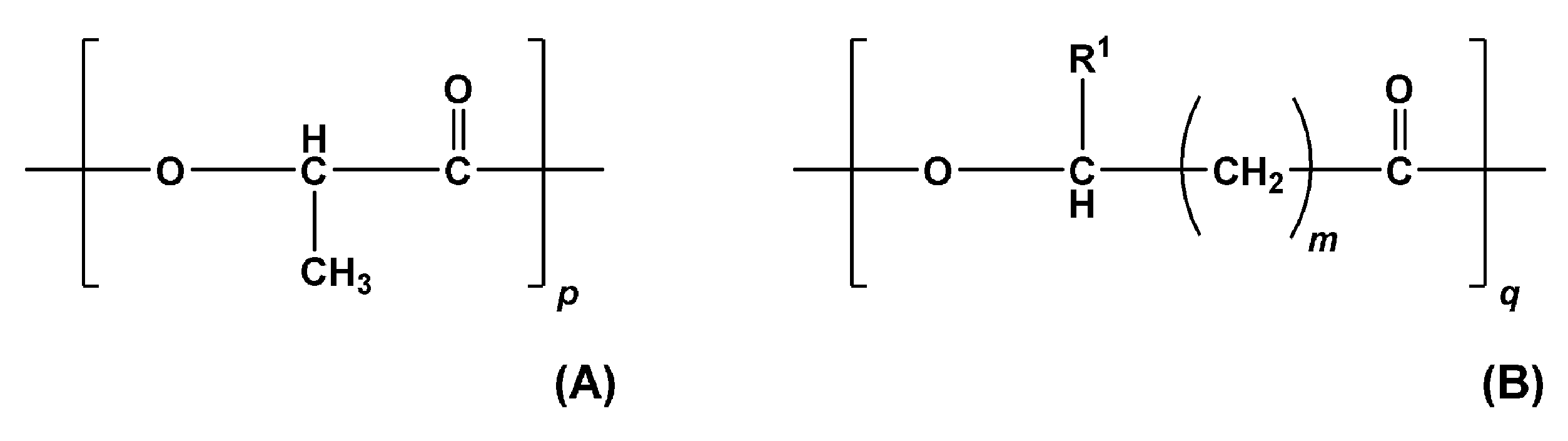
なお、式中、R1はCnH2n+1で表されるアルキル基であり、例えば、nは1~12の整数、より好ましくは1~8の整数である。またmは例えば、1~3の整数である。
繰り返し単位(B)を構成するその他のヒドロキシアルカン酸としては、具体的には、例えば、3-ヒドロキシ酪酸(3HB)、3-ヒドロキシ吉草酸(3HV)、3-ヒドロキシヘキサン酸(3HH)、3-ヒドロキシブチレート-コ-3-ヒドロキシヘキサノエート(PHBH)、3-ヒドロキシオクタン酸、3-ヒドロキシデカン酸、4-ヒドロキシ酪酸(4HB)、4-ヒドロキシ吉草酸(4HV)等が挙げられる。このうち、特に、3-ヒドロキシ酪酸(3HB)、3-ヒドロキシブチレート-コ-3-ヒドロキシヘキサノエート(PHBH)等が好ましく、さらに好ましくは、3-ヒドロキシ酪酸(3HB)である。
従って、多元ヒドロキシアルカン酸コポリマーの好ましい一例としては、酪酸-3-ヒドロキシ酪酸共重合体、すなわち、ポリ(ラクテート-コ-3-ヒトロキシブチレート)(poly(lactate-co-3-hydroxybutyrate)(P(LA-co-3HB)))を挙げることができる。
なお、多元ヒドロキシアルカン酸コポリマーにおいて、乳酸繰り返し単位(A)と共重合されるその他のヒドロキシアルカン酸繰り返し単位(B)としては、1種のコモノマーに由来するものに限られず、2種以上のコモノマーに由来するものであっても良い。すなわち、多元ヒドロキシアルカン酸コポリマーとしては、二元のみならず、三元乃至それ以上の共重合体が含まれ得る。
また、多元ヒドロキシアルカン酸コポリマーを構成するコモノマーとして、乳酸とその他のヒドロキシアルカン酸は、何れも主鎖に不斉炭素を持つため、多元ヒドロキシアルカン酸コポリマーとしても、結晶性のD体あるいはL体、非晶性のDL体、及びその中間の光学純度を持つ多元ヒドロキシアルカン酸コポリマーが存在する。
本発明において、生分解性樹脂として用いられる多元ヒドロキシアルカン酸コポリマーとしては、これら何れのものであっても良く、得様とする成形品において望まれる、耐熱性、耐衝撃強度等あるいは、柔軟性、弾性等の特性の観点から、適宜好適な特性のものを使用することが可能である。さらに、多元ヒドロキシアルカン酸コポリマーとしては、ブロック共重合体、ランダム共重合体、グラフト共重合体等の如何なる繰り返し単位のものであっても良い。また、ブロック共重合体としては、上記した乳酸繰り返し単位(A)及びその他のヒドロキシアルカン酸繰り返し単位(B)におけるD体あるいはL体のブロックポリマーセグメントを含む形態のものも含まれ得る。
多元ヒドロキシアルカン酸コポリマーにおいては、特に限定されないが、好ましくは、乳酸分率、すなわち上記した繰り返し単位(A)、(B)における{p/(p+q)}×100で表される値が、20モル%以上80モル%以下であることが望ましい。乳酸分率が20モル%以上80モル%以下であると、例えば、多元ヒドロキシアルカン酸コポリマーに対して重質炭酸カルシウムを多量に配合しても、より良好な柔軟性が得られるためである。
この乳酸分率は、本発明の樹脂組成物の用途によっても最適値が変動する。例えば、真空成形用として用いられる場合においては、乳酸分率がより好ましくは50モル%以上80モル%以下であることが望ましい。すなわち、真空成形により得られる容器等の成型品に関しては、充分な機械的強度を得る上で、この様な範囲とすることが望ましい。また、例えば、インフレーション成形用として用いられる場合においては、乳酸分率がより好ましくは20モル%以上50モル%以下であることが望ましい。すなわち、インフレーション成形により得られるフィルムに関しては、充分な延伸性、柔軟性を得る上で、この様な範囲とすることが望ましい。
多元ヒドロキシアルカン酸コポリマーの重量平均分子量(Mw)は、特に限定されず、目的とする成形品の用途、例えば、真空成形品、インフレーション成形品にした場合に、実質的に充分な機械的強度を示すものであれば、その分子量は特に制限されない。概して、分子量が低いと得られる成形品の機械的強度が低下し、生分解速度が速くなり、一方、分子量が高いと機械的強度が向上するが、加工性が低下し、成形が困難になる。従って、重量平均分子量(Mw)は、好ましくは50,000以上300,000以下、より好ましくは100,000以上200,000以下である。
また、特に限定されないが、多元ヒドロキシアルカン酸コポリマーの融点としては、一般に120℃以上180℃以下、より好ましくは140℃以上170℃以下程度のものが望ましい。この様な範囲内であれば、各種の成形加工性が良好となる。
多元ヒドロキシアルカン酸コポリマーを得る上での合成方法としては、所定の組成のものが得られる限りにおいて、特に限定されず、公知の何れの方法に基づくものであっても良い。
代表的な製造方法としては、生合成法が知られている。基本的には、例えば、ポリ3-酪酸等のポリヒドロキシアルカンに対する重合活性を有する酵素を持つ微生物において、ヒドロキシアルカン酸との共存下において乳酸重合活性を示す酵素を持つ変異体を、バイオマス中で培養することにより、本発明において用いられる、乳酸とその他のヒドロキシアルカン酸とを含む多元ヒドロキシアルカン酸コポリマーを得ることができる。
この様な変異体としては、遺伝子組み換え技術により所定の外来遺伝子を微生物中で発現させた遺伝子組み換え菌を用いることが可能である。
より具体的には、例えば、この遺伝子組み換え菌としては、大腸菌(Escherichia coli)、ラクトバシラス属(Lactobacillus)を含む各種乳酸菌、枯草菌(Bacillus subtilis)、その他の多元ポリ乳酸の製造に好適な真正細菌等を用いることが可能であり、特に、遺伝子組み換え大腸菌を好適に用いることが可能である。
この遺伝子組み換え大腸菌としては、メガスフェラ・エルスデニ(Megasphaera elsdenii)由来のプロピオニルCoA転移酵素遺伝子、STQK変異のあるポリヒドロキシ酸合成酵素遺伝子、Ralstonia eutropha由来β-ケトチオラーゼ遺伝子、Ralstonia eutropha由来アセトアセチル-CoAリダクターゼ遺伝子を含むプラスミド(ファージミド)等により形質転換されたものが好適である。なお、STQK変異のあるポリヒドロキシ酸合成酵素遺伝子については、人為的にランダムな変異を起こして特性の優れた酵素を選ぶ酵素進化工学手法等により、さらに収率等が改良されたものを用いても良い。また、形質転換する菌種等に合わせて、コドン等を最適化した遺伝子を合成したもので形質転換しても良い。
この様な微生物をバイオマス中、例えば、バイオマスの熱水抽出物を含む培地中で培養することで、所定の組成を有する多元ポリヒドロキシアルカン酸コポリマーを製造することが可能である。
原料として用いるバイオマスとしては、五炭糖、六炭糖を構成糖として含むものであれば、木本類、草本類由来の何れであっても、特に制限なく使用することができる。
より具体的に説明すると、木本類由来のバイオマスとしては、広葉樹、針葉樹の木部、樹皮、枝、葉等、林地残材、間伐材、廃材等のチップ又は樹皮、製材工場等から発生するおが屑、街路樹の剪定枝葉、建築廃材等が挙げられる。また、草本類由来のバイオマス原料としては、ケナフ、麻、バガス、イネ、稲藁、麦わら、コーンコブ等(農産廃棄物も含む)、油用作物やゴム用作物等の工芸作物の残渣及び廃棄物、草本系エネルギー作物のエリアンサス、ミスカンサスやネピアグラス等のバイオマスを用いることも可能である。また、工芸作物の残渣及び廃棄物として、例えば、EFB(Empty Fruit Bunch)等を用いることもできる。これらのバイオマスのなかで木本類由来のバイオマスを用いるのが好ましく、広葉樹、針葉樹の木部等のリグノセルロース系バイオマスを用いるのが特に好ましい。
より具体的に説明すると、木本類由来のバイオマスとしては、広葉樹、針葉樹の木部、樹皮、枝、葉等、林地残材、間伐材、廃材等のチップ又は樹皮、製材工場等から発生するおが屑、街路樹の剪定枝葉、建築廃材等が挙げられる。また、草本類由来のバイオマス原料としては、ケナフ、麻、バガス、イネ、稲藁、麦わら、コーンコブ等(農産廃棄物も含む)、油用作物やゴム用作物等の工芸作物の残渣及び廃棄物、草本系エネルギー作物のエリアンサス、ミスカンサスやネピアグラス等のバイオマスを用いることも可能である。また、工芸作物の残渣及び廃棄物として、例えば、EFB(Empty Fruit Bunch)等を用いることもできる。これらのバイオマスのなかで木本類由来のバイオマスを用いるのが好ましく、広葉樹、針葉樹の木部等のリグノセルロース系バイオマスを用いるのが特に好ましい。
これらのバイオマスは、単独、又は複数を組み合わせて使用しても良い。また、バイオマスは、乾燥固形物であっても、水分を含んだ固形物であっても、スラリーであっても用いることができる。バイオマスが乾燥固形物又は水分を含んだ固形物であれば、水と混合させスラリー状態にした後に、加熱加圧装置に供給することが好適である。
また、木本類の木部や樹皮の部位、あるいは草本性植物の茎、枝葉等の部位を微細化処理した微細化物を用いることができる。微細化の方式は、リファイナー、ウィレーミル、ボールミル等による粉末化、破砕、爆砕等の手法を用いることができる。
微生物による反応を促進する上で、上記した様なバイオマスの熱水抽出物を用いることができる。
加熱加圧装置による熱水抽出処理におけるバイオマスの乾燥重量に対する水の量(液比)は、特に限定されないが、例えば、1.0~10.0、好ましくは1.5~5.0程度とされる。熱水処理における水の添加方法は、特に限定されず、外部から水を添加しても良く、バイオマスに元々含まれる水を利用しても良い。また、加熱時に蒸気を使用する場合には、蒸気に含まれる水を利用しても良い。
熱水抽出処理の処理温度は、例えば、加圧状態で140℃以上200℃以下、好ましくは160℃以上170℃以下とされる、140℃未満であると、充分な糖質濃度が得られず、一方、200℃を超えると、セルロースの加水分解やヘミセルロースの過分解等が起きる虞があるため好ましくない。熱水抽出処理の処理時間は、上述の温度での加圧状態で30分以上120分以下であることが好適である。ここで、30分未満であると、充分な糖質濃度が得られない。また、120分を超えても、生成される糖質の濃度は殆ど変化しない。
必要に応じて、上記加熱処理により取得した熱水抽出物の原液を減圧、透過膜等により濃縮する。この濃縮は、酸加水分解に適した濃度、例えば、原液が1.5~30.0倍になる程度に濃縮することが好適である。
次に、上述の濃縮液を酸の存在下で加水分解処理して、粗単糖液を得る。この酸加水分解処理は、当業者が用いる硫酸や塩酸等の一般的な酸を用いることが可能である。また、酸加水分解処理の酸としては、硝酸やリン酸等の無機酸や、トリフルオロ酢酸や蟻酸等の有機酸を用いても良い。また、この酸加水分解処理の反応時間、温度、圧力等は、セルロースやヘミセルロースが加水分解される当業者に知られた一般的な条件を用いることが可能である。例えば、本実施形態の酸加水分解処理として、濃縮液に希硫酸を添加し、pHを1.0程度に調整し、120℃程度で60分間以上反応させ、中和後に沈殿を除去するといった処理であっても良い。
なお、粗単糖液は、セルラーゼやヘミセルラーゼ等の酵素による糖化された糖化液、亜臨界水による水熱糖化された水熱糖化液等であっても良い。
次に、上述の酸加水分解処理された粗単糖液をカラム等に通過させ、精製し、例えば、熱水抽出物の水溶液に含まれる糖の糖濃度を1質量%とした際の波長420nmにおける吸光度が0.04以下になる様な状態に精製した溶液(以下、「透過液」という。)、又は精製糖液を取得する。
バイオマス、特に上述の様にして得られた熱水抽出物を唯一の炭素源として、ヒドロキシアルカン酸との共存下において乳酸重合活性を示す酵素を持つ微生物を、一般的な培養条件下にて培養することにより、多元ヒドロキシアルカン酸コポリマーを微生物内に蓄積させ、回収することが可能である。
具体的には、遺伝子組み換え大腸菌は、例えば、上述の一般的な大腸菌培養用の培地を用いて、37℃で好気的に12~90時間培養することにより多元ヒドロキシアルカン酸コポリマーを菌体内に蓄積させ、回収することが可能である。なお、この培養時には、LB培地等の一般的な培地を用いることも可能である。また、培養時に、例えばアンモニウム塩、ペプトン、肉エキス、酵母エキス等を窒素源として加えても良い。また、培養時に、無機物として、例えばリン酸塩、硫酸塩、塩化ナトリウム等を加えても良い。また、培養時に、プラスミド保持用に、培地中に、カナマイシン、アンピシリン、テトラサイクリン等の抗生物質を培地に添加して培養しても良い。
また、多元ヒドロキシアルカン酸コポリマーの産生に用いた微生物、例えば、上述した遺伝子組み換え大腸菌は、培養菌中に多元ヒドロキシアルカン酸コポリマーを蓄積させるため、回収した菌体から容易に多元ヒドロキシアルカン酸コポリマーを採取して製造することが可能である。この培養菌の菌体は、遠心分離して粉砕し、クロロホルム、メタノール等の一般的な溶媒で多元ヒドロキシアルカン酸コポリマーを溶出させて取得しても良い。また、この溶出させた際に、PTFE膜等のフィルターで残渣等を濾過させても良い。
多元ヒドロキシアルカン酸コポリマーは、上記した生合成法のみならず、化学合成法により調製することも可能である。すなわち、例えば、直接溶融重合法、固相重合法、乳酸の直接縮重合法、ラクチドの溶融開環重合法等によりポリD-乳酸、ポリL-乳酸、ポリDL-乳酸を合成する上において、原料モノマーとして乳酸成分のみならず、例えば、3-ヒドロキシ酪酸(3HB)、3-ヒドロキシ吉草酸(3HV)、3-ヒドロキシヘキサン酸(3HH)、3-ヒドロキシブチレート-コ-3-ヒドロキシヘキサノエート(PHBH)、3-ヒドロキシオクタン酸、3-ヒドロキシデカン酸、4-ヒドロキシ酪酸(4HB)、4-ヒドロキシ吉草酸(4HV)等の乳酸成分と共重合可能なその他のモノマー成分を用い、それらを縮重合させて、多元ヒドロキシアルカン酸コポリマーを製造することが可能である。
生分解性樹脂として多元ヒドロキシアルカン酸コポリマーを主成分とする場合、重量平均分子量(Mw)50,000以上300,000以下の多元ヒドロキシアルカン酸コポリマーを、生分解性樹脂全体の10質量%以上100質量%以下の割合で含むことが好ましい。
(その他の樹脂)
本発明の樹脂組成物中には、必要に応じて生分解性樹脂以外の樹脂、好適には熱可塑性樹脂を配合することは可能であるが、その他の熱可塑性樹脂の配合量は、本発明の樹脂組成物から得た樹脂成形品の生分解性に実質的に影響を与えない様に、樹脂成分全容量に対し、20質量%以下とすることが好ましく、より好ましくは10質量%以下であり、特に好ましくは、これらのその他の熱可塑性樹脂は配合しない態様である。熱可塑性樹脂としては、例えば、ポリエチレン系樹脂、ポリプロピレン系樹脂、ポリメチル-1-ペンテン、エチレン-環状オレフィン共重合体等のポリオレフィン系樹脂;エチレン-酢酸ビニル共重合体、エチレン-アクリル酸共重合体、エチレン-メタクリル酸共重合体、エチレン-メタクリル酸共重合体の金属塩(アイオノマー)、エチレン-アクリル酸アルキルエステル共重合体、エチレン-メタクリル酸アルキルエステル共重合体、マレイン酸変性ポリエチレン、マレイン酸変性ポリプロピレン等の官能基含有ポリオレフィン系樹脂;ナイロン-6、ナイロン-6,6、ナイロン-6,10、ナイロン-6,12等のポリアミド系樹脂;ポリエチレンテレフタレート及びその共重合体、ポリエチレンナフタレート、ポリブチレンテレフタレート等の芳香族ポリエステル系樹脂、ポリブチレンサクシネート、ポリ乳酸等の脂肪族ポリエステル系樹脂等の熱可塑性ポリエステル系樹脂;芳香族ポリカーボネート、脂肪族ポリカーボネート等のポリカーボネート樹脂;アタクティックポリスチレン、シンジオタクティックポリスチレン、アクリロニトリル-スチレン(AS)共重合体、アクリロニトリル-ブタジエン-スチレン(ABS)共重合体等のポリスチレン系樹脂;ポリ塩化ビニル、ポリ塩化ビニリデン等のポリ塩化ビニル系樹脂;ポリフェニレンスルフィド;ポリエーテルスルフォン、ポリエーテルケトン、ポリエーテルエーテルケトン等のポリエーテル系樹脂等が挙げられる。
本発明の樹脂組成物中には、必要に応じて生分解性樹脂以外の樹脂、好適には熱可塑性樹脂を配合することは可能であるが、その他の熱可塑性樹脂の配合量は、本発明の樹脂組成物から得た樹脂成形品の生分解性に実質的に影響を与えない様に、樹脂成分全容量に対し、20質量%以下とすることが好ましく、より好ましくは10質量%以下であり、特に好ましくは、これらのその他の熱可塑性樹脂は配合しない態様である。熱可塑性樹脂としては、例えば、ポリエチレン系樹脂、ポリプロピレン系樹脂、ポリメチル-1-ペンテン、エチレン-環状オレフィン共重合体等のポリオレフィン系樹脂;エチレン-酢酸ビニル共重合体、エチレン-アクリル酸共重合体、エチレン-メタクリル酸共重合体、エチレン-メタクリル酸共重合体の金属塩(アイオノマー)、エチレン-アクリル酸アルキルエステル共重合体、エチレン-メタクリル酸アルキルエステル共重合体、マレイン酸変性ポリエチレン、マレイン酸変性ポリプロピレン等の官能基含有ポリオレフィン系樹脂;ナイロン-6、ナイロン-6,6、ナイロン-6,10、ナイロン-6,12等のポリアミド系樹脂;ポリエチレンテレフタレート及びその共重合体、ポリエチレンナフタレート、ポリブチレンテレフタレート等の芳香族ポリエステル系樹脂、ポリブチレンサクシネート、ポリ乳酸等の脂肪族ポリエステル系樹脂等の熱可塑性ポリエステル系樹脂;芳香族ポリカーボネート、脂肪族ポリカーボネート等のポリカーボネート樹脂;アタクティックポリスチレン、シンジオタクティックポリスチレン、アクリロニトリル-スチレン(AS)共重合体、アクリロニトリル-ブタジエン-スチレン(ABS)共重合体等のポリスチレン系樹脂;ポリ塩化ビニル、ポリ塩化ビニリデン等のポリ塩化ビニル系樹脂;ポリフェニレンスルフィド;ポリエーテルスルフォン、ポリエーテルケトン、ポリエーテルエーテルケトン等のポリエーテル系樹脂等が挙げられる。
(重質炭酸カルシウム粒子)
本発明の樹脂組成物中には、生分解性樹脂と共に、重質炭酸カルシウム粒子が配合されるが、この重質炭酸カルシウムとは、以下に示す様な天然炭酸カルシウムを機械的に粉砕・加工して得られるものであって、化学的沈殿反応等によって製造される合成炭酸カルシウムとは明確に区別されるものである。
本発明の樹脂組成物中には、生分解性樹脂と共に、重質炭酸カルシウム粒子が配合されるが、この重質炭酸カルシウムとは、以下に示す様な天然炭酸カルシウムを機械的に粉砕・加工して得られるものであって、化学的沈殿反応等によって製造される合成炭酸カルシウムとは明確に区別されるものである。
本明細書において重質炭酸カルシウムとは、方解石(石灰石、大理石等)、貝殻、サンゴ等の天然炭酸カルシウムを粉砕、分級したものを指す。重質炭酸カルシウムの原料である石灰石は、日本国内に高純度なものが豊富に産出し、経済的に入手できる。
生分解性樹脂として、乳酸とヒドロキシアルカン酸とを含む多元ヒドロキシアルカン酸コポリマーを用いる場合、重質炭酸カルシウム粒子と共に併用することで、マトリックスとなる生分解性樹脂である多元ヒドロキシアルカン酸コポリマーと当該重質炭酸カルシウム粒子表面との間に未接着で微細な空隙を多数形成されること、またこの様な界面の空隙に水分が入り込むと重質炭酸カルシウムからアルカリ成分が溶出すること等によって、多元ヒドロキシアルカン酸コポリマーの生分解性が促進される。
重質炭酸カルシウムの粉砕方法は、湿式、乾式どちらを選択しても良いが、経済的な観点で、脱水、乾燥工程等が不要な乾式粉砕が有利である。粉砕機に関しても特に限定されず、衝撃式粉砕機、ボールミル等の粉砕メディアを用いた粉砕機、ローラーミル等が使用できる。
分級も空気分級、湿式サイクロン、デカンター等を利用した分級で良く、表面処理は粉砕前、粉砕中、分級前、分級後何れの工程で行っても良いが、好ましくは、分級前に表面処理した方が効率的に粒度分布のシャープなものが得られる。また、表面処理剤の一部を粉砕前や粉砕中に粉砕助剤として添加し、残りを後の工程で添加して表面処理を行っても良い。
また、重質炭酸カルシウム粒子の分散性又は反応性を高めるために、重質炭酸カルシウム粒子の表面を予め表面改質しておいても良い。表面改質法としては、プラズマ処理等の物理的な方法や、カップリング剤や界面活性剤で表面を化学的に表面処理するもの等が例示できる。カップリング剤としては、例えば、シランカップリング剤やチタンカップリング剤等が挙げられる。界面活性剤としては、アニオン性、カチオン性、ノニオン性及び両性の何れのものであっても良く、例えば、高級脂肪酸、高級脂肪酸エステル、高級脂肪酸アミド、高級脂肪酸塩等が挙げられる。
重質炭酸カルシウム粒子としては、その平均粒子径が、1.0μm以上10.0μm以下が好ましく、1.0μm以上3.0μm以下がより好ましい。特に、その粒径分布において、粒子径50.0μm以上の粒子を含有しないことが好ましい。他方、粒子が細かくなり過ぎると、前述した生分解性樹脂と混練した際に粘度が著しく上昇し、成形品の製造が困難になる虞がある。そのため、その平均粒子径は1.0μm以上とすることが好ましい。なお、本明細書において述べる無機物質粉末(重質炭酸カルシウム粒子)の平均粒子径は、JIS M-8511に準じた空気透過法による比表面積の測定結果から計算した値をいう。測定機器としては、例えば、島津製作所社製の比表面積測定装置SS-100型を好ましく用いることができる。
平均粒子径が10.0μmよりも大きくなると、例えば、当該組成物を用いてシート状の成形品を形成した場合に、その成形品の層厚にもよるが、成形品表面より重質炭酸カルシウム粒子が突出して、当該重質炭酸カルシウム粒子が脱落したり、表面性状や機械的強度等を損なう虞がある。
本発明において使用される重質炭酸カルシウム粒子としては、例えば、合成法による軽質炭酸カルシウム等とは異なり、粒子形成が粉砕処理によって行われたことに起因する、表面の不定形性、比表面積の高さが、特に重要である。生分解性樹脂組成物中に配合された重質炭酸カルシウム粒子がこの様に不定形性、比表面積の高さを有するため、マトリックスを構成する生分解性樹脂と重質炭酸カルシウム粒子との界面においては、成形時に特に延伸等の処理を加えなくとも、成形品の成形当初から、生分解性樹脂が重質炭酸カルシウム粒子表面に未接着で微細な空隙が多数形成される、乃至は接着が非常に弱い部分が多数存在する状態となる。
この様な理由から、重質炭酸カルシウム粒子の比表面積(BET比表面積)としては、0.1m2/g以上10.0m2/g以下、より好ましくは0.2m2/g以上5.0m2/g以下、さらに好ましくは1.0m2/g以上3.0m2/g以下であることが望まれる。ここでいうBET吸着法とは窒素ガス吸着法によるものである。比表面積がこの範囲内にあると、得られる成形品において、上記した理由から生分解性樹脂が、生分解反応の起点となる表面を多く有することとなり、自然環境下における生分解性が良好に促進される一方で、重質炭酸カルシウム粒子を配合することによる樹脂組成物の加工性の低下も生じない。なお、重質炭酸カルシウム粒子の比表面積(BET比表面積)は、実施例に示した方法で特定される。
また、重質炭酸カルシウム粒子の不定形性は、粒子形状の球形化の度合いが低いことで表すことができ、具体的には、真円度が0.50以上0.95以下、より好ましくは0.55以上0.93以下、さらに好ましくは0.60以上0.90以下であることが望まれる。本発明においては使用される重質炭酸カルシウム粒子の真円度が範囲内にあると、マトリックスを構成する生分解性樹脂と重質炭酸カルシウム粒子との界面においては、未接着で微細な空隙が多数形成される、乃至は接着が非常に弱い部分が多数存在する状態が形成されやすく、自然環境下における生分解性を高める上で好適なものとなる一方で、製品としての機械的強度や成形加工性も適度なものとなる。
なお、ここで、真円度とは、(粒子の投影面積)/(粒子の投影周囲長と同一周囲長を持つ円の面積)で表されるものである。真円度の測定方法は特に限定されないが、例えば、顕微鏡写真から粒子の投影面積と粒子の投影周囲長とを測定し、各々(A)と(PM)とし、粒子の投影周囲長と同一周囲長を持つ円の半径を(r)とすると、
PM=2πr (1)
であり、粒子の投影周囲長と同一周囲長を持つ円の面積を(B)とすると、
B=πr2 (2)
である。(1)式を変形すると、r=PM/2π (3)
となるから、(2)式に(3)式を代入すると、
B=π×(PM/2π)2 (4)
となり、真円度=A/B=A×4π/(PM)2
となる。測定する粒子は、粉末の粒度分布を代表する様に、サンプリングを行う。測定粒子の数が多い程、測定値の信頼性は増すが、測定時間も考慮して、一般に100個程度の粒子の平均値で表すものとされており、本明細書においても100個の粒子の平均値とした。これらの測定は走査型顕微鏡や実体顕微鏡等で得られる各粒子の投影図を一般に商用されている画像解析ソフトによって真円度を求めることが可能である。
PM=2πr (1)
であり、粒子の投影周囲長と同一周囲長を持つ円の面積を(B)とすると、
B=πr2 (2)
である。(1)式を変形すると、r=PM/2π (3)
となるから、(2)式に(3)式を代入すると、
B=π×(PM/2π)2 (4)
となり、真円度=A/B=A×4π/(PM)2
となる。測定する粒子は、粉末の粒度分布を代表する様に、サンプリングを行う。測定粒子の数が多い程、測定値の信頼性は増すが、測定時間も考慮して、一般に100個程度の粒子の平均値で表すものとされており、本明細書においても100個の粒子の平均値とした。これらの測定は走査型顕微鏡や実体顕微鏡等で得られる各粒子の投影図を一般に商用されている画像解析ソフトによって真円度を求めることが可能である。
さらに本発明の樹脂組成物において含まれる重質炭酸カルシウム粒子は、成形品の状態においては、その粒子表面が部分的に酸化され、一部に酸化カルシウムの組成を含むものとなっていることが好ましい。この酸化の度合いとしては特に限定されるものではないが、粒子表面の比較的少ない部分、例えば粒子の体積の2%よりも充分に小さな割合であっても、生分解性を促進させる効果が見られるので、過剰な酸化は必要ではない。なお、この様な成形品中に含まれる重質炭酸カルシウム粒子の表面の部分酸化は、成形に使用する重質炭酸カルシウム粒子に予め別途熱処理等を施す等を行う必要は特になく、生分解性樹脂と重質炭酸カルシウム粒子とを混合溶融して成形品を製造する際に、当該重質炭酸カルシウム粒子が受ける熱履歴により表面の酸化が生じ得る。なお、粒子表面における酸化による酸化カルシウムの生成については、例えば、JIS R 9011:2006に規定されるEDTA滴定法、過マンガン酸カリウム滴定法等によって確認、定量可能である。なお、その表面が部分酸化された重質炭酸カルシウム粒子における酸化カルシウムの含量は極微量であるため、後述する、本発明の樹脂組成物に配合される酸化カルシウムの含量に影響を与えない。つまり、本発明の樹脂組成物における酸化カルシウムの含量には、重質炭酸カルシウム粒子の部分酸化によって生じた酸化カルシウムの含量は含まれない。
本発明の樹脂組成物に含まれる生分解性樹脂と、重質炭酸カルシウム粒子との配合比(質量%)は、生分解性樹脂:重質炭酸カルシウム粒子=50:50~10:90の比率であれば特に限定されないが、40:60~20:80の比率であることが好ましく、40:60~25:75の比率であることがさらに好ましい。生分解性樹脂と重質炭酸カルシウム粒子との配合比において、重質炭酸カルシウム粒子の割合が50質量%より低いものであると、重質炭酸カルシウム粒子を配合したことによる生分解性樹脂成形品の所定の質感、耐衝撃性等の物性が得られないものとなり、一方90質量%よりも高いものであると、押出成形、射出成形等による成形加工が困難となるためである。
生分解性樹脂として、乳酸とヒドロキシアルカン酸とを含む多元ヒドロキシアルカン酸コポリマーを用いる場合、本発明の樹脂組成物に含まれる多元ヒドロキシアルカン酸コポリマーと、重質炭酸カルシウム粒子との配合比(質量%)は、多元ヒドロキシアルカン酸コポリマー:重質炭酸カルシウム粒子=50:50~10:90の比率であれば特に限定されないが、40:60~20:80の比率であることが好ましく、40:60~25:75の比率であることがさらに好ましい。多元ヒドロキシアルカン酸コポリマーと重質炭酸カルシウム粒子との配合比において、重質炭酸カルシウム粒子の割合が50質量%より低いと、樹脂組成物を用いて得られる成形品の所定の質感、耐衝撃性等の物性が得られず、また経済性が劣るものとなり、一方90質量%より高いと、押出成形、射出成形等による成形加工が困難となるためである。
本発明の樹脂組成物に含まれる生分解性樹脂及び重質炭酸カルシウム粒子の総量は、特に限定されないが、樹脂組成物に対し、好ましくは95.0質量%以上99.5質量%以下、より好ましくは96.5質量%以上99.5質量%以下である。
(酸化カルシウム)
本発明の樹脂組成物は、樹脂組成物に対し、0.5質量%以上3.5質量%以下の酸化カルシウムを含む。本発明においては、かかる量の酸化カルシウムを配合することで、水分含量が高い生分解性樹脂含有組成物において、成形時の生分解性樹脂の加水分解を抑制できる。さらに、かかる量の酸化カルシウムは、生分解性樹脂含有組成物に含まれる重質炭酸カルシウム粒子の作用を損ない難く、該組成物から得られた樹脂成形品の生分解性は良好である。
本発明の樹脂組成物は、樹脂組成物に対し、0.5質量%以上3.5質量%以下の酸化カルシウムを含む。本発明においては、かかる量の酸化カルシウムを配合することで、水分含量が高い生分解性樹脂含有組成物において、成形時の生分解性樹脂の加水分解を抑制できる。さらに、かかる量の酸化カルシウムは、生分解性樹脂含有組成物に含まれる重質炭酸カルシウム粒子の作用を損ない難く、該組成物から得られた樹脂成形品の生分解性は良好である。
酸化カルシウムの含量の下限は、樹脂組成物に対し、好ましくは0.5質量%以上、より好ましくは0.8質量%以上である。かかる量の酸化カルシウムを配合することで、成形時の生分解性樹脂の加水分解をより抑制できる。
酸化カルシウムの含量の上限は、樹脂組成物に対し、好ましくは3.5質量%以下、より好ましくは2.0質量%以下である。かかる量の酸化カルシウムを配合することで、本発明の樹脂組成物から得られる樹脂成形品の機械的特性が均一となりやすくなる。
生分解性樹脂と酸化カルシウムとの質量比は、特に限定されないが、本発明の効果が奏されやすいという観点から、生分解性樹脂:酸化カルシウム=99.5:0.5~96.5:3.5が好ましく、99.2:0.8~98.0:2.0がより好ましい。
酸化カルシウムの形状や粒子径は特に限定されない。酸化カルシウムとして、例えば、平均粒子径が、好ましくは0.1μm以上20.0μm以下、より好ましくは0.5μm以上10.0μm以下のものを使用できる。
(水分)
本発明の樹脂組成物は、樹脂組成物に対し、0.2質量%以上の水分を含む。生分解性樹脂含有組成物は、水分含量が高いと生分解性樹脂の加水分解が促進し、樹脂組成物の成形性等が損なわれる結果、成形品を安定的に生産できなかったり、成形品の強度にばらつきが生じたりするという問題がある。しかし、本発明によれば、生分解性樹脂含有組成物中の水分含量が高くとも、酸化カルシウムの作用により、成形時の生分解性樹脂の加水分解が抑制される。
本発明の樹脂組成物は、樹脂組成物に対し、0.2質量%以上の水分を含む。生分解性樹脂含有組成物は、水分含量が高いと生分解性樹脂の加水分解が促進し、樹脂組成物の成形性等が損なわれる結果、成形品を安定的に生産できなかったり、成形品の強度にばらつきが生じたりするという問題がある。しかし、本発明によれば、生分解性樹脂含有組成物中の水分含量が高くとも、酸化カルシウムの作用により、成形時の生分解性樹脂の加水分解が抑制される。
水分含量の下限は、樹脂組成物に対し、好ましくは0.2質量%以上、より好ましくは0.5質量%以上である。本発明によれば、この様に高い含量の水分が含まれていても成形時の生分解性樹脂の加水分解が抑制され得る。
水分含量の上限は、樹脂組成物に対し、好ましくは3.0質量%以下、より好ましくは2.0質量%以下である。水分含量は過度ではないことが好ましい。
本発明の樹脂組成物に含まれる水分の由来は特に限定されない。例えば、成形環境における大気中の水分、樹脂組成物の材料(樹脂等)に不可避的に含まれる水分、重質炭酸カルシウム粒子表面に吸着した水分等が挙げられる。従って、本発明によれば、例えば、高湿度環境下(0℃以上50℃以下、相対湿度75%RH以上)においても、成形時の生分解性樹脂の加水分解を抑制しつつ、樹脂組成物の成形が可能である。
(その他の添加剤)
本発明の樹脂組成物には、必要に応じて、補助剤としてその他の添加剤を配合することも可能である。その他の添加剤としては、例えば、可塑剤、重質炭酸カルシウム粒子以外の充填剤、色剤、滑剤、カップリング剤、流動性改良材、分散剤、酸化防止剤、紫外線吸収剤、難燃剤、安定剤、帯電防止剤、発泡剤等を配合しても良い。これらの添加剤は、単独で用いても良く、2種以上を併用しても良い。また、これらは、後述の混練工程において配合しても良く、混練工程の前に予め樹脂組成物に配合していても良い。本発明の樹脂組成物において、これらのその他の添加剤の添加量は、上記した生分解性樹脂と、重質炭酸カルシウム粒子との配合による所望の効果を阻害しない限り特に限定されないが、例えば、樹脂組成物全体の質量を100%とした場合に、その他の添加剤はそれぞれ0質量%以上5質量%以下程度の割合で、かつ当該その他の添加剤全体で10質量%以下となる割合で配合されることが望まれる。
本発明の樹脂組成物には、必要に応じて、補助剤としてその他の添加剤を配合することも可能である。その他の添加剤としては、例えば、可塑剤、重質炭酸カルシウム粒子以外の充填剤、色剤、滑剤、カップリング剤、流動性改良材、分散剤、酸化防止剤、紫外線吸収剤、難燃剤、安定剤、帯電防止剤、発泡剤等を配合しても良い。これらの添加剤は、単独で用いても良く、2種以上を併用しても良い。また、これらは、後述の混練工程において配合しても良く、混練工程の前に予め樹脂組成物に配合していても良い。本発明の樹脂組成物において、これらのその他の添加剤の添加量は、上記した生分解性樹脂と、重質炭酸カルシウム粒子との配合による所望の効果を阻害しない限り特に限定されないが、例えば、樹脂組成物全体の質量を100%とした場合に、その他の添加剤はそれぞれ0質量%以上5質量%以下程度の割合で、かつ当該その他の添加剤全体で10質量%以下となる割合で配合されることが望まれる。
以下に、これらのうち、重要と考えられるものについて例を挙げて説明するが、これらに限られない。
可塑剤としては、上記生分解性樹脂として、例えば、結晶化度の高いポリL-乳酸又はポリD-乳酸を主成分として用いた場合に、その加工性や、得られる成形品の柔軟性を付与するために添加され得る。例えば、乳酸、重量平均分子量3,000以下程度の乳酸オリゴマー、分岐状ポリ乳酸(例えば、国際公開WO2010/082639号明細書等を参照。)等が挙げられる。
重質炭酸カルシウム粒子以外の充填剤としては、例えば、カルシウム、マグネシウム、アルミニウム、チタン、鉄、亜鉛等の炭酸塩(重質炭酸カルシウムを除く)、硫酸塩、珪酸塩、リン酸塩、ホウ酸塩、酸化物、若しくはこれらの水和物の粉末状のものが挙げられ、具体的には、例えば、軽質炭酸カルシウム、炭酸マグネシウム、酸化亜鉛、酸化チタン、シリカ、アルミナ、クレー、タルク、カオリン、水酸化アルミニウム、水酸化マグネシウム、ケイ酸アルミニウム、ケイ酸マグネシウム、ケイ酸カルシウム、硫酸アルミニウム、硫酸マグネシウム、硫酸カルシウム、リン酸マグネシウム、硫酸バリウム、珪砂、カーボンブラック、ゼオライト、モリブデン、珪藻土、セリサイト、シラス、亜硫酸カルシウム、硫酸ナトリウム、チタン酸カリウム、ベントナイト、黒鉛等が挙げられる。これらは合成のものであっても天然鉱物由来のものであっても良い。
色剤としては、公知の有機顔料又は無機顔料あるいは染料の何れをも用いることができる。具体的には、アゾ系、アンスラキノン系、フタロシアニン系、キナクリドン系、イソインドリノン系、ジオオサジン系、ペリノン系、キノフタロン系、ペリレン系顔料等の有機顔料や群青、酸化チタン、チタンイエロー、酸化鉄(弁柄)、酸化クロム、亜鉛華、カーボンブラック等の無機顔料が挙げられる。
滑剤としては、例えば、ステアリン酸、ヒドロキシステアリン酸、複合型ステアリン酸、オレイン酸等の脂肪酸系滑剤、脂肪族アルコール系滑剤、ステアロアミド、オキシステアロアミド、オレイルアミド、エルシルアミド、リシノールアミド、ベヘンアミド、メチロールアミド、メチレンビスステアロアミド、メチレンビスステアロベヘンアミド、高級脂肪酸のビスアミド酸、複合型アミド等の脂肪族アマイド系滑剤、ステアリン酸-n-ブチル、ヒドロキシステアリン酸メチル、多価アルコール脂肪酸エステル、飽和脂肪酸エステル、エステル系ワックス等の脂肪族エステル系滑剤、脂肪酸金属石鹸系滑剤等を挙げることができる。
酸化防止剤としては、リン系酸化防止剤、フェノール系酸化防止剤、ペンタエリスリトール系酸化防止剤が使用できる。より具体的には亜リン酸エステル、リン酸エステル等のリン系酸化防止剤が好ましく用いられる。亜リン酸エステルとしては、例えば、トリフェニルホスファイト、トリスノニルフェニルホスファイト、トリス(2,4-ジ-t-ブチルフェニル)ホスファイト、等の亜リン酸のトリエステル、ジエステル、モノエステル等が挙げられる。
リン酸エステルとしては、トリメチルホスフェート、トリエチルホスフェート、トリブチルホスフェート、トリオクチルホスフェート、トリフェニルホスフェート、トリクレジルホスフェート、トリス(ノニルフェニル)ホスフェート、2-エチルフェニルジフェニルホスフェート等が挙げられる。これらリン系酸化防止剤は単独で用いても良く、二種以上を組み合わせて用いても良い。
フェノール系の酸化防止剤としては、α-トコフェロール、ブチルヒドロキシトルエン、シナピルアルコール、ビタミンE、n-オクタデシル-3-(3,5-ジ-t-ブチル-4-ヒドロキシフェニル)プロピオネイト、2-t-ブチル-6-(3’-t-ブチル-5’-メチル-2’-ヒドロキシベンジル)-4-メチルフェニルアクリレート、2,6-ジ-t-ブチル-4-(N,N-ジメチルアミノメチル)フェノール、3,5-ジ-t-ブチル-4-ヒドロキシベンジルホスホネイトジエチルエステル、及びテトラキス[3-(3,5-ジ-t-ブチル-4-ヒドロキシフェニル)プロピオニルオキシメチル]メタン等が例示され、これらは単独で又は2種以上を組み合わせて使用することができる。
難燃剤としては、特に限定されないが、例えば、ハロゲン系難燃剤、あるいはリン系難燃剤や金属水和物等の非リン系ハロゲン系難燃剤を用いることができる。ハロゲン系難燃剤としては、具体的には例えば、ハロゲン化ビスフェニルアルカン、ハロゲン化ビスフェニルエーテル、ハロゲン化ビスフェニルチオエーテル、ハロゲン化ビスフェニルスルフォン等のハロゲン化ビスフェノール系化合物、臭素化ビスフェノールA、臭素化ビスフェノールS、塩素化ビスフェノールA、塩素化ビスフェノールS等のビスフェノール-ビス(アルキルエーテル)系化合物等が、またリン系難燃剤としては、トリス(ジエチルホスフィン酸)アルミニウム、ビスフェノールAビス(ジフェニルホスフェート)、リン酸トリアリールイソプロピル化物、クレジルジ2、6-キシレニルホスフェート、芳香族縮合リン酸エステル等が、金属水和物としては、例えば、アルミニウム三水和物、二水酸化マグネシウム又はこれらの組み合わせ等がそれぞれ例示でき、これらは単独で又は2種以上を組み合わせて使用することができる。難燃助剤として働き、より効果的に難燃効果を向上させることが可能となる。さらに、例えば、三酸化アンチモン、五酸化アンチモン等の酸化アンチモン、酸化亜鉛、酸化鉄、酸化アルミニウム、酸化モリブデン、酸化チタン、酸化カルシウム、酸化マグネシウム等を難燃助剤として併用することも可能である。
発泡剤は、溶融混練機内で溶融状態にされている原料である樹脂組成物に混合し、又は圧入し、固体から気体、液体から気体に相変化するもの、又は気体そのものであり、主として発泡シートの発泡倍率(発泡密度)を制御するために使用される。原料となる樹脂組成物に溶解した発泡剤は、常温で液体のものは樹脂温度によって気体に相変化して溶融樹脂に溶解し、常温で気体のものは相変化せずそのまま溶融樹脂に溶解する。溶融樹脂に分散溶解した発泡剤は、溶融樹脂を押出ダイからシート状に押出した際に、圧力が開放されるのでシート内部で膨張し、シート内に多数の微細な独立気泡を形成して発泡シートが得られる。発泡剤は、副次的に原料樹脂組成物の溶融粘度を下げる可塑剤として作用し、原料樹脂組成物を可塑化状態にするための温度を低くする。
発泡剤としては、例えば、プロパン、ブタン、ペンタン、ヘキサン、ヘプタン等の脂肪族炭化水素類;シクロブタン、シクロペンタン、シクロヘキサン等の脂環式炭化水素類;クロロジフルオロメタン、ジフロオロメタン、トリフルオロメタン、トリクロロフルオロメタン、ジクロロメタン、ジクロロフルオロメタン、ジクロロジフルオロメタン、クロロメタン、クロロエタン、ジクロロトリフルオロエタン、ジクロロペンタフルオロエタン、テトラフルオロエタン、ジフルオロエタン、ペンタフルオロエタン、トリフルオロエタン、ジクロロテトラフルオロエタン、トリクロロトリフルオロエタン、テトラクロロジフルオロエタン、パーフルオロシクロブタン等のハロゲン化炭化水素類;二酸化炭素、窒素、空気等の無機ガス;水等が挙げられる。
成形工程において発泡剤に含まれる発泡剤の含有量は生分解性樹脂、重質炭酸カルシウム粒子の量等に応じて、適宜設定することができ、樹脂組成物の全質量に対して0.04質量%以上5.00質量%以下の範囲とすることが好ましい。
<本発明の樹脂組成物の製造方法>
本発明の樹脂組成物は、上記の成分を公知の方法によって、必要に応じ、混合、撹拌等することで得られる。
本発明の樹脂組成物は、上記の成分を公知の方法によって、必要に応じ、混合、撹拌等することで得られる。
酸化カルシウムの添加は、樹脂組成物中の酸化カルシウムの最終濃度が0.5質量%以上3.5質量%以下となる量で配合できれば、添加の方法や条件は特に限定されない。生分解性樹脂、重質炭酸カルシウム粒子、酸化カルシウムの混合順序も特に限定されない。
作業のしやすさから、本発明の樹脂組成物におけるベース樹脂である生分解性樹脂に重質炭酸カルシウム粒子を加えた後、酸化カルシウムが添加されることが好ましい。通常、酸化カルシウムを添加後、樹脂組成物中の酸化カルシウムの濃度が均一となる様に、生分解性樹脂や、重質炭酸カルシウム粒子と共に撹拌される。
生分解性樹脂、重質炭酸カルシウム粒子、及び酸化カルシウムの混合は、成形方法(押出成形、射出成形、真空成形等)に応じて適宜設定して良く、例えば、成形機にホッパーから投入する前に生分解性樹脂、重質炭酸カルシウム粒子、及び酸化カルシウムを混練溶融しても良く、成形機と一体で成形と同時に生分解性樹脂、重質炭酸カルシウム粒子、及び酸化カルシウムを混練溶融しても良い。溶融混練は、生分解性樹脂に重質炭酸カルシウム粒子及び酸化カルシウムを均一に分散させる傍ら、高い剪断応力を作用させて混練することが好ましく、例えば二軸混練機で混練することが好ましい。
本発明の樹脂組成物の形態は特に限定されず、ペレットとして調製しても良いが、ペレットとして調製せずにそのまま成形工程に供しても良い。加工や扱いの容易さから、本発明の樹脂組成物の形態はペレットであることが好ましい。
本発明の樹脂成形体がペレットの形態である場合、ペレットの形状は特に限定されず、例えば、円柱、球形、楕円球状等のペレットを成形しても良い。ペレットを得るための造粒操作は、当業者が通常用いる手順又は装置によって行われ得る。例えば、二軸押出機等を用いて生分解性樹脂を溶融させながら、重質炭酸カルシウム粒子及びその他の添加剤を投入して溶融混練し、ストランド形状に押出して冷却後ペレタイザーによってペレットを作製する等すれば良い。この様に作製したペレットは充分に乾燥して水分を除去した後、射出成形等に用いることができる。
ペレットのサイズは、形状に応じて適宜設定すれば良いが、例えば、球形ペレットの場合、直径1mm以上10mm以下であって良い。楕円球状のペレットの場合、縦横比0.1以上1.0以下の楕円状とし、縦横1mm以上10mm以下であって良い。円柱ペレットの場合は、直径1mm以上10mm以下の範囲内、長さ1mm以上10mm以下の範囲内であって良い。これらの形状は、混練工程後、常法に従って成形させて良い。
<樹脂成形品>
本発明の樹脂成形品は、本発明の樹脂組成物を用いて任意の形態に成形された成形品である。
本発明の樹脂成形品は、本発明の樹脂組成物を用いて任意の形態に成形された成形品である。
本発明の樹脂成形品の形状等は特に限定されず、各種の形態のものであっても良いが、例えば、フィルム、シート、食品用容器及びその他の容器体、あるいは、比較的短期間で廃棄される、日用品、自動車用部品、電気・電子部品、建築部材等の分野における消耗品等の各種成形品として成形され得る。
本発明の樹脂成形品の肉厚としても特に限定されるものではなく、その成形品の形態に応じて、薄肉のものから厚肉のものまで種々のものであり得るが、例えば、肉厚40μm以上5,000μm以下、より好ましくは肉厚50μm以上1,000μm以下である成形品が示される。この範囲内の肉厚であれば、成形性、加工性の問題なく、偏肉を生じることなく均質で欠陥のない成形品を形成することが可能である。
特に、成形品の形態が、印刷用シート、又は包装用シートである場合には、より好ましくは、肉厚50μm以上1,000μm以下、さらに好ましくは肉厚50μm以上400μm以下であることが望ましい。この様な範囲内の肉厚を有するシートであれば、一般的な印刷・情報用、及び包装用の用途の紙あるいは合成紙に代えて、好適に使用できるものである。
また、成形品の形態が、真空成形用シートである場合には、より好ましくは、肉厚300μm以上2,000μm以下、さらに好ましくは肉厚500μm以上1,000μm以下であることが望ましい。この様な範囲内の肉厚を有するシートであれば、その後の真空成形によっても、充分な機械的強度を有して、表面性状等に優れた二次成形体を加工性良く得ることができる。
さらに、成形品の形態が、インフレーション成形によるフィルムである場合には、より好ましくは、肉厚10μm以上200μm以下、さらに好ましくは肉厚30μm以上100μm以下であることが望ましい。この様な範囲内の肉厚を有するフィルムに成形すると、充分な機械的強度と柔軟性とを有し、かつ表面性状等にも優れた成形品とすることができる。
さらに、成形品の形態が、インフレーション成形によるフィルムである場合には、より好ましくは、肉厚10μm以上200μm以下、さらに好ましくは肉厚30μm以上100μm以下であることが望ましい。この様な範囲内の肉厚を有するフィルムに成形すると、充分な機械的強度と柔軟性とを有し、かつ表面性状等にも優れた成形品とすることができる。
本発明の樹脂成形品の一実施態様においては、成形品を構成する部材が、積層構造を有するもの(すなわち積層体)であっても良い。本発明の樹脂組成物より形成される成形品は、良好な機械的強度、柔軟性、耐熱性及び生分解性等を有するものとなるが、表面に、含有成分非移行性、耐擦傷性、光沢性、ヒートシール性等の種々の機能性を持たせる目的のため、積層体においては、本発明の樹脂組成物からなる層の少なくとも一方の表面を、表面層により被覆してなる態様とし得る。この様な表面層の好ましい例として、生分解性樹脂からなる表面層(生分解性樹脂のみが含まれる表面層)が挙げられる。
なお、本発明の樹脂組成物よりなる層の両面を被覆する場合において、それぞれの面に配置される表面層としては、同一のものであっても、異なるものであっても良い。さらに、この様な表面層と本発明の樹脂組成物よりなる層との間に別の単一又は複数の中間層を設けることも可能である。この様な表面層を構成する素材としては、付与しようとする機能等に応じて、種々のものを用いることができるため特に限定されるものではないが、例えば、添加物を有さない乃至は添加物の配合量が非常に低い生分解性樹脂、特にポリ乳酸、あるいはポリオレフィン樹脂、さらに、無添加ポリプロピレンフィルム層や無添加ポリエチレンフィルム層等の石油系合成樹脂である態様が例示できる。これらの表面層の肉厚としては、本発明の樹脂組成物よりなる層の肉厚に比べて充分に薄いものであって良く、例えば、肉厚1μm以上40μm以下、さらに好ましくは肉厚2μm以上15μm以下程度のものとすることができる。
本発明の樹脂組成物よりなる層の少なくとも一方の表面を、表面層により被覆する方法としても特に限定されるものではなく、例えば、インフレーション成形等により別途調製した表面層用のフィルムを、本発明の樹脂組成物よりなる層の一方の面又は両面に、ラミネート加工により被着させる方法や、あるいは、従来公知の様に、2色乃至多色ダイを用いて、本発明の樹脂組成物と共に、これら表面層用の生分解性組成物と共押出しすることにより積層シートとするといった方法を用いることが可能である。
<樹脂成形品の製造方法>
本発明の樹脂成形品の製造方法は、成形対象として、本発明の樹脂組成物(すなわち、生分解性樹脂と、重質炭酸カルシウム粒子とを、50:50~10:90の質量比で含み、かつ、樹脂組成物に対し、0.5質量%以上3.5質量%以下の酸化カルシウムを含む樹脂組成物)を用いる点以外は、通常の方法を使用することができる。本発明の樹脂組成物を調製後、該樹脂組成物を任意の方法で成形することで樹脂成形品を得ることができる。
本発明の樹脂成形品の製造方法は、成形対象として、本発明の樹脂組成物(すなわち、生分解性樹脂と、重質炭酸カルシウム粒子とを、50:50~10:90の質量比で含み、かつ、樹脂組成物に対し、0.5質量%以上3.5質量%以下の酸化カルシウムを含む樹脂組成物)を用いる点以外は、通常の方法を使用することができる。本発明の樹脂組成物を調製後、該樹脂組成物を任意の方法で成形することで樹脂成形品を得ることができる。
本発明の樹脂成形品の製造方法において、成形工程の開始時点における樹脂組成物の水分含量は0.2質量%以上(好ましくは0.2質量%以上3.0質量%以下)である。
本発明において、「成形工程の開始時点」とは、本発明の樹脂組成物又は本発明の樹脂組成物を構成する各材料が、成形機に投入される直前(好ましくは投入される30分以内、より好ましくは投入される10分以内)を意味する。
上記の通り、本発明においては、酸化カルシウムの作用により、成形時の生分解性樹脂の加水分解が抑制される。従って、本発明によれば、例えば、成形工程の開始時点における樹脂組成物の水分含量が高いだけではなく、成形工程が高湿度環境下にあっても、成形時の生分解性樹脂の加水分解が抑制され得る。
本発明において、「高湿度環境」とは、例えば、0℃以上50℃以下、相対湿度75%RH以上(好ましくは75%RH以上98%RH以下)の環境を意味する。例えば、本発明の樹脂組成物又は本発明の樹脂組成物を構成する各材料を成形機に投入する直前において、該樹脂組成物又は材料が接する環境が上記の様な高湿度環境であっても良い。
樹脂組成物から樹脂成形品を得る方法は、任意の成形方法を採用できる。例えば、射出成形法、発泡射出成形法、射出圧縮成形法、押出成形法、ブロー成形法、インフレーション成形法、プレス成形法、カレンダー成形法、真空成形法、さらに、インモールド成形法、ガスプレス成形法、2色乃至多色成形法、サンドイッチ成形法等公知の任意の成形方法を採用することができる。さらにまた、本発明の樹脂組成物が発泡剤を含有し、発泡体である態様の成形品を得る場合においても、所望の形状に成形できるものであれば発泡体の成形方法として従来公知の、例えば、射出発泡,押出発泡,発泡ブロー等の液相発泡法、あるいは、例えば、ビーズ発泡,バッチ発泡、プレス発泡、常圧二次発泡等の固相発泡法の何れを用いることも可能である。
成形時における成形温度は、その成形方法や使用する生分解性樹脂の種類等によっても異なるため、樹脂の種類に応じて適宜設定でき、例えば、溶融混練温度140℃以上220℃以下、より好ましくは160℃以上200℃以下の温度範囲で成形するのが望ましい。この様な温度範囲においては、生分解性樹脂を変質させることなく良好な形状追従性を持って成形することができる。
通常、生分解性樹脂の溶融混練時に、温度上昇に伴い水分の存在下で加水分解が促進する。この結果、樹脂組成物から得られる樹脂成形品には強度のばらつきや低下が生じる傾向があった。しかし、本発明によれば、酸化カルシウムの作用により、水分の存在下であっても加水分解が抑制され、樹脂成形品の強度のばらつきや低下が生じ難い。
本発明の成形品の製造方法の具体的な好ましい一態様は、本発明の樹脂組成物を、二軸押出機により140℃以上220℃以下、より好ましくは160℃以上200℃以下で溶融混練後、Tダイにてシート状(無延伸シート状)に成形する成形品の製造方法が示される。
本発明の成形品の製造方法の具体的な好ましい別の一態様は、本発明の樹脂組成物を、二軸押出機により140℃以上220℃以下、より好ましくは160℃以上200℃以下で溶融混練後、金型温度20℃以上110℃以下で成形する成形品の製造方法が示される。
なお、上述した様に、本発明の成形品の成形においては他の樹脂組成物との多層化も可能であり、目的に応じて、本発明の樹脂組成物からなる層の片面、両面に他の樹脂組成物を適用することができ、あるいは逆に他の樹脂組成物からなる層の片面、両面に本発明の樹脂組成物を適用することもできる。
さらに、シート状、フィルム状に成形する際においては、その成形時あるいはその成形後に一軸方向又は二軸方向に、乃至は、多軸方向(チューブラー法による延伸等)に延伸することが可能であるが、本発明においては、無延伸乃至は実質的に無延伸である様な不可避的な弱延伸である態様が望ましい。この様な無延伸乃至は実質的に無延伸である状態において、本発明の成形品は、充分な機械的強度を有する一方で、良好な生分解性が得られる。
なお、本発明において生分解性樹脂として代表的に用いられ得る結晶性のポリ乳酸(ポリL-乳酸又はポリD-乳酸)は、ガラス転移温度が57℃以上60℃以下と比較的高いことからも明らかな通り、主鎖が剛直であり、結晶化速度が遅い。従って、延伸操作を伴わない射出成形においては、金型温度を結晶化に最適な90℃以上100℃以下に設定(高温金型)しても半溶融状態のままである。金型温度を室温近傍に設定(低温金型)することにより冷却・固化されるものの、結晶化度は極めて低く、耐熱性に劣るものしか得られない。
一方、本発明の樹脂組成物においては、生分解性樹脂に対して、重質炭酸カルシウム粒子が高配合量で混合されており、例えば、生分解性樹脂として結晶性のポリ乳酸(ポリL-乳酸又はポリD-乳酸)を主成分と用いた場合でも、高温金型でも充分に硬化し、また低温金型においても結晶化度は高くなり、従来の結晶性ポリ乳酸を主成分としたものに比べて、重質炭酸カルシウム粒子が高配合量で配合されていることも加わって、耐熱性が高くなる。このため、冷却に充分な時間をとる必要がなく、成形サイクルが短くなり生産性が向上する。
以下本発明を、実施例に基づき具体的に説明する。なお、これらの実施例は、本明細書に開示され、また添付の請求の範囲に記載された、本発明の概念及び範囲の理解を、容易なものとする上で、特定の態様及び実施形態の例示の目的のためにのみ記載するのであって、本発明はこれらの実施例に何ら限定されるものではない。
<参考試験1>
以下の方法で、生分解性樹脂を含む製品の生分解性を高める上で、重質炭酸カルシウム粒子を用いることの有用性を確認した。
以下の方法で、生分解性樹脂を含む製品の生分解性を高める上で、重質炭酸カルシウム粒子を用いることの有用性を確認した。
参考試験1においては、以下の成分を材料として用いた。
(樹脂成分(P))
P1-1: ポリL-乳酸(重量平均分子量Mw:130,000、融点:172℃)
P1-2: ポリL-乳酸(重量平均分子量Mw:170,000、融点:178℃)
P1-3: ポリL-乳酸(重量平均分子量Mw:80,000、融点:167℃)
P1-4: ポリD-乳酸(重量平均分子量Mw:230,000、融点:182℃)
P1-5:ポリDL-乳酸(重量平均分子量Mw:150,000)
P1-6:ポリ乳酸マルチブロックコポリマー(重量平均分子量Mw:70,000、融点:140℃)
P1-7:ポリグリコール酸(重量平均分子量Mw:200,000、融点:228℃)
P1-1: ポリL-乳酸(重量平均分子量Mw:130,000、融点:172℃)
P1-2: ポリL-乳酸(重量平均分子量Mw:170,000、融点:178℃)
P1-3: ポリL-乳酸(重量平均分子量Mw:80,000、融点:167℃)
P1-4: ポリD-乳酸(重量平均分子量Mw:230,000、融点:182℃)
P1-5:ポリDL-乳酸(重量平均分子量Mw:150,000)
P1-6:ポリ乳酸マルチブロックコポリマー(重量平均分子量Mw:70,000、融点:140℃)
P1-7:ポリグリコール酸(重量平均分子量Mw:200,000、融点:228℃)
(無機物質粉末(I))
I1-1:重質炭酸カルシウム粒子 平均粒径:2.2μm、BET比表面積:1.0m2/g、真円度:0.85
I1-2:重質炭酸カルシウム粒子 平均粒径:1.1μm、BET比表面積:3.2m2/g、真円度:0.55
I1-3:重質炭酸カルシウム粒子 平均粒径:3.6μm、BET比表面積:0.6m2/g、真円度:0.9
I1-4:重質炭酸カルシウム粒子 平均粒径:8.0μm、BET比表面積:0.3m2/g、真円度:0.93
I1-a:軽質炭酸カルシウム粒子 平均粒径:1.5μm、BET比表面積:0.1m2/g、真円度:1.0
I1-b:タルク粒子 平均粒径:3.3μm、BET比表面積:12.0m2/g、真円度:0.49
I1-1:重質炭酸カルシウム粒子 平均粒径:2.2μm、BET比表面積:1.0m2/g、真円度:0.85
I1-2:重質炭酸カルシウム粒子 平均粒径:1.1μm、BET比表面積:3.2m2/g、真円度:0.55
I1-3:重質炭酸カルシウム粒子 平均粒径:3.6μm、BET比表面積:0.6m2/g、真円度:0.9
I1-4:重質炭酸カルシウム粒子 平均粒径:8.0μm、BET比表面積:0.3m2/g、真円度:0.93
I1-a:軽質炭酸カルシウム粒子 平均粒径:1.5μm、BET比表面積:0.1m2/g、真円度:1.0
I1-b:タルク粒子 平均粒径:3.3μm、BET比表面積:12.0m2/g、真円度:0.49
(可塑剤(M))
分岐状ポリ乳酸
分岐状ポリ乳酸
<実施例1-1>
樹脂成分として上記ポリL-乳酸P1-1を、無機物質粉末として上記重質炭酸カルシウム粒子I1-1を、さらに上記可塑剤として分岐状ポリ乳酸Mを、表1に示す配合割合において用いた。なお、表1において各成分の数値は質量部の値である。各成分を、二軸スクリューを装備した押出成形機(東洋精機製作所製Tダイ押出成形装置(φ20mm、L/D=25))に投入し、175℃の温度で混練し、ペレット化した。得られたペレットを175℃で射出成形して金型温度60℃で保持して容器状の成形体を得た。その結果、離型性は良好であった。また、得られたペレットを用いて180℃でTダイを通して厚み3mmのシート、及び厚み200μmのフィルムを作製した。得られたシート、及びフィルムから作成した試験片を用いてアイゾット衝撃試験、酵素分解性試験、海水分解性試験を行った。得られた結果を表1に示す。
樹脂成分として上記ポリL-乳酸P1-1を、無機物質粉末として上記重質炭酸カルシウム粒子I1-1を、さらに上記可塑剤として分岐状ポリ乳酸Mを、表1に示す配合割合において用いた。なお、表1において各成分の数値は質量部の値である。各成分を、二軸スクリューを装備した押出成形機(東洋精機製作所製Tダイ押出成形装置(φ20mm、L/D=25))に投入し、175℃の温度で混練し、ペレット化した。得られたペレットを175℃で射出成形して金型温度60℃で保持して容器状の成形体を得た。その結果、離型性は良好であった。また、得られたペレットを用いて180℃でTダイを通して厚み3mmのシート、及び厚み200μmのフィルムを作製した。得られたシート、及びフィルムから作成した試験片を用いてアイゾット衝撃試験、酵素分解性試験、海水分解性試験を行った。得られた結果を表1に示す。
<実施例1-2~1-12、比較例1-1~1-4>
樹脂組成物中における各成分の種類及び量をそれぞれ、下記表1に示す様に変更する以外は実施例1-1と同様にして、厚み3mmのシート、及び厚み200μmのフィルムを作製し、同様にアイゾット衝撃試験、酵素分解性試験、海水分解性試験を行った。得られた結果を表1に示す。
樹脂組成物中における各成分の種類及び量をそれぞれ、下記表1に示す様に変更する以外は実施例1-1と同様にして、厚み3mmのシート、及び厚み200μmのフィルムを作製し、同様にアイゾット衝撃試験、酵素分解性試験、海水分解性試験を行った。得られた結果を表1に示す。
<評価方法>
以下の実施例及び比較例においての各物性値はそれぞれ以下の方法により評価されたものである。
以下の実施例及び比較例においての各物性値はそれぞれ以下の方法により評価されたものである。
(粒子の比表面積)
マイクロトラック・ベル社製、BELSORP-miniを用い、窒素ガス吸着法によって求めた。
マイクロトラック・ベル社製、BELSORP-miniを用い、窒素ガス吸着法によって求めた。
(粒子の平均粒径)
島津製作所社製の比表面積測定装置SS-100型を用い、JIS M-8511に準拠して空気透過法による比表面積の測定結果から計算した。
島津製作所社製の比表面積測定装置SS-100型を用い、JIS M-8511に準拠して空気透過法による比表面積の測定結果から計算した。
(粒子の真円度)
粉末の粒度分布を代表する様に、100個の粒子のサンプリングを行い、光学顕微鏡を用いて得たこれらの各粒子の投影図を粒子の画像を市販の画像解析ソフトを用いて画像解析することによって真円度を求めた。測定原理としては、粒子の投影面積と粒子の投影周囲長とを測定し、各々(A)と(PM)とし、粒子の投影周囲長と同一周囲長を持つ円の半径を(r)とすると、
PM=2πr (1)
であり、粒子の投影周囲長と同一周囲長を持つ円の面積を(B)とすると、
B=πr2 (2)
である。(1)式を変形すると、r=PM/2π (3)
となるから、(2)式に(3)式を代入すると、
B=π×(PM/2π)2 (4)
となり、真円度=A/B=A×4π/(PM)2
を求めるものである。
粉末の粒度分布を代表する様に、100個の粒子のサンプリングを行い、光学顕微鏡を用いて得たこれらの各粒子の投影図を粒子の画像を市販の画像解析ソフトを用いて画像解析することによって真円度を求めた。測定原理としては、粒子の投影面積と粒子の投影周囲長とを測定し、各々(A)と(PM)とし、粒子の投影周囲長と同一周囲長を持つ円の半径を(r)とすると、
PM=2πr (1)
であり、粒子の投影周囲長と同一周囲長を持つ円の面積を(B)とすると、
B=πr2 (2)
である。(1)式を変形すると、r=PM/2π (3)
となるから、(2)式に(3)式を代入すると、
B=π×(PM/2π)2 (4)
となり、真円度=A/B=A×4π/(PM)2
を求めるものである。
(重量平均分子量(Mw))
ゲルパーミエーションクロマトグラフィー(GPC)による標準ポリスチレン値に換算した。測定機器は、検出器;示差屈折計 島津RID-6A、ポンプ;島津LC-10AT、カラム;東ソーTSKgelG2000HXL、TSKgelG3000HXLとTSKguardcolumnHXL-Lを直列に接続したものを使用した。溶離液にはクロロホルムを使用し、温度40℃、流速1.0ml/分、濃度1mg/mlの試料を10μl注入した。
ゲルパーミエーションクロマトグラフィー(GPC)による標準ポリスチレン値に換算した。測定機器は、検出器;示差屈折計 島津RID-6A、ポンプ;島津LC-10AT、カラム;東ソーTSKgelG2000HXL、TSKgelG3000HXLとTSKguardcolumnHXL-Lを直列に接続したものを使用した。溶離液にはクロロホルムを使用し、温度40℃、流速1.0ml/分、濃度1mg/mlの試料を10μl注入した。
(アイゾット衝撃強度)
アイゾット衝撃試験は、ASTM D256に準拠して、幅10mm及び厚み3mmの試験片を用いて、室温(23℃±1℃)中、ノッチありの条件で行った。
アイゾット衝撃試験は、ASTM D256に準拠して、幅10mm及び厚み3mmの試験片を用いて、室温(23℃±1℃)中、ノッチありの条件で行った。
(酵素分解性試験)
CLE酵素液の作製と分解液の作製;
pH7の60mmol/lリン酸緩衝液10mlに、CLE酵素液(リパーゼ活性653U/mlを示すCryptococcus sp. S-2由来リパーゼ(独立行政法人酒類総合研究所:特開2004-73123))48μlを添加して分解液を作製した。なお、リパーゼ活性は基質としてパラニトロフェニルラウレートを用いて測定した。ここで、リパーゼ活性の1Uとは1μmol/minのパラニトロフェノールをパラニトロフェニルラウレートから遊離させたときの酵素量で定義される。
酵素分解性試験;
各実施例及び比較例で作製されたフィルム(30mm×30mm)と、上記分解液10mlを25mlのバイアル瓶内に入れ、58℃、100rpmで7日間振とうさせた。なお、pHの極端な低下を避けるため、7日間を2日、2日、3日に分け、それぞれ分解液を交換して行った。7日後、フィルムを取り出し45℃オーブンで一晩乾燥させ、重量を測定した。フィルムの分解率は{(初期のフィルム重量)―(7日後のフィルム重量)/初期のフィルム重量}×100で求めた。
CLE酵素液の作製と分解液の作製;
pH7の60mmol/lリン酸緩衝液10mlに、CLE酵素液(リパーゼ活性653U/mlを示すCryptococcus sp. S-2由来リパーゼ(独立行政法人酒類総合研究所:特開2004-73123))48μlを添加して分解液を作製した。なお、リパーゼ活性は基質としてパラニトロフェニルラウレートを用いて測定した。ここで、リパーゼ活性の1Uとは1μmol/minのパラニトロフェノールをパラニトロフェニルラウレートから遊離させたときの酵素量で定義される。
酵素分解性試験;
各実施例及び比較例で作製されたフィルム(30mm×30mm)と、上記分解液10mlを25mlのバイアル瓶内に入れ、58℃、100rpmで7日間振とうさせた。なお、pHの極端な低下を避けるため、7日間を2日、2日、3日に分け、それぞれ分解液を交換して行った。7日後、フィルムを取り出し45℃オーブンで一晩乾燥させ、重量を測定した。フィルムの分解率は{(初期のフィルム重量)―(7日後のフィルム重量)/初期のフィルム重量}×100で求めた。
(海水分解性試験)
人工海水の作製;
ドライタイプの人工海水(ジェックス株式会社製)36gを水道水1Lに溶解して人工海水を作製した。
海水分解性試験;
各実施例及び比較例で作製されたフィルム(30mm×30mm)と、上記人工海水10mlを25mlのバイアル瓶内に入れ、58℃、100rpmで7日間振とうさせた。7日後、フィルムを取り出し45℃オーブンで一晩乾燥させ、重量を測定した。フィルムの分解率は{(初期のフィルム重量)―(7日後のフィルム重量)/初期のフィルム重量}×100で求めた。
人工海水の作製;
ドライタイプの人工海水(ジェックス株式会社製)36gを水道水1Lに溶解して人工海水を作製した。
海水分解性試験;
各実施例及び比較例で作製されたフィルム(30mm×30mm)と、上記人工海水10mlを25mlのバイアル瓶内に入れ、58℃、100rpmで7日間振とうさせた。7日後、フィルムを取り出し45℃オーブンで一晩乾燥させ、重量を測定した。フィルムの分解率は{(初期のフィルム重量)―(7日後のフィルム重量)/初期のフィルム重量}×100で求めた。
(引張弾性率及び伸び)
シートの引張試験は、(株)東洋精機製作所製、ストログラフを用いて、23℃の温度で行った。試験片の形状としては、JIS K6251:2017のダンベル状3号形試験片を用いた。延伸速度は200mm/分であった。
得られた応力-歪曲線より、引張弾性率及び伸びを測定した。
シートの引張試験は、(株)東洋精機製作所製、ストログラフを用いて、23℃の温度で行った。試験片の形状としては、JIS K6251:2017のダンベル状3号形試験片を用いた。延伸速度は200mm/分であった。
得られた応力-歪曲線より、引張弾性率及び伸びを測定した。
(生分解性)
各実施例及び比較例で作製されたフィルム乃至シート(30mm×30mm)を、室温(25℃±5℃)下に汲み置きした海水10mlと共に25mlのバイアル瓶内に入れ、1月間放置した後に、フィルム乃至シートの状態観察を目視にて行い、以下の評価基準によって評価した。
〇:フィルム乃至シートが分解されている。
△:フィルム乃至シートが部分的に分解されている。
×:フィルム乃至シートに変化は見られない。
各実施例及び比較例で作製されたフィルム乃至シート(30mm×30mm)を、室温(25℃±5℃)下に汲み置きした海水10mlと共に25mlのバイアル瓶内に入れ、1月間放置した後に、フィルム乃至シートの状態観察を目視にて行い、以下の評価基準によって評価した。
〇:フィルム乃至シートが分解されている。
△:フィルム乃至シートが部分的に分解されている。
×:フィルム乃至シートに変化は見られない。
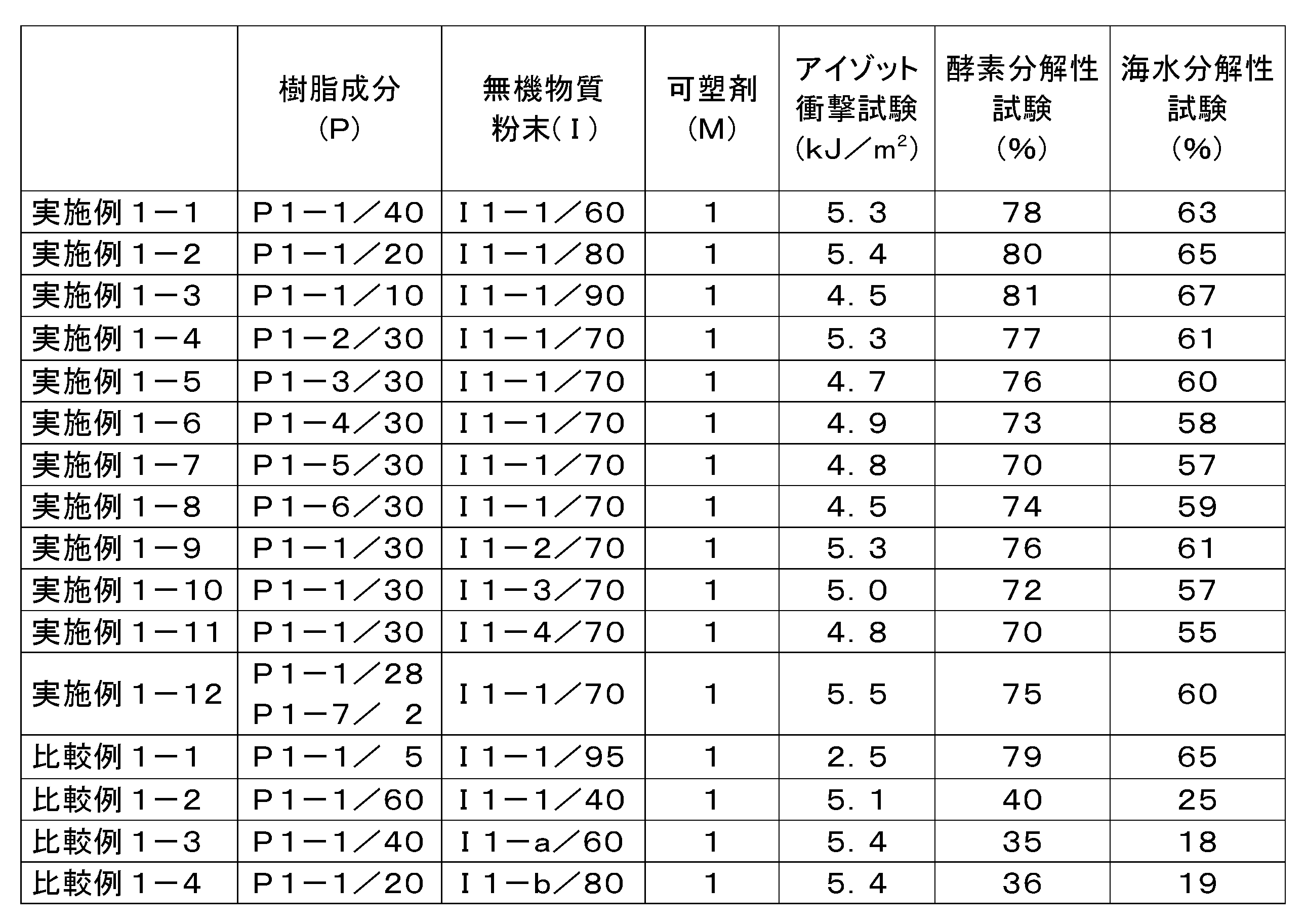
重質炭酸カルシウム粒子配合熱可塑性樹脂組成物の実施例1-1~1-12においては、何れも良好な成形性を有し、強度的に良好な成形品が得られたことがわかる。また、生分解性に関しても、比較例1-2、1-3、1-4と比べ、生分解特性が向上していることが明らかであった。
<参考試験2>
以下の方法で、生分解性樹脂として多元ヒドロキシアルカン酸コポリマー(P(LA-co-3HB))を用い、かつ、生分解性樹脂を含む製品の生分解性を高める上で、重質炭酸カルシウム粒子を用いることの有用性を確認した。
以下の方法で、生分解性樹脂として多元ヒドロキシアルカン酸コポリマー(P(LA-co-3HB))を用い、かつ、生分解性樹脂を含む製品の生分解性を高める上で、重質炭酸カルシウム粒子を用いることの有用性を確認した。
参考試験2においては、以下の成分を材料として用いた。
(樹脂成分(P))
P2-1:P(LA-co-3HB)(乳酸分率80モル%)
P2-2:P(LA-co-3HB)(乳酸分率70モル%)
P2-3:P(LA-co-3HB)(乳酸分率50モル%)
P2-4:P(LA-co-3HB)(乳酸分率30モル%)
P2-5:P(LA-co-3HB)(乳酸分率20モル%)
P2-a:ポリL-乳酸
P2-b:ポリ3-ヒドロキシ酪酸
P2-1:P(LA-co-3HB)(乳酸分率80モル%)
P2-2:P(LA-co-3HB)(乳酸分率70モル%)
P2-3:P(LA-co-3HB)(乳酸分率50モル%)
P2-4:P(LA-co-3HB)(乳酸分率30モル%)
P2-5:P(LA-co-3HB)(乳酸分率20モル%)
P2-a:ポリL-乳酸
P2-b:ポリ3-ヒドロキシ酪酸
(炭酸カルシウム(I))
I2-1:重質炭酸カルシウム粒子 平均粒径:2.2μm、BET比表面積:1.0m2/g、真円度:0.85
I2-2:重質炭酸カルシウム粒子 平均粒径:1.1μm、BET比表面積:3.2m2/g、真円度:0.55
I2-3:重質炭酸カルシウム粒子 平均粒径:3.6μm、BET比表面積:0.6m2/g、真円度:0.90
I2-a:軽質炭酸カルシウム粒子 平均粒径:1.5μm、BET比表面積:0.1m2/g、真円度:1.00
I2-1:重質炭酸カルシウム粒子 平均粒径:2.2μm、BET比表面積:1.0m2/g、真円度:0.85
I2-2:重質炭酸カルシウム粒子 平均粒径:1.1μm、BET比表面積:3.2m2/g、真円度:0.55
I2-3:重質炭酸カルシウム粒子 平均粒径:3.6μm、BET比表面積:0.6m2/g、真円度:0.90
I2-a:軽質炭酸カルシウム粒子 平均粒径:1.5μm、BET比表面積:0.1m2/g、真円度:1.00
<比較例2-1~2-7>
樹脂中における乳酸分率が異なる樹脂P2-1~P2-5並びにP2-a及びP2-bをそれぞれ用い、インフレーションフィルム押出ライン(60mmの円形ダイ、1.2mmのダイギャップ、30mmのネジ直径、L/D比=30)にて厚さ30μmのフィルムを作成した。フィルムは、2.5のBUR(ブローアップ比)で処理した。なお、押出機において、各区域の温度は160℃~180℃に設定し、回転数は20rpmに維持した。
得られたフィルムの引張弾性率、伸び、生分解性の評価結果を表2に示す。
表2に示す通り、P(LA-co-3HB)における乳酸分率が20~80%の範囲では柔軟性は充分なものとなり、実用上良好な伸びが示されたが、比較例2-1では伸びが低く脆いものであった。また生分解性としては、何れも不十分なものであった。
樹脂中における乳酸分率が異なる樹脂P2-1~P2-5並びにP2-a及びP2-bをそれぞれ用い、インフレーションフィルム押出ライン(60mmの円形ダイ、1.2mmのダイギャップ、30mmのネジ直径、L/D比=30)にて厚さ30μmのフィルムを作成した。フィルムは、2.5のBUR(ブローアップ比)で処理した。なお、押出機において、各区域の温度は160℃~180℃に設定し、回転数は20rpmに維持した。
得られたフィルムの引張弾性率、伸び、生分解性の評価結果を表2に示す。
表2に示す通り、P(LA-co-3HB)における乳酸分率が20~80%の範囲では柔軟性は充分なものとなり、実用上良好な伸びが示されたが、比較例2-1では伸びが低く脆いものであった。また生分解性としては、何れも不十分なものであった。
<実施例2-1~2-9>
樹脂中における乳酸分率が異なる樹脂P2-3、P2-4、P2-5をそれぞれ用い、これに炭酸カルシウム(I)として表2に示す通り添加して、上記比較例2-1~2-7と同様に、インフレーションフィルム押出ライン(60mmの円形ダイ、1.2mmのダイギャップ、30mmのネジ直径、L/D比=30)にて厚さ30μmのフィルムを作成した。フィルムは3.0のBUR(ブローアップ比)で処理した。なお、押出機において、各区域の温度は160℃~180℃に設定し、回転数は20rpmに維持した。
得られたフィルムの引張弾性率、伸び、生分解性の評価結果を表2に示す。
表2に示す様に、実施例2-1~2-9に係るものにおいては何れも柔軟性は充分なものとなり、実用上良好な伸びが示され、また生分解性としても充分なものとなった。
樹脂中における乳酸分率が異なる樹脂P2-3、P2-4、P2-5をそれぞれ用い、これに炭酸カルシウム(I)として表2に示す通り添加して、上記比較例2-1~2-7と同様に、インフレーションフィルム押出ライン(60mmの円形ダイ、1.2mmのダイギャップ、30mmのネジ直径、L/D比=30)にて厚さ30μmのフィルムを作成した。フィルムは3.0のBUR(ブローアップ比)で処理した。なお、押出機において、各区域の温度は160℃~180℃に設定し、回転数は20rpmに維持した。
得られたフィルムの引張弾性率、伸び、生分解性の評価結果を表2に示す。
表2に示す様に、実施例2-1~2-9に係るものにおいては何れも柔軟性は充分なものとなり、実用上良好な伸びが示され、また生分解性としても充分なものとなった。
<実施例2-10~2-11及び比較例2-8>
炭酸カルシウム(I)をそれぞれI2-2、I2-3、I2-aに代える以外は、実施例2-1と同様にして、インフレーション法により厚さ30μmのフィルムを作成した。
得られたフィルムの引張弾性率、伸び、生分解性の評価結果を表2に示す。
表2に示す様に、実施例2-10、2-11に係るものにおいては何れも柔軟性、生分解性ともに良好な結果が得られた。これに対し、炭酸カルシウム(I)として軽質炭酸カルシウム粒子を配合した比較例2-8のものでは、成形性が著しく劣り、均一なフィルムの作成は困難であった。
炭酸カルシウム(I)をそれぞれI2-2、I2-3、I2-aに代える以外は、実施例2-1と同様にして、インフレーション法により厚さ30μmのフィルムを作成した。
得られたフィルムの引張弾性率、伸び、生分解性の評価結果を表2に示す。
表2に示す様に、実施例2-10、2-11に係るものにおいては何れも柔軟性、生分解性ともに良好な結果が得られた。これに対し、炭酸カルシウム(I)として軽質炭酸カルシウム粒子を配合した比較例2-8のものでは、成形性が著しく劣り、均一なフィルムの作成は困難であった。
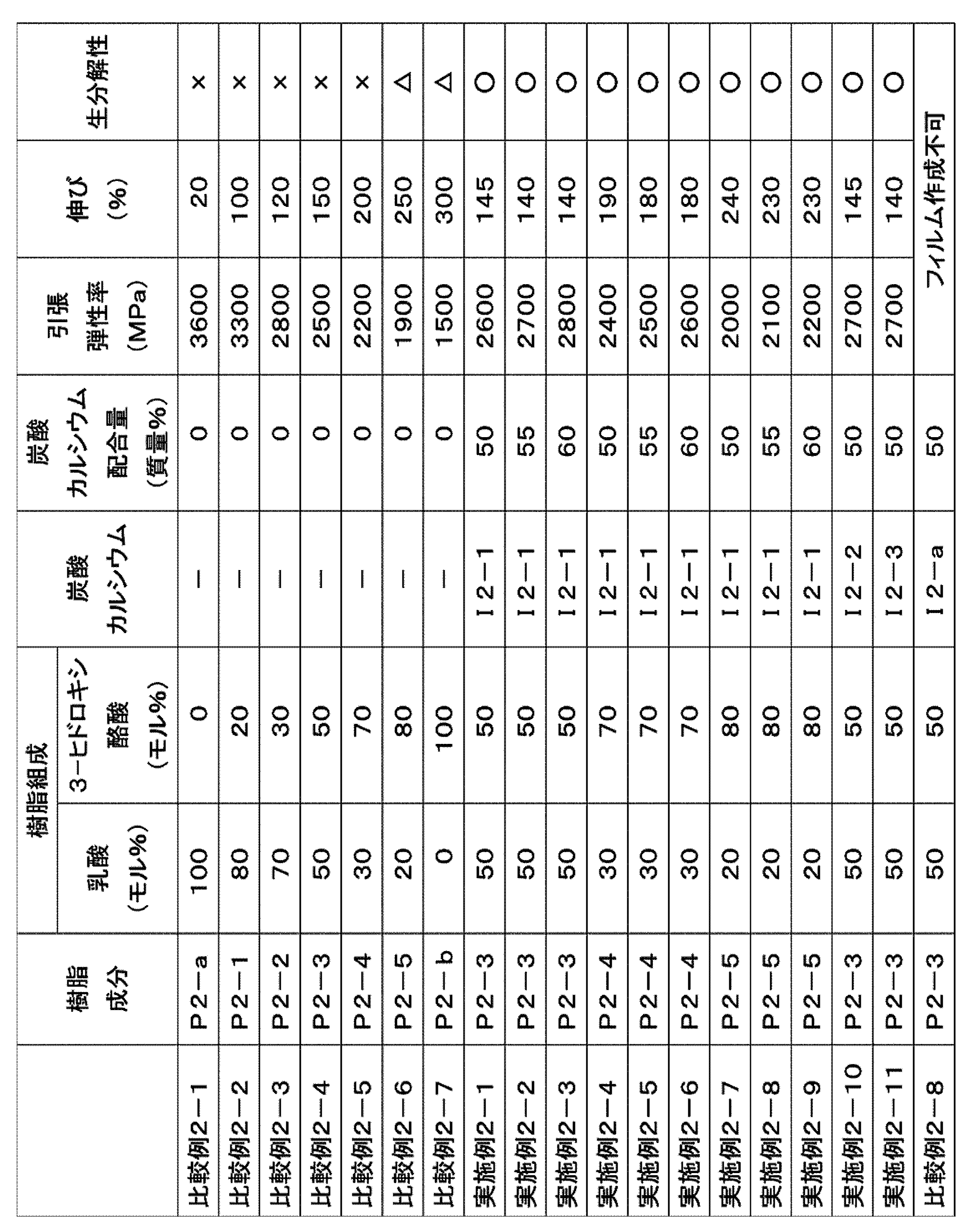
<比較例2-9~2-15>
樹脂中における乳酸分率が異なる樹脂P2-1~P2-5並びにP2-a及びP2-bをそれぞれ用い、二軸押出機により180℃の温度でTダイにて厚さ500μmのシートに成形後、さらに350℃の熱板温度で、浅皿状の容器体への真空成形を行った。
得られた成形体の引張弾性率、伸び、生分解性の評価結果を表3に示す。
表3に示す様に、生分解性は、何れも不十分なものであった。
樹脂中における乳酸分率が異なる樹脂P2-1~P2-5並びにP2-a及びP2-bをそれぞれ用い、二軸押出機により180℃の温度でTダイにて厚さ500μmのシートに成形後、さらに350℃の熱板温度で、浅皿状の容器体への真空成形を行った。
得られた成形体の引張弾性率、伸び、生分解性の評価結果を表3に示す。
表3に示す様に、生分解性は、何れも不十分なものであった。
<実施例2-12~2-20及び比較例2-16~2-18>
樹脂中における乳酸分率が異なる樹脂P2-1、P2-2、P2-3及びP2-aをそれぞれ用い、これに炭酸カルシウム(I)として重質炭酸カルシウム粒子I2-1を表3に示す通り添加して、上記比較例2-9~2-15と同様に、二軸押出機により180℃の温度でTダイにて厚さ500μmのシートに成形後、さらに350℃の熱板温度で、浅皿状の容器体への真空成形を行った。
得られた成形体の引張弾性率、伸び、生分解性の評価結果を表3に示す。
表3に示す様に、実施例2-12~2-20に係るものにおいては何れも柔軟性は充分なものとなり、実用上良好な伸びが示され、また生分解性としても充分なものとなった。
樹脂中における乳酸分率が異なる樹脂P2-1、P2-2、P2-3及びP2-aをそれぞれ用い、これに炭酸カルシウム(I)として重質炭酸カルシウム粒子I2-1を表3に示す通り添加して、上記比較例2-9~2-15と同様に、二軸押出機により180℃の温度でTダイにて厚さ500μmのシートに成形後、さらに350℃の熱板温度で、浅皿状の容器体への真空成形を行った。
得られた成形体の引張弾性率、伸び、生分解性の評価結果を表3に示す。
表3に示す様に、実施例2-12~2-20に係るものにおいては何れも柔軟性は充分なものとなり、実用上良好な伸びが示され、また生分解性としても充分なものとなった。
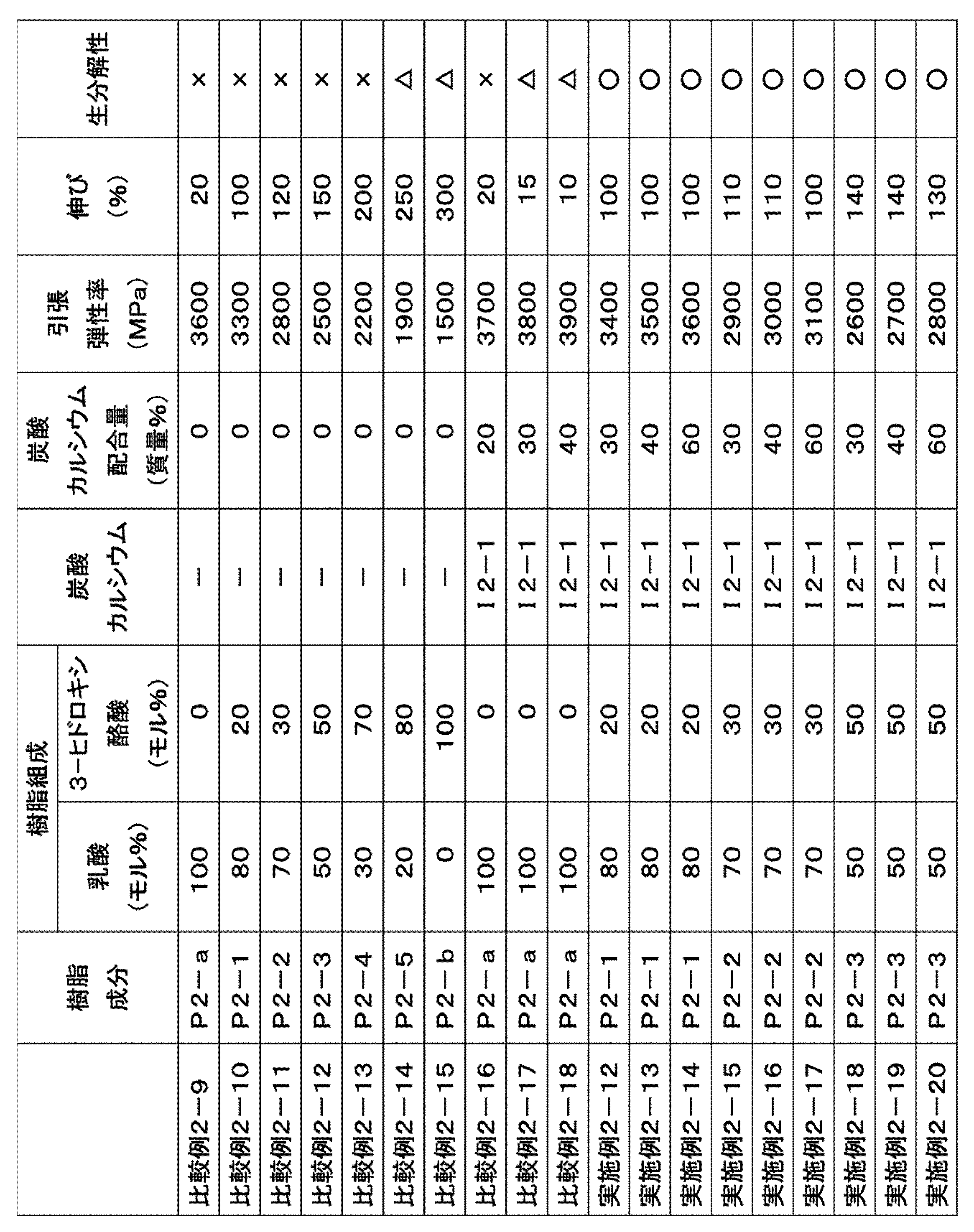
生分解性樹脂として多元ヒドロキシアルカン酸コポリマーを用いた場合であっても、重質炭酸カルシウム粒子配合熱可塑性樹脂組成物の実施例においては、何れも良好な成形性を有し、強度的に良好な成形品が得られたことがわかる。
<試験1>
参考試験1に記載した方法を基礎として、さらに所定量の酸化カルシウムを配合した樹脂組成物(ペレット)を作製し、各種評価を行った。酸化カルシウムの代わりに、酸化カルシウム同様に脱水作用を有することが知られるシリカゲルを用いた試験もあわせて行った。
参考試験1に記載した方法を基礎として、さらに所定量の酸化カルシウムを配合した樹脂組成物(ペレット)を作製し、各種評価を行った。酸化カルシウムの代わりに、酸化カルシウム同様に脱水作用を有することが知られるシリカゲルを用いた試験もあわせて行った。
なお、表4中、「樹脂成分(P)」及び「無機物質粉末(I)」の項目に示した数値は、樹脂成分と無機物質粉末の質量比を意味する。例えば、「P1-1/40」かつ「I1-1/60」とは、樹脂成分P1-1:無機物質粉末I1-1=40:60の質量比で使用したことを意味する。
試験1においては、以下の成分を材料として用いた。
(樹脂成分(P))
P1-1:ポリL-乳酸(重量平均分子量Mw:130,000、融点:172℃)
P1-2:ポリL-乳酸(重量平均分子量Mw:170,000、融点:178℃)
P1-3:ポリL-乳酸(重量平均分子量Mw:80,000、融点:167℃)
P1-4:ポリD-乳酸(重量平均分子量Mw:230,000、融点:182℃)
P1-5:ポリDL-乳酸(重量平均分子量Mw:150,000)
P1-6:ポリ乳酸マルチブロックコポリマー(重量平均分子量Mw:70,000、融点:140℃)
P1-1:ポリL-乳酸(重量平均分子量Mw:130,000、融点:172℃)
P1-2:ポリL-乳酸(重量平均分子量Mw:170,000、融点:178℃)
P1-3:ポリL-乳酸(重量平均分子量Mw:80,000、融点:167℃)
P1-4:ポリD-乳酸(重量平均分子量Mw:230,000、融点:182℃)
P1-5:ポリDL-乳酸(重量平均分子量Mw:150,000)
P1-6:ポリ乳酸マルチブロックコポリマー(重量平均分子量Mw:70,000、融点:140℃)
(無機物質粉末(I))
I1-1:重質炭酸カルシウム粒子 平均粒径:2.2μm、BET比表面積:1.0m2/g、真円度:0.85
I1-a:軽質炭酸カルシウム粒子 平均粒径:1.5μm、BET比表面積:0.1m2/g、真円度:1.0
I1-1:重質炭酸カルシウム粒子 平均粒径:2.2μm、BET比表面積:1.0m2/g、真円度:0.85
I1-a:軽質炭酸カルシウム粒子 平均粒径:1.5μm、BET比表面積:0.1m2/g、真円度:1.0
(脱水剤(D))
D1:酸化カルシウム
D2:シリカゲル
D1:酸化カルシウム
D2:シリカゲル
(水分含量(W))
各成分を混合後、JIS K0113:2005 電位差・電流・電量・カールフィッシャー滴定方法通則に準拠して、樹脂組成物中の水分含量を調整した。
各成分を混合後、JIS K0113:2005 電位差・電流・電量・カールフィッシャー滴定方法通則に準拠して、樹脂組成物中の水分含量を調整した。
(実施例及び比較例)
参考試験1と同様の方法で、表4に示す成分を含む樹脂成形品(シート、及びフィルム)から作成した試験片を作製した。これらを用いて、各物性値を参考試験1と同様に測定した。その結果を表4に示す。
参考試験1と同様の方法で、表4に示す成分を含む樹脂成形品(シート、及びフィルム)から作成した試験片を作製した。これらを用いて、各物性値を参考試験1と同様に測定した。その結果を表4に示す。
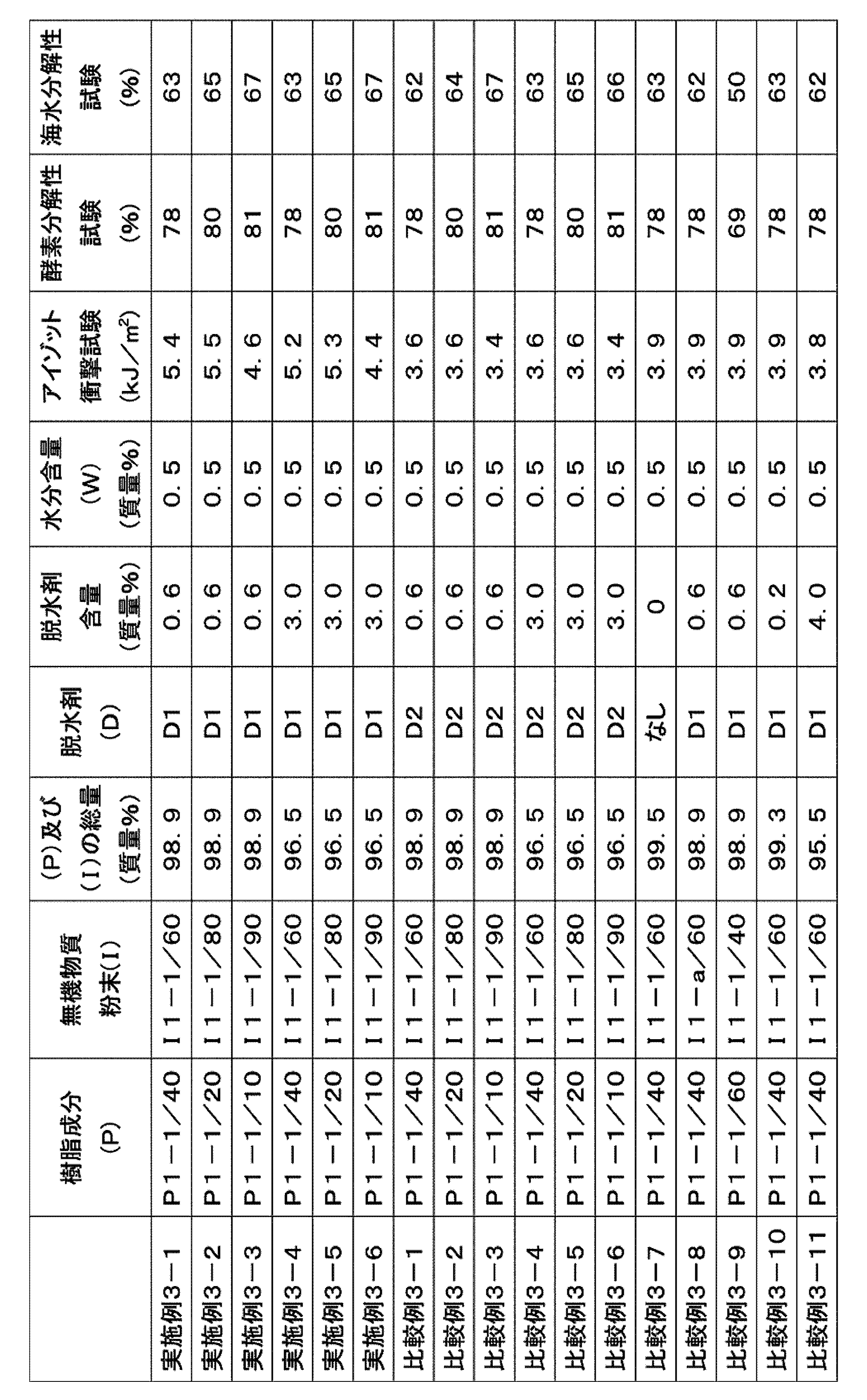
表4に示される通り、本発明の樹脂組成物から得られた樹脂成形品は、アイゾット衝撃試験における数値が高く、樹脂成形品の強度に優れることがわかる。このことは、成形時において生分解性樹脂の加水分解が抑制されたことによると推察された。
また、本発明の樹脂組成物から得られた樹脂成形品は、各種分解性試験の結果も良好であり、生分解性が損なわれることはなかった。
上記の効果は、本発明の樹脂組成物の要件を満たさない樹脂組成物から得られた樹脂成形品においては認められなかった。
特に、酸化カルシウムと同様に脱水作用を有することが知られるシリカゲルを用いると、樹脂成形品の強度が劣り、成形時において生分解性樹脂の加水分解が抑制されていないことが推察された。
なお、データは示していないが、樹脂として、P1-1の代わりに、P1-2乃至P1-6を用いた場合であっても、P1-1を用いた場合と同様の結果が得られた。
<試験2>
参考試験2に記載した方法を基礎として、さらに所定量の酸化カルシウムを配合した樹脂組成物(ペレット)を作製し、各種評価を行った。酸化カルシウムの代わりに、酸化カルシウム同様に脱水作用を有することが知られるシリカゲルを用いた試験もあわせて行った。
参考試験2に記載した方法を基礎として、さらに所定量の酸化カルシウムを配合した樹脂組成物(ペレット)を作製し、各種評価を行った。酸化カルシウムの代わりに、酸化カルシウム同様に脱水作用を有することが知られるシリカゲルを用いた試験もあわせて行った。
なお、表5及び6中、「樹脂成分(P)」及び「炭酸カルシウム(I)」の項目に示した数値は、樹脂成分と無機物質粉末の質量比を意味する。例えば、「P2-3/50」かつ「I2-1/50」とは、樹脂成分P2-3:無機物質粉末I2-1=50:50の質量比で使用したことを意味する。
試験2においては、以下の成分を材料として用いた。
(樹脂成分(P))
P2-1:P(LA-co-3HB)(乳酸分率80モル%)
P2-2:P(LA-co-3HB)(乳酸分率70モル%)
P2-3:P(LA-co-3HB)(乳酸分率50モル%)
P2-4:P(LA-co-3HB)(乳酸分率30モル%)
P2-5:P(LA-co-3HB)(乳酸分率20モル%)
P2-a:ポリL-乳酸
P2-b:ポリ3-ヒドロキシ酪酸
P2-1:P(LA-co-3HB)(乳酸分率80モル%)
P2-2:P(LA-co-3HB)(乳酸分率70モル%)
P2-3:P(LA-co-3HB)(乳酸分率50モル%)
P2-4:P(LA-co-3HB)(乳酸分率30モル%)
P2-5:P(LA-co-3HB)(乳酸分率20モル%)
P2-a:ポリL-乳酸
P2-b:ポリ3-ヒドロキシ酪酸
(炭酸カルシウム(I))
I2-1:重質炭酸カルシウム粒子 平均粒径:2.2μm、BET比表面積:1.0m2/g、真円度:0.85
I2-a:軽質炭酸カルシウム粒子 平均粒径:1.5μm、BET比表面積:0.1m2/g、真円度:1.00
I2-1:重質炭酸カルシウム粒子 平均粒径:2.2μm、BET比表面積:1.0m2/g、真円度:0.85
I2-a:軽質炭酸カルシウム粒子 平均粒径:1.5μm、BET比表面積:0.1m2/g、真円度:1.00
(脱水剤(D))
D1:酸化カルシウム
D2:シリカゲル
D1:酸化カルシウム
D2:シリカゲル
(実施例及び比較例)
炭酸カルシウムの有無に応じた参考試験2と同様の方法で、表5及び6に示す成分を含む樹脂成形品(フィルム又は浅皿状の容器体)を作製した。これらを用いて、各物性値を参考試験2と同様に測定した。その結果を表5(樹脂成形品としてフィルムを成形した結果)及び表6(樹脂成形品として浅皿状の容器体を成形した結果)に示す。
炭酸カルシウムの有無に応じた参考試験2と同様の方法で、表5及び6に示す成分を含む樹脂成形品(フィルム又は浅皿状の容器体)を作製した。これらを用いて、各物性値を参考試験2と同様に測定した。その結果を表5(樹脂成形品としてフィルムを成形した結果)及び表6(樹脂成形品として浅皿状の容器体を成形した結果)に示す。
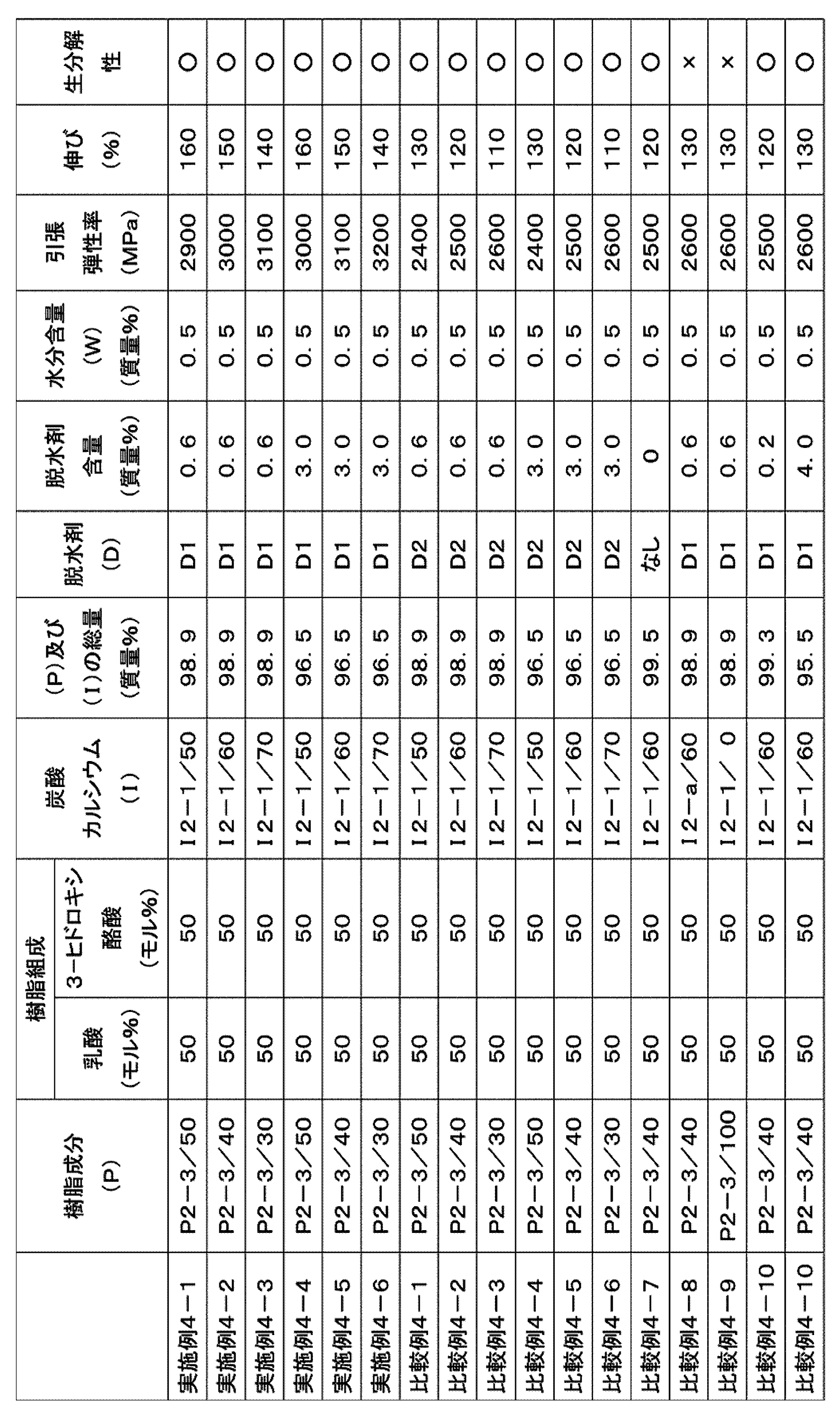
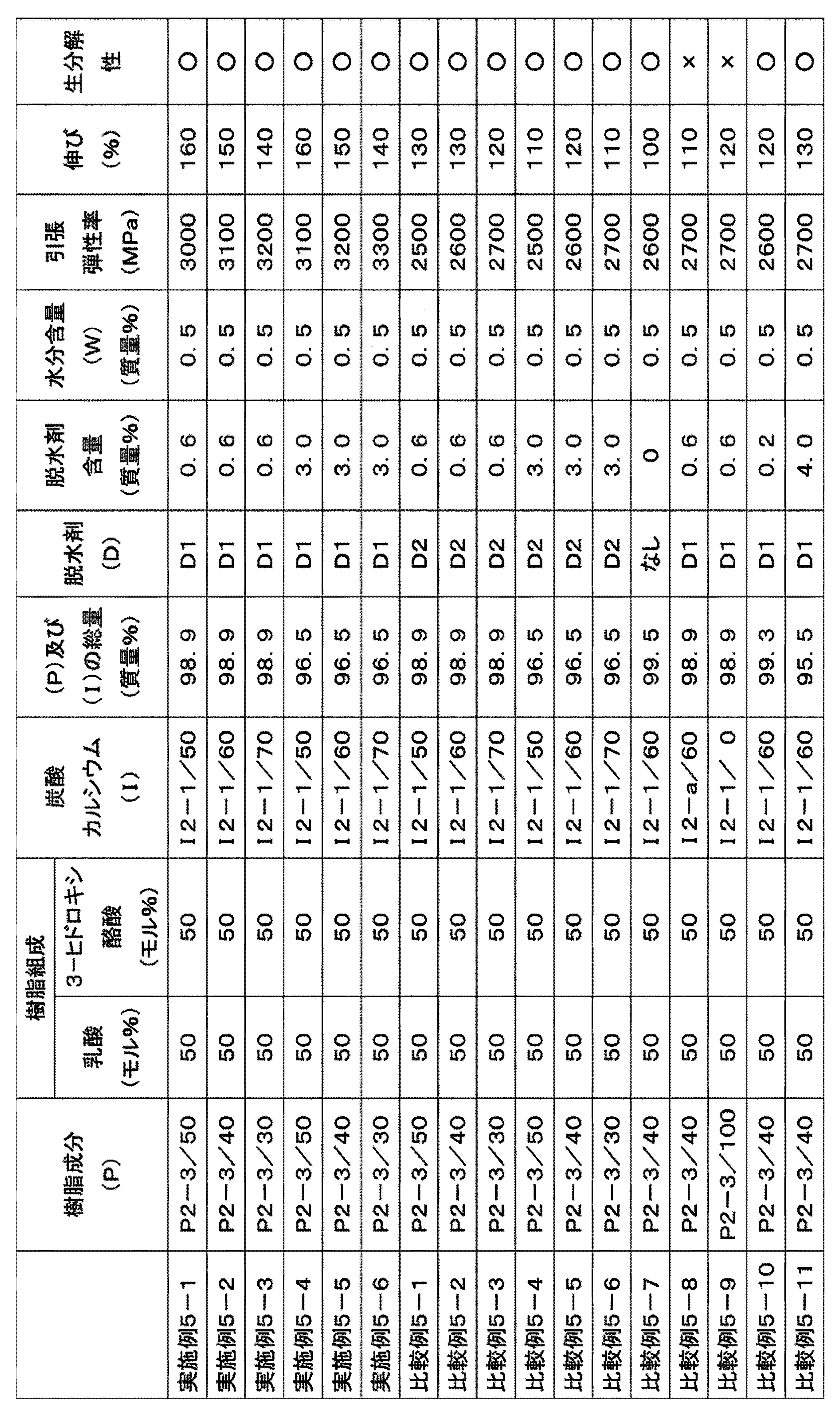
表5及び6に示される通り、本発明の樹脂組成物から得られた樹脂成形品は、引張弾性率や伸びの値が高く、樹脂成形品の強度に優れることがわかる。このことは、成形時において生分解性樹脂の加水分解が抑制されたことによると推察された。
また、本発明の樹脂組成物から得られた樹脂成形品は、生分解性試験の結果も良好であり、生分解性が損なわれることはなかった。
上記の効果は、本発明の樹脂組成物の要件を満たさない樹脂組成物から得られた樹脂成形品においては認められなかった。
特に、酸化カルシウムと同様に脱水作用を有することが知られるシリカゲルを用いると、樹脂成形品の強度が劣り、成形時において生分解性樹脂の加水分解が抑制されていないことが推察された。
なお、データは示していないが、樹脂として、P2-3の代わりに、上記「(樹脂成分(P))」の項に示したP2-3以外の樹脂を用いた場合であっても、P2-3を用いた場合と同様の結果が得られた。
Claims (18)
- 生分解性樹脂と、重質炭酸カルシウム粒子とを、50:50~10:90の質量比で含む樹脂組成物であって、
前記樹脂組成物に対し、0.5質量%以上3.5質量%以下の酸化カルシウムを含み、かつ、
前記樹脂組成物に対し、0.2質量%以上の水分を含む、
樹脂組成物。 - 前記重質炭酸カルシウム粒子の平均粒子径が、1.0μm以上10.0μm以下である、請求項1に記載の樹脂組成物。
- 前記重質炭酸カルシウム粒子のBET比表面積が、0.1m2/g以上10.0m2/g以下である、請求項1又は2に記載の樹脂組成物。
- 前記重質炭酸カルシウム粒子の真円度が、0.50以上0.95以下である、請求項1から3の何れかに記載の樹脂組成物。
- 重質炭酸カルシウム粒子がその表面部において部分酸化された、請求項1から4の何れかに記載の樹脂組成物。
- 前記生分解性樹脂が、ポリ乳酸を含む、請求項1から5の何れかに記載の樹脂組成物。
- 前記生分解性樹脂が、乳酸と、ポリヒドロキシアルカン酸との多元ヒドロキシアルカン酸コポリマーを含む、請求項1から5の何れかに記載の樹脂組成物。
- 前記多元ヒドロキシアルカン酸コポリマーの乳酸分率が、20モル%以上80モル%以下である、請求項7に記載の樹脂組成物。
- 前記生分解性樹脂が、重量平均分子量(Mw)50,000以上300,000以下のポリL-乳酸を、前記生分解性樹脂全体の10質量%以上100質量%以下の割合で含む、請求項1から8の何れかに記載の樹脂組成物。
- ペレットの形態である、請求項1から9の何れかに記載の樹脂組成物。
- 樹脂組成物を成形する成形工程を含み、
前記樹脂組成物が、生分解性樹脂と、重質炭酸カルシウム粒子とを、50:50~10:90の質量比で含み、かつ、
前記樹脂組成物が、前記樹脂組成物に対し0.5質量%以上3.5質量%以下の酸化カルシウムを含み、
前記成形工程の開始時点における樹脂組成物の水分含量が0.2質量%以上である、
樹脂成形品の製造方法。 - 前記成形工程は、0℃以上50℃以下、相対湿度75%RH以上の環境である、請求項11に記載の製造方法。
- 延伸処理を含まない、請求項11又は12に記載の製造方法。
- 前記成形工程が、二軸押出機により樹脂組成物を140℃以上220℃以下で溶融混練後、Tダイにてシート状に成形する工程を含む、請求項11から13の何れかに記載の製造方法。
- 前記成形工程が、二軸押出機により樹脂組成物を140℃以上220℃以下で溶融混練後、金型温度20℃以上110℃以下に保持された金型に注入して成形する工程を含む、請求項11から14の何れかに記載の製造方法。
- 前記樹脂成形品が積層体であり、
前記積層体は、
前記樹脂組成物からなる樹脂層と、
前記樹脂層の少なくとも一方の表面を被覆する生分解性樹脂からなる表面層と、
を有する、請求項11から15の何れかに記載の製造方法。 - 前記樹脂成形品が、シートである、請求項11から16の何れかに記載の製造方法。
- 前記樹脂成形品が、容器体である、請求項11から16の何れかに記載の製造方法。
Priority Applications (3)
| Application Number | Priority Date | Filing Date | Title |
|---|---|---|---|
| US17/772,357 US20230076881A1 (en) | 2019-10-31 | 2020-07-01 | Resin composition and method for producing resin molded product |
| EP20882531.5A EP4052877A4 (en) | 2019-10-31 | 2020-07-01 | RESIN COMPOSITION AND METHOD FOR PRODUCING A RESIN PRODUCT |
| CN202080075291.4A CN114599734A (zh) | 2019-10-31 | 2020-07-01 | 树脂组合物和树脂成型品的制造方法 |
Applications Claiming Priority (2)
| Application Number | Priority Date | Filing Date | Title |
|---|---|---|---|
| JP2019199020A JP6675700B1 (ja) | 2019-10-31 | 2019-10-31 | 樹脂組成物、及び樹脂成形品の製造方法 |
| JP2019-199020 | 2019-10-31 |
Publications (1)
| Publication Number | Publication Date |
|---|---|
| WO2021084800A1 true WO2021084800A1 (ja) | 2021-05-06 |
Family
ID=70001048
Family Applications (1)
| Application Number | Title | Priority Date | Filing Date |
|---|---|---|---|
| PCT/JP2020/025916 Ceased WO2021084800A1 (ja) | 2019-10-31 | 2020-07-01 | 樹脂組成物、及び樹脂成形品の製造方法 |
Country Status (5)
| Country | Link |
|---|---|
| US (1) | US20230076881A1 (ja) |
| EP (1) | EP4052877A4 (ja) |
| JP (1) | JP6675700B1 (ja) |
| CN (1) | CN114599734A (ja) |
| WO (1) | WO2021084800A1 (ja) |
Cited By (3)
| Publication number | Priority date | Publication date | Assignee | Title |
|---|---|---|---|---|
| WO2023042024A1 (en) * | 2021-09-16 | 2023-03-23 | Ricoh Company, Ltd. | Foamed polylactic acid sheet, and method for producing foamed polylactic acid sheet |
| WO2024053219A1 (ja) * | 2022-09-08 | 2024-03-14 | 株式会社日立製作所 | バイオマス由来樹脂を母材とした複合材料、構造部材およびリサイクル方法 |
| WO2025164572A1 (ja) * | 2024-02-02 | 2025-08-07 | 株式会社ジェイエスピー | 脂肪族ポリエステル系樹脂組成物の製造方法、脂肪族ポリエステル系樹脂組成物及び海洋分解促進剤 |
Families Citing this family (5)
| Publication number | Priority date | Publication date | Assignee | Title |
|---|---|---|---|---|
| JP6782505B1 (ja) * | 2020-04-03 | 2020-11-11 | 株式会社Tbm | 延伸シートを製造するための樹脂組成物、延伸シート、及び延伸シートの製造方法 |
| JP6782506B1 (ja) * | 2020-04-22 | 2020-11-11 | 株式会社Tbm | 生分解性マスク |
| JP6755067B1 (ja) * | 2020-04-23 | 2020-09-16 | 株式会社Tbm | 生分解性不織布マスク |
| CN117279976A (zh) * | 2021-04-20 | 2023-12-22 | 赢创运营有限公司 | 包含长链羟基酸的聚合物 |
| CN117207633A (zh) * | 2022-06-09 | 2023-12-12 | 周沅俊 | 农林牧渔业用生物降解树脂片及其制备方法 |
Citations (12)
| Publication number | Priority date | Publication date | Assignee | Title |
|---|---|---|---|---|
| JPH1059466A (ja) * | 1996-08-12 | 1998-03-03 | Shin Etsu Polymer Co Ltd | 生分解性樹脂製cdトレイ |
| JPH10273582A (ja) * | 1997-03-28 | 1998-10-13 | Okura Ind Co Ltd | 生分解性樹脂組成物 |
| JP2000239508A (ja) * | 1999-02-18 | 2000-09-05 | Mitsubishi Gas Chem Co Inc | 生分解性成形材料およびその成形方法 |
| JP2004073123A (ja) | 2002-08-20 | 2004-03-11 | National Research Inst Of Brewing | リパーゼcs2遺伝子 |
| JP2009144105A (ja) * | 2007-12-17 | 2009-07-02 | Kao Corp | 多孔性シートの製造方法及び多孔性シート |
| JP2009292875A (ja) * | 2008-06-03 | 2009-12-17 | Kobayashi Kk | 防湿澱粉組成物 |
| JP2010006885A (ja) * | 2008-06-25 | 2010-01-14 | Achilles Corp | 液状可塑剤を含有する熱可塑性樹脂組成物及びその製造方法、並びに上記熱可塑性樹脂組成物を用いた生分解性押出成形シートまたはフィルム |
| WO2010082639A1 (ja) | 2009-01-16 | 2010-07-22 | バイオベース株式会社 | ポリ乳酸樹脂組成物およびポリ乳酸樹脂用添加剤 |
| WO2015064566A1 (ja) | 2013-10-30 | 2015-05-07 | 日産化学工業株式会社 | 耐加水分解性に優れたポリ乳酸樹脂組成物 |
| JP2015108160A (ja) * | 2011-02-24 | 2015-06-11 | 東レ株式会社 | ポリ乳酸系フィルム |
| JP2016106171A (ja) * | 2011-02-02 | 2016-06-16 | 三菱化学株式会社 | ポリエステル樹脂組成物、該樹脂組成物を成形してなるフィルム、および該フィルムを成形してなる袋 |
| JP2019521238A (ja) * | 2016-07-19 | 2019-07-25 | オムヤ インターナショナル アーゲー | 一置換コハク酸無水物の使用 |
Family Cites Families (6)
| Publication number | Priority date | Publication date | Assignee | Title |
|---|---|---|---|---|
| JP4169390B2 (ja) * | 1998-05-20 | 2008-10-22 | 信越ポリマー株式会社 | ポリ乳酸系樹脂シートの製造方法 |
| JP5156925B2 (ja) * | 2005-10-05 | 2013-03-06 | ユニチカ株式会社 | 生分解性樹脂組成物、その製造方法、それを用いた成形体 |
| CN104031302B (zh) * | 2013-03-04 | 2016-07-06 | 中国科学院过程工程研究所 | 一种可控氧化生物降解塑料母粒及其制备方法 |
| CN106883568A (zh) * | 2015-12-15 | 2017-06-23 | 深圳市联创科技集团有限公司 | 可完全生物降解塑料的吸水母料及其制备方法 |
| ES2955235T3 (es) * | 2016-09-08 | 2023-11-29 | Karl Leibinger Medizintechnik Gmbh & Co Kg | Procedimiento de fabricación de un implante mediante un polvo compuesto que contiene sales de calcio con partículas microestructuradas |
| JP6675690B1 (ja) * | 2018-10-26 | 2020-04-01 | 株式会社Tbm | 生分解性樹脂成形品、及びその製造方法並びにこれに用いられるペレット体 |
-
2019
- 2019-10-31 JP JP2019199020A patent/JP6675700B1/ja active Active
-
2020
- 2020-07-01 EP EP20882531.5A patent/EP4052877A4/en not_active Withdrawn
- 2020-07-01 WO PCT/JP2020/025916 patent/WO2021084800A1/ja not_active Ceased
- 2020-07-01 CN CN202080075291.4A patent/CN114599734A/zh active Pending
- 2020-07-01 US US17/772,357 patent/US20230076881A1/en not_active Abandoned
Patent Citations (12)
| Publication number | Priority date | Publication date | Assignee | Title |
|---|---|---|---|---|
| JPH1059466A (ja) * | 1996-08-12 | 1998-03-03 | Shin Etsu Polymer Co Ltd | 生分解性樹脂製cdトレイ |
| JPH10273582A (ja) * | 1997-03-28 | 1998-10-13 | Okura Ind Co Ltd | 生分解性樹脂組成物 |
| JP2000239508A (ja) * | 1999-02-18 | 2000-09-05 | Mitsubishi Gas Chem Co Inc | 生分解性成形材料およびその成形方法 |
| JP2004073123A (ja) | 2002-08-20 | 2004-03-11 | National Research Inst Of Brewing | リパーゼcs2遺伝子 |
| JP2009144105A (ja) * | 2007-12-17 | 2009-07-02 | Kao Corp | 多孔性シートの製造方法及び多孔性シート |
| JP2009292875A (ja) * | 2008-06-03 | 2009-12-17 | Kobayashi Kk | 防湿澱粉組成物 |
| JP2010006885A (ja) * | 2008-06-25 | 2010-01-14 | Achilles Corp | 液状可塑剤を含有する熱可塑性樹脂組成物及びその製造方法、並びに上記熱可塑性樹脂組成物を用いた生分解性押出成形シートまたはフィルム |
| WO2010082639A1 (ja) | 2009-01-16 | 2010-07-22 | バイオベース株式会社 | ポリ乳酸樹脂組成物およびポリ乳酸樹脂用添加剤 |
| JP2016106171A (ja) * | 2011-02-02 | 2016-06-16 | 三菱化学株式会社 | ポリエステル樹脂組成物、該樹脂組成物を成形してなるフィルム、および該フィルムを成形してなる袋 |
| JP2015108160A (ja) * | 2011-02-24 | 2015-06-11 | 東レ株式会社 | ポリ乳酸系フィルム |
| WO2015064566A1 (ja) | 2013-10-30 | 2015-05-07 | 日産化学工業株式会社 | 耐加水分解性に優れたポリ乳酸樹脂組成物 |
| JP2019521238A (ja) * | 2016-07-19 | 2019-07-25 | オムヤ インターナショナル アーゲー | 一置換コハク酸無水物の使用 |
Non-Patent Citations (1)
| Title |
|---|
| See also references of EP4052877A4 |
Cited By (5)
| Publication number | Priority date | Publication date | Assignee | Title |
|---|---|---|---|---|
| WO2023042024A1 (en) * | 2021-09-16 | 2023-03-23 | Ricoh Company, Ltd. | Foamed polylactic acid sheet, and method for producing foamed polylactic acid sheet |
| WO2024053219A1 (ja) * | 2022-09-08 | 2024-03-14 | 株式会社日立製作所 | バイオマス由来樹脂を母材とした複合材料、構造部材およびリサイクル方法 |
| JP2024038913A (ja) * | 2022-09-08 | 2024-03-21 | 株式会社日立製作所 | バイオマス由来樹脂を母材とした複合材料、構造部材およびリサイクル方法 |
| JP7825533B2 (ja) | 2022-09-08 | 2026-03-06 | 株式会社日立製作所 | バイオマス由来樹脂を母材とした複合材料、構造部材およびリサイクル方法 |
| WO2025164572A1 (ja) * | 2024-02-02 | 2025-08-07 | 株式会社ジェイエスピー | 脂肪族ポリエステル系樹脂組成物の製造方法、脂肪族ポリエステル系樹脂組成物及び海洋分解促進剤 |
Also Published As
| Publication number | Publication date |
|---|---|
| US20230076881A1 (en) | 2023-03-09 |
| EP4052877A1 (en) | 2022-09-07 |
| EP4052877A4 (en) | 2023-11-29 |
| JP2021070761A (ja) | 2021-05-06 |
| CN114599734A (zh) | 2022-06-07 |
| JP6675700B1 (ja) | 2020-04-01 |
Similar Documents
| Publication | Publication Date | Title |
|---|---|---|
| JP6675700B1 (ja) | 樹脂組成物、及び樹脂成形品の製造方法 | |
| KR102244819B1 (ko) | 생분해성 수지 성형품 및 그 제조 방법, 및 이에 이용되는 펠렛체 | |
| CN103172840B (zh) | 来自生物质资源的聚酯及其制造方法 | |
| JP4380654B2 (ja) | ポリエステル及びその製造方法 | |
| JP5212183B2 (ja) | 樹脂組成物及びこれを用いた成形品 | |
| JP5378063B2 (ja) | ポリエステル及びその製造方法 | |
| JP5428127B2 (ja) | ポリエステルの製造方法 | |
| JP6675697B1 (ja) | 生分解性樹脂組成物及び成形品 | |
| JP2008094887A (ja) | バイオマス資源由来ポリエステル製シート及びその製造方法 | |
| WO2026079421A1 (ja) | エステルオリゴマーの製造方法 | |
| CN122074085A (zh) | 树脂组合物 | |
| JP2014133899A (ja) | バイオマス資源由来ポリエステル製延伸フィルム | |
| JP7090523B2 (ja) | 樹脂組成物及び成形体 |
Legal Events
| Date | Code | Title | Description |
|---|---|---|---|
| 121 | Ep: the epo has been informed by wipo that ep was designated in this application |
Ref document number: 20882531 Country of ref document: EP Kind code of ref document: A1 |
|
| NENP | Non-entry into the national phase |
Ref country code: DE |
|
| ENP | Entry into the national phase |
Ref document number: 2020882531 Country of ref document: EP Effective date: 20220531 |