WO2021084955A1 - ウレタン樹脂組成物、接着剤、及び、合成皮革 - Google Patents
ウレタン樹脂組成物、接着剤、及び、合成皮革 Download PDFInfo
- Publication number
- WO2021084955A1 WO2021084955A1 PCT/JP2020/035179 JP2020035179W WO2021084955A1 WO 2021084955 A1 WO2021084955 A1 WO 2021084955A1 JP 2020035179 W JP2020035179 W JP 2020035179W WO 2021084955 A1 WO2021084955 A1 WO 2021084955A1
- Authority
- WO
- WIPO (PCT)
- Prior art keywords
- urethane resin
- resin composition
- mass
- anionic
- adhesive
- Prior art date
- Legal status (The legal status is an assumption and is not a legal conclusion. Google has not performed a legal analysis and makes no representation as to the accuracy of the status listed.)
- Ceased
Links
Classifications
-
- C—CHEMISTRY; METALLURGY
- C09—DYES; PAINTS; POLISHES; NATURAL RESINS; ADHESIVES; COMPOSITIONS NOT OTHERWISE PROVIDED FOR; APPLICATIONS OF MATERIALS NOT OTHERWISE PROVIDED FOR
- C09J—ADHESIVES; NON-MECHANICAL ASPECTS OF ADHESIVE PROCESSES IN GENERAL; ADHESIVE PROCESSES NOT PROVIDED FOR ELSEWHERE; USE OF MATERIALS AS ADHESIVES
- C09J175/00—Adhesives based on polyureas or polyurethanes; Adhesives based on derivatives of such polymers
- C09J175/04—Polyurethanes
- C09J175/12—Polyurethanes from compounds containing nitrogen and active hydrogen, the nitrogen atom not being part of an isocyanate group
-
- C—CHEMISTRY; METALLURGY
- C08—ORGANIC MACROMOLECULAR COMPOUNDS; THEIR PREPARATION OR CHEMICAL WORKING-UP; COMPOSITIONS BASED THEREON
- C08G—MACROMOLECULAR COMPOUNDS OBTAINED OTHERWISE THAN BY REACTIONS ONLY INVOLVING UNSATURATED CARBON-TO-CARBON BONDS
- C08G18/00—Polymeric products of isocyanates or isothiocyanates
- C08G18/06—Polymeric products of isocyanates or isothiocyanates with compounds having active hydrogen
- C08G18/28—Polymeric products of isocyanates or isothiocyanates with compounds having active hydrogen characterised by the compounds used containing active hydrogen
- C08G18/65—Low-molecular-weight compounds having active hydrogen with high-molecular-weight compounds having active hydrogen
- C08G18/66—Compounds of groups C08G18/42, C08G18/48, or C08G18/52
- C08G18/6633—Compounds of group C08G18/42
- C08G18/6659—Compounds of group C08G18/42 with compounds of group C08G18/34
-
- C—CHEMISTRY; METALLURGY
- C08—ORGANIC MACROMOLECULAR COMPOUNDS; THEIR PREPARATION OR CHEMICAL WORKING-UP; COMPOSITIONS BASED THEREON
- C08G—MACROMOLECULAR COMPOUNDS OBTAINED OTHERWISE THAN BY REACTIONS ONLY INVOLVING UNSATURATED CARBON-TO-CARBON BONDS
- C08G18/00—Polymeric products of isocyanates or isothiocyanates
- C08G18/06—Polymeric products of isocyanates or isothiocyanates with compounds having active hydrogen
- C08G18/28—Polymeric products of isocyanates or isothiocyanates with compounds having active hydrogen characterised by the compounds used containing active hydrogen
- C08G18/65—Low-molecular-weight compounds having active hydrogen with high-molecular-weight compounds having active hydrogen
- C08G18/66—Compounds of groups C08G18/42, C08G18/48, or C08G18/52
- C08G18/6603—Compounds of groups C08G18/42, C08G18/48, or C08G18/52 with compounds of group C08G18/32 or polyamines of C08G18/38
- C08G18/6614—Compounds of groups C08G18/42, C08G18/48, or C08G18/52 with compounds of group C08G18/32 or polyamines of C08G18/38 with compounds of group C08G18/3225 or C08G18/3271 and/or polyamines of C08G18/38
-
- C—CHEMISTRY; METALLURGY
- C08—ORGANIC MACROMOLECULAR COMPOUNDS; THEIR PREPARATION OR CHEMICAL WORKING-UP; COMPOSITIONS BASED THEREON
- C08G—MACROMOLECULAR COMPOUNDS OBTAINED OTHERWISE THAN BY REACTIONS ONLY INVOLVING UNSATURATED CARBON-TO-CARBON BONDS
- C08G18/00—Polymeric products of isocyanates or isothiocyanates
- C08G18/06—Polymeric products of isocyanates or isothiocyanates with compounds having active hydrogen
- C08G18/08—Processes
- C08G18/0804—Manufacture of polymers containing ionic or ionogenic groups
- C08G18/0819—Manufacture of polymers containing ionic or ionogenic groups containing anionic or anionogenic groups
- C08G18/0823—Manufacture of polymers containing ionic or ionogenic groups containing anionic or anionogenic groups containing carboxylate salt groups or groups forming them
-
- C—CHEMISTRY; METALLURGY
- C08—ORGANIC MACROMOLECULAR COMPOUNDS; THEIR PREPARATION OR CHEMICAL WORKING-UP; COMPOSITIONS BASED THEREON
- C08G—MACROMOLECULAR COMPOUNDS OBTAINED OTHERWISE THAN BY REACTIONS ONLY INVOLVING UNSATURATED CARBON-TO-CARBON BONDS
- C08G18/00—Polymeric products of isocyanates or isothiocyanates
- C08G18/06—Polymeric products of isocyanates or isothiocyanates with compounds having active hydrogen
- C08G18/08—Processes
- C08G18/10—Prepolymer processes involving reaction of isocyanates or isothiocyanates with compounds having active hydrogen in a first reaction step
-
- C—CHEMISTRY; METALLURGY
- C08—ORGANIC MACROMOLECULAR COMPOUNDS; THEIR PREPARATION OR CHEMICAL WORKING-UP; COMPOSITIONS BASED THEREON
- C08G—MACROMOLECULAR COMPOUNDS OBTAINED OTHERWISE THAN BY REACTIONS ONLY INVOLVING UNSATURATED CARBON-TO-CARBON BONDS
- C08G18/00—Polymeric products of isocyanates or isothiocyanates
- C08G18/06—Polymeric products of isocyanates or isothiocyanates with compounds having active hydrogen
- C08G18/08—Processes
- C08G18/10—Prepolymer processes involving reaction of isocyanates or isothiocyanates with compounds having active hydrogen in a first reaction step
- C08G18/12—Prepolymer processes involving reaction of isocyanates or isothiocyanates with compounds having active hydrogen in a first reaction step using two or more compounds having active hydrogen in the first polymerisation step
-
- C—CHEMISTRY; METALLURGY
- C08—ORGANIC MACROMOLECULAR COMPOUNDS; THEIR PREPARATION OR CHEMICAL WORKING-UP; COMPOSITIONS BASED THEREON
- C08G—MACROMOLECULAR COMPOUNDS OBTAINED OTHERWISE THAN BY REACTIONS ONLY INVOLVING UNSATURATED CARBON-TO-CARBON BONDS
- C08G18/00—Polymeric products of isocyanates or isothiocyanates
- C08G18/06—Polymeric products of isocyanates or isothiocyanates with compounds having active hydrogen
- C08G18/08—Processes
- C08G18/16—Catalysts
- C08G18/22—Catalysts containing metal compounds
- C08G18/227—Catalysts containing metal compounds of antimony, bismuth or arsenic
-
- C—CHEMISTRY; METALLURGY
- C08—ORGANIC MACROMOLECULAR COMPOUNDS; THEIR PREPARATION OR CHEMICAL WORKING-UP; COMPOSITIONS BASED THEREON
- C08G—MACROMOLECULAR COMPOUNDS OBTAINED OTHERWISE THAN BY REACTIONS ONLY INVOLVING UNSATURATED CARBON-TO-CARBON BONDS
- C08G18/00—Polymeric products of isocyanates or isothiocyanates
- C08G18/06—Polymeric products of isocyanates or isothiocyanates with compounds having active hydrogen
- C08G18/28—Polymeric products of isocyanates or isothiocyanates with compounds having active hydrogen characterised by the compounds used containing active hydrogen
- C08G18/30—Low-molecular-weight compounds
- C08G18/32—Polyhydroxy compounds; Polyamines; Hydroxyamines
- C08G18/3225—Polyamines
- C08G18/3234—Polyamines cycloaliphatic
-
- C—CHEMISTRY; METALLURGY
- C08—ORGANIC MACROMOLECULAR COMPOUNDS; THEIR PREPARATION OR CHEMICAL WORKING-UP; COMPOSITIONS BASED THEREON
- C08G—MACROMOLECULAR COMPOUNDS OBTAINED OTHERWISE THAN BY REACTIONS ONLY INVOLVING UNSATURATED CARBON-TO-CARBON BONDS
- C08G18/00—Polymeric products of isocyanates or isothiocyanates
- C08G18/06—Polymeric products of isocyanates or isothiocyanates with compounds having active hydrogen
- C08G18/28—Polymeric products of isocyanates or isothiocyanates with compounds having active hydrogen characterised by the compounds used containing active hydrogen
- C08G18/30—Low-molecular-weight compounds
- C08G18/32—Polyhydroxy compounds; Polyamines; Hydroxyamines
- C08G18/3271—Hydroxyamines
-
- C—CHEMISTRY; METALLURGY
- C08—ORGANIC MACROMOLECULAR COMPOUNDS; THEIR PREPARATION OR CHEMICAL WORKING-UP; COMPOSITIONS BASED THEREON
- C08G—MACROMOLECULAR COMPOUNDS OBTAINED OTHERWISE THAN BY REACTIONS ONLY INVOLVING UNSATURATED CARBON-TO-CARBON BONDS
- C08G18/00—Polymeric products of isocyanates or isothiocyanates
- C08G18/06—Polymeric products of isocyanates or isothiocyanates with compounds having active hydrogen
- C08G18/28—Polymeric products of isocyanates or isothiocyanates with compounds having active hydrogen characterised by the compounds used containing active hydrogen
- C08G18/30—Low-molecular-weight compounds
- C08G18/32—Polyhydroxy compounds; Polyamines; Hydroxyamines
- C08G18/3271—Hydroxyamines
- C08G18/3275—Hydroxyamines containing two hydroxy groups
-
- C—CHEMISTRY; METALLURGY
- C08—ORGANIC MACROMOLECULAR COMPOUNDS; THEIR PREPARATION OR CHEMICAL WORKING-UP; COMPOSITIONS BASED THEREON
- C08G—MACROMOLECULAR COMPOUNDS OBTAINED OTHERWISE THAN BY REACTIONS ONLY INVOLVING UNSATURATED CARBON-TO-CARBON BONDS
- C08G18/00—Polymeric products of isocyanates or isothiocyanates
- C08G18/06—Polymeric products of isocyanates or isothiocyanates with compounds having active hydrogen
- C08G18/28—Polymeric products of isocyanates or isothiocyanates with compounds having active hydrogen characterised by the compounds used containing active hydrogen
- C08G18/30—Low-molecular-weight compounds
- C08G18/34—Carboxylic acids; Esters thereof with monohydroxyl compounds
- C08G18/348—Hydroxycarboxylic acids
-
- C—CHEMISTRY; METALLURGY
- C08—ORGANIC MACROMOLECULAR COMPOUNDS; THEIR PREPARATION OR CHEMICAL WORKING-UP; COMPOSITIONS BASED THEREON
- C08G—MACROMOLECULAR COMPOUNDS OBTAINED OTHERWISE THAN BY REACTIONS ONLY INVOLVING UNSATURATED CARBON-TO-CARBON BONDS
- C08G18/00—Polymeric products of isocyanates or isothiocyanates
- C08G18/06—Polymeric products of isocyanates or isothiocyanates with compounds having active hydrogen
- C08G18/28—Polymeric products of isocyanates or isothiocyanates with compounds having active hydrogen characterised by the compounds used containing active hydrogen
- C08G18/40—High-molecular-weight compounds
- C08G18/42—Polycondensates having carboxylic or carbonic ester groups in the main chain
- C08G18/44—Polycarbonates
-
- C—CHEMISTRY; METALLURGY
- C08—ORGANIC MACROMOLECULAR COMPOUNDS; THEIR PREPARATION OR CHEMICAL WORKING-UP; COMPOSITIONS BASED THEREON
- C08G—MACROMOLECULAR COMPOUNDS OBTAINED OTHERWISE THAN BY REACTIONS ONLY INVOLVING UNSATURATED CARBON-TO-CARBON BONDS
- C08G18/00—Polymeric products of isocyanates or isothiocyanates
- C08G18/06—Polymeric products of isocyanates or isothiocyanates with compounds having active hydrogen
- C08G18/28—Polymeric products of isocyanates or isothiocyanates with compounds having active hydrogen characterised by the compounds used containing active hydrogen
- C08G18/65—Low-molecular-weight compounds having active hydrogen with high-molecular-weight compounds having active hydrogen
- C08G18/66—Compounds of groups C08G18/42, C08G18/48, or C08G18/52
- C08G18/6633—Compounds of group C08G18/42
- C08G18/6637—Compounds of group C08G18/42 with compounds of group C08G18/32 or polyamines of C08G18/38
- C08G18/6648—Compounds of group C08G18/42 with compounds of group C08G18/32 or polyamines of C08G18/38 with compounds of group C08G18/3225 or C08G18/3271 and/or polyamines of C08G18/38
- C08G18/6655—Compounds of group C08G18/42 with compounds of group C08G18/32 or polyamines of C08G18/38 with compounds of group C08G18/3225 or C08G18/3271 and/or polyamines of C08G18/38 with compounds of group C08G18/3271
-
- C—CHEMISTRY; METALLURGY
- C08—ORGANIC MACROMOLECULAR COMPOUNDS; THEIR PREPARATION OR CHEMICAL WORKING-UP; COMPOSITIONS BASED THEREON
- C08G—MACROMOLECULAR COMPOUNDS OBTAINED OTHERWISE THAN BY REACTIONS ONLY INVOLVING UNSATURATED CARBON-TO-CARBON BONDS
- C08G18/00—Polymeric products of isocyanates or isothiocyanates
- C08G18/06—Polymeric products of isocyanates or isothiocyanates with compounds having active hydrogen
- C08G18/70—Polymeric products of isocyanates or isothiocyanates with compounds having active hydrogen characterised by the isocyanates or isothiocyanates used
- C08G18/72—Polyisocyanates or polyisothiocyanates
- C08G18/74—Polyisocyanates or polyisothiocyanates cyclic
- C08G18/75—Polyisocyanates or polyisothiocyanates cyclic cycloaliphatic
- C08G18/751—Polyisocyanates or polyisothiocyanates cyclic cycloaliphatic containing only one cycloaliphatic ring
- C08G18/752—Polyisocyanates or polyisothiocyanates cyclic cycloaliphatic containing only one cycloaliphatic ring containing at least one isocyanate or isothiocyanate group linked to the cycloaliphatic ring by means of an aliphatic group
- C08G18/753—Polyisocyanates or polyisothiocyanates cyclic cycloaliphatic containing only one cycloaliphatic ring containing at least one isocyanate or isothiocyanate group linked to the cycloaliphatic ring by means of an aliphatic group containing one isocyanate or isothiocyanate group linked to the cycloaliphatic ring by means of an aliphatic group having a primary carbon atom next to the isocyanate or isothiocyanate group
- C08G18/755—Polyisocyanates or polyisothiocyanates cyclic cycloaliphatic containing only one cycloaliphatic ring containing at least one isocyanate or isothiocyanate group linked to the cycloaliphatic ring by means of an aliphatic group containing one isocyanate or isothiocyanate group linked to the cycloaliphatic ring by means of an aliphatic group having a primary carbon atom next to the isocyanate or isothiocyanate group and at least one isocyanate or isothiocyanate group linked to a secondary carbon atom of the cycloaliphatic ring, e.g. isophorone diisocyanate
-
- C—CHEMISTRY; METALLURGY
- C08—ORGANIC MACROMOLECULAR COMPOUNDS; THEIR PREPARATION OR CHEMICAL WORKING-UP; COMPOSITIONS BASED THEREON
- C08L—COMPOSITIONS OF MACROMOLECULAR COMPOUNDS
- C08L75/00—Compositions of polyureas or polyurethanes; Compositions of derivatives of such polymers
- C08L75/04—Polyurethanes
- C08L75/06—Polyurethanes from polyesters
-
- C—CHEMISTRY; METALLURGY
- C09—DYES; PAINTS; POLISHES; NATURAL RESINS; ADHESIVES; COMPOSITIONS NOT OTHERWISE PROVIDED FOR; APPLICATIONS OF MATERIALS NOT OTHERWISE PROVIDED FOR
- C09J—ADHESIVES; NON-MECHANICAL ASPECTS OF ADHESIVE PROCESSES IN GENERAL; ADHESIVE PROCESSES NOT PROVIDED FOR ELSEWHERE; USE OF MATERIALS AS ADHESIVES
- C09J175/00—Adhesives based on polyureas or polyurethanes; Adhesives based on derivatives of such polymers
- C09J175/04—Polyurethanes
-
- C—CHEMISTRY; METALLURGY
- C09—DYES; PAINTS; POLISHES; NATURAL RESINS; ADHESIVES; COMPOSITIONS NOT OTHERWISE PROVIDED FOR; APPLICATIONS OF MATERIALS NOT OTHERWISE PROVIDED FOR
- C09J—ADHESIVES; NON-MECHANICAL ASPECTS OF ADHESIVE PROCESSES IN GENERAL; ADHESIVE PROCESSES NOT PROVIDED FOR ELSEWHERE; USE OF MATERIALS AS ADHESIVES
- C09J175/00—Adhesives based on polyureas or polyurethanes; Adhesives based on derivatives of such polymers
- C09J175/04—Polyurethanes
- C09J175/06—Polyurethanes from polyesters
-
- D—TEXTILES; PAPER
- D06—TREATMENT OF TEXTILES OR THE LIKE; LAUNDERING; FLEXIBLE MATERIALS NOT OTHERWISE PROVIDED FOR
- D06N—WALL, FLOOR, OR LIKE COVERING MATERIALS, e.g. LINOLEUM, OILCLOTH, ARTIFICIAL LEATHER, ROOFING FELT, CONSISTING OF A FIBROUS WEB COATED WITH A LAYER OF MACROMOLECULAR MATERIAL; FLEXIBLE SHEET MATERIAL NOT OTHERWISE PROVIDED FOR
- D06N3/00—Artificial leather, oilcloth or other material obtained by covering fibrous webs with macromolecular material, e.g. resins, rubber or derivatives thereof
- D06N3/12—Artificial leather, oilcloth or other material obtained by covering fibrous webs with macromolecular material, e.g. resins, rubber or derivatives thereof with macromolecular compounds obtained otherwise than by reactions only involving carbon-to-carbon unsaturated bonds, e.g. gelatine proteins
- D06N3/14—Artificial leather, oilcloth or other material obtained by covering fibrous webs with macromolecular material, e.g. resins, rubber or derivatives thereof with macromolecular compounds obtained otherwise than by reactions only involving carbon-to-carbon unsaturated bonds, e.g. gelatine proteins with polyurethanes
-
- D—TEXTILES; PAPER
- D06—TREATMENT OF TEXTILES OR THE LIKE; LAUNDERING; FLEXIBLE MATERIALS NOT OTHERWISE PROVIDED FOR
- D06N—WALL, FLOOR, OR LIKE COVERING MATERIALS, e.g. LINOLEUM, OILCLOTH, ARTIFICIAL LEATHER, ROOFING FELT, CONSISTING OF A FIBROUS WEB COATED WITH A LAYER OF MACROMOLECULAR MATERIAL; FLEXIBLE SHEET MATERIAL NOT OTHERWISE PROVIDED FOR
- D06N3/00—Artificial leather, oilcloth or other material obtained by covering fibrous webs with macromolecular material, e.g. resins, rubber or derivatives thereof
- D06N3/12—Artificial leather, oilcloth or other material obtained by covering fibrous webs with macromolecular material, e.g. resins, rubber or derivatives thereof with macromolecular compounds obtained otherwise than by reactions only involving carbon-to-carbon unsaturated bonds, e.g. gelatine proteins
- D06N3/14—Artificial leather, oilcloth or other material obtained by covering fibrous webs with macromolecular material, e.g. resins, rubber or derivatives thereof with macromolecular compounds obtained otherwise than by reactions only involving carbon-to-carbon unsaturated bonds, e.g. gelatine proteins with polyurethanes
- D06N3/146—Artificial leather, oilcloth or other material obtained by covering fibrous webs with macromolecular material, e.g. resins, rubber or derivatives thereof with macromolecular compounds obtained otherwise than by reactions only involving carbon-to-carbon unsaturated bonds, e.g. gelatine proteins with polyurethanes characterised by the macromolecular diols used
-
- C—CHEMISTRY; METALLURGY
- C08—ORGANIC MACROMOLECULAR COMPOUNDS; THEIR PREPARATION OR CHEMICAL WORKING-UP; COMPOSITIONS BASED THEREON
- C08G—MACROMOLECULAR COMPOUNDS OBTAINED OTHERWISE THAN BY REACTIONS ONLY INVOLVING UNSATURATED CARBON-TO-CARBON BONDS
- C08G2170/00—Compositions for adhesives
- C08G2170/80—Compositions for aqueous adhesives
-
- D—TEXTILES; PAPER
- D06—TREATMENT OF TEXTILES OR THE LIKE; LAUNDERING; FLEXIBLE MATERIALS NOT OTHERWISE PROVIDED FOR
- D06N—WALL, FLOOR, OR LIKE COVERING MATERIALS, e.g. LINOLEUM, OILCLOTH, ARTIFICIAL LEATHER, ROOFING FELT, CONSISTING OF A FIBROUS WEB COATED WITH A LAYER OF MACROMOLECULAR MATERIAL; FLEXIBLE SHEET MATERIAL NOT OTHERWISE PROVIDED FOR
- D06N2211/00—Specially adapted uses
- D06N2211/12—Decorative or sun protection articles
- D06N2211/28—Artificial leather
Definitions
- the present invention relates to a urethane resin composition, a film, and synthetic leather.
- the urethane resin composition in which the urethane resin is dispersed in water can reduce the burden on the environment as compared with the conventional organic solvent-based urethane resin composition, synthetic leather (including artificial leather), gloves, curtains and sheets.
- synthetic leather including artificial leather
- gloves In recent years, it has begun to be suitably used as a material for producing coating agents and the like.
- biomass raw materials such as plants in order to reduce the amount of fossil resources used such as petroleum.
- the urethane resin composition is required to have high durability, especially when it is used for synthetic leather used as an interior material for vehicles.
- synthetic leather is required to have strong resistance to oleic acid contained in sebum because it comes into frequent contact with the human body, but it has been pointed out that water-based urethane resin is inferior in oleic acid resistance to solvent-based urethane resin. It was done.
- An object to be solved by the present invention is to provide a urethane resin composition containing water, which uses a biomass raw material and is excellent in olein acidity resistance, low temperature flexibility, and peel strength.
- the present invention is a urethane resin composition containing an anionic urethane resin (X) and water (Y), wherein the anionic urethane resin (X) is a polyol containing a biomass-derived polycarbonate polyol (a1).
- a urethane resin composition characterized by containing (a), polyisocyanate (b), and alkanolamine (c) as essential raw materials.
- the present invention also provides an adhesive characterized by containing the urethane resin composition and synthetic leather characterized by having an adhesive layer formed by the adhesive.
- the urethane resin composition of the present invention contains water and further uses a biomass raw material, and is an environment-friendly material. Further, the urethane resin composition of the present invention can form a film having excellent olein acidity resistance, low temperature flexibility, and peel strength. Therefore, the urethane resin composition of the present invention can be suitably used as a material for synthetic leather, and particularly preferably as a material for forming an adhesive layer.
- the urethane resin composition of the present invention contains an anionic urethane resin (X) and water (Y), which require a specific raw material.
- the anionic urethane resin (X) has a polyol (a) containing a biomass-derived polycarbonate polyol (a1) and a polyisocyanate (b) in order to obtain excellent olein acid resistance, low-temperature flexibility, and peel strength.
- alkanolamine (c) are essential raw materials.
- the biomass-derived polycarbonate polyol (a1) is an essential component for obtaining excellent olein acid resistance and low-temperature flexibility.
- polycarbonate polyol (a1) for example, a reaction product of a carbonic acid ester and / or phosgene and a glycol compound containing a glycol derived from biomass can be used, and specifically, Japanese Patent Application Laid-Open No. 2018-127758. Those described in JP-A-2017-133024, JP-A-2011-225863, and the like can be used. These polycarbonate polyols may be used alone or in combination of two or more.
- polycarbonate polyol (a1) among the above-mentioned ones, those using a biomass-derived decanediol as a raw material as the glycol compound can obtain even more excellent olein acid resistance and low-temperature flexibility. From this point of view, those using 1,10-decanediol derived from biomass as a raw material are more preferable.
- glycol compound it is more preferable to use butanediol, and 1,4-butanediol is more preferable, from the viewpoint of obtaining even more excellent olein acid resistance and low-temperature flexibility.
- the total amount used is preferably 50 mol% or more, more preferably 70 mol% or more, and 80 mol% or more of the glycol compound. % Or more is more preferable.
- the biomass-derived decanediol (C10) and the butanediol (C4) are used in combination as the glycol compound, the molar ratio [(C4) / (C10)] is even more excellent.
- the range is preferably 5/95 to 95/5, more preferably 50/50 to 98/2, and 75/25 to 95/5. The range is more preferred.
- the number average molecular weight of the polycarbonate diol (a1) is preferably in the range of 500 to 100,000 from the viewpoint of obtaining even more excellent olein acid resistance, low temperature flexibility, and peel strength.
- the range of 000 to 3,000 is more preferable, and the range of 1,500 to 2,500 is even more preferable.
- the number average molecular weight of the polycarbonate diol (a1) indicates a value measured by a gel permeation chromatography (GPC) method.
- polycarbonate polyol (a1) for example, "Beneviol NL-2010DB” manufactured by Mitsubishi Chemical Corporation can be obtained as a commercially available product.
- the polyol (a) may be used in combination with other polyols, if necessary, in addition to the polycarbonate polyol (a1).
- the content of the polycarbonate polyol (a1) in the polyol (a) is preferably 50% by mass or more, more preferably 70% by mass or more, still more preferably 80% by mass or more.
- polystyrene resin for example, a polycarbonate polyol, a polyester polyol, a polyether polyol, a polyacrylic polyol, or the like other than the above (a1) can be used. These polyols may be used alone or in combination of two or more.
- polyisocyanate (b) examples include aliphatic polyisocyanates such as hexamethylene diisocyanate and lysine diisocyanate; alicyclic polyisocyanates such as cyclohexane diisocyanate, isophorone diisocyanate, dicyclohexylmethane diisocyanate, tetramethylxylylene diisocyanate, and norbornene diisocyanate; and phenylenedi isocyanate.
- aliphatic polyisocyanates such as hexamethylene diisocyanate and lysine diisocyanate
- alicyclic polyisocyanates such as cyclohexane diisocyanate, isophorone diisocyanate, dicyclohexylmethane diisocyanate, tetramethylxylylene diisocyanate, and norbornene diisocyanate
- phenylenedi isocyanate
- Toluene diisocyanate, diphenylmethane diisocyanate, xylylene diisocyanate, naphthalene diisocyanate, polymethylene polyphenyl polyisocyanate, carbodiimidated diphenylmethane polyisocyanate and other aromatic polyisocyanates can be used. These polyisocyanates may be used alone or in combination of two or more.
- the polyisocyanate (b) is an aliphatic polyisocyanate and / or, from the viewpoint of being able to obtain even more excellent oleinic acid resistance, low temperature flexibility, peel strength, and light resistance among the above-mentioned ones.
- the alicyclic polyisocyanate is preferable, and the alicyclic polyisocyanate is more preferable.
- the amount of the polyisocyanate (b) used is preferably in the range of 2.5 to 5.0% by mass, preferably 3.0 to 4.0% by mass, based on the total mass of the raw materials constituting the anionic urethane resin (X).
- the range of% is preferable.
- the alkanolamine (c) is an essential component for obtaining excellent peel strength.
- the alkanolamine has an amino group having a high reactivity with the isocyanate group derived from the polyisocyanate (b) and a hydroxyl group having a slower reactivity than the amino group. Therefore, the alkanolamine (c) functions not only as a chain extender (contributing to high molecular weight and hard segment formation) in producing the urethane resin (X), but also as a stopper. As a result, the molecular weight of the urethane resin (X) can be controlled while forming a good hard segment, so that excellent peel strength, olein acid resistance, and low-temperature flexibility can be achieved at the same time.
- alkanolamine (c) examples include primary alkanolamines such as monoethanolamine and monoisopropanolamine; diethanolamine, diisopropanolamine, di-2-hydroxybutylamine, N-methylethanolamine, and N-ethylethanolamine. , Secondary alkanolamines such as N-benzylethanolamine, tertiary alkanolamines such as triethanolamine and tripropanolamine can be used. These alkanolamines may be used alone or in combination of two or more. Among these, primary alkanolamines and / or secondary alkanolamines are preferable from the viewpoint of obtaining even more excellent olein acidity resistance, low temperature flexibility, and peel strength.
- primary alkanolamines and / or secondary alkanolamines are preferable from the viewpoint of obtaining even more excellent olein acidity resistance, low temperature flexibility, and peel strength.
- the amount of the alkanolamine (c) used is preferably in the range of 0.1 to 0.95% by mass, preferably 0.7 to 0.9% by mass, based on the total mass of the raw materials constituting the anionic urethane resin (X).
- the range of% is preferable.
- the anionic urethane resin (X) used in the present invention is, for example, the polyol (a), the polyisocyanate (b), an alkanolamine (c), and a compound having an anionic group (d). ) And, if necessary, a reactant of the chain extender (e) can be used.
- Examples of the compound (d) having an anionic group include 2,2-dimethylol propionic acid, 2,2-dimethylol butanoic acid, 2,2-dimethylol butyric acid, 2,2-dimethylol propionic acid, and 2,2.
- the usage fee of the compound (d) having an anionic group is preferably in the range of 0.2 to 0.95% by mass, preferably 0.2 to 0% by mass, based on the total mass of the raw materials constituting the anionic urethane resin (X).
- the range of 5.5% by mass is preferable.
- the chain extender (e) preferably has a molecular weight of less than 500, more preferably a molecular weight in the range of 50 to 450, and specifically, ethylenediamine, 1,2-propanediamine, 1. , 6-Hexamethylenediamine, 2,5-dimethylpiperazine, isophoronediamine, 1,2-cyclohexanediamine, 1,3-cyclohexanediamine, 1,4-cyclohexanediamine, 4,4'-dicyclohexylmethanediamine, 3,3 Chain extender (e1) having two or more amino groups such as'-dimethyl-4,4'-dicyclohexylmethanediamine, 1,4-cyclohexanediamine, piperazin, hydrazine; ethylene glycol, diethylene recall, triethylene glycol, propylene Glycol, dipropylene glycol, 1,3-propanediol, 1,3-butanediol, 1,4-butanediol, he
- a chain extender (e1) having two or more amino groups is used as a raw material from the viewpoint of obtaining even more excellent low-temperature flexibility and peel strength among the above-mentioned ones. Moreover, it is preferable not to use a chain extender (e2) having two or more hydroxyl groups as a raw material, and as the chain extender (e1), piperazine and / or hydrazine is more preferable.
- the equivalent ratio [(c) / (e1)] of the alkanolamine (c) to the chain extender (e1) is even more excellent at low temperature flexibility.
- the range of 50/50 to 99/1 is preferable, the range of 80/20 to 97/3 is more preferable, and the range of 85/15 to 95/5 is even more preferable.
- the usage fee is preferably in the range of 0.001 to 0.1% by mass, preferably 0.01 to 0.1% by mass, based on the total mass of the raw materials constituting the anionic urethane resin (X).
- the range of 0.050% by mass is preferable.
- Examples of the method for producing the anionic urethane resin (X) include a raw material polyol (a), the polyisocyanate (b), the alkanolamine (c), the compound (d) having an anionic group, and necessary.
- a method of reacting the urethane prepolymer with the alkanolamine (c) and the chain extender (e) and the like can be mentioned. Among these, the latter method is preferable because the reaction can be easily controlled.
- All of the above reactions can be carried out, for example, at 50 to 100 ° C. for 30 minutes to 10 hours.
- an organic solvent when producing the anionic urethane resin (X), an organic solvent may be used.
- the organic solvent include ketone compounds such as acetone and methyl ethyl ketone; ether compounds such as tetrahydrofuran and dioxane; acetate compounds such as ethyl acetate and butyl acetate; nitrile compounds such as acetonitrile; dimethylformamide and N-methylpyrrolidone.
- An amide compound or the like can be used.
- These organic solvents may be used alone or in combination of two or more. It is preferable that the organic solvent is finally removed by a distillation method or the like.
- the weight average molecular weight of the anionic urethane resin (X) is preferably in the range of 15,000 to 70,000, more preferably in the range of 15,000 to 35,000, from the viewpoint of obtaining even more excellent peel strength. preferable.
- the weight average molecular weight of the anionic urethane resin (X) indicates a value measured by a gel permeation chromatography (GPC) method.
- the content of the urethane resin (X) in the urethane resin composition is, for example, in the range of 10 to 60% by mass.
- water (Y) for example, ion-exchanged water, distilled water, or the like can be used. These waters may be used alone or in combination of two or more.
- the content of the water (Y) is, for example, in the range of 35 to 85% by mass.
- the urethane resin composition of the present invention contains the anionic urethane resin (X) and the water (Y), but may contain other additives as necessary.
- additives examples include neutralizing agents, emulsifiers, cross-linking agents, thickeners, urethanization catalysts, fillers, foaming agents, pigments, dyes, oil repellents, hollow foams, flame retardants, and defoaming agents. , Leveling agent, anti-blocking agent and the like can be used. These additives may be used alone or in combination of two or more.
- the acid value of the anionic urethane resin (X) is 35 mgKOH / g or less from the viewpoint of obtaining even more excellent hydrolysis resistance, olein acidity, low temperature flexibility, and peel strength. Is preferable, and the range is preferably in the range of 1 to 20 mgKOH / g.
- the acid value of the anionic urethane resin (X) can be adjusted by the amount of the compound (d) having an anionic group as a raw material. The method for measuring the acid value of the anionic urethane resin (X) will be described in Examples described later.
- the urethane resin composition of the present invention contains water and further uses a biomass raw material, and is an environment-friendly material. Further, the urethane resin composition of the present invention can form a film having excellent olein acidity resistance, low temperature flexibility, and peel strength. Therefore, the urethane resin composition of the present invention can be suitably used as a material for synthetic leather, and particularly preferably as a material for forming an adhesive layer.
- Examples of the synthetic leather include those having at least a base cloth, an adhesive layer, and other layers.
- the base fabric for example, a plastic base material; a fiber base material such as a non-woven fabric, a woven fabric, or a knitted fabric can be used. Among these, it is preferable to use a fiber base material from the viewpoint of obtaining good flexibility.
- a fiber base material for example, polyester fiber, nylon fiber, acrylic fiber, acetate fiber, rayon fiber, polylactic acid fiber, cotton, linen, silk, wool, blended fiber thereof and the like can be used. it can.
- the adhesive layer is formed of the urethane resin composition of the present invention, and the thickness thereof includes, for example, the range of 5 to 100 ⁇ m.
- Examples of the other layers include a wet porous layer, an intermediate layer, an epidermis layer, and a surface treatment layer. Two or more kinds of these layers can be used even if they are used alone, and a synthetic leather having good adhesiveness can be obtained by the adhesive layer.
- a known material can be used as the material constituting the other layer.
- Example 1 In a four-necked flask equipped with a stirrer, a reflux condenser, a thermometer, and a nitrogen introduction tube, under a nitrogen stream, a polycarbonate polyol (Mitsubishi Chemical Corporation "Beneviol NL-2010DB", 1,4-butanediol, and , Nitrogen-derived 1,10-decandyl as a raw material, number average molecular weight; 2,000, hereinafter abbreviated as "bio-PC”) 300 parts by mass, methyl ethyl ketone (hereinafter abbreviated as "MEK”) 380 mass 9.2 parts by mass of 2,2-dimethylolpropionic acid (hereinafter abbreviated as "DMPA”) was added, and the mixture was thoroughly stirred and mixed.
- DMPA 2,2-dimethylolpropionic acid
- IPDI isophorone diisocyanate
- bismuth carboxylate a compound having an isocyanate group.
- a solution was obtained.
- 8.4 parts by mass of triethylamine was added to the MEK solution of the obtained urethane prepolymer to neutralize the carboxyl group in the urethane prepolymer, and then 690 parts by mass of ion-exchanged water was added, and then piperazine (hereinafter referred to as piperazine) was added.
- urethane resin (X-1) 0.76 parts by mass of "PiP” and 8.3 parts by mass of monoethanolamine (hereinafter abbreviated as "MEA") were added and reacted. After completion of the reaction, MEK was distilled off under reduced pressure to obtain a urethane resin (X-1) composition.
- the acid value of the obtained urethane resin (X-1) was 10.3 KOHmg / g, and the weight average molecular weight was 30,000.
- Example 2 A urethane resin (X-2) composition was obtained in the same manner as in Example 1 except that diethanolamine (hereinafter referred to as “DEA”) was used instead of MEA.
- the acid value of the obtained urethane resin (X-2) was 10.3 KOHmg / g, and the weight average molecular weight was 25,000.
- Example 3 To a four-necked flask equipped with a stirrer, a reflux condenser, a thermometer, and a nitrogen introduction tube, 300 parts by mass of Bio-PC, 360 parts by mass of MEK, and 3.0 parts by mass of DMPA were added under a nitrogen stream, and the mixture was thoroughly stirred and mixed. Then, 54 parts by mass of IPDI and then 0.1 part by mass of bismuth carboxylate were added and reacted at 75 ° C. for 4 hours to obtain a MEK solution of a urethane prepolymer having an isocyanate group. Then, the obtained urethane prepolymer was obtained.
- Example 4 A urethane resin (X-4) composition was obtained in the same manner as in Example 3 except that DEA was used instead of MEA.
- the acid value of the obtained urethane resin (X-4) was 3.6 KOHmg / g, and the weight average molecular weight was 35,000.
- a MEK solution of a urethane prepolymer having an isocyanate group 8.4 parts by mass of triethylamine was added to the MEK solution of the obtained urethane prepolymer to neutralize the carboxyl group in the urethane prepolymer, and then 690 parts by mass of ion-exchanged water was added, and then MEA 8.0. A part by mass was added and reacted. After completion of the reaction, MEK was distilled off under reduced pressure to obtain a urethane resin (XR-2) composition. The acid value of the obtained urethane resin (XR-2) was 10.3 KOHmg / g, and the weight average molecular weight was 70,000.
- Non-bio PC (2) non-biomass, number average molecular weight; 2,000, hereinafter abbreviated as "non-bio PC (2)”.
- a urethane resin (XR-3) composition was obtained in the same manner as in Comparative Example 3.
- the acid value of the obtained urethane resin (XR-3) was 9.2 KOHmg / g, and the weight average molecular weight was 110,000.
- Measuring device High-speed GPC device ("HLC-8220GPC” manufactured by Tosoh Corporation) Column: The following columns manufactured by Tosoh Corporation were connected in series and used. "TSKgel G5000" (7.8 mm ID x 30 cm) x 1 "TSKgel G4000” (7.8 mm ID x 30 cm) x 1 "TSKgel G3000" (7.8 mm ID x 30 cm) x 1 This "TSKgel G2000" (7.8 mm ID x 30 cm) x 1 Detector: RI (Differential Refractometer) Column temperature: 40 ° C Eluent: tetrahydrofuran (THF) Flow rate: 1.0 mL / min Injection amount: 100 ⁇ L (tetrahydrofuran solution with a sample concentration of 0.4% by mass) Standard sample: A calibration curve was prepared using the following standard polystyrene.
- A (B ⁇ f ⁇ 5.611) / S (1)
- A is the solid acid value of the resin (mgKOH / g)
- B is the amount (mL) of the 0.1 mol / L potassium hydroxide aqueous solution used for titration
- f is the 0.1 mol / L potassium hydroxide aqueous solution.
- the factor S is the mass (g) of the resin particles
- 5.611 is the formula amount of potassium hydroxide (56.11 / 10).
- this polyurethane film was cut into strips having a width of 5 mm and a length of 50 mm to obtain test pieces.
- This test piece is subjected to a tensile test using a tensile tester (“Autograph AG-I” manufactured by Shimadzu Corporation) under the conditions of a distance between chucks of 40 mm, a tensile speed of 10 mm / sec, and a temperature of 23 ° C. , The stress at the time of 100% elongation (100% modulus, hereinafter "100% M (1)”) was measured.
- the retention rate was calculated as the retention rate and evaluated as follows. "A”: The retention rate is 50% or more. "B”: The retention rate is 30% or more and less than 50%. “C”: The retention rate is less than 30%.
- the obtained synthetic leather was subjected to a flexibility test (-10 ° C, 100 times / minute) with a flexometer (“Flexometer with low temperature tank” manufactured by Yasuda Seiki Seisakusho Co., Ltd.), and the surface of the synthetic leather was cracked. The number of times until it occurred was measured and evaluated as follows. "A”: 30,000 times or more "B”: 10,000 times or more and less than 30,000 times "C”: less than 10,000 times
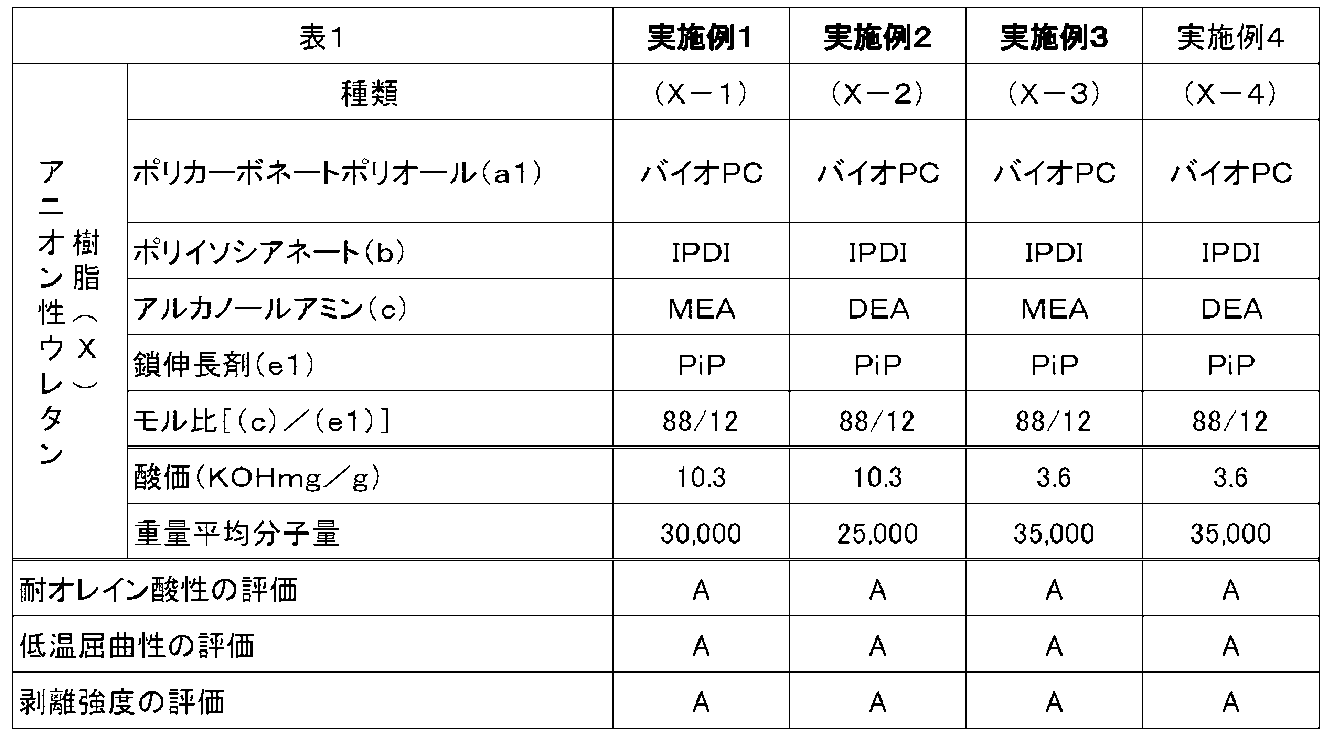
- the urethane resin composition of the present invention uses a biomass raw material and is excellent in olein acid resistance, low temperature flexibility, and peel strength.
- Comparative Examples 2 and 3 show an embodiment in which a petroleum-based polycarbonate polyol is used instead of the polycarbonate polyol (a1), but each has poor olein acid resistance or peel strength.
Landscapes
- Chemical & Material Sciences (AREA)
- Organic Chemistry (AREA)
- Chemical Kinetics & Catalysis (AREA)
- Health & Medical Sciences (AREA)
- Medicinal Chemistry (AREA)
- Polymers & Plastics (AREA)
- Engineering & Computer Science (AREA)
- Dispersion Chemistry (AREA)
- Textile Engineering (AREA)
- Manufacturing & Machinery (AREA)
- Polyurethanes Or Polyureas (AREA)
- Adhesives Or Adhesive Processes (AREA)
Abstract
Description
攪拌機、還流冷却器、温度計、及び、窒素導入管を備えた四つ口フラスコに、窒素気流下、ポリカーボネートポリオール(三菱化学株式会社製「ベネビオールNL-2010DB」、1,4-ブタンジオール、及び、バイオマス由来の1,10-デカンジールを原料とするもの、数平均分子量;2,000、以下「バイオPC」と略記する。)300質量部、メチルエチルケトン(以下「MEK」と略記する。)380質量部、2,2-ジメチロールプロピオン酸(以下「DMPA」と略記する。)9.2質量部を加え、十分に攪拌混合した。その後、イソホロンジイソシアネート(以下「IPDI」と略記する。)68質量部、次いで、カルボン酸ビスマス0.1質量部を加え、75℃で4時間反応させることで、イソシアネート基を有するウレタンプレポリマーのMEK溶液を得た。
次いで、得られたウレタンプレポリマーのMEK溶液に、トリエチルアミン8.4質量部を加え、前記ウレタンプレポリマー中のカルボキシル基を中和した後、イオン交換水690質量部を加え、次いで、ピペラジン(以下「PiP」と略記する。)0.76質量部、モノエタノールアミン(以下「MEA」と略記する。)8.3質量部を加え、反応させた。反応終了後、MEKを減圧留去することによって、ウレタン樹脂(X-1)組成物を得た。得られたウレタン樹脂(X-1)の酸価は、10.3KOHmg/g、重量平均分子量は、30,000であった。
MEAに代えて、ジエタノールアミン(以下「DEA」)を用いた以外は、実施例1と同様にしてウレタン樹脂(X-2)組成物を得た。得られたウレタン樹脂(X-2)の酸価は、10.3KOHmg/g、重量平均分子量は、25,000であった。
攪拌機、還流冷却器、温度計、及び、窒素導入管を備えた四つ口フラスコに、窒素気流下、バイオPC300質量部、MEK360質量部、DMPA3.0質量部を加え、十分に攪拌混合した。その後、IPDI54質量部、次いで、カルボン酸ビスマス0.1質量部を加え、75℃で4時間反応させることで、イソシアネート基を有するウレタンプレポリマーのMEK溶液を得た
次いで、得られたウレタンプレポリマーのMEK溶液に、トリエチルアミン2.8質量部を加え、前記ウレタンプレポリマー中のカルボキシル基を中和した後、イオン交換水620質量部を加え、次いで、PiP0.63質量部、MEA6.69質量部を加え、反応させた。反応終了後、MEKを減圧留去することによって、ウレタン樹脂(X-3)組成物を得た。得られたウレタン樹脂(X-3)の酸価は、3.6KOHmg/g、重量平均分子量は、35,000であった。
MEAに代えて、DEAを用いた以外は、実施例3と同様にしてウレタン樹脂(X-4)組成物を得た。得られたウレタン樹脂(X-4)の酸価は、3.6KOHmg/g、重量平均分子量は、35,000であった。
攪拌機、還流冷却器、温度計、及び、窒素導入管を備えた四つ口フラスコに、窒素気流下、バイオPC300質量部、MEK400質量部、DMPA16質量部を加え、十分に攪拌混合した。その後、IPDI83質量部、次いで、カルボン酸ビスマス0.1質量部を加え、75℃で4時間反応させることで、イソシアネート基を有するウレタンプレポリマーのMEK溶液を得た。
次いで、得られたウレタンプレポリマーのMEK溶液に、トリエチルアミン14.3質量部を加え、前記ウレタンプレポリマー中のカルボキシル基を中和した後、イオン交換水630質量部を加え、次いで、PiP6.42質量部を加え、反応させた。反応終了後、MEKを減圧留去することによって、ウレタン樹脂(XR-1)組成物を得た。得られたウレタン樹脂(XR-1)の酸価は、10.3KOHmg/g、重量平均分子量は、150,000であった。
攪拌機、還流冷却器、温度計、及び、窒素導入管を備えた四つ口フラスコに、窒素気流下、ポリカーボネートポリオール(宇部興産株式会社製「ETERNACOLL UH-2000」、非バイオマス、数平均分子量;2,000、以下「非バイオPC(1)」と略記する。)300質量部、MEK380質量部、DMPA3.0質量部を加え、十分に攪拌混合した。その後、IPDI68質量部、次いで、カルボン酸ビスマス0.1質量部を加え、75℃で4時間反応させることで、イソシアネート基を有するウレタンプレポリマーのMEK溶液を得た。
次いで、得られたウレタンプレポリマーのMEK溶液に、トリエチルアミン8.4質量部を加え、前記ウレタンプレポリマー中のカルボキシル基を中和した後、イオン交換水690質量部を加え、次いで、MEA8.0質量部を加え、反応させた。反応終了後、MEKを減圧留去することによって、ウレタン樹脂(XR-2)組成物を得た。得られたウレタン樹脂(XR-2)の酸価は、10.3KOHmg/g、重量平均分子量は、70,000であった。
非バイオPC(1)に代えて、非バイオマス、数平均分子量;2,000、以下「非バイオPC(2)」と略記する。)を用いた以外は、比較例3と同様にして、ウレタン樹脂(XR-3)組成物を得た。得られたウレタン樹脂(XR-3)の酸価は、9.2KOHmg/g、重量平均分子量は、110,000であった。
実施例および比較例で用いたポリオール等の数平均分子量、アニオン性ウレタン樹脂(X)の重雨量平均分子量は、ゲル・パーミエーション・カラムクロマトグラフィー(GPC)法により、下記の条件で測定し得られた値を示す。
カラム:東ソー株式会社製の下記のカラムを直列に接続して使用した。
「TSKgel G5000」(7.8mmI.D.×30cm)×1本
「TSKgel G4000」(7.8mmI.D.×30cm)×1本
「TSKgel G3000」(7.8mmI.D.×30cm)×1本
「TSKgel G2000」(7.8mmI.D.×30cm)×1本
検出器:RI(示差屈折計)
カラム温度:40℃
溶離液:テトラヒドロフラン(THF)
流速:1.0mL/分
注入量:100μL(試料濃度0.4質量%のテトラヒドロフラン溶液)
標準試料:下記の標準ポリスチレンを用いて検量線を作成した。
東ソー株式会社製「TSKgel 標準ポリスチレン A-500」
東ソー株式会社製「TSKgel 標準ポリスチレン A-1000」
東ソー株式会社製「TSKgel 標準ポリスチレン A-2500」
東ソー株式会社製「TSKgel 標準ポリスチレン A-5000」
東ソー株式会社製「TSKgel 標準ポリスチレン F-1」
東ソー株式会社製「TSKgel 標準ポリスチレン F-2」
東ソー株式会社製「TSKgel 標準ポリスチレン F-4」
東ソー株式会社製「TSKgel 標準ポリスチレン F-10」
東ソー株式会社製「TSKgel 標準ポリスチレン F-20」
東ソー株式会社製「TSKgel 標準ポリスチレン F-40」
東ソー株式会社製「TSKgel 標準ポリスチレン F-80」
東ソー株式会社製「TSKgel 標準ポリスチレン F-128」
東ソー株式会社製「TSKgel 標準ポリスチレン F-288」
東ソー株式会社製「TSKgel 標準ポリスチレン F-550」
実施例及び比較例で得られたウレタン樹脂組成物を乾燥し、乾燥固化した樹脂粒子の0.05g~0.5gを、300mL三角フラスコに秤量し、次いで、テトラヒドロフランとイオン交換水との質量割合[テトラヒドロフラン/イオン交換水]が80/20の混合溶媒約80mLを加えそれらの混合液を得た。
次いで、前記混合液にフェノールフタレイン指示薬を混合した後、あらかじめ標定された0.1mol/Lの水酸化カリウム水溶液で滴定し、滴定に用いた水酸化カリウム水溶液の量から下記計算式(1)に従い、水性ウレタン樹脂(A)の酸価(mgKOH/g)を求めた。
計算式 A=(B×f×5.611)/S (1)
式中、Aは樹脂の固形分酸価(mgKOH/g)、Bは滴定に用いた0.1mol/L水酸化カリウム水溶液の量(mL)、fは0.1mol/L水酸化カリウム水溶液のファクター、Sは樹脂粒子の質量(g)、5.611は水酸化カリウムの式量(56.11/10)である。
実施例及び比較例で得られたウレタン樹脂組成物100質量部、増粘剤(DIC株式会社製「ハイドラン アシスターT10」)1質量部、ポリイソシアネート架橋剤(DIC株式会社製「ハイドラン アシスターC5」)3質量部を配合した配合液を、フラット離型紙(リンテック株式会社製「EK-100D」)上に、乾燥後の膜厚が30μmとなるように塗布し、70℃で2分間、120℃で2分間乾燥させて、ポリウレタンフィルムを得た。次いで、このポリウレタンフィルムを幅5mm、長さ50mmの短冊状に裁断し、試験片とした。この試験片を引張試験機(株式会社島津製作所製「オートグラフAG-I」)を使用して、チャック間距離;40mm、引張速度;10mm/秒、温度23℃の条件下で引張試験を行い、100%伸長した際の応力(100%モジュラス、以下「100%M(1)」)を測定した。
「A」:保持率が50%以上である。
「B」:保持率が30%以上50%未満である。
「C」:保持率が30%未満である。
ウレタンディスパージョン(DIC株式会社製「ハイドランCRS-1286」)100質量部、黒色顔料(DIC株式会社製「ダイラックHS-9530」)10質量部、増粘剤(DIC株式会社製「ハイドラン アシスターT10」)1質量部を配合した配合液を、フラット離型紙(味の素株式会社製「DN-TP-155T」)上に、乾燥後の膜厚が30μmとなるように塗布し、70℃で2分間、120℃で2分間乾燥させて、表皮層を得た。
次いで、実施例及び比較例で得られたウレタン樹脂組成物100質量部、増粘剤(DIC株式会社製「ハイドラン アシスターT10」)1質量部、ポリイソシアネート架橋剤(DIC株式会社製「ハイドラン アシスターC5」)3質量部を配合した配合液を、、前記表皮層上に、乾燥後の膜厚が50μmとなるように塗布し、70℃で3分間乾燥させた。乾燥後、直ちにT/R起毛布を貼り合わせた後、120℃で2分間熱処理し、次いで、50℃で2日間熟成させた後、離型紙を剥がして合成皮革を得た。
得られた合成皮革を、フレキソメーター(株式会社安田精機製作所製「低温槽付きフレキソメーター」)での屈曲性試験(-10℃、100回/毎分)を行い、合成皮革の表面に割れが生じるまでの回数を測定し、以下のように評価した。
「A」:30,000回以上
「B」:10,000回以上30,000回未満
「C」:10,000回未満
前記[低温屈曲性の評価方法]で得られた合成皮革を、島津オートグラフ「AG-1」(株式会社島津製作所製)を使用して、フルスケール5kg、ヘッドスピード20mm/分の条件にて剥離強度を測定し、以下のように評価した。
「A」;1.0kgf/cm以上
「B」;0.5kgf/cm以上1.0kgf/cm未満
「C」;0.5kgf/cm未満

Claims (6)
- アニオン性ウレタン樹脂(X)、及び、水(Y)を含有するウレタン樹脂組成物であって、
前記アニオン性ウレタン樹脂(X)が、
バイオマス由来のポリカーボネートポリオール(a1)を含むポリオール(a)と、
ポリイソシアネート(b)と、アルカノールアミン(c)とを必須原料とすることを特徴とするウレタン樹脂組成物。 - 前記バイオマス由来のポリカーボネートポリオール(a1)が、バイオマス由来のデカンジオールを原料とするものである、請求項1記載のウレタン樹脂組成物。
- 前記ポリカーボネートポリオール(a1)の数平均分子量が、1,500~2,500の範囲である請求項1又は2記載のウレタン樹脂組成物。
- 前記アニオン性ウレタン樹脂(X)の重量平均分子量が、1万~7万の範囲である請求項1~3のいずれか1項記載のウレタン樹脂組成物。
- 請求項1~4のいずれか1項記載のウレタン樹脂組成物を含有することを特徴とする接着剤。
- 少なくとも、基布(i)、及び、請求項5記載の接着剤により形成された接着層(ii)を有することを特徴とする合成皮革。
Priority Applications (5)
| Application Number | Priority Date | Filing Date | Title |
|---|---|---|---|
| CN202080074120.XA CN114599701B (zh) | 2019-10-28 | 2020-09-17 | 氨基甲酸酯树脂组合物、接着剂及合成皮革 |
| JP2021529430A JP7231030B2 (ja) | 2019-10-28 | 2020-09-17 | ウレタン樹脂組成物、接着剤、及び、合成皮革 |
| EP20882649.5A EP4053182A4 (en) | 2019-10-28 | 2020-09-17 | URETHANE RESIN COMPOSITION, ADHESIVE AND SYNTHETIC LEATHER |
| KR1020227007387A KR102810013B1 (ko) | 2019-10-28 | 2020-09-17 | 우레탄 수지 조성물, 접착제, 및, 합성 피혁 |
| US17/773,017 US12486439B2 (en) | 2019-10-28 | 2020-09-17 | Urethane resin composition, adhesive, and synthetic leather |
Applications Claiming Priority (2)
| Application Number | Priority Date | Filing Date | Title |
|---|---|---|---|
| JP2019-195231 | 2019-10-28 | ||
| JP2019195231 | 2019-10-28 |
Publications (1)
| Publication Number | Publication Date |
|---|---|
| WO2021084955A1 true WO2021084955A1 (ja) | 2021-05-06 |
Family
ID=75715113
Family Applications (1)
| Application Number | Title | Priority Date | Filing Date |
|---|---|---|---|
| PCT/JP2020/035179 Ceased WO2021084955A1 (ja) | 2019-10-28 | 2020-09-17 | ウレタン樹脂組成物、接着剤、及び、合成皮革 |
Country Status (7)
| Country | Link |
|---|---|
| US (1) | US12486439B2 (ja) |
| EP (1) | EP4053182A4 (ja) |
| JP (1) | JP7231030B2 (ja) |
| KR (1) | KR102810013B1 (ja) |
| CN (1) | CN114599701B (ja) |
| TW (1) | TWI912257B (ja) |
| WO (1) | WO2021084955A1 (ja) |
Cited By (3)
| Publication number | Priority date | Publication date | Assignee | Title |
|---|---|---|---|---|
| JPWO2021261259A1 (ja) * | 2020-06-23 | 2021-12-30 | ||
| WO2024122083A1 (ja) * | 2022-12-06 | 2024-06-13 | Dic株式会社 | 湿気硬化型ポリウレタン樹脂組成物、接着剤、及び、積層体 |
| JPWO2024122084A1 (ja) * | 2022-12-08 | 2024-06-13 |
Families Citing this family (1)
| Publication number | Priority date | Publication date | Assignee | Title |
|---|---|---|---|---|
| CN114316197B (zh) * | 2022-01-11 | 2023-07-14 | 万华化学集团股份有限公司 | 一种低极性高耐热的热塑性聚氨酯粘合剂及其用途 |
Citations (12)
| Publication number | Priority date | Publication date | Assignee | Title |
|---|---|---|---|---|
| JP2011225863A (ja) | 2010-04-02 | 2011-11-10 | Dainichiseika Color & Chem Mfg Co Ltd | バイオポリウレタン樹脂 |
| JP2013087122A (ja) * | 2011-10-13 | 2013-05-13 | Nicca Chemical Co Ltd | 繊維積層体用水性接着剤 |
| JP2013227528A (ja) * | 2012-03-29 | 2013-11-07 | Sanyo Chem Ind Ltd | ポリウレタン系樹脂水性分散体 |
| JP2014001475A (ja) * | 2012-06-18 | 2014-01-09 | Seiren Co Ltd | 合成皮革 |
| JP2016188362A (ja) * | 2015-03-27 | 2016-11-04 | 三洋化成工業株式会社 | ポリウレタン樹脂水分散体 |
| JP2016222921A (ja) | 2011-09-26 | 2016-12-28 | 旭化成株式会社 | 水分散性ウレタン(メタ)アクリレートおよび塗料組成物 |
| JP2017133024A (ja) | 2011-06-16 | 2017-08-03 | 三菱ケミカル株式会社 | ポリカーボネートジオール含有組成物およびポリカーボネートジオール含有組成物を用いたポリウレタン |
| JP2018123255A (ja) * | 2017-02-02 | 2018-08-09 | セイコーエプソン株式会社 | インクジェットインク組成物、記録方法及び記録物 |
| JP2018127758A (ja) | 2018-03-20 | 2018-08-16 | 三菱ケミカル株式会社 | 合成皮革用ポリウレタン |
| JP2019081826A (ja) * | 2017-10-30 | 2019-05-30 | セイコーエプソン株式会社 | インクジェットインク組成物、高分子、その製造方法及び記録方法 |
| JP2020083902A (ja) * | 2018-11-15 | 2020-06-04 | 宇部興産株式会社 | 水性樹脂組成物及びそれを含有するコーティング剤組成物 |
| JP2020105243A (ja) * | 2018-12-26 | 2020-07-09 | 三井化学株式会社 | アンカーコート剤および多層フィルム |
Family Cites Families (15)
| Publication number | Priority date | Publication date | Assignee | Title |
|---|---|---|---|---|
| US20120238701A1 (en) | 2009-11-10 | 2012-09-20 | Takeshi Yamada | Aqueous polyurethane resin dispersion, process for preparing the same and use thereof |
| JP5686372B2 (ja) * | 2010-04-02 | 2015-03-18 | 本田技研工業株式会社 | バイオポリウレタン樹脂を用いてなる合成擬革及び該合成擬革の製造方法 |
| US8673991B2 (en) * | 2010-04-22 | 2014-03-18 | Dic Corporation | Two-part curable polyurethane foam resin composition, molded article using the same, and shoe sole |
| WO2013027489A1 (ja) | 2011-08-22 | 2013-02-28 | Dic株式会社 | 皮革様シート及びその製造方法 |
| CN102675585B (zh) * | 2011-12-14 | 2014-04-30 | 浙江华峰新材料股份有限公司 | 添加醇胺化合物的聚氨酯微孔弹性体及制备方法和应用 |
| TWI644975B (zh) * | 2012-09-21 | 2018-12-21 | 日商Adeka股份有限公司 | 聚胺基甲酸酯樹脂水分散液、使用它之難燃性聚酯系纖維、及該纖維之製造方法 |
| JP2016505737A (ja) * | 2012-12-14 | 2016-02-25 | アドコ プロダクツ,インコーポレイテッド | 反応性接着剤を用いる屋根葺き継ぎ目 |
| CN105408543B (zh) * | 2013-07-25 | 2018-04-03 | 世联株式会社 | 合成皮革及其制造方法 |
| JP6323205B2 (ja) * | 2014-06-23 | 2018-05-16 | 三菱ケミカル株式会社 | 合成皮革用ポリウレタン |
| JP6503917B2 (ja) * | 2014-06-23 | 2019-04-24 | 三菱ケミカル株式会社 | 合成皮革用ポリウレタン |
| WO2016047415A1 (ja) | 2014-09-26 | 2016-03-31 | Dic株式会社 | 水性ウレタン樹脂組成物、コーティング剤及び物品 |
| JP6591189B2 (ja) * | 2015-03-31 | 2019-10-16 | トーヨーポリマー株式会社 | ポリウレタン水分散体及び合成皮革 |
| JP6616685B2 (ja) * | 2015-12-28 | 2019-12-04 | 日華化学株式会社 | 水分散型ポリカーボネート系ポリウレタン樹脂組成物、それを用いて処理した繊維製品、及び水分散型ポリカーボネート系ポリウレタン樹脂組成物の製造方法 |
| JP6780492B2 (ja) * | 2016-12-22 | 2020-11-04 | Dic株式会社 | ウレタン樹脂組成物、皮膜、及び皮革様シート |
| JP7192353B2 (ja) * | 2017-10-30 | 2022-12-20 | Dic株式会社 | ウレタン樹脂組成物、皮膜、及び合成皮革 |
-
2020
- 2020-09-17 WO PCT/JP2020/035179 patent/WO2021084955A1/ja not_active Ceased
- 2020-09-17 US US17/773,017 patent/US12486439B2/en active Active
- 2020-09-17 CN CN202080074120.XA patent/CN114599701B/zh active Active
- 2020-09-17 KR KR1020227007387A patent/KR102810013B1/ko active Active
- 2020-09-17 EP EP20882649.5A patent/EP4053182A4/en active Pending
- 2020-09-17 JP JP2021529430A patent/JP7231030B2/ja active Active
- 2020-09-23 TW TW109132929A patent/TWI912257B/zh active
Patent Citations (12)
| Publication number | Priority date | Publication date | Assignee | Title |
|---|---|---|---|---|
| JP2011225863A (ja) | 2010-04-02 | 2011-11-10 | Dainichiseika Color & Chem Mfg Co Ltd | バイオポリウレタン樹脂 |
| JP2017133024A (ja) | 2011-06-16 | 2017-08-03 | 三菱ケミカル株式会社 | ポリカーボネートジオール含有組成物およびポリカーボネートジオール含有組成物を用いたポリウレタン |
| JP2016222921A (ja) | 2011-09-26 | 2016-12-28 | 旭化成株式会社 | 水分散性ウレタン(メタ)アクリレートおよび塗料組成物 |
| JP2013087122A (ja) * | 2011-10-13 | 2013-05-13 | Nicca Chemical Co Ltd | 繊維積層体用水性接着剤 |
| JP2013227528A (ja) * | 2012-03-29 | 2013-11-07 | Sanyo Chem Ind Ltd | ポリウレタン系樹脂水性分散体 |
| JP2014001475A (ja) * | 2012-06-18 | 2014-01-09 | Seiren Co Ltd | 合成皮革 |
| JP2016188362A (ja) * | 2015-03-27 | 2016-11-04 | 三洋化成工業株式会社 | ポリウレタン樹脂水分散体 |
| JP2018123255A (ja) * | 2017-02-02 | 2018-08-09 | セイコーエプソン株式会社 | インクジェットインク組成物、記録方法及び記録物 |
| JP2019081826A (ja) * | 2017-10-30 | 2019-05-30 | セイコーエプソン株式会社 | インクジェットインク組成物、高分子、その製造方法及び記録方法 |
| JP2018127758A (ja) | 2018-03-20 | 2018-08-16 | 三菱ケミカル株式会社 | 合成皮革用ポリウレタン |
| JP2020083902A (ja) * | 2018-11-15 | 2020-06-04 | 宇部興産株式会社 | 水性樹脂組成物及びそれを含有するコーティング剤組成物 |
| JP2020105243A (ja) * | 2018-12-26 | 2020-07-09 | 三井化学株式会社 | アンカーコート剤および多層フィルム |
Non-Patent Citations (1)
| Title |
|---|
| See also references of EP4053182A4 |
Cited By (9)
| Publication number | Priority date | Publication date | Assignee | Title |
|---|---|---|---|---|
| JPWO2021261259A1 (ja) * | 2020-06-23 | 2021-12-30 | ||
| WO2021261259A1 (ja) * | 2020-06-23 | 2021-12-30 | Dic株式会社 | ウレタン樹脂組成物、皮膜、及び、合成皮革 |
| JP7095816B2 (ja) | 2020-06-23 | 2022-07-05 | Dic株式会社 | ウレタン樹脂組成物、皮膜、及び、合成皮革 |
| WO2024122083A1 (ja) * | 2022-12-06 | 2024-06-13 | Dic株式会社 | 湿気硬化型ポリウレタン樹脂組成物、接着剤、及び、積層体 |
| JPWO2024122083A1 (ja) * | 2022-12-06 | 2024-06-13 | ||
| JP7704311B2 (ja) | 2022-12-06 | 2025-07-08 | Dic株式会社 | 湿気硬化型ポリウレタン樹脂組成物、接着剤、及び、積層体 |
| JPWO2024122084A1 (ja) * | 2022-12-08 | 2024-06-13 | ||
| WO2024122084A1 (ja) * | 2022-12-08 | 2024-06-13 | Dic株式会社 | ポリウレタン発泡シートの製造方法、及び、合成皮革の製造方法 |
| JP7658518B2 (ja) | 2022-12-08 | 2025-04-08 | Dic株式会社 | ポリウレタン発泡シートの製造方法、及び、合成皮革の製造方法 |
Also Published As
| Publication number | Publication date |
|---|---|
| EP4053182A4 (en) | 2023-11-08 |
| TWI912257B (zh) | 2026-01-21 |
| KR20220044776A (ko) | 2022-04-11 |
| EP4053182A1 (en) | 2022-09-07 |
| CN114599701A (zh) | 2022-06-07 |
| KR102810013B1 (ko) | 2025-05-21 |
| JP7231030B2 (ja) | 2023-03-01 |
| JPWO2021084955A1 (ja) | 2021-11-25 |
| CN114599701B (zh) | 2024-08-02 |
| TW202124492A (zh) | 2021-07-01 |
| US20220389293A1 (en) | 2022-12-08 |
| US12486439B2 (en) | 2025-12-02 |
Similar Documents
| Publication | Publication Date | Title |
|---|---|---|
| JP6844757B2 (ja) | ウレタン樹脂組成物、皮膜、及び、合成皮革 | |
| JP7231030B2 (ja) | ウレタン樹脂組成物、接着剤、及び、合成皮革 | |
| JP6684457B1 (ja) | 合成皮革 | |
| JP7347711B2 (ja) | 合成皮革 | |
| KR20200140898A (ko) | 합성 피혁 | |
| JP7095816B2 (ja) | ウレタン樹脂組成物、皮膜、及び、合成皮革 |
Legal Events
| Date | Code | Title | Description |
|---|---|---|---|
| ENP | Entry into the national phase |
Ref document number: 2021529430 Country of ref document: JP Kind code of ref document: A |
|
| 121 | Ep: the epo has been informed by wipo that ep was designated in this application |
Ref document number: 20882649 Country of ref document: EP Kind code of ref document: A1 |
|
| ENP | Entry into the national phase |
Ref document number: 20227007387 Country of ref document: KR Kind code of ref document: A |
|
| NENP | Non-entry into the national phase |
Ref country code: DE |
|
| ENP | Entry into the national phase |
Ref document number: 2020882649 Country of ref document: EP Effective date: 20220530 |