WO2021092703A1 - Methods for using low-dose colchicine after myocardial infarction - Google Patents
Methods for using low-dose colchicine after myocardial infarction Download PDFInfo
- Publication number
- WO2021092703A1 WO2021092703A1 PCT/CA2020/051559 CA2020051559W WO2021092703A1 WO 2021092703 A1 WO2021092703 A1 WO 2021092703A1 CA 2020051559 W CA2020051559 W CA 2020051559W WO 2021092703 A1 WO2021092703 A1 WO 2021092703A1
- Authority
- WO
- WIPO (PCT)
- Prior art keywords
- polymorphic site
- colchicine
- patient
- genetic variant
- gene
- Prior art date
- Legal status (The legal status is an assumption and is not a legal conclusion. Google has not performed a legal analysis and makes no representation as to the accuracy of the status listed.)
- Ceased
Links
Classifications
-
- C—CHEMISTRY; METALLURGY
- C12—BIOCHEMISTRY; BEER; SPIRITS; WINE; VINEGAR; MICROBIOLOGY; ENZYMOLOGY; MUTATION OR GENETIC ENGINEERING
- C12Q—MEASURING OR TESTING PROCESSES INVOLVING ENZYMES, NUCLEIC ACIDS OR MICROORGANISMS; COMPOSITIONS OR TEST PAPERS THEREFOR; PROCESSES OF PREPARING SUCH COMPOSITIONS; CONDITION-RESPONSIVE CONTROL IN MICROBIOLOGICAL OR ENZYMOLOGICAL PROCESSES
- C12Q1/00—Measuring or testing processes involving enzymes, nucleic acids or microorganisms; Compositions therefor; Processes of preparing such compositions
- C12Q1/68—Measuring or testing processes involving enzymes, nucleic acids or microorganisms; Compositions therefor; Processes of preparing such compositions involving nucleic acids
- C12Q1/6876—Nucleic acid products used in the analysis of nucleic acids, e.g. primers or probes
- C12Q1/6883—Nucleic acid products used in the analysis of nucleic acids, e.g. primers or probes for diseases caused by alterations of genetic material
-
- A—HUMAN NECESSITIES
- A61—MEDICAL OR VETERINARY SCIENCE; HYGIENE
- A61K—PREPARATIONS FOR MEDICAL, DENTAL OR TOILETRY PURPOSES
- A61K31/00—Medicinal preparations containing organic active ingredients
- A61K31/16—Amides, e.g. hydroxamic acids
- A61K31/165—Amides, e.g. hydroxamic acids having aromatic rings, e.g. colchicine, atenolol, progabide
-
- A—HUMAN NECESSITIES
- A61—MEDICAL OR VETERINARY SCIENCE; HYGIENE
- A61P—SPECIFIC THERAPEUTIC ACTIVITY OF CHEMICAL COMPOUNDS OR MEDICINAL PREPARATIONS
- A61P9/00—Drugs for disorders of the cardiovascular system
- A61P9/10—Drugs for disorders of the cardiovascular system for treating ischaemic or atherosclerotic diseases, e.g. antianginal drugs, coronary vasodilators, drugs for myocardial infarction, retinopathy, cerebrovascula insufficiency, renal arteriosclerosis
-
- C—CHEMISTRY; METALLURGY
- C12—BIOCHEMISTRY; BEER; SPIRITS; WINE; VINEGAR; MICROBIOLOGY; ENZYMOLOGY; MUTATION OR GENETIC ENGINEERING
- C12Q—MEASURING OR TESTING PROCESSES INVOLVING ENZYMES, NUCLEIC ACIDS OR MICROORGANISMS; COMPOSITIONS OR TEST PAPERS THEREFOR; PROCESSES OF PREPARING SUCH COMPOSITIONS; CONDITION-RESPONSIVE CONTROL IN MICROBIOLOGICAL OR ENZYMOLOGICAL PROCESSES
- C12Q1/00—Measuring or testing processes involving enzymes, nucleic acids or microorganisms; Compositions therefor; Processes of preparing such compositions
- C12Q1/68—Measuring or testing processes involving enzymes, nucleic acids or microorganisms; Compositions therefor; Processes of preparing such compositions involving nucleic acids
- C12Q1/6876—Nucleic acid products used in the analysis of nucleic acids, e.g. primers or probes
-
- C—CHEMISTRY; METALLURGY
- C12—BIOCHEMISTRY; BEER; SPIRITS; WINE; VINEGAR; MICROBIOLOGY; ENZYMOLOGY; MUTATION OR GENETIC ENGINEERING
- C12Q—MEASURING OR TESTING PROCESSES INVOLVING ENZYMES, NUCLEIC ACIDS OR MICROORGANISMS; COMPOSITIONS OR TEST PAPERS THEREFOR; PROCESSES OF PREPARING SUCH COMPOSITIONS; CONDITION-RESPONSIVE CONTROL IN MICROBIOLOGICAL OR ENZYMOLOGICAL PROCESSES
- C12Q1/00—Measuring or testing processes involving enzymes, nucleic acids or microorganisms; Compositions therefor; Processes of preparing such compositions
- C12Q1/68—Measuring or testing processes involving enzymes, nucleic acids or microorganisms; Compositions therefor; Processes of preparing such compositions involving nucleic acids
- C12Q1/6844—Nucleic acid amplification reactions
- C12Q1/6858—Allele-specific amplification
-
- C—CHEMISTRY; METALLURGY
- C12—BIOCHEMISTRY; BEER; SPIRITS; WINE; VINEGAR; MICROBIOLOGY; ENZYMOLOGY; MUTATION OR GENETIC ENGINEERING
- C12Q—MEASURING OR TESTING PROCESSES INVOLVING ENZYMES, NUCLEIC ACIDS OR MICROORGANISMS; COMPOSITIONS OR TEST PAPERS THEREFOR; PROCESSES OF PREPARING SUCH COMPOSITIONS; CONDITION-RESPONSIVE CONTROL IN MICROBIOLOGICAL OR ENZYMOLOGICAL PROCESSES
- C12Q2600/00—Oligonucleotides characterized by their use
- C12Q2600/106—Pharmacogenomics, i.e. genetic variability in individual responses to drugs and drug metabolism
-
- C—CHEMISTRY; METALLURGY
- C12—BIOCHEMISTRY; BEER; SPIRITS; WINE; VINEGAR; MICROBIOLOGY; ENZYMOLOGY; MUTATION OR GENETIC ENGINEERING
- C12Q—MEASURING OR TESTING PROCESSES INVOLVING ENZYMES, NUCLEIC ACIDS OR MICROORGANISMS; COMPOSITIONS OR TEST PAPERS THEREFOR; PROCESSES OF PREPARING SUCH COMPOSITIONS; CONDITION-RESPONSIVE CONTROL IN MICROBIOLOGICAL OR ENZYMOLOGICAL PROCESSES
- C12Q2600/00—Oligonucleotides characterized by their use
- C12Q2600/156—Polymorphic or mutational markers
Definitions
- the invention relates to a treatment regimen for patients after suffering a myocardial infarction.
- Colchicine is an inexpensive, orally administered, potent anti-inflammatory medication that was initially extracted from the autumn crocus and has been used for centuries. Its mechanism of action is through the inhibition of tubulin polymerization and microtubule generation and, possibly, effects on cellular adhesion molecules, inflammatory chemokines, and the inflammasome (Ravelli et al. (2004) Nature 428:198-202; Perico et al. (1996) J Am Soc Nephrol 7: 594-601 ; Pope et al. (2007) Arthritis Rheum 56:3183-8). Colchicine is currently indicated for the treatment of gout, familial Mediterranean fever, and pericarditis (Cerquaglia et al. (2005) Curr Drug Targets Inflamm Allergy 4:117-24; and Imazio et al. (2005) Circulation 112:2012-6).
- Colchicine Cardiovascular Outcomes Trial was conducted to evaluate the effects of colchicine on cardiovascular outcomes as well as its long-term safety profile in patients who had recently had a myocardial infarction.
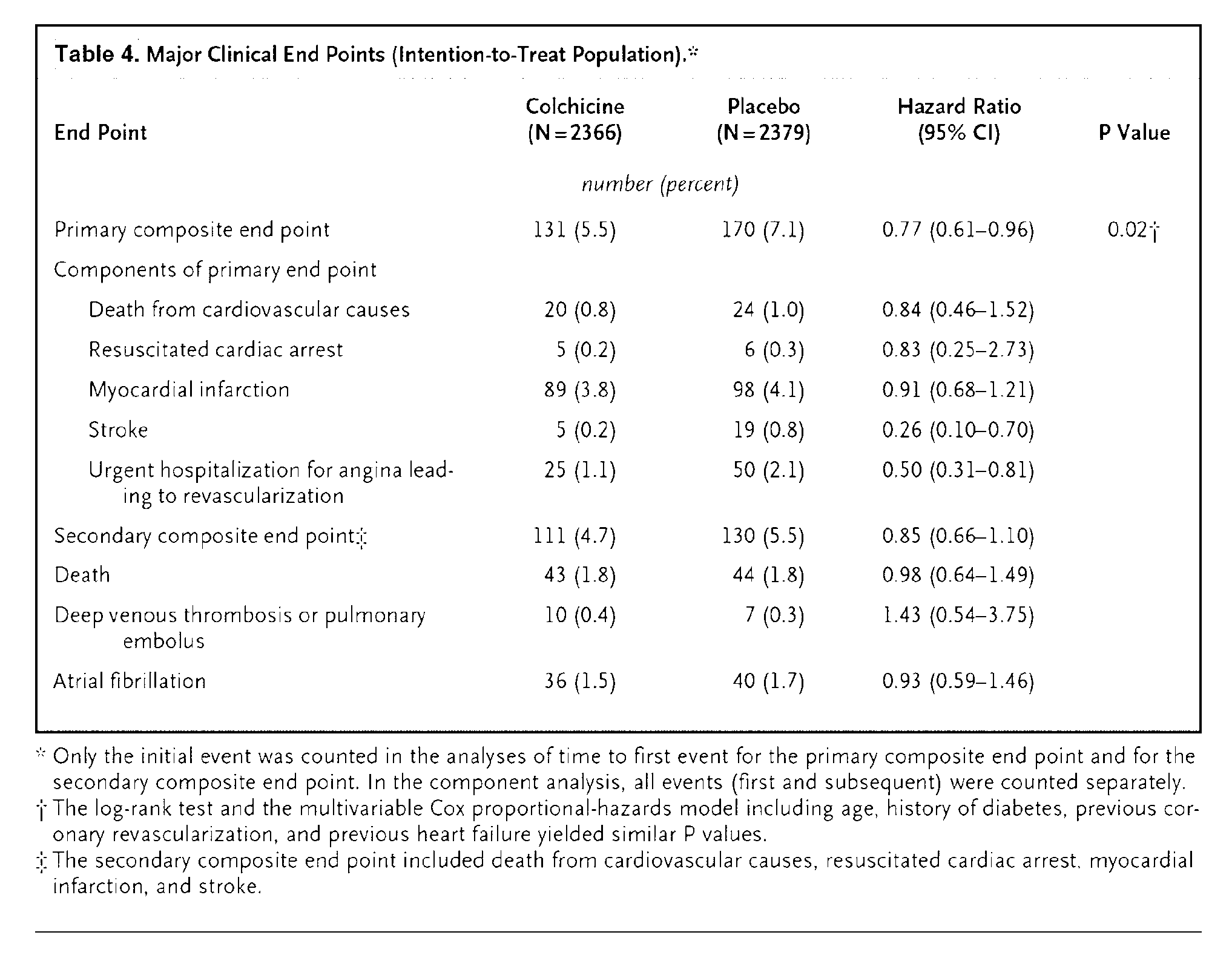
- hazard ratios are 0.26 (95% confidence interval is 0.10-0.70) and 0.50 (95% confidence interval is 0.31-0.81), respectively.
- colchicine did not increase the incidence of septic shock.
- no serious adverse event of myopathy linked to colchicine occurred despite the use of statins in 99% of trial participants.
- the invention in one aspect, features a method of treating a patient after having a myocardial infarction including administering colchicine to a patient determined to have a genetic variant in its genome that is indicative of the patient benefiting from colchicine administration, where the genetic variant includes polymorphic site rs149354567 intergenic for the patient's CDRT8 gene and PMP22 gene on chromosome 17. ln some embodiments of the first aspect of the invention the genotype at polymorphic site rs149354567 is G-/G-.
- the genome includes a further genetic variant at polymorphic site rs75780450.
- the genotype at polymorphic site rs75780450 is C.
- the invention features a method of treating a male patient after having a myocardial infarction including administering colchicine to the male patient determined to have a genetic variant in its genome that is indicative of the patient benefiting from colchicine administration, where the genetic variant includes polymorphic site rs10811106 in the patient's SAXO1 gene on chromosome 9.
- the genotype at polymorphic site rs10811106 is C/C.
- the genome includes a further genetic variant at a polymorphic site selected from the group consisting of rs10118790, rs28733572, rs1854156, and rs10963895 or selected from the group consisting of rs10118790, rs28733572, and rs1854156.
- the genotype at polymorphic site rs 10118790, rs28733572, rs1854156, and/or rs10963895 is G.
- the patient has two copies of the genetic variant indicative of the patient benefiting from colchicine administration.
- the invention features a method of treating a patient after having a myocardial infarction including administering colchicine to a patient determined not to have a genetic variant in its genome that is indicative of the patient suffering a gastrointestinal disorder following colchicine administration, where the genetic variant includes polymorphic site rs6916345 intergenic for the patient's LINC01108 gene and JARID2 gene on chromosome 6 or polymorphic site rs10128117 in the patient's SEPHS1 gene on chromosome 10.
- the genotype at polymorphic site rs6916345 is G/G. In other embodiments, the genotype at polymorphic site rs10128117 is A/A. ln some embodiments of the third aspect of the invention, the genome includes a further genetic variant at a polymorphic site selected from the group consisting of rs9476615, rs9464702, rs9370772, rs6918045, rs6459368, rs6903188, rs9476616, rs12210439, rs9358042, rs4620126, rs7747013, rs7751771 , rs7764937, rs9382993, rs6920905, rs70993041 , rs9349955, rs2327827, rs9358044, and rs857414, e.g., a polymorphic site selected from the group consisting
- the genotype at polymorphic site rs9476615 is T
- at polymorphic site rs9464702 is G
- at polymorphic site rs9370772 is T
- at polymorphic site rs6918045 is T
- at polymorphic site rs6459368 is A
- at polymorphic site rs6903188 is G
- at polymorphic site rs9476616 is G
- at polymorphic site rs12210439 is A
- at polymorphic site rs9358042 is T
- at polymorphic site rs4620126 is G
- at polymorphic site rs7747013 is G
- at polymorphic site rs7751771 is C
- at polymorphic site rs7764937 is C
- at polymorphic site rs9382993 is C
- at polymorphic site rs6920905 is C
- at polymorphic site rs70993041 is TAA
- the genome includes a further genetic variant at a polymorphic site selected from the group consisting of rs535968, rs825610, rs9423893, rs10906346, rs11258319, rs2476986, rs615497, rs2783648, rs2253619, rs77006996, rs7901525, rs61851591 , rs7917549, rs552621122, rs58260827, rs74795203, rs7894075, rs61851592, rs61851593, rs7919509, rs7916194, rs41291319, rs41291321 , rs7902331 , rs61851598, rs117874450, and rs61851599, e.g., a polymorphic site selected from the group consisting of rs535968
- the genotype at polymorphic site rs535968 is C
- at polymorphic site rs825610 is C
- at polymorphic site rs9423893 is A
- at polymorphic site rs10906346 is A
- at polymorphic site rs11258319 is T
- at polymorphic site rs2476986 is T
- at polymorphic site rs615497 is G
- at polymorphic site rs2783648 is A
- at polymorphic site rs2253619 is T
- at polymorphic site rs77006996 is T
- at polymorphic site rs7901525 is A
- at polymorphic site rs61851591 is A
- at polymorphic site rs7917549 is A
- at polymorphic site rs552621122 is A--
- at polymorphic site rs58260827 is CA
- at polymorphic site rs74795203 is
- the patient has two copies of the genetic variant that is indicative of the patient suffering a gastrointestinal disorder following colchicine administration.
- the invention features a method of treating a patient after having a myocardial infarction including determining whether the patient has a genetic variant in its genome that is indicative of the patient benefiting from colchicine administration or does not have a genetic variant in the genome that is that is indicative of the patient suffering from a gastrointestinal disorder following colchicine administration, and administering colchicine to the patient determined to have a genetic variant in the genome that is indicative of the patient benefiting from colchicine administration or not to have a genetic variant in the genome that is that is indicative of the patient suffering a gastrointestinal disorder following colchicine administration.
- the genetic variant in the genome that is indicative of the patient benefiting from colchicine administration includes polymorphic site rs149354567 in the patient's CDRT8 gene on chromosome 17.
- the genotype at polymorphic site rs149354567 is G-/G-.
- the genome includes a further genetic variant at polymorphic site rs75780450.
- the patient is male and the genetic variant in the genome that is indicative of the male patient benefiting from colchicine administration includes polymorphic site rs10811106 in the patient's SAXO1 gene on chromosome 9.
- the genotype at polymorphic site rs10811106 is C/C.
- the genome includes a further genetic variant at a polymorphic site selected from the group consisting of rs10118790, rs28733572, rs1854156, and rs10963895.
- the genetic variant in the genome that is indicative of the patient suffering a gastrointestinal disorder following colchicine administration includes polymorphic site rs6916345 in the patient's LINC01108 gene on chromosome 6 or polymorphic site rs10128117 in the patient's SEPHS1 gene on chromosome 10.
- the genotype at polymorphic site rs6916345 is G/G.
- the genotype at polymorphic site rs10128117 is A/A.
- the genome includes a further genetic variant at a polymorphic site selected from the group consisting of rs9476615, rs9464702, rs9370772, rs6918045, rs6459368, rs6903188, rs9476616, rs12210439, rs9358042, rs4620126, rs7747013, rs7751771 , rs7764937, rs9382993, rs6920905, rs70993041 , rs9349955, rs2327827, rs9358044, and rs857414, e.g., at a polymorphic site selected from the group consisting of rs6918045, rs6459368, rs6903188, rs9476616, rs7747013, rs7751771 , rs7764937, rs93
- the genome includes a further genetic variant at a polymorphic site selected from the group consisting of rs535968, rs825610, rs825610, rs9423893, rs10906346, rs11258319, rs2476986, rs615497, rs2783648, rs2253619, rs77006996, rs7901525, rs61851591 , rs7917549, rs61851591 , rs7917549, rs552621122, rs58260827, rs74795203, rs7894075, rs61851592, rs61851593, rs7919509, rs7916194, rs41291319, rs41291321 , rs7902331 , rs61851598, rs117874450
- the invention features a method of identifying a subject who would benefit from the administration of colchicine, including determining the genotype of the subject at one or more polymorphic sites in the subject's CDRT8 gene, where at least one polymorphic site is rs149354567.
- the invention features a method of identifying a male subject who would benefit from the administration of colchicine, including determining the genotype of the male subject at one or more polymorphic sites in the subject's SAXO1 gene, where at least one polymorphic site is rs 10811106.
- the invention features a method of identifying a subject who would benefit from the administration of colchicine, including determining the genotype of the subject at one or more polymorphic sites in the subject's LINC01108 gene, where at least one polymorphic site is rs6916345. ln the eighth aspect, the invention features a method of identifying a subject who would benefit from the administration of colchicine, including determining the genotype of the subject at one or more polymorphic sites in the subject's SEPHS1 gene, where at least one polymorphic site is rs10128117.
- the determining includes obtaining a biological sample from the patient, and in other embodiments, the determining includes the use of polymerase chain reaction, ligation chain reaction, DNA microarray technology, interference RNA microarray, allele specific hybridization, laser capture micro-dissection, mass spectrometry, or pyrosequencing.
- the myocardial infarction was within thirty days, e.g., the myocardial infarction was within 5, 10, 15, 20, or 25 days.
- percutaneous coronary intervention was performed for treating the patient's myocardial infarction.
- the patient was prescribed a medication, e.g., an antiplatelet agent such as aspirin.
- a medication e.g., an antiplatelet agent such as aspirin.
- the medication is a statin.
- the patient is at a lower risk of an ischemic cardiovascular event.
- the administration of colchicine is initiated upon assessment in (a) an emergency department (ED), (b) the hospital, or (c) a medical office setting.
- ED emergency department
- the hospital or (c) a medical office setting.
- the colchicine is in the form of a tablet or capsule.
- the colchicine is administered at 0.3 to 0.7 mg, e.g., the colchicine is administered at 0.4 to 0.6 mg, or the colchicine is administered at 0.5 mg. In some embodiments of any one of the aforementioned aspects of the invention, the colchicine is administered one, twice, or three times a day, e.g., the colchicine is administered once a day, or 0.25 mg of colchicine is administered twice a day.
- colchicine formulations are readily available, for example, as a coated tablet, and well known in the art.
- colchicine in a method of treating a patient after having a myocardial infarction typically continues, as needed, throughout the life of a patient.
- the duration of treatment is for 6 months, 12 months, 18 months, 24 months, 30 months, 36 months, or even longer as is needed.
- polymorphism polymorphism site
- polymorphic site Polymorphic site or “single nucleotide polymorphism site” (SNP site) or “single nucleotide polymorphism” refers to a location in the sequence of a gene which varies within a population.
- a polymorphism is the occurrence of two or more forms of a gene or position within a gene "allele", in a population, in such frequencies that the presence of the rarest of the forms cannot be explained by mutation alone.
- Preferred polymorphic sites have at least two alleles. The implication is that polymorphic alleles confer some phenotype variability on the host. Polymorphism may occur in both the coding regions and the noncoding region of genes.
- Polymorphism may occur at a single nucleotides site or may involve an insertion or a deletion. The location of such a polymorphism may be identified by its nucleotide position in the gene, on the chromosome or on the transcriptor by the amino acid that is altered by the nucleotide polymorphism. Individual polymorphisms are also assigned unique identifiers ("Reference SNP", "refSNP” or “rs#”) known to one of skill in the art and used, e.g., in the Single Nucleotide Polymorphism Database (db SNP) of Nucleotide Sequence Variation available on the NCBI web site.
- db SNP Single Nucleotide Polymorphism Database
- the "rs” prefix refers to a SNP in the database found at the NCB1 SNP database (ncbi.nlm.nih.gov/snp/?term).
- the "rs” numbers are the NCBI rsSNP ID form.
- genotype refers to the genetic constitution of an organism, usually in respect to one gene or a few genes or a region of a gene relevant to a particular context (i.e. the genetic loci responsible for a particular phenotype).
- specific combination of alleles at a given position in a gene such as, for example, the genotypes G-/G-, G-/GA or GA/GA which are possible genotypes of the rs149354567 SNP, C/C, C/T, or T/T are possible genotypes of the rs10811106 SNP, A/A, A/G, or G/G are possible genotypes for the rs6916345 SNP, and T/T, T/A, or A/A are possible genotypes for the rs10128117 SNP.
- FIG. 1 shows a flow chart of the randomization and follow-up of patients in the study.
- FIG. 2 shows the cumulative incidence of cardiovascular events (intention-to-treat population). Shown are the Kaplan-Meier event curves for the primary efficacy composite end point of death from cardiovascular causes, resuscitated cardiac arrest, myocardial infarction, stroke, or urgent hospitalization for angina leading to coronary revascularization in the colchicine group and the placebo group in a time-to-event analysis.
- the inset shows the same data on an enlarged y axis.
- FIG. 3 is a Manhattan plot of a Genome-wide Association Study (GWAS) with common single-nucleotide polymorphisms (SNPs) with minor allele frequency (MAF) ⁇ 5% for the primary efficacy end point using a survival analysis (coxph) regression with all patients in colchicine treatment arm (compliant ITT pgx population) in the COLCOT cohort, controlling for age, sex, principal components (C1-C10) with a threshold of 5.000E-08 (4,462,492 variants and 702 samples).
- GWAS Genome-wide Association Study
- SNPs single-nucleotide polymorphisms
- MAF minor allele frequency
- FIG. 4 is a plot of SNPs located on chromosome 17 (from 14,623,118 to 15,623,118 bp) for the primary efficacy end point using a survival analysis (coxph) regression with all patients in colchicine treatment arm (compliant ITT pgx population) in the COLCOT cohort, controlling for age, sex, principal components (C1-C10) with a threshold of 5.000E-08 (4,462,492 variants and 702 samples).
- FIG. 5 is a Manhattan plot of a GWAS with common SNPs with MAF ⁇ 5% for gastrointestinal disorders using a survival analysis (coxph) regression with all patients in colchicine treatment arm (on-treatment pgx population) in the COLCOT cohort, controlling for age, sex, principal components (C1-C10) with a threshold of 5.000E-08 (4,468,817 variants and 767 samples).
- FIG. 5 is a Manhattan plot of a GWAS with common SNPs with MAF ⁇ 5% for gastrointestinal disorders using a survival analysis (coxph) regression with all patients in colchicine treatment arm (on-treatment pgx population) in the COLCOT cohort, controlling for age, sex, principal components (C1-C10) with a threshold of 5.000E-08 (4,468,817 variants and 767 samples).
- FIG. 5 is a Manhattan plot of a GWAS with common SNPs with MAF ⁇ 5% for gastrointestinal disorders using a survival analysis (
- SNPs single-nucleotide polymorphisms located on chromosome 6 (from 14,149,353 to 15,149,353 bp) for gastrointestinal disorders using a survival analysis (coxph) regression with all patients in colchicine treatment arm (on-treatment pgx population) in the COLCOT cohort, controlling for age, sex, principal components (C1-C10) with a threshold of 5.000E-08 (4,468,817 variants and 767 samples).
- SNPs single-nucleotide polymorphisms
- FIG. 7 is a plot of single-nucleotide polymorphisms (SNPs) located on chromosome 10 (from 12,884,400 to 13,884,400 bp) for gastrointestinal disorders using a survival analysis (coxph) regression with all patients in colchicine treatment arm (on-treatment pgx population) in the COLCOT cohort, controlling for age, sex, principal components (C1-C10) with a threshold of 5.000E-08 (4,468,817 variants and 767 samples).
- SNPs single-nucleotide polymorphisms
- FIG. 8 is a Manhattan plot of GWAS with common SNPs with MAF > 5% for the primary efficacy endpoint using a survival analysis (coxph) regression with male patients in colchicine treatment arm (compliant ITT pgx population) in the COLCOT cohort, controlling for age, sex specific principal components (SC1-SC10) with a threshold of 5.000E-08 (4,455,743 variants and 576 samples).
- FIG. 9 is a plot of single-nucleotide polymorphisms (SNPs) located on chromosome 9 (from
- FIG. 10A is a series of graphs showing colocalization at the chromosome 9:18,537,533-
- FIG. 10B is a series of graphs showing colocalization at the chromosome 9:18,537,533-
- the red dot (arrows) corresponds to the lead SNP for this locus in the COLCOT GWAS.
- the red dot (arrows) indicates the lead SNP in the COLCOT GWAS.
- the primary efficacy end point was a composite of death from cardiovascular causes, resuscitated cardiac arrest, myocardial infarction, stroke, or urgent hospitalization for angina leading to coronary revascularization.
- the components of the primary end point and safety were also assessed.
- the hazard ratios were 0.84 (95% Cl, 0.46 to 1.52) for death from cardiovascular causes, 0.83 (95% Cl, 0.25 to 2.73) for resuscitated cardiac arrest, 0.91 (95% Cl, 0.68 to 1.21) for myocardial infarction, 0.26 (95% Cl, 0.10 to 0.70) for stroke, and 0.50 (95% Cl, 0.31 to 0.81) for urgent hospitalization for angina leading to coronary revascularization.
- Patients were excluded if they had severe heart failure, a left ventricular ejection fraction of less than 35%, stroke within the previous 3 months, a type 2 index myocardial infarction, coronary-bypass surgery either within the previous 3 years or planned, a history of noncutaneous cancer within the previous 3 years, inflammatory bowel disease or chronic diarrhea, neuromuscular disease or a nontransient creatine kinase level that was greater than three times the upper limit of the normal range (unless due to infarction), clinically significant nontransient hematologic abnormalities, severe renal disease with a serum creatinine level that was greater than two times the upper limit of the normal range; severe hepatic disease, drug or alcohol abuse, current or planned long-term systemic glucocorticoid therapy, or a history of clinically significant sensitivity to colchicine. (Details regarding eligibility criteria are provided herein.)
- the primary efficacy end point was a composite of death from cardiovascular causes, resuscitated cardiac arrest, myocardial infarction, stroke, or urgent hospitalization for angina leading to coronary revascularization in a time-to-event analysis.
- the secondary end points consisted of the components of the primary efficacy end point; a composite of death from cardiovascular causes, resuscitated cardiac arrest, myocardial infarction, or stroke; and total mortality in time-to-event analyses.
- Coronary revascularization, hospitalization for heart failure, atrial fibrillation, and deep venous thrombosis or pulmonary embolus were prespecified as exploratory end points in the protocol.
- Additional prespecified exploratory end points included the change from baseline to 6 months in the high-sensitivity C-reactive protein level and the change from baseline to 12 months in the white-cell count.
- the C-reactive protein biomarker substudy was implemented after a protocol amendment and was optional for sites and for patients; 34 sites chose to participate in this substudy.
- the efficacy analyses were conducted with the use of positively adjudicated data and according to the intention-to-treat principle.
- the primary end point was compared between the two trial groups with the use of a log-rank test, and the hazard ratio from a Cox proportional-hazards model, with a 95% confidence interval, was calculated.
- a Cox proportional-hazards model with adjustment for important baseline characteristics was also used as prespecified in the protocol.
- Identification of the particular genotype of a DNA sample may be performed by any of a number of methods well known to one of skill in the art. For example, identification of a polymorphism can be accomplished by cloning of the allele and sequencing it using techniques well known in the art. Alternatively, the gene sequences can be amplified from genomic DNA, e.g., using polymerase chain reaction (PCR), and the product sequenced. Numerous methods are known in the art for isolating and analyzing a subject's DNA for a given genetic marker including PCR, ligation chain reaction (LCR) or ligation amplification and amplification methods such as self-sustained sequence replication. Several non-limiting methods for analyzing a patient's DNA for mutations at a given genetic locus are described below.
- DNA microarray technology e.g., DNA chip devices and high-density microarrays for high- throughput screening applications and lower-density microarrays
- Methods for microarray fabrication include various inkjet and microjet deposition or spotting technologies and processes, in situ or on-chip photolithographic oligonucleotide synthesis processes, and electronic DNA probe addressing processes.
- the DNA microarray hybridization applications has been successfully applied in the areas of gene expression analysis and genotyping for point mutations, single nucleotide polymorphisms (SNPs), and short tandem repeats (STRs).
- RNA microarrays and combinations of microarrays and other methods such as laser capture micro-dissection (LCM), comparative genomic hybridization (CGH) and chromatin immunoprecipitation (ChiP). See, e.g., He et al. (2007) Adv. Exp. Med. Biol. 593: 117-133 and Heller (2002)
- Another detection method is allele specific hybridization using probes overlapping the polymorphic site and having about 5, or alternatively 10, or alternatively 20, or alternatively 25, or alternatively 30 nucleotides around the polymorphic region.
- probes capable of hybridizing specifically to the allelic variant or genetic marker of interest are attached to a solid phase support, e.g., a “chip.”
- Oligonucleotide probes can be bound to a solid support by a variety of processes, including lithography. Mutation detection analysis using these chips comprising oligonucleotides, also termed “DNA probe arrays” is described e.g., in Cronin et al. (1996) Human Mutation 7':244.
- Amplification can be performed, e.g., by PCR and/or LCR or other methods well known in the art.
- the presence of the specific allele in DNA from a subject can be shown by restriction enzyme analysis.
- the specific nucleotide polymorphism can result in a nucleotide sequence comprising a restriction site which is absent from the nucleotide sequence of another allelic variant.
- protection from cleavage agents can be used to detect mismatched bases in RNA/RNA DNA/DNA, or RNA/DNA heteroduplexes (see, e.g., Myers et al. (1985) Science 230: 1242).
- cleavage agents such as a nuclease, hydroxylamine or osmium tetroxide and with piperidine
- cleavage agents such as a nuclease, hydroxylamine or osmium tetroxide and with piperidine
- mismatched bases in RNA/RNA DNA/DNA or RNA/DNA heteroduplexes (see, e.g., Myers et al. (1985) Science 230: 1242).
- the technique of “mismatch cleavage” starts by providing duplexes formed by hybridizing a probe, e.g., RNA or DNA, which is optionally labeled, comprising a nucleotide sequence of the allelic variant of the gene with a sample nu
- RNA/DNA duplexes can be treated with RNase and DNA/DNA hybrids treated with SI nuclease to enzymatically digest the mismatched regions.
- DNA/DNA or RNA/DNA duplexes can be treated with hydroxylamine or osmium tetroxide and with piperidine in order to digest mismatched regions.
- control and sample nucleic acids After digestion of the mismatched regions, the resulting material is then separated by size on denaturing polyacrylamide gels to determine whether the control and sample nucleic acids have an identical nucleotide sequence or in which nucleotides they are different. See, for example, U.S. Pat. No. 6,455,249; Cotton et al. (1988) Proc. Natl. Acad. Sci. USA 85:4397; Saleeba et al. (1992) Meth. Enzymol. 217:286-295.
- Alterations in electrophoretic mobility may also be used to identify the particular allelic variant.
- single strand conformation polymorphism (SSCP) may be used to detect differences in electrophoretic mobility between mutant and wild type nucleic acids (Orita et al. (1989) Proc Natl. Acad. Sci USA 86:2766; Cotton (1993) Mutat. Res. 285: 125- 144 and Hayashi (1992) Genet. Anal. Tech. Appl. 9:73-79).
- Single-stranded DNA fragments of sample and control nucleic acids are denatured and allowed to renature.
- the secondary structure of single-stranded nucleic acids varies according to sequence; the resulting alteration in electrophoretic mobility enables the detection of even a single base change.
- the DNA fragments may be labeled or detected with labeled probes.
- the sensitivity of the assay may be enhanced by using RNA (rather than DNA), in which the secondary structure is more sensitive to a change in sequence.
- the subject method utilizes heteroduplex analysis to separate double stranded heteroduplex molecules on the basis of changes in electrophoretic mobility (Keen et al. (1991) Trends Genet. 7:5).
- allelic variant or genetic marker may also be obtained by analyzing the movement of a nucleic acid comprising the polymorphic region in polyacrylamide gels containing a gradient of denaturant, which is assayed using denaturing gradient gel electrophoresis (DGGE) (Myers et al. (1985) Nature 313:495).
- DGGE denaturing gradient gel electrophoresis
- DNA will be modified to ensure that it does not completely denature, for example by adding a GC clamp of approximately 40 bp of high-melting GC-rich DNA by PCR.
- a temperature gradient is used in place of a denaturing agent gradient to identify differences in the mobility of control and sample DNA (Rosenbaum and Reissner (1987) Biophys. Chem. 265: 1275).
- oligonucleotide probes may be prepared in which the known polymorphic nucleotide is placed centrally (allele-specific probes) and then hybridized to target DNA under conditions which permit hybridization only if a perfect match is found (Saiki et al. (1986) Nature 324:163); Saiki et al. (1989) Proc. Natl. Acad. Sci. USA 86:6230).
- oligonucleotide hybridization techniques are used for the detection of the nucleotide changes in the polymorphic region of the gene. For example, oligonucleotide probes having the nucleotide sequence of the specific allelic variant are attached to a hybridizing membrane and this membrane is then hybridized with labeled sample nucleic acid. Analysis of the hybridization signal will then reveal the identity of the nucleotides of the sample nucleic acid.
- Oligonucleotides used as primers for specific amplification may carry the allelic variant of interest in the center of the molecule (so that amplification depends on differential hybridization) (Gibbs et al. (1989) Nucl. Acids Res. 17:2437-2448) or at the extreme 3’ end of one primer where, under appropriate conditions, mismatch can prevent, or reduce polymerase extension (Prossner (1993) Tibtechl 1:238 and Newton et al. (1989)
- identification of the allelic variant or genetic marker is carried out using an oligonucleotide ligation assay (OLA), as described, e.g., in U.S. Pat. No. 4,998,617 and in Laridegren, U. et al. (1998) Science 241 : 1077-1080.
- OLA oligonucleotide ligation assay
- the OLA protocol uses two oligonucleotide probes which are designed to be capable of hybridizing to abutting sequences of a single strand of a target.
- One of the oligonucleotides is linked to a separation marker, e.g., biotinylated, and the other is detectably labeled.
- oligonucleotides will hybridize such that their termini abut, and create a ligation substrate. Ligation then permits the labeled oligonucleotide to be recovered using avidin, or another biotin ligand.
- Nickerson, D. A. et al. have described a nucleic acid detection assay that combines attributes of PCR and OLA (Nickerson, D. A. et al. (1990) Proc. Natl. Acad. Sci. USA 87:8923-8927). In this method, PCR is used to achieve the exponential amplification of target DNA, which is then detected using OLA. A variation of the OLA method as described in Tobe et al.
- each allele specific primers is labeled with a unique hapten, i.e. digoxigenin and fluorescein and each OLA reaction is detected using hapten specific antibodies labeled with reporter enzymes.
- the invention provides methods for detecting a single nucleotide polymorphism (SNP) in a region of the genome in the vicinity of the CDRT8, PMP22, SAXO1 , LINC01108, JARID2, PHYH, or SEPHS1 gene. Because single nucleotide polymorphisms are flanked by regions of invariant sequence, their analysis requires no more than the determination of the identity of the single variant nucleotide and it is unnecessary to determine a complete gene sequence for each patient. Several methods have been developed to facilitate the analysis of SNPs.
- the single base polymorphism can be detected by using a specialized exonuclease-resistant nucleotide, as disclosed, e.g., in U.S. Pat. No. 4,656,127.
- a primer complementary to the allelic sequence immediately 3’ to the polymorphic site is permitted to hybridize to a target molecule obtained from a particular animal or human. If the polymorphic site on the target molecule contains a nucleotide that is complementary to the particular exonuclease-resistant nucleotide derivative present, then that derivative will be incorporated onto the end of the hybridized primer. Such incorporation renders the primer resistant to exonuclease, and thereby permits its detection.
- a solution-based method may also be used to determine the identity of the nucleotide of the polymorphic site (WO 91/02087).
- a primer is employed that is complementary to allelic sequences immediately 3’ to a polymorphic site. The method determines the identity of the nucleotide of that site using labeled dideoxynucleotide derivatives, which, if complementary to the nucleotide of the polymorphic site will become incorporated onto the terminus of the primer.
- the labeled terminator that is incorporated is thus determined by, and complementary to, the nucleotide present in the polymorphic site of the target molecule being evaluated.
- the method is usually a heterogeneous phase assay, in which the primer or the target molecule is immobilized to a solid phase.
- any of the above methods for detecting alterations in a gene or gene product e.g., CDRT8, PMP22, SAXO1 , LINC01108, JARID2, PHYH, or SEPHS1 , or a polymorphic variants in regions of the genome containing or near these genes can be used to monitor the course of treatment or therapy.
- the methods described herein may be performed, for example, by using pre-packaged diagnostic kits, such as those described below, comprising at least one probe, primer nucleic acid, or reagent which may be conveniently used for genotyping, e.g., analyzing a genetic marker present in regions of the genome in or near the CDRT8, PMP22, SAXO1 ,
- LINC01108 JARID2, PHYH, or SEPHS1 gene to determine whether an individual has an increased likelihood of benefiting from treatment with colchicine.
- the genetic markers are as described herein.
- Primers or probes of the present invention for use as reagents for genotyping genetic markers present in regions of the genome containing or near the CDRT8, PMP22, SAXO1 , LINC01108, JARID2, PHYH, or SEPHS1 gene, include a synthetic nucleotide sequence that is complimentary to and hybridizes with a contiguous sequence within a region of the genome containing or near the CDRT8, PMP22, SAXO1 , LINC01108, JARID2, PHYH, or SEPHS1 gene, of preferably 12 to 30 nucleotides, adjacent to or encompassing one or more SNPs described herein, such as, rs149354567 or rs75780450 for the intergenic region of the CDRT8 gene and the PMP22 gene, rs10811106, rs10118790, rs28733572, rs1854156, or rs10963895 for the SAXO1 gene, rs6916345, r
- a primer includes 100 or fewer nucleotides, in certain aspects from 12 to 50 nucleotides or from 12 to 30 nucleotides.
- the primer is at least 70% identical to the contiguous sequence or to the complement of the contiguous nucleotide sequence, preferably at least 80% identical, and more preferably at least 90%, 95%, 98%, 99%, or even 100% identical.
- Oligonucleotides including probes and primers, “specific for” a genetic allele or genetic marker bind either to the polymorphic region of a gene or bind adjacent to the polymorphic region of the gene.
- primers are adjacent if they are sufficiently close to be used to produce a polynucleotide comprising the polymorphic region.
- oligonucleotides are adjacent if they bind within about 1-2 kb, e.g., less than 1 kb from the polymorphism. Specific oligonucleotides are capable of hybridizing to a sequence, and under suitable conditions will not bind to a sequence differing by a single nucleotide.
- Oligonucleotides whether used as probes or primers, can be detectably labeled. Labels can be detected either directly, for example, for fluorescent labels, or indirectly. Indirect detection can include any detection method known to one of skill in the art, including biotin- avidin interactions, antibody binding and the like. Fluorescently labeled oligonucleotides also can contain a quenching molecule. Oligonucleotides can be bound to a surface. In some embodiments, the surface is silica or glass. In some embodiments, the surface is a metal electrode.
- Probes can be used to directly determine the genotype of the sample or can be used simultaneously with or subsequent to amplification.
- the term “probes” includes naturally occurring or recombinant single- or double-stranded nucleic acids or chemically synthesized nucleic acids. They may be labeled by nick translation, Klenow fill-in reaction, PCR or other methods known in the art. Probes of the present invention, their preparation and/or labeling are described in Sambrook et al. (1989) supra.
- a probe can be a polynucleotide of any length suitable for selective hybridization to a nucleic acid containing a polymorphic region of the invention. Length of the probe used will depend, in part, on the nature of the assay used and the hybridization conditions employed.
- Labeled probes also can be used in conjunction with amplification of a polymorphism.
- U.S. Pat. No. 5,210,015 describes fluorescence-based approaches to provide real time measurements of amplification products during PCR.
- Such approaches have either employed intercalating dyes (such as ethidium bromide) to indicate the amount of double-stranded DNA present, or they have employed probes containing fluorescence-quencher pairs (also referred to as the “TaqMan.RTM.” approach) where the probe is cleaved during amplification to release a fluorescent molecule whose concentration is proportional to the amount of double-stranded DNA present. During amplification, the probe is digested by the nuclease activity of a polymerase when hybridized to the target sequence to cause the fluorescent molecule to be separated from the quencher molecule, thereby causing fluorescence from the reporter molecule to appear.
- the TaqMan.RTM. approach uses a probe containing a reporter molecule-quencher molecule pair that specifically anneals to a region of a target polynucleotide containing the polymorphism.
- Probes can be affixed to surfaces for use as “gene chips.” Such gene chips can be used to detect genetic variations by a number of techniques known to one of skill in the art. In one technique, oligonucleotides are arrayed on a gene chip for determining the DNA sequence of a by the sequencing by hybridization approach, such as that outlined in U.S. Pat. Nos. 6,025,136 and 6,018,041. The probes of the invention also can be used for fluorescent detection of a genetic sequence. Such techniques have been described, for example, in U.S. Pat. Nos. The probes of the invention also can be used for fluorescent detection of a genetic sequence. Such techniques have been described, for example, in U.S. Pat. Nos.
- a probe also can be affixed to an electrode surface for the electrochemical detection of nucleic acid sequences such as described in U.S. Pat. No. 5,952,172 and by Kelley, S. O. et al. (1999) Nucl. Acids Res. 27:4830-4837.
- One or more probes for detecting a SNP disclosed herein can be affixed to a chip and such a device used to predict response colchicine and select an effective treatment for an individual with a myocardial infarction. It is conceivable that probes for detecting a SNP disclosed herein could be included on a chip with a variety of other probes for uses other than predicting response to colchicine.
- synthetic oligonucleotides used as probes or primers may be modified to become more stable.
- Exemplary nucleic acid molecules which are modified include uncharged linkages such as phosphoramidate, phosphothioate and methylphosphonate analogs of DNA (see also U.S. Pat. Nos. 5,176,996; 5,264,564 and 5,256,775).
- Primers and probes can include, for example, labeling methylation, inter-nucleotide modification such as pendent moieties (e.g., polypeptides), intercalators (e.g., acridine, psoralen), chelators, alkylators, and modified linkages (e.g., alpha anomeric nucleic acids).
- synthetic molecules that mimic nucleotide acid molecules in the ability to bind to a designated sequence by hydrogen bonding and other chemical interactions including peptide linkages that substitute for phosphate linkages in the nucleotide backbone.
- the disclosure also relates to synthetic oligonucleotide molecules, primers, and probes that hybridize under high stringency hybridization conditions to naturally occurring oligonucleotides described herein as gene markers of the CDRT8, PMP22, SAXO1 , LINC01108, JARID2, PHYH, or SEPHSI gene.
- Oligonucleotides can be detected and/or isolated by specific hybridization, under high stringency conditions. “High stringency conditions” are known in the art and permit specific hybridization of a first oligonucleotide to a second oligonucleotide where there is a high degree of complimentarity between the first and second oligonucleotide. For the genotyping methods disclosed herein this degree of complimentarity is between 80% and 100% and preferably between 90% and 100%
- the SNPs described herein can also be detected from pre-existing data, such as whole genome sequence data present in a data base. Included herein is a computer implemented method of querying genomic data to determine a genotype for predicting the response of a patient to a colchicine and treating the patient accordingly.
- Sample nucleic acid for use in the genotyping methods, treatment selection or methods of treatment can be obtained from any cell type or tissue of a subject.
- a subject's bodily fluid, a sample, (e.g. blood) can be obtained by known techniques.
- nucleic acid tests can be performed on dry samples (e.g., hair or skin). More particularly, the sample nucleic acid for genotyping methods, treatment selection or methods of treatment will be obtained from blood cell type.
- the disclosure also provides treatment selection methods comprising detecting one or more genetic markers present in or near the CDRT8, PMP22, SAXO1 , LINC01108, JARID2, PHYH, or SEPHSI gene.
- the methods use probes or primers including nucleotide sequences which are complementary to a polymorphic site in the region of the genome containing or near the CDRT8, PMP22, SAXO1 , LINC01108, JARID2, PHYH, or SEPHSI gene.
- the disclosure provides kits including probes and primers for performing the genotyping methods described herein.
- kits useful for determining whether a patient with a myocardial infarction has an increased likelihood of benefiting from treatment with colchicine contain one of more of the reagents, in particular primers or probes, described herein and instructions for use.
- kits can include at least one probe or primer that is capable of specifically hybridizing to a polymeric site in the region of the genome containing or near the CDRT8, PMP22, SAXO1 , LINC01108, JARID2, PHYH, or SEPHS1 gene and instructions for use.
- the kits can include at least one of the above described nucleic acids.
- Kits useful for amplifying at least a portion of the CDRT8, PMP22, SAXO1 , LINC01108, JARID2, PHYH, or SEPHSI gene generally include two primers, at least one of which is capable of hybridizing to the allelic variant sequence.
- Such kits are suitable for detection of genotype by, for example, fluorescence detection, by electrochemical detection, or by other detection.
- kits include at least one reagent useful to perform the assay.
- the kit can include an enzyme.
- the kit can include a buffer or any other useful reagent.
- kits can include all or some of the positive controls, negative controls, reagents, primers, sequencing markers, probes and antibodies described herein for determining the subject's genotype at a polymeric site in the region of the genome containing or near the CDRT8, PMP22, SAXO1 , LINC01108, JARID2, PHYH, or SEPHSI gene.
- Patients were enrolled a mean of 13.5 days after myocardial infarction.
- the mean age of the patients was 60.6 years, 19.2% of the patients were women, and 20.2% had diabetes.
- Most patients (93.0%) underwent percutaneous coronary intervention for their index myocardial infarction.
- Aspirin, a different antiplatelet agent, and a statin were taken by 98.8%, 97.9%, and 99.0% of the patients, respectively.
- the trial regimen had been discontinued in 18.4% of the patients in the colchicine group and in 18.7% of those in the placebo group.
- the median time of taking the trial drug was 7.1 months (interquartile range, 1.9 to 14.6) in the colchicine group, as compared with 6.1 months (interquartile range, 1.6 to 14.4) in the placebo group.
- the median duration of receipt of the trial drug was 19.6 months in the colchicine group and 19.5 months in the placebo group.
- CABG denotes coronary artery bypass graft
- PCI percutaneous coronary intervention.
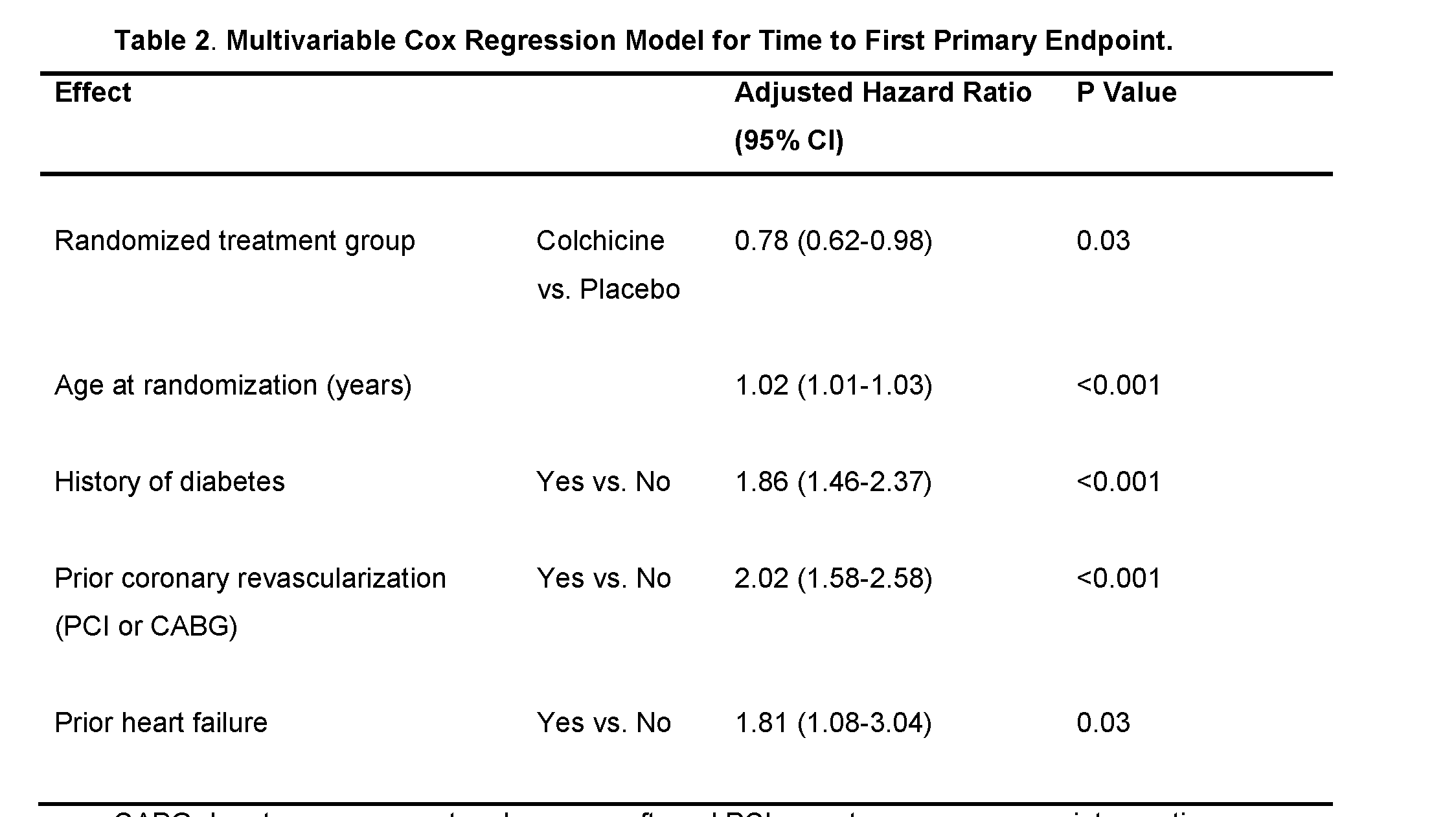
- the model was based on 4745 observations. All baseline characteristics that showed an association (P ⁇ 0.20) with the occurrence of a first positively adjudicated primary endpoint were included in the stepwise multivariable Cox regression.
- the hazard ratio is for an increase of one year of age.
- CV denotes cardiovascular, and Ml myocardial infarction.
- Table 4 shows the percentages of patients with events and the hazard ratios for the components of the primary end point, including death from cardiovascular causes (hazard ratio, 0.84; 95% Cl, 0.46to 1.52), resuscitated cardiac arrest (hazard ratio, 0.83; 95% Cl, 0.25 to 2.73), myocardial infarction (hazard ratio, 0.91; 95% Cl, 0.68 to 1.21), stroke (hazard ratio, 0.26; 95% Cl, 0.10 to 0.70), and urgent hospitalization for angina leading to coronary revascularization (hazard ratio, 0.50; 95% Cl, 0.31 to 0.81). The hazard ratios remained unchanged in the analysis that took competing events into account.
- the secondary efficacy end point consisting of a composite of death from cardiovascular causes, cardiac arrest, myocardial infarction, or stroke occurred in 4.7% of the patients in the colchicine group and in 5.5% of those in the placebo group (hazard ratio, 0.85; 95% Cl, 0.66 to 1.10).
- Data on the primary, secondary, and exploratory efficacy end points are provided in Table 4. Two patients had a first positively adjudicated event of urgent hospitalization for angina leading to coronary revascularization within 14 days after randomization. The median time to this clinical end point was 258 days.
- CABG denotes coronary artery bypass graft, Ml myocardial infarction, PCI percutaneous coronary intervention, and TIA transient ischemic attack.
- the hazard ratio for the primary endpoint was 0.70 (0.52; 0.93) in men and 0.81 (0.47; 1.41) in women in the per-protocol population.
- WLW denotes Wei-Lin-Weissfeld method.
- High-sensitivity C-reactive protein was measured in a subgroup of only 207 patients at the time of randomization and 6 months later, and the median concentration at trial entry was 4.28 mg per liter.
- the baseline characteristics of these patients were similar to those of the overall population (Table 7), but the small and selected subgroup with these data limits the interpretation of these analyses.
- the adjusted geometric mean percent changes in the high- sensitivity C-reactive protein level at 6 months after myocardial infarction were -70.0% in the colchicine group and -66.6% in the placebo group, and the placebo-adjusted geometric mean percent change was -10.1% percentage points in the colchicine group (95% Cl, -28.6 to 13.4) (Table 8).
- Table 7 Characteristics of the Trial Patients with hs-CRP data values.
- CABG denotes coronary artery bypass graft surgery, Ml myocardial infarction, PCI percutaneous coronary intervention, and TIA transient ischemic attack.
- GM denotes geometric mean, HS high-sensitivity, and IQR inter-quartile range.
- the C-reactive protein biomarker sub-study was implemented following a protocol amendment and was optional for sites and for patients; 34 sites accepted to participate in this substudy.
- Statistical analysis was conducted on the patients who provided both baseline and follow-up data and as these were exploratory analyses, no missing data was imputed.
- At least one gastrointestinal adverse event during the double-blind period occurred in 17.5% of the patients in the colchicine group, as compared with 17.6% of those in the placebo group.
- colchicine did not increase the incidence of septic shock in our trial. Infections have previously been described in patients who have attempted suicide by taking an overdose of colchicine (Kocak et al. (2008) Clin Pharm Ther 33:451-2). There was no serious adverse event of myopathy linked to colchicine despite the use of statins in 99% of the patients in the trial.
- regions in the genome that are indicative of a patient benefiting from colchicine administration after a myocardial infarction include an intergenic region for the CDRT8 (CMT1A duplicated region transcript 8) gene and PMP22 (peripheral myelin protein 22) gene on chromosome 17.
- CDRT8 CMT1A duplicated region transcript 8
- PMP22 peripheral myelin protein 22
- SAXO1 stabilizer of axonemal microtubules 1 gene on chromosome 9.
- polymorphic sites rs10811106, rs10118790, rs28733572, rs1854156, and rs10963895, intronic for the SAXO1 gene, were identified as potentially being indicative of a patient benefiting from colchicine administration.
- a genetic variant that is indicative of a patient who had a myocardial infarction benefiting from colchicine administration may be at polymorphic site rs149354567, rs75780450, rs10811106, rs10118790, rs28733572, rs1854156, or rs10963895.
- regions in the genome that are indicative of a patient suffering from a gastrointestinal disorder following colchicine administration after a myocardial infarction.
- Such regions include the intergenic region for the LINC01108 (long intergenic non-coding RNA 1108) gene and JARID2 (Jumonji and AT-rich interaction domain containing 2) gene on chromosome 6.
- polymorphic sites rs6916345, rs9476615, rs9464702, rs9370772, rs6918045, rs6459368, rs6903188, rs9476616, rs12210439, rs9358042, rs4620126, rs7747013, rs7751771 , rs7764937, rs9382993, rs6920905, rs70993041 , rs9349955, rs2327827, rs9358044, and rs857414 were identified as potentially being indicative of the patient suffering from a gastrointestinal disorder following colchicine administration after a myocardial infarction.
- regions indicative of a patient suffering from a gastrointestinal disorder following colchicine administration after a myocardial infarction include the intronic regions for the SEPHS1 (selenophosphate synthetase 1) gene and its upstream and downstream regions.
- SEPHS1 senophosphate synthetase 1
- a genetic variant that is indicative of a patient suffering from a gastrointestinal disorder following colchicine administration after a myocardial infarction may be at polymorphic site rs6916345, rs9476615, rs9464702, rs9370772, rs6918045, rs6459368, rs6903188, rs9476616, rs12210439, rs9358042, rs4620126, rs7747013, rs7751771 , rs7764937, rs9382993, rs6920905, rs70993041 , rs9349955, rs2327827, rs9358044, rs857414, rs10128117, rs535968, rs825610, rs9423893, rs10906346, rs11258319, rs2476986, rs615497, rs
- GWAS Genome-wide Association Study
- SNP rs149354567 is intergenic for the CDR8T (CMT1A duplicated region transcript 8) gene and the PMP22 (peripheral myelin protein 22) gene.
- rs149354567 a region of the genome with a genetic variant, that is associated with efficacy of colchicine in the prevention of cardiovascular events in participants recruited within 30 days of a myocardial infarction (acute coronary syndrome).
- a further region of the genome with a genetic variant, rs10811106, that, in males, is associated with efficacy of colchicine in the prevention of cardiovascular events in participants recruited within 30 days of a myocardial infarction (acute coronary syndrome) was identified using similar statistical analyses (FIG. 8).
- SNP rs10811106 is intronic in the SAXO1 (stabilizer of axonemal microtubules 1) gene (FIG. 9).
- a GWAS for COLCOT gastrointestinal disorders was performed, and a Manhattan plot of the GWAS is shown in FIG. 5.
- a plot of single-nucleotide polymorphisms (SNPs) located on chromosome 6 (from 14,149,353 to 15,149,353 bp) for gastrointestinal disorders using a survival analysis (coxph) regression with all patients in colchicine treatment arm (on-treatment pgx population) in the COLCOT cohort is shown in FIG. 6.
- SNPs single-nucleotide polymorphisms located on chromosome 10 (from 12,884,400 to 13,884,400 bp) for gastrointestinal disorders using a survival analysis (coxph) regression with all patients in colchicine treatment arm (on-treatment pgx population) in the COLCOT cohort is shown in FIG. 7.
- SNP rs6916345 Two SNPs (rs6916345 and rs10128117) were identified for further analysis (Table 20).
- SNP rs6916345 is intergenic for the LINC01108 (long intergenic non-coding RNA 1108) gene and the JARID2 (Jumonji and AT-rich interaction domain containing 2) gene.
- SNP rs10128117 in intronic in the SEPHS1 (selenophosphate synthetase 1) gene.
- SNPs on chromosome 6 associated with gastrointestinal disorders are provided in Table 23 below.
- SNPs on chromosome 10 associated with gastrointestinal disorders are provided in Table 24 below. These SNPs are either in the SEPHS1 gene, downstream or upstream of the SEPHS1 gene, or intergenic for the SEPHS1 and the PHYH (phytanoyl-CoA 2 hydroxylase) gene.
- the SNP with highest probability of being causal within the 500-kbp region was rs10811106 alone (based on FINEMAP, CAVIAR) and with rs1854156, rs10118790, and rs28733572 (based on CAVIARBF).
- CAVIARBF calculated a posterior inclusion probability of 0.50 for the rs10811106 variant.
- the majority of the variants in the region are predicted to function as modifier of the gene expression of FAM154A ( SAXO1 ), with the most credible functional variant as rs12377838 and rs7030400.
- SAXO1 FAM154A
- PhenoScanner identified rs10811106 as a modulator of the expression of genes PLIN2, HAUS6, RRAGA, and FBX07, and associated with protein levels of palmitoleoyl-protein carboxylesterase (NOTUM) and ETS homologous factor, a transcriptional activator that may play a role in regulating epithelial cell differentiation and proliferation and a possible modulator of the nuclear response to mitogen- activated protein kinase (MAPK) signaling cascades.
- MAPK mitogen- activated protein kinase
- This gene encodes a subunit of the augmin complex involved in microtubule generation from existing microtubules as well as kinetochore-microtubule attachment and central spindle formation during anaphase. These effects may interact with those of colchicine which inhibits microtubule formation by binding to tubulins.
- the SNP with highest probability of being causal within the 500-kbp region was rs6916345 based on FINEMAP.
- CAVIARBF analysis prioritized the set including rs6916345 with rs9382993 and rs6920905.
- CAVIARBF calculated a posterior inclusion probability of 0.17 for the rs6916345 variant.
- the majority of the variants in the candidate region are predicted as modifier of the pseudogene RNU6-793P expression. This gene is poorly annotated.
- HNF4a protein encoded by HNF4A which controls the expression of several genes (Table 25).
- Dysregulation of HNF4a expression has been associated with many human diseases such as ulcerative colitis, colon cancer, maturity-onset diabetes of the young, liver cirrhosis, and hepatocellular carcinoma. Polymorphisms in the HNF4A gene have been associated with diabetes and childhood-onset Crohn's disease.
- PhenoScanner identified previous associations (P ⁇ 0.001) with Crohn's disease, haematocrit, thyroid peroxidase (TPO) gene expression, and with decreased protein levels of the signaling lymphocytic activation molecule (SLAM) family member 5 and interferon gamma receptor 2.
- Table 25 predicted metabolizer phenotypes based on CYP3A4 allelic variants
- the SNP with the highest probability of being causal within the 500-kbp region was rs10128117 based on FINEMAP and CAVIAR analysis, followed by rs41291319 and rs825610 according to CAVIARBF.
- CAVIARBF calculated a posterior inclusion probability of 0.78 for the rs10128117 variant.
- candidate variants in the region are predicted as modifier of SEPHS1 gene expression through its promoter, including transcription factor binding sites. This gene encodes an enzyme that synthesizes selenophosphate from selenide and ATP.
- Two SNPs in SEPHS1 (rs17529609 and rs7901303) have previously been associated with modified selenium levels and an increase risk of developing Crohn's disease.
- Ml myocardial infarction
Landscapes
- Health & Medical Sciences (AREA)
- Chemical & Material Sciences (AREA)
- Life Sciences & Earth Sciences (AREA)
- Engineering & Computer Science (AREA)
- Organic Chemistry (AREA)
- Proteomics, Peptides & Aminoacids (AREA)
- Bioinformatics & Cheminformatics (AREA)
- General Health & Medical Sciences (AREA)
- Zoology (AREA)
- Veterinary Medicine (AREA)
- Public Health (AREA)
- Animal Behavior & Ethology (AREA)
- Wood Science & Technology (AREA)
- Pharmacology & Pharmacy (AREA)
- Analytical Chemistry (AREA)
- Medicinal Chemistry (AREA)
- Genetics & Genomics (AREA)
- Nuclear Medicine, Radiotherapy & Molecular Imaging (AREA)
- Microbiology (AREA)
- Chemical Kinetics & Catalysis (AREA)
- Heart & Thoracic Surgery (AREA)
- Cardiology (AREA)
- Physics & Mathematics (AREA)
- Biophysics (AREA)
- Biotechnology (AREA)
- Immunology (AREA)
- General Chemical & Material Sciences (AREA)
- Molecular Biology (AREA)
- Vascular Medicine (AREA)
- Urology & Nephrology (AREA)
- Biochemistry (AREA)
- General Engineering & Computer Science (AREA)
- Epidemiology (AREA)
- Pathology (AREA)
- Measuring Or Testing Involving Enzymes Or Micro-Organisms (AREA)
- Acyclic And Carbocyclic Compounds In Medicinal Compositions (AREA)
Abstract
Description




Claims
Priority Applications (3)
| Application Number | Priority Date | Filing Date | Title |
|---|---|---|---|
| US17/776,690 US12514832B2 (en) | 2019-11-15 | 2020-11-13 | Methods for using low-dose colchicine after myocardial infarction |
| EP20887173.1A EP4058595A4 (en) | 2019-11-15 | 2020-11-13 | Methods for using low-dose colchicine after myocardial infarction |
| CA3161620A CA3161620A1 (en) | 2019-11-15 | 2020-11-13 | Methods for using low-dose colchicine after myocardial infarction |
Applications Claiming Priority (2)
| Application Number | Priority Date | Filing Date | Title |
|---|---|---|---|
| US201962935751P | 2019-11-15 | 2019-11-15 | |
| US62/935,751 | 2019-11-15 |
Publications (2)
| Publication Number | Publication Date |
|---|---|
| WO2021092703A1 true WO2021092703A1 (en) | 2021-05-20 |
| WO2021092703A8 WO2021092703A8 (en) | 2021-10-21 |
Family
ID=75911326
Family Applications (1)
| Application Number | Title | Priority Date | Filing Date |
|---|---|---|---|
| PCT/CA2020/051559 Ceased WO2021092703A1 (en) | 2019-11-15 | 2020-11-13 | Methods for using low-dose colchicine after myocardial infarction |
Country Status (4)
| Country | Link |
|---|---|
| US (1) | US12514832B2 (en) |
| EP (1) | EP4058595A4 (en) |
| CA (1) | CA3161620A1 (en) |
| WO (1) | WO2021092703A1 (en) |
Family Cites Families (8)
| Publication number | Priority date | Publication date | Assignee | Title |
|---|---|---|---|---|
| EP1670445A2 (en) | 2003-09-17 | 2006-06-21 | Decode Genetics EHF. | Methods of preventing or treating recurrence of myocardial infarction |
| US7799530B2 (en) | 2005-09-23 | 2010-09-21 | Celera Corporation | Genetic polymorphisms associated with cardiovascular disorders and drug response, methods of detection and uses thereof |
| DK2155907T3 (en) * | 2007-04-30 | 2015-08-31 | Decode Genetics Ehf | Genetic variants useful for risk assessment of coronary artery disease and myocardial infarction |
| EP2878680B1 (en) * | 2008-07-09 | 2016-06-08 | Celera Corporation | Genetic polymorphisms associated with cardiovascular diseases, methods of detection and uses thereof |
| MX393493B (en) | 2012-11-02 | 2025-03-21 | Murray & Poole Entpr Ltd | TREATMENT OR PREVENTION OF CARDIOVASCULAR EVENTS. |
| AU2014255434B2 (en) | 2013-04-16 | 2018-11-08 | Murray And Poole Enterprises Limited | Sustained-release formulations of colchicine and methods of using same |
| EP3283063A1 (en) | 2015-04-17 | 2018-02-21 | Murray And Poole Enterprises Limited | Colchicine salicylate and uses thereof |
| CA3099143A1 (en) | 2019-11-15 | 2021-01-26 | Institut De Cardiologie De Montreal | Early administration of low-dose colchicine after myocardial infarction |
-
2020
- 2020-11-13 CA CA3161620A patent/CA3161620A1/en active Pending
- 2020-11-13 EP EP20887173.1A patent/EP4058595A4/en active Pending
- 2020-11-13 US US17/776,690 patent/US12514832B2/en active Active
- 2020-11-13 WO PCT/CA2020/051559 patent/WO2021092703A1/en not_active Ceased
Non-Patent Citations (7)
| Title |
|---|
| ANONYMOUS: "Colchicine Cardiovascular Outcomes Trial (COLCOT)", 12 October 2019 (2019-10-12), XP055924906, Retrieved from the Internet <URL:https://clinicaltrials.gov/ct2/history/NCT02551094?V_8=View#StudyPageTop> [retrieved on 20210113] * |
| FUJISUE ET AL.: "Colchicine improves survival, left ventricular remodeling, and chronic cardiac function after acute myocardial infarction", CIRCULATION JOURNAL, vol. 81, August 2017 (2017-08-01), pages 1174 - 1182, XP055820929, ISSN: 1346-9843 * |
| PATRICE WENDLING: "The Earlier the better for Colchicine post-MI: COLCOT", 8 September 2020 (2020-09-08), pages 1 - 3, XP009536461, Retrieved from the Internet <URL:https://www.medscape.com/viewarticle/937041> [retrieved on 20210111] * |
| RUSTEMOGLU ET AL.: "MDRl gene polymorphisms may be associated with Behçet's disease and its colchicum treatment response", GENE, vol. 505, June 2012 (2012-06-01), pages 333 - 339, XP028930444, DOI: 10.1016/j. gene . 2012.05.04 0 * |
| See also references of EP4058595A4 * |
| TARDIF ET AL.: "Efficacy and safety of low-dose Colchicine after Myocardial Infarction", NEW ENGLAND JOURNAL OF MEDICINE, vol. 381, no. 26, December 2019 (2019-12-01), pages 2497 - 2505, XP055689308, DOI: 10.1056/NEJMoa1912388 * |
| TUFAN ET AL.: "Association of drug transporter gene ABCB1 (MDR1) 3435C to T polymorphism with Colchicine response in Familial Mediterranean Fever", THE JOURNAL OF RHEUMATOLOGY, vol. 34, no. 7, July 2007 (2007-07-01), pages 1540 - 1544, XP055820934 * |
Also Published As
| Publication number | Publication date |
|---|---|
| US20220401388A1 (en) | 2022-12-22 |
| EP4058595A1 (en) | 2022-09-21 |
| EP4058595A4 (en) | 2023-12-06 |
| WO2021092703A8 (en) | 2021-10-21 |
| CA3161620A1 (en) | 2021-05-20 |
| US12514832B2 (en) | 2026-01-06 |
Similar Documents
| Publication | Publication Date | Title |
|---|---|---|
| CN103333952B (en) | Genetic polymorphism in the macular degeneration that age is correlated with | |
| US10711303B2 (en) | CETP inhibitors for therapeutic use | |
| JP6854752B2 (en) | Genetic markers for predicting responsiveness to treatment with HDL-elevating agents or HDL mimetics | |
| AU2010310804B2 (en) | Genetic polymorphisms in age-related macular degeneration | |
| JP2019503176A (en) | Method for predicting response to treatment | |
| US20210348235A1 (en) | Genetic markers associated with response to crth2 receptor antagonists | |
| US12514832B2 (en) | Methods for using low-dose colchicine after myocardial infarction | |
| US20160230231A1 (en) | Genotyping tests and methods for evaluating plasma creatine kinase levels | |
| MXPA06014127A (en) | Biomarkers for the prediction of responsiveness to clozapine treatment. | |
| US8080374B2 (en) | Methods of diagnosing cardiovascular disease | |
| WO2005117859A2 (en) | Methods of diagnosing cardiovascular disease | |
| BRPI0914368B1 (en) | METHOD FOR PREDICTING WHETHER A PATIENT WITH WET AGE-RELATED MACULAR DEGENERATION (AMD) HAS A GREATER LIKELIHOOD OF BENEFITING FROM TREATMENT WITH AN ANTI-VEGF ANTIBODY AND METHOD FOR PREDICTING WHETHER AN INDIVIDUAL HAS A GREATER LIKELIHOOD OF DEVELOPING WET AMD OR DRY AMD WITH GEOGRAPHIC ATROPHY (GA) | |
| HK1173751B (en) | Genetic polymorphisms in age-related macular degeneration | |
| WO2008052115A1 (en) | Materials and methods for predicting physiological responses to cardiovascular drugs | |
| HK1173192A (en) | Genetic polymorphisms in age-related macular degeneration | |
| HK1173192B (en) | Genetic polymorphisms in age-related macular degeneration |
Legal Events
| Date | Code | Title | Description |
|---|---|---|---|
| 121 | Ep: the epo has been informed by wipo that ep was designated in this application |
Ref document number: 20887173 Country of ref document: EP Kind code of ref document: A1 |
|
| ENP | Entry into the national phase |
Ref document number: 3161620 Country of ref document: CA |
|
| NENP | Non-entry into the national phase |
Ref country code: DE |
|
| ENP | Entry into the national phase |
Ref document number: 2020887173 Country of ref document: EP Effective date: 20220615 |
|
| WWG | Wipo information: grant in national office |
Ref document number: 17776690 Country of ref document: US |