WO2021095394A1 - 全固体リチウムイオン電池用正極活物質、全固体リチウムイオン電池用正極、全固体リチウムイオン電池及び全固体リチウムイオン電池用正極活物質の製造方法 - Google Patents
全固体リチウムイオン電池用正極活物質、全固体リチウムイオン電池用正極、全固体リチウムイオン電池及び全固体リチウムイオン電池用正極活物質の製造方法 Download PDFInfo
- Publication number
- WO2021095394A1 WO2021095394A1 PCT/JP2020/037480 JP2020037480W WO2021095394A1 WO 2021095394 A1 WO2021095394 A1 WO 2021095394A1 JP 2020037480 W JP2020037480 W JP 2020037480W WO 2021095394 A1 WO2021095394 A1 WO 2021095394A1
- Authority
- WO
- WIPO (PCT)
- Prior art keywords
- positive electrode
- electrode active
- active material
- solid
- state lithium
- Prior art date
- Legal status (The legal status is an assumption and is not a legal conclusion. Google has not performed a legal analysis and makes no representation as to the accuracy of the status listed.)
- Ceased
Links
Classifications
-
- H—ELECTRICITY
- H01—ELECTRIC ELEMENTS
- H01M—PROCESSES OR MEANS, e.g. BATTERIES, FOR THE DIRECT CONVERSION OF CHEMICAL ENERGY INTO ELECTRICAL ENERGY
- H01M4/00—Electrodes
- H01M4/02—Electrodes composed of, or comprising, active material
- H01M4/36—Selection of substances as active materials, active masses, active liquids
- H01M4/48—Selection of substances as active materials, active masses, active liquids of inorganic oxides or hydroxides
- H01M4/50—Selection of substances as active materials, active masses, active liquids of inorganic oxides or hydroxides of manganese
- H01M4/505—Selection of substances as active materials, active masses, active liquids of inorganic oxides or hydroxides of manganese of mixed oxides or hydroxides containing manganese for inserting or intercalating light metals, e.g. LiMn2O4 or LiMn2OxFy
-
- C—CHEMISTRY; METALLURGY
- C01—INORGANIC CHEMISTRY
- C01G—COMPOUNDS CONTAINING METALS NOT COVERED BY SUBCLASSES C01D OR C01F
- C01G53/00—Compounds of nickel
- C01G53/40—Complex oxides containing nickel and at least one other metal element
- C01G53/42—Complex oxides containing nickel and at least one other metal element containing alkali metals, e.g. LiNiO2
-
- C—CHEMISTRY; METALLURGY
- C01—INORGANIC CHEMISTRY
- C01G—COMPOUNDS CONTAINING METALS NOT COVERED BY SUBCLASSES C01D OR C01F
- C01G53/00—Compounds of nickel
- C01G53/40—Complex oxides containing nickel and at least one other metal element
- C01G53/42—Complex oxides containing nickel and at least one other metal element containing alkali metals, e.g. LiNiO2
- C01G53/44—Complex oxides containing nickel and at least one other metal element containing alkali metals, e.g. LiNiO2 containing manganese
- C01G53/50—Complex oxides containing nickel and at least one other metal element containing alkali metals, e.g. LiNiO2 containing manganese of the type (MnO2)n-, e.g. Li(NixMn1-x)O2 or Li(MyNixMn1-x-y)O2
-
- H—ELECTRICITY
- H01—ELECTRIC ELEMENTS
- H01M—PROCESSES OR MEANS, e.g. BATTERIES, FOR THE DIRECT CONVERSION OF CHEMICAL ENERGY INTO ELECTRICAL ENERGY
- H01M10/00—Secondary cells; Manufacture thereof
- H01M10/05—Accumulators with non-aqueous electrolyte
- H01M10/052—Li-accumulators
-
- H—ELECTRICITY
- H01—ELECTRIC ELEMENTS
- H01M—PROCESSES OR MEANS, e.g. BATTERIES, FOR THE DIRECT CONVERSION OF CHEMICAL ENERGY INTO ELECTRICAL ENERGY
- H01M10/00—Secondary cells; Manufacture thereof
- H01M10/05—Accumulators with non-aqueous electrolyte
- H01M10/052—Li-accumulators
- H01M10/0525—Rocking-chair batteries, i.e. batteries with lithium insertion or intercalation in both electrodes; Lithium-ion batteries
-
- H—ELECTRICITY
- H01—ELECTRIC ELEMENTS
- H01M—PROCESSES OR MEANS, e.g. BATTERIES, FOR THE DIRECT CONVERSION OF CHEMICAL ENERGY INTO ELECTRICAL ENERGY
- H01M4/00—Electrodes
- H01M4/02—Electrodes composed of, or comprising, active material
- H01M4/13—Electrodes for accumulators with non-aqueous electrolyte, e.g. for lithium-accumulators; Processes of manufacture thereof
- H01M4/131—Electrodes based on mixed oxides or hydroxides, or on mixtures of oxides or hydroxides, e.g. LiCoOx
-
- H—ELECTRICITY
- H01—ELECTRIC ELEMENTS
- H01M—PROCESSES OR MEANS, e.g. BATTERIES, FOR THE DIRECT CONVERSION OF CHEMICAL ENERGY INTO ELECTRICAL ENERGY
- H01M4/00—Electrodes
- H01M4/02—Electrodes composed of, or comprising, active material
- H01M4/36—Selection of substances as active materials, active masses, active liquids
- H01M4/362—Composites
- H01M4/366—Composites as layered products
-
- H—ELECTRICITY
- H01—ELECTRIC ELEMENTS
- H01M—PROCESSES OR MEANS, e.g. BATTERIES, FOR THE DIRECT CONVERSION OF CHEMICAL ENERGY INTO ELECTRICAL ENERGY
- H01M4/00—Electrodes
- H01M4/02—Electrodes composed of, or comprising, active material
- H01M4/36—Selection of substances as active materials, active masses, active liquids
- H01M4/48—Selection of substances as active materials, active masses, active liquids of inorganic oxides or hydroxides
- H01M4/52—Selection of substances as active materials, active masses, active liquids of inorganic oxides or hydroxides of nickel, cobalt or iron
- H01M4/525—Selection of substances as active materials, active masses, active liquids of inorganic oxides or hydroxides of nickel, cobalt or iron of mixed oxides or hydroxides containing iron, cobalt or nickel for inserting or intercalating light metals, e.g. LiNiO2, LiCoO2 or LiCoOxFy
-
- H—ELECTRICITY
- H01—ELECTRIC ELEMENTS
- H01M—PROCESSES OR MEANS, e.g. BATTERIES, FOR THE DIRECT CONVERSION OF CHEMICAL ENERGY INTO ELECTRICAL ENERGY
- H01M4/00—Electrodes
- H01M4/02—Electrodes composed of, or comprising, active material
- H01M4/62—Selection of inactive substances as ingredients for active masses, e.g. binders, fillers
-
- C—CHEMISTRY; METALLURGY
- C01—INORGANIC CHEMISTRY
- C01P—INDEXING SCHEME RELATING TO STRUCTURAL AND PHYSICAL ASPECTS OF SOLID INORGANIC COMPOUNDS
- C01P2002/00—Crystal-structural characteristics
- C01P2002/50—Solid solutions
- C01P2002/52—Solid solutions containing elements as dopants
-
- C—CHEMISTRY; METALLURGY
- C01—INORGANIC CHEMISTRY
- C01P—INDEXING SCHEME RELATING TO STRUCTURAL AND PHYSICAL ASPECTS OF SOLID INORGANIC COMPOUNDS
- C01P2004/00—Particle morphology
- C01P2004/60—Particles characterised by their size
- C01P2004/61—Micrometer sized, i.e. from 1-100 micrometer
-
- C—CHEMISTRY; METALLURGY
- C01—INORGANIC CHEMISTRY
- C01P—INDEXING SCHEME RELATING TO STRUCTURAL AND PHYSICAL ASPECTS OF SOLID INORGANIC COMPOUNDS
- C01P2004/00—Particle morphology
- C01P2004/80—Particles consisting of a mixture of two or more inorganic phases
- C01P2004/82—Particles consisting of a mixture of two or more inorganic phases two phases having the same anion, e.g. both oxidic phases
- C01P2004/84—Particles consisting of a mixture of two or more inorganic phases two phases having the same anion, e.g. both oxidic phases one phase coated with the other
-
- C—CHEMISTRY; METALLURGY
- C01—INORGANIC CHEMISTRY
- C01P—INDEXING SCHEME RELATING TO STRUCTURAL AND PHYSICAL ASPECTS OF SOLID INORGANIC COMPOUNDS
- C01P2006/00—Physical properties of inorganic compounds
- C01P2006/14—Pore volume
-
- H—ELECTRICITY
- H01—ELECTRIC ELEMENTS
- H01M—PROCESSES OR MEANS, e.g. BATTERIES, FOR THE DIRECT CONVERSION OF CHEMICAL ENERGY INTO ELECTRICAL ENERGY
- H01M10/00—Secondary cells; Manufacture thereof
- H01M10/05—Accumulators with non-aqueous electrolyte
- H01M10/056—Accumulators with non-aqueous electrolyte characterised by the materials used as electrolytes, e.g. mixed inorganic/organic electrolytes
- H01M10/0561—Accumulators with non-aqueous electrolyte characterised by the materials used as electrolytes, e.g. mixed inorganic/organic electrolytes the electrolyte being constituted of inorganic materials only
- H01M10/0562—Solid materials
-
- H—ELECTRICITY
- H01—ELECTRIC ELEMENTS
- H01M—PROCESSES OR MEANS, e.g. BATTERIES, FOR THE DIRECT CONVERSION OF CHEMICAL ENERGY INTO ELECTRICAL ENERGY
- H01M4/00—Electrodes
- H01M4/02—Electrodes composed of, or comprising, active material
- H01M2004/026—Electrodes composed of, or comprising, active material characterised by the polarity
- H01M2004/028—Positive electrodes
-
- Y—GENERAL TAGGING OF NEW TECHNOLOGICAL DEVELOPMENTS; GENERAL TAGGING OF CROSS-SECTIONAL TECHNOLOGIES SPANNING OVER SEVERAL SECTIONS OF THE IPC; TECHNICAL SUBJECTS COVERED BY FORMER USPC CROSS-REFERENCE ART COLLECTIONS [XRACs] AND DIGESTS
- Y02—TECHNOLOGIES OR APPLICATIONS FOR MITIGATION OR ADAPTATION AGAINST CLIMATE CHANGE
- Y02E—REDUCTION OF GREENHOUSE GAS [GHG] EMISSIONS, RELATED TO ENERGY GENERATION, TRANSMISSION OR DISTRIBUTION
- Y02E60/00—Enabling technologies; Technologies with a potential or indirect contribution to GHG emissions mitigation
- Y02E60/10—Energy storage using batteries
Definitions
- the present invention relates to a method for producing a positive electrode active material for an all-solid-state lithium-ion battery, a positive electrode for an all-solid-state lithium-ion battery, an all-solid-state lithium-ion battery, and a positive electrode active material for an all-solid-state lithium-ion battery.
- lithium batteries are attracting attention from the viewpoint of high energy density. Further, high energy density and improvement of battery characteristics are also required for lithium secondary batteries in large-scale applications such as power sources for automobiles and road leveling.
- the positive electrode active material of the non-aqueous electrolyte secondary battery includes lithium cobalt composite oxide represented by lithium cobalt oxide (LiCoO 2 ) and lithium nickel composite oxide represented by lithium nickel oxide (LiNiO 2). Lithium-manganese composite oxides such as lithium manganate (LimnO 2) are widely used.
- lithium cobalt oxide has a problem that it is expensive because the reserves of cobalt are small, and contains cobalt as a main component, which has unstable supply and large price fluctuations. Therefore, a lithium nickel composite oxide or a lithium manganese composite oxide containing relatively inexpensive nickel or manganese as a main component is attracting attention from the viewpoint of cost.
- lithium manganate is superior to lithium cobalt oxide in thermal stability, its charge / discharge capacity is much smaller than that of other materials, and its charge / discharge cycle characteristics indicating its life are also very short.
- lithium nickel oxide is expected to be a positive electrode active material capable of producing a battery having a high energy density at low cost because it exhibits a larger charge / discharge capacity than lithium cobalt oxide.
- An all-solid-state battery that does not use a non-aqueous electrolyte solution that may ignite, leak, or explode may improve safety, but a high resistance layer may be formed at the interface between the solid electrolyte and the positive electrode active material in the positive electrode layer. Yes, the battery performance may deteriorate.
- Patent Document 1 describes a positive electrode active material particle in which the concentration of Al is higher outside the particle than inside the particle. According to such a configuration, the formation of a high resistance layer at the interface between the positive electrode active material for the all-solid-state lithium-ion battery and the sulfide-based solid electrolyte is suppressed, and the internal impedance of the all-solid-state lithium-ion battery is reduced. can do.
- the electrode density of the all-solid-state lithium-ion battery cannot be sufficiently obtained by simply increasing the concentration of Al outside the particles rather than inside the particles, and the volume is increased. Sufficient energy density cannot be obtained.
- Patent Document 1 describes that an Al surface segregation layer (self-forming buffer layer) is formed for a primary particle type LCO (lithium cobalt composite oxide), but a secondary particle type NCM. (Lithium nickel cobalt manganese composite oxide) is not described.
- NCM Lithium nickel cobalt manganese composite oxide
- NCM when Al is added at the precursor production stage as in the examples described in Patent Document 1, Al is uniformly present in the particles and the surface segregation layer is not formed.
- the High—Ni composition NCM there is no example in which the High—Ni composition NCM is used in the technique described in Patent Document 1.
- NCA lithium nickel cobalt aluminum composite oxide
- the Al surface segregation layer is not described.
- an embodiment of the present invention provides a positive electrode active material for an all-solid-state lithium-ion battery in which the electrode density of the positive electrode is improved and excellent volumetric energy density and output characteristics can be obtained when used in an all-solid-state lithium-ion battery. That is the issue.
- the positive electrode active material for an all-solid-state lithium-ion battery according to another embodiment of the present invention has an average particle size (D50) of the positive electrode active material (1) with respect to the average particle size (D50) of the positive electrode active material (2).
- the ratio of is 2 to 6.
- the present invention is a positive electrode for an all-solid-state lithium-ion battery provided with the positive electrode active material for the all-solid-state lithium-ion battery of the present invention.
- the present invention is an all-solid-state lithium-ion battery provided with the positive electrode for the all-solid-state lithium-ion battery of the present invention.
- the above-mentioned additive is added in a step of dispersing Al 2 O 3 in pure water to prepare an additive slurry and in a medium in which nickel cobalt manganese hydroxide is charged into pure water.
- This is a method for producing a positive electrode active material for an all-solid lithium-ion battery of the present invention, which comprises a step of firing at about 800 ° C.
- the volume-based average particle size D50 when Al 2 O 3 is viewed as a powder is 0.05 to 0. It is 7 ⁇ m.
- a positive electrode active material for an all-solid-state lithium-ion battery in which the electrode density of the positive electrode is improved and excellent volumetric energy density and output characteristics can be obtained when used in an all-solid-state lithium-ion battery. be able to.
- the present invention is concerned. There is a risk that the discharge capacity of the all-solid-state lithium-ion battery manufactured using the positive electrode active material will be low.
- the positive electrode active material for an all-solid-state lithium-ion battery according to the embodiment of the present invention has an Al concentration C c at the center of the particle and an Al concentration C s at a depth of 10 nm from the particle surface in the particle cross section.
- C s / C c 2 to 10.
- the concentration C s of Al at a depth of 10 nm from the particle surface in the particle cross section is the concentration C c of Al in the center of the particle. Greater.
- the positive electrode active material for an all-solid-state lithium-ion battery according to the embodiment of the present invention has an intraparticle porosity of less than 30%. According to such a configuration, when used for a positive electrode for an all-solid-state lithium-ion battery, the filling amount of the positive electrode active material is improved, so that the electrode density is improved.
- the positive electrode active material for an all-solid-state lithium-ion battery according to the embodiment of the present invention may control the porosity in the particles to less than 25% or less than 20%.
- the positive electrode active material for an all-solid-state lithium-ion battery has a positive electrode active material (1) having an average particle size (D50) of 6 to 15 ⁇ m and an average particle size (D50) of 1 to 5 ⁇ m. It is made by mixing with the positive electrode active material (2). According to such a configuration, by mixing the particles having a small average particle diameter (D50) and the particles having a large average particle diameter (D50), the interparticle voids become small and the filling amount of the positive electrode active material is improved.
- D50 average particle size
- D50 average particle size
- the positive electrode active material for an all-solid-state lithium-ion battery according to the embodiment of the present invention is a High—Ni composition NCM having small interparticle voids and an Al surface segregation layer, and has a small average particle diameter (D50). By mixing the particles and large particles, an all-solid-state battery having excellent volumetric energy density and output characteristics can be obtained.
- the ratio of the average particle size (D50) of the positive electrode active material (1) to the average particle size (D50) of the positive electrode active material (2) is 2 to 2. It is preferably 6. Since the ratio of the average particle size (D50) of the positive electrode active material (1) to the average particle size (D50) of the positive electrode active material (2) is 2 or more, the voids between the positive electrode active materials are easily filled and the electrode density is increased. improves. Since the ratio of the average particle size (D50) of the positive electrode active material (1) to the average particle size (D50) of the positive electrode active material (2) is 6 or less, the small particles required to fill the voids between the positive electrode active materials.
- the ratio of the positive electrode active material (2) can be reduced, and a decrease in electrode density can be prevented.
- the ratio of the average particle size (D50) of the positive electrode active material (1) to the average particle size (D50) of the positive electrode active material (2) is 3 to 3. It is more preferably 5.
- Al 2 O 3 is dispersed in pure water so as to be 10 to 204 g / L to prepare an additive slurry.
- the volume-based average particle size D50 when Al 2 O 3 is viewed as a powder is 0.05 to 0.7 ⁇ m.
- the volume-based average particle size D50 when Al 2 O 3 is viewed as a powder is 0.05 ⁇ m or more, the occurrence of aggregation can be suppressed when dispersed in pure water.
- the volume-based average particle size D50 when Al 2 O 3 is viewed as a powder is 0.7 ⁇ m or less, the precursor surface can be uniformly dispersed.
- the volume-based average particle size D50 when Al 2 O 3 is viewed as a powder is preferably 0.1 to 0.7 ⁇ m, more preferably 0.1 to 0.5 ⁇ m, and 0. Even more preferably, it is 1 to 0.3 ⁇ m.
- the composition formula: in Ni b Co c Mn d (OH ) 2 ( wherein, 0.8 ⁇ b ⁇ 0.9,0 ⁇ c ⁇ 0.2,0 ⁇ d ⁇ 0.2, b + c + d 1
- the surface of the nickel-cobalt-manganese hydroxide is treated by adding the above-mentioned additive slurry to a medium in which the nickel-cobalt-manganese hydroxide represented by (a) is put into pure water and stirring and dispersing it. In this way, a surface-treated slurry is produced.
- the surface treatment is performed with an additive slurry in which Al 2 O 3 is dispersed in pure water so that Al / (Ni + Mn + Co) is 2 to 15 mol% in the surface-treated slurry.
- the above-mentioned surface-treated slurry is dried to obtain a surface-treated precursor.
- a lithium source such as lithium hydroxide is added to the surface treatment precursor and calcined at 650 to 800 ° C.
- the firing atmosphere is preferably an oxygen atmosphere.
- the positive electrode active material (1) having an average particle size (D50) of 6 to 15 ⁇ m and the positive electrode active material (2) having an average particle size (D50) of 1 to 5 ⁇ m have the average particle size (D50) of the precursor. It can be produced by setting the thickness to 6 to 15 ⁇ m and 1 to 5 ⁇ m, respectively. Then, by mixing these, the positive electrode active material for an all-solid-state lithium-ion battery according to the embodiment of the present invention can be produced.
- a transition metal aqueous solution, a caustic soda aqueous solution, and an ammonia aqueous solution in which nickel sulfate, cobalt sulfate, and manganese sulfate are dissolved are prepared, and these are put into one reaction vessel or a reaction vessel in a reaction apparatus.
- Nickel Cobalt Manganese Hydroxide (precursor) particles are included in the slurry.
- the reaction may be carried out while circulating with the cross-flow filtration device.
- the precursor preparation conditions are adjusted to prepare two types of precursors having an average particle size (D50) of 6 to 15 ⁇ m and 1 to 5 ⁇ m.
- the particle size of the precursor becomes the particle size of the positive electrode active material after firing almost as it is.
- the method for obtaining these precursor powders is not particularly determined, and can be achieved by selecting production conditions suitable for the above from known crystallization methods.
- the nickel cobalt manganese hydroxide is surface-treated with Al 2 O 3 and then fired together with a lithium source to segregate the Al surface in the secondary particle type nickel cobalt manganese composite oxide.
- a layer self-forming buffer layer
- the porosity in the particles can be controlled to less than 30% by adjusting the precursor preparation conditions, for example, the pH at the time of reaction, the amount of ammonia added, and the reaction time.
- An all-solid-state lithium-ion battery equipped with positive electrode active material for all-solid-state lithium-ion battery An all-solid-state lithium having a positive electrode layer (positive electrode for an all-solid-state lithium-ion battery) formed by using the positive electrode active material for an all-solid-state lithium-ion battery according to an embodiment of the present invention, and having a solid electrolyte layer, the positive electrode layer, and a negative electrode layer
- An ion battery can be manufactured.
- Example 1 ⁇ Preparation of large particle (large particle size) positive electrode active material> Al 2 O 3 was dispersed in pure water so as to be 102 g / L to prepare an additive slurry.
- the volume-based average particle size D50 when Al 2 O 3 was viewed as a powder was 0.3 ⁇ m.
- the above-mentioned additive was put into a medium in which nickel cobalt manganese hydroxide represented by the composition formula: Ni 82 Co 15 Mn 3 (OH) 2 and having an average particle diameter (D50) of about 10 ⁇ m was put into pure water.
- the surface of nickel-cobalt-manganese hydroxide was treated by adding a slurry and stirring and dispersing.
- a surface-treated slurry was prepared.
- the surface treatment was performed with an additive slurry in which Al 2 O 3 was dispersed in pure water so that Al / (Ni + Mn + Co) was 5 mol% in the surface-treated slurry.
- the above-mentioned surface-treated slurry was dried to obtain a surface-treated precursor.
- lithium hydroxide was added to the surface treatment precursor and calcined at 740 ° C. for 12 hours in an oxygen atmosphere to obtain a positive electrode active material (1).
- Ni 82 Co 15 Mn 3 (OH) 2 is represented by, and the above-mentioned additive slurry is added to a medium in which nickel cobalt manganese hydroxide having an average particle size (D50) of about 3 ⁇ m is put into pure water.
- the surface of nickel-cobalt-manganese hydroxide was treated by stirring and dispersing. In this way, a surface-treated slurry was prepared.
- the surface treatment was performed with an additive slurry in which Al 2 O 3 was dispersed in pure water so that Al / (Ni + Mn + Co) was 5 mol% in the surface-treated slurry. Then, the above-mentioned surface-treated slurry was dried to obtain a surface-treated precursor. Next, lithium hydroxide was added to the above-mentioned surface treatment precursor and calcined at 720 ° C. for 12 hours in an oxygen atmosphere to obtain a positive electrode active material (2).
- the positive electrode active material (1) and the positive electrode active material (2) thus prepared were mixed so as to have the mass ratios shown in Table 2 to obtain the positive electrode active material according to Example 1.
- Example 2 The positive electrode active material is the same as in Example 1 except that the surface-treated slurry is surface-treated with an additive slurry in which Al 2 O 3 is dispersed in pure water so that Al / (Ni + Mn + Co) is 2 mol%. Was produced.
- Example 3 The positive electrode active material is the same as in Example 1 except that the surface-treated slurry is surface-treated with an additive slurry in which Al 2 O 3 is dispersed in pure water so that Al / (Ni + Mn + Co) is 15 mol%. Was produced.
- Example 4 As the positive electrode active material (1), those having an average particle diameter (D50) of about 13 ⁇ m and about 6 ⁇ m of the precursor were used, and the mixed weight ratio of the positive electrode active materials (1) and (2) is shown in Table 2.
- a positive electrode active material was prepared in the same manner as in Example 1 except that the mixture was mixed so as to have a ratio.
- Example 6 As the positive electrode active material (2), a precursor having an average particle size (D50) of about 5 ⁇ m is used, and the particle size ratios of the positive electrode active materials (1) and (2) are set to the values shown in Table 2. A positive electrode active material was prepared in the same manner as in Example 1 except that.
- Example 7 For the positive electrode active materials (1) and (2), those having an average particle size (D50) of the precursor of about 6 ⁇ m and about 1 ⁇ m are used, respectively, and the particle size ratios of the positive electrode active materials (1) and (2) are shown in the table.
- a positive electrode active material was prepared in the same manner as in Example 1 except that the values were set to the values described in 2.
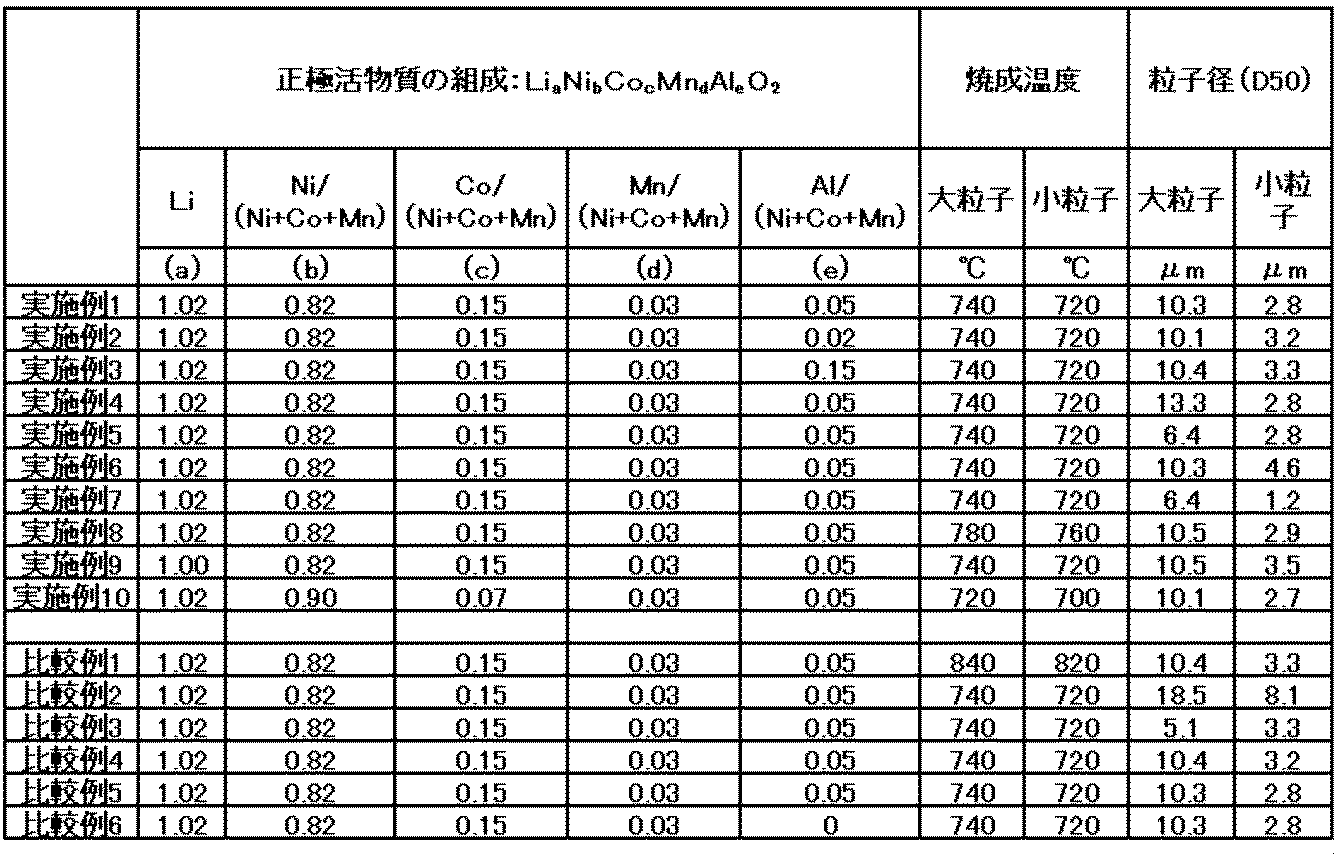
- Example 8 The positive electrode active material was prepared in the same manner as in Example 1 except that the firing temperature of the large particle positive electrode active material (1) and the firing temperature of the small particle positive electrode active material (2) were set to the temperatures shown in Table 1. Made.
- Example 9 A positive electrode active material was prepared in the same manner as in Example 1 except that the amount of lithium hydroxide added to the surface treatment precursor was reduced.
- Example 10 Composition formula: Using nickel cobalt manganese hydroxide represented by Ni 90 Co 7 Mn 3 (OH) 2 , the firing temperature of the large particle positive electrode active material (1) and the small particle positive electrode active material (2).
- the positive electrode active material was prepared in the same manner as in Example 1 except that the firing temperature of the above was set to the temperature shown in Table 1.
- Example 1 The positive electrode active material was prepared in the same manner as in Example 1 except that the firing temperature of the large particle positive electrode active material (1) and the firing temperature of the small particle positive electrode active material (2) were set to the temperatures shown in Table 1. Made.
- Comparative Example 2 For the positive electrode active materials (1) and (2), those having an average particle size (D50) of the precursor of about 18 ⁇ m and about 8 ⁇ m are used, respectively, and the particle size ratios of the positive electrode active materials (1) and (2) are shown in the table.
- a positive electrode active material was prepared in the same manner as in Example 1 except that the values were set to the values described in 2.
- Example 3 For the positive electrode active materials (1) and (2), those having an average particle size (D50) of the precursors of about 5 ⁇ m and about 3 ⁇ m, respectively, were used, and the particle size ratios of the positive electrode active materials (1) and (2) were mixed.
- a positive electrode active material was prepared in the same manner as in Example 1 except that the weight ratio was set to the value shown in Table 2.
- a positive electrode active material was prepared in the same manner as in Example 1 except that the positive electrode active materials (1) and (2) had a porosity in the particles of about 30% for each of the precursors.
- the porosity in the precursor particles can be increased by adjusting the precursor preparation conditions, for example, increasing the pH during the reaction, reducing the amount of ammonia added, and shortening the reaction time.
- Example 5 A positive electrode active material was prepared in the same manner as in Example 1 except that the positive electrode active material (1) and the positive electrode active material (2) were mixed so as to have the mass ratios shown in Table 2.
- Example 6 A positive electrode active material was prepared in the same manner as in Example 1 except that the nickel cobalt manganese hydroxide was not surface-treated with Al.
- the contents of Li, Ni, Co, Mn, and Al of the positive electrode active material were measured by an inductively coupled plasma emission spectrophotometer (ICP-OES) and an ion chromatograph method. From the analysis results, determined the positive electrode active material Li a Ni b Co c Mn d Al a when e expressed in metal composition, b, c, d, and e.
- ICP-OES inductively coupled plasma emission spectrophotometer
- the Al concentration C c at the center of the particle and the Al concentration C s at a depth of 10 nm from the particle surface were measured as follows. First, line analysis of particle cross sections was performed with a STEM-EDX analyzer. The concentration of Al (atm%) is calculated from the analysis result, and the difference in concentration of Al between the center of the diameter (any one point 100 nm or more inside the particle surface) and the depth of 10 nm from the particle surface is calculated as follows. The concentration of Al at a depth of 10 nm from the particle surface) / (concentration of Al at the center of the diameter) was calculated.
- the average particle size D50 of the positive electrode active material was measured by MT3300EXII manufactured by Microtrac.
- the particles of the positive electrode active material were cut by argon sputtering using a cross section polisher (CP) to expose the particle cross section.
- the exposed particle cross section is observed using a scanning electron microscope, and the image of the observed particle cross section is analyzed by image analysis software with the voids of the image as black and the dense parts as white, and any 20
- the void ratio was obtained by calculating the area of the black portion / (black portion + white portion) with respect to the cross section of one or more particles.
- the all-solid-state battery cell was manufactured in a glove box under an argon atmosphere.
- the total amount of the positive electrode active materials obtained in Examples 1 to 10 and Comparative Examples 1 to 6, the sulfide solid electrolyte material Li 3 PS 4, and the acetylene black so as to have a mass ratio of 72:25: 3. Weighed about 3 g and mixed in a mortar to prepare a mixture.
- an appropriate amount of electrolyte was put into a jig and pressed, and an appropriate amount of the above-mentioned mixture was put into the jig and pressed. After pressing, the upper part was fixed and inverted, and the lower punch of the jig was removed.
- Discharge capacity 1 Charge: 3.7V, 0.1C CCCV, Discharge: 0.05C, 2.5V termination Discharge capacity 2 Charge: 3.7V, 0.1C CCCV, Discharge: 1C, 2.5V termination Output characteristics are The ratio (maintenance rate) of the discharge capacity 2 to the discharge capacity 1 was used.
- Tables 1 and 2 show the test conditions and evaluation results according to Examples 1 to 10 and Comparative Examples 1 to 6.
Landscapes
- Chemical & Material Sciences (AREA)
- Chemical Kinetics & Catalysis (AREA)
- Electrochemistry (AREA)
- General Chemical & Material Sciences (AREA)
- Engineering & Computer Science (AREA)
- Inorganic Chemistry (AREA)
- Materials Engineering (AREA)
- Organic Chemistry (AREA)
- Manufacturing & Machinery (AREA)
- Composite Materials (AREA)
- Battery Electrode And Active Subsutance (AREA)
- Inorganic Compounds Of Heavy Metals (AREA)
- Secondary Cells (AREA)
- Physics & Mathematics (AREA)
- Condensed Matter Physics & Semiconductors (AREA)
- General Physics & Mathematics (AREA)
Abstract
全固体リチウムイオン電池に用いたとき、正極の電極密度が向上し、優れた体積エネルギー密度及び出力特性が得られる全固体リチウムイオン電池用正極活物質を提供する。組成式がLiaNibCocMndAleO2(式中、1.00≦a≦1.02、0.8≦b≦0.9、0<c≦0.2、0<d≦0.2、b+c+d=1、0.02≦e≦0.15である)で表され、粒子断面において、粒子中心部のAlの濃度Cc、及び、粒子表面から深さ10nmの位置におけるAlの濃度Csについて、Cs/Cc=2~10であり、粒子内空隙率が30%未満であり、平均粒子径(D50)が6~15μmである正極活物質(1)と、平均粒子径(D50)が1~5μmである正極活物質(2)とを混合してなる全固体リチウムイオン電池用正極活物質。
Description
本発明は、全固体リチウムイオン電池用正極活物質、全固体リチウムイオン電池用正極、全固体リチウムイオン電池及び全固体リチウムイオン電池用正極活物質の製造方法に関する。
近年におけるパソコン、ビデオカメラ、及び携帯電話等の情報関連機器や通信機器等の急速な普及に伴い、その電源として利用される電池の開発が重要視されている。該電池の中でも、エネルギー密度が高いという観点から、リチウム電池が注目を浴びている。また、車載用等の動力源やロードレべリング用といった大型用途におけるリチウム二次電池についても、高エネルギー密度、電池特性向上が求められている。
ただ、リチウムイオン電池の場合は、電解液は有機化合物が大半であり、たとえ難燃性の化合物を用いたとしても火災に至る危険性が全くなくなるとは言いきれない。こうした液系リチウムイオン電池の代替候補として、電解質を固体とした全固体リチウムイオン電池が近年注目を集めている。
また、非水系電解質二次電池の正極活物質としては、コバルト酸リチウム(LiCoO2)で代表されるリチウムコバルト複合酸化物とともに、ニッケル酸リチウム(LiNiO2)で代表されるリチウムニッケル複合酸化物、マンガン酸リチウム(LiMnO2)で代表されるリチウムマンガン複合酸化物等が広く用いられている。
ところで、コバルト酸リチウムは、コバルトの埋蔵量が少ないため高価であり、かつ供給不安定で価格の変動も大きいコバルトを主成分として含有しているという問題点があった。このため、比較的安価なニッケルまたはマンガンを主成分として含有するリチウムニッケル複合酸化物またはリチウムマンガン複合酸化物がコストの観点から注目されている。しかしながら、マンガン酸リチウムについては、熱安定性ではコバルト酸リチウムに比べて優れているものの、充放電容量が他の材料に比べ非常に小さく、かつ寿命を示す充放電サイクル特性も非常に短いことから、電池としての実用上の課題が多い。一方、ニッケル酸リチウムは、コバルト酸リチウムよりも大きな充放電容量を示すことから、安価で高エネルギー密度の電池を製造することができる正極活物質として期待されている。
発火、漏えい、爆発の恐れのある非水系電解液を使用しない全固体電池は、安全性は向上するものの、正極層での固体電解質と正極活物質との界面に高抵抗層が生成することがあり、電池性能が低下する場合がある。
このような問題に対し、例えば、全固体リチウムイオン電池用正極活物質と硫化物系固体電解質との界面に高抵抗層が生成することを抑制するために、正極活物質表面を被覆する技術が知られている。
正極活物質表面を被覆する技術として、特許文献1には、正極活物質粒子において、Alの濃度に関し、粒子内部よりも粒子外部を高くしたものが記載されている。そして、このような構成によれば、全固体リチウムイオン電池用正極活物質と硫化物系固体電解質との界面の高抵抗層が生成することを抑制し、全固体リチウムイオン電池の内部インピーダンスを低減することができる。
しかしながら、特許文献1に記載のように、正極活物質粒子において、Alの濃度に関し、粒子内部よりも粒子外部を高くするだけでは、全固体リチウムイオン電池の電極密度が十分に得られず、体積エネルギー密度が十分に得られない。
また、特許文献1には、一次粒子タイプのLCO(リチウムコバルト複合酸化物)について、Al表面偏析層(自己形成緩衝層)が形成されることが記載されているが、二次粒子タイプのNCM(リチウムニッケルコバルトマンガン複合酸化物)について記載されていない。NCMでは、特許文献1に記載の実施例のように、前駆体作製段階でAlを添加すると、粒子内に均一にAlが存在し、表面偏析層は形成されない。また、高体積エネルギー密度を得るにはHigh-Ni組成NCMの使用が有利となるが、特許文献1に記載の技術では、High-Ni組成NCMを用いた実施例もない。なお、特許文献1には、NCA(リチウムニッケルコバルトアルミニウム複合酸化物)の実施例はあるが、Al表面偏析層については記載されていない。
そこで、本発明の実施形態は、全固体リチウムイオン電池に用いたとき、正極の電極密度が向上し、優れた体積エネルギー密度及び出力特性が得られる全固体リチウムイオン電池用正極活物質を提供することを課題とする。
本発明は一側面において、組成式がLiaNibCocMndAleO2(式中、1.00≦a≦1.02、0.8≦b≦0.9、0<c≦0.2、0<d≦0.2、b+c+d=1、0.02≦e≦0.15である)で表され、粒子断面において、粒子中心部のAlの濃度Cc、及び、粒子表面から深さ10nmの位置におけるAlの濃度Csについて、Cs/Cc=2~10であり、粒子内空隙率が30%未満であり、平均粒子径(D50)が6~15μmである正極活物質(1)と、平均粒子径(D50)が1~5μmである正極活物質(2)とを混合してなる全固体リチウムイオン電池用正極活物質である。
本発明の一実施形態に係る全固体リチウムイオン電池用正極活物質は、質量比で、前記正極活物質(1):前記正極活物質(2)=5:5~2:8である。
本発明の別の一実施形態に係る全固体リチウムイオン電池用正極活物質は、前記正極活物質(2)の平均粒子径(D50)に対する前記正極活物質(1)の平均粒子径(D50)の比が2~6である。
本発明は、別の一側面において、本発明の全固体リチウムイオン電池用正極活物質を備えた全固体リチウムイオン電池用正極である。
本発明は、更に別の一側面において、本発明の全固体リチウムイオン電池用正極を備えた全固体リチウムイオン電池である。
本発明は、更に別の一側面において、Al2O3を純水に分散して添加物スラリーを作製する工程と、ニッケルコバルトマンガン水酸化物を純水に投入した媒体中に、前記添加物スラリーを加え、撹拌分散することで、表面処理したスラリーを作製する工程と、前記表面処理したスラリーを乾燥して表面処理前駆体を得る工程と、前記表面処理前駆体にリチウム源を加え、650~800℃で焼成する工程とを含む本発明の全固体リチウムイオン電池用正極活物質の製造方法である。
本発明の一実施形態に係る全固体リチウムイオン電池用正極活物質の製造方法は、前記Al2O3を粉体として見たときの体積基準の平均粒子径D50が、0.05~0.7μmである。
本発明の実施形態によれば、全固体リチウムイオン電池に用いたとき、正極の電極密度が向上し、優れた体積エネルギー密度及び出力特性が得られる全固体リチウムイオン電池用正極活物質を提供することができる。
(全固体リチウムイオン電池用正極活物質の構成)
本発明の実施形態に係る全固体リチウムイオン電池用正極活物質は、組成式がLiaNibCocMndAleO2(式中、1.00≦a≦1.02、0.8≦b≦0.9、0<c≦0.2、0<d≦0.2、b+c+d=1、0.02≦e≦0.15である)で表される。
本発明の実施形態に係る全固体リチウムイオン電池用正極活物質は、組成式がLiaNibCocMndAleO2(式中、1.00≦a≦1.02、0.8≦b≦0.9、0<c≦0.2、0<d≦0.2、b+c+d=1、0.02≦e≦0.15である)で表される。
本発明の実施形態に係る全固体リチウムイオン電池用正極活物質において、Liの組成が1.00未満では、リチウム量が不足して安定した結晶構造を保持しにくく、1.02を超えると当該正極活物質を用いて作製した全固体リチウムイオン電池の放電容量が低くなるおそれがある。
本発明の実施形態に係る全固体リチウムイオン電池用正極活物質は、粒子断面において、粒子中心部のAlの濃度Cc、及び、粒子表面から深さ10nmの位置におけるAlの濃度Csについて、Cs/Cc=2~10である。本発明の実施形態に係る全固体リチウムイオン電池用正極活物質は、このように粒子断面において、粒子表面から深さ10nmの位置におけるAlの濃度Csが、粒子中心部のAlの濃度Ccより大きい。これは、後述するように、NCM前駆体作製後にAl2O3を表面処理し、その後、リチウム源と一緒に焼成することで、2次粒子タイプのNCMにおいてAl表面偏析層(自己形成緩衝層)が形成されるためである。
本発明の実施形態に係る全固体リチウムイオン電池用正極活物質は、粒子断面において、粒子中心部のAlの濃度Cc、及び、粒子表面から深さ10nmの位置におけるAlの濃度Csについて、Cs/Cc=2以上であるため、全固体リチウムイオン電池用正極活物質と硫化物系固体電解質との界面に高抵抗層が生成することを良好に抑制することができる。また、Cs/Cc=10以下であるため、正極活物質自体の抵抗値を抑制することができる。Cs/Ccは2.5以上、3.0以上、3.5以上に制御してもよい。また、Cs/Ccは、9以下、8以下、7以下、6以下に制御してもよい。
本発明の実施形態に係る全固体リチウムイオン電池用正極活物質は、粒子内空隙率が30%未満である。このような構成によれば、全固体リチウムイオン電池用正極に用いたときに、正極活物質の充填量が向上するため、電極密度が向上する。本発明の実施形態に係る全固体リチウムイオン電池用正極活物質は、粒子内空隙率を25%未満、または、20%未満に制御してもよい。
本発明の実施形態に係る全固体リチウムイオン電池用正極活物質は、平均粒子径(D50)が6~15μmである正極活物質(1)と、平均粒子径(D50)が1~5μmである正極活物質(2)とを混合してなる。このような構成によれば、平均粒子径(D50)が小さい粒子と大きい粒子とを混合することで、粒子間空隙が小さくなり、正極活物質の充填量が向上する。
上述のように、本発明の実施形態に係る全固体リチウムイオン電池用正極活物質は、粒子内空隙が小さく、Al表面偏析層を有するHigh-Ni組成NCMで、平均粒子径(D50)が小さい粒子と大きい粒子とを混合することで、体積エネルギー密度及び出力特性に優れる全固体電池が得られる。
本発明の実施形態に係る全固体リチウムイオン電池用正極活物質は、質量比で、正極活物質(1):正極活物質(2)=5:5~2:8であるのが好ましい。質量比で、正極活物質(1):正極活物質(2)=5:5以上であるため、正極活物質の中で小粒径である正極活物質(2)の比率が5割以上となり、正極活物質と固体電解質の接触面積を必要最低限確保することができる。また、質量比で、正極活物質(1):正極活物質(2)=2:8以下であるため、小粒径である正極活物質(2)の増加による電極密度低下を防止することができる。本発明の実施形態に係る全固体リチウムイオン電池用正極活物質は、質量比で、正極活物質(1):正極活物質(2)=4:6~3:7であるのがより好ましい。
本発明の実施形態に係る全固体リチウムイオン電池用正極活物質は、正極活物質(2)の平均粒子径(D50)に対する正極活物質(1)の平均粒子径(D50)の比が2~6であるのが好ましい。正極活物質(2)の平均粒子径(D50)に対する正極活物質(1)の平均粒子径(D50)の比が2以上であるため、正極活物質間の空隙が埋まりやすくなり、電極密度が向上する。正極活物質(2)の平均粒子径(D50)に対する正極活物質(1)の平均粒子径(D50)の比が6以下であるため、正極活物質間の空隙を埋めるのに必要な小粒径正極活物質(2)の割合を小さくでき、電極密度低下を防止することができる。本発明の実施形態に係る全固体リチウムイオン電池用正極活物質は、正極活物質(2)の平均粒子径(D50)に対する正極活物質(1)の平均粒子径(D50)の比が3~5であるのがより好ましい。
(全固体リチウムイオン電池用正極活物質の製造方法)
次に、本発明の実施形態に係る全固体リチウムイオン電池用正極活物質の製造方法について詳述する。まず、Al2O3を純水に10~204g/Lとなるように分散して添加物スラリーを作製する。
次に、本発明の実施形態に係る全固体リチウムイオン電池用正極活物質の製造方法について詳述する。まず、Al2O3を純水に10~204g/Lとなるように分散して添加物スラリーを作製する。
添加物スラリーの作製において、Al2O3を粉体として見たときの体積基準の平均粒子径D50が、0.05~0.7μmであるのが好ましい。Al2O3を粉体として見たときの体積基準の平均粒子径D50が、0.05μm以上であると、純水に分散したときに凝集の発生を抑制することができる。Al2O3を粉体として見たときの体積基準の平均粒子径D50が、0.7μm以下であると、前駆体表面に均一に分散処理することができる。Al2O3を粉体として見たときの体積基準の平均粒子径D50は、0.1~0.7μmであるのが好ましく、0.1~0.5μmであるのがより好ましく、0.1~0.3μmであるのがさらにより好ましい。
次に、組成式:NibCocMnd(OH)2(式中、0.8≦b≦0.9、0<c≦0.2、0<d≦0.2、b+c+d=1である)で表されるニッケルコバルトマンガン水酸化物を純水に投入した媒体中に、上述の添加物スラリーを加え、撹拌分散することで、ニッケルコバルトマンガン水酸化物の表面を処理する。このようにして、表面処理したスラリーを作製する。
上述の表面処理では、表面処理したスラリーにおいて、Al/(Ni+Mn+Co)が2~15mol%となるように、Al2O3を純水に分散した添加物スラリーによって表面処理を行う。
次に、上述の表面処理したスラリーを乾燥して表面処理前駆体を得る。次に、表面処理前駆体に水酸化リチウム等のリチウム源を加え、650~800℃で焼成する。焼成雰囲気は、酸素雰囲気が好ましい。
平均粒子径(D50)が6~15μmである正極活物質(1)と、平均粒子径(D50)が1~5μmである正極活物質(2)は、前駆体の平均粒子径(D50)をそれぞれ6~15μm、1~5μmとすることで作製することができる。その後、これらを混合することで、本発明の実施形態に係る全固体リチウムイオン電池用正極活物質を製造することができる。
例えば、前駆体の作製は、硫酸ニッケル・硫酸コバルト・硫酸マンガンが溶解している遷移金属水溶液、苛性ソーダ水溶液、アンモニア水溶液を用意し、これらを一つの反応容器または反応装置内の反応槽に投入し、ニッケルコバルトマンガン水酸化物(前駆体)粒子を含むスラリーとする。この際、クロスフローろ過装置との間で循環させながら反応してもよい。
このときに、前駆体作製条件を調整し、前駆体の平均粒子径(D50)が6~15μm、1~5μmの2種類を作製する。前駆体の粒径がほぼそのまま焼成後の正極活物質の粒径となる。なお、これらの前駆体粉体を得る方法は特に決められたものはなく、既知の晶析法の中から上記に見合う製造条件を選定することで達成することができる。
例えば、前駆体の作製は、硫酸ニッケル・硫酸コバルト・硫酸マンガンが溶解している遷移金属水溶液、苛性ソーダ水溶液、アンモニア水溶液を用意し、これらを一つの反応容器または反応装置内の反応槽に投入し、ニッケルコバルトマンガン水酸化物(前駆体)粒子を含むスラリーとする。この際、クロスフローろ過装置との間で循環させながら反応してもよい。
このときに、前駆体作製条件を調整し、前駆体の平均粒子径(D50)が6~15μm、1~5μmの2種類を作製する。前駆体の粒径がほぼそのまま焼成後の正極活物質の粒径となる。なお、これらの前駆体粉体を得る方法は特に決められたものはなく、既知の晶析法の中から上記に見合う製造条件を選定することで達成することができる。
上述のように、ニッケルコバルトマンガン水酸化物に対してAl2O3で表面処理し、その後、リチウム源と一緒に焼成することで、2次粒子タイプのニッケルコバルトマンガン複合酸化物においてAl表面偏析層(自己形成緩衝層)を形成することができる。
ここで、全固体リチウムイオン電池用正極活物質は粒子断面において、粒子中心部のAlの濃度Cc、及び、粒子表面から深さ10nmの位置におけるAlの濃度Csについて、Cs/Cc=2~10であり、粒子内空隙率が30%未満であり、平均粒子径(D50)が6~15μmである正極活物質(1)と、平均粒子径(D50)が1~5μmである正極活物質(2)とを混合してなる。
このうち、Cs/Cc=2~10の制御は、正極活物質の焼成温度、Al添加量を調製することで行うことができる。
また、粒子内空隙率の30%未満への制御は、前駆体作製条件、例えば、反応時のpH、アンモニア添加量、反応時間を調製することで行うことができる。
このうち、Cs/Cc=2~10の制御は、正極活物質の焼成温度、Al添加量を調製することで行うことができる。
また、粒子内空隙率の30%未満への制御は、前駆体作製条件、例えば、反応時のpH、アンモニア添加量、反応時間を調製することで行うことができる。
(全固体リチウムイオン電池用正極活物質を備えた全固体リチウムイオン電池)
本発明の実施形態に係る全固体リチウムイオン電池用正極活物質を用いて正極層(全固体リチウムイオン電池用正極)を形成し、固体電解質層、当該正極層及び負極層を備えた全固体リチウムイオン電池を作製することができる。
本発明の実施形態に係る全固体リチウムイオン電池用正極活物質を用いて正極層(全固体リチウムイオン電池用正極)を形成し、固体電解質層、当該正極層及び負極層を備えた全固体リチウムイオン電池を作製することができる。
以下、本発明及びその利点をより良く理解するための実施例を提供するが、本発明はこれらの実施例に限られるものではない。
(実施例1)
<大粒子(大粒径)の正極活物質の作製>
Al2O3を純水に102g/Lとなるように分散して添加物スラリーを作製した。添加物スラリーの作製において、Al2O3を粉体として見たときの体積基準の平均粒子径D50は0.3μmであった。
次に、組成式:Ni82Co15Mn3(OH)2で表され、平均粒子径(D50)が約10μmのニッケルコバルトマンガン水酸化物を純水に投入した媒体中に、上述の添加物スラリーを加え、撹拌分散することで、ニッケルコバルトマンガン水酸化物の表面を処理した。このようにして、表面処理したスラリーを作製した。上述の表面処理では、表面処理したスラリーにおいて、Al/(Ni+Mn+Co)が5mol%となるように、Al2O3を純水に分散した添加物スラリーによって表面処理を行った。
次に、上述の表面処理したスラリーを乾燥して表面処理前駆体を得た。次に、表面処理前駆体に水酸化リチウムを加え、酸素雰囲気下、740℃で12時間の焼成を行い、正極活物質(1)を得た。
<大粒子(大粒径)の正極活物質の作製>
Al2O3を純水に102g/Lとなるように分散して添加物スラリーを作製した。添加物スラリーの作製において、Al2O3を粉体として見たときの体積基準の平均粒子径D50は0.3μmであった。
次に、組成式:Ni82Co15Mn3(OH)2で表され、平均粒子径(D50)が約10μmのニッケルコバルトマンガン水酸化物を純水に投入した媒体中に、上述の添加物スラリーを加え、撹拌分散することで、ニッケルコバルトマンガン水酸化物の表面を処理した。このようにして、表面処理したスラリーを作製した。上述の表面処理では、表面処理したスラリーにおいて、Al/(Ni+Mn+Co)が5mol%となるように、Al2O3を純水に分散した添加物スラリーによって表面処理を行った。
次に、上述の表面処理したスラリーを乾燥して表面処理前駆体を得た。次に、表面処理前駆体に水酸化リチウムを加え、酸素雰囲気下、740℃で12時間の焼成を行い、正極活物質(1)を得た。
<小粒子(小粒径)の正極活物質の作製>
組成式:Ni82Co15Mn3(OH)2で表され、平均粒子径(D50)が約3μmのニッケルコバルトマンガン水酸化物を純水に投入した媒体中に、上述の添加物スラリーを加え、撹拌分散することで、ニッケルコバルトマンガン水酸化物の表面を処理した。このようにして、表面処理したスラリーを作製した。上述の表面処理では、表面処理したスラリーにおいて、Al/(Ni+Mn+Co)が5mol%となるように、Al2O3を純水に分散した添加物スラリーによって表面処理を行った。その後、上述の表面処理したスラリーを乾燥して表面処理前駆体を得た。
次に、上述の表面処理前駆体に水酸化リチウムを加え、酸素雰囲気下、720℃で12時間の焼成を行い、正極活物質(2)を得た。
組成式:Ni82Co15Mn3(OH)2で表され、平均粒子径(D50)が約3μmのニッケルコバルトマンガン水酸化物を純水に投入した媒体中に、上述の添加物スラリーを加え、撹拌分散することで、ニッケルコバルトマンガン水酸化物の表面を処理した。このようにして、表面処理したスラリーを作製した。上述の表面処理では、表面処理したスラリーにおいて、Al/(Ni+Mn+Co)が5mol%となるように、Al2O3を純水に分散した添加物スラリーによって表面処理を行った。その後、上述の表面処理したスラリーを乾燥して表面処理前駆体を得た。
次に、上述の表面処理前駆体に水酸化リチウムを加え、酸素雰囲気下、720℃で12時間の焼成を行い、正極活物質(2)を得た。
こうして作製した正極活物質(1)と正極活物質(2)とを、表2に記載の質量比となるように混合し、実施例1に係る正極活物質を得た。
(実施例2)
表面処理したスラリーにおいて、Al/(Ni+Mn+Co)が2mol%となるように、Al2O3を純水に分散した添加物スラリーによって表面処理を行った以外は実施例1と同様にして正極活物質を作製した。
表面処理したスラリーにおいて、Al/(Ni+Mn+Co)が2mol%となるように、Al2O3を純水に分散した添加物スラリーによって表面処理を行った以外は実施例1と同様にして正極活物質を作製した。
(実施例3)
表面処理したスラリーにおいて、Al/(Ni+Mn+Co)が15mol%となるように、Al2O3を純水に分散した添加物スラリーによって表面処理を行った以外は実施例1と同様にして正極活物質を作製した。
表面処理したスラリーにおいて、Al/(Ni+Mn+Co)が15mol%となるように、Al2O3を純水に分散した添加物スラリーによって表面処理を行った以外は実施例1と同様にして正極活物質を作製した。
(実施例4、5)
正極活物質(1)に、前駆体の平均粒子径(D50)が約13μmと約6μmのものを使用し、正極活物質(1)と(2)の混合重量比を表2に記載の質量比となるように混合した以外は実施例1と同様にして正極活物質を作製した。
正極活物質(1)に、前駆体の平均粒子径(D50)が約13μmと約6μmのものを使用し、正極活物質(1)と(2)の混合重量比を表2に記載の質量比となるように混合した以外は実施例1と同様にして正極活物質を作製した。
(実施例6)
正極活物質(2)に、前駆体の平均粒子径(D50)が約5μmのものを使用し、正極活物質(1)と(2)の粒径比が表2に記載の値となるようにした以外は実施例1と同様にして正極活物質を作製した。
正極活物質(2)に、前駆体の平均粒子径(D50)が約5μmのものを使用し、正極活物質(1)と(2)の粒径比が表2に記載の値となるようにした以外は実施例1と同様にして正極活物質を作製した。
(実施例7)
正極活物質(1)、(2)に、前駆体の平均粒子径(D50)がそれぞれ約6μm、約1μmのものを使用し、正極活物質(1)と(2)の粒径比が表2に記載の値となるようにした以外は実施例1と同様にして正極活物質を作製した。
正極活物質(1)、(2)に、前駆体の平均粒子径(D50)がそれぞれ約6μm、約1μmのものを使用し、正極活物質(1)と(2)の粒径比が表2に記載の値となるようにした以外は実施例1と同様にして正極活物質を作製した。
(実施例8)
大粒子の正極活物質(1)の焼成温度、及び、小粒子の正極活物質(2)の焼成温度を、表1に記載の温度とした以外は実施例1と同様にして正極活物質を作製した。
大粒子の正極活物質(1)の焼成温度、及び、小粒子の正極活物質(2)の焼成温度を、表1に記載の温度とした以外は実施例1と同様にして正極活物質を作製した。
(実施例9)
表面処理前駆体に加えた水酸化リチウムの量を減らした以外は実施例1と同様にして正極活物質を作製した。
表面処理前駆体に加えた水酸化リチウムの量を減らした以外は実施例1と同様にして正極活物質を作製した。
(実施例10)
組成式:Ni90Co7Mn3(OH)2で表されるニッケルコバルトマンガン水酸化物を用い、大粒子の正極活物質(1)の焼成温度、及び、小粒子の正極活物質(2)の焼成温度を、表1に記載の温度とした以外は実施例1と同様にして正極活物質を作製した。
組成式:Ni90Co7Mn3(OH)2で表されるニッケルコバルトマンガン水酸化物を用い、大粒子の正極活物質(1)の焼成温度、及び、小粒子の正極活物質(2)の焼成温度を、表1に記載の温度とした以外は実施例1と同様にして正極活物質を作製した。
(比較例1)
大粒子の正極活物質(1)の焼成温度、及び、小粒子の正極活物質(2)の焼成温度を、表1に記載の温度とした以外は実施例1と同様にして正極活物質を作製した。
大粒子の正極活物質(1)の焼成温度、及び、小粒子の正極活物質(2)の焼成温度を、表1に記載の温度とした以外は実施例1と同様にして正極活物質を作製した。
(比較例2)
正極活物質(1)、(2)に、前駆体の平均粒子径(D50)がそれぞれ約18μm、約8μmのものを使用し、正極活物質(1)と(2)の粒径比が表2に記載の値となるようにした以外は実施例1と同様にして正極活物質を作製した。
正極活物質(1)、(2)に、前駆体の平均粒子径(D50)がそれぞれ約18μm、約8μmのものを使用し、正極活物質(1)と(2)の粒径比が表2に記載の値となるようにした以外は実施例1と同様にして正極活物質を作製した。
(比較例3)
正極活物質(1)、(2)に、前駆体の平均粒子径(D50)がそれぞれ約5μm、約3μmのものを使用し、正極活物質(1)と(2)の粒径比、混合重量比が表2に記載の値となるようにした以外は実施例1と同様にして正極活物質を作製した。
正極活物質(1)、(2)に、前駆体の平均粒子径(D50)がそれぞれ約5μm、約3μmのものを使用し、正極活物質(1)と(2)の粒径比、混合重量比が表2に記載の値となるようにした以外は実施例1と同様にして正極活物質を作製した。
(比較例4)
正極活物質(1)、(2)に、前駆体の粒子内空隙率がそれぞれ約30%ものを使用する以外は実施例1と同様にして正極活物質を作製した。
なお、前駆体粒子内の空隙率を大きくするには、前駆体作製条件、例えば、反応時のpHを大きく、アンモニア添加量を少なく、反応時間を短くする調整を行うことで可能となる。
正極活物質(1)、(2)に、前駆体の粒子内空隙率がそれぞれ約30%ものを使用する以外は実施例1と同様にして正極活物質を作製した。
なお、前駆体粒子内の空隙率を大きくするには、前駆体作製条件、例えば、反応時のpHを大きく、アンモニア添加量を少なく、反応時間を短くする調整を行うことで可能となる。
(比較例5)
正極活物質(1)と正極活物質(2)とを、表2に記載の質量比となるように混合した以外は実施例1と同様にして正極活物質を作製した。
正極活物質(1)と正極活物質(2)とを、表2に記載の質量比となるように混合した以外は実施例1と同様にして正極活物質を作製した。
(比較例6)
ニッケルコバルトマンガン水酸化物にAlでの表面処理を実施しないこと以外は実施例1と同様にして正極活物質を作製した。
ニッケルコバルトマンガン水酸化物にAlでの表面処理を実施しないこと以外は実施例1と同様にして正極活物質を作製した。
-組成-
誘導結合プラズマ発光分光分析装置(ICP-OES)及びイオンクロマトグラフ法により、正極活物質のLi、Ni、Co、Mn、Alの含有量を測定した。その分析結果から、当該正極活物質をLiaNibCocMndAleの金属組成で表した場合のa、b、c、d、eを求めた。
誘導結合プラズマ発光分光分析装置(ICP-OES)及びイオンクロマトグラフ法により、正極活物質のLi、Ni、Co、Mn、Alの含有量を測定した。その分析結果から、当該正極活物質をLiaNibCocMndAleの金属組成で表した場合のa、b、c、d、eを求めた。
-Alの濃度Cc、Cs-
正極活物質の粒子断面において、粒子中心部のAlの濃度Cc、及び、粒子表面から深さ10nmの位置におけるAlの濃度Csを、それぞれ以下のようにして測定した。
まず、STEM-EDX分析装置で粒子断面の線分析を行った。分析結果からAlの濃度(atm%)を出し、粒子断面において径中心部(粒子表面から100nm以上内側の任意の1点)と、粒子表面から深さ10nmの位置におけるAlの濃度差について、(粒子表面から深さ10nmの位置におけるAlの濃度)/(径中心部のAlの濃度)を算出した。
正極活物質の粒子断面において、粒子中心部のAlの濃度Cc、及び、粒子表面から深さ10nmの位置におけるAlの濃度Csを、それぞれ以下のようにして測定した。
まず、STEM-EDX分析装置で粒子断面の線分析を行った。分析結果からAlの濃度(atm%)を出し、粒子断面において径中心部(粒子表面から100nm以上内側の任意の1点)と、粒子表面から深さ10nmの位置におけるAlの濃度差について、(粒子表面から深さ10nmの位置におけるAlの濃度)/(径中心部のAlの濃度)を算出した。
-平均粒子径D50-
正極活物質の平均粒子径D50は、Microtrac製MT3300EXIIにより測定した。
正極活物質の平均粒子径D50は、Microtrac製MT3300EXIIにより測定した。
-粒子内空隙率-
正極活物質を樹脂に埋め込んだ後、クロスセクションポリッシャ(CP)を用い、アルゴンスパッタリングによって、正極活物質の粒子を切断し、粒子断面を露出させた。露出した粒子断面を、走査型電子顕微鏡を用いて観察し、観察された粒子断面の画像を、画像解析ソフトによって、画像の空隙部を黒とし、且つ緻密部を白として解析し、任意の20個以上の粒子断面に対して、黒の部分/(黒の部分+白の部分)の面積を計算することで、空隙率を求めた。
正極活物質を樹脂に埋め込んだ後、クロスセクションポリッシャ(CP)を用い、アルゴンスパッタリングによって、正極活物質の粒子を切断し、粒子断面を露出させた。露出した粒子断面を、走査型電子顕微鏡を用いて観察し、観察された粒子断面の画像を、画像解析ソフトによって、画像の空隙部を黒とし、且つ緻密部を白として解析し、任意の20個以上の粒子断面に対して、黒の部分/(黒の部分+白の部分)の面積を計算することで、空隙率を求めた。
-電池特性-
以下、全固体電池セルの作製はアルゴン雰囲気下のグローブボックス内にて行った。実施例1~10及び比較例1~6でそれぞれ得られた正極活物質と、硫化物固体電解質材料Li3PS4と、アセチレンブラックとを72:25:3の質量比となるように、全量で約3g秤量し、乳鉢で混合して合材を作製した。
次に、適量の電解質を冶具に入れプレスし、さらに、上記合材を当該治具へ適量投入し、プレスした。
プレス後、上部を固定して反転させ、治具の下パンチを外した。
次に、負極のLi-In箔を冶具に入れて下部を固定し、加圧ネジで最終固定してシール用袋ナットを締め、セルを作製した。
このセルを用いて、25℃電池特性(放電容量1、放電容量2、出力特性)を測定した。充放電条件を下記に示す。
放電容量1 充電:3.7V、0.1C CCCV、 放電:0.05C、2.5V終止
放電容量2 充電:3.7V、0.1C CCCV、 放電:1C、2.5V終止
出力特性は、放電容量1に対する放電容量2の比率(維持率)とした。
以下、全固体電池セルの作製はアルゴン雰囲気下のグローブボックス内にて行った。実施例1~10及び比較例1~6でそれぞれ得られた正極活物質と、硫化物固体電解質材料Li3PS4と、アセチレンブラックとを72:25:3の質量比となるように、全量で約3g秤量し、乳鉢で混合して合材を作製した。
次に、適量の電解質を冶具に入れプレスし、さらに、上記合材を当該治具へ適量投入し、プレスした。
プレス後、上部を固定して反転させ、治具の下パンチを外した。
次に、負極のLi-In箔を冶具に入れて下部を固定し、加圧ネジで最終固定してシール用袋ナットを締め、セルを作製した。
このセルを用いて、25℃電池特性(放電容量1、放電容量2、出力特性)を測定した。充放電条件を下記に示す。
放電容量1 充電:3.7V、0.1C CCCV、 放電:0.05C、2.5V終止
放電容量2 充電:3.7V、0.1C CCCV、 放電:1C、2.5V終止
出力特性は、放電容量1に対する放電容量2の比率(維持率)とした。
-電極密度(ペレット密度)-
上記で作製した正極合材約2gをφ10mmのSUS製ペレット作製冶具に入れ、330MPaの圧力でプレスし、電極ペレットを作製した。作製したペレットの重量、径、厚さを測定し、電極密度を算出した。
なお、電極の体積エネルギー密度は、上記の放電容量1、電極密度を使用し、下記により算出した。
体積エネルギー密度=放電容量1×放電時平均電圧×電極密度×0.72(電極活物質比率)
上記で作製した正極合材約2gをφ10mmのSUS製ペレット作製冶具に入れ、330MPaの圧力でプレスし、電極ペレットを作製した。作製したペレットの重量、径、厚さを測定し、電極密度を算出した。
なお、電極の体積エネルギー密度は、上記の放電容量1、電極密度を使用し、下記により算出した。
体積エネルギー密度=放電容量1×放電時平均電圧×電極密度×0.72(電極活物質比率)
上記実施例1~10及び比較例1~6に係る試験条件及び評価結果を表1、2に示す。

Claims (7)
- 組成式がLiaNibCocMndAleO2
(式中、1.00≦a≦1.02、0.8≦b≦0.9、0<c≦0.2、0<d≦0.2、b+c+d=1、0.02≦e≦0.15である)
で表され、
粒子断面において、粒子中心部のAlの濃度Cc、及び、粒子表面から深さ10nmの位置におけるAlの濃度Csについて、Cs/Cc=2~10であり、
粒子内空隙率が30%未満であり、
平均粒子径(D50)が6~15μmである正極活物質(1)と、平均粒子径(D50)が1~5μmである正極活物質(2)とを混合してなる全固体リチウムイオン電池用正極活物質。 - 質量比で、前記正極活物質(1):前記正極活物質(2)=5:5~2:8である請求項1に記載の全固体リチウムイオン電池用正極活物質。
- 前記正極活物質(2)の平均粒子径(D50)に対する前記正極活物質(1)の平均粒子径(D50)の比が2~6である請求項1または2に記載の全固体リチウムイオン電池用正極活物質。
- 請求項1~3のいずれか一項に記載の全固体リチウムイオン電池用正極活物質を備えた全固体リチウムイオン電池用正極。
- 請求項4に記載の全固体リチウムイオン電池用正極を備えた全固体リチウムイオン電池。
- Al2O3を純水に分散して添加物スラリーを作製する工程と、
ニッケルコバルトマンガン水酸化物を純水に投入した媒体中に、前記添加物スラリーを加え、撹拌分散することで、表面処理したスラリーを作製する工程と、
前記表面処理したスラリーを乾燥して表面処理前駆体を得る工程と、
前記表面処理前駆体にリチウム源を加え、650~800℃で焼成する工程と、
を含む請求項1~3のいずれか一項に記載の全固体リチウムイオン電池用正極活物質の製造方法。 - 前記Al2O3を粉体として見たときの体積基準の平均粒子径D50が、0.05~0.7μmである請求項6に記載の全固体リチウムイオン電池用正極活物質の製造方法。
Priority Applications (3)
| Application Number | Priority Date | Filing Date | Title |
|---|---|---|---|
| CN202080050752.2A CN114127993B (zh) | 2019-11-12 | 2020-10-01 | 全固态锂离子电池用正极活性物质、全固态锂离子电池用正极、全固态锂离子电池以及全固态锂离子电池用正极活性物质的制造方法 |
| EP20887881.9A EP3975294A4 (en) | 2019-11-12 | 2020-10-01 | POSITIVE ELECTRODE ACTIVE MATERIAL FOR SOLID STATE LITHIUM ION BATTERIES, POSITIVE ELECTRODE FOR SOLID STATE LITHIUM ION BATTERIES, SOLID STATE LITHIUM ION BATTERY AND METHOD FOR PRODUCING POSITIVE ELECTRODE ACTIVE MATERIAL FOR SOLID STATE LITHIUM ION B ATTERIES |
| KR1020217041805A KR102709615B1 (ko) | 2019-11-12 | 2020-10-01 | 전고체 리튬 이온 전지용 정극 활물질, 전고체 리튬 이온 전지용 정극, 전고체 리튬 이온 전지 및 전고체 리튬 이온 전지용 정극 활물질의 제조 방법 |
Applications Claiming Priority (2)
| Application Number | Priority Date | Filing Date | Title |
|---|---|---|---|
| JP2019-204937 | 2019-11-12 | ||
| JP2019204937A JP7264792B2 (ja) | 2019-11-12 | 2019-11-12 | 全固体リチウムイオン電池用正極活物質、全固体リチウムイオン電池用正極、全固体リチウムイオン電池及び全固体リチウムイオン電池用正極活物質の製造方法 |
Publications (1)
| Publication Number | Publication Date |
|---|---|
| WO2021095394A1 true WO2021095394A1 (ja) | 2021-05-20 |
Family
ID=75900049
Family Applications (1)
| Application Number | Title | Priority Date | Filing Date |
|---|---|---|---|
| PCT/JP2020/037480 Ceased WO2021095394A1 (ja) | 2019-11-12 | 2020-10-01 | 全固体リチウムイオン電池用正極活物質、全固体リチウムイオン電池用正極、全固体リチウムイオン電池及び全固体リチウムイオン電池用正極活物質の製造方法 |
Country Status (5)
| Country | Link |
|---|---|
| EP (1) | EP3975294A4 (ja) |
| JP (1) | JP7264792B2 (ja) |
| KR (1) | KR102709615B1 (ja) |
| CN (1) | CN114127993B (ja) |
| WO (1) | WO2021095394A1 (ja) |
Cited By (2)
| Publication number | Priority date | Publication date | Assignee | Title |
|---|---|---|---|---|
| CN115472841A (zh) * | 2022-10-10 | 2022-12-13 | 宁波容百新能源科技股份有限公司 | 一种正极活性材料及其制备方法、应用 |
| EP4456197A4 (en) * | 2021-12-21 | 2025-11-12 | Posco Holdings Inc | ACTIVE POSITIVE ELECTRODE MATERIAL FOR SOLID ELECTROLYTE BATTERIES AND ITS PREPARATION PROCESS, POSITIVE ELECTRODE AND SOLID ELECTROLYTE BATTERY |
Citations (5)
| Publication number | Priority date | Publication date | Assignee | Title |
|---|---|---|---|---|
| JP5395258B2 (ja) | 2010-03-31 | 2014-01-22 | 独立行政法人物質・材料研究機構 | 全固体リチウム電池 |
| WO2015198521A1 (ja) * | 2014-06-26 | 2015-12-30 | ソニー株式会社 | 正極、電池、電池パック、電子機器、電動車両、蓄電装置および電力システム |
| JP2016122626A (ja) * | 2014-12-25 | 2016-07-07 | Jx金属株式会社 | リチウムイオン電池用正極活物質、リチウムイオン電池用正極、及び、リチウムイオン電池 |
| JP2016225300A (ja) * | 2015-06-02 | 2016-12-28 | Jx金属株式会社 | リチウムイオン電池用正極活物質、リチウムイオン電池用正極、及び、リチウムイオン電池 |
| JP2019509605A (ja) * | 2016-03-31 | 2019-04-04 | ユミコア | 自動車用途のためのリチウムイオン電池 |
Family Cites Families (14)
| Publication number | Priority date | Publication date | Assignee | Title |
|---|---|---|---|---|
| JPS5626706Y2 (ja) | 1976-12-28 | 1981-06-25 | ||
| JP5343347B2 (ja) * | 2007-11-08 | 2013-11-13 | 三菱化学株式会社 | リチウム二次電池用正極活物質材料及びその製造方法、並びにそれを用いたリチウム二次電池用正極及びリチウム二次電池 |
| JP5132360B2 (ja) * | 2008-02-28 | 2013-01-30 | Agcセイミケミカル株式会社 | リチウムイオン二次電池正極活物質用リチウムコバルト複合酸化物の製造方法 |
| JP5313392B2 (ja) * | 2010-03-04 | 2013-10-09 | Jx日鉱日石金属株式会社 | リチウムイオン電池用正極活物質、リチウムイオン電池用正極、及び、リチウムイオン電池 |
| JP2012238581A (ja) * | 2011-04-28 | 2012-12-06 | Nichia Chem Ind Ltd | 非水電解液二次電池用正極活物質 |
| KR101746899B1 (ko) * | 2013-05-31 | 2017-06-14 | 한양대학교 산학협력단 | 리튬 전지용 양극 활물질 및 이의 제조방법 |
| KR101590441B1 (ko) * | 2014-06-17 | 2016-02-02 | 전자부품연구원 | 다기능 2종 물질이 표면처리된 구형의 니켈코발트망간수산화물을 이용한 고온특성 향상용 비수계 리튬이차전지용 양극재료, 그를 갖는 비수계 리튬이차전지 및 그의 제조 방법 |
| KR102296131B1 (ko) * | 2014-12-30 | 2021-09-01 | 삼성에스디아이 주식회사 | 리튬이온 이차전지용 양극 활물질, 그의 제조방법 및 이것을 포함하는 리튬이온 이차전지 |
| JP6407754B2 (ja) * | 2015-02-12 | 2018-10-17 | Jx金属株式会社 | リチウムイオン電池用正極活物質、リチウムイオン電池用正極、リチウムイオン電池、及び、リチウムイオン電池用正極活物質の製造方法 |
| JP2017188211A (ja) * | 2016-04-01 | 2017-10-12 | 住友金属鉱山株式会社 | 非水系電解質二次電池用正極活物質とその製造方法、非水系電解質二次電池用正極合材ペースト及び非水系電解質二次電池 |
| KR102026918B1 (ko) * | 2016-07-04 | 2019-09-30 | 주식회사 엘지화학 | 이차전지용 양극활물질의 제조방법 및 이에 따라 제조된 이차전지용 양극활물질 |
| KR102172154B1 (ko) * | 2016-10-19 | 2020-10-30 | 주식회사 엘지화학 | 이차전지용 양극 및 이를 포함하는 이차전지 |
| JP6412094B2 (ja) * | 2016-12-26 | 2018-10-24 | 住友化学株式会社 | リチウム二次電池用正極活物質、リチウム二次電池用正極及びリチウム二次電池 |
| JP6650956B2 (ja) * | 2018-02-01 | 2020-02-19 | Jx金属株式会社 | リチウムイオン電池用正極活物質、リチウムイオン電池及びリチウムイオン電池用正極活物質の製造方法 |
-
2019
- 2019-11-12 JP JP2019204937A patent/JP7264792B2/ja active Active
-
2020
- 2020-10-01 CN CN202080050752.2A patent/CN114127993B/zh active Active
- 2020-10-01 WO PCT/JP2020/037480 patent/WO2021095394A1/ja not_active Ceased
- 2020-10-01 KR KR1020217041805A patent/KR102709615B1/ko active Active
- 2020-10-01 EP EP20887881.9A patent/EP3975294A4/en active Pending
Patent Citations (5)
| Publication number | Priority date | Publication date | Assignee | Title |
|---|---|---|---|---|
| JP5395258B2 (ja) | 2010-03-31 | 2014-01-22 | 独立行政法人物質・材料研究機構 | 全固体リチウム電池 |
| WO2015198521A1 (ja) * | 2014-06-26 | 2015-12-30 | ソニー株式会社 | 正極、電池、電池パック、電子機器、電動車両、蓄電装置および電力システム |
| JP2016122626A (ja) * | 2014-12-25 | 2016-07-07 | Jx金属株式会社 | リチウムイオン電池用正極活物質、リチウムイオン電池用正極、及び、リチウムイオン電池 |
| JP2016225300A (ja) * | 2015-06-02 | 2016-12-28 | Jx金属株式会社 | リチウムイオン電池用正極活物質、リチウムイオン電池用正極、及び、リチウムイオン電池 |
| JP2019509605A (ja) * | 2016-03-31 | 2019-04-04 | ユミコア | 自動車用途のためのリチウムイオン電池 |
Non-Patent Citations (1)
| Title |
|---|
| See also references of EP3975294A4 |
Cited By (2)
| Publication number | Priority date | Publication date | Assignee | Title |
|---|---|---|---|---|
| EP4456197A4 (en) * | 2021-12-21 | 2025-11-12 | Posco Holdings Inc | ACTIVE POSITIVE ELECTRODE MATERIAL FOR SOLID ELECTROLYTE BATTERIES AND ITS PREPARATION PROCESS, POSITIVE ELECTRODE AND SOLID ELECTROLYTE BATTERY |
| CN115472841A (zh) * | 2022-10-10 | 2022-12-13 | 宁波容百新能源科技股份有限公司 | 一种正极活性材料及其制备方法、应用 |
Also Published As
| Publication number | Publication date |
|---|---|
| CN114127993A (zh) | 2022-03-01 |
| JP2021077565A (ja) | 2021-05-20 |
| JP7264792B2 (ja) | 2023-04-25 |
| EP3975294A4 (en) | 2023-09-27 |
| KR102709615B1 (ko) | 2024-09-26 |
| KR20220008915A (ko) | 2022-01-21 |
| EP3975294A1 (en) | 2022-03-30 |
| CN114127993B (zh) | 2023-11-14 |
Similar Documents
| Publication | Publication Date | Title |
|---|---|---|
| CN111615496B (zh) | 用于能够再充电锂离子蓄电池的正电极材料 | |
| JP6380608B2 (ja) | リチウム複合化合物粒子粉末の製造方法、リチウム複合化合物粒子粉末を非水電解質二次電池に用いる方法 | |
| JP6627241B2 (ja) | 非水系電解質二次電池用正極活物質とその製造方法、および、非水系電解質二次電池 | |
| CN113972352B (zh) | 一种锂离子电池正极活性材料及其制备方法 | |
| CN110998930B (zh) | 全固态型锂二次电池用正极活性物质 | |
| CN108292749B (zh) | 非水系电解质二次电池用正极材料及其制造方法、正极复合材料膏、非水系电解质二次电池 | |
| KR100934612B1 (ko) | 비수전해액 2차전지용 양극활성물질, 그 제조법,비수전해액 2차전지, 및 양극의 제조법 | |
| CN108137347A (zh) | 含锂镍的复合氧化物及其制造方法、非水系电解质二次电池 | |
| KR102016788B1 (ko) | 소듐 이차전지용 양극활물질, 및 이의 제조 방법 | |
| WO2018052038A1 (ja) | 非水系電解質二次電池用正極活物質とその製造方法、および該正極活物質を用いた非水系電解質二次電池 | |
| CN105470493A (zh) | 一种材料及其制备以及含有该材料的锂离子正极活性物质、正极材料、电池正极和电池 | |
| JP2015122234A (ja) | 非水系電解質二次電池用正極活物質とその製造方法 | |
| CN107078294A (zh) | 非水系电解质二次电池用正极活性物质、其制造方法和使用其的非水系电解质二次电池 | |
| JP7229271B2 (ja) | 全固体リチウムイオン電池用酸化物系正極活物質の前駆体の製造方法及び全固体リチウムイオン電池用酸化物系正極活物質の製造方法 | |
| JP2018142402A (ja) | 非水系電解質二次電池用正極活物質とその製造方法、および該正極活物質を用いた非水系電解質二次電池 | |
| JP2017154916A (ja) | ニッケル複合水酸化物とその製造方法、非水系電解質二次電池用正極活物質とその製造方法、ならびに非水系電解質二次電池 | |
| KR20110108301A (ko) | 비수 전해질 이차 전지 및 비수 전해질 이차 전지의 제조 방법 | |
| CN112635752A (zh) | 三元正极材料及其制备方法、锂电池 | |
| KR102709615B1 (ko) | 전고체 리튬 이온 전지용 정극 활물질, 전고체 리튬 이온 전지용 정극, 전고체 리튬 이온 전지 및 전고체 리튬 이온 전지용 정극 활물질의 제조 방법 | |
| KR102142335B1 (ko) | 리튬 이온 전지용 산화물계 양극 활물질, 리튬 이온 전지용 산화물계 양극 활물질 전구체의 제조 방법, 리튬 이온 전지용 산화물계 양극 활물질의 제조 방법, 리튬 이온 전지용 양극 및 리튬 이온 전지 | |
| JP6624631B2 (ja) | リチウム遷移金属複合酸化物及びその製造方法 | |
| JP2016072188A (ja) | 非水系電解質二次電池用正極活物質用の被覆複合酸化物粒子の製造方法及び当該製造方法によって製造される被覆複合酸化物粒子を用いた非水系電解質二次電池 | |
| JP2019212365A (ja) | リチウムイオン二次電池用正極活物質及びその製造方法、並びにその正極活物質を用いたリチウムイオン二次電池 | |
| CN111033831B (zh) | 非水系电解质二次电池用正极活性物质及其制造方法和使用其的非水系电解质二次电池 | |
| CN109698325B (zh) | 一种锂钴金属氧化物粉末及其制备方法 |
Legal Events
| Date | Code | Title | Description |
|---|---|---|---|
| 121 | Ep: the epo has been informed by wipo that ep was designated in this application |
Ref document number: 20887881 Country of ref document: EP Kind code of ref document: A1 |
|
| ENP | Entry into the national phase |
Ref document number: 20217041805 Country of ref document: KR Kind code of ref document: A |
|
| ENP | Entry into the national phase |
Ref document number: 2020887881 Country of ref document: EP Effective date: 20211224 |
|
| NENP | Non-entry into the national phase |
Ref country code: DE |