WO2021095501A1 - 熱伝導性付加硬化型シリコーン組成物及びその製造方法 - Google Patents
熱伝導性付加硬化型シリコーン組成物及びその製造方法 Download PDFInfo
- Publication number
- WO2021095501A1 WO2021095501A1 PCT/JP2020/040097 JP2020040097W WO2021095501A1 WO 2021095501 A1 WO2021095501 A1 WO 2021095501A1 JP 2020040097 W JP2020040097 W JP 2020040097W WO 2021095501 A1 WO2021095501 A1 WO 2021095501A1
- Authority
- WO
- WIPO (PCT)
- Prior art keywords
- group
- component
- formula
- heat
- mass
- Prior art date
- Legal status (The legal status is an assumption and is not a legal conclusion. Google has not performed a legal analysis and makes no representation as to the accuracy of the status listed.)
- Ceased
Links
Classifications
-
- C—CHEMISTRY; METALLURGY
- C08—ORGANIC MACROMOLECULAR COMPOUNDS; THEIR PREPARATION OR CHEMICAL WORKING-UP; COMPOSITIONS BASED THEREON
- C08K—Use of inorganic or non-macromolecular organic substances as compounding ingredients
- C08K5/00—Use of organic ingredients
- C08K5/54—Silicon-containing compounds
- C08K5/5403—Silicon-containing compounds containing no other elements than carbon or hydrogen
-
- C—CHEMISTRY; METALLURGY
- C08—ORGANIC MACROMOLECULAR COMPOUNDS; THEIR PREPARATION OR CHEMICAL WORKING-UP; COMPOSITIONS BASED THEREON
- C08L—COMPOSITIONS OF MACROMOLECULAR COMPOUNDS
- C08L83/00—Compositions of macromolecular compounds obtained by reactions forming in the main chain of the macromolecule a linkage containing silicon with or without sulfur, nitrogen, oxygen or carbon only; Compositions of derivatives of such polymers
- C08L83/04—Polysiloxanes
-
- C—CHEMISTRY; METALLURGY
- C08—ORGANIC MACROMOLECULAR COMPOUNDS; THEIR PREPARATION OR CHEMICAL WORKING-UP; COMPOSITIONS BASED THEREON
- C08G—MACROMOLECULAR COMPOUNDS OBTAINED OTHERWISE THAN BY REACTIONS ONLY INVOLVING UNSATURATED CARBON-TO-CARBON BONDS
- C08G77/00—Macromolecular compounds obtained by reactions forming a linkage containing silicon with or without sulfur, nitrogen, oxygen or carbon in the main chain of the macromolecule
- C08G77/04—Polysiloxanes
- C08G77/12—Polysiloxanes containing silicon bound to hydrogen
-
- C—CHEMISTRY; METALLURGY
- C08—ORGANIC MACROMOLECULAR COMPOUNDS; THEIR PREPARATION OR CHEMICAL WORKING-UP; COMPOSITIONS BASED THEREON
- C08G—MACROMOLECULAR COMPOUNDS OBTAINED OTHERWISE THAN BY REACTIONS ONLY INVOLVING UNSATURATED CARBON-TO-CARBON BONDS
- C08G77/00—Macromolecular compounds obtained by reactions forming a linkage containing silicon with or without sulfur, nitrogen, oxygen or carbon in the main chain of the macromolecule
- C08G77/04—Polysiloxanes
- C08G77/06—Preparatory processes
- C08G77/08—Preparatory processes characterised by the catalysts used
-
- C—CHEMISTRY; METALLURGY
- C08—ORGANIC MACROMOLECULAR COMPOUNDS; THEIR PREPARATION OR CHEMICAL WORKING-UP; COMPOSITIONS BASED THEREON
- C08G—MACROMOLECULAR COMPOUNDS OBTAINED OTHERWISE THAN BY REACTIONS ONLY INVOLVING UNSATURATED CARBON-TO-CARBON BONDS
- C08G77/00—Macromolecular compounds obtained by reactions forming a linkage containing silicon with or without sulfur, nitrogen, oxygen or carbon in the main chain of the macromolecule
- C08G77/04—Polysiloxanes
- C08G77/20—Polysiloxanes containing silicon bound to unsaturated aliphatic groups
-
- C—CHEMISTRY; METALLURGY
- C08—ORGANIC MACROMOLECULAR COMPOUNDS; THEIR PREPARATION OR CHEMICAL WORKING-UP; COMPOSITIONS BASED THEREON
- C08K—Use of inorganic or non-macromolecular organic substances as compounding ingredients
- C08K3/00—Use of inorganic substances as compounding ingredients
- C08K3/18—Oxygen-containing compounds, e.g. metal carbonyls
- C08K3/20—Oxides; Hydroxides
- C08K3/22—Oxides; Hydroxides of metals
-
- C—CHEMISTRY; METALLURGY
- C08—ORGANIC MACROMOLECULAR COMPOUNDS; THEIR PREPARATION OR CHEMICAL WORKING-UP; COMPOSITIONS BASED THEREON
- C08K—Use of inorganic or non-macromolecular organic substances as compounding ingredients
- C08K5/00—Use of organic ingredients
- C08K5/54—Silicon-containing compounds
-
- C—CHEMISTRY; METALLURGY
- C08—ORGANIC MACROMOLECULAR COMPOUNDS; THEIR PREPARATION OR CHEMICAL WORKING-UP; COMPOSITIONS BASED THEREON
- C08K—Use of inorganic or non-macromolecular organic substances as compounding ingredients
- C08K9/00—Use of pretreated ingredients
- C08K9/04—Ingredients treated with organic substances
- C08K9/06—Ingredients treated with organic substances with silicon-containing compounds
-
- C—CHEMISTRY; METALLURGY
- C08—ORGANIC MACROMOLECULAR COMPOUNDS; THEIR PREPARATION OR CHEMICAL WORKING-UP; COMPOSITIONS BASED THEREON
- C08K—Use of inorganic or non-macromolecular organic substances as compounding ingredients
- C08K9/00—Use of pretreated ingredients
- C08K9/08—Ingredients agglomerated by treatment with a binding agent
-
- C—CHEMISTRY; METALLURGY
- C08—ORGANIC MACROMOLECULAR COMPOUNDS; THEIR PREPARATION OR CHEMICAL WORKING-UP; COMPOSITIONS BASED THEREON
- C08L—COMPOSITIONS OF MACROMOLECULAR COMPOUNDS
- C08L83/00—Compositions of macromolecular compounds obtained by reactions forming in the main chain of the macromolecule a linkage containing silicon with or without sulfur, nitrogen, oxygen or carbon only; Compositions of derivatives of such polymers
- C08L83/04—Polysiloxanes
- C08L83/06—Polysiloxanes containing silicon bound to oxygen-containing groups
-
- C—CHEMISTRY; METALLURGY
- C08—ORGANIC MACROMOLECULAR COMPOUNDS; THEIR PREPARATION OR CHEMICAL WORKING-UP; COMPOSITIONS BASED THEREON
- C08K—Use of inorganic or non-macromolecular organic substances as compounding ingredients
- C08K3/00—Use of inorganic substances as compounding ingredients
- C08K3/18—Oxygen-containing compounds, e.g. metal carbonyls
- C08K3/20—Oxides; Hydroxides
- C08K3/22—Oxides; Hydroxides of metals
- C08K2003/2227—Oxides; Hydroxides of metals of aluminium
-
- C—CHEMISTRY; METALLURGY
- C08—ORGANIC MACROMOLECULAR COMPOUNDS; THEIR PREPARATION OR CHEMICAL WORKING-UP; COMPOSITIONS BASED THEREON
- C08K—Use of inorganic or non-macromolecular organic substances as compounding ingredients
- C08K2201/00—Specific properties of additives
- C08K2201/001—Conductive additives
-
- C—CHEMISTRY; METALLURGY
- C08—ORGANIC MACROMOLECULAR COMPOUNDS; THEIR PREPARATION OR CHEMICAL WORKING-UP; COMPOSITIONS BASED THEREON
- C08L—COMPOSITIONS OF MACROMOLECULAR COMPOUNDS
- C08L2205/00—Polymer mixtures characterised by other features
- C08L2205/02—Polymer mixtures characterised by other features containing two or more polymers of the same C08L -group
- C08L2205/025—Polymer mixtures characterised by other features containing two or more polymers of the same C08L -group containing two or more polymers of the same hierarchy C08L, and differing only in parameters such as density, comonomer content, molecular weight, structure
-
- C—CHEMISTRY; METALLURGY
- C08—ORGANIC MACROMOLECULAR COMPOUNDS; THEIR PREPARATION OR CHEMICAL WORKING-UP; COMPOSITIONS BASED THEREON
- C08L—COMPOSITIONS OF MACROMOLECULAR COMPOUNDS
- C08L2205/00—Polymer mixtures characterised by other features
- C08L2205/03—Polymer mixtures characterised by other features containing three or more polymers in a blend
Definitions
- the present invention relates to an addition-curable silicone composition having excellent thermal conductivity and a method for producing the same, and particularly when used as a heat-dissipating member for electronic components, a power device, a transistor, a thyristor, and a CPU (central processing device).
- the present invention relates to a thermally conductive additive-curable silicone composition and a method for producing the same, which provides a thermally conductive silicone cured product having excellent stress relaxation and insulating properties, which can be incorporated into an electronic device without damaging heat-generating electronic components such as ..
- thermally conductive silicone compositions have been used for the purpose of relieving thermal stress. It is known that a filler having good thermal conductivity may be used for the purpose of relaxing thermal stress.
- Such fillers include silica powder, aluminum oxide powder, silicon carbide powder, and silicon nitride powder. , Aluminum nitride powder, magnesium oxide powder, diamond powder, iron, stainless steel, metal powder such as copper, carbon powder and the like are known.
- metal powder and carbon powder have electrical conductivity and cannot be used in a thermally conductive silicone composition for the purpose of electrical insulation.
- Both silicon carbide powder and diamond powder are materials with high hardness, and there is a risk that the wiring and elements in the substrate filled with these powders will be worn or cut.
- Silicon nitride powder, aluminum nitride powder, magnesium oxide powder, etc. can be used from the viewpoint of electrical insulation, but all of them show hydrolyzability, lack long-term stability, and are two-component heat conductive addition curing. It was also difficult to ensure the storage stability of the mold silicone composition.
- examples of the filler that can be actually used include silica powder and aluminum oxide powder.
- the silica powder does not have sufficient thermal conductivity, and when trying to give high thermal conductivity, silicone is used. Workability such as the viscosity of the composition is significantly reduced.
- aluminum oxide powder it is known that due to the influence of Al—OH groups remaining on the alumina surface, it reacts with hydrogen atoms bonded to silicon atoms to cause a dehydrogenation reaction, resulting in a low crosslink density. With the set low hardness material, the effect of dehydrogenation reaction cannot be ignored.
- it has been proposed to use aluminum oxide treated with silyl ketene acetal or the like Patent Document 1
- a silicone gel composition defining the pH of aluminum oxide Patent No. 2741436).
- No. 3676544 Patent Document 2
- the surface-treated aluminum oxide with the silyl ketene acetal is concerned about the change in hardness over time, and it is difficult to use it in an environment whose main purpose is stress relaxation. Further, in aluminum oxide having a defined pH, a treatment agent for an inorganic acid is used, and the remaining inorganic acid causes a dehydrogenation reaction with time, and it is difficult to suppress a change in hardness with time. It was.
- Japanese Patent No. 2741436 Japanese Patent No. 3676544 Japanese Patent No. 5821160
- the present invention has been made in view of the above circumstances, and is applicable to a module including an electric / electronic component and a circuit board on which these are mounted, and exhibits excellent stress relaxation characteristics and thermal conductivity after curing. It is an object of the present invention to provide a thermally conductive addition-curable silicone composition capable of producing the same, and a method for producing the same.
- organopolysiloxane having at least two alkenyl groups bonded to a silicon atom in one molecule and a hydrogen atom bonded to a silicon atom in one molecule.
- Aluminum oxide particles having at least 3 organohydrogenpolysiloxanes and aluminum oxide powder heated and extracted with pure water at 60 ° C for 24 hours and the aqueous layer measured by ion chromatography have an Na + ion amount of 50 ppm or less.
- Organohydrogenpoly having two or more hydrogen atoms bonded to silicon atoms in one molecule and a mixture obtained by surface-treating the aluminum oxide particles with the organohydrogenpolysiloxane.
- An aluminum oxide powder is heat-extracted with pure water at 60 ° C. for 24 hours as a thermally conductive addition-curable silicone composition containing siloxane and a platinum group metal catalyst, preferably as a thermally conductive filler, and the aqueous layer thereof is prepared.
- Aluminum oxide having an Na + ion amount of 50 ppm or less as measured by ion chromatography, an alkenyl group-containing organopolysiloxane, and an organohydrogenpolysiloxane are simultaneously heat-treated and mixed at a temperature of 70 ° C. or higher, and then the mixture is prepared.
- Aluminum oxide powder is heat-extracted with pure water at 60 ° C.
- a heat-conducting addition-curable silicone composition obtained by adding organohydrogenpolysiloxane and a curing catalyst, or as a heat-conducting filler.
- aqueous layer is measured by ion chromatography, aluminum oxide having an amount of Na + ions of 50 ppm or less and an alkenyl group-containing organopolysiloxane are heat-treated and mixed at a temperature of 70 ° C. or higher, and then cured into the mixture.
- the amount of Na + ions is 50 ppm when aluminum oxide powder is heat-extracted with pure water at 60 ° C.
- the present invention provides the thermally conductive addition-curable silicone composition shown below and a method for producing the same.
- Organopolysiloxane having at least two alkenyl groups bonded to silicon atoms in one molecule, organohydrogenpolysiloxane having at least three hydrogen atoms bonded to silicon atoms in one molecule, and pure at 60 ° C for 24 hours.
- the aluminum oxide powder is heat-extracted with water, and the aqueous layer is a heated mixture with aluminum oxide particles having an amount of Na + ions of 50 ppm or less when measured by ion chromatography, and the aluminum oxide particles are the above-mentioned organohydrogen.
- Organohydrogenpolysiloxane having at least three hydrogen atoms bonded to silicon atoms in one molecule: Silicon atom-bonded hydrogen atom in component (B) for one alkenyl group in component (A) ( Amount of SiH group) of 0.1 to 2 (C) Aluminum oxide powder having an amount of Na + ions of 50 ppm or less when the aluminum oxide powder is heat-extracted with pure water at 60 ° C. for 24 hours and the aqueous layer is measured by ion chromatography: 1,000 to 7,000 mass.
- Organohydrogenpolysiloxane having at least two hydrogen atoms bonded to silicon atoms in one molecule Silicon atom-bonded hydrogen atom in component (D) for one alkenyl group in component (A) The amount of SiH group) is 0.01 to 3, and (E) platinum group metal catalyst: 1 to 200 ppm by mass of platinum group metal with respect to component (A).
- the thermal conductivity of the composition is 2.0 to 7.0 W / m ⁇ K in the ISO 22007-2 compliant hot disk method, and the viscosity of the composition at 25 ° C is the rotor A by a spiral viscometer.
- the thermally conductive addition-curable silicone composition according to [1] which has a shear rate of 30 to 800 Pa ⁇ s when measured at a rotation speed of 10 rpm (slip speed 6 (1 / sec)).
- the heat-treated mixture contains components (A) to (C), a silane coupling agent (F) and / or the following general formula (5).
- R 4 is an independently unsubstituted or substituted monovalent hydrocarbon group
- R 5 is an independently alkyl group, alkoxyalkyl group, alkenyl group or acyl group
- g is an integer of 5 to 100.
- h is an integer from 1 to 3.
- Organohydrogenpolysiloxane having at least three hydrogen atoms bonded to silicon atoms in one molecule: Silicon atom-bonded hydrogen atom in component (B) for one alkenyl group in component (A) ( Amount of SiH group) of 0.1 to 2 (C)
- Silicon oxide powder having an amount of Na + ions of 50 ppm or less when the aluminum oxide powder is heat-extracted with pure water at 60 ° C. for 24 hours and the aqueous layer is measured by ion chromatography: 1,000 to 7,000 mass. The part was heat-treated at a temperature of 70 ° C. or higher, and the heat-treated mixture was cooled.
- Organohydrogenpolysiloxane having at least two hydrogen atoms bonded to silicon atoms in one molecule Silicon atom-bonded hydrogen atom in component (D) for one alkenyl group in component (A) The amount of SiH group) is 0.01 to 3, and (E) platinum group metal catalyst: 1 to 200 ppm by mass of platinum group metal with respect to component (A).
- the thermal conductivity of the obtained composition is 2.0 to 7.0 W / m ⁇ K in the ISO 22007-2 compliant hot disk method, and the viscosity of the obtained composition at 25 ° C.
- Is a method for producing a thermally conductive addition-curable silicone composition which is 30 to 800 Pa ⁇ s when the rotor A is measured by a spiral viscometer and the rotation speed is 10 rpm (slip speed 6 (1 / sec)).
- a silane coupling agent (F) and / or the following general formula (5) (5) (In the formula, R 4 is an independently unsubstituted or substituted monovalent hydrocarbon group, R 5 is an independently alkyl group, alkoxyalkyl group, alkenyl group or acyl group, and g is an integer of 5 to 100. Yes, h is an integer from 1 to 3.)
- Platinum group metal catalyst A first liquid containing 1 to 200 ppm of platinum group metal mass with respect to the total mass of the component (A), and (A) The following average composition formula (1) R a R 1 b SiO (4-ab) / 2 (1) (In the formula, R is an alkenyl group independently, R 1 is an unsubstituted or substituted monovalent hydrocarbon group independently having no aliphatic unsaturated bond, and a is 0.0001 to 0.2.
- Organohydrogenpolysiloxane having at least three hydrogen atoms bonded to silicon atoms in one molecule Silicon atom-bonded hydrogen in component (B) for one alkenyl group in the total of component (A) Na + when the amount of atoms (SiH groups) is 0.1 to 2 and (C) aluminum oxide powder is heat-extracted with pure water at 60 ° C. for 24 hours and the aqueous layer is measured by ion chromatography. A heat-treated mixture of aluminum oxide having an ion amount of 50 ppm or less and a temperature of 70 ° C.
- Organohydrogenpolysiloxane having two hydrogen atoms bonded to silicon atoms in one molecule Silicon atom-bonded hydrogen atom in component (H) for one alkenyl group in the total of component (A) It consists of a two-component type with a second solution containing an amount of 0.01 to 3 (SiH groups), except that the first solution does not contain the above components (B) and (H) and is the first solution.
- the second liquid does not contain the above component (E), and the total amount of the component (A) in the composition is 100 parts by mass, and the total amount of the component (C) is 1,000 to 7,000 parts by mass.
- each of the first and second liquids is 2.0 to 7.0 W / m ⁇ K in the ISO 22007-2 compliant hot disk method, and the viscosities of the first and second liquids at 25 ° C.
- Conductive add-curable silicone composition is 2.0 to 7.0 W / m ⁇ K in the ISO 22007-2 compliant hot disk method, and the viscosities of the first and second liquids at 25 ° C.
- the silane coupling agent (F) and / or the following general formula (5) (5) (In the formula, R 4 is an independently unsubstituted or substituted monovalent hydrocarbon group, R 5 is an independently alkyl group, alkoxyalkyl group, alkenyl group or acyl group, and g is an integer of 5 to 100. Yes, h is an integer from 1 to 3.)
- Organopolysiloxane (G) having a viscosity of 0.01 to 30 Pa ⁇ s at 25 ° C. is used as a heat-treated mixture of the components (A) and (C) in the first liquid at a temperature of 70 ° C. or higher.
- [11] (A) The following average composition formula (1) R a R 1 b SiO (4-ab) / 2 (1) (In the formula, R is an alkenyl group independently, R 1 is an unsubstituted or substituted monovalent hydrocarbon group independently having no aliphatic unsaturated bond, and a is 0.0001 to 0.2.
- b is 1.7 to 2.2, and a + b is a positive number satisfying 1.9 to 2.4.
- Aluminum oxide powder is heat-extracted with organopolysiloxane having at least two alkenyl groups bonded to silicon atoms in one molecule and (C) pure water at 60 ° C. for 24 hours, and the aqueous layer is ion chromatographed.
- Aluminum oxide having an amount of Na + ions of 50 ppm or less as measured by chromatography is mixed at a temperature of 70 ° C. or higher and heat-treated, and then the heat-treated mixture is cooled.
- Organohydrogenpolysiloxane having at least three hydrogen atoms bonded to silicon atoms in one molecule Silicon atom-bonded hydrogen in component (B) for one alkenyl group in the total of component (A) Na + when the amount of atoms (SiH groups) is 0.1 to 2 and (C) aluminum oxide powder is heat-extracted with pure water at 60 ° C. for 24 hours and the aqueous layer is measured by ion chromatography.
- Aluminum oxide having an ion amount of 50 ppm or less is mixed at a temperature of 70 ° C. or higher and heat-treated, and then the heat-treated mixture is cooled.
- Organohydrogenpolysiloxane having two hydrogen atoms bonded to silicon atoms in one molecule Silicon atom-bonded hydrogen atom in component (H) for one alkenyl group in the total of component (A) It has a step of preparing a second liquid by mixing an amount of 0.01 to 3 (SiH groups), except that the first liquid contains the components (B) and (H) and the second liquid. Is not containing the component (E), the total amount of the component (A) in the composition is 100 parts by mass, and the total amount of the component (C) is 1,000 to 7,000 parts by mass.
- the thermal conductivity of each of the first and second liquids is 2.0 to 7.0 W / m ⁇ K in the ISO 22007-2 compliant hot disk method, and 25 of each of the first and second liquids obtained.
- a method for producing a thermally conductive additive-curable silicone composition wherein the viscosity at ° C. is 30 to 800 Pa ⁇ s when the rotor A is measured by a spiral viscometer and the rotation speed is 10 rpm (slip speed 6 (1 / sec)).
- a method for producing a conductive addition-curable silicone composition [13] Further, the silane coupling agent (F) and / or the following general formula (5) (5) (In the formula, R 4 is an independently unsubstituted or substituted monovalent hydrocarbon group, R 5 is an independently alkyl group, alkoxyalkyl group, alkenyl group or acyl group, and g is an integer of 5 to 100. Yes, h is an integer from 1 to 3.) Organopolysiloxane (G) having a viscosity at 25 ° C. of 0.01 to 30 Pa ⁇ s is used as components (A) and (C) of the first liquid and (A) and (B) of the second liquid. , (C) The method for producing a thermally conductive addition-curable silicone composition according to [11] or [12], which is mixed with the component (C) and heat-treated.
- a thermally conductive additive-curable silicone composition having improved storage stability and suppressing a change in hardness over time can be obtained, and the thermally conductive silicone which is a cured product of the composition is electrically and. Since it can be suitably used for protecting electronic components and circuit boards on which they are mounted, excellent stress relaxation characteristics and thermal conductivity can be exhibited.
- the thermally conductive addition-curable silicone composition of the present invention contains an organopolysiloxane having at least two alkenyl groups bonded to silicon atoms in one molecule and at least three hydrogen atoms bonded to silicon atoms in one molecule. Heating of organohydrogenpolysiloxane with aluminum oxide particles having Na + ion amount of 50 ppm or less when aluminum oxide powder is heated and extracted with pure water at 60 ° C. for 24 hours and the aqueous layer is measured by ion chromatography. A mixture in which the aluminum oxide particles are surface-treated with the organohydrogenpolysiloxane. Organohydrogenpolysiloxane having two or more hydrogen atoms bonded to silicon atoms in one molecule, It contains a platinum group metal catalyst.
- Organohydrogenpolysiloxane having at least three hydrogen atoms bonded to silicon atoms in one molecule: Silicon atom-bonded hydrogen atom in component (B) for one alkenyl group in component (A) ( Amount of SiH group) of 0.1 to 2 (C) Aluminum oxide powder having an amount of Na + ions of 50 ppm or less when the aluminum oxide powder is heat-extracted with pure water at 60 ° C. for 24 hours and the aqueous layer is measured by ion chromatography: 1,000 to 7,000 mass.
- Organohydrogenpolysiloxane having at least two hydrogen atoms bonded to silicon atoms in one molecule Silicon atom-bonded hydrogen atom in component (D) for one alkenyl group in component (A) The amount of SiH group) is 0.01 to 3, and (E) platinum group metal catalyst: 1 to 200 ppm by mass of platinum group metal with respect to component (A).
- the thermal conductivity of the composition is 2.0 to 7.0 W / m ⁇ K in the ISO 22007-2 compliant hot disk method, and the viscosity of the composition at 25 ° C is the rotor A by a spiral viscometer. It is 30 to 800 Pa ⁇ s when the rotation speed is measured at 10 rpm (slip speed 6 (1 / sec)).
- the component (A) of the composition of the present invention is a component that serves as a main component (base polymer) of the composition.
- the component (A) is an organopolysiloxane represented by the following average composition formula (1) and having at least two alkenyl groups bonded to silicon atoms (hereinafter referred to as "silicon atom-bonded alkenyl groups") in one molecule. ..
- the silicon atom-bonded alkenyl group has at least two in one molecule, preferably 2 to 50, and more preferably 2 to 20.
- These silicon atom-bonded alkenyl groups may be bonded to a silicon atom at the end of the molecular chain, a silicon atom at the non-terminal of the molecular chain (that is, other than the terminal of the molecular chain), or a combination thereof.
- R a R 1 b SiO (4-ab) / 2 (1) (In the formula, R is an alkenyl group independently, R 1 is an unsubstituted or substituted monovalent hydrocarbon group independently having no aliphatic unsaturated bond, and a is 0.0001 to 0.2. b is 1.7 to 2.2, and a + b is a positive number satisfying 1.9 to 2.4.)
- R is independently an alkenyl group having usually 2 to 6 carbon atoms, preferably 2 to 4 carbon atoms. Specific examples thereof include lower alkenyl groups such as a vinyl group, an allyl group, a propenyl group, an isopropenyl group, a butenyl group and an isobutenyl group, and a vinyl group is particularly preferable.
- R 1 is independently an unsubstituted or substituted monovalent hydrocarbon group having 1 to 10 carbon atoms, preferably 1 to 6 and having no aliphatic unsaturated bond. .. Specific examples thereof include an alkyl group such as a methyl group, an ethyl group, a propyl group, an isopropyl group, a butyl group, an isobutyl group, a tert-butyl group, a pentyl group, a hexyl group, a cyclohexyl group, an octyl group and a decyl group; a phenyl group.
- an alkyl group such as a methyl group, an ethyl group, a propyl group, an isopropyl group, a butyl group, an isobutyl group, a tert-butyl group, a pentyl group, a hexyl group, a cyclohe
- Aryl groups such as trill groups; Aralkyl groups such as benzyl groups and phenylethyl groups; Chloromethyl groups in which some or all of the hydrogen atoms of these groups are replaced with halogen atoms such as fluorine, chlorine and bromine. Examples thereof include 3,3,3-trifluoropropyl group, but from the viewpoint of ease of synthesis and the like, methyl group, phenyl group and 3,3,3-trifluoropropyl group are preferable.
- a is a positive number of 0.0001 to 0.2, preferably a positive number of 0.0005 to 0.1, and b is a positive number of 1.7 to 2.2. It is preferable that it is a positive number of 1.9 to 2.0, and a + b is a positive number satisfying 1.9 to 2.4 and a positive number satisfying 1.95 to 2.05. Is preferable.
- the molecular structure of the organopolysiloxane of the component (A) is not particularly limited, and is linear; in a part of the molecular chain, RSiO 3/2 unit, R 1 SiO 3/2 unit, SiO 2 unit (in the formula, R).
- the group represented by and R 1 may be a branched chain including (as defined above); cyclic; a three-dimensional network (resin), or a combination thereof, but the main chain is basic.
- a linear diorganopolysiloxane consisting of repeating diorganosiloxane units and having both ends of the molecular chain sealed with a triorganosyloxy group is particularly preferable.
- the viscosity of the organopolysiloxane of the component (A) is preferably 50 to 100,000 mPa ⁇ s, and more preferably 100 to 10,000 mPa ⁇ s.
- the viscosity is a value at 25 ° C. measured by a rotational viscometer (hereinafter, the same applies).
- organopolysiloxane of the component (A) satisfying the above requirements include the following general formula (1A): (1A) (In the formula, R 6 is an independently unsubstituted or substituted monovalent hydrocarbon group, except that at least two of R 6 are alkenyl groups and i is an integer of 20 to 2,000.) The ones represented by are mentioned.
- the unsubstituted or substituted monovalent hydrocarbon group represented by R 6 is the above-mentioned R (alkenyl group) and R 1 (unsubstituted or substituted without aliphatic unsaturated bond). It is the same as the one defined in (monovalent hydrocarbon group), and the number of carbon atoms, specific examples, etc. are also the same. Provided that at least two R 6, preferably 2 to 50, more preferably 2 to 20 alkenyl group. Further, i is preferably an integer of 40 to 1,200, more preferably 50 to 600.
- organopolysiloxane represented by the above formula (1A) include a dimethylpolysiloxane having a dimethylvinylsiloxy group-blocking at both ends of the molecular chain, a dimethylsiloxane / methylvinylsiloxane copolymer having a trimethylsiloxy group-blocking at both ends of the molecular chain, and a molecule.
- the organopolysiloxane of the component (A) may be used alone or in combination of two or more.
- the above-mentioned organopolysiloxane having an alkenyl group is known per se and is produced by a conventionally known method.
- the component (B) of the composition of the present invention has at least three hydrogen atoms bonded to silicon atoms in one molecule, and acts as a surface treatment agent and a cross-linking agent for aluminum oxide which is a component (C). It is a thing. That is, when the heat treatment is performed at a high temperature, a part of the component (B) is consumed by the dehydrogenation reaction with the surface treatment agent residue of the Al-OH group or the inorganic acid remaining on the surface of the component (C), and the remaining silicon. A hydrogen atom bonded to an atom undergoes an addition reaction with an alkenyl group in the component (A), which is an essential component in the present invention.
- the component (B) is represented by the following average composition formula (2), and is an organohydrogen having at least three hydrogen atoms bonded to silicon atoms (hereinafter, also referred to as “silicon atom-bonded hydrogen atoms”) in one molecule. It is a polysiloxane.
- the number of silicon atom-bonded hydrogen atoms contained in one molecule of this organohydrogenpolysiloxane is preferably 3 to 100, more preferably 3 to 50, and particularly preferably 3 to 20.
- R 2 c H d SiO (4-cd) / 2 (2)
- R 2 is an unsubstituted or substituted monovalent hydrocarbon group independently having no aliphatic unsaturated bond, c is 0.7 to 2.2, d is 0.001 to 0.5. And c + d is a positive number satisfying 0.8 to 2.5.
- R 2 is an unsubstituted or substituted monovalent hydrocarbon group independently having no aliphatic unsaturated bond, and the number of carbon atoms thereof is usually 1 to 10, preferably 1 to 6. Is. Specific examples thereof include methyl group, ethyl group, propyl group, isopropyl group, butyl group, isobutyl group, tert-butyl group, pentyl group, neopentyl group, hexyl group, cyclohexyl group, octyl group, nonyl group and decyl group.
- Alkyl groups such as phenyl group, trill group, xylyl group, naphthyl group and other aryl groups; benzyl group, phenylethyl group, phenylpropyl group and other aralkyl groups; , 3,3,3-trifluoropropyl group substituted with halogen atoms such as chlorine and bromine.
- halogen atoms such as chlorine and bromine.
- an alkyl group, an aryl group and a 3,3,3-trifluoropropyl group are preferable, and a methyl group, a phenyl group and a 3,3,3-trifluoropropyl group are more preferable.
- c is a positive number of 0.7 to 2.2, and preferably a positive number of 1.0 to 2.1.
- d is a positive number of 0.001 to 0.5, and preferably a positive number of 0.005 to 0.1.
- c + d is a positive number satisfying 0.8 to 2.5, preferably a positive number satisfying 1.0 to 2.5, and a positive number satisfying 1.5 to 2.2. Is more preferable.
- the number of silicon atoms (that is, the degree of polymerization) in one molecule of the component (B) organohydrogenpolysiloxane is usually 10 to 1,000, but the handling workability of the composition and the obtained cured product From the viewpoint of good characteristics, the number is preferably 20 to 500, more preferably 20 to 100.
- the molecular structure of the organohydrogenpolysiloxane of the component (B) is not particularly limited as long as it satisfies the above requirements.
- the viscosity of the organohydrogenpolysiloxane of the component (B) is usually 10,000 to 10,000 mPa ⁇ s, preferably 3 to 2,000 mPa ⁇ s, more preferably 10 to 1,000 mPa ⁇ s, and is at room temperature (25). It is desirable that it is liquid at ° C).
- organohydrogenpolysiloxane represented by the above formula (2) examples include methylhydrogensiloxane / dimethylsiloxane cyclic copolymer, dimethylhydrogensiloxy group-blocked methylhydrogenpolysiloxane at both ends of the molecular chain, and both molecular chains.
- the organohydrogenpolysiloxane of the component (B) may be used alone or in combination of two or more. Further, this organohydrogenpolysiloxane is synthesized by a conventionally known method.
- the blending amount of the organohydrogenpolysiloxane of the component (B) is 0.1 to 2 hydrogen atoms (SiH groups) bonded to silicon atoms in the component (B) with respect to one alkenyl group in the component (A).
- the amount is, preferably 0.2 to 2, and more preferably 0.5 to 2. If the blending amount is too small, the effect of improving storage stability may be insufficient, and if the blending amount is too large, the physical properties of the obtained thermally conductive silicone cured product may become unstable.
- the component (C) of the composition of the present invention is aluminum oxide having an amount of Na + ions of 50 ppm or less when aluminum oxide powder is heat-extracted with pure water at 60 ° C. for 24 hours and the aqueous layer is measured by ion chromatography. Is.
- the amount of Na + ions when the aluminum oxide powder is heat-extracted with pure water at 60 ° C. for 24 hours and the aqueous layer is measured by ion chromatography is 50 ppm or less, more preferably 30 ppm or less. If the amount of Na + ion exceeds 50 ppm, the component (E) may be inactivated over time.
- commercially available aluminum oxide powder is dispersed in water to keep the temperature at room temperature (1 to 25 ° C.) or to shorten the process time.
- the amount of Na + ions can be adjusted by washing with water by heating to 60 ° C. and stirring.
- the aluminum oxide powder preferably has an average particle size of 1 to 100 ⁇ m as measured by laser diffraction, more preferably 5 to 50 ⁇ m, and further preferably has crushed particles or rounded particles. Particles or spherical particles, preferably crushed particles and spherical particles. As long as the present invention is not impaired, one type may be used alone, or two or more types having different average particle sizes may be used in combination.
- the average particle size is less than 1 ⁇ m, the contact between the particles is reduced, and the thermal conductivity tends to be deteriorated due to the increase in the thermal resistance between the particles. Further, when the average particle size exceeds 100 ⁇ m, the unevenness of the sheet surface becomes large, the interfacial thermal resistance increases, and the thermal conductivity tends to deteriorate.
- the heat conductive filler of the component (C) is 1,000 to 7,000 parts by mass, preferably 1,000 to 6,900 parts by mass, and more preferably 1,000 parts by mass with respect to 100 parts by mass of the component (A). It is ⁇ 6,700 parts by mass.
- the heat conductive add-curable silicone composition gives a heat conductive silicone cured product capable of suppressing the viscosity, thermal conductivity, storage stability, and hardness change with time of the present invention. be able to.
- these components (A) to (C) are heated at 70 ° C. or higher, preferably 100 to 200 ° C., more preferably 100 to 170 ° C., still more preferably 100 to 160 ° C., and particularly preferably 100 to 150 ° C. Underneath, it is preferably mixed for 60 minutes or more to obtain a heat-treated mixture of the components (A) to (C).
- the upper limit of the heat treatment time is not particularly limited, but the heat treatment is preferably performed for 60 to 240 minutes, more preferably 60 to 180 minutes, and particularly preferably 60 to 120 minutes.
- the heat treatment temperature is less than 70 ° C.
- the hydrogen atom bonded to the silicon atom in the component (B) and the reactive group that can reduce the storage stability of the Al-OH group and the residual inorganic acid in the component (C) When the progress of the reaction with the reactive substance is slowed down and the heat treatment temperature is a high temperature exceeding 200 ° C., deterioration of the polymer itself of the component (A) and the component (B) may occur. Further, if the heat treatment time is too short, the storage stability of the reactive groups such as the hydrogen atom bonded to the silicon atom in the component (B) and the Al—OH group in the component (C) and the residual inorganic acid is lowered. The reaction with the reactive group or the reactive substance may not proceed sufficiently, and the effect of improving the storage stability may be insufficient.
- the component (D) of the composition of the present invention has the following average composition formula (3).
- R 3 e H f SiO (4-ef) / 2 (3) (In the formula, R 3 is an unsubstituted or substituted monovalent hydrocarbon group independently having no aliphatic unsaturated bond, e is 0.7 to 2.2, and f is 0.001 to 0.5. And e + f is a positive number satisfying 0.8 to 2.5.)
- It is an organohydrogenpolysiloxane having at least two hydrogen atoms bonded to a silicon atom in one molecule.
- the number of silicon atom-bonded hydrogen atoms contained in one molecule of this organohydrogenpolysiloxane is preferably 2 to 100, more preferably 2 to 50, and particularly preferably 2 to 20.
- R 3 is an unsubstituted or substituted monovalent hydrocarbon group independently having no aliphatic unsaturated bond, and the number of carbon atoms thereof is usually 1 to 10, preferably 1 to 6. Is. Specific examples thereof include methyl group, ethyl group, propyl group, isopropyl group, butyl group, isobutyl group, tert-butyl group, pentyl group, neopentyl group, hexyl group, cyclohexyl group, octyl group, nonyl group and decyl group.
- Alkyl groups such as phenyl group, trill group, xylyl group, naphthyl group and other aryl groups; benzyl group, phenylethyl group, phenylpropyl group and other aralkyl groups; , 3,3,3-trifluoropropyl group substituted with halogen atoms such as chlorine and bromine.
- halogen atoms such as chlorine and bromine.
- an alkyl group, an aryl group and a 3,3,3-trifluoropropyl group are preferable, and a methyl group, a phenyl group and a 3,3,3-trifluoropropyl group are more preferable.
- e is a positive number of 0.7 to 2.2, and preferably a positive number of 1.0 to 2.1.
- f is a positive number of 0.001 to 0.5, and is preferably a positive number of 0.005 to 0.1.
- e + f is a positive number satisfying 0.8 to 2.5, preferably a positive number satisfying 1.0 to 2.5, and a positive number satisfying 1.5 to 2.2. Is more preferable.
- the number of silicon atoms (that is, the degree of polymerization) in one molecule of the organohydrogenpolysiloxane of the component (D) is usually 10 to 1,000, but the handling workability of the composition and the obtained cured product From the viewpoint of good characteristics, the number is preferably 15 to 500, more preferably 18 to 100.
- the molecular structure of the organohydrogenpolysiloxane of the component (D) is not particularly limited as long as it satisfies the above requirements.
- the viscosity of the organohydrogenpolysiloxane of the component (D) is usually 10,000 to 10,000 mPa ⁇ s, preferably 3 to 2,000 mPa ⁇ s, more preferably 10 to 1,000 mPa ⁇ s, and is at room temperature (25). It is desirable that it is liquid at ° C).
- organohydrogenpolysiloxane represented by the above formula (3) examples include a methylhydrogensiloxane / dimethylsiloxane cyclic copolymer, a dimethylhydrogensiloxy group-blocked methylhydrogenpolysiloxane at both ends of the molecular chain, and both molecular chains.
- the organohydrogenpolysiloxane of the component (D) may be used alone or in combination of two or more. Further, this organohydrogenpolysiloxane is synthesized by a conventionally known method.
- the component (D) is represented by the above formula (3), but the same component as the component (B) may be exemplified. That is, the same component as the component (B) may be used, or a component having a different structure and degree of polymerization may be used.
- the component (B) is used as a surface treatment agent for the component (C), whereas the component (D) is used as a cross-linking agent for reacting with the alkenyl group in the component (A) to obtain a cured product.
- the amount of the component (D) used is such that the number of SiH groups in the component (D) is 0.01 to 3, preferably 0.05 to 2, with respect to one alkenyl group in the component (A).
- the amount is preferably 0.2 to 1.5. If the number of SiH groups in the component (D) is less than 0.01 with respect to one alkenyl group in the component (A), it may become too soft and a stable cured silicone product may not be obtained. If the number of SiH groups in the component exceeds three with respect to one alkenyl group in the component (A), the cured silicone product may become too hard and brittle.
- the total amount of the SiH groups in the component (B) and the component (D) described above is 0.11 to 5, particularly 0.25 to 5, with respect to one alkenyl group in the component (A). It is preferable to use it in a ratio of four. If the total amount of SiH groups in the component (B) and the component (D) is less than 0.11 with respect to one alkenyl group in the component (A), the silicone cured product becomes too soft and stable. If the total amount of SiH groups in the components (B) and (D) exceeds 5 with respect to 1 alkenyl group in the component (A), the cured silicone product becomes too hard. May become brittle.
- the component (E) of the composition of the present invention is a platinum group metal catalyst, and promotes the addition reaction of the alkenyl group in the component (A) and the hydrogen atom bonded to the silicon atom in the component (B) and the component (D). It is a catalyst to be used.
- a catalyst to be used for example, chloroplatinic acid, alcohol-modified chloroplatinic acid, olefins, aldehydes, vinylsiloxanes, or coordination compounds with acetylene compounds, tetrakis (triphenylphosphine) palladium, chlorotris (triphenylphosphine) rhodium.
- Etc. are used, but a platinum catalyst is preferable, and a coordination compound of platinum chloride acid and vinyl siloxane is most preferably used.
- the blending amount of the component (E) may be the amount of the catalyst, but is usually 1 to 200 ppm, preferably 2 to 100 ppm, in terms of mass of the platinum group metal with respect to the component (A). It is preferable that the blending amount of the component (E) is within this range because appropriate curability can be obtained.
- a (F) silane coupling agent can be used in the composition of the present invention, if necessary.
- the (F) silane coupling agent include vinyl-based silane coupling agents, epoxy-based silane coupling agents, acrylic-based silane coupling agents, long-chain alkyl-based silane coupling agents, and the like.
- two or more types can be used in appropriate combinations.
- a long-chain alkyl-based silane coupling agent is preferable, and decyltrimethoxysilane is preferable.
- the component (F) when the component (F) is used, it is preferable to prepare a heat-treated mixture at a temperature of 70 ° C. or higher together with the above-mentioned components (A) to (C), but the component (C) is used as the component (F). It can also be processed in advance.
- the law can be adopted.
- Stirring is performed so that the spherical aluminum oxide powder is not destroyed.
- the in-system temperature in the dry method or the drying temperature after the treatment is appropriately determined in a region where the surface treatment agent does not volatilize or decompose, depending on the type of the surface treatment agent, and is 80 to 180 ° C.
- the amount used is preferably 0.1 to 5 parts by mass, more preferably 1 to 5 parts by mass with respect to 100 parts by mass of the component (C). If it is less than 0.1 part by mass, the effect of lowering the viscosity is small, and if it is more than 5 parts by mass, the effect corresponding to the amount used is not exhibited.
- composition of the present invention contains (G) at least one hydrolyzable silyl group represented by the following general formula (5) in one molecule, if necessary, and has a viscosity at 25 ° C. of 0.01.
- Organopolysiloxanes of up to 30 Pa ⁇ s can be used.
- R 4 is an independently unsubstituted or substituted monovalent hydrocarbon group
- R 5 is an independently alkyl group, alkoxyalkyl group, alkenyl group or acyl group
- g is an integer of 5 to 100.
- h is an integer from 1 to 3.
- R 4 is an independently unsubstituted or substituted monovalent hydrocarbon group having preferably 1 to 10 carbon atoms, more preferably 1 to 6 and even more preferably 1 to 3.
- Examples include a linear alkyl group, a branched chain alkyl group, a cyclic alkyl group, an alkenyl group, an aryl group, an aralkyl group, and an alkyl halide group.
- Examples of the linear alkyl group include a methyl group, an ethyl group, a propyl group, a hexyl group, an octyl group, a decyl group and the like.
- Examples of the branched-chain alkyl group include an isopropyl group, an isobutyl group, a tert-butyl group, a 2-ethylhexyl group and the like.
- Examples of the cyclic alkyl group include a cyclopentyl group and a cyclohexyl group.
- Examples of the alkenyl group include a vinyl group and an allyl group.
- Examples of the aryl group include a phenyl group and a tolyl group.
- Examples of the aralkyl group include a 2-phenylethyl group and a 2-methyl-2-phenylethyl group.
- alkyl halide group examples include a 3,3,3-trifluoropropyl group, a 2- (nonafluorobutyl) ethyl group, a 2- (heptadecafluorooctyl) ethyl group and the like.
- R 4 a methyl group and a phenyl group are preferable.
- R 5 is independently an alkyl group, an alkoxyalkyl group, an alkenyl group or an acyl group.
- the alkyl group for example, the same straight-chain alkyl groups as those exemplified in R 4, branched chain alkyl groups, cyclic alkyl groups.
- the alkoxyalkyl group include a methoxyethyl group and a methoxypropyl group, and those having 2 to 10 carbon atoms are preferable.
- Examples of the alkenyl group include those similar to those exemplified in R above, and those having 1 to 8 carbon atoms are preferable.
- acyl group examples include an acetyl group and an octanoyl group, and those having 2 to 10 carbon atoms are preferable.
- R 5 is preferably an alkyl group, particularly preferably a methyl group or an ethyl group.
- g is an integer of 5 to 100, preferably an integer of 8 to 50, and h is an integer of 1 to 3, preferably 3.
- the viscosity of the organopolysiloxane of the component (G) at 25 ° C. is usually 0.01 to 30 Pa ⁇ s, preferably 0.01 to 10 Pa ⁇ s. If the viscosity is lower than 0.01 Pa ⁇ s, oil bleeding of the component (G) may easily occur from the silicone composition. If the viscosity is higher than 30 Pa ⁇ s, the fluidity of the obtained silicone composition becomes extremely poor, and the coating workability may be deteriorated.
- the blending amount is preferably 5 to 900 parts by mass, more preferably 10 to 900 parts by mass, and even more preferably 15 to 700 parts by mass with respect to 100 parts by mass of the component (A). If the blending amount of the component (G) is less than 5 parts by mass, the effect of lowering the viscosity is small, and if it is more than 900 parts by mass, oil bleeding of the component (G) may easily occur from the silicone composition. There is.
- the component (G) When the component (G) is blended, the component (G) is blended together with the components (A) to (C) and heat-treated at a temperature of 70 ° C. or higher to obtain a cooled heat-treated mixture. It is preferable to blend the components (D) and (E).
- the composition of the present invention may contain various additives known per se as long as the object of the present invention is not impaired. ..
- reaction control agents for adjusting the curing rate and storage stability specifically acetylene alcohols such as triallyl isocyanate alkyl maleate and ethynylcyclohexanol, and their silanes, siloxane modified products; hydroperoxide, tetra.
- Methylethylenediamine, benzotriazole and the like, ferrous oxide as a colorant, ferric oxide and the like alone or in combination, and fumed silica as a thixo-imparting agent can be blended.
- the blending amount of each of these is preferably 0.01 to 100,000 ppm in terms of mass per composition.
- the composition of the present invention is a heat-treated mixture obtained by heating and mixing the above-mentioned components (A) to (C) and, if necessary, the components (F) and (G) at 70 ° C. or higher, preferably from 0 to 50 ° C. It can be obtained by adding the above-mentioned components (D) and (E) and, if necessary, other compounding agents to those cooled to room temperature (1 to 25 ° C.) and mixing them uniformly.
- the thermal conductivity of the composition of the present invention is 2.0 to 7.0 W / m ⁇ K, preferably 2.2 to 7.0 W / m ⁇ K in the ISO 22007-2 compliant hot disk method. is there. If the thermal conductivity is too low, the heat dissipation performance of the heat-generating electronic component may be insufficient.
- the thermal conductivity can be set within the above range by setting the blending amount of the component (C) within the above range.
- the viscosity of the composition of the present invention at 25 ° C. is 30 to 800 Pa ⁇ s, preferably 30 to 700 Pa ⁇ s when the rotor A is measured by a spiral viscometer at a rotation speed of 10 rpm (slip speed 6 (1 / sec)). s. If the viscosity is too low, the shape retention of the composition may be insufficient, and if it is too high, workability may be difficult. In the present invention, the viscosity can be set within the above range by setting the blending amount of the component (C) within the above range.
- the curing conditions of the composition of the present invention obtained above may be the same as the curing conditions of the heat conductive add-curing silicone composition which is usually performed, and may be heated or cured at room temperature. When curing by heating, although it depends on the desired curing time, 80 ° C. or higher is usually sufficient.
- the obtained cured product of the composition of the present invention is preferably in the range of 5 to 95, particularly 10 to 90 in the Shore OO hardness tester specified in ASTM D 2240-05.
- Organohydrogenpolysiloxane having at least three hydrogen atoms bonded to silicon atoms in one molecule Silicon atom-bonded hydrogen in component (B) for one alkenyl group in the total of component (A) Na + when the amount of atoms (SiH groups) is 0.1 to 2 and (C) aluminum oxide powder is heat-extracted with pure water at 60 ° C. for 24 hours and the aqueous layer is measured by ion chromatography. A heat-treated mixture of aluminum oxide having an ion amount of 50 ppm or less and a temperature of 70 ° C.
- Organohydrogenpolysiloxane having two hydrogen atoms bonded to silicon atoms in one molecule Silicon atom-bonded hydrogen atom in component (H) for one alkenyl group in the total of component (A) It consists of a two-component type with a second solution containing an amount of 0.01 to 3 (SiH groups), except that the first solution does not contain the above components (B) and (H) and is the first solution.
- the second liquid does not contain the above component (E), the total amount of the component (A) in the composition is 100 parts by mass, and the total amount of the component (C) is 1,000 to 7,000 parts by mass.
- the thermal conductivity of each of the first and second liquids is 2.0 to 7.0 W / m ⁇ K in the ISO 22007-2 compliant hot disk method, and the viscosity of each of the first and second liquids at 25 ° C. Is 30 to 800 Pa ⁇ s when the rotor A is measured by a spiral viscometer at 10 rpm (slip speed 6 (1 / sec)).
- the component (A) of the composition of the present invention is a component that serves as a main component (base polymer) of the composition.
- the component (A) is an organopolysiloxane represented by the following average composition formula (1) and having at least two alkenyl groups bonded to silicon atoms (hereinafter referred to as "silicon atom-bonded alkenyl groups") in one molecule. ..
- the silicon atom-bonded alkenyl group has at least two in one molecule, preferably 2 to 50, and more preferably 2 to 20.
- These silicon atom-bonded alkenyl groups may be bonded to a silicon atom at the end of the molecular chain, a silicon atom at the non-terminal of the molecular chain (that is, other than the terminal of the molecular chain), or a combination thereof.
- R a R 1 b SiO (4-ab) / 2 (1) (In the formula, R is an alkenyl group independently, R 1 is an unsubstituted or substituted monovalent hydrocarbon group independently having no aliphatic unsaturated bond, and a is 0.0001 to 0.2. b is 1.7 to 2.2, and a + b is a positive number satisfying 1.9 to 2.4.)
- R is independently an alkenyl group having usually 2 to 6 carbon atoms, preferably 2 to 4 carbon atoms. Specific examples thereof include lower alkenyl groups such as a vinyl group, an allyl group, a propenyl group, an isopropenyl group, a butenyl group and an isobutenyl group, and a vinyl group is particularly preferable.
- R 1 is independently an unsubstituted or substituted monovalent hydrocarbon group having 1 to 10 carbon atoms, preferably 1 to 6 and having no aliphatic unsaturated bond. .. Specific examples thereof include an alkyl group such as a methyl group, an ethyl group, a propyl group, an isopropyl group, a butyl group, an isobutyl group, a tert-butyl group, a pentyl group, a hexyl group, a cyclohexyl group, an octyl group and a decyl group; a phenyl group.
- an alkyl group such as a methyl group, an ethyl group, a propyl group, an isopropyl group, a butyl group, an isobutyl group, a tert-butyl group, a pentyl group, a hexyl group, a cyclohe
- Aryl groups such as trill groups; Aralkyl groups such as benzyl groups and phenylethyl groups; Chloromethyl groups in which some or all of the hydrogen atoms of these groups are replaced with halogen atoms such as fluorine, chlorine and bromine. Examples thereof include 3,3,3-trifluoropropyl group, but from the viewpoint of ease of synthesis and the like, methyl group, phenyl group and 3,3,3-trifluoropropyl group are preferable.
- a is a positive number of 0.0001 to 0.2, preferably a positive number of 0.0005 to 0.1, and b is a positive number of 1.7 to 2.2. It is preferable that it is a positive number of 1.9 to 2.0, and a + b is a positive number satisfying 1.9 to 2.4 and a positive number satisfying 1.95 to 2.05. Is preferable.
- the molecular structure of the organopolysiloxane of the component (A) is not particularly limited, and is linear; in a part of the molecular chain, RSiO 3/2 unit, R 1 SiO 3/2 unit, SiO 2 unit (in the formula, R).
- the group represented by and R 1 may be a branched chain including (as defined above); cyclic; a three-dimensional network (resin), or a combination thereof, but the main chain is basic.
- a linear diorganopolysiloxane consisting of repeating diorganosiloxane units and having both ends of the molecular chain sealed with a triorganosyloxy group is particularly preferable.
- the viscosity of the organopolysiloxane of the component (A) is preferably 50 to 100,000 mPa ⁇ s, and more preferably 100 to 10,000 mPa ⁇ s.
- the viscosity is a value at 25 ° C. measured by a rotational viscometer (hereinafter, the same applies).
- organopolysiloxane of the component (A) satisfying the above requirements include the following general formula (1A): (1A) (In the formula, R 6 is an independently unsubstituted or substituted monovalent hydrocarbon group, except that at least two of R 6 are alkenyl groups and i is an integer of 20 to 2,000.) The ones represented by are mentioned.
- the unsubstituted or substituted monovalent hydrocarbon group represented by R 6 is the above-mentioned R (alkenyl group) and R 1 (unsubstituted or substituted without aliphatic unsaturated bond). It is the same as the one defined in (monovalent hydrocarbon group), and the number of carbon atoms, specific examples, etc. are also the same. Provided that at least two R 6, preferably 2 to 50, more preferably 2 to 20 alkenyl group. Further, i is preferably an integer of 40 to 1,200, more preferably 50 to 600.
- organopolysiloxane represented by the above formula (1A) include a dimethylpolysiloxane having a dimethylvinylsiloxy group-blocking at both ends of the molecular chain, a dimethylsiloxane / methylvinylsiloxane copolymer having a trimethylsiloxy group-blocking at both ends of the molecular chain, and a molecule.
- the organopolysiloxane of the component (A) may be used alone or in combination of two or more.
- the above-mentioned organopolysiloxane having an alkenyl group is known per se and is produced by a conventionally known method.
- the component (A) is used for both the first liquid and the second liquid, and the ratio of the component (A) used for the first liquid and the second liquid is the ratio of the first liquid and the second liquid. It is not particularly limited as long as it is used so that the mixing ratio has almost the same mass ratio.
- the component (B) of the composition of the present invention has at least three hydrogen atoms bonded to silicon atoms in one molecule, and is a surface treatment agent and crosslink of aluminum oxide which is a component (C) of the second liquid. It acts as an agent. That is, when the heat treatment is performed at a high temperature, a part of the component (B) is consumed by the dehydrogenation reaction with the surface treatment agent residue of the Al—OH group or the inorganic acid remaining on the surface of the component (C) of the second liquid. , The hydrogen atom bonded to the remaining silicon atom undergoes an addition reaction with the alkenyl group in all the components (A) contained in the first liquid and the second liquid, which is an essential component in the present invention.
- the component (B) is represented by the following average composition formula (2), and is an organohydrogen having at least three hydrogen atoms bonded to silicon atoms (hereinafter, also referred to as “silicon atom-bonded hydrogen atoms”) in one molecule. It is a polysiloxane.
- the number of silicon atom-bonded hydrogen atoms contained in one molecule of this organohydrogenpolysiloxane is preferably 3 to 100, more preferably 3 to 50, and particularly preferably 3 to 20.
- the hydrogen atom bonded to the silicon atom may be at the end of the molecular chain, in the middle of the molecular chain, or both.
- R 2 c H d SiO (4-cd) / 2 (2)
- R 2 is an unsubstituted or substituted monovalent hydrocarbon group independently having no aliphatic unsaturated bond, c is 0.7 to 2.2, d is 0.001 to 0.5. And c + d is a positive number satisfying 0.8 to 2.5.
- R 2 is an unsubstituted or substituted monovalent hydrocarbon group independently having no aliphatic unsaturated bond, and the number of carbon atoms thereof is usually 1 to 10, preferably 1 to 6. Is. Specific examples thereof include methyl group, ethyl group, propyl group, isopropyl group, butyl group, isobutyl group, tert-butyl group, pentyl group, neopentyl group, hexyl group, cyclohexyl group, octyl group, nonyl group and decyl group.
- Alkyl groups such as phenyl group, trill group, xylyl group, naphthyl group and other aryl groups; benzyl group, phenylethyl group, phenylpropyl group and other aralkyl groups; , 3,3,3-trifluoropropyl group substituted with halogen atoms such as chlorine and bromine.
- halogen atoms such as chlorine and bromine.
- an alkyl group, an aryl group and a 3,3,3-trifluoropropyl group are preferable, and a methyl group, a phenyl group and a 3,3,3-trifluoropropyl group are more preferable.
- c is a positive number of 0.7 to 2.2, and preferably a positive number of 1.0 to 2.1.
- d is a positive number of 0.001 to 0.5, and preferably a positive number of 0.005 to 0.1.
- c + d is a positive number satisfying 0.8 to 2.5, preferably a positive number satisfying 1.0 to 2.5, and a positive number satisfying 1.5 to 2.2. Is more preferable.
- the number of silicon atoms (that is, the degree of polymerization) in one molecule of the component (B) organohydrogenpolysiloxane is usually 10 to 1,000, but the handling workability of the composition and the obtained cured product From the viewpoint of good characteristics, the number is preferably 20 to 500, more preferably 20 to 100.
- the molecular structure of the organohydrogenpolysiloxane of the component (B) is not particularly limited as long as it satisfies the above requirements.
- the viscosity of the organohydrogenpolysiloxane of the component (B) is usually 10,000 to 10,000 mPa ⁇ s, preferably 3 to 2,000 mPa ⁇ s, more preferably 10 to 1,000 mPa ⁇ s, and is at room temperature (25). It is desirable that it is liquid at ° C).
- organohydrogenpolysiloxane represented by the above formula (2) examples include methylhydrogensiloxane / dimethylsiloxane cyclic copolymer, dimethylhydrogensiloxy group-blocked methylhydrogenpolysiloxane at both ends of the molecular chain, and both molecular chains.
- the organohydrogenpolysiloxane of the component (B) may be used alone or in combination of two or more. Further, this organohydrogenpolysiloxane is synthesized by a conventionally known method.
- the blending amount of the organohydrogenpolysiloxane of the component (B) is such that one alkenyl group in all the components (A) contained in the first solution and the second solution contains a silicon atom-bonded hydrogen atom in the component (B).
- the amount of SiH groups) is 0.1 to 2, preferably 0.1 to 1.8, and more preferably 0.1 to 1.5. If the blending amount is too small, the effect of improving storage stability may be insufficient, and if the blending amount is too large, the physical properties of the obtained thermally conductive silicone cured product may become unstable.
- the component (C) of the composition of the present invention is aluminum oxide having an amount of Na + ions of 50 ppm or less when aluminum oxide powder is heat-extracted with pure water at 60 ° C. for 24 hours and the aqueous layer is measured by ion chromatography. Is.
- the amount of Na + ions when the aluminum oxide powder is heat-extracted with pure water at 60 ° C. for 24 hours and the aqueous layer is measured by ion chromatography is 50 ppm or less, more preferably 30 ppm or less. If the amount of Na + ion exceeds 50 ppm, the component (E) may be inactivated over time.
- commercially available aluminum oxide powder is dispersed in water to keep the temperature at room temperature (1 to 25 ° C.) or to shorten the process time.
- the amount of Na + ions can be adjusted by washing with water by heating to 60 ° C. and stirring.
- the aluminum oxide powder preferably has an average particle size of 1 to 100 ⁇ m as measured by laser diffraction, more preferably 1 to 80 ⁇ m, and further preferably has crushed particles or rounded particles. Particles or spherical particles, preferably crushed particles and spherical particles. As long as the present invention is not impaired, one type may be used alone, or two or more types having different average particle sizes may be used in combination.
- the average particle size is less than 1 ⁇ m, the contact between the particles is reduced, and the thermal conductivity tends to be deteriorated due to the increase in the thermal resistance between the particles. Further, when the average particle size exceeds 100 ⁇ m, the unevenness of the sheet surface becomes large, the interfacial thermal resistance increases, and the thermal conductivity tends to deteriorate.
- the blending amount of the heat conductive filler (total of (C) component) of the component (C) is 1,000 to 7,000 parts by mass, preferably 1,000 parts by mass with respect to the total 100 parts by mass of the component (A). It is up to 6,900 parts by mass, more preferably 1,000 to 6,700 parts by mass.
- the heat conductive add-curable silicone composition gives a heat conductive silicone cured product capable of suppressing the viscosity, thermal conductivity, storage stability, and hardness change with time of the present invention. be able to.
- the component (C) is used for both the first liquid and the second liquid, and the ratio of the component (C) used for the first liquid and the second liquid is the ratio of the first liquid and the second liquid. It is not particularly limited as long as it is used so that the mixing ratio has almost the same mass ratio.
- the component (H) of the composition of the present invention has the following average composition formula (4).
- R 7 j H k SiO (4-jk) / 2 (4) (In the formula, R 7 is an unsubstituted or substituted monovalent hydrocarbon group independently having no aliphatic unsaturated bond, j is 0.7 to 2.2, and k is 0.001 to 0.5. And j + k is a positive number satisfying 0.8 to 2.5.) It is an organohydrogenpolysiloxane having two hydrogen atoms bonded to a silicon atom in one molecule.
- R 7 is an unsubstituted or substituted monovalent hydrocarbon group independently having no aliphatic unsaturated bond, and the number of carbon atoms thereof is usually 1 to 10, preferably 1 to 6. Is. Specific examples thereof include methyl group, ethyl group, propyl group, isopropyl group, butyl group, isobutyl group, tert-butyl group, pentyl group, neopentyl group, hexyl group, cyclohexyl group, octyl group, nonyl group and decyl group.
- Alkyl groups such as phenyl group, trill group, xylyl group, naphthyl group and other aryl groups; benzyl group, phenylethyl group, phenylpropyl group and other aralkyl groups; , 3,3,3-trifluoropropyl group substituted with halogen atoms such as chlorine and bromine.
- halogen atoms such as chlorine and bromine.
- an alkyl group, an aryl group and a 3,3,3-trifluoropropyl group are preferable, and a methyl group, a phenyl group and a 3,3,3-trifluoropropyl group are more preferable.
- j is a positive number of 0.7 to 2.2, and preferably a positive number of 1.0 to 2.1.
- k is a positive number of 0.001 to 0.5, and preferably a positive number of 0.005 to 0.1.
- j + k is a positive number satisfying 0.8 to 2.5, preferably a positive number satisfying 1.0 to 2.5, and a positive number satisfying 1.5 to 2.2. Is more preferable.
- the organohydrogenpolysiloxane of the component (H) has two hydrogen atoms bonded to a silicon atom in one molecule, and this may be at the end of the molecular chain or in the middle of the molecular chain. , There may be one in each of them, but it is preferably the end of the molecular chain.
- the number of silicon atoms (that is, the degree of polymerization) in one molecule of the organohydrogenpolysiloxane of the component (H) is usually 10 to 1,000, but the handling workability of the composition and the obtained cured product From the viewpoint of good characteristics, the number is preferably 15 to 500, more preferably 18 to 100.
- the molecular structure of the organohydrogenpolysiloxane of the component (H) is not particularly limited as long as it satisfies the above requirements.
- the viscosity of the organohydrogenpolysiloxane of the component (H) is usually 10,000 to 10,000 mPa ⁇ s, preferably 3 to 2,000 mPa ⁇ s, more preferably 10 to 1,000 mPa ⁇ s, and is at room temperature (25). It is desirable that it is liquid at ° C).
- organohydrogenpolysiloxane represented by the above formula (4) examples include methylhydrogensiloxane / dimethylsiloxane cyclic copolymer, dimethylhydrogensiloxy group-blocking dimethylpolysiloxane at both ends of the molecular chain, and trimethyl at both ends of the molecular chain.
- Syroxy group-blocked methylhydrogenpolysiloxane molecular chain double-ended trimethylsiloxy group-blocked dimethylsiloxane / methylhydrogensiloxane copolymer, molecular chain double-ended trimethylsiloxy group-blocked methylhydrogensiloxane / diphenylsiloxane copolymer, molecular chain both Terminal trimethylsiloxy group-blocking methylhydrogensiloxane / diphenylsiloxane / dimethylsiloxane copolymer, a polymer consisting of (CH 3 ) 2 HSiO 1/2 units and (CH 3 ) 2 SiO units and CH 3 SiO 3/2 units , (CH 3 ) 2 HSiO 1/2 unit and (C 6 H 5 ) 2 SiO unit and (CH 3 ) 2 SiO unit and CH 3 SiO 3/2 unit, (CH 3 ) (C 6) H 5 ) HSiO 1/2 unit and (CH 3 )
- Copolymer (CH 3 ) 2 HSiO 1/2 unit and (CH 3 ) (CF 3 C 2 H 4 ) SiO unit and (CH 3 ) 2 SiO unit and (CF 3 C 2 H 4 ) SiO 3
- Examples include copolymers consisting of / 2 units.
- the organohydrogenpolysiloxane of the component (H) may be used alone or in combination of two or more. Further, this organohydrogenpolysiloxane is synthesized by a conventionally known method.
- the component (H) has two hydrogen atoms (SiH groups) bonded to silicon atoms in one molecule, and has at least three hydrogen atoms bonded to silicon atoms in one molecule (B). ) Ingredients differ in this respect. Further, the component (B) is also used as a surface treatment agent for the component (C) in the second liquid, whereas the component (H) is contained in all the components (A) contained in the first liquid and the second liquid. It is used as a cross-linking agent to react with an alkenyl group to obtain a cured product. That is, since the component (H) has two SiH groups, if even one of them is deactivated, three-dimensional cross-linking will not occur. Therefore, in the present invention, the component (C) of the second liquid is surface-treated with the above-mentioned component (B) so that the component (H) to be blended in the second liquid does not deteriorate with time.
- the amount of the (H) component used is 0.01 to 3 SiH groups in the (H) component with respect to one alkenyl group in all the (A) components contained in the first liquid and the second liquid.
- the amount is preferably 0.05 to 2, more preferably 0.2 to 1.5. If the number of SiH groups in the component (H) is less than 0.01 with respect to one alkenyl group in the component (A), the silicone may become too soft and a stable cured silicone product may not be obtained. If the number of SiH groups in the component exceeds three with respect to one alkenyl group in the component (A), the cured silicone product may become too hard and brittle.
- the total amount of SiH groups in the above-mentioned component (B) and component (H) is 0 with respect to one alkenyl group in all the components (A) contained in the first liquid and the second liquid. It is preferable to use the ratio of 11.1 to 5, particularly 0.25 to 4. If the total amount of SiH groups in the component (B) and the component (H) is less than 0.11 with respect to one alkenyl group in the component (A), the silicone cured product becomes too soft and stable. If the total amount of SiH groups in the component (B) and the component (H) exceeds 5 for each alkenyl group in the component (A), the cured silicone product becomes too hard. May become brittle.
- the component (E) of the composition of the present invention is a platinum group metal catalyst, and the alkenyl group and the component (B) in the component (A) (all the components (A) contained in the first and second liquids) and ( H) A catalyst that promotes the addition reaction of hydrogen atoms bonded to silicon atoms in the component.
- a catalyst that promotes the addition reaction of hydrogen atoms bonded to silicon atoms in the component For example, chloroplatinic acid, alcohol-modified chloroplatinic acid, olefins, aldehydes, vinylsiloxanes, or coordination compounds with acetylene compounds, tetrakis (triphenylphosphine) palladium, chlorotris (triphenylphosphine) rhodium. Etc. are used, but a platinum catalyst is preferable, and a coordination compound of platinum chloride acid and vinyl siloxane is most preferably used.
- the blending amount of the component (E) may be the amount of the catalyst, but is usually 1 to 200 ppm, preferably 2 to 100 ppm, in terms of the mass of the platinum group metal with respect to the total mass of the component (A). It is preferable that the blending amount of the component (E) is within this range because appropriate curability can be obtained.
- a (F) silane coupling agent can be used in the composition of the present invention, if necessary. By blending the component (F), the effect of lowering the viscosity of the first liquid and the second liquid can be obtained.
- the (F) silane coupling agent include vinyl-based silane coupling agents, epoxy-based silane coupling agents, acrylic-based silane coupling agents, long-chain alkyl-based silane coupling agents, and the like. Alternatively, two or more types can be used in appropriate combinations. Among them, a long-chain alkyl-based silane coupling agent is preferable, and decyltrimethoxysilane is preferable.
- the component (F) when used, it is combined with the above-mentioned components (A) and (C) of the first liquid or the components (A) to (C) of the second liquid together with the heat-treated mixture at a temperature of 70 ° C. or higher.
- the component (C) can be pretreated with the component (F).
- the law can be adopted.
- Stirring is performed so that the spherical aluminum oxide powder is not destroyed.
- the in-system temperature in the dry method or the drying temperature after the treatment is appropriately determined in a region where the surface treatment agent does not volatilize or decompose, depending on the type of the surface treatment agent, and is 80 to 180 ° C.
- the amount used is preferably 0.1 to 5 parts by mass and more preferably 1 to 5 parts by mass with respect to 100 parts by mass of the total of the component (C). If it is less than 0.1 part by mass, the effect of lowering the viscosity is small, and if it is more than 5 parts by mass, the effect corresponding to the amount used is not exhibited.
- the component (F) When the component (F) is used, it is used for both the first liquid and the second liquid, and the ratio of the component (F) used for the first liquid and the second liquid is not particularly limited. For example, the same amount can be blended in the first liquid and the second liquid.
- the composition of the present invention contains (G) at least one hydrolyzable silyl group represented by the following general formula (5) in one molecule, if necessary, and has a viscosity at 25 ° C. of 0.01. Organopolysiloxanes of up to 30 Pa ⁇ s can be used. By blending the component (G), the effect of lowering the viscosity of the first liquid and the second liquid can be obtained.
- R 4 is an independently unsubstituted or substituted monovalent hydrocarbon group
- R 5 is an independently alkyl group, alkoxyalkyl group, alkenyl group or acyl group
- g is an integer of 5 to 100.
- h is an integer from 1 to 3.
- R 4 is an independently unsubstituted or substituted monovalent hydrocarbon group having preferably 1 to 10 carbon atoms, more preferably 1 to 6 and even more preferably 1 to 3.
- Examples include a linear alkyl group, a branched chain alkyl group, a cyclic alkyl group, an alkenyl group, an aryl group, an aralkyl group, and an alkyl halide group.
- Examples of the linear alkyl group include a methyl group, an ethyl group, a propyl group, a hexyl group, an octyl group, a decyl group and the like.
- Examples of the branched-chain alkyl group include an isopropyl group, an isobutyl group, a tert-butyl group, a 2-ethylhexyl group and the like.
- Examples of the cyclic alkyl group include a cyclopentyl group and a cyclohexyl group.
- Examples of the alkenyl group include a vinyl group and an allyl group.
- Examples of the aryl group include a phenyl group and a tolyl group.
- Examples of the aralkyl group include a 2-phenylethyl group and a 2-methyl-2-phenylethyl group.
- alkyl halide group examples include a 3,3,3-trifluoropropyl group, a 2- (nonafluorobutyl) ethyl group, a 2- (heptadecafluorooctyl) ethyl group and the like.
- R 4 a methyl group and a phenyl group are preferable.
- R 5 is independently an alkyl group, an alkoxyalkyl group, an alkenyl group or an acyl group.
- the alkyl group for example, the same straight-chain alkyl groups as those exemplified in R 4, branched chain alkyl groups, cyclic alkyl groups.
- the alkoxyalkyl group include a methoxyethyl group and a methoxypropyl group, and those having 2 to 10 carbon atoms are preferable.
- Examples of the alkenyl group include those similar to those exemplified in R above, and those having 1 to 8 carbon atoms are preferable.
- acyl group examples include an acetyl group and an octanoyl group, and those having 2 to 10 carbon atoms are preferable.
- R 5 is preferably an alkyl group, particularly preferably a methyl group or an ethyl group.
- g is an integer of 5 to 100, preferably an integer of 8 to 50, and h is an integer of 1 to 3, preferably 3.
- the viscosity of the organopolysiloxane of the component (G) at 25 ° C. is usually 0.01 to 30 Pa ⁇ s, preferably 0.01 to 10 Pa ⁇ s. If the viscosity is lower than 0.01 Pa ⁇ s, oil bleeding of the component (G) may easily occur from the silicone composition. If the viscosity is higher than 30 Pa ⁇ s, the fluidity of the obtained silicone composition becomes extremely poor, and the coating workability may be deteriorated.
- the blending amount is preferably 5 to 900 parts by mass, more preferably 10 to 900 parts by mass, and further preferably 15 to 700 parts by mass with respect to 100 parts by mass of the total of the component (A). If the blending amount of the component (G) is less than 5 parts by mass, the effect of lowering the viscosity is small, and if it is more than 900 parts by mass, oil bleeding of the component (G) may easily occur from the silicone composition. There is.
- the component (G) When the component (G) is used, it is used for both the first liquid and the second liquid, and the ratio of the (G) component used for the first liquid and the second liquid is not particularly limited. For example, the same amount can be blended in the first liquid and the second liquid.
- the component (G) When the component (G) is blended, the component (G) is blended together with the above-mentioned components (A) and (C) of the first liquid or the components (A) to (C) of the second liquid, and 70 It is preferable to add the component (E) or the component (H) after heat-treating at a temperature of ° C. or higher to obtain a cooled heat-treated mixture.
- composition of the present invention contains various known components as long as the object of the present invention is not impaired. Additives can be blended.
- reaction control agents for adjusting the curing rate and storage stability specifically acetylene alcohols such as triallyl isocyanate alkyl maleate and ethynylcyclohexanol, and their silanes, siloxane modified products; hydroperoxide, tetra.
- Methylethylenediamine, benzotriazole and the like, ferrous oxide as a colorant, ferric oxide and the like alone or in combination, and fumed silica as a thixo-imparting agent can be blended.
- the blending amount of each of these is preferably 0.01 to 100,000 ppm in terms of mass per composition.
- the composition of the present invention is a first liquid containing the above-mentioned (A) to (C), (E), (H) components, and if necessary, the above-mentioned (F), (G) components and other components.
- It is a heat conductive addition-curable silicone composition composed of a two-component type of a second liquid and a second liquid.
- the first liquid contains the components (A) and (C), and if necessary, a heat-treated mixture of the components (F) and (G) having a temperature of 70 ° C. or higher, and the component (E), and (B).
- the second liquid is heat-treated with the components (A), (B), (C) and, if necessary, the components (F) and (G) at a temperature of 70 ° C. or higher. It contains the mixture, the component (H), and if necessary, other additives, and does not contain the component (E).
- the first liquid contains the above-mentioned (A) and (C) components, and if necessary, a heat-treated mixture of the above-mentioned (F) and (G) components at a temperature of 70 ° C. or higher, and the above-mentioned (E) component, and the above-mentioned (B). ) And (H) are not contained.
- the heat-treated mixture is prepared by adjusting the components (A) and (C) and, if necessary, the components (F) and (G) to 70 ° C. or higher, preferably 100 to 200 ° C., more preferably 100 to 170 ° C., and further preferably.
- the upper limit of the heat treatment time is not particularly limited, but the heat treatment is preferably performed for 60 to 240 minutes, more preferably 60 to 180 minutes, and particularly preferably 60 to 120 minutes.
- the heat treatment temperature is less than 70 ° C.
- the surface treatment of the component (C) by the component (A) may be insufficient
- the heat treatment temperature is a high temperature exceeding 200 ° C., (A), (F), (G).
- Ingredients may decompose.
- the heat treatment time is too short, the surface treatment of the component (C) by the component (A) may be insufficient.
- the heat-treated mixture obtained by mixing the components (A) and (C) obtained above and, if necessary, the components (F) and (G) and heating at 70 ° C. or higher is preferably 0 to 50 ° C., more preferably.
- the above component (E) is added to the mixture cooled to room temperature (1 to 25 ° C.) and mixed uniformly.
- the mixing condition of the heat-treated mixture and the component (E) is about 5 to 30 minutes at room temperature (1 to 25 ° C.), and the first liquid can be obtained by the above method.
- the second liquid contains the above-mentioned (A), (B), (C) components, and if necessary, a heat-treated mixture of the above-mentioned (F) and (G) components having a temperature of 70 ° C. or higher, the above-mentioned (H) component, and if necessary. It contains other additives and does not contain the above component (E).
- the above components (A), (B) and (C) and, if necessary, the components (F) and (G) are prepared at 70 ° C. or higher, preferably 100 to 200 ° C., more preferably 100 to 170.
- the upper limit of the heat treatment time is not particularly limited, but the heat treatment is preferably performed for 60 to 240 minutes, more preferably 60 to 180 minutes, and particularly preferably 60 to 120 minutes.
- the heat treatment temperature is less than 70 ° C.
- the heat treatment temperature is a high temperature exceeding 200 ° C.
- deterioration of the polymer itself of the component (A) and the component (B) may occur.
- the heat treatment time is too short, the storage stability of the reactive groups such as the hydrogen atom bonded to the silicon atom in the component (B) and the Al—OH group in the component (C) and the residual inorganic acid is lowered.
- a heat-treated mixture obtained by mixing the components (A), (B) and (C) obtained above and, if necessary, the components (F) and (G) and heating at 70 ° C. or higher is preferably 0 to 50 ° C.
- the above-mentioned component (H) and, if necessary, other additives are added to the mixture cooled to room temperature (1 to 25 ° C.) and mixed uniformly.
- the mixing condition of the heat-treated mixture, the component (H) and, if necessary, other additives is about 5 to 30 minutes at room temperature (1 to 25 ° C.), and the second liquid is obtained by the above method. be able to.
- a known mixer such as a static mixer, a planetary mixer, or a paddle mixer can be used.
- the thermal conductivity of the first liquid and the second liquid is 2.0 to 7.0 W / m ⁇ K, respectively, preferably 2. It is 2 to 7.0 W / m ⁇ K. If the thermal conductivity is too low, the heat dissipation performance of the heat-generating electronic component may be insufficient.
- the thermal conductivity can be set within the above range by setting the blending amount of the component (C) within the above range.
- the viscosities of the first liquid and the second liquid at 25 ° C. are 30 to 800 Pa. It is s, preferably 30 to 700 Pa ⁇ s. If the viscosity is too low, the shape retention of the composition may be insufficient, and if it is too high, workability may be difficult.
- the viscosity can be set within the above range by setting the blending amount of the component (C) within the above range.
- the first liquid and the second liquid have a small difference in viscosity, and these can be uniformly mixed by a static mixer such as a static mixer.
- a static mixer such as a static mixer.
- the initial (preparation) viscosity difference between the first liquid and the second liquid is the first for the viscosity at 25 ° C.
- the viscosity of the liquid it is preferably ⁇ 0 to 80%, particularly ⁇ 0 to 50%.
- the mixing ratio of the first liquid and the second liquid is almost the same mass ratio, but specifically, the first liquid and the second liquid are 1: 0.5 to 1: 2, especially 1: 0.75 to 1: 1.25, and further 1: 0.9 to 1: 1.1, especially 1: 0.95 to 1: 1.05. It is desirable to mix in a mass ratio of about.
- the mixing device for the first liquid and the second liquid is not limited to a static mixer such as a static mixer, and is a known mixing device such as a planetary mixer and a paddle mixer. It may be a machine.
- the curing conditions of the composition of the present invention are not particularly limited and may be the same as the curing conditions of the known addition reaction curing type silicone composition.
- the composition is sufficiently cured at room temperature, but may be heated as necessary. Good.
- the curing conditions for heating can be 40 to 180 ° C. for 1 to 60 minutes.
- the obtained cured product of the composition of the present invention is preferably in the range of 5 to 95, particularly 10 to 90 in the Shore OO hardness tester specified in ASTM D 2240-05.
- Vi represents a vinyl group and Me represents a methyl group.
- Example 1-1 In a 5L planetary mixer manufactured by Inoue Seisakusho Co., Ltd., 100 parts by mass of dimethylpolysiloxane containing dimethylvinylsiloxy group-sealed at both ends of the molecular chain having a viscosity of 600 mPa ⁇ s, represented by the following general formula (6), and having a viscosity at 25 ° C. of 28 mPa.
- the amount of Na + ions measured by ion chromatography is 22 ppm, 600 parts by mass of molten spherical aluminum oxide A having an average particle diameter of 40 ⁇ m, and aluminum oxide powder is heat-extracted with pure water at 60 ° C. for 24 hours, and the aqueous layer thereof.
- the amount of Na + ions measured by ion chromatography was 3 ppm, and 400 parts by mass of crushed aluminum oxide B having an average particle size of 1.2 ⁇ m was added and mixed, and heat-treated and mixed at 100 ° C. for 1 hour.
- dimethylhydrogensiloxy group-sealed dimethylpolysiloxane which is further represented by the following general formula (8) and has a viscosity at 25 ° C. of 17 mPa ⁇ s.
- Example 1-2 A thermally conductive addition-curable silicone composition 1-3 was obtained in the same manner except that the heat treatment temperature described in Example 1-1 was set to 50 ° C.
- Example 1-3 When aluminum oxide powder is heat-extracted from the molten spherical aluminum oxide A described in Example 1-1 with pure water at 60 ° C. for 24 hours and the aqueous layer is measured by ion chromatography, the amount of Na + ions is 55 ppm.
- a thermally conductive addition-curable silicone composition 1-4 was obtained in the same manner except that it was replaced with molten spherical aluminum oxide C having an average particle diameter of 42 ⁇ m.
- Example 1-2 In a 5L planetary mixer manufactured by Inoue Seisakusho Co., Ltd., 100 parts by mass of dimethylpolysiloxane containing dimethylvinylsiloxy group-sealed at both ends of the molecular chain having a viscosity of 400 mPa ⁇ s, represented by the above general formula (6), and having a viscosity at 25 ° C. of 28 mPa.
- the amount of Na + ions measured by ion chromatography is 11 ppm, and aluminum oxide powder is heat-extracted with pure spherical aluminum oxide D4,836 parts by mass and pure water at 60 ° C. for 24 hours with an average particle size of 58 ⁇ m.
- the amount of Na + ions is 3 ppm, and 1,814 parts by mass of crushed aluminum oxide B 1,814 with an average particle size of 1.2 ⁇ m is added and mixed, and heated at 100 ° C. for 1 hour. The treatment was mixed.
- the viscosity of the thermally conductive addition-curable silicone compositions 1-1 to 1-7 according to Examples 1-1 and 1-2 and Comparative Examples 1-1 to 1-5 is determined by a spiral viscometer: Malcolm viscometer. Measured in a 25 ° C environment using (type PC-10AA, rotation speed 10 rpm), and the thermal conductivity of each silicone at 25 ° C using the hot disk method thermophysical property measuring device TPS 2500 S manufactured by Kyoto Denshi Kogyo Co., Ltd. The thermal conductivity of the composition before curing was measured (ISO 22007-2 compliant hot disk method). Then, after sufficient vacuum defoaming, the mixture is poured into a molding mold having a curing thickness of 6 mm and heat-cured at 120 ° C.
- a treatment agent that can treat the surface of the thermally conductive filler when stored for a long period of time Hardness, although no significant change in viscosity or thermal conductivity is observed depending on the presence or absence of the component (B). From the beginning, a large change of 10 points or more can be seen over time. It can also be seen that the amount of Na + ions defined by the component (C) is preferably 50 ppm or less. Further, it can be seen that it is preferable that the heat treatment temperature is 70 ° C. or higher after mixing the components (A), (B) and (C). Therefore, according to the present invention, a thermally conductive addition-curable silicone composition having long-term storage stability and a cured product thereof can be obtained.
- Example 2-1 In a 5L planetary mixer manufactured by Inoue Seisakusho Co., Ltd., a molecular chain with a viscosity of 600 mPa ⁇ s, both ends of the molecular chain, dimethyl vinyl siloxy group-sealed dimethylpolysiloxane 55.2 parts by mass, represented by the following general formula (7), viscosity at 25 ° C.
- a molecular chain with a viscosity of 600 mPa ⁇ s, both ends of the molecular chain, dimethyl vinyl siloxy group-sealed dimethylpolysiloxane 55.2 parts by mass represented by the following general formula (7), viscosity at 25 ° C.
- the amount of Na + ions is 22 ppm, which is an average.
- thermally conductive addition-curable silicone composition 2-1 (first liquid) was obtained.
- a thermally conductive addition-curable silicone composition 2-1 (first liquid) was obtained.
- the amount of Na + ions is 22 ppm, and 300 parts by mass of molten spherical aluminum oxide A having an average particle size of 40 ⁇ m is heated and extracted with pure water at 60 ° C. for 24 hours.
- the amount of Na + ions is 3 ppm, and 200 parts by mass of crushed aluminum oxide B having an average particle size of 1.2 ⁇ m is added and mixed, and the mixture is mixed at 100 ° C. for 1 hour. Heat-treated and mixed.
- thermally conductive addition-curable silicone composition 2-2 (first liquid) was obtained.
- a thermally conductive addition-curable silicone composition 2-2 (first liquid) was obtained.
- a 5L planetary mixer manufactured by Inoue Seisakusho Co., Ltd. 44.8 parts by mass of dimethylpolysiloxane 44.8 parts by mass of dimethylvinylsiloxy group-sealed dimethylvinylsiloxy group at both ends of the molecular chain having a viscosity of 600 mPa ⁇ s
- aluminum oxide powder is heat-extracted with 9 parts by mass of organopolysiloxane at 30 mPa ⁇ s and pure water at 60 ° C.
- the amount of Na + ions is 22 ppm, which is an average.
- the amount of Na + ions is 3 ppm.
- 200 parts by mass of crushed aluminum oxide B having an average particle size of 1.2 ⁇ m was added and mixed, and heat-treated and mixed at 100 ° C. for 1 hour.
- Example 2-2 A thermally conductive addition-curable silicone composition 2-3 (first liquid / second liquid) was obtained in the same manner except that the heat treatment temperature described in Example 2-1 was set to 50 ° C.
- Example 2-3 When aluminum oxide powder is heat-extracted from the molten spherical aluminum oxide A described in Example 2-1 with pure water at 60 ° C. for 24 hours and the aqueous layer is measured by ion chromatography, the amount of Na + ions is 55 ppm.
- a thermally conductive addition-curable silicone composition 2-4 (first liquid / second liquid) was obtained in the same manner except that it was replaced with molten spherical aluminum oxide C having an average particle diameter of 42 ⁇ m.
- Example 2-2 In a 5L planetary mixer manufactured by Inoue Seisakusho Co., Ltd., 57.2 parts by mass of dimethylvinylsiloxy group-sealed dimethylpolysiloxane having a viscosity of 400 mPa ⁇ s at both ends of the molecular chain, represented by the above general formula (7), and viscosity at 25 ° C.
- the aluminum oxide powder When the aluminum oxide powder is heat-extracted with 2,418 parts by mass of molten spherical aluminum oxide D having a particle size of 56 ⁇ m and pure water at 60 ° C. for 24 hours, and the aqueous layer is measured by ion chromatography, the amount of Na + ions is 3 ppm. 907 parts by mass of crushed aluminum oxide B having an average particle size of 1.2 ⁇ m was added and mixed, and heat-treated and mixed at 100 ° C. for 1 hour.
- the heat-treated mixture is sufficiently cooled to room temperature (25 ° C.), and then 1.00 parts by mass of a vinylsiloxane complex (Pt content: 1% by mass) of chloroplatinic acid is uniformly mixed at room temperature (25 ° C.) for 20 minutes. Then, a thermally conductive addition-curable silicone composition 2-5 (first liquid) was obtained.
- the mixture was heat-treated and mixed for 1 hour. Next, after sufficiently cooling the heat-treated mixture to room temperature (25 ° C.), 0.11 parts by mass of ethynylcyclohexanol, further represented by the above general formula (8), dimethyl having a viscosity at 25 ° C. of 17 mPa ⁇ s.
- the aluminum oxide powder When the aluminum oxide powder is heat-extracted with 2,418 parts by mass of molten spherical aluminum oxide D having a particle size of 56 ⁇ m and pure water at 60 ° C. for 24 hours, and the aqueous layer is measured by ion chromatography, the amount of Na + ions is 3 ppm. 907 parts by mass of crushed aluminum oxide B having an average particle size of 1.2 ⁇ m was added and mixed, and heat-treated and mixed at 100 ° C. for 1 hour.
- the heat-treated mixture is sufficiently cooled to room temperature (25 ° C.), and then 1.00 parts by mass of a vinylsiloxane complex (Pt content: 1% by mass) of chloroplatinic acid is uniformly mixed at room temperature (25 ° C.) for 20 minutes. Then, a thermally conductive addition-curable silicone composition 2-6 (first liquid) was obtained.
- the aluminum oxide powder When the aluminum oxide powder is heat-extracted with 2,418 parts by mass of molten spherical aluminum oxide D having a particle size of 56 ⁇ m and pure water at 60 ° C. for 24 hours, and the aqueous layer is measured by ion chromatography, the amount of Na + ions is 3 ppm. 907 parts by mass of crushed aluminum oxide B having an average particle size of 1.2 ⁇ m was added and mixed, and heat-treated and mixed at 100 ° C. for 1 hour.
- the SiVi group (1.0) in the mixture was uniformly mixed at room temperature (25 ° C.) for 20 minutes to obtain a heat conductive addition-curable silicone composition 2-6 (second liquid).
- thermoly conductive addition-curable silicone composition 2-7 (first liquid / second liquid) was obtained in the same manner except that the heat treatment temperature described in Example 2-2 was set to 50 ° C.
- thermally conductive addition-curable silicone compositions 2-1 (first liquid / second liquid) to 2-7 (first liquid) to 2-7 (first liquid / second liquid) according to Examples 2-1 and 2-2 and Comparative Examples 2-1 to 2-5.
- the viscosity of (1st liquid / 2nd liquid) was measured in a 25 ° C environment using a spiral viscometer: Malcolm viscometer (type PC-10AA, rotation speed 10 rpm), and the thermal conductivity was manufactured by Kyoto Denshi Kogyo Co., Ltd.
- Hot disk method The thermal conductivity of each silicone composition before curing was measured at 25 ° C. using a thermal property measuring device TPS 2500S (ISO 22007-2 compliant hot disk method).
- the first liquid and the second liquid of each composition were made uniform at a mass ratio of 1: 1 at room temperature (at room temperature (MXA6.3-21). After mixing and discharging at 25 ° C.), it is sufficiently vacuum defoamed and then poured into a molding mold having a curing thickness of 6 mm, cured at 25 ° C. for 24 hours to obtain a cured product, and its hardness (hardness) is determined by ASTM D 2240. It was measured by a Shore OO hardness tester specified in -05. Further, after leaving the first liquid and the second liquid of each of these compositions in a constant temperature bath at 25 ° C. for 6 months, the viscosity, thermal conductivity, and hardness were measured in the same manner as above, and the results compared with the initial results were obtained. It is shown in Tables 3 and 4.
- the compositions of Examples 2-1 and 2-2 of the present invention have no change in viscosity or thermal conductivity even after long-term storage (25 ° C., 6 months). While no change in the hardness of the obtained cured product was observed, the compositions of Comparative Examples 2-1 to 2-5 were obtained, although no significant change in viscosity or thermal conductivity was observed after long-term storage. It can be seen that the hardness of the cured product has changed by 10 points or more from the initial stage. As described above, from Comparative Examples 2-1 and 2-4, it can be seen that it is preferable to heat-mix the component (B) with the components (A) and (C) as the second liquid.
- the amount of Na + ion defined by the component (C) is preferably 50 ppm or less.
- the heat treatment temperature is 70 ° C. or higher after mixing the components (A), (B) and (C) as the second liquid. .. Therefore, according to the present invention, a thermally conductive addition-curable silicone composition having long-term storage stability and a cured product thereof can be obtained.
- the thermally conductive silicone cured product obtained by curing the thermally conductive additive-curable silicone composition obtained by the present invention was stable without being affected by the thermally conductive filler even after long-term storage. Since the hardness can be maintained, it is expected that reliability will be improved in heat dissipation and protection applications of electronic parts such as power devices, transistors, psyllistas, and CPUs (central processing devices).
Landscapes
- Chemical & Material Sciences (AREA)
- Health & Medical Sciences (AREA)
- Chemical Kinetics & Catalysis (AREA)
- Medicinal Chemistry (AREA)
- Polymers & Plastics (AREA)
- Organic Chemistry (AREA)
- Compositions Of Macromolecular Compounds (AREA)
Abstract
Description
熱応力の緩和目的として、熱伝導性の良好な充填剤を使用すればよいことが知られているが、このような充填剤としては、シリカ粉末、酸化アルミニウム粉末、炭化珪素粉末、窒化珪素粉末、窒化アルミニウム粉末、酸化マグネシウム粉末、ダイヤモンド粉末、鉄、ステンレススチール、銅等の金属粉末、並びにカーボン粉末等が知られている。
[1]
一分子中に珪素原子に結合したアルケニル基を少なくとも2個有するオルガノポリシロキサンと、一分子中に珪素原子に結合した水素原子を少なくとも3個有するオルガノハイドロジェンポリシロキサンと、60℃×24時間純水で酸化アルミニウム粉末を加熱抽出し、その水層をイオンクロマトグラフィーで測定した場合のNa+イオン量が50ppm以下の酸化アルミニウム粒子との加熱混合物であって、該酸化アルミニウム粒子が上記オルガノハイドロジェンポリシロキサンで表面処理されてなる混合物と、
一分子中に珪素原子に結合した水素原子を2個又はそれ以上有するオルガノハイドロジェンポリシロキサンと、
白金族金属触媒と
を含有する熱伝導性付加硬化型シリコーン組成物。
[2]
(A)下記平均組成式(1)
RaR1 bSiO(4-a-b)/2 (1)
(式中、Rは独立にアルケニル基であり、R1は独立に脂肪族不飽和結合を有さない非置換又は置換の1価炭化水素基であり、aは0.0001~0.2、bは1.7~2.2で、かつa+bが1.9~2.4を満足する正数である。)
で表され、一分子中に珪素原子に結合したアルケニル基を少なくとも2個有するオルガノポリシロキサン:100質量部、
(B)下記平均組成式(2)
R2 cHdSiO(4-c-d)/2 (2)
(式中、R2は独立に脂肪族不飽和結合を有さない非置換又は置換の1価炭化水素基であり、cは0.7~2.2、dは0.001~0.5で、かつc+dが0.8~2.5を満足する正数である。)
で表され、一分子中に珪素原子に結合した水素原子を少なくとも3個有するオルガノハイドロジェンポリシロキサン:(A)成分中のアルケニル基1個に対し(B)成分中の珪素原子結合水素原子(SiH基)が0.1~2個となる量、
(C)60℃×24時間純水で酸化アルミニウム粉末を加熱抽出し、その水層をイオンクロマトグラフィーで測定した場合のNa+イオン量が50ppm以下の酸化アルミニウム:1,000~7,000質量部
の温度70℃以上の加熱処理混合物と、
(D)下記平均組成式(3)
R3 eHfSiO(4-e-f)/2 (3)
(式中、R3は独立に脂肪族不飽和結合を有さない非置換又は置換の1価炭化水素基であり、eは0.7~2.2、fは0.001~0.5で、かつe+fが0.8~2.5を満足する正数である。)
で表され、一分子中に珪素原子に結合した水素原子を少なくとも2個有するオルガノハイドロジェンポリシロキサン:(A)成分中のアルケニル基1個に対し(D)成分中の珪素原子結合水素原子(SiH基)が0.01~3個となる量、及び
(E)白金族金属触媒:(A)成分に対して白金族金属質量で1~200ppm
とを含有し、組成物の熱伝導率がISO 22007-2準拠のホットディスク法において、2.0~7.0W/m・K、組成物の25℃における粘度がスパイラル粘度計によるローターA、回転数10rpm測定時(ずり速度6(1/sec))において、30~800Pa・sである[1]に記載の熱伝導性付加硬化型シリコーン組成物。
[3]
(B)成分と(D)成分中のSiH基の合計量が、(A)成分中のアルケニル基1個に対して0.11~5個の割合である[2]に記載の熱伝導性付加硬化型シリコーン組成物。
[4]
加熱処理混合物が、(A)~(C)成分と、シランカップリング剤(F)及び/又は下記一般式(5)
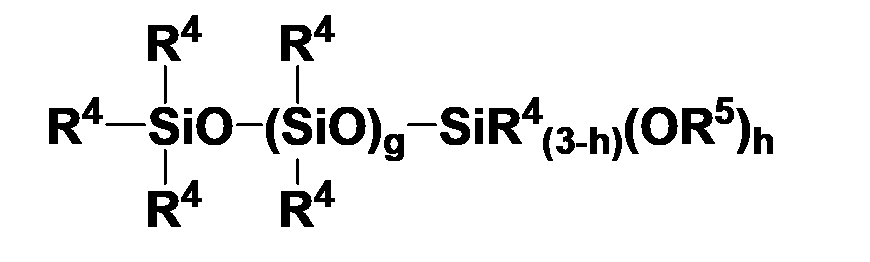
(式中、R4は独立に非置換又は置換の1価炭化水素基であり、R5は独立にアルキル基、アルコキシアルキル基、アルケニル基又はアシル基であり、gは5~100の整数であり、hは1~3の整数である。)
で表され、25℃における粘度が0.01~30Pa・sのオルガノポリシロキサン(G)との温度70℃以上の加熱処理混合物である[2]又は[3]に記載の熱伝導性付加硬化型シリコーン組成物。
[5]
(A)下記平均組成式(1)
RaR1 bSiO(4-a-b)/2 (1)
(式中、Rは独立にアルケニル基であり、R1は独立に脂肪族不飽和結合を有さない非置換又は置換の1価炭化水素基であり、aは0.0001~0.2、bは1.7~2.2で、かつa+bが1.9~2.4を満足する正数である。)
で表され、一分子中に珪素原子に結合したアルケニル基を少なくとも2個有するオルガノポリシロキサン:100質量部、
(B)下記平均組成式(2)
R2 cHdSiO(4-c-d)/2 (2)
(式中、R2は独立に脂肪族不飽和結合を有さない非置換又は置換の1価炭化水素基であり、cは0.7~2.2、dは0.001~0.5で、かつc+dが0.8~2.5を満足する正数である。)
で表され、一分子中に珪素原子に結合した水素原子を少なくとも3個有するオルガノハイドロジェンポリシロキサン:(A)成分中のアルケニル基1個に対し(B)成分中の珪素原子結合水素原子(SiH基)が0.1~2個となる量、
(C)60℃×24時間純水で酸化アルミニウム粉末を加熱抽出し、その水層をイオンクロマトグラフィーで測定した場合のNa+イオン量が50ppm以下の酸化アルミニウム:1,000~7,000質量部
を70℃以上の温度で加熱処理を行い、冷却した加熱処理混合物に、
(D)下記平均組成式(3)
R3 eHfSiO(4-e-f)/2 (3)
(式中、R3は独立に脂肪族不飽和結合を有さない非置換又は置換の1価炭化水素基であり、eは0.7~2.2、fは0.001~0.5で、かつe+fが0.8~2.5を満足する正数である。)
で表され、一分子中に珪素原子に結合した水素原子を少なくとも2個有するオルガノハイドロジェンポリシロキサン:(A)成分中のアルケニル基1個に対し(D)成分中の珪素原子結合水素原子(SiH基)が0.01~3個となる量、及び
(E)白金族金属触媒:(A)成分に対して白金族金属質量で1~200ppm
を添加混合することにより、得られる組成物の熱伝導率がISO 22007-2準拠のホットディスク法において、2.0~7.0W/m・Kであり、得られる組成物の25℃における粘度がスパイラル粘度計によるローターA、回転数10rpm測定時(ずり速度6(1/sec))において、30~800Pa・sである熱伝導性付加硬化型シリコーン組成物の製造方法。
[6]
(B)成分と(D)成分中のSiH基の合計量が、(A)成分中のアルケニル基1個に対して0.11~5個の割合である[5]に記載の熱伝導性付加硬化型シリコーン組成物の製造方法。
[7]
(A)~(C)成分に、更にシランカップリング剤(F)及び/又は下記一般式(5)
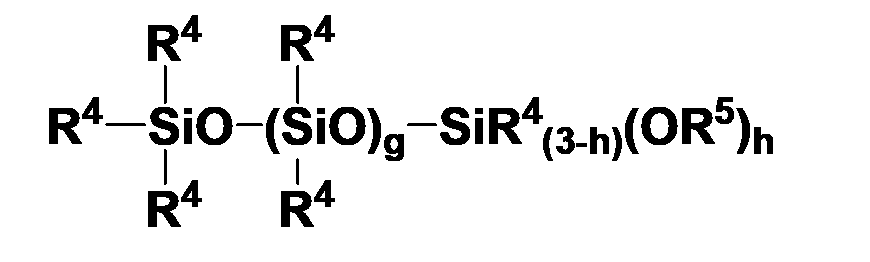
(式中、R4は独立に非置換又は置換の1価炭化水素基であり、R5は独立にアルキル基、アルコキシアルキル基、アルケニル基又はアシル基であり、gは5~100の整数であり、hは1~3の整数である。)
で表され、25℃における粘度が0.01~30Pa・sのオルガノポリシロキサン(G)を混合して加熱処理を行う[5]又は[6]に記載の熱伝導性付加硬化型シリコーン組成物の製造方法。
[8]
(A)下記平均組成式(1)
RaR1 bSiO(4-a-b)/2 (1)
(式中、Rは独立にアルケニル基であり、R1は独立に脂肪族不飽和結合を有さない非置換又は置換の1価炭化水素基であり、aは0.0001~0.2、bは1.7~2.2で、かつa+bが1.9~2.4を満足する正数である。)
で表され、一分子中に珪素原子に結合したアルケニル基を少なくとも2個有するオルガノポリシロキサン、及び
(C)60℃×24時間純水で酸化アルミニウム粉末を加熱抽出し、その水層をイオンクロマトグラフィーで測定した場合のNa+イオン量が50ppm以下の酸化アルミニウム
の温度70℃以上の加熱処理混合物と、
(E)白金族金属触媒:(A)成分の合計質量に対して白金族金属質量で1~200ppmと
を含有する第1液と、
(A)下記平均組成式(1)
RaR1 bSiO(4-a-b)/2 (1)
(式中、Rは独立にアルケニル基であり、R1は独立に脂肪族不飽和結合を有さない非置換又は置換の1価炭化水素基であり、aは0.0001~0.2、bは1.7~2.2で、かつa+bが1.9~2.4を満足する正数である。)
で表され、一分子中に珪素原子に結合したアルケニル基を少なくとも2個有するオルガノポリシロキサン、
(B)下記平均組成式(2)
R2 cHdSiO(4-c-d)/2 (2)
(式中、R2は独立に脂肪族不飽和結合を有さない非置換又は置換の1価炭化水素基であり、cは0.7~2.2、dは0.001~0.5で、かつc+dが0.8~2.5を満足する正数である。)
で表され、一分子中に珪素原子に結合した水素原子を少なくとも3個有するオルガノハイドロジェンポリシロキサン:(A)成分の合計中のアルケニル基1個に対し(B)成分中の珪素原子結合水素原子(SiH基)が0.1~2個となる量、及び
(C)60℃×24時間純水で酸化アルミニウム粉末を加熱抽出し、その水層をイオンクロマトグラフィーで測定した場合のNa+イオン量が50ppm以下の酸化アルミニウム
の温度70℃以上の加熱処理混合物と、
(H)下記平均組成式(4)
R7 jHkSiO(4-j-k)/2 (4)
(式中、R7は独立に脂肪族不飽和結合を有さない非置換又は置換の1価炭化水素基であり、jは0.7~2.2、kは0.001~0.5で、かつj+kが0.8~2.5を満足する正数である。)
で表され、一分子中に珪素原子に結合した水素原子を2個有するオルガノハイドロジェンポリシロキサン:(A)成分の合計中のアルケニル基1個に対し(H)成分中の珪素原子結合水素原子(SiH基)が0.01~3個となる量と
を含有する第2液と
の2液型からなり、但し、第1液は上記(B)、(H)成分を含有せず、第2液は上記(E)成分を含有せず、組成物中の(A)成分の合計は100質量部であり、(C)成分の合計は1,000~7,000質量部であり、第1液及び第2液それぞれの熱伝導率がISO 22007-2準拠のホットディスク法において、2.0~7.0W/m・Kであり、第1液及び第2液それぞれの25℃における粘度がスパイラル粘度計によるローターA、回転数10rpm測定時(ずり速度6(1/sec))において、30~800Pa・sである[1]に記載の熱伝導性付加硬化型シリコーン組成物。
[9]
(B)成分と(H)成分中のSiH基の合計量が、(A)成分の合計中のアルケニル基1個に対して0.11~5個の割合である[8]に記載の熱伝導性付加硬化型シリコーン組成物。
[10]
更にシランカップリング剤(F)及び/又は下記一般式(5)

(式中、R4は独立に非置換又は置換の1価炭化水素基であり、R5は独立にアルキル基、アルコキシアルキル基、アルケニル基又はアシル基であり、gは5~100の整数であり、hは1~3の整数である。)
で表され、25℃における粘度が0.01~30Pa・sのオルガノポリシロキサン(G)を、第1液に(A)、(C)成分との温度70℃以上の加熱処理混合物として、第2液に(A)、(B)、(C)成分との温度70℃以上の加熱処理混合物として含有する[8]又は[9]に記載の熱伝導性付加硬化型シリコーン組成物。
[11]
(A)下記平均組成式(1)
RaR1 bSiO(4-a-b)/2 (1)
(式中、Rは独立にアルケニル基であり、R1は独立に脂肪族不飽和結合を有さない非置換又は置換の1価炭化水素基であり、aは0.0001~0.2、bは1.7~2.2で、かつa+bが1.9~2.4を満足する正数である。)
で表され、一分子中に珪素原子に結合したアルケニル基を少なくとも2個有するオルガノポリシロキサン、及び
(C)60℃×24時間純水で酸化アルミニウム粉末を加熱抽出し、その水層をイオンクロマトグラフィーで測定した場合のNa+イオン量が50ppm以下の酸化アルミニウム
を70℃以上の温度で混合して加熱処理を行い、冷却した加熱処理混合物に、
(E)白金族金属触媒:(A)成分の合計質量に対して白金族金属質量で1~200ppm
を添加混合することにより、第1液を調製する工程、
(A)下記平均組成式(1)
RaR1 bSiO(4-a-b)/2 (1)
(式中、Rは独立にアルケニル基であり、R1は独立に脂肪族不飽和結合を有さない非置換又は置換の1価炭化水素基であり、aは0.0001~0.2、bは1.7~2.2で、かつa+bが1.9~2.4を満足する正数である。)
で表され、一分子中に珪素原子に結合したアルケニル基を少なくとも2個有するオルガノポリシロキサン、
(B)下記平均組成式(2)
R2 cHdSiO(4-c-d)/2 (2)
(式中、R2は独立に脂肪族不飽和結合を有さない非置換又は置換の1価炭化水素基であり、cは0.7~2.2、dは0.001~0.5で、かつc+dが0.8~2.5を満足する正数である。)
で表され、一分子中に珪素原子に結合した水素原子を少なくとも3個有するオルガノハイドロジェンポリシロキサン:(A)成分の合計中のアルケニル基1個に対し(B)成分中の珪素原子結合水素原子(SiH基)が0.1~2個となる量、及び
(C)60℃×24時間純水で酸化アルミニウム粉末を加熱抽出し、その水層をイオンクロマトグラフィーで測定した場合のNa+イオン量が50ppm以下の酸化アルミニウム
を70℃以上の温度で混合して加熱処理を行い、冷却した加熱処理混合物に、
(H)下記平均組成式(4)
R7 jHkSiO(4-j-k)/2 (4)
(式中、R7は独立に脂肪族不飽和結合を有さない非置換又は置換の1価炭化水素基であり、jは0.7~2.2、kは0.001~0.5で、かつj+kが0.8~2.5を満足する正数である。)
で表され、一分子中に珪素原子に結合した水素原子を2個有するオルガノハイドロジェンポリシロキサン:(A)成分の合計中のアルケニル基1個に対し(H)成分中の珪素原子結合水素原子(SiH基)が0.01~3個となる量
を混合することにより、第2液を調製する工程
を有し、但し、第1液は(B)、(H)成分を、第2液は(E)成分を含有しないものであり、組成物中の(A)成分の合計は100質量部であり、(C)成分の合計は1,000~7,000質量部であり、得られる第1液及び第2液それぞれの熱伝導率がISO 22007-2準拠のホットディスク法において、2.0~7.0W/m・Kであり、得られる第1液及び第2液それぞれの25℃における粘度がスパイラル粘度計によるローターA、回転数10rpm測定時(ずり速度6(1/sec))において、30~800Pa・sである熱伝導性付加硬化型シリコーン組成物の製造方法。
[12]
(B)成分と(H)成分中のSiH基の合計量が、(A)成分の合計中のアルケニル基1個に対して0.11~5個の割合である[11]に記載の熱伝導性付加硬化型シリコーン組成物の製造方法。
[13]
更にシランカップリング剤(F)及び/又は下記一般式(5)

(式中、R4は独立に非置換又は置換の1価炭化水素基であり、R5は独立にアルキル基、アルコキシアルキル基、アルケニル基又はアシル基であり、gは5~100の整数であり、hは1~3の整数である。)
で表され、25℃における粘度が0.01~30Pa・sのオルガノポリシロキサン(G)を、第1液の(A)、(C)成分と、第2液の(A)、(B)、(C)成分に混合して加熱処理を行う[11]又は[12]に記載の熱伝導性付加硬化型シリコーン組成物の製造方法。
本発明の熱伝導性付加硬化型シリコーン組成物は、一分子中に珪素原子に結合したアルケニル基を少なくとも2個有するオルガノポリシロキサンと、一分子中に珪素原子に結合した水素原子を少なくとも3個有するオルガノハイドロジェンポリシロキサンと、60℃×24時間純水で酸化アルミニウム粉末を加熱抽出し、その水層をイオンクロマトグラフィーで測定した場合のNa+イオン量が50ppm以下の酸化アルミニウム粒子との加熱混合物であって、該酸化アルミニウム粒子が上記オルガノハイドロジェンポリシロキサンで表面処理されてなる混合物と、
一分子中に珪素原子に結合した水素原子を2個又はそれ以上有するオルガノハイドロジェンポリシロキサンと、
白金族金属触媒と
を含有するものである。
本発明の第一実施形態の熱伝導性付加硬化型シリコーン組成物としては、
(A)下記平均組成式(1)
RaR1 bSiO(4-a-b)/2 (1)
(式中、Rは独立にアルケニル基であり、R1は独立に脂肪族不飽和結合を有さない非置換又は置換の1価炭化水素基であり、aは0.0001~0.2、bは1.7~2.2で、かつa+bが1.9~2.4を満足する正数である。)
で表され、一分子中に珪素原子に結合したアルケニル基を少なくとも2個有するオルガノポリシロキサン:100質量部、
(B)下記平均組成式(2)
R2 cHdSiO(4-c-d)/2 (2)
(式中、R2は独立に脂肪族不飽和結合を有さない非置換又は置換の1価炭化水素基であり、cは0.7~2.2、dは0.001~0.5で、かつc+dが0.8~2.5を満足する正数である。)
で表され、一分子中に珪素原子に結合した水素原子を少なくとも3個有するオルガノハイドロジェンポリシロキサン:(A)成分中のアルケニル基1個に対し(B)成分中の珪素原子結合水素原子(SiH基)が0.1~2個となる量、
(C)60℃×24時間純水で酸化アルミニウム粉末を加熱抽出し、その水層をイオンクロマトグラフィーで測定した場合のNa+イオン量が50ppm以下の酸化アルミニウム:1,000~7,000質量部
の温度70℃以上の加熱処理混合物と、
(D)下記平均組成式(3)
R3 eHfSiO(4-e-f)/2 (3)
(式中、R3は独立に脂肪族不飽和結合を有さない非置換又は置換の1価炭化水素基であり、eは0.7~2.2、fは0.001~0.5で、かつe+fが0.8~2.5を満足する正数である。)
で表され、一分子中に珪素原子に結合した水素原子を少なくとも2個有するオルガノハイドロジェンポリシロキサン:(A)成分中のアルケニル基1個に対し(D)成分中の珪素原子結合水素原子(SiH基)が0.01~3個となる量、及び
(E)白金族金属触媒:(A)成分に対して白金族金属質量で1~200ppm
とを含有し、組成物の熱伝導率がISO 22007-2準拠のホットディスク法において、2.0~7.0W/m・K、組成物の25℃における粘度がスパイラル粘度計によるローターA、回転数10rpm測定時(ずり速度6(1/sec))において、30~800Pa・sのものである。
RaR1 bSiO(4-a-b)/2 (1)
(式中、Rは独立にアルケニル基であり、R1は独立に脂肪族不飽和結合を有さない非置換又は置換の1価炭化水素基であり、aは0.0001~0.2、bは1.7~2.2で、かつa+bが1.9~2.4を満足する正数である。)
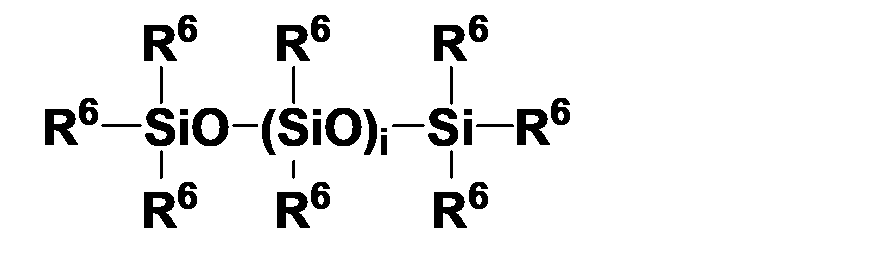
(式中、R6は、独立に非置換又は置換の1価炭化水素基であり、但しR6の少なくとも2個はアルケニル基であり、iは20~2,000の整数である。)
で表されるものが挙げられる。
上述したアルケニル基を有するオルガノポリシロキサンは、それ自体公知のものであり、従来公知の方法で製造される。
R2 cHdSiO(4-c-d)/2 (2)
(式中、R2は独立に脂肪族不飽和結合を有さない非置換又は置換の1価炭化水素基であり、cは0.7~2.2、dは0.001~0.5で、かつc+dが0.8~2.5を満足する正数である。)
また、このオルガノハイドロジェンポリシロキサンは、従来公知の方法で合成される。
ここで、本発明に用いる酸化アルミニウムのNa+イオン量を上記範囲とするためには、市販の酸化アルミニウム粉末を水に分散させ、常温(1~25℃)、あるいは工程時間短縮のために、例えば60℃に加温して攪拌させることにより水洗することで、Na+イオン量を調整することができる。
R3 eHfSiO(4-e-f)/2 (3)
(式中、R3は独立に脂肪族不飽和結合を有さない非置換又は置換の1価炭化水素基であり、eは0.7~2.2、fは0.001~0.5で、かつe+fが0.8~2.5を満足する正数である。)
で表され、一分子中に珪素原子に結合した水素原子を少なくとも2個有するオルガノハイドロジェンポリシロキサンである。このオルガノハイドロジェンポリシロキサンが一分子中に有する珪素原子結合水素原子は、好ましくは2~100個、より好ましくは2~50個、特に好ましくは2~20個である。
また、このオルガノハイドロジェンポリシロキサンは、従来公知の方法で合成される。
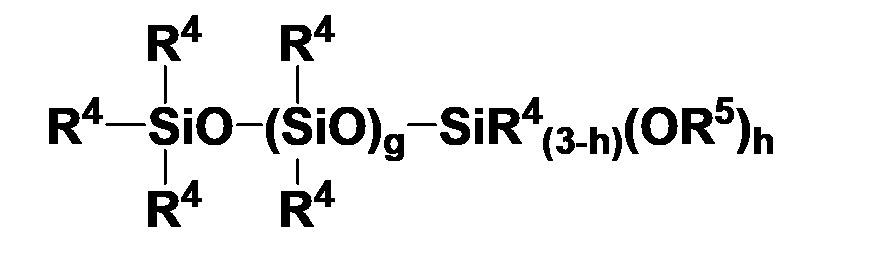
(式中、R4は独立に非置換又は置換の1価炭化水素基であり、R5は独立にアルキル基、アルコキシアルキル基、アルケニル基又はアシル基であり、gは5~100の整数であり、hは1~3の整数である。)

例えば、硬化速度や保存安定性を調節するための反応制御剤、具体的にはトリアリルイソシアネートアルキルマレエート、エチニルシクロヘキサノール等のアセチレンアルコール及びこれらのシラン類、シロキサン変性物;ハイドロパーオキサイド、テトラメチルエチレンジアミン、ベンゾトリアゾール等、着色剤としての酸化第一鉄、酸化第二鉄等の単独又は組み合わせ、チクソ付与剤としてのフュームドシリカ等を配合することができる。これらの配合量は、それぞれ本組成物あたり、質量換算で0.01~100,000ppmであることが好ましい。
本発明の第二実施形態の熱伝導性付加硬化型シリコーン組成物としては、
(A)下記平均組成式(1)
RaR1 bSiO(4-a-b)/2 (1)
(式中、Rは独立にアルケニル基であり、R1は独立に脂肪族不飽和結合を有さない非置換又は置換の1価炭化水素基であり、aは0.0001~0.2、bは1.7~2.2で、かつa+bが1.9~2.4を満足する正数である。)
で表され、一分子中に珪素原子に結合したアルケニル基を少なくとも2個有するオルガノポリシロキサン、及び
(C)60℃×24時間純水で酸化アルミニウム粉末を加熱抽出し、その水層をイオンクロマトグラフィーで測定した場合のNa+イオン量が50ppm以下の酸化アルミニウム
の温度70℃以上の加熱処理混合物と、
(E)白金族金属触媒:(A)成分の合計質量に対して白金族金属質量で1~200ppmと
を含有する第1液と、
(A)下記平均組成式(1)
RaR1 bSiO(4-a-b)/2 (1)
(式中、Rは独立にアルケニル基であり、R1は独立に脂肪族不飽和結合を有さない非置換又は置換の1価炭化水素基であり、aは0.0001~0.2、bは1.7~2.2で、かつa+bが1.9~2.4を満足する正数である。)
で表され、一分子中に珪素原子に結合したアルケニル基を少なくとも2個有するオルガノポリシロキサン、
(B)下記平均組成式(2)
R2 cHdSiO(4-c-d)/2 (2)
(式中、R2は独立に脂肪族不飽和結合を有さない非置換又は置換の1価炭化水素基であり、cは0.7~2.2、dは0.001~0.5で、かつc+dが0.8~2.5を満足する正数である。)
で表され、一分子中に珪素原子に結合した水素原子を少なくとも3個有するオルガノハイドロジェンポリシロキサン:(A)成分の合計中のアルケニル基1個に対し(B)成分中の珪素原子結合水素原子(SiH基)が0.1~2個となる量、及び
(C)60℃×24時間純水で酸化アルミニウム粉末を加熱抽出し、その水層をイオンクロマトグラフィーで測定した場合のNa+イオン量が50ppm以下の酸化アルミニウム
の温度70℃以上の加熱処理混合物と、
(H)下記平均組成式(4)
R7 jHkSiO(4-j-k)/2 (4)
(式中、R7は独立に脂肪族不飽和結合を有さない非置換又は置換の1価炭化水素基であり、jは0.7~2.2、kは0.001~0.5で、かつj+kが0.8~2.5を満足する正数である。)
で表され、一分子中に珪素原子に結合した水素原子を2個有するオルガノハイドロジェンポリシロキサン:(A)成分の合計中のアルケニル基1個に対し(H)成分中の珪素原子結合水素原子(SiH基)が0.01~3個となる量と
を含有する第2液と
の2液型からなり、但し、第1液は上記(B)、(H)成分を含有せず、第2液は上記(E)成分を含有せず、組成物中の(A)成分の合計は100質量部であり、(C)成分の合計は1,000~7,000質量部であり、第1液及び第2液それぞれの熱伝導率がISO 22007-2準拠のホットディスク法において、2.0~7.0W/m・Kであり、第1液及び第2液それぞれの25℃における粘度がスパイラル粘度計によるローターA、回転数10rpm測定時(ずり速度6(1/sec))において、30~800Pa・sのものである。
RaR1 bSiO(4-a-b)/2 (1)
(式中、Rは独立にアルケニル基であり、R1は独立に脂肪族不飽和結合を有さない非置換又は置換の1価炭化水素基であり、aは0.0001~0.2、bは1.7~2.2で、かつa+bが1.9~2.4を満足する正数である。)

(式中、R6は、独立に非置換又は置換の1価炭化水素基であり、但しR6の少なくとも2個はアルケニル基であり、iは20~2,000の整数である。)
で表されるものが挙げられる。
上述したアルケニル基を有するオルガノポリシロキサンは、それ自体公知のものであり、従来公知の方法で製造される。
R2 cHdSiO(4-c-d)/2 (2)
(式中、R2は独立に脂肪族不飽和結合を有さない非置換又は置換の1価炭化水素基であり、cは0.7~2.2、dは0.001~0.5で、かつc+dが0.8~2.5を満足する正数である。)
また、このオルガノハイドロジェンポリシロキサンは、従来公知の方法で合成される。
ここで、本発明に用いる酸化アルミニウムのNa+イオン量を上記範囲とするためには、市販の酸化アルミニウム粉末を水に分散させ、常温(1~25℃)、あるいは工程時間短縮のために、例えば60℃に加温して攪拌させることにより水洗することで、Na+イオン量を調整することができる。
R7 jHkSiO(4-j-k)/2 (4)
(式中、R7は独立に脂肪族不飽和結合を有さない非置換又は置換の1価炭化水素基であり、jは0.7~2.2、kは0.001~0.5で、かつj+kが0.8~2.5を満足する正数である。)
で表され、一分子中に珪素原子に結合した水素原子を2個有するオルガノハイドロジェンポリシロキサンである。
(H)成分のオルガノハイドロジェンポリシロキサンの一分子中の珪素原子の数(即ち、重合度)は、通常10~1,000個であるが、組成物の取扱作業性及び得られる硬化物の特性が良好となる点から、好ましくは15~500個、より好ましくは18~100個である。
また、このオルガノハイドロジェンポリシロキサンは、従来公知の方法で合成される。

(式中、R4は独立に非置換又は置換の1価炭化水素基であり、R5は独立にアルキル基、アルコキシアルキル基、アルケニル基又はアシル基であり、gは5~100の整数であり、hは1~3の整数である。)

ここで、第1液は、(A)、(C)成分、及び必要により(F)、(G)成分の温度70℃以上の加熱処理混合物と、(E)成分を含有し、かつ(B)、(H)成分を含有しないものであり、第2液は、(A)、(B)、(C)成分、及び必要により(F)、(G)成分の温度70℃以上の加熱処理混合物と、(H)成分と、必要によりその他の添加剤を含有し、かつ(E)成分を含有しないものである。
第1液は、上記(A)、(C)成分、及び必要により(F)、(G)成分の温度70℃以上の加熱処理混合物と、上記(E)成分を含有し、かつ上記(B)、(H)成分を含有しないものである。
加熱処理混合物の調製は、上記(A)、(C)成分、及び必要により(F)、(G)成分を70℃以上、好ましくは100~200℃、より好ましくは100~170℃、更に好ましくは100~160℃、特に好ましくは100~150℃の加熱下で、好ましくは60分以上混合する。熱処理時間の上限は特に制限はないが、好ましくは60~240分、より好ましくは60~180分、特に好ましくは60~120分熱処理する。熱処理温度が70℃未満の場合、(A)成分による(C)成分の表面処理が不十分な場合があり、熱処理温度が200℃を超える高温の場合、(A)、(F)、(G)成分が分解するおそれがある。また、熱処理時間が短すぎると、(A)成分による(C)成分の表面処理が不十分な場合がある。
上記で得られた(A)、(C)成分、及び必要により(F)、(G)成分を混合して70℃以上で加熱した加熱処理混合物を、好ましくは0~50℃、より好ましくは常温(1~25℃)に冷却したものに、上記(E)成分を添加し、均一に混合する。ここで、加熱処理混合物と(E)成分との混合条件は、常温(1~25℃)で5~30分間程度であり、上記の方法により、第1液を得ることができる。
第2液は、上記(A)、(B)、(C)成分、及び必要により(F)、(G)成分の温度70℃以上の加熱処理混合物と、上記(H)成分と、必要によりその他の添加剤を含有し、かつ上記(E)成分を含有しないものである。
加熱処理混合物の調製は、上記(A)、(B)、(C)成分、及び必要により(F)、(G)成分を70℃以上、好ましくは100~200℃、より好ましくは100~170℃、更に好ましくは100~160℃、特に好ましくは100~150℃の加熱下で、好ましくは60分以上混合する。熱処理時間の上限は特に制限はないが、好ましくは60~240分、より好ましくは60~180分、特に好ましくは60~120分熱処理する。熱処理温度が70℃未満の場合、(B)成分中の珪素原子に結合した水素原子と(C)成分中のAl-OH基や残存無機酸等の保存安定性を低下させ得る反応性基や反応性物質との反応の進行が遅くなり、熱処理温度が200℃を超える高温の場合、(A)成分や(B)成分のポリマー自身の劣化が発生するおそれがある。また、熱処理時間が短すぎると、(B)成分中の珪素原子に結合した水素原子と(C)成分中のAl-OH基等の反応性基や残存無機酸等の保存安定性を低下させる反応性基や反応性物質との反応が十分に進行せず、保存安定性向上効果が不十分となる場合がある。
上記で得られた(A)、(B)、(C)成分、及び必要により(F)、(G)成分を混合して70℃以上で加熱した加熱処理混合物を、好ましくは0~50℃、より好ましくは常温(1~25℃)に冷却したものに、上記(H)成分、及び必要によりその他の添加剤を添加し、均一に混合する。ここで、加熱処理混合物と(H)成分と必要によりその他の添加剤との混合条件は、常温(1~25℃)で5~30分間程度であり、上記の方法により、第2液を得ることができる。
(株)井上製作所製5Lプラネタリーミキサーに、粘度が600mPa・sの分子鎖両末端ジメチルビニルシロキシ基封鎖ジメチルポリシロキサン100質量部、下記一般式(6)で示され、25℃における粘度が28mPa・sのトリメチルシロキシ基封鎖メチルハイドロジェン・ジメチルポリシロキサン1.26質量部(式(6)のポリシロキサン中のSiH基/分子鎖両末端ジメチルビニルシロキシ基封鎖ジメチルポリシロキサン中のSiVi基=0.11)、下記一般式(7)で示され、25℃における粘度が30mPa・sのオルガノポリシロキサン18質量部、60℃×24時間純水で酸化アルミニウム粉末を加熱抽出し、その水層をイオンクロマトグラフィーで測定した場合のNa+イオン量が22ppmであり、平均粒子径が40μmの溶融球状酸化アルミニウムA600質量部、60℃×24時間純水で酸化アルミニウム粉末を加熱抽出し、その水層をイオンクロマトグラフィーで測定した場合のNa+イオン量が3ppmであり、平均粒子径が1.2μmの破砕状酸化アルミニウムB400質量部を添加して混合し、100℃で1時間加熱処理混合した。
次いで、この加熱処理混合物を室温まで十分冷却した後、更に下記一般式(8)で示され、25℃での粘度が17mPa・sであるジメチルハイドロジェンシロキシ基封鎖ジメチルポリシロキサン9.4質量部(式(8)のポリシロキサン中のSiH基/上記分子鎖両末端ジメチルビニルシロキシ基封鎖ジメチルポリシロキサン中のSiVi基=0.79、式(6)及び(8)のポリシロキサン中の合計SiH基/上記分子鎖両末端ジメチルビニルシロキシ基封鎖ジメチルポリシロキサン中のSiVi基=0.9)、塩化白金酸のビニルシロキサン錯体(Pt含有量1質量%)0.18質量部、エチニルシクロヘキサノール0.18質量部を均一に混合し、熱伝導性付加硬化型シリコーン組成物1-1を得た。
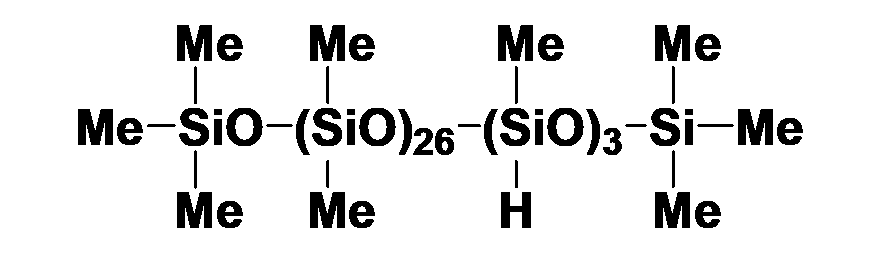
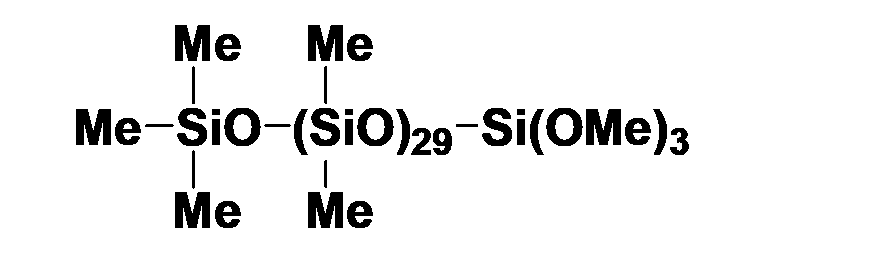

(株)井上製作所製5Lプラネタリーミキサーに、粘度が600mPa・sの分子鎖両末端ジメチルビニルシロキシ基封鎖ジメチルポリシロキサン100質量部、上記一般式(7)で示され、25℃における粘度が30mPa・sのオルガノポリシロキサン18質量部、平均粒子径が40μmの溶融球状酸化アルミニウムA600質量部、平均粒子径が1.2μmの破砕状酸化アルミニウムB400質量部を添加して混合し、150℃で1時間加熱処理混合した。
次いで、この加熱処理混合物を室温まで十分冷却した後、更に上記一般式(6)で示され、25℃における粘度が28mPa・sのトリメチルシロキシ基封鎖メチルハイドロジェン・ジメチルポリシロキサン1.26質量部、上記一般式(8)で示され、25℃での粘度が17mPa・sであるジメチルハイドロジェンシロキシ基封鎖ジメチルポリシロキサン9.4質量部(式(6)のポリシロキサン中のSiH基/分子鎖両末端ジメチルビニルシロキシ基封鎖ジメチルポリシロキサン中のSiVi基=0.11、式(8)のポリシロキサン中のSiH基/上記分子鎖両末端ジメチルビニルシロキシ基封鎖ジメチルポリシロキサン中のSiVi基=0.79、式(6)及び(8)のポリシロキサン中の合計SiH基/上記分子鎖両末端ジメチルビニルシロキシ基封鎖ジメチルポリシロキサン中のSiVi基=0.9)、塩化白金酸のビニルシロキサン錯体(Pt含有量1質量%)0.18質量部、エチニルシクロヘキサノール0.18質量部を均一に混合し、熱伝導性付加硬化型シリコーン組成物1-2を得た。
実施例1-1に記載の熱処理温度を50℃にする以外は同様にして、熱伝導性付加硬化型シリコーン組成物1-3を得た。
実施例1-1に記載の溶融球状酸化アルミニウムAから、60℃×24時間純水で酸化アルミニウム粉末を加熱抽出し、その水層をイオンクロマトグラフィーで測定した場合のNa+イオン量が55ppmであり、平均粒子径が42μmの溶融球状酸化アルミニウムCに置き換えた以外は同様にして、熱伝導性付加硬化型シリコーン組成物1-4を得た。
(株)井上製作所製5Lプラネタリーミキサーに、粘度が400mPa・sの分子鎖両末端ジメチルビニルシロキシ基封鎖ジメチルポリシロキサン100質量部、上記一般式(6)で示され、25℃における粘度が28mPa・sのトリメチルシロキシ基封鎖メチルハイドロジェン・ジメチルポリシロキサン2.33質量部(式(6)のポリシロキサン中のSiH基/分子鎖両末端ジメチルビニルシロキシ基封鎖ジメチルポリシロキサン中のSiVi基=0.15)、上記一般式(7)で示され、25℃における粘度が30mPa・sのオルガノポリシロキサン234質量部、60℃×24時間純水で酸化アルミニウム粉末を加熱抽出し、その水層をイオンクロマトグラフィーで測定した場合のNa+イオン量が11ppmであり、平均粒子径が58μmの溶融球状酸化アルミニウムD4,836質量部、60℃×24時間純水で酸化アルミニウム粉末を加熱抽出し、その水層をイオンクロマトグラフィーで測定した場合のNa+イオン量が3ppmであり、平均粒子径が1.2μmの破砕状酸化アルミニウムB1,814質量部を添加して混合し、100℃で1時間加熱処理混合した。
次いで、この加熱処理混合物を室温まで十分冷却した後、更に上記一般式(8)で示され、25℃での粘度が17mPa・sであるジメチルハイドロジェンシロキシ基封鎖ジメチルポリシロキサン13.0質量部(式(8)のポリシロキサン中のSiH基/上記分子鎖両末端ジメチルビニルシロキシ基封鎖ジメチルポリシロキサン中のSiVi基=0.85、式(6)及び(8)のポリシロキサン中の合計SiH基/上記分子鎖両末端ジメチルビニルシロキシ基封鎖ジメチルポリシロキサン中のSiVi基=1.0)、塩化白金酸のビニルシロキサン錯体(Pt含有量1質量%)1.00質量部、エチニルシクロヘキサノール1.00質量部を均一に混合し、熱伝導性付加硬化型シリコーン組成物1-5を得た。
(株)井上製作所製5Lプラネタリーミキサーに、粘度が400mPa・sの分子鎖両末端ジメチルビニルシロキシ基封鎖ジメチルポリシロキサン100質量部、上記一般式(7)で示され、25℃における粘度が30mPa・sのオルガノポリシロキサン234質量部、60℃×24時間純水で酸化アルミニウム粉末を加熱抽出し、その水層をイオンクロマトグラフィーで測定した場合のNa+イオン量が11ppmであり、平均粒子径が58μmの溶融球状酸化アルミニウムD4,836質量部、60℃×24時間純水で酸化アルミニウム粉末を加熱抽出し、その水層をイオンクロマトグラフィーで測定した場合のNa+イオン量が3ppmであり、平均粒子径が1.2μmの破砕状酸化アルミニウムB1,814質量部を添加して混合し、150℃で1時間加熱処理混合した。
次いで、この加熱処理混合物を室温まで十分冷却した後、更に上記一般式(6)で示され、25℃における粘度が28mPa・sのトリメチルシロキシ基封鎖メチルハイドロジェン・ジメチルポリシロキサン2.33質量部、上記一般式(8)で示され、25℃での粘度が17mPa・sであるジメチルハイドロジェンシロキシ基封鎖ジメチルポリシロキサン13.0質量部(式(6)のポリシロキサン中のSiH基/分子鎖両末端ジメチルビニルシロキシ基封鎖ジメチルポリシロキサン中のSiVi基=0.15、式(8)のポリシロキサン中のSiH基/上記分子鎖両末端ジメチルビニルシロキシ基封鎖ジメチルポリシロキサン中のSiVi基=0.85、式(6)及び(8)のポリシロキサン中の合計SiH基/上記分子鎖両末端ジメチルビニルシロキシ基封鎖ジメチルポリシロキサン中のSiVi基=1.0)、塩化白金酸のビニルシロキサン錯体(Pt含有量1質量%)1.00質量部、エチニルシクロヘキサノール1.00質量部を均一に混合し、熱伝導性付加硬化型シリコーン組成物1-6を得た。
実施例1-2に記載の熱処理温度を50℃にする以外は同様にして、熱伝導性付加硬化型シリコーン組成物1-7を得た。
その後、十分真空脱泡してから6mm硬化厚みとなるような成形型に流し込み、120℃×60分加熱硬化して硬化物を得、その硬度をASTM D 2240-05に規定されるShore OO硬度計により測定した。また、これらの各組成物を5℃の冷蔵庫内に6ヶ月間放置後、上記と同様に粘度、熱伝導率、並びに硬度を測定し、初期と比較した結果を表1及び2に示した。
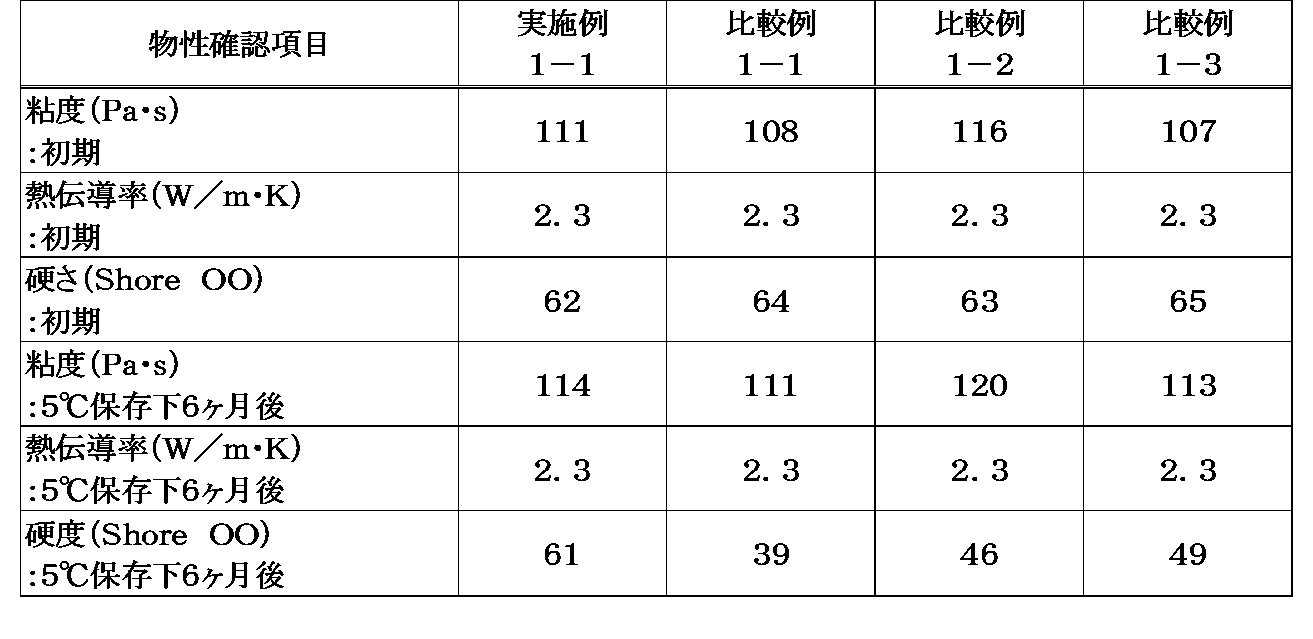

(株)井上製作所製5Lプラネタリーミキサーに、粘度が600mPa・sの分子鎖両末端ジメチルビニルシロキシ基封鎖ジメチルポリシロキサン55.2質量部、下記一般式(7)で示され、25℃における粘度が30mPa・sのオルガノポリシロキサン9質量部、60℃×24時間純水で酸化アルミニウム粉末を加熱抽出し、その水層をイオンクロマトグラフィーで測定した場合のNa+イオン量が22ppmであり、平均粒子径が40μmの溶融球状酸化アルミニウムA 300質量部、60℃×24時間純水で酸化アルミニウム粉末を加熱抽出し、その水層をイオンクロマトグラフィーで測定した場合のNa+イオン量が3ppmであり、平均粒子径が1.2μmの破砕状酸化アルミニウムB 200質量部を添加して混合し、100℃で1時間加熱処理混合した。
次いで、この加熱処理混合物を室温(25℃)まで十分冷却した後、塩化白金酸のビニルシロキサン錯体(Pt含有量1質量%)0.18質量部を均一に室温(25℃)で20分間混合し、熱伝導性付加硬化型シリコーン組成物2-1(第1液)を得た。
(株)井上製作所製5Lプラネタリーミキサーに、粘度が600mPa・sの分子鎖両末端ジメチルビニルシロキシ基封鎖ジメチルポリシロキサン44.8質量部、下記一般式(6)で示され、25℃における粘度が28mPa・sのトリメチルシロキシ基封鎖メチルハイドロジェン・ジメチルポリシロキサン1.26質量部(式(6)のポリシロキサン中のSiH基/分子鎖両末端ジメチルビニルシロキシ基封鎖ジメチルポリシロキサン中の合計SiVi基=0.11)、下記一般式(7)で示され、25℃における粘度が30mPa・sのオルガノポリシロキサン9質量部、60℃×24時間純水で酸化アルミニウム粉末を加熱抽出し、その水層をイオンクロマトグラフィーで測定した場合のNa+イオン量が22ppmであり、平均粒子径が40μmの溶融球状酸化アルミニウムA 300質量部、60℃×24時間純水で酸化アルミニウム粉末を加熱抽出し、その水層をイオンクロマトグラフィーで測定した場合のNa+イオン量が3ppmであり、平均粒子径が1.2μmの破砕状酸化アルミニウムB 200質量部を添加して混合し、100℃で1時間加熱処理混合した。
次いで、この加熱処理混合物を室温(25℃)まで十分冷却した後、エチニルシクロヘキサノール0.02質量部、更に下記一般式(8)で示され、25℃での粘度が17mPa・sであるジメチルハイドロジェンシロキシ基封鎖ジメチルポリシロキサン9.4質量部(式(8)のポリシロキサン中のSiH基/上記分子鎖両末端ジメチルビニルシロキシ基封鎖ジメチルポリシロキサン中の合計SiVi基=0.79、式(6)及び(8)のポリシロキサン中の合計SiH基/上記分子鎖両末端ジメチルビニルシロキシ基封鎖ジメチルポリシロキサン中のSiVi基=0.9)を均一に室温(25℃)で20分間混合し、熱伝導性付加硬化型シリコーン組成物2-1(第2液)を得た。
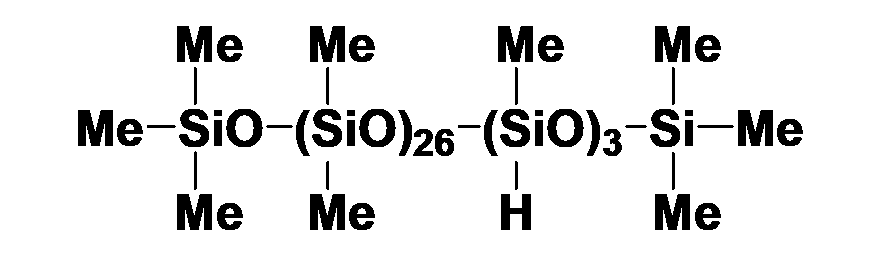
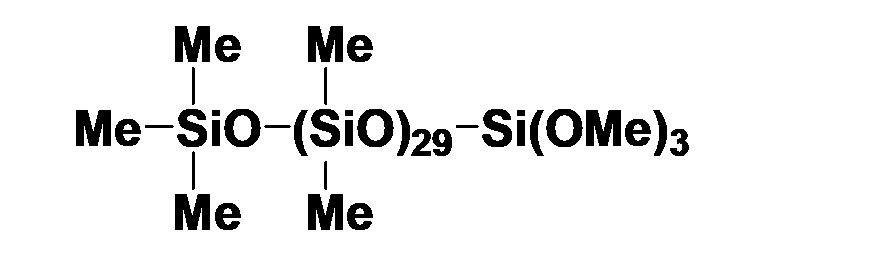

(株)井上製作所製5Lプラネタリーミキサーに、粘度が600mPa・sの分子鎖両末端ジメチルビニルシロキシ基封鎖ジメチルポリシロキサン55.2質量部、上記一般式(7)で示され、25℃における粘度が30mPa・sのオルガノポリシロキサン9質量部、60℃×24時間純水で酸化アルミニウム粉末を加熱抽出し、その水層をイオンクロマトグラフィーで測定した場合のNa+イオン量が22ppmであり、平均粒子径が40μmの溶融球状酸化アルミニウムA 300質量部、60℃×24時間純水で酸化アルミニウム粉末を加熱抽出し、その水層をイオンクロマトグラフィーで測定した場合のNa+イオン量が3ppmであり、平均粒子径が1.2μmの破砕状酸化アルミニウムB 200質量部を添加して混合し、100℃で1時間加熱処理混合した。
次いで、この加熱処理混合物を室温(25℃)まで十分冷却した後、塩化白金酸のビニルシロキサン錯体(Pt含有量1質量%)0.18質量部を均一に室温(25℃)で20分間混合し、熱伝導性付加硬化型シリコーン組成物2-2(第1液)を得た。
(株)井上製作所製5Lプラネタリーミキサーに、粘度が600mPa・sの分子鎖両末端ジメチルビニルシロキシ基封鎖ジメチルポリシロキサン44.8質量部、上記一般式(7)で示され、25℃における粘度が30mPa・sのオルガノポリシロキサン9質量部、60℃×24時間純水で酸化アルミニウム粉末を加熱抽出し、その水層をイオンクロマトグラフィーで測定した場合のNa+イオン量が22ppmであり、平均粒子径が40μmの溶融球状酸化アルミニウムA 300質量部、60℃×24時間純水で酸化アルミニウム粉末を加熱抽出し、その水層をイオンクロマトグラフィーで測定した場合のNa+イオン量が3ppmであり、平均粒子径が1.2μmの破砕状酸化アルミニウムB 200質量部を添加して混合し、100℃で1時間加熱処理混合した。
次いで、この加熱処理混合物を室温(25℃)まで十分冷却した後、エチニルシクロヘキサノール0.02質量部、上記一般式(6)で示され、25℃における粘度が28mPa・sのトリメチルシロキシ基封鎖メチルハイドロジェン・ジメチルポリシロキサン1.26質量部(式(6)のポリシロキサン中のSiH基/分子鎖両末端ジメチルビニルシロキシ基封鎖ジメチルポリシロキサン中の合計SiVi基=0.11)、更に上記一般式(8)で示され、25℃での粘度が17mPa・sであるジメチルハイドロジェンシロキシ基封鎖ジメチルポリシロキサン9.4質量部(式(8)のポリシロキサン中のSiH基/上記分子鎖両末端ジメチルビニルシロキシ基封鎖ジメチルポリシロキサン中の合計SiVi基=0.79、式(6)及び(8)のポリシロキサン中の合計SiH基/上記分子鎖両末端ジメチルビニルシロキシ基封鎖ジメチルポリシロキサン中のSiVi基=0.9)を均一に室温(25℃)で20分間混合し、熱伝導性付加硬化型シリコーン組成物2-2(第2液)を得た。
実施例2-1に記載の熱処理温度を50℃にする以外は同様にして、熱伝導性付加硬化型シリコーン組成物2-3(第1液/第2液)を得た。
実施例2-1に記載の溶融球状酸化アルミニウムAから、60℃×24時間純水で酸化アルミニウム粉末を加熱抽出し、その水層をイオンクロマトグラフィーで測定した場合のNa+イオン量が55ppmであり、平均粒子径が42μmの溶融球状酸化アルミニウムCに置き換えた以外は同様にして、熱伝導性付加硬化型シリコーン組成物2-4(第1液/第2液)を得た。
(株)井上製作所製5Lプラネタリーミキサーに、粘度が400mPa・sの分子鎖両末端ジメチルビニルシロキシ基封鎖ジメチルポリシロキサン57.2質量部、上記一般式(7)で示され、25℃における粘度が30mPa・sのオルガノポリシロキサン117質量部、60℃×24時間純水で酸化アルミニウム粉末を加熱抽出し、その水層をイオンクロマトグラフィーで測定した場合のNa+イオン量が22ppmであり、平均粒子径が56μmの溶融球状酸化アルミニウムD 2,418質量部、60℃×24時間純水で酸化アルミニウム粉末を加熱抽出し、その水層をイオンクロマトグラフィーで測定した場合のNa+イオン量が3ppmであり、平均粒子径が1.2μmの破砕状酸化アルミニウムB 907質量部を添加して混合し、100℃で1時間加熱処理混合した。
次いで、この加熱処理混合物を室温(25℃)まで十分冷却した後、塩化白金酸のビニルシロキサン錯体(Pt含有量1質量%)1.00質量部を均一に室温(25℃)で20分間混合し、熱伝導性付加硬化型シリコーン組成物2-5(第1液)を得た。
(株)井上製作所製5Lプラネタリーミキサーに、粘度が400mPa・sの分子鎖両末端ジメチルビニルシロキシ基封鎖ジメチルポリシロキサン42.8質量部、上記一般式(6)で示され、25℃における粘度が28mPa・sのトリメチルシロキシ基封鎖メチルハイドロジェン・ジメチルポリシロキサン2.33質量部(式(6)のポリシロキサン中のSiH基/分子鎖両末端ジメチルビニルシロキシ基封鎖ジメチルポリシロキサン中の合計SiVi基=0.15)、上記一般式(7)で示され、25℃における粘度が30mPa・sのオルガノポリシロキサン117質量部、60℃×24時間純水で酸化アルミニウム粉末を加熱抽出し、その水層をイオンクロマトグラフィーで測定した場合のNa+イオン量が22ppmであり、平均粒子径が56μmの溶融球状酸化アルミニウムD 2,418質量部、60℃×24時間純水で酸化アルミニウム粉末を加熱抽出し、その水層をイオンクロマトグラフィーで測定した場合のNa+イオン量が3ppmであり、平均粒子径が1.2μmの破砕状酸化アルミニウムB 907質量部を添加して混合し、100℃で1時間加熱処理混合した。
次いで、この加熱処理混合物を室温(25℃)まで十分冷却した後、エチニルシクロヘキサノール0.11質量部、更に上記一般式(8)で示され、25℃での粘度が17mPa・sであるジメチルハイドロジェンシロキシ基封鎖ジメチルポリシロキサン13.0質量部(式(8)のポリシロキサン中のSiH基/上記分子鎖両末端ジメチルビニルシロキシ基封鎖ジメチルポリシロキサン中の合計SiVi基=0.85、式(6)及び(8)のポリシロキサン中の合計SiH基/上記分子鎖両末端ジメチルビニルシロキシ基封鎖ジメチルポリシロキサン中のSiVi基=1.0)を均一に室温(25℃)で20分間混合し、熱伝導性付加硬化型シリコーン組成物2-5(第2液)を得た。
(株)井上製作所製5Lプラネタリーミキサーに、粘度が400mPa・sの分子鎖両末端ジメチルビニルシロキシ基封鎖ジメチルポリシロキサン57.2質量部、上記一般式(7)で示され、25℃における粘度が30mPa・sのオルガノポリシロキサン117質量部、60℃×24時間純水で酸化アルミニウム粉末を加熱抽出し、その水層をイオンクロマトグラフィーで測定した場合のNa+イオン量が22ppmであり、平均粒子径が56μmの溶融球状酸化アルミニウムD 2,418質量部、60℃×24時間純水で酸化アルミニウム粉末を加熱抽出し、その水層をイオンクロマトグラフィーで測定した場合のNa+イオン量が3ppmであり、平均粒子径が1.2μmの破砕状酸化アルミニウムB 907質量部を添加して混合し、100℃で1時間加熱処理混合した。
次いで、この加熱処理混合物を室温(25℃)まで十分冷却した後、塩化白金酸のビニルシロキサン錯体(Pt含有量1質量%)1.00質量部を均一に室温(25℃)で20分間混合し、熱伝導性付加硬化型シリコーン組成物2-6(第1液)を得た。
(株)井上製作所製5Lプラネタリーミキサーに、粘度が400mPa・sの分子鎖両末端ジメチルビニルシロキシ基封鎖ジメチルポリシロキサン42.8質量部、上記一般式(7)で示され、25℃における粘度が30mPa・sのオルガノポリシロキサン117質量部、60℃×24時間純水で酸化アルミニウム粉末を加熱抽出し、その水層をイオンクロマトグラフィーで測定した場合のNa+イオン量が22ppmであり、平均粒子径が56μmの溶融球状酸化アルミニウムD 2,418質量部、60℃×24時間純水で酸化アルミニウム粉末を加熱抽出し、その水層をイオンクロマトグラフィーで測定した場合のNa+イオン量が3ppmであり、平均粒子径が1.2μmの破砕状酸化アルミニウムB 907質量部を添加して混合し、100℃で1時間加熱処理混合した。
次いで、この加熱処理混合物を室温(25℃)まで十分冷却した後、エチニルシクロヘキサノール0.11質量部、上記一般式(6)で示され、25℃における粘度が28mPa・sのトリメチルシロキシ基封鎖メチルハイドロジェン・ジメチルポリシロキサン2.33質量部(式(6)のポリシロキサン中のSiH基/分子鎖両末端ジメチルビニルシロキシ基封鎖ジメチルポリシロキサン中の合計SiVi基=0.15)、更に上記一般式(8)で示され、25℃での粘度が17mPa・sであるジメチルハイドロジェンシロキシ基封鎖ジメチルポリシロキサン13.0質量部(式(8)のポリシロキサン中のSiH基/上記分子鎖両末端ジメチルビニルシロキシ基封鎖ジメチルポリシロキサン中の合計SiVi基=0.85、式(6)及び(8)のポリシロキサン中の合計SiH基/上記分子鎖両末端ジメチルビニルシロキシ基封鎖ジメチルポリシロキサン中のSiVi基=1.0)を均一に室温(25℃)で20分間混合し、熱伝導性付加硬化型シリコーン組成物2-6(第2液)を得た。
実施例2-2に記載の熱処理温度を50℃にする以外は同様にして、熱伝導性付加硬化型シリコーン組成物2-7(第1液/第2液)を得た。

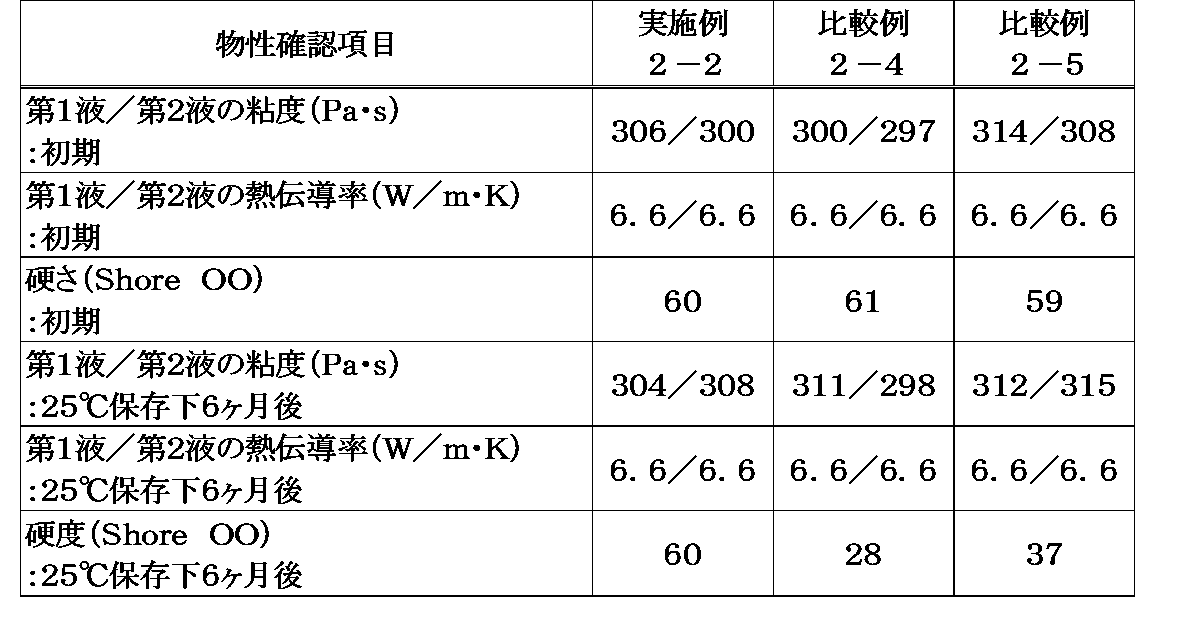
Claims (13)
- 一分子中に珪素原子に結合したアルケニル基を少なくとも2個有するオルガノポリシロキサンと、一分子中に珪素原子に結合した水素原子を少なくとも3個有するオルガノハイドロジェンポリシロキサンと、60℃×24時間純水で酸化アルミニウム粉末を加熱抽出し、その水層をイオンクロマトグラフィーで測定した場合のNa+イオン量が50ppm以下の酸化アルミニウム粒子との加熱混合物であって、該酸化アルミニウム粒子が上記オルガノハイドロジェンポリシロキサンで表面処理されてなる混合物と、
一分子中に珪素原子に結合した水素原子を2個又はそれ以上有するオルガノハイドロジェンポリシロキサンと、
白金族金属触媒と
を含有する熱伝導性付加硬化型シリコーン組成物。 - (A)下記平均組成式(1)
RaR1 bSiO(4-a-b)/2 (1)
(式中、Rは独立にアルケニル基であり、R1は独立に脂肪族不飽和結合を有さない非置換又は置換の1価炭化水素基であり、aは0.0001~0.2、bは1.7~2.2で、かつa+bが1.9~2.4を満足する正数である。)
で表され、一分子中に珪素原子に結合したアルケニル基を少なくとも2個有するオルガノポリシロキサン:100質量部、
(B)下記平均組成式(2)
R2 cHdSiO(4-c-d)/2 (2)
(式中、R2は独立に脂肪族不飽和結合を有さない非置換又は置換の1価炭化水素基であり、cは0.7~2.2、dは0.001~0.5で、かつc+dが0.8~2.5を満足する正数である。)
で表され、一分子中に珪素原子に結合した水素原子を少なくとも3個有するオルガノハイドロジェンポリシロキサン:(A)成分中のアルケニル基1個に対し(B)成分中の珪素原子結合水素原子(SiH基)が0.1~2個となる量、
(C)60℃×24時間純水で酸化アルミニウム粉末を加熱抽出し、その水層をイオンクロマトグラフィーで測定した場合のNa+イオン量が50ppm以下の酸化アルミニウム:1,000~7,000質量部
の温度70℃以上の加熱処理混合物と、
(D)下記平均組成式(3)
R3 eHfSiO(4-e-f)/2 (3)
(式中、R3は独立に脂肪族不飽和結合を有さない非置換又は置換の1価炭化水素基であり、eは0.7~2.2、fは0.001~0.5で、かつe+fが0.8~2.5を満足する正数である。)
で表され、一分子中に珪素原子に結合した水素原子を少なくとも2個有するオルガノハイドロジェンポリシロキサン:(A)成分中のアルケニル基1個に対し(D)成分中の珪素原子結合水素原子(SiH基)が0.01~3個となる量、及び
(E)白金族金属触媒:(A)成分に対して白金族金属質量で1~200ppm
とを含有し、組成物の熱伝導率がISO 22007-2準拠のホットディスク法において、2.0~7.0W/m・K、組成物の25℃における粘度がスパイラル粘度計によるローターA、回転数10rpm測定時(ずり速度6(1/sec))において、30~800Pa・sである請求項1に記載の熱伝導性付加硬化型シリコーン組成物。 - (B)成分と(D)成分中のSiH基の合計量が、(A)成分中のアルケニル基1個に対して0.11~5個の割合である請求項2に記載の熱伝導性付加硬化型シリコーン組成物。
- 加熱処理混合物が、(A)~(C)成分と、シランカップリング剤(F)及び/又は下記一般式(5)

(式中、R4は独立に非置換又は置換の1価炭化水素基であり、R5は独立にアルキル基、アルコキシアルキル基、アルケニル基又はアシル基であり、gは5~100の整数であり、hは1~3の整数である。)
で表され、25℃における粘度が0.01~30Pa・sのオルガノポリシロキサン(G)との温度70℃以上の加熱処理混合物である請求項2又は3に記載の熱伝導性付加硬化型シリコーン組成物。 - (A)下記平均組成式(1)
RaR1 bSiO(4-a-b)/2 (1)
(式中、Rは独立にアルケニル基であり、R1は独立に脂肪族不飽和結合を有さない非置換又は置換の1価炭化水素基であり、aは0.0001~0.2、bは1.7~2.2で、かつa+bが1.9~2.4を満足する正数である。)
で表され、一分子中に珪素原子に結合したアルケニル基を少なくとも2個有するオルガノポリシロキサン:100質量部、
(B)下記平均組成式(2)
R2 cHdSiO(4-c-d)/2 (2)
(式中、R2は独立に脂肪族不飽和結合を有さない非置換又は置換の1価炭化水素基であり、cは0.7~2.2、dは0.001~0.5で、かつc+dが0.8~2.5を満足する正数である。)
で表され、一分子中に珪素原子に結合した水素原子を少なくとも3個有するオルガノハイドロジェンポリシロキサン:(A)成分中のアルケニル基1個に対し(B)成分中の珪素原子結合水素原子(SiH基)が0.1~2個となる量、
(C)60℃×24時間純水で酸化アルミニウム粉末を加熱抽出し、その水層をイオンクロマトグラフィーで測定した場合のNa+イオン量が50ppm以下の酸化アルミニウム:1,000~7,000質量部
を70℃以上の温度で加熱処理を行い、冷却した加熱処理混合物に、
(D)下記平均組成式(3)
R3 eHfSiO(4-e-f)/2 (3)
(式中、R3は独立に脂肪族不飽和結合を有さない非置換又は置換の1価炭化水素基であり、eは0.7~2.2、fは0.001~0.5で、かつe+fが0.8~2.5を満足する正数である。)
で表され、一分子中に珪素原子に結合した水素原子を少なくとも2個有するオルガノハイドロジェンポリシロキサン:(A)成分中のアルケニル基1個に対し(D)成分中の珪素原子結合水素原子(SiH基)が0.01~3個となる量、及び
(E)白金族金属触媒:(A)成分に対して白金族金属質量で1~200ppm
を添加混合することにより、得られる組成物の熱伝導率がISO 22007-2準拠のホットディスク法において、2.0~7.0W/m・Kであり、得られる組成物の25℃における粘度がスパイラル粘度計によるローターA、回転数10rpm測定時(ずり速度6(1/sec))において、30~800Pa・sである熱伝導性付加硬化型シリコーン組成物の製造方法。 - (B)成分と(D)成分中のSiH基の合計量が、(A)成分中のアルケニル基1個に対して0.11~5個の割合である請求項5に記載の熱伝導性付加硬化型シリコーン組成物の製造方法。
- (A)~(C)成分に、更にシランカップリング剤(F)及び/又は下記一般式(5)
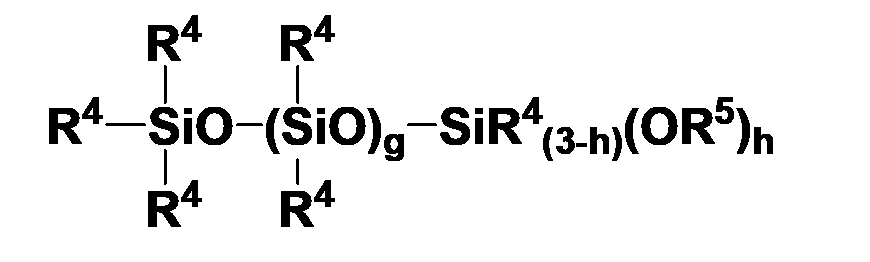
(式中、R4は独立に非置換又は置換の1価炭化水素基であり、R5は独立にアルキル基、アルコキシアルキル基、アルケニル基又はアシル基であり、gは5~100の整数であり、hは1~3の整数である。)
で表され、25℃における粘度が0.01~30Pa・sのオルガノポリシロキサン(G)を混合して加熱処理を行う請求項5又は6に記載の熱伝導性付加硬化型シリコーン組成物の製造方法。 - (A)下記平均組成式(1)
RaR1 bSiO(4-a-b)/2 (1)
(式中、Rは独立にアルケニル基であり、R1は独立に脂肪族不飽和結合を有さない非置換又は置換の1価炭化水素基であり、aは0.0001~0.2、bは1.7~2.2で、かつa+bが1.9~2.4を満足する正数である。)
で表され、一分子中に珪素原子に結合したアルケニル基を少なくとも2個有するオルガノポリシロキサン、及び
(C)60℃×24時間純水で酸化アルミニウム粉末を加熱抽出し、その水層をイオンクロマトグラフィーで測定した場合のNa+イオン量が50ppm以下の酸化アルミニウム
の温度70℃以上の加熱処理混合物と、
(E)白金族金属触媒:(A)成分の合計質量に対して白金族金属質量で1~200ppmと
を含有する第1液と、
(A)下記平均組成式(1)
RaR1 bSiO(4-a-b)/2 (1)
(式中、Rは独立にアルケニル基であり、R1は独立に脂肪族不飽和結合を有さない非置換又は置換の1価炭化水素基であり、aは0.0001~0.2、bは1.7~2.2で、かつa+bが1.9~2.4を満足する正数である。)
で表され、一分子中に珪素原子に結合したアルケニル基を少なくとも2個有するオルガノポリシロキサン、
(B)下記平均組成式(2)
R2 cHdSiO(4-c-d)/2 (2)
(式中、R2は独立に脂肪族不飽和結合を有さない非置換又は置換の1価炭化水素基であり、cは0.7~2.2、dは0.001~0.5で、かつc+dが0.8~2.5を満足する正数である。)
で表され、一分子中に珪素原子に結合した水素原子を少なくとも3個有するオルガノハイドロジェンポリシロキサン:(A)成分の合計中のアルケニル基1個に対し(B)成分中の珪素原子結合水素原子(SiH基)が0.1~2個となる量、及び
(C)60℃×24時間純水で酸化アルミニウム粉末を加熱抽出し、その水層をイオンクロマトグラフィーで測定した場合のNa+イオン量が50ppm以下の酸化アルミニウム
の温度70℃以上の加熱処理混合物と、
(H)下記平均組成式(4)
R7 jHkSiO(4-j-k)/2 (4)
(式中、R7は独立に脂肪族不飽和結合を有さない非置換又は置換の1価炭化水素基であり、jは0.7~2.2、kは0.001~0.5で、かつj+kが0.8~2.5を満足する正数である。)
で表され、一分子中に珪素原子に結合した水素原子を2個有するオルガノハイドロジェンポリシロキサン:(A)成分の合計中のアルケニル基1個に対し(H)成分中の珪素原子結合水素原子(SiH基)が0.01~3個となる量と
を含有する第2液と
の2液型からなり、但し、第1液は上記(B)、(H)成分を含有せず、第2液は上記(E)成分を含有せず、組成物中の(A)成分の合計は100質量部であり、(C)成分の合計は1,000~7,000質量部であり、第1液及び第2液それぞれの熱伝導率がISO 22007-2準拠のホットディスク法において、2.0~7.0W/m・Kであり、第1液及び第2液それぞれの25℃における粘度がスパイラル粘度計によるローターA、回転数10rpm測定時(ずり速度6(1/sec))において、30~800Pa・sである請求項1に記載の熱伝導性付加硬化型シリコーン組成物。 - (B)成分と(H)成分中のSiH基の合計量が、(A)成分の合計中のアルケニル基1個に対して0.11~5個の割合である請求項8に記載の熱伝導性付加硬化型シリコーン組成物。
- 更にシランカップリング剤(F)及び/又は下記一般式(5)
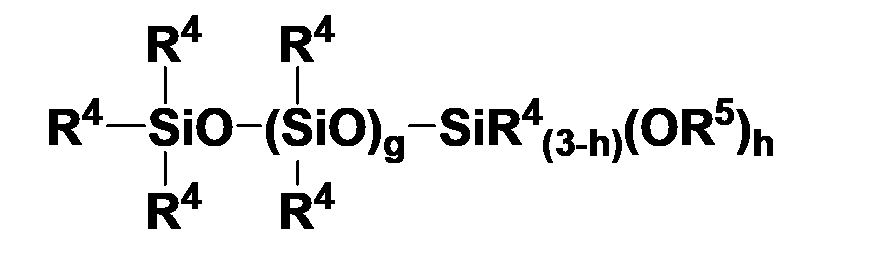
(式中、R4は独立に非置換又は置換の1価炭化水素基であり、R5は独立にアルキル基、アルコキシアルキル基、アルケニル基又はアシル基であり、gは5~100の整数であり、hは1~3の整数である。)
で表され、25℃における粘度が0.01~30Pa・sのオルガノポリシロキサン(G)を、第1液に(A)、(C)成分との温度70℃以上の加熱処理混合物として、第2液に(A)、(B)、(C)成分との温度70℃以上の加熱処理混合物として含有する請求項8又は9に記載の熱伝導性付加硬化型シリコーン組成物。 - (A)下記平均組成式(1)
RaR1 bSiO(4-a-b)/2 (1)
(式中、Rは独立にアルケニル基であり、R1は独立に脂肪族不飽和結合を有さない非置換又は置換の1価炭化水素基であり、aは0.0001~0.2、bは1.7~2.2で、かつa+bが1.9~2.4を満足する正数である。)
で表され、一分子中に珪素原子に結合したアルケニル基を少なくとも2個有するオルガノポリシロキサン、及び
(C)60℃×24時間純水で酸化アルミニウム粉末を加熱抽出し、その水層をイオンクロマトグラフィーで測定した場合のNa+イオン量が50ppm以下の酸化アルミニウム
を70℃以上の温度で混合して加熱処理を行い、冷却した加熱処理混合物に、
(E)白金族金属触媒:(A)成分の合計質量に対して白金族金属質量で1~200ppm
を添加混合することにより、第1液を調製する工程、
(A)下記平均組成式(1)
RaR1 bSiO(4-a-b)/2 (1)
(式中、Rは独立にアルケニル基であり、R1は独立に脂肪族不飽和結合を有さない非置換又は置換の1価炭化水素基であり、aは0.0001~0.2、bは1.7~2.2で、かつa+bが1.9~2.4を満足する正数である。)
で表され、一分子中に珪素原子に結合したアルケニル基を少なくとも2個有するオルガノポリシロキサン、
(B)下記平均組成式(2)
R2 cHdSiO(4-c-d)/2 (2)
(式中、R2は独立に脂肪族不飽和結合を有さない非置換又は置換の1価炭化水素基であり、cは0.7~2.2、dは0.001~0.5で、かつc+dが0.8~2.5を満足する正数である。)
で表され、一分子中に珪素原子に結合した水素原子を少なくとも3個有するオルガノハイドロジェンポリシロキサン:(A)成分の合計中のアルケニル基1個に対し(B)成分中の珪素原子結合水素原子(SiH基)が0.1~2個となる量、及び
(C)60℃×24時間純水で酸化アルミニウム粉末を加熱抽出し、その水層をイオンクロマトグラフィーで測定した場合のNa+イオン量が50ppm以下の酸化アルミニウム
を70℃以上の温度で混合して加熱処理を行い、冷却した加熱処理混合物に、
(H)下記平均組成式(4)
R7 jHkSiO(4-j-k)/2 (4)
(式中、R7は独立に脂肪族不飽和結合を有さない非置換又は置換の1価炭化水素基であり、jは0.7~2.2、kは0.001~0.5で、かつj+kが0.8~2.5を満足する正数である。)
で表され、一分子中に珪素原子に結合した水素原子を2個有するオルガノハイドロジェンポリシロキサン:(A)成分の合計中のアルケニル基1個に対し(H)成分中の珪素原子結合水素原子(SiH基)が0.01~3個となる量
を混合することにより、第2液を調製する工程
を有し、但し、第1液は(B)、(H)成分を、第2液は(E)成分を含有しないものであり、組成物中の(A)成分の合計は100質量部であり、(C)成分の合計は1,000~7,000質量部であり、得られる第1液及び第2液それぞれの熱伝導率がISO 22007-2準拠のホットディスク法において、2.0~7.0W/m・Kであり、得られる第1液及び第2液それぞれの25℃における粘度がスパイラル粘度計によるローターA、回転数10rpm測定時(ずり速度6(1/sec))において、30~800Pa・sである熱伝導性付加硬化型シリコーン組成物の製造方法。 - (B)成分と(H)成分中のSiH基の合計量が、(A)成分の合計中のアルケニル基1個に対して0.11~5個の割合である請求項11に記載の熱伝導性付加硬化型シリコーン組成物の製造方法。
- 更にシランカップリング剤(F)及び/又は下記一般式(5)
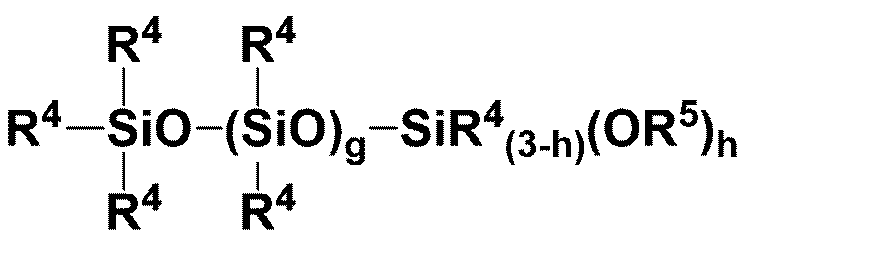
(式中、R4は独立に非置換又は置換の1価炭化水素基であり、R5は独立にアルキル基、アルコキシアルキル基、アルケニル基又はアシル基であり、gは5~100の整数であり、hは1~3の整数である。)
で表され、25℃における粘度が0.01~30Pa・sのオルガノポリシロキサン(G)を、第1液の(A)、(C)成分と、第2液の(A)、(B)、(C)成分に混合して加熱処理を行う請求項11又は12に記載の熱伝導性付加硬化型シリコーン組成物の製造方法。
Priority Applications (5)
| Application Number | Priority Date | Filing Date | Title |
|---|---|---|---|
| JP2021555983A JP7243857B2 (ja) | 2019-11-15 | 2020-10-26 | 熱伝導性付加硬化型シリコーン組成物及びその製造方法 |
| EP20886880.2A EP4060000A4 (en) | 2019-11-15 | 2020-10-26 | THERMALLY CONDUCTIVE ADDITION CROSS-LINKING SILICONE COMPOSITION AND METHOD FOR PRODUCING THE SAME |
| CN202080079164.1A CN114729194B (zh) | 2019-11-15 | 2020-10-26 | 导热性加成固化型有机硅组合物及其制造方法 |
| US17/775,537 US20220411589A1 (en) | 2019-11-15 | 2020-10-26 | Thermally conductive addition curing silicone composition and method for producing same |
| KR1020227019464A KR20220103982A (ko) | 2019-11-15 | 2020-10-26 | 열전도성 부가 경화형 실리콘 조성물 및 그 제조 방법 |
Applications Claiming Priority (4)
| Application Number | Priority Date | Filing Date | Title |
|---|---|---|---|
| JP2019207067 | 2019-11-15 | ||
| JP2019-207067 | 2019-11-15 | ||
| JP2020068492 | 2020-04-06 | ||
| JP2020-068492 | 2020-04-06 |
Publications (1)
| Publication Number | Publication Date |
|---|---|
| WO2021095501A1 true WO2021095501A1 (ja) | 2021-05-20 |
Family
ID=75912861
Family Applications (1)
| Application Number | Title | Priority Date | Filing Date |
|---|---|---|---|
| PCT/JP2020/040097 Ceased WO2021095501A1 (ja) | 2019-11-15 | 2020-10-26 | 熱伝導性付加硬化型シリコーン組成物及びその製造方法 |
Country Status (7)
| Country | Link |
|---|---|
| US (1) | US20220411589A1 (ja) |
| EP (1) | EP4060000A4 (ja) |
| JP (1) | JP7243857B2 (ja) |
| KR (1) | KR20220103982A (ja) |
| CN (1) | CN114729194B (ja) |
| TW (1) | TWI869484B (ja) |
| WO (1) | WO2021095501A1 (ja) |
Cited By (2)
| Publication number | Priority date | Publication date | Assignee | Title |
|---|---|---|---|---|
| WO2022030108A1 (ja) * | 2020-08-06 | 2022-02-10 | 信越化学工業株式会社 | 熱伝導性2液付加硬化型シリコーン組成物及びその製造方法 |
| JP2023501754A (ja) * | 2019-11-19 | 2023-01-18 | ヘンケル・アクチェンゲゼルシャフト・ウント・コムパニー・コマンディットゲゼルシャフト・アウフ・アクチェン | サーマルインターフェース材料及び適用方法 |
Families Citing this family (2)
| Publication number | Priority date | Publication date | Assignee | Title |
|---|---|---|---|---|
| TW202506890A (zh) * | 2023-04-10 | 2025-02-16 | 德商漢高股份有限及兩合公司 | 熱導性灌封材料 |
| EP4665797A1 (en) * | 2023-05-23 | 2025-12-24 | Wacker Chemie AG | A polysiloxane composition |
Citations (6)
| Publication number | Priority date | Publication date | Assignee | Title |
|---|---|---|---|---|
| JPS5821160B2 (ja) | 1977-12-29 | 1983-04-27 | 三恵工業株式会社 | 光信号による監視装置 |
| JP2741436B2 (ja) | 1991-06-24 | 1998-04-15 | 信越化学工業株式会社 | 表面処理アルミナ及びそれを含有する熱伝導性シリコーン組成物 |
| JP3676544B2 (ja) | 1997-08-05 | 2005-07-27 | ジーイー東芝シリコーン株式会社 | 難燃性放熱性シート用シリコーンゲル組成物および難燃性放熱性シリコーンシート |
| JP2005344106A (ja) * | 2004-05-07 | 2005-12-15 | Shin Etsu Chem Co Ltd | シリコーンゲル組成物 |
| JP2007233084A (ja) * | 2006-03-01 | 2007-09-13 | Fuji Xerox Co Ltd | 定着ロール、定着装置及び画像形成装置 |
| JP2011122084A (ja) * | 2009-12-11 | 2011-06-23 | Shin-Etsu Chemical Co Ltd | 熱伝導性シリコーンゲル組成物、その製造方法及び熱伝導性シリコーンゲル |
Family Cites Families (8)
| Publication number | Priority date | Publication date | Assignee | Title |
|---|---|---|---|---|
| JP4193052B2 (ja) * | 2003-08-25 | 2008-12-10 | 信越化学工業株式会社 | 高熱伝導性シリコーンゴム組成物並びに定着ロール及び定着ベルト |
| JP4214074B2 (ja) * | 2004-03-30 | 2009-01-28 | 電気化学工業株式会社 | 高純度球状アルミナ粉末の製造方法 |
| JP5539283B2 (ja) * | 2011-09-27 | 2014-07-02 | 信越化学工業株式会社 | 熱伝導性シリコーンゴム組成物 |
| JP6481599B2 (ja) * | 2015-12-08 | 2019-03-13 | 信越化学工業株式会社 | 無機粒子−ポリシロキサン複合体、それを含む分散液、固体材料、及び該無機粒子−ポリシロキサン複合体の製造方法 |
| JP6705426B2 (ja) * | 2017-05-09 | 2020-06-03 | 信越化学工業株式会社 | 熱伝導性シリコーン組成物 |
| JP2019131734A (ja) * | 2018-02-01 | 2019-08-08 | 信越化学工業株式会社 | 2液付加反応硬化型放熱シリコーン組成物及びその製造方法 |
| JP7344174B2 (ja) * | 2020-05-26 | 2023-09-13 | 信越化学工業株式会社 | 熱伝導性付加硬化型シリコーン組成物及びその製造方法 |
| JP7328184B2 (ja) * | 2020-08-06 | 2023-08-16 | 信越化学工業株式会社 | 熱伝導性2液付加硬化型シリコーン組成物及びその製造方法 |
-
2020
- 2020-10-26 KR KR1020227019464A patent/KR20220103982A/ko active Pending
- 2020-10-26 JP JP2021555983A patent/JP7243857B2/ja active Active
- 2020-10-26 WO PCT/JP2020/040097 patent/WO2021095501A1/ja not_active Ceased
- 2020-10-26 US US17/775,537 patent/US20220411589A1/en not_active Abandoned
- 2020-10-26 EP EP20886880.2A patent/EP4060000A4/en not_active Withdrawn
- 2020-10-26 CN CN202080079164.1A patent/CN114729194B/zh active Active
- 2020-11-09 TW TW109138974A patent/TWI869484B/zh active
Patent Citations (6)
| Publication number | Priority date | Publication date | Assignee | Title |
|---|---|---|---|---|
| JPS5821160B2 (ja) | 1977-12-29 | 1983-04-27 | 三恵工業株式会社 | 光信号による監視装置 |
| JP2741436B2 (ja) | 1991-06-24 | 1998-04-15 | 信越化学工業株式会社 | 表面処理アルミナ及びそれを含有する熱伝導性シリコーン組成物 |
| JP3676544B2 (ja) | 1997-08-05 | 2005-07-27 | ジーイー東芝シリコーン株式会社 | 難燃性放熱性シート用シリコーンゲル組成物および難燃性放熱性シリコーンシート |
| JP2005344106A (ja) * | 2004-05-07 | 2005-12-15 | Shin Etsu Chem Co Ltd | シリコーンゲル組成物 |
| JP2007233084A (ja) * | 2006-03-01 | 2007-09-13 | Fuji Xerox Co Ltd | 定着ロール、定着装置及び画像形成装置 |
| JP2011122084A (ja) * | 2009-12-11 | 2011-06-23 | Shin-Etsu Chemical Co Ltd | 熱伝導性シリコーンゲル組成物、その製造方法及び熱伝導性シリコーンゲル |
Non-Patent Citations (1)
| Title |
|---|
| See also references of EP4060000A4 |
Cited By (7)
| Publication number | Priority date | Publication date | Assignee | Title |
|---|---|---|---|---|
| JP2023501754A (ja) * | 2019-11-19 | 2023-01-18 | ヘンケル・アクチェンゲゼルシャフト・ウント・コムパニー・コマンディットゲゼルシャフト・アウフ・アクチェン | サーマルインターフェース材料及び適用方法 |
| JP7850659B2 (ja) | 2019-11-19 | 2026-04-23 | ヘンケル・アクチェンゲゼルシャフト・ウント・コムパニー・コマンディットゲゼルシャフト・アウフ・アクチェン | サーマルインターフェース材料及び適用方法 |
| WO2022030108A1 (ja) * | 2020-08-06 | 2022-02-10 | 信越化学工業株式会社 | 熱伝導性2液付加硬化型シリコーン組成物及びその製造方法 |
| CN116075552A (zh) * | 2020-08-06 | 2023-05-05 | 信越化学工业株式会社 | 导热性两液加成固化型有机硅组合物及其制备方法 |
| CN116075552B (zh) * | 2020-08-06 | 2024-06-21 | 信越化学工业株式会社 | 导热性两液加成固化型有机硅组合物及其制备方法 |
| US12378416B2 (en) | 2020-08-06 | 2025-08-05 | Shin-Etsu Chemical Co., Ltd. | Thermally-conductive two-part addition-curable silicone composition and method for producing the same |
| KR102937544B1 (ko) * | 2020-08-06 | 2026-03-11 | 신에쓰 가가꾸 고교 가부시끼가이샤 | 열전도성 2액부가경화형 실리콘 조성물 및 그의 제조방법 |
Also Published As
| Publication number | Publication date |
|---|---|
| US20220411589A1 (en) | 2022-12-29 |
| EP4060000A1 (en) | 2022-09-21 |
| EP4060000A4 (en) | 2023-12-13 |
| TWI869484B (zh) | 2025-01-11 |
| JPWO2021095501A1 (ja) | 2021-05-20 |
| KR20220103982A (ko) | 2022-07-25 |
| CN114729194B (zh) | 2023-10-20 |
| CN114729194A (zh) | 2022-07-08 |
| JP7243857B2 (ja) | 2023-03-22 |
| TW202132468A (zh) | 2021-09-01 |
Similar Documents
| Publication | Publication Date | Title |
|---|---|---|
| JP7243857B2 (ja) | 熱伝導性付加硬化型シリコーン組成物及びその製造方法 | |
| JP7344174B2 (ja) | 熱伝導性付加硬化型シリコーン組成物及びその製造方法 | |
| US12378416B2 (en) | Thermally-conductive two-part addition-curable silicone composition and method for producing the same | |
| CN110234711A (zh) | 导热性聚有机硅氧烷组合物 | |
| WO2023171353A1 (ja) | 2液型熱伝導性付加硬化型シリコーン組成物及びそのシリコーン硬化物 | |
| JP5821160B2 (ja) | 熱伝導性シリコーンゲル組成物の製造方法 | |
| WO2023171352A1 (ja) | 熱伝導性付加硬化型シリコーン組成物及びそのシリコーン硬化物 | |
| WO2024024503A1 (ja) | 熱伝導性2液付加硬化型シリコーン組成物、硬化物及びシート | |
| JP2025021180A (ja) | 熱伝導性2液付加硬化型シリコーン組成物 | |
| JP2024178019A (ja) | 熱伝導性2液付加硬化型シリコーン組成物、硬化物及びシート | |
| JP2024172885A (ja) | 熱伝導性2液付加硬化型シリコーン組成物、硬化物及びシート |
Legal Events
| Date | Code | Title | Description |
|---|---|---|---|
| 121 | Ep: the epo has been informed by wipo that ep was designated in this application |
Ref document number: 20886880 Country of ref document: EP Kind code of ref document: A1 |
|
| ENP | Entry into the national phase |
Ref document number: 2021555983 Country of ref document: JP Kind code of ref document: A |
|
| ENP | Entry into the national phase |
Ref document number: 20227019464 Country of ref document: KR Kind code of ref document: A |
|
| NENP | Non-entry into the national phase |
Ref country code: DE |
|
| ENP | Entry into the national phase |
Ref document number: 2020886880 Country of ref document: EP Effective date: 20220615 |