WO2021111975A1 - Dispositif, procédé et programme de traitement d'informations - Google Patents
Dispositif, procédé et programme de traitement d'informations Download PDFInfo
- Publication number
- WO2021111975A1 WO2021111975A1 PCT/JP2020/044031 JP2020044031W WO2021111975A1 WO 2021111975 A1 WO2021111975 A1 WO 2021111975A1 JP 2020044031 W JP2020044031 W JP 2020044031W WO 2021111975 A1 WO2021111975 A1 WO 2021111975A1
- Authority
- WO
- WIPO (PCT)
- Prior art keywords
- information processing
- head
- display
- processing device
- content image
- Prior art date
- Legal status (The legal status is an assumption and is not a legal conclusion. Google has not performed a legal analysis and makes no representation as to the accuracy of the status listed.)
- Ceased
Links
Images




Classifications
-
- G—PHYSICS
- G09—EDUCATION; CRYPTOGRAPHY; DISPLAY; ADVERTISING; SEALS
- G09G—ARRANGEMENTS OR CIRCUITS FOR CONTROL OF INDICATING DEVICES USING STATIC MEANS TO PRESENT VARIABLE INFORMATION
- G09G5/00—Control arrangements or circuits for visual indicators common to cathode-ray tube indicators and other visual indicators
- G09G5/36—Control arrangements or circuits for visual indicators common to cathode-ray tube indicators and other visual indicators characterised by the display of a graphic pattern, e.g. using an all-points-addressable [APA] memory
- G09G5/38—Control arrangements or circuits for visual indicators common to cathode-ray tube indicators and other visual indicators characterised by the display of a graphic pattern, e.g. using an all-points-addressable [APA] memory with means for controlling the display position
-
- G—PHYSICS
- G06—COMPUTING OR CALCULATING; COUNTING
- G06F—ELECTRIC DIGITAL DATA PROCESSING
- G06F3/00—Input arrangements for transferring data to be processed into a form capable of being handled by the computer; Output arrangements for transferring data from processing unit to output unit, e.g. interface arrangements
- G06F3/14—Digital output to display device ; Cooperation and interconnection of the display device with other functional units
- G06F3/147—Digital output to display device ; Cooperation and interconnection of the display device with other functional units using display panels
-
- G—PHYSICS
- G02—OPTICS
- G02B—OPTICAL ELEMENTS, SYSTEMS OR APPARATUS
- G02B27/00—Optical systems or apparatus not provided for by any of the groups G02B1/00 - G02B26/00, G02B30/00
- G02B27/01—Head-up displays
- G02B27/017—Head mounted
-
- G—PHYSICS
- G02—OPTICS
- G02B—OPTICAL ELEMENTS, SYSTEMS OR APPARATUS
- G02B27/00—Optical systems or apparatus not provided for by any of the groups G02B1/00 - G02B26/00, G02B30/00
- G02B27/01—Head-up displays
- G02B27/017—Head mounted
- G02B27/0172—Head mounted characterised by optical features
-
- G—PHYSICS
- G06—COMPUTING OR CALCULATING; COUNTING
- G06T—IMAGE DATA PROCESSING OR GENERATION, IN GENERAL
- G06T19/00—Manipulating three-dimensional [3D] models or images for computer graphics
-
- G—PHYSICS
- G06—COMPUTING OR CALCULATING; COUNTING
- G06V—IMAGE OR VIDEO RECOGNITION OR UNDERSTANDING
- G06V10/00—Arrangements for image or video recognition or understanding
- G06V10/70—Arrangements for image or video recognition or understanding using pattern recognition or machine learning
- G06V10/74—Image or video pattern matching; Proximity measures in feature spaces
- G06V10/761—Proximity, similarity or dissimilarity measures
-
- G—PHYSICS
- G06—COMPUTING OR CALCULATING; COUNTING
- G06V—IMAGE OR VIDEO RECOGNITION OR UNDERSTANDING
- G06V20/00—Scenes; Scene-specific elements
- G06V20/20—Scenes; Scene-specific elements in augmented reality scenes
-
- G—PHYSICS
- G06—COMPUTING OR CALCULATING; COUNTING
- G06V—IMAGE OR VIDEO RECOGNITION OR UNDERSTANDING
- G06V40/00—Recognition of biometric, human-related or animal-related patterns in image or video data
- G06V40/10—Human or animal bodies, e.g. vehicle occupants or pedestrians; Body parts, e.g. hands
- G06V40/16—Human faces, e.g. facial parts, sketches or expressions
- G06V40/161—Detection; Localisation; Normalisation
-
- G—PHYSICS
- G06—COMPUTING OR CALCULATING; COUNTING
- G06V—IMAGE OR VIDEO RECOGNITION OR UNDERSTANDING
- G06V40/00—Recognition of biometric, human-related or animal-related patterns in image or video data
- G06V40/10—Human or animal bodies, e.g. vehicle occupants or pedestrians; Body parts, e.g. hands
- G06V40/18—Eye characteristics, e.g. of the iris
- G06V40/19—Sensors therefor
-
- H—ELECTRICITY
- H04—ELECTRIC COMMUNICATION TECHNIQUE
- H04N—PICTORIAL COMMUNICATION, e.g. TELEVISION
- H04N13/00—Stereoscopic video systems; Multi-view video systems; Details thereof
- H04N13/30—Image reproducers
- H04N13/332—Displays for viewing with the aid of special glasses or head-mounted displays [HMD]
- H04N13/344—Displays for viewing with the aid of special glasses or head-mounted displays [HMD] with head-mounted left-right displays
-
- H—ELECTRICITY
- H04—ELECTRIC COMMUNICATION TECHNIQUE
- H04N—PICTORIAL COMMUNICATION, e.g. TELEVISION
- H04N5/00—Details of television systems
- H04N5/66—Transforming electric information into light information
-
- G—PHYSICS
- G02—OPTICS
- G02B—OPTICAL ELEMENTS, SYSTEMS OR APPARATUS
- G02B27/00—Optical systems or apparatus not provided for by any of the groups G02B1/00 - G02B26/00, G02B30/00
- G02B27/01—Head-up displays
- G02B27/0101—Head-up displays characterised by optical features
- G02B2027/0138—Head-up displays characterised by optical features comprising image capture systems, e.g. camera
-
- G—PHYSICS
- G06—COMPUTING OR CALCULATING; COUNTING
- G06V—IMAGE OR VIDEO RECOGNITION OR UNDERSTANDING
- G06V2201/00—Indexing scheme relating to image or video recognition or understanding
- G06V2201/07—Target detection
-
- G—PHYSICS
- G09—EDUCATION; CRYPTOGRAPHY; DISPLAY; ADVERTISING; SEALS
- G09G—ARRANGEMENTS OR CIRCUITS FOR CONTROL OF INDICATING DEVICES USING STATIC MEANS TO PRESENT VARIABLE INFORMATION
- G09G2320/00—Control of display operating conditions
- G09G2320/02—Improving the quality of display appearance
- G09G2320/0261—Improving the quality of display appearance in the context of movement of objects on the screen or movement of the observer relative to the screen
-
- G—PHYSICS
- G09—EDUCATION; CRYPTOGRAPHY; DISPLAY; ADVERTISING; SEALS
- G09G—ARRANGEMENTS OR CIRCUITS FOR CONTROL OF INDICATING DEVICES USING STATIC MEANS TO PRESENT VARIABLE INFORMATION
- G09G2340/00—Aspects of display data processing
- G09G2340/04—Changes in size, position or resolution of an image
- G09G2340/0464—Positioning
-
- G—PHYSICS
- G09—EDUCATION; CRYPTOGRAPHY; DISPLAY; ADVERTISING; SEALS
- G09G—ARRANGEMENTS OR CIRCUITS FOR CONTROL OF INDICATING DEVICES USING STATIC MEANS TO PRESENT VARIABLE INFORMATION
- G09G2340/00—Aspects of display data processing
- G09G2340/12—Overlay of images, i.e. displayed pixel being the result of switching between the corresponding input pixels
-
- G—PHYSICS
- G09—EDUCATION; CRYPTOGRAPHY; DISPLAY; ADVERTISING; SEALS
- G09G—ARRANGEMENTS OR CIRCUITS FOR CONTROL OF INDICATING DEVICES USING STATIC MEANS TO PRESENT VARIABLE INFORMATION
- G09G2340/00—Aspects of display data processing
- G09G2340/14—Solving problems related to the presentation of information to be displayed
-
- G—PHYSICS
- G09—EDUCATION; CRYPTOGRAPHY; DISPLAY; ADVERTISING; SEALS
- G09G—ARRANGEMENTS OR CIRCUITS FOR CONTROL OF INDICATING DEVICES USING STATIC MEANS TO PRESENT VARIABLE INFORMATION
- G09G2354/00—Aspects of interface with display user
Definitions
- the present invention relates to an information processing device, an information processing method, and an information processing program.
- an information processing device that provides virtual reality to the wearer of a head-mounted display. While the content is being displayed on the head-mounted display, the wearer's field of vision is optically obstructed.
- the peripheral person may feel that the wearer of the head-mounted display is gazing at the peripheral person himself. It may cause discomfort.
- the present invention has been made in view of the above, and an object of the present invention is to provide an information processing device, an information processing method, and an information processing program capable of reducing discomfort given to a surrounding person.
- the information processing device includes a display control unit and a determination unit in order to solve the above-mentioned problems and achieve the object.
- the display control unit displays the content image on the head-mounted display.
- the determination unit determines whether or not a peripheral person exists in the front direction of the head-mounted display based on a camera image obtained by capturing the surrounding environment of the head-mounted display while the display control unit is displaying the content image. judge.
- the display control unit moves the display position of the content image when the determination unit determines that the peripheral person exists.
- FIG. 1 is a diagram showing an example of the appearance of the display device according to the embodiment.
- FIG. 2 is a diagram showing an example of the field of view of the wearer.
- FIG. 3 is a diagram showing an outline of the information processing method according to the embodiment.
- the display device 10 is a head-mounted display (hereinafter, also referred to as an HMD (Head Mount Display)). More specifically, the display device 10 is a so-called optical transmission type HMD provided with a display unit 11 having optical transparency.
- HMD Head Mount Display
- the display device 10 includes a camera 13 in the vicinity of the display unit 11.
- the camera 13 captures an angle of view corresponding to the field of view of the wearer U when the display device 10 is mounted.
- the field of view of the wearer U is optically blocked by the content image.
- the content image here is a concept including both a still image and a moving image.
- a light-shielding member (not shown) is generally provided in order to secure the brightness of the display unit 11.
- a dimming element whose transmittance can be adjusted according to a change in the brightness of external light can be used.
- the field of view (eye movement) of the wearer U of the HMD cannot be confirmed from the surrounding persons existing around the wearer U. That is, while the wearer U is viewing the content image, the field of view of the wearer U is obstructed, so that the wearer U is less likely to notice the surrounding person, and the peripheral person recognizes where the wearer U is looking. Can't.
- the posture of the wearer U that is, by moving the display position of the video content displayed on the display device 10. It was decided to change the front direction of the HMD.
- the center coordinates C of the content image displayed on the display device 10 are displayed on the display device 10. It is moved in a predetermined direction from the initial coordinates Rp indicating the center of the display area of.
- the presence or absence of a peripheral person can be determined based on the camera image captured by the camera 13.
- the discomfort given by the wearer U to the peripheral person is reduced by encouraging the change of the posture of the wearer U in a direction different from the peripheral person initially existing in the front direction of the HMD. can do.
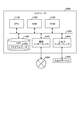
- FIG. 4 is a block diagram of the information processing device 1 according to the embodiment. Note that FIG. 4 also shows the display device 10. Further, the information processing device 1 and the display device 10 can transmit and receive data in both directions wirelessly or by wire.
- the display device 10 includes a display unit 11, a gyro sensor 12, a camera 13, and a distance measuring sensor 14.
- the display unit 11 is composed of, for example, a half mirror or the like, has a light transmission type display surface (lens), and displays a content image input from the information processing device 1. More specifically, the display unit 11 projects the content image duplicated on a display (not shown) toward the eyeball of the wearer U by repeating total reflection in the lens.
- the gyro sensor 12 is a sensor that detects the angular velocity of three axes that detects the movement of the display device 10. As described above, since the display device 10 is an HMD, the gyro sensor 12 detects a change in the posture of the wearer U of the display device 10 and processes a posture signal corresponding to the detected change in the posture. Output to 1.
- the camera 13 is a camera that has an image sensor and images the front of the display device 10.
- the camera 13 preferably includes a wide-angle lens such as a fisheye lens.
- the camera 13 captures an angle of view corresponding to the field of view of the wearer U when the HMD is worn, captures the captured camera image, and outputs the captured camera image to the information processing device 1.
- the distance measuring sensor 14 is an example of a sensor that senses the surrounding environment of the display unit 11, and is, for example, a ToF (Time of Flight) type sensor.
- the image sensor of the camera 13 may be regarded as a sensor for measuring the surrounding environment. That is, if the distance to a nearby person can be measured by image analysis, the image sensor may take on the function of the distance measuring sensor 14.
- the information processing device 1 includes a storage unit 2 and a control unit 3.
- the information processing device 1 may include a communication unit (not shown) for wirelessly or wiredly communicating with an external device, and an operation unit (not shown) for accepting user operations.
- the storage unit 2 is realized by, for example, a semiconductor memory element such as a RAM or a flash memory, or a storage device such as a hard disk or an optical disk. In the example shown in FIG. 4, the storage unit 2 stores the model information 20 and the score information 21.
- the model information 20 is information about a model for detecting a predetermined object from a camera image captured by the camera 13. For example, the feature amount in the camera image for each object is stored in the storage unit 2 as model information 20.
- the score information 21 is information related to the score for determining the moving destination when moving the display position of the content image. A specific example of the score information 21 will be described later with reference to FIG.
- control unit 3 for example, a program stored in the information processing device 1 is executed by a CPU (Central Processing Unit), an MPU (Micro Processing Unit), or the like with a RAM (Random Access Memory) or the like as a work area. It will be realized. Further, the control unit 3 is a controller, and may be realized by an integrated circuit such as an ASIC (Application Specific Integrated Circuit) or an FPGA (Field Programmable Gate Array).
- ASIC Application Specific Integrated Circuit
- FPGA Field Programmable Gate Array
- the control unit 3 includes an acquisition unit 30, a determination unit 31, a determination unit 32, a calculation unit 33, and a display control unit 34, and includes information processing functions described below. Realize or execute the action.
- the internal configuration of the control unit 3 is not limited to the configuration shown in FIG. 4, and may be another configuration as long as it is a configuration for performing information processing described later.
- the control unit 3 may be connected to a predetermined network by wire or wirelessly using, for example, a NIC (Network Interface Card) or the like, and may receive various information from an external server or the like via the network.
- NIC Network Interface Card
- the acquisition unit 30 acquires various information input from the display device 10. Specifically, the acquisition unit 30 acquires a posture signal from the gyro sensor 12 and acquires a camera image from the camera 13.
- the determination unit 31 determines whether or not a peripheral person exists in the front direction of the display device 10 based on the camera image obtained by capturing the surrounding environment of the display device 10 while the content image is being displayed by the display control unit 34.
- the determination unit 31 detects a person appearing in the camera image captured by the camera 13 based on the feature amount registered in the model information 20, and if the detected person is in the front direction of the display device 10, the periphery It is determined that the person exists in the front direction of the display device 10.
- the determination unit 31 when it detects a person who satisfies a predetermined determination condition, it may determine that a peripheral person exists.
- a specific example of the processing by the determination unit 31 will be described with reference to FIGS. 5 to 7.
- 5 to 7 are schematic views of processing by the determination unit 31 according to the embodiment.
- the front direction of the display device 10 may be described as the front vector V.
- the determination unit 31 detects a specific part of an object in addition to the person from the camera image and calculates the orientation of the specific part.
- the specific part C1 is the face of a peripheral person
- the direction of the specific part C1 that is, the line-of-sight vector Va indicating the direction of the line of sight (face) of the person
- the specific part C2 is the center of the body.
- the case where it is the direction vector Vb which shows the direction of a specific part C2 is shown.
- the specific site is not limited to the above example, and may be another site. For example, when the person is a woman, the chest or buttocks of the woman may be a specific part.
- the determination unit 31 calculates the relative position between the display device 10 and the specific part. At this time, the determination unit 31 may calculate the above relative position based on the measurement result of the distance measuring sensor 14 shown in FIG. 4, or may calculate the relative position based on the camera image. May be calculated.
- the determination unit 31 determines whether or not the person satisfies the predetermined determination condition, and if it determines that the predetermined determination condition is satisfied, determines that a peripheral person exists in the front direction of the display device 10.
- the determination unit 31 has a state in which the angle error between the front vector V and the line-of-sight vector V1 is equal to or less than a predetermined value, and the distance d between the front vector V and the specific portion C1 is equal to or less than a predetermined value.
- the angle error between the front vector V and the line-of-sight vector V1 is equal to or less than a predetermined value
- the distance d between the front vector V and the specific portion C1 is equal to or less than a predetermined value.
- the distance d between the front vector V and the specific portion C1 corresponds to the length of the perpendicular line from the specific portion C1 to the front vector V.
- the determination unit 31 satisfies the determination condition when the peripheral person notices the situation in which the wearer U is gazing at himself / herself.
- the above-mentioned determination condition may be described as a line-of-sight condition.
- the determination condition may be satisfied without considering the orientation of the surrounding persons.
- the determination unit 31 determines the front direction of the display device 10 when the distance d between the front vector V and the specific portion C1 continues to be equal to or less than a predetermined value for a certain period of time. It is determined that there is a surrounding person in.
- the determination unit 31 determines that a peripheral person exists when the person is stationary for a predetermined time or longer in the front direction of the display device 10. In this case, when the wearer U is gazing at a specific part of the peripheral person, it is determined that the peripheral person exists in the front direction of the display device 10.
- the above-mentioned determination condition may be described as a distance condition.
- the determination unit 32 determines the destination of the display position based on the camera image.
- the determination unit 31 determines that a peripheral person exists in the front direction of the display device 10
- the determination unit 32 determines the destination of the display position of the content image based on the camera image captured by the camera 13. ..
- FIGS. 8 to 10 are diagrams showing an example of the detection process by the determination unit 32 according to the embodiment.
- FIG. 10 is a diagram showing an example of score information 21 according to the embodiment.
- the determination unit 32 detects a person in the camera image I based on the camera image I captured by the camera 13.
- a person detected by the determination unit 32 is indicated by a marker.
- the determination unit 32 detects the orientation of each person in addition to the person captured in the camera image I. In other words, the determination unit 32 distinguishes between a person facing the wearer U side and a person facing the other direction.
- the determination unit 32 detects a feature object that satisfies the visual condition indicating the visual feature among the objects captured in the camera image I.
- the object refers to all the objects captured in the camera image I
- the feature object refers to an object having a predetermined visual feature and easily attracting attention.
- tourist monuments, signboards, etc. correspond to feature objects.
- the feature object is easy to gather the line of sight of the people who exist in the vicinity, and when it exists in the front direction of the wearer U, the peripheral person looks at the feature object instead of the surrounding person himself. It is an object that is expected to be thought of as being.
- the feature amount of the feature object satisfying the visual condition may be registered in advance, and the object having the feature amount may be detected as the feature object from the camera image I, or the line of sight of the person reflected in the camera image I may be detected. Based on this, the feature object may be detected.
- the position of the feature object may be registered in the map in advance, and the feature object may be detected based on the map and the relative positional relationship of the wearer U with the current location.
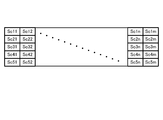
- the determination unit 32 When the determination unit 32 detects a person or a feature object in the camera image I, the determination unit 32 calculates a score based on the respective detection results. Specifically, as shown in FIG. 10, the field of view of the wearer U is divided into a plurality of regions, and a score is calculated for each of the divided regions.
- points are deducted in the area where the person exists, further points are deducted in the area where the person facing the wearer U side exists, and the area where the feature object exists is deducted. Add points.
- the determination unit 32 determines, for example, the destination of the display position of the video content, that is, the destination of the center coordinate C shown in FIG. 3, in the region having the lowest score. That is, by determining the movement destination of the center coordinate C based on the person captured in the camera image I, the area where the person does not exist is preferentially determined as the movement destination of the center coordinate C, and a plurality of people are determined. If it exists, the area where the person who is not looking at the wearer U side exists is preferentially determined as the movement destination of the center coordinate C.
- the determination unit 32 can reduce the frequency of movement of the content image by determining the direction in which there is no person satisfying the determination condition in the front direction of the HMD after movement as the movement destination of the center coordinate C.
- the determination unit 32 determines the movement destination of the center coordinate C based on the feature object, so that the wearer U can make the surrounding person think as if he / she is looking at the feature object. Therefore, it is possible to eliminate the discomfort itself that the wearer U gives to the surrounding persons.
- the movement destination of the center coordinate C may be determined again.
- the calculation unit 33 calculates, for example, the amount of change in the posture of the wearer U based on the detection result of the gyro sensor 12. Specifically, the calculation unit 33 calculates the amount of rotation of the wearer's head as the amount of change based on the posture signal input from the gyro sensor 12.
- the display control unit 34 moves the center coordinate C of the content image from the initial coordinate Rp. In this case, if the head of the wearer U does not rotate, the situation of whether the wearer U is gazing at a peripheral person continues.
- the calculation unit 33 calculates the amount of rotation of the head of the wearer U triggered by the movement of the center coordinate C, and notifies the display control unit 34, for example, when the calculated amount of rotation exceeds the threshold value.
- the threshold value here is an amount required for the initial peripheral person to deviate from the front direction of the HMD, but even if it is determined based on the movement destination determined by the determination unit 32, for example. Good. That is, when the front direction of the HMD is near the movement destination determined by the determination unit 32, it may be determined that the rotation amount exceeds the threshold value.
- the display control unit 34 moves the display position of the content image when the determination unit 31 determines that a peripheral person exists in the front direction of the HMD. At this time, as described above, the initial coordinates Rp are set at the center of the display area in the display device 10.
- the display control unit 34 moves the center coordinate C so that the distance between the initial coordinate Rp and the center coordinate C increases. Further, the display control unit 34 moves the center coordinates C to the movement destination determined by the determination unit 32.
- the center coordinate C is rapidly moved from the initial coordinate Rp, the visibility of the content image may be impaired according to the display position of the content image. Further, in this case, if the wearer U rapidly rotates the head with the movement of the center coordinate C, the line of sight is greatly deviated from the surrounding persons, so that there may be a case of giving a feeling of distrust.
- the display control unit 34 moves the display position so that the movement speed of the content image falls below a predetermined value, and displays the display position before the movement and the display after the movement. It is preferable to move the display position so that the distance from the position is within a predetermined range.
- FIG. 11 is a transition diagram of the center coordinate C when the display position is moved.
- FIG. 12 is a diagram showing an example of the amount of rotation of the head.
- the display control unit 34 moves the center coordinate C at any time so that the moving speed of the center coordinate C is equal to or less than the predetermined value and the distance of the center coordinate C before and after the movement is equal to or less than the predetermined value.
- the distance between the initial coordinate Rp and the center coordinate C after movement is preferably a predetermined value or more. Further, in this case, the display control unit 34 acquires the amount of rotation of the head from the calculation unit 33 for each movement of the center coordinate C, and moves to the next display position only when the head is not rotating. , The center coordinate C may be moved.
- the display control unit 34 moves the center coordinate C to the initial coordinate Rp.
- the display control unit 34 can stop the rotation of the head of the wearer U by returning the center coordinate C to the initial coordinate Rp. it can.
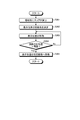
- FIG. 13 is a flowchart showing a processing procedure executed by the information processing apparatus 1 according to the embodiment.
- FIG. 14 is a flowchart showing the processing procedure of step S105 shown in FIG. The processing procedure shown below is repeatedly executed by the control unit 3.
- the information processing apparatus 1 first determines whether or not the content image is being displayed (step S101), and when the content image is being displayed (step S101, Yes), the information processing device 1 is based on the camera image. , Performs recognition processing of peripheral persons (step S102).
- the information processing device 1 determines whether or not the line-of-sight condition shown in FIG. 6 is satisfied based on the result of the recognition process of the peripheral person (step S103).
- the information processing apparatus 1 determines in the determination of step S103 that the line-of-sight condition is satisfied (steps S103, Yes)
- the information processing apparatus 1 shifts to the display control process (step S105) and ends the process.
- step S104 determines whether or not the distance condition shown in FIG. 7 is satisfied.
- step S104 the information processing apparatus 1 proceeds to the process of step S105 when the distance condition is satisfied (step S104, Yes), and when it is determined that the distance condition is not satisfied (step S104, Yes). No), the process ends. If the content image is not displayed in the determination in step S101 (steps S101, No), the information processing device 1 omits the processes after step S102 and ends the process.
- step S105 the information processing device 1 calculates a score for each area based on a person or a feature object captured in a camera image (step S201).
- the information processing device 1 determines the destination of the display position of the video content based on the score for each area (step S202), and moves the display position to the determined destination (step S203).
- the information processing device 1 determines whether or not the rotation amount of the head of the wearer U is larger than the threshold value (step S204), and when the rotation amount exceeds the threshold value (step S204, Yes), The display position is moved to the initial coordinates Rp (step S205), and the process ends.
- step S204 when the rotation amount does not reach the threshold value (step S204, No), the information processing apparatus 1 shifts to the process of step S203.
- the display device 10 is an optical see-through type display device
- the present invention is not limited to this, and the display device 10 can be similarly applied to a video see-through type display device.
- FIG. 15 is a hardware configuration diagram showing an example of a computer 1000 that realizes the functions of the information processing device 1.
- the computer 1000 has a CPU 1100, a RAM 1200, a ROM (Read Only Memory) 1300, an HDD (Hard Disk Drive) 1400, a communication interface 1500, and an input / output interface 1600.
- Each part of the computer 1000 is connected by a bus 1050.
- the CPU 1100 operates based on the program stored in the ROM 1300 or the HDD 1400, and controls each part. For example, the CPU 1100 expands the program stored in the ROM 1300 or the HDD 1400 into the RAM 1200 and executes processing corresponding to various programs.
- the ROM 1300 stores a boot program such as a BIOS (Basic Input Output System) executed by the CPU 1100 when the computer 1000 is started, a program that depends on the hardware of the computer 1000, and the like.
- BIOS Basic Input Output System
- the HDD 1400 is a computer-readable recording medium that non-temporarily records a program executed by the CPU 1100 and data used by the program.
- the HDD 1400 is a recording medium for recording a program according to the present disclosure, which is an example of program data 1450.
- the communication interface 1500 is an interface for the computer 1000 to connect to an external network 1550 (for example, the Internet).
- the CPU 1100 receives data from another device or transmits data generated by the CPU 1100 to another device via the communication interface 1500.
- the input / output interface 1600 is an interface for connecting the input / output device 1650 and the computer 1000.
- the CPU 1100 receives data from an input device such as a keyboard or mouse via the input / output interface 1600. Further, the CPU 1100 transmits data to an output device such as a display, a speaker, or a printer via the input / output interface 1600. Further, the input / output interface 1600 may function as a media interface for reading a program or the like recorded on a predetermined recording medium (media).
- the media is, for example, an optical recording medium such as a DVD (Digital Versatile Disc) or PD (Phase change rewritable Disk), a magneto-optical recording medium such as an MO (Magneto-Optical disk), a tape medium, a magnetic recording medium, or a semiconductor memory.
- an optical recording medium such as a DVD (Digital Versatile Disc) or PD (Phase change rewritable Disk)
- a magneto-optical recording medium such as an MO (Magneto-Optical disk)
- a tape medium such as a magnetic tape
- magnetic recording medium such as a magnetic tape
- semiconductor memory for example, an optical recording medium such as a DVD (Digital Versatile Disc) or PD (Phase change rewritable Disk), a magneto-optical recording medium such as an MO (Magneto-Optical disk), a tape medium, a magnetic recording medium, or a semiconductor memory.
- the CPU 1100 of the computer 1000 realizes the function of the acquisition unit 30 by executing the program loaded on the RAM 1200.
- the HDD 1400 stores the program related to the present disclosure and the data in the storage unit 2.
- the CPU 1100 reads the program data 1450 from the HDD 1400 and executes the program, but as another example, these programs may be acquired from another device via the external network 1550.
- the present technology can also have the following configurations.
- a display control unit that displays content images on a head-mounted display, While the display control unit is displaying the content image, a determination unit that determines whether or not a peripheral person exists in the front direction of the head-mounted display based on a camera image that captures the surrounding environment of the head-mounted display. With The display control unit When the determination unit determines that the surrounding person exists, the display position of the content image is moved.
- Information processing device (2)
- the head-mounted display is Has optical transparency, The information processing device according to (1) above.
- the head-mounted display is Equipped with a light-shielding member, The information processing device according to (2) above.
- the display control unit The content image is moved so that the distance from the initial coordinates set in the center of the display area of the head-mounted display to the center of the content image increases.
- the information processing device according to any one of (1) to (3) above.
- the display control unit When moving the display position of the content image, the display position is moved so that the moving speed of the content image falls below a predetermined value.
- the information processing device according to any one of (1) to (4) above.
- (6) The display control unit When moving the display position of the content image, the display position is moved so that the distance between the display position before the movement and the display position after the movement is within a predetermined range.
- the information processing device according to any one of (1) to (5) above.
- a calculation unit for calculating the amount of change in the posture of the head-mounted display before and after the movement of the content image based on the posture signal relating to the posture of the head-mounted display is provided.
- the display control unit When the amount of change in the posture calculated by the calculation unit exceeds the threshold value, the display position of the content image is restored.
- the information processing device according to any one of (1) to (6) above.
- the calculation unit Based on the posture signal, the amount of rotation of the head of the wearer of the head-mounted display is calculated as the amount of change.
- the display control unit When the amount of rotation exceeds the threshold value, the display position of the content image is restored.
- the information processing device according to (7) above.
- the determination unit It is determined whether or not the peripheral person is present based on the orientation of the face of the person who is present in the front direction of the head-mounted display.
- the information processing device according to any one of (1) to (8) above.
- the determination unit When the angle formed by the front direction of the head-mounted display and the direction of the face of the person is within a predetermined threshold value, it is determined that the peripheral person exists.
- the information processing device according to (9) above.
- (11) The determination unit When the peripheral person is stationary for a predetermined time or longer in the front direction of the head-mounted display, it is determined that the peripheral person exists.
- the information processing device according to any one of (1) to (10) above.
- the determination unit When the distance between the front direction of the head-mounted display and the coordinates of a specific part of the peripheral person is equal to or less than a threshold value, it is determined that the peripheral person exists.
- the information processing device according to any one of (1) to (11) above.
- the determination unit includes a determination unit that determines the destination of the display position of the content image based on the camera image.
- the information processing device according to any one of (1) to (12) above.
- the decision unit The destination of the display position of the content image is determined based on the orientation of the person in the camera image.
- the information processing device according to (13) above.
- the decision unit The destination of the display position of the content image is determined in the direction in which there is no person in the camera image.
- the information processing device according to (13) or (14) above.
- the decision unit Among the objects captured in the camera image, the destination of the display position is determined in the direction of the feature object that satisfies the visual condition indicating the visual feature.
- the information processing device according to any one of (13) to (15) above.
- the computer displays the content image on the head-mounted display, While displaying the content image, it is determined whether or not a peripheral person exists in the front direction of the head-mounted display based on a camera image of the surrounding environment of the head-mounted display. When it is determined that the surrounding person exists, the display position of the content image is moved. Information processing method.
- a display control unit that displays content images on a head-mounted display of a computer, While the display control unit is displaying the content image, a determination unit that determines whether or not a peripheral person exists in the front direction of the head-mounted display based on a camera image that captures the surrounding environment of the head-mounted display. It is an information processing program that functions as The display control unit When the determination unit determines that the surrounding person exists, the display position of the content image is moved. Information processing program.
Landscapes
- Engineering & Computer Science (AREA)
- Physics & Mathematics (AREA)
- Theoretical Computer Science (AREA)
- General Physics & Mathematics (AREA)
- Multimedia (AREA)
- General Health & Medical Sciences (AREA)
- Health & Medical Sciences (AREA)
- Human Computer Interaction (AREA)
- Computer Vision & Pattern Recognition (AREA)
- Optics & Photonics (AREA)
- Computer Hardware Design (AREA)
- Software Systems (AREA)
- Signal Processing (AREA)
- General Engineering & Computer Science (AREA)
- Medical Informatics (AREA)
- Evolutionary Computation (AREA)
- Databases & Information Systems (AREA)
- Computing Systems (AREA)
- Artificial Intelligence (AREA)
- Oral & Maxillofacial Surgery (AREA)
- Ophthalmology & Optometry (AREA)
- Computer Graphics (AREA)
- Controls And Circuits For Display Device (AREA)
Abstract
Le dispositif de traitement d'informations (1) selon un mode de réalisation de l'invention comprend une unité de commande d'affichage (34) et une unité de détermination (31). L'unité de commande d'affichage (34) affiche une image de contenu sur un visiocasque. L'unité de détermination (31) détermine si une personne proche est présente dans la direction avant du visiocasque, dans l'image de contenu affichée par l'unité de commande d'affichage (34), sur la base d'une image de caméra obtenue par une capture de l'environnement ambiant du visiocasque. De plus, lorsque l'unité de détermination (31) a déterminé que la personne proche est présente, l'unité de commande d'affichage (34) déplace la position d'affichage de l'image de contenu.
Priority Applications (1)
| Application Number | Priority Date | Filing Date | Title |
|---|---|---|---|
| US17/756,419 US12057092B2 (en) | 2019-12-04 | 2020-11-26 | Information processing device and information processing method for a head-mounted display |
Applications Claiming Priority (2)
| Application Number | Priority Date | Filing Date | Title |
|---|---|---|---|
| JP2019-219694 | 2019-12-04 | ||
| JP2019219694 | 2019-12-04 |
Publications (1)
| Publication Number | Publication Date |
|---|---|
| WO2021111975A1 true WO2021111975A1 (fr) | 2021-06-10 |
Family
ID=76221218
Family Applications (1)
| Application Number | Title | Priority Date | Filing Date |
|---|---|---|---|
| PCT/JP2020/044031 Ceased WO2021111975A1 (fr) | 2019-12-04 | 2020-11-26 | Dispositif, procédé et programme de traitement d'informations |
Country Status (2)
| Country | Link |
|---|---|
| US (1) | US12057092B2 (fr) |
| WO (1) | WO2021111975A1 (fr) |
Cited By (1)
| Publication number | Priority date | Publication date | Assignee | Title |
|---|---|---|---|---|
| JP2023040326A (ja) * | 2021-09-10 | 2023-03-23 | Kddi株式会社 | 光透過率を制御可能なレンズを搭載したスマートグラス |
Families Citing this family (1)
| Publication number | Priority date | Publication date | Assignee | Title |
|---|---|---|---|---|
| CN116744064A (zh) * | 2022-03-02 | 2023-09-12 | 北京字跳网络技术有限公司 | 基于虚拟现实的视频播放方法、装置及电子设备 |
Citations (5)
| Publication number | Priority date | Publication date | Assignee | Title |
|---|---|---|---|---|
| JP2007304721A (ja) * | 2006-05-09 | 2007-11-22 | Toyota Motor Corp | 画像処理装置及び画像処理方法 |
| JP2015087909A (ja) * | 2013-10-30 | 2015-05-07 | キヤノン株式会社 | 情報処理システム、情報処理装置、情報処理サーバ、情報処理方法、及びプログラム |
| JP2015090635A (ja) * | 2013-11-07 | 2015-05-11 | コニカミノルタ株式会社 | 透過型hmdを有する情報表示システム及び表示制御プログラム |
| JP2015518580A (ja) * | 2012-04-08 | 2015-07-02 | サムスン エレクトロニクス カンパニー リミテッド | 透明ディスプレイ装置及びそのディスプレイ方法 |
| JP2017149335A (ja) * | 2016-02-25 | 2017-08-31 | 京セラ株式会社 | 運転支援情報表示装置 |
Family Cites Families (2)
| Publication number | Priority date | Publication date | Assignee | Title |
|---|---|---|---|---|
| EP2981070B1 (fr) | 2013-03-29 | 2021-09-29 | Sony Group Corporation | Dispositif de traitement d'informations, procédé de commande d'état de notification et programme |
| US9898868B2 (en) * | 2014-11-06 | 2018-02-20 | Seiko Epson Corporation | Display device, method of controlling the same, and program |
-
2020
- 2020-11-26 WO PCT/JP2020/044031 patent/WO2021111975A1/fr not_active Ceased
- 2020-11-26 US US17/756,419 patent/US12057092B2/en active Active
Patent Citations (5)
| Publication number | Priority date | Publication date | Assignee | Title |
|---|---|---|---|---|
| JP2007304721A (ja) * | 2006-05-09 | 2007-11-22 | Toyota Motor Corp | 画像処理装置及び画像処理方法 |
| JP2015518580A (ja) * | 2012-04-08 | 2015-07-02 | サムスン エレクトロニクス カンパニー リミテッド | 透明ディスプレイ装置及びそのディスプレイ方法 |
| JP2015087909A (ja) * | 2013-10-30 | 2015-05-07 | キヤノン株式会社 | 情報処理システム、情報処理装置、情報処理サーバ、情報処理方法、及びプログラム |
| JP2015090635A (ja) * | 2013-11-07 | 2015-05-11 | コニカミノルタ株式会社 | 透過型hmdを有する情報表示システム及び表示制御プログラム |
| JP2017149335A (ja) * | 2016-02-25 | 2017-08-31 | 京セラ株式会社 | 運転支援情報表示装置 |
Cited By (1)
| Publication number | Priority date | Publication date | Assignee | Title |
|---|---|---|---|---|
| JP2023040326A (ja) * | 2021-09-10 | 2023-03-23 | Kddi株式会社 | 光透過率を制御可能なレンズを搭載したスマートグラス |
Also Published As
| Publication number | Publication date |
|---|---|
| US12057092B2 (en) | 2024-08-06 |
| US20230005454A1 (en) | 2023-01-05 |
Similar Documents
| Publication | Publication Date | Title |
|---|---|---|
| CN114761909B (zh) | 头戴式设备及调整对虚拟内容项的渲染的方法 | |
| US9122053B2 (en) | Realistic occlusion for a head mounted augmented reality display | |
| US20200341284A1 (en) | Information processing apparatus, information processing method, and recording medium | |
| JP6747504B2 (ja) | 情報処理装置、情報処理方法、及びプログラム | |
| JP6780642B2 (ja) | 情報処理装置、情報処理方法及びプログラム | |
| KR102209873B1 (ko) | 헤드 마운트 디스플레이를 위한 예측적 트래킹에 기반한 인식 | |
| US9230368B2 (en) | Hologram anchoring and dynamic positioning | |
| US9728010B2 (en) | Virtual representations of real-world objects | |
| KR20220120649A (ko) | 인공 현실 콘텐츠의 가변 초점 디스플레이를 갖는 인공 현실 시스템 | |
| CN110018736A (zh) | 人工现实中的经由近眼显示器界面的对象增强 | |
| WO2020050186A1 (fr) | Appareil de traitement d'informations, procédé de traitement d'informations et support d'enregistrement | |
| WO2013155217A1 (fr) | Occlusion réaliste pour visiocasque à réalité augmentée | |
| JP7543959B2 (ja) | 画像処理装置、画像処理方法及びプログラム | |
| CN110895676B (zh) | 动态对象跟踪 | |
| US11151804B2 (en) | Information processing device, information processing method, and program | |
| US20220049947A1 (en) | Information processing apparatus, information processing method, and recording medium | |
| US20260050660A1 (en) | Bending estimation as a biometric signal | |
| US10771707B2 (en) | Information processing device and information processing method | |
| WO2021100553A1 (fr) | Dispositif, procédé et programme de traitement d'informations | |
| WO2021111975A1 (fr) | Dispositif, procédé et programme de traitement d'informations | |
| US20190369807A1 (en) | Information processing device, information processing method, and program | |
| US20230206622A1 (en) | Information processing device, information processing method, and program | |
| JP6784289B2 (ja) | 情報処理装置、情報処理方法、及びプログラム | |
| US12244960B2 (en) | Information display system, information display method, and non-transitory recording medium | |
| US10319072B2 (en) | Adaptation of presentation speed |
Legal Events
| Date | Code | Title | Description |
|---|---|---|---|
| 121 | Ep: the epo has been informed by wipo that ep was designated in this application |
Ref document number: 20896391 Country of ref document: EP Kind code of ref document: A1 |
|
| NENP | Non-entry into the national phase |
Ref country code: DE |
|
| 122 | Ep: pct application non-entry in european phase |
Ref document number: 20896391 Country of ref document: EP Kind code of ref document: A1 |
|
| NENP | Non-entry into the national phase |
Ref country code: JP |